Month: November 2015

Osbornomics – the self-perpetuating omnishambles that we can’t escape

Chancellor George Osborne


Osborne’s targeted austerity measures, based entirely on Conservative small state ideology, rather than economic necessity, have established an economic trap. It’s a vicious cycle, because tax cuts to the wealthy, and low, stagnated wages reduce Treasury income, thus increasing the deficit – which is the gap between Treasury income and what is needed for spending. His solution? Cut spending and public services. Again and again.

Yet this is clearly not working. Reducing spending means shrinking the economy further. The services that the state provides – education, healthcare, social security, housing, for example – also contribute to our wellbeing and raise our standard of living. Of course reducing consumer spending also serves to deflate the economy further.

Meanwhile our overall debt has increased. It’s a strategy doomed to failure all round, and it certainly exposes the lie that the financial burden of paying the deficit is shared and that “those with the broadest shoulders” carry the largest burden. Those experiencing the worst of the cuts are the poorest.

I’m not sure if the Conservatives have massively understated the damage that spending cuts inflict on a weak economy because they don’t understand that this is the case or because they don’t actually care. But you would think that the evidence after five years would have prompted a rethink, if it were the former case.

The initial economic research that was held up to support austerity measures has since been thoroughly discredited. Widely touted statistical results were, it turned out, based on highly dubious assumptions and procedures and a few outright mathematical errors –  it didn’t stand up to scrutiny.

The textbook answer to recession was and still is fiscal expansion: increasing government spending both to create jobs directly and to put money in consumers’ pockets to stimulate the economy. Fiscal stimulus measures should continue until economies had recovered. John Maynard Keynes wrote in 1937: “The boom, not the slump, is the right time for austerity at the Treasury.”

You really can’t cut your way out of a shrinking economy. Austerity and spending cuts are actually intrinsic to New Right and neoliberal ideology. Margaret Thatcher radically cut public spending, created recession and generally messed up, but Cameron’s government have gone much further than she dared.


proper Blond


Conservatives have manipulated the general public’s lack of understanding about basic economics, and lied about the “dangers” of debt and deficits in order to radically reduce the welfare state and justify cuts to people’s lifeline benefits, cuts to public services such as the national health service, social care, legal aid, and to councils, for example.

The Tories have also set about reversing all of the social gains of our post-war settlement, in fact. It’s something they have always hated. They have persistently denied that higher spending might actually be beneficial to the majority of UK citizens. Austerity has been paraded as the only possibility, as “economically necessary” but that’s utter tosh.

Gordon Brown said today that when the worst of the global recession hit, his government protected the most vulnerable social groups – including children. He’s right, we didn’t need austerity back then, in the throes of the global crisis. Brown put in place a package of expansionary fiscal measures, and we were in recovery by the last quarter of 2009.

The Conservatives put us straight back into recession and lost our Fitch and Moody international credit ratings to boot. Something that George Osborne pledged he would maintain as a priority, back in 2010.


539627_450600381676162_486601053_n (2)

And the national debt is growing, not shrinking.

uk debt


Economic competence is measured by our social conditions and the living standards of citizens far more than by dry numbers and the ideological commitments of government. Austerity is failing millions, who have witnessed the biggest fall in living standards since before the war.

And if a political strategy is failing and damaging people’s lives, as austerity clearly is, then it’s time to change that strategy.

Related

The word “Tories” is an abbreviation of “tall stories”

The Great Debt Lie and the Myth of the Structural Deficit

Osborne’s Autumn statement reflects the Tory ambition to reduce State provision to rubble

Tory dogma and hypocrisy: the “big state”, bureaucracy, austerity and “freedom”

The BBC expose a chasm between what the Coalition plan to do and what they want to disclose

Follow the Money: Tory Ideology is all about handouts to the wealthy that are funded by the poor

Tory MP Slams ‘Completely Unacceptable’ Child Tax Credit Cuts After He Researches Impact

imagesA timely reminder of the warnings about Osborne’s cuts from the spending review last autumn.

Conservative MP for Stevenage, Stephen McPartland, has conscientiously boycotted a meeting with a treasury minister David Gaulke, after he discovered that tax credits will be cut, despite assurances to the contrary from the Government.

McPartland did some research, he asked the House of Commons Library for statistical information and found that it calls into question the prime minister’s promise that child tax credits were “not going to fall”.

McPartland, who is one of the two Conservatives that voted against tax credit cuts in September, says that information from the Commons Library reveals that 830,000 families would see their child tax credit support cut in 2015/16 because of measures proposed in the summer budget.

He said the current policy is: “Completely unacceptable and destroys the government’s final defence that planned cuts do not apply to child tax credits.” 

He said: “I am grateful to the House of Commons Library for providing me with these statistics, which sadly prove that many working families will see their Child Tax Credits cut. In fact, the example below clearly demonstrates that the family will currently receive 87% of their maximum Child Tax Credit award. However, this will be cut to 51% in April, when the planned changes take effect, which is unacceptable.”

He told the Telegraph: “I am boycotting the meeting and the media are not invited, as he [Mr Gauke] does not want to talk about the cuts to child tax credits I have uncovered.

“I just think it’s inappropriate that a Treasury minister is coming to Stevenage to talk about giving money away in tax credits to businesses when as a member of the same government I’m trying to stop the disastrous impact of the tax credit changes are going to have.”

Shadow chief secretary to the Treasury, Seema Malhotra, responded: “It is simply astounding that David Cameron and George Osborne’s failure to address concerns around their proposed tax credit cuts means one of their own MPs has had to protest in this way.”

Gordon Brown – who was the designer of tax credits when he was Chancellor – spoke at a meeting with the Child Poverty Action Group in central London today. He said that the tax-credit cuts are “totally counter to British Values” and warned child poverty would hit a 50-year high if the reforms are not abandoned in full.

He pointed out that the cuts will undermine the work ethic that the Tories value so much, and act as a disincentive for people with families wanting to work. He also said that the cuts will mean that there is “less compassion for children in our country which is surely one of the most important features of a civilised society.”

He concluded that the tax credits cuts “anti-work, anti-family, anti-children, anti-fairness, anti-women, and in my opinion anti-British”. 

Related

Osborne’s Tax Credit Cuts Nothing Less Than An Omnishambles

This post was written for Welfare Weekly, which is a socially responsible and ethical news provider, specialising in social welfare related news and opinion.

Specialist Disability Employment Advisors in Jobcentres cut by over 60 per cent

536738_306169162785952_999031084_n

Full-time specialist disability employment advisors who are posted in jobcentres have been radically reduced since 2011. The full-time advisors are employed to help disabled people navigate the support system and find employment. Over the last four years, the number of specialist advisors fell by over 60 per cent, from 226 to just 90.

The government says that the advisors will be replaced by unqualified  non-specialist “work coaches” as part of its Universal Credit programme, which also extends welfare conditionality, entailing sanctions, to people in part-time and low paid work.

We reported last week that the work coach scheme is to extend from jobcentres to GP practices, to prevent sick and disabled people from “leaving the job market” and “claiming Employment Support Allowance” (ESA), with pilots already underway.

The latest figures on jobcentre advisors were released by ministers in response to a Parliamentary question by Labour MP Emily Thornberry.

A spokesman for the Department for Work and Pension said the fall in advisor numbers was consistent with Government policy.

“With the introduction of Universal Credit disabled people looking for work now have access to Work Coaches who are trained to provide tailored support specific to their individual needs. As we continue to make our mainstream services more accessible to disabled jobseekers it is expected that the number of Disability Employment Advisors will continue to decline.”

“The Government is committed to halving the disabled employment gap and the most recent disabled employment figures show that 226,000 more disabled people found work over the past year.”

Charities have responded, saying that the specialist advisors are absolutely crucial for people with disabilities who have to navigate the support system and that their reduction will undermine the Government’s own claim of “supporting people in to work.”

The government have also cut in work support for disabled people, such as the Access to Work fund, which helps people and employers cover costs of disabilities that may present a barrier to work. Under the Equality Act, employers are obliged to make “reasonable adjustments” to the workplace to support people with disabilities.

A coalition of 100 disability charities had warned that the government cuts threaten disabled people’s rights earlier this year, and last month, especially those with learning disability and mental health problems, charities also called for a halt in the government’s cuts to ESA, which will be reduced, removing the work-related activity component, so that people will receive the same amount as jobseekers with no disability, which will make it more difficult for disabled people to find work, and may have an adverse impact on people with health conditions.

The cuts to specialist employment support for people with disabilities flies in the face of  Iain Duncan Smith’s comments during the Tory conference – that sick and disabled people need to see work as their route out of poverty. It’s difficult to see how that can be achieved when the government is busy closing down the transport system, as it were.

Duncan Smith commented at the Conservative conference: “We don’t think of people not in work as victims to be sustained on government handouts. No, we want to help them live lives independent of the state.

“We won’t lift you out of poverty by simply transferring taxpayers’ money to you. With our help, you’ll work your way out of poverty.”

We can’t help wondering what “help” actually means to Conservatives, because there is every indication that they don’t use the word in a conventional sense. Usually when Tories use the word “help” or “support”, it indicates some sort of penalty or punishment: a reference to the extended draconian benefit conditionality and  sanctions regime

Elliot Dunster, group head of policy, research and public affairs at disability charity Scope, has said that the fall in specialist assistance was concerning:

“Disability employment advisors make a huge difference in supporting disabled people into work – providing expert, personalised advice and guidance.

“We’re very concerned to see this drop in the number of job centres that have fulltime specialist advisors for disabled people. Disabled people are pushing hard to find work, but continue to face huge barriers, ranging from inaccessible workplaces to employer attitudes. 

“Disability employment advisors help tackle these barriers. The Government has set out a welcome ambition to halve the disability employment gap. To do this disabled people must have access to specialist, tailored employment support.”

Dan Scorer, head of policy at Mencap, has warned that the replacement generalist advisors would “simply not have the training” required:

“People with a learning disability find the demands placed upon them difficult while claiming Job Seekers Allowance or Employment and Support Allowance.

“Some find them impossible and we are worried that there is not the right support in Jobcentres to help them. Families tell us that a lack of learning disability training and cuts to DEAs is leading to many people with a learning disability being unfairly sanctioned and receiving insufficient support to appeal decisions, or the right support to find employment.

“Even if the reduction in DEAs in some part of the country is due to the rolling out of Universal Credit and part of a strategic move to generic advisors, we are concerned that these advisors will simply not have the training to fully support claimants with a learning disability.

“The problems with the administration of benefits and changes in the benefits system, combined with future cuts to benefits and social care, is causing fear and anxiety among the 1.4 million people with a learning disability and their families in the UK who are scared they could be isolated in their local communities.”

Mind have already warned that the transition away from specialist help under Universal Credit would make the benefits system more difficult for people with mental health issues. Policy manager, Tom Pollard told the Independent:

“We’re pretty sceptical of the ability of those jobcentre advisors to be able to understand the barriers that people with mental health issues face.” 

Labour MP Debbie Abrahams recently challenged Priti Patel, the employment minister, during work and pensions questions in the Commons recently to raise concerns about the negative impacts of social security sanctions on the mental health of claimants.

During the session the Patel had claimed: “Our staff are trained to support claimants with mental health conditions and there is no evidence to suggest that such claimants are being sanctioned more than anybody else.”

Mrs Abrahams, Shadow minister for Disabled People, responded: “The minister may have inadvertently slipped up there. There is clear evidence from last year that 58 per cent, more than half, of people with mental health conditions on the employment and support allowance work-related activity group were sanctioned.”

A recent Freedom of Information request showed that between April, 2014, and March this year there were almost 20,000 benefit sanctions received by people who were out of work because of their mental health.

However, in this same period only 6,340 of the group were successfully supported into employment during the same period by the Work Programme.

Tom Pollard said: “Figures obtained by us show that people with mental health problems are more likely to have their benefits stopped than those with other conditions.

“Last year, the Department of Work and Pensions issued more sanctions to people with mental health problems being supported by Employment and Support Allowance than they did to those with other health conditions.

“Stopping somebody’s benefits, or threatening to stop them, is completely the wrong approach to help people with mental health problems find work — it’s actually counterproductive.

“In continually refusing to listen to calls for a review of the use of sanctions, the Government is not only undermining its ambition of helping a million more disabled people into work, but is also failing its duty of care for the health and wellbeing of hundreds of thousands of people with mental health problems.”

The Department of Work and Pension’s own research shows that the threat of sanctions does ensure that people who need support from social security comply with benefit rules, but that doesn’t actually help them to find work. It also tends to undermine confidence, and many jobcentre advisors have expressed concern that people with mental illness are more likely to be sanctioned simply because they would have greater difficulty meeting the strict conditionality criteria and because of the greater pressure to sanction “non-compliance” from government. (page 54)

But we deeply suspect that sanctions are precisely what the government are referencing when they use the phrase “helping people into work.”

This post was written for Welfare Weekly, which is a socially responsible and ethical news provider, specialising in social welfare related news and opinion.

Amnesty International UK poll shows little support for abolition of Human Rights Act

994442_352804464870608_5110112617916821526_n (1)

In response to the atrocities committed during World War two, the International Community sought to define the rights and freedoms necessary to secure the dignity and worth of each individual. In 1948 the newly formed United Nations adopted the Universal Declaration of Human Rights (UDHR), one of the most important agreements in world history.

Shortly afterwards another newly formed international body, the Council of Europe, set about giving effect to the UDHR in a European context. The resulting European Convention on Human Rights was signed in 1950 and ratified by the United Kingdom, one of the first countries to do so, in 1951. At the time there were only ten members of the Council of Europe.

Now 47 member countries subscribe to the European Convention, and in 1998 the Human Rights Act was passed by the Labour Party in order to “give further effect” to the European Convention in British law. It consolidates international laws and includes provision for the British public have their cases heard British courts instead of having to travel to Strasbourg.

We reported that the Government intend to controversially scrap the Human Rights Act by next summer, and replace it with a British “Bill of Rights.”

A  12-week public consultation on the Conservative Bill of Rights will start in November or December this year. It will be worded to clarify that the UK will not pull out of the European Convention of Human Rights (ECHR), as some critics have feared, it will even mirror much of the ECHR language in an effort to “calm opposition.”

However, Amnesty International (UK) have commissioned a poll, and it seems that the British public are not particularly willing to see any change to existing Human Rights legislation, with only one in 10 people in the UK (11%) believing that scrapping the Human Rights Act should be a government priority.

The poll results were released over the weekend, and also showed that almost half (46%) of people in the UK would not want to remove any of the rights currently included in the Human Rights Act from a new bill of rights. This said, a minority (16%) also felt that the death penalty should not be outlawed in a new bill.

The new ComRes survey found that more than three-quarters (78%) of people in the UK think that rights, laws and protections must apply to everyone equally in order to be effective, while 67% agree that governments should not be able to choose which rights they enforce.

Kate Allen, the Director of Amnesty UK, said the survey indicates that the Government should abandon its “ill-advised” plans to repeal the Human Rights Act because there is “simply no appetite” for it.

She said: “The British people clearly want the Government to get on with their proper business of the day-to-day running of the country, and abandon these destructive plans.

“It’s quite right that it shouldn’t be up to governments to pick and choose which rights we are entitled to and select who they deem worthy of them. It took ordinary people a very long time to claim these rights and we mustn’t let politicians take them away with the stroke of a pen.

“It’s great to have it confirmed that British people think that rights and protections must apply to everyone equally in order to work at all.

“That includes people whose beliefs and actions we might profoundly disagree with, and it’s all the more important we stick to our enduring principles in challenging times.

“This is no time for the British government to set about dismantling and undermining human rights protections.”

We reported have that the government is currently facing investigations regarding serious allegations of contraventions of the human rights of disabled people and other protected social groups. The UK is also in breach of the rights of women and children.

A leak has revealed that Michael Gove will unveil British bill of rights to replace the Human Rights Act before Christmas. The justice minister is reportedly also seeking a “crackdown” on the so-called “human rights industry,” introducing measures intended to reduce the compensation individuals can win from public bodies following human rights claims.

Human rights groups have called the Government’s desire to scrap the  Human Rights Act “destructive”. The Ministry of Justice has of course claimed the details leaked over the weekend, were “speculation”.

The leaked draft proposals, which will be put out for a three-month consultation within weeks, indicate that the UK will remain a signatory to the European Convention on Human Rights. However, domestic courts would not be “automatically bound” to follow European Court rulings and ministers are also considering ways of guaranteeing the UK parliament’s sovereignty explicitly in law.

Harriet Harman, who is now the chair of parliament’s Joint Committee on Human Rights, has written to Michael Gove, asking whether he could confirm that the government had officially ruled out withdrawing from the European Convention on Human Rights and if it would “abide by the final judgment of the ECHR in any case to which they are parties”.

I can quite understand her need for some clarity on this issue, as Cameron has previously pledged to leave the ECHR. The Sunday Times have released details of a leak revealing plans to scrap the Human Rights Act. Again.

Harman said: “In the first six months, government proposals have gone from a bill in the Queen’s speech to ‘proposals’ to ‘a consultation’. The timescale has moved from the first 100 days to this autumn and thenin a few months’ time‘.

“There is no more clarity about the government’s plans than there was back in May: we have no indication as to whether the government intends to publish a white paper, draft clauses or indeed a draft bill for pre-legislative scrutiny. It’s essential that such a vital issue is widely scrutinised and debated – and not just by politicians and lawyers. Twelve weeks is not enough.”

Lord Falconer, Labour’s Shadow Justice Secretary, responding to the reports in the Sunday Times of the Tories’ plans, said:

“These are ill-thought out, illiterate and dangerous plans. The Human Rights Act has helped some of the most vulnerable people in our society. To talk about a “victims’ culture” is shocking and clear evidence that the Tories are intent on reducing people’s fundamental rights.

“They say they don’t want to withdraw from the European Convention on Human Rights but their plans clearly show that they have misunderstood the relationship between our courts and the European Court and their approach could result in such tensions that we would have to withdraw. 

“For the Government to dither over this issue and send a message that it’s ok to pick and choose the human rights you like does incredible damage both at home and to the UK’s standing in the world.

“Labour will stand firm in support of the Human Rights Act and oppose any watering down of people’s fundamental rights.”

Equal access to justice and protection of universal Human Rights is the bedrock of democracy, the alternative to this is that some people simply cease to be free.

The HRA is quite often portrayed by the Right as a party political measure. However, whilst the Human Rights Act is ultimately recognised as one of the greatest legacies of Labour in government, Cameron seems oblivious to the fact that Human Rights are not objects to be bartered away. They arose from struggles that were begun long ago by past generations who gave their lives for these rights to be enshrined in our laws.

Labour’s Human Rights Act ought to be a source of national pride. It is a civilised and a civilising law. It ensures that Britain remains a nation where key universal benchmarks of human decency and protections against state abuse are upheld by the courts. 

There is already a modern British bill of rights already. It is called the Human Rights Act.

British Psychological Society and charity consortium campaign for reform of WCA gains momentum

paa-550x3691


I reported previously that the British Psychological Society (BPS) have called for the reform of the highly controversial Work Capability Assessment.

The BPS have cited a growing body of evidence that seriously ill people are being inappropriately subjected to the Work Capability Assessment (WCA). Psychologists also argue that the WCA does not effectively measure fitness for work and that its application is producing inappropriate outcomes for claimants.

The Society’s call for reform has gained momentum, with more than  20,000 people signing a petition to the Department for Work and Pensions (DWP) and representatives of the charities Mind, the National Autistic Society and Rethink Mental Illness delivered the petition on Thursday, 5 November.

The highly problematic WCA is used to determine whether someone applying for employment and support allowance is “fit for work.” The charities say flaws in the test are causing a great deal of stress and anxiety. In some cases people are being wrongly assessed as fit for work, which can have devastating financial and personal consequences.”

Professor Jamie Hacker Hughes, President of the British Psychological Society, said:

“The Society has repeatedly asked for a meeting with ministers at the DWP so that we can express our concerns over the WCA – so far without success. We are particularly concerned that the government’s benefits policy may misuse psychological tools and techniques. We want to ensure policies are informed by appropriate psychological, theoretical and practical evidence.”

The Society published a briefing paper in June.

A Judicial Review of the WCA was instigated by two anonymous claimants with mental health problems, who were represented by the Public Law Project.

In May 2013 the Upper Tribunal made an “interim” judgment that the WCA puts people with mental health problems, learning disabilities and autism at a “substantial disadvantage”. It was a landmark ruling.

The Tribunal panel ruled that the DWP had failed to make reasonable adjustments, according to the Equality Act, to ensure people with mental health problems were treated fairly by the system. This failure meant such claimants were placed at a substantial disadvantage.

Directors of the three charities, Mind, the National Autistic Society and Rethink Mental Illness, all backed the case and welcomed the judgment, calling on the government to stop assessing people’s fitness for work under the current system until the issue was resolved.

The DWP immediately appealed against the judgment, stating there was no intention of halting the WCA process, but in December 2013 the Court of Appeal upheld the Upper Tribunal’s interim ruling.

The Tribunal held further Hearings in 2014, which were focused on whether or not there is a “reasonable” adjustment that the DWP should have put in place.

The Upper Tribunal confirmed its earlier ruling that the WCA puts people with mental health problems, learning disabilities and autism at a “substantial disadvantage”. However, it did not find, at this point,  that the claimants had been personally discriminated against.

As a result, the court said it could not compel the DWP to trial changes to the WCA. They also said that they did not have enough information to determine whether or not there is a reasonable adjustment which could be put in place for people with mental health problems.

However, the court said that there still may be reasonable adjustments that the DWP can make to the WCA, and has encouraged the DWP to trial changes “as soon as possible”.

Paul Jenkins, CEO of Rethink Mental Illness, said:

“This ruling proves once and for all that this cruel and unfair process is unlawful. The judges have independently confirmed what our members have been saying for years – the system is discriminating against some of the most ill and vulnerable people in our society, the very people it is meant to support.

The work capability assessment process is deeply unfair for people with a mental illness – it’s like asking someone in a wheelchair to walk to the assessment centre.”

Professor Malcom Harrington’s first review – published in back in November 2010 – had previously criticised the way the WCA process failed to properly account for and accommodate people that have chronic illnesses with fluctuating symptoms and people with mental health problems, and he recommended changes, including placing mental health experts in all test centres.

His recommendations have not been implemented.

Pictures courtesy of Robert Livingstone

DWP Staff Gifted £42 Million in ‘Bonus Bonanza’.

IDS_n

At a time when the Conservatives have inflicted draconian cuts on those needing financial support because of illness, disability or losing their job, justifying this by their claim of “economic necessity” and the need to “live within our means” to “pay down the debt”, which is increasing rather than decreasing, the “responsibilities” imposed by the Tory austerity measures apply only to those with the very least.

Meanwhile, Whitehall bureaucrats, many involved in the implementation of the punitive welfare cuts, pocketed more than £90million in hand-outs last year.

Figures obtained by The Huffington Post UK show that in the year to April, 12 Government departments forked out £89.4million in bonuses to staff.

The most rewarding was Department for Work and Pensions, overseen by Iain Duncan Smith, which handed out £42.1million in bonuses to its staff – £38.1million of which went to Senior Civil Servants. And these figures only relate to 12 out of the 20 Government departments, meaning the total bonus figure could soar to almost £140million if the average pay out of almost £7million per department continues.

Labour MP Andrew Gwynne, who uncovered the figures, said: “For all his talk of belt-tightening, these figures show that David Cameron is happy to splash the cash on bonuses.

“Whilst the NHS is in crisis, this bonus bonanza would pay for thousands of new nurses.”

In 2012, the then Treasury minister Danny Alexander vowed to end bonuses for “run of the mill performance” as the coalition Government slashed departmental budgets.

Since 2010-11 the Government says it has restricted awards for senior civil servants to the “top 25 per cent of performers.”

Mark Serwotka, general secretary of the Public and Commercial Services Union called for the bonus system to be scrapped.

He said: “It is unfair and favours the already well paid. The money should be put towards decent pay rises, especially considering that since 2010 rank and file civil servants have seen their real incomes fall by 20 per cent.”

Prospect, a union for professionals, defended the civil service workers and he claimed the focus on bonuses is a “distraction” from the drop in take home pay of many civil servants.

Deputy general secretary Garry Graham said: “Pay in the private sector is increasingly buoyant with average increases running at more than 3.5 per cent. Civil servants have been told that average increases will be capped at 1 per cent until 2020.

“Pay rates in the private sector outstrip those of the public sector – and that gap is only forecast to increase, creating real problems in recruiting and retaining staff, particularly the professional specialists and managers Prospect represents.

“Many, if not all of our members would happily forgo the opportunity to earn a bonus in return for a decent and fair increase to their base pay.

“Government has created the bonus culture in the civil service, not the staff. And only 1 per cent of the civil service paybill is spent on bonuses.”

In a statement alongside his department’s figures, Work and Pensions Minister Justin Tomlinson said: “In line with Civil Service pay guidance, DWP rewards employees for their performance through either end of year non-consolidated payments and/or in-year payments. In year payments are limited to 0.23 per cent of the total DWP paybill.

I can’t help wondering what indicators are used to measure “performance,” and what actually constitutes “good performance.”

This post was written for Welfare Weekly, which is a socially responsible and ethical news provider, specialising in social welfare related news and opinion.

Benefit Sanctions and the Rule of Law – Michael Adler

In this paper, Michael Adler, Emeritus Professor of Socio-Legal Studies, School of Social and Political Science, University of Edinburgh, highlights the enormous growth in the severity, the scope and the incidence of benefit sanctions in the UK since the turn of the century, and assesses the compatibility of the current sanctions regime with the ‘rule of law’. 

This blog is based on a paper presented at the Annual Conference of the Law Society of Scotland, held at the Edinburgh International Conference Centre on 2nd October 2015. The author is very grateful to David Webster, Jeff King and Colm O’Cinneide for their help.

Few people have written as clearly on the ‘rule of law’ as Tom Bingham, formerly Master of the Rolls, Lord Chief Justice of England and Wales, and Senior Law Lord in the UK Supreme Court, and I use his analysis as my starting point. According to Tom Bingham,[1] the ‘rule of law’ comprises eight principles. These are set out in Table 1 below:

Table 1: The eight principles of the Rule of Law

1. The law must be accessible and, so far as possible, intelligible, clear and predictable.
2. Questions of legal right and liability should ordinarily be resolved by application of the law and not of discretion.
3. The laws of the land should apply equally to all, save to the extent that objective differences justify differentiation.
4. Ministers and public officials at all levels must exercise the powers conferred on them in good faith, fairly for the purpose for which the powers were conferred, without exceeding the limits of such powers and not unreasonably.
5. The law must offer adequate protection of fundamental human rights.
6. Means must be provided for resolving, without prohibitive cost or inordinate delay, bona fide civil disputes which the parties themselves are unable to resolve.
7. Adjudicative procedures provided by the state should be fair.
8. The rule of law requires compliance by the state of its obligations in international law as in national law.

Since few members of the audience will have any personal experience of sanctions and most of you will probably only be dimly aware of their existence, the paper starts with an account of recent changes in the sanctions regime.

The origins of benefit sanctions

There is nothing new about benefit sanctions. When unemployment insurance was introduced in the UK under the National Insurance Act 1911, claimants could be disqualified from benefit for periods of up to six weeks for a limited number of reasons (mainly for having left work voluntarily, lost their job as a result of ‘misconduct’ or not being available for work). What is new is the striking increase in their scope and severity, and in their incidence. Most of these changes can be traced back to the Jobseeker’s Act 1995, which inserted the principle of ‘activation’ into social security for those deemed capable of work (or of progression towards it), made the receipt of benefit conditional on claimants’ job-seeking behaviour, required claimants to undertake training and job-search, and introduced sanctions for non-compliance.

THE increasing scope and severity of benefit sanctions

Benefit sanctions are now very much wider in scope (in that they are applied to more misdemeanours), greater in severity (in that they apply for longer periods) and more extensive in application (in that they apply to more people) than was formerly the case.

The main changes in the scope and severity of benefit sanctions since the 1980s are summarised in Table 2 below.

Table 2: Benefit Sanctions Then and Now

 THEN (pre-activation)  NOW (post-activation)
only passive ‒ mainly for ex-ante offences e.g. leaving work voluntarily, losing their job as a result of ‘misconduct’ or not being available for work also active ‒ mainly for ex-post offences, e.g. not ‘actively seeking work’, failure to participate in a training or employment scheme and missing an interview
applied to unemployed also apply to single parents and long-term sick and disabled people
applied to applicants for insurance benefits apply to applicants for all the main out-of-work benefits
applied for up to 6 weeks (1911-1986), 13 weeks (1986-1988) or 26 weeks (1988 onwards) now apply for up to 156 weeks (three years)
sanctioned claimants had a right to claim means-tested social assistance (at a reduced rate) immediately sanctioned claimants can apply for discretionary ‘hardship payments’ but, in many cases, only after a two week delay

The increasing incidence of benefit sanctions

In 2001, about 300,000 sanctions and disallowances were imposed by the Department for Work and Pensions (DWP) on JSA claimants. This figure remained fairly static for the next five years but started to rise quite sharply in 2006 and exceeded 1 million in 2013. Thus, the increase over the period was nearly 250 per cent. The number of sanctions fell to just over 700,000 in 2014, mainly because of the decline in unemployment and the corresponding reduction in the JSA caseload, which fell by about 30 per cent. However, this is more than twice the number imposed in 2001.

In addition to JSA sanctions, 34,000 sanctions were imposed on ESA claimants in 2013. The detailed statistics for sanctions and disqualifications are set out in Table 3 below.

Table 3: JSA and ESA Sanctions and Disqualifications, 2000-2014

Year Number of JSA sanctions imposed Change since 2001 (%) [see note below] Number of ESA sanctions imposed
2000 no statistics available
2001 300,104
2002 305,080 +1.65%
2003 282,096 -6.00%
2004 258,985 -13.70%
2005 267,172 -10.93%
2006 278,827 -7.09%
2007 351,341 +17.07%
2008 380,028 +26.63%
2009 471,476 +57.10% 19,087
2010 742,030 +147.26% 30,298
2011 738,850 +146.20% 4,817
2012 904,965 +201.55% 14,361
2013 1,046,398 +248.67% 34,022
2014 702,000 +133.92% 36,808

Note: 2001 was selected as the base year for comparisons because the statistical system changed in that year.

Source: The statistics are based on the DWP’s quarterly sanctions statistics, published in Jobseeker’s Allowance and Employment and Support Allowance sanctions and available at https://www.gov.uk/government/statistics/jobseekers-allowance-and-employment-and-support-allowance-sanctions-decisions-made-to-june-2014

Comparing benefit sanctions with court fines

To put these figures into perspective, we can compare changes in the number of benefit sanctions with changes in the number of fines imposed in the criminal courts in the period since 2000. While the incidence of benefit sanctions in Great Britain increased from about 300,000 to more than 1,000,000 over the period 2001-2013, the incidence of fines imposed in the criminal courts in England and Wales decreased from about 1,000,000 to about 800,000. Although it is not generally known, the incidence of benefit sanctions overtook the number of court fines in 2012. The gap opened up in 2013 but the number of benefit sanctions fell quite sharply in 2014, due mainly to a fall in the number of unemployed people. However, the number of benefit sanctions is still very high indeed. These changes are shown in Figure 1.

Figure 1. The Incidence of Criminal Fines and Benefit Sanctions 2000-2014
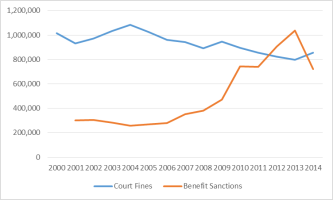
 Figure 1

Court fines are preceded by court proceedings and these provide a reasonable level of procedural protection. They are set at ‘moderate levels’ but, because judges impose fines without inquiring into offenders’ circumstances or ability to pay, and because many offenders are unemployed and/or poor, the extent of proportionality in imposing fines is not all that high. Fine default is quite a serious problem and, although it is being tackled, a few fine defaulters still end up in prison. The imposition of court fines is not, in principle, inconsistent with justice although the justice inherent in the process could be enhanced.

Benefit sanctions are not preceded by legal proceedings. There are established reconsideration and appeal procedures although, since there are no time limits, reconsideration can take a long time and sanctions are implemented without waiting for claimants’ cases to be considered. The number of appeals to an independent tribunal increased by more than 600 per cent over the period but Mandatory Reconsideration (MR), which was introduced in 2013, was designed to choke this off and appears to have done so. The number of appeals in the three month period October-December 2012 fell from 130,606 to 28,142 in the same period two years later, i.e. in 2014.

Until October 2013, when MR was introduced, claimants could either ask for the DWP’s decision to impose a sanction to be reviewed, in which case, this would be undertaken by a different decision maker, or they could appeal directly to a tribunal. Now they must first make an informal request for reconsideration (there is no form). The claimant is then telephoned by the original decision-maker and given a verbal ‘explanation’ or, on request, a written statement of reasons (WSOR), and may be given an opportunity to provide further information relevant to the decision. If the claimant accepts this explanation, the matter ends there. However, if the claimant disputes anything, the initial decision-maker will consider what they have to say, including any new evidence they present. The initial decision-maker may change his/her decision at this point but, if not, and the claimant insists, the initial decision maker (not the claimant) will request a formal Mandatory Reconsideration (MR), which is undertaken by a new, remotely-located Dispute Resolution Team (DRT), and only if they are turned down at this stage can they appeal to a tribunal. Claimants who wish to appeal must submit an application to HM Courts and Tribunals Service within one month of the date on which they were given the result of Mandatory Reconsideration. It is hardly surprising that the numbers of reviews and appeals have plummeted.

Thus, the combination of internal review and external appeal procedures does not provide an acceptable level of procedural protection. Those who receive benefit sanctions are, because they were on benefit and have had their benefit stopped, among the poorest people in society and the sanctions themselves are extremely severe since they can deprive claimants of all their income for periods ranging from four weeks to three years. If the courts were to impose fines set at the level of the offender’s disposable income, and go on doing this for lengthy periods, there would be an outcry. Sanctions for a non-criminal offence that are set at 100 per cent of the alleged offender’s income and applied repeatedly are, clearly, totally lacking in proportionality.

Vulnerable claimants are most likely to be sanctioned and, despite the availability of hardship payments, many of those who are sanctioned experience enormous hardship. Anecdotal evidence suggests that many of them end up becoming homeless, using food banks and resorting to crime. It is hard to see how these shortcomings could be rectified and it follows that benefit sanctions, as they have developed in the UK, are incompatible with justice. salient characteristics of court fines and benefit sanctions are compared in Table 4.

Table 4. The salient characteristics of court fines and benefit sanctions

Screenshot 2015-10-08 09.07.37

We now come to the question of whether benefit sanctions are compatible with the rule of law. My conclusions, and I must stress that these are my personal conclusions and that other people may wish to take issue with them, is that they are not. The consistency of benefit sanctions with Bingham’s eight principles is summarised in Table 5 and discussed in more detail below.

Table 5: Benefit Sanctions and the eight principles of the Rule of Law

Principle Assessment  Compliance
1 unclear whether the law is either accessible or intelligible, clear and predictable doubtful
2 most decisions involve discretion, disputes are handled internally and adjudication is rare no
3 sanctions apply to everyone in receipt of benefits yes
4 sanctions are often applied unreasonably and for trivial misdemeanours no
5 the right to a fair trial, guaranteed under Art. 6, is inadequately protected no
6 appeals to tribunals have virtually disappeared no
7 MR procedures weighted against claimants no
8 international law does not apply no
  1. Although the Decision Makers’ Guide provides guidance for DWP staff who make decisions about benefits and pensions and helps them make decisions that are accurate and consistent, claimants have not been provided with any comparable account of the law which sets out when sanctions can be imposed and how they can be challenged. However, since October 2013, new jobseekers have been required to sign a ‘Jobseekers’ Agreement’, which sets out what they need to do in order to receive state support, and they will have to renew this on a regular basis. They also have to provide evidence to prove they have met the requirements in their Jobseekers’ Agreement or a Jobseekers’ Direction, which specifies exactly what they are required to do, and those who fail to do so ‘without good reason’ risk losing their benefits. Although this is undoubtedly a step in the right direction, there must be very real doubts about whether the first principle is satisfied.
  2. The phrase ‘good reason’ is not defined in the legislation and depends on the circumstances of the case. Most disputes involve the exercise of discretion and are handled internally while independent adjudication is only used in the very small number of cases that are appealed to a tribunal. Whether this is sufficient to satisfy the second principle is an open question.
  3. Since the sanctions regime applies to everyone in receipt of benefits, the third principle appears to be satisfied.
  4. There is an accumulating body of evidence that sanctions are often applied unreasonably and for trivial misdemeanours. In addition, the absence of comprehensive quality assurance procedures and the failure to hold individual members of staff who have acted unfairly or unreasonably to account for their decisions, even where these overturned as a result of review or appeal, raise serious doubts about whether the fourth principle is satisfied.
  5. The attenuated arrangements for challenging the imposition of sanctions, which can leave people without any income, indicate that the right to a fair trial, guaranteed under Article 6 of the ECHR, it is inadequately protected. This suggests that the fifth principle is probably not satisfied.
  6. Cost is not an issue since there are no financial barriers to challenging the DWP’s decision to impose a sanction but delay is, mainly because there are no time limits for the DWP to reconsider its decision As a result, a claimant who wishes to challenge the imposition of a sanction may have to endure a long period without any income. Under MR, so many obstacles have been put in the way of getting to an independent Tribunal that Tribunal appeals have virtually disappeared; the right of appeal has become effectively purely theoretical. This indicates that the sixth principle is also probably not satisfied.
  7. The adjudicative procedures provided by the state in tribunals that hear appeals are undoubtedly fair. However, the MR process which is now the last recourse for almost all claimants is clearly unfair as it is completely one-sided. Moreover, the difficulty that claimants experience in accessing these procedures raises doubts about the fairness of the whole set of procedures for challenging sanctions. Thus, the seventh principle is also probably not satisfied.
  8. Benefit sanctions probably violate the International Covenant on Social and Cultural Rights. In addition, although Article 13 of the European Social Charter permits benefit sanctions, they must not deprive the person concerned of his/her means of subsistence. The situation in the UK is currently under review but, on these grounds, the eighth principle is also probably not satisfied.

The number of counts on which the current sanctions regime in the UK fails to satisfy the rule of law principles proposed by Lord Bingham indicate that there are serious questions about its legality ‒ in addition to its efficacy and humanity.

The most significant reform, which would undoubtedly make the sanctions regime more consistent with the rule of law, would involve giving claimants an opportunity to attend a hearing before a sanction is imposed (as is the case in in the USA) and continuing to pay benefit until the hearing has taken place. Another significant reform would involve abolition of the Mandatory Reconsideration procedure. Claimants who wished to challenge the imposition of a sanction would appeal directly to a tribunal. Cases could be reconsidered by the DWP before the hearing but, if the claimant’s case was not met in full, the appeal would then be heard by the tribunal. A further reform would involve reducing the severity of the sanctions that are imposed. In addition, some serious thought also needs to be given to reducing the scope of conditionality so that fewer sanctions are imposed in the first place. Unfortunately, given its commitment to conditionality and sanctions, it is most unlikely that any of these reforms will be accepted by the UK Government.

Minor reforms, such as issuing written statements of what claimants can expect from staff as well as what staff expect from claimants that would explain what the consequences for each party of failing to meet the expectations of the other are, and giving claimants a right to seek a review of these statements and to appeal against them to a tribunal, would help to make the administration of benefits fairer and more humane, as would strengthening the provision of hardship payments for those who are sanctioned. However, the prospect of minor reforms such as these being supported by the UK Government is, to say the least, unlikely.

In a recent Report, the House of Commons Work and Pensions Committee (2015) reiterated its previous call for a comprehensive, independent review of sanctions and for a serious attempt to resolve the conflicting demands on claimants made by DWP staff to enable them to take a common-sense view on good reasons for non-compliance. The Committee concluded that there was no evidence to support the longer sanction periods introduced in October 2012 and recommended the piloting of pre-sanction written warnings and non-financial sanctions. Sadly, these recommendations seem to have fallen on deaf ears and to date there has been no response from the DWP to the Report.

[1] Bingham, Tom (2010) The Rule of Law, London: Allen Lane.

You can read the original article here

For more about the origins of the extended use of sanctions, see here

Conservatives in disarray as Osborne signals raid on Duncan Smith’s Universal Credit funds

Chancellor George Osborne

George Osborne and Iain Duncan Smith have clashed over the chancellor’s plans to soften the impact of tax credit cuts by raiding the budget for Universal Credit.

The Centre for Social Justice (CSJ), which was founded by Iain Duncan Smith, insists that the Chancellor could use this month’s Autumn Statement to ease the impact of the controversial changes without risking his drive for a budget surplus.

In a critical report, the thinktank warned against taking money from Duncan Smith’s flagship Universal Credit scheme to sweeten the tax credit pill. Duncan Smith said that he’s concerned that the raid will serve to “undermine people’s incentive to work.”

The CSJ said in their report that the UC reforms meant by 2020 only 9% of those currently getting tax credits would still be receiving them.

Instead, it was suggested that the Government could “help people to work more hours” or introduce a transitional fund for those hardest hit.

But Osborne is nonetheless preparing to fund plans to soften the impact of tax credit cuts by making people claiming Universal Credit forgo as much as 75p of every extra pound they earn. At present Universal Credit recipients lose 65p for every extra pound they earn. Osborne is thought to be examining plans to increase the figure, known as the “taper”, to 75p.

The most expensive course of action would be to only impose the tax credit cuts on new claimants – but the authors note that it would have the “least social and political cost”.

The chief executive of the Centre for Social Justice, Baroness Stroud, who is a former special adviser to the Work and Pensions Secretary said:

“There are no easy choices, but these are the options the Chancellor has. What he should not do is raid Universal Credit to pay for any transitional changes or he will be recreating the same problem there.

“The projected savings through changes to tax credits is £4.4 billion, the Government plans to turn a surplus of £10 billion in 2019-20 and of 11.6 billion in 2020-21.

“Why have a surplus if we can’t protect those on the lowest pay, doing the right thing by taking work?

“The Chancellor can protect these workers and have a surplus by 2020.

“This Government is set to achieve its historic aim to make sure work always pays more than welfare, we shouldn’t put that at risk.”

Paul Johnson, the Director of the respected Institute for Fiscal Studies, questioned whether the move would raise enough to limit the impact of tax credits. He said: “If you are also increasing the taper rate then you are losing quite a lot of the key design of Universal Credit.”

Both the Treasury and the Deparment for Work and Pensions have declined to comment, but Conservative Tim Montgomerie, a columnist for The Times and founder of the Conservative Home website, said he believed George Osborne “could be forced to resign” over his tax credit omnishambles, and he warned that the chancellor faces a “massive rebellion” from his own party because the policy  is “terrible politics”.

“You cannot fight an election saying you are standing up for hard-working families then you cut benefits for hard-working families,” he said.

Perhaps it is time for the Conservatives to recognise that policies are not an ideological tool designed to ensure the government gets its own way in exercising traditional Tory prejudices towards the working and non-working poor.

However, in fairness there has been a series of right-wing backbenchers that have aired their disquiet at the cuts, although that unease may have be motivated by a pragmatic rather than an any ethical objection. The proposed tax credit cuts do make a mockery of the Tory claims to ensuring that “work always pays,”and presents the public with an incoherent narrative that has now lost any credibilty.

Montgomerie said:

“I don’t think George Osborne will tweak,” he said. “If he does just try to get away with this, he will not just be defeated in the Lords, he will be defeated in the Commons.”

539627_450600381676162_486601053_n (2)Courtesy of Robert Livingstone

 —

This post was written for Welfare Weekly, which is a socially responsible and ethical news provider, specialising in social welfare related news and opinion.

Labour will reinstate Legal Aid – John van der Luit-Drummond

994596_517805604955639_608589568_n

Jeremy Corbyn has said that “Society cannot survive on charity, goodwill, and food banks. It has to rely on the basis of a welfare state that ensures that no one falls into destitution, and a legal system that ensures no one goes unrepresented in the courts.”

He said that he shares agreement with members of his shadow justice team, that the Labour party under Ed Miliband’s leadership had not given legal aid the attention it deserved in the last general election.

“It wasn’t given enough prominence either by us or in the general debates at the election itself, I want to see a rights-based society and the right to justice is crucial, therefore the right to legal aid is absolutely essential,” he said.

The Labour party leader said the government’s £350m worth of cuts to the Ministry of Justice (MoJ) budget had clearly meant many people were not getting justice, and in many cases were going unrepresented in court.

corbyn

Speaking exclusively to Solicitors Journal, following a barnstorming address at a legal aid forum to a gathering of legal professionals, Jeremy Corbyn said the government’s reforms to the justice system meant firms were pulling out of legal aid to concentrate on more lucrative practice areas, to the detriment of young practitioners.

“At the moment a lot of lawyers feel they can’t be dealing with legal aid, they have to find something else to do, hence the number of firms that don’t want to get involved in legal aid or just do commercial law because that is the only way they can make a living. It is not good for anyone. We need a proper legal system,” said Corbyn.

“It is a deterrent for young people going into law in the future, so we end up with young lawyers not being able to work. If you can, stick at it. Try and stay there because people need good lawyers. They need that representation. I want to see the restoration of legal aid in the new parliament and hopefully we will have a Labour majority to bring it about.”

Labour plan to produce a draft report on the legal aid crisis by April next year and present a finished version at the Labour party conference in Liverpool in September 2016 that can then be used as a “thoughtful and credible justice policy” by the party.

You can read the full exclusive article from Solictors Journal here

Related

The Coming Tyranny and the Legal Aid Bill

Children are being denied justice and their human rights by legal aid cuts

Lord Bach: Civil Legal Aid – a disaster area?

Devastating blow to Grayling as judges halt his legal aid reform

Government told Universal Credit roll-out plans are “not credible”

66864_464287263640807_1896397853_nCourtesy of Robert Livingstone

The Government has been warned that their plan to see it’s flagship welfare policy – Universal Credit (UC) – implemented within five years is not “credible”. The benefit is to replace six of the main welfare benefits, and tax credits, with a single monthly payment. The aim is to save billions of pounds of taxpayers money.

UC, championed by Duncan Smith with David Cameron’s full support, received royal assent in 2012 with initial plans for a full roll-out by the 2015 general election.

David Freud, who was being questioned by MPs on the Work and Pensions Parliamentary Select Committee, said he was “quite confident” the plan would succeed, despite the fact that previous governments have said that the streamlining process is too complicated to implement unproblematically.

Lord Freud who is the government welfare adviser and somewhat controversial Parliamentary Under Secretary of State for Work and Pensions, said that he wants seven million people receiving the new Universal Credit by the “end of 2020”, despite only 146,000 people being on the system to date.

He said that the project was following an “S-curve”, which involved a “careful start, big ramp, and then a tail at the end”.

Asked at what stage the scheme was at, he said: “We are coming up to the approach trajectory.”

However, Labour’s Steve McCabe, who serves on the Committee, questioned whether the target was realistic given the modest number of people on it since the programme was “re-set” two years ago.

The MP said: “If we’re at 146,000 and we’re at the bottom of the S as it begins to rise, and you want to get to 7 million by May 2020, that would suggest by any standard you’ve got to be near 3 million in less than 18 months time.

“You’ve got to have a massive escalation at some point. How is that credible? I’m wondering how on earth you seriously believe you’ll hit that figure.”

Speaking to the HuffPost later, he said : “This matters because if you can’t get your projections right what does it mean for your projected savings and does that mean people will suffer? You’re left with a fragmented benefits system and a recipe for chaos.”

In response, Lord Freud insisted there would be “a massive escalation” once the system has been tested fully.

He defended Universal Credit for “producing benefits of £7 billion to society a year”, adding: “I will not hurry the department to do something that is so big.”

“It’s the most incredible programme. It’s much more efficient way of getting money to the poorest people,” he said.

Freud was questioned by the Committee regarding the prospect of the Chancellor raiding the Universal Credit budget and asked  if this would delay its roll-out, to which he replied: “It doesn’t give me cause for concern about the roll-out. That’s a slightly different issue.”

He added that changes to tax credits would mean “parallel changes” to the so-called working allowance element of Universal Credit.

He also said  he would “doubt it” if tax credits still existed in 2020, meaning they would be “replaced” by then.

“We will go on talking (with the Treasury) because the two systems are in parallel,” Lord Freud said.

A coalition of major Churches has warned the UK Government’s Welfare Reform and Work Bill will make some of poorest families in Britain even poorer. 

Paul Morrison, Public Issues Policy Adviser for the Methodist Church and author of the report, said: “No child should be left without enough in order to motivate their parents.

“If children live in a family which doesn’t have enough money they are more likely to die young, do worse at school, and experience worse health.

Commenting on the Welfare Reform and Work Bill and the Government’s proposed cuts to tax credits, Mr Morrison said: “Many of these families are already in work and working very hard.

“Any policy that claims that taking £1,000 from a family will enhance the life-chances of its children, as the Bill does, is not only supremely questionable but morally flawed.”

The study also shows that government policies are out  of step with public opinions, too, revealing that 61% of the general public believe benefits should be set at a high enough level to cover basic living costs, rather than too low to deter people claiming lifeline support when they need to.

Perhaps the focus on timescales and the problems with implementing UC has allowed the continuation of a dangerous myth: that the problems facing UC are all about delivery, rather than design.

In the universal credit white paper (pdf), the government argued:

Welfare dependency has become a significant problem in Britain with a huge social and economic cost.” The new benefit will be “leaner” and “firmer”.

The UK has one of the highest rates of children growing up in homes where no one works and this pattern repeats itself through the generations. Less than 60% of lone parents in the UK are in employment, compared to 70% or more in France, Germany and the Netherlands … Universal credit will start to change this. It will reintroduce the culture of work in households where it may have been absent for generations.

The Joseph Rowntree Foundation published a study that debunked  the notion of a “culture of worklessness” in 2012.  I’ve argued with others more recently that there are methodological weaknesses underlying the Conservative’s regressive psychopolitics based on behaviourist theories, especially a failure to scientifically test the permanence or otherwise of an underclass status, and a failure to distinguish between the impact of “personal inadequacy” and socio-economic misfortune and for failing to factor in political decision-making.

The theory which UC is premised on is not supported by empirical research – the idea of the cycle of “worklessness” has become “common sense.” Clearly, common perceptions of the causes of poverty are (being) misinformed. The individual behaviourist theory of poverty predicts that the same group of people remain in poverty. This doesn’t happen.

However, the structural theory predicts that different people are in poverty over time (and further, that we need to alter the economic structure to make things better). Longitudinal surveys show that impoverished people are not the same people every year. In other words, people move in and out of poverty: it’s a revolving door, as predicted by structural explanations of poverty.

And then there is the fact that in-work poverty is rising. Over the last five years, the UK has become the most unequal country in Europe, on the basis of income distribution and wages. If that increase in inequality arose because of individual failings, as the Conservatives are claiming, we need to ask why have those “personal failings” only become apparent so suddenly within the past five years.

The Conservatives are claiming that poverty arises because of the “faulty” lifestyle choices of people with personal deficits and aim to reconstruct the identities of poor people via psychopolitical interventions, but surely, it is only through a wholesale commitment to eliminating poverty by sincerely addressing unemployment, underemployment, job insecurity, low paid work, inadequate welfare support and institutionalised inequalities that any meaningful social progress can be made.

It could be argued that unemployment and in-work benefit claims are generally a measure of how well or poorly the government is handling the economy, not of how “lazy” or “incentivised” to work people are.

This post was written for Welfare Weekly, which is a socially responsible and ethical news provider, specialising in social welfare related news and opinion.