Month: June 2016

Disabled people’s human rights in further jeopardy because of Brexit

equality+act+image

The UK government has tended to regard human rights as optional; as being rather more like ‘guidelines’ than laws, and often, as a mere inconvenience and barrier to the fulfillment of their ideological commitments.

Opportunities for disabled people in the workplace are likely to come under further threat unless government prioritises the recreation of EU safeguards into British statute. That is according to diversity consultancy, The Clear Company, which contributes to the government’s Disability Confident Campaign.

Former Paralympian Baroness Grey-Thompson has also warned that leaving the European Union would prevent British people with disabilities benefiting from plans to boost accessibility.

She added that Brexit would also risk a recession that would leave less money to be spent on support services. She said:

“Our membership of the European Union has had real, positive benefits for the millions of UK residents with limiting long-term illnesses, impairments or disabilities.

“It has helped to counter workplace discrimination, obliged transport providers to make their services more accessible and secured access to some UK disability benefits for Britons living in other EU countries.

“Not only would leaving Europe jeopardise these, it would close us off from enjoying the rewards of upcoming legislation that will further increase accessibility and risk a recession that would leave less money to be spent on much-needed support services.”

Fiona McGhie, Public Law expert at Irwin Mitchell, said:

“What Brexit would affect is the ability to potentially rely on the European Charter of Fundamental Rights (CFR) which in particular includes many wider social and economic rights, such as the rights to fair and just working conditions, to healthcare and to have personal data protected. If disabled people wished to try and strike down UK legislation as incompatible with rights under CFR under EU law – that avenue may not be available after the vote to leave.”

In the wake of the referendum, the following is an official press release from ResponseSource, which is a journalist enquiry service that provides a press release wire:

The EU promotes the active inclusion and full participation of disabled people in society, in line with the EU human rights approach to disability issues, through priorities including accessibility, participation, social protection and external action. It works around a firm ethos that disability is a rights issue rather than a matter for discretion.

From an employment perspective, the objective of the European Commission’s European Disability Strategy 2010-2020 is to significantly raise the number of people with disabilities working in the open labour market. They represent one-sixth of the EU’s overall working-age population, but their employment rate is comparatively low at around 50%.

The EU promotes the active inclusion and full participation of disabled people in society, in line with the EU human rights approach to disability issues, through priorities including accessibility, participation, social protection and external action. It works around a firm ethos that disability is a rights issue rather than a matter for discretion.

Commenting on this morning’s revelation, Kate Headley, Development Director at The Clear Company, said:

“As long as the UK was part of the EU, disabled people had the benefit of EU frameworks and directives to act as a safety-net against British government and any power it may exert. Now, the future of policy which most affects disabled people is in the hands of Whitehall alone.

“There is no doubt that EU-derived laws, and EU-led initiatives, have had a largely positive impact on the disabled community. This may explain why Miro Griffiths, a former government adviser and project officer for the European Network on Independent Living, recently went on record to say he believed that Britain’s exit from the EU “would have dire consequences for disabled people”. Our priority now is to help ensure that the rights disabled people currently hold are protected post-Brexit.

“Aside from the issues of how the UK’s decision to exit will impact the NHS and wider care services, the European Health Insurance Card, and EU Air Passengers Regulation – all of which disproportionately affect those with disabilities – we must also look at the effect on disabled people in the workplace.”

“The EU’s record on assisting disabled workers is strong. Its Employment Equality Directive 2000, for example, led to the removal of the original exemption in the Disability Discrimination Act (DDA) for employers with fewer than 20 staff in the UK, so that in 2004 it became unlawful for any UK employer to discriminate against disabled people. The employment directive also led to the DDA being changed to make direct discrimination by employers against disabled people unlawful.”

“The TUC has identified employment rights that could well be under threat from a government no longer required to comply with EU legislation. Many of these promote health and well-being at work and home, such as the Working Time Directive, which protects from stress and ill-health that arise from working excessive hours including health service workers.”

“I would urge the government, post Article 50, to recreate the safeguards that disabled people have benefited from under EU membership into British statute. We will gladly continue to support the government in the development of strategy and stand by our commitment to support employers and employees alike. Amid the avalanche of new legislation which will almost certainly flood Whitehall in the coming months, laws that safeguard and support disabled workers must be prioritised as EU law recedes.”

Related

Unfortunately, the UK government has systematically violated the human rights of disabled people. It’s highly unlikely, given the current context, that the Conservatives will recreate the EU safeguards and incorporate them in protective legislation.

The new Work and Health Programme: government plan social experiments to “nudge” sick and disabled people into work

Prime minister dismisses UN inquiry into government’s discriminatory treatment of disabled people

The biggest barrier that disabled people face is a prejudiced government

The Government’s brutal cuts to disability support isn’t ‘increasing spending’, Chancellor, but handing out tax cuts to the rich is

If even the DWP isn’t Disability Confident, how will a million disabled people get jobs? – Bernadette Meaden

Universal discontent with Tory government triggers intergalactic referendum

Cly9HNEWIAEstB7

England to go from infinity to beyond.

As the pound reaches its lowest value since 1985, and Moody’s lower our credit ratings yet again, many Remain campaigners are saying stuff like “There goes the neighbourhood and the economy.” However, those in the Out camp announce they are pushing for a new referendum next year. The slogan “We’re takin’ our earth back” trended across all social media platforms yesterday and today. The Leave campaigners are gathering momentum again. They claim that it’s only by exiting the universe that we will make things better, redistribute wealth and power, have social justice and stop Tories from being Tories. They say that maybe we will even get some of them to resign and prevent other people from doing stupid things in England. However, the campaign has already gained support from some Tory MPs.

Meanwhile England First launched a petition in the wake of the EU referendum to ask the government to immediately deport all of the “Macks” in England. The far-right organisation have called for anyone with “Mc” , “Mac” or “Mack” in their surname and those who like haggis and tossing their cabers in public to be sent home.

Dickie Richardhead the foreign affairs spokesperson for England First said: “Quite properly so. They come over here wearing kilts and swinging their big sporruns at our weddings and it ain’t on. It’s unhygienic because they don’t wear any underpants. English culture and Calvin Kleins in english churches, that’s what I say. It’s about time we put them out of our misery.” 

Due to a slightly catastrophic typo on the petition, however, the government have subsequently agreed to deport everyone from Sunderland. A spokesperson for England First said that predictive text was to blame, and added: “Bugger, Mackems make up half of our membership.”  

A statement released yesterday from the E exit campaign said: “The universe’s powers that be are also do-gooders, screaming virtue signallers, bloody Guardian readers and wishy washy liberals. And multicultural. They’re all the same, which is probably self-serving, out of touch, anti-democratic and like, really disempowering for England. 

It’s not even the case that they were democratically elected and we don’t get a say in how things are run. It’s a diabolical bloody mystery, in fact. No-one seems to know what happened before the big bang for example, but we demand accountability and transparency. We deserve justifications for our existence, we deserve answers about all of that dark matter stuff and about gravity and we will demand that democratic right for english citizens from our english government. 

Being in the universe costs us billions of pounds every year. The universe imposes laws on us that we don’t want, like the second law of thermodynamics. English laws for english people is what I say. It’s about time the imposed restrictions on the speed of light were lifted, too. And vacuum cleaners. And banannas.

Then there’s the millions of illegal invisible aliens who sneak through space wormholes to swamp our country’s public services, take our houses and women. And they steal our jobs. They persuade employers to pay them much less than us because they just don’t care, they really like being poor and exploited by the capital class, even though they know that means we will end up getting less wages too. And they don’t speak any english. 

We also disagree with the moon, it wasn’t in any manifesto, we didn’t vote for it, it ain’t democratic and we will definitely organise a protest and vote against it. A scientist once tried to con us all, saying the moon disappears when you look away, but we know he’s a bloody liar, because it would take everyone’s willpower not to look at it to make it go away. That’s just a fob-off because no-one has that much willpower or attention span these days. Quantum physics proves it. Sod’s law, isn’t it? 

We have to have our sovereignty, the queen and the final say in our own laws, our own cultural identity and whatnot. English things for english people, that’s what we say. Though we don’t like them much, some of the left-wing E exiters say that a universe exit could topple the government, well, it might, anyway, and it will definitely let ’em know what we think, as we are very angry with just about everything except England, which is great. The government should all resign and go off with their power, money, raunchy birds, big houses, chums and additional leisure time to really think about what they’ve done, I say make them suffer, that’s the best punishment for ’em. 

So we want the new referendum to be held next year.” 

The Remain campaigners have already started a fresh crusade of scaremongering, claiming that if we left the universe, we would all die a horrible death.

But the opposition say “We know they are just telling fibs, representing bankers, private tycoons and that this is an elitist agenda. No-one really knows for certain what would happen if we left, many Conservative MPs have reassured us that we will still negotiate and strike up robust trading deals in the nothingness.”

We should all have faith that England will be great again. There’s nothing like a good protest vote to give the Establishment two fingers.

black-hole-1
A feeding black hole (quasar). The ultimate Brexit and E exit plan involves passing through the accretion disc, sneaking past the event horizon and then going through an economic process of spaghettification through the eye of a subatomic sized needle. 

You know, it could work...

I got this response on Facebook:-

Joan Dematas:  No. Your wrong. The referendum is over. Period. Who announced a referendum?


I don’t make any money from my work. But you can support Politics and Insights and contribute by making a donation which will help me continue to research and write informative, insightful and independent articles, and to provide support to others. The smallest amount is much appreciated, and helps to keep my articles free and accessible to all – thank you.

DonatenowButton
cards

A view from the Overton window: through the looking glass darkly


CCHU9011


“The UK is a divided country” is a phrase being bandied around a lot, especially in the aftermath of the referendum, and it is of course true. We are divided. We have politically constructed categories of scapegoats, outgroups, uncertainty, disempowerment, low wages, our public services are being dismantled, and we are witnessing massive inequality and growing poverty. The recipe for anomie. Many people feel despair and are fearful of the future.

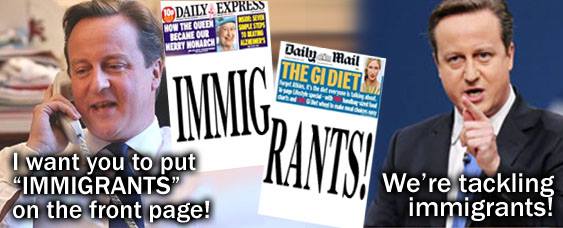
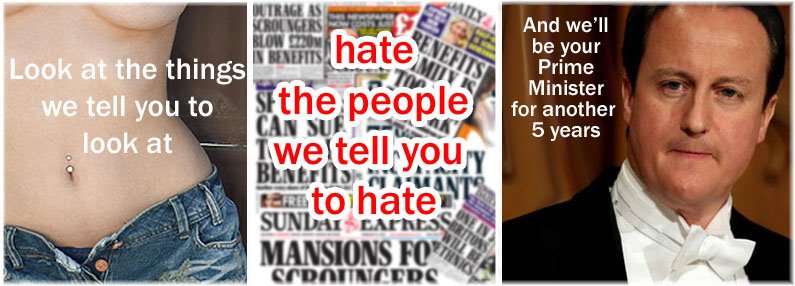
We have a nation of oppressed people wanting to see others oppressed. The real oppressors, however, are getting a free ride on the back of their own purposefully divisive and diversionary tactics. Dominant narratives and neoliberal ideology – smoke and mirrors; reductive soundbites, dodgy statistics and carefully constructed, cunning fact-proof screens. And yes, the media, directed by the government, have played a significant part in trying to shape what we see and think about, manipulating public opinion. Most of the Tories wanted to leave the EU, Cameron wasn’t typical of his party.

I don’t blame the Scottish people for wanting their independence one bit, particularly from this side of the EU referendum. But that means we will shrivel a little more. England, the husk.

But a divided country hasn’t happened just because of these things. Some of the irrational statements I have heard over the last few years include commentary about how some traditional Labour voters feel the party “let them down” and no longer reflect their interests. Well, I do hope the Tories do better for you, then. Because they’re clearly SO much better at reflecting working-class interests – the new “party of the workers” they mocked. Yet Conservatism in a nutshell is all about reducing worker’s rights and reducing pay so that private companies can make big profits from a cheap and desperate reserve army of labor. And if you reduce welfare provision and make receipt of benefits highly conditional – provision that’s already paid for by working people –  the subsequent rising level of desperation drives many to increasingly insecure jobs for much less pay in order to simply survive.

The “all the same” lie was always a Right-wing expediency, it’s about disempowering and fragmenting the Left. It worked. The Narxists got very narked, with their sense of alienation, and their peculiar brand of exclusive socialism (they are “real” socialists apparently). Yet Miliband had denounced Blairism, and would have given us a fair and progressive tax system. Not good enough, some of you said, but then some people are never happy, so with impeccable knee-jerked fallibility, you helped the Tories back in Office. Again.

Chomsky once said that sometimes, the best we can do is vote for the least damaging option. That at least would have marked the beginning, not the end, of campaigning for social justice and pushing for a socialist agenda.

Meanwhile, all of those genuine traditional socialist values of solidarity and cooperation, community and mutual aid, internationalism, equality and diversity, social justice, worker’s rights, trade unionism, well the Right-wing in Office are smashing those from our common vocabulary. And deporting them. The Tories in power, not the Labour party in opposition. But the government can only do that with OUR consent. So we must take some responsibility for that.

Now we had a further Left Labour leader, but of course for some, he ain’t good enough. The media push an elite agenda, and divert attention from the real problems that are being created by a Conservative government’s policies, and irrationally, the opposition party is hated whilst the Government get on with fucking over ordinary people, the economy and the country. Democracy is steadily being dismantled. Public funds are being stolen and redistributed to the very wealthy and powerful. Public services are being destroyed. Some people are dying because of Tory policies. Meanwhile people bicker amongst themselves and irrationally blame each other, the opposition party and vulnerable social groups. Prejudice grows. People are being permitted to hate. Their prejudice is fed and endorsed by the Establishment. Discrimination happens. Violence begins. People get killed. More people will get killed. Many remain indifferent. But sooner or later, they must take responsibility for that.

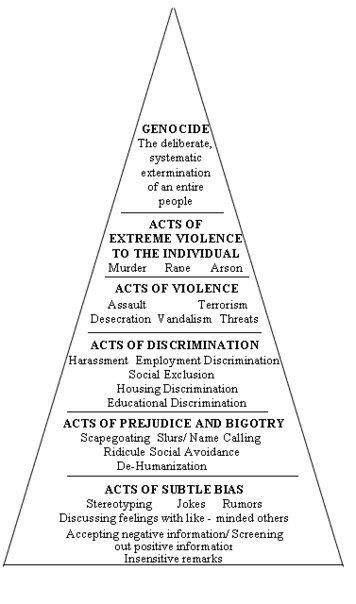
If you have ever wondered how fascist or totalitarian regimes manage to gain power, and to commit atrocities, apparently with public consent, well take a close look at the psychosocial processes involved, read Gordon Allport’s work on the growth of prejudice, where that can lead, then look more closely at what is unfolding here in the UK, stage by stage. It’s hidden in plain view, advancing by almost inscrutable degrees. But once you see it, you can’t unsee it.

Most Right-wing political systems, from Conservatism to Fascism, succeed to some extent by fostering a strong anti-intellectual prejudice amongst populations. It serves two key purposes. It discourages people from thinking critically and expressing themselves independently, and it discredits those who do (even before they do) by establishing a cultural normative default that serves to alienate people who challenge established narratives, and invites derision and accusations of being “out of touch with real lives and everyday experiences.”  But those “telling it like it is” often aren’t, quite. Seems to me that people’s hearts and minds are becoming directed, focused increasingly by an external, political and economic, narrow and rigid agenda. 

Why are we divided? Some people blame the government and media for their corrosive rhetoric, some say Tory social Darwinist, supremicist ideology and policies that have influenced the nation and pushed people further to the Right are to blame. Some people blame the general public’s stupidity and gullibility. Some people blame “patronising” and “arrogant” academics and all things intellectual. Some people blame the EU. Some people blame the Labour party. A few people have even blamed me. Some people blame the wealthy. Some people blame our faulty decision-making through rubbish cognitive processes that apparently need “nudging.” Some people blame the poor, or single parents, unemployed people, immigrants, sick and disabled people.

“I take full responsibility for this” said hardly anyone, ever.

I blame those people who choose to opt out of collective responsibility-taking and participatory democracy. Oh yes, democracy is not something you HAVE, it’s something you DO. To be divided as a nation requires social groups to want to oppress other groups, and for bystanders to permit that to happen – you have to participate in the process, even if that participation is just as a bystander who says and does nothing or as a person who is prejudiced at a gut and knee-jerk level. 

We really do have to take some responsibility for that.

13508843_1457642880928107_5042276407041750262_n
Picture courtesy of Dave Sid Poole


Some poignant reflection on what it is to be a socialist

Socialists have always tended to be internationalists. Whereas nationalists believe that the world is divided primarily into different nationalities, geopolitical zones, socialists consider social class to be the primary divide. For socialists, class struggle, not national identity, is the driving force of history. And capitalism creates an international working class that must fight back, united and cooperatively against an international capitalist class.

People who have a nationalist inclination, who view the social world parochially and hierarchically, are more likely than others to hold prejudices toward low-status groups. This is especially true of people who want their own group to dominate and be superior to other groups – a characteristic known in social psychology as “social dominance orientation.” It isn’t only the elite that hold this perspective, either.

But economic and social challenges such as inequality and social injustice will never be addressed by simply drawing a new set of geographical borders.

Any group claiming dominance over another – including the “working class” – is displaying social dominance orientation. The oppressed can be oppressive, too.

It is time to recognise those artificially constructed divisions and unite, for we have nothing left to lose but our chains.

“So comrades come rally
And the last fight let us face”.

The verses of the Internationale were written on 30 June, 1871, in the immediate aftermath of the brutal crushing of the Paris Commune during La Semaine sanglante (“The Bloody Week”). The policies and outcome of the Commune had a significant influence on the ideas of Karl Marx, of course.

The author, Eugène Pottier, was hiding in fear of his life. The lyrics were intended to convey the historical experience of an important workers’ struggle to a worldwide audience. For Pottier, liberty, equality and fraternity meant the promise of a society in which poor people, like himself, had justice.

The Internationale has long been the anthem of the labor’ movement throughout the world. Its power to move people has survived the repression of fascism, the cruel parody that was Stalinism and free market capitalism. Those who sing it need know nothing about it’s history to feel a strong sense of international unity. The Internationale is simultaneously about history, political argument and is a powerful rallying statement. Pottier established a reputation as the workers’ poet. It earned him a seat on the Communal Council representing the 2nd arrondissement.

The sheer power of Pottier’s Internationale lies in the fact that he was able to encapsulate his personal experience of specific events and express them in universal terms. And that identification and recognition is socialism in action.

The Second International (now known as the “Socialist International”) adopted it as its official anthem. The title arises from the First International, which was an alliance of socialist parties formed by Marx and Engels that held a congress in 1864. The author of the anthem’s lyrics, Pottier, attended this congress.

 The Internationale has been translated into many languages, it is a left-wing anthem, and is celebrated by socialists, communists, anarchists, democratic socialists, and some social democrats.

The original French refrain of the song is C’est la lutte finale / Groupons-nous et demain / L’Internationale / Sera le genre humain.

That translates as:

This is the final struggle

 Let us group together and tomorrow

 The Internationale

 Will be the human race.

Right now, that makes me feel like weeping in sorrow.

Related

UKIP: Parochialism, Prejudice and Patriotic Ultranationalism.

Don’t believe everything you think: cognitive dissonance

Inverted totalitarianism. Oh dear

The ultimate aim of the “allthesame” lie is division and disempowerment of the Left

Once you hear the jackboots, it’s too late


I don’t make any money from my work. But you can support Politics and Insights and contribute by making a donation which will help me continue to research and write informative, insightful and independent articles, and to provide support to others. The smallest amount is much appreciated, and helps to keep my articles free and accessible to all – thank you.

DonatenowButton
cards

Lots of little Englanders wont make Britain great

stream_img

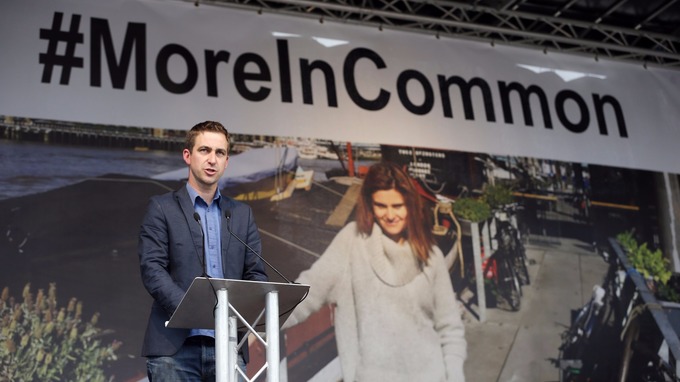
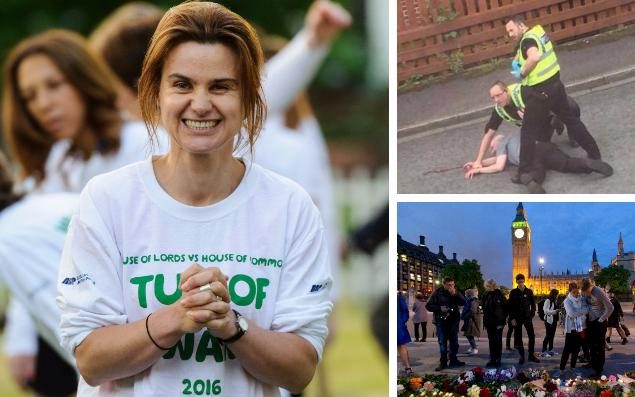
 Brendan Cox gave a moving speech yesterday in honour of his wife as worldwide tributes were held on what would have been the MP’s 42nd birthday.

Some people have been angered by my previous article about the murder of MP Jo Cox, and insist that Thomas Mair committed the murder because he was “mentally ill” and unstable. That’s a cop out, it’s taking the comfortable and easy option as far as offering explanations go. Many people are mentally ill, but they do not plan cold-blooded murders. My article explored the political, social, economic and cultural context of prejudice more generally, and the appalling normalisation of a corrosive, far Right rhetoric. It was hardly controversial.

England as a nation has often experienced confusion, seemingly lost and adrift, uncertain of its role since the end of empire, and of course, the rise of devolution. Our sense of collective identity has been portrayed as fragile, especially by the Right wing media. But “national identity” is always a facade. More recently, we witnessed the unprecedented rise of nationalism in Wales and Scotland, where patriotic sentiment runs high, whilst in England, the insular, self-regarding enclave of Government has a strong whiff of a deeply disdainful supremicist Regency aristocracy. There are no local loyalties to be seen there, well, none that extend further than just 1% of the Country. Neither post-imperial cringing nor nationalism will alter that. 

Brexit is an English rather than a British symptom of a collective sense of disempowerment. But those responsible for the erosion of democracy in the UK are in London, not Brussels. It was the Conservatives that provided opportunity for UKIP and the far Right to become established as a populist part of the mainstream political conversation, the Tory rhetoric, founded on social divisions and established hierarchy, has created a space for far Right’s subversive “insurgency”.

And Brexit may well hasten the further breakup of Britain. The constitutional fallout will also extend to Northern Ireland. A Leave vote would turn the open border between Northern Ireland and the Republic into a guarded frontier with Europe, since Ireland would remain a member in the union. This would undermine a major provision of the 1998 Good Friday Agreement, the peace deal that ended three decades of the Troubles.

Prejudice in the UK is manifested not only in racism, but in dominant narratives and policies directed against sick and disabled people, unemployed people, people on low pay and poor people more generally. There is also a growing culture of sexism, increasingly evident in the impact of Conservative policies. We have never been more fragmented as a society, nor has any other UK government in our lifetime been responsible for such extensive, divisive social outgrouping, systematic exclusion and massive inequality. And it’s intentional. The thing about prejudice is that it multitasks, grows and culminates, invariably, in violence.

Thomas Mair, it emerges, is a neo-Nazi who managed to remain stable and calculating enough to plot, gain weapons and to savagely kill Jo. Furthermore, she was targeted because of her strong beliefs, clear principles and her outstanding work. That’s not a random or impulsive act, it was intentional and deliberate. He knew what he was doing. I’ve yet to come across a mental illness that directs a person to murder someone they consider a political opponent in cold blood. Furthermore, to use the term “mental illness” so casually and to present it as the single reason for what he did risks adding another layer of stigma and social prejudice, potentially, for those with mental illness. Yet another prejudice.

For those of you who don’t think that the far Right, including groups like Britain First, encourage hatred and violence, well I have had some direct experience of it. Last year shortly before the General Election, a malicious meme about me was designed and circulated by Tommy Robinson, formerly leader of the English Defence League. It was eagerly shared on every Right wing page on every social media platform, by every single Right wing group, from UKIP to Britain First. There were even a few Conservatives that posted it. Robinson claimed that I had dismissed the Rotherham child abuse as a “far Right myth”, which of course is absolutely untrue. I’d basically told him to stop mithering me on Twitter, to go peddle his Right wing myths elsewhere.  He had been aggressive and rude.  I never mentioned Rotherham or child abuse to him during any of the exchange.

He used my account details and photo to direct people to “tell her what you think of her.” I had death threats, rape threats and threats of murder from combat 18. I had to involve the police. In my teens, under the Thatcher government, I was part of the Anti-Nazi League and Rock Against Racism movements. On peaceful demonstrations, the National Front  turned up and I had my head kicked in and stitched up more than once by size 20 male boots, just because I was there. Are all of these people “mentally ill”, or is it truer to say that the far Right are motivated by fear, anger and hatred, intolerant of anyone who doesn’t agree with their misanthropy, or their petty, mean and grubby prejudices?

I think it’s the latter. My article cites psychosocial studies of the growth of prejudice and outlines the terrible consequences of that. I cited, as I often do,  Gordon Allport’s “The Growth of Prejudice,” for example. I asked for people in our society to pause, and take a good look at what is going down, because of the perpetuation of prejudice, and the politics of division, of social outgrouping, of a culture of us and politically constructed others.

In an interview following the brutal murder of MP Jo Cox, her bereaved husband, Brendan, has said that Jo was “very worried” about the political culture in the UK.

He said: “I think she was very worried the language was coarsening, that people were being driven to take more extreme positions, that people didn’t work with each other as individuals.

On issues it was all much too tribal and unthinking.”

He said that Jo was “particularly worried about the direction of politics, around creating division and playing on people’s worst fears rather than their best instincts.”

The Times reports that Jo was preparing a report on the dangers of far-right nationalism when she was murdered, which she had planned to publish on June 29.

Nationalist Jack Buckby, press officer of “Liberty” GB, ex-member of the BNP, launched a despicable political point scoring and smearing campaign against the Labour Party. He offered an endorsement of violence by suggesting it’s somehow justified, and issued something of a threat as a consequence of Labour’s continued commitment to diversity and equality. Buckby wants to see a candidate put forward from this far Right group (himself) in Jo Cox’s community, when all other parties have stated they will not contest the by-election out of respect for Jo. He said:

“The Labour Party has blood on its hands. And by shutting down debate and labeling working class people concerned about their communities as racists, they risk driving desperate, disenfranchised people to further horrendous acts like this.”

“Concerned about their communities” is a euphemism for hate, racism, violence and murder, then. Deeply divisive, despicably Machiavellian politics.

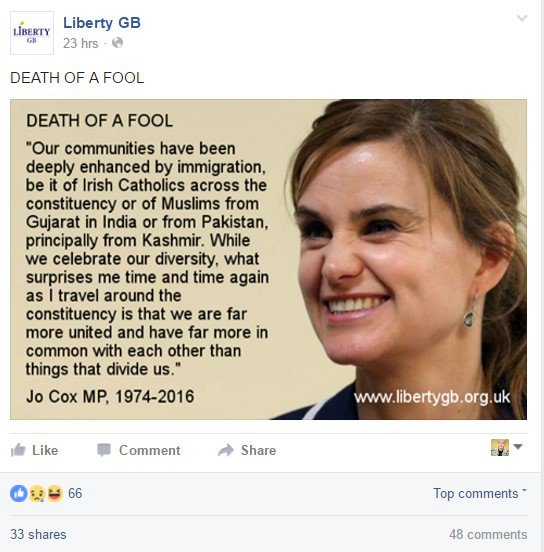
Even more despicable and utterly inappropriate is this post, which my friend and fellow writer, Steve Topple, screengrabbed:

libertyGBJoCox-


Brendan Cox said of his wife: 

“She was a politician and she had very strong political views and I believe she was killed because of those views. I think she died because of them, and she would want to stand up for those in death as much as she did in life. 

I don’t want people ascribing views to her that she didn’t have, but I certainly want to continue to fight for the legacy and for the politics and views that she espousedThey were what she was. She died for them, and we definitely want to make sure we continue to fight for them.” 

British and American imperialists employed the language of social Darwinism to promote and justify Anglo-Saxon expansion and domination of other peoples. Such different personalities as Machiavelli, Sir Francis Bacon, Ludwig Gumplowicz, Adolf Hitler, and Benito Mussolini, each reasoning on different grounds, nevertheless arrived at similar conclusions. Imperialism to them is part of the natural struggle for survival. Those endowed with “superior” qualities are “destined” to rule all others. Imperialism has been morally excused as the means of liberating peoples from tyrannical rule or of bringing them the benefits of a “superior” way of life. Imperialism is all about human aggressiveness and greed, the search for security, drive for power and prestige and particularly nationalist emotions, amongst other things.

Nationalism is anti-progressive. It’s a paradigm of competitive individualism that further undermines principles of cooperation, equality and social cohesion. It’s also a recognisable symptom of the rise of fascism. The UKIP brand of Parish pump politics nurtures fear, spite and vilifies people on the basis of one of our most wonderful assets: our human diversity.

Related

Support Hope Not Hate.

Donate to the Jo Cox memorial fund.


I don’t make any money from my work. But you can support Politics and Insights and contribute by making a donation which will help me continue to research and write informative, insightful and independent articles, and to provide support to others. The smallest amount is much appreciated, and helps to keep my articles free and accessible to all – thank you.

DonatenowButton
cards

Who killed Jo Cox?


Jo-Cox-composite-image-2016.6.17-7.57-large_trans++qVzuuqpFlyLIwiB6NTmJwfSVWeZ_vEN7c6bHu2jJnT8

I’ve said before, probably more than once, that the Conservatives are, on the whole, supremicist creatures of habit rather than reason. They carry with them a poisonous, heavy burden of longstanding, traditional grudges and prejudices. That is why their policies are so stifling and anti-progressive for the majority of us. It’s why Tory policies don’t meet public needs and are so blatantly class-contingent.

There’s always an air of doom and gloom when we have a Tory government, and a largely subdued, depressed, repressed nation, carrying vague and fearful intuitions that something truly catastrophic is just around the corner.

It usually is.

I can remember the anxiety and creeping preternatural fear infecting and agitating young people back in the eighties, and our subsequent teenage, transcendent defiance, which we carried like the banners at the Rock Against Racism marches, in the Thatcher era. It struck me more than once that we always witness the social proliferation of ultranationalist sentiments and fascist ideals whenever we have a Tory government, too. It stems from the finger-pointing divide and rule mantra: it’s them not us, them not us. But of course history refutes as much as it verifies, and we learned that it’s been the Tories all along. Well, some of us did, anyway

With a Conservative government, the general public are always fighting something. Poverty, inequality, social injustice: we fight for political recognition of our fundamental rights, which the Tories always circumvent. We fight despair and material hardship, caused by the rising cost of living, low wages, high unemployment and the intentionally manufactured recessions that are a key characteristic of every single neoliberal Tory government. 

I think people mistranslate what that something is; they quickly lose sight of what they are fighting, of why they feel fearful.  A loss of identity and sense of belonging is inevitable, because Tory rhetoric is all about outgrouping and othering: dividing, fragmenting society into alienated bite-sized manageable pieces by amplifying an ultimately anomic, pathologically paranoid narrative of sneaking suspicions and hate thy neighbours

The Tories are and always have been psychocrats. They insidiously intrude into people’s everyday thoughts and try to nudge, micro-manage and police them. They use Orwellian-styled rhetoric crowded with words like “market forces”, “meritocracy” “autonomy”, “incentivisation”, “democracy”, “efficient, small state”, and even “freedom”, whilst all the time they are actually extending a brutal, bullying, extremely manipulative, all-pervasive and socially damaging authoritarianism.

The man who murdered Jo Cox in cold blood, who shot her, stabbed her, then continued to brutally kick her when she was on the ground, was apparently described as a “loner”. Neighbours expressed their shock at the atrocity he has committed, because he was “quiet” and because he also has a strong work ethic. He tidies people’s gardens and he had said that he believed “hard work” could cure mental illness. That’s a Conservative notion, by the way. Work is now considered to be a “health” outcome. We have a government that wants to put therapists in jobcentres and job coaches in GP surgeries. Not that all hardworking and reserved people are right-wing or murderers, of course. Nor are most people with mental health problems.

He said: “All these [mental health-related] problems are alleviated by doing voluntary work. Getting out of the house and meeting new people is a good thing, but more important in my view is doing physically demanding and useful labour.”

999622_566748676727998_1599547969_n

I wonder how many of those people who readily misjudged Mair because of his superficial politeness and reserved nature would be equally quick to condemn those who cannot work because they are sick and disabled?  Or those so poor that it takes every ounce of energy they have to simply survive, with none spare for cutting people’s hedges or passing on horticultural tips?

The hardworking taxpayer and economic free-rider myth is founded on a false dichotomy, since it is estimated that around 70% of households claim benefits of one kind or another at some point in their lives. In the current climate of poor pay, poor working conditions, job insecurity, and high living costs, the myth of an all pervasive welfare-dependent something for nothing culture is being used to foster prejudice and resentment towards those unfortunate enough to be out of work. It also serves to bolster Right-wing justification narratives that are entirely ideologically driven, which are aimed at dismantling the welfare state, whilst concurrently undermining public support for it.

Thomas Mair was clearly wrong about “hard work” being anything like a positive “mental health outcome” and so are the Tories. It’s frustrating that people don’t pay enough attention to details and look beyond surface appearances. Since when was being “quiet” or submissively “hard working” anything to do with being a decent, humane, moral, empathic and good citizen? And since when did having those qualities exclude the possibility that someone may be a murderer?

As someone with an academic background in psychology (and sociology), and as someone who also worked within mental health services, I have yet to encounter a mental illness that directs people to plan and carry out the brutal murder of their political opponents.

Thomas Mair, it emerges, is a neo-Nazi. He was living quietly, he presented himself to his community as a plausible, calm, respectable character, generating positive public perceptions of himself, whilst arming himself and planning to carry out a murder in a calculated, cold-blooded manner. All of those very dutiful people out there conforming to the frightfully exploitative and alienating Tory redefinition of our social norms, and a narrative that imposes directives of how a small group of authoritarians think we ought to be, seem to fail to recognise how empty such superficial gestures are, and how they lack meaning when they are premised on repression, festering hatred, fear of others and such rage-driven motives. It’s time to take a closer look at what is happening here. Here is where people are getting poorer, more excluded, isolated, more fearful, suspicious, lonelier and angrier by the day. 

And who really bothered to get to know Thomas Mair?

How quickly his local community disassociated themselves from him, preferring instead to see him as some kind of pathological mystery; someone with “mental health problems” hiding in their midst, rather than as a member of the community, as someone living and sharing a realm of intersubjective cultural meanings. Us and them again. He was apparently a pillar of the community, until it was very plain that actually, he wasn’t.

599849_369461329790068_1640090166_n

More than one person killed Jo Cox. Surely our whole, indifferent, ever so competitively individualistic, neoliberal, right-wing, increasingly intolerant, prejudiced society is also culpable. Sure, it was only one person that pulled the trigger of a gun and wielded the knife, but Jo was murdered by a process of unfolding prejudice and hate every bit as much as by the person and weapons chosen and purposefully gathered to carry out the terrible and intentional act. It’s all too easy to dismiss this terrible murder as a random and meaningless act carried out in isolation by a “mentally ill loner” (yet another prejudice), but we must not take the easy option: there is an awful, but far bigger and more important truth to be found in exploring the broader context of these horrific events, difficult though that is. 

The Conservatives (and those further Right) have parochialised both explanations of and responses to the global economic crisis, reducing us to a gossiping around the parish-pump type of politics. Parochialism entails neglect of the interests of identified “outsiders”, and this kind of isolationist tendency has also provided a political platform for nationalism. Parochialism tends to support inter-group hostilities, and it tends to lead to violations of human rights, as we are currently witnessingParochialism directly opposes a fundamental set of [internationally agreed] principles that constitute these rights: namely that all humans beings are of equal worth, and that human rights are universally applicable – they apply to everyone.

Even to the social groups that you don’t like.

It’s also worth bearing in mind that fascists never stop at discriminating against and persecuting the one social group of your choice. Fascists are fascists and tend to discriminate almost indiscriminately. However, fascists generally spare the establishment, curiously enough. Pastor Martin Niemöller famously observed public complicity and the consequences of bystander apathy and silence when he wrote: First they came for the socialistsand I did not speak out – Because I was not a Socialist…”

Of course Britain is not divided by race and culture: it’s divided by wealth inequalities fueled by the government’s ideology, policies and austerity programme.  Blaming people who are unemployed, sick and disabled, refugees and immigrants for the failings of the government has fueled misperceptions that drive support for the far-Right. People complain they can’t get council houses, surely the only really honest question an honest politician ought to ask is: “Why aren’t there more council houses?”

And when there are large numbers of people receiving unemployment benefit or tax credits, then the only honest question to ask is: “Why is the economy failing to provide enough jobs, or pay adequate wages?”

As a society that once promised equality and democracy, we now preside over massive inequalities of wealth: that’s a breeding ground for racism, classism and other vicious resentments.

Hate crime directed at disabled people has risen over the past five years, and is now at the highest level it’s ever been since records began. That’s the kind of society we have become.

Austerity cuts and the steady and deliberate erosion of democratic inclusion have served to awaken the disgruntled beast within people, the one that feeds on anger, disempowerment, demoralisation, fear, resentment and uncertainty. And loss of a sense of meaning and identity.

And wherever antipathy and a degree of enmity exist, the far-Right have always tried to perpetuate, exploit and increase rancour. The fascism of the 20s and 30s gained prominence because it played on wider public fears, manipulating them, and deflecting attention, as ever, from those who are truly to blame for dire social conditions: the ever-greedy elite. There’s a well-established link between political extremism, economic hardship and recession and social cleavages, with the far-Right “anti-system” parties now deceitfully winning the support of those who would never previously have thought of themselves as extremists. 

Such extremism and rancour feeds the disgruntled beast. The political Right have always sought to divide sections of the poor and middle class and set them to fight one against the other; to have us see enemies in our midst which do not exist, so that we see economic policies – the Tory-rigged “free market” competition – as the solution rather than the cause of our problems.

And here we are again.

When you just feed disgruntled beasts, you only end up with beasts.

I’ve often written about the Right’s tendency to infrahumanise, dehumanise and create categories of “others”; scapegoating, using a media manufactured stigma to extend the politics of division and prejudice, and hate-mongering rhetoric.  I’ve also written about how Conservative governments always work to encourage the rise of far-right groups and a toxic climate of nationalism. Thatcher’s government was no different. Now they need to take some responsibility for what that kind of context does to people’s sense of identity and mental health, to social solidarity and community cohesion. They need to take some responsibility for transforming what was a diverse and reasonably tolerant culture into one of labeling and bullying, and ultimately into, dear God, one of murder: Perhaps the Conservatives need to read Gordon Allport’s work about how prejudice escalates and as a reminder from history about the terrible social consequences of that, again.

Gordon Allport studied the psychological and social processes that create a society’s progression from prejudice and discrimination to genocide. In his research of how the Holocaust happened, he describes socio-political processes that foster increasing social prejudice and discrimination and he demonstrates how the unthinkable becomes tenable: it happens incrementally, because of a steady erosion of our moral and rational boundaries, and propaganda-driven changes in our attitudes towards politically defined others, that advances culturally, by almost inscrutable degrees.

Decades of research findings in sociology and psychology inform us that as soon as a group can be defined as an outgroup, people will start to view them differently. The very act of demarcating groups begins a process of ostracisation.

The process always begins with the political scapegoating of a social group and with ideologies that identify that group as  the Other: an “enemy” or a social “burden” in some way. A history of devaluation of the group that becomes the target, authoritarian culture, and the passivity of internal and external witnesses (bystanders) all contribute to the probability that violence against that group will develop, and ultimately, if the process is allowed to continue evolving, extermination of the group being targeted.

Economic recession, uncertainty and political systems on the authoritarian -> totalitarian spectrum contribute to shaping the social conditions that seem to trigger Allport’s escalating scale of prejudice.

Prejudice requires the linguistic downgrading of human life, it requires dehumanising metaphors: a dehumanising socio-political system using a dehumanising language, and it has now become familiar and all-pervasive: it has seeped almost unnoticed into our lives. Because we permitted it to do so. 

‘Though some of us do challenge it, we need the wider public to recognise their moral and rational boundaries are being politically manipulated and systematically pushed. That has consequences. Increasing inequality, poverty, prejudice, discrimination and social injustice and social isolation, decreasing democracy, social inclusion and civic rights are just some such consequences. There are many more, some happening at a profoundly existential level. All at a time when supportive provision is being steadily withdrawn, public and mental health services are in crisis because of the Conservative cuts to funding. And many people are dying as a consequence.

Let’s freeze this, let’s stop and observe the context and full horror of this awful event for a moment, so we can see something of the enormity of the tragic murder of Jo Cox. She was a dedicated Labour MP, who fought tirelessly for social justice. She was just 41 and was taken from a husband and two young children, as well as her friends and constituents. Her final words were “my pain is too much.” Jo’s grieving husband, Brendan, has urged us to “fight the hatred that killed her.”  We must.

It must be time to recognise that each and every one of us bears some responsibility and has some positive contribution to make to the kind of society we live in.

And want to live in.

And surely that society is not the one we witness today.


Allport's scale

Adapted from Gordon Allport’s The Nature of Prejudice”

Related 

The Psychological Impact of Austerity – Psychologists Against Austerity

Mainstream politicians ‘clueless on migration debate’, says Jo Cox’s husband – Brendan Cox /  Patrick Wintour

Jo Cox: The Labour MP who campaigned tirelessly for refugees

Jo Cox’s Husband Brendan Pays Moving Tribute To Labour MP After Shooting In Birstall, West Yorkshire

UKIP: Parochialism, Prejudice and Patriotic Ultranationalism

The disgruntled beast

Aktion Arbeitsscheu Reich, Human Rights and infrahumanisation


I don’t make any money from my work. But you can support Politics and Insights and contribute by making a donation which will help me continue to research and write informative, insightful and independent articles, and to provide support to others. The smallest amount is much appreciated, and helps to keep my articles free and accessible to all – thank you.

DonatenowButton
cards

Brexit, dirty campaigning, the TTIP and a case for Remain

images


“We cannot be content with the state of the EU as it stands. But that does not mean walking away, but staying to fight together for a better Europe.”  Jeremy Corbyn, Statement to The Guardian, 28 July 2015.

Despite his reservations, and a desire to see progressive reform within the European Union, Mr Corbyn strongly supports the Remain campaign. He has been very clear about his views, and he has presented powerful arguments to support his position. He says:

“I have seen first-hand jobs, investment, workers’ rights and environmental protection that being part of the EU helps secure for working people. That’s why, despite its faults, I believe it’s best we vote to stay and work with our friends to make the changes Europe needs.”

It was therefore something of a surprise to see the Leave campaign use a quote with such malicious intent from Mr Corbyn, that was so outdated and out of context, to deliberately mislead people into thinking that the Labour leader supports Brexit.

This post was sponsored on Facebook, and came up more than once in my feed: Stand with Jeremy Corbyn.  

The site is promoted by Matthew Elliot, the founder and former Chief Executive of the TaxPayers’ Alliance and Big Brother Watch. He also acted as Campaign Director for the successful NOtoAV campaign in the 2011 Alternative Vote referendum. He is the Founder and was the Chief Executive of Business for Britain, and is now the Chief Executive of the Vote Leave Campaign Committee, having founded and been the chief executive of the main Vote Leave.

Elliott also founded the Politics and Economics Research Trust (PERT) in 2004. Labour MP and former Shadow Minister for Europe, Emma Reynolds, raised significant questions about the affairs of the TPA and PERT, she wrote to the Charity Commission and said that “PERT may be in breach of charities legally binding commitments to preserve their independence, specifically regarding political activity and the delivery of charitable objectives.”

Of £532,000 PERT paid out in grants in 2014, £300,000 went to the TPA and £205,000 to Business for Britain, both of which are Eurosceptic. £10,000 went to Global Britain, which has campaigned for Brexit. Charitable trusts are not allowed to be used for political purposes under British charity law.

There were some pretty grubby tricks employed during November 2015, when the group established a fake company in order to gain entry to a speech being given by the Prime Minister at the Confederation of British Industry where they heckled him and held banners stating “CBI = voice of Brussels.” Dominic Cummings, campaign director of Leave, subsequently stated:

“You think it is nasty? You ain’t seen nothing yet. These guys have failed the country, they are going to be under the magnifying glass. Tough shit … It is going to be tough”.

The campaign group also stated their intention to target and disrupt meetings of pro-EU organisations and companies. In a letter to the Electoral Commission, Eric Pickles, the former Conservative cabinet minister, said he believed Vote Leave had disqualified itself from lead status in the referendum (which entitles the campaign to public funding) after it pledged to run a “nasty” campaign against opponents.

The European referendum, some have argued, is more important than any general election, because it will potentially change Britain’s relationship with Europe and the rest of the world. There’s a lot of grand and quaint imperialist talk from the Leave camp about power, sovereignty and Britain’s “place in the world.” But it’s a clever sales pitch, nonetheless, as it harnesses the public restiveness, which reflects a broader disquiet with social democracy in the UK. 

I have to agree with Michael Sandel’s comment, in his excellent interview in today’s New Stateman with Jason Crowley: “A big part of the debate has been about economics – jobs and trade and prosperity – but my hunch is that voters will decide less on economics than on culture and ­questions of identity and belonging.”

The Right have always been strongly inclined towards socioeconomic outgrouping, creating categories of others, using stigma and scapegoating techniques to formulate justification narratives for policy that is purposefully designed to impose gross social inequalities. This alienates already marginalised groups, fragments social identities, and of course, breaks social solidarity. It’s therefore no surprise that immigration and othering have been the focus of a substantial part of the Brexit campaign.

He goes on to say: “Social democracy is in desperate need of reinvigoration, because it has over the past several decades lost its moral and civic energy and purpose. It’s become a largely managerial and technocratic orientation to politics. It’s lost its ability to inspire working people, and its vision, its moral and civic vision, has faltered. So for two generations after the Second World War, social democracy did have an animating vision, which was to create and to deepen and to articulate welfare states, and to moderate and provide a counterbalance to the power of unfettered market capitalism.

“This was the raison d’être of social democracy, and it was connected to a larger purpose, which was to empower those who were not at the top of the class system, to empower working people and ordinary men and women, and also to nurture a sense of solidarity and an understanding of citizenship that enabled the entire society to say we are all in this together. But over the past, well, three or four decades, this sense of purpose has been lost, and I think it begins with the Ronald Reagan/Margaret Thatcher era.”   

Yes, the transatlantic neoliberal turn. The commentary throughout the article is coherent and compelling, and well worth the read.

Leaving the EU would mean the UK giving up its place and influence in Europe, turning back the clock and retreating from the established global power networks of the 21st century. It would also legitimize the Conservatives’ crusade against what remains of a political settlement based on an inclusive, multicultural democracy. Without a level of international scrutiny and legal safeguards, I believe that this Conservative governments’ already evident authoritarian inclinations would be held under rather less constraint. 

The Labour Party, except for a small handful of eurosceptics, is now firmly pro-Europe  – we are, after all, internationalists – despite the fact that leader Jeremy Corbyn has in the past questioned whether the EU structure delivers more for business than it does workers. The Scottish National Party, most of the Liberal Democrats, Green Party and Welsh nationalists Plaid Cmyru are firmly placed with the ‘In’ camp. 

Jeremy Corbyn has said that David Cameron must not have a carte blanche to negotiate away workers’ rights as part of his desired EU reform package, ahead of the in-out referendum. However, Corbyn knows for sure that workers’ rights will not be stronger if the UK ends up outside the EU. 

It was the New Labour Government who ended the Tories’ opt-out on EU social policy (the “social chapter” as it was then called) back in 1998. The Trades Union Congress (TUC) have also staunchly defended workers’ rights in the EU over the last two decades. Now Cameron is aiming to undermine such positive EU employment laws in the UK, as the Tories successfully did back in the 1990s with an across-the-board opt-out. This said, Cameron’s “re-negotiation” has been pretty quickly sidelined. 

A Labour government could easily opt back into any areas that the Tories did succeed in opting-out of, as long as the UK is still an EU member state. The real attack on workers’ rights would inevitably happen if the UK left the EU. Then it would be straightforward for the Tory government to repeal other directives protecting workers’ rights. And they would – obligations to implement EU laws would cease, and so leaving the EU would reduce rather than help workers’ rights. And joining the EU again in the future would be very difficult – it would require a new referendum and fresh negotiations with Brussels, at the very least.

One final point. Some on the Left have said that the Transatlantic Trade and Investment Partnership (TTIP) is a reason for them to vote to leave the EU.  I can understand this, because the TTIP will lead to a large-scale transfer of democratic power to multinationals. It is a blueprint for deregulation and privatisation. 

The Left Leave group argue that the deal promotes the privatisation of the NHS, and that leaving the EU would mean avoiding TTIP and hence save Britain’s free healthcare system. However, TTIP would still have a strong influence on the UK economy. Once outside the EU, the UK would be unable to stop the TTIP, or shape it. TTIP would create a transatlantic marketspace that would influence British firms and the UK economy by aligning regulation in the US and EU.  

Britain would need to stop trading with both the EU and the US to escape the TTIP’s regulations. The EU, like the US, would most likely remain an important trading partner for the UK in the event of a success for the Brexit campaign. Brexit is premised on extreme free trade agreements coupled with looser regulation to make us more “competitive.” 

The TTIP deal was supposed to be signed by now – but together, the Progressive Alliance of Socialists and Democrats (S&D) group and Europe’s people have seriously stalled things. Would it really be possible to stop such a move if we couldn’t link up with campaigners across Europe? If being in the EU has brought us TTIP, it has also brought us the means to stop it. Labour MEPs fought hard to secure support within the EU to get the toxic Investor State Dispute Settlement (ISDS) clause removed from the TTIP at the negotiating table last year. 

This was an excellent achievement by our own Labour MEPs within the broader S&D group. The ISDS contradicts principles of democratic accountability and would potentially allow one government to bind another for decades to come. Unlike the great majority of other treaties, investment treaties have very long minimum lifespans ranging up to 30 years. 

Much debate has arisen concerning the impact of controversial ISDS on the capacity of governments to implement reforms and legislative and policy programs related to public health, environmental protection, labour and human rights. 

In the UK, we already have a highly corporatised Government. We have witnessed scandalous price-rigging, and massive job losses, decreased standards in service delivery and a disempowerment of our Unions. This is because the Tories will always swing policy towards profiting private companies and not towards meeting public needs, as we know. 

In Britain, privatisation was primarily driven by Tory neoliberal ideological motives, to “roll back the frontiers of the State.” 

This Conservative government has done everything possible to push the most extreme version of TTIP, just as they’ve fought against pretty much every financial regulation, from bankers bonuses to a financial transaction tax. Cameron has his own programme of stripping away laws that direct big business towards reasonable behaviours and standards, no matter how important those laws are for safeguarding people and our environment.

 —

Related

Three excellent articles: –

EU debate: what are the real choices? – Red Pepper

The energy of the Brexiteers and Trump is born of the failure of elites Michael Sandel / Jason Cowley

#BREXIT ANTI-IMMIGRATION ARGUMENT CONTINUES WAR AGAINST POOR – Rupert Dreyfus/Consented


I don’t make any money from my work. But you can support Politics and Insights and contribute by making a donation which will help me continue to research and write informative, insightful and independent articles, and to provide support to others. The smallest amount is much appreciated, and helps to keep my articles free and accessible to all – thank you.
DonatenowButton