
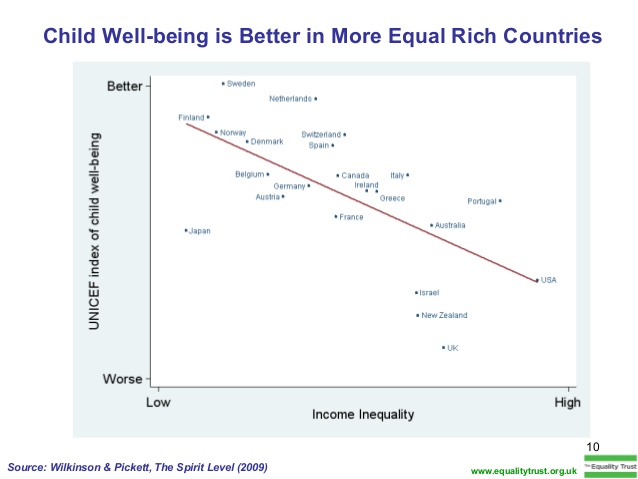
UNICEF’s reports have consistently put the UK at the bottom of the child well-being league table. See also: UNICEF criticises UK’s failure to tackle child inequality as gap grows.
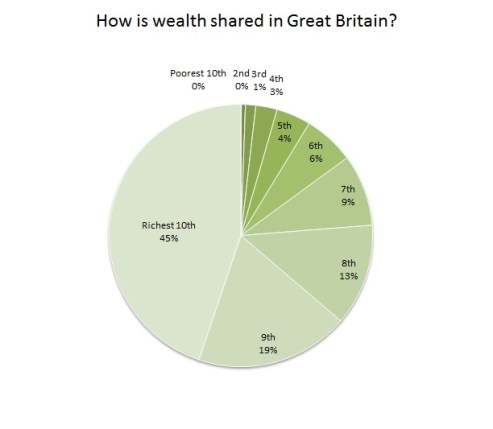 Source: The Equality Trust
The still face paradigm and inequality
Before Christmas I read an excellent and insightful article by Michael Bader called The Decline of Empathy and the Appeal of Right-Wing Politics, which was about Edward Tronick’s Still Face experiment in part. Tronick is an American developmental psychologist at the University of Massachusetts, Boston. His studies illuminate the importance of trusting relationships and consistent human responses in children’s development and learning.
Tronick’s experimental design was very simple: mothers were asked to play as they usually would with their six-month-old infants. The mothers were then instructed to suddenly blank their face: to make their facial expression flat and neutral – completely “still” – and to do so for three minutes, regardless of her baby’s activity. Mothers were then told to resume normal play. The design came to be called the “still face paradigm.”
The study demonstrated that when the connection between an infant and caregiver is broken, the infant tries to re-engage the caregiver, and then, if there is no response, the infant withdraws – first physically and then emotionally. Recent studies have found that four-month-old infants, when re-exposed to the “Still Face” two weeks after the first time, show rapid physiological changes that were not present when they were exposed to it the first time.
Tronick said: “It speaks to the incredible emotional capacities [of] the infant — to pick up on the fact that the mother’s not reacting emotionally the way she normally does. The baby has not only this ability to process what’s [happening], but [also] the capacity to respond in a really appropriate way — that is, they try to get the mother’s attention, and then when they fail, they give up, with a sense of their own helplessness. They may be angry and then they become sad.”
Tronick also emphasised the impact of parenting practices embedded in the sociocultural and ecological environment of the infant.
Bader’s inspiring article draws on Tronick’s experimental findings, which he then applies to citizen’s life experiences in the US, in the face of dehumanising encounters with bureacracy, increasingly depopulated policies and a profoundly alienating sociopolitical system. He goes on to discuss how “the pain of the “still face” in American society is present all around us.”
He says: “People feel it while waiting for hours on the phone for technical support, or dealing with endless menus while on hold with the phone or cable company, or waiting to get through to their own personal physician. They feel it in schools with large class sizes and rote teaching aimed only at helping students pass tests.
They feel it when crumbling infrastructure makes commuting to work an endless claustrophobic nightmare. And, too often, they feel it when interacting with government agencies that hold sway over important areas of their lives, such as social services […] and city planning departments, or a Department of Motor Vehicles. Like Tronick’s babies, citizens who look to corporations and government for help, for a feeling of being recognized and important, are too often on a fool’s errand, seeking recognition and a reciprocity that is largely absent.
This problem is greatly exaggerated by the profoundly corrosive effects of social and economic inequality. Under condition of inequality, the vulnerability of those seeking empathy is dramatically ramped up, leading to various forms of physical and psychological breakdowns. In a classic epidemiological study [The Spirit Level] by Richard Wilkinson and Kate Pickett, researchers found a strong correlation between the degree of inequality in a country (or a state, for that matter) and such problems as rates of imprisonment, violence, teenage pregnancies, obesity rates, mental health problems such as anxiety, depression, and addiction, lower literacy scores, and a wide range of poor health outcomes, including reduced life expectancy.
Wilkinson and Pickett’s key finding is that it is the inequality itself, and not the overall wealth of a society that is the key factor in creating these various pathologies. Poorer places with more equality do better than wealthy ones marked by gross inequality.
Inequality makes people feel insecure, preoccupied with their relative status and standing, and vulnerable to the judgment of others, and it creates a greater degree of social distance between people that deprives them of opportunities for intimate and healing experiences of recognition and empathy.”
The still face of the neoliberal state
It’s impossible to fail to recognise the parallels with citizen’s experiences here in Britain. We have ideological and socioeconomic commonality with the US, especially as both the UK and US are neoliberal states. Neoliberalism is an ongoing, totalising ideological and political-economic project of a resurgent political right that gained ascendancy in the US under Ronald Reagan and in the UK under Margaret Thatcher in the 1980s.
Bader says: “As a metaphor for adult life in contemporary society, the “still face” paradigm—the helplessness intrinsic to it and the breakdown of empathy that lies at its foundation—aptly describes the experience of many people as they interact with the most important institutions in their lives, including government.
And, as with Tronick’s babies and their mothers, when our social milieu is indifferent to our needs and inattentive to our suffering, widespread damage is done to our psyches, causing distress, anger, and hopelessness. Such inattention and neglect lead to anxiety about our status and value, and a breakdown of trust in others.”

I agree that the growing inequalities we are witnessing in western neoliberal “democracies” create profound psychological trauma and ontological insecurity. Humans are fundamentally social beings. We thrive best when we have a social rationale which tends towards the promotion of cooperative and collective creativity. This was perhaps expressed best in our civilised, progressive institutions and civilising practices, facilitated by the social gains and economic organisation that arose from the post-war democratic settlement.
Those gains are now being systematically dismantled. Our culture has been saturated with conceptual schema that demand we remain committed to an socioeconomic Darwinism, a kind of economic enclosure: a neoliberal competitive individualist obsession with our private, inner experiences, the pursuit of economic self-interest, and ultimately, this embellishes our separability from other human beings. It alienates us.
Neoliberalism scripts social interactions that are founded on indifference to others, tending to be dehumanising, adversarial and hierarchical in nature, rather than social and cooperative. Neoliberalism is the antithesis of the responsive, animated human face; of collectivism, mutual support, universalism, cooperation and democracy. Neoliberalism has transformed our former liberal democracy into an authoritarian “still faced” state that values production, competition and profit above all else; including citizens’ lives, experiences, freedoms, well-being, democratic inclusion and social conditions that support all of this.
Citizens are seen and are being politically redefined in isolation from the broader political, economic, sociocultural and reciprocal contexts that invariably influence and shape individual experiences, meanings, motivations, behaviours and attitudes, causing a problematic duality between context and cognition. This also places responsibility on citizens for circumstances which lie outside of their control, such as the socioeconomic consequences of political decision-making, whilst at the same time, the state is steadily abdicating responsibility for the basic welfare of ordinary citizens.
Geographer David Harvey describes neoliberalism as a process of accumulation by dispossession: predatory policies are used to centralise wealth and power in the hands of a few by dispossessing the public of their wealth and assets.
Neoliberals see the state as a means to reshape social institutions and social relationships based on the model of a competitive market place. This requires a highly invasive power and mechanisms of persuasion, manifested in an authoritarian turn. Public interests are conflated with narrow economic outcomes. Public behaviours are ‘nudged’ – citizens are being politically micromanaged. Social groups that don’t conform to ideologically defined outcomes are stigmatised and outgrouped.
Stigma is a political and cultural attack on people’s identities. It’s used to discredit, and as justification for excluding some groups from economic and political consideration, refusing them full democratic citizenship.
Stigma is being used politically to justify the systematic withdrawal of support and public services for the poorest – the casualties of a system founded on competition for allegedly scarce wealth and resources. Competition inevitably means there are winners and losers. Stigma is profoundly oppressive. It is used as a propaganda mechanism to draw the public into collaboration with the state, to justify punitive and discriminatory policies and to align citizen “interests” with rigid neoliberal outcomes. Inclusion, human rights, equality and democracy are not compatible with neoliberalism.
Othering and outgrouping have become common political practices, and are now culturally embedded.
This serves to desensitise the public to the circumstances of marginalised social groups. Outgroups serve to de-empathise society and dehumanise stigmatised others.
This political and cultural process legitimises neoliberal “small state” policies, such as the systematic withdrawal of state support for those adversely affected by neoliberalism, and it also justifies inequality. By stigmatising the poorest citizens, a “default setting” is established regarding how the public ought to perceive and behave towards politically demarcated outgroups. That default setting is indifference to the plight of others.
Authors of The Spirit Level, Richard Wilkinson and Kate Pickett, say “The truth is that human beings have deep-seated psychological responses to inequality and social hierarchy. The tendency to equate outward wealth with inner worth means that inequality colours our social perceptions. It invokes feelings of superiority and inferiority, dominance and subordination – which affect the way we relate to and treat each other.”
Neoliberalism and the myth of meritocracy
How does inequality and social injustice become acceptable? And why do we, as a society, permit the political construction of scapegoats and outgroups?
Neoliberalism is premised on the assumption that the market place can somehow replace the state as the ultimate arbiter of cultural logic and value. Relationships between people are mediated by the depersonalising market place.
It is fundamentally Hobbesian in character, neoliberalism privatises citizen’s experiences, who are valued for their economic productivity and are therefore only responsible for themselves.
Bader says: “The failure of our institutions to empathize with the plight of the middle and working classes, to recognize their sacrifice and reward their hard work is traumatic. It is the same type of trauma that children experience when their caretakers are preoccupied or rejecting. The trauma erodes trust. It overwhelms systems that people have developed to deal with stress and creates psychological suffering and illness.”
He goes on to tell us how our social brains seek a collective experience – of “we” rather than “I” – and often do so by creating a fantasy of an “us” versus “them” that we can devalue and fight.
Tribalism draws on our need for sociability and interconnectedness but it can also be used to pervert it. Rejected by government, employers and wider society, some citizens then go on to reject and demean others. It’s a coping strategy: they are trying to cope with the pain, powerlessness, and lack of empathy that they experience in their social lives. This serves to further divide citizens, undermining social solidarity further, and isolating vulnerable groups. The government and right wing press have ruthlessly exploited the social divisions and scapegoats they have meticulously crafted to uphold a dogma that is absolutely incompatible with democracy, human rights, human needs and any notion of equality.
We must recognise the play of hidden ideologies and the influence of dog whistle and wedge issue politicking. This is a state tactic which manipulates our fundamental human need for a sense of belonging. It’s about the creation of scapegoats and diversion from the real problem: neoliberalism, authoritarianism and the inequality and increasing precarity that this extends and perpetuates. Hierarchical thinking is embedded in neoliberal and authoritarian ideologies.
Neoliberalism also extends a myth that citizens are autonomous and free to make choices. However, this ignores the well-researched reality that those without resources have few or no choices.
Neoliberalism is an ideology that manufactures consent to inequalities by offering the myth of meritocracy: the false promise that everyone will eventually benefit by working hard to earn merit, status and wealth. However, it isn’t logically possible for equal opportunities to exist in a highly unequal society.
This myth undermines the principles of social and economic rights and discredits solidarity, collective responsibility and contravenes our human need for belonging. Success, according to the meritocrats, is shaped by your IQ and individual talents, hard work and personal effort. Yet at least a third of those touting this myth are millionaires who simply inherited their wealth.
The ideology of meritocracy conceals the fact that class privileges are institutionalised, and are reinforced through the education system, for example. The UNICEF report, Fairness for Children, emphasised the importance of a strong welfare system in reducing inequality – and carried a strong suggestion that the UK Government should reconsider its cuts to benefits. In June last year, following its investigation, the United Nations committee on the rights of the child called on ministers to act regarding austerity, the benefit cap and tax credit cuts, which are undermining children’s rights to an adequate standard of living. The government were also urged to do more to ensure children’s rights to adequate health, housing and education are met, too.
The government, however, have claimed that welfare cuts reduce poverty by “incentivising” people to work. Meanwhile, over half of those families queuing at food banks are in work, and nearly two thirds of children in poverty live in working families. “Making work pay” is nothing more than a Conservative euphemism for the incremental dismantling of the welfare state, which they intend to continue, regardless of the social consequences.
Neoliberalism is sustained by ideologues employed by governments, in think tanks, PR companies and as individual consultants, that invent technical justifications for small state neoliberal policies on the grounds of: “efficiencies”, savings, democracy, economic growth, and more recently “fairness” and “social justice.” The latter two especially are founded on the myth of meritocracy, in this context.
In any competitive system, there are invariably a few “winners” and many more “losers”. The system itself creates the conditions which mean that many people “lose”. It has nothing to do with the IQ, character or qualities of those people. Competition is adversarial – it’s defined as a situation in which two or more people or groups are fighting to get something which not everyone can have.
The Nudge Unit is one example of a technocratic think tank that promotes the myth of meritocracy, which is embedded in the Cabinet Office. The neoliberal Reform think tank and the Adam Smith Institution are others. There is a raft of contemporary academics who are also fueling ideological justifications of neoliberal policies – the likes of Adam Perkins, Richard Layard, Mansel Aylward and Simon Wessley, for example, each in their respective academic fields have each presented “studies” that endorse “small state” antiwelfarism and enforce notions of personal responsibility and competitive individualism. Public interests are steadily being aligned with economic outcomes, driven by private interests.
Status and rewards in society do not go “naturally” to those who are best “performers” or those who “earn” their privilege: the hierarchy of wealth and power is being purposefully shaped by the state.
Stigma and the just world fallacy
Sociologist Imogen Tyler at Lancaster University, says “[…] the centrality of stigma in producing economic and social inequalities has been obscured ‘because bodies of research pertaining to specific stigmatized statuses have generally developed in separate domains’ (Hatzenbuehler, 2013). In short, stigma is widely accepted to be a major factor in determining life chances, yet research on stigma is fragmented across academic disciplines.”
Tyler’s ongoing work – The Stigma Doctrine, is focused on “policy design and implementation, ‘The Stigma Doctrine’ aims to develop a new theoretical account of the ways in which neoliberal modes of government operate not only by capitalizing upon ‘shocks’ but through the production and mediation of stigma.”
Her explicit focus is on “stigmatization as a central dimension of neoliberal state-crafting.” The project is focussing in particular on welfare “reform”, the neoliberal de/recomposition of class, poverty, work and dis/abilities.
At a basic level, stigma is seen as a mark of disgrace associated with particular circumstances, qualities, or persons. However, it has a fundamental normative dimension, which is culturally and historically specific.
We tend to make assumptions about people, based on what their circumstances or characteristics are. Central to these assumptions lies a basic moral dichotomy founded on the binary notions of “deserving” and “undeserving”.
Everyone has heard “what goes around comes around” before, or maybe you’ve seen a person “get what was coming to them” and thought, “that’s karma for you.” These are all shades of the just world fallacy. But in reality, we don’t always “reap what we sow.”
In social psychology, the just world hypothesis is the tendency to attribute consequences to – or expect consequences as the result of – a universal force that restores moral balance. This belief generally implies the existence of destiny, cosmic justice, or divine providence.
It is very common in fiction for the villains to lose and the virtuous folk to win. It is a reflection of how we would like to see the world – just and fair. In psychology the tendency to believe that this is how the real world actually works is a known cognitive error: the just world is a fallacy.
Many people have a strong desire or need to believe that the world is an orderly, predictable, and fair place, where people simply get what they deserve. Such a belief plays an important role in our lives – in order to plan our lives or achieve our goals we need to assume that our actions will have predictable consequences.
Moreover, when we encounter evidence suggesting that the world is not just, we either act to restore justice by helping victims or we persuade ourselves that no injustice has occurred. We comfort ourselves with the idea that the person without a job is simply lazy, the homeless person is irresponsible, and the ill person made the “wrong” lifestyle choices. These attitudes are continually reinforced in the ubiquitous fairy tales, fables, popular fiction, comics, TV, the mainstream media, current political rhetoric and other morality tales of our culture, including the great myth of meritocracy, embedded in neoliberal narrative, in which “good” is always rewarded and “evil” punished. Only it isn’t.
Deep down, we all would probably like to believe hard work and virtue will lead to success, and laziness, evil and manipulation will lead to ruin, quite often we simply edit the world to match those expectations.
The normalisation of socioeconomic hierarchy: a nod to Milgram
Social psychologist, Melvin Lerner documents people’s eagerness to convince themselves that beneficiaries deserve their benefits and victims their suffering. In a 1965 study, Lerner reported that subjects who were told that a fellow student had won a cash prize in a lottery tended to believe that the student worked harder than another student who lost the lottery. Lerner observed that when one of two men was chosen at random to receive a reward for a task, that somehow caused him to be more favourably evaluated by observers, even when the observers had been informed that the recipient of the reward was chosen at random. (Lerner, M. J., & Miller, D. T. (1978). Just world research and the attribution process: Looking back and ahead. Psychological Bulletin, 85(5), 1030–1051).
Existing social psychological theories, including cognitive dissonance, do not fully explain these phenomena. In another study a year later, Lerner and a colleague recorded a simulated “learning” experiment in which it appeared that the “participants” were subjected to electric shocks. Lerner found that subjects who observed the videotapes tended to form much lower opinions of these “victimised” participants when there was no possibility of the victim finding relief from the ordeal, or when the victim took on the role of “martyr” by voluntarily remaining in the experiment despite the apparent unpleasantness of the experience.
Lerner concluded that “the sight of an innocent person suffering without possibility of reward or compensation motivated people to devalue the attractiveness of the victim in order to bring about a more appropriate fit between her fate and her character.”
If the belief in a just world simply resulted in humans feeling more comfortable with the universe, its uncertainties and our own precarity, it would not be a matter of great concern for human rights activists, ethicists or social scientists. But Lerner’s just world hypothesis, if correct, has significant social implications. The belief in a just world may well seriously undermine a commitment to social justice.
So, the just world fallacy is founded on a massive misconception: that we always get what we “deserve”. We like to think that people who are not doing well in their lives must have done something to deserve it. Yet we also know that the beneficiaries of good fortune often do nothing to earn it, and people doing harmful deeds often get away with their actions without consequences.
Lerner’s research extended, to some extent, on Stanley Milgram‘s research on social conformity and obedience. Lerner was curious as to how regimes that cause cruelty and suffering manage to maintain popular support, and how people come to accept social norms and laws that produce misery and suffering.
Lerner’s direction of inquiry was influenced by his frequent witnessing of the tendency of observers to blame victims for their suffering, particularly during his clinical training as a psychologist, when he observed treatment of mentally ill persons by the health care practitioners with whom he worked. Though he knew them to be basically kind, educated people, they often blamed patients for the patients’ own suffering. Lerner also describes his surprise at hearing his students derogate disadvantaged people, believing that poor people somehow caused their own poverty, whilst being seemingly oblivious to the social, political and economic (structural) forces that contribute significantly to poverty.
Zick Rubin of Harvard University and Letitia Anne Peplau of the UCLA conducted surveys to examine the characteristics of people with strong beliefs in a just world. They found that people who have a strong tendency to believe in a just world also tend to be more religious, more authoritarian, more Conservative, more likely to admire political leaders and existing social institutions, and more likely to have negative attitudes and and hold prejudices toward underprivileged groups. To a lesser but nonetheless significant degree, the believers in a just world tend to “feel less of a need to engage in activities to change society or to alleviate plight of social victims.”
It’s ironic that the belief in a just world may take the place of a genuine commitment to justice. For some people, it is simply easier to assume that forces beyond their control mete out justice. When that occurs, the result may be the abdication of personal responsibility, acquiescence in the face of suffering and misfortune, and indifference towards injustice
In the murky waters of real life, evil people often prosper whilst harming others, and quite often never face justice and retribution.
Social reality isn’t founded on some intrinsic and fair principle or quality of the universe. Social justice is something that we must construct and re-construct our selves. In the same way, democracy isn’t something we “have”, it is something we must do.
As a society, we make our own “karma”. We participate in, shape and distribute social justice. That affects those around us. We do need to think about what kind of world we live in, how we ought to live and how that affects our families, friends, neighbours and strangers. A measure of civilisation may be observed in how we behave towards those people we don’t know.
In our society, over the past 6 years, some (previously protected) social groups have become politically defined strangers and economic exiles. If you think that’s okay, it’s worth bearing in mind that sooner or later, someone you know well, perhaps one of your loved ones, will be affected by this ongoing process.
When one group are targeted with injustice and inequality, it affects everyone, and other groups soon follow. Historically, we learned that tyrants don’t stick with targeting and persecuting the group you don’t like. You don’t get a choice ultimately. Prejudice tends to multitask very well, and tyrants remain tyrants no matter who you are.
Wilkinson and Pickett’s research on the harmful effects of economic inequality is a challenge for us to ensure that redistribution is the main focus of our political programme. Their research very clearly shows us that if we work towards greater equality, we can ameliorate a wide range of human suffering. Because neoliberal ideology ultimately disconnects us from each other, we really must work hard to seek common ground with the people on the other side of what American sociologist, Arlie Hochschild, calls the “empathy wall” to reach out, communicate to them that “we not only feel their pain, but we share it, and that, in the end, we are all in this together.”
Hochschild’s work has often described the various ways in which we each becomes a “shock absorber” of larger social, economic and political forces. She explores the “deep story” of American citizens – a metaphorical expression of the emotions they live by. She recognised that the people she studied may not vote in favour of their economic self-interest, but they often voted for what they felt was their emotional self-interest as members of a group which feels marginalised, scorned and betrayed by the establishment. This sense of betrayal was utilised by the right, who readily draw on and manipulate the role of emotion in politics.
How much more of the current political-economic just world narrative will people permit to remain largely unchallenged before we all say “enough”?
In democracies, Government’s are elected to represent and serve the needs of the population. Democracy is not only about elections. It is also about distributive and social justice. The quality of the democratic process, including transparent and accountable Government and equality before the law, is crucial to social organisation, yet it seems the moment we become distracted, less attentive and permit inequality to fundamentally divide our society, the essential details and defining features of democracy seem to melt into air.
Government policies are expressed political intentions regarding how our society is organised and governed. They have calculated social and economic aims and consequences. In democratic societies, all citizen’s accounts of the impacts of policies ought to matter.
However, in the UK, the way that policies are justified is being increasingly detached from their aims and consequences, partly because democratic processes and basic human rights are being disassembled or side-stepped, and partly because the government employs the widespread use of linguistic strategies and techniques of persuasion to intentionally divert us from their aims and the consequences of their ideologically (rather than rationally) driven policies. Furthermore, policies have become increasingly depopulated; detached from public interests and needs.
Democracy is not something we have: it’s something we have to DO.
My hope for 2017 is that enough of us will recognise that democratic participation is essential, and that injustice directed against one is injustice ultimately directed against all.

—
All the best for the new year.
In solidarity.
Related
The Decline of Empathy and the Appeal of Right-Wing Politics – Michael Bader
Who Believes in a Just World? – Zick Rubin and Letitia Anne Peplau
The Stigma Project – Imogen Tyler
The Spirit Level authors: why society is more unequal than ever – Richard Wilkinson and Kate Pickett
The importance of citizen’s qualitative accounts in democratic inclusion and political participation
I don’t make any money from my work. But you can make a donation if you wish and help me continue to research and write informative, insightful and independent articles, and to provide support to others. The smallest amount is much appreciated – thank you.




 Politics and Insights