Author: Kitty S Jones

I’m a political activist with a strong interest in human rights. I’m also a strongly principled socialist. Much of my campaign work is in support of people with disability. I am also disabled: I have an autoimmune illness called lupus, with a sometimes life-threatening complication – a bleeding disorder called thrombocytopenia. Sometimes I long to go back to being the person I was before 2010. The Coalition claimed that the last government left a “mess”, but I remember being very well-sheltered from the consequences of the global banking crisis by the last government – enough to flourish and be myself. Now many of us are finding that our potential as human beings is being damaged and stifled because we are essentially focused on a struggle to survive, at a time of austerity cuts and welfare “reforms”. Maslow was right about basic needs and motivation: it’s impossible to achieve and fulfil our potential if we cannot meet our most fundamental survival needs adequately. What kind of government inflicts a framework of punishment via its policies on disadvantaged citizens? This is a government that tells us with a straight face that taking income from poor people will "incentivise" and "help" them into work. I have yet to hear of a case when a poor person was relieved of their poverty by being made even more poor. The Tories like hierarchical ranking in terms status and human worth. They like to decide who is “deserving” and “undeserving” of political consideration and inclusion. They like to impose an artificial framework of previously debunked Social Darwinism: a Tory rhetoric of division, where some people matter more than others. How do we, as conscientious campaigners, help the wider public see that there are no divisions based on some moral measurement, or character-type: there are simply people struggling and suffering in poverty, who are being dehumanised by a callous, vindictive Tory government that believes, and always has, that the only token of our human worth is wealth? Governments and all parties on the right have a terrible tradition of scapegoating those least able to fight back, blaming the powerless for all of the shortcomings of right-wing policies. The media have been complicit in this process, making “others” responsible for the consequences of Tory-led policies, yet these cruelly dehumanised social groups are the targeted casualties of those policies. I set up, and administrate support groups for ill and disabled people, those going through the disability benefits process, and provide support for many people being adversely affected by the terrible, cruel and distressing consequences of the Governments’ draconian “reforms”. In such bleak times, we tend to find that the only thing we really have of value is each other. It’s always worth remembering that none of us are alone. I don’t write because I enjoy it: most of the topics I post are depressing to research, and there’s an element of constantly having to face and reflect the relentless worst of current socio-political events. Nor do I get paid for articles and I’m not remotely famous. I’m an ordinary, struggling disabled person. But I am accurate, insightful and reflective, I can research and I can analyse. I write because I feel I must. To reflect what is happening, and to try and raise public awareness of the impact of Tory policies, especially on the most vulnerable and poorest citizens. Because we need this to change. All of us, regardless of whether or not you are currently affected by cuts, because the persecution and harm currently being inflicted on others taints us all as a society. I feel that the mainstream media has become increasingly unreliable over the past five years, reflecting a triumph for the dominant narrative of ultra social conservatism and neoliberalism. We certainly need to challenge this and re-frame the presented debates, too. The media tend to set the agenda and establish priorities, which often divert us from much more pressing social issues. Independent bloggers have a role as witnesses; recording events and experiences, gathering evidence, insights and truths that are accessible to as many people and organisations as possible. We have an undemocratic media and a government that reflect the interests of a minority – the wealthy and powerful 1%. We must constantly challenge that. Authoritarian Governments arise and flourish when a population disengages from political processes, and becomes passive, conformist and alienated from fundamental decision-making. I’m not a writer that aims for being popular or one that seeks agreement from an audience. But I do hope that my work finds resonance with people reading it. I’ve been labelled “controversial” on more than one occasion, and a “scaremonger.” But regardless of agreement, if any of my work inspires critical thinking, and invites reasoned debate, well, that’s good enough for me. “To remain silent and indifferent is the greatest sin of all” – Elie Wiesel I write to raise awareness, share information and to inspire and promote positive change where I can. I’ve never been able to be indifferent. We need to unite in the face of a government that is purposefully sowing seeds of division. Every human life has equal worth. We all deserve dignity and democratic inclusion. If we want to see positive social change, we also have to be the change we want to see. That means treating each other with equal respect and moving out of the Tory framework of ranks, counts and social taxonomy. We have to rebuild solidarity in the face of deliberate political attempts to undermine it. Divide and rule was always a Tory strategy. We need to fight back. This is an authoritarian government that is hell-bent on destroying all of the gains of our post-war settlement: dismantling the institutions, public services, civil rights and eroding the democratic norms that made the UK a developed, civilised and civilising country. Like many others, I do what I can, when I can, and in my own way. This blog is one way of reaching people. Please help me to reach more by sharing posts. Thanks. Kitty, 2012

Very important consultation on the migration of people onto universal credit from legacy benefits

Related image

The Social Security Advisory Committee (SSAC) has launched an important public consultation on the government’s proposals for moving all existing claimants of a working age income-related benefit to Universal Credit.

From next year the Department for Work and Pensions (DWP) will begin the process of moving claimants in receipt of one or more of the following benefits to Universal Credit:

  • Working Tax Credit
  • Child Tax Credit
  • income-based Jobseeker’s Allowance
  • income-related Employment and Support Allowance
  • Income Support
  • Housing Benefit

The wide-ranging draft legislation, which was presented to the Committee for scrutiny at its meeting on 20 June 2018, sets out the government’s proposals on:

  1. requirements for claimants on existing benefits to make a claim for Universal Credit (including the deadlines for doing so) and arrangements for ending their existing benefit
  2. the calculation, award and ongoing treatment of transitional protection

The task of safely moving around 3 million claimants (in around 2 million households) from legacy benefits to Universal Credit raises important questions about the delivery challenge facing the department and the potential impact on claimants.

SSAC has therefore decided to examine this draft legislation, and the impacts that flow from it, in more detail. To help inform this work, the committee would welcome evidence from a broad range of organisations and individuals who have good insight into and/or experience of the following aspects of these proposals:

  • the overall migration timetable
  • arrangements for contacting claimants and inviting claims from them
  • issues associated with making a claim, and ending legacy benefit claims
  • the calculation of transitional protection (including the treatment of earnings and capital)
  • the impact of proposed transitional protection (including how easily it will be delivered and the degree to which it will be understood by claimants)
  • the impact on workers, including the self-employed
  • equality impact (whether there will be particular effects for different groups and how these can best be addressed), for example are there any groups that will not be covered by transitional protection?
  • monitoring and evaluation

The Committee would welcome responses to ensure that its advice to the Secretary of State for Work and Pensions is informed by a range of perspectives. The committee would welcome real or hypothetical case studies or specific examples as part of that evidence.

Paul Gray, the Committee’s Chair, said:

“The planned rollout of Universal Credit is now reaching its most critical and challenging stage. The government’s draft proposals involve major issues on both detailed entitlement rules and delivery logistics, and are due to be debated in Parliament later this year. SSAC is keen to ensure that the scrutiny report it submits to ministers and Parliament is as well-informed as possible, and we therefore strongly encourage all organisations and individuals with relevant evidence to take part in this consultation process.”

The government has said that migration onto Universal Credit will take place between 2019 and 2023. Under the recent government proposals, people currently receiving Employment and Support Allowance (ESA) will receive a letter informing them that their benefits will be stopped and asking them to make a new claim to Universal Credit. The proposals suggest people will be given between one and three months to do this, with some circumstances in which that would be extended.

Some thoughts on the government’s proposals

The ‘managed migration’ entails claimants making a new claim for Universal Credit, which could mean that people with health problems may see their benefits stopped entirely while they struggle with the difficult and lengthy process of applying for Universal Credit. These are people who have already been through a rigorous and stressful assessment process and declared eligible for benefits because they are disabled or unwell. A gap in support for ill or disabled or people would leave them very vulnerable, and may have distressing and potentially harmful consequences.

It’s not as if the government have a particularly good track record on managing migrations. It’s difficult to find any good faith regarding the ‘managed’ transition to Universal Credit for so many people from a complex variety of legacy benefits, when the Conservatives’ welfare ‘reforms’ have had such a profoundly damaging effect on so many people already. This is because the word ‘reforms’ has been used to euphemise cruel austerity cuts that have fallen disproportionately on the poorest citizens.

Nor have the government demontrated that they are particularly observant of human rights frameworks and equality legislation. In fact their track record indicates they hold such safeguards and mechanisms of accountability in contempt.

This is a good reason why the 50 page poorly worded government document requires very careful scrutiny via a consultation. It’s not appropriate or adequate for the government to adopt a ‘test and learn’ approach that lacks safeguarding measures for those at risk of vulnerability through a cut or delay in their lifeline income, while the government attempts to get this right through trial and error at their expense. 

The ‘safeguards’ that government has proposed simply do not address the concern that people will be left without a source of income during the migration. It’s completely unfair to place all the responsibility on severely unwell people to have to reapply for a new benefit and risk losing their income in the process.

The government should take full responsibility for migrating ill and disabled people onto Universal Credit smoothly and safely while protecting their income, health and wellbeing. 

If people have to make a claim for Universal Credit due to a change in circumstances, such as moving house, or living with a new partner, rather than simply being migrated from the legacy benefit, that may also potentially place at risk any transitional protections they would have been entitled to, such as the severe disability premiums that some people are entitled to on ESA, since those are not included in Universal Credit. It’s also not clear if such a group would have to go through reassessment. That would also cause hardship and distress, because of the long waiting period between assessments, mandatory review and appeal.

Originally, the government had implied that migration from ESA to Universal Credit would not entail having to make a claim, and that provided the claimant’s circumstances have not changed, they would receive a transitional protection to compensate for the loss of the severe disability allowance and other amounts under legacy benefits which are not covered by Universal Credit. 

A regulation [2(6)] has been ‘inserted’ which will introduce a ‘Gateway Condition’ into previous social security regulations from 2014, so that claimants who are receiving:

  • income-related Employment and Support Allowance (ESA(IR);
  • income-based Jobseeker’s Allowance (JSA(IB));
  •  Income Support (IS); or 
  •  HB; 

and have the Severe Disability Premium (SDP) included in their award will not be
able to claim UC. Instead, rather than naturally migrate to UC, they will remain on
their existing benefit if they have a change of circumstance that would require a new claim for a benefit that UC is replacing to be made.

This is because of a recent landmark High Court ruling, earlier this month, in which the Court ruled that the Department for Work and Pensions (DWP) unlawfully discriminated against two severely disabled men, who both saw their benefits dramatically reduced when they claimed Universal Credit, as they lost their SDP under Universal Credit rules. 

However, there is no clear mention in the document of what will happen to those who receive Enhanced Disability Premium (EDP) on ESA, which is also not payable under Universal Credit. Also, there needs to be more discussion and debate around clarifying the details of how the tapering of transitional protections is going to happen, and indeed, if this should happen at all. 

It’s difficult to forget that disabled people who were ‘migrated’ from Disability Living Allowance (DLA) to Personal Independent Payment (PIP) were also ‘invited’ to apply for PIP following notification of their claim for DLA being closed, which meant facing reassessment. Many people lost their eligibility for this lifeline support, and others were assessed as eligible for only part of an award, leaving them with rather less money than they had before they claimed PIP. Many have lost their motability vehicles as a consequence of losing the mobility component at reassessment for PIP.

These are just some of the worrying issues that the government’s latest proposals raise, which need to be addressed. We need to respond collectively to this consultation as a matter of urgency. 

The overall effect and impacts of the proposed amendments placed before the Committee, outlined in the 50 page government document, are to be subject to a government ‘test and learn’ approach to implementation. It is unacceptable that those migrated first onto Universal Credit are regarded by the government as a sort of group of experimental test cases, when a rigorous impact assessment would have been much more appropriate to safeguard these citizens from hardships and distress created by government policy and administration.

People who need social security, paid for by the public, among whom are people needing social security support, and those who may in the future, are not lab rats for the government to experiment on without their consent. Most unemployed, underemployed, disabled or ill people have contributed to the Treasury and deserve better management of their money, adequate provision and rather more competent policy administration by the government.

Having read through the government proposal document, it does say that there are certain protections for claimants who have a disability or a health problem when they ‘transition’ to UC from ESA or incapacity benefits. Such protections include:

  • ensuring that a capability for work determination for ESA can automatically be applied to the UC award; and 
  •  paying the Limited Capability for Work addition in UC if they have been continuously entitled to ESA and entitled to the Work-Related Activity Component in ESA prior to 3rd April 2017. 

Glancing through this document, it not very clearly outlined what will happen to those people with a more recent award of the Work-Related Activity Component, or to those where there has been a break in their previous entitlement since April 2017. 

Regulation 19 states that in cases where ESA claimants had the Support Component (SC) or Work-Related Activity Component (WRAC) applied to their award immediately before they make a claim for UC, if ESA claimants have the SC applied to their ESA award, the Limited Capability for Work and Work-Related Activity (LCWRA) element in UC would be applied to their UC award, without the need for a Work Capability Assessment (WCA), from the start of their first (UC) assessment period.

An assessment period is one month. Entitlement to Universal Credit depends on your circumstances and your income in each complete assessment period. This potentially introduces a degree of uncertainty for people on long-term disability support, who rely on a degree of financial security to manage day-to-day living with additional needs. 

UC is ordinarily paid monthly in arrears, and there is very little discussion in the government proposal document about how the gap will be bridged when legacy benefit claims are closed. There is mention that in some circumstances, where a claim for full housing benefit is in place, people migrated onto Universal Credit may claim a kind of ‘run on’, for a two-week period. However, housing benefit is always paid in arrears, and the two week run-on would simply cover the period of arrears from legacy benefits.

Regulation 20 states that with cases where the ESA assessment phase has not ended at the point the claimant claims UC, any unspent portion of the 13-week ESA assessment phase is carried forward and, if awarded, the appropriate UC element will apply. 

The proposed regulations will be subject to the affirmative resolution procedure and, as such, will need to be debated in both Houses of Parliament. Affirmative procedure is a type of parliamentary procedure relating to statutory instruments (SIs), which are traditionally reserved for non-controversial policies. 

An SI laid under the affirmative procedure must be actively approved by both Houses of Parliament. Certain SIs on financial matters are only considered by the Commons. However affirmative resolution SIs require the approval of Parliament.

SSAC is an independent advisory body of the Department for Work and Pensions. The Committee’s role is to give advice on social security issues; scrutinise and report on social security regulations (including tax credits) and to consider and advise on any matters referred to it by the Secretary of State for Work and Pensions or the Northern Ireland Department for Communities.

The Committee’s Chair is Paul Gray. Its membership comprises: Bruce Calderwood, David Chrimes, Carl Emmerson, Chris Goulden, Philip Jones, Jim McCormick, Grainne McKeever, Dominic Morris, Seyi Obakin, Judith Paterson, Charlotte Pickles, Liz Sayce and Victoria Todd.

Most social security regulations go before SSAC for scrutiny, the only significant exceptions being regulations which go to other advisory bodies or set benefit rates. When SSAC has considered regulations which it has asked to be formally referred, its response is made in the form of a report to the Secretary of State for Work and Pensions. That report must be presented to Parliament when the regulations are laid with a statement from the Secretary of State showing what has been done (or is intended to be done) about the SSAC’s recommendations (section 174(1) and (2) of the Social Security Administration Act 1992).

Please read the regulations and explanatory memorandum in full if you intend to send a response regarding the consultation.

Responses should be submitted to the Committee Secretary by no later than 10am on Monday 20 August:

The Committee Secretary 
Social Security Advisory Committee 
5th Floor 
Caxton House 
Tothill Street 
London 
SW1H 9NA 

Alternatively responses can be emailed to – ssac.consultation@ssac.gsi.gov.uk

I will need to read through all of the government proposals carefully in order to make my own full response, which I’ll publish in due course.

And of course, Universal Credit, its impact, adequacy and performance as a form of social security, needs some more careful scrutiny, too. 

Image result for Universal credit


I don’t make any money from my work. I’m disabled through illness and on a very low income. But you can make a donation to help me continue to research and write free, informative, insightful and independent articles, and to provide support to others. The smallest amount is much appreciated – thank you.

DonatenowButton

Devastated mother whose children were murdered fears eviction due to cut benefit

Image result for pip esa inquiry


A mother of two children who were murdered by her husband says she fears being made homeless, after the heartless Department for Work and Pensions stopped her disability benefit support, despite being aware of the severe trauma she had experienced and the devastating impact it has had on her mental health.

June Martin, who has been diagnosed as suffering with post traumatic stress disorder (PTSD) and depression, was considered by the Department for Work and Pensions (DWP) to be ineligible for Personal Independence Payment (PIP), following an assessment by Independent Assessment Service – formerly known as Atos Healthcare.

June has challenged the accuracy and fairness of the PIP assessment process. She told the Sunday Post that the assessor only “wanted to know if I could spell ‘world’ backwards and hold my arms above my head.”

She said I’ve been treated like some kind of scrounger and put on trial, although I’ve done nothing wrong.

“My former husband, who murdered our children, doesn’t have to worry about keeping a roof over his head or where his next meal is coming from but now I do.

She added, tragically:I’ve been made to feel a burden on society. Maybe it would be better if I wasn’t here.”

On Saturday, May 3, 2008, June walked into her home in Buckhaven, Fife, and found the bodies of disabled Michelle and her little brother Ryan while their father, who had stabbed them 26 times, lay on his bed, pretending to be dead. June’s former husband, Rab Thomson, was found guilty of stabbing 25-year-old Michelle and 7-year-old Ryan and given a life sentence in 2008. 

However, despite her struggle to cope with the terrible trauma, the benefits assessment report describes her mental state examination as “unremarkable”.

She said: “I’m now terrified I will lose my rented flat because I can’t keep up the £35 a week I have to find to make up the difference to housing benefit.

“I must have moved over a dozen times because I haven’t been able to settle somewhere I feel safe.

“Just when I finally found a little peace and somewhere I can feel safe, I fear it’s all going to be taken from me now.

“I’ve tried far too many times to take my own life because I just feel there is nothing for me to live for and this has left me feeling like that again.”

MP Patricia Gibson described the case as “shocking” and said: “This is yet another example of the DWP letting down vulnerable people when they most need support. Those living with mental health challenges are poorly understood by DWP assessor and this has to change.”

Left bereft, extremely distressed and suicidal, June has struggled to rebuild her life. She has never recovered from her ordeal, which is absolutely understandable. She had been in receipt of £55.10 a week in disability benefits before being reassessed for PIP.

However, an independent tribunal has unbelievably upheld the DWP decision. 

A spokesperson said: “Whilst the tribunal accepts Ms Martin has mental health problems and balance problems, the nature and extent of the resulting limitations are insufficient to score the required number of points.

“As a result Ms Martin does not qualify for either component of Personal Independent Payment.”

That someone who has faced such a deeply traumatic event as the murder of her children has to then “score a required number of points” to be considered eligible for lifeline support indicates just how profoundly dehumanising and utterly unfit for purpose the disability benefit assessment process is.

June said “Neither the assessor or the tribunal last week seemed to want to know about the trauma I suffer daily reliving finding my children posed as if they were asleep in their beds, or pulling back the covers to find them stabbed to death,” she said.

“I’ve battled so very hard to try and go on, but I’ve had to accept I’ll never get over finding my babies murdered, their blood on the walls and over their toys and teddy bears.

“My disabilities are invisible. They cannot be tested by spelling a word backwards or holding my arms above my head.

“Questions were thrown at me, one after the other. I couldn’t think straight to answer them properly. I’m a mess. I don’t stand up well to questioning. I just blurt things out and I panic.

“I’d written on the official forms that my children were murdered and I found them, but I don’t remember being questioned about that or my inability to live anything like a normal life.”

June also said that the assessor and DWP failed to take into account how her mental health fluctuates from day to day.

June continued: “I don’t know from one day to the other how I will feel, sometimes from one hour to the other”, she said.

“I can get up and go to the supermarket for a loaf of bread one day, but if I hear a child crying it takes me back to the murder scene.

“A smell, a song, someone laughing like my Michelle used to laugh, brings it all back and I have to run away from it.”

A DWP spokesperson offered the usual meaningless and standardised platitudes, saying: “This is a sensitive and distressing set of circumstances and our thoughts remain with Ms Martin.

“We will continue to ensure Ms Martin is receiving all the benefits she is entitled to and gets the support she needs.”

The support that June needs is the reinstatement of her Personal Independence Payment, and an adequate level of support to meet her housing costs, not gaslighting from the DWP. 

We live in an age of ubiquitous measurement, where our health and eligibility for support is defined and decided by metric based judgments, and our behaviours and expectations are expected to conform to the government’s notion of an overarching competitive model of the market. In this horrifically cruel, impersonal and dehumanising neoliberal world, eligibility for support depends on whether you score enough points that measure arbitrary criteria of what the state thinks should be measured.

Can you say a “world” backwards? Can you touch your knees? Can you raise an arm? This framework of meaningless tick box criteria bears little resemblance to the many actions and decisions you have to make during your everyday life, and it doesn’t show anything of how someone copes or doesn’t cope. It doesn’t indicate if someone has a network of support, help from other agencies, or if they are completely isolated.

It tells us nothing of whether or not someone can consistently perform one of these prescribed and contradistinctive tasks at an assessment for lifeline support in real life. The more of these meaningless and detatched-from-everyday-living tasks you are perceived as able to perform, the less points you are awarded. If you fail to score enough points, you aren’t considered ‘eligible’ for support, regardless of how much you happen to need it. 

The accounts presented in disability assessment reports based on the rigid, inadequate point scoring system and the actual realities of disabled people’s lives are incommensurable.

The Commons Work and Pensions Committee said earlier this year that it had an “unprecedented” response when it asked members of the public to get in touch with their experiences of being assessed.

Some people said reports of their assessments included the results of physical examinations that hadn’t happened. Some reports left out crucial information provided during the interview, and some seemed to refer to entirely different people. Publishing their findings, the MPs said the number of ‘mistakes’ taking place, and the number of decisions eventually overturned on appeal, had created “a lack of trust in both benefits” and led to fears the system is deliberately rigged against claimants.

It is. The system is rigged to disallow social security awards to disabled people who need support.

Stephen Brown, head of North Ayrshire Council’s health and social care partnership, said: “The benefits system often fails to recognise the impact of trauma and its long-term debilitating nature. Our psychologists, psychiatrists and social workers have known this for years and much of their time is spent supporting people to rebuild their lives.”

To rebuild lives, we must first ensure people can meet the costs of their basic living needs – such as for food, fuel and keeping roof over their head.


Related

Please let’s help Peter to maintain his mobility and independence

The PIP & ESA inquiry report from the Work and Pensions Select Committee – main recommendations

Government guidelines for PIP assessment: a political redefinition of the word ‘objective’

Thousands of disabled people have already lost their specialist Motability vehicles because of Conservative PIP cuts and many more are likely to be affected.

PIP and the Tory monologue

Government plans further brutal cuts to disability support

Consultation as government seek to limit disabled people’s eligibility for Personal Independence Payment

Second Independent Review of Personal Independence Payment assessment


I don’t make any money from my work. I am disabled because of illness  and have a very limited income. But you can help by making a donation to help me continue to research and write informative, insightful and independent articles, and to provide support to others. The smallest amount is much appreciated – thank you.

DonatenowButton


Labour challenge government about ‘shocking’ rise in coroner warnings over NHS patient deaths

Image result for nhs funding cuts

Coroners have a statutory duty to make reports to a person, organisation, local authority or government department or agency where the coroner believes that action should be taken to prevent future deaths. 

The Labour Party, who compiled the figures, has said the increase is due to the government’s austerity policies. Shadow health minister Justin Madders responded to the finding, saying: “This shocking rise in austerity-related deaths in the NHS shows yet again the devastating impact of Tory underfunding. Jeremy Hunt has claimed patient safety as his watchword, yet the truth is that more deaths are being blamed on a lack of resources in the NHS.

If the government doesn’t provide the health service with the funding it needs there is a real danger that services just become unsafe for patients. Ministers must take action now and give the NHS the resources it needs to keep patients safe.”

There were 42 ‘prevention of future death’ reports (PFDs) relating to issues such as lack of beds, staff shortages and insufficiently trained agency staff in 2016 compared with 30 in 2013. 

Within the 42 PFDs relating to lack of resources, eight were specifically concerned with resourcing of mental health services, double the number from 2013. Labour said the resourcing of mental health services was of particular concern, with deaths related to issues including the lack of mental health in-patient beds or shortages of trained staff.

In 2017, a damning PFD sent to the Department of Health after the death of Christopher Fairhurst in December 2016 said a shortage of GPs put patients at risk and placed unmanageable workloads upon those GPs who were in post. 

At the inquest into Christopher’s death, the court heard that the GP practice where Christopher was a patient serves 14,000 to 15,000 patients, but has been operating for the past few years with four or five GPs. Coroner Lisa Hamshi recorded a conclusion of misadventure, but Fairhurst’s family claimed he was often ‘twentieth in the queue’ when he tried to book a GP appointment.

The coroner claimed the ‘knock-on effect’ of the NHS funding crisis is seen ‘day in and day out’ in courts like hers. Hamshi said that she was satisfied with the care provided by doctors at Edenfield Road Surgery, but said she was concerned about the strain on surgeries – and a critical shortage of GPs across the country.

A Guardian investigation published in March found that coroners in England and Wales served PFDs relating to 271 mental health patients between 2012 and 2017. The NHS ombudsman also warned that mental health patients are suffering serious harm, and in some cases dying, because of “serious failings” in their treatment. 

In a report analysing more than 200 complaints about NHS mental health care, John  Behrens – the ombudsman – highlighted “failings that have occurred, and continue to occur, in specialist mental health services in England, and the devastating toll this takes on patients and their families”.

His findings came just two weeks after the Guardian revealed that coroners had issued NHS providers of care with legal warning notices over 271 deaths of mental health patients that occurred in England and Wales between 2012 and 2017 following failings in the treatment they had provided.

The report identified five “common failings” by mental health trusts that can lead to patients suffering distress or harm or dying avoidably. They include inadequate assessment of the patient’s risk of suffering harm or committing suicide and poor communication between health professionals and the patient or their family.

The report is a dossier of detailed but anonymous cases which, in some cases, led the ombudsman to conclude that patients were subjected to care so poor that it was “injustice [that was] shocking and tragic”. The failings illustrate how far the NHS has to go if it is to improve care in the dramatic way that ministers and health service bosses have promised in recent years.  

For example, a Ms J died after she had a life-threatening reaction, called neuroleptic malignant syndrome (NMS), to being prescribed an antipsychotic drug for a psychotic episode she was having. Doctors dismissed the physical symptoms of her condition.

“Had doctors identified NMS, it is likely that Ms J would have received the appropriate treatment and survived. As such, we concluded that Ms J’s death was avoidable,” the report said. Her death illustrated “the human cost of service failures”, Behrens said.

In another case, a mental health professional decided that a Mr O was suffering from an episode of psychosis for the first time. However, the worker breached National Institute of Health and Care Excellence guidelines by not assessing the patient for signs of post-traumatic stress disorder. The NHS trust’s risk assessment “was too brief and inadequate”, the report said.

Among the mental health-related deaths attributed to resource issues in 2016 was that of Wendy Telfer, 44, who died after taking an overdose. The PFD to Royal Devon and Exeter NHS foundation trust said: “It is accepted that the problem of psychiatric in-patient beds is a national one, but on this occasion, had a bed been available when needed for Wendy, her death is likely to have been avoided.”

A 2017 PFD sent to the Department of Health after the death of Christopher Fairhurst in December 2016 said a shortage of GPs put patients at risk and placed unmanageable workloads upon those GPs who were in post.

The peak month in 2016 for deaths identified by coroners as being linked to a lack of resources – whether mental health-related or otherwise – was December, with eight. The NHS is always most overstretched in winter, with staff shortages and high bed occupancy rates.

Regular winter crises are a consequence of increased demand for services without a corresponding increase in funding. In four weeks in the run-up to Christmas 2016, 50 of the 152 English trusts were at the highest or second-highest level of pressure, according to a Nuffield Trust analysis commissioned by the BBC.

A Department of Health and Social Care spokesman said every preventable death was a tragedy. He said: “When coroners recommend specific steps to prevent future tragedy we expect NHS bodies to act without delay. 

“As well as making mental health services a personal priority, both the prime minister and the secretary of state have committed to a long-term plan with a sustainable multi-year settlement for the NHS, which will be agreed with NHS leaders, clinicians and health experts.”

That clearly isn’t adequate.

Mental health is an integral and essential component of health. Those groups with high rates of socioeconomic deprivation also tend to have the highest need for mental health care, but the lowest access to it.

People with mental illnesses are also vulnerable to abuse of their human rights. Scarcity of available resources and inequities in their distribution pose major obstacles to better mental health. 

Research by the Royal College of Psychiatrists (RCP) found that the income of mental health trusts across the UK had fallen since 2011, after taking account of inflation.  

In England, 62% of mental health trusts reported a lower income at the end of 2016-17 than they had in 2011-12. Only one trust saw their funding rise in all five financial years, according to official figures.

The RCP reports that the total amount of income that mental health trusts received in 2016-17 was £11.829bn – £105m less than in 2011-12 at today’s prices. 

Parity of esteem – the requirement to treat mental and physical health equally – was enshrined in law in 2012 and became part of the NHS Constitution in 2015. Yet ddespite legislating for parity of esteem, the government has failed to adequately fund it. The lack of resources is exacerbated by the fact that mental health funding is not ring-fenced and can be diverted by the NHS to plug gaps in other areas.

“It is totally unacceptable that when more and more people are coming forward with mental health problems, trusts are receiving less investment than they did, in some cases, seven years ago,” said RCP president Professor Wendy Burn.

It’s totally unacceptable that a government which has contributed to a rise in mental ill health in the first place by designing policies that widen inequalities, implementing cuts to public services that are both avoidable and immoral, continues in failing to recognise the psychological costs of austerity for individuals, communities and wider society.

Careless cuts cost lives.

Related image


I don’t make any money from my work. I’m disabled through illness and on a very low income. But you can make a donation to help me continue to research and write free, informative, insightful and independent articles, and to provide support to others. The smallest amount is much appreciated – thank you.

DonatenowButton

Please let’s help Peter to maintain his mobility and independence

Peter Nicholls's Profile Photo, Image may contain: 1 person

This is Peter, I’ve known him for a few years, through our mutual campaigning on Facebook to raise awareness of issues that affect disabled people.

Peter also has multiple health conditions – ME/CFS, fibromyalgia, chronic pain, chronic depression, painful nerve entrapments, and arthritic wear in his neck. These conditions leave him exhausted and debilitated for much of the time. Even doing the most simple tasks can severely exhaust him. Not only is Peter’s mobility substantially restricted at all times, there are many days when he is not even able to leave his bed due to profound fatigue,  a lack of energy and physical strength. He is unable to work, due to my impact of his health conditions.

For seven years, Peter received Disability Living Allowance (DLA) and then Personal Independence Payment (PIP). Under both awards, Peter also qualified for the enhanced mobility component. This meant that he could use this part of his lifefine benefit to lease a mobility car from the Motability scheme.

However, Peter was reassessed in January and despite the fact that Peter’s conditions are chronic, the assessor surprisingly decided that he now needs a lower level of support. This meant that Peter’s income was immediately cut by £50 per week.

Peter has appealed unsuccessfully through the Mandatory Reconsideration process, and is now going appeal the Department for Work and Pension’s decision at a tribunal court. However, the wait for appeals is currently long, and Peter has been told that his won’t likely happen until after Christmas 2018. In the mean time, Motability are taking back his car as they are no longer getting payments from the benefit agency.

The loss of income is becoming a struggle, but Peter tells me that the loss of his mobility car is absolutely devastating. He says: “A car gives someone like me freedom, it is autonomous mobility. I have no idea how I’m going to cope. Getting to and from bus stops is very hard. Buses end up causing me such pain and harm, that I cannot do anything once I’ve been on a journey. Taxis might be ok for one or two trips per week, but the cost soon becomes intolerable, and they restrict getting out of the house to just 2 or 3 times a week.

He added “I am appealing with the support of Disability Solutions West Midlands. They have an excellent record of overturning 90% of decisions on appeal, and on the evidence, they say my case is a good one. Therefore, once I finally get my appeal heard it is very likely I will have everything reinstated.”

Meanwhile, Peter is hoping to use crowd fund support to help him buy a car to help him over the difficulties and barriers he faces over the next six months or so. Without this support, Peter will be effectively housebound and unable to do everyday things, such as shopping, visiting the doctor and hospital, visiting friends, going for coffee or enjoying the outdoors. All of these things are vital his ongoing therapy, and basic inclusion in his community and wider society. 

Thousands of disabled people have already lost their specialist Motability vehicles because of the cruel Conservative cuts to PIP, and sadly, many more are likely to be affected. 

Personal Independence Payment is a non means tested benefit for people with a long-term health condition or impairment, whether physical, sensory, mental, cognitive, intellectual, or any combination of these. It is an essential financial support towards the extra costs that ill and disabled people face, to help them lead as full, active and independent lives as possible.

However, I’ve written at length about how the assessment process is unfit for purpose, and is creating distress and causing harm to disabled people. See for example: Government guidelines for PIP assessment: a political redefinition of the word ‘objective, which discusses how, prior to the introduction of PIP, Esther McVey stated that of the initial 560,000 claimants to be reassessed by October 2015, 330,000 of these are targeted to either lose their benefit altogether or see their payments reduced.

Of course the ever-shrinking category of “those with the greatest need” simply reflects a government that has made a partisan political decision to cut disabled people’s essential income to fund a financial gift to the wealthiest citizens. There is no justification for this decision, nor is it “fair.”

That article also discusses government guidelines for PIP assessors or ‘health care professionals’. The PIP assessment is geared towards looking for “inconsistencies” in “functional limitations”. For example, if you say you can’t sit unaided for half an hour, but then say that you watch soaps on TV, it will be assumed you sit unaided for at least half an hour to watch TV, and that will be classed as a “discrepancy between the reported need and the actual needs of the claimant.”

The whole assessment is set up and designed to look for “inconsistencies.” In other words, the assessor is looking for any excuse to justify a decision that you are not among those in “greatest need” for a PIP award. The entire process happens within a framework of reducing welfare costs, after all. This makes a mockery of the government’s fondness for using the word “objective.”

As someone who went through a PIP assessment last year, I know how harrowing and utterly unfair they can be. I was awarded basic rate. I was one point short of an enhanced level award. In a report concerning the decision, I was told that because I had a degree (I graduated in 1996, Master’s in 2007), because I worked as a social worker (until becoming too ill to work in 2010), and because I had a driving licence in 1993 (I can no longer drive because of flicker induced seizures), I had “no evident cognitive difficulties” caused by my conditions. It seemed inconceivable to the assessor that my illness, which arose after I graduated, has caused cognitive difficulties since 2010. 

Assessors use any irrational and outrageous excuse they can to award the lowest amount possible.

I manage my health care and hospital appointments, shopping and so on because my son and other family members support me by taking me themselves.  I’ve been unable to drive for a few years now.

However, Peter depends on his motability vehicle to get out to appointments, to shop and to meet friends. Without his car he will be trapped in the house, and the loss will cause him hardship and distress. That’s why I thought a crowdfund appeal would be  appropriate. 

The appeal is to raise £1,500 to help replace the loss of PIP payments and replace or keep Peter’s essential mobility car, so he can stay mobile and remain able to leave the house. 

Please add your support for Peter here at Just Giving (Click).


Nudge and neoliberalism

002fc17b9115fe26a6ed5d9d58b1ece1.603x472x1

I’ve been criticising nudge and the closely related discipline of behavioural economics for a few years, sometimes with an international audience (see, for example: The connection between Universal Credit, ordeals and experiments in electrocuting laboratory rats.)  Nudge has been increasingly seen by governments as a cheap and effective way of achieving social political goals in an era of austerity. 

I have several objections to the “behavioural turn”; some are to do with its impact on democracy, others are to do with its class contingency: poor people are disproportionately nudged, and without their consent. When I say ‘disproportionately’, I mean almost exclusively.

Over the last seven years, behavioural economics has been regarded as something of a technocratic fix for a failing and overarching socioeconomic system. However, it has more in common with PR, marketing and advertising than psychology or economics. It’s part of the ‘sales pitch’ for neoliberalism, which is already a sold out event.

Behavioural economics epitomizes an era in which politics is concerned chiefly with saving money and combating the symptoms rather than the causes of growing social inequality. Nudges may serve to make poverty infinitesimally more bearable for the government, who can say that they are ‘doing something’ to ‘solve’ poverty, but certainly not for the poorest people. When you zoom out, you see clearly that exactly nothing is being solved at all. At best, nudge is like persuading a person to learn how to swim in a clean and tidy swimming pool, and them throwing them back into a maelstrom out at sea.

The poorest citizens are targeted with punitive, heavily bureaucratic policies and an administrative authoritarianism, while wealthy people get the freedom to do as they please, and a rewarding form of state libertarian socialism, where the regulation book is ripped up. Unaccountable private companies design nudge strategies for profit, politicians and civil servants learn them and become board room, arm-chair psychologists, experimenting on ordinary citizens to find ways of not paying out for public services. All without the publics’ consent.

What could possibly go right? 

The government and their small army of behavioural economists argue that citizens’ characters, cognitive ‘limitations’ and ‘flawed’ decision making is the root cause of poverty and that is what creates inequality, so handing over money every year to poor people is akin to “treating the symptoms, but ignoring the disease.” Margaret Thatcher, the High Priestess of neoliberalism, once called poverty a “personality defect.” It stuck with the Tories.

However, this narrative is based on assumption and fails to take into account the possibility that people’s decisions, behaviours and circumstantial problems are not the cause but the consequences of poverty. Giving poor people more money might well just genuinely work wonders, because simply having too little is THE problem. 

Nudge is an authoritarian prop for a failing neoliberal ideology and policies. Most citizens don’t benefit from a system founded on accumulation by dispossession – a concept presented by David Harvey, which defines the neoliberal capitalist policies in many western nations, from the New Right Thatcher era to the present day, as resulting in the centralisation of wealth and power in the hands of a few, by dispossessing the public of their wealth, public services and land. And increasingly, their autonomy, as public perceptions and behaviours are being aligned with politically determined neoliberal ‘outcomes’. It’s a vicious cycle – a maelstrom. 

Nudge is politically ‘justified’ by a draconian, ideological framework of beliefs, partly based on Victorian meritocratic notions of ‘deserving’ and ‘undeserving’. One theme is that poor people lack the qualities or capacities to be economically competent, and simply make the ‘wrong’ choices. But in a system where everyone competes for resources (as well as a democratic voice, government attention and funding), not everyone is permitted to be wealthy. That is the nature of ‘competition’.  A handful of ‘winners’ and many more ‘losers’.

There is no such thing as ‘trickle down’ either. Wealthy people don’t generally share their wealth.

Lance Ulanoff expresses it this way:

Trickle Down Economics
Trickle Down Economic
Trickle Down Economi
Trickle Down Econom
Trickle Down Econo Trickle Down Econ
Trickle Down Eco Trickle Down Ec
Trickle Down E
Trickle Dow
Trickle Do
Trickle D
Trickl
Trick

Furthermore, being poor isn’t particularly lucrative, in fact poverty itself tends to be accumulative. Poor people are financially penalised and economically excluded. Poor citizens can’t get loans when they need them, unless they are prepared to pay eyewatering interest rates, of course. Pay as you go metered utilities – gas, electric and water, for example – tend to cost rather more than a monthly or quarterly direct debit. Poor people who get into debt with utility companies tend to be coerced into having payment meters fitted, as they are considered at ‘risk’ of defaulting on payments by big businesses.

It’s somehow become obscenely normal to charge poor people more money than wealthy people for the same services and utilities. I’ve yet to hear of a poor person who became less poor because they are being punished by having more money taken from them.

However, being wealthy is very lucrative; it’s the gift that keeps on giving. This discrimination has been dressed up carefully with a political narrative, using terms like “incentives”. For wealthy people, a reward of more money is apparently an ‘incentive’ to just keep on being wealthy. 

Poor people, however, seemingly require a different form of ‘incentivisation’. They need to be told that it’s ‘wrong’ to be poor, and that it is their own fault, rather than the consequence of a prejudiced and discriminatory government and their flawed, prejudiced and discriminatory policy designs. In a so-called meritocratic system, it follows that wealthy people ‘deserve’ their wealth – even though at least one third of them simply inherited it – and poor people deserve to be poor. If it wasn’t for the myth of meritocracy, inequality and burdening those in poverty with a sense of shame and personal failing would be considered abhorrent. However, neither neoliberalism nor it’s PR and strategic communications agent, behavioural economics, are drawn from the philosophical well of human kindness. They came to life in the degenerative, dry ruins of once civilised societies, marking a Fin de Siècle of  late capitalism.

The socioeconomic system of organisation – neoliberalism – eliminates the possibility that everyone can ‘win’, since neoliberalism is itself founded on competitive individualism, which permits only a few ‘winners’ and many more ‘losers’. The existence of absolute poverty in a wealthy country is ample evidence of a fatally flawed system, so the government uses a rhetoric of a myth – meritocracy – to justify the status quo, blaming citizens’ ‘behaviours’ and ‘attitudes’, rather than recognising the real problem and changing the system, which generates inequality from its very core.

So poor people are penalised for being poor by being incentivised’ by punitive economic sanctions that entail losses from the little money they have. This is so appallingly cruel, because scarcity completely consumes people. It eats away at human potential and stifles possibilities. And removes choices.

The patronising ‘paternalism’ of a government that assumes it ‘knows what is best’ for people – punitive nudges delivered by a group of privileged, powerful and prejudiced elitists – is doomed to fail. The key reason is that being poor means having less choice to start off with. Poor people don’t act on available choices because they can’t. They have none. They are compelled to act on necessity.

maslow-5

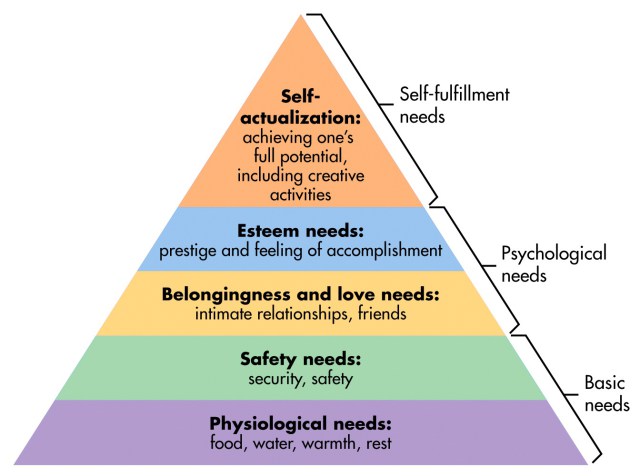
Maslow’s hierarchy of needs outlines that our most basic needs are biological, and meeting these needs is a necessity for survival. There isn’t a ‘choice’.

Taking money from poor people is simply cruel and barbaric. It reduces ‘choices’ and increases necessity and desperation.

If we can’t meet our fundamental needs, we can’t meet higher level psychosocial needs either – the ones that do entail choices about our lives. Poverty has got nothing to do with making “irrational choices” at a personal level. It’s got everything to do with being left with NO choices.

There is a world of difference between ‘choice’ and ‘necessity’. It is time the government and the technocratic behavioural economists busy propping up a failing system recognised and acknowledged this. People are poor because we have a system that diverts available resources away from them, hanging them out to dry. Until that fundamental fact is addressed, nothing will change.

It’s time for a serious and open political debate about inequality, the limits of nudge, democracy and the fundamental failure of neoliberalism. It’s time to stop blaming poor people for poverty and inequality.

Bootstraps

Related

The connection between Universal Credit, ordeals and experiments in electrocuting laboratory rats

 The government plan social experiments to “nudge” sick and disabled people into work

A critique of benefit sanctions:  the Minnesota Starvation Experiment and  Maslow’s Hierarchy of Needs

The benefit cap, phrenology and the new Conservative character divination

Stigmatising unemployment: the government has redefined it as a psychological disorder

The power of positive thinking is really political gaslighting

Cameron’s Nudge that knocked democracy down: mind the Mindspace

The just world fallacy

The still face paradigm, the just world fallacy, inequality and the decline of empathy


I don’t make any money from my work. But you can make a donation if you wish and help me continue to research and write informative, insightful and independent articles, and to provide support to others. The smallest amount is much appreciated – thank you.

DonatenowButton

Serco, government contracts and the new minister for justice: what could possibly go right?

The Serious Fraud Office (SFO) is conducting a criminal investigation into Serco (and G4S) regarding electronic monitoring contracts – specifically concerning the tagging of prisoners. Although the case was opened and announced in 2014, the case is still ongoing, and is listed under ‘current cases’. Serco is reliant on the UK public sector for half of the group’s sales: £1.2 billion last year. As a “strategic supplier”, Serco’s contracts include running prisons, Royal Navy tugs and the Atomic Weapons Establishment.

Labour’s Richard Burgon has written to justice secretary David Gauke to express concern over the appointment of a new  junior minister who previously worked for the outsourcing giant Serco – which is under criminal investigation for overcharging Gauke’s own department. 

In 2013 Serco agreed to pay £68.5 million for overcharging the Ministry of Justice. There were allegations that the government had been billed for the electronic monitoring of people who were still in jail, were not tagged anymore, or were even, in a few cases, dead. Serco also had to pay back £2 million over claims of fraud concerning its prisoner transfer contract. In May 2014 a Survation poll for campaign group We Own It, found that 63% of respondents thought Serco should be banned from bidding for any new public contracts after the firm was investigated for overcharging on government contracts.

Despite the ongoing criminal investigation, it’s rather worrying that Serco continues running one of its most lucrative operations after it was announced in 2016 that the struggling government contractor was to retain its role in the manufacture and maintenance of the warheads for Britain’s Trident ­nuclear deterrent, and in the storage of UK atomic waste, especially given claims that the company has “mishandled” the disposal of nuclear waste. 

After months of contractual wrangling in which investors had feared that Serco and its joint venture partners would lose the work, the Ministry of Defence announced that it is keeping the contract to run the Atomic Weapons Establishment, based at Aldermaston, other sites in Berkshire and at Coulport in Scotland.

It was revealed in the Paradise Papers that Appleby, an offshore law firm, regarded Serco, who run “sensitive” government services in Australia and the UK, as a “high-risk” client, expressing concern about its “history of problems, failures, fatal errors and overcharging”. The company had also presented false data to the NHS  at least 252 times, was accused of fraudulent record keeping and had allegedly manipulated results when it failed to meet targets, Appleby’s compliance team warned. 

In health services, Serco’s ‘difficulties’ include the poor handling of pathology labs and fatal errors in patient records. At St Thomas’ Hospital, the increase in the number of clinical incidents arising from Serco non-clinical management has resulted in patients receiving incorrect and infected blood, as well as patients suffering kidney damage due to Serco providing incorrect data used for medical calculations. A Serco employee revealed that the company had disgracefully falsified 252 reports to the National Health Service regarding Serco health services in Cornwall. 

On 24 October 2017, it was reported that Serco was preparing to buy healthcare contracts from facilities management business Carillion. The deal included 15 contracts, with annual revenues of approximately £90m, for which Serco would pay £47.7m, with Carillion losing £1bn from the value of its order book. 

Chief among the law firm Appleby’s concerns about Serco were the  numerous allegations of fraud, the cover-up of the abuse of detainees, and the “mishandling” of radioactive waste in the UK.

Serco say: “Within the UK and Europe we work across public service sectors in Justice, Immigration, Healthcare, Defence, Transport and Citizen Services. From providing critical air navigation services for our aviation customers to pursuing innovative approaches to reduce reoffending in our prisons, we seek to transform the experience of our services users”. The company have a finger in many lies.

Edward Argar, Conservative MP for Charnwood, has replaced Phillip Lee at the Ministry of Justice (MoJ) following Lee’s resignation last week over the way Theresa May is delivering Brexit. He is ex-head of UK and Europe Public Affairs at Serco, working there until nine months before he was elected as MP for Charnwood in 2015.

Argar was previously head of UK and Europe public affairs at Serco, which has a number of prisons contracts and previously ran Hassockfield Secure Training Centre, in County Durham, prior to its closure in 2014.  Serco runs  a total of five private prisons on behalf of the MoJ – Doncaster, Ashfield, Dovegate, Lowdham Grange and Thameside. Doncaster was criticised by inspectors in 2016 who found vermin infestations and “overwhelmed” staff.

In September 2013, Serco was accused of extensive sexual abuse cover ups of immigrants at Yarl’s Wood Immigration Removal Centre prison in Bedfordshire. In August 2014, Serco, along with G4S, was criticised for using immigrant detainees as cheap labour, with some being paid as little as £1 per hour. 

The decision to give the company a new £70 million eight-year contract to run Yarl’s Wood has been criticised. Natasha Walter, of Women for Refugee Women, said “Serco is clearly unfit to manage a centre where vulnerable women are held and it is unacceptable the government continues to entrust Serco with the safety of women who are survivors of sexual violence.”

In January this year, a damning report by the Commons Public Accounts Committee described the programme – by this point five years late and £60 million over budget – as “a catastrophic waste of public money which has failed to deliver the intended benefits.”

Argar’s new role will include overseeing the establishment of proposed “secure schools” as part of efforts to place a greater focus on the education and rehabilitation of young offenders.

Argar’s voting record reveal a staunch and mean neoliberal, who believes, unsurprisingly, that the government should make the asylum system more ‘strict’ and should be ‘tough’ on illegal immigration. He strongly supports academy schools, austerity; welfare cuts, including the bedroom tax; mass surveilance and of course, increases in the tax-free allowance. He supports the replacement of Trident 100%, too, which is also unsurprising, given Serco’s role in the nuclear industry. He’s not so keen on equality and human rights legislation, however.

Labour’s shadow justice secretary Richard Burgon has quite rightly asked whether Argar will be dealing with any contracts related to his former employer as part of his work. 

The letter, sent on 15 June by shadow justice secretary, Burgon, says: “It is essential that government ministers can command public confidence that they are capable of holding such companies [as Serco] to account.”

It goes on to ask whether “Mr Argar will be involved in any way in liaising on behalf of the Ministry of Justice with the Serious Fraud Office about the ongoing investigation” or “dealing with any of the ministry’s contracts with Serco in his new ministerial capacity”.

The campaign group Transparency International has said that the government should have “mechanisms” in place to avoid the possibility or perception of any firm ‘gaining an advantage.’

Research manager Steve Goodrich said: “When appointing new Ministers it’s imperative that all real or potential conflicts of interest are fully scrutinised and addressed, and mechanisms are in place to avoid any decisions made in the interest of previous employers.

“Failing to do so can lead to the perception or reality that a Ministers may seek to put private interests first at the public’s expense.”

An MOJ source stressed: “There is no conflict of interest simply because someone has worked for a particular employer earlier in their career.

 “The Government benefits by having Ministers with a breadth of previous experience.”

And big business benefits by having Ministers in government with a breadth of big business experience, who vote on issues that affect and promote big business interests.

The Ministry of Justice has declined to comment further, when asked if any  mechanisms of transparency and accountability would be put in place, but said that Argar had been appointed “in line with normal procedures and rules.”

You can’t help but wonder just how many catastrophic failures it will take to demonstrate conclusively to an ideologically paralysed government that in reality, existing public services markets are a far cry from the paradigm of ‘competitive efficiencies’ in perfect markets.  Serco alone has perpetrated more scandals than a public agency would have ever survived. Yet this government has rolled over hundreds of major outsourcing contracts in 2017 without review, many of them 10 years long, because of the current Brexit workload. 

Within the neoliberal idiom of public services, there is clearly a fundamental inability to consider collective public interests because of the private profit motive. 

You also have to wonder what part of this idiom constitutes “sound public finance.” Yet despite the clear wake of crises thrown up by a fatally flawed outsourcing model, the government stumble on dogmatically, hiding their own ideological reach behind a privatised wall that completely blocks out transparency and democratic accountability.  

The companies profit, while all of the risks of privatisation are carried by citizens using the diminished, ‘streamlined’, ‘efficient’ facade services. Meanwhile, democratic transparency and accountability is denied; due to the ‘commercial sensitivity’ of private companies, they cannot be held to account by public appeals to the Freedom Of Information Act (FOI), debarring openness and transparency – the essential foundations for democratic decision making. 

Here is Richard Burgon’s letter in full:

Dear Secretary of State,

I am writing about the appointment of Edward Argar MP yesterday as a Justice Minister following the resignation of Dr Phillip Lee earlier this week.

Press reports today state that Mr Argar was formerly Head of Public Affairs in the UK and Europe for Serco, the outsourcing giant. A Serco spokesperson confirmed to the media that Mr Argar was employed there for over three years until August 2014.

As you know, Serco plays a significant role in our justice system, including by running five private prisons and in transporting 24,000 prisoners per month to court through the Prison Escort Contract.

The role of the private sector in our justice system is increasingly contentious given the widespread performance failings, for example in the probation service and in detention centres for young people such as Oakhill.

Serco itself has a controversial record in our justice system. It is currently under criminal investigation by the Serious Fraud Office for overcharging in an offender tagging contract. In 2013 it was forced to repay £68.5m to the Ministry of Justice after having charged for tagging offenders, some of whom had died or were back in prison. In addition, Serco previously had to repay £2m to the Ministry of Justice after being found to have falsely recorded prisoners as having been delivered to court on time.

It is essential that government ministers can command public confidence that they are capable of holding such companies to account, that the interests of the public, and not the profits of the corporations, are being put first and that there is no perceived conflict of interest.

Given this could you confirm whether Mr Argar will be involved in any way in liaising on behalf of the Ministry of Justice with the Serious Fraud Office about the ongoing investigation or will be dealing with any of the Ministry’s contracts with Serco in his new ministerial capacity?

Yours

Richard Burgon MP

As I’ve said elsewhere, in the UK market economy, everything is for sale, with the very wealthiest people finding considerable discounts on moral obligations and behavioural ethicality. It’s become very easy to lose track of why some things simply shouldn’t be. The Conservative’s privatisation programme has proved to be a theme park for economic crime and party profit; firms and politicians collude to ensure we have the ‘best’ system that money can buy.  It’s a system, however, that is incompatible with democracy and human rights frameworks.

We hear a lot from the new right fundamentalists about how the market place extends ‘liberty’, but there is little discussion about the fundamental imbalance built into the system that has systematically disempowered many others who can’t afford to pay for their liberty. Or their legal fees and penalties. The market place is not neutral. It’s a place where class discrimination is rampant, traditional power relations are fortified and morally constrained behaviour is only ascribed to and required from the poorest citizens. All of this has profound implications for democracy. 

‘Public choice’ economics has shaped the neoliberal reforms to the civil service and public institutions, resulting in the slippery sloped internal market in the NHS, the dismantling of the welfare state and outsourcing of many other state functions, student fees in higher education, the destruction of social housing, legal aid provision and the deregulation, bonfire-of-the-red-tape approach of the pro-market regulatory agencies of many other areas of public life, including the financial sector.

The wake of scandals to date, in which large corporations more generally, politicians, and bureaucrats have engaged in criminal activity in order to profit personally, facilitate mergers and block competition; in which officials accept private payments to facilitate private interests, and for public services rendered, demonstrates only too well the extent to which corruption is driven by the very economic and political reforms that are claimed to decrease it. 


Related

Neoliberalism and corruption: hidden in plain sight


I don’t make any money from my work. I am disabled because of illness and have a very limited income. But you can help by making a donation to help me continue to research and write informative, insightful and independent articles, and to provide support to others. The smallest amount is much appreciated – thank you.

DonatenowButton

It’s time government ministers stopped lying about their attack on disabled people

Image result for centre for welfare reform simon duffy

Earlier this year, I wrote an article about the Universal Credit (UC) rules which will leave many disabled people who are new claimants, who experience a change in circumstances or a break in their claim, without their Disability Income Guarantee.

Those people who qualified for the support component of income-related Employment and Support Allowance and (ESA) are eligible for a disability premium (also called the Disability Income Guarantee.) However, as a result of the abolition of both the severe disability premium (SDP) and enhanced disability premium (EDP) under UC rules, according to the disability charity, Scopethe cut to the disability income guarantee will see disabled people lose as much as £395 a month.

Two disabled people decided to take the government to court over the brutal cuts to their income, which has caused them severe hardship.

Earlier this month, in a landmark judgment, the High Court ruled that the Department for Work and Pensions (DWP) unlawfully discriminated against two severely disabled men who both saw their benefits dramatically reduced when they claimed Universal Credit. 

Lawyers representing the men said the ruling showed that the new benefit system was “not working” for the disabled or other claimants, and urged the government to halt the roll-out and overhaul the system to meet peoples’ needs and not “condemn them to destitution”. The two claimants, known only as TP and AR, had both previously been in receipt of the Severe Disability Premium (SDP) and Enhanced Disability Premium (EDP), which were specifically aimed at ensuring the additional care and needs of severely disabled people living alone with no carer are met.

Both people were required to make a claim for universal credit when they moved into new local authorities where the controversial new benefit was being rolled out. According to both the men, they were advised by DWP staff that their benefit entitlement would not change. Yet despite repeated assurances from the government that “no one will experience a reduction in the benefit they are receiving at the point of migration to universal credit where circumstances remain the same”, both men saw an immediate drop in their income of around £178 a month when they were moved over to UC.

When they asked for the top up payments promised by the DWP, they were told that Government policy was that no such payments would be paid until July 2019 when managed migration is due to begin.

As both claimants testified to the court, the sudden drop of income had a devastating impact on them, both physically and psychologically. TP, a former City banker who suffers from a terminal illness, has been struggling to address his care needs, and AR, who suffers from severe mental health issues, has been unable to afford basic necessities.

Earlier this month, the DWP committed the government to ensuring that no severely disabled person in receipt of the SDP will be made to move onto universal credit until transitional protection is in place and also, made a commitment to compensate those like the claimants who have lost out.  

Despite this, following the judgment, the Secretary of State for Work and Pensions has sought permission to appeal, maintaining that there was “nothing unlawful” with the way the claimants were treated. 

Their lawyer, Tessa Gregory from the human rights team at Leigh Day, told the Court: “Nothing about either of the claimants’ disability or care needs changed, they were simply unfortunate enough to need to move local authorities into a Universal Credit full service area.”

The judge said the impact on the individuals was “clear”, and said the way they were transferred onto universal credit was “manifestly without reasonable foundation” and “failed to strike a fair balance”.

Following the ruling, Ms Gregory said: “This is the first legal test of the roll out of Universal Credit and the system has been found to be unlawfully discriminating against some of society’s most vulnerable. 

“Whilst we welcome the Government’s commitment to ensuring that no one in our client’s position will now be moved onto Universal Credit until top up payments are in place, it comes too late as it cannot make up for the months of suffering and grinding poverty our clients and many others like them have already had to endure.

“We call upon Esther McVey to compensate our clients and all those affected without any further delay, and urge her to focus on fixing Universal Credit rather than wasting more public funds appealing this court decision.

“Today’s decision shows again that Universal Credit is not delivering what was promised at the outset. It is not working. It’s not working for the disabled, it’s not working for parents, it’s not working for low-income and part-time employees and it’s not working for the self-employed.  

“The government needs to halt the rollout and completely overhaul the system to meet peoples’ needs, not condemn them to destitution. If this doesn’t happen further legal challenges will inevitably follow.

“Disability premiums are not a luxury. They play a crucial role in helping disabled people pay for essentials like food, clothing and bills. The needs of the people involved in this case haven’t changed, and yet they have lost more than £170 per month in support. This isn’t  fair.

Until the Government fully addresses these issues, it will unfairly penalise disabled people for moving over to universal credit.”

A DWP spokesperson said: “The court found in our favour on three of the four points raised by the claimant. We will be applying to appeal on the one point the court found against the Department. This government is committed to ensuring a strong system of support is in place for vulnerable people who are unable to work.”

Clearly the government is committed to trying it on by paying people as little as they can possibly get away with from the public fund. Deliberately cutting money from disabled peoples’ crucial lifeline support can hardly be described as “ensuring a strong system of support is in place”. This response indicates quite clearly that the cut was fully intentional on the part of the government.

The spokesperson added: “Last week, the Secretary of State announced that we will be providing greater support for severely disabled people as they move onto universal credit. And we have gone even further, by providing an additional payment to those who have already moved onto the benefit.”

Yes, because the cut has been ruled as discriminatory and unlawful, not because a choice was actually made to do so. Only the Conservatives could turn prejudice, discrimination and breaking the law into some kind of virtue.

Again this response indicates clearly that these were intended changes, and not merely  a consequence of administrative incompetence. There was not a shred of regret expressed by the government regarding the severe hardship these cuts have caused for disabled people. 

And this still leaves disabled people claiming the disability support component of Universal Credit for the first time without the Disability Income Guarantee. That is also discriminatory. 

The Department for Work and Pensions have claimed UC means that support is “focused on those who need it most”, but a government removing Severe Disability Premium and Enhanced Disability Premium, which is support designed to help severely disabled people who live without a carer – is pulling a basic safety net from citizens with the greatest needs. The premiums were also designed in part to address the problem of cumulative poverty for severely disabled people who cannot work, or who face disadvantage in the labour market because of additional needs and barriers. 

This cut will also potentially affect disabled lone parents who may rely on their benefit support to pay for support to shop, cook and wash, for example. The cut may mean that they will be forced to rely on their own children as carers.

Austerity has been carried disproportionately by disabled people

The UC system has made an estimated £11bn in savings, mainly through Treasury cuts to the original set level of universal credit rates – most notably through reductions to work allowances, which will save around £3bn, and the removal of £2bn in disability premium payments – but UC planning and delivery has also incurred £8.5bn in expenses.

Government statistics published last year show 47 per cent of people who were formerly receiving Disability Living Allowance (DLA) saw their support fall or stop altogether when they were reassessed for Personal Independent Payment (PIP).

Of a total of 947,000 claimants who were reassessed in the year up to October 2017, 22 per cent saw their support reduced, while a quarter were disallowed or withdrawn altogether — meaning 443,000 people will have had their claims reduced or removed.

However, the success rate for claimants when appealing Personal Independence Payments (PIP), for example, was 65% in 2016/17. The Mirror has recently reported that the rate of PIP appeal success has hit an all-time high of 71% for the first quarter of 2018.

Labour MP Rosie Duffield secured a debate (her first) which took place a couple of days ago (20 June) about the report by the UN committee on the Rights of Persons with Disabilities (UNCRPD). The report said successive UK governments had committed “grave” and “systematic” violations of disabled people’s human rights. The chair of the committee said the government had created a “human catastrophe” for disabled people. (You can read the full debate here).  

The debate addressed last autumn’s report on the UK’s implementation of UNCRPD, and the conclusion of the UN’s disability committee that the UK government should make more than 80 improvements to the ways its laws and policies affect disabled people’s human rights.

In a briefing prepared ahead of the debate, the Equality and Human Rights Commission  the other official and independent bodies responsible for monitoring the UK’s progress in implementing the convention – had called on the UK government to describe how it would “comprehensively address” the UN committee’s findings. However, the government has not made any commitment to implementing the committee’s recommendations.

During the debate, Labour MPs accused Sarah Newton, Minister of State for the Department for Work and Pensions, and the government, of making disabled people a “forgotten class”; of allowing the DWP to “endlessly mistreat” them, and of creating a “national scandal”.

Newton dismissed Labour’s comments, using techniques of neutralisation that I’ve written about before. In short, Newton used a tactic that the Conservatives have used many times before – an indignant and outraged denial. She actually accused the opposition of ‘scaremongering’ again, (and by default, she attempted to discredit disabled citizens’ accounts of their own experiences, which of course flies in the face of democratic accountability). 

The Conservatives are denying responsibility for the consequences of their policies, denying harm, denying the victims and condemning the condemners. 

In her attempt to defend her government’s appalling record on cuts to social security, she also told MPs that there had been “no freeze in the benefits that disabled people receive”.

But this is not true, a fact that has been repeatedly pointed out to Tory ministers and her party.

Although disability living allowance (DLA), personal independence payment (PIP) and the employment and support allowance (ESA) support group top-up are exempt from the benefits freeze – which is set to last to 2020 – there is no exemption for the main component of ESA and the top-up paid to those in the ESA work-related activity group, which continues to be frozen.

Newton claimed that the UN, opposition and again, by default, disabled citizens, were making “irresponsible” allegations. And the courts. Again, this is a technique of neutralisation called “condemning the condemners”, used to ‘switch off ‘someone’s conscience when they plan, or have done, something to cause harm to others. The technique may also be used to push at the normative and moral boundaries of groups and the wider public.  (*See below for a full outline of the techniques).

Newton also said that the government was “very disappointed” that the UNCRPD did not “take on board […] the evidence that the government gave them. They did not acknowledge the full range of support.” That’s because it isn’t there.

The UNCRPD report presented extensive, meticulous evidence with their thorough report, gathered from disabled people that have been affected by the welfare cuts, campaign groups, charities and research academics. It also condemned the UK government’s attempts to misrepresent the impact of policies through “unanswered questions”, “misused statistics”, and a “smoke screen of statements.” 

It isn’t ‘scaremongering’ to express concern about punitive policies that are targeted to reduce the income of social groups that are already struggling because of limited resources, nor is it much of an inferential leap to recognise that such punitive policies will have some adverse consequences. 

Political denial is oppressive – it serves to sustain and amplify a narrow, hegemonic political narrative, stifling pluralism and excluding marginalised social groups, excluding qualitative and first hand accounts of citizen’s experiences, discrediting and negating counternarratives; it sidesteps democratic accountability; stultifies essential public debate; obscures evidence and hides politically inconvenient, exigent truths. Denial of causality does not reduce the probability of it, especially in cases where a correlation has been well-established and evidenced. The government have no empirical evidence to verify their own claims that their punitive policies do not cause harm and distress.

Government policies are expressed political intentions regarding how our society is organised and governed. They have calculated social and economic aims and consequences. In democratic societies, citizen’s accounts of the impacts of policies ought to matter.

However, in the UK, the way that policies are justified is being increasingly detached from their aims and consequences, partly because democratic processes and basic human rights are being disassembled or side-stepped, and partly because the Government employs the widespread use of linguistic strategies and techniques of persuasion and neutralisation to intentionally divert us from their aims and the consequences of their ideologically (rather than rationally) driven policies. Furthermore, policies have become increasingly detached from public interests and needs.

Damian Green, who was the work and pensions secretary at the time the UN report was published. dismissed the highly critical findings . He said, shamefully, that the report was “patronising and offensive” and presented an outdated view of disability in the UK. He said Britain was “a world leader in disability rights and equality”.

But many of us – disabled citizens, disability activists, campaigners, charities and researchers – welcomed the report, saying it accurately highlighted the real economic and social hardships faced by disabled people after years of harsh spending cuts to social security and social care.

The shadow work and pensions secretary at the time, Debbie Abrahams, said the UN report was “crystal clear” in its identification of UK government failures. “It confirms that, despite Theresa May’s warm words, this government is failing sick and disabled people,” she said.

The UN committee said a range of measures introduced since 2010, including the bedroom tax and cuts to disability benefits and social care budgets, had disproportionately and adversely affected disabled people.

Spending cuts had negatively affected the rights of disabled people to live independently, to work and to achieve an adequate standard of living, the report said. The UN urged UK ministers to ensure the rights of disabled people were upheld.

Green said: “At the heart of this report lies an outdated view of disability which is patronising and offensive. We strongly refute its findings. The UN measures success as the amount of money poured into the system, rather than the work and health outcomes for disabled people. Our focus is on helping disabled people find and stay in work, whilst taking care of those who can’t.”

The government said at the time that it spent about £50bn a year to support sick and disabled people – a bigger proportion of GDP than countries including Canada, France and the US.

However, this is plainly untrue. In 2015, the government’s own figures show that even before some of the cuts were implemented, the UK was ninth out of 28 countries, when ranked in terms of the size of its social protection expenditure as a proportion of its gross domestic product (GDP). 

In fact Newton’s highly selective statistical ‘data’ was contradicted by the Office for National Statistics (ONS) who also reported that the UK actually spends less than France, as well as Norway, Germany and Spain on disability benefits.

Furthermore, Newton’s figure includes amounts that are not directly related to disability benefit, such as carers’ allowance, housing benefit, council tax allowance, and it also includes some NHS spending.

The government actually spent £39 billion on disability, incapacity and industrial injury benefits in 2017/18. That’s 76% of the total £51 billion that Newton claimed was spent.

Abrahams said the report echoed warnings Labour had been making since 2011 about the effects of the government’s policies on disabled people. It certainly echoed warnings many of us have been making – in my own case, since the welfare “reforms” in 2012.

“The UN committee is clear that its report examines the cumulative impact of legislation, policies and measures adopted from 2010 to October 2016, so the government’s claim that it is outdated does not stand up to scrutiny.

“I am also concerned that the government is labelling the report as patronising, when they are the ones dismissing the concerns raised by disabled people who helped instigate the inquiry in the first place.”

This dismissal is despite being presented with evidence from a wide range of organisations as well as disabled citizens, to whom Conservative policies are causing harm and distress.  Yet the government continue to distance themselves from the consequences of their own decision-making, opting to deny them instead. Those are not the reasonable actions of an accountable, democratic government. 

Decades of findings in sociology and psychology tell us that as soon as a social group are defined as an outgroup, the public start to see them differently. Because politicians have stereotyped people who claim welfare support, portraying only negative characteristics, the public also perceive only those characteristics. The government, with the help of the media, has purposefully portrayed people claiming welfare support as folk devils: lazy, dishonest, stupid and as scroungers, and so on. This is profoundly dehumanising. 

The people being harmed by policies have become outsiders, they’ve been pushed out of the circle of our moral community. The government clearly don’t think of the people enduring terrible distress and hardship as experiencing the same range of autonomy, needs, thought, emotion and motivations that they do; they don’t imagine them feeling things in the same way that they do. This disconnection – a failure to recognise common human characteristics in the other – means that they are denied some measure of empathy, and consequently a sense of ethical and democratic obligation and inclusion.

The Conservatives talk a lot about “evidence-based policy”, but they don’t walk the talk. A weight of evidence has highlighted the cruel, draconian effects of the Tories’ social polices. The government have chosen to deny and ignore it. 

This lack of appropriate response indicates a deliberately prejudiced, vicious attack on a significant minority of the population, which the government has absolutely no intention of stopping or putting right any time soon.


You can watch the whole debate that was secured by Rosie Duffield here


* Techniques of neutralisation: 

Used to switch off the conscience when someone plans or has done something to cause harm to others. 

The idea of techniques of neutralisation was first proposed by David Matza and Gresham Sykes during their work on Edwin Sutherland’s Differential Association in the 1950s. Matza and Sykes were working on juvenile delinquency, they theorised that the same techniques could be found throughout society and published their ideas in Delinquency and Drift, 1964.

They identified the following psychological techniques by which, they believed, delinquents justified their illegitimate actions, and Alexander Alverez further identified these methods used at a socio-political level in Nazi Germany to “justify” the Holocaust:

1. Denial of responsibility. The offender(s) will propose that they were victims of circumstance or were forced into situations beyond their control.

2. Denial of harm and injury. The offender insists that their actions did not cause any harm or damage.

3. Denial of the victim. The offender believes that the victim deserved whatever action the offender committed. Or they may claim that there isn’t a victim.

4. Condemnation of the condemners. The offenders maintain that those who condemn their offence are doing so purely out of spite, ‘scaremongering’ or they are shifting the blame from themselves unfairly. 

5. Appeal to higher loyalties. The offender suggests that his or her offence was for the ‘greater good’, with long term consequences that would justify their actions, such as protection of a social group/nation, or benefits to the economy/ social group/nation.

6. Disengagement and Denial of Humanity is a category that Alverez
added to the techniques formulated by Sykes and Matza because of its special relevance to the Holocaust. Nazi propaganda portrayed Jews and other non-Aryans as subhuman. A process of social division, stigma, scapegoating and dehumanisation was explicitly orchestrated by the government. This also very clearly parallels Gordon Allport’s work on explaining how prejudice arises, how it escalates, often advancing by almost inscrutable degrees, pushing at normative and moral boundaries until the unthinkable becomes tenable. This stage on the scale of social prejudice may ultimately result in genocide.

Any one of these six techniques may serve to encourage violence by neutralising the norms against prejudice and aggression to the extent that when they are all implemented together, as they apparently were under the Nazi regime, a society can seemingly forget its normative rules, moral values and laws in order to engage in wholesale prejudice, discrimination, exclusion of citizens, hatred and ultimately, in genocide.

In accusing citizens and the opposition of ‘scaremongering’, the Conservatives are denying responsibility for the consequences of their policies, denying harm, denying  distress; denying the victims and condemning the condemners.


I write voluntarily, to do the best I can to raise awareness of political and social issues. In particular I research and write about how policy impacts on citizen wellbeing and human rights. I also co-run a group on Facebook to support other disabled people going through ESA and PIP assessments, mandatory reviews and appeals.

I don’t make any money from my work. I am disabled and don’t have any paid employment. But you can contribute by making a donation and help me continue to research and write informative, insightful and independent articles, and to provide support to others. The smallest amount is much appreciated – thank you.

DonatenowButton


Why won’t ministers come clean about the impact of cuts on disabled people? – Frances Ryan


B
ack in 2014, armed with only a laptop and phone, disabled campaigners started a hunt for the truth. As policies including the bedroom tax, the abolition of disability living allowance, and the rollout of controversial out-of-work sickness benefits hit, War on Welfare (Wow) called on the coalition government to carry out a cumulative impact assessment of the wave of disability cuts to measure the effect on disabled people. It resulted in a debate in parliament – the first time disabled people had secured a debate in the main chamber of the House of Commons – but no action

Now, four years on, Wow has gained the backing of a cross-party coalition that wants Theresa May’s government to calculate the overall impact of the so-called welfare reforms on disabled people. Every party except the Conservatives is in favour of a Commons debate on conducting this assessment, including the DUP. In light of the pressure over Northern Irish abortion reform, their support for detailed analysis of the impact of Tory disability cuts is another awkward clash between May and the DUP’s 10 MPs propping up her administration. But more than that, it’s a sign of hope that ministers may have to finally investigate just what damage their disability cuts are causing – from the social care crisis to cuts to multiple parts of the NHS, to the disastrous rollout of universal credit; now delayed for an extra year until 2023

Last week’s damning report by the National Audit Office (NAO) on universal credit castigated the system’s inability to protect and support “vulnerable claimants”. It follows the revelation this month that the government was forced to say it would repay thousands of severely disabled people made worse off under the UC system ahead of the high court ruling last week that it was “discriminatory” to have docked two disabled men’s benefits after transferring to UC. Following pressure from disability groups, this week ministers made another U-turn, this time to stop repeatedly testing some disabled people for personal independence payments.

The government’s austerity programme has resulted in multiple reductions in income since 2010 that have hit disabled people all at once and disproportionately. Being hit by the bedroom tax is tough – but losing your sickness benefits as well after being found “fit for work” is even harder.

If you need an insight into the damage these policies have done, just go to Wow Voices, a website set up by campaigners that features disabled people explaining the impact of cuts on them. One woman with terminal breast cancer writes of how, for the last 18 months, she’s been told she needs to be reassessed for her benefits every six months, and she’s frantic about the thought of losing her support. “I’ve cried more about this than my terminal diagnosis,” she says. 

The UN’s damning report in 2016 into the UK’s “violations” of disabled people’s rights has put further pressure on the government over its treatment of disabled citizens. Meanwhile, the Equality and Human Rights Commission’s own cumulative impact assessment shows that families with a disabled adult and a disabled child will lose £5,500 a year by 2022 as a result of tax and benefit changes – contradicting the government’s claim that such analysis would be “too complex” to do. 

This month, research by the Joseph Rowntree Foundation found around 650,000 people with mental and physical health problems were officially destitute in the UK last year – that means being so poor, they can’t afford deodorant, the electric, or regular meals – with social security changes found to be a key cause. It’s bad enough for ministers to take away state support from disabled people en masse, but to refuse to analyse its effects is the definition of irresponsible. The Conservatives must finally shine a light on the impact that disability cuts have had. What are they so afraid of?


Related

The government response to the WoW petition is irrational, incoherent nonsense on stilts

The government refuse to carry out a cumulative impact assessment of welfare “reforms”. Again


I write voluntarily, to do the best I can to raise awareness of political and social issues. In particular I research and write about how policy impacts on citizen wellbeing and human rights. I also co-run a group on Facebook to support other disabled people going through ESA and PIP assessments, mandatory reviews and appeals.

I don’t make any money from my work. I am disabled and don’t have any paid employment. But you can contribute by making a donation and help me continue to research and write informative, insightful and independent articles, and to provide support to others. The smallest amount is much appreciated – thank you.

Research finds 80% of rough sleepers who died in London in 2017 had mental health needs

Image result for homelessness reduction act

A research report published on Tuesday by the homeless charity St Mungo’s shows that four out of five (80%) rough sleepers who died in the capitol in 2017 had mental health needs, a huge increase from three in 10 (29%) in 2010. The rise in deaths of rough sleepers with mental health problems have risen sharply over the last seven years, prompting concern that specialist services are not reaching those who need them. 

The number of people sleeping rough has risen by 169% since 2010. Last year in England more than 4,700 people slept rough on any one night, and a far larger number experienced rough sleeping during the course of the year.

The charity is calling on the prime minister to take urgent action to prevent more people dying on the streets and ensure that the deaths are not ignored. The charity says the government need to invest more in specialist support, as NHS services are “severely overstretched”. this could sometimes be overlooked. Petra Salva, director of St Mungo’s rough sleeping services, said:

This is a scandal and something the government needs to recognise and do more about … there should be more funds and support for these groups but instead they have been cut over the years and that correlates in these people stuck living on the streets … these deaths are preventable.”

He added: “The rise is because rough sleepers with mental health support needs end up sleeping rough and the help isn’t there and when it is there it is not quick enough … access to help and support is getting harder and so the prevalence of death … is increasing.”

The report said “Research carried out by St Mungo’s showed that only 32% of the areas where 10 or more people are sleeping rough on any one night commission mental health services actively targeting people sleeping rough.” 

The report also featured a survey of dozens of street outreach workers and 63% said they were aware of someone who had died while sleeping rough in their local authority area last year. However, only 23% had experienced a review being carried out.

“With access to vital emergency accommodation and support services getting harder and harder, it is unsurprising that the number people dying on the streets is rising. Urgent action to provide rapid relief from rough sleeping is needed to turn this around,” the report stated.

Having a mental health problem can create the circumstances which can cause a person to become homeless in the first place. Yet poor housing or homelessness can also increase the chances of developing a mental health problem, or exacerbate an existing condition. In turn, this can make it even harder for that person to recover. It also makes it very challenging to develop good mental health, to secure stable housing, to find or maintain a job, to stay physically healthy and to maintain relationships.

The figures come amid concern about the growing number of homeless deaths and the lack of reviews into what has led to them. Out of the hundreds of deaths that have occurred in recent years, reports suggest only eight have resulted in a review.

The Guardian and the Bureau of Investigative Journalists revealed earlier this year that 340 homeless people died on the streets or in temporary accommodation in the last six years, surging from 32 in 2013 to 78 in 2017. A further 59 deaths have been recorded so far this year, already more than the whole of 2016.

In the capital, the only place where a local authority records homeless deaths, 158 people died between 2010 and 2017, an average of one death a fortnight.

Experts and campaigners have warned that without official records, counts and reviews, it’s impossible to determine why so many homeless people are dying and design and take effective action to prevent future deaths. 

Howard Sinclair, the St Mungo’s chief executive, said: “This is nothing short of a national scandal. These deaths are premature and entirely preventable.”

Sinclair said that he welcomed the government Homeless Rduction Act set out by Sajid Javid to reduce the number of people sleeping rough. 

Though he added: “The forthcoming strategy presents a vital opportunity to make sure no one else dies as a result of sleeping rough. We are calling on the prime minister to follow through on her commitment to end rough sleeping by making sure all parts of the public sector play their part, especially the health, justice and welfare systems.”

The Homelessness Reduction Act received Royal Assent in April 2017 and will commence in April 2018. The Act places a new duty on local authorities to help prevent the homelessness of all families and single people, regardless of priority need, who are eligible for assistance and threatened with homelessness. 

Matt Downie, director of policy and external affairs at Crisis, said: “In 21st-century Britain, nobody should be dying on our streets, especially when there is clear evidence to show that rough sleeping – and all forms of homelessness – can be ended. 

“Homelessness is a devastating experience. People sleeping on our streets – who are experiencing the most visible form of homelessness – are exposed to everything from sub-zero temperatures, to violence, to debilitating illnesses. And all of these dangers puts them at serious risk of death.”

Back in 2016, Theresa May unveiled the £40 million package designed to prevent homelessness by intervening to help individuals and families before they ‘end up on the streets.’ It was claimed that the ‘shift’ in government policy will move the focus away from dealing with the consequences of homelessness and place prevention ‘at the heart’ of the Prime Minister’s approach. I criticised the approach at the time, as it was framed with a narrative of individualism, and was based on a considerable degree of political prejudice regarding the causes of homelessness, which positioned citizen ‘decision-making’ as a key factor. 

The Conservatives fail or refuse to recognise that many problems in wider society arise as a consequence of a prejudiced ideology that shapes political decision making, and that contributes significantly towards homelessness. These structural causes include a lack of affordable housing; high levels of poverty, low wages, the high cost of living, unemployment and underemployment; welfare cuts, punitive sanctions and problems with the way benefits system operates. Also, the way that social housing is rationed has a direct impact on levels of homelessness. 

In 2016, Sajid Javid, then Communities Secretary, announced that the Government will support reforms to England’s anti-homelessness laws and strengthen local authority duties to prevent people becoming homeless. But local authorities are already struggling to meet their statutory obligations because of years of underfunding because of the Conservatives’ ideological austerity.

The Homelessness Reduction Bill – a private member’s bill put forward by Conservative MP Bob Blackman – will place a duty on local authorities to help eligible people at risk of homelessness to secure accommodation, 56 days before they are threatened with eviction. However, councils have already expressed their concerns regarding delayed government code of guidance and funding on the Homelessness Reduction Act.

Announcing the Government’s support of the bill, Javid said: “No one should have to sleep rough on the streets. We want to build a country that works for everyone, not just the privileged few. That’s why we are determined to do all we can to help those who lose their homes and provide them with the support they need to get their lives back on track.

“This Government is therefore, very pleased to support Bob Blackman MP’s Private Members Bill, with its ambitious measures to help reduce homelessness.”

Blackman, the Conservative MP for Harrow East, said he welcomed the Government’s decision. He added: “Throughout my 24 years in local government prior to becoming an MP, I saw the devastation that can be caused by homelessness first hand, with too many people simply slipping through the net under the current arrangements.

“By backing this bill, the Government is demonstrating its commitment to an agenda of social justice and also shows that it is willing to listen. I look forward to working with Ministers going forward in order to bring about this important change in legislation.”

The 2013 annual State of the Nation report by the charities Crisis and Joseph Rowntree Foundation (JRF) revealed that the number sleeping rough had risen by six per cent in England that year, and by 13 per cent in London. There has been a 10 per cent increase in those housed temporarily, including a 14 per cent rise in the use of bed and breakfast accommodation.

Writing just a year after the highly controversial Welfare Reform Act was ushered through the legislative process on the back of Cameron’s claim to the “financial privilege” of the Commons , the JRF report authors explicitly blamed the Government’s welfare cuts for compounding the problems caused by the high cost and shortage of housing as demand outstripped supply. The researchers found found that the cap on housing benefit made it more difficult to rent from a private landlord, especially in London, and claimed the controversial “bedroom tax” has caused a sharp rise in arrears for people in public housing, particularly in the Midlands and North.

A separate survey by Inside Housing magazine showed that councils and housing associations are increasingly resorting to the threat of eviction, as the loss of an adequate social security safety net is causing increasing hardship for social housing tenants. The reduction of council tax benefit for people who were previously exempt from paying council tax has also contributed significantly to experiences of material hardship, too. 

Ministers have emphatically denied that their reforms have contributed to the return of homelessness. However, homelessness has now risen in each of the years since the Tory-led coalition was formed – after falling sharply in the previous six years, and has continued to rise rapidly, since.

The government’s welfare policies have emerged as the biggest single trigger for homelessness now the economy has allegedly recovered, and are likely to increase pressure on households for the next few years, with the new benefit cap increasing the strain, according to the independent research findings in the Homelessness Monitor 2015, the annual independent audit, published by Crisis and the Joseph Rowntree Foundation.

The Homelessness Monitor study 2015 found:

  • Housing benefit caps and shortages of social housing has led to homeless families increasingly being placed in accommodation outside their local area, particularly in London. Out-of-area placements rose by 26% in 2013-14, and account for one in five of all placements.
  • Welfare reforms such as the bedroom tax contributed to an 18% rise in repossession actions by social landlords in 2013-14, a trend expected to rise as arrears increase and temporary financial support shrink
  • Housing benefit cuts played a large part in the third of all cases of homelessness last year caused by landlords ending a private rental tenancy, and made it harder for those who lost their home to be rehoused.

The study said millions of people are experiencing  precarious circumstances because of “hidden homelessness”, including families forced by financial circumstances to live with other families in the same house, and people categorised as “sofa surfers” who sleep on friends’ floors or sofas because they have nowhere to live. 

At the same time, the Department for Work and Pensions also announced that it was cutting funding for homeless hostels and supported housing for disabled people by reducing supported housing benefit rent payments for three years. The homelessness reduction bill in the current policy context is yet another example of how Conservatives don’t seem to manage coherent, joined up thinking. 

Howard Sinclair, the chief executive of the homelessness charity St Mungo’s, said the cut would leave the homeless charity with £3 million a year less to spend on services. 

“The rent reduction will threaten the financial viability of some of our hostels and other supported housing schemes and offers no direct benefit to vulnerable tenants who mostly rely on housing benefit to cover their housing costs,” he said.

It’s just not good enough that the Government simply attempts to manipulate and colonise progressive rhetoric, claiming they ‘stand for social justice’, when they very clearly don’t walk the talk.

Conservative neoliberal “small state” anti-welfare policies are increasing homelessness. The bedroom tax, council tax benefit reductions, housing benefit reductions, welfare caps, sanctions, the deregulation of private sector, the selling off and privatising of social housing stock have all contributed to the current crisis of homelessness. 

It was particularly remarkable that May claimed the government are “doing the right thing for social justice” yet the Conservative policy framework is, by its very design, inevitably adding to the precariousness of the situations those people with the least financial security are in.

Affordable, accessible and safe accommodation brings stability and security; provides a gateway to access health services like GPs; enhances social and community inclusion; and provides the basis for the right to private and family life. A home is vital for good mental and physical health, allowing people to live in safety, security, peace and dignity.

Currently there is no such ‘right to housing’ in itself, however, the right to an adequate standard of living, including housing, is recognised in the UN Covenant on Economic, Social and Cultural Rights.

Of course, there are numerous factors which can cause people to become homeless, many of which are beyond individual control, such as lack of affordable housing, disability and poverty. But what really needs to be highlighted is the two-way relationship between homelessness and mental health.

Government policies haven’t worked because they overlook the obvious. Despite Theresa May’s claims, the government tends to simply address the effects and not the real causes of homelessness. Unless the government actually address the growing inequality, poverty and profound insecurity that their own policies have created, then homelessness and absolute poverty will continue to increase.

Image result for homelessness reduction act

You can help a homeless person by contacting Streetlink. (Click) When a rough sleeper is reported via the Streetlink app, or by phone – telephone number 0300-500 0914.

The details you provide are sent to the local authority concerned, so they can help connect the person to local services and support. You will also receive an update on what action was taken so you’ll know if the situation was resolved. StreetLink aims to offer the public a means to act when they see someone sleeping rough, and is the first step someone can take to ensure rough sleepers are connected to the local services and support available to them.

Related

Number of new social homes has plummeted by almost 90% under Tories

Don’t walk on by. We are better than this 

Two very vulnerable homeless men left to die in sub-zero temperatures


I write voluntarily, to do the best I can to raise awareness of political and social issues. In particular I research and write about how policy impacts on citizen wellbeing and human rights.

I don’t make any money from my work. I am disabled and don’t have any paid employment. But you can contribute by making a donation and help me continue to research and write informative, insightful and independent articles, and to provide support to others. The smallest amount is much appreciated – thank you.

DonatenowButton

The NHS is to hire 300 employment coaches to find patients jobs to “keep them out of hospital.”

Image result for cognitive therapy for unemployed protests

The government has a problem with the public actually using public services

The government announced the creation of the Joint Health and Work Unit and the Health and Work Service in 2015/16, both with a clear remit to cut benefits and “get people into work.” Given that mental health is a main cause for long-term sickness absence in the UK, a key aspect of this policy is to provide mental health services that get people back into work.

There has already been an attempt to provide mental health services for people who claim social security support, which includes a heavily resisted pilot to put therapists into job centresAnother heavily opposed government proposal was announced as part of the  health and work pilot programme to put job coaches in GP surgeries
The proposals have been widely held to be profoundly anti-therapeutic, potentially very damaging and professionally unethical. 

With such a narrow objective, the delivery will invariably be driven by an ideological agenda, politically motivated outcomes and meeting limited targets, rather than being focused on the wellbeing of individuals who need support and who may be vulnerable. I also discovered almost by chance back in 2015 that the Nudge Unit team have been working with the Department for Work and Pensions and the Department of Health to trial social experiments aimed at finding ways of: “preventing people from falling out of the jobs market and going onto Employment and Support Allowance (ESA).” 

“These include GPs prescribing a work coach, and a health and work passport to collate employment and health information. These emerged from research with people on ESA, and are now being tested with local teams of Jobcentres, GPs and employers.”  Source: Matthew Hancock’s conference speech: The Future of Public Services

GPs have raised their own concerns about sharing patient data with the Department for Work and Pensions – and quite properly so. Pulse reported that the Department for Work and Pensions (DWP) planned to extract information from GP records, including the number of Med3s or so-called “fit notes” issued by each practice and the number of patients recorded as “unfit” or “maybe fit” for work, in an intrusive move described by GP leaders as amounting to “state snooping.”

Part of the reason for this renewed government attack on sick and disabled people is that the government’s flagship fit note scheme, which replaced sick notes five years ago in the hope it would see GPs sending thousands more employees back to workto reduce sickness-related absence, despite GPs having expressed doubts since before its launch, has predicably failed.

The key reason for the failure is that employers did not take responsibility for working with employees and GPs seriously, and more than half (59%) of employers said they felt unable to support employees by making all of the legally required workplace adjustments for those who had fit notes signed as “may be fit for work.” Rather than address this issue with employers, the government has decided instead to simply coerce patients back into work without essential support.

Another reason for the failure of this scheme is that most people who need time off from work are ill and genuinely cannot return to work until they have recovered. Regardless of the government’s concern for the business and state costs of sick leave, people cannot be simply ushered out of illness and into work by the state to “contribute to the economy.” When a GP says a person is “unfit for work”, they generally ARE unfit for work, regardless of whether the government likes that or not.

The government have planned to merge health and employment services, and are now attempting to redefine work as a clinical outcome. Unemployment has been stigmatised and politically redefined as a psychological disorder, the government claims somewhat incoherently that the “cure” for unemployment due to illness and disability, and sickness absence from work, is work.

The latest strand of this ideological anti-welfare crusade was recently announced: the NHS is to hire 300 employment coaches who will find patients jobs to “keep them out of hospital.” The Individual Placement and Support services (IPS) is aimed at ‘supporting’ people with severe mental illness to seek work and ‘hold down a job’. Job coaches will offer assistance on CVs, interview techniques and are expected to work with 20,000 people by 2021. Pilot schemes running in Sussex, Bradford, Northampton and some London boroughs suggest that the coaches manage to find work for at least a quarter of users. The scheme is to be extended nationwide. 

The roll out of mental health employment specialists across the country is based on  analysis of the pilots, which is claimed to show that 2,300 patients have been helped into work in the last year. However, the longer term consequences of the programme are not known, and it is uncertain if there will be any meaningful monitoring regarding efficacy, safeguarding and the uncovering of unintended consequences and risks to participants.

It is held that those in work tend to be in better health, visit their GP less and are less likely to need hospital treatment. The government has assumed that there is a causal relationship expressed in this common sense finding, and make an inferential leap with the claim that “work is a health outcome”.

However, support for this premise is not universal. Some concerns which have been reasonably raised are commonly about the extent to which people will be ‘pushed’ into work they are not able or ready to do, or into bad quality work that is harmful to them, under the misguided notion that any work will be good for them in the long run. 

Of course it may equally be the case that people in better health work because they can, and have less need for healthcare services simply because they are relatively well, rather than because they work. 

Undoubtedly there are some people who may be able to work and who want to, but struggle to find suitable employment without adequate support. This section of the population may also face the lack of knowledge, attitudes and prejudices of potential employers regarding their conditions as a further barrier to gaining appropriate employment. The scheme will be ideal for supporting this group. That is, however, only provided that engagement with the service is voluntary, and does not become mandatory. 

It must also be acknowledged that there are some people who are simply too ill to work. Again, it’s a serious concern that this group may be pressured and coerced to find employment, which may prove to be detrimental to their wellbeing. Furthermore, placing them in work may present unacceptable risk to both themselves and others. How can we possibly know in advance about the longer term risks presented by the impact of an illness, and the potential effects of some medications in the workplace? If something goes catastrophically wrong as a consequence of someone taking up work when they are too unwell to work, who will hold the responsibility for the consequences?

In the current political context where the public are told “work is the route out of poverty” and “work is a health outcome”, people feel obliged to try to work, when they believe they can. But what happens when they are wrong in that belief? Who is responsible, for example, when someone has a loss of consciousness or an episode of altered awareness, caused by a condition or medication, while operating machinery, at the wheel of a taxi, bus or refuse waggon? 

Harry Clarke, who believed that he was fit for work, suffered a loss of consciousness on 22 December 2014 while at the wheel of a moving refuse lorry in Glasgow city centre, resulting in six deaths and leaving 15 people injured. Following numerous warnings from the court about his right to remain silent, Clarke refused to answer key questions about numerous doctors visits and medical tests for dizziness, fainting, vertigo, heart problems, tension headaches, operations on hands and knee pain dating back to 1976. However, one of the biggest revelations of the inquiry was Clarke’s lengthy medical history, which showed he had suffered episodes of dizziness and fainting for decades prior to the tragic crash.

Yet during an inquiry about the case, a health care professional who assessed the Glasgow bin lorry crash driver for the renewal of his HGV licence in 2011 would have deemed him only “temporarily unfit to drive” if she had known he had fainted the year before the accident. Furthermore, Clarke’s conditions would probably not have made him eligible for Employment and Support Allowance (ESA). Dr Joanne Willox told the inquiry panel at Glasgow Sheriff Court that she saw Mr Clarke on 6 December 2011 at the request of his employer Glasgow City Council to complete a HGV renewal application form with him which was to be submitted to the DVLA. 

Dr Willox, an occupational medical adviser for the private company Bupa, on behalf of Glasgow City Council, did not have access to his medical records. She could have requested the records with the patient’s consent if she considered it necessary, though this was not the normal practice and it may have taken time to get the records.

She said it would have been “helpful” to have the records. The inquiry revealed that Clarke had a history of fainting and dizziness, and had in fact previously suffered a similar episode while at the wheel of a stationary bus, in 2010.

The horrific case highlights several issues, not least that employment of people with unpredictable or undiagnosed medical conditions does not only pose a threat to the person, but it may potentially be contrary to public safety, too. It also highlights that a privately contracted occupational health professional who had no knowledge of Clarke’s medical history, was unsuitably tasked to make a judgement about his potential ability to work as a refuse waggon driver. Employing people who are ill and later found to be unfit for the role is potentially in contravention of the Health and Safety at Work Act. 

Another horrific example of the dangers presented by placing trust in unqualified bureaucrats and the state – who have ideological interests that often lie in conflict with those of patients – to make decisions about citizens’ health and welfare arose when a manager at Birkenhead Benefit Centre in Liverpool wrote a letter, addressed to a GP, regarding a seriously ill patient. It said:

We have decided your patient is capable of work from and including January 10, 2016.

“This means you do not have to give your patient more medical certificates for employment and support allowance purposes unless they appeal against this decision.

“You may need to again if their condition worsens significantly, or they have a new medical condition.” (My emphasis)

The job centre manager was wrong. The health care professional, assessing the patient on behalf of the private company contracted to carry out the ESA assessment, on behalf of the government, was wrong. 

The patient, James Harrison, had been declared “fit for work” and the letter stated that he should not get further medical certificates. However, 10 months after the Department for Work and Pensions (DWP) contacted his doctor without telling him, James died, aged 55.

He was clearly not fit for work.

James’ grieving daughter, Abbie, said: “It’s a disgrace that managers at the Jobcentre, who know nothing about medicine, should interfere in any way in the relationship between a doctor and a patient.

“They have no place at all telling a doctor what they should or shouldn’t give a patient. It has nothing to do with them.

“When the Jobcentre starts to get involved in telling doctors about the health of their patients, that’s a really slippery slope.” (See Jobcentre tells GP to stop issuing sick notes to patient assessed as ‘fit for work’ and he died.)

It has become very evident over recent years that the labour market is not delivering an adequate income for many citizens and despite “record levels of employment”, the problem seems to be getting bigger. The government’s answer to the problem has been to extend punishment those on low pay, rather than tackle employers who pay exploitative, low wages.

The neoliberal narrative and Conservative antiwelfarism

Some of the underpinning language used to justify this approach also troubles me, as it is clearly couched in economic terms. It’s about cutting costs, propping up the economy as a whole and “rewarding” tax payers. Here, it is implied that people who are ill are somehow a burden on tax payers. However, most people who become ill have also worked and contributed to the Treasury. Furthermore, people who aren’t in employment also pay taxes, too, be it VAT, council tax, or a range of other stealth taxes from which even the poorest citizens are no longer exempted. 

Claire Murdoch, NHS England national mental health director, said: “Helping people with mental ill health to find and keep a job is good for individual wellbeing and good for the health of our economy. Tackling severe mental illness is not just about getting medication and treatment right, but ensuring people can recover to live independently with their condition, including the reward and satisfaction of getting and keeping a job.

In our 70th year, mental health is one of the NHS’ top priorities, and ensuring services are integrated, so people get whole-person care, means our patients get better outcomes and taxpayers are rewarded as treatment is more efficient. One in seven of us will go through mental ill health whilst at work, so delivering a safety net, to help people back in to work when they fall ill, will minimise harm and make our country’s workforce more productive.”

NHS England say: “As part of patients’ care and support package, work coaches in NHS Individual Placement and Support (IPS) services, offer advice about finding a job, help them to prepare for an interview and can speak with potential employers about how someone’s condition can be managed so that they can work effectively while staying in good health.

“The trained specialists also improve the health of people with severe mental illness, reducing the need for urgent hospital admissions and GP appointments. Research shows that type of support can free up as much as £6,000 per patient, which can be invested in other frontline care.”

Again, the language is loaded, it’s a narrative with a scattering of casual cost-cutting phrases and prioritises a ‘productive workforce.’ There isn’t any discussion regarding the claim to ‘minimise harm’, it seems to be assumed that work in itself will take care of that. It’s also a little worrying that employers and work coaches are to be included in the ‘management’ of employees’ illnesses. When I am ill, I don’t want the advice or ‘management’ of a boss or a work coach, I want impartial medical diagnosis, treatment and advice from my doctor, not a ‘nudge’ or trite armchair psychology and pseudoscientific platitudes from the state.

It’s difficult to see how someone with a serious, chronic or progressive illness, can actually ‘manage’ their illness and ‘move back into work.’ The use of the extremely misinformed, patronising and very misleading term manage implies that very ill people actually have some kind of choice in the matter.

Implicit in this narrative is the idea that illness is caused by deviant behaviours. The ‘cure’ therefore, is to simply address and remedy the faulty behaviours. 

The sick role and the resurrection of Talcott Parsons: disciplining disabled people

There is a lack of coherence within the narratives of contemporary Conservative governance, which is simultaneously neoliberal – grounded in free market principles and the ideal of a small, ‘non-intrusive’ state – and paternalism – which is founded on an authoritarian, large, extremely intrusive state, which is designed to tell people what is best for them and nudging citizens’ behaviours towards government defined policy outcomes.

The tension between neoliberalism and paternalism which outlines current policy approaches to disability and employment policy is filled with ambiguity, inconsistency and contradiction in its definition and understanding of the subject, the nature of the ‘problem’ and the policy ‘solutions’. On the one hand, neoliberalism is a doctrine that demands the withdrawal of social support mechanisms such as welfare, health care and public services, on the other, paternalism is based on state interventions designed to extend politically defined ‘optimal outcomes’.

These apparently contradictory narratives have been embodied in discipline of behavioural economics, which is largely aimed at enforcing the alignment of public expectations, attitudes and behaviours with neoliberal outcomes. It’s a prop for dogma and the status quo. Behavioural economics is concerned with reducing citizens’ expectations of social provision, while enforcing self reliance, and with providing justification narratives for neoliberal policies. 

I have written critical accounts of this somewhat draconian Conservative neoliberal paternalism on more than one occasion. The Conservatives place emphasis on highlighting the obligations of citizens, rather than on their rights, and this is why the work of Talcott Parsons in the early 1950s is especially appealing to them. 

Behavioural medicine was partly influenced by Talcott Parsons’ The Social System, 1951, and his work regarding the sick role, in which he analysed in a framework of citizen’s roles, social obligations, reciprocities and behaviours within a wider capitalist society, with an analysis of rights and obligations during sick leave. From this perspective, the sick role is considered to be sanctioned deviance, which disturbs the function of society. (It’s worth comparing that the government are currently focused on economic function and enhancing the supply side of the labour market.)

Behavioural medicine more generally arose from a view of illness and sick role behaviours as characteristics of individuals, and these concepts were imported from sociological and sociopsychological theories.

However, it should be noted that there is a distinction between the academic social science disciplines, which include critical perspectives of conflict and power, for example, and the recent technocratic “behavioural insights” approach to public policy, which is a monologue that doesn’t include critical analysis, and serves as prop for neoliberalism, conflating citizen’s needs and interests with narrow, politically defined economic outcomes.

We have a government that has regularly misused concepts from psychology and sociology, distorting them to fit a distinct framework of ideology, and justification narratives for draconian policies, usually entailing the diversion of public funds from public services and the provision of social security to wards rewards for the wealthiest citizens, usually in the form of tax cuts. Parsons’ work has generally been defined as sociological functionalism, and functionalism tends to embody very conservative ideas. 

From this perspective, sick people are not productive members of society; therefore this deviation from the norm must be policed. This, according to Parsons, is the role of the medical profession. More recently, however, we have witnessed the rapid extension of this role to include extensive State policing of sick and disabled people, and the introduction of increasingly coercive measures to push citizens into self managing their health conditions, while the medical profession have been increasingly politically sidelined in their provision of advice, care and support, regarding sickness and employment.

Last year, the government proposed extending ‘fit note’ certification beyond GPs to a wider group of non-specialist healthcare professionals, including physiotherapists, psychiatrists and senior nurses, to better ‘identify health conditions and treatments’ to help workers go back into their jobs faster. This is very worrying, since it entails the diagnosis and treatment of conditions by people who are not qualified to undertake this role.

‘Fit notes’ are specifically designed to ‘help’ patients develop a return to work plan, and are meant to be tailored to their individual needs. However, the introduction of fit notes –  a somewhat Orwellian title that refuses to acknowledge people get ill, or permit citizens time to recover, which replaced sick notes –  failed to produce an increase in a more rapid return to work for patients generally, mainly due to the fact that employers failed to support patients with adequate workplace adjustments to accommodate their return.  

It seems many of the psychosocial advocates have ignored the rise of chronic illnesses and the increasing pathologisation of everyday behaviours in health promotion. Parson’s sick role came to be seen as a negative referent rather than as a useful interpretative tool. Parsons’ starting point is his understanding of illness as deviance. Illness is the breakdown of the general “capacity for the effective performance of valued tasks” (Parsons, 1964: 262). Losing this capacity disrupts “loyalty” to particular commitments in specific contexts such as the workplace.

Theories of the social construction of disability also provide an example of the cultural meaning of certain health conditions. The roots of this anti-essentialist approach are found in Stigma bErving Goffman (1963), in which he highlights the social meaning physical impairment comes to acquire via social interactions. The social model of disability tends to conceptually distinguish impairment (the attribute) from disability (the social experience and meaning of impairment). Disability cannot be reduced to a mere biological problem located in an individual’s body  (Barnes, Mercer, and Shakespeare, 1999). Rather than a “personal tragedy” that should be fixed to conform to medically determined standards of “normality” (Zola, 1982), disability becomes politicised.

The issues we then need to confront are about the obstacles that may limit the opportunities for individuals with impairments, and about how those social barriers may be removed.

From a social constructionist perspective, emphasis is placed on how certain illnesses come to have cultural meanings that are not reducible to or determined by biology, and these cultural meanings further burden the afflicted (as opposed to burdening “the tax payer” , the health services, those with profit seeking motives, or the state.)

So to clarify, it is wider society and governments that need a shift in disabling attitudes, perceptions and behaviours, not disabled people.

The insights that arose from the social construction of disability approach are embodied in policies, which include the Disability Discrimination Act 1995, which included an employers’ duty to ensure reasonable adjustments/adaptations; the more recent Equality Act 2010 and the Human Rights Act 1998, which provides an important tool for disabled people to use to challenge discrimination, violations to their human rights and unacceptable treatment.

In contrast, Parsons invokes a social contract in which society’s “gift of life” is repaid by continued contributions and conformity to (apparently unchanging, non-progressive) social expectations. For Parsons, this is more than just a matter of symbolic interaction, it has far more concrete, material implications: “honour” (deserving) and “shame” (undeserving) which accompany conformity and deviance, have consequences for the allocation of resources, for notions of citizenship, civil rights and social status.

Parsons never managed to accommodate and reflect social change, suffering and distress, poverty, deprivation and conflict in his functionalist perspective. His view of citizens as oversocialised and subjugated in normative conformity was an essentially Conservative one. In fact, the instituted Nudge Unit at the heart of the Cabinet Office and a proliferation of nudge-laden behaviourist policies over recent years indicates this view is a Conservative ideal. 

Furthermore, Parsons’ systems theory was heavily positivistic, anti-voluntaristic and profoundly dehumanising. His mechanistic and unilinear evolutionary theory reads like an instruction manual for the capitalist state.

Parsons thought that social practices should be seen in terms of their function in maintaining order and social structure. You can see why his core ideas would appeal to Conservative neoliberals and rogue multinational companies (such as Unumwho had a hand in the government’s Work, Health and Employment green paper). Conservatives have always been very attached to tautological explanations (insofar that they tend to present circular arguments.)

One question raised in this functional approach is how do we determine what is functional and what is not, and for whom each of these activities and institutions are functional. If there is no method to sort functional from non-functional aspects of society, the functional model is tautological – without any explanatory power to why any activity is regarded as “functional.” The causes are simply explained in terms of perceived effects, and conversely, the effects are explained in terms of perceived causes). 

Because of the highly gendered division of labour in the 1950s, the body in Parsons’ sick role is a male one, defined as controlled by a rational, purposive mind and oriented by it towards an income-generating performance. For Parsons, most illness could be considered to be psychosomatic.

The ‘mind over matter’ dogma is not benign; there are billions of pounds and dollars at stake for the global insurance industry, which is set to profit massively to the detriment of sick and disabled people. The eulogised psychosocial approach is evident throughout the highly publicised UK PACE Trial on treatment regimes that entail Cognitive Behaviour Therapy (CBT) and graded exercise. By curious coincidence, that trial was also significantly about de-medicalising illnesses. Another curious coincidence is that Mansel Aylward sat on the PACE Trial steering group. 

Work will set you free


Arbeit macht frei
(‘work makes you free’) is a German expression which comes from the title of a novel by German philologist Lorenz Diefenbach, Arbeit macht frei: Erzählung von Lorenz Diefenbach (1873), in which gamblers and fraudsters find the path to virtue through work. The Weimar Republic in the 1920s, and later, the Nazis, found the leading character of Diefenbach’s book, whose achievements are defined by ‘concentrating on doing his work’, compelling.

The phrase was used to promote German employment policies. The slogan was placed at the entrances to a number of Nazi concentration camps. It strikes as an almost mystical declaration that self-sacrifice in the form of endless labour does in itself bring a kind of spiritual freedom. However, given the true role of concentration camps such as Auschwitz during the Holocaust as well as the individual prisoner’s knowledge that once they entered the camp, freedom was not likely to be gained by any means other than their death, the terrible and cruel irony of the slogan becomes clear. And the lie. 

Though the context and wording has changed –  “work is a health outcome” – and full employment at any cost is the neoliberal goal, the idea that work has some mystical benefit, such as curing illness, or even simply alleviating poverty and inequality, remains a lie. 

The British Psychological Society (BPS) has expressed concerns about the idea  that employment (of whatever type) should be recognised as a “health outcome”. The Society recognise that suitable work can be good for wellbeing – but this very much depends on the type and quality of work and its social context. 

Furthermore, my own view is that the IPS programme will make it more difficult to ensure and maintain the political independence of health professionals. The private and confidential patient-doctor relationship ought to be a safe space, where citizens may address medical health problems, and doctors can provide support for people who are ill. The government is creating yet another space for an intrusive, overextension of the coercive arm of the state to “help people into work”, regardless of whether or not they are actually well enough to cope with working.

Placing employment advisors in the NHS will not address inequality, and the social conditions that are the consequence of political decision-making and imposed economic frameworks, so it permits the government and society to look the other way, while the government continue to present mental illness as an individual weakness or vulnerability, and a consequence of “worklessness” rather than a fairly predictable result of living in a highly unequal, competitive society, and arising because of experiences of living stigmatised, marginalised lives because of politically expedient policy-directed material deprivation. 

Feeding a myth 

I found a document almost by accident, while researching the Health, Work and Disability green paper a couple of years back. It presents further evidence that government policy is not founded on empirical evidence, but rather, it is often founded on deceitful contrivance. The Department for Work and Pensions research document published back in 2011 –Routes onto Employment and Support Allowance– said that if people believed that work was good for them, they were less likely to claim or stay on disability benefits. 

It was decided that people should be “encouraged” to believe that work was “good” for health. There is no empirical basis for the belief, and the purpose of encouraging it is simply to cut the numbers of disabled people claiming ESA by “encouraging” them into work. Some people’s work is undoubtedly a source of wellbeing and provides a sense of purpose.

That is not the same thing as being work being miraculously “good for health”. For a government to use data regarding opinion rather than empirical evidence to claim that work is “good” for health indicates a ruthless mercenary approach to fulfill their broader aim of dismantling social security and relentless determination to uphold their ideological commitment to supply-side policy, regardless of the harmful social costs.

From the document: “The belief that work improves health also positively influenced work entry rates; as such, encouraging people in this belief may also play a role in promoting return to work.”

The aim of the research was to “examine the characteristics of ESA claimants and to explore their employment trajectories over a period of approximately 18 months in order to provide information about the flow of claimants onto and off ESA.”

The document also says: “Work entry rates were highest among claimants whose claim was closed or withdrawn suggesting that recovery from short-term health conditions is a key trigger to moving into employment among this group.”

“The highest employment entry rates were among people flowing onto ESA from non-manual occupations. In comparison, only nine per cent of people from non-work backgrounds who were allowed ESA had returned to work by the time of the follow-up survey. People least likely to have moved into employment were from non-work backgrounds with a fragmented longer-term work history. Avoiding long-term unemployment and inactivity, especially among younger age groups, should, therefore, be a policy priority. ” 

“Given the importance of health status in influencing a return to work, measures to facilitate access to treatment, and prevent deterioration in health and the development of secondary conditions are likely to improve return to work rates”

Rather than make a link between manual work, lack of reasonable adjustments in the work place and the impact this may have on longer term ill health, the government chose instead to promote the cost-cutting and unverified, irrational belief that work is a “health” outcome. Furthermore, the research does conclude that health status itself is the greatest determinant in whether or not people return to work. That means that those not in work are not recovered and have longer term health problems that tend not to get better.

Work does not “cure” ill health. To mislead people in such a way is not only atrocious political expediency, it’s actually downright dangerous.

As neoliberals, the Conservatives see the state as a means to reshape social institutions and social relationships based on the model of a competitive market place. This requires a highly invasive power and mechanisms of persuasion, manifested in an authoritarian turn. Public interests are conflated with narrow economic outcomes. Public behaviours are politically micromanaged. Social groups that don’t conform to ideologically defined economic outcomes are politically stigmatised and economically outgrouped.

Nicola Oliver, from Northamptonshire Healthcare NHS Foundation Trust, said: “Employment support linked to mental health means people can live the life they want to lead.

“If you help someone into a job they really like – which means they are inspired to get up in the morning and want to manage their symptoms – they’re likely to say to their clinician ‘This is what I want to do, help me to overcome these barriers.’ In this way, you’re motivating the person to manage their own condition” (My emphasis).

Mental health employment specialists in the IPS service are part of community mental health teams. They currently operate in parts of the country including Sussex, Bradford, Northampton and some London boroughs, which have seen 9,000 people in the past twelve months. NHS England will be providing £10 million funding to expand access over the next two years, with further investment to follow. By 2021, NHS England anticipates that 20,000 people with severe mental illness will receive tailored care and employment advice via the NHS, suggesting that around 5,000 people with mental ill health avoid unemployment thanks to ‘better health care’.

IPS is one of a number of integrated mental health services which are being introduced or expanded across England, as part of NHS England’s Five Year Forward View for Mental Health, described as a “transformation and investment programme to improve care between 2016 and 2021.”

People can only work when their basic needs are met
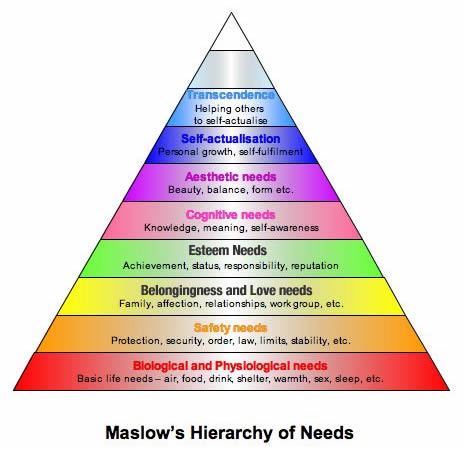
maslows_hierarchy_of_needs-4

Despite the government’s rhetoric on welfare “dependency”, and the alleged need for removing so-called “perverse incentives” from the social security system by imposing a harsh conditionality framework and a compliance regime – using punitive sanctions – and work capability assessments designed to preclude eligibility to disability benefits, research shows that generous social security regimes make people more likely to want to work, not less. I have written at length over the last few years about why a punitive welfare system can never work, as the government claim, to “incentivise people to find employment. See, for example, The Minnesota Starvation Experiment provided empirical evidence that demonstrates clearly why welfare sanctions can’t possibly work as an “incentive” to “make work pay”).

The government’s welfare “reforms” have already invited scathing international criticism because they have disproportionately targeted cuts at those with the least income. Furthermore, the government have systematically violated the human rights of those with mental and physical disabilities. In a highly critical UN report which followed a lengthy inquiry, it says: “States parties should find an adequate balance between providing an adequate level of income security for persons with disabilities through social security schemes and supporting their labour inclusion. The two sets of measures should be seen as complementary rather than contradictory.”

However, the UK government have continued to conflate social justice and inclusion with punitive policies and cuts – dressed up in the language of “incentives” and “nudge” – aimed at coercing disabled people towards narrow employment outcomes that preferably bypass any form of genuine support and the social security system completely.  (See –UN’s highly critical report confirms UK government has systematically violated the human rights of disabled people).

It’s hardly the case that the state has an even remotely credible track record of assessing people’s medical conditions, nor is it the case that this government bothers itself with empirical evidence, or deigns to listen to concerns raised by citizens, academics, professionals and charities regarding the harm that their policies are causing. This is a government that can’t even manage to observe basic human rights, let alone care about citizen’s best interests, health and wellbeing. In a political context of savage cuts to essential support and services for disabled people, and such blatant disregard of the legislative frameworks that outline their fundamental rights, it is very difficult to trust that this government have the best interests of disabled people in mind with the formulation of Work, Health and Employment related programmes. 

The government’s aim to prompt public services to “speak with one voice” to promote work as a health outcome is founded on highly questionable ethics. This proposed multi-agency approach is reductive, rather than being about formulating expansive, coherent, comprehensive and importantly, responsive provision.

Employment is not therapy. Ultimately, the IPS programme is all about (re)defining the behaviours, experience and reality of a social group to ensure they conform to government ideological incentives and to justify dismantling public services (especially welfare, and increasingly, the NHS – see, for example, Rogue company Unum’s profiteering hand in the government’s work, health and disability green paper).

This is form of gaslighting intended to extend oppressive political control and behavioural micromanagement. In linking receipt of welfare with health services and “state therapy,” with the single intended outcome explicitly expressed as employment, the government is purposefully conflating citizen’s widely varied needs with economic outcomes and diktats, isolating people from traditionally non-partisan networks of relatively unconditional support, such as the health service, social services, community services and mental health services.

Public services “speaking with one voice” will invariably make accessing support conditional, and further isolate already marginalised social groups. It will damage trust between people needing support and professionals who are meant to deliver essential public services, rather than simply extending government dogma, prejudices and discrimination.

Conservatives really seem to believe that the only indication of a person’s functional capacity, value and potential is their economic productivity, and the only indication of their moral worth is their capability and degree of willingness to work. But unsatisfactory employment – low-paid, insecure and unfulfilling work – can result in a decline in health and wellbeing, indicating that it is poverty and growing inequality, rather than unemployment, that increases the risk of experiencing poor mental and physical health.
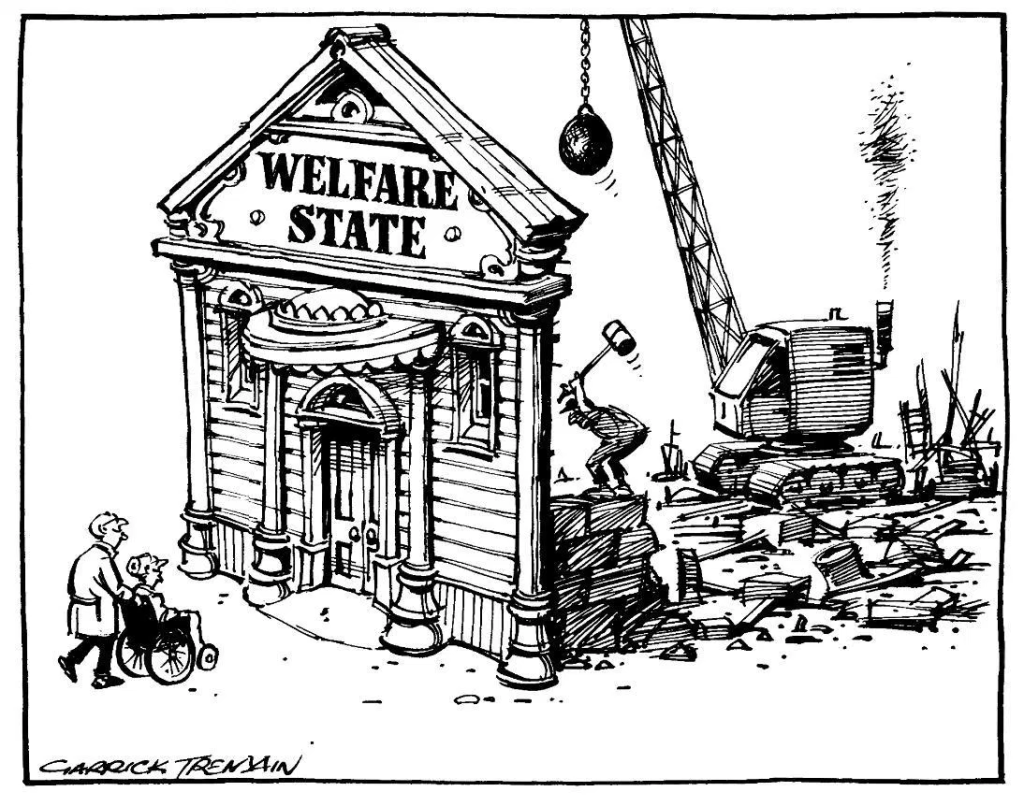
facade welfare