Author: Kitty S Jones

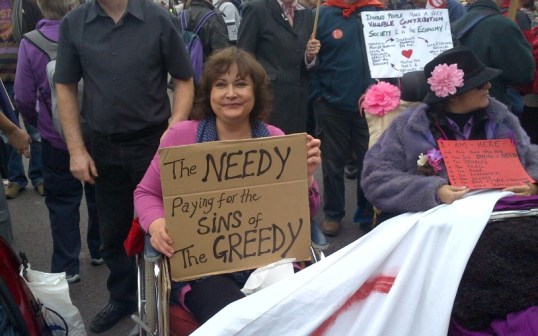
I’m a political activist with a strong interest in human rights. I’m also a strongly principled socialist. Much of my campaign work is in support of people with disability. I am also disabled: I have an autoimmune illness called lupus, with a sometimes life-threatening complication – a bleeding disorder called thrombocytopenia. Sometimes I long to go back to being the person I was before 2010. The Coalition claimed that the last government left a “mess”, but I remember being very well-sheltered from the consequences of the global banking crisis by the last government – enough to flourish and be myself. Now many of us are finding that our potential as human beings is being damaged and stifled because we are essentially focused on a struggle to survive, at a time of austerity cuts and welfare “reforms”. Maslow was right about basic needs and motivation: it’s impossible to achieve and fulfil our potential if we cannot meet our most fundamental survival needs adequately. What kind of government inflicts a framework of punishment via its policies on disadvantaged citizens? This is a government that tells us with a straight face that taking income from poor people will "incentivise" and "help" them into work. I have yet to hear of a case when a poor person was relieved of their poverty by being made even more poor. The Tories like hierarchical ranking in terms status and human worth. They like to decide who is “deserving” and “undeserving” of political consideration and inclusion. They like to impose an artificial framework of previously debunked Social Darwinism: a Tory rhetoric of division, where some people matter more than others. How do we, as conscientious campaigners, help the wider public see that there are no divisions based on some moral measurement, or character-type: there are simply people struggling and suffering in poverty, who are being dehumanised by a callous, vindictive Tory government that believes, and always has, that the only token of our human worth is wealth? Governments and all parties on the right have a terrible tradition of scapegoating those least able to fight back, blaming the powerless for all of the shortcomings of right-wing policies. The media have been complicit in this process, making “others” responsible for the consequences of Tory-led policies, yet these cruelly dehumanised social groups are the targeted casualties of those policies. I set up, and administrate support groups for ill and disabled people, those going through the disability benefits process, and provide support for many people being adversely affected by the terrible, cruel and distressing consequences of the Governments’ draconian “reforms”. In such bleak times, we tend to find that the only thing we really have of value is each other. It’s always worth remembering that none of us are alone. I don’t write because I enjoy it: most of the topics I post are depressing to research, and there’s an element of constantly having to face and reflect the relentless worst of current socio-political events. Nor do I get paid for articles and I’m not remotely famous. I’m an ordinary, struggling disabled person. But I am accurate, insightful and reflective, I can research and I can analyse. I write because I feel I must. To reflect what is happening, and to try and raise public awareness of the impact of Tory policies, especially on the most vulnerable and poorest citizens. Because we need this to change. All of us, regardless of whether or not you are currently affected by cuts, because the persecution and harm currently being inflicted on others taints us all as a society. I feel that the mainstream media has become increasingly unreliable over the past five years, reflecting a triumph for the dominant narrative of ultra social conservatism and neoliberalism. We certainly need to challenge this and re-frame the presented debates, too. The media tend to set the agenda and establish priorities, which often divert us from much more pressing social issues. Independent bloggers have a role as witnesses; recording events and experiences, gathering evidence, insights and truths that are accessible to as many people and organisations as possible. We have an undemocratic media and a government that reflect the interests of a minority – the wealthy and powerful 1%. We must constantly challenge that. Authoritarian Governments arise and flourish when a population disengages from political processes, and becomes passive, conformist and alienated from fundamental decision-making. I’m not a writer that aims for being popular or one that seeks agreement from an audience. But I do hope that my work finds resonance with people reading it. I’ve been labelled “controversial” on more than one occasion, and a “scaremonger.” But regardless of agreement, if any of my work inspires critical thinking, and invites reasoned debate, well, that’s good enough for me. “To remain silent and indifferent is the greatest sin of all” – Elie Wiesel I write to raise awareness, share information and to inspire and promote positive change where I can. I’ve never been able to be indifferent. We need to unite in the face of a government that is purposefully sowing seeds of division. Every human life has equal worth. We all deserve dignity and democratic inclusion. If we want to see positive social change, we also have to be the change we want to see. That means treating each other with equal respect and moving out of the Tory framework of ranks, counts and social taxonomy. We have to rebuild solidarity in the face of deliberate political attempts to undermine it. Divide and rule was always a Tory strategy. We need to fight back. This is an authoritarian government that is hell-bent on destroying all of the gains of our post-war settlement: dismantling the institutions, public services, civil rights and eroding the democratic norms that made the UK a developed, civilised and civilising country. Like many others, I do what I can, when I can, and in my own way. This blog is one way of reaching people. Please help me to reach more by sharing posts. Thanks. Kitty, 2012

Peaceful anti-fox hunting protester arrested for ‘breaching the peace’ at Welsh Tory manifesto launch

With thanks to B Heard Media

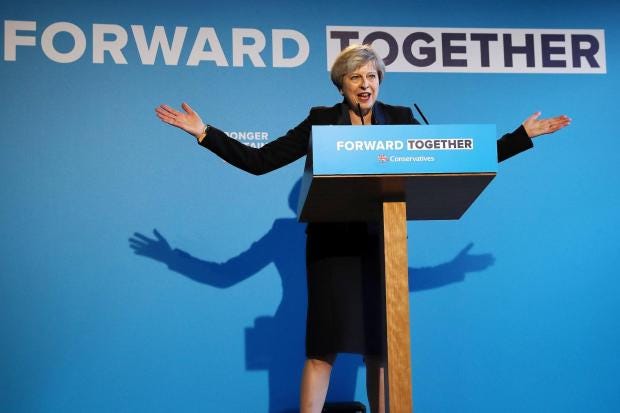
A protester was arrested for “breaching the peace” and dragged away by the police from a peaceful protest, as the prime minister’s car arrived in Wrexham before the launch of the Welsh Conservative manifesto

Connor was dragged to the ground by police as May’s motorcade swept past. Blowing a horn, he attempted to move towards the car with a banner before he was pounced on, tackled and dragged away, surrounded by hordes of photographers and journalists. A journalist and fellow campaigners asked if he was under arrest, an officer said: “Yes, he’s under arrest.” Pressed on what charge, he replied: “Breach of the peace.”

Connor was dragged along the floor, whilst shouting “This is the fascist state that we are living in under Theresa May’s regime.” 

He told reporters who were present that he was protesting about the “repeal of the foxhunting Act, fracking, austerity, “state therapy”,  – the lot”.

“I’ve not done nothing wrong,” he added.

Another demonstrator told police that Connor, who appeared to have a Merseyside accent, had “done nothing wrong” and described their response as a farce.

Theresa May has said she would give Conservative MPs a free vote on the ban, most likely meaning that in a planned and highly regressive move, the ban will be lifted if the party wins the number of seats it seems to expect to. 

 25-year-old Connor was later released without charge.

Superintendent Nick Evans claims: “Our policing operation today was proportionate and necessary.” 

Article 11 Right to protest and freedom of association

Everyone has the right to freedom of peaceful assembly. This is a right closely linked to the right to freedom of expression. The right to peaceful protest in the UK is expressly guaranteed under the European Convention of Human Rights (ECHR).

It provides a means for public expression and is one of the key foundations of a democratic society.

The right applies to protest marches and demonstrations, press conferences, public and private meetings, counter-demonstrations, “sit-ins”, motionless protests etc.

The right only applies to peaceful gatherings and does not protect intentionally violent protest.

This was not a violent protest.

There may be interference with the right to protest if the authorities prevent a demonstration from going ahead; halt a demonstration; take steps in advance of a demonstration in order to disrupt it; and store personal information on people because of their involvement in a demonstration.

The right to peaceful assembly cannot be interfered with merely because there is disagreement with the views of the protesters or because it is likely to be inconvenient and cause a nuisance or there might be tension and heated exchange between opposing groups.

There is a positive obligation on the State to take reasonable steps to facilitate the right to freedom of assembly, and to protect participants in peaceful demonstrations from disruption by others.

The rights to free speech and protest, along with the right to form and join associations or groups, are found in Articles 10 and 11 of the UK Human Rights Act 1998.

These rights can be limited by law to protect the interests of others, but only when the limitation is proportionate and necessary in a democratic society.

So, for example:

  • the right to free speech will not protect a person who tries to spread hateful lies against another but it will protect fair comment;
  • the right to protest won’t protect violent gatherings but it will protect peaceful protest.

In recent years we have seen a variety of measures introduced that undermine the right to protest and freedom of speech:

  • Laws that were explicitly intended to combat anti-social behaviour, terrorism and serious crime are routinely used against legitimate protesters;
  • Broadly drafted anti-terrorism offences of ‘encouragement’ and ‘glorification’ of terrorism threaten to make careless talk a crime;
  • Membership of certain organisations can be banned under anti-terror laws even if the organisation is non-violent and political;
  • Hate speech laws have been extended in a piecemeal way to ban ever-expanding categories of speech;
  • Broad anti-terrorism powers of stop and search have been used to harass and stifle peaceful protesters;
  • Protest around Parliament has been severely restricted by laws limiting and overly regulating the right to assemble and protest around Parliament.

Another Conservative government will undermine both the right to protest and disassemble our human rights more generally.


I don’t make any money from my work. I am disabled because of illness and have a very limited income. 

But you can help by making a donation to help me continue to research and write informative, insightful and independent articles, and to provide support to others. The smallest amount is much appreciated – thank you.

DonatenowButton

Noam Chomsky endorses Jeremy Corbyn. Here’s why

Image result for Noam Chomsky

Professor Noam Chomsky has urged the British electorate to vote for Labour. In an exclusive interview with the Guardian, earlier this month, Chomsky stated: “If I were a voter in Britain, I would vote for him.”

The linguist, cognitive academic and philosophical anarchist endorsed Jeremy Corbyn, and observes that the Labour Party would be doing far better in opinion polls if it were not for the “bitter” hostility of the mainstream media.

As Chomsky is world renowned for being a major critic of neoliberalism, it comes as no surprise that he supports a candidate who would reverse the radical socioeconomic reforms that Britain has gone through since the Thatcher era.

He said there were a lot of factors involved, but insisted that Labour would not be trailing the Conservatives so heavily in the polls if the media was more open to Corbyn’s agenda.  He said: “If he had a fair treatment from the media – that would make a big difference.” 

Asked what motivation he thought newspapers had to oppose Corbyn, Chomsky said the Labour leader had, like Bernie Sanders in the US, broken out of the “elite, liberal consensus” that he claimed was “pretty conservative”.

It’s potentially a fresh and hopeful view from the Overton window, if only we would open the curtains.

The academic, who was in Britain to deliver a lecture at the University of Reading on what he believes is the deteriorating state of western democracy, says that voters had turned to the Conservatives in recent years because of “an absence of anything else”.

He said: “The shift in the Labour party under [Tony] Blair made it a pale image of the Conservatives which, given the nature of the policies and their very visible results, had very little appeal for good reasons.”

He added that Labour had needed to “reconstruct itself” in the interests of working people, with concerns about human and civil rights at its core, arguing that such a programme could appeal to the majority of people. As a human rights activist, I have to agree.

Chomsky said that the future must lie with the left of the party. “The constituency of the Labour party, the new participants, the Momentum group and so on … if there is to be a serious future for the Labour party that is where it is in my opinion,” he said.

The comments came as Chomsky prepared to deliver a university lecture entitled Racing for the precipice: is the human experiment doomed?

He told the Guardian that he believed people had created a “perfect storm” in which the key defence against the existential threats of climate change and the nuclear age were being radically weakened.

“Each of those is a major threat to survival, a threat that the human species has never faced before, and the third element of this pincer is that the socio-economic programmes, particularly in the last generation, but the political culture generally has undermined the one potential defence against these threats,” he said.

Chomsky described the defence as a “functioning democratic society with engaged, informed citizens deliberating and reaching measures to deal with and overcome the threats”. 

He said that neoliberal policies are the reason for the breakdown in democracy, they had transferred power from public institutions to markets and deregulated financial institutions while failing to benefit ordinary people. 

It’s certainly true that neoliberalism is incompatible with democracy and human rights frameworks.

He said: “In 2007 right before the great crash, when there was euphoria about what was called the ‘great moderation’, the wonderful economy, at that point the real wages of working people were lower – literally lower – than they had been in 1979 when the neoliberal programmes began. You had a similar phenomenon in England.”

Chomsky said that the disillusionment that followed gave rise to the surge of anti-establishment movements – including Donald Trump and Brexit, but also Emmanuel Macron’s victory in France and the rise of Corbyn and Sanders. 

He said: The Sanders achievement was maybe the most surprising and significant aspect of the November election. Sanders broke from a century of history of pretty much bought elections. That is a reflection of the decline of how political institutions are perceived.”

But he said the positions that the US senator, who challenged Hillary Clinton for the Democratic nomination, had taken would not have surprised Dwight Eisenhower, who was US president in the 1950s.

“[Eisenhower] said no one belongs in a political system who questions the right of workers to organise freely, to form powerful unions. Sanders called it a political revolution but it was to a large extent an effort to return to the new deal policies that were the basis for the great growth period of the 1950s and 1960s.”

Chomsky believes that Corbyn stands in the same tradition.

The media is the massage

Chomsky has written extensively about the role of the free market media in reinforcing dominant ideology and maintaining the unequal distribution and balance of power. 

In Manufacturing Consent, Chomsky and Herman explore the pro-establishment media’s role in establishing the apparence of a political and economic orthodoxy (neoliberalism) and extending a seemingly normative compliance with state policies, while also marginalising antithetical or alternative perspectives, dismissing them as heresy. In the US and UK, most left wing commentors have a very diminished media platform from which to present their perspectives and policy proposals.

This “free-market” version of censorship is more subtle and difficult to identify, challenge and undermine than the equivalent propaganda system which was present in Nazi Germany or the Soviet Union. 

As Chomsky argues, the mainstream press is corporate owned and so reflects corporate priorities and interests. While acknowledging that some journalists are dedicated and well-intentioned, he says that the choice of topics and issues featured in the mass media, the unquestioned premises on which that “coverage” rests, and the range of opinions that are expressed are all constrained to reinforce the state’s dominant ideology.

Last year, research by YouGov found that the British media is the most right wing in Europe. Readers also ranked the British press as the most biased in all of the seven countries surveyed.

Noam Chomsky: I would vote for Jeremy Corbyn (extended interview) – BBC Newsnight

Noam Chomsky’s 8-Point Rationale for Voting for the “Lesser Evil” Candidate

Although this was written about the American political system, it applies equally well to the UK one.

Chomsky says: “Critics of “lesser evil voting” (LEV) should consider that their footing on the high ground may not be as secure as they often take for granted. 

Generally associated with the religious left, secular leftists implicitly invoke it when they reject LEV on the grounds that “a lesser of two evils is still evil.” Leaving aside the obvious rejoinder that this is exactly the point of lesser evil voting – i.e. to do less evil, what needs to be challenged is the assumption that voting should be seen a form of individual self-expression rather than as an act to be judged on its likely consequences. 

The basic moral principle at stake is simple: not only must we take responsibility for our actions, but the consequences of our actions for others are a far more important consideration than feeling good about ourselves.

Leaving aside the obvious rejoinder that this is exactly the point of lesser evil voting-i.e. to do less evil, what needs to be challenged is the assumption that voting should be seen a form of individual self-expression rather than as an act to be judged on its likely consequences, specifically those outlined in 4). The basic moral principle at stake is simple: not only must we take responsibility for our actions, but the consequences of our actions for others are a far more important consideration than feeling good about ourselves.

While some would suggest extending the critique by noting that the politics of moral witness can become indistinguishable from narcissistic self-agrandizement, this is substantially more harsh than what was intended and harsher than what is merited. That said, those reflexively denouncing advocates of LEV on a supposed “moral” basis should consider that their footing on the high ground may not be as secure as they often take for granted to be the case.

A third criticism of LEV equates it with a passive acquiescence to the bipartisan status quo under the guise of pragmatism, usually deriving from those who have lost the appetite for radical change. It is surely the case that some of those endorsing LEV are doing so in bad faith-cynical functionaries whose objective is to promote capitulation to a system which they are invested in protecting. Others supporting LEV, however, can hardly be reasonably accused of having made their peace with the establishment.

Their concern, as alluded to in 6) and 7) inheres in the awareness that frivolous and poorly considered electoral decisions impose a cost, their memories extending to the ultra-left faction of the peace movement having minimized the comparative dangers of the Nixon presidency during the 1968 elections. The result was six years of senseless death and destruction in Southeast Asia and also a predictable fracture of the left setting it up for its ultimate collapse during the backlash decades to follow.

The broader lesson to be drawn is not to shy away from confronting the dominance of the political system under the management of the two major parties. Rather, challenges to it need to be issued with a full awareness of their possible consequences.

This includes the recognition that far right victories not only impose terrible suffering on the most vulnerable segments of society but also function as a powerful weapon in the hands of the establishment center, which, now in opposition can posture as the “reasonable” alternative. A Trump presidency, should it materialize, will undermine the burgeoning movement centered around the Sanders campaign, particularly if it is perceived as having minimized the dangers posed by the far right.

A more general conclusion to be derived from this recognition is that this sort of cost/benefit strategic accounting is fundamental to any politics which is serious about radical change. Those on the left who ignore it, or dismiss it as irrelevant are engaging in political fantasy and are an obstacle to, rather than ally of, the movement which now seems to be materializing.

Finally, it should be understood that the reigning doctrinal system recognizes the role presidential elections perform in diverting the left from actions which have the potential to be effective in advancing its agenda. These include developing organizations committed to extra-political means, most notably street protest, but also competing for office in potentially winnable races. The left should devote the minimum of time necessary to exercise the LEV choice then immediately return to pursuing goals which are not timed to the national electoral cycle.

*****

1) Voting should not be viewed as a form of personal self-expression or moral judgement directed in retaliation towards major party candidates who fail to reflect our values, or of a corrupt system designed to limit choices to those acceptable to corporate elites.

2) The exclusive consequence of the act of voting in 2016 will be (if in a contested “swing state”) to marginally increase or decrease the chance of one of the major party candidates winning.

3) One of these candidates, Trump, denies the existence of global warming, calls for increasing use of fossil fuels, dismantling of environmental regulations and refuses assistance to India and other developing nations as called for in the Paris agreement, the combination of which could, in four years, take us to a catastrophic tipping point. Trump has also pledged to deport 11 million Mexican immigrants, offered to provide for the defense of supporters who have assaulted African American protestors at his rallies, stated his “openness to using nuclear weapons”, supports a ban on Muslims entering the U.S. and regards “the police in this country as absolutely mistreated and misunderstood” while having “done an unbelievable job of keeping law and order.” Trump has also pledged to increase military spending while cutting taxes on the rich, hence shredding what remains of the social welfare “safety net” despite pretenses.

4) The suffering which these and other similarly extremist policies and attitudes will impose on marginalized and already oppressed populations has a high probability of being significantly greater than that which will result from a Clinton presidency.

5) 4) should constitute sufficient basis to voting for Clinton where a vote is potentially consequential-namely, in a contested, “swing” state.

6) However, the left should also recognize that, should Trump win based on its failure to support Clinton, it will repeatedly face the accusation (based in fact), that it lacks concern for those sure to be most victimized by a Trump administration.

7) Often this charge will emanate from establishment operatives who will use it as a bad faith justification for defeating challenges to corporate hegemony either in the Democratic Party or outside of it. They will ensure that it will be widely circulated in mainstream media channels with the result that many of those who would otherwise be sympathetic to a left challenge will find it a convincing reason to maintain their ties with the political establishment rather than breaking with it, as they must.

8) Conclusion: by dismissing a “lesser evil” electoral logic and thereby increasing the potential for Clinton’s defeat the left will undermine what should be at the core of what it claims to be attempting to achieve.”

 
 —
 

Noam Chomsky is institute professor emeritus in the Department of Linguistics and Philosophy at Massachusetts Institute of Technology. His most recent books are Who Rules the World? (Metropolitan Books, 2016) and Requiem for the American Dream: The 10 Principles of Concentration of Wealth & Power (Seven Stories Press, 2017). His website is www.chomsky.info.

Fear of losing disability support led a vulnerable man to a horrific suicide

PAY-Protesters-with-posters-outside-the-Dept-of-Work-Pensions

The government have persistently denied that there is a “causal link” between their welfare “reforms” (a Conservative euphemism for savage cuts) and an increase in suicides, premature deaths, psychological distress and severe hardship. However, a number of researchers and many campaigners have demonstrated a clear correlation that the government have so far refused to investigate further. Correlation quite often implies a causal relationship, and as such, requires further research.

Each case that has been presented to the government as evidence that their policies are causing severe harm has been dismissed as “anecdotal”.

Dr Simon Duffy, Director of the Centre for Welfare Reform said: “It is not enough to just stop introducing new policies to attack the rights and lives of disabled people and the poorest in society. These policies have been in place for six years and many are designed to increase poverty year on year. The Government should apologise for the harm it has caused since 2010, calculate the full impact of cuts that targeted the most disadvantaged and begin a full programme of reparations.”

This is the third harrowing article I have written this week about the devastating impact of the Conservatives’ punitive welfare policies on some of our most vulnerable citizens. I wish with all my heart that this is the last such article.

However, we have a government that has casually and systematically transgressed the human rights of disabled people, and then casually denied that they have done so. 

There will continue to be a need of witnesses like myself and other campaigners until the political denial stops.

Last month, an inquest in Ipswich heard how Peter, a disabled man, struggling to cope with mental health problems, committed suicide by setting himself on fire because of fear that he would lose his lifeline support, following his compulsory re-assessment for Personal Independence Payment (PIP).

The government introduced the controversial PIP to replace Disability Living Allowance (DLA) in order to save costs and to “target those most in need” in 2013.  

Peter Sherwood set fire to himself in front of horrified onlookers in Lowestoft town centre on September 4, 2015.  The retired builder died in Broomfield Hospital, Chelmsford, which has a specialist burns unit, on September 8, 2015, following the horrific incident in Lowestoft town centre four days before.

Peter had received a letter from the Department for Work and Pensions, informing him that his DLA was ending and that he needed to reapply for PIP.

He suffered with a recurrent depressive disorder and psychosis. Peter had attempted to take his own life on a number of occasions previously. He also had a condition called tardive dyskinesia, which caused involuntary movements to his mouth and is a known side-effect of anti-psychotic medications.

Giving evidence at the inquest, Lucinda Stapleton, care coordinator from the Waveney Recovery Team, said this had affected Peter’s self-confidence as he was worried people were laughing and staring at him when he left the house.

In a statement read during the hearing, Mr Sherwood’s niece, Sarah Wilby, said: “I knew he was feeling a bit low the last time I saw him, which was two weeks before he died. He held me close on the sofa and told me he loved me.

“He was a loving person and had a great sense of humour.

He was angry at many things in life, but could put a good front on.

“I loved him very much and miss him dreadfully.”

Ms Wilby said she was shocked at the drastic way her uncle took his own life.

She added: “He seemed to want to make some kind of a statement, but I don’t know what.”

During the inquest Ms Wilby said that Peter was claiming Disability Living Allowance but not long before his death he received a letter informing him he needed to reapply for Personal Independence Payment, which she believes contributed to his low mood at that time.

She said: “I personally think quite an underlying cause of his anger was the change in benefits.

“Knowing Peter as we did that would have had a huge impact on him.”

Paul Anderson, a community support worker for the Norfolk and Suffolk Foundation Trust, said Peter had claimed that the Government was trying to take money off him.

The Coroner, Peter Dean, read statements from witnesses, who described seeing Peter spraying something on the pavement starting with the letter ‘h’ with an aerosol can.

The inquest heard passer-by William Groves asked Peter if he was a street artist, to which he replied “no, I’m a suicide artist”.

Peter then poured liquid over his head and set himself on fire using a lighter.

Members of the public tried to douse the flames by first throwing their jackets onto Peter, and then using a fire extinguisher from a nearby shop.

Police at the scene reported that Peter had muttered the word “humanity” to them a couple of times following the incident.

On September 4, 2015, Peter was visited at home by the community mental health team and he had expressed plans to end his life.

An urgent appointment was made for Peter to see a psychiatrist the following week, but it was tragically too late.

Norfolk and Suffolk NHS Foundation Trust has since updated its criteria of when patients should be referred to the 24-hour crisis team, following its routine investigation into Peter’s death.

The medical cause of death was given as 75% non-survivable full thickness burns, and mental health concerns.

The coroner’s conclusion was suicide.

If you are experiencing distress and feel suicidal, please don’t suffer in silence. The Samaritans have launched a free telephone national helpline number, 116 123. 

People who are going through a difficult time can access the service round the clock, every single day of the year.

This number is free to call from both landlines and mobiles, including pay-as-you-go mobiles. You do not need to have any credit or call allowance on your plan to call 116 123.


Related

Government guidelines for PIP assessment: a political redefinition of the word ‘objective’

New discriminatory regulations for PIP come into effect today

Disabled mum took fatal overdose after she was refused PIP

Vote Labour to uphold the rights of disabled people – our letter to the Guardian


I don’t make any money from my work. I am disabled because of illness and have a very limited income. 

But you can help by making a donation to help me continue to research and write informative, insightful and independent articles, and to provide support to others. The smallest amount is much appreciated – thank you.

DonatenowButton


Raincoat. Age. Die. A guest post by Hubert Huzzah

Hubert

In 2008 there were 700,000 people with dementia in the UK. That number is rising rapidly and is projected to be over 1 million by 2025. One in three people over 65 will end their lives with a form of dementia. In 2008 there were 580,000 people with dementia needing Carers in England.

Not all Dementia Sufferers are home owners. For the age group most likely to suffer Dementia 71.6% (45-75+) of the population do own their own home. The average home is worth £215,847 at 2017 prices. So, of the one million people with dementia by 2025, 716,000 will be sitting on assets worth a total of £154Bn.

Imagine being able to take ownership of £154Bn of assets simply by waiting ten years. That is the Dementia Tax. By 2027 those who are currently suffering from even mild dementia symptoms will have to pay for care as the value of the Home will be taken into account when means testing financial support for social care.

Currently, Carers put £132Bn into the Economy purely through Caring Services. This is the amount of money after all benefits – not just Attendance Allowance or Carers Allowance – are paid out. Carers are, in general, the next generation for Dementia sufferers – the children and grandchildren. In total, the Dementia Tax will be taking £286Bn from people who already pay substantial amounts into the economy and have been doing so for two generations.

That means penalising people until 2050 and it does not even make financial sense.

A report from the London School of Economics and King’s College London commissioned by the Alzheimer’s Society estimated the financial cost of dementia at over £17 billion for the state and families in 2008. This cost grew significantly as the number of people with dementia rose. A King’s Fund study estimated that the cost of dementia in England would rise from £14.9 billion per year in 2007 to £24 billion (at 2007 prices) by 2026, making up 74% of mental health service costs. Using £154Bn of assets to pay for £24Bn of expenditure is not only poor economics it is an invitation to fraud on an industrial scale.

The less well understood outcome will be a house price collapse leaving first time buyers in negative equity for the first time since the 1980s. In efforts to reduce the amount paid for Care Services, it will become rational for Carers of Dementia Sufferers to undervalue the property to bring the total estate under £100,000 for the purposes of means testing. Undervaluation to receive benefits is, in Social Security Law, fraud. Which will result in a market in avoidance and evasion promoting corruption. The policy, itself, is about effective money laundering which is, always, corrupt.

This undervaluation of properties will, inevitably, signal to the markets that house prices are dropping and so provide pressure to further reduce house prices. This will leave existing first time buyers at risk of negative equity. When Dementia Sufferers within the Dementia Tax Regime begin to die, First Time Buyers will sell to escape negative equity. Resulting in an extreme boom and crash market that will last for decades. The initial boom will be hailed as an economic miracle until the initial crash reveals the depth of the problem. In 2007 the National Audit Office estimated that £102 million could be saved by reducing the time people Dementia Sufferers stay in hospital.

A Lincolnshire case study they found that people with dementia on orthopaedic wards were staying over 24 days on average compared to under 17 days for people without. That increased length of Hospital stay is increasingly expensive as Private Contractors provide the service. At the same time, the Private Contractors, driven by profit, have no incentive to move Dementia sufferers out of Hospitals. The overall outcome is that Hospitals will become bed blocked by Private Contractors and that will feed back to poorer Accident and Emergency Service, longer waiting times and increased ill health in the general population.

The Dementia Tax is a poorly thought out policy that has one objective: releasing £154Bn of assets into financial markets. With the net contribution of £29Bn to the UK economy from the Insurance Sector in 2015, the indication is that the £154Bn will be a five year soft landing for the Insurance Sector on exit from the EU. That soft landing will, inevitably, be a source of capital flight from the UK to other EU capitals such as Dublin, Paris and Berlin. Which leaves the policy cascading out from the Health and Social Care Sector to cascade destabilisation across the Economy.

There are 379 authorised Life Insurance Companies in the UK. 200 are UK authorised and 179 are headquartered in another European country and passport in under the EU Third Life Directive. With the unfolding of Exit from the European Union, the Dementia Tax creates a mechanism for capital flight from the UK via those 179 passported Life Insurance companies. If the UK wishes to retain a working financial services relationship after exit then those 47.2% of Life Insurance Companies passported into the UK market will become the potential source of almost £73Bn of capital flight.

It is a poorly thought out, uncosted, scheme that seeks to buy time for the Tories. Given the public availability of information that can be used to cost the scheme, and the pieces of past research that show how poor equity-release is for solving financial problems, where did the Dementia Tax actually come from?


Sources: National Audit Office, Alzheimers Society, Association Of British Insurers. Picture: Madeline Von Foerster. “The Promise II” (Death And The Maiden).

Written by Hubert Huzzah

Woman was too scared to leave job centre during a heart attack as she feared being sanctioned

Salena Hannah (Photo: Adam Sorenson)

A woman who suffered a heart attack during a job centre in-work progression interview has said she was too scared to get up and leave to get medical help as she was afraid of ­losing her benefits. Salena Hannah, who works part-time, says that she had the attack during her appointment, but was ignored by the “callous” job centre interviewer.

She explained: “I had been suffering with chest pains for about two weeks and took a couple of sprays of GTN spray, to help with my angina, before I walked in to meet my interviewer.

“My job is under 16 hours, so I am forced to attend regular meetings, or my benefits might be stopped.

“I was feeling some really bad pains in my chest and I told her at least two or three times that I was in agony, but she was just so callous, she just kept ignoring me.

“I said I needed to go to the NHS walk-in centre immediately, but it fell on deaf ears. I was living in fear of being sanctioned and just felt trapped. I didn’t think I could leave or I would be sanctioned.”

Salena says she was forced to endure a 40-minute interview, while sweating profusely and suffering chest pains.

As soon as she left the interview, she went straight to a nearby NHS walk-in centre, where medics immediately called an ambulance and took her to hospital.

Blood tests revealed she had suffered a heart attack and she had to have surgery to have two stents inserted into her arteries.

Although Salina was discharged after three days in hospital, she suffered serious chest pains an hour after she got home, and had to return to hospital, where doctors inserted three more stents.

Salina is now recovering at home but is struggling for breath and feels constantly weak.

She said: “I was just dreading getting sanctioned. I just would not be able to afford to live if that happened, so pain or no pain, I had to endure that meeting.

“It is unbelievable how cruel the sanction scheme can be to people like me. It is almost like they are trained to be unfeeling.

Is that what Britain is coming to these days under a Tory Government?”

Salena, a mum of four, is bringing up her two grandsons aged 14 and 10 on her own. Had she been sanctioned, she would not have been able to provide for their basic needs.

At the time of her heart attack, she was working in a chip shop and was in receipt of JSA and housing benefit.

Last year, the The National Audit Office launched a scathing attack on the benefit sanctions system, saying that punishing people for “non-compliance” with welfare conditionality does more harm than good and costs more to enforce than it saves. There is no evidence that the pointlessly cruel welfare sanctions work at all. 

The report said that withholding benefits, which is now very commonplace, plunges claimants into hardship, hunger and depression. It also seriously jeopardises their health, since sanctions leave people without the means to meet the costs of food, fuel and often, shelter – and these are fundamental survival needs.

Dr Wanda Wyporska, director of The Equality Trust, said: “It’s disgusting to see how some of the most vulnerable people in society are treated.

“Our social security system is being slowly eroded and further cuts will see the poorest families hit even harder.”

Tim Roache, general secretary of the GMB, said: “You have to wonder if all compassion has been completely ripped from our system by continued austerity and cuts to frontline services.”

A Department for Work and Pensions (DWP) spokesperson said: “We would always encourage claimants who suddenly fall ill to seek medical attention, or to speak to a member of staff for assistance.”

The Department, however, is not focused not on helping individuals but on cutting welfare expenditure while hitting targets for doing so. 

In February, employer relationship manager at Jobcentre Plus in Tyne & Wear and Northumberland, who is based at the branch featured in the film I, Daniel Blake, said: “I, Daniel Blake is a representation … I hope people don’t think the film is a documentary, because it’s a story that doesn’t represent the reality we work in.”

“My team and I try to treat people as individuals, and we care about the work we do,” he told the Guardian. “There will be times when we get it wrong, but I don’t believe we are ever as wrong as how we are portrayed in this film.

“I remember talking about the film in the canteen. We were concerned about how it might affect our relationship with the people we were trying to help find work. How would they react to it?”

Ken Loach, however, defended the authenticity and realism of the film’s content. “I challenge anyone to find a single word in that film that isn’t true,” he said.

I, Daniel Blake tells the story of a joiner who has had a heart attack, and is no longer able to work. However, he becomes caught up in the nightmare bureacracy of the welfare state, is passed as “fit for work” at his work capability assessment, and is told he has to look for work. He suffers a second fatal heart attack just before his tribunal, as a consequence of the sustained psychological distress and strain he experiences because of the punitive Conservative welfare “reforms”. 

Damian Green, the work and pensions secretary, said the film was “monstrously unfair” – though he added he had not seen it. 

I wonder if Green considers his department’s lies “monstrously unfair”. For example, in August 2015, the DWP admitted to using fictional stories from made-up claimants on leaflets, despicably advertising the “positive impact” of benefit sanctions, following a Freedom of Information request from Welfare Weekly, claiming that they were for “illustrative purposes only” and admitting that it was “quite wrong” to pass these off as genuine quotes.

Later that month figures were released which showed that between December 2011 and February 2014, 2,650 people died shortly after their Work Capability Assessment told them that they should be finding workThe DWP had fought hard for the figures not to be released, with chief minister Iain Duncan Smith at one point telling Parliament that they did not exist.

Research published in the Journal of Epidemiology and Community Health by Oxford University and Liverpool University, showed there were an additional 590 suicides between 2010 and 2013 in areas where Work Capability Assessments (WCA) were carried out. The researchers say that the DWP had introduced the policy of moving people off benefits without understanding the consequences. The research showed a correlation between worsening mental health and the assessments. The DWP of course denied the evidenced correlation between suicides and the WCA. 

I, Daniel Blake has been criticised by some media commentators, such as Toby Young (the Daily Mail) and the Sunday Times film critic Camilla Long who said it did not “ring true”. However, Hayley Squires, who plays a single mother in the film, said it showed “the absolute truth of what’s happening to millions of British people in this country” and accused Young and Long of “irresponsible journalism”.

The government’s controversial benefit sanctions regime can cause “damage to the wellbeing of vulnerable claimants and can lead to hunger, debt and destitution”, according to a damning new report, which debunks Tory myths that benefit sanctions – denying people who are already struggling the only means by which to support themselves and their families – “incentivise people into work.”

In a report titled Benefit Conditionality and Sanctions in Salford – One Year on, it was concluded that, far from than “incentivising” people to move into work, the sanctions regime actually serves as a demotivator and barrier, preventing people from engaging in appropriate training, volunteering and employment-related activities.

Furthermore, the sudden loss of income caused by removing benefits – through the imposition of a punitive sanctions regime – often damages people’s mental health, creates tensions within family relationships and may cause individuals to turn to crime in order to meet their basic survival needs.

Salford City Mayor, Paul Dennett said: “People on benefits are already struggling to afford food, heating and essential costs. They can’t save so they have no financial safety net. They live in dread of being sanctioned  which isn’t the right frame of mind for job hunting, volunteering or going back into education.” Or for looking for more hours of work.

The cruel and inhumane way that Salena Hannah was treated by a job centre “advisor”, and the fear and dread that she felt at the prospect of being sanctioned, is real.

Susan Roberts’ despair following her PIP application being refused, which led to her suicide, was real.

David Clapson’s awful death, which was the result of grotesque government policies, is real.

David Sugg, who was so afraid of the catastrophic health impacts that the strain of the Work Capability Assessment (WCA) may have had on him, left a letter for the local coroner, to be opened in the event of his sudden death. He feared the assessment would kill him. That is real.

George Vranjkovic’s extreme anxiety, agitation and fear facing the WCA, which he knows is designed to try and cut costs and take lifeline support from sick and disabled people, is real. He lost his lifeline support for six months previously. His panic attack the night before the WCA is real. 

A man who was forced to give up work with heart problems had his benefits stopped for failing to complete a WCA – after suffering a heart attack during the examination. That is real.

Sheila Holt, who suffers from bipolar disorder, was sectioned after being taken off Income Support. Days later she had a heart attack and fell into the coma. Nonetheless, she was sent a letter by Atos to ask why she was not working. That really happened. 

I co-run a support group on Facebook for sick and disabled people claiming disability benefits. I know from the accounts and everyday experience of many others just how stressful the assessment process is. It’s a terrible and shameful state of affairs when people who are already struggling with severe health problems are made even more vulnerable because of callous cost-cutting government policies. That is real.

It needs to change. That is real.

We are all, potentially, Daniel Blakes. That is real.

Dave Johns in I, Daniel Blake. (Mongrel Media)


I don’t make any money from my work. I am disabled because of illness and have a very limited income. The budget didn’t do me any favours at all.

But you can help by making a donation to help me continue to research and write informative, insightful and independent articles, and to provide support to others. The smallest amount is much appreciated – thank you.

DonatenowButton


Theresa May pledges to create new internet that would be controlled and regulated by government

Image result for theresa May Internet regulations

A plurality of views and perspectives is a fundamental ingredient of a flourishing democracy. Freedom of speech is a prerequisite of an inclusive, genuine democracy. When a government tries to stifle some perspectives, and control which views may be expressed or permitted online, it’s an indication that we have left democracy behind, and strayed into the realms of authoritarianism.

If Theresa May gets to form a new government next month, then it would appear that the Conservatives will be attempting a regulatory land grab of the Internet. But, if the Conservatives’ digital record is anything to go by, its pledge to negotiate an “international settlement” and be a “global leader” for an incredibly complex area of Internet and data law looks, frankly, like the stuff of dystopian movies about totalitarian regimes. I suspect the phrase “digital crime” is set to take on a whole new meaning. 

May is planning to introduce far-reaching regulations on the way the internet works, allowing the government to decide what is said online. Much of the internet is currently controlled by private businesses like Google and Facebook, Theresa May intends to allow government to decide what is and isn’t published, the manifesto strongly suggests.

I’m all for an internet environment that is safe and free from harassment and bullying. However, we already have legislation in place to ensure that it is.

The proposed laws would also force technology companies to delete anything that a person posted when they were under 18.

 The companies would be forced to help controversial government schemes like its Prevent strategy, by promoting “counter-extremist narratives”.

It seems that this is a Conservative reaction to the EU Digital Single Market Project.
It’s aim is “to create a true digital single market, where the free movement of goods, persons, services and capital is ensured — and where citizens and businesses can seamlessly and fairly access online goods and services: whatever their nationality, and wherever they live.” (Commission Press Release May 2015).

The new EU digital single market legislative package seeking to improve cross-border access to digital services and create a level playing field for companies will be launched in 2015. The Commission will also seek to complement the regulatory telecommunications environment, modernise EU legislation on copyright and audio-visual media services, simplify the rules for consumers making online purchases, and enhance cyber-security. This ambitious agenda includes concluding the long-running negotiations over data protection reform.

As my friend Hubert Huzzah has pointed out, the European Single Digital Market will make it difficult to defraud people, and importantly,  it will the Election manipulation in the form of  “we are just advertising on Facebook” strategies worthless.

The Conservative plans are in keeping with the Conservatives’ commitment that the online world must be regulated and controlled as strongly as the offline one, and that the same rules should apply in both.

“Our starting point is that online rules should reflect those that govern our lives offline,” the Conservatives’ manifesto says, in justification for the new level of regulation. 

In laying out its plan for increased regulation, the so-called “small state” Tories anticipate and reject potential criticism that such rules could put people at risk.

“While we cannot create this framework alone, it is for government, not private companies, to protect the security of people and ensure the fairness of the rules by which people and businesses abide,” the document reads. “Nor do we agree that the risks of such an approach outweigh the potential benefits.”

Tucked away at the end of the Conservative’s manifesto, it’s clear that May wants to introduce huge changes to the way the internet works:

“We will take up leadership in a new arena, where concern is shared around the world: we will be the global leader in the regulation of the use of personal data and the Internet.”

Among the new self -appointed powers proposed, the government intends to force internet companies to remove “explicit” or “extremist material”, backed by legal power to impose fines.

This is a government that has labeled disability campaigners  “extremists” and fully endorsed the media labeling of those in standing in democratic opposition to Conservative policies as “saboteurs”.

The Conservatives say “Some people say that it is not for government to regulate when it comes to technology and the internet.  We disagree.”

The Conservatives are claiming this proposal is part of an ambitious attempt by the party to impose some sort of “decorum” on the internet and social media.

Senior Conservatives have also confirmed to BuzzFeed News that the phrasing indicates that the government intends to introduce huge restrictions on what people can post, share and publish online.

The plans will allow Britain to become “the global leader in the regulation of the use of personal data and the internet”, the manifesto claims.

Internet imperialism, how very Conservative.

There are many proposed measures in the manifesto that are designed to make it easier to do business online, of course, but the Conservatives are proposing a rather more oppressive approach when it comes to social networks.

One particular issue that caught my eye was the Conservative’s voiced “concerns about online news”, warning the government is willing to “take steps to protect the reliability and objectivity of information that is essential to our democracy”, while pledging to “ensure content creators are appropriately rewarded for the content they make available online”.  

One Tory source clarified that this comment relates to Google and Facebook’s growing dominance of the advertising market, which the newspaper industry believes is crushing its business model. The source suggested that if the web giants failed to act voluntarily then they could be forced by legislation to find ways to financially compensate traditional news producers.

Implications for social media

So, the Conservatives will also seek to regulate the kind of news that is posted online and how companies are paid for it.

This may have some potentially serious implications for the growing number of online independent media platforms that have developed precisely because of an undemocratic crisis of representation in our mainstream media, which has increasingly become an unreliable source of objective news, generally. 

Independent media includes any form of autonomous media project that is free from institutional dependencies, and in particular, from the influence of government and corporate interests.

We are not constrained by the interests of society’s major power-brokers. So far. 

I haven’t forgotten Iain Duncan Smith’s pledge to “monitor” the BBC’s news coverage for “left wing bias”, or the jackbooted government officials visiting the Guardian offices to smash the hard drives containing the Snowden leaks. This doesn’t signal a coming improvement if it is to be based on Tory standards of “objective and reliable”. 

The manifesto also says that the government will work even harder to ensure there is no “safe space for terrorists to be able to communicate online”. That is apparently a reference in part to its work to encourage technology companies to build backdoors into their encrypted messaging services – which gives the government the ability to read terrorists’ messages, but also weakens the security of everyone else’s messages, technology companies have warned.

The proposals follow on from the Investigatory Powers Act being passed into law. That legislation allowed the government to force internet companies to keep records on their customers’ browsing histories, as well as giving ministers the power to break apps like WhatsApp so that messages can be read.

Imagine a future when the only online reflection of reality is a Conservative one. Antisocial media.

“In every really great world-shaking movement, propaganda will first have to spread the idea of this movement. Thus, it will indefatigably attempt to make the new thought processes clear to the others, and therefore to draw them over to their own ground, or to make them uncertain of their previous conviction.

Now, since the dissemination of an idea, that is, propaganda, must have a firm backbone, the doctrine will have to give itself a solid organization. The organization obtains its members from the general body of supporters won by propaganda. The latter will grow the more rapidly, the more intensively the propaganda is carried on, and the latter in turn can work better, the stronger and more powerful the organization is that stands behind it.” Adolph Hitler, Mein Kampf.

Hitler’s promise of “strong government and stability” was widely supported particularly by industrialists and businesses, who were terrified of the left wing unions, socialism and communism.

A lot of people describe Theresa May as a New Right Conservative, some have been misled by her semantic shifts and claimed she is a “red Tory”. However, it seems she is more of an old right wing authoritarian, after all.

The stuff of nightmares.


I don’t make any money from my work. I am disabled because of illness and have a very limited income. Successive Conservative chancellors have left me in increasing poverty. But you can help by making a donation to help me continue to research and write informative, insightful and independent articles, and to provide support to others. The smallest amount is much appreciated – thank you. 

DonatenowButton


Vote Labour to uphold the rights of disabled people – our letter to the Guardian

Image result for Human rights are universal

The following letter was published in the Guardian today, written and signed by a group of academics, professionals, campaigners and grassroots activists who work together cooperatively.

We collaborate to fulfil our mutual aims of achieving a progressive, civilised, just and safe society for all. We hope to do this by ensuring that the society we are a part of is democratic and fully inclusive: we want a civilised society that observes and meets its human rights obligations on behalf of all social groups. This isn’t happening currently. (See: UN’s highly critical report confirms UK government has systematically violated the human rights of disabled people).

As an independent researcher, writer, campaigner, and as a disabled person, I am very proud to be included among them. 

westminster-20121020-00081

Many disabled people see Labour’s policies as a lifeline, say the 30 signatories to this letter. 

For chronically ill and disabled people, recent years have been a disaster. The UN recently found “reliable evidence that the threshold of grave or systematic violations of the rights of persons with disabilities has been met” (Report, 8 November 2016).

We have been forced through a work capability assessment that the government’s own expert adviser described as “inhumane”, and which in 2015 was found to be associated with an additional 599 suicides.

Many needing help are now forced through another persecutory assessment – the personal independence payment – designed to reduce the numbers qualifying for help by half a million.

Social care has been so savagely cut that some young disabled must wear incontinence pads for lack of toileting assistance. People can’t take any more of this.

Many disabled people are not party-political, but see Labour’s policies for disabled people as a lifeline – envisioning a society where people are treated as human beings deserving of respect, equality and a decent life. Please, don’t endorse recent human-rights abuses; endorse the human rights of disabled people by registering, and by voting Labour on 8 June.

Paul Atkinson Jungian psychotherapist
Stef Benstead Spartacus Network
Peter Beresford Co-chair, Shaping Our Lives
Gary Bourlet Founder, People First Movement in England
Dr Emma Bridger Research fellow in psychology
Professor Woody Caan Journal of Public Mental Health
Dr Kelly Camilleri Registered clinical psychologist
Merry Cross
Dr David Drew Labour Parliamentary candidate for Stroud
Nick Duffell Psychohistorian
Dr Simon Duffy Centre for Welfare Reform
Dr Dina Glouberman Skyros Holistic Holidays
Catherine Hale Chronic Illness Inclusion Project
AC Howard DWPexamination.org – For The UK’s Disabled Community
Chris Johnstone General practitioner
Sue Jones Psychologists Against Austerity, researcher and writer, campaigner
Jayne Linney Disability activist
Alec McFadden TUC Salford
Helen McGauley Trainee clinical psychologist, Lancaster University
Beatrice Millar Person-centred counsellor/psychotherapist
Rev Paul Nicolson Taxpayers Against Poverty
Gavin Robinson Alliance for Counselling and Psychotherapy
Professor Andrew Samuels University of Essex
Nicola Saunders Psychotherapist
Martyn Sibley Disability blogger
Mike Sivier Vox Political
Professor Ernesto Spinelli
Mo Stewart Independent researcher, disability studies
Gail Ward
Dr Jay Watts Queen Mary, University of London
Dr Claudia GillbergSenior Research Associate in Education; Fellow at Centre for Welfare Reform and Disability Rights Activist

Dr Richard House Alliance for Counselling and Psychotherapy


Join the debate – email guardian.letters@theguardian.com

Read more Guardian letters – click here to visit gu.com/letters


I don’t make any money from my work. I am disabled because of illness and have a very limited income. The budget didn’t do me any favours at all.

But you can help by making a donation to help me continue to research and write informative, insightful and independent articles, and to provide support to others. The smallest amount is much appreciated – thank you.

DonatenowButton

The government has failed to protect the human rights of children

Related image

The UK has plummeted from 11th position to 156th in global ranking for meeting its children’s rights obligations in the space of just a year. The UK now ranks among the bottom 10 global performers in the arena of improving the human rights of the child, after it achieved the lowest possible score across all six available indicators in the domain of Child Rights Environment (CRE), according to the KidsRights Index 2017.

The Index gathers data from Unicef and the United Nations Committee on the Rights of the Child (UNCRC) to identify global trends in the arena of children’s rights protection. It comprises a ranking for all UN member states that have ratified the UN Convention on the Rights of the Child, a total of 165 countries. 

The report says that a nation’s prosperity does not always guarantee children’s rights. Interestingly, economically better performing countries are not necessarily doing a better job when it comes to safeguarding the rights of children.

This year’s overall worst performing countries are the United Kingdom, Papua New Guinea, New Zealand, Guinea-Bissau, Equatorial Guinea, Chad, Vanuatu, Sierra Leone, Afghanistan and Central African Republic.

Very serious concerns have been raised about structural discrimination in the UK. Muslim children are facing increased discrimination following recent anti-terrorism measures, and a rise in discrimination against gypsy and refugee children in recent years.

The KidsRights Index is comprised of 5 domains: 

  1. Right to Life
  2. Right to Health
  3. Right to Education
  4. Right to Protection
  5. Enabling Environment for Child Rights

Marc Dullaert, founder and chairman of the KidsRights Foundation, has urged the UK government to treat non-discrimination as a policy priority, and to speed up the process of aligning its child protection laws with the Convention on the Rights of the Child at both the national and devolved levels, as well as in all crown dependencies.

He said: “Discrimination against vulnerable groups of children and youths is severely hampering opportunities for future generations to reach their full potential.” 

“Following the general election, the new government should demonstrate to the world that it will not allow the retreat from the EU to adversely affect the rights and opportunities of its children.” 

In light of the findings, Lord Philip Hunt, shadow deputy leader of the House of Lords and shadow health spokesperson, accused the Government of “inactivity” and “inadequate service provision”, urging it to do more to protect the rights of the child.

He said: “This report exposes the inactivity of the current UK government and inadequate service provision in this most important area of policy making; rights of the child.” 

“The UK is the sixth largest economy globally and therefore has the resources at its disposal to ensure that our children are adequately protected and cared for across multiple disciplines. Our children are our future and the barometer of our approach to social justice and the state of our society.”

Although many states have adopted new children’s rights policies in recent years, the Index reveals that implementation is often not evident, and many new policies fail to fully comply with the principles and provisions of the Convention on the Rights of the Child.

The Index rates and ranks the extent to which a country has implemented the general principles of the Convention on the Rights of the Child while taking into account the basic infrastructure for making and implementing children’s rights policies. Portugal is this year’s global top ranking nation, with France, Norway, Sweden, Finland and Spain also ranking in the top ten.

The Index methodology means that extremely poor performances in one domain cannot be compensated by higher scores in other domains, as all of areas children’s rights are deemed to be equally important.

The report concluded that many industrialised nations, and especially the UK, are falling far short of allocating sufficient budgets towards creating a stable environment for children’s rights, by neglecting their leadership responsibilities and failing to invest in the rights of children to the best of their abilities.

Human rights and the impact of childhood poverty 

Earlier this month, another damning report published by the Royal College of Paediatrics, Child Health (RCPCH) and Child Poverty Action Group (CPAG) revealed that more than two-thirds of paediatricians believe poverty and low income contribute “very much” to the ill health of children that they work with. 

The report – Poverty and child health: views from the frontline  is based on a survey of more than 250 paediatricians across the country, whose comments provide an insight into the grave reality of life for the millions of UK children living in poverty.

Latest figures show that more than one in four (nearly 4 million) children in the UK live in poverty – with projections suggesting this could rise to 5 million by the end of the decade.

The report explores number of areas including food insecurity, poor housing and worry, stress and stigma – and the effect of these issues on the health of children.  

The report reveals that:

  • more than two-thirds of paediatricians surveyed said poverty and low income contribute ‘very much’ to the ill health of children they work with
  • housing problems or homelessness were a concern for two-thirds of respondents.
  • more than 60% said food insecurity contributed to the ill health amongst children they treat 3
  • 40% had difficulty discharging a child in the last 6 months because of concerns about housing or food insecurity
  • more than 50% of respondents said that financial stress and worry contribute ‘very much’ to the ill health of children they work with

Alison Garnham, Chief Executive of the Child Poverty Action Group, said:

“Day in, day out doctors see the damage rising poverty does to children’s health. Their disquiet comes through in the survey findings and should sound alarms for the next government. Low family incomes, inadequate housing and cuts to support services are jeopardising the health of our most vulnerable children.

“We can and must do better to protect the well-being of future generations. reinstating the UK’s poverty-reduction targets would be an obvious place to start.” 

Professor Russell Viner, Officer for Health Promotion at the Royal College of Paediatrics and Child Health, said:

“Poverty has a devastating effect on child health and this report makes disturbing reading. The health impact on children living in poverty is significant – whether that’s increased likelihood of respiratory problems, mental ill-health or obesity – than children living in more affluent areas.

“Worryingly, almost half of those surveyed feel the problem is getting worse, with the combination of increasing poverty, housing problems and cuts to services meaning more families are struggling.”  

The RCPCH and CPAG are calling on whoever forms the next Government to tackle poverty urgently through: 

  • the restoration of binding national targets to reduce child poverty, backed by a national child poverty strategy
  • the adoption of a ‘child health in all policies’ approach to decision making and policy development, with Her Majesty’s Treasury disclosing information about the impact of the Chancellor’s annual budget statement on child poverty and inequality
  • the reversal of public health cuts to ensure universal early years services, including health visiting and school nursing, are prioritised and supported financially, with additional targeted help for children and families experiencing poverty
  • the reversal of cuts to universal credit which will leave the majority of families claiming this benefit worse off.

As one survey respondent said: “We cannot expect to have a healthy future for the UK if we leave children behind. Poverty makes children sick.”

There were 3.9 million children living in “relative poverty” in 2014-15, up from 3.7 million a year earlier, according to figures from the Department for Work and Pensions (DWP).

The report follows the release of  figures from the DWP which revealed one in four (nearly four million) children in the UK live in poverty – with projections suggesting this could rise to five million by the end of the decade.

It’s not as if the government have been unaware of the consequences of their policies and the implications of a consistent failure to uphold the UK’s human rights obligations towards children. In 2014, the Children’s Commissioner warned that the increasing inequality resulting from the austerity cuts, and in particular, the welfare reforms, means that Britain is now in breach of the United Nations Convention on the Rights of the Child, which is supposed to protect children from the adverse effects of government economic measures.

In 2015, the Children’s Commissioner criticised the Conservative’s tax credit cuts and called for measures to reduce the impact that the changes will have on the poorest children. Anne Longfield, who took up her role on 1 March 2015, called on the government to exempt 800,000 children under five from tax credit cuts and to offer additional support to families with a child under five-years-old.

The role of Children’s Commissioner was established under Labour’s Children Act in 2004 to be the independent voice of children and young people and to champion their interests and bring their concerns and views to the national arena. The Commissioner’s work must take regard of children’s rights (the United Nations Convention on the Rights of the Child) and seek to improve the wellbeing of children and young people.

However, the government rejected the findings of what they deemed the “partial, selective and misleading” Children’s Commissioner report. The Commissioner wrote to the Chancellor to call for children in the poorest families aged under five to be protected from the cuts.

However, George Osborne shamefully remained brazenly unrepentant.

A damning joint report written by the four United Kingdom Children’s Commissioners for the UN Committee on the Rights of the Child’s examination of the UK’s Fifth Periodic Report under the UN Convention on the Rights of the Child (UNCRC), dated 14 August 2015, says, in its overall assessment of the UK’s record: 

“The Children’s Commissioners are concerned that the UK State Party’s response to the global economic downturn, including the imposition of austerity measures and changes to the welfare system, has resulted in a failure to protect the most disadvantaged children and those in especially vulnerable groups from child poverty, preventing the realisation of their rights under Articles 26 and 27 UNCRC. 

The best interests of children were not central to the development of these policies and children’s views were not sought. 

Reductions to household income for poorer children as a result of tax, transfer and social security benefit changes have led to food and fuel poverty, and the sharply increased use of crisis food bank provision by families. In some parts of the UK there is insufficient affordable decent housing which has led to poorer children living in inadequate housing and in temporary accommodation.

Austerity measures have reduced provision of a range of services that protect and fulfil children’s rights including health and child and adolescent mental health services; education; early years; preventive and early intervention services; and youth services. 

The Commissioners are also seriously concerned at the impact of systematic reductions to legal advice, assistance and representation for children and their parents/carers in important areas such as prison law; immigration; private family law; and education. This means that children are denied access to remedies where their rights have been breached.

The Commissioners are also concerned at the future of the human rights settlement in the United Kingdom due to the UK Government’s intention to repeal the Human Rights Act 1998 (HRA) which incorporates the European Convention on Human Rights (ECHR) into domestic law; replace it with a British Bill of Rights (the contents of which are yet to be announced), and ‘break the formal link between British courts and the European Court of Human Rights’.

The HRA has been vital in promoting and protecting the rights of children in the United Kingdom and the European Court of Human Rights has had an important role in developing the protection offered to children by the ECHR.The Commissioners are concerned that any amendment or replacement of the HRA is likely to be regressive.”

In another regressive and punitive policy move by the government, from April 6 2017, child tax credits and universal credit across the UK will be restricted to the first two children in a family. This measure will affect all households with two or more children that have an additional child after this date.

Analysis by consultancy Policy in Practice revealed a low-income family whose third or additional child is born before midnight on the day before the policy came into force would qualify for up to £50,000 in tax credit support over 18 years whereas a similar family whose third child is born on April 6 will miss out.

The government says it wants to save money and make the tax credit system “fairer”. It intends the two-child restriction to “influence the behaviour” of less well-off families by making them “think twice” about having a third child. But it also accepts there is no evidence to suggest this will happen.

This is an extremely regressive eugenic policy, with its emphasis being on social class. Eugenics was discredited following its terrible escalation and consequences in Nazi Germany.  

The two children only policy also a reflects a politically motivated form of crude behaviourism –  behaviour modification through the use of financial punishments. It’s probably true that all authoritarians and tyrants are behaviourists of sorts.

Critics say that at current birth rates, 100,000 third or subsequent children will not qualify for tax credit support over the next 12 months, inflating child poverty figures by at least 10% by 2020.

Social Darwinism is linked closely with eugenic ideas – a view that society and economics will naturally “check” the problem of dysgenics if no welfare policies are in place. 

The Conservative government has steadily dismantled the welfare state over the past seven years, so that now, there is no longer adequate support provision for people both in work and out of work, to meet their basic living needs. 

The current retrogressive, draconian approach to poverty needs to radically change if we are to be a nation that respects and upholds the human rights of all its citizens.


I don’t make any money from my work. I am disabled because of illness and have a very limited income. But you can help by making a donation to help me continue to research and write informative, insightful and independent articles, and to provide support to others. The smallest amount is much appreciated – thank you.

DonatenowButton

Mandatory reconsiderations and the rule of law

When is a reconsideration not a reconsideration?

When the Department for Work and Pensions are reviewing their own decisions.

Mandatory reviews were introduced by the Conservative government to deter people from appealing unfair Department for Work and Pensions decisions. They are not actually genuine reconsiderations. A Freedom of Information (FoI) request has revealed that there is a target set so that decisions in at least 80% of cases are to be upheld in the Department’s favour. That is regardless of the actual details and circumstances of each case under review, and the level accuracy, fairness and rationale that informed the original decision. This fundamentally removes an opportunity for access to justice and the right to redress for people who are on the end of unfair political decision making processes.

“This appears to be an absolutely outrageous interference by the executive with the rule of law.”

Absolutely. I campaigned against the introduction of Mandatory Reconsideration back in 2012/13, precisely because it smacks of despicable political authoritarianism and rigid ideological antiwelfareism.

The FoI response says:

The key measures which are used by the Department for Work and Pensions to monitor Mandatory Reconsideration (MR) Performance are: 
 
a) 90% to be cleared within target. 
         
b) 80% of the original decisions are to be upheld. 
 
The performance measures for April 2016 – March 2017 are: 
 
% MR Cleared within target = 70.2% 
 
% MR Original Decision Upheld = 87.5% 

Henry Brooke's avatarHenry Brooke

Note: This should now be read alongside my next blog on Muddled language, as it appears that the DWP did not mean what it said in answer to the FOI request.

From time to time I have been invited to help seriously disabled people attain their rights after their applications for appropriate benefits have been turned down by agents appointed by the Department of Work and Pensions (DWP).

View original post 273 more words

Disabled mum took fatal overdose after she was refused PIP

Susan Roberts was found dead because of a morphine overdose (Photo: Philip Coburn)

A disabled mum, Susan Roberts, was found dead at home following an overdose of morphine. Susan died just metres away from a heartbreaking 11-page letter she had written to the Department for Work and Pensions (DWP), detailing her suffering following being told she wasn’t eligible for Personal Independence Payment (PIP). 

Susan, a grandmother of eight, had survived four heart attacks. She died £4,000 in debt, after taking a fatal overdose within hours of being informed that her claim for PIP was unsuccessful. She had previously claimed Disability Living Allowance (DLA) and had been given an indefinite award, as her medical conditions were considered highly unlikely to get better.

The letter from the Department for Work and Pensions (Photo: Philip Coburn)

Susan was asked to apply for PIP by the DWP following the proposed closure of her DLA claim. Many people who have previously been eligible for DLA have found that they lose their support once they are reassessed for PIP. The government introduced PIP to replace DLA and to cut costs in 2013, as a part of their welfare “reform” programme, which inflicted cuts on the poorest citizens. The Conservatives claim that PIP “targets those most in need”. However, many people with the highest level of needs have been turned down for PIP after having indefinite or lifetime awards of DLA.

Susan’s tragic death also highlights that despite their claims, the government are not succeeding in “targeting the most vulnerable people”

Before taking a fatal dose of morphine, Susan had placed the paperwork from the DWP, which informed her that she had been turned down for PIP following mandatory review, a Do Not Resuscitate note and her unsent letter, on her dresser.

Susan was shocked when she was informed that she did not even qualify for an award of PIP at the lower rate. 

She began her heartbreaking letter: “Dear sirs, first of all, I request that you read this through carefully – this is my life after all.”

She said: “I am in a considerable state of depression after receiving your decision about my claim for PIP.”

Describing her health, she said: “My gall bladder needs to be removed because of multiple stones, weight loss, vomiting, excruciating pain – but specialists won’t operate because of my heart condition.”

She then describes the impact of suffering from ME, and explains that she can only manage to do tasks for just two or three hours a day. 

Susan had a stent fitted after her heart attacks and spent most of her time bedbound, largely due to also having ME.

An operation to remove part of her bowel meant she needed help to go to the toilet. She also needed help with her personal care, such as showering and with shopping, as she struggled to walk. But in late 2015, the Conservatives scrapped DLA and replaced it with PIP. Anyone 65 or older on April 8, 2013 still got DLA.

Susan’s daughter, Hayley Storrow, said: “It’s so sad. If she was born a week earlier she may have still been alive today.”

Susan’s PIP assessor had somehow erroneously decided that she could wash and bathe unaided, go to the loo and walk over 200 metres. Shockingly, this type of “error” and gross inaccuracy is very commonplace in the reports produced when disabled people are assessed for their lifeline support. In fact, earlier this year, the Labour party, the Green party and the Liberal Democrats called for the government to act on claims of widespread dishonesty by the medical professionals paid to compile benefits assessment reports, following a two-month investigation by Disability News Service.

Susan added in her letter that she would be virtually housebound without her Motability vehicle and her concluding comment is: “Thank you for reading this, with the greatest respect.”

She lost her Motability car last April because of the DWP’s decision not to award her PIP. Susan had sent a heartbreaking text to her daughter, Hayley, saying: “I’m never going to be able to see you again because they are taking the car.”

Susan is among thousands of disabled people who have lost their specialist Motability vehicles and wheelchairs because of cruel Conservative cuts and the restrictions to the eligibility criteria of PIP, and many more are likely to be affected. 

The PIP is supposed to help with the additional costs of being disabled, and in supporting disabled people in maintaining their independence and dignity, but many people are being denied the benefit because they are not assessed properly, and because the eligibility criteria have been made increasingly restrictive.

This means people previously eligible for the mobility component of DLA lose their cars and wheelchairs once they have been reassessed for the new PIP, if they don’t qualify for the mobility component. For many disabled people, this is a massive blow which impacts on their ability to remain independent, take part in their communities or get and keep a job. PIP is not means tested, so disabled people in work may claim it to help with additional support and extra costs. Many people losing their Motability vehicle will no longer be able to work.

Susan had asked for a review of the DWP decision following her first appeal. On 18 May last year, a letter arrived at her warden-assisted flat to tell her that the PIP award had been turned down yet again.

She was found dead the following morning and despite the letter and papers left out on the dresser, remarkably, a coroner said in October that she “had not taken her own life as there was no suicide note”, ruling it was a “drugs-related death”.

However, her daughter, Hayley, said: “I believe her unsent letter was her suicide note.”

It’s highly unlikely that an accidental overdose would have somehow prompted Susan to include a Do Not Resuscitate note with her letter and the bundle of DWP paperwork, too.

Do Not Resuscitate (DNR) orders are basically notes kept in a patient’s file that they do not want to be resuscitated should their heart stop. The medical establishment views DNR orders as the patient’s choice, though they do request that those considering DNR orders to discuss it with their family members. DNR orders may be requested by patients for a variety of reasons, all of them designed to keep the patient from suffering further. However, DNR laws do not take into account the situation of mentally ill patients framing a DNR order as a preparation for suicide.

The fact that Susan left the DNR note out with her letter and bundle of DWP documents indicates that her overdose was not accidental.

The Coroner’s verdict

By the end of 2015 it had emerged that the UK had experienced the largest annual spike in mortality rates for nearly 50 years.

Much media coverage seems to avoid reporting suicide as a response to structural conditions, and instead tends to emphasise suicide as an outcome of “mental illness” – as an individual act, rather than a problem that is influenced by socioeconomic and political conditions. The government has attempted to reconfigure wider social and economic problems as psychological problems, which has pushed highly politicised individual clinical and state therapeutic interventions – embodied in a rise of the mass provision of cognitive behavioural therapy and mandatory “attitude adjustment” classes for welfare recipients in the UK. This approach reflects political ideology and prejudices, rather than tackling the bigger issues of social inequality, poverty, lack of opportunity and an extremely punitive welfare regime. All of which are largely shaped by government policies.

Earlier this year, the Samaritans pubished their report Dying from Inequalitywhich clearly recognised rising socioeconomic inequality with a higher risk of suicide. The charity called on the government to direct support to those with unstable employment, insecure housing, low income or in areas of socioeconomic deprivation.

Mary Hassell, the senior coroner for inner North London, wrote directly to the DWP in 2015, stating that the suicide of Michael O’Sullivan, a disabled man who hanged himself, had been a direct result of being ruled “fit to work.

The coroner’s verdict of Michael O’Sullivan’s suicide is widely seen as ground-breaking by disability rights campaigners and groups like Disabled People Against Cuts (DPAC) because the DWP, the media and charities usually frame suicide as “complex” with no single cause, which means suicide has rarely been directly linked to the austerity programme, nor have government policies more generally been seen as directly responsible for suicides. 

Suicide is a significant social problem. Over 800,000 people commit suicide every year. Many of these can be quite properly understood as “economic suicides” because they take place against a backdrop of structural adjustment policies and rampant neoliberal market-led reforms. A counter discourse to the government tendency of psychologising socioeconomic conditions, making them the responsibility of individuals, rather than government and wider society, is of course crucial.

Technically, a coroner makes a finding of fact at the end of an Inquest. The coroner cannot attribute blame to any individual and cannot imply a criminal or civil liability, by law. The Coroner must use the evidence heard to decide who the deceased person was, where they died, when they died, and what the cause of their death was. Commonly, the “finding of fact” is referred to as a verdict or conclusion. A conclusion of suicide is decided where the evidence indicates a person has voluntarily acted to destroy his or her life in an intentional way. Inquest verdicts of Suicide (and Unlawful Killing) must be decided “beyond reasonable doubt”. Other causes of death may be decided on “a balance of probability”.

However, there is evidence to suggest that suicides are being under-reported because of the change in Coroner’s statutory regulations and guidelines, in 2013. Interestingly, contrary to the current trend in health and safety inquests, the Ministry of Justice guidance tells coroners that, wherever possible, short-form conclusions should be delivered, rather than the more detailed narrative conclusion.

Furthermore, open conclusions are discouraged, to be used only as a “last resort”. Concerns have been raised about the government’s new short-form conclusions and some organisations, including the Royal College of Psychiatrists, have asked the government to give due consideration to changing the standard of proof required for suicide verdicts. The 2013 reforms also enable the government to suspend an independent inquest into any death in favour of an inquiry, which under the Inquiries Act 2005 can be now be held in secret. 

The House of Commons Health Committee Suicide prevention: interim report Fourth Report of Session 2016–17 says: “Our evidence suggests the need for a more rapid provisional notification of suicide at the time when a suspected death by suicide occurs. We recommend that the Government take action to improve consistency between coroners and to make routine the use of provisional notifications of suicide. Furthermore, we recommend that the standard of proof for conclusions of death by suicide should be changed to the balance of probabilities rather than beyond reasonable doubt.” 

Rule 43 of the Coroners Rules (1984) states that if the Coroner is of the opinion that a death could have been prevented if different action had been taken by a particular person or organisation, he/she may make a recommendation for change. Also, the scope of the coroner’s investigation must be widened to include an investigation of the broad circumstances of the death, including events leading up to the death in question, where this wider investigation is necessary to ensure compliance with Article 2 of the European Convention on Human Rights (right to life). The positive duty to protect life implies a duty to investigate unnatural deaths, including but not confined to deaths in which state agents may be implicated.

Hayley has accused the government of having blood on their hands. She said: “People are living in poverty or considering suicide because of these benefits changes. My Mum won’t be the last to die.”

A DWP spokeswoman said: “Our thoughts are with Mrs Roberts’ family but there is no evidence to suggest any link between her death and her benefit claim.”

There is no evidence to suggest it isn’t, either, without further investigation, which so far, the government have refused to do. There is an established correlation between disability benefit assessments and increased mental health problems, distress and exacerbations of physical illness symptoms, too. While correlation isn’t necessarily the same thing as causation, it quite often implies a causal link, which may only be ruled out following further investigation, rather than political denial.

The DWP has quietly carried out investigations into 60 cases where benefit claimants are said to have taken their own lives. Labour MP Diana Johnson said the figures cast doubt on claims that there is no link between suicide and welfare re-assessments, with the DWP carrying out the internal reviews over the last five years. 

Johnson said: “Ministers have repeatedly claimed there to be no link between suicide and welfare re-assessment whenever figures have come to light.

“This parliamentary answer to me blows this claim out of the water.

“If there was no link, there wouldn’t have been 60 reviews of suicides in the past five years.

“I am appalled that these figures have remained unpublished for so long.”

A written parliamentary question from the Hull North MP revealed that the DWP carried out 15 internal reviews into suicides or alleged suicides of so-called DWP “clients” in 2012/13 alone.

“Families who’ve been left in the dark need to know everything the DWP knows about these cases,” Johnson said.

“Most importantly, we need a welfare system that supports, rather than victimises, the poorest and most vulnerable in our society.”

Susan’s daughter, Hayley said: “When my brother went to mum’s flat after she died, he found 37p in her purse. Even with DLA she was living day to day, scraping by. She was found dead with the PIP refusal letter placed strategically on a dresser.

“She was a poorly woman and this ­decision tipped her over the edge – she was in a desperate situation. I feel if it wasn’t for PIP and the Tory Government, my mum would still be alive. 

“They failed her like they have failed thousands.”

Susan wrote the 11-page letter criticising the decision and outlining her circumstances but as the DWP turned down her initial appeal within six days, she did not have time to send it. 

Hayley said: “I just want Theresa May to know that her rules and regime are killing the most vulnerable people in society.

“With the election coming up, it is so vital that things change.

“I feel any vote for the Tories is going to lead to more deaths.”


If you are experiencing distress and feel suicidal, please don’t suffer in silence. The Samaritans have launched a free telephone national helpline number, 116 123. 

People who are going through a difficult time can access the service round the clock, every single day of the year.

This number is free to call from both landlines and mobiles, including pay-as-you-go mobiles. You do not need to have any credit or call allowance on your plan to call 116 123.


Related

Government guidelines for PIP assessment: a political redefinition of the word ‘objective’

Government subverts judicial process and abandons promise on mental health ‘parity of esteem’ to strip people of PIP entitlement

New discriminatory regulations for PIP come into effect today


I don’t make any money from my work. I am disabled because of illness and have a very limited income. The budget didn’t do me any favours at all.

But you can help by making a donation to help me continue to research and write informative, insightful and independent articles, and to provide support to others. The smallest amount is much appreciated – thank you.

DonatenowButton