Author: Kitty S Jones

I’m a political activist with a strong interest in human rights. I’m also a strongly principled socialist. Much of my campaign work is in support of people with disability. I am also disabled: I have an autoimmune illness called lupus, with a sometimes life-threatening complication – a bleeding disorder called thrombocytopenia. Sometimes I long to go back to being the person I was before 2010. The Coalition claimed that the last government left a “mess”, but I remember being very well-sheltered from the consequences of the global banking crisis by the last government – enough to flourish and be myself. Now many of us are finding that our potential as human beings is being damaged and stifled because we are essentially focused on a struggle to survive, at a time of austerity cuts and welfare “reforms”. Maslow was right about basic needs and motivation: it’s impossible to achieve and fulfil our potential if we cannot meet our most fundamental survival needs adequately. What kind of government inflicts a framework of punishment via its policies on disadvantaged citizens? This is a government that tells us with a straight face that taking income from poor people will "incentivise" and "help" them into work. I have yet to hear of a case when a poor person was relieved of their poverty by being made even more poor. The Tories like hierarchical ranking in terms status and human worth. They like to decide who is “deserving” and “undeserving” of political consideration and inclusion. They like to impose an artificial framework of previously debunked Social Darwinism: a Tory rhetoric of division, where some people matter more than others. How do we, as conscientious campaigners, help the wider public see that there are no divisions based on some moral measurement, or character-type: there are simply people struggling and suffering in poverty, who are being dehumanised by a callous, vindictive Tory government that believes, and always has, that the only token of our human worth is wealth? Governments and all parties on the right have a terrible tradition of scapegoating those least able to fight back, blaming the powerless for all of the shortcomings of right-wing policies. The media have been complicit in this process, making “others” responsible for the consequences of Tory-led policies, yet these cruelly dehumanised social groups are the targeted casualties of those policies. I set up, and administrate support groups for ill and disabled people, those going through the disability benefits process, and provide support for many people being adversely affected by the terrible, cruel and distressing consequences of the Governments’ draconian “reforms”. In such bleak times, we tend to find that the only thing we really have of value is each other. It’s always worth remembering that none of us are alone. I don’t write because I enjoy it: most of the topics I post are depressing to research, and there’s an element of constantly having to face and reflect the relentless worst of current socio-political events. Nor do I get paid for articles and I’m not remotely famous. I’m an ordinary, struggling disabled person. But I am accurate, insightful and reflective, I can research and I can analyse. I write because I feel I must. To reflect what is happening, and to try and raise public awareness of the impact of Tory policies, especially on the most vulnerable and poorest citizens. Because we need this to change. All of us, regardless of whether or not you are currently affected by cuts, because the persecution and harm currently being inflicted on others taints us all as a society. I feel that the mainstream media has become increasingly unreliable over the past five years, reflecting a triumph for the dominant narrative of ultra social conservatism and neoliberalism. We certainly need to challenge this and re-frame the presented debates, too. The media tend to set the agenda and establish priorities, which often divert us from much more pressing social issues. Independent bloggers have a role as witnesses; recording events and experiences, gathering evidence, insights and truths that are accessible to as many people and organisations as possible. We have an undemocratic media and a government that reflect the interests of a minority – the wealthy and powerful 1%. We must constantly challenge that. Authoritarian Governments arise and flourish when a population disengages from political processes, and becomes passive, conformist and alienated from fundamental decision-making. I’m not a writer that aims for being popular or one that seeks agreement from an audience. But I do hope that my work finds resonance with people reading it. I’ve been labelled “controversial” on more than one occasion, and a “scaremonger.” But regardless of agreement, if any of my work inspires critical thinking, and invites reasoned debate, well, that’s good enough for me. “To remain silent and indifferent is the greatest sin of all” – Elie Wiesel I write to raise awareness, share information and to inspire and promote positive change where I can. I’ve never been able to be indifferent. We need to unite in the face of a government that is purposefully sowing seeds of division. Every human life has equal worth. We all deserve dignity and democratic inclusion. If we want to see positive social change, we also have to be the change we want to see. That means treating each other with equal respect and moving out of the Tory framework of ranks, counts and social taxonomy. We have to rebuild solidarity in the face of deliberate political attempts to undermine it. Divide and rule was always a Tory strategy. We need to fight back. This is an authoritarian government that is hell-bent on destroying all of the gains of our post-war settlement: dismantling the institutions, public services, civil rights and eroding the democratic norms that made the UK a developed, civilised and civilising country. Like many others, I do what I can, when I can, and in my own way. This blog is one way of reaching people. Please help me to reach more by sharing posts. Thanks. Kitty, 2012

Sanctions are founded on Tory psychobabble. You can’t “incentivise” people by starving them

430835_148211001996623_1337599952_n (1)

The fact that there is now such an extensive gap between Conservative rhetoric, the claims being made and reality makes the task of critical analysis difficult.

But the most striking thing isn’t just the disorientating gap between rhetoric and reality: it is also the gap between the bland vocabulary used and the references, meanings and implications of what is actually being said.

Lying, saying one thing and doing another, creating a charade to project one false reality when something else is going on, is very damaging: it leaves people experiencing such deception deeply disorientated, doubting their own memory, perception and sanity.

To cover their tracks and gloss over the gaping holes in their logic, the Tories employ mystification techniques, the prime function of which is to maintain the status quo. Marx used the concept of mystification to mean a plausible misrepresentation of what is going on (process) or what is being done (praxis) in the service of the interests of one socioeconomic class (the exploiters) over or against another class (the exploited). By representing forms of exploitation as forms of benevolence, the exploiters confuse and disarm the exploited.

The Conservatives also use Orwellian-styled language – semantic shifts – and construct incongruent, dissonance-inducing narratives to misdirect us, and to mask the aims and consequences of their policies.  For example, the words “fair”, “support” and the phrase “making work pay” have shifted to become simple socio-linguistic codifications for very regressive punitive measures such as cuts to social security support. 

The semantics are also stratified. People who are unaffected by austerity policies will probably take the bland vocabulary at face value. Cameron said:

“The British people are decent, sensible, reasonable, and they just want a government that supports the vulnerable.”

However, the “vulnerable” know a very different reality to the one substituted and described on their behalf. People who are adversely affected by Conservative policy will regard the bland vocabulary as bewildering, deceitful, frightening – especially because of its incongruence with reality – and most likely, as very threatening. Such rhetoric is designed to hide intention, but it is also designed to deliberately invalidate people’s own experiences of Tory policies and ultimately, the consequences of an imposed Tory ideology.

Not that there can be any mistaking the threats aimed at sick and disabled people from Duncan Smith in his Conference speech. He said:

“We won’t lift you out of poverty by simply transferring taxpayers’ money to you. With our help, you’ll work your way out of poverty.”

Of course the Work and Pensions secretary employed a traditionally Tory simplistic, divisive rhetoric that conveniently sections the population into “deserving” tax payers and “undeserving” non-tax paying citizens, to justify his balefully misanthropic attitude towards the latter group, as usual. However, the majority of sick and disabled people have worked and have contributed tax. 

Tory claims are incongruent with reality, evidence, academic frameworks and commonly accepted wisdom.

As Dr Simon Duffy, from the Centre for Welfare Reform points out, the poor not only pay taxes they also pay the highest taxes.  For example, the poorest 10% of households pay 47% of their income in tax. This is a higher percentage than any other group. We tend to forget that people in poverty pay taxes because we forget how many different ways we are taxed:

  • VAT
  • Duties
  • Income tax
  • National Insurance
  • Council tax
  • Licences
  • Social care charges, and many others taxes.

Mr Duncan Smith said that many sick and disabled people “wanted to work” and that the Government should give them “support” to find jobs and make sure the welfare system encouraged them to get jobs.

Ah, he means the “making work pay,” approach, which is the Tory super-retro approach to policy-making, based on the 1834 Poor Law principle of less eligibility again.  The reality is that sick and disabled people are being coerced by the state into taking any very poorly paid work, regardless of whether or not they can work, and to translate the rhetoric further, Duncan Smith is telling us that the government will ensure the conditions of claiming social security are so dismal and brutal that no-one can survive it.

Cameron also claims that the Conservatives are the “party for workers”, and of course lamblasted Labour. Again. Yet it was the Labour party that introduced tax credits to ensure low paid workers had a decent standard of living, and this government are not only withdrawing that support, we are also witnessing wages drop lower than all of the other G20 countries, since 2010, the International Labour Organisation reliably informs us.

This fall not only led to a tight squeeze on living standards (the cost of living has rapidly increased), it also led to a shortfall in treasury income in the form of tax revenues. But all of this is pretty standard form for Conservative governments, and shouldn’t come as any surpise, given their history and ideological foundation. We see recession, lower standards of living, wages being driven down and poorer working conditions under very single Tory government. Thatcher did the same, for example.

And Cameron’s promise during his address to the Conservative party conference that “an all-out assault on poverty” would be at the centre of his second term is contradicted by a sturdy research report from the Resolution Foundation that reveals planned welfare cuts will lead to an increase of 200,000 working households living in poverty by 2020.

Duncan Smith also criticised what he claimed was Labour’s “something for nothing culture” which was of course a very supportive and fair, reasonably redistributive system. He also dismissed and scorned the protests against his policies, which his party’s conference has been subject to. But demonstration and protest is a mechanism of democracy for letting a government know that their policies are having adverse consequences.

Many of the disabled protesters at the conference are being hounded, hurt and persecuted by this government and actually, we are fighting for our lives. But clearly this is not a government that listens, nor is it one that likes democratic dialogue and accountability.

In his teeth-grindingly vindictive and blindly arrogant speech, Duncan Smith also criticised the old Employment Support Allowance benefit for signing people off work when they were judged by doctors as too sick to work. He claimed that Labour treated disabled people as “passive victims.” I’m wondering what part of professional judgements that a person is too sick to work this lunatic and small-state fetishist finds so difficult to grasp. Duncan Smith is a confabulating zealot who drives a dogmatic steam-roller over people and their experiences until they take some Tory neo-feudalist deferential, flat-earth shape that he thinks they should be.

Let’s not forget that this government have actually cut support for disabled people who want to work. The Access To Work funding has been severely cut, this is a fund that helps people and employers to cover the extra living costs arising due to disabilities that might present barriers to work. The Independent Living fund was also cruelly scrapped by this Government, which also has a huge impact on those trying their best to lead independent and dignified lives.

By “support to get jobs”, what Duncan Smith actually means is no support at all. He means more workfare – free labor for Tory donors – and more sanctions – the removal of people’s lifeline social security. He also means that good ole’ totalitarian dictum of “behaviour change,” a phrase that the Tories are bandying about a lot, these days.  Ask not what the government can do for you.

And what about the very frail and elderly people needing support?

The public care sector has been cut by a third this past 5 years, yet people are still aging and living longer, so demand for the services has risen. We know that private residential care homes notoriously put profit over care standards, as yet there’s not been an equivalent local authority scandal, but cuts and gross underfunding mean care workers are stretched beyond limit, and there aren’t enough funds to run an adequate home care service. It’s mostly the very frail and elderly who need this service. And it’s those vulnerable citizens that are being increasingly left without adequate care, and certainly not care of a sufficient standard to maintain their dignity.

These are citizens that have paid into a social security system that was established for “cradle to the grave” support if it was needed. This government has so wickedly betrayed them. That’s hardly making a lifetime of work and contribution “pay”.

The knock-on effect is that many people without adequate care end up stranded in hospital, taking up beds and resources, through no fault of their own, and as we know, the health service is also desperately struggling to provide adequate service because of Tory cuts.

Tory policy is all about social engineering using justification narratives founded on an insensate, draconian ideological and semantic unobtainium equivalent. It’s clear that this government lacks the experience and understanding necessary for the proper use of psychological terms. The content of their smug and vindictive justification narratives and stapled-together, alienating and psychopathic rhetoric deviates markedly from even basic common sense and good judgement.

The Tories reduce long debated, complex ideas to surprisingly spiteful platitudes, and hand us back dogmas gift wrapped in aggrandized certitude.

They bandy about insidiously bland, psychobabble words like “incentivise” in the context of coercive state actions – such as the ideas for welfare increased conditionality and brutal operant conditioning based sanctions.

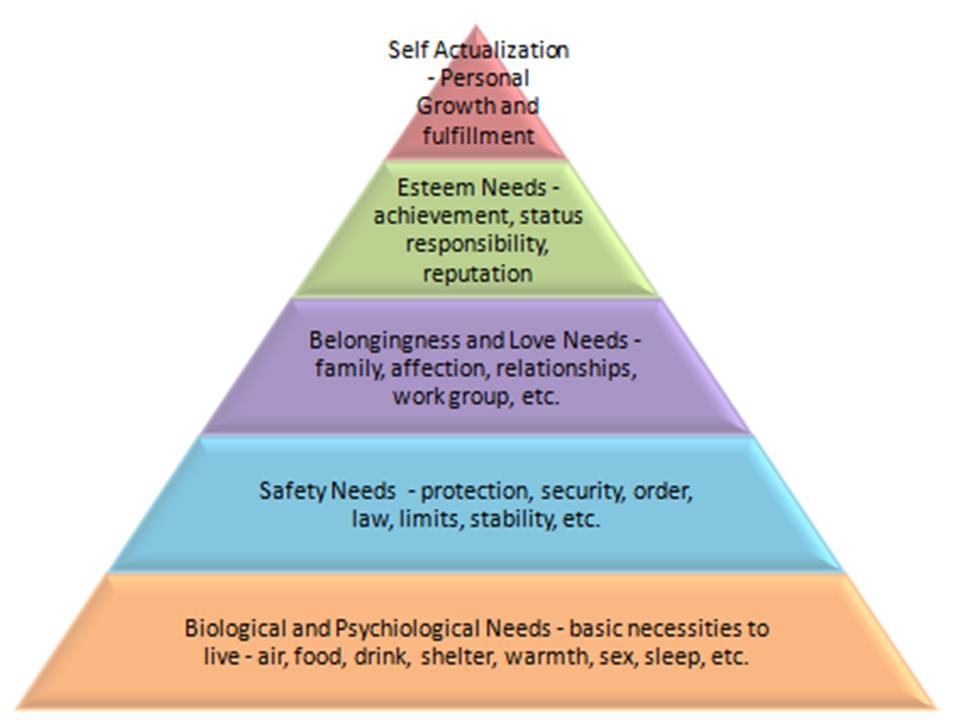
I sent an Freedom of Information request (FOI) to the Department of Work and Pensions asking about the sanction figures from 2010 to present day, and I also asked how sanctions can possibly “incentivise” or “help” people into work,  what psychological/academic/theoretical framework the claim is premised on and what research evidence supports this claim, after I pointed out Maslow’s motivation theory based on a hierarchy of needs – accepted conventional wisdom is that you can’t fulfil higher level psycho-social needs without first fulfiling the fundamental biological ones.

If people are reduced to struggling to meet basic survival needs, then they can’t be “incentivised” to do anything else. And even very stupid people know that if you remove people’s means to eat, keep warm and shelter, they will probably die. It’s worth remembering that originally, benefits were calculated to meet only these basic survival needs. That’s why welfare is called a social “safety net”.

No response from the Department of Work and Pensions yet.

maslow-5Maslow’s hierarchy of needs

There can be no justification whatsoever for removing that crucial safety net, and certainly not as a political punishment for people falling on hard times – that may happen to anyone through no fault of their own.

No matter what vocabulary is used to dress this up and attempt to justify the removal of people’s lifeline benefits, such treatment of citizens by an allegedly democratic, first-world government is unacceptable, despicable, cruel: it’s an act of violence that cannot fail to cause harm and distress, it traps people into absolute poverty and it is particularly reprehensible because it jeopardises people’s lives.

And what kind of government does that?

This is an excerpt, taken from a much longer article about the Tory Conference.
430847_149933881824335_1645102229_n (1)
Related

Sanctions misery for tens of thousands of families this Christmas

If the Tories don’t like being compared to the Nazis, then they need to stop behaving like despots.

Government under fire for massaging unemployment figures via benefit sanctions from Commons Select Committee

A tale of two suicides and a very undemocratic, inconsistent government

Rising ESA sanctions: punishing sick and disabled people for being sick and disabled

Benefit sanctions are not fair and are not helping people into work

292533_330073053728896_1536469241_nThanks to Robert Livingstone for the illustrations

This isn’t about Doctors or Nurses, GP’s or Consultants. It’s about our Free Health Service

stephenpaulblanchard's avatarstephenpaulblanchard

Yesterday morning, the silence was broken. Fifteen days after Jeremy Hunt made his inflammatory speech at the Kings Fund in Central London, giving NHS consultants an ultimatum on working weekends, and describing the rest of the staff as “lazy” and over-paid, the desperate voices of those people he bad-mouthed and those who support them were set free. After spending over two weeks building up in the virtual pressure cooker of social media, traditional news outlets have finally started to take notice.

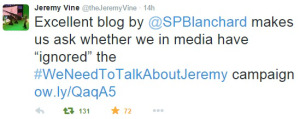
Twitter Jeremy Vine used his Twitter feed to break two weeks of silence around #WeNeedToTalkAboutJeremy.

Jeremy Vine is the first mainstream media broadcaster to openly take notice of #WeNeedToTalkAboutJeremy. He neither supports nor ridicules, merely highlighting the fact that there is a story here. Whether he decides to take it further and make it part of his Radio 2 show remains to be seen, but the fact that he recognises…

View original post 1,402 more words

Employment and Support Allowance – Another Mean Cut From IDS – Sheila Gilmore

Originally posted in the Huff Post, by Sheila Gilmore.

544840_330826693653532_892366209_nCruel cuts.

Policies developed on a false premise will inevitably run into problems. When these policies apply to people this can also cause great harm.

The Government’s policy on ‘sickness benefits’ is framed on the assertion that previous governments ‘dumped’ people on these benefits who never worked again. For their own good they needed to be re-tested on a new basis. Many people would then be returned to the labour market and spending on the benefit would be cut. The trouble is that numbers haven’t reduced much, and projected savings haven’t been made. But rather than review the basis on which their policy was built, it appears that the Government is simply going to cut by £30 per week the benefits of many of those its own test has found unfit for work for the time being. 

Like all good myths this has some elements of truth. Incapacity Benefit was used to deal with the problem of those displaced from industries like coal, textiles and steel during the 1980s. Job opportunities where they lived were limited, and many genuinely suffered from work related poor health . This was particularly true of older workers whose chances of a new job were always the slimmest. Under the Conservatives between 1978/79 and 1996/97, the total number of claimants more than doubled from 1.204 million to 2.569 million. This rate of increase slowed under Labour, with total numbers eventually peaking at 2.678 million in 2008/09 when ESA was introduced.

As this Budget rolls out I suspect we are going to hear a vigorous refreshing of the ‘people being callously dumped’ argument from Tory Ministers and backbenchers. However the truth is more complex. Even where total numbers have remained similar over a fairly long period, these are not by any means the same people. There is substantial flow both on and off benefit. Of those who are long term claimants , many have long term conditions making employment difficult, sometimes impossible.

 The Government insisted on rolling out the transfer of all existing Incapacity Benefit claimants to Employment & Support Allowance from 2011 , believing that the more stringent test applied for ESA would result in many existing claimants being found fit for work. In its first three years ESA was for new claimants only, with around 35% being found fit for work. The correctness of the testing process has rightly been the subject of much controversy , but applying the same test to those moving from IB produced a different result with only 23% being found fit for work initially.
One conclusion which may be reached is that in fact many people in receipt of IB actually were more unwell or disabled than the Government’s propaganda keeps suggesting . Not a conclusion it appears the Government wants to accept.

Even more crucially despite all the numbers being found ‘fit for work’, trumpeted by the Government as proof of their assertions, when you look at the total numbers in receipt of ESA, together those still on the older benefits, this number remains very high. The total number in receipt of ESA and IB is only 100,000 lower than in 2008/9.

Yet taking just the period between April 2011 and March 2013 some 234,600 former IB claimants had been found fit for work. With the toughness of the test also applying to new claimants, and the time-limiting of contributory ESA to a year for many , one would expect the total number of claimants to drop by more than the number of Incapacity Benefit claimants declared Fit for Work – but bizarrely it has dropped by considerably less.

With unemployment falling since 2008/9, one might hope that more people with health issues would have been able to find work.

Something unexplained is going on. Despite all the stress to individuals, the increasing cost and difficulty of administering the system (the migration process created a huge backlog in the assessment process), nothing much seems to have changed and savings not achieved. Are more people are becoming ill or disabled? This seems unlikely.

But what if the initial assumptions were wrong, and that there are not lots of ‘fit’ people sidelined onto incapacity benefits. Three quarters of those being ‘migrated ‘ from IB are not fit for work. The proportion of new claimants being found fit for work has fallen to 23%, and has been steadily falling . In addition I suspect that a good number of those declared Fit for Work, are simply not getting better, not getting jobs, getting less well and end up reapplying for ESA and being awarded benefit the second time round.

If we accept that most claimants actually face significant barriers to returning to work, we need to be putting more effort into both giving them the help they need, and encouraging employers to take people on. This was what the Work Related Activity Group was intended to do, but for many the support offered is minimal . People are invited to ‘work focused interviews (in letters that contain severe warnings about the consequences of not attending) and are then sent away for a year in some cases. Box ticked but no help given. Some are referred to the Work Programme which has very poor outcomes for this group, not surprising given that those attending say that all the emphasis was on the mechanics of job search with little reference to their heath.

Taking away £30 pw of income won’t tackle these weaknesses of the system. Will there still be a Work Related Activity Group at all? The only difference from being on JSA will be less conditionality (although there is still some and examples of ESA-WRAG claimants being sanctioned).

Nor are we dealing here with people with minor illness. Charities report that 45% of people who put in a claim for ESA, and had Parkinson’s, Cystic Fibrosis, multiple sclerosis, or Rheumatoid Arthritis, were placed in the Work Related Activity Group (WRAG).

While this change isn’t due to start until 2017 it won’t take long for it to apply to a substantial number of people . Around 700,000 apply each year for ESA, of which number around 60% proceed to full assessment (the others generally return to work before the process is complete). Currently around 14% of these go into the WRAG. That’s around 60,000 people affected every year.

37079_433060243430176_1848475368_nPictures courtesy of Robert Livingstone

The new social prescribing: ask not what your government can do for you

socialprescribing


I have a background in community work and have always seen it as a progressive mechanism for social transformation; challenging oppression; extending inclusion and democracy; offering learning and personal growth opportunities; empowerment, social justice, equity, fairness, participation, self-determination, amongst many other things. Communities potentially provide essential support for individuals, groups and organisations, and opportunities for reciprocity. Good community work promotes human development, and fosters civic responsibility through solidarity, cooperation and mutual aid.

Social prescribing is basically a community-based referral: it’s a means of enabling primary care services to refer patients with psycho-social, emotional or practical needs to a range of local, non-clinical services, often provided by the voluntary and community sector, and it’s aim is to improve people’s mental health, physical health and wellbeing, using community interventions.

In practice this means that GPs, nurses and other healthcare practitioners work with patients to identify non-medical opportunities or interventions that will help, improving support and the wider social aspects of their lives. The services that patients can choose from include everything from debt counselling, support groups, allotments and walking clubs, to community cooking classes and one-to-one coaching. Both evidence and commons sense suggests that social prescribing may be particularly appropriate and beneficial for isolated, marginalised groups. And needs-led community provision that supports and enhances psychosocial health and wellbeing is an excellent idea.

Poor mental health is often correlated with poverty, (Melzer et al. 2004) poor community integration, and competitiveness amongst social groups (Arrindell et al., 2003). Key questions arise as to the efficacy, therefore, of working with individuals, when much research suggests community work would be more effective (Orford, 2008).

So far so good.

I had the following message yesterday from friend and fellow writer, Linda:

“I have received an email from my local Tory MP letting me (and other constituents) know that he is going to be setting up a ‘Mental Health Surgery’ Hub with a ‘Mental Health Expert’ who will be handing out ‘social Prescriptions’ as he says he is aware that many mental health problems are caused by ‘Social Problems’. Im wondering if there is perhaps a wider agenda from the Conservatives.”

This is the relevant paragraph taken from his email:

“Since my election in May I have been surprised at the number of my constituents with different mental health issues, so much so I am looking to run a surgery ‘hub’ with a mental health specialist so people can drop in and have their needs assessed and be issued with a form of ‘social prescription’. I recognise many mental health issues are caused or exacerbated by social factors so sometimes a social solution can be more effective than a medical one.

I did a little research.

The 2010 Marmot Review (Fair Society, Healthy Lives) of health inequalities identified social prescribing as an, “approach [that] facilitates greater participation of patients and citizens and support in developing health literacy and improving health and wellbeing”.

It identified additional NHS healthcare costs linked to inequality as being well in excess of £5.5 billion per year. It is claimed that social prescriptions can cut the NHS bill.

However, despite the growing popularity of social prescriptions amongst cash and resource-strapped professionals, the University of York has surprisingly produced research to show that there is little good quality evidence that social prescribing is cost-effective.

But the thing that bothers me the most is the link that the Conservative government have made between social prescriptions, cost-cutting and (as I deeply suspected) as a mechanism of extending behavioural modification (euphemistically called “nudging” by the government’s team of behavioural economists and decision-making “experts”).

I read several current reviews of social precribing, each mentioning both criteria in recommendations for “success.”:

“The work of social prescribing health trainers fits with the approach of the Coalition Government as described in its White Paper on Public Health which emphasises the need to ‘build people’s self esteem and confidence’ in order to bring about changes in behaviour.”

It also fits with the Marmot Review’s recommendation on tackling the social problems that undermine health and with the Coalition Government’s approach to behaviour change as outlined in recent publications such as MINDSPACE.” (Link added by me.)

and:

“In times when finances are under pressure and the NHS is charged with achieving ‘better for less’, primary care needs to be looking at how to do things differently.”

Nesta, who now partly own the Government’s Behavioural Insights Team (the Nudge Unit) are of course at the forefront of promoting social prescriptions amongst medical professionals, firmly linking what is very good idea with very anti-democratic Conservative notions of behaviour change, citizen responsibility and small-state ideology. So, it’s no longer just about helping people to access a wider range of community-based services and support, social prescribing has also places strong emphasis on “encouraging patients to think about how they can take better care of themselves.”

Of course, there is what may easily be construed as a whopping self-serving process of linking behavioural change with social prescribing, opening some potentially very lucrative opportunities for Nesta.  

However, taken at face value, the idea of promoting patient participation in their own care sounds very democratic and reasonable. Common sense, in fact.

In this context, social prescribing can be seen as a logical extention of the Biopsychosocial model (BPS) of ill health. The biological component of the model is based on a traditional allopathic (bio-medical) approach to health. The social part of the model investigates how different social factors such as socioeconomic status, culture and poverty impact on health. The psychological component of the biopsychosocial model looks for potential psychological causes for a health problem such as lack of self-control, difficulties with coping, emotional turmoil, and negative thinking.

Of course a major criticism is that the BPS model has been used to disingenuously trivialise and euphemise serious physical illnesses, implying either a psychosomatic basis or reducing symptoms to nothing more than a presentation of malingering tactics. This ploy has been exploited by medical insurance companies (infamously by Unum Provident in the USA) and government welfare departments keen to limit or deny access to medical, social care and social security payments, and to manufacture ideologically determined outcomes that are not at all in the best interests of patients, invalidating diagnoses, people’s experience and accounts, and the existence of serious medical conditions.

Unum was involved in advising the government on making the devastating cuts to disabled people’s support in the UK’s controversial Welfare Reform Bill. (See also: The influence of the private insurance industry on the UK welfare reforms.)

Secondly, this is a government that tends to emphasise citizen responsibilities over rights, moralising and psychologizing social problems, whilst quietly editing out government responsibilities and democratic obligations towards citizens.

For example, poverty, which is caused by political decisions affecting socioeconomic outcomes, is described by the Conservatives, using elaborate victim-blame narratives, and this is particularly objectionable at a time when inequality has never been greater in the UK. Poverty may only be properly seen in a structural context, including account of the exclusion and oppression experienced by those living in poverty, the global neoliberal order, the gender order, the disability, racial, sexual and other orders which frame social life and precipitate poverty in complex and diverse ways. It’s down to policy-makers to address the structural origins of poverty, not the poor, who are the casualities of politically imposed structural constraints.

In this context, social prescriptions are used to maintain the status quo, and are likely to be part of a broader process of responsibility ascription – based on the traditional Conservative maxim of self-help, which is used to prop up fiscal discipline and public funding cuts, the extensive privatisation of public services, defense of private property and privilege, and of course, the free market. The irony of the New Right, neoliberal, paternalistic libertarianism is that the associated policies are not remotely libertarian. They are strongly authoritarian. It’s a government that doesn’t respond to public needs, but rather, it’s one that pre-determines public interests to fit within an ideological framework

A government that regards individuals as the architects of their own misfortune tends to formulate policies that act upon individuals to change their behaviour, rather than to address the structural constraints (and meet public needs,) such as social injustice and unequal access to resources. This isn’t a government prepared to meet public needs at all. Instead it’s a government that expects citizens to change their behaviour to accommodate the government’s ideologically directed needs.

That approach flies in the face of established professional community work values and principles.

Poor people suffering mental ill health because we live in a society that is extremely unequal, are blamed by the government for the “symptoms” of their poverty – poor eating habits and “lifestyle choices”. But poverty is all about limited choices, which is itself not a “lifestyle choice.” No-one actually chooses to be poor. Government policies, social structures and systemic failures create poverty.

The Conservatives extend an economic Darwinism, coupled with an extremely intrusive disciplinary approach, mass surveillance and a stigmatising rhetoric, whilst moralising a free-market framework that constrains many and preserves the privilege of a few. The absurdity is this: if an economic framework isn’t meeting the needs of a population, it isn’t an adequate response for the government to act upon citizens who have become casualities of that framework, to persuade or coerce people into fitting within an increasingly harmful and useless socioecomomic ideology.

There is a clear correlation with low socioeconomic status and poor mental health. Poverty is a complex, multidimensional phenomenon, encompassing the lack of means to satisfy basic needs, lack of control over resources, often, a lack of access to education, exclusion from opportunities, and poor health. Poverty is intrinsically alienating and distressing, and of particular concern are the direct and indirect effects of poverty on the development of psychosocial stress. (See also: The Psychological Impact of Austerity – Psychologists Against Austerity.)

State “therapy” aimed at changing the behaviour of individuals diverts attention from growing inequality, and from policies that are creating circumstances of absolute poverty. It also diverts attention from the fact that if people cannot meet their basic physiological needs, they cannot possibly be “incentivised” to meet higher level psychosocial ones. 

I wrote a critical analysis of the government proposal to introduce Cognitive Behaviour Therapists to deliver state “therapy” in job centres earlier this year, with the sole aim of improving “employment outcomes.” There is also an extensive critique of Cognitive Behaviour Therapy (CBT) included in the article, along with some discussion about the merits of community work, which is very relevant to this discussion. (See: The power of positive thinking is really political gaslighting.)

I also wrote earlier this year about how the government has stigmatised and redefined unemployment, problematizing and re-categorising it as an individual psychological disorder. Both articles are very pertinent to this discusion. (See: Stigmatising unemployment: the government has redefined it as a psychological disorders.)

Welfare has been redefined: it is a now a reflecton of a government pre-occupied with assumptions about and modification of the behaviour and character of recipients rather than with the alleviation of poverty and ensuring economic and social wellbeing.

The stigmatisation of people needing benefits is designed purposefully to displace public sympathy for the poor, and to generate moral outrage, which is then used to further justify the steady dismantling of the welfare state.

Many psychosocial problems have arisen because of social conservatism and neoliberalism. The victims of this government’s policies and decision-making are being portrayed as miscreants – as perpetrators of the social problems caused by the government’s decisions.

It’s all too often the case that good ideas are placed in political ideological frameworks, distorted, and are then applied to simply justify and prop up dogma.

Meanwhile, mental health services are facing crisis because of budget cuts by this government, Local Authorities and community services have also been cut to the bone. (See: The cost of the cuts: the impact on local government and poorer communities.) Those with mental health problems are stranded on an ever-shrinking island.

Policy initiatives such as social prescriptions, which focus on how to remediate problems at an individual level, seeing both poverty and mental illness, for example, as simply states of being – rather than dealing with the generative political and economic practices and social relations framework which precipitated that state in the first place, effectively depoliticises political problems leaving people with an internalised state of oppression, disabling them from taking effective action.

The political refusal to permit people to voice their concerns and anxieties in political rather than personal terms further exacerbates sociopolitical marginalisation, low status, it breaks a sense of connectedness with others and wider communities, it reinforces a sense isolation and of personal responsibility for circumstances that are politically constructed and disowned.


Cameron ridiculed for hypocrisy and quoting Corbyn out of context

 Tory_David-Cameron_3466207b
“Bin Laden’s death a tragedy”: Cameron is widely ridiculed as hypocritical attack on Corbyn backfires

Video:

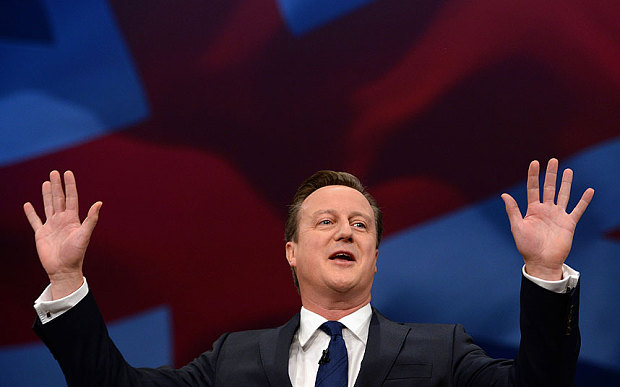
Cameron has been subjected to much ridicule this week, after he misquoted the leader of the opposition, Jeremy Corbyn, taking his comments out of context, during the Prime minster’s Conservative party conference speech. This led to thousands of people sharing a video of Cameron himself describing Osama bin Laden’s death as “a tragedy.” 

The point was very deftly well made.

Cameron was hoist by his own petulant petard.

Mr Cameron failed to provide any context about Mr Corbyn’s previous comments, neglecting to mention the fact that Mr Corbyn had actually said that the lack of trial for Bin Laden was the “tragedy” not the terrorist leaders death itself.

Mr Corbyn’s original comments had come from an interview with Iranian news channel, The Agenda. During the interview, Jeremy Corbyn, who was actually introduced as an “outspoken rebel in the Labour party’s ranks”, said:

“There was no attempt whatsoever that I can see to arrest him, to put him on trial, to go through that process.

This was an assassination attempt, and is yet another tragedy, upon a tragedy, upon a tragedy.

The World Trade Center was a tragedy, the attack on Afghanistan was a tragedy, the war in Iraq was a tragedy. Tens of thousands of people have died. Torture has come back on to the world stage, been canonised virtually into law by Guantanamo and Bagram.”

However the malicious Mr Cameron made no show of an attempt at quoting Mr Corbyn correctly and instead used the old quote out of context, to mislead people, claiming he felt Mr Corbyn somehow constituted a “threat to national security.”

Even the BBC has called the Conservatives out on this particular propaganda campaign against the opposition leader. See – BBC’s Stephen Sackur accuses Tories of spreading propaganda about Jeremy Corbyn, and of being unaccountable and undemocratic.

Supporters of the leader of the opposition went on to give Prime Minister David Cameron a taste of his own medicine by sharing a clip of the exact moment when he says: “the death of Osama bin Laden was a tragedy”, (shown above,) removing its context, causing mirth and a sense of poetic justice amongst Corbyn’s strong following.

During the Conservative conference, Cameron’s only standing ovation happened during his delivery of the malicious, deeply personal attack, and typical Bullingdon bully boy sneering comments about the Labour leader. It was to vindictively rapturous applause that the Prime Minister went on to say, without qualification:

“We cannot let that man inflict his security-threatening, terrorist-sympathising, Britain-hating ideology on the country we love.”

What does that tell you about the Tories?

Firstly, that they have no use for evidence, truth and fact, as their ideologically directed policies and rhetoric demonstrate time and time again. Secondly, that they most strongly and passionately endorse bullying and ridiculing others who don’t share their fearful little Britain perspective and ever-shrinking small world view.

Yet isn’t it a little odd that the Tories have considered every single Labour leader to be a “Britain hating threat” and a “dangerous commie”, with the exception of Blair, of course, though they are still busy trying to repeal Blair’s policy legacy. Only last year we saw the Daily Mail claiming the same about mild as milk Miliband, using his father, Ralph, to hold up as the dangerous “red under the bed.”

History tells us the Tories are not only nasty, paranoid propagandarising fearmongers, but that they are prepared to go to extraordinary lengths to maintain the status quo, repeating the same pattern of tired lies over and over. See for example, the fake, “leaked” Zinoviev letter, the plot against Harold Wilson, the “enemy within”.

This further embarrassment comes in the wake of the recent #PigGate scandal, where allegations about his past encounters with a pigs head whilst at Oxford University were revealed by the former Conservative donor Lord Ashcroft in his recent biography.

Related

It’s not as if the Tories are well known for telling the truth:

The Conservative’s negative campaign strategy: “share the lies and win a prize”

A list of official rebukes for Tory lies

Cameron’s pre-election contract: a catalogue of lies

The Tory election strategy is more of the same: Tories being conservative with the truth

The word “Tories” is an abbreviation of “tall stories”

Tory rhetoric, the politics of psychobabble: it’s batshit telementalism and mystification

650
Oh come all ye faithful

The Conservative conference was a masterpiece of stapled together soundbites and meaningless glittering generalities. And intentional mystification. Cameron claims that he is going to address “social problems”, for example, but wouldn’t you think that he would have done so over the past five years, rather than busying himself creating them? Under Cameron’s government we have become the most unequal country in the European Union, even the US, home of the founding fathers of neoliberalism, is less divided by wealth and income than the UK.

I’m also wondering how tripling university tuition fees and reintroducing banding in classrooms can possibly indicate a party genuinely interested in extending equal opportunities.

“Champions of social justice and opportunities”? Must have been a typo in the transcript: it’s not champions but chancers.

Cameron also claims that the Conservatives are the “party for workers”, and of course lamblasted Labour. Again. Yet it was the Labour party that introduced tax credits to ensure low paid workers had a decent standard of living, and this government are not only withdrawing that support, we are also witnessing wages drop lower than all of the other G20 countries, since 2010, the International Labour Organisation reliably informs us.

This fall not only led to a tight squeeze on living standards, it also led to a shortfall in treasury income in the form of tax revenues. But all of this is pretty standard form for Conservative governments.

It’s interesting to note that the only standing ovation Cameron had for his speech from delegates was not related to policy proposals or even rhetoric. It was a response to the bitter, spiteful and typical Tory bullying approach to any opposition: in this case, an outburst of vindictive, unqualified personal comments, misquotes, misinformation and downright lies about Jeremy Corbyn.

It was more of the usual Conservative claptrap about Labour leaders “hating Britain”. Cameron used an out-of-context quote to paint Jeremy Corbyn as a “security-threatening, terrorist-sympathising, Britain-hating” leader. Cameron had failed to give any context to Mr Corbyn’s comments that he intentionally  misquoted, failing, for example, to mention the fact that Corbyn had said the lack of a trial for Bin Laden was the “tragedy”, not his death itself. The deliberate misquote, however, was met with a deft response from the Left, hoisting Cameron by his own petard.

Here is Cameron’s speech in full technicolour and spectacular ontological insecurity:

Cameron’s malicious comments reminded me again of the Tories’ history of dirty tricks, like the Zinoviev letter, the campaign against Harold Wilson, and made me think of the almost prophetic and increasingly less fictional A Very British Coup.

Even the BBC have called the Conservatives out on their very nasty anti-democratic propaganda campaign against Corbyn.

From the deluge of incoherent commentaries to the mechanisms of telling lies: Conservatives don’t walk the talk

The fact that there is now such an extensive gap between Conservative rhetoric, the claims being made and reality makes the task of critical analysis difficult and somewhat tiring, and I’m not the only writer to comment on this.

The Conservatives use language – semantic shifts – and construct incongruent, dissonance-inducing narratives to misdirect us, and to mask the aims and consequences of their policies.  For example, the words “fair”, “support” and the phrase “making work pay” have shifted to become simple socio-linguistic codifications for very regressive punitive measures such as cuts to social security support (comparable with the principle of less eligibility embedded in the Poor Law of 1834) and benefit sanctions.

The most striking thing about the Conservative conference, for me, isn’t just the gap between rhetoric and reality, it is also the gap between the bland vocabulary used and the references, meanings and implications of what was actually being said.

The semantics are also stratified. People who are unaffected by austerity policies will probably take the bland vocabulary at face value. Cameron said:

“The British people are decent, sensible, reasonable, and they just want a government that supports the vulnerable.”

However, the “vulnerable” know a very different reality to the one substituted and described on their behalf. People who are adversely affected by Conservative policy will regard the bland vocabulary as bewildering, deceitful, frightening – especially because of its incongruence with reality – and most likely, as very threatening. Such rhetoric is designed to hide intention, but it is also designed to deliberately invalidate people’s own experiences of Tory policies and ultimately, the consequences of an imposed Tory ideology.

Not that there can be any mistaking the threats aimed at sick and disabled people from Duncan Smith in his Conference speech. He said:

“We won’t lift you out of poverty by simply transferring taxpayers’ money to you. With our help, you’ll work your way out of poverty.”

Of course the Work and Pensions secretary employed a traditionally Tory simplistic, divisive rhetoric that conveniently sections the population into “deserving” tax payers and “undeserving” non-tax paying citizens, to justify his balefully misanthropic attitude towards the latter group, as usual. However, the majority of sick and disabled people have worked and have contributed tax. 

As Dr Simon Duffy, from the Centre for Welfare Reform, points out, the poor not only pay taxes they also pay the highest taxes.  For example, the poorest 10% of households pay 47% of their income in tax. This is a higher percentage than any other group. We tend to forget that people in poverty pay taxes because we forget how many different ways we are taxed:

  • VAT
  • Duties
  • Income tax
  • National Insurance
  • Council tax
  • Licences
  • Social care charges, and many others taxes.

Mr Duncan Smith said that many sick and disabled people “wanted to work” and that the Government should give them “support” to find jobs and make sure the welfare system encouraged them to get jobs.

We’ve seen the future and it’s feudal

Ah, he means “making work pay,” which is the Tory super-retro approach to policy-making, based on the 1834 Poor Law principle of less eligibility again.  The reality is that sick and disabled people are being coerced by the state into taking any very poorly paid work, regardless of whether or not they can work, and to translate the rhetoric further, Duncan Smith is telling us that the government will ensure the conditions of claiming social security are so dismal and brutal that no-one can survive it.

And Cameron’s promise during his address to the Conservative party conference that “an all-out assault on poverty” would be at the centre of his second term is contradicted by a sturdy research report from the Resolution Foundation that reveals planned welfare cuts will lead to an increase of 200,000 working households living in poverty by 2020.

Duncan Smith also criticised what he claimed was Labour’s “something for nothing culture” which was of course a very supportive and fair, reasonably redistributive system. He also dismissed and scorned the protests against his policies, which his party’s conference has been subject to. But demonstration and protest is a mechanism of democracy for letting a government know that their policies are having adverse consequences.

Many of the disabled protesters at the conference are being hounded, hurt and persecuted by this government and actually, we are fighting for our lives. But clearly this is not a government that listens, nor is it one that likes democratic dialogue and accountability.

In his teeth-grindingly vindictive and blindly arrogant speech, Duncan Smith also criticised the old Employment Support Allowance benefit for signing people off work when they were judged by doctors as too sick to work. He claimed that Labour treated disabled people as “passive victims.” I’m wondering what part of professional judgements that a person is too sick to work this lunatic and small-state fetishist finds so difficult to grasp. Duncan Smith is a confabulating zealot who drives a dogmatic steam-roller over people and their experiences until they take some Tory neo-feudalist deferential, flat-earth shape that he thinks they should be.

Let’s not forget that this government have actually cut support for disabled people who want to work. The Access To Work funding has been severely cut, this is a fund that helps people and employers to cover the extra living costs arising due to disabilities that might present barriers to work. The Independent Living fund was also cruelly scrapped by this Government, which also has a huge impact on those trying their best to lead independent and dignified lives.

By “support to get jobs”, what Duncan Smith actually means is no support at all. He means more workfare – free labor for Tory donors – and more sanctions – the removal of people’s lifeline social security. He also means that good ole’ totalitarian dictum of “behaviour change,” a phrase that the Tories are bandying about a lot, these days.  Ask not what the government can do for you.

And what about frail and elderly people needing support?

The public care sector has been cut by a third this past 5 years, yet people are still aging and living longer, so demand for the services has risen. We know that private residential care homes notoriously put profit over care standards, as yet there’s not been an equivalent local authority scandal, but cuts and gross underfunding mean care workers are stretched beyond limit, and there aren’t enough funds to run an adequate home care service. It’s mostly the very frail and elderly who need this service. And it’s those vulnerable citizens that are being increasingly left without adequate care, and certainly not care of a sufficient standard to maintain their dignity.

These are citizens that have paid into a social security system that was established for “cradle to the grave” support if it was needed. This government has so wickedly betrayed them. That’s hardly making a lifetime of work and contribution “pay”.

The knock on effect is that many people without adequate care end up stranded in hospital, taking up beds and resources, through no fault of their own, and as we know, the health service is also desperately struggling to provide adequate service because of Tory cuts.

The aim of Conservatives is not to meet public needs, but to nudge the public into complicity with Conservative ideology

Many writers, a number of MPs and Peers have variously likened Conservative rhetoric to George Orwell’s Doublespeak in his novel Nineteen Eighty Four. Others claim that the idea of a language and thought-manipulating totalitarian regime in the UK is absurd. But that said, I never thought I would witness an era of human rights abuses of disabled people, women and children by the government of a so-called first-world liberal democracy. The same government have also stated it’s their intention to repeal our Human Rights Act and exit the European Convention on Human Rights. I can understand the inclination towards disbelief.

There’s another group of people that know something is wrong,  precisely what that is becomes elusive when they try to think about it and the detail slips through their fingers, as it were, when they try to articulate it. But that’s what Tory rhetoric purposefully aims to generate in those who oppose Conservatism: confusion, cognitive dissonance and disbelief

Which brings me to the government’s woeful brand of “liberatarian paternalism” – manifested in the form of an authoritarian Nudge Unit. The fact that it exists at all and that it is openly engaged in changing people’s decision-making without their consent is an indication of an extremely anti-democratic, psychocratic approach to government. The Tories are conducting politics and policy-making using insidious techniques of persuasion and psycholinguistic hocuspocusery for psychic and material profiteering, ordinarily reserved for the very dubious, telemental, manipulative end of the diabolistic advertising industry.

Once a PR man, always a PR man, that’s David Cameron.

By telemental, I mean it’s based on a kind of communication model that is transmissional, linear, mechanistic – where people are treated as conforming, passive “receivers” of information constructs, rather than an interactive, participatory, dialogical and importantly, a democratic one where people are regarded as autonomous critical interpreters and negotiators. We’re being talked at, not with. The Tories are using telementation to communicate their ideological sales pitch, without any democratic engagement with the majority of citizens, and without any acknowledgement of their needs. (Telementation is a concept originally introduced by linguist Roy Harris. )

The co-author of Nudge theory, Cass Sunstein, actually suggested that government monitors political activism online, too. He has some links with GCHQ’s covert online operations which employ social science to inform their psychological operations to influence online interactions and outcomes. Sunstein proposed sending covert agents into “chat rooms, online social networks, or even real-space groups” which spread what he views as “false and damaging conspiracy theories” about the government. “Conspiracy” theories like this one, eh?

The nudging of psychobabble and neuroliberalism

Tory policy is all about social engineering using justification narratives founded on an insensate, draconian ideological and semantic unobtainium equivalent. It’s clear that this government lacks the experience and understanding necessary for the proper use of psychological terms.  The content of their smug and vindictive justification narratives and stapled-together, alienating and psychopathic rhetoric deviates markedly from even basic common sense and good judgement.

The Tories reduce long debated, complex ideas to surprisingly spiteful platitudes, and hand us back dogmas gift wrapped in aggrandized certitude.

Malice in blunderland.

There is an accessible government website outlining some of the Nudge Unit’s neurobabble and subliminal messaging “successes”, albeit the more mundane ones, like getting men to pee on the “right” part of a urinal. Or getting people to pay their taxes on time, or to donate organs.

The Nudge Unit’s behaviourism and psychological quackery, however, is all-pervasive. It has seeped into policy, political rhetoric, the media, education, the workplace, health services and is now embedded in our very vocabulary and social narrative. Every time you hear the phrase “behavioural change” you know it’s a government department acting upon citizens everywhere, using  basic, crude operant conditioning without their consent, instead of actually doing what public services should and meeting public needs. Instead, citizens are now expected to meet the government’s needs.

Where do you think the government got their pre-constructed ideological defence lexicon of psychobabble – they bandy about insidiously bland words like “incentivise” in the context of coercive state actions – such as the ideas for welfare increased conditionality and brutal operant conditioning based sanctions?

Did anyone actually ask for state “therapy” delivered by gaslighting, anti-socially disordered tyrants?

I sent an FOI asking the Department of Work and Pensions for the figures for sanctions since 2010 to the present, and I asked for the reasons they were applied. I also asked how sanctions can possibly “incentivise” or “help” people into work, and what research and academic/psychological/theoretical framework the claim is premised on, after I pointed out Maslow’s motivation theory based on a hierarchy of needs – accepted conventional wisdom is that you can’t fulfil higher level psycho-social needs without first fulfiling the fundamental biological ones.

If people are reduced to struggling to meet basic survival needs, then they can’t be “incentivised” to do anything else. And even very stupid people know that if you remove people’s means to eat, keep warm and shelter, they will probably die. It’s worth remembering that originally, benefits were calculated to meet only these basic survival needs. That’s why welfare is called a social “safety net”.

maslow-hierarchy-of-needsMaslow’s hierarchy of needs

There can be no justification whatsoever for removing that crucial safety net, and certainly not as a political punishment for people falling on hard times – that may happen to anyone through no fault of their own.

No matter what vocabulary is used to dress this up and attempt to justify the removal of people’s lifeline benefits, such treatment of citizens by an allegedly democratic, first-world government is unacceptable, despicable, cruel: it’s an act of violence that cannot fail to cause harm and distress, it traps people into absolute poverty and it is particularly reprehensible because it jeopardises people’s lives.

And what kind of government does that?

The nature of deception and psychological trauma

The Government are most certainly lying to project a version of reality that isn’t real.  Critical analysis of Tory rhetoric is a very taxing, tiring challenge of endlessly trying to make sense of disturbing relations and incoherent misfits between syntax and semantics, discourse and reality events. There’s a lot of alienating, fake humanism in there.

When politicians lie, there is a break down in democracy, because citizens can no longer play an authentic role in their own life, or participate in good faith in their community, state, and nation. Deception is cruel, confusing, distressing and anxiety-provoking: keeping people purposefully blind to what the real political agendas are and why things are happening in their name which do not have their agreement and assent.

Lying, saying one thing and doing another, creating a charade to project one false reality when something else is going on, is very damaging: it leaves people experiencing such deception deeply disorientated, doubting their own memory, perception and sanity.

To cover their tracks and gloss over the gaping holes in their logic, the Tories employ mystification techniques, the prime function of which is to maintain the status quo. Marx used the concept of mystification to mean a plausible misrepresentation of what is going on (process) or what is being done (praxis) in the service of the interests of one socioeconomic class (the exploiters) over or against another class (the exploited). By representing forms of exploitation as forms of benevolence, the exploiters confuse and disarm the exploited.

The order of concepts is not the order of things

On a psychological level, mystification is used in abusive relationships to negate the experience of abuse, to deceive and to avoid authentic criticism and conflict. Mystification often includes gaslighting, which is a process involving the projection and introjection of psychic conflicts from the perpetrator to the victim, and has a debilitating effect on the victim’s ability to think rationally and often, to function independently of the gaslighter. It can take many forms. In all instances, however, it involves the intentional, cold and cunning distortion of accounts of reality by a predator that systematically undermines the victim’s grasp of what is happening, distorting perceptions of events, editing and re-writing for the gaslighter’s own political, financial, or psychological ends.

And of course, gaslighting exploits the fact that human beings have a tendency to deny and repress those things that are too overwhelming and painful to bear. Much psychotherapy is based on creating a safe space for allowing experience of the dreadful – which as an event has already happened – to “happen.”

A memorable example of psychological mystification is presented in a case study cited by R.D. Laing. (In Did You used to be R.D.Laing, 1989). A woman finds her husband with a naked woman in the living room. She asks: “What is that naked woman doing in my house on my sofa!?” To which her gaslighting husband, without missing a beat, replied:  “That isn’t a woman, that’s a waterfall.” 

The poor woman felt her grasp of reality weaken, because she had trusted her husband and had always tended to believe him. She lost her self to a period of psychosis because of the deep trauma this event caused her. Her husband was an authoritarian figure. We tend to accept that authority figures tell the truth, with little questioning. But it’s not a safe assumption at all.

She was made to doubt her own perception and account of events, despite the utter absurdity of the alternative account of reality presented to her. To have one’s perception and experience of reality invalidated is very painful, threatening to the self and potentially extremely damaging.

We have a government that thinks nothing of using this type of distortion and deception to cover up the worst consequences of its policies.

This is a government of authoritarians and psychocrats who have an apparent cognitive dissonance: they decided that rich people are motivated only by fincancial gains, whilst poor people are motivated only by financial losses and punishments. However, when you replace the word “incentive” with the value-laden term “deserve”, and then slot it into an ideological framework with an underpinning social Darwinist philosophy, it becomes more coherent and actually, profoundly unpleasant. The Tories think that “social justice” is about taking money from those who need the most support, and handing it to those who don’t

This is a government that’s all about manufacturing conformity and obedience. The gospel, according to the likes of Iain Duncan Smith, is that we are the architects of our own misfortunes, but when it comes to good fortunes, well of course, the government claims responsibility for those. Incoherent, puerile proselytizing nonsense.

The truth of the human condition, according to the Tories, is that poor people scrounge, rich people are saintly and the former group needs humiliating and state “therapy” – degrading “paternalistic” corrective treatment, (mostly comprised of a barrage of anti-humanist ideology and the constant threat of, and often actual withdrawal of your lifeline income), whereas the latter group need all the praise, support and state handouts they can get.

This is a government that use a counterfeit and dark triad (particularly Machiavellian) inspired language to create an impression of plausibility and truth, and to hide their true aims. They are demogogues of a radical and reactionary anti-social agenda. Intolerance, fear and hatred, machismo and bullying tendencies are masqueraded as moral rectitude.

This is a government that uses superficial, incongruent, meaningless psychobabble to justify the most savage and cruelly coercive policies that we have seen in the UK during our lifetime. Those social groups unaffected by the policies think that the government are acting in our “best interests”, but people are suffering and dying as a consequence of these policies.

People’s life problems such as unemployment and poverty arise from bad decision-making from the government and are not clinical maladies, the use of or implying of pseudo-clinical terms in political victim-blame narratives and gaslighting is not meaningful or appropriate.

Political psychobabble is designed intentionally to limit the freedom of public comprehension, it neutralises our own vocabulary, and invalidates our experiences. The nasty party are engaged in psychic profiteering – a government of quacks spouting pretentious gibberish to justify taking money from the poorest citizens and handing it out to the very wealthy.

It’s irrational, incoherent psychobabble from over-controlling, obedience-obsessed irrationalists whose sole aim is to ensure the population conform to government needs, and meet the demands of neoliberalism, rather than, heaven forbid, wanting a democratic government and an economic system that actually meet public needs.

Or if you prefer plainspeak: Tory rhetoric is rather like a long-empty belfry – full of batshit.

Oh, that way madness lies.

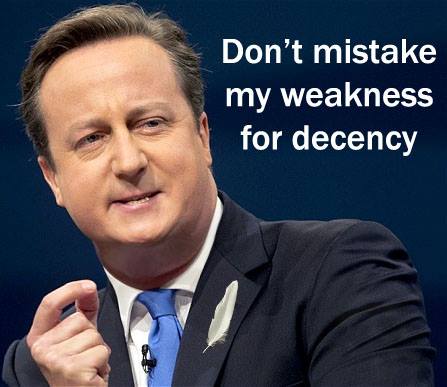
Cam weakness
Picture courtesy of Robert Livingstone

GPs bribed to send FEWER cancer patients for vital hospital tests – Mike Sivier

An important article from Vox Political (and the Mirror.) It needs to be shared.

Visit Vox Political for the full article

GPs are being offered cash to send fewer patients with suspected cancer to hospital for vital tests.Surgeries can claim thousands of pounds worth of “incentives” for not sending patients to hospitals for tests, scans and operations, according to an investigation by doctors’ magazine Pulse.

First appointments for cancer – which should happen within two weeks of a GP suspecting the disease – are included in some of the targets to cut referrals, the probe found.

The rewards are being offered by Clinical Commissioning Groups (CCGs), local NHS bodies responsible for commissioning of healthcare across the country.

The move comes as the NHS is trying to slash £22billion in costs before 2020.

Source: GPs ‘bribed’ to send FEWER cancer patients for vital hospital tests – Mirror Online

The Mirror blasted the policy, run by CCGs that were created as part of the Health and Social Care Act of 2012 which began the mass-privatisation of the NHS, in its editorial:

Bribing family doctors not to send patients to hospitals for cancer tests is sacrificing lives by turning the NHS into a cut-price market place.

GPs should never be awarded bonuses at the cost of the public’s health. Those incentives are indefensible, because the likelihood is that cancers will go undetected.

Early detection is vital and when England’s cancer survival rates are already among the lowest in Europe, Health Secretary Jeremy Hunt should be demanding that more people are tested sooner.

Doctors must be free to make objective decisions on medical grounds rather than receiving dangerous instructions that reduce patients to financial statistics.

But don’t blame your doctor. Blame the Government. A Tory Government. The NHS wasn’t perfect under Labour but the Tories don’t appear to care at all.

This wasteful party is handing down a death sentence for unsuspecting patients. And that’s unforgiveable.


Related

The Coalition has deliberately financially trashed the NHS to justify its privatisation

Selling off NHS for profit: Tories’ and Liberal Democrats’ links with private healthcare firms revealed

The commercialisation and undemocratising of the NHS: the commodification of patients

252299_486936058042594_609527550_nPicture courtesy of Robert Livingstone

Don’t believe everything you think: cognitive dissonance

sipress-cognitive-dissonance

“Some things have to be believed to be seen.” – Ralph Hodgson

I’ve often thought that once people identify with a political party, there is often an accompanying tendency to edit the world so that it conforms with their ideology. I suspect that exposure to more information about objective reality and politics quite often doesn’t affect partisan bias because people tend to only assimilate those “facts” that confirm what they already believe. Perhaps this is why many people become defensive, aggressive, incoherent and dogmatic when challenged with evidence that contradicts their fundamental world-view.

President Lyndon Johnson once said: It’s a heck of a lot easier to throw grenades than to catch them.

It’s always a good idea to look at who is lobbing the explosives, too. And to see if they are recycling their bombshells

It’s certainly the same with criticism, especially those which challenge our cherished beliefs. Critical thinking is a difficult and sometimes painful process. It requires facing often challenging and contradictory narratives about the fundamental nature of the world and ourselves, analysing and evaluating them. It also requires work: practice, time and effort. But the more you do it, the easier it becomes.

Critical thinking is the foundation for intelligence, for making sound decisions, and for accommodating dissonant narratives within our own paradigm, and importantly, for understanding them.

“Knowledge” isn’t simply something arising from a closed fact-finding mission to confirm what we already hold as a theory of the world, but rather, it’s about understanding the diverse views of others who are part of our world, after all, and who contribute to its rich, meaningful pluralism.

That doesn’t mean, of course, that each account or theory of the world has equal merit and worth, but without a genuinely critical and open exploration of other views, we cannot know the worth of our own views, let alone anyone elses’. Knowledge isn’t something we have, either, it’s something we have to do. Learning is a process that is ongoing, and knowledge is always subject to challenges, revision and expansion.

Never has there been a greater need for critical thinking, yet it seems there has never been a time when that has been more difficult, because of the constant bombardment from the media of fragmented, discordant, conflicting, non-linear narratives, purposefully misdirecting and whopping lies, dead cat ploys, semantic thrifts, glittering generalities, government PR, Orwellian double-speak and other strategies being deployed to keep us in a state of fearful, confused, manipulable stupification and, to be terribly Marxist about this … in a state of false consciousness. Well, dazed and confused, at the very least.

This Adam Curtis video (below) was originally shown as part of Charlie Brooker’s 2014 Wipe show. It’s about strategies adopted by political leaders, here and abroad, to keep the population confused, uncertain what to believe or what to do – and therefore powerless.

Cognitive dissonance warfare is one weapon of choice. It isn’t just the Tories that use this method. 

We are subjected to an overwhelming barrage of partial accounts, contradictory accounts, screaming headlines, vicious lies, smears and ferocious mudslinging – negative campaigning in the media. It’s like being trapped in a hall of mirrors with Beelzebub, a few of hells’ myrmidons and your best friends, all in fancy dress.

So how do we escape the hall of mirrors?

Well, I’ve already discussed critical thinking. A good approach is to look for integrity, consistency and coherence in narratives, as well as evidence to support and refute the claims being made. And it’s important to examine scope  –  what those narratives accommodate – how comprehensive they are, how much they connect up, how much they make sense. If they involve personal attacks, this is generally a strategy of diversion, and  indicate the group flinging smears has less to offer the public than the person or being viciously attacked. 

It’s also worth understanding a little more about cognitive dissonance.

Leon Festinger: Let’s see what happens when you are stood up by the aliens.

images

Leon Festinger is the social psychologist that proposed cognitive dissonance theory, which basically states that a powerful motive to maintain cognitive consistency can give rise to irrational, and often, maladaptive behaviour.

According to Festinger, we hold many cognitions about the world and ourselves; when they clash, an uncomfortable discrepancy is evoked, resulting in a state of tension known as cognitive dissonance. As the experience of dissonance is unpleasant, we are motivated to reduce or eliminate it to achieve consonance (agreement).

How we do so seems to be very much our own business, with avoidance, biased perception and denial commonly used as a defence to eliminate our discomforts – but as I pointed out earlier, the only real and lasting solution is critical thinking.

Leon Festinger once infiltrated a flying saucer doomsday cult in the late 1950s. The members of this cult had given up their entire lives – left everything and everyone behind – because they believed that the world was about to end and that their faith would ensure that they would be the sole survivors of a global flood. Up until the fateful day, the cult shunned publicity and didn’t entertain journalists.

Festinger posed as a member of the group and was present when the foretold space ship failed to show up. He was particularly interested in what would happen next. How would the disappointed cult react to the failure of their prophecy?

In science, when a theory is challenged by evidence that contradicts it, adjustments or ad hoc hypotheses are sometimes formulated to preserve the theory, attempting to explain away anomalies. However, ad hoc hypotheses are often a key characteristic of pseudoscience, as they are used to ensure a theory is never falsified, no matter how much evidence accrues to falsify that theory. Ultimately, it’s a get out clause for failed theories.

In science, whilst we accommodate gaps in our knowledge, the use of many ad hoc hypotheses is frowned upon. (Einstein’s proposition of hidden variables is a good example of this method of accommodating anomaly: he used an ad hoc hypothesis to explain quantum mechanics and maintain the integrity of relativity theory: explaining quantum entanglement without action at a distance).

Ad hoc hypotheses are a widely used strategy in managing cognitive dissonance. So, after the failure of their prophecy and the non-materialisation of the rescue space ship, the cult suddenly wanted publicity. They wanted media attention. This was apparently so the world would know how their faith had helped save the entire planet from flood.

The hypothesis was that aliens had spared planet earth for their sake – and now their new role was to spread the word and make us all listen. This fascinated Festinger. He observed that the real motivation behind the apparently inexplicable response was the need to not face an uncomfortable truth and to re-assert emotional comfort and equilibrium – to smooth over the apparently unacceptable and whopping inconsistencies between prophecy and events.

Theory and reality.

Explanations of events such as the one offered by the doomsday cult are clearly not founded on a rational process: it’s largely an emotional defence mechanism that is rationalised post hoc. Festinger coined the term “cognitive dissonance” to describe the uncomfortable tension we feel when we experience conflicting thoughts or beliefs (cognitions), or engage in behavior that is apparently opposed to our stated beliefs.

What is particularly interesting is the lengths to which people will go to reduce the inner tension without accepting that they might, in fact, be wrong. They will accept almost any form of relief, other than admitting being at fault, or mistaken. If a person believes, for example, that they are not racist, but then they discriminate against someone on the basis of race, they are then faced with the discomfort of acknowledging that they are racist after all. In an attempt to escape this discomfort, they may seek to rationalise (explain away) their behaviour on some other grounds, which may be spurious, but which allows them to hold on to their otherwise discredited belief.

Many UKIP supporters, for example, often say something like: “I’m not racist though, my brother-in-law/ friend/ uncle’s wife is actually Indian/Chinese/African” and so forth.

Another example is the “allthesame” myth. When you present people with evidence that refutes what was originally a Tory propaganda soundbite, rather than acknowledging verifiable evidence, some people choose to start a hate campaign aimed at trying to attribute all kinds of bizarre “motives” to the person simply telling a truth. Truth and populist perspectives are often poles apart.

And such tactics serve only to fragment opposition to the Right even further. Dividing people by using blame and prejudice further weakens our opposition to oppression. The oppressed can be very oppressive, it has to be said.

Festinger quickly realised that our intolerance for cognitive dissonance could explain many mysteries and irrationalities of human behavior.

Politicians have utilised this intolerance to their advantage – most particularly the Right, who deploy rhetoric heavily steeped in propaganda and behavioural manipulation techniques. (See Cameron’s behaviourist Nudge Unit,  I’ve previously discussed the implications of such manipulation on an unconsenting public and the ramifications for democracy.)

Marshall McLuhan once said: There is absolutely no inevitability as long as there is a willingness to contemplate what is happening.

Objective truth does not change according to our inclination to want something else. Facing that may be difficult at times, but the alternative is simply the idle creation of pseudo-enclaves of fleeting comfort – illusions that distract and disempower us. And make us apathetic.

It’s worth noting that totalitarian and authoritarian regimes arise in societies where populations are politically disengaged and apathetic. If we want to change unpalatable truths – part of the way things are –  the only way to do so is to have the courage, first, to face those truths head-on.

We can’t lie those truths away. There are no short-cuts or real, tenable escapes from that. We have to work our way through the confusion, avoiding the appeal and brief comfort of avoidance strategies, defence mechanisms and flat denial – short-cuts down what is invariably a cul-de-sac – difficult though that often is.

Look at where we are: we have Tory small minds attempting to justify the Tory notion of a small state. But small states and competitive individualism foster adversarial relationships, and reduce us all. Small states and individualism disconnect us from others, sever any sense of social responsibility, mutuality, cooperation and obligation we have towards others.

It divides, isolates and fragments us. Neoliberal small states make us all smaller individuals, less coherent, less connected. Less comprehending. We lose touch with social reality when we disengage with others. We become less rational agents. More dissonant. How can we hold rational, reasoned and democratic debates to oppose what is little more than Tory superstition and prejudice?  

But we must.

Iain Duncan Smith’s “magical elitism” thinking – he’s just knows he’s right – is another indication that we don’t have a democratic government that is willing to engage in dialogue: we have an authoritarian one that is interested only in imposing its own incoherent neoliberal monologue on the masses.

The Queen’s Honours list shows us just what we have become as a society this past 4 years, and how little worth we place on intelligence, honour, basic coherence, decency and genuine achievement. The Maurice Mills MBE is a farce – he blamed Hurricane Katrina on gay people – it’s like open, raucous, insane, cackling laughter from a decrepit, senile, evil elite that has lived far too long. One that is completely detached from our society and its needs. That’s the reality.

Cognitive dissonance theory is an example of the political misuse of psychology which is being used as a means of thought micro-management to ensure that we don’t move and progress. Personal and social development – growth – by their very nature demand that we have the courage to seek to extend ourselves beyond what we know and where we are. It’s very uncomfortable to acknowledge that we are limited, especially when some of that is our own doing, but it’s also essential we do acknowledge it in order to at least try and transcend those limits, extend their context step by step and make progress.

There are no alien space ships to save us from ourselves or from our government. It’s down to us to seek and evaluate the truth, and there really are no shortcuts to positive change and progress. But we can take responsibilty to ensure that what we hold to be true and the decisions we make are fully and bravely informed.

cogDisMeter

Have your say on the Welfare Reform and Work Bill

430847_149933881824335_1645102229_n (1)

Do you have relevant expertise and experience or a special interest in the Welfare Reform and Work Bill which is currently passing through Parliament?

If so, you can submit your views in writing to the House of Commons Public Bill Committee which is going to consider this Bill.

Welfare Reform and Work Bill 2015-16

Aims of the Welfare Reform and Work Bill

The Government website claims that the Bill would make provision about reports on progress towards full employment and the apprenticeships target; to make provision about reports on the effect of certain support for troubled families; to make provision about social mobility; to make provision about the benefit cap; to make provision about social security and tax credits; to make provision for loans for mortgage interest; and to make provision about social housing rents.

However, many of us see the Bill as a further economic attack on Britain’s poorest families. I’m concerned it includes many measures that risk trapping more children into poverty.

Beyond the well-publicised cuts to tax credits, which will leave many families on low wages struggling to buy basics, the government also plans to cap benefits. For the moment this will be set at £20,000 (£23,000 in Greater London), but a clause in the Bill allows the government to change the amount in future too – without consulting parliament. This paves the way for the threshold to sink ever lower, consigning children from larger families to the breadline without any democratic scrutiny or safeguarding.

Perhaps the most worrying element of the Bill is the government’s decision to abandon the duty to end child poverty by 2020. Instead this Bill would redefine “poverty”, scrapping income as the way we measure being poor and replacing it with worklessness, addiction and educational attainment. Given that two-thirds of our poorest children already live in low-paid “working” families, this is a completely unacceptable way to measure hardship. Furthermore, addiction is not a class-based problem, it affects wealthy people too, in fact substance abuse – especially alcohol related – is something that affects people who aren’t in poverty more than those who are. As for educational attainment, well Iain Ducan Smith has no qualifications, but he isn’t poor. I’ve a first degree and a Masters and I am poor.

If the causes of poverty, according to Duncan Smith, were in any way correct, we’d see the same people on the dole, year in year out. But we don’t. Instead we see  a “revolving door” of claims from people who take low paid, insecure work for months or a couple of years at the most and end up out of work again. Through no fault of their own. This revolving door is consistent with the structural explanation of povertythat government decision-making and socieconomic circumstances are the causes poverty.

This Bill would make the government dramatically less accountable for its policies, leaving poor families worse off and limiting children’s life chances.

Javed Khan
Chief executive, Barnardo’s

Other Briefings

Welfare Reform and Work Bill 2015 final – Unison

Welfare Reform and Work Bill: what might this mean for carers – Carers UK

Briefing: Welfare Reform & Work Bill – Shelter England

Joseph Rountree Foundation: Welfare Reform and Work Bill: Second Reading | JRF

Briefing on the Welfare Reform and Work Bill FINAL -TUC

The Children’s Society Briefing: House of Commons Second Reading of the Welfare Reform and Work Bill

Follow the progress of the Welfare Reform and Work Bill

The Bill was presented to the House on 9 July 2015. On Monday 20 July, the Bill received its Second Reading in the House of Commons where MPs debated the main principles of the Bill.

The Bill has now been sent to the Public Bill Committee where detailed examination of the Bill will take place. The Bill Committee is expected to hold its first oral evidence session on 10 September.

Guidance on submitting written evidence

Deadline for written evidence submissions

The Public Bill Committee is now able to receive written evidence. The sooner you send in your submission, the more time the Committee will have to take it into consideration. The Committee is expected to meet for the first time on Thursday 10 September; it will stop receiving written evidence at the end of the Committee stage on Thursday 15 October.

Please note: When the Public Bill Committee reports, it is no longer able to receive written evidence and it could report earlier than Thursday 15 October 2015.

What should written evidence cover?

Your submission should address matters contained within the Bill and concentrate on issues where you have a special interest or expertise, and factual information of which you would like the Committee to be aware.

Your submission could most usefully:

  • suggest amendments to the Bill with explanation; and
  • (when available) support or oppose amendments tabled or proposed to the Bill by others with explanation

It is helpful if the submission includes a brief introduction about you or your organisation. The submission should not have been previously published or circulated elsewhere.

If you have any concerns about your submission, please contact the Scrutiny Unit (details below).

How should written evidence be submitted?

Your submission should be emailed to scrutiny@parliament.uk. Please note that submissions sent to the Government department in charge of the Bill will not be treated as evidence to the Public Bill Committee.

Submissions should be in the form of a Word document. A summary should be provided. Paragraphs should be numbered, but there should be no page numbering.

Essential statistics or further details can be added as annexes, which should also be numbered. To make publication easier, please avoid the use of coloured graphs, complex diagrams or pictures.

As a guideline, submissions should not exceed 3,000 words.

Please include in the covering email the name, address, telephone number and email address of the person responsible for the submission. The submission should be dated.

What will happen to my evidence?

The written evidence will be circulated to all Committee Members to inform their consideration of the Bill.

Most submissions will also be published on the internet as soon as possible after the Committee has started sitting.

The Scrutiny Unit can help with any queries about written evidence.

Scrutiny Unit contact details

Email: scrutiny@parliament.uk
Telephone: 020 7219 8387
Address: Ian Hook
Senior Executive Officer
Scrutiny Unit
House of Commons
London SW1A OAA

If the Tories don’t like being compared to the Nazis, they need to stop behaving like despots.


2 authoritarians

Two authoritarians on the far right of the political spectrum.

Apparently the Conservatives are cross about being compared with the Nazis. Mike Sivier at Vox Political wrote about the circumstances of the comparison, which arose on Monday: This ignorant Tory councillor had better try justifying the deaths his party has caused.

Human Rights abuses

This is a government that is currently at the centre of a United Nations inquiry into abuses of the human rights of sick and disabled people, and is also in breach of the rights of women and children, because of their anti-humanist, draconian welfare “reforms”.

While I am very aware that we need take care not to trivialise the terrible events of the Holocaust by making casual comparisons, there are some clear and important parallels with what is happening to sick and disabled people, poor people and those who are unemployed in the UK and the ideological processes in Nazi Germany: events on a political, cultural and a psychosocial level, that I feel are crucially important to recognise.

Conservative policies are entirely ideologically driven. We have a government that frequently uses words like workshy to describe vulnerable social groups. This is a government that is intentionally scapegoating poor, unemployed, disabled people and migrants. A few  years ago, a Tory councillor said that “the best thing for disabled children is the guillotine.” More recently, another Tory councillor called for the extermination of gypsies, more than one Tory MP has called for illegal and discriminatory levels of pay for disabled people.

These weren’t “slips”, it’s patently clear that the Tories believe these comments are acceptable, and we need only look at the discriminatory nature of policies such as the legal aid bill, the wider welfare “reforms” and research the consequences of austerity for the poorest and the vulnerable citizens – those with the “least broad shoulders” –  to understand that these comments reflect how Conservatives think.

This is a government that is manipulating public prejudice to justify massive socio-economic inequalities and their own policies that are creating a steeply hierarchical society based on social Darwinist survival of the wealthiest libertarian, minarchist principles. Society is being re-arranged by the Conservatives into hierarchies of human worth, based on traditional 19th century notions of ‘deserving’ and ‘undeserving’.

Conservatives have always seen society and human relationships in terms of hierarchies, based on “red in tooth and claw” Darwinist conflict. A hierarchy is any system of persons or things ranked one above the other. The government claim that this kind of inequality and ‘competition’ for scarce resources is somehow ‘good’ for the economy. They say that people who are higher in the hierarchy got there on merit. However, at least a third of wealthy people inhereited their wealth and power. Cameron included.

Hierarchy was originally used to describe the system of church government by priests graded into ranks. Organised religion is very hierarchical. Hierarchical thinking is about seeing the world through systems of domination, ranks and importance. But the central principle of human rights is that we each have equal worth: that we are all equally important. But hierarchies ensure that privilege and decision-making is not socially distributed. Nor is power.

The very way that Tories think leads to a collision between their ideology and our human rights, and is completely incompatible with the principles of equality and democracy. Tories think that some people hold a more important place in society than others. This reduces people – they become inferiors or superiors, and really, that is about unequal distribution of power, subordination and domination – those power relationships are no longer entirely notional, we have moved some distance from being a liberal democracy these past five years – and feudalism and manorialism are very Tory ideals.

To summarise, there are strong links between the right-wing idea of competitive individualism, Social Darwinism, social inequalities, eugenics, nationalism, fascism and authoritarianism. Those ideas are implicit in Tory rhetoric, because they form the very foundations of Tory ideology. A society with inequalities is and always has been the ideologically founded and rationalised product of Conservative Governments.

The creation of scapegoats, categories of others and outgrouping

The malicious creation of socio-economic scapegoats, involving vicious stigmatisation of vulnerable social groups, particularly endorsed by the mainstream media, is simply a means of manipulating public perceptions and securing public acceptance of the increasingly punitive and repressive basis of the Tories’ welfare “reforms”, and the steady stripping away of essential state support and provision. At the same time, wages are depressed, many jobs are insecure, or zero-hour contracts and working conditions are declining.

web-earnings-graphic

A coerced labor force is a key feature of most despotic, authoritarian, totalitarian and fascist states and as history has taught us, ALL eugenicist-founded tyrannies.

The political construction of social problems also marks an era of increasing state control of citizens with behaviour modification techniques, (under the guise of “paternalistic libertarianism”) all of which are a part of the process of restricting access rights to welfare provision.

The mainstream media has been complicit in the process of constructing deviant welfare stereotypes and in engaging prejudice and generating moral outrage from the public:

“If working people ever get to discover where their tax money really ends up, at a time when they find it tough enough to feed their own families, let alone those of workshy scroungers, then that’ll be the end of the line for our welfare state gravy train.” James Delingpole 2014

Poverty cannot be explained away by reference to simple narratives of the workshy scrounger as Delingpole claims, no matter how much he would like to apply such simplistic, blunt, stigmatising, dehumanising labels that originated from the Nazis (see arbeitssheu.)

This past five years we have witnessed an extraordinary breakdown of the public/private divide, and a phenomenological intrusion on the part of the state and media into the lives of the poorest members of society. (For example, see: The right-wing moral hobby horse: thrift and self-help, but only for the poor.)

Ideology

Hannah Arendt wrote extensively about totalitarian regimes, in particular Nazism and Stalinism, which she distinguishes from Italian Fascism, because Hitler and Stalin sought to eliminate all restraints upon the power of the State and furthermore, they sought to dominate and control every aspect of everyone’s life. There are parallels here, especially when one considers the continued attempts at dismantling democratic processes and safeguards since the Coalition first took office. And the quiet editing and steady erosion of our protective laws

Between February 1933 and the start of World War Two, Nazi Germany underwent an economic “recovery” according to the government. Rather like the “recovery” that Osborne and Cameron are currently claiming, which isn’t apparent to the majority of citizens.

This economic miracle, sold to the people of Germany, entailed a huge reduction in unemployment. However, the main reason for this was fear – anyone who was found guilty of being workshy (arbeitssheucould then be condemned to the concentration camps that were situated throughout Germany. Hitler frequently referred to the economic miracle, whilst people previously employed in what was the professional class were made to undertake manual labour on the autobahns. People didn’t refuse the downgraded status and pay, or complain, lest they became Arbeitsscheu Reich compulsory labor camp prisoners, and awarded a black triangle badge for their perceived mental inferiority and Otherness.

Behaviour can be controlled by manipulating fear, using a pattern of deprivation. Benefit sanctions, for example, leave “workshy”people without the means to meet their basic survival needs and are applied for periods of weeks or months and up to a maximum of 3 years. That the government of a so-called first world liberal democracy is so frankly inflicting such grotesquely cruel punishments on vulnerable citizens is truly horrific. It’s also terrifying that the media and to some extent, the wider British public are complicit in this: they fail to recognise that the Social Darwinism inherent in Tory ideological grammar is being communicated through discourses and policies embodying crude behaviour modification techniques and an implicit eugenics subtext .

There were various rationales for the Nazi Aktion T4 programme, which include eugenics, Social Darwinism, racial hygiene, cost effectiveness and reducing the welfare budget.

The social psychology of eugenics

Gordon Allport studied the psychological and social processes that create a society’s progression from prejudice and discrimination to genocide. In his research of how the Holocaust happened, he describes socio-political processes that foster increasing social prejudice and discrimination and he demonstrates how the unthinkable becomes tenable: it happens incrementally, because of a steady erosion of our moral and rational boundaries, and propaganda-driven changes in our attitudes towards politically defined others, that advances culturally, by almost inscrutable degrees.

The process always begins with political scapegoating of a social group and with ideologies that identify that group as  the Other: an “enemy” or a social “burden” in some way. A history of devaluation of the group that becomes the target, authoritarian culture, and the passivity of internal and external witnesses (bystanders) all contribute to the probability that violence against that group will develop, and ultimately, if the process is allowed to continue evolving, extermination of the group being targeted.

Economic recession, uncertainty and authoritarian or totalitarian political systems contribute to shaping the social conditions that seem to trigger Allport’s escalating scale of prejudice.

In the UK, the media is certainly being used by the right-wing as an outlet for blatant political propaganda, and much of it is manifested as a pathological persuasion to hate others. The Conservatives clearly have strong authoritarian tendencies, and that is most evident in their anti-democratic approach to policy, human rights, equality, social inclusion and processes of government accountability.

Vulnerable groups are those which our established principles of social justice demand we intervene to help, support and protect.  However, the Conservative’s rhetoric is aimed at a deliberate identification of citizens as having inferior behaviour. The poorest citizens are presented as a problem group because of their individual faulty characteristics, and this is intentionally diverting attention from wider socio-economic and political causes of vulnerability. Individual subjects experiencing hardships have been placed beyond state protection and are now the objects of policies that embody behaviourism, and pathologising, punitive and coercive elements of social control. Vulnerable people are no longer regarded as human subjects, the state is acting upon them, not for or on behalf of them.

People are still debating if Stalin’s Holodomor conforms to a legal definition of genocide, no-one doubts that Hitler’s gas chambers do, though Hitler also killed thousands by starvation.

Our own government have formulated and implemented policies that punish unemployed people for being “workshy” – for failing to meet the never-ending benefit conditionality requirements which entails the use of negative incentives and behaviour modification to “support” a person’s into  work –  by withdrawing their lifeline benefit. We also know that sanction targets have led to many people losing lifeline benefits for incoherent and grossly unfair reasons that have nothing to do with an unwillingness to cooperate or work.

Since benefits were originally calculated to meet basic living requirements – food, fuel and shelter – it’s  inconceivable that the government haven’t already considered the consequences of removing people’s means of meeting these fundamental survival needs. Of course, the Tory claim that this draconian measure is to incentivise people to “find work” doesn’t stand up to scrutiny when we consider that there isn’t enough work for everyone, and certainly not enough work around that pays an adequate amount to actually survive on.

Furthermore it flies in the face of long-established and conventional wisdom which informs us that if you reduce people by removing their means of survival, those people cannot be motivated to do anything else but to struggle and survive. Maslow tells us that unless we meet basic survival needs, we cannot be motivated to meet higher level psychosocial ones.

Tory austerity is all about ideology – the dehumanisation of the poor, and the destruction of public services and provisions – state infrastructure – and nothing to do with the state of the economy. It’s also about cutting money from the poorest and handing it to the wealthiestMany economists agree that austerity is damaging to the economy.

There has been a media complicity with irrational and increasingly punitive Tory policies. But why are the public so compliant?

Decades of  research findings in sociology and psychology inform us that as soon as a group can be defined as an outgroup, people will start to view them differently. The very act of demarcating groups begins a process of ostracization.

As well as the political and social definitions of others, there also exists deeper, largely unconscious beliefs that may have even more profound and insidious effects. These are related to whether people claiming benefits are even felt to be truly, properly human in the same way that “we” are.

This is called infrahumanisation. Infra means “below”, as in below or less than fully human. The term was coined by a researcher at the University of Louvain called Jacque-Philippe Leyens to distinguish this form of dehumanisation from the more extreme kind associated with genocide.

However, I don’t regard one form of dehumanisation as being discrete from another, since studies show consistently that it tends to escalate when social prejudice increases. It’s a process involving accumulation.

According to infrahumanisation theory, the denial of uniquely human emotions to the outgroup is reflective of a tacit belief that they are less human than the ingroup.

Poor people, sick and disabled people, homeless people people with mental illness and social security claimants are the most frequently outgrouped. It is these most stigmatised groups that people have the most trouble imagining having the same uniquely human qualities as the rest of us. This removes the “infrahumanised” group from the bonds, moral protection and obligations of our community, because outgrouping de-empathises us.

This would explain why some people attempt to justify the austerity cuts, which clearly fall disproportionately on the most vulnerable. This is probably  why fighting the austerity cuts is much more difficult than simply fighting myths and political propaganda. I think the government are very aware of the infrahumanisation tendency amongst social groups and are manipulating it, because growing social inequality generates a political necessity for social prejudices to use as justification narratives.

The linguistic downgrading of human worth

During a debate in the House of Lords, Freud described the changing number of disabled people likely to receive the employment and support allowance as a “bulge of, effectively, stock. After an outraged response, this was actually transcribed by Hansard as “stopped”, rendering the sentence meaningless.  He is not the only person in the Department of Work and Pensions who uses this term. The website describes disabled people entering the government’s work programme for between three and six months as 3/6Mth stock.

This infrahumanised stock are a source of profit for the companies running the programme. The Department’s delivery plan recommends using  credit reference agency data to cleanse the stock of fraud and error”.

The linguistic downgrading of human life requires dehumanising metaphors: a dehumanising socio-political system using a dehumanising language, and it is becoming familiar and pervasive: it has seeped almost unnoticed into our lives.

Until someone like Freud or Mellins pushes our boundaries of decency a little too far. Then we suddenly see it, and wonder how such prejudiced and discriminatory comments could be deemed acceptable and how anyone could possibly think they would get away with such blatantly offensive comment without being challenged. It’s because they have got away with less blatantly offensive comments previously: it’s just that they pushed more gently and so we didn’t see.

The government also distorts people’s perceptions of the aims of their policies by using techniques of neutralisation. An example of this method of normalising prejudice is the use of the words “incentivise” and “help” in the context of benefit sanctions, which as we know are intentionally extremely punitive, and people have died as a consequence of having their lifeline benefit withdrawn.

As Allport’s scale of prejudice indicates, hate speech and incitement to genocide start from often subliminal expressions of prejudice and subtle dehumanisation, which escalate. Germany didn’t wake up one morning to find Hitler had arranged the murder of millions of people. It happened, as many knew it would, and was happening whilst they knew about it. And many opposed it, too.

The dignity and equal worth of every human being is the axiom of international human rights. International law condemns statements which deny the equality of all human beings.

As a so-called civilised society, so should we.

Much of this was taken from a longer article: Aktion Arbeitsscheu Reich, Human Rights and infrahumanisation

I’ve written at length about the link between Conservative policies and premature deaths of ill and disabled people on this site. And the government’s attempts at hiding that information. For example:

A tale of two suicides and a very undemocratic, inconsistent government

Techniques of neutralisation: David Cameron’s excuses for Iain Duncan Smith

The Tories are epistemological fascists: about the DWP’s Mortality Statistics release

The government need to learn about the link between correlation and causality. Denial of culpability is not good enough.

Black Propaganda

Remembering the Victims of the Government’s Welfare “Reforms”


I don’t make any money from my work. But you can support me by making a donation and help me continue to research and write informative, insightful and independent articles, and to provide support to others. The smallest amount is much appreciated – thank you.

DonatenowButton