Author: Kitty S Jones

I’m a political activist with a strong interest in human rights. I’m also a strongly principled socialist. Much of my campaign work is in support of people with disability. I am also disabled: I have an autoimmune illness called lupus, with a sometimes life-threatening complication – a bleeding disorder called thrombocytopenia. Sometimes I long to go back to being the person I was before 2010. The Coalition claimed that the last government left a “mess”, but I remember being very well-sheltered from the consequences of the global banking crisis by the last government – enough to flourish and be myself. Now many of us are finding that our potential as human beings is being damaged and stifled because we are essentially focused on a struggle to survive, at a time of austerity cuts and welfare “reforms”. Maslow was right about basic needs and motivation: it’s impossible to achieve and fulfil our potential if we cannot meet our most fundamental survival needs adequately. What kind of government inflicts a framework of punishment via its policies on disadvantaged citizens? This is a government that tells us with a straight face that taking income from poor people will "incentivise" and "help" them into work. I have yet to hear of a case when a poor person was relieved of their poverty by being made even more poor. The Tories like hierarchical ranking in terms status and human worth. They like to decide who is “deserving” and “undeserving” of political consideration and inclusion. They like to impose an artificial framework of previously debunked Social Darwinism: a Tory rhetoric of division, where some people matter more than others. How do we, as conscientious campaigners, help the wider public see that there are no divisions based on some moral measurement, or character-type: there are simply people struggling and suffering in poverty, who are being dehumanised by a callous, vindictive Tory government that believes, and always has, that the only token of our human worth is wealth? Governments and all parties on the right have a terrible tradition of scapegoating those least able to fight back, blaming the powerless for all of the shortcomings of right-wing policies. The media have been complicit in this process, making “others” responsible for the consequences of Tory-led policies, yet these cruelly dehumanised social groups are the targeted casualties of those policies. I set up, and administrate support groups for ill and disabled people, those going through the disability benefits process, and provide support for many people being adversely affected by the terrible, cruel and distressing consequences of the Governments’ draconian “reforms”. In such bleak times, we tend to find that the only thing we really have of value is each other. It’s always worth remembering that none of us are alone. I don’t write because I enjoy it: most of the topics I post are depressing to research, and there’s an element of constantly having to face and reflect the relentless worst of current socio-political events. Nor do I get paid for articles and I’m not remotely famous. I’m an ordinary, struggling disabled person. But I am accurate, insightful and reflective, I can research and I can analyse. I write because I feel I must. To reflect what is happening, and to try and raise public awareness of the impact of Tory policies, especially on the most vulnerable and poorest citizens. Because we need this to change. All of us, regardless of whether or not you are currently affected by cuts, because the persecution and harm currently being inflicted on others taints us all as a society. I feel that the mainstream media has become increasingly unreliable over the past five years, reflecting a triumph for the dominant narrative of ultra social conservatism and neoliberalism. We certainly need to challenge this and re-frame the presented debates, too. The media tend to set the agenda and establish priorities, which often divert us from much more pressing social issues. Independent bloggers have a role as witnesses; recording events and experiences, gathering evidence, insights and truths that are accessible to as many people and organisations as possible. We have an undemocratic media and a government that reflect the interests of a minority – the wealthy and powerful 1%. We must constantly challenge that. Authoritarian Governments arise and flourish when a population disengages from political processes, and becomes passive, conformist and alienated from fundamental decision-making. I’m not a writer that aims for being popular or one that seeks agreement from an audience. But I do hope that my work finds resonance with people reading it. I’ve been labelled “controversial” on more than one occasion, and a “scaremonger.” But regardless of agreement, if any of my work inspires critical thinking, and invites reasoned debate, well, that’s good enough for me. “To remain silent and indifferent is the greatest sin of all” – Elie Wiesel I write to raise awareness, share information and to inspire and promote positive change where I can. I’ve never been able to be indifferent. We need to unite in the face of a government that is purposefully sowing seeds of division. Every human life has equal worth. We all deserve dignity and democratic inclusion. If we want to see positive social change, we also have to be the change we want to see. That means treating each other with equal respect and moving out of the Tory framework of ranks, counts and social taxonomy. We have to rebuild solidarity in the face of deliberate political attempts to undermine it. Divide and rule was always a Tory strategy. We need to fight back. This is an authoritarian government that is hell-bent on destroying all of the gains of our post-war settlement: dismantling the institutions, public services, civil rights and eroding the democratic norms that made the UK a developed, civilised and civilising country. Like many others, I do what I can, when I can, and in my own way. This blog is one way of reaching people. Please help me to reach more by sharing posts. Thanks. Kitty, 2012

Conservatives, cruelty and the collective unconscious

fastThis offensive image mocks the Stroke Association’s Act FAST poster – illustrating each of the charity’s three signs of a stroke, “Face, Arms and Speech”, with a picture of Ed Miliband, being mocked as a victim of brain damage.

The Conservatives, using social media accounts for Kensington and Chelsea borough, have been accused of circulating this offensive and callous graphic mocking Ed Miliband as a stroke victim, finishing with the phrase “Time to LOL.”

The entire Twitter account has since been deleted and the ward’s Facebook page has changed its name to “London parks and trees” and now, strangely, to “Parks Lnd.”

Since when, in the 21st century, did it become an acceptable part of democratic dialogue to attempt to ridicule and reduce political opponents by systematically mocking their physical characteristics? Or by contemptuously defining, discrediting and dismissing them as ill and disabled? Moreover, how has it become acceptable that ill and disabled people are held up as objects of political derision?

Amidst claims of an attempted cover-up, Campden’s three Tory councillors have denied having anything to do with the post. Councillor Catherine Faulkes said that she and her two elected colleagues do not run the page – but has refused to say who does.

She told the Mirror:“I don’t want to comment on who operates it. We’re investigating them and we’re investigating the Twitter account because there’s the possibility it might have been hacked.”

I don’t buy that. Conservatives have always coldly conceived society as a hierarchy of human value, and they have, from their pinnacle of supremicist, self-appointed authority, historically cast the poorest and the most vulnerable citizens as the putative “enemies of civilization.” Social Darwinism is written in bold throughout their policies.

There has never been a clearer contrast between the values and approach of the two main political parties: the Tories are undemocratic, they state plainly that some people’s lives don’t matter – the food bank debate and the bedroom tax debate are further examples of how Conservatives reduce human subjects to objects of derision.

While Labour MPs spoke out in the debates about the terrible hardships that vulnerable families in their constituencies are facing, we were faced with the unedifying spectacle of Tory MPs laughing, jeering and shouting their spiteful glee at the plight of those people that this government have intentionally impoverished – after all, policies are plain and legislated statements of intent.

By contrast, the Labour Party have fostered a counter-narrative that is decent, democratic, inclusive and about a fundamental equality of the worth of each human life, founded on a strong commitment to human rights – without which there can be no meaningful social justice and democracy.

The narcissism of nudging

Labour recognise human potential, and surely that is what progressive politics is about, ultimately: human and social development. The Tories, on the other hand, never fail to stifle our individual potential, social evolution and development.

Progressives liberated themselves from the pre-occupation with superficial characteristics and taxonomic ranking of human beings – the emphasis on “what” we are – and began to cherish “who” we are, delving into our human potential and celebrating  one o our greatest assets – our diversity – as much as our individual, equal worth.

The Conservatives have created a Darwinist socioeconomic landscape – they always do – and yet take it upon themselves to “civilise” we “irrational” heathens, using disdainful behaviourist nudges that deny our autonomy by acting upon us, telling us how to be, rather than acting for and with us. They construct rhetoric peppered with authoritarian morality, blame, ascribed motives – the poor are dismissed as “scroungers” for example. Projection is a defence process by which personal inferiority is recognised as a perceived moral deficiency in others. It’s a bully’s way of protecting their ego – an assembled fantasy – from their psyche.

I have often thought that beneath the need to control others and cruel behaviour lies a profound emptiness. Scorn, spite, rage, anger, and hatred are ways of filling the emptiness. Perhaps some people believe it is better to feel sadistic than to feel nothing at all. To stop feeling, after all, is to die. Or perhaps investing such hatred in others is a way of undoing their own profound self-loathing.

We are being led by a group of people that have failed to grasp the myth of individualism: identity is a deceit, it is nothing more than a constructed, superficial mask that is tied to largely unconscious impulses. Whilst we, in appalled fascination, watch on, these preachers of materialism measure out our human worth in meagre pounds and pennies, whilst presenting us with reductive, impoverishing sermons on primitivity, dominance and cruelty. They ask us to blame ‘them’ not ‘us’ for the increasing problems we face as a society. 

Not content with scapegoating societies’ most vulnerable groups, the Conservatives want to take away their lifeline support as well,on the grounds that they are ‘non deserving.’

I’ve often wondered where does human cruelty towards fellow humans come from, and why do we permit it, as a so-called civilised society?

We are climbing Allport’s ladder

I’ve previously discussed Gordon Allport’s work which explored the psycho-sociological processes that led to the Holocaust. Allport knew that it’s crucial to recognise social prejudices and dehumanization, because these processes push our rational and moral boundaries, gradually eroding the natural inhibitions that prevent us from inflicting harm on other human beings. The stages of prejudice unfold, permitting bullying, cruelty, persecution and ultimately, Allport’s end-stage: systemic genocide.

It’s a social process of barely perceptible stages: the perpetrators become increasingly confident in the “validity” of their prejudice, the public are systematically desensitised and indoctrinated. Mocking, negative stereotypes and negative images become a part of our everyday culture and language: hate speech is normalised, discriminatory policies and practices flourish, hate crimes are permitted.

On a psychic level, our repressed, destructive urges; the reservoir of darkness that is our shadow selves; our uncivilised rage and fear – previously sublimated – are manipulated and directed at politically constructed scapegoats.

For me, Gordon Allport and Carl Jung respectively show us that when those who have never confronted our instinctive, collective fear of the dark are urged to open their own cellar door, it is others that are consumed by the ferocity of the straining beast that is found there.

Those right-wing critics of left-wing political correctness are wrong. Far from it stifling free speech, political correctness liberates us by actually acknowledging the straining beast within us all, and helps us to begin a dialogue about how we can help each other find our way in the dark. That has got to be so much better than denial and projection, which happens beyond the light of reflection, integration and consciousness. Hate speech isn’t free speech at all: it’s aim is to intimidate, silence and to close down democratic debate.

And the consequences of denial and projection are scapegoating, prejudice, discrimination, persecution of others, all of which may lead to genocide if we fail to address such social manifestations from our psyche.

Jungians believe that our own shadow contains and reflects the shadow of society, which is fed by ancestral, abandoned, neglected and repressed collective values: the collective unconscious. Our psyche is an assemblage of our timeless collective fantasies. There are shared, fundamental elements that make up the collective unconscious and generate a limiting framework around which our psychic material organises. Jung referred to those elements as archetypes.

We are much more than that which we choose, embody, perform, and identify with. The common importance of the collective unconscious makes people especially vulnerable to political manipulation, especially in an era of mass media.

Psychopathology is considered by Jungians to be the independent ability of the psyche to create morbidity, disorder, illness, abnormality and suffering in any part of its manifest behaviour and to imagine and experience life through a distorted perspective. Social psychology has shown us that even at a basic normative level, social group values, beliefs and behaviours are very vulnerable to manipulation and corruption. (See Milgram experiment, Stanford Prison experiment, for example.)

The medium is the message

The media is far from objective, benign and politically neutral, in fact we have handful of offshore billionaires that have subverted  democracy and established a cultural hegemony. This self-appointed elite are telling you that some human lives are worthless, whilst investing in their own, quite literally, at all cost to our society.

The United Nations High Commissioner for Human Rights has said recently that UK tabloid coverage of “immigration” is directly linked to the loss of life (of refugees) in the Mediterranean, for example. The media have created a category of others, and desensitised the public to the humanitarian crisis that has unfolded. Using the word “immigration” implies that people are travelling from choice. These people are not migrants: they are desperate refugees.

The United Nations statement says that an article in which Katie Hopkins described  refugees as “cockroaches” and “feral humans” resembled dehumanizing, pro-genocide propaganda. (See also – Media Migrant Propaganda ‘Can Cost Lives’ (Video).)

little girl

This dear human child tragically lost her precious life on Sunday.  Her “feral” family were fleeing for their lives.

They were trying to save her.

The number of people fleeing war, oppressive regimes, unspeakable horror, pain and absolute poverty in the Middle East and Africa has risen sharply in recent months. Around 65% of the refugees are from the Syrian civil war zone. Their desperation is being exploited by profiteering smugglers, linked with organised crime, who charge exorbitant fees for transport in often unseaworthy cargo vessels, cramming hundreds of human beings into locked holds.

It is now estimated that for every 1,000 refugees that are known to have crossed the Mediterranean, more than 46 lose their lives in shipwrecks. The actual number might be much higher.

In a strongly worded statement issued on Friday, the High Commissioner said tabloid “misinformation” about immigration was fed into a “nasty underbelly of racism” lurking beneath the migration issue. He noted that the media in Nazi Germany “described people their masters wanted to eliminate as rats and cockroaches.”

“Under the guise of freedom of expression, [negative coverage is] being allowed to feed a vicious cycle of vilification, intolerance and politicization of migrants,” High Commissioner Zeid Ra’ad Al Hussein said in the statement.

However, the word “migrant” implies choice of movement. These people are fleeing for their lives, they are not migrants: they are refugees.

Prejudice multitasks

For those of you that hate refugees, and fail to recognise others as being of equal worth to you, perhaps it’s worth considering that the Nazis didn’t simply exterminate the ethnic group of public choice, they also exterminated sick and disabled people, social democrats, socialists, trade unionists, freemasons, communists, and anarchists, the Roma, Slavs, Polish people, gay people, poor people, vagrants, pacifists, people with mental illness – including those with war-induced PTSD, unemployed people, drug addicts, people who were better artists than Hitler, and the list was continually extended. You see, prejudice and cruelty multi-task very well, and scapegoating and persecution doesn’t stay confined to the social group you may dislike: fascists are mercilessly fascists, regardless of who you are.

Jung once remarked on Hitler: “You know you could never talk to this man; because there is nobody there … It is not an individual; it is an entire nation.”  He was referring to the collective unconscious. I am reminded of ancient cultures sacrificing to their “Gods”, offering up their joys of cruelty to appease.

Conservatives are liturgists of competitive individualism, market forces and minarchism. The ecclesiastical procession of our own right-wing state is ritualistically sacrificing people to appease their own god: neoliberalism.

The ability to recognise and translate our collective, remnant, dark impulses, and excercise self-control is a rare and remarkable virtue. Yet the collective conscious contains all aspects of human nature: light and dark, beautiful and ugly, good and evil, if we would only turn to look at it.

The Holocaust is the most thoroughly documented example of the extreme savagery and hideousness of dehumanization.  It’s a little too easy to imagine that the Third Reich was an aberration. We can take the easy option and dismiss the Holocaust as a very unusual phenomenon – a mass insanity instigated by a small group of deranged ideologues who conspired to seize political power and exercise their monstrously evil will.

It’s comforting to imagine that these were uniquely cruel and savage people. However, one of the most disturbing discoveries about how the Holocaust happened is not that all of the Nazis were madmen and monsters. It’s that they were mostly ordinary human beings.

Behind the cellar door

My point is simply this: every one of us is vulnerable. Every single human being is susceptible to frailties – we are each partial, and easily compromised: open to the ravages of fear, doubt, insecurity, anger and loneliness, and to the shadow of our unchosen choices – the person we choose to be always invites a dark double – the person we choose not to be – the psychic twin we keep leashed deep in our psychic basement, as it were. The more we repress, the darker our shadow becomes, and the greater its influence.

By alienating our self and our own shared, instinctual foundation, we fail to recognise when it motivates us, animates us and directs our deeds. It is all to easy, therefore, for those who are politically motivated to manipulate our perceptions, to touch and rouse the ancient predatory instincts we all have locked away in the cellar of our psyche.

Perhaps a definition of evil is suffering transferred to others. In the process, whatever started the original pain is forgotten and the energy of it moves around amplifying revenge and cruelty until someone somewhere contains it, and transforms it by walking in the shoes of many others towards empathy, wisdom, kindness and compassion. We have that wonderful potential. All we need to realise it is the courage to face our selves. Beyond the cellar door. And by facing our selves, we recognise all others.

Anyone who has recognised transference as a potentially therapeutic tool in a group setting will tell you that emotions are a tangible, primordial, manifest life-force, moving indiscriminately, relentlessly from person to person, animating, hating, hurting, loving and healing. E-motion -> movement.

We are primarily emotional creatures. Advertisers and propagandists know this. Many of us deny it. However, as developed human beings we endeavour to learn and to recognise the base elements of the psyche and arbitrate: mature adults liberate their self, both from the deceptive cover of the persona, (some call this the ego – our superficial individual identity –  though the ego is also considered to be a mediator between self and society) and from the power of (universal and personal) unconscious impulses. But the more we repress, the more the leashed shadow strains for release from the force of our resistance.

Perhaps if we were to rename and redefine the shadow archetype as “teacher”, we would find the motivation and courage to face what is in the darkness of our collective basement. And learn.

Know thyself – Delphic maxim.
Manly P HallPicture courtesy of Robert Livingstone.

Endnote

Here, I’ve used Jungian concepts as a frame of analysis. Jung provides us with an expansive frame of reference and an invaluable therapeutic tool, yet his work has all too often been devalued and dismissed as “new age mysticism.” But for me, any kind of personal development may be deemed “spiritual” without necessarily having any reference to a systemic religion.

It is proposed that Jung had a profound influence on the development of quantum theory through his own theory of synchronicity – as a mode of relationship that is acausal and non-local – an idea that influenced Wolfgang Pauli, in particular, as well as other physicists.

Jung’s archetypes have also been identified as universal and this seems to have been verified at an anthropological level.

They certainly have a powerful cross-cultural resonance.


I don’t make any money from my work. I am disabled because of illness and have a very limited income. But you can help by making a donation to help me continue to research and write informative, insightful and independent articles, and to provide support to others. The smallest amount is much appreciated – thank you. 

DonatenowButton

Psychologists Against Austerity: mental health experts issue a rallying call against coalition policies.

PAA-550x369

I wrote an article in March about the government plans to make the receipt of social security benefits for those with mental illnesses conditional on undergoing “state therapy.” I raised concern about ethical issues – such as consent, the inappropriateness of using behaviour modification as a form of “therapy,” and I criticised the proposed Cognitive Behaviour Therapy (CBT) programme on methodological and theoretical grounds, as well as considering wider social implications.

The 2015 budget included plans to provide online CBT to 40,000 claimants and people on the Fit for Work programme, as well as putting therapists in more than 350 job centres.

Since I wrote, over 400 psychotherapists, counsellors and mental health practitioners have written an open letter, published by the Guardian, about the broader, profoundly disturbing psychological and quality-of-life implications of the coalition government’s austerity cuts and policies. However, the letter was particularly critical of the government’s benefits sanctions scheme, which has been condemned by many of us – human rights advocates across the state – as brutal, unjust, ill-conceived, ineffective and inhumane.

In particular, the letter stated that the government’s proposed policy of linking social security benefits to the receipt of “state therapy” is utterly unacceptable. The measure, casually coined “get to work therapy,” was discussed by Chancellor for the Exchequer George Osborne during his last budget.

The letter’s supporters included psychotherapist and writer Susie Orbach. She called the Conservative proposals “beyond shocking.” Echoing the concerns I raised earlier this year, she said:

“It undermines the fundamental principles of one’s right to physical and mental care – that you have to be able to consent and that the people you go to have to be highly trained and have your best interests and aren’t meeting targets.”

The letter’s signatories, all of whom are experts in the field of mental health, have said such a measure is counter-productive, “anti-therapeutic,” damaging and professionally unethical. The “intimidatory disciplinary regime” facing benefits claimants would be made even worse by further unacceptable proposals outlined in the budget.

Among the groups represented by the signatories were Psychologists Against Austerity, Britain’s Alliance for Counselling and Psychotherapy, Psychotherapists and Counsellors for Social Responsibility, the Journal of Public Mental Health, and a range of academic institutions including Goldsmiths, Birkbeck, the University of London, the University of Amsterdam, Manchester Metropolitan University, the University of Brighton, Disabled People Against the Cuts and others.

More generally, the wider reality of a society thrown completely off-balance by the emotional toxicity of social conservatism combined with economic neoliberalism (which I have argued is manifestly authoritarian) is affecting Britain in profound and complex ways, the distressing effects of which are often most visible in therapist’s consulting rooms.

This letter sounds the starting-bell for a broadly based campaign of organisations and professionals against the damage that neoliberalism is doing to the nation’s mental health.

The letter said that for now, we call on all the parties in this election to make it clear that they will urgently review such regressive, anti-therapeutic practices, and appropriately refashion their commitment to mental health if and when they enter government.

Andrew Samuels, an Essex University professor, and immediate past chair of the UK Council for Psychotherapy, said he believed there was “a bit of a public school ethos” behind the work-capability regime introduced under the conservative-liberal democrat coalition and new conservative plans.

Characterising the government attitude as “Pull yourself together man, for heaven’s sake,” Samuels added: “It is wholly inappropriate. It symbolises a society that has lost all moral compass.”

Absolutely. Public schools are notorious for a culture of bullying. However, it’s one thing to be treated as a privileged and insulated public school boy by a peer from an elite background to “character building” rhetoric, but quite another to adopt that same bullying approach towards the ill and most vulnerable citizens. All to justify an ideological drive to “shrink the state” and remove support from the poorest.

All of this said, public schools are regarded by many as institutions that inflict a particularly British form of child abuse and social control. I also think it has to be said that soul trauma and pain don’t respect social status.

Samuels insisted the open letter was not “pro-Labour” but was aimed at getting a review of measures taken and proposed over the past five years.

He said: “If Labour decides afterwards all this is in order, it will go on. But I don’t think it will.”

The Labour Party does value professional opinion and rational discourse. The Conservatives, on the other hand, are not widely recognised as a party that welcomes democratic, open debate, transparency and accountability. The Tories simply exclude critical professionals and representative organisations that may challenge and disagree from the discourse.

A spokesperson for Labour said mental health “is the biggest unaddressed health challenge of our age.”

“It’s essential that we give mental health the priority it deserves if we are to thrive as a nation and ensure the NHS remains sustainable for the future,” he said.

The Labour Party have pressured the government to “write parity of esteem between physical and mental health into law,” and in the response, Labour have stated that the party is committed to implementing this policy if elected in May.

The spokesman pledged the Labour will bring an end to the “scandal of the neglect of child mental health,” indicating a welcomed return to a comprehensive preventative approach. He said: “It is simply not right that when three-quarters of adult mental illnesses begin in childhood, children’s mental health services get just six per cent of the mental health budget.”

Richard House of the Alliance for Counselling and Psychotherapy, the letter’s main organiser, said there had been a mounting groundswell of concern: “When one hears story after story of dramatic negative health impacts, psychological and physical, after people are subjected to these back-to-work practices, the time has surely come for an ‘emotional audit’ of the impact of what, to many, appear to be heartless, un-thought-through policies that are merely penalising and punishing the already disadvantaged still further.”

Yes, the time has come for a change of government. On May 7, we must ensure that the regressive, oppressive regime of the past five years is replaced by a progressive, inclusive and democratic alternative.

Related

The power of positive thinking is really political gaslighting

The just world fallacy

Cameron’s Nudge that knocked democracy down – a summary of the implications of Nudge theory

Rising ESA sanctions: punishing the vulnerable for being vulnerable

Suicides reach a ten year high and are linked with welfare “reforms”

Mental Health Services in crisis because of Coalition cuts to funding

The Psychology of Austerity

A group of mental health professionals have come together under the banner of Psychologists Against Austerity (PAA) to highlight the psychological impact of austerity.

Now, with only a few weeks to go before the general election, PAA have started a campaign calling for a Parliamentary Inquiry into the psychological damage austerity has wreaked across the UK.

You can read more and sign our petition here: 38degrees/psychological costs of austerity inquiry.


I don’t make any money from my work. But you can support Politics and Insights and contribute by making a donation which will help me continue to research and write informative, insightful and independent articles, and to provide support to others. The smallest amount is much appreciated, and helps to keep my articles free and accessible to all – thank you. 

DonatenowButton

Cameron believes that saving ‘the tax payer’ money is more important than saving lives.

rich keep millons

The following is from a very revealing transcript of David Cameron’s interview with Andrew Marr earlier today.

Cameron implied that dying is somehow an appropriate punishment for failing to attend an interview at the Jobcentre, in order to save “the tax payer” money. Cameron thinks that taxing the wealthy is “immoral,”  but evidently, formulating policies that cause the death of vulnerable citizens is acceptable. Cameron made it plain that he has no intention of carrying out a policy review, or of investigating the growing number of deaths correlated with the conservative party’s welfare cuts.

He showed a complete lack of remorse and basic compassion for David Clapson (and his family,) who died as a direct consequence of the cruel sanction regime that Cameron introduced as part of benefit conditionality,  which is now an integral part of the wider welfare “reforms.”

 THE ANDREW MARR SHOW, BBC 19.4.15 (Full transcript here.)
David Cameron before the news:

AM: Well you also talked to Evan Davis about the twenty two billion pounds of welfare cuts you’ve made so far as if that was easy. Do you accept that has hurt a lot of poor and vulnerable people?

DC: Well it has involved difficult decisions. But of course as we’ve done that we’ve been getting two million people into work, nine hundred thousand people…

AM: Difficult decisions for you; a lot of real pain and suffering for people out there.

DC: Well, we have protected for instance the pension, we’ve protected benefits for the lowest paid, we’ve always made sure that we’ve increased spending on disability benefits rather than reduced it. But crucially the nine hundred thousand people we’ve got off welfare and into work that has actually saved money but it’s also been good for ourcountry and crucially good for them:a job is the best route out of poverty that there is.

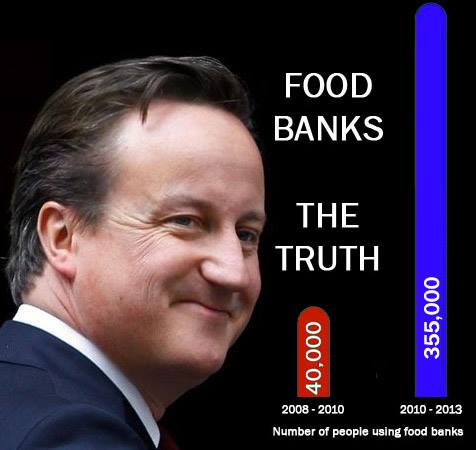
AM: What about the million people depending on food banks?

DC: Well obviously I want a country where people don’t depend on food banks, we did something.

AM: But why are more people depending on food banks?

DC: One of the things we did was that Labour, because they didn’t like the PR of this, they didn’t advertise or promote the existence of food banks through job centres. We changed that because we thought that was, that was basically sort of selfish and shortminded…

1390648_548165358586330_1740107407_nAM: And according to the Trussell Trust who run these banks that accounts for just three percent of people using food banks at the moment so it’s not a significant thing. But can I take you to an individual case, James [he meant David] Clapson. Clapson who was a former soldier worked very hard for a long time then was on benefits, failed to turn up to two job centre interviews, [it was just one interview that David missed,] had his benefits removed for a month, he was diabetic, his insulin couldn’t be refrigerated and he died two weeks later.

Now that is the kind of case that is coming up again and again and again and shows that the welfare cuts have been agonisingly painful for real people out there.

DM: Well we have hardship funds and councils have hardship funds for exactly those sorts of tragic cases but if you’re asking me…

AM: It didn’t work.

DC: If you are asking me is it right that people who are asked to turn up for interviews or asked to fill in a CV or asked to apply for a job should have to do those things before getting benefits then yes it’s right that we do have that system in place but we always, as I put it on the steps of…

AM: But the system has been very very aggressive, another case of a man who had learning difficulties and filled in his form by hand rather than by computer and was refused benefits, there is lots of these cases as you won’t have a review, you should have a review of the system surely?

DC: I look at all of those individual cases and all of those cases can be addressed by the hardship funds and by the flexibilities that are there in the system but we have sanctions for a reason, people watching this programme…

AM: You don’t get the hardship fund for two weeks.

DC: Hold on a second

AM: Alright.

DC: People watching this programme who pay their taxes, who work very hard, they don’t pay their taxes so people can sign on and show no effort at getting a job, as I put it on the steps of Downing Street those who can should; those who can’t we always help – that is the principle that should always underline a compassionate benefits system.

scroll2
We do not have a compassionate welfare system: we have a re-designed system that is draconian because of the “reforms” – it’s more about taking money from people than supporting them. It’s about punishing people into work. That is precisely why people like David Clapson are dying. No support was given to David, and many others like him.

Cameron’s rhetoric isn’t remotely coherent or compassionate, let alone honest.

Let’s not forget that it was Cameron’s government that has ruthlessly stigmatised, dehumanised and scapegoated unemployed and disabled people, in order to justify punishing them by removing their support and handing out the subsequent “savings” to millionaires, who gained £107,000 each per year, whilst those who paid for it – and we are also tax payers, Mr Cameron – are suffering and dying, and the establishment look on with contemptible, pathological, greedy, grasping, self-serving indifference.

Related

11046274_80388630968089cam cThanks to Robert Livingstone for the excellent memes.
The real progressive in the leader’s debate is Ed Miliband

Ed Miliband has faced some vicious opposition over the past five years. Not just from the Tories, the press, big business and the establishment, but from the rival fringe parties claiming to be on the left. It’s because Miliband wants to create a new post-Thatcherite settlement for Britain. The Labour manifesto clearly signposts that intention.

Miliband understands that the growing chasm between the incomes of rich and poor and obscene levels of wealth inequality have shown that political collaboration with the wealthy has not delivered any “trickle down” to the poorest at all. As a society, we cannot afford to indulge the millionaires’ something for nothing culture.

We all know by now that despite the fact that our economy was in recovery from the consequences of the global crisis by the last quarter of 2009, due to the competence of the previous government, the Tories duped the public, using a narrative founded on panic-mongering and malicious lies  about an “economic firestorm” and “financial mess” to formulate further justification for redrafting the social contract on behalf of the elite, and extending an exclusive, undemocratic politics of privilege.

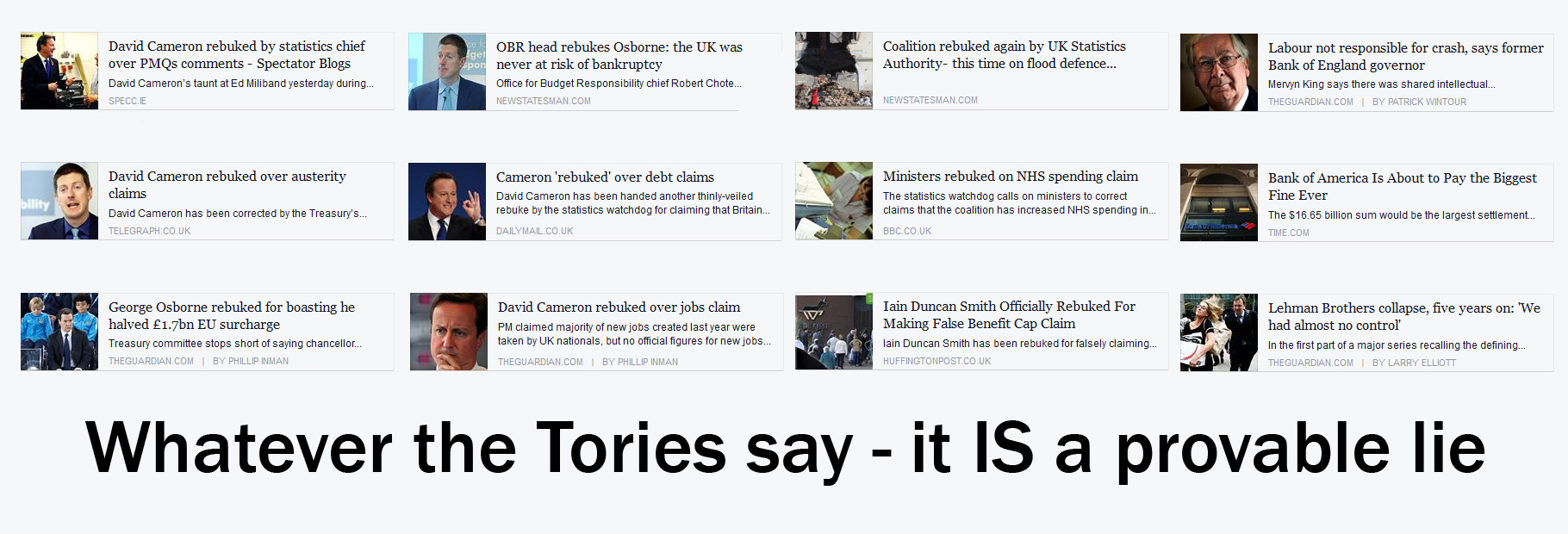
(See A list of official rebukes for Tory lies to appreciate something of the full extent of recognised lies the government have told the public.)

The cosseted elite are now engaged in an all out war to maintain the socio-economic status quo. Firstly they know that Ed Miliband has edited their script, abandoning the free-market fundamentalist consensus established by Thatcherism in favour of social democracy.

Secondly, the right-wing media barons who set the terms of what is deemed politically palatable, and who frame the parameters of debate in Britain have never forgiven Ed Miliband for his endorsement of Leveson, which they regard as an unacceptable threat to their power.

Thirdly, they know Labour under Ed Miliband is likely to win the 2015 election.

The fringe “alternative left” parties in competition for Labour votes have focused debate on the issue of cuts they claim Labour are proposing, which perhaps purposefully misses the more important point: Miliband’s whole approach to government isn’t about austerity at all: it’s about changing the status quo by shifting the balance of how the economy works and adjusting who the economy works for.

It struck me, listening to the televised debate earlier, that Miliband needs to reclaim the word “progressive” from those parties such as the Scottish Nationalists and the Greens, especially given that his economic plan and redistributive tax policies are the most progressive of all the opposition parties.

Indeed Miliband has bravely chosen to rehabilitate the word “taxation” and reintroduce the fundamental post-war settlement tenet that in order to have civilised and sustainable public services, everyone has to contribute their share, and the burden should not be placed on the poorest via consumption taxes (VAT for example) and policies such as the punitive, unfair bedroom tax. Wealthy people and big businesses, after all, use our infrastructure: roads, railways, schools, hospitals and other services. Yet far too many consider the very idea of paying income or corporation tax worthy of moral outrage. The real outrage is the Thatcherite consensus that social responsibility and duty should be regarded only as a moral framework for the vulnerable: the obligations of only the poorest.

During the televised debate, the fringe party leaders regurgitated electioneering lies, too. For example, Natalie Bennett deliberately misquoted Rachel Reeves, and not for the first time, claiming that Labour “ignored” the plight of those on benefits. (See Anyone worried about protecting the welfare state should concentrate on kicking out the Tories – Debbie Abrahams, which addresses this misquote, Labour would end this Government’s demonisation of benefits claimants – Chi Onwurah MP and Labour demand big improvements to Work Capability Assessments – by Kate Green.)

Miliband was accused by Farage of introducing Private Finance Initiatives (PFI), adding a “creeping” and “back door” privatisation element to the NHS, under New Labour, when in fact it was John Major that introduced PFI in 1992.

A priceless claim from Farage, since he does not want an NHS. Farage wants an Americanised private insurance system.

Sturgeon parroted the lie that the Labour Party had “voted with the Tories” for cuts totalling “£30 Billion,” accusing Miliband of being “Tory lite.” As was pointed out by Miliband, and again, later, on Question Time by Yvette Cooper, the Hansard record shows clearly that the vote was not about cuts, nor did the motion contain any reference to any sums of money.

However, the debate surprised me in that Miliband was not attacked quite as vigorously or as much as anticipated. Farage drew the most fire, causing deep discomfort amongst the audience and other leaders with his dogged and prejudiced pursuit of single issue politics, he was accused, rightly, of being divisive. Farage managed to further alienate UKIP by patronising Sturgeon and Bennett on the issue of immigration, and accusing both the studio audience and the BBC itself of “heavy left-wing bias.” Laugh out loud.

Leanne Wood responded scathingly to Farage’s anti-immigration rhetoric with: “Well I would disagree with my friend on the far right,” which met with applause and cheers from the audience, at her capturing of a neat double meaning.

Farage claimed: “My opponents are abusing me,” moments after he had himself been abusive towards the audience and other leaders, to which Wood responded with: “You abuse immigrants and those with HIV and then complain UKIP is being abused,” with deep disdain evident in her voice.

Miliband, described by many political commentators as the only prime ministerial party leader, responded in a measured, honest way to Farage’s drone about immigration with:  “The problem is, Nigel, you exploit people’s fears rather than addressing them,” raising more applause and cheers from the audience and creating a moment of tangible solidarity amongst the left leaders. Farage’s usual swagger departed.

On the subject of defence, the SNP, the Greens and Plaid Cymru are clear that they would not renew Trident. However, it’s worth bearing in mind that the general public are not inclined towards unilateralism, no matter how persuasive the proposition and reasoning is. Labour have long-standing and close ties with the CND, but their previous unilateral disarmament philosophy lost them two elections, they were therefore pushed to adopt a position of multilateralism. That’s a by-product of genuine democracy. This said, some 75% of Labour parliamentary candidates do not support the renewal of Trident.

By far the most memorable moment of the debate came when Nicola Sturgeon declared that she will do anything to “kick the Tories out” – including proposing a coalition with a party she’s spent years fighting and telling lies about – she’ll do anything, except of course to honourably put aside electioneering for her own party in an election it can never win, to kick the Tories out.

She had previously said: “If Labour won’t be bold enough I think people should vote for parties that would hold them to account.”  As Ed Miliband pointed out, she meant vote SNP in Scotland, Green in England, Plaid in Wales, as she has previously urged the electorate, thus increasing the likelihood of another Tory government.

Sturgeon attempted to turn conventional wisdom on its head, despite her previous appeal to voters to fritter away the opportunity to get shot of the Tories, she proposed a Labour/SNP coalition, pleading: “We have a chance to kick David Cameron out of Downing Street. Don’t turn your back on that. People will never forgive you.”

Miliband, turning conventional wisdom the right way up again, gave a powerfully forthright response: “You fought Labour all your life, Nicola,” he said, adding: “I’ve fought the Tories all my life.”

“You want to gamble on getting rid of a Tory government; I can guarantee getting rid of a Tory government.”

“I’ve got fundamental disagreements with you, Nicola, because in the last few weeks you’ve revealed that you haven’t ruled out having a second referendum,” he said.

“We have profound differences – that’s why I’m not going to have a second coalition with the SNP, because I’m never going to put at risk our United Kingdom.”

Sturgeon has said that the SNP would not form a coalition with Labour, or agree a confidence and supply deal, without a deal on Trident, and Miliband has said categorically that it’s not on offer. That means that, effectively, that the SNP is reduced to supporting Labour on a confidence motion and then restricted in dealing with everything else on a case by case basis.

And if the SNP are genuinely not prepared to let in the Tories, they will support Labour on a confidence motion. It was difficult to miss the hint of pleading in Sturgeon’s pitch at the end the debate.  Miliband is in the much stronger position.

Miliband reminded Sturgeon that the SNP worked with the Tories in Edinburgh, their vote in 1979 put Thatcher in office.

Sturgeon isn’t consistent: either it doesn’t matter whether Labour or the Conservatives win the election or it does. Half the time the SNP would like you to believe it makes no difference; the rest of the time they acknowledge it does. Which is why we see ludicrous contradictions like the SNP leader advocating a vote for the Greens – a vote that, if delivered, would render the SNP’s notionally-preferred outcome less, not more, likely.

So, my enemies’ enemy is not always my friend, except when he can be useful. Now that’s a career politician who claims far too loudly that she isn’t.  Ho hum.

LP card
Many thanks to Robert Livingstone for his excellent memes.

And one more thing. Mr Cameron:

What will the Tories suggest next. “Compassionate” genocide?

68196_116423458427191_5364492_n
The Tory parliamentary candidate for Cambridge, Chamali Fernando sparked outrage and horror after saying mental health patients should wear wristbands to identify their conditions. Fernando was speaking at a hustings event hosted by the campaign group Keep Our NHS Public when she made the comment.

Andy Burnham, Labour’s Shadow Health Secretary, said:

“There has been an enormous amount of work in Parliament to challenge the stigma surrounding mental health. But comments like this are so disappointing – they set us back and remind us how far we have to go. Jeremy Hunt must disown these comments, instruct his candidate to apologise and make it clear that they form no part of Conservative Party policy.”

“This proposal shows the candidate’s harmful views on mental health.

Disability and Mental Health Adviser at University of the Arts, London Annabel Crowley said.

“Research carried out by the Institute of Psychiatry, Psychology & Neuroscience at King’s College London shows personal contact with mentally ill people is the most effective way to reduce discrimination.”

Crowley says Fernando’s proposals would only alienate the mentally ill and “further curtail their freedom,” which would encourage further stigmatization.

We need to provide adequate care and support, not blame the victims of a failing health service,” she added.

Mental Health Services are in crisis because of Coalition cuts to funding. The Government has been criticised for allowing mental health services to be cut disproportionately, as the NHS as a whole undergoes the most severe budget cut in its history. And let’s not forget that under the guise of a “policy of deinstitutionalisation,” Thatcher’s “Care in the Community” Bill was about anything but care: it was all about cutting costs, as reflected in the experiences of many people leaving long term institutional care and being left to fend for themselves in the community. “Compassionate Tories”: there is no such thing.

Dr. Pooky Kingsmith, a mental health specialist, said that she [Fernando] “fails to understand” what the wristbands would achieve “beyond increasing the stigma and prejudice already experience by mentally ill people.”

A petition has since been set up calling for Fernando to stand down in the election. The description on the petition read:

“This kind of thinking has no place in modern society and especially not in someone who is hoping to be elected as an MP.

I can’t see any possible justification in allowing Ms Fernando to continue to stand for election after showing such prejudice against the mentally ill, and if allowed to do so, shows a total disregard to the people in this country, who already have to battle against the misunderstanding and ignorance of their mental illness.”

Chamali Fernando was asked how the authorities could help the police better deal with people with mental health issues.

Fernando responded that wristbands which disclose a person’s illness could help barristers, such as herself, to better aid the public.

She said wearing colour-coded wristbands indicating the nature of the person’s condition would be helpful to professionals as “they often could not explain themselves.”

Perhaps Fernando had designs that are something like this in mind:


1936 illustration of Nazi camp ID-emblems.

The red triangle was used by the Nazis to identify social democrats, socialists, trade unionists, Freemasons and communists, for example. The pink triangle was primarily used for identifying homosexual men, and the black triangle was used to identify “asocial elements” (asozial) and “work shy” (arbeitsscheu) including those who were mentally ill, pacifists, vagrants and the Roma.

And for anyone itching to invoke Godwin’s law at this point, I suggest you hang fire and read about Allport’s Ladder of Prejudice. Whilst I am very aware that we need take care not to trivialise the terrible events of Nazi Germany by making casual comparisons, there are some clear and important parallels on a socio-political level and a psycho-social one, that I feel are crucially important to recognise.

Gordon Allport studied the psychological and social processes that create a society’s progression from prejudice and discrimination to genocide. In his research of how the Holocaust happened, he describes socio-political processes that foster increasing social prejudice and discrimination and he demonstrates how the unthinkable becomes acceptable: it happens incrementally, because of a steady erosion of our moral and rational boundaries, and propaganda-driven changes in our attitudes towards “others” that advances culturally, by almost inscrutable degrees.

The process always begins with political scapegoating of a social group and with ideologies that identify that group as an “enemy” or a social “burden” in some way. A history of devaluation of the group that becomes the target, authoritarian culture, and the passivity of internal and external witnesses (bystanders) all contribute to the probability that violence against that group will develop, and ultimately, if the process is allowed to continue evolving, genocide.

As I have discussed elsewhere on this site, we have a government that uses words like workshy to describe vulnerable groups. This is a government that is intentionally scapegoating poor, unemployed, disabled people and migrants. One Tory councillor called for the extermination of gypsies, more than one Tory MP has called for illegal and discriminatory levels of pay for disabled people. (See also David Freud was made to apologise for being a true Tory in public.)

David Freud’s comment that disabled people are not worth the minimum wage was not a momentary lapse, nor was it unrepresentative of Tory views more generally. He is the contemptuous architect of the grossly punitive Tory Bedroom Tax that disproportionately affects households of disabled people. The Tories endorsed Freud’s discriminatory policy proposal, and savagely ridiculed the UN rapporteur, Raquel Rolnik, when she pointed out, very professionally and reasonably, that the policy contravenes human rights.

He is the same government minister that rejected suggestions that austerity policies have led to an increase in food bank use – making the jaw-droppingly astonishing suggestion that food bank charities are somehow to blame. This former investment banker and peer told the Lords that the increase in the usage of food banks was “supply led”. He said:

“If you put more food banks in, that is the supply. Clearly, food from the food banks is a free good and by definition with a free good there’s almost infinite demand.”

Poverty reduced to blame-the-individual neoliberal motivational formulae. Yet it is the government that are responsible for policies that create and sustain inequality and poverty.

We need only look at the discriminatory nature of policies such as the legal aid bill, the wider welfare “reforms” and research the consequences of austerity for the vulnerable – those with the  “least broad shoulders” –  to understand that these comments reflect how conservatives think.

This is a government that is using public prejudice to justify massive socio-economic inequalities and their own policies that are creating a steeply hierarchical, society based on social Darwinist “survival of the fittest” libertarian, minarchist principles.

The Tory creation of socio-economic scapegoats, involving vicious stigmatisation of vulnerable social groups, particularly endorsed by the mainstream media, is simply a means of manipulating public perceptions and securing public acceptance of the increasingly punitive and repressive basis of the Tories’ welfare “reforms”, and the steady stripping away of essential state support and provision.

Let’s not forget that we were recently informed that the Tories plan to limit child benefit to the first two children because it would save money. The idea is being examined by the Conservatives, despite previously being vetoed by Downing Street because of fears that it could “alienate” parents.

Asked about the idea on the BBC’s Sunday Politics programme, Duncan Smith said:

“I think it’s well worth looking at. It’s something if we decide to do it we’ll announce out. But it does save significant money and also it helps behavioural change.”

This is a clear indication of the Tories’ underpinning eugenicist designs – exercising control over the reproduction of the poor, albeit by stealth. It also reflects the underpinning belief that poverty somehow arises because of faulty individual choices, (as opposed to faulty political decision-making and ideologically-driven socio-economic policies), that those choices are non-rational, stereotypical, and that reducing cost to the State involves making people change their “faulty,” stereotypical behaviours.

This government’s policies are contibuting significantly to mental illness: Suicides have reached a ten year high and are linked with welfare “reforms”.

And Osborne announced in the budget that the government will be funding a “package of measures” to improve “employment outcomes” which will entail putting Cognitive Behaviour therapists in more than 350 job centres to provide “support” to those with “common mental health conditions” who are claiming employment support allowance (ESA) and job seekers allowance (JSA).

As I have written elsewhere, the government have put up an online contract notice which specifically states:

“This provision is designed to support people with common mental health conditions to prepare for and move into work, with intervention at the earliest possible point in a claim to benefit or access to the Fit for Work service.”

Cognitive Behaviour Therapy (CBT) is used to change how you think (“Cognitive”) and what you do (“Behaviour”). It bypasses emotions, personal history and narrative, to a large extent, and tends to focus on the “here and now.” In this case, the here and now consists of taking any job available, regardless of its suitability, or face being sanctioned.

CBT is an approach that facilitates the identification of “negative thinking patterns” and associated “problematic behaviours” and challenges them. This approach is at first glance a problem-solving approach, however, it is of course premised on the assumption that interpreting situations “negatively” is a bad thing, and that thinking positively about bad events is beneficial.

The onus is on the individual to adapt by perceiving their circumstances in a stoical and purely rational way.

So we need to ask what are the circumstances that the government are expecting people claiming benefits to accept stoically. Sanctions? Work fare? Being forced to accept very poorly paid work, abysmal working conditions and no security? The loss of social support, public services and essential safety nets ? Starvation and destitution?

The political vilification of sick and disabled people and the poor, amplified in the media, has preceded policies particularly aimed at the steady removal of State support, indicating a clear scapegoating process, and this isn’t indicative of a government that is “neglectful”- it is patently intentional, hence the pre-emptive “justification” narratives to garner public support and acceptance towards such punitive and harsh policies.

As Frances Ryan says:

“The ideology of a small state or the belief that benefits build dependency are crass, irrelevant details to what at its core is simply a decision about how to treat a human being. This is particularly damning when one person has all the power and the other is forced through economic necessity to take whatever humiliation or pain they are given. To do that to someone – let alone hundreds of thousands – is no accident. It is a conscious decision, that has been made over and over again by this government.”

I’ve consistently expressed my own well-founded, carefully considered, evidenced view that the Tories are authoritarians,  social Dawinists, and their social policies are founded on a creeping and implicit eugenics by stealth, fueled by their preference for a steeply hierarchical, unequal society, anachronistic ideas about “deserving” and “undeserving”, which belong to the 1834 Poor Law era, and a behaviourist approach to socio-economic circumstances .

In Edgbaston, Keith Joseph, (1974) announced to the world that:

“The balance of our population, our human stock is threatened … a high and rising proportion of children are being born to mothers least fitted to bring children into the world and bring them up. They are born to mothers who were first pregnant in adolescence in social classes 4 and 5. Many of these girls are unmarried, many are deserted or divorced or soon will be. Some are of low intelligence, most of low educational attainment.”

And in 2010, the former deputy chairman of Conservative Party, Lord Howard Flight, told the London Evening Standard:

“We’re going to have a system where the middle classes are discouraged from breeding because it’s jolly expensive. But for those on benefits, there is every incentive. Well, that’s not very sensible.”

These comments are not momentary lapses, nor are they unrepresentative of Tory views more generally. They reflect the true colours of the nazi nasty party.

demcracy

Pictures courtesy of Robert Livingstone


My work is unfunded and I don’t make any money from it. I am disabled because of illness and struggle to get by. But you can support Politics and Insights and contribute by making a donation which will help me continue to research and write informative, insightful and independent articles, and to provide support to others.  DonatenowButton

This unsnookered isle

1395990_559940054075527_258446375_nWriting in the New York Times, Paul Krugman said Britain’s performance since 2010, after the global financial crisis struck, has been “startlingly bad,” with a tentative recovery that began in 2009, which was stalled in the last quarter of 2010. In his article entitled This Snookered Isle, Krugman provides an indictment of the Coalition’s claims and their methods of managing the UK economy. Mr Krugman echoes many leading economists in Britain.

Krugman says: “Unfortunately, economic discourse in Britain is dominated by a misleading fixation on budget deficits. Worse, this bogus narrative has infected supposedly objective reporting; media organizations routinely present as fact propositions that are contentious if not just plain wrong.”

Simon Wren-Lewis of Oxford University has dubbed this narrative “mediamacro.” As his coinage suggests, this is what you hear all the time on TV and read in British newspapers, presented not as the view of one side of the political debate, but as simple fact.

Yet none of it is true.

Krugman goes on to ask: “Was the Labour government that ruled Britain before the crisis profligate? [As so often claimed by the Conservatives.] Nobody thought so at the time.”

In 2007, government debt as a percentage of G.D.P. was close to its lowest level in a century (and well below the level in the United States), while the budget deficit was quite small. The only way to make those numbers look bad is to claim that the British economy in 2007 was operating far above capacity, inflating tax receipts. But if that had been true, Britain should have been experiencing high inflation, which it wasn’t.

What about growth? When the current British government came to power in 2010, it imposed harsh austerity — and the British economy, which had been recovering from the 2008 global slump, soon began slumping again. In response, Prime Minister David Cameron’s government backed off, putting plans for further austerity on hold (but without admitting that it was doing any such thing). And growth resumed.” (See also: The Return of Expansionary Austerity.)

He adds: “If this counts as a policy success, why not try repeatedly hitting yourself in the face for a few minutes? After all, it will feel great when you stop.

Given all this, you might wonder how mediamacro gained such a hold on British discourse. Don’t blame economists. As Mr. Wren-Lewis points out, very few British academics (as opposed to economists employed by the financial industry) accept the proposition that austerity has been vindicated. This media orthodoxy has become entrenched despite, not because of, what serious economists had to say.”

Cameron has misled the public by making Government debt analogous with personal debt. It isn’t. If a person misses a mortgage payment, for example, they may risk damaging their credit rating, and possibly even losing their home. So if we owe money, we need to find a way to pay it back as soon as possible. But government debt does not need to be paid back overnight – in fact, it’s widely recognised to be potentially damaging to do so.

In an economy, one person’s spending is another person’s income. So when the government cuts spending, it reduces people’s income, leading to less business, more unemployment, and a vicious spiral of slowing down the economy.

Osborne’s austerity measures have achieved nothing, except deepening poverty, widening economic inequality, and suffering for the poorest and most vulnerable communities – and Osborne announced in his Autumn statement that we face at least four more years of it, should the Tories gain office again.

Austerity is not an economic necessity, nor is it temporary measure to balance the books, but rather, it reflects the Conservative’s long-standing ideological commitment to dismantle the gains and achievements of the post war settlement: public services, the welfare state and the National Health Service. This is where most of the cuts have been aimed.

With a shortfall in tax receipts set to increase the size of the deficit by at least £25 billion during the next parliament, the Office for Budget Responsibility have said the only way Osborne could balance the books would be through shrinking the state to a level not seen since before the Second World War: “Total public spending is now projected to fall to 35.2 percent of GDP by 2019-20, taking it below the previous post-war lows reached in 1957-8 and 1999-2000 to what would probably be its lowest level in 80 years”. Robert Chote.

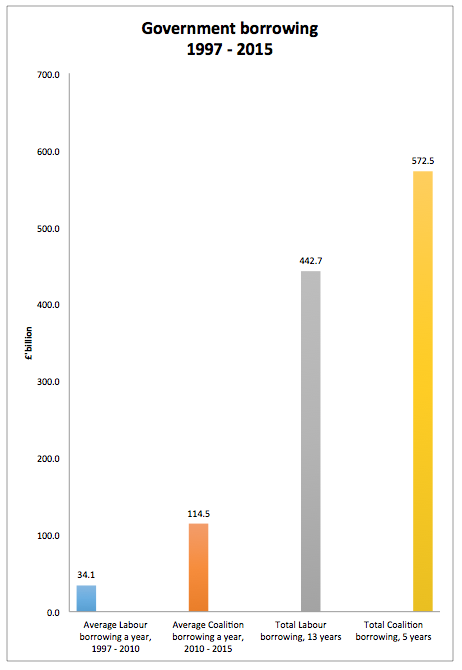
Despite facing a global recession, the Labour Government invested in our public services, and borrowed substantially less in thirteen years than the Coalition have in just five years. UK citizens were sheltered very well from the worst consequences of the global bank-induced crash.

Gordon Brown got it right in his championing of the G20 fiscal stimulus, agreed at the London summit of early April 2010, which was a continuation of his policies that had served to steer the UK economy out of the consequences of a global recession, and to protect citizens from those consequences.

Osborne’s policy of imposing austerity and budget cuts on an economy that was actually recovering was a catastrophic error. The austerity cuts propelled the economy backwards and into depression; and, far from using public spending as a countervailing force against the cutbacks in private sector investment, the Coalition’s budget cuts served to aggravate the crisis. Many people are suffering terribly as a consequence, many have been reduced to a struggle for basic survival.

The Conservatives have been engaged in a significant transfer of income from the least well-off half of the population to the more affluent in the past five years. Those with the lowest incomes have been hit hardest by austerity. Deliberately so.

It’s inconceivable that Coalition policies were formulated for anything other than profiting the wealthy at the expense of the poorest.

The following cuts came into force in April 2013:

  • 1 April – Housing benefit cut, including the introduction of the bedroom tax
  • 1 April – Council tax benefit cut
  • 1 April – Legal Aid savagely cut
  • 6 April – Tax credit and child benefit cut
  • 7 April – Maternity and paternity pay cut
  • 8 April – 1% cap on the rise of in working-age benefits (for the next three years)
  • 8 April – Disability living allowance replaced by personal independence payment (PIP)
  • 15 April – Cap on the total amount of benefit working-age people can receive.

Here are some of the Tory “incentives” and consquences for the wealthy:

In November last year, my proposition was also verified in a study of the cumulative impact of tax and welfare changes, from in-work benefits to council tax support, to the cut in the top rate of income tax and an increase in tax-free personal allowances, the report concluded that Coalition policy has been regressive across the income spectrum.

Its authors, Paola De Agostini and Professor Holly Sutherland at the university of Essex, and Professor John Hills at the LSE, wrote: “Whether we have all been ‘in it together’, making equivalent sacrifices through the period of austerity, is a central question in understanding the record of the coalition government … It is clear that the changes did not lead to uniform changes in people’s incomes. The reforms had the effect of making an income transfer from the poorer half of households (and some of the very richest) to most of the richer half, with no net effect on the public finances.

“In effect, the reductions in benefits and tax credits financed the cuts in taxes. Some groups were clear losers on average – including lone-parent families, large families, children, and middle-aged people (at the age when many are parents).”

Last year, the scale of Britain’s growing inequality was revealed by a report from the leading charity, Oxfam, showing that the country’s five richest families now own more wealth than the poorest 20% of the population.

Oxfam urged the chancellor to use the 2014 spring budget to make an assault on tax avoidance and introduce a living wage, in a report highlighting how a handful of the super-rich, headed by the Duke of Westminster, have more money and financial assets than 12.6 million Britons put together.

In the report,  A Tale of Two Britains, Oxfam said the poorest 20% in the UK had wealth totalling £28.1bn – an average of £2,230 each. The latest rich list from Forbes magazine showed that the five top UK entries – the family of the Duke of Westminster, David and Simon Reuben, the Hinduja brothers, the Cadogan family, and Sports Direct retail boss Mike Ashley – between them had property, savings and other assets worth £28.2bn.

And:

Increasing inequality is a sign of economic failure rather than success. It’s far from inevitable – a result of political choices that can be reversed.

The Labour Party have announced this week that tackling tax avoidance and evasion is a priority, and they plan to push emergency laws through parliament designed to impose far higher fines and close  tax loopholes. This move alone will raise more than £7.5bn a year in revenue for the Treasury. It’s a measure that sends out a clear message: the poorest people should not have to pay more to compensate for tax abuses by the rich.

Also announced this week was Labour’s intention to abolish archaic rules that allow wealthy “non-domiciles”, who live in the UK but claim to be domiciled overseas, to avoid paying tax in this country on what they earn outside of Britain.

Labour’s careful, costed and evidence-based policies also include: a Bankers’ Bonus Tax; a Mansion Tax; repeal of the Bedroom Tax; a reversal of the Pension Tax relief that the Tories gifted to millionaires; a reversal of the Tory Tax cut for Hedge Funds; freezing gas and electricity bills for every home a the UK for at least 20 months; the big energy firms will be split up and governed by a new tougher regulator to end overcharging; banning exploitative zero hour contracts; introduction of a living wage (already introduced by some Labour councils); a reversal of the £107,000 tax break that the Tories have given to the millionaires; reintroduction of the 50p tax; scrapping George Osborne’s “Shares for Rights” scheme that has opened up a tax loophole of £1 billion; ensuring Water Companies place the poorest households on a Social Tariff that makes it easier for them to pay their Water Bills; breaking up the banks and separating retail banking from investment banking; introduction of measures to prevent corporate tax avoidance, scrapping the Profit Tax Cut (Corporation Tax) that George Osborne has already announced for 2015 and many more.

These are not austerity measures. They are much needed, strongly redistributive policies.

The Organisation for Economic Co-operation and Development (OECD) has recently found what most of us already knew: that income inequality actually stifles economic growth in some of the world’s wealthiest countries, whilst the redistribution of wealth via taxes and benefits encourages growth.

Will the super-rich leave the UK, bag, baggage and all, as the right-wing scaremongers bleat, if we have a fair government that expects tax contributions from the cosseted rich? I seriously doubt it. They could start an exodus to New York I suppose, a city with a currently heavier tax regime, yet curiously not short of thousands of super-rich residents.

Ask yourself this: what are these tax-evading, hoarding and loudly complaining people actually contributing to our society? As far as I can see, they are supported by enormous state handouts, at everyone elses’ expense. They are propped up in their greed for ever-increasing profits,

Tax avoidance is costing us at least £70bn each year.

The most costly benefit payments in the UK are Tax Credits, Housing Benefit and Child Benefit, totalling £56.4bn a year.  These are not out of work benefits.  Some 65% of the total spent on working age benefits, is paid to people in work, whose wages are below subsistence levels.

Add to that the corporate tax benefits, such as the value of the cheap credit made available to banks and other business, the insurance schemes run by the government to protect exporters, the marketing for British business laid on by Vince Cable’s ministry, the public procurement from the private sector … a recent study conducted by Kevin Farnsworth, a senior lecturer in social policy at the University of York, concludes that direct corporate welfare costs British taxpayers just short of £85bn a year.

The Tory’s justification for allowing exploitative tax avoiders to have all of their own way is the mythological “trickle down effect.” Or “voodoo economics” to Keynsians. It was also known as the “horse and sparrow theory” a couple of centuries back. The idea being that if you feed a horse plenty of oats, the sparrows in it’s wake will also be fed .

And we are most certainly being fed horsesh*t.

It’s time to put an end to corporate welfare, and state handouts to the wealthy. We can do that by voting for a Labour government.

And if some thieving, hoarding, greedy misers threaten to leave the UK, why, I think I’ll offer to help them pack.

rich keep millonsBig thanks to Robert Livingstone for his excellent memes.

Everyone matters: it’s time to vote for our lives – vote Labour

430847_149933881824335_1645102229_n (1)I published an article earlier this month from Debbie Abrahams and added a short piece by myself: Anyone worried about protecting the welfare state should concentrate on kicking out the Tories.

Benefits and Work published a very good article this week: Vote for your life – “dramatic”, “life-changing” cuts are coming, I have  reproduced the most salient parts of it here for those who don’t have access to their site. I’ve also added a few links with information.

“Dramatic” and “life-changing” benefits cuts will be imposed if the Tories are running the country after 7 May, Iain Duncan Smith has warned.

They could include taxing DLA, PIP and AA, axeing contribution-based ESA and JSA, cutting the work-related activity component of ESA to 50p, cutting carers allowance numbers by 40%, and making people pay the first 10% of their housing benefit.

For many, these will be life-threatening cuts, rather than life-changing ones.

But claimants are in a position to prevent them happening.

And it won’t take a miracle.

In fact, just an additional 5% turnout by working age claimants could have a dramatic and life-changing effect on Iain Duncan Smith and his plans instead.

But a higher turnout won’t happen by itself.  Many of the major charities and disability organisations have been scared into silence by the Lobbying Act. And the media has little interest in benefits cuts, other than to applaud them as a good thing.

So it looks like it’s up to ordinary claimants to make sure as many other claimants as possible understand the threat they are facing.

Dramatic cuts
Iain Duncan Smith told Andrew Marr last week he didn’t become a minister to make “cheese-paring” cuts. Instead he has ‘dramatic’ and ‘life-changing’ plans for claimants.

And the tool for those dramatic changes is £12 billion of cuts to benefits in the space of just two years.

So far, we only know where £2 billion of the cuts will come from – a freeze on working age benefits. But the Conservatives are refusing to say where the other savings will be made.

Hit list
A document leaked to the BBC, however, set out some of the cuts the Conservative party are considering, including:

  • Taxing DLA, PIP and AA.
  • Abolishing contribution based ESA and JSA entirely, so that only claimants who pass a means test can claim these benefits.
  • Cutting the number of people getting carer’s allowance by 40%.
  • Limiting child benefit to the first two children.

There are other proposed cuts too, including replacing industrial injuries benefits with an insurance policy for employers, regional benefit caps and changes to council tax.

Not enough cuts
But all of this will still not be enough.

According to the Institute for Fiscal Studies (IFS):

“If all of these were implemented, the total saving would be likely to fall well short of the missing £10 billion per year that the Conservatives intend to find by 2017–18”

So, what else might be in the firing line?

Housing benefit and ESA cuts
We know that pensioners benefits are protected. And JSA costs such a tiny amount compared to other benefits that further cuts there would make little difference.

Cuts to housing benefit are one possibility that the IFS have highlighted, however, as this makes up a large and growing proportion of the benefits bill.

The IFS have estimated that making everyone pay the first 10% of their housing benefit would save £2.5 billion over two years.

Another extremely strong contender is to cut the work-related activity component (WRAC) of ESA to just 50 pence.

We know that the Conservatives are keen to slash the WRAC, because they’ve considered doing it before.

Cutting the WRAC wouldn’t save huge amounts, probably less than £1 billion a year.

But combined with cuts to housing benefit and all the other cuts listed above, it would probably be enough.

What you can do
Is this all nothing more than unnecessarily distressing speculation? After all, we don’t know what cuts will be made until – and unless – the Tories are elected.

But by then it will be too late. As Andrew Marr said in his interview with Iain Duncan Smith, if the Conservatives won’t tell us which benefits will be cut, sick and disabled claimants will have to expect the worst:

“What I’m saying to you is if I was on welfare, if I was on disability benefit and I was told that you were taking £12 billion out of the budget, I would really need to know before I voted was I going to be hit. Or if I didn’t know that, I’d have to be assume that I was going to be hit.”

Iain Duncan Smith, Osborne and Cameron have all now said no details of the cuts will be given before the election. So there’s no time to lose.

Clearly, the most important thing is to make sure you are registered to vote and then actually vote for a candidate who can keep the Tories out, if that’s possible, in your constituency.

But there’s more.

Above all, alert other claimants and carers to the dramatic threat they face – because many people still have no idea how huge £12 billion in cuts in two years really is.

And then try to persuade them that voting isn’t a waste of time. Because it is no longer true that all the parties are the same.

Here at Benefits and Work we have no trust for either of the major parties. But Labour, regardless of your political preferences, don’t drool at the thought of cutting welfare in the way that the Tories do.

And the £7 billion savings Labour say they plan to make are very much smaller than the Conservative cuts. Even if every single pound Labour saved was from cutting benefits, instead of from other measures such as raising taxes from the wealthy, it would still amount to just over half the benefits cuts the Tories have guaranteed.

[To clarify, Labour have stated they will not be cutting benefits, but they will address the overall costs to the welfare budget, tackling high private sector rent, repealing the bedroom tax, reducing costs such as private contracts within the Depatment of Work and Pensions, for example. See: We can reduce the Welfare Budget by billions: simply get rid of Iain Duncan Smith. Kitty]

You can make a difference
And don’t imagine that your voice can’t make a difference.

Bar chart:  Tory Majority 333, claimant count 6840 Lancaster Fleetwood

This is a very close election so far.

There will be many seats where the winner’s majority is in the low hundreds, some where it will be less than a hundred. Even a 5% additional turnout by working age claimants – amounting to perhaps 400 voters in many constituencies – could make the difference between Labour and the Conservatives being the largest party.

If you can convince a handful of people to vote and to talk to other claimants, you could genuinely help to change the course of this election.

Remember, you’re not trying to persuade hard-faced, right wing tabloid readers that cutting benefits is wrong. That undoubtedly would be a waste of time.

You’re talking to people who already know how painful the Coalition benefits cuts have been – because they’ve been hit by them.

You just have to persuade them that it’s not time to despair.

It’s time to fight back.

It’s time to vote for your life.

Related

Rising ESA sanctions: punishing the vulnerable for being vulnerable

As predicted, Mandatory Review has effectively destroyed independent Tribunals

Government under fire for massaging unemployment figures via benefit sanctions from Commons Select Committee

Osborne’s razor, smoke and mirrors

Osborne’s Autumn statement reflects the Tory ambition to reduce State provision to rubble

Follow the Money: Tory Ideology is all about handouts to the wealthy that are funded by the poor

Thanks to Robert Livingstone for the excellent memes.

The Conservatives are guilty of great deceit in blaming Labour for the deficit – Ed Miliband.

gret deceit

The first part of this article was originally posted in the Guardian, on Thursday 6 January 2011:

Ed Miliband accuses the Conservatives today of a “great deceit” in blaming Labour for the national deficit and warned that they have concocted a false narrative to justify politically driven cuts. Speaking at Labour’s campaign centre in Oldham yesterday, the Labour leader  attacked the Tories for rewriting history.

In announcing a raft of swingeing public spending cuts the coalition government has repeatedly sought to portray that its hands are tied because of the size of the deficit it inherited from the last government.

The same argument was rolled out this week to defend this week’s rise in VAT from 17.5% to 20%, after warnings of the likely impact on low and middle-income families and the fragile economy. Amid Labour concerns that the opposition has not been forcefully contradicting the coalition’s narrative on the deficit, Miliband insisted that it was not caused by Labour overspending but by the global financial crisis.

“My concern is that a great deceit designed to damage Labour has led to profoundly misguided and dangerous economic decisions that I fear will cause deep damage to Britain’s future,” he writes in today’s Times (paywall).

The Labour leader says that by blaming the deficit on overspending the Conservative-led government is seeking to win consensus for its policy of cutting the deficit “as far and as fast as possible”. But he accuses the chancellor of “gambling on a rapid rebalancing of the economy” and says he is going “too far and too fast on the deficit”.

Accusing the Tories of attempting to rewrite history, Miliband points out that Britain’s debt at the outset of the economic crisis was the second-lowest in the G7 and lower than it was under the Conservatives in 1997 and says neither of the parties in the coalition government called for lower spending at the time.

Miliband repeats his warning from earlier this week that the VAT increase will squeeze families on middle and low incomes and says growth will be restricted as a consequence. He argues that while some would argue those are prices worth paying in the short-term, the effect will be to store up greater problems for the future.

He says Labour is not opposed to every cut, but that he does oppose those being inflicted on the county’s poorest. He added: “but neither is it true that Labour is to blame for the deficit or that the deficit-reduction programme being pursued by this government is necessary and fair. Because this Conservative-led government is trying to deceive people about the past, it is making the wrong judgments about the future”.

David Cameron said yesterday that the joint impact of increases on duty and VAT meant things were “very painful and difficult” and raised the prospect of introducing a fair fuel stabiliser which would keep fuel duty down when oil prices rise. He also admitted that the rise in VAT to 20% this week was regressive in terms of people’s income but “might not be if it was looked at in terms of people’s spending.”

See also: Ed Miliband’s speech on the deficit and economy: George Osborne’s cuts are extreme and ideological.

scroll2
Ed Miliband’s speech shows that he is a very perceptive and conscientious leader.

The claims made by the Conservatives that Labour “left a mess” don’t stand up to scrutiny. Here is a little evidence which demonstrates that the Tories have a track record of lying, and of blaming everyone else for their own ideological preferences, policy decisions and economic incompetence:

https://i0.wp.com/www.taxresearch.org.uk/Blog/wp-content/uploads/2014/10/Screen-Shot-2014-10-06-at-09.36.30.png

Thanks to Richard Murphy, who produced this graphic, all data is from the HM Treasury Pocket Bank for 30 September on the Government’s own website.

See also: Labour is not responsible for crash, says former Bank of England governor

OBR head rebukes Osborne: the UK was never at risk of bankruptcy. Osborne was rebuked by the Office for Budget Responsibility (OBR) for telling the great big lie about Labour leaving the country “near bankrupt”, yet Cameron has used that same lie in the televised leaders debates. You’d think that a near “bankrupt” country would have had the Fitch and Moody triple A credit ratings downgraded …oh hang on, didn’t that happen … under the TORIES?

And haven’t the Tories borrowed more in 5 years than Labour did in 13? Surely we must be bankrupt now, by the Tories’ own reckoning.

Then there is the oft-cited Liam Byrne note. The jest recalls a similar note left by Tory Reginald Maudling to his Labour successor James Callaghan in 1964: “Good luck, old cock … Sorry to leave it in such a mess.”

Byrne clarified at the time that the note was meant in jest: “My letter was a joke, from one chief secretary to another,” he said. “I do hope David Laws’s sense of humour wasn’t another casualty of the coalition deal.”

Treasury sources said the full text of the letter from Byrne – dated 6 April, the day Gordon Brown called the general election – was: “Dear chief secretary, I’m afraid there is no money. Kind regards – and good luck! Liam.”

Byrne’s notes have caused bemusement before. When he was promoted to the cabinet in 2008, he gave officials a set of instructions entitled “Working with Liam Byrne”, which included the lines: “Coffee/Lunch. I’m addicted to coffee. I like a cappuccino when I come in, an espresso at 3pm and soup at 12.30-1pm … If I see things that are not of acceptable quality, I will blame you.”

Gary Gibbon of Channel 4 News remembers that former chancellor Alistair Darling had also left a note for his successor, George Osborne, as well as a bottle (how very civilsed) – but, in Gibbon’s words, “no revolver.”

It’s an indication of how desperately determined this government are to blame the previous government for the consequences of their own policy decisions and economic catastrophe, that the Tories have to seize on a traditional and humorous exchange between outgoing and incoming ministers as “proof” to bolster their spurious claims and to prop up such deception.

The Office of National Statistics (ONS) has said that David Cameron has presided over an economy with the weakest productivity record of any government since the second world war, and revealed that output per worker fell again in the final three months of 2014.

In a separate blow to the credibility of the government, two-thirds of leading UK economists said they believed George Osborne’s austerity strategy had been damaging for the economy.

The Centre for Macroeconomics polled 50 leading economists, asking them whether they agreed that the government’s deficit-reduction strategy had a positive impact on growth and employment. One third disagreed and a further third strongly disagreed.

Furthermore, 77% feel that the outcome of the general election will have serious (“non-trivial”) consequences for the economy, and are clearly not in favour of the Conservatives’ “long-term economic plan.”

The Tories seem to think we have forgotten that it was they that lost the Moody’s Investors Service triple A grade, despite pledges to keep it secure. Moody’s credit ratings represent a rank-ordering of creditworthiness, or expected loss.

The Fitch credit rating was also downgraded due to increased borrowing by the Tories, who have borrowed more in 4 years than Labour did in 13.

I remember that we were very well sheltered from the consequences of the global banking crisis by the last government. It’s remarkable that despite George Osborne’s solid five-year track record of failure, the Tories still mechanically repeat the “always cleaning up Labour’s mess” lie, as if increasing the national debt by 11% of GDP in 13 years, mitigated by a global recession, caused by bankers, as Labour did, is somehow significantly worse than George Osborne’s unmitigated record of increasing the national debt by 26% in just 5 years. Osborne has ironically demonstrated that it is possible to dramatically cut spending and massively increase debt. Austerity doesn’t work as a means of reducing debt, but works exceptionally well as a smokescreen for an ideologically-driven reduction of the state.

econ lies

The Tories have seized an opportunity to dismantle the institutions they have always hated since the post-war social democratic settlement – institutions of health, welfare, education, culture and human rights which should be provided for all citizens. The Tories attempt to destroy fundamental public support for the health, education and welfare of its people. Offering and inflicting only regressive, punitive policies and devastating cuts, the Tories lie, lie and lie some more to attempt to justify the unustifiable.

proper Blond

The Conservatives have not encouraged investment in the UK either:


The Tories have told many lies. Here’s a list of those that have earned them official rebukes – A list of official rebukes for Tory lies.

Further reading:

The Austerity Con Simon Wren-Lewis

The Tory election strategy is more of the same: Tories being conservative with the truth.

The Great Debt Lie and the Myth of the Structural Deficit.

One of the most destructive Tory myths has been officially debunked.

“The mess we inherited” – some facts with which to fight the Tory Big Lies.

Political scrapbook: Telegraph business leaders letter ‘was padded out with Sam Cam’s luvvie friends’

Follow the Money: Tory Ideology is all about handouts to the wealthy that are funded by the poor.

The word “Tories” is an abbreviation of “tall stories”.

10689499_731152076954323_875040546185242333_nWith thanks to Robert Livingstone 

A few facts about the deficit and the economy, since the Tories are determined to peddle pre-election lies

correct versionThe study can be found here.

From the excellent Richard Murphy:

I think this graph tells a story very few seem to know about:

Screen Shot 2014-10-06 at 09.36.30All data is from the HM Treasury Pocket Bank for 30 September. I have extrapolated 2014/15 borrowing from the August data to suggest whole year borrowing of just over £107 billion based on average proportion of total year borrowing to 31 August over the past five years.

The conclusions are stark: the Coalition has borrowed more than four times more a year than 3.3 times a year what Labour did, on average.

In five years the Coalition has borrowed more than Labour did in 13, by a considerable margin.

And there wasn’t an unforeseen banking crisis on the Coalition’s watch.

So why is the story still told that it is Labour who borrowed too much? Purely objectively that makes no sense and says that there is another entirely different story to be told here.

From the excellent Simon Wren-Lewis, Professor of economics, who explains how Tory austerity has actually wrecked Britain’s economy, not helped it. Radio 4 World At One, today. (4 minutes)

Just more proof of what we already know – not only that austerity wrecks an economy, but that the Tories were going to make their cuts ANYWAY, because that’s what they believe in, and simply used the Global Crash of 2007-8 as their excuse, and the previous government as their scapegoat. With many thanks to Robert Livingstone for capturing both audios: Listen here.

And from the excellent Professor David Blanchflower austerity has prevented recovery: Listen here.

proper BlondIdeology is the reason for the Tory austerity cuts and not economic necessity.

Austerity has not encouraged investment in the UK:

The Coalition have a track record of lying and trying to mislead the public. David Cameron has now been rebuked several times for making false claims: on NHS spending, the rising national debt and the impact of his tax rises and deep spending cuts on economic growth. The Tories invented figures to claim people are now “better off”, but which totally ignored and excluded an account of the impact of significant factors like the rise in VAT, the cost of living, cuts to tax credits and other benefits.

The government is committing fraud on a grand scale. The reason for such deceit has nothing to do with public finances or the state of the economy, and everything to do with shrinking the public realm. There is an irreducibly ideological dimension to Tory economics, and by making it sound “scientific” when really, it’s more akin to philosophy or Tory buck passing, they attempt to lend it an air of authority and legitimacy it does not deserve.

The only thing that unites Tories is wealth, they mostly thrive on creating social divisions. The Tories have used a justification narrative based on a moral entrepreneur approach to scapegoat and vilify vulnerable social groups in order to justify transferring our public wealth to private bank accounts, behind the façade of austerity. What we are witnessing is a governments’ nonchalant adherence to Tory ideology, no matter what the consequences for the poorest, the sick and disabled, the unemployed and most vulnerable. Or the economy.

The Tories peddled the lie that due to Labour’s management of the economy, the UK was “on the brink bankruptcy” and claim the solution to is to cut government spending with a painful programme of austerity cuts. Of course the UK economy was growing in 2010 when the Tories took over and was subsequently plunged back into recession by Osborne’s austerity policies which have meant that the economy has not grown at all under the coalition; and for much of their tenure , it has been contracting.

Many economist have said consistently that this is the wrong approach. The best solution is to borrow or, better, create money to invest in infrastructure. But what we have instead is Osbornes’ closed economy, with a colossal redistribution of public funds to few private businesses and millionaires, who are sat on our money, whilst the government is steadily removing even more of our public capital through deep cuts. There is no investment in the infrastructure, public services – it’s a framework of increasing and devastating socio-economic entropy.

The Tories seem to think we have forgotten that it was they that lost the Moody’s Investors Service triple A grade, despite pledges to keep it secure. Moody’s credit ratings represent a rank-ordering of creditworthiness, or expected loss.

The Fitch credit rating was also downgraded due to increased borrowing by the Tories, who have borrowed more in 4 years than Labour did in 13. In fact this Tory administration have borrowed more than every single Labour government ever, combined.

The Tories have seized an opportunity to dismantle the institutions they have always hated since the post-war social democratic settlement – institutions of health, welfare, education, culture and human rights which should be provided for all citizens. The Tories attempt to destroy fundamental public support for the health, education and welfare of its people. Offering and inflicting only regressive, punitive policies and devastating cuts, the Tories lie to drag the compliant, conforming and increasingly shell-shocked electorate along as they dismantle our social democracy, our public services, fundamental rights and the very basis of our civilisation.

Whenever this authoritarian government have been challenged and opposed effectively, they simply ignore or edit the law, veto tribunal rulings or invoke archaic government privilege to bypass opposition and to get their own way with unpopular policies, such as The Health and Social Care Bill and the Welfare “Reforms”.

That a government needs to engage in such underhanded methods to pass their policy through the legislative process, and justify such policies by lying, and by the malevolent scapegoating of vulnerable sections of society via the media, informs us that those policies are not addressing public needs, and wishes; that they are not democratically motivated or processed and that they reflect a political ideology which does not accommodate social and economic realities, nor is it fitting for a so-called first world liberal democracy that is a signatory to several international human rights charters to witness a government so deceptive and arbitrary in its approach to legitimacy.

Here is a catalogue of officially recognised Tory lies used to justify their unjustifiable policies  which have resulted in official reprimands.

Related:

The Tory election strategy is more of the same: Tories being conservative with the truth.

The Great Debt Lie and the Myth of the Structural Deficit.

One of the most destructive Tory myths has been officially debunked.

“The mess we inherited” – some facts with which to fight the Tory Big Lies.

Political scrapbook: Telegraph business leaders letter ‘was padded out with Sam Cam’s luvvie friends’

correct beecroft
tory liesThanks to the excellent Robert Livingstone for the excellent memes.
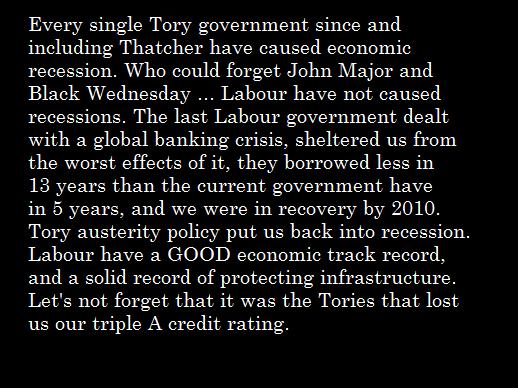
The Conservative’s negative campaign strategy: “share the lies and win a prize”

lie
The Office of National Statistics (ONS) said that David Cameron has presided over an economy with the weakest productivity record of any government since the second world war, and revealed that output per worker fell again in the final three months of 2014.

In a separate blow to the credibility of the government, two-thirds of leading UK economists said they believed George Osborne’s austerity strategy had been damaging for the economy.

The Centre for Macroeconomics polled 50 leading economists, (as opposed to Tory donors and “business leaders” with an agenda) asking them whether they agreed that the government’s deficit-reduction strategy had a positive impact on growth and employment. One third disagreed and a further third strongly disagreed.

Furthermore, 77% feel that the outcome of the general election will have serious (“non-trivial”) consequences for the economy, and are clearly not in favour of the Conservatives’ “long-term economic plan.”

The Tories seem to think we have forgotten that they lost the Moody’s Investors Service triple A grade, despite Osborne’s pledges to keep it secure. Moody’s credit ratings represent a rank-ordering of creditworthiness, or expected loss.

The Fitch credit rating was also downgraded due to increased borrowing by the Tories, who have borrowed more in 4 years than Labour did in 13. In fact this Tory administration have borrowed more than every single Labour government ever, combined. This hardly reflects economic competence on the part of the Conservatives, and that applies even if we accept the Conservative’s limited terms of economic competence, too.

Every single Tory government since and including Thatcher’s administration have caused extremely damaging and avoidable economic recessions. Labour did not cause the global crash, and the last Labour government sheltered us very well from the fall out of the banking crisis, without imposing austerity on the poorest citizens. Labour borrowed less in thirteen years than the Tories have in four years. We were in economic recovery by 2010. Labour have an excellent economic track record.

However, despite this, over on the Conservative campaign site, the focus is on the economy. Or more precisely, on how Labour “wrecked” or “will wreck” the economy. Yet Osborne was rebuked by the Office for Budget Responsibility (OBR) for making outrageous claims that Labour left the country “close to bankruptcy.” The economy was officially recovered and growing following the global crash, by the last quarter of 2009, so the Tories and Clegg are lying when they claim they “inherited a mess.” Furthermore, within months of the Coalition taking office, we were back in recession.

It’s remarkable that despite George Osborne’s solid five-year track record of failure, the Tories still mechanically repeat the “always cleaning up Labour’s mess” lie, as if increasing the national debt by 11% of GDP in 13 years, mitigated by a global recession, caused by bankers, as Labour did, is somehow significantly worse than George Osborne’s unmitigated record of increasing the national debt by 26% in just 5 years. Osborne has ironically demonstrated that it is possible to dramatically cut spending and massively increase debt. Austerity doesn’t work as a means of reducing debt, but works exceptionally well as a smokescreen for an ideologically-driven reduction of the state.

There are no positive messages on offer from the Conservatives to potential voters of an aspirational nature on their site, instead, all we see are desperate “warnings” about a Labour government, which border on hysteria, and some have veered from labels such as “Trotskyism” to scenes from 28 Days Later.

The entire Conservative campaign lacks warmth, honesty and any sense of social responsibility. It’s nothing to do with engaging democratically with the electorate, rather, it’s all about manipulating people using fear-mongering and despicable lies. Don’t believe me? Take a look at their track record.

It’s strikingly apparent that the Tories have typified the “playground bully” approach to campaigning, fully intent on spreading lies to discredit the opposition any way they can, whilst avoiding open debate and scrutiny at all costs. Because the Conservatives have no genuine and positive policies to offer most of the electorate.

An example from the Tory “Share the Facts” site:

The truth: Cameron’s ‘warning’ on Labour’s £3,000 ‘tax rise’ was shot down within hours by the respected think tank, the Institute for Fiscal Study (IFS). Despite being debunked, this lie is still up on the Tory site.

This Tory lie carries an opportunity to earn 50 points towards a prize if you share it. Further points are awarded if the post is subsequently shared, too. So not only are the Tories bribing people to share lies, they are encouraging people to persuade others to share the lies.

How it works:

Share the Facts is a great way to play your part in the most important election campaign for a generation. By sharing videos, graphics and blog posts with friends, you can help get the message out about everything we’re doing to secure a better future – and how Labour would put it all at risk.

Every week, Share the Facts users help our content reach over 3 million people – and if you sign up too, the number will be even greater. You’ll get points for every post you share – with rewards for those doing most to support the campaign.

EARNING POINTS

You’ll be awarded points for 3 things:

  1. Sharing a post – you immediately receive the number of points shown on the post
  2. When your friends click the post you’ve shared – 10 extra points
  3. When your friends react to your post (i.e. like, share or retweet) – 10 extra points

The Conservatives have already been accused of trying to “buy the General Election” by quietly raising the legal spending limit by £6.2 million to £32.7m amidst concern from the Electoral Commission over undue influence. The party has reportedly amassed a war chest of more than £70 million.

Last year it emerged that the Tories have spent thousands of pounds on advertising to encourage Facebook users to “like” Cameron’s page.

One motive for offering rewards to share lies and buying Facebook “likes” is to create an illusion of consensus. People sharing posts and adding “likes,” will lend to a false impression that the Tories are credible, making legitimate claims and that people agree with them.

Bribery is defined as an act of giving money or gifts that alters the behaviour of the recipient. In operant conditioning, which the Tories use a lot in policy-making aimed at “changing behaviours,” positive reinforcement is based on the idea that behaviours followed by a reward tend to be repeated.

This is an element of a discredited psychological theory known as behaviourism, which is linked with totalitarian thinking. The Tories are using behaviourist techniques via policies on an unconsenting population.

However, the methods used in welfare policies, for example, are not about positive reinforcement. Punishment , not reward is being used on the poorest citizens instead to “change behaviours” or incentivise people to work. Benefit sanctions, which were made an integral part of benefit conditionality in the Tories’ welfare “reforms,” are one example. If you think this is far-fetched, then you can always read up a little about the extensive, baleful influence of the government’s Behavioural Insights Team (Nudge Unit) on the framing and justification of Tory policy.

The Tory “share the facts” tactic also draws on well-known propaganda techniques. The first is called Bandwagon –  this is an “inevitable-victory” appeal that attempts to persuade the target audience to join in and take the course of action that “everyone else is taking.” The second technique is called Join the crowd, which reinforces people’s natural desire to be on the “winning side.” This technique is used to convince the audience that a programme is an expression of an irresistible mass movement and that it is in their best interest to join.

This is not just a deceptive government: it’s a very dangerously anti-democratic one. If they gain office again, the Tories will repeal our Human Rights Act and say they will withdraw from the European Convention.

Human rights are the bedrock of our democracy.

The Tories will destroy what remains of our welfare provision, National Health Service and other public services. This is the truth.

Research has shown that Conservatism is the enclave for those with socially destructive dark triad personality traits (Machiavellianism, Narcissismand Psychopathy). Tories share the same regressive social Darwinist ideology, so they will always formulate the same policies that divide society into steep hierarchies of wealth and privilege, resulting in massive inequalities, suffering and poverty, lies, corruption and indifference to the majority of the publics’ needs.

These are basic truths that the Tories are trying to divert your attention from, by lying and by attempting to bribe people into complicity in sharing those lies.

Voting is deeply emotional for many people. But for me, the Conservative’s negative campaigning reinforces the negative emotions I feel about the Tories, not the Labour Party. It highlights the Conservatives as the nasty party, trying to manipulate the electorate rather than presenting authentic reasons why they should be retained in government. The negative campaigning says much more about the Tories than it does about those they attack.

But the fact that the Tories do attack so viciously and persistently indicates very clearly that they see the Labour party as a significant threat to their increasingly hierarchical status quo.

scroll2

Related

Some of the promises the Tories are trying to delete from the internet.

Cameron’s pre-election contract: a catalogue of lies.

Cam weakness

Pictures courtesy of Robert Livingstone 


CONTRIBUTE TO POLITICS AND INSIGHTS

I don’t make any money from my work. But you can support me by making a donation and help me continue to research and write informative, insightful and independent articles, and to provide support to others. The smallest amount is much appreciated – thank you.