Author: Kitty S Jones

I’m a political activist with a strong interest in human rights. I’m also a strongly principled socialist. Much of my campaign work is in support of people with disability. I am also disabled: I have an autoimmune illness called lupus, with a sometimes life-threatening complication – a bleeding disorder called thrombocytopenia. Sometimes I long to go back to being the person I was before 2010. The Coalition claimed that the last government left a “mess”, but I remember being very well-sheltered from the consequences of the global banking crisis by the last government – enough to flourish and be myself. Now many of us are finding that our potential as human beings is being damaged and stifled because we are essentially focused on a struggle to survive, at a time of austerity cuts and welfare “reforms”. Maslow was right about basic needs and motivation: it’s impossible to achieve and fulfil our potential if we cannot meet our most fundamental survival needs adequately. What kind of government inflicts a framework of punishment via its policies on disadvantaged citizens? This is a government that tells us with a straight face that taking income from poor people will "incentivise" and "help" them into work. I have yet to hear of a case when a poor person was relieved of their poverty by being made even more poor. The Tories like hierarchical ranking in terms status and human worth. They like to decide who is “deserving” and “undeserving” of political consideration and inclusion. They like to impose an artificial framework of previously debunked Social Darwinism: a Tory rhetoric of division, where some people matter more than others. How do we, as conscientious campaigners, help the wider public see that there are no divisions based on some moral measurement, or character-type: there are simply people struggling and suffering in poverty, who are being dehumanised by a callous, vindictive Tory government that believes, and always has, that the only token of our human worth is wealth? Governments and all parties on the right have a terrible tradition of scapegoating those least able to fight back, blaming the powerless for all of the shortcomings of right-wing policies. The media have been complicit in this process, making “others” responsible for the consequences of Tory-led policies, yet these cruelly dehumanised social groups are the targeted casualties of those policies. I set up, and administrate support groups for ill and disabled people, those going through the disability benefits process, and provide support for many people being adversely affected by the terrible, cruel and distressing consequences of the Governments’ draconian “reforms”. In such bleak times, we tend to find that the only thing we really have of value is each other. It’s always worth remembering that none of us are alone. I don’t write because I enjoy it: most of the topics I post are depressing to research, and there’s an element of constantly having to face and reflect the relentless worst of current socio-political events. Nor do I get paid for articles and I’m not remotely famous. I’m an ordinary, struggling disabled person. But I am accurate, insightful and reflective, I can research and I can analyse. I write because I feel I must. To reflect what is happening, and to try and raise public awareness of the impact of Tory policies, especially on the most vulnerable and poorest citizens. Because we need this to change. All of us, regardless of whether or not you are currently affected by cuts, because the persecution and harm currently being inflicted on others taints us all as a society. I feel that the mainstream media has become increasingly unreliable over the past five years, reflecting a triumph for the dominant narrative of ultra social conservatism and neoliberalism. We certainly need to challenge this and re-frame the presented debates, too. The media tend to set the agenda and establish priorities, which often divert us from much more pressing social issues. Independent bloggers have a role as witnesses; recording events and experiences, gathering evidence, insights and truths that are accessible to as many people and organisations as possible. We have an undemocratic media and a government that reflect the interests of a minority – the wealthy and powerful 1%. We must constantly challenge that. Authoritarian Governments arise and flourish when a population disengages from political processes, and becomes passive, conformist and alienated from fundamental decision-making. I’m not a writer that aims for being popular or one that seeks agreement from an audience. But I do hope that my work finds resonance with people reading it. I’ve been labelled “controversial” on more than one occasion, and a “scaremonger.” But regardless of agreement, if any of my work inspires critical thinking, and invites reasoned debate, well, that’s good enough for me. “To remain silent and indifferent is the greatest sin of all” – Elie Wiesel I write to raise awareness, share information and to inspire and promote positive change where I can. I’ve never been able to be indifferent. We need to unite in the face of a government that is purposefully sowing seeds of division. Every human life has equal worth. We all deserve dignity and democratic inclusion. If we want to see positive social change, we also have to be the change we want to see. That means treating each other with equal respect and moving out of the Tory framework of ranks, counts and social taxonomy. We have to rebuild solidarity in the face of deliberate political attempts to undermine it. Divide and rule was always a Tory strategy. We need to fight back. This is an authoritarian government that is hell-bent on destroying all of the gains of our post-war settlement: dismantling the institutions, public services, civil rights and eroding the democratic norms that made the UK a developed, civilised and civilising country. Like many others, I do what I can, when I can, and in my own way. This blog is one way of reaching people. Please help me to reach more by sharing posts. Thanks. Kitty, 2012

Access to justice is the foundation of democracy

995147_204045783079811_467247470_n

“Ministers keep using the mantra that their proposals are to protect the most vulnerable when, quite obviously, they are the exact opposite. If implemented their measures would, far from protecting the most vulnerable, directly harm them. Whatever they do in the end, Her Majesty’s Government should stop this 1984 Orwellian-type misuse of language.”  – Lord Bach, discussing the Legal Aid Bill.

Source: Hansard, Column 1557, 19 May, 2011.

The Legal Aid and Advice Act 1949 was a British Act of Parliament which extended the welfare state to ensure that those unable to pay for a solicitor were able to access free legal help. It was designed and implemented to allow poor and vulnerable people to have a genuine access to justice, and was a key part of our post war settlement.

Massive funding reductions, implemented through the contested and controversial Legal Aid, Sentencing and Punishment of Offenders Act 2012, (LAPSO) removed in one fell swoop public funding for huge and crucial areas of civil work – including welfare benefits, debt, immigration, domestic violence, clinical negligence, employment rights and most housing. What this means in basic terms is the poor have no access to justice, and at a time when government is relentlessly encroaching on poor people’s freedoms and rights.

The Legal Aid Bill has been cumulatively devastating to the provision of legal services and is a savage attack on one of our fundamental constitutional principles – it seriously undermines the rule of law.  The government is ensuring that those affected the most by their draconian policies are unable to challenge government decisions. It’s now very difficult to get advice and representation, and judicial reviews are being stifled as a consequence. Yet the number of judicial reviews involving government departments has almost doubled since 2010, the government has revealed. It’s increased by 92%.

The figures were revealed in the same week that the House of Lords thwarted the government’s attempt to restrict judicial review. In particular, peers voted down Ministry of Justice attempts to create a presumption that those who apply to the court to intervene in a judicial review case should have to pay their own costs. Cameron has made it clear that he regards judicial reviews, audits, consultations, impact assessments and other democratic mechanisms that ensure government transparency, accountability, and serve as safeguards of our human rights, as “barriers to getting things done.”

Cameron has confirmed that he wants civil servants to stop conducting routine equality impact assessments for legislation, which assess the likely effect of new policies on women, disabled people and people from ethnic minorities, and to end cumbersome 12-week public consultations that delayed ministers from pressing ahead with their plans. He said that such safeguards to the rights of protected groups are  “bureaucratic rubbish”.

The legal aid “reform” was introduced at a time when the Government have implemented other radical, controversial and contentious cuts to health, education and welfare, and it is no coincidence that the legal aid Bill will curtail justice for those with legitimate needs at a time when draconian Tory policies such as the bedroom tax will most likely result in a massive increase of numbers of people needing and seeking justice and redress.

This will mean the compounding of effects of other fundamental  human rights breaches, legally unchecked, because of the profound impact of multiple, grossly unfair and unjust Tory-led policies. Each policy hitting the same vulnerable citizens, to their detriment, over and over.

As a former barrister at Tooks chambers, Emily Thornberry MP has condemned the closure of the “exceptional set”: “We were the chambers of the Guildford Four, the Birmingham Six, the Lawrence family… and we have closed because of the legal aid cuts. But this isn’t just about lawyers. The legal aid system has to begin with the vulnerable; ensuring people get a voice and access to justice, and ensuring that our legal system contains the checks and balances that we need in a democratic society.”

Thornberry, speaking last year to a packed conference in a Brighton, criticised the government for the ideological nature of the cuts it has introduced – and in particular, the attack on judicial review. She said:

“The government doesn’t want to be held accountable in the courts so they’re making it harder for people to judicially review them.  Nobody wants to be judicially reviewed, but it goes with the territory.  It’s important for people to be able to hold the government to account in the courts.”

The legal aid bill was defeated 14 times in the House of Lords and ultimately passed after a tied vote. Services and individuals feeling the impact are currently giving evidence to the House of Commons justice committee. The Equality and Human Rights Commission had warned in 2012 that: reducing the scope of legal aid in a number of areas in civil and family law will create serious practical barriers to access to justice, potentially in breach of Article 6(1) of the European Convention on Human Rights (ECHR).   

This is a government that clearly cares nothing for being held accountable for its actions, for public scrutiny and critical debate, and for justice and human rights. In fact since 2010, they have steadily eroded all of these crucial safeguards and democratic criteria through the implementation of policies that are extremely authoritarian and discriminatory.

It’s very dangerous to allow the State to decide which cases constitute the most need. In a free, democratic and fair Society, each and every single individual has equal legal worth and entitlement to opportunity to bring about legal justice. The Government choosing which cases are most “worthwhile” undermines this very premise of legal equality which is so fundamental to the notion of liberty.  Everybody has a right to take any grievances they have, which have invoked legal ramifications, to court. Everybody ought to have an absolute, inalienable right to free and fair trial in a so-called free, democratic country.

Such profoundly unjust legislated inequality is not something we expect to see in a country which was once a beacon of Western liberty. The State must fund the means of contract enforcement and free and fair trial legal costs, for those who cannot afford it.

If the State fails to fulfil this contingent function, then we simply cease to be free.

7005_494073677328832_658777491_n (1)Picures courtesy of Robert Livingstone


I don’t make any money from my work. But you can support Politics and Insights and contribute by making a donation which will help me continue to research and write informative, insightful and independent articles, and to provide support to others. The smallest amount is much appreciated, and helps to keep my articles free and accessible to all – thank you.

DonatenowButton

UK Government still in breach of the human rights convention on gender discrimination.

994596_517805604955639_608589568_n

The welfare reforms present a particular challenge to the financial security and autonomy of women. The “reforms” have been strongly influenced by (a particular form of) economic modelling, and do not take into account the lived experiences or the impact of the cuts on those targeted. Conservative ideology also informs the reforms and the Government uses an out-of-date model of households and concern about “dependency” on the state, not within families. The form of modelling depopulates social policy, dehumanises people, and indicates that the Tory policy-makers see the public as objects of their policies, and not as human subjects.

We therefore need to ask whose needs the “reforms” are fulfilling.

In 2010 the Equality and Human Rights Commission warned the government about its potential failure to meet its legal duties. This followed concerns raised by the Fawcett Society and others, regarding the estimated grossly disproportionate impact of the austerity cuts on women. The Commission recognised the serious concerns about the impact of the deficit reduction measures on vulnerable groups and, in particular, following the House of Commons library report, the impact of the budget on women. The Commission stated:

We have written to the Treasury to ask for reassurance that they will comply with their equality duties when making decisions about the overall deficit reduction, and in particular in relation to any changes to tax and benefits for which they are directly responsible.”

A more inclusive understanding of the range of impacts on both men and women is essential in the formulation of gender-aware, as opposed to gender-blind, policy responses to recession and recovery. It’s clear that the UK government is not interested in collating information regarding impacts and subsequent implications regarding inequality, yet they do have a legal duty to do so.

The United Nations Committee report on the Elimination of Discrimination against Women highlights areas where women’s rights in the UK have come to a standstill and appallingly, shamefully, some have been reversed.

Committee on the Elimination of Discrimination against Women: concluding observations on the UK’s report

August 13, 2013

The Committee on the Elimination of Discrimination against Women released its concluding observations on the UK’s seventh periodic report on 26 July 2013.

Concerns raised by the Committee include protection from discrimination under the Public Sector Equality Duty, the impact of austerity measures on women and women’s services, and restrictions on women’s access to legal aid.

Background information

On 17 July 2013, in Geneva, the United Nations Committee on the Elimination of Discrimination against Women examined how the United Kingdom has implemented the provisions of the Convention on the Elimination of All Forms of Discrimination against Women (CEDAW).

The Committee, a 23-person expert body, monitors compliance with the treaty. It assesses to what extent each State is meeting its obligations on ending all political, economic, social, cultural, civil or other forms of discrimination against women, and makes recommendations for the implementation of the Convention.

The UK CEDAW Shadow Report – “Women’s Equality in the UK: A health check” – was published in May 2013. It was produced by the CEDAW Working Group, a coalition of 42 women’s and human rights organisations from across the UK. The Shadow Report brings together issues impacting on the realisation of women’s rights under CEDAW in the UK in order to support the Government to make positive change in the future.

The report highlights the key areas where women’s rights in the UK have come to a standstill and in fact some are being reversed.

The Equality and Human Rights Commission (EHRC) published its submission to the United Nations Committee on the Elimination of All Forms of Discrimination Against Women on 1 July 2013. In its submission the Commission, as a national human rights institution, identifies key issues it believes should be highlighted as actions following the examination and sets out a number of questions the Committee may wish to put to the Government.

These include:

There is no joined up national strategy to implement the Convention in the UK, although there are equality strategies for England, Scotland and Wales. Devolution and localism mean responsibility for delivery and funding is spread across different levels of government. This could lead to geographical inconsistencies and hamper national progress in, for example, the availability of services to women experiencing violence.

Further questions raise issues around legal aid and access to justice; the effect of austerity measures on women and how these are assessed and mitigated and how the persistent educational and occupational gender segregation that contribute to the pay gap will be tackled.

The report says:

While noting the State party’s efforts to harmonise anti-discrimination laws under a single piece of legislation on equality (Equality Act 2010), the Committee is concerned that the Equality Act replaces the Gender Equality Duty (GED) with a single Public Sector Equality Duty (PSED) that covers all prohibited grounds of discrimination, and that the specific duty requirements of the PSED have now have no explicit gender component in England, unlike in Scotland and Wales, and does not adequately protect women against multiple discrimination. The Committee is also concerned that certain provisions of the Equality Act have not entered into force, such as provisions relating to the new public sector duty on socio-economic inequalities (sections 1-3); the recognition of “combined discrimination” (section 14); and the publication of gender pay information on (section 78).

The Committee is concerned that the austerity measures introduced by the State party have resulted in serious cuts in funding for organisations providing social services to women, including those providing for women only. The Committee is concerned that these cuts have had a negative impact on women with disabilities and older women. It is also concerned that the State party resorts to commissioning women’s services instead of direct funding, which allegedly risks undermining the provision of these services. The Committee is further concerned that budgetary cuts in the public sector, disproportionately affect women, due to their concentration in this sector.

The Committee is concerned that the Legal Aid, Sentencing and Punishment of Offenders Act of 2012 unduly restricts women’s access to legal aid, as it removes access to legal aid for litigation concerning, inter alia, divorce, property disputes, housing and and that a proposed residency test is under consultation. It is also concerned at the introduction of court fees under the Employment Appeal Tribunal Fees Order 2013. The Committee notes with concern reports that these limitations may push women, particularly ethnic minority women, into informal community arbitration systems, including faith-based tribunals, which are often not in conformity with the Convention. 

The Committee notes the reforms to the welfare benefit system in order to consolidate benefits and tax credits into a single payment under the Universal Credit system. However, it is concerned that, under the Universal Credit system, benefits and tax credits will be paid into a bank account of one member of the family, which poses risks of financial abuse for women due to power imbalances in the family, particularly if payment is made to an abusive male spouse.

The government has failed to publish a gender equality assessment of how their policy measures will hit women and men differently. This obscures somewhat the extent to which they have adhered to their legal duty to give due , or in fact any, regard to what their policies will mean for women’s equality.

Click here for details of the Committee’s consideration of the UK’s report, including presentation of the report by the Government Equalities Office, questions by experts and the delegation’s response

Click here for information about the Committee on the Elimination of Discrimination against Women – 55th session

Click here for live webcast of UK session

Click here for link to Shadow Report

Click here for link to EHRC submission

Click here for Touchstone blog by Scarlet Harris, Women’s Equality Officer at the TUC

Related

The welfare reforms and the language of flowers: the Tory gender agenda

Equality laws fail to protect working women from budget cuts

Thanks to Robert Livingstone for the excellent pictures

The great council house sell off scandal, again – right to buy leaves nowhere for poor people to live

14533697838_dffcc736f2_o (1)

Council houses, already in limited supply, are being sold off on the cheap to people who immediately rent them back to housing benefit tenants, according to an Independent investigation that exposes a new “Right to Buy” scandal.

Cameron launched a revamped version of Right to Buy in 2012, giving new preferential terms. He increased the cap on the maximum discount to £75,000 (or £100,000 for London). This means a quadrupling of the discount in London and a trebling for most parts of Britain.

Now the Independent has uncovered evidence that the Government’s drive to encourage councils to sell off their already limited supplies of housing stock is allowing former council tenants to profiteer as buy-to-let landlords.

Margaret Thatcher coerced local authorities who were strapped for cash in the 1980s to sell their properties at a cut price, and the Tory Government’s latest  initiative to encourage councils to sell off their remaining stock of houses is having a disastrous effect because it allows social housing, intended to house those people in most need of housing, to be exploited for personal profit. The policy, introduced in 1980, gave generous discounts for council tenants to buy their own home. More than two million homes were sold under Right to Buy between 1980 and 1995.

Local authorities, already facing massive funding cuts,  now have to pay much more to place vulnerable families in properties that were once council-owned. At least 32 councils now rent or pay out housing benefit to tenants living in homes sold since the Government revamped the Right to Buy scheme in 2012, Freedom of Information requests show.

There are rules to deter the immediate sale of properties bought under Right to Buy but renting is unregulated, so the Government’s hefty discounts on sales have turned former council tenants into buy-to-let landlords overnight. Council leaders have branded the situation a national scandal.

In April 2012, David Cameron increased the cap on the maximum discount to £75,000, or £100,000 for London. In the borough of Haringey 396 homes have been sold under Right to Buy since April 2012; of those, 28 are already being rented out to people on housing benefit at a cost of more than £265,000 a year to the public purse.

And of course the real costs of the Tory Right To Buy scheme are shouldered by those in greatest need of accommodation, who are forced to rent from the increasingly unaffordable private sector, whilst private landlords rake in profits. This means that people are forced to cut their spending on essentials like food and heating, or uproot and move away from community, jobs, schools and families.

There are currently five million people on housing waiting lists. The lack of affordable council and social housing has become even more acute due to the Government slashing the budget for building new social housing by 60%, soon after gaining office.

This Government’s housing policies are creating misery for thousands of families.

Labour demand big improvements to Work Capability Assessments – by Kate Green

995658_494538353949031_779653065_n

Today the government has announced the new provider for the ailing Work Capability Assessment (WCA). Maximus are replacing Atos, who quit the process after repeated concerns, raised by Labour and disabled people, about the operation of the test.

The government has spent months seeking an alternative provider.

While we’ve always said that simply changing the provider isn’t enough to deal with the underlying problems, Labour hope the new start under Maximus will lead to improved results.

Disabled people have every right to feel wary. The Department for Work and Pensions (DWP) are agreeing a new contract that will last years. With a general election looming, and Labour already having outlined a series of reforms we’d make to the Work Capability Assessment, it is unclear how the new provider will be expected to deliver improvements – or what penalties they’ll face if they don’t.

That’s why I have written to the Minister for Disabled People to ensure that any change of policy direction under a future Labour government can be accommodated within the contract, and that action can be taken swiftly to address poor performance.

We have also said that the new provider should be made responsible for ensuring that the Work Capability Assessment is better connected to work support to increase the number of disabled people in work. It’s essential that the new provider gains credibility quickly by providing more accurate results about assessments.

And crucially, the new provider must ensure the huge backlog of Work Capability Assessments is tackled swiftly.

We also expect Maximus to make significant improvements in the day to day delivery of Work Capability Assessments. Labour will insist that:

  • Every assessment centre must be accessible; that information about the Work Capability Assessment process must be available in accessible formats; and that disabled people who cannot reasonably be expected to attend a face to face interview should be assessed at home or another convenient and accessible location.
  • Claimants are advised that they are able to bring a companion to the assessment, who can assist them as appropriate.
  • Information sharing must be improved, including between Department for Work and Pensions, Maximus and Work Programme contractors.
  • Recordings of assessments must be provided on request.
  • Reports from assessors must include information on how an impairment or health condition affects someone’s ability to work.

But there is a broader need for reforming the Work Capability Assessment. Assessments must be part of the support to help disabled people back to work. Currently, the Work Capability Assessment is seen as entirely separate to the Work Programme – contributing to the appalling failure rate of the government’s flagship employment scheme.

Iain Duncan Smith’s DWP set a target of a 15 per cent employment rate for people on the Work Programme after two years. But after three years only 7 per cent of Employment Support Allowance (ESA) claimants who have accessed the programme have found work.

Our new approach would provide information about the support that is available in the local area to help individuals. Improving this element of the assessment and decision-making process is a crucial step towards a more integrated system of support.

Disabled people should also have a central role in monitoring the tests. A Labour government would ensure that for the first time disabled people would get a real say in how the assessments are delivered.

The independent reviewer of the Work Capability Assessment would work alongside a scrutiny group of disabled people supported by the Office for Disability Issues. We would also require the DWP to respond to Work Capability Assessment reviews and end the practice of ‘accepting’ recommendations that are then kicked into the long grass.

Accuracy of Work Capability Assessments must be dramatically improved under Maximus. Thousands of disabled people appealing inaccurate decisions have had to wait months for decisions, wasting millions of pounds in appeals and tribunals.

The DWP must deliver a better service for disabled people and better value for money for taxpayers. The Public Accounts Committee has already reported that targets set for the quality of the assessment were not challenging enough.

Labour would ensure a new system would impose penalties for poor performance, measured both on the number of times decisions are overturned by the DWP or through appeals. Clear financial penalties will ensure assessors improve the quality of assessments.

This means collecting all the medical evidence needed to make a decision and ensuring they listen to what claimants tell them to ensure decisions are based on the full facts.

The new provider of Work Capability Assessments takes over at a difficult time. Maximus will be judged very quickly on whether its performance is an improvement on years of failure and chaos in the DWP.

Ministers and the new provider need to urgently get a grip of Work Capability Assessments.

Kate Green MP​ is shadow minister for disabled people

scroll2

The Labour Party introduced a host of measures to strengthen the rights of disabled people. They passed the Disability Discrimination Act 2005, introduced the Equality Act 2010, and formed the Equality and Human Rights Commission, and, in 2009, the Labour government signed the United Nations convention on the rights of persons with disabilities.

It’s worth noting that without the Equality Act in particular, it would have been difficult to win the cases that have been presented to court against the government, concerning the unprecedented level of discrimination embedded in their policies.

Kate Green and Anne McGuire have pointed out that the original intentions when Labour introduced the Employment Support Allowance pilot and an assessment of people’s capacity for work, have been distorted – that the original aim was to be a supportive and facilitative process, with Disability Living Allowance (DLA), and other supportive measures in place to help people with disability lead a dignified life, fulfilling their potential, but, as Anne McGuire has pointed out, the renegotiation of the Atos contract by the current Government, (along with the addition of targets to remove people’s benefits, and sanctions,) has rebalanced the system to be punitive, rather than facilitative.

Of course the Tories have been very quick to blame Labour for the current situation, however, following a review of their pilot, Labour warned the government of problems with the Work Capability Assessment, which Iain Duncan Smith duly ignored, passing the ESA system into law, making the WCA even more problematic, and as stated, re-contracting Atos “in line with the welfare reforms” in 2011, including targets to take people’s lifeline benefits away, despite the claims made by the Tories. The targets were exposed by Dr Steven Bicks, a GP that applied for job with Atos, assessing whether benefit applicants were fit for work, and secretly filmed his training, which was broadcast by channel 4 – on their Dispatches programme, on Monday 30 July, 2012.

I was very pleased to hear of Labour’s proposal to introduce a new Disability Hate Crime Prevention Law, particularly in light of what has happened this past four years regarding right wing and media portrayals of sick and disabled people, using fake statistics, vicious stigmatising and scapegoating rhetoric to justify the punitive cuts, which have been aimed disproportionately at disabled people.

Comparing policies indicates clearly the stark differences between the parties, and given the briefing from Labour from their ESA review that was blatantly disregarded, and the refusal of the Coalition to undertake a cumulative impact assessment of the “reforms”, it’s clear that the Tories do not regard the poorest and most vulnerable worthy of government diligence, accountability, support and fair treatment.

KittySJones.

Related

“By the general election in May 2010, it was becoming clear that the WCA was getting too many decisions wrong. Unfortunately, the new Conservative-led government was so unmoved by these failings that Iain Duncan Smith ordered that the number of assessments be increased. So while assessments had previously been restricted to new applications for ESA, in November 2010 Atos started to put all 2.2 million existing incapacity benefit claimants through the WCA.

Unsurprisingly things did not improve – many people who were genuinely unable to work were still being declared as fit to do so, and there is now a backlog of more than 700,000 claimants awaiting an assessment. These delays not only cause financial hardship – they also often exacerbate people’s existing physical and mental health conditions.”Sheila Gilmore.

New ‘fit for work’ contract will not be fit for purpose

14533697838_dffcc736f2_o (1)With thanks to Robert Livingstone for his brilliant art work

Cuts to employment support allowance are being “considered” by ministers

37079_433060243430176_1848475368_n
Tory ministers are considering drastically cutting the main Employment and Support Allowance sickness (ESA) benefit, internal documents seen by the BBC suggest.

New claimants, judged to be capable of work with appropriate support, could be given just 50p more per week than people on job seekers allowance.

Current recipients get almost £30 per week more. This is to meet additional costs that arise because of a person’s disability.

The Department for Work and Pensions said the ESA proposals were “not government policy.”

The documents reveal that the government has also been forced to hire extra staff to clear the backlog on the benefit.

Some 100 healthcare professionals are being hired to carry out fitness-for-work tests. The staff, who will be employed through the Pertemps agency, will help to reduce a backlog of more than 600,000 cases.

They will be in addition to any extra staff brought in when a new contractor is announced shortly to replace ATOS. The American firm, Maximus, has been awarded the contract. Controversies and scandals have been unearthed by UK researchers since Maximus was handed the lucrative contract in July to deliver the government’s new health and work service in England and Wales.

Leaked documents over the summer showed that ministers considered ESA – formerly known as incapacity benefit – to be “one of the largest fiscal risks currently facing the government”.

They also revealed “concerns” about claimants moving off jobseekers allowance onto ESA.

Giving consideration to cutting the differential paid to ESA recipients in the Work Related Activity Group (WRAG) – individuals who have to prepare for employment – is a reflection of that concern. However these are people that have been declared unfit for work by their doctor. They currently receive £28.75 more per week but the documents show plans are being discussed to cut that to just 50p more than jobseekers allowance. People receiving JSA, who are aged 25 or over, currently get £72.40 per week.

However, disabled people do have have additional needs and higher living costs, which is why ESA was set at a higher amount than JSA. Furthermore, because ESA is paid to people who can’t work, that means they are potentially reliant on benefit to meet their living costs indefinitely, and certainly longer term than those claiming JSA. ESA wasn’t designed to be such a temporary means of support as JSA was.

Employment and Support Allowance is paid to approximately two million people. Claimants have to undergo an extremely controversial Work Capability Assessment (WCA) to determine whether they are eligible and at what level.

Many people have been wrongly assessed as fit for work, and have been forced to appeal in order to receive the benefit that they are entitled to, and the high success rate of appeals in itself indicates that the WCA is deeply flawed. People have died within weeks of being told they are fit for work, also indicating that this assessment process is heavily weighted towards ensuring that sick and disabled people lose their lifeline benefit.

Labour MP, Dame Anne Begg, who chairs the Commons Work and Pensions Select Committee, said she would support overhauling the delivery of ESA but: “did not envisage any reduction in the value of the benefit.”

She added: “That’s not reform, that is just saving money. I hope that is not something the government is going to come forward with.”

Of course the Conservatives have used the word “reform” as a euphemism for severe cuts since 2010.

If we look at how the Coalition austerity cuts have been targeted, we see that:

  • People in poverty are targeted 5 times more than most citizens
  • Disabled people are targeted 9 times more than most citizens
  • Disabled people needing social care are targeted 19 times more than most citizens.

A reminder of the established standards and ethics of Public Office, as the UK Coalition have exempted themselves

10616235_686911748045023_5041552951187809370_n

How policies are justified is increasingly being detached from the aims and consequences of them, partly because democratic processes and basic human rights are being disassembled or side-stepped, and partly because the current government employs the widespread use of a “malevolent benevolence” type of propaganda to intentionally divert us from the aims and the consequences of their ideologically (rather than rationally) driven policies.

An example of such propaganda is the common use of words such as “support”, “incentives”, “responsibility” and “fairness” to legitimise welfare cuts during a recession and the punitive benefit sanctions regime introduced by the Coalition. (I’ve written at length about this elsewhere on this site).

Furthermore, policies have become increasingly detached from public interests and needs.

Transparency International are a politically non-partisan, independent organisation whose mission is to prevent corruption and promote transparency, accountability and integrity at all levels and across all sectors of society, particularly in governments. Their core values are: transparency, accountability, integrity, solidarity, courage, justice and democracy.

In 2013, Transparency International undertook their annual opinion survey called the Global Corruption Barometer and found 65% of people believed the UK had become more corrupt in the last two years. 90% said British politics is now run by a few “big entities” who were looking after their own interests.

Corruption is defined as the abuse of entrusted power for private gain.

For example, Cameron’s defence secretary, Liam Fox, resigned over his relationship with the lobbyist Adam Werritty, and his election adviser, Lynton Crosby, is a lobbyist – for tobacco, alcohol, oil and gas companies. Which is why the prime minister came under attack for dropping curbs on cigarette packaging and alcohol pricing. His party treasurer Peter Cruddas resigned after offering access to Cameron for a £250,000 party donation.

Corporate influence extends beyond lobbying, though. Corporate and political interests have become increasingly interchangeable and mutual. The Tory party receives over half of its income from bankers, hedge fund and private equity financiers. The Tory party is bankrolled by a few hundred millionaires. We know that Peers who have made six-figure donations have been rewarded with government jobs. 

We know that venture capitalists such as Adrian Beecroft have influenced Tory employment policies, and in July, it emerged that millions of pounds of taxpayers’ money is being spent on a venture capital fund overseen by Beecroft, who is one of the Conservative Party’s biggest donors, and head of the private equity group that administers the high profile barely legal loan shark operation Wonga. The Wonga “business model” is basically to prey on the poor, vulnerable and absolutely desperate by offering them exploitative loans at eye-watering interest rates of 5,853% APR. Tellingly, even in the globally renowned haven of free-marketeering – the United States – such outrageous loans are illegal, but in the UK the Tory party are defiantly resisting efforts to regulate the so-called Payday lending sector and introduce maximum APRs.

Following the tide of sleaze and corruption allegations, Cameron “dealt” with with parliamentary influence-peddling by introducing the Gagging Act, which is primarily a blatant attack on Trade Unions (which are the most democratic part of the political funding system) and Labour Party funding, giving the Tories powers to police union membership lists, to make strike action very difficult and to cut union spending in election campaigns.

10553308_680322242037307_1558281906340939819_n

At least 142 peers linked to companies involved and invested in private healthcare were able to vote on last year’s Health Bill that opened the way to sweeping and corrosive outsourcing and privatisation. Tory MP Patrick Mercer also resigned the party whip when details of yet another lobbying scandal emerged, in May 2013, following questions surrounding paid advocacy, he was an Independent MP representing the constituency of Newark in Parliament until his resignation at the end of April 2014 after the Standards Committee suspended him for six months for “an unprecedented, sustained and pervasive breach of the house’s rules”

252299_486936058042594_609527550_n

The Tories have normalised political corruption and made it almost entirely legal. Our democracy and civic life are now profoundly compromised as a result of corporate and financial power colonising the State.

The Transparency of Lobbying, non-Party Campaigning, and Trade Union Administration Bill is a calculated and partisan move to insulate Tory policies and records from public and political scrutiny, and to stifle democracy. There are many other examples of this government removing mechanisms of transparency, accountability and safeguards to rights and democracy.

Transparency International have flagged up many areas of concern in their report: A mid-term assessment of the UK Coalition Government’s record on tackling corruption

Here is a list of the main causes for concern, many of which we have reported also:

  • There is no coordinated strategy or action plan to combat corruption in the UK. Data on corruption are not currently collected or are subsumed with other data such as fraud.
  • There is no strategic plan or clear channels of accountability; this is symptomatic of the lack of coordination surrounding Whitehall’s anti-corruption efforts.
  • Resources available to the institutions responsible for fighting corruption have been significantly reduced by the Government. Notably, the Serious Fraud Office’s budget has been cut from £51 million in 2008-9 to £33m in 2012-13. Its budget is expected to fall further to £29m by 2014-15.
  • The Government is seeking to amend the Freedom of Information Act to make it easier for authorities to refuse requests on cost grounds.
  • This Government is threatening to reduce the access of civil society and others to use judicial review mechanisms.
  • Legal Aid is being cut extensively,  this is likely to deny access to justice to individuals and groups who are victims of corruption.
  • The Government’s Localism Act abolished the Audit Commission, which in addition to overseeing and commissioning audit for local government and other bodies like the NHS, had statutory functions for investigating financial management and value for money. There was insufficient public discussion and consultation on the decision to abolish the Audit Commission and to debate and discuss the alternatives to it.
  • The Leveson enquiry and associated criminal investigations revealed a disturbing picture of the cosy relationship between politicians and the media, the bribing of police officers by journalists and the lack of will to hold the media accountable even when laws had clearly been broken.  Concentration of media ownership remains a significant corruption risk. The Government has thus far failed to implement the Leveson reforms or any alternative.
  • Labour’s Bribery Act has succeeded in encouraging many private companies to implement adequate procedures to combat corruption. However the Coalition  has reduced resources for investigation and prosecution.
  • The “Generals for hire scandal” in October 2012 suggests that the current system of controls and oversight of movement between the Governmentand the private sector is insufficient. There have been too many similar scandals. In July 2012 the Public Administration Select Committee (PASC) recommended that Advisory Committee on Business Appointments (ACoBA) be replaced by a new, statutory, Conflicts of Interest and Ethics Commissioner. This recommendation has been ignored by the Government.
  • The Government has failed to address the problems with Tory political party funding.
  • Cash-for-access scandals indicate that donations to the government are a major source of vulnerability to corruption. Current funding rules lead to a lack of public trust in political parties. 42%  of voters believe that donations of over £100,000 are designed to gain access and influence over the Tory party.
  • It has been estimated that billions of pounds of dirty money is laundered into and through the UK each year. Currently the UK and its Overseas Dependent Territories and Crown Dependencies do not require companies to declare who the ultimate beneficial ownership are of companies and trusts. Action taken against the facilitators and enablers of corruption is inadequate, for example, the lawyers, bankers and accountants that handle corrupt transactions.

Perhaps it is worth a reminder of the Nolan principles, which are The Seven Principles of Public Life. They are included in the Ministerial Code, they were defined by the Committee for Standards in Public Life and they provide the basis of an ethical framework for responsible conduct, expected of those who hold positions in public office. The seven principles of conduct are:

1) Selflessness – Holders of public office should act solely in terms of the public interest. They should not do so in order to gain financial or other benefits for themselves, their family or their friends.

2) Integrity – Holders of public office should not place themselves under any financial or other obligation to outside individuals or organisations that might seek to influence them in the performance of their official duties.

3) Objectivity – In carrying out public business, including making public appointments, awarding contracts, or recommending individuals for rewards and benefits, holders of public office should make choices on merit.

4) Accountability – Holders of public office are accountable for their decisions and actions to the public and must submit themselves to whatever scrutiny is appropriate to their office.

5) Openness – Holders of public office should be as open as possible about all the decisions and actions they take. They should give reasons for their decisions and restrict information only when the wider public interest clearly demands.

6) Honesty – Holders of public office have a duty to declare any private interests relating to their public duties and to take steps to resolve any conflicts arising in a way that protects the public interest.

7) Leadership – Holders of public office should promote and support these principles by leadership and example.

These principles apply to all aspects of public life. The Committee that set them out did so for the benefit of all who serve the public in anyway.

The principles were drawn up in 1995 after previous Tory “sleaze scandals”. Recently, both the Guardian and Huff Post report that the Chairman of the Parliamentary Committee into Standards in Public Life says in a report that: “MPs should be required to undergo an induction course to teach them about the seven principles of public life that are meant to promote openness and honesty.”

He warned the Prime Minister: “that making sure politicians are aware of their duties to be honest, open, accountable and selfless cannot be left to chance”.

The report is part of the committee’s submission to an inquiry being carried out into standards procedure set up amid controversies over the way MPs self-police misconduct in their ranks, notably in the case of the expenses scandal surrounding then cabinet minister Maria Miller.

In 1997, Tony Blair extended the Committee’s terms of reference: “To review issues in relation to the funding of political parties, and to make recommendations as to any changes in present arrangements”.  

However, other ethical matters ultimately come under the jurisdiction of the Commons Standards Committee.

The Standards Board for England, branded as Standards for England was sponsored by the Department for Communities and Local Government. Established under Labour’s Local Government Act 2000, it was responsible for promoting  and ensuring high ethical standards in local government. It oversaw the nationally imposed Code of Conduct – now abandoned – which covered elected and co-opted members across a range of local authorities. The Standards Board has been abolished by the Coalition. It is now left to local authorities to make and police their own codes of conduct.

Part 1 of the Local Government Act 2000 introduced a power for local authorities in England and Wales to promote the economic, social and environmental well-being of their area. A similar power was introduced in section 20 of the Local Government in Scotland Act 2003.  The well-being power in the Local Government Act 2000 was repealed in 2011 with respect to England,  and replaced with a provision in the Localism Act. Section 1 (1) of the Act provides that “a local authority has power to do anything that [private] individuals generally may do.” This is called a general power of competence.

The Act was certainly not introduced in an open way which promoted any meaningful debate and participation, it was preceded by no White Paper, the rationale for the Bill was left largely unexplained before its introduction, and although devolution was mentioned a lot, ministers advocating the repeal of the well-being power and its replacement with the somewhat lame general competence power, were rather shorter on concrete explanations as to why the Bill was either necessary or desirable.

The Act will divorce local government from clear and transparent accountability mechanisms, making it difficult for local people to challenge its actions effectively.

There is a clear pattern of alarming and extremely anti-democratic policies formulated by the Coalition that are designed to protect the interests of the very wealthy; to stifle debate; challenges and opposition; to encourage corruption whilst obscuring it; to restrict access to justice for victims of government and corporate corruption; to remove accountability and transparency, and there is an increasing detachment of policies from wider public needs and interests.

Legal equality, freedom and rule of law have been identified as important characteristics of representative democracy since ancient times. More contemporary definitions include: political pluralism; equality before the law; the right to petition elected officials for redress of grievances; due process; civil liberties; human rights – all of these are considered to be crucial criteria for defining liberal democracies.

Since 2010, many of the essential processes and safeguards of democracy have been dismantled: we no longer have a democratic state.

946487_494193727316827_2051552810_nPictures courtesy of Robert Livingstone


I don’t make any money from my work. I am disabled because of illness and have a very limited income. But you can help by making a donation to help me continue to research and write informative, insightful and independent articles, and to provide support to others. The smallest amount is much appreciated – thank you.

DonatenowButton

The PM who cried wolf.

Excellent blog exposing the Tory lie of economic ‘recovery’

thelovelywibblywobblyoldlady's avatarThe lovely wibbly wobbly old lady

Prime Minister David Cameron arrives for a European Union summit at the EU headquarters in Brussels

David Cameron can thump the table, stamp his feet and shout all he likes …. he’s been caught out in a lie and now the pigeons have come home to roost!

When you have an (unelected) prime minister and a chancellor of the exchequer (who doesn’t even know his seven times table), who have manipulated and lied about the economy, they shouldn’t be surprised when they are forced to live up to their fiction.

The EU have asked the UK to pay £1.7 billion pounds because… the UK economy has improved.

If the economy HAD improved to the extent that CaMORON says it has, then this payment would not be too much of a problem.

There has indeed been an improvement in the economy, but only because of factors such as the money from activities such as drug use and prostitution being used to bolster the figures.

Prostitution and illegal…

View original post 266 more words

Aktion Arbeitsscheu Reich, Human Rights and infrahumanisation

1379986_541109785958554_2049940708_n

The European Convention on Human Rights, which came into force on 3 September 1953, guarantees a range of political rights and freedoms of the individual against interference by the State. The Convention came about as an international response to the horrors of World War Two, and the Holocaust.

Before the incorporation of the Convention, people in the United Kingdom could only complain of unlawful interference with their Convention rights by lodging a petition with the European Commission of Human Rights in Strasbourg. That all changed on 2 October 2000 when Labour’s Human Rights Act 1998 came into force, allowing UK citizens to sue public bodies for violations of their Convention rights in domestic courts.

David Cameron wants to scrap the Human Rights Act and has pledged to leave the European Convention. Human Rights are the bedrock of any democracy. He also wants to scrap consultations, impact assessments, audits, judicial reviews: all essential safeguards for citizens and mechanisms of democracy. 

Government policies are expressed political intentions, regarding how our society is organised and governed. They have calculated social and economic aims and consequences.

How policies are justified is increasingly being detached from their aims and consequences, partly because democratic processes and basic human rights are being disassembled or side-stepped, and partly because the government employs the widespread use of propaganda to intentionally divert us from their aims and the consequences of their ideologically (rather than rationally) driven policies. Furthermore, policies have become increasingly detached from public interests and needs.

A clear example of an ideologically-driven policy is the Welfare “Reform” Act, which is founded on a stigmatising, Othering narrative: benefit recipients are portrayed as the enemy that battles against fairness and responsibility. The mythological economic “free-rider,” a “burden on the state.” The “reforms” left people in receipt of lifeline benefits much worse off than they were, the word reform has been used as a euphemism for cuts.

Iain Duncan Smith’s Department for Work and Pensions  (DWP) has launched a new propaganda scapegoating  advertising campaign encouraging people to phone a hotline if they suspect somebody they know is fraudulently claiming benefits.

I’m sure that serious fraudulent claimants inform their friends and neighbours of their every activity, including holidays, sleeping arrangements, moments of intimacy and all of their benefit payment details, all the time, so that makes sense…

Mark Harper said: “Those who cheat the system need to know we will use everything in our power to stop them stealing money from hardworking taxpayers.”  

Yet we know that there isn’t a real distinction between benefit claimants and hard-working taxpayers, as the Tories would have us believe. Many people on benefits are also in work, but are not paid a sufficient wage to live on. Most people claiming benefits, including disabled people, have worked and contributed income tax previously.

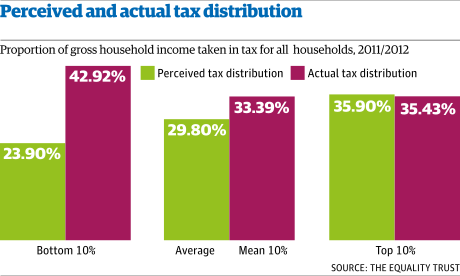
It’s worth bearing in mind that the poorest citizens, including people claiming benefits, pay proportionally more indirect taxes than the wealthiest citizens, such as VAT. The strivers/skivers rhetoric is simply a divert, divide and scapegoating strategy. Growing social inequality evidently generates a political necessity for creating scapegoats and cultivating prejudices.

The real cost of out-of-work benefits is over-estimated in relation to the welfare bill for pensions and in-work benefits such as tax credits and housing benefit, obscuring the increasing role that the British state plays in subsidising the scandalously low wages paid by increasingly exploitative employers, in order to meet a minimum standard of living for the hardworking.

The hardworking taxpayer myth is founded on a false dichotomy, since it is estimated that around 70% of households claim benefits of one kind or another at some point in their lives. In the current climate of poor pay, poor working conditions, job insecurity, and high living costs, the myth of an all pervasive welfare-dependent something for nothing culture is being used to foster prejudice and resentment towards those unfortunate enough to be out of work. It also serves to bolster right-wing justification narratives that are entirely ideologically driven, which are aimed at dismantling the welfare state, while concurrently undermining public support for it.

As the Huff Post’s Asa Bennett points out, there are much bigger costs to the taxpayer that the government are reluctant to discuss.

For example, the tax gap, charting the estimated amount of taxes unpaid thanks to evasion, avoidance, error and criminality, soared to £34 billion, according to HM Revenue and Customs. This equates to £1 in every £15 owed in taxes not being collected last year.

The National Audit Office found that the Department for Work and Pensions had made £1.4 billion in declared benefit overpayments, an increase of nearly 6%.

Meanwhile, the DWP estimate that between £7.5 billion and £12.3 billion of the six main benefits it administered were left unclaimed in 2009/2010. On top of that. HMRC suggest that several billion pounds more is most in unclaimed tax credits, with childless families missing out on £2.3 billion worth. That’s a grand total of 22.1 billion that ordinary taxpayers aren’t claiming, even though they are entitled to do so. 

Iain Duncan Smith’s Department have wasted an estimated total of £6,221,875,000.00 of taxpayers’ money on the implementation of Universal Credit and private company contracts, amongst other things. (See We can reduce the Welfare Budget by billions: simply get rid of Iain Duncan Smith ). 

Duncan Smith’s claims that his policies are about fairness and saving taxpayers’ money, simply don’t stand up to scrutiny. 

The policies are entirely ideologically-driven. We have a government that uses words like workshy to describe vulnerable social groups. This is a government that is intentionally scapegoating poor, unemployed, disabled people and migrants. One Tory councillor called for the extermination of gypsies, more than one Tory MP has called for illegal and discriminatory levels of pay for disabled people. A conservative deputy mayor said, unforgivably, that the “best thing for disabled children is the guillotine.”

These weren’t “slips”, it’s patently clear that the Tories believe these comments are acceptable, and we need only look at the discriminatory nature of policies such as the legal aid bill, the wider welfare “reforms” and research the consequences of austerity for the most economically vulnerable citizens – those with the “least broad shoulders” –  to understand that these comments reflect how conservatives think.

This is a government that is using public prejudice to justify massive socio-economic inequalities and their own policies that are creating a steeply hierarchical society based on social Darwinist survival of the fittest neoliberal “small state” principles.

The Tory creation of socio-economic scapegoats, involving vicious stigmatisation of vulnerable social groups, particularly endorsed by the mainstream media, is simply a means of manipulating public perceptions and securing public acceptance of the increasingly punitive and repressive basis of the Tories’ welfare “reforms”, and the steady stripping away of essential state support and provision.

The political construction of social problems also marks an era of increasing state control of citizens with behaviour modification techniques, (under the guise of paternalistic libertarianism) all of which are a part of the process of restricting access rights to welfare provision and public services.

The mainstream media has been complicit in the process of constructing deviant welfare stereotypes and in engaging prejudice and generating moral outrage from the public:

“If working people ever get to discover where their tax money really ends up, at a time when they find it tough enough to feed their own families, let alone those of workshy scroungers, then that’ll be the end of the line for our welfare state gravy train.” James Delingpole 2014

Delingpole conveniently fails to mention that a majority of people needing lifeline welfare support are actually in work. He also fails to mention that while this government were imposing austerity on the poorest citizens, the wealthiest got generous handouts from the Treasury, in the form of tax breaks – hundreds of thousands of pounds each per year. 

Poverty cannot be explained away by reference to simple narratives of the workshy scrounger as Delingpole claims, no matter how much he would like to apply such simplistic, blunt, stigmatising, dehumanising labels that originated from the Nazis (see arbeitssheu.)

This past four years we have witnessed an extraordinary breakdown of the public/private divide, and a phenomenological intrusion on the part of the state and media into the lives of the poorest members of society. (For example, see: The right-wing moral hobby horse: thrift and self-help, but only for the poor. ) Many people feel obliged to offer endless advice on thrift and self help aimed at persuading poor people to “manage” their poverty better.

Hannah Arendt wrote extensively about totalitarian regimes, in particular Nazism and Stalinism, which she distinguishes from Italian Fascism, because Hitler and Stalin sought to eliminate all restraints upon the power of the State and furthermore, they sought to dominate and control every aspect of everyone’s life. There are parallels here, especially when one considers the continued attempts at dismantling democratic processes and safeguards since the Coalition took office.

Many policies are aimed at ‘incentivising’ certain behaviours and perceptions of citizens, using psychology to align them with political and defined economic goals. Citizens are increasingly seen by government as a means to an end.

Further parallels may be found here: Defining features of Fascism and Authoritarianism

Between February 1933 and the start of World War Two, Nazi Germany underwent an economic “recovery” according to the government. Rather like the “recovery” that Osborne and Cameron are currently claiming, which isn’t apparent to most citizens.

This economic miracle, sold to the people of Germany, entailed a huge reduction in unemployment. However, the main reason for this was fear – anyone who was found guilty of being “workshy” (arbeitssheucould then be condemned to the concentration camps that were situated throughout Germany. Hitler frequently referred to the economic miracle, whilst people previously employed in what was the professional class were made to undertake manual labour on the autobahns. People didn’t refuse the downgraded status and pay, or complain, lest they became Arbeitsscheu Reich compulsory labor camp prisoners, and awarded a black triangle badge for their perceived mental inferiority and Otherness.

Behaviour can be controlled by manipulating fear, using a pattern of deprivation. Benefit sanctions, for example, leave “workshy” people without the means to meet their basic survival needs and are applied for periods of weeks or months and up to a maximum of 3 years.

That the government of a so-called first world liberal democracy is so frankly inflicting such grotesquely cruel punishments on some of our most vulnerable citizens is truly horrific. It’s also terrifying that the media and the British public are complicit in this: they fail to recognise that the Social Darwinism inherent in Tory ideological grammar is being communicated through discourses and policies embodying crude behaviour modification techniques and an implicit eugenic subtext .

There were various rationales for the Nazi Aktion T4 programme, which include eugenics, Social Darwinism, racial and mental “hygiene”, cost effectiveness and the welfare budget.

Those involved with the operation of the Aktion T4 programme used the term euthanasia as bureaucratic cover, in the minimal public relations effort to invest what was essentially eugenics. It is clear that none of the killing was done to alleviate pain or suffering on the part of the victims. Rather, the evidence, including faked death certificates, deception of the victims and of the victims’ families, and widespread use of cremation, indicates the killing was done solely according to the socio-political aims and ideology of the perpetrators. The Nazis believed that the German people needed to be “cleansed” of the so-called racial enemies, but the Aktion T4 programme also included people with disabilities, the poor and the workshy.  

Although many were gassed using carbon monoxide or killed by lethal injection, many more of these people deemed “life unworthy of life” were simply starved to death.

The Holodomor – “extermination by hunger” –  was Joseph Stalin’s intentionaly inflicted famine, designed to destroy  people in the Ukraine seeking independence from his rule. As a result, an estimated 7,000,000 people starved to death. The attitude of the Stalinist regime in 1932–33 was that many of those starving to death were “counterrevolutionaries”idlers” or “thieves” who “fully deserved their fate”. In 2008, the European Parliament adopted a resolution that recognised the Holodomor as a crime against humanity.

Implementing policies that lead to members of vulnerable social groups starving, which is an INTENTIONAL political act, however, is not currently included in the UN Treaty definition of genocide. Nor are disabled people amongst the categories of groups protected by the Convention on the Prevention and Punishment of the Crime of  Genocide.

While I am very aware that we need take care not to trivialise the terrible events of Stalinist Russia and Nazi Germany by making casual comparisons, there are some clear and important parallels on a socio-political level and a psycho-social one, that I feel are crucially important to recognise.

Gordon Allport studied the psychological and social processes that create a society’s progression from prejudice and discrimination to genocide. In his research of how the Holocaust happened, he describes socio-political processes that foster increasing social prejudice and discrimination and he demonstrates how the unthinkable becomes tenable: it happens incrementally, because of a steady erosion of our moral and rational boundaries, and propaganda-driven changes in our attitudes towards politically defined others, that advances culturally, by almost inscrutable degrees.

The process always begins with political scapegoating of a social group and with ideologies that identify that group as the Other: an “enemy” or a social “burden” in some way. A history of devaluation of the group that becomes the target, authoritarian culture, and the passivity of internal and external witnesses (bystanders) all contribute to the probability that violence against that group will develop, and ultimately, if the process is allowed to continue evolving, extermination of the group being targeted.

Economic recession, uncertainty and political systems on the authoritarian -> totalitarian spectrum contribute to shaping the social conditions that seem to trigger Allport’s escalating scale of prejudice.

In the UK, the media is certainly being used by the right-wing as an outlet for blatant political propaganda, and much of it is manifested as a pathological persuasion to hate others. The Coalition clearly have strong authoritarian tendencies, and that is most evident in their anti-democratic and behaviourist approach to policy, human rights, equality, social inclusion and processes of government accountability.

Vulnerable groups are those which our established principles of social justice demand we intervene to help, support and protect. However, the Coalition’s rhetoric is aimed at a deliberate identification of citizens as having inferior behaviour. The poorest citizens are presented as a problem group because of their individual faulty characteristics, and this is intentionally diverting attention from  wider socio-economic and political causes of vulnerability. Individual subjects experiencing hardships have been placed beyond state protection and are now the objects of policies that embody behaviourism, and pathologising, punitive and coercive elements of social control. Vulnerable people are no longer regarded as human subjects, the state is acting upon them, not for or on behalf of them.

People are still debating if Stalin’s Holodomor conforms to a legal definition of genocide, no-one doubts that Hitler’s gas chambers do, though Hitler also killed thousands by starvation.

Our own government have formulated and implemented policies that punish unemployed people for being “workshy” – for failing to meet the never-ending benefit conditionality requirements which entails the use of negative incentives, coercion and behaviour modification to “support” a person into  work –  by withdrawing their lifeline benefit. We also know that sanction targets have led to many people losing lifeline benefits for incoherent and grossly unfair reasons that have nothing to do with an unwillingness to cooperate or work.

Since benefits were originally calculated to meet basic living requirements – food, fuel and shelter – it’s  inconceivable that the government haven’t already considered the consequences of removing people’s means of meeting these fundamental survival needs. Of course, the Tory claim that this draconian measure is to incentivise people to “find work” doesn’t stand up to scrutiny when we consider that there isn’t enough work for everyone, and certainly not enough work around that pays an adequate amount to actually survive on.

Furthermore, the Tories “incentivise” the  wealthy by rewarding them with more money (such as the £107,000  tax break that was handed out to each millionaire every year from our own taxes by Osborne). It flies in the face of our conventional and established wisdom that reducing people to starvation and desperation will somehow motivate people to do anything other than to try and survive. (See Maslow’s Hierarchy, and two tragic accounts of the consequences of imposed sanctions.)

Tory austerity is all about ideology – the dehumanisation of the poor, and the destruction of public services and provisions – state infrastructure – and nothing to do with the state of the economy. It’s also about cutting money from the poorest and handing it to the wealthiest. Many economists agree that austerity is damaging to the economy.

There has been a media complicity with irrational and increasingly punitive Tory policies. But why are the public so compliant?

Decades of  research findings in sociology and psychology inform us that as soon as a group can be defined as an outgroup, people will start to view them differently. The very act of demarcating groups begins a process of ostracisation.

As well as the political and social definitions of others, there also exists deeper, largely unconscious beliefs that may have even more profound and insidious effects. These are related to whether people claiming benefits are even felt to be truly, properly human in the same way that “we” are.

This is called infrahumanisation. Infra means “below”, as in below or less than fully human. The term was coined by a researcher at the University of Louvain called Jacque-Philippe Leyens to distinguish this form of dehumanisation from the more extreme kind associated with genocide.

However, I don’t regard one form of dehumanisation as being discrete from another, since studies show consistently that it tends to escalate when social prejudice increases. It’s a process involving accumulation.

According to infrahumanisation theory, the denial of uniquely human emotions to the outgroup is reflective of a tacit belief that they are less human than the ingroup.

Poor people, homeless people, drug addicts and welfare claimants are the frequently outgrouped. It is these most stigmatised groups that people have the most trouble imagining having the same uniquely human qualities as the rest of us. This removes the “infrahumanised” group from the bonds, moral protection and obligations of our community, because outgrouping de-empathises us.

This would explain why some people attempt to justify the cuts, which clearly fall disproportionately on the most vulnerable. This is probably  why fighting the austerity cuts is much more difficult than simply fighting myths and political propaganda. I think the government are very aware of the infrahumanisation tendency amongst social groups and are manipulating it, because growing social inequality generates a political necessity for social prejudices to use as justification narratives.

During a debate in the House of Lords, Freud described the changing number of disabled people likely to receive the employment and support allowance as a bulge of, effectively, stock”. After an outraged response, this was actually transcribed by Hansard as “stopped”, rendering the sentence meaningless.  He is not the only person in the Department for Work and Pensions who uses this term. The  website describes disabled people entering the government’s work programme for between three and six months as 3/6Mth stock.

This infrahumanised stock are a source of profit for the companies running the programme. The Department’s delivery plan recommends using  credit reference agency data to cleanse the stock of fraud and error.

The linguistic downgrading of human life requires dehumanising metaphors: a dehumanising socio-political system using a dehumanising language, and it is becoming familiar and pervasive: it has seeped almost unnoticed into our lives.

Until someone like Freud or Mellins pushes our boundaries of decency a little too far. Then we suddenly see it, and wonder how such prejudiced and discriminatory comments could be deemed acceptable and how anyone could possibly think they would get away with such blatantly offensive rhetoric without being challenged. It’s because they have got away with less blatantly offensive comments previously: it’s just that they pushed more gently and so we didn’t see.

It’s also the case that the government distorts people’s perceptions of the  aims of their policies by using techniques of neutralisation. An example of this method of normalising prejudice is the use of the words “incentivise” and “help” in the context of benefit sanctions, which as we know are intentionally extremely punitive, and people have died as a consequence of having their lifeline benefit withdrawn.

As Allport’s scale of prejudice indicates, hate speech and incitement to genocide start from often subliminal expressions of prejudice and subtle dehumanisation, which escalate. Germany didn’t wake up one morning to find Hitler had arranged the murder of millions of people. It happened, as many knew it would, and was happening whilst they knew about it. And many opposed it, too.

The dignity and equal worth of every human being is the axiom of international human rights. International law condemns statements which deny the equality of all human beings.

As a so-called civilised society, so should we.
526544_532055030197363_2137237288_n
Pictures courtesy of Robert Livingstone

Inquiry to be launched into ex-soldier’s death after JSA stopped – Mike Sivier

The late David Clapson [Image: change.org petition site].

MPs are set to hold an inquiry into benefit sanctions after 200,000 people signed a petition in the wake of an ex-soldier’s death.

More than 211,000 people signed a Change.org petition started by Gill Thompson calling for an inquiry into benefit sanctions after diabetic David Clapson, 59, was found dead in his home.

Gill’s three-month campaign called for an independent inquiry into benefit sanctions – which refers to occasions that money is withheld from claimants if they fail to meet the terms agreed.

The Work and Pensions cross-party select committee has now agreed and its inquiry into benefit sanctions is due to start early next year. It is expected to be completed shortly before the General Election in May.

David, from Stevenage – who worked for 29 years, had his £71.70 weekly allowance stopped and died three weeks later. When his body was found by a friend, his electricity card was out of credit, meaning the fridge where he kept the insulin he used to treat his diabetes was not working.

He died from diabetic ketoacidosis three weeks after his benefits were stopped, caused by not taking insulin. A coroner found that when David died there was no food in his stomach.

Gill, 57, from London, has welcomed the decision to hold an inquiry. She said: “I’m still getting my head around the announcement. It’s still so overwhelming. When I started the petition I didn’t know what would happen.

“It wasn’t just for David. Nothing can replace him but the one thing I thought I could do was to make sure this doesn’t happen to anyone else.

“I’m not normally a campaigner and David wasn’t someone who liked a fuss, but sometimes in life there are certain things you have to do – and starting this petition was one of them.

“I am so glad I did it now. I hope, through this investigation, lessons will be learnt. People turn to the state when they are in need – that is what the system is for – a safety net for hard working people like my brother when they need a bit of support.”

Debbie Abrahams, MP for East Oldham and Saddleworth, has been calling on the DWP select committee, of which she is a member, to hold an inquiry into “inappropriate use” of benefit sanctions since November last year.

She said: “Gill has shown great courage in the wake of her brother’s appalling death to take on this cruel government and its inhuman policy of targeting vulnerable people who are reliant on social security.

“The huge response to Gill’s Change.org petition with more than 200,000 signatures is proof that the British public will not stand by and do nothing when they see vulnerable people suffering.”

“The government has done everything it can to avoid having this inquiry. There is increasing evidence of the negative effects of social security sanctions on some of the most vulnerable in society, which shows that their so-called welfare reforms don’t work. This is a government that doesn’t give a damn about ordinary people.

“Latest figures show that there are now more people in working families who are living in poverty than in workless and retired families combined.”

Many thanks to Vox Political

Related

Benefit sanctions are not fair and are not helping people into work

Rising ESA sanctions: punishing the vulnerable for being vulnerable

Punishing Poverty: A review of benefits sanctions and their impacts on clients and claimants

Rising ESA sanctions: punishing the vulnerable for being vulnerable10177255_710935002309364_996655242459079802_n

Many thanks to Robert Livingstone


It’s the Tories that want something for nothing: the democratic contract and government responsibility

430847_149933881824335_1645102229_n (1)
The Conservative defense of increasing economic inequality, the lionisation of Randian, Libertarian, selfish individualism and the proliferation of ideological justification narratives regarding the dismantling of the “Big (Welfare) State”, where the latter, in Orwellian fashion, is now being indicted for many of the very social and economic ills that the free market era has actually delivered has surely worn threadbare by now. 

It’s abundantly clear that it’s the Tories and the very wealthy that want something for nothing. Cameron’s mantra is “social responsibility, not state control equals Big Society.” Cameron, in his Hugo Young lecture (2009), claimed that the “Big Society demands mass engagement: a broad culture of responsibility, mutuality and obligation”.

But this isn’t about a transfer of political power or decision-making from government to the public: it’s a transfer of responsibility and duty only.

In true Orwellian spirit, Cameron went on to say: “The recent growth of the state has promoted not social solidarity, but selfishness and individualism.”  Only a conservative would claim poverty and social cohesion as their concern and passion, and then attack  the mechanism that until now has been used to alleviate them  – publicly funded state spending.

Democracy (based on the partnership between political and economic enfranchisement) happens when the concept of property encompasses access to “social goods” such as healthcare, education and public infrastructure as a right of citizenship. The idea of political representation becomes consolidated when access to such social goods is guaranteed by a legal process, as well as a political process.

The electoral franchise in countries which adopted a Lockean liberal constitutional  system, such as  Britain, had a property qualification attached to it. Universal suffrage coincided with a wider public access to social goods, giving rise to a new type of social contract: by giving up a portion of their property by way of taxation, the propertied class ensured the survival of capitalism, and the working class escaped the worst ravages of capitalism.

Access to social goods was a means of widening and legitimising the scope of democratic political representation.

However, whilst removing all of our public services, provisions, destroying our post-war settlement, the key features of which were accepted in principle by the main political parties at the time, namely: a mixed economy, a free public sector healthcare and education, a guaranteed (though minimal) state pension and social welfare provision, the government is removing social goods, nullifying the established social contract between state and individual, and is expecting that we each fend for ourselves.

I don’t remember any consent amongst the public to accept diminished living standards in return for Cameron’s proposal of national fiscal security (which he has consistently and spectacularly failed to deliver) and the maintenance of the “market-state”. Nor was there consent for authority, inequality and hierarchy, or an acceptance of being less than we can be and having less than we can have.

Our welfare provision (and I include our National Health Service, here), paid for by us, IS OUR MEANS OF BEING RESPONSIBLE AS A SOCIETY AND INDIVIDUALLY: it is a means of securing provision for ourselves if or when we need it. Our welfare provision is, and has been since its inception, each citizens’ responsibility, because we pay for it. It doesn’t belong to the government.

The consensus that the welfare state was the best basis for a healthy society was first rejected by Thatcher, who notoriously denied the very existence of society, and unashamedly espoused greed as the  “best social driver.”  Cameron, building on Thatcher’s previous groundwork, has effectively delivered an economic enclosure act, claiming OUR collective, public funds, turning that money into the private property right of the rich, in the same way the land enclosure act robbed the public of their commonly shared land, and enabled rich landowners use of their control of state processes to appropriate public land for their private benefit.

Yet despite this blatant theft: the massive transference of public funds to a few private accounts, the demands being made by the state on citizens have never been greater. All the Tories talk about are OUR obligations and individual responsibilities, whilst they claim they have NO responsibility for citizen well-being. But we have paid for state services and continue to do so via the tax and national insurance system.

In 2013 the Government spent approximately £93.5billion of our money on the private sector. This is half the £187bn government usually spends on goods and services each year. Recent growth in outsourcing of government services to private providers has been widely criticised for a lack of transparency, poor management of money and, in particular, excessive remuneration of top executives and pay inequality between employees. Extreme pay inequality and a succession of scandals in the largest government suppliers suggests that, in its present form, government outsourcing is a very poor use of tax payers’ money and not fit for purpose. This is verified by the Equality Trust’s research report: Subsidising Unfairness

It’s only the very wealthy that gain (enormously) from austerity, and they  manage to avoid  any socially responsible contribution by using government endorsed accounting systems and dodges to avoid paying taxes wherever possible. The estimated amount of taxes unpaid, thanks to evasion, avoidance, error and criminality, soared to £34 billion, according to HM Revenue and Customs. This equates to £1 in every £15 owed in taxes not being collected last year.

Furthermore, it is the poorest 10 percent of households that pay eight percent more of their income in all taxes than the richest – 43 percent compared to 35 percent, outlined in a report from the Equality Trust. The poorest pay more than four times as much of their income, in Cameron’s poll tax-styled council tax system, than the wealthiest top 10 precent.

The government’s “hardworking taxpayer” myth which is at the heart of the Tory ideologically driven austerity narrative, and divert, divide and poison strategy, creates an artificial dichotomy between benefit claimants and taxpayers. Cameron’s diversionary rhetoric has got nothing to do with responsibility and fairness: it’s simply about justifying policies that privilege a wealthy elite at the expense of the poor.

 Such us and them dichotomies  can be linked to the distinctions made between the “deserving” and  “undeserving” poor, going back over a hundred years or more, to the cruel and punitive Poor Law Reform Act. The Tories have purposefully created scapegoats: adversarial identities that are politically constructed according to notions of difference which simultaneously encourages a public comparison to, and rejection of, Others. This Othering narrative portrays benefit recipients as the enemy in a battle against fairness and responsibility.

And the public have bought into it, the Equality Trust thinktank highlights a gulf between perceptions of the tax system and its reality. A poll, conducted with Ipsos Mori, found that nearly seven in ten people believe that households in the highest 10% income group pay more of their income in tax than those in the lowest 10%.

Wealth concentration damages economies. It focuses activity within finance and other services geared towards only towards serving the super rich.Maintaining inequality requires penalising and further impoverishing the poor.

Reducing  wealth inequalities will require the introduction of wealth taxes, like the inheritance tax  we introduced a century ago. Reducing inequality requires a high top rate of income tax. This reduces income inequality not only by raising revenue, but by deterring the profit-driven greedy from asking for more money. When there is a tax rate of 60 percent on incomes above £200,000 a year, it makes little sense to pay employees much more than that.

But the wealthy tend to get so indignant when policy proposals from the opposition indicate that they will be required to actually contribute something to a society that they have taken so much more than others from. There’s been an outraged outcry, for example, regarding Labour’s Mansion tax proposals. These ignoble, self-serving Randians are happy to sit back and allow the poorest and most vulnerable to suffer and starve, whilst being subjected to the unfair, punitive bedroom tax, which contravened human rights: the poorest are bearing the terrible burden of austerity cuts whilst the wealthy continue to profit massively. Presumably, Cameron exempted the very rich from responsibility, duty and contributing  to society in any meaningful way.

Of course this is about restricting political engagement, the Conservatives have always sought to reduce it to a basic partnership between corporate interests and professional politicians. Cameron’s Conservatism rests on the unwitting rejection  of the social democratic consensus by the population which, paradoxically, need what they reject. Public consent is being manipulated to accommodate the idea that democracy is a relationship between rulers and governed, rather than it being about an elected government that reflects, represents and serves public needs. The population are being incrementally subordinated to a political system which is not conducive to the betterment of their lives, well-being or material conditions –  the Tories are imposing an imbalanced social contract comprised of citizen duties with no citizen rights; the acceptance of ever-lower living standards and increasing state authoritarianism.

The Conservative scapegoating narratives, which have blamed Labour, the poor and the unemployed for a recession caused by the private finance sector, and not the “big state” as claimed, have permitted the Coalition to pursue an ideological, destructive and grossly unfair economic strategy, which has generated only a bogus and isolated recovery largely based on government-fuelled asset bubbles in real estate and private finance, with stagnant productivity, plummeting wages, millions of people in precarious jobs, inflated living costs and utterly savage welfare cuts.

One obligation that all democratic states have, surely, is that of protecting citizens rights and freedoms. Those are most certainly being steadily diminished, and Cameron has been quite candid about scrapping our Human Rights Act, and withdrawing from the ECHR in the future.

See what I mean? It’s all take take take…

Danny Dorling says: “Gross economic inequality is as vile as racism, misogyny and hatred of the disabled; as damaging in effect; and as dependent on a small group of supporters who believe that just a few should have more and more and more, because they’re “worth it”.”

I believe that growing social inequality generates a political necessity for prejudices: they are entrenched vis-à-vis Social Darwinism in Tory ideology, fueled and perpetuated through justification narratives and amplified via the media.

I’ve said many times previously that never in this country have those who fight for democracy and social justice carried a greater burden or faced the possibility of bigger losses of human rights, human freedoms, human dignity and human welfare than they do right now.

14533697838_dffcc736f2_o (1)

 Many thanks to Robert Livingstone for his brilliant art work