

Author: Kitty S Jones
I’m a political activist with a strong interest in human rights. I’m also a strongly principled socialist. Much of my campaign work is in support of people with disability. I am also disabled: I have an autoimmune illness called lupus, with a sometimes life-threatening complication – a bleeding disorder called thrombocytopenia.
Sometimes I long to go back to being the person I was before 2010. The Coalition claimed that the last government left a “mess”, but I remember being very well-sheltered from the consequences of the global banking crisis by the last government – enough to flourish and be myself. Now many of us are finding that our potential as human beings is being damaged and stifled because we are essentially focused on a struggle to survive, at a time of austerity cuts and welfare “reforms”.
Maslow was right about basic needs and motivation: it’s impossible to achieve and fulfil our potential if we cannot meet our most fundamental survival needs adequately.
What kind of government inflicts a framework of punishment via its policies on disadvantaged citizens? This is a government that tells us with a straight face that taking income from poor people will "incentivise" and "help" them into work. I have yet to hear of a case when a poor person was relieved of their poverty by being made even more poor.
The Tories like hierarchical ranking in terms status and human worth. They like to decide who is “deserving” and “undeserving” of political consideration and inclusion. They like to impose an artificial framework of previously debunked Social Darwinism: a Tory rhetoric of division, where some people matter more than others. How do we, as conscientious campaigners, help the wider public see that there are no divisions based on some moral measurement, or character-type: there are simply people struggling and suffering in poverty, who are being dehumanised by a callous, vindictive Tory government that believes, and always has, that the only token of our human worth is wealth?
Governments and all parties on the right have a terrible tradition of scapegoating those least able to fight back, blaming the powerless for all of the shortcomings of right-wing policies. The media have been complicit in this process, making “others” responsible for the consequences of Tory-led policies, yet these cruelly dehumanised social groups are the targeted casualties of those policies.
I set up, and administrate support groups for ill and disabled people, those going through the disability benefits process, and provide support for many people being adversely affected by the terrible, cruel and distressing consequences of the Governments’ draconian “reforms”. In such bleak times, we tend to find that the only thing we really have of value is each other. It’s always worth remembering that none of us are alone.
I don’t write because I enjoy it: most of the topics I post are depressing to research, and there’s an element of constantly having to face and reflect the relentless worst of current socio-political events. Nor do I get paid for articles and I’m not remotely famous. I’m an ordinary, struggling disabled person. But I am accurate, insightful and reflective, I can research and I can analyse.
I write because I feel I must. To reflect what is happening, and to try and raise public awareness of the impact of Tory policies, especially on the most vulnerable and poorest citizens. Because we need this to change. All of us, regardless of whether or not you are currently affected by cuts, because the persecution and harm currently being inflicted on others taints us all as a society.
I feel that the mainstream media has become increasingly unreliable over the past five years, reflecting a triumph for the dominant narrative of ultra social conservatism and neoliberalism. We certainly need to challenge this and re-frame the presented debates, too. The media tend to set the agenda and establish priorities, which often divert us from much more pressing social issues. Independent bloggers have a role as witnesses; recording events and experiences, gathering evidence, insights and truths that are accessible to as many people and organisations as possible. We have an undemocratic media and a government that reflect the interests of a minority – the wealthy and powerful 1%. We must constantly challenge that. Authoritarian Governments arise and flourish when a population disengages from political processes, and becomes passive, conformist and alienated from fundamental decision-making.
I’m not a writer that aims for being popular or one that seeks agreement from an audience. But I do hope that my work finds resonance with people reading it. I’ve been labelled “controversial” on more than one occasion, and a “scaremonger.” But regardless of agreement, if any of my work inspires critical thinking, and invites reasoned debate, well, that’s good enough for me.
“To remain silent and indifferent is the greatest sin of all” – Elie Wiesel
I write to raise awareness, share information and to inspire and promote positive change where I can. I’ve never been able to be indifferent.
We need to unite in the face of a government that is purposefully sowing seeds of division. Every human life has equal worth. We all deserve dignity and democratic inclusion. If we want to see positive social change, we also have to be the change we want to see. That means treating each other with equal respect and moving out of the Tory framework of ranks, counts and social taxonomy. We have to rebuild solidarity in the face of deliberate political attempts to undermine it. Divide and rule was always a Tory strategy. We need to fight back. This is an authoritarian government that is hell-bent on destroying all of the gains of our post-war settlement: dismantling the institutions, public services, civil rights and eroding the democratic norms that made the UK a developed, civilised and civilising country.
Like many others, I do what I can, when I can, and in my own way. This blog is one way of reaching people. Please help me to reach more by sharing posts.
Thanks.
Kitty, 2012
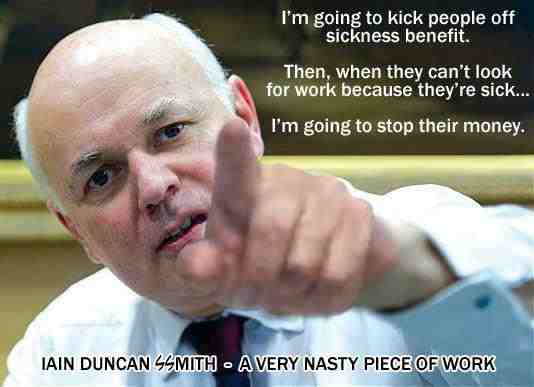

An email to authoritarian Tory MPs Charlie Elphicke, Priti Patel and Conor Burns

I sent the following email to Tory MPs Charlie Elphicke, Priti Patel and Conor Burns, with a copy sent to Charities Commission.
The email has evidence hyperlinked throughout in a bid to spare me the standardised Tory bullshit avalanche in response:
Dear Charlie Elphicke, Priti Patel and Conor Burns,
I write to complain about your extremely authoritarian and oppressive treatment of the charity Oxfam.
First of all, I must point out that it is impossible to discuss poverty without reference to its root cause and that invariably involves reference to government policies. I am particularly disgusted by the way you have diverted attention away from the real issue raised – the rise of cases of absolute poverty.
Oxfam are not alone in their concern about the rise of absolute poverty. Medical experts recently wrote an open letter to David Cameron condemning the rise in food poverty under this government, stating that families “are not earning enough money to meet their most basic nutritional needs” and that “the welfare system is increasingly failing to provide a robust line of defence against hunger.”
Many charities have said that the UK government has violated the Human Right to food. Article 11(1) of the International Covenant on Economic, Social and Cultural Rights (ICESCR) recognises the right of everyone to an adequate standard of living, including adequate food, clothing and housing. The UK has signed and ratified, and in so doing is legally bound by the ICESCR, in particular, the human right to adequate food.
According to the Just Fair Consortium report, welfare reforms, benefit delays and the cost of living crisis have pushed an unprecedented number of people into a state of hunger, malnutrition and food insecurity in the UK. New research by Oxfam has revealed the extent of poverty amongst British children, with poor families taking drastic measures to survive.
What kind of government is concerned only about stifling critical discussion of its policies and not at all about the plight of the citizens it is meant to serve? This is a government that attempts to discredit and invalidate the accounts of people’s experience of the suffering that is directly caused by this government. By blaming the victims and by trying to smear and dismiss anyone that champions the rights of vulnerable citizens.
Priti Patel said: “With this Tweet they have shown their true colours and are now nothing more than a mouthpiece for left wing propaganda.”
When did concern for poverty and the welfare of citizens become the sole concern of “the left wing”? I think that casually spiteful and dismissive admission of indifference tells us all we need to know about the current government’s priorities. And no amount of right wing propaganda will hide the fact that poverty and inequality rise under every Tory government.
Mr Burns has written to the Charities Commission requesting an investigation into the “overtly political attack” on “the policies of the current Government.” However, he failed to mention this government’s overtly and cowardly economic attack on the most vulnerable citizens. I believe Oxfam has behaved responsibly, honourably, and with good conscience. It is the Tory-led government that have behaved disgracefully. We have a government that provides disproportionate and growing returns to the already wealthy, whilst imposing austerity cuts on the very poorest people. That is very clearly evidenced in their policies, the aims of which are clear when we examine who is carrying the burden of austerity. It is largely the poorest social groups and especially disabled people.
How can the government possibly claim Oxfam’s observations are “biased” when inequality is so fundamental to their own ideology, and when social inequalities and poverty are extended and perpetuated by all of their policies. The Tories have no right to be indignant about research findings regarding the poverty they have caused, and to complain about the genuine concern Oxfam expressed about those politically damning findings, when those findings are so patently true. I don’t believe that Oxfam have shown “bias” at all. I do believe that punitive Conservative policies are based on traditional class-based Tory prejudices, however.
The truth is the truth, whether conservative MPs like it or not. Tory “facts” are both constructed and seen through a lens of pre-conceptions and ideology. Oxfam and the Joseph Rowntree Foundation choose to study poverty. Cynical Tories, such as Iain Duncan Smith simply change the definition of it. But changing the narrative can never edit people’s experience of grinding poverty and their consequent suffering. Or disguise the causes.
So where is your concern for those vulnerable and increasingly impoverished citizens – the ones you are meant to serve? You didn’t even entertain the idea that there’s a problem, choosing instead to dismiss a respectable charity as “lefties”. Have you any idea how utterly callous, irrelevant AND ludicrous that comment was?
Or how obviously oppressive your actions are for reporting a charity for merely carrying out awareness-raising campaign work?
And before you spin me the poppycock line about inequality being ‘lower’ under this government, I already know about the methodological problems with the measurement method you purposely use, so spare me: https://kittysjones.wordpress.com/2014/06/09/camerons-gini-and-the-hidden-hierarchy-of-worth/
Share this:

Atos fined 30 million for WCA errors
In an exclusive report, The Londoner says that the government contractor Atos was fined £30 million for errors in its delivery of the work capability assessments (WCA).
It was announced at the time that Atos had made a “substantial financial settlement” to the Department of Work and Pensions (DWP), for “significant quality failures” in its reports on people’s ability to work.
The IT company – which the Department of Work and Pensions put in charge of deciding which people on benefits were well enough to work – had its contract unceremoniously cancelled a year early this March, following a campaign spearheaded by Paralympian Dame Tanni Grey-Thompson.
Until now details of the fine have been kept quiet to avoid embarrassing the company, which is leaving the contract in February 2015.
When asked, the DWP would only respond with:
“They are paying us a financial settlement but we can’t disclose the amount for commercial reasons”.
When Atos was asked the same question: “It’s all legally bound up, we can’t comment,” was the reply from its company spokesperson.
But is the £30 million correct? “Will you tell me who gave you the figure?” was Atos’s only reply.
What we would like to know is: what exactly were the problems with Atos’ work? The DWP never appeared to care about the poor quality of reports before.
So, was it that Atos were putting too many people in the support group without medicals?
Were decision makers disagreeing with large numbers of Atos findings?
Or was it costing the Department too much when claimants appealed because the reports were inaccurate?
Given that claimants’ well-being is very much tied up with these assessments we have a right to know exactly what it was that was going wrong.
Will those people adversely affected by distress due to this company’s apparent incompetence be compensated?
Read the full article in the London Evening Standard.
–
Thanks to Robert Livingstone for the art work
Thanks also to Benefits and Work
Share this:


Thatcher, Mad Cow Disease and her other failings, the Blair detour and déjà entendu, Mr Cameron.

The catastrophes of Margaret Thatcher:
- Thatcher was responsible for two recessions that were driven by ideology and deliberate policies. Although inflation needed controlling in 1980, the government deflated the economy too much – chasing money supply targets which were unreliable. The cost was poverty, suffering, unemployment and social disorder, which was avoidable.
- The 1980s saw a return of mass unemployment – such high levels had not been seen since the Great Depression of the 1930s.
- Thatcher instigated a series of “free market” decisions that deregulated government control of the processing of animal feed, and thereby allowed the spread of bovine spongiform encephalopathy (BSE), known as “Mad Cow” disease. The government had been made aware of the risks to public health. It is certain that the Thatcher government, in the face of the serious threat of infection, did not take the necessary public health measures to protect food and feed supplies. In fact, the Agriculture and Health Ministry policies of deregulation and privatisation, implemented during the Thatcher years and continued under Prime Minister John Major, served to spread BSE.
- Widening of the north/south divide and regional inequality. Unemployment particularly affected former industrial areas; the government were disinclined to deal with problems of structural unemployment, preferring to blame the unemployed for unemployment.
- Privatisation, which involved selling off our state assets at an undervalued price. Those who could afford to buy shares saw immediate gains. This was missed opportunity to use the nations resources to invest in infrastructure, public services and the future.
- A massive rise in inequality and poverty during the 1980s.
- Thatcher savagely undermined the power and influence of the trade unions, at the cost of alienating many people among the working class because of the vicious nature of her conflict.
- The government deliberately allowed a boom and bust which caused an unnecessary and painful recession in 1991. For all of Lamont and Thatcher’s claims to see the importance of keeping inflation low – it was at the cost of a deep recession and unemployment rising to over 3 million. It was ironic that the government made such a mistake in allowing an inflationary bubble in the late 1980s. Part of the reason is that they really felt they had created a supply side miracle – which of course hadn’t actually occurred.
- The rise in home-ownership was good for those who could afford to buy, but it served to increase wealth inequality in the UK. The supply of council homes is now very limited because many had been sold off under Thatcher’s regime.
- Thatcher’s Financial deregulation of the 1980s laid the framework for credit bubble of 2000s and subsequent credit crisis. For example, privatised building societies like Northern Rock, and Bradford & Bingley pursued risky growth strategies which eventually needed government bailouts in the aftermath of the 2008 recession.
- Thatcher made no attempt to deal with environmental issues during a decade of increased concerns over global warming, pollution and environmental degradation.
A summary of Thatcher’s Economic policies:
- Minarchism – a belief in free markets over government intervention, pursuing policies of privatisation and deregulation, for example.
- Pursuit of the supply side policies to increase “efficiency and productivity”.
- Reducing power of the trades unions and increased labour market “flexibility”
- Financial deregulation, e.g. building societies becoming profit making banks.
- Reducing higher rates of marginal income tax to increase ‘incentives to work.’
- Ending state subsidies for major manufacturing companies.
- Encouraging home ownership and share ownership.
- Targeting money supply and monetarist policies to reduce inflation of late 1979. Monetarism was effectively abandoned by 1984…
- Lowering direct taxes on income and increasing indirect taxes.
Her aims when she took Office:
- Reduce inflation which was running at over 20% in 1979
- Reduce the budget deficit.
- Increase the “efficiency” of the economy
- Reduce the power of the Unions.
- Thatcher also became the face of the ideological movement opposing the welfare state and Keynesian economics.
Thatcher introduced cash limits on public spending, and reduced expenditure on public services such as education, health, welfare and housing.
Her cuts in higher education spending resulted in her being the first Oxford-educated post-war Prime Minister not to be awarded an honorary doctorate by the University of Oxford, after a 738 to 319 vote of the governing assembly and a student petition.
More than £29 billion was raised from the sale of nationalised industries, and another £18 billion from the sale of council houses. That money was not re-invested in any way that benefited the public.
In a interview in Woman’s Own magazine in September 1987. Thatcher said:
“I think we have gone through a period when too many children and people have been given to understand “I have a problem, it is the Government’s job to cope with it!” or “I have a problem, I will go and get a grant to cope with it!” “I am homeless, the Government must house me!” and so they are casting their problems on society and who is society? There is no such thing!
There are individual men and women and there are families and no government can do anything except through people and people look to themselves first. It is our duty to look after ourselves and then also to help look after our neighbour and life is a reciprocal business and people have got the entitlements too much in mind without the obligations. The culture of dependency, which had done such damage to Britain.”
Thatcher was very divisive, and promoted a commercialised, power-dressed version of competitive individualism and an Ayn Rand spirited greed and selfishness, her stance on immigration was part of a rising racist public discourse, which Professor Martin Barker has called “new racism.”
Thatcher left Britain a divided, sparser, unequal, meaner, worse and more dysfunctional society than when she took Office; in contrast Blair made life better for most working people in Britain. That doesn’t mean he got everything right. We know he certainly didn’t.
The economic consequences of Thatcher were pain, pain and more pain. Having endured years of misery through Thatcher’s attempts at driving inflation out of the national economy (Norman Lamont said: “if it’s not hurting it’s not working” ) we are now going through more Tory economic sadism – austerity. More pain, pain and pain, but never for the elite: for them, regardless of how the Tories thrash and trash the economy for the majority, for the very wealthy, it’s always gain gain and more gain.
The New Labour interlude.
The “mess” that Thatcher left is verified by several longitudinal studies. Dr. Alex Scott-Samuel and colleagues from the Universities of Durham, West of Scotland, Glasgow and Edinburgh, sourced data from over 70 existing research papers, which concludes that as a result of unnecessary unemployment, welfare cuts and damaging housing policies, the former prime minister’s legacy “includes the unnecessary and unjust premature death of many British citizens, together with a substantial and continuing burden of suffering and loss of well-being.”
The article also cites evidence including the substantial increase in income inequality under Thatcher – the richest 0.01% of society had 28 times the mean national average income in 1978 but 70 times the average in 1990, and the rise in UK poverty rates from 6.7% in 1975 to 12% in 1985.
It concludes that: “Thatcher’s governments wilfully engineered an economic catastrophe across large parts of Britain” by dismantling traditional industries such as coal and steel in order to undermine the power of working class organisations, such as unions.
This ultimately fed through into growing regional disparities in health standards and life expectancy, as well as greatly increased inequalities between the richest and poorest in society.”
Blair established the social exclusion unit inside No 10. “Social exclusion” signified not just poverty, but its myriad causes and symptoms, with 18 task forces examining education, babies’ development, debt, addiction, mental health, housing and much more. Policies followed and so did improvements. John Prescott’s department published an annual Opportunities for All report that monitored these social targets: 48 out of 59 indicators improved.
The myth that Blairism was a continuation of Thatcherism is a little misleading, it’s as part of a unique brand of (very lazy) political commentary. It’s true to say that Blair was a neoliberal. However, he also advocated a strong social safety net and human rights to ensure people were protected against the worst ravages of market economics.
Though Blair did admittedly accept the idea of “market efficiency” as ideologically neutral, he formulated policies directly to benefit trade unions – such as union learning, and rights to recognition; and these were the result of the coalition/social nature of the Labour Party. Blair also had a distinct social agenda, which was both ideologically and practically progressive.
This is why the current government are so busy trying to repeal many of Blair’s policies – such as the Human Rights Act, the Equality Act, Every Child Matters, along with the effective measures of childhood poverty that the Blair administration established. Had Blair been a fully fledged Thatcherite, as is often claimed, it’s highly improbable that Cameron’s conservatives would object to any of his policies. But they do.
A criticism that is often levelled at Blair is the that he “started” the privatisation process of the NHS, now happening under Cameron’s government. However, there is a very distinct difference between Labour using PFI, previously introduced by John Major, in the context of using private borrowing to expand and improve public services, with the Tory policy of privatising to disrupt and curtail public services. Blair did reinvest in the NHS.
Furthermore, much of the social spending committed during the Blair years did deliver real benefits: comparing 2010 with 1997 saw 41000 more teachers and 120000 more teaching assistants, 80000 more nurses and 44000 more doctors, and 4.5 million families received tax credits of an average £65 per week, for example. Although they weren’t the best solution to low wages, they did help ordinary people meet their living costs.
New Labour, for all its faults was actually ideologically founded on the idea and intention of creating a fairer, more harmonious society through an empowering partner state that provides conditions for individuals to thrive and to benefit from good choices. For all its weaknesses, it is a distinctly different agenda from Thatcher’s ideology of regarding the state as inherently problematic, and that individuals needed to be liberated from its influence.
Thatcher would certainly not have been willing to sit down with Gerry Adams and Martin McGuinness to negotiate peace in Northern Ireland. And as the architect of section 28, she would definitely not have equalised the age of consent or introduced civil partnerships.
The proceeds of the economic growth of the 1990s and early 2000s would not have been invested in rebuilding the Nation’s public services, about which the Thatcher governments had precious little to say. Having seen poverty double during her time in office, Thatcher would undoubtedly not have pledged to eradicate it.
In 2003, Conservatives voted with the Government to send British troops into military action in Iraq, the Conservative votes carried the motion authorising conflict, since 139 Labour MPs rebelled against their party’s whip.
Iain Duncan Smith led Conservative MPs in demanding a rush to war as early as 2002. I fundamentally disagreed with the war against Iraq, and I protested at the time. But the truth is important and regardless of the subsequent analysis and blame-mongering, and the very strong feelings this particular issue always raises, (and quite properly so,) this was a war that was voted for democratically in Parliament.
I’ll add that the same democratic process secured the prevention of a war on Syria, thanks to Ed Miliband rallying the opposition, to the fury of Cameron. And that’s a line drawn under Blairism.
Ed Miliband’s frequent criticisms of the economic policies of the last 30 years’ in speeches strongly suggests that, in part, he agrees with those who believe that Labour’s election in 1997 did not mark a decisive enough break with what came before. I agree, and was glad to hear Miliband declare the end of New Labour.
However, appreciating the past strengths in addition to the well discussed limitations of New Labour is necessary if we genuinely want to take valuable and balanced lessons from it and move upwards and onwards.
The catastrophe of David Cameron .
It’s worth considering that New Labour had 13 years in which to fulfil what Cameron’s Conservatives have achieved in just 4. And they didn’t. Because it was never New Labour’s aim.
The Welfare “Reform” Act 2012 marked the continuation of a wholesale dismantling of the welfare state. Cameron took up where Thatcher left off. It’s utterly callous and it also steals money from people in work. The unemployed are blamed for unemployment, at a time when Cameron’s Government created a double-dip recession. Thatcher also blamed the unemployed for the unemployment that her policy choices created, but not as viciously as Cameron’s administration has.
Living standards are being driven down deliberately while tax cuts are gifted to the rich. Education is privatised, any remaining pretence of meritocratic principles has been well and truly bludgeoned and our gifted young people are being priced out of university. Local democracy is shackled, Councils (and subsequently, public services,) are turned into a queue of hostages for Eric Pickles’ cuts.
Cameron has said that it is “essential to reduce taxes on employment and wealth creation in order to enhance our economy’s competitiveness.” Definitely déjà vu.
He strongly supports deregulation of the private sector, and promised an immediate deregulation bill upon election. He has also pledged to remove Britain from the European Union’s social chapter and to withdraw unilaterally from certain directives stemming from the European Union. He has said that Britain must not be a “soft touch” and has called for a crackdown on “access to justice.”
Speaking of access to justice, well the Legal Aid Bill has ensured that those hit the very hardest by this Government’s carefully planned and coordinated assault on public services and welfare support have none. This is not a government that would allow the victims of its brutal policies to challenge or seek redress.
When I say planned assault, I mean it started with Thatcher, who was certainly behind radical proposals to end free healthcare and schooling in Britain. We know this from the Central Policy Review Staff (CPRS) Report, that was encouraged and commissioned by Thatcher and Howe in 1982, which shows a radical, politically toxic plan to dismantle the welfare state, to introduce education vouchers, ending the state funding of higher education, to freeze welfare benefits and to introduce an insurance-based health service, ending free health care provision of the NHS. One of the architects of the report was Lord Wasserman, he is now one of Cameron’s advisors.
The Government asserts that its welfare “reform” strategy is aimed at breaking the cycle of “worklessness” and “dependency” on the welfare system in the UK’s poorest families. Poor Law rhetoric. There’s no such thing as “worklessness”, it’s simply a blame apportioning word, made up by the Tories to hide the fact that they have destroyed the employment market, as they always do. There has never been any presented empirical evidence that “welfare dependency” exists outside of Tory prejudice and ideology either, despite many decades of claims of it from the Tories.
The “reforms” (cuts) consist of 39 individual changes to welfare payments, eligibility, sanctions and timescales for payment and are intended to save the exchequer around £18 billion. How remarkable that the Department for Work and Pensions claim that such cuts to welfare spending will reduce poverty.
George Osborne’s “plan A” isn’t about economics: it amounts to little more than a rehashed Thatcherite ideological agenda of stripping away public services and welfare, deregulation and labour market “flexibility”, as modelled by the Beecroft report – an assault on the rights of employees, and Labour’s historic equality legislation. The Tory demand for a “nightwatchman state” is both ill-conceived and completely irrelevant to Britain’s economic circumstances. It’s a complete abdication of government responsibility, democratic obligations and duty towards its citizens.
The Coalition have borrowed more in 4 years than labour did in 13 and have NOTHING to show for it except a handful of wealthier millionaires. And the return of absolute poverty.
We know that austerity was intentionally imposed by the Coalition, using a feigned panic over the budget deficit to front an opportunistic vulture capitalist approach to stripping our public assets. With the Coalition in power for 4 years, the deficit has apparently receded in importance.
Tories, the more things change, the more they stay the same.
Nasty, vindictive neofeudalists.
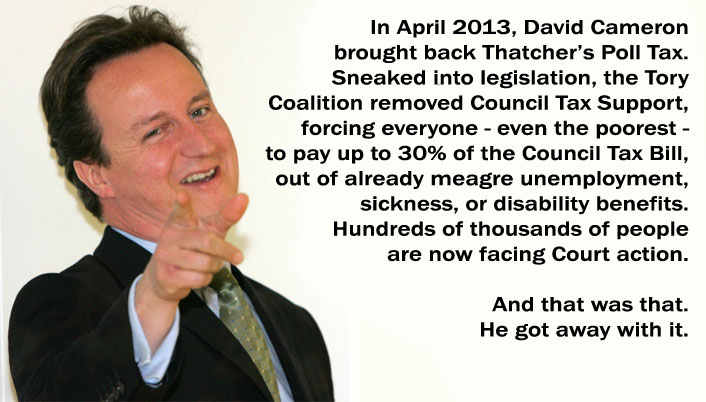

Pictures courtesy of Robert Livingstone
Share this:


UK unemployment benefit is less generous than Romania, Albania and the US
Originally posted on Pride’s Purge

Well now. Here’s an interesting ranking of countries according to how generous their unemployment benefit is for the first year after workers have lost their jobs.
Quite contrary to the spin we constantly receive from the mainstream press et al about how generous the UK is with unemployment benefits, the fact is we actually rank lower in generosity than countries like Romania, Albania and even the US.
Here’s the ranking – with the most generous countries at the top (you have to go right to the bottom to find the UK):
| Country | Gross Replacement Rate, year 1 | Ranking |
| Netherlands | 0.7 | 1 |
| Switzerland | 0.687 | 2 |
| Sweden | 0.685 | 3 |
| Portugal | 0.65 | 4 |
| Spain | 0.635 | 5 |
| Norway | 0.624 | 6 |
| Algeria | 0.612 | 7 |
| Taiwan | 0.6 | 8 |
| Ukraine | 0.56 | 9 |
| Italy | 0.527 | 10 |
| Denmark | 0.521 | 11 |
| Russia | 0.505 | 12 |
| Tunisia | 0.5 | 13 |
| Finland | 0.494 | 14 |
| France | 0.479 | 15 |
| Bulgaria | 0.473 | 16 |
| Canada | 0.459 | 17 |
| Romania | 0.45 | 18 |
| Hong Kong | 0.41 | 19 |
| Austria | 0.398 | 20 |
| Belgium | 0.373 | 21 |
| Argentina | 0.354 | 22 |
| Germany | 0.353 | 23 |
| Greece | 0.346 | 24 |
| Azerbaijan | 0.338 | 25 |
| Egypt | 0.329 | 26 |
| Venezuela | 0.325 | 27 |
| Belarus | 0.313 | 28 |
| Israel | 0.307 | 29 |
| Japan | 0.289 | 30 |
| United States | 0.275 | 31 |
| Kyrgyzstan | 0.255 | 32 |
| New Zealand | 0.254 | 33 |
| Latvia | 0.253 | 34 |
| India | 0.25 | 38 |
| Korea, South | 0.25 | 37 |
| Uruguay | 0.25 | 36 |
| Uzbekistan | 0.25 | 35 |
| Ireland | 0.238 | 39 |
| Hungary | 0.235 | 40 |
| Poland | 0.226 | 41 |
| Czech Republic | 0.225 | 42 |
| Australia | 0.21 | 43 |
| Turkey | 0.206 | 44 |
| Albania | 0.202 | 45 |
| United Kingdom | 0.189 | 46 |
| Brazil | 0.152 | 47 |
| Estonia | 0.132 | 48 |
| Lithuania | 0.117 | 49 |
| Chile | 0.115 | 50 |
| Georgia | 0.09 | 51 |
For more details of how the list was compiled – have a look at this excellent website:
World ranking in Unemployment Benefit replacement rates
The data by the way, is taken from a study compiled for the IMF – before anyone starts accusing me of peddling left-wing propaganda.
I don’t know about you, but I think it would be nice to see a few real facts being allowed to surface in the debate about welfare reform – instead of the ill-informed spin and propaganda that passes for debate on benefits we’re getting at the moment in the UK.
Tom Pride
Share this:

Tory policies cause poverty and trying to discredit Oxfam won’t mitigate that truth

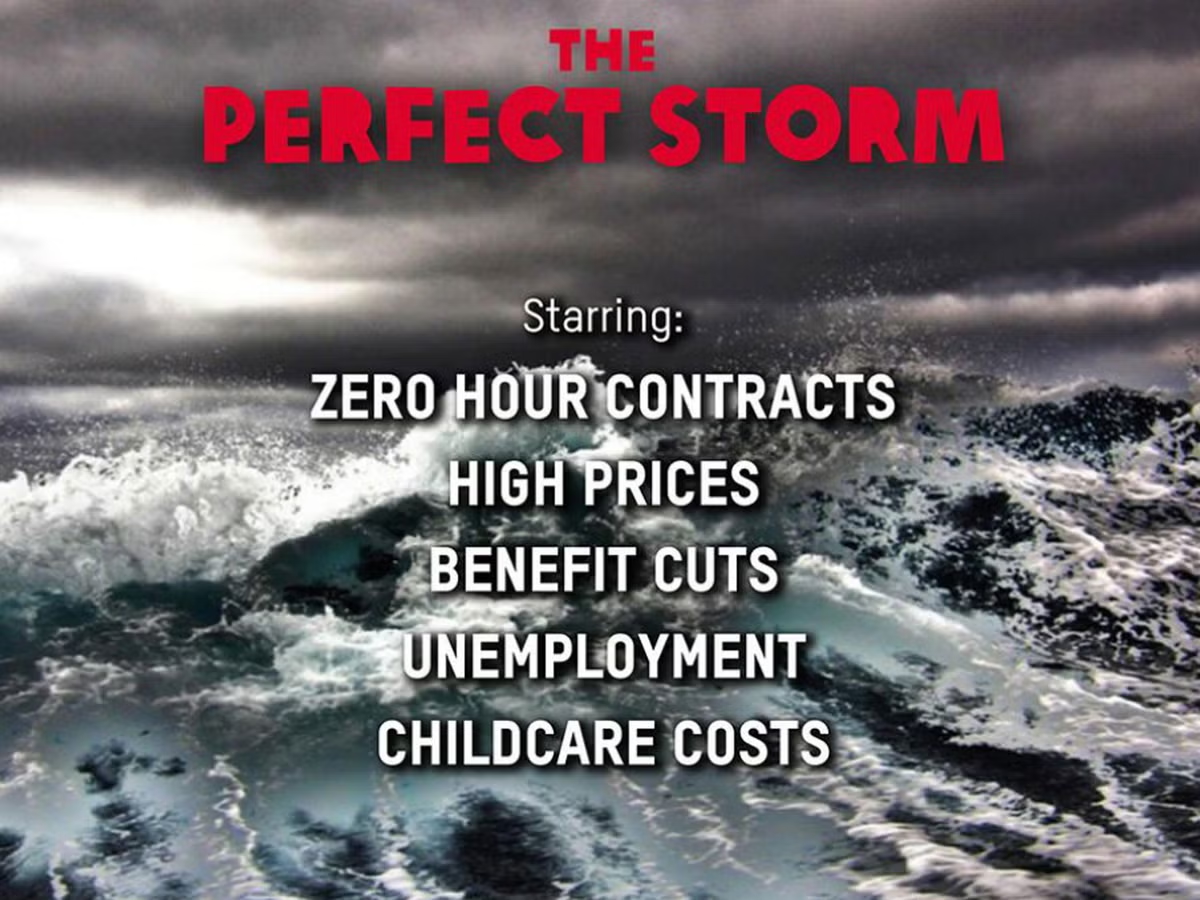
Lifting the lid on austerity Britain reveals a perfect storm – and it’s forcing more and more people into poverty.
Oxfam posted this image on Twitter as part of a campaign on falling living standards and poverty in the UK. Conservative MP’s are angry about it and regard it as “politically biased” and controversial.
Tory MPs have reported Oxfam to the Charity Watchdog for campaigning against poverty. I guess the Joseph Rowntree Foundation had better watch it, then. What next, will they be reporting the NSPCC for campaigning for children’s welfare?
The picture is part of a bigger campaign on poverty in the UK, and was posted on Twitter. Previously OxfamGB had invited people to hear how “we investigate the reasons why so many people are turning to food banks in Britain 2014”.
Another OxfamGB tweet said: “We think all political parties need to commit to action on food poverty in the UK.”
Conor Burns, a Conservative MP, tweeted in response:”This has lost you a lot of supporters. Very foolish.”
I think he mean tory supporters, as other people have realised that it is mostly the vulnerable who carry the burden of the Tory austerity cuts. Since when was a Government above criticism for its policies, especially when those policies are causing suffering and deaths?
It’s impossible to discuss poverty without reference to its root cause, and that invariably involves reference to government policies.
Oxfam are not alone in their concern about the rise of absolute poverty. Medical experts recently wrote an open letter to David Cameron condemning the rise in food poverty under this government, stating that families “are not earning enough money to meet their most basic nutritional needs” and that “the welfare system is increasingly failing to provide a robust line of defence against hunger.”
Many charities have said that the UK government has violated the Human Right to food. Article 11(1) of the International Covenant on Economic, Social and Cultural Rights (ICESCR) recognises the right of everyone to an adequate standard of living, including adequate food, clothing and housing. The UK has signed and ratified, and in so doing is legally bound by the ICESCR, in particular, the human right to adequate food.
According to the Just Fair Consortium report, welfare reforms, benefit delays and the cost of living crisis have pushed an unprecedented number of people into a state of hunger, malnutrition and food insecurity in the UK.
New research by Oxfam has revealed the extent of poverty amongst British children, with poor families taking drastic measures to survive. What kind of government is concerned only about stifling critical discussion of its policies, and not about the plight of the citizens it is meant to serve? This is a government that attempts to invalidate the accounts of people’s experience of the suffering that is directly caused by this government. By blaming the victims and by trying to discredit anyone that champions the rights of the vulnerable.
Tory MP Priti Patel said: “With this Tweet they have shown their true colours and are now nothing more than a mouthpiece for left wing propaganda.”
When did concern for poverty and the welfare of citizens become the sole concern of “the left wing”? I think that casually spiteful and dismissive admission of indifference tells us all we need to know about the current government’s priorities. And no amount of right wing propaganda will hide the fact that poverty and inequality rise under every Tory government.
Burns has written to the Charities Commission requesting an investigation into the “overtly political attack” on “the policies of the current Government.” However, he failed to mention this government’s overtly economic attack on the most vulnerable.
He questions whether the advert is breach of Oxfam’s charitable status.
The Conservatives are said to be particularly angry at the inclusion of unemployment and high prices in the list.
Well we know that the government lies extensively, and invents statistics. We also know that government “employment statistics” include those sanctioned, those awaiting mandatory review or appeal, those on workfare, in prison, in hospital or dead – anyone that has had their benefit claim closed for any reason, since people are not tracked to check if they have actually found a job – because the Department of Work and Pensions measures “employment” by off-benefit flows rather than sustained job outcomes. This can create perverse incentives to coerce jobseekers into short term employment outcomes, rather than refer them to long term contracted out support. It can also create a perverse incentive to sanction claimants, as we know.
Another Tory MP, Charlie Elphicke, branded the campaign post as a:
“shameful abuse of taxpayers’ money,” whilst Priti Patel accused Oxfam of “behaving disgracefully.” Elphicke also claimed child poverty had risen under the Labour government, and was now “falling”.
I wonder if Elphicke actually thinks that people are incapable of making the comparison between this government and the last, and recognising almighty Tory lies. As well as our own experience to draw on, we also have a wide array of research to verify the fact that poverty is rising rapidly under THIS government, because of austerity cuts, and a rapidly rising cost of living.
I believe Oxfam has behaved responsibly, honourably, and with good conscience. It is the Tory-led government that have behaved disgracefully. We have a government that provides disproportionate and growing returns to the already wealthy, whilst imposing austerity cuts on the very poorest. That is very clearly evidenced in their policies.
How can such a government possibly claim Oxfam’s observations are “biased” when inequality is so fundamental to their own ideology, and when social inequalities and poverty are extended and perpetuated by all of their policies. The Tories have no right to be indignant about research findings regarding the poverty they have caused, and to complain about the genuine concern Oxfam expressed about those politically damning findings, when those findngs are so patently true.
Apparently, number 10 has steered clear of the row, however, with a spokesperson saying: “Charities and organisations will have their campaigns. The Government’s job is to have the right policies and explain why those are the right policies.”
We have to wonder what the “right policies” actually are, and why they would need so much defending if they are “right”. And in a democracy, it would be acceptable for a charity to speak out if those policies were in fact the wrong policies, especially when people are suffering harm as a consequence of them. In fact, I believe they have a duty to do so.
Therese Coffey, another Tory MP, accused Oxfam of using: “anecdote to create alarmist generalisations.”
No Therese, the post followed a joint report yesterday by Oxfam, Church Action on Poverty and the Trussell Trust, which reported a 54% annual increase in the number of meals given to people in the UK unable to feed themselves. And it also follows many previous, meticulously researched reports that your government have chosen to deny and ignore.
Ben Phillips, Oxfam campaigns and policy director, has responded:
“Oxfam is a resolutely non-party political organisation – we have a duty to draw attention to the hardship suffered by poor people we work with in the UK.
Fighting poverty should not be a party political issue – successive governments have presided over a tide of rising inequality and created a situation where food banks and other providers provided 20 million meals last year to people who could not afford to feed themselves.”
“This is an unacceptable situation in one of the world’s largest economies and politicians of all stripes have a responsibility to tackle it.”
Oxfam found that more than 20 million meals were delivered to people living in poverty by the four main food bank charities last year.
The charity is asking concerned constituents to email MPs with a letter that highlights the unacceptable reliance on food banks by a growing number of people.
The template letter cites a number of reasons for the prevalence of foodbanks, including “low incomes, rising living costs, welfare cuts, and problems with the benefit sanctions system that stops vital welfare payments going to people who are struggling to make ends meet.” And in absolute fairness to Oxfam, this is verified by more than one piece of research.
Oxfam have urged the government to keep track of the number of people using food banks and encourages constituents to press their MPs to “highlight the need for urgent action to address the rise in food poverty”.
A Charity Commission spokesperson said that the Commission has begun an assessment of the Oxfam tweet, which is the first stage that could lead to full investigation, after receiving the complaint about the campaign, but had contacted the individual concerned for more information about the basis of their objections. The spokesperson added:
“It is worth being aware of the rules on charity campaigning,” she added. “Charities are often the most appropriate organisations to speak out and campaign on behalf of their users.
“From lobbying politicians to running online petitions, charities can engage in a range of activities to support their charity’s aims. But charities must never be politically biased or support a politician.”
I don’t believe that Oxfam have shown “bias.” The truth is the truth, whether conservative MPs like it or not. Tory“facts” are both constructed and seen through a lens of pre-conceptions and ideology. Oxfam and the Joseph Rowntree Foundation choose to study poverty. Cynical Tories, such as Iain Duncan Smith simply change the definition of it. But changing the narrative can never edit people’s experience of poverty and their consequent suffering. Or disguise the causes.
This is a government that gave us the Transparency of Lobbying, non-Party Campaigning, and Trade Union Administration Bill , which is a blatant and calculated move to insulate Tory policies and records from public and political scrutiny, and to stifle democracy.
The ambiguous way in which this Bill targets anything which may impact on an election is calculated and deliberate. It is a way of politically intimidating charities, trade unions, religious organisations and all protest groups into remaining silent on important issues (such as protecting the NHS, introducing fair taxation, fighting poverty, public health, education, financial sector reform, civil liberties, human rights, the privatisation agenda) in election years, and this includes European elections and local Council elections too, so it will mean an almost continuous constraint on organisational freedom to comment on politics in any way. The government’s intentions to stifle criticism and dissent could not be any clearer.
This Bill has been entirely deviously constructed by a spiteful and self-serving, anti-democratic Government. That this same Government no longer deems it necessary to be accountable for its policies, and is by-passing democratic processes and legal safeguards, is frankly terrifying. This is an oppressive, authoritarian Government.
Consider how likely is it that will this Bill will affect the likes of Rupert Murdoch’s News Corp UK and the Daily Mail Group, because they spend a huge amount amount per day, and much of the content of the press is highly political in nature. (For more about the political tyranny directed against the “free press”, please see Once you here the jackboots, it’s too late).
In my opinion, every act of such tyranny is proof that the Tories have planned and carefully coordinated this multi-varied attack on our liberties. The Legal Aid Bill and the Welfare Reforms are just as blatantly oppressive. And such brutal policies and mounting opposition to them are the reason the government feel that water cannons are necessary. People are desperate, starving and destitute, and widespread protest is surely coming. But I fully expect that the Tories are prepared for it.
I am expecting an announcement from number 10 any day now, explaining that the water cannons are not a worryingly authoritarian move at all: that’s just plain scaremongering from “extremists.”
No, they are simply a safety precaution, just in case we get a little too rowdy in our street party celebrations of Osborne’s economic mirage: the “recovery.”
Well done Oxfam. You certainly have my continued support.
–
Copy of the letter from Conor Burns MP to William Shawcross, Chairman of the Charity Commission:
10 June 2014
Dear Mr Shawcross,
My attention was drawn this morning to some advertising being undertaken by Oxfam.
This is overtly political and aimed at the policies of the current Government.
In writing I would formally like to request that the Charity Commission undertake an enquiry as to whether this work in in breach of Oxfam’s charitable status.
Yours sincerely,
Conor Burns MP
Member of Parliament for Bournemouth West.
Further reading
Trussell Trust told ‘the government might try to shut you down’
My complaint: An email to authoritarian Tory MPs Charlie Elphicke, Priti Patel and Conor Burns
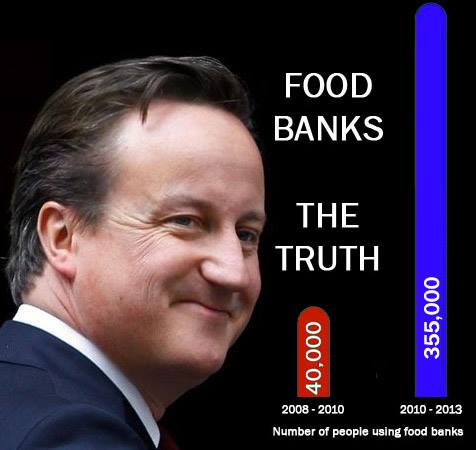 Thanks to Robert Livingstone
Share this:

When the oppressed are oppressive too
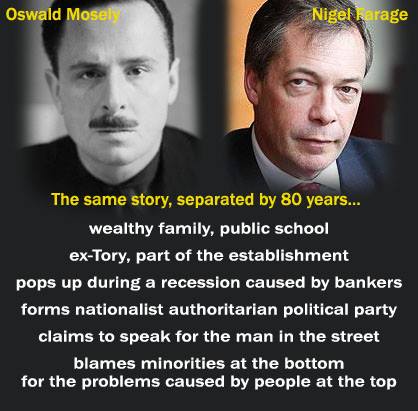
Labour are and always have been democratic and inclusive, they won’t pander to the anti-immigration rhetoric and racism of the right. Quite properly so. Miliband is right to address the issue of exploitative employers, and promote the rights of all workers, that is what equality means.
Human rights apply to everyone, including migrants, otherwise there’s no point in having them. Labour’s Equality Act and Human Rights Act apply to all, and not just disgruntled blue collar workers. Human rights were originally a cooperative international response to the Holocaust, and they are premised on the socialist axiom that every human life has equal worth. Nationalism, Fascism and Conservatism are premised on inequality, a hierarchy of worth and Social Darwinism.
Sir Oswald Ernald Mosley, 6th Baronet of Ancoats is known principally as the founder of the British Union of Fascists (BUF) but he was originally a Tory. He crossed the floor to sit as an Independent Member on the opposition side of the House of Commons. Dissatisfied with the Labour Party, Mosley founded the New Party. Its early parliamentary contests, in the 1931 Ashton-under-Lyne by-election and subsequent by-elections had a spoiler effect in splitting the left-wing vote and allowing Conservative candidates to win.
BUF gained the endorsement of the Daily Mail newspaper, headed at the time by Harold Harmsworth (later created 1st Viscount Rothermere). The BUF was protectionist, strongly anti-communist, nationalistic, and strongly authoritarian. In 1933, after his wife’s death, Mosley married one of his mistresses, Diana Guinness. They married in secret in Germany on 6 October 1936 in the Berlin home of Minister of Public Enlightenment and Propaganda Joseph Goebbels. Adolf Hitler was one of the guests.
Farage is readily comparable with Mosely, he also tried to entice the working class, and those blue collar defectors who don’t feel solidarity with anyone except their “own kind” need to ask themselves how a fascist party would better reflect their interests, because fascists aren’t just fascists when it comes to your preferred target group – in this case migrants – fascists are fascists full stop. And most migrants are working class, too.
Fascists are not known for being big on unions and worker’s rights either, Hitler smashed the unions, Mosely fought them too. But fascists do like to use the oppressed to oppress others.
Mosely was defeated by working class solidarity – Jews, communists, socialists, the labour movement, and the middle classes, who all stood side by side in Newcastle, in the Valleys, Yorkshire, at Olympia and on Cable Street. Unity and regard for the rights and well-being of others was their strength.
Those blue collar workers that are so negative towards their exploited migrant brothers and sisters are more like Thatcher’s children, with so little regard for anyone else. There’s no excuse for prejudice and blaming Labour won’t cut it. Our own principles and respect for each other are our own responsibility. Labour have always provided a framework of tolerance and equality, so there are no excuses. The Labour Party isn’t (and ought not be) about the exclusive representation of just one self-defined social group. That isn’t how democracy works.
Prejudice is politically and socially motivated and directed – there is a considerable element of political and media “duping” involved but there has to be more to it than simply socio-political process, otherwise everyone would be prejudiced in the exactly the same ways. And we are not at all.
There are some identifiable psychological characteristics that present reasons why some people may be more susceptible to adopting prejudice as a kind of defence mechanism:
Avoiding uncertainty – Prejudice allows people to avoid anxiety, anger, doubt and fear. It’s a way of choosing something easier to confront than a reality, since stigmatising a vulnerable social group is an easier option than facing a powerful government that is invariably responsible for the anxiety, anger, doubt and fear in the first place. Of course, that diversion of blame and responsibility suits the government very well, too.
Avoiding ambiguity and insecurity – Prejudice gives people tangible scapegoats to blame in times of social crisis. It offers people a simple formula – stereotypes – from which to make predictions about other people’s behaviour.
Allowing self-serving bias – Prejudice may be used to boost self-esteem. People with prejudiced attitudes tend to be those that harbour a sense of inadequacy. (See Iain Duncan Smith, and his fake qualifications and false statistics, for example)
Permitting oppressive behaviours – Prejudice legitimises discrimination because it apparently justifies hierarchical thinking, and one group’s dominance over another.
Prejudice has been linked with the tendency for over-simplification of explanations – seeing the world as black and white, and also, hierarchical thinking.
Following the Holocaust, several influential theorists came to regard prejudice as pathological, and they searched for personality syndromes associated with racism, anti-Semitism, and other forms of prejudice. The most prominent of these theorists was Theodor Adorno, who had fled Nazi Germany and concluded that the key to prejudice lay in what he called an “authoritarian personality.”
In his book The Authoritarian Personality, (1950), Adorno and his co-authors described authoritarians as rigid thinkers who obeyed authority, saw the world as black and white, and enforced strict adherence to social rules and hierarchies. Authoritarian people, they argued, were more likely than others to harbour prejudices against low-status groups.
All forms of right-wing authoritarianism correlate with prejudice. Well-designed studies in South Africa, Russia, Canada, the U.S., and elsewhere have found that right-wing authoritarianism is associated with a variety of prejudices (Altemeyer, 1996; Duckitt & Farre, 1994; McFarland, Ageyev, & Abalakina, 1993). People who view the social world hierarchically are more likely than others to hold prejudices toward low-status groups. This is especially true of people who want their own group to dominate and be superior to other groups – a characteristic known as “social dominance orientation” .
Any group claiming dominance over another – including the “working class” – is displaying social dominance orientation. The oppressed can be oppressive, too.
Social dominance orientation tends to correlate with prejudice strongly and studies have linked it to anti-Black and anti-Arab prejudice, sexism, nationalism, opposition to gay rights, and other attitudes concerning social hierarchies.
So what are the answers?
Reducing Prejudice:
Research shows that prejudice and conflict among groups can be reduced if four conditions are met:
1) The groups have equality in terms of legal status, economic opportunity, and political power. This is one reason why Labour’s Human Rights Act and the Equality Act are so important.
2) Authorities advocate equal rights and are positive about diversity. We ought to be able to expect positive role modelling from a government. That will never happen with any right wing administration. They advocate measures and present narratives that heighten prejudice, Labour are currently the only party actually addressing the root causes of prejudice.
3) The conflicted groups are provided with opportunities to interact formally and informally with each other.
4) The groups cooperate to reach a common goal.
Yes, that’s the real socialist principle of cooperation, for the benefit of that elite of “purist socialists” who exclude others because they think that they are better socialists than everyone else.
The world would be a much better place if we used cooperation as our unifying foundation for inter-group process, conflict resolution and for wider social organisation.
In solidarity.
Many thanks to Robert Livingstone for his excellent pictures
Share this:

Work and Pensions Committee announces the final oral evidence sessions for its inquiry into Employment and Support Allowance and Work Capability Assessments

The Work and Pensions Committee has today announced the final oral evidence sessions for its inquiry into Employment and Support Allowance and Work Capability Assessments.
- Parliament TV: Watch the fourth session
- Parliament TV: Watch the final session
- Inquiry: Employment Support Allowance and Work Capability Assessments
- Work and Pensions Committee
Fourth Session
Witnesses
Monday 9 June 2014, at 4.30pm, Wilson Room, Portcullis House
- Lisa Coleman, Senior Vice President, Health Market, Atos
- Dr Angela Graham, Clinical Director, Atos Healthcare
- Helen Hall, Head of Communications and Customer Relations, Atos Healthcare
Purpose of the meeting
The session will consider
- Atos’s role in the process before the face to face assessment and claimants’ experience of the process
- The design and delivery of the WCA
- The contract for delivering the WCA, including the relationship between quality and productivity, and Atos’s early exit from the contract
- The ESA decision-making process, including outcomes and appeals
- Future delivery of the WCA
Final session
Witnesses
Wednesday 11 June 2014, at 9.30am, Grimond Room
Department for Work and Pensions
- Rt Hon Mike Penning MP, Minister of State for Disabled People
- Jason Feeney CBE, Benefits Director
- James Bolton, Deputy Director, Health and Wellbeing Directorate
- Iain Walsh, Deputy Director, Working Age Benefits Division
Purpose of the session
The session will consider
- The effectiveness of the WCA, including the findings of the Evidence Based Review
- Key concerns about the delivery of the WCA by Atos, and how these issues may be resolved with the new provider
- The ESA decision-making process
- ESA outcomes and reassessments
- Mandatory reconsideration and appeals
- The interaction between ESA and Universal Credit

 Politics and Insights