Author: Kitty S Jones

I’m a political activist with a strong interest in human rights. I’m also a strongly principled socialist. Much of my campaign work is in support of people with disability. I am also disabled: I have an autoimmune illness called lupus, with a sometimes life-threatening complication – a bleeding disorder called thrombocytopenia. Sometimes I long to go back to being the person I was before 2010. The Coalition claimed that the last government left a “mess”, but I remember being very well-sheltered from the consequences of the global banking crisis by the last government – enough to flourish and be myself. Now many of us are finding that our potential as human beings is being damaged and stifled because we are essentially focused on a struggle to survive, at a time of austerity cuts and welfare “reforms”. Maslow was right about basic needs and motivation: it’s impossible to achieve and fulfil our potential if we cannot meet our most fundamental survival needs adequately. What kind of government inflicts a framework of punishment via its policies on disadvantaged citizens? This is a government that tells us with a straight face that taking income from poor people will "incentivise" and "help" them into work. I have yet to hear of a case when a poor person was relieved of their poverty by being made even more poor. The Tories like hierarchical ranking in terms status and human worth. They like to decide who is “deserving” and “undeserving” of political consideration and inclusion. They like to impose an artificial framework of previously debunked Social Darwinism: a Tory rhetoric of division, where some people matter more than others. How do we, as conscientious campaigners, help the wider public see that there are no divisions based on some moral measurement, or character-type: there are simply people struggling and suffering in poverty, who are being dehumanised by a callous, vindictive Tory government that believes, and always has, that the only token of our human worth is wealth? Governments and all parties on the right have a terrible tradition of scapegoating those least able to fight back, blaming the powerless for all of the shortcomings of right-wing policies. The media have been complicit in this process, making “others” responsible for the consequences of Tory-led policies, yet these cruelly dehumanised social groups are the targeted casualties of those policies. I set up, and administrate support groups for ill and disabled people, those going through the disability benefits process, and provide support for many people being adversely affected by the terrible, cruel and distressing consequences of the Governments’ draconian “reforms”. In such bleak times, we tend to find that the only thing we really have of value is each other. It’s always worth remembering that none of us are alone. I don’t write because I enjoy it: most of the topics I post are depressing to research, and there’s an element of constantly having to face and reflect the relentless worst of current socio-political events. Nor do I get paid for articles and I’m not remotely famous. I’m an ordinary, struggling disabled person. But I am accurate, insightful and reflective, I can research and I can analyse. I write because I feel I must. To reflect what is happening, and to try and raise public awareness of the impact of Tory policies, especially on the most vulnerable and poorest citizens. Because we need this to change. All of us, regardless of whether or not you are currently affected by cuts, because the persecution and harm currently being inflicted on others taints us all as a society. I feel that the mainstream media has become increasingly unreliable over the past five years, reflecting a triumph for the dominant narrative of ultra social conservatism and neoliberalism. We certainly need to challenge this and re-frame the presented debates, too. The media tend to set the agenda and establish priorities, which often divert us from much more pressing social issues. Independent bloggers have a role as witnesses; recording events and experiences, gathering evidence, insights and truths that are accessible to as many people and organisations as possible. We have an undemocratic media and a government that reflect the interests of a minority – the wealthy and powerful 1%. We must constantly challenge that. Authoritarian Governments arise and flourish when a population disengages from political processes, and becomes passive, conformist and alienated from fundamental decision-making. I’m not a writer that aims for being popular or one that seeks agreement from an audience. But I do hope that my work finds resonance with people reading it. I’ve been labelled “controversial” on more than one occasion, and a “scaremonger.” But regardless of agreement, if any of my work inspires critical thinking, and invites reasoned debate, well, that’s good enough for me. “To remain silent and indifferent is the greatest sin of all” – Elie Wiesel I write to raise awareness, share information and to inspire and promote positive change where I can. I’ve never been able to be indifferent. We need to unite in the face of a government that is purposefully sowing seeds of division. Every human life has equal worth. We all deserve dignity and democratic inclusion. If we want to see positive social change, we also have to be the change we want to see. That means treating each other with equal respect and moving out of the Tory framework of ranks, counts and social taxonomy. We have to rebuild solidarity in the face of deliberate political attempts to undermine it. Divide and rule was always a Tory strategy. We need to fight back. This is an authoritarian government that is hell-bent on destroying all of the gains of our post-war settlement: dismantling the institutions, public services, civil rights and eroding the democratic norms that made the UK a developed, civilised and civilising country. Like many others, I do what I can, when I can, and in my own way. This blog is one way of reaching people. Please help me to reach more by sharing posts. Thanks. Kitty, 2012

Techniques of neutralisation: Cameron says keep calm and carry on climbing Allport’s ladder

599849_369461329790068_1640090166_n
The Conservatives have deliberately created socio-economic conditions of austerity to benefit the wealthy at the expense of the poorest. They have created cultural scripts that justify their policies, which also serve to alienate and demonise politically constructed categories of the other. Individuals in the most vulnerable social groups, as a consequence, experience feelings of being out-grouped, estrangement from their community and society, experience an outsider status and antagonism and aggression from other ingroups.

It’s recognised in social psychology that people define themselves to a large degree in terms of social groupings and generally, it seems people have a tendency to denigrate others who don’t fit into those groups, with a little prompting.

Others who share our particular qualities are identified as our “ingroup,” and those who do not are our “outgroup.” The Conservatives are basically manipulating an inclination we seem to have towards prejudice, in order to foster and extend social divisions and undermine social cohesion, by creating artificial categories of outgroups. The calculated “striver versus scrounger” rhetoric is one example of this.

Yet as humans we also possess a need to belong, and to be accepted by others. Conformity is one recognisable response of people managing feelings of rejection, of not belonging and of not being accepted. Division and isolation tends to foster obedience.

Alienation (isolation between groups also leads to engulfment within them, and some loss of identity) is the fundamental condition for inter-group conflict. The Asch conformity experiments were a series of laboratory experiments in the 1950s that demonstrated the significant degree to which an individual’s own opinions are influenced by those of a majority group.

Milgram demonstrated that conformity can take precedence over one’s own moral values and principles, and that authority figures and small-scale interactions within wider group behaviour can create significant barriers to individual autonomy.

Divide, diffuse, demoralise and divert certainly seems to be the current political strategy of governance.

However, although it is difficult to resist the majority opinion if each of us is isolated, follow-ups to the Asch experiment also showed that the number of dissenting voices among experimental subjects made a difference to the results – and that just one voice can make a difference amongst many, liberating others from the conformity and obedience tendencies.

Techniques of neutralisation are a linguistic and psychological method employed by people to develop a special set of justifications for their behaviour when such behaviour violates social norms and collective morality.

Such techniques allow people to neutralise and temporarily suspend their commitment to societal values, and to switch off their own “inner protests”, providing them with the freedom to commit deviant acts. Some people don’t have such inner protests – psychopaths, for example – but they may employ techniques of neutralisation to manipulate, and switch off the conscience protests of others.

It’s clear that this is a method frequently employed by the government and that the Tories systematically attempt to distort meanings, to minimise the impact of what they are doing.

For example, when they habitually use the word “reform” euphemistically, what they are referring to is an act that entails the removal of financial support. “Help” and “support” is Tory-speak that means to punish, to compel “behaviour change” (self-reliance without support from the state) and to remove further lifeline support from the group being threatened with Conservative “support”.  

However, when people don’t have enough money to meet their basic needs – which is what welfare was designed to cover, originally (to meet the costs of food, fuel and shelter only) – they struggle and cannot meet higher level psychosocial ones. If people are left without the means to meet the costs of fulfilling their basic needs for long, they will die.

For example, the claim that the bedroom tax is “helping” people into work” or helping child poverty” – when research  shows that 96% of those affected by the bedroom tax can NOT downsize due to a lack of available homes in their area – is a completely outrageous lie. People can’t move as there is a housing crisis, which is due to a lack of affordable homes and appropriately sized accommodation.

How can policies that further impoverish the poorest citizens ever help them to find work or alleviate child poverty, as the government claims? It’s an astonishing lie.

This means that most people have to find extra rent costs from benefits that were calculated to meet only the costs of basic survival needs such as food and fuel, and furthermore, were calculated with the assumption that people on benefits also received full housing costs via housing benefit.

At a time when the cost of living has risen so steeply, and the value of benefits has actually decreased to the point where this essential support is nowmanifestly inadequateaccording to the Council of Europe in Strasbourg, it’s inconceivable to regard the bedroom tax as anything other than grossly punitive to the most the poorest, disabled people and some of the most vulnerable citizens.

The idea of techniques of neutralisation was first proposed by David Matza  and Gresham Sykes during their work on Edwin Sutherland’s Differential Association in the 1950s.  Matza and Sykes were working on ideas about juvenile delinquency, they theorised that the same techniques could be found throughout society and published their ideas in Delinquency and Drift, 1964.

They identified the following methods by which, they believed, delinquents/deviants justified their illegitimate actions, and Alexander Alverez identified these methods used at a sociopolitical level in Nazi Germany to justify” the Holocaust:

  • Denial of responsibility. The offender(s) will propose that they were victims of circumstance or were forced into situations beyond their control. For example, the frequently cited statement that the perpetrator was “only carrying out orders from above.”
  • Denial of injury. The offender insists that their actions did not cause any harm or damage. For example, under the Nazi regime this took the form of special language which hid or disguised what was actually being done, euphemisms in which killing became “special treatment,” “cleansing”and many other similar examples.
  • Denial of the victim. The offender believes that the victim deserved whatever action the offender committed. For example, The Nazis ensured it was widely believed that Jews were involved in a conspiracy to enslave the whole world, so that killing them was self-defence. Although a fabrication, many Germans appeared to have believed it to be true.
  • Condemnation of the condemners. The offenders maintain that those who condemn their offence are doing so purely out of spite, or are shifting the blame from themselves unfairly. For example, claims made by the German government and the media that the other countries that were condemning the Nazis were historically guilty of worse crimes, such as the treatment of blacks and Native Americans in the United States and the treatment of native peoples in the French, British and Spanish colonies.
  • Appeal to higher loyalties. The offender suggests that his or her offence was for the greater good, with long term consequences that would justify their actions, such as protection of a friend/social group/nation. For example, German perpetrators of genocide thought of themselves as patriots, nobly carrying out their duty.Disengagement and Denial of Humanity is a category that Alverez added to those techniques formulated by Sykes and Matza because of its special relevance to the Holocaust. Nazi propaganda portrayed Jews and other non-Aryans as subhuman. Dehumanisation was explicitly orchestrated by the government. This also very clearly parallels Allport’s work, explaining how prejudice arises.

Any one of these six techniques can serve to encourage violence by neutralising the norms against prejudice, aggression and murder. To the extent that they are all implemented together, as they were under the Nazi regime, to that extent a whole society can seemingly forget its moral values and laws , in order to engage in wholesale prejudice, hatred and murder.

Our own government have deliberately manufactured and perpetuated misconceptions about disabled people via their rhetoric, intentional, strategic lies and manipulated statistics.

With the support of a conformist media, the coalition have officialised prejudice, scapegoating, vilification and alienation of already marginalised social groups, hatred – and they have given their permission for people to perpetrate hate crimes by their own negative role modelling.

Disability hate crime in 2011 was at its highest level since records began. Last year, it was also found that victims of disability hate crime are being let down by the criminal justice system and attacks are not being properly recorded, according to a report by three official inspectorates.

Recently, the Department for Work and Pensions (DWP) have been reprimanded for series of rule breaches in which official statistics were used inaccurately, inappropriately, or to “spin” stories about benefit claimants in the media.

The Commons Work and Pensions committee cites examples where the UK Statistics Authority criticised the use of DWP statistics, including by the Secretary of State, Iain Duncan Smith, and Party Chairman Grant Shapps.

The Committee stated that the government was warned as early as 2011 to take more care over the way it presented information on benefits statistics to the media. Ministers had replied then by saying they had a “robust” system in place to ensure no abuses took place. But this was clearly a lie.

The committee notes, in a published report into DWP performance, that problems still remained and that the UK Statistical Authority had reprimanded the department a number of times in 2013 for the way it used welfare statistics.

The Department of Work and Pensions Select Committee report also highlights how government use of statistics are not being used objectively to shed light on policy implementation, they are being used instead to prop up misconceptions and established preconceptions. Anne McGuire said:

“The DWP ministers and its press office have been found guilty yet again of trying to pull the wool over the public’s eyes by its failure to be clear what exactly the statistics show.”

The DWP used its “new figures” to persuade two right-wing newspapers to run stories claiming that the rise in DLA claimants proved the need for reform.

The Sun newspaper claimed the number of DLA claimants on “handouts” was “soaring” at the rate of “one every ten minutes”, and that ministers believed the figures “proved they are right to scrap DLA from April” and replace it with the “tough” new PIP.

The Daily Mail claimed that a new DLA claimant was “signing on” every nine minutes, and that “the rush to secure the state payout is thought to be because its replacement will have tougher eligibility tests”. The article says:

“The cost to the taxpayer is now £13billion a year. An astonishing seven out of ten claimants – 71 per cent – have been offered the benefit for life without any checks to see if they still need it, according to the Department for Work and Pensions.”

Rise: A new applicant is signing on to claim DLA every nine minutes, the latest figures show

The Daily Mail trivialising disability and illness. The caption reads – “Rise: A new applicant is signing on to claim DLA every nine minutes, the latest figures show”


“From April, DLA will gradually be replaced by the Personal Independence Payment (PIP), which is being introduced in an attempt to cut the nation’s benefits bill.”

Note the divisive dichotomy: tax payers are apparently a discrete group of people, portrayed as carrying the financial burden of this social group. However, both DLA and PIP are also classed as in-work support. Many disabled people claiming these benefits do so in order to remain independent and to support them in work. Both benefits were designed to meet the additional living costs that disabled people face because of their disability, to help them remain independent, and are not means tested.

A recent British Social Attitudes survey showed that the Tory austerity cuts may well have become aligned with public opinion, as views have hardened towards perceived “benefits scroungers”. This was a politically calculated outcome, and is used as a self-perpetuating justification for the government’s punitive policies that target the most vulnerable social groups.

It was both individual and collective behaviours that contributed to the Holocaust. Allport’s studies helped us to understand that severe, targeted, personally destructive scapegoating and bullying was a major part in the incremented stages of public acceptance of the unacceptable.

There are some thematic parallels between the social processes and history leading up to the Holocaust and the bigotry, prejudice and targeted bullying we are witnessing in our own society.

What really worries me is how it’s become everyday and almost ordinary to us. And how we fail to link micro and macro level prejudices and behaviours. Ordinary people become easily invested in the values of a morally bankrupt status quo and may participate in terrible behaviours that are seemingly unthinkable in civilised society. History has taught us that.

Perpetrators – in this case our own government – typically require assistance to manipulate the opinions of others, usually to portray their target as the miscreant. Allport’s Scale is a measure of the manifestation of prejudice in a society.

Gordon Allport is a psychologist who researched how the Holocaust happened. There are identifiable ideological parallels here. They are clear and real:

Stage 1. Antilocution. This is when speech is in terms of negative stereotypes and negative images. This is also called hate speech. It sets the stage for more severe outlets for prejudice. When a government does this, it is giving the public permission to hate others.

Stage 2. Avoidance: Members of the majority group actively avoid people in a minority group. No direct harm may be intended, but harm is done through isolation, and this may include also other forms of social exclusion.

Stage 3. Discrimination: Minority group is discriminated against by denying them opportunities and services and so putting prejudice into action. Behaviours have the specific goal of harming the minority group by preventing them from achieving goals, getting education or jobs, etc. The majority group harms the minority.

Stage 4. Physical Attack: The majority group may vandalize, burn or destroy minority group property and carry out violent attacks on individuals or groups. Physical harm is done to members of the minority group. Examples are lynchings of blacks, pogroms against Jews in Europe and British Loyalists in the 1700s. Incidents of hate crime against disabled people has risen massively since the Tories took office.

Final stage 5. Extermination: The majority group seeks extermination or removal of the minority group. They attempt to eliminate either the entire or a large fraction of a group of people (e.g., Indian Wars to remove Native Americans, lynchings of African-Americans, Final Solution to the “Jewish Question” in Nazi Germany, the Rwandan Genocide, and ethnic cleansing in the Bosnian War). When people deliberately or unthinkingly side with abusers to facilitate the destruction of a targeted victim/group, they play institutional roles very similar to the bureaucrats of the Nazi regime.

There are not just victim/target and perpetrator roles, bystanders play a key role in enabling perpetrators, too. Bystanders are not guilty of simply looking the other way. They are complicit in the abuse; often they are among the key enablers leading to the final elimination of the target. And whether that’s on the level of social groups that are being targeted, or individuals, it’s all part of the same methodology and ideology.

We know that the Asch experiment is related closely to the Stanford Prison and Milgram experiments, in that it tries to show how perfectly normal human beings can be pressured into atypical and irrational  behaviour by authority figures, or by the consensus of opinion around them. Asch’s paradigm indicates that having social support is an important tool in combating conformity. Techniques of neutralisation may serve to help people (including the government) to rationalise acts of prejudice and violence.

However, these experiments lack a degree of ecological credibility – in that they do not necessarily relate to real-life situations, though they undoubtedly reveal something of our human tendencies.

We must challenge our own government’s attempts to normalise prejudice. One voice can make a difference amongst many. Social norms are the unwritten rules that govern social behaviour. These are customary standards for behaviour that are widely shared by members of a culture.

We know that it is possible for an articulate and vocal minority to stem the normative influence of a larger majority. It’s up to each of us to have a responsible role in meta-scripting or re-scripting those norms.

Wittgenstein once said: “The limits of my language are the limits of my  world.”

Words are powerful. As well as describing, signifying, explaining, persuading, interpreting, deceiving and so on, they may also issue commands and instructions. We “spell” words. Spelling may also be described as “words or a formula purported to have magickal powers.”

With words, both spoken and unspoken, we can shape and re-shape the universe. We can create. Einstein changed the meaning of the word “mass” and transformed Newton’s universe of structures to become his own – one of events. It’s a different universe.

We can oppress, liberate or transform with a few intentional words. The choice is ours.

changeworld2013


My work is unfunded and I don’t make any money from it. I am disabled because of illness and struggle to get by. But you can support Politics and Insights and contribute by making a donation which will help me continue to research and write informative, insightful and independent articles, and to provide support to others. DonatenowButton


Manufacturing consensus: the end of history and the partisan man

10001887913_f8b7888cbe_o
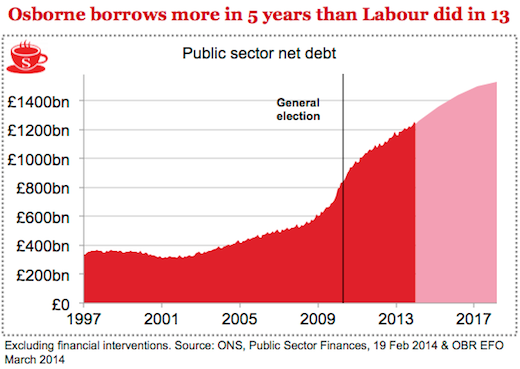
The Tories are not “paying down the debt” as claimed. They are “raising more money for the rich”

Austerity is not being imposed by the Coalition to achieve an economic result. Austerity IS the economic result. In the wake of the global banking crisis, the Tories, aided and abetted by the Liberal Democrats, have opportunistically delivered ideologically driven cuts and mass privatisation.

We also know that the government’s own Office for Budget Responsibility (OBR) laid bare an important truth – that any semblance of economic recovery is despite the Coalition and not because of them. Yet the Tories have continued to claim that austerity is “working”. The Chairman of the OBR, Robert Chote said:

“Looking over the forecast as a whole – net trade makes very little contribution and government spending cuts will act as a drag.

The OBR state that any slight economic recovery is in no way because of Osborne and Tory policy, but simply due to the wider global recovery from the global crash. 

The government has drastically cut its spending on everything – including the NHS, and welfare in spite of their ludicrous claims to the contrary, this means that the government has consistently damaged the prospect of any economic recovery. This also demonstrates clearly that Coalition policy is driven by their own ideology rather than a genuine problem-solving approach to the economy. Yes, I know I’ve said all of this before – and so have others – but it’s so important to keep on exposing this Tory lie.

However, I believe that Conservatives really do have a conviction that the “big state” has stymied our society: that the “socialist relic” – our NHS and our Social Security system, which supports the casualties of Tory free markets, have somehow created those casualties. But we know that the competitive, market choice-driven Tory policies create a few haves and many have-nots.

Coalition rhetoric is designed to have us believe there would be no poor if the welfare state didn’t “create” them. If the Coalition must insist on peddling the myth of meritocracy, then surely they must also concede that whilst such a system has some beneficiaries, it also creates situations of insolvency and poverty for others.

Inequality is a fundamental element of the same meritocracy script that neoliberals so often pull from the top pockets of their bespoke suits. It’s the big contradiction in the smug, vehement meritocrat’s competitive individualism narrative. This is why the welfare state came into being, after all – because when we allow such fundamentally competitive economic dogmas to manifest, there are always winners and losers. It’s hardly “fair”, therefore, to leave the casualties of competition facing destitution and starvation, with a hefty, cruel and patronising barrage of calculated psychopolicical scapegoating, politically-directed cultural blamestorming, and a coercive, pathologising and punitive behaviourist approach to the casualities of inbuilt, systemic, inevitable and pre-designated sentences of economic exclusion and poverty.

And that’s before we consider the fact that whenever there is a Conservative-led government, there is no such thing as a “free market”: in reality, all markets are rigged to serve elites.

Political theorist Francis Fukuyama, announced in 1992 that the great ideological battles between “east and west” were over, and that western liberal democracy had triumphed. He was dubbed the “court philosopher of global capitalism” by John Gray. In his book The End of History and the Last Man, Fukuyama wrote:

“At the end of history, it is not necessary that all societies become successful liberal societies, merely that they end their ideological pretensions of representing different and higher forms of human society…..What we are witnessing, is not just the end of the cold war, or a passing of a particular period of postwar history, but the end of history as such: that is, the end point of mankind’s ideological evolution and the universalisation of western liberal democracy as the final form of human government.”

I always saw Fukuyama as an ardent champion of ultra-neoliberalism, and he disguised his neo-conservatism behind apparently benign virtue words and phrases (as part of a propaganda technique called Glittering Generalities), such as “Man’s universal right to freedom.” 

He meant the same sort of self-interested “freedom” as Ayn Rand – “a free mind and a free market are corollaries.” He meant the same kind of implicit Social Darwinist notions long held by Conservatives like Herbert Spencer – where the market rather than evolution decides who is “free,” who survives, and as we know, that’s rigged. Tory ideology does not ever have a utilitarian outcome.

Fukuyama’s ideas have been absorbed culturally, and serve to naturalise the dominance of the Right, and stifle the rationale for critical debate.

Like Marx, Fukuyama drew to some extent on the ideas of Hegel – who defined history as a linear procession of “epochs” – technological progress and the progressive, cumulative resolution of conflict allowed humans to advance from tribal to feudal to industrial society. Fukuyama was determined to send us on an epic detour – Marx informed us the journey ended with communism, but Fukuyama has diverted us to another destination.

I agree with Fukuyama on one point: since the French Revolution, democracy has repeatedly proven to be the fundamentally better system (ethically, politically, economically) than any of the alternatives. However we haven’t witnessed the “triumph of liberal democracy” at all: in the UK, we are seeing the imposition of rampant, unchecked neoliberalism coupled with an unyielding, authoritarian-styled social conservatism, with the safety net of democracy removed.

Fukuyama’s declaration manufactures an impression of global consensus politics but I believe this is far from the truth. I don’t believe this can possibly be the endpoint of humanity’s sociocultural evolution. It doesn’t reflect any global and historical learning or progress.

Jacques Derrida (Specters of Marx (1993) ) said that Fukuyama – and the quick celebrity of his book – is but one symptom of the wider anxiety to ensure the “death of Marx”. He goes on to say:

“For it must be cried out, at a time when some have the audacity to neo-evangelize in the name of the ideal of a liberal democracy that has finally realized itself as the ideal of human history: never have violence, inequality, exclusion, famine, and thus economic oppression affected as many human beings in the history of the earth and of humanity. Instead of singing the advent of the ideal of liberal democracy and of the capitalist market in the euphoria of the end of history, instead of celebrating the ‘end of ideologies’ and the end of the great emancipatory discourses, let us never neglect this obvious macroscopic fact, made up of innumerable singular sites of suffering: no degree of progress allows one to ignore that never before, in absolute figures, have so many men, women and children been subjugated, starved or exterminated on the earth.”

Fukuyama’s work is a celebration of neoliberal hegemony and a neo-conservative endorsement of it. It’s an important work to discuss simply because it has been so widely and tacitly accepted, and because of that, some of the implicit, taken-for-granted assumptions and ramifications need to be made explicit.

I don’t think conviction politics is dead, as claimed by Cameron – he has said that he doesn’t “do isms”, that politics is doing “what works”, “working together in the National interest” and “getting the job done”. But we know he isn’t working to promote a national interest, only an elite one. Cameron may have superficially smoothed recognisable “isms” from Tory ideology, but Nick Clegg has most certainly taken the politics out of politics, and added to the the impression that old polarities no longer pertain –  that all the main parties have shifted to the right.

However, the authoritarian Right’s domination of the ideological landscape, the Liberal Democrat’s complete lack of any partisan engagement and their readiness to compromise with their once political opponents has certainly contributed to popular disaffection with mainstream politics, and a sense of betrayal.

It’s ironic that many of those on the left who mistake divisiveness for a lack of political choice have forgotten the degree of consensus politics between 1945 and 1979, when Labour achieved so much, and manifested what many deem “real” socialist ideals. The Conservatives at that time largely agreed the need for certain basic government policies and changes in government responsibility in the decades after World War II, from which we emerged economically exhausted.

The welfare state, the national health service (NHS), and widespread nationalisation of industry happened at a time of high national debt, because the recommendations of the Beveridge Report were adopted by the Liberal Party, to some extent by the Conservative Party, and then most expansively, by the Labour Party.

It was Thatcher’s government that challenged the then accepted orthodoxy of Keynesian economics – that a fall in national income and rising unemployment should be countered by increased government expenditure to stimulate the economy. There was increasing divergence of economic opinion between the Labour and the Tories, ending the consensus of the previous decades. Thatcher’s policies rested on a strongly free-market monetarist platform aiming to curb inflation by controlling the UK’s money supply, cut government spending, and privatise industry, consensus became an unpopular word.

The Thatcher era also saw a massive under-investment in infrastructure. Inequality increased. The winners included much of the corporate sector and the City, and the losers were much of the public sector and manufacturing. Conservatism: same as it ever was.

Those on the “Narxist” left who claim that there is a consensus – and that the Blair government continued with the tenets of Thatcherism need to take a close look at Blair’s policies, and the important achievements that were underpinned with clear ethical socialist principles: strong themes of equality, human rights, anti-discrimination legislation, and strong programmess of support for the poorest, sick and disabled and most vulnerable citizens. Not bad going for a party that Narxists lazily dubbed “Tory-lite”.

Narxism is founded on simplistic, sloganised references to Marxist orthodoxy, and the claim to “real socialism.” Many Narxists claim that all other political parties are “the same.”

The Narxist “all the samers” tend to think at an unsophisticated populist level, drawing heavily on a frustratingly narrow lexicon of blinding glittering generalities, soundbites and slogans. But we need to analyse and pay heed to what matters and what defines a political party: policies and their impact. Despite New Labour’s shortcomings, if we are truly to learn anything of value and evolve into an effective opposition, presenting alternatives to the Conservative neoliberal doxa, we must also examine the positives: a balanced and even-handed analysis. We won’t progress by fostering further divisions along the longstanding “real socialist”, “left” and “moderate” faultlines.

It’s very clear that it is the Coalition who are continuing Thatcher’s legacy. We know this from the Central Policy Review Staff (CPRS) report, which was encouraged and commissioned by Thatcher and Howe in 1982, which shows a radical, politically toxic plan to dismantle the welfare state, to introduce education vouchers, ending the state funding of higher education, to freeze welfare benefits and to introduce an insurance-based health service, ending free health care provision of the NHS. One of the architects of the report was Lord Wasserman, he is now one of Cameron’s advisors.

New Labour had 13 years to fulfil Thatcher’s legacy – and did not. However, in four short years, the Coalition have gone a considerable way in making manifest Thatcher’s ideological directives. To do this has required the quiet editing and removal of Labour’s policies – such as key elements of Labour’s Equality Act .

The imposed austerity is facilitated by the fact that we have moved away from the equality and rights based society that we were under the last Labour government to become a society based on authoritarianism  and the market-based distribution of power. The only recognisable continuity is between Thatcher’s plans and Cameron’s policies. The intervening Labour government gave us some respite from the cold and brutal minarchism of the Tories.

There was never a greater need for partisan politics. The media, which is most certainly being managed by the authoritarian Tory-led government creates an illusory political “centre ground” – and a manufactured consensus – that does not exist.

Careful scrutiny and comparison of policies indicates this clearly. Yet much propaganda in the media and Tory rhetoric rests on techniques of neutralisation – a deliberately employed psychological method used to direct people to turn off “inner protests”, blur distinctions: it’s a mechanism often used to silence the inclination we have to follow established moral obligations, social norms, as well as recognise our own values and principles. And it’s also used to disguise intentions. Therefore, it’s important to examine political deeds rather than words: policy, and not narratives.

My own partisanship is to fundamental values, moral obligations  and principles, and is certainly none-negotiable. Those include equality, human rights, recognising diversity, justice and fairness, mutual aid, support and cooperation, collective responsibility, amongst others, and the bedrock of all of these values and principles is, of course, democracy.

Democracy exists partly to ensure that the powerful are accountable to the vulnerable. The far-right Coalition have blocked that crucial exchange, and they despise the welfare state, which provides the vulnerable protection from the powerful. They despise human rights.

Conservatives claim that such protection causes vulnerability, yet history has consistently taught us otherwise. The Coalition’s policies are expressions of contempt for the lessons of over a century of social history and administration.

The clocks stopped when the Tories took Office, now we are losing a decade a day.

382035_141704259313964_676863845_n
Thank you to Robert Livingstone for the pictures. More here

Labour welfare cap rebels: the full list

Labour welfare cap rebels: the full list

Thirteen Labour MPs, including Diane Abbott and Tom Watson, voted against George Osborne’s new cap on welfare spending.


Thirteen Labour MPs voted against Osborne's new measure.
Former Labour minister Tom Watson was one of the 13 rebels. Photograph: Getty Images.
In the end, the Labour rebellion over George Osborne’s new cap on welfare spending (which The Staggers revealed details of on Monday) was smaller than most predicted, with 13 voting against the measure, including Diane Abbott and Tom Watson (22 MPs voted against in total, with 520 in favour).
But it’s worth noting that some would-be rebels were away at a funeral and that party sources may well have inflated the likely number of dissenters in an attempt to manage expectations (a figure of 25 was mentioned at one point). It’s also likely that at least some MPs were persuaded by the whips not to vote against the measure on the grounds that it won’t automatically result in any new cuts and that a future Labour government could amend the cap as it sees fit.
The policy won’t take effect until 2015-16 (the limit has been set at £119.5bn for that year) and is largely intended as a political trap for the opposition. It’s for this reason that Ed Balls and other shadow cabinet ministers have been unambiguous in their support for the measure today. It’s also why some MPs, most notably Diane Abbott, who made a fiercely critical speech during the debate, couldn’t stomach voting with the Tories. At a time when many of their constituents are suffering the effects of benefits cuts, they regard Osborne’s attempt to perpetuate a false divide between “strivers” and “scroungers” as politics of the lowest kind.
Here’s a list of the 13 Labour MPs who voted against the cap:
Diane Abbott
Ronnie Campbell
Katy Clark
Michael Connarty
Jeremy Corbyn
Kelvin Hopkins
Glenda Jackson
John McDonnell
George Mudie
Linda Riordan
Dennis Skinner
Tom Watson
Mike Wood
Tags:LabourWelfare
It’s also worth noting that  there is a difference between a limit on welfare spending, which is always set and voted on anyway, and an individual benefit cap. How the budget is spent is important, and that is where the conservatives and labour remain partisan.
Asked whether Labour was prepared to cut aspects of the welfare bill to stay within the cap, she said Rachel Reeves was “confident” it would not need to because it would tackle the “root causes” of rising costs – such as low wages, youth unemployment and the increase in part-time workers.
“We would do it in different ways to the way the government is proposing to do it but we are confident that our way will control the cost of social security.”
21 more good  reasons to vote labour

You are not alone: therapy, individualism and collectivism

images
I have often felt that western individualistic therapeutic models tend to distort therapeutic outcomes. I don’t see humans as self-contained and independent –  we don’t exist in isolation. Indeed, evidence from human and animal studies shows that isolation prompts sensitivity to social threats and usually motivates the renewal of social connections. I see humans as fundamentally interdependent, I was always more inclined (intuitively and academically) towards social psychology and small scale, interpretive and interactionist sociology, but then I tend to slot that into a broader structural context. Rather like R.D Laing’s existential starting point, as he writes, he moves outwards from self, to others, to a society which he analyses using a Marxist frame. We cannot examine mental health without reference to the intersubjective home which cultivates it. Society: the very crucible in which selves are forged.

Many of my colleagues also noted that the complexity of individual personality and psychological processes tended to get lost in a “one-size-fits-all” approach to “improving human functioning and experience.”

For example, that the costs and benefits of different kinds of optimism and pessimism may vary across different individuals, situations, and cultural contexts was rarely if ever taken into consideration. Yet we know that there are times when pessimism and negative thinking are positive psychology, as these approaches often lead to the development of better coping mechanisms via diligent problem-solving, learning and personal growth.

I was always very interested in people’s attitudes toward styles of social interdependence and how people derive self-esteem. Studies show that there are correlations between attitudes towards styles of interdependence and of deriving self-esteem and a sense of self worth which indicate distinctive and theoretically predictable patterns of relationship.

Those who indicate a cathexis for cooperative relationships tend to report patterns of higher self-esteem related to freedom of personal expressiveness and feelings of personal well-being; those people indicating a cathexis for competitive or highly individualised patterns of interdependence experience greater vulnerability on dimensions of self-esteem reflecting a sensitivity to the experiences of approval, success and support of others.

The magnitudes of the correlations between a global measure of personal worth and attitudes towards types of interdependence reflect the extent to which positive social reinforcement is available in these contexts.

In 1902 Charles Horton Cooley wrote about a social psychological concept that came to influence much symbolic interactionist sociology, and its central themes are manifested in labelling theory, for example. Cooley said “the human mind is social.”  As children, we begin to define ourselves within the context of our socialisation. We learn that crying will elicit a response from our parents, not only when we are in need of necessities such as food, but also as a symbol to receive their attention.

The term “looking glass self” was first used by Cooley in his work, Human Nature and the Social Order , it’s a description of a process where a person’s self-concept [cognitive or descriptive component of one’s self] develops through  interpersonal interactions and the perceptions of others. The term refers to people shaping their self-concepts based on their understanding of how others perpetually perceive them to be. Because people conform to how they think others think them to be, to a significant degree.

George Herbert Mead described the self as “taking the role of the other,” the premise for which the self is actualised. Through interaction with others, we begin to develop an identity – the “who” we are, as well as developing empathy for others. In respect to this Cooley said:

“The thing that moves us to pride or shame is not the mere mechanical reflection of ourselves, but an imputed sentiment, the imagined effect of this reflection upon another’s mind.”

But we are capable of reflection and reflexivity, [reflexivity includes both a subjective process of self-consciousness and the study of social behaviour with reference to theories about social relationships. We bridge the gap between structure and agency] self-fulfilling and self-negating prophesies [the prophecy has a constitutive impact on the result, changing the outcome from what would otherwise have happened]: we have intentionality and a degree of free-will.

Conservatives perpetuate and utilise our western tendency towards individualism, amplifying it and using it as a way to deliberately undermine social cohesion, cooperation and collective responsibility. It isolates many. Individuals are easier to manipulate and persuade, they are more likely to conform. [See the Milgram experiment]. Furthermore, competing for resources with others diminishes empathy.

Collectivism is a fundamental element of human culture that has existed independently of any one political system and has existed since the founding of human society, roughly some ten thousand years ago. It is a feature of all societies to some degree and therefore may be regarded as an inherent feature of human nature.

But in my [ex-]professional experience, there is an over-emphasis on Western individualism – with its concomitant selfishness, alienation, and divisiveness – it’s one of the root causes of our personal, social and political problems. It’s not possible to address the New Right neoliberalist, narrow, competitive self-interest kind of ontological insecurity – a very paltry view of human “nature” – with a commitment to any higher social purpose. Individualism is fundamentally incompatible with egalitarianism. Laissez faire individualism, as we ought to have learned from history, only ever results in increasing inequality, a nation of a few very rich and a lot of very poor people. It elevates a handful of individuals in terms of social status and oppresses many others, whilst also restricting or destroying our human potential.

Our very language derives from the individualism of Hobbes and Locke, the contemporary cost benefit analysis, and from the individualism of modern therapists – we have the self-made man and the self actualised one -“looking out for number one”, and “being your own best friend”. It’s an overarching narrative, it’s become tacit “knowledge”, yet in the English language, the word “individualism” was first introduced, as a pejorative, by the Owenites in the 1830s.

There is a concomitant dominant paradigm of individualist psychological perspectives that enshrine the idea that human behaviour is primarily governed by self-interest. Humans first seek to ensure survival, and then they seek to dominate. These facets of human nature are seen as a product of genetically coded survival instincts modified by the totality of our environment and expressed as neurochemically-mediated emotions and actions.

This culture of individualism – which is embedded in both Western therapy approaches and enshrined in popular self-help mantras – helps to sustain Conservative free-market ideology and cultivate narcissism. Free-market ideology is deterministic. It implies that there are no institutional choices: the market “decides”, whilst the individual is held responsible for his own fortune, or lack of it. Do mind the logical gaps there…

Furthermore, the government is actually expanding ever more rapidly rather than shrinking – seizing public funds and spending more and more of our money on handouts to the wealthy, and intruding on our lives in increasingly oppressive ways.

“There’s no such thing as society” has become something of a Tory mantra since the Thatcher era. Tories reduce the social to the alienated isolated individual, and individuals are free only insofar as we compete with each other for resources in the market place. The market place is where money is taken from the poor in exchange for their survival, and handed out to the wealthy, in exchange for the subversion of democracy to suit themselves. It’s the gift that keeps on giving.

It’s an irony that whilst we traditionally contrast collectivism and individualism, it was collectivism that brought about the process of civic emancipation in Western societies which resulted in social and civic structures that champions the role of individual choice, personal freedom and competition.

Individual sovereignty or individual autonomy is only feasible anyway when it is balanced carefully with personal responsibility and interest in the autonomy of others. But that isn’t happening: instead we have a steep hierarchy of autonomy which is based on economic determinism: a society of a few autonomous, wealthy narcissists and psychopaths, and a growing mass of a stifled, dehumanised, poor precariat class .

Conservatives create a myth that we live in a dangerous world. Such a dangerous world metaphor has long been associated with right-wing ideological views. In the last couple of centuries, though, this metaphor has taken the form of Social Darwinism.

This ruthless “survival of the fittest” concept [a phrase coined by British conservative sociologist Herbert Spencer, and not Darwin] is a one-sided [and frequently distorted] view of the fuller scientific picture of evolution that has developed over the second half of the twentieth century. Since the 1960s, biologists have made advances in understanding how evolution motivates various kinds of altruistic cooperation in nature – in addition to self-interest. Kropotkin had observed this at the time Darwin wrote his classic text anyway, in his own work “Mutual Aid”. Nonetheless, public opinion of folk-Darwinism, which situates people in a dangerous “red in tooth and claw, jungle world,” has  been very frequently been evoked to support a right-wing moral philosophy.

Kropotkin’s work about altruism and cooperation was dismissed because, despite the fact it was very coherent and compelling, and provided empirical evidence, it did not fit the Conservative and Liberal laissez faire dominant paradigm at the time, which was comprised of the ideas of Mathus, Smith’s laissez faire economics and “market forces”, competitive individualism. These are culturally specific and relative views, and not ones which are shared by many eastern countries, for example.

The Social Darwinist survival of the fittest idea appears most obviously and prevalently in narratives of the extreme right. Hitler saw life as a zero-sum struggle between races, in which one group would always seek to dominate the other. In 1928, Hitler gave a speech in Kulmbach, Bavaria, he envisioned a conflict between races in pseudo-Darwinian terms:

“The idea of struggle is as old as life itself, for life is only preserved because other living things perish through struggle . . . in the struggle, the stronger, more able, win, while the less able, the weak, lose . . . it is not by the principles of humanity that man lives or is able to preserve himself above the animal world, but solely by the means of the most brutal struggle.”

Hitler rejected that cooperative behaviour in human and non-human animals plays a significant role in the struggle for survival and in fitness generally. Moreover, the inhuman acts committed by humans in the name of Nazism greatly surpassed the brutality of any other animal. Nonetheless, Hitler viewed the world as extremely dangerous, and he attributed the danger to a misconstrued Social Darwinism.

Marx described us as essentially creative and productive beings. It is not just that we produce for our means of survival, it is also that we engage in creative and productive activity over and above what is necessary for survival and find fulfilment in this activity. This activity is inherently social – most of what we produce is produced collectively. This contrasts completely with the individualist basis of conservative and liberal thinking, which came from the likes of Edmund Burke, I agree with Marx: we are fundamentally social creatures.

We become consciously aware of ourselves as a discrete being through language – and language is inherently inter-subjective; it is a social practice. What we think – including what we think about ourselves – is governed by what we do and what we do is always done socially and collectively.

In contrast to the tories, the left have fairly expansive view of human nature – it is our nature to be creatively adaptable and for our understanding of what is normal in terms of behaviour to be shaped by the social relationships around us. For Marx, we flourish and thrive in a society that allows us to express  sociability and creativity. Self fulfilment and self-realisation is a reciprocal process because we are social beings.

There never was a time when we had a more compelling need for democracy, cooperation and collective citizen participation than now. That means we need to transcend the individualistic therapeutic mentality and dog-eat-dog individualism that is descending from the establishment via a divisive, toxic political rhetoric, the media and the Nudge Unit – which is aimed at “fixing” our alleged irrationality, so that we behave in line with state definitions of rationality. Of course this assumes our collective fallibility and the infallibility of the Nudgers.

The conceptual framework was already in place though. As a society, we have long thought that the self is [pathologically] more important than others.

And personally, I think we need more therapists who sometimes say: “Today, I couldn’t give a f*ck about how you feel, I would like you to consider the impact of your actions on the feelings and experiences of others, let’s explore that …”

Because you are not alone. None of us are.


Manly P Hall
Picture courtesy of Robert Livingstone.

“All being in each being
Each being in all being
All in each
Each in all
All distinctions are mind, by mind, in mind, of mind.
No distinctions no mind to distinguish.” R.D Laing

47 more good reasons to vote labour

1379457_540985575970975_1546760968_n

Labour builds, the Tories always destroy.

Here is the first stage of Labours’ costed and evidence-based plan to rebuild the UK:

1. Labour pledge to build  200,000 per year by 2020, focusing on social housing.

2. Labour pledged to create a State-Owned Rail Company that would compete and win back Rail Franchises.

3. Labour vow to cut business rates for small firms.

4. Labour vowed to introduce an increased Bankers’ Bonus Tax if they win in 2015.

5. Labour promised Free Childcare worth £5,000 a year for working parents who had children aged 3&4.

6. Labour committed to Sacking ATOS, Serco and G4S if they win the election.

7. Ed Miliband promised to repeal the Bedroom Tax.

8. Ed Balls pledged to reverse the Pension Tax relief that the Tories gifted to millionaires.

9. Labour promised to reverse the Tory Tax cut for Hedge Funds.

10. Labour pledged they will create 200,000 Apprenticeships

11. Ed Miliband vowed to increase the fine levied on firms not paying the Minimum Wage by 1000% to £50,000.

12. Labour are to introduce a new Disability Hate Crime Prevention Law.

13. Labour would freeze gas and electricity bills for every home and business in the UK for at least 20 months, the big energy firms would be split up and governed by a new tougher regulator to end overcharging.

14. Voting age to be lowered to 16.

15. NHS to be re-nationalised.

16. Miliband also said that any private company that does not meet the needs of the public will be brought under state control.

17. Labour will ban exploitative zero hour contracts.

18.  Labour have pledged to introduce a living wage.

19.  Labour have pledged to reverse the £107,000 tax break that the Tories have given to the millionaires.

20. Labour will reintroduce the 50p tax.

21. Labour will repeal clause 119.

22. Labour will introduce a law making Private Companies subject to the Freedom of Information Act.

23. Labour will introduce a Mansion Tax on properties worth more than £2 million

24.  Labour will make up the difference to the value in the minimum wage is restored, reversing the Tory cut of 5%.

25. Labour will halt Michael Gove’s Free School Expansion Programme.

26. Labour will abolish the Tory ban on Local Education Authorities opening State Schools once more.

27. Labour will scrap George Osborne’s “Shares for Rights” scheme that has opened up a tax loophole of £1 billion .

28. Labour will launch a full public inquiry into blacklisting.

29. Labour will ensure Water Companies place the poorest households on a Social Tariff that makes it easier for them to pay their Water Bills.

30. Labour will double the tax duty on Pay Day Lenders and will use the additional £13,000,000 that raises to help foster more Credit Unions.

31. Labour will impose a cap on the cost of credit, setting a limit at which Pay Day Lenders can charge borrowers.

32. Labour will regulate food labelling to simplify pricing so that Supermarkets cannot con customers.

33. Labour plan to introduce a Bill that would ban Recruitment Consultancy firms from only hiring abroad & ban firms from paying temporary workers less than permanent staff.

34. Labour would set up a Financial Crime Unit, with increased staffing, in the Serious Fraud Office to enable the SFO to pursue bankers who break the law.

35. Labour will break up the banks, separating retail banking from investment banking.

36. Labour will scrap Police Commissioners.

37. Labour will introduce a Forces & Veterans Bill of Rights to build upon the Military Covenant.

38. As a minimum measure, Labour will at least cut Tuition Fees by 33%.

39. Labour will introduce measures to prevent corporate tax avoidance.

40. Labour will also increase the Bank Levy by £800m a year.

41. Labour will scrap the Profit Tax Cut (Corporation Tax) that George Osborne has already announced for 2015.

42. Labour will scrap Cameron’s “Gagging” Act.

43. Labour will ensure all MPs will be banned from receiving any income from corporations after 2015.

44. Labour will tackle the abuse and exploitation of migrant labour that undercuts wages.

45. Labour will extend their 2002 public interest test to protect us from exploitative multinational takeovers.

46. Labour will end unpaid workfare

47. Labour have pledged to scrap sanction targets.

48. Labour will scrap the non-domicile tax rule.

307438_447255352010665_491067854_n Thanks to Robert Livingstone for the pictures

What Labour achieved, lest we forget

The pre-election pledges that the Tories are trying to wipe from the internet, lest we forget

The Coalitions’ biggest hits, volume 1

The Tories cynically veto Balls’s plan to allow the OBR to audit Labour’s manifesto


Hi

Hi. Just to let you all know I can’t access my FB account from here, just twitter and wordpress. But there’s share on FB option on wordpress, don’t know if this will get there, though. Cheapskate and limitd hospital broadband! . But will be home hopefully tomorrow. I am carefully plotting my escape.. 🙂   xxx
peacock bf

The poverty of responsibility and the politics of blame – part 2

430847_149933881824335_1645102229_n (1)
Social security came about precisely because we evolved to recognise a need for a social safety net to protect citizens when they encountered economic difficulties, because we learned last century that we are all potentially vulnerable, and that this isn’t anything to do with a person’s characteristics – ordinary people are not to blame for socio-economic circumstances, or for becoming ill and disabled. Unemployment, accident and illness can happen to anyone.

In 1992, Peter Lilley, the somewhat salacious Tory department of social security secretary said he had “got a little list” of people to stereotype as scroungers. Lilley amused the Conservative Party conference with a plan to “close down the something for nothing society”, delivered in the form of a parody of the Lord High Executioner’slittle listsong from The Mikado  by Gilbert and Sullivan:

“I’ve got a little list / Of benefit offenders who I’ll soon be rooting out / And who never would be missed / They never would be missed. / There’s those who make up bogus claims / In half a dozen names / And councillors who draw the dole / To run left-wing campaigns / They never would be missed / They never would be missed. / There’s young ladies who get pregnant just to jump the housing queue / And dads who won’t support the kids / of ladies they have … kissed / And I haven’t even mentioned all those sponging socialists / I’ve got them on my list / And there’s none of them be missed / There’s none of them be missed….”

I remember that subsequently, Spitting Image  portrayed Lilley as a commandant at a Nazi concentration camp and commentator Mark Lawson of The Independent said that if Lilley remained as Secretary of State for Social Security, it would be “equivalent to Mary Whitehouse becoming madam of a brothel.”

The social groups who featured on that hate list are some of the poorest and most disempowered in our society: lone parents, mental health service users, refugees and asylum seekers, the unemployed, and young and homeless people. They have few, if any advocates in parliament on the right, and apparently, few votes are to be lost by attacking them.

Such are the Tory prejudiced, divisive and self-serving attacks on welfare and the purposely devalued social groups it supports. This punitive approach to welfare reform generally has the opposite effect to that promised by Tories such as Lilley, creating additional bureaucratic costs and waste, and setting one group against another. This is a deliberate undermining of social cohesion, cooperation and collective responsibility. It isolates many, who by common consent need support. This approach is also designed to deter those people with legitimate entitlement to support, and to justify an unnecessary and inappropriate harassment, stigmatising and denigrating those it should be helping.

Welfare is the provision of a minimal level of well-being and social support for all citizens. In other words, it was conceived to alleviate absolute poverty and meet basic survival needs. This is based on a model of human developmental psychology focusing on the recognised stages of growth in humans, and is founded on the central idea that the most basic level of needs must be met before the individual may be motivated to fulfil any other needs and betterment. As a minimal condition for making choices and being responsible, people must have all of their basic physiological needs met. For example, a homeless person’s job choices might be constrained by the lack of an address for correspondence or even a place to take a shower. Understanding such humanist concepts was central to the development equality policies and human rights.

The welfare state expands on these concepts to include services such as universal healthcare. In most developed countries welfare is provided by the government. Benefits are based on a compulsory supra-governmental insurance contribution system, the National Insurance system in the UK was established in 1911.

The Beveridge Report in 1942, essentially recommended a national, compulsory, flat rate insurance scheme which would combine health care, unemployment and retirement benefits. After its victory in the United Kingdom general election, 1945 the Labour Party pledged to eradicate the five Giant Evils, and undertook policy measures to provide universal support for the people of the United Kingdom “from the cradle to the grave.”

Social Security policy resulted in the development of what was considered to be a state responsibility towards its citizens, and a citizen responsibility towards each other. Welfare is a social protection that is necessary. There was also an embedded doctrine of fostering equity in the policy.

In addition to the central services of education, health, unemployment and sickness allowances, the welfare state also involved increasing redistributive taxation, increasing regulation of industry, food, and housing, better safety regulations, weights and measures controls. The principle of health care “free at the point of use” became a pivotal idea of the welfare state, which later Conservative governments, who were critical of this, were unable to reverse. Prescription charges were introduced by the Conservative Government in 1952.

The Welfare State period lasted from around 1945 until the Thatcher government began to privatise public institutions in the 1980s, although some features remain today, including compulsory National Insurance contributions, and the provision of old age pensions. It was Conservative governments that introduced constraints to eligibility for benefits via means testing.

The Labour Party won a clear victory in 1945 based on their programme of building provision for citizens with the Welfare State. However, since the 1980s the Conservative government had begun to reduce provisions in England: for example, free eye tests for all were stopped and prescription charges for drugs have constantly risen since they were first introduced by the Conservatives in 1951.

During the Thatcher era, the English High Tory journalist T. E. Utley, wrote that the welfare state was “an arrangement under which we all largely cease to be responsible for our own behaviour and in return become responsible for everyone else’s.” However, even people who erroneously believe that the present welfare system is corrosive to individual responsibility accept the urgency of preventing hunger and destitution. Yet the Tories have persisted with their pre-Victorian rhetoric of the “undeserving, idle poor.”

There is a moral as well as a logical absurdity in this Conservative claim, tied up with notions of citizenship. It’s a continual contradiction of principle within Conservative ideology that small state logic applies to the most vulnerable, who are left to the worst ravages of “market forces” without state protection, but such laissez faire principles don’t extend to the wealthy. Conservatives systematically fail to correct market failures in the interests of the public, but they do intervene to protect the interests of the minority of wealthy citizens. Similarly, replacing state run public services with profit incentivised private providers is an intervention. These partisan interferences distort the “market mechanism,” contrary to Tory claims.

As Ed Miliband noted, when Cameron declared We are raising more money for the rich:

“David Cameron and George Osborne believe the only way to persuade millionaires to work harder is to give them more money.’

‘But they also seem to believe that the only way to make you (ordinary people) work harder is to take money away.”

So “market forces” are adjusted and fixed to benefit the wealthy and penalise the poor.

The sociologist T.H. Marshall wrote in 1965, “it is generally agreed that… the overall responsibility for the welfare of the citizens must remain with the state.” Marshall’s own concept of “social citizenship” – which put forward a new model of citizenship based on economic and social (as well as political) rights – was characteristic of this collective approach to social welfare after 1945. There was a clear and optimistic sense of rebuilding a better Britain.

It’s worth noting that the Universal Declaration on Human Rights recognises socio-economic human rights, such as the right to educationright to housingright to adequate standard of livingright to health and the right to science and culture. Economic, social and cultural rights are recognised and protected in several international and regional human rights instruments. The International Covenant on Economic, Social and Cultural Rights (ICESCR) is the primary international legal source of economic, social and cultural rights. All member states have a legal obligation to respect, protect and fulfil economic, social and cultural rights of the public and are expected to take “progressive action” towards their fulfilment. The current government have made it clear that they hold such rights in high contempt, and in terms of socio-economic policy, they are driven by an extremely regressive rather than progressive ideology.

The social citizenship model remained unchallenged until the emergence of Margaret Thatcher as Conservative Party leader (1975) and then Prime Minister (1979). Thatcherism promised low taxes, less state intervention, and lower levels of public spending, Thatcher introduced cuts in spending on housing and stricter eligibility rules for benefits. This was the Conservative beginning of the end of collective provision.

The Tories have steadily eroded our provision for the poorest and the most vulnerable citizens – our collective safety net, and their rhetoric is about erasing our evolved, civilised collective approach from our social memory. We are being steadily de-civilised, our historical, collective learning and social history is being re-written, and the Tories would have us turn into a society of dog eat dog psychopaths if they get their way.

The Tories have a cynical view of human nature, and presume people will always act out of self-interest, and whilst they may well avoid disappointment, Conservatives will never understand people by assuming that is all that motivates them. History has demonstrated that when human beings are given the chance to meet their fundamental needs and express themselves fully, they are, by nature, interested in the well-being of society and all its members.

I don’t believe that we have limited ability in terms of human endeavour to achieve positive change. Conservatives see the traditional order as enduring and sacred: a trust to be passed from generation to generation. They see the hierarchy that they always engineer as the result of “natural merit.” To be a Tory is to believe this “natural order” of things.

Survival of the wealthiest

Yet Conservative ideology directs an openly hierarchical society and promotes social inequalities, both materially and in terms of social esteem. Tories believe that a “good” society is one where people would simply accept their place. And that is wherever the Tories place them – “The rich man at his castle, the poor man at his gate.”

There are strong links between the right wing idea of “competitive individualism,” laissez faire capitalism, Social Darwinism, eugenics, nationalism and fascism/authoritarianism. Social Darwinists generally argue that the “strong” should see their wealth and power increase while the weak should see their wealth and power decrease.

Most of these views emphasise competition between individuals in a laissez-faire capitalism context; but similar concepts have motivated ideas of eugenics, racism, imperialism fascism, Nazism and struggle between national or racial groups. Eugenics is state interference in the engineering of the “survival of the fittest (wealthiest)”. That is happening here in the UK, with Tory policies like the welfare “reforms”, which are extremely punitive towards sick and disabled citizens in particular – all too often denying them the means of meeting basic survival needs. The Tories think that wealth is a measure of virtue, and that poor people deserve poverty.

Welfare isn’t simply a matter of societal rights but also a matter of life and death. People are dying, and are being made homeless, we are seeing a massive increase in food poverty, malnutrition and people are committing suicide because they are so desperate. Yet the Tories continue to present the victim-blame script. It’s a script that is used almost always to reinforce white supremacist and patriarchal power structures.

And it’s a script that plays off a weakness of our Western worldview, our inclination to assign negative moral value to those who suffer – what psychologists call thejust world fallacy .”

It is often said that you can judge a society on how it treats its weaker members, and in that respect the current government have failed so many. What kind of society is it that allows over a million young people to struggle on the dole, stifling their potential and their creativity, instead of spending the money on helping them to find meaningful work – and then blames them?

What kind of society allows a government to re-brand unemployment and poverty as personal failure, when we know that this government’s policies have caused unemployment to rise, just like every other Tory government. Thatcher at least admitted she had intentionally created high unemployment to keep inflation low, however, that “strategy” failed and we had high inflation and high unemployment. Conservative governments always create a large, disposable army of labour, which they like to keep as desperate as possible to drive down wages, working conditions and to stultify collective bargaining.

Raising unemployment is an extremely effective way of reducing the strength of the working classes, and what is being engineered in Marxist terms is a crisis of capitalism which creates a reserve army of labour and has allowed Tory donors – the capitalist class – to make very high profits.

What kind of society allows sick and disabled people to be harassed – where they are called in for crude, tick-box tests to prove that they are “really” ill or disabled, one where that “assessment” is designed purposefully to remove their lifeline benefits, one where most are found “fit for work” with many dying a few weeks or months later? And when people succeed in appealing wrongful decisions, they are almost immediately sent for a reassessment?

This is happening here in the UK. The Tory welfare “reforms” are extremely punitive towards people who can’t find work and sick and disabled citizens, all too often denying them the means to meet basic survival needs. We urgently need to overturn this by forcefully challenging the Tory myths that poison any attempts at progressive change. Human suffering, loss of dignity and death may have many facets, but all of them are equally unforgiving, and when imposed by humans on fellow humans, all are equally unforgivable. 

Some Tory benefit myths addressed:

Mythbuster: Tall tales about welfare reform – Red pepper
Voters ‘brainwashed by Tory welfare myths’, shows new poll – The Independent
Welfare Myth Number One – Benefits Are Expensive – Dr Simon Duffy
Who really benefits from welfare – Dr Simon Duffy
Where the cuts are targeted – Dr Simon Duffy
The myth of the “welfare scrounger” – The New Statesman

1902872_299005260250529_1922060527_n
Pictures courtesy of Robert Livingstone

Ed Miliband’s response to the Budget: full text

Foreword

New coin, same old cons.

“Films, football, beer, and above all, gambling filled up the horizon of their minds. To keep them in control was not difficult….” – George Orwell, 1984.

photo-1


1974029_10152735375548327_1567866350_o

The government’s own Office for Budget Responsibility (OBR) laid bare an important truth – that any semblance of economic recovery is despite the Coalition and not because of them.

The Chairman of the OBR, Robert Chote, spoke to journalists, and there was some coverage on the BBC News – though so far they have managed to mute this salient fact. Chote said this:

“Looking over the forecast as a whole – net trade makes very little contribution and government spending cuts will act as a drag.”

The OBR have also stated that any slight economic recovery is in no way because of Osborne and Tory policy, but simply due to the wider global recovery from the global crash. 

The government has drastically cut its spending on everything – including the NHS, in spite of their claims to the contrary, this means that the government has consistently damaged the prospect of any economic recovery.

It’s therefore outrageous to hear Osborne trying to claim credit for the appearance of something that the Tories have done their very best to impede.

The Tories create high unemployment deliberately. Every time they are in Office. The subsequent increased reserve army of labour are then forced to ‘compete’ to take lower paid work, under less favourable working conditions, because they are desperate – and especially more so now that our welfare system is so unfit for purpose. The Tories made sure of that, too.

Making work pay” is a big Tory lie that has benefited no-one but the very wealthy, and the reduction in both the value and the amount of welfare support for unemployed individuals has come at a time when we are witnessing steady reductions in worker’s rights, and worryingly, the Tory-led Government has stepped up its attack on employment health and safety regulations.

This suits Tory donor profit- seeking businesses just fine, but unforgivingly and unforgivably, it costs lives, and costs us a decent, civilised standard of living. This is what Tories always do. It’s an intrinsic tenet of Tory ideology. They always start a brutal race to the bottom.

They are NOT paying down the debt, they are raising more money for the rich.

1000649_619680011444370_1767881827_n

Tory austerity is a false economy.

1948159_10151942671742411_1351878813_n

The Chancellor spoke for nearly an hour. But he did not mention one central fact:

The working people of Britain are worse off under the Tories. Living standards down: month after month, year after year.

2011 – living standards down.

2012 – living standards down.

2013 – living standards down.

And since the election working people’s living standards £1,600 a year – down. You’re worse off under the Tories.

Their 2010 manifesto promised:

“An economy where…[people’s] standard of living…rises steadily and sustainably”

But they have delivered exactly the opposite. Standards of living not rising steadily and sustainably, but falling sharply and steeply.

And today the Chancellor simply reminded people of the gap between the Chancellor’s rhetoric and the reality of peoples’ lives. Living standards falling for 44 out of 45 months under this Prime Minister.

Unmatched since records began. No amount of smoke and mirrors today can hide it.

We already know the answer to the question millions of people will be asking in 2015:

“Are they better off now than they were five years ago?”

The answer is no. Worse off.

Much worse off. Worse off under the Tories.

And the Chancellor trumpeted the tax allowance today. But what he didn’t tell you is that it is the same old Tory trick. He didn’t tell you the rest of the story. He didn’t mention the 24 tax rises introduced since he became chancellor.

He forgot to mention that he put up VAT.

He taxed away Child Benefit.

He raised insurance tax.

And gave us the ‘Granny Tax’.

It’s a classic Tory con. Give with one hand and take far more away with another.

Same old Tories.

Now the Chancellor painted a picture of the country today that millions of people simply will not recognise. Because this is Cameron’s Britain 2014:

350,000 people going to food banks.

400,000 disabled people paying the Bedroom Tax.

1 million more people paying 40p tax.

4.6 million families facing cuts to tax credits.

But there is one group who are better off. Much better off.

We all know who they are. The Chancellor’s chums. The Prime Minister’s friends.

The Prime Minister rolls his eyes, he doesn’t want to talk about the millionaire’s tax cut. No mention of it in the Budget speech.

The beneficiaries of this year’s millionaire’s tax cut.

Because if you are a City banker earning £5m and you are feeling the squeeze, don’t worry because they feel your pain. Because this year that city banker was given a tax cut. Not just any tax cut.

£664 a day.

£20,000 a month.

A tax cut worth more than £200,000 a year.

So the Prime Minister chooses to afford a tax cut of £200,000 for a banker. But he can’t afford a pay rise of £250 for a nurse.

And these are the people that had the nerve to tell us we’re all in this together.

It’s Tory values.

It’s Tory choices.

It’s the same old Tories.

And of course, the Leader of the Liberal Democrats, with them every step of the way. Day after day he claims he doesn’t support Tory policy. But day after day he votes for Tory policy.

Now to listen to the Chancellor today, for a recovery that arrived three years later than he promised, he expects the country to be grateful.

Back in 2010, he told us that by the end of 2014, the economy would have grown by nearly 12 per cent. Today the figures say it has been barely half that. And he wants the country to be grateful.

Back in 2010 he said the Government would clear the deficit in this parliament by 2014/15. Today he wants the country to be grateful because he says he can do it by 2018/19.

Three years ago the Chancellor told us in his 2011 Budget speech he would deliver an economy “carried aloft by the march of the makers”:

But what has actually happened since then to the rebalancing that he promised?

Manufacturing output has fallen by 1.3 per cent.

Construction output has fallen by 4.2 per cent.

Infrastructure investment down 11 per cent.

Every time he comes to this house he promises a rebalancing.

And every time he fails.

He talked about housing today, but what has he actually delivered?

They’ve overseen the lowest house building since the 1920s. And rents have risen twice as fast as wages.

At the heart of the argument we will have over the next fourteen months is this question: whose recovery is it?

Under them it’s a recovery for the few not the many. Bankers pay in London rising five times faster than the pay of the average worker. This recovery’s not working for working people whose living standards are falling.

It’s not working for millions of women who see the gap between men and women’s pay rising. It’s not working for low-paid people promised by the Chancellor a £7 minimum wage, but given just 19p more an hour.

Under this Government it’s an economy of the privileged, by the privileged, for the privileged.

And instead of today admitting the truth about what is happening in most people’s lives, they want to tell them the opposite.

They tell people their wages are rising when they’re falling. Just like they tell people their energy bills are falling when they’re rising. And they tell people they’re better off but everyone knows the truth.

You can change the shape of the pound. But it doesn’t matter if the pound is square, round or oval. If you’re £1,600 pounds worse off, you’re still £1,600 pounds worse off.

You’re worse off under the Tories.

And the reason they can’t deliver is because of what they believe. His global race is a race to the bottom.People forced to do 2 or even 3 jobs to make ends meet. Not knowing how many hours they will get from one week to the next.

And no idea what the future holds for their kids.

Low wages.

Low skills.

Insecure work.

That’s how they think Britain succeeds.

That is why they’re not the solution to the cost of living crisis.

They are the problem.

We needed a Budget today that would make the long-term changes our economy needs in housing, banking and energy. But they can’t do it. They won’t stand up to the vested interests.

They won’t tackle developers sitting on land, even though they can’t solve the housing crisis without it.They won’t force the banks to improve competition, even though small businesses say they need it.

They won’t stand up to the energy companies and freeze energy bills, even though the public support it.

Same old Tories.

We know what their long term plan is: more tax cuts for the richest, while everyone else gets squeezed.

What does the Chancellor say about the people dragged into paying 40p tax?

He says they should be happy. It’s good news for them.

So this is the new Osborne tax theory:

If you’re in the middle paying 40p you should be pleased to pay more.

But if you’re at the top paying 50p, you should be helped to pay less.

Same old Tories.

It’s no wonder that even their own side think they’re totally out-of-touch. And even now, even after all the embarrassment of the millionaire’s tax cut, they won’t rule out going further.

Maybe today we can get the straight answer we haven’t had so far?

Will he rule out a further tax cut for millionaires to 40p?

Just nod your head if you’re ruling it out!

There they go again.

They won’t rule it out.

Doesn’t it say everything about them?

They really do believe the way you make the rich work hard is to make them richer, and the way you make everyone else work harder is by making them poorer.

And just like they paint a picture of the country that working people will not recognise, so too themselves. Now the Prime Minister is an expert in re-branding. Remember the huskies, the bike, the tree?

That was before they said cut the green crap.

What is the latest re-brand from the Bullingdon club?

It is beyond parody.

Because what does this lot now call themselves?

They call themselves ‘The workers’ party’.

And who is writing the manifesto for this new workers’ party?

We already know the answer and I quote:

“There are six people writing the manifesto, five went to Eton…”

By my count more Etonians writing the manifesto than there are women in the Cabinet.

No girls allowed.

And this week we’ve heard it right from the top. Here’s what his former best friend, his closest ally, the Education Secretary had to say about the Prime Minister’s inner circle. He said it was, and I quote:

“Ridiculous.

Preposterous.

Unlike anywhere else in the world.”

You know you’re in trouble when even the Education Secretary calls you a bunch of out of touch elitists.

And where is the Education Secretary? I think he has been banished … He’s hiding! I think he has been consigned to the naughty step by the Prime Minister.

I think it’s time we listened to Baroness Warsi and took the whole Eton mess out of Downing Street. And what a mess it is.

There are more sides in the Tory briefing war than there are on the new pound coin. We don’t need a party for the privileged few.

We need a party for the many.

That is why a Labour government will:

Freeze energy bills.

Guarantee jobs for unemployed young people.

Cut business rates.

Reform the banks.

Get 200,000 homes built a year.

And abolish the Bedroom Tax.

This is the Budget that confirms people are worse off under the Tories. A worse off budget, from an out-of-touch Chancellor.

Britain can do better than them.

Britain needs a Labour government.

Ed Miliband.
scroll2

21 more good reasons to vote labour:

1. Labour pledge to build a million new homes

2. Labour pledged to create a State-Owned Rail Company that would compete and win back Rail Franchises.

3. Labour vow to cut business rates for small firms.

4. Labour vowed to introduce an increased Bankers’ Bonus Tax if they win in 2015.

5. Labour promised Free Childcare worth £5,000 a year for working parents who had kids aged 3+4.

6. Labour committed to Sacking ATOS, Serco and G4S if they win the election.

7. Ed Miliband promised to repeal the Bedroom Tax.

8. Ed Balls pledged to reverse the Pension Tax relief that the Tories gifted to millionaires.

9. Labour promised to reverse the Tory Tax cut for Hedge Funds.

10. Labour said they would create 200,000 Apprenticeships and tie it to immigration.

11. Ed Miliband vowed to increase the fine levied on firms not paying the Minimum Wage by 1000% to £50,000.

12. Labour are to introduce a new Disability Hate Crime Prevention Law.

13. Labour would freeze gas and electricity bills for every home and business in the UK for at least 20 months,the big energy firms would be split up and governed by a new tougher regulator to end overcharging.

14. Voting age to be lowered to 16.

15 NHS to be re-nationalised.

16. Miliband also said that any private company that does not meet the needs of the public will be brought under state control.

17. Labour will scrap zero hour contracts.

18.  Labour have pledged a living wage.

19.  Labour have pledged to reverse the £107,000 tax break that the Tories have given to the millionaires.

20. Labour will reintroduce the 50p tax.

21. Labour will repeal clause 119.1896930_10151941274942411_961048560_n
Further reading:
What Labour Achieved
The Great Debt Lie and the Myth of the Structural Deficit
The mess we inherited – some facts with which to fight the Tory Big Lies
A short-term Budget to shrink the state and help the rich – Frances O’Grady
Budget 2014: George Osborne’s ‘recovery’ exposed as con – Graham Hiscott
Follow the money


The commercialisation and undemocratising of the NHS: the commodification of patients

252299_486936058042594_609527550_n
Last September, I wrote an article entitledJobseekers are being coerced into experimental drug trials dressed up as “job opportunities” .

I reported that David Cameron had announced that it was: “simply a waste to have a health service like the NHS and not use the data it generatedLet me be clear, this does not threaten privacy”, he reassured us, “it doesn’t mean anyone can look at your health records, but it does mean using anonymous data to make new medical breakthroughs”.

Cameron often inadvertently signposts the coming of a diabolical lie with the phrase “let me be clear”, as we know. We also know that so-called anonymisation of data offers no protection at all to identities and personal details. Campaigners described the plan as an”unprecedented threat” to confidentiality, Health Secretary Jeremy Hunt says, rather worryingly, that it will be a boon to research.

It’s common knowledge that many Coalition MPs and Peers are heavily financially invested in pharmaceutical and health care companies. Over 200 parliamentarians have recent past or present financial links with, and vested interests in companies involved in healthcare and all were allowed to vote on the Health and Social Care Bill. The Tories have normalised corruption and made it almost entirely legal. Our democracy and civic life are now profoundly compromised as a result of corporate and financial power colonising the State, and vice versa.

The Health and Social Care Bill, 2012, has a telling insert: The Secretary of State’s duty as to research, which is “In exercising functions in relation to the health service, the Secretary of State must promote – (a) research on matters relevant to the health service, and (b) the use in the health service of evidence obtained from research”.

And also very worryingly: (1) The National Patient Safety Agency is abolished. (2) The National Patient Safety Agency (Establishment and Constitution) Order 2001 (S.I. 2001/1743) is revoked. (3) In section 13 of the NHS Redress Act 2006 (scheme authority’s duties of co-operation), omit subsection (2)

So we must ponder just how coincidental it is that Jobseekers are now being coerced into experimental drug trials, or risk benefit sanctions, as the trials are being dressed up as “job opportunities”.

People claiming Jobseekers Allowance while searching for new employment are being forced to accept ever worsening working conditions or join exploitative Government work programmes in desperate attempts to survive, as our civilised social safety nets and lifeline benefits are being torn away by a draconian and authoritarian Government.

The rising number of unemployed and underemployed citizens of the UK are having their desperation to survive exploited, enticed into zero hour contracts, workfare and now, clinical trials. My revulsion at this Government is at an all time absolute.

Jobseekers using the Government’s  job website – the Universal JobMatch – have been receiving multiple messages from the service inviting them to apply for jobs, only to find that these “employment opportunities” are actually clinical trials.

Drug companies are also to be given provisional approval to treat the severely ill with new drugs and use the data in later licence applications In other words, our government is permitting pharmaceutical companies to experiment using severely ill people.

Behind the scheme is a Tory concern that the UK is no longer a favourite location for the drug companies to develop and trial new medicines – “Making Britain the best place in the world for science, research and development is a central part of our long-term economic plan,” said Health Secretary, Jeremy Hunt.

George Freeman, Conservative MP for Mid-Norfolk, who has long campaigned for the scheme, said: “it would benefit small biotech companies and charities, which may have breakthrough drugs that they cannot afford to take all the way through the long and expensive regulatory process – increasingly the source of innovative medicines which are then bought up by big pharma.

They would get their drugs into NHS patients, hopefully giving them positive data which would attract investors for the large-scale clinical trials.”

So not this is not actually about patient welfare, as Hunt had initially claimed. If it were, then there would have been no need for the abolition of The National Patient Safety Agency, or the revoking of The National Patient Safety Agency.

In 2011, an influential report written by Colin Haslam, Pauline Gleadle and Nick Tsitsianis entitled UK bio-pharma: Innovation, re-invention and capital at risk concludes by presenting the case for innovative short and medium term government-led policy initiatives for the sector and highlights four central areas in which the current bio-pharma business model could evolve. The study concludes by presenting the case for innovative short and medium term government-led policy.

The acknowledgement reads: “in order to complete our research work we have obtained the support of a number of senior executives in private and publicly quoted SME bio-pharma companies and also industry experts in big-pharma. We would like to thank this group for giving up their time to be interviewed for this research project.”

One of the key recommendations of the report is: access to NHS clinical datasets to provide a significant knowledge resource to strategically drive UK drug discovery.

The report is primarily concerned with “the evolution of the bio-pharma business model.”

Reuters reports that the UK is currently one of the only markets in the world in which pharmaceutical companies are free to set prices for their drugs. At the moment, the UK Pharmaceutical Price Regulation Scheme (PPRS) regulates profits, not prices on sales to the NHS, whilst the National Institute for Health and Clinical Excellence (NICE) assesses if drugs are cost effective.

However, this is set to change with the introduction of the “Programme for Government” document indicating that the coalition would “reform NICE and move to a system of value-based pricing”. This would lead to changes in the way that drug prices are determined.

The Association of British Pharmaceutical Industry has stated that it will be keeping an open mind ahead of talks with the government.

“Valued-based pricing is one way of doing it,” said spokesman Richard Ley. “We are not opposed to the principle. It is a question of how it is achieved to get it right.” By that, he means how to make it very profitable, of course.

“The regulatory process is inefficient,” according to one leading biotech investor.From a business side of things these products stop being developed in the UK when they get into later stage because the UK is not a very good market for pharmaceuticals.”

Drug companies have for years strongly criticised the National Institute for Health and Care Excellence (Nice), the UK pricing regulator, which they believe is blocking new and innovative medicines by complicated approval processes and a heavy emphasis on cost control.

Steve Bates, chief executive of the Biotech Industry Association, said: “It’s fantastic and very important that there is a new designation and an “all hands on deck” approach.

“The Coalition Government is determined to secure and expand the UK’s position as an international hub for innovation, medical science and research and in the last 12 months has generated more than £1 billion industry and private sector investment. The Prime Minister will use his visit to the US to meet with CEOs and senior figures from leading pharmaceutical companies, including Johnson & Johnson, Baxter, Covance and Pfizer. The meeting will focus on the UK’s life sciences sector and initiatives such a genomics and dementia research”.

A key policy advisory group – The Ministerial Industry Strategy Group – is co-chaired by the Secretary of State for Health and the Chairman of the British Pharma Group, and aims to promote a “strong and profitable UK-based bio-pharmaceutical industry capable of sustained research”.

The Deregulation Bill is wide-ranging in scope. It’s when we look at what it might mean for the NHS that we see why so much of the contents are very worrying.

This Bill imposes a new duty on non-economic regulators to promote economic growth, for example. What exactly would that mean for the Care Quality Commission? How would the Medicines and Healthcare Regulatory Agency, which regulates the pharmaceutical industry, promote growth?

The bill also imposes a new “growth duty” on watchdogs as well as regulators. Currently, such bodies exist to monitor particular sectors – like health – and take action in the best interests of the public according to the relevant law.

But Clause 58 of the Deregulation Bill puts a responsibility on regulators in England so that when they take regulatory action it has to be with regard to “promoting economic growth”, and not to promoting the best interests of the public. The Bill was quietly tabled in draft by Ken Clarke and Oliver Letwin, and didn’t Letwin say back in 2004 that the “NHS will not exist within five years of a Conservative election victory”?

Regulation evolved to “help build a more fair society and even save lives”, but regulation is often considered a hindrance by business. So this is all about The Coalition making it easier for big profits to be made out of the NHS by private healthcare multinationals. True to Tory form, it’s another policy which is designed to facilitate the exploitation of the vulnerable by the wealthy.

It’s also worth noting that last week, two of the government’s top health and work advisers stated they believed in the merits of “prioritising NHS treatment for working people”, and this needs to be seriously discussed.

If that isn’t further clear evidence of the relentless Tory drive towards economic reductionism and determinism, I don’t know what is.

I need not go on to discuss the religion of the Pope or the toilet habits of bears, I suppose.

Further reading:

Profit before human need  – “The drug companies will get away with whatever they can get away with within the law to look after the interests of their shareholders. But they couldn’t get away with these things were it not for members of my profession being willing to collude with them and put patients in second place”: unfavourable results from medical trials are being withheld, MPs warn

1098410_520975421305324_1267996419_n                                                                     


‘Gaslighting’ and Private Eye on February 2013 on Further Restrictions to Disabled Claimants by Atos

“‘Gaslight’, verb – to ‘gaslight’ someone is to lie repeatedly to them, even though you both know it is a lie, with the intention of causing the other person to doubt their sanity; ‘Gaslighting’, a form of abusive behaviour.

Origin: 1940s film/play/novel in which an evil husband drives his wife insane by turning the gas lights down, while swearing that the darkness was in his wife’s imagination.

This term needs to be made well known, because the Tories have chosen this as one of their strategies for the next election.” –  Robert Livingstone

scroll2

Yesterday I reblogged one of Mike Sivier’s articles from Vox Political, reporting that Atos/ OH Assist was trying to bully blogs criticising them into taking down their posts. Atos/OH Assist was demanding that they do so as these articles encouraged hate towards their members and staff, some of whom have received death threats. This looks to me like another example of a rich and corrupt corporation trying to silence its critics through legal action, regardless of whether the criticisms levelled at the company are true or not. Mike’s article has extensively rebutted these claims, to which I’ve added the classic Private Eye response to bullying, unfounded threats of legal action ‘Arkell vs. Pressdram’.

Atos/ OH Assist is hated, because its administration of the Work Capability Assessment for the DWP has resulted in thousands of the poor and desperate being thrown off benefit, to die in poverty and starvation. Some have taken their own life. The actual numbers, who may have died after being assessed by Atos and then had their benefits stopped by the DWP may be as high as 38,000. Commenters on Mike’s blog have suggested that it is no accident that Atos/OH Assist have made these accusations of threats and intimidation now, just when they are trying to get out of the government contract.

One of Mike’s commenters, Kittysjones, has identified Atos/OH Assist’s tactics as ‘gaslighting’. She says:

Gas-lighting on a political level is a manipulative strategy used to prevent us forming a secure picture of reality. In its most basic form, gaslighting involves modifying evidence and falsifying information for the purpose of making the intended victim question his or her recollection, memory, analysis, and perception of events or behaviours. Gaslighting is commonly used by the military and other high-level organizations for socio-political operations. It is sometimes used by the mental health profession as a concept to describe a particular form of psychological manipulation in inter-personal relationships. A common form of gaslighting is victim-blame , where the perpetrator attempts to convince others that the targeted victim is the aggressor,and the perpetrator is the victim. These tactics are commonly used by psychopaths to control and manipulate others

The language manipulations and redefinitions of this government are attempts to distort and control your view of reality. As are the denials of the terrible impact of their policies

Sometimes, gaslighting can be as simple as knowingly denying something took place. This is a common behaviour exhibited by perpetrators of child abuse, who will sometimes deny completely that abuse happened, intending to make the victim doubt his or her own recollection.

Other times, gaslighting can involve the creation of elaborate schemes, experiences, and situations that cause a person to question their own judgment and recollection. There are a good number of con games based upon the concept of gaslighting, almost all of which are designed to steal money from the victim.

A brilliant example of gaslighting is the Michael Douglas movie The Game. It is one great series of gaslighting from beginning to end.

So basically, Atos here are blaming their victims in order to divert attention from their own heinous persecution of society’s most vulnerable.

It is interesting after hearing these accusations by Atos/OH Assist, to read an article from February last year in Private Eye, that reported that the company was making the tests for disability benefit even more stringent in order to have more claimants declared ‘fit for work’. The article is as follows:

Fitness to Work
Ill Thought Out

Despite cross-party condemnation last week over the way thousands of sick and disabled people have had their benefits axed after the private company Atos wrongly found them fit to work, the government is trying to sneak in new measures which will make the problem worse.

It has tabled amendments to employment and support allowance legislation which, academics and campaigners say, will lead to even greater suffering by the genuinely ill.

Plans include withdrawing benefit if an assessor decides that a claimant’s ability to work would be improved by aids, such as guide dogs, walking sticks or prosthetic limbs – whether or not the claimant has access to them or can use them. Atos assessors already have the power to carry out an “imaginary wheelchair test” when they decide that a person could work if they used a wheelchair – even if they do not have one.

Under the changes people will also lose benefit if an assessor decides that adjustments could be made for them in the workplace – whether or not those changes have been made. The amendments also include plans to consider physical and mental health problems separately, instead of looking at the combined effects of mental and physical health on a person’s ability to work. As is common knowledge, some disease impact on both mental and physical health, and treatments for one can severely impact the other.

The changes, due to take effect at the end of the month after no public debate, have been condemned in a briefing by Ekklesia, which says they fly in the face of “coalition claims to be protecting and supporting sick and disabled people in a climate of austerity, cutbacks and hardship”.

MP Tom Greatrex, a critic of Atos, said: ‘The fact that people can be assessed as fit for work on the basis of an imaginary guide dog, without taking an account of the availability of guide dogs and the time taken to train both dogs and users, highlights just how far the DWP seem to be prepared to go to find people fit for work without the support they need to make work a reality.”

Last week the Commons heard of may cases where patients had died, or committed suicide, after being assessed as fit for work following “a demeaning process that was making sick people sicker”. Under coalition proposals there will be many more such cases.

(Private Eye, 25th January 7th February 2013, p. 20.)

It looks like after the DWP made the conditions for passing the Work Capability Assessment even more severe and restrictive, Atos/OH Assist found themselves even more unpopular than they were already. They are thus trying to salvage some kind of positive image from the public by trying to get out of their contract. The accusations and claims of death threats by their staff are merely attempts to deflect the blame for a cruel, callous and punitive system intent of throwing as many of the disabled off benefit as possible. Not only does Atos need to go, but the whole DWP also needs to be comprehensively reviewed and overhauled.

beastrabban's avatarBeastrabban\'s Weblog

Yesterday I reblogged one of Mike’s articles from Vox Political, reporting that Atos/ OH Assist was trying to bully blogs criticising them into taking down their posts. Atos/OH Assist was demanding that they do so as these articles encouraged hate towards their members and staff, some of whom have received death threats. This looks to me like another example of a rich and corrupt corporation trying to silence its critics through legal action, regardless of whether the criticisms levelled at the company are true or not. Mike’s article has extensively rebutted these claims, to which I’ve added the classic Private Eye response to bullying, unfounded threats of legal action ‘Arkell vs. Pressdram’.

Atos/ OH Assist is hated, because its administration of the Work Capability Assessment for the DWP has resulted in thousands of the poor and desperate being thrown off benefit, to die in poverty and starvation. Some have…

View original post 948 more words