Author: Kitty S Jones

I’m a political activist with a strong interest in human rights. I’m also a strongly principled socialist. Much of my campaign work is in support of people with disability. I am also disabled: I have an autoimmune illness called lupus, with a sometimes life-threatening complication – a bleeding disorder called thrombocytopenia. Sometimes I long to go back to being the person I was before 2010. The Coalition claimed that the last government left a “mess”, but I remember being very well-sheltered from the consequences of the global banking crisis by the last government – enough to flourish and be myself. Now many of us are finding that our potential as human beings is being damaged and stifled because we are essentially focused on a struggle to survive, at a time of austerity cuts and welfare “reforms”. Maslow was right about basic needs and motivation: it’s impossible to achieve and fulfil our potential if we cannot meet our most fundamental survival needs adequately. What kind of government inflicts a framework of punishment via its policies on disadvantaged citizens? This is a government that tells us with a straight face that taking income from poor people will "incentivise" and "help" them into work. I have yet to hear of a case when a poor person was relieved of their poverty by being made even more poor. The Tories like hierarchical ranking in terms status and human worth. They like to decide who is “deserving” and “undeserving” of political consideration and inclusion. They like to impose an artificial framework of previously debunked Social Darwinism: a Tory rhetoric of division, where some people matter more than others. How do we, as conscientious campaigners, help the wider public see that there are no divisions based on some moral measurement, or character-type: there are simply people struggling and suffering in poverty, who are being dehumanised by a callous, vindictive Tory government that believes, and always has, that the only token of our human worth is wealth? Governments and all parties on the right have a terrible tradition of scapegoating those least able to fight back, blaming the powerless for all of the shortcomings of right-wing policies. The media have been complicit in this process, making “others” responsible for the consequences of Tory-led policies, yet these cruelly dehumanised social groups are the targeted casualties of those policies. I set up, and administrate support groups for ill and disabled people, those going through the disability benefits process, and provide support for many people being adversely affected by the terrible, cruel and distressing consequences of the Governments’ draconian “reforms”. In such bleak times, we tend to find that the only thing we really have of value is each other. It’s always worth remembering that none of us are alone. I don’t write because I enjoy it: most of the topics I post are depressing to research, and there’s an element of constantly having to face and reflect the relentless worst of current socio-political events. Nor do I get paid for articles and I’m not remotely famous. I’m an ordinary, struggling disabled person. But I am accurate, insightful and reflective, I can research and I can analyse. I write because I feel I must. To reflect what is happening, and to try and raise public awareness of the impact of Tory policies, especially on the most vulnerable and poorest citizens. Because we need this to change. All of us, regardless of whether or not you are currently affected by cuts, because the persecution and harm currently being inflicted on others taints us all as a society. I feel that the mainstream media has become increasingly unreliable over the past five years, reflecting a triumph for the dominant narrative of ultra social conservatism and neoliberalism. We certainly need to challenge this and re-frame the presented debates, too. The media tend to set the agenda and establish priorities, which often divert us from much more pressing social issues. Independent bloggers have a role as witnesses; recording events and experiences, gathering evidence, insights and truths that are accessible to as many people and organisations as possible. We have an undemocratic media and a government that reflect the interests of a minority – the wealthy and powerful 1%. We must constantly challenge that. Authoritarian Governments arise and flourish when a population disengages from political processes, and becomes passive, conformist and alienated from fundamental decision-making. I’m not a writer that aims for being popular or one that seeks agreement from an audience. But I do hope that my work finds resonance with people reading it. I’ve been labelled “controversial” on more than one occasion, and a “scaremonger.” But regardless of agreement, if any of my work inspires critical thinking, and invites reasoned debate, well, that’s good enough for me. “To remain silent and indifferent is the greatest sin of all” – Elie Wiesel I write to raise awareness, share information and to inspire and promote positive change where I can. I’ve never been able to be indifferent. We need to unite in the face of a government that is purposefully sowing seeds of division. Every human life has equal worth. We all deserve dignity and democratic inclusion. If we want to see positive social change, we also have to be the change we want to see. That means treating each other with equal respect and moving out of the Tory framework of ranks, counts and social taxonomy. We have to rebuild solidarity in the face of deliberate political attempts to undermine it. Divide and rule was always a Tory strategy. We need to fight back. This is an authoritarian government that is hell-bent on destroying all of the gains of our post-war settlement: dismantling the institutions, public services, civil rights and eroding the democratic norms that made the UK a developed, civilised and civilising country. Like many others, I do what I can, when I can, and in my own way. This blog is one way of reaching people. Please help me to reach more by sharing posts. Thanks. Kitty, 2012

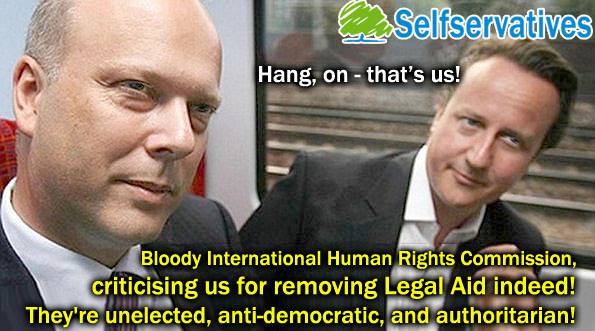
The Coming Tyranny and the Legal Aid Bill.

995147_204045783079811_467247470_n

“Ministers keep using the mantra that their proposals are to protect the most vulnerable when, quite obviously, they are the exact opposite. If implemented their measures would, far from protecting the most vulnerable, directly harm them. Whatever they do in the end, Her Majesty’s Government should stop this 1984 Orwellian-type misuse of language.”  – Lord Bach, discussing the Legal Aid Bill.

Source: Hansard, Column 1557, 19 May, 2011.

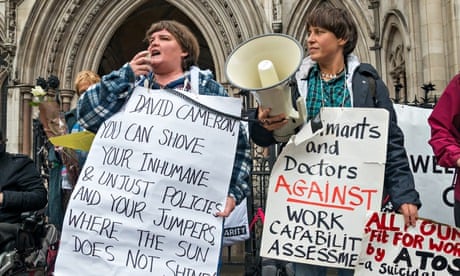
The Ministry of Justice’s “reforms” (Tory-speak for cuts) to legal aid undermine the fundamental principle of legal equality and violate Article 6(1of the European Convention of Human Rights: the right to a fair trial. They reflect a truly authoritarian agenda of legislative tyranny: the reforms effectively remove legal access for many, crucially that access ultimately safeguards individual liberty against intrusion by the State, and protects us from despotic abuses of authority.

The cuts will seriously undermine access to justice and sidestep the obligation of Government accountability. The cuts will affect the most disadvantaged and vulnerable in society and allow unlawful and unfair public body decision-making to go unchallenged.

The Equality and Human Rights Commission’s analysis in 2012 warned that reducing the scope of legal aid in a substantial number of areas in civil and family law will create serious practical barriers to access to justice, potentially in breach of Article 6(1) of the European Convention on Human Rights (ECHR).


The cuts to the civil legal aid budget, which came in to effect from April 2013, mean many cases, including those about debt, private family law, employment, welfare benefits, clinical negligence and housing problems are no longer eligible for funding.

This is at a time when the Government have implemented other radical, controversial and contentious cuts to health, education and welfare, and it is no coincidence that the legal aid Bill will curtail justice for those with legitimate needs at a time when draconian Tory policies such as the bedroom tax will most likely result in a massive increase of numbers of people needing and seeking redress.

This will mean the compounding of effects of other fundamental  human rights breaches, legally unchecked, because of the profound impact of multiple, grossly unfair and unjust Tory-led policies. Each policy hitting the same group of citizens, to their detriment, over and over.

This sends out a truly worrying message to those of us who believed we lived in a first world liberal democracy  (one that has recognition of  individual rights and freedoms embedded in its Constitution, and one in which decisions from direct or representative processes prevail in State policies.) The promotion of equal opportunity to legal justice is the bedrock of a free and democratic society. It ought to be inclusive of all who cannot afford to be tried fairly. The reality is only a few can afford the legal costs to enforce contracts and against criminal prosecution. This profoundly unjust inequality is not something we expect to see in a Country which was once a beacon of Western liberty.

Even if we were to take a Conservative perspective, it’s still the case that the only way to wed the principle of a “pursuit of economic liberty” with wider justice is by a basic notion of equality before the law, through the equal access to justice. This means that the State must fund the means of contract enforcement and free and fair trial legal costs, for those who cannot afford it. If the State fails to fulfil this contingent function, then we simply cease to be free.

“Legal aid will continue to be provided to those who most need it, such as where domestic violence is involved, where people’s life or liberty is at stake or the loss of their home. But in cases like divorce, courts should be a last resort, not first. Evidence shows that mediation can often be more successful and less expensive for all involved.”  –  Chris Grayling.

Section 10 of LASPO (Legal Aid, Sentencing and Punishment of Offenders Act 2012) provides the new Director of legal aid casework with the power to provide ‘exceptional funding’ for cases that are out of scope. Part 8 of the Civil Legal Aid (Procedure) Regulations 2012 indicates that providers of legal services will not have delegated powers to grant exceptional funding. Instead, an application must be made to the Director for an ‘exceptional case determination’.

Section 10(3) of LASPO states that an exceptional case determination is a determination:
a) that it is necessary to make the services available to the individual under this part because failure to do so would be a breach of:

1) the individual’s convention rights (within the meaning of the Human Rights Act 1998), or
2) any rights of the individual to the provision of legal services that are enforceable EU rights, or
b) that it is appropriate to do so, in the particular circumstances of the case, having regard to any risk that failure to do so would be such a breach.

This misses a very crucial point: it’s very dangerous to allow the State to decide which cases constitute the most need. In a free, democratic and fair Society, each and every single individual has equal legal worth and entitlement to opportunity to bring about legal justice. The Government choosing which cases are most “worthwhile” undermines this very premise of legal equality which is so fundamental to the notion of liberty. Everybody has a right to take any grievances they have, which have invoked legal ramifications, to court. Everybody ought to have an absolute, inalienable right to free and fair trial in a free, democratic and liberal country.

Having cut the civil legal aid budget by £320m, the Ministry of Justice proposes to cut the criminal legal aid budget by a further £220m. Legal contracts are to be based on competitive tendering. One of the outcomes of the reform and cut to the budget is that defendants on legal aid will no longer be offered a choice of solicitor.

One of the most unfair aspects of this system is that if you are charged, the State will select a prosecutor with specialist experience in that area of the law, funded by the taxpayer. Be it a sexual offences case, a road traffic death, a murder, a drugs case or a serious assault, in each case, a prosecutor will be picked to prosecute you from a specialist team.

But when it comes to your defending yourself, however, you will be given no choice. You will either have the defence lawyer allocated by the State or you will be on your own. This cannot be right. Many legal experts have voiced their alarm at this, because it will  invariably lead to gross injustices.

Large commercial firms who are going to be paid, win or lose, will have a vested interest to encourage their clients to plead guilty, whether they are or not. At a time when people are at their most vulnerable they need a local service that listens, not a business, whose goal will be to turn around the case as fast and cheaply as possible.

The scope for dangerous consequences due to vested interests in the justice system following Justice Secretary Chris Grayling’s “reforms” is considerable, and allows potential for further erosion of legal freedom. In some cases,  the sole choice of lawyer for a defendant via legal aid will also be a representative for the organisation with an interest in ensuring a prosecution. The  tendering process – where the cheapest bid wins – would be run by companies with no record of providing legal services, resulting in a dumbing down of the profession and a race to the bottom that will mean citizens being denied access to quality legal aid.

As is always the case when private companies that are driven solely by the profit motive are involved in any service, cases will be run on the cheap by under-qualified, inexperienced, low-cost staff. The company Serco, for example, provides prison security guards. Serco is one company bidding for the legal contracts with the Legal Aid Agency. The Department of Justice has proposed to remove defendants’ automatic right to select their own solicitors to make the contracts to bidders more profitable.

I have no doubt that the Coalition wants to see access to justice removed for those affected by its nightmarish, dystopian policies. Those people affected most of all are some of our most vulnerable citizens, as the cuts have been disproportionately aimed at the poorest, at sick and disabled people, and those who are unemployed. Injustice increases and extends vulnerability, especially for those groups of people already experiencing marginalisation.

We need look no further than Clause 99 of the welfare “reform” Act to see how silencing those seeking redress is a priority for this Government. This is also about hiding the evidence of the dire consequences of the “reforms”, since large numbers of successful appeal outcomes highlight, for example, that the Work Capability Assessment (WCA) is grossly unfair and widely inaccurate. Yet despite almost 11,000 deaths, many of which have been attributed to the stress of the assessment process itself, and to people being wrongfully assessed, the Government have not even instigated an inquiry into the WCA. Had an auto-mobile been associated with such a high number of deaths, it would have been withdrawn. Yet we still have the WCA, and incredibly, no willingness for an investigation from our perennially indifferent Tory-led Government.

Those wishing to appeal wrongful decisions by Atos/The Department of Work and Pensions (DWP) that they are “fit for work” after having their Employment Support Allowance (ESA) unfairly  removed will find that this will be an almost impossible task, since their right to legal aid has been removed. The introduction of the  Mandatory Review in Clause 99 will mean that they have to wait an indefinite period without any ESA sickness benefit, or claim Job Seekers Allowance (JSA), whilst waiting for the DWP to conduct the review, with no time limit imposed on the DWP to do so.

That means signing on and declaring that you are fit  for work, and people are being told by the DWP, unbelievably, that they don’t qualify because they are not fit, or fully available for work. Others have been told that to claim JSA they need to close their ESA claim which means they cannot appeal a review decision. Basic rate ESA is exactly the same amount of money as JSA, so the Government cannot even claim this is a cost-cutting move.

And we also know that Atos are contracted by the Government to make “wrongful” decisions. 

The right to a lawyer of a persons’ choice, regardless of your income, race, gender or nationality, is an underpinning condition of a free and fair justice system. Having both a sense of, and access to choice over one’s legal representative, who is there to fight for justice is paramount to basic legal equality and liberty. When this choice is removed and legal representation is essentially imposed on a passive defendant by the State (if a defendant can still access legal aid at all, that is,) our justice system becomes unacceptably authoritarian.

And it has.

Further reading:

Guidance on the exceptional funding regime

The Public Law Project scheme to assist people with making exceptional funding applications

Government lawyers warn Justice Secretary Chris Grayling over proposed ‘unconscionable’ changes to legal aid

Cutting Legal Aid – the surest way to threaten Justice 

John Finnemore on The Now Show, discussing the injustice of the Legal Aid Bill

421077_263839013685634_1738380387_n

Update – In response to this article, a statement has been issued from the International Human Rights Commission, who say: “The IHRC strongly condemned the Bill and asked the UK Government to consider this action, which is against the norm of human rights”.

7005_494073677328832_658777491_n (1)

Pictures courtesy of Robert Livingstone


I don’t make any money from my work. But you can support Politics and Insights and contribute by making a donation which will help me continue to research and write informative, insightful and independent articles, and to provide support to others. The smallest amount is much appreciated, and helps to keep my articles free and accessible to all – thank you.

DonatenowButton

George Rolph is on Hunger Strike because of having his disability benefits denied. He has been censored by Facebook

936_490548701014663_918849902_n

George’s CALL TO ACTION letter is below.

Today, 3rd June, 2013, George Rolph was banned from Facebook, without reason.  He is in Day 14 of his Hunger Strike, which he is doing for others going through what he has had to endure, whilst also trying to get the general public to wake up to what is happening to the most vulnerable people in the United Kingdom, a country which once cared for those who are vulnerable, sick and disabled.
He will not stop this Hunger Strike until the British Government and ATOS stop their persecution of the Sick, the Disabled, the Poor, the Carers, the Unemployed, even if it means he has to die in doing so.
Please, share his story, and please note that the government, have been pushed, albeit unwillingly, by the public’s reaction, and have now reinstated the benefits due to George, but he remains on Hunger Strike until this horror stops, for so many have already been driven to take their own lives. Many have died because they are ill and cannot cope with the strain of the “revolving door” process and the dreadful uncertainty about their future: having the money they need to survive taken from them, being told they have to work when they are too ill, repeated assessments and appeals, all just months apart. It’s a constant ordeal. It is wicked persecution and bullying of the worst kind, and directed at our most vulnerable citizens.
***URGENT NOTICE***
To the people across the UK and the World, please read and hear UK Hunger Striker George Rolph’s call to action, read publicly at St. George’s Hall, Liverpool, June 1st, 2013!
Today is Day 13 of George’s Hunger Strike and he asks “Will You Fight With Me?”
And we must fight.

George Rolph

We all know about the growing disconnect in this country between those who claim to lead us and the people they want to lead. We have all seen the ever more intrusive nature of government poking into our daily lives. Right now you are on cameras that are watching you closely. Give them a wave and a cheer. We have witnessed the awful corruption going on, both here in the UK, and in the EU.
We have sat and gasped as politicians have openly led us into illegal wars in other lands. All of these things and much more than I have mentioned here leave us feeling soiled as a people. As if we have been dragged unwillingly in some perverts private party. It feels like our land is not our land any more. It has been stolen from us and we are just drones who keep it all ticking over so others can benefit from your labours, while you get fed in drips and drabs, the little bits that fall from the table. We watch as the London Mayor and other politicians take our money to build huge expensive projects, so they can strut around looking proud and having massive ego trips in front of the cameras.
Yet, in the midst of this financial splurging, we see the same people hammering the poorest and most vulnerable people in the land. Energy prices are zooming through the roof. That drives all prices up. Yet, at the same time, benefits for the poor are either cut or done away with. A new bedroom tax is imposed which is making people homeless or causing massive problems for people who have to find the money in the face of shrinking income. Make no mistake. This is not accidental. The politicians know EXACTLY what they are doing and they are following a script, the details of which they have hidden from us, but which they are feeding to us a little at a time. Did you notice, for example, that just before the new welfare reforms for the sick and disabled were announced, the media had a propaganda blitz on people faking sickness to scrounge dole money? It is called social psychology and you and I are the targets of it.
When those reforms came in I went happily to the ATOS assessment interviews, because I had nothing to hide. I was sick. I was not scrounging anything. I needed help, that is all. Three times I passed. Three times I answered the same questions the same way and passed unfit to work. On the forth time, despite the questions and answers being the same, they took all of my benefits away. Someone, to meet a target set by government, decided to ignore the other three assessment reports and single me out for another kind of treatment. The imposition of total poverty! I knew what was coming to me then, but I was too shocked to think about it.
No money to pay rent. No money to pay gas or electricity bills. No money to pay council tax demands. No money to pay the phone bill. No money to buy clothes. No money to buy food. I was facing bailiffs, eviction, hunger and homelessness at 60 years of age. I knew I would not live long on the streets. I knew they were condemning me to certain death. I only had two things left. My dignity and my fighting spirit. I decided to fight back! I decided I would not just tug my forelock and accept my fate as I backed away from my “masters” in government. I decided I did not like the idea of being their serf! I decided to use what they had planned for me, against them.
If they wanted me dead OK. I would die, but I would do it exposing them for what they are, and I would do it for all the other sick and disabled people they had already driven to suicide, despair or were about to hurt. I went on hunger strike. I went on Facebook and I began to yell the place down. People began to come and see what all the noise was about. At first a few. Then more. Then more. Then more. I have told them NOT to copy me but to fight with me. I have told them the same truth I am going to tell you now. THIS LAND DOES NOT BELONG TO THE POLITICIANS AND NEITHER DO YOUR LIVES. THIS LAND IS YOURS AND YOUR LIVES ARE YOURS TOO. NO ONE OWNS YOU. NO ONE HAS A RIGHT TO ABUSE AND MANIPULATE YOU THROUGH SOCIAL PSYCHOLOGY OR ECONOMIC TERRORISM.
There is however an even deeper truth and it is simply this: YOU, ARE WHERE THE REAL POWER LIES and if you will stand together as one, you can make those politicians that are hurting and killing our people in the name of ideology or profit, back into the public servants they really are. STAND TALL. STAND PROUD. STAND STRONG. You do not need to be violent. You only need to be united. Tell these corrupted, ruthless and vile politicians that you DEMAND your country back. You DEMAND that they take care of our weakest. You DEMAND they withdraw their poverty creating taxes. I am willing to give my life to help those who cannot help themselves.
Not because I am special. Or a hero. Or because I want to be famous, but because I have a heart that bleeds for them and I cannot bear what these vermin in Westminster and beyond are doing to our nation. WE MUST STOP ATOS AND WE MUST DO IT FAST. Don’t let them fool you. You do not need to gain power. YOU ARE THE POWER UNDER GOD IN THIS LAND. WILL YOU HELP ME TO FIGHT FOR YOU BY FIGHTING BESIDE ME? God bless you all. Look me up on Facebook and lets get to work.”
George Rolph 6-1-2013 Alteri serviens consumor – “In serving others, I myself destroy:”
Today, 3rd June, 2013, George Rolph was banned from Facebook, unofficially and without reason.  He is in Day 14 of his Hunger Strike, which he is doing for others going through what he has had to endure, whilst also trying to get the general public to wake up to what is happening to the most vulnerable people in the United Kingdom, a country which once cared for all those less fortunate than ourselves. We once celebrated the achievements of people with disability, but we are no longer a civilised society that values the equal worth of all of its citizens. Because of our Government and its policies.
Our government has organised and directed hate speech in our media – propaganda – that is a sustained psychic attack on sick and disabled people, and to attempt to”justify” taking away money for their basic survival needs. The Equality and Human Rights Parliamentary Committee have expressed grave concerns about the subsequent rise in hate crimes directed towards sick and disabled people because of media “distortions”. (Let’s be honest, that means “lies”.) What kind of  government would do such brutal and terrible things?
ATOS assessment starts on the day of your appointment with the Health Care Professional (HCP) reading the form you completed when you applied for benefit. Every single question you are asked is designed to justify ending your claim for your support and passing you as “fit for work”. That is what Atos are contracted to do by the Government. No matter how sic and disabled you are. This is not a genuine assessment, but rather, an opportunity for the DWP to take away the financial support that you are entitled to. Atos is contracted by the government to take benefit from 7 out of 8 of us. How can that be a fair assessment, when those targets exist prior to our having an assessment?
Since the Welfare “Reforms” Bill was passed,  almost 11,000 deaths have happened as a consequence. Last year, a friend and fellow campaigner, Karen Sherlock, tragically died because of the strain she was placed under when ATOS ruled her to be fit for work, and she lost her disability benefit. She was very ill, and even though she won her appeal, the constant struggle and fight were just too much for her, as is the case for so many. It really is a “revolving door” – a brief respite, then bleak hardship, fear, pain, despair and desperation. Over and over again.
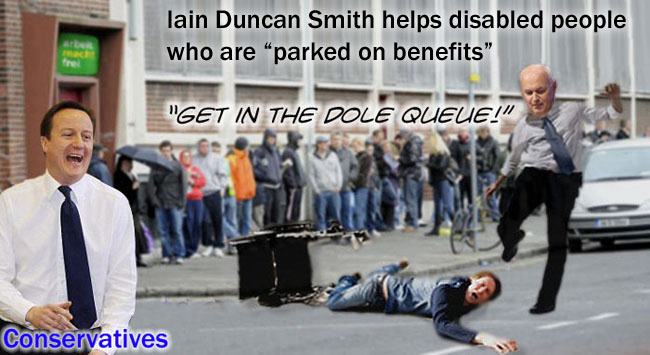
Owen Jones raised her death, amongst others, with Iain Duncan Smith on Question Time. Iain Duncan Smith IGNORED what Owen said, spoke over over him, disrespectfully raised his voice and uttered that he was PROUD of his reforms. No concern, inquiry or even acknowledgement of those deaths from our Government.
George will not stop this Hunger Strike until the British Government and ATOS stop their Persecution of the Sick, the Disabled, the Poor, the Carers, the Unemployed, even if it means he has to die in doing so.
This must stop. The persecution and deaths must stop.
Please share his story. Let’s show that censorship always achieves the opposite of what the censor intends.

————————————————————-


An Announcement About My Protest.
George Rolph

“When I began my protest my aim was not hurt or cause distress to anyone but those who should be hurt and distressed because they deserve to be. Neither did I intend to take my life, but to give it in the service of others also suffering under the brutal and cruel regime of ATOS and the DWP.
I did not ask to be placed on disability benefit. My doctor made that decision when he gave me a sick note to take to the DHSS as it was then. He gave me that note because it was clear I could no longer hold down a job. I wanted to work but I just could not do so. I have PTSD.
I sought help for the PTSD but It was almost impossible to find any. This country is way behind America in that regard. My doctor got me a counsellor. She asked me to lay on a couch while she played dolphin music to me. I left in disgust. I wanted help coping with the symptoms, not to be a part of some new age hippy experiment.
I found a psychiatric drop-in centre nearby and went in and poured out my heart to a bored looking man who said virtually nothing. At the end, he left the office and returned shortly after with a piece of paper. He handed it to me; made it clear it was time for me to leave and showed me the door. When I got outside I looked at the paper. It was a list of books to read. One of the titles I remember was “How to contact your inner child.” I was stupefied that this was the level of care being offered to the sick by people being paid very handsome salaries. Sheer, disinterested laziness lay behind that book list!
I took the list to the Library and the girl took it to see if they could order them for me. Some of them cost over £60 one of them was over £100. She laughed and said the Library could not afford to buy books like this and said I needed a specialist reference Library. I threw the paper in the bin.
The level of benefits I was getting placed me just above the poverty line and sometimes, when many bills came together, below the poverty line. I watched my life going down the toilet. I was eating rubbish food. Wearing second hand clothes bought from charity shops. I was never totally on top of bills, so to pay them I would have to eat beans on toast every day for two weeks and vitamin supplements. In Winter I was frightened of turning on the heating. I had a fridge-freezer that I turned onto the lowest safe setting to conserve electricity. I would never have more than one light bulb burning and those were energy saving bulbs. When my hoover burnt out I could no longer clean the carpet and I watched as the grime built up. I could not afford a new hoover.
In time you become inured to living in filth. You stop seeing it because you can do nothing about it. You just try to keep yourself clean and presentable to the world. I wore a false smile everyday so people would not know the strain I was feeling inside. I felt like half a man; a failure; but I went on in the hope that the future may get brighter some day.
One day I saw a job advertised. Working from home in Telesales. I decided to give it a go. Maybe, if I was working from home, I could fit the job around my symptoms. It was a big decision. If I took the job and could not handle it, I would lose all benefits. I took the risk. I worked very hard for three weeks and then I fell apart. It is the nature of PTSD that routines can be almost impossible to maintain. You cannot go night after night with little sleep and remain a fully functioning human being who rises at 7am and works to 5pm. I quit and I lost all benefits.
When my last pay cheque ran out I sat in a house with no power and no food wondering if I would starve or freeze to death first. Finally I went to a local church and began to beg. I had never felt so degraded in my life. An old Scottish couple heard my pleas and came to my rescue. Out of their own pockets they began shopping for three and they paid my power bills too. I now had heat, food and light again. I then went to war with the DHSS, won the battle and my benefits were restored after three more weeks. God bless that Scottish couple. They were a model of what Christianity is supposed to be.
My life returned to a routine of robbing Peter to pay Paul. Just trying to keep my head above water. I used to read reports in the media of people living a life of luxury on the dole and wonder how they managed it. I never read about what it is really like.
Of course, I saw through the government and media agenda on the subject. If they could blame those on the dole for daring to take it, they could hide the truth of what life was like for those honest people living on it. The government needed cash for wars, grand building projects, like high speed rail links and for fiddling their expenses. They did not want to give cash to the poor, but they also wanted to look like they did.
The art of spin.
Then one day the call came to visit an ATOS assessment centre in Croydon. I duly went along. I went without food for two days to pay for the train and bus fairs to get there, but they said I could claim those expenses back. I would have to wait three weeks to get those fairs back though.
I went, I sat through the interview. I passed. Later I was called to do the same again. I went, I sat through the interview. I passed. Then again.I went, I sat through the interview. I passed. Then once more. Same questions. Same responses to those questions. I failed!
They did not tell me there and then I had failed. I found out a month later at a compulsory job centre interview. I had drawn my last benefits that day. All benefits were now cut off.
I was in shock for three days. I could not read, let alone fill out the appeal form I had been given. I would stare at the form but the words would not penetrate my mind. My whole world was crumbling around me. The terrible implications for my immediate future were pounding at my mind.
Bailiffs banging on the door. Power cut off. No food. Eviction for non payment of rent. On the streets at sixty years old. Dying in obscurity down an alley somewhere.
Why? Who did I hurt? Even criminals get a warm bed, three meals a day and clothing.
I was not stealing from anyone. In fact, when a friend gave me £20 for helping load a van when he moved house, I took £10 of it and handed it in the DHSS office in Bromley because I was not allowed to earn more that £10 a week. Why was I now being punished by ATOS for being sick and being honest?
How did I fail? There was no sense or logic to it. If I passed three times and nothing had changed, why had I failed on the forth occasion. This smelt of a whim. Someone at the assessment centre had made a decision that I was going to fail in order to meet their target. They met their target. I met horror.
How do they sleep?
I typed “Dealing with ATOS” into Google and I started reading. What I found horrified me. They had done this to thousands of people and people were dying!
Dear friend and supporter. I am going to make an announcement, but before I do so I want to strain your patience just a little longer. I want to show you what REAL criminal scroungers look like and then I want you to remember that this government and Prime Minister insists we remain a part of this villainous exercise, while at the same time they beat up the disabled in our own country.
This is part of a report from the Times newspaper.
February 22, 2009
By Jonathan Oliver (Times Online)
A LEAKED internal report has revealed systematic abuses by Euro MPs of parliamentary allowances that enable them to pocket more than £1m in profits from a single five-year term, writes Jonathan Oliver.
The auditor’s confidential report, suppressed by the Brussels parliament, discloses the extraordinary frauds used by MEPs to siphon off staff allowances funded by taxpayers.
It shows that some claimed for paying assistants of whom no record exists, awarded them bonuses of up to 1½ times annual salary and diverted public money into front companies.
An investigation into the abuses of staff allowances worth up to £182,000 a year — many of which are paid by MEPs to members of their family — was delivered in January last year but was not published.
A copy of the 92-page report, prepared by Robert Galvin, the parliament’s head of internal audit, has been seen by The Sunday Times. It reveals:
Payments were made to assistants who were not accredited with the European parliament and to companies whose accounts showed no activity.
End-of-year bonuses worth up to 19½ times monthly salary were paid to assistants to allow members to use up their full annual allowance.
Payments, supposedly for secretarial work, were made to a crèche whose manager happened to be a local politician from the MEP’s political party.
Payments were made straight into the coffers of national political parties.
Some assistants doubled their money by banking pay-offs from outgoing MEPs at the same time as receiving salaries from incoming ones.
One MEP claimed to have paid the full £182,000 staff allowance to one person, suspected of being a relative.
The revelations come as British MEPs look forward to an inflation-busting pay rise this year that could see their take-home pay rising by almost 50%.
In his report, Galvin said that overpayments of allowances were common, adding: “Remuneration paid may not always be justified by the real costs of providing parliamentary assistance.” He warned that abuses exposed the parliament to “financial, legal and reputational risk”.
The report was based on a representative sample of 167 payments — out of a total of 4,686 — made during October 2004. It suggests that Galvin unearthed only a tiny fraction of the many corrupt practices employed by some of the 785 members of the 27-nation parliament. His analysis of the 2004 figures then took years to surface within the secretive Brussels bureaucracy.
Dear friend. Can you see? We are being run by gangsters in expensive suits who are lining their own pockets while they strip all they can get away with from our own people. They are stealing your money while hypocritically blaming the poor for doing the same!
THAT is evil. No matter how you cut it, that is EVIL.
I fought back with the only weapon I had and decided to go on a hunger and water strike in protest and to try and alert as many people as possible to what is going on. I know that politicians willing to do these things are not going to listen to me. BUT I also know that if YOU raise your voices loudly enough they will HAVE TO listen to YOU!
However, there was a flaw in my strategy that I did not take into account. In doing this and making my time so short, I was actually going to be hurting the very people I needed to support me. I have been so moved by people who have been saying to me that they support me 100% but would I please just drink.
My dear friends Jess and Ian, who have been stalwarts in backing my protest have both carried a lot of anxiety about my health and I know many of you have also. One of the biggest problems has been the time factor that my hunger and water strike imposed. A maximum of just 12 days to live but probably shorter than that in reality.
After much soul searching I have decided to drink today, but I shall not eat until victory has been won. I gather I can expect to live for around 60 days without food. That should be enough time to mobilise a huge protest to get ATOS stopped and to demand retribution for the needless deaths that have already happened.
Murder is wrong! Officially sanctioned murder is just as wrong!
Please. Let us all fight back and for once, let the decent people be heard instead of those evil voices that con, deceive, lie and pervert our country and its values for their own ends.
We have to take our country back. This fight will be one step on that journey. I beg you. Help me to win it so we can help those who cannot help themselves.
George Rolph
—————————————————-

NO MORE SILENCE!
George Rolph,  May 28th, 2013.

There is a sort of unwritten maxim that says when the government, or one of its departments, does bad things to the people, then the people have to grin and bare it until the next election comes along and they can vote them out. The politicians know we think this way because they HELP us to think this way.
In practise, this means they can roll out their most damaging policies in their mid term, and then feed us sweety polices just before an election to make us all forget the fact that they dumped all over us during their second and third year in office, and then vote them back into power.
They also rely upon us not to notice the stuff they do when something big happens, like a terrorist attack. Those big news days are when some of their most vile legislation gets passed and the press are looking the other way and fail to spot it. Some of the press, on purpose, of course.
I do not believe in that maxim though. I believe that when a government hurts its own people they should be held accountable at the time, not two and half years later after they have given us some goodies to make us all forget and calm down our anger. Now, in order for that to happen the people have to stand up, at the time, and say, ‘we will not let you do this in our name.’
Today is one of those times. Today is a day for standing together.
As I started to research what ATOS were doing to people I was ASTOUNDED by what I was finding. I am not over stating this. I really was astonished. My first thoughts were. ‘This cannot be legal!’ How can a company and government, put such pressure on people that it drives them to suicide or causes that pressure to make them sicker – sometimes to the point of death, and not find themselves raided by police, prosecuted and sent to jail?
But there was silence from the police.
Silence from the legal profession.
Did the government tell the police to stand down and did they meekly do as they were told. Tugging their forelocks as they backed away? Why were the opposition parties so quiet over this issue? A few minor complaints, but nothing of any substance. Then I remembered it was the now-in-opposition-party that brought ATOS here in the first place.
Something started to stink! An agenda was afoot and we were being kept in the dark.
Something about the way we are being governed and policed is very, very, wrong. Evil kills the innocent but as Edmund Burke once said, “The only thing necessary for the triumph of evil is for good men to do nothing.” I decided to do SOMETHING. I decided to stand up and shout:
“NO MORE SILENCE!” I cannot – I will not – stand by and let some faceless, over paid socio-path in a suit, tell me it is time for those selected by them to die in the name of saving money, while we go on pouring money into the Communistic purses of that monstrosity called the EU that few people in this country want any part of!
I am all for helping the poor. It is a fundamental part of my Christian faith, but should I let my children starve to do so? Of course not! That would be obscene parenting. Why then are our government pouring vast amounts of our cash into overseas aid when they claim not to have enough money to take care of the disabled and sick here?
Remember the much vaunted “Olympic Legacy” we were all promised to convince us that spending obscene amounts of money for a glorified sports day, so Boris Johnson and his mates could strut around looking and sounding ever more ridiculous. So where is this “legacy?” In the pockets of some big businessmen but how much reached yours?
We all got conned again and here is the tragedy:
They know if they can just find the correct words plus a little mass psychology, they can go on conning us and we will be dumb enough to believe them!
Our lives are being shaped and ruled by ruthless thieves and con men and they are telling us it is time to steal from the poor and give to the rich.
How can it be that MPs can dip their hand into the tax payers pockets and fiddle their expenses and then have the nerve to call people who need genuine help, scroungers? I have no moat to clean. I have a carpet I cannot clean because I cannot afford a hoover! I don’t have a second property and I venture to suggest not many other disabled people do either. What I have is an incapacitating illness I did not want, did not ask for but have to live with because when I called for help I was told, in a hundred different ways, we don’t help male victims of abuse.
Don’t call me a scrounger when you are sitting in the house of commons using tax payers money to purchase, renovate and furnish a second home. Who the hell do you people think you are? That is without mentioning the wholesale criminality going on in the EU.
The whole system is corrupt, from the top down, how dare those running it for their own benefit say to the people of this land, if your son, daughter, brother sister, mother or father get seriously ill or hurt, we are going to make them jump through a hundred hoops just to put bread in their stomachs and on a whim, pull the rug from under them whenever some faceless ATOS assessor feels like it.
 That is not welfare reform, that is brutality! That, is not humane, that is cruelty. That is not human, that is demonic. Devilish. Wicked. Evil!
We, the people, have been slowly beaten back into serfdom. Frightened of raising our voices. We have instead taken to switching on inane soap operas or Hollywood mush and hoping the problems will go away. ‘let the government sort it out,’ we say. What happens though when those in the House of Commons are themselves the problem and sorting it out is the last thing they want to do? Well, I don’t know about you but I don’t want TV, Hollywood and the media doing my thinking for me. I have a brain and I want to use it myself.
I am very tired of governments, social workers, doctors, civil servants, weak little journalists and so on, talking to me as if I were five years old and saying, in effect, ‘be a good boy and accept this pain now and I will give you a nice bar of chocolate later.’ That is how paedophiles groom children and I don’t want to be raped by these people!
I know many, many, of you feel the same way. You see what is being done in your name and it disgusts you. It makes you angry and you wish you could do something about it.
Well, I think you can and I think it is time to hit back. To stand up for decency again. To reclaim those values and ideals that once made this the greatest nation on earth.
Let’s stand up as one. Proud. Determined and resolute and make this evil war on the disabled stop. It is time to make the powers that be understand the only power they have is that which the people give them.
How? I will have some ideas for you later. Feel free to think of your own and share them with me. I know this though, it only takes a small spanner, tossed into the gears of a giant machine to bring it shuddering to a halt. I think it’s time we picked up our spanners. The machine is out of control.
There is no need to fill bottles with petrol. No need to act like mindless thugs on the street smashing windows. We simply have to end our silence.
That then, is my cry to you. NO MORE SILENCE.
George Rolph.
 Petitioning THE HOUSE OF COMMONS THE HOUSE OF COMMONS: Permit a debate on the hunger striker, George Rolph .
A Parliamentary Petition has been denied and it is vital that this matter be debated.
Please sign here: http://www.change.org/en-GB/petitions/the-house-of-commons-permit-a-debate-on-the-hunger-striker-george-rolph

Further Reading:
(Please click on links)
Mentally ill Downham man on hunger strike after his benefits are taken 
George’s Story
George’s Statement
George’s Facebook URL
Owen Jones illustrates IDSS’s crass and inhumane indifference to Atos deaths
What you need to know about Atos assessments
The Atos Revolving Door Process and related death increase
The UK Government got it wrong about our human rights

Contact Iain Duncan Smith and tell him what you think of his welfare “reforms” (that is doublespeak for “CUTS”)
An interview with George Rolph
For anyone wishing to contact ATOS: 0207 830 4447 – Ask for Melanie Gundy, the manager of their Customer Relations Department. 
With thanks to Lizzie Cornish for the original narrative, to which I’ve added some thoughts of my own.
Thank you to George: most of this is his work.

603022_491903834212483_1997062073_n

Thanks to Robert Livingstone for his brilliant art work
 

The UK Government have got it wrong about our Human Rights.

564882_438358886199493_1982719183_n
The Joint Parliamentary Committee on Human Rights has conducted an inquiry into the UK Government’s implementation of Article 19 of the United Nations Convention on the Rights of Persons with Disabilities (UNCRPD) – the right to live independently and to be included in the community. The inquiry which began in 2011 has received evidence from over 300 witnesses.

The inquiry has highlighted just how little awareness, understanding and employment of the Convention there is by the Tory-led Government.  Very few of the witnesses made specific reference to the Convention in their presented evidence, despite the inquiry being conducted by the Parliamentary Human Rights Committee, with the terms of reference clearly framing the inquiry as being about Article 19 of the UNCRPD.

“This finding is of international importance”, said Oliver Lewis, MDAC Executive Director, “Our experience is that many Governments are of the view that the CRPD is nothing more than a policy nicety, rather than a treaty which sets out legal obligations which governments must fulfil.”

The report is particularly critical of the Minister for Disabled People (Maria Miller, at the time) who told the Committee that the CRPD was “soft law”. The Committee criticised this as “indicative of an approach to the treaty which regards the rights it protects as being of less normative force than those contained in other human rights instruments.” (See para. 23 in the report, the link is at the foot of this article.) The Committee’s view is that the CRPD is hard law, not soft law.

Dr Hywel Francis MP, Chair of the Committee, said: “We are concerned to learn that the right of disabled people to independent living may be at risk through the cumulative impact of current reforms. Even though the UK ratified the UNCPRD in 2009 with cross-party support, the Government is unable to demonstrate that sufficient regard has been paid to the Convention in the development of policy with direct relevance to the lives of disabled people. The right to independent living in UK law may need to be strengthened further, and we call on the Government and other interested organisations to consider the need for a free-standing right to independent living in UK law.”

“The Government is meant to include disabled people in making sure people have their human rights upheld. We are concerned that a part of the Law on treating people equally and fairly (Equality Act section 149) does not say any more that disabled people should be involved. This is a step backwards.”

In other words, the Tory-led Coalition has quietly removed this part of the Equality Act.

The budget of the Equality and Human Rights Commission (EHRC), which was established by the Labour Party when they were drafting this flagship policy, is being reduced by over 60%, its staffing cut by 72%, and its powers restricted by the Coalition. Provisions that are being repealed by the Enterprise and Regulatory Reform (ERR) Bill include the duty on public authorities to have due regard to the need to reduce socio-economic inequalities.

Savage Legal Aid cuts from April 2013 have also contributed significantly to creating further barriers to ensuring Equal Rights law protect us, and the Tory-driven Legal Aid Bill also contravenes our right to a fair trial under Article 6(1) of the European Convention on Human Rights.

This is not a coincidental multiple policy timeline, but rather a very coordinated political attack on potential legal challenges at a time when Tory-led severe and devastating multiple welfare and provision cuts have affected disabled people so disproportionately. The changes, which came into effect in April, will hit the same group of disabled people over and over again”.

The threats to the legal infrastructure make it all the more important to mobilise all disadvantaged groups around equality as a fundamental human right.

The Report draws attention to several significant Human Rights issues, including:

  • the need for freestanding legislation to protect the right to independent living in UK law,
  • the effect of current reforms to benefits and services on the ability of disabled people to enjoy independent living,
  • the role played by the UNCRPD in policy development and decision-making at all levels of government,
  • the need for the use of equality impact assessments,
  • the effects of devolution on implementation of the UNCRPD, and
  • hate crime

The right to independent living does not exist as a free-standing right in UK law. Although it is protected and promoted to some extent by a matrix of rights, the Committee believes that this is not enough. It argues that the Government and other interested parties should immediately assess the need for, and feasibility of, legislation to establish independent living as a free-standing right. In addition, the Committee concludes that the UNCRPD is “hard law” and that the Government should fulfil their obligations under the Convention on that basis.

The Committee finds that:

  • reforms to benefits and services (let’s be frank here, they are not welfare “reforms”, they are cuts) risk leaving disabled people without the support they need to live independently;
  • restrictions in local authority eligibility criteria for social care support, the replacement of the Disability Living Allowance with Personal Independence Payment, the closure of the Independent Living Fund and changes to housing benefit risk interacting in a particularly harmful way for disabled people;
  • people fear that the cumulative impact of these changes will force them out of their homes and local communities and into residential care.

It also finds that:

  • the Government has not conducted an Equality impact assessment of the cumulative impact of current “reforms” on disabled people. The Report urges them do so, and to report on the extent to which these “reforms “are enabling them and local authorities to comply with their obligations under the UNCRPD.
  • The Committee states that the Government should make a commitment to Parliament that they will give due consideration to the articles of the Convention when making legislation. The UNCRPD did not have a significant role in the development of policy and legislation, as is required by the Convention.

Furthermore, the Committee criticises changes to the duties of public authorities in England under the Equality Act 2010, which no longer require the production of equality impact assessments of changes in policy, nor the involvement of disabled people in developing policies which will affect them.

The Committee also expresses a major concern over a growing incidence of hate crime against disabled people and urges the Government take action to foster respect for the rights and dignity of disabled people.

Article 19 states that the Government must always ensure it “stops things getting worse.” This has NOT happened. The quality of so many sick and disabled people’s lives in this Country has been radically, significantly and DELIBERATELY reduced since the Tory-led Coalition took Office in 2010. This needs to change as a matter of urgency.

The Government’s “reforms” have led to a terrible increase in deaths amongst sick and disabled people, and we have already seen a significant rise in suicides that are directly linked with the Tory-driven austerity measures.

When we genuinely seek to improve the situation of the poorest and vulnerable, first of all we will need to spend time studying the privileged elite and their lifestyle choices of tax avoidance, their own economic lasciviousness and lack of capacity for personal and social responsibility.

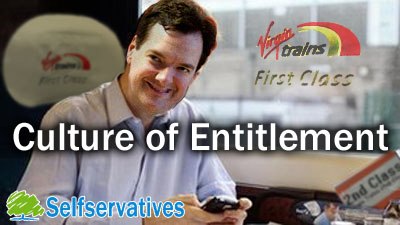
We need to pay attention to Government handouts (of our money) to banks, private businesses and the wealthy: we need to appraise the dependency and culture of entitlement that these sponsored acts have fostered, and of course special focus should be on the amoral decisions and anti-social actions of the feckless, scrounging wealthy, and with particularly careful, critical scrutiny of the Government responsible for policies that re-distribute and concentrate our wealth and their advantage and power, therefore creating social divisions, inequality and poverty, perpetuating and extending it.

The Tory-led Coalition prefers to take money from the vulnerable, the sick and disabled, and hand it out to millionaires.

We need to ask why our Government refuses to instigate or agree an inquiry into the substantial rise in deaths amongst sick and disabled people, as these deaths are so clearly a direct consequence of this Government’s policies. What kind of Government uses the media to scape-goat and stigmatise sick and disabled people, by lying and inventing statistics to “justify” the persecution of some of our most vulnerable citizens, and the withdrawal of their crucial lifelines and support?

One that does not value those lives, or regard them as having an equal worth with others.

We are raising more money for the rich” – David Cameron, 12th December 2012


Further reading:

Archbishop Tartaglia adds to protest against Atos assessments which ‘trample on human dignity’

The European courts have their priorities wrong. Why aren’t they stopping the disability deaths? – Mike Sivier, Vox Political

Did They Hope We Wouldn’t Notice? Under The Smokescreen – John D Clare

The Coming Tyranny and The Legal Aid Bill – KittySJones

CRPD IS “HARD LAW” – UK PARLIAMENT

The Summary of the Report on Implementation of the Right of Disabled People to Independent Living: easy read version  and the full length report

644117_408620012540866_785481358_nMany thanks to Robert Livingstone for his outstanding art work.

Whoever said Labour has no policies: Prepare to be embarrassed!

544807_370332463014480_1710535589_n


Mike Sivier's avatarMike Sivier's blog

This is turning into a very bad weekend to be a Conservative.

The Nasty Party has lost control of 10 councils, with hundreds of councillors unseated. Its claims about people on benefits are falling flat when faced with the facts. It has fallen foul of UK and EU law with its fake psychometric test, which turned out to have been stolen from the USA. Its claim that Labour has no policies has proved to be utterly unfounded.

… What was that last one again?

Yes, you must have heard at least one Tory on telly, rabidly barking that Labour can’t criticise the Coalition if it doesn’t have any policies of its own. Those people were not telling the truth – even though they probably thought they were (poor deluded fools).

I am indebted to Michael Meacher MP, for posting information on the following in his own blog. He lists Labour…

View original post 418 more words

Follow the Money: Tory ideology is all about handouts to the wealthy that are funded by the poor

310024_618087491552293_1852914423_n

Here is yet another great Tory lie exposed – “Making work pay”. This Government have raided our tax-funded welfare provision and used it to provide handouts to the very wealthy – £107, 000 EACH PER YEAR in the form of a tax cut for millionaires. The Conservatives claim that it is “unfair” that people on benefits are “better off” than those in work. But the benefit cuts are having a dire impact on workers as well.

People in work, especially those who are paid low wages, often claim benefits. Housing benefit, tax credit and council tax benefit are examples of benefits that are paid to people with jobs. Indeed the number of working people claiming housing benefit has risen by 86 percent in three years, which debunks another Tory myth that benefits are payable only to the “feckless” unemployed.

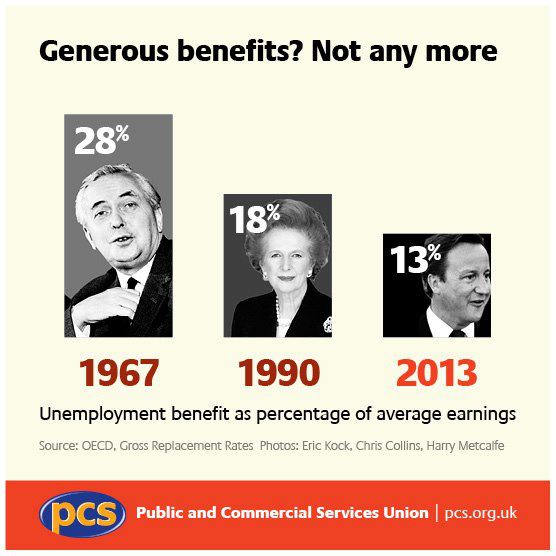
By portraying housing benefit as a payment for “the shirkers”, not “the strivers”, Cameron and Osborne aim to convince the public that their draconian, unprecedented welfare “reforms” are justified. 60 percent of people visiting food banks last year were in work. But unemployment benefits are just 13 percent of the national average earnings. What Cameron’s Government have done is created extreme hardship for many of those in work, and further severe hardship for those who are unemployed.

“Making work pay” is a big lie that has benefited no-one but the very wealthy, and the reduction in both the value and the amount of welfare support for unemployed individuals has come at a time when we are witnessing steady reductions in worker’s rightsand worryingly, the Tory-led Government is stepping up its attack on employment health and safety regulations. And the unions.

Last week, on the 25th April 2013, the Enterprise and Regulatory Reform Bill was granted royal assent, bringing into law the Government’s widely unpopular proposals to scrap employers’ 114-year-old liability for their staff’s health and safety in the workplace. This steady erosion of our fundamental and hard-earned rights in the workplace is linked to the steady erosion of the basic human rights of the poorest citizens. The Government have liberated wealthy private companies of any moral or legal responsibilities, so that they can simply generate vast profits by exploiting workers who have increasingly fewer means of redress.

There is also a growing reserve army of labour that may be exploited via the workfare schemes. This will mean that unscrupulous, greedy, profit-driven employers will increasingly replace paid workers with unpaid ones that are forced to work for their benefits or face losing them. This is a politically enforced programme of reducing the population’s expectations regarding choice, opportunities, rights, and quality of life.

A recent proposal from our “caring Conservatives” is that new in-work claimants should be required to attend an initial interview at a Job Centre “where a conditionality regime should be set up to ensure the individual is doing all they can to increase their hours and earnings”.

Claimants “should then be forced to attend a quarterly meeting to be reminded of their “responsibility” to try to increase their earnings”, with sanctions applied for failing to attend. This may well be the next stage of the welfare “reforms”, incorporating a punitive approach to those in work on low hours or low pay, as well as those unfortunate enough to be out of work.

There is absolutely no evidence, sense or logic behind the Tory claim that cutting welfare will “make work pay”. Well, unless we are referring to the greedy employers that will benefit and profit from the welfare “reforms” and reduction in worker’s pay level and rights. This is about gross exploitation and profiteering at any cost to human lives.

“Making work pay” is an entirely ideologically-driven, dogmatic, absurd and reductionist Conservative superficial soundbite. There is certainly an essence of all that is Tory in the word “peremptory”. There is also many a Tory donor in private business that wants to see more profit and a more abject workforce.

The real “culture of entitlement” is not to be found among poor citizens, those who are unemployed, sick and disabled citzens, as this Government would have you believe. As a matter of fact, most amongst this politically demarcated social group have paid tax and paid for the provision that they ought to be able to rely on when they/we have need of it, it’s ours, after all. The real culture of entitlement emanates from the very wealthy, and is well-fed and sustained by an aristocratic and authoritarian Government.

Every time we have periods of high unemployment, growing inequalities, substantial increases in poverty, and loss of protective rights, there is a Conservative administration behind this wilful destruction of people’s lives, and the unravelling of many years of essential social progress and civilised development that spans more than one century in ontogeny and maturation.

The Conservatives lied about our “generous welfare”. It wasn’t and it certainly isn’t now. Coming at the same time that severe cuts to tax credits and benefits are set to make an estimated 11.5 million households poorer, the Chancellor was accused by Britain’s largest union, Unite, of conducting class war on the poor while giving handouts to the rich.

The following cuts came into force in April 2013:

  • 1 April – Housing benefit cut, including the introduction of the ‘bedroom tax’
  • 1 April – Council tax benefit cut
  • 1 April – Legal Aid savagely cut
  • 6 April – Tax credit and child benefit cut
  • 7 April – Maternity and paternity pay cut
  • 8 April – 1% cap on the rise of in working-age benefits (for the next three years)
  • 8 April – Disability living allowance replaced by personal independence payment (PIP)
  • 15 April – Cap on the total amount of benefit working-age people can receive

    922829_509977429064049_604527973_n

In addition, wages have not risen in real terms since 2003 and there are further fears that the Government is trying to pressurise the Low Pay Commission into cutting the national minimum wage from its present £6.19 per hour. At a time when the cost of living has risen so steeply, the Government has also increased VAT.

Commenting, general secretary Len McCluskey of Unite said: “Millionaires will be raising a glass of champagne to George Osborne this weekend as he slashes the incomes of people struggling to get by to give handouts to the rich.”

“But ordinary people – taxpayers – will be furious that George Osborne has chosen to give away £1 billion to the super-rich while their fuel and food costs rise and wages are falling”.

“His party knows no shame. They are trying to claim that their tax cuts benefit ordinary people but this is another lie – the truth is that while those earning over £1 million per year will be an average £100,000 better off, low income families will be around £900 worse off.”

“This is not the way to recover our failing economy.  Creating real jobs and paying decent wages, including a one pound increase on the minimum wage, will bring down the benefits bill and get people spending again.”

“Instead of getting on with the job he ought to be doing, like sorting out the problems he has caused to our economy, Osborne prefers to encourage hatred and demonise the poor, both in and out of work, in an ideological attack on our welfare state.”

Ed Miliband said: “David Cameron and George Osborne believe the only way to persuade millionaires to work harder is to give them more money.

But they also seem to believe that the only way to make you (ordinary people) work harder is to take money away.”

Bravo Ed, a very well spotted contradiction regarding Cameron’s claims about how “incentives” work. Apparently, the rich are a different kind of human from the majority of human beings.

Here are some of the Tory “incentives” for the wealthy:

  • Rising wealth – 50 richest people from this region increased their wealth by £3.46 billion last year to a record £28.5 billion.
  • Falling taxes – top rate of tax cut from 50% to 45% for those earning over £150,000 a year. This is 1% of the population who earn 13% of the income.
  • No mansion tax and caps on council tax mean that the highest value properties are taxed proportionately less than average houses.
  • Benefited most from Quantitative Easing (QE) – the Bank of England say that as 50% of households have little or no financial assets, almost all the financial benefit of QE was for the wealthiest 50% of households, with the wealthiest 10% taking the lions share
  • Tax free living – extremely wealthy individuals can access tax avoidance schemes which contribute to the £25bn of tax which is avoided every year, as profits are shifted offshore to join the estimated £13 trillion of assets siphoned off from our economy.

It’s plain to see that Cameron rewards his wealthy friends, and has a clear elitist agenda, while he funds his friends and sponsors by stealing money from the taxpayer, by stripping welfare provision and public services down to bare bones.

A simple truth is that poverty happens because some people are very, very rich. That happens ultimately because of Government policies that create, sustain and extend inequalities. The very wealthy are becoming wealthier, the poorest are becoming poorer. This is a consequence of  “vulture capitalism”, designed by the opportunism and greed of a few, it is instituted, facilitated and directed by the Tory-led  Coalition.  

Welfare provision was paid for by the public, via tax and NI contributions. It is not a “handout.” It is not the Governments money to cut. That is our provision, paid for by us to support us if and when we need it. It’s the same with the National Health Service. Public services and provisions do not and never did belong to the Government to sell off, to make a profit from, and to strip bare as they have done

Low wages and low benefit levels, rising unemployment and a high cost of living are major causes of poverty. (“worklessness” is a made-up word to imply that the consequences of Government policies are somehow the fault of the victims of this traditional Tory harshness. It’s a psychological and linguistic attack on the poorest, disabled people and the most vulnerable citizens – blaming the unemployed for unemployment, and the poor for poverty.)

Those are a direct consequence of Coalition policies. The Coalition take money from those who need it most to give away to those who need it least. That causes poverty, and cannot fail to create growing inequality. The Coalition are creating more poverty via the class-contingent consequences of policies.

It’s time to debunk the great myth of meritocracy. Wealth has got nothing whatsoever to do with “striving” and hard work. If it were so simple, then most of the poor would be billionaires by now. 

This week it was reported that one school liaison officer told how a parent came to her pleading for help because her children were suffering from SCURVY – a potentially fatal condition caused by a severe Vitamin C deficiency. It’s an illness linked with malnutrition and poverty, and has seldom been seen in this Country for most of this century, due to improvements in medical knowledge, and the development of adequate welfare provision – that had eliminated absolute poverty in Britain. Until now. It’s increasing again.

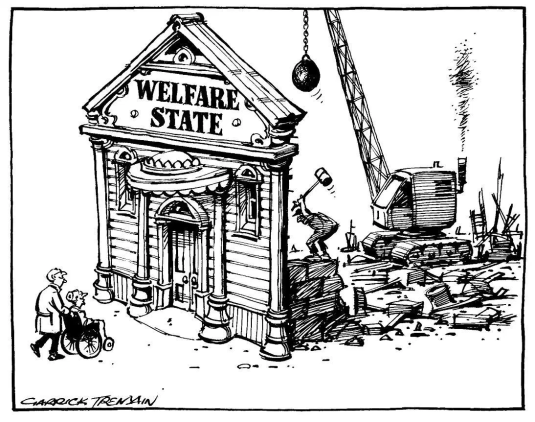
We now have pre-Victorian Health and Safety laws in the workplace. We have Victorian malnutrition and illnesses such as scurvy and rickets. Malnutrition has resurfaced because of the re-appearance of absolute poverty – something that was eradicated because of our effective, essential welfare program, until now. We have a punitive Poor Law approach to “supporting” the poorest instead of welfare provision. These ideas and subsequent harsh and punitive policies were a dark part of our history, and now they have been resurrected by the Tories to be a part of our future. It’s social regression.

We have recession and austerity, entirely manufactured, based on ideology and not because of any economic necessity. Austerity does not include and affect the very privileged. Indeed they have benefited immensely from the politically engineered economic situation.  We have a society that has been lulled into forgetting equality, decency and fairness. We have a lying authoritarian Government that created a crisis for many to make profiteering opportunities for a few.

The New Poor Law of 1834 was based on the “principle of less eligibility,” which stipulated that the condition of the “able-bodied pauper” on relief be less “eligible” – that is, less desirable, less favourable – than the condition of the independent labourer. “Less-eligibility” meant not only that the pauper receive less by way of relief than the labourer did from his wages but also that he receive it in such a way (in the workhouse, for example) as to make pauperism less respectable than work – to stigmatise it. Thus the labourer would be discouraged from lapsing into a state of “dependency” and the pauper would be encouraged to work.

The Poor Law “made work pay”, in other words.

The clocks stopped the moment that the Tories took Office. Now their policies mean that we are losing a decade a day.

544840_330826693653532_892366209_n

208082_397796890289845_858870070_n (1)

 Pictures courtesy of Robert Livingstone

Further reading:

Conservatism in a nutshell

Families £900 Per Year Worse Off After Benefit And Tax Changes, Says Labour’s Ed Balls

Labour exposes Osborne’s tax cut for bankers

A catalogue of failure and broken promises-Catherine Mckinnell MP’s verdict on George Osborne’s autumn statement

The poverty of responsibility and the politics of blame 

“We are raising more money for the rich” – an analysis 


I  don’t make any money from my work. But you can help if you like by making a donation to help me continue to research and write free, informative, insightful and independent articles, and to provide support to others. The smallest amount is much appreciated – thank you.

DonatenowButton

Employment Support Allowance claim update: Exceptional Circumstances – Regulations 25 and 31 and Universal Credit.

71915_457283111007889_61730291_n

Regulations 25 and 31 will replace the old Special Regulations 29 and 35 when Universal Credit is rolled out.

However, the old Regulations 29 and 35 still apply to ongoing cases that are not yet affected by Universal Credit, and will remain in place indefinitely for all Contributions-based ESA. This means that most of you will use Regulations 29 and 35 at this time.

Income-based ESA will be replaced by Universal Credit, as it is rolled out, but there will be the same additional financial components added as we currently have for ESA – either the work-related activity or the support component.

The contents of both sets of Regulations are essentially the same. They are applied in the same way. 25 and 29 are for those who are not capable of work, and would usually be placed in the Work-related Activity Group, and 31 and 35 apply to those not capable of work-related activity, and would normally be placed in the Support Group.

Here are the new Universal Credit Exceptional Circumstances Regulations in full:

Regulation 25

25.—(1) A claimant who does not have limited capability for work as determined in accordance with the limited capability for work assessment is to be treated as having limited capability for work if paragraph (2) applies to the claimant.

(2) Subject to paragraph (3), this paragraph applies if—

(a) the claimant is suffering from a life-threatening disease in relation to which—

(i) there is medical evidence that the disease is uncontrollable, or uncontrolled, by a recognised therapeutic procedure; and

(ii) in the case of a disease that is uncontrolled, there is a reasonable cause for it not to be controlled by a recognised therapeutic procedure; or

(b) the claimant suffers from some specific disease or bodily or mental disablement and, by reason of such disease or disablement, there would be a substantial risk to the mental or physical health of any person if the claimant were found not to have limited capability for work.

(3) Paragraph (2)(b) does not apply where the risk could be reduced by a significant amount by—

(a) reasonable adjustments being made in the claimant’s workplace; or

(b) the claimant taking medication to manage the claimant’s condition where such medication has been prescribed for the claimant by a registered medical practitioner treating the claimant.

(4) In this regulation “medical evidence” means—

(a) evidence from a health care professional approved by the Secretary of State; and

(b) evidence (if any) from any health care professional or a hospital or similar institution, or such part of such evidence as constitutes the most reliable evidence available in the circumstances.

Regulation 25 outlines exceptional circumstances in which a person will be treated as having limited capability for work, but may be capable of work -related activities. People in these circumstances are placed in the ESA work-related activity group (WRAG)

However, there are further exceptional circumstances in which a person  will be treated as having limited capability for work-related activity in addition, and will therefore be placed in the ESA support group. These are outlined by Regulation 31.

Regulation 31 

31.—(1) A claimant is to be treated as having limited capability for work-related activity if—

(a) the claimant is terminally ill;

(b) the claimant is—

(i) receiving treatment for cancer by way of chemotherapy or radiotherapy;

(ii) likely to receive such treatment within six months after the date of the determination of capability for work-related activity; or

(iii) recovering from such treatment, and the Secretary of State is satisfied that the claimant should be treated as having limited capability for work-related activity;

(c) in the case of a woman, she is pregnant and there is a serious risk of damage to her health or to the health of her unborn child if she does not refrain from work-related activity; or

(d) the claimant is entitled to universal credit and it has previously been determined that the claimant has limited capability for work and work-related activity on the basis of an assessment under Part 5 of the Universal Credit Regulations 2013.

(2) A claimant who does not have limited capability for work-related activity as determined in accordance with regulation 30(1) is to be treated as having limited capability for work-related activity if—

(a) the claimant suffers from some specific disease or bodily or mental disablement; and

(b) by reason of such disease or disablement, there would be a substantial risk to the mental or physical health of any person if the claimant were found not to have limited capability for work-related activity.

___________________

Advice regarding EXCEPTIONAL CIRCUMSTANCES – Regulations 25, 29 31 and 35. 

Because of the tick-box nature of the ESA50 form, it is likely that people will fall below the number of points required to be declared incapable of work – it doesn’t take into account variable illnesses, mental illness, or the effects of having more than one illness.

However, the Exceptional Circumstances Regulations may cover us – they both state that the claimant should be found incapable of work (Regulation 29 for ongoing ESA claims, 25 for U.C. ) or work-related activity (Regulation 35 for ongoing ESA claims, 31 for U.C.).

These two essential paragraphs are an important part of both the old and new Regulations, and can be used in the same way, if:

  • “they have an uncontrolled or uncontrollable illness, or “the claimant suffers from some specific disease or bodily or mental disablement and
  • by reason of such disease or disablement, there would be a substantial risk to the mental or physical health of any person if the claimant were found not to have limited capability for work/work-related activity.”

If you feel this is your circumstance, then we suggest adding something like this, where you put “other information” on the ESA50:

“If the scoring from my answers above is insufficient, then I believe applying the Exceptional Circumstances Regulations would be appropriate due to the severity and interaction of my conditions, and my inability to reliably, repeatedly and safely encounter work-related situations and/or safely perform work-related tasks.

I am taking all available and appropriate medication as prescribed by my doctor(s), and there are no reasonable adjustments to a workplace which would mitigate my medical condition(s).

Therefore I believe being placed in the Support Group would be appropriate, because there would be a serious substantial risk to mental and/or physical health if I were placed into a workplace environment or in the work-related activity group.”

Please change the wording to fit your situation, delete “mental” or “physical” if appropriate, leave both in if necessary. If your illness cannot be controlled at all, or medication can’t be used to control it, add that instead.

Legally, both of these exemptions must be applied to all cases where a “serious” or “substantial” risk of harm is likely, should the person be found to be either capable of work, or capable of work-related activity. This is the statutory interpretation.

Regulations 25 and 29 cover people who might be put in the Work-Related Activity Group (WRAG), which has work-focused activities, sometimes it has workfare placements, and sanctions may apply if you are unable to meet the conditions of eligibility for your ESA, while Regulations 35 and 31 cover people who are not fit for any kind of work activity. This is for people who might be placed in the Support Group. There are no conditions placed on you for getting your ESA, such as workfare, if you have limited capability for work-related activity.

So do bear in mind that Regulations 31 and 35 are specifically related to limited capability of work-related activity, and that you will need to invoke 35, (or 31 if you are now claiming Universal Credit, and not eligible for contributions-based ESA,) if your circumstances are such that the support group is appropriate, rather than the work-related activity group (WRAG), as work-related activity would present a substantial or serious risk of harm.

You can ask your doctor to support you with this, as stated in the regulations:

“(b) evidence (if any) from any health care professional or a hospital or similar institution, or such part of such evidence as constitutes the most reliable evidence available in the circumstances” may be presented to support your case.

This is based on the Statutory Interpretation of the Regulations.

Here are some links to download and print some documents that you can give to your GP to support your claim or appeal. You ought to submit copies of these to the DWP as soon as you can. (Make sure that you keep a copy).

In some cases, this may mean that your case will be reconsidered in your favour without having to wait for a tribunal hearing:

Please remember: Regulations 29 and 35 still apply to all ongoing cases, and will remain in use for all contributions-based ESA claims. Regulations 25 and 31 apply to Universal credit.

These templates are for ongoing ESA claims and Contribution-based ESA:

(CLICK)    Cover letter for your GP

(CLICK)    ESA Appeals Letter for your GP

(CLICK)     Legal Advice of Counsel for GPs: Prevention of Avoidable Harm Interpretation and Application of ‘Substantial Risk’ ESA Regulations 29 & 35

With many thanks to the Black Triangle Campaign for sharing these very helpful documents.

If you are one of the few claiming Universal Credit in one of the pilot areas, and you are not entitled to contribution-based ESA then Regulations 25 and 31 now apply, and you will need to amend the templates, as they currently reflect the Regulations most likely to be applicable at this time.

As yet we don’t know for sure when and even if Universal Credit will be rolled out in full. I will update this article when we know more about this.

For all ongoing cases where Universal Credit does NOT apply, (which is the majority at present) and for ALL Contributions-based ESA claims:

Regulation 29

29.—(1) A claimant who does not have limited capability for work as determined in accordance with

the limited capability for work assessment is to be treated as having limited capability for work if:

paragraph (2) applies to the claimant.

(2) This paragraph applies if—

(a) the claimant is suffering from a life threatening disease in relation to which—

(i) there is medical evidence that the disease is uncontrollable, or uncontrolled, by a recognised therapeutic procedure; and

15(ii) in the case of a disease that is uncontrolled, there is a reasonable cause for it not to be controlled by

a recognised therapeutic procedure; or

(b) the claimant suffers from some specific disease or bodily or mental disablement and, by reasons of

such disease or disablement, there would be a substantial risk to the mental or physical health of any person if the claimant were found not to have limited capability for work.

Regulation 35

35.—(1) A claimant is to be treated as having limited capability for work-related activity if—

(a) the claimant is terminally ill;(b) the claimant is—

21(i) receiving treatment by way of intravenous, intraperitoneal or intrathecal chemotherapy; or

(ii) recovering from that treatment and the Secretary of State is satisfied that the claimant should be treated as having limited capability for work-related activity; or

(c) in the case of a woman, she is pregnant and there is a serious risk of damage to her health or to the health of her unborn child if she does not refrain from work-related activity.

(2) A claimant who does not have limited capability for work-related activity as determined in accordance with regulation 34(1) is to be treated as having limited capability for work-related activity if—

(a) the claimant suffers from some specific disease or bodily or mental disablement; and

(b) by reasons of such disease or disablement, there would be a substantial risk to the mental or physical health of any person if the claimant were found not to have limited capability for work-related activity.

Some thoughts on the implications of the other changes.

30.—(1) For the purposes of Part 1 of the Act, where, by reason of a claimant’s physical or mental condition, at least one of the descriptors set out in Schedule 3 applies to the claimant, the claimant has limited capability for work-related activity and the limitation must be such that it is not reasonable to require that claimant to undertake such activity.

(2) A descriptor applies to a claimant if that descriptor applies to the claimant for the majority of the time or, as the case may be, on the majority of the occasions on which the claimant undertakes or attempts to undertake the activity described by that descriptor.

(3) In determining whether a descriptor applies to a claimant, the claimant is to be assessed as if—

(a) the claimant were fitted with or wearing any prosthesis with which the claimant is normally fitted or normally wears; or, as the case may be

(b) wearing or using any aid or appliance which is normally, or could reasonably be expected to be, worn or used

___________________

Two broad concerns arising in light of the Regulation changes are that there is significant scope for the assessor to speculate and make assumptions about those being assessed, and there is a limitation regarding what symptoms can be considered in which parts of the assessment (as is evident in the new descriptors.) Such consideration has been narrowed in focus and subdued by the amendments, which clearly and strictly polarise illnesses into physical or mental categories. Both of these problems may lead to an over-estimation of a person’s capability for work.

The exceptional circumstances provision originally in Regulation 29 has been changed. Trying to demonstrate that a person would be at “substantial risk” in a workplace will now also involve considering whether any “reasonable adjustments” in the workplace or if prescribed medication would significantly reduce such a risk. The amendments would allow any potential risk resulting from a person being found fit for work to be ignored if a reasonable adjustment, or taking prescribed medication would hypothetically offer significant reduction of that risk.

The Atos assessor has previously been able to assume that a person could use some aids that they do not actually use, and theoretically determine what the person’s capability would be using those aids. Many people have experienced the difficulties presented by the “imaginary wheelchair test” – the assessor decides they would be mobile with a manual wheelchair, often contrary to the appropriateness or availability of a wheelchair for that person. The amendments to the Regulations have extended this to include imaginary prostheses and guide dogs under the “could reasonably be used” criteria to most parts of the assessment.

Any “reasonable adjustments” to “the workplace” are very hypothetical and can never be guaranteed. Nor may they necessarily be effective in the event that they are actually carried out. The assessor does not know the person claiming ESA or their long term medical circumstances, or whether the use of such aids would be consistent with their current management programme, or whether any theoretical aids would be suitable in reality.

There is no guarantee that in the event of a person obtaining these aids  they would actually be capable of work. This imaginary exercise will not be discussed with the person making the claim; they are simply going to be refused benefit on the basis of hypothetical aids and appliances. “Reasonable adjustment” may include cases where the risk is still considerable, if it is significantly reduced by hypothetical adjustments, it can be ignored. There is no explicitly stated requirement to take into account side-effects of medication.

This is worrying for more than one reason. There seems to be an implicit suggestion that medication ought to be enforced. For obvious reasons that is very troubling. It has serious implications for issues of medical consent, and patient rights.

The amendments made to the Work Capability Assessment descriptors will mean that claimants can only score on either the physical descriptor for a physical illness or the mental descriptor for a mental illness. Part One of the Work Capability Assessment activities will only accommodate the effects of “a specific bodily disease or disablement,” while Part Two of the WCA  will only allow consideration of the effects of “a specific mental illness or disablement.” Similarly, only side-effects of treatment for physical conditions will be considered in Part One, and side-effects of treatment for mental illnesses only in Part Two.

Using prescribed medication as a purely theoretical “reasonable adjustment” provides scope for a lot of speculation presented as “evidence” regarding the efficacy of medications. For many of us, medication is “experimental” and often trialled initially, and effectiveness and side-effects vary hugely from person to person. Medications for mental health problems produce physical side-effects, and vice-versa. A person who suffers severe chronic pain from physical illness or injury may take strong pain medications that severely compromise their cognitive ability, but it would seem the amended regulations would require that this effect is disregarded.

Many illnesses that are not yet well-understood have a full spectrum of physical, mental and cognitive symptoms. Examples include autoimmune illnesses such as Rheumatoid Arthritis, Lupus, MS, ME and Fibromyalgia. There is often a fundamental interconnectedness of physical and mental health, yet the amendments demand a clean separation of physical, mental and cognitive effects of illness.

As stated, medications for these illnesses are invariably “experimental”, and the efficacy of treatments is widely unpredictable, as are the potentially severe and often “black box” side-effects. For example, a common treatment for autoimmune illness such as Lupus and Rheumatoid Arthritis is a chemotherapy called methotrexate, usually given in a weekly dose, by injection or taken orally. Side-effects commonly include nausea and vomiting, ulcerative stomatitis, dizziness, drowsiness, headache, hair loss, blurred vision or sudden loss of vision, seizures, confusion, weakness or difficulty moving one or both sides of the body, loss of consciousness, vulnerability to overwhelming infections such as pneumonia.

Less common side effects of methotrexate include sudden death, liver failure, kidney damage and lung fibrosis. There is no way of predicting most of these side-effects. Of course this treatment is not handed out like sweets by doctors, and there is very careful consideration given to the risks carried with the drug, which are carefully weighed against the substantial risks presented by the serious illness to be treated.

Many autoimmune illnesses may also cause death, lung fibrosis, kidney and liver damage and blindness. How can it be that a person so ill, and taking such a risky medication could be deemed even remotely capable of work, and that such a treatment could be seen as a “reasonable adjustment” to allow that judgement?

A grave concern is that this will mean additional challenges for many sick and disabled people at a time when the Tribunal Service is hugely overworked and struggling to accommodate the sheer volume of appeals regarding wrongful decisions, and the waiting times for Hearings are stretching out, leaving very vulnerable people without the essential support they need to live. Now there is the additional requirement for providing evidence regarding the “reasonable adjustments” amendment, and I doubt that hypothetical evidence will suffice.

It seems that the Government have simply extended legislative opportunities to further reduce “eligibility” for ESA. I don’t believe these changes and omissions are casual: they are about limiting successful claims and appeal outcomes.

From the moment we begin a claim by filling out the form, we know that every single question asked is designed to justify ending our claim for ESA and aimed at passing us as “fit for work.” That is what Atos are contracted to do by the Government. This is not a genuine medical assessment, but rather, a created opportunity for the Government to take away the financial support that we are entitled to. Every change in legislation related to benefits and support for sick and disabled people that has been made by the Coalition has been aimed at limiting successful outcomes for claims for those benefits.

It’s therefore important that we explore the implications of legislative changes like this, because the additional information helps us to pre-empt potential new difficulties we are likely to encounter with the claim process, it allows us to plan in advance how we can find effective ways around anticipated problems, and so improve the outcomes of our ESA claims.

Further information:
The Black Triangle Campaign:  Applying ESA Regulations 29 and 35 (see note for 25 and 31)

Employment and Support Allowance: 2013 Regulations in full Explanatory memorandum to all benefits 2013: Full legislation document  Exceptional circumstances: Employment and Support Allowance Regulation 25
Exceptional Circumstances: Employment and Support Regulation 31
Changes to the work Capability Assessment : Regulation 15
Rapid response EDM: 
Commons’ motion to annul the Employment and Support Allowance regulations
The new Work Capability Assessment 2013:DWP Guide
The Employment and  Support Allowance Regulations 2008 (as amended) – judiciary.gov.uk Clause 99 and important changes to the appeal process: Clause 99, Catch 22 – The ESA Mandatory Second Revision and Appeals

V-STARTU

Written by Sue Jones.

With huge thanks to Jane Clout for her considerable support with this in clarifying the circumstances regarding which Regulations may be used. It’s important to know that the new Regulations won’t be applicable to most people until Universal Credit has been rolled out.

With many thanks to The Black Triangle Campaign for sharing their work on the GP support letter template, and covering legal and explanatory documents

Essential information for ESA claims, assessments and appeals

37079_433060243430176_1848475368_n

Essential Information for claims, assessments and appeals. 

There are three essential ideas to keep in mind when claiming Employment Support Allowance (ESA) because of the nature of the ESA50 form, and the fact that Atos are seeking to deny benefits, and NOT assess disability: this will not be a fair investigation of your health issues.

This information needs to be shared widely so people are made aware of them, and can use them when claiming ESA or appealing.

These very helpful ideas are:

  •  Reliably, repeatedly and safely
  •  Exceptional circumstances – Regulations 25 and 31, 29 and 35
  •  Atos assessments and pitfalls – how they try to deceive you

1. Reliably, repeatedly and safely. 

‘Lord’ Fraud made this statement in the House of Lords:

“It must be possible for all the descriptors to be completed reliably, repeatedly and safely, otherwise the individual is considered unable to complete the activity.”

You might be able to go up three steps once – but if cannot do it “reliably, repeatedly and safely”, in Freud’s own words you CAN NOT do it at all.

Apply the phrase “reliably, repeatedly and safely” all through your ESA50 or appeal form, use it on each of the descriptors. Make sure you state clearly which activities you can not do reliably, repeatedly, safely and in a timely manner, because Atos will otherwise assume you are consistently capable of them all.

2. Exceptional Circumstances – Regulations 25 and 31 for Universal Credit and Regulations 29 and 35 for current and ongoing ESA claims and Contribution-based ESA.

Regulations 25 and 31 will replace the old Special Regulations 29 and 35 from April 2013 for Universal Credit. This is in preparation for the abolishment of income-related ESA only, and not contribution-based ESA.

However, the old Regulations 29 and 35 still apply to ongoing cases that are not yet affected by Universal Credit, and will remain in place indefinitely for all Contribution-based ESA. So there are two sets of Regulations in place for Exceptional Circumstances.

Income-based ESA will be replaced by Universal Credit, as (or if) it is rolled out, but there will be the same additional financial components added as we currently have for ESA – you will be able to claim either the work-related activity or the support component.

The contents of both sets of Regulations are essentially the same. They are applied in the same way. 25 and 29 are for those who are not capable of work, and would usually be placed in the Work-Related Activity Group, and 31 and 35 apply to those not capable of work-related activity, and would normally be placed in the Support Group.

Because of the tick-box nature of the ESA50 form, it is likely that people will fall below the number of points required to be declared incapable of work – it doesn’t take into account variable illnesses, mental illness, or the effects of having more than one illness.

However, the Exceptional Circumstances Regulations may cover us – they both state that the claimant should be found incapable of work (Regulation 29 for ongoing ESA claims, 29 for Universal Credit) or work-related activity (Regulation 35 for ongoing ESA claims, 31 for Universal Credit) if:

  • they have an uncontrolled or uncontrollable illness, or “the claimant suffers from some specific disease or bodily or mental disablement and
  • by reason of such disease or disablement, there would be a substantial risk to the mental or physical health of any person if the claimant were found not to have limited capability for work/work-related activity”.

If you feel this reflects your circumstances, then we suggest adding something like this, where you put “other information” on the ESA50:

“If the scoring from my answers above is insufficient, then I believe applying the Exceptional Circumstances Regulations would be appropriate due to the severity and interaction of my conditions, and my inability to reliably, repeatedly and safely encounter work-related situations and/or safely perform work-related tasks.

I am taking all available and appropriate medication as prescribed by my doctor(s), and there are no reasonable adjustments to a workplace which would mitigate my medical condition(s).

Therefore I believe being placed in the Support Group would be appropriate, because there would be a serious substantial risk to mental and/or physical health if I were placed into a workplace environment or in the work-related activity group.”

You can word it yourself, of course. Please change the wording to fit your situation, delete “mental” or “physical” if appropriate, leave both in if necessary. If your illness cannot be controlled at all, or medication can’t be used to control it, add that instead.

Regulations 29 (for ESA) and 25 (for Universal Credit) cover people who might be put in the Work-Related Activity Group (WRAG), which has work-focused activities, sometimes it has workfare placements, and sanctions may apply, while Regulations 35 (for ESA) and 31 (for Universal Credit) cover people who are not well enough for any kind of work activity. This is for people who might be placed in the Support Group. There are no conditions placed on you for getting your ESA, such as workfare, if you have limited capability for work-related activity.

You can ask your doctor to support you with this claim, as it is stated in the regulations:

“(b) evidence (if any) from any health care professional or a hospital or similar institution, or such part of such evidence as constitutes the most reliable evidence available in the circumstances” may be presented to support your case. 

You can ask for copies of any communication from your consultant to your GP. You can also ask to be copied into any further correspondence between your doctors. 

Here are some links so you can download and print off documents to give to your GP to support your claim or appeal. You ought to submit copies of these to the DWP as soon as you can. (Make sure that you keep a copy).

In some cases, this may mean that your case will be reconsidered in your favour without having to wait for a tribunal hearing.

These templates are for ongoing ESA claims and Contribution-based ESA:

(CLICK)   Cover letter for your GP

(CLICK)   ESA Appeals Letter for your GP

(CLICK)   Legal Advice of Counsel for GPs: Prevention of Avoidable Harm Interpretation and Application of ‘Substantial Risk’ ESA Regulations 29 & 35

With many thanks to the Black Triangle Campaign for these extremely helpful links and templates.

Please remember: Regulations 29 and 35 still apply to all ongoing ESA claims, and will remain in use for contribution-based ESA claims.

Regulations 25 and 31 apply to Universal credit when that is rolled out. If you are one of the few currently claiming Universal Credit in one of the pilot areas, and if you are not eligible for contribution-based ESA, Regulations 25 and 31 apply now. You may amend the print off documents for your GP, as they cite the Regulations most likely to be applicable at the moment.

The full text of the legislation appears at the end of this article (Appendix A).

3. The Atos assessment and what you need to know.

You have a right to ask for your assessment to be recorded. You will need to request this in advance, but it’s worth making sure you use this opportunity to gather evidence on record because in doing so, you make it much more difficult for the Health Care Professional (HCP) to disregard what you tell them and write “inaccuracies” in their assessment report. We would strongly recommend you exercise this right.

It’s also worth knowing that Atos don’t conduct “medical” assessments,  they conduct “disability analysis“. You are not a patient to Atos, you are a “claimant”.

Bear in mind throughout the assessment that your answers to any apparently innocent questions, such as:

  • Do you watch television
  • Do you read
  • Do you use the internet 

These may be translated into phrases for the assessment report such as:

  • Can sit unaided and unsupported for at least half an hour. 
  • Has no problems with concentration and focus
  • Has no visual problems

Assessment starts on the day of your appointment with the HCP reading the form you completed when you applied for benefit. Remember that every single question you are asked is designed to justify ending your claim for ESA and passing you as “fit for work.” That is what Atos are contracted to do by the Government. This is not a genuine medical assessment, but rather, an opportunity for the DWP to take away the financial support that you are entitled to.

Things that are noted from your form:

  • Did you complete the form yourself
  • Is the handwriting legible
  • Are the contents coherent

These observations are already used in assessing your hand function, your cognitive state and concentration.

Further observations made:

  • Do the things you have written add up, is there consistency
  • Does your medication support your diagnosis
  • What tests have you had to confirm diagnosis. For example a diagnosis of sciatica is not accepted unless diagnosed by MRI scan
  • Do you have supporting medical evidence from your GP or consultants. If you do, it shows that you are able to organise getting this information

When the HCP has read your form they input some data into the computer system. The assessment properly begins when they call your name in the waiting room.

At this point the HCP assesses:

  • Did you hear your name being called
  • Did you rise from your chair unaided, did the chair have support arms or not
  • Were you accompanied – assessing your ability to go out alone
  • Were you reading a paper while waiting – assessing your concentration
  • Did you walk to the assessment room unaided, did you use aids correctly. Did you navigate any obstacles safely – assessing sight

The HCP will shake your hand on introduction – assessing your handshake, noting if are you trembling, sweating – signs of anxiety. Note that you are under constant scrutiny. The HCP will often ask on the way to the assessment room:

  • How long you’ve been waiting – assessing your ability to physically sit, and appraising your mental state
  • How did you get here today – assessing your ability to drive or use public transport

Formal assessment begins by listing medical conditions/complaints. For each complaint you will be asked:

  • How long have you had it, have you seen a specialist
  • Have you had any tests, what treatments have you had
  • What’s your current treatment. Have you had any other specialist input e.g. physiotherapy, CPN

The HCP will use a lack of specialist input/ hospital admissions to justify assessing your condition as less severe. Medications will be listed and it will be noted if they are prescribed or bought. Dates will be checked on boxes to assess compliance with dosage and treatment regime. Any allergies or side-effects should be noted.

  • A brief note is made of how you feel each condition affects your life
  • A brief social history will be taken – who you live with, if have you stairs in your house or steps outside your house
  • An employment history taken – when you last worked, what you work entailed, reason for leaving employment

Your typical day – this is the part of the assessment where how you function on a day to day basis is used to justify the HCP decisions. Anything you say here is most often used to justify the HCP “failing” you and assessing you as “fit for work”. The HCP records their observations.

Starting with your sleep pattern, questions are asked about your ability to function. This will include:

  • Lower limb problems – ability to mobilise to shop, around the house, drive, use public transport, dress, shower
  • Upper limb – ability to wash, dress, cook, shop, complete the ESA form
  • Vision – did you manage to navigate safely to the assessment room
  • Hearing – did you hear your name being called in the waiting room
  • Speech – could the HCP understand you at assessment
  • Continence – do you describe incontinence NOT CONTROLLED by pads, medication. Do you mention its effects on your life when describing your typical day
  • Consciousness – do you suffer seizures – with loss of continence, possible injury, witnessed, or uncontrolled diabetes
  • The HCP observations include noting how far you walked to the examination room, watching to see if you removed your coat independently, did you handle medications without difficulty, did you bend to pick up your handbag

Formal examination consists of simple movements to assess limited function. Things the HCP also looks at:

  • Are you well-presented, hair done, wearing make-up, eyebrows waxed
  • Do you have any pets – this can be linked with ability to bend to feed and walk
  • Do you look after someone else – as a parent or carer – if you do, this will be taken as evidence of functioning
  • Are you doing any training, voluntary work, do you socialise – this will be used as evidence of functioning

This is not a comprehensive list, but it gives you an idea of how seemingly innocent questions are used to justify HCP decisions to pass you as “fit for work.”

Mental Health:

  • Learning tasks – can you use a phone, computer, washing machine
  • Hazards – can you safely make tea, if you claim you have accidents, there must be emergency services involvement, e.g. fire service. Near miss accidents do not count

Personal Actions:

  • Can you wash, dress, gather evidence for assessment
  • Do you manage bills

Other observations made by the HCP – appearance and presentation:

  • Coping with assessment interview – any abnormal thoughts, hallucinations, confusion, suicidal thoughts
  • Coping with change – ability to attend assessment, attend GP or hospital appointments, shopping and socialising

More HCP observations include:

  • Appearance, eye contact, rapport, any signs/symptoms that are abnormal mood/thoughts/perceptions. Any suicidal thoughts
  • How you cope with social engagement- appropriateness of behaviour – any inappropriate behaviour must have involved police to be considered significant
  • Your capacity to cope with the assessment, overall responses and level of engagement with the assessor

Again, this is not an exhaustive list, merely some examples.

Additional information:

Special cases: exemptions from assessment include – terminal illness, intravenous chemotherapy treatment and regular weekly treatment of haemodialysis for chronic renal failure; treatment by way of plasmapheresis; regular weekly treatment by way of total parenteral nutrition for gross impairment of enteric function.

At present to qualify for ESA you need to score 15 points. This can be a combination of scores from physical and mental health descriptors.To qualify for the support group you must score 15 points in one section. As long as you are claiming income-based ESA then your award can be renewed at each assessment, if you gain 15 points.

Remember that you may also qualify without meeting the 15 points criterion, even if you don’t score any points, because of Exceptional Circumstances (Regulations 25, 29 and 31, 35) if there would be a substantial risk to your mental or physical health if you were found not to have limited capability for work and/or work-related activity respectively.

Contribution-based ESA lasts for 1 year only, unless you are in the Support Group. After 1 year, in the Work-Related Activity Group (WRAG), you may only get income-based ESA if your household income is below a certain threshold. It makes no difference how long you have previously paid National Insurance. 

Further information:

Lord Freud – “Reliably, repeatedly and safely”  – Source: Hansard, column 326, paragraph 4.

*There are Judges who interpret the law and where applicable, set precedent. There are Ministers who set policy. With specific reference to the use of repeatedly, reliably, safely, and in a timely manner, this is the result of Upper Tribunal judges interpreting the law and setting precedent through case law.*

Exceptional Circumstances: Employment and Support Allowance Regulation 25
Exceptional Circumstances: Employment and Support Regulation 31
Employment and Support Allowance: 2013 Regulations in full
Explanatory memorandum to all benefits 2013: Full legislation document
Recommended – Implications of the changes and advice: Employment Support Allowance claim update: Exceptional Circumstances – Regulations 25 and 31 and Universal Credit
Recommended – The Black Triangle Campaign: How to Gain Exemption from DWP/Atos ‘Fit for Work’ & WRAG decisions by Applying ESA Regulations 29 and 35 (see note for 25 and 31)
The new Work Capability Assessment 2013: DWP Guide
The Employment and  Support Allowance Regulations 2008 (as amended) – judiciary.gov.uk

Appendix A: 

Regulation 25

25.—(1) A claimant who does not have limited capability for work as determined in accordance with the limited capability for work assessment is to be treated as having limited capability for work if paragraph (2) applies to the claimant.

(2) Subject to paragraph (3), this paragraph applies if—

(a) the claimant is suffering from a life-threatening disease in relation to which—

(i) there is medical evidence that the disease is uncontrollable, or uncontrolled, by a recognised therapeutic procedure; and

(ii) in the case of a disease that is uncontrolled, there is a reasonable cause for it not to be controlled by a recognised therapeutic procedure; or

(b) the claimant suffers from some specific disease or bodily or mental disablement and, by reason of such disease or disablement, there would be a substantial risk to the mental or physical health of any person if the claimant were found not to have limited capability for work.

(3) Paragraph (2)(b) does not apply where the risk could be reduced by a significant amount by—

(a) reasonable adjustments being made in the claimant’s workplace; or

(b) the claimant taking medication to manage the claimant’s condition where such medication has been prescribed for the claimant by a registered medical practitioner treating the claimant.

(4) In this regulation “medical evidence” means—

(a) evidence from a health care professional approved by the Secretary of State; and

(b) evidence (if any) from any health care professional or a hospital or similar institution,

or such part of such evidence as constitutes the most reliable evidence available in the circumstances.

*Regulation 25 outlines exceptional circumstances in which a person will be treated as having limited capability for work, but may be capable of work-related activities. People in these circumstances are placed in the ESA work-related activity group (WRAG)

However, there are further exceptional circumstances in which a person  will be treated as having limited capability for work-related activity in addition, and will therefore be placed in the ESA support group. These are outlined by Regulation 31.

Regulation 31 

31.—(1) A claimant is to be treated as having limited capability for work-related activity if—

(a) the claimant is terminally ill;

(b) the claimant is—

(i) receiving treatment for cancer by way of chemotherapy or radiotherapy;

(ii) likely to receive such treatment within six months after the date of the determination of capability for work-related activity; or

(iii) recovering from such treatment,

and the Secretary of State is satisfied that the claimant should be treated as having limited capability for work-related activity;

(c) in the case of a woman, she is pregnant and there is a serious risk of damage to her health or to the health of her unborn child if she does not refrain from work-related activity; or

(d) the claimant is entitled to universal credit and it has previously been determined that the claimant has limited capability for work and work-related activity on the basis of an assessment under Part 5 of the Universal Credit Regulations 2013.

(2) A claimant who does not have limited capability for work-related activity as determined in accordance with regulation 30(1) is to be treated as having limited capability for work-related activity if—

(a) the claimant suffers from some specific disease or bodily or mental disablement; and

(b) by reason of such disease or disablement, there would be a substantial risk to the mental or physical health of any person if the claimant were found not to have limited capability for work-related activity.

For all ongoing cases where Universal Credit does NOT apply, and for ALL Contributions-based ESA claims:

Regulation 29

29.—(1) A claimant who does not have limited capability for work as determined in accordance with

the limited capability for work assessment is to be treated as having limited capability for work if:

paragraph (2) applies to the claimant.

(2) This paragraph applies if—

(a) the claimant is suffering from a life threatening disease in relation to which—

(i) there is medical evidence that the disease is uncontrollable, or uncontrolled, by a recognised therapeutic procedure; and

15(ii) in the case of a disease that is uncontrolled, there is a reasonable cause for it not to be controlled by

a recognised therapeutic procedure; or

(b) the claimant suffers from some specific disease or bodily or mental disablement and, by reasons of

such disease or disablement, there would be a substantial risk to the mental or physical health of any person if the claimant were found not to have limited capability for work.

Regulation 35

35.—(1) A claimant is to be treated as having limited capability for work-related activity if—

(a) the claimant is terminally ill;(b) the claimant is—

21(i) receiving treatment by way of intravenous, intraperitoneal or intrathecal chemotherapy; or

(ii) recovering from that treatment and the Secretary of State is satisfied that the claimant should be treated as having limited capability for work-related activity; or

(c) in the case of a woman, she is pregnant and there is a serious risk of damage to her health or to the health of her unborn child if she does not refrain from work-related activity.

(2) A claimant who does not have limited capability for work-related activity as determined in accordance with regulation 34(1) is to be treated as having limited capability for work-related activity if—

(a) the claimant suffers from some specific disease or bodily or mental disablement; and

(b) by reasons of such disease or disablement, there would be a substantial risk to the mental or physical health of any person if the claimant were found not to have limited capability for work-related activity.

Appendix B

Most Atos HCPs are not doctors, they are usually nurses or occupational therapists. You can demand that a qualified doctor or specialist conducts your assessment under some circumstances. I’ve gathered the following list from various Freedom of Information responses from the Department for Work and Pensions.

List of conditions judged suitable for assessment by neuro – trained nurses/any health care profession, so make sure that you are seen by a qualified HCP: 

Prolapsed intervertebral disc
Lumbar nerve root compression
Sciatica
Slipped disc
Lumbar spondylosis
Lumbar spondylolisthesis
Lumbar spondylolysis
Cauda equina syndrome
Spinal stenosis
Peripheral neuropathy
Neuropathy
Drop foot
Meralgia paraesthetica
Cervical spondylosis
Cervical nerve root compression
Cervicalgia
Nerve entrapment syndrome
Carpal tunnel syndrome
Trapped nerve
Paraesthesia
Tingling
Numbness
Brachial plexus injury
Polyneuropathy
Dizziness
Vertigo
Essential Tremor
VWF
Alzheimer’s

List of conditions judged by the DWP and Atos Healthcare as suitable only for assessment by doctors:

Stroke
Head injury with neuro sequelae
Brain haemorrhage
Sub Arachnoid Haemorrhage
Brain tumour
Acoustic Neuroma
Multiple Sclerosis
Motor Neurone Disease
Parkinson’s disease
TIAs
Bulbar Palsy
Myasthenia Gravis
Muscular Dystrophy
Guillain-Barre Syndrome
Amyotrophic lateral sclerosis
Syringomyelia
Neurofibromatosis
Spina bifida
Polio
Fits (secondary to brain tumour)
Learning difficulties (with physical problems)
Nystagmus
Myelitis
Bells Palsy
Trigeminal Neuralgia
Paraplegia
Quadriplegia
Huntington’s Chorea
Huntington’s Disease

Further reading:

More on questions you may be asked at assessment: dwpexamination forum 
How to deal with Benefits medical examinations: A Useful Guide to Benefit Claimants when up against ATOS Doctors
More support and advice here: How to deal with Benefits medical examinations
Step by step guide to appealing a ESA decision: Good Advice Matters

Important update

Clause 99, Catch 22 – The ESA Mandatory Second Revision and Appeals

Additional support:

The LawWorks Clinics Network is a nationwide network of free legal advice sessions which LawWorks supports.Clinics provide free initial advice to individuals on various areas of law including social welfare issues, employment law, housing matters and consumer disputes – List of LawWorks  clinics

V-STARTU

Thanks to Robert Livingstone for his valuable contributions.

With many thanks to Joyce Drummond for contributing such valuable information about the Work Capability Assessment.

With many thanks to The Black Triangle Campaign for sharing their work on the GP support letter template, and covering legal and explanatory documents


I don’t make any money from my work. But you can help me continue to research and write informative, insightful and independent articles, and to provide support to others by making a donation. The smallest amount is much appreciated – thank you.

DonatenowButton cards

What you need to know about Atos assessments.

A-demonstration-against-A-011

Courageous whistleblower, Scottish nurse and ex-Atos employee, Joyce Drummond, who recently made a heartfelt apology to Atos assessment victims, has submitted evidence to the Scottish Parliament Select Committee on Welfare Reform.

Joyce forwarded some of her notes to me, containing this information about Atos assessments. We had some dialogue about the content. I have edited where needed, organised the notes and added some information to the text. I’ve included the contents from Joyce’s notes in full.

Both Joyce and I share this information in the hope that people going through Atos assessments will find it helpful.

Joyce told me: 

“I knew nothing about Atos when I joined, and left as soon as I realised that there was no way to ‘fight from the inside.’  I stated at my interview for the job that I believed in social inclusion and social justice.

I attended 4 weeks training in England. The training did not prepare me for what I was expected to do in real life.

The forms that are completed prior to assessment, I have recently found out, are actually opened by Royal Mail Staff. They are then sent for “scrutiny” where nurses decide whether or not a face to face assessment is required. I was not involved in this and do not know what criteria are used.  

 It is made clear throughout training and working that we are not nurses – we are disability analysts.  Also, we do not carry out “medical assessments” – we carry out “functional assessments”. We did not even need a diagnosis to carry out assessments. I had reservations around consent, as we were expected to assess patients – sorry, we didn’t have patients, we had ‘claimants’ – who appeared to be under the influence of alcohol or other substances. 

We were also consistently told that we did not make benefit decisions. The final decision was made by a Department for Work and Pensions (DWP) decision maker with no medical qualification. If our assessment was overturned at appeal we never knew about it. There was no accountability for assessments overruled.”

Please note that assessment starts on the day of your appointment with the Health Care Professional (HCP) reading the form you completed when you applied for disability support. Remember that every single question you are asked is designed to justify ending your claim for ESA and passing you as “fit for work”. That is what Atos are contracted to do by the Government.  This is not a genuine medical assessment, but rather, an opportunity for the DWP to take away the financial support that you are entitled to.

Things that are carefully noted at this stage are:

  • Did you complete the form yourself?
  • Is the handwriting legible?
  • Are the contents coherent?

These observations are already used in assessing your hand function, vision, your cognitive state and concentration.

Further observations made:

  • Do the things you have written ‘add up’? Are there any ‘discrepancies’?
  • Does your medication support your diagnosis?
  • What tests have you had to confirm diagnosis? For example a diagnosis of sciatica is not accepted unless diagnosed by MRI scan.
  • Do you have supporting medical evidence from your GP or consultants? If you do, it shows that you are able to organise getting this information

Joyce observes:

“This is also a hidden cost to the NHS. I believe that if ATOS request information there is a charge levied by GP’s. However claimants are expected to source medical evidence themselves. It uses valuable NHS time for medical staff to write supporting statements. 

There were no hidden cameras, at least in Glasgow, to watch people arriving for assessment or sitting in waiting room. This may not be true in other areas.”

When the HCP has read your form they input some data into the computer system. The assessment properly begins when they call your name in the waiting room.

At this point the HCP assesses:

  • Did you hear your name being called?
  • Did you rise from your chair unaided, did the chair have support arms or not?
  • Were you accompanied? – assessing your ability to go out alone
  • Were you reading a paper while waiting? – assessing your concentration
  • Did you walk to the assessment room unaided, did you use any aids correctly? Did you navigate any obstacles safely? – assessing sight.

The HCP will shake your hand on introduction – assessing your handshake, noting if are you trembling, sweating – signs of anxiety. The HCP carefully scrutinises everything you do and say. The HCP will often ask on the way to waiting room:

  • How long you’ve been waiting – assessing ability to sit, physically, and appraising your mental state
  • How you got to the appointment – assessing ability to drive or use public transport

Formal assessment begins by listing medical conditions/complaints. For each complaint you will be asked:

  • How long have you had it, have you seen a specialist?
  • Have you had any tests, what treatments have you had?
  • What’s your current treatment? Have you had any other specialist input e.g. physiotherapy, CPN?

The HCP will use lack of specialist input/ hospital admissions to justify assessing your condition as “less severe”. Medications will be listed and it will be noted if they are prescribed or bought. Dates will be checked on boxes to assess compliance with dosage and treatment regime. Any allergies or side-effects should be noted.

  • A brief note is made of how you feel each condition affects your life
  • A brief social history will be taken – who you live with, if have you stairs in your house or steps outside your house
  • Employment history taken – asking when you last worked, what you work entailed, and the reason for leaving employment.

Your typical day – this is the part of the assessment where how you function on a day to day basis is used to justify the HCP decisions. Anything you say here is what is most likely to be used to justify you failing your assessment and being passed as “fit for work”. Along side this, the HCP records their observations.

Starting with your sleep pattern, questions are asked around your ability to function. This will include:

  • Lower limb problems – ability to mobilise to shops, around the house, drive, use public transport, dress, shower
  • Upper limb – ability to wash, dress, cook, shop, complete ESA form
  • Vision – did you manage to navigate safely to the assessment room
  • Hearing – did you hear your name being called in the waiting room
  • Speech – could the HCP understand you at assessment
  • Continence – do you describe incontinence NOT ‘CONTROLLED’ by pads, medication. Do you mention its effects on your life when describing your typical day
  • Consciousness – Do you suffer seizures – with loss of continence, possible injury, witnessed, or uncontrolled diabetes
  • HCP observations include – how far did you walk to the examination room, did you remove your coat independently, did you handle medications without difficulty, did you bend to pick up your handbag.

Formal examination consists of simple movements to assess limited function. Things the HCP also looks at:

  • Are you well presented, hair done, wearing make-up, eyebrows waxed
  • Do you have any pets – this can be linked with ability to bend to feed and walk
  • Do you look after someone else – as a parent or carer – if you do, this will be taken as evidence of functioning
  • Any training, voluntary work, socialising – this will be used as evidence of functioning
  • Do you watch TV – this may be used as evidence of being able to sit unaided or as evidence of being able to concentrate
  • If you wear jewelry it will be assumed you have sufficient dexterity to open and close the clasps on chains and so on.

This is not a comprehensive list, but it gives you an idea of how seemingly innocent questions are used to justify HCP decisions to pass you as “fit for work.” For example, “Do you watch soaps on TV?” is translated as “Can sit unaided for at least half an hour” on the report.

Mental Health:

  • Learning tasks – Can you use a phone, computer, washing machine
  • Hazards – Can you safely make tea, if claiming accident, there must have been some emergency services involvement, e.g. fire service. Near miss accidents do not count.

Personal Actions:

  • Can you wash, dress, gather evidence for assessment
  • Do you manage bills

Further observations made by the HCP – appearance and presentation:

  • Coping with assessment interview – any abnormal thoughts, hallucinations, confusion
  • Coping with change – ability to attend assessment, attend GP or hospital appointments, shopping and socialising

More HCP observations:

  • Appearance, eye contact, rapport, any signs/symptoms that are abnormal mood/thoughts/perceptions. Any suicidal thoughts
  • Coping with social engagement/appropriateness of behaviour – any inappropriate behaviour must have involved police to be considered significant
  • Ability to attend assessment, engage with assessor, behave appropriately

Again, this is not an exhaustive list, merely some examples.

Further information: 

At present to qualify for ESA you need to score 15 points, unless the Exceptional Circumstances Regulations apply to you. The 15 points can be from a combination of scores from physical and mental health descriptors.

To qualify for the Support Group you must score 15 points in one section. As long as you are claiming income-based ESA then your award can be renewed at each assessment, if you gain 15 points.

You may also qualify without meeting the 15 points criterion, even if you don’t score any points, because of Exceptional Circumstances (Regulation 29 and Regulation 35, (or 25 and 31 for Universal Credit – see link at the foot of article) if there would be a substantial risk to your mental or physical health if you were found not to have limited capability for work. Regulation 29 is about exceptional circumstances for being assessed as having limited capability for work (Work Related Activity Group), and Regulation 35 is about being assessed as having limited capability for work-related activity (Support Group).

Special cases – exemptions from assessment include those people having: terminal illness, intravenous chemotherapy treatment and those considered a danger to self or others if found fit to work.

Contribution-based ESA lasts for one year only, unless you are in the support group. After one year in the work-related activity group, you may only get income-based ESA if your household income is below a certain threshold. It makes no difference how long you have previously paid National Insurance.

Joyce told me:

“For clarity, as far as I know in the real world, doctors carry out medical assessments, nurses carry out nursing assessments and physios carry out physiotherapy assessments. In the world of Atos, people from each of these separate professions are employed as disability analysts, carrying out functional assessments.

Nurses are employable for these posts if they have been qualified for at least 3 years, are registered to practice with the NMC, and have basic computer skills.

My interview consisted of:

  • Face to face interview with medical director and nurse team leader.
  • A written paper assessing a scenario, in my case someone with back pain
  • A 10 minute basic computer test

“In order to be approved as a disability analyst I had to complete 4 weeks of Atos disability training, reach a certain standard of assessment reports – as decided by audit of all cases seen (I don’t know what criteria was) and was finally approval to carry out Work Capability Assessments (WCA) from the Secretary for Work and Pensions.

In my opinion the money given to Atos and spent on tribunals should be given to NHS GPs. They are best placed to make assessments regarding patients’ work capability. They have access to all medical reports, knowledge of past history, specialist input and they know their patients. My concern would be about what criteria the DWP would impose on GPs risking the doctor/patient relationship. GPs already assess patients for “fit notes”, which have to be submitted to DWP during assessment phase of ESA.

While I worked at Atos, sessional medical staff were being paid £40 per assessment, as far as I am aware. I have no idea of wages of permanent medical staff. Nurses were on a salary, which, based on 10 assessments a day (Atos target), equalled around £10 per assessment. These are approximate figures but may give a clue as to why Atos are employing nurses rather than doctors.”

Appendix

Most Atos HCPs are not doctors, they are usually nurses or occupational therapists. There are some conditions that will mean you need to be assessed by a qualified specialist nurse, or a doctor and you can ask for this.

List of conditions judged suitable for assessment by neuro trained nurses/any health care profession:

Prolapsed intervertebral disc
Lumbar nerve root compression
Sciatica
Slipped disc
Lumbar spondylosis
Lumbar spondylolisthesis
Lumbar spondylolysis
Cauda equina syndrome
Spinal stenosis
Peripheral neuropathy
Neuropathy
Drop foot
Meralgia paraesthetica
Cervical spondylosis
Cervical nerve root compression
Cervicalgia
Nerve entrapment syndrome
Carpal tunnel syndrome
Trapped nerve
Paraesthesia
Tingling
Numbness
Brachial plexus injury
Polyneuropathy
Dizziness
Vertigo
Essential Tremor
VWF
Alzheimers

List of conditions judged by the DWP and Atos Healthcare as suitable only for assessment by doctors:

Stroke
Head injury with neuro sequelae
Brain haemorrhage/Sub Arachnoid Haemorrhage
Brain tumour
Acoustic Neuroma
Multiple Sclerosis
Motor Neurone Disease
Parkinson’s disease
TIAs
Bulbar Palsy
Myasthenia Gravis
Muscular Dystrophy
Guillain-Barre Syndrome
Amyotrophic lateral sclerosis
Syringomyelia
Neurofibromatosis
Spina bifida
Polio
Fits (secondary to brain tumour)
Learning difficulties (with physical problems)
Nystagmus Myelitis
Bells Palsy
Trigeminal Neuralgia
Paraplegia
Quadriplegia
Huntington’s Chorea
Huntington’s Disease

Further information:

Special exemptions from the 15 points criteria: The New Regulation 25
Useful updated information about Regulations 25 & 31: Exceptional Circumstances and Universal Credit.
Exceptional Circumstances:
Employment and Support Regulation 31

Employment and Support Allowance: 2013 Regulations in full
The Amendments to ESA Regulations: as laid before Parliament
Clause 99 and important changes to the appeal process: Clause 99, Catch 22 – The ESA Mandatory Second Revision and Appeals
Questions you may be asked at assessment: dwpexamination forum 
How to deal with Benefits medical examinations: A Useful Guide to Benefit Claimants when up against ATOS Doctors
More support and helpful advice here: How to deal with Benefits medical examinations

Essential information for ESA claims, assessments and appeals

Previous related articles: 

Joyce’s campaign:  The Daily Record 
Joyce Drummond and Sue Jones:  After Atos

Further reading:

Targets in Atos contract

7 out of 8 targeted to lose ESA

Amnesty condemns erosion of human rights of disabled in UK

Whistleblower says Atos Work Capability Assessments are unfair

377683_445086432227557_1770724824_n (1)

Many thanks to Robert Livingstone for his excellent artwork. Many thanks to Joyce for the information she has provided, and for her courage and integrity, which is so strongly evident in her outstanding campaign work.


I don’t make any money from my work. I am disabled because of illness and have a very limited income. But you can help by making a donation to help me continue to research and write informative, insightful and independent articles, and to provide support to others. The smallest amount is much appreciated – thank you. 

DonatenowButton

Welfare Wrongs and Human Rights: a summary

          
71915_457283111007889_61730291_n

A summary of discussion with Anne McGuire, Shadow Minister for disabled people.

The Coalition is not a Government that recognises the intrinsic value and worth of life. It is not a Government that recognises human potential, or values personal growth and development. It is not a Government that values social evolution and progress. Trying to explain these fundamental concepts to a Tory is like pondering how best to describe a rainbow and shooting stars to a blind man with no imagination. Or soul.

It is widely held opinion amongst us that the Work Capability Assessment (WCA) – no matter how much it may be re-designed – is not fit for purpose, and that no-one has any faith in it because of the appalling damage already inflicted on so many members of the disabled community. The overwhelming consensus is that it needs to be scrapped. Atos have no credibilty whatsoever, with most of us regarding them with loathing and fear. Unfortunately, many sick and disabled people also recognise that successive Governments have contracted Atos, trust and faith in Government and Ministers has receded.

I explained to Anne that some blame the previous Labour Government for current problems, as they originally contracted Atos to undertake the WCA. I don’t subscribe to this view, personally, but I raised the point because it’s one that I’ve encountered frequently, and I recognise that it’s an important issue for some. However, I would like to clarify that I don’t hold a previous Government responsible for what the current one does.

Anne explained that the original Labour Party contract with Atos did not happen within a context of welfare cuts, and was very different to the one that the current Government have with Atos.  Labour support some kind of assessment, and the old system typically involved a decision that was made entirely by the DWP, and the decision was regarded as final. Labour had felt at the time that this needed addressing with some form of independent decision-making mechanism.

We know that the WCA has had such devastating consequences for so many ill and disabled people that it would never be trusted again, no matter how much it was redesigned and “improved” by ANY Government. However, the context of the Labour version of WCA, when it was piloted, was a completely different one to present day. There were many more jobs available, we were not in a recession, and there was support available (and well funded) for disabled people who wanted to work. Anne pointed out again that it is in the context of the welfare reforms, which are about taking away essential support, rather than providing it, that the aims of assessment have become grossly distorted. The original aims were intended to support ill and disabled people. That is clearly not the Coalitions aim at all.

“A Conservative Government is organised hypocrisy” – Benjamin Disraeli.

Disability Living Allowance supports many people in work, and despite Labour’s pleas for common sense safeguards, according to the Hardest Hit survey, three in ten disabled people stated that without DLA their carer would not be able to work. Carers UK estimates that 10,000 people could lose carer’s allowance as a result of cuts to DLA. Without this vital care, disabled people could be forced to turn to overstretched social care services. Liam Byrne  stated that here must now be an assessment, in the round, of all the changes hitting disabled people: a cumulative impact assessment. Esther McVey weakly said to the Commons that she wouldn’t order one because “Labour never did one.” However, Labour did complete a review, and informed this Government of the findings, and raised their concerns regarding the piloted WCA. They were completely ignored. Furthermore, Labour never inflicted the concerted attack we’re now seeing on disabled citizens. It was the Coalition that harshly “reformed” and reduced our welfare provision, and not Labour.

The Access to Work fund was re-established by the last Labour Government to ease the transition to work for disabled people, by paying grants to businesses for vital equipment. It was put in place to support people with disabilities, it aimed to reduce inequalities between disabled people and non-disabled people in the workplace by removing practical barriers to work. This fund has seen severe cuts since 2010, which flies in the face of this Government’s claim to “make work pay” for all. By reducing this essential funding, the Coalition have effectively excluded many from work.

Additionally, disabled people with the highest support needs have been left in fear and distress following a Government announcement that it is to callously abolish a key source of independent living support. The Government decision to close the Independent Living Fund and devolve responsibility to local authorities follows a consultation that disabled people claim is unlawful and on which an urgent hearing has been scheduled by the High Court to go ahead on 13/14 March 2013. Labour have also challenged the decision to close this crucial source of support.

Opportunity for new applications for this funding was closed in June 2010 by the Coalition. Once again this plainly indicates that the Coalition do not consider the needs of disabled people as important, and clearly demonstrates the extent of their eager ideological drive to strip away essential provision and support for the most vulnerable citizens.

It’s important to acknowledge that there are those of us who simply can not work. The Labour Party agree that regardless of the national employment situation and support for those who could and wish to work, we must, as a civilised Society, make provision and support those who cannot work, too. I’m pleased that this important issue was recognised, because as we know, doctors are providing written evidence to the DWP and Atos that verifies people are not fit for work, and that professional and expert opinion and evidence is being ignored by people who are NOT qualified to decide otherwise.

DWP “decision-makers” and Atos assessors have no expertise on medical conditions and how those impact on a persons’ capabilities for work. We know that the majority of Atos assessors are nurses or occupational therapists, and that Atos don’t take into account any medical facts at all: the assessment is entirely about “work capability.”

We informed Anne that we are acutely aware that every single part of the assessment process is designed to interpret any capability a person has to complete a task at all, no matter how small, as an indication that they can work. For example, if a person says that they watch TV, that translates as “can sit unaided for at least half an hour”, even if that half an hours viewing is done laid up in bed, propped up by pillows. Huge inferences are drawn from anything that a person can do, and translated into “work capability,” regardless of whether or not a person can fulfil tasks without pain, fatigue and discomfort, and it always assumed that people can complete a task reliably, consistently and safely, unless it is explicitly stated that this isn’t the case. Even when it is expressed clearly, it is often ignored and omitted from Atos reports. Anne acknowledged that there is a significant problem with the WCA descriptors, not least because of the many cases that have been brought to her attention regarding this issue.

Anne recognised that the WCA makes it very difficult for health professionals to exercise their professional judgement. It’s a computer-based programme and has little or no regard to the complexity of the needs of severely disabled or ill persons. This is why the British Medical Association has condemned the WCA as unfit for purpose. Those who have been assessed often feel the opinion of their own health professionals have been overridden or ignored. As Iain McKenzie, Labour MP for Inverclyde, put it: “It is ridiculous to have people making an assessment based on a tick-list that looks like it should be used for an MOT on a car.” Anne has observed and acknowledged that people are having their lives ruined by a system that was originally designed to support them. It is outrageous; it is inhumane, it is shameful.

Labour conducted a review of the ESA pilot, and by the time they lost Office, they were aware of the fact that there were problems with the Work Capability Assessment: the main ones being that it did not acceptably accommodate fluctuating conditions, or mental health problems. Labour raised their concerns about this with Iain Duncan Smith, but he refused, as previously stated, to undertake an impact assessment, and he pushed the Tory ‘reforms’ through and made them law, regardless.

Furthermore, the WCA was amended by the Coalition to be even less sensitive to how conditions impact on work capability. We know that when Atos were re-contracted by the Coalition, it was in the context of the “reforms,” and Atos are therefore contracted to remove support from the most vulnerable citizens. Dr Steven Bick revealed that there are targets imposed on staff at Atos, and  that only one in eight ESA claimants are passed as eligible for ESA (as “unfit for work”) regardless of their actual state of health and their capabilities.

This exposes what a sham the entire assessment process is, because it has been decided in advance that 7 out of 8 will lose their eligibility for ESA, no matter how much a person needs that support, or how much of a negative impact this will have on the lives of those stripped of their ESA award. It’s therefore not terribly surprising that Atos reports contain so many widely reported “errors,” “inaccuracies” and “mistakes.” These are actually calculated and deliberate lies, which are also attempts at justifying taking away a persons’ lifeline support, regardless of the impact this will have on their well being and health. This is what Atos are contracted to do by the Coalition. This has nothing whatsoever to do with genuine health assessment. It has everything to do with denying people what they are entitled to, and what they have already paid for. It has everything to do with an ideological drive to strip our welfare provision to the bone.

We know that the PIP assessment has targets attached to it, because Esther McVey has indicated this by stating in advance that “More than 300,000 disabled people are to have benefits cut.” It is concerning that in making her statement to Parliament, Disabilities Minister Esther McVey set out very clearly the numbers of people who she believed will qualify for the new benefit. But not surprising in light of how the whole legislative process has been conducted by Esther McVey. Conservatives are not known for following established procedure and protocol, nor do they value transparency and accountability.

Labour recognise it is people that are the most vulnerable who will bear a disproportionate share of the cuts, simply because of the inequality they face in employment means they are more likely to rely on benefit support. In other words they are facing a double penalty simply because of their characteristics – disadvantaged in the (somewhat limited) labour market and now targeted by benefit ‘reform’. This also raises concern about human rights, since this constitutes discrimination on the basis of “characteristics”, in accord with Labour’s Equality Act.

Anne has voiced major concerns about the mandatory workfare introduced to the ESA Work Related Activity Group, and the sanctions attached to this. She commented: “How can people be punished into work, especially during a recession?” We all agreed that there is a likely contravention of  human rights  and cited Article 3 (amongst other articles) of the ECHR  –  we believe it has been clearly violated.

Again, I pointed out that the issue isn’t so much one concerning the availability of jobs, but rather, it is one concerning the fact that people who have been deemed unfit for work by a doctor are being bullied into unlimited workfare and finding jobs, when they cannot, and ought not be expected to undertake these tasks. Anne agreed again that those who cannot work ought to be fully supported, and should not be not coerced into any kind of work if professional opinion is that they are unfit for work.

Once again, the issue of human rights contraventions was raised, and Anne told us that there is a substantial backlog of work, concerning human rights cases, and this is because the Equality and Human Rights Commission (EHRC) – established by Labour – has had its funding severely reduced  this past two years, as stated previously. One cannot help but wonder just how calculated the cuts are in light of the extremely punitive nature of the ideologically driven ‘reforms’, and the continued blatant disregard of the most basic human rights, which is very evident in Tory-led policies. Such a well-coordinated attack on our rights seems unlikely to have happened by mere coincidence.

Since the meeting with Anne took place, I have remained in regular contact with her, and Anne Begg, John McDonnell, Tom Greatex, Dennis Skinner and my own MP, Kevan Jones. I send out information and articles on a regular basis, to ensure that the continued impact and the consequences of current policies are known to the Labour party. By raising awareness, we can prompt the Opposition to challenge effectively. That is needed, because we have a Government that doesn’t follow democratic norms, disdains procedure and protocol, and does not like to share information regarding its own policies, even to the relevant Parliamentary Committees, let alone with the Opposition.

I am quite serious when I use the term “authoritarian” to describe the Coalition. This is what happens when we become a complacent population, and leave decision making entirely to politicians. Especially Conservatives. We know from history that under Conservative Governments, poverty, unemployment, inequality, premature mortality and civil unrest increase, while the wealthy accumulate even more wealth, and the recognition and accommodation of human rights, welfare, and all of our support provisions and programs diminish.

“Those who do not remember the past are doomed to repeat it” –  Boris Pasternak

We need to learn how to be responsible citizens and participate in how our Country is governed. And we must. We do have a choice: we can each contribute something, when we are able, and in our own way, to raise public awareness and demand positive change. Governments must reflect and serve the needs and interests of the whole population, and not just an elite. It’s our duty and responsibility to make sure that they do.

It’s our responsibility to keep the Labour Party informed of our needs, to push for effective challenges to be made against the Coalition, and to promote, prioritise and value social progress, the recognition of human potential, fairness and equality. We set the policy agenda, as voters, if only we will take that responsibility.

The Coalition are dismantling democratic processes and structures. David Cameron has already stated that he wants to “reduce” consultations, judicial review, and equality impact assessments, amongst other processes that are essential to human rights safeguarding, accountability and transparency. “It’s not how you get things done” he said of these essential processes of inclusion and democracy. Ask yourself what it is that he wants to “get done,” which requires bypassing democratic process and human rights safeguarding. Clearly, this is a Government that certainly intends to continue to inflict harm.

We must collectively fight the Coalition’s steady attack on the post war democratic settlement: our support programs, welfare and health provision, human rights, and their determined intentions of undoing all that is civilised and decent about our society. We must maintain those (Labour) principles that make society civilised, welcoming, supportive and inclusive to all.  It is our own responsibility to recognise the equal worth and potential of every person, and the intrinsic value of each life. It’s an established, historically verified fact that Conservatives never have, and they never will.

Labour are currently consulting with the public on a National level, regarding the policy content of their Manifesto. That’s democracy in action. Make sure you have your say. It matters.

You can also get involved in Labour policy ideas here and here , or you can contact your nearest Labour MP here .

Further reading:

Full length report of the meeting and discussion with Anne McGuire (Original text)

This is what happens when we do collectively push for positive change and participate: we arm the Opposition with crucial information, detail and cases studies so that they can challenge effectively (from column 1050 onwards.)

The Shadow State: The “dehumanising, degrading” treatment of disabled people  New Statesman

The ESA Revolving Door Process  Kitty Jones

Clause 99, Catch 22 Kitty Jones

Back to the Dark Ages as the Tories plan to scrap your Human Rights 
Mike Sivier, Vox Political

 574630_305838552819013_1653237359_n

Many thanks to Robert Livingstone for all of his outstanding artwork

‘We are raising more money for the rich’ revisited: some thoughts

facade-welfare

The exposure of Cameron’s lie that the welfare “reforms” are about “making work pay” and his Freudian-style slip – “We are raising more money for the rich” – during Parliamentary debate on 12th December 2012 deserve a little scrutiny and analysis. This was a memorable Commons debate, with Ed Miliband delivering some outstanding challenges to David Cameron, some of which provoked the Freudian-style slip, and exposed the traditional Tory values and neoliberal ideology underpinning their policies.

So Cameron is raising more money for the rich. Get outta town! Well, it’s not as if most of us haven’t spotted the growing gap between the wealthiest and the poorest, and made a fundamental connection there.

Tax avoidance and evasion costs this Country at least £69 billion a year, at a conservative estimate. Also, note that the highest earners each stand to gain a further £107, 000 EXTRA per year, courtesy of the Tory-led Coalition.

That’s most certainly reflects traditional Tory ideological commitments, and it drags Osborne’s sham “economic strategy” shrieking into daylight, revealing it starkly for what it is. The real reason for the austerity measures this Government have inflicted on the poorest citizens is that Tory sponsors and very greedy, hoarding rich people are being handsomely rewarded with tax payers money.

The money for our welfare provision, our healthcare, our public services, schools, and so on, is being stolen from the British public and backhanded to the undeserving rich – there is the REAL “culture of entitlement”.

Private companies, many of which donate to the Conservative party, and have a subsequent powerful (and corrupt) lobbying influence on Tory policies, are making a fortune from the poverty that has been inflicted on many citizens. We have seen that the private sector do not deliver public “services” or meet public needs at all. (AtosA4E , G4S, for example.)

Private companies simply make profit. Indeed, that profit is all too often made at the expense of the well being of Citizens. That is most certainly and clearly true of Atos.

Ed Milliband said: ‘David Cameron and George Osborne believe the only way to persuade millionaires to work harder is to give them more money.’

‘But they also seem to believe that the only way to make you (ordinary people) work harder is to take money away.’ 

A very well spotted contradiction regarding Cameron’s claims about how “incentives” work. Apparently, the rich are a different kind of human from the majority of human beings. One set of punitive incentives for the poorest, another set of deluxe incentives, based on reward, for the wealthiest. That’s most certainly discrimination, embedded in Tory policy.

Cameron rewards his wealthy friends and has a clear elitist agenda, while he funds his friends and sponsors by stealing money from the tax payer, by stripping welfare provision and public services down to the bare bones. The truly terrible and catastrophic thing is that some are paying for Cameron’s shameful and unwarranted generosity to the already wealthy with their very lives. 73 sick and disabled people die on average every week, having their benefit claim ended by the Department for Work and Pensions.

This Government have written targets into Atos’s contract when they renewed it: 7 out of 8 claimants to lose their benefit. That indicates quite clearly that people are losing their benefit regardless of whether or not they they are fit to work, since the target exists before the claimant is even assessed.

Cameron’s generosity to his pals means eugenics by the back door for the most vulnerable citizens.

  • Article 2 of the Convention of Human Rights uses the following definitions of genocide, amongst others: 
  • Killing members of the group Causing serious bodily or mental harm to members of the group.

However, under the UN Convention on the Prevention and Punishment of the Crime of Genocide, disabled people are not currently recognised as a clearly defined protected group. The many deaths of vulnerable people are currently being denied or passed off as “unintended consequences” of Coalition policies.

The persistent denials and consistent refusal to carry out a cumulative impact assessment, or conduct an independent investigation into the many  deaths indicates, to me, that those policies are intentional. The Coalition have no intention of changing them.

Taking money from the most vulnerable and poorest members of Society means they are unlikely  to be able to meet their basic biological needs. Welfare provision – our various benefits system – was based on the carefully calculated amounts we need to survive, so the amount of benefit we have meets just basic needs. The Tories have cut that basic survival level from the money we paid in for our own provisions and services. Meanwhile, those provisions and services are being sold off to Tory-sponsoring businesses. What a truly cunning heist.

This is not just about an ideologically motivated economic theft from the people with the least, and a redistribution of wealth to those that need it least, the Tories have also waged an existential attack: a psychic war is being waged on us every bit as much as a fiscal one, with the media on the enemy frontline, attacking on a linguistic and psychological level every day.

Unemployed, ill and disabled people have been redefined, semantically reduced, dehumanised, and demarcated from the rest of the population and turned into the ‘others’, and this divisive strategy has paid off for the enemy, because we are now regularly attacked by our own side: by those people who are also with us on this increasingly sparsely resourced, economically excavated side of the growing inequality divide.

Imagine what that does to faith and hope. For those of you that are not sick and/or disabled, I can tell you that it is often a very isolating and lonely experience. That is made so much more unbearable by prejudice and hate from other people. To be excluded further from everyday life and experience, both materially and existentially, brings about a terrible, bleak, desolating sense of social abandonment and a very real imprisonment.

We are living in a Government-directed culture of division and hatred.  

It’s no coincidence that hate crime against disabled people has risen steeply over this past two years. Most of us have experienced some verbal abuse from members of the wider public, at the very least. It’s become such a common experience that it may be regarded as almost normalised behaviour.

So let’s get this right… Cameron claims that the wealthy need more money as an incentive to work, whereas the poor need money taking from them via “Reforms” to “incentivise” them to work harder. Sixty percent of the welfare cuts will affect the working poor most of all. So much for the flat lie that Cameron and Co. are “making work pay”. The jobless, of course, are to be starved into finding none-existent jobs, in an economic depression.

Everyone knows that when people are prevented from meeting basic needs – food, fuel and shelter –  they die. It’s an irrefutable fact. Consider the new sanction regime that the Tory – led Government has just introduced from December 3rd 2012. Up to three years with no benefit at all for those benefit claimants that don’t “meet certain conditions for eligibility.” 

That certainly contravenes fundamental and established human rights. And it is certainly calculated and deliberate removal of the means that the poor have of basic survival. That is certainly a calculated and deliberate eugenics agenda.

Bearing in mind that the Government has set sanction targets for the DWP, and also, we know that claimants are set up to be sanctioned by DWP staff, we know that the sanction regime is just another way that the Government are stripping welfare, punishing and harming claimants, and in a recession (some are calling it a depression).

How on earth did it become the ‘norm’ – for a government to punish people by withholding public funds to deny them their basic survival needs? How is it acceptable in any way that people are being punished by starvation and the threat of homelessness? This is a government creating destitution within a targeted sector of the population.

What kind of Government would do that? This is Cameron’s Cruel Britannia. Killing vulnerable citizens via policy IS deliberate.

People are dying so that Cameron can hand out their publicly funded welfare provision budget as pocket money for the already rich.

We are raising more money for the rich

Hansard source and my original article 

382035_141704259313964_676863845_n

 Many thanks to Robert Livingstone for his brilliant artwork

Worth reading:

Ed Miliband challenges Cameron on the massive growth of food banks over the past two years –I never thought the big society was about feeding hungry children in Britain,” Miliband tells Cameron.

On the subject of foodbanks – private companies with Conservative connections are benefiting from ‘reform’ of the British welfare state


I  don’t make any money from my work. But you can help if you like by making a donation to help me continue to research and write free, informative, insightful and independent articles, and to provide support to others. The smallest amount is much appreciated – thank you.

DonatenowButton