Category: Authoritarianism

Damian Hinds rebuked for misusing statistics and being conservative with the truth

The statistics watchdog today issued a stern rebuke to Damian Hinds (pictured last week at the Tory Party conference in Birmingham) accusing his department of misleading the public over school funding and standards

Education Secretary David Hinds’ careful use of numbers doesn’t add up

The chair of the UK’s statistics watchdog has written to education secretary Damian Hinds for the fourth time this year, raising “serious concerns” about his department’s use of school funding statistics.

The UK Statistics Authority (UKSA) launched an investigation into the Department for Education over a minister’s claim that it was spending “record amounts” on school funding, after it emerged that the figures included billions of pounds of university and private school fees.

The figures cited by the DfE and school standards minister Nick Gibb, in defending the government’s spending on education, included the money paid out by university students on tuition fees and money that parents spent on private school fees.

Sir David Norgrove, chair of the UK Statistics Authority, wrote to Hinds this morning, chastising him for repeatedly using misleading statistics to support misleading claims.

Hetan Shah, CEO of the Royal Statistical Society, described the rebuke as “blistering”, and said it was “amazing” for Sir David to send such a letter to a minister. 

“Extraordinary that [the Uk Statistical Authority] has felt it necessary to seek the secretary of state’s reassurance that his department remains committed to the statutory code of practice for statistics and, secondary that [the DfE] will start behaving in a manner that ‘does not mislead’,” he tweeted. 

The row erupted last week after the DfE and Gibb cited figures saying that the UK was the third-highest spender on education as a proportion of economic output in the Organisation for Economic Cooperation and Development, a group of wealthy nations.

His comments came after more than 2,000 headteachers marched to Downing Street to protest at funding cuts. Headteachers also accused the government of eroding trust. Jules White, the head of Tanbridge House school in West Sussex and leader of the Worth Less? group, which has lobbied for fairer funding, said: “Parents and the wider public have a right to know the facts and the government cannot have it both ways; you cannot slash our budgets and then pretend all’s well. 

“The constant use of misinformation is placing an intolerable strain on headteachers’ relationships with the DfE. Trust is being eroded. We respectfully request the DfE to publicly set the record straight and, much more crucially, work with the chancellor to make a real-terms investment in our schools in the upcoming budget. ”

Paul Whiteman, the general secretary of the National Association of Head Teachers, said: “If trust goes, there is little left for the profession to hold on to. Failing to face up to the truth will cheat an entire generation. The chancellor must now step up and rescue education funding. It is in the national interest.”

Mary Bousted, joint leader of the NEU teaching union, branded the DfE’s use of figures as “appalling.”  

Hinds has defended the department’s use of figures today in a letter to the Statistics Authority, and pledged to work closely with it to ensure that “all departmental statistics to be both factually accurate and used in the right context”.

The shadow education secretary, Angela Rayner, said the UKSA letter represented a “humiliating rebuke” for Conservative ministers and called on the government to come clean over the crisis in school funding.

The intervention by the UKSA follows a row last week over a claim by the DfE and the schools standards minister, Nick Gibb, that the UK’s spending on education was the third highest in the world.

Complaints were made to the UKSA after it emerged in a BBC report that the OECD figures on which the claim was based included university student tuition fees as well as fees paid by private school pupils.

Hinds wrote to MPs over the weekend defending his department’s claims, but following its investigation, the UKSA ruled the figure “included a wide range of education expenditure unrelated to publicly funded schools … rather than a comparison of school spending alone. 

The result was to give a more favourable picture. Yet the context would clearly lead readers to expect that the figures referred to spending on schools

An accompanying letter by Ed Humpherson, UKSA’s director general for regulation, to the DfE’s chief statistician piled on the criticism.

“The way statistics have been presented gives a potentially misleading picture of changes in schools funding,” he wrote. “It is important that the department present statistics and data professionally and I encourage you to continue to work with communication teams to minimise the risk of misleading the public.”

The UKSA complained about a DfE tweet on school funding featuring a graph with a truncated axis which had the effect of “exaggerating” school spending figures. The information was also presented in cash terms rather than real terms.

It also criticised Gibb’s claim that in an international survey of reading abilities of nine-year-olds, England had leaped up the rankings last year after decades of falling standards, moving from 19th out of 50 countries to 8th. “This is not correct,” Norgrove pointed out. “Figures published last year show the increase was from 10th place in 2011 to 8th place in 2016.”

The UKSA also ruled on a complaint from shadow education secretary, Angela Rayner, about the DfE’s oft-repeated claim that there were now “1.9 million more young people studying in good or outstanding schools”. The authority said the figure did not give a full picture and should be set in the context of increasing pupil numbers, changes to the inspection framework and out-of-date inspections.

“I am sure you share my concerns that instances such as these do not help to promote trust and confidence in official data, and indeed risk undermining them,” said David Norgrove.

The education secretary responded to the UKSA saying his department was “looking into the precise issues raised” but he went on to largely defend the disputed claims.

Here are both letters:

Header

The Rt Hon Damian Hinds MP
Secretary of State for Education
(via email)

8 October 2018

Dear Secretary of State

I am writing to raise with you serious concerns about the Department for Education’s presentation and use of statistics. 

The UK Statistics Authority has had cause to publicly write to the Department with concerns on four occasions in the past year. 1 

I regret that the Department does not yet appear to have resolved issues with its use of statistics. Last week, the Minister of State for School Standards wrote that, in an international survey of reading abilities of nine-year-olds, England “leapfrogged up the rankings last year, after decades of falling standards, going from 19th out of 50 countries to 8th.”2. This is not correct. Figures published last year show the increase was from 10th place in 2011 to 8th place in 2016. 

My attention has also been drawn to a recent tweet and blog issued by the Department regarding education funding. 3 As the Authority’s Director General for Regulation has noted in a letter to the Department today, figures were presented in such a way as to misrepresent changes in school funding. In the tweet, school spending figures were exaggerated by using a truncated axis, and by not adjusting for per pupil spend. In the blog about government funding of schools (which I note your Department has now updated), an international comparison of spend which included a wide range of education expenditure unrelated to publicly funded schools was used, rather than a comparison of school spending alone. The result was to give a more favourable picture. Yet the context would clearly lead readers to expect that the figures referred to spending on schools. 

The Shadow Secretary of State for Education has written to express concerns about your use of a figure that appears to show a substantial increase in the number of children in high performing schools, as judged by OFSTED. While accurate as far as it goes, this figure does not give a full picture. It should be set in the context of increasing pupil numbers, changes to the inspection framework and some inspections that are now long in the past, as an earlier letter to the Department from the Office of Statistics Regulation pointed out. 

I am sure you share my concerns that instances such as these do not help to promote trust and confidence in official data, and indeed risk undermining them.

I seek your reassurance that the Department remains committed to the principles and practices defined in the statutory Code of Practice for Statistics. In particular, I urge the Department to involve the analysts closely in the development of its communications, to ensure that data are properly presented in a way that does not mislead. 

I have asked the Authority’s Director-General for Regulation, Ed Humpherson to speak with Jonathan Slater, Permanent Secretary at the Department for Education, and to Neil McIvor, Head of Profession for Statistics at the Department for Education, about what the Department might do to improve its practice. 

I am copying this letter to the Minister of State for School Standards, to Mr Slater and Mr McIvor, and to John Pullinger, the National Statistician. 

  Yours sincerely
Sir David
  Sir David Norgrove

1 Letter from Ed Humpherson to Head of Profession (March 2018) National Pupil Database Access
Letter from Sir David Norgrove to Shadow Secretary of State for Education (March 2018), School Funding
Letter from Ed Humpherson to Head of Profession (January 2018) International Reading Literacy Study
Letter from Ed Humpherson to Jonathan Slater (November 2017) Department for Education breaches of the Code of Practice

2 The Telegraph (27 September 2018): Our whizzpopping phonics revolution is transforming literacy in schools
3 Department for Education (28 September 2018): Tweet regarding school funding
Department for Education (28 September 2018): Education in the Media: Funding


response
Dear David,

Thank you for your letter. 

I appreciate you drawing your concerns to my attention and very much welcome the work by the UKSA to ensure communication of statistics across Government meets the highest standards. We are keen to work closely with the UKSA and we want all departmental statistics to be both factually accurate and used in the right context.

We are looking into the precise issues that you raise, and the Permanent Secretary will write to the UKSA shortly with a more detailed response. It may be helpful though to respond on the points of substance, including for the public including for the public
record.

Taking funding first – we need to be clear about different types of funding and spending. However, several statistics in the OECD’s 2018 report comparing expenditure in 2015 (which as you know are the latest comparative data published by the OECD) demonstrate the UK as being among the higher spenders on education at primary and secondary level, whether you look at spend as a share of GDP, spend as a share of government spending or spend per pupil. It is true to say that the OECD has ranked the UK as the third highest for total education spending – the figure which includes tertiary and private education for every country. A more direct statistic about school spending
specifically is that among G7 nations the UK government spent the highest percentage of its GDP on institutions delivering primary and secondary education.

On overall school funding, core funding is rising to £43.5bn by 2019-20. Of course, I recognise that pupil numbers are rising, we are asking schools to do more and schools are facing cost pressures. I am on record setting this out with a range of different audiences and agree that context is important.

Moving on to the survey of reading abilities, it is true to say that we have achieved our highest score in PIRLS since it first began in 2001 – in 2016 we were placed joint 8th. We agree that we could have been clearer that the improvement from 19th to 8th was between 2006 and 2016. We have put a great deal of emphasis on the teaching of phonics, introducing the phonics screening check in 2012, and since then many more six year olds are on track to be fluent readers.

Regarding the 1.9m statistic, I believe it is important to establish that the proportion of children in schools whose last Ofsted judgement was Good or Outstanding has risen from 66% in 2010 to 86% in March 2018; to make this more intelligible we tend to use the number of children rather than a percentage figure – hence we express it as 1.9m more children in Good or Outstanding schools. 

Our methodology is published at: https://www.gov.uk/government/publications/children-in-good-or-outstandingschools-august-2018As you know, Ofsted use a range of triggers for a reinspection, such as an unexpected fall in exam performance.

Naturally we want to ensure we always present those factually accurate statements, and all others, in line with your Code of Practice for Statistics and I look forward to working with your team further on that. More widely, in the interests of making sure the public debate is well-informed, I hope that others who produce and use statistics which become regularly cited will also aspire to the highest standards of data integrity, and that the UKSA can play a role in challenging where data could easily be open to misinterpretation.

Thank you once again and please be assured of my, and my department’s, continued commitment to working with you on the integrity of statistics and informing the public debate.
signature


Related

A list of official rebukes for Tory lies

Esther Mcvey forced to apologise for being conservative with the truth

It’s truly priceless that Iain Duncan Smith can accuse anyone of misrepresenting statistics with a straight face.


I don’t make any money from my work. I’m disabled through illness and on a very low income. But you can make a donation to help me continue to research and write free, informative, insightful and independent articles, and to provide support to others. The smallest amount is much appreciated – thank you.

DonatenowButton

Journalism in the UK is under threat from a repressive, authoritarian government

media networks on Twitter

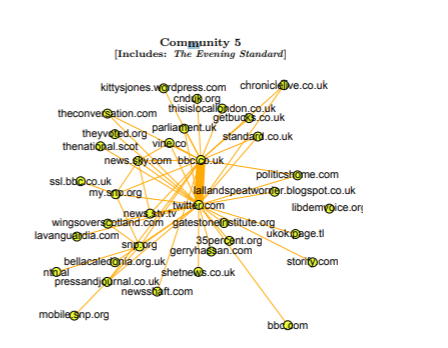
Media network community, from The University of Exeter’s study – Different News for Different Views: Political News-sharing Communities on Social Media Through the UK General Election in 2015

In the 2018 World Press Freedom Index, an annual report produced by Reporters Without Borders (RSF), Britain was judged to have been in 40th place. This compared to Norway and Sweden at the top of the index, with the UK placed below Trinidad and Tobago and only just ahead of Taiwan. The United States is also trailing, to the dismay of US media organisations, at 45 on the list (with North Korea in bottom place, at 180). 

The Index is based on an evaluation of media freedom that measures pluralism, media independence, the quality of the legal framework and the safety of journalists in 180 countries. It is compiled by means of a survey questionnaire in 20 languages that is completed by experts all over the world. This qualitative analysis is combined with quantitative data on abuses and acts of violence against journalists during the period evaluated.

Last year, the World Press Freedom Index report said“The election of the 45th president of the United States set off a witchhunt against journalists. Donald Trump’s repeated diatribes against the Fourth Estate and its representatives – accusing them of being “among the most dishonest human beings on earth” and of deliberately spreading “fake news” – compromise a long US tradition of defending freedom of expression. The hate speech used by the new boss in the White House and his accusations of lying also helped to disinhibit attacks on the media almost everywhere in the world, including in democratic countries.”


Britain’s ranking, from the World Press Freedom Index 2018

The recent report has drawn attention to several issues that may have contributed to the UK’s place in the ranking. It says: “A continued heavy-handed approach towards the press (often in the name of national security) has resulted in the UK keeping its status as one of the worst-ranked Western European countries in the World Press Freedom Index.” 


Related 

The erosion of democracy and the repression of mainstream media in the UK

The BBC’s ‘churnalism’ and the government’s PR and strategic communications crib sheet 

Inverted totalitarianism and neoliberism 

Dishonest ways of being dishonest: an exploration of Conservative euphemisms

Once you hear the jackboots, it’s too late


I don’t make any money from my work. I write because I must. You can make a donation to help me continue to research and write free, informative, insightful and independent articles, and to provide support to others. The smallest amount is much appreciated – thank you.
DonatenowButton

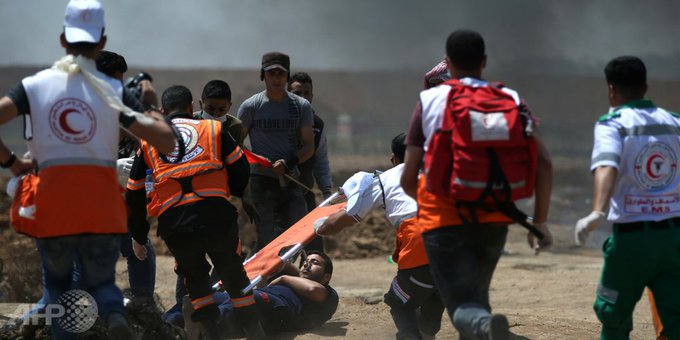
The unarmed Palestinian protestors who were killed on the Gaza border include an 8 month old baby

The United States blocked the adoption of a UN Security Council statement that called for an “independent and transparent investigation” into Israel’s killing of Palestinian protestors on the Gaza border.

The statement, drafted by Kuwait ahead of a meeting on Tuesday, expressed “outrage and sorrow” at the deaths of at least 58 people during demonstrations over the opening of the US embassy in Jerusalem.

It also demanded all countries comply with a decades-old Security Council resolution calling on them not to station diplomatic missions in the contested holy city.

“The Security Council expresses its outrage and sorrow at the killing of Palestinian civilians exercising their right to peaceful protest,” the draft text reads.

“The Security Council calls for an independent and transparent investigation into these actions to ensure accountability.”

The statement also called on “all sides to exercise restraint with a view to averting further escalation and establishing calm”.

Most UN member states say the status of Jerusalem – a sacred city to Jews, Muslims and Christians – should be determined in a final peace settlement and that the relocation of the US embassy has prejudiced any such deal. France, one of the council’s five permanent members, has condemned “the violence of Israeli armed forces against demonstrators” and said president Emmanuel Macron would speak to Israeli prime minister Benjamin Netanyahu on Tuesday.  

On Monday, 10 of the council’s 15 members wrote to UN secretary-general to express profound concern” that a 2016 resolution demanding an end to Israeli settlement building on land that Palestinians want for an independent state was not being implemented. UN Middle East envoy Nickolay Mladenov reported last year that Israel was continuing to flout the demand for an end to settlements, which is prohibited by international law.

Back in January, Trump threatened in a tweet to cut millions in funding support contributions in order to force Palestinian National Authority President Mahmoud Abbas into coming to the negotiating table to hash out a peace deal with Israel. 

In cutting the aid package, the administration appeared to be in line with Trump’s tweet in which he wrote that Palestinians were receiving “hundreds of millions of dollars” but gave the US “no appreciation or respect.” 

Donald J. Trump

@realDonaldTrump

It’s not only Pakistan that we pay billions of dollars to for nothing, but also many other countries, and others. As an example, we pay the Palestinians HUNDRED OF MILLIONS OF DOLLARS a year and get no appreciation or respect. They don’t even want to negotiate a long overdue…

Donald J. Trump

@realDonaldTrump

…peace treaty with Israel. We have taken Jerusalem, the toughest part of the negotiation, off the table, but Israel, for that, would have had to pay more. But with the Palestinians no longer willing to talk peace, why should we make any of these massive future payments to them?

One of the sticking points in the peace process has been the control of Jerusalem. Trump broke with 70 years of diplomatic procedure and announced the US would recognise the holy city as the capital of Israel. 

US Ambassador to the UN, Nikki Haley, had originally advocated for cutting off funds going to UNRWA completely, echoing her sentiments that the world body had an “anti-Israel bias.”

She was talked down after Defence Secretary James Mattis and Secretary of State Rex Tillerson indicated that if the relief agency’s efforts are severely hampered it could cause further unrest in Jordan, an ally which hosts several million Palestinian refugees. 

Nicky whatsit

Nikki Haley walked out of an emergency Security Council meeting yesterday when the Palestinian envoy began to speak, just hours after she praised Israel for acting with “restraint” in handling the protests in Gaza. The meeting was held to discuss the violence in Gaza. Haley told the Security Council that Hamas, with the help of Iran, was to blame for the violence and pointed to “Molotov cocktails being flown into Israel via kites.”

Israeli forces dropped drones with tear gas and shot at Palestinian protesters in Gaza on Monday, Trump’s son-in-law and senior adviser Jared Kushner called the protesters “part of the problem and not part of the solution.” Kushner’s family has longtime ties to Israeli Prime Minister Benjamin Netanyahu, and previously failed to disclose that he once led a group that funded West Bank settlements, which are illegal under international law.

Hours after Kushner’s speech, White House Deputy Press Secretary Raj Shah also claimed that the Palestinian deaths on Monday were “an unfortunate propaganda attempt” by Hamas.

The United States unveiled its new embassy in Jerusalem on Monday, the same day as Israel’s independence day, after having moved its location from Tel Aviv. The move has been roundly condemned by Palestinian leadership and other world leaders, as East Jerusalem — under Israeli occupation since 1967 — has been recognised as the capital of a future Palestinian state by the international community.

But the protests in Gaza were about more than the embassy. Many of those involved were participating in the “March of Return” protests, which began on March 30, and involved tens of thousands of Palestinians marching to the Gaza border fence to demand the right to return to family homes lost in 1948.

Riots in the region had already broken out in the wake of Trump’s “recognition of Jerusalem” and cutting off all aid is likely to have have escalated protests and violence.

UK policy should reflect the asymmetry of the two parties (occupier and occupied), the importance of international law and human rights treaties as a reference point, and accountability for violations of that body of law and of those treaties.

The British Government must suspend the granting of arms export licenses to the Israeli military,  produce, and formulate tougher rules for charities regarding support for settlements, building on the recent Charity Commission warning.

The UK should condition bilateral ties with the Israeli government, including in relation to trade arrangements, in respect for international law and human rights.

British Palestinian scholar-activist Yara Hawari wrote “The past is not in the past. Britain continues to be complicit in the suffering of the Palestinians through its diplomatic and trade relations with Israel”.

Ending that complicity would be the best form of apology.

Israel claims that its troops were “defending its border” and accused Hamas militants of using the protests as a cover for attacks. It said 40,000 Palestinians had taken part in “violent riots” along the border and that some had tried to breach security fences. However, no Jewish people were killed. It’s not clear what danger Israel faced from unarmed protestors, nor is it explained why the response from the military was so absolutely disproportionate.

The unarmed Palestinian people who were atrociously murdered 

Medics and journalists were among the injured in what the Palestinian Authority condemned as a “massacre”.  The Israeli military,  however, claim they were defending the state borders.

The following was published on Tuesday, May 15, 2018, by Middle East Eye.

The Gaza Ministry of Health has released the names of 58 unarmed Palestinians killed. They were protesting for their freedom and dignity. 

From left: Ahmed Alrantisi, Laila Anwar Al-Ghandoor, Ahmed Altetr, Alaa Alkhatib Ezz el-din Alsamaak, Motassem Abu Louley (Photo: Screengrab)

From left: Ahmed Alrantisi, Laila Anwar Al-Ghandoor, Ahmed Altetr, Alaa Alkhatib Ezz el-din Alsamaak, Motassem Abu Louley (Photo: Screengrab) 

Editor’s note: Middle East Eye has live coverage of protests in Palestine and Israel here.

Sixty-one people were either killed or died of wounds inflicted by Israeli forces in the Gaza Strip on Monday and Tuesday as thousands of Palestinians demonstrated across the occupied territory to mark the 70th anniversary of the Nakba.

The youngest victim was just 8 months old. Laila Anwar Al-Ghandoor’s family told media that the baby’s mother had left the child at home to join the demonstrations. When the infant began crying her uncle took her towards the protest area in order to locate his sister. 

Reports on Palestinian social media said Laila had been in a tent away from the security fence when a tear gas canister was dropped by a drone.  

Fresh protests are expected. Tensions are running high as many families bury their dead.

On Tuesday afternoon, the Gaza Ministry of Health released the names of 58 Palestinians killed:

1. Laila Anwar Al-Ghandoor, 8 months old

2. Ezz el-din Musa Mohamed Alsamaak, 14 years old

3. Wisaal Fadl Ezzat Alsheikh Khalil, 15 years old

4. Ahmed Adel Musa Alshaer, 16 years old

5. Saeed Mohamed Abu Alkheir, 16 years old

6. Ibrahim Ahmed Alzarqa, 18 years old

7. Eman Ali Sadiq Alsheikh, 19 years old

8. Zayid Mohamed Hasan Omar, 19 years old

9. Motassem Fawzy Abu Louley, 20 years old

10. Anas Hamdan Salim Qadeeh, 21 years old

11. Mohamed Abd Alsalam Harz, 21 years old

Fadi%20Abu%20Salmi%20-29%20Motaz%20Al-nuFrom left: Fadi Abu Salah, Motaz Al-Nunu, Jihad Mohammed Othman Mousa, Mousa Jabr Abdulsalam Abu Hasnayn, Ezz Eldeen Nahid Aloyutey, Anas Hamdan Salim Qadeeh 

12. Yehia Ismail Rajab Aldaqoor, 22 years old

13. Mustafa Mohamed Samir Mahmoud Almasry, 22 years old

14. Ezz Eldeen Nahid Aloyutey, 23 years old

15. Mahmoud Mustafa Ahmed Assaf, 23 years old

16. Ahmed Fayez Harb Shahadah, 23 years old

17. Ahmed Awad Allah, 24 years old

18. Khalil Ismail Khalil Mansor, 25 years old

19. Mohamed Ashraf Abu Sitta, 26 years old

20. Bilal Ahmed Abu Diqah, 26 years old

21. Ahmed Majed Qaasim Ata Allah, 27 years old

3_46.jpg


From left: Mahmoud Wael Mahmoud Jundeyah, Ibrahim Ahmed Alzarqa, Musab Yousef Abu Leilah, Jihad Mufid Al-Farra, Saeed Mohamed Abu Alkheir, Mohamed Hasan Mustafa Alabadilah (screengrab)
 

22. Mahmoud Rabah Abu Maamar, 28 years old

23. Musab Yousef Abu Leilah, 28 years old

24. Ahmed Fawzy Altetr, 28 years old

25. Mohamed Abdelrahman Meqdad, 28 years old

26. Obaidah Salim Farhan, 30 years old

27. Jihad Mufid Al-Farra, 30 years old

28. Fadi Hassan Abu Salah, 30 years old

29. Motaz Bassam Kamil Al-Nunu, 31 years old

30. Mohammed Riyad Abdulrahman Alamudi, 31 years old

31. Jihad Mohammed Othman Mousa, 31 years old

32. Shahir Mahmoud Mohammed Almadhoon, 32 years old

33. Mousa Jabr Abdulsalam Abu Hasnayn, 35 years old

4_36.jpg
From left: Shahir Mahmoud Mohammed Almadhoon, Khalil Ismail Khalil Mansor, Mahmoud Saber Hamad Abu Taeemah, Mohamed Ashraf Abu Sitta, Mustafa Mohamed Samir Mahmoud Almasry, Obaidah Salim Farhan (screengrab)
 

34. Mohammed Mahmoud Abdulmoti Abdal’al, 39 years old

35. Ahmed Mohammed Ibrahim Hamdan, 27 years old

36. Ismail Khalil Ramadhan Aldaahuk, 30 years old

37. Ahmed Mahmoud Mohammed Alrantisi, 27 years old

38. Alaa Alnoor Ahmed Alkhatib, 28 years old

39. Mahmoud Yahya Abdawahab Hussain, 24 years old

40. Ahmed Abdullah Aladini, 30 years old

41. Saadi Said Fahmi Abu Salah, 16 years old

42. Ahmed Zahir Hamid Alshawa, 24 years old

43. Mohammed Hani Hosni Alnajjar, 33 years old

44. Fadl Mohamed Ata Habshy, 34 years old

45. Mokhtar Kaamil Salim Abu Khamash, 23 years old

46. Mahmoud Wael Mahmoud Jundeyah, 21 years old

47. Abdulrahman Sami Abu Mattar, 18 years old

48. Ahmed Salim Alyaan Aljarf, 26 years old

4_37.jpg
From left: Mohammed Hani Hosni Alnajjar, Yehia Ismail Rajab Aldaqoor, Mohammed Riyad Abdulrahman Alamudi, Ahmed Adel Musa Alshaer, Fadl Mohamed Ata Habshy, Ismail Khalil Ramadhan Aldaahuk (screengrab)
 

49. Mahmoud Sulayman Ibrahim Aql, 32 years old

50. Mohamed Hasan Mustafa Alabadilah, 25 years old

51. Kamil Jihad Kamil Mihna, 19 years old

52. Mahmoud Saber Hamad Abu Taeemah, 23 years old

53. Ali Mohamed Ahmed Khafajah, 21 years old

54. Abdelsalam Yousef Abdelwahab, 39 years old

55. Mohamed Samir Duwedar, 27 years old

56. Talal Adel Ibrahim Mattar, 16 years old

57. Omar Jomaa Abu Ful, 30 years old

58. Nasser Ahmed Mahmoud Ghrab, 51 years old

59 – 61: Unidentified

The UN tweeted this response:


https://www.youtube.com/watch?v=UzOpUMAmRkU


Related

UN spokesman cries on camera over Gaza school attack

The UK government must stop selling arms to Israel and end its own complicity in human rights abuses


I don’t make any money from my work. You can make a donation to help me continue to research and write free, informative, insightful and independent articles, and to provide support to others. The smallest amount is much appreciated – thank you.

DonatenowButton


Marginalisation of left leaning Jewish groups demonstrates political exploitation of the antisemitism controversy by the right wing

Ruth Smeeth, shown here, is surrounded by right wing journalists, Kevin Schofield, editor of Politics Home, (he used to work with the Sun), Richard Angell, bullying executive director of the moderate group Progress, who oppose Jeremy Corbyn’s leadership, Senior Political Correspondent at The Telegraph, Kate McMann, and John Adrian Pienaar, who is currently Deputy Political Editor for BBC News, and presenter of Pienaar’s Politics on BBC Radio 5 Live. It is the right wing journalist Kevin Scofield who says clearly on the video that Marc Wadsworth’s comments constitute “antisemitism”. 

Marc Wadsworth, a former BBC journalist and member of the Momentum Black Connexions group, had been suspended by the Labour Party since the 2016 row with Smeeth at the launch of Shami Chakrabarti’s report into antisemitism, where he accused the MP of “working hand in hand” with the Daily Telegraph to undermine Jeremy Corbyn. That a group of so-called moderates in the party have worked with the right wing press – and at times, even with Conservative MPs – to attempt to discredit Corbyn, isn’t open to dispute. They have.

See for example, John Woodcock’s comments on Pienaar’s show. Woodcock is the only Labour MP to state publicly that, if re-elected, he would not support Corbyn as Prime Minister. It’s a well established fact that the plots by so-called moderates to marginalise Corbyn and his supporters have been going on since he became party leader. To pass a comment on this is not remotely “antisemitic”. The fact that Ruth Smeeth is Jewish does not make the comment antisemitic. 

In his statement, Wadsworth says “At the Chakrabarti event, I handed out a press release in defence of him. I was dismayed when I saw journalist Kate McCann, from the arch anti-Labour Daily Telegraph, hand it to a member of the public. That person told me brusquely she was ‘Ruth Smeeth Labour MP’.

“So, I suspected an unhealthy cosy relationship between the two of them. I later found out the MP was one of Corbyn’s dissident frontbenchers who had resigned to damage him.

“Anyway, after being called out by McCann in a hostile question about me to the Labour leader, I responded by saying what I genuinely thought I had spotted. The MP walked out filmed by the cameras of news media uninterested in the important issues covered by the Chakrabarti report and looking for an anti-Corbyn scoop. I mainly spoke about the lack of black people at the event aimed at combatting racism and, sadly, the journalists were not interested in that. Corbyn sympathetically supported my observation and said the party needed to do better to improve black representation. I didn’t know the MP involved was Jewish.”

Wadsworth also says: “As a black activist, I’ve fought racism and antisemitism all my life. The Hitler-worshipping Combat 18 paramilitaries put me on a death list after I founded the Anti-Racist Alliance in 1991, and helped Doreen and Neville Lawrence set up the Justice for Stephen Lawrence campaign. After I was able to introduce Stephen’s parents to Nelson Mandela, the campaign became the cause célèbre it deserved to be. This April marks the 25th anniversary of black teenager Stephen’s brutal, racist murder.

“I’ve been on the frontline, side by side with Jewish, black and other anti-racist campaigners, opposing the fascist BNP, including on the Isle of Dogs when one of their members was elected a councillor. Together we managed to shut down the BNP’s “Nazi bunker” headquarters in south east London, close to where Stephen was murdered.

“Despite my history of anti-racist campaigning, Labour expelled me by email the very same day of the June 2016 launch of the party’s Shami Chakrabarti report into antisemitism and racism I attended. I was shocked, thinking it must be a practical joke. I was caught up in what’s been called a “media concocted firestorm”.  

“Since then I’ve been pilloried and had my reputation trashed. Most painful has been the non-stop trial by media – print and online.”

Smeeth didn’t look to be in tears when she left, as the media reported: she glanced at the cameras and rather pointedly stormed out. That was following Schofield’s smirking comments about alleged antisemitism. 

What is telling about this whole series of events, is that Smeeth’s statement at the time claims the comment Wadsworth made was definitely antisemitic, leaving no room for doubt when there clearly IS room for doubt. Furthermore she uses this to call for Corbyn to stand down, yet again, claiming unreasonably that Corbyn is “unfit” to be leader. Given the large, unjustified logical leap there, it’s very difficult to see these events as anything other than staged. 

Corbyn did not hear an antisemitic comment because it wasn’t clearly an antisemitic comment. It’s rather difficult to put aside the previous attempts by Smeeth and other moderates – the neoliberal party within our party – to deliberately attempt to discredit the twice-elected left leaning, anti-neoliberal leader of the party.  The comment made Wadsworth simply highlights this, in my view. 

Travesty: Marc Wadsworth exclusive interview on week of his expulsion from UK Labour party.

You can support Marc Wadsworth’s appeal campaign here.

Is antisemitism worse in the Labour Party than in others?  The evidence of the Home Affairs select committee strongly suggests it’s not. 

commons select committee antisemitism
This finding is in spite of the fact that no-one appears to be affording other parties the same level of scrutiny.

Julie pierce plant QT

Julie Pierce, pictured in the centre (above), a Conservative plant in the audience on Question time this week, asked why Labour have a “problem with antisemitism”, and why the Labour party only “attack Israel”, the only Jewish state”, rather than other countries in the middle east.

As a matter of fact Labour have consistently also criticised Saudi Arabia’s history of human rights violations in Yemen. I thought John Bercow’s response in his interview with Alastair Campbell was even handed and spot on. Bercow has know Corbyn for over twenty years. He states clearly that Corbyn is not antisemitic. Bercow has said he never came across any antisemitism in the Labour Party but plenty from the Conservatives.

The comments were made at the launch of an autobiography from Edgware-born Bercow, 57, himself Jewish, who represented Buckingham as a Conservative MP for 20 years and was Speaker of the House of Commons for the last ten.

Linguistic entrapment

I have pointed out elsewhere that there is a basic frame composed of an over simplistic, false dichotomy regarding the Labour party’s alleged antisemitism, which the right wing (including so-called centrist neoliberals within the Labour party) and their allies in the media have also rolled out. The frame itself is a trap. It runs like this: If the Labour party confirm that they are “addressing” an antisemitism problem, regardless of whether that problem is real – then it is read as an admission of guilt. However, if the party says there is no problem – regardless of whether there is or isn’t – that will simply be read as a denial of “guilt” and the action of a party that “doesn’t care” about antisemitism more generally.

The phrasing of accusation is designed to make the party and members look bad either way. However, as a person who has warned and written extensively about the dangers of growth of social prejudice since 2012, again, I won’t ever claim that antisemitism is eradicated or negligible. It isn’t either, unfortunately. I will maintain, however, that it is no greater problem within the Labour party than it is in wider society. That is NOT the same thing as saying there is no antisemitism within the party membership. The rise of social prejudice within the UK is partly because of a toxic, divisive, intolerant right wing authoritarian political culture and a media that acts a PR service for Conservative rhetoric, amplifying their racist values.

Antisemitism reached its highest level since records began in the UK back in 2014, before Corbyn was party leader, and before Momentum formed. Yet the media and moderates are using Corbyn’s reasonable commitment to address antisemitism as “proof” that antisemitism is now “rife” in the party. However, a survey of anti-Semitic attitudes in Britain, published last September by the respected Institute for Jewish Policy Research — an organization with no ties to any political party — contains several findings that are worth considering amid this uproar. First: Levels of anti-Semitism in Britain are among the lowest in the world. Second: Supporters across the political spectrum manifest anti-Semitic ideas. Third: Far from this being an issue for the left, the prejudice gets worse the farther right on the political spectrum that you look.

There are two issues here, which I hope I have made clear. One is the justified concern regarding antisemitism in the UK and within the Labour party among members, the other is how that is being politically exploited. This does little to genuinely address antisemitism. Furthermore, it has caused further division among Jewish communities, with left leaning Jewish groups being marginalised in this debate. See, for example, Jewish and Black activists united in support of antiracist campaigner Marc Wadsworth, which is Jewish Voice for Labour’s statement on this issue.

The accusations of antisemitism have been redesigned for use as a political stick with which to beat Corbyn. Again, I would not claim there is no antisemitism within the party. If there is, it must be addressed. However, mine is a question of proportionality, and whether the media focus and comments of right wing commentators are reasonable and justified. This is the same branch of the media that displayed no qualms in systematically dehumanising migrants and asylum seekers in their drive to force the EU referendum.

The comments made by Wadsworth were certainly not overtly antisemitic. Comment about the party moderates’ relationship with the press include people who are not Jewish, too. Furthermore, he says that he did not know Smeeth is Jewish. Nor did I until she spoke about it in parliament. I didn’t know Margaret Hodge is until very recently, either.

The fact remains that the group – which includes Jewish and non-Jewish people alike – are bound by the same neoliberal ideology, and have systematically set out to destablise the party and discredit the twice-elected leader, using the right wing press to do so, as well as opportunities for parliamentary commentary.  I don’t believe commenting on that is antisemitic. Exploiting Jewish suffering to prosecute petty vendettas, wage factional warfare and discredit legitimate criticism of Israel is however, dismally nasty. In the process, this is poisoning relations between British Jews and movements for social justice; fomenting antisemitism while claiming to combat it.

Most of the moderates are indistinguishable from the Conservatives in terms of the policies they support, which are underpinned by a neoliberal ideology. Graham Jones for example, said in 2015I want to see [Corbyn] change some of his policies. I think we need to be fiscally more responsible. We’ve got to stop turning our back on the debate on immigration. On welfare, are we just leaving people to a lifetime on benefits?”

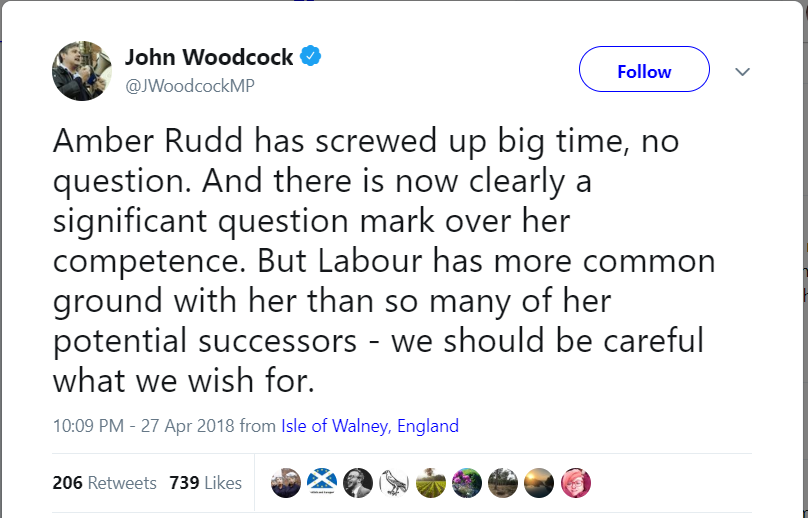
And then there is this:

proamber rudd

The responses from Labour party members to this ill-conceived but revealing Tweet categorically demonstrated that the Labour party has no common ground with Rudd whatsoever.

Labour policies under Corbyn have been formulated using public consultation, it’s clear that the right of the Labour party are out of touch with what the public actually want. After seven grinding years of targeted austerity – a plank of neoliberalism – and the ever-lower standards of living under the Conservatives, the wider public have had enough. 

The divisions being fostered between left and right leaning Jewish groups demonstrates the political exploitation of the antisemitism controversy

Jewdas was recently denounced by the president of the Board of Deputies of British Jews, Jonathan Arkush, as “a source of virulent anti-Semitism.” The board, which has claimed to speak for British Jewry since the 18th century, usually keeps its head down and avoids the headlines. In the 1930s, it held back as other Jewish groups, mostly on the left, led the struggle against a nascent fascist movement on the streets of London, in the battle of Cable Street. An inglorious role, perhaps, but one that has allowed the Board of Deputies to appear nonpartisan and impartial. However, Arkrush has openly expressed that he supports the Conservatives and DUP. He is not impartial:

“If the governing party, which is a strong supporter of Israel, loses so much ground, then of course it has to be something of a loss for Israel and the Jewish community,” Arkush, who was in Israel at the time, told The Times of Israel in an interview.

“And that loss is compounded when it comes to the gains by Labour. Corbyn’s party has policies that are supportive of Israel, supportive of the two-state solution, but will see its “far-left faction, which is far less sympathetic to Israeli concerns, bolstered by the strong showing.”

Interviewed on TV, Arkush proposed that Jewdas’s members “are not all Jewish,” as if he were in a position to make authoritative pronouncements on the subject. 

This part of the controversy marked the turning point from serious debate about repugnant antisemitism into fabrication, political point-scoring and abuse. Jeremy Corbyn attended a Passover meal with Jewish left-wing group Jewdas in his constituency, an engagement that had been made well in advance of the controversy. Jewdas is a collective of left leaning Jewish people that focuses on diaspora Jewry and giving UK Jews a space outside of the self-appointed “mainstream” to meet, pray, learn and party. The group is generally anti-Zionist, but support the view that Zionism in itself is not a problem since Zionism is a movement that had as its original aim the creation of a country for Jewish people, and that now supports the state of Israel. That support, say Jewdas, does not entail condoning “land grabs” and the murder of Palestinian civilians. 

Jewdas is famed for its satirical takes on UK Jewish communal life, and its thoughtful and humorous political and religious resources. 

Those attempting to discredit this group on the grounds that they are left wing should read Article 10 of the Human Rights Act. They should also consider that it is always under the conditions of political intolerance, right wing authoritarianism, and a toxic culture of discrediting and persecuting political opposition, that the conditions for a divided society and the growth of social prejudices arise.

The Nazis – who, despite the title they adopted to win working class votes – were right wing authoritarians, who brutally murdered socialists, trade unionists, anarchists, disabled people, as well as Jewish people and other groups. Yet those groups are currently becoming increasingly divided in their fight for social justice, because of poisonous right wing political manoeuvering and the political exploitation of a very serious issue. As it is, the Labour party – her Majesty’s opposition – are now portrayed by the right as pathological – we have become political dissidents in what was once a democratic state.

Jewdas, who are a liberal, diversity-embracing group, say: “We campaign against fascism, and against antisemitism on the left and on the right, running workshops and creating educational materials to help other people and organisations do the same. (And we’ve been campaigning against antisemitism on the left since before it became ‘cool’.)

“We also participate in solidarity campaigns to support other oppressed minorities, including sustained pro-Palestine activism, interfaith events with the Inclusive Mosque Initiative, and yesterday’s rally at East London Mosque to counter the so-called #PunishAMuslimDay.

It was particularly galling to see the moderate Labour MPs use the communal fight to intentionally marginise and isolate left wing Jews from their own community.

The “moderates” didn’t like Corbyn’s meeting with this Jewish community in his constituency, and made a somewhat incoherent claim that meeting with the Jewish group somehow “dismisses” the case for tackling antisemitism:

Smith Jewdas

In a supreme act of discourtesy, Smith also refers to the Passover Seder as “seber”.

In 2016 Smith backed a vote of no confidence in Labour leader Jeremy Corbyn in events which led to a leadership election in which Corbyn was re-elected as leader.

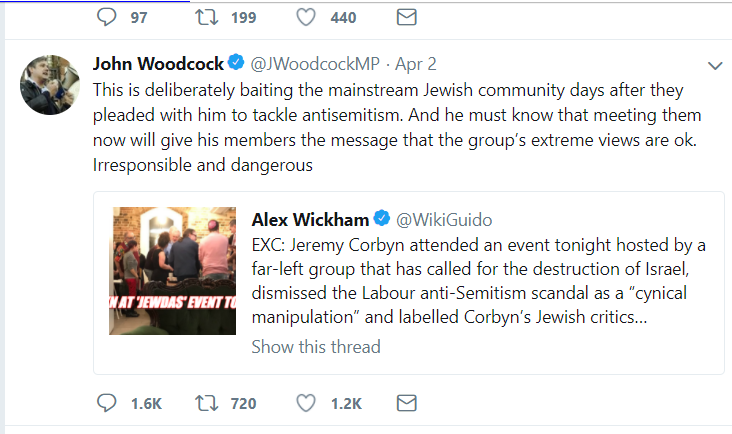
John Woodcock, who is not a Jew, takes it upon himself to decide which Jewish groups are “mainstream”, apparently, and which are not.

Jon woodcock judas

Apparently, it was the “wrong” seder and engagement with the “wrong” Jews. Before the event was finished, Guido Fawkes (a trashy gossip-mongering, hard right wing blog) had posted about Corbyn’s meeting. 

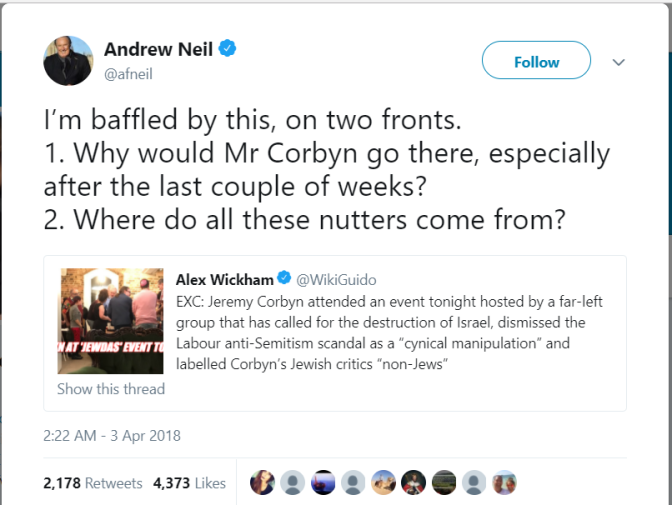
Labour MPs of the “moderate” kind had condemned Corbyn’s Passover. Joined by the Jewish Board of Deputies, of course. And the usual suspects in the media, who not only come off as antisemitic, in their parsing of “good Jews” and “bad Jews” based on their political beliefs,  some even managed to insult people with their diversity blind comments about mental health status:

andrew neil antisemitic

I posted that comment, along with the one below from moderate supporter Dan Hodges, on Twitter, and asked the moderate MPs who express their “concern” about antisemitism, to actually condemn the antisemitic statements. I tagged the MPs in the post. 

Not a single one has condemned the comments made by two right leaning pundits. Yet the comments are very clearly antisemitic and also openly express political intolerance. 

Finally, here is a statement from the Jewish socialist community, which is not a view that you will see fairly represented in the right wing media, who are stage-managing our democracy and repressing the right to political expression from the left:

“The Jewish Socialists’ Group expresses its serious concern at the rise of antisemitism, especially under extreme right wing governments in central and Eastern Europe, in America under Donald Trump’s Presidency and here in Britain under Theresa May’s premiership. The recent extensive survey by the highly respected Jewish Policy Research confirmed that the main repository of antisemitic views in Britain is among supporters of the Conservative Party and UKIP.

This political context, alongside declining support for the Tories, reveals the malicious intent behind the the latest flimsy accusations of antisemitism against Jeremy Corbyn and the Labour Party. These accusations have come from the unrepresentative Board of Deputies and the unelected, self-proclaimed “Jewish Leadership Council”, two bodies dominated by supporters of the Tory Party.

Between now and the local elections the Tories would love to divert the electorate on to accusations of antisemitism against the Labour Party rather than have us discussing austerity, cuts to local authority budgets, the health service, and social care. Many Jews within and beyond the Labour Party are suffering from these policies along with the rest of the population, and oppose them vehemently.

Jonathan Arkush, the President of the Board of Deputies, was one of the first to congratulate Donald Trump on his election as President of the United States on behalf of the Board. This action was harshly criticised by many Jews he claims that the Board represents. He also gives unqualified support to Israel’s pro-settler Prime Minister, Benjamin Netanyahu, who enjoys good relations with the very far right political forces in Hungary, Poland and the Czech Republic who are fanning bigotry against minorities, including Jews.

Until very recently the Jewish Leadership Council was chaired by Sir Mick Davies, who was appointed Tory Party treasurer in February 2016 and is now the Chief Executive of the Conservative Party.

The Jewish Socialists’ Group includes many members of the Labour party, and we know many Jews who have joined or re-joined the Labour party enthused by the progressive leadership of Jeremy Corbyn.

Labour is the party that brought in anti-discrimination legislation at a time when many Tory members were open supporters of and investors in apartheid South Africa. The Tories are the party that have dished out the harshest treatment to migrants and refugees, especially when Theresa May was Home Secretary. Shamefully, they are still refusing to accede to the proposal of Labour peer, Lord Dubs, who came to Britain as a Jewish refugee on the Kindertransport, to take in a small but significant number of unaccompanied child refugees from Syria.

We have worked alongside Jeremy Corbyn in campaigns against all forms of racism and bigotry, including antisemitism, for many years, and we have faith that a Labour government led by Jeremy Corbyn and Labour-led councils across the country, will be best placed to implement serious measures against all forms of racism, discrimination and bigotry.”

Related

Left wing Jewish groups don’t agree with right wing ones, surprisingly enough

Promoting social solidarity is a positive way to address antisemitism and the growth of social prejudice

Antisemitism and the growth of prejudice and oppression in the UK

UKIP: Parochialism, Prejudice and Patriotic Ultranationalism

Jeremy Corbyn hasn’t got an ‘antisemitism problem’. His opponents do – Jamie Stern-Weiner


I don’t make any money from my work. I’m disabled through illness and on a very low income. But you can make a donation to help me continue to research and write free, informative, insightful and independent articles, and to provide support to others. The smallest amount is much appreciated – thank you.

DonatenowButton