Category: Civil Liberties

The alternative narrative – Corbyn’s full speech to the TUC

Sisters and brothers, thank you very much for inviting me here today.  I must admit it seems to be a very fast journey we are on at the present time and, to me, it is an enormous honour to be invited to address the TUC.  It only seems a very short time ago that your General Secretary, Frances O’Grady, did me the honour of coming to speak at the nominating meeting in my constituency, Islington North, and now she has invited me here to address the TUC.  I am very grateful, Frances, for what you did there and I am delighted to be here today because I am, and always will be, an active trade unionist.  That is in my body.

I have been a trade union member all my life.  I was an organiser for the National Union of Public Employees before I became a Member of Parliament.  I realise this is deeply controversial because they are now part of Unison but you can only be in one union at a time; you know the problem.  That taught me a great deal about people, about values, and about the value of trade unions in the everyday lives of ordinary people.  School cleaners, they have a hard time, school meals workers being badly treated, school caretakers looking for some security in their jobs, all those issues that are day-to-day work of trade unions and those that attack and criticise trade unions should remember this.

There are six million of us in this country.  We are the largest voluntary organisation in Britain.  Every day we make a difference in looking after people in their ordinary lives as well as a huge contribution in the wider community.  Unions are not just about the workplace, they are also about society as a whole, life as a whole, and the right of the working class to have a voice in society as a whole.  That is why trade unionism is so important.

We celebrate the values of solidarity, of compassion, of social justice, fighting for the under-privileged, and of working for people at home and abroad.  Whilst we value and protect the rights that we have in this country, the same thing does not apply to trade unionists all over the world.  Those people that died in that dreadful fire in China where there was a free market philosophy around the operation of a port, fire-fighters died trying to protect other workers who should have been protected by decent health and safety conditions.  All around the world, Colombia and many other places, trade unionists try to survive trying to stand up for their rights.

Trade unions in Britain have achieved a fantastic amount in protection and in the wider society.  We need to stand in solidarity with trade unionists all over the world demanding exactly the same things as we have secured for ourselves and trying to defend for ourselves.  Trade unionism is a worldwide movement, not just a national movement and we should never be ashamed to say that.

There are those that say trade unions are a thing of the past and the idea of solidarity, unity, and community are a thing of the past.  Ever since this Labour leadership election was announced, and I have taken part in it, I have spoken at 99 different events all over Britain, 99 events in 99 days.  Those events were often very large.  They would bring together people that had been estranged from the Labour movement or indeed from the Labour Party and they would bring together young people who had not been involved in that kind of politics before.

What brought them together was a sense of optimism and hope.  What brought them together was a sense of the way things can be done better in politics in Britain.

Those values I want restored to the heart of the Labour Party, which was of course itself a creation of the trade unions and socialists in the first place.  I have some news to report to you.  Ever since last Saturday, large numbers of people have been joining the Labour Party and the last figure I got, that was Saturday afternoon, 30,000 people have become members of the Labour Party.   Our membership is now more than a third of a million, and rising.  Over half a million people were able to take part in that election.

But the values that people bring to joining the Party and the Party brings to them have to be things that we fight for every single day.  I want the unions and the Labour Party to work together to win people over to the basic values we all accept, to change minds, and change politics, so that we can have a Labour government, we can look in a different direction, we can look away from the policy of growing inequality and look to a society that grows in equality, in confidence, in involvement of everybody, and does not allow the gross levels of poverty and inequality to get worse in Britain.  That is what the Tories have in store for us.

But Labour must become more inclusive and open and I have had the very interesting task in the last few days of a number of events and a number of challenges.

The first thing I did on being elected was to go and speak at a rally in saying Refugees are Welcome Here because they are victims of human rights abuses and other abuses.   I thought it was important to give that message out, that we recognise human rights abuses and the victims of it all over the world from wherever they come, they are human beings just like you and me, we hold out our hands and our hearts to them, and we want to work with them for a safer and better world.  They are seeking the same things that we are seeking.

Later, the next day, I wanted also to give a message about how we intend to do things and the kind of society we want.  So, I was very proud to accept an invitation to attend a mental health open day in my constituency, or a nearby constituency, to show that we believe the NHS is vital and valuable as it obviously and absolutely is but there are many people who suffer in silence from mental health conditions, suffer the abuse that often goes with those conditions, and the rest of society passes by on the other side.  Mental illness is an illness just like any other, it can be recovered from, but we have to be prepared to spend the time and the resources and end the stigma surrounding mental illness which often comes with stress, workplace stress, poverty, and many other things.

There are other messages we have to put and the media has been absolutely full of midnight oil burning sessions in appointments to the new Shadow Cabinet of the Parliamentary Labour Party.  After consideration and thought, and lots of discussion, we have assembled and appointed a Shadow Cabinet of a majority of women members for the first time ever in history.

To show how determined we are on a number of specific areas of policy, there is a specific Shadow Minister, Luciana Berger, who is dealing with mental health issues.  She will be at the table along with everyone else, and there is a specific Minister dealing with housing, and that is because I believe that John Healey will put the case very well.  The issue is that we have to address the housing crisis that faces so many people all over this country.  The free market is not solving the problem of homelessness.

The free market is not allowing people to lead reasonable lives when they are paying excessive rents in the private-rented sector. We have to change our housing policies fundamentally by rapidly increasing a council house building programme to give real security to people’s lives.

But there are other issues that we have to address, and that is how we make our party and our movement more democratic. The election process that I have just come through was an electorate of 558,000 people, the largest electorate ever for an internal party election.  The number of votes that were cast for me were more than twice the total membership of the Tory Party in the whole country.  That is something to savour.

But all those people coming forward to take part in this process came forward, yes, because they were interested, yes, because they were hopeful but, yes, because they wanted to be part of a democratic process where we make policy together.  We live in a digital age, we live in an age where communications are much easier and we live in an age where we can put our views to each other in a much quicker and in a much more understandable form.  So we don’t need to have policymaking that is top down from an all-seeing, all-knowing leader who decides things.  I want everybody to bring their views forward, every union branch, every party branch and every union, so we develop organically the strengths we all have, the ideas we all have and the imagination we all have.

When we have all had a say in how we develop, say, the housing policy, or, say, the health policy, say any other particular area of environmental protection or anything else, if everyone has been involved in that policymaking, they own the policy that is there at the end.  They are more determined to campaign and fight for it. They are more likely to mobilise many more people around it, so we don’t go through until 2020 with a series of surprises, but we go through to 2020 with a series of certainties, that we are a growing, stronger movement, we are more confident and more determined than ever and, above all, we are going to win in 2020 so we see the end of this Tory Government.

When politicians get out of touch with reality, they sometimes forget where skillsets really lie.  Can I give you an example.  When I was a union organiser, we used to get involved in negotiations about work-study arrangements, the time it took to drive a van from place A to place B and how long it took to load the van, all those kind of issues.  So we would go in there and start negotiations, and I would always go to the branch meeting before hand and say, “Who here is keen on betting?”

Every hand went up, of course.  “Who’s the best at betting?”  One particular hand would be pointed to, and I would say, “Can you come along to the negotiations?”  “Why?”  Because that member had brilliant skills at mental arithmetic — this was pre computer days — and he would work out very quickly, and he would say sotto voce to me, “They are lying to you, Jerry. Don’t accept it”, or whatever.   Skills at the workplace, skills of ordinary people, knowledge of ordinary people.  The elite in our society look with contempt on people with brilliance and ideas just because  they don’t speak like them or look like them.  Let’s do things differently and do things together.

Had we had a different approach, would we now have the millstone of private finance initiatives around the necks of so many hospitals and so many schools in this country, or would we, instead, have a more sensible form of public sector borrowing to fund for investment and fund for the future, rather than handing over our public services to hedge funds, which is exactly what this Government would like us to do?  Be confident, be strong.  We have lots of knowledge and lots of power.

I have worked with unions affiliated to the Labour Party and not affiliated to the Labour Party, and I work with all trade unions because I think that is what the Leader of the Labour Party should do.  I think the Leader of the Labour Party, if invited, should always be at the TUC. I see it as an organic link.

I want to say a special mention to one group of workers who are here.  They are doing their best to defend something we all own, know and love.  Welcome to those strikers from PCS from the National Gallery for what they are going through at the present time.   They look after our national treasures in the National Gallery.  They do it well.

They love what they do and they love what we have got in our National Gallery.  Please, let’s not privatise our galleries and privatise our staff.  We welcome and we recognise the skills of those people who work in all those places and so many other places as being a precious national asset, not something to be traded away on the market of privatisation.  Well done to you for your campaign.

Yesterday the Tories put the Second Reading of the Trade Union Bill to Parliament, and, sadly, it achieved its Second Reading and it has now gone into Committee.  Basically, they are declaring war on organised labour in this country ever since they won the General Election, albeit with the support of 24% of the electorate.  Yesterday, I was proud to sit alongside Angela Eagle on our Front Bench to oppose the Trade Union Bill, and she rightly said, and I quote: “This Bill is a dangerous attack on basic liberties that would not be tolerated by the Conservative Party if they were imposed on any other section of society.”  Stephen Doughty gave an excellent reply, and Labour MPs spoke with passion, knowledge and understanding of the dangers of this Bill.

It is quite interesting how the Tories champion deregulation wherever regulation is ever mentioned.  How many times have we heard that, Ministers for Deregulation, Departments for Deregulation, Ministers who will tear up all regulations?  But one thing they really want to regulate is organised labour and the trade unions in this country. I think that sauce for the goose is sauce for the gander, don’t you?

So we have to oppose it and recognise what they are doing.  The burdens they are placing, as one Tory MP admitted, are actually the strategy that was used by General Franco in Spain on his control of the trade unions in Spain.  They seem to still think that it is right just to attack trade unions because they exist.  I am not going to be lectured to by saying, “If the Labour Party gets too close to unions it puts us all on the back foot.”  I am sorry.  Trade unions are an essential and valuable part of modern Britain.  Six million people voluntarily join trade unions and I am proud to be a trade unionist.  That is why we are going to fight this Bill all the way.  When we have been elected with a majority in 2020, we are going to repeal this Bill and replace it with a workers’ rights agenda and something decent and proper for the future.

Every difficulty actually gives you an opportunity, and the difficulty is that this Bill has been placed in front of us, but it gives us the opportunity to defend civil liberties and traditional freedoms and explain to the wider public, beyond trade union members and others, that it is actually a threat to the liberties of all of us.  Because by calling into question the right of free association of trade unions they are actually in contravention, in my view, of Article 11 of the European Convention of Human Rights.

They are also in contravention, as Stephen pointed out in his reply yesterday, to the International Labour Organisation conventions.  So we are going to continue our opposition to this.  They are threatening the right of peaceful protest by looking to criminalise picketing.  They are even threatening the right to free speech by seeking to limit what a union member can say on social media during a dispute.  Are we really going to have teams of civil servants or lawyers or police or somebody trawling through massive numbers of twitter messages, Facebook messages, to find something somebody said about their employer or about an industrial dispute?

What kind of intrusive society are they really trying to bring about.  We have got to fight this Bill all the way, because if they get it through it’s a damage to civil liberties and for everybody in our society.  They will use it as a platform to make other attacks on other sections of our community. Let’s be strong about this.

We also have to promote trade unionism and understand that good trade unions, good trade union organisation, yes, it protects people in the workplace, yes, it leads to better pay, better conditions and better salaries and better promotional opportunities as a whole, but it also means there is often better management in those places where unions are very strong.  The two things actually go together and are very important.  Where unions are weak, job security is weak, conditions get worse and you look at the results of what this Conservative Government are doing.  They want to raise the threshold on strike ballots, so I would like to ask the Prime Minister this question: if you want trade unions to vote in ballots, why leave unions with the most archaic, expensive, inefficient method of voting you could find, why not modernise the balloting?

Above all, why not go forward and secure workplace balloting ensuring that every member of a trade union can vote securely and secretly at their own workplace?  That, surely, is something we all want in this Bill for ourselves.

But they are also attacking the rights of trade unions to be involved in the wider society.  The Tories have always been concerned about the right of trade unions to be involved in political actions in any way.  Why shouldn’t workers, organised together in a union, express a political view?  Why shouldn’t they use their funds, if they wish, on political or public campaigning?  We had the Act in the last Parliament that restricted the participation of unions and charities in public commentary during elections.  This is taking it a stage even further.  They seem quite relaxed about the involvement of hedge funds and funny money in politics.  They seem absolutely obsessed with the cleanest money in politics, which is trade union funds being used for political campaigning.

So we are going to oppose this Bill with every opportunity we get. We are going to expose it for what it is and we are going to try and stop it passing. As I have said, we will try to replace this Bill with something much better.

But there are other issues that we have to remind ourselves about what is going on at the present time. The Welfare Reform Bill is anything but welfare reform. It is all about building on the cuts they have already made, making the lives of the most vulnerable and poorest people in our society even worse.  The disability benefits cuts that have been made over the past five years and the availability of the work test have had some disastrous — appalling — consequences where people have even committed suicide and taken their own lives out of a sense of desperation. I simply ask the question: what kind of a society are we living in where we deliberately put regulations through knowing what the effects are going to be on very poor and very vulnerable people who end up committing suicide?  And we say it is all part of a normal process.  No, it is not!

The reduction in the benefit cap has the effect of socially cleansing many parts of our cities.

Owen Smith and I had discussions last night about amendments that we are going to put down to the Welfare Reform Bill. As far as I am concerned, the amendments we are putting forward are to remove the whole idea of the benefit cap altogether. We need to raise wages and regulate rents rather than to have a welfare system that do things, of subsidising high rents and low wages.  Surely, we can do things differently and better if we really want to?  We will bring down the welfare bill in Britain by controlling rents and boosting wages, not by impoverishing families and the most vulnerable people.

I have to leave straightaway after I have concluded my remarks here because I want to be back in Parliament to vote against their attempt to cut the tax credits that act as a lifeline to millions of people.  Barnados say it will take £1,200 per year away from a lone parent of two working full time on the minimum wage.  The Government says there is no alternative to this. John McDonnell, our new Shadow Chancellor of the Exchequer, is setting out what the alternatives are.

They call us “deficit deniers”, but then they spend billions in cutting taxes for the richest families and for the most profitable businesses.  What they are as is “poverty deniers”.  They are ignoring the growing queues at food banks; they are ignoring the housing crisis; they are cutting tax credits when child poverty rose by half-a-million under the last government to over four million.  Let’s be clear. Austerity is actually a political choice that this Government has taken and they are imposing it on the most vulnerable and poorest in our society.

It is our job as Labour to set out a vision for a better society and campaign proudly against Britain’s greatest democratic organisation, the trade union Movement.  Our shared vision will be delivered by shared campaigning, a Labour Party proud to campaign for the trade unions and a trade union Movement proud to campaign with Labour.  We have a job to do, to understand the process that has been going through in politics in Britain, to understand the levels of inequality that are there, to understand the levels of insecurity of people on zero-hours contracts, students with massive debts and understand the stress and tension that so many people have.

We are actually quite a rich country. We are actually a country that is deeply unequal. Surely, the whole vision of those who founded our unions and founded our political parties was about doing things differently. That generation, those brilliant people brought us the right to vote, got women the right to vote, brought us the National Health Service and brought us so many other things. We build on that in the way we do our policy, we build on that in the way we develop our movement, and we build on that in the way that we inspire people to come together for a better, more decent, more equal, fairer and more just society.  These things are not dreams.  These things are practical realities that we, together, intend to achieve.

Thank you very much.

__

See also – A change is gonna come: new page, new Labour

Image result for corbyn at TUC

Inverted totalitarianism and neoliberalism

edward-bernays-pic1
One particularly successful way of neutralising opposition to an ideology is to ensure that only those ideas that are consistent with that ideology saturate the media and are presented as orthodoxy. The Conservative election campaign was a thoroughly dispiriting and ruthless masterclass in media control.

Communication in the media is geared towards establishing a dominant paradigm and maintaining an illusion of a consensus. This ultimately serves to reduce democratic choices. Such tactics are nothing less than a political micro-management of your beliefs and are ultimately aimed at nudging your voting decisions and maintaining a profoundly unbalanced, pathological status quo.

Presenting an alternative narrative is difficult because the Tories have not only framed all of the issues to be given public priority – they set and stage-manage the media agenda – they have also dominated the narrative; they constructed and manage the political lexicon and now treat words associated with the Left, such as welfare, like semantic landmines, generating explosions of right-wing scorn, derision and ridicule. Words like cooperation, inclusion, mutual aid, reciprocity, equality, nationalisation, redistribution – collective values – are simply dismissed as mere anachronisms that need to be stricken from public conversation and exiled from our collective consciousness, whilst all the time enforcing their own bland language of an anti-democratic political doxa. The political manufacturing of a culture of anti-intellectualism extends this aim, too.

We also see a strong political trend towards negative labelling and derogatory terms flung at the Opposition, words like ‘snowflake’, ‘cult’, ‘woke’ and ‘Stalinist’, for example. The policies associated with the Left are also traduced, and the emphasis on a universal rights-based support and economic inclusion for all citizens, including public services such as welfare and the NHS, workers’ rights and so on  are being ridiculed and deemed ‘unsustainable’.  ‘Virtue signalling’, ‘political correctness’ and ‘woke’ are terms used to demonise the Left, and to de-sensitise the public to the dire, profoundly damaging social impacts of crass inequality, which is happening as a consequence of harsh authoritarian, corrupt, right wing, ‘libertarian’, neoliberal policies.  The Conservatives are not content with demonising the Left: they are denigrating basic human qualities of caring, empathy, compassion, and conscience, along with concepts of equality and fairness, which they consider as a mere interference and inconvenience in their complete ‘marketisation’ of every realm of social existence. For the neoliberal Conservatives, competition and individualism, not co-operation and solidarity, are all that matters. But it is the latter qualities that create a civilised, democratic, inclusive society    

Words like competition, market place, small state, efficiency, responsibility and so on, now crowd out any opportunity of even a fleeting glance of another way of socio-economic organisation.

Anything presented that contradicts the consensus – a convincing, coherent, viable alternative perspective – is treated to a heavily staged editing via meta-coverage by the media. Anyone would think that the media regards the UK as a one-party state.

And here, people tend to take the Daily Mail with totalitarianism and tea …

“There’s something happening here
  But what it is ain’t exactly clear …”

Such tactics deployed in manufacturing consensus are widely used, and combined, they serve to reduce public expectation of opposition and in doing so establish diktats: it’s a way of mandating acceptance of ideology, policies or laws by presenting them as if they are the only viable alternative.

Adam Curtis explores themes of “power and how it works in society” in depth, and his works draw on areas of sociology, psychology, philosophy and political history.

Curtis points out, in his Oh-Dearism documentary, that there is an emerging “strategy of power that keeps any opposition constantly confused, a ceaseless shapeshifting that is unstoppable because it’s indefinable.” 

Adam Curtis’s Oh-Dearism on Charlie Brooker’s 2014 ScreenWipe show.

I have been reading about totalitarianism recently. You know when you have an itching recognition of something and need clarification of what it is precisely? I’ve felt for a long time that our own Tory government has totalitarian tendencies.

Totalitarianism is the name given to a political system that aims to mobilise entire populations in support of an official state ideology, and to exercise a repressive, absolute control over society, seeking to micro-manage all aspects of public and private life.

However, Sheldon Wolin has outlined an alternative form – inverted totalitarianism  – as not only signaling the political demobilization of the citizenry, but goes on to say that because it isn’t clearly evident in neoliberal ideology or policy, and it isn’t named, this makes recognition, reflection and challenging it very difficult. It is inverted because it does not require the use of overt coercion, police power and a messianic ideology as in the classical Nazi, Fascist and Stalinist versions of totalitarianism.

It’s true that dominant ideologies tend to become naturalised epistemology – acquiring an illusory consensus – and so become embedded and disguised as “common sense.” This makes it very difficult to identify and articulate the doxa, and even more difficult to present coherent challenges to it. See: Manufacturing consensus: the end of history and the partisan man.

Wolin writes:

“Our thesis is this: it is possible for a form of totalitarianism, different from the classical one, to evolve from a putatively “strong democracy” instead of a “failed” one.

Democracy is about the conditions that make it possible for ordinary people to better their lives by becoming political beings and by making power responsive to their hopes and needs. It depends on the existence of a demos – a politically engaged and empowered citizenry, one that voted, deliberated, and occupied all branches of public office.”

Wolin proposes that the United States on occasion came close to genuine democracy, but it was because citizens struggled against and momentarily defeated the elitism that was written into the Constitution.

He sees the New Deal as perhaps the only period of American history in which rule by a true demos prevailed. That is comparable with the rise of welfare states elsewhere in European democracies. Here in the UK, the welfare state arose in part because of the enfranchisement of the working class. The welfare state may be considered a fundamental part of the foundations for democracy. 

Other features of inverted totalitarianism are the same as the ones that formal definitions of classical totalitarianism identify: the mass media is the first mechanism of control that tyrants generally seek, which is used to erect fact-proof screens from reality. 

The regime attempts to control virtually all aspects of social life, including the economy, education, art, science, private life, psychology, morals and the perceptions of citizens. And decision-making. 

I had already linked the government Behavioural Insights Team (the Nudge Unit) with behaviourism and totalitarian thinking last year

To influence the decision-making of the public without their knowledge and consent, using techniques of persuasion – usually associated with advertising – is profoundly anti-democratic. As is the underpinning assumption that the public are generally irrational and fallible, but the government are somehow infallible, formulating a theory of human nature as if from some impossible, mind-independent, species-independent, “objective,” external vantage point. 

It’s like saying: “That’s your human nature, but not ours. We are somehow miraculously exempted from it.” 

This is a government that is encroaching at an existential level and surreptitiously imposing instructions about how we must be. And how we must be is ultimately confined to accommodating neoliberalism.

Edward Bernays, amongst others, has contributed significantly to the rise and perpetuation of inverted totalitarianism through the imported methods and practice of techniques of persuasion drawn from knowledge of social psychology and sociology, from advertising, and the rule of “market forces” to many other contexts than markets, including politics and the media. The ultimate purpose for the use of such techniques is to subvert and obscure the truth. 

Of course history showed that Bernays’ identification of the “manipulation of the masses” as a “natural and necessary feature of a democratic society” was a flawed theory when the rise to power of the totalitarian Nazis demonstrated that propaganda could be used to subvert democracy and generate social conflicts. In his autobiography – Biography of an Idea – Bernays recalls a dinner at his home in 1933 where: 

“Karl von Weigand, foreign correspondent of the Hearst newspapers, an old hand at interpreting Europe and just returned from Germany, was telling us about Goebbels and his propaganda plans to consolidate Nazi power. Goebbels had shown Weigand his propaganda library, the best Weigand had ever seen. Goebbels, said Weigand, was using my book ‘Crystallizing Public Opinion’ as a basis for his destructive campaign against the Jews of Germany. This shocked me. … Obviously the attack on the Jews of Germany was no emotional outburst of the Nazis, but a deliberate, planned campaign.” 

In Days of Destruction, Days of Revolt by Chris Hedges and Joe Sacco, inverted totalitarianism is described as a system where corporations have corrupted and subverted democracy and where economics trumps politics. Inverted totalitarianism is a system where every natural resource and every living being is commodified and exploited to collapse as the citizenry is lulled and manipulated into surrendering their liberties and their participation in government.

Although this is a critique aimed at the US, we have the same social conservatism and neoliberal ideology here in the UK, and to me, it’s as plain as day. One of the main objectives of managed democracy is to increase the profits of large corporations and dismantle the institutions of social democracy – our social security, trade unions, public health services, social housing, access to legal aid, human rights and so forth, and roll back the social and political ideals of the post-war settlement here in the UK, and the New deal in the US. The primary tool is privatisation. 

Managed democracy aims at the abdication of governmental responsibility for the well-being of most citizens, under the cover of improving “efficiency,” reducing small state “intrusion” and cost-cutting. Over recent years, austerity has been used as a front to accelerate this process, increasing economic inequality, redistributing public funds to increasingly wealthy individual’s private bank accounts. 

Another feature of managed democracy is the need to keep citizens preoccupied with the peripheral and the private conditions of human life so that they fail to focus on the widespread corruption and betrayal of public trust. The political function of this is to divide the public whilst obscuring class differences and diverting the voters’ attention from the social and economic concerns (and interests) of the general population.

Neoliberalism is a system of economic arrangements that greatly benefits a few powerful and wealthy people and impoverishes the majority of the public incrementally. As each social group reaches a crisis – struggling to survive – scapegoating narratives are constructed and disseminated via the media that blame them for their insolvency, creating socially divisive and politically managed categories of “others,” which serve to de-empathise the rest of the population and divert them from the fundamental fact that it isn’t the poor that create poverty: it is the neoliberal decision-makers and those who are steadily removing and privatising our public funds and ebulliently shrinking state responsibility towards citizens, leaving many at the mercy of “market forces” without a state safety net – it’s economic Darwinism. 

The Nazis openly mocked democracy, the UK and United States maintain the conceit that they serve as the model of democracy for the whole world. Instead, we have become a showcase for how to reduce democracy to just a brand, displaying how it can be managed without appearing to be suppressed. Democracy has been reduced to a flimsy façade, obscuring its antithesis. 

Totalitarianism isn’t simply a feature of a dystopian novel by George Orwell: it’s become entrenched and naturalised. Alternatives to social conservatism and neoliberalism are either edited out in advance of reaching public attention, or meta-edited, distorted and presented as “all the same” or straw man fallacies to buttress the status quo. 

I’ve been saying since 2012 that democracy is being subverted. The welfare “reforms” were hammered through parliament despite widespread and strong opposition, when Cameron used “financial privilege” as a justification to sidestep democratic process. Then came the widely opposed Health and Social Care Bill, and the Conservative’s refusal to release the details of the risk register to the public. It has remained unreleased.

But mostly, the recognition starts as an uneasy feeling, an indefinable something being not quite right, like a fleeting glimpse from the corner of your eye that triggers an adrenaline trickle of unease. Then comes the discovery that laws are being edited quietly, protective policies are eroded and some have been secretly repealed. Our human rights are being disregarded, and there’s a clearly expressed intention to heavily edit the existing legislation. Human rights are the bedrock of democracy, and observation of them separates democrats from despots. 

It’s so essential that we don’t disengage from politics, but rather, we need to organise, we need to construct a cogent narrative of resistance and transformation, formulating an alternative vocabulary that helps to raise awareness; to motivate; to inspire; to change public perceptions and directly challenge the tyrants. We need to fight to reclaim our democracy; to collectively insist on the re-population of increasingly dehumanising public and economic policies; to re-assert human needs and rights over and above the absurd, anti-humanist and socially fatal demands of desolating, pathological and ever-escalating neoliberalism.


I don’t make any money from my work. I am disabled and don’t have any paid employment. But you can contribute by making a donation and help me continue to research and write informative, insightful and independent articles, and to provide support to others. The smallest amount is much appreciated – thank you.

DonatenowButton

From Spycatcher and GBH to the Zinoviev letter – an emergent pattern and the real enemy within

zinovievPunch cartoon by Bernard Partridge from 29 October 1924.

A scene from Alan Bleasdale’s perceptive GBH, a much misunderstood, darkly comedic series from 1991. Some felt that Bleasdale was attempting to discredit the militant left, but what he portrayed is an infiltation of the Labour Party by MI5, ordered by the Conservative government at the time. Their aim was to recruit, manipulate and indoctrinate local “young bulls” with quasi left-wing ideology to have them assist, unknowingly, in destablising and discrediting the Labour Party in its entirety.

The far-right, racism and social conflict always bloom and flourish under Conservative governments.

Fueling social tensions, MI5 agents provocateurs were prepared to manipulate the ethnic communities to foster social division, in the hope of causing riots and ultimately, the hardened right-wing thugs (MI5 were eventually revealed as the real thugs here) dismissed the minority groups as collateral damage, a callous, calculated move that was deemed necessary to destroy the Labour Party.

MI5 staged a series of violent racist assaults on the city’s ethnic minorities, using hired local hardcases posing as police officers. They “made things happen.” Ultimately to preserve the status quo. In the drama, it’s eventually revealed that the plot to destablise the Left involves Britain’s entire intelligence community.

Some commentators at the time felt that Bleasdale was portraying the end of socialism, but if he was, it was ultimately at the hand of the Tories – the real enemy within – not the militant left. 

I watched the mini series again recently, and it made me think of the Zinoviev letter – one of the greatest but almost forgotten British political scandals of last century – it was forged by a MI6 agent’s source and almost certainly leaked by MI6 or MI5 officers to the Conservative Party, according to an official report published in 1999.

Britain’s most senior security and intelligence officials discussed the smearing of the Labour party just as it was emerging as a major political force according to previously secret documents.

The potential repercussions of attempts by the intelligence agencies to damage the Labour party were debated at length by the little-known Secret Service Committee, later research – now released at the National Archives – shows.

Of course it was not the only time Britain’s intelligence agencies were implicated in attempts to destabilise a Labour government. A group of right-wing intelligence officers attempted to destabilise Harold Wilson’s administrations in the 1960s and 70s.

One newly released document at the National Archives is a minute of the Secret Service Committee, dated 11 March 1927. It quotes Sir William Tyrrell, top official at the Foreign Office, referring to a conversation he had with the prime minister, Stanley Baldwin, about politically inspired leaks by the police special branch as well as the security and intelligence agencies.
Baldwin’s main concern, said Tyrrell, was the fear that the political work done at Scotland Yard might at any moment give rise to a scandal, owing to the Labour party obtaining some “plausible pretext to complain that a government department was being employed for party politics.”

On October 8, 1924, Britain’s first Labour government lost a vote of confidence in the House of Commons. The next day the Foreign Office was evidently sent a copy of a letter, purportedly originally sent from Grigori Zinoviev, the president of Comintern, addressed to the central committee of the Communist Party of Great Britain. The letter urged the party to stir up the British proletariat and the military in preparation for class war.

On October 25 the letter appeared in the heavily Conservative-biased Daily Mail just four days before the election. The political and diplomatic repercussions were immense.

The Daily Mail published a series of sensationalist headlines:

  • Civil War Plot by Socialists’ Masters
  • Moscow Order to Our Reds
  • Great Plot Disclosed Yesterday
  • Paralyse the Army and Navy
  • Mr. MacDonald Would Lend Russia Our Money

Here is the entire fake Zinoviev ‘letter’:

Very secret

Executive Committee, Third Communist International.

To the Central Committee, British Communist Party.

Presidium, September 15, 1924. Moscow.

Dear Comrades,

The time is approaching for the Parliament of England to consider the Treaty concluded between the Governments of Great Britain and the S.S.S.R. for the purpose of ratification. The fierce campaign raised by the British bourgeoisie around the question shows that the majority of the same, together with reactionary circles, are against the Treaty for the purpose of breaking off an agreement consolidating the ties between the proletariats of the two countries leading to the restoration of normal relations between England and the S.S.S.R.

The proletariat of Great Britain, which pronounced its weighty word when danger threatened of a break-off of the past negotiations, and compelled the Government of MacDonald to conclude the treaty, must show the greatest possible energy in the further struggle for ratification and against the endeavours of British capitalists to compel Parliament to annul it.

It is indispensable to stir up the masses of the British proletariat to bring into movement the army of unemployed proletarians whose position can be improved only after a loan has been granted to the S.S.S.R. for the restoration of her economics and when business collaboration between the British and Russian proletariats has been put in order. It is imperative that the group in the Labour Party sympathising with the Treaty should bring increased pressure to bear upon the Government and Parliamentary circles in favour of the ratification of the Treaty.

Keep close observation over the leaders of the Labour Party, because these may easily be found in the leading strings of the bourgeoisie. The foreign policy of the Labour Party as it is, already represents an inferior copy of the policy of the Curzon Government. Organize a campaign of disclosure of the foreign policy of MacDonald.

The I.K.K.I. (Executive Committee, Third [Communist] International) will willingly place at your disposal the wide material in its possession regarding the activities of British Imperialism in the Middle and Far East. In the meanwhile, however, strain every nerve in the struggle for the ratification of the Treaty, in favour of a continuation of negotiations regarding the regulation of relations between the S.S.S.R. and England. A settlement of relations between the two countries will assist in the revolutionising of the international and British proletariat not less than a successful rising in any of the working districts of England, as the establishment of close contact between the British and Russian proletariat, the exchange of delegations and workers, etc., will make it possible for us to extend and develop the propaganda of ideas of Leninism in England and the Colonies. Armed warfare must be preceded by a struggle against the inclinations to compromise which are embedded among the majority of British workmen, against the ideas of evolution and peaceful extermination of capitalism. Only then will it be possible to count upon complete success of an armed insurrection. In Ireland and the Colonies the case is different; there is a national question, and this represents too great a factor for success for us to waste time on a prolonged preparation of the working class.

But even in England, as other countries, where the workers are politically developed, events themselves may more rapidly revolutionise the working masses than propaganda. For instance, a strike movement, repressions by the Government etc.

From your last report it is evident that agitation-propaganda work in the army is weak, in the navy a very little better. Your explanation that the quality of the members attracted justifies the quantity is right in principle, nevertheless it would be desirable to have cells in all the units of the troops, particularly among those quartered in the large centres of the country, and also among factories working on munitions and at military store depots. We request that the most particular attention be paid to these latter.

In the event of danger of war, with the aid of the latter and in contact with the transport workers, it is possible to paralyse all the military preparations of the bourgeoisie, and make a start in turning an imperialist war into a class war. Now more than ever we should be on our guard. Attempts at intervention in China show that world imperialism is still full of vigour and is once more making endeavours to restore its shaken position and cause a new war, which as its final objective is to bring about the break-up of the Russian Proletariat and the suppression of the budding world revolution, and further would lead to the enslavement of the colonial peoples. ‘Danger of War’, ‘The Bourgeoisie seek War’, ‘Capital fresh Markets’ – these are the slogans which you must familiarise the masses with, with which you must go to work into the mass of the proletariat. These slogans will open to you the doors of comprehension of the masses, will help you to capture them and march under the banner of Communism.

The Military Section of the British Communist Party, so far as we are aware, further suffers from a lack of specialists, the future directors of the British Red Army.

It is time you thought of forming such a group, which together with the leaders, might be in the event of an outbreak of active strife, the brain of the military organisation of the party.

Go attentively through the lists of the military ‘cells’ detailing from them the more energetic and capable men, turn attention to the more talented military specialists who have for one reason or another, left the Service and hold Socialist views. Attract them into the ranks of the Communist Party if they desire honestly to serve the proletariat and desire in the future to direct not the blind mechanical forces in the service of the bourgeoisie, but a national army.

Form a directing operative head of the Military Section.

Do not put this off to a future moment, which may be pregnant with events and catch you unprepared.

Desiring you all success, both in organisation and in your struggle.

With Communist Greetings,

President of the Presidium of the I.K.K.I.

ZINOVIEV

Member of the Presidium: McMANUS

Secretary: KUUSINEN

Some historians say that the letter aided the Conservative party in hastening the collapse of the Liberal party which led to a decisive Conservative victory. Curiously, a now familiar tactic.

Others say the letter was an example of Conservative deceit, which in 1924, enabled Britain’s Conservative party to cheat their way to a general election victory. Personally, I’m inclined to believe the latter. It’s not as if the Conservatives have a history of democratic engagement, transparency, accountability and honesty, after all.

The faked letter came at a sensitive time in relations between Britain and the Soviet Union, due to the Conservative opposition to the parliamentary ratification of the Anglo-Soviet trade agreement of 8 August 1924.

The publication of the letter was severely embarrassing to Prime Minister James Ramsay MacDonald and his Labour party. The chance of a victory was dashed as the spectre of internal revolution and a government oblivious to the red peril dominated the public consciousness, via the media.

MacDonald’s attempts to establish doubt regarding the authenticity of the letter were catastrophically in vain, hampered by the document’s widespread acceptance amongst Tory government officials. MacDonald told his Cabinet he “felt like a man sewn in a sack and thrown into the sea.”

New light on the scandal which triggered the fall of the first Labour government in 1924 is shed in a study by Gill Bennett, chief historian at the Foreign Office, commissioned by Robin Cook in 1998.

Bennett’s investigation implicates Desmond Morton, an MI6 officer and close friend of Churchill who appointed him personal assistant during the second world war, and also points to Major Joseph Ball, an MI5 officer who joined Conservative Central Office in 1926. Ball later went on to be one of the earliest spin doctors – for the Tories.

The exact route of the forged letter to the Daily Mail will probably never be known. There were other possible conduits, including Stewart Menzies, a future head of MI6 who, according to MI6 files, admitted sending a copy to the Mail.

In summary, the letter was purported to be from Grigori Zinoviev, president of the Comintern, the internal communist organisation, called on British communists to mobilise “sympathetic forces” in the Labour Party to support an Anglo-Soviet treaty (including a loan to the Bolshevik government) and to encourage “agitation-propaganda” in the armed forces.

As stated, on October 25, 1924, just four days before the election, the Mail splashed headlines across its front page claiming: Civil War Plot by Socialists’ Masters: Moscow Orders To Our Reds; Great Plot Disclosed. Labour lost the election by a landslide.

Ms Bennett said the letter “probably was leaked from SIS [the Secret Intelligence Service, commonly known as MI6] by somebody to the Conservative Party Central Office.” She named Major Ball and Mr Morton, who was responsible for assessing agents’ reports.

“I have my doubts as to whether he thought it was genuine but [Morton] treated it as if it was,” she said.

She described MI6 as being at the centre of the scandal, although it was impossible to say whether the head of MI6, Admiral Hugh Sinclair, was involved.

Ms Bennett also said there was “no evidence of a conspiracy” in what she called “the institutional sense.”

Of course not. Such an act of deceit couldn’t possibly have been intended to damage the Labour party.

However, sarcasm aside, there was no evidence that refuted such a conspiracy either. The security and intelligence community at the time consisted of a “very, very incestuous circle, an elite network” who went to school together. Their allegiances, she says in her report, “lay firmly in the Conservative camp.”

Ms Bennett had full access to secret files held by MI6 (though some have been destroyed) and MI5. She also saw Soviet archives in Moscow before writing her 128-page study. The files show the forged Zinoviev letter was widely circulated, including to senior army officers, to inflict maximum damage on the Labour government.

She found no evidence to identify the name of the forger. The report says there is no hard evidence that MI6 agents in Riga were directly responsible – though it is known they had close contacts with White Russians – or that the letter was commissioned in response to British intelligence services’ “uneasiness about its prospects under a re-elected Labour government.”

The report does not tie up loose ends. But by putting a huge amount of material into the public domain, it at least allows people to make up their own minds. Important questions remain, and may always go unanswered – such as who actually forged the letter.

However, even if Ms Bennett is right in her suggestion that MI6 chiefs did not set up the forgery, her report claims that MI6 deceived the Foreign Office by asserting it did know who the source was – a deception it used to insist, wrongly, that the Zinoviev letter was genuine.

Ms Bennett claims that we cannot conclude the scandal brought down Ramsay Macdonald’s government, which had already lost a confidence vote and Liberal support on which it depended was disappearing.

“In electoral terms,” she says, “the impact of the Zinoviev letter on Labour was more psychological than measurable.”

I don’t agree. The despicable faked letter was an act that was intended to harm the party’s popularity and undermine public trust, AND to have a psychological impact. 

The media has always exercised enormously heavy influence on voters, I find it a little odd that such a connection was deemed insignificant. Especially given the wide use of black propaganda, very evident at the time.

Besides, this isn’t an isolated event, and there does appear to be an established relationship between Conservative governments and the Secret Service staging persistent attempts at “destabilising,” discrediting and smearing the left. And the media.

Fast-forward to more recent events, and low and behold, the mainstream media are still feeding us the fear-mongering and pseudo-warnings of an “evil Communist threat” in the form of Ralph Miliband, and his “influence” on his son, “Red Ed,” claiming that the Labour leader’s policies are founded on a “legacy of evil and a “poisonous creed.” That’s once again according to the very pro-establishment, corrupt Daily Mail, of course. (See also: Tory Fascist Lie Machine The Daily Mail Has Met Its Match.) Same old tactics.

The Comintern and Soviet government vehemently and consistently denied the authenticity of the document. Grigori Zinoviev issued a denial on 27 October 1924 (two days before the election), which was finally published in the December 1924 issue of The Communist Review, considerably well after the MacDonald government had fallen.

Zinoviev declared:

The letter of 15th September, 1924, which has been attributed to me, is from the first to the last word, a forgery. Let us take the heading. The organisation of which I am the president never describes itself officially as the “Executive Committee of the Third Communist International”; the official name is “Executive Committee of the Communist International.” Equally incorrect is the signature, “The Chairman of the Presidium.” The forger has shown himself to be very stupid in his choice of the date. On the 15th of September, 1924, I was taking a holiday in Kislovodsk, and, therefore, could not have signed any official letter. […]

It is not difficult to understand why some of the leaders of the Liberal-Conservative bloc had recourse to such methods as the forging of documents. Apparently they seriously thought they would be able, at the last minute before the elections, to create confusion in the ranks of those electors who sincerely sympathise with the Treaty between England and the Soviet Union. It is much more difficult to understand why the English Foreign Office, which is still under the control of the Prime Minister, MacDonald, did not refrain from making use of such a white-guardist forgery.”


Bugger, secret service spies are “weirdos who have created a completely mad version of the world that they then impose on the rest of us.” Adam Curtis

Sounds like a very Conservative mindset to me. I think that it’s a fairly safe and balanced conclusion that the Intelligence Services lack diversity, with a strong tendency to recruit staunch establishmentarians.

Again, the Zinoviev letter is by no means the only attempt by the security and intelligence services to destabilised a Labour government.

Peter Wright, a former MI5 officer, showed in Spycatcher, a candid autobiography, how elements in his agency worked against the Wilson government in the 1970s.

Despite the Thatcher government’s attempts to prevent publication, the book gained worldwide attention. MI5’s own archives have shown there was a “permanent file” on the Labour leader throughout his time in office. He is the only serving prime minister to have a permanent Secret Service file.

MI5 opened the dossier in 1945 when Mr Wilson became an MP after communist civil servants allegedly suggested he had similar “political sympathies.”

His file was so secret that he was given the pseudonym Norman John Worthington.

Sir Michael Hanley, MI5 director general from 1972, went to even greater lengths to conceal its existence by removing it from the central index, meaning any search would result in a “no trace.”

Personal permission from Sir Michael was required to access it.

This is backed up by corroborating interviews with senior figures at the time.

These events unfolded at a time when the establishment, from the intelligence services down to parts of Fleet Street, were paranoid about the “threat of communism.” So paranoid it seems, they were prepared to believe a prime minister of Britain was an active Soviet spy.

At a time of continuing Cold War tensions, industrial unrest was rife, the country had suffered power cuts and a three-day working week and in 1975 the government was being warned privately that the consequences would be severe if it could not curb inflation.

Whilst some on the hard left believed revolution was imminent, former military figures, angry at the extent of union control, were building private armies, in preparation for the coming conflict, according to the then BBC investigative journalist Barrie Penrose. (Penrose co-authored The Pencourt File with another journalist, Roger Courtiour.)

Meetings with Wilson were secretly recorded in 1976 by both the journalists (Penrose and Courtiour) weeks after his shock departure from Number 10.

“Wilson spoke darkly of two military coups which he said had been planned to overthrow his government in the late 1960s and in the mid 1970s,” Penrose writes.

Wilson told the journalists they “should investigate the forces that are threatening democratic countries like Britain.”

In his book, Peter Wright also outlines a plot to force Wilson’s resignation by MI5 agents who were convinced he was a Communist spy. Wright’s account is often dismissed as an exaggeration, but fresh evidence of plots surfaced in 2006.

Penrose says that witnesses confirm such plotting “wasn’t in the fevered imagination of an embittered ex-PM.”

Writing about the drama documentary The Plot Against Harold Wilson, shown on BBC Two at 21:00 on Thursday 16 March, 2006, Penrose concludes:

“You may ask, at the end of the programme, how much of it can be believed. My view now, as it was then, is that Wilson was right in his fears…. in answer to the question ‘how close did we come to a military government’ I can only say – closer than we’d ever be content to think.”


Harold Wilson, Aneurin Bevan, Ian Mikardo, Tom Driberg and Barbara Castle of the Keep Left Group (1951)


A very British Coup

Chris Mullins, a former Foreign Office minister and author, writes:

“By the time A Very British Coup was published, in 1982, the political climate was even more propitious. Prompted by the imminent arrival of cruise missiles, CND demonstrations were attracting crowds in excess of 200,000. The establishment was getting so twitchy that, as we later learned, Michael Heseltine had set up a special unit in the Ministry of Defence to counter the impact of CND.

The US was getting a relapse of McCarthist twitchiness too. When A Very British Coup was published I was editor of the political weekly Tribune, and we were selling the book by mail order through the paper. A few days after the first advert appeared we were intrigued to receive an order from the US embassy. We duly dispatched a copy and waited to see what would happen next. We did not have to wait long.

An invitation arrived to lunch with the minister, the most important man at the embassy after the ambassador. He even sent his bullet-proof Cadillac to Tribune’s modest headquarters in Gray’s Inn Road to convey me to his mansion in Kensington.

At first I assumed that I was one of a number of guests, but no: there was just the minister, two of his colleagues, an Asian butler and myself.

“Why are you interested in a minnow like me?” I inquired.

“I reckon,” he drawled, “that you are among the top 1,000 opinion formers in the country.”

“Well, I must be about number 999.”

“The other 999 have been here too.”

A year or two later I received from an anonymous source an envelope posted in Brussels. It contained an internal US state department memorandum addressed to US diplomats in London listing a number of questions they were to put to “authorised contacts” in London regarding the balance of power within the Labour party and opinion regarding the US bases in general and the impending arrival of cruise missiles in particular. Although, in retrospect, we can see they had no cause for concern, there is no doubt that alarm bells were ringing in Washington.

A Very British Coup attracted attention elsewhere too. It was helpfully denounced in the correspondence columns of the Times, and as a result sales in Hatchards of Piccadilly almost matched those at the leftwing bookshop Collets. (When it comes to selling books, a high-profile denunciation is worth half a dozen friendly reviews and I have always done my best to organise one).

Thereafter interest might have faded, but for events conspiring to make it topical. In August 1985 the Observer revealed that an MI5 officer, Brigadier Ronnie Stoneham, was to be found in room 105 at Broadcasting House. His job? Stamping upturned Christmas trees on the personnel files of BBC employees he deemed to be unsuitable for promotion. Students of A Very British Coup will know that my head of MI5, Sir Peregrine Craddock, was also vetting BBC employees. What’s more, he also had a spy on the general council of CND – and in due course the MI5 defector Cathy Massiter revealed that there had indeed been such a spy. His name was Harry Newton.

Finally, in 1987 Peter Wright, a retired MI5 officer, caused a sensation with his claim that he and a group of MI5 colleagues had plotted to undermine the Wilson government. Suddenly the possibility that the British establishment might conspire with its friends across the Atlantic to destabilise the elected government could no longer be dismissed as leftwing paranoia.”

The Enemy Within.

Margaret Thatcher branded Arthur Scargill and the other leaders of the 1984-5 miners’ strike the enemy within. With the publication of Seumas Milne’s bestselling book a decade later, the full irony of that accusation became clear. There was an enemy within. But it was not the National Union of Mineworkers (NUM) that was out to subvert liberty. It was the secret services of the British state – operating inside the NUM itself.

Seumas Milne reveals the astonishing lengths to which the government and its intelligence machine were prepared to go to destroy the power of Britain’s miners’ union. Using phoney bank deposits, staged cash drops, forged documents, agents provocateurs and unrelenting surveillance, MI5 and police Special Branch set out to discredit Scargill and other miners’ leaders.

Now we know that the Tory prime minister intended to extend the charge of seditious insurrection, not only to left wing Labour councils in Liverpool and London resisting cuts in services, but against the Labour party as a whole.

Planted tales of corruption were seized on by the media and both Tory and Labour politicians in what became an unprecedentedly savage smear campaign. This is one of the UK’s most important postwar class confrontations.

Seumas Milne has highlighted the continuing threat posed by the security services to democracy today.

Milne describes the Conservative government’s systematic resort to anti-democratic measures to break the resistance of Britain’s most powerful union: from the use of the police and security services to infiltrate and undermine the miners’ union to the manipulation of the courts and media to discredit and tie the hands of its leaders.

He says:

“A decade after the strike, I called the book I wrote about that secret war against the miners The Enemy Within, because the phrase turned out to have multiple layers of meaning. As the evidence has piled up with each new edition, the charge that Thatcher laid at the door of the National Union of Mineworkers can in fact be seen to fit her own government’s use of the secret state far better.

It wasn’t just the militarised police occupation of the coalfields; the 11,000 arrests, deaths, police assaults, mass jailings and sackings; the roadblocks, fitups and false prosecutions – most infamously at the Orgreave coking plant where an orgy of police violence in June 1984 was followed by a failed attempt to prosecute 95 miners for riot on the basis of false evidence.

It’s that under the prime minister’s guidance, MI5, police Special Branch, GCHQ and the NSA were mobilised not only to spy on the NUM on an industrial scale, but to employ agents provocateurs at the highest level of the union, dirty tricks, slush funds, false allegations, forgeries, phoney cash deposits and multiple secretly sponsored legal actions to break the defence of the mining communities.

In the years since, Thatcher and her former ministers and intelligence mandarins have defended such covert action by insisting the NUM leaders were “subversive” because they wanted to bring down the government. Which of course they did – but “legitimately,” as Scargill remarked recently, by bringing about a general election – as took place in the wake of the successful coal strike of 1974.

In reality, as 50 MPs declared when some of these revelations first surfaced, Thatcher’s government and its security apparatus were themselves guilty of the mass “subversion of democratic liberties”. And, as the large-scale malpractices of police undercover units have driven home in the past couple of years, their successors are still at it today.”

https://www.youtube.com/watch?v=oG6FR03BqIQ

See also:

Wilson, MI5 and the rise of Thatcher – Lobster

Bugger – Adam Curtis

How Covert Agents Infiltrate the Internet to Manipulate, Deceive, and Destroy Reputations – Glenn Greenwald

Controversial GCHQ Unit Engaged in Domestic Law Enforcement, Online Propaganda, Psychology Research – Glenn Greenwald and Andrew Fishman

inconImage courtesy of Robert Livingstone


I don’t make any money from my work. I am disabled because of illness and have a very limited income. But you can help by making a donation to help me continue to research and write informative, insightful and independent articles, and to provide support to others. The smallest amount is much appreciated – thank you.

DonatenowButton

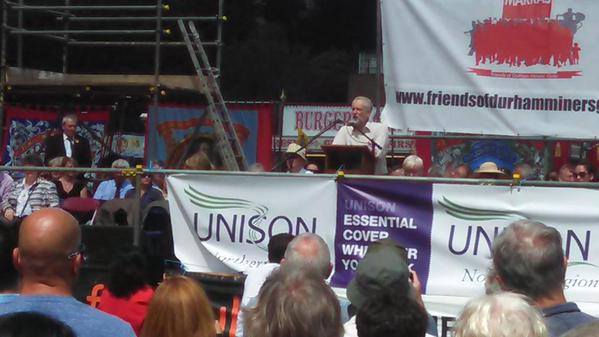
Jeremy Corbyn speaks against TTIP at Durham Miners Gala

11695892_859530877415623_7150417838458484968_nJeremy Corbyn speaking at the Durham Miners Gala, The Sands.

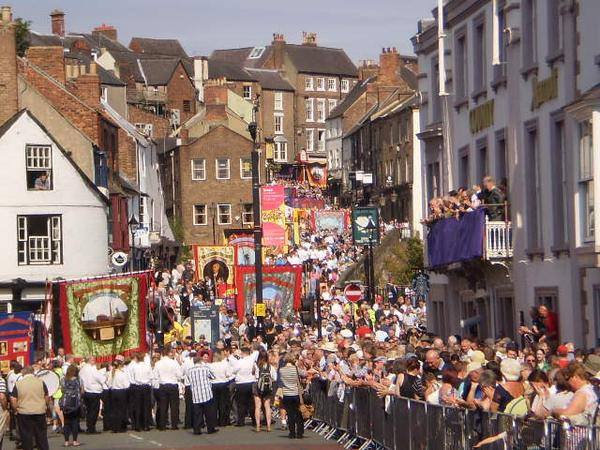
Durham gala

 Durham Miners Gala, Framwellgate Bridge

syzygysue's avatarThink Left

In an inspiring and comprehensive speech, Jeremy Corbyn spelt out the aspirations [sic] that the left should have for any future Labour government.. a race to the top, not Osborne’s welfare for the rich and cuts for the poorest and the young.  An end to homelessness, hunger, the selling-off of publicly owned assets, zero hours contracts, food banks – that every child matters (not just the first two), solidarity with the trade unions and above all else, an end to the callous and unnecessary ‘Austerity’.

Jeremy specifically emphasised the threat of the US-EU trade deal TTIP… NAFTA on Steroids. He called for TTIP’s rejection not only in terms of its well publicised threat to the NHS and public services but also because of the international threat that it poses to worker and environmental protection legislation across Europe, the UK and the US.

In this speech, Jeremy Corbyn demonstrates by example, just how…

View original post 149 more words

Inquiry needed into GCHQ’s spying on us

The following letter was published in the Guardian on Friday 10 July, 2015, from representatives of three leading human rights organisations, who have called on the prime minister David Cameron to launch an inquiry into why the intelligence services spied illegally on Amnesty International.

The revelation that GCHQ has been monitoring its communications came in a revised judgment this month from the Investigatory Powers Tribunal (IPT), the body responsible for handling complaints about state surveillance:

One measure of a free society is how it treats its NGOs and campaign organisations. The recent revelation (Rights groups targeted by GCHQ spies, 23 June) that Amnesty International has been snooped on by the UK security services is the death of the canary in the coalmine.

Ever since whistleblower Edward Snowden revealed the existence and scale of the US and UK mass surveillance programmes two years ago, campaign groups across the world have been worried that we are being spied on. We now know definitively that Amnesty International and the Legal Resources Centre in South Africa were. That is likely to be just the tip of the iceberg.

We only know what little we do because GCHQ fell foul of its own internal rules on handling communications once they had been intercepted.

As human rights organisations, we all work regularly with victims of abuses and government critics. That vital work is put in jeopardy if people can justifiably fear that their confidential communications with us might be opened up by governments.

Many questions remain. Which other organisations are being spied on? What confidential information was GCHQ looking at? Why was it of interest? Who read it? Was it shared? Is it still going on? How did it come to this?

David Cameron must immediately set up an independent inquiry into how spying on law-abiding human rights organisations was allowed to happen, and what justification there could possibly be for such an invasive and chilling violation of privacy.

Kate Allen, UK director, Amnesty International
Shami Chakrabarti, Director, Liberty
Gus Hosein, Executive director, Privacy International

Any plan to bypass or ban end-to-end encryption will only be of limited help in spying on terrorists. Though only the new permitted encryption schemes would be used in officially available apps, the fact that working encryption standards are open source and available means that anyone determined enough could program their own applications which use them. Terrorists are known to adapt their methods quickly, the public is not. I wonder why the spy masters and government are so determined to push through such legislation.

Mustafa Aydin,
Department of computer science, University of York.

In a separate letter sent by Amnesty to Cameron, the human rights group asks for an urgent meeting with the prime minister and for “as much as possible” of the IPT’s secret findings to be published.

Kate Allen, Amnesty UK’s director, said:

It’s absolutely shocking that Amnesty International’s private correspondence was deemed fair game for UK spooks, who have clearly lost all sense of what is proportionate or appropriate.

A key measure of a free society is how it treats its charities and NGOs. Snooping on charities is a practice straight out of the KGB handbook. If Amnesty International is being spied on, then is anyone safe?

Downing Street said it was considering its response to Amnesty International’s letter, repeating the government statement given at the time of the IPT judgment:

The IPT has confirmed that any interception by GCHQ in these cases was undertaken lawfully and proportionately, however technical errors were identified.

GCHQ takes procedure very seriously. It is working to rectify the technical errors identified by this case and constantly reviews its processes to identify and make improvements.”

3742

Satellite receiver dishes at a GCHQ facility near Bude, Cornwall.

“Snooping on charities is a practice straight out of the KGB handbook.”

And I thought the Tories were claiming to be minarchist types, with state shrinking aims …

Photograph: Education Images/UIG/Getty.

How Covert Agents Infiltrate the Internet to Manipulate, Deceive, and Destroy Reputations – Glenn Greenwald

One of the many pressing stories that remains to be told from the Snowden archive is how western intelligence agencies are attempting to manipulate and control online discourse with extreme tactics of deception and reputation-destruction. It’s time to tell a chunk of that story, complete with the relevant documents.

Over the last several weeks, I worked with NBC News to publish a series of articles about “dirty trick” tactics used by GCHQ’s previously secret unit, JTRIG (Joint Threat Research Intelligence Group). These were based on four  classified  GCHQ  documents presented to the NSA and the other three partners in the English-speaking “Five Eyes” alliance.

Today, we at the Intercept are publishing another new JTRIG document, in full, entitled “The Art of Deception: Training for Online Covert Operations.”

By publishing these stories one by one, our NBC reporting highlighted some of the key, discrete revelations: the monitoring of YouTube and Blogger, the targeting of Anonymous with the very same DDoS attacks they accuse “hacktivists” of using, the use of “honey traps” (luring people into compromising situations using sex) and destructive viruses.

But, here, I want to focus and elaborate on the overarching point revealed by all of these documents: namely, that these agencies are attempting to control, infiltrate, manipulate, and warp online discourse, and in doing so, are compromising the integrity of the internet itself.

Among the core self-identified purposes of JTRIG are two tactics: (1) to inject all sorts of false material onto the internet in order to destroy the reputation of its targets; and (2) to use social sciences and other techniques to manipulate online discourse and activism to generate outcomes it considers desirable.

To see how extremist these programs are, just consider the tactics they boast of using to achieve those ends: “false flag operations” (posting material to the internet and falsely attributing it to someone else), fake victim blog posts (pretending to be a victim of the individual whose reputation they want to destroy), and posting “negative information” on various forums.

Here is one illustrative list of tactics from the latest GCHQ document we’re publishing today:

Other tactics aimed at individuals are listed here, under the revealing title “discredit a target”:

Then there are the tactics used to destroy companies the agency targets:

GCHQ describes the purpose of JTRIG in starkly clear terms: “using online techniques to make something happen in the real or cyber world,” including “information ops (influence or disruption).”

Critically, the “targets” for this deceit and reputation-destruction extend far beyond the customary roster of normal spycraft: hostile nations and their leaders, military agencies, and intelligence services. In fact, the discussion of many of these techniques occurs in the context of using them in lieu of “traditional law enforcement” against people suspected (but not charged or convicted) of ordinary crimes or, more broadly still, “hacktivism”, meaning those who use online protest activity for political ends.

The title page of one of these documents reflects the agency’s own awareness that it is “pushing the boundaries” by using “cyber offensive” techniques against people who have nothing to do with terrorism or national security threats, and indeed, centrally involves law enforcement agents who investigate ordinary crimes:

No matter your views on Anonymous, “hacktivists” or garden-variety criminals, it is not difficult to see how dangerous it is to have secret government agencies being able to target any individuals they want – who have never been charged with, let alone convicted of, any crimes – with these sorts of online, deception-based tactics of reputation destruction and disruption.

There is a strong argument to make, as Jay Leiderman demonstrated in the Guardian in the context of the Paypal 14 hacktivist persecution, that the “denial of service” tactics used by hacktivists result in (at most) trivial damage (far less than the cyber-warfare tactics favored by the US and UK) and are far more akin to the type of political protest protected by the First Amendment.

The broader point is that, far beyond hacktivists, these surveillance agencies have vested themselves with the power to deliberately ruin people’s reputations and disrupt their online political activity even though they’ve been charged with no crimes, and even though their actions have no conceivable connection to terrorism or even national security threats.

As Anonymous expert Gabriella Coleman of McGill University told me, “targeting Anonymous and hacktivists amounts to targeting citizens for expressing their political beliefs, resulting in the stifling of legitimate dissent.” Pointing to this study she published, Professor Coleman vehemently contested the assertion that “there is anything terrorist or violent in their actions.”

Government plans to monitor and influence internet communications, and covertly infiltrate online communities in order to sow dissension and disseminate false information, have long been the source of speculation.

Harvard Law Professor Cass Sunstein, [co-author of “Nudge”], a close Obama adviser and the White House’s former head of the Office of Information and Regulatory Affairs, wrote a controversial paper in 2008 proposing that the US government employ teams of covert agents and pseudo-independent advocates to “cognitively infiltrate” online groups and websites, as well as other activist groups.

Sunstein also proposed sending covert agents into “chat rooms, online social networks, or even real-space groups” which spread what he views as false and damaging “conspiracy theories” about the government. Ironically, the very same Sunstein was recently named by Obama to serve as a member of the NSA review panel created by the White House, one that – while disputing key NSA claims – proceeded to propose many cosmetic reforms to the agency’s powers (most of which were ignored by the President who appointed them).

But these GCHQ documents are the first to prove that a major western government is using some of the most controversial techniques to disseminate deception online and harm the reputations of targets. Under the tactics they use, the state is deliberately spreading lies on the internet about whichever individuals it targets, including the use of what GCHQ itself calls “false flag operations” and emails to people’s families and friends.

Who would possibly trust a government to exercise these powers at all, let alone do so in secret, with virtually no oversight, and outside of any cognizable legal framework?

Then there is the use of psychology and other social sciences to not only understand, but shape and control, how online activism and discourse unfolds. Today’s newly published document touts the work of GCHQ’s “Human Science Operations Cell,” devoted to “online human intelligence” and “strategic influence and disruption”:

Under the title “Online Covert Action”, the document details a variety of means to engage in “influence and info ops” as well as “disruption and computer net attack,” while dissecting how human beings can be manipulated using “leaders,” “trust,” “obedience” and “compliance”:

The documents lay out theories of how humans interact with one another, particularly online, and then attempt to identify ways to influence the outcomes – or “game” it:

We submitted numerous questions to GCHQ, including: (1) Does GCHQ in fact engage in “false flag operations” where material is posted to the Internet and falsely attributed to someone else?; (2) Does GCHQ engage in efforts to influence or manipulate political discourse online?; and (3) Does GCHQ’s mandate include targeting common criminals (such as boiler room operators), or only foreign threats?

As usual, they ignored those questions and opted instead to send their vague and nonresponsive boilerplate: “It is a longstanding policy that we do not comment on intelligence matters. Furthermore, all of GCHQ’s work is carried out in accordance with a strict legal and policy framework which ensures that our activities are authorised, necessary and proportionate, and that there is rigorous oversight, including from the Secretary of State, the Interception and Intelligence Services Commissioners and the Parliamentary Intelligence and Security Committee. All our operational processes rigorously support this position.”

These agencies’ refusal to “comment on intelligence matters” – meaning: talk at all about anything and everything they do – is precisely why whistleblowing is so urgent, the journalism that supports it so clearly in the public interest, and the increasingly unhinged attacks by these agencies so easy to understand. Claims that government agencies are infiltrating online communities and engaging in “false flag operations” to discredit targets are often dismissed as conspiracy theories, but these documents leave no doubt they are doing precisely that.

Whatever else is true, no government should be able to engage in these tactics: what justification is there for having government agencies target people – who have been charged with no crime – for reputation-destruction, infiltrate online political communities, and develop techniques for manipulating online discourse? But to allow those actions with no public knowledge or accountability is particularly unjustifiable.

Documents referenced in this article:

Controversial GCHQ Unit Engaged in Domestic Law Enforcement, Online Propaganda, Psychology Research – Glenn Greenwald and Andrew Fishman

Introduction

A visit by Government national security agents on Saturday 20 July 2013 to smash up computers at The Guardian newspaper office in London hit the news surprisingly quietly, when Edward Snowden exposed a gross abuse of power and revealed mass surveillance programmes by American and British secret policing agencies (NSA and GCHQ) last year. (More detailed information here).

David Miranda, partner of Glenn Greenwald, the Guardian interviewer of the whistleblower Edward Snowden, was held for 9 hours at Heathrow Airport and questioned under the Terrorism Act. Officials confiscated electronics equipment including his mobile phone, laptop, camera, memory sticks, DVDs and games consoles.

This was a profound attack on press freedoms and the news gathering process, and Greenwald said:

“To detain my partner for a full nine hours while denying him a lawyer, and then seize large amounts of his possessions, is clearly intended to send a message of intimidation.”

Absolutely. Since when was investigative journalism a crime?

Since it flies in the face of an increasingly authoritarian and psychocratic government that exercises rigid control over public access to information, and manipulates public perceptions and behaviours.

Sure, it sounds like the basis of a conspiracy theory doesn’t it?

But it’s not.

___

The following article was originally posted on The Intercept site by Glenn Greenwald and Andrew FishmanReproduced here with thanks.


The spy unit responsible for some of the United Kingdom’s most controversial tactics of surveillance, online propaganda and deceit focuses extensively on traditional law enforcement and domestic activities — even though officials typically justify its activities by emphasizing foreign intelligence and counterterrorism operations.

Documents published today by The Intercept demonstrate how the Joint Threat Research Intelligence Group (JTRIG), a unit of the signals intelligence agency Government Communications Headquarters (GCHQ), is involved in efforts against political groups it considers “extremist,” Islamist activity in schools, the drug trade, online fraud and financial scams.

Though its existence was secret until last year, JTRIG quickly developed a distinctive profile in the public understanding, after documents from NSA whistleblower Edward Snowden revealed that the unit had engaged in “dirty tricks” like deploying sexual “honey traps” designed to discredit targets, launching denial-of-service attacks to shut down Internet chat rooms, pushing veiled propaganda onto social networks and generally warping discourse online.

Early official claims attempted to create the impression that JTRIG’s activities focused on international targets in places like Iran, Afghanistan and Argentina. The closest the group seemed to get to home was in its targeting of transnational “hacktivist” group Anonymous.

While some of the unit’s activities are focused on the claimed areas, JTRIG also appears to be intimately involved in traditional law enforcement areas and U.K.-specific activity, as previously unpublished documents demonstrate. An August 2009 JTRIG memo entitled “Operational Highlights” boasts of “GCHQ’s first serious crime effects operation” against a website that was identifying police informants and members of a witness protection program. Another operation investigated an Internet forum allegedly “used to facilitate and execute online fraud.” The document also describes GCHQ advice provided “to assist the UK negotiating team on climate change.”

Particularly revealing is a fascinating 42-page document from 2011 detailing JTRIG’s activities. It provides the most comprehensive and sweeping insight to date into the scope of this unit’s extreme methods. Entitled “Behavioral Science Support for JTRIG’s Effects and Online HUMINT [Human Intelligence] Operations,” it describes the types of targets on which the unit focuses, the psychological and behavioral research it commissions and exploits, and its future organizational aspirations. It is authored by a psychologist, Mandeep K. Dhami.

Among other things, the document lays out the tactics the agency uses to manipulate public opinion, its scientific and psychological research into how human thinking and behavior can be influenced, and the broad range of targets that are traditionally the province of law enforcement rather than intelligence agencies.

JTRIG’s domestic and law enforcement operations are made clear. The report states that the controversial unit “currently collaborates with other agencies” including the Metropolitan police, Security Service (MI5), Serious Organised Crime Agency (SOCA), Border Agency, Revenue and Customs (HMRC), and National Public Order and Intelligence Unit (NPOIU). The document highlights that key JTRIG objectives include “providing intelligence for judicial outcomes”; monitoring “domestic extremist groups such as the English Defence League by conducting online HUMINT”; “denying, deterring or dissuading” criminals and “hacktivists”; and “deterring, disrupting or degrading online consumerism of stolen data or child porn.”

It touts the fact that the unit “may cover all areas of the globe.” Specifically, “operations are currently targeted at” numerous countries and regions including Argentina, Eastern Europe and the U.K.

JTRIG’s domestic operations fit into a larger pattern of U.K.- focused and traditional law enforcement activities within GCHQ.

Many GCHQ documents describing the “missions” of the “customers” for which it works make clear that the agency has a wide mandate far beyond national security, including providing help on intelligence to the Bank of England, to the Department for Children, Schools and Families on reporting of “radicalization,” to various departments on agriculture and whaling activities, to government financial divisions to enable good investment decisions, to police agencies to track suspected “boiler room fraud,” and to law enforcement agencies to improve “civil and family justice.”

Previous reporting on the spy agency established its focus on what it regards as political radicalism. Beyond JTRIG’s targeting of Anonymous, other parts of GCHQ targeted political activists deemed to be “radical,” even monitoring the visits of people to the WikiLeaks website. GCHQ also stated in one internal memo that it studied and hacked popular software programs to “enable police operations” and gave two examples of cracking decryption software on behalf of the National Technical Assistance Centre, one “a high profile police case” and the other a child abuse investigation.

The JTRIG unit of GCHQ is so notable because of its extensive use of propaganda methods and other online tactics of deceit and manipulation. The 2011 report on the organization’s operations, published today, summarizes just some of those tactics:

Throughout this report, JTRIG’s heavy reliance on its use of behavioral science research (such as psychology) is emphasized as critical to its operations. That includes detailed discussions of how to foster “obedience” and “conformity”:


In response to inquiries, GCHQ refused to provide on-the-record responses beyond its boilerplate claim that all its activities are lawful.

———

Documents published with this article:

Eugenics is hiding behind Hitler, and it informs Tory and Labour policies.

eugenics

One of the commentators on this site raised some interesting issues, in response to part of an article that I wrote, which warrant some discussion.

I had said: “Eugenics is now embodied in economic acts, carried out by a government that has systematically rigged the neoliberal market, the act of [state] murder simply requires policies that leave the poorest and the most vulnerable people without support to meet their basic survival needs, denial from government that this is happening, and then it’s just a matter of withholding or hiding the evidence ….  the Right are and always have been Social Darwinists.”

The response: “I think you exaggerate a bit by bringing in eugenics – which was a deliberate attempt to wipe out/sterilise large proportions of the poor, whereas here it’s only a side effect that the powerful aren’t particularly concerned about.

There is a strong sense of the ‘deserving and undeserving poor’ in Tory narratives though, and I find the lack of empathy mindboggling. Particularly as David Cameron himself had a severely disabled son, so must have first-hand knowledge of the expensive nature of care for the disabled.

I don’t disagree with them [the Tories] being Social Darwinists at all – there is a brutal ‘survival of the fittest’ logic to many of their policies in practice. But eugenics is different – I don’t believe that anyone in the current government actually wants the poor and disabled to be dead or infertile, just that they don’t want to pay to support them. There’s a small, but important, distinction between neglect and genocide.” 

There are several facets to my initial response. Firstly, eugenics is tightly entwined with social Darwinist ideology. Charles Darwin’s theory of natural selection and concept of the “struggle for existence,” presented in his On the Origin of Species in 1859, captivated the minds of biologists and policy makers. Darwin’s ideas also played to the dangerously receptive imaginations of certain members of Victorian society. It resonated strongly with ideological individualism and with laissez faire economics – the dominant paradigm of the era.  The ideas became embedded in political and economic theory and policies.  Francis Galton, Darwin’s half-cousin, introduced his own controversial idea—the theory of eugenics—in 1883.  He used “natural selection” as the basis of his theory to describe selective breeding in humans as a means to improve the “fitness” of the human race. These ideas were part of a broader notion of  “progress” during the era of modernity.  Any idea that aims at ensuring the “survival of the fittest” is essentially eugenic.

The cross-over of natural selection themes from “science” into political and social thinking is reflected in the fact that it was a sociologist, not a scientist, who coined the term “survival of the fittest” – the very Conservative Herbert Spencer.

Neoliberalism, which has been the dominant framework of socio-economic organisation since the Thatcher era, is underpinned with eugenic notions. It justifies “competitive individualism” and both creates and legitimises wide economic inequalities. 

While the government may not be committing conspicuous murder, people ARE dying as a consequence of Conservative policies. Ethically, is there any difference between withdrawing lifeline support for vulnerable citizens and letting “nature take its course” on the one hand, and taking up more visible and overt methods of eliminating perceived “faulty” traits” and disposing of “undesirable” people on the other? Some people call the government’s “eugenics by indifference'”approach ‘democide‘, rather than genocide.

However,  policies tend to have INTENDED aims and consequences.

The pertinent question is: are the well-documented welfare-related deaths an intentional consequence of Conservative policies or simply because of government “neglect” regarding consequences of their policies? Does withdrawing essential state support for the poorest citizens, disabled citizens and vulnerable social groups constitute eugenics? 

I think it does. A government that kills citizens, regardless of the means that are used, is not a democratic one. Nor is it in any way liberal. 

The objectives of democide include the disintegration of the political and social institutions of culture, language, national feelings, religion, and the economic existence of national groups; the destruction of the personal security, liberty, health, dignity; and sometimes, the lives of the individuals belonging to such groups. While genocide is regarded generally as political murder on the basis of race, democide covers a broader definition to include those killed in large numbers as a result of government policies, regardless of ethnicity. 

There is an intimate and historical connection between Social Darwinism and eugenics, which is worth some discussion, because ideology has considerable bearing on policies, and policies may be regarded as objective statements of political intent regarding how a government thinks society should be socioeconomically organised.

Social Darwinism was one of the pillars of fascism and Nazi ideology, and the consequences of the application of policies based on notions of “survival of the fittest” by the Nazis drove the eugenics program, which eventually created a very powerful international backlash against the theory, culminating in the Universal Declaration of Human Rights

Social Darwinists interpret human society primarily in terms of biology, struggle, competition, and natural law (a philosophy based on what are considered to be the immutable characteristics of human nature). Social Darwinism characterises a variety of past and present social policies and theories. Social Darwinism explains the philosophical rationalisation behind racism, imperialism, capitalism and eugenics.

The term quite rightly has negative implications for most people because we consider it a rejection of democracy,  decency, compassion, civilisation and social responsibility, and a devaluing of human life.

Neoliberalism is incompatible with democracy, human rights and notion of equality. It is all about competitive individualism and it also normalises  inequality. Neoliberal ideology has become a throw back to the New Poor Law of 1834. The poorest are financially punished for being poor, while the very wealthy are consistently rewarded for being rich. It doesn’t take a genius to work out why inequality is so high in the UK, or why poverty continues to grow. When Tories, and more recently, the Labour government tell us they want to ‘grow the economy’ we should be asking ‘for whom’? Who will benefit from this? Because so far, all we see is government policies that make the poorest citizens even poorer. We are gradually being excluded from economic consideration, and the poorest are seeing their lifeline support ripped away. 

Any social policy based on an underpinning philosophy of Social Darwinism –  explicitly or implicitly – invariably has eugenic implications. Modern eugenics was rooted in the Social Darwinism of the late 19th century, and is used to justify a hierarchy of entitlement to rights, State withdrawal of support for the most marginalised (and vulnerable) social groups, with all of its associated metaphors of fitness, competition, and intrinsic, tautological rationalisations of inequality.

I want to make clear at this point that any consideration of the political and psychosocial processes that culminated in the atrocities of the Holocaust is not in any way an attempt to trivialise those events. Quite the contrary. In recognising the processes that important researchers such as Gordon Allport identified – the unfolding stages involved in the growth of prejudice in a society that manifests othering, outgrouping, and permits a society to incrementally discriminate and hate over time – and in drawing parallels, we may try to ensure that such atrocities never happen again.

Allport's ladder

Eugenic theories are most commonly associated with Nazi Germany’s racially motivated social policies. The Nazis sought the improvement of the Aryan race or Germanic Ubermenschen – master race – through eugenics, which was the foundation of Nazi ideology.

Those people targeted by the Nazis were identified as life unworthy of Life Lebensunwertes Leben – including but not limited to the “idle”, “insane”, “degenerate”, “dissident”, “feeble-minded”, homosexual and the generally weak, for elimination from the chain of heredity. More than 400,000 people were sterilised against their will, whilst 275,000 were killed under Action T4, a “euthanasia” programme.

However, there is quite a broad definition of eugenics and I propose that because it has been so thoroughly discredited, it has been forced to “go incognito” over the last century. The public support for eugenics greatly waned after the fall of Nazi Germany and the Nazis’ attempt to use eugenic justifications for the Holocaust at the Nuremberg Trials.

Right-wing philosopher, Roger Scruton, said in an article in the American Spectator: “The once respectable subject of eugenics was so discredited by Nazism that “don’t enter” is now written across its door,” implying he would like to see more openness to eugenics as an idea. In a way, he does make a valid point, because when what was once stated explicitly becomes implicit and tacit – normalised – it is difficult to oppose and challenge, essential debate is therefore stifled.

Eugenics is the infamous idea that governments should decide which kinds of citizens ought to be considered desirable – the consensus tends to be that these are white, athletic, intelligent, and wealthy – and which kinds of citizens ought to be considered undesirable – these tended to be black, Jewish, disabled, or poor –  and employ the power of the State to encourage increases of desirable citizens (positive eugenics) and encourage decreases of undesirable citizens (negative eugenics).

Eugenics is specifically State interference in and engineering of the “survival of the fittest”. That is happening here in the UK, with Tory policies like the extremely punitive welfare “reforms”, which are aimed at the most vulnerable citizens – such as those who are seriously ill and/or disabled – all too often denying them the means to meet basic survival needs.

The founder of eugenics, Sir Francis Galton, who was a half-cousin of  Charles Darwin, formulated the idea that the protection afforded by civil society had prevented the kind of natural selection occurring in Darwin’s Origin of Species from happening in humans, thus perpetuating the existence of “weak and feeble-minded” people who would have been unable to survive in the “state of nature”.

Thomas Malthus went further, and is most often considered the founding father of this ideology of profound antihumanism: he also believed that giving support to the needy would only imperil everyone else, because resources are limited, so the brutal reality was that it was better to let them starve. Malthus held the belief that the poor are akin to a “horde of vermin whose unconstrained aspirations and appetites endanger the natural order”: that tyrannical measures are necessary to constrain humanity.

It was Malthus that offered a pseudo-scientific basis for the idea that human reproduction always outstrips available resources. Following this pessimistic and inaccurate assessment of the capacity of human ingenuity to develop new resources, Malthus advocated oppressive policies that led to the starvation of millions in India and Ireland.

Malthus’s position as professor at the British East India Company training college gave his theories considerable influence over Britain’s administration of India through most of the nineteenth century, which led to the official response of neglect to India’s periodic famines.

Malthus wrote about restraints on population growth which included famine, disease and war. His theory was later used to explain the British government policy of maintaining agricultural exports from Ireland during the Great Famine (1845-49) in which at least 1.5 million people died of starvation or the side-effects of malnutrition, and at least another million immigrated.

Malthus was also very influential in bringing about the punitive Poor Law Amendment Act of 1834. His work, An Essay on the Principle of Population, was a product of that era, it resonated with the laissez-faire framework of competitive individualism, and the dominant socio-political paradigm. It remains influential today, despite being thoroughly discredited, not least by social history since his time of writing.

Prior to the Holocaust, eugenics was widely accepted in the UK. Malthus’s ideas on population control and Spencer’s Social Darwinism fitted neatly into the sociopolitcal ideological framework. The ruling elite feared that offering medical treatment and social services to disabled people would undermine the natural struggle for existence and lead to the degeneration of the human race.

Those ideas, once explicitly endorsed, are now implicitly captured in policies and Conservative narratives about sanctions, “conditionality,”  “making work pay,” (compare with the principle of less eligibility enshrined in the New Poor Law) “fairness,” “incentives,” “scroungers,” and so forth. A crucial similarity with the early part of the century and now is reflected in Tory austerity rhetoric – a perceived shortage of resources for health and welfare. Another parallel is the scapegoating process and a rise in the level of social prejudices and sociopolitical discrimination.

Anti-immigration rhetoric, reflected in the media, with the vilification of sick and disabled people and the poor, has preceded policies particularly aimed at the steady removal of State support indicating a clear scapegoating process, and this isn’t indicative of a government that is “neglectful”- it is patently intentional, hence the pre-emptive “justification” narratives to garner public support and acceptance towards such punitive and harsh policies.

So, the first purpose of such justification narratives is to make cruel and amoral policies seem acceptable. However, such propaganda narratives also serve to intimidate the targeted minority, leading them to question whether their dignity and social status is secure. In many instances, such intimidation is successful.

Furthermore, this type of hate speech is a gateway to harassment and violence. (See Allport’s scale of prejudice, which shows clearly how the Nazis used this type of propaganda and narrative to justify prejudice, discrimination, to incite hatred and ultimately, to incite genocide.)

As Allport’s scale indicates, hate speech and incitement to genocide start from often subtle expressions of prejudice. The dignity, worth and equality of every individual is the axiom of international human rights. International law condemns statements which deny the equal worth of all human beings. This is for very good reason.

Article 20(2) of the ICCPR requires states to prohibit hate speech. Hate speech is prohibited by international and national laws, not because it is offensive, but rather, because it amounts to the intentional degradation and repression of groups that have been historically oppressed. In the UK, we have a government that endorses the repression of the historically oppressed.

Social Darwinists generally argue that the “strong” should see their wealth and power increase while the weak should see their wealth and power decrease. In most contemporary western societies these views tend to emphasise competition between individuals for resources in a neoliberal State. In the UK, this idea is very apparent in the policies of the conservative-led government, and previously, we saw similar views from Thatcher.

The biological concept of “adaptation” is used by the Right to claim that the rich and powerful are better adapted to the social and economic climate of the time, and the concept of natural selection perpetuates the supremacist argument that it is natural, normal and proper for the strong to thrive at the expense of the weak.

Notions of deserving and undeserving poor flourished at a time when Social Darwinism and eugenics where widely acceptable here in the UK. The utilitarianism of Jeremy Bentham and John Stuart Mill, identifying moral actions in public policy as those which produce the greatest good for the greatest number, also support the contention that, whilst in the short term the interests of the poor would seem to be supported by public relief, the ultimate result of relief is detrimental to their interests.

Social Darwinism was popular in the late Victorian era in England, America, and elsewhere and the ethical philosophies of Conservatives are underpinned by a strongly elitist view based on the pseudo-scientific arguments of “adaptation and natural selection.” The Victorian era has made a deep impact upon many contemporary Conservatives, such as Gove and Osborne.

Michael Gove has written: For some of us Victorian costume dramas are not merely agreeable ways to while away Sunday evening but enactments of our inner fantasies … I don’t think there has been a better time in our history” in “Alas, I was born far too late for my inner era”.

A better time for whom, precisely? It was a time of child labour, desperation, prostitution, low life expectancy, disease, illiteracy, workhouses, and a truly dog-eat-dog social perspective. Or was it the deferential protestant work ethic reserved only for the poor, the pre-destiny of the aristocracy, and “the rich man in his castle, the poor man at his gate” that appeals to Gove?

In a speech to the Confederarion of British Industry, (CBI) George Osborne argued that both parties in the coalition had revitalised themselves by “revisiting their 19th-century roots.”

Herbert Spencer’s Social Darwinism, with his dictum “the survival of the fittest” – he was a sociologist, not a biologist – provided further support for the view that the “vices” of the lowest class in society make such persons undeserving of help from those who were financially privileged. (“Us” are the fittest: “Them” – the “Other” – are not.)

It is but a short step from the eugenics movement of the early twentieth century to the radical individualism of Ayn Rand, the latter’s popularity on the Right continuing to support a Conservative libertarian celebration of selfishness – “Nobody is mine.”

And:1965037_301820166635705_1502392114_n (1)
Conservatives have always seen society and human relationships in terms of hierarchies, based on “red in tooth and claw” Darwinist conflict. A hierarchy is any system of persons or things ranked one above the other, on the basis of human worth.

The term was originally used to describe the system of church government by priests graded into ranks. Organised religion is very hierarchical. Hierarchical thinking is about seeing the world through systems of  worth, domination or importance. But the central principle of human rights is that each have equal worth: that we are all equally important. But hierarchies ensure that privilege and decision-making is not socially distributed. Nor is power.

The very way that Tories think leads to a collision between their ideology and our human rights, and is completely incompatible with the principles of equality and democracy. Tories think that some people hold a more important place in society than others. This reduces people – they become inferiors or superiors, and really, that is about unequal distribution of power, subordination and domination – those power relationships are no longer entirely notional, we have moved some distance from being a liberal democracy these past four years – and feudalism and manorialism are very Tory ideals. 

It’s worth noting that disabled people have been disproportionately affected by the government’s austerity programme. People are dying prematurely because the government has radically cut their lifeline support, leaving them without the means to meet their fundamental survival needs.

To summarise, there are strong links between the neoliberal idea of competitive individualism, Social Darwinism, social inequalities, eugenics, nationalism, fascism and authoritarianism. Those ideas are implicit in Tory rhetoric, because they form the very foundations of Tory ideology. A society with inequalities is and always has been the ideologically founded and rationalised product of Conservative Governments. Inequality is at the heart of ‘competitive individualism’ which is at the heart of neoliberal ideology. In any competitive system, there are always a handful of ‘winners’ and many more ‘losers’. 

Robert Michel’s iron law of oligarchy describes the inevitable tendency of hierarchical organisations to become oligarchic in their decision making – anti-democratic. And prejudice is an in-built feature of hierarchy, because of the stratified nature of power, esteem and status.  Right-wing populism so often takes the form of distrust of the European Union, and of politicians in general, combined with anti-immigrant rhetoric, and a call for a return to “traditional, national values”.

Those “traditional values” that the Tories cherish, and often speak about, mean the end of our hard-earned rights, the end of any principle of the equal worth of everyone, the end of government accountability and increasingly, legal restraint, the end of democracy, the end of access to social opportunities, the end of any meaningful citizen autonomy. Yet these are civilising conditions. The Tories would prefer to have us outwardly oppressed and inwardly repressed, and fighting amongst ourselves for ever-decreasing resources.

This government’s schadenfreude, the intent and motivation behind the draconian policies that we’ve seen this past four years, which target the most vulnerable citizens most of all, is debated.

Some people believe that the policies are a consequence of a redistribution of wealth from the poorest to the wealthy rather than being malicious acts. But the Tories laughed on hearing the accounts of suffering of the poor because of the bedroom tax and an increasing dependency on food banks, for all to see, during parliamentary debate with the opposition.

But entertaining the idea for a moment that the inflicted suffering is not a motivation but rather, a consequence, well that would make the Government at the very least indifferent, callous and unremorseful, since they show a supreme lack of concern for the plight of those least able to defend themselves against injustice and inflicted poverty. And such indifference contravenes fundamental human rights. It breaches international laws.

Either way, I feel shock and anger at the recognition that all of those principles and beliefs we held dear – such as justice, fairness, democracy, freedom, Government accountability, equality (at least in terms of the worth of each life), institutionalised philanthropy – all trodden under foot by advocates of Social Darwinism – an aristocratic elite – in just four years. And the faith we each had in those collective ideals undermined by the constant perpetuation of socially divisive propaganda tactics from the Right.

Dividing people by using blame and prejudice further weakens our opposition to oppression. It’s a strategy the Tories have mastered.

Government policies are expressed political intentions, regarding how our society is organised and governed. They have calculated socio-economic aims and consequences. None of the policies that this government have formulated regarding the “support and care” of some of the most vulnerable citizens could be seen as anything other than expressions of intentional harm.

Services and support have been cut, lifeline benefits have been restricted by a variety of means, such as the revolving door process application of the work capability assessment, benefit sanctions, the mandatory reconsideration process.

Where is the investigation into the very high number of deaths associated with the Tory-led welfare reforms? The government have been made aware of those deaths through parliamentary debate, yet they persist in denying any “causal link” with the significant increase of sick and disabled people dying and their savage cuts to lifeline benefits. If there is no causal link, an inquiry would demonstrate that, surely?

It’s a universally recognised fact that if people are prevented from meeting their basic survival needs, they will die. Benefit sanctions, and cuts to welfare and public services, the rising cost of living and the depression of wages are having a detrimental effect on many. I don’t imagine that it’s the case that everyone but the government are aware of this. Yet the harmful policies remain.

The Coalition will leave more debt than all Labour governments since 1900. The current government’s now responsible for £517 billion of the trillion-plus-pound UK public debt, compared to £472 billion accrued during the 33 years Labour led the country since the turn of the twentieth century.

And the figures look even worse when you adjust for inflation. When you do that, the Coalition’s share jumps to nearly half of the total debt.

But the Coalition don’t meet any public’s needs, they simply serve the wants of the 1%. Labour invested in public services, the Tories have bled them dry. So, what have they done with the money? Because the public have seen only austerity cuts.

These policies are intentional. Withholding State support for poor, disabled, ill and vulnerable people – paid for via our taxes – is a deliberate act.

While our government have been busy denying the eugenics-by-stealth consequences of their diabolical policies in this Country, back in 2012, the Guardian exposed the fact that the British government has spent millions of pounds funding a policy of forced sterilisation of the poor in India as part of an effort to reduce human population to “help combat climate change”. But we also know that many Tories deny climate change exists.

The governments of China and India practice hard eugenics, underwritten by American and British tax money, these are coercive measures undertaken by governments to decrease citizen population.  The exposure of support for hard eugenics prompted denial and backtracking.  United Nations Population Fund (UNFPAclaims to support “voluntary family planning” in China. They assume that women, who are aware that conceiving a second child will result in a forced abortion, are free to make choices – thus the forced abortion is a State arrangement entered into “voluntarily.”

Hard eugenics is the ideology that is hiding behind Hitler. But soft eugenics  is based on the same pathological belief – that a government should spend its resources to prevent the propagation of those who the government believes to be “detrimental” to society and economic production. It won’t be long before there is some UK policy that imposes a restriction on the number of children poor people may have – probably “soft” eugenic policy, initially. Perhaps a limit on the number of children that unemployed or underemployed families may claim support for. Of course that will have ghastly ramifications for the human rights of children, since it would discriminate against a child on the grounds of when he/she was born.

Here in the UK, our government has been quite explicit in its drive to end “the something for nothing culture”. Our taxes  have been handed out to the wealthy and State support has been steadily withdrawn from the vulnerable. Government policies are an explicit statement of political and socio-economic intentions.

Policies based on Social Darwinism and eugenics cannot be justified. Our morality is liberated from the biological, reductionist constraints of evolutionary thinking. We relate to one another through culture, shared histories, language, morality, and law. Even if it were true that we are biologically determined – fixed by evolution, as intentional beings, we are not culturally fixed.

There is a difference between what we are, and who we are. There is also a difference between what is and what ought to be. The theories of Social Darwinism, eugenics and sociobiology involve biological reductionism. A recognition of the importance of biological conditions and even “human nature” need and ought not involve biological reductionism. And to embrace reductionism is to ultimately deny our capacity for making rational choices.

But we exceed the limits of reductionism and determinism every time we make any claim to knowledge (including those claims of reductionism and determinism), make a choice, discuss ethics and morals, explore possibilities, create, discover, invent – we are greater than the sum of our parts. The humanist ideas of human potential have never interested the Tories.

However, humanist principles, particularly those of Maslow, are very closely connected to our human rights and the development of our welfare state. Maslow’s psychology about possibility, not restraints. His metaphysics were all about the possibilities of change and progress, within a democratic framework. These ideas run counter to Tory ideology.

It’s therefore of no surprise that the Tory-led Coalition has steadily eroded our welfare and public service provisions and that Cameron has stated plainly that he fully intends to repeal the Human Rights Act and withdraw from the European Convention on Human Rights

This is a government that chooses to treat our most vulnerable citizens brutally, with absolutely no regard for their legal and moral obligation to ensure that our taxes are used to meet our most basic needs.

There can be no justification for editing or repealing the Human Rights Act itself, that would make Britain the first European country to regress in the level and degree of our human rights protection. It is through times of recession and times of affluence alike that our rights ought to be the foundation of our society, upon which the Magna Carta, the Equality Act and the Human Rights Act were built – protecting the vulnerable from the powerful and ensuring those who govern are accountable to the rule of law, and as an instrument of equality, social cohesion and public purpose.

It is expected of a democratic government to improve the understanding and application of the Act. That is an international expectation, also. Quite rightly so.

Observation of human rights distinguishes democratic leaders from dictators and despots. Human Rights are the bedrock of our democracy, they are universal and are a reflection of a society’s and a governments’ recognition of the equal worth of every citizens’ life.

We need to ask, in light of the issues I’ve raised here, why would any government want to opt out of such protections for its citizens?

We know from history that a society which isn’t founded on the basic principles of equality, decency, dignity and mutual respect is untenable and unthinkable.

scroll2

Article 2 of the Convention on Human Rights uses the following definitions of genocide, amongst others:

  • Killing members of the group
  • Causing serious bodily or mental harm to members of the group.
  •  Deliberately inflicting on the group conditions of life calculated to bring about its physical destruction in whole or in part
  • Imposing measures intended to prevent births within the group
  •  Forcibly transferring children of the group to another group

The right to life contained in Article 2:

  • Prohibits the State from intentionally killing;
  • and  requires an effective and proper investigation into all deaths caused by the State.

14533697838_dffcc736f2_o (1)

Pictures courtesy of Robert Livingstone

My work isn’t funded and I don’t get paid to write. But you can support Politics and Insights, and help me to continue researching, analysing and writing independently.

The smallest amount is much appreciated, and helps to keep my articles free and accessible to all – thank you.

And a massive thank you to those who have already contributed.

DonatenowButton
cards

JP Morgan wants Europe to be rid of social rights, democracy, employee rights and the right to protest

 Published: June 25, 2013

I read a very worrying article from Richard Murphy, director of Tax Research UK.


His article was originally posted in Good Society

JP Morgan

Murphy says: In late May, J P Morgan issued a chilling review of what they saw as the state of progress on tackling the Eurozone crisis. As they put it:

“The narrative of crisis management in the Euro area has two dimensions: first, designing new institutions for the next steady state (EMU-2); and second, dealing with the national legacy problems, some of which were there at EMU’s launch and some of which arose during the first decade of the monetary union’s life.”

Their assessment of progress is:

Sovereign deleveraging—about halfway there.

• Real exchange rate adjustment—almost there for a number of countries.

• Household deleveraging in Spain—about a quarter of the way there in stock terms, but almost there in flow terms.

• Bank deleveraging—hard to say due to heterogeneity across countries and banks, but large banks have made a lot of progress.

• Structural reform—hard to say but progress is being made.

Political reform—hardly even begun.

I could comment on the first five issues, but it is the last that is most chilling. A view of  ‘the journey of national political reform’ as they see it:

“At the start of the crisis, it was generally assumed that the national legacy problems were economic in nature. But, as the crisis has evolved, it has become apparent that there are deep seated political problems in the periphery, which, in our view, need to change if EMU is going to function properly in the long run. The political systems in the periphery were established in the aftermath of dictatorship, and were defined by that experience.

Constitutions tend to show a strong socialist influence, reflecting the political strength that left wing parties gained after the defeat of fascism. Political systems around the periphery typically display several of the following features: weak executives; weak central states relative to regions; constitutional protection of labor rights; consensus building systems which foster political clientalism; and the right to protest if unwelcome changes are made to the political status quo. The shortcomings of this political legacy have been revealed by the crisis.

Countries around the periphery have only been partially successful in producing fiscal and economic reform agendas, with governments constrained by constitutions (Portugal), powerful regions (Spain), and the rise of populist parties (Italy and Greece).

There is a growing recognition of the extent of this problem, both in the core and in the periphery. Change is beginning to take place. Spain took steps to address some of the contradictions of the post-Franco settlement with last year’s legislation enabling closer fiscal oversight of the regions. But, outside Spain little has happened thus far. The key test in the coming year will be in Italy, where the new government clearly has an opportunity to engage in meaningful political reform. But, in terms of the idea of a journey, the process of political reform has barely begun.” 

What J P Morgan is making clear is that socialist’ and democratic  inclinations  must be removed from political structures; localism must be replaced with strong, central, authority; labour rights must be removed, consensus (call it democracy if you will) must cease to be of concern and the right to protest must be curtailed.

This is an agenda for hard right, corporatist, centrist government. There’s another word for that, and it’s what the bankers seem to want.

You have been warned. Amazingly, they had the nerve to issue the warning.”


564882_438358886199493_1982719183_n

Part 2: They mean business – Kitty S Jones

“Fascism should more appropriately be called Corporatism because it is a merger of state and corporate power” – attributed to Benito Mussolini, but probably came from Giovanni Gentile, the philosopher of fascism, in the first edition of the Italian Encyclopedia (Enciclopedia Treccani).

“The real corruption that has eaten into the heart of British public life is the tightening corporate grip on government and public institutions – not just by lobbyists, but by the politicians, civil servants, bankers and corporate advisers who increasingly swap jobs, favours and insider information, and inevitably come to see their interests as mutual and interchangeable… Corporate and financial power have merged into the state.” – Seumus Milne

JP Morgan’s proto-fascist document can be accessed here: The Euro Area Adjustment—About Half-Way There. Firstly, they say that financial measures are ‘necessary’ to ensure that major investment houses such as JP Morgan can continue to reap huge profits from their speculative activities in Europe. Secondly, the authors maintain, it is necessary to impose ‘political reforms’ aimed at suppressing opposition to the massively unpopular austerity measures being imposed at the behest of the banks. 

The authors write: “The political systems in the periphery were established in the aftermath of dictatorship, and were defined by that experience. Constitutions tend to show a strong socialist influence, reflecting the political strength that left-wing parties gained after the defeat of fascism.

“Political systems around the periphery typically display several of the following features: weak executives; weak central states relative to regions; constitutional protection of labour rights; consensus-building systems which foster political clientalism; and the right to protest if unwelcome changes are made to the political status quo. The shortcomings of this political legacy have been revealed by the crisis.

Whatever the historical inaccuracies in their analysis, there can not be the slightest doubt that the authors of the JP Morgan report are arguing for governments to adopt authoritarianism to complete the process of social counterrevolution to austerity that is already well underway across Europe.

What JP Morgan is making clear is that anything resembling ‘socialism’ or inclinations towards the left of the spectrum must be removed from political structures; localism must be replaced with strong, central authority; labour rights must be removed, consensus (democracy) and the right to protest must be curtailed.

In short, JP Morgan are calling for extremely authoritarian measures to suppress the working class and wipe out its social gains since the post-war settlement. This is the proto-fascism and reflects the unadulterated anti-philanthropic voice of  neoliberalism, which is incompatible with human rights, social liberalism and democracy.

Fascism

Some additional information:

Harriet BaldwinConservative MP for West Worcestershire is the former managing director of JP Morgan Asset Management. 

JP Morgan are major players in healthcareAccording to their website they serve: 1,100 hospitals, 8 of the top 10 health insurers, thousands of physicians groups, top five pharmacy benefit managers, six of the top eight pharmacy retailers. JP Morgan are very heavily invested in healthcare.

See also: Corporate power has turned Britain into a corrupt state.

We are witnessing increasing privatisation of key State functions – particularly in previously “untouchable” areas, such as policing and our legal system. The coercive functions of the State are being subsumed by private corporate entities. These are very frightening developments with horrific implications – for example, many citizens will no longer have a right to access to justice: an inalienable right to a free and fair trial. This is an established, fundamental human right, and it’s expected that human rights and laws are observed and upheld by a so-called free democratic and liberal State.

Chomsky’s concept of Necessary Illusions in Manufacturing Consent is linked to powerful elites dominating how life happens – shaping human experiences – and most people, some 90% of the population, are marginalised, diverted from political awareness, participation in self-governing, and reduced to apathy so they don’t vote or take responsibility for the quality of our lives, as a social collective. Media are a tool of society’s elites and owned and controlled by them and are used to impose those illusions – propaganda tools – that are necessary to keep people diverted from participation, empowerment, and the political process.

Chomsky said that the major form of authority that really needs challenging is the system of private control over public resources. Such privatisation (and economic enclosure) is something our own government is galloping along with at full tilt. It’s a system that entails the dispossession of the majority of citizens (the 99%) by a wealthy and powerful minority (the 1%).

“The real corruption that has eaten into the heart of British public life is the tightening corporate grip on government and public institutions – not just by lobbyists, but by the politicians, civil servants, bankers and corporate advisers who increasingly swap jobs, favours and insider information, and inevitably come to see their interests as mutual and interchangeable… Corporate and financial power have merged into the state.” – Seumus Milne.

Hello America.

Chomsky believes (and so do I) that our biggest hope lies with ordinary people and in the understanding that all changes in history have come because people build a foundation for change at a grassroots level. Ordinary people are very capable of understanding the world, yet must work TOGETHER to get beyond the imposed information and strive to act in accordance with their own decent interests, developing independent minds and critical thought.

Chomsky asserts that in order to break free, citizens must take 2 actions:

1. They must seek out information from ALTERNATIVE MEDIA (media outside of the mainstream)

2. They must move toward change by becoming engaged in (cooperative) community action – because people can use their ordinary intelligence to make changes in their lives and communities. Grassroots movements begin there. And we must also practice what we preach. If we want a more equal society, we must treat each other as equals. If we value human rights, we must also recognise the fundamental fact that each life has equal worth. 

So, my friends, we have already begun this journey here, as our own virtual community, and now we must continue to build and grow.

That means we have to learn to be cooperative, mutually supportive, strong and purposeful. We have to stay focused, refuse to be diverted or divided by superficial difference. We have to be united, because this really is a fight; it’s a battle that we must win.

All that is decent and civilised depends on us winning, because the Tory-led coalition are not going to suddenly see the error of their ways and begin to recognise and realise the equal worth of all human lives, nor are they going to stop prioritising generating profits for their sponsors and donors over and above the fundamental priority of human lives, and as is increasingly the case now – it is often at the expense of those lives that private companies prosper.

The dominant ideology – neoliberalism – is propped up by ideals of competing interests, artificial divisions, divide and rule strategies, and elitist psychological egoism. We need to stand outside of that to breath and to survive, ultimately.

We know that the Coalition have served the needs of private companies very well via “business friendly” policies, and that has been at the expense of recognising the human needs of many. Indeed “costs not needs” ought to be the mantra of the Tories, and reflects very well what we see: the shifting priority and funding of public services that meet social needs to private companies that exist solely to generate profit, and they do this by cutting cost and providing services as cheaply and as barely as possible.

This is all propped up by an overarching New Right Conservative brand of ideology. We see the once discredited notions of competitive individualism  and social Darwinism embedded in contemporary media narratives, and at the heart of draconian policies. Ideology is mainstreamed and naturalised.

Those brutal policies threaten the very fabric of our civilised, democratic  society, and undermine the quality and authenticity of our experiences as human beings.

“Competition may be the law of the jungle, but cooperation is the law of civilization.” – Peter Kropotkin

Further Reading:

Corporate Research Project: JPMorgan Chase

Is JPMorgan Chase America’s Most Corrupt Bank?

Dimon’s JPMorgan Chase: Why It’s the Scandal of Our Time

JPMorgan Chase Manipulation Scandal Raises Specter Of Enron

Why JPMorgan Wants to See More Americans on Food Stamps

Benefits payment in U.K. (banking operation)

The company (JP Morgan) is currently providing the banking license and the electronic benefits transfer banking engine for the card accounts of the Post Office for the financial issuances of the DWP, after an application to the High Courts of England and Wales on the 24th of January 2006 for transfer of banking operations from the previous provider Citibank. The deal of exchange of services was valued at $380,000,000. That’s £249,147,760.00.

That’s a lot of private profit to be had from a publicly funded social safety net originally designed to meet basic human needs in times of hardship.


I don’t make any money from my work. I am disabled because of illness and have a very limited income. But you can help by making a donation to help me continue to research and write informative, insightful and independent articles, and to provide support to others. The smallest amount is much appreciated – thank you. 

DonatenowButton

The Coming Tyranny and the Legal Aid Bill.

995147_204045783079811_467247470_n

“Ministers keep using the mantra that their proposals are to protect the most vulnerable when, quite obviously, they are the exact opposite. If implemented their measures would, far from protecting the most vulnerable, directly harm them. Whatever they do in the end, Her Majesty’s Government should stop this 1984 Orwellian-type misuse of language.”  – Lord Bach, discussing the Legal Aid Bill.

Source: Hansard, Column 1557, 19 May, 2011.

The Ministry of Justice’s “reforms” (Tory-speak for cuts) to legal aid undermine the fundamental principle of legal equality and violate Article 6(1of the European Convention of Human Rights: the right to a fair trial. They reflect a truly authoritarian agenda of legislative tyranny: the reforms effectively remove legal access for many, crucially that access ultimately safeguards individual liberty against intrusion by the State, and protects us from despotic abuses of authority.

The cuts will seriously undermine access to justice and sidestep the obligation of Government accountability. The cuts will affect the most disadvantaged and vulnerable in society and allow unlawful and unfair public body decision-making to go unchallenged.

The Equality and Human Rights Commission’s analysis in 2012 warned that reducing the scope of legal aid in a substantial number of areas in civil and family law will create serious practical barriers to access to justice, potentially in breach of Article 6(1) of the European Convention on Human Rights (ECHR).


The cuts to the civil legal aid budget, which came in to effect from April 2013, mean many cases, including those about debt, private family law, employment, welfare benefits, clinical negligence and housing problems are no longer eligible for funding.

This is at a time when the Government have implemented other radical, controversial and contentious cuts to health, education and welfare, and it is no coincidence that the legal aid Bill will curtail justice for those with legitimate needs at a time when draconian Tory policies such as the bedroom tax will most likely result in a massive increase of numbers of people needing and seeking redress.

This will mean the compounding of effects of other fundamental  human rights breaches, legally unchecked, because of the profound impact of multiple, grossly unfair and unjust Tory-led policies. Each policy hitting the same group of citizens, to their detriment, over and over.

This sends out a truly worrying message to those of us who believed we lived in a first world liberal democracy  (one that has recognition of  individual rights and freedoms embedded in its Constitution, and one in which decisions from direct or representative processes prevail in State policies.) The promotion of equal opportunity to legal justice is the bedrock of a free and democratic society. It ought to be inclusive of all who cannot afford to be tried fairly. The reality is only a few can afford the legal costs to enforce contracts and against criminal prosecution. This profoundly unjust inequality is not something we expect to see in a Country which was once a beacon of Western liberty.

Even if we were to take a Conservative perspective, it’s still the case that the only way to wed the principle of a “pursuit of economic liberty” with wider justice is by a basic notion of equality before the law, through the equal access to justice. This means that the State must fund the means of contract enforcement and free and fair trial legal costs, for those who cannot afford it. If the State fails to fulfil this contingent function, then we simply cease to be free.

“Legal aid will continue to be provided to those who most need it, such as where domestic violence is involved, where people’s life or liberty is at stake or the loss of their home. But in cases like divorce, courts should be a last resort, not first. Evidence shows that mediation can often be more successful and less expensive for all involved.”  –  Chris Grayling.

Section 10 of LASPO (Legal Aid, Sentencing and Punishment of Offenders Act 2012) provides the new Director of legal aid casework with the power to provide ‘exceptional funding’ for cases that are out of scope. Part 8 of the Civil Legal Aid (Procedure) Regulations 2012 indicates that providers of legal services will not have delegated powers to grant exceptional funding. Instead, an application must be made to the Director for an ‘exceptional case determination’.

Section 10(3) of LASPO states that an exceptional case determination is a determination:
a) that it is necessary to make the services available to the individual under this part because failure to do so would be a breach of:

1) the individual’s convention rights (within the meaning of the Human Rights Act 1998), or
2) any rights of the individual to the provision of legal services that are enforceable EU rights, or
b) that it is appropriate to do so, in the particular circumstances of the case, having regard to any risk that failure to do so would be such a breach.

This misses a very crucial point: it’s very dangerous to allow the State to decide which cases constitute the most need. In a free, democratic and fair Society, each and every single individual has equal legal worth and entitlement to opportunity to bring about legal justice. The Government choosing which cases are most “worthwhile” undermines this very premise of legal equality which is so fundamental to the notion of liberty. Everybody has a right to take any grievances they have, which have invoked legal ramifications, to court. Everybody ought to have an absolute, inalienable right to free and fair trial in a free, democratic and liberal country.

Having cut the civil legal aid budget by £320m, the Ministry of Justice proposes to cut the criminal legal aid budget by a further £220m. Legal contracts are to be based on competitive tendering. One of the outcomes of the reform and cut to the budget is that defendants on legal aid will no longer be offered a choice of solicitor.

One of the most unfair aspects of this system is that if you are charged, the State will select a prosecutor with specialist experience in that area of the law, funded by the taxpayer. Be it a sexual offences case, a road traffic death, a murder, a drugs case or a serious assault, in each case, a prosecutor will be picked to prosecute you from a specialist team.

But when it comes to your defending yourself, however, you will be given no choice. You will either have the defence lawyer allocated by the State or you will be on your own. This cannot be right. Many legal experts have voiced their alarm at this, because it will  invariably lead to gross injustices.

Large commercial firms who are going to be paid, win or lose, will have a vested interest to encourage their clients to plead guilty, whether they are or not. At a time when people are at their most vulnerable they need a local service that listens, not a business, whose goal will be to turn around the case as fast and cheaply as possible.

The scope for dangerous consequences due to vested interests in the justice system following Justice Secretary Chris Grayling’s “reforms” is considerable, and allows potential for further erosion of legal freedom. In some cases,  the sole choice of lawyer for a defendant via legal aid will also be a representative for the organisation with an interest in ensuring a prosecution. The  tendering process – where the cheapest bid wins – would be run by companies with no record of providing legal services, resulting in a dumbing down of the profession and a race to the bottom that will mean citizens being denied access to quality legal aid.

As is always the case when private companies that are driven solely by the profit motive are involved in any service, cases will be run on the cheap by under-qualified, inexperienced, low-cost staff. The company Serco, for example, provides prison security guards. Serco is one company bidding for the legal contracts with the Legal Aid Agency. The Department of Justice has proposed to remove defendants’ automatic right to select their own solicitors to make the contracts to bidders more profitable.

I have no doubt that the Coalition wants to see access to justice removed for those affected by its nightmarish, dystopian policies. Those people affected most of all are some of our most vulnerable citizens, as the cuts have been disproportionately aimed at the poorest, at sick and disabled people, and those who are unemployed. Injustice increases and extends vulnerability, especially for those groups of people already experiencing marginalisation.

We need look no further than Clause 99 of the welfare “reform” Act to see how silencing those seeking redress is a priority for this Government. This is also about hiding the evidence of the dire consequences of the “reforms”, since large numbers of successful appeal outcomes highlight, for example, that the Work Capability Assessment (WCA) is grossly unfair and widely inaccurate. Yet despite almost 11,000 deaths, many of which have been attributed to the stress of the assessment process itself, and to people being wrongfully assessed, the Government have not even instigated an inquiry into the WCA. Had an auto-mobile been associated with such a high number of deaths, it would have been withdrawn. Yet we still have the WCA, and incredibly, no willingness for an investigation from our perennially indifferent Tory-led Government.

Those wishing to appeal wrongful decisions by Atos/The Department of Work and Pensions (DWP) that they are “fit for work” after having their Employment Support Allowance (ESA) unfairly  removed will find that this will be an almost impossible task, since their right to legal aid has been removed. The introduction of the  Mandatory Review in Clause 99 will mean that they have to wait an indefinite period without any ESA sickness benefit, or claim Job Seekers Allowance (JSA), whilst waiting for the DWP to conduct the review, with no time limit imposed on the DWP to do so.

That means signing on and declaring that you are fit  for work, and people are being told by the DWP, unbelievably, that they don’t qualify because they are not fit, or fully available for work. Others have been told that to claim JSA they need to close their ESA claim which means they cannot appeal a review decision. Basic rate ESA is exactly the same amount of money as JSA, so the Government cannot even claim this is a cost-cutting move.

And we also know that Atos are contracted by the Government to make “wrongful” decisions. 

The right to a lawyer of a persons’ choice, regardless of your income, race, gender or nationality, is an underpinning condition of a free and fair justice system. Having both a sense of, and access to choice over one’s legal representative, who is there to fight for justice is paramount to basic legal equality and liberty. When this choice is removed and legal representation is essentially imposed on a passive defendant by the State (if a defendant can still access legal aid at all, that is,) our justice system becomes unacceptably authoritarian.

And it has.

Further reading:

Guidance on the exceptional funding regime

The Public Law Project scheme to assist people with making exceptional funding applications

Government lawyers warn Justice Secretary Chris Grayling over proposed ‘unconscionable’ changes to legal aid

Cutting Legal Aid – the surest way to threaten Justice 

John Finnemore on The Now Show, discussing the injustice of the Legal Aid Bill

421077_263839013685634_1738380387_n

Update – In response to this article, a statement has been issued from the International Human Rights Commission, who say: “The IHRC strongly condemned the Bill and asked the UK Government to consider this action, which is against the norm of human rights”.

7005_494073677328832_658777491_n (1)

Pictures courtesy of Robert Livingstone


I don’t make any money from my work. But you can support Politics and Insights and contribute by making a donation which will help me continue to research and write informative, insightful and independent articles, and to provide support to others. The smallest amount is much appreciated, and helps to keep my articles free and accessible to all – thank you.

DonatenowButton