Category: Democracy

The new Work and Health Programme: government plan social experiments to “nudge” sick and disabled people into work


Illustration by Jack Hudson

The government’s Nudge Unit team is currently working with the Department for Work and Pensions and the Department of Health to trial social experiments aimed at finding ways of: “preventing people from falling out of the jobs market and going onto Employment and Support Allowance (ESA).”

“These include GPs prescribing a work coach, and a health and work passport to collate employment and health information. These emerged from research with people on ESA, and are now being tested with local teams of Jobcentres, GPs and employers.”

This is a crass state intrusion on the private and confidential patient-doctor relationship, which ought to be about addressing medical health problems, and supporting people who are ill, not about creating yet another space for obsessive political micromanagement. It’s yet another overextension of the coercive arm of the state to “help” people into work. Furthermore, this move will inevitably distort people’s interactions with their doctors: it will undermine the trust and rapport that the doctor-patient relationship is founded on.

In the current political context, where the government extends a brutally disciplinarian approach to basic social security entitlement, it’s very difficult to see how the plans to place employees from the Department for Work and Pensions in GP practices can be seen as anything but a threatening gesture towards patients who are ill, and who were, up until recent years, quite rightly exempted from working. Now it seems that this group, which includes some of our most vulnerable citizens, are being politically bullied and coerced into working, regardless of the consequences for their health and wellbeing.

Of course the government haven’t announced this latest “intervention” in the lives of disabled people. I found out about it quite by chance because I read Matthew Hancock’s recent conference speech: The Future of Public Services.

I researched a little further and found an article in Pulse which confirmed Hancock’s comment: GP practices to provide advice on job seeking in new pilot scheme.

Hancock is appointed Minister for the Cabinet Office and Paymaster General, and was previously the Minister of State for Business and Enterprise. He headed David Cameron’s “earn or learn” taskforce which aims to have every young person earning or “learning” from April 2017.

He announced that 18 to 21-year-olds who can’t find work would be required to do work experience (free labour for Tory business donors) as well as looking for jobs or face losing their benefits. But then Hancock is keen to commodify everyone and everything, including public data.

However his references to “accountability and transparency” don’t stand up to much scrutiny when we consider the fact that he recently laid a statement before parliament outlining details about the five-person commission that will be asked to decide whether the Freedom of Information act is too expensive and “overly intrusive.”

He goes on to say: “And this brings me onto my second area of reform: experimentation. Because in seeking to improve our services, we need to know what actually works.”

But we need to ask for whom services are being “improved” and for whom does such reform work, exactly?

And did any of the public actually consent to being experimented upon by the state?

Or to having their behaviour modified without their knowledge?

Now that the nudge unit has been privatised, it is protected from public scrutiny, and worryingly, it is also no longer subject to the accountability afforded the public by the Freedom of Information Act.

The Tory welfare “reforms” are a big business profiteering opportunity, whilst lifeline benefits are being steadily withdrawn: policy context

The current frame of reference regarding Conservative welfare policies is an authoritarian and punitive one. It’s inconceivable that a government proposing to continue cutting the lifeline income of sick and disabled people, including a further £120 a month to those people in the ESA Work Related Activity group (WRAG), will suddenly show an interest in actually supporting disabled people. There are also proposals to further limit eligibility for Personal Independence Payments (PIP) for sick and disabled people. 

From the shrinking category of legitimate “disability” to forcing people to work for no pay on exploitative workfare schemes, “nudge” has been used to euphemistically frame punitive policies, “applying the principles of behavioural economics to the important issue of the transition from welfare to work.” (From: Employing BELIEF: Applying behavioural economics to welfare to work, 2010.)

And guess who sponsored the “research” into “nudging” people into workfare? Steve Moore, Business Development Director from esg, which is a leading welfare to work and vocational skills group, created through the merger and acquisition of four leading providers in the DWP and LSC sector.” How surprising.

It’s even more unsurprising that esg was established by two Conservative donors with very close ties to ministers, and were subsequently awarded very lucrative contracts with the Department for Work and Pensions. I think there may have been a “cognitive bias” in operation there, too. But who is nudging the nudgers?

Of course the “aim” of the “research” is: “breaking the cycle of benefit dependency especially for our hardest to help customers, including the “cohort” of disabled people.”

However, there’s no such thing as a “cycle of benefit dependency”, it’s a traditional Tory prejudice and is based on historically unevidenced myths. Poverty arises because of socioeconomic circumstances that are unmitigated through government decision-making. In fact this government has intentionally extended and perpetuated inequality through its policies.

2020health – Working Together is a report from 2012 that promotes the absurd notion of work as a health outcome.  This is a central theme amongst ideas that are driving the fit for work and the work and health and programme. Developing this idea further, Dame Carol Black and David Frost’s Health at Work – an independent review of sickness absence was aimed at reviewing ways of “reducing the cost of sickness to employers, ‘taxpayers’ and the economy.” Seems that the central aim of the review wasn’t a genuine focus on sick and disabled people’s wellbeing and “health outcomes,” then. Black and Frost advocated changing sickness certification to further reduce the influence of GPs in “deciding entitlement to out-of-work sickness benefits.”

The subsequent “fit notes” that replaced GP sick notes (a semantic shift of Orwellian proportions) were designed to substantially limit the sick role and reduce recovery periods, and to “encourage” GPs to disclose what work-related tasks patients may still be able to perform. The idea that employers could provide reasonable adjustments that allowed people who are on sick leave to return to work earlier, however, hasn’t happened in reality.

The British Medical Association (BMA) has been highly critical of the language used by the government when describing the fit for work service. The association said it was “misleading” to claim that fit for work was offering “occupational health advice and support” when the emphasis was on sickness absence management and providing a focused return to work.

The idea that work is a “health” outcome is founded on an absurd and circular Conservative logic that people in work are healthier than those out of work. It’s true that they are, however, the government have yet again confused causes with effects. Work does not make people healthier: it’s simply that healthy people can work and do. People who have long term or chronic illnesses often can’t work. The government’s main objection to sick leave and illness more generally, is that it costs businesses money. As inconvenient as that may be, politically and economically, it isn’t ever going to be possible to cure people of serious illnesses by cruelly coercing them into work.

The government’s removal of essential in-work support for disabled people – such as the Independent Living Fund, and the replacing of Disability Living Allowance  with Personal Independence Payment in order to reduce eligibility, cut costs and “target” support to those most severely disabled, and the cuts to the Access To Work scheme – means that it is now much more difficult for those disabled people who want to work to find suitable and supported employment.

The politics of punishment

There’s a clear connection between the Nudge Unit’s obsession with manipulating “cognitive bias” – in particular, “loss aversion” – and the increased use, extended scope and severity of sanctions, though most people succumbing to the Nudge Unit’s guru effect (ironically, another cognitive bias) think that “nudging” is just about prompting men to pee on the right spot in urinals, or persuading us to donate organs and to pay our taxes on time.

When it comes to technocratic fads like nudge, it’s worth bearing in mind that truth and ethics quite often have an inversely proportional relationship with the profit motive.

For anyone curious as to how such tyrannical behaviour modification techniques like benefit sanctions arose from the bland language, inane, managementspeak acronyms and pseudo-scientific framework of “paternal libertarianism” – nudge – read this paper, focused almost exclusively on New Right obsessions, paying particular attention to the part about “loss aversion” (a cognitive bias according to behavioural economists) on page 7.

And this on page 18: The most obvious policy implication arising from loss aversion is that if policy-makers can clearly convey the losses that certain behaviour will incur, it may encourage people not to do it,” and page 46: “Given that, for most people, losses are more important than comparable gains, it is important that potential losses are defined and made explicit to jobseekers (e.g.the sanctions regime).” 

The recommendation on that page: We believe the regime is currently too complex and, despite people’s tendency towards loss aversion, the lack of clarity around the sanctions regime can make it ineffective. Complexity prevents claimants from fully appreciating the financial losses they face if they do not comply with the conditions of their benefit.”

The Conservatives duly “simplified” sanctions by extending them in terms of severity, frequency and by broadening the scope of their application to include previously protected social groups.

The paper was written in November 2010, prior to the Coalition policy of increased “conditionality” and extended sanctions element of the Tory-led welfare “reforms” in 2012.

Sanctioning welfare recipients by removing their lifeline benefit – originally calculated to meet the cost of only basic survival needs – food, fuel and shelter – isn’t about “arranging choice architecture”, it’s not nudging: it’s operant conditioning. It’s a brand of particularly dystopic, psychopolitical neobehaviourism, and is all about a totalitarian level of micromanaging people to ensure they are obedient and conform to meet the needs of the “choice architects” and policy-makers.

Nudge even permeates language, prompting semantic shifts towards bland descriptors which mask power and class relations, coercive state actions and political intentions. One only need to look at the context in which the government use words like “fair”, “support”, “help” “justice” and “reform” to recognise linguistic behaviourism in action. Or if you prefer, Orwellian doublespeak.

It’s rather difficult to see how starving people and threatening them with destitution can possibly improve the well-being of many socially excluded people, and help to bring them to inclusion.”

The conclusion that Ancel Keys drew from the Minnesota Starvation Experiment in the the US during the 1940s, (which explored the physical and psychological effects of undernutrition, and stressed the dramatic, adverse effect that starvation had on competence, motivation, behaviour, mental attitude and personality) was that “democracy and nation building would not be possible in a population that did not have access to sufficient food.”

No amount of bland and meaningless psychobabble or intransigent, ideologically-tainted policies can legitimize the economic sanctioning of people who are already poor and in need of financial assistance.

Apparently, citizenship and entitlement to basic rights and autonomy is a status conferred on only the currently economically productive. Previous employment and contributions don’t count as “responsibility,” and don’t earn you any rights – the government believes that citizens owe a perpetual debt of unconditional service to the Conservative’s steeply stratified economy. Not much of a social contract, then. Cameron says he wants to “build a responsible society” by removing people’s rights and reducing or removing their lifeline income. Presumably, free invisible bootstraps are part of the deal.

Government decision-making has contributed the most significant influence on “health outcomes.” Conservative policies have entailed a vicious cutting back of support and a reduction of essential provision for sick and disabled people. In fact this group have been disproportionately targeted for austerity cuts time and time again, massively reducing their lifeline income. It’s not being “workless” that has a detrimental impact on people’s health and wellbeing: it is the deliberate impoverishment of those requiring state aid and support, funded from the public purse, (including contributions from those who now need support), which is being dogmatically and steadily withdrawn.

Making work pay for whom?

If work truly paid, then there would be no need to incentivise” almost 1.2 million low-paid workers claiming the new universal credit with the threat of in-work benefit sanctions if they fail to “take steps to boost their earnings.”

It’s very difficult to see how punishing individuals for perhaps being too ill to work more that a few hours, or those working for low pay or part-time in the context of a chronically weak labour market, depressed wages and with little scope for effective negotiating and collective bargaining can possibly be justified. It’s an utterly barbaric way for a government to treat citizens.

Surely if the government was genuinely seeking to increase choices and to widen access to the workplace for sick and disabled people, it would not be cutting the very programmes supporting and extending this aim, such as the Access to Work scheme  – a fund that helps people and employers to cover the extra living costs arising due to disabilities that might present barriers to work – and the Independent Living Fund.

This government has pushed at the public’s rational and moral boundaries, establishing and attempting to justify a draconian trend of punishing those unable to work, and what was previously unthinkable – stigmatising and punishing legally protected social groups such as sick and disabled people – has become somehow acceptable. We are on a very slippery slope, clearly mapped out previously by Allport’s scale of prejudice.

People’s needs don’t disappear just because the government has decided to “pay down” an ever-growing debt and build a “surplus” by taking money from those that have the least. Or because the government doesn’t like “big state interventions.”

So the recent proposed cut to ESA – and this is a group of sick and disabled people deemed physically incapable of work by doctors – is completely unjustified and unjustifiable. No amount of pseudo-psychology and paternalist cruelty can motivate or “incentivise” people who are medically ill.

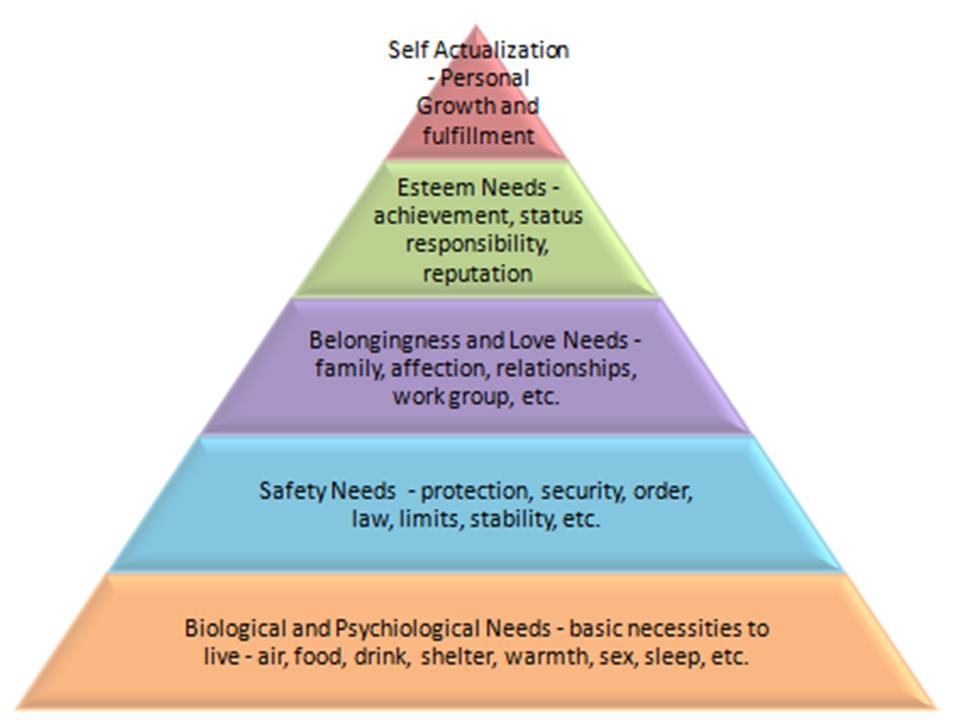
It’s for disabled individuals and their doctors – professionals, specialists and experts – to decide if a person can work or not, it’s not the role of the state, motivated only by a perverse economic Darwinist ideology. Maslow taught us that we must attend to our physiological needs before we may be motivated to meet higher level psychosocial ones.

Iain Duncan Smith is a zealot who actually tries to justify further punitive cuts to disabled people’s provision by claiming that working is “good” for people and is the only “route out of poverty.”

Presumably he believes work can cure people of the serious afflictions that they erroneously thought exempted them from full-time employment. 

He stated: “There is one area on which I believe we haven’t focused enough – how work is good for your health. Work can help keep people healthy as well as help promote recovery if someone falls ill. So, it is right that we look at how the system supports people who are sick and helps them into work.”

Duncan Smith undoubtedly “just knows” that his absurd claim is “right.” He’s never really grown out of his “magical thinking” stage, or transcended his dereistic tendencies. His department had to manufacture “evidence” recently in a ridiculous attempt to support Iain Duncan Smith’s imaginative, paternalist claim that punitive sanctions are somehow “beneficial” to claimants, by using fake characters to supply fake testimonials, but this was rumbled and exposed by a well-placed Freedom of Information request from Welfare Weekly.

Recent research indicates that not all work serves to “keep people healthy” nor does it ever “promote recovery.” This assumption that work can promote recovery in the case of people with severe illness and disability – which is why people claim ESA – is particularly bizarre. We have yet to hear of a single case involving a job miracle entailing people’s limbs growing back, vision being restored, or a wonder cure for heart failure, cerebral palsy, multiple sclerosis and lupus, for example.

The government’s Fit for Work scheme is founded on exactly the same misinformative nonsense. It supports profit-making for wealthy employers, at the expense of the health and wellbeing of employees that have been signed off work because of medically and professionally recognised illness that acts as a real barrier to work.

Furthermore, there is no proof that work in itself is beneficial. Indeed much research evidence strongly suggests otherwise.

And where have we heard these ideas from Iain Duncan Smith before?

Arbeit macht frei.

If work really paid then surely there would be no need to “nudge” people by using sanctions, regardless of whether or not they are employed. “Making work pay” is all about reducing support for those who the government deems “undeserving,” to “discourage welfare dependency” by making any support as horrible as the workhouse – founded on the principle of “less eligibility”, where conditions for those in need of support were punitive and kept people in a state of desperation so that even the lowest paid work in the worst of conditions would seem appealing.

The public/private divide

For a government that claims a minarchist philosophy, remarkably it has engineered an unprecedented blurring of public/private boundaries and a persistent violation of traditionally private experiences, including thoughts, beliefs, preferences, autonomy and attitudes via legislations and of course a heavy-handed fiscal conflation of public interests with private ones.

This also caught my attention from Matthew Hancock’s speech transcript:

“My case is that we need continuous improvement in public services. And for that we must reform the relationship between citizen and state. [My bolding]

“The case for reform is strong. Because people have high and rising expectations about what our public services should deliver. Because budgets are tight, and we have to make significant savings for our country to live within her means.”

Basically, the “paternalistic libertarian” message here is that we will have to expect less and less from the state, as the balance between rights and responsibilities is heavily weighted towards the latter, hence requiring the “reform” of the relationship between citizen and state.

However, surely it is active, democratic participation in processes of deliberation and decision-making that ensures that individuals are citizens, not subjects.

Social democracy evolved to include the idea of access to social goods and improving living standards as a means of widening and legitimizing the scope of political representation.

Political policies are defined as (1) The basic principles by which a government is guided. (2) The declared objectives that a government  seeks to achieve and preserve in the interest of national community. As applied to a law, ordinance, or Rule of Law, it’s the general purpose or tendency considered as directed to the welfare or prosperity of the state or community.

Once upon a time, policy was a response from government aimed at meeting public needs. It was part of an intimate democratic dialogue between the state and citizens. Traditional methods of participating in government decision-making include:

  • political parties or individual politicians
  • lobbying decision makers in government
  • community groups
  • voluntary organisations
  • public opinion
  • public consultations
  • the media

Nowadays, policies have been unanchored from any democratic dialogue regarding public needs and are more about monologues aimed at shaping those needs to suit the government. 

Nudge does not entail citizen involvement in either its origin or design. The state intrusions are at such an existential level, of an increasingly authoritarian nature, and are of course reserved for the poorest, who are deemed “irrational” and incapable of making “the right decisions.”

Yet those “faulty decisions” are deemed so from the perspective of the Behavioural Insights Team, (the “Nudge Unit”) who are not social psychologists: they are predominantly concerned with behavioural economics, decision-making and how governments influence people – “economologists”, changing people’s behaviours, enforcing compliance to fulfil political aims. That turns democracy completely on its head.

The Nudge Unit gurus claim that we need help to “correct our cognitive biases”, but those who make policies have their own whopping biases, too.

Nudge is the new fudging

Nudge is a prop for New Right neoliberal ideology that is aimed at dismantling a rights-based society and replacing it with an insidiously nudged, manipulated, compliant, and entirely “responsible”, “self-reliant” population of divided, isolated state-determined individuals who expect nothing from their elected government.

The Conservatives are obsessive about strict social taxonomies and economic enclosures. The Nudge Unit was set up by David Cameron in 2010 to try to “improve” public services and save money. The asymmetrical, class-contingent application of paternalistic libertarian “insights” establishes a hierarchy of decision-making “competence” and autonomy, which unsurprisingly corresponds with the hierarchy of wealth distribution.

So Nudge inevitably will deepen and perpetuate existing inequality and prejudice, adding a dimension of patronising psycho-moral suprematism to add further insult to politically inflicted injury. Nudge is a fashionable fad that is overhyped, trivial, unreliable; a smokescreen, a prop for neoliberalism and monstrously unfair, bad policy-making.

As someone who (despite the central dismal and patronising assumptions about the irrationality of others that king nudgers have as a central cognitive bias and the traditional prejudices that Tory ideology narrates,) manages to make my own decisions relatively without bias, intelligently, rationally, critically, carefully and coherently, and that, along with my professional and academic background, I can and will conclude that no matter how you dress it up, nudge is a pretentious, cringeworthy pseudo-intellectual dead-end.

 A Nudge for the Conservatives from history

The more things change for the Tories, the more they tend to stay the same.

In the 1870s, England had a recession and the Conservatives launched a Crusade of cuts to welfare expenditure to diminish “dependency” on poor law outdoor relief – non-institutional benefits called “out-relief” because it was paid to the poor in their own homes from taxation, rather than their having to go into the punitive “deterrent” workhouses.

The Crusade included cutting medical payments to lone mothers, widows, the elderly, chronically sick and disabled people and those with mental illness. The 1834 Poor Law amendment was shaped by people such as Jeremy Bentham, who argued for a disciplinary, punitive approach to social problems and particularly poverty, whilst Thomas Malthus focused attention on overpopulation, and moralising about the growth of illegitimacy. He placed emphasis on moral restraint rather than poor relief as the best means of easing the poverty of the lower classes. 

David Ricardo argued that there was a problem with poor relief provision “interfering” with an iron law of wages. Ricardo claimed that aid given to poor workers under the old Poor Law to supplement their wages had the effect of undermining the wages of other workers, so that the Roundsman System and Speenhamland system led employers to reduce wages, and needed reform to help workers who were not getting such aid and rate-payers whose poor-rates were going to subsidise low-wage employers. Yet we found, despite Ricardo’s pet theory, that the poor law deterrent element served to push wages down further.

The effect of poor relief, in the absurd view of the reformers, was to undermine the position of the “independent labourer.” They also wanted to “make work pay.” And end the “something for nothing” culture. But much subsequent evidence shows that reducing support for people out of work actually drives wages and working conditions down.

Neither the punitive poor law amendment act of 1834 or the Crusade “helped” people into work or addressed the lack of available paid work – that’s unemployment, not the made-up and intentionally stigmatizing word “worklessness”.

And its utter failure as a credible account of poverty – the-blame-the-individual narrative and the notion that relief discourages “self-reliance” – fuelled the national insurance act of 1911 and the development of the welfare state along with the other civilising and civilised benefits of the post-war settlement. 

The Conservatives inadvertently taught us as a society precisely why we need a welfare state.

We learned that it isn’t possible to be “thrifty” or help ourselves if we haven’t got the means for meeting basic survival needs. Nor is it possible to be nudged out of poverty when the means of doing so are not actually available. No amount of moralising and pseudo-psychologising about poor people actually works to address poverty, and structural socioeconomic inequalities.

The government’s undeclared preoccupation with behavioural change through personal responsibility is simply a revamped version of Samuel Smiles’s bible of Victorian and over-moralising, a hobby-horse: “thrift and self-help” – but only for the poor, of course. Smiles and other powerful, wealthy and privileged Conservative thinkers, such as Herbert Spencer, claimed that poverty was caused largely by the irresponsible habits of the poor during that era. But we learned historically that socioeconomic circumstances caused by political decision-making creates poverty.

Conservative rhetoric is designed to have us believe there would be no poor people if the welfare state didn’t somehow “create” them. If the Tories must insist on peddling the myth of meritocracy, then surely they must also concede that whilst such a system has some beneficiaries, it also creates situations of insolvency and poverty for others.

In other words, the same system that allows some people to become very wealthy is the same system that condemns others to poverty.

This wide recognition that the raw “market forces” of the old liberal laissez-faire (and the current starker neoliberalism) causes casualties is why the welfare state came into being, after all – because when we allow such competitive economic dogmas to manifest, there are invariably winners and losers.

That is the nature of “competitive individualism,” and along with inequality, it’s an implicit, undeniable and fundamental part of the meritocracy myth and neoliberal script. And that’s before we consider the fact that whenever there is a Conservative government, there is no such thing as a “free market”: in reality, all markets are rigged for elites.

Public policy is not an ideological tool for a so-called democratic government to simply get its own way. Democracy means that the voices of citizens, especially members of protected social groups, need to be included in political decision-making, rather than so frankly excluded.

We elect governments to meet public needs, not to “change behaviours” of citizens to suit government needs and prop up policy “outcomes” that are driven entirely by traditional Tory prejudice and ideology.

And by the way, we call any political notion that citizens should be totally subject to an absolute state authority “totalitarianism,” not “nudge.”
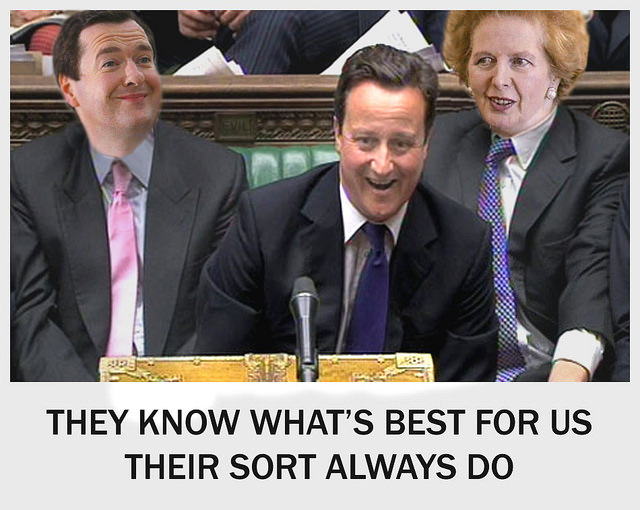
demcracy
Courtesy of Robert Livingstone

Update: The government have since announced the introduction of a number of “policy initiatives” aimed at reducing the number of people claiming Employment and Support Allowance (ESA). These initiatives are currently still at a research and trialing stage. Health Management, a subsidiary of MAXIMUS are to deliver the fit for work programme, which was set up based on recommendations from the Health at Work – an independent review of sickness absence report by Dame Carol Black and David Frost. The review was aimed at “reducing the cost of sickness to employers, ‘taxpayers’ and the economy.”

Fit for Work occupational health professional will have access to people’s diagnoses from their fit notes, the fit note end date and any further information that the GP considers relevant to their absence from work or current treatment (at the discretion of the GP). The primary referral route for an assessment for the Maximus programme will be via the GP.

The government is cutting funding for contracted-out employment support by 80%, following the Spending Review. The Department for Work and Pensions has indicated that total spending on employment will be reduced, including not renewing Mandatory Work Activity and Community Work Placements, the new Work and Health Programme will have funding of around £130 million a year – around 20% of the level of funding for the unsuccessful Work Programme and Work Choice, which it will replace.

Iain Duncan Smith says: “This Spending Review will see the start of genuine integration between the health and work sectors, with a renewed focus on supporting people with health conditions and disabilities return to and remain in work. We will increase spending in this area, expanding Access to Work and Fit for Work, and investing in the Health and Work Innovation Fund and the new Work and Health Programme.” 

Meeting the Government’s goal of halving the employment gap between disabled and non-disabled workers – moving around one million more disabled people into work – will be no easy task. Not least because despite Iain Duncan Smith’s ideological commitments, and aims to “reduce welfare dependency,” most disabled people who don’t work (and claim ESA) can’t do so because of genuine and insurmountable barriers such as incapacitating and devastating, life-changing illness. No amount of targeting those people with the Conservative doublespeak variant of “help” and nasty “incentivising” via welfare sanctions and benefit cuts will remedy that.


Jeremy Corbyn is being stalked by a pantomime horse

3359686

In a recent stage production called “Closing The Barn Door after the Chicken Coup,” a well-known actor who plays the rear end of a horse has complained how much he dislikes Labour party leaders, just on principle. He’s a Labour MP; he says that it’s good to have a hobby in his spare time.

“I hate them all. But more than any of them, I really feel that Corbyn is just too beardy, and I simply can’t get behind him,” says the sullen actor.

“I say neigh, neigh and thrice neigh. How very dare he. He’s only gone and appealed to the tens of thousands of new party recruits, enthusing them by his pesky kid anti-austerity messages. I’m worried that the electorate will spot what a sham Tory austerity is soon, because of such strong opposition from the extremists amongst them who are sick of being made poorer. That simply must not happen.

We can’t have a Labour party that is just about social things for any Tom, Dick or Harry. We need to look after big business. I know all about trickle down economics, being the back end of a mule. In the 1800s it was called the “horse and sparrow” theory. You feed the big horse all the oats and the many little sparrows get to feed in its wake. That’s what it’s all about. I say give all the money to the big private horses.”

I think he means that the public are being fed horse shit.

The actor claims to be a long-standing supporter and member of the Labour party, as well as a part-time MP. However, earlier this year he complained bitterly to the Daily Mail that the then party leader, Ed Miliband, is “a f****** knob.”  As Labour’s new self-appointed publicist, the actor has become famous for his nonsensical outbursts, controversial business interests and excessively large luvvie ego, which is the impressive size of a cathedral.

He told the Mail on Sunday: “I would be prepared to stand as a stalking horse against Jeremy Corbyn.”

“My only intention is to secure a better leader for the Labour party as they’re all rubbish, none of them are ever good enough, in my very important opinion. They need to be nagged. The person to do it is me me me!”

Although the actor says “We know that Labour only wins when it is united and when it is patriotic and speaks for the whole country,” he has nonetheless decided that unbridled disunity and carping about the party is the best way forward. From the back.

He says: “The only way forward for the Labour party is for them to stop opposing the Conservatives completely, especially on welfare cuts and austerity. This crazy left wing politics is nonsense and needs to stop.  And it would do us no harm to behave like blue-collar UKIP supporters. I say we should bring back hanging as well, that would get us elected as most of the public like reality TV entertainment and punishing the poor. We should do what the public want.”

When asked about his leading role as the rear end of a horse, he replied: “Farce doesn’t begin to describe my position any more, it’s the political equivalent of all the slapstick staples and stables rolled into one. But I make hay while the sun shines from my back end.”

He wouldn’t disclose the identity of the front end of the horse, despite the truth being right under his nose. But he has never been one to bury his head in the … sand, and said his real ambition was to progress and play the rear end of a rocking horse.

The actor complained that during the pantomime, the horses head kept pitching abruptly further and further to the right, whilst he couldn’t see where he was going. It made him feel very un-stable. But he added “It’s much better than turning left I suppose.”

He went on to say: “It’s a night mare. Sometimes it’s better to laugh than cry. Because the inescapable truth from here is painfully hard to countenance.”

It must be difficult to keep a tight reign from his position, which lends a form to his pressing sense of inadequacy. Yet despite his own unfortunate position, with his nose pressed firmly to the grind, the actor, left in the dark and certainly left behind, went on to say that “Corbyn should let his trousers fall down and John McDonnell plant a custard pie in his face.”

“The world’s my stage and I’m a horse’s ass”, he added.

A recent Gallop poll showed that many agree. He is.

images

Osborne’s tax credit cuts omnishambles

540525_186110078206715_79170441_n

The Chancellor, George Osborne, has recently announced that the Conservatives are a true “workers party”  – claiming that his opponents, the Labour Party, represent the unemployed. But the Conservatives are attempting to re-write history: the Labour Party grew from the Trade Union Movement, and have a strong tradition of supporting worker’s rights and fair wages, and of course the Unions have retained close institutional links with the Labour Party.

Osborne has argued, somewhat absurdly, that reducing tax credit payments to people in low paid jobs would give them “economic security” by reducing the Government’s spending deficit. Labour argues that the richest should pay to cut the deficit, and has identified cuts to tax avoidance and corporate subsidies that could replace cuts to the lowest paid. Osborne’s priorities reflect a traditional Conservative ideology.

As Richard Murphy, from Tax Research UK, points out:

“… the government is forcing the burden of risk bearing onto those least able to bear it in society – that is those with the lowest income. So just as we now know inequality, especially concerning wealth, is rising rapidly, insecurity is also increasing exponentially as risk is being passed from those with the capacity to bear it to those who have not.”

Osborne’s “long-term economic plan” isn’t without controversy. According to many economists, during recessions, the government can stimulate the economy by intentionally running a deficit. The budget deficit is the annual amount the government has to borrow to meet the shortfall between current receipts (tax) and government spending.

Of course, last year, serious doubts were raised regarding Osborne’s deficit targets after the treasury met a significant tax revenue shortfall. Osborne’s obsession with deficit cutting and the Conservative small-state ideology has clearly overlooked the problems created by poor pay and high living costs, which has impacted detrimentally at both a micro and macro level, creating an economic spiral of cuts and stagnation. And it has widened inequality significantly.

In order to keep his promises on further future tax cuts for higher earners, Osborne will invariably make even more cuts to public services, public sector pay and the social security safety net that are so deep they will severely damage both the economy and potentially, the fabric of our society.

The Institute for Fiscal Studies (IFS) have recently criticised George Osborne’s proposed tax credit cuts, because it is “at odds” with wider Conservative stated aims to “support hardworking families”.

Research conducted by the IFS calculated that only around quarter of money take from families through tax credit cuts would be returned by the new National “Living Wage”.

Tax credits are payments made by the Government to people on lower incomes, most of whom are in work.

It was announced today that the Work and Pensions Committee is holding an urgent evidence gathering session on the proposed reforms to the tax credit system on Monday 26 October. The Committee will question representatives of respected independent think tanks that have analysed the impact of the Conservative plans, including the IFS and the Resolution Foundation, who revealed that the planned welfare cuts will lead to an increase of 200,000 working households living in poverty by 2020, and that almost two-thirds of the cut would be borne by the poorest 30 per cent of households, whilst almost none of the cuts will fall upon the richest 40 per cent of households.

A Labour motion calling on the government to rethink the controversial tax credit cuts has been defeated in the Commons. But despite Labour losing the vote today, the debate saw a number of Tory MPs attack the proposed changes, too.

In her maiden speech today, Tory MP Heidi Allen said that her party risks betraying its values, as she voiced her opposition to tax credit cuts.

She suggested ministers were losing sight of the difficulties of working people in their “single-minded determination to achieve a [budget] surplus”. She also said that the tax credit changes do not pass the “family test”, warning that the pace of the reforms is “too hard and too fast”.

The opposition day motion called for a reversal of the policy but MPs voted against it by 317 to 295 – a government majority of just 22. Next week, the vote in the House of Lords was set to be far closer, with the very real possibility that on Monday, Peers would  vote to block the changes. Because the tax credit cut proposals were not in the Tory manifesto, it means they are not bound by the usual Salisbury convention that prevents the peers from blocking election promises.

Also, the tax credit cuts were not included in the Finance Bill, which normally enacts a Budget, and the opposition have used the opportunity to seize on the fact that a Statutory Instrument can be halted by a single House of Lords vote.

Mr Cameron effectively ruled out cutting the benefit before the election, telling a voters Question time that he “rejected” proposals to cut tax credits and did not want to do so.

The cuts are part of £12bn cuts to the social security budget that the Government is to make – the details of which the Conservatives refused to announce before the election.

However, in an unprecedented move, the Conservatives have threatened a constitutional “showdown”, and have refused to engage in dialogue with peers that want kill off the proposed Tory cuts. The government warned the House of Lords it would trigger a full-scale constitutional crisis by pressing ahead with their plans.

Despite the fact that the chancellor faces a growing rebellion against the cuts among Tory MPs, the government told the group of crossbench peers that they also “risked” a renewed push to weaken the powers of the upper house if they refused to back down.

The threats from the government that came because it was facing probable defeat on what is an extremely unpopular reform, even amongst their own party ranks, are truly remarkable, showing a contempt for democratic process and a lack of willingness to engage in transparent dialogue. They came after Lady Meacher, a crossbencher who is the former chair of the East London NHS Trust, threatened to table a “fatal motion” to kill off the cuts to tax credits.

The Tories do not have a majority in the Lords and faced defeat after Labour and the Liberal Democrats said they would support Lady Meacher.

It is understood that Meacher withdrew her fatal motion on Tuesday night and announced she would table a motion calling on the government to deliver a report responding to the warning by the Institute for Fiscal Studies that 3 million families would lose over £1,000 a year.

Meacher told the Guardian today:

My plan at the moment is to put down a motion which will prevent this regulation being approved on Monday, which will require the government to produce a report responding to the IFS analysis and consider mitigating action before bringing it back. This gives time to the House of Commons to go on doing what they are doing. There are Tory MPs horrified by this.

So we are giving the government time to think again, but the word fatal would not be appropriate. This is causing a great deal of consternation at government level and we are trying to find a way through which will ensure that the government revisits these regulations

This move will also allow time for the Work and Pensions Committee to gather further evidence to present to the government, too. The Committee have stated that they will ask representatives questions on the following topics;

  • The impact of the April 2016 tax credit cuts (in isolation and in the context of other welfare measures in the Summer Budget), and the National Living Wage
  • The winners and losers and their characteristics
  • The extent to which the National Living Wage will compensate individuals receiving lower tax credit payments
  • The distributional impact of these measures, individually and combined
  • The scale of the financial gains/losses to households and what influences this
  • The quality of the analysis produced by the Government to support their proposals
  • Other options for achieving savings from the tax credit system that will mitigate the impact on the least well off
  • The implications for work incentives and the Government’s wider objectives in welfare reform

Select Committees work in both Houses of parliament. They check and report on areas ranging from the work of government departments to economic affairs. The results of these inquiries are made public and the Government must respond to their findings.

A select committee is a cross-party group of MPs or Lords given a specific remit to investigate and report back to the House that set it up. Select committees are one of the key ways in which Parliament makes sure the Government is adequately scrutinised, held to account, and has to explain or justify what it is doing or how it is spending taxpayers’ money.

Committee findings are reported to the Commons, printed, and published on the Parliament website. The government then usually has 60 days to respond to the committee’s recommendations.

The Osborne omnishambles is far from done and dusted yet.

555114_453356604733873_1986499794_nPictures courtesy of Robert Livingstone

Tory rhetoric, the politics of psychobabble: it’s batshit telementalism and mystification

650
Oh come all ye faithful

The Conservative conference was a masterpiece of stapled together soundbites and meaningless glittering generalities. And intentional mystification. Cameron claims that he is going to address “social problems”, for example, but wouldn’t you think that he would have done so over the past five years, rather than busying himself creating them? Under Cameron’s government we have become the most unequal country in the European Union, even the US, home of the founding fathers of neoliberalism, is less divided by wealth and income than the UK.

I’m also wondering how tripling university tuition fees and reintroducing banding in classrooms can possibly indicate a party genuinely interested in extending equal opportunities.

“Champions of social justice and opportunities”? Must have been a typo in the transcript: it’s not champions but chancers.

Cameron also claims that the Conservatives are the “party for workers”, and of course lamblasted Labour. Again. Yet it was the Labour party that introduced tax credits to ensure low paid workers had a decent standard of living, and this government are not only withdrawing that support, we are also witnessing wages drop lower than all of the other G20 countries, since 2010, the International Labour Organisation reliably informs us.

This fall not only led to a tight squeeze on living standards, it also led to a shortfall in treasury income in the form of tax revenues. But all of this is pretty standard form for Conservative governments.

It’s interesting to note that the only standing ovation Cameron had for his speech from delegates was not related to policy proposals or even rhetoric. It was a response to the bitter, spiteful and typical Tory bullying approach to any opposition: in this case, an outburst of vindictive, unqualified personal comments, misquotes, misinformation and downright lies about Jeremy Corbyn.

It was more of the usual Conservative claptrap about Labour leaders “hating Britain”. Cameron used an out-of-context quote to paint Jeremy Corbyn as a “security-threatening, terrorist-sympathising, Britain-hating” leader. Cameron had failed to give any context to Mr Corbyn’s comments that he intentionally  misquoted, failing, for example, to mention the fact that Corbyn had said the lack of a trial for Bin Laden was the “tragedy”, not his death itself. The deliberate misquote, however, was met with a deft response from the Left, hoisting Cameron by his own petard.

Here is Cameron’s speech in full technicolour and spectacular ontological insecurity:

Cameron’s malicious comments reminded me again of the Tories’ history of dirty tricks, like the Zinoviev letter, the campaign against Harold Wilson, and made me think of the almost prophetic and increasingly less fictional A Very British Coup.

Even the BBC have called the Conservatives out on their very nasty anti-democratic propaganda campaign against Corbyn.

From the deluge of incoherent commentaries to the mechanisms of telling lies: Conservatives don’t walk the talk

The fact that there is now such an extensive gap between Conservative rhetoric, the claims being made and reality makes the task of critical analysis difficult and somewhat tiring, and I’m not the only writer to comment on this.

The Conservatives use language – semantic shifts – and construct incongruent, dissonance-inducing narratives to misdirect us, and to mask the aims and consequences of their policies.  For example, the words “fair”, “support” and the phrase “making work pay” have shifted to become simple socio-linguistic codifications for very regressive punitive measures such as cuts to social security support (comparable with the principle of less eligibility embedded in the Poor Law of 1834) and benefit sanctions.

The most striking thing about the Conservative conference, for me, isn’t just the gap between rhetoric and reality, it is also the gap between the bland vocabulary used and the references, meanings and implications of what was actually being said.

The semantics are also stratified. People who are unaffected by austerity policies will probably take the bland vocabulary at face value. Cameron said:

“The British people are decent, sensible, reasonable, and they just want a government that supports the vulnerable.”

However, the “vulnerable” know a very different reality to the one substituted and described on their behalf. People who are adversely affected by Conservative policy will regard the bland vocabulary as bewildering, deceitful, frightening – especially because of its incongruence with reality – and most likely, as very threatening. Such rhetoric is designed to hide intention, but it is also designed to deliberately invalidate people’s own experiences of Tory policies and ultimately, the consequences of an imposed Tory ideology.

Not that there can be any mistaking the threats aimed at sick and disabled people from Duncan Smith in his Conference speech. He said:

“We won’t lift you out of poverty by simply transferring taxpayers’ money to you. With our help, you’ll work your way out of poverty.”

Of course the Work and Pensions secretary employed a traditionally Tory simplistic, divisive rhetoric that conveniently sections the population into “deserving” tax payers and “undeserving” non-tax paying citizens, to justify his balefully misanthropic attitude towards the latter group, as usual. However, the majority of sick and disabled people have worked and have contributed tax. 

As Dr Simon Duffy, from the Centre for Welfare Reform, points out, the poor not only pay taxes they also pay the highest taxes.  For example, the poorest 10% of households pay 47% of their income in tax. This is a higher percentage than any other group. We tend to forget that people in poverty pay taxes because we forget how many different ways we are taxed:

  • VAT
  • Duties
  • Income tax
  • National Insurance
  • Council tax
  • Licences
  • Social care charges, and many others taxes.

Mr Duncan Smith said that many sick and disabled people “wanted to work” and that the Government should give them “support” to find jobs and make sure the welfare system encouraged them to get jobs.

We’ve seen the future and it’s feudal

Ah, he means “making work pay,” which is the Tory super-retro approach to policy-making, based on the 1834 Poor Law principle of less eligibility again.  The reality is that sick and disabled people are being coerced by the state into taking any very poorly paid work, regardless of whether or not they can work, and to translate the rhetoric further, Duncan Smith is telling us that the government will ensure the conditions of claiming social security are so dismal and brutal that no-one can survive it.

And Cameron’s promise during his address to the Conservative party conference that “an all-out assault on poverty” would be at the centre of his second term is contradicted by a sturdy research report from the Resolution Foundation that reveals planned welfare cuts will lead to an increase of 200,000 working households living in poverty by 2020.

Duncan Smith also criticised what he claimed was Labour’s “something for nothing culture” which was of course a very supportive and fair, reasonably redistributive system. He also dismissed and scorned the protests against his policies, which his party’s conference has been subject to. But demonstration and protest is a mechanism of democracy for letting a government know that their policies are having adverse consequences.

Many of the disabled protesters at the conference are being hounded, hurt and persecuted by this government and actually, we are fighting for our lives. But clearly this is not a government that listens, nor is it one that likes democratic dialogue and accountability.

In his teeth-grindingly vindictive and blindly arrogant speech, Duncan Smith also criticised the old Employment Support Allowance benefit for signing people off work when they were judged by doctors as too sick to work. He claimed that Labour treated disabled people as “passive victims.” I’m wondering what part of professional judgements that a person is too sick to work this lunatic and small-state fetishist finds so difficult to grasp. Duncan Smith is a confabulating zealot who drives a dogmatic steam-roller over people and their experiences until they take some Tory neo-feudalist deferential, flat-earth shape that he thinks they should be.

Let’s not forget that this government have actually cut support for disabled people who want to work. The Access To Work funding has been severely cut, this is a fund that helps people and employers to cover the extra living costs arising due to disabilities that might present barriers to work. The Independent Living fund was also cruelly scrapped by this Government, which also has a huge impact on those trying their best to lead independent and dignified lives.

By “support to get jobs”, what Duncan Smith actually means is no support at all. He means more workfare – free labor for Tory donors – and more sanctions – the removal of people’s lifeline social security. He also means that good ole’ totalitarian dictum of “behaviour change,” a phrase that the Tories are bandying about a lot, these days.  Ask not what the government can do for you.

And what about frail and elderly people needing support?

The public care sector has been cut by a third this past 5 years, yet people are still aging and living longer, so demand for the services has risen. We know that private residential care homes notoriously put profit over care standards, as yet there’s not been an equivalent local authority scandal, but cuts and gross underfunding mean care workers are stretched beyond limit, and there aren’t enough funds to run an adequate home care service. It’s mostly the very frail and elderly who need this service. And it’s those vulnerable citizens that are being increasingly left without adequate care, and certainly not care of a sufficient standard to maintain their dignity.

These are citizens that have paid into a social security system that was established for “cradle to the grave” support if it was needed. This government has so wickedly betrayed them. That’s hardly making a lifetime of work and contribution “pay”.

The knock on effect is that many people without adequate care end up stranded in hospital, taking up beds and resources, through no fault of their own, and as we know, the health service is also desperately struggling to provide adequate service because of Tory cuts.

The aim of Conservatives is not to meet public needs, but to nudge the public into complicity with Conservative ideology

Many writers, a number of MPs and Peers have variously likened Conservative rhetoric to George Orwell’s Doublespeak in his novel Nineteen Eighty Four. Others claim that the idea of a language and thought-manipulating totalitarian regime in the UK is absurd. But that said, I never thought I would witness an era of human rights abuses of disabled people, women and children by the government of a so-called first-world liberal democracy. The same government have also stated it’s their intention to repeal our Human Rights Act and exit the European Convention on Human Rights. I can understand the inclination towards disbelief.

There’s another group of people that know something is wrong,  precisely what that is becomes elusive when they try to think about it and the detail slips through their fingers, as it were, when they try to articulate it. But that’s what Tory rhetoric purposefully aims to generate in those who oppose Conservatism: confusion, cognitive dissonance and disbelief

Which brings me to the government’s woeful brand of “liberatarian paternalism” – manifested in the form of an authoritarian Nudge Unit. The fact that it exists at all and that it is openly engaged in changing people’s decision-making without their consent is an indication of an extremely anti-democratic, psychocratic approach to government. The Tories are conducting politics and policy-making using insidious techniques of persuasion and psycholinguistic hocuspocusery for psychic and material profiteering, ordinarily reserved for the very dubious, telemental, manipulative end of the diabolistic advertising industry.

Once a PR man, always a PR man, that’s David Cameron.

By telemental, I mean it’s based on a kind of communication model that is transmissional, linear, mechanistic – where people are treated as conforming, passive “receivers” of information constructs, rather than an interactive, participatory, dialogical and importantly, a democratic one where people are regarded as autonomous critical interpreters and negotiators. We’re being talked at, not with. The Tories are using telementation to communicate their ideological sales pitch, without any democratic engagement with the majority of citizens, and without any acknowledgement of their needs. (Telementation is a concept originally introduced by linguist Roy Harris. )

The co-author of Nudge theory, Cass Sunstein, actually suggested that government monitors political activism online, too. He has some links with GCHQ’s covert online operations which employ social science to inform their psychological operations to influence online interactions and outcomes. Sunstein proposed sending covert agents into “chat rooms, online social networks, or even real-space groups” which spread what he views as “false and damaging conspiracy theories” about the government. “Conspiracy” theories like this one, eh?

The nudging of psychobabble and neuroliberalism

Tory policy is all about social engineering using justification narratives founded on an insensate, draconian ideological and semantic unobtainium equivalent. It’s clear that this government lacks the experience and understanding necessary for the proper use of psychological terms.  The content of their smug and vindictive justification narratives and stapled-together, alienating and psychopathic rhetoric deviates markedly from even basic common sense and good judgement.

The Tories reduce long debated, complex ideas to surprisingly spiteful platitudes, and hand us back dogmas gift wrapped in aggrandized certitude.

Malice in blunderland.

There is an accessible government website outlining some of the Nudge Unit’s neurobabble and subliminal messaging “successes”, albeit the more mundane ones, like getting men to pee on the “right” part of a urinal. Or getting people to pay their taxes on time, or to donate organs.

The Nudge Unit’s behaviourism and psychological quackery, however, is all-pervasive. It has seeped into policy, political rhetoric, the media, education, the workplace, health services and is now embedded in our very vocabulary and social narrative. Every time you hear the phrase “behavioural change” you know it’s a government department acting upon citizens everywhere, using  basic, crude operant conditioning without their consent, instead of actually doing what public services should and meeting public needs. Instead, citizens are now expected to meet the government’s needs.

Where do you think the government got their pre-constructed ideological defence lexicon of psychobabble – they bandy about insidiously bland words like “incentivise” in the context of coercive state actions – such as the ideas for welfare increased conditionality and brutal operant conditioning based sanctions?

Did anyone actually ask for state “therapy” delivered by gaslighting, anti-socially disordered tyrants?

I sent an FOI asking the Department of Work and Pensions for the figures for sanctions since 2010 to the present, and I asked for the reasons they were applied. I also asked how sanctions can possibly “incentivise” or “help” people into work, and what research and academic/psychological/theoretical framework the claim is premised on, after I pointed out Maslow’s motivation theory based on a hierarchy of needs – accepted conventional wisdom is that you can’t fulfil higher level psycho-social needs without first fulfiling the fundamental biological ones.

If people are reduced to struggling to meet basic survival needs, then they can’t be “incentivised” to do anything else. And even very stupid people know that if you remove people’s means to eat, keep warm and shelter, they will probably die. It’s worth remembering that originally, benefits were calculated to meet only these basic survival needs. That’s why welfare is called a social “safety net”.

maslow-hierarchy-of-needsMaslow’s hierarchy of needs

There can be no justification whatsoever for removing that crucial safety net, and certainly not as a political punishment for people falling on hard times – that may happen to anyone through no fault of their own.

No matter what vocabulary is used to dress this up and attempt to justify the removal of people’s lifeline benefits, such treatment of citizens by an allegedly democratic, first-world government is unacceptable, despicable, cruel: it’s an act of violence that cannot fail to cause harm and distress, it traps people into absolute poverty and it is particularly reprehensible because it jeopardises people’s lives.

And what kind of government does that?

The nature of deception and psychological trauma

The Government are most certainly lying to project a version of reality that isn’t real.  Critical analysis of Tory rhetoric is a very taxing, tiring challenge of endlessly trying to make sense of disturbing relations and incoherent misfits between syntax and semantics, discourse and reality events. There’s a lot of alienating, fake humanism in there.

When politicians lie, there is a break down in democracy, because citizens can no longer play an authentic role in their own life, or participate in good faith in their community, state, and nation. Deception is cruel, confusing, distressing and anxiety-provoking: keeping people purposefully blind to what the real political agendas are and why things are happening in their name which do not have their agreement and assent.

Lying, saying one thing and doing another, creating a charade to project one false reality when something else is going on, is very damaging: it leaves people experiencing such deception deeply disorientated, doubting their own memory, perception and sanity.

To cover their tracks and gloss over the gaping holes in their logic, the Tories employ mystification techniques, the prime function of which is to maintain the status quo. Marx used the concept of mystification to mean a plausible misrepresentation of what is going on (process) or what is being done (praxis) in the service of the interests of one socioeconomic class (the exploiters) over or against another class (the exploited). By representing forms of exploitation as forms of benevolence, the exploiters confuse and disarm the exploited.

The order of concepts is not the order of things

On a psychological level, mystification is used in abusive relationships to negate the experience of abuse, to deceive and to avoid authentic criticism and conflict. Mystification often includes gaslighting, which is a process involving the projection and introjection of psychic conflicts from the perpetrator to the victim, and has a debilitating effect on the victim’s ability to think rationally and often, to function independently of the gaslighter. It can take many forms. In all instances, however, it involves the intentional, cold and cunning distortion of accounts of reality by a predator that systematically undermines the victim’s grasp of what is happening, distorting perceptions of events, editing and re-writing for the gaslighter’s own political, financial, or psychological ends.

And of course, gaslighting exploits the fact that human beings have a tendency to deny and repress those things that are too overwhelming and painful to bear. Much psychotherapy is based on creating a safe space for allowing experience of the dreadful – which as an event has already happened – to “happen.”

A memorable example of psychological mystification is presented in a case study cited by R.D. Laing. (In Did You used to be R.D.Laing, 1989). A woman finds her husband with a naked woman in the living room. She asks: “What is that naked woman doing in my house on my sofa!?” To which her gaslighting husband, without missing a beat, replied:  “That isn’t a woman, that’s a waterfall.” 

The poor woman felt her grasp of reality weaken, because she had trusted her husband and had always tended to believe him. She lost her self to a period of psychosis because of the deep trauma this event caused her. Her husband was an authoritarian figure. We tend to accept that authority figures tell the truth, with little questioning. But it’s not a safe assumption at all.

She was made to doubt her own perception and account of events, despite the utter absurdity of the alternative account of reality presented to her. To have one’s perception and experience of reality invalidated is very painful, threatening to the self and potentially extremely damaging.

We have a government that thinks nothing of using this type of distortion and deception to cover up the worst consequences of its policies.

This is a government of authoritarians and psychocrats who have an apparent cognitive dissonance: they decided that rich people are motivated only by fincancial gains, whilst poor people are motivated only by financial losses and punishments. However, when you replace the word “incentive” with the value-laden term “deserve”, and then slot it into an ideological framework with an underpinning social Darwinist philosophy, it becomes more coherent and actually, profoundly unpleasant. The Tories think that “social justice” is about taking money from those who need the most support, and handing it to those who don’t

This is a government that’s all about manufacturing conformity and obedience. The gospel, according to the likes of Iain Duncan Smith, is that we are the architects of our own misfortunes, but when it comes to good fortunes, well of course, the government claims responsibility for those. Incoherent, puerile proselytizing nonsense.

The truth of the human condition, according to the Tories, is that poor people scrounge, rich people are saintly and the former group needs humiliating and state “therapy” – degrading “paternalistic” corrective treatment, (mostly comprised of a barrage of anti-humanist ideology and the constant threat of, and often actual withdrawal of your lifeline income), whereas the latter group need all the praise, support and state handouts they can get.

This is a government that use a counterfeit and dark triad (particularly Machiavellian) inspired language to create an impression of plausibility and truth, and to hide their true aims. They are demogogues of a radical and reactionary anti-social agenda. Intolerance, fear and hatred, machismo and bullying tendencies are masqueraded as moral rectitude.

This is a government that uses superficial, incongruent, meaningless psychobabble to justify the most savage and cruelly coercive policies that we have seen in the UK during our lifetime. Those social groups unaffected by the policies think that the government are acting in our “best interests”, but people are suffering and dying as a consequence of these policies.

People’s life problems such as unemployment and poverty arise from bad decision-making from the government and are not clinical maladies, the use of or implying of pseudo-clinical terms in political victim-blame narratives and gaslighting is not meaningful or appropriate.

Political psychobabble is designed intentionally to limit the freedom of public comprehension, it neutralises our own vocabulary, and invalidates our experiences. The nasty party are engaged in psychic profiteering – a government of quacks spouting pretentious gibberish to justify taking money from the poorest citizens and handing it out to the very wealthy.

It’s irrational, incoherent psychobabble from over-controlling, obedience-obsessed irrationalists whose sole aim is to ensure the population conform to government needs, and meet the demands of neoliberalism, rather than, heaven forbid, wanting a democratic government and an economic system that actually meet public needs.

Or if you prefer plainspeak: Tory rhetoric is rather like a long-empty belfry – full of batshit.

Oh, that way madness lies.

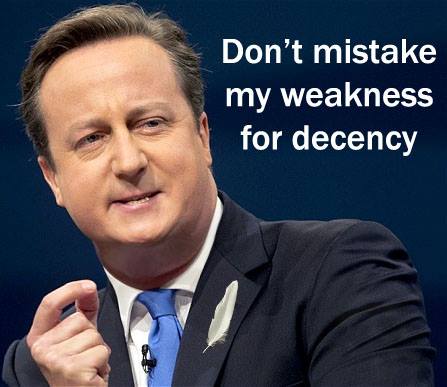
Cam weakness
Picture courtesy of Robert Livingstone

Don’t believe everything you think: cognitive dissonance

sipress-cognitive-dissonance

“Some things have to be believed to be seen.” – Ralph Hodgson

I’ve often thought that once people identify with a political party, there is often an accompanying tendency to edit the world so that it conforms with their ideology. I suspect that exposure to more information about objective reality and politics quite often doesn’t affect partisan bias because people tend to only assimilate those “facts” that confirm what they already believe. Perhaps this is why many people become defensive, aggressive, incoherent and dogmatic when challenged with evidence that contradicts their fundamental world-view.

President Lyndon Johnson once said: It’s a heck of a lot easier to throw grenades than to catch them.

It’s always a good idea to look at who is lobbing the explosives, too. And to see if they are recycling their bombshells

It’s certainly the same with criticism, especially those which challenge our cherished beliefs. Critical thinking is a difficult and sometimes painful process. It requires facing often challenging and contradictory narratives about the fundamental nature of the world and ourselves, analysing and evaluating them. It also requires work: practice, time and effort. But the more you do it, the easier it becomes.

Critical thinking is the foundation for intelligence, for making sound decisions, and for accommodating dissonant narratives within our own paradigm, and importantly, for understanding them.

“Knowledge” isn’t simply something arising from a closed fact-finding mission to confirm what we already hold as a theory of the world, but rather, it’s about understanding the diverse views of others who are part of our world, after all, and who contribute to its rich, meaningful pluralism.

That doesn’t mean, of course, that each account or theory of the world has equal merit and worth, but without a genuinely critical and open exploration of other views, we cannot know the worth of our own views, let alone anyone elses’. Knowledge isn’t something we have, either, it’s something we have to do. Learning is a process that is ongoing, and knowledge is always subject to challenges, revision and expansion.

Never has there been a greater need for critical thinking, yet it seems there has never been a time when that has been more difficult, because of the constant bombardment from the media of fragmented, discordant, conflicting, non-linear narratives, purposefully misdirecting and whopping lies, dead cat ploys, semantic thrifts, glittering generalities, government PR, Orwellian double-speak and other strategies being deployed to keep us in a state of fearful, confused, manipulable stupification and, to be terribly Marxist about this … in a state of false consciousness. Well, dazed and confused, at the very least.

This Adam Curtis video (below) was originally shown as part of Charlie Brooker’s 2014 Wipe show. It’s about strategies adopted by political leaders, here and abroad, to keep the population confused, uncertain what to believe or what to do – and therefore powerless.

Cognitive dissonance warfare is one weapon of choice. It isn’t just the Tories that use this method. 

We are subjected to an overwhelming barrage of partial accounts, contradictory accounts, screaming headlines, vicious lies, smears and ferocious mudslinging – negative campaigning in the media. It’s like being trapped in a hall of mirrors with Beelzebub, a few of hells’ myrmidons and your best friends, all in fancy dress.

So how do we escape the hall of mirrors?

Well, I’ve already discussed critical thinking. A good approach is to look for integrity, consistency and coherence in narratives, as well as evidence to support and refute the claims being made. And it’s important to examine scope  –  what those narratives accommodate – how comprehensive they are, how much they connect up, how much they make sense. If they involve personal attacks, this is generally a strategy of diversion, and  indicate the group flinging smears has less to offer the public than the person or being viciously attacked. 

It’s also worth understanding a little more about cognitive dissonance.

Leon Festinger: Let’s see what happens when you are stood up by the aliens.

images

Leon Festinger is the social psychologist that proposed cognitive dissonance theory, which basically states that a powerful motive to maintain cognitive consistency can give rise to irrational, and often, maladaptive behaviour.

According to Festinger, we hold many cognitions about the world and ourselves; when they clash, an uncomfortable discrepancy is evoked, resulting in a state of tension known as cognitive dissonance. As the experience of dissonance is unpleasant, we are motivated to reduce or eliminate it to achieve consonance (agreement).

How we do so seems to be very much our own business, with avoidance, biased perception and denial commonly used as a defence to eliminate our discomforts – but as I pointed out earlier, the only real and lasting solution is critical thinking.

Leon Festinger once infiltrated a flying saucer doomsday cult in the late 1950s. The members of this cult had given up their entire lives – left everything and everyone behind – because they believed that the world was about to end and that their faith would ensure that they would be the sole survivors of a global flood. Up until the fateful day, the cult shunned publicity and didn’t entertain journalists.

Festinger posed as a member of the group and was present when the foretold space ship failed to show up. He was particularly interested in what would happen next. How would the disappointed cult react to the failure of their prophecy?

In science, when a theory is challenged by evidence that contradicts it, adjustments or ad hoc hypotheses are sometimes formulated to preserve the theory, attempting to explain away anomalies. However, ad hoc hypotheses are often a key characteristic of pseudoscience, as they are used to ensure a theory is never falsified, no matter how much evidence accrues to falsify that theory. Ultimately, it’s a get out clause for failed theories.

In science, whilst we accommodate gaps in our knowledge, the use of many ad hoc hypotheses is frowned upon. (Einstein’s proposition of hidden variables is a good example of this method of accommodating anomaly: he used an ad hoc hypothesis to explain quantum mechanics and maintain the integrity of relativity theory: explaining quantum entanglement without action at a distance).

Ad hoc hypotheses are a widely used strategy in managing cognitive dissonance. So, after the failure of their prophecy and the non-materialisation of the rescue space ship, the cult suddenly wanted publicity. They wanted media attention. This was apparently so the world would know how their faith had helped save the entire planet from flood.

The hypothesis was that aliens had spared planet earth for their sake – and now their new role was to spread the word and make us all listen. This fascinated Festinger. He observed that the real motivation behind the apparently inexplicable response was the need to not face an uncomfortable truth and to re-assert emotional comfort and equilibrium – to smooth over the apparently unacceptable and whopping inconsistencies between prophecy and events.

Theory and reality.

Explanations of events such as the one offered by the doomsday cult are clearly not founded on a rational process: it’s largely an emotional defence mechanism that is rationalised post hoc. Festinger coined the term “cognitive dissonance” to describe the uncomfortable tension we feel when we experience conflicting thoughts or beliefs (cognitions), or engage in behavior that is apparently opposed to our stated beliefs.

What is particularly interesting is the lengths to which people will go to reduce the inner tension without accepting that they might, in fact, be wrong. They will accept almost any form of relief, other than admitting being at fault, or mistaken. If a person believes, for example, that they are not racist, but then they discriminate against someone on the basis of race, they are then faced with the discomfort of acknowledging that they are racist after all. In an attempt to escape this discomfort, they may seek to rationalise (explain away) their behaviour on some other grounds, which may be spurious, but which allows them to hold on to their otherwise discredited belief.

Many UKIP supporters, for example, often say something like: “I’m not racist though, my brother-in-law/ friend/ uncle’s wife is actually Indian/Chinese/African” and so forth.

Another example is the “allthesame” myth. When you present people with evidence that refutes what was originally a Tory propaganda soundbite, rather than acknowledging verifiable evidence, some people choose to start a hate campaign aimed at trying to attribute all kinds of bizarre “motives” to the person simply telling a truth. Truth and populist perspectives are often poles apart.

And such tactics serve only to fragment opposition to the Right even further. Dividing people by using blame and prejudice further weakens our opposition to oppression. The oppressed can be very oppressive, it has to be said.

Festinger quickly realised that our intolerance for cognitive dissonance could explain many mysteries and irrationalities of human behavior.

Politicians have utilised this intolerance to their advantage – most particularly the Right, who deploy rhetoric heavily steeped in propaganda and behavioural manipulation techniques. (See Cameron’s behaviourist Nudge Unit,  I’ve previously discussed the implications of such manipulation on an unconsenting public and the ramifications for democracy.)

Marshall McLuhan once said: There is absolutely no inevitability as long as there is a willingness to contemplate what is happening.

Objective truth does not change according to our inclination to want something else. Facing that may be difficult at times, but the alternative is simply the idle creation of pseudo-enclaves of fleeting comfort – illusions that distract and disempower us. And make us apathetic.

It’s worth noting that totalitarian and authoritarian regimes arise in societies where populations are politically disengaged and apathetic. If we want to change unpalatable truths – part of the way things are –  the only way to do so is to have the courage, first, to face those truths head-on.

We can’t lie those truths away. There are no short-cuts or real, tenable escapes from that. We have to work our way through the confusion, avoiding the appeal and brief comfort of avoidance strategies, defence mechanisms and flat denial – short-cuts down what is invariably a cul-de-sac – difficult though that often is.

Look at where we are: we have Tory small minds attempting to justify the Tory notion of a small state. But small states and competitive individualism foster adversarial relationships, and reduce us all. Small states and individualism disconnect us from others, sever any sense of social responsibility, mutuality, cooperation and obligation we have towards others.

It divides, isolates and fragments us. Neoliberal small states make us all smaller individuals, less coherent, less connected. Less comprehending. We lose touch with social reality when we disengage with others. We become less rational agents. More dissonant. How can we hold rational, reasoned and democratic debates to oppose what is little more than Tory superstition and prejudice?  

But we must.

Iain Duncan Smith’s “magical elitism” thinking – he’s just knows he’s right – is another indication that we don’t have a democratic government that is willing to engage in dialogue: we have an authoritarian one that is interested only in imposing its own incoherent neoliberal monologue on the masses.

The Queen’s Honours list shows us just what we have become as a society this past 4 years, and how little worth we place on intelligence, honour, basic coherence, decency and genuine achievement. The Maurice Mills MBE is a farce – he blamed Hurricane Katrina on gay people – it’s like open, raucous, insane, cackling laughter from a decrepit, senile, evil elite that has lived far too long. One that is completely detached from our society and its needs. That’s the reality.

Cognitive dissonance theory is an example of the political misuse of psychology which is being used as a means of thought micro-management to ensure that we don’t move and progress. Personal and social development – growth – by their very nature demand that we have the courage to seek to extend ourselves beyond what we know and where we are. It’s very uncomfortable to acknowledge that we are limited, especially when some of that is our own doing, but it’s also essential we do acknowledge it in order to at least try and transcend those limits, extend their context step by step and make progress.

There are no alien space ships to save us from ourselves or from our government. It’s down to us to seek and evaluate the truth, and there really are no shortcuts to positive change and progress. But we can take responsibilty to ensure that what we hold to be true and the decisions we make are fully and bravely informed.

cogDisMeter

BBC’s Stephen Sackur accuses Tories of spreading propaganda about Jeremy Corbyn, and of being unaccountable and undemocratic

“Generals and Majors always
seem so unhappy ‘less they got a war.”  Colin Moulding, XTC

In a BBC World News interview, Crispin Blunt, the Chairman of the Foreign Affairs Select Committee, said that the government is not under any obligation to share intelligence information with the new Labour leader Jeremy Corbyn.

His comments came just days after a senior serving general, scaremongering anonymously to the Sunday Times, said Mr Corbyn’s victory had been greeted with “wholesale dismay” in the army. The general said that any plans to scrap Trident, pull out of Nato or announce “any plans to emasculate and shrink the size of the armed forces” will meet fierce opposition. His hint that some in the military planned an illegal seizure of the state if Corbyn wins the next General Election is particularly extraordinary. He said the army would “use whatever means possible, fair or foul to maintain security.”

A coup d’état is an anachronistic and violent method of political engineering that happens only in one-party fascist, totalitarian and despotic states, it’s not an event you would expect to see used as a threat in a so-called first world liberal democracy.

Regardless of how far-fetched the threats may seem, that a general feels it’s okay to threaten a coup or “mutiny” against a future left-wing government using the mainstream right-wing press as a mouthpiece is a cause for some concern. It’s a symptom of how oppressive the establishment have become, and how apparently acceptable it is to attack, discredit and threaten anyone who presents a challenge and an alternative perspective to the status quo.  

The nameless, gutless and anti-democratic general’s comments reminded me of the Zinoviev letter, and the subversive plots in the 1960s and 1970s by the military and intelligence services to destabilise Harold Wilson’s government.

The Labour leader has said that as far as the party is concerned, the UK’s role in Nato is a matter for discussion for the shadow cabinet, the party at large and most importantly, the public. Emily Thornberry announced that there will be a public consultation regarding the value of the UK nuclear deterrent. That is, after all, the democratic thing to do.

The anonymous general claimed that there would be “mass resignations at all levels and you would face the very real prospect of an event which would effectively be a mutiny” if Mr Corbyn became [democratically elected] as prime minister.

The threat, regardless of its authenticity, is undoubtedly part of a broader strategy of tension, designed purposefully to create public alarm – to portray the left as a threat to the wellbeing of society – and it will reverberate around the media, to be used as part of an arsenal of pro-establishment, anti-progressive propaganda to discredit Corbyn.  

Mr Blunt told BBC Hardtalk‘s Stephen Sackur that the serving general’s opinion was “inappropriate”, did not reflect the view of the government and that if Jeremy Corbyn were elected prime minister the army like everyone else would have to carry out the instructions of the elected government.

In the meantime, Blunt said that it was a matter for the government to decide how much access to “privileged information” the leader of the opposition had access to. There would be no point in passing on such information if it would not “achieve consensus.”

In other words, the government don’t want a critical and democratic dialogue about potential military decisions. They are refusing to include anyone else in crucial political decision-making processes, if they don’t agree with the government. This kind of response is usually associated with authoritarian states, not liberal democracies.

Sackur said that as soon as Corbyn was elected, the Conservatives “issued propaganda” suggesting that Corbyn is a threat to national security. He also pointed directly to the government’s fundamental lack of accountability, transparency and democracy in the unprecedented move to refuse to share military and intelligence information, which is conventionally shared with the leader of the opposition.

Blunt simply confirmed Stephen Sackur’s point about the government’s lack of democracy, accountability and transparency.

Sackur exposed the rank hypocrisy of a government that claims to be democratic, yet does not tolerate parties with differing views, nor does it invite or engage in dialogue and critical debate, choosing instead to exercise totalitarian control over what ought to be democratic decision-making, the will and thoughts of others, including the public that a government is meant to serve.

Perhaps a coup in the event of a left-wing win in 2020 isn’t so far-fetched in the current oppressive political climate.

You can see the Hardtalk interview here on iPlayer:

http://bbc.in/1WgxmXF

Or here: http://www.mondonews.net/News/64885/video-no-obligation-to-share-intelligence

Related

Human rights are the bedrock of democracy, which the Tories have imperiled.

not negot
The prime minister has again confirmed that a future majority Conservative government would repeal Labour’s landmark legislation – the Human Rights Act , 1998 – and replace it with a “British Bill of Rights”, as I reported back in Julyand he has previously pledged to leave the  European Convention on Human Rights, as I’ve also reported.

And I wrote this earlier today: The lord chancellor is dismantling the rule of law, which discusses how  Grayling is preparing to unveil Tory plans to scrap Britain’s human rights laws. The plans would repeal the Human Rights Act and break the formal link between the European Court of Human Rights and British law. Its judgement would now be treated as “advisory” and need to be approved by parliament. 

Grayling has already tried to take legal aid from the poorest and most vulnerable, in a move that is so clearly contrary to the very principle of equality under the law. He turned legal aid into an instrument of discrimination. He has tried to dismantle the vital legal protection available to the citizen – judicial review – which has been used to stop him abusing his powers again and again. He has tried to restrict legal aid for domestic abuse victims, welfare claimants seeking redress for wrongful state decisions, victims of medical negligence, for example. And now he wants to take away citizens’right to take their case to the European court.

I have argued elsewhere that even if we were to take a Conservative perspective, it’s still the case that the only way to wed the principle of a “pursuit of economic liberty” with wider justice is by a basic notion of equality before the law, through the equal access to justice. This means that the State must fund the means of contract enforcement and free and fair trial legal costs, for those who cannot afford it. If the State fails to fulfil this contingent function, then we simply cease to be free. 

The Tory attack on our universal human rights is not about euroscepticism, terrorists, cats, “common sense” or any of the other Sun and Daily Mail endorsed ideological justifications they are using. It is about scrapping our essential legal protections against the state, with each Tory policy advancing authoritarianism by almost inscrutable degrees, eroding our democratic freedoms further and further.

Director of the civil rights organisation Liberty, Shami Chakrabarti, said: “Shame on the prime minister for citing Churchill, while promising to trash his legacy. The convention protects both prisoners of war and soldiers sent off to fight and die with inadequate equipment. But the prime minister believes there is no place for human rights in Helmand – on that, he and Isis agree.”

Amnesty UK’s campaigns director, Tim Hancock, said: “Theresa May made much in her speech about how we must stand up and fight for human rights abroad, it makes absolutely no sense to denigrate those same rights at home.

It’s exasperating to hear the prime minister vow to tear up the Human Rights Act again – so he can draft ‘his own’. Human rights are not in the gift of politicians to give. They must not be made a political plaything to be bestowed or scrapped on a whim. It’s time politicians accepted that they too have to follow the rules and that those rules include the civilising human rights standards Churchill championed.”

In his speech to the Tory party conference in Birmingham, Cameron did not explicitly threaten to withdraw from the European convention on human rights, a move that would have wide-ranging, international repercussions for the UK’s relationship with Europe.

The prime minister told Conservative delegates: “It’s not just the European Union that needs sorting out – it’s the European court of human rights. When that charter was written, in the aftermath of the second world war, it set out the basic rights we should respect.

But since then, interpretations of that charter have led to a whole lot of things that are frankly wrong. Rulings to stop us deporting suspected terrorists. The suggestion that you’ve got to apply the human rights convention even on the battlefields of Helmand. And now – they want to give prisoners the vote. I’m sorry, I just don’t agree.”

Erm… hello, Mr Cameron, but this isn’t just about egocentric ole’ you.

Last time I checked, this was a first-world liberal democracy, and not your “kingdom”, or a totalitarian state. The principle that “all power ultimately rests with the people and must be exercised with their consent” lies at the heart of democracy. Democracy is premised on the recognition and protection of people’s right to have a say in all decision-making processes which is itself based on the central principle of equality of all human beings.

The purpose of democracy, like that of human rights protection, is to uphold the dignity of every individual and to ensure that the voices of the weakest are also heard. Its core values – freedom, equality, fraternity, accommodation of diversity and the assurance of justice underpin the norms of human rights as well.

Democracy is one of the universal core values and principles of the United Nations. Respect for human rights and fundamental freedoms and the principle of holding periodic and genuine elections by universal suffrage are essential elements of democracy. These values are embodied in the Universal Declaration of Human Rights and further developed in the International Covenant on Civil and Political Rights which enshrines a host of political rights and civil liberties underpinning meaningful democracies.

The Rule of Law and Democracy Unit stands as the Office of the High Commissioner for Human Rights (OHCHR) focal point for democracy activities. The Unit works to develop concepts and operational strategies to enhance democracy and provide guidance and support to democratic institutions through technical cooperation activities and partnership with the relevant parts of the UN, notably the UN Democracy Fund, the Department of Political Affairs and the newly established UN Working Group on Democracy. Legal and expert advice are provided as required to OHCHR field operations on relevant issues such as respect for participatory rights in the context of free and fair elections, draft legislation on  national referenda and training activities.

The strong link between democracy and human rights is captured in article 21(3) of the Universal Declaration of Human Rights, which states:

“The will of the people shall be the basis of the authority of government; this will shall be expressed in periodic and genuine elections which shall be by universal and equal suffrage and shall be held by secret vote or by equivalent free voting procedures.” 

The link is further developed in the Covenant on Civil and Political Rights which enshrines a host of political rights and civil liberties underpinning meaningful democracies. The rights enshrined in the International Covenant on Economic, Social and Cultural Rights and subsequent human rights instruments covering group rights (e.g.indigenous peoples, minorities, people with disabilities) are equally essential for democracy as they ensure inclusivity for all groups, including equality and equity in respect of access to civil and political rights.

More recently, in March 2012, the Human Rights Council adopted a resolution titled “Human rights, democracy and the rule of law,” which reaffirmed that democracy, development and respect for all human rights and fundamental freedoms were interdependent and mutually reinforcing.

The Council called upon States to make continuous efforts to strengthen the rule of law and promote democracy through a wide range of measures. It also requested the OHCHR, in consultation with States, national human rights institutions, civil society, relevant inter-governmental bodies and international organizations, to draft a study on challenges, lessons learned and best practices in securing democracy and the rule of law from a human rights perspective.

Human rights, democracy and the rule of law are core values of the European Union, too. Embedded in its founding treaty, they were reinforced when the EU adopted the Charter of Fundamental Rights in 2000, and strengthened still further when the Charter became legally binding with the entry into force of the Lisbon Treaty in 2009.

I think that the Conservative Party, even if they managed a narrow majority, ought to be expecting to find it very difficult to pass such a seriously partisan bill. That they aren’t troubles me greatly.Graylings’ documented proposals have drawn a furious response from the Tories’ coalition partners. Simon Hughes, the Liberal Democrat justice minister, said: “The Conservatives don’t care about the rights of British citizens – they care about losing to Ukip. These plans make no sense: you can’t protect the human rights of Brits and pull out of the system that protects them.”

Europe’s human rights laws were designed by British lawyers to reflect British values of justice, tolerance and decency. We will not allow the Tories to take away the hard-won human rights of British people when in the UK or anywhere else in Europe.

Andrea Coomber, director of the civil rights group Justice, said: “Conservative party policy now says: ‘We support minimum human rights standards, but only if we define their content.’ A patchwork of national rules would mean no standard at all; every human being, subject only to the whims of national interest. This vision would reset the clock to 1945, before Eleanor Roosevelt, Churchill and Maxwell-Fyfe ever put pen to paper.”

Sadiq Khan, the shadow justice secretary, said: “Once again David Cameron is pandering to UKIP instead of standing up for the rights and best interests of the people of Britain. The truth is that our courts have been free to interpret rulings by the European convention on human rights for 50 years – the Human Rights Act did nothing to change that fact.”

Labour’s Human Rights Act ought to be a source of pride. It is a civilised and a civilising law. It ensures that Britain remains a nation where key universal benchmarks of human decency and protections against state abuse are upheld by the courts. There is already a modern British bill of rights already. It is called the Human Rights Act (HRA).

The rights protected by the Act are quite simple. They include the right to life, liberty and the right to a fair trial; protection from torture and ill-treatment; freedom of speech, thought, religion, conscience and assembly; the right to free elections; the right to fair access to the country’s education system; the right to marry and an overarching right not to be discriminated against. Cameron has argued that it should be repealed just 10 years after its implementation (the HRA came into force in October 2000) … so that he can pass another Act.

No other country has proposed de-incorporating a human rights treaty from its law so that it can introduce a Bill of Rights. The truly disturbing aspect of Cameron’s Bill of Rights pledge is that rather than manifestly building on the HRA, it’s predicated on its denigration and repeal. One has to wonder what his discomfort with the HRA is. The Act, after all, goes towards protecting the vulnerable from neglect of duty and abuse of power. Are we really believe Cameron (Or Farage, who also states that he intends to repeal the HRA, given the opportunity) is more likely to build on existing rights and freedoms or to destroy them?

The front page agendas of the Sun and Daily Mail indicate quite plainly the latter. And they have established form. Tory policies violate International Human Rights  standards, a fact that was met with only sneering contempt and denial from our authoritarian government. I’ve written at length previously about the Tory-led persecution of some of our most vulnerable citizens.

It seems to me that their callous indifference to the welfare of UK citizens is coupled with a drive to avoid international scrutiny and accountability, as well as at a national level. The government are certainly seeking to insulate themselves from legal challenge, and restrict the ability of citizens to hold to account future governments that break the law. And this general trend of creeping authoritarianism doesn’t bode well, coupled with the intent to scrap our protective rights, here.

The rights protected by the HRA are drawn from the 1950 European convention on human rights, which was a way of ensuring that we never again witness the full horrors of the second world war, the rise of Fascism and overwhelmingly, one of the greatest stains on the conscience of humanity – the Holocaust. Winston Churchill was one of the main drivers of the Convention, it was largely drafted by UK lawyers and the UK was one of the first countries to ratify it in 1951.

This was the establishing simple set of minimum standards of decency for humankind to hold onto for the future. The European Convention on Human Rights and Fundamental Freedoms (ECHR) was drafted as a lasting legacy of the struggle against fascism and totalitarianism. Yet the HRA is quite often portrayed by the Right as a party political measure.

However, whilst the Human Rights Act is ultimately recognised as one of the greatest legacies of Labour in government, Cameron seems oblivious to the fact that Human Rights are not objects to be bartered away. They arose from struggles that were begun long ago by past generations who gave their lives for these rights to be enshrined in our laws.

B8EQnPnIAAA2CNo

The whole point of human rights is that they are universal

Related

Defining features of Fascism and Authoritarianism

The Coming Tyranny and the Legal Aid Bill

Children are being denied justice and their human rights by legal aid cut

Amnesty International has condemned the erosion of human rights of disabled people in UK

UK becomes the first country to face a  UN inquiry into disability rights violations

The disgruntled beast

10437171_327099100774478_1052932761_n

Miliband doesn’t pander to populism, and upholds the inclusion, equality and diversity principles that are embedded in policies which Labour pioneered. He aims to address and curtail exploitative employers, which of course is a real problem, rather than migrants, who are being exploited in the same way that “nationals” are. We have workfare, analogous to slavery and counterproductive in decreasing unemployment, which is universally exploitative, and absolutely nothing to do with the poor migrants, and everything to do with profit-driven greed, and a government that has encouraged that greed to thrive and flourish at such catastrophic expense to others.

Miliband knows that Britain is not divided by race and culture, it’s divided by wealth inequalities fuelled by the Tory-led Coalition’s austerity policies. Blaming the unemployed, the sick and disabled and immigrants for the failings of the government has fuelled misperceptions that drive support for the far-right. People complain they can’t get council houses, and the only really honest question an honest politician ought to ask is: “Why aren’t there more council houses?”

And when there are large numbers of people receiving unemployment benefit or tax credits, then the only honest question to ask is: “Why is the economy failing to provide enough jobs, or pay adequate wages?”

Miliband’s emphasis on equality is bothering the Tories, because their entire ideology is founded on Social Darwinism: to the Tories, inequalities are an inevitability, because of their emphasis on competition between individuals for resources in the “free market.” Miliband’s social democracy program provides an alternative that challenges the established right-wing neoliberal consensus.

The media and the government have stigmatised vulnerable social groups as a justification of cruel and punitive policies aimed at those least able to fight back, as an explanation of the failings of this government to be fair and honour a degree of legislation to reflect public needs – the public they are meant to serve.

As a society that once promised equality and democracy, we now preside over massive inequalities of wealth: that’s a breeding ground for racism and other vicious resentments.

It’s awoken the disgruntled beast within people, the one that feeds on anger, demoralisation, fear, resentment and uncertainty.

And wherever antipathy and a degree of enmity exist, the far-right have always tried to perpetuate, exploit and increase rancour. The fascism of the 20s and 30s gained prominence because it played on wider public fears, manipulating them, and deflecting attention, as ever, from those who are truly to blame for dire social conditions: the ever-greedy elite. There’s a well-established link between political extremism, economic hardship and recession and social cleavages, with the far-right “anti-system” parties deceitfully winning the support of those who would never previously have thought of themselves as extremists.

Such extremism and rancour feeds the disgruntled beast. The political right have always sought to divide sections of the poor and middle class and set them to fight one against the other; to have us see enemies in our midst which do not exist, so that we see economic policies – the Tory-rigged “free market” competition – as the solution rather than the cause of our problems.

And here we are again. A Tory government, another rigged recession, and the politics of fear, despair and micro-managed discontent.

Fascism plays a specific role for the ruling class: it is a weapon against civil unrest during social crises caused by recession. It redirects public anger from the government to scapegoats. To build such a movement, fascists have to delve into the “lower classes” using a mixture of crude economic radicalism and racism. Oswald Mosley also started out as a Tory and he was a rich aristocrat. His tactic was “street politics”, rather like Farage’s appeal to woo “ordinary people.” Mosley cut himself adrift from the mainstream ruling class when in early 1934, he launched a campaign for street supremacy in key working class areas.

Farage is comparable with Mosely: he also tried to entice the working class, and those blue collar defectors who don’t feel solidarity with anyone except their “own kind” need to ask themselves how a fascist party would better reflect their interests, because fascists aren’t just fascists when it comes to your preferred target group – in this case migrants – fascists are fascists, full stop. And most migrants are working class, too.

Fascists are not known for being big on unions and worker’s rights either, Hitler smashed the unions, Mosely fought them too. But fascists do like to use the oppressed to oppress others.

Mosely was defeated by working class solidarity – Jews, communists, socialists, the labour movement, and the middle classes, who all stood side by side in Scotland, Newcastle, in the Valleys, Yorkshire, at Olympia and on Cable Street. Unity and regard for the rights and well-being of others was their greatest strength.

That community spirit and solidarity is precisely what we need to find again. The disgruntled beast is divisive, and it feeds on demoralisation, alienation, feelings of isolation and a lack of regard for others.

Identity politics and the faultlines of division

Lynton Crosby, who has declared that his role is to destroy the Labour Party, rather than promote the Conservatives, based on any notion of merit, is all about such a targeted “divide and rule” strategy. This is a right wing tactic of cultivating and manipulating apostasy amongst support for the opposition. It’s a very evident ploy in the media, too, with articles about Labour screaming headlines that don’t match content, and the Sun and Telegraph blatantly lying about Labour’s policy intentions regularly.

One major ploy has been to attempt to rally the disgruntled working classes behind the flag of identity politics – aimed exclusively at the most disgruntled, very purposefully excluding other social groups. It also sets them against each other, for example, the working class unemployed attacking migrants – it really is divisive, anti-democratic, and flies in the face of labour’s equality and diversity principles. It also enhances the political myth of convenience – the “out of touch/allthesame MPs”, some of those stoked-up disgruntled blue collar workers have defected to UKIP.

There’s an immediate danger that if the far-right succeed in colonising the anti-mainstream vote, as they are aiming to, and developing party loyalty, it will block the development of an independent working class politics capable of defending our conditions and challenging the status quo.

UKIP (and the Tories) first and foremost are traditionalists and defenders of property, with the socially paranoid ideology of the hard right. A dominant theme is a conspiratorial view of the EU as a sort of “socialist plot”, with the Eurocrats encouraging mass immigration, stifling small businesses with legislation and fuelling the welfare state. And working class cultural imperialism – some blue collar workers and working class supporters have disgruntled beasts that respond to the populist, “anti-establishment”, Islamophobic agenda. The wealthier middle class supporters who were traditionally Conservative want to force the Tories further to the right.

Thanks to the persistent propaganda work of the government and the media, the tendency is to see the far-right’s behaviour as merely the justified reaction to the provocation of socially stigmatised groups – the sick and disabled, the unemployed, Muslims and immigrants. This is the climate in which UKIP and its allies thrive. As a result, there is an urgent need to shift toward a wider cultural and political offensive against prejudice more generally. Again. The only party concerning itself with that, as ever, is Labour.

UKIP supporters manifestly don’t care about prejudice directed at others. At the very least they are not repelled by racism, sexism, disablism and homophobia, they seem unsentimental about the types of alliances they find themselves in. Yet working class UKIP supporters are cutting off their own noses to spite their faces, as UKIP are Thatcherites: neoliberal white trash. Fascists don’t support the working class –  they never have and never will. No matter how much they say otherwise.

I’ve talked about UKIP, here, but they are not the only party drawing on the propaganda of the right. I have seen Left Unity, the Greens, the SNP, and a range of so-called socialist groups utilise right-wing myths about the Labour Party, too. This means we end up repeatedly fighting to clarify truths amongst ourselves instead of simply fighting the injustices and lies of the Tories.

It also struck me that we have a raft of writers loosely writing about the Labour Party that don’t seem to promote achievements and positive policies, which is at the very least as important as the negatively weighted “critical” analyses of the last Labour government, for balance and for providing a framework for those perpetually disconsolate readers that tend to feed their pet disgruntled beasts from buzz phrases and glittering generalities for the perpetually unhappy orthodoxy obsessed narxists – like “working class disenfranchisement”, “New Labour”, “Progress”, “Blairite”, “weakened unions”, “blue labour” and so forth. Many narxists have a peculiar elitist and very  non-inclusive obsession with what socialism ought to be.

Ticked boxes and pressed disgruntle buttons.

It was mostly the disgruntled blue collar workers that found UKIP’s inverted elitism – anti-intellectualism, anti-middle-classism and a few other prejudices more appealing, and defected, in a false conscious moment of supreme nose-cutting and spited faces. I don’t see anything to be gained in fueling their discontent, propping up populism, and its irrational response – a nod in the direction of fascism from people claiming they are excluded from mainstream politics – so they defected to a party that is founded on the rhetoric of exclusion.

There are contradictions between UKIP’s ultra-Tory policies and the instincts and interests of its working class supporters. So, not quite “breaking the mould of British politics” then.  UKIP demagogically and disingenuously attack Labour for abandoning white workers, but they also focus on attacking David Cameron for not being Conservative enough.

Farage implies he has some sort of superior social knowledge and wisdom compared with the rest of the mainstream political class, and that he understands “ordinary people”, but he speaks fluently in the language of anti-progression, the fact that anyone at all is listening is indicative of an internalisation of the national right wing prejudice toward a profound anti-intellectualism.

And of course anti-intellectualism is to be expected from the Conservatives, who have historically used the repression of critical thinking as a way of deflecting scrutiny, and as a means of ensuring a compliant, non-questioning workforce to exploit. From the working class, however, it’s just the politics of resentment, and another disgruntled face of bigotry. So much for class consciousness. And solidarity.

It’s worth remembering that Marx and Engels were hardly working class, and they most certainly were intellectuals. Left wing UKIP supporters have no fig leaf to hide behind.

It’s one thing to be opposed to traditional elites, but to show support for a party so vehement in its hostility to democracy, trade unionism, socialism, human rights, our NHS and the welfare state because someone speaks with a pint and a ciggie in their hands, indicates the need for some responsible critical thinking, paying attention to details, less resentment, superficiality and disgruntled grunting.

Fascism always presents itself as your friend, it extends a cozening arm of camaraderie around your shoulder with a sly smile, a malicious grin with far too many teeth.

It’s a disgruntled beast that loves disgruntled beasts, but this public school boy and ex-Tory with offshore tax havens isn’t one of the lads from the shop floor. Farage didn’t take any lessons from the school of hard knocks, that’s for sure.

But many of us have membership in more than one oppressed group, surely its possible at least to recognise in principle the validity of other struggles against oppression, it’s important to recognise that these struggles are not in a zero-sum relationship with one another. They are complementary and cumulative. I believe the collectively oppressed are natural allies in a larger fight for justice, and create a whole greater than the sum of its parts, and this kind of intersectionality and solidarity undermines the ruling-class’s “divide and conquer.”

I think the divisions are what happens when you just feed the disgruntled beast.

That’s the problem with identity politics: it tends to enhance a further sense of social segregation, and it isn’t remotely inclusive. Of course it also enhances the myth of  “out of touch/ allthesame” politics. It’s a clever strategy, because it attacks Labour’s equality and inclusive principles – the very reason why the Labour movement happened in the first place – and places restriction on who ought to be “included”. Think of that divisive strategy  1) in terms of equality. 2) in terms of appealing to the electorate 3) in terms of policy. Note how it imposes limits and is reductive.

The Tories set this strategy up in the media, UKIP have extended it further and the minority rival parties, including the Green Party have also utilised the same rhetoric tool. Yet we KNOW right wing parties have NO interest in the working class. And those amongst the working class that have.

The Tories do not offer up public critical analysis of themselves. Indeed the anti-Labour bias on display by the Murdoch-owned news empire has never been more apparent. That’s not just because of ideology, it’s because Miliband stood up to Murdoch. But Tories don’t collectively and painfully self-scrutinise or soul search, and certainly not in public sight: they self promote. They speak with unfaltering conviction, and from that platform they control public debate and that’s despite their continuing assault on public interests.

So, where is our fully informed pro-labour spokesperson in the media? Where are the articles that inform people – the ones about what Labour do, rather than what they ought to do? Because the implicit message over and over from undoubtedly well-meaning left-leaning writers is that Labour constantly get it wrong and need advice on how to get it right, whilst their policies are not being publicly promoted, analysed, and their progress and achievements remain hidden from view. What gets attention is myth reduced to populist pseudo-critical soundbites.

The media and the message

That means, potentially, many people don’t know enough on balance to make informed choices. Disgruntled defectors often take the medium to be the message, unfortunately, and with no balance, no genuine pros and cons, just a perpetual party wish list, that reads as a list of deficits, many are fueling an often misinformed, unreasonable, hungry disgruntled beast. You present the policies from source that fill the cited alleged deficits, and dear lord, people actually get angry and abusive.

A few months ago, a well-known left wing commentator wrote a “critical” article about Labour that was based on inferences drawn from a very suspiciously muffled recording of Jon Crudass, which was a couple of minutes long, and which ended, somewhat dubiously, in mid-sentence. The recording was very well-utilised by the right wing, too.

At the time, having heard it, I challenged the writer concerned regarding the references to that very dodgy recording, and the inferences he had drawn from it, which echoed those of the Tories. I was ludicrously and condescendingly told I was being “anti-democratic”, in my “blind and uncritical” support for the Labour Party. From where I’m stood, it certainly isn’t me that is being anti-democratic, here.

It seems to be almost trendy to try and undermine Labour’s credibility and completely regardless of the accuracy of any “criticism” used. Since when was it anti-democratic to want to tell the truth, supported with facts? Why is it that people have such objections to a person being supportive of the Labour Party, anyway? That doesn’t make me undemocratic, “blind” or “uncritical” at all. I’m discerning, and the truth actually matters to me, in all of its detail. I put a lot of work in researching to ensure that I’m well-informed. And why is any of this a reason for people to direct condescending and disgusting abuse and nastiness? Yet somehow, this behaviour has become normalised and acceptable.

One response I’ve seen frequently is: “oh, but people are disillusioned with Labour”. Yeah? Well stop writing inaccurate commentaries that create disillusionment and alienation, then. Perhaps it’s time people learned to research facts for themselves, anyway, rather than allowing their apathy and disgruntledment to be fed by willing, earning authors or propaganda merchants and Tory/SNP/UKIP/Green shills and trolls on Facebook.

The Tory press operation had handed the Daily Telegraph and the BBC the transcript of that same recording of Jon Cruddas, who was approached in the foyer at the Fabian summer conference at the Royal College of Surgeons in London.

A note from the Conservatives accompanying the transcript made clear that the recording had been made by researchers posing as students, according to the account on the BBC website.

The Labour Party is considering referring the transcript of the remarks to the Press Complaints Commission, and the former standards watchdog Sir Alistair Graham has accused the Tories of entrapment. It was a dirty trick. Why on earth would someone on the left take advantage of such chicanery pulled by the Tories? 

No party is above criticism, and quite rightly so. But the criticism needs to be balanced, fair, accurate and based on informed analysis and fact. And not on any old bullshit that’s masqueraded as “criticism.” Or on secretly recorded partial conversations. If debates are not open and honest, and if criticism of parties and their policies are not based on facts, that isn’t actually debate you’re engaged in: it’s a propaganda campaign.

Surely by now we all know the media lies and excludes anything important; that it’s under authoritarian Tory control? That Iain Duncan Smith “monitors” the BBC for “left wing bias”, that the Guardian’s occasional forays into truth are stifled by jackbooted officials marching into their office and smashing hard drives? Does anyone REALLY imagine that such a government spokesmedia will do any justice to reporting about the positive intentions and actions of its opposition? It won’t. Not one bit.

Yet I see people running around hysterically clutching at cherry-picked, distorted media spun soundbites, as if the media is somehow suddenly credible when it talks of the opposition, and when you actually read what was said and proposed at the unspun initial source, it bears no resemblance at all to the media tale of the unexpected. If you trouble yourself to investigate these things, the crap being published and broadcast doesn’t stand up to scrutiny. But it does feed the disgruntled beast.

And when the media resort to personal smears – like they did last year about Ralph Miliband – you KNOW they are worried about being defeated. And behold their disgruntled beast.

It’s a crucial time when we need to make sure we know the difference between truth and propaganda, fact from fiction. It’s up to us to discern – please. We are each responsible for what happens next. It mustn’t be 5 more years of the same neo-feudalist rulers.

The nitty gritty

The Right are engaged in an all out war. The disgruntled Right know that Miliband has edited their script, abandoning the free-market fundamentalist consensus established by Thatcherism in favour of social democracy.

The right-wing media barons who set the terms of what is deemed politically palatable in Britain have never forgiven Ed Miliband for his endorsement of Leveson, which they believe is an unacceptable threat to their power.

And they know Labour under Ed Miliband will probably win the 2015 election.

This is a war, and the Tories think that chucking an avalanche of lies at the opposition is enough. It isn’t. Where are their positive, supportive, life-enhancing policies for the citizens of the UK? The Tories have NOTHING but increasing poverty and pain to offer most of us, and no amount of smearing Labour and telling lies will hide that fact. And they will do all they can to make sure Labour don’t get space in the media to tell you about their own positive social democracy program, based on tackling the inequality and poverty that Tories always create.

We simply can’t tolerate another 5 years of the terrible consequences of New Right Conservatism.

Some on the left also need reminding that there is far more at stake than tiresome debating about what “real” socialism entails. I can tell you categorically that socialism isn’t about feeding your own pet disgruntled beast at the expense of concern and care for comrades who are suffering, living in absolute poverty and dying, because of the policies of this authoritarian regime. We need to address the current crisis, the sociopolitical dysfunction, and escape Cameron’s vision of a feudal dytopia before we can even begin to design our utopia, based on orthodoxy or otherwise.

The outcome of the general election, and the future of this country, and the well-being of is our citizens is what is important, please let’s not lose sight of that.

Because when you feed only the disgruntled beasts, you just end up with beasts.

14301012075_2454438e62_o (1)

Thanks to Robert Livingtone for the excellent memes

The commercialisation and undemocratising of the NHS: the commodification of patients

252299_486936058042594_609527550_n
Last September, I wrote an article entitledJobseekers are being coerced into experimental drug trials dressed up as “job opportunities” .

I reported that David Cameron had announced that it was: “simply a waste to have a health service like the NHS and not use the data it generatedLet me be clear, this does not threaten privacy”, he reassured us, “it doesn’t mean anyone can look at your health records, but it does mean using anonymous data to make new medical breakthroughs”.

Cameron often inadvertently signposts the coming of a diabolical lie with the phrase “let me be clear”, as we know. We also know that so-called anonymisation of data offers no protection at all to identities and personal details. Campaigners described the plan as an”unprecedented threat” to confidentiality, Health Secretary Jeremy Hunt says, rather worryingly, that it will be a boon to research.

It’s common knowledge that many Coalition MPs and Peers are heavily financially invested in pharmaceutical and health care companies. Over 200 parliamentarians have recent past or present financial links with, and vested interests in companies involved in healthcare and all were allowed to vote on the Health and Social Care Bill. The Tories have normalised corruption and made it almost entirely legal. Our democracy and civic life are now profoundly compromised as a result of corporate and financial power colonising the State, and vice versa.

The Health and Social Care Bill, 2012, has a telling insert: The Secretary of State’s duty as to research, which is “In exercising functions in relation to the health service, the Secretary of State must promote – (a) research on matters relevant to the health service, and (b) the use in the health service of evidence obtained from research”.

And also very worryingly: (1) The National Patient Safety Agency is abolished. (2) The National Patient Safety Agency (Establishment and Constitution) Order 2001 (S.I. 2001/1743) is revoked. (3) In section 13 of the NHS Redress Act 2006 (scheme authority’s duties of co-operation), omit subsection (2)

So we must ponder just how coincidental it is that Jobseekers are now being coerced into experimental drug trials, or risk benefit sanctions, as the trials are being dressed up as “job opportunities”.

People claiming Jobseekers Allowance while searching for new employment are being forced to accept ever worsening working conditions or join exploitative Government work programmes in desperate attempts to survive, as our civilised social safety nets and lifeline benefits are being torn away by a draconian and authoritarian Government.

The rising number of unemployed and underemployed citizens of the UK are having their desperation to survive exploited, enticed into zero hour contracts, workfare and now, clinical trials. My revulsion at this Government is at an all time absolute.

Jobseekers using the Government’s  job website – the Universal JobMatch – have been receiving multiple messages from the service inviting them to apply for jobs, only to find that these “employment opportunities” are actually clinical trials.

Drug companies are also to be given provisional approval to treat the severely ill with new drugs and use the data in later licence applications In other words, our government is permitting pharmaceutical companies to experiment using severely ill people.

Behind the scheme is a Tory concern that the UK is no longer a favourite location for the drug companies to develop and trial new medicines – “Making Britain the best place in the world for science, research and development is a central part of our long-term economic plan,” said Health Secretary, Jeremy Hunt.

George Freeman, Conservative MP for Mid-Norfolk, who has long campaigned for the scheme, said: “it would benefit small biotech companies and charities, which may have breakthrough drugs that they cannot afford to take all the way through the long and expensive regulatory process – increasingly the source of innovative medicines which are then bought up by big pharma.

They would get their drugs into NHS patients, hopefully giving them positive data which would attract investors for the large-scale clinical trials.”

So not this is not actually about patient welfare, as Hunt had initially claimed. If it were, then there would have been no need for the abolition of The National Patient Safety Agency, or the revoking of The National Patient Safety Agency.

In 2011, an influential report written by Colin Haslam, Pauline Gleadle and Nick Tsitsianis entitled UK bio-pharma: Innovation, re-invention and capital at risk concludes by presenting the case for innovative short and medium term government-led policy initiatives for the sector and highlights four central areas in which the current bio-pharma business model could evolve. The study concludes by presenting the case for innovative short and medium term government-led policy.

The acknowledgement reads: “in order to complete our research work we have obtained the support of a number of senior executives in private and publicly quoted SME bio-pharma companies and also industry experts in big-pharma. We would like to thank this group for giving up their time to be interviewed for this research project.”

One of the key recommendations of the report is: access to NHS clinical datasets to provide a significant knowledge resource to strategically drive UK drug discovery.

The report is primarily concerned with “the evolution of the bio-pharma business model.”

Reuters reports that the UK is currently one of the only markets in the world in which pharmaceutical companies are free to set prices for their drugs. At the moment, the UK Pharmaceutical Price Regulation Scheme (PPRS) regulates profits, not prices on sales to the NHS, whilst the National Institute for Health and Clinical Excellence (NICE) assesses if drugs are cost effective.

However, this is set to change with the introduction of the “Programme for Government” document indicating that the coalition would “reform NICE and move to a system of value-based pricing”. This would lead to changes in the way that drug prices are determined.

The Association of British Pharmaceutical Industry has stated that it will be keeping an open mind ahead of talks with the government.

“Valued-based pricing is one way of doing it,” said spokesman Richard Ley. “We are not opposed to the principle. It is a question of how it is achieved to get it right.” By that, he means how to make it very profitable, of course.

“The regulatory process is inefficient,” according to one leading biotech investor.From a business side of things these products stop being developed in the UK when they get into later stage because the UK is not a very good market for pharmaceuticals.”

Drug companies have for years strongly criticised the National Institute for Health and Care Excellence (Nice), the UK pricing regulator, which they believe is blocking new and innovative medicines by complicated approval processes and a heavy emphasis on cost control.

Steve Bates, chief executive of the Biotech Industry Association, said: “It’s fantastic and very important that there is a new designation and an “all hands on deck” approach.

“The Coalition Government is determined to secure and expand the UK’s position as an international hub for innovation, medical science and research and in the last 12 months has generated more than £1 billion industry and private sector investment. The Prime Minister will use his visit to the US to meet with CEOs and senior figures from leading pharmaceutical companies, including Johnson & Johnson, Baxter, Covance and Pfizer. The meeting will focus on the UK’s life sciences sector and initiatives such a genomics and dementia research”.

A key policy advisory group – The Ministerial Industry Strategy Group – is co-chaired by the Secretary of State for Health and the Chairman of the British Pharma Group, and aims to promote a “strong and profitable UK-based bio-pharmaceutical industry capable of sustained research”.

The Deregulation Bill is wide-ranging in scope. It’s when we look at what it might mean for the NHS that we see why so much of the contents are very worrying.

This Bill imposes a new duty on non-economic regulators to promote economic growth, for example. What exactly would that mean for the Care Quality Commission? How would the Medicines and Healthcare Regulatory Agency, which regulates the pharmaceutical industry, promote growth?

The bill also imposes a new “growth duty” on watchdogs as well as regulators. Currently, such bodies exist to monitor particular sectors – like health – and take action in the best interests of the public according to the relevant law.

But Clause 58 of the Deregulation Bill puts a responsibility on regulators in England so that when they take regulatory action it has to be with regard to “promoting economic growth”, and not to promoting the best interests of the public. The Bill was quietly tabled in draft by Ken Clarke and Oliver Letwin, and didn’t Letwin say back in 2004 that the “NHS will not exist within five years of a Conservative election victory”?

Regulation evolved to “help build a more fair society and even save lives”, but regulation is often considered a hindrance by business. So this is all about The Coalition making it easier for big profits to be made out of the NHS by private healthcare multinationals. True to Tory form, it’s another policy which is designed to facilitate the exploitation of the vulnerable by the wealthy.

It’s also worth noting that last week, two of the government’s top health and work advisers stated they believed in the merits of “prioritising NHS treatment for working people”, and this needs to be seriously discussed.

If that isn’t further clear evidence of the relentless Tory drive towards economic reductionism and determinism, I don’t know what is.

I need not go on to discuss the religion of the Pope or the toilet habits of bears, I suppose.

Further reading:

Profit before human need  – “The drug companies will get away with whatever they can get away with within the law to look after the interests of their shareholders. But they couldn’t get away with these things were it not for members of my profession being willing to collude with them and put patients in second place”: unfavourable results from medical trials are being withheld, MPs warn

1098410_520975421305324_1267996419_n                                                                     


Austerity is a con, the Tories are authoritarians and they conflated the fact-value distinction.

539627_450600381676162_486601053_n (2)
One of the first things I realised as an undergraduate is that social “sciences” aren’t. My very first essay was on the topic of the “scientific” basis of sociology and its methodology, and my reading took me deep into the labyrinth of history and philosophy of science. I concluded that science itself isn’t as “scientific” as we are led to believe, let alone a discipline that aims at the study of inter-subjectively constructed human behaviours in a social context. I’ve been attempting to rescue anyone that has succumbed to the mythical, positivist, fraudulent chimera called “objectivity” ever since.

As a critical interpretivist, I believe that social reality is not “out there” waiting to be discovered: we are constructing and reconstructing it meaningfully. However, politically, there’s been a marked shift away from understanding the lived experiences of real people in context: a systematic dehumanisation. The Tories have depopulated social policy. This is a characteristic of authoritarianism, and other hallmarks include stigmatisation of social groups, moral disengagement, moral exclusion, impunity, and a societal “bystander apathy”. (See also Allport’s ladder, which is a measure of the manifestation of prejudice and discrimination in a Society. It’s also an explanation of the stages of genocide, and how the Holocaust happened.)

And before anyone invokes Reductio ad Hitlerum or Godwin’s Law, I will point out in advance that it would be unreasonable where such a comparison is appropriate and reasonable, as it is in this case. (For example, in discussions of the dangers involved in eugenics, persecution and stigmatisation of any social group, or tolerance of racist and nationalist political parties, and propaganda campaigns used to promote and justify any of these). In such a context, the dismissal of someone’s proposition on this basis becomes its own form of association fallacy and Ad Hominem attack.

Upwards and onwards then.

Authoritarian legitimacy is often based on emotional appeal, especially the identification of the regime as a “necessary evil” to combat easily recognisable societal problems, such as economic crises.

Authoritarian regimes commonly emerge in times of political, economic, or social instability, and because of this, especially during the initial period of authoritarian rule, such Governments may have broad public support. Many citizens won’t immediately recognise authoritarianism, especially in formerly liberal and democratic countries. In the UK, there  has been an incremental process of un-democratising, permeated by a wide variety of deliberative practices which have added to the problem of recognising it for what it is.

Authoritarian leaders typically prefer and encourage a population that is uninformed and apathetic about politics, with no desire to participate in the political process. Authoritarian Governments often work via propaganda to cultivate such public attitudes, by fostering a sense of a deep divide between social groups, society and Government, they tend to generate prejudice between social groups, and repress expressions of dissent, using media control, law amendments or quietly editing existing laws.

Many of us are unaware of the sheer extent to which this is going on. George Lakoff, researcher and cognitive linguist, said: “Conservatives have set up an incredible infrastructure. It’s a vast, unseen communication system and it’s very effective. This has been pointed out over and over to progressives and few seem to recognise the danger. They think it’s just propaganda and so they ignore it.” cognitive linguist. Lakoff is right. The deep and hidden state that the government have created is founded on nudge, ‘strategic communications’, data analytics and psychographic profiling. It includes the use of military grade psyops, aimed at changing people’s perceptions and decision making., with the ultimate aim of maintaining the status quo. This has profoundly perverted our democracy.

Whenever I listen to the Tories in Parliamentary debate, I’m reminded of the fact/value distinction – the alleged difference between descriptive statements (about what is) and prescriptive or normative statements (about what ought to be). Facts are one sort of thing, values another sort of thing, and the former never determine the latter. That’s the idea, anyway. But it isn’t considered to be very clear-cut when it comes to the “social sciences” such as politics and economics (although I would go further and propose that it’s not so clear-cut in the physical sciences, either. (Please see footnote).

The fact/value dichotomy was associated with the doctrine of logical positivism, that arose out of a supreme attempt at concept control. Beginning in the eighteenth century, some of the Enlightenment thinkers had declared that values (such as moral obligations) could not be derived from facts.

The verification principle, which is at the heart of the logical positivist doctrine, is a form of vigorous scientific anti-realism – restricting science to (empirically verifiable) observable aspects of nature. Inductive reasoning makes broad generalisations from specific observations. Such observations can be used to make “probability guesses” based on deductive reasoning.

This applies to many theoretical claims, including the beginning of time, gravity, the existence of matter (one of which is the Big Bang Theory), quantum events, the age of the Universe, the age of the Earth, the origin of the Moon, and the occurrence of other magical events in the past.

But the verification principle is itself unverifiable.

Values are involved in the very identification or determination of what is “fact”. As Einstein once said: “the theory tells you what you may observe.” 

Similarly, in social research, the area of study is intentionally selected. There are problems related to the connection between observation and interpretation also. Perhaps every observation is an interpretation, since “facts” are seen through a lens of perceptions, pre-conceptions and ideology. The Joseph Rowntree Foundation choose to study poverty. Cynical Iain Duncan Smith simply changes the definition of it.

Tory values. How else can we explain the flagrantes et virulentes Tory political rhetoric manifested in media-wide chanting for the blood and souls of the poor for the sake of “austerity”? There are no “facts” that can ever justify the persecution of a social group.

All of the knowledge and understanding we possess, whether of “facts”, values, or anything else, is contained within our consciousness, as structured by intentionality.  There isn’t an “objective”, mind-independent yardstick – we cannot step outside our consciousness to compare our ideas with anything else “out there” (please see footnote). We cannot experience our consciousness independently of intentionality, and we do have a degree of free-will and moral agency.

This means we have to face our morality, take responsibility for our ethical decisions and own our value-judgements. Rather than disguise them as “facts”, as the pseudo-positivist Tories frequently do.

It’s truly remarkable that Tories loudly attribute the capacity for moral agency to people claiming benefits, for example, formulating sanctions and “assessments” to both shape and question the morality of the poor constantly, yet stand outside of any obligation to morality themselves. It’s always someone else’s responsibility, never theirs.

Any claim to value-freedom in decision-making does not and cannot exempt us from moral responsibility, or justify moral indifference.

The consciousness of each of person is situated, rather than existing independently. A situation is an intentional act (or action) taken in social contexts as we experience them. Our understanding of our situation is embedded in conversational language. We are continually engaged in dialogues with other persons – “discourse”. Dialogue and narrative are how we make sense of the world.

It strikes me that in politics it all comes down to language. Those who can shape a controversial issue in the terms they prefer have the advantage in shaping public opinion. It’s called “framing”. Such concept control is a way of rigging the debate: You must talk about this controversial issue using our categories, terms, and definitions.

As a result, those who have the power to declare the terms of discourse have the power to determine the outcome of the debate, and furthermore, they have the power to determine what is accepted as “true or false”.

Really, for the Tories, it’s nothing more than linguistic bullying. You only need listen to Prime Minister’s Questions to understand this. For the Tories, both facts and values are irrelevant, despite their fake claims to fake empirical statistical data, all that matters is their ideological narrative. As a Society, we really need to pay much more attention to detail.

And we really need to challenge more. In terms of evidence, the Tories have not provided any verification that any of their policies work. There’s a growing body of rich qualitative data that reliably and consistently informs us that those policies do not work as claimed by the Tory-led Coalition, and the sheer volume of those accounts also informs us that this data is both credible and valid. So why are the Government so determined to ignore it?

Value-laden observation: their “theory” tells them what they may observe.

I’m not particularly au fait with economic theory, I just about grasp the differences between Keynes and Hayek, but I do know that after the British depression of the 1920s, Hayek promoted the idea that private investment, rather than Government spending, would promote sustainable growth. However, Keynes proposed that the Government’s job is to increase its own spending to offset the decline in public spending – that is by running a deficit to whatever extent necessary. To cut Government spending is a completely damaging policy in an economic slump. Keynes’s message was: you cannot cut your way out of a slump; you have to grow your way out. Eighty years on and the Tories have still not fully learned the lesson. Well, they probably have, but the fact is they simply don’t care enough to apply it.

I do understand ideology, and the case for austerity is not founded on economic principles, but rests entirely on social conservative ideology, with their wide embrace of neoliberalist principles.

The repetition of a lie ad nauseum is based on the idea Goebbels had – that repeated lies will somehow convince people that they are true. Cameron was busted when he repeatedly told the lie “We are paying down the debt.” Despite being rumbled, the Coalition have stuck with this lie doggedly. The bonus of the lie is that it may be used (and has been, repeatedly) to undermine the Opposition’s economic credibility, and the Tories particularly delight in the lie that it’s all Labour’s fault because they “overspent” as it further justifies austerity measures and starving public services of Government funding, with our paid taxes, as well as stripping our welfare provision and public services away.

Big labour boy

The Tories have carefully planned these measures for a long time, and attacks on our human rights and public services can be seen in plans and policies of previous Tory administrations. Such attacks on the most marginalised and vulnerable citizens and the undermining and steady destruction of social programs and services that may offer any support are an integral part of Tory ideological grammar.

A leading British academic concludes that the last Labour Government has been tarnished by spin and propaganda, while the US treasury secretary follows Gordon Brown’s lead. Jack Lew, the relatively new US treasury secretary, wrote recently in the Financial Times: “While long-term fiscal policy requires tough decisions, we knew we could not cut our way to prosperity”.

 in today’s Guardian says “Lew has now taken up the baton from Gordon Brown when it comes to politicians who understand the nature of the huge deficiency of demand in the world economy. People go on about the need for supply-side policies, but the fact is that there is no shortage of supply, but of demand, which continues to be constrained by the vogue for totally unnecessary and hugely destructive policies of austerity”.

Keegan quotes the economist Simon Wren-Lewis, who is a widely respected in the profession, from  the Oxford Review of Economic Policy. It covers the economic record of the 1997-2010 Labour Government in considerable and balanced detail: “The line that the Labour government was responsible for leaving a disastrous fiscal position which requires great national sacrifice to put right is pure spin”.

The austerity movement has damaged recovery from the economic depression, whilst it has also caused a crisis worldwide through its imposition upon many nations. The foundation research that was used to justify the austerity movement came from two Harvard Professors: Carmen Reinhart and Kenneth Rogoff.  A University of Massachusetts student Thomas Herndon found that their work was filled with mathematical errors in their research spreadsheets.

Their spreadsheets were their “proofs” that economic austerity promotes economic recovery and were used to “verify” this theory. The powers that be have imposed this fundamentally flawed doctrine, and the ill-effects fall squarely upon 99% of the people, leaving the wealthiest unscathed.Thriving, actually.

It’s is both infuriating and horrific to witness the sheer suffering and destruction that follows in the wake of these now debunked theories. The unemployment in Europe  has reached record high levels high levels, Countries like Greece and Spain have widespread rioting in the streets and a new neo Nazi movement is gaining popularity throughout Europe.

The cost in human suffering is incalculable, but those fatuous academic asses supporting austerity are not concerned with people, they are concerned with their reputations and salaries, and with catering for the powerful wealthy. Their theories, rather than being based on informed facts, the result of real research and learning experiences, are NOT science: they are nothing more than by-products of overweening egotism in tandem with uncaring self interest. Such highly prized Tory values.

It gets worse. Huffington Post contributor: Mark Gongloff wrote this article : “Austerity Fanatics Won’t Let Mere Economics Stop Them From Thinking They’re Winning”, in it he writes: Like Hiroo Onoda, the Japanese soldier who hid on an island in the Philippines for 30 years refusing to believe Japan had lost World War II, austerity fanatics are never going to admit their failure. Instead, they are going to keep pushing the policies that are making millions of people in Europe miserable”.

Another example of their denial is a piece by Michael Rosen of the American Enterprise Institute, a Conservative think tank, entitled Austerity And Its Discontents”. He declares that, far from being shamed by the recent discovery of errors in influential research by Harvard economists Carmen Reinhart and Kenneth Rogoff, austerity fans have recently gained “the upper hand in the global argument over austerity”.

We really do need to shout down the public’s passive acceptance of grotesque inequality, social injustice, political justifications for intentionally inflicted and growing poverty and the steady removal of our civil rights. This is now the propaganda of a so-called liberal democracy.

Sure, many news articles circumvent the conspicuous propaganda of pernicious sophist, Conservative policies – manifestations of their socioeconomic Darwinist neoliberalist orthodoxy – which really makes the media complicit in such propaganda: diversions are a silent endorsement, after all.

The column of truth has holes in it, no matter which newspaper you read now.

There is a very conspicuous absence of counter agitprop, let alone any semblance of the grim truth. There is no representation of those with alternative principles, values and norms, the ones that challenge, with the potential to trigger much needed cultural changes. Public attitudes are being micromanaged. Whatever happened to counter-culture? There’s no Beat Generation, only a ‘being beat’ one. And we, the blogging Bohemians, and other underground dissenters, seceded from the conventionalities of an increasingly right wing public.  

The wealthy one percent have their own problems, just not on par with ours. The ‘poor me’ rich have to face a modicum f Government regulation, taxes and those darned pesky workers who want fair wages and decent working conditions. The political solution has been to bring many of the 99% to a level slightly above starvation.

This ensures that they will work for any amount that helps them put some food on the table, to meet their basic survival needs. It necessitates that social welfare and support programs be destroyed so the plebs will have no choice but to seek shelter from material devastation at some exploitative, low paying job that keeps them just above subsistence. This adds to the profits of the 1%. The steady erosion of workers rights also a lowers the value of labour further, because there is now a large and pretty desperate, disposable reserve army of labour.

The pay and bonuses of bankers and the tax cuts for the very wealthiest have sunk our country into obscene levels of inequality. When banks receive money, they invest over 90% in assets like property, that does nothing for the economy. The rich benefit as the value of their assets rises, so 12% of the population now own half the country’s wealth.

Wide gaps in income levels, human rights violations, political corruption and authoritarianism. These conditions tend to happen together. Despite the emphasis and value that authoritarian regimes place on social conformity, and a reliance on passive mass acceptance, rather than popular support, history shows us that it cannot be maintained by repressive and coercive strategies.

In Britain, the minority are exceptionally well-housed, have gold-plated pensions, fine art, fine food, luxury yachts, a big say and shrinking taxes. Many of the rest of the population are fighting to survive. There is a chasm opening between them and the majority of society who are mostly in debt, suffering severely reduced welfare and tax benefits, unable to afford a home, increasingly forced to relocate away from their community, breaking kith and kinship bonds and ways of life, routines and many are being forced to travel for hours in order to pick up menial work for the rich to profit from.

Those in a run-down area lucky enough to own a flat pay eight times as much council tax proportionally as the very rich. That beggars belief, but its a social fact, one of many grim facts we are now facing, manifested directly from Tory class prejudice.

Edwardian levels of inequality led to the Great Depression. Austerity measures under Chancellor Hindenburg contributed to the rise of Nazism. The drop in household income in Japan between 1929 and 1931 led to a wave of assassinations of Government officials and bankers. Social policies after World War 2 turned the tables and brought peace, with inequality steadily dropping in Britain until recently. But inequality is now returning to pre-war levels.

In response to the atrocities committed during the War, the International Community sought to define the rights and freedoms necessary to secure the dignity and worth of each individual. Ratified by the United Kingdom, one of the first countries to do so, in 1951, those human rights originally established in the Universal Declaration have been steadily eroded since the Coalition gained Office. There’s a clear link between high levels of inequality and failure of Government’s to recognise human rights, and to implement them in policies.

Authoritarians view the rights of the individual, (including those considered to be human rights by the international community), as subject to the needs of the Government. Of course in democracies, Government’s are elected to represent and serve the needs of the population. Democracy is not only about elections. It is also about distributive and social justice.

The quality of the democratic process, including transparent and accountable Government and equality before the law, is critical. Façade democracy occurs when liberalisation measures are kept under tight rein by elites who fail to generate political inclusion. See Corporate power has turned Britain into a corrupt state  and also Huge gap between rich and poor in Britain is the same as Nigeria and worse than Ethiopia, UN report reveals.

In the UK, democracy is very clearly faltering. It’s time to be very worried.

382035_141704259313964_676863845_n

Thanks to Robert Livingstone for his brilliant illustrations.


Footnote

My academic background is in sociology, history and philosophy of science, social policy and social psychology. I tend towards critical (Marxist) Phenomenology when it comes to ontology and epistemology:  defining “social reality”. Experience is “evidence”.  Existence is fact, which precedes essence.

Max Weber’s principle of Verstehen  is a critical approach in all social sciences, and we can see the consequences of its absence in the cold, pseudo-positivist approach of the Coalition in the UK. Their policies clearly demonstrate that they lack the capacity to understand, or meaningfully “walk a mile in the shoes of another”. The Coalition treat the population of the UK as objects and not human subjects of their policies.

My own starting point is that regardless of any claim to value-freedom in social science, we cannot abdicate moral responsibility, and cannot justify moral indifference. We see this positive approach exemplified in our laws, human rights and democratic process. We are also seeing an erosion of this tendency to a globalisation of values, and inclusion of a recognition and account of the full range of human experiences in policy making. Indeed our policy has become an instrument of social exclusion and increasing minoritization.

We are being reduced to little more than economic statements here in the UK. We have a Government that tends to describe vulnerable social groups in terms of costs to the State, and responsibility is attributed to these social groups via media and State rhetoric, whilst those decision-makers actually responsible for the state of the economy have been exempted, legally and morally, and are hidden behind complex and diversionary scapegoating propaganda campaigns.

Sartre once said that oppressors oppress themselves as well as those they oppress. Freedom and autonomy are also reciprocal, and it’s only when we truly recognise our own liberty that we may necessarily acknowledge that of others. Conservatism has always been associated with a capacity to inhibit and control, and never liberate. We need to take responsibility for the Government that we have. In fact we must.

With regard to the philosophical issues raised regarding the physical sciences, to clarify, I believe that there is a mind-independent “reality”, that exists beyond the full grasp of our perception and conception of it: in this respect I am a transcendental realist. My point is that how we choose to perceive reality is very much our own business, and demonstrating a correspondence with reality and our description of it is very problematic. Wittgenstein once said that any attempt to demonstrate such correspondence by theory leads to an infinite regress of descriptions of descriptions of descriptions…

Although it’s fallible, the scientific method is pretty much all we have in terms of validation. My own sidestep criterion for the problems raised with methodology is to recognise the role that values play in determining “facts”, and take responsibility for those values. Identify and declare your interest in an area of research. Although we may have difficulty in proving something to be an ultimate truth, we may at least explore issues and give an increasingly coherent account of them. See Coherence theory of truth
 

It’s not possible to do full justice to the debate about objectivity and relativism, deduction and induction here, so I’ve posted a couple of links for anyone interested in pursuing it further:

These are reasonable starting points: Philosophy of Science and Philosophy of Social Science. 

Update:

Beastrabban has written an analysis of this article: Kittysjones on the Philosophical and Methodological Errors in the Tories’ Austerity Myth


I don’t make any money from my work. But if you like,  you can contribute by making a donation and help me continue to research and write informative, insightful and independent articles, and to provide support to others. The smallest amount is much appreciated – thank you.

DonatenowButton