Category: Ethical journalism

George Osborne has always been something of an editor: he’s very conservative with the truth

Chancellor George OsborneGeorge Osborne, the financial adviser, after-dinner speaker, author, Kissinger Fellow, chairman of the Northern Powerhouse project, newspaper editor and MP.

Here in the UK, a sitting MP, and a member of the party in office, is the editor of London’s only newspaper. It becomes an almost farcical situation when one considers that London, one of the most cosmopolitan cities in the world, is the most Labour supporting region in the UK. It’s about to have its only local newspaper read like pages from ConservativeHome. The plot sickens.

I seriously doubt that the Standard’s political editor will be pitching a story about the Crown Prosecution Service currently reviewing the Conservatives’ electoral spending, amid the growing evidence of serious electoral fraud, any time soon.

Oh hang on, wasn’t Baronet Osborne one of the key strategic masterminds behind the general election? The same Osborne who regarded the UK social security budget – in particular, the financial safety net that supports disabled people – as disposable income for his equally privileged millionaire peers? He was only forced to climb down over his proposed 4.4 billion of spending cuts to disability benefits after the surprising resignation of the hard faced Work and Pensions Secretary Iain Duncan Smith, who also likes to abandon sinking ships.

Osborne is so hated in London and elsewhere that he was booed by crowds at the Paralympics when handing out medals

Any suggestion that Britain is still a great bastion of first world liberalism and democracy makes me laugh until I cry these days.

Osborne was widely criticised for his decision not to quit his Tatton seat in north-west England since it was announced that he would take up the position as editor of the Evening Standard. He has already rattled the Advisory Committee on Business Appointments (ACOBA) – which is an ethics committee that aims to decide whether job roles for former ministers present a conflict of interest – by announcing the appointment before they were given any time at all to review any potential conflict with his duties as MP and his former role as chancellor. Ex-ministers are supposed to submit their requests and then wait for the committee’s guidance before accepting something and announcing it to the public.

The committee assessing Osborne’s post-ministerial roles is usually given at least a month to carry out research into what contacts a former minister had in his or her department that could constitute a conflict of interest in any new role, but it is understood that some members of the committee were informed less than an hour before Osborne’s appointment was made public. They are now expected to give advice within two weeks.

It’s understood that the committee will be actively considering a call for the former chancellor to delay or decline the role.

Osborne defended his new job on Monday, telling the House of Commons that parliament benefited from members bringing in experience of different sectors alongside their constituency work. He was responding to an urgent question from Labour’s election co-ordinator, Andrew Gwynne, over a potential conflict of interest.

Osborne facetiously remarked “I thought it was important to be here, though unfortunately we have missed the deadline of the Evening Standard

In my view, Mr Speaker, this parliament is enhanced when we have people from all walks of life and different experience in the debate and when people who have held senior ministerial office continue to contribute to the debate.

He’s not exactly a man that cares much for integrity. He seems to think we have forgotten that it was under his chancellorship that the UK lost the Moody’s Investors Service triple A grade, despite Osborne’s key pledge to keep it secure. Moody’s credit ratings represent a rank-ordering of creditworthiness, or expected loss.

The Fitch credit rating was also downgraded due to increased borrowing by the Tories. In fact they borrowed more in 4 years than Labour did in 13. Now they have borrowed more than every single Labour government ever, combined. 

Osborne was rebuked by the Office for Budget Responsibility (OBR) for telling outrageous lies that Labour left the country “close to bankruptcy” following the global recession. However, the economy was officially recovered and growing following the crash, by the last quarter of 2009. Baronet Osborne, the high priest of austerity, put the UK back into recession within months of the Coalition taking office.

539627_450600381676162_486601053_n (2)

Baronet Osborne is not deemed a member of the nobility, but rather, entitled gentry. The rank of a Baronet is a hereditary title awarded by the British Crown. One’s position in an order of precedence is not necessarily an indication of functional importance.

It’s remarkable that despite Osborne’s solid five-year track record of failure, the Tories still mechanically repeat the “always cleaning up Labour’s mess” lie, as if Labour increasing the national debt by 11% of GDP in 13 years, mitigated by a global recession, (caused by bankers and the finance class), is somehow significantly worse than Osborne’s unmitigated record of increasing the national debt by at least £555 billion.

Osborne has ironically demonstrated that it is possible to dramatically cut spending and massively increase debt. At least Labour invested money in decent public service provision, the Conservatives have simply ransacked every public service, handed out our money to their private sector buddies and steadily dismantled the gains we made as a society from the post-war settlement.

Who could forget in September 2007, ahead of the publication of the 2007 Comprehensive Spending Review, Osborne pledged that the Conservative Party would match Labour’s public spending plans for the next three years. He promised increases in public spending of 2% a year,calling Labour charges that the Conservatives would cut public spending “a pack of lies”. He also ruled out any “upfront, unfunded tax cuts.” 

Then there were the expenses scandals, he even had the cheek to claim £47 for two copies of a DVD of his own speech on “value for taxpayers’ money.

Gosh, what, with Osborne being so conservative with the truth, I can really see the Evening Standard taking a credible objective turn.

Sorry, that was a sarcasm typo, I meant authoritarian turn.

However, it has to be said that it’s not as if  Osborne will be editor of a left leaning paper. Who could forget the Evening Standard‘s headlines during the London Mayoral campaigns: Exposed: Sadiq Khan’s family links to extremist organisation – the front page story about Khan’s former brother-in-law once coincidently attending the same rally as a hate preacher – and Why Sadiq Khan cannot escape questions about extremists, a hit and sneer piece that only just stopped just short of accusing Khan of being a terrorist. But I seriously doubt Osborne will have a liberalising impact on the screaming headlined nonsense of this tabloid.

Among the Tory MPs defending Osborne in the Commons was his former cabinet colleague and Times columnist Michael Gove, a former journalist who himself has been tipped as a potential future newspaper editor. He said: “Is it not the case that we believe in a free press and that proprietors should have the right to appoint who they like to be editor, without the executive or anyone else interfering with that decision?

And isn’t it also the case that who represents a constituency should be up to its voters, not the opposition or anyone else?”

Osborne’s appointment will be subjected to wider scrutiny. On Tuesday, the economy committee of the London Assembly will be considering whether the appointment could “affect the neutrality and objectivity of news coverage in London”.

In addition, Osborne will face questioning by his constituents in Tatton, Cheshire, on Friday, when he is expected to attend his local Conservative Association’s annual general meeting. A petition signed by more than 175,000 people was delivered to his constituency office on Monday, calling on the MP to “pick one job and stick to it”.

Andrew Gwynne amongst others in the Labour party, have called for an inquiry. Gwynne wrote to John Manzoni, the permanent secretary to the Cabinet Office, urging him to examine whether there was a breach of the Ministerial Code of Conduct (which was amended yet again last year by Theresa May, following the previous editing in 2015.)

In his letter, he said former ministers must refer any new jobs to the Advisory Committee on Business Appointments (Acoba) to “counter suspicion” and ensure ministers are not “influenced” by private firms while in government. 

Gwynne, Labour’s national elections and campaign coordinator, added: “Disregarding these rules deeply undermines public trust in the democratic processes and does a disservice to those Members that ensure they follow the rules laid out on these matters.”

 shooting-party


Related

It’s time to stop the revolving door reflecting political/corporate interests that spins the news.

Politics and Insights is proud to join other independent media journalists, writers, collectives and organisations across the UK to condemn the appointment of George Osborne as the new editor of the Evening Standard.

Independent media includes any form of autonomous media project that is free from institutional dependencies, and in particular, from the influence of government and corporate interests.

We are not constrained by the interests of society’s major power-brokers.

“For an effective democratic system, we need a vibrant public sphere fuelled by varied independent broadcast and print media. We do not need the ex-Chancellor benefitting from the editorial control of a free London daily which benefits from city-wide circulation to publicise the divisive rhetoric of a right-wing government. When a crisis of representation, fed by a culture of nepotism already plagues so many establishments, Osborne’s appointment is a step in completely the wrong direction.

We write this as independent journalists, committed to holding the powerful to account. We will continue to fight for better representation and healthier political analysis in our media channels, and we will continue to produce the journalism that is missing from the corporate-owned outlets which dominate our newspapers and televisions today.”

Politics and Insights condemns George Osborne’s appointment to the Evening Standard in joint independent media statement


I don’t make any money from my work. I am disabled because of illness and have a very limited income. Successive Conservative chancellors have left me in increasing poverty. But you can help by making a donation to help me continue to research and write informative, insightful and independent articles, and to provide support to others. The smallest amount is much appreciated – thank you. 

DonatenowButton cards

Politics and Insights condemns George Osborne’s appointment to the Evening Standard in joint independent media statement

539627_450600381676162_486601053_n (2)

Politics and Insights is proud to join other independent media journalists, writers, collectives and organisations across the UK to condemn the appointment of George Osborne as the new editor of the Evening Standard.

Independent media includes any form of autonomous media project that is free from institutional dependencies, and in particular, from the influence of government and corporate interests.

We are not constrained by the interests of society’s major power-brokers.

jan22ossie

Here is our joint statement:

The appointment of George Osborne as Editor of the Evening Standard signals the continued demise of trusted mainstream media sources at a time of great political strife in Britain. We have come together to denounce the brazen conflict of interest advocated by this announcement, and to champion the growing need for independent, truthful and representative media channels.

Trust in the mainstream media has never been lower. At present, the number of people who trust the media polls at about 24%. That’s 12% lower than it was before Brexit at the start of 2016, and 2% lower than trust in politicians.

Revolving doors between business, media and politics have severely affected impartial reporting, while political analysis has proven to be a futile exercise when journalists become politicians and politicians become journalists. The Evening Standard’s former editor, Sarah Sands, known for her conservative-leaning views, leaves a Conservative MP in her wake, at the helm of a paper which will offer no challenge to its new editor and his politics.

George Osborne, who comes into this role without any formal journalism experience, will not be bringing an editorial revolution to the Evening Standard to give London the representative newspaper it needs. The appointment of the Tory MP does, however, plainly illustrate a situation which sees personal interests and closed cliques continue to dominate the information disseminated to the masses. To put it very simply, how can a member of parliament hold parliament to account? When the issues of the day relate to policies supported, or indeed created, by Osborne, what can we expect from his editorial stewardship?

Before Osborne’s recent hire as Editor of the Standard, former journalists Michael Gove and Boris Johnson ran a deeply damaging pro-Brexit campaign, facilitated by the nation’s biggest newspapers. Columnists have been paid to spew hate and fear, whether of Muslims, migrants, transgender people, disabled people or other marginalised groups within our society for some time now.

For an effective democratic system, we need a vibrant public sphere fuelled by varied independent broadcast and print media. We do not need the ex-Chancellor benefitting from the editorial control of a free London daily which benefits from city-wide circulation to publicise the divisive rhetoric of a right-wing government. When a crisis of representation, fed by a culture of nepotism already plagues so many establishments, Osborne’s appointment is a step in completely the wrong direction.

We write this as independent journalists, committed to holding the powerful to account. We will continue to fight for better representation and healthier political analysis in our media channels, and we will continue to produce the journalism that is missing from the corporate-owned outlets which dominate our newspapers and televisions today.

Signed:

The Platform
OpenDemocracy

Media Diversified
Skin Deep Magazine
Red Pepper
gal-dem
Consented
Novara Media
Real Media
Media Reform Coalition
Now Then
Campaign for Press and Broadcasting Freedom
Centre for Investigative Journalism
Politics and Insights


17155949_1822049698120118_7951920745723374115_n
Collaborative solidarity

Secret DWP documents prove they silenced the media from running stories they didn’t approve of – Evolve Politics

Following a 13 month battle, the Department for Work and Pensions (DWP) have finally been forced to release secret documents illustrating the tactics they use to control and manipulate the media.

The documents reveal that the DWP monitors and analyses both mainstream and social media to reduce and manage negative coverage.

And even more worryingly, the documents show the DWP have managed to kill hundreds of stories by making sure that they are not reported on.

Almost every month since March 2014 the DWP communications team has produced “Media Evaluation Reports” detailing the ways and methods that the DWP controls negative stories about them in the media.

The DWP refused to release the reports since the Disability News Service (DNS) originally requested them in September 2015 stating they were “commercially sensitive”. 

Finally after a struggle that took over a year, and a complaint by the DNS to the Information Commissioner’s Office (ICO) the documents have finally been released.

The reports show that on a nearly monthly basis from March 2014 to September 2015 the DWP “spiked” (persuaded journalists not to run) a total of 385 stories.

The highest month for spiked stories was June 2015 when the department managed to successfully kill a massive 46 negative stories.

spiked-june-2014

The second highest was March 2014 when the DWP terminated 44 stories.

spiked-march

In August 2015 the DWP “proactively briefed” the media about long-awaited statistics which showed the amount of ESA claimants who had died after being found fit for work, and successfully spiked coverage in a range of news outlets.

crisis-coms-esa

The reports confirm that the DWP considers the right-wing press to be supportive of them, and highlights cases where they have used them to “set the record straight” and further government policy.

dm-pensionsexpress-mothers

The reports show that the DWP closely monitors media output, and compiles a “sentiment of articles” chart every month to make sure that they receive positive coverage.

sentiments-of-articles
The reports give valuable insight into a department that is unhealthily focused on the press coverage they receive.

The fact that they have managed to kill so many stories that they don’t approve of raises serious questions as to how the department is exercising its influence over the free press.

The role of journalism is to bring people the truth behind the DWP’s rhetoric, not to act as the chief mouthpiece for it.

Link : Evolve Politics.

Prologue to the Chilcot Report


“The children of Iraq have names.
Their names are not collateral damage.”

David Krieger, peace wager, founder and president of The Nuclear Age Peace Foundation.

“I saw things that I won’t forget for as long as I live… When you hear people shouting the words ‘gas’ or ‘chemicals’ — and you hear those shouts spreading among the people — that is when terror begins to take hold, especially among the children and the women. Your loved ones, your friends, you see them walking and then falling like leaves to the ground. It is a situation that cannot be described — birds began falling from their nests; then other animals, then humans. It was total annihilation. Whoever was able to walk out of the town, left on foot. Whoever had a car, left by car. But whoever had too many children to carry on their shoulders, they stayed in the town and succumbed to the gas.”

Kherwan. From: Halabja: Survivors talk about horror of attack, continuing ordeal.

“It was life frozen. Life had stopped, like watching a film and suddenly it hangs on one frame. It was a new kind of death to me. (…) The aftermath was worse. Victims were still being brought in. Some villagers came to our chopper. They had 15 or 16 beautiful children, begging us to take them to hospital. So all the press sat there and we were each handed a child to carry. As we took off, fluid came out of my little girl’s mouth and she died in my arms.”

Photo journalist Kaveh Golestan, describing the Halabja Massacre, a chemical weapon attack on Kurdish people that took place on March 16, 1988, which was part of the Iraqi Al-Anfal Genocide Campaign.

All lives are equally precious. 

Many good writers have added their own footnotes to the Chilcot report. However, there is a broader context to the war in Iraq, which has been edited from the mainstream narrative. There doesn’t seem to be anyone writing about that context. In fact that’s been purged from the conversation. I don’t like to see issues reduced to political opportunism and party politics, but that has happened, too. 

“Lamp post or bonfire for Mr Blair.” Gosh, we get to choose.

But the mainstream column of truth has more than one hole in it. 

Don’t get me wrong, there’s a temporary solace, a curious savage satisfaction and a kind of sublimation value to be had in simply hating Blair. I’ve done it. But it’s rather like trying to put an ocean onto a teaspoon in the long run. Besides, whilst I know emotions are a fundamental part of being human, and as such are important, I also value rational discourse, too. There’s so much more to be said on this, regarding the historic political expedience of successive western governments, which has had catastrophic humanitarian consequences beyond the Iraq invasion. That must not be excluded from mainstream conversation. The UK government also played a part in arming a brutal dictator with chemical weapons, which resulted in atrocities and genocide.

For the record, I protested against the Iraq war. I didn’t like Tony Blair because he betrayed the working-class, he was an advocate of neoliberalism. I didn’t like his anti-terrorism laws or his anti-social behaviour legislation, which were repressive and symptomatic of a horrible “lowest common denominator” type of populism creeping into public policy. But I nonetheless valued some of his social policy programme, most of which the current government are so busy trying to repeal. That’s a clear indication that at least most of his social policies were not ideologically Conservative, even if his economic approach was, albeit a diluted version.

The Equality Act, the Human Rights Act, the Worker’s Rights and Union laws, the Every Child Matters Policy (repealed the day after the Tories took office in 2010 by Michael Gove), animal welfare legislation and the Gender Recognition Act, repeal of Section 28, were all examples of very good public policies. Saying that does not make me  a “Blairite.” It simply makes me someone who looks critically at policy with a balanced and evidence-based approach. Everyone knows what Blair did wrong, few are prepared to recognise nowadays what he actually got right.

All of this said, as an ideological experiment, New Labour’s dabble with neoliberalism has had profoundly damaging consequences for the Labour Movement, and the Left more generally. It resulted in widespread disillusionment, a sense of working-class disenfranchisement and alienation, factionism, infighting and disunity. But much of this, curiously, only became clearly evident from 2010 onwards, when a much harsher neoliberal government gained Office, imposing a strict and devastating austerity programme and an unprecedented authoritarianism on the UK. 

So, the man who worked with Mo Mowlem, sitting down with Gerry Adams and Martin McGuinness to broker peace with the Good Friday Agreement, is now regarded only as a “warmonger.”

Meanwhile I’m utterly bewildered, watching on as Jeremy Corbyn, a staunchly anti-neoliberal leader and the thoroughly decent bloke that I voted for, is being hung by the Bolsheviks, on orders from the Mensheviks. No-one is ever good enough to lead the Labour Party, apparently. It beggars belief and shows a fairly widespread lack of joined-up thinking. At the very least, it shows how rubbish the Left are at organisation, strategic thinking and tactical voting, from grassroots level upwards. We really need to learn. Because a class-war waging authoritarian government imposing such an unforgiving ideological brand of Conservative neoliberalism and desolating austerity can never be better than a Labour government, be it under the leadership of Ed Miliband or Jeremy Corbyn.

I digress. 

Some history

In 2003, most of the Ulster Unionists and Conservatives voted to send British troops into military action in Iraq, the Conservative votes carried the motion that authorised the Iraq conflict, since 140 Labour MPs rebelled against their party’s whip. Robin Cook resigned and there was a memorable backbench rebellion. Jeremy Corbyn paid tribute to Cook yesterday in parliament, and said that he had: “said in a few hundred words what has been confirmed by this [Chilcot] report in more than two million.” All of the Liberal Democrats voted against military action, too. Let’s not forget the then Liberal Democrat leader, Charles Kennedy, who was also an implacable opponent of the Iraq war, despicably demonised by the mainstream media. He’s officially vindicated by the Chilcot Report, like Cook and others. The Tory whip, John Randall, also resigned over his party’s stance on Iraq. Throughout the conflict, Blair remained the strongest supporter of the United States plan to invade Iraq, though originally seeking a UN Mandate. 

Parliament gave Blair the go-ahead for the Iraq war. It highlights a big problem with democracy: we didn’t vote for that. In the end, despite a total of seven resignations from the government, and three from the Tory shadow cabinet, the Iraq war happened. Let’s not lose sight of the fact that Iain Duncan Smith had led Conservative MPs in demanding a rush to war from 2002, too. 

Before the invasion, the (then) UK Attorney General Lord Goldsmith, advised Blair that the war would be in breach of international law for six reasons, ranging from the lack of a second United Nations resolution to UN inspector Hans Blix’s continuing search for weapons of mass destruction (WMDs). Ten days later on 7 March 2003, as UK troops were massing in Kuwait, Lord Goldsmith changed his mind, saying:

“I remain of the opinion that the safest legal course would be to secure the adoption of a further resolution to authorise the use of force … Nevertheless, having regard to the information on the negotiating history which I have been given and to the arguments of the US Administration which I heard in Washington, I accept that a reasonable case can be made that resolution 1441 is capable in principle of reviving the authorisation in 678 without a further resolution.”

He concluded his revised analysis, saying that “regime change cannot be the objective of military action.”

From John Major’s Commons Statement on the first Gulf War – 17th January 1991: Mr. Bob Cryer (Bradford, South) In view of the precipitate abandonment of sanctions and the onslaught of this bloody conflict, will the Government learn some lessons? For example, the arms and ammunition used against our service men will have been sold to Iraq by western nations. Indeed, components for the manufacture of arms have been sold from this nation. Will the Government make serious efforts to develop an arms embargo to curtail the wretched trade in arms throughout the rest of the world and make sure that the opportunity for conflicts such as this is limited? Or do the Government intend to put profit before peace?

It emerged that during the first Gulf War, “friendly fire” killed more British troops than the Iraqis did – of 16 British soldiers who died, nine were killed by Americans. Of 148 Americans who died, 35 were killed by friendly fire. Iraqi deaths were estimated at 50,000, with 100,000 wounded.

Some more history: when our friend Saddam was gassing Kurdish people.

Iraq invaded Iran in 1980 with the support of the Arab states, the UK, United States, and Europe. Many viewed Iraq as “an agent of the civilized world.” So they said. The blatant disregard of international law and violations of international borders were completely ignored,  Iraq received economic and military support from its allies, who turned a blind eye to Saddam Hussein’s use of chemical warfare against the Kurds and the Iranians, and to Iraq’s efforts to develop a nuclear programme. The United States provided diplomatic and military aid, financial aid and also supplied Iraq with “satellite photos showing Iranian deployments.

The US had opened full diplomatic relations with Iraq, the country was removed from the US list of State Sponsors of Terrorism. Former United States Assistant Secretary of Defense Noel Koch later stated: “No one had any doubts about [the Iraqis’] continued involvement in terrorism… The real reason was to help them succeed in the war against Iran, because the West, Russia and China feared the potential expansion of revolutionary Iran’s influence in the region.” 

The biological weapons programme

During the early 1980s, five German firms supplied equipment to manufacture botulin toxin and mycotoxin to Iraq. Strains of “dual-use ” biological agents and material from France also helped advance Iraq’s biological warfare programme. From the United States, in addition to exporting the advanced computers, some of which were used to develop Iraq’s nuclear programme, American Type Culture Collection – a non-profit organisation, and the Centers for Disease Control sold or sent biological samples to Iraq up until 1989, which Iraq claimed to need for medical research.

These materials included botulism, anthrax and West Nile virus, camel pox, rotavirus, Brucella melitensis, and Clostridium perfringens (gas gangrene). Some of these were used for vaccine development, whilst others were used in Iraq’s bioweapons research programme. Details of the bioweapon programme surfaced only in the wake of the Gulf War (1990–91)

During UN inspections in 1998, it was evident that Hussein had overseen prisoners tied to stakes and bombarded with anthrax and chemical weapons for experimental purposes. These experiments began in the 1980s during the Iran–Iraq War, after initial experiments had been carried out on sheep and camels. Dozens of prisoners are believed to have died in terrible agony during the programme. According to an article in the London Sunday Times:

“In one incident, Iranian prisoners of war are said to have been tied up and killed by bacteria from a shell detonated nearby. Others were exposed to an aerosol of anthrax sprayed into a chamber while doctors watched behind a glass screen. Two British-trained scientists have been identified as leading figures in the programme …”

The deployment of chemical weapons

On 16 March 1988, the Kurdish town of Halabja was attacked with chemical weapons, using a mix of mustard gas and nerve agents, 5,000 civilians were massacred, 10,000 more were maimed, disfigured or seriously debilitated. Thousands more died from the after effects of the attack. The massacre was part of the Al-Anfal Campaign – a genocide programme designed to reassert central control of the mostly Kurdish population of rural northern Iraq and defeat the Kurdish peshmerga rebel forces. Hussein’s goals were to systematically terrorize and exterminate the Kurdish population in northern Iraq, to silence Hussein’s critics, and to test the effectiveness of his chemical and biological weapons.

Hussein launched chemical attacks against 40 Kurdish villages and on thousands of innocent civilians in 1987-88. The United States now maintains that Saddam ordered the attack to terrorize the Kurdish population in northern Iraq, but Hussein’s regime claimed at the time that Iran was responsible for the attacks. Apparently, the US supported this account of events, changing the story several years later. The Al-Anfal genocide campaign also targeted Assyrians, Turkoman people, Shabaks and Yazidis people and Mandeans, many villages belonging to these ethnic groups were also completely destroyed. Human Rights Watch estimates that between 50,000 and 100,000 people were killed. Some Kurdish sources put the number higher, estimating that some 182,000 Kurds were killed in total.

Iraqi Kurds have been especially critical of the UK, given its support and arms shipments to Saddam Hussein during the 1980s. The extent to which Margaret Thatcher’s government was responsible for arming Iraq was revealed in 2011, when secret government files from 1981 were made public. The documents show Thatcher’s approval of large military contracts with Iraq and indicate her turning a blind eye to ongoing private sales of allegedly “non-lethal” military equipment. According to the documents, she sought to “exploit Iraq’s potentialities as a promising market for the sale of defence equipment.”  So the “free-markets” of the West aren’t morally discerning at all. Nor are those promoting them. Whilst the world turned a blind eye, many thousands died as a direct consequence. 

John Major’s government faced an ongoing inquiry into how ministers such as Alan Clark had encouraged businesses to supply arms to Iraq during the Iran-Iraq War of the 1980s, in breach of the official UN arms embargo, and how senior ministers had, on legal advice, attempted to withhold evidence of this official connivance when directors of Matrix Churchill were put on trial for breaking the embargo. It’s funny, the things we forget when someone else is drawing all the fire. Despite the interview with John Pilger, and the Scott Inquiry.

The Iraq Arms scandal period coincided roughly with the 8 years of war between Iraq and Iran, when Margaret Thatcher was the UK Prime Minister. The revelations prompted the Scott Inquiry, set up in 1992 after the collapse of the Matrix Churchill trial, which reported in 1996. Four directors of Matrix Churchill, a British machine tools manufacturer in Coventry, were put on trial for supplying “equipment and knowledge” to Iraq, but in 1992 the trial collapsed when it became clear that the company had been advised by senior government ministers and officials on how best to circumvent its own arms embargo. Much of both the report itself and the Inquiry’s evidence remain classified.

Sir Richard Scott’s three-year inquiry led him to conclude that the government had secretly “eased” UN and its own guidelines on arms sales to Saddam Hussein’s regime.

The British Cabinet had set up a secret sub-committee to oversee the project, with both the Home Office (MI5) and MI6 ordered to support the illegal exports. Michael Heseltine, Willie Whitelaw, Francis Pym, Geoffrey Howe and the then PM Thatcher gave the project government approval. During the 1992 Matrix Churchill trial, ex-Minister Alan Clark said “The interests of the West were best served by Iran and Iraq fighting each other, and the longer the better.”

It is inconceivable that Major, as Foreign Secretary in 1989, could have been unaware of the Matrix Churchill export to Iraq. The affair caused a major scandal which contributed to growing dissatisfaction with the then Conservative government of John Major and somewhat ironically contributed to the victory of Tony Blair’s New Labour at the 1997 general election.

By the end of the 1980s, Baghdad had acquired a massive arsenal – enabling it to fight against Iran and launch offensive operations such as Al-Anfal. 

In 1990, a case of nuclear triggers bound for Iraq were seized at Heathrow Airport. The British government also financed a chlorine factory that was intended to be used for manufacturing mustard gas. A chemical plant which the United States said was a key component in Iraq’s chemical warfare arsenal was secretly built by Britain in 1985. Documents show British ministers knew at the time that the £14m plant, called Falluja 2, was likely to be used for mustard and nerve gas production. 

Paul Channon, then trade minister, concealed the existence of the chlorine plant contract from the US administration, which was quite properly pressing for controls on such types of exports. He also instructed the export credit guarantee department (ECGD) to keep details of the deal secret from the public.

The papers show that Mr Channon rejected a “strong plea” from a Foreign Office minister, Richard Luce, that the deal would ruin Britain’s image in the world if news got out: “I consider it essential everything possible be done to oppose the proposed sale and to deny the company concerned ECGD cover”.

The Ministry of Defence also warned that it could be used to make chemical weapons. But Mr Channon, in support of Mrs Thatcher’s policy of supporting the dictator, said: “A ban would do our other trade prospects in Iraq no good.”

Saddam Hussein was internationally condemned for his use of chemical weapons during the 1980s against Iranian and Kurdish civilians during and after the Iran–Iraq War. In the 1980s, he pursued an extensive biological weapons programme and a nuclear weapons programme, though as far as we know, no nuclear bombs were built.

However, the United States and the UK blocked condemnation of Iraq’s known chemical weapons attacks at the UN Security Council. No resolution was passed during the war that specifically criticised Iraq’s use of chemical weapons, despite the wishes of the majority to condemn this use. On March 21, 1986 the United Nations Security Council recognized that “chemical weapons on many occasions have been used by Iraqi forces against Iranian forces.” This statement was opposed by the United States, the sole country to vote against it in the Security Council (the UK abstained). The UN confirmed that Iraq was using chemical weapons against Iranian troops after dispatching a team of specialists to the area in 1984, and again in 1986 and 1987, to verify the claims of the use.

By 2002, according to reports from the previous UN inspection agency, UNSCOM, Iraq produced 600 metric tons of chemical agents, including mustard gas, VX and sarin, and nearly 25,000 rockets and 15,000 artillery shells, with chemical agents, that remained unaccounted for. UN weapons inspectors, the United States, France, United Kingdom, Germany and other countries thought that this declaration failed to account for all of Iraq’s chemical and biological agents. Many of these countries had supplied the Iraqi regime with the technology to make the weapons in the 1980s during the Iran–Iraq War. However, there was no evidence of Iraq having built any nuclear weapons.

Oil on troubled slaughter

Declassified UK government documents indicate that the Iraq war was also about oil. At the time that the UK invaded, Iraq had nearly a tenth of the world’s oil reserves – and government documents clearly state that oil was a consideration before the war. In May 2003, a Foreign Office strategy paper highlighted  government motives which related to Iraq’s oil resources:

“The future shape of the Iraqi industry will affect oil markets, and the functioning of Opec, in both of which we have a vital interest.”

and:

“… an oil sector open and attractive to foreign investment, with appropriate arrangements for the exploitation of new fields.”

Bush administration officials quite openly considered proposals that the United States tap Iraq’s oil to help pay for a military occupation. Such a move, however, fueled existing suspicion of US motives in Iraq. Officially, the White House agreed that oil revenue would play an important role during an occupation period, but only for the benefit of Iraqis, according to a National Security Council spokesman. 

But there were strong advocates inside the administration, including in the White House, for appropriating the oil funds as “spoils of war,” according to a source who has been briefed by participants in the talks. “There are people in the White House who take the position that it’s all the spoils of war,” said the source, who asked not to be named. “We (the United States) take all the oil money until there is a new democratic government.” The source said the Justice Department had doubts about the legality of such a move.

Days after the US invasion, the (then) Deputy Defense Secretary Paul Wolfowitz told a congressional panel that Iraqi oil revenues would help pay for reconstructing the country, ie a cost of the war. “The oil revenue of that country could bring between 50 and 100 billion dollars over the course of the next two or three years. We’re dealing with a country that could really finance its own reconstruction, and relatively soon,” he said.

One month before the war, the White House press secretary at the time, Ari Fleischer, said Iraq “is a rather wealthy country … And so there are a variety of means that Iraq has to be able to shoulder much of the burden for their own reconstruction.”

Britain co-sponsored a resolution in the Security Council which gave the US and UK control over Iraq’s oil revenues. Far from “all oil revenues” being used for the Iraqi people, Resolution 1483 continued to make deductions from Iraq’s oil earnings to pay compensation for the invasion of Kuwait in 1990.

David Whyte and Greg Muttitt have pointed out that:Buried in deep in volume 9 of the 2.6 million-word report, Chilcot refers to government documents that explicitly state the oil objective, and outlining how Britain pursued that objective throughout the occupation. But he does not consider this evidence in his analysis or conclusions. Oil considerations do not even appear in the report’s 150-page summary.

To many people around the world, it was obvious that oil was a central issue, as Iraq itself had nearly a tenth of the world’s oil reserves, and together with its neighbouring countries nearly two thirds. There was a clear public interest in understanding how that affected UK decisions. Chilcot failed to explore it.

Section 10.3 of the report, in volume 9, records that senior government officials met secretly with BP and Shell on at several occasions (denied at the time) to discuss their commercial interests in obtaining contracts. Chilcot did not release the minutes, but we had obtained them under the Freedom of Information Act: they are posted here. In unusually expressive terms for a civil service write-up, one of the meeting’s minutes began, “Iraq is the big oil prospect. BP are desperate to get in there” (emphasis in original).

That same section 10.3 refers to numerous documents revealing the UK’s evolving actions to shape the structure of the Iraqi oil industry, throughout the occupation until 2009. The government did so in close coordination with BP and Shell. This full story was told in Fuel on the Fire: Oil and Politics in Occupied Iraq.

Despite US and UK denial that oil was a war aim, American troops were detailed to secure oil facilities as they fought their way to Baghdad in 2003. And while former defence secretary Donald Rumsfeld shrugged off the orgy of looting after the fall of Saddam’s statue in Baghdad, the Oil Ministry – alone of all the seats of power in the Iraqi capital – was under American guard.

Chilcot does include references to several pre-war documents that identify a British objective to use Iraqi oil to boost Britain’s own energy supplies. For example, a February 2002 Cabinet Office paper stated that the UK’s Iraq policy falls “within our objectives of preserving peace and stability in the Gulf and ensuring energy security”. But the Foreign Office strategy paper in May 2003, which Chilcot omitted, was even more explicit.

Chilcot also acknowledges that the British government was angling to ensure British oil firms could exploit the UK’s involvement in the war. Chilcot’s documentation confirms, for example, that the US and UK worked together to privatise Iraqi oil production and guarantee a takeover from foreign companies.

“By 2010 we will need [a further] 50 million barrels a day. The Middle East, with two-thirds of the oil and the lowest cost, is still where the prize lies”

Dick Cheney; US Vice-President, 1999

Operation Avarice

In 2005, the CIA collaborated with the Army Intelligence Corps, contacting an unnamed Iraqi individual who had possession and knowledge of all the legacy chemical WMD stockpiles and munitions in Iraq. The Operation was classified, most of the armed forces knew nothing about it. Chemical specialists and ordnance disposal units were assigned to the task of destroying and disposing of the recovered WMDs. It’s unknown who the individual is, or how the weapons had come into his/herpossession. Nonetheless, the person cooperated with US intelligence and sold all of the chemical WMDs to the units heading Operation Avarice. As a result, the CIA and army intelligence acquired over 400 rockets, missiles, and other chemical weapons in varying states of operational viability.

At one point, 150 separate rockets containing chemical agents were traded. Chemical experts then destroyed the weapons. Some of the weapons analysed had a concentration of nerve agents much higher than military intelligence had expected Iraq held the capabilities to develop, with the highest “agent purity of up to 25 percent for recovered unitary sarin weapons”, which was considered highly lethal.

The mission resulted in the largest recovery of chemical weapons during the Iraq war. It was confirmed that these weapons were remnants of the Iraqi weapons programme first developed during the Iran-Iraq war and also confirmed that the Hussein government had failed to dismantle and dispose WMDs in its possession. The collaboration between US military intelligence and the unnamed Iraqi proprietor resulted in minimal attacks on US military and coalition personnel or Iraqi citizenry from WMDs on a scale seen during the Iran-Iraq war, although small-scale attacks still occurred. Operation Avarice did succeed, however, in keeping the weapons off the black market.

Conclusions

The West, including the UK, had supplied Iraq with the components for manufacturing weapons of mass destruction. Prior to Blair taking office, there was the Scott Inquiry and a wake of revelations and scandals from the Thatcher administration regarding the supply of components for the assembly of WMDs (biological and chemical weapons are also classified as WMDs). Had that not been the case, there may well have been a little more clarity about Iraq’s arsenal and capabilities in 2003. Either way, I would never endorse the war. However, it is still worth considering that the UK-funded Falluja 2 featured in Colin Powell’s dossier of reasons why the world should go to war against Iraq, which was presented to the UN security council. 

Spy satellite pictures of Falluja 2, identifying it as a chemical weapons site, were previously published by the CIA, and a report by Britain’s joint intelligence committee, published with Tony Blair’s imprimatur, also focused on Falluja 2 as a rebuilt plant “formerly associated with the chemical warfare programme.” Blair also knew that we (the UK, along with the US and other countries) had sold Iraq the components for building WMDs previously, under the Thatcher/Reagan administrations. 

UN weapons inspectors toured the Falluja 2 plant in 2002 and Hans Blix, the chief inspector, reported to the security council that the chemical equipment there might have to be destroyed.

Thatcher’s government covertly supplied Iraq with armsfrom spare tank parts, terrain-following radar and Hawk fighter jets to military air and naval bases, all sold from the UK to Saddam Hussein’s despotic regime. 

“Contracts worth over £150m have been concluded [with Iraq] in the last six months including one for £34m (for armoured recovery vehicles through Jordan)” wrote Thomas Trenchard, a junior minister, in a secret letter to Mrs Thatcher in March 1981.

The letter also says that a meeting with Saddam Hussein “represent a significant step forward in establishing a working relationship with Iraq which … should produce both political and major commercial benefits”.

Mrs Thatcher wrote by hand at the top of the letter that she was “very pleased” by the progress being made.

Throughout her premiership Mrs Thatcher took a key role in securing deals for British defence companies, calling her efforts “battling for Britain”. Partly thanks to “free marketeering” efforts, the UK climbed from being the fifth to the second-largest supplier of military equipment over the decade. The terrible escalating logic of neoliberalism just sweeps humane, ethical and rational considerations triumphantly out of its way as it advances.

On record is the mercenary and duplicitous Thatcher’s greatest defence coup over the decade, which was the Al-Yamamah contract with Saudi Arabia in 1985 and 1988, one of the largest arms deals in history worth about £40bn to British Aerospace and other British companies. The push to sell arms in Iraq, encouraged by the privatisation of British Aerospace in 1981, in the end caused serious embarrassment when, in 1990, Iraq invaded Kuwait. Britain then found itself at war with the country they had been selling weapons to just a few months earlier. Such are the risks of unregulated “market forces”, and unfettered free-trade.

As mentioned, another consequence was the Scott Report, published in 1996, which gave a very damming assessment of the Conservative government’s role in selling arms to the Middle East through the 1980s. The released report also shows that some in the government were concerned about Mrs Thatcher’s “aggressive arms sales policy.”

Monstrous free-marketeering. 

One prime ministerial brief in January 1981 warned that “if we expose ourselves to serious accusations of breach of neutrality obligation [in Iraq] or deviousness our efforts could backfire”.

Iraq’s invasion of Kuwait almost certainly never would have happened without the US and the UK’s support for Iraq during the eighties. And even once it had happened, it could have been reversed without war.

Blair’s actions in initiating an unwarranted, unwanted and unforgivable war are the very tip of a very big shitberg, most of which is submerged in the murky waters of public amnesia, selective focus and party political opportunism. The war prior to that was even more unforgivable. If Blair lied or misled parliament, it can’t ever, nonetheless, touch the utterly monstrous Machiavellianism and psychopathy of his political predecessors. That doesn’t excuse what Blair did, but it would be disingenuous to disregard the broader context and history of successive government’s iniquity that led to the Iraq wars. The UK’s previous involvement in selling arms to a despot has had horrific consequences, most of which are being obscured simply because of a media and public unwillingness to recognise them. 

Most of the many thousands of Kurds that were massacred by Saddam Hussein were women and children. The UK is partly responsible for the Al-Anfal genocide. Not because of Blair’s actions, but because of Thatcher’s.

The first Gulf War probably would never have happened had Saddam Hussein not been armed by the West. It would have been very difficult to justify had Hussein not invaded Kuwait. On the balance of probabilities, nor would the second war, though oil was a significant motivating factor for the Iraq invasion, it would have been much more difficult to justify without reference to Hussein’s previous use of WMDs , which the West had provided illegally in the 80s. That permitted speculation and suspicion that some of those weapons still existed after the Gulf War to be used as a justification. 

We can’t make complete sense of events and learn anything of value if we only take a partial and ahistoric view, because the meaningful context in which events are situated matters a lot, too. Our collective short-sightedness has had terrible and ongoing consequences. 

Kurdish civilians and children matter just as much as Iraqi civilians and children. It would be without heart, hypocritical, compassionless, incoherent and unconscientious of us not to acknowledge that. 

Related

The Secret Casualties of Iraq’s Abandoned Chemical Weapons

Margaret Thatcher and Iraq

How £1bn was lost when Thatcher propped up Saddam

CIA Report: Prewar Movement of WMD Material Out of Iraq

CIA: Biological Warfare. Annex B (2004)

Excerpts from “The Death Lobby. How the West Armed Iraq”

Britain’s dirty secret

Iraqi bio-scientist breaks silence

The real motive for the Iraq war is buried under the 2.6 million words of the Chilcot report


644560_471416252927908_1178436986_n

I don’t make any money from my work. But you can support Politics and Insights and contribute by making a donation which will help me continue to research and write informative, insightful and independent articles, and to provide support to others. The smallest amount is much appreciated, and helps to keep my articles free and accessible to all – thank you.

DonatenowButton
cards

Censorship: the F word is neoliberalism

images


I was locked out of my Facebook account earlier today, for allegedly “misusing” the share feature on my WordPress site. I shared a political article in political discussion groups, some of which I co-manage. Facebook conducted “security checks”, made me change my password, and when I was finally permitted to log back in, I found a notice telling me that my account was temporarily “restricted” for the fourth or fifth time this year. I can’t post or comment in any Facebook groups. Furthermore, the few posts that I made cannot be read, as people tell me they can’t open the link. They are getting a notice that says “content is unavailable.” Some of my previous posts have been completely removed, too. Not for the first time, either.

I made ten shares from my WordPress site, and I’ve since watched a friend make at least twenty shares of an article, she posted in some of the same groups as I had. She wasn’t booted from her account or given a temporary ban from posting like I was.

I posted this article on my own Facebook wall after I published it, and was asked to go through another security check …

Previously I had assumed that Facebook imposes account restrictions which are based on an algorithm. But now, I don’t believe this is the case.

Facebook is a business, is motivated by profit and can handle and disseminate its news any way it likes, and it does in much the same way as any newspaper or cable news channel. What is disappointing is that Facebook has long professed its political neutrality, and the manipulation of computer-driven trending news flies in the face of that promise to its billions of users.

Last Thursday, the Guardian reported that a team of news “editors” working in shifts around the clock were instructed on how to “inject” stories into the trending topics module on Facebook, and how to “blacklist” topics for removal for up to a day over reasons including “doesn’t represent a real-world event,” left to the discretion of the editors.

Facebook relies heavily on just 10 news sources to determine whether a trending news story has editorial authority.  The report said that “editors” were told: “You should mark a topic as ‘National Story’ importance if it is among the 1-3 top stories of the day,” reads the trending review guidelines for the US. “We measure this by checking if it is leading at least 5 of the following 10 news websites: BBC News, CNN, Fox News, The Guardian, NBC News, The New York Times, USA Today, The Wall Street Journal, Washington Post, Yahoo News or Yahoo.”

Yet the allegation, made by Gizmodo, which is a commercial enterprise that is a part of Gawker Media, whose founder and proprietor is Nick Denton, a British Internet entrepreneur, (who has also featured in the Sunday Times Rich List 2007) was that there is an inclination to censor Conservative stories. The BBC, Fox News (created by Australian-American right-wing media mogul Rupert Murdoch, who hired former Republican Party media consultant and NBC executive Roger Ailes as its founding CEO), CNN (with its prominent anti- Sanders bias), NBC, the controversial New York Times, Wall Street Journal (former The Wall Street Journal reporters have said that, since Rupert Murdoch bought the paper, news stories have been edited to adopt a far more Conservative tone, critical of Democrats), can hardly be described as having a “left-wing bias.”

I mean, come ON! What, with the BBC being such a veritable hotbed of communism, a bastion for ardent lefties such as Chris Patten and his successor, Rona Fairhead, in charge of strategic direction, for example.

Yeah, just kidding with you. 

Facebook’s policy to artificially inject stories, as long as they were validated by coverage from these outlets reflects the platform’s clear connection to perpetuating dominant, establishment narratives, replicating the same mainstream media biases, censorship and distortions. As one former curator said, “If it looked like it had enough news sites covering the story, we could inject it—even if it wasn’t naturally trending.

The practice clearly violates Facebook’s claims to make the trending news feed appear as strictly topics that have recently become popular on the site.

The criticism of “liberal bias” sounds to me much like Duncan Smith’s lament and subsequent rabid crusade to “closely monitor” the BBC for a non-existent “left-wing bias” a couple of years back, because the Conservatives don’t tolerate challenges and criticism, especially those made publicly, very well at all. Perhaps the critics meant “neoliberal.”

Strict guidelines are enforced around Facebook’s “involved in this story” feature, which pulls information from Facebook pages of newsmakers – say, a sports star or a famous author. The guidelines give editors ways to determine which users’ pages are appropriate to cite, and how prominently.

 I don’t agree that Facebook has a liberal or left-wing bias. It’s a business and its central motivation is to make a profit. However, I do believe that far from democratising how we access global information, the web has in fact restricted those information sources, reflecting a minority interest in much the same way that mainstream media outlets have. Much as large national chains and globalization have replaced the local shops with megastores and local trade and craftsmanship with assembly line production, the internet is centralising and gatekeeping information access from a myriad of websites and local newspapers and radio/television shows to a handful of single behemoth social platforms that wield universal global power and control over what we consume, shape what we desire and curate what we see. 

Indeed, social media platforms appear to increasingly view themselves no longer as neutral publishing platforms but rather as active mediators and curators of what we may be permitted to see. 

My site, though fairly popular among social media users, is clearly not considered to be “relevant” to Facebook’s increasingly tatty, diversionary  and outright censorship approach to news “editing.” However, Facebook doesn’t have any scruples about asking me for money to “boost” the reach of posts on my Politics and Insights community page, including for two articles that have each earned me a temporary ban for sharing in groups, Facebook actually removed those articles from the groups I had managed to post in. Then asked me to pay to increase the audience for them.

Although Facebook have been accused of a “liberal bias,” a second list, of 1,000 trusted sources, was provided to the Guardian by Facebook following the allegations. It includes prominent Conservative news outlets such as Redstate, Breitbart, the Drudge Report and the Daily Caller. I think that the Conservatives get FAR more than the alleged thin end of the partisan wedge space allocated on social media platforms.

Facebook has become a destination for fluff and nonsense, diverting interest from the real news and pressing social issues, favoring gossip-mongering about celebs, advertising and other trivia. 

Meanwhile, the Conservatives continue to shape our conceptual landscape with a ferocious level of control freakery, effectively airbrushing over anything that challenges and contradicts their hegemonic stranglehold.

1456601_560704250665774_390356424_n
Image courtesy of Robert Livingstone 

Update: The restriction on my Facebook account was lifted less than two hours ago.  I shared my latest article in four groups from my Facebook homepage. I then went onto my WordPress sharing feature to get a shortlink for the article, only to discover that the share link with Facebook had somehow been disconnected, there was a warning notice informing me that I needed to reconnect with Facebook. I did so, and then posted the shortlink, pasting it manually, in just two groups… and immediately got another Facebook ban from posting and commenting in groups, including the ones I set up or co-run, until 12.55am tomorrow (Thursday).

I’ve just submitted details about my recent experiences of Facebook censorship to this survey: https://onlinecensorship.org/ty

See also – http://www.bbc.co.uk/newsbeat/article/34872506/facebook-censorship-had-a-post-removed-and-dont-know-why

Second update: A few hours after the last ban was lifted, I tried to share my post written for Scisco Media via that site to ONE group just ONCE and was booted off my account, and had to prove my identity AGAIN and go through security checks, change my password AGAIN, logged back in, and my account is restricted AGAIN. I’ve a ban from posting and commenting in groups until tomorrow afternoon. Facebook sent me a notice saying that they detected “suspicious activity” on my account, and said it’s likely I used my password to log into a site that looked like Facebook. The notice said the problems on my account are probably because of “phishing.” But I changed my password at their request earlier this week, I have not logged out of Facebook since, and don’t use the same password on other sites. I never click on dubious links, I have decent security on my PC and never open emails unless I know where they are from. I don’t believe Facebook, though I suppose I could be wrong. I feel they really are taking the proverbial now. 

How does any of their line of reasoning regarding potential “phishing”, locking down my account, the ID and security checks, which would have been reasonable measures had my account actually been compromised, justify another ban from posting in my groups? It’s not a coherent explanation for the ban on posting in groups at all. I ran my security software, no problems were detected.

Fuckbook

Third update: My ban lifted. I shared two different posts in just four groups. I also tried to share my latest article about human rights for Scisco Media, directly from the site. I posted in just two human rights discussion groups and was immediately banned again, with a notice from Facebook that said: “Looks like you are misusing this feature.”  Today I have seen people posting articles in up to fifteen groups and they didn’t get a ban or a notice telling them that posting in multiple groups is “misuse” of the share feature. This is my fifth ban in six days. Absolutely ridiculous. I’m wondering why Facebook bothers encouraging people to set up discussion groups when people get banned for simply posting in them.

Actually, I’m now wondering, what is the point of Facebook?

Related

The BBC expose a chasm between what the Coalition plan to do and what they want to disclose

Lynton Crosby’s staff deleted valid criticism from Wikipedia

Cameron’s pre-election contract: a catalogue of lies

Once you hear the jackboots, it’s too late.

The bias in our mainstream media makes a lot more sense when you see who owns and runs it – Kerry-Anne Mendoza (The Canary)

How Covert Agents Infiltrate the Internet to Manipulate, Deceive, and Destroy Reputations – Glenn Greenwald (The Intercept)

Controversial GCHQ Unit Engaged in Domestic Law Enforcement, Online Propaganda, Psychology Research – Glenn Greenwald and Andrew Fishman

FACEBOOK ISN’T CENSORING CONSERVATIVE VIEWS – IT’S PUSHING A PRO-CORPORATIST AGENDA THAT IS STIFLING ROBUST DEBATE – Ivy Bader (Scisco Media)

I don’t make any money from my work. But you can support Politics and Insights and contribute by making a donation which will help me continue to research and write informative, insightful and independent articles, and to provide support to others. The smallest amount is much appreciated, and helps to keep my articles free and accessible to all – thank you.
DonatenowButtoncards

Shut The Door On Your Way Out Campaign

CgtFl6zWYAAwO50
                                                   We call for his resignation.


This cross-border Campaign aims at naming and shaming those colluding in the cuts to disabled people instead of addressing disabled people’s rights. We will be writing a series of letters asking for the resignations of those not defending our rights as appointed to do so.

This letter is to the Chair of EHRC.

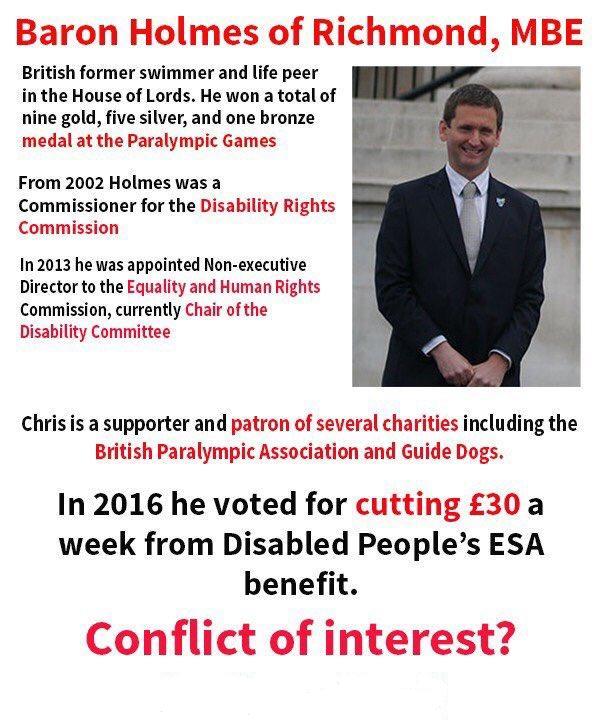
Dear Lord Holmes of Richmond,

I wish to draw your attention to the functions that were delegated to the Disability Committee and the Commissions duties as they relate to “disability matters” in:

  • Promoting understanding of the importance of equality and diversity
  • Encourage good practice
  • Promoting equality of opportunity
  • Promoting awareness and understanding of rights
  • Enforcing equality law
  • working towards the elimination of unlawful discrimination and harassment
  • Promoting understanding of good relations

Let me draw your attention to an article printed in the Guardian by the  EHRC on 01.03.2016 http://www.theguardian.com/politics/2016/mar/01/equalities-watchdog-criticises-planned-cuts-to-work-support-allowance

The very body you are a Commissioner for, the EHRC, say that the proposed cuts to ESA will disproportionately affect disabled people, widen inequalities and undermine the UK’s Human Rights obligations.

How can you be seen to be promoting the above when you went on to vote for these cuts to both ESA and PIP as a Conservative Peer, your actions will have a detrimental effect on disabled people’s lives, to both  Independent living and will undermine the UK’s Human Rights obligations.

As a disability rights campaigner I am calling for your immediate resignation of the position you hold as Disability Commissioner and Chair of the Disability Committee for EHRC as alongside my peers and other user led organization’s we think you are no longer worthy of this position.

Look forward to your reply

Susan Archibald
Disability Rights Campaigner.

Please sign the petition and support this campaign – Campaigners Demand For Lord Chris Holmes Resignation.

Supported by:

Dr Stephen Carty -Black Triangle Campaign

Professor Peter Beresford, Co-Chair, Shaping Our Lives

Mo Stewart –Disabled Veteran/Researcher

Dr Simon John Duffy – Centre of Welfare Reform

Gail Ward – Cross Border Alliance

John McArdle-Black Triangle Campaign

Pat Onions – Pats Petition

Rosemary ONeill – Carerwatch

Frances Kelly – Carerwatch/Dead Parrot Campaign

Linda Burnip – DPAC

Debbie Jolly – DPAC

Anita Bellows – DPAC

Merry Cross – DPAC

Rick Burgess – DPAC  Manchester

Paula Peters – DPAC

Annie Bishop – Involve North East & Cumbria for deaf, blind and people with disabilities

Carole Robinson – Bolshy Divas

Tracey Flynn – Bolshy Divas

Catherine Hale – Disability Researcher

C  Richardson – Disability Researcher

Stef Benstead – Disability Researcher

Jayne Linney DEAP

Sue Livett-Campaign for a Fair Society England

Michelle Mayer

Rosemary Trustam-Publisher Community Living Magazine

Jo Walker

Sue Jones – Psychologists against Austerity/Human Rights/Policy Researcher/Writer

Again, if you want to sign our petition please click the link here.


Further reading:

http://www.independent.co.uk/news/uk/politics/dwp-drew-up-plans-to-charge-disabled-people-for-fit-to-work-appeals-internal-documents-reveal-a6993996.html

http://thirdforcenews.org.uk/tfn-news/disability-activists-call-for-commissioner-to-resign?

http://www.mirror.co.uk/news/uk-news/secret-government-plan-charge-disabled-7798786

http://www.disabilitynewsservice.com/tory-peer-faces-calls-to-quit-as-ehrc-commissioner-over-support-for-wrag-cuts/

http://www.disabilitynewsservice.com/revealed-dwps-secret-financially-devastating-proposals-for-benefits-appeals/

http://www.disabilitynewsservice.com/secret-dwp-proposal-to-scrap-esa-substantial-risk-rules-would-breach-right-to-life/

http://www.thenational.scot/news/snp-calls-to-see-reports-on-suicides-following-benefits-cuts.16660


The Government’s brutal cuts to disability support isn’t ‘increasing spending’, Chancellor, but handing out tax cuts to the rich is

Chancellor George Osborne


2 wrag

Source: Hansard

Context

Many of us recognised in 2012, when the welfare “reforms” and other cuts to public services that support the poorest citizens were forced through parliament despite considerable opposition, using only the “financial privilege” of the Commons as a justification, that the Conservatives are on an ideological crusade, which flies in the face of public needs, democracy and sound economics, to shrink the welfare state and privatise our essential services.

In a wealth transfer from the poorest to the very rich, we have witnessed the profits of public services being privatised, but the losses have been socialised – entailing a process of economic enclosure for the wealthiest, whilst the burden of losses have been placed on the poorest social groups and our most vulnerable citizens – largely those who are ill, disabled and elderly. The Conservative’s justification narratives regarding their draconian policies, targeting the poorest social groups, have led to media scapegoating, social outgrouping, persistent political denial of the aims and consequences of policies and reflect a wider process of political disenfranchisement of the poorest citizens, especially sick and disabled people.

That the cuts are ideologically driven, and have nothing whatsoever to do with economic necessity, was demonstrated only too well by the National Audit Office (NAO) report earlier this year. The NAO scrutinises public spending for Parliament and is independent of government. The report indicates how public services are being appropriated for purely private benefit.

The audit report in January concluded that the Department for Work and Pension’s spending on contracts for disability benefit assessments is expected to double in 2016/17 compared with 2014/15. The government’s flagship welfare-cut scheme will be actually spending more money on the assessments conducted by private companies than it is saving in reductions to the benefits bill.

From the report:

£1.6 billion
Estimated cost of contracted-out health and disability assessments over three years, 2015 to 2018

£0.4 billion
Latest expected reduction in annual disability benefit spending.

This summary reflects staggering economic incompetence, a flagrant, politically motivated waste of tax payers money and even worse, the higher spending has not created a competent or ethical assessment framework, nor is it improving the lives of sick and disabled people. Some people are dying after being wrongly assessed as “fit for work” and having their lifeline benefits brutally withdrawn. Maximus is certainly not helping the government to serve even the most basic needs of sick and disabled people.

However, Maximus is serving the private needs of a “small state” doctrinaire neoliberal government, and making lots of private profit whilst it does so. The Conservatives are systematically dismantling the UK’s social security system, not because there is an empirically justifiable reason or economic need to do so, but because the government has purely ideological, anticollectivist, antidemocratic, profoundly uncivilising prescriptions and longstanding prejudices.

Last week I wrote about the £30 a week Employmen Support Allowance (ESA) work related activity group (WRAG) cuts, which the Government have forced through the legislative process, despite meeting with widespread opposition, the government claim that it is their financial privilege to do so. Yesterday I wrote about the brutal cuts that are planned for Personal Independence Payments (PIP) for sick and disabled people, which are aimed at saving money by reducing eligibility for the support. The cut, it is estimated, will affect at least 640,000 disabled people by 2020, who may lose up to £150 a week. This is money that provides essential support for people who need help to prepare food, use the toilet or dress themselves, amongst other things, and to maintain a degree of dignity and independence.

The cuts to ESA and Personal Independent Payments (PIP) take place in the context of a Tory manifesto that included a pledge not to cut disability benefits. In fact in March last year, the Prime Minister signalled that the Conservatives will protect disabled claimants from welfare cuts in the next parliament (this one). Cameron said the Conservatives would not “undermine” PIP, which was introduced under the Coalition to save money by “targeting those most in need.” Now it seems those most in need are not the ones originally defined as such.

At the time he told BBC Breakfast: “We’ve replaced one benefit – Disability Living Allowance – with a new benefit – Personal Independence Payment – it’s working well, it is also going to lead to some savings over time and we haven’t created that benefit in order to undermine it. We want to enhance it and safeguard it.”

Semantic thrifts: being Conservative with the truth

Only a Conservative minister would claim that taking money from sick and disabled people is somehow “fair,” or about “helping”, “supporting” or insultingly, “incentivising” sick and disabled people who have already been deemed unfit for work by their doctors and the state via the work capability assessment to work.

The Tories all too frequently employ such semantic shifts and euphemism – linguistic strategies – as an integral part of a wider range of techniques of neutralisation that are used, for example, to provide linguistic relief from conscience and to suspend moral constraint – to silence both “inner protest” and public objections – to the political violation of social and moral norms; to justify acts that cause harm to others whilst also denying there is any subsequent harm being inflicted; to deny the target’s and casualties’ accounts and experiences of political acts of harm, and to neutralise remorse felt by themselves or other witnesses.

Media discourse has often preempted the Conservative austerity cuts, resulting in the identification, stereotyping and scapegoating of the groups in advance of the targeted, discriminatory policies. Media discourse is being used as a vehicle for the government to push their ideological agenda forward without meeting legitimate criticism, public scrutiny and without due regard for essential democratic processes and safeguards.

The five neutralisation techniques identified by Gresham Sykes and David Matza are: denial of responsibility, denial of injury, denial of victims, appeal to higher loyalties, and condemnation of condemners.

The really critical part of Sykes and Matza’s argument is that rationalisations precede immoral, cruel or controversial acts and are a key factor in making deviant behaviour possible (amongst delinquents, the mafia or Conservative ministers). As such, the rationalisations betray intent.

The cuts of £120 a month to the disability benefit Employment Support Allowance  are also claimed to be “fair.” and “supportive.” Though I have yet to hear a coherent and rational  explanation of how this can possibly be the case. Ministers claimed that people subjected to the ESA Work Related Activity Group cuts could claim PIP if they required support with extra living costs, but now we are told that PIP is to be cut, too.

Osborne’s techniques of neutralisation: calling a cut “increased spending”

The chancellor has defended his decision to use the cuts in disability benefits to fund tax breaks for the wealthy. On the Andrew Marr show yesterday, he was questioned about his decision to cut PIP, currently made to over 640,000 disabled people in a bid to save at least £1.2 billion. Many severely disabled people are facing a cut of up to £150 a week under the new reduced eligibility assessment criteria.

Controversially, the cuts to disability benefits will fund tax cuts for the most affluent – the top 7% of earners. The Chancellor is set to raise the threshold at which people start paying 40p tax, in a move that will probably see  many wealthier people pulled out of the higher rate of income tax, in the coming budget. Mr Osborne says he wants to “accelerate progress” towards the Conservative’s manifesto pledge of raising the threshold for the 40p rate to £50,000 in 2020, it is understood. The average annual income in the UK is around £27,000. 

Andrew Marr said: You’re taking money out of the pockets of some of the most vulnerable people in this country, disabled people. These are the people who can least afford the sacrifice, the people with the weakest shoulders.

And you’re changing the rules to hit them. Is that really your priority?”

Osborne ludicrously claimed that the Conservative government was “increasing spending on disabled people”, he said: “Controlling welfare bills is part of what you need to do if you’re a secure country confronting the problems in the world.”

But as Marr pointed out, the cuts to ESA and PIP show an intended substantial reduction on government spending to essential support for disabled people.

From January 2017, the cut to PIP is likely to hit sick and disabled people who face fundamental barriers to health and essential basic care. The cut, it is estimated, will affect at least 640,000 disabled people by 2020.

Andrew Marr went on to say: “At the same time as you’re raising thresholds to help middle-class tax payers, it’s going to seem a very callous set of priorities.”

However, Mr Osborne maintained that the brutal and uncivilised cuts were “necessary to improve the economic conditions in the UK”. He said: “Yes, times are tough. The fiscal situation is a difficult one. All Western countries are not productive enough.”

You can see the interview here:


Austerity and premature mortality

Since 2011, a year after the government began their austerity programme, mortality rates have increased rapidly. Advisers to Public Health England (PHE) have warned that the 4-year trend may be the worst since World War II.

Data from the Office of National Statistics shows a 5.4% (27,000) increase in deaths in the past year alone, prompting calls for an urgent investigation. The year-on-year rise, to a total of 528,340 deaths, is the highest since 1968.

PHE said the elderly were bearing the worst of Tory austerity cuts, with women suffering disproportionately, though this is partly because they live longer, however, it is also due to a growing crisis in the NHS and cuts to social care. Professor Danny Dorling, from Oxford University, an advisor to PHE on older age life expectancy, said:

“When we look at 2015, we are not just looking at one bad year. We have seen excessive mortality – especially among women – since 2012.”

Figures show that the number of deaths had been falling steadily until 2011, a year after the government began their austerity programme, when deaths rates began to increase rapidly.

Professor Dorling cited Tory austerity as the biggest cause:

“I suspect the largest factor here is cuts to social services – to meals on wheels, to visits to the elderly.”

Empirical research published two years ago demonstrated the high a cost the country paid in terms of health and wellbeing for the Thatcher administration’s economic and social policies. The study, which looked at material from existing research and data from the Office for National Statistics, illustrates that Thatcherism resulted in the unnecessary and unjust premature deaths of British citizens, together with a substantial and continuing burden of suffering and a widespread degradation of wellbeing. Co-author and researcher Professor Clare Bambra from the Wolfson Research Institute of Health and Wellbeing said that deaths from violence and suicide all increased substantially during the Thatcher era in comparison with other countries. Regional inequalities in life expectancy between north and south were also exacerbated, as were health inequalities between the richest and poorest in British society.

Professor Bambra also says that the welfare cuts implemented by Thatcher’s governments led to a rise in poverty rates from 6.7% in 1975 to 12% by 1985; poverty is well known to be one of the major causes of ill health and mortality. Income inequality also increased in the Thatcher period, as the richest 0.01% of society had 28 times the mean national average income in 1978 but 70 times the average by 1990. Other research (The Spirit Level) indicates that income inequality is internationally associated with higher mortality and morbidity.

Welfare reform minister, Lord Freud, refused to monitor the number of people who take their own lives as a result of the £120-a-month cut planned for those people in the work related activity group (WRAG), claiming employment and support allowance from April 2017. Concerns were raised in the House of Lords last week, when Baroness Meacher, amongst others, warned that for the most vulnerable, the cut was “terrifying” and bound to lead to increased debt.

Condemning the truly callous and terrible actions of the Treasury, she urged ministers to monitor the number of suicides in the year after the change comes in, adding: “I am certain there will be people who cannot face the debt and the loss of their home, who will take their lives.”

Many people have died as a consequence of the welfare “reforms.”

Not only have the government failed to carry out an impact assessment regarding the cuts, Lord Freud said that the impact, potential increase in deaths and suicides won’t be monitored, apart from “privately” because individual details can’t be shared and because that isn’t a “useful approach”.

He went on to say “We have recently produced a large analysis on this, which I will send to the noble Baroness. That analysis makes it absolutely clear that you cannot make these causal links between the likelihood of dying – however you die – and the fact that someone is claiming benefit.”

Actually, a political refusal to investigate an established correlation between the welfare “reforms” and an increase in the mortality statistics of those hit the hardest by the cuts – sick and disabled people – is not the same thing as there being no causal link. Often, correlation implies causality and therefore such established links require further investigation. It is not possible to disprove a causal link without further investigation.

Whilst the government continue to deny there is a causal link between their welfare policies, austerity measures and an increase in premature deaths and suicides, they cannot deny there is a clear correlation establised, which warrants further research and political accountability.

Then they came for the ESA Support Group …

Despite the fact that this government face a UN inquiry into grave and systematic abuses of the human rights of disabled people, the blatant attacks on a social group with legally protected characteristics continues and the Conservatives continue to target disabled people for a disproportionately large and unfair burden of austerity cuts.

A government advisor, who is a specialist in labour economics and econometrics, has proposed scrapping all ESA sickness and disability benefits. Matthew Oakley, a senior researcher at the Social Market Foundation, recently published a report entitled Closing the gap: creating a framework for tackling the disability employment gap in the UK, in which he proposes abolishing the ESA Support Group. To meet extra living costs because of disability, Oakley says that existing spending on PIP and the Support Group element of ESA should be brought together to finance a new extra costs benefit. Eligibility for this benefit should be determined on the basis of need, with an assessment replacing the WCA and PIP assessment. The Conservative definition of “the basis of need” seems to be an ever-shrinking category.

Oakely also suggests considering a “role that a form of privately run social insurance could play in both increasing benefit generosity and improving the support that individuals get to manage their conditions and move back to work.”

I’m sure the private company Unum would jump at the opportunity. Steeped in controversy, with a wake of scandals that entailed the company denying people their disabilty insurance, in 2004, Unum entered into a regulatory settlement agreement (RSA) with insurance regulators in over 40 US states. The settlement related to Unum’s handling of disability claims and required the company “to make significant changes in corporate governance, implement revisions to claim procedures and provide for a full re-examination of both reassessed claims and disability insurance claim decisions.

The company is the top disability insurer in both the United States and United Kingdom. By coincidence, the  company has been involved with the UK’s controversial Welfare Reform Bill, advising the government on how to cut spending, particularly on disability support. What could possibly go right?

It’s difficult to see how someone with a serious, chronic and often progressive illness, (which most people in the ESA Support Group have) can actually “manage” their illness and “move back into work.” The use of the extremely misinformed, patronising and very misleading term manage implies that very ill people actually have some kind of choice in the matter. For people with Parkinson’s disease, rheumatoid arthritis, lupus and multiple sclerosis, cancer and kidney failure, for example, mind over matter doesn’t fix those problems, positive thinking and sheer will power cannot cure these illnesses sadly. Nor does benefit conditionality and being coerced into work by callously insensitive and medically ignorant assessors, advisors and ministers.

The Reform think tank has also recently proposed scrapping what is left of the disability benefit support system, in their report Working welfare: a radically new approach to sickness and disability benefits and has called for the government to set a single rate for all out of work benefits and reform the way sick and disabled people are assessed. 

Reform says the government should cut the weekly support paid to 1.3 million sick and disabled people in the ESA Support Group from £131 to £73. This is the same amount that Jobseeker’s Allowance claimants receive. However, those people placed in the Support Group after assessement have been deemed by the state as unlikely to be able to work again. It would therefore be very difficult to justify this proposed cut.

Yet the authors of the report doggedly insist that having a higher rate of weekly benefit for extremely sick and disabled people encourages them “to stay on sickness benefits rather than move into work.”

The report recommended savings which result from removing the disability-related additions to the standard allowance should be reinvested in support services and extra costs benefits – PIP. However, as outlined, the government have ensured that eligibility for that support is rapidly contracting, with the ever-shrinking political and economic re-interpretation of medically defined sickness and disability categories and a significant reduction in what the government deem to be a legitimate exemption from being “incentivised” into hard work.

The current United Nations investigation into the systematic and gross violations of the rights of disabled people in the UK because of the Conservative welfare “reforms” is a clear indication that there is no longer any political commitment to supporting disabled people in this country, with the Independent Living Fund being scrapped by this government, ESA for the work related activiy group (WRAG) cut back, PIP is becoming increasingly very difficult to access, and now there are threats to the ESA Support Group. The Conservative’s actions have led to breaches in the CONVENTION on the RIGHTS of PERSONS with DISABILITIES – CRPD articles 4, 8, 9, 12, 13, 14, 15, 17, and especially 19, 20, 27 and 29 (at the very least.) There are also probable violations of articles 22, 23, 25, 30, 31.

The investigation began before the latest round of cuts to ESA and PIP were announced.


426785_10151205298996274_171693454_n

Reverse the ESA disability benefit cut: sign the petition

Extend the PIP consultation & stop cuts to supporting terminally ill & disabled: sign the petition


Related

A tale of two suicides and a very undemocratic, inconsistent government

Paternalistic Libertarianism and Freud’s comments in context

Let’s keep the job centre out of GP surgeries and the DWP out of our confidential medical records

Conservative governments are bad for your health

Research finds strong correlation between Work Capability Assessment and suicide

Benefits Assessor: How Long Are You Likely To Have Parkinson’s?

scroll2

I don’t make any money from my work and I’m not funded. You can support Politics and Insights by making a donation to help me continue researching and writing independently, and to continue to help others.

DonatenowButton
cards

Support Politics and Insights

0_0_0_0_370_308_csupload_52703375

Maslow’s hierarchy of human needs.

I don’t make any money from my work and I’m not funded. But you can support Politics and Insights and contribute by making a donation which will help me continue to research and write informative, insightful and independent articles, and to provide support to others in the groups that I co-run. As a disabled person, I often struggle to meet basic needs, like many others. But research, writing and analysis is one thing I can do to try and make a positive difference and raise public awareness.

The smallest amount is much appreciated, and helps to keep my articles free and accessible to all – thank you.
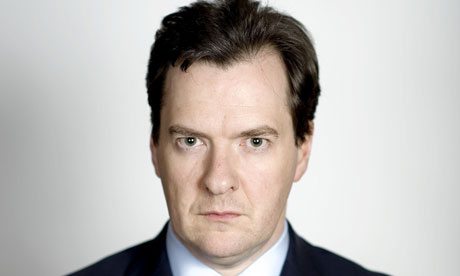
And a massive thank you to those who have already contributed.

DonatenowButton
cards

DWP Staff Gifted £42 Million in ‘Bonus Bonanza’.

IDS_n

At a time when the Conservatives have inflicted draconian cuts on those needing financial support because of illness, disability or losing their job, justifying this by their claim of “economic necessity” and the need to “live within our means” to “pay down the debt”, which is increasing rather than decreasing, the “responsibilities” imposed by the Tory austerity measures apply only to those with the very least.

Meanwhile, Whitehall bureaucrats, many involved in the implementation of the punitive welfare cuts, pocketed more than £90million in hand-outs last year.

Figures obtained by The Huffington Post UK show that in the year to April, 12 Government departments forked out £89.4million in bonuses to staff.

The most rewarding was Department for Work and Pensions, overseen by Iain Duncan Smith, which handed out £42.1million in bonuses to its staff – £38.1million of which went to Senior Civil Servants. And these figures only relate to 12 out of the 20 Government departments, meaning the total bonus figure could soar to almost £140million if the average pay out of almost £7million per department continues.

Labour MP Andrew Gwynne, who uncovered the figures, said: “For all his talk of belt-tightening, these figures show that David Cameron is happy to splash the cash on bonuses.

“Whilst the NHS is in crisis, this bonus bonanza would pay for thousands of new nurses.”

In 2012, the then Treasury minister Danny Alexander vowed to end bonuses for “run of the mill performance” as the coalition Government slashed departmental budgets.

Since 2010-11 the Government says it has restricted awards for senior civil servants to the “top 25 per cent of performers.”

Mark Serwotka, general secretary of the Public and Commercial Services Union called for the bonus system to be scrapped.

He said: “It is unfair and favours the already well paid. The money should be put towards decent pay rises, especially considering that since 2010 rank and file civil servants have seen their real incomes fall by 20 per cent.”

Prospect, a union for professionals, defended the civil service workers and he claimed the focus on bonuses is a “distraction” from the drop in take home pay of many civil servants.

Deputy general secretary Garry Graham said: “Pay in the private sector is increasingly buoyant with average increases running at more than 3.5 per cent. Civil servants have been told that average increases will be capped at 1 per cent until 2020.

“Pay rates in the private sector outstrip those of the public sector – and that gap is only forecast to increase, creating real problems in recruiting and retaining staff, particularly the professional specialists and managers Prospect represents.

“Many, if not all of our members would happily forgo the opportunity to earn a bonus in return for a decent and fair increase to their base pay.

“Government has created the bonus culture in the civil service, not the staff. And only 1 per cent of the civil service paybill is spent on bonuses.”

In a statement alongside his department’s figures, Work and Pensions Minister Justin Tomlinson said: “In line with Civil Service pay guidance, DWP rewards employees for their performance through either end of year non-consolidated payments and/or in-year payments. In year payments are limited to 0.23 per cent of the total DWP paybill.

I can’t help wondering what indicators are used to measure “performance,” and what actually constitutes “good performance.”

This post was written for Welfare Weekly, which is a socially responsible and ethical news provider, specialising in social welfare related news and opinion.

Tory rhetoric, the politics of psychobabble: it’s batshit telementalism and mystification

650
Oh come all ye faithful

The Conservative conference was a masterpiece of stapled together soundbites and meaningless glittering generalities. And intentional mystification. Cameron claims that he is going to address “social problems”, for example, but wouldn’t you think that he would have done so over the past five years, rather than busying himself creating them? Under Cameron’s government we have become the most unequal country in the European Union, even the US, home of the founding fathers of neoliberalism, is less divided by wealth and income than the UK.

I’m also wondering how tripling university tuition fees and reintroducing banding in classrooms can possibly indicate a party genuinely interested in extending equal opportunities.

“Champions of social justice and opportunities”? Must have been a typo in the transcript: it’s not champions but chancers.

Cameron also claims that the Conservatives are the “party for workers”, and of course lamblasted Labour. Again. Yet it was the Labour party that introduced tax credits to ensure low paid workers had a decent standard of living, and this government are not only withdrawing that support, we are also witnessing wages drop lower than all of the other G20 countries, since 2010, the International Labour Organisation reliably informs us.

This fall not only led to a tight squeeze on living standards, it also led to a shortfall in treasury income in the form of tax revenues. But all of this is pretty standard form for Conservative governments.

It’s interesting to note that the only standing ovation Cameron had for his speech from delegates was not related to policy proposals or even rhetoric. It was a response to the bitter, spiteful and typical Tory bullying approach to any opposition: in this case, an outburst of vindictive, unqualified personal comments, misquotes, misinformation and downright lies about Jeremy Corbyn.

It was more of the usual Conservative claptrap about Labour leaders “hating Britain”. Cameron used an out-of-context quote to paint Jeremy Corbyn as a “security-threatening, terrorist-sympathising, Britain-hating” leader. Cameron had failed to give any context to Mr Corbyn’s comments that he intentionally  misquoted, failing, for example, to mention the fact that Corbyn had said the lack of a trial for Bin Laden was the “tragedy”, not his death itself. The deliberate misquote, however, was met with a deft response from the Left, hoisting Cameron by his own petard.

Here is Cameron’s speech in full technicolour and spectacular ontological insecurity:

Cameron’s malicious comments reminded me again of the Tories’ history of dirty tricks, like the Zinoviev letter, the campaign against Harold Wilson, and made me think of the almost prophetic and increasingly less fictional A Very British Coup.

Even the BBC have called the Conservatives out on their very nasty anti-democratic propaganda campaign against Corbyn.

From the deluge of incoherent commentaries to the mechanisms of telling lies: Conservatives don’t walk the talk

The fact that there is now such an extensive gap between Conservative rhetoric, the claims being made and reality makes the task of critical analysis difficult and somewhat tiring, and I’m not the only writer to comment on this.

The Conservatives use language – semantic shifts – and construct incongruent, dissonance-inducing narratives to misdirect us, and to mask the aims and consequences of their policies.  For example, the words “fair”, “support” and the phrase “making work pay” have shifted to become simple socio-linguistic codifications for very regressive punitive measures such as cuts to social security support (comparable with the principle of less eligibility embedded in the Poor Law of 1834) and benefit sanctions.

The most striking thing about the Conservative conference, for me, isn’t just the gap between rhetoric and reality, it is also the gap between the bland vocabulary used and the references, meanings and implications of what was actually being said.

The semantics are also stratified. People who are unaffected by austerity policies will probably take the bland vocabulary at face value. Cameron said:

“The British people are decent, sensible, reasonable, and they just want a government that supports the vulnerable.”

However, the “vulnerable” know a very different reality to the one substituted and described on their behalf. People who are adversely affected by Conservative policy will regard the bland vocabulary as bewildering, deceitful, frightening – especially because of its incongruence with reality – and most likely, as very threatening. Such rhetoric is designed to hide intention, but it is also designed to deliberately invalidate people’s own experiences of Tory policies and ultimately, the consequences of an imposed Tory ideology.

Not that there can be any mistaking the threats aimed at sick and disabled people from Duncan Smith in his Conference speech. He said:

“We won’t lift you out of poverty by simply transferring taxpayers’ money to you. With our help, you’ll work your way out of poverty.”

Of course the Work and Pensions secretary employed a traditionally Tory simplistic, divisive rhetoric that conveniently sections the population into “deserving” tax payers and “undeserving” non-tax paying citizens, to justify his balefully misanthropic attitude towards the latter group, as usual. However, the majority of sick and disabled people have worked and have contributed tax. 

As Dr Simon Duffy, from the Centre for Welfare Reform, points out, the poor not only pay taxes they also pay the highest taxes.  For example, the poorest 10% of households pay 47% of their income in tax. This is a higher percentage than any other group. We tend to forget that people in poverty pay taxes because we forget how many different ways we are taxed:

  • VAT
  • Duties
  • Income tax
  • National Insurance
  • Council tax
  • Licences
  • Social care charges, and many others taxes.

Mr Duncan Smith said that many sick and disabled people “wanted to work” and that the Government should give them “support” to find jobs and make sure the welfare system encouraged them to get jobs.

We’ve seen the future and it’s feudal

Ah, he means “making work pay,” which is the Tory super-retro approach to policy-making, based on the 1834 Poor Law principle of less eligibility again.  The reality is that sick and disabled people are being coerced by the state into taking any very poorly paid work, regardless of whether or not they can work, and to translate the rhetoric further, Duncan Smith is telling us that the government will ensure the conditions of claiming social security are so dismal and brutal that no-one can survive it.

And Cameron’s promise during his address to the Conservative party conference that “an all-out assault on poverty” would be at the centre of his second term is contradicted by a sturdy research report from the Resolution Foundation that reveals planned welfare cuts will lead to an increase of 200,000 working households living in poverty by 2020.

Duncan Smith also criticised what he claimed was Labour’s “something for nothing culture” which was of course a very supportive and fair, reasonably redistributive system. He also dismissed and scorned the protests against his policies, which his party’s conference has been subject to. But demonstration and protest is a mechanism of democracy for letting a government know that their policies are having adverse consequences.

Many of the disabled protesters at the conference are being hounded, hurt and persecuted by this government and actually, we are fighting for our lives. But clearly this is not a government that listens, nor is it one that likes democratic dialogue and accountability.

In his teeth-grindingly vindictive and blindly arrogant speech, Duncan Smith also criticised the old Employment Support Allowance benefit for signing people off work when they were judged by doctors as too sick to work. He claimed that Labour treated disabled people as “passive victims.” I’m wondering what part of professional judgements that a person is too sick to work this lunatic and small-state fetishist finds so difficult to grasp. Duncan Smith is a confabulating zealot who drives a dogmatic steam-roller over people and their experiences until they take some Tory neo-feudalist deferential, flat-earth shape that he thinks they should be.

Let’s not forget that this government have actually cut support for disabled people who want to work. The Access To Work funding has been severely cut, this is a fund that helps people and employers to cover the extra living costs arising due to disabilities that might present barriers to work. The Independent Living fund was also cruelly scrapped by this Government, which also has a huge impact on those trying their best to lead independent and dignified lives.

By “support to get jobs”, what Duncan Smith actually means is no support at all. He means more workfare – free labor for Tory donors – and more sanctions – the removal of people’s lifeline social security. He also means that good ole’ totalitarian dictum of “behaviour change,” a phrase that the Tories are bandying about a lot, these days.  Ask not what the government can do for you.

And what about frail and elderly people needing support?

The public care sector has been cut by a third this past 5 years, yet people are still aging and living longer, so demand for the services has risen. We know that private residential care homes notoriously put profit over care standards, as yet there’s not been an equivalent local authority scandal, but cuts and gross underfunding mean care workers are stretched beyond limit, and there aren’t enough funds to run an adequate home care service. It’s mostly the very frail and elderly who need this service. And it’s those vulnerable citizens that are being increasingly left without adequate care, and certainly not care of a sufficient standard to maintain their dignity.

These are citizens that have paid into a social security system that was established for “cradle to the grave” support if it was needed. This government has so wickedly betrayed them. That’s hardly making a lifetime of work and contribution “pay”.

The knock on effect is that many people without adequate care end up stranded in hospital, taking up beds and resources, through no fault of their own, and as we know, the health service is also desperately struggling to provide adequate service because of Tory cuts.

The aim of Conservatives is not to meet public needs, but to nudge the public into complicity with Conservative ideology

Many writers, a number of MPs and Peers have variously likened Conservative rhetoric to George Orwell’s Doublespeak in his novel Nineteen Eighty Four. Others claim that the idea of a language and thought-manipulating totalitarian regime in the UK is absurd. But that said, I never thought I would witness an era of human rights abuses of disabled people, women and children by the government of a so-called first-world liberal democracy. The same government have also stated it’s their intention to repeal our Human Rights Act and exit the European Convention on Human Rights. I can understand the inclination towards disbelief.

There’s another group of people that know something is wrong,  precisely what that is becomes elusive when they try to think about it and the detail slips through their fingers, as it were, when they try to articulate it. But that’s what Tory rhetoric purposefully aims to generate in those who oppose Conservatism: confusion, cognitive dissonance and disbelief

Which brings me to the government’s woeful brand of “liberatarian paternalism” – manifested in the form of an authoritarian Nudge Unit. The fact that it exists at all and that it is openly engaged in changing people’s decision-making without their consent is an indication of an extremely anti-democratic, psychocratic approach to government. The Tories are conducting politics and policy-making using insidious techniques of persuasion and psycholinguistic hocuspocusery for psychic and material profiteering, ordinarily reserved for the very dubious, telemental, manipulative end of the diabolistic advertising industry.

Once a PR man, always a PR man, that’s David Cameron.

By telemental, I mean it’s based on a kind of communication model that is transmissional, linear, mechanistic – where people are treated as conforming, passive “receivers” of information constructs, rather than an interactive, participatory, dialogical and importantly, a democratic one where people are regarded as autonomous critical interpreters and negotiators. We’re being talked at, not with. The Tories are using telementation to communicate their ideological sales pitch, without any democratic engagement with the majority of citizens, and without any acknowledgement of their needs. (Telementation is a concept originally introduced by linguist Roy Harris. )

The co-author of Nudge theory, Cass Sunstein, actually suggested that government monitors political activism online, too. He has some links with GCHQ’s covert online operations which employ social science to inform their psychological operations to influence online interactions and outcomes. Sunstein proposed sending covert agents into “chat rooms, online social networks, or even real-space groups” which spread what he views as “false and damaging conspiracy theories” about the government. “Conspiracy” theories like this one, eh?

The nudging of psychobabble and neuroliberalism

Tory policy is all about social engineering using justification narratives founded on an insensate, draconian ideological and semantic unobtainium equivalent. It’s clear that this government lacks the experience and understanding necessary for the proper use of psychological terms.  The content of their smug and vindictive justification narratives and stapled-together, alienating and psychopathic rhetoric deviates markedly from even basic common sense and good judgement.

The Tories reduce long debated, complex ideas to surprisingly spiteful platitudes, and hand us back dogmas gift wrapped in aggrandized certitude.

Malice in blunderland.

There is an accessible government website outlining some of the Nudge Unit’s neurobabble and subliminal messaging “successes”, albeit the more mundane ones, like getting men to pee on the “right” part of a urinal. Or getting people to pay their taxes on time, or to donate organs.

The Nudge Unit’s behaviourism and psychological quackery, however, is all-pervasive. It has seeped into policy, political rhetoric, the media, education, the workplace, health services and is now embedded in our very vocabulary and social narrative. Every time you hear the phrase “behavioural change” you know it’s a government department acting upon citizens everywhere, using  basic, crude operant conditioning without their consent, instead of actually doing what public services should and meeting public needs. Instead, citizens are now expected to meet the government’s needs.

Where do you think the government got their pre-constructed ideological defence lexicon of psychobabble – they bandy about insidiously bland words like “incentivise” in the context of coercive state actions – such as the ideas for welfare increased conditionality and brutal operant conditioning based sanctions?

Did anyone actually ask for state “therapy” delivered by gaslighting, anti-socially disordered tyrants?

I sent an FOI asking the Department of Work and Pensions for the figures for sanctions since 2010 to the present, and I asked for the reasons they were applied. I also asked how sanctions can possibly “incentivise” or “help” people into work, and what research and academic/psychological/theoretical framework the claim is premised on, after I pointed out Maslow’s motivation theory based on a hierarchy of needs – accepted conventional wisdom is that you can’t fulfil higher level psycho-social needs without first fulfiling the fundamental biological ones.

If people are reduced to struggling to meet basic survival needs, then they can’t be “incentivised” to do anything else. And even very stupid people know that if you remove people’s means to eat, keep warm and shelter, they will probably die. It’s worth remembering that originally, benefits were calculated to meet only these basic survival needs. That’s why welfare is called a social “safety net”.

maslow-hierarchy-of-needsMaslow’s hierarchy of needs

There can be no justification whatsoever for removing that crucial safety net, and certainly not as a political punishment for people falling on hard times – that may happen to anyone through no fault of their own.

No matter what vocabulary is used to dress this up and attempt to justify the removal of people’s lifeline benefits, such treatment of citizens by an allegedly democratic, first-world government is unacceptable, despicable, cruel: it’s an act of violence that cannot fail to cause harm and distress, it traps people into absolute poverty and it is particularly reprehensible because it jeopardises people’s lives.

And what kind of government does that?

The nature of deception and psychological trauma

The Government are most certainly lying to project a version of reality that isn’t real.  Critical analysis of Tory rhetoric is a very taxing, tiring challenge of endlessly trying to make sense of disturbing relations and incoherent misfits between syntax and semantics, discourse and reality events. There’s a lot of alienating, fake humanism in there.

When politicians lie, there is a break down in democracy, because citizens can no longer play an authentic role in their own life, or participate in good faith in their community, state, and nation. Deception is cruel, confusing, distressing and anxiety-provoking: keeping people purposefully blind to what the real political agendas are and why things are happening in their name which do not have their agreement and assent.

Lying, saying one thing and doing another, creating a charade to project one false reality when something else is going on, is very damaging: it leaves people experiencing such deception deeply disorientated, doubting their own memory, perception and sanity.

To cover their tracks and gloss over the gaping holes in their logic, the Tories employ mystification techniques, the prime function of which is to maintain the status quo. Marx used the concept of mystification to mean a plausible misrepresentation of what is going on (process) or what is being done (praxis) in the service of the interests of one socioeconomic class (the exploiters) over or against another class (the exploited). By representing forms of exploitation as forms of benevolence, the exploiters confuse and disarm the exploited.

The order of concepts is not the order of things

On a psychological level, mystification is used in abusive relationships to negate the experience of abuse, to deceive and to avoid authentic criticism and conflict. Mystification often includes gaslighting, which is a process involving the projection and introjection of psychic conflicts from the perpetrator to the victim, and has a debilitating effect on the victim’s ability to think rationally and often, to function independently of the gaslighter. It can take many forms. In all instances, however, it involves the intentional, cold and cunning distortion of accounts of reality by a predator that systematically undermines the victim’s grasp of what is happening, distorting perceptions of events, editing and re-writing for the gaslighter’s own political, financial, or psychological ends.

And of course, gaslighting exploits the fact that human beings have a tendency to deny and repress those things that are too overwhelming and painful to bear. Much psychotherapy is based on creating a safe space for allowing experience of the dreadful – which as an event has already happened – to “happen.”

A memorable example of psychological mystification is presented in a case study cited by R.D. Laing. (In Did You used to be R.D.Laing, 1989). A woman finds her husband with a naked woman in the living room. She asks: “What is that naked woman doing in my house on my sofa!?” To which her gaslighting husband, without missing a beat, replied:  “That isn’t a woman, that’s a waterfall.” 

The poor woman felt her grasp of reality weaken, because she had trusted her husband and had always tended to believe him. She lost her self to a period of psychosis because of the deep trauma this event caused her. Her husband was an authoritarian figure. We tend to accept that authority figures tell the truth, with little questioning. But it’s not a safe assumption at all.

She was made to doubt her own perception and account of events, despite the utter absurdity of the alternative account of reality presented to her. To have one’s perception and experience of reality invalidated is very painful, threatening to the self and potentially extremely damaging.

We have a government that thinks nothing of using this type of distortion and deception to cover up the worst consequences of its policies.

This is a government of authoritarians and psychocrats who have an apparent cognitive dissonance: they decided that rich people are motivated only by fincancial gains, whilst poor people are motivated only by financial losses and punishments. However, when you replace the word “incentive” with the value-laden term “deserve”, and then slot it into an ideological framework with an underpinning social Darwinist philosophy, it becomes more coherent and actually, profoundly unpleasant. The Tories think that “social justice” is about taking money from those who need the most support, and handing it to those who don’t

This is a government that’s all about manufacturing conformity and obedience. The gospel, according to the likes of Iain Duncan Smith, is that we are the architects of our own misfortunes, but when it comes to good fortunes, well of course, the government claims responsibility for those. Incoherent, puerile proselytizing nonsense.

The truth of the human condition, according to the Tories, is that poor people scrounge, rich people are saintly and the former group needs humiliating and state “therapy” – degrading “paternalistic” corrective treatment, (mostly comprised of a barrage of anti-humanist ideology and the constant threat of, and often actual withdrawal of your lifeline income), whereas the latter group need all the praise, support and state handouts they can get.

This is a government that use a counterfeit and dark triad (particularly Machiavellian) inspired language to create an impression of plausibility and truth, and to hide their true aims. They are demogogues of a radical and reactionary anti-social agenda. Intolerance, fear and hatred, machismo and bullying tendencies are masqueraded as moral rectitude.

This is a government that uses superficial, incongruent, meaningless psychobabble to justify the most savage and cruelly coercive policies that we have seen in the UK during our lifetime. Those social groups unaffected by the policies think that the government are acting in our “best interests”, but people are suffering and dying as a consequence of these policies.

People’s life problems such as unemployment and poverty arise from bad decision-making from the government and are not clinical maladies, the use of or implying of pseudo-clinical terms in political victim-blame narratives and gaslighting is not meaningful or appropriate.

Political psychobabble is designed intentionally to limit the freedom of public comprehension, it neutralises our own vocabulary, and invalidates our experiences. The nasty party are engaged in psychic profiteering – a government of quacks spouting pretentious gibberish to justify taking money from the poorest citizens and handing it out to the very wealthy.

It’s irrational, incoherent psychobabble from over-controlling, obedience-obsessed irrationalists whose sole aim is to ensure the population conform to government needs, and meet the demands of neoliberalism, rather than, heaven forbid, wanting a democratic government and an economic system that actually meet public needs.

Or if you prefer plainspeak: Tory rhetoric is rather like a long-empty belfry – full of batshit.

Oh, that way madness lies.

Cam weakness
Picture courtesy of Robert Livingstone