Category: Human Rights

Disabled woman and survivor of abuse to be subjected to grossly intrusive council surveillance to justify care costs

14264869_10155156840200130_1352094000808474819_n

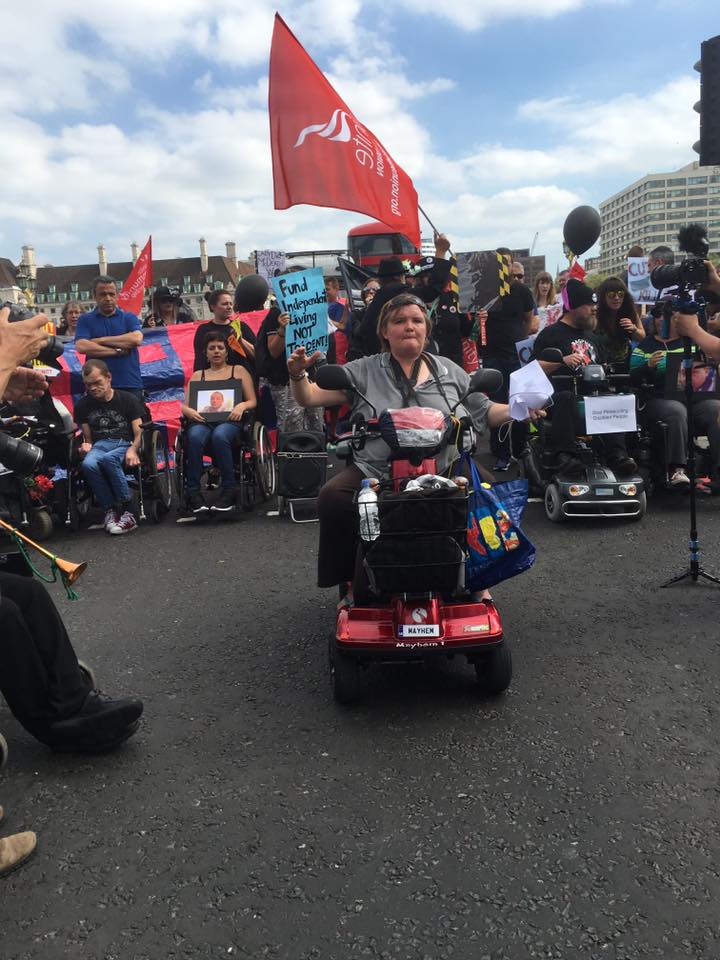
 Cuts Kill, No More Benefit Deaths protest, Westminster Road block, 7 September 2016: part of Disabled People Against the Cuts’ Rights Not Games week of action.

Photo courtesy of Paula Peters, DPAC.


John Pring from Disability News Service
reports:

“A disabled woman has told how her local council is threatening to spend several days watching her every move as she eats, showers and uses the toilet, in order to check if planned cuts to her care package will meet her needs.

The woman, Jane*, a survivor of serious sexual, physical and emotional abuse, and a former Independent Living Fund (ILF) recipient, spoke about the council’s “violation” at a parliamentary campaign meeting this week.

The meeting was held to launch Inclusion London’s report on the impact of last year’s ILF closure, as part of the Rights Not Games week of action organised by Disabled People Against Cuts (DPAC)**.

The report, One Year On: Evaluating The Impact Of The Closure Of The Independent Living Fund, includes information from all 33 London local authorities, and concludes that there has been a “dramatic postcode lottery” in the support provided to former ILF recipients since the fund closed.”

*Not her real name

**DPAC has set up a legal fund to help former ILF recipients like Jane challenge cuts to their support packages.

I recommend that you read the full article: Council wants to watch abuse survivor shower and toilet to check post-ILF needs.

The council have suggested that Jane may survive on microwave meals – which she has said would damage her health and be unaffordable – and that she can use incontinence pads for up to 12 hours a day, instead of being helped to use the toilet.

Over the summer, council officials told Jane that once the cuts to her care package were in place (from 12 hours of support a day to 38 hours a week), they wanted to send a “team of people” to observe (for up to two weeks) the impact of the reduction in care on how she manages to use the toilet, take a shower, gets in and out of her wheelchair and her bed, and feeds herself.

This will require an intrusion on a very intimate level, into aspects of her life where privacy is something that most people would take for granted. For disabled people, the public/private divide no longer exists. The details of our most intimate circumstances have become public property. Jane is not only horrified at this dehumanising move to cut costs, and about the fact that her physical needs, citizen rights and dignity are being so casually disregarded; she also has concerns regarding the potentially very damaging psychological effects of such an intrusion from the state, who have the sole aim of callously cutting her essential support.

The Independent Living Fund (ILF) was set up in 1988 to fund support for disabled people with high support needs in the United Kingdom, enabling them to live in the community independently, rather than move into residential care.

The ILF was designed to combat social exclusion on the grounds of disability. The money is generally used to enable disabled people to live in their own homes and to pay for care, and in particular, to employ personal care assistants. Many of the beneficiaries would have otherwise had to move to residential care homes.

In December 2010 the Government announced the closure of the Fund to new applicants, and in December 2012, following a consultation on the future of the Fund, it was announced that the Fund would be closed permanently from April 2015. The Government claimed that Local Authorities could meet the same outcomes as the ILF and proposed transfer for existing ILF recipients to their Local Authorities.

The Government initially decided to close the fund by March 2015 but this was delayed until June 2015 after five disabled people challenged the Government’s decision in the High Court.

In a very significant decision on 6 November 2013 following the Judicial Review, which highlighted the effects of the Equality Act 2010 on public authorities and their decision-making, the Court of Appeal found that the Department of Work and Pensions’ (DWP) decision to close the ILF was not lawful, overturning the High Courts’ decision of April 2013. The Government had indicated that it would not be appealing this judgement and the ILF would remain intact for the time being. 

The Court of Appeal unanimously quashed the decision to close the fund and devolve the money, on the basis that the minister had not specifically considered duties under the Equality Act, such as the need to promote equality of opportunity for disabled people and, in particular, the need to encourage their participation in public life. The court emphasised that these considerations were not optional in times of austerity.

On March 6, 2014, the Government made the authoritarian announcement that it would go ahead with the closure of the ILF fund on 30th June 2015, saying that a new equalities analysis had been carried out by the DWP. The government has shown a complete disregard for disabled people and the Court of Appeal decision. 

Highlighting that government had failed to comply with the equality duty had been a rare victory, entirely due to disabled people fighting back. The government responded to this by simply ignoring the court ruling.

The ILF provided additional income to nearly 19,000 disabled people who have high level support needs. The government devolved the responsibility to already cash-strapped local authorities in England, which meant that it would cease to be ring-fenced and would be subject to constraints and cuts within a local authority budget in June 2015. The funding was not ring-fenced. Because of budget cuts, local authorities have had limited capacity to support individuals unless their needs are very severe and so the ILF had previously served to supplement this provision. Local Authorities are already struggling to fund statutory provision and services, as it is. 

Local Authorities had already said that they will not be able to offer the current level of financial support provided by ILF, potentially forcing many disabled people to move out of their homes and into residential care homes.

The Inclusion report aims at gathering evidence of the impact of the closure of the ILF with a focus on the situation in London. It brings together statistical analysis from Freedom Of Information (FOI) requests sent to all 33 London boroughs with findings from a survey sent out to London Deaf and Disabled People’s Organisations (DDPOs) as well as qualitative evidence provided by former ILF recipients concerning their experiences of transfer to Local Authority (LA) support.

Comparison of evidence gathered through comparison of the Freedom Of Information (FOI) responses, Deaf and Disabled People’s Organisations (DDPO) survey, and examples of lived experience submitted by former ILF recipients has led to a number of themes emerging:

  • Post-code lottery for former ILF recipients across Local Authorities.
  • The detrimental impacts of the ILF closure on former ILF recipients, ranging from distress and anxiety to removal of essential daily support. 9 One Year On: evaluating the impact of the closure of the Independent Living Fund
  • The lack of consistent practice across different Local Authorities regarding referrals for CHC funding.
  • Limitations of the mainstream care and support system and failings in the implementation of the Care Act.
  • The value of the model of support provided by the Independent Living Fund.
  • The importance of Deaf and Disabled People’s Organisations for making Deaf and Disabled people aware of and supported to exercise their rights.

There is an urgent need for a radical rethink of how Disabled people are supported to live independently. Disabled people who use independent living support must be at the forefront of developing ideas and with adequate resources for meaningful engagement.

This also needs to happen quickly, before the memories of what effective independent living support looks like and how much Disabled people can contribute when our support needs are met fade into the distance.

You can read the full report here: One year on: Evaluating the impact of the closure of the Independent Living Fund

Related  

ILF closure cuts report produces instant results from Labour and Greens

Two-way mirrors, hidden observers: welcome to the Department for Work and Pensions laboratory


Two-way mirrors, hidden observers: welcome to the Department for Work and Pensions laboratory

018

I regularly write to raise concerns about the current government’s misuse of psychology in public policies and research. There has been a shift towards the formulation of targeted, prejudiced, class contingent policies which have the central aim of “changing behaviours”  and enforcing “compliance” and conformity. This behaviourist approach has some profound implications for democracy. It constrains autonomy and curtails the basic liberties of targeted citizens, it does not include safeguards or a space for citizens’ qualitative accounts and feedback, while also excluding them from any political consideration of their human rights. 

On the government website, a contract finder notice for the “Provision of Research Laboratory Facilities” for the Department for Work and Pensions says:

“The Department for Work and Pensions (DWP) requires research to be undertaken, in a research laboratory environment, with recipients of the Carers Allowance and recipients of the Employment and Support Allowance (ESA).

In a typical lab situation DWP shall have one DWP researcher in a room with the participant and other DWP researchers (if appropriate) and invited observers behind a two way mirror evaluating what is happening. As well as viewing the interview they can also see the activity on the web screen via monitors in their room.

The proceedings are currently recorded on MP4 for subsequent use when research findings are being reported. The participants cannot see the people in the viewing facility though they know they are there. There needs to be flexibility to be able to undertake the research in the North West and Leeds and be able to recruit for participants to attend a Government Lab set up at Aviation House in London WC2B 6NH.” 

Northern Voices T/A The Talking Shop is a Manchester based market research and public opinion polling company that has been awarded the contract in June this year. This company will be paid up to £60,000 for experimenting on sick and disabled claimants, using covert observation from behind a two-way mirror, studying eye movements, facial expressions and body language. 

Eye movement measurements are frequently used, though controversially, in criminal psychology, too, as a somewhat unreliable method of “lie detection.” Questions arise regarding precisely how eye movements, perception and cognition are related, and to date, this question hasn’t been answered by academics. 

It struck me that the experimental set up is very reminiscent of the social psychology experiments conducted in the 60s and early 70s to study social conformity and obedience to authority. However, the welfare “reforms” were specifically designed to coerce people claiming welfare into conformity – “to do the ‘right thing'”-  and compliance with a harsh “conditionality” regime and ever-shrinking eligibility criteria. It’s hardly a secret that the New Right Conservatives and neoliberals have always loathed the welfare state, and along with the other social gains of our post-war settlement, it is being systematically dismantled.

The wider context is significant, both in terms of its impact on individual citizen’s experiences and behaviours, and on the way that theory is formulated to conflate and align citizen’s needs with neoliberal outcomes, and this is also reflected in how research is being designed and used.

Some context

In the UK, the Behavioural Insight Team has been testing libertarian paternalist ideas for conducting public policy by running experiments in which many thousands of participants receive various policy “treatments.” A lot of the actual research work is contracted out to private providers. Whilst medical researchers generally observe strict ethical codes of practice, in place to protect subjects, the new behavioural economists and profit-driven private companies are less transparent in conducting behavioural research “interventions.” There are no ethical and safeguarding guidelines in place to protect participants.

Earlier this year I wrote about a Department for Work and Pensions Trial that was about “testing whether conditionality and the use of financial sanctions are effective for people that need to claim benefits in low paid work.” A secretly released document (which said: This document is for internal use only and should not be shared with external partners or claimants.) was particularly focused on methods of enforcing the “cultural and behavioural change” of people claiming both in-work and out-of-work social security.

Evaluation of the Trial will be the responsibility of the Labour Market Trials Unit (LMTU). Evaluation will “measure the impact of the Trial’s 3 group approaches, but understand more about claimant attitudes to progression over time and how the Trial has influenced behaviour changes.”

Worryingly, claimant participation in the Trial was mandatory. There was no appropriate procedure to obtain and record clearly informed consent from research participants. Furthermore, the Trial is founded on a coercive psychomanagement and political approach to labour market constraints, and is clearly expressed as a psychological intervention, explicitly aimed at “behavioural change” and this raises some serious concerns about the lack of research ethics and codes of conduct in government research. It’s also very worrying that this “intervention” is to be delivered by non-qualified work coaches.

The British Psychological Society (BPS) have issued a code of ethics in psychology that provides guidelines for the conduct of research. Some of the more important and pertinent ethical considerations are as follows:

  • Informed Consent.

Participants must be given the following information:

  •  A statement that participation is voluntary and that refusal to participate will not result in any consequences or any loss of benefits that the person is otherwise entitled to receive.
  • Purpose of the research.
  •  Procedures involved in the research.
  •  All foreseeable risks and discomforts to the participant (if there are any). These include not only physical injury but also possible psychological.
  •  Subjects’ right to confidentiality and the right to withdraw from the study at any time without any consequences.

Protection of Participants

  • Researchers must ensure that those taking part in research will not be caused distress. They must be protected from physical and mental harm. This means you must not embarrass, frighten, offend or harm participants.
  • Normally, the risk of harm must be no greater than in ordinary life, i.e. participants should not be exposed to risks greater than or additional to those encountered in their normal lifestyles. Withdrawing lifeline support that is calculated to meet the costs of only minimum requirements for basic survival – food, fuel and shelter – as a punishment for non-compliance WILL INVARIABLY cause distress, harm and loss of dignity for the subjects that are coerced into participating in this Trial. Participants should be able to leave a study at any time if they feel uncomfortable.

Behavioural “rights” and the politics of moralising

Consent to a therapy or research protocol must possess a minimum of three features in order to be valid. These are: it should be voluntarily expressed, it should be the expression of a competent subject, and the subject must be be adequately informed of the details.This raises some serious concerns about experimental social research, especially when it may involve people with mental health disabilities who may be highly vulnerable.

It’s highly unlikely that people subjected to the extended use and broadened application of welfare sanctions gave their informed consent to participate in experiments designed to test the nudge theory of “cognitive bias,” for example. The extended use of sanctions in the Welfare Reform Act 2012 was originally advised by the Behavioural Insights Team (the Nudge Unit) back in 2010. It was based on the manipulation of an alleged cognitive bias that we have – loss aversion – and designed as a method of coercing conformity to increasingly unreasonable state-imposed conditionality rules, and as punishment for the perceived “non-compliance” of unemployed people.

There is nothing to prevent a government deliberately exploiting a research framework as a way to test out highly unethical and ideologically-driven policies. How appropriate is it to apply a biomedical model of prescribed policy “treatments” to people experiencing politically and structurally generated social problems, such as unemployment, inequality and poverty, for example? 

The fact that this government regards work as a “health outcome” should raise alarm bells. (Please see: Let’s keep the job centre out of GP surgeries and the DWP out of our confidential medical records). The government have already stigmatised unemployment, and redefined it as a psychological disorder.

Furthermore, the research models being used are framed by a profoundly undemocratic conservative neopositivism, which emphasises directed quantitative data collection and excludes the accounts, experiences, narratives and language of research participants. Much of the research is prejudiced, and starts from an authoritarian premise that people experiencing socioeconomic problems do so because they make the “wrong choices” and that they need to be “incentivised to change their behaviours”.

An element of the “laboratory  research environment” research went ahead in March last year. It’s stated aim was to “to improve the Carer’s Allowance Digital Service.”  The recruitment brief specifies that:

“These self employed people shouldn’t have accounts prepared by an accountant however it’s mandatory that they bring with them details of their self-employment eg a log book or papers of incoming and outgoings. We also need these people to be looking after someone who has a disability.”

It’s become normalised that many millionaires avoid paying taxes and contributing to the society that they have gained so much from. I don’t see anyone intimidating them, demanding details of their “incoming and outgoings,” yet that would profit society far, far more.

Wouldn’t you think that if this were genuinely about supporting carers using software or accessing services online, it would be designed to be USER LED – a direct face-to-face approach would be the usual way, with an input from those service users, which is qualitative and much more reliable, authentic and useful than the account of a group of strangers hiding behind mirrored glass, observing people and applying controversial psychology techniques.

Measuring eye movements is usually coupled with other more inclusive qualitative methodologies, such as introspective verbal protocols, since used on its own, it is unreliable in that it fails to indicate specific kinds of cognitive processing or content. This dialogic approach, however, isn’t included in the government’s research brief. (Please see The importance of citizen’s qualitative accounts in democratic inclusion and political participation.)

The central premise of justifications for “behavioural interventions” is that the general public has numerous cognitive biases that lead to “faulty” decision-making. Current research and interventions are largely aimed at the poorest citizens, however, exposing a government bias that wealthy people are somehow cognitively competent. Yet many of this powerful, offshore hoarding minority class want to see worker’s rights, welfare support and our public services dismantled.

Not a rational or civilised class, on the whole, then.

As I have previously stated, the behavioural approach removes people from the socioeconomic and political context that they inhabit and isolates them from meaningful and impacting socio-structural events and political decision-making, placing the burden of responsibility and obligation entirely within those who are suffering the inevitable systemic consequences of neoliberal policies. In such an economic system of “market forces” based on competition, there are invariably winners and losers. It’s hardly rational or fair to punish those who are simply adversely affected by an intrinsically flawed and unfair system of socioeconomic organisation for which there was never a consensus. It was simply imposed on the UK public, without any legitimate, informed consent.

Can you imagine the government carrying out this kind of research and stigmatising, intimidating methodology on billionaires interacting with their accountants, completing their tax returns or interacting with their offshore banks? No, I thought not. 

It’s noteworthy that current Nudge Unit policy is to keep those being targeted for nudges “naive” as people tend to temporarily alter their behaviour when they know they are being observed and that skews research results. In sociology and social psychology, this is called the Hawthorne effect.

However, that approach is profoundly incompatible with established ethical research frameworks, and fundamental human rights, which, as I’ve outlined, always specify a central requirement of participants’ informed consent.

Similarly, the starting premise of laboratory usability testing is that “what people say they do with products is not always what they actually do.” In other words, we cannot trust the public to tell us what they need.

Userbility testing, an American import, is designed to “target” users’ needs and preferences by observing their behaviour. However, a big part of the motivation for this kind of research is Building credibility for usability activities within an organization.” The government often use research like this to formulate justification narratives for controversial, coercive and punitive policies.

Democracy is meant to involve the election of a government that reflects on social problems objectively, recognises and serves public needs, and designs policy in response to what citizens actually need; it’s not about governments that coerce people to “change their behaviour” in accordance to a partisan, ideological agenda. We call the kind of government that does that “totalitarian.”

I am not the only person who is very concerned about this development.  

A spokesperson for Fightback 4 Justice said:

“This is the company that has won the tender experimenting with Carers claimants using body language techniques and 2 way mirrors. If anyone gets called into one of these meetings please get in touch as I’d be happy to attend. I am very very concerned about a potential breach of a person’s human rights here particularly where mental health is one of the claimants conditions. Nothing about this “study” seems ethical in my legal opinion. A room with a 2 way mirror and capacity for 12 people studying body language and facial expressions is wrong in so many ways, DWP are giving the wrong impression that claimants are potential criminals with this latest research in my view.” Michelle (legal advocate).

The Talking Shop’s research studios

images

Related

The politics of blame and in-work conditionality

Nudging conformity and benefit sanctions

G4S are employing Cognitive Behavioural Therapists to deliver “get to work therapy”

The new Work and Health Programme: government plan social experiments to “nudge” sick and disabled people into work

The importance of citizen’s qualitative accounts in democratic inclusion and political participation

Let’s keep the job centre out of GP surgeries and the DWP out of our confidential medical records

The Conservative approach to social research – that way madness lies

A critique of Conservative notions of social research


CONTRIBUTE TO POLITICS AND INSIGHTS

I don’t make any money from my work. But you can contribute by making a donation and help me continue to research and write informative, insightful and independent articles, and to provide support to others. The smallest amount is much appreciated – thank you.

DonatenowButton

The Tory British Bill of Rights: ‘be the short change you want to see’

Cngs9EjXEAAmYy7

The politics of regression

The UK has passed a lot of posts over the last five years. We are now a post-European, post-welfare, post-consensus, post-progressive, post-rational, post-democratic, post-first world, post-liberal, post-inclusive, post-diverse, post-equality, post-freedom, post-rights, post-protest, post-truth society. We managed all of this by travelling backwards as a society, not forwards.

The clocks stopped when the Conservatives took office in 2010. Now we are losing a decade a day.

This week, the government have confirmed they still plan to repeal the Human Rights Act and replace it with a so-called British Bill of Rights. This will break the formal link between the European Court of Human Rights and British law. Any judgement from Europe would be treated as “advisory” only, rather than legally binding, and would need to be “approved” by parliament. Such a Bill would definitely short change UK citizens in terms of balancing responsibilities, obligations and rights. It would profoundly disempower citizens because it will shift the balance of democracy, placing power almost entirely in the hands of the state.

The citizen rights protected by Labour’s flagship Human Rights Act are quite basic. They include the right to life, liberty and the right to a fair trial; protection from torture and ill-treatment; freedom of speech, thought, religion, conscience and assembly; the right to free elections; the right to fair access to the country’s education system; the right NOT to be given the death penalty; the right to marry and an overarching right not to be discriminated against.

Over their time in office, the Tories have systematically contravened the Human Rights of disabled people, women and children. It’s clear that we have a government that regards the rights of most of the population as a mere bureaucratic inconvenience, to be simply brushed aside. In October 2014, I was one of the very first independent writers to report the United Nations’ inquiry into the government’s gross breaches of the rights of disabled people. Writers and researchers like me and organised groups such as Disabled People Against the Cuts (DPAC) have been submitting evidence regarding the dehumanising impacts of the Conservative welfare “reforms” to the UN since 2012.

Theresa May has previously expressed strong support for controversial constitutional change. She stated in 2014, that she would like to see the UK withdraw from the European Convention on Human Rights, echoing David Cameron.

In a speech earlier this year, she said: “This is Great Britain, the country of Magna Carta, parliamentary democracy and the fairest courts in the world.

And we can protect human rights ourselves in a way that doesn’t jeopardise national security or bind the hands of parliament.

A true British bill of rights, decided by parliament and amended by parliament, would protect not only the rights set out in the convention, but could include traditional British rights not protected by the European Convention on Human Rights (ECHR) such as the right to trial by jury.”

However, May’s comment about the need for a Bill of rights that doesn’t “bind the hands of parliament” is worrying, since human rights were designed originally to protect citizens from despotic states and authoritarian governments like this one.

Her comment that the ECHR does not provide for the right to trial by jury is also misleading. Article 6 of the European Convention on Human Rights is a provision  which protects the right to a fair trial and access to justice. In criminal law cases and cases to determine civil rights, it protects the right to a public hearing before an independent and impartial tribunal within reasonable time, the presumption of innocence, and other basic rights for those charged in a criminal case (such as adequate time and facilities to prepare their defence, access to legal representation, the right to examine witnesses against them or have them examined, the right to the free assistance of an interpreter).

The Effective Criminal Defence in Europe report identified that the UK already needs to address issues regarding inadequate disclosure to suspects during investigation stage and that a more effective judicial oversight of bail and arrest are needed. Cuts to legal aid are also problematic in terms of ensuring the right of equal access to justice. Chris Grayling has already tried to take legal aid from the poorest citizens, in a move that is so clearly contrary to the very principle of equality under the law. He turned legal aid into an instrument of discrimination. He has also tried to dismantle another vital legal protection  – judicial review – which has been used to stop him abusing political power on several occasions. I don’t think this is a government that has indicated so far that it has the needs and wellbeing of citizens as a main priority.

Liz Truss, the justice secretary, dismissed reports that that the Government was abandoning the policy, which was included in the Conservative manifesto in 2015, to avoid a conflict with the Scottish Government 

She told BBC Radio 4’s Today programme on Monday morning: “We are committed to that. That is a manifesto commitment. 

I’m looking very closely at the details but we have a manifesto commitment to deliver that.”

However, last year, Amnesty UK commissioned a poll that indicated the British public are not particularly willing to see any change to existing Human Rights legislation, with only one in 10 people in the UK (11%) believing that scrapping the Human Rights Act should be a government priority.

Kate Allen, Amnesty International (UK) director, said:

“The British people clearly want the Government to get on with their proper business of the day-to-day running of the country, and abandon these destructive plans.

“It’s quite right that it shouldn’t be up to governments to pick and choose which rights we are entitled to and select who they deem worthy of them. It took ordinary people a very long time to claim these rights and we mustn’t let politicians take them away with the stroke of a pen.

“It’s great to have it confirmed that British people think that rights and protections must apply to everyone equally in order to work at all.”

David Cameron pledged to explore ways to leave the ECHR in the wake of the departure of his most senior legal advisor, Dominic Grieve. 

Ken Clarke said: “It is unthinkable for Britain to leave the European Convention on Human Rights,” he was also a departing cabinet minister. Cameron is believed to have wanted rid of the Attorney General Grieve because he was supportive of Britain’s continued ECHR membership.

Labour dubbed the cabinet reshuffle “the massacre of the moderates”, pointing to the departure of pro-Europe and “one nation” Tories such as David Willetts, Nick Hurd and Oliver Heald.

It’s long been the case that the Tories and the right wing press have deliberately blurred the boundaries between the European Union and the European Council of Human Rights, which are of course completely different organisations. This was a misdirection ploy.

However it is the case that the member states of the EU agreed that no state would be admitted to membership of the EU unless it accepted the fundamental principles of the European Convention on Human Rights and agreed to declare itself bound by it. I also think that conservatives, who regard both institutions as “interfering”, do see the Union and the Council as the same in terms of both being international frameworks requiring the British government to have a degree of democratic accountability at an international level.

In his parting interview, Clarke, who has held office in every Conservative government since 1972 and is also the party’s most prominent Europhile, said the debate was “absurd”.

“I personally think it’s unthinkable we should leave the European Convention on Human Rights; it was drafted by British lawyers after the Second World War in order to protect the values for which we fought the War for.” He’s right, of course.

The years immediately after the second world war marked a turning point in the history of human rights, as the world reeled in horror at the rise of fascism and the Nazi concentration camps, there came an important realisation that although fundamental rights should be respected as a matter of course, without formal protection, human rights concepts are of little use and consolation to those facing persecution.

So in response to the atrocities committed during the war, the international community sought to define the rights and freedoms necessary to secure the dignity and worth of each individual. In 1948 the newly formed United Nations adopted the Universal Declaration of Human Rights (UDHR), one of the most important agreements in world history.

Shortly afterwards another newly formed international body, the Council of Europe, set about giving effect to the UDHR in a European context. The resulting European Convention on Human Rights was signed in 1950 and ratified by the United Kingdom, one of the first countries to do so, in 1951. At the time there were only ten members of the Council of Europe. Now 47 member countries subscribe to the European Convention, and in 1998 the Human Rights Act was passed by the Labour Party in order to “give further effect” to the European Convention in British law.

Previously, along with the Liberal Democrats, Grieve was able to thwart attempts to reform the ECHR, and opposed pulling out altogether. The plan to reform it is being led by the Justice Secretary Chris Grayling but Grieve has pledged to continue to fight for Britain’s membership from the backbenchers. Though Clegg had agreed to a British Bill of Rights, he was strongly opposed to withdrawing from the ECHR.

Grieve understood that ECHR is about the fundamental rights of the citizen and ought to be cherished in the same way as the Magna Carta and Habeas Corpus are. But as we know, this is not a typical view amongst Conservatives, who frequently cite the same examples of “foreign criminals” being allowed to stay in the country as evidence it is “not working”.

The prime minister’s spokesman said that the sacking of Grieve had not led to a change in government’s policy. However he pledged action if the Conservatives are elected next year without the Liberal Democrats: “If you are asking me about party manifestos, the prime minister has previously said that he wants to look at all the ways that we can ensure we are able to deport those who have committed criminal offences.”

Grieve said he would defend human rights legislation from the back benches to “contribute to rationality and discourse”.

“If we send out a sign that human rights don’t matter, that is likely to be picked up in other countries which are also signatory states such as Russia.”

humanrights

The marked loss of transparency and democratic accountability

In the original Conservative proposals to scrap our existing human rights framework, and replace it with their own, one sentence from the misleadingly titled document  –Protecting Human Rights in the UK, (found on page 6 ) – is particularly chilling: “There will be a threshold below which Convention rights will not be engaged.”

Basically this means that human rights will no longer be absolute or universally applied – they will be subject to stipulations and caveats. And discrimination. The government will establish a threshold below which Convention rights will not be engaged, allowing UK courts to strike out what are deemed trivial cases.

The Tories’ motivation for changing our human rights is to allow reinterpretations to work around the new legislation when they deem it necessary. The internationally agreed rights that the Tories have always seen as being open to interpretation will become much more parochial and open to subjective challenge.

Many people have said that the Conservatives won’t escape accountability if they repeal the Human Rights Act and replace it with something less comprehensive, because we are still signatories to a number of broader international treaties on human rights. 

However, last year I wrote about how the government has quietly edited the ministerial code, which was updated on October 15  without any announcement at all. The code sets out the standard of conduct expected of ministers. The latest version of the code is missing a key element regarding complicity with international law. 

The previous code, issued in 2010, said there was an “overarching duty on ministers to comply with the law including international law and treaty obligations and to uphold the administration of justice and to protect the integrity of public life”.

The new version of the code has been edited to say only that there is an“overarching duty on ministers to comply with the law and to protect the integrity of public life”.

Conservative party policy document had revealed that the ministerial code will be rewritten in the context of the UK withdrawing from the European convention on human rights. In order to help achieve these aims the document says:

“We will amend the ministerial code to remove any ambiguity in the current rules about the duty of ministers to follow the will of Parliament in the UK.”

Yasmine Ahmed, director of Rights Watch, an organisation which works to hold the government to account, said:

“This amendment to the ministerial code is deeply concerning. It shows a marked shift in the attitude and commitment of the UK government towards its international legal obligations.”

Any precedent that allows a government room for manoeuvre around basic and fundamental human rights is incredibly dangerous. Especially such an authoritarian government.

Implications for democracy

Democracy is one of the universal core values and principles of the United Nations. Respect for human rights and fundamental freedoms and the principle of holding periodic and genuine elections by universal suffrage are essential elements of democracy. These values are embodied in the Universal Declaration of Human Rights and further developed in the International Covenant on Civil and Political Rights which enshrines a host of political rights and civil liberties underpinning meaningful democracies.

The Rule of Law and Democracy Unit stands as the Office of the High Commissioner for Human Rights (OHCHR) focal point for democracy activities. The Unit works to develop concepts and operational strategies to enhance democracy and provide guidance and support to democratic institutions through technical cooperation activities and partnership with the relevant parts of the UN, notably the UN Democracy Fund, the Department of Political Affairs and the newly established UN Working Group on Democracy. Legal and expert advice are provided as required to OHCHR field operations on relevant issues such as respect for participatory rights in the context of free and fair elections, draft legislation on national referenda and training activities.

The strong link between democracy and human rights is captured in article 21(3) of the Universal Declaration of Human Rights, which states:

“The will of the people shall be the basis of the authority of government; this will shall be expressed in periodic and genuine elections which shall be by universal and equal suffrage and shall be held by secret vote or by equivalent free voting procedures.” 

The link is further developed in the Covenant on Civil and Political Rights which enshrines a host of political rights and civil liberties underpinning meaningful democracies. The rights enshrined in the International Covenant on Economic, Social and Cultural Rights and subsequent human rights instruments covering group rights (e.g. indigenous peoples, minorities, people with disabilities) are equally essential for democracy as they ensure inclusivity for all groups, including equality and equity in respect of access to civil and political rights.

More recently, in March 2012, the Human Rights Council adopted a resolution titled “Human rights, democracy and the rule of law,” which reaffirmed that democracy, development and respect for all human rights and fundamental freedoms were interdependent and mutually reinforcing.

The Council called upon States to make continuous efforts to strengthen the rule of law and promote democracy through a wide range of measures. It also requested the OHCHR, in consultation with states, national human rights institutions, civil society, relevant inter-governmental bodies and international organizations, to draft a study on challenges, lessons learned and best practices in securing democracy and the rule of law from a human rights perspective.

Human rights, democracy and the rule of law are core values of the European Union, too. Embedded in its founding treaty, they were reinforced when the EU adopted the Charter of Fundamental Rights in 2000, and strengthened still further when the Charter became legally binding with the entry into force of the Lisbon Treaty in 2009.

A legally binding human rights framework must be applied universally, and implemented without the “interpretation” and interference from individual governments. Furthermore, the State must fund the means of contract enforcement and free and fair trial legal costs, for those who cannot afford it. If the State fails to fulfil this contingent function, then citizens simply cease to be free.

936319_485819054820961_1954794757_n


I wrote another in-depth analysis of the implications of a British Bill of Rights earlier this year, which includes some of the constitutional implications – The British Bill Of Frights: We Need To Ask What Could Possibly Go Right?


I don’t make any money from my work. But you can contribute by making a donation and help me continue to research and write informative, insightful and independent articles, and to provide support to others. The smallest amount is much appreciated – thank you.

DonatenowButton cards


Disabled people’s human rights in further jeopardy because of Brexit

equality+act+image

The UK government has tended to regard human rights as optional; as being rather more like ‘guidelines’ than laws, and often, as a mere inconvenience and barrier to the fulfillment of their ideological commitments.

Opportunities for disabled people in the workplace are likely to come under further threat unless government prioritises the recreation of EU safeguards into British statute. That is according to diversity consultancy, The Clear Company, which contributes to the government’s Disability Confident Campaign.

Former Paralympian Baroness Grey-Thompson has also warned that leaving the European Union would prevent British people with disabilities benefiting from plans to boost accessibility.

She added that Brexit would also risk a recession that would leave less money to be spent on support services. She said:

“Our membership of the European Union has had real, positive benefits for the millions of UK residents with limiting long-term illnesses, impairments or disabilities.

“It has helped to counter workplace discrimination, obliged transport providers to make their services more accessible and secured access to some UK disability benefits for Britons living in other EU countries.

“Not only would leaving Europe jeopardise these, it would close us off from enjoying the rewards of upcoming legislation that will further increase accessibility and risk a recession that would leave less money to be spent on much-needed support services.”

Fiona McGhie, Public Law expert at Irwin Mitchell, said:

“What Brexit would affect is the ability to potentially rely on the European Charter of Fundamental Rights (CFR) which in particular includes many wider social and economic rights, such as the rights to fair and just working conditions, to healthcare and to have personal data protected. If disabled people wished to try and strike down UK legislation as incompatible with rights under CFR under EU law – that avenue may not be available after the vote to leave.”

In the wake of the referendum, the following is an official press release from ResponseSource, which is a journalist enquiry service that provides a press release wire:

The EU promotes the active inclusion and full participation of disabled people in society, in line with the EU human rights approach to disability issues, through priorities including accessibility, participation, social protection and external action. It works around a firm ethos that disability is a rights issue rather than a matter for discretion.

From an employment perspective, the objective of the European Commission’s European Disability Strategy 2010-2020 is to significantly raise the number of people with disabilities working in the open labour market. They represent one-sixth of the EU’s overall working-age population, but their employment rate is comparatively low at around 50%.

The EU promotes the active inclusion and full participation of disabled people in society, in line with the EU human rights approach to disability issues, through priorities including accessibility, participation, social protection and external action. It works around a firm ethos that disability is a rights issue rather than a matter for discretion.

Commenting on this morning’s revelation, Kate Headley, Development Director at The Clear Company, said:

“As long as the UK was part of the EU, disabled people had the benefit of EU frameworks and directives to act as a safety-net against British government and any power it may exert. Now, the future of policy which most affects disabled people is in the hands of Whitehall alone.

“There is no doubt that EU-derived laws, and EU-led initiatives, have had a largely positive impact on the disabled community. This may explain why Miro Griffiths, a former government adviser and project officer for the European Network on Independent Living, recently went on record to say he believed that Britain’s exit from the EU “would have dire consequences for disabled people”. Our priority now is to help ensure that the rights disabled people currently hold are protected post-Brexit.

“Aside from the issues of how the UK’s decision to exit will impact the NHS and wider care services, the European Health Insurance Card, and EU Air Passengers Regulation – all of which disproportionately affect those with disabilities – we must also look at the effect on disabled people in the workplace.”

“The EU’s record on assisting disabled workers is strong. Its Employment Equality Directive 2000, for example, led to the removal of the original exemption in the Disability Discrimination Act (DDA) for employers with fewer than 20 staff in the UK, so that in 2004 it became unlawful for any UK employer to discriminate against disabled people. The employment directive also led to the DDA being changed to make direct discrimination by employers against disabled people unlawful.”

“The TUC has identified employment rights that could well be under threat from a government no longer required to comply with EU legislation. Many of these promote health and well-being at work and home, such as the Working Time Directive, which protects from stress and ill-health that arise from working excessive hours including health service workers.”

“I would urge the government, post Article 50, to recreate the safeguards that disabled people have benefited from under EU membership into British statute. We will gladly continue to support the government in the development of strategy and stand by our commitment to support employers and employees alike. Amid the avalanche of new legislation which will almost certainly flood Whitehall in the coming months, laws that safeguard and support disabled workers must be prioritised as EU law recedes.”

Related

Unfortunately, the UK government has systematically violated the human rights of disabled people. It’s highly unlikely, given the current context, that the Conservatives will recreate the EU safeguards and incorporate them in protective legislation.

The new Work and Health Programme: government plan social experiments to “nudge” sick and disabled people into work

Prime minister dismisses UN inquiry into government’s discriminatory treatment of disabled people

The biggest barrier that disabled people face is a prejudiced government

The Government’s brutal cuts to disability support isn’t ‘increasing spending’, Chancellor, but handing out tax cuts to the rich is

If even the DWP isn’t Disability Confident, how will a million disabled people get jobs? – Bernadette Meaden

UN to question the Conservatives about the two-child restriction on tax credits

get

The government’s decision to limit child tax credits to two children only per family, unless a further child is the result of rape, has been referred to a United Nations human rights panel. 

The government has made an exception to the tax credit limit for children conceived through rape – though what policies will be put in place to process this exemption have yet to be specified.

A formal complaint by the Scottish National Party MP Alison Thewliss to the UN will be examined by its official committee on the rights of the child, before hearings on the impact of the Conservative’s welfare “reforms” next week. A UK government delegation will have to explain how the “reforms” conform to the UN obligations on child poverty. 

The UN has asked the UK government to provide evidence on whether ministers had carried out an impact assessment into how the welfare cuts including the implementation of the benefits cap “and other benefits cuts” would affect children.

In a letter to Alison Thewliss, the UN said it had also asked for information on “the measures being taken to mitigate negative impact of this reform on the enjoyment of the rights of children, particularly those in vulnerable situations”.

The UN committee is expected to deliver its final recommendations to the UK government in early June.

Alison Thewliss.
                                                                   Alison Thewliss.

Thewliss, who held a meeting with the welfare reform minister Lord Freud earlier this week, described the rape clause as “medieval”. She said it “stigmatises mother and child, and risks discriminating against those who may for religious or traditional reasons have larger families.”

Eugenics by stealth

Last year I wrote about the government plans to restrict child tax credit payments to two children in families, with the stated intention of directing behavioural change, so that poor families wouldn’t have more children that they “can afford.” This assumes, of course that family situations remain static, and that people don’t experience downward mobility because of job market insecurity, accident or ill health. The Conservatives had announced plans to cut welfare payments for larger families at that time. Whilst this might not go quite as far as imposing limits on the birth of children for poor people, it does effectively amount to a two-child policy.

A two-child policy is defined as a government-imposed limit of two children allowed per family or the payment of government subsidies only to the first two children. 

The restriction in support for children of larger families significantly impacts on the autonomy of families, and their freedom to make decisions about their family life. Benefit rules purposefully aimed at reducing family size rarely come without repercussions.

It’s worth remembering that David Cameron ruled out cuts to tax credits before the election when asked during interviews. Tax credit rates weren’t actually cut in the recent Budget – although they were frozen and so will likely lose some of their value over the next four years because of inflation.

Some elements were scrapped, and of course some entitlements were restricted. But either way a pre-election promise not to cut child tax credits sits very uneasily with what was announced in the budget.

Iain Duncan Smith said last year that limiting child benefit to the first two children in a family is “well worth considering” and “could save a significant amount of money.” The idea was being examined by the Conservatives, despite previously being vetoed by Downing Street because of fears that it could alienate parents. Asked about the idea on the BBC’s Sunday Politics programme, Duncan Smith said:

“I think it’s well worth looking at,” he said. “It’s something if we decide to do it we’ll announce out. But it does save significant money and also it helps behavioural change.”

Firstly, this is a clear indication of the Tories’ underpinning eugenicist designs – exercising control over the reproduction of the poor, albeit by stealth. It also reflects the underpinning belief that poverty somehow arises because of faulty individual choices, rather than faulty political decision-making and ideologically driven socioeconomic policies.

Such policies are not only very regressive, they are offensive, undermining human dignity by treating children as a commodity – something that people can be incentivised to do without.

Moreover, a policy aimed at restricting support available for families where parents are either unemployed or in low paid work is effectively a class-contingent policy.

The tax child credit policy of restricting support to two children seems to be premised on the assumption that it’s the same “faulty” families claiming benefits year in and year out. However, extensive research indicates that people move in and out of poverty – indicating that the causes of poverty are structural rather than arising because of individual psychological or cognitive deficits.

The Joseph Rowntree Foundation published a study that debunked  the notion of a “culture of worklessness” in 2012.  I’ve argued with others more recently that there are methodological weaknesses underlying the Conservative’s regressive positivist/behaviourist theories, especially a failure to scientifically test the permanence or otherwise of an underclass status, and a failure to distinguish between the impact of “personal inadequacy” and socioeconomic misfortune.

Limiting financial support to two children may also have consequences regarding the number of abortions. Abortion should never be an outcome of reductive state policy. By limiting choices available to people already in situations of limited choice – either an increase of poverty for existing children or an abortion, then women may feel they have no choice but to opt for the latter. That is not a free choice, because the state is inflicting a punishment by withdrawing support for those choosing to have more than two children, which will have negative repercussions for all family members.

Many households now consist of step-parents, forming reconstituted or blended families. The welfare system recognises this as assessment of household income rather than people’s marital status is used to inform benefit decisions. The imposition of a two-child policy has implications for the future of such types of reconstituted family arrangements.

If one or both adults have two children already, how can it be decided which two children would be eligible for child tax credits?  It’s unfair and cruel to punish families and children by withholding support just because those children have been born or because of when they were born. Or because of the circumstances of their birth.

And how will residency be decided in the event of parental separation or divorce – by financial considerations rather than the best interests of the child? That flies in the face of our legal framework which is founded on the principle of paramountcy of the needs of the child. I have a background in social work, and I know from experience that it’s often the case that children are not better off residing with the wealthier parent, nor do they always wish to.

Restriction on welfare support for children will directly or indirectly restrict women’s autonomy over their reproduction. It allows the wealthiest minority to continue having babies as they wish, whilst aiming to curtail the poor by disincentivisingbreeding” of the “underclass.” It also imposes a particular model of family life on the rest of the population. Ultimately, this will distort the structure and composition of the population, and it openly discriminates against the children of large families.

Article 25 of the Universal Declaration of Human Rights, of which the UK is a signatory, reads:

  1. Everyone has the right to a standard of living adequate for the health and well-being of himself and of his family, including food, clothing, housing and medical care and necessary social services, and the right to security in the event of unemployment, sickness, disability, widowhood, old age or other lack of livelihood in circumstances beyond his control.
  2.  Motherhood and childhood are entitled to special care and assistance. All children, whether born in or out of wedlock, shall enjoy the same social protection.

The United Nation’s Convention on the Rights of the Child (UNCRC) applies to all children and young people aged 17 and under. The convention is separated into 54 articles: most give children social, economic, cultural or civil and political rights, while others set out how governments must publicise or implement the convention.

The UK ratified the Convention on the Rights of the Child (UNCRC) on 16 December 1991. That means the State Party (England, Scotland, Wales and Northern Ireland) now has to make sure that every child benefits from all of the rights in the treaty. The treaty means that every child in the UK has been entitled to over 40 specific rights. These include:

Article 6

1. States Parties recognize that every child has the inherent right to life.

2. States Parties shall ensure to the maximum extent possible the survival and development of the child.

Article 26

1. States Parties shall recognize for every child the right to benefit from social security, including social insurance, and shall take the necessary measures to achieve the full realization of this right in accordance with their national law.

There are other relevant Convention Articles here, which the Conservative’s two-child policy also potentially compromises or violates.

_47839782_logo_226


My work is unfunded and I don’t make any money from it. But you can support Politics and Insights and contribute by making a donation which will help me continue to research and write informative, insightful and independent articles, and to provide support to others.


DonatenowButton

cards


A Tory Bill of Rights? We should be asking what could possibly go right

cce1c37e7556eac34d5a5f5b35c181bd

Ministerial code amendment indicates a government that doesn’t like international transparency, accountability and scrutiny

Last year I wrote about how the government has quietly edited the ministerial code, which was updated on October 15  without any announcement at all. The code sets out the standard of conduct expected of ministers. The latest version of the code is missing a key element regarding complicity with international law. 

The previous code, issued in 2010, said there was an “overarching duty on ministers to comply with the law including international law and treaty obligations and to uphold the administration of justice and to protect the integrity of public life”.

The new version of the code has been edited to say only that there is an“overarching duty on ministers to comply with the law and to protect the integrity of public life”.

Conservative party policy document had revealed that the ministerial code will be rewritten in the context of the UK withdrawing from the European convention on human rights. In order to help achieve these aims the document says:

“We will amend the ministerial code to remove any ambiguity in the current rules about the duty of ministers to follow the will of Parliament in the UK.”

Yasmine Ahmed, director of Rights Watch, an organisation which works to hold the government to account, said:

“This amendment to the ministerial code is deeply concerning. It shows a marked shift in the attitude and commitment of the UK government towards its international legal obligations.”

The Conservatives have planned since 2010 to scrap the Human Rights Act (HRA), which was the previous Labour governments’ legislation, designed to supplement the European Convention on Human Rights. It came into effect in 2000. The Act makes available a remedy for breach of Convention right without the need to go to the European Court of Human Rights in Strasbourg.

The citizen rights protected by the Act are quite basic. They include the right to life, liberty and the right to a fair trial; protection from torture and ill-treatment; freedom of speech, thought, religion, conscience and assembly; the right to free elections; the right to fair access to the country’s education system; the right NOT to be given the death penalty; the right to marry and an overarching right not to be discriminated against.

Cameron has argued that it should be repealed just 15 years after its implementation … so that he can pass another unspecified Act – a British Bill of Rights. Why would any government object to citizens being afforded such established, basic protections, which are, after all, very simple internationally shared expectations of any first world liberal democracy?

In the Conservative proposals to scrap our existing human rights framework, and replace it with their own, one sentence from the misleadingly titled document  – Protecting Human Rights in the UK, (found on page 6 ) – is particularly chilling: “There will be a threshold below which Convention rights will not be engaged.”

Basically this means that human rights will no longer be absolute or universally applied – they will be subject to stipulations and caveats. And discrimination. The government will establish a threshold below which Convention rights will not be engaged, allowing UK courts to strike out what are deemed trivial cases.

The Tories’ motivation for changing our human rights is to allow reinterpretations to work around the new legislation when they deem it necessary. The internationally agreed rights that the Tories have always seen as being open to interpretation will become much more parochial and open to subjective challenge.

Any precedent that allows a government room for manoeuvre around basic and fundamental human rights is incredibly dangerous.

No other country has proposed de-incorporating a human rights treaty from its law so that it can introduce a Bill of Rights. The truly disturbing aspect of Cameron’s Bill of Rights pledge is that rather than manifestly building on the HRA, it’s predicated on its denigration and repeal. One has to wonder what his discomfort with the HRA is. The Act, after all, goes towards protecting the vulnerable from neglect of duty and abuse of power of the State. The Universal Declaration of Human Rights was an International response to the atrocities of World War Two and the rise of fascism and totalitarianism.

During their last term, the Tories contravened the Human Rights of disabled people, women and children. It’s clear that we have a government that regards the rights of most of the population as a mere bureaucratic inconvenience, to be simply brushed aside. 

The abolition of the Political and Constitutional Reform Committee: some implications

Last year I also wrote about the Political and Constitutional Reform Committee, which was originally established for the duration of the 2010 parliament and was very quietly scrapped following a meeting of party whips.

The cross-party Committee was primarily established to scrutinise the plans of the Coalition government, such as the House of Lords Reform and the Alternative Vote – many of which never made it onto the statute books.

The parliamentary Committee’s main role was to scrutinise proposed major constitutional changes. This undemocratic development is especially worrying given the likelihood of significant constitutional changes in this parliament, with the referendum on membership of the European Union set to be held.

There are further plans for devolution of powers to Scotland and Wales, as well as to cities, and it is expected that these will be delivered at the same time as the government repeals the Human Rights Act, and finalises drawing up a bill of rights to replace it.

Considerable doubt exists among experts that the Council of Europe, a human rights watchdog responsible for ensuring the Convention is upheld, will accept the Tories’ proposals. In fact the plans are highly unlikely to be accepted. As a result, it is quite widely believed Britain will disengage from the European Convention on Human Rights (ECHR) and undermine Europe’s’ civil liberties framework in the process.

Cameron has previously pledged to withdraw from the European Convention on Human Rights, indicating plainly that he is indifferent to the fact that such a withdrawal would very likely spark a complex constitutional crisis in the UK.

If the Human Rights Act is repealed in its entirety, the repeal will apply to the whole of the UK. The Scotland Act gives powers to the Scottish Parliament, provided that they comply with the ECHR (among other things). This would not change with repeal of the Human Rights Act alone.

However, human rights are also partially devolved (the Scottish Parliament, for example, has set up a Scottish Human Rights Commission), and so any unilateral repeal of the Human Rights Act by Westminster would violate the Sewell Convention, which outlines that the Westminster government will: “not normally legislate with regard to devolved matters in Scotland without the consent of the Scottish Parliament.” Nicola Sturgeon has stated clearly that the Scottish National Party oppose the repeal of the Human Rights Act.

And similar principles apply through the memoranda of understandings with each of the devolved legislatures in the UK.

In Northern Ireland, human rights are even further devolved than in Scotland, and the Human Rights Act (HRA) is explicitly mentioned in the Good Friday Act in 1998. To repeal the HRA would violate an international treaty as the Agreement was also an accord between two sovereign states – the UK and the Irish Republic.

Repealing the HRA unilaterally would put the UK in violation of the Good Friday Agreement, and its international treaty obligations to Ireland.  This would certainly damage our international reputation, as well as having consequences for the reciprocity on which the Treaty depends.

It’s quite possible that it would also be understood within Northern Ireland as a violation of both letter and the spirit of the Good Friday Agreement, signalling that the UK government were no longer committed to the Agreement.

The Good Friday Agreement was also subject to a referendum in both Northern Ireland and the Republic of Ireland, both having to consent for the Agreement to be implemented.  The referendum enabled the Agreement to have widespread legitimacy, but importantly, because it took place in both parts of Ireland, it answered historic Republican claims to be using violence to secure the “right to self-determination” of the Irish people.

It was also necessary to changing the Irish Constitution. So a unilateral move away from UK commitments carries serious bad faith and democratic legitimacy implications, potentially with deeply problematic historical consequences.

The Conservatives also have plans to reintroduce the redefining of parliamentary constituency boundaries in a way that will be advantageous to the Conservative party. It is estimated that the planned changes will help the Tories to win up to 20 extra seats at a future election.

It was during the last term that the proposals were originally put forward. Labour and Liberal Democrat MPs were joined by those of smaller parties – including the SNP, Plaid Cymru, the DUP,  the Greens and Respect – to defeat the proposals, giving them majority in voting down the Tory plans for boundary changes.

The Tories had also committed to implementing a form of “English vote for English” laws – a move which will further undermine ties within the UK. But this pre-election pledge placed an emphasis upon English voting rights to undermine the nationalist appeal of UKIP south of the Border, whilst spotlighting the constitution to bolster the Scottish National Party in Scotland, again using nationalism tactically to disadvantage the Labour Party.

At a time when the government is planning potentially turbulent constitutional changes in the forthcoming parliament, the move to abolish the watchdog – the Political and Constitutional Reform Committee – will serve to insulate the Tories from democratic accountability and scrutiny.

The Political and Constitutional Reform Committee had instigated an inquiry in 2013 regarding increasingly inconsistent standards in the quality of legislation, which resulted in several key recommedations, one of which was the development of a Code of Legislative Standards, and another was the creation of a Legislative Standards Committee.

The government response  at the time was little more than an extravagant linguistic exercise in avoiding accountability, transparency and scrutiny. Having waded through the wordy Etonian etiquette of paragraph after paragraph in the formal responses to each recommendation, the meaning of each may be translated easily enough into just one word: no.

For example: “A bill when it is published is the collectively agreed view of the whole Government on how it wishes to proceed. The process by which it has arrived at that view is a matter for the Government, not for Parliament.”

“The Government does not believe that a Code of Legislative Standards is necessary or would be effective in ensuring quality legislation. It is the responsibility of government to bring forward legislation of a high standard and it has comprehensive and regularly updated guidance to meet this objective. … Ultimately, it is for Ministers to defend both the quality of the legislation they introduce and the supporting material provided to Parliament to aid scrutiny.”

It’s troubling that the House of Lords Constitution Committee raised concerns during the inquiry that there is currently no acceptable watertight definition of what constitutional legislation actually is. The current ad hoc process of identifying which bills to take on the Floor of the House of Commons in a Committee of the whole House lacks transparency: it is clear that differentiation is taking place in order to decide which bills are to be considered by a Committee of the whole House, but the decision-making process is “unclear.” The very worrying response:

“The Government does not accept that it would be helpful to seek to define “constitutional” legislation, nor that it should automatically be subject to a different standard of scrutiny. The tests suggested by Lord Norton and the list of characteristics suggested by Professor Sir John Baker are themselves subjective: whether something raises an important issue of principle, or represents a “substantial” alteration to the liberties of the subject [citizen], for example, are matters more for political rather than technical judgement.

Well no, such matters may be more for legal judgement, given the current framework of Human Rights and Equality legislation. The idea that the law is superior to the megrims of rulers is the cornerstone of English constitutional thought as it developed over the centuries. The Universal Declaration of Human Rights and the European Convention on Human Rights both refer to the Rule of Law.

The Universal Declaration of Human Rights of 1948, is the historic international recognition that all human beings have fundamental rights and freedoms, and it recognises that “… it is essential, if man is not to be compelled to have recourse, as a last resort, to rebellion against tyranny and oppression, that human rights should be protected by the rule of law…”

And of course there are implications for our current understanding of the word “democracy.”

There you have it: the government does seem to regard the liberty of citizens to be enclosed within their own doctrinal boundaries. Those Tory boundaries are entirely defined by partisan dogma and value-judgements, ad hoc justifications, all of which distinctly lack any coherence and rational expertise. Or independence and protection from state intrusion and abuse.

This is a government that has taken legal aid from the poorest and most vulnerable, in a move that is contrary to the very principle of equality under the law. Without access to justice, we simply cease to be free.

The Tories have turned legal aid into an instrument of discriminationThey have tried to dismantle a vital legal protection available to the citizen – judicial review – which has been used to stop the Conservatives abusing their powers again more than once. The Tories have restricted legal aid for domestic abuse victims, welfare claimants seeking redress for wrongful state decisions, victims of medical negligence, for example.

Reflected in many Conservative proposals and actions is the clear intent on continuing to tear up British legal protections for citizens and massively bolstering the powers of the state.

The hypocrisy is evident in that this is a government which claims to pride itself on a dislike for “big state” interventions. But in every meaningful way, the Tories are vastly increasing state powers and an all pervasive, intrusive authoritarian reach.


564882_438358886199493_1982719183_n

I don’t make any money from my work. But you can support Politics and Insights and contribute by making a donation which will help me continue to research and write informative, insightful and independent articles, and to provide support to others. The smallest amount is much appreciated, and helps to keep my articles free and accessible to all – thank you.
DonatenowButtoncards

Stephen Crabb’s obscurantist approach to cuts in disabled people’s support

proper Blond

It’s less than two months ago that the new Work and Pensions secretary, Stephen Crabb, assured us that the Government had “no further plans” for specific welfare cuts. Now, he has admitted that welfare is to be the source of further austerity cuts to “bring down the deficit,” bearing in mind that the last budget saw alternative  and far more fair, humane measures taken off the table when the Conservatives controversially announced cuts to disability benefits to fund tax cuts for the most affluent – the top 7% of earners. The Chancellor raised the threshold at which people start paying the 40p tax. This leaves the poorest and some of our most vulnerable citizens carrying the entire burden of austerity and the whole responsibility for cutting the deficit.

Of course Crabb assumes we believe that austerity is an economic necessity and not an ideological choice. However, austerity is being used as a euphemism for the systematic dismantling of the gains of our post-war settlement: welfare, social housing, the NHS, legal aid and democracy. There is no such thing as conditional democracy. It can’t be rationed out or applied with prejudice and discrimination. That would make it something else, more akin to totalitarianism and not a necessarily inclusive democracy.

The Government has already made substantial cuts to the Employment and Support Allowance disability benefit, cutting the rate for new claimants in the Work Related Activity Group by £30 a week from 2017. Now the Work and Pensions Secretary has said he wants to go further than the £12 billion welfare cuts declared in the Conservative manifesto and to “re-frame discussion” around disability welfare support, signalling his intention to cut expenditure on disability benefits through further reform to the welfare system. The Conservatives are clearly using the word “reform” as a euphemism for dismantling the welfare state in its entirety.

Prior to 2010, cutting support for sick and disabled people was unthinkable, but the “re-framing” strategy and media stigmatising campaigns have been used by the Conservatives to systematically cut welfare, push the public’s normative boundaries and to formulate moralistic justification narratives for their draconian policies. Those narratives betray the Conservative’s intentions.

Crabb said that he will set out a “discursive” Green Paper on the additional proposed cuts to disability benefits later this year. Iain Duncan Smith had previously promised a more formal White Paper which was considered key to persuading Tory rebels to vote through the cuts despite opposition in February.

The shadow Work and Pensions secretary, Owen Smith, said that the Government should reverse the ESA cuts which had already been passed, adding that the Conservatives needed to offer clarity on how the “reforms” would support disabled people into work.

He said: “Yet again the Tories have let down disabled people, by breaking their promise to quickly publish firm plans on supporting disabled people in to work.

“When the Tories forced through cuts to Employment Support Allowance in the face of widespread opposition they bought off their own rebels with a promise to have a firm plan in place by the summer.

“Now the new Secretary of State has confirmed that he is going to downgrade the plan to a Green Paper, effectively kicking the issue in to the long grass for months, if not years.

The flimsy case for the cuts to Employment Support Allowance is now totally blown apart by this broken promise and the Tories must listen to Labour’s calls for them to be reversed.”

Remarkably, Crabb has claimed that disability benefit cuts are among policies “changing things for the better.” However, if cutting people’s income is such a positive move, we do need to ask why the Conservatives won’t consider taxing wealthy people proportionately, distributing the burden of austerity more fairly amongst UK citizens, instead of handing out money for tax cuts to those who need the very least support, at the expense of those who need the most.

The secretary for Work and Pensions has said: “The measures  that have either already been legislated for or announced get us to the £12 billion [welfare cuts planned in the Conservative manifesto].

Does that mean welfare reform comes to an end? I would say no. I’ve already pointed to what I see as one of the big challenges of welfare reform – and that’s around work and health.”

Crabb told MPs on Work and Pensions Select Committee that he would deploy “smart strategies” for cutting expenditure on disability and sickness benefits and would hopefully be able to secure the support of disability charities.

“In terms of how you make progress of welfare reform there when you are talking about people who are very vulnerable, people with multiple barriers, challenges, sicknesses, disabilities – I am pretty clear in my mind that you can’t just set targets for cutting welfare expenditure,” he said.

“When you’re talking about those cohorts of people you’ve actually got to come up with some pretty smart strategies for doing it which carry the support and permission of those people and organisations who represent those people who we are talking about.”

Both Crabb and his predecessor, Duncan Smith, have claimed that there are “millions of sick and disabled people parked on benefits,” yet rather than providing support for those who may be able to work, the Conservatives have abolished the Independent Living Fund and made substantial reductions to payments for the Access To Work scheme, creating more barriers instead of providing support for those who feel they are well enough to work.

A government advisor, who is a specialist in labour economics and econometrics, has proposed scrapping all ESA sickness and disability benefits. Matthew Oakley, a senior researcher at the Social Market Foundation, recently published a report entitled Closing the gap: creating a framework for tackling the disability employment gap in the UK, in which he proposes abolishing the ESA Support Group. To meet extra living costs because of disability, Oakley says that existing spending on PIP and the Support Group element of ESA should be brought together to finance a new extra costs benefit. Eligibility for this benefit should be determined on the basis of need, with an assessment replacing the WCA and PIP assessment. The Conservative definition of “the basis of need” seems to be an ever-shrinking category.

Oakely also suggests considering a “role that a form of privately run social insurance could play in both increasing benefit generosity and improving the support that individuals get to manage their conditions and move back to work.”

I’m sure the private company Unum would jump at the opportunity. Steeped in controversy, with a wake of scandals that entailed the company denying people their disabilty insurance, in 2004, Unum entered into a regulatory settlement agreement (RSA) with insurance regulators in over 40 US states. The settlement related to Unum’s handling of disability claims and required the company “to make significant changes in corporate governance, implement revisions to claim procedures and provide for a full re-examination of both reassessed claims and disability insurance claim decisions.

The company is the top disability insurer in both the United States and United Kingdom. By coincidence, the  company has been involved with the UK’s controversial Welfare Reform Bill, advising the government on how to cut spending, particularly on disability support. What could possibly go right?

It’s difficult to see how someone with a serious, chronic and progressive illness, (which most people in the ESA Support Group have) can actually “manage” their illness and “move back into work.” The use of the extremely misinformed, patronising and very misleading term manage implies that very ill people actually have some kind of choice in the matter. For people with Parkinson’s disease, rheumatoid arthritis, lupus and multiple sclerosis, cancer and kidney failure, for example, mind over matter doesn’t fix those problems, positive thinking and sheer will power cannot cure these illnesses, sadly. Nor does refusing to acknowledge or permit people to take up a sick role, or imposing benefit conditionality and coercive policies to push chronically ill people into work by callous and insensitive and medically ignorant assessors, advisors and ministers.  

The Reform think tank has also recently proposed scrapping what is left of the disability benefit support system, in their report Working welfare: a radically new approach to sickness and disability benefits and has called for the government to set a single rate for all out of work benefits and reform the way sick and disabled people are assessed. 

Reform says the government should cut the weekly support paid to 1.3 million sick and disabled people in the ESA Support Group from £131 to £73. This is the same amount that Jobseeker’s Allowance claimants receive. However, those people placed in the Support Group after assessement have been deemed by the state as unlikely to be able to work again. It would therefore be very difficult to justify this proposed cut.

Yet the authors of the report doggedly insist that having a higher rate of weekly benefit for extremely sick and disabled people encourages them “to stay on sickness benefits rather than move into work.”

The report recommended savings which result from removing the disability-related additions to the standard allowance should be reinvested in support services and extra costs benefits – PIP. However, as outlined, the government have ensured that eligibility for that support is rapidly contracting, with the ever-shrinking political and economic re-interpretation of medically defined sickness and disability categories and a significant reduction in what the government deem to be a legitimate exemption from being “incentivised” into hard work.

The current United Nations investigation into the systematic and gross violations of the rights of disabled people in the UK because of the Conservative welfare “reforms” is a clear indication that there is no longer any political commitment to supporting disabled people in this country, with the Independent Living Fund being scrapped by this government, ESA for the work related activiy group (WRAG) cut back, PIP is becoming increasingly very difficult to access, and now there are threats to the ESA Support Group. The Conservative’s actions have led to breaches in the CONVENTION on the RIGHTS of PERSONS with DISABILITIES – CRPD articles 4, 8, 9, 12, 13, 14, 15, 17, and especially 19, 20, 27 and 29 (at the very least.) There are also probable violations of articles 22, 23, 25, 30, 31.

The investigation began before the latest round of cuts to ESA were announced. That tells us that the government is unconcerned their draconian policies violate the human rights of sick and disabled people.

And that, surely, tells us all we need to know about this government.

 —

This post was written for Welfare Weekly, which is a socially responsible and ethical news provider, specialising in social welfare related news and opinion.


I don’t make any money from my work. But you can support Politics and Insights and contribute by making a donation which will help me continue to research and write informative, insightful and independent articles, and to provide support to others. The smallest amount is much appreciated, and helps to keep my articles free and accessible to all – thank you.
DonatenowButton
cards


Court maintains benefit sanctions are unlawful

0_0_0_0_370_308_csupload_52703375

Maslow’s hierarchy of human needs. If people cannot fulfil their basic physiological needs, such as for food, fuel and shelter, they cannot move on to meet higher level psychosocial needs, such as looking for work.

The Court of Appeal have dismissed a legal challenge by the Government, the Independent reports.  Sanctions imposed on thousands of benefit claimants for not taking part in the DWP’s so-called “back-to-work” schemes are unlawful, a court has ruled. 

Three Court of Appeal judges upheld an earlier decision by the High Court, potentially paving the way for millions in refunds to people who had their incomes cut while they were unemployed.

But ministers argued that the new law also retroactively applied to people whose sanctions had been imposed before the law was passed.

The High Court and Appeal Court have now both ruled that the retroactive legislation is not lawful, however.  

“We have … held – upholding the decision of the High Court – that in the cases of those claimants who had already appealed against their sanctions the Act was incompatible with their rights under the European Convention on Human Rights,” Lord Justice Underhill said.

“Under the Human Rights Act that ‘declaration of incompatibility’ does not mean that the 2013 Act ceases to be effective as regards those claimants; it is up to the Government, subject to any further appeal, to decide what action to take in response.”

After a previous Supreme Court judgment ruled some sanctions unlawful the Government passed a new law to make them legal. 

The sanctions had originally been ruled unlawful because a court said the Government had not provided sufficient information to claimants on how to make representations before benefits were stopped.

That ruling was won by university graduate Cait Reilly, from Birmingham, who challenged having to work without wages at a local Poundland outlet.

The sanctions system has been widely criticised, including by academics, policy analysists, campaigners, charities and MPs on the Work and Pensions Select Committee. A report by the committee suggested the system might be ‘purely punitive’ and not aimed at helping people find work.

The Government had originally feared that up to £130 million could be paid back in refunds, but the DWP now believes it will only have to pay back under £2 million because of the limited scope of the judgement.

The latest court judgement is the latest in a string of legal setbacks for the Government’s benefit reforms.

The controversial “bedroom tax” was branded “discriminatory” and “unlawful” by a court in January of this year.

Last month the Department also lost a legal challenge to keep problems with Universal Credit under wraps after a freedom of information request from campaigners. 

A spokesperson for the DWP said: “It’s only right that jobseekers do all they can to find work while claiming benefits. We are considering the judgment.”

It’s only right that in a very wealthy first-world liberal democracy we can expect a government to meet their human rights obligations and uphold the law.

Sanctions and welfare cuts can’t possibly “incentivise” people to work as claimed by the Conservatives, a wealth of historical empirical evidence has established that financial insecurity and poverty demotivates people, changes cognitive priority and reduces them to simply struggling to survive.

Workfare coercion in the UK: an assault on persons with disabilities and their human rights – Anne-Laure Donskoy

boycott_workfare_front


Anne-Laure Donskoy
is an independent survivor researcher, this paper was published by the National Survivor User Network (NSUN) for mental health, which is an independent, service-user-led charity that connects people with experience of mental health issues to give us a stronger voice in shaping policy and services.

In a report, titled Workfare coercion in the UK: an assault on persons with disabilities and their human rights, she provides an in-depth consideration of psychocompulsion as a series of state-sponsored human rights violations. I recommend that you read this discussion in full.

She writes: While there is a lot of focus on coercion organised and implemented in psychiatry, less attention is being paid to state engineered welfare measures based on libertarian paternalism, which have coercive practices at their core. Among them are policies that strongly support behavioural change using positive psychology and cognitive behavioural therapy. Freidli and Stearn (2015) call this ‘psychocompulsion.'”

“The narrative of welfare is changing drastically. As Friedli says, we are moving from a “what people have to do [to find work] to what they have to be [demonstrating the right attitude to be employable]”. This is exemplified through the new ‘Work and Health Programme’ planned to be rolled out in England and Wales. This programme has many strands, including:−

  • Embedding psychological services within Job Centres
  • Placing ‘job coaches’ within GP surgeries for people with certain conditions (specifically people with mental health issues): the ‘Working Better’ pilot scheme is funded by the Department for Work and Pensions and the coaches will be provided by welfare to work agency, Remploy (a welfare-to-work subsidiary of the Maximus).”

She goes on to say: “It has come to light that these new programmes are also the subject of ‘research’. The new Work and Health Programme is currently at a research and trialing stage. As Kitty Jones writes, “Part of the experimental nudge element of this research entails enlisting GPs to “prescribe” job coaches, and to participate in constructing “a health and work passport to collate employment and health information.”

However, this ‘research’ (if one can call it so), has been heavily criticised because it is not sanctioned according to the usual robust ethical guidelines. Research that adheres to robust ethical guidelines would absolutely seek not to cause harm to its participants, and would seek their informed consent beforehand. This is not the case here where claimants are the participants, involuntary and ‘unconsented’, of an experiment they know nothing about.

“There are a wide range of legal and Human Rights implications connected with experimentation and research trials conducted on social groups and human subjects.”

A spokesperson for Disabled People Against the Cuts (DPAC), talked of the UN CRPD Committee’s visit to the UK and described the situation thus: It means the UN will examine the vicious and punitive attacks on disabled people’s independent living as well as the cuts which have seen so many placed in inhuman circumstances and has led to unnecessary deaths.”

There is a very detailed and important consideration of the implications of current UK policies within the context of the Convention on the Rights of Persons with Disabilities (CRPD) throughout this excellent article.

nudge2-618375_621x320


Related 

Cited on the article:

https://kittysjones.wordpress.com/2015/11/28/the-goverments-reductive-positivistic-approach-to-social-research-is-a-nudge-back-to-the-nineteenth-century/– The idea that it is both possible and legitimate for governments, public and private institutions to affect and change the behaviours of citizens whilst also [controversially] “respecting freedom of choice.”

https://kittysjones.wordpress.com/2015/12/14/the-department-for-work-and-pensions-dont-know-what-their-ethical-and-safeguarding-guidelines-are-but-still-claim-they-have-some/

Friedli L, et al.MedHumanit2015;41:40–47. doi:10.1136/medhum-2014-010622

http://www.disabilitynewsservice.com/coroners-ground-breaking-verdict-suicide-was-triggered-by-fit-for-work-test/

(among other work)

Watch – And This time its Personal Psychocompulsion & Workfare from wellredfilms on Vimeo.

Other related:

Cameron’s Nudge that knocked democracy down: mind the Mindspace

Let’s keep the job centre out of GP surgeries and the DWP out of our confidential medical records

Nudging conformity and benefit sanctions

My work is unfunded and I don’t make any money from it. But you can support Politics and Insights and contribute by making a donation which will help me continue to research and write informative, insightful and independent articles, and to provide support to others.

DonatenowButton

cards

Shut The Door On Your Way Out Campaign

CgtFl6zWYAAwO50
                                                   We call for his resignation.


This cross-border Campaign aims at naming and shaming those colluding in the cuts to disabled people instead of addressing disabled people’s rights. We will be writing a series of letters asking for the resignations of those not defending our rights as appointed to do so.

This letter is to the Chair of EHRC.

Dear Lord Holmes of Richmond,

I wish to draw your attention to the functions that were delegated to the Disability Committee and the Commissions duties as they relate to “disability matters” in:

  • Promoting understanding of the importance of equality and diversity
  • Encourage good practice
  • Promoting equality of opportunity
  • Promoting awareness and understanding of rights
  • Enforcing equality law
  • working towards the elimination of unlawful discrimination and harassment
  • Promoting understanding of good relations

Let me draw your attention to an article printed in the Guardian by the  EHRC on 01.03.2016 http://www.theguardian.com/politics/2016/mar/01/equalities-watchdog-criticises-planned-cuts-to-work-support-allowance

The very body you are a Commissioner for, the EHRC, say that the proposed cuts to ESA will disproportionately affect disabled people, widen inequalities and undermine the UK’s Human Rights obligations.

How can you be seen to be promoting the above when you went on to vote for these cuts to both ESA and PIP as a Conservative Peer, your actions will have a detrimental effect on disabled people’s lives, to both  Independent living and will undermine the UK’s Human Rights obligations.

As a disability rights campaigner I am calling for your immediate resignation of the position you hold as Disability Commissioner and Chair of the Disability Committee for EHRC as alongside my peers and other user led organization’s we think you are no longer worthy of this position.

Look forward to your reply

Susan Archibald
Disability Rights Campaigner.

Please sign the petition and support this campaign – Campaigners Demand For Lord Chris Holmes Resignation.

Supported by:

Dr Stephen Carty -Black Triangle Campaign

Professor Peter Beresford, Co-Chair, Shaping Our Lives

Mo Stewart –Disabled Veteran/Researcher

Dr Simon John Duffy – Centre of Welfare Reform

Gail Ward – Cross Border Alliance

John McArdle-Black Triangle Campaign

Pat Onions – Pats Petition

Rosemary ONeill – Carerwatch

Frances Kelly – Carerwatch/Dead Parrot Campaign

Linda Burnip – DPAC

Debbie Jolly – DPAC

Anita Bellows – DPAC

Merry Cross – DPAC

Rick Burgess – DPAC  Manchester

Paula Peters – DPAC

Annie Bishop – Involve North East & Cumbria for deaf, blind and people with disabilities

Carole Robinson – Bolshy Divas

Tracey Flynn – Bolshy Divas

Catherine Hale – Disability Researcher

C  Richardson – Disability Researcher

Stef Benstead – Disability Researcher

Jayne Linney DEAP

Sue Livett-Campaign for a Fair Society England

Michelle Mayer

Rosemary Trustam-Publisher Community Living Magazine

Jo Walker

Sue Jones – Psychologists against Austerity/Human Rights/Policy Researcher/Writer

Again, if you want to sign our petition please click the link here.


Further reading:

http://www.independent.co.uk/news/uk/politics/dwp-drew-up-plans-to-charge-disabled-people-for-fit-to-work-appeals-internal-documents-reveal-a6993996.html

http://thirdforcenews.org.uk/tfn-news/disability-activists-call-for-commissioner-to-resign?

http://www.mirror.co.uk/news/uk-news/secret-government-plan-charge-disabled-7798786

http://www.disabilitynewsservice.com/tory-peer-faces-calls-to-quit-as-ehrc-commissioner-over-support-for-wrag-cuts/

http://www.disabilitynewsservice.com/revealed-dwps-secret-financially-devastating-proposals-for-benefits-appeals/

http://www.disabilitynewsservice.com/secret-dwp-proposal-to-scrap-esa-substantial-risk-rules-would-breach-right-to-life/

http://www.thenational.scot/news/snp-calls-to-see-reports-on-suicides-following-benefits-cuts.16660