Category: ILF

Disabled woman and survivor of abuse to be subjected to grossly intrusive council surveillance to justify care costs

14264869_10155156840200130_1352094000808474819_n

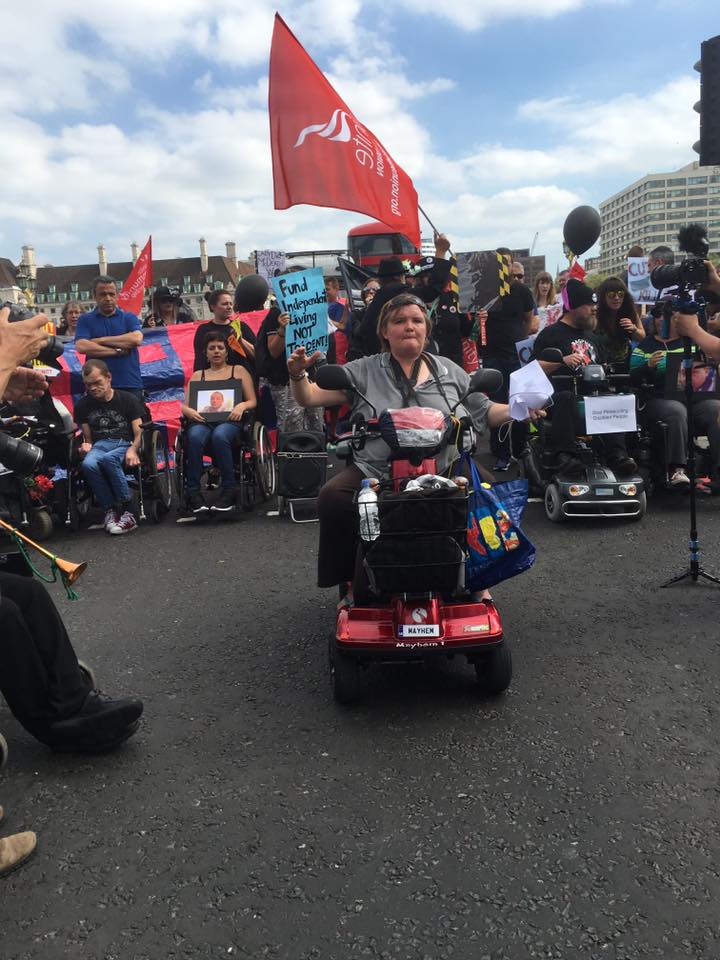
 Cuts Kill, No More Benefit Deaths protest, Westminster Road block, 7 September 2016: part of Disabled People Against the Cuts’ Rights Not Games week of action.

Photo courtesy of Paula Peters, DPAC.


John Pring from Disability News Service
reports:

“A disabled woman has told how her local council is threatening to spend several days watching her every move as she eats, showers and uses the toilet, in order to check if planned cuts to her care package will meet her needs.

The woman, Jane*, a survivor of serious sexual, physical and emotional abuse, and a former Independent Living Fund (ILF) recipient, spoke about the council’s “violation” at a parliamentary campaign meeting this week.

The meeting was held to launch Inclusion London’s report on the impact of last year’s ILF closure, as part of the Rights Not Games week of action organised by Disabled People Against Cuts (DPAC)**.

The report, One Year On: Evaluating The Impact Of The Closure Of The Independent Living Fund, includes information from all 33 London local authorities, and concludes that there has been a “dramatic postcode lottery” in the support provided to former ILF recipients since the fund closed.”

*Not her real name

**DPAC has set up a legal fund to help former ILF recipients like Jane challenge cuts to their support packages.

I recommend that you read the full article: Council wants to watch abuse survivor shower and toilet to check post-ILF needs.

The council have suggested that Jane may survive on microwave meals – which she has said would damage her health and be unaffordable – and that she can use incontinence pads for up to 12 hours a day, instead of being helped to use the toilet.

Over the summer, council officials told Jane that once the cuts to her care package were in place (from 12 hours of support a day to 38 hours a week), they wanted to send a “team of people” to observe (for up to two weeks) the impact of the reduction in care on how she manages to use the toilet, take a shower, gets in and out of her wheelchair and her bed, and feeds herself.

This will require an intrusion on a very intimate level, into aspects of her life where privacy is something that most people would take for granted. For disabled people, the public/private divide no longer exists. The details of our most intimate circumstances have become public property. Jane is not only horrified at this dehumanising move to cut costs, and about the fact that her physical needs, citizen rights and dignity are being so casually disregarded; she also has concerns regarding the potentially very damaging psychological effects of such an intrusion from the state, who have the sole aim of callously cutting her essential support.

The Independent Living Fund (ILF) was set up in 1988 to fund support for disabled people with high support needs in the United Kingdom, enabling them to live in the community independently, rather than move into residential care.

The ILF was designed to combat social exclusion on the grounds of disability. The money is generally used to enable disabled people to live in their own homes and to pay for care, and in particular, to employ personal care assistants. Many of the beneficiaries would have otherwise had to move to residential care homes.

In December 2010 the Government announced the closure of the Fund to new applicants, and in December 2012, following a consultation on the future of the Fund, it was announced that the Fund would be closed permanently from April 2015. The Government claimed that Local Authorities could meet the same outcomes as the ILF and proposed transfer for existing ILF recipients to their Local Authorities.

The Government initially decided to close the fund by March 2015 but this was delayed until June 2015 after five disabled people challenged the Government’s decision in the High Court.

In a very significant decision on 6 November 2013 following the Judicial Review, which highlighted the effects of the Equality Act 2010 on public authorities and their decision-making, the Court of Appeal found that the Department of Work and Pensions’ (DWP) decision to close the ILF was not lawful, overturning the High Courts’ decision of April 2013. The Government had indicated that it would not be appealing this judgement and the ILF would remain intact for the time being. 

The Court of Appeal unanimously quashed the decision to close the fund and devolve the money, on the basis that the minister had not specifically considered duties under the Equality Act, such as the need to promote equality of opportunity for disabled people and, in particular, the need to encourage their participation in public life. The court emphasised that these considerations were not optional in times of austerity.

On March 6, 2014, the Government made the authoritarian announcement that it would go ahead with the closure of the ILF fund on 30th June 2015, saying that a new equalities analysis had been carried out by the DWP. The government has shown a complete disregard for disabled people and the Court of Appeal decision. 

Highlighting that government had failed to comply with the equality duty had been a rare victory, entirely due to disabled people fighting back. The government responded to this by simply ignoring the court ruling.

The ILF provided additional income to nearly 19,000 disabled people who have high level support needs. The government devolved the responsibility to already cash-strapped local authorities in England, which meant that it would cease to be ring-fenced and would be subject to constraints and cuts within a local authority budget in June 2015. The funding was not ring-fenced. Because of budget cuts, local authorities have had limited capacity to support individuals unless their needs are very severe and so the ILF had previously served to supplement this provision. Local Authorities are already struggling to fund statutory provision and services, as it is. 

Local Authorities had already said that they will not be able to offer the current level of financial support provided by ILF, potentially forcing many disabled people to move out of their homes and into residential care homes.

The Inclusion report aims at gathering evidence of the impact of the closure of the ILF with a focus on the situation in London. It brings together statistical analysis from Freedom Of Information (FOI) requests sent to all 33 London boroughs with findings from a survey sent out to London Deaf and Disabled People’s Organisations (DDPOs) as well as qualitative evidence provided by former ILF recipients concerning their experiences of transfer to Local Authority (LA) support.

Comparison of evidence gathered through comparison of the Freedom Of Information (FOI) responses, Deaf and Disabled People’s Organisations (DDPO) survey, and examples of lived experience submitted by former ILF recipients has led to a number of themes emerging:

  • Post-code lottery for former ILF recipients across Local Authorities.
  • The detrimental impacts of the ILF closure on former ILF recipients, ranging from distress and anxiety to removal of essential daily support. 9 One Year On: evaluating the impact of the closure of the Independent Living Fund
  • The lack of consistent practice across different Local Authorities regarding referrals for CHC funding.
  • Limitations of the mainstream care and support system and failings in the implementation of the Care Act.
  • The value of the model of support provided by the Independent Living Fund.
  • The importance of Deaf and Disabled People’s Organisations for making Deaf and Disabled people aware of and supported to exercise their rights.

There is an urgent need for a radical rethink of how Disabled people are supported to live independently. Disabled people who use independent living support must be at the forefront of developing ideas and with adequate resources for meaningful engagement.

This also needs to happen quickly, before the memories of what effective independent living support looks like and how much Disabled people can contribute when our support needs are met fade into the distance.

You can read the full report here: One year on: Evaluating the impact of the closure of the Independent Living Fund

Related  

ILF closure cuts report produces instant results from Labour and Greens

Two-way mirrors, hidden observers: welcome to the Department for Work and Pensions laboratory


DWP’s decision to abolish the Independent Living Fund overturned thanks to Labour’s Equality Act, but the court ruling is ignored.

397514_433063430096524_259754982_n
In a very significant decision on 6 November 2013, which highlights the effects of the Equality Act 2010 on public authorities and their decision-making, the Court of Appeal has 
found that the Department of Work and Pensions’ (DWP) decision to close the Independent Living Fund was not lawful, overturning the High Courts’ decision of April 2013. The Government had indicated that it would not be appealing this judgement and the Independent Living Fund (ILF) will remain intact for now. 

People with disabilities may receive funding under the ILF: a non-departmental Government body which provides money to help disabled people live independent lives in the community. The ILF operates an independent discretionary trust funded by the DWP and managed by a board of trustees. Its aim is to combat social exclusion on the grounds of disability and the money is generally used to enable disabled people to live in their own homes and to pay for care which would otherwise need to be given at residential care homes.

Over 19,000 disabled people receive assistance from the fund and the money is allocated by local authorities. Due to budget cuts, local authorities have had limited ability to support individuals unless their needs are very severe and so the ILF has served to supplement this provision.

In 2010, the Government indicated that the ILF was considered financially unsustainable and that it would consult to develop a new model for the future care and support of ILF users.  The consultation launched in July 2012 sought the views of: ILF users; their families and carers; interested individuals; and organisations, on the proposal to close the ILF in 2015 and on how best existing users of the ILF could have their needs met after closure.  The Government stated that its preferred option was to devolve funding to local government.

However, the Government has since stated that money will be devolved to already cash-strapped local authorities in England, which means that it would cease to be ring-fenced and would be subject to normal constraints and cuts within a local authority budget. And the local authorities have already said that they will not be able to offer the current level of financial support provided on ILF, potentially forcing many disabled people to move out of their homes and into residential care homes.

The Government initially decided to close the fund by March 2015 but this was delayed until June 2015 after five disabled people challenged the Government’s decision in the High Court.

The Court of Appeal unanimously quashed the decision to close the fund and devolve the money, on the basis that the minister had not specifically considered duties under the Equality Act, such as the need to promote equality of opportunity for disabled people and, in particular, the need to encourage their participation in public life. The court emphasised that these considerations were not optional in times of austerity.

On March 6, 2014, the Government announced in authoritarian style that it would go ahead with the closure of the ILF fund on 30th June 2015, saying that a new equalities analysis had been carried out by the Department for Work and Pensions. The government has shown a complete disregard for disabled people and the Court of Appeal decision. The government had failed to comply with the equality duty – and this was a rare victory entirely due to disabled people fighting back.

Unite national officer for equalities Siobhan Endean said: “Unite believes that the closure of the Independent Living Fund will have a catastrophic impact on disabled people and their right to live independent and fulfilling lives.”

“Ministers decided not to appeal, but have instead carried out a new equality impact assessment to justify the closure. Many other changes to benefits and local authority services are also undermining independent living.”

The papers released during the judicial review reveal that the Government was banking on the closure of the ILF receiving very little attention from the public and mainstream media because it only affects relatively few people. They are calculating on the British public not caring enough about our human rights.  We hope they have miscalculated.

Labour has called for the retention of this vital fund which benefits the most severely disabled. To show her support for the retention of Independent Living Fund, which is relied upon by over 19,000 severely disabled, Labour’s Dame Anne Begg is the primary sponsor an Early Day Motion calling on the Government to reverse their decision to close the fund in June 2015. You can view the EDM here. You can also ask your MP to sign it.

The successful judicial review is a useful demonstration of how strictly the courts will consider whether or not a public body has complied with its Public Sector Equality Duties (PSED) imposed by the Equality Act 2010 (EA 2010). There must be hard evidence that the “decision maker”  has fully complied with the requirements contained in the legislation, specifically, in this case, the duties under Section 149 in relation to advancing equality of opportunity for those who share a relevant protected characteristic.

In particular, Lord Justice McCombe restated that the court must ensure that there has been a proper and conscientious focus on the statutory criteria, rather than simply a “tick box” approach. He noted that the EA 2010 placed real obligations on the Minister under section 149 to consider, amongst other things, “the need to advance equality of opportunity between persons who share a relevant protected characteristic and persons who do not share it” and to, “take steps to meet the needs of persons who share a relevant protected characteristic that are different from the needs of persons who do not share it.

The Court of Appeal agreed with the Appellants that documents which the Minister (Esther McVey) had seen in the run up to her decision proved that, “the Minister did not receive a sufficient understanding of the true threat to independent living for ILF users posed by the proposal to close the fund”  The Minister had received from her officials a somewhat toned down summary of the response to the consultation which did not give her a “true flavour” of the real level of threat to users posed by the proposal to close the ILF. The Court agreed that the detail set out in the local authority responses to the consultation which clearly articulated concerns about the effect of closure on users, was not seen by the Minister.

As a result, the Court of Appeal rejected the DWP’s argument that the Minister was fully aware of the effects of the proposal. The DWP’s argument was based largely on “common sense inferences” that by virtue of her role as Minister for Disabled People and the fact that she was considering the impact of closing a fund aimed at the independent living of disabled people, it will have been obvious to her that independent living may not be possible for all users. The Court of Appeal noted that a heavy burden is imposed by the EA 2010 on public authorities and therefore, there has to be hard evidence that the public body has discharged that duty.

The Labour Party included a commitment to an Equality Bill in its 2005 election manifesto. The Discrimination Law Review was established in 2005 to develop the legislation and was led by the Government Equalities Office. The review considered the findings of the Equalities Review Panel, chaired by Trevor Phillips, which reported in February 2007. 

The Act was intended to simplify the law by bringing together previous existing anti-discrimination legislation. The primary purpose of Labour’s Equality Act 2010 is to codify the complicated and numerous array of Acts and Regulations, which formed the basis of anti-discrimination law in Great Britain previously. One of the most radical aspects of the Equality Act was its recognition of class – socio-economic disadvantage, apart from other protected and universally accepted characteristics.

This legislation has the same goals as the four major EU Equal Treatment Directives, whose provisions it mirrors and implements, although it extends beyond EU Directives. It requires equal treatment in access to employment as well as private and public services, regardless of the protected characteristics of age, disability, gender reassignment, marriage and civil partnership, race, religion or belief, sex, and sexual orientation.

However, it’s worth noting that the achievements of the British Equality Acts 2006 and 2010 are being seriously undermined by actions of the Coalition Government at a time when recession and cuts in public services are having a disproportionate impact on women, working families, jobseekers, ethnic minorities, the elderly, and disabled people. The Home Secretary said 5 May 2011 that it is not the intention of the Government to abolish the Equality Act. But we are witnessing “death by a thousand cuts.”

As Sir Bob Hepple QC has pointed out, some provisions of the Labour Government’s EA are not being brought into force, (only roughly 90% of the Act came into force, after the Coalition quickly said it would be “reviewing several sections of the legislation passed by parliament in April 2010,”) whilst other provisions have been repealed by the Enterprise and Regulatory Reform (ERR) Bill, including the duty on public authorities to have due regard to the need to reduce socio-economic inequalities.

The failure to implement the Act in full certainly sends out a clear signal that creating a more equal society is a very low priority for the coalition.

The budget of the Equality and Human Rights Commission (EHRC) has being reduced by over 60%, its staffing cut by 72%, and its powers restricted. As from April 2013 claimants in discrimination cases in tribunals will have to pay an issue fee of £250 and a hearing fee of £950.

The public sector equality duty needs to be strengthened and strategic litigation used to force the pace of change. The further threats to the legal infrastructure make it all the more important to rally and mobilise all disadvantaged groups around equality as a fundamental human right at this crucial time. The “death by a thousand cuts” is not incidental. Once again we are seeing one element of a Tory-led planned and coordinated attack on our most vulnerable citizens, with plain evidence that this government is deliberately bypassing our rights in order to impose cruel austerity cuts on those with least.

And just in case you had any doubts about this government’s strong authoritarian tendency, it emerged last month that Government proposals making it much harder for ministers are to be challenged in the courts and have been slammed in a report by parliamentarians. Labour have strongly attacked the proposals.

A report by the Joint Committee on Human Rights extended the criticisms already voiced by MPs to Chris Grayling, the Justice Secretary behind the reforms. It says ministers’ proposal to only make legal aid payable if permission for the judicial review is granted is “a potentially serious interference with access to justice”.

Grayling combines that role with his title of Lord Chancellor, a position which has for centuries defended the judiciary.

Now MPs and peers have declared a “thoroughgoing review” of the dual role is needed because, they suggest, Graylings’ moves to undermine the rule of law are politically motivated.

Importantly, the Committee also concluded that the legal aid changes – which are now in effect – have been made without sufficient opportunity for parliamentary scrutiny. The Report recommends that the Government void the Regulations and make amendments to the Criminal Justice and Courts Bill. 

Both Grayling and May have made admissions that they could not conceive of a situation where a majority Conservative government would not repeal the Human Rights Act and withdraw from the European Court of Human Rights.

The Human Rights Act and the ability of UK citizens and residents to take appeals to the European Court of Human Rights has received considerable propagandarised criticism in the UK media and the Conservative party, who claim that the Act has “ushered in a regime of “political correctness”” and who have focussed on a small number of high-profile cases involving foreign prisoners and detainees to try and discredit it.  

The effect of the UK Human Rights Act 1998 was to make the rights specified in the European Convention of Human Rights enforceable in UK courts.  The act is described in official Ministry of Justice information releases as “the most important piece of constitutional legislation passed in the United Kingdom since the achievement of universal suffrage in 1918” and gives UK citizens and residents protection against abuses of civil rights and personal freedoms by state and governmental authorities.

This Government wants to take that protection away, it considers itself above the law, and is relentlessly working to undermine our access to justice and protection from the Government itself. The real horror hits home when you ask yourself why.

They cannot be allowed to remain in Office another term. 

536738_306169162785952_999031084_n

 Many thanks to Rob Livingstone for his excellent pictures

The UK Government have got it wrong about our Human Rights.

564882_438358886199493_1982719183_n
The Joint Parliamentary Committee on Human Rights has conducted an inquiry into the UK Government’s implementation of Article 19 of the United Nations Convention on the Rights of Persons with Disabilities (UNCRPD) – the right to live independently and to be included in the community. The inquiry which began in 2011 has received evidence from over 300 witnesses.

The inquiry has highlighted just how little awareness, understanding and employment of the Convention there is by the Tory-led Government.  Very few of the witnesses made specific reference to the Convention in their presented evidence, despite the inquiry being conducted by the Parliamentary Human Rights Committee, with the terms of reference clearly framing the inquiry as being about Article 19 of the UNCRPD.

“This finding is of international importance”, said Oliver Lewis, MDAC Executive Director, “Our experience is that many Governments are of the view that the CRPD is nothing more than a policy nicety, rather than a treaty which sets out legal obligations which governments must fulfil.”

The report is particularly critical of the Minister for Disabled People (Maria Miller, at the time) who told the Committee that the CRPD was “soft law”. The Committee criticised this as “indicative of an approach to the treaty which regards the rights it protects as being of less normative force than those contained in other human rights instruments.” (See para. 23 in the report, the link is at the foot of this article.) The Committee’s view is that the CRPD is hard law, not soft law.

Dr Hywel Francis MP, Chair of the Committee, said: “We are concerned to learn that the right of disabled people to independent living may be at risk through the cumulative impact of current reforms. Even though the UK ratified the UNCPRD in 2009 with cross-party support, the Government is unable to demonstrate that sufficient regard has been paid to the Convention in the development of policy with direct relevance to the lives of disabled people. The right to independent living in UK law may need to be strengthened further, and we call on the Government and other interested organisations to consider the need for a free-standing right to independent living in UK law.”

“The Government is meant to include disabled people in making sure people have their human rights upheld. We are concerned that a part of the Law on treating people equally and fairly (Equality Act section 149) does not say any more that disabled people should be involved. This is a step backwards.”

In other words, the Tory-led Coalition has quietly removed this part of the Equality Act.

The budget of the Equality and Human Rights Commission (EHRC), which was established by the Labour Party when they were drafting this flagship policy, is being reduced by over 60%, its staffing cut by 72%, and its powers restricted by the Coalition. Provisions that are being repealed by the Enterprise and Regulatory Reform (ERR) Bill include the duty on public authorities to have due regard to the need to reduce socio-economic inequalities.

Savage Legal Aid cuts from April 2013 have also contributed significantly to creating further barriers to ensuring Equal Rights law protect us, and the Tory-driven Legal Aid Bill also contravenes our right to a fair trial under Article 6(1) of the European Convention on Human Rights.

This is not a coincidental multiple policy timeline, but rather a very coordinated political attack on potential legal challenges at a time when Tory-led severe and devastating multiple welfare and provision cuts have affected disabled people so disproportionately. The changes, which came into effect in April, will hit the same group of disabled people over and over again”.

The threats to the legal infrastructure make it all the more important to mobilise all disadvantaged groups around equality as a fundamental human right.

The Report draws attention to several significant Human Rights issues, including:

  • the need for freestanding legislation to protect the right to independent living in UK law,
  • the effect of current reforms to benefits and services on the ability of disabled people to enjoy independent living,
  • the role played by the UNCRPD in policy development and decision-making at all levels of government,
  • the need for the use of equality impact assessments,
  • the effects of devolution on implementation of the UNCRPD, and
  • hate crime

The right to independent living does not exist as a free-standing right in UK law. Although it is protected and promoted to some extent by a matrix of rights, the Committee believes that this is not enough. It argues that the Government and other interested parties should immediately assess the need for, and feasibility of, legislation to establish independent living as a free-standing right. In addition, the Committee concludes that the UNCRPD is “hard law” and that the Government should fulfil their obligations under the Convention on that basis.

The Committee finds that:

  • reforms to benefits and services (let’s be frank here, they are not welfare “reforms”, they are cuts) risk leaving disabled people without the support they need to live independently;
  • restrictions in local authority eligibility criteria for social care support, the replacement of the Disability Living Allowance with Personal Independence Payment, the closure of the Independent Living Fund and changes to housing benefit risk interacting in a particularly harmful way for disabled people;
  • people fear that the cumulative impact of these changes will force them out of their homes and local communities and into residential care.

It also finds that:

  • the Government has not conducted an Equality impact assessment of the cumulative impact of current “reforms” on disabled people. The Report urges them do so, and to report on the extent to which these “reforms “are enabling them and local authorities to comply with their obligations under the UNCRPD.
  • The Committee states that the Government should make a commitment to Parliament that they will give due consideration to the articles of the Convention when making legislation. The UNCRPD did not have a significant role in the development of policy and legislation, as is required by the Convention.

Furthermore, the Committee criticises changes to the duties of public authorities in England under the Equality Act 2010, which no longer require the production of equality impact assessments of changes in policy, nor the involvement of disabled people in developing policies which will affect them.

The Committee also expresses a major concern over a growing incidence of hate crime against disabled people and urges the Government take action to foster respect for the rights and dignity of disabled people.

Article 19 states that the Government must always ensure it “stops things getting worse.” This has NOT happened. The quality of so many sick and disabled people’s lives in this Country has been radically, significantly and DELIBERATELY reduced since the Tory-led Coalition took Office in 2010. This needs to change as a matter of urgency.

The Government’s “reforms” have led to a terrible increase in deaths amongst sick and disabled people, and we have already seen a significant rise in suicides that are directly linked with the Tory-driven austerity measures.

When we genuinely seek to improve the situation of the poorest and vulnerable, first of all we will need to spend time studying the privileged elite and their lifestyle choices of tax avoidance, their own economic lasciviousness and lack of capacity for personal and social responsibility.

We need to pay attention to Government handouts (of our money) to banks, private businesses and the wealthy: we need to appraise the dependency and culture of entitlement that these sponsored acts have fostered, and of course special focus should be on the amoral decisions and anti-social actions of the feckless, scrounging wealthy, and with particularly careful, critical scrutiny of the Government responsible for policies that re-distribute and concentrate our wealth and their advantage and power, therefore creating social divisions, inequality and poverty, perpetuating and extending it.

The Tory-led Coalition prefers to take money from the vulnerable, the sick and disabled, and hand it out to millionaires.

We need to ask why our Government refuses to instigate or agree an inquiry into the substantial rise in deaths amongst sick and disabled people, as these deaths are so clearly a direct consequence of this Government’s policies. What kind of Government uses the media to scape-goat and stigmatise sick and disabled people, by lying and inventing statistics to “justify” the persecution of some of our most vulnerable citizens, and the withdrawal of their crucial lifelines and support?

One that does not value those lives, or regard them as having an equal worth with others.

We are raising more money for the rich” – David Cameron, 12th December 2012


Further reading:

Archbishop Tartaglia adds to protest against Atos assessments which ‘trample on human dignity’

The European courts have their priorities wrong. Why aren’t they stopping the disability deaths? – Mike Sivier, Vox Political

Did They Hope We Wouldn’t Notice? Under The Smokescreen – John D Clare

The Coming Tyranny and The Legal Aid Bill – KittySJones

CRPD IS “HARD LAW” – UK PARLIAMENT

The Summary of the Report on Implementation of the Right of Disabled People to Independent Living: easy read version  and the full length report

644117_408620012540866_785481358_nMany thanks to Robert Livingstone for his outstanding art work.