Category: Libertarian paternalism

Corporate nudging and the graveyard shift: would a stint in a coffin inspire you to work harder?

The emergence of Nudge theory in the 2000s – generally described as a system for change/societal-management, has increasingly been used by governments to understand and alter group behaviour – reinforces the principle that governance must be driven by needs of the people being governed, not by the governing authority.

Nudge theory has found its way into the business management and corporate culture. Although Nudge was initially developed as a concept by behavioural economists, its stated aim was the improvement of society, theorists claimed it was not designed as a mechanism for commercial exploitation, or government manipulation. However, there are no safeguards in place to prevent such exploitation and manipulation in the application of Nudge theories.  

Imagine the scene. You knew office morale had been low for a while, but you never thought senior management would go to quite such lengths to try and get everyone enthusiastic about their jobs again.

You and your co-workers file slowly into the meeting room and an array of perfectly aligned coffins comes into view. As your team development manager smiles and asks you to climb into a coffin – after all, it has your name on it – you are met by a photograph of yourself taken years ago when you still were optimistic about the future: “Now hug the image of yourself” is the final instruction before the coffin’s lid is closed.

No, this is not some bizarre scene from a Philip K Dick novel but an actual motivation exercise reported to have occurred in South Korea.

Faced with high stress levels and low productivity in corporate Korea, some employers have upped the ante, trying to get employees to embrace life at work rather than seek ever more desperate forms of escape. Firms send staff to the Hyowon Healing Centre, where its president explains the rationale behind the coffin ritual: “Our company has always encouraged employees to change their old ways of thinking, but it was hard to bring about any real difference … I thought going inside a coffin would be such a shocking experience it would completely reset their minds for a completely fresh start in their attitudes.”

To get employees in the mood they are shown videos of people overcoming debilitating conditions including cancer. As one employee robotically says as he emerges from a coffin: “I’ve realised I’ve made lots of mistakes. I hope to be more passionate in all the work I do, and spend more time with my family.”

What on earth is going on here? Actually, this extreme motivational technique is symptomatic of how work has changed over the last 20 years. What some call 24/7 capitalism has seen work overtake all other social activities to become the centre of society.

This is not only down to mobile technology, as some have argued, since there is nothing inherent in a smartphone that makes us work 24/7. No, the compulsion to check email and always be “poised to work” stems from the expectation that if you are not ready for that call from the boss then you are somehow deficient, disposable and lacking important qualities. No wonder a survey found 80% of employers find it perfectly appropriate to contact workers outside of business hours.

This weird “24/7 perpetual worker” was always the ideal goal of neoliberal economists such as Friedrich Hayek and Gary Becker. Because homo economicus is considered a superior being, we are constantly encouraged to transform ourselves into tradeable “human capital” and “permanent enterprises” that never switch off in case we miss that crucial deal.

We would expect unions and anti-work lobbyist to be at the forefront of resisting this trend. And they are. But large corporations are also trying to deal with the fallout, recognising the all-too human limits of this extreme ethos. Having unleashed 24/7 capitalism – and the ideal-worker to go with it – some businesses are frantically trying to put the genie back in the bottle.

Some firms in Europe and the US, for example, now deactivate their employees’ email after business hours because they realise that the obsessive-compulsive behaviour it inspires is bad for the worker and bad for business.

A Barclays’ banker was fired after it was leaked he declared to summer interns: “I recommend bringing a pillow to the office (yoga mat works as well). It makes sleeping under your desk a lot more comfortable, in the very likely scenario that you have to do that.” In light of the tragic case of Moritz Erhardt, the intern who died of an epileptic seizure after working nonstop for 72 hours, the comment was deemed very bad taste.

No wonder South Korean employers are taking extreme measures to put work back into perspective: actually ordering workers into a coffin and reminding them that life isn’t all that bad … death is worse.

The intertwined relationship between work and dying is the dark-side of the neoliberal fantasy and ‘ideal’ worker, which probably can’t be reversed so easily. When our society is reconfigured singly around our job or search for one, then work becomes more than something we do among other things: it becomes who we are. Thus escaping our job when things go wrong becomes exceedingly difficult. For how do you escape yourself?

It seems that neoliberal capitalism wants its cake, and to eat it too: a life of nonstop work and normal, balanced individuals. But something has to give.

Indeed, we can imagine the “coffin exercise” backfiring, an employee refusing to ever return to the pettiness of office life after realising that her existence must add up to more than merely sending emails all day. Inspired by neoliberal capitalism’s own contradictions, perhaps we are on the cusp of a new workers’ movement and the coffin exercise is not so morbidly wacky after all.

4928

You can read the original article here.

The Department for Work and Pensions don’t know what their ethical and safeguarding guidelines are but still claim they have some

dc308-media_http1bpblogspot_yzchd

I have recently written quite extensively about problems with how the government conduct “research,” I’ve also highlighted the many official rebukes the Conservatives have faced because of their tendency to invent statistics to “verify” their ideologically-driven, value-laden “hypotheses.”

Who could ever forget the Department for Work and Pension’s fake testimonials from fake benefit claimants telling us all how fakely beneficial the fakesters had found having their fake lifeline benefits withdrawn for fake non-compliance, leading to fake improvements of behaviour, presumably after a bout of fake starvation and destitution.

The new Work and Health Programme, aimed at reducing the number of people claiming Employment and Support Allowance (ESA), is currently still at a research and trialing stage. Part of the experimental nudge element of this research entails enlisting GPs to “prescribe” job coaches, and to participate in constructing “a health and work passport to collate employment and health information.”  (See The new Work and Health Programme: the government plan social experiments to “nudge” sick and disabled people into work.)

This raised some serious ethical concerns for me, which I addressed in a Freedom of Information (FoI) request to the Department for Work and Pensions (DWP). The most important part of the request was:

I should like to ask what ethical guidelines are in place regarding the use of behavioural theory on claimants. What guidelines are in place to protect claimants from any potential adverse effects of trials and experiments using methods aimed at changing behaviours of claimants? And what method of gaining claimant consent (to be used as a subject in trials and experiments ) is used by the Department and by job centres?

I did ask a further three brief and reasonable questions, citing a source of information – The Government Communication Service guide to communications and behaviour change quoting from it and explaining the questions.

My request was refused.

The DWP response

I can confirm that we hold information falling within the description specified in your request. However, we estimate that the cost of complying with your request would exceed the appropriate limit for central Government, set by regulations at £600. This represents the estimated cost of one person spending 3½ working days in determining whether the Department holds the information, and locating, retrieving and extracting it.

Under section 12 of the Freedom of Information Act the Department is not therefore obliged to comply with your request and we will not be processing it further.

images

Firstly, something as fundamentally important as safeguarding and ethical guidelines regarding government behavioural/psychological experimentation should actually be available for public access and scrutiny, not hidden away in a place that allegedly takes so much time, effort and money to locate.

Anyone would think those comments are simply an obstructive tactic, if the DWP can confirm that they have the information, then surely that reduces the cost and time spent retrieving and extracting it to comply with my request. Wouldn’t you think?

Someone who is earning £600 for 3½days work is on a very generous annual salary of around £45K. Unless this person is being paid to be intentionally incompetent and obstructive, their job skills suck, it has to be said. So do the logic and reasoning skills of the person who wrote that response.

I also know from experience that the DWP regularly respond only partially. They had the option of answering some of my request, at least. After all, they claim to have the information, seems a shame not to share some of it.

However, because the ethical considerations of government experiments and trials on people needing welfare support are so very important, I have pursued this request further by taking the option of simplifying it.

I wrote:

Dear DWP CAXTON HOUSE Communications,

You confirm that you have the information that I requested, but then claim that it would exceed the £600 limit to provide that
information which you state is because of the “estimated cost of one person spending 3½ working days in determining whether the Department holds the information, and locating, retrieving and extracting it.”

If you confirm you have the information, then surely that reduces the cost and time spent retrieving and extracting it to comply with my request.

I will however simplify my request. Most people would expect that ethical guidelines, safeguards and the important matter of client consent to participating in Government trials and experiments on people needing welfare support is something that the DWP would have to hand – easy to retrieve and very important information that one would expect to be in the public domain in any case. But I can’t find it.

I refer again to the The Government Communication Service guide to communications and behaviour change –
https://gcn.civilservice.gov.uk/wp-conte…

In particular, I refer to page 5: “Behavioural theory is a powerful
tool for the government communicator, but you don’t need to be an experienced social scientist to apply it successfully to your work.”

I should like to ask:

  • What ethical guidelines are in place regarding the use of behavioural theory on claimants?
  • What guidelines are in place to protect claimants from any potential adverse effects of trials and experiments using methods aimed at changing the behaviours of claimants?
  • And what method of gaining claimant consent (to be used as a subject in trials and experiments ) is used by the Department for Work and Pensions and by job centres?

Yours sincerely,

Susan Jones

Link to the request

Here is the FoI request and response in full: Use of behavioural theory to change behaviours of people claiming benefits.

Under Section 16 of the FoI Act the DWP should assist me in helping to narrow my request so that it may fall beneath the cost limit. I have narrowed my request and submitted a shorter, simplified version, focussing on the ethical issues only. It is reasonable to expect the DWP, whose remit includes face to face work with some of our most vulnerable citizens, to have ethical and safeguarding guidelines and consent forms to hand without having to pay someone hundreds of pounds for days of work to “find and retrieve” information that ought to be in the public domain anyway. 

In the event of that request being refused, I will be pursuing this further via the Internal Review Mechanism, and if need be, I shall be contacting the Information Commissioner’s Office.

gcs-guide-to-communications-and-behaviour-change1

I wonder if the response was influenced by this

Update

My second amended request has been refused. I have therefore asked for an Internal Review. I said:

Dear DWP CAXTON HOUSE Communications,

I refer to your first response: “Under section 16 of the Act we
should assist you in helping you narrow your request so that it may fall beneath the cost limit. It may help to reduce the number of questions by refocusing it to only a few elements of the presently broad request. We will consider a fresh any revised request however we cannot guarantee that any revised request will fall within the cost limit.”

I subsequently submitted a narrowed and focussed request in
response, with just 3 basic questions from the initial FOI request. You responded by refering to my original request, and completely ignored my amended and narrowed down, shorter request.

I am therefore making a formal complaint that you did not address the reduced, simplified and narrowed down request. I am asking for an internal review.

I wrote:

“I should like to ask what ethical guidelines are in place
regarding the use of behavioural theory on claimants.

What guidelines are in place to protect claimants from any
potential adverse effects of trials and experiments using methods aimed at changing the behaviours of claimants?

And what method of gaining claimant consent (to be used as a
subject in trials and experiments ) is used by the Department for Work and Pensions and by job centres?”

You have stated that you do have this information. As I have
considerably narrowed down the request to 3 very basic questions, the costs involved in retrieving and providing it ought to be quite minimal. It’s also a very reasonable request. The DWP works with some of our most vulnerable citizens. It is especially important that in light of the current experimental nature of behavioural theories, and the current trialing of the new government health and work programme, that there are ethical guidelines and safeguards in place to protect vulnerable clients, and also, that there is a mechanism for gaining informed consent from clients who are subjects of trials and experiments.

These are issues that researchers within the medical sciences and social sciences have to consider every day. Using behavioural modification (“behavioural change theory”) methods on citizens without their consent and without engaging their deliberative processes has enormous ethical implications.

The British Psychological Society , for example, has strict code of
conduct and human research ethics –
http://www.bps.org.uk/sites/default/file…

And I refer to the Helsinki Declaration regarding medical research http://www.ncbi.nlm.nih.gov/pmc/articles…

The Geneva Declaration – https://en.wikipedia.org/wiki/Declaratio…

And the the Nuremberg code includes such principles as informed consent and absence of coercion; properly formulated scientific experimentation; and beneficence towards experiment participants – https://en.wikipedia.org/wiki/Nuremberg_…

These are just a few examples of codes of ethics regarding human research.

There are a wide range of legal and Human Rights implications
connected with experimentation and research trials conducted on social groups and human subjects. My request for clarification that there are ethical guidelines, safeguards and protections for subjects and basic consent mechanisms in place and the details of what they are is therefore a very reasonable one.

Yours sincerely,

Susan Jones

Link to this

I also added that Section 16 of the FoI Act places a duty on public authorities to provide reasonable advice and assistance to applicants. I was not provided with “advice or assistance.” I was not asked if I prefer to narrow my request in an alternative way to reduce costs (this is a breach of the section 16 duty to advise and assist). Nonetheless I did narrow my request, and that was completely ignored, the second response I received was related entirely to the initial request. In fact it was exactly the same response. I also challenged the DWP’s estimate of the costs of meeting my request. The rest of the grounds for my request for an Internal Review may be viewed here.

The media need a nudge: the government using ‘behavioural science’ to manipulate the public isn’t a recent development, nudging has been happening since 2010

8+Ways+to+Protect+Yourself+From+Emotional+Manipulation

Last year I wrote a critical article about the government’s Nudge Unit. The ideas of libertarian paternalism were popularised around five years ago by the legal theorist Cass Sunstein and the behavioural economist Richard Thaler, in their bestselling book Nudge. Sunstein and Thaler argue that we are fundamentally “irrational” and that many of our choices are influenced negatively by “cognitive bias.” They go on to propose that policymakers can and ought to nudge citizens towards making choices that are supposedly in their best interests and in the best interests of society.

But who nudges the nudgers?

Who decides what is in our “best interests”?

And how can human interests be so narrowly defined and measured in terms of economic outcomes, within a highly competitive, “survival of the fittest” neoliberal framework? The Nudge Unit is concerned with behavioural economics, not human happiness and wellbeing.

The welfare reforms, especially the increased application of behavioural conditionality criteria and the extended use of benefit sanctions, are based on a principle borrowed from behavioural economics theory – the cognitive bias called “loss aversion.” It refers to the idea that people’s tendency is to strongly prefer avoiding losses to acquiring gains. The idea is embedded in the use of sanctions to “nudge” people towards compliance with welfare rules of conditionality, by using a threat of punitive financial loss, since the longstanding, underpinning Conservative assumption is that people are unemployed because of behavioural deficits.

I’ve argued elsewhere, however, that benefit sanctions are more closely aligned with operant conditioning (behaviourism) than “libertarian paternalism,” since sanctions are a severe punishment intended to modify behaviour and restrict choices to that of compliance and conformity or destitution. But nudge was always going to be an attractive presentation at the top of a very slippery slope all the way down to open state coercion. Most people think that nudge is just about helping men to pee on the right spot on urinals, getting us to pay our taxes on time, or to save for our old age. It isn’t.

How can sanctioning ever be considered a rational political action –  that taking away lifeline income from people who are already struggling to meet their basic needs is somehow justifiable, or “in their best interests” or about making welfare “fair”?  The government claim that sanctions “incentivise” people to look for work. But there is an established body of empirical evidence which demonstrates clearly that denying people the means of meeting basic needs, such as money for food and fuel, undermines their physical, emotional and psychological wellbeing, and serves to further “disincentivise” people who are already trapped at a basic level of struggling to simply survive.

The Minnesota Semistarvation Experiment for example, provided empirical evidence and a highly detailed account regarding the negative impacts of food deprivation on human motivation, behaviour, sociability, physical and psychological health. Abraham Maslow, a humanist psychologist who studied human potential, needs and motivation, said that if a person is starving, the desire to obtain food will trump all other goals and dominate the person’s thought processes. This idea of cognitive priority is also represented in his classic hierarchy of needs. 

0_0_0_0_370_308_csupload_52703375

Maslow’s hierarchy of needs

In a nutshell, this means that if people can’t meet their basic survival needs, it is extremely unlikely that they will have either the capability or motivation to meet higher level psychosocial needs, including social obligations and responsibilities to job seek.

Libertarian paternalists claim that whilst it is legitimate for government, private and public institutions to affect behaviour the aims should be to ensure that “people should be free to opt out of specified arrangements if they choose to do so.” The nudges favoured by libertarian paternalists are also supposed to be “unobtrusive.” That clearly is not the case with the application of coercive, draconian Conservative welfare sanctions. (See Nudging conformity and benefit sanctions.)

Evidently the government have more than a few whopping cognitive biases of their own.

I have previously criticised nudge because of its fundamental incompatibility with traditional democratic principles, and human rights frameworks, amongst other things. Democracy is based on a process of dialogue between the public and government, ensuring that the public are represented: that governments are responsive, shaping policies that address identified social needs. However, policies are no longer about representing and reflecting citizen’s needs: they are all about telling us how to be.

I’ve also pointed out that nudge operates to manipulate at a much broader level, too. The intentional political construction of folk devils and purposeful culturally amplified references to a stereotype embodying fecklessness, idleness and irresponsibility, utilising moral panic and manufactured public outrage as an effective platform for punitive welfare reform legislation, is one example of the value-laden application of pseudoscientific “behavioural insights” theory. The new paternalists have drawn on our psychosocial inclinations towards conformity, which is evident in the increasing political use of manipulative normative messaging. (For example, see: The Behavioral Insights Team in the U.K. used social normative messages to increase tax compliance in 2011.) 

The paternalist’s behavioural theories have been used to increasingly normalise a moral narrative based on a crude underpinning “deserving” and “undeserving” dichotomy, that justifies state interventions imposing conditions of extreme deprivation amongst some social groups – especially those previously considered legally protected. Public rational and moral boundaries have been and continue to be nudged and shifted, incrementally. Gordon Allport outlined a remarkably similar process in his classic political psychology text, The Nature of Prejudice, which describes the psychosocial processes involved in the construction of categorical others, and the subsequent escalating scale of prejudice and discrimination.

So we really do need to ask exactly in whose “best interests” the new paternalist “economologists” are acting. Nudge is being targeted specifically at the casualties of inequality, which is itself an inevitability of neoliberalism. The premise of nudge theory is that poor people make “bad choices” rather than their circumstances being recognised as an inexorable consequence of a broader context in which political decisions and the economic Darwinism that neoliberalism entails creates “winners and losers.”

I have seen very little criticism of nudge in the mainstream media until very recently. On Monday the Independent published an article about how the Chancellor exploited our cognitive biases to secure his cuts to welfare, drawing particularly on the loss aversion theory. To reiterate, in economics decision theory, loss aversion refers to people’s tendency to strongly prefer avoiding losses to acquiring gains.

From the Independent article:

“Researchers have also found that people do not treat possible forgone gains resulting from a decision in the same way as equivalent potential out-of-pocket losses from that same decision. The forgone gains are much less psychologically painful to contemplate than the losses. Indeed, the gains are sometimes ignored altogether.

There was an apparent attempt to harness this particular psychological bias in George Osborne’s Autumn Statement. Of course the Chancellor was forced into a memorable U-turn on his wildly unpopular tax credit cuts. Millions of poor working families will now not see their benefits cut in cash terms next April. Yet the Chancellor still gets virtually all his previously targeted savings from the welfare bill by 2020.

How? Because the working age welfare system will still become much less generous in five years’ time. As research from the Institute for Fiscal Studies and the Resolution Foundation has shown, the typical low-income working family in 2020 will be hit just as hard as they were going to be before the Autumn Statement U-turn. The Chancellor seems to be calculating that the pain of future forgone gains will be less politically toxic than immediate cash losses.”
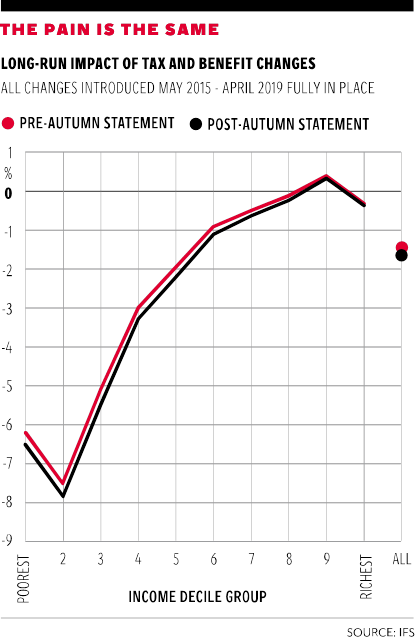
 image002

It’s hardly a revelation that the Conservative government are manipulating public opinion, using scapegoating, outgrouping and the creation of folk devils in order desensitize the public to the plight of the poorest citizens and to justify dismantling the welfare state incrementally. As I’ve pointed out previously, this has been going on since 2010, hidden in plain view.

In the article, Ben Chu also goes on to say:

“Experiments by Daniel Kahneman, Jack Knetsch and Richard Thaler also suggest that this stealth approach fits with people’s sense of fairness. They found that in a time of recession and high unemployment most people they surveyed thought a hypothetical company that cut pay in cash terms was acting unfairly, while one that merely raised it by less than inflation was behaving fairly.

There was another exploitation of our psychological biases in the Autumn Statement. The Chancellor announced an increase in stamp duty for people buying residential properties to let. That underscored the fact that the Chancellor remains wedded to the stamp duty tax, despite pressure from public finance experts to shift to a more progressive and efficient annual property tax (perhaps an overhauled council tax).

But Mr Osborne, like all his recent predecessors, realises that stamp duty, for all its deficiencies, tends to be less resented as a form of taxing property. Why? Because of “anchoring”. When people buy a house they are mentally prepared to part with a huge sum, usually far bigger than any other transaction they will make in their lives. The additional stamp duty payable to the Treasury on top of this massive sum, large though it is, seems less offensive. People resent it less than they would if the tax were collected annually in the form of a property tax – even if, for most, it would actually make little difference over the longer term. Sticking with stamp duty is the path of least resistance.”

There is another economologist “experiment” that seems to have slipped under the radar of the media – an experiment to nudge sick and disabled people into work, attempting to utilise GPs in a blatant overextension of the intrusive and coercive arm of the state. It is aimed at ensuring sick and disabled people don’t claim benefits. I don’t recall any mention of behaviourist social experiments on the public in the Conservative manifesto.

When I am ill, I visit a doctor. I expect professional and expert support. I wouldn’t consider consulting Iain Duncan Smith about my medical conditions. Or the government more generally. There are very good reasons for that. I’m sure that Iain Duncan Smith has Dunning–Kruger syndrome. He thinks he knows better than doctors and unreliably informs us that work can set you free, it can help prevent and cure illness.  Yet I’ve never heard of a single case of work curing blindness, heart disease, rheumatoid arthritis, cerebral palsy, multiple sclerosis, cancer or even so much as a migraine. I’ve also yet to hear of a person’s missing limbs miraculously growing back. The Conservative “medical intervention” entails a single prescription: a work coach from the job centre. State medicine – a single dose to be taken daily: Conservative ideology, traditional prejudice and some patronising and extremely coercive paternalism. The blue pill.

I don’t agree with the conclusions that Ben Chu draws in his article. Whilst he acknowledges that:

“The Government has a Behavioural Insights Team (or “Nudge Unit”) whose objective is to exploit the public’s psychological biases,” he goes on to say that it’s merely “to push progressive policies, such as getting us to save more for retirement and helping us make “better choices”, perhaps by counteracting the negative impact of loss aversion. But, as we’ve seen, the Chancellor is not above exploiting our biases in a cynical fashion too.” 

Progressive policies? The draconian welfare “reforms” aren’t remotely “progressive.” In the UK, the growth and institutionalisation of prejudice and discrimination is reflected in the increasing tendency towards the transgression of international legal human rights frameworks at the level of public policy-making. Policies that target protected social groups with moralising, stereotypical (and nudge-driven) normative messages, accompanied with operant disciplinary measures, have led to extremely negative and harmful outcomes for the poorest and most vulnerable citizens, but there is a marked political and social indifference to the serious implications and consequences of such policies.

There is a relationship between the world that a person inhabits and that person’s actions. Any theory of behaviour and cognition that ignores context can at best be regarded as very limited and partial. Yet the libertarian paternalists overstep their narrow conceptual bounds, with the difficulty of reconciling individual and social interests somewhat glossed over. They conflate “social interests” with neoliberal outcomes.

The asymmetrical, class-contingent application of paternalistic libertarian “insights” establishes a hierarchy of decision-making “competence” and autonomy, which unsurprisingly corresponds with the hierarchy of wealth distribution.

So nudge inevitably will deepen and perpetuate existing inequality and prejudice, adding a dimension of patronising psycho-moral suprematism to add further insult to politically inflicted injury. Nudge is a technocratic fad that is overhyped, theoretically trivial, unreliable; a smokescreen, a prop for neoliberalism and monstrously unfair, bad policy-making.

Libertarian paternalists are narrowly and uncritically concerned only with the economic consequences of decisions within a neoliberal context, and therefore, their “interventions” will invariably encompass enforcing behavioural modifiers and ensuring adaptations to the context, rather than being genuinely and more broadly in our “best interests.” Defining human agency and rationality in terms of economic outcomes is extremely problematic. And despite the alleged value-neutrality of the new behavioural economics research it is invariably biased towards the status quo and social preservation rather than progressive social change.

At best, the new “behavioural science” is merely theoretical, at a broadly experimental stage, and therefore profoundly limited in terms of scope and academic rigour, as a mechanism of explanation, and in terms of its capacity for generating comprehensive and coherent accounts and understandings of human motivation and behaviour.

At worst, the rise of this new form of psychopolitical behaviourism reflects, and aims at perpetuating, the hegemonic nature of neoliberalism.

But for the record, when a government attempts to micromanage and manipulate the behaviour of citizens, we call that “totalitarianism” not “nudge.” 

behavchange.jpg

Related reading

A critique of Conservative notions of social research

The government plan social experiments to “nudge” sick and disabled people into work

Mind the MINDSPACE: the nudge that knocked democracy down

Nudging conformity and benefit sanctions