Category: NHS

GPs bribed to send FEWER cancer patients for vital hospital tests – Mike Sivier

An important article from Vox Political (and the Mirror.) It needs to be shared.

Visit Vox Political for the full article

GPs are being offered cash to send fewer patients with suspected cancer to hospital for vital tests.Surgeries can claim thousands of pounds worth of “incentives” for not sending patients to hospitals for tests, scans and operations, according to an investigation by doctors’ magazine Pulse.

First appointments for cancer – which should happen within two weeks of a GP suspecting the disease – are included in some of the targets to cut referrals, the probe found.

The rewards are being offered by Clinical Commissioning Groups (CCGs), local NHS bodies responsible for commissioning of healthcare across the country.

The move comes as the NHS is trying to slash £22billion in costs before 2020.

Source: GPs ‘bribed’ to send FEWER cancer patients for vital hospital tests – Mirror Online

The Mirror blasted the policy, run by CCGs that were created as part of the Health and Social Care Act of 2012 which began the mass-privatisation of the NHS, in its editorial:

Bribing family doctors not to send patients to hospitals for cancer tests is sacrificing lives by turning the NHS into a cut-price market place.

GPs should never be awarded bonuses at the cost of the public’s health. Those incentives are indefensible, because the likelihood is that cancers will go undetected.

Early detection is vital and when England’s cancer survival rates are already among the lowest in Europe, Health Secretary Jeremy Hunt should be demanding that more people are tested sooner.

Doctors must be free to make objective decisions on medical grounds rather than receiving dangerous instructions that reduce patients to financial statistics.

But don’t blame your doctor. Blame the Government. A Tory Government. The NHS wasn’t perfect under Labour but the Tories don’t appear to care at all.

This wasteful party is handing down a death sentence for unsuspecting patients. And that’s unforgiveable.


Related

The Coalition has deliberately financially trashed the NHS to justify its privatisation

Selling off NHS for profit: Tories’ and Liberal Democrats’ links with private healthcare firms revealed

The commercialisation and undemocratising of the NHS: the commodification of patients

252299_486936058042594_609527550_nPicture courtesy of Robert Livingstone

WORKING FOR PATIENTS OR NOT? – a guest post by Suzanne Kelsey

imgres


A guest post by Suzanne Kelsey, who is a key campaigner for the NHS, amongst other things.

In 1988, when Margaret Thatcher had been in office for some 9 years, and the very foundations of our NHS had been shaken with more of the public encouraged to use private medical care,  there were serious concerns about capacity in the hospital services as waiting lists increased and wards closed.  The Conservative government appointed a group of people, without consulting the health professions, to look at this growing problem.

As a result of this the NHS experienced the most significant cultural shift since its inception with a White Paper entitled, ‘Working for Patients, ’ which proposed what we now  know as the ‘Internal Market’ and the development of the purchase provider split. GPs become the purchaser and the hospitals are the providers. This passed into law as the NHS and Community Care Act 1990. Understandably there was a great deal of opposition from trade unions, Labour and the general public but it went ahead as did the Private Finance Initiative in 1992 implemented for the first time in the UK by the Conservative government of John Major.

There is no doubt that further major problems were created for our NHS, although I would question if on the same scale as we are currently witnessing with the threat of complete privatisation and the sell-off of our publically funded service to huge private international companies, who have been waiting in the wings for quite some time and would have been rubbing their hands in glee some years ago if Thatcher and the Conservatives had continued in office.

The definition of ‘privatisation’ also needs to be acknowledged because with the downgrading of facilities and existing provision struggling to meet demands, more and more people will become anxious and tempted to pay for their treatment even if it is to ensure they have a hospital bed!

We must never let this practice become the ‘norm.’ Campaigners must ensure that the ‘free at point of use’ core principle is upheld or we will be taken back to pre-war years, removing freedom from fear that was fought long and hard for by our champions of social justice. At the same time we must remember the mantra, ‘public health not private wealth’ with numerous examples available to us of how private companies will always put profits before patients, but more of that later.

When Tony Blair became Prime Minister in 1997 he inherited a very impoverished NHS and although we expected him to abolish the internal market this did not happen, perhaps for a variety of justifiable reasons. How do you replace crumbling hospitals and inadequate resources without massively raising taxes, whilst also limiting the upheaval that had already been caused?

Alan Milburn was Minister of State at the Department of Health during this time and he stated that after years of the Tory’s gross underfunding, there was absolutely no money to fund the infrastructure, hence the use of John Major’s PFI initiative. Labour therefore it would seem had little choice but to implement this because of the historic neglect of the NHS under the Conservatives that led to understaffing and an NHS unable to manage with the rising expectations of the population, coupled with the costly advances in modern medicine and technology.

A global recession, which was not Labour’s fault, further compounded the challenges of meeting the complex needs of the nation’s health care. Dennis Skinner MP for Bolsover Derbyshire, passionately summarised this in parliament in 2014 when he stated; ‘Between 1997 and 2010 Labour dragged the NHS from the depths of degradation that the Tories had left it in and hoisted it back to the pinnacles of achievement.’

I would like to pose some questions to those experts of marketisation and competition. My knowledge is very limited on the economic implications but I am learning, slowly but surely, through my long involvement with local and national campaigning, speaking to key people in politics and campaign groups, who are also passionate about our NHS. I become increasingly frustrated when people continually blame Labour for the introduction of privatisation  Yes Blair did carry on certain aspects of it which was a disappointment for many, including me, but perhaps my arguments surely go some way to addressing why this was.

  •  My first question is in the title of this article; ‘IS THIS WORKNG FOR PATIENTS OR NOT?’
  •  If Labour had made such massive inroads into privatisation surely there would have been no need for the Coalition’s unwieldy and costly three billion pound reforms, so huge they were just about visible from outer space and the truth is many of those who voted for it would not have time to read it fully. The bill was a long time in the writing and despite the pause because of massive opposition it was nevertheless hastily introduced by the Coalition, despite all the election promises, notably, ‘there will be no top down reorganisation of the NHS.’ They have as predicted caused unprecedented chaos and in fact a major crisis in our NHS, with exhausted frontline workers propping up a system, becoming totally stressed, angry and demoralised.

Many of the population are afraid of becoming ill, because of worrying inadequacies not only at primary and secondary health care levels but also in social care. The frail and elderly feel a burden as they are constantly labelled as ‘bed blockers,’ Thus long queues have been created to see your GP and at A+E, the gateway to the hospital, all of which can result in a lack of timely care. In contrast however Labour ensured patient satisfaction was at its highest with waiting times were at their lowest and the NHS during their time was lauded as one of the best, if not the best health service in the world.

  • Were the massive and unprecedented reforms therefore unnecessary and unjustified?
  • What are the implications for binding private contracts that have taken place across large swathes of the country if hopefully there is a change of government?
  • What lesson have been learnt from the withdrawal of Circle, the private company that took over Hitchingbrooke hospital, with claims of managers installed by these private operators creating a ‘blame culture?’ Allegedly Circle were willing to ensure local GPs incurred financial losses as long as it meant corporations continued to make a profit and the damning report about the quality of care in this hospital is shocking. CQC inspecting the hospital felt obliged to intervene when they became fearful of a sickening child and Professor Mike Richards the chief inspector of hospitals said that the findings were the worst it had ever published.
  • Clive Efford Labour MP for Eltham, South East London,   presented a private members bill to parliament in November 2014,which in order to avoid further top down reorganisation, focussed on the most damaging aspects of the Health and Social Care Act 2012, that gave powers to competition regulators to interfere in decisions of local health care commissioners. The most significant change is that the Secretary of State is once again accountable to you and me through parliament. If the bill is passed he can no longer avoid answering parliamentary questions by saying that it is down to local decision making and not his responsibility. Efford’s Bill also provides that neither EU competition rules nor EU procurement rules will apply. That is an important change from the present because, at the moment, a disappointed private provider can sue an NHS commissioner for damages for failing to put a service out to tender or running a tender process wrongly. My thanks to Clive Efford for that explanation and for securing a vote of 241 for the bill to 18 against.
  • How is this Bill progressing and how it is being supported by NHS campaign groups and health professionals.
  • If the Conservatives are allowed to waltz back in by a public who have been influenced by the hype and propaganda through a biased media and/or have become disengaged, disenchanted or disillusioned , or indeed confused by the outrageous claims of some minor parties who seem to be making it up as they go along, what do we do next!?

I hear talk of a revolution being the only answer from those extremists who are likely to be the least affected by one. Perhaps we would do well to remember that our NHS has just seen the biggest revolution since its inception in 1948. Unfortunately we have seen a glimpse into our future and the outcomes are dire, if we do not use our votes wisely.

Suzanne Kelsey 1stFebruary 2015

http://www.nhshistory.net/shorthistory.htm#_ednref15

http://www.nhs.uk/NHSEngland/thenhs/nhshistory/Pages/NHShistory1948.aspx

https://abetternhs.wordpress.com/2011/01/18/commissioning-and-the-purchaser-provider-split/

http://www.healthp.org/node/71

http://labourlist.org/2014/11/commons-pass-vote-on-clive-effords-nhs-bill/

http://www.telegraph.co.uk/news/politics/11333986/Damning-report-as-first-private-firm-to-run-NHS-hospital-pulls-out.html

Battle with GPs led to Circle’s retreat from Hinchingbrooke hospital,   The Guardian, January 9, 2015

Hinchingbrooke staff in CQC abuse concerns fear bosses BBC, September 29, 2014

http://www.independent.co.uk/news/uk/uks-healthcare-ranked-the-best-out-of-11-western-countries-with-us-coming-last-9542833.html

Selling off NHS for profit: Tories’ and Liberal Democrats’ links with private healthcare firms revealed

252299_486936058042594_609527550_n

Article from the Mirror 

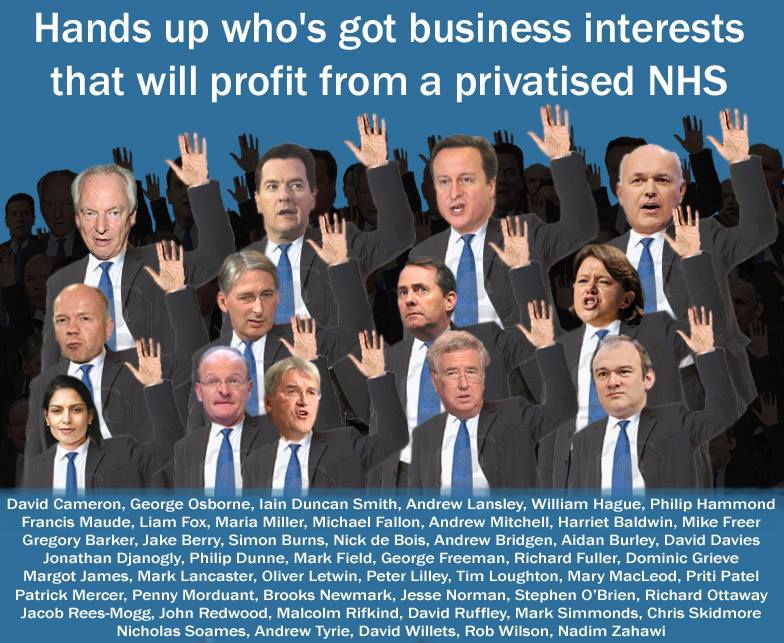
PM David Cameron and Health Secretary Jeremy Hunt are among 64 Tory MPs named in a study by Unite – Lib Dems Nick Clegg and Vince Cable are also on the list.

One in five Coalition MPs have links with private firms who could profit from the Government’s NHS reforms, a damning dossier will reveal on Tuesday.

Prime Minister David Cameron, former Health Secretary Andrew Lansley and his successor Jeremy Hunt are among 64 Tory MPs named in a study by the Unite union.

Deputy PM Nick Clegg and Business Secretary Vince Cable are among seven Liberal Democrats on the list.

All 71 MPs named in the dossier voted in favour of the Government’s controversial Health and Social Care Act in 2012, which opened up the NHS to more private firms.

It comes ahead of Friday’s crunch vote on Labour frontbencher Clive Efford’s Private Members’ Bill, when MPs will decide whether to scrap key sections of the Act.

[However, the only way to see the Act scrapped in full is to make sure we have a Labour Government on May 7th 2015, as the Labour Party have pledged to repeal the entire Act since it came into being, in 2012.]

Unite general secretary Len McCluskey raged: “This dossier of disgrace exposes the corruption at the heart of our Government’s sinister health reforms.”

‘Dossier of shame’: Clegg, Cameron, Hague, Hunt, Duncan Smith and Lansley are named.

Len McCluskey at the Daily Mirror Real Britain Fringe

Unite leader Len McCluskey

He added: “The Government’s real plan is the complete and irreversible privatisation of our NHS.”

Many of the MPs named in the document have directly received donations from business leaders or firms with links to the private health industry.

There is no suggestion any of the politicians or donors acted illegally.

The Conservative Party stressed tonight that all donations are reported to the Electoral Commission in line with electoral law.

But critics said the dossier shines a bright light on the close ties between members of the ­Coalition and the private health industry.

Mr McCluskey said: “The sheer scale of the conflict of interest is staggering.

“But it is the subsequent betrayal and privatisation of our NHS, driven by the monstrous Health and Social Care Act, that has made this a genuine scandal for our democracy.”

The dossier shows Mr Lansley, the chief architect of the Coalition’s NHS reforms, accepted a £21,000 donation in November 2009 from John Nash, the former chairman of Care UK.

Andrew Lansley


Chief architect: Former Health Secretary Lansley received £21k from former chairman of Care UK.

 Two other Tory MPs received donations from Mr Nash’s wife Caroline.

Hunt, who took over as Health Secretary when Mr Lansley was sacked in September 2012, received more than £20,000 from hedge fund baron Andrew Law, a major investor in health care firms.

Other Cabinet Ministers to have received donations include Leader of the Commons William Hague, who accepted £20,000 from MMC Ventures, the part-owner of The Practice plc which runs 60 GP surgeries.

And Culture ­Secretary Sajid Javid received £11,000 from Moundsley Healthcare Ltd.

The Prime Minister is named in the dossier after handing a life peerage to nursing and care home tycoon Dolar Popat, who has given the Tories more than £200,000 in donations.

Tory Dolar: PM Cameron, pictured, gave peerage to nursing and care home tycoon who donated £200k+

Work and Pensions Secretary Iain Duncan Smith has share options in hygiene tech firm Byotrol, which sells products to the NHS.

Foreign Secretary Philip Hammond is named because his former firm Castlemead is a health care and nursing home developer.

Andy Burnham, Labour’s Shadow Health Secretary, said of the Tories: “They were bankrolled by private health in Opposition as they drew up secret plans to put market forces at the heart of the NHS.

“And once in Government, MPs and peers with links to private health voted it through without a mandate from the public.”

For the Lib Dems, the dossier says party leader Mr Clegg received a £5,000 donation to his constituency office from Alpha Medical Consultancy.

And Vince Cable was given £2,000 by Chartwell Care Services, which is owned by Chartwell Health & Care plc.

Liberal Democrat leader Nick Clegg accompanied by shadow chancellor Vince CableDonations: Clegg’s (left) office received £5k while Cable was given £2k

Tonight a Conservative spokesman hit back, and said: “Here in the ­Conservative Party, donations don’t buy our leader, our candidates or our ­policies. If only the same could be said of Unite and the Labour Party.

“The most important thing with NHS care is that it is high quality and free at the point of delivery.”

A Lib Dem spokesman said his party had “stopped Conservative privatisation plans and reversed Labour’s special favours to private health companies”.

He added: “We have already committed to spending at least £1billion extra on health and care in each year of the next Parliament.”

Some MPs’ health connections

  • George Osborne, Chancellor: Received donation through Conservative Campaign HQ from Julian Schild whose family made £184m in 2006 by selling hospital bed-makers Huntleigh Technology
  • Michael Fallon, Defence Secretary: Former director of Attendo AB, a Swedish private health company
  • Philip Hammond, Foreign Secretary: Beneficiary of a trust which owns controlling interest in nursing home developer Castlemead Ltd
  • David Davis, former Shadow Home Secretary: Received £4,250 for a speaking engagement for health insurance company Aviva
  • Liam Fox, former Defence Secretary: Received £5,000 from iIPGL Ltd, which purchased health care company Cyprotex
  • John Redwood, former Cabinet Minister: Advised the private equity company which runs Pharmacy2u
  • Vince Cable, Business Secretary: Received a donation of £2,000 from Chartwell Care Services, which is 100% owned by Chartwell Health & Care PLC.

    Click here for a full list of MPs with links to private healthcare firms

    See also: The Coalition has deliberately financially trashed the NHS to justify its privatisation


    1912510_690135534389311_7775048840596309303_o

The commercialisation and undemocratising of the NHS: the commodification of patients

252299_486936058042594_609527550_n
Last September, I wrote an article entitledJobseekers are being coerced into experimental drug trials dressed up as “job opportunities” .

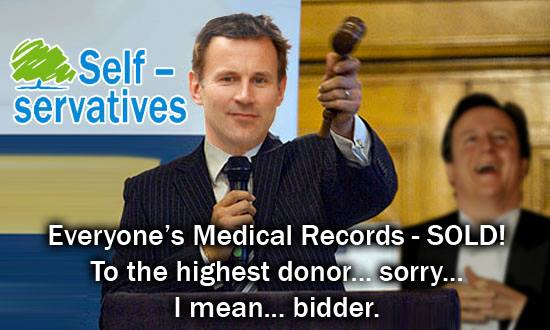
I reported that David Cameron had announced that it was: “simply a waste to have a health service like the NHS and not use the data it generatedLet me be clear, this does not threaten privacy”, he reassured us, “it doesn’t mean anyone can look at your health records, but it does mean using anonymous data to make new medical breakthroughs”.

Cameron often inadvertently signposts the coming of a diabolical lie with the phrase “let me be clear”, as we know. We also know that so-called anonymisation of data offers no protection at all to identities and personal details. Campaigners described the plan as an”unprecedented threat” to confidentiality, Health Secretary Jeremy Hunt says, rather worryingly, that it will be a boon to research.

It’s common knowledge that many Coalition MPs and Peers are heavily financially invested in pharmaceutical and health care companies. Over 200 parliamentarians have recent past or present financial links with, and vested interests in companies involved in healthcare and all were allowed to vote on the Health and Social Care Bill. The Tories have normalised corruption and made it almost entirely legal. Our democracy and civic life are now profoundly compromised as a result of corporate and financial power colonising the State, and vice versa.

The Health and Social Care Bill, 2012, has a telling insert: The Secretary of State’s duty as to research, which is “In exercising functions in relation to the health service, the Secretary of State must promote – (a) research on matters relevant to the health service, and (b) the use in the health service of evidence obtained from research”.

And also very worryingly: (1) The National Patient Safety Agency is abolished. (2) The National Patient Safety Agency (Establishment and Constitution) Order 2001 (S.I. 2001/1743) is revoked. (3) In section 13 of the NHS Redress Act 2006 (scheme authority’s duties of co-operation), omit subsection (2)

So we must ponder just how coincidental it is that Jobseekers are now being coerced into experimental drug trials, or risk benefit sanctions, as the trials are being dressed up as “job opportunities”.

People claiming Jobseekers Allowance while searching for new employment are being forced to accept ever worsening working conditions or join exploitative Government work programmes in desperate attempts to survive, as our civilised social safety nets and lifeline benefits are being torn away by a draconian and authoritarian Government.

The rising number of unemployed and underemployed citizens of the UK are having their desperation to survive exploited, enticed into zero hour contracts, workfare and now, clinical trials. My revulsion at this Government is at an all time absolute.

Jobseekers using the Government’s  job website – the Universal JobMatch – have been receiving multiple messages from the service inviting them to apply for jobs, only to find that these “employment opportunities” are actually clinical trials.

Drug companies are also to be given provisional approval to treat the severely ill with new drugs and use the data in later licence applications In other words, our government is permitting pharmaceutical companies to experiment using severely ill people.

Behind the scheme is a Tory concern that the UK is no longer a favourite location for the drug companies to develop and trial new medicines – “Making Britain the best place in the world for science, research and development is a central part of our long-term economic plan,” said Health Secretary, Jeremy Hunt.

George Freeman, Conservative MP for Mid-Norfolk, who has long campaigned for the scheme, said: “it would benefit small biotech companies and charities, which may have breakthrough drugs that they cannot afford to take all the way through the long and expensive regulatory process – increasingly the source of innovative medicines which are then bought up by big pharma.

They would get their drugs into NHS patients, hopefully giving them positive data which would attract investors for the large-scale clinical trials.”

So not this is not actually about patient welfare, as Hunt had initially claimed. If it were, then there would have been no need for the abolition of The National Patient Safety Agency, or the revoking of The National Patient Safety Agency.

In 2011, an influential report written by Colin Haslam, Pauline Gleadle and Nick Tsitsianis entitled UK bio-pharma: Innovation, re-invention and capital at risk concludes by presenting the case for innovative short and medium term government-led policy initiatives for the sector and highlights four central areas in which the current bio-pharma business model could evolve. The study concludes by presenting the case for innovative short and medium term government-led policy.

The acknowledgement reads: “in order to complete our research work we have obtained the support of a number of senior executives in private and publicly quoted SME bio-pharma companies and also industry experts in big-pharma. We would like to thank this group for giving up their time to be interviewed for this research project.”

One of the key recommendations of the report is: access to NHS clinical datasets to provide a significant knowledge resource to strategically drive UK drug discovery.

The report is primarily concerned with “the evolution of the bio-pharma business model.”

Reuters reports that the UK is currently one of the only markets in the world in which pharmaceutical companies are free to set prices for their drugs. At the moment, the UK Pharmaceutical Price Regulation Scheme (PPRS) regulates profits, not prices on sales to the NHS, whilst the National Institute for Health and Clinical Excellence (NICE) assesses if drugs are cost effective.

However, this is set to change with the introduction of the “Programme for Government” document indicating that the coalition would “reform NICE and move to a system of value-based pricing”. This would lead to changes in the way that drug prices are determined.

The Association of British Pharmaceutical Industry has stated that it will be keeping an open mind ahead of talks with the government.

“Valued-based pricing is one way of doing it,” said spokesman Richard Ley. “We are not opposed to the principle. It is a question of how it is achieved to get it right.” By that, he means how to make it very profitable, of course.

“The regulatory process is inefficient,” according to one leading biotech investor.From a business side of things these products stop being developed in the UK when they get into later stage because the UK is not a very good market for pharmaceuticals.”

Drug companies have for years strongly criticised the National Institute for Health and Care Excellence (Nice), the UK pricing regulator, which they believe is blocking new and innovative medicines by complicated approval processes and a heavy emphasis on cost control.

Steve Bates, chief executive of the Biotech Industry Association, said: “It’s fantastic and very important that there is a new designation and an “all hands on deck” approach.

“The Coalition Government is determined to secure and expand the UK’s position as an international hub for innovation, medical science and research and in the last 12 months has generated more than £1 billion industry and private sector investment. The Prime Minister will use his visit to the US to meet with CEOs and senior figures from leading pharmaceutical companies, including Johnson & Johnson, Baxter, Covance and Pfizer. The meeting will focus on the UK’s life sciences sector and initiatives such a genomics and dementia research”.

A key policy advisory group – The Ministerial Industry Strategy Group – is co-chaired by the Secretary of State for Health and the Chairman of the British Pharma Group, and aims to promote a “strong and profitable UK-based bio-pharmaceutical industry capable of sustained research”.

The Deregulation Bill is wide-ranging in scope. It’s when we look at what it might mean for the NHS that we see why so much of the contents are very worrying.

This Bill imposes a new duty on non-economic regulators to promote economic growth, for example. What exactly would that mean for the Care Quality Commission? How would the Medicines and Healthcare Regulatory Agency, which regulates the pharmaceutical industry, promote growth?

The bill also imposes a new “growth duty” on watchdogs as well as regulators. Currently, such bodies exist to monitor particular sectors – like health – and take action in the best interests of the public according to the relevant law.

But Clause 58 of the Deregulation Bill puts a responsibility on regulators in England so that when they take regulatory action it has to be with regard to “promoting economic growth”, and not to promoting the best interests of the public. The Bill was quietly tabled in draft by Ken Clarke and Oliver Letwin, and didn’t Letwin say back in 2004 that the “NHS will not exist within five years of a Conservative election victory”?

Regulation evolved to “help build a more fair society and even save lives”, but regulation is often considered a hindrance by business. So this is all about The Coalition making it easier for big profits to be made out of the NHS by private healthcare multinationals. True to Tory form, it’s another policy which is designed to facilitate the exploitation of the vulnerable by the wealthy.

It’s also worth noting that last week, two of the government’s top health and work advisers stated they believed in the merits of “prioritising NHS treatment for working people”, and this needs to be seriously discussed.

If that isn’t further clear evidence of the relentless Tory drive towards economic reductionism and determinism, I don’t know what is.

I need not go on to discuss the religion of the Pope or the toilet habits of bears, I suppose.

Further reading:

Profit before human need  – “The drug companies will get away with whatever they can get away with within the law to look after the interests of their shareholders. But they couldn’t get away with these things were it not for members of my profession being willing to collude with them and put patients in second place”: unfavourable results from medical trials are being withheld, MPs warn
1098410_520975421305324_1267996419_n