Category: PIP

Lords table motion to kill new Tory restrictions on PIP

westminster-20121020-00081

It’s estimated that around 160,000 disabled people will be stripped of their entitlement to support for the additional costs they face because of their disability after the government shifted the goalposts to deal with upper tribunal legal rulings, according to the Labour Party.

Debbie Abrahams, shadow work and pensions secretary, said: “Instead of listening to the court’s criticisms of personal independence payment assessments and correcting these injustices, the government has instead decided to undermine the legal basis of the rulings.

This is an unprecedented attempt to subvert an independent tribunal judgment by a government with contempt for judicial process.

By shifting the goalposts, the Tory government will strip entitlements from over 160,000 disabled people, money which the courts believe is rightfully theirs.

This is a step too far, even for this Tory government. Labour will stand with disabled people, who have already borne the brunt of seven years of austerity, in fighting this injustice.”

(See also:  Government subverts judicial process and abandons promise on mental health ‘parity of esteem’ to strip people of PIP entitlement. )

Labour opposes the reform and will also seek to block the statutory instrument in the House of Lords and the House of Commons.

According to the Liberal Democrat Voice, the Liberal Democrats have tabled a motion to kill the government attempts to severely restrict disability benefits. 

The government will have used a statutory instrument that amends the Welfare Reform Act 2012. However, statutory instruments are generally used for non-controversial policy changes, and changes that don’t require much parliamentary scrutiny and debate. That clearly is not the case for the Conservative’s contentious Personal Independence Payment regulations, that attempt to overturn court rulings that are meant to be independent of government influence.

The move follows the recent undemocratic announcement by the government that they will be tightening the criteria for claimants of Personal Independence Payments (PIP) which will see people with serious illnesses such as diabetes, epilepsy and a wide range of mental illnesses left without support.

The purpose of Upper Tribunals

The government has introduced the restrictive regulations after losing two cases at tribunals, showing an utter contempt for the UK judiciary system. However, the UK tribunal system is part of the national system of administrative justice

Administrative law is the body of law that governs the activities of administrative agencies of government. It is designed to independently review the decisions of governments, and as such, it provides protection and promotion of fundamental rights and freedoms for citizens.

The Upper Tribunal is a superior court of record, giving it equivalent status to the High Court and it can both set precedents and can enforce its decisions (and those of the First-tier Tribunal) without the need to ask the High Court or the Court of Session to intervene. It is also the first (and only) tribunal to have the power of judicial review. (The Conservatives have a historical dislike of judicial review. See for example: The real “constitutional crisis” is Chris Grayling’s despotic tendencies and his undermining of the Rule of Law.)

The Tribunals, Courts and Enforcement Act 2007 created a new unified structure for tribunals and recognises legally qualified members of tribunals as members of the judiciary of the United Kingdom who are guaranteed continued judicial independence. This means that the judiciary is kept discrete from other branches of government. That is so that courts are not subjected to improper influence from the other branches of government, or from private or partisan interests.

Judicial Independence is vital and important to the idea of separation of powers. The intent behind this concept is to prevent the concentration of political power and provide for checks and balances. It has been significantly influenced by judicial independence principles developed by international human rights constitutional documents. in the application of the European Convention on Human Rights in British law through the Human Rights Act 1998, which came into force in the UK in 2000.

The government’s new regulations are a particularly autocratic move, aimed at simply overturning two legal rulings that the government did not like, partly because their zealotry concerning their anti-welfarism and “small state” neoliberal ideology has been challenged. The regulations were ushered in and imposed so that they would not be subjected to parliamentary scrutiny and debate or democratic dialogue with disabled people or groups and organisations that support and advocate for those with disability. 

From Penny Mordaunt’s statement:

“The first judgement held that needing support to take medication and monitor a health condition should be scored in the same way as needing support to manage therapy, like dialysis, undertaken at home. Until this ruling, the assessment made a distinction between these two groups, on the basis that people who need support to manage therapy of this kind are likely to have a higher level of need, and therefore face higher costs.

The second held that someone who cannot make a journey without assistance due to psychological distress should be scored in the same way as a person who needs assistance because they have difficulties navigating. By way of example, the first group might include some people with isolated social phobia or anxiety, whereas the second group might include some people who are blind. Until this ruling, the assessment made a distinction between these two groups, on the basis that people who cannot navigate, due to a visual or cognitive impairment, are likely to have a higher level of need, and therefore face higher costs.”

Responding to the announcement, Baroness Cathy Bakewell, Liberal Democrat Shadow Secretary of State for Work and Pensions, said:

“The government is using its recent losses in court as an excuse to severely restrict disability benefits. Rather than listening to the ruling they are using it to make matters worse for disabled people – that is utterly outrageous.

What makes things even worse is that they have sneaked this announcement out under the cover of by-elections. These decisions impact the lives of vulnerable people, Liberal Democrats will not allow the Conservatives to get away with treating people with disabilities with such total contempt.”

The Liberal Democrats contributed to scuppering the government’s plans to restrict tax credits back in October 2015.

Personally, I welcome any collaborative effort to challenge the Conservative’s draconian policies which deny people the help and support that they need. 


Related

Government defeated twice on tax credit cuts in House of Lords

Government signal move to curb the powers of the House of Lords after tax credit defeat

The Strathclyde Review clarifies the Conservatives’ authoritarianism

A black day for disabled people – disability benefit cuts enforced by government despite widespread opposition


I don’t make any money from my work. I am disabled because of illness and have a very limited income. But you can help by making a donation to help me continue to research and write informative, insightful and independent articles, and to provide support to others. The smallest amount is much appreciated – thank you.

DonatenowButton cards

Department for Work and Pensions Recruits Staff To Reduce ESA And PIP Appeal Success Rates

8a26960ab68d6c169049cd0b22475a12

Legal Aid funding became unavailable for welfare cases at First Tier tribunal in April 2013, because of the Conservative-led Legal Aid, Sentencing and Punishment of Offenders Act 2012 (LASPO). This included Legal Aid for appealing all benefit decisions. Legal Aid at Second Tier tribunal may be available if the case is about a point of law. Political lip service was paid to the legal human rights implications regarding the violation to the right to a fair trial (Article 6 of the ECHR), equal access to justice , and the Act provided that funding may be granted on a case-by-case basis where the failure to provide legal aid would be a breach of the individual’s rights under the European Convention on Human Rights (ECHR) or the rights of the individual to the provision of legal services that are enforceable European Union rights.

The Lord Chancellor’s Exceptional Funding Guidance (Non-Inquests) clarified that in determining whether Article 6 ECHR would be breached, it has to be shown that the failure to grant funding would mean that bringing the case would be “practically impossible or lead to an obvious unfairness in proceedings” (para 63). But Ministry of Justice figures showed that from 1 April 2013 to 31 December 2013, of the 1,083 applications determined, funding was granted in only 35 cases (3% of cases). This indicates that the criteria are being applied in an intentionally “overly restrictive manner” and, in the case of welfare benefits, all 11 applications were refused: Exceptional Case Funding Statistics – April 2013 to March 2014

Considering this in a context that includes the introduction of the Mandatory Review, in 2013, and in light of more recent events, I think it’s fair to say that the Conservatives have shown they are determined to take away money that provides essential support from disabled people in particular, one way or another, no matter how much it costs to do so.

Many thanks to Benefits and Work for the following information:

The Department for Work and Pensions has been given £22 million to recruit presenting officers in an effort to reduce the number of claimants winning their personal independence payment (PIP) and employment and support allowance (ESA) appeals.

The Office for Budget Responsibility’s (OBR) “Economic and Fiscal Outlook” document lists the following amount:

“£22 million to DWP to recruit presenting officers across 2016-17 to 2017-18 to support the department in personal independent payments and employment and support allowance tribunals.”

Buzzfeed is reporting that the money will pay for 180 new presenting officers.

The number of PIP appeals is expected to skyrocket over the coming two years as the forced move from DLA to PIP takes place.

In addition, the proportion of successful PIP appeals has increased with every quarter since the benefit was introduced. PIP claimants won in 60% of cases from July to September 2015, up from 56% in the previous quarter.

58% of ESA cases are also won by the claimant.

The DWP is also concerned by the way that tribunal judges have been interpreting the very badly drafted PIP legislation in favour of claimants. In particular, the widening of what counts as aids and appliances for PIP activities by judges is what led to the disastrous attempt to change the point scores for PIP.

In theory, presenting officers should act a s a ‘friend of the court’, helping judges to reach a fair decision. In reality, they will be sent by the DWP to try to discredit claimants and argue as forcibly as possible for the DWP’s interpretation of the law to be accepted.

Attending an appeal tribunal is likely to be an even more gruelling process for claimants over the next few years.

Update

Recovery In The Bin is a mental health social justice group, who are fundraising to help train 16 volunteers to support people with mental health difficulties before and up to ESA/ PIP tribunals. They say:

“Here’s what we’re doing about it

We have asked Welfare trainer Tom Messere, author of the Big Book of Benefits, if he would train 20 volunteers in the basics that they will support people up to these tribunals to give them a bit more of a fighting chance. And whilst we have Tom at our disposal we are also we will be training the volunteers to help fill out the often complex and confusing forms, so that less have to go to tribunal in the first place. The training will be on ESA and PIP, form filling, getting any available medical and informal evidence correctly pitched (what the person needs to ask for), possible calls, key pointers for accompanying, and up to tribunals.

You can join us

We are hoping you can donate to help pay for the training, the venue, transport and accommodation for Tom, and as we are recruiting volunteers, many on low incomes themselves, and as we will need to have representatives in as many places as we can (sorry, we wish we could provide for everywhere) then we are trying to raise as much help for their travel as well.

As such we are looking to raise £2250.”


You can support Recovery In The Bin in their aim to provide support for people who need to fight at tribunal for their ESA and PIP award, and donate here

Government plans further brutal cuts to disability support

358-burden-of-cuts

Disabled people are already carrying a disproportionately high burden of the austerity cuts, despite government claims of economic recovery.

Government ministers are planning to cut a key element of the Personal Independent Payment (PIP). Last year a consultation indicated that the Conservatives were considering ways of reducing eligibility criteria for the daily living component of PIP, by narrowing definitions of aids and appliances.

From January 2017, the cut is likely to hit people experiencing incontinence, who struggle to dress themselves, and those facing other fundamental barriers to health and essential basic care. The cut, it is estimated, will affect at least 640,000 disabled people by 2020.

Controversially, it is alleged that the cuts to disability benefit will fund tax cuts for the most affluent – the top 7% of earners. The Chancellor is set to raise the threshold at which people start paying 40p tax, in a move that will probably see  many wealthier people pulled out of the higher rate of income tax, in the coming budget. Mr Osborne says he wants to “accelerate progress” towards the Conservative’s manifesto pledge of raising the threshold for the 40p rate to £50,000 in 2020, it is understood.

Meanwhile, under the plans announced on Friday, sick and disabled people will be much less likely to receive essential disabled benefits if they use aids such as a handrail or a walking stick to get dressed or use the toilet.

The Department for Work and Pensions reviewed a sample of 105 cases of people who had scored all, or the majority, of their points for PIP due to aids and appliances, in order to assess the extent to which the award may reflect extra costs.

The review led the government to conclude that PIP “doesn’t currently fulfil the original policy intent”, which was to cut costs and “target” the benefit to “those with the greatest need.” That originally meant a narrowing of eligibility criteria for people formerly claiming Disability Living Allowance, increasing the number of  reassessments required, and limiting the number of successful claims.

Prior to the introduction of PIP, Esther McVey stated that of the initial 560,000 claimants to be reassessed by October 2015, 330,000 of these are targeted to either lose their benefit altogether or see their payments reduced. Of course the ever-shrinking category of “those with the greatest need” simply reflects a government that has simply made a partisan political decision to cut disabled people’s essential income to fund a financial gift to the wealthiest citizens. There is no justification for this decision, nor is it “fair.”

The government now  claim that the proportion of people awarded the daily living component of PIP, who scored all of their points because they need aids and appliances, has more that tripled, from 11 per cent in April 2014 to 35 per cent in 2015.

The PIP assessment currently examines an individual’s ability to complete ten daily living activities and two mobility activities. Regular reviews were also introduced by the last government to ensure that claimants continue to receive the “right level of support.”

The increase has largely been driven by a significant and sustained rise in relation to activities one, four, five and six: preparing food, washing and bathing, dressing and undressing, and managing incontinence and toileting. Around three-quarters of those who score all of their points through aids and appliances score the minimum number of daily living points needed to qualify for the standard rate of the daily living component.

The government ridiculously claim that the “evidence” presented to the review suggested that in some instances points were being awarded “… because claimants chose to use aids and appliances, rather than needed them.”  And noted that in many cases “ these were non-specialised items of very low cost.”

However, it’s very difficult to justify cutting support for people who require aids to meet fundamental needs such as preparing food, dressing, basic and essential personal care and managing incontinence.

Ministers have now announced their intention to cut PIP for people who currently receive it to help them afford specially-adapted appliances and equipment. Examples of qualifying equipment currently includes adapted cutlery for people who find it difficult to hold things for long periods of time and specially-designed household items for people less able to stand.

Justin Tomlinson, the disabilities minister, said that the cuts to funding for aids and appliances for the disabled could save about £1bn a year and was announced the week before the budget. Charities warned that the cuts to personal independence payments (PIP) would be devastating after the move was confirmed by Tomlinson on Friday.

Tomlinson, said: “The introduction of Personal Independence Payment to replace the outdated Disability Living Allowance for working age claimants has been a hugely positive reform.

But it is clear that the assessment criteria for aids and appliances are not working as planned. Many people are eligible for a weekly award despite having minimal to no extra costs and judicial decisions have expanded the criteria for aids and appliances to include items we would expect people to have in their homes already.

We consulted widely to find the best approach. And this new change will ensure that PIP is fairer and targets support at those who need it most.”

Only a Conservative minister would claim that taking money from sick and disabled people is somehow “fair,” and they frequently do. The cuts of £120 a month to the disability benefit employment support allowance (ESA) are also claimed to be “fair.” and “supportive.” Though I have yet to hear an explanation of how this can possibly be the case. Ministers claimed that people subjected to the ESA Work Related Activity Group cuts could claim PIP if they required support with extra living costs, but now we are told that PIP is to be cut, too.

Bearing in mind the Department for Work and Pensions “review” was based on a sample of just 105 people, it’s very difficult to see how further inhumane cuts to the lifeline income for this group of amongst the most disabled citizens can possibly be justified. How did ministers “plan” the assessment criteria for aids and appliances to work, exactly?  People qualifying for PIP need extra support in meeting their living costs.

A coalition of 25 disability charities has written to the Government to warn against plans that would strip some disabled people of a key payments meant to help them live more independent lives.

The Disability Benefits Consortium wrote to Justin Tomlinson, to argue that proposed changes to Personal Independence Payment – or PIP – assessments would have a “severe impact” on people’s security and make it harder for them to find work.

Debbie Abrahams, the shadow disabilities minister, said: “Removing support for people who need help to use the toilet or dress is an attack on dignity.”

“These further cuts would represent another huge blow, making life even more difficult for many people who already facing huge barriers.”

Phil Reynold, policy and campaigns adviser at Parkinson’s UK, said: “If someone needs aids and appliances to carry out the most basic tasks that most people take for granted then they clearly need ongoing support to live independently, which is often expensive. They should not be penalised by making personal independence payments even more difficult to claim.”

Michelle Mitchell, chief executive of the MS Society, said: “This decision could have a devastating impact on the lives of people with MS. In the worst cases, they could lose up to £150 a week.

PIP is an essential benefit which goes towards the extra cost of being disabled. The new plans will fail some of the most vulnerable people in society and we have serious concerns about the future health and welfare of those affected.”

The government is currently being investigated by the United Nations because of  serious allegations that many of us have made regarding the welfare “reforms”, which have extended gross and systematic abuse of the human rights of disabled people. The UK is the first country to be subject to an investigation regarding the government’s failure to meet legal obligations to uphold disabled people’s human rights. In the 6th wealthiest nation of the world, and a so-called liberal democracy, this treatment of an already marginalised and protected social group is utterly shameful.

536738_306169162785952_999031084_n

scroll2

I don’t make any money from my work and I’m not funded. You can support Politics and Insights by making a donation to help me continue researching and writing independently, and to continue to help others.

DonatenowButton
cards

The UK Government have got it wrong about our Human Rights.

564882_438358886199493_1982719183_n
The Joint Parliamentary Committee on Human Rights has conducted an inquiry into the UK Government’s implementation of Article 19 of the United Nations Convention on the Rights of Persons with Disabilities (UNCRPD) – the right to live independently and to be included in the community. The inquiry which began in 2011 has received evidence from over 300 witnesses.

The inquiry has highlighted just how little awareness, understanding and employment of the Convention there is by the Tory-led Government.  Very few of the witnesses made specific reference to the Convention in their presented evidence, despite the inquiry being conducted by the Parliamentary Human Rights Committee, with the terms of reference clearly framing the inquiry as being about Article 19 of the UNCRPD.

“This finding is of international importance”, said Oliver Lewis, MDAC Executive Director, “Our experience is that many Governments are of the view that the CRPD is nothing more than a policy nicety, rather than a treaty which sets out legal obligations which governments must fulfil.”

The report is particularly critical of the Minister for Disabled People (Maria Miller, at the time) who told the Committee that the CRPD was “soft law”. The Committee criticised this as “indicative of an approach to the treaty which regards the rights it protects as being of less normative force than those contained in other human rights instruments.” (See para. 23 in the report, the link is at the foot of this article.) The Committee’s view is that the CRPD is hard law, not soft law.

Dr Hywel Francis MP, Chair of the Committee, said: “We are concerned to learn that the right of disabled people to independent living may be at risk through the cumulative impact of current reforms. Even though the UK ratified the UNCPRD in 2009 with cross-party support, the Government is unable to demonstrate that sufficient regard has been paid to the Convention in the development of policy with direct relevance to the lives of disabled people. The right to independent living in UK law may need to be strengthened further, and we call on the Government and other interested organisations to consider the need for a free-standing right to independent living in UK law.”

“The Government is meant to include disabled people in making sure people have their human rights upheld. We are concerned that a part of the Law on treating people equally and fairly (Equality Act section 149) does not say any more that disabled people should be involved. This is a step backwards.”

In other words, the Tory-led Coalition has quietly removed this part of the Equality Act.

The budget of the Equality and Human Rights Commission (EHRC), which was established by the Labour Party when they were drafting this flagship policy, is being reduced by over 60%, its staffing cut by 72%, and its powers restricted by the Coalition. Provisions that are being repealed by the Enterprise and Regulatory Reform (ERR) Bill include the duty on public authorities to have due regard to the need to reduce socio-economic inequalities.

Savage Legal Aid cuts from April 2013 have also contributed significantly to creating further barriers to ensuring Equal Rights law protect us, and the Tory-driven Legal Aid Bill also contravenes our right to a fair trial under Article 6(1) of the European Convention on Human Rights.

This is not a coincidental multiple policy timeline, but rather a very coordinated political attack on potential legal challenges at a time when Tory-led severe and devastating multiple welfare and provision cuts have affected disabled people so disproportionately. The changes, which came into effect in April, will hit the same group of disabled people over and over again”.

The threats to the legal infrastructure make it all the more important to mobilise all disadvantaged groups around equality as a fundamental human right.

The Report draws attention to several significant Human Rights issues, including:

  • the need for freestanding legislation to protect the right to independent living in UK law,
  • the effect of current reforms to benefits and services on the ability of disabled people to enjoy independent living,
  • the role played by the UNCRPD in policy development and decision-making at all levels of government,
  • the need for the use of equality impact assessments,
  • the effects of devolution on implementation of the UNCRPD, and
  • hate crime

The right to independent living does not exist as a free-standing right in UK law. Although it is protected and promoted to some extent by a matrix of rights, the Committee believes that this is not enough. It argues that the Government and other interested parties should immediately assess the need for, and feasibility of, legislation to establish independent living as a free-standing right. In addition, the Committee concludes that the UNCRPD is “hard law” and that the Government should fulfil their obligations under the Convention on that basis.

The Committee finds that:

  • reforms to benefits and services (let’s be frank here, they are not welfare “reforms”, they are cuts) risk leaving disabled people without the support they need to live independently;
  • restrictions in local authority eligibility criteria for social care support, the replacement of the Disability Living Allowance with Personal Independence Payment, the closure of the Independent Living Fund and changes to housing benefit risk interacting in a particularly harmful way for disabled people;
  • people fear that the cumulative impact of these changes will force them out of their homes and local communities and into residential care.

It also finds that:

  • the Government has not conducted an Equality impact assessment of the cumulative impact of current “reforms” on disabled people. The Report urges them do so, and to report on the extent to which these “reforms “are enabling them and local authorities to comply with their obligations under the UNCRPD.
  • The Committee states that the Government should make a commitment to Parliament that they will give due consideration to the articles of the Convention when making legislation. The UNCRPD did not have a significant role in the development of policy and legislation, as is required by the Convention.

Furthermore, the Committee criticises changes to the duties of public authorities in England under the Equality Act 2010, which no longer require the production of equality impact assessments of changes in policy, nor the involvement of disabled people in developing policies which will affect them.

The Committee also expresses a major concern over a growing incidence of hate crime against disabled people and urges the Government take action to foster respect for the rights and dignity of disabled people.

Article 19 states that the Government must always ensure it “stops things getting worse.” This has NOT happened. The quality of so many sick and disabled people’s lives in this Country has been radically, significantly and DELIBERATELY reduced since the Tory-led Coalition took Office in 2010. This needs to change as a matter of urgency.

The Government’s “reforms” have led to a terrible increase in deaths amongst sick and disabled people, and we have already seen a significant rise in suicides that are directly linked with the Tory-driven austerity measures.

When we genuinely seek to improve the situation of the poorest and vulnerable, first of all we will need to spend time studying the privileged elite and their lifestyle choices of tax avoidance, their own economic lasciviousness and lack of capacity for personal and social responsibility.

We need to pay attention to Government handouts (of our money) to banks, private businesses and the wealthy: we need to appraise the dependency and culture of entitlement that these sponsored acts have fostered, and of course special focus should be on the amoral decisions and anti-social actions of the feckless, scrounging wealthy, and with particularly careful, critical scrutiny of the Government responsible for policies that re-distribute and concentrate our wealth and their advantage and power, therefore creating social divisions, inequality and poverty, perpetuating and extending it.

The Tory-led Coalition prefers to take money from the vulnerable, the sick and disabled, and hand it out to millionaires.

We need to ask why our Government refuses to instigate or agree an inquiry into the substantial rise in deaths amongst sick and disabled people, as these deaths are so clearly a direct consequence of this Government’s policies. What kind of Government uses the media to scape-goat and stigmatise sick and disabled people, by lying and inventing statistics to “justify” the persecution of some of our most vulnerable citizens, and the withdrawal of their crucial lifelines and support?

One that does not value those lives, or regard them as having an equal worth with others.

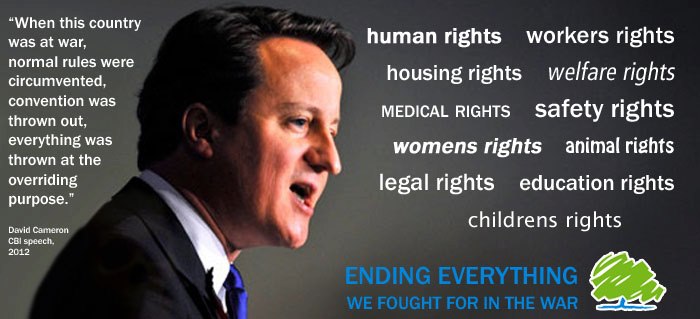
We are raising more money for the rich” – David Cameron, 12th December 2012


Further reading:

Archbishop Tartaglia adds to protest against Atos assessments which ‘trample on human dignity’

The European courts have their priorities wrong. Why aren’t they stopping the disability deaths? – Mike Sivier, Vox Political

Did They Hope We Wouldn’t Notice? Under The Smokescreen – John D Clare

The Coming Tyranny and The Legal Aid Bill – KittySJones

CRPD IS “HARD LAW” – UK PARLIAMENT

The Summary of the Report on Implementation of the Right of Disabled People to Independent Living: easy read version  and the full length report

644117_408620012540866_785481358_nMany thanks to Robert Livingstone for his outstanding art work.

PIP and the Tory monologue

644117_408620012540866_785481358_n

Here is a very important leaked correspondence between Dame Anne Begg and Esther McVey regarding PIP. (Personal Independence Payment, which is to replace Disability Living Allowance.) The correspondence flags up some serious concerns regarding a lack of transparency and accountability, responsiveness and a basic lack of following established democratic norms and protocol on the part of  the current Government. Mounting successful challenges to reform requires having detailed information regarding that reform. Here is clear evidence that the Conservatives are intentionally stifling democratic dialogue.

There are some serious issues raised in Esther McVey’s response that signal some very worrying changes to advisory groups and their role in how they influence policies. Esther McVey is indicating that the Secretary of State has already moved away from dialogue with, and paying heed to independent groups, as well as secretly deciding that any input and advice at all does not need to be published and open to public scrutiny. It signals that the Government will no longer be obliged to do anything more than pay lip service to consulting independent groups. Of course such consultations are crucial mechanisms of democratic process, scrutiny, the safeguarding of human rights, as well as Government transparency and accountability. Here we see evidence that these mechanisms are being very quietly dismantled. This clearly signals an authoritarian turn on the part of the government.

McVey has managed to avoid going before the Work and Pensions Select Committee, and she is telling the Committee that she intends to publish the Government’s response the SAME DAY as the secondary regulations are presented to Parliament. This gives us no time whatsoever for scrutiny, analysis, preparation or effective challenge.

Letter from Anne Begg to Esther McVey:

Dear Minister

Disability Living Allowance and Personal Independence Payment (PIP)

You will be aware from the debate in Westminster Hall on 25 October that the Committee has a number of outstanding concerns about the eligibility criteria and plans for implementation for PIP. As you know, we had hoped to explore these issues in an evidence session with you in November. Committee staff had been in the process of trying to identify a suitable date through your officials.

We first invited you to appear during the week of 5 November but you did not have a diary slot available that week. You then offered 9.00 am on 12 or 13 November, but neither of these was possible for Committee members (particularly as one was a Monday morning when we are travelling from our constituencies). Our next suggestion was 21 November.

The issue now seems to have moved on from being simply a diary problem. Your officials have indicated that you would prefer not to give evidence before the PIP Regulations are published because you feel you would be unable to answer the Committee’s questions. I would like to make clear that our intention was that our evidence session should inform the drafting of the Regulations, and the eligibility criteria, before they are finalised and laid before Parliament. The change in your position suggests to us that final decisions have already been made.

We would be grateful for your response to the following questions to help clarify the situation:

1. When do you plan to respond to the consultations on the draft assessment criteria and thresholds and on finalising the detailed rules for PIP?

2. Will the relevant Regulations, including the draft assessment criteria, be published in draft and subject to some form of further consultation, before they are laid before Parliament? If so, what is the timescale for this and what scope will there be to amend them further?

3. When do you expect the final Regulations to be laid (officials have been able to tell us only that they will be laid “before the end of the year”). If it is your position that it is already too late for the Committee to influence the finalising of the relevant Regulations, I would ask you to give a commitment to appear before us as soon as possible after they are laid, to explain the rationale for the final decisions you have made.

Draft Public Bodies (Abolition of the Disability Living Allowance Advisory Board) Order 2013

Departmental select committees (DSCs) have a formal role in scrutinising draft Orders laid under the Public Bodies Act. Departments are required to bring these draft Orders to the attention of the relevant DSC. The Committee has the power, as set out in Cabinet Office guidance, to recommend an extension of the laying period to 60 days if it decides this is necessary to ensure proper scrutiny.

DWP staff failed to bring the Draft Order on the DLA Advisory Board, which was laid on 15 October, to the Committee’s attention. The Committee staff only became aware of it because the House of Lords Secondary Legislation Scrutiny Committee contacted them to discuss the respective action each committee planned to take.

We are concerned about this lack of recognition by the Department of my Committee’s formal scrutiny role in relation to draft Orders under the Public Bodies Act. Officials have tried to allay the Committee’s concerns about the draft Order by saying that it does not do anything significant. I would make two points about this. Firstly, it is for the Committee to decide whether any matter within its remit is significant or not, including draft Orders. Secondly, the agreed formal procedures should be adhered to whether or not officials regard an issue as significant.

I would be grateful for your assurance that the Department will adhere to the agreed procedure on future occasions.

We understand that the Lords Scrutiny Committee has expressed concerns about the Department’s failure to carry out any consultation on the proposed abolition and has recommended an extension of the scrutiny period to 60 days [12th Report, HL 55, 1 November 2012]. We agree with this recommendation.

Turning to the substantive issues raised by the draft Order, the Committee staff made clear to your officials that we were willing to deal with these as part of the broader oral evidence session with you on PIP—if you had been able to attend a meeting before the 40-day laying period expires on 28 November.

As you no longer intend to appear before us in November, we would be grateful for your response to the following questions on the implications of the abolition of the DLA Advisory Board:

1. What measures will be put in place to protect the interests of non working-age claimants who will continue to claim DLA?

2. What measures will be put in place to protect the interests of working-age DLA claimants prior to their migration to PIP?

3. What will be the composition of the PIP advisory group referred to in paragraph 7.5 (b) of the PBO explanatory memorandum?

4. Will the advice of the PIP advisory group be published?
I would be grateful for your response by Friday 9 November.

Yours sincerely
Dame Anne Begg MP

Chair
Dame Anne Begg.

I suppose the terms of authoritarianism extend to have an impact on opposition parties and affect their capacity to gather information and organise actions much the same as they do campaigners and the general population. Again, without being provided with information and crucial detail, it becomes very difficult to mount a successful challenge against controversial legislation. This is a Government that does exactly what it chooses, and barely bothers justifying itself. Consider, for example, that no impact assessment was carried out regarding the welfare reforms. Or that the risk register concerning the Health and Social Care Bill has yet to be published and made accessible to the public.

It’s also noteworthy that Cameron is currently proposing that consultations, equality impact assessments, audits, judiciary review are all simply “inconveniences” that are (and I quote) “… not how you get things done…” 

Ask yourself what kind of things Cameron “wants to get done” bearing in mind that every single policy that this Government has designed and implemented has been about taking money away from the poorest people, and reducing the lives and experiences of the most vulnerable citizens, rather than enhancing those lives in any way.

Consider that these legislative mechanisms are important to democratic process, accountability, procedure and law, as well as being basic human rights safeguards. This is a Government that clearly is not about reflecting and meeting the needs of the public.

The Government have been made aware that sick and disabled people are dying after Atos have assessed them as fit for work. Ask yourself what kind of Government flatly and loudly denies that this is the case, without investigating the truth of the many serious concerns raised, and looking at the many cases that have been presented to them during debates in Parliament. What kind of Government tells lies about marginalised social groups, and propagates hateful stereotypes of marginalised citizens in the media to justify removing their welfare – calculated to cover basic living costs. Welfare provision is paid for via taxes, which many sick and disabled people have also paid. Our welfare support is NOT a “handout”: it is our money, our national insurance, paid by us for when we have a need of support. Social security.

Below are a couple of key paragraphs from McVey’s response to Dame Begg. These reflect the quiet dismantling of the Disability Living Advisory Committee, and the fact there is no advisory report or a formal advisory group regarding the development of PIP. Note again that the Government is not big on following procedure, or being transparent, accountable and consultative.

E. McVey: “Public Bodies (Abolition of the Disability Living Advisory Board) Order 2013

Please accept my apologies that the draft Order was not formally brought to the attention of the Committee as it should have been done. I understand that Cabinet Office made the Secretariat of the Committee aware that a draft Order was in the offing earlier in the year but unfortunately procedures were not followed through on a formal basis as they should have been. I will ensure that the Department will adhere to the agreed procedure on future occasions.

I hope my answers to your questions explain why we have taken the view that this Body which has not been asked to give any advice since 2008 had an extremely limited remit and why officials thought it proportionate to deal with the questions you raise on a correspondence basis. We certainly had no intention of disparaging the important role the Committee undertakes. I have set out my replies to your questions below.”….

“There will not be a PIP Advisory Group in the way that the Disability Living Allowance advisory group operates. In the Explanatory Document to the Public Body Order we explain that we have decided to use time-limited advisory groups and that the people asked to help us develop the assessment criteria for Personal Independence Payment (the Assessment Development Group) encompassed a wide range of expertise across health, social care and disability, including from occupational therapy, psychiatry, physiotherapy, social work, general practice, as well as representatives from Equality 2025 and Disability Rights UK. We included the Assessment Development Group in the Explanatory Memorandum as an example of how the Secretary of State is using a time-limited advisory group in policy development.”….

[Note the fact that the time limited invisible Advisory group approach doesn’t apply to just the PIP legislative development, it is to apply to ALL policy development. Also note she later goes on to say that “There was no FORMAL Advisory group, there is therefore no formal report from the Group, nor is there a requirement to publish their advice.”]

Section 89 of the Welfare Reform Act 2012 requires the Secretary of State to lay before Parliament an independent report on the operation of assessment within two years of regulations under section 80 coming into force and a second report within four years of that date.

Will the advice of the advisory Group be published?

As mentioned above there is no formal Advisory Group. The assessment criteria for Personal Independence Payment were developed in close collaboration with the Assessment Development Group. Although members sometimes submitted written comments on proposals, advice was generally given verbally and captured in meeting minutes.

There is therefore no formal report from the Group, nor is there a requirement to publish their advice, although we have published details of the development process in the explanatory notes which have accompanied the first and second drafts of the assessment criteria. The explanatory notes can be found at http://www.dwp.gov.uk/policy/disability/personal-independence-payment/the-assessment-criteria/

I hope this reply is helpful to the Committee.

Esther McVey MP
Parliamentary Under Secretary of State and Minister for Disabled People

Anne Begg : “Disability groups have not been consulted about the framing of the PIP assessment contracts or the guidance to assessors, so, although there has been limited consultation, the wider implications of how the measure will work in practice have not been subject to any kind of co-production. In one meeting, the Disability Benefits Consortium told us that the documents had been counted in and counted up, and that it had been given 15 minutes to look at them. That, again, is hardly co-production.

On the PIP assessment, the Government have said that there will be a requirement for face-to-face assessments for most claimants. That also raises a number of questions. On what basis did the Government come to that conclusion? Will the Government not be able to take account of existing evidence in most cases? That leads me to a question on a slightly different point: will there be any transfer of information already held by the Department for Work and Pensions, so that people do not have continually to remind it of such things as, “This is a glass eye, and of course I am not going to see out of it.” That is not as daft as it sounds. Sometimes, when people have gone for a WCA they have been asked what vision they have in their left eye when they have not had a left eye for decades.” – Dame Anne Begg, Daily Hansard – Westminster Hall 25 Oct 2012 : Column 319WH Westminster Hall.

Here is the full response from Esther McVey :

Dame Anne Begg MP
Chair
Work and Pensions Select Committee
7 Millbank
LONDON
SW1A 0AA
8 November 2012

Dear Anne

Thank you for your letter of 1 November. I am sorry we have been unable to identify an opportunity in November for me to appear before the Select Committee to discuss the PIP assessment criteria and regulations.

The Department has taken considerable time to develop the assessment criteria, throughout which we have sought to be transparent and to engage with and seek the views of disabled people, their organisations and parliamentarians. Our initial proposals for Disability Living Allowance reform, including the high-level principles of the assessment, were published in December 2010.

We published a first draft of the detailed proposals for the assessment criteria and regulations in May 2011, a second draft in November 2011 and ran significant consultations on both. The consultation on the second draft ran from January to the end of April this year, during which we received around 1,100 written responses and met with around 60 disability organisations.

Since the consultation closed on April 30 the Department has been carefully considering the responses received to identify any areas that we need to change to ensure that the assessment is both fair and operates effectively. As part of this we have also considered the comments made in the Select Committee’s report of 19 February and during the evidence session attended by my predecessor in December 2011.

We have also been working to test proposals for change, so we can understand the likely impact of the revised assessment. This work has now concluded and we have reached conclusions on the content of the finalised assessment criteria and regulations. We are now in the process of finalising the drafting of the government response and regulations and discussing the detail with colleagues across government.

We intend to publish a joint response to the consultations on the assessment criteria and benefit rules as soon as it is ready. While we do not yet have a firm date for publication, I am confident that it will be before the December recess. I do appreciate that many people would have liked an earlier response but it has been essential to take our time on this important issue and make sure we get the decisions right.

We have also not yet reached any final decisions on the publication of the PIP regulations but I think it likely that the key regulations will be published and laid on the same day as the government response.

Given the significant engagement that has already been undertaken, we are not intending to carry out any further consultation on draft regulations. However, we agreed during the passage of the Welfare Reform Act that the key regulations on PIP relating to benefit entitlement would be affirmative, which will allow Parliament further opportunity to scrutinise them.

I realise that this response is likely to be disappointing. However, I do consider that the development of our proposals for PIP has been carried out in a transparent and consultative fashion and that there has been full opportunity for the Committee to comment and offer suggestions for changes over the two year development process. We will be offering briefing sessions to MPs and Peers to explain the government response and regulations before the regulations are debated and I would be very happy to appear before the Select Committee to do the same to explain the rationale, as you suggest.

Draft Public Bodies (Abolition of the Disability Living Advisory Board) Order 2013

Please accept my apologies that the draft Order was not formally brought to the attention of the Committee as it should have been done. I understand that Cabinet Office made the Secretariat of the Committee aware that a draft Order was in the offing earlier in the year but unfortunately procedures were not followed through on a formal basis as they should have been. I will ensure that the Department will adhere to the agreed procedure on future occasions.

I hope my answers to your questions explain why we have taken the view that this Body which has not been asked to give any advice since 2008 had an extremely limited remit and why officials thought it proportionate to deal with the questions you raise on a correspondence basis. We certainly had no intention of disparaging the important role the Committee undertakes. I have set out my replies to your questions below.

1. What measures will be put in place to protect the interests of non working-age claimants who will continue to claim DLA?

DLAAB ‘s function is to issue the Secretary of State with independent advice. It does not exist to protect DLA claimants’ interests although of course the Board members had an interest in the integrity of the benefit system. It is not part of the decision making process for benefits and has no power to intervene in individual claims for Disability Living Allowance and Attendance Allowance. DLAAB has not provided any advice since 2008.

Work undertaken by the Board over the years concentrated mainly on medical reports on specific conditions or illnesses. This was usually because the department had detected a potential issue. For instance the department noted that DLA spending on “behavioural disorder” cases (which included ADHD cases) had increased much more rapidly than spending on other child recipients. In light of this the Board was asked to advise:

  •  whether there has been an increase in the number of children diagnosed with ADHD generally and, if so, suggest reasons for the increase; and 
  •  could the increased numbers of children in receipt of DLA be directly related to the increase in diagnosis or were there other reasons?

The Secretary of State will still commission work if he thinks this is necessary using task and finish groups as and when required and ensuring that the appropriate specialisms are covered. Even with the wide breath of professions covered by DLAAB it was still necessary on occasion to co-opt professionals with particular expertise as in the Attention Deficit Hyperactivity Disorder study where a Consultant Child and Adolescent Psychiatrist was asked to provide advice.

Claimants have always had the right to ask for a reconsideration if they are unhappy with a decision and then appeal to an independent tribunal if still dissatisfied. The Welfare Reform Act 2012 includes powers to require all claimants to seek a reconsideration before they can appeal to an independent tribunal. There is a complaints system which claimants can utilise which is advertised on the DWP website. Claimants may also apply to the Independent Case Examiner, if they consider the department has not treated them fairly or have not dealt with complaints in a satisfactory manner.

2. What measures will be put in place to protect the interests of working-age DLA claimants prior to their migration to PIP.

As explained above this was never the role of DLAAB. The same rights apply to working- age and non working-age people.

3. What will be the composition of the PIP advisory group referred to in paragraph 7.5 (b) of the PBO explanatory memorandum?

There will not be a PIP Advisory Group in the way that the Disability Living Allowance advisory group operates. In the Explanatory Document to the Public Body Order we explain that we have decided to use time-limited advisory groups and that the people asked to help us develop the assessment criteria for Personal Independence Payment (the Assessment Development Group) encompassed a wide range of expertise across health, social care and disability, including from occupational therapy, psychiatry, physiotherapy, social work, general practice, as well as representatives from Equality 2025 and Disability Rights UK. We included the Assessment Development Group in the Explanatory Memorandum as an example of how the Secretary of State is using a time-limited advisory group in policy development.

We will also continue to liaise and listen to other stakeholders of and from disability organisations including Equality 2025 which is a non-departmental public body of publicly-appointed disabled people. The group offers strategic, confidential advice to government on issues that affect disabled people. This advice can include participation in the very early stages of policy development or in-depth examination
of existing policy. The group works with ministers and senior officials across government.

Section 89 of the Welfare Reform Act 2012 requires the Secretary of State to lay before Parliament an independent report on the operation of assessment within two years of regulations under section 80 coming into force and a second report within four years of that date.

4. Will the advice of the advisory Group be published?

As mentioned above there is no formal Advisory Group. The assessment criteria for Personal Independence Payment were developed in close collaboration with the Assessment Development Group. Although members sometimes submitted written comments on proposals, advice was generally given verbally and captured in meeting minutes. There is therefore no formal report from the Group, nor is there a requirement to publish their advice, although we have published details of the development process in the explanatory notes which have accompanied the first and second drafts of the assessment criteria. The explanatory notes can be found at http://www.dwp.gov.uk/policy/disability/personal-independence-payment/the-assessment-criteria/

I hope this reply is helpful to the Committee.

Esther McVey MP
Parliamentary Under Secretary of State and Minister for Disabled People


Picture by Robert Livingstone

Pictures courtesy of Rob Livingstone 

I ought to update this in light of recent events. Campaigners won an important victory regarding an essential regulation being excluded from the PIP legislation, namely, the “reliably, repeatedly and safely” adjustment, that is an essential mechanism in ensuring that “fluctuating” conditions are fairly considered and assessed.

However, many disabled activists were shocked and angry when Esther McVey, the Conservative minister for disabled people, suddenly announced the unexpected changes in December. The alterations to the regulations that will decide who is eligible for the new personal independence payment (PIP) – which will gradually replace working-age disability living allowance from this April – saw the key walking distance criteria reduced from 50 to 20 metres.

There has been absolutely NO Consultation on this whatsoever. That in itself warrants a legal challenge. The alteration of the distance criteria has been challenged by the Labour  Party, too. Anne McGuire, Labour’s shadow minister for disabled people, said disabled people had “been alarmed at the hurdle they will now face before being awarded the enhanced mobility rate”.

She said: “Most of those who have looked at these descriptors would say that a 20-metre qualifying distance simply does not provide a practical level of mobility.”

She said about 200 disabled people in every parliamentary constituency were likely to lose their Motability vehicle with a 20-metre qualifying distance.

And she pointed out that one of the Department for Transport’s own publications, Inclusive Mobility, recommends that “seating should be provided on pedestrian routes at intervals of no more than 50 metres, and that parking spaces for blue badge holders should preferably be provided within 50 metres of the facilities they serve”.

Another issue that concerns me is that McVey as good as admitted there are built in targets to reduce/remove eligibility for PIP. How could she know in advance of assessments, otherwise, that “330,000 of claimants are expected to either lose their benefit altogether or see their payments reduced”, as she informed the House of Commons?

http://www.guardian.co.uk/society/2013/apr/08/disabled-claimants-legal-action-mobility-tests