Category: Political ideology

Labour plan to extend their excellent animal welfare policies

1390721_542502649152601_378674621_nI have often said that a person’s attitude towards animals is a pretty good indication of their attitude towards people, too. Valuing and respecting the right to life, and ensuring freedom from cruelty and abuse for all living beings is a fundamental starting point for a civilised society.

We know that the Labour Party’s track record on Human Rights is excellent: they brought us the Human Rights Act in 1998, and the Equality Act in 2010.

The Labour Party also have an excellent record of promoting animal rights and creating animal welfare law.

Six things you need to know about Labour’s future plans to protect animals

2) Labour will ban wild animals in circuses
Travelling circuses are no place for wild animals. Being moved from place to place in cramped and substandard enclosures, forced training and performance, loud noises and crowds of people are the unavoidable distressing realities for animals in circuses. Despite promising to ban the use of wild animals in travelling circuses, the Tory-led Government has failed to do so. The next Labour government will ban this cruel practice.

3) Labour will end the ineffective and inhumane badger culls
Badger culls are supposed to reduce Bovine TB but experts say the Tories’ culls will make the problem worse. Following repeated failures to meet deadlines and targets, the Tories are effectively pursing an unscientific mass cull with no rigorous monitoring or evaluation. Labour will end this and develop a better plan to eradicate Bovine TB.

4) Labour will improve the protection of dogs and cats
At present we have ineffective regulation, a lack of information for pet owners and a failure to deal with irresponsible and cruel breeding practices. Labour will review the inadequate regulations on the sale and breeding of dogs and cats and develop a new strategy to improve their welfare.

5) Labour will tackle wildlife crime and reduce animal cruelty on shooting estates
More needs to be done to protect animal welfare on shooting estates. The next Labour government will undertake an independent review into the most effective way to end the illegal persecution of birds of prey, such as the hen harrier; prevent non-target animals getting trapped in snares; and ensure the humane treatment of game birds.

6) Labour will lead the fight against global animal cruelty
The humane treatment of animals should be a benchmark for any civilised society. National governments have a duty to work together to prevent cruelty around the world. Labour will push to end all commercial whaling and prevent the poaching and near extinction of endangered species such as elephants, rhinos and tigers.

Here’s more on Labour’s plans to protect animals.

What Labour achieved lest we forget: animal welfare.

Many thanks to Robert Livingstone for the memes.


It’s about time the Green Party stopped their compliance with the Conservatives

10940505_767712909964906_6225427822143651262_n

“Of all tyrannies, a tyranny sincerely exercised for the good of its victims may be the most oppressive.”  C.S Lewis.

Following her election as party leader, Natalie Bennett told a press conference that the policies of the Green Party were “the only viable way forward for British people, for the world.”  It is extremely presumptuous of people to claim to act for “the people” when they seem to despise the ideology of a large part of “the people.”

Much Green Party policy and philosophy seems to be essentially grounded in a sort of eco-supremicist bad faith. We consume too much. (Who does, exactly? ) And no matter how much the Greens try to distance themselves from the stigma attached to Malthusianism there is no escaping the fact that arguments about consumption and population are inextricably linked.

Tristam Hunt recently described the Green Party as “stop-the-world-I-want-to-get-off politics.” Apt for what is ultimately a politics of perpetual bad faith and lip-curling disapproval of others. The language used to describe other parties by grassroot supporters betrays this and lends to the Green Party worrying characteristics of cult thinking.

The ecology movement will never gain any real influence or have any significant impact on society if it advances a message of despair rather than hope, of a regressive and impossible return to primordial human cultures and sensibilities, rather than a commitment to human progress and to a uniquely human empathy for life as a whole. I agree with the following:

“I can easily understand why despair exists among mystical ecologists – indeed, in the environmental movement generally – over the impact of a grow-or-die capitalistic economy on the biosphere and on the human psyche. While a patronising, quasi-religious often misanthropic ecology that denigrates the uniqueness of human beings and the wondrous role they can play in natural evolution may be an understandable response to that economy, it is a flat denial of humanities’ most human potentiality: the ability to change the world for the better and enrich it for all life forms.

We must recover the utopian impulses, the hopefulness, the appreciation of what is good, what is worth rescuing in human civilization, as well as what must be rejected, if the ecology movement is to play a transformative and creative role in human affairs. For without changing society, we will not change the disastrous ecological direction in which capitalism is moving.” – Murray Bookchin, 1991

In an article titled: In response to the Socialist Party of GB’s slur on the Green Party & Ecosocialism, Martin O’Beirne writes:“We also need a mass movement against climate change and to promote new ways of existing, prefigurative, perhaps moneyless, primitivist, eco-technic or some combination. Something that points the way to that which can exist beyond capitalism.”  He went on to say: “Capitalism and consumerism, manufacturing consent, keep the multitude docile chasing trinkets and so on.”

In other words, most of us are stupid, and need “fixing”. Not moral, progressive, socialist proposals, but rather, moralising, regressive ones.

The Green Party have gathered up many dislillusioned ex-Liberal Democrat voters, the ones who haven’t learned from last time that like the Liberal  Democrats, any party that tries to appear to be all things to all people is not being honest with you.

Badly disappointed idealists most readily succumb to the depths of disillusioned, resentful cynicism. The Greens are very busy trying to hoover up the votes of all of those disillusioned souls on the Left, and regardless of the potentially devastating consequences that may have on the election outcome.

The pressing issue for me is that people are suffering, some have died because of Tory policies, our society is being fundamentally damaged, and to the point where it will soon be impossible to repair it in our lifetimes. The damage will be lasting, probably for more than one generation. I care about that. I care about the suffering, growing inequality, the re-appearance of absolute poverty, not seen in the UK since the 1930s, and the damage to our society and country.

I’m a socialist because of those long-standing concerns, which transcend the parochial and actually, they transcend party politics. What matters to me is ensuring that we vote intelligently for the best possible outcome we can, especially for those who are suffering greatly because of the current government. I am fundamentally cooperative and community-minded. I care about what happens to others.

Cameron has made no secret of the fact he is playing up the Greens’ potential for influencing and eating into Labour voters. It was very apparent when he refused to appear in TV debates unless Bennett is also invited to take part. The Conservatives’ sudden pro-Green tactics, focusing on the party’s exclusion from the debates, and some Tory MPs suggesting left-wing voters in their constituencies vote Green instead of Labour, are pretty transparent.

All this from the prime minister who dismissed environment policy as “green crap” not long ago. It isn’t just the Tories displaying utter cynicism, here. The Greens are too. They have attempted to account for their unlikely alliance with the Tories by claiming that the Green Party sees itself as having a role to put pressure on Labour to become more “progressive”  However, the Greens themselves are not progressive at all. As their roots indicate, as much as their policies:
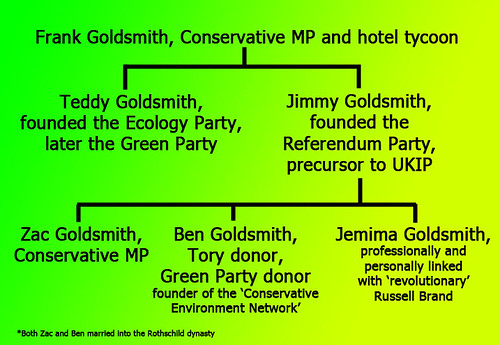
goldsmith greenHow about putting pressure on left-wing voters to divide them, with the likeliest outcome of allowing another Tory government? It’s rather pointless trying to claim the Greens are “pushing Labour left” when the outcome of that is likely to bleed votes from Labour, ultimately.

And that attempt at explanation of the fact that the Greens attack and undermine Labour, rather than the Tories conveniently circumvents the fact that the Green Party tell intentional lies about Labour’s policies. A genuine attempt to influence Labour policy would entail negotiation and co-operation, not constant, hostile undermining tactics, coupled with an alliance with the Tories.

The Greens are not cooperative or community-minded. They are dividing our opposition to the Tories and risking returning Cameron to Office in May. They prefer to undermine the Labour Party, because they are purely electioneering, rather that directing challenges at the Tory-led Coalition. That is not “socialist”.

How “socialist” is it to join ranks with the party inflicting all of that damage and harm on people of this country to attack and undermine the only viable alternative to the tories? That’s not genuine politics, that’s grandstanding. It’s not “socialist” at all.

Jon Ashworth, Labour’s shadow Cabinet Office minister, said: “David Cameron’s new-found affection for the Green Party is nothing short of political opportunism. If you ever needed proof that a vote for the Greens is a vote for David Cameron, this is it.

The Tories and the Greens seem to be working hand-in-hand. The Tories need the Greens because they are scared to run on their own record. The Greens need the Tories because Labour is the only party with a progressive policy agenda.”

You can’t claim to be a “progressive ” political party and at the same time advocate zero growth and parochialisation – to cut us off from global trade. The Green Party says: “In our Green vision for Europe we seek to replace the unsustainable economics of free trade and unrestricted growth with the ecological alternative of local self reliance and resource conservation, within a context of wider diversity.” That’s a clear step back from internationalism and forwards towards parochialisation. It’s not progressive at all to shut out the rest of the world. And socialists have always been internationalists. The Green Party, on the other hand, find natural allies with nationalist parties such as the Scottish National Party (SNP).

The economy matters to every country in the world and no growth or low growth economies invariably mean high unemployment, increased inequality and increased absolute poverty. There are a variety of ways by which governments may mitigate social inequality. It’s known that Countries with a left-leaning legislature have lower levels of inequality. Many factors constrain economic inequality – they are often divided into two classes: government sponsored, and market driven. The relative merits and effectiveness of each approach is of course debated.

Government initiatives to reduce economic inequality include: public education: increasing the supply of skilled labor and reducing income inequality due to education differentials.

Progressive taxation: the rich are taxed proportionally more than the poor, reducing the amount of income inequality in society if the change in taxation does not cause changes in income. These form the basis of  Miliband’s approach, with his proposals for redistribution via a very progressive tax system. This is why tax-dodging billionaires  such as Stephano Pessina are complaining about Labour’s genuinely coherent, costed, evidenced, progressive equality-focussed redistributive tax policies, and not Green Party policies.

Market forces outside of government intervention may also reduce economic inequality, including the propensity to spend. The Green Party, however, does not support any of these options. Their anti-growth, anti-consumption starting point excludes all of these measures. Their key policy  proposal – Universal Basic Income – was shown to be so flawed that the Greens announced it is to be withdrawn from their manifesto.

Bennett has tried to brush aside criticisms that her party’s policies would lead to economic catastrophe, emphasising the Green’s stance against materialism. “People don’t just want to work to earn more and more money,” she said. “They want to do other things that often now aren’t recognised and valued.”

However, an isolationist zero growth economy would be a disastrous experiment, just like the austerity measures have been – with the same outcomes. The Green Party does not present a single coherent policy that may be deemed a viable alternative to austerity, yet it claims: A real change: from austerity and welfare cuts to investment in decent jobs.”

Not only would the Green Party’s anti-progressive zero growth economy create high unemployment, it most certainly create deep recession and the policies are cumulatively pro-austerity, in that they advocate inhibiting public spending on consumer goods.

The Green Party fail to show us any understanding of imbalances of power, they provide no class analysis, they aren’t connected with marginalised groups, they don’t reflect their needs and they clearly have no understanding of the mechanics and virtues of redistribution. There isn’t a single policy currently in their manifesto that demonstrates a coherent offer of support to very poorest. That isn’t “socialist” at all.

The Greens grew out of the environmental movement, with David Icke at the helm as a spokesperson, well, until they got embarrassed by him and sacked him. As Suzanne Moore commented, the incoherence is even apparent at how they fail to define the State. They offer the biggest of big-state polices with huge intervention in some areas, without specifying the role of the state except as a series of committees. It’s a curious mix of immense levels of authoritarian state control over our private lives, a strongly moralising approach, alongside a moral relativism towards things like sex industry, terrorism and crime. Page 3 is frowned upon, but how can prostitution be regarded as any less economical exploitative of women? That’s certainly not coherent policy-making.

The Green’s “anti-austerity measures” seem to translate as “taking on corporations and vested interests.” But Miliband has already explicitly stated (and shown) that he will do that. (He already has – Leveson, the banks, the big power companies, water companies, to name a few)

The Green Party’s key policy idea – that of a Citizen’s Income for everyone whether they work or not – sounds so great on the surface. Just like a lot of their rhetoric and policies, it lacks depth and doesn’t connect up – it lacks integrity and falls to pieces when properly examined. Many of the poorest households would lose out. Most wealthy households will gain. How does that address inequality – something the Greens claim to be concerned about?

The “citizen’s income” of just £71 a week, at an annual cost of £280billion would replace existing welfare payments such as personal tax allowances and means tested benefits such as income allowance and jobseekers benefit.

It was a popular policy during the 1990s, with notable libertarian economists on the Right, such as Milton Friedman (the founding father of monetarism) favoring the model as a type of negative income tax. Friedman attacked the very notion of Social Security, stating that it had created welfare dependency. Friedman’s political philosophy extolled the virtues of a free-market economic system with minimal state intervention. Friedman proposed the replacement of the existing U.S. welfare system with a negative income tax, a progressive tax system in which the poor receive a basic living income from the government.

The Liberal Democrats have included similar policies in their manifesto in 1996.

The Citizen’s Income Trust (CIT), which has given advice to the Green party (and has also been repeatedly cited by the Greens a credible source), has modelled the Green Party scheme and discovered it would mean 35.15% of households would be losers, with many of the biggest losers among the poorest households.

The Trust’s research shows that for the two lowest disposable income deciles, more than one-fifth would suffer income losses of more than 10%.

If anything, this policy will EXTEND inequality.  That’s not very “socialist”.

Many critics of the Green party point to their many failures in Brighton and Hove, where they couldn’t even get the rubbish collection right. However, the most damning criticism – their fundamental inability to run services for the most vulnerable – is the one that ought to concern us the most. That’s not very “socialist.”

Using minorities as nothing more than political props and tools. That’s not very “socialist”.

During a recent interview, with the Times, Bennett defended commitments to decriminalise membership of terrorist organisations, possession of drugs, and prostitution, as well as promising to abolish the monarchy and remove the Queen from Buckingham Palace.

Bennett said: “I can’t see that the Queen is ever going to be really poor, but I’m sure we can find a council house for her.”

The remark appeared to be a glib, clumsy attempt to grab some media attention, given the Queen’s private wealth. As far as an appeal to juvenile anti-establishmentarians go, it was probably a successful glib, clumsy remark. The Green Party’s stated policy on the monarchy is that it should cease to be an office of government and that the property held by the royal family should be divided between that required for the private life of current members of the family, with the remainder to become public property. Not sure I could use any staff, spare tiaras or corgis, personally, but thanks for the thought.

The Tories have trashed the economy, damaged the very structure of our society and destroyed people’s lives. We’ve seen the return of absolute poverty, malnutrition and illness, such absolute poverty-related illness has not been seen since Victorian times. People have died as a consequence of Tory policy.

What do the Greens do? Bitch about LabourMany thanks to Robert Livingstone for his excellent memes

Electioneering and grandstanding: how to tell the difference between a moral political party and a moralistic one.

1796655_294409220710133_3373329_nThis past four years or so, I’ve watched the media distort the truth, often removing it from a meaningful context and twisting it out of recognisable shape. Or very often avoiding it altogether. I’ve watched minor parties claiming to be on the Left do the same, too, and I won’t ever forgive them for that. Nonetheless we have done our best to share truths and information and to decode rhetoric and re-translate lies.

One thing I can do is analyse social policy, I’ve a perceptive and predictive eye for how policies will affect us – the implications and probable consequences – well before they are implemented. The last four years will bear that out. It’s not just because I studied it, it’s also because I see underpinning ideology, too. I recognise that policy is comprised of a set of scripted motives and intentions on the part of any government and instructions to society on how to organise itself, how to behave and how our individual degree of freedoms are defined, extended or restricted. Policies also send out instructions regarding how social groups are perceived and treated.

Policies may express and extend tolerance and reflect a valuing of diversity, or, as the case is now, they may also prescribe social prejudice and serve to institutionalize discrimination.

Ideology reflects how a government believes society is (and what it isn’t,) and also prescribes how it SHOULD be. The Tories have been imposing their own narrow, nightmarish vision upon us for the past five years.

Today it struck me again just how we have had to decode so very much misinformation. For example, someone asked me about the headline lie that the Labour Party intend to “scrap benefits for young people.” Of course it’s not true. Or rather, it’s a carefully selected, out of context, partial truth.

Miliband is REPLACING jobseekers allowance with another allowance for young people. He thinks that conditional benefits are inappropriate for young people, as to be entitled to jobseekers allowance requires having to be available for work and actively looking for work, so it excludes the very possibility of further education and learning experiences. But young people need the freedom and support to gain from learning. That’s why Ed Miliband will replace out of work benefits for those aged 18-21 with a youth allowance of the same value – currently around £57 a week. This isn’t the controversial issue that was presented by the mainstream media and other parties at all: it’s actually a very well thought out, cost efficient and positive policy.

So young people don’t have to be available for work, but they do have to use their freedom to be learning or training. This detail matters a lot and was excluded from most accounts of the policy. Miliband had a good idea, it won’t cost any more than we currently pay young people, but it means we are investing in young people’s potential and their futures.

This is just one example of how truths are being distorted and not just by the media, but also by the likes of the SNP, the Green Party, TUSC and many of the other increasingly authoritarian groups competing for votes from the Left. Yet when you think about how they have lied to you on fundamental issues, (and they really have) would you REALLY trust them with your vote? Would you REALLY have faith that these parties will suddenly become honest and develop some integrity if they ever got any power?  They won’t. Not one bit.

More recently, there was an intentional distortion of the parliamentary debate on the Infrastructure Bill and fracking, with the Green Party in particular being very critical of Labour’s fracking amendments, which involve regulations that were, after all, succesful: they were accepted by the Tories. Labour proposals considerably tighten environmental regulations. In the UK, drilling for shale gas is still at an exploratory stage, though the Conservatives had planned on fast-tracking the fracking process. The regulations will halt exploratory drilling going ahead in the UK for at least a year. Meanwhile, the Environmental Audit Committee continue with its inquiry, gathering the strong, credible evidence we need if there is to be a justifiable, democratic and fully accountable ban on fracking.

A ban would never have been successful at this stage, and Labour knew this. The other thing NONE of the of aggressive, electioneering “critics” consider, apparently, is that had the proposed moratorium actually scraped a successful yes vote, and that was unlikely, the Tories would most certainly NOT have abided by that outcome, leaving them free without amendments and thus no regulation at all, to go ahead and fast-track fracking. Labour got them to agree on considerable restrictions, which will tie the Tories’ hands at least until well after the election. That is a success.

Anyone with concerns regarding fracking and the legislation ought to be big and authentic enough to take their issues directly to the TORIES, they are the ones that introduced this Bill, after all, not Labour. Yet all we have seen is moralising accounts from rival left parties about how Labour should have done things. Labour have made a difference. Only the grandstanding, electioneering parties would and did turn a success into an opportunity for unreasonable criticism. And they do this every single time the Labour Party achieve or present something positive.

Evidence is much more important than rhetoric and gesture politics. Reasoned and evidenced debate, however, seems to have been sidelined by those who, rather than engaging in genuine politics, prefer gesturing and politicking, no matter what that costs us.

Another claim made recently by the Green Party, again, amongst others, is that “Labour voted to keep austerity”. That is such a blatant lie, because the vote, clearly stated on the Hansard record (13 Jan 2015: Column 738, Charter for Budget Responsibility), was pertaining strictly to the motion: “That the Charter for Budget Responsibility: Autumn Statement 2014 update, which was laid before this House on 15 December 2014, be approved.”

The charter sets out that the Office of Budget Responsibility (OBR) will continue to monitor our fiscal rules. As we know, the  OBR has written extremely critical economic forecasts and analysis of austerity and the Tory spending cuts, clearly expressing the risks that the Chancellor is running and the scale of the damage his strategy will inflict on what remains of our public services. It’s worth noting that whilst Ed Balls challenged Osborne, there was a curious silence from the  SNP and the Green Party. It was Ed Balls that challenged Osborne’s outrageous claims regarding “halving the deficit”- such a blatant lie, upon which even the exceedingly Conservative Spectator spluttered contempt. Or any of the other lies, some of which have already earned the Conservatives official rebukes from the Office for National Statistics. (See “bankruptcy lie” for example, on the hyperlinked article)

Furthermore, it’s about time that some MP’s, including Caroline Lucas, amongst others, recognised that there is a fundamental difference between the meaning of the word budget and the word austerity. Conflating the two for the purpose of politicking is unprincipled and dishonest.

It’s also worth noting from the same debate on the Hansard record:

13 Jan 2015 : Column 746

Caroline Lucas: Does the Chancellor agree with me that with the feeble and inconsistent opposition coming from the Labour Front Bench, there is a very good reason for seeing the SNP, the Greens and Plaid as the real opposition on this issue because we are clear and consistent about the fact that austerity is not working?

Mr Osborne: That shows why we want the hon. Lady’s party in the TV debates.

Yes, I just bet they do, to collaborate with the Tories in attacking and undermining the Labour Party, not the Coalition, who are, after all, the ones responsible for introducing austerity measures. I don’t imagine for a moment that Osborne values further challenges to his outrageous claims of efficacy regarding austerity measures. What is very evident when you read through this debate, is that Ed Balls and a couple of other Labour MPs presented the ONLY challenges to Osborne on this matter, just to reiterate.

10940505_767712909964906_6225427822143651262_nThere’s a clear gap between professed principles and their application amongst the parties that claim to be “real socialists”.  How can it be principled or moral (or “socialist” for that matter) to collaborate with the Tories in attempting to damage, smear and discredit the only viable option of removing the Tories from Office in May? Bearing in mind that many people are suffering profoundly, some have died as a consequence of Conservative-led policies, we can see what the Green Party’s priorities actually are, here. They don’t include the best interests of citizens and consideration of their well-being, that’s for sure.

There is a big difference between being moral and being moralistic. Being moral means that we know what is right and wrong, what is fair and what is unfair, and so on. Being moral means we take responsibility for ourselves. We extend our morality to others, it shapes how we relate to them, our esteem of others and respect. It tends to frame democratic relationships

Being moralistic means we impose on others our own definitions. We tell others what is right and wrong, we define those things for them. Being moral is also about being authentic, being moralistic is often inauthentic and hypocritical. It’s more about control and overburdening others with  responsibility, whilst restricting their choices, than genuine morality. Moralising shapes how we interact with others too, forming power imbalances and inequalities.

We can use this dichotomy to explore political parties and democracy. The Tories often talk about morality, they are a moralistic party that impose what they think is right on everyone else. We know how that has worked out this past five years and it’s got nothing to do with right and wrong, nor is it even remotely related to fairness or social justice. Tory moralising is about control and subjugation of the poorest, liberation and freedom of the wealthiest. That’s what the Tories are all about.They don’t possess any moral core themselves, which is evident in the sleaze and corruption that they tend to leave in their wake.

Labour are moral. This is evident in policies which are coherent, embedding human rights and equality principles. There’s an integrity evident in their social policies, because they reflect core values that Labour have always held, regardless of who has been party leader. They  impose a legal framework of moral codes that establish decent, civilised conduct. Labour’s policies accommodate democracy, equality, diversity and meet a broad array of social needs. In debate, the Labour party are generally rational and reasoned, rather than emotive and judgemental. They favour a learning approach – which is progressive – it’s about development, rather than imposing dogma on the population.

It’s evident that the Green Party are moralisers too. They criticise Labour, often imposing their view of what Labour should do. Meanwhile, the Tories are destroying the country and people’s lives. Even a cursory glance at the Green manifesto indicates plainly that it is a set of policies from idealising moralists, rather than a meaningful democratic representation of the whole population and a balanced reflection of their varied needs.

For example, the universal basic income that the Green Party propose – will it be paid to millionaires as well as the poorest? How would that address inequality – an issue which the Green Party claims to be concerned with? How will it contribute to a so-called steady-state, zero growth economy?

How does banning page three, but legalising prostitution and the sex industry, which is also about economically exploited women being economically exploited, reflect any joined-up thinking? Inconsistency and incoherence.

It’s more dogma.

Think very carefully about what you are voting for. Look for the facts and truth to inform that decision, because in such bleak times, it’s easy to cling to a populist, superficial, dressed-up promise of better things than the Tories offer, but easy fixes don’t exist. Look for coherence, depth and consistency in the narratives being proffered. And look for evidence. You will see that once you look below the surface of false claims, false promises and electioneering, there’s a big difference between moral policies (they tend to be democratic) and moralising ones (they tend to be authoritarian).

14301012075_2454438e62_o (1)Many thanks to Robert Livingstone for his outstanding pictures.

Old New Labour: some thoughts on myths, strengths and weaknesses.

1044468_500666173336249_1718830491_n

Most people like to criticise New Labour. In political debates with the right, and people loosely assembled on the “left” and pseudo-left, with a variety of affiliations, ranging from the Green Party, the SNP, the Socialist party, TUSC, Left Unity to UKIP and the Judean People’s Popular Front, you can bet your bottom, top and middle dollar that Tony Blair will be wheeled out and painted in curses as the High Priest of “neoliberalism” sooner rather than later, I set my watch and warrant on it. But it’s become difficult to separate party politicking and opportunism from the genuine and useful commentaries.

Labour Party supporters and members also criticise Blair, of course. Quite properly so. However, it’s about time we learned that in order to learn constructively and move on, we must also balance those criticisms with some acknowledgement of New Labour’s achievements. We have tended to focus on the negatives. That puts us in a defensive position – apologising endlessly for the same things over and over again, and it’s difficult to advance from such a position. Even the term “Blairite” has become a deprecatory one. Yet Blair gave us the Good Friday Agreement, Every Child Matters, the Equality Act, the Human Rights Act, the Gender Recognition Act, the Fox Hunting Ban, among many others.

This said, much of that depreciation is probably justified, but not fully. I’ve watched centrists and those of us further left polarise more and more, and that can only weaken us and lead to diversionary infighting in the long run. Our focus ought to be on making progress, not on “Progress.” I have nonetheless been concerned that the core of centrists have contributed to negative media campaigns directed at the left of the party. But this said, some of the more aggressive amongst the so-called “hard left” haven’t done the party any favours either, on the whole. For the record, the “hard left” are also in a minority. Most of our membership are anti-neoliberals and occupy a loose left of centre position, which is not the same as “hard left”.

No party is or ought to be above criticism, but it’s not wholly constructive or appropriate for Labour to be placed in a position of endlessly defending itself from critics for the same misdemeanor from years ago, over and over, because New Labour also had some rarely mentioned, outstanding and comprehensive flagship policies and achievements very worth celebrating, such as the Climate Change Act, free prescriptions for people being treated for cancer or the effects of cancer and many more. Despite the shift towards neoliberal values on an economic level, (and even much of that was a media manufactured consensus) after the heavily and relentlessly neoliberalising Thatcher years, most of Labour’s social policies have never relinquished our core values of equality, inclusivity and valuing diversity, human rights, cooperation, support of public services and all that our post-war settlement entailed.

It’s worth keeping this in mind now that we have moved on and approach the General Election, just a few months away. If we don’t, we will simply see the Tories returned to office, with more devastation being inflicted on the country to follow. We do need to think more strategically here and spend a vote on something better than that.

And no, I’m not a “Blairite”, just someone who likes to analyse in a conscientious, honest, thorough and balanced way. I’m not a “black and white”, reductionist thinker. People are rarely one just thing, they don’t have only one quality or characteristic, political parties possess a similar kind of complexity. I’m much further left than Blair, with some anarchist principles chucked in the mix. I believe in participatory democracy, and I’m also an advocate of prefigurative movements. If we want a society that is more tolerant and equal, for example, we must practice what we preach and treat others with tolerance and regard them as having equal worth. We must be the change we want to see.

Blair’s policy virtues – which are manifold – seem to have dropped out of our collective memory. Ask a psychologist, and they’ll explain this as a cognitive bias whereby certain positive associations, or in this case negative ones, disproportionately colour an overall opinion about someone.

The Iraq war presents the cognitive short-cut when we talk about Tony Blair. Indeed, the aftermath of Iraq has been so appalling that it has even distorted our understanding of Blair’s role in the war itself. Regardless of how it started and worked out, the 2003 invasion evolved from a debated and democratic parliamentary decision. I didn’t like that decision. Many of us didn’t. Many in the Labour party broke ranks and voted against the war, all of the liberal democrats also did. The Tories all voted for the war.

Most major intelligence agencies also believed that Saddam Hussein had weapons of mass destruction – many of Saddam’s generals believed he did. This probably wasn’t a lie fabricated by Blair’s inner circle. That doesn’t mean he didn’t get it wrong, however. He very clearly did.

But it’s also worth considering the fact that Thatcher and other western leaders sold Saddam Hussein the materials to build weapons of mass destruction, including the components for chemical weapons, which were used in a genocide campaign against the Kurdish people. Without that, the first Gulf War under John Major would never had been deemed “necessary.” That war was equally unforgivable. I don’t think the second war would have happened either. The Scott Report brought to light the illegal arms sales from the early 80s, and it undoubtedly contributed to the confusion about Iraq’s capabilities and arsenal. There’s a much bigger picture which also needs some scrutiny. Blair was by no means the only one who should be held accountable for what has happened in Iraq.

Of course, a lot of the intelligence was wrong, we learned in hindsight. However the evidence from the UN and other sources showed that Saddam planned to develop nuclear and other weapons of mass destruction as soon as sanctions yielded. Chemical weapons, which are weapons of mass destruction, had already been deployed against the Kurds. The attacks killed at least 5,000 people and injured 7,000 to 10,000 more, most of them civilians. Thousands more died of complications, diseases, and birth defects in the years after the attack. Dead livestock, contaminated land and subsequent grinding poverty is still a problem in the villages that were attacked, too.

The incident, which has been now officially defined as an act of genocide against the Kurdish people, was and still remains the largest chemical weapons attack directed against a civilian-populated area in history. The Halabja attack has been recognised by the UK, amongst other countries, as a separate event from the Anfal Genocide  – also known as “Chemical Ali” due to the use of chemical weapons, too – that was also conducted against the Kurdish people by the Iraqi regime under Saddam Hussein.

Furthermore, the New York Times and other sources reported recently that from 2004 to 2011, UK and American-trained Iraqi troops repeatedly encountered, and were wounded by, chemical weapons remaining from years earlier during Saddam Hussein’s rule. American troops reported finding roughly 5,000 chemical warheads, shells or aviation bombs, according to interviews with dozens of participants, Iraqi and American officials, and heavily redacted intelligence documents obtained under the Freedom of Information Act.

140 Labour MPs voted against the Iraq war. I protested against it, as did many of us. But nonetheless I would have an accurate and reasonable account of it, rather than some of the almost hysterical accusations of “war criminal”, “illegal war” “there were no weapons of mass destruction” and so forth, that I very often see. It’s far more complex and horrifying than that.

Like him or loathe him personally, by all means, disagree with and protest the invasion of Iraq, sure, but you ought not let that interfere with being honest and objective about policies and events. It’s great myth that Blair didn’t achieve anything in whilst office; the truth is he fundamentally transformed the country after the Thatcher and Major years. And the Tories really DID leave a “mess”.

It’s not just the Good Friday Agreement, workers rights, tax credits and the minimum wage either, that credit him: he left a vast legacy. Civil partnerships. Bank of England independence. The Welsh Assembly. The Scottish Parliament. Every Child Matters. A mayor of London. A plunging crime rate. Abroad, his brand of interventionism in Sierra Leone and Kosovo successful. He is a hero to Kosovan Albanians, many of whom have named their children “Tonibler” in his honour (well, according to Charlie Burton of GQ fame). Personally I object to wars on principle. But that includes John Major’s Gulf War, which many seem to have forgotten about, and Thatcher’s Falklands war. I also object to illegal arms deals with known despots. I mean, what could possibly go right there? If we want to avoid wars, we need to ensure those most likely to start them aren’t handed weapons of mass destruction from “free marketing” western leaders.

I remember that we didn’t need austerity measures under Blair or Brown, despite the depth of the global depression. That in itself tells us that Tory austerity is entirely ideological. Blair and Brown protected citizens to a considerable degree against the worst ravages of deep global recession. This is something many seem to have forgotten, too. Brown instead proposed an economic stimulus, which is the use of monetary or fiscal policy changes to kick-start a struggling economy. Governments can use tactics such as lowering interest rates, increasing government spending and quantitative easing, to name a few, to accomplish this. Our public services were not cut, Labour continued to invest in them.

I think the myth that Labour “borrowed excessively” has been well and truly exposed, since it’s become common knowledge that the Coalition has borrowed more in just 4 years than the last government, indeed, the Tory-led government borrowing has exceeded that of  every single Labour government combined since 1920.

Thanks to the Labour government’s excellent management of the consequences of the global crash caused by the banks and financial institutions,  we were out of recession by 2009. So the Tory austerity measures, which targeted the poorest people, were completely unjustifiable. Osborne used the “bankrupcy lie” to legitimise an entirely ideological Tory-led program of “shrinking the state“, cutting social support for those who need it and slashing public services. However, whilst the poorest paid dearly, this government handed out £107, 000 each per year to millionaires in the form of a “tax break”.

Cameron has been rebuked twice for lying about “paying down the debt” already. The national debt is still rising. It currently stands at more than twice its level than when the Coalition took office.  Osborne is responsible for more debt than every Labour chancellor in history combined. Even the staunchly Tory Spectator commented that it’s “… a depressing point: the Tory leadership is prepared to use dishonesty as a weapon in this election campaign.”

Miliband denounced New Labour in 2010 and has done so since. He presents a break from the established neoliberal paradigm, which is why the establishment hate him so much. Miliband will extend the best of our long-standing tradition, whilst learning from the worst of our mistakes. His tax proposals, for example, are progressive and fair. His proposal to implement the Leveson recommendations is also a plus. He demonstrated learning from the past when he took a principled stance on Syria in 2013 and led a rebellion that even included some Conservatives, too. Cameron was furious at the time with Miliband, because he was thwarted, and cleverly.

Anyone still believing the biggest myth of all: “allthesame”, needs to actually look at a comparison of policies here, and read this: The ultimate aim of the “allthesame” lie is division and disempowerment of the Left.he

The Labour Party have moved on, progressing since 2010. We need to do likewise. They aren’t perfect and certainly not the solution to everything that’s wrong. But a Labour government would be a start for us to build a strong, united labour movement. We would have a bigger platform from which to push for our common aims of social justice, equality, civil rights and so on. If the Tories remain in power, we will continue to become fragmented, isolated, increasingly silenced and disempowered. My view is that sometimes we have to vote for what’s better for us all, rather than what’s our own prefered best. Taking small steps in a much bigger journey, closing the gap between the ideal and the real is better than seeing the regressive Tory authoritarians returned to office on May 7.

Until ALL of us on the Left learn a little about strategy, learn to look at a bigger picture, learn to organise and unite, the country’s nightmare fate is endless authoritarian neoliberal Tory governments.

14533697838_dffcc736f2_o (1)

Many thanks to Robert Livingstone for his excellent memes

Research shows only a fifth of 2 million people find employment after losing jobseeker’s allowance

430835_148211001996623_1337599952_n (1)Further to an article I wrote last November – Government under fire for massaging unemployment figures via benefit sanctions from Commons Select Commitee – it’s emerged that the Coalition’s claims regarding an increase in employment are again under scrutiny after research shows only a fifth of 2 million people find employment after losing jobseeker’s allowance.

Fresh research, presented at the Commons Select Committee inquiry into welfare sanctions on Wednesday, suggests that hundreds of thousands are leaving jobseeker’s allowance because of benefit sanctions without finding employment, though the report’s authors cannot provide an exact figure.

Written by academics at the University of Oxford and the London School of Hygiene and Tropical Medicine, the report raises questions about why so many of those losing their benefit then disappear from the welfare system – possibly to rely on food banks.

The Guardian reports that Professor David Stuckler, of Oxford University, said that benefit sanctions “do not appear to help people return to work. There is a real concern that sanctioned persons are disappearing from view. What we need next is a full cost-benefit analysis that looks not just narrowly at employment but possibly at hidden social costs of sanctions.

“If, as we’re finding, people are out of work but without support – disappeared from view – there’s a real danger that other services will absorb the costs, like the NHS, possibly jails and food support systems, to name a few. Sanctions could be costing taxpayers more.”

However, the Department for Work and Pensions, which is expected to announce a further rise in UK employment on Wednesday, countered that it was “proud” that 1 million jobless people were now subject to the “claimant commitment”, which sets out tougher requirements on the jobless to find work or risk losing their benefit payments.

Iain Duncan Smith, the work and pensions secretary, said: “It is only right that in return for government support – and in return for their benefits – jobseekers are expected to do all they can to find work. Although on benefits, they still have a job: the job is to get back into work.

“The claimant commitment, which is deliberately set to mimic a contract of employment, makes this expectation explicit. It has created a real change in attitudes. Already more than a million people have signed up to – and are benefiting from – this new jobseeking regime.”

Seems that Iain Duncan Smith forgets that it’s not government money that supports jobseekers, but rather their own, which was paid in tax contributions, in good faith that should any of us need state support, that support would be there to ensure we don’t become destitute or starve. It is not jobseekers attitudes that create jobs and a decent wage: that is the role of the government.People who are sanctioned can hardly be described as “benefitting” from a social scheme that was originally designed to support, not punish.

The Oxford-based research showed that between June 2011 and March 2014, more than 1.9 million sanctions were imposed on people receiving jobseeker’s allowance (JSA), with 43% of those sanctioned having their benefit claim ceased. Only 20% of those who left the benefit system gave as their stated reason that they had found work.

As I have stated before, the Department for Work and Pensions conducts no systematic research into what happens to those sanctioned, so the new findings start to fill an evidential gap in what has been one of the biggest but least publicised changes to the welfare system since the government came to power.

The 1.9 million benefit removals between June 2011 and March 2014 represent a 40% increase compared with the previous seven years. The figures are based on official monthly and quarterly data from databases covering UK local authorities between 2005 and 2014.

Dispute has arisen about a central aspect of government welfare reform centres on whether jobcentre staff, driven by senior management, are following arbitrary and poorly communicated rules that punish not just the minority of those who don’t look for work, but some of the most vulnerable in society, including mentally ill and disabled people. Many independent witnesses have urged the DWP inquiry at least to suspend the sanctions regime for those claiming employment support allowance, the main disability benefit. Evidence, however, strongly suggests that most people receiving sanctions want to work and that sanctions are imposed because of targets, and so are not related to any claimant claim of non-cooperation or unwillingness to work at all. Rather, it’s the case that sanctions are punishing the vulnerable for being vulnerable.

Study author Dr Rachel Loopstra, from Oxford University, said: “The data did not give us the full picture of why sanctioned people have stopped claiming unemployment benefit. We can say, however, that there was a large rise in the number of people leaving JSA for reasons that were not linked to employment in association with sanctioning. On this basis, it appears that the punitive use of sanctions is driving people away from social support.”

The study also shows widespread variation in how local authorities used sanctions. In Derby, Preston, Chorley and Southampton, researchers found particularly high rates of people being referred for sanctions. In some months, more than 10% of claimants in these areas were sanctioned – the highest rates nationwide.

Co-author Prof Martin McKee, from the London School of Hygiene & Tropical Medicine, said: “There is a need for a cost-benefit analysis of sanctioning, looking at it not just in narrow terms of unemployment benefit, but also the bigger picture, focusing on employment, health, and other social costs.”

He added: “The coalition government has embarked upon an unprecedented experiment to reform social security. I hope policymakers will be informed by these findings and see the value of investigating the consequences.”

Separate evidence in front of the DWP select committee inquiry includes witness statements from former jobcentre staff suggesting senior management threaten staff if they do not take a harsh approach to claimants. There is also cumulative evidence that many of those sanctioned have little or no knowledge of why they are being punished.

The main union representing jobcentre staff, PCS – which was also due to give evidence on Wednesday to the select committee inquiry – suggests: “While there is considerable anecdotal evidence about the inappropriate use of sanctions, there is a lack of empirical evidence. We believe that DWP should publish a more detailed breakdown of sanctions, and specifically more detailed explanations as to why they were imposed. PCS’s survey of our adviser members showed that 61% had experienced pressure to refer claimants to sanctions where they believed it may be inappropriate to do so.”

DWP select committee member Debbie Abrahams said: “This government has developed a culture in which Jobcentre Plus advisers are expected to sanction claimants using unjust, and potentially fraudulent, reasons in order get people “off-flow”. This creates the illusion the government is bringing down unemployment.”

The government counters that its policies are turning the UK into “the jobs factory of Europe”, and dismisses the idea that the unemployment figures are being subverted by sanctions.

A DWP spokesman said: “As the authors admit themselves the data does not give a full picture. What we do know – according to independent figures from the Office for National Statistics – is that we now have a record number of people in employment in this country and there are two million more people in private sector jobs compared to 2010.”

That is a claim which is not very well substantiated by income tax revenue collected by the Treasury at all. (See also A letter of complaint to Andrew Dilnot regarding Coalition lies about employment statistics).


Related
: Cameron’s Nudge that knocked democracy down – a summary of the implications of Nudge theory

Jobless are being punished with hunger for claiming unemployment benefit, say churches

Hain’s horror as figures reveal four in five who have JSA sanctioned “don’t find work”

385294_195107567306966_1850351962_nMany thanks to Robert @LivingstonePics

The ultimate aim of the “allthesame” lie is division and disempowerment of the Left.

1796655_294409220710133_3373329_n

The speech-writer for David Cameron in the run-up to the 2010 general election, Ian Birrellseems to have finger in every lie on behalf of the Tories. He’s the contributing editor of The Mail on Sunday, whilst writing columns regularly in several other papers. He’s been published in The Guardian, The Wall Street Journal, The Economist, The Daily Mail, The Financial Times, The Times, The Observer, The London Evening Standard, The Sun, The Daily Telegraph, The Sunday Telegraph, The Independent, The Independent on Sunday, Prospect, New Statesman and The Spectator.

On the 2nd January, Birrell cobbled together a somewhat strange and hugely speculative article in the Guardianclaiming that “a Tory-Labour unity coalition may be the only way forward after 7 May” and the two parties have more in common with each other than with the insurgents. A national government would prevent a constitutional crisis.”

There are no quotes or citations, just an unsubstantiated comment: “But most people in Westminster privately predict a hung parliament.”

As I said, entirely speculative, seemingly without an aim.

Birrell also claims there was “a brief flicker of unity” between the parties during the Scottish referendum. That’s a neat side-stepping of the fundamental fact that Labour, like most socialists, have always been internationalists, which has absolutely nothing to do with the Tories’ position on Scottish independence at all, and everything to do with Labour’s core values. It’s also a claim frequently made by the Scottish Nationalists –  Labour “sided with the Tories.” Anyone would think that the Scottish National Party want to undermine support for the Labour Party in Scotland…

There is of course a subtext to Birrell’s article. It is a piece of propaganda. The subtext is “the mainstream political parties are all the same.”

The “allthesame” myth came straight from Tory HQ. The BBC’s Tory correspondent Nick Robinson admitted live on air that Cameron’s best chance of winning the next election is if people believe politicians are “all the same.” That is very clearly not the case. I think this is a major ploy aimed at propagandarising an exclusively class-based identity politics, to target and fragment the “working class left.”

It purposefully excludes other social groups and also sets them against each other, for example, working class unemployed people attacking migrants – it really is divisive, anti-democratic, and quite deliberately flies in the face of Labour’s equality and diversity principles. That’s the problem with identity politics: it tends to enhance a further sense of social segregation, fragmentation and it isn’t remotely inclusive.

Of course it also enhances the tropes “outoftouch” and  “allthesame.” It’s a clever strategy, because it attacks Labour’s equality and inclusive principles – the very reason why the Labour movement happened in the first place – and places restriction on who ought to be included.

Think of that divisive strategy 1) in terms of equality; 2) in terms of appealing to the electorate; 3) in terms of policy. Note how it imposes limits and is reductive.

It also demoralises and confuses people.

The Tories set this strategy up in the media, UKIP have extended it further and the minority rival parties, including the Green Party and the Scottish National Party have utilised the same rhetoric tool: all of these parties frequently use the term “liblabcon”for example. That’s a sort of cognitive shortcut to what has been tacitly accepted, apparently, as a “common sense” view that partisanship amongst the mainstream parties is dead. I’ve written at length about this process of “normalisation” –  how social conservatism and neoliberalism have been absorbed culturally, and how this serves to naturalise the dominance of the Right and stifle the rationale for critical debate here – Manufacturing consensus: the end of history and the partisan man.

Be prepared for much more of this propaganda tactic: the Right are engaged in an all out war.

Firstly they know that Ed Miliband has edited their script, abandoning the free-market fundamentalist consensus established by Thatcherism in favour of social democracy.

Secondly, the right-wing media barons who set the terms of what is deemed politically palatable in Britain have never forgiven Ed Miliband for his endorsement of Leveson, which they believe is an unacceptable threat to their power.

Thirdly, they know Labour under Ed Miliband may well actually win the 2015 election.

It doesn’t take much effort to work out that the two main parties in competition have nothing in common at all. They debate oppositionally in parliament. Cameron attacks Miliband at every opportunity and on a very personal level, quite often. It’s plain, if you listen to the parliamentary debates, that neither man can stand what the other represents.

And how would the Tories and Labour reconcile their fundamental differences regarding human rights, the European Convention On Human Rights (ECHR) and the European Union? How about the bedroom tax? The National Health Service? Taxation? The welfare reforms? Equality? These are issues on which the two rival parties will never be able reach a consensus.

10635953_696483917087806_7307164383030383606_n

It’s quite difficult to assert that there are significant differences between the parties, because of the constant repetition of the “allthesame” lie. It has become almost like a comforting, lulling mantra and a shortcut from cognitive dissonance. People often get quite angry when confronted with evidence that challenges this soundbite. But policies provide very good evidence, they are scripted from ideologies and are statements of a party’s intentions.

Ed Miliband has been cautious in making policy promises and has said that he won’t pledge anything that he may not be able to deliver. Here are Labour’s key policies to date, each has been costed and evidenced.

The thing about policies that have been passed into law is that they can be verified on the Parliamentary website and elsewhere. How many of you reading this think that Blair was a “Thatcherite”? I’m not a Blairite. I do like Miliband, who is a very different leader than Blair was. Miliband denounced New Labour in 2010. His stance on Syria in 2013 draws a clean line under the Blair approach. Yet Blair is still being used as a stick to hit the Labour Party with.

The claims made in lying articles in the media and the often inaccurate and distorted claims of fringe party supporters are based on a propaganda technique called transfer and association, which is a method of projecting negative (or positive) qualities of a person, entity, object, or value (an individual, group, organisation) to another in order to discredit it (or sometimes, to make the second more acceptable, this tactic is used in advertising a lot.)

It evokes an emotional response, which stimulates the target to identify with recognised authorities. But that stick is hitting a closed door now. Newsflash: Blair hasn’t been party leader for some years.

I worked on compiling a list of New Labour’s policies, and despite Blair’s faults, there really were some outstanding achievements, such as the Equality Act, the Human Rights Act, various animal welfare laws, Every Child Matters and the Good Friday Agreement. I have listed New Labour’s achievements with a comparable list of the Coalition’s “memorable” moments, too. If you hated Blair, and see him as some sort of high priest of neoliberalism, it’s probably even more important that you read this. I promise it will help you to understand cognitive dissonance, at the very least, and perhaps to appreciate the importance of evidence and critical thinking: Political parties – there are very BIG differences in their policies.

And this, for some balance and perspective: Thatcher, Mad Cow Disease and her other failings, the Blair detour and déjà entendu, Mr Cameron.

The “allthesame” lie is a way of neutralising opposition to dominant ideas. It’s a way of disguising partisanship and of manipulating and reducing democratic choices. It’s nothing less than a political micro-management of your beliefs and decision-making.

It also reduces public expectation of opposition and in doing so it establishes diktats: it’s a way of mandating acceptance of ideology, policies or laws by presenting them as if they are the only viable alternative. And those that refuse to accept the diktats are enticed by the marginal parties who offer much, safe in the knowledge that they won’t have to rationalise, evidence, cost or deliver those promises. This also plays a part in diluting viable opposition, because the smaller parties tend to employ the same strategy to gain credibility and support – negative campaigning and repeated lies and soundbites.

Lynton Crosby, who has declared that his role is to destroy the Labour Party, rather than promote the Conservatives, based on any notion of merit, is also all about such a targeted “divide and rule” strategy. This is a right wing tactic of cultivating and manipulating apostasy amongst support for the opposition. It’s a very evident ploy in the media, too, with articles about Labour screaming headlines that don’t match content, and the Sun, Mail and Telegraph in particular blatantly lying about Labour’s policy intentions regularly.

Propaganda isn’t always obvious, and that’s how it works. We need to be very mindful of this.

Ultimately, the only party that will gain from any of this negative campaigning approach and divisive propaganda is the Tories. And that is who we should be collectively opposing.

The Tories launched their election campaign a couple of days ago, and already, it’s obvious that the entire campaign is founded on attempting to undermine Labour’s  credibility by telling lies about their economic management – The Tory election strategy is more of the same: Tories being conservative with the truth.

Contrast the Conservative with the truth approach I’ve discussed here with Miliband’s consistently genuine approach to politics – Ed Miliband: Labour election campaign will be one of hope, not falsehood.  

Whatever party you support and regardless of whether or not we agree on the issues I raise, my key aim, whenever I write, is to inspire a sense of responsibility and some critical thinking. That helps to reliably inform our decision-making.

I won’t apologise to my critics for being a Labour Party supporter, but I will always provide evidence and analysis to support and justify my own views and I will always be happy to engage in dialogue, provided that it’s a respectful and polite exchange. No party is above criticism, quite rightly so, as politics has to be an accountable, reflective and responsive process. That’s what democracy is about.

There is, however, a big difference between genuine criticism, on the one hand and propaganda and lies on the other, which are being masqueraded as “criticism.” If debate isn’t established on a genuine, critical exploration of evidence and establishing truths, then it’s not debate: it’s simply indoctrination.

Related

Don’t believe everything you think: it’s almost election time.

From  Psycho-Linguistics to the Politics of Psychopathy. Part 1: Propaganda

Ed Miliband is the biggest threat to the status quo we’ve seen for decades.

Once you hear the jackboots, it’s too late.

The moment Ed Miliband said he’ll bring socialism back to Downing Street.

Ed Miliband’s policy pledges at a glance

Miliband is an excellent leader, and here’s why.

Cameron’s Nudge that knocked democracy down: mind the Mindspace.

403898_365377090198492_976131366_nThanks to Robert Livingstone for the excellent memes.

The Tory election strategy is more of the same: Tories being conservative with the truth

1235473_537097386359794_65317730_n (1)

The following email is fromBack to messagesthe Conservative Campaign HQ, it’s packed with the most jaw-droppingly blatant lies and it marks the launch of their election campaign:

Your friends need to see this:

Conservative Campaign HQ (bulletin@mail.conservatives.com)
02/01/2015

Newsletters

To: Susan Jones

Our plan is working – and we need to stay on the road to a stronger economy. Please share our poster today and let everyone know:

 Let’s stay on the road to a stronger economy

When the Conservatives came into office in 2010, Britain was on the brink of bankruptcy. People were losing their jobs and families were worried about the future.

So we took difficult decisions to get our economy back on track.

Five years later, thanks to the measures we’ve taken and the hard work of the British people, the deficit has been halved, new businesses are opening up across the country, and there are a record number of people in work, with the security of a pay packet.

We need to stay on the road to a stronger economy – and your friends need to know about the important choice facing Britain in this election year.

Britain has come a long way in five years. We can’t go back to Labour’s way of more borrowing, more debt and higher taxes. Instead, let’s stay on the road that has brought us this far – the road that is securing a better future for everyone in our country.

Please share our poster today and let your friends know the important choice facing Britain this year.

Thank you,

Conservative Campaign HQ

Promoted by Alan Mabbutt on behalf of the Conservative Party, both at 4 Matthew Parker Street, London, SW1H 9HQ

Here is my response

Lie number 1. “When we came into office in 2010, Britain was on the brink of bankruptcy.”

The Office for Budget Responsibility (OBR) head rebuked Osborne for lying: Robert Chote said that the UK was never at risk of bankruptcy. Yet despite this public rebuke for lying, the Tories continue to peddle the same lie. Having established the OBR to act as a check on the government, the Chancellor and the Conservative Party might want to listen to its head and finally concede that there was no basis for his claim in 2010.

For the full list of official rebukes for Tory lies, please see here

Lie number 2. “People were losing their jobs and families were worried about the future.”

united-kingdom-unemployment

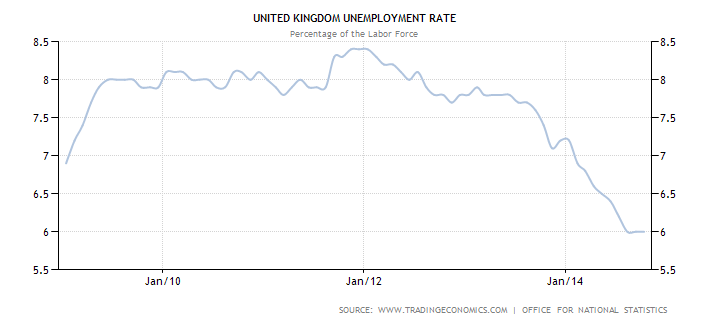
1381256_10151703147396305_1638953570_n (1)Note that after an increase in people losing their jobs under the Tory-led Coalition since 2010, the apparent decrease in job losses in the first graph coincides with the introduction of the new benefit sanction regime in 2012.

We know that the Conservatives measure unemployment by using a conveniently heavily biased system called “off-flow” that includes all of the numbers of people thrown off Jobseekers’ Allowance through sanctions. Indeed, it emerged during an ongoing inquiry instigated by the parliamentary Work and Pensions Select Committee, through research conducted by Professor David Stuckler, that more than 500,000 Job Seekers Allowance (JSA) claimants have disappeared from unemployment statistics, without finding work, since the sanctions regime was substantially extended in October, 2012.

And let’s not forget that sanctions are a draconian and target-driven removal of lifeline benefits – the amount of money that the state previously deemed necessary for meeting basic needs, and as such, cannot possibly be justified when all they may ever achieve is forcing people to focus on basic survival rather than on gaining employment. The Work and Pensions Select Committee have accused the Conservatives of using benefit sanctions to massage unemployment figures.

Other problems with off-flow and the far-fetched claims of the Conservative Party are highlighted in: A letter of complaint to Andrew Dilnot regarding Coalition lies about employment statistics.

The Treasury saw a drop in revenue of 25 billion pounds from income tax, which doesn’t tally with the account of rising employment and this certainly refutes the claim that was made about wages rising last year by this Government, too.

As for “families were worried for the future”, the impact of this government’s austerity measures has had a significantly negative impact on women and children, and particularly lone parents. The setting up of the Welfare State enshrined a commitment to state support for those unable to support themselves.

This government is dismantling that commitment. In the process they are destroying many of our basic rights: to universal free healthcare; protection from domestic violence and abuse; decent, affordable housing; pension and employment rights; education and training; and access to the legal system. Some facts:

  •  More than 70% of the revenue raised from direct tax and benefit
    changes will come from female taxpayers. (Parliamentary research 2011).
  •  92% of single parents are women. Although they are amongst
    the poorest in our society, they face not only the brunt of the cuts
    with the slashing of their benefits, but government and media
    demonisation as “benefit scroungers”.
  •  Women’s unemployment is rising sharply, largely owing to
    public sector cutbacks. Black and minority ethnic women are
    particularly hard hit.
  •  Poverty levels not seen since the 1930’s Depression, are
    returning, as is childhood malnutrition.
  • 1 out of 6 charities fear they will have to close in 2013 due to lack of funds.(From the Charities Aid Foundation report 2012).See also: Austerity measures disproportionately affecting women should be consigned to the bonfires of history from November 2014

Lie number 3. “So we took difficult decisions to get our economy back on track.”

Thanks to the Labour government’s excellent management of the consequences of the global crash caused by the banks and financial insitutions,  we were out of recession by 2010. So the Tory austerity measures, which targeted the poorest people, were completely unjustifiable. Osborne used the “bankrupcy lie” to legitimise an entirely ideological Tory-led programme of “shrinking the state“, cutting social support for those who need it and slashing public services. However, whilst the poorest paid dearly, this government handed out £107, 000 each per year to millionaires in the form of a “tax break”.

“This government will not cut [the] deficit in a way that hurts those we most need to help, that divides the country, or that undermines the spirit and ethos of our public services.”  Keynote speech by David Cameron, at the launch of The Conservative party’s manifesto in Milton Keynes, June 7th 2010.

That was another lie.

The economy is NOT “back on track” at all, despite the savage and punitive cuts imposed on the most vulnerable citizens.

 Lie number 4. “The deficit has been halved.”

Cameron has been rebuked twice for lying about “paying down the debt” already. The national debt is still rising. It currently stands at more than twice its level than when the Coalition took office.  Osborne is responsible for more debt than every Labour chancellor in history combined. Even the staunchly Tory Spectator commented that it’s: “… a depressing point: the Tory leadership is prepared to use dishonesty as a weapon in this election campaign.”

Fraser Nelson also refutes that the deficit has been halved – see: Which Tory MPs will repeat the porkie about ‘halving’ the deficit?

For a government whose raison d’etre is deficit reduction, the Coalition really isn’t very good at all.

Lie number 5. “New businesses are opening up across the country.”

150102businesses

 Thanks to Mike Sivier for the infographic

Lie number 6. “Our plan is working” / “..the road that is securing a better future for everyone in our country.”

Current human rights abuses of women, children and disabled people cannot possibly be regarded as “securing a better future for everyone.” The Tories have also pledged to repeal our human rights act and to withdraw from the European Commission on Human Rights. A government that cannot respect human rights and recognise the equal worth of citizens is certainly not interested in securing a better future for everyone at all. Nor can the slashing of public services, the National Health Service, welfare and other social protections be in anyway about securing a better future for all of us, or even “most” of us.

How is increasing hunger and malnutrition in our “best interests” as a so-called civilised society. This is the 5th wealthiest nation in the world. Shame on this government.

Lie number 7. The first Tory election campaign picture is not a photograph of a British road, as Osborne claimed:  The Road to Weimar image shows Tories can’t be trusted to tell the truth. – Mike Sivier.

Let’s not forget the Tory  2010 pre-election promises, broken and deleted from record on the internet. And valid criticism of their spinner of Tory yarns and opposition smears, also deleted. This is not a democratic government that values political accountability, nor is it one that is prepared to bear any scrutiny at all.

And the word “Tories” is clearly an abbreviation of “tall stories”

(more…)

Greens: the myth of the “new left” debunked

Embedded image permalink
Introduction.

This article is in part an exploration of the tension between environmentalism, human rights, equality and social justice. This is an important issue, because how political ideologies are translated into policy often has profound and far-reaching social consequences. I also challenge assumptions and criticise the Green Party for a lack of clarity regarding policy and intent – there’s a lack of connection – integrity  – beneath some of their key policies. There are no explicit connections made in the Green Party manifesto between ideas, policy, context and consequences.

I explore the environmentalism and “blood and soil” philosophy underpinning the Volk and Nazi movements, the Nazis being an exemplar of the problematic issues I raised. I also examine Malthus’s ideas on population growth and the finite nature of resources. I link some of the Green philosophy and policies with Malthus’s ideas.

The important point here is that it is not the ideas in themselves that are problematic: it is the context, the application, the way those ideas are translated via policy and the subsequent social consequences that warrants some discussion.

Malthus’s ideas both informed and were informed by a context of Social Darwinism, eugenics, laissez faire capitalism, competitive individualism, all of which were the basis of a dominant paradigm at that point in our history. One consequence of that was the terrible Poor Law Amendment Act in 1834, which saw the introduction of the dreadful, punitive workhouses.

Just to clarify further, I do not at any point claim “the Greens are Nazis,” or “are like Nazis”  as some have tried to claim. The discussion of Nazism and environmentalism is used to highlight the problematic tension between green ideas, human rights and to challenge assumptions made about social equality.  scroll2
There is a strand of Green Party narrative with philosophical roots that may be traced back to the thinking of the Reverend Thomas Malthus. He was a political economist who believed that the decline of living conditions in nineteenth century England was because of three elements: the overproduction of children; the inability of resources to keep up with the rising human population; and the irresponsibility of the lower classes. Malthus’s narrative in the nineteenth century fueled the rise of Social Darwinism; the eugenics movement and resulted in the extremely punitive Poor Law Reform Act of 1834, which included the introduction of workhouses for the poor.

The Green Party have the following listed amongst their aims regarding population:

In the short-term, to promote debate on sustainable population levels for the UK. In the long-term, to achieve consumption and population levels that are globally sustainable and respect carrying capacity – the term used to describe the population that can, according to the Green Party,  be sustainably supported in any given region. In theory it varies, depending on consumption patterns.

However, during times of greater social equality and prosperity, rather than the population growth predicted by Malthus, families actually reduced the numbers of children they had, with the emergence of the small nuclear family unit. Families and households got smaller throughout the 20th century. Women in the late nineteenth century gave birth, on average, to 4.6 children during their lifetime. Having ten or more children was not uncommon. By the 1950s the average had fallen to 2.19 children.

Data released by the government in the General Lifestyle Survey shows that the number of children in the average household has become smaller. In 1971, there were 2.91 persons in the average family whereas in 2011, this number has shrunk to 2.35 persons.This means that almost half of families in the UK have just one child. Malthus was wrong. Prosperity, equality, social development and growth contribute to population reduction and greater resources.

Environmentalism is widely seen as a caring, strictly left-wing concern, and it’s been linked with what are now fairly tacit assumptions about the Green Party’s credentials regarding equality, rights and political partisanship. The Green Party have tried to position themselves as “the new party of the left”, and have invested heavily in an aggressively negative campaign strategy that has involved outright lies about the Labour Party’s proposed policy intentions.

But the claims made by the Party and assumptions drawn from grassroots supporters have no historical verification whatsoever. In fact history refutes the claims.

Just because people have environmentalist concerns, we cannot infer from that – it does not automatically follow – that the same people will have concerns about inequality, social justice and human rights.

The German Volk and Nazi movements marched beneath the banners of “Nature” and the “organic.” Environmentalist ideology  was a fundamental part of National Socialism (which wasn’t socialism at all, on the same  basis, we wouldn’t say that the German Democratic Republic was a flourishing democracy, either), Green ideas were at the core of Nazi thinking. The Germans idealised Nature.

Whilst the Holocaust took place, German army comrades were also busy establishing bird sanctuaries, nature walks and planting trees. The Nazis conducted horrific experiments on men, women and children but at the same time, they banned medical experiments on animals. The Nazi perpetrators of crimes of unimaginable  brutality and horror against fellow human beings also advocated conservation, vegetarianism, homeopathic healthcare, organic agriculture and forest preservation. It’s a myth that environmentalism and ecological concern go hand in hand with a concomitant respect and concern for the well-being of all people, too.

In The Destruction of Reason, written in 1952, the marxist Georg Lukács proposed that the idealisation of “nature” and the “organic” was, from the very beginning a political narrative. It was an attempt to defend “natural” feudal privileges. He said:

“Biologism in philosophy and sociology has always been a basis for reactionary philosophical tendencies … it cannot permit of any essential change, let alone progress …. Oppression, inequality, exploitation and so forth were presented as “facts of nature” or “laws of nature” which, as such, could not be avoided or revoked.”

This is an essentially right-wing perspective: that society is naturally hierarchical – a pseudo-biological defence of class privileges.

The Green Party, with their uncritical embrace of environmentalism, have focused on the idea of a scarcity of natural resources. They promote the idea that there are natural limits on how many people may live on the planet and constraints on how much we can produce and consume. That is essentially a Malthusian position.

And we tend to think of fascism strictly in terms of its oppression, so that we lost sight of the fact that Nazism began as a movement by appealing to the working classes and campaigning against capitalism.

One famous National Socialist election poster shows a social-democratic winged “angel” walking hand in hand with a stereotyped banker, with the curious slogan: “Marxism is the Guardian Angel of Capitalism.”

The Left and the Labour Movement grew from of an overwhelming social need to challenge the idea of a “natural order”, limits and the idea that human potential and aspirations must be constrained to preserve some kind of natural order. Karl Marx condemned the ideas of the miserabilist Thomas Malthus and the Social Darwinists, he would condemn the Green Party for the same reasons. Marx described Malthus’s ideas as a “libel on the human race” because they promoted the idea that human beings “cannot abolish poverty, because poverty has its base in nature.”

Nature is truly a many-splendoured thing, but three essential socialist principles will not be found anywhere in nature: democracy, rights and equality. This is an example of the is/ought distinction: regardless of what we may think “human nature” is, our moral decisions regarding how we ought to organise as a society are distinct- there’s a difference between what we are and who we are.

Sylvia Pankhurst summed up socialism as follows: “It means plenty for all. We do not preach a gospel of want and scarcity, but of abundance … We do not call for limitation of births, for penurious thrift, and self-denial. We call for a great production that will supply all, and more than all the people can consume.”

The Greens are proposing exactly the opposite of what Pankhurst and most socialists have called for, historically. The Greens call for scarcity, not abundance. They propose a limitation on births, always insisting that the world is overpopulated and resources are being diminished.

The Green party’s manifesto argues for zero, or even negative growth and falling levels of personal consumption. This would lead to recession; families would become materially poorer each year. After centuries of growing global connectivity, the Greens want to see greater national self-reliance. And whilst Labour prioritise job creation, the Greens argue that government policy should make paid work “less necessary”, with people making their living from the home-based “informal economy”. That is anti-progressive.

The Left is progressive and has an expansive, generous view of humanity, faith in our potential and holds a vision of a plentiful future. The Greens, by contrast, are in favour of adapting to austerity – incorporating a social philosophy of thrift, parsimony and self-denial.

The Left aim to liberate humankind from poverty , the Greens aim to encourage us to accommodate it.

In Brighton where the Greens have power in the council, they have been cutting services, disastrously, for the least well-off and caused a refuse collection strike when they clashed with the GMB union over pay – as chronicled by Labour Peer Lord Bassam.

Earlier this year the Green Party leadership in Brighton and Hove was defeated in its efforts to impose council tax increase of five per cent by a coalition of opposition parties, including Labour. The increase will affect the poorest the most.

After losing a vote of no confidence in the leadership, the Council was threatened with Whitehall humiliatingly stepping in if a budget could not be agreed. This is not the sort of responsible leadership that households in the midst of a cost-of-living crisis deserve.

As my friend Neil Schofield informs us, for a second year running, the Greens are proposing a substantial increase in Council Tax – next year of 5.9% – that would require the approval of a referendum.  And the arguments are largely the same; that an increase of this magnitude is needed to offset the effects of austerity. He says:

“And the same arguments against such a rise apply this year too: that it is an entrenchment of austerity, using legislation designed to reduce the power of local authorities and to reduce them to hollowed-out commissioning bodies of a skeleton level of local services, provided by the lowest bidder; that it avoids the responsibilities that Councillors are elected to take; that it will make no real difference to the cuts faced by the city; it will hit hardest those who on low incomes who have seen their real incomes fall dramatically, in a city with some of the highest living costs in Europe; and that it is more about gesture politics than about effecting real change. “

The Green Party do not have an underpinning ideology that can be described as left-wing at all. Some of the historical and ideological links with far-right and fascist ideology are very worrying, because the links highlight a tension that needs to be addressed between environmentalism, social equality and justice.

This doesn’t imply the Green Party are fascists, but rather, it indicates a need to examine underpinning philosophies and explore how they may translate into social policies, and what the implications of those policies may be. It cannot be assumed that caring for the environment is automatically equated with caring for all human beings, as history has taught us.

The fact that the Greens have themselves chosen to regard the Labour Party as their “enemy” means that they don’t see a potential ally, yet they manage very well in coalition councils, working amicably side-by-side and cooperatively with Tory and Liberal Democrats.

If they did see the Left as a natural ally, they would join us and lobby for green policies through SERA, Labour’s green affiliate. Instead, the Green Party have chosen to aggressively campaign using a negative strategy, shamefully lying about Labour’s policies and proposals, all of which are costed and evidenced, in an attempt to bolster their own credibility. That in itself is a right-wing tactic, which ought to be raising alarm amongst supporters. The deeper implications of policies are also cause for concern.

Another worry is that one of the Green party’s key policy proposals – the universal basic income (or “citizen’s income”) – will adversely affect the poorest, and would in fact create more, not less, inequality and poverty.

The Citizen’s Income Trust (CIT), which has given advice to the Green party and been repeatedly cited by the Greens, has modelled its scheme and discovered it would mean 35.15% of households would be losers, with many of the biggest losers among the poorest households.

The trust’s research shows that for the two lowest disposable income deciles, more than one-fifth would suffer income losses of more than 10%, something one of the most left-wing parties in the election is unlikely to want to advocate.

The Green Party have already failed the people of Brighton and Hove. Don’t let them fail the people of Britain by voting Green next year and allowing the Tories to remain in government another five years. People are suffering and dying as a consequence of Tory austerity, we need to ensure that ends.

Related

Waste your vote on the Green Party – or choose a green Labour government – Sadiq Khan

Brighton’s Greens, Council Tax and a disgraceful act of moral blackmail – Neil Schofield

The Green Party’s women problem – Neil Schofield

A few words about respect – Mike Sivier

The moment Ed Miliband said he’ll bring socialism back to Downing Street  

Ecofascism: Deep Ecology and Right-Wing Co-optation  

Green Fascism and the Greening of Hate – Derek Wall

“Paradoxically, while Greens argue for social justice and other left themes, environmentalism is often linked to the right. Hitler believed in a politics of hatred ordained by iron ‘laws of nature'” Darker shades of green. Derek Wall traces the thread of ecofascism through the Green movement’s history. Derek is a member of the Green Party’s Anti-Fascist and Anti-Racist Network, author of Green History (Routledge 1994).

He notes the same tension as I do, between environmentalism and social justice/human rights. He discusses the environmentalism of the Nazis and the influence of Malthus’s ideas.


The moment Ed Miliband said he’ll bring socialism back to Downing Street

1796655_294409220710133_3373329_n

One of the most frequent and misinformed comments I see about the Labour Party is “Oh, but they aren’t socialist enough.”  My standard response is to post Labour’s policy proposals, because the people who raise this complaint most often can’t name even one of the policies. Then I try and engage in a discussion about what the policies are about – the implications and social consequences of them, and what they reflect about the Labour Party.

I often waste my time, because the people usually making this claim are defensive None of The Above protagonists, or Green and Scottish National Party  supporters, who have no intention of genuinely discussing anything critically, they offer dogmatic, propaganda-styled soundbites instead, designed to mislead. Yet they ought to be our natural allies, and invest some time in attacking the Conservatives regarding their austerity cuts and idiosyncratic brand of anti-democracy instead of telling lies about the Labour Party.

10534673_673759979360200_9173930462113592426_n

The following short article is from Fraser Nelson, published in the right-wing Spectator last year.

What’s Ed Miliband about? In a word: socialism. You can think this a good or a bad thing, but there ought to be no doubt about where he stands. At a Q&A in the Labour conference last night, he was challenged by an activist: When will you bring back socialism?’ ‘That’s what we are doing, sir’ Miliband replied, quick as a flash. ‘That’s what we are doing. It says on our party card: democratic socialism’. It was being filmed, and your baristas at Coffee House have tracked down the clip as an exclusive. This little exchange will perhaps tell you more about Ed Miliband and his agenda than much of the over-wrought character-spinning stunts you can expect to see this week.

It was no slip of the tongue. Miliband’s fidelity to socialism is explained by his definition of it – as he says on the clip. He seems to regard ‘socialism’ as synonymous with justice, and ‘capitalism’ with injustice. When interviewed in the Daily Telegraph by Charles Moore this time last year, he put it thusly:

“Isn’t the great lesson from his parents’ that socialism was a god that failed? ‘No!’, exclaims Ed Miliband vehemently, because socialism is not a rigid economic doctrine, but ‘a set of values’ It is ‘a tale that never ends’. Indeed, the strange fact is that ‘While there’s capitalism, there’ll be socialism, because there is always a response to injustice.”

Miliband’s father, Ralph, was made famous by his book Parliamentary Socialism. His 1993 book, Socialism for a Sceptical Age, was about the continued relevance of socialism in a post-communist world. Ed Miliband has said that the final few sentences of this book are his favourites of all his father’s work:

“In all the countries there are people in numbers large and small who are moved by the vision of a new social order in which democracy, egalitarianism and co-operation – the essential values of socialism – would be the prevailing values of social organization. It is in the growth of their numbers and in the success of their struggles that lies the best hope for mankind.”

Miliband considered his father too dogmatic and sectarian on many things, but agreed with him on this. And personally, I’m all in favour. There is a long history of British socialism, which Ralph Miliband did much to document.

Mr Miliband makes no bones out it in conversation. Many of his enemies say he has no principles at all: this is flatly untrue. For all his faults, Miliband does not lack ideological direction. It’s pretty clear that Ed Miliband regards himself as the man who’ll bring socialism back to Downing St.


scroll2


Ed Miliband has pledged to take on “vested interests” and “powerful forces” in his bid to win the next general election. Not even the Crosby and Murdoch-orchestrated media campaign, which was aimed at demoralising, undermining and monstering Ed Miliband can disguise the fact that the Tories are in a state of panic.

In fact the media campaign, aimed at attempting to undermine Miliband’s credibility as a leader, arose precisely because Miliband is the biggest threat to the UK power base and status quo that we’ve seen for many decades. He’s challenging the neo-liberal consensus of the past 30 years – now that is a plain indication of strong leader, and someone with personal strength and courage.

Related

The establishment are ‘frit’ because Ed Miliband is the biggest threat to the status quo we’ve seen for decades

Ed Miliband’s 10 Biggest Successes as Labour Leader, at a glance – LabourLeft

Ed Miliband’s policy pledges at a glance

46 more good reasons to vote labour

See video: Ed Miliband in a Q&A at the 2013 Labour Party conference in Blackpool


10359559_723668077702723_4383422308887814918_n

Thanks to @LivingstonePics

Cameron’s Nudge that knocked democracy down – a summary of the implications of Nudge theory

Democracy is based on a process of dialogue between the public and government, ensuring that the public are represented: that governments are responsive, shaping policies that address identified social needs. However, Coalition policies are no longer about reflecting citizen’s needs: they are all about telling us how to be.

The idea of libertarian paternalism was popularised around five years ago by the legal theorist Cass Sunstein and the behavioral economist Richard Thaler, in their bestselling book Nudge. Sunstein and Thaler argue that policymakers can preserve an individual’s liberty whilst still nudging a person towards choices that are supposedly in their best interests. But who nudges the nudgers? Who decides what is in our “best interests”? That would be the government, of course.

Nudge philosophy is dressed-up as libertarian paternalism, which in turn dresses-up Tory ideology. Another phrase the authors introduced was “choice architecture”, a concept implying that the State can be the architect that arranges personal choice in way that nudges consumers in the right direction.

The direction is towards a small state, with nothing but behavioural “incentives” to justify forcing  citizens who have needs to be “responsible” and “self-sufficient,” achieving this presumably by paying taxes and then pulling themselves up strictly by their own bootstraps. It’s the new nothing for something culture.

Behavioural economics is actually founded on crude operant conditioning: it marks the return of a psycho-political theory that arose in the mid-20th century, linked with behaviourism. Theorists from this perspective generalise that all human behaviour may be explained and described by a very simple reductive process: that of Stimulus – Response. There is no need, according to behaviourists, to inquire into human thoughts, beliefs or values, because we simply respond to external stimuli, and change our automatic responses accordingly, like automatons or rats in a laboratory. Nudge theorists propose that we are fundamentally irrational, and that our decision-making processes are flawed because of “cognitive biases.” Nudge theory therefore bypasses any engagement with our deliberative processes.

Formally instituted by Cameron in September 2010, the Behavioural Insights Team, (also known as the Nudge Unit) which is a part of the Cabinet  Office,  is made up of people such as David Halpern, who is also a part of Cameron’s “Big Society” campaign. He co-authored the Cabinet Office report:  Mindspace: Influencing Behaviour Through Public Policy, which comes complete with a cover illustration of the human brain, with an accompanying psycho-babble of words such as “incentives”, “habit’, “priming” and “ego.” It says the report “addresses the needs of policy-makers.”  Not the public.

The behaviourist educational function made explicit through the Nudge Unit is now operating on many levels, including through policy programmes, forms of “expertise”, and through the State’s influence on the mass media, other cultural systems and more subliminally, it’s embedded in the very language that is being used.

Education is a dialogic process, with consenting, willing participants. Even compulsory education involves consent and dialogue – children are engaged in the process. What the Nudge Unit is doing is not engaging in the least, nor is it done with our consent: we are being acted upon. Not as inquiring subjects, but as passive objects.

At the heart of every Coalition policy is a “behaviour modification” attempt, promoted by the influential Nudge Unit and based on the discredited, pseudo-scientific behaviourism, which is basically just about making people do what you want them to do, using a system of punishments and reinforcements. Once you see it, you can’t unsee it.

At the same time, as well as shaping behaviour, the messages being given loud and clear are all-pervasive, entirely ideological and not remotely rational: they reflect and are shaping an anti-welfarism that sits with Conservative agendas for welfare “reform”, “austerity policies” the small State (minarchism) and also legitimises them.

Nudge has made Tory ideology seem credible, and the Behavioural Insights Team have condoned, justified and supported punitive, authoritarian policies, with bogus claims about “objectivity” and by using discredited pseudo-science. Those policies have contravened the human rights of women, children and disabled people, to date. Nudge is hardly in our “best interests,” then.

Coalition narratives, amplified via the media, have framed our reality, stifled alternatives, and justified Tory policies that extend psychological coercion  including through workfare; benefit sanctions; in stigmatising the behaviour and experiences of poor citizens and they endorse the loss of autonomy for citizens who were disempowered to begin with.

A summary of the main influences outlined in the MINDSPACE framework

All of these basic ideas are being utilised to uphold Conservative ideology, to shape Conservative policies and justify them; to deploy justification narratives through the mass media, in schools and throughout all of our other social institutions.

For example, incentives being linked to the mental “shortcut” of strongly avoiding losses shows us precisely where the Tories imported their justification narrative for the welfare cuts and benefit sanctions from. What the government calls  “incentivising” people by using systematic punishments translates from Orwellian Doublespeak to “bullying” in plain language.

“We act in ways that make us feel better about ourselves” – norms, committments, affect, ego are all contributing to Tory rhetoric, lexical semantics and media justification narratives that send both subliminal and less subtle, overt messages about how poor and disabled people ought to behave.

This is political micro-management and control, and has nothing to do with alleviating poverty. Nor can this ever be defined as being in our “best interests.”

There’s an identifiable psychocratic approach to Conservative policy-making that is aimed at the poorest. Whilst on the one hand, the Tories ascribe deleterious intrinsic motives to rational behaviours that simply express unmet needs, such as claiming benefit when out of work, and pathologise these by deploying a narrative with subtextual personality disorder labels, such as scrounger, skiver and the resurrected Nazi catch-all category for deemed miscreants: work-shy, the Tories are not at all interested in your motivations, attitudes, thoughts, hopes and dreams. They are interested only in how your expectations and behaviour fits in with their intent to reduce the State to being a night-watchman – but it watches out only for the propertied class.

Behaviourism was discredited and labelled “pseudoscience” many decades ago, (very memorably by Noam Chomsky, amongst others). Most psychologists and cognitive scientists don’t accept that myriad, complex human behaviours are determined by and reducible to nothing more than an empty stimulus/response relationship; our deeds and words merely a soulless, heartless and mindless cause and effect circuit.

There are serious political ramifications regarding the application of  behaviourism to an unconsenting public. Firstly, that in itself is undemocratic. Skinner was clearly a totalitarian thinker, and behaviour modification techniques are the delight of authoritarians. Behaviourism is basically a theory that human and animal behaviour can be explained in terms of conditioning, without appeal to consciousness, character, traits, personality, internal states, intentions, purpose, thoughts or feelings, and that psychological disorders and “undesirable” behaviours are best treated by using a system of reinforcement and punishment to alter behaviour “patterns.”

Most psychologists and cognitive scientists don’t endorse behaviourism. Democracy involves governments that shape themselves in response to what people need and want, not about people who reshape their lifestyles in response to what the government wants.

Democracy is meant to involve the formulation of a government that reflects public’s needs. Under the new nudge tyranny that is turned totally on its head: instead the government is devising more and more ways to put pressure on us to change. We elect Governments to represent us, not to manipulate us covertly.

Nudge is actually about bypassing rationality and reason, political accountability and transparency – democratic process, critical debate. The government are substituting those with manipulation, coercion, and an all-pervasive psycho-political experiment.

This was taken from a longer piece, here’s the full articleCameron’s Nudge that knocked democracy down: mind the Mindspace.