Category: Political ideology

Aktion Arbeitsscheu Reich, Human Rights and infrahumanisation

1379986_541109785958554_2049940708_n

The European Convention on Human Rights, which came into force on 3 September 1953, guarantees a range of political rights and freedoms of the individual against interference by the State. The Convention came about as an international response to the horrors of World War Two, and the Holocaust.

Before the incorporation of the Convention, people in the United Kingdom could only complain of unlawful interference with their Convention rights by lodging a petition with the European Commission of Human Rights in Strasbourg. That all changed on 2 October 2000 when Labour’s Human Rights Act 1998 came into force, allowing UK citizens to sue public bodies for violations of their Convention rights in domestic courts.

David Cameron wants to scrap the Human Rights Act and has pledged to leave the European Convention. Human Rights are the bedrock of any democracy. He also wants to scrap consultations, impact assessments, audits, judicial reviews: all essential safeguards for citizens and mechanisms of democracy. 

Government policies are expressed political intentions, regarding how our society is organised and governed. They have calculated social and economic aims and consequences.

How policies are justified is increasingly being detached from their aims and consequences, partly because democratic processes and basic human rights are being disassembled or side-stepped, and partly because the government employs the widespread use of propaganda to intentionally divert us from their aims and the consequences of their ideologically (rather than rationally) driven policies. Furthermore, policies have become increasingly detached from public interests and needs.

A clear example of an ideologically-driven policy is the Welfare “Reform” Act, which is founded on a stigmatising, Othering narrative: benefit recipients are portrayed as the enemy that battles against fairness and responsibility. The mythological economic “free-rider,” a “burden on the state.” The “reforms” left people in receipt of lifeline benefits much worse off than they were, the word reform has been used as a euphemism for cuts.

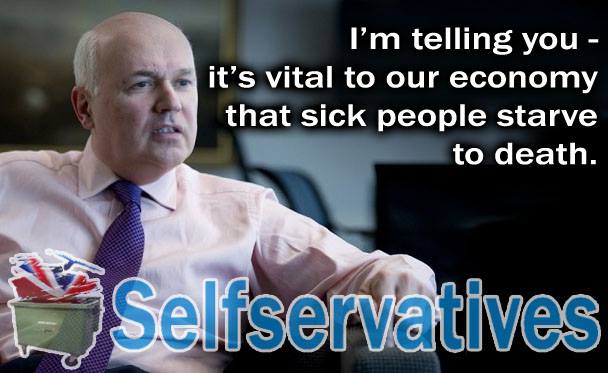
Iain Duncan Smith’s Department for Work and Pensions  (DWP) has launched a new propaganda scapegoating  advertising campaign encouraging people to phone a hotline if they suspect somebody they know is fraudulently claiming benefits.

I’m sure that serious fraudulent claimants inform their friends and neighbours of their every activity, including holidays, sleeping arrangements, moments of intimacy and all of their benefit payment details, all the time, so that makes sense…

Mark Harper said: “Those who cheat the system need to know we will use everything in our power to stop them stealing money from hardworking taxpayers.”  

Yet we know that there isn’t a real distinction between benefit claimants and hard-working taxpayers, as the Tories would have us believe. Many people on benefits are also in work, but are not paid a sufficient wage to live on. Most people claiming benefits, including disabled people, have worked and contributed income tax previously.

It’s worth bearing in mind that the poorest citizens, including people claiming benefits, pay proportionally more indirect taxes than the wealthiest citizens, such as VAT. The strivers/skivers rhetoric is simply a divert, divide and scapegoating strategy. Growing social inequality evidently generates a political necessity for creating scapegoats and cultivating prejudices.

The real cost of out-of-work benefits is over-estimated in relation to the welfare bill for pensions and in-work benefits such as tax credits and housing benefit, obscuring the increasing role that the British state plays in subsidising the scandalously low wages paid by increasingly exploitative employers, in order to meet a minimum standard of living for the hardworking.

The hardworking taxpayer myth is founded on a false dichotomy, since it is estimated that around 70% of households claim benefits of one kind or another at some point in their lives. In the current climate of poor pay, poor working conditions, job insecurity, and high living costs, the myth of an all pervasive welfare-dependent something for nothing culture is being used to foster prejudice and resentment towards those unfortunate enough to be out of work. It also serves to bolster right-wing justification narratives that are entirely ideologically driven, which are aimed at dismantling the welfare state, while concurrently undermining public support for it.

As the Huff Post’s Asa Bennett points out, there are much bigger costs to the taxpayer that the government are reluctant to discuss.

For example, the tax gap, charting the estimated amount of taxes unpaid thanks to evasion, avoidance, error and criminality, soared to £34 billion, according to HM Revenue and Customs. This equates to £1 in every £15 owed in taxes not being collected last year.

The National Audit Office found that the Department for Work and Pensions had made £1.4 billion in declared benefit overpayments, an increase of nearly 6%.

Meanwhile, the DWP estimate that between £7.5 billion and £12.3 billion of the six main benefits it administered were left unclaimed in 2009/2010. On top of that. HMRC suggest that several billion pounds more is most in unclaimed tax credits, with childless families missing out on £2.3 billion worth. That’s a grand total of 22.1 billion that ordinary taxpayers aren’t claiming, even though they are entitled to do so. 

Iain Duncan Smith’s Department have wasted an estimated total of £6,221,875,000.00 of taxpayers’ money on the implementation of Universal Credit and private company contracts, amongst other things. (See We can reduce the Welfare Budget by billions: simply get rid of Iain Duncan Smith ). 

Duncan Smith’s claims that his policies are about fairness and saving taxpayers’ money, simply don’t stand up to scrutiny. 

The policies are entirely ideologically-driven. We have a government that uses words like workshy to describe vulnerable social groups. This is a government that is intentionally scapegoating poor, unemployed, disabled people and migrants. One Tory councillor called for the extermination of gypsies, more than one Tory MP has called for illegal and discriminatory levels of pay for disabled people. A conservative deputy mayor said, unforgivably, that the “best thing for disabled children is the guillotine.”

These weren’t “slips”, it’s patently clear that the Tories believe these comments are acceptable, and we need only look at the discriminatory nature of policies such as the legal aid bill, the wider welfare “reforms” and research the consequences of austerity for the most economically vulnerable citizens – those with the “least broad shoulders” –  to understand that these comments reflect how conservatives think.

This is a government that is using public prejudice to justify massive socio-economic inequalities and their own policies that are creating a steeply hierarchical society based on social Darwinist survival of the fittest neoliberal “small state” principles.

The Tory creation of socio-economic scapegoats, involving vicious stigmatisation of vulnerable social groups, particularly endorsed by the mainstream media, is simply a means of manipulating public perceptions and securing public acceptance of the increasingly punitive and repressive basis of the Tories’ welfare “reforms”, and the steady stripping away of essential state support and provision.

The political construction of social problems also marks an era of increasing state control of citizens with behaviour modification techniques, (under the guise of paternalistic libertarianism) all of which are a part of the process of restricting access rights to welfare provision and public services.

The mainstream media has been complicit in the process of constructing deviant welfare stereotypes and in engaging prejudice and generating moral outrage from the public:

“If working people ever get to discover where their tax money really ends up, at a time when they find it tough enough to feed their own families, let alone those of workshy scroungers, then that’ll be the end of the line for our welfare state gravy train.” James Delingpole 2014

Delingpole conveniently fails to mention that a majority of people needing lifeline welfare support are actually in work. He also fails to mention that while this government were imposing austerity on the poorest citizens, the wealthiest got generous handouts from the Treasury, in the form of tax breaks – hundreds of thousands of pounds each per year. 

Poverty cannot be explained away by reference to simple narratives of the workshy scrounger as Delingpole claims, no matter how much he would like to apply such simplistic, blunt, stigmatising, dehumanising labels that originated from the Nazis (see arbeitssheu.)

This past four years we have witnessed an extraordinary breakdown of the public/private divide, and a phenomenological intrusion on the part of the state and media into the lives of the poorest members of society. (For example, see: The right-wing moral hobby horse: thrift and self-help, but only for the poor. ) Many people feel obliged to offer endless advice on thrift and self help aimed at persuading poor people to “manage” their poverty better.

Hannah Arendt wrote extensively about totalitarian regimes, in particular Nazism and Stalinism, which she distinguishes from Italian Fascism, because Hitler and Stalin sought to eliminate all restraints upon the power of the State and furthermore, they sought to dominate and control every aspect of everyone’s life. There are parallels here, especially when one considers the continued attempts at dismantling democratic processes and safeguards since the Coalition took office.

Many policies are aimed at ‘incentivising’ certain behaviours and perceptions of citizens, using psychology to align them with political and defined economic goals. Citizens are increasingly seen by government as a means to an end.

Further parallels may be found here: Defining features of Fascism and Authoritarianism

Between February 1933 and the start of World War Two, Nazi Germany underwent an economic “recovery” according to the government. Rather like the “recovery” that Osborne and Cameron are currently claiming, which isn’t apparent to most citizens.

This economic miracle, sold to the people of Germany, entailed a huge reduction in unemployment. However, the main reason for this was fear – anyone who was found guilty of being “workshy” (arbeitssheucould then be condemned to the concentration camps that were situated throughout Germany. Hitler frequently referred to the economic miracle, whilst people previously employed in what was the professional class were made to undertake manual labour on the autobahns. People didn’t refuse the downgraded status and pay, or complain, lest they became Arbeitsscheu Reich compulsory labor camp prisoners, and awarded a black triangle badge for their perceived mental inferiority and Otherness.

Behaviour can be controlled by manipulating fear, using a pattern of deprivation. Benefit sanctions, for example, leave “workshy” people without the means to meet their basic survival needs and are applied for periods of weeks or months and up to a maximum of 3 years.

That the government of a so-called first world liberal democracy is so frankly inflicting such grotesquely cruel punishments on some of our most vulnerable citizens is truly horrific. It’s also terrifying that the media and the British public are complicit in this: they fail to recognise that the Social Darwinism inherent in Tory ideological grammar is being communicated through discourses and policies embodying crude behaviour modification techniques and an implicit eugenic subtext .

There were various rationales for the Nazi Aktion T4 programme, which include eugenics, Social Darwinism, racial and mental “hygiene”, cost effectiveness and the welfare budget.

Those involved with the operation of the Aktion T4 programme used the term euthanasia as bureaucratic cover, in the minimal public relations effort to invest what was essentially eugenics. It is clear that none of the killing was done to alleviate pain or suffering on the part of the victims. Rather, the evidence, including faked death certificates, deception of the victims and of the victims’ families, and widespread use of cremation, indicates the killing was done solely according to the socio-political aims and ideology of the perpetrators. The Nazis believed that the German people needed to be “cleansed” of the so-called racial enemies, but the Aktion T4 programme also included people with disabilities, the poor and the workshy.  

Although many were gassed using carbon monoxide or killed by lethal injection, many more of these people deemed “life unworthy of life” were simply starved to death.

The Holodomor – “extermination by hunger” –  was Joseph Stalin’s intentionaly inflicted famine, designed to destroy  people in the Ukraine seeking independence from his rule. As a result, an estimated 7,000,000 people starved to death. The attitude of the Stalinist regime in 1932–33 was that many of those starving to death were “counterrevolutionaries”idlers” or “thieves” who “fully deserved their fate”. In 2008, the European Parliament adopted a resolution that recognised the Holodomor as a crime against humanity.

Implementing policies that lead to members of vulnerable social groups starving, which is an INTENTIONAL political act, however, is not currently included in the UN Treaty definition of genocide. Nor are disabled people amongst the categories of groups protected by the Convention on the Prevention and Punishment of the Crime of  Genocide.

While I am very aware that we need take care not to trivialise the terrible events of Stalinist Russia and Nazi Germany by making casual comparisons, there are some clear and important parallels on a socio-political level and a psycho-social one, that I feel are crucially important to recognise.

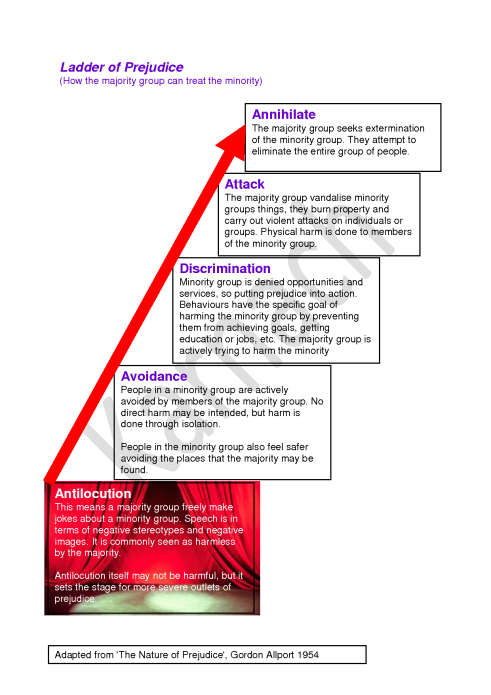
Gordon Allport studied the psychological and social processes that create a society’s progression from prejudice and discrimination to genocide. In his research of how the Holocaust happened, he describes socio-political processes that foster increasing social prejudice and discrimination and he demonstrates how the unthinkable becomes tenable: it happens incrementally, because of a steady erosion of our moral and rational boundaries, and propaganda-driven changes in our attitudes towards politically defined others, that advances culturally, by almost inscrutable degrees.

The process always begins with political scapegoating of a social group and with ideologies that identify that group as the Other: an “enemy” or a social “burden” in some way. A history of devaluation of the group that becomes the target, authoritarian culture, and the passivity of internal and external witnesses (bystanders) all contribute to the probability that violence against that group will develop, and ultimately, if the process is allowed to continue evolving, extermination of the group being targeted.

Economic recession, uncertainty and political systems on the authoritarian -> totalitarian spectrum contribute to shaping the social conditions that seem to trigger Allport’s escalating scale of prejudice.

In the UK, the media is certainly being used by the right-wing as an outlet for blatant political propaganda, and much of it is manifested as a pathological persuasion to hate others. The Coalition clearly have strong authoritarian tendencies, and that is most evident in their anti-democratic and behaviourist approach to policy, human rights, equality, social inclusion and processes of government accountability.

Vulnerable groups are those which our established principles of social justice demand we intervene to help, support and protect. However, the Coalition’s rhetoric is aimed at a deliberate identification of citizens as having inferior behaviour. The poorest citizens are presented as a problem group because of their individual faulty characteristics, and this is intentionally diverting attention from  wider socio-economic and political causes of vulnerability. Individual subjects experiencing hardships have been placed beyond state protection and are now the objects of policies that embody behaviourism, and pathologising, punitive and coercive elements of social control. Vulnerable people are no longer regarded as human subjects, the state is acting upon them, not for or on behalf of them.

People are still debating if Stalin’s Holodomor conforms to a legal definition of genocide, no-one doubts that Hitler’s gas chambers do, though Hitler also killed thousands by starvation.

Our own government have formulated and implemented policies that punish unemployed people for being “workshy” – for failing to meet the never-ending benefit conditionality requirements which entails the use of negative incentives, coercion and behaviour modification to “support” a person into  work –  by withdrawing their lifeline benefit. We also know that sanction targets have led to many people losing lifeline benefits for incoherent and grossly unfair reasons that have nothing to do with an unwillingness to cooperate or work.

Since benefits were originally calculated to meet basic living requirements – food, fuel and shelter – it’s  inconceivable that the government haven’t already considered the consequences of removing people’s means of meeting these fundamental survival needs. Of course, the Tory claim that this draconian measure is to incentivise people to “find work” doesn’t stand up to scrutiny when we consider that there isn’t enough work for everyone, and certainly not enough work around that pays an adequate amount to actually survive on.

Furthermore, the Tories “incentivise” the  wealthy by rewarding them with more money (such as the £107,000  tax break that was handed out to each millionaire every year from our own taxes by Osborne). It flies in the face of our conventional and established wisdom that reducing people to starvation and desperation will somehow motivate people to do anything other than to try and survive. (See Maslow’s Hierarchy, and two tragic accounts of the consequences of imposed sanctions.)

Tory austerity is all about ideology – the dehumanisation of the poor, and the destruction of public services and provisions – state infrastructure – and nothing to do with the state of the economy. It’s also about cutting money from the poorest and handing it to the wealthiest. Many economists agree that austerity is damaging to the economy.

There has been a media complicity with irrational and increasingly punitive Tory policies. But why are the public so compliant?

Decades of  research findings in sociology and psychology inform us that as soon as a group can be defined as an outgroup, people will start to view them differently. The very act of demarcating groups begins a process of ostracisation.

As well as the political and social definitions of others, there also exists deeper, largely unconscious beliefs that may have even more profound and insidious effects. These are related to whether people claiming benefits are even felt to be truly, properly human in the same way that “we” are.

This is called infrahumanisation. Infra means “below”, as in below or less than fully human. The term was coined by a researcher at the University of Louvain called Jacque-Philippe Leyens to distinguish this form of dehumanisation from the more extreme kind associated with genocide.

However, I don’t regard one form of dehumanisation as being discrete from another, since studies show consistently that it tends to escalate when social prejudice increases. It’s a process involving accumulation.

According to infrahumanisation theory, the denial of uniquely human emotions to the outgroup is reflective of a tacit belief that they are less human than the ingroup.

Poor people, homeless people, drug addicts and welfare claimants are the frequently outgrouped. It is these most stigmatised groups that people have the most trouble imagining having the same uniquely human qualities as the rest of us. This removes the “infrahumanised” group from the bonds, moral protection and obligations of our community, because outgrouping de-empathises us.

This would explain why some people attempt to justify the cuts, which clearly fall disproportionately on the most vulnerable. This is probably  why fighting the austerity cuts is much more difficult than simply fighting myths and political propaganda. I think the government are very aware of the infrahumanisation tendency amongst social groups and are manipulating it, because growing social inequality generates a political necessity for social prejudices to use as justification narratives.

During a debate in the House of Lords, Freud described the changing number of disabled people likely to receive the employment and support allowance as a bulge of, effectively, stock”. After an outraged response, this was actually transcribed by Hansard as “stopped”, rendering the sentence meaningless.  He is not the only person in the Department for Work and Pensions who uses this term. The  website describes disabled people entering the government’s work programme for between three and six months as 3/6Mth stock.

This infrahumanised stock are a source of profit for the companies running the programme. The Department’s delivery plan recommends using  credit reference agency data to cleanse the stock of fraud and error.

The linguistic downgrading of human life requires dehumanising metaphors: a dehumanising socio-political system using a dehumanising language, and it is becoming familiar and pervasive: it has seeped almost unnoticed into our lives.

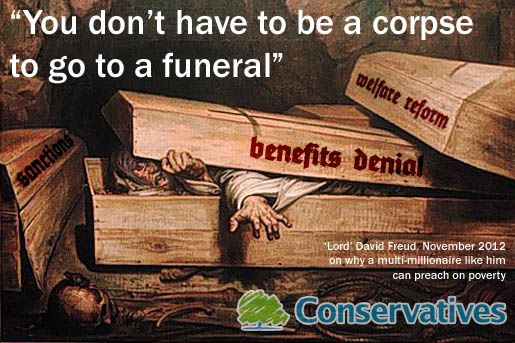
Until someone like Freud or Mellins pushes our boundaries of decency a little too far. Then we suddenly see it, and wonder how such prejudiced and discriminatory comments could be deemed acceptable and how anyone could possibly think they would get away with such blatantly offensive rhetoric without being challenged. It’s because they have got away with less blatantly offensive comments previously: it’s just that they pushed more gently and so we didn’t see.

It’s also the case that the government distorts people’s perceptions of the  aims of their policies by using techniques of neutralisation. An example of this method of normalising prejudice is the use of the words “incentivise” and “help” in the context of benefit sanctions, which as we know are intentionally extremely punitive, and people have died as a consequence of having their lifeline benefit withdrawn.

As Allport’s scale of prejudice indicates, hate speech and incitement to genocide start from often subliminal expressions of prejudice and subtle dehumanisation, which escalate. Germany didn’t wake up one morning to find Hitler had arranged the murder of millions of people. It happened, as many knew it would, and was happening whilst they knew about it. And many opposed it, too.

The dignity and equal worth of every human being is the axiom of international human rights. International law condemns statements which deny the equality of all human beings.

As a so-called civilised society, so should we.

526544_532055030197363_2137237288_n
Pictures courtesy of Robert Livingstone

Inquiry to be launched into ex-soldier’s death after JSA stopped – Mike Sivier

The late David Clapson [Image: change.org petition site].

MPs are set to hold an inquiry into benefit sanctions after 200,000 people signed a petition in the wake of an ex-soldier’s death.

More than 211,000 people signed a Change.org petition started by Gill Thompson calling for an inquiry into benefit sanctions after diabetic David Clapson, 59, was found dead in his home.

Gill’s three-month campaign called for an independent inquiry into benefit sanctions – which refers to occasions that money is withheld from claimants if they fail to meet the terms agreed.

The Work and Pensions cross-party select committee has now agreed and its inquiry into benefit sanctions is due to start early next year. It is expected to be completed shortly before the General Election in May.

David, from Stevenage – who worked for 29 years, had his £71.70 weekly allowance stopped and died three weeks later. When his body was found by a friend, his electricity card was out of credit, meaning the fridge where he kept the insulin he used to treat his diabetes was not working.

He died from diabetic ketoacidosis three weeks after his benefits were stopped, caused by not taking insulin. A coroner found that when David died there was no food in his stomach.

Gill, 57, from London, has welcomed the decision to hold an inquiry. She said: “I’m still getting my head around the announcement. It’s still so overwhelming. When I started the petition I didn’t know what would happen.

“It wasn’t just for David. Nothing can replace him but the one thing I thought I could do was to make sure this doesn’t happen to anyone else.

“I’m not normally a campaigner and David wasn’t someone who liked a fuss, but sometimes in life there are certain things you have to do – and starting this petition was one of them.

“I am so glad I did it now. I hope, through this investigation, lessons will be learnt. People turn to the state when they are in need – that is what the system is for – a safety net for hard working people like my brother when they need a bit of support.”

Debbie Abrahams, MP for East Oldham and Saddleworth, has been calling on the DWP select committee, of which she is a member, to hold an inquiry into “inappropriate use” of benefit sanctions since November last year.

She said: “Gill has shown great courage in the wake of her brother’s appalling death to take on this cruel government and its inhuman policy of targeting vulnerable people who are reliant on social security.

“The huge response to Gill’s Change.org petition with more than 200,000 signatures is proof that the British public will not stand by and do nothing when they see vulnerable people suffering.”

“The government has done everything it can to avoid having this inquiry. There is increasing evidence of the negative effects of social security sanctions on some of the most vulnerable in society, which shows that their so-called welfare reforms don’t work. This is a government that doesn’t give a damn about ordinary people.

“Latest figures show that there are now more people in working families who are living in poverty than in workless and retired families combined.”

Many thanks to Vox Political

Related

Benefit sanctions are not fair and are not helping people into work

Rising ESA sanctions: punishing the vulnerable for being vulnerable

Punishing Poverty: A review of benefits sanctions and their impacts on clients and claimants

Rising ESA sanctions: punishing the vulnerable for being vulnerable10177255_710935002309364_996655242459079802_n

Many thanks to Robert Livingstone


It’s the Tories that want something for nothing: the democratic contract and government responsibility

430847_149933881824335_1645102229_n (1)
The Conservative defense of increasing economic inequality, the lionisation of Randian, Libertarian, selfish individualism and the proliferation of ideological justification narratives regarding the dismantling of the “Big (Welfare) State”, where the latter, in Orwellian fashion, is now being indicted for many of the very social and economic ills that the free market era has actually delivered has surely worn threadbare by now. 

It’s abundantly clear that it’s the Tories and the very wealthy that want something for nothing. Cameron’s mantra is “social responsibility, not state control equals Big Society.” Cameron, in his Hugo Young lecture (2009), claimed that the “Big Society demands mass engagement: a broad culture of responsibility, mutuality and obligation”.

But this isn’t about a transfer of political power or decision-making from government to the public: it’s a transfer of responsibility and duty only.

In true Orwellian spirit, Cameron went on to say: “The recent growth of the state has promoted not social solidarity, but selfishness and individualism.”  Only a conservative would claim poverty and social cohesion as their concern and passion, and then attack  the mechanism that until now has been used to alleviate them  – publicly funded state spending.

Democracy (based on the partnership between political and economic enfranchisement) happens when the concept of property encompasses access to “social goods” such as healthcare, education and public infrastructure as a right of citizenship. The idea of political representation becomes consolidated when access to such social goods is guaranteed by a legal process, as well as a political process.

The electoral franchise in countries which adopted a Lockean liberal constitutional  system, such as  Britain, had a property qualification attached to it. Universal suffrage coincided with a wider public access to social goods, giving rise to a new type of social contract: by giving up a portion of their property by way of taxation, the propertied class ensured the survival of capitalism, and the working class escaped the worst ravages of capitalism.

Access to social goods was a means of widening and legitimising the scope of democratic political representation.

However, whilst removing all of our public services, provisions, destroying our post-war settlement, the key features of which were accepted in principle by the main political parties at the time, namely: a mixed economy, a free public sector healthcare and education, a guaranteed (though minimal) state pension and social welfare provision, the government is removing social goods, nullifying the established social contract between state and individual, and is expecting that we each fend for ourselves.

I don’t remember any consent amongst the public to accept diminished living standards in return for Cameron’s proposal of national fiscal security (which he has consistently and spectacularly failed to deliver) and the maintenance of the “market-state”. Nor was there consent for authority, inequality and hierarchy, or an acceptance of being less than we can be and having less than we can have.

Our welfare provision (and I include our National Health Service, here), paid for by us, IS OUR MEANS OF BEING RESPONSIBLE AS A SOCIETY AND INDIVIDUALLY: it is a means of securing provision for ourselves if or when we need it. Our welfare provision is, and has been since its inception, each citizens’ responsibility, because we pay for it. It doesn’t belong to the government.

The consensus that the welfare state was the best basis for a healthy society was first rejected by Thatcher, who notoriously denied the very existence of society, and unashamedly espoused greed as the  “best social driver.”  Cameron, building on Thatcher’s previous groundwork, has effectively delivered an economic enclosure act, claiming OUR collective, public funds, turning that money into the private property right of the rich, in the same way the land enclosure act robbed the public of their commonly shared land, and enabled rich landowners use of their control of state processes to appropriate public land for their private benefit.

Yet despite this blatant theft: the massive transference of public funds to a few private accounts, the demands being made by the state on citizens have never been greater. All the Tories talk about are OUR obligations and individual responsibilities, whilst they claim they have NO responsibility for citizen well-being. But we have paid for state services and continue to do so via the tax and national insurance system.

In 2013 the Government spent approximately £93.5billion of our money on the private sector. This is half the £187bn government usually spends on goods and services each year. Recent growth in outsourcing of government services to private providers has been widely criticised for a lack of transparency, poor management of money and, in particular, excessive remuneration of top executives and pay inequality between employees. Extreme pay inequality and a succession of scandals in the largest government suppliers suggests that, in its present form, government outsourcing is a very poor use of tax payers’ money and not fit for purpose. This is verified by the Equality Trust’s research report: Subsidising Unfairness

It’s only the very wealthy that gain (enormously) from austerity, and they  manage to avoid  any socially responsible contribution by using government endorsed accounting systems and dodges to avoid paying taxes wherever possible. The estimated amount of taxes unpaid, thanks to evasion, avoidance, error and criminality, soared to £34 billion, according to HM Revenue and Customs. This equates to £1 in every £15 owed in taxes not being collected last year.

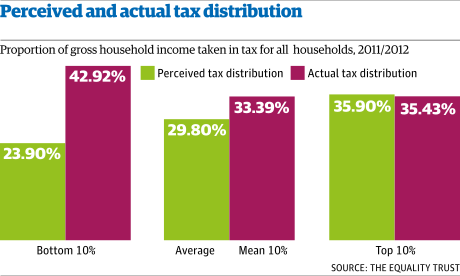
Furthermore, it is the poorest 10 percent of households that pay eight percent more of their income in all taxes than the richest – 43 percent compared to 35 percent, outlined in a report from the Equality Trust. The poorest pay more than four times as much of their income, in Cameron’s poll tax-styled council tax system, than the wealthiest top 10 precent.

The government’s “hardworking taxpayer” myth which is at the heart of the Tory ideologically driven austerity narrative, and divert, divide and poison strategy, creates an artificial dichotomy between benefit claimants and taxpayers. Cameron’s diversionary rhetoric has got nothing to do with responsibility and fairness: it’s simply about justifying policies that privilege a wealthy elite at the expense of the poor.

 Such us and them dichotomies  can be linked to the distinctions made between the “deserving” and  “undeserving” poor, going back over a hundred years or more, to the cruel and punitive Poor Law Reform Act. The Tories have purposefully created scapegoats: adversarial identities that are politically constructed according to notions of difference which simultaneously encourages a public comparison to, and rejection of, Others. This Othering narrative portrays benefit recipients as the enemy in a battle against fairness and responsibility.

And the public have bought into it, the Equality Trust thinktank highlights a gulf between perceptions of the tax system and its reality. A poll, conducted with Ipsos Mori, found that nearly seven in ten people believe that households in the highest 10% income group pay more of their income in tax than those in the lowest 10%.

Wealth concentration damages economies. It focuses activity within finance and other services geared towards only towards serving the super rich.Maintaining inequality requires penalising and further impoverishing the poor.

Reducing  wealth inequalities will require the introduction of wealth taxes, like the inheritance tax  we introduced a century ago. Reducing inequality requires a high top rate of income tax. This reduces income inequality not only by raising revenue, but by deterring the profit-driven greedy from asking for more money. When there is a tax rate of 60 percent on incomes above £200,000 a year, it makes little sense to pay employees much more than that.

But the wealthy tend to get so indignant when policy proposals from the opposition indicate that they will be required to actually contribute something to a society that they have taken so much more than others from. There’s been an outraged outcry, for example, regarding Labour’s Mansion tax proposals. These ignoble, self-serving Randians are happy to sit back and allow the poorest and most vulnerable to suffer and starve, whilst being subjected to the unfair, punitive bedroom tax, which contravened human rights: the poorest are bearing the terrible burden of austerity cuts whilst the wealthy continue to profit massively. Presumably, Cameron exempted the very rich from responsibility, duty and contributing  to society in any meaningful way.

Of course this is about restricting political engagement, the Conservatives have always sought to reduce it to a basic partnership between corporate interests and professional politicians. Cameron’s Conservatism rests on the unwitting rejection  of the social democratic consensus by the population which, paradoxically, need what they reject. Public consent is being manipulated to accommodate the idea that democracy is a relationship between rulers and governed, rather than it being about an elected government that reflects, represents and serves public needs. The population are being incrementally subordinated to a political system which is not conducive to the betterment of their lives, well-being or material conditions –  the Tories are imposing an imbalanced social contract comprised of citizen duties with no citizen rights; the acceptance of ever-lower living standards and increasing state authoritarianism.

The Conservative scapegoating narratives, which have blamed Labour, the poor and the unemployed for a recession caused by the private finance sector, and not the “big state” as claimed, have permitted the Coalition to pursue an ideological, destructive and grossly unfair economic strategy, which has generated only a bogus and isolated recovery largely based on government-fuelled asset bubbles in real estate and private finance, with stagnant productivity, plummeting wages, millions of people in precarious jobs, inflated living costs and utterly savage welfare cuts.

One obligation that all democratic states have, surely, is that of protecting citizens rights and freedoms. Those are most certainly being steadily diminished, and Cameron has been quite candid about scrapping our Human Rights Act, and withdrawing from the ECHR in the future.

See what I mean? It’s all take take take…

Danny Dorling says: “Gross economic inequality is as vile as racism, misogyny and hatred of the disabled; as damaging in effect; and as dependent on a small group of supporters who believe that just a few should have more and more and more, because they’re “worth it”.”

I believe that growing social inequality generates a political necessity for prejudices: they are entrenched vis-à-vis Social Darwinism in Tory ideology, fueled and perpetuated through justification narratives and amplified via the media.

I’ve said many times previously that never in this country have those who fight for democracy and social justice carried a greater burden or faced the possibility of bigger losses of human rights, human freedoms, human dignity and human welfare than they do right now.

14533697838_dffcc736f2_o (1)

 Many thanks to Robert Livingstone for his brilliant art work

Libertarian Paternalism and David Freud’s comments in context

1374718_540929452643254_208125039_n (1)

.

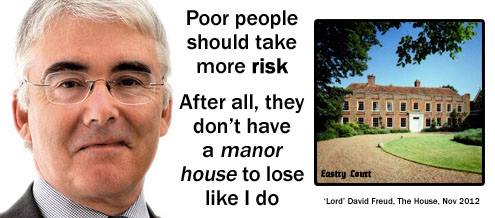
It’s taken just four years since Labour’s Equality Act was implemented for it to appear reasonable for a government minister to propose that disabled people have fewer rights and are of less worth than everyone else. Only a corporocratic Tory would call exploiting disabled people for profit “support” and try and make out they are doing us a favour.

The Tories have made a virtue out of claiming they are giving something by taking something away. For example, the welfare cuts have been casually re-named reforms in true Orwellian style. We have yet to see how cutting the lifeline benefits of the poorest people, and imposing harsh sanctioning can possibly be an improvement for them, or how it is helping them into none-existent work, in a time of inflated living costs and recession.

This said, even the Tories have been forced to distance themselves from David Freud’s “business-friendly” Tory  commentary, about the lower economic worth of disabled people. 

Anyone endorsing Freud’s comments should perhaps try substituting the word “disabled” with “woman” or “gay” or any ethnic group and see how far they get with that.

We do have laws that demand people are treated equally, regardless of their characteristics, and for good reason, especially when people commenting on this issue think it’s ever acceptable to discriminate against disabled people. But then there’s also the issue of basic decency, and of what a civilised society allows and doesn’t allow. It’s telling that the loudest of defences for  Freud’s blatantly discriminatory remarks came from the Adam Smith Institute, who would have everyone on less than the minimum wage if they had their “all hail the competitive, managed free-market” minarchist way. 

The real hypocrisy of Libertarians is that they know that the invisible hand of the market goes hand in hand with the iron fist of the state, in their rigged game. Indeed, politically  the idealised neoliberal small state has not disengaged from the public domain but its authoritarian arm has been extended.

Under the guise of a “new paternalism” (much the same as the old Tory 19th Century paternalism), which reduces the social world to the theories of behavioural economics and narrow neoliberal outcomes, the Tories have aligned public values with tradition – legitimated by a claimed concern for the welfare of society – but in reality it’s clear that Conservative paternalism is and always has been shorthand for hierarchical societies based upon privilege and a rigid control over the mass of people’s freedom, responsibilities (to the state), wellbeing and opportunities.

This is simply a social control mechanism with its micro-managerial politics; the tendency for politicians to devolve not power but responsibility for decision-making to citizens, without any reference to human experiences, constraints, or either micro or macro-level circumstances. And without extending genuine choices. It’s as if we have been placed in a state of perpetual Tabula rasa. The government and media re-write our narratives upon us.

Its also a preposterous zero-sum approach to wealth distribution. For the Tories, inequality is seen as necessary and beneficial.

State interventions this past four years have ensured that only the poorest and most vulnerable are left to the mercy of market forces, whilst welfare, in any meaningful sense, applies only to the wealthiest. Whilst austerity has been inflicted on the most vulnerable citizens in our society, the millionaires have enjoyed tax breaks and increased salaries. The elite play a rigged game: lobbying, the revolving doors between business and politics, being above the law, and tax-payer funded bailouts. The free-market isn’t open to the poor.

True laissez-faire capitalism is left for imposition only for the most vulnerable citizens, and only after we have been squeezed dry by those lying, pro-interventionist minarchists, who ensure that all protective, supportive public provision has been removed, and the public services we depend upon have been plundered and then sold off to the ever-circling private business and capitalist class vultures.

My point is this: the Tories, as neoliberal fundamentalists, have supplanted collective, public values with individualistic, private values of market rationality. They have successfully displaced established models of welfare provision and state regulation through policies of privatisation and de-regulation and have shifted public focus, instigating various changes in subjectivity, by normalising individualistic self-interest, entrepreneurial values, and crass consumerism. And increasing the social  and material exclusion of growing numbers living in absolute poverty

Basically, the Tories tell lies to change perceptions, divert attention from the growing wealth inequality manufactured by their own policies, by creating scapegoats and stigma. 

Freud’s comments have reduced disabled people’s worth to their economic value. Just as all Tories conflate everyone’s worth to an economic value. Human needs are being conflated to narrow neoliberal outcomes.

And they do tell such lies to justify their policy interventions.

For example, Disability Living Allowance (DLA) allows disabled people to purchase home adaptations, medication, treatment and equipment themselves. It is a very modest benefit of around £70 a week, it saves the taxpayer money because it allows early intervention, preventative treatment and, most importantly of all, it allows disabled people to work.

In fact the majority of DLA claimants were in work and use the extra cash to pay for the transport, software, screen readers, tactile keyboards and orthopaedic chairs, and so forth, thus allowing more and more disabled people to do a 9 to 5 job.

Yet the Chancellor said, in his 2010 emergency budget speech, that the Tory instigated reassessments for DLA would “significantly improve incentives to work, despite the fact that DLA has nothing whatsoever to do with unemployment.

“BRITAIN’S shirkers’ paradise shame with hordes of work shy benefit claimants was blamed last night for much of our economic mess…

…we have managed to create a block of people in Britain who do not add anything to the greatness of this country. (Now THAT is a typified Tory view)

They  have become conditioned to be users of services, not providers of money. This is a huge part of the reason we have this massive deficit. We have had to borrow vast sums of money. We went on this inflated spending spree”  –  More lies from Iain Duncan Smith, in The Sun, 1 December 2010, despite an official rebuke from the Office for National Statistics.

Duncan Smith has somehow forgotten that the global banking crisis is responsible for the recession, not poor people without jobs, and as for the lies about New Labour’s “big spending”  Fabianism, which has no empirical basis, it’s worth noting that total public spending under the Thatcher Governments averaged 42.11 per cent of GDP and, under the Blair Governments, 36.59 per cent (Source: HM Treasury, 2010).

The Access to Work fund was re-established by the last Labour Government to ease the transition to work for disabled people, by paying grants to businesses for vital equipment. It was put in place to support people with disabilities, it aimed to reduce inequalities between disabled people and non-disabled people in the workplace by removing practical barriers to work. This fund has seen severe cuts since 2010, which flies in the face of this Government’s claim to “make work pay” for all. By reducing this essential funding, the Coalition have effectively excluded many from work.

Additionally, disabled people with the highest support needs have been left in fear and distress following the Government announcement that it is to callously abolish a key source of independent living support. The Government decision to close the Independent Living Fund and devolve responsibility to severely under-funded local authorities follows a consultation that disabled people claim is unlawful and on which an urgent hearing scheduled by the High Court to go ahead on 13/14 March 2013.

Labour have also challenged the decision to close this crucial source of support. Labour has called for the retention of this vital fund which benefits the most severely disabled. To show her support for the retention of Independent Living Fund, which is relied upon by over 19,000 severely disabled, Labour’s Dame Anne Begg is the primary sponsor of  an Early Day Motion calling on the Government to reverse their decision to close the fund in June 2015. You can view the EDM here.

In May 2014,  the Court of Appeal, in the case of Bracking and others v Secretary of State for Work and Pensions found that the Department of Work and Pensions’ decision to close the Fund was not lawful, overturning a High Court decision of April 2013. It decided that the Department had not complied with the Public Sector Equality Duties imposed by section 149 of the Equality Act 2010. Opportunity for new applications for this funding was closed in June 2010 by the Coalition. Once again this plainly indicates that the Coalition do not consider the needs of disabled people as important, and clearly demonstrates the extent of their disgustingly eager ideological drive to strip away essential provision and support for the vulnerable.

As Sir Bob Hepple QC has pointed out, some provisions of the Labour Government’s Equality Act were very quietly edited by the Coalition, (only roughly 90% of the Act came into force, after the Coalition quickly said it would be “reviewing several sections of the legislation passed by parliament in April 2010,”) whilst other provisions have been repealed by the Enterprise and Regulatory Reform (ERR) Bill, including the duty on public authorities to have due regard to the need to reduce socio-economic inequalities.

The failure to implement the Act in full certainly sends out a clear signal that creating a more equal society is not priority for the Coalition. However, perhaps even more important has been the Conservative defense of increasing economic inequality, the lionisation of a Randian selfish individualism and a proliferation of ideological justification narratives regarding the dismantling the “Big (Welfare) State”, where the latter, in Orwellian fashion, is now being indicted for many of the very social and economic ills that the free-market era has actually delivered.

Ed Miliband is right to demand Freud’s resignation, and right to defend our vulnerable citizens from potential exploitation: that is not “playing politics” as claimed by the likes of Paul Staines and James Delingpole,  Freud was certainly not a victim in this.

To put this in context, the Labour Party introduced a host of measures to strengthen the rights of disabled people. They passed the Disability Discrimination Act 2005, introduced the Equality Act 2010, and formed the Equality and Human Rights Commission, and, in 2009, the Labour government signed the United Nations convention on the rights of persons with disabilities.

Kate Green and Anne McGuire have pointed out that the original intentions when Labour introduced the Employment Support Allowance (ESA)pilot and an assessment of people’s capacity for work, have been distorted – that the original aim was to be a supportive and facilitative process, with Disability Living Allowance (DLA), and other supportive measures in place to help people with disability lead a dignified life, fulfilling their potential, but, as Anne McGuire has pointed out, the renegotiation of the Atos contract by the current Government, (along with the addition of targets to remove people’s benefits, and sanctions,) has rebalanced the system to be punitive, rather than facilitative.

Of course the Tories have been very quick to blame Labour for the current situation, however, following a review of their pilot, Labour warned the government of problems with the Work Capability Assessment (WCA), which Iain Duncan Smith duly ignored, passing the ESA system into law, making the WCA even more problematic, and as stated, re-contracting Atos “in line with the welfare reforms”, including targets to take people’s lifeline benefits away, despite the claims made by the Tory liars.

Comparing policies indicates clearly the stark differences between the parties, and given the briefing from Labour from their ESA review that was blatantly disregarded, and the refusal of the Coalition to undertake a cumulative impact assessment of the “reforms”, it’s clear that the Tories do not regard the poorest and most vulnerable worthy of government diligence, accountability, support and fair treatment.

We simply cannot allow such a vindictive, uncivilised government another five years to harm our most vulnerable citizens, further undermine our democracy, destroy our public services and welfare provisions and trample our human rights. This is the first government to face a United Nations inquiry into disability rights violations. And that is absolutely shameful for a wealthy so-called first world liberal democracy.

Never in this country have those who fight for democracy and social justice carried a greater burden or faced the possibility of bigger losses of human rights, human freedoms, human dignity and human welfare than they do right now.


1459165_266124213538634_1461740450_n

Pictures courtesy of Robert Livingstone


David Freud was made to apologise for being a true Tory in public

1459165_266124213538634_1461740450_n

Lord Freud, a Conservative Welfare Reform Minister, has admitted comments he made that some disabled people are  not worth” the full national minimum wage”  were “offensive”, after they were disclosed by Ed Miliband during Prime Minister’s Questions yesterday afternoon. The Labour leader has called on the Tory peer to resign. Cameron called for a full apology from Freud.

He has since apologised after slipping up and suggesting that disabled people are “not worth” the national minimum wage and some could only be paid “£2 an hour.” Cameron says the comments made by Lord Freud at the Tory conference do not represent the views of government. However, his austerity measures and the welfare “reforms” tell us a very different story.

Cameron betrayed his anger at being challenged when he once again alluded to his severely disabled late son, Ivan, and his late father, as he told Miliband that he would take no lectures on disabled people.

This is not the first time that the prime minister has used his son in anger, as a tactic designed to cause others emotional discomfort, deflect criticism and to avoid answering difficult questions regarding this government’s harsh and punitive policies towards disabled people.

The Labour leader quoted Freud, saying: “You make a really good point about the disabled. There is a group where actually, as you say, they’re not worth the full wage.”

Amidst cries of “outrage” and “shame” from the Labour benches, Mr Miliband said: “To be clear about what the Welfare Reform Minister said, it’s very serious. He didn’t just say disabled people weren’t worth the minimum wage, he went further and he said he was looking at whether there is something we can do, if someone wants to work for £2 an hour.”

He added: “Surely someone holding those views can’t possibly stay in your Government?”

Cameron said: “Those are not the views of the government, they are not the views of anyone in the government. The minimum wage is paid to everybody, disabled people included.”

Clearly very angry, the prime minister added: “Let me tell you: I don’t need lectures from anyone about looking after disabled people. So I don’t want to hear any more of that. We pay the minimum wage, we are reforming disability benefits, we want to help disabled people in our country, we want to help more of them into work. And instead of casting aspersions why doesn’t he get back to talking about the economy.”  

Once again, note the rhetorical diversionary tactics that Cameron used.

Miliband responded: “I suggest, if he wants to protect the rights of disabled people, he reads very carefully what his welfare minister has said because they are not the words of someone who ought to be in charge of policy related to disabled people.

“In the dog days of this government the Conservative party is going back to its worst instincts – unfunded tax cuts, hitting the poorest hardest, now undermining the minimum wage. The nasty party is back.”

In the Guardian said: We are in the climate of the Work Programme  and  employment and support allowance travesties, in jobseeker’s allowance sanctions and personal independent payment delays.

Coerced, free labour and a shrinking, ever conditional benefit system. Freud has not spoken out of turn, but encapsulated Conservative attitudes to both disabled people and workers: pay them as little as possible and they will be grateful for it.

The Tories are not content with forcing disabled people into work. They want to pay them a pittance when they get there. I suppose we can thank Freud. The government has been producing enough measures that infers disabled people are slightly less than human. He’s finally said it out loud.”

I couldn’t agree more. Freud’s comments are simply a reflection of a wider implicit and fundamental Social Darwinism underpinning Tory ideology, and even Tim Montgomerie, who founded the Conservative­Home site has conceded that: “Conservative rhetoric often borders on social Darwinism…and has lost a sense of social justice.”

Of course the problem with such an ideological foundation is that it directly contradicts the basic principles that modern, western democracy was founded on, it is incompatible with our Human Rights Act, which enshrines the principle that we are each of equal worth. And our Equality Act, introduced by Labour to ensure that people are not discriminated against on the grounds of their disability, gender, age and a variety of other protected characteristics.

Sam Bowman, research director of the Adam Smith Institute, has said that Freud was “shamefully mistreated” by Labour leader Ed Miliband.

The Adam Smith Institute – a think tank that promotes Conservative “libertarian and free market ideas”, minarchism and claims it is:“known for its pioneering work on privatization, deregulation, and tax reform, and for its advocacy of internal markets in healthcare and education, working with policy-makers”  – has, perhaps unsurprisingly, defended Lord Freud’s disgraceful comments regarding striving disabled workers.

Mr Bowman said: “His (Freud’s) point was that the market value of some people’s wages is below the minimum wage. This is often true of the severely disabled and can have appalling consequences for their self-esteem and quality of life.”

He added: “To point out that someone’s market value is less than minimum wage has nothing to do with their moral value as human beings.”

I beg to differ. We have a government that claims meritocratic principles define those who are worthy and deserving of wealth.We have a government that generates socially divisive narratives founded on ideological dichotomies like strivers and skivers. We have a government that systematically disregards the human rights of disabled people. Their very policies define the moral value they attribute to the poor, disabled people and the wealthy, respectively. This defence is based on a false distinction, because the Tories conflate market value and moral value explicitly, their policies are evidence of that.

The think tank president, Madsen Pirie,  once said: “We propose things which people regard as being on the edge of lunacy. The next thing you know, they’re on the edge of policy.”  

This group of neoconservatives brought you the fundamentals of Thatcher’s poll tax, the Adam Smith Institute was also the ideological driving force behind the sales of council house stock. If you need any further convincing of their Tory credentials, then their proposals that the National Health Service should establish an internal market with hospitals buying the use of facilities from other districts and from the private sector ought to be sufficient.

The Institute has always been a fierce critic of the NHS, it thinks that the government should only regulate healthcare and that healthcare should be privately funded and privately provided by private sector companies. The Adam Smith Institute said: Congratulations to the new Health Secretary Andrew Lansley, for what could be the biggest revolution in the UK’s state-run National Health Service for 60 years. 

Also recommended by this group of privatisation vultures was an internal market system for UK schools that would have (reduced) state funds to follow students to independently run academic institutions. This approach to school funding is now Coalition policy. Following the Institute’s call for the use of private businesses by local governments, many council-run local services, such as waste collection and cleaning, were contracted out. Additionally, local governments are now required to solicit competitive bids for local services.

And it was this group of Hayek-worshipping, pro-exploitation neofeudalists, who don’t declare their funding sources, that called for a radical shake-up of welfare policy, which would make work requirements absolutely central to the benefits system. These proposals subsequently became Tory policy.

And who could forget their peddling of unfettered free markets and trade as an objection to fair trade?

In the UK and elsewhere, such Conservative neoliberal ideas have drastically changed how states operate. By heavily promoting market-based economies that highly value competition and efficiency, such neoliberalist economies have moved countries to retrogressively adopting Social Darwinist philosophies to prop up free market “logic”. 

Bourdieu (1999) contends that neoliberalism as a form of national governance has become a doxa, or an unquestioned and simply accepted world-view.(See also Manufacturing consensus: the end of history and the partisan man.)

Harvey (2005) is not surprised that the ideas of capitalism have been infused into political, social, and cultural institutions at state-level. By placing a mathematical quality on social life, the neoconservatives have encouraged a formerly autonomous state to regress into penal state that values production, competition, and profit above all else, and social issues and consequences are increasingly disregarded.

Tories view their brand of economics as a social science that is capable of explaining all human behaviours, since all social agency is thought to be directed by a rationale of individualistic and selfish goals. And the focus on the individual means that ideas related to concepts such as “the public good” and realities such as “the community” are now being discarded as unnecessary components of a welfare state.

Unsurprisingly, then, high unemployment, gross inequality, and increasingly absolute poverty are increasingly blamed on individuals rather than on structural/economic constraints.

Tory economic policy is designed to benefit only a very small class of people. Such a world-view also makes it easier to justify the thought that some people are deserving of much more than others because, after all, it is a common refrain that we are all responsible for our own destinies. (See the just-world fallacy.)

Freud’s comment was not a momentary lapse, nor was it unrepresentative of Tory views more generally. He is the contemptuous architect of the grossly punitive Tory Bedroom Tax that disproportionately affects households of disabled people. The Tories endorsed Freud’s discriminatory policy proposal, and savagely ridiculed the UN rapporteur, Raquel Rolnik, when she pointed out, very professionally and reasonably, that the policy contravened human rights.

He is the same government minister that rejected suggestions that austerity policies have led to an increase in food bank use – making the jaw-droppingly astonishing suggestion that food bank charities are somehow to blame. This former investment banker and peer told the Lords that the increase in the usage of food banks was “supply led”.

He said: “If you put more food banks in, that is the supply. Clearly, food from the food banks is a free good and by definition with a free good there’s almost infinite demand.”

Poverty reduced to individual neoliberal motivational formulae. Yet it is the government that are responsible for policies that create and sustain inequality and poverty.

In the wake of the longer wait for unemployment benefits introduced by George Osborne, a massive increase in the use of cruel benefit sanctions, the introduction of the mandatory review, during which benefits are not payable to disabled people, Freud also rejected suggestions by leading food bank operators that delays in benefit payments drove demand for emergency food aid.

Such brutal, dehumanising and inequitable treatment of our most vulnerable citizens cannot be regarded as an exceptional incident: the Tories have formulated policies that have at their very core the not so very subliminal message that we are worthless and undeserving of support, basic honesty and decency.

Social Darwinism, with its brutalising indifference to human suffering, has been resurrected from nineteenth century and it fits so well with the current political spirit of neoliberalism. As social bonds are replaced by narcissistic, unadulterated materialism, public concerns are now understood and experienced as utterly private miseries, except when offered up to us on the Jerry Springer Show or Benefit Street as spectacle.

The Tories conflate autonomy (the ability to act according to our own internalised beliefs and values) with independence (not being reliant on or influenced by others). Tories like Freud have poisoned the very idea that we are a social species, connected by mutual interdependencies that require a degree of good will, kindliness and willingness to operate beyond our own exclusive, strangle hold of self-interest.

The time has come to ask ourselves what possible benefit to society such a government actually is – what use is an authoritarian, punitive state that is more concerned with punishing, policing and reducing citizens than with nurturing, supporting and investing in them?

224079_411432638926270_715135125_n

Tory Values Explained In One Easy Chart

Nicky Morgan proposes a retrogressive, enforced segregation of pupils based on ability

get

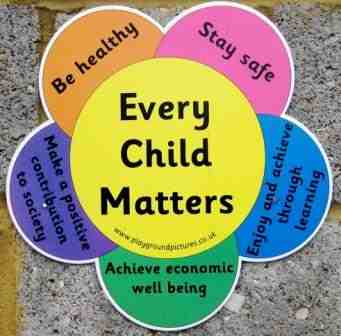
 Every Child Matters, Labour’s flagship child protection and welfare policy, was scrapped in 2010, the day after the Coalition took office


As Social Darwinists, the Tories do like ranks, taxonomies, hierarchies, outgrouping and social segregation. Nicky Morgan, the education secretary, proposes to introduce compulsory “setting” according to pupil’s ability in secondary schools. Patrick Wintour reports in the Guardian that it’s expected Morgan will ask the education watchdog, Ofsted, to implement and enforce the measure, probably by making it a condition of receiving an “outstanding” rating. Ofsted is likely to be highly critical of the proposal.

I think this proposal tells us such a lot about Tory ideology. It would turn the clock back on inclusion 30 years, to a time when the idea of segregating children was acceptable, if this becomes policy. This is also an attack on the very principle of inclusion. The foundation of any progressive education policy must be settled on and work towards all schools being willing and able to include, value, support, care for and respect all children, in their diversity, including young people with complex needs that require additional support.

Diversity is a strength and a great learning resource – it shouldn’t ever be the basis for segregation and exclusion.

Schools may currently decide whether to put children into classes according to ability. The proposal to make it compulsory is likely to raise questions as to how the plan is to be enforced legally, since independent state academies were supposedly set up to be free of state control.

Setting according to ability for separate subjects is controversial since it helps those with high ability and tends to leave those with lower ability behind.

And with the Conservative’s emphasis on cutting funding, and their previous form, it’s unlikely that any meaningful support will be put in place for those children with “additional” educational needs.

Sir Michael Wilshaw, the Ofsted chief inspector, has been a firm supporter of setting, he said in 2012 that “bright teenagers fail to achieve top grades in some comprehensives because teachers insist on mixed-ability classes and concentrate on weaker students. Able children are being held back in some schools that do not tailor teaching, tasks and resources to stretch their best pupils.”

Dr Mary Bousted, general secretary of the Association of Teachers and Lecturers, said: “If Nicky Morgan is committed to closing the gap for disadvantaged children the last thing she should do is to divide children into ability sets and to use Ofsted to enforce this.

“This is educationally unjustifiable. The evidence is overwhelming that this practice holds back poor children, denying them access to an appropriately demanding curriculum. Any claim that Ofsted is independent of government ideology will be shot to pieces if the agency is required to enforce ministerial dogma.”

Research has indicated that overall, ability grouping benefits higher attaining pupils and is detrimental to the learning of mid-range and lower attaining learners. On average, ability grouping is not regarded to be an effective strategy for raising the attainment of disadvantaged pupils, who are more likely to be assigned to lower groups. Summer born pupils and students from ethnic minority backgrounds are also likely to be adversely affected by ability grouping.

The evidence is fairly consistent and has accumulated over at least 30 years of research. (I know of some studies that date back to the 1960’s.) Although there is some variation depending on methods and research design, conclusions on the impact of ability grouping are relatively consistent. It is therefore difficult to see this proposal as anything but an endorsement of discrimination, in light of consistent findings that those pupils labeled “less able” are being set up to fail.

Morgan fails to recognise that there’s an important distinction to be made: that a measure of “current attainment,” such as a recent curriculum test, is not the same as a measure of a child’s ability or of potential.

Furthermore, a strong body of historical research indicates that the allocation of children to bands and sets is often based upon inaccurate and prejudicial teacher assessments of pupils’ abilities and/or potential.

Working class pupils are disproportionately likely to be allocated to lower bands and sets for reasons unrelated to their educational abilities and potential. Furthermore, the consignment of some pupils to lower bands and sets is likely to affect their self-confidence and therefore to restrict their educational progress.

Social interaction theorists (from the 1960’s onwards) said that the processes of streaming, setting and banding involve the negative and positive labeling respectively of mainly working class pupils in the lower sets and mainly middle class pupils in the higher sets, which has adverse consequences for the educational prospects of the lower set pupils.

Hargreaves study – Deviance in Classrooms – of mainly white working class secondary modern school boys in the 1960s – demonstrated that low stream pupils were denied academic status within the school and that they therefore tried to regain status among their peers by rebelling, misbehaviour and unwillingness to work which led to the development of anti-school subcultures in lower streams. Paul Willis’s study, Learning to Labour, yielded similar conclusions.

Additional criticisms of setting, banding and streaming were made by Nell Keddie in Classroom Knowledge (1970) where she observed that an undifferentiated humanities course was delivered differently according to the sets of the students and that, for example, teachers chose not to teach the more complex, theoretical ideas to mainly working class, lower set students on the unfounded assumption that these students would not understand them.

In the 1950s almost all the schools in the UK were “streamed” – a process by which students are grouped by “ability” in the same class for all subjects. A survey of junior schools in the mid-1960s (Jackson, 1964) found that 96% of teachers taught to streamed ability groups. The same study also revealed the over-representation of working-class students in low streams and the tendency of schools to allocate teachers with less experience and fewer qualifications to such groups.

Students’ experiences of ability grouping have historically been disaffection, polarisation and the construction of failure. Low sets are correlated with low expectations and limited opportunities. It establishes self-fulfilling prophecies.

Labelling theory

“We cannot live in a world that is interpreted for us by others. An interpreted world is not a hope. Part of the terror is to take back our own listening. To use our own voice. To see our own light.”  Hildegard Von Bingen

Self-fulfilling prophecy is the behavioural confirmation effect, in which behaviour, influenced by expectations causes those expectations to come true. People react, not only to the situations they are in, but also, and often primarily, to the way they perceive the situations and to the meanings they ascribe to their perceptions. Sociologists often use the Pygmalion effect, interchangeably with self-fulfilling prophecy, and the effect is most often cited with regard to educational under-attainment, social class and race.

“When teachers expect students to do well and show intellectual growth, they do; when teachers do not have such expectations, performance and growth are not so encouraged and may in fact be discouraged in a variety of ways. How we believe the world is and what we honestly think it can become have powerful effects on how things will turn out.”  James Rhem, executive editor for the online National Teaching and Learning Forum.

In the context of race, gender and class, negative labeling is often associated with  socio-political control mechanisms and prejudice. Stereotypes and labels estrange us from our authentic possibilities. The attributions and labels that people exchange on a symbolic level, also have the function of instruction or injunction, this function may be denied, giving rise to one type of “mystification”, rather like hypnotic suggestion.

It is argued that working class pupils are disproportionately likely to be allocated to lower bands and sets for reasons unrelated to their educational abilities and potential and that the consignment of some pupils to lower bands and sets is likely to affect their self-esteem, self-concept, and therefore to restrict their educational progress. So working class young people are written off as incapable of achieving, by the setting up of a frame of reference in which their failings are noticed and their achievements discounted.

Numerous studies have concluded that teachers, who themselves originated mainly from middle-class backgrounds, have often failed to assess their pupils’ academic potential objectively and instead have been very likely to assess students’ academic potential in terms of such variables as their appearance, language, social skills and social class background rather than in terms of their real intellectual abilities, with a bias towards judging working class children as being on average less intelligent than middle class children. It followed that where streaming, setting or banding systems were in operation, working class students were more likely to be consigned to lower streams, sets or bands even when in reality they often had very good academic potential.

Setting establishes an educational elitism which is based largely on class distinctions and not abilities, those labeled negatively are unlikely to progress onto further and higher education. That’s such a blatant repression of potential and opportunities.

It’s strange, isn’t it, that those who value orders and classes are always at the top of both?

Of course I can’t, in good conscience, leave this topic without a Marxist analysis.

Louis Althusser argued that the main role of education in a capitalist society was the reproduction of an efficient and obedient work force. This is achieved through ideological state apparatus – such as schools – used to augment the reproduction of class relations using insidious ideological machinations controlled by the dominant ruling class in the context of a class struggle, to repress, exploit, extort and subjugate the ruled class.

Schools are used for transmitting ideology that capitalism is just and reasonable, schools, for example, encourage competition amongst pupils, school hierarchies of authority train future workers to become submissive to authority.

The Hidden Curriculum

Bowles and Gintis’s research Schooling in Capitalist America (1976) supported Althusser’s ideas that there is a close correspondence between the social relationships in the classroom and those in the workplace, through the hidden curriculum . As a means of social control, the hidden curriculum promotes the acceptance of a social “destiny” without promoting rational and reflective consideration.

The functions of the hidden curriculum include: the inculcation of values, political socialisation, training in obedience and docility, the perpetuation of traditional class structure-functions that may be characterised generally as social control.”  Bowles and Gintis argue schools introduce the long shadow of work because schools create a hard-working disciplined workforce for capitalist societies. This process is essential for social reproduction – the reproduction of a new generation of workers schooled (disciplined) into accepting their role in society.

This occurs because school mirrors the workplace through its hierarchical structures – teachers give orders and pupils obey. Schools are a microcosm of society, too. Pupils have little control over their work – a fact of life in the majority of jobs. Schools reward conformity, punctuality and obedience and are dismissive of independence, critical awareness and creativity – this also mirrors workplace expectations. The hidden curriculum is seen by Bowles and Gintis as instrumental in this process.

Schools reflect and justify social inequality – they legitimate the Conservative myth that everyone has an equal chance – those that work hard deserve the top jobs, these people deserve their superior rewards – this is the myth of meritocracy. It is in this way that inequality becomes normalised and justified. However Bowles and Gintis argue that rewards in education and occupation are based not on ability but on social background. The higher a person’s class or origin the more likely they are to attain higher qualifications and a career.

Besides family background and income differences, other determinants such as race and gender do contribute to differences in educational attainment. Bowles and Gintis conclude that the educational system is a gigantic myth-making machine which serves to create and perpetuate inequality, and by emphasising IQ as the basis for economic success, the educational system legitimises an authoritative, hierarchical, stratified and unequal social system, it manufactures the myth that those in powerful positions in society deserve their positions and financial “rewards”.

IQ testing is an intellectual cul-de-sac that does not reflect skill and talent

IQ testing is culturally specific. It tells us nothing more than how well people perform IQ tests. Traditional studies of “intelligence” based on IQ tests, which have drawn links between intellectual ability, race, gender and social class, have led to highly contentious claims that some groups of people are inherently less intelligent that other groups. But that betrays a thinking of intelligence as a fixed, innate ability, instead of something that develops as a process in a context.

Intelligence isn’t something we have, it’s something we learn to do. 

But this is the kind of government that would have children learning their times tables by rote, which is just so very century before last. This approach is based on a view that students are passive objects, rather than participating subjects, in the learning process. It seems that Conservatives are incapable of learning from historical policy failures. And the many sociological studies that were instrumental in formulating more effective education methods in the late 60s and 70s.

Rote learning is a way of bypassing critical thinking and understanding-based learning. And creativity. It’s founded on a “jugs and mugs principle” – an authoritarian-styled learning process, where teachers “fill” the pupil with facts and it’s not remotely about democratic engagement and participatory, dialogic learning. It turns students off, disengages them, excluding them from the learning process.

Children being ranked and labelled is extremely problematic – each of us is complex, with such varied, developing and ongoing talents, aptitudes and preferences, and it seems that any one number purporting to quantify our intelligence must be grossly misleading in every case, as well as providing nothing more than a snapshot of limited and specific task performance.

The right are obsessed with the taxonomic ranking of human beings based on superficial characteristics. They have no interest in the depth of “who” we are, but only the surface appearance of us – the “what” we are.

IQ testing originally evolved from the eugenics movement. The founding father of eugenics was  Sir Francis Galton, a cousin of Charles Darwin. Over the course of Galton’s varied career, he not only codified the “science of eugenics” but also pioneered psychometry as a tool for measuring people’s “intelligence” and determining whether it would be best for them to breed or not. Galton coined the phrase nature versus nurture and identified the trend of regression towards the mean, though his original term for this was reversion towards mediocrity. So long as “unintelligent” people were allowed to reproduce freely, mankind could never rise above its “native mediocrity”. What a wretched, oppressive, repressive and right-wing view.

Charles Murray’s New Right treatise on the white, male elite supremicism

I read the The Bell Curve: Intelligence and Class Structure in American Life  (1994) by psychologist Richard J. Herrnstein and American political scientist Charles Murray in the 90’s, and it filled me with utter despair. Funded by Conservatives in the States, the book was simply a neo-eugenic narrative masqueraded as “academic study”. Murray justified the status quo by claiming poor people, and especially ethnic minorities, were of lower intelligence than white middle class citizens, and that this was largely genetically determined.  

Bob Herbert, writing for The New York Times, described the book as: “a scabrous piece of racial pornography masquerading as serious scholarship.Others, including Noam Chomsky, have pulled this cheap right-wing pseudo-scientific catalogue of prejudices apart most thoroughly, ever since.

Challenging what he deemed to be “educational romanticism”, Murray, a darling of Thatcher and Cameron, wrote Real Education: Four Simple Truths for Bringing America’s Schools Back to Reality. His “four simple truths” are:

  • “Ability varies.”
  • “Half of the children are below average.”
  • “Too many people are going to college.”
  • “America’s future depends on how we educate the academically gifted.

In a paper published in 2005 titled Where Are the Female Einsteins?  Murray  the charmer stated, among other things: “no woman has been a significant original thinker in any of the world’s great philosophical traditions”. 

Murray advocates educational exclusion and social oppression for the majority of pupils. He has been a “academic witness” before United States congressional and senate committees and a consultant to senior Republican government officials in the United States, and of course, Conservative officials in the United Kingdom.

From the ranking, banking model to a democratic, dialogic model

So, is there an alternative education model?

Yes. One I have worked with myself, (as a community worker and informal educator), and it’s based on liberation psychology. It’s far more about critical thinking, egalitarianism, creativity and inspiration than formalised teaching permits.

The genesis of liberation psychology began amongst a body of psychologists in Latin America in the 1970s. Ignacio Martín-Baró is credited as the founder of liberation psychology, and it was further developed by others. Of particular interest here is the work of Brazilian educator Paulo Freire, and one of the key concepts of liberation psychology is concientización: critical consciousness – a recognition of the intrinsic connectedness of the person’s experience and the sociopolitical structure. Freire believed education to be a political act that could not be divorced from pedagogy. Freire defined this as a main tenet of his critical “Pedagogy of the Oppressed.”

Teachers and students must become aware of the politics that surround education. The way students are taught and what they are taught serves a political agenda. Teachers themselves have political notions that they bring into the classroom.

Freire attacked what he called the “banking” concept of education, in which the student was viewed as a passive participant – empty accounts to be “filled” by the teacher. He notes that “it transforms students into receiving objects. It attempts to control thinking and action, leads men and women to adjust to the world, and inhibits their creative power.” 

Freire recognised that emphasis on individual characteristics are a result of social relations, and to view such individualistically de-emphasizes the role of social structure and  is responsible for the incorrect attribution of sociopolitical problems to the individual. Liberation psychology addresses this by re-orienting the focus from an individualistic to a social one. Using this framework, the behaviour of oppressed people is conceptualised not through intra-psychic processes, but as a result of an alienating environment.

Freire advocated authentic dialogue-based learning, where the role of the student shifts from object to active, critical subject. Freire heavily endorsed students’ ability to think critically about their education situation, this way of thinking allows them to recognise connections between their individual problems and experiences and the social contexts in which they are embedded.

Realising one’s consciousness is the first step of praxis, which is defined as the power and know-how to take action against oppression, whilst stressing the importance of liberating education. Praxis involves engaging in a cycle of theory, application, evaluation, reflection, and then referring back to theory. Social transformation is possible through praxis at the collective level.

In 1999, PAULO, a National Training Organisation named in honour of Freire, was established in the United Kingdom. This agency was approved by the New Labour Government to represent some 300,000 community-based education practitioners working across the UK (myself included). It was a platform also, perhaps surprisingly, for Blair’s re-democratising democracy programme, based on a dialogic democracy, and a recognition of the centrality of life politics.

PAULO was given formal responsibility for setting the occupational training standards for people working in this field, and was based on a revolutionary anarchist/Marxist model of critical education. Even outside of that political context, Freire’s collective works, and especially Pedagogy of the Oppressed, has huge value and merit as a direction for an approach to teaching which is based on self awareness, community awareness, political awareness, responsibility, critical thinking, creativity, dialogue and social solidarity, and not on manipulation and oppression.

The Tories, however, are unrelentingly authoritarian, and this is reflected in their notions of “education”, which are: “Raising standards (through “setting” and taking those segregated off record: the “disappeared”)… and restoring discipline – so our children can compete with the world’s best and enjoy a better future.”

So nothing at all there about developing human potential, personal development, social development or even the fundamental capacity for critical thinking.

A person who has not had opportunities to think critically about social and political reality, but simply accepts it is thereby simply participating in the world in a way that has been organised and designed for him/her by others.

If being human means exercising choice and freedom, then such uncritical, passive acceptance means being less than human.

But Tories prefer us that way. They don’t like to extend equal opportunities.

1374718_540929452643254_208125039_n (1)

Pictures courtesy of  Robert Livingstone


I don’t make any money from my work. I am disabled because of illness and have a very limited income. But you can help by making a donation to help me continue to research and write informative, insightful and independent articles, and to provide support to others. The smallest amount is much appreciated – thank you.

DonatenowButton

Conservatism in a nutshell

Image result for Theresa May poor wages
It’s not enough to challenge Tory ideology. We also have to dismantle the Orwellian semantic thrifts and shifts. We have to defeat the Tory propaganda machine that lies, persuades and lulls people with meaningless populist slogans, empty glittering generalities and glib catch-phrases.

You’ve heard those slogans – “less government”, “personal responsibility”, “hard-working families”, “making work pay” and lots of nationalist flag waving. These are shorthand messages to the public that are thrifty with the truth, codifications for an entire world-view. But it’s ever such a shabby, ruthless, isolating and paltry one.

1209102_539900659412800_1664499134_n

The clue is in the name: the word “Tory” derives from the Middle Irish word tóraidhe, which means outlaw, robber or brigand, from the Irish word tóir, meaning “pursuit”, since outlaws were “pursued men”. It was originally used to refer to an Irish outlaw and later applied to Confederates or Royalists in arms. The term was originally one of abuse.

The Tories live by plundering. They steal your taxes, your public services, your state provision and your labour in order to raise more money for the rich. They have reneged on our post war democratic settlement. Legal aid, human rights, social housing, the NHS, lifeline welfare support – the essential components of any functioning democracy – are being viciously and systematically dismantled by the Tories. 

It’s a dystopic world of corporate fiefdom. I heard a very smart person from the States once sum up the Tories neatly with the phrase “cheap-labour conservatism”. How very apt. It fits so well. It makes sense of such a lot.

Basically, the larger the labour supply, the cheaper it is. The more desperately you need a job, the less you tend to demand for your wages to be fair, and the more power those big business Tory buddies have over you. This is what the Tories actually mean by “making work pay” – it’s either rationed out peanuts or starvation. But for big business, your work pays them handsomely in fat profits.

The Tories engineer this same socioeconomic situation every time they are in office. Think back to the Thatcher era, she did it, Major did it – it’s a manufactured recession and a large reserve army of cheap labour every time. ALWAYS the same with the Tories. Because it suits their “business friendly” agenda.

That’s another Tory slogan that means corporate greed, profit before people and Tory donations – see the Beecroft Report, for example, written by a British “venture capitalist” that has donated more than £500,000 to the Conservative Party. The overdogs write policies to make sure that we remain the underdogs. Fat profits are all that matter to the vulture capitalists. 

Beecroft is currently Chairman of Dawn Capital. The release in May 2012, of the long awaited Beecroft Report in the UK caused considerable controversy because it recommended that the government should “cut red tape” in order to make the hiring and firing of employees easier and cheaper.

The report claimed this would help to ‘boost’ the economy although no evidence for this was provided. It’s hard to imagine how increasing job insecurity would encourage workers to spend their money. It does, however, help boost profits for venture  vulture capitalists, and the government-commissioned report strips workers of their rights.

As the TUC said at the time, the ideas have taken the UK back towards Victorian era working conditions and standards. Conservatives don’t like social spending or welfare – our safety net. The safety net we funded. That’s because when you’re unemployed and desperate, companies can pay you whatever they feel like – which is inevitably next to nothing, so their profits can grow. 

You see, the Tories want you in a position to work for next to nothing or starve, so their business buddies can focus on feeding their profits, which is their only priority.

Cheap-labour conservatives don’t like the minimum wage, or other improvements in wages and working conditions. These policies undo all of their efforts to keep you desperate. They don’t like European Union labour laws and directives either, for the same reason.

Cheap-labour conservatives don’t like unions, because when we unite, organise and collectively bargain, wages go up and living standards rise. Working conditions improve. That’s why workers unionise. Seems workers don’t like being desperate.

10553308_680322242037307_1558281906340939819_n

But businesses don’t like to pay out money. They like to hoard it. Cheap-labour conservatives constantly bray about “morality”, “virtue”, “respect for authority”, “hard work”, “responsibility” and other such vaguely defined values. This is only so that they can blame you for being desperate due to your own “immorality”, “lack of values”, “lack of character” , “idleness” and “poor life-choices”  when you are poor, within a system designed to generate a few ‘winners’ and a lot more ‘losers’. It’s not a level playing field that hosts the great neoliberal ‘competition’.

Those inane soundbites have been used to dismantle another worker’s protection: the welfare state.

They have also been deployed so that the Tories can justify their “business friendly” workfare schemes to further exploit the reserve army of labour and keep us desperate, unpaid and in our place.

1235473_537097386359794_65317730_n (1)

Cheap-labour conservatives encourage racism, misogyny, homophobia and other forms of bigotry. That’s because bigotry among wage earners distracts them, and keeps them from recognising their common interests as wage earners. Divide and rule was invented by cheap labour-conservatives. To keep labour cheap.

An ugly truth is that cheap-labour conservatives don’t like working people. They don’t like working class opportunities and prosperity, and the reason for this is very simple. Lords have a harder time kicking us around when we aren’t desperate, hungry and in fear of destitution.

Once we understand this about the cheap-labour conservatives, the real motivation for their policies makes perfect sense. Cheap-labour conservatives, the neo-feudalist fools, believe in social hierarchy and limited privilege, so the only prosperity they want to permit is limited to them and their elite class.

They want to see absolutely nothing that benefits us whatsoever. And even better if we fight amongst ourselves for scraps. Divide and rule. The Tory mantra “making work pay” is an argument for RAISING WAGES, not cutting benefits, talk about the rationally illiterate …. But then cheap-labour conservatives hope that those affected will take comfort in the fact that if your wages are not enough to meet the cost of living, at least those without a job are much worse off.

The Tory “race to the bottom” is hidden in plain view, and after five years of austerity, Osborne is forced to concede that the new welfare cuts leave £9bn of the deficit reductions promised by the Chancellor unaccounted for. The cuts are PURELY ideological. Tories: dangerous with the economy, dangerous for society.

1965037_301820166635705_1502392114_n (1)

“Less government” is another defining right-wing slogan. It’s also all about cheap labour. Referenced by the slogan is the whole conservative set of assumptions about the nature of the “free market” and government’s role in that market. However, we pay for government. We pay for protective state services. It is not the government’s money to hand out to millionaires, it is ours. 

The slogan “less government” permitted the conservatives’ cunning transformation of a crisis caused by banks into a crisis of public spending. It was a huge triumph of Tory dogma over the facts. And of course, our public services are being sold off to private companies. A few people are quietly making megabucks while the rest of us are told to “live within our means.”

And anyone would think, to hear the Tories talk, that the “free-market” isn’t rigged to benefit the wealthy. There’s no such thing as an “invisible hand”, unless you count the iron fist of the authoritarian state, getting on with getting their own way. The bedroom tax, welfare cuts, public service cuts, cutting inheritance tax and handing out tax breaks to the wealthy are, after all, examples of state interventions, and not “market forces”, which the Tories always use as a front to suck the life out of entire communities and to keep people desperate.

The whole “public sector/private sector” distinction is an invention of the cheap-labour conservatives. They say that the “private sector” exists outside and independently of the “public sector”. The public sector, according to cheap-labour ideology, can only “interfere” with the “private sector”, and that such “interference” is “inefficient”, “costly” and “unprincipled”.

Using this ideology, the cheap-labour ideologue paints him/her self as a defender of “freedom” against “big government tyranny,” while all the time, the conservatives are extending an extreme, oppressive authoritarianism.They have to because no ordinary person who knows what they’re up to actually wants their policies. And in fact, the whole idea that the “private sector” is independent of the public sector is totally bogus, because “the market” is created by public laws, public institutions and public infrastructure. 

But the cheap-labour conservative isn’t really interested in “freedom”. What they want is the privatised tyranny of industrial and financial serfdom, the main characteristic of which is – you guessed it – cheap labour.

1395990_559940054075527_258446375_n

Pictures courtesy of Robert Livingstone 


I don’t make any money from my work. But you can contribute by making a donation and help me continue to research and write informative, insightful and independent articles, and to provide support to others. The smallest amount is much appreciated – thank you.

DonatenowButton

Inequality has risen: Incomes increased for the richest last year, but fell for everyone else

1459720_569627496440116_902730897_n

On 04 June, 2014, at 3.52pm BST, Cameron said inequality is at its lowest level since 1986. I really thought I’d misheard him. This isn’t the first time Cameron has used this lie. We have a government that provides disproportionate and growing returns to the already wealthy, whilst imposing austerity cuts on the very poorest. How can such a government possibly claim that inequality is falling, when inequality is so fundamental to their ideology and when social inequalities are extended and perpetuated by all of their policies? The standard measure of inequality is  certainly being used to mislead us into thinking that the economy is far more “inclusive’ than it is.

Dr Simon Duffy authored report – A Fair Society?  – last year, for the Centre for Welfare Reform, about how the austerity cuts have been targeted. He said:

  • People in poverty are targeted 5 times more than most citizens
  • Disabled people are targeted 9 times more than most citizens
  • People needing social care are targeted 19 times more than most citizens

“The UK is the third most unequal developed country in the world and most disabled people live in poverty. The current policy is guaranteed to increase inequality and to make extreme poverty even worse.”

I also wrote an article last year –  Follow the Money: Tory Ideology is all about handouts to the wealthy that are funded by the poor. I said:

The following cuts came into force in April 2013:

  • 1 April – Housing benefit cut, including the introduction of the ‘bedroom tax’
  • 1 April – Council tax benefit cut
  • 1 April – Legal Aid savagely cut
  • 6 April – Tax credit and child benefit cut
  • 7 April – Maternity and paternity pay cut
  • 8 April – 1% cap on the rise of in working-age benefits (for the next three years)
  • 8 April – Disability living allowance replaced by personal independence payment (PIP)
  • 15 April – Cap on the total amount of benefit working-age people can receive

Here are some of the “incentives” for the wealthy:

  • Rising wealth – 50 richest people from this region increased their wealth by £3.46 billion last year to a record £28.5 billion.
  • Falling taxes – top rate of tax cut from 50% to 45% for those earning over £150,000 a year. This is 1% of the population who earn 13% of the income.
  • No mansion tax and caps on council tax mean that the highest value properties are taxed proportionately less than average houses.
  • Benefited most from Quantitative Easing (QE) – the Bank of England say that as 50% of households have little or no financial assets, almost all the financial benefit of QE was for the wealthiest 50% of households, with the wealthiest 10% taking the lions share
  • Tax free living – extremely wealthy individuals can access tax avoidance schemes which contribute to the £25bn of tax which is avoided every year, as profits are shifted offshore to join the estimated £13 trillion of assets siphoned off from our economy.

I also said: “A simple truth is that poverty happens because some people are very, very rich. That happens ultimately because of Government policies that create, sustain and extend inequalities. The very wealthy are becoming wealthier, the poor are becoming poorer. This is a consequence of  “vulture capitalism”, designed by the opportunism and greed of a few, it is instituted, facilitated and directed by the Tory-led  Coalition. ”  

Inequality Briefing reports that richest fifth of the UK population saw their incomes increase by £940 in 2013. But incomes were down by £250 for the other 80% of the population… and by £381 for the poorest fifth , according to data from the Office for National Statistics (ONS)

Incomes increased for the richest fifth of the population last year, but fell for everyone else

Thanks to Inequality Briefing for the info graphic and summary

To download the full pdf, click here

Explaining the data

This data compares the ‘equivalised disposable household income’ for 2011/12 and 2012/13. It was published by the Office for National Statistics as part of ‘the effects of UK tax and benefits on household income 2012/13 study.’ ONS have found that the recession did have a small effect on reducing inequality, but it now looks as though inequality is set to increase.

It has increased. Just as we have predicted.

1234134_539964652739734_1075596050_nPicture courtesy of  Robert Livingstone

Other relevant articles:

Quantitative data on poverty from the Joseph Rowntree Foundation

Welfare reforms, food banks, malnutrition and the return of Victorian diseases are not coincidental, Mr Cameron

The poverty of responsibility and the politics of blame 

“We are raising more money for the rich” – an analysis 

Cameron’s Gini and the hidden hierarchy of worth

How the Tories chose to hit the poor

The Conservatives’ slippery slope and Allport’s scale of prejudice

Gordon Allport studied the psychological and social processes that create a society’s progression from prejudice and discrimination to genocide. In his research of how the Holocaust happened, he describes sociopolitical and socio-psychological processes that foster increasing social prejudice and discrimination and he demonstrated how the unthinkable becomes acceptable: it happens incrementally. It happens because of a steady, nudged erosion of our moral and rational boundaries, and propaganda-driven changes in our attitudes towards others, all of which advances culturally, by almost inscrutable degrees. 

The process always begins with political scapegoating of a social group and with ideologies that identify that group as an enemy or a social burden in some way.  It begins with dehumanizing language.

By using dehumanizing language, we negatively shape the way we view some groups of people. We may begin to view them as “less-than” or “subhuman”. When we view someone as less than us, it creates a social, cultural, moral, psychological and emotional separation, which makes it easier to permit or commit violence against them. Every human being has inherent dignity by virtue of our shared humanity and the rational nature that comes with it. No matter our age, innocence, gender, size, race, nationality, or ability, we are all equally human; our language and actions should reflect that fact.

Unless we actively challenge dehumanizing rhetoric, it will continue to permeate our society and lead to acts of violence.  Dehumanizing rhetoric used to oppress groups of human beings in the past is still being used against marginalized groups of today.

bad-words-poster-smaller.png
                                                                                         Examples of dehumanizing language

A history of devaluation of the group that becomes the target, authoritarian culture, and the passivity of internal and external witnesses (bystanders) all contribute to the probability that violence against that group will develop, and ultimately, if the process is allowed to continue evolving, genocide.

Economic recession, uncertainty and authoritarian or totalitarian political systems contribute to shaping the social conditions that seem to trigger Allport’s escalating scale of prejudice. In his book, The Nature of Prejudice, Gordon W. Allport uses the metaphor of a ladder to describe how “little acts,” which often go unnoticed, can lead to serious and deadly individual and collective behaviors.  This framework describes, in ascending order, five “rungs” of intolerance and injustice: speech, avoidance, discrimination, physical attack, extermination.

Allport's ladder

The Conservatives are authoritarians, they manufactured an economic recession, as did the previous Conservative administrations. Though the sheer pace and blatancy of Cameron’s austerity programme  – a front for the theft and redistribution of public wealth to Tory-supporting private bank accounts – is unprecedented, even for Conservatives.

And prejudice towards vulnerable minority groups is almost a cardinal Conservative trait. The media is being used by the right-wing as an outlet for blatant political propaganda, and much of it is manifested as a pathological persuasion to hate others. This process of outgrouping and othering has historically been used by tyrants to target, oppress, persecute and murder some social groups.

599849_369461329790068_1640090166_n

The Conservative party has said that they are “controlling immigration” by clamping down on benefits tourism and health tourism – so that we only welcome those who want to “work hard and contribute to our society”, cutting net immigration from outside the EU to levels not seen since the late 1990s – to “ease pressure on the schools and hospitals that all hardworking people rely on”, and introducing a new citizen test with “British values at its heart”.  Such policies pander to public nationalism and normalise political fascism.

David Cameron is asking for our views on immigration. I didn’t bother responding to the highly selective, deliberately poorly designed, directed and loaded survey.

As someone who has designed sociological and psychological surveys, I know that rule number one for conducting genuine research is that we do not use loaded or leading questions. And I can’t abide the distraction and diversionary tactics – “finger pointing” politics at its very worst: scapegoating and bullying towards politically exploited minority groups, those least able to speak up for themselves.

We know that it is Tory polices that have damaged our Country, and not migrants, or ill and disabled people, or the poorest citizens. So I sent the following qualitative response to David Cameron:

“I’ve always felt the Tories don’t belong here, they have stolen all of our money, jobs, best houses, they’re scrounging off the hard-working taxpayer, and are draining our publicly funded public services – the welfare state, social security; legal aid, social housing, and they are bleeding the NHS dry. We can’t afford Conservatives, they contribute absolutely nothing to society, and cost ordinary people pretty much everything. They are also known criminals and terrorists, so they should be immediately deported back to the feudal era, where they  belong and never allowed back to civilised, democratic society again”.

Well, it is said that in satire, irony is militant. I pointed back and found the truth.

We are obliged to critique, in every  way we can, the constant subliminal drip of Tory bullying, imperialist white supremacist, social Darwinist, patriarchal political culture, because it is normalised by political narrative, a complicit mass media, and rendered opaque, presented tacitly as unproblematic “common sense”. 

It isn’t common sense. It’s nasty, manipulative authoritarian right-wing prejudice, scapegoating and diversion. For those of you who welcome the political permission to exercise your own racism, it’s worth bearing in mind that prejudice tends to “multi-task”.

Once a social group is targeted for outgrouping and discrimination, others quickly follow, as Pastor Martin Niemöller famously observed very well, in his famous statement about the cowardice of German intellectuals following the Nazis’ rise to power and the subsequent purging of their chosen targets, group after group.


  Related 

When the oppressed are oppressive too

UK becomes the first country to face a UN inquiry into disability rights violations

Techniques of neutralisation – a framework of prejudice

UKIP: Parochialism, Prejudice and Patriotic Ultranationalism.

999622_566748676727998_1599547969_n (1)
Art work courtesy of Robert Livingstone


I don’t make any money from my work. But you can support Politics and Insights and contribute by making a donation which will help me continue to research and write informative, insightful and independent articles, and to provide support to others going through ESA an PIP assessments and appeals. The smallest amount is much appreciated, and helps to keep my articles free and accessible to all – thank you. 

DonatenowButton

top 100 blogs

A distillation of thoughts on Tory policies aimed at marginalised groups

14533697838_dffcc736f2_o (1)
Government policies are expressed political intentions, regarding how our society is organised and governed. They have calculated socio-economic aims and consequences. None of the policies that this government have formulated regarding the “support and care” of some of the most vulnerable citizens, for example, could be seen as anything other than expressions of intended harm.

Unintended consequences may arise from implementing policies, however, governments usually evaluate the merit, worth and consequences of policies, using criteria governed by a set of standards for evaluating, after implementation, and before implementation by carrying out a cumulative impact assessment. There has been neither a review nor a cumulative assessment of the welfare “reforms” carried out by the government to date. (The Social Security Advisory Committee (SSAC) submitted a report with several recommendations for a cumulative impact assessment of welfare reform, which were recently rejected by Lord Freud, in a letter, on behalf of the government). 

Equality impact assessments, introduced in Labour’s 2010 Equality Act, involve assessing “the likely or actual effects of policies or services on people in respect of disability, gender and racial equality”. They are essential to improving fairness and in ensuring policies aren’t discriminatory. But the prime minister said there was too much “bureaucratic nonsense” and policy-makers should use “judgement” rather than “tick boxes”.

On the 19th of November 2012, the prime minister announced that equality impact assessments would no longer be undertaken for government decisions. That is extremely worrying, as this law was designed to prevent discrimination against people who are categorised as being disadvantaged or vulnerable within society. Removing this legal requirement also serves to hide the evidence of discrimination.

Services and support for the disabled people have been cut, lifeline benefits have been restricted by a variety of means, such as benefit cuts (not “reforms”), the revolving door process application of the work capability assessment, benefit sanctions, the mandatory reconsideration process, the Bedroom Tax, the Council Tax, and severe cuts to council support and care provisions. People are suffering, as a direct consequence of policies since 2010, some have died. These are policies that are blatantly discriminatory. The implications of the “reforms” really are a matter of life and death for many.

Disability-related harassment and hate crime has increased in Britain, the result of an implicit campaign by both the Conservatives and its media allies to discredit all disabled benefit claimants. This represents one element of a renewed campaign to label some people as a “burden” to society, a view that has gained renewed currency this past four years. Such ideas leave those groups particularly vulnerable to further socio-political abuse

The government are using the pretext of the economic crisis (that began with the Global Financial Crisis of 2008) and has now been extended through austerity measures to initiate a new war of attrition against disabled people, unemployed people and other disadvantaged communities.

Eugenic theories are most commonly associated with Nazi Germany’s racially motivated social policies. The Nazis sought the improvement of the Aryan race or Germanic “Ubermenschen“- master race – through eugenics, which was the foundation of Nazi ideology. Those people targeted by the Nazis were identified as “life unworthy of Life“- “Lebensunwertes Leben” – including but not limited to the “idle”, “insane”, “degenerate”, “dissident”, “feeble-minded”, homosexual and the generally weak, for elimination from the chain of heredity.

More than 400,000 people were sterilised against their will, whilst 275,000 were killed under Action T4, a “euthanasia” program. However, there is quite a broad definition of eugenics and I propose that because it has been so thoroughly discredited, it has been forced to “go incognito” over the last century.

The public support for eugenics greatly waned after the fall of Nazi Germany and the Nazi attempt to use eugenic justifications for the Holocaust at the Nuremberg Trials. Right-wing philosopher, Roger Scruton, said in an article in The American Spectator “The once respectable subject of eugenics was so discredited by Nazism that “don’t enter” is now written across its door” implying he would like to see more openness to eugenics as an idea. In a way, he does make a valid point, because when what was once stated explicitly becomes implicit and tacit, it is difficult to challenge, and essential debate is therefore stifled.

Eugenics is the infamous idea that governments should decide which kinds of citizens ought to be considered desirable  – the consensus tends to be that these are  white, athletic, intelligent, and wealthy – and which kinds of citizens ought to be considered undesirable – these tended to be black, Jewish, disabled, or poor –  and employ the power of the State to encourage increases of desirable citizens (positive eugenics) and encourage decreases of undesirable citizens (negative eugenics).

Eugenics is specifically State interference in and engineering of the “survival of the fittest”. That is happening here in the UK, with Tory policies like the extremely punitive welfare “reforms”, which are aimed at the most vulnerable citizens – such as those who are sick and/or disabled – all too often denying them the means to meet basic survival needs.

Prior to the Holocaust, eugenics was widely accepted in the UK, particularly as it fitted well with the dominant paradigm – comprised of laissez faire economics, competitive individualism, Malthus’s ideas on population control and Spencer’s Social Darwinism. The ruling elite feared that offering medical treatment and social services to disabled people would undermine the natural struggle for existence and lead to the degeneration of the human race. Those ideas, once explicitly endorsed are now implicitly captured in policies and Conservative narratives about sanctions, “conditionality,”  “making work pay,” (compare with the principle of less eligibility enshrined in the New Poor Law) “fairness,” “incentives,” “scroungers,” and so forth.

A crucial similarity with the early part of the century and now is reflected in Tory austerity rhetoric – a perceived shortage of resources for health and welfare. Another parallel is the scape-goating process and a rise in the level of social prejudices and discrimination.

Anti-immigration rhetoric, reflected in the media, with the vilification of sick and disabled people and the poor, has preceded policies particularly aimed at the steady removal of State support indicating a clear scape-goating process, and this isn’t indicative of a government that is “neglectful”- it is patently intentional, hence the pre-emptive “justification” narratives to garner public support and acceptance towards such punitive and harsh policies.

So, the first purpose of such justification narratives is to make cruel and amoral policies seem acceptable. However, such propaganda narratives also serve to intimidate the targeted minority, leading them to question whether their dignity and social status is secure.

Furthermore, this type of hate speech is a gateway to harassment and violence. (See Allport’s scale of prejudice, which shows clearly how the Nazis used this type of propaganda and narrative to justify prejudice, discrimination, to incite hatred and ultimately, to incite genocide.)

As Allport’s scale indicates, hate speech and incitement to genocide start from often subtle expressions of prejudice. The dignity, worth and equality of every individual is the axiom of international human rights. International law condemns statements which deny the equality of all human beings. Article 20(2) of the ICCPR requires states to prohibit hate speech.

Hate speech is prohibited by international and national laws, not because it is offensive, but rather, because it amounts to the intentional degradation and repression of groups that have been historically oppressed. In the UK, we have a government that endorses the repression of the historically oppressed.

This government’s schadenfreude, the intent and motivation behind the draconian policies that we’ve seen this past 4 years, which target the most vulnerable citizens most of all, is debated. Some people believe that the policies are a consequence of a redistribution of wealth from the poorest to the wealthy rather than being malicious acts. But the Tories laughed on hearing the accounts of suffering of the poor because of the bedroom tax and the food bank, for all to see, during parliamentary debate with the opposition.

But entertaining the idea for a moment that the inflicted suffering is not a motivation but, rather, a consequence, well that would make the Government at the very least indifferent, callous, indifferent and unremorseful, since they show a supreme lack of concern for the plight of those least able to defend themselves against injustice and inflicted poverty. And such indifference contravenes fundamental human rights. It violates international laws.

Either way, I feel shock and anger at the recognition that all of those principles and beliefs we held dear – such as justice, fairness, democracy, freedom, Government accountability, equality (at least in terms of the worth of each life), institutionalised philanthropy – all trodden under foot by advocates of Social Darwinism- an aristocratic elite – in just 4 years. And the faith we each had in those collective ideals undermined by the constant perpetuation of socially divisive propaganda tactics from the right. Dividing people by using blame and prejudice further weakens our opposition to oppression.

Where is the investigation into the very high number of deaths associated with the Tory-led welfare reforms? The government have been made aware of those deaths through parliamentary debate, yet they persist in denying any causal link with the  significant increase of vulnerable people dying, and their savage cuts to lifeline benefits. If there is no causal link, an inquiry would demonstrate that, surely?

It’s a universally recognised fact that if people are prevented from meeting their basic survival needs, they will die. Benefit sanctions, and cuts to welfare and public services, the rising cost of living and the depression of wages are having a detrimental effect on many. I don’t imagine that it’s the case that everyone but the government are aware of this. Yet the policies remain.

Deciding who should be allocated resources and who should not is also founded on Social Darwinist and eugenic thinking. 

The Coalition will leave more debt than all Labour governments since 1900. The current government’s now responsible for £517 billion of the trillion-plus-pound UK public debt, compared to £472 billion accrued during the 33 years Labour led the country since the turn of the twentieth century. And the figures look even worse when you adjust for inflation. When you do that, the Coalition’s share jumps to nearly half of the total debt.

But the Coalition don’t meet any public’s needs, they simply serve the wants of the 1%. Labour invested in public services, the Tories have bled them dry. So, what have they done with the money? Because the a proportion of the public have seen only austerity cuts. The same groups have witnessed and experienced a narrowly targeted austerity programme, where multiple cuts to funding for their essential support have selectively hit over and over. These policies are intentional.

Withholding State support for disabled people, unemployed people and the poorest citizens – support paid for via our taxes – is a deliberate act. Whilst our government have been busy denying the eugenics-by-stealth consequences of their diabolical policies in this Country, back in 2012, the Guardian exposed the fact that the British government has spent millions of pounds funding a policy of forced sterilisation of the poor in India as part of an effort to reduce human population to “help combat climate change”. But we also know that many Tories deny climate change exists.

The governments of China and India practice hard eugenics, underwritten by American and British tax money, these are coercive measures undertaken by governments  to decrease citizen population. The exposure of support for hard eugenics prompted denial and backtracking.  United Nations Population Fund (UNFPA) claims to support “voluntary family planning” in China. They assume that women are aware that conceiving a  second child will result in a forced abortion are free to make  choices – thus the forced abortion is a State arrangement entered into “voluntarily.”

Hard eugenics is the ideology that is hiding behind Hitler. But soft eugenics  is based on the same pathological belief – that a government should spend its resources to prevent the propagation of those whom the government believes to be  “detrimental” to society and economic production. Here in the UK, our government has been quite explicit in its drive to end “the something for nothing culture”.

Our taxes have been handed out to the wealthy and State support has been steadily withdrawn from the vulnerable. Government policies are an explicit statement of political and socio-economic intentions. Policies based on Social Darwinism and eugenics cannot be justified.

Our morality is liberated from the biological, reductionist constraints of evolutionary thinking. We relate to one another through culture, shared histories, language, morality, and law. Even if it were true that we are biologically determined – fixed by evolution, as intentional beings, we are not culturally fixed. There is a difference between what we are, and who we ought to be.

The theories of Social Darwinism, eugenics, and sociobiology involve biological reductionism. A recognition of the importance of biological conditions and even “human nature” need and ought not involve biological reductionism. And to embrace reductionism is to ultimately deny our capacity for making rational choices. But we exceed the limits of reductionism and determinism every time we make any claim to knowledge (including those claims of reductionism and determinism), make a choice, discuss ethics and morals, explore possibilities, create, discover, invent – we are greater than the sum of our parts.

The humanist ideas of human potential have never interested the Tories. However, humanist principles, particularly those of Maslow are  very closely connected to our human rights and the development of our welfare state. Maslow’s  psychology about possibility, not restraints. His metaphysics were all about the possibilities of change and progress, within a democratic framework. These ideas run counter to Tory ideology.

It’s therefore of no surprise that the Tory-led Coalition has steadily eroded our welfare, and Cameron has stated plainly that he fully intends to repeal the Human Rights Act and withdraw from the European Convention on Human Rights. A central tenet of human rights law is that all humans have equal worth. We know that Conservatives such as Cameron don’t hold that view. This is a government that chooses to treat some of our most our most vulnerable citizens brutally, with absolutely no regard for their legal and moral obligation to ensure that our taxes are used to meet our most basic needs.

There can be no justification for editing or repealing the Human Rights Act itself, that would make Britain the first European country to regress in the level and degree of our human rights protection. It is through times of recession and times of affluence alike that our rights ought to be the foundation of our society, upon which the Magna Carta, the Equality Act and the Human Rights Act were built – protecting the vulnerable from the powerful and ensuring those who govern are accountable to the rule of law, and as an instrument of equality, social cohesion and public purpose. It is expected of a democratic government to improve the understanding and application of the Act. That is an international expectation, also. Quite rightly so.

Observation of human rights distinguishes democratic leaders from dictators and despots. Human Rights are the bedrock of our democracy, they are universal, and are a reflection of a society’s and a governments’ recognition of the equal worth of every citizens’ life. We need to ask, in light of the issues I’ve raised here, why would any government want to opt out of such protections for its citizens? We know from history that a society which isn’t founded on the basic principles of equality, decency, dignity and mutual respect is untenable and unthinkable. scroll2 Article 2 of the Convention on Human Rights uses the following definitions of genocide, amongst others:

  • Killing members of the group
  • Causing serious bodily or mental harm to members of the group.
  •  Deliberately inflicting on the group conditions of life calculated to bring about its physical destruction in whole or in part
  • Imposing measures intended to prevent births within the group
  •  Forcibly transferring children of the group to another group

The right to life contained in Article 2:

  • Prohibits the State from intentionally killing;
  • and  requires an effective and proper investigation into all deaths caused by the State.

scroll2 This is a brief summary taken from a longer piece of work: Eugenics is hiding behind Hitler, and informs Tory policies.

Manly P Hall

Many thanks to Robert Livingstone for his brilliant works of art