Category: Political ideology

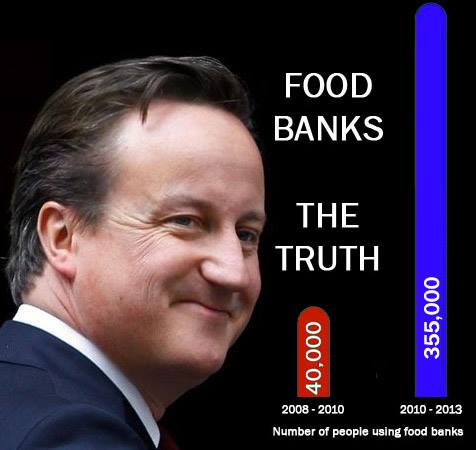
Welfare reforms, food banks, malnutrition and the return of Victorian diseases are not coincidental, Mr Cameron

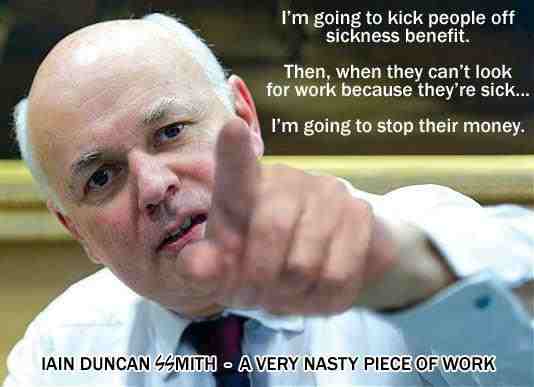
1390648_548165358586330_1740107407_n
The coalition will leave more debt than all Labour governments since 1900. The current government is now responsible for £517 billion of the trillion-plus-pound UK public debt, compared to £472 billion accrued during the 33 years Labour led the country since the turn of the twentieth century.

And the figures look even worse when you adjust for inflation. When you do that, the Coalition’s share jumps to nearly half of the total debt.

But the Coalition don’t meet any public needs, they simply serve the wants of a powerful, wealthy elite. Labour invested in public services, the Tories have bled them dry. So, what have they done with the money? Because the public have seen only austerity cuts. And the most vulnerable citizens bear the brunt of the cuts.

Oxfam’s director of campaigns and policy, Ben Phillips, said: “Britain is becoming a deeply divided nation, with a wealthy elite who are seeing their incomes spiral up, while millions of families are struggling to make ends meet.”

“It’s deeply worrying that these extreme levels of wealth inequality exist in Britain today, where just a handful of people have more money than millions struggling to survive on the breadline.”

Diseases associated with malnutrition, which were very common in the Victorian era in the UK, became rare with the advent of our welfare state and universal healthcare, but they are now making a reappearance because of the rise of numbers of people living in absolute poverty.

NHS statistics indicate that the number of cases of gout and scarlet fever have almost doubled within five years, with a rise in other illnesses such as scurvy, cholera, whooping cough and general malnutrition. People are more susceptible to infectious illness if they are under-nourished.

In 2013/14, more than 86,000 hospital admissions involved patients who were diagnosed with gout – an increase of 78 per cent in five years, and of 16 per cent on the year before. Causes of gout include a lack of vitamin C in the diet of people who are susceptible.

The figures from the Health and Social Care Information Centre (HSCIC) show a 71 per cent increase in hospital admissions among patients suffering from malnutrition – from 3,900 admissions in 2009-10 to 6,690 admissions in 2013-14.

Cases of scarlet fever admitted to hospital doubled, from 403 to 845, while the number of hospital patients found to be suffering from scurvy also rose, with 72 cases in 2009/10 rising to 94 cases last year.

The figures also show a steep rise in cases diagnosed with cholera, a water-borne disease which was extremely prevalent in the 19th century, causing nearly 40,000 deaths.

While total numbers remain low, the 22 cases last year compare with just 4 in 2009/10, the statistics show.

Dr Theresa Lamagni, Public Health England’s head of streptococcal infection surveillance, said the total number of notifications of scarlet fever this year has already reached 12,580 cases – the highest since 1970.

Cases of measles in hospital rose, from 160 to 205 cases, with a small rise in admissions for whooping cough, from 285 to 289 cases over the five years examined.

The figures on malnutrition follow a series of scandals of care of the elderly, with doctors, remarkably, forced to prescribe patients with drinking water or put them on drips to make sure they do not become severely dehydrated.

Charities have warned that too many patients are being found to be malnourished after being admitted to hospitals from care homes, as well as from their own homes.

However, Labour have said the figures a national scandal.

Luciana Berger MP, Labour’s Shadow Public Health Minister, said: “This shouldn’t be happening in 21st century Britain and the Government’s response is hopelessly complacent.

“People are living under greater pressure and struggling with the cost of living”.

“Hundreds of thousands are forced to turn to food banks and sadly it’s unsurprising people are eating less, and eating less healthily too”.

“David Cameron needs to listen to what the experts are saying and tackle the cost of living crisis that is driving people into food poverty.”

Cases of malnutrition have been steadily increasing since the 2010 general election.

In 2009/10 there were 3,899 hospital admissions for this, in 2010/11 there were 4,660, in 2011/12 there were 5,396 then in 2012/13 this had risen again to 5,594.

People unable to feed themselves adequately needing hospital admission saw a significant rise to 6,686,  where malnutrition was the primary or secondary diagnosis during 2013/14.This is a rise of 71 per cent from 3,899 in the year up to April 2010.

Chris Mould, chief executive of the Trussell Trust which runs a nationwide network of food banks, said: “This shows increases in diseases related to poverty and that’s alarming.

“Our food banks see tens of thousands of people who have been going hungry, missing meals and cutting back on the quality of the food they buy.

“We know quite a large proportion of the population are struggling to get nutritious food on the table. And at the extreme end of that you get people who are malnourished”.

“We don’t believe anyone should have to go hungry in the UK”.

“The scale of the increases we’re seeing must be further investigated to find out why this is happening”.

Scurvy is a disease associated with pirates stuck at sea for long periods – has increased by 31 per cent in England since 2010. This is caused by a lack of vitamin C and is usually due to an inadequate diet without enough fresh fruit and vegetables.

Figures from January this year from the NHS indicate that there were 833 hospital admissions for children suffering from Rickets – a condition which is caused by a lack of Vitamin D, from 2012-13. Ten years ago, the figure was just 190.

The disease, which causes softening of the bones and permanent deformities, was common in 19th century Britain but was almost eradicated by improvements in nutrition. The body produces vitamin D when it is exposed to the sun, but it’s clear that adequate diet plays an important role, too, since the decline of Rickets happened at a time when we saw an improvement in the diets of the nation as a whole.

It is thought that malnutrition is the main cause, children are most at risk if their diet doesn’t include sufficient levels of vitamin D.

Low incomes, unemployment and benefit delays have combined to trigger increased demand for food banks among the UK’s poorest families, according to a report commissioned by the government and released earlier this year,

The report directly contradicts the claim from a government minister that the rise in the use of food banks is linked to the fact that there are now more of them. It says people turn to charity food as a last resort following a crisis such as the loss of a job, or problems accessing social security benefits, or through benefit sanctions.

The review emerged as the government comes under pressure from church leaders and charities to address increasing prevalence of food poverty caused by welfare cuts. The End Hunger Fast campaign called for a national day of fasting on 4 April to highlight the issue.

The report was written by  food policy experts from the University of Warwick, and it was passed to ministers in June 2013 but had remained undisclosed until February 2014, creating reasonable speculation that the government suppressed its findings.

Examining the effect of welfare changes on food bank use was not a specific part of its remit, and the report is understood to have undergone a number of revisions since early summer, ordered by the Department for Food and Agriculture and the Department for Work and Pensions (DWP).

The researchers found that a combination of rising food prices, ever-shrinking incomes, low pay, increasing personal debt, and benefit payment problems meant an increasing number of families could not afford to buy sufficient food.

In a letter to the British Medical Journal, a group of doctors and senior academics from the Medical Research Council and two leading universities said that the effect of Government policies on vulnerable people’s ability to afford food needed to be “urgently” monitored.

The group of academics and professionals said that the surge in the number of people requiring emergency food aid, a decrease in the amount of calories consumed by British families, and a doubling of the number of malnutrition cases seen at English hospitals represent “all the signs of a public health emergency that could go unrecognised until it is too late to take preventative action”.

The health specialists also said:“Access to an adequate food supply is the most basic of human needs and rights”.

The authors of the letter, who include Dr David Taylor-Robinson and Professor Margaret Whitehead of Liverpool University’s Department of Public Health, say that they have serious concerns that malnutrition can have a long-lasting impact on health, particularly among children.

Tory ministers have repeatedly insisted that there is no “robust link” between the welfare reforms and rising food bank use, whilst welfare minister Lord Freud claimed the rise in food bank use was because there were more food banks and because the food was free.

It ought to be noted, not least by the government, that people may only access food banks when they are referred by a professional agency, such as social services, the DWP or a Doctor. In particular, vouchers for emergency food parcels tend to be given by benefits officials.

In all but exceptional cases, Trussell Trust food banks will only issue a food parcel to someone with a voucher from an accredited agency. Claimants are limited to emergency aid on three occasions only. This indicates that need, rather than availability, is the key reason for the increased use of food banks since 2010.

Together with the pressure created by rising prices and falling wages, there has been a marked increase in demand for emergency food aid since the welfare reforms came into effect. And this is affecting both people in and out of work.

More than half of people who have visited a food bank since April were referred because of social security problems.

The Government claimed the rapid increase in malnutrition cases “could be partly due to better diagnosis”.

I don’t imagine that it’s likely that Doctors have suddenly become better at diagnosis since 2010.

I do, however, think there is much scope for improvement in the capacity of Tory ministers for understanding correlation, basic cause and effect and simple connections.

However, Tory skills in mendacity, creating diversions and ad hominem are second to none.


See also:

Poverty

 An email to authoritarian Tory MPs Charlie Elphicke, Priti Patel and Conor Burns

Quantitative Data on Poverty from the Joseph Rowntree Foundation.

430835_148211001996623_1337599952_n (1)

Pictures courtesy of Robert Livingstone 


Eugenics is hiding behind Hitler, and it informs Tory and Labour policies.

eugenics

One of the commentators on this site raised some interesting issues, in response to part of an article that I wrote, which warrant some discussion.

I had said: “Eugenics is now embodied in economic acts, carried out by a government that has systematically rigged the neoliberal market, the act of [state] murder simply requires policies that leave the poorest and the most vulnerable people without support to meet their basic survival needs, denial from government that this is happening, and then it’s just a matter of withholding or hiding the evidence ….  the Right are and always have been Social Darwinists.”

The response: “I think you exaggerate a bit by bringing in eugenics – which was a deliberate attempt to wipe out/sterilise large proportions of the poor, whereas here it’s only a side effect that the powerful aren’t particularly concerned about.

There is a strong sense of the ‘deserving and undeserving poor’ in Tory narratives though, and I find the lack of empathy mindboggling. Particularly as David Cameron himself had a severely disabled son, so must have first-hand knowledge of the expensive nature of care for the disabled.

I don’t disagree with them [the Tories] being Social Darwinists at all – there is a brutal ‘survival of the fittest’ logic to many of their policies in practice. But eugenics is different – I don’t believe that anyone in the current government actually wants the poor and disabled to be dead or infertile, just that they don’t want to pay to support them. There’s a small, but important, distinction between neglect and genocide.” 

There are several facets to my initial response. Firstly, eugenics is tightly entwined with social Darwinist ideology. Charles Darwin’s theory of natural selection and concept of the “struggle for existence,” presented in his On the Origin of Species in 1859, captivated the minds of biologists and policy makers. Darwin’s ideas also played to the dangerously receptive imaginations of certain members of Victorian society. It resonated strongly with ideological individualism and with laissez faire economics – the dominant paradigm of the era.  The ideas became embedded in political and economic theory and policies.  Francis Galton, Darwin’s half-cousin, introduced his own controversial idea—the theory of eugenics—in 1883.  He used “natural selection” as the basis of his theory to describe selective breeding in humans as a means to improve the “fitness” of the human race. These ideas were part of a broader notion of  “progress” during the era of modernity.  Any idea that aims at ensuring the “survival of the fittest” is essentially eugenic.

The cross-over of natural selection themes from “science” into political and social thinking is reflected in the fact that it was a sociologist, not a scientist, who coined the term “survival of the fittest” – the very Conservative Herbert Spencer.

Neoliberalism, which has been the dominant framework of socio-economic organisation since the Thatcher era, is underpinned with eugenic notions. It justifies “competitive individualism” and both creates and legitimises wide economic inequalities. 

While the government may not be committing conspicuous murder, people ARE dying as a consequence of Conservative policies. Ethically, is there any difference between withdrawing lifeline support for vulnerable citizens and letting “nature take its course” on the one hand, and taking up more visible and overt methods of eliminating perceived “faulty” traits” and disposing of “undesirable” people on the other? Some people call the government’s “eugenics by indifference'”approach ‘democide‘, rather than genocide.

However,  policies tend to have INTENDED aims and consequences.

The pertinent question is: are the well-documented welfare-related deaths an intentional consequence of Conservative policies or simply because of government “neglect” regarding consequences of their policies? Does withdrawing essential state support for the poorest citizens, disabled citizens and vulnerable social groups constitute eugenics? 

I think it does. A government that kills citizens, regardless of the means that are used, is not a democratic one. Nor is it in any way liberal. 

The objectives of democide include the disintegration of the political and social institutions of culture, language, national feelings, religion, and the economic existence of national groups; the destruction of the personal security, liberty, health, dignity; and sometimes, the lives of the individuals belonging to such groups. While genocide is regarded generally as political murder on the basis of race, democide covers a broader definition to include those killed in large numbers as a result of government policies, regardless of ethnicity. 

There is an intimate and historical connection between Social Darwinism and eugenics, which is worth some discussion, because ideology has considerable bearing on policies, and policies may be regarded as objective statements of political intent regarding how a government thinks society should be socioeconomically organised.

Social Darwinism was one of the pillars of fascism and Nazi ideology, and the consequences of the application of policies based on notions of “survival of the fittest” by the Nazis drove the eugenics program, which eventually created a very powerful international backlash against the theory, culminating in the Universal Declaration of Human Rights

Social Darwinists interpret human society primarily in terms of biology, struggle, competition, and natural law (a philosophy based on what are considered to be the immutable characteristics of human nature). Social Darwinism characterises a variety of past and present social policies and theories. Social Darwinism explains the philosophical rationalisation behind racism, imperialism, capitalism and eugenics.

The term quite rightly has negative implications for most people because we consider it a rejection of democracy,  decency, compassion, civilisation and social responsibility, and a devaluing of human life.

Neoliberalism is incompatible with democracy, human rights and notion of equality. It is all about competitive individualism and it also normalises  inequality. Neoliberal ideology has become a throw back to the New Poor Law of 1834. The poorest are financially punished for being poor, while the very wealthy are consistently rewarded for being rich. It doesn’t take a genius to work out why inequality is so high in the UK, or why poverty continues to grow. When Tories, and more recently, the Labour government tell us they want to ‘grow the economy’ we should be asking ‘for whom’? Who will benefit from this? Because so far, all we see is government policies that make the poorest citizens even poorer. We are gradually being excluded from economic consideration, and the poorest are seeing their lifeline support ripped away. 

Any social policy based on an underpinning philosophy of Social Darwinism –  explicitly or implicitly – invariably has eugenic implications. Modern eugenics was rooted in the Social Darwinism of the late 19th century, and is used to justify a hierarchy of entitlement to rights, State withdrawal of support for the most marginalised (and vulnerable) social groups, with all of its associated metaphors of fitness, competition, and intrinsic, tautological rationalisations of inequality.

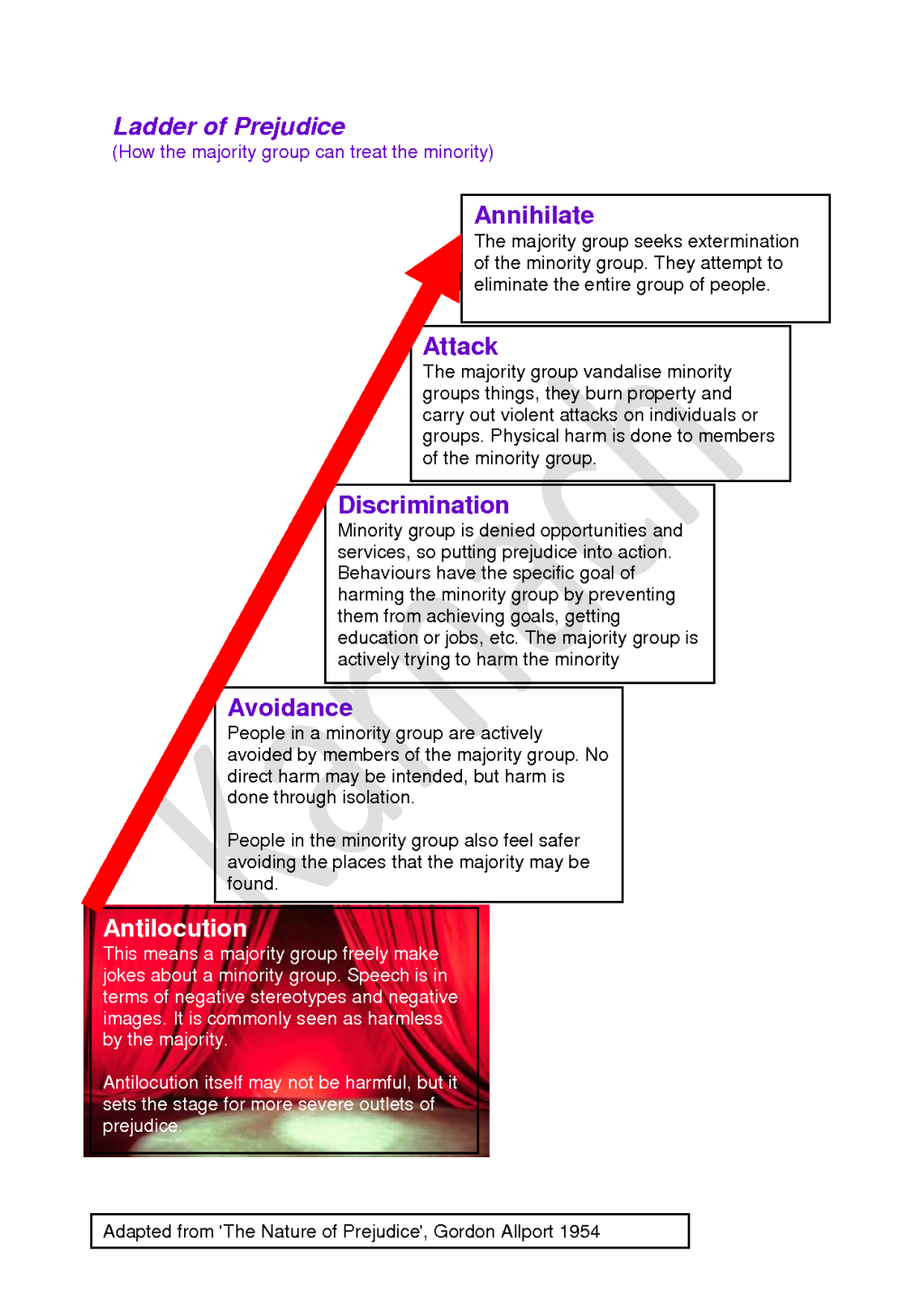
I want to make clear at this point that any consideration of the political and psychosocial processes that culminated in the atrocities of the Holocaust is not in any way an attempt to trivialise those events. Quite the contrary. In recognising the processes that important researchers such as Gordon Allport identified – the unfolding stages involved in the growth of prejudice in a society that manifests othering, outgrouping, and permits a society to incrementally discriminate and hate over time – and in drawing parallels, we may try to ensure that such atrocities never happen again.
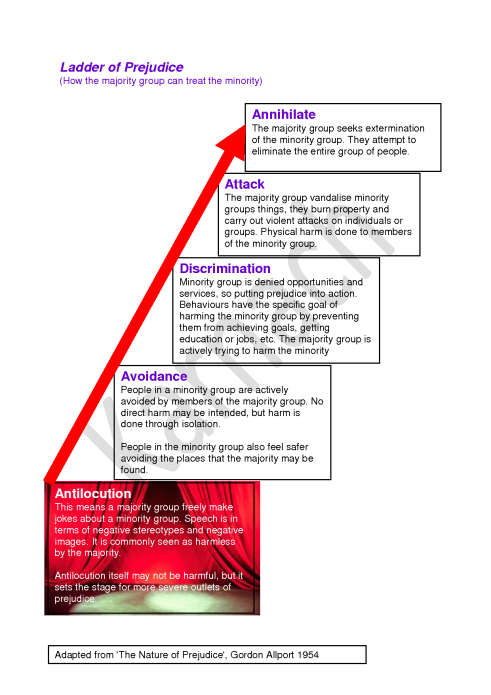
Allport's ladder

Eugenic theories are most commonly associated with Nazi Germany’s racially motivated social policies. The Nazis sought the improvement of the Aryan race or Germanic Ubermenschen – master race – through eugenics, which was the foundation of Nazi ideology.

Those people targeted by the Nazis were identified as life unworthy of Life Lebensunwertes Leben – including but not limited to the “idle”, “insane”, “degenerate”, “dissident”, “feeble-minded”, homosexual and the generally weak, for elimination from the chain of heredity. More than 400,000 people were sterilised against their will, whilst 275,000 were killed under Action T4, a “euthanasia” programme.

However, there is quite a broad definition of eugenics and I propose that because it has been so thoroughly discredited, it has been forced to “go incognito” over the last century. The public support for eugenics greatly waned after the fall of Nazi Germany and the Nazis’ attempt to use eugenic justifications for the Holocaust at the Nuremberg Trials.

Right-wing philosopher, Roger Scruton, said in an article in the American Spectator: “The once respectable subject of eugenics was so discredited by Nazism that “don’t enter” is now written across its door,” implying he would like to see more openness to eugenics as an idea. In a way, he does make a valid point, because when what was once stated explicitly becomes implicit and tacit – normalised – it is difficult to oppose and challenge, essential debate is therefore stifled.

Eugenics is the infamous idea that governments should decide which kinds of citizens ought to be considered desirable – the consensus tends to be that these are white, athletic, intelligent, and wealthy – and which kinds of citizens ought to be considered undesirable – these tended to be black, Jewish, disabled, or poor –  and employ the power of the State to encourage increases of desirable citizens (positive eugenics) and encourage decreases of undesirable citizens (negative eugenics).

Eugenics is specifically State interference in and engineering of the “survival of the fittest”. That is happening here in the UK, with Tory policies like the extremely punitive welfare “reforms”, which are aimed at the most vulnerable citizens – such as those who are seriously ill and/or disabled – all too often denying them the means to meet basic survival needs.

The founder of eugenics, Sir Francis Galton, who was a half-cousin of  Charles Darwin, formulated the idea that the protection afforded by civil society had prevented the kind of natural selection occurring in Darwin’s Origin of Species from happening in humans, thus perpetuating the existence of “weak and feeble-minded” people who would have been unable to survive in the “state of nature”.

Thomas Malthus went further, and is most often considered the founding father of this ideology of profound antihumanism: he also believed that giving support to the needy would only imperil everyone else, because resources are limited, so the brutal reality was that it was better to let them starve. Malthus held the belief that the poor are akin to a “horde of vermin whose unconstrained aspirations and appetites endanger the natural order”: that tyrannical measures are necessary to constrain humanity.

It was Malthus that offered a pseudo-scientific basis for the idea that human reproduction always outstrips available resources. Following this pessimistic and inaccurate assessment of the capacity of human ingenuity to develop new resources, Malthus advocated oppressive policies that led to the starvation of millions in India and Ireland.

Malthus’s position as professor at the British East India Company training college gave his theories considerable influence over Britain’s administration of India through most of the nineteenth century, which led to the official response of neglect to India’s periodic famines.

Malthus wrote about restraints on population growth which included famine, disease and war. His theory was later used to explain the British government policy of maintaining agricultural exports from Ireland during the Great Famine (1845-49) in which at least 1.5 million people died of starvation or the side-effects of malnutrition, and at least another million immigrated.

Malthus was also very influential in bringing about the punitive Poor Law Amendment Act of 1834. His work, An Essay on the Principle of Population, was a product of that era, it resonated with the laissez-faire framework of competitive individualism, and the dominant socio-political paradigm. It remains influential today, despite being thoroughly discredited, not least by social history since his time of writing.

Prior to the Holocaust, eugenics was widely accepted in the UK. Malthus’s ideas on population control and Spencer’s Social Darwinism fitted neatly into the sociopolitcal ideological framework. The ruling elite feared that offering medical treatment and social services to disabled people would undermine the natural struggle for existence and lead to the degeneration of the human race.

Those ideas, once explicitly endorsed, are now implicitly captured in policies and Conservative narratives about sanctions, “conditionality,”  “making work pay,” (compare with the principle of less eligibility enshrined in the New Poor Law) “fairness,” “incentives,” “scroungers,” and so forth. A crucial similarity with the early part of the century and now is reflected in Tory austerity rhetoric – a perceived shortage of resources for health and welfare. Another parallel is the scapegoating process and a rise in the level of social prejudices and sociopolitical discrimination.

Anti-immigration rhetoric, reflected in the media, with the vilification of sick and disabled people and the poor, has preceded policies particularly aimed at the steady removal of State support indicating a clear scapegoating process, and this isn’t indicative of a government that is “neglectful”- it is patently intentional, hence the pre-emptive “justification” narratives to garner public support and acceptance towards such punitive and harsh policies.

So, the first purpose of such justification narratives is to make cruel and amoral policies seem acceptable. However, such propaganda narratives also serve to intimidate the targeted minority, leading them to question whether their dignity and social status is secure. In many instances, such intimidation is successful.

Furthermore, this type of hate speech is a gateway to harassment and violence. (See Allport’s scale of prejudice, which shows clearly how the Nazis used this type of propaganda and narrative to justify prejudice, discrimination, to incite hatred and ultimately, to incite genocide.)

As Allport’s scale indicates, hate speech and incitement to genocide start from often subtle expressions of prejudice. The dignity, worth and equality of every individual is the axiom of international human rights. International law condemns statements which deny the equal worth of all human beings. This is for very good reason.

Article 20(2) of the ICCPR requires states to prohibit hate speech. Hate speech is prohibited by international and national laws, not because it is offensive, but rather, because it amounts to the intentional degradation and repression of groups that have been historically oppressed. In the UK, we have a government that endorses the repression of the historically oppressed.

Social Darwinists generally argue that the “strong” should see their wealth and power increase while the weak should see their wealth and power decrease. In most contemporary western societies these views tend to emphasise competition between individuals for resources in a neoliberal State. In the UK, this idea is very apparent in the policies of the conservative-led government, and previously, we saw similar views from Thatcher.

The biological concept of “adaptation” is used by the Right to claim that the rich and powerful are better adapted to the social and economic climate of the time, and the concept of natural selection perpetuates the supremacist argument that it is natural, normal and proper for the strong to thrive at the expense of the weak.

Notions of deserving and undeserving poor flourished at a time when Social Darwinism and eugenics where widely acceptable here in the UK. The utilitarianism of Jeremy Bentham and John Stuart Mill, identifying moral actions in public policy as those which produce the greatest good for the greatest number, also support the contention that, whilst in the short term the interests of the poor would seem to be supported by public relief, the ultimate result of relief is detrimental to their interests.

Social Darwinism was popular in the late Victorian era in England, America, and elsewhere and the ethical philosophies of Conservatives are underpinned by a strongly elitist view based on the pseudo-scientific arguments of “adaptation and natural selection.” The Victorian era has made a deep impact upon many contemporary Conservatives, such as Gove and Osborne.

Michael Gove has written: For some of us Victorian costume dramas are not merely agreeable ways to while away Sunday evening but enactments of our inner fantasies … I don’t think there has been a better time in our history” in “Alas, I was born far too late for my inner era”.

A better time for whom, precisely? It was a time of child labour, desperation, prostitution, low life expectancy, disease, illiteracy, workhouses, and a truly dog-eat-dog social perspective. Or was it the deferential protestant work ethic reserved only for the poor, the pre-destiny of the aristocracy, and “the rich man in his castle, the poor man at his gate” that appeals to Gove?

In a speech to the Confederarion of British Industry, (CBI) George Osborne argued that both parties in the coalition had revitalised themselves by “revisiting their 19th-century roots.”

Herbert Spencer’s Social Darwinism, with his dictum “the survival of the fittest” – he was a sociologist, not a biologist – provided further support for the view that the “vices” of the lowest class in society make such persons undeserving of help from those who were financially privileged. (“Us” are the fittest: “Them” – the “Other” – are not.)

It is but a short step from the eugenics movement of the early twentieth century to the radical individualism of Ayn Rand, the latter’s popularity on the Right continuing to support a Conservative libertarian celebration of selfishness – “Nobody is mine.”

And:1965037_301820166635705_1502392114_n (1)
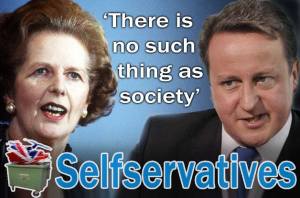
Conservatives have always seen society and human relationships in terms of hierarchies, based on “red in tooth and claw” Darwinist conflict. A hierarchy is any system of persons or things ranked one above the other, on the basis of human worth.

The term was originally used to describe the system of church government by priests graded into ranks. Organised religion is very hierarchical. Hierarchical thinking is about seeing the world through systems of  worth, domination or importance. But the central principle of human rights is that each have equal worth: that we are all equally important. But hierarchies ensure that privilege and decision-making is not socially distributed. Nor is power.

The very way that Tories think leads to a collision between their ideology and our human rights, and is completely incompatible with the principles of equality and democracy. Tories think that some people hold a more important place in society than others. This reduces people – they become inferiors or superiors, and really, that is about unequal distribution of power, subordination and domination – those power relationships are no longer entirely notional, we have moved some distance from being a liberal democracy these past four years – and feudalism and manorialism are very Tory ideals. 

It’s worth noting that disabled people have been disproportionately affected by the government’s austerity programme. People are dying prematurely because the government has radically cut their lifeline support, leaving them without the means to meet their fundamental survival needs.

To summarise, there are strong links between the neoliberal idea of competitive individualism, Social Darwinism, social inequalities, eugenics, nationalism, fascism and authoritarianism. Those ideas are implicit in Tory rhetoric, because they form the very foundations of Tory ideology. A society with inequalities is and always has been the ideologically founded and rationalised product of Conservative Governments. Inequality is at the heart of ‘competitive individualism’ which is at the heart of neoliberal ideology. In any competitive system, there are always a handful of ‘winners’ and many more ‘losers’. 

Robert Michel’s iron law of oligarchy describes the inevitable tendency of hierarchical organisations to become oligarchic in their decision making – anti-democratic. And prejudice is an in-built feature of hierarchy, because of the stratified nature of power, esteem and status.  Right-wing populism so often takes the form of distrust of the European Union, and of politicians in general, combined with anti-immigrant rhetoric, and a call for a return to “traditional, national values”.

Those “traditional values” that the Tories cherish, and often speak about, mean the end of our hard-earned rights, the end of any principle of the equal worth of everyone, the end of government accountability and increasingly, legal restraint, the end of democracy, the end of access to social opportunities, the end of any meaningful citizen autonomy. Yet these are civilising conditions. The Tories would prefer to have us outwardly oppressed and inwardly repressed, and fighting amongst ourselves for ever-decreasing resources.

This government’s schadenfreude, the intent and motivation behind the draconian policies that we’ve seen this past four years, which target the most vulnerable citizens most of all, is debated.

Some people believe that the policies are a consequence of a redistribution of wealth from the poorest to the wealthy rather than being malicious acts. But the Tories laughed on hearing the accounts of suffering of the poor because of the bedroom tax and an increasing dependency on food banks, for all to see, during parliamentary debate with the opposition.

But entertaining the idea for a moment that the inflicted suffering is not a motivation but rather, a consequence, well that would make the Government at the very least indifferent, callous and unremorseful, since they show a supreme lack of concern for the plight of those least able to defend themselves against injustice and inflicted poverty. And such indifference contravenes fundamental human rights. It breaches international laws.

Either way, I feel shock and anger at the recognition that all of those principles and beliefs we held dear – such as justice, fairness, democracy, freedom, Government accountability, equality (at least in terms of the worth of each life), institutionalised philanthropy – all trodden under foot by advocates of Social Darwinism – an aristocratic elite – in just four years. And the faith we each had in those collective ideals undermined by the constant perpetuation of socially divisive propaganda tactics from the Right.

Dividing people by using blame and prejudice further weakens our opposition to oppression. It’s a strategy the Tories have mastered.

Government policies are expressed political intentions, regarding how our society is organised and governed. They have calculated socio-economic aims and consequences. None of the policies that this government have formulated regarding the “support and care” of some of the most vulnerable citizens could be seen as anything other than expressions of intentional harm.

Services and support have been cut, lifeline benefits have been restricted by a variety of means, such as the revolving door process application of the work capability assessment, benefit sanctions, the mandatory reconsideration process.

Where is the investigation into the very high number of deaths associated with the Tory-led welfare reforms? The government have been made aware of those deaths through parliamentary debate, yet they persist in denying any “causal link” with the significant increase of sick and disabled people dying and their savage cuts to lifeline benefits. If there is no causal link, an inquiry would demonstrate that, surely?

It’s a universally recognised fact that if people are prevented from meeting their basic survival needs, they will die. Benefit sanctions, and cuts to welfare and public services, the rising cost of living and the depression of wages are having a detrimental effect on many. I don’t imagine that it’s the case that everyone but the government are aware of this. Yet the harmful policies remain.

The Coalition will leave more debt than all Labour governments since 1900. The current government’s now responsible for £517 billion of the trillion-plus-pound UK public debt, compared to £472 billion accrued during the 33 years Labour led the country since the turn of the twentieth century.

And the figures look even worse when you adjust for inflation. When you do that, the Coalition’s share jumps to nearly half of the total debt.

But the Coalition don’t meet any public’s needs, they simply serve the wants of the 1%. Labour invested in public services, the Tories have bled them dry. So, what have they done with the money? Because the public have seen only austerity cuts.

These policies are intentional. Withholding State support for poor, disabled, ill and vulnerable people – paid for via our taxes – is a deliberate act.

While our government have been busy denying the eugenics-by-stealth consequences of their diabolical policies in this Country, back in 2012, the Guardian exposed the fact that the British government has spent millions of pounds funding a policy of forced sterilisation of the poor in India as part of an effort to reduce human population to “help combat climate change”. But we also know that many Tories deny climate change exists.

The governments of China and India practice hard eugenics, underwritten by American and British tax money, these are coercive measures undertaken by governments to decrease citizen population.  The exposure of support for hard eugenics prompted denial and backtracking.  United Nations Population Fund (UNFPAclaims to support “voluntary family planning” in China. They assume that women, who are aware that conceiving a second child will result in a forced abortion, are free to make choices – thus the forced abortion is a State arrangement entered into “voluntarily.”

Hard eugenics is the ideology that is hiding behind Hitler. But soft eugenics  is based on the same pathological belief – that a government should spend its resources to prevent the propagation of those who the government believes to be “detrimental” to society and economic production. It won’t be long before there is some UK policy that imposes a restriction on the number of children poor people may have – probably “soft” eugenic policy, initially. Perhaps a limit on the number of children that unemployed or underemployed families may claim support for. Of course that will have ghastly ramifications for the human rights of children, since it would discriminate against a child on the grounds of when he/she was born.

Here in the UK, our government has been quite explicit in its drive to end “the something for nothing culture”. Our taxes  have been handed out to the wealthy and State support has been steadily withdrawn from the vulnerable. Government policies are an explicit statement of political and socio-economic intentions.

Policies based on Social Darwinism and eugenics cannot be justified. Our morality is liberated from the biological, reductionist constraints of evolutionary thinking. We relate to one another through culture, shared histories, language, morality, and law. Even if it were true that we are biologically determined – fixed by evolution, as intentional beings, we are not culturally fixed.

There is a difference between what we are, and who we are. There is also a difference between what is and what ought to be. The theories of Social Darwinism, eugenics and sociobiology involve biological reductionism. A recognition of the importance of biological conditions and even “human nature” need and ought not involve biological reductionism. And to embrace reductionism is to ultimately deny our capacity for making rational choices.

But we exceed the limits of reductionism and determinism every time we make any claim to knowledge (including those claims of reductionism and determinism), make a choice, discuss ethics and morals, explore possibilities, create, discover, invent – we are greater than the sum of our parts. The humanist ideas of human potential have never interested the Tories.

However, humanist principles, particularly those of Maslow, are very closely connected to our human rights and the development of our welfare state. Maslow’s psychology about possibility, not restraints. His metaphysics were all about the possibilities of change and progress, within a democratic framework. These ideas run counter to Tory ideology.

It’s therefore of no surprise that the Tory-led Coalition has steadily eroded our welfare and public service provisions and that Cameron has stated plainly that he fully intends to repeal the Human Rights Act and withdraw from the European Convention on Human Rights

This is a government that chooses to treat our most vulnerable citizens brutally, with absolutely no regard for their legal and moral obligation to ensure that our taxes are used to meet our most basic needs.

There can be no justification for editing or repealing the Human Rights Act itself, that would make Britain the first European country to regress in the level and degree of our human rights protection. It is through times of recession and times of affluence alike that our rights ought to be the foundation of our society, upon which the Magna Carta, the Equality Act and the Human Rights Act were built – protecting the vulnerable from the powerful and ensuring those who govern are accountable to the rule of law, and as an instrument of equality, social cohesion and public purpose.

It is expected of a democratic government to improve the understanding and application of the Act. That is an international expectation, also. Quite rightly so.

Observation of human rights distinguishes democratic leaders from dictators and despots. Human Rights are the bedrock of our democracy, they are universal and are a reflection of a society’s and a governments’ recognition of the equal worth of every citizens’ life.

We need to ask, in light of the issues I’ve raised here, why would any government want to opt out of such protections for its citizens?

We know from history that a society which isn’t founded on the basic principles of equality, decency, dignity and mutual respect is untenable and unthinkable.

scroll2

Article 2 of the Convention on Human Rights uses the following definitions of genocide, amongst others:

  • Killing members of the group
  • Causing serious bodily or mental harm to members of the group.
  •  Deliberately inflicting on the group conditions of life calculated to bring about its physical destruction in whole or in part
  • Imposing measures intended to prevent births within the group
  •  Forcibly transferring children of the group to another group

The right to life contained in Article 2:

  • Prohibits the State from intentionally killing;
  • and  requires an effective and proper investigation into all deaths caused by the State.

14533697838_dffcc736f2_o (1)

Pictures courtesy of Robert Livingstone

My work isn’t funded and I don’t get paid to write. But you can support Politics and Insights, and help me to continue researching, analysing and writing independently.

The smallest amount is much appreciated, and helps to keep my articles free and accessible to all – thank you.

And a massive thank you to those who have already contributed.

DonatenowButton
cards

The disgruntled beast

10437171_327099100774478_1052932761_n

Miliband doesn’t pander to populism, and upholds the inclusion, equality and diversity principles that are embedded in policies which Labour pioneered. He aims to address and curtail exploitative employers, which of course is a real problem, rather than migrants, who are being exploited in the same way that “nationals” are. We have workfare, analogous to slavery and counterproductive in decreasing unemployment, which is universally exploitative, and absolutely nothing to do with the poor migrants, and everything to do with profit-driven greed, and a government that has encouraged that greed to thrive and flourish at such catastrophic expense to others.

Miliband knows that Britain is not divided by race and culture, it’s divided by wealth inequalities fuelled by the Tory-led Coalition’s austerity policies. Blaming the unemployed, the sick and disabled and immigrants for the failings of the government has fuelled misperceptions that drive support for the far-right. People complain they can’t get council houses, and the only really honest question an honest politician ought to ask is: “Why aren’t there more council houses?”

And when there are large numbers of people receiving unemployment benefit or tax credits, then the only honest question to ask is: “Why is the economy failing to provide enough jobs, or pay adequate wages?”

Miliband’s emphasis on equality is bothering the Tories, because their entire ideology is founded on Social Darwinism: to the Tories, inequalities are an inevitability, because of their emphasis on competition between individuals for resources in the “free market.” Miliband’s social democracy program provides an alternative that challenges the established right-wing neoliberal consensus.

The media and the government have stigmatised vulnerable social groups as a justification of cruel and punitive policies aimed at those least able to fight back, as an explanation of the failings of this government to be fair and honour a degree of legislation to reflect public needs – the public they are meant to serve.

As a society that once promised equality and democracy, we now preside over massive inequalities of wealth: that’s a breeding ground for racism and other vicious resentments.

It’s awoken the disgruntled beast within people, the one that feeds on anger, demoralisation, fear, resentment and uncertainty.

And wherever antipathy and a degree of enmity exist, the far-right have always tried to perpetuate, exploit and increase rancour. The fascism of the 20s and 30s gained prominence because it played on wider public fears, manipulating them, and deflecting attention, as ever, from those who are truly to blame for dire social conditions: the ever-greedy elite. There’s a well-established link between political extremism, economic hardship and recession and social cleavages, with the far-right “anti-system” parties deceitfully winning the support of those who would never previously have thought of themselves as extremists.

Such extremism and rancour feeds the disgruntled beast. The political right have always sought to divide sections of the poor and middle class and set them to fight one against the other; to have us see enemies in our midst which do not exist, so that we see economic policies – the Tory-rigged “free market” competition – as the solution rather than the cause of our problems.

And here we are again. A Tory government, another rigged recession, and the politics of fear, despair and micro-managed discontent.

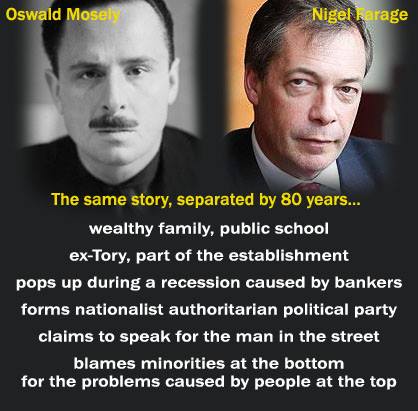
Fascism plays a specific role for the ruling class: it is a weapon against civil unrest during social crises caused by recession. It redirects public anger from the government to scapegoats. To build such a movement, fascists have to delve into the “lower classes” using a mixture of crude economic radicalism and racism. Oswald Mosley also started out as a Tory and he was a rich aristocrat. His tactic was “street politics”, rather like Farage’s appeal to woo “ordinary people.” Mosley cut himself adrift from the mainstream ruling class when in early 1934, he launched a campaign for street supremacy in key working class areas.

Farage is comparable with Mosely: he also tried to entice the working class, and those blue collar defectors who don’t feel solidarity with anyone except their “own kind” need to ask themselves how a fascist party would better reflect their interests, because fascists aren’t just fascists when it comes to your preferred target group – in this case migrants – fascists are fascists, full stop. And most migrants are working class, too.

Fascists are not known for being big on unions and worker’s rights either, Hitler smashed the unions, Mosely fought them too. But fascists do like to use the oppressed to oppress others.

Mosely was defeated by working class solidarity – Jews, communists, socialists, the labour movement, and the middle classes, who all stood side by side in Scotland, Newcastle, in the Valleys, Yorkshire, at Olympia and on Cable Street. Unity and regard for the rights and well-being of others was their greatest strength.

That community spirit and solidarity is precisely what we need to find again. The disgruntled beast is divisive, and it feeds on demoralisation, alienation, feelings of isolation and a lack of regard for others.

Identity politics and the faultlines of division

Lynton Crosby, who has declared that his role is to destroy the Labour Party, rather than promote the Conservatives, based on any notion of merit, is all about such a targeted “divide and rule” strategy. This is a right wing tactic of cultivating and manipulating apostasy amongst support for the opposition. It’s a very evident ploy in the media, too, with articles about Labour screaming headlines that don’t match content, and the Sun and Telegraph blatantly lying about Labour’s policy intentions regularly.

One major ploy has been to attempt to rally the disgruntled working classes behind the flag of identity politics – aimed exclusively at the most disgruntled, very purposefully excluding other social groups. It also sets them against each other, for example, the working class unemployed attacking migrants – it really is divisive, anti-democratic, and flies in the face of labour’s equality and diversity principles. It also enhances the political myth of convenience – the “out of touch/allthesame MPs”, some of those stoked-up disgruntled blue collar workers have defected to UKIP.

There’s an immediate danger that if the far-right succeed in colonising the anti-mainstream vote, as they are aiming to, and developing party loyalty, it will block the development of an independent working class politics capable of defending our conditions and challenging the status quo.

UKIP (and the Tories) first and foremost are traditionalists and defenders of property, with the socially paranoid ideology of the hard right. A dominant theme is a conspiratorial view of the EU as a sort of “socialist plot”, with the Eurocrats encouraging mass immigration, stifling small businesses with legislation and fuelling the welfare state. And working class cultural imperialism – some blue collar workers and working class supporters have disgruntled beasts that respond to the populist, “anti-establishment”, Islamophobic agenda. The wealthier middle class supporters who were traditionally Conservative want to force the Tories further to the right.

Thanks to the persistent propaganda work of the government and the media, the tendency is to see the far-right’s behaviour as merely the justified reaction to the provocation of socially stigmatised groups – the sick and disabled, the unemployed, Muslims and immigrants. This is the climate in which UKIP and its allies thrive. As a result, there is an urgent need to shift toward a wider cultural and political offensive against prejudice more generally. Again. The only party concerning itself with that, as ever, is Labour.

UKIP supporters manifestly don’t care about prejudice directed at others. At the very least they are not repelled by racism, sexism, disablism and homophobia, they seem unsentimental about the types of alliances they find themselves in. Yet working class UKIP supporters are cutting off their own noses to spite their faces, as UKIP are Thatcherites: neoliberal white trash. Fascists don’t support the working class –  they never have and never will. No matter how much they say otherwise.

I’ve talked about UKIP, here, but they are not the only party drawing on the propaganda of the right. I have seen Left Unity, the Greens, the SNP, and a range of so-called socialist groups utilise right-wing myths about the Labour Party, too. This means we end up repeatedly fighting to clarify truths amongst ourselves instead of simply fighting the injustices and lies of the Tories.

It also struck me that we have a raft of writers loosely writing about the Labour Party that don’t seem to promote achievements and positive policies, which is at the very least as important as the negatively weighted “critical” analyses of the last Labour government, for balance and for providing a framework for those perpetually disconsolate readers that tend to feed their pet disgruntled beasts from buzz phrases and glittering generalities for the perpetually unhappy orthodoxy obsessed narxists – like “working class disenfranchisement”, “New Labour”, “Progress”, “Blairite”, “weakened unions”, “blue labour” and so forth. Many narxists have a peculiar elitist and very  non-inclusive obsession with what socialism ought to be.

Ticked boxes and pressed disgruntle buttons.

It was mostly the disgruntled blue collar workers that found UKIP’s inverted elitism – anti-intellectualism, anti-middle-classism and a few other prejudices more appealing, and defected, in a false conscious moment of supreme nose-cutting and spited faces. I don’t see anything to be gained in fueling their discontent, propping up populism, and its irrational response – a nod in the direction of fascism from people claiming they are excluded from mainstream politics – so they defected to a party that is founded on the rhetoric of exclusion.

There are contradictions between UKIP’s ultra-Tory policies and the instincts and interests of its working class supporters. So, not quite “breaking the mould of British politics” then.  UKIP demagogically and disingenuously attack Labour for abandoning white workers, but they also focus on attacking David Cameron for not being Conservative enough.

Farage implies he has some sort of superior social knowledge and wisdom compared with the rest of the mainstream political class, and that he understands “ordinary people”, but he speaks fluently in the language of anti-progression, the fact that anyone at all is listening is indicative of an internalisation of the national right wing prejudice toward a profound anti-intellectualism.

And of course anti-intellectualism is to be expected from the Conservatives, who have historically used the repression of critical thinking as a way of deflecting scrutiny, and as a means of ensuring a compliant, non-questioning workforce to exploit. From the working class, however, it’s just the politics of resentment, and another disgruntled face of bigotry. So much for class consciousness. And solidarity.

It’s worth remembering that Marx and Engels were hardly working class, and they most certainly were intellectuals. Left wing UKIP supporters have no fig leaf to hide behind.

It’s one thing to be opposed to traditional elites, but to show support for a party so vehement in its hostility to democracy, trade unionism, socialism, human rights, our NHS and the welfare state because someone speaks with a pint and a ciggie in their hands, indicates the need for some responsible critical thinking, paying attention to details, less resentment, superficiality and disgruntled grunting.

Fascism always presents itself as your friend, it extends a cozening arm of camaraderie around your shoulder with a sly smile, a malicious grin with far too many teeth.

It’s a disgruntled beast that loves disgruntled beasts, but this public school boy and ex-Tory with offshore tax havens isn’t one of the lads from the shop floor. Farage didn’t take any lessons from the school of hard knocks, that’s for sure.

But many of us have membership in more than one oppressed group, surely its possible at least to recognise in principle the validity of other struggles against oppression, it’s important to recognise that these struggles are not in a zero-sum relationship with one another. They are complementary and cumulative. I believe the collectively oppressed are natural allies in a larger fight for justice, and create a whole greater than the sum of its parts, and this kind of intersectionality and solidarity undermines the ruling-class’s “divide and conquer.”

I think the divisions are what happens when you just feed the disgruntled beast.

That’s the problem with identity politics: it tends to enhance a further sense of social segregation, and it isn’t remotely inclusive. Of course it also enhances the myth of  “out of touch/ allthesame” politics. It’s a clever strategy, because it attacks Labour’s equality and inclusive principles – the very reason why the Labour movement happened in the first place – and places restriction on who ought to be “included”. Think of that divisive strategy  1) in terms of equality. 2) in terms of appealing to the electorate 3) in terms of policy. Note how it imposes limits and is reductive.

The Tories set this strategy up in the media, UKIP have extended it further and the minority rival parties, including the Green Party have also utilised the same rhetoric tool. Yet we KNOW right wing parties have NO interest in the working class. And those amongst the working class that have.

The Tories do not offer up public critical analysis of themselves. Indeed the anti-Labour bias on display by the Murdoch-owned news empire has never been more apparent. That’s not just because of ideology, it’s because Miliband stood up to Murdoch. But Tories don’t collectively and painfully self-scrutinise or soul search, and certainly not in public sight: they self promote. They speak with unfaltering conviction, and from that platform they control public debate and that’s despite their continuing assault on public interests.

So, where is our fully informed pro-labour spokesperson in the media? Where are the articles that inform people – the ones about what Labour do, rather than what they ought to do? Because the implicit message over and over from undoubtedly well-meaning left-leaning writers is that Labour constantly get it wrong and need advice on how to get it right, whilst their policies are not being publicly promoted, analysed, and their progress and achievements remain hidden from view. What gets attention is myth reduced to populist pseudo-critical soundbites.

The media and the message

That means, potentially, many people don’t know enough on balance to make informed choices. Disgruntled defectors often take the medium to be the message, unfortunately, and with no balance, no genuine pros and cons, just a perpetual party wish list, that reads as a list of deficits, many are fueling an often misinformed, unreasonable, hungry disgruntled beast. You present the policies from source that fill the cited alleged deficits, and dear lord, people actually get angry and abusive.

A few months ago, a well-known left wing commentator wrote a “critical” article about Labour that was based on inferences drawn from a very suspiciously muffled recording of Jon Crudass, which was a couple of minutes long, and which ended, somewhat dubiously, in mid-sentence. The recording was very well-utilised by the right wing, too.

At the time, having heard it, I challenged the writer concerned regarding the references to that very dodgy recording, and the inferences he had drawn from it, which echoed those of the Tories. I was ludicrously and condescendingly told I was being “anti-democratic”, in my “blind and uncritical” support for the Labour Party. From where I’m stood, it certainly isn’t me that is being anti-democratic, here.

It seems to be almost trendy to try and undermine Labour’s credibility and completely regardless of the accuracy of any “criticism” used. Since when was it anti-democratic to want to tell the truth, supported with facts? Why is it that people have such objections to a person being supportive of the Labour Party, anyway? That doesn’t make me undemocratic, “blind” or “uncritical” at all. I’m discerning, and the truth actually matters to me, in all of its detail. I put a lot of work in researching to ensure that I’m well-informed. And why is any of this a reason for people to direct condescending and disgusting abuse and nastiness? Yet somehow, this behaviour has become normalised and acceptable.

One response I’ve seen frequently is: “oh, but people are disillusioned with Labour”. Yeah? Well stop writing inaccurate commentaries that create disillusionment and alienation, then. Perhaps it’s time people learned to research facts for themselves, anyway, rather than allowing their apathy and disgruntledment to be fed by willing, earning authors or propaganda merchants and Tory/SNP/UKIP/Green shills and trolls on Facebook.

The Tory press operation had handed the Daily Telegraph and the BBC the transcript of that same recording of Jon Cruddas, who was approached in the foyer at the Fabian summer conference at the Royal College of Surgeons in London.

A note from the Conservatives accompanying the transcript made clear that the recording had been made by researchers posing as students, according to the account on the BBC website.

The Labour Party is considering referring the transcript of the remarks to the Press Complaints Commission, and the former standards watchdog Sir Alistair Graham has accused the Tories of entrapment. It was a dirty trick. Why on earth would someone on the left take advantage of such chicanery pulled by the Tories? 

No party is above criticism, and quite rightly so. But the criticism needs to be balanced, fair, accurate and based on informed analysis and fact. And not on any old bullshit that’s masqueraded as “criticism.” Or on secretly recorded partial conversations. If debates are not open and honest, and if criticism of parties and their policies are not based on facts, that isn’t actually debate you’re engaged in: it’s a propaganda campaign.

Surely by now we all know the media lies and excludes anything important; that it’s under authoritarian Tory control? That Iain Duncan Smith “monitors” the BBC for “left wing bias”, that the Guardian’s occasional forays into truth are stifled by jackbooted officials marching into their office and smashing hard drives? Does anyone REALLY imagine that such a government spokesmedia will do any justice to reporting about the positive intentions and actions of its opposition? It won’t. Not one bit.

Yet I see people running around hysterically clutching at cherry-picked, distorted media spun soundbites, as if the media is somehow suddenly credible when it talks of the opposition, and when you actually read what was said and proposed at the unspun initial source, it bears no resemblance at all to the media tale of the unexpected. If you trouble yourself to investigate these things, the crap being published and broadcast doesn’t stand up to scrutiny. But it does feed the disgruntled beast.

And when the media resort to personal smears – like they did last year about Ralph Miliband – you KNOW they are worried about being defeated. And behold their disgruntled beast.

It’s a crucial time when we need to make sure we know the difference between truth and propaganda, fact from fiction. It’s up to us to discern – please. We are each responsible for what happens next. It mustn’t be 5 more years of the same neo-feudalist rulers.

The nitty gritty

The Right are engaged in an all out war. The disgruntled Right know that Miliband has edited their script, abandoning the free-market fundamentalist consensus established by Thatcherism in favour of social democracy.

The right-wing media barons who set the terms of what is deemed politically palatable in Britain have never forgiven Ed Miliband for his endorsement of Leveson, which they believe is an unacceptable threat to their power.

And they know Labour under Ed Miliband will probably win the 2015 election.

This is a war, and the Tories think that chucking an avalanche of lies at the opposition is enough. It isn’t. Where are their positive, supportive, life-enhancing policies for the citizens of the UK? The Tories have NOTHING but increasing poverty and pain to offer most of us, and no amount of smearing Labour and telling lies will hide that fact. And they will do all they can to make sure Labour don’t get space in the media to tell you about their own positive social democracy program, based on tackling the inequality and poverty that Tories always create.

We simply can’t tolerate another 5 years of the terrible consequences of New Right Conservatism.

Some on the left also need reminding that there is far more at stake than tiresome debating about what “real” socialism entails. I can tell you categorically that socialism isn’t about feeding your own pet disgruntled beast at the expense of concern and care for comrades who are suffering, living in absolute poverty and dying, because of the policies of this authoritarian regime. We need to address the current crisis, the sociopolitical dysfunction, and escape Cameron’s vision of a feudal dytopia before we can even begin to design our utopia, based on orthodoxy or otherwise.

The outcome of the general election, and the future of this country, and the well-being of is our citizens is what is important, please let’s not lose sight of that.

Because when you feed only the disgruntled beasts, you just end up with beasts.

14301012075_2454438e62_o (1)

Thanks to Robert Livingtone for the excellent memes

UKIP, Conservatism and the racist race to the bottom

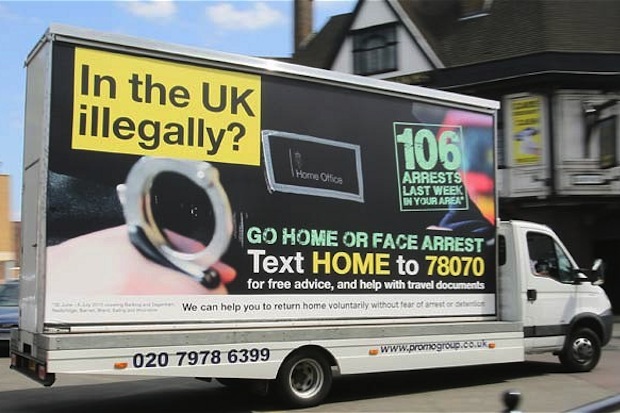
HomeOfficeImmigrationPoster_0_0

During the Tory 2005 election campaign billboards were used that read: “It isn’t racist to talk about immigration.” That phrase is now the mantra of UKIP supporters, and is used as a platform to launch populist rhetoric founded on social divisions, Social Darwinism and established hierarchy. More than half of UKIP’s support in the European elections came from disenchanted Conservative voters, a poll commissioned by Lord Ashcroft found.

It was the Conservatives that created the opportunity for UKIP to join mainstream political conversation. The Conservatives started the process of politically scapegoating minority groups to justify austerity cuts that disproportionately affect the most vulnerable and disadvantaged citizens. The rise in racism is paralleled with a rise in disability hate crime, which is now at its highest since records began.

I believe the UKIP parochial brand of Parish pump politics is a reduction of democratic politics to the social equivalent of a few people gathered in a small place gossiping about others – it nurtures fear, spite and vilifies people on the basis of one of our most wonderful assets: our human diversity.

The British Social Attitudes Survey has been conducted annually since 1983. The 2013 survey consisted of 3,244 interviews with a representative, random sample of adults in Britain.

The proportion of Britons who admit to being racially prejudiced has risen since the start of the millennium, raising concerns that growing hostility to immigrants and widespread Islamophobia are setting community relations back 20 years.

New data from the British Social Attitudes (BSA) survey shows that after years of increasing tolerance, the percentage of people who describe themselves as prejudiced against those of other races has risen overall since 2001. One of the findings is that males who are unskilled manual labourers in economically deprived areas are most likely to admit to racial prejudice.

However, Dr Grace Lordan, from the London School of Economics, said her own research based on BSA data going back to 1983 showed a clear correlation between recession and the numbers who self-described as prejudiced. Her research found that the group that recorded the biggest rise was white, professional men between the ages of 35 and 64, highly educated and earning a lot of money. Their attitudes may directly affect others as many will have managerial responsibilities. When asked to consider if they are racially prejudiced, the oldest age group (55+) admit they are the most. Conversely, the youngest age group (17-34) admitted they were racially prejudiced the least. That’s at least one hopeful outcome.

More than three quarters of the public (77 per cent) wanted to see a reduction in immigration to Britain, and public views on the level of immigration are significantly more negative than in 2011. 

We know from the political rhetoric of the right that there is always a subtext that runs something like this: “Don’t blame the bankers, low-paying, exploitative bosses, tax dodgers, legal loan sharks or rip-off landlords or the Government. Blame the “foreigner”. Blame the unemployed and the disabled people”.

It’s about time the public generally did some joined-up thinking and made these fundamental connections: this is a Tory standard – poverty of responsibility and the politics of blame.

Of course political party allegiance also has a significant bearing on racial prejudice. Conservative supporters have consistently been the most likely to describe themselves as prejudiced against people of other races, and against those they consider as having a lower socioeconomic status.

Sadiq Khan, the shadow justice minister, said the findings should come as a wake-up call. “This is clear evidence that we cannot be complacent about racial prejudice. Where it manifests itself, it blights our society. Those in positions of authority must take their responsibilities seriously. It also falls to us to address the underlying causes.” 

Yes. The causes. Over the past four years, we have witnessed the political right using rhetoric that has increasingly transformed a global economic crisis into an apparently ethno-political one, and this also extends to include the general scapegoating and vilification of other groups and communities that have historically been the victims of prejudice and social exclusion: the poorest, the unemployed and the disabled. These far-right rhetorical flourishes define and portray the putative “outsider” as an economic threat. This is then used to justify active political exclusion of the constitutive Other.

Racism and other forms of prejudice are normalised gradually, in almost inscrutable stages, as Allport’s ladder demonstrated all too well – as an explanation of how the Holocaust happened. Allport describes social processes, and how the unthinkable be comes acceptable, by a steady and unrelenting erosion of our moral and rational boundaries.

Not enough people read Allport’s pioneering work, and I’ve yet to see it cited in the current debates about contemporary social prejudice. Allport’s scale indicates hate speech and incitement to genocide start from often subtle expressions of prejudice, and pleas for “free speech.” But prejudice and hate speech doesn’t invite open debate: it’s about using speech to intentionally oppress others and close down debate. It escalates when permitted, into harassment and violence. We learn this from history, and formulated human rights as a consequence, to safeguard minority groups from discrimination and prejudice. 164204381

Prejudice may be expressed in oblique and strange ways. I remember pondering this in a sociology lecture that assigned the book The Nature of Prejudice by Allport. In Chapter 12, Allport wrote: “Why do so many people admire Abraham Lincoln? They may tell you it is because he was thrifty, hardworking, eager for knowledge, ambitious, devoted to the rights of the average man and eminently successful in climbing the ladder of opportunity. Why do so many people dislike the Jews? They may tell you it is because they are thrifty, hardworking, eager for knowledge, ambitious, devoted to the rights of the average man, and eminently successful in climbing the ladder of opportunity.”

Prejudice becomes apparent on a symbolic level first – language – and it starts with subtlety, such as the use of phrases like immigrants “swamping” our shores’ in the media, as part of political rhetoric and so on. Racists very seldom own up to being racists. They also quite often employ linguistic bullying strategies that makes challenging them very difficult. But as history has taught us, we really must challenge them.

Meanwhile, the right are attempting to make words like “fascism” “racism” and “bigotry” taboo. One ploy is to claim the words are “overused” and “offensive”. I’ve seen a conflation of “condemnation” with “censorship” – fascists ludicrously claiming that anti-fascists are fascist because they have merely used the term appropriately. This is a clear use of Techniques of Neutralisation as a propaganda strategy. Again, it is a tactic used to close down debate, and appeals to our feelings of fear and anxiety, rather than to our rationality.

Using such words can be qualified when they are legitimately used to describe a lack of democratic principles, extreme right-wing, authoritarian, intolerant views or practices and racism describes oppression and illegal political discrimination.

I’ve said before that “political correctness” arose originally from attempts at making language more culturally inclusive. Critics of political correctness show a curious blindness when it comes to examples of “conservative correctness”. Most often, the case is entirely ignored or censorship of the Left is justified as a positive virtue. Perhaps the key argument supporting this form of linguistic and conceptual inclusion is that we still need it, unfortunately. We have a right-wing logocracy, creating pseudo-reality by prejudicial narratives and words. We are witnessing that narrative being embedded in extremely oppressive policies and practices and in their justification.

It’s something of an irony that fascists use democracy to promote fascism, but they do. There was only a 36% turnout at the Euro elections, a mere 10% of the public voted for UKIP – they were determined UKIP supporters. It’s another irony that fascism gains momentum through public apathy. The Right ALWAYS vote. The left need to learn a valuable lesson here. The battle isn’t about establishing “ideological purity”: it’s about uniting and fighting fascism. VOTE!

Ordinary people did not caused the financial crisis. The real culprits are sat untouched in mansions, making even more money from the “austerity” imposed on the most vulnerable, whilst too many comply with misdirected blame of their oppressed brothers and sisters, rather than a political elite that have deliberately engineered a prolonged recession in the UK. Conservative governments always do. Thatcher did, Major did and Cameron has also. Our current social hardships have been created by this government’s policies and not powerless immigrants, disabled people or the unemployed. These are people whose lives are being broken by an elite. 

Here’s something to think about for those pleading that they voted UKIP only as a “protest”: fascists don’t stop at discriminating against the group of your choosing, such as the poor migrants. Fascists are fascists no matter what country you came from. It’s obvious that any political group that has councillors and MEPs calling for the compulsory euthanasia of disabled children, that are also sexist and homophobic, really don’t have good intentions towards British citizens either. What exactly were you “protesting”?

I remember the Thatcher era, yet another inflicted Tory recession, and I remember needing stitches after getting my head kicked in by the BNP on a Rock Against Racism (RAR) march. The RAR was a campaign set up in the United Kingdom in 1976 as a response to an increase in racial conflict and the growth of white nationalist groups such as the National Front. Conservative governments always engineer social prejudices and divisions, and here we are again, after the progress in equality and diversity legislation made by the Labour party, we’ve regressed via some covert Tory default programme that resets a moral and social race to the bottom. It happens every time the Tories are in Office.

We are so much better than this. At least I hope so, and that we are underestimated by parties like UKIP and the Tories. 

But everything positive that we had as a civilised society – rights-based policy and institutions, education, health care, anything that is deemed socialist or left wing, egalitarian, democratic is being re-labelled  negatively, as “evil”, corrupted, and all of the intentions and purposes of our great institutions are being turned on their head through right wing narratives, they are re-writing our history. Those post-war settlement gains we made were never mistakes, they were amongst our finest and most civilised, civilising achievements, yet they are being scorned by a bunch of greedy opportunist heartless elitist neo-feudalists and vulture capitalists.

“And what rough beast, it’s hour come round at last, slouches towards Bethlehem to be born?”  W.B Yeats.

Labour have always promoted positive policies that are inclusive, and embrace equality and diversity. It was Labour that pioneered inclusion, equality and diversity policies. Labour don’t vilify any social group. Labour have shown historically that they do reflect the needs of the majority, and respond appropriately with positive, supportive policy. That is precisely what democratically elected governments are meant to do.

I believe that inclusion, equality and diversity reflects our strength – this is the best of us. 

It’s not for politicians or the media to set the political agenda – to tell the public what is and what isn’t legitimate, what we should and shouldn’t be concerned about. In a democracy, WE TELL THEM. Don’t ever lose sight of that – because that is precisely how fascism works. You begin to forget that governments are there to reflect and represent OUR needs. They don’t “rule”, us: they serve us. WE set the political agenda, and we must; despite the constant cognitive dissonant, indoctrinating media accounts. If we continue to allow the right to set the agenda, all of those things we valued – democracy, justice, freedom, rights, equality, diversity, fairness, public services – will be taken away.

It’s time we let them know what we want, and what we expect of a government, because once you hear the jackboots, it’s too late.

Related

A more in depth analysis – UKIP: Parochialism, Prejudice and Patriotic Ultranationalism.

Collaborators – Kanjin Tor

The Truth About Immigration: Are Foreigners Jumping the Queue? – Scriptonite

6 Facts you need to know to have an honest debate on Immigration


Once you hear the jackboots, it’s too late.

556770_138948196256237_144572172_n

Dr. Lawrence Britt examined the fascist regimes of Hitler (Germany), Mussolini (Italy), Franco (Spain), Suharto (Indonesia) and several Latin American regimes. Britt found 14 defining characteristics common to each, and it is becoming increasingly difficult to overlook some of the parallels with increasingly authoritarian characteristics of our own right wing government here in the UK.

Controlled mass media is one example of such a defining feature of fascism, with “news” being directly controlled and manipulated by the government, by regulation, or via sympathetic media spokespeople and executives. Censorship is very common. And then there is an obsession with “National Security” –  with fear being used as a “motivational tool” by the government on the public.

In June 2013, a visit by Government national security agents to smash computer hard drives at the Guardian newspaper offices hit the news surprisingly quietly, when Edward Snowden exposed a gross abuse of power and revealed mass surveillance programmes by American and British secret policing agencies (NSA and GCHQ) last year. (More detailed information here).

David Miranda, partner of Glenn Greenwald, Guardian interviewer of the whistleblower Edward Snowden, was held for 9 hours at Heathrow Airport and questioned under the Terrorism Act. Officials confiscated electronics equipment including his mobile phone, laptop, camera, memory sticks, DVDs and games consoles. 

This was a profound attack on press freedoms and the news gathering process, and as Greenwald said: “To detain my partner for a full nine hours while denying him a lawyer, and then seize large amounts of his possessions, is clearly intended to send a message of intimidation.”

Absolutely. Since when was investigative journalism a crime?

Even the Telegraph columnist Janet Daley remarked that these events were like something out of East Germany in the 1970s.

This certainly raised critically important legal and ethical issues, for those involved in journalism, especially if some kinds of journalism can be so easily placed at risk of being politically conflated with terrorism.

Once again, the mild and left wing/liberal Guardian is under attack by our Tory-led government. In an extraordinary and vicious attack on The Guardian newspaper, Department for Work and Pensions (DWP) communications chief and senior government spin doctor, Richard Caseby, has called for the newspaper to be “blackballed” and prevented from joining the new press regulatory body, because “day after day it gets its facts wrong.” Remarkably, “ineptitude or ideology” were to blame for what he deemed “mistakes” in the paper’s coverage of the DWP’s cuts to benefits. He called for the broadsheet to be kept out of the new Independent Press Standards Organisation (IPSO), set up after the Leveson Inquiry into media standards. 

As a former journalist at the Sun and The Sunday Times, Caseby certainly has an axe to grind against the paper that revealed how those right wing papers’ stablemate, the News Of The World, had hacked the voicemail of murdered teenager Millie Dowler, sparking the phone hacking scandal that prompted Rupert Murdoch to close the tabloid down.

richard caseby

Richard Caseby, pictured when giving evidence to MPs as managing editor of The Sun.

In July 2011 it emerged that Cameron met key executives of Murdoch’s News Corporation 26 times during the 14 months that Cameron had served as Prime Minister. It was also reported that Murdoch had given Cameron a personal guarantee that there would be no risk attached to hiring Andy Coulson, the former editor of News of the World, as the Conservative Party’s communication director in 2007. This was in spite of Coulson having resigned as editor over phone hacking by a reporter. Cameron chose to take Murdoch’s advice, despite warnings from Nick Clegg, Lord Ashdown and the Guardian. Coulson resigned his post in 2011 and was later arrested and questioned on allegations of further criminal activity at the News of the World, specifically regarding the News International phone hacking scandal.

The Culture, Media and Sport Committee of the House of Commons served a summons on Murdoch, his son James, and his former CEO Rebekah Brooks to testify before a committee on 19 July. After an initial refusal, the Murdochs confirmed they would attend after the committee issued them a summons to Parliament. The day before the committee, the website of the News Corporation publication the Sun was “hacked”, and a false story was posted on the front page claiming that Murdoch had died. Murdoch described the day of the committee “the most humble day of my life.”  He argued that since he ran a global business of 53,000 employees and that the News of the World was “just 1%” of this, he was not ultimately responsible for what went on at the tabloid. 

On 1 May 2012, the Culture, Media and Sport Committee issued a report stating that Murdoch was “not a fit person to exercise the stewardship of a major international company.”

On 3 July 2013 Exaro and Channel 4 news broke the story of a secretly recorded tape. It had been recorded by Sun journalists, and in it Murdoch can be heard telling them that the whole investigation was “one big fuss over nothing”, and that he, or his successors, would “take care” of any journalists who went to prison.

He said: “Why are the police behaving in this way? It’s the biggest inquiry ever, over next to nothing.” Murdoch believes that he doesn’t have to be accountable. His initial refusal to testify, despite being summonsed, is extraordinarily indifferent and arrogant.

In connection with Murdoch’s testimony to the Leveson Inquiry “into the ethics of the British press,” editor of Newsweek International, Tunku Varadarajan, referred to him as “the man whose name is synonymous with unethical newspapers.”

Not a shred of concern raised about any of this or Murdoch’s nasty and corrupt myth industry, and right wing scapegoating empire, coming from our government, a point worth reflecting on for a moment. Miliband said the phone-hacking was not just a media scandal, but it was a symbol of what was wrong with British politics.  He called for cross-party agreement on new media ownership laws that would cut Murdoch’s current market share, arguing that he has “too much power over British public life.He said: “If you want to minimise the abuses of power, then that kind of concentration of power is frankly quite dangerous.” 

Meanwhile, Iain Duncan  Smith is “monitoring” the BBC for any “left wing bias”. Gosh, I just bet that took the jolly well-known ardent commie Chris Patten by complete surprise…

The BBC Trust said that a programme called the “Future of Welfare”, written and presented by John Humphrys, breached its rules on impartiality and accuracy. It found that the programme had failed to back up with statistics claims that there was a “healthy supply of jobs”.

Iain Duncan Smith, the Work and Pensions Secretary, defended Humphrys as a “robust broadcaster” and said the documentary was “thoughtful and intelligent”. And perhaps most importantly, it endorsed the Governments’ punitive and callous welfare  “reforms.”

Duncan Smith was infuriated by the BBC’s coverage of the ruling, which he felt gave “too much airtime to campaigners.” Too much for what, exactly, we have to wonder. Perish the thought that anyone may dare to poke at the half-timbered facade of Tory ideology – Duncan Smiths’ rhetoric is a painful parody of fact that loudly dismisses – and intentionally obscures – the private despair and ruined lives of so many of those least able to speak up for themselves.

He said: “I have just watched reporting on the BBC about the Government winning a High Court judgement on the Spare Room Subsidy (that’s the Bedroom Tax to you and I) that once again has left me absolutely staggered at the blatant Left-wing bias within the coverage. And yet the BBC Trust criticise John Humphrys’s programme, which was thoughtful, intelligent and born out of the “real” life experience of individuals.”  The same Duncan Smith, who chooses to deny the all too painful and impoverished real life experiences his policies have inflicted on many. He prefers to lie them away from public attention. Or dismiss them as merely “anecdotal”.

Duncan Smith’s credibility doesn’t stand up to much scrutiny here, as someone attempting to verify “accuracy” and er…  statistical claims. Ah, yes. The Department of Work and Pensions – Iain Duncan Smiths’ Department – has a long track record of misusing statistics, making unsubstantiated inferences and stigmatising claimants, and it’s clear these are tactics used to attempt to vindicate further welfare cuts. In fact several minsters, including Cameron, have been officially rebuked by the Office of National Statistics for telling lies, and in Duncan Smith’s case – on at least 3 occasions this past 12 months despite warnings regarding his dishonest claims in the media, as well as in parliament. 

So considering all of this, it was with some incredulity that I read Caseby’s comments in the Huff Post earlier: “Should the new IPSO members accept (editor Alan Rusbridger) as a johnny-come-lately? No, rather he should be blackballed. Sorry, but the Guardian isn’t fit to become a member of IPSO until it starts valuing accuracy.”

And: “In the end, of course, it’s IPSO’s decision. But should the new standards body be so gracious as to invite him in, I guess I’ll be waiting to lodge the first complaint.” He said an MP had complained to the Office for National Statistics over The Guardian’s reporting of its data. I bet that was said without a trace of irony, too.

So, if alleged (and improbable) benefits inaccuracies “should get [The] Guardian blackballed,” what is this spin doctor’s recommendation for the perpetual propagandarising, lying, right wing media and a lying government minister’s serial offensive “benefits inaccuracies”?

Oh … of course, this is Iain Duncan Smiths’ relatively new pet guard dog.

An interesting choice of word from Caseby – “blackballing”, which is a rejection in a traditional form of secret ballot, where a white ball ballot constitutes a vote in support and a black ball signifies opposition. This system is typically used where a club (or Lodge) rules provide that, rather than a majority of the votes, one or two objections are sufficient to defeat a proposition. Since the seventeenth century, these rules have commonly applied to elections to membership of many gentlemen’s clubs and similar institutions such as in Freemasonry. It’s an apt term because of its association with conservatism, tradition and secrecy. 

In contrast, and unlike many whistleblowers who remain anonymous, Edward Snowden chose to be open and go public. Snowdens’ sole motive for leaking the documents was, in his words, “to inform the public as to that which is done in their name and that which is done against them.”  He believes that the global public is due an explanation of the motives of those who act outside of the democratic process.

To “protect democracy” we have governments that are subverting the law. This is a fundamental paradox, of course and Snowden saw this could lead to the collapse of democracy and critically endanger our freedom. And Snowden reminds us that what no individual conscience can change, a free press can. It has to be one that is free enough to allow a diverse range of political commentaries, rather than a stranglehold of right wing propaganda from the Murdoch empire and its ideological stablemates.

I think that the process of dismantling democracy started in May 2010 here in the UK, and has been advancing incrementally ever since, almost undetected at first, because of pervasive government secrecy and a partly complicit, dominant right wing media.

But once you hear the jackboots, it’s far too late.

994763_494550317281168_1024248164_n

With big thanks to Robert Livingstone

Related 

The Transparency of Lobbying, non-Party Campaigning, and Trade Union Administration Bill is a calculated and partisan move to insulate Tory policies and records from public and political scrutiny, and to stifle democracy. The Government’s Lobbying Bill has been criticised by bloggers and campaigners from right across the political spectrum, with the likes of Owen Jones and Guido Fawkes united in agreement over this issue: that the Bill is a “Gagging Act”. Five Conservatives – Douglas Carswell, Philip Davies, David Davis, Zac Goldsmith and David Nuttall – voted against the Bill, whilst others also expressed concerns.

The Bill will treat charities, think tanks, community groups and activists of every hue as “political parties”. From small groups addressing local matters to big national organisations, all equally risk being silenced in the year before a general election, to avoid falling under electoral law. Any organisation spending £5,000 a year and expressing an opinion on anything remotely political must register with the Electoral Commission. Since most aspects of our public life are political, (and a substantial proportion of our private life has been increasingly politicised under this authoritarian government) this stifles much essential debate in election years when voters should be hearing and evaluating policy choices.

The ‘Let Lynton Lobby Bill’: Grubby Partisan Politics and a Trojan Horse 


I  don’t make any money from my work. But you can help Politics and Insights if you like by making a donation to help me continue to research and write free, informative, insightful and independent articles, and to provide support to others. The smallest amount is much appreciated – thank you.

DonatenowButton

Iain Duncan Smith used false statistics again to justify disability benefit cuts

486294_4737578711832_1816039541_n
The Department of Work and Pensions has a long track record of misusing statistics, making unsubstantiated inferences and stigmatising claimants, and it’s clear these are tactics used to vindicate further welfare cuts.

The Tories have peddled the lie that he UK was “on the brink bankruptcy” and claimed the solution to is to cut government spending with a painful programme of austerity cuts. Of course, the UK economy was growing in 2010 when the Tories took over and was subsequently plunged back into recession by Osborne’s austerity policies, which have meant that the economy has not grown at all under the coalition; and for much of their tenure has been contracting. Despite the fact that Osborne was officially rebuked for this lie, the Goebbels-styled repetition propaganda technique employed by the conservatives has embedded this lie in the minds of the public.  However, our current problems are the result of a global financial crisis that we and not the banks that caused it, continue to pay for.

Austerity is a smokescreen – the Coalition has used the deficit as an excuse to do what they have always wanted to do: shrink the state, privatise the NHS, and hand out our money to the wealthy minority. We cannot trust them. 

It’s become clear that the Tories have seized an opportunity to dismantle the institutions they have always hated since the post-war social democratic settlement – institutions of health, welfare, education, culture and human rights which should be provided for all citizens. The Tories also attempt to destroy fundamental public support for the health, education and welfare of its people by a divisive scapegoating of vulnerable groups, perpetuated via the media, and by offering and inflicting only regressive, punitive policies and devastating cuts. 

The  Official statistics watchdog (UKSA) has found that the Department for Work and Pensions (DWP) have repeatedly made false claims about the numbers of people living on disability benefits.

Ministers claim that the majority of people claiming disability living allowance (DLA) were given benefits for life, and without any supporting medical evidence. This is untrue.

According to DWP press releases:

“More than 50% of decisions on entitlement are made on the basis of the claim form alone, without any additional corroborating medical evidence.”

However, the UK Statistics Authority (UKSA) found that the real percentage of claims passed without supporting medical evidence was just 10%.

The DWP also claimed that “Under the current system of Disability Living Allowance, 71% of claimants get indefinite awards without systematic reassessments.” However the UKSA found that in the last two years, just 23% and 24% of claimants were given indefinite awards of DLA.


The DWP accept that their claims were “ambiguous” and “had not been re-checked by the Department’s analysts, as is the usual practice.”

The findings were uncovered by an investigation by Channel Four News following complaint by the charity Parkinson’s UK.

 Parkinson’s UK policy advisor Donna O’Brien said:

“People with Parkinson’s who claimed DLA have told us supporting medical evidence was crucial due to a woeful knowledge of the condition amongst assessors, and it is absurd that the Government was trying to imply that anyone going through the system had an easy ride.”

This is the third time in the past year that Iain Duncan Smith has come under fire for the use of false statistics to justify cuts to benefits.

Last year Duncan Smith was rebuked by UKSA for misuse of benefit statistics. He claimed that 8000 people who had been affected by the benefits cap had “moved back into work.”

The UKSA found that this figure was “unsupported by the official statistics.”

Another statement by Duncan Smith later in the month also drew criticism and a reprimand. The minister said around 1 million people have been stuck on benefits for at least three of the last four years “despite being judged capable of preparing or looking for work”.

However, the figures cited also included single mothers, people who were seriously ill, and people awaiting their assessment.

Grant Shapps was also rebuked by UK Statistics Authority for misrepresenting benefit figures – Shapps joined his fellow Conservatives in the data hall of shame. In March, the Tory chairman claimed that “nearly a million people” (878,300) on incapacity benefit had dropped their claims, rather than face a new medical assessment for its successor, the employment and support allowance (ESA).

The figures, he said, “demonstrate how the welfare system was broken under Labour and why our reforms are so important”.  The claim was faithfully reported by the Sunday Telegraph  but as the UK Statistics Authority has now confirmed in its response to Labour MP Sheila Gilmore (the complainant), it was entirely and intentionally fabricated.

In his letter to Shapps and Iain Duncan Smith, UKSA chair Andrew Dilnot writes that the figure conflated “official statistics relating to new claimants of the ESA with official statistics on recipients of the incapacity benefit (IB) who are being migrated across to the ESA”.

Of the 603,600 incapacity benefit claimants referred for reassessment as part of the introduction of the ESA between March 2011 and May 2012, just 19,700 (somewhat short of Shapps’s “nearly a million) abandoned their claims prior to a work capability assessment in the period up to May 2012. The figure of 878,300 refers to the total of new claims for the ESA closed before medical assessment from October 2008 to May 2012.

Thus, Shapps’s suggestion that the 878,300 were pre-existing claimants, who would rather lose their benefits than be exposed as “scroungers”, was entirely wrong. As significantly, there is no evidence that those who abandoned their claims did so for the reasons ascribed by Shapps. However, he did at least honestly reveal his own prejudices regarding disabled people, at least. But he did so without a trace of shame and remorse.

At the time Iain Duncan Smith dismissed the findings, saying that he “believed” that he was “right”, anyway. It seems that Iain Duncan Smith has some disdain for evidence-based policy.

“I believe this to be right, I believe that we are already seeing people going back to work who were not going to go back to work,”  he said.

This is a remarkable claim, given that the Department for Work and Pensions does not track the destination of people no longer entitled to benefits. Simply measuring how many people no longer claim benefits does not accurately reflect the numbers of those actually moving into employment. The DWP off-flow figures will inevitably include many having their claim ended for reasons other than securing employment, including sanctions, awaiting mandatory review, appeal, death, hospitalisation, imprisonment, or on a government “training scheme” (workfare). 

In 2011, the Work and Pensions Select Committee warned the Department for Work and Pensions (DWP) needed to take more care when releasing and commenting on benefit statistics, to make sure media stories were “accurate.”

It seems unlikely, however, that accuracy will replace Duncan Smith’s “gut feelings” and ideologically-driven rhetoric – which is aimed at presenting excuses for the steady reduction of support for the most vulnerable citizens – any time soon.

36626_217452248405831_532419169_n

Pictures courtesy of Robert Livingstone 

A letter of complaint to Andrew Dilnot regarding Coalition lies about employment statistics

 10270806_319228004894921_8005540502444686357_n
I’ve written the following to Andrew Dilnot:

Dear Sir,

I write in response to the government claims made recently regarding employment. During Prime Minister’s questions in Parliament on Wednesday, Mr Cameron said that the number of people in full-time employment had risen. Other ministers, such as Esther McVey have echoed these claims.

We are growing the economy and we’ve got more people in work,”  Mr Cameron said.

And: The number of people out of work in the UK fell by 133,000 to a fresh five-year low of 2.2 million in the three months to March, official figures show.The jobless rate also fell to a five-year low of 6.8%, the Office for National Statistics (ONS) has said”.

I am very concerned about the accuracy of these claims, and should like to challenge both the validity and reliability of them, given the current methodological problems with measurement, which the ONS have acknowledged in part, previously.

To count as unemployed, people have to say they are not working, are available for work and have either looked for work in the past four weeks or are waiting to start a new job they have already obtained. Someone who is out of work but doesn’t meet these criteria counts as “economically inactive”. The results from a selected sample, based on narrow criteria, are then weighted to give an estimate that reflects the entire population.

The other measure of joblessness – the claimant count – is published for each single month. It doesn’t suffer from the limitations of sample size and sampling frame, because it derives from the numbers of Jobseeker’s Allowance (JSA) claimants recorded by Jobcentre Plus, so a monthly figure is possible right down to local level. But because many people who are out of work won’t be eligible for JSA, it’s an  even narrower measure.

I draw your attention to the following, taken from the Summary of recommendations: Response from the Employment Related Services Association (ERSA) to the Work and Pensions Select Committee inquiry into Jobcentre Plus, dated May, 2013:

Jobcentre Plus performance metrics:

  • The effectiveness of Jobcentre Plus (JCP) should be measured by sustained job outcomes rather than off-benefit flows to create greater incentives to support jobseekers into employment and provide a more accurate picture of success rates. This would address potential perverse incentives to sanction claimants inappropriately, plus ensure greater comparability between JCP provision and contracted out provision.
  •   Such a change could help to provide greater transparency in order to identify those who would benefit from intensive employment support. Such a performance metric would prevent the phenomenon of ‘cycling’, jobseekers moving between short term jobs and unemployment for many years, but not building up the length of time of continual unemployment to qualify them for specialist support.

In particular, I wish to draw your attention to this from the same document – Response from ERSA to the Work and Pensions Select Committee inquiry into JCP, 2013:

4.1. JCP is measured by off-benefit flows rather than sustained job outcomes. This can create perverse incentives to move jobseekers into short term employment outcomes, rather than refer them to long term contracted out support. It can also create a perverse incentive to sanction claimants as discussed below.

ERSA recommends that whilst off-benefit checks are monitored for national statistical purposes, job outcome and sustainment measure, comparable to the Work Programme, should be introduced for Jobcentre Plus. This would enable analysis between the performance of JCP and contracted out provision and provide accurate value for money comparisons.

5.1. DWP point to off-benefit flows as an indication of the effectiveness of pre-Work Programme support. However, analysis undertaken by Policy Exchange calls into question the validity of off-benefit figures as a success measure given that many do not go into sustainable employment or simply move on to another type of benefit.

8.1 As identified by the Committee in its report into the experience of different user groups on the Work Programme, the use of sanctions is inconsistent. 

Providers are obliged to notify Jobcentre Plus if a jobseeker fails to undertake an activity, for example if they miss an appointment. The decision as to whether to actually enact sanctions rests with Jobcentre Plus though. This means that sanctions are not applied even though a provider may think there is a clear case to do so. Conversely, a provider may be satisfied with the progress made by a participant but may be overruled by Jobcentre Plus who have a case for applying conditionality.

For example, one ERSA member reported that Jobcentre Plus decided to sanction a Work Programme participant for insufficient use of the Universal Jobmatch website, despite the fact that the provider had explicitly asked the participant to focus on resolving some other issues ahead of any formal job search activity. Sanctioning represented a great setback in the trust and progress made up to that point. ERSA agrees with the recommendation put forward by the Committee in its most recent report into the Work Programme for DWP to conduct a review of sanctioning activity with a view to ensuring that the processes are clearly understood by participants and consistently applied.

8.2 Part of the problem lies in the fact that Jobcentre Plus is measured by off-benefit flows rather than sustained job outcomes. This therefore means that a situation in which a Personal Advisor applies a sanction that may in fact damage an individual’s progress to employment, would register as a success according to the off-benefit flow measure. ERSA believes that measuring Jobcentre Plus success by sustained job outcomes would remove any perverse incentives to sanction individuals.

So, in summary, simply measuring how many people end their claims for benefits does not reveal the true impact of jobcentre services, nor does it accurately reflect the numbers of those moving into employment.

Let’s not forget that in 1996, the Conservative government introduced the jobseeker’s allowance that cut benefits to young people up to 18 years old – the new allowance was designed to replace unemployment benefit and income support. Young people excluded from eligibility for benefit are therefore absent from unemployment statistics.

The Department has simplified its performance measures and now primarily targets the move by claimants away from benefits, or “off-flow”, as a simple and intuitive measure of performance. However, this gives no information about how individual jobcentres perform in supporting claimants to work. Some may have found work but, in more than 40 per cent of cases, the reason for moving off benefits is not actually recorded.

I am also concerned that underemployment continues to remain very high, despite a small fall of 7,000 in the number in involuntary part time work, the total still stands at 1.42m. This is an increase of a 100 per cent beyond the pre-recession level of 701,000. The rise in employment also continued to be driven by self-employment, which is extraordinary as self-employment is a relatively small part of the UK jobs market. But although just one in seven workers are self-employed, over half of all jobs growth over the year has been in this type of employment. The TUC share this concern, and have said that some people have been forced in to self-employment as they have no alternative.

Previous TUC’s analysis  suggests that rising self-employment is part of a wider shift towards insecure employment, rather than as a result of a growing number of people starting up new companies as ministers have claimed. Analysis shows that self-employed workers are often earning less, underemployed, and have less job security than employees.

One very important issue not currently considered is that since the government does not track or follow up the destination of all those leaving the benefit system, as discussed, the off-flow figures will inevitably include many having their claim ended for reasons other than securing employment, including sanctions, awaiting mandatory review, appeal, death, hospitalisation, imprisonment, on a government “training scheme” (see consent.me.uk  and the Telegraph – those on workfare are counted as employed by the Labour Force Survey.)

Furthermore, last week Iain Duncan Smith met a whistle-blower who has worked for his Department for Work and Pensions for more than 20 years. Giving the Secretary of State a dossier of evidence, the former Jobcentre Plus adviser told him of a “brutal and bullying” culture of “setting claimants up to fail”.

“The pressure to sanction customers was constant,” he said. “It led to people being stitched-up on a daily basis.”

The whistle-blower wishes to be anonymous but gave his details to Iain Duncan Smith, DWP minister Esther McVey and Neil Couling, Head of Jobcentre Plus, who also attended the meeting. He said:

“We were constantly told ‘agitate the customer’ and that ‘any engagement with the customer is an opportunity to ­sanction.”

Iain Duncan Smith and his department have repeatedly denied there are targets for sanctions. However, the whistle-blower says:

“They don’t always call them targets, they call them ‘expectations’ that you will refer people’s benefits to the decision maker. It’s the same thing.”

He claimed managers fraudulently altered claimants’ records, adding: “Managers would change people’s appointments without telling them. The appointment wouldn’t arrive in time in the post so they would miss it and have to be sanctioned. That’s fraud. The customer fails to attend. Their claim is closed. It’s called ‘off-flow’ – they come off the statistics. Unemployment has dropped. They are being stitched up.”

Labour MP Debbie Abrahams, the member of the DWP Select Committee who set up the meeting, has renewed her call for an inquiry into inappropriate sanctioning. Debbie said:

“I am deeply concerned that sanctions are being used to create the illusion the Government is bringing down unemployment.

It is my belief that the claims made by David Cameron and his ministers are an unwarranted, far-fetched inferential leap from methodological premises that don’t stand up to scrutiny, for all of the reasons I have outlined. I felt obliged to draw your attention to this matter, not least because I am not alone in my concerns, and I feel very strongly that it is immoral of any government to mislead the public to which it is meant to be accountable.

Yours sincerely
Ms Susan Jones.

Related article: Austerity, socio-economic entropy and being conservative with the truth

Petition to Stop DWP Minsters Spinning Statistics 

995658_494538353949031_779653065_n
Thanks to  Robert Livingstone for the pictures.

UKIP: Parochialism, Prejudice and Patriotic Ultranationalism.

999622_566748676727998_1599547969_n (1)

Political outgrouping

Over the past four years, we have witnessed the political right using rhetoric that has increasingly transformed a global economic crisis into an apparently ethno-political one, and this also extends to include the general scapegoating and vilification of other groups and communities that have historically been the victims of prejudice and social exclusion: the poorest, unemployed and disabled people. These far-right rhetorical flourishes define and portray the putative “outsider” as an economic threat. This is then used to justify active political exclusion of the constitutive Other.

The poorest have been politically disenfranchised. Politically directed and constructed cultural and social boundaries, exclusionary discourses and practices create and define strangers who are further stigmatised and reduced by labels of “economic freerider.”  Groups are politically redefined and reduced to a basic, standard right wing category: “a burden on the state”. In Zygmunt Bauman’s analysis of the Holocaust, the Jews became “strangers” par excellence in Europe, the Final Solution was an extreme example of the attempts made by societies to excise the (politically defined) uncomfortable and indeterminate elements existing within them. Here in the UK, it’s evident that many citizens now feel like strangers in their own communities – they have become politically alienated. 

Definitions of citizenship and associated privileges have been reformulated and restricted here in the UK, and the current Conservative neoliberal framework of intensifying an aggressive competitive individualism is further motivated by far-right reforms that embed socioeconomic Darwinism.

This has provided opportunity for UKIP to become established as a populist part of the mainstream political conversation, the Tory rhetoric, founded on social divisions and established hierarchy, has created a space for UKIP’s subversive “insurgency”.

UKIP has an extremist appeal that is based entirely on fear-mongering, and attempts to shape and perpetuate fears, resentment and hatreds, social group phobias and deliberate attempts at further undermining social cohesion. UKIP try to make this extremely divisive approach somehow “respectable”, (by the frequent use of phrases such as “we say what many think”, “we speak our minds” and “it’s not racist to be worried about too many people coming here,” which are used to attempt to normalise and justify what are actually very objectionable, prejudice-laden opinions, for example) whilst offering nothing at all that might improve our living conditions and quality of life.

UKIP is also manipulating an anti-politics and anti-establishment public mood. This is not just about gaining electoral success but in shifting the terms of debate. Farage admits that UKIP’s effect on the Tories is “psychological not numerical”. His success in this encourages the further right Tory backbenchers, encourages the populist strategies of Lynton Crosby, as it forces political and media focus on right-wing concerns, like welfare and immigration. Public moral boundaries are being pushed.   

UKIP utilises, amplifies and perpetuates an increasingly poisonous climate of distrust and cynicism. UKIP manipulate public views and in particular, they perpetuate a myth that politicians of all colours are an out of touch elite that is far removed from, and largely unconcerned with, the everyday struggles of “ordinary people.” But the category of “ordinary people” is an ever-shrinking one, from this perspective.

UKIP make the mistake of portraying the entire political class as pampered elitistswhich is grossly inaccurate. Whilst it’s true that the Conservative party most certainly can claim aristocratic membership, the same isn’t true of the Labour party. Furthermore, Farage, an ex-Tory public school boy (and Miliband attended a comprehensive school), an ex-stockbroker, with offshore tax havens and an inclination for far-right policy is hardly likely to be “in touch” with the man and woman on the Clapham omnibus.

Although UKIP suffers from a chronic, persistent failure to appeal to three key groups of voters – women (because of the chauvinistic and anti-feminist views of UKIP members and politicians); young people (who find the party almost farcically out of touch with their own world-view) and ethnic minorities (because of its strident and emotive language about immigration). UKIP does represent something of a “blue-collar revolt”- its electoral base is “old, male, working class, white and less educated,” say academics Matthew Goodwin and Robert Ford.

Anti-intellectual prejudice is a strong undercurrent amongst UKIP’s supporters. Anti-intellectualism is a dominant feature of far-right politics – especially those entailing authoritarianism, fascism and Nazism.

 10403497_472514972893769_324031577992330978_n
Anti-intellectualism and inverted snobbery from the patriotic nationalist and racist Britain First site on Facebook

Parochialisation

The Conservatives have parochialised both explanations of and responses to the global economic crisis. Parochialism entails neglect of the interests of identified “outsiders”, and this kind of isolationist tendency has also provided a political platform for nationalism. Parochialism tends to support inter-group hostilities, and it tends to lead to violations of human rightsParochialism directly opposes a fundamental set of principles that constitute these rights: namely that all humans beings are of equal worth, and that human rights are universally applicable – they apply to everyone.

The alternative perspective is social Darwinism, which is used to justify a hierarchy of entitlement to rights. Modern eugenics was rooted in the Social Darwinism of the late 19th century, with all its metaphors of fitness, competition, and rationalisations of inequality. For progressives, eugenics was a branch of the drive for social improvement or perfection that many reformers of the day thought might be achieved through the deployment of science to “good” social ends. Eugenics, of course, drew appreciable support from Conservatives, concerned to “prevent” the “proliferation” of lower income groups and save on the cost of providing support for them.

The progressives progressed. They ceased to believe that progress was about advancing the human race by physical “improvement” – that kind of supremacist view was a product of its time – context bound by a cumulatively catastrophic zeitgeist. Progressives liberated themselves from the superficial characteristics and taxonomic ranking of human beings – the emphasis on “what” we are – and began to cherish “who” we are, delving into our human potential and celebrating our diversity as much as our individual equal worth.

Although eugenics programmes are usually associated with Nazi Germany, they could, and did, happen everywhere. They focused on manipulating heredity or breeding to produce politically defined “better” people and on eliminating those considered biologically inferior. In the 1920s and 1930s, eugenic sterilisation laws were passed in 24 of the American states, in Canada, and in Sweden. Here in the UKMalthus saw overpopulation as the cause of misery and poverty, which was an element of the social Darwinism that contributed to the devaluing of human life due to its stress on the struggle for existence and competition for resources. 

Eugenic doctrines were criticised increasingly during the inter-war years, on scientific grounds and for their blatant class and racial bias, and were attacked widely when a eugenics narrative and role in the holocaust was revealedHuman rights evolved in response to the Holocaust, to ensure that race genocide doesn’t happen again. And to the growth of fascism. Human rights are premised on the belief that all human lives are of equal value. That is why those rights apply to everyone, that was the whole point of them, and to exclude people on whatever basis from enjoying those rights is to stray onto a very dangerous slippery slope in terms of recognising the equal worth of other human beings. Again.

The concept of adaptation remains, and allows the right to claim that the rich and powerful are better adapted to the social and economic climate of the time, and the concept of natural selection perpetuates the supremacist argument that it is natural, normal, and proper for the “strong” to thrive at the expense of the weak. Strength, however, is conflated with wealth.

British and American imperialists employed the language of social Darwinism to promote and justify Anglo-Saxon expansion and domination of other peoples. Such different personalities as Machiavelli, Sir Francis Bacon, Ludwig Gumplowicz, Adolf Hitler, and Benito Mussolini, each reasoning on different grounds, nevertheless arrived at similar conclusions. Imperialism to them is part of the natural struggle for survival. Those endowed with “superior” qualities are “destined” to rule all others. Imperialism has been morally excused as the means of liberating peoples from tyrannical rule or of bringing them the benefits of a “superior” way of life. Imperialism is all about human aggressiveness and greed, the search for security, drive for power and prestige and nationalist emotions, amongst other things.

Nationalism is anti-progressive. It’s a paradigm of competitive individualism that further undermines principles of cooperation, equality and social cohesion. It’s also a recognisable symptom of the rise of fascism. The UKIP brand of Parish pump politics nurtures fear, spite and vilifies people on the basis of one of our most wonderful assets: our human diversity.

Ordinary people did not caused the financial crisis. The real culprits are sat untouched in mansions, making even more money from the “austerity” imposed on the poorest and some of the most vulnerable members of society, whilst too many comply with misdirected blame of their oppressed brothers and sisters, rather than a political elite that have deliberately engineered a prolonged recession in the UK. Conservative governments always do. Our current social hardships have been created by this government’s policies and not powerless immigrants, disabled people or the unemployed. These are people whose lives are being broken by an elite.

The answer to our problems isn’t making the rest of the world go away, it isn’t bigotry and “national pride” – we surely learned those are not tenable answers from the terrible consequences of Nazism.

Dividing people by using blame and prejudice only weakens our opposition to oppression.

UKIP, however, have capitalised on the current government’s lack of clear, open and honest debate about why the UK has become more unequal and anomic (anomie – a sociological concept – is the breakdown of social bonds between an individual and the community resulting in fragmentation of social identity and rejection of self-regulatory values. This has been heightened by a significant discrepancy between Conservative ideology – rhetorical values commonly professed – and what is real, actual and achievable in our everyday life).

UKIP have exercised a crass manipulation of the existentially destabilised: many people are confused and anxious about where they belong, where their country is heading, and why the current government won’t do anything about it. Of course Farage denies vigorously that in giving these anxieties a directed voice they are merely acting as outlets for prejudice and faux protest votes. But prejudice, protest and a politics of fear is nevertheless UKIP’s leitmotif.

And farce. Like the UKIP councillor blamed the recent floods on the Government’s decision to legalise gay marriage. David Silvester said the Prime Minister had acted “arrogantly against the Gospel,” and God had punished the Thames Valley as a result. And John Sullivan, a UKIP candidate, explained that physical exercise in schools can “prevent homosexuality”.

Farage says he represents such “ordinary people”. As I stated earlier, he is an ex-Tory, a public school-educated former banker and stockbroker, whose policies will help him and his kind, maintaining the status quo, whilst presenting a fake challenge to the establishment. He set up a trust fund in an offshore tax haven, in a bid to avoid paying thousands of pounds in tax money. So UKIP are a “protest vote” for pretty much more of the same.

Farage claims he is the voice of “common sense”, whilst having allegiance with every kind of homophobic, wild conspiracy theorist, misogynist, racist, chauvinist , classist, peevish, vindictive and resentful inadequate. The only sense he and his followers seem to have in common is a fear of anyone who is not like them.

Farage disowned the entire 2010 UKIP manifesto – and not in the transparent manner of an honest politician admitting to past mistakes. Instead, he pretended he knew nothing of his party’s promises for a dress code for taxi drivers and a state-enforced repainting of the nation’s trains in traditional colours. Imagine if anyone else in public life said that a document they had put their name to, and claimed ownership of, was “drivel” and tried to avoid awkward questions by pretending that it had never been read. 

“Our traditional values have been undermined. Children are taught to be ashamed of our past. Multiculturalism has split our society. Political correctness is stifling free speech”, states the UKIP manifesto. Their “Pocket Guide to Immigration” promises to “end support for multiculturalism and promote one, common British culture”. After attracting some negative publicity, it has disappeared from here, but an archived version can be seen here.

Conformity, prejudice and language

Bigots quite often seem to use the freedom of speech plea to justify their prejudice. They say they have a right to express their thoughts. But speech is an intentional ACT. Hate speech is intended to do harm – it’s used purposefully to intimidate and exclude vulnerable groups. Hate speech does not “democratise” speech, it tends to monopolise it. Nor is it  based on reason, critical thinking or open to debate. Bigotry is a crass parody of opinion and free speech. Bigots are conformists – they tend not to have independent thoughts. Prejudice and Groupthink are longstanding bedfellows.

Being inequitable, petty or prejudiced isn’t “telling it like it is” – a claim which is an increasingly common tactic for the right, and particularly UKIP – it’s just being inequitable, petty or prejudiced.  And some things are not worth saying. Really. We may well have an equal right to express an opinion, but not all opinions are of equal worth. And UKIP do frequently dally with hate speech. Hate speech generally is any speech that attacks a person or group on the basis of e.g. race, religion, gender, disability, or sexual orientation. 

In law, hate speech is any speech, gesture or conduct, writing, or display which is forbidden because it may incite violence or prejudicial action against or by a protected individual or group, or because it disparages or intimidates a protected individual or group. Critics have argued that the term “hate speech” is a contemporary example of Newspeak, used to silence critics of social policies that have been poorly implemented in order to appear politically correct

This term was adopted by US Conservatives as a pejorative term for all manner of attempts to promote multiculturalism and identity politics, particularly, attempts to introduce new terms that sought to leave behind discriminatory baggage attached to older ones, and conversely, to try to make older ones taboo.

“Political correctness” arose originally from attempts at making language more culturally inclusive. Critics of political correctness show a curious blindness when it comes to examples of conservative correctness. Most often, the case is entirely ignored or censorship of the left is justified as a positive virtue. Perhaps the key argument supporting this form of linguistic and conceptual inclusion is that we still need it, unfortunately. We have a right-wing Logocracy, creating pseudo-reality by prejudicial narratives and words. We are witnessing that narrative being embedded in extremely oppressive policies and in the justification rhetoric.

The negative impacts of hate speech cannot be mitigated by the responses of third-party observers, as hate speech aims at two goals. Firstly, it is an attempt to tell bigots that they are not alone. It validates and reinforces prejudice.

The second purpose of hate speech is to intimidate a targeted minority, leading them to question whether their dignity and social status is secure. In many cases, such intimidation is successful. Furthermore, hate speech is a gateway to harassment and violence. (See Allport’s scale of prejudice, which shows clearly how the Nazis used “freedom of speech” to incite hatred and then to incite genocide.)

As Allport’s scale indicates, hate speech and incitement to genocide start from often subtle expressions of prejudice. The dignity, worth and equality of every individual is the axiom of international human rights. International law condemns statements which deny the equality of all human beings.

Article 20(2) of the ICCPR requires states to prohibit hate speech. Hate speech is prohibited by international and national laws, not because it is offensive, but rather, because it amounts to the intentional degradation and repression of groups that have been historically oppressed.

The most effective way to diffuse prejudice is an early preventative approach via dialogue: education and debate. Our schools, media and public figures have a vital part to play in positive role-modelling, in challenging bigotry, encouraging social solidarity, respect for diversity and in helping to promote understanding and empathy with others.

Hate speech categories are NOT about “disagreement” or even offence. Hate speech doesn’t invite debate. It’s about using speech to intentionally oppress others. It escalates when permitted, into harassment and violence. We learn this from history, and formulated human rights as a consequence. UKIP would have us unlearn the lessons of the Holocaust so that people can say “I’m not being  racist, but…” or “It’s not wrong to say immigrants should be sent home…” and so on.

There are recognisable effects of Social Norms and conformity on Prejudice: Minard (1952) investigated how social norms influence prejudice and discrimination. The behaviour of black and white miners in a town in the southern United States was observed, both above and below ground.

Results: Below ground, where the social norm was friendly behaviour towards work colleagues, 80 of the white miners were friendly towards the black miners. Above ground, where the social norm was prejudiced behaviour by whites to blacks, this dropped to 20.

Conclusion: The white miners were conforming to different norms above and below ground. Whether or not prejudice is shown depends on the social context within which behaviour takes place. See also Milgram experiment on conformity – Milgram showed that people tend to conform in groups and defer to authority even when it means behaving immorally. It’s very depressing reading, but it’s important to recognise the role of conformity and obedience in the genocides we’ve witnessed, and Allport’s work is also important here too. Asch came up with more optimistic results, showing that an objection from just one person could change the behaviour of the whole group.

And that’s our responsibility, surely.

UKIP are not simply a collective of classist, sexist, xenophobes and homophobes: they are omniphobes. Political rhetoric has been reduced to simplistic, crude dichotomies which provoke arguments instead of rational debate, the populist themes trade on fear, and fear provokes strongly emotive responses. You can’t reason with those, they don’t lend themselves well to rational discourse.

I am appalled and horrified at the public stage that UKIP have gained, at how the right generally have pushed back our boundaries of decency and are cultivating prejudice and fear towards politically constructed Others, which share common themes with Nazi ideology, and worse, some people don’t see these terrifying connections. The increasing class of the poorest and most vulnerable people are being turned into outsiders by both the Conservatives and UKIP. And that is NOT okay.

Farage demands that “We want our country back.” So do I. But my vision is very different to the shrunken patriotic neo-imperialism of Farage. No one hates his own country more that the resentful nationalist – and how they complain that “things ain’t what they used to be”.

My country is multicultural, rich and diverse, it is one that has learned from history and evolved. It is founded on progress and civil rights movements, past battles of the oppressed fought and won – our hard-earned freedoms to be who we are without fear.

We have a government that reduces benefits so that poorly paid workers can feel a little better about being so poorly paid. It’s a government that is all about lowering standards, and crucially, our expectations, and our regard of each other. So much mean spirited resentment has been kindled and perpetuated by the Coalition amongst the oppressed, aimed at the oppressed.

I recognise political themes of oppression and repression, and it is NOT okay. How can anyone think it is?

This governments’ schadenfreude – motivation for the vindictive policies that we’ve seen this past 4 years, which target the most vulnerable citizens most of all – is debated. Some people believe that the policies are a consequence of a redistribution of wealth from the poorest to the wealthy rather than being malicious acts. But the Tories laughed on hearing the accounts of suffering of the poor because of the bedroom tax and the food banks in parliament, for all to see.

But entertaining the idea for a moment that the inflicted suffering isn’t a motivation but a consequence, well that would make the Government at the very least indifferent, callous and unremorseful, since they show a supreme lack of concern for the plight of those least able to defend themselves against injustice and inflicted poverty. Either way, I know evil when I see it, and this government ARE evil. The shock and anger at the recognition that all of those principles and beliefs we held dear – such as justice, fairness, democracy, freedom, Government accountability, equality (at least in terms of the worth of each life), institutionalised philanthropy – all trodden under foot by the social Darwinist aristocratic elite in just 4 years. And the faith we each had in those collective ideals undermined by the constant perpetuation of divisive propaganda tactics from the right.

Dividing people by using blame and prejudice only weakens our opposition to oppression.

We must each take some responsibility and work to put right the terrible mistakes and inhumane acts that we’ve allowed to be written into our collective history. Our starting point must be founded on an egalitarian doctrine that maintains that all humans are equal in fundamental worth and social status. We have to learn and evolve. If we remain silent and indifferent, that makes us nothing more than complicit bystanders.

68196_116423458427191_5364492_n

Pictures courtesy of Robert Livingstone

We can forgive children who are afraid of the dark, the real tragedy of life is when men and women are afraid of the light.


Related

DEFINING FEATURES OF FASCISM AND AUTHORITARIANISM 

Nigel Farage schooldays letter reveals concerns over fascism

Techniques of neutralisation: Cameron says keep calm and carry on climbing Allport’s ladder

Winston McKenzie, organiser for UKIP, Croydon, defending normalisation and legitimisation of racism and racist language in the UKRadio 4 PM, discussion with Sunny Singh; Friday May 23rd, 2014.

Remarkable linguistic bullying from McKenzie and a Godwin’s law type of approach to the word ‘racism’, which UKIP seem to have adopted to shut down critical debate about racism.

Racism and other forms of prejudice are normalised almost inscrutably, in stages as Allport’s ladder demonstrated all too well as an explanation of how the Holocaust happened. Allport describes social processes, and how the unthinkable becomes acceptable, by a steady erosion of our moral and rational boundaries.  

The prejudice happens on a symbolic level first – language – and it starts with subtlety, such as the use of phrases like ‘immigrants “swamping” our shores’ in the media, as part of political rhetoric and so on. Racists very seldom own up to being racists. They also quite often employ linguistic bullying strategies that makes challenging them very difficult. But as history has taught us, we must challenge them.


Cameron’s ‘divine inspiration’ came from Max Weber, not God

10257904_309423985875323_7153330499946730765_n
The Department of Work and Pensions announce that they are to be re-named the
“Congregation for the Doctrine of the Faith”. The government have released a statement that although they favoured the strappado, a variety of other methods of trial by ordeal will be used in addition to replace the Work Capability Assessment. Iain Duncan Smith has called for the introduction of dunking – a form of water ordeal and divination – to determine who is disabled enough to build the HS2.

Conservatives have reassured the appalled public by explaining that really, the old English word ordǣl,”  simply means a “judgement or verdict”, so not to worry, as pretending that a word means something else is a magick formula used for ensuring public compliance and conformity. Lynton Crosby has been announced as the new Pontifex Maximus of such formulae. Previous successes include the words “fair”, “reform” and the phrase “making work pay” in the context of the Tory’s neoliberal cunning stunts known collectively as the misnamed “welfare reforms.”

I can see where Cameron thinks he’s coming from with his recent claims of “divine inspiration”. Cameron’s social policies may certainly be regarded as a codified version of the Malleus Malificarum (The Hammer of the Witches).

His ideology is founded on principles similar to those found in Commentarius de Maleficius. There are some uncanny similarities between such legal treatises on witchcraft and the Tory Welfare “Reform” Act, especially regarding the establishing of entitlement to benefits.

“Christians are now the most persecuted religion around the world. We should stand up against persecution of Christians and other faith groups wherever and whenever we can,” says the Prime Minister.

Contrary to what you said, Christians have often been the persecutors, rather than the persecuted, Mr Cameron.

witch-hunt is a search for witches or evidence of witchcraft, often involving carefully manufactured public moral panics. This is a manipulated intense feeling expressed in a population about an issue that appears to threaten the social order. Or in this case, that mythical beast of burden – the right-wing tax payer. Tories are moral entrepreneurs, who have despicably used the media to transform the poorest and most vulnerable social groups into folk devils. Conservatives have always created social tension and ensured that criticism and disagreement are difficult because the matter at the centre of such controversies are taboo.

The right-wing media have aided and abetted the Tories, who have long operated as agents of moral indignation. I can see a very clear, common framework of reference for prejudice and persecution here, Mr Cameron.

Proofs of practising witchcraft in Commentarius de Maleficius read a lot like Techniques of Neutralisation, (Sykes and Matza). The first “proof” is the identification of the “diabolical mark”. Usually, this was a mole or a birthmark. If no such mark was visible, the examiner would claim to have found an invisible mark. Or invent statistics. It seems using physical characteristics as an opportunity and excuse to persecute a social group is no new thing then, in the name of “God”, Mr Cameron. As you know.

The “diabolical pact” was an alleged pact with Satan to perform evil acts in return for rewards. Benefit “Fraud” is the new diabolical pact. Thus spake the grand inquisitor Iain “de Torquemáda”  Duncan Smith.

Mr Duncan Smith claims to know of many invisible families with generations of witches, and feels the need produce imaginary statistics and to take measures to “prevent” this invisible culture of entitlement. To be afraid during the interrogatories is a sure sign of guilt.

This is called being Condemned by the condemners – it’s a formula ensuring an abdication of all responsibility for behaviour, and instead the condemned point to the people condemning them: they  are the problem, not us. What they have done “wrong” excuses persecution, appalling and unforgivable political behaviour and policies.

Denying harm is another technique of neutralisation, which is evident in words like ‘support’, help’, which the Tories use to mask the fact that their blatantly punitive welfare policies are absolutely draconian, with sanctions, for example, involving the withdrawal of the means for citizens to meet their basic survival needs.

Mr Cameron, in 1540: Antonio Venegas de Figueroa, Bishop of Pamplona, sent a circular to the priests in his diocese, explaining that witchcraft was a false belief. He recommended medical treatment for those accused of witchcraft, and blamed the ignorance of the people for their confusion of witchcraft with medical conditions. Didn’t you get the memo?

…..For the extraordinarily evil and cruel are always with us.

Manly P Hall

Satirical swipes aside, Cameron’s deluded and quite alarming declaration that “divine inspiration was at work when it came to drafting a key concept for Conservative Party policy” is founded on the Tory affinity with hierarchies and social stratification – and this is reflected in the appeal to “higher authority”. Of course, much of our religious organisation is extremely hierarchical too. This is Cameron’s version of psychobabble, a warped and inverted idea of noblesse oblige, he’s clearly close to meltdown.

And what utter moral cowardice, Cameron’s claim is an attempt to endorse Tory policy by partially disowning responsibility for it himself. It’s obvious that Tory policies have not arisen from anything remotely resembling an “intelligent design”, from a Christian deity or otherwise.

Marx said that: “Religion is the sigh of the oppressed creature, the heart of a heartless world, and the soul of soulless conditions. It is the opiate of the people”.  Yes, and for Cameron and his ilk, social control and moral codification is an attractive feature of religion. And aligning with a doctrine that makes a virtue of virtue, Cameron is attempting to add legitimacy to his unchristian and uncharitable “reforms”.

The Puritan work ethic has long considered indispensable for right wing political ideologues. Protestantism offers a concept of the worldly “calling,” and gives worldly activity and ruthless profiteering a religious character. 

Max Weber’s The Protestant Ethic and the Spirit of Capitalism is a study of the relationship between the ethics of ascetic Protestantism, (which embodies values such as thrift, self help, and hard work) and the emergence of the spirit of modern capitalism.

Weber observed a correlation between being Protestant and being involved in business, and went on to explore religion as a potential cause of modern economic conditions. He concluded that the modern spirit of capitalism sees profit as an end in itself, and pursuing profit as virtuous.

Calvinism promoted the idea that profit and material success as signs and cues of God’s favour. Other religious groups, such as the Pietists, Methodists, and the Baptist sects had similar attitudes, but to a lesser degree. Weber proposed that that this new attitude broke down the traditional economic system, paving the way for modern capitalism, and once capitalism emerged, the ethic took on a life of its own. We are now locked into the spirit of capitalism.

Weber doesn’t exactly argue that Protestantism caused the capitalist spirit, but rather, that they are correlated. He also acknowledges the converse: that capitalism itself had an impact on the development of the religious ideas. It’s a teleology (a doctrine explaining phenomena by final causes) that would appeal to Cameron for obvious reasons.

Cameron clearly hasn’t spotted the gaping contradictions in what he claims. His cognitive dissonance arises from the fact that while he claims to hold true a predestination doctrine – that God has ordained all that will happen, especially with regard to the salvation of some and not others, (particularly associated with the teachings of St Augustine of Hippo and of Calvin), this contradicts Cameron’s beliefs that are evident in his “reforms” for the poor – which are based on the premise that the poor are responsible for their own circumstances, and may be “helped”, coerced, sanctioned and legislated into somehow different “choices” and circumstances.

Cameron fails to reconcile his apparent belief in predestiny with his punitive, welfare “reforms” apparently designed to coerce socially “responsible” citizens into work. 

You can’t argue from a perspective of predetermination that only poor people are responsible for their actions and situations of poverty – that only poor people have a degree of free will – and then go on to formulate punitive policies based on notions of “deserving” and “undeserving” poor people, and a redistribution of wealth from the poorest to the wealthiest. AND claim you believe in God. With a straight face.  

The stunning hypocrisy and incoherence of Cameron’s claim to “divine inspiration” for such uncharitable, unkind, inhumane, persecutory and malevolent deeds as the welfare “reforms”, when empathy and compassion are so widely regarded to be central to Christianity, amongst a diverse range of religions and world-views, demonstrates only too well that Cameron lacks the integrity, depth, basic empathy and regard for others that is crucially required of a leader. He has absolutely no conscience, compassion, remorse or shame.

12787_401370889932445_1764534847_n
  Pictures courtesy of Robert Livingstone

Tory dogma and hypocrisy: the “big state”, bureaucracy, austerity and “freedom”

1965037_301820166635705_1502392114_n (1)

The Tories are not “paying down the debt” as claimed. They are raising more money for the rich.

Labour’s social and economic policy was a success, and this is substantiated by the LSE’s definitive survey of the Blair-Brown years:

There is clear evidence that public spending worked, contrary to popular belief.” Nor did Labour overspend. It inherited “a large deficit and high public sector debt”, with spending “at a historic low” – 14th out of 15 in the EU.

Labour’s spending increased, and money was invested in public services and social programs, and until the crash was still “unexceptional”, either by historic UK standards or international ones.

Until 2007 “national debt levels were lower than when Labour took office”. After years of neglect during the previous Conservative administration [2 recessions during the Thatcher era, another during Major’s],  Labour inherited a mess: public services in very poor state, shabby and squalid public buildings and unforgivably neglected human lives that formed a social deficit much more costly than any Treasury debt.

Labour Ministers set about addressing the causes and devastating effects of poverty and social marginalisation. Both poverty and inequality had risen to levels unprecedented in post-war history. This process accelerated during the 1980s.

Unlike every other post-war decade, in which the benefits of economic growth had been shared across social groups, the economic gains of the 1980s disproportionately benefited the rich at the expense of the poor (Hills, 2004). Social inequality on such a gross level was not only the result of Thatcher’s policies, she celebrated it. She declared that inequality is essential to fostering “the spirit of envy” and hailed greed as a “valuable spur to economic activity”.

The mess that Thatcher left is verified by several longitudinal studies. Dr. Alex Scott-Samuel and colleagues from the Universities of Durham, West of Scotland, Glasgow and Edinburgh, sourced data from over 70 existing research papers, which concludes that as a result of unnecessary unemployment, welfare cuts and damaging housing policies, the former prime minister’s legacy

…includes the unnecessary and unjust premature death of many British citizens, together with a substantial and continuing burden of suffering and loss of well-being.

The article also cites evidence including the substantial increase in income inequality under Thatcher – the richest 0.01% of society had 28 times the mean national average income in 1978 but 70 times the average in 1990, and the rise in UK poverty rates from 6.7% in 1975 to 12% in 1985.

It concludes that:

Thatcher’s governments wilfully engineered an economic catastrophe across large parts of Britain” by dismantling traditional industries such as coal and steel in order to undermine the power of working class organisations, such as unions. This ultimately fed through into growing regional disparities in health standards and life expectancy, as well as greatly increased inequalities between the richest and poorest in society.

Blair established the social exclusion unit inside No 10. “Social exclusion” signified not just poverty, but its myriad causes and symptoms, with 18 task forces examining education, babies’ development, debt, addiction, mental health, housing and much more. Policies followed and so did improvements.

John Prescott’s department published an annual Opportunities for All report that monitored these social targets: 48 out of 59 indicators improved. So when Cameron and his band of brigands sneer that “all Labour did was give tax credits to lift families just over the poverty line” – “poverty plus a pound” – they lie through their teeth.

Contrary to Tory claims, benefits were not Labour’s main instrument of social change: the benefit budget fell as a proportion of spending, outstripped by increases in health, education and other social services.

Despite Blair’s neoliberal turn, Labour’s social policies enshrined principles of equality and inclusion. The Tories deplore such principles, yet that doesn’t stop them claiming that their socially regressive policies are somehow “fair”. Things got better with a Labour administration, money was mostly well spent. That’s not the case now. It’s all being intentionally and spitefully undone. We are moving backwards on just about every positive social measure Labour put in place: the coalition’s “more for less” is exposed as pretence. They are simply raising more money for the rich.

And all because of their driving ideology. George Osborne’s “plan A” isn’t about economics: it amounts to little more than a rehashed Thatcherite ideological agenda of deregulation and labour market “flexibility”, as modelled by the Beecroft report – the assault on the rights of employees, and Labour’s historic equality legislation. The Tory demand for a “nightwatchman state” is both ill-conceived and completely irrelevant to Britain’s economic circumstances.

The Coalition have borrowed more in 4 years than labour did in 13 and have NOTHING to show for it except a handful of wealthier millionaires. And the return of absolute poverty.

We know that austerity was intentionally imposed by the Coalition, using a feigned panic over the budget deficit to front an opportunistic vulture capitalist approach to stripping our public assets. With the Coalition in power for 4 years, the deficit has apparently receded in importance.

We can hope that Labour can return to its  pro-social role of advocating government spending for the provision of public services. Conservatives have always played on dogma and popular prejudice by constantly equating government with bureaucracy. But that’s just the superficial excuse for their obsession with removing every trace of supportive provision and our public services.

It’s more accurate to say that Conservatives equate socially responsible, democratic, caring governments with “bureaucracy”. Conservatives aren’t ever interested in championing independent and merit-based public service. But most criticisms of government bureaucracy are based on myth, not reality.

The agencies that the Tories attack and destroy actually play a valuable and indispensable role in making our society a better place to live. They are the very hallmarks of what makes us civilised, they are how we support vulnerable citizens, ensure equal opportunities, uphold human rights.

The whole point of having human rights is that they apply to EVERYONE – something the Tories never understand – if rights are  not universally applied, then they are worthless. In fact they are hostile to the very notion that we each have equal worth, as we know.

Tories value and develop social hierarchy. When Tories want to make “shrinking” government sound attractive and feasible, they claim they are cutting “bureaucracy” and not social “programs.” Most people recognise the public value of State programs – in the areas of education, health and the environment for example – and don’t want to see these reduced; but everyone hates bureaucracy.

Using the term “bureaucracy” in this way is a rhetorical sleight-of-hand that attempts to obscure the real costs of cutting back on government programs. The lack of coherent reasoning underpinning the rhetoric is because this is simply Tory fundamentalism: it is not founded at all on rational, evidenced discourse.

I’ve said elsewhere that Edwardian levels of inequality led to the Great Depression. Austerity measures under Chancellor Hindenburg contributed to the rise of Nazism. The drop in household income in Japan between 1929 and 1931 led to a wave of assassinations of Government officials and bankers.

Social policies after World War 2 turned the tables and brought peace, with inequality steadily dropping in Britain until recently. But inequality is now returning to pre-war levels. The Tories are incapable of learning from historic lessons, because of their own sense of entitlement, privilege and ideological bondage.

In response to the atrocities committed during the War, the International Community sought to define the rights and freedoms necessary to secure the dignity and worth of each individual. Ratified by the United Kingdom, one of the first countries to do so, in 1951, those human rights originally established in the Universal Declaration have been steadily eroded since the Coalition gained Office.

There’s a clear link between high levels of inequality and failure of Governments to recognise human rights, and to implement them in policies. Authoritarians view the rights of the individual, (including those considered to be human rights by the international community), as subject to the needs of the Government. Of course in democracies, Governments are elected to represent and serve the needs of the population.

Democracy is not only about elections. It is also about distributive and social justice. The quality of the democratic process, including transparent and accountable Government and equality before the law, is critical. Façade democracy occurs when liberalisation measures are kept under tight rein by elites who fail to generate political inclusion.

Related articles:

How remarkable that a government that argues against bureaucracy on the grounds that it’s a “threat to individual freedom” have no problems imposing the Gagging Act and the Legal Aid Act – policies purposefully designed to severely limit our freedoms. But then, the Tories were never known for their rationality, coherence and joined-up narratives. Or for integrity and telling the truth.

Thatcher’s secret plot to dismantle the welfare state and privatise the NHS revealed

The mess we inherited: some facts with which to fight the Tory Big Lies

The great debt lie and the structural deficit myth

539627_450600381676162_486601053_n (2)
scroll2

Osborne’s real aim is not budget surplus, but attack on Welfare State & public sectors It’s not a difficult task for a government to guarantee a safety-net that is always available for anyone who falls on hard times during an era of huge social and economic change. We all fund it, after all. And we all know that unemployment, injury or illness may happen to anyone through no fault of their own. It’s considered a duty of any first-world government to provide the means of basic survival for its citizens and to fund that with the money we contribute via taxes. In fact such an approach to social and economic welfare is internationally codified in human rights.

Article 25 of the Universal Declaration of Human Rights, to which the UK is a signatory, reads:

Everyone has the right to a standard of living adequate for the health and well-being of himself and of his family, including food, clothing, housing and medical care and necessary social services, and the right to security in the event of unemployment, sickness, disability, widowhood, old age or other lack of livelihood in circumstances beyond his control. Motherhood and childhood are entitled to special care and assistance. All children, whether born in or out of wedlock, shall enjoy the same social protection.

The Tories prefer to spend the tax they take from you on Tory donors – private companies that don’t deliver a service but simply fleece profit; on undeserving millionaires’ tax breaks – the feckless, scrounging rich had at least £107,000 each per year extra already. Then there is the never ending list of Tory expense scandals – all at our expense. And tax evasion. Why are we paying for this?

Furthermore, why are we indifferent as a society to the fact that our government is causing harm to our fellow citizens? I can’t comprehend this, how can we have allowed this to happen, as a so-called civilised and once democratic society? It’s about a driving ideology that is socially detrimental, malevolent, and not economically necessary: the Tories do not think that people have a right to food, housing or medical care, that much is clear. But they continue to take the money we have paid since the 1940s for those things. And hand it out to the wealthy.

Despite these facts, the Govt and the right-wing media have the audacity to talk about welfare claimants, as if all our woes are their fault. They aren’t, the spiteful authoritarian Tories are the problem.

1234134_539964652739734_1075596050_n

We can’t afford this government, economically, socially, morally or psychologically. Osborne’s austerity message was seriously undermined, and his lies in trying to blame the last government were demonstrated last November when the Office for National Statistics found that the coalition had borrowed £430.072 billion since it took over, whereas the last Labour government managed to borrow just £429.975 billion in 13 years. –  George Osborne Says Britain’s ‘Best Days Lie Ahead’, Ignoring These 6 Graphs


Many thanks to Robert Livingstone for his brilliant memes