Category: Political ideology

welfare reforms and the language of flowers: the Tory gender agenda

994596_517805604955639_608589568_n

In all places, then, and in all seasons,
Flowers expand their light and soul-like wings,
Teaching us, by most persuasive reasons,
How akin they are to human things.” – Henry Wadsworth Longfellow’s Flowers from Voices Of the Night

Ring-a-ring-a-roses,
A pocket full of posies;
Ashes! Ashes!
We all fall down – Traditional

Part one

The axis of marginalisation

George Bernard Shaw immortalised the Victorian East End flower girls in Eliza Doolittle, in his play “Pygmalion.” The play is a sharp lampoon of the rigid British class system of the day and must also be read as a commentary on women’s striving for independence. The play was subsequently adapted numerous times, most notably as the highly romanticised musical “My Fair Lady” (and the film, starring Audrey Hepburn). But there was a historical reality behind Shaw’s fiction that was far less glamorous, he edited out genuine representation of so many miserable lives filled with a constant, dehumanising, gnawing ache of absolute poverty and oppression.

Assumptions about women’s roles have historically shaped public policy. And they still do. Historically the Victorian era was a time of many contradictions, such as the widespread cultivation of an outward appearance of dignity, a strict social code of conduct and prudish sexual restraint together, with the prevalence of social phenomena such as prostitution and child labour. Hardly surprising that an affluence of social movements arose from attempts to improve the prevailing harsh living conditions for so many under a rigid class system.

The Victorian era was founded on optimistic Modernist notions of progress, but it ought to serve as a historical lesson in the social evils of Elitism, the Victoran Era saw great expansion of wealth and  power that was  not shared or “trickled down” in the slightest. But it seems we never learn. Victorian Britain was a land of laissez-faire capitalism and self-reliance. Government regulation was minimal and welfare was left mostly to charity.

At the same time that explicit erotica was beginning to appear in newspapers, emotions and sexual feelings were expressed by means of cryptological communications through the use or arrangement of flowers. “Talking bouquets” called “nosegays” or “tussie-mussies” were used to send coded messages to the recipient, allowing the sender to express feelings that could not be spoken out loud in Victorian society.

The language of flowers was used by women to speak for women at a time when women often were discouraged from speaking for themselves in society. In the UK, (and the US) the language of flowers was a popular phenomenon and was traditionally associated with Victorian womanhood ideals for women to be pious, pure, domestic, and submissive to their husbands.

When a woman married, she had no independent legal status. She had no right to any money (earned or inherited), she could not make a will or buy property, she had no claim to her children, she had to move with her husband wherever he went. If her husband died, he could name the mother as the guardian, but he did not have to do so.

During Victoria’s reign, Britain was also ruled by an aristocratic elite that excluded democrats, radicals, and workers. The Government was not fully representative, since in 1832, only 20 percent of the population could fulfil the property qualifications to vote.

The Victorian era is almost synonymous with the ideology of “great men” – “outstanding” male individuals, whose features and life stories fill the National Portrait Gallery (founded 1856) and the patriarchal Dictionary of National Biography (launched 1882) while their exploits were hymned in key texts like Thomas Carlyle’s Heroes and Hero Worship (1841) and Samuel Smiles’s Self-Help (1859).

Throughout the era, “masculine” values of action, courage and endeavour supported military campaigns and commercial expansion. Women were allotted a subsidiary role, with patience and self-sacrifice the prime feminine virtues, and central to their domestic roles. Motherhood was idealised, alongside virginal innocence, but women were subject to pervasive denigration.

Towards the end of the century, strident misogyny was still strong in both popular fiction and academic writing – but as loudly as female inferiority was declared immutable, women everywhere began to demonstrating otherwise, challenging the axis of patriarchy, and the architects of their marginalisation.

Patterns of patriarchal authority were reinforced by social philosophers like Auguste Comte, Arthur Schopenhauer, Herbert Spencer, Pierre-Joseph Proudhon and John Ruskin, this developed into a mid-century doctrine of “separate spheres” –  men were figured as competitors in the amoral, economic realm while women were positioned as either decorative trophies or spiritual guardians of men’s immortal souls.

From the 1860s, social construction of the the Darwinian theory of “survival of the fittest” (a phrase coined by sociologist, Herbert Spencer, not Darwin) added a pseudo-scientific dimension which placed men higher on the evolutionary ladder. This theory of evolutionary ethics is an attempt to derive morality from “biological laws”, and is based on the general doctrine of evolution connected to Darwin.  Malthus’ Essay on Population (1766-1834) was another significant influence on Victorian attitudes.

The mid-century was notable for its moral panic over prostitution, which developed – despite a “permissive” interval in the 1860s – into demands for male chastity outside marriage. At the end of the era, a socially shocking topic was that of the virginal bride (and her innocent offspring) infected with syphilis by a sexually experienced husband. But during the Victorian era, the concept of pater familias, meaning the husband as head of the household and moral leader of his family, was firmly entrenched in British culture.

It was women that were perceived as unclean and this perception was worsened through the First Contagious Diseases Prevention Act in 1864. Women suspected of being unclean were subjected to an involuntary genital examination. Refusal was punishable by imprisonment; diagnosis with an illness was punishable by involuntary confinement to hospital until perceived as cured.

The disease prevention law was only ever applied to women, which became the primary rallying point for activists who argued that the law was both ineffective and inherently unfair to women. The examinations were inexpertly performed by male police, women could be suspected based on little or no evidence, and the exams were painful and humiliating. After two extensions of the law in 1866 and 1869 the unjust acts were finally repealed in 1886.

Bringing together political and personal demands for equality, the slogan: “Votes for Women, Chastity for Men” was coined. Feminist ideas spread among the educated female middle classes,  and the women’s suffrage movement gained momentum in the last years of the Victorian Era.

In addition to losing money and material goods to their husbands, Victorian wives became property to their husbands, giving them rights over their bodies and what their bodies produced; children, sex and domestic labour. Marriage abrogates a women’s right to consent to sexual intercourse with her husband, giving him ownership. Their mutual matrimonial consent therefore became a contract of surrendered autonomy for women.

While husbands quite often participated in affairs with other women, wives endured infidelity as they had no rights to divorce on these grounds and their divorce was considered to be a social taboo. Even following divorce, a husband had complete legal control over any income earned by his wife; women were not allowed to open banking accounts.

The context for such oppression was set around a century and a half ago, a few years before Queen Victoria ascended the throne, a Royal Commission of Parliament proposed a major reform of the Poor Law. The bastardy clauses of the New Poor Law of 1834 outlined that “women bear financial responsibilities for out-of-wedlock pregnancies.” In 1834 women were made legally and financially supportive of their illegitimate children.

It was a Conservative and Liberal project – largely influenced by Thomas Robert Malthus and disseminated by the 1834 Poor Law Report from His Majesty’s Commissioners for Inquiring into the Administration and Practical Operation of the Poor Laws and such novelists as Harriet Martineau – asserting that poverty arose from overpopulation and that women more so than men were responsible for determining demographic growth. (Yes, really).

Single mothers and their out-of-wedlock children represented the worst violators of independence and individualism, and the centuries-old welfare provisions offered them among the worst obstacles to a free market.

Radical critics perceived in the bastardy clauses a challenge to traditional notions of protecting society’s weak and of allowing the working class the “right” to receive parish and charitable aid. Furthermore, critics recognised that the sexual double standard inherent in the new clauses revealed the ideology of Liberalism: the Liberal system magnified rather than minimised the advantages enjoyed by society’s enfranchised and the disadvantages experienced by society’s weakest members.

The Commissions report, presented in March 1834, was largely the work of two of the Commissioners, Nassau Senior and Edwin Chadwick. The report took the outline that poverty was essentially caused by the indigence of individuals rather than economic and social conditions. Paupers claimed relief regardless of his merits: large families got most, which encouraged improvident marriages; women claimed relief for bastards, which encouraged immorality; labourers had no incentive to work; employers kept wages artificially low as workers were subsidised from the poor rate. (Aha, the Daily Mail and déjà vu)

The New Poor Law of 1834 was based on the “principle of less eligibility,” which stipulated that the condition of the “able-bodied pauper” on relief  be less “eligible” – that is, less desirable, less favourable – than the condition of the independent labourer. “Less-eligibility” meant not only that the pauper receive less by way of relief than the labourer did from his wages but also that he receive it in such a way (in the workhouse, for example) as to make pauperism less respectable than work – to stigmatise it. Thus the labourer would be discouraged from lapsing into a state of “dependency” and the pauper would be encouraged to work.

The Poor Law “made work pay”, in other words.

Did I hear a collective, weary sigh, heavily laden with a strong sense of déjà vu? The parallels to be drawn here are no coincidence.

540695_532291630173703_1425159679_n (1)

Part two

The Tory motto: the more things change, the more they stay the same

The Victorian era has made a deep impact upon Tory thinking, which had always tended towards nostalgia and tradition. Margaret Thatcher said that during the 1800s:

Not only did our country become great internationally, also so much advance was made in this country … As our people prospered so they used their independence and initiative to prosper others, not compulsion by the state.

There she makes an inference to the twin peaks of callous laissez-faire and the mythical “trickle down” effect. Yet history taught us only too well that both ideas were inextricably linked with an unforgivable and catastrophic increase in destitution, poverty and suffering for so many, for the purpose of extending profit for a few.

Writing in the 1840s, Engels observed that Manchester was a source of immense profit for a few capitalists. Yet none of this significantly improved the lives of those who created this wealth. Engels documents the medical and scientific reports that show how human life was stunted and deformed by the repetitive, back breaking work in The Condition Of The Working Class In England. Constantly in his text, we find Engels raging at those responsible for the wretched lives of the workers. He observed the horror of death by starvation, mass alienation, gross exploitation and unbearable, unremitting poverty.

The great Victorian empire was built whilst the completely unconscientious, harsh and punitive attitude of the Government further impoverished and caused so much distress to a great many. It was a Government that created poverty and also made it dishonourable to be poor.

Whilst Britain became great, much of the population lived in squalid, disease-ridden and overcrowded slums, and endured the most appalling living conditions. Many poor families lived crammed in single-room accommodations without sanitation and proper ventilation.

That’s unless they were unlucky enough to become absolutely destitute and face the horrors of the workhouse. It was a country of startling contrasts. New building and affluent development went hand in hand with so many people living in the worst conditions imaginable.

Michael Gove has written:

For some of us Victorian costume dramas are not merely agreeable ways to while away Sunday evening but enactments of our inner fantasies … I don’t think there has been a better time in our history”  in “Alas, I was born far too late for my inner era.

A better time for what, precisely? Child labour, desperation? Prostitution? Low life expectancy, disease, illiteracy, workhouses? Or was it the deferential protestant work ethic reserved only for the poor, the pre-destiny of the aristocracy, and “the rich man in his castle, the poor man at his gate”?

In a speech to the CBI, George Osborne argued that both parties in the coalition had revitalised themselves by revisiting their 19th-century roots. When Liberal Democrat David Laws gave his first speech to the Commons as the secretary to the Treasury, Tory MP Edward Leigh said: “I welcome the return to the Treasury of stern, unbending Gladstonian Liberalism”, and  Laws recognised the comparison to the Liberal prime minister,and said:

I hope that this is not only Gladstonian Liberalism, but liberalism tinged with the social liberalism about which my party is so passionate.

The Coalition may certainly be described as “stern and unbending,” if one is feeling mild and generous.

I usually prefer to describe them as “authoritarian”.

We know that the 19th-century Conservative party would have lost the election had it not been rescued by Benjamin Disraeli, a “one nation” Tory who won working-class votes only because he recognised the need and demand for essential social reform. Laissez-faire, competitive individualism and social Darwinism gave way to an interventionist, collectivist and more egalitarian paradigm. And there’s something that this Government have completely missed: the welfare state arose precisely because of the social problems and dire living conditions created in the 19th century.

The 19th century also saw the beginnings of the Labour Party. By pushing against the oppression of the conservative Victorian period, and by demanding reform, they built the welfare state and the public services that the current Government is now so intent on dismantling.

During the Victorian era, oppression of women was embedded deeply in psychic, political and cultural processes. It’s quite easy to see how some feminists came to attribute the characteristics of violence and hierarchical authoritarianism to men.

However, whatever claims we make as truths of our biological “natures”, the is/ought distinction highlights our (degree of) autonomy and emphasises our moral responsibilities and choices regarding social organisation, also. In this respect, debating the fundamentals of sex-based attributes and gender stereotypes is futile, because we have ethical and social obligations that transcend bickering about “biological facts.” The traditional binary opposition between “equality”and “difference” is a damaging one, especially in assessing the debate in terms of social rights and needs.

The welfare reforms present a particular challenge to the financial security and autonomy of women. The “reforms” have been strongly influenced by (a particular form of) economic modelling, and do not take into account the lived experiences or the impact of the cuts on those targeted. Conservative ideology also informs the reforms and the Government uses out-of-date model of households and concern about “dependency” on state, not within families.

The form of modelling depopulates social policy, dehumanises people, and indicates that the Tory policy-makers see the public as objects of their policies, and not as human subjects. We therefore need to ask whose needs the “reforms” are fulfilling.

Our welfare system has brought the UK a high degree of social and income equality. Economists, it seems, disagree on the effect that inequality has on economic growth, however. Some argue that it promotes growth, others insist that it’s a barrier, but very tellingly, most would like to live in a country with a high degree of income equality as one of the main indicators for a high score on the human-development index.

In developed Liberal democracies, the state plays a key role in the protection and promotion of the economic and social well-being of its citizens. It is based on the principles of equality of opportunity, equitable distribution of wealth, and public responsibility for those unable to avail themselves of the minimal provisions for an acceptable quality of life.

The welfare state is funded through redistributionist taxation. Such taxation usually includes a larger income tax for people with higher incomes, called a progressive tax. This helps to reduce the income gap between the rich and poor.

The UK Government’s welfare “reform” programme represents the greatest change to benefits biggest changes to welfare since its inception. These changes will impact the most vulnerable in our society. In particular, women rely on state support to a greater extent than men and will be disproportionately affected by benefit cuts.

Former Conservative leader Iain Duncan Smith (who didn’t manage to lead his party to an election due to losing a motion of no confidence) is largely responsible for this blitzkreig of apparent moral rigour, a right wing permutation of “social justice” rhetoric and harsh Victorian orthodoxy.

The Government asserts that its welfare “reform” strategy is aimed at breaking the cycle of “worklessness” and dependency on the welfare system in the UK’s poorest families. Poor Law rhetoric. There’s no such thing as “worklessness,” it’s simply a blame apportioning word, made up by the Tories to hide the fact that they have destroyed the employment market, as they always do.

The strategy fails to explicitly acknowledge the link between women’s poverty and child poverty, it fails to provide the supports needed in terms of flexible childcare and flexible working that women with children need in order to work, and it sets the “blame” for poverty squarely at the feet of the UK’s most disadvantaged families, stigmatising them further and pushing them deeper into poverty as an ideologically-driven means of “freeing” them from poverty.

The “reforms” (cuts) consist of 39 individual changes to welfare payments, eligibility, sanctions and timescales for payment and are intended to save the exchequer around £18 billion. How remarkable that the Department of Work and Pensions claim that such cuts to welfare spending will “reduce poverty.

There’s nothing quite so diabolical as the shock of the abysmally expected: the brisk and brazen Tory lie, so grotesquely untrue. Such reckless rhetoric permeates Government placations for the “reforms”. The “reforms” were hammered through despite widespread protest, and when the House of Lords said “no“, the Tories deployed a rarely used  and ancient parliamentary device, claimed “financial privilege” asserting that only the Commons had the right to make decisions on bills that have large financial implications.

Determined to get their own way, despite the fact no-one welcomed their policy, the Tories took the rare jackbooted, authoritarian step to direct peers they have no constitutional right to challenge the Commons’ decisions further. Under these circumstances, what could possibly go right?

Recently the Government effectively abolished the Child Support Agency. Very quietly. With immediate effect it is replaced, in part, by the Child Maintenance Service (CMS). This will cover new arrangements for separated and divorced families where two or more ­children are involved – and will ultimately cover all separated families.

Closure of around one million existing cases starts next year. At which point, if families want to join the new CMS, they need to reapply, start from scratch and pay an initial £20 fee.

The most controversial measure is the introduction of charging for use of the service, which is being held back until 2014. Parents will be encouraged to bypass the CMS altogether and make their own arrangements.

The Government’s own analysis shows that one in 11 – 100,000 – families will drop out of the system entirely and stop getting maintenance for their children rather than go through the stress of ­reapplying.

Gingerbread, an organisation that campaigns for lone parent families have already pointed out that in such tough financial times, any missed payments could have a serious impact on children.

Whilst the Government claim that “encouraging parents to agree terms” regarding supporting children is a positive move, it doesn’t take a genius to work out that if such negotiations came with ease, then couples with children wouldn’t separate in the first place, surely.

There is already provision in the law for encouraging divorcing  parents to reach an “agreement of terms”. There will usually be a family court adviser from the Children and Family Court Advisory and Support Service (Cafcass) to support with parents via mediation, including reaching agreements about child maintenance.

And what of those relationships that have been abusive – where one partner has fled domestic violence, for example?

According to Home Office figures, 1.2 million women reported that they experienced domestic abuse last year in the UK, including half a million victims of sexual assault.

Traumatised women who have just left violent partners, and whose children are distressed, have little respite from the Government imposed obligation to attend “work-focussed interviews” as a condition of getting money to live on. When claimants miss Jobcentre appointments and “work-focussed interviews”, they are sanctioned and lose their benefit, and the Housing Benefit which pays for a refuge place stops too.

Citizens Advice has reported a substantial increase in the number of people telling advisers they are victims. Their figures reveal that 13,500 people – 80% of them women – reported domestic violence to Citizens Advice last year.

There were 3,300 reported incidents between October and December 2012, an 11% increase on the same period the previous year. More than 30% of women have suffered domestic violence.

Convictions for domestic violence rose to 74% of prosecutions in the year leading up to  to March – not far behind the average for other violent crime and up from 60% in 2005-6. At the same time the rape conviction rate was 63.2%, up from 62.5% last year. Ten years ago rape conviction rates were not recorded by the CPS.There is a hidden epidemic of abuse undermining decades of progress in the women’s liberation movement.

Obtaining legal assistance for cases of domestic violence is now much more difficult that it was last year. The legal aid budget is being cut by £350 million a year. With 57% of recipients of legal aid being women, thousands will find themselves without the means to get representation. It has been estimated that 54% of women suffering from domestic violence would not qualify for legal aid. That is unacceptable.

The Everywoman Safe Everywhere Commission, chaired by former Labour MP Vera Baird, says:

Just as there is now overwhelming evidence that women have borne the brunt of the economic recession so too it is clear the services designed to keep them safe are now under threat too.

The Commission found services offering help and ­counselling to abused wives and girlfriends have had their funding cut by 31% since May 2010. As a result women’s refuges are facing closure or having to cut services. There is also a real fear that cuts to housing benefit mean many will not be able to claim help towards staying in a refuge. 

Research by Shelter and Cambridge University suggests that the reforms will in fact cost more in terms of the extra strain on local authorities, such as homeless accommodation services, and the National Health Service.

Income Support, Child Benefit and Child Tax Credit for lone parents will be reduced and lone parents will now face new sanctions if they do not find work promptly. They will only receive Income Support if their children are less than 5 years old. Lone parents whose children are older than 5 will have to apply for Job Seekers Allowance and find work regardless of local childcare opportunities.

Such difficult barriers to navigate ordinarily, but for someone enduring the trauma of abuse and fear, it is even more unacceptable to impose such punitive measureson such avery vulnerable social group.

Victims of domestic violence must now show medical evidence before they can qualify for legal aid in family cases. Women and children living with domestic violence may have to visit more than 13 different agencies to get the help they need. For some women the energy and resilience required to persevere and navigate complex services are understandably lacking.

Added problems are that many women are very afraid that their children may be taken into care, that they will be judged as poor parents; bad mothers. And they are right to be afraid.

I have heard professionals talk about women “choosing” to let a violent man back into the family home and expressing their opinion that her relationship with the violent man is obviously more important to her than her relationship with her children.

Yet their reality can be so very extreme and difficult to comprehend because of the utter desperation that these circumstances create – women have absolutely no choice when they have a knife at their throat, or the real and believable threat that the house will be set on fire and the children killed if she doesn’t allow her partner back in.

The risk of letting a violent partner back into the family home, even though this will mean facing daily violence and abuse and the possibility of your children being taken into care is less of a risk than not letting a violent partner back into the home. And we hear, almost on a weekly basis that “distraught” fathers/ husbands have killed or attempted to kill their partners and/or children.

Women also know from painful and bitter experience that the police, the courts, the women’s refuge, social services, the probation service cannot protect her or her children from a man who is determined, obsessive and relentless. Women who are killed by their partners or former partners almost always tell someone “he is going to kill me.” And how has that become normal, within our society?

Our response to domestic abuse, as professionals, as a society and as individual human beings is difficult to understand. We react strongly to reports of war crimes, of torture and institutional abuse and yet we tolerate the long term, unrelenting abuse of women and children in their own homes and blame and punish women when they cannot protect themselves or their children. And the Tory-led welfare processes further narrow the options for women and children experiencing domestic violence.

Refuges for women are reporting that their very existence is under threat from drastic changes to the UK’s welfare system. Without these vital services, more women will be at continued risk of abuse – or worse.

The housing benefit on which refuges depend is the lifeblood of the national network of services that keep women and children safe. But this vital source of income is now at risk. Many of refuges do not meet the official definition of “supported exempt accommodation,” which means that a lot of the women needing support will fall foul of the benefit cap rolled out in July.

This will be particularly damaging for women who pay two rents – one for the refuge they are living in temporarily, and the other for the home they have fled.

Women who move on from refuges and resettle in areas of high rent may also be plunged into debt as a result of the cap. Those who accumulate rent arrears may face eviction and be left with an impossible dilemma either to sleep rough or return to their violent partner.

The new universal credit scheme presents further problems for lone parents. Under this system, all benefit payments will go directly to one member of a couple. In cases of domestic violence, this could give perpetrators command of household income, further enabling them to control and isolate their partners.

One of the most devastating impacts of welfare reform has been the abolition of community care grants and crisis loans. These are two of the most crucial resources for women and children trying to rebuild their lives following abuse. For women moving to new, safe homes, these benefits enabled them to buy items such as beds and refrigerators. The local schemes that have been set up to replace them are underfunded and poorly managed, often providing food bank vouchers instead of cash.

One woman recently supported didn’t even have enough money to buy beds for her two small children. Another woman was delighted to secure a new home in a safe area, but was refused funding for furniture by her local scheme. When a refuge worker applied to children’s services on her behalf, their response was to offer to take her children into care. Is this really the kind of empowerment we must expect for victims of domestic violence who are struggling to forge new lives?

Local authorities are under enormous pressure to limit spending, and their response has been to prioritise funding for residents with a “local connection.” This move is deeply concerning, since women fleeing domestic violence frequently move great distances in search of safety.

One resident recently secured new housing in a different local authority from the refuge she had been staying in, but was refused funding assistance because she had did not qualify as a local resident.

The sum total of consequences of these new welfare processes is bleak. They are narrowing options for women and children experiencing domestic violence and threatening the survival of vital services like refuges.

Local and central Government must ensure that victims of domestic violence do not fall through the gaps in these reforms. Local authorities must train their staff in the complex dynamics and risks of abuse, so that every woman who needs support to rebuild her life is given professional, sensitive consideration, not subjected to a box-ticking exercise. Central government must ensure that refuges are included in the definition of supported exempt accommodation. This will help to protect funding for the network of safe houses that keep women and children safe across the country.

Domestic violence is a national problem. It is a problem that kills an average of two women every week. It is increasing, and we must not risk the reforms inflating this horrific statistic even further.

Gingerbread, the charity representing single parents, has campaigned against the “disproportionate” effects of the benefit cap on single parents who are not working. Families with a single parent make up three-quarters of those losing money in trials of the coalition’s £500-a-week benefit cap, new Government figures show.

Pilot schemes in four London areas discovered that 74% of people affected by the cap in its first few months were lone parents living with their children.

The effect on single parents in these areas has been found to be bigger than the national picture predicted in the Department for Work and Pensions’ impact assessment. It’s unfair that lone parents and their children should bear the brunt of the Government’s failure to address the underlying cause of housing benefit rises: the shortage of affordable housing and the greed of private landlords.

Fiona Weir, Gingerbread’s chief executive, said:

Thousands of young children from single-parent families will face deeper poverty, or the upheaval of having to move away from their family networks and communities as a result of this poorly conceived benefit cap.”

The Government has denied that its cap is aimed at forcing lone parents with young children to go back to work of course. Mark Hoban argued that the scheme is simply “designed to strengthen work incentives and create ‘fairness’ between those in work and those out of it”.

So Hoban and the Tories think that “fairness” is to impoverish lone parents and their children. The punitive approach to poverty didn’t work during the last century, it simply stripped the unfortunate of their dignity, and diverted people, for a while, from recognising the real cause of poverty. It isn’t about individual inadequacies: the poor do not cause poverty, but rather, Governments do via their policy and economic decision-making. Owen Jones recently claimed that “the political right is the inevitable, rational product of an unequal society”.

I disagree. Unequal society is and always has been the rational product of Conservative Governments. History shows this to be true. Tory ideology is built upon a very traditional feudal vision of a “grand scheme of things,” which is extremely and sharply hierarchical.

There are currently only 146 female MPs, out of a total 650 members of parliament. The Tories have only 48 female MPs and 256 male ones. To say that women are under-represented in parliament would be a gross understatement.

In an article titled “Gender Inequality and Gender Differences in Authoritarianism” by Mark J. Brandt and P.J. Henry, it is recognised that there is a direct correlation between the rates of gender inequality and the levels of authoritarian ideas in the male and female populations.

It was found that in countries with less gender equality where individualism was encouraged and men occupied the dominant societal roles, women were more likely to support traits such as obedience which would allow them to survive in an authoritarian environment, and less likely to encourage ideas such as independence and imagination.

In countries with higher levels of gender equality, men held more authoritarian views. It is believed that this occurs due to the stigma attached to individuals who question the cultural norms set by the dominant individuals and establishments in an authoritarian society, as a way to prevent the psychological stress caused by the active ostracising of the stigmatised individuals.

The private sphere is the part of our social life in which individuals enjoy a degree of authority, unhampered by interventions from Governmental or other institutions. Examples of the private sphere are our family, relationships and our home.

There has been an increasing intrusion by Government into the private domain, (the bedroom tax is a good example of this, since it affects our family sleeping arrangements and significantly reduces the choice of home we are permitted to live in) whilst at the same time, our participation in the public domain of  work, business, politics and ideas is being repressed, and we are once again being contained in the private domestic sphere.

The enforcement of the public/private divide was a significant feature of the Victorian Era, too. This divide reflects gendered spaces of men and women. The mantra of second wave feminism, “the personal is political,” signifies the first attempt to break down the gendered division between the private sphere attributed to women and the public sphere and freedoms of men.

In the course of history, women’s voices have been silenced in the public arena. We must therefore contest majoritarian conceptions of the public sphere, once again, that underpin traditional notions of gendered spaces, whilst we also vindicate a robust private sphere that protects minorities from quasi-majoritarian political assault.

For some of us Victorian costume dramas are not merely agreeable ways to while away Sunday evening but enactments of our inner fantasies … I don’t think there has been a better time in our history” – Michael Gove

God preserve us from the rigidly conservative and traditional inner fantasies that have spilled over into the policies of these lunatics, who have no regard, clearly, for human dignity, human rights and the equality of esteem and worth of all citizens.

Once again we see the most vulnerable bear the brunt of the ideologically-driven austerity measures. Welcome back to Victorian patriarchy. This Government refuse to listen, even worse, they go to great lengths to silence us, and they have not been reasonable.

But calm down dears, perhaps Cameron would be more responsive to a nice posy.
1st jan 2009


Equality impact assessments: the current legal position in UK

Government must show due regard, when developing new policies/processes, to their impact on race, disability and gender; Equality Act 2010 (April 2011) adds new categories

  •  Processes should be in place to help ensure that :

– strategies/policies/services are free from discrimination;
– departments comply with equalities legislation;
– due regard is given to equality in decision making etc.; +
– opportunities for promoting equality are identified

  •  Equality Impact Assessments: show impact on protected

– groups (including women) of proposed policy changes, to
– ensure that policies do what is intended and for everybody.

Coalition budget faces legal challenge from Fawcett Society over claims women will bear brunt of cuts

The Fawcett Society’s immediate response to the Chancellor’s 2013 Budget Statement

Government strategy – Preparing for the future, tackling the past -Child Maintenance – Arrears and Compliance Strategy 2012 – 2017

TUC Briefing: The Gender Impact of the Cuts

For help and advice about the  CSA changes: gingerbread.org.uk .

If you are experiencing domestic violence, the free 24-hour National Domestic Violence Freephone Helpline is: 0808 2000 247

Advice on domestic violence and Legal Aid eligibility – Rights of Women

Women’s Aid – The Survivor’s Handbook

Darren Hill: U.K Welfare Reform and the Youth Contract.

547145_195460507271672_1145852710_n
Thanks to Robert Livingstone for his superb art work

Austerity is a con, the Tories are authoritarians and they conflated the fact-value distinction.

539627_450600381676162_486601053_n (2)
One of the first things I realised as an undergraduate is that social “sciences” aren’t. My very first essay was on the topic of the “scientific” basis of sociology and its methodology, and my reading took me deep into the labyrinth of history and philosophy of science. I concluded that science itself isn’t as “scientific” as we are led to believe, let alone a discipline that aims at the study of inter-subjectively constructed human behaviours in a social context. I’ve been attempting to rescue anyone that has succumbed to the mythical, positivist, fraudulent chimera called “objectivity” ever since.

As a critical interpretivist, I believe that social reality is not “out there” waiting to be discovered: we are constructing and reconstructing it meaningfully. However, politically, there’s been a marked shift away from understanding the lived experiences of real people in context: a systematic dehumanisation. The Tories have depopulated social policy. This is a characteristic of authoritarianism, and other hallmarks include stigmatisation of social groups, moral disengagement, moral exclusion, impunity, and a societal “bystander apathy”. (See also Allport’s ladder, which is a measure of the manifestation of prejudice and discrimination in a Society. It’s also an explanation of the stages of genocide, and how the Holocaust happened.)

And before anyone invokes Reductio ad Hitlerum or Godwin’s Law, I will point out in advance that it would be unreasonable where such a comparison is appropriate and reasonable, as it is in this case. (For example, in discussions of the dangers involved in eugenics, persecution and stigmatisation of any social group, or tolerance of racist and nationalist political parties, and propaganda campaigns used to promote and justify any of these). In such a context, the dismissal of someone’s proposition on this basis becomes its own form of association fallacy and Ad Hominem attack.

Upwards and onwards then.

Authoritarian legitimacy is often based on emotional appeal, especially the identification of the regime as a “necessary evil” to combat easily recognisable societal problems, such as economic crises.

Authoritarian regimes commonly emerge in times of political, economic, or social instability, and because of this, especially during the initial period of authoritarian rule, such Governments may have broad public support. Many citizens won’t immediately recognise authoritarianism, especially in formerly liberal and democratic countries. In the UK, there  has been an incremental process of un-democratising, permeated by a wide variety of deliberative practices which have added to the problem of recognising it for what it is.

Authoritarian leaders typically prefer and encourage a population that is uninformed and apathetic about politics, with no desire to participate in the political process. Authoritarian Governments often work via propaganda to cultivate such public attitudes, by fostering a sense of a deep divide between social groups, society and Government, they tend to generate prejudice between social groups, and repress expressions of dissent, using media control, law amendments or quietly editing existing laws.

Many of us are unaware of the sheer extent to which this is going on. George Lakoff, researcher and cognitive linguist, said: “Conservatives have set up an incredible infrastructure. It’s a vast, unseen communication system and it’s very effective. This has been pointed out over and over to progressives and few seem to recognise the danger. They think it’s just propaganda and so they ignore it.” cognitive linguist. Lakoff is right. The deep and hidden state that the government have created is founded on nudge, ‘strategic communications’, data analytics and psychographic profiling. It includes the use of military grade psyops, aimed at changing people’s perceptions and decision making., with the ultimate aim of maintaining the status quo. This has profoundly perverted our democracy.

Whenever I listen to the Tories in Parliamentary debate, I’m reminded of the fact/value distinction – the alleged difference between descriptive statements (about what is) and prescriptive or normative statements (about what ought to be). Facts are one sort of thing, values another sort of thing, and the former never determine the latter. That’s the idea, anyway. But it isn’t considered to be very clear-cut when it comes to the “social sciences” such as politics and economics (although I would go further and propose that it’s not so clear-cut in the physical sciences, either. (Please see footnote).

The fact/value dichotomy was associated with the doctrine of logical positivism, that arose out of a supreme attempt at concept control. Beginning in the eighteenth century, some of the Enlightenment thinkers had declared that values (such as moral obligations) could not be derived from facts.

The verification principle, which is at the heart of the logical positivist doctrine, is a form of vigorous scientific anti-realism – restricting science to (empirically verifiable) observable aspects of nature. Inductive reasoning makes broad generalisations from specific observations. Such observations can be used to make “probability guesses” based on deductive reasoning.

This applies to many theoretical claims, including the beginning of time, gravity, the existence of matter (one of which is the Big Bang Theory), quantum events, the age of the Universe, the age of the Earth, the origin of the Moon, and the occurrence of other magical events in the past.

But the verification principle is itself unverifiable.

Values are involved in the very identification or determination of what is “fact”. As Einstein once said: “the theory tells you what you may observe.” 

Similarly, in social research, the area of study is intentionally selected. There are problems related to the connection between observation and interpretation also. Perhaps every observation is an interpretation, since “facts” are seen through a lens of perceptions, pre-conceptions and ideology. The Joseph Rowntree Foundation choose to study poverty. Cynical Iain Duncan Smith simply changes the definition of it.

Tory values. How else can we explain the flagrantes et virulentes Tory political rhetoric manifested in media-wide chanting for the blood and souls of the poor for the sake of “austerity”? There are no “facts” that can ever justify the persecution of a social group.

All of the knowledge and understanding we possess, whether of “facts”, values, or anything else, is contained within our consciousness, as structured by intentionality.  There isn’t an “objective”, mind-independent yardstick – we cannot step outside our consciousness to compare our ideas with anything else “out there” (please see footnote). We cannot experience our consciousness independently of intentionality, and we do have a degree of free-will and moral agency.

This means we have to face our morality, take responsibility for our ethical decisions and own our value-judgements. Rather than disguise them as “facts”, as the pseudo-positivist Tories frequently do.

It’s truly remarkable that Tories loudly attribute the capacity for moral agency to people claiming benefits, for example, formulating sanctions and “assessments” to both shape and question the morality of the poor constantly, yet stand outside of any obligation to morality themselves. It’s always someone else’s responsibility, never theirs.

Any claim to value-freedom in decision-making does not and cannot exempt us from moral responsibility, or justify moral indifference.

The consciousness of each of person is situated, rather than existing independently. A situation is an intentional act (or action) taken in social contexts as we experience them. Our understanding of our situation is embedded in conversational language. We are continually engaged in dialogues with other persons – “discourse”. Dialogue and narrative are how we make sense of the world.

It strikes me that in politics it all comes down to language. Those who can shape a controversial issue in the terms they prefer have the advantage in shaping public opinion. It’s called “framing”. Such concept control is a way of rigging the debate: You must talk about this controversial issue using our categories, terms, and definitions.

As a result, those who have the power to declare the terms of discourse have the power to determine the outcome of the debate, and furthermore, they have the power to determine what is accepted as “true or false”.

Really, for the Tories, it’s nothing more than linguistic bullying. You only need listen to Prime Minister’s Questions to understand this. For the Tories, both facts and values are irrelevant, despite their fake claims to fake empirical statistical data, all that matters is their ideological narrative. As a Society, we really need to pay much more attention to detail.

And we really need to challenge more. In terms of evidence, the Tories have not provided any verification that any of their policies work. There’s a growing body of rich qualitative data that reliably and consistently informs us that those policies do not work as claimed by the Tory-led Coalition, and the sheer volume of those accounts also informs us that this data is both credible and valid. So why are the Government so determined to ignore it?

Value-laden observation: their “theory” tells them what they may observe.

I’m not particularly au fait with economic theory, I just about grasp the differences between Keynes and Hayek, but I do know that after the British depression of the 1920s, Hayek promoted the idea that private investment, rather than Government spending, would promote sustainable growth. However, Keynes proposed that the Government’s job is to increase its own spending to offset the decline in public spending – that is by running a deficit to whatever extent necessary. To cut Government spending is a completely damaging policy in an economic slump. Keynes’s message was: you cannot cut your way out of a slump; you have to grow your way out. Eighty years on and the Tories have still not fully learned the lesson. Well, they probably have, but the fact is they simply don’t care enough to apply it.

I do understand ideology, and the case for austerity is not founded on economic principles, but rests entirely on social conservative ideology, with their wide embrace of neoliberalist principles.

The repetition of a lie ad nauseum is based on the idea Goebbels had – that repeated lies will somehow convince people that they are true. Cameron was busted when he repeatedly told the lie “We are paying down the debt.” Despite being rumbled, the Coalition have stuck with this lie doggedly. The bonus of the lie is that it may be used (and has been, repeatedly) to undermine the Opposition’s economic credibility, and the Tories particularly delight in the lie that it’s all Labour’s fault because they “overspent” as it further justifies austerity measures and starving public services of Government funding, with our paid taxes, as well as stripping our welfare provision and public services away.

Big labour boy

The Tories have carefully planned these measures for a long time, and attacks on our human rights and public services can be seen in plans and policies of previous Tory administrations. Such attacks on the most marginalised and vulnerable citizens and the undermining and steady destruction of social programs and services that may offer any support are an integral part of Tory ideological grammar.

A leading British academic concludes that the last Labour Government has been tarnished by spin and propaganda, while the US treasury secretary follows Gordon Brown’s lead. Jack Lew, the relatively new US treasury secretary, wrote recently in the Financial Times: “While long-term fiscal policy requires tough decisions, we knew we could not cut our way to prosperity”.

 in today’s Guardian says “Lew has now taken up the baton from Gordon Brown when it comes to politicians who understand the nature of the huge deficiency of demand in the world economy. People go on about the need for supply-side policies, but the fact is that there is no shortage of supply, but of demand, which continues to be constrained by the vogue for totally unnecessary and hugely destructive policies of austerity”.

Keegan quotes the economist Simon Wren-Lewis, who is a widely respected in the profession, from  the Oxford Review of Economic Policy. It covers the economic record of the 1997-2010 Labour Government in considerable and balanced detail: “The line that the Labour government was responsible for leaving a disastrous fiscal position which requires great national sacrifice to put right is pure spin”.

The austerity movement has damaged recovery from the economic depression, whilst it has also caused a crisis worldwide through its imposition upon many nations. The foundation research that was used to justify the austerity movement came from two Harvard Professors: Carmen Reinhart and Kenneth Rogoff.  A University of Massachusetts student Thomas Herndon found that their work was filled with mathematical errors in their research spreadsheets.

Their spreadsheets were their “proofs” that economic austerity promotes economic recovery and were used to “verify” this theory. The powers that be have imposed this fundamentally flawed doctrine, and the ill-effects fall squarely upon 99% of the people, leaving the wealthiest unscathed.Thriving, actually.

It’s is both infuriating and horrific to witness the sheer suffering and destruction that follows in the wake of these now debunked theories. The unemployment in Europe  has reached record high levels high levels, Countries like Greece and Spain have widespread rioting in the streets and a new neo Nazi movement is gaining popularity throughout Europe.

The cost in human suffering is incalculable, but those fatuous academic asses supporting austerity are not concerned with people, they are concerned with their reputations and salaries, and with catering for the powerful wealthy. Their theories, rather than being based on informed facts, the result of real research and learning experiences, are NOT science: they are nothing more than by-products of overweening egotism in tandem with uncaring self interest. Such highly prized Tory values.

It gets worse. Huffington Post contributor: Mark Gongloff wrote this article : “Austerity Fanatics Won’t Let Mere Economics Stop Them From Thinking They’re Winning”, in it he writes: Like Hiroo Onoda, the Japanese soldier who hid on an island in the Philippines for 30 years refusing to believe Japan had lost World War II, austerity fanatics are never going to admit their failure. Instead, they are going to keep pushing the policies that are making millions of people in Europe miserable”.

Another example of their denial is a piece by Michael Rosen of the American Enterprise Institute, a Conservative think tank, entitled Austerity And Its Discontents”. He declares that, far from being shamed by the recent discovery of errors in influential research by Harvard economists Carmen Reinhart and Kenneth Rogoff, austerity fans have recently gained “the upper hand in the global argument over austerity”.

We really do need to shout down the public’s passive acceptance of grotesque inequality, social injustice, political justifications for intentionally inflicted and growing poverty and the steady removal of our civil rights. This is now the propaganda of a so-called liberal democracy.

Sure, many news articles circumvent the conspicuous propaganda of pernicious sophist, Conservative policies – manifestations of their socioeconomic Darwinist neoliberalist orthodoxy – which really makes the media complicit in such propaganda: diversions are a silent endorsement, after all.

The column of truth has holes in it, no matter which newspaper you read now.

There is a very conspicuous absence of counter agitprop, let alone any semblance of the grim truth. There is no representation of those with alternative principles, values and norms, the ones that challenge, with the potential to trigger much needed cultural changes. Public attitudes are being micromanaged. Whatever happened to counter-culture? There’s no Beat Generation, only a ‘being beat’ one. And we, the blogging Bohemians, and other underground dissenters, seceded from the conventionalities of an increasingly right wing public.  

The wealthy one percent have their own problems, just not on par with ours. The ‘poor me’ rich have to face a modicum f Government regulation, taxes and those darned pesky workers who want fair wages and decent working conditions. The political solution has been to bring many of the 99% to a level slightly above starvation.

This ensures that they will work for any amount that helps them put some food on the table, to meet their basic survival needs. It necessitates that social welfare and support programs be destroyed so the plebs will have no choice but to seek shelter from material devastation at some exploitative, low paying job that keeps them just above subsistence. This adds to the profits of the 1%. The steady erosion of workers rights also a lowers the value of labour further, because there is now a large and pretty desperate, disposable reserve army of labour.

The pay and bonuses of bankers and the tax cuts for the very wealthiest have sunk our country into obscene levels of inequality. When banks receive money, they invest over 90% in assets like property, that does nothing for the economy. The rich benefit as the value of their assets rises, so 12% of the population now own half the country’s wealth.

Wide gaps in income levels, human rights violations, political corruption and authoritarianism. These conditions tend to happen together. Despite the emphasis and value that authoritarian regimes place on social conformity, and a reliance on passive mass acceptance, rather than popular support, history shows us that it cannot be maintained by repressive and coercive strategies.

In Britain, the minority are exceptionally well-housed, have gold-plated pensions, fine art, fine food, luxury yachts, a big say and shrinking taxes. Many of the rest of the population are fighting to survive. There is a chasm opening between them and the majority of society who are mostly in debt, suffering severely reduced welfare and tax benefits, unable to afford a home, increasingly forced to relocate away from their community, breaking kith and kinship bonds and ways of life, routines and many are being forced to travel for hours in order to pick up menial work for the rich to profit from.

Those in a run-down area lucky enough to own a flat pay eight times as much council tax proportionally as the very rich. That beggars belief, but its a social fact, one of many grim facts we are now facing, manifested directly from Tory class prejudice.

Edwardian levels of inequality led to the Great Depression. Austerity measures under Chancellor Hindenburg contributed to the rise of Nazism. The drop in household income in Japan between 1929 and 1931 led to a wave of assassinations of Government officials and bankers. Social policies after World War 2 turned the tables and brought peace, with inequality steadily dropping in Britain until recently. But inequality is now returning to pre-war levels.

In response to the atrocities committed during the War, the International Community sought to define the rights and freedoms necessary to secure the dignity and worth of each individual. Ratified by the United Kingdom, one of the first countries to do so, in 1951, those human rights originally established in the Universal Declaration have been steadily eroded since the Coalition gained Office. There’s a clear link between high levels of inequality and failure of Government’s to recognise human rights, and to implement them in policies.

Authoritarians view the rights of the individual, (including those considered to be human rights by the international community), as subject to the needs of the Government. Of course in democracies, Government’s are elected to represent and serve the needs of the population. Democracy is not only about elections. It is also about distributive and social justice.

The quality of the democratic process, including transparent and accountable Government and equality before the law, is critical. Façade democracy occurs when liberalisation measures are kept under tight rein by elites who fail to generate political inclusion. See Corporate power has turned Britain into a corrupt state  and also Huge gap between rich and poor in Britain is the same as Nigeria and worse than Ethiopia, UN report reveals.

In the UK, democracy is very clearly faltering. It’s time to be very worried.

382035_141704259313964_676863845_n

Thanks to Robert Livingstone for his brilliant illustrations.


Footnote

My academic background is in sociology, history and philosophy of science, social policy and social psychology. I tend towards critical (Marxist) Phenomenology when it comes to ontology and epistemology:  defining “social reality”. Experience is “evidence”.  Existence is fact, which precedes essence.

Max Weber’s principle of Verstehen  is a critical approach in all social sciences, and we can see the consequences of its absence in the cold, pseudo-positivist approach of the Coalition in the UK. Their policies clearly demonstrate that they lack the capacity to understand, or meaningfully “walk a mile in the shoes of another”. The Coalition treat the population of the UK as objects and not human subjects of their policies.

My own starting point is that regardless of any claim to value-freedom in social science, we cannot abdicate moral responsibility, and cannot justify moral indifference. We see this positive approach exemplified in our laws, human rights and democratic process. We are also seeing an erosion of this tendency to a globalisation of values, and inclusion of a recognition and account of the full range of human experiences in policy making. Indeed our policy has become an instrument of social exclusion and increasing minoritization.

We are being reduced to little more than economic statements here in the UK. We have a Government that tends to describe vulnerable social groups in terms of costs to the State, and responsibility is attributed to these social groups via media and State rhetoric, whilst those decision-makers actually responsible for the state of the economy have been exempted, legally and morally, and are hidden behind complex and diversionary scapegoating propaganda campaigns.

Sartre once said that oppressors oppress themselves as well as those they oppress. Freedom and autonomy are also reciprocal, and it’s only when we truly recognise our own liberty that we may necessarily acknowledge that of others. Conservatism has always been associated with a capacity to inhibit and control, and never liberate. We need to take responsibility for the Government that we have. In fact we must.

With regard to the philosophical issues raised regarding the physical sciences, to clarify, I believe that there is a mind-independent “reality”, that exists beyond the full grasp of our perception and conception of it: in this respect I am a transcendental realist. My point is that how we choose to perceive reality is very much our own business, and demonstrating a correspondence with reality and our description of it is very problematic. Wittgenstein once said that any attempt to demonstrate such correspondence by theory leads to an infinite regress of descriptions of descriptions of descriptions…

Although it’s fallible, the scientific method is pretty much all we have in terms of validation. My own sidestep criterion for the problems raised with methodology is to recognise the role that values play in determining “facts”, and take responsibility for those values. Identify and declare your interest in an area of research. Although we may have difficulty in proving something to be an ultimate truth, we may at least explore issues and give an increasingly coherent account of them. See Coherence theory of truth
 

It’s not possible to do full justice to the debate about objectivity and relativism, deduction and induction here, so I’ve posted a couple of links for anyone interested in pursuing it further:

These are reasonable starting points: Philosophy of Science and Philosophy of Social Science. 

Update:

Beastrabban has written an analysis of this article: Kittysjones on the Philosophical and Methodological Errors in the Tories’ Austerity Myth


I don’t make any money from my work. But if you like,  you can contribute by making a donation and help me continue to research and write informative, insightful and independent articles, and to provide support to others. The smallest amount is much appreciated – thank you.

DonatenowButton

Frack off Lord Howell, you greedy, Tory, nasty, NIMBY snob.

Weardalehigh-force-waterfall-h0029-graeme-peacock-use-by-vcd-until-march-2012img049

Some views of the “vast uninhabited desolate areas” from around County Durham, in the North East.

“Fracking should be carried out in the North East of England, where there are large, ‘desolate areas'”, a former energy secretary Lord Howell of Guildford has said. He argued there was “‘plenty of room’ for developments and less concern than was the case over ‘beautiful natural areas'”.

That comment reveals an utter ignorant thug. This is someone with traditional Conservative prejudices towards the north, as well as a greedy and hell bent inclination towards environmental vandalism and ecological devastation, and all for nothing more than base greed and profit. The man has never seen County Durham, clearly, or Teesdale, with our spectacular Durham Dales and many other areas of exceptional beauty and remarkable, precious wildlife.

Oh ho! The Land of Prince Bishops, and indeed most of the North East is a long-standing haven of Labour Party voters, and the North/South schism is never more clear and manifest than when we have a Tory (or Tory-led) Government. Well the contempt is reciprocated. Now then, you braying, greedy wolf, go yelp at the moon. And no, there’s no shale gas up there, Mr Howl. Get thee gone, loutish man, and shut thy prattling, greedy, gawping, gormless gob. Or, perish t’ thought, I will go find t’ very angry northern whippets, and let them all loose on you.

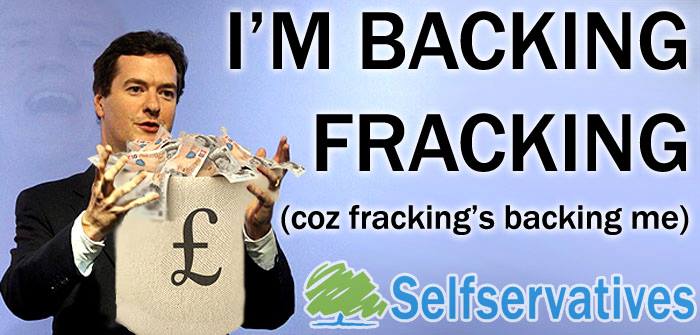
Seriously, the Tories, along with their network of unholy business alliances, are selling England by the pound. And the rest of the UK.

945744_222576267893429_574558961_n

Lord Howell is the father-in-law of Chancellor George Osborne, and was also the minister in the Foreign Office responsible for international energy policy between 2010 and 2013. George Osborne’s planned new shale gas allowance will more than halve the tax due on a proportion – which will be determined following consultation – of income from production in order to “encourage” exploration of the unconventional and controversial energy resource in the UK. Howell and his sponsors stand to gain substantially from this enormous tax break for the fracking industry.

Howell’s comments were so crass and churlish that a Government spokesman with a damage limitation mission piped up instantly that: “Lord Howell is not a minister and does not speak for the Government. He has not been a Government adviser since April 2013.” Howell may have “provoked gasps of shock” in the House of Lords when he said the gas production method could be safely carried out in the North East without environmental impact, but his attitude of prejudice towards “the North” is a commonly held one within the current Cabinet, and this was so within the Thatcher Cabinet: he was the energy secretary from 1979 to 1981.

I’ve always known that Tories hold deeply bigoted and vulgar views of me and my friends in the North. Never mind, I’ll let you into a little secret: I’m not so keen on the Tories, either.

Natalie Bennett said of the crude comments Howl made: “His casual Nimbyism is breath-taking – and his view of the North East deeply disturbing.We know that governments have long neglected regional development policy, and allowed a greatly excessive concentration of the economy on the South East, and this is a demonstration of the attitudes behind that”. Environmental campaigners reacted to the Tory peer’s comments with fury.

North Eastern Labour MPs also expressed their shock at Lord Howell’s comments. Chi Onwurah, MP for Newcastle upon Tyne Central, told the Huffington Post UK: It is a revealing insight into the attitudes this Government of posh boys from the home counties try to hide – the north east is a long, long way away and not near where our kind of people live”.  What a namby pamby NIMBY.

Shale gas is a resource with huge potential to broaden the UK’s energy mix, we want to create the right conditions for industry to explore and unlock that potential in a way that allows communities to share in the benefits.

This new tax regime, which I want to make the most generous for shale in the world, will contribute to that. I want Britain to be a leader of the shale gas revolution – because it has the potential to create thousands of jobs and keep energy bills low for millions of people”. George Osborne

So if fracking is such a great, risk-free deal that will create employment, keep our energy bills low, meet our demands for fuel for at least the next 25 years, and grace our communities as claimed, why would this “revolution” require the added incentive of a huge tax hand-out to the fracking industry, George?

Some serious concerns about the safety of fracking

Documented widespread groundwater contamination has occurred from seepage of the stored water, from fracking, from unlined surface ponds in America. Water companies in the UK have expressed concern that the fracking process could contaminate drinking water aquifers that lie above shale gas reserves. 

UK water companies have warned shale gas fracking should not be allowed to compromise public health as the Chancellor unveiled his plans for the generous handout of a tax relief regime for the industry. There has been a call for a large scale impact assessments from Water UK policy and business adviser Dr Jim Marshall.

Government “advisors”, however, have said that fracking is “safe”, despite the evidence to the contrary, and that it is “essential to making the UK more energy self-sufficient.”

However, the British Geological Survey (BGS), which has played a key role in advising the UK Government, is partly funded by companies involved in the hydraulic fracturing industry, including Chevron, ConocoPhillips, Exxon, BG Group and Schlumberger. The BGS’s close financial ties to industry raises some serious concerns about the impartiality of the BGS report commissioned by the UK Government.

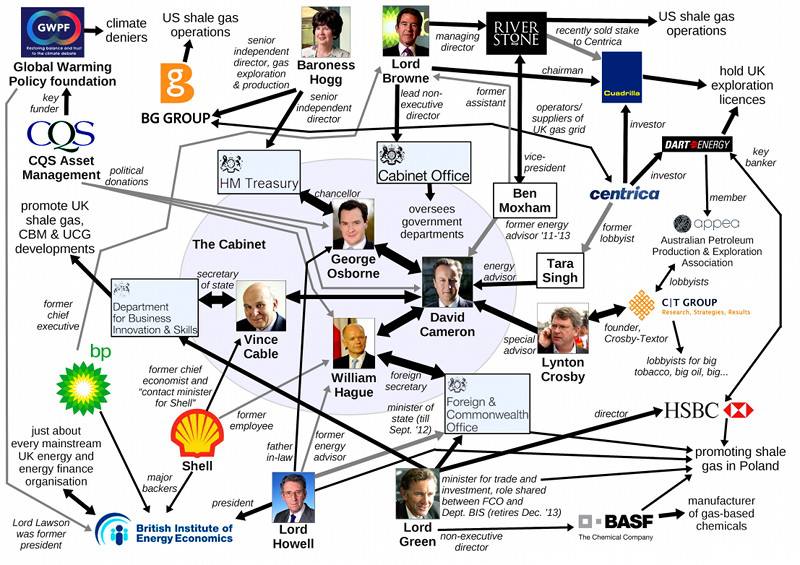
It ought to be of major concern that at least two other Conservative Peers, and two crossbenchers in the House of Lords have vested financial interests in fracking  – Lord Browne, (the former chief executive of BP and director of Cuadrilla Resource Holdings Ltd, appointed by Frances Maude to the Cabinet Office in 2010) Lord Green (of the HSBC scandal), Lord Howell (of the handouts from the boys scandal) and Baroness Hogg, (a director at BG Group, who expects to earn nearly $300 million from fracking operations in the US this year.) – each have financial interests in the fracking industry, and each holds either ministerial or executive rank at some of Whitehall’s most powerful departments: the Foreign and Commonwealth Office (FCO), the Treasury and the Cabinet Office.

David Cameron has already come under renewed pressure to sack his party’s elections adviser Lynton Crosby earlier this month, as environmental activists expressed serious concerns about his links to the fracking industry.

Crosby’s lobbying firm, Crosby Textor, represents the Australian Petroleum Production and Exploration Association, an oil and gas lobby group campaigning aggressively for fracking. The association’s chief operating officer, Stedman Ellis, has made headlines in recent months for his outspoken criticism of anti-fracking campaigners, telling one Australian paper: “The opportunity provided by shale gas is too important to be jeopardised by political scare campaigns run by activist groups.”

One has to wonder how many more of these transparent conflicts of interests is it going to take before Crosby has to step away from his role in Government?

And what a tangled web they weave…

1016893_10151586093372831_133919409_n

 With thanks to Paul Mobbs

Fracking – which is short for “hydraulic fracturing” – involves drilling deep under ground and involves the release of a high-pressure mix of water, sand and hundreds of chemicals to crack rocks and release gas stored inside.

Widespread fracking has not started in the UK yet, but Cuadrilla began exploratory drilling in Lancashire in 2011 and many other possible sites have been identified. The exploratory drilling triggered earth tremors.

The fracking process itself is a “mini-earthquake”, as it involves the breaking of rock strata deep inside of the earth to release gas. Many people, (myself included) are very legitimately opposed to fracking because of the potential for devastating environmental impacts, including contamination of ground water, depletion of fresh water, risks to air quality, the migration of gases and hydraulic fracturing chemicals to the surface, surface contamination from spills and flow-back, and the serious subsequent health effects of these. For these reasons hydraulic fracturing has come under international scrutiny, with some countries suspending or prohibiting it. However, some of those countries, including most notably the United Kingdom, have recently lifted their bans.

Substantial evidence from the States reveals that fracking is an extremely risky process that affects the water we drink, air we breathe, food we eat, our wildlife and climate – a significant air pollutant from fracking is methane, a greenhouse gas that traps 20 to 25 times more heat in the atmosphere than does carbon dioxide, and causes chaotic weather systems through the process of global warming.

While some claim that the cost is worth the benefits if it means we can transition away from fossil fuels, it has been shown that the “footprint” of shale gas is actually 20 percent higher than coal. Studies reveal that fracking poses a grave risk to public health, researchers examined 353 out of 994 fracking chemicals identified in hydraulic fracking operation, including lethal radioactive contaminants.

They found over 75% of the 353 chemicals affected the skin, eyes, and other sensory organs, 52% affected the nervous system, 40% affected the immune system and kidney system, and 46% affected the cardiocascular system and blood. That’s a serious concern.

Then there is the established link between fracking and earthquakes.

It’s worth seeing the documentary Gasland by Josh Fox, which is about the devastating impact and ill effects of fracking. It won the Special Jury Prize at the 2010 Sundance Film Festival. Gasland also provides a wealth of evidence, and records the socio-economic and environmental destruction caused by fracking. Some of the most striking images in the documentary are the clips of people setting fire to their contaminated tap water.

There are also some heartbreaking scenes of animals suffering, and of people’s livelihoods, well-being and health being destroyed by this undemocratically unregulated industry.

So, to Mr Howl, the greedy thug of a man who wants to make a buck from environmental vandalism and ecological devastation, and as ever with the Tories, a profit at the expense of wildlife and human well-being, I have this to say: It is patently clear to us that fracking plans in the UK are being steam-rolled out, on the back of vested interests in Government and lobbying from fossil fuel giants. First came the huge tax breaks for companies involved in shale gas exploration.

Then the announcement of new planning guidance making it harder to protect the environment from drilling.

Fracking is being hailed by the Government as the solution to all of our energy needs, despite evidence to the contrary. We know that although it may well be good for your own bank account, fracking is very bad for people, ecology and the environment. Cuadrilla’s UK operation was put on hold after causing tremors (small earthquakes), buthe report by the UK Government’s advisers published in April 2012 gave the green light to fracking, despite acknowledging the link between the process and the earthquakes in Lancashire in 2011.

We know that the Government “advisory report” was funded in part by companies involved in the hydraulic fracturing industry, including Chevron, ConocoPhillips, Exxon, BG Group and Schlumberger, and that raises some serious concerns about the impartiality of the report commissioned by the UK Government. (See also Frackademic scandals)

We say NO to fracking here in the North East. So expect a bloody big fight from us.

Further Reading:

Three lords and one Baroness: fracking interests inside the government

The White report: consideration of Radiation in Hazardous Waste Produced from Horizontal Hydrofracking

Global bans on fracking

Osborn accused over gas lobbyist father-in-law

GOVERNMENT ADVISORS SPONSORED BY FRACKING INDUSTRY

Hydraulic Fracturing Poses Substantial Water Pollution Risks, Analysts Say

Taxpayers’ bill of £1million to police West Sussex anti-fracking protests

Resource Efficiency, Harmful Substances and Hazardous Waste: Global Environment Alert Service

E-Petition to make Hydralic fracturing / fracking illegal in the UK

Tom Greatrex, the shadow Energy Minister, is demanding a full-scale government investigation into the controversial “fracking”

List of the harmed

Josh Fox’s Gasland  documetary in full

Please Sign Petition To End To Police Aggression When Arresting Peaceful Protesters

97bc59181fc5ccc590138d704d372c41

Sussex Police arrested peaceful anti-fracking protesters in Balcombe using physical violence and restraint methods, designed to inflict pain and incapacitate people. Sussex Police claim on their website that the arrests were peaceful. There is significant photographic evidence that unnecessary force was used. This isn’t acceptable in a peaceful democracy.

(Take a look at the picture. The Dokko is a specific pressure point, located where the jaw and skull meet. In most people, this point is just under the outer ledge of the earlobe at the base of the ear. Pressure points are specific sensitive areas that may be exploited to cause excruciating pain, and the military and police are increasingly using this technique on peaceful protesters.)

This petition is a call for a formal investigation into the police behaviour and for disciplinary action to be taken against those who used violence against the people they arrested. We need an end to Police aggression when arresting peaceful protesters. Here is some video evidence.


71407_222385347912521_137557564_n
Picture courtesy of  Robert Livingstone 


My work is unfunded and I don’t make any money from it. This is a pay as you like site. If you wish you can support me by making a one-off donation or a monthly contribution. This will help me continue to research and write independent, insightful and informative articles, and to continue to support others.


From Psycho-Linguistics to the Politics of Psychopathy. Part 1: Propaganda.

68196_116423458427191_5364492_n

1. Propaganda Techniques

Metacognition: We need to be mindful of how we think as well as what we think.

While the term propaganda has acquired a strongly negative connotation by association with its most manipulative and jingoistic examples (e.g. Nazi propaganda used to justify the Holocaust), propaganda in its original sense was neutral, and could refer to uses that were generally benign or innocuous, such as public health recommendations, signs encouraging citizens to participate in a census or election, or messages encouraging people to report crimes to law agencies, amongst others.

So the exact definition of propaganda is constantly debated, and no specific definition is completely agreed. Some argue that any persuasive communication is propaganda, whilst others hold that propaganda specifically alters political opinions. However, it is doubtless that propaganda is material which is meant to manipulate or change public opinion, and though it may vary in form and technique, it always serves this same purpose.

In the context of this article, propaganda is generally to be defined as a calculated, coordinated campaign carried out through media that are capable of reaching a large amount of people, to further a primarily political agenda, (although principles of propaganda can be applied equally to further a religious or commercial agenda also).

A number of techniques founded on social psychological research are used to generate propaganda. Many of these same techniques can be found under logical fallacies, since propagandists use arguments that, while sometimes convincing, are certainly not necessarily valid.

Some time has been spent analysing the means by which propaganda messages are transmitted. That work is important but it is clear that information dissemination strategies only become propaganda strategies when coupled with propagandistic messages. Identifying these messages is a necessary prerequisite to study the methods by which those messages are spread.

A basic assertion is an enthusiastic or energetic proposition presented as a statement of fact, although of course it is not necessarily true. Assertions often imply that the statement requires no explanation or evidence, but that it should merely be accepted without question.

Examples of assertions can be found often in advertising propaganda. Any time an advertiser states that their product is the best without providing evidence for this, they are using an assertion. The subject, ideally, are supposed to simply agree with the assertion without searching for additional information or applying any reasoning. Assertions, although usually simple to spot, are often dangerous forms of propaganda because they often include damaging falsehoods or lies.

“Glittering generalities” is one of the seven main propaganda techniques identified by the Institute for Propaganda Analysis in 1938. It also arises very often in politics and political propaganda. Glittering generalities are words that have different positive meaning for individual subjects, but are linked to highly valued concepts. When these words are used, they demand approval without thinking, simply because such an important concept is involved. For example, when a person is asked to do something in “defence of democracy” or “freedom” they are more likely to agree. The concepts of democracy and freedom have positive connotations to them because they are regarded as highly valued principles by the majority of people.

The “lesser of two evils” technique is an attempt to convince us of an idea or proposal by presenting it as the least offensive option. This technique is often implemented during wartime or economic recession to convince people of the need for sacrifices or to justify difficult decisions. This technique is often accompanied by adding blame on an enemy country or political group. One idea or proposal is often portrayed as the “better” one of the only options, and dominates political opinion.

The proposal that austerity measures are for the “benefit” or “good” of the general population is an excellent example of this. Just don’t expect to be informed about how much more wealthy the already wealthy have become since the Coalition imposed cuts and austerity, with the most vulnerable bearing the biggest burden of loss, and the wealthy bearing gifts from the always generous Tory tax handouts, but only for the already privileged.

It’s worth bearing in mind that when someone speaks or writes, they are trying to convince you of somethingAsk yourself what it is that they want you to believe, then analyse their basic proposition carefully. Examine what they are saying, look for consistency, coherence, reasoning and logic, and look for the evidence to support the proposition, of course.

It’s also important to recognise the merit and value of critical thinking, because propositions are opinions that usually exist in debate and controversy. There are usually other counter propositions, often at least equally compelling, that set a challenge – other points of view.  In Parliament, members debate proposals regarding legislation, vote, and make resolutions which become laws. Debates are usually conducted by proposing a law, or changes to a law. Members of Parliament (or Congress) then discuss it and eventually cast their vote for or against such a law. In democracies, this process is (at least in principle) based on reasoned debate, and a balanced consideration of all of the propositions, facts, evidence and implications presented.

Critical thinking involves understanding the extent of an area of controversy, as well as the details of each individual proposition, and looking at the evidence and reasoning presented with each point of view. We don’t have to agree with an opinion to understand it. Understanding something that we disagree with is an important part of formulating alternative reliable and valid perspectives of our own. Understanding alternatives and critically appraising them means that your own thought out and well-reasoned views are more likely to stand up to scrutiny and critical evaluation. It also means they are more likely to be grounded in reality – more likely to be factually informed.

Critical thinking is essential to spark cogent, rational, open debate and provide a framework to support and guide the public to participate in well-informed discussions on current issues responsibly. The Institute for Propaganda Analysis in the US arose “to teach people how to think rather than what to think.”

In the UK, we currently have a Government that exercises an unhealthy and considerable control of the media. It’s often possible to predict when the next round of cuts and austerity measures are going to be inflicted on us because the announcement of policy is typically preceded by media attempts at justification prior to the event, usually involving the demarcation and scapegoating of the social group to be affected by the policy.

We usually have a few weeks of the press stereotyping immigrants as a “free-loading drain on the taxpayer”, or poor sick and disabled people as “fraudsters” and “con artists”, with problems no more disabling that acne, being overweight, or substance abuse. Or unemployed people are portrayed as feckless, idle “spongers”, or lone parents as immoral and irresponsible “burdens”, reducing social housing availability for “deserving” families, as well as costing the State, and that mythical being, the very righteous but careworn and duped taxpayer.  But how else could a corrupt and authoritarian Government attempt to justify taking so much money from the poorest and most vulnerable citizens, whilst rewarding the wealthy with enormous tax cuts?

There is usually a considerable chasm between the propositions stated by the likes of Cameron, Iain Duncan Smith and Lord Fraud, for example, (well-established, prolific liars), evidence and reality. It’s almost like these people have a kind of political rhetoric schizophrenia: completely detached and isolated from reality, the ordinary world of everyday life and events. There is clearly a need for some analysis of such rhetoric and its link with Coalition policies.

The current Government are most certainly outrageous propagandists, on par with the Nazi Reichsministerium für Volksaufklärung und Propaganda, controlling the news media in particular, with the aim of shaping and controlling public opinions, attitudes and behaviours by a process of indoctrination, using übertrieben neo-liberalist dogmata to both create and justify neo-feudal subordination, oppressive hierarchical social structures and to signify the end of our humanist ideal and practice of shared citizenship.

We must challenge this 

The challenge starts in the same way as this article did: through metacognition. We need to be mindful of how we think as well as what we think. I ought to recommend Sir Karl Popper’s ideas of  falsificationism and verisimilitude rather than the more commonly employed verificationism as a methodology for discerning valid information: habitually search for the evidence that refutes what you are being told by any of the Coalition. It’s out there, and saves what would be an impossible task: you can never find proof of any Tory proposition actually being true. Plenty of evidence to verify lies, though. (I’m not being entirely tongue in cheek here, either.)

(I did try very hard to refute the existence of the Coalition….there was a snag with that, sorry to say. It seems falsificationism does have limitations.)

I almost forgot to mention Cameron’s one remarkable but accidental, blurted out truth: We are raising more money for the rich. That is verifiable fact. For once. Gosh.

Techniques for generating propaganda:

Ad hominem – A Latin phrase which has come to mean attacking your opponent, as opposed to attacking their arguments. David Cameron employs this strategy with considerable psychopathic expertise in Parliamentary debate. (See Prime Ministers Questions).

Ad nauseam – This approach uses tireless repetition of an idea. An idea, especially a simple slogan, that is repeated enough times, may begin to be taken as the truth. This approach works best when media sources are limited and controlled by the propagator. Joseph Goebbels, not known to be driven by the passionate inspiration of the moment, but by the result of sober psychological calculation, was particularly talented in utilising this approach. Iain Duncan Smith has a similar penchant for repeated mendacity. A serial offender.

To justify his cruel and unwarranted welfare “reforms” (cuts), Iain Duncan Smith says that he has taken money that is essential for meeting the basic survival needs from the poorest people because “It’s fair to taxpayers.”  Repeatedly. (See also Slogans.)

I am somehow reminded of the parable “The Judgement of Solomon”  from the Hebrew Bible, in which King Solomon of Israel ruled between two women both claiming to be the mother of a child by tricking the parties into revealing their true feelings. It has become an archetypal example of a judge displaying wisdom in making a ruling. Solomon ordered a sword to cut the baby in half, as the “one fair solution”. Of course the woman who loved her child was revealed as she was prepared to sacrifice her motherhood to save her baby and of course Solomon spared the baby.

Iain Duncan Smith is a stereotypical Tory, and being neither wise nor compassionate, he proceeded to cut (and not “reform”) the baby in half: he spitefully killed it, allegorically speaking. Despite the fierce protests. And the need for ad hoc application of an archaic commons convention – financial privilege, invoked to stifle the mass opposition, overturn the House of Lords amendments to the Bill and hammer the “reforms” through the legislative process.

The narrative constructed in support of this attack on welfare payments rests on the proposition “Benefit claimants shouldn’t get more than ‘strivers‘”: an appeal to generate and fuel a public sense of injustice. However, the majority of welfare payments to be slashed in real terms are benefits that are paid to working people. Benefits to be restricted to below inflation rises include; Working Tax Credit, Child Tax Credit, Housing Benefit, Child Benefit, Maternity Pay, Paternity Pay, Council Tax Benefit and Statutory Sick Pay.

People claiming welfare benefits are also taxpayers, these are not two discrete social groups at all. Welfare is funded by taxpayers for times when taxpayers need financial support, because they lost their job, or became ill or disabled, for example. No-one has gained a thing from the welfare “reforms”, except for the minority of very wealthy people. That’s where the savings made from welfare cuts, at the expense of the poorest, have gone. (See also Operant conditioning and Slogan.)

544547_466042163465317_917876792_n

Appeals to authority – this technique involves citing prominent figures to support a position, idea, argument, or course of action. The Tories, however, believe there are none who know better, or have more authority than the Tories. According to the Tories. See also Authoritarianism.

A good example of this technique being used is Osborne’s careful selection of “leading economists” (he used business leaders) to endorse his damaging austerity program. He carefully excluded those who presented valid criticisms of the centrepiece of Osborne’s strategy: it’s accelerated austerity for purely ideological ends, (see also Minarchism) and it halted the recovery that happened under the previous Labour Government in its tracks.

Another example is Cameron’s quote from a doctor in Ed Miliband’s constituency of Doncaster last year, he used “Doncaster GP”, Dr Greg Conner to defend his NHS Reform Bill, following debate when Miliband had pointed out that most Health Care professionals did not endorse or support the Bill. In fact the majority opposed it. However, Dr Conner’s remarks were made when he was chairman of the Doncaster clinical commissioning group – a position he no longer holds, as he left in 2011. Cameron failed to mention this, of course. See Card Stacking and Disinformation also.

Loaded language – Specific words and phrases with strong emotional implications are used to influence the audience. News headlines are often used for this purpose. For example “Britain risks huge influx of east Europe migrants”, from the Telegraph.

Examples also include the ad nauseum use of value-laden terms in political narratives and the media, such as “benefit cheat”, “dependency”, “entrenched”, “fraud”, “worklessness”, “addiction”, and more opprobrious examples such as “scrounger”, “skiver”, “workshy” (see Aktion Arbeitsscheu Reich and the origins of this word, it’s now being used very frequently in the media to describe unemployed and disabled people.)

Iain Duncan Smith has spoken of a “mass culture of welfare dependency” in every speech on benefits he has made in the past 12 months. Several studies show that compared with the end of the Labour Government, such pejorative language use has risen dramatically, and Duncan Smith is the most frequent Parliamentary user of value-laden terminology, regularly including phrases and terms such as entrenched and intergenerational worklessness and welfare dependency in his speeches. The research and analysis came after complaints that the government is using exceptional cases such as that of Mick Philpott, the unemployed man jailed for the manslaughter of six children, to justify its program of brutal cuts to the benefits system. Fullfact research debunked claims made about “intergenerational worklessness”, using the Department of Work and Pension’s own data.

However, the Tories tend to “unload” or “neutralise” some of their language too, especially in discussion and debate about their policies. For example, using the word reforms rather than a more neutral but informative word like changes, or a negative (and accurate) one like cuts. This is used to conceal the true aims and consequences of policies, and draws on Orwellian Doublespeak: language that deliberately disguises, distorts, or even reverses the normative meaning of words.

Another example is the use of phrases such as “statistical norms”, “not targets but aspirations” and “robust expectations of performance”  in outrageous, very unsubtle feats of Government linguistic ducking and diving to attempt disguise of the fact that sick and disabled people’s benefits have inbuilt targets of benefit removal, embedded in “assessments” and “eligibility criteria”.

In fact, the whole “assessment” process is nothing more than an opportunity for the “justification” of welfare stripping. And regardless of any human costs, no matter how catastrophic to those targeted to lose their benefits. That’s 7 out of 8 people, regardless of the extent of their illness and disability, who will be told they are “fit for work”, because the Government decided in advance of any assessment that they are going to lose their disability benefit, and wrote this into the Atos contract. See Repetition, Stereotyping, Labeling, Name-calling and Ad Nauseum and also Techniques of Neutralisation.

Appeal to fear or Ad Horribilis – Appeals to fear seek to build support by instilling anxieties and panic in the general population, for example Goebbels exploited Theodore N. Kaufman’s Germany Must Perish! to claim that the Allies sought the extermination of the German people.

This strategy is often employed to justify racism. It often appeals to the “burden on the taxpayer”  proposition, and often utilises Stereotyping and Flag-Waving techniques. Use of reactionary words like “swamping”, “spiralling”, “invading” and “crisis” have a long history of creating and heightening public fears of immigration, implying blame for economic downturns and recession and justifying racist policy.

The calculated use of the example of an exceptional psychopathic individual, Mick Philpott, the incidently unemployed man jailed for the manslaughter of his six children, as a way of deliberately creating public fears that a “benefit culture”  turns people into such violent and manipulative characters, whilst conveniently stigmatising all  unemployed benefit claimants, was done in an attempt to justify the Tory-led Government’s long-standing ideological imperative to destroy our social security system.

Dr Harold Shipman, one of the most prolific serial killers in recorded history, was in work, as was Ian Kevin Huntley, a caretaker at a secondary school and Peter Sutcliffe –  the “Yorkshire ripper” –  worked as a truck driver, yet we never hear of a link being made between employment and the capacity for prolific, brutal, cold-bloodied murder.

The “hardworking taxpayer”  is often depicted as solely carrying the burden of the costs of welfare and any other kind of social support , and there is an element of fear-mongering in this portrayal, but of course, everyone pays taxes, including those in receipt of welfare. In fact the poorest citizens tend to pay more in taxes than the wealthy. See also Appeal to Prejudice, Loaded language, Stereotyping  and Name-Calling.

Appeal to prejudice – Using loaded or emotive terms to attach value or moral goodness to believing the proposition. For example, the phrase: “Any hard-working, striving taxpayer would have to agree that those who do not work, and who do not support the community do not deserve the public’s support through welfare benefits”.

Another example of this technique is the proposition embedded in this comment: “Who will pay for the pensions these immigrants will claim, and their families? It is nothing more than living on credit, making our children deal with the mess”. – UKIP Chief Executive, Will Gilpin.

A key study conducted by The Migration Observatory at the University of Oxford, showed that migrants from so-called A8 countries (the eight countries that joined the EU in 2004) made a positive contribution to the country’s public finances in each fiscal year since their EU accession. Although they mostly work in low-wage jobs, their (often exploited) labour-force participation and employment rates tend to be higher than average, which offsets the impact of their lower wages. See also Black and White Fallacy and Loaded language.

Bandwagon – Bandwagon and “inevitable-victory” appeals attempt to persuade the target audience to join in and take the course of action that “everyone else is taking.”

Black and White fallacy – Presenting only two choices, with the product or idea being propagated as the better choice. (e.g. “You are either with us, or you are with the enemy” or “If you aren’t part of the solution, then you are part of the problem”). So this involves reducing complex issues to overly simplified and contrived oppositional dichotomies, and uncritically favouring one of the two schemata.

An example is the “either endure austerity or increase the UK’s deficit” binary conceptual schema. We know that the evidence is that austerity has led to the deteriorating state of the UK economy, and the austerity  program has a negative impact on domestic demand and GDP, and there has been no substantive reduction in Britain’s current account deficit.

Another example is from the Home Secretary, Theresa May, who said in her statement, directly in response to the recent killing in Woolwich: “This attack was an attack on everyone in the United Kingdom, and it will be condemned by people from every community”  she spurred on a wave of anti-Muslim sentiment and consequent violence. On May 22, the English Defence League (EDL) were quick to sweep through Woolwich whilst it was recommended that Muslims in the area remain indoors. Since then, we have seen many verbal and physical attacks around the country against Muslims and Islamic institutions, alongside weekly marches called by both the EDL and the British National Party (BNP) in an attempt to legitimise explicitly racist and Islamophobic rhetoric through its existence in the mainstream political sphere.

Theresa May, however, has responded by calling for the instatement of a “snooper’s charter” in order to ban groups that are deemed to encourage “radical Islamism” whether or not they condone the use of violence, and in order to monitor the internet use of potential suspects (i.e. monitoring e-mails, social media, Skype, website visits, etc.). Whilst undemocratic policies and initiatives like these have been in existence throughout the so-called “War on Terror” with the creation of organisations such as “Prevent” and the collection of students’ information from University College of London’s (UCL) Islamic Society given to the CIA (2010), they do not encompass other forms of hate speech that have been the cause of racially or religiously motivated attacks in Britain. It seems, then, that terror inflicted upon Muslims in Britain, or “racially or religiously motivated attacks”, does not constitute a threat to British society despite its prevalence and violent nature. Instead, these attacks are indirectly encouraged through the language used and actions taken by the Government, especially by Theresa May and David Cameron. This is also a very good example of the Government marginalising and isolating a social group. See also Appeal to Prejudice and Loaded language.

Big Lie – See also Disinformation. The repeated articulation of a complex of series of events that justify subsequent action. The descriptions of these events have elements of truth, and the “big lie” generalisations merge and eventually supplant the public’s accurate perception of the underlying events. After World War I the German Stab in the back explanation of the cause of their defeat became a justification for Nazi re-militarisation and revanchist aggression.

Not to be confused with Cameron’s “Big society”, although this is also a big lie.

Common man – The ordinary folks  or Common man approach is an attempt to convince the audience that the propagandist’s positions reflect the common sense of the people. It is designed to win the confidence of the audience by communicating in the common manner and style of the target audience. Propagandists use ordinary language and mannerisms (and clothe their message in face-to-face and audiovisual communications) in attempting to identify their point of view with that of the average person.

For example, a propaganda leaflet may make an argument on a macroeconomic issue, such as unemployment benefits, using everyday terms: “given that the country has little money during this recession, we should stop paying extravagant unemployment benefits to those who do not work, because that is like maxing out all your credit cards during a tight period, when we all should be tightening our belt”.

A common example of this type of propaganda is a political figure, usually running for a parliamentary seat, portrayed in a humble backyard, commercial bread bakery or shop, doing daily routine things. This image appeals to the “common person”. The Tories frequently try this one to attempt to shake off the solid, privileged, aristocratic and insular anti-social situation they inhabit, in vain attempts to appear “ordinary”. Needless to say, most of us don’t buy it.

Demonising the enemy – Making individuals from the opposing nation, from a different ethnic group, or those who support the opposing viewpoint appear to be subhuman (e.g., the Vietnam War-era term “gooks” for National Front for the Liberation of South Vietnam aka Vietcong, (or ‘VC’) soldiers), worthless, or immoral, through suggestion or false accusations.

Another example is the current Government making individuals of the Opposition Party appear responsible for the socio-economic crisis of Coalition origin and manufacture. (See The Great Debt Lie and the Deficit Myth).

The systematic demonisation of the recipients of any social support and welfare via the media and political rhetoric is another example. This is done to to erode public sympathy and support for the poor, so that the Government can then remove such “costly” support and hand out “tax payer’s” money to the wealthy and private companies instead. See also Loaded language, Name-calling and Stereotyping.

Direct order – This technique is an attempt to simplify the decision making process by using images and words to tell the audience exactly what actions to take, eliminating any other possible choices. Authority figures can be used to give the order, overlapping it with the Appeal to authority technique, but not necessarily.

A good example is the raft of pointless questionnaires and consultation documents that have no scope whatsoever for disagreeing with the current Government. “Choice architecture” –  your responses are “nudged” in the desired “direction”, although the Tories are often even less subtle than that: there are no alternative perspectives expressed or suggested, the loaded, fixed questions elicit fixed, short responses and that renders the exercise of completing them futile. The words “stroke me with my own Tory opinions, because this ain’t a democracy” ought to be written on the title page of each one.

Disinformation – The creation or deletion of information from public records, in the purpose of making a false record of an event or the actions of a person or organisation, including outright forgery of photographs, motion pictures, broadcasts, and sound recordings as well as printed documents. And in the case of the Tories, statistics (Iain Duncan Smith). See David “paying down the debt” Cameron also.

Another example is Iain Duncan Smith’s lie about his education and qualifications, as stated in his biography on the Conservative Party website, his entry in Who’s Who, and various other places, which make the claim that he went to the Universita di Perugia in Italy. Mr Duncan Smith’s office has been forced to admit to Newsnight researchers investigating his academic  background that he didn’t get any qualifications in Perugia, or even finish his exams. It was also claimed that he was “educated at Dunchurch College of Management”. In fact, Dunchurch was the former staff college for GEC Marconi, for whom he worked in the 1980s. Mr Duncan Smith’s office was forced to admit that that he did not get any qualifications there either, but that he completed six separate courses lasting a few days each, adding up to about a month in total. (See Newsnight reveals ‘inaccuracies’ in Iain Duncan Smith’s CV ). It’s easy to see why Mr Duncan Smith has made it his very own personal campaign to “monitor” the BBC for “left-wing bias.”

I believe that a related technique is Information Suppression, and it is becoming increasingly common practice in the UK. This includes censorship, media black-outs, such as the lack of open reporting about the widespread criticisms and professional and public protests preceding and following the welfare reforms and Health and Social Care Bill, suppression of investigations, such as Project Riverside , “the other hacking scandal”, and withholding information that would ordinarily be released to the public. These strategies bear the characteristic hallmark of an authoritarian Government.

A very blatant example is the Government’s deliberate withholding publication of the Department of Health’s Transition Risk Register, which was a statement of risks of NHS changes due to the Tory-led Health and Social Care Bill. There was legitimate demand from professionals, academics and the public, and a legal ruling from the Parliamentary Information Commissioner for release of the information, the Government defied a second legal ruling to publish the risk register following their unsuccessful appeal against the information commissioner’s original ruling that it should be made public. The judgement very clearly and explicitly supported the public’s right to know about the risks the Government is taking with its plans to privatise the NHS. Despite strong legal support for a full and open public debate about the NHS “reorganisation”, Cabinet Ministers did not respect the law and continue to stifle and censor such debate. We are still awaiting the release of that information from 2010. (See also David Cameron launches damaging attack on the Freedom of Information Act.)

Perhaps we may call another related technique: “Re-writing History”. Examples include the making of false claims and inventing statistical “evidence”, or mispresenting that evidenceGrant Shapps falsely claimed in the House of Commons that the Coalition would build more affordable homes in five years than the Labour Government had done in the 13 years they were in Office. However, housebuilding is currently at the lowest it’s been since 1946. Officials in the Department for Communities and Local Government battled for nearly a year to prevent the release of internal correspondence (emails) relating to the former Housing minister Mr Shapps following the complaint made to Andrew Dilnot, the head of the UK Statistics Authority, by the Opposition, about Mr Shapps’s claims and the misuse of statistics.

Finally forced to back down by the Information Commissioner the subsequently released emails showed that civil servants believed Mr Shapps, who is now Conservative Party chairman, had made inaccurate statements about the number of affordable homes being built in Britain.

Mr Shapps was reprimanded again after being been caught using false statistics to back up the Government’s welfare reforms, pointing to the wrong set of numbers to imply there were nearly a million benefit cheats. Shapps is quoted saying: “nearly 900,000 people who were on incapacity benefit dropped their claim to the payments, rather than undergo a tough medical test”. The figure of nearly one million Shapps quoted was in fact the number of new applicants to Employment and Support Allowance who had dropped claims between October 2008 and May 2012. They had not been awarded ESA. The actual number of people who were claiming incapacity benefit who dropped their claim to the payments was 19,700.

The UK Statistics Authority chair Andrew Dilnot, responding to Labour MP Sheila Gilmore’s enquiry, said: “Having reviewed the article and the relevant figures, we have concluded that these statements appear to conflate official statistics relating to new claimants of the ESA with official statistics on recipients of the incapacity benefit (IB) who are being migrated across to the ESA”.

Ms Gilmore had also complained that press reports of the issue implied that those dropping claims were doing so because they had never really been ill. Mr Dilnot wrote: “In your letter, you also expressed concern about the apparent implication in the Sunday Telegraph article that claims for Employment Support Allowance (ESA) had been dropped because the individuals were never really ill in the first place. The statistical release does not address the issue of why cases were closed in great depth, but it does point to research undertaken by DWP which suggests that ‘an important reason why ESA claims in this sample were withdrawn or closed before they were fully assessed was because the person recovered and either returned to work, or claimed a benefit more appropriate to their situation'”. A copy of the rebuke was also sent to Iain Duncan Smith, also reprimanded more than once by the UK Statistics Authority for similar misuse of figures to promote the “effectiveness” of the welfare “reforms”. (See also Grant Shapps, the Conservative Party chairman, has claimed he was only joking when he used a fake name to promote his get-rich-quick business.)

Euphoria – The use of an event that generates euphoria or “feel good”, happiness, or using an appealing event to boost morale, such as the Olympic games. Euphoria can also be created by declaring a holiday, or mounting a military parade with marching bands and patriotic messages. Royal weddings and births are elevated and spotlighted by the media for this purpose. See also Ad Nauseum

Flag-waving – An attempt to justify an action on the grounds that doing so will make one more patriotic, or in some way benefit a group, country, or idea. The feeling of patriotism which this technique attempts to inspire may not necessarily diminish or entirely omit one’s capability for rational examination of the matter in question.

In the most recent budget announcement by the Chancellor George Osborne, a measure was declared that proposes people who have “unfavourable English language skills should have their benefits cut”.  A shallow, populist appeal to the shallow “common man” Daily Mail readers. Those who frequent the far-right saw this as a moment of national pride: “keeping Britain for the British”.

The selling of public services to foreign multinational companies is not patriotic at all, however. The Minister who has been given responsibility for the sell-off Royal Mail is the ultra-dry Thatcherite, Michael Fallon. He has already informed Billy Hayes, General Secretary of the Communications Workers Union that if his members won’t accept the bribe of some shares in return for the mortgaging of their future and that of a national postal service, he will actively seek foreign buyers to asset-strip this national institution.

We already know that the transfer of largely profitable state assets such as British Telecom to the private sector meant that the taxpayer lost that income – which instead went to private shareholders. As years went by, many publicly owned companies were not only privatised, such as the railways, the taxpayer was then asked to subsidise the private operators. The reward for our enforced generosity? Exorbitant price rises. Examples of this are electricity, water and rail. Tories like Fallon usually grace us with lectures about “patriotism” and “flying the flag”. This certainly reveals inconsistency and incoherence in established Tory “ideological grammar”. See also Cognitive Dissonance.

The Finnish Maiden  – personification of Finnish nationalism. See Sibelius also.

Intentional vagueness – Generalities are deliberately vague so that the audience may supply its own interpretations. The intention is to move the audience by use of undefined phrases, without analysing their validity or attempting to determine their reasonableness or application. The intent is to cause people to draw their own interpretations rather than simply being presented with an explicit idea. In trying to “figure out” the propaganda, the audience forgoes judgement of the ideas presented. Their validity, reasonableness and application may still be considered.

Not to be confused with “completely ignoring questions”. This is something of a speciality technique of David Cameron. He also mastered the technique of “getting away with it”, but that tends to come with experienced, psychopathic, aristocratic authoritarians.

Labeling – A Euphemism is used when the propagandist attempts to increase the perceived quality, credibility, or credence of a particular ideal. A Dysphemism is used when the intent of the propagandist is to discredit, diminish the perceived quality, or hurt the perceived righteousness of the Mark. By creating a “label” or “category” or “faction” of a population, it is much easier to make an example of these larger bodies, because they can uplift or defame the Mark without actually incurring legal-defamation. “Scrounger/striver” rhetoric would fall into this category.

Another example – “Liberal” is a dysphemsim intended to diminish the perceived credibility of a particular Mark. By taking a displeasing argument presented by a Mark, the propagandist can quote that person, and then attack “liberals” in an attempt to both (1) create a political battle-axe of unaccountable aggression and (2) diminish the quality of the Mark.

If the propagandist uses the label on too many perceivably credible individuals, muddying up the word can be done by broadcasting bad-examples of “liberals” in the media.

Labeling can be thought of as a sub-set of Guilt by association, another Logical Fallacy. For example, the Labour Party don’t support the Tory welfare “reforms” (cuts), and so Cameron has tried to brand them as “the party of the scrounger, who are supporting the idle”. See Stereotyping and Loaded Language also.

Name-calling – Propagandists use this technique to incite fears and arouse prejudices in their hearers with the intent that the bad names will cause hearers to construct a negative opinion about a group or set of beliefs or ideas that the propagandist would wish hearers to denounce. The method is intended to provoke conclusions about a matter apart from impartial examinations of facts. Name-calling is thus a substitute for rational, fact-based arguments against the an idea or belief on its own merits. Again, “scrounger”, “fraud” and “workshy” are examples of this technique. See also Labeling and Stereotyping.

Obtain disapproval or Reductio ad Hitlerum – This technique is used to persuade a target audience to disapprove of an action or idea by suggesting that the idea is popular with groups hated, feared, or held in contempt by the target audience. Thus if a group which supports a certain policy is led to believe that undesirable, subversive, or contemptible people support the same policy, then the members of the group may decide to change their original position. This is a form of bad logic, where it is said that a ∈ X and a ∈ Y, therefore, X=Y.

It’s worth noting that invocation of Reductio ad Hitlerum or the related Godwin’s Law is unreasonable where such a comparison is appropriate. (For example, in discussions of dangers involved in eugenics, the stigmatisation and persecution of social groups, tolerance of racist and nationalist political parties and propaganda campaigns to promote any of these). In such contexts, the belittling and dismissal of an opponent’s argument on this basis becomes its own form of association fallacy and Ad Hominem attack.

The Obtain Disapproval technique has been used to stifle debate about the welfare “reforms” with the Opposition, because the Labour Party don’t endorse the cuts, they are therefore supportive of, and popular amongst the “idle, feckless scrounging” poor. They also “borrow too much” in order to support the unfortunates, and as we know, that’s a big untruth because such support is paid for by us for us. It isn’t the Government’s money: it’s ours.

Another good example is Iain Duncan Smith’s comment: “I’m sorry, but there is a group of people out there who think they’re too good for this kind of stuff.”  The comment was aimed at people opposing workfare, not because of the nature of the work, but rather because it involves forcing people to do menial work (under threat of sanctions) for free with profit-making corporations. That is immoral, and contravenes established rights that were fought for by our grandparents, great grandparents, and their parents.

This is also an appeal to the “common man”, and Iain Duncan Smith employs an inverted snobbery approach to try and appeal to his audience. He is also dissembling tangentially to avoid discussing the actual fundamentals of the case for workfare. Well, there isn’t one, unless you happen to be an executive of a private company, solely directed by the profit motive, so he has no choice, strategically speaking.

Oversimplification – Favourable generalities are used to provide simple answers to complex social, political, economic, or military problems. An example of this is the use of the word “worklessness”  instead of unemployment. We know that unemployment arises through political and economic macro-level structural conditions caused by Government decision making. But the word “worklessness” is used by the current Government to shift the burden of guilt, divert attention from their shortcomings and to blame individuals for the fact they cannot find a job. There aren’t enough jobs, it’s a grim recession, we know this is so, but the Government blatantly ignores this crucial detail, or invents statistical “evidence” of none existent jobs.  See Labeling also

Quotes out of Context – Selective editing of quotes which can change meanings. Political documentaries designed to discredit an opponent or an opposing political viewpoint often make use of this technique.

An example of this is Liam Byrne’s jesting note to David Laws, his successor. It said “I’m afraid to tell you there’s no money left.”  It is a long-standing convention for outgoing ministers to leave notes for their successors with advice on how to settle into the job, which are often slanted with humour. But Byrne’s note – which he later confirmed was certainly intended as a private joke – was used in Tory-led attempts to negate Labour’s credibility regarding their (comparatively excellent) economic record. Mind the logical gap.

Rationalisation – Individuals or groups may use favourable generalities to rationalise questionable acts or beliefs. Vague and pleasant phrases are often used to justify such actions or beliefs. A good example is the rationalisation that benefit sanctions  – the taking away of someone’s means of basic survival – will “support people into work”. A further example is the rationalisation that cutting benefits will “make work pay”, despite the fact that wages have decreased enormously in value due to the 25% rise in the cost of living, and wages have not risen in monetary terms at all. But above all, there is a huge logical gap between the act of cutting benefits and the statement “making work pay”. It doesn’t have any coherence, as a basic idea, and certainly not in practice, either. It’s propaganda of raving dementors. They suck the life from every social kindness, act of decency, civilisation, good will and grace.

Card stacking, or selective omission, is often related to Rationalisation, and is one of the seven techniques identified by the Institute for Propaganda Analysis (IPA). It involves only presenting information that is positive to an idea or proposal and omitting information contrary to it. Card stacking is used in almost all forms of propaganda, and is extremely effective in convincing the public. Although the majority of information presented by the card stacking approach may contain some truth, it is dangerous because it omits important information. See also Black and White fallacy, Disinformation and Information Suppression.

Red herring – Presenting data or issues that, while compelling, are irrelevant to the argument at hand, and then claiming that it validates the argument. Or if you are Iain Duncan Smith, invention of statistics is the preferred sub-set technique here.

A good example of this is Cameron’s oft-used response to difficult questions about the NHS, welfare or disability benefits: he frequently uses Ivan, his own disabled and deceased child, to elicit public sympathy, and to offer as “irrefutable” proof that his welfare “reforms” (cuts) must be therefore be “right”, and this tactic has the added bonus of implied rebuke for daring to question the policies. Curiously, we never hear mention of Cameron’s other children. But the comment “As someone who has actually filled out the form for disability allowance and had a child with cerebral palsy, I know how long it takes to fill in that form”  is very clearly calculated to appeal to common experience, in addition to diverting us from the truth: the current Government is persecuting and pauperising sick and disabled people via an implicit eugenics agenda written into their devastating policies, which are based on removing benefits from the most vulnerable people.

Repetition – This type of propaganda deals with a jingle or word that is repeated over and over again, thus getting it stuck in someone’s head, so they can buy the product. The “Repetition” method has been described previously. A good example is “making work pay”, which has also become something of a Tory slogan, (see below). The phrase has come to mean stripping social security, and welfare provision, whilst driving down wages at the same time. Another example is Cameron’s unconvincing “Big Society”. There is definitely Orwellian Doublespeak going on there. See also Ad Nauseum.

Slogans – A slogan is a brief, striking phrase that may include labeling and stereotyping. Although slogans may be enlisted to support reasoned ideas, in practice they tend to act only as emotional appeals. Opponents of the US’s invasion and occupation of Iraq use the slogan “blood for oil” to suggest that the invasion and its human losses was done to access Iraq’s oil riches. On the other hand, “hawks” who argued that the US should continue to fight in Iraq use the slogan “cut and run” to suggest that it would be cowardly or weak to withdraw from Iraq. Similarly, the names of the military campaigns, such as “enduring freedom” or “just cause”, may also be regarded as slogans, devised to influence people.

A Tory slogan of epic farce value is: “we are all in it together”. We know that whilst the majority endure austerity, and life changing cuts to our basic income, the minority of very wealthy individuals are enjoying an increase in their already considerable standard of living, at our expense. Also see Repetition and Ad Nauseum. Again.

It’s worth noting that “we are all in it together” was a slogan made famous in Terry Guiliams’s black and dystopic  film “Brazil.” Cameron certainly had a moment of recycling propaganda with taunting irony there.

tumblr_m81dzafFA21qcekj1o1_500State propaganda poster from the film “Brazil”

Stereotyping (Name-Calling or Labeling) – This technique attempts to arouse prejudices in an audience by labeling the object of the propaganda campaign as something the target audience fears, hates, loathes, or finds undesirable. For instance, reporting on a foreign country or social group may focus on the stereotypical traits that the reader expects, even though they are far from being representative of the whole country or group; such reporting often focuses on the constructed and amplified negative traits (See the Telegraph, Daily Mail and Sun in particular).

Again, the “workshy” individual, lounging in bed all day behind closed curtains, with massive and expensive plasma screen TVs, luxurious and idle lifestyles, usually with drugs and alcohol in abundance, undeserved holidays, a walking stick which is never used except for assessments, propped by the front door, and many offspring of dubious parentage just to “con” the “taxpayer” out of even more money is a well-worn typification.

The right wing public express outrage at the very idea that people who are unemployed are somehow “better off” than people who work. Although most of us know that it isn’t the case since benefits are calculated to meet basic living costs only, and we also know that most claimants have contributed and continue to contribute tax, this mythological scrounger-type persists only as a rhetorical strategy, a necessity for the current Government, so that stripping welfare provision can be “justified”. See Loaded language

Testimonial – Testimonials are quotations, in or out of context, especially cited to support or reject a given policy, action, program, or personality. The reputation or the role (expert, respected public figure, etc.) of the individual giving the statement is exploited. The testimonial places the official sanction of a respected person or authority in a propaganda message. This is done in an effort to cause the target audience to identify itself with the authority or to accept the authority’s opinions and beliefs as its own. See also damaging quotation and Appeal to Authority

An example of this technique is the selective employment of a leading doctor as a spokesperson for the Government to justify closing National Health Service maternity units, by asserting, with a straight face, that this will “improve” services by increasing centralisation and that “We do need to rationalise because in future smaller obstetric units won’t be affordable”. Tosh.

Firstly, increasing the distance that pregnant women in labour have to travel to receive crucial care puts them and their babies at serious risk, for obvious reasons. Secondly, we know the NHS is able to function in the way that it has done since its inception because it is primarily funded through the general taxation system. We also know that the Coalition is deliberately starving the NHS of essential funding, setting it up to fail the needs of patients so that full privatisation can be justified, and profit for many Coalition MPs, invested in private health care companies, can be had.

Transfer – Also known as Association, this is a technique of projecting positive or negative qualities (praise or blame) of a person, entity, object, or value (an individual, group, organisation, nation, patriotism, etc.) to another to make the second more acceptable or to discredit it. It evokes an emotional response, which stimulates the target to identify with recognised authorities.

Unstated assumption – This technique is used when the propaganda concept that the propagandist intends to transmit would seem less credible if explicitly stated. The concept is instead repeatedly assumed or implied.

An example of this is the current Tory notion of the “trickle down” effect. This is to justify tax breaks or other economic benefits provided by Government to businesses and the wealthy, on the basis that this will benefit poorer members of society eventually by improving the economy as a whole.

The term has been attributed to humorist Will Rogers, who said, during the Great Depression, that “money was all appropriated for the top in hopes that it would trickle down to the needy.” Worth remembering that the term was originally mostly used ironically or as pejorative. So to clarify the implicit Tory policy directive, money is taken from the poorest, and handed to the wealthiest, with the hope of it being “trickled” back down to the poorest at some point in the future. Well, how very coherent, credible and sensible that is. Ho hum. And how very Tory.

Virtue words – These are words in the value system of the target audience which tend to produce a positive image when attached to a person or issue. Peace, happiness, security, wise leadership, freedom, “The Truth”,  striver etc. are virtue words. In countries such as the U.S. religiosity is seen as a virtue, making associations to this quality effectively beneficial. This technique is now very evident in the UK.  See Transfer.

Straw man – This type of argument is an informal fallacy based on misrepresentation of an opponent’s position. To “attack a straw man” is to create the illusion of having refuted a proposition by substituting a superficially similar proposition (the “straw man”), and refuting it, without ever having actually refuted the original position.

I’ve written a summary of the techniques here.

537138_298121333590735_348384495_n (1)Many thanks to Robert Livingstone for his really excellent art work  

Quantitative Data on Poverty from the Joseph Rowntree Foundation.

377683_445086432227557_1770724824_n (1)

The minimum cost of living has soared by a quarter – 25% – since the start of the economic downturn, according to a report from the Joseph Rowntree Foundation, which details the true inflationary pressures facing low income households. The research finds families are facing an “unprecedented erosion of household living standards” thanks to rapid inflation and flat-lining wages.

Cuts to benefits and tax credits have exacerbated the problem over the past 12 months, according to the report. Now we are seeing the hard evidence that the Coalition’s “reforms” are pushing employed people in low paid work and unemployed people into absolute poverty, as our welfare system is no longer meeting basic living needs, and Government policy has distorted the original purpose of our social security, using rhetoric about costs to “the tax payer”, whilst carefully excluding the fact from their monologue that most benefit recipients are also tax payers.

A frightening consideration is that this report doesn’t include the latest round of benefit cuts – the very worst of them to date – that were implemented in April of this year. The report was produced prior to then, covering the period up to April, but doesn’t include it.

A quarter of households in the UK already fell short of the income required to reach an adequate standard of living – for them a 25% increase in costs intensifies the everyday struggle to make ends meet. The price of food and goods we need for an acceptable living standard has risen far faster than average inflation. This has combined with low pay increases to create a widening gap between income and needs.

The freeze in child benefit, the decision to uprate tax credits by just 1% and the increase in the cost of essentials faster than inflation mean that a working couples with children an  working lone parents will lose out, making a mockery of the Coalition’s claim of “making work pay”.

Over the past five years:

• Childcare costs have risen over twice as fast as inflation at 37%.
• Rent in social housing has gone up by 26%.
• Food costs have increased by 24%.
• Energy costs are 39% more.
• Public transport is up by 30%.

Some further shocking Key findings from the Poverty and Social Exclusion Project – The Impoverishment of the UK report reveals that:

• Over 30 million people (almost half the population) are suffering some degree of financial insecurity.
• Almost 18 million people cannot afford adequate housing conditions.
• Roughly 14 million cannot afford one or more essential household goods.
• Almost 12 million people are too poor to engage in common social activities considered necessary by the majority of the population.
• About 5.5 million adults go without essential clothing.
• Around 4 million children and adults are not properly fed by today’s standards.
• Almost 4 million children go without at least two of the things they need;
• Around 2.5 million children live in homes that are damp.
• Around 1.5 million children live in households that cannot afford to heat their home.

Since 2010, wages have been rising more slowly than prices, and over the past 12 months, incomes have been further eroded by cuts to benefits and tax credits. Ministers argue that the raising of the personal tax allowance to £10, 000 for low income households will help, however, the report says its effect is cancelled out by cuts and rising living costs.

I would add that for many who are low paid, and the increasing numbers of part-time workers, this political gesturing is meaningless. The policy only benefits those who earn enough to pay tax. Most of this group are affected by the benefit cuts – many have to claim housing benefit and council tax benefit, and they are therefore likely to be affected by the bedroom tax and the poll tax-styled reductions to benefits under the Localism Bill, to compound matters.

It has to be said that the greatest percentage change in net income from the personal tax free allowance of £10,000 is seen by those on the upper end of the income scale – not, as is often claimed, low earners. This does explain the policy. Increasing the personal allowance serves to increase the gap between the those on the lowest incomes and those on  middle range incomes, resulting in low income households falling further into poverty.

At the low paid end of salaried work there are a cohort of workers trapped in a cycle of very poorly paid, low – skilled work, zero hour contracts, with few, if any, employee rights. They tend to work for a few months here and there, in work that is often seasonal. There is no opportunity for saving money or hope of better employment prospects.

This group of workers tend to live hand to mouth from one pay day to the next, so have no opportunity to build a reserve when the contract ends, there is nothing in reserve.

The net result is that it is increasingly very difficult for low-to-middle income families to balance the weekly budget. There is now a widening gulf between public expectations of a minimum decent living standard and their ability to earn enough to meet it. I would add that the gap between low and middle income families is widening, and will continue to do so because of the impact of policies that have recently been implemented.

Welfare support is one of the hallmarks of a civilised society. All developed countries have such support for the vulnerable, and the less developed ones are striving to establish their own. Welfare states depend on a fair collection and redistribution of resources, which in turn rests upon the maintenance of trust between different sections of society and across generations. Most of us have paid for our own welfare.

It’s a common rhetorical trick for politicians is to talk about “looking after the tax payer.” However the reality is that they are often only really concerned with particular tax payers – the electoral groups that determine the outcomes of elections – often people on middle-incomes. They talk as if tax payers are some hard-pressed group who are burdened by the poor and that the rest of us don’t pay taxes.

But the reality is that there are many different taxes (the Institute of Fiscal Studies counted at least 25). Also the poorest people don’t just pay tax, they often pay the most tax. Not just indirect taxes, like VAT, but also income tax and council tax. Many other taxes are hidden from view in duties or other background taxes like Employer’s National Insurance.

Most assume that the rich pay a much higher rate of tax than the poor. After all the income tax system is meant to place progressively higher burdens on people with higher incomes. However, when you look at the rates of tax paid by each household it is very surprising.

The highest rate of tax, that is the share of income lost in tax, is paid by the poorest 10% of households (or families). The poorest 10% of families pay 45% of their income in tax. The other 90% of families pay quite a similar rates of tax, varying between 31% and 35%.

The three things to remember when politicians talk about tax:

1. Tax payers are not a special class of people – we are all tax payers.
2. Tax payers are not burdened by the poor – the poor are actually super tax payers.
3. Tax cuts come in many different shapes and sizes – not everybody benefits equally. The wealthiest profit the most.

(Information taken from here)

Office for National Statistics logo 

Statisticians hold two basic definitions of poverty – relative poverty is a measure which looks at those well below the median average of income (60% of income) – who are excluded from participating in what society generally regards as normal activities. This kind of poverty is relative to the rest of society, and is the type that we have seen and measured since the welfare state came into being.

Absolute poverty refers to a level of poverty beyond the ability to afford the essentials which we need simply to live and survive. People in absolute poverty cannot afford some of the basic requirements that are essential for survival. It is horrifying that this is now the fastest growing type of poverty in Britain, according to research bodies such as the Institute for Fiscal Studies (IFS) and Joseph Rowntree Foundation.  When the IFS produced its report on growing child poverty, David Cameron’s callous, calculated  and unflinching reaction was to question the figures, rather than accept the consequences of his Government policies on citizens.

And it IS calculated and deliberate legislative spite. The Government’s own impact assessment has demonstrated that the 1% uprating in the Welfare Benefits Up-rating Act will have a disproportionate effect on the poorest. Families with children will be particularly hard hit, pushing a further 200,000 children into poverty. In addition, those with low to middle earnings and single-earner households will be caught by the 1% limit on tax credit rates. These new cuts come on top of the cumulative impact of previous tax, benefit and public expenditure cuts which have already meant the equivalent to a loss of around 38% of net income for the poorest tenth of households and only 5% for the richest tenth.

According to a TUC report, average wages have dropped by 7.5 per cent since the Coalition came into office. This has a direct impact on child poverty statistics, which the government has conveniently ignored in its latest, Iain Duncan Smith-endorsed, child poverty figures.

Child poverty is calculated in relation to median incomes – the average income earned by people in the UK.

If incomes drop, so does the number of children deemed to be in poverty, even though – in fact – more families are struggling to make ends meet with less money to do so.

This is why the Department for Work and Pensions has been able to sound an announcement that child poverty in “workless” families (which translates from Tory propaganda-speak to “victims of the Government- induced recession”) has dropped, even though we can all see that this is nonsense.

As average incomes drop, the amount received by  families not in work – taken as an average of what’s left – appears to rise, even though, as we know, the increase is not even keeping up with inflation any more.

Liam Byrne said: “The Institute of Fiscal Studies report shows that the price of ministers’ failure on child poverty isn’t just a million more children growing up poor – it’s a gigantic £35 billion bill for the tax payer. It’s not just a moral failure, but an economic disaster.”

“Ministers should be doing everything they can for struggling families but instead they are slashing working families’ tax credits whilst handing a massive tax cut to the richest people in the country. That tells you all you need to know about this Government’s priorities.”

And – “Not only is there a cost attached to rising levels of child poverty but the trend is illegal. Left unabated child poverty will reach 24% in 2020, compared with the goal of 10% written in law.”

Iain Duncan Smith, the welfare and pensions secretary, has publicly questioned whether poverty targets are useful – arguing that “feckless” parents only spend money on themselves. The spirits of Samuel Smiles, Thomas Malthus and David Ricardo, they of the workhouse mentality, speak clearly in booming voices through Iain Duncan Smith from across the centuries.

And of course the Department for Work and Pensions ludicrously continue to blame the previous Administration. We know, however, that the research here shows starkly that poverty has risen under this Government, and we are now seeing cases of childhood malnutrition, such as scurvy.

The breakfast clubs established under the previous Labour Government, as a part of the Extending Schools program and Every Child Matters Bill often provided crucial meals, particularly  for children who relied on school provision  – in fact, for one in four of all UK children, school dinners are their only source of hot food. Malnutrition is rising and schools see children coming in hungry.

The previous Government recognised the importance of adequate nutrition and saw  the link between low educational attainment, behavioural difficulties and hunger in school. The breakfast club provision also helped parents on low incomes in other ways, for example, the free childcare that these wrap-around services provided is essential to support them to keep on working.

There are further issues worth a mention from Osborne’s Comprehensive Spending Review, that are not in the report. They are worth a mention not least because they tell you all you need to know about the Coalition. They speak volumes about Tory-led intention, malice and despicable aims. They expose the lie once again that the Tories “support” the most vulnerable citizens.

I’m very concerned about Osborne’s plans to set a cap on benefits spending. This cap will include disability benefits, but exclude spending on the state pension. Disabled people have already faced over £9 billion of cuts to benefits they rely on, with at least 600,000 fewer expected to qualify for the new Personal Independence Payment, which is replacing disability living allowance, and over 400,000 facing cuts to their housing benefit through the bedroom tax. Disabled people of working age have borne the brunt of cuts, and the Government is once again targeting those who can least afford to lose out.

By including “Disability Benefits” in the cap, the Government have signalled clearly that they fully intend severing any remaining link between social security and need. We are hurtling toward a system that is about eradicating the cost of any social need. But taxation hasn’t stopped, however, public services and provisions are shrinking.

Barely a month now passes without one of David Cameron’s ministers being rebuked for some act of statistical chicanery (or, indeed, the Prime Minister himself). And it’s not just the number crunchers at the UK Statistics Authority who are concerned. An alliance of 11 churches, including the Methodist Church, the Quakers and the Church of Scotland, has written to Cameron demanding “an apology on behalf of the Government for misrepresenting the poor.”

Many people have ended their lives. Many people have died because of the sustained attack from our Government on them both psychologically and materially, via what ought to be unacceptable, untenable and   socially unconscionable policies. People are going without food. People are becoming homeless. There are people now living in caves around Stockport The UK is the world’s six largest economy, yet 1 in 5 of the UK population live below the official poverty line, this means that they experience life as a daily struggle for survival.

And this is because of the changes this Government is making. And we are allowing them to do so. Unless we can form a coalition with other social groups in our society, we are unlikely to influence or produce enduring, positive political change. But that will only happen once others realise that they are not exempt from the devastating changes, or the long term consequences of them. It’s down to us to ensure that the public are informed, since the maintream media have abdicated that responsibility.

The author of the Joseph Rountree Foundation report, Donald Hirsch, says the cumulative effect is historically significant:

From this April, for the first time since the 1930s, benefits are being cut in real terms by not being linked to inflation. This combined with falling real wages means that the next election is likely to be the first since 1931 when living standards are lower than at the last one.”

Further reading:

Briefing on How Cuts Are Targeted

Who Really Benefits from Welfare?

  • The system make little difference to the incomes of the poorest
  • People in poverty pay the highest rates of tax
  • It is hardest for the poorest to earn, save and be a family
  • Most money actually goes to the better-off.

    (This article was taken from a longer piece of work: Poverty and Patrimony – the Evil Legacy of the Tories.)

1017174_500690710000462_512008904_nThanks to Robert Livingstone for his brilliant artwork

Nothing News under the Sun

556770_138948196256237_144572172_n

                      A guest post by Samantha Baldwin

I write regarding the Sun newspaper, the Sun or Scum newspaper is not a working-class newspaper, but a far-right, anti-working-class, anti-trade union, phone-hacking, scouser hating and baiting, phone hacking, Levi Bellfield aiding, war-mongering, bigoted, homophobic, racist, xenophobic, lying, unprincipled, two-faced rag. I am not saying those things because I don’t like its political stance, or crap journalism or sensationalism. I can back them up one by one, and unlike the Scum, I will provide serious analysis of why it is all those things.

ANTI-WORKING CLASS
The Scum viciously condemned Labour’s plans to bring in the Minimum Wage and has said it shouldn’t rise. It opposed the Social Chapter and has backed moves to come out of it. This means agency workers, part-time workers, temporary workers will all lose rights, as well many low-paid and minimum wage workers. It condemned the postmen for going on strike in 2009, the train drivers in 1994, attacked the printers at Wapping and printed a false front page about Arthur Scargill in 1984 and backed the pit closures. It backed the poll tax, called protestors scum, and attacked the 50% tax rate on those on £100,000 a year or more, saying it drags us all down to a drab level. How many Scum readers are on that a year? It has backed Royal Mail privatisation, public spending cuts, tax cuts and breaks for the well-off.

ANTI-TRADE UNION
The Scum attacked Labour’s giving GCHQ workers the chance to join a Trade Union in 1997 after a 13-year-ban. They have repeatedly attacked them as reds and said they restrict business, and even have said there is no need for them. They have launched attacks on Trade Union leaders, which have been filthy, vicious, personal and at times, inaccurate.

FAR-RIGHT
The Scum claims to hate the far-right BNP. Yet look at their policies. The BNP is racist. The Scum is racist. The BNP is Xenophobic. The Scum is Xenophobic. The BNP wants hanging back. The Scum wants hanging back. The BNP wants us out of Europe. The Scum wants us out of Europe. The BNP is anti-immigration. The Scum is anti-immigration. The BNP doesn’t like Trade Unions, neither does the Scum, so what are they complaining about?

BIGOTED
The Scum referred to the mentally ill boxer “Frank Bruno” as bonkers in 2003. It has launched attacks on Asylum Seekers that the BNP propangda chief would be delighted with. It has attacked homosexuals, the unemployed, single parents.

HOMOPHOBIC
The Scum opposed Edwina Currie’s bill in 1994 to lower the age of consent for homosexuals from the age of 21 to 18. Then it opposed the equalization bill that Labour brought in during 1999, and backed the homophobic section 28. It has tried to equate homosexuality with paedophilia. It has referred to pulpit poofs in the Church of England, lied saying that Elton John uses rent boys. It opposed civil partnerships and Television personality Piers Morgan, a former Editor of the Daily Mirror and of The Sun’s Bizarre pop column, has said that during the late 1980s, at Kelvin MacKenzie’s behest, he was ordered to speculate on the sexuality of male pop stars for a feature headlined “The Poofs of Pop”. He also recalls MacKenzie headlining a story about the first homosexual kiss on BBC television soap opera EastEnders “EastBenders”. It also said that only homosexual sex could give you AIDS.

RACIST
Readers were encouraged to wear free badges with the slogan ‘Hop off, you frogs’. When in Sept 1985, Hackney Council proposed re-naming a street after Indian nationalist Shahid Bhagat Singh, the Sun headlined: ‘Lefties start a singh and a dance in the street’. When head-teacher Ray Honeyford was forced to quit a Bradford school with many Muslim pupils, a Sun cartoon (17 Oct 85) showed Asian parents in turbans, dhotis and saris perched on the school roof with a steaming pot of curry to pour on an Honeyford approaching the school. The caption read: ‘The Madras curry will finish him off.’

The Scum backed apartheid in South Africa and attacked the ANC and Nelson Mandela as terrorists. It employed columnists such as Garry Bushell who defended the racist Tory MP for Welwyn David Evans who referred to “Black bastards” in 1997 and said he was a racist. It has made subliminal references to black people and racism in the past.

LYING
Where do I start…. The Dunn of the Sun, Elton John uses rent boys, the Hillsborough article, which for me, has been the most evil headline ever on a newspaper, vicious and personal attacks on Tony Benn, Ken Livingstone, Arthur Scargill and Gordon Brown which have been dishonest at times. The Sun also did a story extensively quoting a respected American psychiatrist claiming that British left-wing politician Tony Benn was “insane”, with the psychiatrist discussing various aspects of Benn’s supposed pathology.[10] The story was discredited when the psychiatrist in question publicly denounced the article and described the false quotes attributed to him as “absurd”, The Sun having apparently fabricated the entire piece.

TWO-FACED
The Scum attacked Benny Hill for having topless women on his shows whilst having topless 17-year-old page 3 girls. It attacked Labour’s policies up to two weeks before when the 1997 General Election was called, and then said it was backing Labour when it knew the Tories had no chance of winning. It loudly backed far-right policies up to 2001 and 2005, but backed Labour because it knew they had no chance of winning.

It said in 1983 that “Do you want this old fools to run Britain” with reference to Michael Foot’s age. He was nearly 70 then. A year later it enthusiastically backed 73-year-old Ronald Reagan’s bid for re-election as USA President. In January 1994 it attacked Benn, Galloway et al for saying troops should be removed from Bosnia. A month later, it attacked John Smith for saying more should be sent saying he was bland and no radical etc!

In January 1994 it said we were fools for backing John Major, despite vigorously backing him to be PM three years earlier and less than two years earlier at the 1992 General Election. It called Tony Martin a hero and then demanded the reintroduction of hanging.

It attacks benefit fraud and calls for welfare cutbacks, whilst News International hasn’t paid Income Tax into the UK since 1987. It backs whoever it thinks will win an election, hence its vigorous support for Cameron, and imagine its fury when he failed to win outright in 2010.

It demanded the hanging of Levi Bellfield, and supported the Sarah’s Law campaign and put up a financial reward for the capture of Milly Dowler’s killer, whilst News International hacked into her phone, and misled the police and her parents, derailed the murder inquiry and gave her parents false hopes, and helped Bellfield to go free to kill twice more and almost a third time. And hacked into a phone given to Sara Payne’s mother.

PROMOTION OF VIOLENCE
In 2000 the Scum and News of the World launched an hate campaign against paedophiles. This meant many were driven underground and a woman’s house was attacked and vandalised. She was a paediatrician. A man was punched in the face three times who was totally innocent, as he was mistook for a paedophile.

In Feb, 2003, the Sun published the mobile phone number of their favourite bogeyman Abu Hamza (preacher at the Finsbury mosque, North London), effectively inviting readers to make abusive calls to him. This no doubt happened but misdialled phone numbers also received hundreds of death threats. For example, a man from Newport, Wales whose mobile differed from Hamza’s by 1 digit, received 200 death threats on one morning from angry Sun readers.

No doubt there are many more examples, but those are the ones I can think of, and I think they perfectly illustrate my case that the Scum is all of the things I have wrote about it.

—————————————————————————

Further reading:

Four ways the British Public is completely wrong about the British Public  – by Us vs Th3m (to which I’ve added.)

Some brilliant research by the Royal Statistical Society looked at how much the public actually knows about… well, itself. The answer? Not a lot.

They published a list of their top ten biggest misconceptions about key social issues. Here’s the four most jaw-dropping ways the public gets its statistics completely wrong:

1. We have NO IDEA how many young teenage girls get pregnant

2. We think there are WAY MORE old people than there actually are

3. And that’s nothing compared to how wrong we are about Muslims. We think there are SOOOOO MANY Muslims

4. Also we are TOTALLY OUT TO LUNCH when trying to guess how many benefit fraudsters there are

Key takeaway thought from this: excellent job, media and Tories! You have successfully convinced us we live in your completely contrived, pre-fabricated fantasy world

Images courtesy of Robert Livingstone

526869_467222756680591_1290764059_n

The Great Debt Lie and the Myth of the Structural Deficit

1017174_500690710000462_512008904_n

The case for austerity measures rests on the Great Debt Lie and the myth of the structural deficit.

The 2008-9 recession was the worst we have experienced globally for sixty years, and it was predicted by no-one. The Labour Government responded to the global crisis with fiscal stimulus. From the start of the financial crisis, Labour took decisive and clear action (including temporarily cutting VAT to boost demand), and it has become increasingly clear that it was this decisive action that brought about the green shoots of recovery by the last quarter of 2009. (Radeke, 2009).

This, combined with the usual effects on GDP of a recession, meant that the budget deficit rose. But without such swift action we simply would not have the signs of tentative recovery that we saw as a result. So what went wrong? What happened to the ‘green shoots of recovery’ that were carefully nurtured by the last Labour Government?

That would be the Tory-led Coaliton. The difference between the recession that happened under Labour and the one under the Tories is that the global banking crisis would have caused recession no matter which party was in office at the time, whereas the current recession is a ‘homegrown’ one that can be directly attributed to Conservative economic policy. Conservatives always cause recession, Margaret Thatcher did, John Major did, and now, David Cameron has.

This Government is cutting the very measures that would ensure not only growth in the short-term, but economic security in the future, too. They are portraying their cuts as ‘necessary’, eliminating ‘waste’,  and ‘efficient’, when in fact they are seriously jeopardising our future economic prosperity: cuts in funding for Regional Development Agencies; scrapping the Future Jobs Fund, which was a success and supported at least 200,000 people back into work through the recession; withdrawing industrial support, and the proposed and systematic cuts to public services, for example.

That is before we even begin to discuss the damning, detrimental economic and social implications of the welfare ‘reforms’ (CUTS), and the Localism Bill (more CUTS), and Legal Aid Bill (even more coordinated and carefully planned Tory CUTS that will serve to keep quiet and hide away subsequent evidence of the rising numbers of impoverished, destitute and starving victims of all of the other CUTS – and subsequent human rights abuses).

And there seems to be very little evidence to support their decisions. No facts, no consultation, no listening to expert advice. Just the ideology of the small state, propped up by notions of ‘self-reliance’ – but only for the poorest citizens of course –  being pursued by the Tory right and the Orange Book Liberals.

The Tory budget is highly regressive, hitting the poorest -people the hardest while asking for very little from those at the top.

Here are some facts which demolish the fallacy that the present economic crisis is the result of excessive spending, leading to unsustainable debt:

  •  Analysis by the Institute of Fiscal Studies (IFS) has concluded that on the eve of the financial crisis ‘the public finances were in a stronger position than they had been when Labour first came to power in 1997.
  •  Average annual spending and taxation were both lower as a proportion of GDP under the last 3 Labour Governments (38% and 35.4%) than under the 4 Conservative governments which preceded them (40% and 35.5%).
  •  National debt was lower as a proportion of GDP at the start of the financial crisis in 2008 (36%) than in 1997, the last year of John Major’s Conservative government (42%).  The national debt is forecast to hit 74.7% of GDP this year and peak at 79.9 per cent in 2015-16.
  • In 2010, the UK’s national debt as a proportion of GDP (52%) was the second lowest of the G7 countries.

The budget deficit is no more ‘structural’ than an overdraft in your bank account when you spend more than you earn. There is either a real deficit or not, and if there is, then it is due to either excessive spending or an inadequate tax take. The Conservatives like to reduce taxes for the wealthiest citizens.

Since it can easily be demonstrated that the problem is not the former, then it must be the latter – caused by the financial crisis and consequent recession and likely to be aggravated when taxes are cut later during this parliament to the benefit of high earners, corporations and banks.

As The Investors Chronicle states (15th February 2010): “The idea of a structural deficit serves a political rather than analytical function. It’s a pseudo-scientific concept which serves to legitimate what is in fact a pure judgement call – that borrowing needs cutting.”  

Osborne began to revive the myth of the structural deficit in June 2010, when it was becoming clear that the deficit would be under £155 billion, well below the Treasury’s £178 billion estimate made six months earlier.

In other words, the deficit was narrowing after Labour increased spending in 2009. The fact that the US, which has made no serious deficit reductions, has suffered almost the smallest recession of any major developed economy, whereas Ireland and Greece have suffered the worst because of drastic spending cuts further undermines the Government’s claim that radical austerity measures are needed – and shows that Osborne’s main aim is not to reduce the deficit but to accelerate the transfer of wealth to the already very rich.

And if anyone still wants to talk about a ‘structural’ deficit, then they should remember that the last 3 Labour Governments managed to earn enough to cover their spending for 4 of their 13 years in office, whereas Thatcher and Major only managed to balance the books for 2 out of 17 years.

The Coalition continue to deny that alternatives to austerity are viable. As a Tory lie repetition strategy, this is based on the idea Goebbels had –  repeated lies will somehow convince people that they are true. Cameron was busted when he repeatedly told the lie ‘We are paying down the debt.’ Despite being rumbled and rebuked, the Coalition have stuck with this lie doggedly.

The bonus of the lie is that it may undermine the Opposition’s economic credibility, and the Conservatives particularly delight in the lie that it’s all Labour’s fault because they ‘overspent’ as it further justifies austerity measures and starving public services of lifeline government funding with our paid taxes, as well as stripping our welfare provision away. There will be more cuts to come, too.

It was the Tories that lost the Moody’s Investors Service triple A grade, despite pledges to keep it secure. Moody’s credit ratings represent a rank-ordering of creditworthiness, or expected loss. The Fitch credit rating was also downgraded due to increased borrowing by the Tories, who have borrowed more in 4 years than Labour did in 13.

The Coalition have REALLY messed up the economy. We know it’s a big fat Tory lie that cutting spending at a time of economic recession will re-balance public finances. As many academics and economists have stated, cutting spending when the economy is flat is likely to cause further contraction to the economy, and that will negatively affect public finances, rather than help at all.

The Government will never confess to this because they are so tightly ideologically bound to an übertreiben Neoliberalism, no matter what the cost is in human terms, or even in economic terms. What we need is Labour’s expansionary fiscal policies, not contractionary ones.

Real, sensible economists (and not the token greedy businessmen the Conservatves trot out to address the public with neoliberal ideology) know that the only way to address a recession is to grow the economy, and that means more public spending in the short term to stimulate economic activity and cutting if needed when the economy is back on the up (which needn’t mean absolute cuts, but relative cuts because the economy is growing).

Related

The OBR rebukes Cameron for claiming that austerity has not hit growth

The Tories continue to blame the previous Labour Government for its own actions  – The Blame Game

Letter from Chair of the UK Statistics Authority, Andrew Dilnot to Labour’s Rachel Reeves – Public sector net debt and net borrowing

Cameron rebuked by the UK Statistics Agency chief Andrew Dilnot – Dear Prime Minister

Investors around the world are putting their trust in the only Labour government in the UK – Investors give thumbs up to Labour

Tory Coalition set to borrow more in five years than Labour in 13. Conservative Mark Field confirms.

A list of official rebukes for Tory lies .

Labour’s economic record given clean bill of health at home and abroad

“The economic situation explained in 3 minutes. Tory austerity has given us the slowest recovery since the South Sea Bubble. Professor David Blanchflower absolutely slaughters Cameron over his pre-excuse warning over the world economy, he blames Tory austerity for tanking Britain’s economy and preventing a recovery, and states that any recovery we do have is simply part of the cycle as long as you don’t wreck it with austerity, and confirms that our economy was on the RISE in 2009 / 2010.” From The World At One, Radio 4, 17th November, 2014.

539627_450600381676162_486601053_n (2)

Many thanks to Robert Livingstone for translating my comment into a meme

All facts and figures used here have since been fact checked by Factcheck.


I don’t make any money from my work.  But if you want to, you can make a donation to help me continue to research and write free, informative, insightful and independent articles, and to provide support to others. The smallest amount is much appreciated – thank you.

DonatenowButton

The Labour Party address welfare wrongs with human rights and strong equality principles.

430847_149933881824335_1645102229_n (1)

The Labour Party have always supported cumulative and equality impact assessments, and embedded this practice in their own legislative process. I know this because it was an issue I raised in discussion with Anne McGuire last year, I was very aware that the welfare reforms had not undergone such essential cumulative impact assessment. And now we are seeing the devastating impacts of those “reforms”.

Impact assessments were enshrined in Labour’s Equality Act, implemented in 2010. This issue is something that I have felt very strongly about, not least because equality and cumulative impact assessments are a positive way of safeguarding our most fundamental human rights. They also assure fairness and  safety, and ensure that people’s circumstances are not made worse by policies.

Impact assessments are intended to ensure that neither discrimination nor adverse treatment to people from different groups occurs based on age, race, religion, disability, gender, sexual orientation, transgender, pregnancy and maternity, socio-economic status, marriage and civil partnership and other groups who may experience disparities in opportunity. Where there is any identified potential for discrimination or adverse treatment, action plans will be created to counter this and demonstrate that the equality impact assessment process is leading to positive change. This is a legal requirement.

Labour have recognised it is disabled people and the most vulnerable who bear a disproportionate share of the austerity cuts, simply because of the inequality they face in employment, which means they are more likely to rely on benefits. In other words they are facing a double penalty simply because of their characteristics – disadvantaged in the (now somewhat limited) labour market and now targeted by benefit “reform”. (Cuts). This also raises further concern about human rights, since this Coalition action constitutes discrimination on the basis of “characteristics”, in accordance  with Labour’s Equality Act.

The general duty to perform equality impact assessments applies across the full range of our public activities. This means that the duty applies to policy-making, budget setting, developing high level strategies, plans, procedures, reports, business cases, service provision, employment matters, and enforcement or statutory discretion and decision-making. Essentially, it applies to everything we do.  It also applies to our functions in relation to procurement and contracting out services. In addition, the duty applies to private and voluntary bodies carrying out our public functions on our behalf.

However, under the Equality Act, the need for public bodies in England to undertake or publish an equality impact assessment (EIA) of their policies, practices and decisions was removed in April 2011 by the Tory-led Coalition, when the “single equality duty” was introduced. Public bodies must still give “due regard” to the need to avoid discrimination and promote equality of opportunity for all protected groups when making policy decisions. They are also required to publish information showing how they are complying with this duty – but can do that…

“…without having to carry out lengthy and detailed impact assessments.” –  David Cameron

Although the Government have produced some perfunctory impact assessment of each individual policy strand of the welfare “reforms”,  these documents are useless. Worse than useless, in fact, because they give us – the media, policy analysts and anyone else caring to look at them – the impression that we know what the impact of the Government’s welfare reform agenda will be. But we don’t. And the Government doesn’t either. This is due to the fragmented nature of our welfare system –  many people claim more than one benefit and tax credit at a time.

As a result, the impact of the Government’s plan to cut several benefits in several ways will inevitably affect some households repeatedly. The Government’s impact assessments only consider each cut in isolation, and cannot quantify this cumulative effect. And so the government had identified dozens of individual groups who will experience a reduction in income, but gave no indication if they are actually identifying the same group over and over again. We now know that it IS the same group that has been hit by multiple cuts. Thousands of disabled people have been hit by as many as six welfare cuts simultaneously.

We do know from “Briefing on How Cuts Are Targeted” by Dr Simon Duffy that if we compare the relative targeting of the welfare cuts on different groups then:

  • People in poverty are targeted 5 times more than most citizens
  • Disabled people are targeted 9 times more than most citizens
  • People needing social care are targeted 19 times more than most citizens

For anyone, this represents the loss of substantial sums of money, essential for meeting fundamental needs. But for disabled people struggling with spiralling costs of living, and the withdrawal of public services  and support also, such multiple financial losses are life-changing and devastating.

Individual impact assessments are utilised when making a single policy change here and there, but when dozens of changes are made simultaneously – 18 impact assessments were issued for the Welfare Reform Bill alone – this piecemeal approach is both inadequate and very misleading.

Each impact assessment identifies a relatively small amount of money shared across a large group. On the face of it, reading them, one might conclude that the cuts are being widely and fairly spread. But the reality is that three, four, or more losses affect a single person. This is the case for hundreds of thousands of people across the country. How can we evaluate the fairness of such a comprehensive package of cuts when its the case that the assessments have provided no real overview of who will be affected, and to what extent? We can not. That was very clearly the aim.

Reading though the Tory-led “equality impact assessment” for universal credit, I can say that the emphasis is strictly on justifying the legislation, and utilises Coalition propaganda, and glib, superficial assurances such as “there will be significant opportunities to promote equality for disabled people through improving work incentives and smoothing the transition into  work”, without any explanation as to how this will be achieved. And of course we know that “work incentives” are actually punitive measures, including the use of sanctions, rather than support offered in any meaningful and real way.

And only the Tories would have the utter mendacity to claim that benefit CUTS will contribute to a reduction in the poverty rate amongst disabled households. We know that this is a very blatant lie. It doesn’t take any degree of genius to work that out, either

I have written to the Labour Party to raise my own concerns about the Coalition’s abandonment of effective impact assessments, as a means of protecting human rights and as a way of ensuring that policies are fair, safe, none discriminatory and democratic. I know many others have also campaigned regarding this important issue.

I have had the following response from Liam Byrne:  

“Dear Susan,

Time to come clean.

After more than three years in power, it’s time for this Government to finally come clean and tell us exactly what impact their changes will have on the lives of disabled people and their carers. So on Wednesday 10 July, Labour will drag Ministers to the House of Commons to debate the changes they have made that affect disabled people, and at about 16:00 we will force a vote to demand a Cumulative Impact Assessment by October 2013 at the latest – and we will be calling on MPs from across the House to support it.

I am asking supporters to help build pressure on the government in three ways:

  • Write to your MP and ask them to back the motion
  • Write to your local paper and explain why we urgently need a cumulative impact assessment
  • Tweet your support using #MakeRightsReality

    Here is the link to the motion – 
    http://liambyrne.co.uk/?p=4534

This government is failing to support our disabled people. It’s time for Ministers to come clean, admit where they are getting things wrong and change course.

It’s time to start making rights a reality for disabled people.

Please forward this email to anyone who might be interested.

This is the motion in full:

That this House believes that the Government should publish a cumulative impact assessment of the changes made by this Government that affect disabled people (to be published by October 2013).

Yours,

Liam Byrne”.

Please support this move, by pressuring your MP, and by publicising the need for a cumulative impact assessment, and emphasising the crucial role it has in democratic process, as a way of ensuring policies are fair and safe, and as a fundamental safeguard of our human rights.

Further reading:

Osborne ‘forgets’ to assess impact of benefits cap on disabled people


377683_445086432227557_1770724824_n (1)
Thank you to Robert Livingstone for his brilliant art work.

Poverty and Patrimony – the Evil Legacy of the Tories.

547145_195460507271672_1145852710_n

If we look back through history, we see that in any period of time when persecution and punishment of the poor, and destruction of the integral bonds of our society reflects the dominant paradigm, that paradigm is scripted by harsh, shrill ideologues and economic liberals. The Poor Law of 1834 is a very good historical example. That also was also about “making work pay”, by ensuring, through the principle of less eligibility, that those without a job were far more miserable and had much less than the lowest paid worker.

Owen Jones recently claimed that: “The political right is the inevitable, rational product of an unequal society”. I disagree. Unequal society is and always has been the rational product of Conservative Governments.

If Toryism is simply about rationalising from the relative isolation of a privileged background, and a belief that “hard work” means prosperity – those old mythological meritocratic principles – then how is it so that unemployment and poverty grows and extends under EVERY Tory Government? And why would such rationalisation include persecution and punishment of the poorest and most vulnerable members of society? And such WILFUL denial of their suffering, and even death, because of Tory policies?

And since when did the aristocracy work hard for their own wealth? Self-reliance, from a Tory perspective is only for those who have no money. Making work payis one of the biggest and most malicious lies the current Tory-led Government have told, to justify raiding our tax-funded welfare provision and using it to provide handouts to the very wealthy – £107, 000 EACH PER YEAR in the form of a tax cut for millionaires. The Conservatives claim that it is “unfair” that people on benefits are “better off” than those in workBut the benefit cuts are having a dire impact on workers as well. Wages have decreased in value and are now at an all time low, while the cost of living has risen steeply. Making work pay for whom?

That calculated lie isn’t a product of “rationalisation” from Tory upbringing and background: we are not simply products of our life experiences, because we have intentionality and a degree of free will to shape those experiences and relate to others. It is therefore wilful greed, theft and deliberately inflicted punishment on the most vulnerable. It is the destruction of a once civilised society that represented ideals which were from the very best of us as a species – altruism, mutual aid, cooperation, compassion and empathy.

Human rights enshrined these ideals and human qualities. Our welfare, social support programs  and National Health Service embedded these ideals. Sixty years of human social evolution and progress is being unraveled wilfuly and deliberately by the Tories. If that isn’t evil, then I don’t know what is.

Poverty is not simply about being on a low income and going without – it is also to do with being denied health, justice, education, adequate housing and social activities, as well as basic autonomy, self-esteem and a sense of identity.

It is about being marginalised and excluded from society. It’s also about stigmatisation and minoritization. This part of the process is blatantly deliberate and wilful. It is undertaken by the wealthy and politically powerful. To justify the calculated impoverishment of others for the gain of a few. It’s what David Harveydescribes  as a process of accumulation by dispossession: predatory policies are used to centralise wealth and power in the hands of a few by dispossessing the public of their wealth and assets.  

I wonder how we should characterise the socioeconomic period we have seen ushered in by the Tory-led Coalition? It’s one that will certainly change the life course and character of more than one generation. It will leave an indelible imprint on so very many. It has already plunged many communities into a despair not seen for many decades, and my fear is that ultimately it is likely to warp our politics, culture and the character of our society for many years to come. It is change propelled by loss for the majority of people. It isn’t simply a material loss, it’s so much worse.

Shocking Key findings from the Poverty and Social Exclusion Project, in The Impoverishment of the UK report, reveals that:

• Over 30 million people (almost half the population) are suffering some degree of financial insecurity.
• Almost 18 million people cannot afford adequate housing conditions.
• Roughly 14 million cannot afford one or more essential household goods.
• Almost 12 million people are too poor to engage in common social activities considered necessary by the majority of the population.
• About 5.5 million adults go without essential clothing.
• Around 4 million children and adults are not properly fed by today’s standards.
• Almost 4 million children go without at least two of the things they need.
• Around 2.5 million children live in homes that are damp.
• Around 1.5 million children live in households that cannot afford to heat their home.

For me, the grim figures and statistics understate the magnitude of the real crisis, though they do provide us with some quantitative proof of the catastrophic loss, and the wilful destruction of our civilised public services and civilising social support mechanisms. But it’s the qualitative changes that I am considering, too. I think that the collective psyche has changed as a result the new political authoritarianism that goes hand in hand with neoliberal policies, incremental impoverishment and micro-management of the population, ethical relativism and moral impoverishment, political scandal and lies, distortions of language and contortions of rationale, and a subversion of democracy that we are going through. Sorry, being subjected to

And we’re different as a result.Yet somehow we have let all of this this happen. The term bystander apathy refers to the phenomenon in which the greater the number of people present, the less likely people are to help a person in distress. When an emergency situation occurs, observers are more likely to take action if there are few or no other witnesses.

There are two major factors that contribute to the bystander effect. First, the presence of other people creates a diffusion of responsibility. Because there are other observers, individuals do not feel as much pressure to take action, since the responsibility to take action is thought to be shared among all of those present. So who will step forward?

The second reason is we seem to have the need to behave in socially normative, “acceptable” ways. When other observers fail to react, individuals often take this as a signal that a response is not needed or not appropriate.

But who defines “socially normative”? The media? Our parents? Social institutions? Isn’t that ultimately down to us?  Don’t we have a capacity for making choices, don’t we have a degree of free will and intentionality, each of us?  So who will take some responsibility?

I don’t believe in the simplistic “economic entropy” model that we have been provided with as a means of explanation for the draconian social policies we are currently witnessing. The Coalition continue to deny that alternatives to austerity are viable. But we know that austerity is damaging our economy, and it is simply a front for an enormous wealth transfer from the taxpayer to private interests, and the very wealthy. The case for austerity is not even convincing: it hasn’t worked. It has not reduced borrowing. The Government borrowing is likely to come out at £120bn this year, exactly where it’s been for the previous two years. The Coalition has borrowed more in three years than the previous Government borrowed in thirteen.

Surveys and lab experiments show that, for better or worse, Schadenfreude is a powerful psychological force: at any fixed level of income, people are somehow happier when the income of others is reduced. However, that Schadenfreude becomes more apparent generally in those with the greatest power and wealth. This is a fundamental quality that the Tory-led Coalition have both fueled and drawn on to justify their crass redistribution of our public wealth to private bank accounts. Whilst they repress our most positive human qualities: caring, cooperation and altruism. Well…they try.

But it’s a terrible fact that whilst those who don’t experience empathy, such as psychopaths, can’t generally learn to, those who can may be switched off. Dehumanising language and dehumanising metaphors, narratives that emphasise prejudice and construct the other and political outgrouping can all serve to de-empathise the general public. As Wittgenstein once said, the limits of my language are the limits of my world. 

Social qualities are so rarely acknowledged by Tories because the implications counter the dominant narrative of meritocracy, competition, free markets, hierarchies, outgroups and legitimated authority figures. The view exemplified by Ayn Rand, that any kind of altruism is actually bad is found at the core of Conservative ideology, and manifests in their social Darwinist policies. She argued that thinking about the needs of others is an enemy of freedom, strength and self-expression. Whose freedom, strength and self-expression does Rands’ recommendations of competitive individualism and individual selfishness suppress? Oh yes, the most vulnerable and poor. Hello America.

The real catastrophe is that we have collectively allowed the associations between people, society and politics to become unravelled. We are truly alienated from decision-making about how our society is, and should be. But we opted out. We let go of our responsibility to each other. Research shows that some 70% of the public supports the welfare cuts. That includes many labour party supporters.

Tory rhetoric has succeeded in creating and justifying monetary apartheid. But this is the reality of the situation: poverty is now more acutely absolute, and becoming more widespread because of an enormous wealth transfer from the taxpayer to private interests, and a bogus ideological austerity programme, presented as a fait accompli. But how do you sell such a thing to civil society? How are the Tory-led Government getting away with such blatant theft and lies?

The battle is being won by the calculated use of techniques of persuasion. Disability hate crime is up by 25% after the Government’s attacks on disabled people needing to claim benefits. The government insinuated that they are all committing benefit fraud, that these are people pretending to be ill to avoid work. Negative day-to-day reporting, with political endorsement and open support from malevolent individuals such as Mark Hoban and Iain Duncan Smith, constantly portrays people with a disability and those facing unemployment as a burden or drain on society.

This method of constructing “Otherness” by the politically powerful colluding in dominant social narrative, commonly via the mainstream media, is a recognised method of social exclusion, minorization and marginalisation. Constructing “Other” social identities involves highlighting difference, rather than acknowledging our common, shared human qualities, characteristics and needs, and typically involves the demonisation and dehumanisation of specific groups, which further justifies political attempts to “civilise” and exploit these “inferior” others. It is a method of propaganda that is commonly employed by authoritarian Governments to justify atrocities such as ethnic cleansing.

A recent TUC study in the UK revealed people’s perceptions about the scale of the welfare bill and welfare fraud were entirely unrelated to the reality. This method of crass negative labelling, demonisation and scapegoating clearly works, as attempts to justify the dismantling of our social security and support for the vulnerable. That is an outrage.

The same type of dehumanising rhetoric that the Nazis used to justify the Holocaust, ultimately. And for those itching to cry 

This deliberately misleading rhetoric concerning those who have to seek support from the welfare state, such as the contrived contrast between “strivers” and “shirkers”, underpinned by the anachronistic, discredited notions of “deserving” and “undeserving” –  and other similar, not so subliminal betrayals spilt into legislative cruelty, of an underlying brand of authoritarian and elitist egoism –  is undermining that trust and, with it, one of the key foundations of our society. We have welfare to protect the poorest; those with least power, to ensure that no-one has to live in absolute poverty. Well, at least we did.

Now we have a Government that regards public funding for our welfare provision as their very own reward pot, disposable income for the already wealthy. Whilst the poorest people in our society have seen their only safety net (self funded via taxes) snatched away by this vicious, misanthropic brood of schadenfreuders. 

310024_618087491552293_1852914423_n

Quantitative Data on Poverty from the Joseph Rowntree Foundation.

The minimum cost of living has soared by a quarter- 25% –  since the start of the economic downturn, according to a report for the Joseph Rowntree Foundation, which details the true inflationary pressures facing low income households. The research finds families are facing an “unprecedented erosion of household living standards” thanks to rapid inflation and flat-lining wages.

Cuts to benefits and tax credits have exacerbated the problem over the past 12 months, according to the report. Now we are seeing the hard evidence that the Coalition’s “reforms” are pushing employed people in low paid work and unemployed people into absolute poverty, as our welfare system is no longer meeting basic living needs, and Government policy has distorted the original purpose of our social security, using rhetoric about costs to “the tax payer”, whilst carefully excluding the fact from their monologue that most benefit recipients are also tax payers.

A terrible and frightening consideration is that this report doesn’t include the latest round of benefit cuts – the very worst of them to date – that were implemented in April of this year. The report was produced prior to then, covering the period up to April, but doesn’t include it.

A quarter of households in the UK already fell short of the income required to reach an adequate standard of living – for them a 25% increase in costs intensifies the everyday struggle to make ends meet. The  price of food and goods we need for an acceptable living standard has risen far faster than average inflation. This has combined with low pay increases to create a widening gap between income and needs.

The freeze in child benefit, the decision to uprate tax credits by just 1% and the increase in the cost of essentials faster than inflation mean that a working couples with children an  working lone parents will lose out, making a mockery of the Coalition’s claim of ” making work pay”.

Over the past five years:

• Childcare costs have risen over twice as fast as inflation at 37%.
• Rent in social housing has gone up by 26%.
• Food costs have increased by 24%.
• Energy costs are 39% more.
• Public transport is up by 30%.

Since 2010, wages have been rising more slowly than prices, and over the past 12 months, incomes have been further eroded by cuts to benefits and tax credits. Ministers argue that the raising of the personal tax allowance to £10, 000 for low income households will help, however, the report says its effect is cancelled out by cuts and rising living costs.

I would add that for many who are low paid, and the increasing numbers of part-time workers, this political gesturing is meaningless. The policy only benefits those who earn enough to pay tax. Most of this group are affected by the benefit cuts – many have to claim housing benefit and council tax benefit, and they are therefore likely to be affected by the bedroom tax and the poll tax-styled reductions to benefits under the Localism Bill, to compound matters.

It has to be said  that the greatest percentage change in net income from the personal tax free allowance of £10,000 is seen by those on the upper end of the income scale – not, as is often claimed, low earners. This does explain the policy. Increasing the personal allowance serves to increase the gap between the those on the lowest incomes and those on  middle range incomes, resulting in low income households falling further into poverty.

At the low paid end of salaried work there are a cohort of workers trapped in a cycle of very poorly paid, low – skilled work, zero hour contracts, with few, if any, employee rights. They tend to work for a few months here and there, in work is often seasonal. There is no opportunity for saving money or hope of better employment prospects. This group of workers tend to live hand to mouth from one pay day to the next, so have no opportunity to build a reserve when the contract ends, there is nothing in reserve.

The net result is that it is increasingly very difficult for low-to-middle income families to balance the weekly budget. There is now a widening gulf between public expectations of a minimum decent living standard and their ability to earn enough to meet it. I would add that the gap between  low and middle income families is widening, and will continue to do so because of the impact of policies that have recently been implemented.

Welfare support is one of the hallmarks of a civilised society. All developed countries have such support for the vulnerable, and the less developed ones are striving to establish their own. Welfare states depend on a fair collection and redistribution of resources, which in turn rests upon the maintenance of trust between different sections of society and across generations. In the UK, the poorest people not only pay taxes, they also pay the highest taxes.

Statisticians hold two basic definitions of poverty – relative poverty is a measure which looks at those well below the median average of income (60% of income) – who are excluded from participating in what society generally regards as normal activities. This kind of poverty is relative to the rest of society, and is the type that we have seen and measured since the welfare state came into being.

Absolute poverty refers to a level of poverty beyond the ability to afford the essentials which we need simply to live and survive. People in absolute poverty cannot afford some of the basic requirements that are essential for survival. It is horrifying that this is now the fastest growing type of poverty in Britain, according to research bodies such as the Institute for Fiscal Studies (IFS) and Joseph Rowntree Foundation.  When the IFS produced its report on growing child poverty, David Cameron’s callous, calculated  and unflinching reaction was to question the figures, rather than accept the consequences of his Government policies.

And it IS calculated and deliberate legislative spite. The Government’s own impact assessment has demonstrated that the 1% uprating in the Welfare Benefits Up-rating Act will have a disproportionate effect on the poorest. Families with children will be particularly hard hit, pushing a further 200,000 children into poverty. In addition, those with low to middle earnings and single-earner households will be caught by the 1% limit on tax credit rates. These new cuts come on top of the cumulative impact of previous tax, benefit and public expenditure cuts which have already meant the equivalent to a loss of around 38% of net income for the poorest tenth of households and only 5% for the richest tenth.

According to a TUC report, average wages have dropped by 7.5 per cent since the Coalition came into office. This has a direct impact on child poverty statistics, which the government has conveniently ignored in its latest, Iain Duncan Smith-endorsed, child poverty figures.

Child poverty is calculated in relation to median incomes – the average income earned by people in the UK. If incomes drop, so does the number of children deemed to be in poverty, even though – in fact – more families are struggling to make ends meet with less money to do so.

This is why the Department for Work and Pensions has been able to sound an announcement that child poverty in “workless” families (which translates from Tory propaganda-speak to “victims of the Government- induced recession”) has dropped, even though we can all see that this is nonsense. As average incomes drop, the amount received by  families not in work – taken as an average of what’s left – appears to rise, even though, as we know, the increase is not even keeping up with inflation any more.

Liam Byrne said: “The IFS report shows that the price of ministers’ failure on child poverty isn’t just a million more children growing up poor – it’s a gigantic £35 billion bill for the tax payer. It’s not just a moral failure, but an economic disaster.

“Ministers should be doing everything they can for struggling families but instead they are slashing working families’ tax credits whilst handing a massive tax cut to the richest people in the country. That tells you all you need to know about this Government’s priorities.”

“Not only is there a cost attached to rising levels of child poverty but the trend is illegal. Left unabated child poverty will reach 24% in 2020, compared with the goal of 10% written in law.”

Iain Duncan Smith, the welfare and pensions secretary, has publicly questioned whether poverty targets are useful – arguing that “feckless” parents only spend money on themselves. The spirits of Samuel Smiles, Thomas Malthus and David Ricardo, they of the workhouse mentality, speak clearly through Iain Duncan Smith from across the centuries.

And of course the Department for Work and Pensions ludicrously continue to blame the previous Administration. We know, however, that the research here shows starkly that poverty has risen under this Government, and we are now seeing cases of childhood malnutrition, such as scurvy. The breakfast clubs established under the previous Labour Government, as a part of the Extending Schools program and Every Child Matters Bill often provided crucial meals, particularly  for children who relied on school provision  – in fact, for one in four of all UK children, school dinners are their only source of hot food. Malnutrition is rising and schools see children coming in hungry.

The previous Government recognised the importance of adequate nutrition and saw  the link between low educational attainment, behavioural difficulties and hunger in school. The breakfast club provision also helped parents on low incomes in other ways, for example, the free childcare that these wrap-around services provided is essential to support them to keep on working.

There are further issues worth a mention from Osborne’s Comprehensive Spending Review, that are not in the report. They are worth a mention not least because they tell you all you need to know about the Coalition. They speak volumes about Tory-led intention, malice and despicable aims. They expose the lie once again that the Tories “support” the most vulnerable citizens.

I’m very concerned about Osborne’s plans to set a cap on benefits spending. This cap will include disability benefits, but exclude spending on the state pension. Disabled people have already faced over £9 billion of cuts to benefits they rely on, with at least 600,000 fewer expected to qualify for the new Personal Independence Payment, which is replacing disability living allowance, and over 400,000 facing cuts to their housing benefit through the bedroom tax. Disabled people of working age have borne the brunt of cuts, and the Government is once again targeting those who can least afford to lose out.

By including “Disability Benefits” in the cap, the Government have signalled clearly that they fully intend severing any remaining link between social security and need. We are hurtling toward a system that is about eradicating the cost of any social need. But taxation hasn’t stopped, however, public services and provisions are shrinking.

Barely a month now passes without one of David Cameron’s ministers being rebuked for some act of statistical chicanery (or, indeed, the Prime Minister himself). And it’s not just the number crunchers at the UK Statistics Authority who are concerned. An alliance of 11 churches, including the Methodist Church, the Quakers and the Church of Scotland, has written to Cameron demanding “an apology on behalf of the Government for misrepresenting the poor.”

Many people have ended their lives. Many people have died because of the sustained attack from our Government on them both psychologically and materially, via what ought to be unacceptable, untenable and  socially unconscionable policies. People are going without food. People are becoming homeless. There are people now living in caves around Stockport The UK is the world’s six largest economy, yet 1 in 5 of the UK population live below the official poverty line, this means that they experience life as a daily struggle for survival.

And this is because of the changes this Government is making. And we are allowing them to do so. Unless we can form a coalition with other social groups in our society, we are unlikely to influence or  produce enduring, positive political change.

The author of the Joseph Rountree Doundation report, Donald Hirsch, says the cumulative effect is historically significant:

From this April, for the first time since the 1930s, benefits are being cut in real terms by not being linked to inflation. This combined with falling real wages means that the next election is likely to be the first since 1931 when living standards are lower than at the last one.” 

For most of us. The millionaires, however, are celebrating a rise in their already lofty standard of living. That’s not mentioned in the JRF report, so I thought I would mention it. Just so you know where our money is going, why poverty is rising and where the real ‘culture of entitlement’ label belongs: with the rich.

Further reading: 

Chris Mould, a former NHS chief executive, now the director of food bank charity the Trussell Trust, is scathing about how the state can coldly impose benefit penalties on vulnerable individuals while “knowing that no one will actually die of starvation because someone else – the voluntary sector – is looking after them”. In some ways, Trussell may be regarded as embodying the government’s “big society”, by Cameron, but Mould himself is a member of the Labour party – A question of responsibility 

Food poverty ‘puts UK’s international human rights obligations in danger

“A DWP spokesperson said: “Our welfare reforms will improve the lives of some of the poorest families in our communities, with the universal credit simplifying the complex myriad of benefits and making 3 million people better off.”

That comment left me dumbfounded. How can welfare CUTS  (not “reforms”) improve the lives of some of the poorest families?  Once again we see the enormous chasm between Government rhetoric and stark, terrible reality. The conservatives’ idea of “helping” people who are struggling is to take money from them,to  punish and stigmatise and to deny and negate the subsequent devastating experiences of their poor victims. Tory gaslighting.

It is grossly irresponsible and hateful that journalists and politicians collude in this manner to create a climate that engenders hatred, hostility and abuse towards people for whom life is already so difficult. This would be true at any time, but especially at a time of such uncertainty, when people are fearful of the future and looking for others to blame for their misfortune.

Many people have ended their lives. Many people have died because of the deliberate, sustained attack from our Government on them both psychologically and materially, via what ought to be unacceptable, untenable and  socially unconscionable policies. People are going without food. People are becoming homeless.

And this is because of the changes this Government is making. And we are allowing them to do so. Unless we can form a coalition with other social groups in our society, we are unlikely to influence or produce enduring, positive political change.

Iain Duncan Smith’s most shocking statistical lie yet: Child poverty 
The demonisation of the disabled is a chilling sign of the times
Constructing the Other
Holocaust and Genocide Studies: Visualising Otherness
Why tackling poverty is crucial in achieving a truly tolerant society
According to the Tories, economic terrorism is the new humanism.The Conservative-led government IS evil, Owen Jones – even if its supporters aren’t
Quantitative Data on Poverty from the Joseph Rowntree Foundation.

1072080_217693798381676_1187116338_o
Thanks to Robert Livingstone for his brilliant memes


What the Labour Party achieved, lest we forget

1. Longest period of sustained low inflation since the 60s.
2. Low mortgage rates.
3. Introduced the National Minimum Wage and raised it to £5.52 per hour.
4. Over 14,000 more police in England and Wales.
5. Cut overall crime by 32 per cent.
6. Record levels of literacy and numeracy in schools.
7. Young people achieving some of the best ever results at 14, 16, and 18.
8. Funding for every pupil in England has doubled.
9. Employment is at its highest level ever.
10. 3,700 rebuilt and significantly refurbished schools; including new and improved classrooms, laboratories and kitchens. 
11. 85,000 more nurses.
12. 32,000 more doctors.
13. Brought back matrons to hospital wards.
14. Devolved power to the Scottish Parliament.
15. Devolved power to the Welsh Assembly.
16. Dads now get paternity leave of 2 weeks for the first time.
17. NHS Direct offering free convenient patient advice.
18. Gift aid was worth £828 million to charities last year.
19. Restored city-wide government to London.
20. Record number of students in higher education.
21. Child benefit up 26 per cent since 1997.
22. Delivered 2,200 Sure Start Children’s Centres.
23. Introduced the Equality and Human Rights Commission.
24. £200 winter fuel payment to pensioners & up to £300 for over-80s.
25. On course to exceed our Kyoto target for reducing greenhouse gas emissions.
26. Restored devolved government to Northern Ireland.
27. Over 36,000 more teachers in England and 274,000 more support staff and teaching assistants.
28. All full time workers now have a right to 24 days paid holiday.
29. A million pensioners lifted out of poverty.
30. The Child Poverty Act – 600,000 children lifted out of relative poverty.
31. Introduced child tax credit giving more money to parents.
32. Scrapped Section 28 and introduced Civil Partnerships.
33. Brought over 1 million social homes up to standard.
34. Inpatient waiting lists down by over half a million since 1997: the shortest waiting times since NHS records began.
35. Banned fox hunting.
36. Cleanest rivers, beaches, drinking water and air since before the industrial revolution.
37. Free TV licences for over-75s.
38. Banned fur farming and the testing of cosmetics on animals.
39. Free breast cancer screening for all women aged between 50-70.
40. Free off peak local bus travel for over-60s and disabled people.
41. New Deal – helped over 1.8 million people into work.
42. Over 3 million child trust funds started.
43. Free eye test for over 60s.
44. More than doubled the number of apprenticeships.
45. Free entry to national museums and galleries.
46. Overseas aid budget more than doubled.
47. Heart disease deaths down by 150,000 and cancer deaths down by 50,000.
48. Cut long-term youth unemployment by 75 per cent.
49. Free nursery places for every three and four-year-olds.
50. Free fruit for most four to six-year-olds at school. 
51. Gender Recognition Act 2004/5
52. Good Friday Agreement in Northern Ireland.
53. Walk-in Health Centres and GP out of hours Service.
54. Digital hearing aids, through the NHS.
55. Children’s Act 2004, 2008 – Every Child Matters.
56. Introduced Smoke–Free legislation, 2007 – child health improving continually since.
57. Retail Distribution Review – ending commission for financial advisers
58. Introduced legislation to make company ‘blacklisting’ unlawful.
59. The Equality Act.
60. Established the Disability Rights Commission in 1999.
61. The Human Rights Act.
62. Signed the European Social Chapter.
63. Launched £1.5 billion Housing Pledge of new affordable housing.
64. The Autism Act 2009.
65. New Deal for Communities Regeneration Programme.
66. All prescriptions free for people being treated for cancer or the effects of cancer.
67. Introduced vaccination to be offered to teenage girls to protect against cervical cancer.
68. Rough sleeping dropped by two thirds and homelessness at its lowest level since the early 1980s
69. 2009 Marine and Coastal Access Act.
70. Increased Britain’s offshore wind capacity than any country in the world, to provide enough electricity to power 2 million homes.
71. Led the campaign to win the 2012 Olympics for London.
72. Introduced the first ever British Armed Forces and Veterans Day to honour past and present achievements of our armed forces.
73. Created a new right of pedestrian access, so that every family has equal opportunity to access the national coastline.
74. Led the campaign to agree a new international convention banning all cluster munitions.
75. Launched the Swimming Challenge Fund to support free swimming for over 60s and under 16s.
76. Sustainable Communities Actcreated community safety partnerships.
77. Set up a dedicated Department for International Development.
78. Cancelled approximately 100 per cent of debt for the world’s poorest countries.
79. Helped lift 3 million people out of poverty each year, globally.
80. Helped to get 40 million more children into school, globally.
81. Worked to ensure polio is on the verge of being eradicated, globally.
82. Ensured 3 million people are now able to access life-preserving drugs for HIV and AIDS.
83. Improved water/sanitation services for over 1.5 million people.
84. Launched a Governance and Transparency Fund to improve governance and increase accountability in poor countries.
85. The Neighbourhood Renewal programme – introduced funding for neighbourhood improvements.
86. The Extending Schools Program – included Breakfast and Homework clubs to improved levels of educational achievement and the longer term life chances of disadvantaged children.
87. Launched the Connexions  Service – provided valuable careers advice and support to young people seeking employment.
88. Introduced Working Family Tax credits to support low paid parents in work and to pay for childcare.
89. Introduced the Education Maintenance Allowance (EMA)
90. Established The Future Jobs Fund to provide all young people access to a job, training or education.
91. Introduced Warm Front –  helped 2.3 million vulnerable households, those in fuel poverty, with energy efficiency improvements.
92. Guaranteed paid holidays – introduced a law to ensure that everyone who works is entitled to a minimum paid holiday of 5.6 weeks,
93. Introduced the right to request flexible working.
94. Introduced improved work hours – introduced a law so employers cannot force employees to work more than 48 hours a week.
95. Protection against unfair dismissal – introduced protections for workers and increased the maximum compensation from £12,000 to around £63,000.
96. Introduced Rights for Part-time workers – the right to equal pay rates, pension rights, pro-rata holidays and sick pay.
97. Introduced the Right to breaks at work
98. Introduced the Right to representation  – every worker can be a member of a trade union and be represented in grievance and disciplinary hearings.
99. Rights for parents and carers – introduced the right to time off to deal with unexpected problems for their dependants, such as illness.
100. Introduced literacy and numeracy hours in schools and extended diversity to the curriculum.
101. Reduced class sizes to 30 for 5-7 year old children.
102. Introduced a public interest test, allowing governments to block international business takeovers on three specific grounds: media plurality, national security or financial stability.
103. Introduced the (anti-)Bribery Act 2010
104. Established the Standards Board for England under Labour’s Local Government Act 2000 for promoting and ensuring high ethical standards and code of conduct in local government.

105. Introduced the first ever Climate Change Act 2008.
106. Introduced robust an comprehensive child protection and welfare measures through Every Child Matters policy.

544807_370332463014480_1710535589_nThanks to Rory Doona for this excellent graphic.


 This list was condensed from: Political Parties – NOT all as bad as each other

Some more sources here.

1- 50 were originally listed in the Telegraph. However, I recognised that some of Labour’s best achievements were not included, so I gathered the rest together over couple of years for this compilation. 

Where Labour policies are cited, I have researched and verified them to ensure that the list accurate. You can find them listed on 

See also: Labour’s animal welfare policies

Many thanks to Robert Livingstone for his valuable additions and for his brilliant pictures.