A woman who suffered a heart attack during a job centre in-work progression interview has said she was too scared to get up and leave to get medical help as she was afraid of losing her benefits. Salena Hannah, who works part-time, says that she had the attack during her appointment, but was ignored by the “callous” job centre interviewer.
She explained: “I had been suffering with chest pains for about two weeks and took a couple of sprays of GTN spray, to help with my angina, before I walked in to meet my interviewer.
“My job is under 16 hours, so I am forced to attend regular meetings, or my benefits might be stopped.
“I was feeling some really bad pains in my chest and I told her at least two or three times that I was in agony, but she was just so callous, she just kept ignoring me.
“I said I needed to go to the NHS walk-in centre immediately, but it fell on deaf ears. I was living in fear of being sanctioned and just felt trapped. I didn’t think I could leave or I would be sanctioned.”
Salena says she was forced to endure a 40-minute interview, while sweating profusely and suffering chest pains.
As soon as she left the interview, she went straight to a nearby NHS walk-in centre, where medics immediately called an ambulance and took her to hospital.
Blood tests revealed she had suffered a heart attack and she had to have surgery to have two stents inserted into her arteries.
Although Salina was discharged after three days in hospital, she suffered serious chest pains an hour after she got home, and had to return to hospital, where doctors inserted three more stents.
Salina is now recovering at home but is struggling for breath and feels constantly weak.
She said: “I was just dreading getting sanctioned. I just would not be able to afford to live if that happened, so pain or no pain, I had to endure that meeting.
“It is unbelievable how cruel the sanction scheme can be to people like me. It is almost like they are trained to be unfeeling.
Is that what Britain is coming to these days under a Tory Government?”
Salena, a mum of four, is bringing up her two grandsons aged 14 and 10 on her own. Had she been sanctioned, she would not have been able to provide for their basic needs.
At the time of her heart attack, she was working in a chip shop and was in receipt of JSA and housing benefit.
Last year, the The National Audit Office launched a scathing attack on the benefit sanctions system, saying that punishing people for “non-compliance” with welfare conditionality does more harm than good and costs more to enforce than it saves. There is no evidence that the pointlessly cruel welfare sanctions work at all.
The report said that withholding benefits, which is now very commonplace, plunges claimants into hardship, hunger and depression. It also seriously jeopardises their health, since sanctions leave people without the means to meet the costs of food, fuel and often, shelter – and these are fundamental survival needs.
Dr Wanda Wyporska, director of The Equality Trust, said: “It’s disgusting to see how some of the most vulnerable people in society are treated.
“Our social security system is being slowly eroded and further cuts will see the poorest families hit even harder.”
Tim Roache, general secretary of the GMB, said: “You have to wonder if all compassion has been completely ripped from our system by continued austerity and cuts to frontline services.”
A Department for Work and Pensions (DWP) spokesperson said: “We would always encourage claimants who suddenly fall ill to seek medical attention, or to speak to a member of staff for assistance.”
The Department, however, is not focused not on helping individuals but on cutting welfare expenditure while hitting targets for doing so.
In February, employer relationship manager at Jobcentre Plus in Tyne & Wear and Northumberland, who is based at the branch featured in the film I, Daniel Blake, said: “I, Daniel Blake is a representation … I hope people don’t think the film is a documentary, because it’s a story that doesn’t represent the reality we work in.”
“My team and I try to treat people as individuals, and we care about the work we do,” he told the Guardian. “There will be times when we get it wrong, but I don’t believe we are ever as wrong as how we are portrayed in this film.
“I remember talking about the film in the canteen. We were concerned about how it might affect our relationship with the people we were trying to help find work. How would they react to it?”
Ken Loach, however, defended the authenticity and realism of the film’s content. “I challenge anyone to find a single word in that film that isn’t true,” he said.
I, Daniel Blake tells the story of a joiner who has had a heart attack, and is no longer able to work. However, he becomes caught up in the nightmare bureacracy of the welfare state, is passed as “fit for work” at his work capability assessment, and is told he has to look for work. He suffers a second fatal heart attack just before his tribunal, as a consequence of the sustained psychological distress and strain he experiences because of the punitive Conservative welfare “reforms”.
I wonder if Green considers his department’s lies “monstrously unfair”. For example, in August 2015, the DWP admitted to using fictional stories from made-up claimants on leaflets, despicably advertising the “positive impact” of benefit sanctions, following a Freedom of Information request from Welfare Weekly, claiming that they were for“illustrative purposes only”and admitting that it was “quite wrong” to pass these off as genuine quotes.
Later that month figures were released which showed that between December 2011 and February 2014, 2,650 people died shortly after their Work Capability Assessment told them that they should be finding work. The DWP had fought hard for the figures not to be released, with chief minister Iain Duncan Smith at one point telling Parliament that they did not exist.
Researchpublished in the Journal of Epidemiology and Community Health by Oxford University and Liverpool University, showed there were an additional 590 suicides between 2010 and 2013 in areas where Work Capability Assessments (WCA) were carried out. The researchers say that the DWP had introduced the policy of moving people off benefits without understanding the consequences. The research showed a correlation between worsening mental health and the assessments. The DWP of course denied the evidenced correlation between suicides and the WCA.
I, Daniel Blake has been criticised by some media commentators, such asToby Young(the Daily Mail) and the Sunday Times film criticCamilla Longwho said it did not “ring true”. However, Hayley Squires, who plays a single mother in the film, said it showed “the absolute truth of what’s happening to millions of British people in this country” and accused Young and Long of “irresponsible journalism”.
The government’s controversial benefit sanctions regime can cause “damage to the wellbeing of vulnerable claimants and can lead to hunger, debt and destitution”, according to a damning new report, which debunks Tory myths that benefit sanctions – denying people who are already struggling the only means by which to support themselves and their families – “incentivise people into work.”
In a report titledBenefit Conditionality and Sanctions in Salford – One Year on, it was concluded that, far from than “incentivising” people to move into work, the sanctions regime actually serves as a demotivator and barrier, preventing people from engaging in appropriate training, volunteering and employment-related activities.
Furthermore, the sudden loss of income caused by removing benefits – through the imposition of a punitive sanctions regime – often damages people’s mental health, creates tensions within family relationships and may cause individuals to turn to crime in order to meet their basic survival needs.
Salford City Mayor, Paul Dennett said: “People on benefits are already struggling to afford food, heating and essential costs. They can’t save so they have no financial safety net. They live in dread of being sanctioned which isn’t the right frame of mind for job hunting, volunteering or going back into education.” Or for looking for more hours of work.
The cruel and inhumane way that Salena Hannah was treated by a job centre “advisor”, and the fear and dread that she felt at the prospect of being sanctioned, is real.
Susan Roberts’ despair following her PIP application being refused, which led to her suicide, was real.
David Clapson’s awful death, which was the result of grotesque government policies, is real.
David Sugg, who was so afraid of the catastrophic health impacts that the strain of the Work Capability Assessment (WCA) may have had on him, left a letter for the local coroner, to be opened in the event of his sudden death. He feared the assessment would kill him. That is real.
George Vranjkovic’sextreme anxiety, agitation and fear facing the WCA, which he knows is designed to try and cut costs and take lifeline support from sick and disabled people, is real. He lost his lifeline support for six months previously. His panic attack the night before the WCA is real.
A man who was forced to give up work with heart problems had hisbenefits stoppedfor failing to complete a WCA – after suffering a heart attack during the examination. That is real.
Sheila Holt, who suffers from bipolar disorder, was sectioned after being taken off Income Support. Days later she had a heart attack and fell into the coma. Nonetheless, shewas sent a letter by Atos to ask why she was not working. That really happened.
I co-run a support group on Facebook for sick and disabled people claiming disability benefits. I know from the accounts and everyday experience of many others just how stressful the assessment process is. It’s a terrible and shameful state of affairs when people who are already struggling with severe health problems are made even more vulnerable because of callous cost-cutting government policies. That is real.
It needs to change. That is real.
We are all, potentially, Daniel Blakes. That is real.
I don’t make any money from my work. I am disabled because of illness and have a very limited income. The budget didn’t do me any favours at all.
But you can help by making a donation to help me continue to research and write informative, insightful and independent articles, and to provide support to others. The smallest amount is much appreciated – thank you.
The UK has plummeted from 11th position to 156th in global ranking for meeting its children’s rights obligations in the space of just a year. The UK now ranks among the bottom 10 global performers in the arena of improving the human rights of the child, after it achieved the lowest possible score across all six available indicators in the domain of Child Rights Environment (CRE), according to the KidsRights Index 2017.
The Index gathers data from Unicef and the United Nations Committee on the Rights of the Child (UNCRC) to identify global trends in the arena of children’s rights protection. It comprises a ranking for all UN member states that have ratified the UN Convention on the Rights of the Child, a total of 165 countries.
The report says that a nation’s prosperity does not always guarantee children’s rights. Interestingly, economically better performing countries are not necessarily doing a better job when it comes to safeguarding the rights of children.
This year’s overall worst performing countries are the United Kingdom, Papua New Guinea, New Zealand, Guinea-Bissau, Equatorial Guinea, Chad, Vanuatu, Sierra Leone, Afghanistan and Central African Republic.
Very serious concerns have been raised about structural discrimination in the UK. Muslim children are facing increased discrimination following recent anti-terrorism measures, and a rise in discrimination against gypsy and refugee children in recent years.
Marc Dullaert, founder and chairman of the KidsRights Foundation, has urged the UK government to treat non-discrimination as a policy priority, and to speed up the process of aligning its child protection laws with the Convention on the Rights of the Child at both the national and devolved levels, as well as in all crown dependencies.
He said: “Discrimination against vulnerable groups of children and youths is severely hampering opportunities for future generations to reach their full potential.”
“Following the general election, the new government should demonstrate to the world that it will not allow the retreat from the EU to adversely affect the rights and opportunities of its children.”
In light of the findings, Lord Philip Hunt, shadow deputy leader of the House of Lords and shadow health spokesperson, accused the Government of “inactivity” and “inadequate service provision”, urging it to do more to protect the rights of the child.
He said: “This report exposes the inactivity of the current UK government and inadequate service provision in this most important area of policy making; rights of the child.”
“The UK is the sixth largest economy globally and therefore has the resources at its disposal to ensure that our children are adequately protected and cared for across multiple disciplines. Our children are our future and the barometer of our approach to social justice and the state of our society.”
Although many states have adopted new children’s rights policies in recent years, the Index reveals that implementation is often not evident, and many new policies fail to fully comply with the principles and provisions of the Convention on the Rights of the Child.
The Index rates and ranks the extent to which a country has implemented the general principles of the Convention on the Rights of the Child while taking into account the basic infrastructure for making and implementing children’s rights policies. Portugal is this year’s global top ranking nation, with France, Norway, Sweden, Finland and Spain also ranking in the top ten.
The Index methodology means that extremely poor performances in one domain cannot be compensated by higher scores in other domains, as all of areas children’s rights are deemed to be equally important.
The report concluded that many industrialised nations, and especially the UK, are falling far short of allocating sufficient budgets towards creating a stable environment for children’s rights, by neglecting their leadership responsibilities and failing to invest in the rights of children to the best of their abilities.
Human rights and the impact of childhood poverty
Earlier this month, another damning report published by the Royal College of Paediatrics, Child Health (RCPCH) and Child Poverty Action Group (CPAG) revealed that more than two-thirds of paediatricians believe poverty and low income contribute “very much” to the ill health of children that they work with.
The report – Poverty and child health: views from the frontline– is based on a survey of more than 250 paediatricians across the country, whose comments provide an insight into the grave reality of life for the millions of UK children living in poverty.
Latest figures show that more than one in four (nearly 4 million) children in the UK live in poverty – with projections suggesting this could rise to 5 million by the end of the decade.
The report explores number of areas including food insecurity, poor housing and worry, stress and stigma – and the effect of these issues on the health of children.
The report reveals that:
more than two-thirds of paediatricians surveyed said poverty and low income contribute ‘very much’ to the ill health of children they work with
housing problems or homelessness were a concern for two-thirds of respondents.
more than 60% said food insecurity contributed to the ill health amongst children they treat 3
40% had difficulty discharging a child in the last 6 months because of concerns about housing or food insecurity
more than 50% of respondents said that financial stress and worry contribute ‘very much’ to the ill health of children they work with
Alison Garnham, Chief Executive of the Child Poverty Action Group, said:
“Day in, day out doctors see the damage rising poverty does to children’s health. Their disquiet comes through in the survey findings and should sound alarms for the next government. Low family incomes, inadequate housing and cuts to support services are jeopardising the health of our most vulnerable children.
“We can and must do better to protect the well-being of futuregenerations. reinstating the UK’s poverty-reduction targets would be an obvious place to start.”
Professor Russell Viner, Officer for Health Promotion at the Royal College of Paediatrics and Child Health, said:
“Poverty has a devastating effect on child health and this report makes disturbing reading. The health impact on children living in poverty is significant – whether that’s increased likelihood of respiratory problems, mental ill-health or obesity – than children living in more affluent areas.
“Worryingly, almost half of those surveyed feel the problem is getting worse, with the combination of increasing poverty, housing problems and cuts to services meaning more families are struggling.”
The RCPCH and CPAG are calling on whoever forms the next Government to tackle poverty urgently through:
the restoration of binding national targets to reduce child poverty, backed by a national child poverty strategy
the adoption of a ‘child health in all policies’ approach to decision making and policy development, with Her Majesty’s Treasury disclosing information about the impact of the Chancellor’s annual budget statement on child poverty and inequality
the reversal of public health cuts to ensure universal early years services, including health visiting and school nursing, are prioritised and supported financially, with additional targeted help for children and families experiencing poverty
the reversal of cuts to universal credit which will leave the majority of families claiming this benefit worse off.
As one survey respondent said: “We cannot expect to have a healthy future for the UK if we leave children behind. Poverty makes children sick.”
There were 3.9 million children living in “relative poverty” in 2014-15, up from 3.7 million a year earlier, according to figures from the Department for Work and Pensions (DWP).
The report follows the release of figures from the DWP which revealed one in four (nearly four million) children in the UK live in poverty – with projections suggesting this could rise to five million by the end of the decade.
It’s not as if the government have been unaware of the consequences of their policies and the implications of a consistent failure to uphold the UK’s human rights obligations towards children. In 2014, the Children’s Commissioner warned that the increasing inequality resulting from the austerity cuts, and in particular, the welfare reforms, means that Britain is now in breach of the United Nations Convention on the Rights of the Child, which is supposed to protect children from the adverse effects of government economic measures.
In 2015, the Children’s Commissioner criticised the Conservative’s tax credit cuts and called for measures to reduce the impact that the changes will have on the poorest children. Anne Longfield, who took up her role on 1 March 2015, called on the government to exempt 800,000 children under five from tax credit cuts and to offer additional support to families with a child under five-years-old.
The role of Children’s Commissioner was established under Labour’s Children Act in 2004 to be the independent voice of children and young people and to champion their interests and bring their concerns and views to the national arena. The Commissioner’s work must take regard of children’s rights (the United Nations Convention on the Rights of the Child) and seek to improve the wellbeing of children and young people.
However, the government rejected the findings of what they deemed the “partial, selective and misleading” Children’s Commissioner report. The Commissioner wrote to the Chancellor to call for children in the poorest families aged under five to be protected from the cuts.
However, George Osborne shamefully remained brazenly unrepentant.
A damning joint report written by the four United Kingdom Children’s Commissioners for the UN Committee on the Rights of the Child’s examination of the UK’s Fifth Periodic Report under the UN Convention on the Rights of the Child (UNCRC), dated 14 August 2015, says, in its overall assessment of the UK’s record:
“The Children’s Commissioners are concerned that the UK State Party’s response to the global economic downturn, including the imposition of austerity measures and changes to the welfare system, has resulted in a failure to protect the most disadvantaged children and those in especially vulnerable groups from child poverty, preventing the realisation of their rights under Articles 26 and 27 UNCRC.
The best interests of children were not central to the development of these policies and children’s views were not sought.
Reductions to household income for poorer children as a result of tax, transfer and social security benefit changes have led to food and fuel poverty, and the sharply increased use of crisis food bank provision by families. In some parts of the UK there is insufficient affordable decent housing which has led to poorer children living in inadequate housing and in temporary accommodation.
Austerity measures have reduced provision of a range of services that protect and fulfil children’s rights including health and child and adolescent mental health services; education; early years; preventive and early intervention services; and youth services.
The Commissioners are also seriously concerned at the impact of systematic reductions to legal advice, assistance and representation for children and their parents/carers in important areas such as prison law; immigration; private family law; and education. This means that children are denied access to remedies where their rights have been breached.
The Commissioners are also concerned at the future of the human rights settlement in the United Kingdom due to the UK Government’s intention to repeal the Human Rights Act 1998 (HRA) which incorporates the European Convention on Human Rights (ECHR) into domestic law; replace it with a British Bill of Rights (the contents of which are yet to be announced), and ‘break the formal link between British courts and the European Court of Human Rights’.
The HRA has been vital in promoting and protecting the rights of children in the United Kingdom and the European Court of Human Rights has had an important role in developing the protection offered to children by the ECHR.The Commissioners are concerned that any amendment or replacement of the HRA is likely to be regressive.”
In another regressive and punitive policy move by the government, from April 6 2017, child tax credits and universal credit across the UK will be restricted to the first two children in a family. This measure will affect all households with two or more children that have an additional child after this date.
Analysis byconsultancy Policy in Practicerevealed a low-income family whose third or additional child is born before midnight on the day before the policy came into force would qualify for up to £50,000 in tax credit support over 18 years whereas a similar family whose third child is born on April 6 will miss out.
The government says it wants to save money and make the tax credit system “fairer”. It intends the two-child restriction to “influence the behaviour” of less well-off families by making them “think twice” about having a third child. But it also accepts there is no evidence to suggest this will happen.
This is an extremely regressive eugenic policy, with its emphasis being on social class. Eugenics was discredited following its terrible escalation and consequences in Nazi Germany.
The two children only policy also a reflects a politically motivated form of crude behaviourism – behaviour modification through the use of financial punishments. It’s probably true that all authoritarians and tyrants are behaviourists of sorts.
Critics say that at current birth rates, 100,000 third or subsequent children will not qualify for tax credit support over the next 12 months, inflating child poverty figures by at least 10% by 2020.
Social Darwinism is linked closely with eugenic ideas – a view that society and economics will naturally “check” the problem ofdysgenicsif no welfare policies are in place.
The Conservative government has steadily dismantled the welfare state over the past seven years, so that now, there is no longer adequate support provision for people both in work and out of work, to meet their basic living needs.
The current retrogressive, draconian approach to poverty needs to radically change if we are to be a nation that respects and upholds the human rights of all its citizens.
I don’t make any money from my work. I am disabled because of illness and have a very limited income. But you can help by making a donation to help me continue to research and write informative, insightful and independent articles, and to provide support to others. The smallest amount is much appreciated – thank you.
When the Department for Work and Pensions are reviewing their own decisions.
Mandatory reviews were introduced by the Conservative government to deter people from appealing unfairDepartment for Work and Pensions decisions. They are not actually genuine reconsiderations. A Freedom of Information (FoI) request has revealed that there is a target set so that decisions in at least 80% of cases are to be upheld in the Department’s favour. That is regardless of the actual details and circumstances of each case under review, and the level accuracy, fairness and rationale that informed the original decision. This fundamentally removes an opportunity for access to justice and the right to redress for people who are on the end of unfair political decision making processes.
“This appears to be an absolutely outrageous interference by the executive with the rule of law.”
Absolutely. Icampaignedagainst the introduction of Mandatory Reconsideration back in 2012/13, precisely because it smacks of despicable political authoritarianism and rigid ideological antiwelfareism.
The key measures which are used by the Department for Work and Pensions to monitor Mandatory Reconsideration (MR) Performance are: a) 90% to be cleared within target. b) 80% of the original decisions are to be upheld. The performance measures for April 2016 – March 2017 are: % MR Cleared within target = 70.2% % MR Original Decision Upheld = 87.5%
Note: This should now be read alongside my next blog on Muddled language, as it appears that the DWP did not mean what it said in answer to the FOI request.
From time to time I have been invited to help seriously disabled people attain their rights after their applications for appropriate benefits have been turned down by agents appointed by the Department of Work and Pensions (DWP).
The prime minister has been avoiding confrontation with real citizens and voters so far, and has simply concerned herself with a series of stage-managed media appearances featuring Conservative supporters.
However, Theresa May faced a series of difficult questions after she was confronted by a furious voter over cuts to disability benefits while she was campaigning in Abingdon, Oxfordshire.
Cathy Mohan, who has learning difficulties, challenged the Prime Minister over Conservative cuts, which meant she lost her carer. She also asked about how others had been affected as the Disability Living Allowance (DLA) is replaced by the new cost cutting Personal Independence Payment (PIP). She told the PM that she has been forced to live on £100 a month in benefits after being denied essential support with the extra costs of coping with a learning disability.
In the footage captured byChannel 5 News, the voter demanded tht the government return to the DLA payments system, explaining that she couldn’t survive on the PIP scheme that has replaced it.
Suprisingly, The Express also ran the story, although it was interesting to note the language use and interpretation to describe the exchange, with the Prime Minister “replying”, “saying”, “concluding” and Cathy “continuing her tirade” and “her rant“. Anyone would think that the Express journalist wanted to portray this citizen demanding democratic inclusion as unreasonable.
Cathy simply asked: “Theresa, are you going to help people with learning difficulties?
It’s good to see the Prime Minister being held democratically accountable for once by a real member of the public with a real life account of the devastating impacts of Tory austerity cuts, which have fallen disproportionately on those with the very least, and those who are among our most vulnerable citizens.
You can see Cathy angrily and bravely confronting the Prime Ministerhere
Cathy says “I’m being serious, I want you to do something for us.”
May replied: “We’ve got a lot of plans for people with mental health in particular…”
But absolutely furious with being fobbed off, Cathy swiftly interrupted the Prime Minister and continued: “And learning difficulties?
Because I’ve got mild learning disabilities and I haven’t got a carer at the moment, and I’m angry.
I would like somebody to help me because I can’t do everything I want to do.
I’m talking about everybody not just me, for everybody who’s got mental health and anybody who’s got learning disabilities.
I want them not to have their money taken away from them, and being crippled.
They just took it all away from me,” she said.
She added: “The fat cats keep the money and us lot get nothing.”
It’s true that the vulture capitalist private companies undertaking disability assessments take millions from the public purse to deliver pseudo-medical assessments that are specifically designed to make it unlikely that your claim will be successful, regardless of how ill and disabled you are.
An audit report concluded that the Department for Work and Pension’s spending on contracts for disability benefit assessments is expected to doublein 2016/17 compared with 2014/15. The government’s flagship welfare-cutting scheme will be actually spending more money on the assessments themselves than it is saving in reductions to the benefits bill – as Frances Ryan pointed out in the Guardian, it’s the political equivalent of burning bundles of £50 notes.
The report also states that only half of all the doctors and nurses hired by Maximus – the US outsourcing company brought in by the Department for Work and Pensions to carry out the assessments – hadevencompleted their training.
The NAO report summarises:
£1.6 billion Estimated cost of contracted-out health and disability assessments over three years, 2015 to 2018
£0.4 billion
Latest expected reduction in annual disability benefit spending
13% Proportion of ESA and PIP targets met for assessment report quality meeting contractual standard (September 2014 to August 2015).
May responded by using trite and meaningless sloganised reassurances: “The government is “particularly focused on those who are most in need”.
“Focusing on those most in need” is a Conservative euphemism for cutting lifeline support for those who need it, by a series of incremental restrictions to the eligibility criteria for PIP.
The criteria for receiving PIP has recently been restricted by the Conservatives, leading to more than160,000 vulnerable people being denied the additional financial help that they once received.
May continued: What I can do is ensure that we’re giving more help to people with mental health and learning disabilities.
We want to ensure when we look at the help we’re giving to people with any disability that particularly we focus on those who are most in need.”
PIP is a non means tested benefit for people with a long-term health condition or impairment, whether physical, sensory, mental, cognitive, intellectual, or any combination of these. It is an essential financial support towards the extra costs that ill and disabled people face, to help them lead as full, active and independent lives as possible, including staying in work.
Before 2010, policies that entailed cutting lifeline support for disabled people and those with serious illnesses were unthinkable. Now, systematically dismantling social security for those citizens who need support the most has become the political norm.
Any social security policy that is implemented with the expressed aim of “targeting those most in need” and is implemented to replace a policy that is deemed “unsustainable” is invariably about cost cutting, aimed at reducing the eligibility criteria for entitlement. The government were explicit in their statement about the original policy intent behind PIP. However, what it is that defines those “most in need” involves ever-shrinking, constantly redefined categories, pitched at an ever-shifting political goalpost.
Two independent tribunals have ruled that the Department for Work and Pensions (DWP) should expand the scope and eligibility criteria of PIP, which helps both in-work and out-of work disabled people fund their additional living costs.
Following a court ruling in favour of disabled people, the government rushed in an “urgent change” to the law to prevent many people with mental health conditions being awarded the mobility component of PIP. Without any parliamentary debate. The court held that people with conditions such as severe anxiety can qualify for the enhanced rate of the mobility component, on the basis of problems with “planning and following a journey”, or “going out”. The new regulations were rushed in without any dialogue with the Social Security Advisory Committee, too, via statutory instrument.
The government’s new regulations will reverse the recent ruling and means that people with mental health conditions such as severe anxiety who can go outdoors, even if they need to have someone with them, are much less likely to get an award of even the standard rate of the PIP mobility component. The new regulations also make changes to the way that the descriptors relating to taking medication are interpreted, again in response to a ruling by a tribunal in favour of disabled people.
The first tribunal said more points should be available in the “mobility” element for people who suffer “overwhelming psychological distress” when travelling alone. The second tribunal recommended more points in the “daily living” element for people who need help to take medication and monitor a health condition.
The DWP warned that it would cost £3.7bn extra by 2022 to implement the court rulings. The government have responded by formulating an extremely authoritarian “emergency legislation” to stop the legal changes that the upper tribunals had ruled on from happening. From 16 March the law was changed, without any democratic conversation with disabled people and related organisations, or debate in parliament, so that the phrase “For reasons other than psychological distress” will be added to the start of descriptors c, d and f in relation to “Planning and following journeys”on the PIP form.
It’s worth noting that the Coalition Government enshrined in law a “commitment” to parity of esteem for mental and physical health in the Health and Social Care Act 2012. In January 2014 it published the policy paper Closing the Gap: priorities for essential change in mental health(Department of Health, 2014), which sets out 25 priorities for change in how children and adults with mental health problems are supported and cared for.
The limiting changes to PIP legislation certainly does not reflect that commitment.
It’s rather more offensive that a government of one of the wealthiest so-called democratic nations in the world chooses to disregard its human rights obligations towards disabled people, often leaving them without lifeline support and with devastating consequences, whilst gifting millionaires and rogue multinationals with tax payers money.
I don’t make any money from my work. I am disabled because of illness and have a very limited income. But you can help by making a donation to help me continue to research and write informative, insightful and independent articles, and to provide support to others. The smallest amount is much appreciated – thank you.
Conservative politics are everywhere, but what is Conservatism and what are Conservatives really like? Deborah takes an ethnographic, insightful and irreverent look at the Conservative mindset.
In the cities, you don’t notice conservatism. It’s there, for sure, but is pretty quiet about itself. Political parties of a more left persuasion don’t get a chance to do a bit of intense political ethnography, so we assume that everyone is pretty much on the same page, despite differences of opinion over issues.
It was only when I moved to one of England’s Southern regions that my immersion in political and social conservatism began. And I realised then what the Brexit culture wars were all about. Forget Cameron, Johnson, and Osborne. They are just metro decadents and a bit like us – conjured up to lull us into thinking the socially liberal consensus was here to stay.
Because real conservatism is not just a difference of opinion about issues (I support welfare; you think the poor should be made to work in chain gangs, kind of thing). It’s embedded in who they are – their psychology and identity. Which then dictates how they respond to issues.
So I thought it would be helpful to employ my ethnographic skills and do an eight-month investigation into the conservative mind – as it really is, not how it likes to portray itself in the media. Here are my results.
Conservatism is more than party politics
Conservatism is pretty wide ranging, though sometimes it does settle on a political party or perspective, like at the moment with the Conservatives, UKIP and Brexit.
But it doesn’t have to. People that have stayed in the same place for decades, haven’t experienced the significant changes over the past 40-50 years occurring in cities or just don’t get out much, tend towards the conservative. Being creates consciousness, and all that.
Even if they may have traditionally voted Labour for years, their prevailing attitudes to women, immigrants or any local thing they don’t like, makes them easy prey for the right-wing sociopaths.
They don’t like change
That’s right. Any change is met with a wall of muttering and complaint. It could be a good change, like a new building, or trying to sort out a failing transport system.
And despite having acres of space around them, they definitely don’t like change that involves new housing. Or immigrants coming in. Or Londoners. Or the post office down the road changing its sign. Or temporary road works. Or a new cycle lane.
It’s all the same. Change is bad.
Keeping it simple
There’s the sketch thatStewart Lee does about UKIP’s anti-immigration policy, where he says, for racists, ‘reality is too full, isn’t it….’
It’s truer than Lee knows. Conservative people just don’t get complexity, whether this is multi-causal chains of reasoning, evidence-based policy or large conurbations.
I guess it’s why change confuses them…because it adds a new variable.
Despite what they say, they don’t like community
Conservatives will make a song and dance aboutcommunity, but mostly what they mean is that they want to keep it for people exactly like themselves, and to act with impunity.
Because contrary to what they say, conservatives are more likely to engage in anti-social acts, like leaving dog poo in the streets and speeding. Because it’s all about them – hang everyone else.
They parade family like a banner but don’t like children
You’d think conservatives, being all family, nation and work, would like children. But they don’t. Children, in their eyes, need to know their place. Be quiet, stop crying, man up.
Teenagers and even worse, youths, for your average conservative, are evil and it would be better if they were all locked up or forced to join the army (same thing).
Conservatives provide nothing for children and particularly teenagers to do and then castigate them for taking the initiative. Conservative areas are high on vandalism and street drinking (and even so, 99% of young people are lovely). Do they see the relationship? Not at all.
They do love babies though, probably because they are helpless and can’t talk back, which is just how conservatives like ‘em.
They never experienced identity politics
Conservatives of all hues just never went through the identity revolution that hit most cities in the UK and beyond. Because they never experienced it, they don’t understand it, and believe the Daily Mail when they are told it’s ‘political correctness gone mad’ and a ‘threat to the social order’.
The idea that it’s about giving people equality and respect, and not being abusive to people who aren’t like you, seems to have passed them by. Conservatives lack basic good manners, except when it comes to people just like them. Which brings me to…
Patriarchy reigns
Both men and women in conservative areas support a set of social practices and policies that perpetuate the oppression of women. In conservative areas, it’s not sexist to bully and troll women on social media, fail to provide job flexibility and childcare and shut women out of work and professional networks.
‘Her indoors’ gets to stay indoors.
I once innocently asked a local male politician from the ‘Independents’ (closet conservatives) how he could attend so many meetings when he has small children. He said, without batting an eyelid, “My wife does all of that.” There was no shame or irony.
Little provision is made for women who have small children and who want to go to work or meetings. In The Patriarchy, women need to know their place, which is firmly latched to the kitchen sink.
Call attention to it, and it’s very much a case of ‘calm down dear’, or you are called a raging fantasist.
Dislike of the arts and psychological sensitivity
Offered a choice between, say, an art gallery and a bus station, conservatives will opt for the bus station.
The arts are a threat to their narrow social order and need to be marginalised or if possible, crushed. They aren’t beguiled by the success of the creative industries; that’s just a liberal plot to shake them out of their boring shires and give it to young people and immigrants.
And you can’t have a world with things in it, remember?
Similarly, conservatives are very anti-emotion. Sensitivity is tortured out of children by bullying at schools and general ostracism. Because emotion is pinko stuff and real men don’t cry. But, and here’s a big but, some of them invite social media abuse. They are less comfortable with understanding and empathy. Hmm…
Difference, what difference?
Conservatives lack empathy. They simply can’t feel the presence of other humans and assume that those objects moving close to them (people) are simply inanimate or just an extension of them.
I think this is why in conservative areas people lack spatial awareness. Despite all the space they have around them, they simply don’t hear you coming or bump into you because they haven’t seen you. Weird right?
Aggression, anxiety and fear
Road rage, tailgating, noisy neighbours, train noise – the list of things people in conservative areas find annoying and anger provoking is extensive. One gets the impression if they moved to a city they’d have an aneurysm within a year. Or chill the hell out.
Beneath this lies a deep anxiety and fear. The world is a scary place for conservatives. Whatever bad things happen, the government had better do it to someone else rather than them. This is probably why they are so enthusiastic about folk devils and punitive policies.
“Do it to them, not me” should be the conservative motto.
Dislike of public anything
Public transport, public sector, public housing – these all strike fear into the heart of your average conservative. Because they are scared of what they’ll find in public spaces (they might stumble across, say, a person unknown to them personally), they want to destroy it for everyone else.
Conservatives are all about private spaces, first class carriages on trains, cars and roads, where they can pay to keep themselves separate – anything to avoid having an unpredictable encounter with another human.
Obedience is safer
I had a strange conversation with a conservative type who said that they’d voted for Brexit and now they had to go along with whatever May wanted. Anything she wanted, because they had to agree with it (sold their soul, was my interpretation). Conservatives love obedience because they are too scared to be independent. Rather than face that, they try and force everyone else to be obedient too.
But get this, conservatives. Some of us have gone and grown up and can cope with ambiguity and freedom. And do it with other people. We’re not pretending. We really can.
The love of obedience makes their pretend notion of taking back control completely fatuous. What they mean, of course, is hand control to their leader. And then shut your mouth, because the exercising of your democratic rights is making them uncomfortable.
It’s not the economy, stupid
Walking around a small local town with an avid conservative, he looked at all the shops and small business, and sneered, “It’s a bit commercial, isn’t it?”
And here’s the shocker. Your average conservative type doesn’t like economic growth and commercial activity. They don’t. They just pretend to in their manifestos and propaganda.
That’s because they are either retired, independently wealthy, employing other people to run things for them, living off rent, or unemployed. They are not even that keen on volunteering anymore, though remnants of an older conservatism are still out there. Working, volunteering or building a business requires engagement with human normality. Moreover, you need a functioning economy to thrive.
I bet if anyone did a calculation they could correlate declining economic participation with the rise in conservatism.
Think about Brexit. It’ll by all accounts tank the economy and push the UK into long-term shrinkage. Do Brexiteers care? No, because they don’t need an economy. So they believe. Obviously their savings would tank too, but that’s a while off. And remember, they can’t handle a multi-causal chain of reasoning – it’s all about that direct relationship between them and their personal pot of gold.
Their lack of caring about the economy and their dead-eyed love of authority is expressed in the continued conservative support for a hard Brexit. And no wonder they don’t like immigrants, who are generally entrepreneurial and energetic.
Conservatives are more like to say, “Where’s my deckchair?” than “This great new caféhas opened; let’s go.”
It’s Labour that has become the party of enterprise, which is all over the cities. Conservatives are disengaged. Surprising, eh?
More than any of the other self-defeating psychological dispositions I’ve talked about, the lack of enthusiasm for economic issues shows us that conservatism is eating itself.
Pea sized imaginations
Anyone that wants to hand this lot the reins of power needs to think again. They are myopic, careless and stuck firmly in a past that more suited their narrow-minded fear-obsessed world.
They don’t want to lead us into a new productive and democratic reality. They want to shrink the world, so it fits their pea-sized imaginations.
So if you are thinking about voting Conservative, but you don’t want people in power who have these traits, have another think. Conservatism is eating itself.
Deliveroocouriers plan legal action against the food delivery firm to claim better employment rights including the minimum wage, sick pay and holiday.
The 20 delivery riders say they are employees and not, as the company argues, self-employed contractors. In the latest challenge to employment conditions in thegig economy, they are seeking compensation for not receiving holiday pay and for being paid wages below the legal minimum for employees.
Uber claimed that its 40,000 drivers in the UK are self-employed, and therefore not entitled to pensions, holiday pay, or other basic employment rights. An employment tribunal in London disagreed, calling Uber’s argument that it was simply a technology company “ridiculous”, and they were relying on “fictions and twisted arguments.”
HMRC is investigating delivery giant Hermes for paying workers less than the minimum wage. Staff receive no holiday or sick pay, and risk losing work if they can’t make their rounds due to illness or lack of childcare.
Some 78 couriers working for Hermes, a company that describes itself as “the UK’s largest nationwide network of self employed couriers”, have subsequently made complaints to Frank Field, the chairman of the House of Commons work and pensions select committee.
It is estimated that falsely classifying workers as self-employed is costing the UK up to £314m per year in lost tax and national insurance contributions.
The Resolution Foundation – a think tank that aims to improve pay for families – partly has blamed the changing nature of the self-employed workforce. Their report says: “With the introduction and growth of the [so-called] New Living Wage, by 2020 more than 1 in 7 are expected to be paid at or only just above the legal minimum. This increases the need for employers and government to provide personal progression opportunities to get people beyond the wage floor.”
Currently, the government expects individuals to make in-work progression without support, or facefinancial penalties (sanctions)to their top up Universal Credit. This draconian approachforces unreasonable responsibility onto individualsand their familes, because the problem of low pay is one of exploitative employers and government policy rather than of individual behaviour.
Employers are responsible for setting pay levels and terms. The problem is more broadly one of the key features ofneoliberalism, which has led to increasing employment precarity, characterised by insecure, exploitative forms of work. Meanwhile, the organisation of labour and collective bargaining by trade unions are being portrayed as “market distortions” by a government (and a party) that has legislatedmercilessly to undermine the basic rights and fair levels of pay for employees.
The Labour party have pledged to reverse the Conservative’s anti-union laws if they are elected June.
The political logrolling of the profit incentive presents us with the most unedifying and hard face of neoliberalism, in which human need is profoundly devalued; the employee is merely availed of as an object of value extraction. The Conservatives certainly don’t value the idea of “a fair day’s wage for a fair day’s work”, despite all their rhetoric about “making work pay”. Over the past six years, we learned that this slogan was only a semantic decoy: a cover for the dismantling of our welfare state by a creeping, unremitting stealth.
The report went on to say that many more people had taken up lower-paid jobs in the so-called “gig economy“, essentially self-employed workers taking on a variety of different roles, while the proportion of self-employed business owners with their own staff had fallen. The number of hours worked by the self-employed had also declined.
The foundation said this had limited wage growth before the financial crash, but that pay had been “squeezed” in real terms more recently, falling £100 a week by 2013-14.
Last year, TUC general secretary Frances O’Grady said: “Britain’s new generation of self-employed workers are not all the budding entrepreneurs ministers like to talk about.
“While some choose self-employment, many are forced into it because there is no alternative work. Self-employment today too often means low pay and fewer rights at work.”
The Resolution Foundation’s most recent briefing looks at the final quarter of labour market data for 2016. It says: “Most importantly, inflation has risen rapidly in recent months, weighing heavily on real pay growth – though published pay statistics will take some time to fully reflect this. Well over a third of the workforce are experiencing shrinking pay packets according to the latest figures, in sectors ranging from accommodation to finance and the public sector. Many more will join them in the coming months as inflation continues to rise, with pay across the economy as a whole set to have fallen in the first three months of 2017.
Indeed, our ‘Spotlight’ article notes that real pay in the public sector has likely now begun a fall that could well last for several years. Conversely, private sector pay growth will continue to outpace the headline average earnings figures.”
A Department for Business spokesperson said the government was “committed to building an economy that works for everyone”.
Last year, Damian Green said, in a speech at the Resolution Foundation, that the private sector and voluntary sector “should be more involved in the provision of welfare services”. Green’s endorsement of the “exciting” gig economy and the “huge potential” that it offered came just the month after an employment tribunal found that drivers for the Uber car service should in fact get the minimum wage and paid holiday.
Green also said: “The Government is a necessary, but not sufficient provider of welfare.”
Shadow Digital Economy minister Louise Haigh tabled an amendment to the Government’s Digital Economy Bill, New Clause 24, following the tribunal ruling against Uber.
She said there was still a danger that despite the ruling, Silicon Valley multinationals and other employers could use “loopholes” to break the rules and get around workers’ protections.
Haigh said: “This is a landmark ruling for workers in the digital economy, and a great victory for the GMB and its members.
“The digital economy was supposed to promise choice and flexibility, but the reality for too many in the sector is that they are overworked, underpaid and exploited by bosses they never meet and who do not even fulfil their basic duties as an employer.
The Work and Pensions Committee report
In a new report the Work and Pensions Committee also concluded that the government must close the loopholes that are currently allowing “bogus” self-employment practices, which are potentially creating an extra burden on the welfare state while simultaneously reducing the tax contributions that sustain it. Increasingly, some companies are using self-employed workforces as cheap labour, excusing themselves from both responsibilities towards their workers and from substantial National Insurance liabilities, pension auto-enrolment responsibilities and the Apprenticeship Levy.
In an inquiry that has had to be curtailed because of the election, the Committee heard from “gig economy” companies like Uber, Amazon, Hermes and Deliveroo, and from drivers who work with them. The evidence taken painted starkly contrasting pictures of the effect and impact of “self-employment” by these companies.
Companies utlilising self-employed workforces frequently promote the idea that flexible employment is contingent on self-employed status, but the Committee says this is a fiction.
The report
The Committee says:
The apparent freedom companies enjoy to deny workers the rights that come with “employee” or “worker” status fails to protect workers from exploitation and poor working conditions. It also leads to substantial tax losses to the public purse, and potentially places increased strain on the welfare state.
Designating workers as self-employed because their contract offers none of the benefits of employment puts the cart before horse. It is clear, though, that this logic has taken hold, enabling companies to propagate a myth of self-employment. This myth frequently fails to stand up in court, but individuals face huge risks in challenging their employment status that way.
Where there are tax advantages to both workers and businesses in opting for a self-employed contractor arrangement, there is little to stand in the way.
An assumption of the employment status of “worker” by default, rather than “self-employed” by default, would protect both those workers and the public purse. It would put the onus on companies to provide basic safety net standards of rights and benefits to their workers, and make the requisite contributions to the social safety net. Companies wishing to deviate from this model would need to present the case for doing so, shifting the burden of proof of employment status onto the better resourced company.
Self-employed people and employees receive almost equal access to all of the services funded by National Insurance, especially with the introduction of the new state Pension, yet the self-employed contribute far less. The incoming government should set out a roadmap for equalising employee and self-employed National Insurance Contributions.
The Department for Work and Pensions (DWP) needs to ensure that its programmes and resources reflect the positive contribution that self-employment can make to society and the economy. This may require an expansion of specialist support in JobCentre Plus.
The DWP is seeking to support entrepreneurship without subsidising unprofitable self-employment. The existing Minimum Income Floor (MIF) in Universal Credit (UC) does not get this balance right and risks stifling viable new businesses. The incoming Government should urgently review the MIF with a view to improving its sensitivity to the realities of self-employment. Until this is complete, the MIF should not apply to self-employed UC claimants.
Chair’s comments
Frank Field MP, Chair of the Committee, said;
“Companies in the gig economy are free-riding on the welfare state, avoiding all their responsibilities to profit from this bogus “self-employed” designation while ordinary tax-payers pick up the tab. This inquiry has convinced me of the need to offer “worker” status to the drivers who work with those companies as the default option. This status would be a much fairer reflection of the work they undertake which seems to fall between what most of us would think of as “self-employed” or “employed”.
It would also protect them from some of the appalling practices that have been reported to the Committee in this inquiry. Uber’s recent announcement that it will soon charge its drivers for sickness cover is just another way of pushing costs onto the workforce, to reinforce the impression that those workers are self-employed.
Self-employment can be genuinely flexible and rewarding for many, but “workers” and “employees” can and do work flexibly. Flexibility is not the preserve of poorly paid, unstable contractors, nor does the brand of “flexibility” on offer from these gig economy companies seem reciprocal. It is clearly profit and profit only that is the motive for designating workers as self-employed. The companies get all the benefits, while workers take on all the risks and the state will be expected to pick up the tab, with little contribution from the companies involved.
It is up to Government to close the loopholes that are currently being exploited by these companies, as part of a necessary and wide ranging reform to the regulation of corporate behaviour.”
My work is unfunded and I don’t make any money from it. I am disabled because of illness and struggle to get by. But you can support Politics and Insights and contribute by making a donation which will help me continue to research and write informative, insightful and independent articles, and to provide support to others.
The Mail on Sunday columnist, christian and Burkean Conservative, Peter Hitchens, hassaid:
“Opinion polls are a device for influencing public opinion, not a device for measuring it. Crack that, and it all makes sense.”
I don’t agree with Hitchens on very much, but he is right about this.
In his book The Broken Compass, Hitchens informs us that opinion polls are actually a device for influencing public opinion. He says that the establishment and the media are responsible for this manipulation, based on the misuse of statistics. The overall purpose is to “bring about the thing it claims is already happening”.
The author cites contemporary examples of the media attacking Gordon Brown and the “predicted” win of the Conservative Party at the 2010 general election, although Hitchens also described Brown, as a “dismal Marxoid.” Hitchens’ comments are based on his time as a reporter at Westminster. He says that political journalists are uninterested in serious political debate, and describes how a media reporting bias is attempting to facilitate a Tory general election win.
Remarkably, as a social Conservative, Hitchens states one of his motivations for writing the book was to frustrate this exercise.
Of course government influence isn’t the only problem. Neoliberal bias and “market forces” that result in a biased presentation include the ownership of the news source,concentration of media ownership, the selection of staff, the preferences of an intended audience, and pressure from advertisers. In short, we cannot escape the cultural saturation of pro-establishment views, and the establishment is of course both neoliberal and Conservative.
Predicting elections may seem interesting, fun, and perhaps even educational from an academic perspective, but it doesn’t add much to our democratic practices. Polls give an apparency of “data-driven journalism” but it produces a reductive “horse-race” narrative, in which political and policy context is mostly ignored with the numbers, accurate or not, pretty much being framed as all that matters. This trivialises our democracy and obscures the importance of critical thinking and informed choices regarding policies in influencing the public’s voting decisions.
Priming and framing
Priming is a subconscious form of memory, based on identification of related ideas and objects. This effect happens when external stimuli “manipulate” internal thoughts, feelings or behaviours. After becoming activated by stimuli, priming triggers these associations in our memory. For example, one study showed that a store playing traditional French or German music can prime shoppers to buy French or German products. Political slogans are also frequently used as a priming tool. They provide reference points – they are gateways to underlying ideological narratives.
So, priming may be used as a strategy that entails the intentional use of certain words, phrases or images that can subtly influence our thinking – via an interpretive frame – at least to an extent. Some psychologists have argued that priming can have effects on changing our decision-making and behaviour, that seeing an image of money can affect our political views, for instance, or that reminding individuals of stereotypes applied to their social group can harm their performance in a test and in other ways. Stigma is a political tool, usually reserved for despotic regimes, but in Western democracies, othering traditionally marginalised groups has become such common practice that it’s almost hidden in plain view.
Attempts to test such effects suggest that at least some of them are not reliable. But priming, in a more general sense, still matters, such as when people use contextual cues during a conversation to interpret the meaning of ambiguous language.
Political media priming is “the process in which the media attend to some issues and not others and thereby alter the standards by which people evaluate election candidates”. A number of studies have demonstrated that there is a dimension of powerful media effects that goes beyond basic agenda setting.
In 1982, Iyengar, Peters, and Kinder first identified this added dimension as the “priming effect.” The theory is founded on the basic assumption that people do not have elaborate knowledge about political matters and do not take into account all of what they do know when making political decisions — they must consider what more readily comes to mind. Through drawing attention to some aspects of politics at the expense of others, the media might help to set the terms by which political judgements are reached, including evaluations of political figures. A process of carefully calculated uses of public opinion on policy issues may (and are) very easily used as strategies to intentionally influence voters’ standards for assessing political candidates’ attributes.
In sociology, framing is a schema of interpretation: a sort of shorthand collection of anecdotes and stereotypes that individuals depend on to understand and respond to and navigate events. In other words, people build a series of mental “filters” through biological, social, political and cultural influences. Citizens then use these filters or signposts to make sense of the world. The choices they then make are influenced by the creation of a frames. The effects of framing can be seen in the media.
With the same information being used as a base, the “frame” surrounding the issue can change the reader’s perceptions without having to alter the underlying facts. In the context of politics or mass-media communication, a frame defines the packaging of an element of rhetoric in such a way as to encourage certain interpretations and to discourage others.
For political purposes, framing often presents facts in such a way that implicates a social problem that is in need of a certain solution. Members of political parties attempt to frame issues in a way that makes a solution favouring their own political leaning appear as the most appropriate course of action for the situation at hand.
Research on frames in sociologically driven media research generally examines the influence of “social norms and values, organisational pressures and constraints, pressures of interest groups, journalistic routines, and ideological or political orientations and bias of journalists” on the existence of frames in media content
Roger Pielke Jr, professor of Technology Policy Research at the University of Colorado, says:Rather than trying to see the future, political science might serve us better by helping citizens to create that future by clarifying the choices we face and their possible consequences for policy.”
“In treating politics like a sporting event, we diminish the partisanship, the choices, and the fundamental values that lie at the core of politics. I fear that data journalists have diminished our politics.”
When political opinion polls and the media appear to support one political party over another, there can be little doubt that this will have an influence on the psychology of voters, because it’s akin to declaring election winners before the election is actually held. It works rather like a self-fulfilling prophecy.
In the UK, the media is biased and leans heavily towards the right. Despite the fact that the Labour party currently has the highest party membership in Western Europe, yet the party leader is viciously attacked, and very often in a particularly nasty, personal and highly misleading way. The systematic way in which the media are actively attempting to delegitimise Corbyn is unworthy of a so-called democracy.
Some countries, such as France, Brazil and South Korea, impose a halt on election polling because of the bandwagon effect, which may skew the democratic process. The bandwagon effect describes a process of voters favouring a party that is doing well in the polls, while the underdog effect predicts that support will go to a party trailing in the polls.
There is also the possibility of a projection effect, with voters’ expectations conforming to their partisanship. There is rather less empirical evidence for the existence of underdog effect than there is for the existence of the bandwagon effect, which is based on individuals rallying to the perceived majority opinion, because of a fairly widespread psychological need for feeling we are part of a social ingroup, and a general tendency towards normative compliance and social conformity. And at a time when the strategically engineered and toxic social divisions of political outgrouping is widespread and affecting citizens’ fundamental sense of identity and self worth, this type of insidious call for a normative compliance and artificial consensus creates a false sense of security for some.
We know that political opinion polls are certainly not always an accurate reflection of public opinion. Samples of the population selected to participate may be biased. For example, asking Daily Mail readers who they will vote for will almost certainly produce a majority right wing set of responses. However, if you ask the same question on Twitter, you are much more likely to get a Labour majority.
The polls do have an effect on voter intentions and on those trying to influence the outcome of elections.
Poll by ITV’s This Morning asked viewers which party leader they would prefer to see as Prime Minister.
More generally, in sociology and other social sciences, bias is defined as any tendency which prevents unprejudiced consideration of a research question. Bias can occur at any phase of research, including study design, or sampling and data collection, as well as in the process of data analysis and publication.
It is widely recognised that quantitative social research methods, such as surveys, may be susceptible to reduced reliability and research bias, sometimes entailing a process where the researchers performing the survey influence the results by selecting a specific kind of sample of the population, for example.
Human nature is complex and can not be reduced easily to just a simple either/or response. Bias may arise when researchers inadvertently or deliberately select subjects that are more likely to generate the desired results. Either way, this is a reversal of the normal processes governing science.
Additionally, there is also a risk of response bias – a general term for a wide range of cognitive biases that influence the responses of participants away from accuracy or truthfulness. These biases are most prevalent in the types of studies and research that involve participant self-report, in quantitative research such as surveys. Response biases can have a large impact on the validity of questionnaires, surveys and polls.
With all of this in mind, we need to think about how the conventional political polls are run, who runs them, who funds them and for what and whose purpose.
In the UK, some of the major polls are run by:
Survation, pollster toThe Mail on Sunday, Daily Mirror, Daily RecordandSkyNews. They say: “Survation also have an active strategy and campaign advisory business helping clients better understand customers & members, appreciate & help shape public opinion. We help our clients improve customer engagement and effectiveness of campaigns – be they charitable, political or commercial.”
ComRes,retained pollster for theBBCandThe Independent. It says on their site:“ComRes provides specialist research and insight to support reputation management, public policy and communications. For more than a decade we have used the latest developments in market and opinion research to inform strategies, change behaviours and define debates.”
Ipsos MORI(formerly MORI). Ipsos MORI’s Social Research Institute works extensively for the Government of the United Kingdom, looking at public attitudes to key public services, and so informing social policy. Issues such as identity, social cohesion, loyalty, physical capital and the impact of place on attitudes are all key themes of the Institute’s work. The company also specialises in mass media, brand loyalty, marketing and advertising research.
YouGov. – Stephan Shakespeare, the firm’s founder and CEO from 2010, once stood as a Conservative candidate for Colchester; he was also a Conservative Party pollster. The other founder, and CEO until 2010, is Nadhim Zahawi a British Conservative Party politician who has been the Member of Parliament (MP) for Stratford-on-Avon since 2010.
ICM. They say“Understanding choice means you know how your audience feels, thinks and behaves. And how you can change that. We help influence choice in three areas. How do you energise your brand and communications? How do you improve your customers’ experience of you? How do you understand and influence citizens?
Populus, officialThe Timespollster. They say: “Our Reputation & Strategy team works with the boards of global companies and public institutions to help them understand, influence, and improve their reputations. We are specialists in reputation. We understand why it matters, how to measure it, what drives it, who influences it, how to align it with existing activity, and what you should do to improve it.”
TNS-BMRB. TNS changed their name to Kantar Public UK: a leading agency providing research and consultancy to UK policymakers. The company is structured around specific areas of marketing expertise: Brand & Communication; Innovation & Product Development; Retail & Shopper; Customer Experience; Employee Engagement; Qualitative; Automotive; and Political & Social.
All of these companies operate within a taken-for-granted neoliberal context, supporting various actors within the “global market place” paradigm, including governments, and therefore have a distinct ideological leaning and very clearly defined economic interests in maintaining the status quo.
Nudging voting decisions
It’s likely that Lynton Crosby’s international notoriety made him the subject of considerable press attention during the Conservative’s election campaign. However, there was another man also behind the Conservative campaign who was probably even more cunning. American strategist Jim Messina was hired as a strategy adviser in August 2013. Senior Conservative staff had been impressed by Barack Obama’s easy victories in the 2008 and 2012 presidential elections, crediting a relentless focus on data collection to Messina.
Access to this level of personal data was crucial to the success of the Conservative campaign: it determined which voters the party needed to target, contact and which type of message they would present. This process began with direct mail – personally addressed to voters in each target seat, who were divided into 40 different categories, with a slightly different tailored message for each one.
A telephone research company called Return Marketing (now known as Return Research) canvassed thousands of voters in the run-up to the 2015 general election. The calls they made rather tellingly targeted voters in specific, marginal constituencies.
Last year, theThe Canaryfound evidence that the Conservatives may have brokena lawthat prohibits paying canvassers to support a specific candidate’s election. Whistleblowers speaking to an independent journalist have alleged that they were told to push poll voters (sway voters towards voting for the Conservatives by using loaded questions.)
Channel Four’s secret filming of the company Return Market’s “push polling”- polling designed to influence voters while masquerading as political research – during the EU referendum.
Pollsters, by and large, reject the charge that they herd public opinion, but social psychologists and behavioural economists inform us that there is more than a little truth in the bandwaggon effect theory.
Pollsters say they are careful to avoid influencing the outcome of a poll through primingand order effects in the survey design, but there are many other stumbling blocks to bear in mind. Social psychologists and the new behavioural economists say that in general people want to follow the crowd and do not like to challenge the normative order (which as a concept is in itself a very functionalist and conservative framing of society).
This is reflected in the nudge theorists’ use of social norming strategies, currently being adopted in public policies, whichpolitically target some social groupsto change their perceptions and behaviours. Social norming is based on an assumption ofpluralistic ignoranceby “choice architects“. Ultimately, the “choice architects” are the government, who, after all, are responsible forpublic policieswhich utilise experimentalbehavioural theory.
It’s of major concern that attempts by a government to surreptitiously change the perceptions, behaviours, emotions and decision-making of a population using experimental behavioural economic theory and discriminatory policies is not currently subject to public scrutiny and ethical standards. There is nothing standing in the way of “choice architects” using social norming to generate, manipulate or exploit pluralistic ignorance in order to simply maintain and justify the status quo. In fact they DO.
So if we see an opinion poll telling us what the majority thinks, believe or is doing, because many have an inbuilt psychological bias towards following the crowd, we need to question potential motives underpinning that “information”.
The government know about the bandwaggon bias and are designing communications strategies and policies which play to this heuristic. Buying Facebook ‘likes’ is one example of this attempt to create a false impression of public consensus and political popularity.
Think tanks, the media and the Conservative influence on public thinking
In the late 1960s and 1970s, movement Conservatives persuaded wealthy individuals and businesses to establish a conservative intellectual and political infrastructure. This includes think tanks that resemble academic institutions but publish studies supporting Conservative and libertarian arguments. The American Enterprise Institute was founded in 1943, but was expanded dramatically with new funding in 1971. The Heritage Foundation was created in 1973 and the Cato Institute was founded in 1974.
In Britain,Tim Montgomerie, has described the Conservative movement as “the infrastructure outside of the party that supports small ‘c’ conservative values.”
A March 2009 presentation by Montgomerie andMatthew Elliottlisted a number of organisations as part of the British Conservative movement:
Elliott compared this with the smaller size of the movement in 1997. According to Montgomerie, the comparison was intended to be indicative rather than comprehensive. An up to date, comprehensive powerbase list might include:
The problem is that think tanks synthesise, create and communicate “information” and give “advice” to the public and policy-makers, very often through the media. Think tanks tend to be far more media savvy than academics, often with staff who have backgrounds in the communication industry – media, PR or lobbying organisations.
This means that policy proposals, media narratives and public debate are much more likely to reflect Conservative ideology and favour pro-establishment outcomes, rather than being non-partisan, evidence-based and crucially, a representation of public needs. This of course turns democracy completely on its head.
As Professor Judy Sebba points out inGetting research into policy: the role of think tanks and other mediators: “Far from educating the public about evidence, think tanks are characterised by closedness and exclusivity. They do not subject their work to review by others and so the quality of their outputs are not assessed. Most worryingly, the media present the work of think tanks as credible sources of research and facts without any checks being in place.”
As key players in “democratic” politics and in shaping public opinion, think tanks have a responsibility to be transparent about their operations, but seldom are. A good question to ask is who funds them and what is their agenda?
The bandwaggon propaganda technique is also used as a key campaign strategy
More recently, I explored the role of intentionally deceitful political language and rhetoric in another article which highlights the role that the media play in shaping our public life. Media manipulation involves a series of related techniques in which partisans create images or arguments that favour their own particular interests. Such tactics may include the use of logical fallacies, psychological manipulations, deception, linguistic, rhetorical and propaganda techniques, and often involve thesuppression of information or alternative perspectives by simply crowding them out.
Discrediting and minimisation are often used in persuading other people or social groups to stop listening to certain perspectives and arguments, or by simply diverting public attention elsewhere. An example of diversion is the recent widespread scapegoating of refugees and people who need social security, such as disabled people or those who have lost their jobs, in a bid to maintain the hegemony of neoliberalism and its values at a time when its failings were brought into sharp focus during and following the global crisis – also exposing failings in the behaviours and practices of the government and the vulture capitalist financier class.
Neoliberalism always gravitates towards increasing inequality, extending and deepening poverty. Fear mongering is sometimes used with a diversion or misdirection propaganda technique to mask this, and may be pervasive. Sometimes politicians and media commentators suddenly take a debate in a weird and irrational but predictable direction to avoid democratic accountability.
During the coalition and Conservative governments, the tabloids have chosen and framed most of the debates that have dominated domestic politics in the UK, ensuring that immigration, welfare, law and order, the role of the state, and Britain’s relationship with Europe have all been discussed in increasingly right wing terms, while almost ironically, the government have colonised progressive rhetoric to cover their intentions. It also serves to further discredit the narrative of the left.
The reason in part for this rhetoric, importing words such as “fair”, “social justice” and “equal opportunity” and repeating them ad nauseam is that the Conservatives know that such ideas build the trust of ordinary citizens.
However, there is therefore a growing chasm between Conservative discourse, and policy intentions and outcomes. There isn’t a bridge between rhetoric and reality.
The Conservatives commonly use a nudge technique called “social norming” – a Behavioural Insights Team variant of the bandwaggon propaganda technique – particularly for General Election campaigning. It’s about manipulating a false sense of consensus, and normalisingConservative ideology. It’s also about prompting behavioural change, and as such, this method is a blatant attempt to influence the voting behaviours of the public, by suggesting that many others have already “joined” the Conservative “cause” and are happier or better off for doing so. The technique uses societal pressures to play on several basic emotional elements of human nature.
Oh, and then there is the basic technique of telling lies, of course.
And using euphemism:
Social norming is an appeal to emotional needs to fit in and belong, and also, to be on the side that wins. As stated earlier, it has a kind of self fulfilling prophecy element to it, too. It’s used in advertising – words like “everyone”, “we”, “our” and “most people” or “many” are used a lot to sell brands and imply a popularity of certain products that usually isn’t real.
Political slogans like the almost farcical “country that works for everyone” and the previous “all in it together” are examples of poor attempts at social norming. It’s aimed at shifting our normative framework to accommodate the status quo, too, regardless of how the accounts don’t tally with reality. Once you see it, you can’t unsee it.
It’s worth noting that “We are all in it together” was a slogan made famous in Terry Guiliams’s dystopic black comedyBrazil. Cameron certainly had a moment of recycling propaganda with grim irony there.
Propaganda techniques commonly used by the Conservatives
As mentioned previously, bandwagon and “inevitable-victory” appeals attempt to persuade the target audience to join in and take the course of action that “everyone else is taking.” Inevitable victoryinvites those not already on the bandwagon to join those already convinced they are on the road to certain victory. Those already or at least partially on the bandwagon are reassured that staying aboard is their best course of action.
Common man – The ordinary folks or Common Man technique is an attempt to convince the audience that the propagandist’s positions reflect the common sense of the people. It is designed to win the confidence of the audience by communicating in the common manner and style of the target audience. Propagandists use ordinary language and mannerisms (and clothe their message in face-to-face and audiovisual communications) in attempting to identify their point of view with that of the average person, and to naturalise it.
Ad hominemis a Latin phrase which has come to mean personally attacking your opponent, as opposed to challenging their propositions and arguments. A recent example is Boris Johnson’s strange attack on Jeremy Corbyn, calling him a “benign herbivore” but at the same time, also a “mutton-headed old mugwump.”
The word comes from Massachusett, an Algonquian language spoken by the Massachusett people, from whom the US state takes its name. The word mugquomp, meaning “war leader” or “great chief”, appeared frequently in John Eliot’s 1663 translation of the Bible into the Massachusett language, where it was used as a gloss for an officer, captain, and duke.
Sadly, Johnson, languishing in his own in solipsism, has clearly invented his own personal meaning, though he really should pay heed to Wittgenstein, who warned of the dangers of private language (the idea of a language understandable by only a single individual is incoherent.) Then he wouldn’t sound like such a mutton-headed numpty. Johnson, like many Conservatives, has problems reconciling his “inner” (subjective) experience with the “outside” (objective) world.
By the early 1800s the form “mugwump” had been adopted into English as a humorous term for an important person, leader, or boss. J K Rowling was probably thinking of the earlier meaning when she used the word for the head of the International Confederation of Wizards in Harry Potter, the Supreme Mugwump.
Ad nauseam – This approach uses tireless repetition of an idea. An idea, especially a simple slogan, that is repeated enough times, may begin to be taken as the truth. This approach works best when media sources are limited and controlled by the propagator. Joseph Goebbels, not known to be driven by the passionate inspiration of the moment, but by the result of sober psychological calculation, was particularly talented in utilising this approach. Iain Duncan Smith has previously shown a similar penchant for repeated mendacity. Then there is Theresa May’s ad nauseum slogans: ” A strong and stable leadership in the national interest,” and “A country that works for everyone.”
Which brings us to the Glittering Generalities technique. This another category of the seven main propaganda techniques identified by the Institute for Propaganda Analysis in 1938. It’s a device often used by the media and in political rhetoric to persuade us to approve and accept something without examining any evidence.
This is a propaganda technique purposefully designed to divert and distract, so that people are less likely to develop their own critical thoughts. This said, the purpose of all forms of propaganda is to tell you what to think, and not how to think.
Glittering Generalities capitalise on increasingly sloganised political discourses, leading to a loss of conceptual clarity, over-idealisation and they also reflect conceptual miserliness – a tendency for some people to prefer simple, superficial and easy answers, rather than having to expend time and effort to grapple with complexity, critical analysis and the need to weigh up evidence. They also succeed in conveying codified messages that reference underpinning discourses which are often prejudiced and controversial, but presented in a way that bypasses any detailed scrutiny, as a consensus view and “common sense.” An example is the slogan “Taking our country back” as it references an underpinning racist, supremicist discourse, whilst sounding vaguely rightous, because someone nicked England, or hid it on another planet.
Glittering Generalities imply – or signpost us – via common stock phrases to our own tacit knowledge, which often lies below our current focal awareness – prior information, beliefs, ideals, values, schemata and mental models, stereotypes and so on, creating the impression that the person using the terms and phrases understands and sees the world as you do, creating a false sense of rapport by doing so. Or the feeling that some very important recognition has been made.
Glittering Generalities propaganda is sometimes based on a kind of logical fallacy known as Equivocation – it is the misleading use of a term with more than one meaning (usually by glossing over which meaning is intended at a particular time)
Glittering Generalities is a technique very often used by people who seek to stifle debate, sidestep accountability and suppress democratic processes. Because Glittering Generalities tend to obscure or gloss over serious areas of disagreement, they hide controversy and submerge alternative propositions.
As such, Glittering Generalities may often be used to neutralise opposition to dominant ideas. It’s a way of disguising partisanship and of manipulating and reducing democratic choices. It’s part of a process of the political micro-management of your beliefs and decision-making.
Here is a bit of refreshing straight talk for a change:
I’m not above a bit of sloganeering myself. In 2015, I came up with “Tory cuts cost lives”, which my friend, Robert Livingstone, turned into a couple of memes.
This one recent one went very viral very quickly, glad to see it so widely used:
Finally, I thought I would share that the widely used word “selfservative” came from a disillusioned Tory I knew called Derek. I used it a lot on social media, and my friend, Robert Livingstone, popularised it in his memes. Derek defected to Labour and vanished from the Conservative Facebook groups where Robert and I used to have surprisingly civilised debate with him.
—
I will be writing more about electioneering, exposing propaganda and other techniques of persuasion, over the next couple of weeks.
Our attitudes and beliefs are being manipulated, our decision-making is being “nudged,” citizens are being micro-managed and policed by the state: “In a white paper authored by Facebook’s security team and published on Thursday, the company detailed well-funded and subtle techniques used by nations and other organizations to spread misleading information and falsehoods for geopolitical goals. These efforts go well beyond “fake news”, the company said, and include content seeding, targeted data collection and fake accounts that are used to amplify one particular view, sow distrust in political institutions and spread confusion.
“We have had to expand our security focus from traditional abusive behavior, such as account hacking, malware, spam and financial scams, to include more subtle and insidious forms of misuse, including attempts to manipulate civic discourse and deceive people,” said the company.
“In general, Facebook said it faced a new challenge in tackling “subtle and insidious forms of misuse, including attempts to manipulate civic discourse and deceive people.
“Facebook described much of the activity as “false amplification” – which included the mass creation of fake accounts; the coordinated sharing of content and engagement with that content (such as likes); and the distribution of “inflammatory and sometimes racist memes”. – BBC
In its effort to clamp down on information operations, Facebook suspended 30,000 accounts in France before the presidential election. The company said it was a priority to remove suspect accounts with high volumes of posting activity and the biggest audiences.
The company also explained how it monitored “several situations” that fit the pattern of information operations during the US presidential election. The company detected “malicious actors” using social media to share information stolen from other sources such as email accounts “with the intent of harming the reputation of specific political targets”. This technique involved creating dedicated websites to host the stolen data and then creating social media accounts and pages to direct people to it.
At the same time, a separate set of malicious actors created fake Facebook accounts to falsely amplify narratives and themes related to topics exposed in the stolen data.
Nor did Facebook attribute the manipulation to any nation state, although it said that the company’s investigation “does not contradict” the findings of a January report by the US Director of National Intelligence that outlined Russian involvement in the election.
Facebook pledged to monitor attempts to manipulate the platform, to develop new ways of identifying fake accounts, educate at-risk people about how to keep their information safe, and support civil society programs around media literacy.
“We recognize that, in today’s information environment, social media plays a sizable role in facilitating communications – not only in times of civic events, such as elections, but in everyday expression,” said the report. “In some circumstances, however, we recognize that the risk of malicious actors seeking to use Facebook to mislead people or otherwise promote inauthentic communications can be higher.” – The Guardian
“The JTRIG unit of GCHQ is so notable because of its extensive use of propaganda methods and other online tactics of deceit and manipulation. The 2011 report on the organization’s operations, published today, summarizes just some of those tactics:
Throughout this report, JTRIG’s heavy reliance on its use of behavioral science research (such as psychology) is emphasized as critical to its operations. That includes detailed discussions of how to foster “obedience” and “conformity”:
My work is unfunded and I don’t make any money from it. I am disabled because of illness and struggle to get by. But you can support Politics and Insights and contribute by making a donation which will help me continue to research and write informative, insightful and independent articles, and to provide support to others.
I have just been given an award for Discretionary Housing Payment (DHP). Not sure how much I will get towards my rent as the award notice doesn’t make much sense, but I got it after sending in my medical evidence recently.
It means I get to keep a roof over my head for a bit longer, anyway. It’s very, very difficult to get an award of DHP now, as it has been madehighly conditional, partly because councils are so strapped for cash due to Conservative cuts, partly because Conservative policies, such as the bedroom tax and other “reforms”, have increased the need considerably for this support.
My own council informed me that already there are very little funds left for DHP. I applied because since becoming too ill to work, my income has dwindled to the point where I’m now short by more than £100 per month to pay for my rent, council tax, food and fuel. I don’t have a spare room, but I have to pay council tax currently because my son is taking a couple of months out from university to care for me, following a severe bout of pneumonia and sepsis, which almost cost me my life. My son is therefore classed as a “non dependent”. Despite the fact he has no income out of term time, he is still expected to contribute to the rent. I am currently so poor because of draconian Conservative policies.
So imagine my surprise and disgust when I got an email today from the Conservative campaign director, asking me to donate £30 to the Tory election campaign. You couldn’t make it up.
Note the nudges used in their grubby mail opening: “We’ve had a great response…” which is an approach that the Behavioural Insights Team at the heart of the cabinet office call “social norming“. It was designed by the advertising industry and is increasingly being used in polcy and political rhetoric to create a false consensuseffect. Social norming is increasingly being used in policies aimed at behavioural change. That the government is using such an approach from their Nudge Unit to influence voting behaviour is deplorable.
This kind of nudge is based on the bandwaggon propaganda technique. It’s an improper appeal to emotion, used for the purpose of swaying the opinions of an audience. This technique involves encouraging people to think or act in some way simply because other people are doing so, or so it is implied. It’s an appeal to “join the winning side” because pretty much everyone apparently endorses it, after all.
Plus there is an urge for us to “all stand together”, remarkably, from a government that has intentionally caused massive social division in order to manipulate the populations’ perceptions and behaviours towards politically scapegoated others, (unemployed and disabled people, refugees and asylum seekers, for example) to divert attention from the fact that Conservative policies are causing massive inequality as their policies reward the wealthy and punish the poorest citizens, their policies are aimed at dismantling the social gains of our post war settlement, and creating scapegoats and the growth of social prejudice as a diversionary tactic to protect those responsible for our ruined economy – the financier class and the government.
I’m wondering just how many people needing social security would be donating half their weekly income to these sadistic jokers after years of their extremely punitive “reforms”?
I’m guessing none.
Quite properly so.
Here is a copy of the email, with my considered response:
The stakes couldn’t be higher, Susan, we need you. Elections are always hard fought. Only Theresa May and the Conservatives can ensure we have strong leadership, certainty and stability through Brexit and beyond.
From: Conservative Campaign Headquarters Subject: We Stand Together
Dear Susan,
This is urgent.
In 6 weeks’ time there will be a general election. Your donation is vital. It is vital to bolster an election campaign that aims to strengthen Theresa May’s and the UK’s negotiating position on Brexit.
Your donation will help defeat Jeremy Corbyn, and our Lib Dem and SNP opponents, who together are planning to disrupt our Brexit negotiations, raise taxes, increase borrowing and waste.
Will you be one of our General Election 2017 Fighting Fund supporters, and will you help us get on with the job of making life in the United Kingdom even better, Susan?
We are finalising our election plans now, Susan. Will you donate to our campaign and become a Fighting Fund supporter today?
Thanks for your support,
Conservative Campaign Headquarters
Promoted by Alan Mabbutt on behalf of the Conservative Party, both at 4 Matthew Parker Street, London, SW1H 9HQ
My measured response:
Susan Jones 05:56
RE: We need to stand together Susan
To: Darren Mott – Chief Agent and Director of Campaigning
After this government’s policies have systematically robbed me of an adequate income, I am afraid I haven’t even enough money to meet my basic needs, let alone donate to a party that has nothing but disdain for those of us who become too ill to work. I have worked most of my life and contributed tax and National Insurance, only to see you dismantle the social gains of our publicly funded post-war settlement and hand out my money to millionaires and rogue multinationals.
You’re right, the stakes have never been higher. That’s why I will be campaigning as hard as I possibly can for a Labour government, which will acknowledge and reflect public needs in their policies. That’s rather more democratic than a government that imposes their own needs on the population to meet their ideological and draconian policy outcomes.
I don’t make any money from my work and I am not funded. I am disabled because of illness and struggle to get by. But you can help me continue to research and write informative, insightful and independent articles, and to provide support to others, by making a donation. The smallest amount is much appreciated – thank you.
A woman was left with just £24 each week of her social security to live on after suffering a miscarriage and being sanctioned. She has told the Daily Recordhow she considered suicide after being left withbarely anything to buy food and pay bills.
Lyndsey Turnbull told of her ordeal as the Scottish Government formally launched their new welfare-to-work programmes.
Lyndsey from Midlothian, said: “I wanted to get into work but the whole thing seemed geared up to punish those who wanted to get off benefits.”
She was on approximately £140 a fortnight Employment and Support Allowance when she missed an appointment after having a miscarriage around nine weeks into a pregnancy.
She said: “I was in a bad place and couldn’t talk to anyone about it.”
Lyndsey was sanctioned because was too distressed to disclose the reason for missing the appointment, which is absolutely understandable. However, the punitive sanctions framework does not accommodate people’s circumstances and situations when they may be very vulnerable.
Having to face a stern and unsupportive bureaucrat, whose role is to discipline and punish people who cannot comply with rigid welfare conditionality, to discuss deeply personal and distressing circumstances – and such a traumatic event as miscarriage – is the very last thing anyone needs.
She added: “I went down to £24. I had no food, nothing to pay bills. It was awful.
“I really thought suicide might be the only option – and I wondered how many people would be just like me.”
Fortunately, Lyndsey eventually found someone to talk to at welfare service group Working Links, who helped her to get a second sanction reduced.
She later found a job at a petrol station and she said the new system’s voluntary focus will make it easier for people to get off benefits.
Lyndsey courageously contributed to a group meeting with Scottish National Party (SNP) Employability Minister Jamie Hepburn, to explain the problems she faced with the UK Department for Work and Pension sanctions regime.
Holyrood has no control over major benefits policy. However the new Scottish programmes will be voluntary – with no financial penalties attached – in a bid to get better results.
In other words, they will be genuinely supportive, rather than punitive and mandatory.
Around 4,800 people with disabilities and health conditions will get some help into work,the Daily Record reports.
Employment support is one of the first powers devolved through the Scotland Act 2016, made possible by the Vow of more powers before the independence vote.
Work First Scotland will help 3300 disabled people while Work Able Scotland will focus on 1500 people with long-term health conditions.
The Record revealed last year that the SNP would block any bid by Westminster to impose a sanctions system on the new programmes.
Batul Hassan, 49, who also met Hepburn yesterday, was made redundant after 11 years at a local authority and was helped into work by Remploy.
She has dyslexia, dyspraxia and hearing problems and said her previous employer struggled to understand her needs.
Batul, from Edinburgh, added: “The new system has the potential to be a good thing.
“Two contracts mean people can move at the right pace, not lumped together.”
Hepburn said: “The devolved services will have fairness, dignity and respect at their core.
“We believe people will see them as an opportunity to gain new skills through supportive training and coaching.”
The Conservatives have clearly changed the meaning of words such as “fairness”, “support” and “respect”, in order to persuade the public that their punitive policies are somehow acceptable, and to deny the negative consequences they have on people who need the most support.
They are not acceptable.
I don’t make any money from my work. I am disabled because of illness and have a very limited income. Successive Conservative chancellors have left me in increasing poverty. But you can help by making a donation to help me continue to research and write informative, insightful and independent articles, and to provide support to others. The smallest amount is much appreciated – thank you.
The government’s behavioural change agenda, which targets the poorest citizens, is being delivered via the increasing conditionality of social security and public service support provision. The underpinning rhetoric is that individual behaviours cause poverty, rather than government policies, which are causing a systemic unequal distribution of wealth.
Councils who are facing shortfalls in government funding to meet their statutory obligations have recently introduced behavioural conditionality to applications for awards of Discretionary Housing Payments (DHP). Most local authorities are now saying they will only help those who will have a “positive outcome” as a result of the support. Yet they claim that this is to ensure limited funds go to only those “most in need”.
The reasoning provided by councils for only supporting those “nearest to the labour market” to encourage “financial independence” is at odds with the aim of ensuring support goes to “those most in need”. Surely those unable to work through illness and disability, who are furthest away from the labour market, actually have more need, yet will be less likely to meet conditionaility requirements and so won’t receive the support that the government tells us is supposed to be in place for us.
DHP is now much less likely to be awarded for those in greatest need precisely because of the new conditionality criteria. It specifically supports people who are more able to find work. Those who can’t are expected to go without food and fuel to meet their housing costs and potentially face destitution.
Disabled people paying for disabled people’s support
On Thursday I went to apply for DHP as I no longer have enough money to live on, partly because of now having to pay council tax and bedroom tax. Like many people, my essential outgoings are considerably greater than my income. The government have claimed that disabled people like me can claim DHP as a safeguard from the financially damaging impact of the bedroom tax, which disproportionately affects disabled people.
However, my own council have warned me in advance that they have little funding left for providing DHP support.
ESA and other benefits were originally calculated to meet the costs of food and fuel, and other essential living costs, based on an assumption that you would also get FULL housing and council tax benefit. There hasn’t been full housing benefit provision for some years now, but previously, people who are disabled were exempt from paying council tax, until recent years.
This is leaving some people without enough money to meet the costs of their basic survival needs – food, shelter and fuel. One reason I now have to pay more council tax, according to the statement from my local authority on my bill, is to raise money to meet the costs for the government’s pledged funds for improving adult social care– the adult social care precept. That is being taken from every household, including the poorest, many of which have people with serious medical conditions and disabilities in them.
My local authority says: “The introduction of the National Living Wage and increase in population means this is an area where we have seen significant financial pressures. The 2% increase will help us to maintain our current services.”
There’s a certain horrible irony here, too.
My local authority inform me that I now have to pay council tax to fund support for:
older people
people with a learning disability
people with a physical disability
people with sensory loss
people with mental health needs
The never-ending need to justify need: facing the bureaucratic wall around support provision
I am a person with physical disabilities because of an illness, and my only income is my ESA, at the support group rate. I ought to have claimed Personal Independence Payment (PIP) before now. However my experiences claiming ESA were extremely distressing and anxiety provoking, and that has deterred me. The enormous stress and anxiety of the assessments, facing a tribunal and then the reassessment almost immediately after I won my case in court exacerbated my already serious illness, and left me acutely and desperately ill for at least two years.
I’m a reasonably robust person ordinarily. I have worked most of my life, and I enjoyed my work, particularly the youth and community posts I undertook. I did a vocational part-time Master’s while I worked full time, and later went on to do mental health social work with young people at risk.
I was very unprepared for what followed when I suddenly became very ill with lupus. I was used to being fit, healthy and very active. I also had a good salary and a relatively comfortable standard of living. Though I was never very affluent, I had enough to cover my family’s needs, and to provide enough for my children to have stability.
I was forced to give up work as I was much too ill to fulfil my role competently and there were significant risks to my health in the workplace. My illness and some of the treatments I have also mean that I am very susceptible to infection. I caught a cold from a colleague in work and ended up with pneumonia and pleurisy more than once, for example. My illness impacted on my capacity to work for many reasons, such as an autoimmune bleeding disorder, widespread joint and tendon damage affecting my mobility, severe nerve pain, deteriorating eyesight, neurological problems, cognitive and coordination difficulties and so on. The tribunal panel (regarding my ESA eligibility) concluded that I had made the right decision to leave work because of the further serious risks to my health, after reading my medical reports from specialists.
My house was repossessed because my modest mortgage payments became unmanageable as I had no way of making the payments. I did approach my local housing office for help, who told me they could only offer support once I was actually homeless. That would have meant having all my family’s possessions left on the street, too.
I found a house to rent just down the street for a very reasonable amount. In fact initially there was very little shortfall between my housing benefit and actual rent. I had two sons still at school, they didn’t want to leave the area as they were in their final years, and we have other family in this area. I was informed by the council that I would be eligible for housing benefit for a three bedroom house at that time. I took out a small loan for my deposit, as by then my last wage had long gone. The council were pleased I had managed to find cheap accommodation that suited my family’s needs.
I moved into the property, but I was very ill and struggled coping. My disability advisor at the job centre advised me to claim ESA at this time. By then I was having weekly chemotherapy treatment (Methotrexate) at the hospital and was considered unavailable for work, I didn’t (and couldn’t) meet the jobseeker’s allowance conditionality requirements, and my advisor recognised this.
Within two months of moving into the property, the law changed, and I had to pay bedroom tax for my older son’s room, as he was suddenly expected to share a room with his younger brother. There are no smaller houses locally, none with lower rents, and all of the limited number of two bedroom council flats here are inhabited. Not that moving again would have been easy for me as I was so poorly at this time. The first move down the street had affected my health, and exhausted me for months.
However, after almost a year of struggling to pay the bedroom tax, my oldest son reached 18 and my housing benefit went back up not long before he left for university. I got almost a year of backpay when I won my ESA tribunal and that helped me get on top of my increasing debt, after months of really struggling. I also got a tax rebate from when I worked, also helped enormously.
The Department for Work and Pensions (DWP) decided that they would take back an overpayment they made in 2007, while I was struggling on basic rate ESA, awaiting tribunal in 2011. I was also paying bedroom tax then. I had claimed income support briefly when I changed jobs, whilst I waited for social services to complete background checks that were necessary for my post. I couldn’t start the post until the checks were done. Meanwhile we had nothing to live on. The checks took three months.
I was entitled to a month of run-on benefit as a lone parent once I took up the post. However, despite the fact I had signed off, the income support payments continued another two months. I had phoned a couple of times and then written twice to inform the job centre again that I had taken up my post.
I don’t mind paying back the money I was overpaid. I did mind that the DWP also took back the run-on benefit that I was actually entitled to for the first month, and told me it was far too late to appeal that decision. The hefty deductions from my reduced ESA did cause me a lot of hardship, but at least I didn’t owe anything by the time I won the tribunal. It was claimed I did still owe money at one point and I had a letter saying my ESA back dated payment wasn’t going to be released as I owed money. I didn’t.
It’s almost as if the DWP want to keep people in a state of constant anxiety, despair and precarity, and to make sure that your life is never remotely acceptably comfortable, secure and safe. Social security is no longer a safety net, it seems to have been transformed into a bureaucratic wall that exists simply to discipline poor people and ensure as few people as possible have access to any lifeline support. The letters are written in a way that intends to cause anxiety, I am sure.
I managed financially for a couple of years, though budgeting on such a limited income is difficult. But having worked for a long time, I had furniture and household items, enough clothing and when things got very bad, I had a few personal items to sell if need be.
Of course over time, vacuum cleaners, washing machines, fridges, kettles and cookers break down. Children grow and need clothes and shoes. I went a whole year without a washing machine when mine broke, but saved a little every month until I had enough for a second hand one. I don’t know how I managed to get by because much of the time I could barely walk or use my wrists/hands, but I had to wash clothes and bedding in the bath. It took up a lot of my time and effort. Poverty is cumulative, too. It gets much worse and more wearying as time goes by. If you are ill and disabled, the impacts of poverty are considerably greater.
Both my youngest sons are at university now. They come home out of term times. I feed them and support them as best I can, though we don’t have any money to cover their living costs. Both are at universities out of the region, they have student finance for term times, but both have struggled to meet living costs. When they come home, it’s for a couple of weeks, though considerably longer at Christmas. They have never managed to find work locally to tide them over out of term time, despite trying. No-one wants to hire people for a couple of weeks.
My oldest son found a part time job in his first year at university. He didn’t have regular hours and his employer simply called him when he needed him. However, my son’s travel costs to and from work exceeded what he earned, and more than once his allocated hours coincided with his lectures, which are compulsory.
Both boys are considered as living at home as they return home out of term times and are expected to return home once they complete their studies.
In the new year, I caught ‘flu and within a couple of days I ended up with pneumonia and sepsis. At the time I was far too ill to know I was so poorly. It was my son who realised how serious my condition was and rang the ambulance, just in time.
I was already in a critical condition with septic shock when the ambulance arrived. My illness means my immunity to infection is very low, so I’m always at risk from pneumonia, kidney infections, random abscesses and so on, but this was the first time I have ever had life-threatening and severe sepsis. I was very ill in hospital and spent a couple of days drifting in and out of a bottomless sleep and hallucinating, while on the lifesaving IV treatments and fluids. I needed oxygen support for five days afterwards, anticoagulant injections, and continued taking combined oral antibiotics, steroids and a course of Tamiflu for a couple of weeks after I came home.
When I got home from hospital in late January, we had no hot water or heating as my boiler had broken. But we used fan heaters, and I managed to keep warm in my room, I focused on recovery, until the electric went off because of a fault on a circuit. My landlord lives in the US currently and I had difficulty in contacting him. I had no choice but to find somewhere else to stay as the house was so cold it was uninhabitable, and we couldn’t cook food. I was still very weak and very slowly recovering. By this time my youngest son had returned to university. My oldest son and I had to stay with a friend.
The electrical fault was fixed and I got a new boiler fitted the following week. I remained weak and my pulmonary specialist told me it would likely be at least three months before I was fully recovered. I have been diagnosed with additional lung problems since, which showed up on a scan, following more tests showing my lung function is just 40% of what it is expected to be. Some of the problems are related to lupus, which has caused a lot of inflammation in both lungs.
My son decided I needed some additional support to recover and he has taken six months out from his degree to care for me. The alternative was for me to contact social services for support.
I now have to pay bedroom tax for his room, in addition to the council tax, as he is classed as a non-dependent adult. Having no boiler for several months has also meant I used a lot more electricity, so my bill is much bigger than usual, so my direct debit has more than doubled every fortnight. I managed to negotiate it down a bit, but it is still more than twice my usual payment. My new boiler is a lot more efficient than the old one, luckily, but I am nonetheless struggling to make ends meet.
So I applied for DHP.
I had an interview on Thursday at our local housing benefit office.
Rent and council tax are more important than food and fuel, apparently
The interview went as follows:
Firstly, I was asked to give an account of my income and outgoings.
Housing Officer: What have you done to look for work?
Me: I am in the Employment Support and Allowance Support Group (ESA). This is because I became too ill to work and it’s been agreed by my doctors, myself and the state that I can’t work “consistently, reliably and safely” due to the severity of my illness and the substantial risks I would face if I were to return to the workplace. I have tried to find a job writing from home that pays a wage to support myself, but had no luck so far.
Housing Officer: What have you done to look for cheaper accommodation?
Me: I wasn’t aware I was expected to. However, there is no cheaper accommodation in the area, unless you have any two bedroom social housing to offer me. Then I would need considerable support in moving, as my illness means I have mobility problems, severe problems with profound fatigue, other health problems that make moving risky, and I also need to be organised to accommodate a strict routine for my health care.
Housing Officer: Have you considered taking in a lodger?
Me: I have no spare room to offer a lodger as my sons occupy them out of term time and are expected to return home once they graduate. However, I would not consider taking a stranger into my home because I am disabled and ill, therefore I am potentially vulnerable and feel that this may present an unacceptable risk to my wellbeing and safety. (See for example: Mother and son who ‘gave shelter to homeless man’ stabbed to death at family home.)
Housing Officer: Your weekly shopping average looks slightly high.
Me: Well at the moment it is for two of us. On Friday my youngest son is home for the Easter break, and I will then need to feed him too.
Housing Officer: I only want details of what you spend on yourself.
Me: Do the council expect that I leave my children without food?
(No response)
Me: My weekly shop includes essential items I can no longer get on prescription, such as eye drops, because my tear film is very poor, I don’t produce tears as I have Sjogren’s – painfully dry eyes – as part of my illness. I used to get moisturising drops on prescription from my opthalmologist but they have been discontinued. If I don’t use the eyedrops my cornea becomes scarred and I get eye infections.
I also have to buy sunblock, because I get a blistering and painful rash in the sunlight, even in winter – that’s also part of my illness.
I have to buy detergents and toiletries that are very hypoallergenic and gentle because my skin is fragile, hypersensitive, prone to rashes and painful blistering in places because I have lupus and eczema, all of which leaves me prone to infection if I don’t treat the conditions with care. I also have to buy cleaning products and antibacterial items, to keep my home as clean as possible because my illness and treatments mean my immunity to infection is very poor.
None of these items are available on prescription, but I do unfortunately need them. I have also included very modest clothing/footwear costs (I have to take care with footwear because I have severe Raynaud’s – a condition that causes very poor circulation that shuts down in my hands, feet and nose with even slight fluctuations in temperature – and so I need to keep my feet and hands warm. I am prone to blisters from badly fitted shoes which then turn into serious infections and have developed sepsis at least once because of this. I also need shoes that are cushioned and support my Achilles tendons because of damage to them and my joints.
I’ve also included modest costs for essential household items, which everybody needs sometimes due to wear and tear. I have a bleeding disorder, which affects me in a way that means I have to spend more on sanitary items than most people. I also have additional dietary needs because I am underweight, and I have IBS and acid reflux, which means I have to eat small meals frequently throughout the day. This is not a lifestyle choice: it’s because of my medical conditions.
Housing Officer: Don’t take any of the questions personally, everyone is asked the same.
Me: The problem with having the expectation of everyone having the same needs is that you then don’t have any opportunity to recognise the more vulnerable clients who need additional support because of their additional needs. Not everyone finds it easy to find suitable employment to support themselves. Illness and disability can happen to anyone, it is sometimes a major barrier to working and I am not ill because of “lifestyle choices”: it’s not because of something I did or didn’t do. I have worked. Now I can’t.
People are dying because of that built-in oversight and other government policies that don’t accommodate people’s circumstances and disregard their additional needs because of disability and illness. Many others are suffering unacceptable distress and harm to their health.
Housing Officer: I know.
She delivered that comment with complete and almost menacing detachment. I was so taken aback I couldn’t speak for a few moments. She didn’t even pause for breath, however.
The part that was by far the worst during the interview was this matter-of-fact agreement that people are dying as a result of the policies that she was calmly sat implementing.
It was delivered almost like a veiled threat: that if I didn’t or couldn’t comply with certain unstated behavioural requirements, which were not made explicit at any point during the interview or prior to it, I would also be left to die.
I was then told I must “prioritise” my rent and council tax payments above everything else.
I explained that my rheumatology consultant has also told me I must prioritise eating well, putting weight on (I weighed less than 8 stones), and keeping warm (I have severe lupus-related Raynaud’s disease that leaves me very susceptible to severe infections and gangrene in winter.) I don’t have enough income to do both of those things, as it is. I explained again that I could meet my housing costs before I had to pay council and bedroom tax, and have managed to do so until now, and this is why I had applied for DHP.
My comment was met with silence.
Apparently, not falling into rent and council tax arrears is more considered more important than meeting basic survival needs such as eating and keeping warm.
I was also almost casually asked if I had any pets or Sky TV. Next I was asked if I had a TV, broadband and a mobile phone contract. I was asked how much I spend on my phone monthly (it’s a pay as you go). I felt I was being turned into a Daily Mail stereotype by bureaucratic questioning that was designed to find ways of dismissing me as ineligible for support in an arbitrary way, under the cover of mundane chit chat.
The more I responded the more demand was placed on me to justify my outgoings, the more information I presented, the bigger the scope for potentially finding reasons for refusing my application.
ESA and PIP assessments work in much the same way – assessors fish for as much information as possible about your everyday life so they can use it to try and claim you are more able to work and less disabled than you and your doctor are claiming.
For example, “Do you watch soaps on TV?” – a deceptively conversational and informal question – may translate your response on the report potentially, as “Can sit unaided and concentrate for at least half an hour”. The aims and motives behind the questions are deliberately obscured, so that you don’t have an opportunity to explain or clarify any details or challenge the assumptions being made to justify ending your lifeline support.
That gold locket and chain that was your mother’s, which you wear all the time because you can’t take it off, as the clasp is too difficult for your arthritic fingers, becomes a sign of finger and hand dexterity to an assessor, as it’s just assumed you take it off and put it on again. When I had a chest x-ray recently, I had to ask the radiographer to take it off. The whole process is designed to search out ways to discredit your doctor’s and your own account by any means at all concerning the level of your disability and the impact it has on your day to day living and work capability.
Agents of state control and “changing behaviours”
Behavioural conditionality has now been built into every aspect of social safety net provision, this is to save costs and ultimately, to justify the dismantling of social security, public services and healthcare provision. It is justified by an ideological narrative of the neoliberal “small state”, austerity and paying off the national deficit, the “unsustainability” of safety net provision and the state re-translation of competitive individualism into a rhetoric of self help, thrift and “personal responsibility”. Only for the poorest, of course. Thrift and self help doesn’t apply to government ministers, whose lavish lifestyles, food and fuel, housing costs, and so on are funded by the tax paying public.
The behavioural change programme is being applied only to poor and vulnerable citizens. Against a backdrop of austerity and welfare “reforms” (cuts), millionaires were awarded a tax cut of £107,000 each per year, exempting them from the same obligation to practice personal responsibility, thrift and self help. The Conservatives’ low tax and low welfare society means that perversely, those who have a lot of money are not expected to contribute to our society, whereas those who are low earners or unemployed are expected to pay down the deficit and pull themselves up by imaginary bootstraps.
If you suffer or die in the process, apparently that is okay because the government inform us there is no “causal link” between such “adverse” consequences and their adverse policies. However, a correlation has been well-established by independent research and the narratives of many of those affected by the draconian policies, as well as campaigners.
What really struck me during my housing benefit interview was how the ordinary and seemingly reasonable woman in front of me seemed to suddenly shapeshift into a resentful, disapproving and prejudiced state drone who didn’t feel I deserved any support, about a third of the way into our interview. I felt like Iain Duncan Smith was conducting the interview.
The government have built up almost impenetrable walls of authoritarian bureaucracy around social security provision, and a hive mind army to deliver their distinctive and punitive approach to poverty, which is now all pervasive. All bullies seek the “behavioural change” of others to get their own way. Conditionality is built upon a behavioural change agenda to prop up neoliberal policies aimed at removing social provisions that the poorest citizens need to survive. Work is no longer the panacea it is held to be, since labour market deregulation and intentionally low social security creates a reserve army of labour, which “incentivises” profiteering employers to keep wages low.
Even a trip to your GP is likely to trigger the question “do you work” these days, as job coaches are co-located in surgeries to enforce the government’s “work cure” and suck you back into a supply side reserve army of desperate labour. However, sometimes people are simply too ill to work. The state and its wall of bureaucracy, however, are absolutely refusing to accept this.
There is no end to intrusive state nudging and shoving, especially when you just want to be left to cope with being progressively ill in peace. The government believe that illness and disability are simply a set of “faulty” behaviours that need correcting, and that people will respond to a particularly punitive form of operant conditioning in order to change their behaviours to bring about a miraculous recovery. Work is considered a “health” outcome. However, work is a work outcome and has nothing whatsoever to do with a person’s health. In my own experience, work considerably contributed to the progression of my illness. Being constantly expected to work has also contributed significantly to the deterioration in my health.
Furthermore, I don’t recall giving consent for my taxes and national insurance to be used to pay rogue companies that cost the public billions to “save” relatively meagre amounts in welfare and public service spending just to punish, bully and coerce people who need support.
Nor did I give consent to a state experiment in value-laden, ideological, poorly designed and prejudice-determined operant conditioning on ill, disabled and unemployed citizens.
Cameron was surely mocking when he used this phrase as a slogan from Terry Gilliam’s darkly dystopic film, “Brazil”, which was coincidently about nightmarish totalitarian bureaucracy
There were no innocent and random comments from the interviewing housing officer. Almost every question was geared towards making me feel guilty for being poor and not being in work, I was challenged over every single penny I spent, as if I have no right to food, items that I need to meet my complex health needs, and no right to extend an ordinary gesture of basic kindness and decency by taking in a stray cat that had no home and no-one. I’m surprised I wasn’t asked to sell everything I had bought and kept from when I worked.
I had no idea that disabled people could be refused support if they had a pet. Regardless of whether that pet was one you had when you were in better circumstances, working. How utterly callous to expect people to dispose of their cherished companions when they experience hard times, it’s cruel on the person and cruel on the poor and innocent animal.
Most pets cost very little to feed, too.
My cat is a great source of calm and comfort for me, at a time when I am struggling trying to constantly adapt to a progressive illness, and increasing absolute poverty. I couldn’t bear to part with her.
I wonder what the decision-makers, who are gatekeeping funds that I have contributed to – and they are meant to support disabled people rather than punish them – expect a person should actually do with a cherished family pet, which may have been a part of a family long before severe financial problems and illness came along.
It’s rather like financially penalising people by cutting off support for some children just because a parent has lost a job and encountered difficult times. It’s a Poor Law/Work House mentality – we are all categorised as either “deserving” or “undeserving” based on our previous choices as well as our current ones. How very dare anyone have anything at all that gives them a little joy and comfort if they become too ill to work. Even if they worked for it prior to losing their job or becoming ill.
This said, those people who have never been able to work should be supported, unconditionally and without any resentment, to meet their living needs and to lead safe and secure lives. This is how a democratic, decent and civilised society should behave, after all.
I don’t need a behavioural change agenda. My behaviour didn’t put me in a position of hardship: ill-conceived state policies that disproportionately target ill and disabled people for austerity cuts are the root cause of my financial problems. I am not ill because of my behaviour, my medical condition arose because of a complex interplay between genetics (my mother and her father had a autoimmune/ connective tissue disease, and both my maternal aunt and uncle do), hormonal events (pregnancy was probably the trigger in my case, as that is when I first became ill, 21 years ago) and possibly some environmental triggers too, such as an infection. It was not because I did or didn’t do something. No-one could have predicted a pregnancy would trigger a autoimmune/connective tissue disease. No-one knows how it will progress either, unfortunately. I managed to work for some years whilst being ill, and stopped only because I absolutely had too when I my symptoms became too severe.
Neoliberalism is founded on the principles of “market competition” and competitive individualism. In competition, a few people do very well and “win”, and many more don’t. That is the nature of competition. This is how it works.
Neoliberalism itself causes inequality and poverty, whilst rewarding most the people who are already very wealthy. Addressing the “behaviours” of poor people to punish them into not being poor won’t change the consequences of inequality because of our socioeconomic organisation one bit. Poverty, by it’s very nature, reduces behavioural choices and opportunity.
It’s really the government who need to change their policies and prejudiced behaviours, not poor, ill and disabled people.
I don’t make any money from my work. I am disabled because of illness and have a very limited income. Successive Conservative chancellors have left me in increasing poverty. But you can help by making a donation to help me continue to research and write informative, insightful and independent articles, and to provide support to others. The smallest amount is much appreciated – thank you.


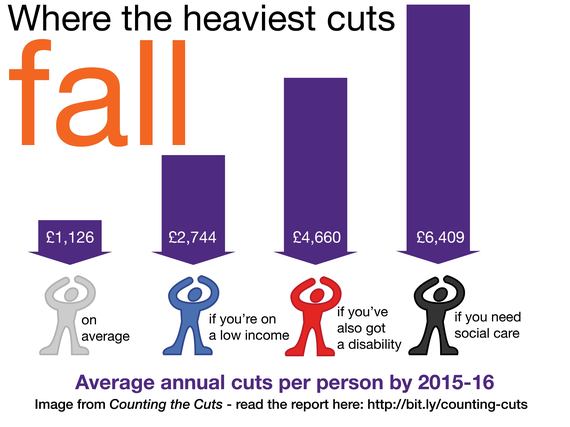

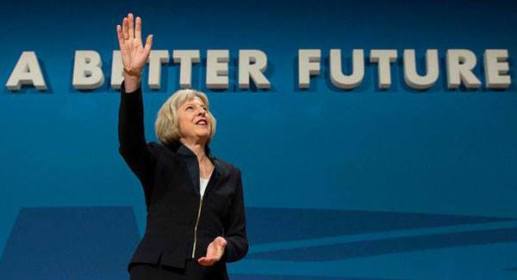


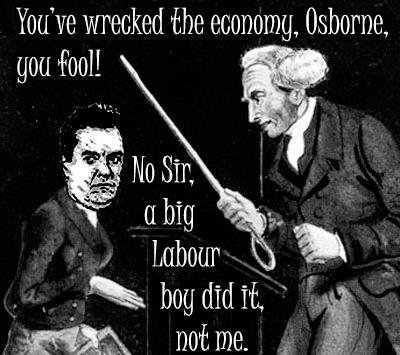


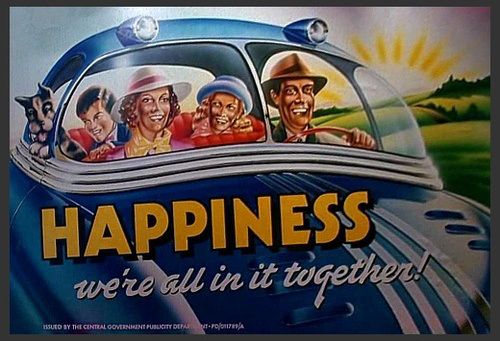






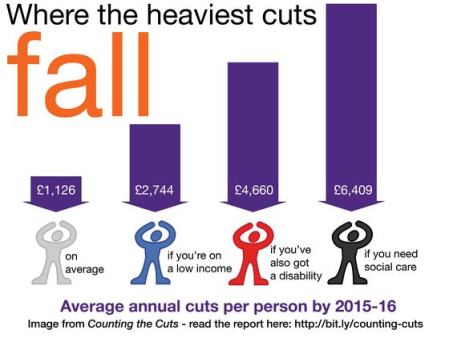


 Politics and Insights