Category: Propaganda

From the Zinoviev letter to the Labour party coup – the real enemy within

crispin-blunt-conservative_4493847


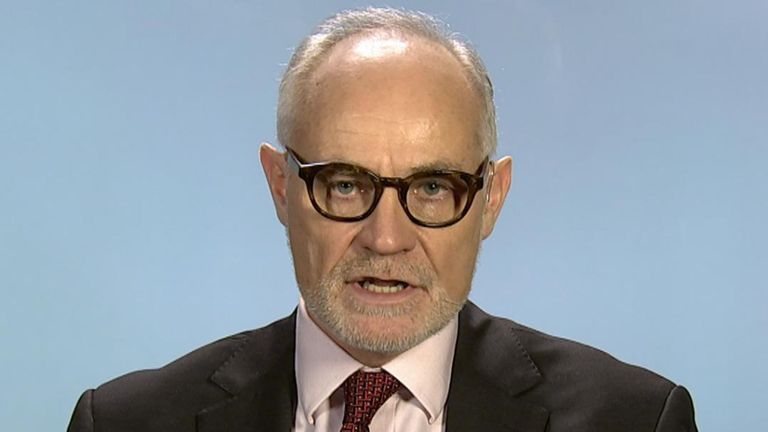
Last September I wrote about an unusually unbiased BBC World News interview with Crispin Blunt (pictured above), the (then) Chairman of the Foreign Affairs Select Committee. The interview highlighted an ongoing crisis of democracy and reflects a broader, longstanding and insidious establishment conflict with the Labour party. Blunt told Stephen Sackur during the interview that the government is not under any obligation to share intelligence information with the (then) new Labour leader Jeremy Corbyn. 

His comments came just days after a senior serving general, scaremongering anonymously in the Sunday Timessaid Corbyn’s victory had been greeted with “wholesale dismay” in the army. The general said that any plans to scrap Trident, pull out of Nato or announce “any plans to emasculate and shrink the size of the armed forces” will meet fierce opposition. His hint that some in the military planned an illegal seizure of the state if Corbyn wins the next General Election is particularly extraordinary. He said the army would “use whatever means possible, fair or foul to maintain security.”

A coup d’état is an anachronistic and violent method of political engineering that ordinarily happens only in one-party fascist, totalitarian and despotic states, it’s not an event you would expect to see used as a threat in a so-called first world liberal democracy.

Regardless of how far-fetched the threats may seem, that a general feels it’s okay to threaten a coup or “mutiny” against a future left wing government using the mainstream right-wing press as a mouthpiece is a cause for some concern. It’s a symptom of how oppressive the establishment have become, and how apparently acceptable it is to attack, discredit and threaten anyone who presents a challenge and an alternative perspective to the status quo.  

The nameless, gutless and anti-democratic general’s comments reminded me of the Zinoviev letter, and the other subversive plots in the 1960s and 1970s that were engineered by the establishment using the military and intelligence services to destabilise Harold Wilson’s government.

The Labour leader has said that as far as the party is concerned, the UK’s role in Nato is a matter for discussion for the shadow cabinet, the party at large and most importantly, the public. Emily Thornberry announced that there will be a public consultation regarding the value of the UK nuclear deterrent. That is, after all, the democratic thing to do.

The anonymous general claimed that there would be “mass resignations at all levels and you would face the very real prospect of an event which would effectively be a mutiny” if Corbyn became [democratically elected as] prime minister.

The threat, regardless of its authenticity, is undoubtedly part of a broader strategy of tension, designed purposefully to create public alarm – to portray the left as a threat to the well-being of society – and it has continued to reverberate around the media; used as part of an arsenal of pro-establishment, anti-progressive propaganda to discredit Corbyn and the left.  

Mr Blunt told BBC Hardtalk Stephen Sackur that the serving general’s opinion was “inappropriate”, did not reflect the view of the government and that if Jeremy Corbyn were elected prime minister the army like everyone else would have to carry out the instructions of the elected government. 

In the meantime, Blunt said that it was a matter for the government to decide how much access to “privileged information” the leader of the opposition had. There would be no point in passing on such information if it would not “achieve consensus.”

In other words, the government don’t want a critical and democratic dialogue about potential military decisions. They are refusing to include anyone else in crucial political decision-making processes.

Sackur said that as soon as Corbyn was elected, the Conservatives “issued propaganda” suggesting that Corbyn is a threat to national security. He also pointed directly to the government’s fundamental lack of accountability, transparency and democracy in the unprecedented move to refuse to share military and intelligence information, which is conventionally shared with the leader of the opposition.

Blunt simply confirmed Stephen Sackur’s point about the government’s lack of democracy, accountability and transparency. Sackur exposed the rank hypocrisy of a government that claims to be democratic, yet does not tolerate parties with differing views, nor does it invite or engage in dialogue and critical debate, choosing instead to exercise totalitarian control over what ought to be democratic decision-making, the will and thoughts of others, including the public that a government is meant to serve.


Perhaps a coup in the event of a left wing win in 2020 isn’t so far-fetched in the current oppressive political climate.

You can see the Hardtalk interview here, which is still up on the BBC iPlayer: http://bbc.in/1WgxmXF

From the Zinoviev letter to GBH and Spycatcher: the real enemy within

A scene from Alan Bleasdale’s perceptive GBH, a much misunderstood, darkly comedic series from 1991. Some commentators in the mainstream media at the time portrayed GBH as an indication that Bleasdale had shifted to the right, claiming that he was attempting to discredit the militant left. Many drew purposeful and convenient parallels with Derek Hatton and one of the central characters, Michael Murray.

However, for me there was a deeper, important and far more sinister message, which was not part of the mainstream conversation. Bleasdale’s central theme is an infiltation of the Labour party by MI5, ordered by the Conservative government at the time. Their aim was to recruit, manipulate and indoctrinate local “young bulls” with quasi left wing ideology to have them assist, unknowingly, in destablising and discrediting the Labour party in its entirety.

It’s certainly true that the far right, racism and social conflict always bloom and flourish under Conservative governments.

Fueling social tensions, MI5 agents provocateurs were prepared to use the ethnic communities to foster social division, in the hope of causing riots and ultimately, the hardened right wing thugs (MI5 were eventually revealed as the real thugs here) dismissed the minority groups as collateral damage, a callous, calculated move that was deemed necessary to destroy the Labour party.

MI5 staged a series of violent racist assaults on the city’s ethnic minorities, using hired local hardcases posing as police officers. They “made things happen.” Ultimately to preserve the status quo. In the drama, it’s eventually revealed that the plot to destablise the left involves Britain’s entire intelligence community.

Many felt that Bleasdale was portraying the end of socialism, but if he was, it was ultimately at the hand of the Tories – the real enemy within – not the militant left.

It’s not such a far-fetched “conspiracy theory”, especially in light of other developments, such as Peter Wright’s Spycatcher and Seamas Milne’s work The enemy Within.

The Zinoviev letter – one of the greatest but almost forgotten British political scandals of last century – was forged by a MI6 agent’s source and almost certainly leaked by MI6 or MI5 officers to the Conservative Party, according to an official report published in 1999.

Britain’s most senior security and intelligence officials discussed the smearing of the Labour party just as it was emerging as a major political force according to previously secret documents.

The potential repercussions of attempts by the intelligence agencies to damage the Labour party were debated at length by the little-known Secret Service Committee, later research – now released at the National Archives – shows.

Of course it was not the only time Britain’s intelligence agencies were implicated in attempts to destabilise a Labour government. A group of right wing intelligence officers attempted to destabilise Harold Wilson’s administrations in the 1960s and 70s.

One newly released document at the National Archives is a minute of the Secret Service Committee, dated 11 March 1927. It quotes Sir William Tyrrell, top official at the Foreign Office, referring to a conversation he had with the prime minister, Stanley Baldwin, about politically inspired leaks by the police special branch as well as the security and intelligence agencies.

Baldwin’s main concern, said Tyrrell, was the fear that the political work done at Scotland Yard might at any moment give rise to a scandal, owing to the Labour party obtaining some “plausible pretext to complain that a government department was being employed for party politics.”

On 8 October, 1924, Britain’s first Labour government lost a vote of confidence in the House of Commons. The next day the Foreign Office was evidently sent a copy of a letter, purportedly originally sent from Grigori Zinoviev, the president of Comintern, addressed to the central committee of the Communist Party of Great Britain. The letter urged the party to stir up the British proletariat and the military in preparation for class war.

On 25 October the letter appeared in the heavily Conservative-biased Daily Mail just four days before the election. The political and diplomatic repercussions were immense.

The Daily Mail published a series of sensationalist headlines:

  • Civil War Plot by Socialists’ Masters
  • Moscow Order to Our Reds
  • Great Plot Disclosed Yesterday
  • Paralyse the Army and Navy
  • Mr. MacDonald Would Lend Russia Our Money

Here is the entire Zinoviev letter:

Very secret

Executive Committee, Third Communist International.

To the Central Committee, British Communist Party.

Presidium, September 15, 1924. Moscow.

Dear Comrades,

The time is approaching for the Parliament of England to consider the Treaty concluded between the Governments of Great Britain and the S.S.S.R. for the purpose of ratification. The fierce campaign raised by the British bourgeoisie around the question shows that the majority of the same, together with reactionary circles, are against the Treaty for the purpose of breaking off an agreement consolidating the ties between the proletariats of the two countries leading to the restoration of normal relations between England and the S.S.S.R.

The proletariat of Great Britain, which pronounced its weighty word when danger threatened of a break-off of the past negotiations, and compelled the Government of MacDonald to conclude the treaty, must show the greatest possible energy in the further struggle for ratification and against the endeavours of British capitalists to compel Parliament to annul it.

It is indispensable to stir up the masses of the British proletariat to bring into movement the army of unemployed proletarians whose position can be improved only after a loan has been granted to the S.S.S.R. for the restoration of her economics and when business collaboration between the British and Russian proletariats has been put in order. It is imperative that the group in the Labour Party sympathising with the Treaty should bring increased pressure to bear upon the Government and Parliamentary circles in favour of the ratification of the Treaty.

Keep close observation over the leaders of the Labour Party, because these may easily be found in the leading strings of the bourgeoisie. The foreign policy of the Labour Party as it is, already represents an inferior copy of the policy of the Curzon Government. Organize a campaign of disclosure of the foreign policy of MacDonald.

The I.K.K.I. (Executive Committee, Third [Communist] International) will willingly place at your disposal the wide material in its possession regarding the activities of British Imperialism in the Middle and Far East. In the meanwhile, however, strain every nerve in the struggle for the ratification of the Treaty, in favour of a continuation of negotiations regarding the regulation of relations between the S.S.S.R. and England.

A settlement of relations between the two countries will assist in the revolutionising of the international and British proletariat not less than a successful rising in any of the working districts of England, as the establishment of close contact between the British and Russian proletariat, the exchange of delegations and workers, etc., will make it possible for us to extend and develop the propaganda of ideas of Leninism in England and the Colonies.

Armed warfare must be preceded by a struggle against the inclinations to compromise which are embedded among the majority of British workmen, against the ideas of evolution and peaceful extermination of capitalism. Only then will it be possible to count upon complete success of an armed insurrection. In Ireland and the Colonies the case is different; there is a national question, and this represents too great a factor for success for us to waste time on a prolonged preparation of the working class.

But even in England, as other countries, where the workers are politically developed, events themselves may more rapidly revolutionise the working masses than propaganda. For instance, a strike movement, repressions by the Government etc.

From your last report it is evident that agitation-propaganda work in the army is weak, in the navy a very little better. Your explanation that the quality of the members attracted justifies the quantity is right in principle, nevertheless it would be desirable to have cells in all the units of the troops, particularly among those quartered in the large centres of the country, and also among factories working on munitions and at military store depots. We request that the most particular attention be paid to these latter.

In the event of danger of war, with the aid of the latter and in contact with the transport workers, it is possible to paralyse all the military preparations of the bourgeoisie, and make a start in turning an imperialist war into a class war. Now more than ever we should be on our guard.

Attempts at intervention in China show that world imperialism is still full of vigour and is once more making endeavours to restore its shaken position and cause a new war, which as its final objective is to bring about the break-up of the Russian Proletariat and the suppression of the budding world revolution, and further would lead to the enslavement of the colonial peoples. ‘Danger of War’, ‘The Bourgeoisie seek War’, ‘Capital fresh Markets’ – these are the slogans which you must familiarise the masses with, with which you must go to work into the mass of the proletariat. These slogans will open to you the doors of comprehension of the masses, will help you to capture them and march under the banner of Communism.

The Military Section of the British Communist Party, so far as we are aware, further suffers from a lack of specialists, the future directors of the British Red Army.

It is time you thought of forming such a group, which together with the leaders, might be in the event of an outbreak of active strife, the brain of the military organisation of the party.

Go attentively through the lists of the military ‘cells’ detailing from them the more energetic and capable men, turn attention to the more talented military specialists who have for one reason or another, left the Service and hold Socialist views. Attract them into the ranks of the Communist Party if they desire honestly to serve the proletariat and desire in the future to direct not the blind mechanical forces in the service of the bourgeoisie, but a national army.

Form a directing operative head of the Military Section.

Do not put this off to a future moment, which may be pregnant with events and catch you unprepared.

Desiring you all success, both in organisation and in your struggle.

With Communist Greetings,

President of the Presidium of the I.K.K.I.

ZINOVIEV

Member of the Presidium: McMANUS

Secretary: KUUSINEN

Some historians say that the letter aided the Conservative party in hastening the collapse of the Liberal party which led to a decisive Conservative victory. Curiously, a now familiar tactic.

Others say the letter was an example of Conservative deceit, which in 1924, enabled Britain’s Conservative party to cheat their way to a general election victory. Personally, I’m inclined to believe the latter. It’s not as if the Conservatives have a history of democratic engagement, transparency, accountability and honesty, after all.

The letter came at a sensitive time in relations between Britain and the Soviet Union, due to the Conservative opposition to the parliamentary ratification of the Anglo-Soviet trade agreement of 8 August 1924.

The publication of the letter was severely embarrassing to Prime Minister James Ramsay MacDonald and his Labour party. The chance of a victory was dashed as the spectre of internal revolution and a government oblivious to the “red peril” dominated the public consciousness, via the media.

MacDonald’s attempts to establish doubt regarding the authenticity of the letter were catastrophically in vain, hampered by the document’s widespread acceptance amongst Tory government officials. MacDonald told his Cabinet he “felt like a man sewn in a sack and thrown into the sea.”

New light on the scandal which triggered the fall of the first Labour government in 1924 is shed in a study by Gill Bennett, chief historian at the Foreign Office, commissioned by Robin Cook in 1998.

Bennett’s investigation implicates Desmond Morton, an MI6 officer and close friend of Churchill who appointed him personal assistant during the second world war, and also points to Major Joseph Ball, an MI5 officer who joined Conservative Central Office in 1926. Ball later went on to be one of the earliest spin doctors – for the Tories.

The exact route of the forged letter to the Daily Mail will probably never be known. There were other possible conduits, including Stewart Menzies, a future head of MI6 who, according to MI6 files, admitted sending a copy to the Mail.

In summary, the letter was purported to be from Grigori Zinoviev, president of the Comintern, the internal communist organisation, called on British communists to mobilise “sympathetic forces” in the Labour party to support an Anglo-Soviet treaty (including a loan to the Bolshevik government) and to encourage “agitation-propaganda” in the armed forces.

As stated, on 25 October, 1924, just four days before the election, the Mail splashed headlines across its front page claiming: Civil War Plot by Socialists’ Masters: Moscow Orders To Our Reds; Great Plot Disclosed. Labour lost the election by a landslide.

Bennett said the letter “probably was leaked from SIS [the Secret Intelligence Service, commonly known as MI6] by somebody to the Conservative Party Central Office.” She named Major Ball and Mr Morton, who was responsible for assessing agents’ reports.

“I have my doubts as to whether he thought it was genuine but [Morton] treated it as if it was,” she said.

She described MI6 as being at the centre of the scandal, although it was impossible to say whether the head of MI6, Admiral Hugh Sinclair, was involved.

Bennett also said there was “no evidence of a conspiracy” in what she called “the institutional sense.”

But there was no evidence that refuted such a conspiracy either. The security and intelligence community at the time consisted of a “very, very incestuous circle, an elite network” who went to school together. Their allegiances, she says in her report, “lay firmly in the Conservative camp.”

Bennett had full access to secret files held by MI6 (though some have been destroyed) and MI5. She also saw Soviet archives in Moscow before writing her 128-page study. The files show the forged Zinoviev letter was widely circulated, including to senior army officers, to inflict maximum damage on the Labour government.

She found no evidence to identify the name of the forger. The report says there is no hard evidence that MI6 agents in Riga were directly responsible – though it is known they had close contacts with White Russians – or that the letter was commissioned in response to British intelligence services’ “uneasiness about its prospects under a re-elected Labour government.”

The report does not tie up loose ends. But by putting a huge amount of material into the public domain, it at least allows people to make up their own minds. Important questions remain, and may always go unanswered – such as who actually forged the letter.

However, if Bennett is right in her suggestion that MI6 chiefs did not set up the forgery, her report claims that MI6 deceived the Foreign Office by asserting it did know who the source was – a deception it used to insist, wrongly, that the Zinoviev letter was genuine.

Bennett claims that we cannot conclude the scandal brought down Ramsay Macdonald’s government, which had already lost a confidence vote and Liberal support on which it depended was disappearing.

“In electoral terms,” she says, “the impact of the Zinoviev letter on Labour was more psychological than measurable.”

I don’t agree.

Firstly, I think that it’s a fairly safe and balanced conclusion that the Intelligence Services lack diversity, with a strong tendency to recruit staunch establishmentarians. The impact was calculated to be measurable. Secondly, the media has always exercised enormously heavy influence on voters, I find it a little odd that such a connection was deemed insignificant. Especially given the wide use of black propaganda, very evident at the time.

Besides, this isn’t an isolated event, and there does appear to be an established relationship between Conservative governments and the secret services staging persistent attempts at “destabilising,” discrediting and smearing the left. And the media.

Fast-forward to more recent events, and low and behold, the mainstream media are still feeding us the fear-mongering and pseudo-warnings of an “evil Communist threat.” Last year we heard how the late Ralph Miliband “influenced” his son, “Red Ed,”  with the media claiming that the then Labour leader’s policies are founded on a “legacy of evil” and a “poisonous creed.” That’s once again according to the very pro-establishment, corrupt Daily Mail, of course. (See also: Tory Fascist Lie Machine The Daily Mail Has Met Its Match.) Same old tactics.

Miliband had established the International Anti-Austerity Alliance to challenge the neoliberal consensus, his progressive tax proposals and promise to implement the Leveson recommendations chafed the establishment’s ass.

The Comintern and Soviet government vehemently and consistently denied the authenticity of the document. Grigori Zinoviev issued a denial on 27 October 1924 (two days before the election), which was finally published in the December 1924 issue of The Communist Review, considerably well after the MacDonald government had fallen.

Zinoviev declared:

“The letter of 15th September, 1924, which has been attributed to me, is from the first to the last word, a forgery. Let us take the heading. The organisation of which I am the president never describes itself officially as the “Executive Committee of the Third Communist International”; the official name is “Executive Committee of the Communist International.” Equally incorrect is the signature, “The Chairman of the Presidium.” The forger has shown himself to be very stupid in his choice of the date. On the 15th of September, 1924, I was taking a holiday in Kislovodsk, and, therefore, could not have signed any official letter. […]

It is not difficult to understand why some of the leaders of the Liberal-Conservative bloc had recourse to such methods as the forging of documents. Apparently they seriously thought they would be able, at the last minute before the elections, to create confusion in the ranks of those electors who sincerely sympathise with the Treaty between England and the Soviet Union. It is much more difficult to understand why the English Foreign Office, which is still under the control of the Prime Minister, MacDonald, did not refrain from making use of such a white-guardist forgery.”

Peter Wright, a former MI5 officer, showed in Spycatcher – a candid autobiography – how elements in his agency worked against the Wilson government in the 1970s.

Despite the Thatcher government’s attempts to prevent publication, the book gained worldwide attention. MI5’s own archives have shown there was a “permanent file” on the Labour leader throughout his time in office. He is the only serving prime minister to have a permanent Secret Service file.

MI5 opened the dossier in 1945 when Mr Wilson became an MP after communist civil servants suggested he had similar “political sympathies.”

His file was so secret that he was given the pseudonym Norman John Worthington.

Sir Michael Hanley, MI5 director general from 1972, went to even greater lengths to conceal its existence by removing it from the central index, meaning any search would result in a “no trace.”

Personal permission from Sir Michael was required to access it.

This is backed up by corroborating interviews with senior figures at the time.

These events unfolded at a time when the establishment, from the intelligence services down to parts of Fleet Street, were paranoid about the “threat of communism.” So paranoid it seems they were prepared to believe a prime minister of Britain was an active Soviet spy.

At a time of continuing Cold War tensions, industrial unrest was rife, the country had suffered power cuts and a three-day working week and in 1975 the government was being warned privately that the consequences would be severe if it could not curb inflation.

Whilst some on the hard left believed revolution was imminent, former military figures, angry at the extent of union control, were building private armies, in preparation for the coming conflict, according to the then BBC investigative journalist Barrie Penrose. (Penrose co-authored The Pencourt File with another journalist, Roger Courtiour.)

Meetings with Wilson were secretly recorded in 1976 by both the journalists (Penrose and Courtiour) weeks after his shock departure from Number 10.

“Wilson spoke darkly of two military coups which he said had been planned to overthrow his government in the late 1960s and in the mid 1970s,” Penrose writes.

Wilson told the journalists they “should investigate the forces that are threatening democratic countries like Britain.”

In his book, Peter Wright also tells of a plot to force Wilson’s resignation by MI5 agents who were convinced he was a Communist spy. Wright’s account is often dismissed as an exaggeration, but fresh evidence of plots surfaced in 2006.

Penrose says that witnesses confirm such plotting “wasn’t in the fevered imagination of an embittered ex-PM.”

Writing about the drama documentary The Plot Against Harold Wilson, shown on BBC Two at 21:00 on Thursday 16 March, 2006, Penrose concludes:

“You may ask, at the end of the programme, how much of it can be believed. My view now, as it was then, is that Wilson was right in his fears…. in answer to the question ‘how close did we come to a military government’ I can only say – closer than we’d ever be content to think.”


Harold Wilson, Aneurin Bevan, Ian Mikardo, Tom Driberg and Barbara Castle of the Keep Left Group (1951)

Chris Mullins, a former Foreign Office minister and author, writes:

“By the time A Very British Coup was published, in 1982, the political climate was even more propitious. Prompted by the imminent arrival of cruise missiles, CND demonstrations were attracting crowds in excess of 200,000. The establishment was getting so twitchy that, as we later learned, Michael Heseltine had set up a special unit in the Ministry of Defence to counter the impact of CND.

The US was getting twitchy too. When A Very British Coup was published I was editor of the political weekly Tribune, and we were selling the book by mail order through the paper. A few days after the first advert appeared we were intrigued to receive an order from the US embassy. We duly dispatched a copy and waited to see what would happen next. We did not have to wait long.

An invitation arrived to lunch with the minister, the most important man at the embassy after the ambassador. He even sent his bullet-proof Cadillac to Tribune’s modest headquarters in Gray’s Inn Road to convey me to his mansion in Kensington.

At first I assumed that I was one of a number of guests, but no: there was just the minister, two of his colleagues, an Asian butler and myself.

“Why are you interested in a minnow like me?” I inquired.

“I reckon,” he drawled, “that you are among the top 1,000 opinion formers in the country.”

“Well, I must be about number 999.”

“The other 999 have been here too.”

A year or two later I received from an anonymous source an envelope posted in Brussels. It contained an internal US state department memorandum addressed to US diplomats in London listing a number of questions they were to put to “authorised contacts” in London regarding the balance of power within the Labour party and opinion regarding the US bases in general and the impending arrival of cruise missiles in particular. Although, in retrospect, we can see they had no cause for concern, there is no doubt that alarm bells were ringing in Washington.

A Very British Coup attracted attention elsewhere too. It was helpfully denounced in the correspondence columns of the Times, and as a result sales in Hatchards of Piccadilly almost matched those at the leftwing bookshop Collets. (When it comes to selling books, a high-profile denunciation is worth half a dozen friendly reviews and I have always done my best to organise one).

Thereafter interest might have faded, but for events conspiring to make it topical. In August 1985 the Observer revealed that an MI5 officer, Brigadier Ronnie Stoneham, was to be found in room 105 at Broadcasting House. His job? Stamping upturned Christmas trees on the personnel files of BBC employees he deemed to be unsuitable for promotion. Students of A Very British Coup will know that my head of MI5, Sir Peregrine Craddock, was also vetting BBC employees. What’s more, he also had a spy on the general council of CND – and in due course the MI5 defector Cathy Massiter revealed that there had indeed been such a spy. His name was Harry Newton.

Finally, in 1987 Peter Wright, a retired MI5 officer, caused a sensation with his claim that he and a group of MI5 colleagues had plotted to undermine the Wilson government. Suddenly the possibility that the British establishment might conspire with its friends across the Atlantic to destabilise the elected government could no longer be dismissed as leftwing paranoia.”

The Enemy Within

Margaret Thatcher branded Arthur Scargill and the other leaders of the 1984-5 miners’ strike the enemy within. With the publication of Seumas Milne’s bestselling book a decade later, the full irony of that accusation became clear. There was an enemy within. But it was not the National Union of Mineworkers (NUM) that was out to subvert liberty. It was the secret services of the British state – operating inside the NUM itself.

Seumas Milne reveals the astonishing lengths to which the government and its intelligence machine were prepared to go to destroy the power of Britain’s miners’ union. Using phoney bank deposits, staged cash drops, forged documents, agents provocateurs and unrelenting surveillance, MI5 and police Special Branch set out to discredit Scargill and other miners’ leaders.

Now we know that the Tory prime minister intended to extend the charge of seditious insurrection, not only to left wing Labour councils in Liverpool and London resisting cuts in services, but against the Labour party as a whole.

Planted tales of corruption were seized on by the media and both Tory and Labour politicians in what became an unprecedentedly savage smear campaign. This is one of the UK’s most important post-war class confrontations. We are currently facing another in the form of a battle for the heart and soul of the Labour party – Corbyn has come to represent for many among the working classes that very heart and soul, still beating strongly under a gangrened body of neoliberal apologists and class traitors.. 

Milne has highlighted the continuing threat posed by the security services to democracy today.

Milne describes the Conservative government’s systematic resort to anti-democratic measures to break the resistance of Britain’s most powerful union: from the use of the police and security services to infiltrate and undermine the miners’ union to the manipulation of the courts and media to discredit and tie the hands of its leaders.

He says:

“A decade after the strike, I called the book I wrote about that secret war against the miners “The Enemy Within”, because the phrase turned out to have multiple layers of meaning. As the evidence has piled up with each new edition, the charge that Thatcher laid at the door of the National Union of Mineworkers can in fact be seen to fit her own government’s use of the secret state far better.

It wasn’t just the militarised police occupation of the coalfields; the 11,000 arrests, deaths, police assaults, mass jailings and sackings; the roadblocks, fitups and false prosecutions – most infamously at the Orgreave coking plant where an orgy of police violence in June 1984 was followed by a failed attempt to prosecute 95 miners for riot on the basis of false evidence.

It’s that under the prime minister’s guidance, MI5, police Special Branch, GCHQ and the NSA were mobilised not only to spy on the NUM on an industrial scale, but to employ agents provocateurs at the highest level of the union, dirty tricks, slush funds, false allegations, forgeries, phoney cash deposits and multiple secretly sponsored legal actions to break the defence of the mining communities.

In the years since, Thatcher and her former ministers and intelligence mandarins have defended such covert action by insisting the NUM leaders were “subversive” because they wanted to bring down the government. Which of course they did – but “legitimately,” as Scargill remarked recently, by bringing about a general election – as took place in the wake of the successful coal strike of 1974.

In reality, as 50 MPs declared when some of these revelations first surfaced, Thatcher’s government and its security apparatus were themselves guilty of the mass “subversion of democratic liberties”. And, as the large-scale malpractices of police undercover units have driven home in the past couple of years, their successors are still at it today.”


The insidious threat to democracy is still very real, hidden in plain view. And plain clothes.

File:MI5 crest and logo.png

See also:

Wilson, MI5 and the rise of Thatcher – Lobster

Bugger – Adam Curtis

How Covert Agents Infiltrate the Internet to Manipulate, Deceive, and Destroy Reputations – Glenn Greenwald

Controversial GCHQ Unit Engaged in Domestic Law Enforcement, Online Propaganda, Psychology Research – Glenn Greenwald and Andrew Fishman

Think the idea of UK leftie movements being infiltrated is all a conspiracy theory? Here are some of the times it’s actually happened – Raphael Schlembach


I don’t currently make any money at all from my work and I’m not funded. But you can support Politics and Insights and contribute by making a donation which will help me continue to research and write informative, insightful and independent articles and to provide support to others. I co-run groups to support disabled people going through the claims, review and appeal process. The smallest amount is much appreciated, and helps to keep my articles free and accessible to all – thank you.

DonatenowButton

I wrote this article for Scisco Media, a new and revolutionary independent platform for news, analysis and alternative media. 

Labour Party To Refer Groundless Iain Duncan Smith Claim To Statistics Watchdog Again

Steve Bell cartoon


Iain Duncan Smith is telling fibs again. Work and pensions secretary claims that 75% of jobseekers think that benefit sanctions have helped them “focus and get on.”

The following is reported by Rowena Mason and Patrick Butler, for theguardian.com on Saturday 12th March 2016:

Labour is to challenge Iain Duncan Smith’s claim that 75% of jobseekers think benefit sanctions have helped them “focus and get on” by lodging a complaint with the official statistics watchdog.

Owen Smith, the shadow work and pensions secretary, said he would write to Duncan Smith challenging him to back up the “groundless” figure and refer the matter to the UK Statistics Authority for investigation.

The work and pensions secretary made the claim in an interview with the Camden New Journal, in which he suggested many claimants were grateful for the consequences of benefit sanctions.

“Seventy-five per cent of all those who have been sanctioned say it helped them focus and get on. Even the people in the jobcentres think it’s the right thing to do … sanctions are the reason why we now have the highest employment levels ever in the UK, and more women in work,” Duncan Smith said.

“What we say is: ‘We’ll give you all the support but at the end of the day we expect you to do something for it: go back to work, take the job, take the interviews.’ And it works, talk to any of the advisers in the jobcentres.”

While out campaigning for the Tory London mayoral candidate, Zac Goldsmith, Duncan Smith also dismissed protests about the controversial sanctions regime as “a classic buzz from the left” and claimed “these people are never going to vote for us – you have to understand, these people hate us”.

Owen Smith said: “Iain Duncan Smith’s claim that 75% of people who had been sanctioned say it ‘helped them focus and get on’ is groundless and shows he is out of touch with the real impacts of policies introduced by his department.

In reality, widespread concerns have been raised about this government’s use of sanctions, including from their own advisers, which is why the cross-party work and pensions select committee called for a full independent review into the system.

However, Iain Duncan Smith is reluctant to accept such scrutiny. Labour is calling for far greater transparency and honesty in this debate, so we can ensure greater numbers of people are actually helped into work, while being treated fairly.

That is why I will be writing to the secretary of state to inform him that we will refer his use of data to the Statistics Authority and calling for the long overdue independent review into sanctions to begin.”

Duncan Smith is believed to have been referring to DWP research that found 72% of jobseeker’s allowance (JSA) claimants said awareness of sanctions made them “more likely to follow the rules.”

However, that paper also said: “There was no evidence from the survey that knowledge of JSA conditions led to actual movement into work. Respondents who said they were more likely to look for work because of their knowledge of JSA conditions were no more likely than other respondents to have moved into work when they left JSA.”

After the interview, the Department for Work and Pensions released a statement saying: “Decisions on sanctions aren’t taken lightly but are an important part of our benefits system – they are only ever used as a last resort and the number of sanctions continues to fall.”

It is not the first time the UK statistics watchdog has been asked to adjudicate on the DWP’s approach to the sanctions regime.

Last year, it asked the DWP to ensure its statements on jobseeker sanctions are “objective and impartial” following a series of complaints by experts.

At the time, the authority’s chair, Sir Andrew Dilnot, wrote to the DWP’s top statistician asking the department to publish far more data and give the public a clearer understanding of how it is imposing sanctions on jobseekers.

Sanctions are used by civil servants to penalise jobseekers when they are alleged to have broken benefit rules, with punishments becoming increasingly severe over the last parliament.

The government has faced repeated calls from Labour to rethink the system, but is resisting pressure for an independent inquiry.

The Commons work and pensions committee last year urged the government to hold a wide-ranging independent review of the regime to address widespread concerns that it is unfair, excessively punitive, and does little to help people get into work.

© Guardian News & Media Limited 2010.

Related

A List of Official Rebukes For Tory Lies

Department of Work and Pensions officials admit to using fake claimant’s comments to justify benefit sanctions

The Department of Whopping Porkies is rebuked as claimants suddenly develop mysterious superpowers after being sanctioned

A letter of complaint to Andrew Dilnot regarding Coalition lies about employment statistics

Audit finds whereabouts and circumstances of 1.5 million people leaving welfare records each year “a mystery”

Granfalloonery, scapegoating, social dominance theory and Conservatism

images

Anyone who has read Kurt Vonnegut’s Cat’s Cradle will know what a granfalloon is. The University of Chicago awarded Vonnegut a Master’s in anthropology for what was essentially a work of satire, irony, black humor and parody. The term has since been adopted by market researchers and social scientists.

A granfalloon is a group of people who affect a proud and shared identity or some cohesive purpose, but whose mutual association is actually meaningless – associations and societies based on a shared but ultimately fabricated premise. Yet members often feel very superior in some way to others.

Granfalloons are powerful propaganda devices because they are easy to create and, once established, the granfalloon then defines social reality, establishes a normative order, by demarcating and maintaining social identities. Granfalloons also play to our strong normative tendencies towards sociability, grouping and a fundamental need for a sense of belonging, based on perceived shared characteristics. They tend not to like deviations from the norm. Or at least from what they perceive as the norm.  

However, group identities constructed around labels such as “strivers”, “tax payers” and “hard working families” are non inclusive, too. These are created politically to justify economic exclusion and outgrouping, and to manage public perceptions. Exclusive language and dominant, prejudiced narrative is an effective means of social control since it can be used to frame the interpretation of events. The group categories are designed to create or redefine moral norms and also, to stigmatise, to define deviance and to create scapegoats.

One of the purposes of the construction of granfalloons is to create categories of outsiders, as much as it is to create a false sense of privilege amongst ingroup members.

The granfalloon technique is used in advertising, in political rhetoric and by pseudoscientists, cults and other dubious groups, as a technique of persuasion in which individuals are encouraged to identify with a particular granfalloon or social group. The pressure to identify with a group is meant as a method of securing the individual’s loyalty and commitment through adoption of the group’s symbols, slogans, language, norms, rituals, actions, goals and beliefs. We like to conform and we like to “belong” and that is manipulated endlessly by granfallooners everywhere.

It’s ultimately very socially divisive. 

Think of UKIP’s extensive granfalloonery; the shrinking island of logic; an ever-decreasing ingroup of supremicists, and you get the gist. The only people who properly “belong” in UKIP  are older, “hard done by” white labourers, predominantly but not quite exclusively males, who don’t like anyone else’s social groups. Everyone else is “privileged” in some way, and that’s a bad thing to be, apparently. Scapegoating can often cause oppressed groups to attack other oppressed groups. Even when injustices are committed against a minority group by a majority ingroup, minorities sometimes lash out against a different minority group in lieu of confronting the more powerful majority.

Sometimes the oppressed can be very oppressive too.

Then there is the “all in it together” granfalloonery of Conservatism, where social groups are targeted by the ever-electioneering, purposeful and powerful elite to vote for policies that serve absolutely no-one but the elite, and cause real harm to other group members of society. All that “hate thy neighbour stuff”, you know: it’s the sick and disabled people, the unemployed people, the ethnic minorities, the working poor, the junior doctors, the unions, the Labour Party, Harold Wilson, Ed Miliband, Jeremy Corbyn, the “extremist” critics and academics. How very dare they.

But the biggest miscreants of all are in office, for crying out loud. “They’re behind you!” came the pantomime call from a usually passive, disengaged audience. We all know the score, yet here we are as an entire society of sub-grouped granfalloons, following all the divisive finger-pointing and scapegoating like dizzy, distracted cats running around in circles chasing unravelling strings.

tumblr_m81dzafFA21qcekj1o1_500

The Conservatives are creatures of habit rather than reason. Traditional. That is why their policies are so anti-progressive, and stifling for the majority of us. It’s also why Tory policies don’t meet public needs. 

I’ve observed before that there’s always an air of doom and gloom when we have a Tory government, and a largely subdued, depressed, repressed nation, carrying vague and fearful intuitions that something truly catastrophic is just around the corner.

I’ve said more than once before that we always witness the social proliferation of fascist ideals with a Tory government, too. It stems from the finger-pointing divide and rule mantra: it’s them not us, them not us. But history refutes as much as it verifies, and we learned that it’s been the Tories all along.

With a Conservative government, we are always fighting something. Poverty, social injustice: we are forced to compete and fight for political recognition of our fundamental rights, which the Tories always circumvent. We fight despair and material hardship, caused by the rising cost of living, low wages, high unemployment or more recently, underemployment, and recession that is characteristic of every Tory government.

I think people often mistranslate what that something is. Because Tory rhetoric is all about othering: dividing, atomising of society into bite-sized manageable pieces by amplifying a narrative of sneaking suspicion and hate thy neighbour via the media. Scapegoating serves as a mechanism of psychological dumping and emotional relief in acts of misplaced aggression towards oppressed outgroups for oppressed ingroups. The social order is maintained this way.

In social psychology, the granfalloon concept stems from research by the British social psychologist Henri Tajfel, in particular, from social identity theory. The significance of ingroup and outgroup categorization was identified using a method that has come to be known as the minimal group paradigm. In his research, Tajfel found that strangers would form groups on the basis of completely inconsequential criteria, such as liking certain paintings, fictions, pseudoscientific dogmas or Elvis.

In one study, Tajfel’s experimental subjects were asked to watch a coin toss. They were then designated to a particular group based on whether the coin landed on heads or tails. The subjects placed in groups based on such meaningless associations between them have consistently been found to “act as if those sharing the meaningless labels were kin or close friends.” Research demonstrates that people are differentially influenced by ingroup members. That is, under conditions where group categorisation is psychologically salient, people will shift their beliefs in line with ingroup social norms.

Outgrouping leads to the homogeneity effect. This is a process where the perception of members of an outgroup as being homogenous arises (“all the same”), while members of one’s ingroup are perceived as being individual and diverse. This is especially likely to occur on the basis of prejudiced, stereotyped negative characteristics. Of course ingroup members can be perceived as being similar to one another in regards to loosely identified positive characteristics. This effect is called ingroup homogeneity.

Authoritarian governments often utilise granfalloonery, maintaining social order by the creation of social allegiances through various means of outgrouping and ingrouping, socialisation and indoctrination. This is also used to justify prejudice, discrimination and socioeconomic inequality.

Being sociable is a positive human quality. But perhaps being duped by trivia and artificially constructed categories, intentionally stigmatised identities and politically constructed social taxonomies is also a human tendency. It seems so.

Granfalloonery is used as a propaganda technique. It is an improper appeal to emotion, which purposefully bypasses the rational thought-processes of populations. It used for the purpose of changing the opinions of a targeted audience or population. The closely related Bandwagon technique involves encouraging people to think or act in some way simply because other people are doing so.

Some people much prefer wide social inequalities. Social dominance orientation (SDO) is conceptualised as a measure of individual differences in levels of group-based discrimination; that is, it is a measure of a person’s preference for status-ranking and hierarchy within society and domination over what are perceived as lower-status outgroups. It is a predisposition toward anti-egalitarianism within and between social groups. High scores of SDO predict stereotyping, discrimination and prejudice. SDO correlates with forms of right-wing authoritarianism. Hello Mrs May.

The concept of SDO as a measurable individual difference arose from social dominance theory. Individuals who score high in SDO desire to maintain and, in many cases, increase the differences between social statuses of different groups, as well as individual group members. Typically, they are controlling, manipulative, competitive, aggressive, dominating, tough, and relatively unempathic, uncaring power-seekers. People scoring high in SDO also prefer hierarchical group orientations. Often, people who score high in SDO have strongly held beliefs in ‘meritocracy’, hierarchical societies and forms of social Darwinism.

See also:

Groupthink

False-consensus effect

How to sell a pseudoscience – Anthony R. Pratkanis

Don’t believe everything you think: cognitive dissonance

3822587_600x600


I don’t make any money from my work. But you can support Politics and Insights and contribute by making a donation which will help me continue to research and write informative, insightful and independent articles, and to provide support to others. The smallest amount is much appreciated, and helps to keep my articles free and accessible to all – thank you.

DonatenowButton

Sometimes people are not fit for work, and that includes MPs, Mr Jackson.

1235473_537097386359794_65317730_n (1)

Stewart Jackson, the Conservative MP for Peterborough, has claimed that Labour MP Simon Danczuk has been “stitched up” by supporters of Jeremy Corbyn within the Labour Party. He commented after Mr Danczuk was suspended from the Labour Party pending an investigation into allegations that he sent sexually explicit text messages to a 17-year-old girl.

Posting on Twitter, Jackson said: “Simon Danczuk has obviously been foolish but he’s also been stitched up like a kipper by the Corbyn cronies in UK Labour.” 

Asked why he believed this to be the case, Mr Jackson replied: “Maybe the haste with which he’s been suspended for what appears to be something that is not a criminal offence if stupid.”

“Given he’s had some mental health issues, [the] more compassionate thing would be to have given him space and return to the issue next week.”

It is a serious cause for concern that this MP doesn’t know that it IS a criminal offence for an adult to have any sexual activity with a person under the age of 18, if the older person holds a position of trust and power, as such sexual activity is an abuse of the position of trust. The Sexual Offences Act 2003 provides this specific legal protection.

Danczuk allegedly exchanged a number of sexually explicit text messages with a 17-year-old girl, it has been reported.

Mr Danczuk, who is 49, sent the messages to Sophena Houlihan after she asked him for a job.

She said: “At the time I played along with it, but now I feel like he duped me. I was keen for a career in politics and he is a very high-profile MP and I was in awe of him.”

Mr Danczuk allegedly asked Miss Houlihan to meet at the Labour Party conference and reportedly suggested that she join him on a trip to Spain. He told her that he was “horny”.

It’s absolutely disgraceful that MPs, regardless of their party politics, think it is in any way acceptable to use their position of trust and power to attempt to justify exploitative or sexually predatory behaviours.

However , a lifelong Conservative supporter, felt that it is Mr Danczuk who is the victim of impropriety, and all because of his mere “foolishness.” She overlooked his serial objectification of women and sexist tendencies, then. She tweeted: “Ironic when we were supposed to be introduced to “kinder” politics! Hypocrites. JC et al dangerous.”

Sure. Some people will go to any lengths to divert attention and discredit the opposition leader, no matter how dogmatic, incoherent and ridiculous this shows them up to be. Or misogynistic, for that matter.

I can just see the headlines in the Sun now: Dangerous Jeremy Corbyn supporters made me become a stalking horse and then they turned me into a disgraceful, stalking sexual predator.

If Mr Danczuk is experiencing mental health problems, he deserves support and has my sympathies. However, the situation that has arisen doesn’t just raise issues that are simply about how “kindly” he is treated: it is also important to establish whether or not he is fit for his post and to ensure that he does not pose a risk to members of the public, as well as himself. Suspending Mr Danczuk is not “dangerous” at all, in fact it is the only reasonable and compassionate thing to do.

Last year, Danczuk saidWhen it comes to Mental Health Problems, being in work can be something that really helps. I know that keeping busy and being motivated certainly works for me.”

However, sometimes, people are simply too ill to work. We have an unhealthy political culture and a government that has persistently refused to accept that sometimes, people are very ill and severely incapacitated. We have witnessed an extended, perpetuated, prejudice-driven political moralising and vicious stigmatisation of people who are ill and out of work, presumably so that the unprecedented, uncivilised cuts to essential support for disabled people have a façade of political justification, at least. But certainly not a respectable, legitimate one.

In fact this government have rather horribly and deceitfully normalised coercing people to work, regardless of their physical or mental illness, and regardless of the extent to which a person is disabled. Furthermore, it is regardless of the potentially devastating consequences for the person who is ill, AND the people that they work with or come into contact with.

Sometimes people need to take time out to recover, and should feel that they are permitted to do so without being judged and punished by the state. And sometimes, people are too ill, and no longer fit for their role. Consideration of these issues is compassionate and kind.

Nobody would expect a person who suffers blackouts to drive a bus or bin waggon if they thought through the potentially devastating consequences. But political, cultural, psychological and financial coercion is being used to force people to work – the government continues to cut welfare, which was calculated to cover only the costs of meeting basic needs. Cruel sanctions and strict, inflexible, often unreasonable behavioural conditions are being imposed on lifeline benefit receipt, adversely affecting some of our poorest and most vulnerable citizens; unemployed and disabled people are stigmatised in the media – all of this is done with an utterly callous disregard of a person’s capacity to work, or the availabilty of appropriate and suitable employment opportunities, and this can have tragic consequences.

This is a government that champions outgrouping and scapegoating already socially marginalised groups. It isn’t likely that they will listen to reason, because traditional Tory prejudices concerning minoritized groups are historically established and deeply embedded in Conservative ideological grammar.

The Conservatives value the use of lies and deceit to get their own way. How fitting that the man who brought truly democratic and liberal values into Conservative electioneering, fostering a respect for diversity and championing equal opportunities, (stop laughing) has finally been awarded a knighthood for his highly salaried dastardy. The lizard of Oz, the kidder for kidders that kidded thousands, did declare war on the Scottish, he is very well known for his dogwhistle racism, but surely divided and prejudiced nations and ever-sinking standards of living are a price well worth paying when we have another Tory government. Hurrah!

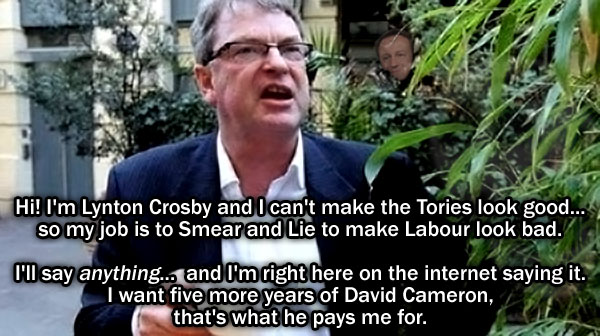
The cult of Lyntonism is a by-product of the micro-managerialism, totalitarian tendencies and the widespread use of techniques of persuasion usually reserved for the advertising industry, that has infected the New Right, “libertarian paternalist” Conservative Party. You know, I always thought there is something very pre-war Berlin about the Crosby crocodile smile.

I keep forgeting that this is 2016, and that we live in a first-world liberal democracy. Don’t we?


Happy New year all.

10853165213_ddb97ac601_o
Pictures courtesy of Robert Livingstone

Update: Mr Stewart Jackson has blocked my Twitter account, surprisingly. It’s good to know how much Tory MPs value democratic exchange, reasoned discussion, transparency and accountability…

Blocked


Further news: Simon Danczuk Investigated Over Historic Rape Allegation By Lancashire Police


Tory rhetoric, the politics of psychobabble: it’s batshit telementalism and mystification

650
Oh come all ye faithful

The Conservative conference was a masterpiece of stapled together soundbites and meaningless glittering generalities. And intentional mystification. Cameron claims that he is going to address “social problems”, for example, but wouldn’t you think that he would have done so over the past five years, rather than busying himself creating them? Under Cameron’s government we have become the most unequal country in the European Union, even the US, home of the founding fathers of neoliberalism, is less divided by wealth and income than the UK.

I’m also wondering how tripling university tuition fees and reintroducing banding in classrooms can possibly indicate a party genuinely interested in extending equal opportunities.

“Champions of social justice and opportunities”? Must have been a typo in the transcript: it’s not champions but chancers.

Cameron also claims that the Conservatives are the “party for workers”, and of course lamblasted Labour. Again. Yet it was the Labour party that introduced tax credits to ensure low paid workers had a decent standard of living, and this government are not only withdrawing that support, we are also witnessing wages drop lower than all of the other G20 countries, since 2010, the International Labour Organisation reliably informs us.

This fall not only led to a tight squeeze on living standards, it also led to a shortfall in treasury income in the form of tax revenues. But all of this is pretty standard form for Conservative governments.

It’s interesting to note that the only standing ovation Cameron had for his speech from delegates was not related to policy proposals or even rhetoric. It was a response to the bitter, spiteful and typical Tory bullying approach to any opposition: in this case, an outburst of vindictive, unqualified personal comments, misquotes, misinformation and downright lies about Jeremy Corbyn.

It was more of the usual Conservative claptrap about Labour leaders “hating Britain”. Cameron used an out-of-context quote to paint Jeremy Corbyn as a “security-threatening, terrorist-sympathising, Britain-hating” leader. Cameron had failed to give any context to Mr Corbyn’s comments that he intentionally  misquoted, failing, for example, to mention the fact that Corbyn had said the lack of a trial for Bin Laden was the “tragedy”, not his death itself. The deliberate misquote, however, was met with a deft response from the Left, hoisting Cameron by his own petard.

Here is Cameron’s speech in full technicolour and spectacular ontological insecurity:

Cameron’s malicious comments reminded me again of the Tories’ history of dirty tricks, like the Zinoviev letter, the campaign against Harold Wilson, and made me think of the almost prophetic and increasingly less fictional A Very British Coup.

Even the BBC have called the Conservatives out on their very nasty anti-democratic propaganda campaign against Corbyn.

From the deluge of incoherent commentaries to the mechanisms of telling lies: Conservatives don’t walk the talk

The fact that there is now such an extensive gap between Conservative rhetoric, the claims being made and reality makes the task of critical analysis difficult and somewhat tiring, and I’m not the only writer to comment on this.

The Conservatives use language – semantic shifts – and construct incongruent, dissonance-inducing narratives to misdirect us, and to mask the aims and consequences of their policies.  For example, the words “fair”, “support” and the phrase “making work pay” have shifted to become simple socio-linguistic codifications for very regressive punitive measures such as cuts to social security support (comparable with the principle of less eligibility embedded in the Poor Law of 1834) and benefit sanctions.

The most striking thing about the Conservative conference, for me, isn’t just the gap between rhetoric and reality, it is also the gap between the bland vocabulary used and the references, meanings and implications of what was actually being said.

The semantics are also stratified. People who are unaffected by austerity policies will probably take the bland vocabulary at face value. Cameron said:

“The British people are decent, sensible, reasonable, and they just want a government that supports the vulnerable.”

However, the “vulnerable” know a very different reality to the one substituted and described on their behalf. People who are adversely affected by Conservative policy will regard the bland vocabulary as bewildering, deceitful, frightening – especially because of its incongruence with reality – and most likely, as very threatening. Such rhetoric is designed to hide intention, but it is also designed to deliberately invalidate people’s own experiences of Tory policies and ultimately, the consequences of an imposed Tory ideology.

Not that there can be any mistaking the threats aimed at sick and disabled people from Duncan Smith in his Conference speech. He said:

“We won’t lift you out of poverty by simply transferring taxpayers’ money to you. With our help, you’ll work your way out of poverty.”

Of course the Work and Pensions secretary employed a traditionally Tory simplistic, divisive rhetoric that conveniently sections the population into “deserving” tax payers and “undeserving” non-tax paying citizens, to justify his balefully misanthropic attitude towards the latter group, as usual. However, the majority of sick and disabled people have worked and have contributed tax. 

As Dr Simon Duffy, from the Centre for Welfare Reform, points out, the poor not only pay taxes they also pay the highest taxes.  For example, the poorest 10% of households pay 47% of their income in tax. This is a higher percentage than any other group. We tend to forget that people in poverty pay taxes because we forget how many different ways we are taxed:

  • VAT
  • Duties
  • Income tax
  • National Insurance
  • Council tax
  • Licences
  • Social care charges, and many others taxes.

Mr Duncan Smith said that many sick and disabled people “wanted to work” and that the Government should give them “support” to find jobs and make sure the welfare system encouraged them to get jobs.

We’ve seen the future and it’s feudal

Ah, he means “making work pay,” which is the Tory super-retro approach to policy-making, based on the 1834 Poor Law principle of less eligibility again.  The reality is that sick and disabled people are being coerced by the state into taking any very poorly paid work, regardless of whether or not they can work, and to translate the rhetoric further, Duncan Smith is telling us that the government will ensure the conditions of claiming social security are so dismal and brutal that no-one can survive it.

And Cameron’s promise during his address to the Conservative party conference that “an all-out assault on poverty” would be at the centre of his second term is contradicted by a sturdy research report from the Resolution Foundation that reveals planned welfare cuts will lead to an increase of 200,000 working households living in poverty by 2020.

Duncan Smith also criticised what he claimed was Labour’s “something for nothing culture” which was of course a very supportive and fair, reasonably redistributive system. He also dismissed and scorned the protests against his policies, which his party’s conference has been subject to. But demonstration and protest is a mechanism of democracy for letting a government know that their policies are having adverse consequences.

Many of the disabled protesters at the conference are being hounded, hurt and persecuted by this government and actually, we are fighting for our lives. But clearly this is not a government that listens, nor is it one that likes democratic dialogue and accountability.

In his teeth-grindingly vindictive and blindly arrogant speech, Duncan Smith also criticised the old Employment Support Allowance benefit for signing people off work when they were judged by doctors as too sick to work. He claimed that Labour treated disabled people as “passive victims.” I’m wondering what part of professional judgements that a person is too sick to work this lunatic and small-state fetishist finds so difficult to grasp. Duncan Smith is a confabulating zealot who drives a dogmatic steam-roller over people and their experiences until they take some Tory neo-feudalist deferential, flat-earth shape that he thinks they should be.

Let’s not forget that this government have actually cut support for disabled people who want to work. The Access To Work funding has been severely cut, this is a fund that helps people and employers to cover the extra living costs arising due to disabilities that might present barriers to work. The Independent Living fund was also cruelly scrapped by this Government, which also has a huge impact on those trying their best to lead independent and dignified lives.

By “support to get jobs”, what Duncan Smith actually means is no support at all. He means more workfare – free labor for Tory donors – and more sanctions – the removal of people’s lifeline social security. He also means that good ole’ totalitarian dictum of “behaviour change,” a phrase that the Tories are bandying about a lot, these days.  Ask not what the government can do for you.

And what about frail and elderly people needing support?

The public care sector has been cut by a third this past 5 years, yet people are still aging and living longer, so demand for the services has risen. We know that private residential care homes notoriously put profit over care standards, as yet there’s not been an equivalent local authority scandal, but cuts and gross underfunding mean care workers are stretched beyond limit, and there aren’t enough funds to run an adequate home care service. It’s mostly the very frail and elderly who need this service. And it’s those vulnerable citizens that are being increasingly left without adequate care, and certainly not care of a sufficient standard to maintain their dignity.

These are citizens that have paid into a social security system that was established for “cradle to the grave” support if it was needed. This government has so wickedly betrayed them. That’s hardly making a lifetime of work and contribution “pay”.

The knock on effect is that many people without adequate care end up stranded in hospital, taking up beds and resources, through no fault of their own, and as we know, the health service is also desperately struggling to provide adequate service because of Tory cuts.

The aim of Conservatives is not to meet public needs, but to nudge the public into complicity with Conservative ideology

Many writers, a number of MPs and Peers have variously likened Conservative rhetoric to George Orwell’s Doublespeak in his novel Nineteen Eighty Four. Others claim that the idea of a language and thought-manipulating totalitarian regime in the UK is absurd. But that said, I never thought I would witness an era of human rights abuses of disabled people, women and children by the government of a so-called first-world liberal democracy. The same government have also stated it’s their intention to repeal our Human Rights Act and exit the European Convention on Human Rights. I can understand the inclination towards disbelief.

There’s another group of people that know something is wrong,  precisely what that is becomes elusive when they try to think about it and the detail slips through their fingers, as it were, when they try to articulate it. But that’s what Tory rhetoric purposefully aims to generate in those who oppose Conservatism: confusion, cognitive dissonance and disbelief

Which brings me to the government’s woeful brand of “liberatarian paternalism” – manifested in the form of an authoritarian Nudge Unit. The fact that it exists at all and that it is openly engaged in changing people’s decision-making without their consent is an indication of an extremely anti-democratic, psychocratic approach to government. The Tories are conducting politics and policy-making using insidious techniques of persuasion and psycholinguistic hocuspocusery for psychic and material profiteering, ordinarily reserved for the very dubious, telemental, manipulative end of the diabolistic advertising industry.

Once a PR man, always a PR man, that’s David Cameron.

By telemental, I mean it’s based on a kind of communication model that is transmissional, linear, mechanistic – where people are treated as conforming, passive “receivers” of information constructs, rather than an interactive, participatory, dialogical and importantly, a democratic one where people are regarded as autonomous critical interpreters and negotiators. We’re being talked at, not with. The Tories are using telementation to communicate their ideological sales pitch, without any democratic engagement with the majority of citizens, and without any acknowledgement of their needs. (Telementation is a concept originally introduced by linguist Roy Harris. )

The co-author of Nudge theory, Cass Sunstein, actually suggested that government monitors political activism online, too. He has some links with GCHQ’s covert online operations which employ social science to inform their psychological operations to influence online interactions and outcomes. Sunstein proposed sending covert agents into “chat rooms, online social networks, or even real-space groups” which spread what he views as “false and damaging conspiracy theories” about the government. “Conspiracy” theories like this one, eh?

The nudging of psychobabble and neuroliberalism

Tory policy is all about social engineering using justification narratives founded on an insensate, draconian ideological and semantic unobtainium equivalent. It’s clear that this government lacks the experience and understanding necessary for the proper use of psychological terms.  The content of their smug and vindictive justification narratives and stapled-together, alienating and psychopathic rhetoric deviates markedly from even basic common sense and good judgement.

The Tories reduce long debated, complex ideas to surprisingly spiteful platitudes, and hand us back dogmas gift wrapped in aggrandized certitude.

Malice in blunderland.

There is an accessible government website outlining some of the Nudge Unit’s neurobabble and subliminal messaging “successes”, albeit the more mundane ones, like getting men to pee on the “right” part of a urinal. Or getting people to pay their taxes on time, or to donate organs.

The Nudge Unit’s behaviourism and psychological quackery, however, is all-pervasive. It has seeped into policy, political rhetoric, the media, education, the workplace, health services and is now embedded in our very vocabulary and social narrative. Every time you hear the phrase “behavioural change” you know it’s a government department acting upon citizens everywhere, using  basic, crude operant conditioning without their consent, instead of actually doing what public services should and meeting public needs. Instead, citizens are now expected to meet the government’s needs.

Where do you think the government got their pre-constructed ideological defence lexicon of psychobabble – they bandy about insidiously bland words like “incentivise” in the context of coercive state actions – such as the ideas for welfare increased conditionality and brutal operant conditioning based sanctions?

Did anyone actually ask for state “therapy” delivered by gaslighting, anti-socially disordered tyrants?

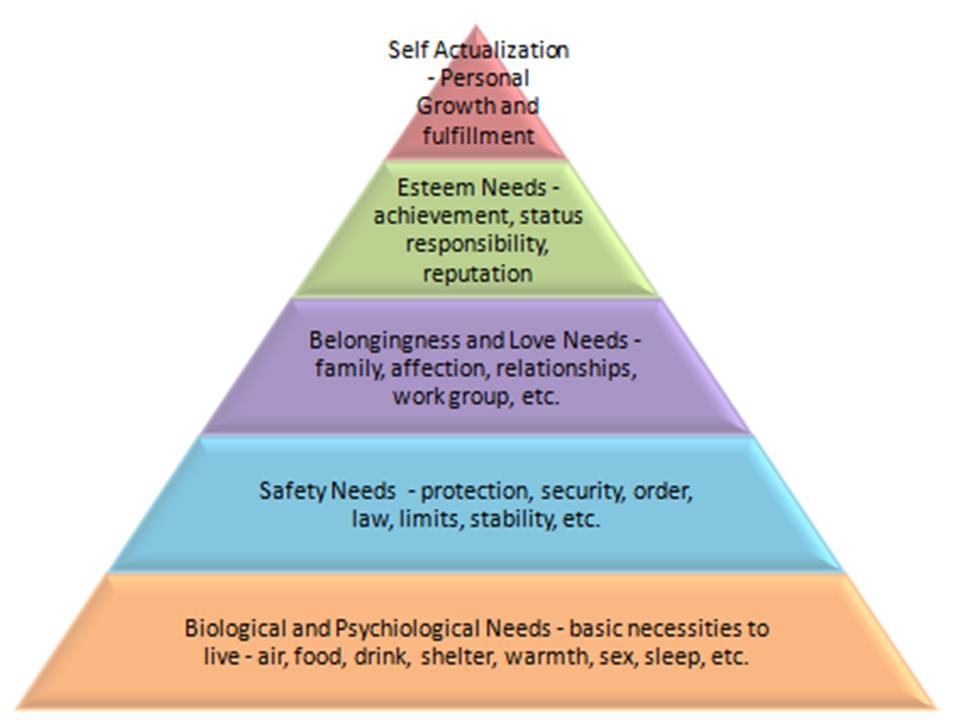
I sent an FOI asking the Department of Work and Pensions for the figures for sanctions since 2010 to the present, and I asked for the reasons they were applied. I also asked how sanctions can possibly “incentivise” or “help” people into work, and what research and academic/psychological/theoretical framework the claim is premised on, after I pointed out Maslow’s motivation theory based on a hierarchy of needs – accepted conventional wisdom is that you can’t fulfil higher level psycho-social needs without first fulfiling the fundamental biological ones.

If people are reduced to struggling to meet basic survival needs, then they can’t be “incentivised” to do anything else. And even very stupid people know that if you remove people’s means to eat, keep warm and shelter, they will probably die. It’s worth remembering that originally, benefits were calculated to meet only these basic survival needs. That’s why welfare is called a social “safety net”.

maslow-hierarchy-of-needsMaslow’s hierarchy of needs

There can be no justification whatsoever for removing that crucial safety net, and certainly not as a political punishment for people falling on hard times – that may happen to anyone through no fault of their own.

No matter what vocabulary is used to dress this up and attempt to justify the removal of people’s lifeline benefits, such treatment of citizens by an allegedly democratic, first-world government is unacceptable, despicable, cruel: it’s an act of violence that cannot fail to cause harm and distress, it traps people into absolute poverty and it is particularly reprehensible because it jeopardises people’s lives.

And what kind of government does that?

The nature of deception and psychological trauma

The Government are most certainly lying to project a version of reality that isn’t real.  Critical analysis of Tory rhetoric is a very taxing, tiring challenge of endlessly trying to make sense of disturbing relations and incoherent misfits between syntax and semantics, discourse and reality events. There’s a lot of alienating, fake humanism in there.

When politicians lie, there is a break down in democracy, because citizens can no longer play an authentic role in their own life, or participate in good faith in their community, state, and nation. Deception is cruel, confusing, distressing and anxiety-provoking: keeping people purposefully blind to what the real political agendas are and why things are happening in their name which do not have their agreement and assent.

Lying, saying one thing and doing another, creating a charade to project one false reality when something else is going on, is very damaging: it leaves people experiencing such deception deeply disorientated, doubting their own memory, perception and sanity.

To cover their tracks and gloss over the gaping holes in their logic, the Tories employ mystification techniques, the prime function of which is to maintain the status quo. Marx used the concept of mystification to mean a plausible misrepresentation of what is going on (process) or what is being done (praxis) in the service of the interests of one socioeconomic class (the exploiters) over or against another class (the exploited). By representing forms of exploitation as forms of benevolence, the exploiters confuse and disarm the exploited.

The order of concepts is not the order of things

On a psychological level, mystification is used in abusive relationships to negate the experience of abuse, to deceive and to avoid authentic criticism and conflict. Mystification often includes gaslighting, which is a process involving the projection and introjection of psychic conflicts from the perpetrator to the victim, and has a debilitating effect on the victim’s ability to think rationally and often, to function independently of the gaslighter. It can take many forms. In all instances, however, it involves the intentional, cold and cunning distortion of accounts of reality by a predator that systematically undermines the victim’s grasp of what is happening, distorting perceptions of events, editing and re-writing for the gaslighter’s own political, financial, or psychological ends.

And of course, gaslighting exploits the fact that human beings have a tendency to deny and repress those things that are too overwhelming and painful to bear. Much psychotherapy is based on creating a safe space for allowing experience of the dreadful – which as an event has already happened – to “happen.”

A memorable example of psychological mystification is presented in a case study cited by R.D. Laing. (In Did You used to be R.D.Laing, 1989). A woman finds her husband with a naked woman in the living room. She asks: “What is that naked woman doing in my house on my sofa!?” To which her gaslighting husband, without missing a beat, replied:  “That isn’t a woman, that’s a waterfall.” 

The poor woman felt her grasp of reality weaken, because she had trusted her husband and had always tended to believe him. She lost her self to a period of psychosis because of the deep trauma this event caused her. Her husband was an authoritarian figure. We tend to accept that authority figures tell the truth, with little questioning. But it’s not a safe assumption at all.

She was made to doubt her own perception and account of events, despite the utter absurdity of the alternative account of reality presented to her. To have one’s perception and experience of reality invalidated is very painful, threatening to the self and potentially extremely damaging.

We have a government that thinks nothing of using this type of distortion and deception to cover up the worst consequences of its policies.

This is a government of authoritarians and psychocrats who have an apparent cognitive dissonance: they decided that rich people are motivated only by fincancial gains, whilst poor people are motivated only by financial losses and punishments. However, when you replace the word “incentive” with the value-laden term “deserve”, and then slot it into an ideological framework with an underpinning social Darwinist philosophy, it becomes more coherent and actually, profoundly unpleasant. The Tories think that “social justice” is about taking money from those who need the most support, and handing it to those who don’t

This is a government that’s all about manufacturing conformity and obedience. The gospel, according to the likes of Iain Duncan Smith, is that we are the architects of our own misfortunes, but when it comes to good fortunes, well of course, the government claims responsibility for those. Incoherent, puerile proselytizing nonsense.

The truth of the human condition, according to the Tories, is that poor people scrounge, rich people are saintly and the former group needs humiliating and state “therapy” – degrading “paternalistic” corrective treatment, (mostly comprised of a barrage of anti-humanist ideology and the constant threat of, and often actual withdrawal of your lifeline income), whereas the latter group need all the praise, support and state handouts they can get.

This is a government that use a counterfeit and dark triad (particularly Machiavellian) inspired language to create an impression of plausibility and truth, and to hide their true aims. They are demogogues of a radical and reactionary anti-social agenda. Intolerance, fear and hatred, machismo and bullying tendencies are masqueraded as moral rectitude.

This is a government that uses superficial, incongruent, meaningless psychobabble to justify the most savage and cruelly coercive policies that we have seen in the UK during our lifetime. Those social groups unaffected by the policies think that the government are acting in our “best interests”, but people are suffering and dying as a consequence of these policies.

People’s life problems such as unemployment and poverty arise from bad decision-making from the government and are not clinical maladies, the use of or implying of pseudo-clinical terms in political victim-blame narratives and gaslighting is not meaningful or appropriate.

Political psychobabble is designed intentionally to limit the freedom of public comprehension, it neutralises our own vocabulary, and invalidates our experiences. The nasty party are engaged in psychic profiteering – a government of quacks spouting pretentious gibberish to justify taking money from the poorest citizens and handing it out to the very wealthy.

It’s irrational, incoherent psychobabble from over-controlling, obedience-obsessed irrationalists whose sole aim is to ensure the population conform to government needs, and meet the demands of neoliberalism, rather than, heaven forbid, wanting a democratic government and an economic system that actually meet public needs.

Or if you prefer plainspeak: Tory rhetoric is rather like a long-empty belfry – full of batshit.

Oh, that way madness lies.

Cam weakness
Picture courtesy of Robert Livingstone

Don’t believe everything you think: cognitive dissonance

sipress-cognitive-dissonance

“Some things have to be believed to be seen.” – Ralph Hodgson

I’ve often thought that once people identify with a political party, there is often an accompanying tendency to edit the world so that it conforms with their ideology. I suspect that exposure to more information about objective reality and politics quite often doesn’t affect partisan bias because people tend to only assimilate those “facts” that confirm what they already believe. Perhaps this is why many people become defensive, aggressive, incoherent and dogmatic when challenged with evidence that contradicts their fundamental world-view.

President Lyndon Johnson once said: It’s a heck of a lot easier to throw grenades than to catch them.

It’s always a good idea to look at who is lobbing the explosives, too. And to see if they are recycling their bombshells

It’s certainly the same with criticism, especially those which challenge our cherished beliefs. Critical thinking is a difficult and sometimes painful process. It requires facing often challenging and contradictory narratives about the fundamental nature of the world and ourselves, analysing and evaluating them. It also requires work: practice, time and effort. But the more you do it, the easier it becomes.

Critical thinking is the foundation for intelligence, for making sound decisions, and for accommodating dissonant narratives within our own paradigm, and importantly, for understanding them.

“Knowledge” isn’t simply something arising from a closed fact-finding mission to confirm what we already hold as a theory of the world, but rather, it’s about understanding the diverse views of others who are part of our world, after all, and who contribute to its rich, meaningful pluralism.

That doesn’t mean, of course, that each account or theory of the world has equal merit and worth, but without a genuinely critical and open exploration of other views, we cannot know the worth of our own views, let alone anyone elses’. Knowledge isn’t something we have, either, it’s something we have to do. Learning is a process that is ongoing, and knowledge is always subject to challenges, revision and expansion.

Never has there been a greater need for critical thinking, yet it seems there has never been a time when that has been more difficult, because of the constant bombardment from the media of fragmented, discordant, conflicting, non-linear narratives, purposefully misdirecting and whopping lies, dead cat ploys, semantic thrifts, glittering generalities, government PR, Orwellian double-speak and other strategies being deployed to keep us in a state of fearful, confused, manipulable stupification and, to be terribly Marxist about this … in a state of false consciousness. Well, dazed and confused, at the very least.

This Adam Curtis video (below) was originally shown as part of Charlie Brooker’s 2014 Wipe show. It’s about strategies adopted by political leaders, here and abroad, to keep the population confused, uncertain what to believe or what to do – and therefore powerless.

Cognitive dissonance warfare is one weapon of choice. It isn’t just the Tories that use this method. 

We are subjected to an overwhelming barrage of partial accounts, contradictory accounts, screaming headlines, vicious lies, smears and ferocious mudslinging – negative campaigning in the media. It’s like being trapped in a hall of mirrors with Beelzebub, a few of hells’ myrmidons and your best friends, all in fancy dress.

So how do we escape the hall of mirrors?

Well, I’ve already discussed critical thinking. A good approach is to look for integrity, consistency and coherence in narratives, as well as evidence to support and refute the claims being made. And it’s important to examine scope  –  what those narratives accommodate – how comprehensive they are, how much they connect up, how much they make sense. If they involve personal attacks, this is generally a strategy of diversion, and  indicate the group flinging smears has less to offer the public than the person or being viciously attacked. 

It’s also worth understanding a little more about cognitive dissonance.

Leon Festinger: Let’s see what happens when you are stood up by the aliens.

images

Leon Festinger is the social psychologist that proposed cognitive dissonance theory, which basically states that a powerful motive to maintain cognitive consistency can give rise to irrational, and often, maladaptive behaviour.

According to Festinger, we hold many cognitions about the world and ourselves; when they clash, an uncomfortable discrepancy is evoked, resulting in a state of tension known as cognitive dissonance. As the experience of dissonance is unpleasant, we are motivated to reduce or eliminate it to achieve consonance (agreement).

How we do so seems to be very much our own business, with avoidance, biased perception and denial commonly used as a defence to eliminate our discomforts – but as I pointed out earlier, the only real and lasting solution is critical thinking.

Leon Festinger once infiltrated a flying saucer doomsday cult in the late 1950s. The members of this cult had given up their entire lives – left everything and everyone behind – because they believed that the world was about to end and that their faith would ensure that they would be the sole survivors of a global flood. Up until the fateful day, the cult shunned publicity and didn’t entertain journalists.

Festinger posed as a member of the group and was present when the foretold space ship failed to show up. He was particularly interested in what would happen next. How would the disappointed cult react to the failure of their prophecy?

In science, when a theory is challenged by evidence that contradicts it, adjustments or ad hoc hypotheses are sometimes formulated to preserve the theory, attempting to explain away anomalies. However, ad hoc hypotheses are often a key characteristic of pseudoscience, as they are used to ensure a theory is never falsified, no matter how much evidence accrues to falsify that theory. Ultimately, it’s a get out clause for failed theories.

In science, whilst we accommodate gaps in our knowledge, the use of many ad hoc hypotheses is frowned upon. (Einstein’s proposition of hidden variables is a good example of this method of accommodating anomaly: he used an ad hoc hypothesis to explain quantum mechanics and maintain the integrity of relativity theory: explaining quantum entanglement without action at a distance).

Ad hoc hypotheses are a widely used strategy in managing cognitive dissonance. So, after the failure of their prophecy and the non-materialisation of the rescue space ship, the cult suddenly wanted publicity. They wanted media attention. This was apparently so the world would know how their faith had helped save the entire planet from flood.

The hypothesis was that aliens had spared planet earth for their sake – and now their new role was to spread the word and make us all listen. This fascinated Festinger. He observed that the real motivation behind the apparently inexplicable response was the need to not face an uncomfortable truth and to re-assert emotional comfort and equilibrium – to smooth over the apparently unacceptable and whopping inconsistencies between prophecy and events.

Theory and reality.

Explanations of events such as the one offered by the doomsday cult are clearly not founded on a rational process: it’s largely an emotional defence mechanism that is rationalised post hoc. Festinger coined the term “cognitive dissonance” to describe the uncomfortable tension we feel when we experience conflicting thoughts or beliefs (cognitions), or engage in behavior that is apparently opposed to our stated beliefs.

What is particularly interesting is the lengths to which people will go to reduce the inner tension without accepting that they might, in fact, be wrong. They will accept almost any form of relief, other than admitting being at fault, or mistaken. If a person believes, for example, that they are not racist, but then they discriminate against someone on the basis of race, they are then faced with the discomfort of acknowledging that they are racist after all. In an attempt to escape this discomfort, they may seek to rationalise (explain away) their behaviour on some other grounds, which may be spurious, but which allows them to hold on to their otherwise discredited belief.

Many UKIP supporters, for example, often say something like: “I’m not racist though, my brother-in-law/ friend/ uncle’s wife is actually Indian/Chinese/African” and so forth.

Another example is the “allthesame” myth. When you present people with evidence that refutes what was originally a Tory propaganda soundbite, rather than acknowledging verifiable evidence, some people choose to start a hate campaign aimed at trying to attribute all kinds of bizarre “motives” to the person simply telling a truth. Truth and populist perspectives are often poles apart.

And such tactics serve only to fragment opposition to the Right even further. Dividing people by using blame and prejudice further weakens our opposition to oppression. The oppressed can be very oppressive, it has to be said.

Festinger quickly realised that our intolerance for cognitive dissonance could explain many mysteries and irrationalities of human behavior.

Politicians have utilised this intolerance to their advantage – most particularly the Right, who deploy rhetoric heavily steeped in propaganda and behavioural manipulation techniques. (See Cameron’s behaviourist Nudge Unit,  I’ve previously discussed the implications of such manipulation on an unconsenting public and the ramifications for democracy.)

Marshall McLuhan once said: There is absolutely no inevitability as long as there is a willingness to contemplate what is happening.

Objective truth does not change according to our inclination to want something else. Facing that may be difficult at times, but the alternative is simply the idle creation of pseudo-enclaves of fleeting comfort – illusions that distract and disempower us. And make us apathetic.

It’s worth noting that totalitarian and authoritarian regimes arise in societies where populations are politically disengaged and apathetic. If we want to change unpalatable truths – part of the way things are –  the only way to do so is to have the courage, first, to face those truths head-on.

We can’t lie those truths away. There are no short-cuts or real, tenable escapes from that. We have to work our way through the confusion, avoiding the appeal and brief comfort of avoidance strategies, defence mechanisms and flat denial – short-cuts down what is invariably a cul-de-sac – difficult though that often is.

Look at where we are: we have Tory small minds attempting to justify the Tory notion of a small state. But small states and competitive individualism foster adversarial relationships, and reduce us all. Small states and individualism disconnect us from others, sever any sense of social responsibility, mutuality, cooperation and obligation we have towards others.

It divides, isolates and fragments us. Neoliberal small states make us all smaller individuals, less coherent, less connected. Less comprehending. We lose touch with social reality when we disengage with others. We become less rational agents. More dissonant. How can we hold rational, reasoned and democratic debates to oppose what is little more than Tory superstition and prejudice?  

But we must.

Iain Duncan Smith’s “magical elitism” thinking – he’s just knows he’s right – is another indication that we don’t have a democratic government that is willing to engage in dialogue: we have an authoritarian one that is interested only in imposing its own incoherent neoliberal monologue on the masses.

The Queen’s Honours list shows us just what we have become as a society this past 4 years, and how little worth we place on intelligence, honour, basic coherence, decency and genuine achievement. The Maurice Mills MBE is a farce – he blamed Hurricane Katrina on gay people – it’s like open, raucous, insane, cackling laughter from a decrepit, senile, evil elite that has lived far too long. One that is completely detached from our society and its needs. That’s the reality.

Cognitive dissonance theory is an example of the political misuse of psychology which is being used as a means of thought micro-management to ensure that we don’t move and progress. Personal and social development – growth – by their very nature demand that we have the courage to seek to extend ourselves beyond what we know and where we are. It’s very uncomfortable to acknowledge that we are limited, especially when some of that is our own doing, but it’s also essential we do acknowledge it in order to at least try and transcend those limits, extend their context step by step and make progress.

There are no alien space ships to save us from ourselves or from our government. It’s down to us to seek and evaluate the truth, and there really are no shortcuts to positive change and progress. But we can take responsibilty to ensure that what we hold to be true and the decisions we make are fully and bravely informed.

cogDisMeter

BBC’s Stephen Sackur accuses Tories of spreading propaganda about Jeremy Corbyn, and of being unaccountable and undemocratic

“Generals and Majors always
seem so unhappy ‘less they got a war.”  Colin Moulding, XTC

In a BBC World News interview, Crispin Blunt, the Chairman of the Foreign Affairs Select Committee, said that the government is not under any obligation to share intelligence information with the new Labour leader Jeremy Corbyn.

His comments came just days after a senior serving general, scaremongering anonymously to the Sunday Times, said Mr Corbyn’s victory had been greeted with “wholesale dismay” in the army. The general said that any plans to scrap Trident, pull out of Nato or announce “any plans to emasculate and shrink the size of the armed forces” will meet fierce opposition. His hint that some in the military planned an illegal seizure of the state if Corbyn wins the next General Election is particularly extraordinary. He said the army would “use whatever means possible, fair or foul to maintain security.”

A coup d’état is an anachronistic and violent method of political engineering that happens only in one-party fascist, totalitarian and despotic states, it’s not an event you would expect to see used as a threat in a so-called first world liberal democracy.

Regardless of how far-fetched the threats may seem, that a general feels it’s okay to threaten a coup or “mutiny” against a future left-wing government using the mainstream right-wing press as a mouthpiece is a cause for some concern. It’s a symptom of how oppressive the establishment have become, and how apparently acceptable it is to attack, discredit and threaten anyone who presents a challenge and an alternative perspective to the status quo.  

The nameless, gutless and anti-democratic general’s comments reminded me of the Zinoviev letter, and the subversive plots in the 1960s and 1970s by the military and intelligence services to destabilise Harold Wilson’s government.

The Labour leader has said that as far as the party is concerned, the UK’s role in Nato is a matter for discussion for the shadow cabinet, the party at large and most importantly, the public. Emily Thornberry announced that there will be a public consultation regarding the value of the UK nuclear deterrent. That is, after all, the democratic thing to do.

The anonymous general claimed that there would be “mass resignations at all levels and you would face the very real prospect of an event which would effectively be a mutiny” if Mr Corbyn became [democratically elected] as prime minister.

The threat, regardless of its authenticity, is undoubtedly part of a broader strategy of tension, designed purposefully to create public alarm – to portray the left as a threat to the wellbeing of society – and it will reverberate around the media, to be used as part of an arsenal of pro-establishment, anti-progressive propaganda to discredit Corbyn.  

Mr Blunt told BBC Hardtalk‘s Stephen Sackur that the serving general’s opinion was “inappropriate”, did not reflect the view of the government and that if Jeremy Corbyn were elected prime minister the army like everyone else would have to carry out the instructions of the elected government.

In the meantime, Blunt said that it was a matter for the government to decide how much access to “privileged information” the leader of the opposition had access to. There would be no point in passing on such information if it would not “achieve consensus.”

In other words, the government don’t want a critical and democratic dialogue about potential military decisions. They are refusing to include anyone else in crucial political decision-making processes, if they don’t agree with the government. This kind of response is usually associated with authoritarian states, not liberal democracies.

Sackur said that as soon as Corbyn was elected, the Conservatives “issued propaganda” suggesting that Corbyn is a threat to national security. He also pointed directly to the government’s fundamental lack of accountability, transparency and democracy in the unprecedented move to refuse to share military and intelligence information, which is conventionally shared with the leader of the opposition.

Blunt simply confirmed Stephen Sackur’s point about the government’s lack of democracy, accountability and transparency.

Sackur exposed the rank hypocrisy of a government that claims to be democratic, yet does not tolerate parties with differing views, nor does it invite or engage in dialogue and critical debate, choosing instead to exercise totalitarian control over what ought to be democratic decision-making, the will and thoughts of others, including the public that a government is meant to serve.

Perhaps a coup in the event of a left-wing win in 2020 isn’t so far-fetched in the current oppressive political climate.

You can see the Hardtalk interview here on iPlayer:

http://bbc.in/1WgxmXF

Or here: http://www.mondonews.net/News/64885/video-no-obligation-to-share-intelligence

Related

A change is gonna come: new page, new narrative, NOT New Labour

Labour party annual conference 2015


Back in early June, I was asked to do an
interview with A Very Public Sociologist, just as Jeremy Corbyn decided to put himself forward as a candidate for the Labour Party leadership. Phil’s first question of course was: Have you made your made up about the Labour leadership?

Jeremy Corbyn was my initial, intuitive choice. This was founded on my previous knowledge of him as an MP that I have always respected and admired. I recognise that Corbyn has always presented a clarified, strong, ethical and material socialism; that he had a strong aim to extend the scope of Labour Party values and push the boundaries of debate to include genuine socialist propositions and alternatives. That is a much needed, valuable development, as an artificially constructed neoliberal consensus has stifled progress in social policies for a long time.

Corbyn has a refreshing sociological imagination, which is a welcomed change from the Conservative’s starkly anti-social focus; ideologically driven repressive, rigid hierarchical thinking, ranking and organising and economic lack of imagination.

But being me, I took a reluctant step back and analysed the situation that the Party was in post-election, adding a rationale; which prompted the only commentary I’ve written about the leadership competition and the dilemmas facing the Labour Party.

I concluded that a change in direction and a left-leaning leader was most likely to be the best bet for the future, despite the misgivings of some about how such a leader would appeal to an apparently right-shifted, UKIP and Tory-voting public. The right-pitching view through the Overton window has made my hair and toes curl since 2010. 

However, as stated, I don’t believe there is a neoliberal, New Right consensus. No-one was genuinely consulted, after all. The world isn’t really filled with irrational, glib, superficial people who all think broadly the same things and who swallow glittering generalities and mediacratic soundbites. Nobody in their right mind would endorse the massive inequalities we are now seeing, and the return of absolute poverty, as a consequence of the stealth policies that are dismantling our welfare state and NHS.

I’m a fairly optimistic realist, after all.

One of the biggest strengths of Corbyn and McDonnell’s powerful anti-austerity alternative narrative is that it will give many more ordinary people a larger stake in our economy. We know that austerity doesn’t work. It’s been used as a front for discriminatory policies that reflect an underlying Conservative extremist and prejudiced ideology.

Young people in particular, who have been betrayed by an older generation that has been happy enough to witness the dismantling of state provision – the provision that they have benefitted from all of their own lives – will hopefully show that such expedient political trade-offs which systematically punish the traditionally disenfranchised, are absolutely unacceptable. Now young people have a hope-inspiring and inclusive alternative that will mobilise their participation in democracy.  

The alienation of politically constructed outgroups has profoundly undermined our democracy for a long time. We now have a much-needed change – a viable alternative narrative – for the better. Such an inclusive approach will undermine the Conservatives’ “no alternative” approach – founded on the pleas that austerity is “inevitable” – to public policy, ensuring that they have to listen to a broader section of society and reflect their needs and views in economic and social policies.

Conservative intentions have nothing at all to do with economic necessity, but rather, austerity is nothing more than an ideologically-driven effort to downsize the British state, particularly, to dismantle welfare, legal aid, social housing and the NHS – they are erasing our post-war settlement. The next generation are left with much less opportunity and support than we have enjoyed, the first generation in a long time that are worse off than their parents. We need to change that.

Last December in his annual fiscal statement, George Osborne, the high priest of austerity, set out plans to extend his austerity cuts until 2020, by which time, his projections showed, over-all public spending as a percentage of GDP would fall to the lowest level since the 1930s, reducing state provision to rubble .

In the run-up to this year’s general election, Osborne disavowed these figures. But once he was safely back on Downing Street, he cunningly announced a new spending review aimed at cutting the budgets of some government departments by another twenty-five or thirty per cent, with some of the biggest cuts falling on welfare support.

Labour’s recent increasingly homeopathic approach to public debate and policysimilia similibus curentur: “like cures like” – hasn’t exactly made room for a sturdy challenge to Tory pseudoscience and polished psychobabble, deployed to justify their draconian and frankly vindictive regressivism.

There have been many calls over the last few years from activists and from disillusioned, largely disengaged ex-members that we need to “take back” the Labour Party, reclaim it and make it a “party of the people” again, instead of a Party of opportunist “career politicians”. Well, that has certainly happened.

Yet despite the inevitable logic of what has happened, I still can’t believe Jeremy Corbyn’s landslide win – nearly 60%.  Corbyn was the 200 to 1 outsider at the start!  I have always maintained that the best leaders are those who don’t seek leadership, but rather, are often reluctantly thrust forward in situations because of their convictions, others come to trust their skills and judgements – and Jeremy Corbyn certainly didn’t prepare for this, but he has taken an unprecedented popularity amongst grassroot supporters and members, and leadership election success in his sure, determined and tightly principled stride.

In his leadership campaign, Corbyn promised to give Labour members a much greater say in the party’s policymaking process, and quite properly so. That is democratic, after all. I believe that proportional representation is also on the table.

His key proposals include renationalisation of the railways, quantitative easing to fund infrastructure, opposing austerity, controlling rents and creating a national education service. And staunchly defending the welfare state, the NHS and access to justice.

Andy Burnham is calling for the party to get behind Corbyn. I always felt that he’s fundamentally a decent man; I’m glad he has been much more gracious than the other candidates. His tireless fight to save our NHS has been outstanding work, we need that kind of dedication from our MPs on the frontbench.

It’s sad that there have been a handful of resignations, but I know many of you will be very happy to see the Blairite stand weakened.

Now the real fight starts. I’m hoping to see a more unified approach amongst my friends, fellow party supporters and members now that the new leadership has been democratically established. This is just the start of our fight for a fair, progressive, civilised UK. Regardless of who you wanted to win, we can’t defeat the Tories and mediacracy in 2020 without willingness and good faith amongst ourselves. We need unity, belief and strength. Solidarity.

Of course the corporate “journalicians” – the puppets of the right-wing establishment – will try to build a hefty damn against the turning tide. We now have one of the most left wing, anti-establishment leaders in Labour Party history.

Evidently that’s a threat to the security of the Conservative Party, leading to mediacratic hysteria and screamingly paranoid, charmless bullying headlines already. This said, it was to be expected: Conservatives have always displayed fears of nonexistent or overblown bogeymen that threaten social order, as well as demonstrating a deft expertise at manufacturing folk devils and inflaming moral panics.

Indeed other psychologists analysing political conservatism as motivated social cognition would certainly verify my comments: these theorists have integrated theories of personality (namely authoritarianism, dogmatism–intolerance of ambiguity), epistemic and existential needs (for closure, regulatory focus, “terror management”), and ideological rationalisation (social dominance, system justification), all of which explain the elaborate Tory and mediacratic manipulations of facts. And dogma.

The Tories are so afraid of alternative perspectives, progress and change – they are such anal retentives that their fearfully and deeply inserted anti-social heads emerge sooner or later where they feel safest and most at home: in the feudal era of their own ancestors.

As well as scaring anachronistic Conservatives into hysterical declarations and reducing them to spasms of gut-clenching horror, brother Corbyn presents us with a relaxed, easy confidence, and a very welcomed alternative and rational narrative that makes a lot of sense in terms of pragmatic problem-solving. His civilised, progressive, inclusive and democratic pro-social vision managed to unite and gain support from many of the Greens and some SNP supporters already. He has appealed to many who have been disengaged from politics and who have felt disenfranchised for a long time. He has already come to represent hope for a better future. That’s a remarkable achievement.

More than 40 leading economists, including a former adviser to the Bank of England, have made public their support for Jeremy Corbyn’s anti-austerity policies, dismissing Tory claims that they are “extreme”.

The only other feasible alternative post-election for the Labour Party was to try to gain the support from those who defected to UKIP and the Tories this year, by maintaining the austerity myth for the sake of “economic credibility” and for me, that’s untenable because it would entail a gross contravention of Labour’s core values and principles. Though some of the UKIP supporters are undoubtedly amongst those who have felt disenfranchised on the basis of class alone. However, I am sure that Corbyn will reflect a fundamentally new über-inclusivity  that will address the trend towards alienation and anomie.

One thing is certain: the tiresome, disempowering and incredibly lazy soundbite that many on the left have previously delivered in criticism of the Labour Party- “they’re all the same” – won’t be used as the recycled nugget of folk wisdom with any whiff of credibility any more.

Politics is about to become very, very interesting. We needed a credible, strong and appealing alternative to mainstreamed prejudices, and to the social conservatism and neoliberal orthodoxy that became the dominant paradigm following Francis Fukuyama’s “End of History” t
riumphalism. His end of ideology thesis was nothing but more ideology, based on a manufactured consensus after all. Free-market dogma. 

I believe we have got that appealing, rational alternative narrative. 

Upwards and onwards.

 proper Blond


I don’t make any money from my work. I am disabled because of illness and have a very limited income.

But you can help by making a donation to help me continue to research and write informative, insightful and independent articles, and to provide support to others. The smallest amount is much appreciated – thank you.

DonatenowButton

The Daily Mail is a far-right rag and an utter disgrace for meddling in the Human Rights of sick and disabled people

10177255_710935002309364_996655242459079802_n

I reported yesterday that the United Nations (UN) is investigating the UK government’s welfare “reforms” and the consequences of them for evidence of abuses of the human rights of sick and disabled people. The Daily Mail has preempted the visit from the special rapporteur, Catalina Devandas Aguilar, who is expected to visit the UK in the coming months to spearhead the ongoing inquiry into many claims that Britain is guilty of grave or systematic violations of the rights of sick and disabled people, by using racist stereotypes, and claiming that the UN are “meddling”. The Mail has blatantly attempted to discredit this important UN intervention and the UN rapporteur before the visit even takes place.

“Meddling” is a curious and interesting word to use, as oppose to “wrong” or, say, “inaccurate”. It implies that the government are already aware that their policies are in breach of the human rights of sick and disabled people, but that they simply don’t welcome independent and international scrutiny of the fact.

There was not a shred of concern expressed in the Mail article regarding the cruel treatment of sick and disabled people by the government. It wasn’t mentioned once that whilst sick and disabled people have been targeted by the government with cuts to their income that are disproportionately large, the millionaires of this country got a handout of £107,000 each per year, in the form of a tax “break”. That choice of policy was made intentionally and purposefully, designed to target the most vulnerable citizens – already amongst the poorest – for further cuts to their lifeline benefits. In 2012:

  • Disabled people (1 in 13 of us) bore 29% of all the cuts
  • People with severe disabilities (1 in 50 of us) bore 15% of all the cuts.

Further cuts to benefits since 2012 will make these proportions even larger now.

Thanks to the Centre for Welfare Reform for this info graphic.

The specialised rapporteur, sent by the UN’s Committee on the Rights of Persons with Disabilities, will report back on a range of issues, including whether welfare cuts have harmed disabled people. This is because we are a voluntary signatory to the Convention on the rights of disabled person, and as such, we are expected to meet the international standards and the legal obligations in terms of the human rights of disabled people.

Tory MP Ian Liddell-Grainger last night described the inquiry as “the most absurd and offensive nonsense”.

As a sick and disabled person, I can confirm that Ian Liddell-Grainger is the one who is talking absurd and offensive nonsense. He added: “I am not an expert on disability rights in Costa Rica [the rapporteur’s country of origin], but I suspect Miss Devandas Aguilar might be better off focusing her efforts much closer to home. The UN should keep their noses out.”

Clearly Mr Liddell-Grainger doesn’t know anything at all about disbility rights or international laws. I’m sure his comments are uttered by every despotic minister that has ever faced an inquiry into their conduct towards others: “the UN should keep their noses out” echoes bullies and tyrants everywhere.

Not very encouraging comment, in terms of government response, openness, accountability,  transparency and democracy, then, bearing in mind that a UN inquiry is only ordered where the UN committee believes there is evidence of grave or systematic violations of the rights of disabled people. We are a very wealthy, so-called first-world liberal democracy, the fact that such an inquiry has been deemed necessary at all ought to be a source of great shame for this government.

Looking at some of the comments on the Daily Mail site, I can’t help wondering if some members of the wider public would still look the other way if the government rounded up the sick and disabled people of this country and shot them in front of TV cameras. The thing is, starvation through cutting off lifeline benefits, sanctions, stress through inhumane policies, invalidating someone’s experience of being seriously ill by constant re-assessment and telling them to work when they cannot, and shooting, they all result in death.

And dead is dead.

Eugenics by stealth is still eugenics.

Bystander apathy is complicity.

And people ARE dying as a consequence of this government’s policies.

Welfare reforms break UN convention

Amnesty International has condemned the erosion of human rights of disabled people in UK

A distillation of thoughts on Tory policies aimed at the vulnerable

Aktion Arbeitsscheu Reich, Human Rights and infrahumanisation

Despotic paternalism and punishing the poor. Can this really be England?

Stigmatising unemployment: the government has redefined it as a psychological disorder

Tory Fascist Lie Machine The Daily Mail Has Met Its Match

And not forgetting the fascistic Daily Mail’s involvement in attempting to discredit the left by publishing the fake Zinoviev letter – From Spycatcher and GBH to the Zinoviev letter – an emergent pattern and the real enemy within

Anyone wishing to make a submission regarding the inquiry may contact the UN here:

Catalina Devandas Aguilar
Special rapporteur on the rights of persons with disabilities
Address: OHCHR-UNOG; CH-1211 Geneva 10, Switzerland
Email: sr.disability@ohchr.org

292533_330073053728896_1536469241_nPictures courtesy of Robert Livingstone

Health officials and sociologists voice concerns about the effects of tabloids on the general public

Image result for tabloids


Research has consistently shown that reading tabloid newspapers such as the Sun, Express and Daily Mail causes an obsession with borders, contagious fatalism, addictive irritable incoherence syndrome, an anxiety-inducing paranoia, a pre-occupation with foreigners and other people stealing tax payer’s money. It’s thought to be the fault of vagabonds, migrants, the EU and scrounging poor, everyone knows offshore banks and tax avoidance are run by the EU. A highly suggestible state results, presenting with swollen spite, distended misery guts, clinical resentment retention, rash folk devils and suppurating moral panic.

These symptoms usually precede the completely incapacitating open mouth of closed-mind syndrome, leading to premature, ejaculated brain death.

Sociologists have discovered that many unfortunate tabloid addicts have nasty outbreaks of brazen neighbours, usually from other countries, or with very dodgy disabilities. Some poor and self-rightously outraged readers even have suspiciously lazy single mothers, layabout, loutish students, suspected illegal foreigners wearing cunning disguises or daring unemployed bad sorts living right next door or just down the street. This is usually preceded by a malignant disdain that is difficult to contain.

Although there has been fierce debate about the aetiology of this condition, sociologists believe that it’s psycho-semantic. The cause also precedes the effects. In other words, it is the victims of these nasty epidemics of dodgy bad sorts that actually manifest those symptomatic phenomena, during fits of psycho-enigmatic, convulsive curtain twitching, whilst presenting further shocking symptoms of frank, febrile tutting. 

Health officials carried out research over many years, which revealed  that during the early stages of chronic tabloiditis, acute, screaming headlines bind to the victim’s brain and dopamine receptors, releasing a surge of bile and some other unidentifiable, free-floating, profuse bitter stuff. This has the unfortunate effect of oxidising the part of the brain ordinarily used to rationalise and the nubbin in the noggin that usually facilitates discernment. The deadly process also affects the vocal chords, leaving the poor patient with an over-developed sense of indignance and a hyper-reactive moral outrage. This culminates in excessive sweating, incoherent shrieking and convulsive knee-jerk responses.

The most alarming health survey reports have revealed that the process involves rapid shrinkage and withering of the gland that regulates reality uptake – the part of the body that scientists call the “getagrippe.”  This reduces the reader to thinking in unsound soundbites, leading to a terminal condition called “end-stage pernicious gullibility.” Once patients reach this stage, there is little hope for them. They tend to rapidly succumb to the malignant “cuttingyournoseofftospiteyourface” syndrome.

For example, many patients suffer a dreadful condition involving hallucinations that it’s better to have no welfare, human rights or NHS rather than have other people using them. In particular, patients tend to stipulate that unless they alone need to use tax-funded public services, they should be blown up or demolished, so no-one else can use them. Some have resorted to self-lobotomising, whilst other hopeless cases mimic end-stage Rumplestiltskinism.

Another symptom is that patients become clinically cynical. These poor victims become increasingly intolerant of everyone else, especially anyone claiming benefits, who chaf their considerably swollen sensibilities. This common reaction is a severe allergic response to others, along with a strong dose of feverish outrage manifested in the obsessive compulsive thought that anyone else should be punished regularly with public floggings, being hung, drawn and quartered and no supper. Or anything. 

Once a person is in a super state of autoimmunity to others, (a condition that some in the government Nudge Unit call “Pavlov’s delight”) the body rejects the spleen, which exits the body through the bile duct and vents. Transplants have been unsuccessful, with issues around host and grafting and NHS tourism, leading to further rejection, atrophic anomie and gonadotrophic adenoids, empathy deficiency heart failure syndrome, brought on by persistent exposure to viral epidemics of the protestant work ethic.

The patient becomes fixated on what they think everyone else has, particularly the poor, and it’s always thought to be a lot more than what the patient has, though this is usually fueled by short bursts of media stereotypes, acute delusions of impacted resentment with profuse sub-arachnoid diarrhoea, spasms of inferiority complexes and feverish exaggerations, culminating in the fatal vomited outcry of “they’ve got a flat-screened TV, an iPhone, and two scruffy kids and a packet of fags that I paid for, the cheeky scrounging b*stards.”

It’s a pernicious, humourless disease that leads to rapid degeneration and further distress through pustular outbreaks of inflamatory comments, extensive diversionary metastases, profound rectal aphasia and ultimately, to a terminal and toxic irrelevance leaking like pus from the brain and mouth. The patient is usually unaware that he/she is mortally offensive to other people at this stage. Painful class envy and terminal false consciousness follow, inevitably.

The contamination was believed to have originated from 2010, when an acute case of Murdochitis broke out and spread to other media. Some sociologists pin-pointed David Cameron’s government as the main source of the outbreak, though many public health officials have argued that Cameron’s lot were merely the original carrier of the deadly bug.

Evidence suggests that even some of the working class on the left of the political spectrum are succumbing rapidly to chronic, deteriorating narksism. This is usually characterised by a pitiful and repetitive cry of “Blair blah blah red Tory. That Nigel Farage speaks his mind.” Unfortunately, Nigel Farrage’s mind causes further contamination, which requires radical treatment in cultural isolation units, but there is currently no cure for having associated symptoms like phobias of God’s wrath and gay rain flooding.

Many narksists have succumbed to the terrible agony of massively enlarged bolsheviks. There’s been a reported number of tragic suicides associated with the condition, and so far, thirty people have been found hung by the baubles on christmas trees after their extreme state of delirium had inexplicably led them to vote for turkeys. What a terrible way to go.

There is no cure for these epidemics, and officials don’t think there is any hope for sufferers in sight until at least 2020. Then there’s a small chance of putting them out of our misery.

Iain Duncan Smith has denied that there is any cause for concern, and today, determined to demonstrate tabloid safety, he ate a full Daily Mail in front of cameras in a public place. Despite growing contrary evidence from experts in their field, government advice, meanwhile, is to keep taking the tabloids.

No automatic alt text available.


I don’t make any money from my work. But you can contribute by making a donation and help me continue to research and write informative, insightful and independent articles, and to provide support to others, if you like. The smallest amount is much appreciated – thank you.