Category: Sickness and Disability

What you need to know about Atos assessments.

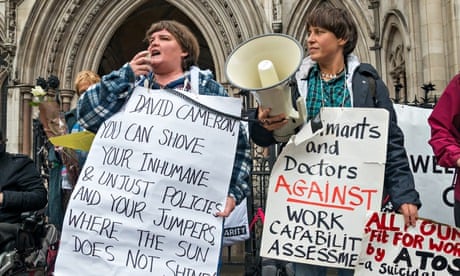
A-demonstration-against-A-011

Courageous whistleblower, Scottish nurse and ex-Atos employee, Joyce Drummond, who recently made a heartfelt apology to Atos assessment victims, has submitted evidence to the Scottish Parliament Select Committee on Welfare Reform.

Joyce forwarded some of her notes to me, containing this information about Atos assessments. We had some dialogue about the content. I have edited where needed, organised the notes and added some information to the text. I’ve included the contents from Joyce’s notes in full.

Both Joyce and I share this information in the hope that people going through Atos assessments will find it helpful.

Joyce told me: 

“I knew nothing about Atos when I joined, and left as soon as I realised that there was no way to ‘fight from the inside.’  I stated at my interview for the job that I believed in social inclusion and social justice.

I attended 4 weeks training in England. The training did not prepare me for what I was expected to do in real life.

The forms that are completed prior to assessment, I have recently found out, are actually opened by Royal Mail Staff. They are then sent for “scrutiny” where nurses decide whether or not a face to face assessment is required. I was not involved in this and do not know what criteria are used.  

 It is made clear throughout training and working that we are not nurses – we are disability analysts.  Also, we do not carry out “medical assessments” – we carry out “functional assessments”. We did not even need a diagnosis to carry out assessments. I had reservations around consent, as we were expected to assess patients – sorry, we didn’t have patients, we had ‘claimants’ – who appeared to be under the influence of alcohol or other substances. 

We were also consistently told that we did not make benefit decisions. The final decision was made by a Department for Work and Pensions (DWP) decision maker with no medical qualification. If our assessment was overturned at appeal we never knew about it. There was no accountability for assessments overruled.”

Please note that assessment starts on the day of your appointment with the Health Care Professional (HCP) reading the form you completed when you applied for disability support. Remember that every single question you are asked is designed to justify ending your claim for ESA and passing you as “fit for work”. That is what Atos are contracted to do by the Government.  This is not a genuine medical assessment, but rather, an opportunity for the DWP to take away the financial support that you are entitled to.

Things that are carefully noted at this stage are:

  • Did you complete the form yourself?
  • Is the handwriting legible?
  • Are the contents coherent?

These observations are already used in assessing your hand function, vision, your cognitive state and concentration.

Further observations made:

  • Do the things you have written ‘add up’? Are there any ‘discrepancies’?
  • Does your medication support your diagnosis?
  • What tests have you had to confirm diagnosis? For example a diagnosis of sciatica is not accepted unless diagnosed by MRI scan.
  • Do you have supporting medical evidence from your GP or consultants? If you do, it shows that you are able to organise getting this information

Joyce observes:

“This is also a hidden cost to the NHS. I believe that if ATOS request information there is a charge levied by GP’s. However claimants are expected to source medical evidence themselves. It uses valuable NHS time for medical staff to write supporting statements. 

There were no hidden cameras, at least in Glasgow, to watch people arriving for assessment or sitting in waiting room. This may not be true in other areas.”

When the HCP has read your form they input some data into the computer system. The assessment properly begins when they call your name in the waiting room.

At this point the HCP assesses:

  • Did you hear your name being called?
  • Did you rise from your chair unaided, did the chair have support arms or not?
  • Were you accompanied? – assessing your ability to go out alone
  • Were you reading a paper while waiting? – assessing your concentration
  • Did you walk to the assessment room unaided, did you use any aids correctly? Did you navigate any obstacles safely? – assessing sight.

The HCP will shake your hand on introduction – assessing your handshake, noting if are you trembling, sweating – signs of anxiety. The HCP carefully scrutinises everything you do and say. The HCP will often ask on the way to waiting room:

  • How long you’ve been waiting – assessing ability to sit, physically, and appraising your mental state
  • How you got to the appointment – assessing ability to drive or use public transport

Formal assessment begins by listing medical conditions/complaints. For each complaint you will be asked:

  • How long have you had it, have you seen a specialist?
  • Have you had any tests, what treatments have you had?
  • What’s your current treatment? Have you had any other specialist input e.g. physiotherapy, CPN?

The HCP will use lack of specialist input/ hospital admissions to justify assessing your condition as “less severe”. Medications will be listed and it will be noted if they are prescribed or bought. Dates will be checked on boxes to assess compliance with dosage and treatment regime. Any allergies or side-effects should be noted.

  • A brief note is made of how you feel each condition affects your life
  • A brief social history will be taken – who you live with, if have you stairs in your house or steps outside your house
  • Employment history taken – asking when you last worked, what you work entailed, and the reason for leaving employment.

Your typical day – this is the part of the assessment where how you function on a day to day basis is used to justify the HCP decisions. Anything you say here is what is most likely to be used to justify you failing your assessment and being passed as “fit for work”. Along side this, the HCP records their observations.

Starting with your sleep pattern, questions are asked around your ability to function. This will include:

  • Lower limb problems – ability to mobilise to shops, around the house, drive, use public transport, dress, shower
  • Upper limb – ability to wash, dress, cook, shop, complete ESA form
  • Vision – did you manage to navigate safely to the assessment room
  • Hearing – did you hear your name being called in the waiting room
  • Speech – could the HCP understand you at assessment
  • Continence – do you describe incontinence NOT ‘CONTROLLED’ by pads, medication. Do you mention its effects on your life when describing your typical day
  • Consciousness – Do you suffer seizures – with loss of continence, possible injury, witnessed, or uncontrolled diabetes
  • HCP observations include – how far did you walk to the examination room, did you remove your coat independently, did you handle medications without difficulty, did you bend to pick up your handbag.

Formal examination consists of simple movements to assess limited function. Things the HCP also looks at:

  • Are you well presented, hair done, wearing make-up, eyebrows waxed
  • Do you have any pets – this can be linked with ability to bend to feed and walk
  • Do you look after someone else – as a parent or carer – if you do, this will be taken as evidence of functioning
  • Any training, voluntary work, socialising – this will be used as evidence of functioning
  • Do you watch TV – this may be used as evidence of being able to sit unaided or as evidence of being able to concentrate
  • If you wear jewelry it will be assumed you have sufficient dexterity to open and close the clasps on chains and so on.

This is not a comprehensive list, but it gives you an idea of how seemingly innocent questions are used to justify HCP decisions to pass you as “fit for work.” For example, “Do you watch soaps on TV?” is translated as “Can sit unaided for at least half an hour” on the report.

Mental Health:

  • Learning tasks – Can you use a phone, computer, washing machine
  • Hazards – Can you safely make tea, if claiming accident, there must have been some emergency services involvement, e.g. fire service. Near miss accidents do not count.

Personal Actions:

  • Can you wash, dress, gather evidence for assessment
  • Do you manage bills

Further observations made by the HCP – appearance and presentation:

  • Coping with assessment interview – any abnormal thoughts, hallucinations, confusion
  • Coping with change – ability to attend assessment, attend GP or hospital appointments, shopping and socialising

More HCP observations:

  • Appearance, eye contact, rapport, any signs/symptoms that are abnormal mood/thoughts/perceptions. Any suicidal thoughts
  • Coping with social engagement/appropriateness of behaviour – any inappropriate behaviour must have involved police to be considered significant
  • Ability to attend assessment, engage with assessor, behave appropriately

Again, this is not an exhaustive list, merely some examples.

Further information: 

At present to qualify for ESA you need to score 15 points, unless the Exceptional Circumstances Regulations apply to you. The 15 points can be from a combination of scores from physical and mental health descriptors.

To qualify for the Support Group you must score 15 points in one section. As long as you are claiming income-based ESA then your award can be renewed at each assessment, if you gain 15 points.

You may also qualify without meeting the 15 points criterion, even if you don’t score any points, because of Exceptional Circumstances (Regulation 29 and Regulation 35, (or 25 and 31 for Universal Credit – see link at the foot of article) if there would be a substantial risk to your mental or physical health if you were found not to have limited capability for work. Regulation 29 is about exceptional circumstances for being assessed as having limited capability for work (Work Related Activity Group), and Regulation 35 is about being assessed as having limited capability for work-related activity (Support Group).

Special cases – exemptions from assessment include those people having: terminal illness, intravenous chemotherapy treatment and those considered a danger to self or others if found fit to work.

Contribution-based ESA lasts for one year only, unless you are in the support group. After one year in the work-related activity group, you may only get income-based ESA if your household income is below a certain threshold. It makes no difference how long you have previously paid National Insurance.

Joyce told me:

“For clarity, as far as I know in the real world, doctors carry out medical assessments, nurses carry out nursing assessments and physios carry out physiotherapy assessments. In the world of Atos, people from each of these separate professions are employed as disability analysts, carrying out functional assessments.

Nurses are employable for these posts if they have been qualified for at least 3 years, are registered to practice with the NMC, and have basic computer skills.

My interview consisted of:

  • Face to face interview with medical director and nurse team leader.
  • A written paper assessing a scenario, in my case someone with back pain
  • A 10 minute basic computer test

“In order to be approved as a disability analyst I had to complete 4 weeks of Atos disability training, reach a certain standard of assessment reports – as decided by audit of all cases seen (I don’t know what criteria was) and was finally approval to carry out Work Capability Assessments (WCA) from the Secretary for Work and Pensions.

In my opinion the money given to Atos and spent on tribunals should be given to NHS GPs. They are best placed to make assessments regarding patients’ work capability. They have access to all medical reports, knowledge of past history, specialist input and they know their patients. My concern would be about what criteria the DWP would impose on GPs risking the doctor/patient relationship. GPs already assess patients for “fit notes”, which have to be submitted to DWP during assessment phase of ESA.

While I worked at Atos, sessional medical staff were being paid £40 per assessment, as far as I am aware. I have no idea of wages of permanent medical staff. Nurses were on a salary, which, based on 10 assessments a day (Atos target), equalled around £10 per assessment. These are approximate figures but may give a clue as to why Atos are employing nurses rather than doctors.”

Appendix

Most Atos HCPs are not doctors, they are usually nurses or occupational therapists. There are some conditions that will mean you need to be assessed by a qualified specialist nurse, or a doctor and you can ask for this.

List of conditions judged suitable for assessment by neuro trained nurses/any health care profession:

Prolapsed intervertebral disc
Lumbar nerve root compression
Sciatica
Slipped disc
Lumbar spondylosis
Lumbar spondylolisthesis
Lumbar spondylolysis
Cauda equina syndrome
Spinal stenosis
Peripheral neuropathy
Neuropathy
Drop foot
Meralgia paraesthetica
Cervical spondylosis
Cervical nerve root compression
Cervicalgia
Nerve entrapment syndrome
Carpal tunnel syndrome
Trapped nerve
Paraesthesia
Tingling
Numbness
Brachial plexus injury
Polyneuropathy
Dizziness
Vertigo
Essential Tremor
VWF
Alzheimers

List of conditions judged by the DWP and Atos Healthcare as suitable only for assessment by doctors:

Stroke
Head injury with neuro sequelae
Brain haemorrhage/Sub Arachnoid Haemorrhage
Brain tumour
Acoustic Neuroma
Multiple Sclerosis
Motor Neurone Disease
Parkinson’s disease
TIAs
Bulbar Palsy
Myasthenia Gravis
Muscular Dystrophy
Guillain-Barre Syndrome
Amyotrophic lateral sclerosis
Syringomyelia
Neurofibromatosis
Spina bifida
Polio
Fits (secondary to brain tumour)
Learning difficulties (with physical problems)
Nystagmus Myelitis
Bells Palsy
Trigeminal Neuralgia
Paraplegia
Quadriplegia
Huntington’s Chorea
Huntington’s Disease

Further information:

Special exemptions from the 15 points criteria: The New Regulation 25
Useful updated information about Regulations 25 & 31: Exceptional Circumstances and Universal Credit.
Exceptional Circumstances:
Employment and Support Regulation 31

Employment and Support Allowance: 2013 Regulations in full
The Amendments to ESA Regulations: as laid before Parliament
Clause 99 and important changes to the appeal process: Clause 99, Catch 22 – The ESA Mandatory Second Revision and Appeals
Questions you may be asked at assessment: dwpexamination forum 
How to deal with Benefits medical examinations: A Useful Guide to Benefit Claimants when up against ATOS Doctors
More support and helpful advice here: How to deal with Benefits medical examinations

Essential information for ESA claims, assessments and appeals

Previous related articles: 

Joyce’s campaign:  The Daily Record 
Joyce Drummond and Sue Jones:  After Atos

Further reading:

Targets in Atos contract

7 out of 8 targeted to lose ESA

Amnesty condemns erosion of human rights of disabled in UK

Whistleblower says Atos Work Capability Assessments are unfair

377683_445086432227557_1770724824_n (1)

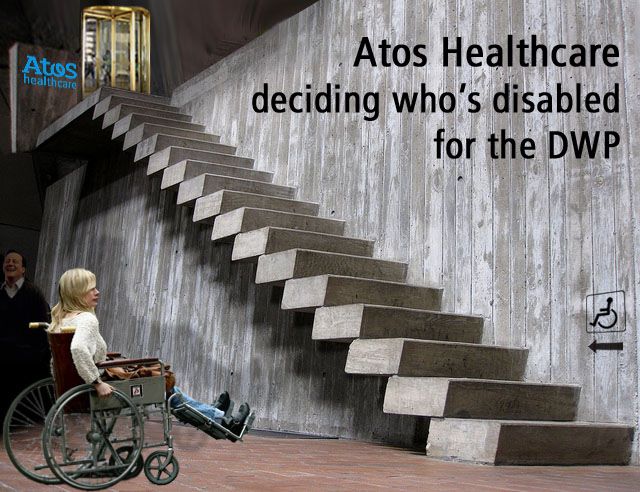
Many thanks to Robert Livingstone for his excellent artwork. Many thanks to Joyce for the information she has provided, and for her courage and integrity, which is so strongly evident in her outstanding campaign work.


I don’t make any money from my work. I am disabled because of illness and have a very limited income. But you can help by making a donation to help me continue to research and write informative, insightful and independent articles, and to provide support to others. The smallest amount is much appreciated – thank you. 

DonatenowButton

Clause 99, Catch 22 – The ESA Mandatory Second Revision and Appeals

552733_435687149834152_88095195_nSection 102 and Schedule 11 of the Welfare Reform Act, (Clause 99) – Power to require revision before appeal.

If anyone left in doubt that this Government’s policies are grossly unfair, and are intentionally punishing sick and disabled people – some of whom are amongst the most vulnerable of our citizens – you need look no further than Clause 99 for verification. Currently, claimants who are found fit for work can continue to receive Employment Support Allowance (ESA) at the basic rate by immediately lodging an appeal if they think the decision is wrong. ESA will then remain in payment until the appeal is decided.

That is all set to change, however, under Clause 99 of the Welfare Reform Bill, intended to be effective from April 2013 – and according to the Department for Work and Pensions, from October 2013 that includes ESA and DLA decisions. Under the new rules, claimants who wish to challenge a benefit decision will no longer be allowed to lodge an appeal immediately. Instead, there will be a mandatory revision or review stage, during which a different Department for Work and Pensions (DWP) decision maker will reconsider the evidence and, if necessary, send for more information, before deciding whether to change the original decision.

There will be no time limit on how long this process may take. The requirement for a mandatory review/revision before proceeding with appeal applies to all DWP linked benefits. During the review, no ESA will be payable, not even the basic rate. However, once the review is completed, those wishing to appeal may claim basic rate ESA again, up until the tribunal. It’s important that people know to request this continued payment from the DWP, once they have lodged their appeal. 

The ludicrous claim from Government is that this “simplifies” the appeal process, and  “the changes will improve customer service by encouraging people to submit additional evidence earlier in the process to help improve decision making. Resolving any disputes without the need for an appeal will also help ensure that people receive the right decision earlier in the process.”

Call me a cynic, but I don’t believe this is the genuine reasoning behind clause 99 at all. The successful appeals to date provide a growing and substantial body of evidence that the Work Capability Assessment isn’t fit for purpose. People are being wrongfully denied their claims for ESA. Mandatory review will make it very difficult for people to continue with an appeal, since their lifeline income will end for an indefinite period until the review is completed and they can proceed with appeal.

You will also have to appeal directly to HM Courts and Tribunal Services – this is known as “direct lodgement” – as DWP will no longer lodge the appeal on your behalf. DWP has agreed with the Tribunal Procedure Committee to introduce time limits to stipulate how long DWP has to respond to an individual appeal. The DWP is currently discussing what these time limits might be with the Tribunal Procedure Committee. That is assuming, of course, that people manage to circumnavigate the other consequences of this legislation.

From 1 April 2013 you will not be able to get Legal Aid for First-tier Tribunal hearings. Legal Aid will still be available for appeals to the Upper Tribunal and Higher Courts. See appealing to the Upper Tribunal against a first tier tribunal decision here: legal aid act 2012 for more information. So much for the right to a fair hearing.

There are some serious implications and concerns about these changes. Firstly, there is no set time limit for DWP to undertake and complete the second revision. Secondly, claimants are left with no income at all whilst they await the review, and until appeal is lodged. The DWP have stated that there is “no legal reason” to pay a benefit that has been disallowed during the review period. The only choice available seems to be an application for Job Seekers Allowance. (JSA) or Universal Credit. However, we know that people in situations where they have been refused ESA have also been refused JSA, incredibly, on the grounds that they are unavailable for work, (and so do not meet the conditions that signing on entails) or they are unfit for work, because they are simply too ill to meet the conditions.

We know of people who have had their application for JSA refused because they attend hospital for treatment once a week and so they are “not available for work” at this time. Furthermore, the minimum waiting period for a new claim to be processed is 6 weeks. That’s 6 weeks with no income at all.

Moreover, there is some anecdotal evidence of people being told by the DWP that in order to claim JSA, they must first close their original claim for ESA, since it isn’t possible to have two claims for two different benefits open at the same time. DWP are also telling people that this means withdrawing their ESA appeal. However, you have the right to appeal.

Another grave concern is that although most people on income related ESA are automatically passported  to maximum Housing and Council Tax Benefit, from the time that the claim ends, (and for whatever reason), eligibility to housing benefit and council tax also ends. 

However, I would urge people in this situation to contact the Housing Benefit office promptly to explain the situation – the DWP automatically contact the Council to tell them when someone’s eligibility for ESA has ended. It is always assumed that the person claiming has found work when their DWP related benefit eligibility ends.

You can still claim for Housing Benefit and Council Tax Benefit because you have a low income, or nil income, but you will need contact the Benefits Section, and will need bank statements to demonstrate that this is true, and also, any other evidence you may have, such as your notification letter from DWP, evidence of your tenancy and ID. If you have no income as a result of your ESA being stopped, ask for a nil income declaration form. (Like this one, for example)

You may also apply for discretionary housing payments if you are likely to become homeless, and if there is a shortfall between your Housing Benefit, and rent costs. It’s also payable sometimes when you have legal costs. It’s certainly worth asking your Local Authority if you qualify for payment. There are limited funds available.

I am informed that when an appeal is pending, providing the Housing Benefit Office is informed of this, there should be some support towards rent and Council Tax. However, this is going to place further strain and difficulty on people who are ill and disabled. Housing Benefit is calculated by taking the work activity or support component of ESA into account, and currently, when basic rate ESA is payable up to appeal, some claimants are not necessarily eligible for the maximum Housing Benefit awards.

It’s therefore possible that Housing Benefit entitlement will be lower, with no basic rate ESA being payable after April 1st. I would urge people to contact their Local Authority as soon as you know your ESA award has ended, because otherwise they will simply close your Housing Benefit and Council Tax claim.

The FOI.

I can confirm that there was no risk analysis or risk register in respect of clause 99 of the Welfare Reform Bill. I sent an FOI to DWP that asked about these issues, together with questioning that Clause 99 contains no reference to a time limit on ESA reconsiderations, although it makes them mandatory. I asked :-

1) When is the intended implementation date?

2) As yet no decisions have been made regarding ESA payment levels
during the reconsideration period which could be indefinite. Can you
give an assurance that this will be announced BEFORE
implementation?

3) What data will you collect so that the effects of this
legislation can be accurately analysed subsequently?

4) Where are the risk assessment, impact analysis and risk register
that show the effect this will have on claimants whose benefit
payments could be affected indefinitely?

The response informed that the planned implementation date is April 2013, and “the DWP will conduct a  formal public consultation in line with the Government’s code of practice on consultation. This does not include publishing a risk register or conducting a risk analysis. This is because all aspects of the proposed changes are considered during the consultation process and in the impact assessment and equality impact assessments related to the changes”. There are no plans to introduce a time limit, or to retain payments of basic rate ESA throughout the second revision and leading up to appeal.

The DWP published consultation document “Mandatory consideration of revision before appeal” that could be accessed via the DWP web site under the heading “Consultations”. The consultation concerned issues relevant to the implementation and operation of the appeals reform provisions in the Welfare Reform Bill and invited comments on the draft regulations. I worked on raising awareness regarding the issues that the Government’s draft raised, as well as prompting and garnering responses to the consultation.

I can also confirm that the Government response to the consultation did NOT take into account any of the concerns we raised collectively, in particular, regarding the lack of a time limit on the DWP to produce the mandatory review, and the withdrawal of basic rate ESA to those awaiting the review outcome .

So, the consultation was evidently a sham, nothing more than paying lip service to an increasingly perfunctory democratic process. Given that basic rate ESA is exactly the same amount per week as JSA, we need to ask ourselves why the  Government have withdrawn the ESA safety net for those wanting to appeal DWP decisions that they are fit to work. Why introduce another layer of DWP bureaucracy to the appeal process, and why is it the case that there is need for a second revision, if the first response is based on robust procedure and decision making, and yields accurate and fair outcomes?

Of course we know that the outcomes are neither fair, accurate, or based on robust decision making. We know that some 40% of appeals for ESA were successful in 2011 and that this percentage rose to around 80% when claimants had representation at appeal. That is pretty damning evidence against this Governments’ claims that the system is working, and that many disabled people “can work”.

It’s likely that Clause 99 has been introduced to make appealing wrongful decisions that we are fit for work almost impossible. Sick and disabled people are effectively being silenced by this Government, and the evidence of a brutal, dehumanising, undignified and grossly unfair system of “assessment” is being hidden.

More than 10,600 people have died following being told they were “fit for work”, and this presents a significant statistical increase (from 310 deaths over the same period amongst incapacity benefit claimants) that correlates with the current system, and it is astounding that our Government have failed to address this. Instead, they have made the system even more brutally punitive, dehumanising and grossly unfair.

Clause 99 is simply an introduction of an additional obstructive layer of Kafkaesque bureaucracy to obscure the evidence of this. This Government is oppressive and certainly bears all of the hallmark characteristics of authoritarianism.

We need to be pressuring the government for the introduction of a time limit (on both legal and humanitarian grounds) as currently there is none. I did enquire to see if DWP had any internal rules or guidelines yet regarding a time limit but so far they have not. We also need to be pressuring for basic rate ESA to continue. That was a major part of the consultation response, too.  

Meanwhile, legal challenges to this unfair and totally unacceptable addition to the Welfare Reform Bill will be going ahead.

Government’s response to the public consultation.

The DWP published a short mandatory consideration of revision before appeal – Government interim response to public consultation which stated that the Department did not propose to make any significant changes to the draft regulations included in the consultation document as a result of the comments received.

The Government’s final response to the consultation included the following:

  • There is to be no time limit for the completion of mandatory reconsideration of decisions.
  • No decision has yet been made with regard to paying ESA pending reconsideration but other benefits may be available to claimants where ESA has been disallowed.
  • It was confirmed that housing benefit and council tax benefit will not be included in the mandatory reconsideration process.
  • Where a person makes a late application for revision, the Department will be removing the requirement that an application for revision cannot be granted unless it has merit, and removing the regulation which requires that, in deciding whether an extension of time is reasonable, the decision maker cannot take into account the fact that the individual misunderstood the law or was ignorant that they could request reconsideration.

In considering a late application for revision, the decision maker will look at whether it is reasonable to grant the application for an extension of time, and what the circumstances were that meant that the application could not be made within the one month time limit.

The decision maker will still consider whether an any time revision can be made, or whether the decision should be superseded when considering a late application for revision as they do now.

Where a request for reconsideration is made out of time, and the decision maker refuses the application to revise the original decision, the effect of the draft regulations is that there can be no appeal as the Secretary of State must consider whether to revise the decision before an appeal can be made.

Update: No basic rate ESA will be payable whilst people await the mandatory review, to challenge wrongful decisions. No appeal can proceed until that has been done by DWP, there is no time limit on DWP to undertake the review.

Lord Freud speaking in the Lords about  basic rate ESA and the mandatory review :-

I turn now to ESA. At the moment, if someone appeals a refusal of ESA, it can continue to be paid pending the appeal being heard; this is not changing. What is changing is that there can be no appeal until there has been a mandatory reconsideration. So there will be a gap in payment. In that period—and I repeat that applications will be dealt with quickly so that this is kept to a minimum—the claimant could claim jobseeker’s allowance or universal credit. Alternative sources of funds are available. Of course, he or she may choose to wait for the outcome of the application and then, if necessary, appeal and be paid ESA at that point.”

Later he said:

Under the current position, there is a voluntary process whereby people can go for reconsideration and the ESA is not payable until the decision is taken to go formally to an appeal.”  Lord Freud (Source: Hansard)

GL24  and Appeal information.

From April, you will need to send your GL24  appeal form (DWP leaflet “if you think our decision is wrong”) or a letter directly to HM Courts and Tribunal Services.

How to appeal by letter.

 The appeal must contain:

  • the appellant’s name, address and National Insurance number
  • enough information to identify the decision under appeal (benefit claimed and date of decision);
  • the grounds for the appeal;
  • if late, the special reasons for lateness and/or why the appeal has a good chance of success;
  • the appellant’s signature (or the signature of a person with written authority to act on their behalf).

Update: Guidance on revision and handling appeals for benefits
Note 3: The guidance comes into effect
from 8.4.13 for PIP and from 29.4.13 for
UC, JSA and ESA.

Decision Makers should note that mandatory reconsideration is being
introduced from:
8.4.13 for PIP
29.4.13 for Universal Credit
28.10.13 for JSA and ESA.

However, we are still hearing about cases where the mandatory review is being used already, and this ought to be challenged on the grounds that DWP have provided dates when clause 99 is to be implemented, and so ought to be working to that legal timetable.

The revision process applies to:
1. UC, PIP, JSA and ESA
2. decisions on credits
http://www.dwp.gov.uk/docs/adma3.pdf

Further reading:

Further information from Rethink

ESA – Appeal statistics – before the MOJ spin!

Who is accountable and legally liable for the well-being of those deemed “fit for work”?

Step by step guide to appealing a ESA decision: Good Advice Matters

Sign the WOW petition – a call for a Cumulative Impact Assessment of all cuts and changes affecting sick & disabled people, their families and carers, and a free vote on repeal of the Welfare Reform Act.

It’s a call for an  immediate end to the Work Capability Assessment, as voted for by the British Medical Association.

Consultation between the Depts of Health & Education to improve support into work for sick & disabled people, and an end to forced work under threat of sanctions for people on disability benefits.

An Independent, Committee-Based Inquiry into Welfare Reform, covering but not limited to: (1) Care home admission rises, daycare centres, access to education for people with learning difficulties, universal mental health treatments, Remploy closures; (2) DWP media links, the ATOS contract, IT implementation of Universal Credit; (3) Human rights abuses against disabled people, excess claimant deaths & the disregard of medical evidence in decision making by ATOS, DWP & the Tribunal Service.

Help –  potential sources of funding from Charities and Trusts that help people out of poverty and debt:
United Utilities
3000 benevolent funds
Directory of National food banks
Representing yourself in Court

The LawWorks Clinics Network is a nationwide network of free legal advice sessions which LawWorks supports. Clinics provide free initial advice to individuals on various areas of law including social welfare issues, employment law, housing matters and consumer disputes – List of LawWorks clinics

“Everyone is entitled in full equality to a fair and public hearing by an independent and impartial tribunal, in the determination of his rights and obligations and of any criminal charge against him.” –  Article 6 of the European Convention of Human Rights, and Article 10 of the Universal Declaration of Human Rights.

417174_409187269150807_530516221_n

Pictures courtesy of Robert Livingstone


I don’t make any money from my work. I am disabled because of illness and have a very limited income. But you can help by making a donation to help me continue to research and write informative, insightful and independent articles, and to provide support to others. The smallest amount is much appreciated – thank you. 

DonatenowButton cards

The ESA ‘Revolving Door’ Process, and its Correlation with a Significant Increase in Deaths amongst Sick and Disabled People

598830_399390316797169_2004284912_n

A Department for Work and Pensions Freedom Of Information request (FOI) yielded a response showing that people having their claim for Employment Support Allowance (ESA) stopped, between October 2010 and November 2011, with a recorded date of death within six weeks of that claim ceasing, who were until recently claiming Incapacity Benefit (IB), totalled 310. Between January and November 2011, those having their ESA claim ended, with a recorded date of death within six weeks of that claim ending totalled 10,600. 

Bearing in mind that those who were successfully migrated to ESA from IB were assessed and deemed unfit for work, (under a different assessment process, originally) one would expect that the death rates would be similar to those who have only ever claimed ESA. This is very clearly not the case.

Furthermore, there are NO alarming increases in mortality rates amongst those who are still in receipt of Incapacity Benefit – there were approximately a million and a half claimants, compared to less than a million ESA claimants for this period. Many of those migrated so far have not yet had a Work Capability Assessment, as the Government decided to re-assess those people when their review from the Incapacity Benefit  Personal Capability Assessment is due, for practical reasons. The migration process won’t be completed, it is anticipated, until 2014.

David Green from the DWP has urged that “care should therefore be taken when interpreting these figures”. Well I have taken care interpreting this data, Mr Green. My careful interpretation is that there is a probable correlation demonstrated here, linking the reformed Work Capability Assessment process and the withdrawal of lifeline benefits with an increase in mortality amongst sick and disabled people.

Incapacity Benefit was fair, it was a genuine social security provision. The “reforms”, including the new Tory-shaped ESA benefit, by stark contrast, are all about taking support and provision away from the sick and disabled, leaving them potentially very vulnerable. It’s very evident that there are measures in place to reduce successful claims for ESA, and many lose their lifeline support for the most arbitrary or manufactured reasons.

Indeed, the Tories have been very keen to articulate the welfare “savings” that they anticipated with regard to the disability benefits, including PIP, which is replacing DLA. But of course, these anticipated “savings” reflect a dark truth: the Government are setting targets to remove benefits from people, regardless of the impact of that imposed deprivation (and frank State theft of our tax funded welfare) on their wellbeing, health and safety. How else is it possible to predict probable “savings?”

Those claiming IB were not required to have continuous assessments, whereas those on ESA are constantly required to have the Work Capability Assessment. Many claimants have described a “revolving door” process of endless assessment, ceased ESA claim, (based on an outcome of almost invariably being wrongly “assessed” as fit for work), appeal, successful appeal outcome, benefit reinstated, only to find just 3 months later another assessment is required. The uncertainty and loss of even the most basic security that this process creates, leading to constant fear and anxiety, is having a damaging, negative impact on the health and wellbeing of so many.

A significant proportion of those required to have endless assessments have very obviously serious illnesses such as cancer, kidney failure, lung disease, heart disease, severe and life threatening chronic conditions such as multiple sclerosis, lupus, myalgic encephalomyelitis, rheumatoid arthritis, brain tumours, severe heart conditions, and severe mental health illnesses, for example. To qualify for ESA, the claimant must provide a note from a doctor stating that the person is unfit for work. There can be no justification for subjecting people who are so ill to further endless assessments, and to treating us as if we have done something wrong.

Marginalising and stigmatising vulnerable social groups via political propaganda in the media, using despiteful and malicious terms such as “workshy” and “feckless” is a major part of the Government’s malevolent “justification” to the public for removing the lifeline support from sick and disabled people, amongst whom are some of our most vulnerable citizens.

We are climbing Allport’s Ladder.

I have often suspected that Iain Duncan Smith is channelling the spirit of Goebbels.

In addition to very justified anxieties regarding the marked increase in disability hate crime that the Tory-led propaganda campaign has resulted in, many sick and disabled people have also stated that they feel harassed and bullied by the Department of Work and Pensions and Atos. Many talk of the dread they feel when they see the brown Atos envelope containing the ESA50 form arrive through the letter box.

The strain of constantly fighting for ESA eligibility/entitlement and perpetually having to prove that we are a “deserving” and “genuine” sick and disabled person is clearly taking a toll on so many people’s health and wellbeing. Many families of those who have died have said that the constant strain, anxiety and stress of this revolving door process has contributed significantly to their loved ones’ decline in health and subsequent death. The figures from the DWP, and the marked contrast between the ESA and IB death statistics certainly substantiates these claims.

The horrific, unforgivable and massive increase in deaths over this period coincides with the Government’s totalitarian styled rapid fire legislation – the “Reforms” – in the face of protest, horror, disbelief, fear and mass opposition. The Tories cited “financial privilege” to trample over opposition and stifle dissent, to drown out the voices of protest. Those protesting this Bill notably included many from the House of Lords. I lobbied the Peers, and emailed every single one of them, stating very clearly that the welfare reforms must not happen. I got a high number of encouraging responses. But  David Cameron got his own way.

Cameron made a Freudian-style slip when he announced to Ed Miliband recently, during Parliamentary debate, that We are raising more money for the rich.” Not that we didn’t already know this was so. Many of us – around 73 sick and disabled people every week –  are paying for that wealth increase for the already wealthy with our very lives.

There are many who have so tragically lost their lives because of this malicious Government’s brutal and grossly unjust economic war on the poorest, on sick and disabled people and on the most vulnerable citizens, because of the Tory-led ransacking and plundering of our welfare provision and social support programs.

But just one life would be one too many.

Further reading:

The Black Triangle Campaign

536738_306169162785952_999031084_n
Many thanks to Robert Livingstone for his outstanding artwork.

This is an excerpt taken from a much longer piece of work – Remembering the Victims of the Welfare “Reforms.”