Category: Social Policy

Jobcentre tells GP to stop issuing sick notes to patient assessed as ‘fit for work’ and he died.

pizapcom14829621211221

Abbie and her late father, James Harrison.

Julia Savage is a manager at Birkenhead Benefit Centre in Liverpool. She wrote a letter addressed to a GP regarding a seriously ill patient. It said:

“We have decided your patient is capable of work from and including January 10, 2016.

“This means you do not have to give your patient more medical certificates for employment and support allowance purposes unless they appeal against this decision.

“You may need to again if their condition worsens significantly, or they have a new medical condition.” 

The patient, James Harrison, had been declared “fit for work” and the letter stated that he should not get further medical certificates. 

However, 10 months after the Department for Work and Pensions (DWP) contacted his doctor without telling him, James died, aged 55, the Daily Record has reported.

He was clearly not fit for work.

His grieving daughter, Abbie, said: “It’s a disgrace that managers at the Jobcentre, who know nothing about medicine, should interfere in any way in the relationship between a doctor and a patient.

“They have no place at all telling a doctor what they should or shouldn’t give a patient. It has nothing to do with them.

“When the Jobcentre starts to get involved in telling doctors about the health of their patients, that’s a really slippery slope.”

Abbie said James had worked since leaving school at a community centre near his home. But his already poor health went downhill after the centre was shut down because of austerity cuts.

James had a serious lung condition and a hernia before the centre closed, and also developed depression and anxiety afterwards.

Abbie said: “He’d worked all his life. He wasn’t the kind of guy who knew anything about benefits.

“But as his health deteriorated, there wasn’t any chance he could do a job. He applied for employment and support allowance.”

James received Employment and Support Allowance (ESA), but only at the low rate of £70 a week, the same amount as jobseekers’ allowance. He was then sent to attend one of the DWP’s controversial Work Capability Assessments – and declared fit for work.

Despite that decision, Abbie said James remained in constant need of medical help and had to visit his doctor regularly.

However, the GP concerned repeatedly refused to give him a sick note, and James began to suspect the Jobcentre were to blame for this.

Abbie said: “He really needed a note. He was too ill to go to the constant appointments at the Jobcentre and he didn’t want to be sanctioned.

“He became convinced the DWP had been talking to his doctor behind his back.”

Although Abbie felt her father was confused, and didn’t think his explanation was right at the time, she later asked to see her father’s medical records. She found the letter in his file from Julia Savage, the manager at Birkenhead Benefit Centre, in James’s home city of Liverpool.

The letter was addressed to James’s GP.

Context: Government claims that work is a “health outcome”

James Harrison was very worried that his ill health interfered with his obligation to comply with the inflexible and constant conditions attached to his eligibility for welfare support, and that this would lead to sanctions – the withdrawal of his lifeline support, which was calculated to meet basic survival needs only.

The GP should have provided evidence that this was the case. The doctor was advised not to provide further fit notes by the DWP, however, unless James appealed. Yet the circumstances warranted that the GP provide a fit note. 

fit-note-guidance

Last year, the Department for Work and Pensions issued an ideologically directed new guidance to GPs regarding when they should issue a Fit Note. This was updated in December 2016.

In the document, doctors are warned of the dangers of “worklessness” and told they must consider “the vital role that work can play in your patient’s health”.  According to the department, “the evidence is clear that patients benefit from being in some kind of regular work”.

The biopsychosocial model, with a current political emphasis on the psychological element, has become a disingenuous euphemism for psychosomatic illness, which has been exploited by successive governments (and rogue insurance companies) to limit or deny access to social security, medical and social care.

Nobody would deny that illness has biological, psychological and social dimensions, however, the model has been adapted to fit a neoliberal “small state” ideology – one that rests almost entirely on Conservative individualist notions of citizen responsibility, as opposed to a rights-based approach and provision of publicly funded state support.

This approach to disability and ill health has been used by the government to purposefully question the extent to which people claiming social security bear personal responsibility for their own health status, rehabilitation and prompt return to work. It also leads to the alleged concern that a welfare system which was originally designed to provide a livable income to those with disabling health problems, may provide “perverse incentives” for perverse behaviours, entrenching “worklessness” and a “culture of dependency”. It’s worth pointing out at this point that there has never been any empirical evidence to support the Conservative notion of welfare “dependency”. 

Instead of being viewed as a way of diversifying risk and supporting those who have suffered misfortune and ill health, social and private insurance systems are to be understood as perverse incentives that pay people, absurdly, to remain ill and keep them from being economically productive.

The idea that people remain ill deliberately to avoid returning to work  – what Iain Duncan Smith and David Cameron have termed “the sickness benefit culture” – is not only absurd, it’s very offensive. This is a government that not only disregards the professional judgements of doctors, it also disregards the judgements of sick and disabled people. However, we have learned over the last decade that political “management” of people’s medical conditions does not make people healthier or suddenly able to work. Government policies, designed to “change behaviours” of sick and disabled people have resulted in harm, distress and sometimes, in premature deaths

The government have made it clear that there are plans to merge health and employment services. In a move that is both unethical and likely to present significant risk of harm to many patients, health professionals are being tasked to deliver benefit cuts for the DWP. This involves measures to support the imposition of work cures, including setting employment as a clinical outcome and allowing medically unqualified job coaches to directly update a patient’s medical record.

The Conservatives (and the Reform think tank) have also proposed mandatory treatment for people with long term conditions (which was first flagged up in the Conservative Party Manifesto) and this is currently under review, including whether benefit entitlements should be linked to “accepting appropriate treatments or support/taking reasonable steps towards “rehabilitation”.  The work, health and disability green paper and consultation suggests that people with the most severe illnesses in the support group may be subjected to welfare conditionality and sanctions.

Many campaigners have raised concerns about the DWP interfering with people’s medical care and accessing their medical files. I wrote an article last year about how the government plans to merge health and employment services and are now attempting to redefine work as a clinical outcome. I raised concerns about the fact that unemployment has been stigmatised and politically redefined as a psychological disorder, and that the government claims, somewhat incoherently, that the “cure” for unemployment due to illness and disability, and sickness absence from work, is work.

In a critical analysis of the recent work, health and disability green paper, I said: 

“And apparently qualified doctors, the public and our entire health and welfare systems have ingrained “wrong” ideas about sickness and disability, especially doctors, who the government feels should not be responsible for issuing the Conservatives recent Orwellian “fit notes” any more, since they haven’t “worked” as intended and made every single citizen economically productive from their sick beds.

It seems likely, then, that a new “independent” assessment and some multinational private company will most likely very soon have a lucrative role to ensure the government get the “right” results.”

The medical specialists are to be replaced by another profiteering corporate giant who will enforce a political agenda in return for big bucks from the public purse. Health care specialists are seeing their roles being incrementally and systematically  de-professionalised. That means more atrocious and highly irrational attempts from an increasingly authoritarian government at imposing an ideological “cure” – entailing the withdrawal of any support and imposing punitive “behavioural incentives” – on people with medical conditions and disabilities. Doctors, who are clever enough to recognise, diagnose and treat illness, are suddenly deemed by this government to be insufficiently clever to judge if patients are fit for work.

The political de-professionalisation of medicine, medical science and specialisms (consider, for example, the implications of permitting job coaches to update patient medical files), the merging of health and employment services and the recent absurd declaration that work is a clinical “health” outcome, are all carefully calculated strategies that serve as an ideological prop and add to the justification rhetoric regarding the intentional political process of dismantling publicly funded state provision, and the subsequent stealthy privatisation of Social Security and the National Health Service. 

“De-medicalising” illness is also a part of that process:

“Behavioural approaches try to extinguish observed illness behaviour by withdrawal of negative reinforcements such as medication, sympathetic attention, rest, and release from duties, and to encourage healthy behaviour by positive reinforcement: ‘operant-conditioning’ using strong feedback on progress.” Gordon Waddell and Kim Burton in Concepts of rehabilitation for the management of common health problems. The Corporate Medical Group, Department for Work and Pensions, UK. 

Waddell and Burton are cited frequently by the DWP as providing “evidence” that their policies are “evidence based.” Yet the DWP have selectively funded their research, which unfortunately frames and constrains the theoretical starting point, research processes and the outcomes with a heavy ideological bias. 

This framing simply shifts the focus from the medical conditions that cause illness and disability to the “incentives”, behaviours and perceptions of patients and ultimately, to neoliberal notions of personal responsibility and self-sufficient citizenship in a context of a night watchman, non-welfare state. 

Medication, rest, release from duties, sympathetic understanding – the remedies to illness – are being appallingly redefined as “perverse incentives” for ill health, yet the symptoms necessarily precede the prescription of medication, the Orwellian renamed (and political rather than medical) “fit note” and exemption from work duties. Notions of “rehabilitation” and medicine are being redefined as behaviour modification: here it is proposed that operant conditioning in the form of negative reinforcement – which the authors seem to have confused with punishment – will “cure” ill health. 

People cannot simply be “incentivised” into not being ill. 

The political use of the biopsychosocial model to cut costs at the expense of people who are ill will undoubtedly have further extremely serious implications. Such an approach, which draws on behaviourism and punishment (such as the threat and implementation of sanctions) is extremely unethical and makes the issue of consent to medical treatment very problematic if it is linked to the loss of lifeline support or the fear of loss of benefits.

This is clearly the direction that government policy is moving in and this represents a serious threat to the health, welfare, wellbeing and human rights of patients and the political independence of health professionals.


I don’t make any money from my work. But you can contribute by making a donation and help me continue to research and write informative, insightful and independent articles, and to provide support to others. The smallest amount is much appreciated – thank you.

DonatenowButton cards


Labour’s Disability Equality Roadshow comes to Newcastle

Jeremy Corbyn, Paul Rutherford and Debbie Abrahams, Shadow Work and Pensions Secretary, at the launch of Labour’s Disability Equality Roadshow. She is talking to people across the country about what disabled people want to see in Labour’s next manifesto. If you’re a Labour Party member keep an eye on updates from the National Policy Forum for more opportunity to get involved.

The Labour Party’s Disability Equality Roadshow was launched in Manchester in November and is set to go nationwide over the coming months. This democratic engagement process is the vitally important first step in developing policies which will address the structural (social, cultural, political and economic) issues affecting disabled people and their carers across the UK, as well as the challenges we all face in building a fairer, more equal society.

At the launch, Paul Rutherford said: “This initiative will enable Labour to develop real policies which will properly support disabled people, not punish and harm them, making their often difficult lives harder, which is what this government’s policies are doing.”

Debbie Abrahams added: “The roadshow will draw on the experiences and expertise of disabled people themselves who have been particularly affected by this Tory Government’s changes to social security.”

After six years of Conservative policies that have not involved any genuine consultation and engagement with disabled people in political decision-making processes, we have witnessed a raft of increasingly punitive measures and cuts that have been imposed on us, supposedly to “incentivise” the poorest citizens – presumably to be less poor – by imposing financial punishments and heaping stigma on them. Invisible bootstraps were included in the government’s basic incentives package.

The phrase “behavioural change” has become a euphemism for traditional Conservative prejudice, blaming individuals for structural barriers and politically constructed problems. “Incentivising” is another euphemism for discrimination and punitive state behaviour modification policies, such as benefit sanctions, for the poorest people. It’s also a fundamental part of a justification narrative to advance the dismantling of the welfare state in stages, a cut at a time.

The wealthiest people, however, have been presented with the deluxe package of Conservative “incentives”, which entail generous handouts in the form of tax cuts and endorsed exemptions. Such policies, which take lifeline income from the poorest citizens, including those in low paid or part-time work and award it to the very wealthiest, cannot fail to extend and accentuate growing inequalities and increase social and economic exclusion.

This topical comment was very welcomed on Saturday: 

“Tax justice means that supporting disabled people IS sustainable. This is our flag in the sand”. Grahame Morris, Labour MP, on Labour Party priorities at the Disability Equality Roadshow, Newcastle.

Debbie said: Firstly, an inclusive labour market is one that finds the right job for those who can work. The Tory government has focused solely on getting people ‘off-flow’, forcing them into any job to bring down claimant numbers, or none, for example, as a result of sanctions.

I believe there is a fairer way; a more holistic, person-centred approach that looks at people’s strengths and barriers to work whether this relates to skills or housing issues. We need to provide them with the best possible employment support but also opportunities to work.”

And on support for disabled people in work: “Ensuring that proper workplace adjustments are made to retain disabled people who are in work is a vital part of an inclusive labour market. These adjustments could be in the form of more flexible leave arrangements as well as extending Access to Work which currently only supports a tiny minority of disabled people, approximately 36,500 out of 3.7 million in work.”

The Roadshow is part of Labour’s commitment to transform our social security system, ensuring that, like our NHS, it is fit for purpose; there for us all in our time of need.

The Disability Equality Roadshow is using the UN Convention on the Rights of Disabled Persons as a framework to help develop a wide array of policies, not just those concerning social security, but also embedding the convention articles in education, health and social care, justice policies and many others.

The Labour Party has already pledged to scrap the discriminatory and unfair Bedroom Tax. Debbie Abrahams announced at Labour Party Conference that a Labour government will also scrap the discredited Work Capability Assessment. Debbie said she wants to replace it with “a system based on personalised, holistic support; one that provides each individual with a tailored plan, building on their strengths and addressing barriers, whether skills, health, care, transport, or housing-related.”

Debbie has asked for our help in exploring how this might be achieved.

Many of us welcomed the announcement from Debbie that a Labour government will get rid of this Government’s punitive sanctions too. As Debbie pointed out: “This will mean Job Centre Plus and employment support providers’ performance will not just be assessed on how many people they get off their books.”

She also discussed the need for a culture change regarding the prejudiced attitudes of many regarding people with disabilities and those out of work.

The event on Saturday was hosted at Unite the Union.

Saturday 3 December was also the International Day for Disabled People.

dis-eq-roadshow Democracy and inclusion in action: discussing social security

Some of the issues that we discussed:

  • We raised individual cases that demonstrated the terrible distress caused by the work capability assessment (WCA) and the serious impact that being told wrongly they are fit for work has on people who are very ill. Labour will scrap the WCA. We said that the evidence that should be considered in claims for disability related benefit should always be medical – presented by qualified doctors and specialists, not from “functional assessment” carried out by non-specialised occupational therapists and nurses employed by private companies hired to cut benefits and make a massive profit at our expense.
  • We must also move away from any process of assessment that is intimidating and distressing. People generally felt that the DLA system was much fairer, with provision for life long awards for chronic and progressive conditions.
  • Increasingly, private companies are taking up money from the social security budget, whilst those that the budget is meant to assist are seeing their support cut and their standard of living plummet. Many are now unable to meet their most basic needs – such as having sufficient income to meet the costs for food and fuel.  It was suggested that benefit levels are set by a specialised  committee, ensuring that the costs of basic needs can be met.
  • As benefits were originally calculated to meet only basic needs, the additional costs of housing and council tax were not included in the benefit level when it was originally calculated. It was assumed that people would remain exempt from paying any additional rent and council tax. That needs to be addressed, since benefits do not cover these or the bedroom tax (though Labour intend to scrap the bedroom tax).
  • The new in-work conditionality is likely to impact on disabled people, many of who may need to work part-time. Shorter and flexible working hours are a reasonable adjustment. Some of us have to also manage hospital appointments with more than one specialist and hospital based treatment regimes. The threat and use of sanctions aimed at part-time and low paid workers is incompatible with the aim of “halving the disability employment gap.”
  • We suggested that employers should fined for not employing a quota of disabled people, rather than being rewarded, as suggested in the government Green Paper, for employing disabled people, given that disabled people have a right to socioeconomic inclusion, including the right to work, without discrimination.
  • The Equality Act was not implemented in full by the Coalition. This limits redress for disabled people regarding:  
    • Dual discrimination: the government decided not to bring this into force as a way of reducing the cost of regulation to business. 
    • Socioeconomic inequalities under the Public Sector Equality Duty 
    • Provisions relating to auxiliary aids in schools
    • Diversity reporting by political parties
    • Provisions about taxi accessibility among other things. These omissions need to be remedied. 
  • Accessibility issues were also raised, ranging from the lack of provision and accessibility for disabled users of public transport and taxis to the lack of large print ESA forms available for people with visual impairments and barriers regarding the availability of home visits for assessments.
  • Run-on benefits for people starting work need to be reinstated, since people usually work a month at least before being paid a wage. Previously, housing benefit, council tax and other benefits were payable for the first month of employment.
  • We discussed the need for culture change to address prejudice, and the now commonly held negative perceptions and attitudes towards disabled people and those out of work.

There were three other task groups, some worked on addressing barriers to access to justice, others worked on disability and barriers at work, among other topics, all of who raised many other issues, which were also fed back. 

It was a very productive and positive event: an excellent opportunity for democratic inclusion in the decision-making process and to contribute positively towards progressive Labour policies.

Of course that process doesn’t stop with the Roadshow events, but in the coming months, if you can get to the Roadshow when it comes to your area, it’s recommended you do. If you’re a Labour Party member you can follow updates from the National Policy Forum, which also provides further opportunity to get involved.

“Nothing about us without us,” as Gail Ward reminded us on the day. This approach provides a solid foundation for democratic norms. Sometimes expressed in Latin, (Nihil de nobis, sine nobis) it is a slogan commonly used to communicate the idea that no policy should be decided by any representative without the full and direct democratic participation of members of the group(s) affected by that policy. The saying has its origins in Central European political traditions.

Debbie has asked if I would contribute in a collaborative response to the government’s recent consultation and green paper on work, health and disability, which I’ve agreed to do. 

Government policies are expressed political intentions regarding how our society is organised and governed. They have calculated social and economic aims and consequences. In democratic societies, citizen’s accounts of the impacts of policies ought to matter. It’s very reassuring to know that the Labour party recognise this, especially in a context of an increasingly authoritarian government that isn’t interested in first-hand witness accounts concerning the terrible consequences of their draconian policies. 

Any consideration of future policy and its impacts must surely engage citizens in dialogue, on a democratic, equal basis and ensure participation in decision-making, to ensure an appropriate balance of power between citizens and government.

The Labour Party recognise that democracy is not something we have: it’s something we  must DO, and that process includes all of us. 

One final point that needs raising is that the progressive left – particularly Labour – do not find any favour with the mainstream corporate media, generally speaking. It is therefore down to all of us to bypass the constraints of media neoliberal framing, to ensure that news of Labour policies and events like this are shared widely. Otherwise genuine alternative narratives to the current socioeconomic paradigm and order will continue to be systematically stifled, at a time when there has never been a greater need for alternatives.

Upwards and onwards. 

DSCN3314.JPG

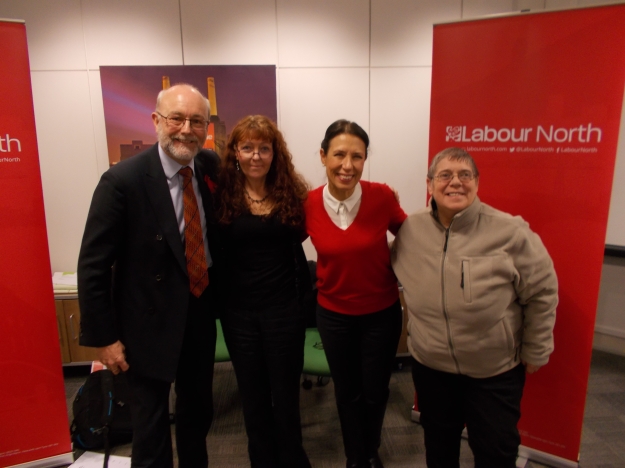
With Alex Cunningham, Debbie Abrahams and Gail Ward on Saturday at the Disability Equality Roadshow 

I’d like to thank Debbie Abrahams, Grahame Morris, Alex Cunningham, Ian Lavery, Ian Mearns, Emma Lewell-Buck, Richard Williams, Dave Allen, Labour North, Unite the Union, and every one who came on Saturday for an excellent and very productive, hope-inspiring event.


Government welfare policies are ‘historically obsolete’ say researchers

images

Historical research shows that the National Health Service (NHS) and welfare state are fundamental to a healthy, productive economy.

The government has been accused of following a “historically obsolete” welfare strategy by a team of Cambridge University researchers.  

Research by Simon Szreter, Ann Louise Kinmonth, Natasha M Kriznik, and Michael P Kelly also supports the work of campaigners, charities and other academics raising their concerns about the harmful social and economic impacts of the Conservatives’ austerity measures. These include the draconian welfare “reforms” and the consequences of the increasing privatisation of and political under-investment in the NHS from 2012 onwards. 

In an article published on Friday in The Lancet, titled  Health and welfare as a burden on the state? The dangers of forgetting history, the group of academics criticised Conservative austerity policies, which were instituted by David Cameron and George Osborne’s and continued by Theresa May and her chancellor Philip Hammond. The researchers point out that investment in welfare has always been crucial for Britain’s economic success.

The Conservatives have frequently claimed that welfare provision isn’t “sustainable”. Welfare support has been reduced so much that many people have been unable to meet even their most basic needs. Food and fuel poverty have significantly increased over the past four years, for example. We have witnessed the return of absolute poverty in the UK, something we haven’t seen since before the inception of the welfare state, until now. Social security is also harshly conditional, with punishment regimes and psycho-compulsion embedded in the diminishing “support” being offered. The emphasis has shifted from “support” to managing and enforcing poor citizens’ compliance and conformity.

Crucially, the researchers, who are based at St John’s College are opposing the idea that welfare and health spending is a “burden” on the country’s economy, arguing instead that economic prosperity is intrinsically tied to an adequate level of welfare provision.

Simon Szreter is a Professor of History and Public Policy at Cambridge’s Faculty of History. He writes: “The interests of the poor and the wealthy are not mutually opposed in a zero-sum game. Investment in policies that develop human and social capital will underpin economic opportunities and security for the whole population.”

The report also states: “The narrow view that spending on the National Health Service and social care is largely a burden on the economy is blind to the large national return to prosperity that comes from all citizens benefiting from a true sense of social security.”

The authors continue: “There are signs that Theresa May subscribes to the same historically obsolete view.

Despite her inaugural statement as Prime Minister, her Chancellor’s autumn statement signals continuing austerity with further cuts inflicted on the poor and their children, the vulnerable, and infirm older people.””

To support their position, the researchers point to the period of economic growth the UK experienced following the post-war settlement – including the development of the welfare state and the NHS, something which they argue also brought about greater equality, with the rich-poor divide falling to an all-time low during the 1970s.

Drawing on recent historical research, they also trace the origins of the British welfare state to reforms to the Poor Laws introduced under Elizabeth I in 1598 and 1601, and claim that investment in supporting the poorest citizens has always gone hand in hand with economic growth.

The report establishes an interesting and useful historical context, following the effect of welfare provision on the nation’s economic prosperity prior to the creation of the modern health and welfare apparatus and institutions that we are familiar with today, arguing that the concept of a British welfare state can be traced back to the reign of Elizabeth I. There are also parallels drawn in the report between the perceived problem of the “idle poor” during the Victorian era and the contemporary political narratives that intentionally label benefit claimants as “scroungers” who allegedly benefit unduly at the expense of “hard-working families”.

Many of us have drawn the same parallels over the past four years. In my  some of my own work, three years ago, I also compared the 1834 Poor Law Amendment Act – particularly the principle of less eligibility with the Conservative’s recent punitive and regressive approach to “making work pay”, which is about reducing social security provision, rather than raising national wages. Basically the ideology behind both political practices is that any support given to people out of work needs to be punitive, and much less than the poorest wages of those in the lowest paid employment. That tends to drive wages down, as people who are desperate to survive have little bargaining power, and are more likely to be forced to work for much less, because employers can exploit a desperate reserve army of labour.

The Poor Law Amendment Act of 1834 is largely remembered through its connection to the punitive workhouses that were infamously instituted across Victorian Britain.

The researchers argue that, though the 1834 Act was passed out of “concerns” that the welfare system was being abused and was an unduly heavy burden on taxpayers, there isn’t any evidence that it had much an economic benefit. They also point out that Britain’s growth actually fell behind that of rival nations after 1870, only recovering in the 1950s, following the post-war settlement

Simon Szreter said: “We are arguing from history that there needs to be an end to this idea of setting economic growth in opposition to the goal of welfare provision. A healthy society needs both, and the suggestion of history is that they seem to feed each other.”

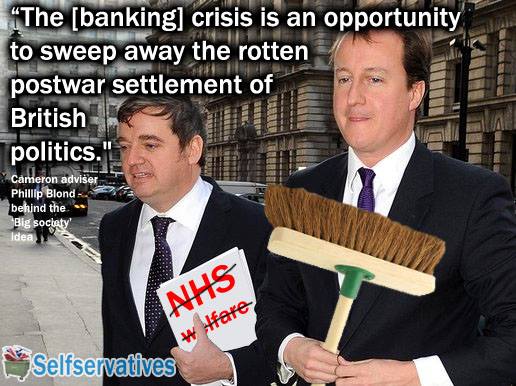
proper Blond


I don’t make any money from my work. But you can help by making a donation to help me continue to research and write informative, insightful and independent articles, and to provide support to others. The smallest amount is much appreciated – thank you.

DonatenowButton cards

Initial thoughts on the work, health and disability green paper

proper Blond

I’ve read the government’s Work, health and disability green paper: improving lives and consultation from end to end. It took me a while, because I am ill and not always able to work consistently, reliably and safely. It’s also a very long and waffling document. I am one of those people that the proposals outlined in this green paper is likely to affect. I read the document very carefully.

Here are a few of my initial thoughts on what I read. It’s organised as best I can manage, especially given the fact that despite being dismally unsurprised, I am scathing.

The context indicates the general intent

“The fact is that Ministers are looking for large savings at the expense of the poorest and most vulnerable. That was not made clear in the general election campaign; then, the Prime Minister said that disabled people would be protected.”Helen Goodman, MP for Bishop Auckland, Official Report, Commons, 2/3/16; cols. 1052-58.

I always flinch when the government claim they are going to “help” sick and disabled people into work. That usually signals further cuts to lifeline support and essential services are on the way, and that the social security system is going to be ground down a little further, to become the dust of history and a distant memory of a once civilised society. 

If the government genuinely wanted to “help” sick and disabled people into work, I’m certain they would not have cut the Independent Living Fund, which has had a hugely negative impact on those trying their best to lead independent and dignified lives, and the Access To Work funding has been severely cut, this is also a fund that helps people and employers to cover the extra living costs arising due to disabilities that might present barriers to work.

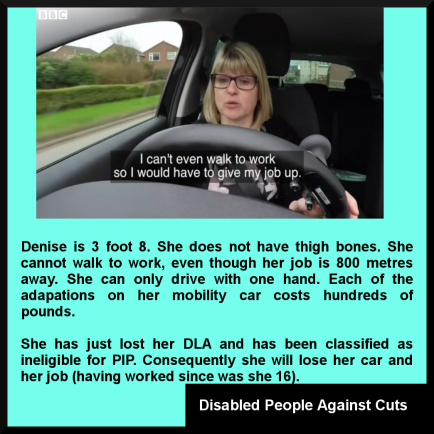
The government also made the eligibility criteria for Personal Independence Payment (PIP) – a non-means tested out-of- work and an in-work benefit – much more difficult to meet, in order to simply reduce successful claims and cut costs. This has also meant that thousands of people have lost their motability vehicles and support.

Earlier this year, it was estimated at least 14,000 disabled people have had their mobility vehicle confiscated after the changes to benefit assessment, which are carried out by private companies. 

Under the PIP rules, thousands more people who rely on this support to keep their independence are set to lose their vehicles – specially adapted cars or powered wheelchairs. Many had been adapted to meet their owners’ needs and many campaigners warn that it will lead to a devastating loss of independence for disabled people.

A total of 45% or 13,900 people, were deemed as not needing the higher rate of PIP, and therefore lost their vehicles after reassessment. And out of the 31,200 people who were once on the highest rate of Disability Living Allowance (DLA) who have been reassessed, just 55%, or 17,300 – have kept their car.

dpac
In 2012, Esther McVey, then the Minister for people with disabilities, as good as admitted there are targets to reduce or remove eligibility for the new disability benefit PIP, which was to replace DLA. How else could she know in advance of people’s reassessment that 330,000 of claimants are expected to either lose their benefit altogether or see their payments reduced as she had informed the House of Commons. 

This was a clear indication that the new assessment framework was designed to cut support for disabled people. A recent review led the government to conclude that PIP doesn’t currently fulfil the original policy intent, which was to cut costs and “target” the benefit to an ever-shrinking category of “those with the greatest need.” 

The Government was twice defeated in the Lords over their proposals to cut Employment and Support Allowance (ESA) for sick and disabled people in the work related activity group (WRAG) from £103 to £73. However the £30 a week cut is to go ahead after bitterly disappointed and angry peers were left powerless to continue to oppose the Commons, which has overturned both defeats.

The government hammered through the cuts of £120 a month to the lifeline income of ill and disabled people by citing the “financial privilege” of the Commons, and after Priti Patel informing the Lords, with despotic relish, that they had “overstepped their mark” in opposing the cuts twice. 

A coalition of 60 national disability charities condemned the government’s cuts to benefits as a “step backwards” for sick and disabled people and their families. The Disability Benefits Consortium said that the cuts, which will see people lose up to £1,500 a year, will leave disabled people feeling betrayed by the government and will have a damaging effect on their health, finances and ability to find work. 

Research by the Consortium suggests the low level of benefit is already failing to meet disabled people’s needs. A survey of 500 people in the affected group found that 28 per cent of people had been unable to afford to eat while in receipt of the benefit. Around 38 per cent of respondents said they had been unable to heat their homes and 52 per cent struggled to stay healthy.

Watching the way the wind blows

Earlier this year I wrote that a government advisor, who is a specialist in labor economics and econometrics, has proposed scrapping all ESA sickness and disability benefits. Matthew Oakley, a senior researcher at the Social Market Foundation, recently published a report entitled Closing the gap: creating a framework for tackling the disability employment gap in the UK, in which he proposes abolishing the ESA Support Group.

To meet extra living costs because of disability, Oakley says that existing spending on PIP and the Support Group element of ESA should be brought together to finance a new extra costs benefit. Eligibility for this benefit should be determined on the basis of need, with an assessment replacing the WCA and PIP assessment. 

I think the word “need” is being redefined to meet politically defined neoliberal economic outcomes. 

Oakely also suggests considering a “role that a form of privately run social insurance could play in both increasing benefit generosity and improving the support that individuals get to manage their conditions and move back to work.” 

I’m sure the rogue company Unum would jump at the opportunity. Steeped in controversy, with a wake of scandals that entailed the company denying people their disabilty insurance, in 2004, Unum entered into a regulatory settlement agreement (RSA) with insurance regulators in over 40 US states. The settlement related to Unum’s handling of disability claims and required the company “to make significant changes in corporate governance, implement revisions to claim procedures and provide for a full re-examination of both reassessed claims and disability insurance claim decisions. 

The company is the top disability insurer in both the United States and United Kingdom. By coincidence, the company has been involved with the UK’s controversial Welfare Reform Bill, advising the government on how to cut spending, particularly on disability support. What could possibly go right? 

It’s difficult to see how someone with a serious, chronic and progressive illness, (which most people in the ESA Support Group have) can actually “manage” their illness and “move back into work.” The use of the extremely misinformed, patronising and very misleading term manage implies that very ill people actually have some kind of choice in the matter.

For people with Parkinson’s disease, rheumatoid arthritis, lupus and multiple sclerosis, cancer and kidney failure, for example, mind over matter doesn’t fix those problems, positive thinking and sheer will power cannot cure these illnesses, sadly. Nor does refusing to acknowledge or permit people to take up a sick role, or imposing benefit conditionality and coercive policies to push chronically ill people into work by callous, insensitive and inept and often medically unqualified assessors, job advisors and ministers.  

The Reform think tank has also recently proposed scrapping what is left of the disability benefit support system, in their report Working welfare: a radically new approach to sickness and disability benefits and has called for the government to set a single rate for all out of work benefits and reform the way sick and disabled people are assessed.  

The Reform think tank proposes that the government should cut the weekly support paid to 1.3 million sick and disabled people in the ESA Support Group from £131 to £73. This is the same amount that Jobseeker’s Allowance claimants receive. It is claimed that the cut will  somehow “incentivise” those people to find work, as if they simply lack motivation, rather than being ill and disabled. However, those people placed in the Support Group after assessment have been deemed by the state as unlikely to be able to work again in the near future, many won’t be able to work again. It would therefore be very difficult to justify this proposed cut, given the additional needs that disabled people have, which is historically recognised, and empirically verified by research. 

Yet the authors of the report doggedly insist that having a higher rate of weekly benefit for extremely sick and disabled people encourages them “to stay on sickness benefits rather than move into work.” People on sickness benefits don’t move into work because they are sick. Forcing them to work is outrageous. 

The report recommended savings which result from removing the disability-related additions to the standard allowance should be reinvested in support services and extra costs benefits – PIP. However, as outlined, the government have ensured that eligibility for that support is rapidly contracting, with the ever-shrinking political and economic re-interpretation of medically defined sickness and disability categories and a significant reduction in what the government deem to be a legitimate exemption from being “incentivised” into hard work.

The current United Nations investigation into the systematic and gross violations of the rights of disabled people in the UK because of the Conservative welfare “reforms” is a clear indication that there is no longer any political commitment to supporting disabled people in this country, with the Independent Living Fund being scrapped by this government, ESA for the work related activity group (WRAG) cut back, PIP is becoming increasingly very difficult to access, and now there are threats to the ESA Support Group. The Conservative’s actions have led to breaches in the CONVENTION on the RIGHTS of PERSONS with DISABILITIES – CRPD articles 4, 8, 9, 12, 13, 14, 15, 17, and especially 19, 20, 27 and 29 (at the very least.)

There are also probable violations of articles 22, 23, 25, 30, 31.

The investigation began before the latest round of cuts to ESA were announced. That tells us that the government is unconcerned their draconian policies violate the human rights of sick and disabled people.

And that, surely, tells us all we need to know about this government’s intentions.

Coercing those deemed to ill to work into work. It’s not “nudge”: it’s psycho-compulsion

The casual discussion in the green paper about new mandatory “health and work conversations” in which work coaches will use “specially designed techniques” to “help” some ESA claimants “identify their health and work goals, draw out their strengths, make realistic plans, and build resilience and motivation” is also cause for some concern. 

Apparently these conversations were “co-designed with disabled people’s organisations and occupational health professionals and practitioners and the Behavioural Insights Teamthe controversial Nudge Unit, which is part-owned by the Cabinet Office and Nesta.

Most people who read my work regularly will know by now that I am one of the staunchest critics of nudge, which is being used as an antidemocratic, technocratic, pseudoscientific political tool to provide a prop and disguise for controversial neoliberal policies. It’s very evident that “disabled people’s organisations” were not major contributors to the design. It’s especially telling that those people to be targeted by this “intervention” were completely excluded from the conversation. Sick and disabled people are reduced to objects of public policy, rather than being seen as citizens and democratic subjects capable of rational dialogue.  

John Pring at Disability News Service (DNS) adds: “Grassroots disabled people’s organisations (DPOs) have criticised the government’s decision to exclude them from an event held to launch its new work, health and disability green paper. 

The event for “stakeholders” was hosted by the disability charity Scope at its London headquarters, and attended by Penny Mordaunt, the minister for disabled people.

The Department for Work and Pensions (DWP) said in its invitation – it turned down a request from Disability News Service to attend – that the event would “start the consultation period” on its green paper, Improving Lives. 

It said that it was “launching a new conversation with disabled people and people with health conditions, their representatives, healthcare professionals and employers”.  

But DWP has refused to say how many disabled people’s user-led organisations were invited to the event, and instead suggested that DNS submit a freedom of information request to find out.
But DNS has confirmed that some of the most prominent user-led organisations with the strongest links to disabled people were not invited to the launch, including Shaping Our Lives, Inclusion London, Equal Lives, People First (Self Advocacy) and Disabled People Against Cuts.” 

For further discussion of the policy context leading up to the green paper, see The new Work and Health Programme: government plan social experiments to “nudge” sick and disabled people into work from October 2015. 

Also see G4S are employing Cognitive Behavioural Therapists to deliver “get to work therapy” and Stephen Crabb’s obscurantist approach to cuts in disabled people’s support and also Let’s keep the job centre out of GP surgeries and the DWP out of our confidential medical records from earlier this year.

The dismal and incoherent contents of the green paper were entirely predictable.

The Conservatives claim work is a “health” outcome: crude behaviourism

A Department for Work and Pensions research document published back in 2011 – Routes onto Employment and Support Allowance – said that if people believed that work was good for them, they were less likely to claim or stay on disability benefits.

It was then decided that people should be “encouraged” to believe that work was “good” for health. There is no empirical basis for the belief, and the purpose of encouraging it is simply to cut the numbers of disabled people claiming ESA by “encouraging” them into work. Some people’s work is undoubtedly a source of wellbeing and provides a sense of purpose. That is not the same thing as being “good for health”. For a government to use data regarding opinion rather than empirical evidence to claim that work is “good” for health indicates a ruthless mercenary approach to a broader aim of dismantling social security.

From the document: “The belief that work improves health also positively influenced work entry rates; as such, encouraging people in this belief may also play a role in promoting return to work.”

The aim of the research was to “examine the characteristics of ESA claimants and to explore their employment trajectories over a period of approximately 18 months in order to provide information about the flow of claimants onto and off ESA.”

The document also says: “Work entry rates were highest among claimants whose claim was closed or withdrawn suggesting that recovery from short-term health conditions is a key trigger to moving into employment among this group.”

“The highest employment entry rates were among people flowing onto ESA from non-manual occupations. In comparison, only nine per cent of people from non-work backgrounds who were allowed ESA had returned to work by the time of the follow-up survey. People least likely to have moved into employment were from non-work backgrounds with a fragmented longer-term work history. Avoiding long-term unemployment and inactivity, especially among younger age groups, should, therefore, be a policy priority. ” 

“Given the importance of health status in influencing a return to work, measures to facilitate access to treatment, and prevent deterioration in health and the development of secondary conditions are likely to improve return to work rates”

Rather than make a link between manual work, lack of reasonable adjustments in the work place and the impact this may have on longer term ill health, the government chose instead to promote the cost-cutting irrational belief that work is a “health” outcome. Furthermore, the research does conclude that health status itself is the greatest determinant in whether or not people return to work. That means that those not in work are not recovered and have longer term health problems that tend not to get better.

Work does not “cure” ill health. To mislead people in such a way is not only atrocious political expediency, it’s actually downright dangerous.

As neoliberals, the Conservatives see the state as a means to reshape social institutions and social relationships based on the model of a competitive market place. This requires a highly invasive power and mechanisms of persuasion, manifested in an authoritarian turn. Public interests are conflated with narrow economic outcomes. Public behaviours are politically micromanaged. Social groups that don’t conform to ideologically defined economic outcomes are stigmatised and outgrouped.

Othering and outgrouping have become common political practices, it seems.

Stigma is a political and cultural attack on people’s identities. It’s used to discredit, and as justification for excluding some groups from economic and political consideration, refusing them full democratic citizenship.

Stigma is being used politically to justify the systematic withdrawal of support and public services for the poorest – the casualties of a system founded on competition for allegedly scarce wealth and resources. Competition inevitably means there are winners and losers. Stigma is profoundly oppressive.

It is used as a propaganda mechanism to draw the public into collaboration with the state, to justify punitive and discriminatory policies and to align citizen “interests” with rigid neoliberal outcomes. Inclusion, human rights, equality and democracy are not compatible with neoliberalism.

Earlier this year, I said: The Conservatives have come dangerously close to redefining unemployment as a psychological disorder, and employment is being redefined as a “health outcome.” The government’s Work and Health programme involves a plan to integrate health and employment services, aligning the outcome frameworks of health services, Improving Access To Psychological Therapies (IAPT), Jobcentre Plus and the Work Programme.

But the government’s aim to prompt public services to “speak with one voice” is founded on questionable ethics. This proposed multi-agency approach is reductive, rather than being about formulating expansive, coherent, comprehensive and importantly, responsive provision.

This is psychopolitics, not therapy. It’s all about (re)defining the experience and reality of a social group to justify dismantling public services (especially welfare), and that is form of gaslighting intended to extend oppressive political control and micromanagement. In linking receipt of welfare with health services and “state therapy,” with the single intended outcome explicitly expressed as employment, the government is purposefully conflating citizen’s widely varied needs with economic outcomes and diktats, isolating people from traditionally non-partisan networks of relatively unconditional support, such as the health service, social services, community services and mental health services.

Public services “speaking with one voice” will invariably make accessing support conditional, and further isolate already marginalised social groups. It will damage trust between people needing support and professionals who are meant to deliver essential public services, rather than simply extending government dogma, prejudices and discrimination.

Conservatives really seem to believe that the only indication of a person’s functional capacity, value and potential is their economic productivity, and the only indication of their moral worth is their capability and degree of willingness to work. But unsatisfactory employment – low-paid, insecure and unfulfiling work – can result in a decline in health and wellbeing, indicating that poverty and growing inequality, rather than unemployment, increases the risk of experiencing poor mental and physical health. People are experiencing poverty both in work and out of work.

Moreover, in countries with an adequate social safety net, poor employment (low pay, short-term contracts), rather than unemployment, has the biggest detrimental impact on mental health. 

There is ample medical evidence (rather than the current raft of political dogma) to support this account. (See the Minnesota semistarvation experiment, for example. The understanding that food deprivation in particular dramatically alters cognitive capacity, emotions, motivation, personality, and that malnutrition directly and predictably affects the mind as well as the body is one of the legacies of the experiment.)

Systematically reducing social security, and increasing conditionality, particularly in the form of punitive benefit sanctions, doesn’t “incentivise” people to look for work. It simply means that people can no longer meet their basic physiological needs, as benefits are calculated to cover only the costs of food, fuel and shelter.

Food deprivation is closely correlated with both physical and mental health deterioration. Maslow explained very well that if we cannot meet basic physical needs, we are highly unlikely to be able to meet higher level psychosocial needs. The government proposal that welfare sanctions will somehow “incentivise” people to look for work is pseudopsychology at its very worst and most dangerous.

In the UK, the government’s welfare “reforms” have further reduced social security support, originally calculated to meet only basic physiological needs, which has had an adverse impact on people who rely on what was once a social safety net. Poverty is linked with negative health outcomes, but it doesn’t follow that employment will alleviate poverty sufficiently to improve health outcomes.

In fact record numbers of working families are now in poverty, with two-thirds of people who found work in 2014 taking jobs for less than the living wage, according to the annual report from the Joseph Rowntree Foundation a year ago.

Essential supportive provision is being reduced by conditionally; by linking it to such a narrow outcome – getting a job – and this will reduce every service to nothing more than a political semaphore and service provision to a behaviour modification programme based on punishment, with a range of professionals being politically co-opted as state enforcers.

The Government is intending to “signpost the importance of employment as a health outcome in mandates, outcomes frameworks, and interactions with Clinical Commissioning Groups.”

I have pointed out previously that there has never been any research that demonstrates unemployment is a direct cause of ill health or that employment directly improves health, and the existing studies support the the idea that the assumed causality between unemployment and health may actually run in the opposite direction. It’s much more likely that inadequate social security support means that people cannot meet all of  their basic survival needs (food, fuel and shelter), and that contributes significantly to poor health outcomes.

It’s not that unemployment is causing higher ill health, but that ill health and discrimination are causing higher unemployment. If it were unemployment causing ill health, at a time when the government assures us that employment rates are currently “the highest on record,” why are more people becoming sick?

The answer is that inequality and poverty have increased, and these social conditions, created by government policies, have long been established by research as having a correlational relationship with increasing mental and physical health inequalities. 

For an excellent, clearly written and focused development of these points, the problem of “hidden” variables and political misinterpretation, see Jonathan Hulme’s Work won’t set us free.

Semantic thrifts: being Conservative with the truth

Prior to 2010, cutting support for sick and disabled people was unthinkable, but the “re-framing” strategy and media stigmatising campaigns have been used by the Conservatives to systematically cut welfare, push the public’s normative boundaries and to formulate moralistic justification narratives for their draconian policies. Those narratives betray the Conservative’s intentions.

Not enough people have questioned what it is that Conservatives actually mean when they use words like “help”, “support”, and “reform” in the context of government policies aimed at disabled people. Nor have they wondered where the evidence of “help” and “support” is hiding. If you sit on the surface of Conservative rhetoric and the repetitive buzzwords, it all sounds quite reasonable, though a little glib.

If you scrutinise a little, however, you soon begin to realise with horror that Orwellian-styled techniques of neutralisation are being deployed to lull you into a false sense of security: the ideologically directed intentions behind the policies and the outcomes and consequences are being hidden or “neutralised” by purposefully deceptive, misdirectional political rhetoric. It’s a kind of glittering generalities tokenism ; a superficial PR ritual of duplicitous linguistic detoxification, to obscure deeply held traditional Conservative prejudices and ill intent.

Rhetoric requires the existence of an audience and an intent or goal in the communication. Once you stand back a little, you may recognise the big glaring discrepancies between Conservative chatter, policies, socioeconomic reality and people’s lived experiences. At the very least, you begin to wonder when the conventional ideological interests of the Conservatives suddenly became so apparently rhetorically progressive, whilst their policies have actually become increasingly authoritarian, especially those directed at the most disadvantaged social groups.

The ministerial foreword from Damian Green, Secretary of State for Work and Pensions and Jeremy Hunt, Secretary of State for Health, is full of concern that despite the claim that “we have seen hundreds of thousands more disabled people in work in recent years”, there are simply too many sick and disabled people claiming ESA.

They say: We must highlight, confront and challenge the attitudes, prejudices and misunderstandings that, after many years, have become engrained in many of the policies and minds of employers, within the welfare state, across the health service and in wider society. Change will come, not by tinkering at the margins, but through real, innovative action. This Green Paper marks the start of that action and a far-reaching national debate, asking: ‘What will it take to transform the employment prospects of disabled people and people with long-term health conditions?’

I think mention of the “engrained attitudes, prejudices and misunderstandings within the welfare state and across the health service” is the real clue here about intent. What would have been a far more authentic and reassuring comment is “we have met with disabled people who have long-term health conditions and asked them if they feel they can work, and what they need to support them if they can.”

Instead, what we are being told via subtext is that we are wrong as a society to support people who are seriously ill and disabled by providing civilised health and social care, social security and exempting them from work because they are ill or injured.

Ministers say:Making progress on the government’s manifesto ambition to halve the disability employment gap is central to our social reform agenda by building a country and economy that works for everyone, whether or not they have a long-term health condition or disability. It is fundamental to creating a society based on fairness [..] It will also support our health and economic policy objectives by contributing to the government’s full employment ambitions, enabling employers to access a wider pool of talent and skills, and improving health.”

I think that should read: “By building a country where everyone works for the [politically defined] economy.”

There’s patronising discussion of how disabled people should be “allowed to fulfil their potential”, and that those mythic meritocratic principles of talent determination and aspiration should be “what counts”, rather than sickness and disability. There are some pretty gaping holes in the logic being presented here. It is assumed that prejudice is the reason why sick and disabled people don’t work.

But it’s true that many of us cannot work because we are too ill, and the green paper fails to acknowledge this fundamental issue.

Instead “inequality” has been redefined strictly in terms of someone’s employment status, rather than as an unequal social distribution of wealth, resources, power and opportunities. All of the responsibility and burden of social exclusion and unemployment is placed on sick and disabled people, whilst it is proposed that businesses are financially rewarded for employing us.

Furthermore, it’s a little difficult to take all the loose talk seriously about the “injustice” of ill people not being in work, or about meritocratic principles and equal opportunities, when it’s not so long ago that more than one Conservative minister expressed the view that disabled people should work for less than the minimum wage. This government have made a virtue out of claiming they are giving something by taking something away. For example, the welfare cuts have been casually re-named reforms in Orwellian style. We have yet to see how cutting the lifeline benefits of the poorest people, and imposing harsh sanctioning can possibly be an improvement for them, or how it is helping them.

The Conservatives are neoliberal fundamentalists, and they have supplanted collective, public values with individualistic, private values of market rationality. They have successfully displaced established models of welfare provision and state regulation through policies of privatisation and de-regulation and have shifted public focus, instigating various changes in subjectivity, by normalising individualistic self-interest, entrepreneurial values, and crass consumerism. And increasing the social and material exclusion of growing numbers living in absolute poverty.

Basically, the Tories tell lies to change perceptions, divert attention from the growing wealth inequality manufactured by their own policies, by creating scapegoats.

Another major assumption throughout the paper is that disabled people claiming ESA are somehow mistaken in assuming they cannot work: “how can we improve a welfare system that leaves 1.5 million people – over 60% of people claiming Employment and Support Allowance – with the impression they cannot work and without any regular access to employment support, even when many others with the same conditions are flourishing in the labour market? How can we build a system where the financial support received does not negatively impact access to support to find a job? How can we offer a better user experience, improve system efficiency in sharing data, and achieve closer alignment of assessments?”

The government’s brand of armchair pseudo-psychology, propped up by the Nudge Unit, is used to justify increasingly irrational requirements being embedded in policy. The government intend to merge health and employment services, redefining work as aclinical health outcome. According to the government, the “cure” for unemployment due to illness and disability and sickness absence from work, is… work.

The new work and health programme, “support” for disabled people, is actually just another workfare programme. We know that workfare tends to decrease the likelihood of people finding work.

Work is the only politically prescribed “route out of poverty” for disabled people, including those with mental distress and illness, regardless of whether or not they are actually well enough to work. In fact the government implicitly equates mental health with economic productivity. Work will set us free. Yet paradoxically, disabled people haven’t been and won’t be included in the same economic system which is responsible for their exclusion in the first place.

Competitive market economies exclude marginalised groups, that’s something we ought to have learned from the industrial capitalism of the last couple of centuries. GPs inform us that employers are not prepared to make the necessary inclusive workplace adjustments sick and disabled people often need to work.

But in a dystopic Orwellian world where medical sick notes have been  politically redefined as ”fit notes”, sick and disabled people are no longer exempt from work, which is now held to be a magic “cure”. People are already being punished and coerced into taking any available job, regardless of its appropriateness, in an increasingly competitive and exclusive labor market.

The nitty gritty

You know the government are riding the fabled rubber bicycle when they calmly propose coercing the most disabled and ill citizens who are deemed unlikely to work by their doctors and the state (via the Work Capability Assessment) into performing mandatory work-related activities and finding jobs. Previously, only those assessed as possibly capable of some work in the future and placed in the Work Related Activity Group (WRAG) were expected to meet behavioural conditionality in return for their lifeline support.

However, the government have cut the WRAG component of Employment and Support Allowance (ESA) – another somewhat Orwellian name for a sickness and disability benefit – so that this group of people, previously considered to have additional needs because of their illness and disability, are no longer supported to meet the extra costs they face. The ESA WRAG rate of pay is now to be the same as Job Seeker’s Allowance.

If the government make work related activity mandatory for those people in the ESA Support Group, it will mean that very sick and disabled people will be sanctioned for being unable to comply and meet conditionality. This entails the loss of their lifeline support. The government have the cheek to claim that they will “protect and support” the most vulnerable citizens.

Hello, these ARE among our most vulnerable citizens. That’s why they were placed in the ESA support group in the first place.

Apparently, sick citizens are costing too much money. Our NHS is “overburdened” with ill people needing healthcare, our public services are “burdened” with people needing… public services. It is claimed that people are costing employers by taking time off work when they are ill. How very dare they.

Neoliberals argue that public services present moral hazards and perverse incentives. Providing lifeline support to meet basic survival requirements is seen as a barrier to the effort people put into searching for jobs. From this perspective, the social security system, which supports the inevitable casualties of neoliberal free markets, has somehow created those casualties. But we know that external, market competition-driven policies create a few “haves” and many “have-nots.” This is why the  welfare state came into being, after all – because when we allow such competitive economic dogmas to manifest without restraint, we must also concede that there are always ”winners and losers.”

Neoliberal economies organise societies into hierarchies.The UK currently ranks highly among the most unequal countries in the world.

Inequality and poverty are central features of neoliberalism and the causes of these sociopolitical problems therefore cannot be located within individuals.

The ESA Support Group includes people who are terminally ill, and those with degenerative illnesses, as well as serious mental health problems. It’s suggested that treating this group of people with computer based Cognitive Behaviour Therapy (cCBT), and addressing obesity, alcohol and drug dependence will “help” them into work.

Ministers claim that this group merely have a “perception” that they can’t work, and that they have been “parked” on benefits. It is also implied that illness arises mostly because of lifestyle choices.

Proposals include a punitive approach to sick and disabled people needing support, whilst advocating financial rewards for employers and businesses who employ sick and disabled people.

And apparently qualified doctors, the public and our entire health and welfare systems have ingrained “wrong” ideas about sickness and disability, especially doctors, who the government feels should not be responsible for issuing the Conservatives recent Orwellian “fit notes” any more, since they haven’t “worked” as intended and made every single citizen economically productive from their sick beds.

So, a new “independent” assessment and private company will most likely soon have a lucrative role to get the government “the right results”.

Meanwhile health and social care is going to be linked with one main outcome: work. People too ill to work will be healthier if they… work. Our public services will cease to provide public services: health and social care professionals will simply become co-opted authoritarian ideologues.

Apparently, the new inequality and social injustice have nothing to do with an unequal distribution of wealth, resources, power and opportunities. Apparently our society is unequal only because some people “won’t” work. I’m just wondering about all those working poor people currently queuing up at the food bank, maybe their poorly paid, insecure employment and zero hour contracts don’t count as working.

I’ve written as I read this Orwellian masterpiece of thinly disguised contempt and prejudice. I don’t think I have ever read anything as utterly dangerous and irrational in all my time analysing Conservative public policy and the potential and actual consequences of them. These utterly deluded and sneering authors are governing our country, shaping our life experiences, and those of our children.

The sick role and any recovery time from illness or accident that you may need has been abolished. Work will cure you.

Well, at least until you die.

75629_107145729354964_2536493_n

Pictures courtesy of Robert Livingstone

The closing date for the consultation is 17 February 2017.
You can download the full consultation document from this link.
You can take part in the consultation from this link.


I don’t make any money from my work. But you can support me by making a donation and help me continue to research and write informative, insightful and independent articles, and to continue to provide support to others. The smallest amount is much appreciated – thank you.


DonatenowButton

Government backs new law to prevent people made homeless through government laws from becoming homeless

cn_fairchange_comp1.jpg

Theresa May’s ritualistic Tory chanting: “getting people’s lives back on track”

Earlier this month, Theresa May surprisingly unveiled a £40 million package designed to prevent homelessness by intervening to help individuals and families before they end up on the streets. It was claimed that the “shift” in government policy will move the focus away from dealing with the consequences of homelessness and place prevention “at the heart” of the Prime Minister’s approach. 

Writing in the Big Issue magazine – sold by homeless people – May said: “We know there is no single cause of homelessness and those at risk can often suffer from complex issues such as domestic abuse, addiction, mental health issues or redundancy.”

“So I believe it’s time we changed our approach. We can no longer focus on tackling the symptoms and immediate consequences of homelessness. We need to put prevention at the heart of a new approach.

“As a first step towards this change, I’m announcing a new £40 million package to both prevent and tackle the causes of homelessness. This will include £20 million for local authorities to pilot innovative initiatives to tackle the causes of homelessness – helping to find solutions for families and individuals before they reach crisis point.”

Earlier this year it was revealed that under David Cameron’s administration homelessness in England had risen by 54 per cent since 2010

This reflected the sixth consecutive annual rise, with households becoming homeless in London increasing to 17,530 (9 per cent) in the last year alone and 58,000 households across the whole of England.

That’s during six consecutive years of the Conservatives in Office, and six years of savage austerity measures that target the poorest citizens disproportionately, by coincidence.

Or by correlation.

There are a few causes that the prime minister seems to have overlooked, amidst the Conservative ritualistic chanting which reflects assumptions and prejudices about the “causal” factors of social problems and a narrative of individualism. It’s a curious fact that wealthy people also experience “complex issues” such as addiction, mental health problems and domestic abuse, but they don’t tend to experience homelessness and poverty as a result. 

The deregulated private sector and increasingly precarious tenancies

“This Government is therefore, very pleased to support Bob Blackman MP’s Private Members Bill, with its ambitious measures to help reduce homelessness.”

Blackman, the Conservative MP for Harrow East, said he welcomed the Government’s decision. He added: “Throughout my 24 years in local government prior to becoming an MP, I saw the devastation that can be caused by homelessness first hand, with too many people simply slipping through the net under the current arrangements.

“By backing this bill, the Government is demonstrating its commitment to an agenda of social justice and also shows that it is willing to listen. I look forward to working with Ministers going forward in order to bring about this important change in legislation.”

Crisis, the national charity for homeless people, welcomed the Government’s commitment but warned that unless “MPs [need to] offer their support at the bill’s second reading on Friday, this historic opportunity could easily be lost”.

Jon Sparkes, the charity’s chief executive, added: “This is a credible and much-needed piece of legislation which now has the backing of the Government, the opposition and the Communities and Local Government Select Committee. The cross-party consensus is there, and we hope that MPs from across the political spectrum will come together on October 28 to vote on the bill.

“Helping people to stay off the streets and rebuild their lives is about basic social justice – it’s the right thing to do – but it also makes good economic sense. New research from Crisis has revealed how preventing 40,000 people from becoming homelessness could save the public purse up to £370m a year, or just over £9,000 per year for every person helped. The logic is clear: preventing homelessness saves lives, but also reduces public costs.

“For 40 years we’ve had a system that fails too many homeless people and turns them away at their time of need. The Homelessness Reduction Bill could help put an end to that injustice once and for all. It is a major opportunity to improve the rights of people currently shut out of the system, whist continuing to protect families with children.”

Lord Porter, the chairman of the Local Government Association, which represents councils and had opposed an earlier draft of the Bill, said granting councils the ability to build homes would be a more effective step towards ending homelessness and the housing crisis in general.

“Councils want to end homelessness and are already doing everything they can within existing resources to prevent and tackle it. However, there is no silver bullet, and councils alone cannot tackle rising homelessness. The causes of homelessness are many and varied and range from financial to social,” he said.

“After having worked closely with Bob Blackman, we are confident that the new Bill, if it does go through Parliament, will be in a better place.

“However, it is clear that legislative change alone will not resolve homelessness. If we are all to succeed, then all new duties proposed in the Bill will need to be fully funded. Councils need powers to resume our role as a major builder of affordable homes.”

The shortage of housing and the impact of the Government’s welfare “reforms”

The 2013 annual State of the Nation report by the charities Crisis and Joseph Rowntree Foundation (JRF) revealed that the number sleeping rough had risen by six per cent in England this year, and by 13 per cent in London. There has been a 10 per cent increase in those housed temporarily, including a 14 per cent rise in the use of bed and breakfast accommodation.

Writing just a year after the highly controversial Welfare Reform Act was ushered through the legislative process on the back of Cameron’s claim to the “financial privilege” of the Commons , the report authors explicitly blamed the Government’s welfare cuts for compounding the problems caused by the high cost and shortage of housing as demand outstripped supply. The researchers found found that the cap on housing benefit made it more difficult to rent from a private landlord, especially in London, and claimed the controversial “bedroom tax” has caused a sharp rise in arrears for people in public housing, particularly in the Midlands and North.

A separate survey by Inside Housing magazine showed that councils and housing associations are increasingly resorting to the threat of eviction, as the loss of an adequate social security safety net is causing increasing hardship for social housing tenants. The reduction of council tax benefit for people who were previously exempt from paying council tax has also contributed significantly to experiences of material hardship, too. 

Ministers have emphatically denied that their reforms have contributed to the return of homelessness. However, homelessness has now risen in each of the five years since the Coalition was formed – after falling sharply in the previous six years, and has continued to rise throughout 2016.

The government’s welfare policies have emerged as the biggest single trigger for homelessness now the economy has allegedly recovered, and are likely to increase pressure on households for the next few years, with the new benefit cap increasing the strain, according to the independent research findings in the Homelessness Monitor 2015, the annual independent audit, published by Crisis and the Joseph Rowntree Foundation.

The housing minister, Kris Hopkins, said the study’s claims were “misleading”. Local authorities had “a wide range of government-backed options available to help prevent homelessness and keep people off the streets,” he said.

“This government has increased spending to prevent homelessness and rough sleeping, making over £500m available to local authorities and the voluntary sector,” he added.

It hasn’t worked. This is because, despite Theresa May’s claims, the government tends to simply address the effects and not the real causes of homelessness. Unless the government actually address the growing inequality, poverty and profound insecurity that their own policies have created, then homelessness and absolute poverty will continue to increase.

Hopkins added that the government had provided Crisis with nearly £14m in funding to help about 10,000 single homeless people find and sustain a home in the private rented sector.

Julia Unwin, chief executive of the Joseph Rowntree Foundation, said: “Homelessness can be catastrophic for those of us who experience it. If we are to prevent a deepening crisis, we must look to secure alternatives to home ownership for those who cannot afford to buy: longer-term, secure accommodation at prices that those on the lowest incomes can afford.”

The Homelessness Monitor study 2015 found:

  • Housing benefit caps and shortages of social housing has led to homeless families increasingly being placed in accommodation outside their local area, particularly in London. Out-of-area placements rose by 26% in 2013-14, and account for one in five of all placements.
  • Welfare reforms such as the bedroom tax contributed to an 18% rise in repossession actions by social landlords in 2013-14, a trend expected to rise as arrears increase and temporary financial support shrink
  • Housing benefit cuts played a large part in the third of all cases of homelessness last year caused by landlords ending a private rental tenancy, and made it harder for those who lost their home to be rehoused.

The study says millions of people are experiencing “hidden homelessness”, including families forced by financial circumstances to live with other families in the same house, and people categorised as “sofa surfers” who sleep on friends’ floors or sofas because they have nowhere to live.

Official estimates of  the numbers of people sleeping rough in England in 2013 were 2,414 – up 37% since 2010. But the study’s estimates based on local data suggest that the true figure could be at least four times that.

The Department for Work and Pensions also announced last month that it was cutting funding for homeless hostels and supported housing for disabled people by reducing supported housing benefit rent payments for three years. The homelessness reduction bill in the current policy context is yet another example of how Conservatives don’t seem to manage coherent, joined up thinking. 

“The Government’s proposals will compromise the right for people with a learning disability to live independently, and must be reconsidered urgently,” Dan Scorer, head of policy at the learning disabilities charity Mencap, warned after the announcement.

Meanwhile Howard Sinclair, the chief executive of the homelessness charity St Mungo’s, said the cut would leave the homeless charity with £3 million a year less to spend on services. 

“The rent reduction will threaten the financial viability of some of our hostels and other supported housing schemes and offers no direct benefit to vulnerable tenants who mostly rely on housing benefit to cover their housing costs,” he said.

It’s just not good enough that the Government simply attempts to colonise progressive rhetoric, claiming they stand for social justice, when they very clearly don’t walk the talk.

Conservative neoliberal “small state” anti-welfare policies are increasing homelessness. The bedroom tax, council tax benefit reductions, housing benefit reductions, welfare caps, sanctions, the deregulation of private sector, the selling off and privatising of social housing stock have all contributed to the current crisis of homelessness.

It was particularly remarkable that May claimed the government are “doing the right thing for social justice” yet the Conservative policy framework is, by its very design, inevitably adding to the precariousness of the situations those people with the least financial security are in.

Someone should explain to the prime minister that “social justice” doesn’t generally entail formulating predatory policies that ensure the wealthy accumulate more wealth by dispossessing the poorest citizens of their public assets, civilised institutions and civilising practices gained through the post-war settlement.

Devolving responsibility for the housing crisis and lack of adequate social security provision to local authorities that are already strapped for cash because of government cuts, and with an ever-dwindling housing stock, won’t help to address growing inequality, or alleviate poverty and destitution.

letter-to-a-homeless-person

Related

From homes fit for heroes to the end of secure, lifelong social housing tenancies

Update

Let’s Pressurise MP’s To Attend the Vote On the ‘Once In a Lifetime Homelessness Bill’ – template letter to MPs, courtesy of the Dorset Eye


I don’t make any money from my work. But you can help by making a donation to help me continue to research and write informative, insightful and independent articles, and to provide support to others. The smallest amount is much appreciated – thank you.

DonatenowButton cards


Government guidelines for PIP assessment: a political redefinition of the word ‘objective’

images

Thousands of disabled people have already lost their specialist Motability vehicles because of Conservative PIP cuts and many more are likely to be affected.

Personal Independence Payment is a non means tested benefit for people with a long-term health condition or impairment, whether physical, sensory, mental, cognitive, intellectual, or any combination of these. It is an essential financial support towards the extra costs that ill and disabled people face, to help them lead as full, active and independent lives as possible.

The Department for Work and Pensions (DWP) have issued a guidance document for providers carrying out assessments for Personal Independence Payment (PIP), which was updated last month. It can be found here: PIP Assessment Guide.

The DWP Chief Medical Officer states that this is a supplementary guidance, in addition to “the contract documents agreed with providers as part of the commercial process, providing guidance for health professionals [HPs] carrying out assessment activity and for those responsible for putting in place and delivering processes to ensure the quality of assessments.”

Words like “fair”, “quality”,  “support”, “reform” and even “objective” have been given a very subjective, highly specific Conservative semantic make-over, to signpost and reference a distinctive underpinning ideology, and to align them with neoliberal and New Right anti-welfare discourse and outcomes, over the last five years.

There is some preemptive dodging of criticism and patronising get-out clauses in the document, for example: “It must be remembered that some of the information may not be readily understood by those who are not trained and experienced HPs.”

This comment is indicative of the lack of transparency in the terms, conditions and process of assessments, and how they are generally carried out. It also emphasises the professional gap between the “health professional” employed by the state to carry out the “functional capacity” assessments in the context of a neoliberal welfare state, and medical health professionals, whose wider work is generally not directly linked to the politically defined conditionality of welfare support.

If you fundamentally disagree with any of the approach outlined in the content of the document, or the policy, it’s because you “fail to comprehend it”, simply because you haven’t trained as a HP. 

I had no idea that HPs are the only people who can work out policy outcomes and who recognise government cuts, small state ideology and general cost-cutting measures for what they are, despite the thumping Orwellian semantic shifts and language use that is all about techniques of neutralisation (where the rhetoric used obscures or “neutralises” the negative aims and harmful consequences of the policy.)

Firstly, the HPs are not so much “health professionals”, but rather, “re-trained disability analysts.” Their role entails assessing the impact of illness and disability on the “functional capacity” of individuals in direct relation to justification or refusal of a PIP award only. Furthermore, it is the decision of the HP to “determine whether any additional evidence needs to be gathered from health or other professionals supporting the claimant.”

Often at the appeal stage, it turns out HPs frequently decide not to ask for further evidence.  The DWP must take all medical evidence into account when making a decision about PIP claims. Yet the DWP say: “In many cases, appeals are granted because further medical evidence is provided.” 

However, neither HPs nor the DWP decision-makers contact people’s GP or other professionals for more information about their health condition very often. This indicates that people are having to go to court, often waiting months for their appeal to be heard, because of deliberately under-informed, poorly evidenced DWP decisions. 

Furthermore, it says in the government guidance to GPs:  “Your patient should complete the forms to support their [PIP] claim using information that they have to hand, and should not ask you for information to help them do this, or to complete the forms yourself.” 

It seems that the DWP are determined to continue making ill-informed, medically unevidenced decisions as long as they can get away with it. 

The ‘functional’ assessment

From the document: “The assessment for PIP looks at an individual’s ability to carry out a series of key everyday activities. The assessment considers the impact of a claimant’s health condition or impairment on their functional ability rather than focusing on a particular diagnosis. Benefit will not be paid on the basis of having a particular health condition or impairment but on the impact of the health condition or impairment on the claimant’s everyday life.”

This process of assessment, however, is a very speculative one, with inferences drawn from seemingly unrelated questions and assumed circumstances, such as “do you have a pet?” This translates into “can bend from the waist to feed a cat/dog” on the HP’s report to the DWP.

During examination, people are asked to perform a series of movements, and inferences are drawn from these regarding the performance of day to day tasks. The movements bear no resemblance to ordinary day to day tasks, nor do they take into account the use of aids and adaptations that people may use to carry out daily tasks.

Furthermore, the person being assessed isn’t presented with the assumptions drawn from the examination and questions, which means they are not provided with an opportunity to verify any claim made by the HP, or to say if they can manage to feed their pet “reliably, safely and consistently”, or if their family have to feed the animal for much of the time. 

From the document: “The HP should check the consistency of what is being said by using different approaches, asking questions in different ways or coming back to a previous point. When considering inconsistencies, HPs should bear in mind that some claimants may have no insight into their condition, for example claimants with cognitive or developmental impairments.”

I know of a lady who wore a gold locket. It was simply assumed at her assessment that despite her extremely arthritic fingers, and information about her pain and the lack of movement in her hands from her GP, that she had sufficient dexterity to fasten and unfasten the clasp. Had she been asked, she would have informed the HP that she never took the locket off, even in the shower. 

This approach – “checking for inconsistencies” by using indirect questioning and assumption is NOT “objective”. It is a calculated strategy to justify a starting point of disbelief and skepticism regarding the accounts provided by ill and disabled people about the impact of their conditions and disabilities on their day-to-day living. As such, it frames the entire assessment process, weighting it towards evidence gathering to justify refusing awards, rather than being “objective”.

It’s simply a method based on side-stepping and discounting people’s own accounts and experiences of their disability, and any medical evidence submitted to verify that.

This approach is also mirrored in the Work Capability Assessment, reflecting Conservative cynicism and prejudice towards sick and disabled people. (See: What you need to know about Atos Assessments – it provides a good overview from a whistle-blower of how responses to seemingly casual observations and apparently conversational questions are re-translated into “inconsistencies” which are then used to justify refusing a claim.)

The introduction of PIP was framed by New Right anti-welfarism

Secondly, “PIP is replacing Disability Living Allowance (DLA), which has become outdated and unsustainable. The introduction of PIP will ensure the benefit is more fairly targeted at those who face the greatest barriers, by introducing a simpler, fairer, more transparent and more objective assessment, carried out by health professionals” [All boldings mine].

In other words, PIP is aimed at cutting welfare costs and support for people who would previously have been eligible for Disability Living Allowance (DLA). We are told that it’s no longer possible as a society to support all disabled people who need help with the additional costs that they face simply because they are ill and disabled, so the government propose to establish those “with the greatest need” by using a more stringent assessment process, which is claimed to be fair and more “objective”.

A recent review led the government to conclude that PIP “doesn’t currently fulfil the original policy intent”, which was to cut costs and “target” the benefit to “those with the greatest need.” That originally meant a narrowing of eligibility criteria for people formerly claiming Disability Living Allowance, increasing the number of reassessments required, and limiting the number of successful claims.

Controversially, the cuts to disability benefits (including the £30 per week cut from those claiming ESA in work related activity group) will fund tax cuts for the most affluent – the top 7% of earners. The chancellor raised the threshold at which people start paying 40p tax, in a move that will probably see many wealthier people pulled out of the higher rate of income tax. Osborne said he wanted to “accelerate progress” towards the Conservative’s manifesto pledge of raising the threshold for the 40p rate to £50,000 in 2020. 

Prior to the introduction of PIP, Esther McVey stated that of the initial 560,000 claimants to be reassessed by October 2015, 330,000 of these are targeted to either lose their benefit altogether or see their payments reduced. Of course the ever-shrinking category of “those with the greatest need” simply reflects a government that has made a partisan political decision to cut disabled people’s essential income to fund a financial gift to the wealthiest citizens. There is no justification for this decision, nor is it “fair.”

Fiona Colegrave, who is chief medical adviser, clinical governance and in charge of training for PIP at Capita, says: “As a disability assessor (DA), you are required to assess objectively how someone’s health conditions affect them and submit a report that is fair, reliable and can be justified with evidence because, if necessary, it may need to be scrutinised through an appeals process.

For these reasons, it is essential we equip DAs with the skills required to manage the assessment process, including: time management; questioning techniques; non-advocacy; collating all available evidence and identifying contradictions; and using an analytical but empathetic approach.

It is important for DAs to establish a rapport with the claimant, so that claimants feel like they have been able to express, in their own words, how their disability affects them and so they know that a DA will produce a report that accurately reflects their functional ability.”

Only “feel like”? Feedback from “claimants” says that DAs do NOT accurately reflect their “functional ability” in reports. And note the reductive use of the word  “claimant” – language use that places the other at a psychological distance from the author and administrators, objectifying them, as if people claiming PIP and other benefits are a homogenous group of people, bound by characteristics rather than circumstances, in a context of political decision-making.

It becomes easier to disassociate from someone you view “objectively” and to distance yourself from the impact of your calculated and target-led decision-making, constrained within a highly political framework. Such an objectification of a person or group of people serves to de-empathise us, which is a key characteristic requirement of neoliberal ideology, embedded in inhumane “small state” policy and extended via administrative (and outsourced, privatised) practices. It leaves us much less likely to relate to the circumstances, emotions or accept the needs and choices of others.

Surely a considerable part of our experience of being objectively diagnosed as ill and/or disabled, in any case, is a person’s subjective experience of it, rather than categories and counts; quantifiable, reductive and speculative statements about how we may perform highly specific tasks.

Quantitative medical evidence is important, because it does often give a general indication of conditions that would entail loss of function. But considering medical evidence isn’t a central part of the assessment process. Whether or not we can perform certain tasks, and inferences drawn from that are the central considerations for PIP eligibility.

Many conditions “fluctuate” – they vary so much that it’s difficult to assess performance of specific tasks consistently. Many conditions become progressively worse at a varied pace, often leaving little scope for a person developing coping strategies and adapting their everyday lives to the changes as they happen, such as a progressive loss of mobility, cognitive impairment, mood changes, anxiety, depression, sleep disruption and other psychological impacts, and the increasing pain and fatigue that they may experience.   

If the process were genuinely “fair, accurate and objective” then there would be no need for mandatory reviews and scrutiny through the appeals process. The introduction of the mandatory review – another layer of bureaucracy and a barrier to justice, where the DWP decide whether their first decision should be changed – has deterred many from appealing wrong decisions.

Those making the decisions about PIP awards are: “trained DWP staff who are familiar with the legislation governing PIP, but who do not have a healthcare background. The HP enables CMs to make fair and accurate decisions by providing impartial, objective and justified advice.

The PIP assessment is geared towards looking for “inconsistencies” in “functional limitations”. For example, if you say you can’t sit unaided for half an hour, but then say that you watch soaps on TV, it will be assumed you sit unaided for at least half an hour to watch TV, and that will be classed as a “discrepancy between the reported need and the actual needs of the claimant.”

The whole assessment is set up and designed to look for “inconsistencies.” In other words, the assessor is looking for any excuse to justify a decision that you are not among those in “greatest need” for a PIP award. The entire process happens within a framework of reducing welfare costs, after all. This makes a mockery of the government’s fondness for using the word “objective.”

What can we do to try to counter the state bias towards political cost-cutting, which is embedded in the assessment process? 

Well, we can use the guidelines and existing legislation to ensure that we are heard clearly. We can also raise awareness that, whilst most ill and disabled people tend to emphasise how well we cope, and remain positive about what we can do independently, and we often tend to understate our needs for support, in assessment situations, that tendency is likely to be used to trivialise the impact of our condition and disabilities on day-to-day “functioning.”

Reliability

The government says in the PIP handbook: “For a descriptor to apply to a claimant, they must be able to reliably complete the activity as described in the descriptor. Reliably means whether they can do so:

 safely – in a manner unlikely to cause harm to themselves or to another person, either during or after completion of the activity

 to an acceptable standard

 repeatedly – as often as is reasonably required, and

 in a reasonable time period – no more than twice as long as the maximum period that a non-disabled person would normally take to complete that activity.” 

If you cannot complete an activity reliably, safely and repeatedly, as outlined, then you must be regarded as unable to complete that task at all.  The reliability criteria are an important key protection for disabled people claiming both PIP and Employment and Support Allowance (ESA).

From the document: “Symptoms such as pain, fatigue and breathlessness should be considered when determining whether an activity can be carried out repeatedly. While these symptoms may not necessarily stop the claimant carrying out the activity in the first instance, they may be an indication that it cannot be done as often as is required.”

And: “The following situations highlight examples where an individual may be considered unable to repeatedly complete a descriptor in the way described due to the impact this would have:

A person who is able to stand and move 20 metres unaided, but is unable to repeat it again that day cannot do it repeatedly as you would reasonably expect people to move 20 metres more than once a day • A person who is able to prepare a meal, but the exhaustion from doing so means they cannot then repeat the activity at subsequent meal times on the same day. This means they cannot complete the activity repeatedly as it is reasonable to expect people to prepare a meal more than once a day.”

This also applies to people with mental health conditions, which may also impact on a person being able to carry out tasks reliably, repeatedly and safely.

Time periods, fluctuations and descriptor choices

The document says: “The impact of most health conditions and disabilities can fluctuate. Taking a view of ability over a longer period of time helps to iron out fluctuations and presents a more coherent picture of disabling effects. The descriptor choice should be based on consideration of a 12-month period.

This should correlate with the Qualifying Period and Prospective Test for the benefit – so in the 3 months before the assessment and in the 9 months after. A scoring descriptor can apply to claimants in an activity where their impairment(s) affect(s) their ability to complete an activity, at some stage of the PIP regulations.

 The following rules apply: If one descriptor in an activity is likely to apply on more than 50% of the days in the 12-month period – the activity can be completed in the way described on more than 50% of days – then that descriptor should be chosen.

If more than one descriptor in an activity is likely to apply on more than 50% of the days in the period, then the descriptor chosen should be the one that is the highest scoring. For example, if D applies on 100% of days and E on 70% of days, E is selected. Where one single descriptor in an activity is likely to not be satisfied on more than 50% of days, but a number of different scoring descriptors in that activity together are likely to be satisfied on more than 50% of days, the descriptor likely to be satisfied for the highest proportion of the time should be selected.

For example if B applies on 20% of days, D on 30% of days and E on 5% of days, D is selected. If someone is awaiting treatment or further intervention, it can be difficult to accurately predict its level of success or whether it will even occur. Descriptor choices should therefore be based on the likely continuing impact of the health condition or disability as if any treatment or further intervention has not occurred.

The timing of the activity should be considered, and whether the claimant can carry out the activity when they need to do it. For example, if taking medication in the morning (such as painkillers) allows the individual to carry out activities reliably when they need to throughout the day, although they would be unable to carry out the activity for part of the day (before they take the painkillers), the individual can still complete the activity reliably when required and therefore should receive the appropriate descriptor.”

Again, “fluctuating conditions” include many mental health conditions.

Risk and safety

“When considering whether an activity can be carried out safely it is important to consider the risk of a serious adverse event occurring. However, the risk that a serious adverse event may occur due to impairments is insufficient – the adverse event has to be likely to occur.”

Even if complex probability calculations were used – and I am certain HPs are unlikely to have been trained to use such formulae – there is no “objective” way of calculating risk of serious “adverse” events over time.

However, it is not such a big inferential leap to recognise that continually cutting essential lifeline support for sick and disabled people will ultimately lead to harm, distress, hardship and other negative consequences for individuals and will have wider social, cultural and economic “adverse” consequences, too.

dpac

“Making work pay” for whom?

See also:

PIP Assessment Guide A DWP guidance document for providers

Personal Independence Payment handbook

Government Toolkit of information for support organisations

Relevant:

PIP and the Tory monologue

Government plans further brutal cuts to disability support

Consultation as government seek to limit disabled people’s eligibility for Personal Independence Payment

Second Independent Review of Personal Independence Payment assessment


I don’t make any money from my work. I’m a disabled person with lupus, and I’m stuggling to get by. But you can help by making a donation and enable me to continue to research and write informative, insightful and independent articles, and to provide support to others going through disability benefit assessment processes and appeals. The smallest amount is much appreciated – thank you.

DonatenowButton cards

Labour pledge to scrap punitive Tory sanctions and the Work Capability Assessment

Debbie Abrahams MP, Shadow Secretary of State for Work and Pensions, said that she will scrap punitive benefit sanctions and the discredited Work Capability Assessment, at the Labour Party Conference in Liverpool. The pledge was echoed by newly re-elected party leader Jeremy Corbyn in his main speech to the conference. He said a Labour government would be “scrapping the punitive sanctions regime and the degrading work capability assessment.”

Here is a transcript of Debbie’s excellent speech:

“It is a real honour to stand here before you as the Party’s spokesperson for Work and Pensions, my first time on the Conference platform.

Conference, we live in troubling times. Our nation seems more adrift than ever. Our troubles often seem insurmountable.

But when I’m faced with complexity and difficulties, I recall some wise words: “The more complicated something is, the more important it is to define what your simple truths are.”

So, what are my ‘simple truths’? First, I am a socialist. I believe that society is stronger – can achieve more – when we stand together, and that every citizen has an equal stake in our future.

It is to me a simple truth that a nation aspiring to decency and fairness does not punish the disabled and disadvantaged.

It is to me a simple truth that the way a government prioritises finite finances reveals its authentic self.

So when this Tory Government imposes the bedroom tax on disabled people but gives tax breaks to millionaires, then their own simple truths are laid bare.

It is to me a simple truth that where the dignity of rewarding work is deprived to millions through a lack of quality jobs, the rise of zero-hours contracts, and indignities heaped on loyal work forces by the likes of Sports Direct and BHS, then social and economic progress is stunted.

And it is also a simple truth that targeting the most vulnerable in our society damages the least vulnerable, too. If you haven’t already, please read the Richard Wilkinson’s and Kate Pickett’s book, The Spirit Level.

This shows that societies with a wider gap between rich and poor experience higher levels of infant mortality, lower life expectancy, poorer mental health, and less social mobility.

To me, as a former academic, it is a simple truth that evidence-based policy must replace policy-based evidence. That’s why I’m a socialist. Because all the evidence points to another simple truth.

By building a society where the hope of progress is genuine and realistic and not forlorn, where every citizen feels themselves an equal participant in our nation, and where government is seen to be working for everyone, we create a virtuous circle of growth, stability and contentment.

For all the Prime Minister’s warm words, it is by her actions we will judge her. She has been a senior member of a government that has chosen to visit austerity on the most vulnerable in society. She has been a senior member of a government that continues to rain down on our education system ideological reforms with little or no evidentiary justification. And she has been a senior member of a government where the number of foodbanks increased ten-fold in 4 years.

Conference, inequality is not inevitable. We are all here precisely because we know that change is both possible and necessary.

Today there are 3.9 million children living in poverty, and children’s charities are estimating that will be 5 million. Conference, children being in poverty affects not just their childhood but their whole future life chances.

And the five million disabled people living in poverty because of the extra costs that they face associated with their disability, is set to increase as a result of even more cuts in social security support.

While I am proud of the last Labour Government’s success at reducing pensioner poverty, women and the lowest paid remain at high risk of falling into poverty in their retirement.

This injustice is being extended to 2.6 million women born in the 1950s, who have been short-changed by this Government bringing forward their state pension age.

The pensions system that I want to see ensures dignity in retirement, and a proper reflection of the contribution that older people have made, and continue to make, to our society.

This Government has fostered an insidious culture of fear and blame to justify their programme of cuts, deliberately attempting to vilify social security claimants as the new undeserving poor.

I wanted to show you the trailer from Ken Loach’s new film ‘I, Daniel Blake’ as I think it sets out so clearly much of that is wrong with the current social security system.

I believe there is a better way, a fairer way. One where Britain is the centre of a new industrial revolution with industries and technologies as diverse as our people.

To achieve this, we need to invest in our greatest asset – our citizens – nurturing a highly skilled workforce and rebuilding our country.

For too long the labour market has been dominated by poor quality, low paid, insecure jobs resulting in two thirds of children living in poverty coming from working families. Four in every five people working in low paid jobs are still stuck in them ten years later.

For those unable to work through illness or disability, we need to transform our social security system to one that is efficient, responsive, and provides basic support. Time and time again, I hear of how worthless the system makes people feel. For the vast majority of people who have paid into it all their working lives, this is like a slap in the face. People often feel desperate, have been left destitute and have even died.

I want to change the culture of our social security system and how the public see it. I believe that, like the NHS, it is based on principles of inclusion, support and security for all, assuring us of our dignity and the basics of life were we to fall on hard times or become incapacitated, giving us a hand up, not a hand out.

Work should always pay more than being on social security, but being in work shouldn’t mean living in poverty and neither should being on social security.

The Labour Party has already pledged to get rid of the discriminatory and unfair Bedroom Tax. But I want to go further.

I want to scrap the discredited Work Capability Assessment and replace it with a system based on personalised, holistic support, one that provides each individual with a tailored plan, building on their strengths and addressing barriers, whether skills, health, care, transport, or housing-related.

This Government’s punitive sanctions system must go too, so Job Centre Plus and employment support providers’ performance will not just be assessed on how many people they get off their books.

I want to see disabled people better supported into and at work. We will halve the Disability Employment Gap – and when we say it we mean it. And we will tackle other labour market inequalities too.

I believe in a fair and just Britain, where everyone can get on and no-one is left behind.

Labour’s policies will deliver prosperity for all and tackle the inequalities and poverty in Britain today.

I challenge the Government to deliver theirs.”


I just wanted to add a note of clarification, as some people are claiming that it isn’t the intention of the Labour party to scrap sanctions entirely. There has always been a degree of benefit conditionality, since the inception of the welfare state. This has not previously been particularly problematic, and a reasonable degree of government accountability and protecting the “public purse” has always been expected from the public.

However, the Conservatives introduced a very harsh and punitive regime in 2012, extending the use of sanctions to include previously protected social groups, such as lone parents and sick and disabled people. The severity and length of the sanctions was also radically increased, and as we know from evidence gathered since 2012, it is these changes that have caused so much hardship and distress for many people.

We also know that sanctions are very often applied unfairly, and that one of the main aims of them is to cut costs and reduce the welfare state. Instead of supporting citizens, our social security is now about coercing citizens into “job seeking” rule-following and conformity, regardless of the employment market conditions and other social and economic constraints.

The Conservatives introduced these changes because they think that coercive “behavioural change” techniques may align citizens’ behaviours with neoliberal outcomes. Their sanction regime is founded on a nudge theory – that we have a “cognitive bias” called loss aversion. The Conservatives expect that by manipulating this alleged bias – using the fear of financial loss – people will comply and get a job. That assumes, of course, that the cause of unemployment is something that happens within an individual, and not because of political decision-making and socioeconomic conditions. 

In this context, sanctions are a punishment for non-compliance with politically defined outcomes, directed entirely by economic dogma. It’s a form of operant conditioning. It does not take into consideration the real structural socioeconomic barriers that people face in finding appropriate work. Instead the individual is held responsible for the failings of a competitive, market-based system.

The stigmatisation of people needing social security – the political and cultural use of dehumanising metaphors and rhetoric – has been used to justify the ideologically-driven dismantling of the welfare state and the other gains of our post-war settlement. The punitive sanction regime is part of this process of political demolition. This is clearly a political misuse of “psychology”. Perhaps it’s more accurate to say it’s a technocratic application of techniques of persuasion: the marketing strategy and packaging for controversial “small state” and authoritarian neoliberal policies.

Debbie acknowledges much of this. She has promised to repeal the Conservative’s punitive sanction regime and the WCA. Her speech indicates clearly the direction of travel for the Labour party.

I welcome that. I’m certain that many others will. It’s long overdue.

Kitty

Related

Nudging conformity and benefit sanctions: a state experiment in behaviour modification


I don’t make any money from my work. But you can help me by making a donation to ensure I can continue to research and write informative, insightful and independent articles, and to provide support to others. The smallest amount is much appreciated – thank you.

DonatenowButton cards

Andrew Samuels on Jobcentre Therapy and the Psy-Organisations

allianceforcp's avatarThe Alliance for Counselling & Psychotherapy

Letter submitted to Therapy Today (the BACP journal) but not published.


I’d like to respond to Catherine Jackson’s interesting article Colocation or collusion? How ethical are the Government’s proposals for closer working between IAPT services and Jobcentre Plus?’ (Therapy Today, April 2016, pp.8-9).

Catherine’s title suggests that the issue is generating heat and, at the end of this letter, I make a suggestion for a dialogical, relational next step.

What Catherine wrote illustrates the usual dilemma that the large professional organisations find themselves in with regard to Government policies – in this case, the many linkages between employment on the one hand and psychological therapies on the other. If bodies such as BACP, UKCP, BPC, BPS and BABCP are too robust in their criticism of Government policies, they will be labelled as ‘the awkward squad’ and ‘the usual suspects’. Doors in Whitehall close, requests for meetings go…

View original post 755 more words

Conservative social security policy is not founded on rational analysis and evidence

650
Recently I wrote an article about the new benefit cap which parodied Conservative ideology, traditional class prejudices and subsequent justification narratives for their welfare “reforms”, likening the latter to nineteenth century character divination – phrenology in particular. Sometimes, it’s easier to highlight the ridiculous by simply ridiculing it.

A lot of my work is themed around serious and rational critique of Conservative shortcomings when it comes to the whole process of policy-making and research, from the theories” that inform the process, to the ideologically-driven impacts and narrow neoliberal aims and outcomes, which have led to some catastrophic social consequences. This is because austerity has been aimed exclusively at those citizens who had the very least to start off with. Sick and disabled people have been systematically and disproportionately targeted for cuts to their support.

2014-02-17-BurdenoftheCuts-thumb

I’ve written previously about the government’s increasing use of secondary legislation to push through controversial and highly partisan policies without an adequate degree of parliamentary scrutiny and debate. The public are entirely excluded from this process. This is one way that the Conservatives have been getting away with highly prejudiced, ideologically-driven policies that have not been analysed in terms of safeguarding citizens, impact, compatibility with our international human rights obligations and are neither adequately justified nor evidenced. 

The Strathclyde review and Conservative authoritarianism

Secondary legislation is unamendable and is allocated 90 minutes debate in the Commons at best, by the Conservatives. Secondary legislation in the form of Statutory Instruments was only ever intended for non-controversial and small tidying up legislative measures. A Tory aide admitted that the government are trying to get as much unpopular legislation in through the secondary route as possible. But this has been very evident anyway. The government is intent on dismantling any inconvenient piece of the constitution.

In a democracy there is always a responsibility and need to ensure additional checks and balances against incumbent governments and for extending opportunities to review and improve the quality of legislation. There is always a need to broaden the political participation and democratic inclusion of particular groups in society; to explore ways by which under-represented groups may be identified and included in political decision-making processes.

Statutory Instruments are the principal form in which delegated legislation is made, and are intended to be used for simple, non-controversial measures, in contrast to more complex items of primary legislation (known as Bills.) The opposition has frequently complained that the government uses Statutory Instruments to pass complex and controversial legislation which should have been subject to full Parliamentary scrutiny. Universal credit, the legal aid and tax credit cuts are clear examples of the misuse of secondary legislation, each with far-reaching and detrimental socioeconomic consequences for many people.

The steep rise in the use of Statutory Instruments since 2010 is an indication of how the Conservatives are politically managing pre-legislative scrutiny, stifling healthy debate, curtailing opposition, and side-stepping essential democratic transparency and accountability. It’s also an indication that much Conservative legislation is ideologically-driven rather than needs-driven: the use of secondary legislation as a means of avoiding scrutiny demonstrates that the government are aware that much of their planned programme won’t stand up to close Parliamentary examination and rational debate.

Lord Strathclyde was asked in October last year by David Cameron to undertake a “rapid review” that considered how to secure the decisive role of the House of Commons in relation to its primacy on financial matters and secondary legislation. Of course, Strathclyde’s report was published by the Government on the 17 December, 2015, which marked the final sitting of Parliament before Christmas. Nonetheless the media did actually cover the contents of the report and some of the implications of the recommendations made.

Strathclyde concluded in his report that the House of Lords should be permitted to ask the Commons to “think again” when a disagreement on proposed legislation exists, but should not be allowed to veto. MPs would ultimately make a decision on whether a measure is passed into law. The review focuses in particular on the relationship between the Commons and the Lords, in relation to the former’s primacy on financial matters and secondary legislation.

The key problem is that Statutory Instruments (SI) are being over-used and are under-scrutinised in the Commons. SIs have become a major form of law-making activity in the UK. In 2015, the UK Parliament passed 34 Acts, whilst 1,999 Statutory Instruments were made. (In fact, 2015 has been a relatively light year for SIs: in 2013 and 2014, 3,292 and 3,486 SIs were made.)

The government ensure they have a majority on any SI committee and MPs are chosen by Whips. The Hansard Society estimate that SIs currently account for as much as 80 per cent of the Government legislation that impacts citizens. However, they are given substantially less Parliamentary time than Bills, enabling government to push through their ideologically designed legislative programme with very little scrutiny, exacerbating a lack of democratic transparency and accountability of the Executive (the government). 

Further presented justification for grotesquely unfair policies from the Conservatives is based on a claim that “we have a clear mandate to do this.” The concept of a government having a legitimate mandate to govern via the fair winning of a democratic election is a central component of representative democracy. However, new governments who attempt to introduce policies that they did not make explicit and public during an election campaign are said to not have a legitimate mandate to implement such policies. 

In order to keep his promises on further future tax cuts for higher earners, George Osborne made even more cuts to public services, public sector pay and the social security safety net that are so deep they will severely damage both the economy and potentially, the fabric of our society. The Institute for Fiscal Studies (IFS) have criticised Osborne’s proposed tax credit cuts, because it is “at odds” with wider Conservative stated aims to “support hardworking families”.

Research conducted by the IFS calculated that only around quarter of money take from families through tax credit cuts would be returned by the new National “Living Wage”.Tax credits are payments made by the government to people on lower incomes, most of whom are in work. 

Cameron effectively ruled out cutting the benefit before the election, telling a voter’s Question Time that he “rejected” proposals to cut tax credits and did not want to do so. The cuts are part of £12bn cuts to the social security budget that the government is to make – the details of which the Conservatives refused to announce before the election.

However, in an unprecedented move, the Conservatives have threatened a constitutional “showdown”, and have refused to engage in dialogue with peers that want kill off the proposed Tory cuts. The government warned the House of Lords it would trigger a full-scale constitutional crisis by pressing ahead with their plans. 

The review by Lord Strathclyde, commissioned by a rancorous and retaliatory Cameron followed the delay and subsequently effective defeat of government tax credit legislation in the House of Lords, and it has, of course, recommended curtailing the powers of Upper House. 

Strathclyde proposed that the House of Commons is given the final say over secondary legislation (in particular, Statutory Instruments), which are, as previously stated, frequently being used for political manoeuvring to edit the details of Acts, and ensure rules, regulations and even changes to legal definitions are made by ministerial order, rather than by the rather more open and democratic process of primary legislation: it’s being used as a way of bypassing Parliamentary scrutiny. 

sis

The view from the Social Security Advisory Committee

More recently, the Chair of the Social Security Advisory Committee (SSAC) has also concluded that “pressure from the Treasury” resulted in welfare changes being pushed through parliament “without meaningful analysis of impact or interactions with other parts of the benefit system.” He also raises the same issues that I previously have regarding the government’s increased use of secondary legislation.

In a very damning report on how the government develops welfare policies, SSAC Chair Paul Gray says top-down pressure from the former chancellor, Osborne, to meet Budget deadlines meant legislation was being rushed without proper analysis or scrutiny.

In a foreword to the report, Gray writes: “On the basis that primary legislation was to be debated in some detail in Parliament, the Government was not required to bring the majority of these provisions to SSAC.

Consequently, the amount of secondary legislation presented to us in the first few months of the reporting year was lighter than usual.

By contrast from September onwards a number of sets of regulations were presented to us for scrutiny – most with their origins in the Chancellor of the Exchequer’s Budget proposals for reducing benefit expenditure.”

He goes on to say: “The Committee has observed that legislation required to deliver policies announced by the Chancellor during his Budget or autumn statements is often developed at pace to meet challenging deadlines set by HM Treasury.

This has regularly resulted in secondary legislation being presented to us without meaningful analysis of impact or interactions with other parts of the benefit system.

The absence of evidence underpinning some of the Government’s policy choices has been a significant concern to us over the past year, and we hope that the Government will adjust this aspect of its approach to policy-making in the coming year.”

He added: “The committee has noted in the past the absence of analytical material on the cumulative impact of welfare reforms.”

Gray also draws attention in particular to tax credit changes proposed in the summer budget highlighting “the lack of available evidence to support the policy changes being presented to us”.

Gray concludes: “There can be no question that this committee is hampered in its role of scrutinising proposed changes in cases where the supporting explanatory material and evidence is scant.”

It’s a point I have made myself many many times. However, unlike the government, I do tend to include evidence and analysis in my ongoing critique of Conservative policies.

The ideological drive to dismantle the welfare state

Despite the relentless Conservative attacks on social security since 2010, (which is funded by the citizens that it supports when they experience hardships), Theresa May will not rule out delivering yet more brutal welfare cuts if the economy suffers a downturn because of Britain exiting the EU. The prime minister refused to offer any guarantees that she will spare struggling families if Whitehall savings are needed in the coming months. 

May has made it clear there will be no end to Tory austerity, she said: “What I’m clear about is we’re going to continue as we have done in Government over the last six years – ensuring that we’re a country that can live within our means.”

I’m just wondering how awarding millionaires £107,000 each per year in the form of a “tax break” in 2012 at the same time as introducing the radical cuts to social security can possibly be construed as an act that ensures “a country that can live within our means.” It seems to me that the Conservatives want to completely dismantle our welfare state, along with all the other gains of our social settlement (social housing, the NHS, legal aid and public services) but fear public opposition.

So rather than be honest about their intention, the Conservatives have chosen to stigmatise people needing welfare support to disperse public sympathy, to create scapegoats and generate moral panic. The public gradually come to accept the anti-welfare narrative as “fact”, despite the lack of evidence and analysis. Moral and rational boundaries will be pushed, prejudice will advance stage by stage. The incremental cuts will continue until there is nothing left to cut.

Earlier this year, the chancellor was forced to try and defend his decision to use the cuts in disability benefits to fund tax breaks for the wealthy. Controversially, the cuts benefitted the top 7% of earners. The Chancellor raised the threshold at which people start paying 40p tax, in a move that saw many wealthier people pulled out of the higher rate of income tax. 

Osborne callously claimed that the Conservative government was “increasing spending on disabled people”, he said: “Controlling welfare bills is part of what you need to do if you’re a secure country confronting the problems in the world.” It was an utterly ludicrous comment.

The cuts to ESA and PIP show an intended substantial reduction on government spending to essential support for disabled people.

In a wealth transfer from the poorest to the very rich, we have witnessed the profits of public services being privatised, but the losses have been socialised – entailing a process of economic enclosure for the wealthiest. The burden of losses have been placed on the poorest social groups and some of our most vulnerable citizens – largely those people who are ill, disabled and elderly. The Conservative’s justification narratives regarding their draconian policies, targeting the poorest social groups, have led to media scapegoating, social outgrouping, persistent political denial of the aims and consequences of policies and reflect a wider process of political disenfranchisement of the poorest citizens, especially sick and disabled people.

That the cuts are ideologically driven, and have nothing whatsoever to do with economic necessity, was demonstrated only too well by the National Audit Office (NAO) report earlier this year. The NAO scrutinises public spending for Parliament and is independent of government. The report indicates how public services are being appropriated for purely private benefit.

The audit report in January concluded that the Department for Work and Pension’s spending on contracts for disability benefit assessments is expected to double in 2016/17 compared with 2014/15. The government’s flagship welfare-cut scheme will be actually spending more money on the assessments conducted by private companies than it is saving in reductions to the benefits bill.

From the report:

£1.6 billion
Estimated cost of contracted-out health and disability assessments over three years, 2015 to 2018

£0.4 billion
Latest expected reduction in annual disability benefit spending.

This summary reflects staggering economic incompetence, a flagrant, politically motivated waste of tax payer’s money and even worse, the higher spending has not created a competent or ethical assessment framework, nor is it improving the lives of sick and disabled people. Some people are dying after being wrongly assessed as “fit for work”and having their lifeline benefits brutally withdrawn. Private companies like Maximus are paid millions from our welfare budget, yet they are certainly not “helping the government” to serve even the most basic needs of sick and disabled people.

However, private companies serve the private needs of a “small state” doctrinaire neoliberal government, and making lots of private profit whilst it does so. The Conservatives are systematically dismantling the UK’s social security system, not because there is an empirically justifiable reason or economic need to do so, but because the government has purely ideological, anticollectivist, antidemocratic, profoundly uncivilising prescriptions and longstanding class-based prejudices.

When the Conservatives say they are going to “tackle poverty”, what they mean is that they intend to rigidly police the poor, rather than alleviate poverty. Meanwhile, the new right’s economic enclosure act – austerity – will continue to impoverish many more. The state will respond to each crisis with more authoritarianism and psychopolitical techniques of persuasion, amplified via the media. And the wealthy and powerful will become wealthier and more powerful.

Unless we collectively fight back.

— 

Related

The Conservative approach to social research – that way madness lies

Cases of malnutrition continue to soar in the UK

Two key studies show that punitive benefit sanctions don’t ‘incentivise’ people to work, as claimed by the government

Benefit Sanctions Can’t Possibly ‘Incentivise’ People To Work – And Here’s Why


I don’t make any money from my work. But you can contribute by making a donation and help me continue to research and write informative, insightful and independent articles, and to provide support to others. The smallest amount is much appreciated – thank you.

DonatenowButton