Category: Uncategorized

It’s time to abolish “purely punitive” benefit sanctions

66864_464287263640807_1896397853_n

Iain Duncan Smith has recently announced that harsh benefit sanctions system will be made less aggressive in response to criticism from a parliamentary select committee. 

The Work and Pensions Secretary said that people subjected to sanctions would from now on initially be given a “yellow card” or warning when the sanction – a benefit deduction – was triggered.

People would then be given a 14 day period to provide evidence of why a sanction was not deserved before the monetary penalty was applied. The onus is on the person claiming benefits to provide evidence and account of any “non-compliance” with the strict codes of “conditionality”, which is a now fundamental part of eligibility for social security benefits.

However, widely criticised decisions include people being sanctioned for missing jobcentre appointments because they had to attend a job interview, or because they were ill, or people sanctioned for not looking for work because they had already secured a job due to start in a week’s time.

A man with heart problems was sanctioned because he had a heart attack during a disability benefits assessment and so failed to complete the assessment.

The Work and Pensions Committee in March called for an independent inquiry into the way the sanctions operated, for the second time in a year. In the Committee report, MPs warned that the sanctions regime appeared to be “purely punitive”.

In August the Department for Work and Pensions (DWP) was caught out making up quotes from supposed “benefit claimants,” saying that sanctions had actually “helped” them. A freedom of Information request (FOI) from Welfare Weekly exposed the fact that neither the comments on DWP leaflets nor the people used for the photographs were genuine.The DWP admitted that both “quotes” and people were for “illustrative purposes only.”

The Department of Work and Pensions is under fire again, this time for applying punitive benefit sanctions without any prior warning to tens of thousands of people over the past five years, according to a academic researcher, David Webster. In almost 300,000 cases, claimants have been hit with sanctions without being officially notified. The shocking figure includes an estimated 28,000 cases in Scotland. Campaigners warn that claimants are being left without any money and plunged into “crisis”.

The figure has been calculated based on data released by the Department of Work and Pensions (DWP) by Dr David Webster, an honorary senior research fellow in urban studies at Glasgow University.

Under the Conservative welfare “reform” Act, sanctions are now used much more frequently within the social security system. The severity of sanctions has also increased and conditionality is now controversially applied to previously exempt groups such as lone parents and disabled people.

The DWP’s own analysis found that in 2014, there were 47,239 sanction decisions – a total of 6.9% of all cases – where claimants of Jobseeker’s Allowance (JSA) had not been notified in writing.

The DWP letters – which outline the sanction decision and the right to ask for a review and lodge an appeal – had not been sent out due to an “administration error.” The first that many people knew of the sanction was when they found they had not been paid into their bank account.

Webster has calculated that applying the percentage over the past five years shows there were around 279,000 cases where claimants had their benefit stopped without being officially notified.

The DWP has admitted the letters should have been sent out and is now writing to all those who did not receive the notification. However the correspondence will not include an apology for the error. The DWP say that they have now changed procedures so that letters to notify of sanctions will now be triggered automatically instead of having to be sent out manually.

Webster said the figures published by the DWP were an “important admission” of the problem.

He said: “It is a very large number and it explains why so many of these cases are being thrown up in the various voluntary sector reports on sanctions.

“This is one of the commonest stories that people tell – that the first they knew about a sanction is when they went to the cash machine and there was no money.”

He added: “You can do an estimate of the number in Scotland and there would be around 28,000 occasions a sanction has been imposed without the claimant being notified.”

However, Duncan Smith has said that the “yellow card” approach would be introduced on a trial basis, which is a relatively small commitment, next year.

In a letter to the Work and Pensions Select Committee, he said: “During this time, [two weeks] claimants will have another opportunity to provide further evidence to explain their non-compliance.” 

“We will then review this information before deciding whether a sanction remains appropriate. We expect that this will strike the right balance between enforcing the claimant commitment and fairness.”

David Webster’s written and oral evidence to the recent House of Commons Work and Pensions Committee inquiry into Benefit Sanctions, Beyond the Oakley Review, is available on the Parliament.uk website and and his other papers on sanctions are available via Child Poverty Action Group.

This post was written for Welfare Weekly, which is a socially responsible and ethical news provider, specialising in social welfare related news and opinion.

Ian Duncan Smith wants to put benefit advisors in food banks

544840_330826693653532_892366209_n

Iain Duncan Smith gave his first oral evidence to the Work and Penions Commitee today, during an investigation about benefit delivery. The Commitee are concerned that long waits for benefit payments are the single biggest cause of food bank use and are forcing claimants into debt and “survival crime” such as shoplifting.

A Trussell Trust survey of 51 of its food banks revealed that people typically experienced benefit delays of five weeks, although waits of up to 20 weeks were also common.

The Trussell Trust said more than one in four of its clients receive food parcels as a result of benefits delays.

This morning, Duncan Smith dismissed the findings from the Resolution Foundation that the Tory tax credit cuts will undermine universal credit because they will reduce work incentives, despite much evidence to the contrary, including from the respected Institute for Financial Study (IFS), he continued to claim that under universal credit, people would still be “better off in work.”

The Secretary of State for Work and Pensions again dismissed evidence that benefit sanctions have pushed some claimants to suicide. He said:

“I don’t accept your assertion somehow that these things are directly linked. These are tragedies in their own right and they are often very complex as individual cases. Sanctions have been part of the benefit system for some time. Under the last Labour government they were accepted as part of the benefit system. I always accepted them. I always recognised there were issues occasionally and problems but I didn’t go round accusing the then Labour government of running a system that somehow ended up in the way that you are making this allegation.”

The persistent denial from the Secretary of State for Work and Pensions that there is a correlation between the government’s welfare cuts and an increase in mortality, including suicide, flies in the face of evidence presented by the Work and Pensions Committee earlier this year, when the cross-party Committee of MPs said that since 2012 there have been at least 40 cases of people taking their own lives because of problems with welfare payments

The MPs called for an independent review into benefit sanctions, and said that they were “causing severe financial hardship” and are behind the rise in food banks. It was reported that the Department for Work and Pensions (DWP) has investigated 49 cases where a claimant has died.

Of these, 40 involved a suicide, the Work and Pensions Select Committee said. But the DWP was unwilling to say how many of the deaths were a result of benefit sanctions or say if it had changed its policies as a result.

Iain Duncan Smith also said today that he is planning to put benefit advisers in food banks, and that this has already been piloted at one food bank in Manchester, and it was a success, he claimed, because the advisers could help resolve problems with people’s benefit claims. He told the Committee:

“I am trialling at the moment a job adviser situating themselves in the food bank for the time that the food bank is open and we are already getting very strong feedback about that. If this works and if the other food banks are willing to encompass this and we think it works we think we would like to roll this out across the whole of the UK.”

Duncan Smith also said:

“They are to provide support to people who come in and that can include people saying, ‘I haven’t had my payment’”, giving the example of a claimant whose money was delayed because officials had not seen the right documents.”

He added weakly:

“I asked how often is this happening, and they said: ‘Well, a bit.’ But what’s happening much more now is not people coming in with questions about their benefits, but they are actually interested in where [they] can find work.”

The comments from Duncan Smith come as the Fabian Society  publish a report today of a year long study that found that the Government lacks any credible strategy for addressing hunger in the UK, making a mockery of the prime minster’s party conference pledge to lead “an all-out assault on poverty” earlier this month.

In a statement after the Select Committee meeting, the Trussell Trust said:

“We welcome the government’s interest in exploring new ways that the DWP might help people at food banks who have hit crisis as a result of problems with welfare delivery, but we would also suggest that there first needs to be a dialogue between the DWP and the Trussell Trust network about the possible challenges and opportunities that hosting DWP advisers in food banks could afford. We need to look at the most helpful ways for local jobcentres and food banks to work together.”

The Trust runs 400 food banks in the UK, said it has had positive discussions with some MPs about piloting DWP advisers in their food banks, but had not talked to Duncan Smith or his advisers about the feasibility of the scheme.

The Trust statement said:

“Whilst we are not aware of any pilots taking place in Trussell Trust food banks, we are very keen to see the results of any pilots currently being undertaken by the DWP in other food banks, and we would like to contribute to future discussions on the potential effectiveness of the proposed scheme.”

But this morning, Duncan Smith questioned Trussell Trust figures that showed a 398% increase in the number of people using its food banks between 2012 and 2014 in Scotland. Whilst the figures were “genuinely put together” he claimed that they were “not absolutely clear”, he said to the Committee.

Owen Smith, the shadow work and pensions secretary, said:

“The revelation that the government is considering placing DWP staff in food banks across the country, highlights the grim reality that people depending on emergency food aid is increasingly a central part of Iain Duncan Smith’s vision for our social security system.

Under the Tories food bank use has risen exponentially, leaving more than a million people depending on emergency food. This is in no small part due to the secretary of state’s incompetent and callous running of the DWP.

It is of course important that people are able to better access advice and support from DWP staff. However, the fact that Iain Duncan Smith is so relaxed about extreme food poverty that he has allowed it to become an accepted element of the national planning for the DWP is deeply worrying.”

Iain Duncan Smith’s comments imply the government considers that charitable food banks are now a compensatory and integral part of welfare provision to indemnify against the inefficiencies and inadequacies of the DWP, and to plug the gaps in woefully inadequate provision due to the punitive Tory cuts to benefits and harsh “reforms” of the welfare state .

Iain Duncan Smith also presents a late recognition and tacit admission of a clear link between Conservative welfare policy, benefit sanctions, benefit delays, and the rise in food bank use, which was previously denied by the government.

Government signal move to curb the powers of the House of Lords after tax credit defeat

Queen

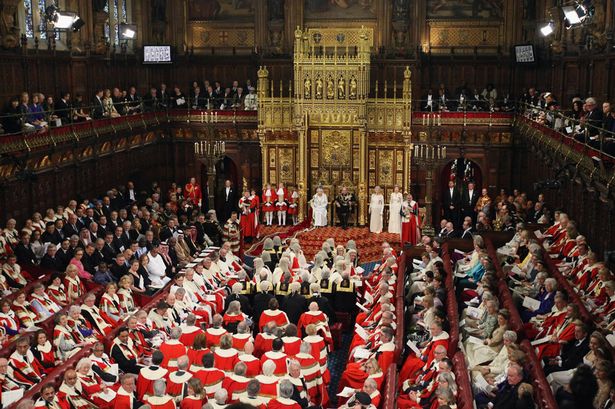
Following the government’s embarrassing defeat on the proposed tax credit cuts in the House of Lords yesterday, the Conservatives are planning to curtail the powers of the Peers. Both the chancellor and David Cameron said the defeats have raised a “constitutional issue” which they were determined to tackle.

A Downing Street spokesman has said: “The prime minister is determined we will address this constitutional issue. A convention exists and it has been broken. He has asked for a rapid review to see how it can be put back in place.”

Yet even Lord Lawson, the former Conservative chancellor, voiced that he was struggling to support the tax credit cuts and he called on Osborne to do more to help low-income earners. He said: “Here a great deal of the harm is at the lowest end, and that is what needs to be looked at again. That is what concerns me.”

He added: “It is not just listening which is required [from the government] but change.”

The Clerk of the Parliaments has confirmed that Commons financial privilege does not extend to statutory instruments. Many Peers pointed out throughout the debate that welfare policy isn’t “budgetary.”

But on Tuesday, Downing Street will outline plans for a “rapid review”, which will examine ways to secure the “supremacy of the House of Commons on financial matters and secondary legislations, after the prime minister accused peers of “breaking a constitutional convention.” A furious Cameron is planning to set limits on the power of the House of Lords after George Osborne suffered a major and humiliating blow yesterday, when Peers voted to delay tax credit cuts in order to protect those who would lose out.

The Upper House voted in favour of a motion by the former Labour minister Lady Hollis to halt the cuts until the government has responded to new evidence regarding the likely negative impact of the cuts on protected social groups, and produces a scheme to compensate low-paid workers for three years. 

Baroness Lister pointed out that no impact assesment was carried out regarding the cuts, and said “the Bill is an example of none evidence-based policy making. She said “It betrays lack of understanding of policy and people’s lives,” and added “getting an impact assessment from the government is like pulling teeth”.

Lord Campbell observed during the debate that because of the Conservative’s pre-election lies, and because the public were deliberately mislead by several statements from the Tories, saying there would be “no cuts to tax credits,”  that “constitutional convention and niceties are not a priority.”

Meanwhile, George Osborne has indicated he will seek to calm tensions by softening the impact of the planned cuts which have been put on hold by the vote in the Upper House. In language that reflected some of the motion, he told the BBC he would help people struggling in the “transition” period when he delivers his autumn statement on 25 November.

He said: “Unelected Labour and Liberal Lords have defeated a financial matter passed by the elected House of Commons, and David Cameron and I are clear that this raises constitutional issues that need to be dealt with. However, it has happened and now we must address the consequences of that. I said I would listen and that is precisely what I intend to do. I believe we can achieve the same goal of reforming tax credits, saving the money we need to secure our economy while at the same time helping in the transition. That is what I intend to do at the autumn statement.”

The “rapid review” will establish ways of guaranteeing that “financial measures” cannot be overturned by the House of Lords despite the fact that Labour successfully argued that because the tax credits were being introduced through a statutory instrument and had not been declared as a formal financial measure, the move in the Upper House was justified. The review will examine ways of guaranteeing that statutory instruments cannot be overturned by the Lords, who have only done so on five occasions.

Downing Street and Treasury officials spoke after Hollis’s motion was passed by 289 to 272 votes. Peers also voted in favour of a milder motion by the crossbench Peer Lady Meacher – by 307 to 277 votes – that also declined to support the cuts until the government responds to the Institute for Fiscal Studies analysis of the negative impacts of the Bill. A fatal motion, tabled by the Liberal Democrat Peer Lady Manzoor, would have halted the Bill, but it was defeated by 310 votes to 99.

During the Lords debate, Baroness Smith said that 60% of the population want to see a u-turn on this policy. She also points out that the original Labour tax credit legislation wasnt subject to financial privilege. She also said that the government truncated the legislative process to introduce a wide reaching and radical change of policy, to avoid a degree of scrutiny. Baroness Hollis urged peers to support the working poor, not government. She argued that the Commons votes were taken based on incomplete evidence.

John McDonnell, the shadow Chancellor, said: “George Osborne has got to think again. He has been defeated twice in the House of Lords tonight, but there are a large number of Conservative MPs as well who have been telling him very, very clearly he has got to think again.”

Just hours before the Lord’s debate, fresh evidence emerged of the potential impact of the tax credit changes on low-paid employees.

Policy in Practice, a welfare-to-work consultancy, calculated that some workers will be able to keep just 7p in every extra £1 they earn, effectively putting them on a 93 per cent marginal tax rate.

The report concluded the overall package of measures – including raising the national minimum wage and increasing the tax allowance – would leave two-thirds of claimants worse off and warned that owner-occupiers would be worst affected.

The calculations were revealed by the Conservative-supporting Spectator, which has urged a rethink of the policy that has been likened to the poll tax.

4-38-degrees-get.jpgA 38 Degrees campaigner outside the Houses of Parliament. An online campaign sought to drum up support among members of the Second Chamber to vote against motion.

Courtesy of Getty images.

Tories Threaten To Suspend House Of Lords If It Attempts To Halt Tax Credit Cuts

Image result for democracy UK

Yesterday I reported that a rarely-used procedure called a “fatal motion” is set to be tabled in the House of Lords this week, followed by a vote next week, with the specific design of preventing George Osborne from putting his controversial proposed £4bn tax credit cuts into law.

The Huffington Post reports that House of Lords could be controversially suspended or “flooded with Tory peers” if it takes the “nuclear option” of killing off George Osborne’s tax credits cuts next week, according to government sources. This is a truly remarkable threat from the Conservative government, in a so-called first world liberal democracy.

Furious Conservatives are threatening the unprecedented and profoundly undemocratic retaliation if peers decide to proceed with the step of using the so-called “fatal motion” to kill the Chancellor’s plans to cut working tax credits.

Campaigners believe that the usual Salisbury convention, which stops the Lords from blocking a party’s plans, does not apply because the tax credits cuts were not mentioned in the Tory manifesto in May.

But a fatal motion on what the Tories deem “a financial matter” would be unprecedented and Tory sources say the government are determined that the Lords would “have to pay a serious political price” if the Government is defeated next week.

Normally if the Lords defeat the Government on a money-related bill, it can be overturned easily in the Commons by the Speaker deeming it a financial issue. But a statutory instrument has no such condition.

Baroness Meacher told BBC Radio 4’s World at One on Monday afternoon that the cross-party determination to overturn the plans was strong.

Asked how much support she had, Meacher said: “A lot. There are clearly a lot of Conservatives who are very worried about this. There’s very strong support from the Labour Party and Lib Dem, cross-benchers who are very worried.”

And the government’s threat comes when several Conservatives have warned the tax credit cut will be damaging. Also speaking to the BBC today, even Boris Johnson ramped up the pressure on the chancellor. The London mayor said while it was “brave” and “right” to reform the tax credit system the government needed to make sure it was done in a fair way. He said:

I think everybody is concerned about everything that bares down unfairly on the working poor and it’s very important as we take this thing forward we do it in such a way as to minimize that impact.

Baroness added that Bishops in the Lords were “very deeply concerned” and would “want to support a rethink” of Osborne’s plan. Asked if the Bishops would support her, she said: “That’s my understanding.”

This is an unprecedented and extremely undemocratic threat on the part of the government. The House of Lords shares responsibility for making laws with the House of Common. The role of the House of Lords (sometimes called the “upper house”) is to provide an additional safeguarding mechanism of democracy, as the second chamber of Parliament. Members regularly review and amend Bills from the Commons.

The House of Lords plays a vital role in making and shaping our laws and crucially, in checking and challenging the government; it shares this role with the House of Commons. The Lords has a reputation for thorough and detailed scrutiny of Bills.

The House of Lords serves a valuable democratic function by providing a national forum of debate free from the constraints of party discipline. Although the defeat of government legislation by the house has been relatively rare on major legislation, it sometimes does defy the government. Members come from many walks of life and bring experience and knowledge from a wide range of occupations. Members use their extensive individual experience to investigate and scrutinise public policy.

Much of this work is done in select committees – small groups appointed to consider specific policy areas. Members play a crucial role in holding the government to account.

In late 2011 and early 2012, the Tory-led Coalition government suffered a series of defeats in the House of Lords on amendments to its flagship Welfare Reform Bill. Most of the defeats were on highly controversial matters, including the bedroom tax, disability benefits, the reform of the child maintenance system and the introduction of an overall benefit cap.

The Lords also tabled amendments to the Legal Aid, Sentencing and Punishment of Offenders Bill. All were subsequently overturned by the House of Commons, which cited its “financial privilege” – or the right to dismiss the Lords’ demands on “financial matters”. As a consequence it was argued by the government that the Lords should, by convention, not insist on its proposals.

These events provoked anger both inside and outside parliament, with claims that the government had misused parliamentary procedure in order to secure its extremely controversial policy programme, and that the incident could be considered not only as profoundly undemocratic, but also, as “an abuse of privilege,” and a means of avoiding unwelcome scrutiny of and accountability for objectionable policies. A widespread complaint is that the financial privilege process lacks transparency.

At present there are no clear definitions as to what falls within Commons financial privilege. And once privilege has been invoked on an amendment, the Commons gives no explanation as to why. Such lack of transparency makes it difficult for peers to anticipate whether financial privilege will be applied to their amendments, and has certainly fed perceptions outside parliament that the process is being abused.

There is also a lack of transparency about how the Lords may respond when faced by a claim of Commons financial privilege.

The mechanisms of democracy have been steadily stripped back since 2011. Who could forget the (still) unpublished National Health Service risk register, which estimated the negative consequences of the Tory Health and Social Care Bill, deliberately hidden from public scrutiny despite court rulings that demanded its release.

The Tax Credit cuts are extremely unpopular with the UK public, and quite properly so. The Conservatives claim to “make work pay”, but that is clearly not the case for those “strivers” on low pay.

Democracy is supposed to protect and reflect the interests of citizens. In Britain, it does the exact opposite: routinely working against the interests of the many, in favour of a wealthy, privileged few.

Public communication from the Conservatives has generally been geared towards establishing a dominant paradigm and maintaining an illusion of a consensus.

It seems the government is no longer concerned with maintaining that illusion, or preserving even the façade of democracy.

inconPicture courtesy of Robert Livingstone

WRAG cuts will “lead to more tragedies”, says Debbie Abrahams

Sick and disabled people in the Work Related Activity Group (WRAG), claiming Employment and Support Allowance (ESA) will see payments cut by £30 a week, to bring the benefit in line with the current Jobseeker’s Allowance (JSA) rate.

The cut will affect up to 500,000 sick and disabled people, including many with incurable and progressive conditions like Parkinson’s and Motor Neuron Disease, who are unfit for work but whom the Department of Work and Pensions believes may be capable of working at some point in the future.

Debbie Abrahams, the shadow minster for disabled people, and a former public health consultant, is calling on the Government to scrap the measure.

Debbie has highlighted the government’s own figures, which showed that the death rate of people on out-of-work disability benefits had increased – in comparison with the general population – from 2003 to the period between 2011 and 2014.

She has pointed out that people in the WRAG were 2.2 times more likely to die than the general population.

She said:

“The innuendo that people with a disability or illness might be ‘faking it’ or are ‘feckless’ is quite frankly grotesque and belies the epidemiological data.

Incapacity benefit and ESA are recognised as good population health indicators. I can say that as a former public health consultant. I have experience of this and I have worked in this field.

The release of the government’s own data, which show that this group are more likely to die than the general population, proves that point.”

Ms Abrahams said the government had “continually maligned, vilified and demonised” benefit claimants, whilst its use of words like “shirkers” and “scroungers” had led to these terms being used far more often in the media.

Disability hate crime has increased significantly over the past five years. Recent figures published by the Home Office reveal that 2,508 disability motivated hate crimes were reported and recorded by the police in 2014/15, up 25% from 2,006 in 2013/14.

Debbie Abrahams told the Daily Mirror:

“Disabled people are already twice as likely to live in persistent poverty.

While last year, more than 300,000 additional disabled people were pushed in to poverty.

That is why Labour is calling for the Government to carry out a proper impact assessments that considers the combined impact of cuts to disabled people.”

Speaking to fellow MPs, Debbie said:

“This group of people are vulnerable and need care and support, not humiliation, from us. 

Once again the cart is being put before the horse: make cuts in support and cross your fingers that something turns up for disabled people.”

During the first parliamentary debate about the WRAG ESA cuts, Priti Patel, the employment minister, said the work-related activity component was introduced by the last Labour government “as an incentive to encourage people to participate in employment”.

She said:

“Clearly, we know that that has not happened. We are therefore reforming our approach with DWP, through our jobcentres and work coaches, to support individuals to get back into work.”

She added:

“Through all our welfare reforms we have made it clear that we will continue to protect and support the vulnerable.

That of course includes those who have terminal illnesses or people with progressive illnesses who are unable to work.”

During discussion of a related clause of the bill, Patel added:

“It is very easy for Labour members to claim that the [WRAG] measure is about taking money away.

It is about providing the right kind of support for people with health conditions and disabilities.”

It IS about taking money away.

Let’s not forget that this government have actually cut support for disabled people who want to work. The Access To Work funding has been severely cut, this is a fund that helps people and employers to cover the extra living costs arising due to disabilities that might present barriers to work. The Independent Living fund was cruelly scrapped by this Government, which also has a huge impact on those trying their best to lead independent and dignified lives.

Ms Abrahams said:

“It is unjust that people with serious health conditions, who have been assessed by the Government’s own Work Capability Assessment process as ‘not fit for work’, should have support cut in this manner.

These measures also risk making it harder for some disabled people to move back to work, as they will have lost the financial support that helps them secure employment opportunities.”

Absolutely.

House of Lords plan move to halt Tory tax credit cuts

Jeremy Corbyn challenges David Cameron over tax credit cuts and affordable housing in his second Prime Minister’s Questions appearance.

According to reports, a rarely-used procedure called a “fatal motion” is set to be tabled in the House of Lords this week, followed by a vote next week, with the specific design of preventing George Osborne from putting his controversial proposed £4bn tax credit cuts into law. In the House of Lords, Peers may table a “prayer” against a negative Statutory Instrument. Under the standard negative procedure, the Statutory Instrument is annulled if the prayer motion is agreed by the House within 40 days of the Statutory Instrument being laid.

Fatal motions are extremely rare, with only a very small number successfully passed since the 1960s, as Peers are wary of overreaching their usual delaying powers with such a drastic “nuclear option.”

But campaigners and crossbench, Labour and Liberal Democrat Peers point out that the fact that the tax credit cuts were not in the Conservative manifesto means they are not bound by the usual Salisbury convention that prevents the Lords from blocking election promises. Opposition parties believe that any move to halt the legislation would be constitutional because the tax credits cuts were not in the Tory manifesto in May, and David Cameron even told TV viewers in the election campaign that tax credit rates would not be cut.

The tax credit cuts were not included in the Finance Bill, which normally enacts a Budget, and the opposition have used the opportunity to seize on the fact that a Statutory Instrument can be halted by a single House of Lords vote.

The tax credit cuts are due to come into force in April, but the statutory instrument needed to make them law is due to be voted on in the House of Lords on October 26.

As I reported in  Welfare Weekly  (and here) earlier, Shadow Chancellor John McDonnell pledged today that his party would reverse the tax credits cuts once it came into power.

The Huffington Post reports that a crossbench peer is being lined up to table the motion in a bid to garner as much support as possible and use the in-built anti-Tory majority in the Lords to stop the Chancellor from going ahead.

The Conservatives have a small overall Commons working majority of 16, however, they are outnumbered in the Lords, with 246 peers compared with 209 for Labour and 106 for the Liberal Democrats. There are also a further 175 peers are crossbenchers (not aligned to any party) and 25 of these are bishops. It is understood that the bishops may also take the rare step of voting against the Government.

The so-called Tax Credits Regulations 2015 (Income Thresholds and Determination of Rates) (Amendment) are in the name of Treasury minister and former Goldman Sachs banker Lord O’Neill of Gatley.

The Liberal Democrats have already tabled a “regret” motion that can only delay the Bill, however, a senior crossbencher will be asked this week table a much the much more drastic fatal motion to kill the secondary legislation.

Among the crossbench names mentioned by campaigners are former social work specialist Baroness Meacher, who has led previous Government defeats on welfare legislation.

Labour also has its own Opposition day debate on Tuesday, which although lacking any binding vote will be used to gauge how many Conservative MPs are worried about the plans, and to court their support in opposing the Bill.

Labour MP Frank Field said:

“This [motion] will be one of those amendments which are rarely tabled but which will kill the measure.

“As time goes on, more of Osborne’s backbenchers are now understanding that far from protecting strivers as the Chancellor promised, he is aiming the biggest cut ever in welfare on this group, who he courted during the election.

“It smashes his 2020 election campaign which would have been all about the strivers. Tory MPs have taken seriously, as the leadership haven’t, that they wish to represent strivers.”

Despite significant pressure from some Tory MPs in marginal seats, the Prime Minister and Mr Osborne have so far rejected warnings that the tax credits cuts will leave large numbers of the low paid workers hundreds of pounds worse off.

Iain Duncan Smith in Stout Denial on Failure of his Welfare ‘reforms’.

Andrew Coates's avatarIpswich Unemployed Action.

http://blogs.telegraph.co.uk/news/files/2014/02/ids1.jpg

Anything Wrong? Not my Fault Says Iain Duncan Smith.

TheGuardianpublishes a long interview with Iain Duncan Smith today,

This is worth noting,

Duncan Smith said that Britain’s welfare system – in particular the way in which the pay packets of the low-paid are topped up through tax credits – worsened the problem of dependency by reducing incentives to work. His grand idea, worked on in opposition at his Centre for Social Justice thinktank, and introduced when he came to power, was to encourage people into work by merging out-of-work benefits and in-work support into one monthly payment, known as universal credit. The new system is meant to encourage the low-paid to work longer hours by slowing the pace at which benefits are withdrawn, known as tapering, so that people will receive more of the extra money they earn.

Transferred from the seminar rooms of thinktanks to the reality…

View original post 632 more words

Labour announce they will reverse Tory tax credit cuts

Shadow Chancellor John McDonnell revealed this afternoon that Labour would reverse the Tory cuts to tax credits. This comes after self-employed working mum Michelle Dorrell highlighted on Question Time that Conservative policies are not “making work pay.”

Michelle Dorrell said:

I voted for Conservatives originally, cos I thought you were going to be the better chance for me and my children. You’re about to cut tax credits after promising you wouldn’t.

I work bloody hard for my money. To provide for my children to give them everything they’ve got – and you’re going to take it away from me and them.

I can hardly afford the rent I’ve got to pay, I can hardly afford the bills I’ve got to do, and you’re going to take more than me.

The Labour party compared the tax credits changes to the community charge – better known as the poll tax, the levy introduced by Margaret Thatcher from 1989, that disproportionately affected poorer households, and which is believed to have contributed to her resignation in 1990.

Shadow Chief Secretary to the Treasury, Seema Malhotra, described the cuts to tax credits as a “turning point in peoples’ trust in George Osborne,” as she criticised the policy.

She was, however, criticised for seeming to “dodge” giving a straight yes or no answer on whether a Labour government would reverse the cuts during an interview on the BBC’s Andrew Marr Show. But it was announced last week by Owen Smith that Labour will attempt to overturn the cuts to tax credits introduced in the summer budget by tabling changes to the welfare bill due to be debated, and John McDonnell has further clarified Labour’s position.

Labour had already organised an Opposition Day Debate on the tax credit cuts in the Commons for Tuesday. Owen Smith, Labour’s shadow work and pensions secretary, said the Labour amendment would give Tory MPs one last chance to reverse tax credit cuts for 3 million families before they face a storm of protest in their constituencies about the changes when voters’ pay packets are hit next year.

He said that he wanted to offer Conservative MPs the chance to act before they face protests from constituents when cuts start affecting wages next year.

Already, some Tory MPs have increased pressure on George Osborne to soften tax credit cuts, after the former cabinet minister Andrew Mitchell urged him to do more to “ameliorate” the impact on the low paid. Mitchell told the BBC’s Sunday Politics that there were “two particular efforts we need to take now to ensure we minimise the impact on what you rightly say are hard-working and low-paid families.”

There were also surprising reports over the weekend that Iain Duncan Smith, the work and pensions secretary, wants extra support for those who are shortly to be told how much money they will lose.

The sweeping changes to tax credits, aimed at saving the Treasury billions of pounds, will affect millions of people and could cost some families up to £1,300 a year, according to the Institute for Fiscal Studies.

The cuts were announced by the Chancellor in July, and as well as raising concern that restricting this in-work benefit to the first two children has a whiff of underpinning eugenics, immediate concerns were raised that millions of low-paid working households would lose income.

Recent evidence provided by the Resolution Foundation reveals planned welfare cuts will lead to an increase of at least 200,000 working households living in poverty by 2020 as a result of the budget changes.

Furthermore, we are also witnessing wages drop lower than all of the other G20 countries, since 2010, the International Labour Organisation informs us.

In advance of the debate, Owen Smith has also written to the chancellor, George Osborne, demanding that the Treasury publishes a full assessment of the cumulative impact of the tax credit and benefit reforms.

Working families’ tax credit was introduced in October 1999 by the Labour government to replace family credit as the main form of support for low-income working families with children. It aimed to help reduce child poverty both by attracting parents from previously non-working  families into the labour market and by directing additional support to those already working but living in families with a low income. It was more generous than Family Credit: the credit amount was higher, there was more support for childcare costs included and the rate of credit withdrawal was lower.

The tax credit cuts will come into force from next April, with those affected expected to receive letters before Christmas informing them of the reductions to their take home pay.

539627_450600381676162_486601053_n (2)


Largest study of UK poverty shows full-time work is no safeguard against deprivation

430835_148211001996623_1337599952_n (1)

By Andrew Naughtie, Deputy editor, Politics + Society, The Conversation

The largest study of poverty ever conducted in the UK has laid out the dire state of British deprivation – and seriously undercut the government’s claim to be lifting people out of poverty through work.

The Poverty and Social Exclusion in the UK (PSE) project details how, over the last 30 years, the percentage of households living below society’s minimum standard of living has increased from 14% to 33% – despite the fact that the economy has doubled in size over the same period.

The 3rd Peter Townsend Memorial Conference, which begins in London today, will hear from an array of academic analysts discussing the findings and how the problems they reveal can best be tackled.

The extent of poverty

Funded by the Economic and Social Research Council and led by the University of Bristol, the PSE report is based on surveys of more than 12,000 people made in June 2012. The surveys found that that millions of Britons in paid employment live with high levels of deprivation.

Among other things, the report found that around 5.5m adults go without essential clothing, around 2.5m children live in homes that are damp, and around 1.5m children live in households that cannot afford to heat their homes.

Meanwhile, one in four adults lives on an income below what they themselves consider necessary to avoid poverty, while one in every six in paid work is technically poor. More than one in five had been forced to borrow money to pay for basic day-to-day needs in the year prior to being surveyed.

But most topically of all, the PSE finds that full-time work is not always sufficient to keep families out of poverty. This calls into question the government’s flagship strategy of getting low-income families into employment and shifting them off state assistance.

Since 2010, Iain Duncan Smith, the work and pensions secretary, has put reducing unemployment and dependence on benefits at the core of his welfare policy. But the PSE finds that children who suffer multiple deprivations are not typically living in homes marked by family breakdown and unemployment.

Instead, the majority live with both parents, at least one of whom is employed; they live in small families, with one or two siblings, are white, and live in England.

The cost of austerity

Commenting on the study’s findings, Professor Jonathan Bradshaw of the University of York said they showed many parents who work full time still have to make huge sacrifices to try and protect their children from deprivation.

“We already know from DWP data that the majority of children with incomes below the the relative income poverty threshold have a working parent. The PSE survey shows that the majority of deprived children, those lacking two or more socially perceived necessities, and very deprived children (lacking five or more socially perceived necessities) have a working parent.

“We found that 65% of the deprived and 58% of the very deprived children had a working parent, and 50% of the deprived and 35% of the very deprived had at least one parent working full-time. Child poverty is not being driven by skivers, but is the consequence of strivers working for low earnings while in-work benefits are being dissipated by government austerity measures”.

The study finds that low wages are a central cause of the widespread deprivation it describes. For many people, full-time work is not enough to lift them out of poverty; almost half of the working poor work 40 hours a week or more. And one in six adults in paid work (17%) is poor, suffering low income and unable to afford basic necessities.

Reacting to the findings, Clare Bambra, professor of geography at Durham University, said that the research was a shameful picture of “the devastating and far-reaching human costs of inequality and poverty in the UK today”.

She said: “It’s shameful for a rich country like ours to be tolerating such levels of poverty especially amongst our children and young people. The mantra that work sets people free from poverty has been shown to be a grand old lie.

“We will be living with the long term consequences of this social neglect for decades to come – there are clear links between poverty and reduced life expectancy and higher rates of ill health, especially concentrated in deprived areas and the north.

“These findings show us the true cost of austerity.”

The Conversation

Andrew Naughtie, Deputy editor, Politics + Society, The Conversation

This article was originally published on The Conversation.

Read the original article.

The mother on Question Time doesn’t need a lecture about voting Tory – LabourList

tax credits question time mother

The video of the tearful mother on Question Time explaining to Cabinet minister Amber Rudd what losing her tax credits will mean is everywhere today. The audience member also revealed that she had voted Conservative in May because, she said, “I thought you were going to be the better chance for me and my children”.

This video has been one of the most emotive examples of the impact of the Tories’ tax credit cuts to date, which is why it has been so widely shared. But the clip has also revealed the more unpleasant side of the left on social media, with people judging this poor woman for the way she voted.

She believed that the Tories would provide a better government for her family. I disagree, but I can relate to that decision. If even she, breaking down on television in desperation, is not good enough for the Labour Party, then who is?

If Labour is to win in 2020 it will need the votes of people like her. In fact, we will also need the votes of people who voted Tory and aren’t being hit by tax credit cuts. This is not up for debate: there is no way to win without their support.

The progressive majority myth, the non-voter myth, the mountain to climb – it all points to winning over Tories.

It’s all well and good sitting there and tweeting how we said this would happen, happy in the knowledge that we are not to blame. Labour does have to shoulder some blame for this, because we did not make a strong enough case that we could support people’s families. That’s why people voted for five more years of David Cameron. An a priori belief that Tories are evil does not amount to a strong enough case for Labour being in power to people who do not share that unshakeable faith.

Fear tactics may be successful in politics, but smug I Told You Sos are not.

This article by Connor Pope first appeared in the LabourList daily email – you can sign up to receive it here.

What’s your own opinion on this issue?

Don’t forget that before the election Cameron promised that he wouldn’t cut tax credits.

Related

Benefit cuts “will involve cuts to benefits” shocker

Budget 2015: cuts to make Daily Mail readers wince, but not just yet

Anyone worried about protecting the welfare state should concentrate on kicking out the Tories – Debbie Abrahams

The welfare state: from hung, drawn and quartered to Tory privatisation