Category: Uncategorized

Facing psychological coercion and manipulation has become a daily part of claiming benefits

https://theconversation.com/assets/logos/logo-06bb368c6cefc24489deacdf1b92722fe048d510a19f90fade0ba79c5fb6d90d.png

Authors: Felicity Callard and Robert Stearn. Republished here with thanks.

Curing unemployment is a growth market for psychologists. Job Centres are becoming medical centres, claimants are becoming patients, and unemployment is being redefined as a psychological disorder.

Made-up ailments such as “psychological resistance to work” and “entrenched worklessness” feature in ministerial speeches and lucrative Department for Work and Pensions (DWP) contracts, without attracting a murmur of protest from professional psychologists.

Psychological explanations for unemployment – the failings of the maladjusted jobseeker – isolate, blame, and stigmatise unemployed people. They reinforce myths about “cultures of worklessness”; they obscure the realities of the UK labour market and the political choices that underpin it. The same is true of psychological prescriptions for treating unemployment.

Interventions

People claiming benefits are already subject to psycho-interventions through mandatory courses designed to promote “employability” and “job readiness”. And as we show in a new paper published in Medical Humanities, “positive psychology” is pervasive in Job Centres (the newly privatised Behavioural Insights Team has trained more than 20,000 Job Centre staff. A narrow set of approved psychological and personality traits are widely touted as essential to getting and keeping a job: confidence, optimism, positive, aspirational, motivated, and infinitely flexible.

Positive psychology is pervasive in Job Centres.
Employment by Shutterstock

Motivational “messaging” targets both staff and claimants, and is set to intensify. The 2015 budget sets out government plans to put therapists in job centres this summer. Online cognitive behavioural therapy will also be provided, in order to “improve employment outcomes” for claimants with mental health conditions. (Some of the many problems with these approaches have recently been discussed in The Conversation.)

The “change your attitude” message of positive psychology is enforced by unsolicited “positive thinking” emails sent to claimants, and in mandatory “employability” training courses promising to help with “self-esteem, self-confidence and motivation”.

Employability, workfare and sanctions

People on benefits are made to take part in various pointless and humiliating psychological group activities (like building paper clip towers to demonstrate team work), or take completely meaningless and unethical psychological tests to determine their “strengths”. But the goal is not a job with pay that you can live on. Instead, this is an intensive “change your attitude” programme, which – along with other forms of workfare – is designed to force people off benefits.

Workfare is a name for the different kinds of “work-for-your-benefits” schemes, exported from the US, which have spread to many rich democracies over the last two decades. In the UK, unemployed people are forced to work unpaid for a charity, business, or local authority in order to continue to be eligible for benefits (both Job Seekers’ Allowance and Employment and Support Allowance – the benefit paid to sick and disabled people).

Workfare also includes coaching, skills-building and motivational workshops, and schemes that are part training course, part unpaid work placement. Failure to take part in these schemes may result in harsher or more demanding workfare activities or benefit sanctions.

High Court ruled unpaid work schemes like Poundland’s were lawful.
Pittaya Sroilong, CC BY

Sanctions amount, as David Webster has recently argued, to a “secret penal system”. Entrenched, arbitrary, and unaccountable, they deprive people of the money they need to eat and live. Workfare – backed by sanctions – also ensures a steady supply of free labour, replacing paid jobs, further depressing wages, and creating a claimant workforce without the legal status and rights normally given to workers. The unemployed person is a generator of income for everyone except themselves.

At the same time, assessing “employability” and enforcing activities said to increase it is now a central function of workfare, stimulating the growth of a state-sanctioned, state-contracted industry heavily influenced by – and reliant upon – psychological “magic” .

“Employability” isn’t a set of skills or attributes required for a specific job or job offer (receptionist, bus driver, call centre operator, care worker). Rather, it is about personality and emotions: achieving a generic upbeat state; having the characteristics, attitudes and habits of “the sort of person who can get a job” – the familiar roll call of confidence, self esteem, motivation and aspiration so celebrated by the CBI, as they lament the absence of these “job ready” attributes in young people leaving school or university and identify “a positive attitude as the key foundation of employability”.

Attitudes to work

This means that “attitude to work” – boosted by confidence courses and assertiveness sheets – becomes a legitimate basis for deciding who is and who is not entitled to social security and a condition placed on receipt of benefits.

In the past, conditionality related to things like refusing to take a job after receiving three offers of work. This was hardly beyond criticism. Now, the supposed absence of positive affect can trigger some form of sanction. “Lack of work experience or motivation” is one of the criteria for being sent on a Community Work Placement – six months’ unpaid community service for 30 hours a week.

Esther McVey, former minister of state for employment, talked about targeting people who are “less mentally fit, bewildered, despondent”, and about the difference between those who are “apprehensive but willing” and those who are “reticent but disengaged”. While unfit claimants will be sent on “more intensive coaching”, those who are “optimistic” can be placed on less rigorous regimes. This is how the DWP will decide who is to be punished with “extra support” – 35 hours a week at a Job Centre.

Medical professionals as state enforcers

The 2015 Conservative manifesto stated that claimants who “refuse a recommended treatment” may have their benefits reduced. This attempt to co-opt medical professionals as state enforcers is what led to the first protest by psychologists. However, while campaigns such as Psychologists Against Austerity have focused on the psychological impact of welfare reform, there has been little mention of psychology’s central role in disciplining and punishing people claiming benefits, or of the ethics of psychological conditionality.

Notwithstanding the UK’s low pay, no pay economy featuring a growing number of precarious, exploitative and part-time jobs, what employers want is “enthusiasm” and workfare is designed to ensure they get it. The “engage” training module will help job seekers achieve “a mindset that appeals to employers, assertiveness, confidence, understanding the benefits of work, motivation and coping with low mood”. In the Job Centre and at the premises of private training providers these positive psychological imperatives – frequently laughable in themselves – are plugged into a violent and coercive sanctions regime.

substituting outcomes

The frameworks used for DWP evaluations of workfare schemes overwhelmingly focus on their psychological benefits. The explanation psychology offers, the treatment it delivers and legitimates, and the kinds of outcome it recognises, are also specified in DWP contracts worth hundreds of thousands of pounds (Focus the Mind, Achieve your Potential, Engage for Success). A programme for JSA/ESA claimants older than 50 even aims to persuade people that age discrimination doesn’t exist.

These developments raise important questions about the ethics of extending state surveillance – and state-contracted surveillance – to psychological characteristics. Psychology can offer a powerful critical perspective on these kinds of compulsion. But pressing issues of accountability and complicity have not been addressed by professional psychological bodies, in spite of persistent lobbying from anti-workfare campaigners. Boycott Workfare says that BACP – which sets standards for therapeutic practice – has been silent, and that they are still waiting for a statement from the British Psychological Society (BPS). Far from addressing the validity or ethics of assessing claimants for “psychological resistance to work”, BPS put out a press release noting that tests should be undertaken by qualified staff.

Psychological coercion and manipulation are part of the day-to-day experience of claiming benefits. It is time the profession took a stand against them.

Co-author Lynne Friedli is a researcher with Hubbub, an interdisciplinary project of scientists, public health experts, clinicians and humanists funded by the Wellcome Trust and run from Durham University, with support from the Max Planck Institutes and the University of York.The Conversation

Felicity Callard is Director of Hubbub (The Hub at Wellcome Collection) and Reader at Durham University.

Robert Stearn is PhD candidate in English and Humanities at Birkbeck, University of London.

This article was originally published on The Conversation.
Read the original article.

The UK is defending tax abuse, not promoting ‘tax competition’ – Richard Murphy

Image result for quotes about tax havens

Many thanks to Richard Murphy at Tax Research UK for this excellent article:

The Guardian has reported that:

Britain will reject plans announced in Brussels this week to combat industrial-scale tax avoidance by the world’s biggest multinationals, the Treasury minister responsible for tax policy has said.

David Gauke, financial secretary to the Treasury, told representatives from the European parliament that Britain would not adopt the measures to introduce certain common tax rules. “He was very clear that the UK is insisting on tax competition,” said German MEP Michael Theurer, who met with the UK treasury minister on Thursday. “It was really a shock from the minister.”

I met that EU delegation yesterday afternoon, representing the Fair Tax Mark with Meesha Nehru. I can say as a result that the comments made by HMRC and David Gauke in the morning were still reverberating in the afternoon and I think Michael Theurer is spot on with his comments.

It is shocking that the UK is so dedicated to tax competition. The suggestion that tax competition between states is something to be promoted is dangerous idea when all competition is necessarily predicated on the idea that it is acceptable for participants to fail. We cannot afford failed states and anything that even hints at that possibility has no place in the international tax system.

That does not mean that international uniformity is necessary, but cooperation and, where appropriate, harmonisation, are essential if tax is not to be an instrument to exercise control from one state over another. In this context there should be no mistaking the fact that those who propose tax competition are the ones who are seeking to exercise control. Time and again right wing think tanks have said things like this by Dan Mitchell of the US based Center for Freedom and Prosperity[i], writing on this occasion for the UK based Adam Smith Institute:

Tax competition exists when people can reduce tax burdens by shifting capital and/or labour from high-tax jurisdictions to low-tax jurisdictions. This migration disciplines profligate governments and rewards nations that lower tax rates and engage in pro-growth tax reform.

The emphasis is mine, and appropriate. Think tanks like those Mitchell works for go out of their way to defend tax havens[ii]. And what they are really saying is that tax havens should be able to use their laws to undermine the tax laws of other states by inducing the relocation of economic activity to low tax jurisdictions. This is what tax competition means, and this is what the UK is subscribing to.

There can be no doubt that some low tax states – like Ireland – have induced some real companies to relocate real economic activities through the offer of low taxes. But it’s also entirely true that places like Ireland are also part tax haven activity which induces no real change in economic activity at all, barring the relocation of where accountants record the profits of the companies for whom they work for tax purposes. This process is called profit shifting[iii].

Profit shifting is, I stress, a pen pushing exercise, usually backed by a lot of paperwork. Perhaps the biggest single expose of the activity to date cam from the Luxleaks disclosures in late 2014[iv]. The key issue there was secrecy, as it always is in these cases. That’s why the EU was on its mission in the UK yesterday.  Large companies secured tax advantages from the use of obscure Luxembourg subsidiaries that had little or no economic substance to them where the details of what they were doing was hidden from the states who lost tax as a result.

This is the reality of tax competition from tax havens that right wing think tanks promote on behalf of their corporate funders. It is why in 2009 I suggested that in most cases tax havens were better described as secrecy jurisdictions[v]. These I defined as places that intentionally create regulation for the primary benefit and use of those not resident in their geographical domain with that regulation being designed to undermine the legislation or regulation of another jurisdiction and with the secrecy jurisdictions also creating a deliberate, legally backed veil of secrecy that ensures that those from outside the jurisdiction making use of its regulation cannot be identified to be doing so. This, of course, is exactly what Luxembourg did in the Luxleaks cases. Most of the tax scandals of recent years have revolved around this tax haven secrecy being used to hide the artificial relocation of profits. Google did that to move profit to Bermuda; Starbucks did it to Switzerland via the Netherlands and Amazon did it to Luxembourg: the theme is always the same.

It’s important to say in that case that this so called tax competition is not about real competition or anything like it. Any economist knows that competition to be fair requires that all the participants have available to them all the information they need to make an informed decision. Tax competition works in exactly the opposite way, and hides everything from view that it can, which reveals what this activity really is: it is economic warfare waged from tax havens that are places that have sold their right to legislate to facilitate attacks on the law of other countries, and then provide secrecy to ensure that those involved cannot, as far as possible, be identified.

The EU is seeking to eliminate this abuse, albeit without the vigour I would wish for. But what’s really shocking is not just that so many tax havens are British, but that we will go so blatantly out of our way to defend tax abuse, which is what David Gauke is doing.

__________

[i] http://www.adamsmith.org/sites/default/files/images/stories/tax-competition.pdf

[ii] See, for example, http://www.adamsmith.org/research/think-pieces/save-the-tax-havens-we-need-them/ by the director of the Adam Smith Institute

[iii] The OECD is dedicated to ending it. See http://www.oecd.org/ctp/beps.htm

[iv] http://www.icij.org/project/luxembourg-leaks

[v] http://www.financialsecrecyindex.com/PDF/SecrecyWorld.PDF

– See more at: http://www.taxresearch.org.uk/Blog/2015/06/19/the-uk-is-defending-tax-abuse-not-promoting-tax-competition/#sthash.idDFKWMm.dpuf

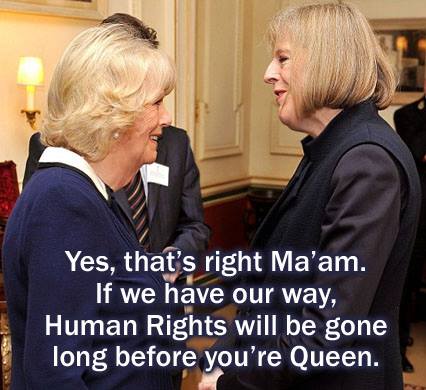
The Labour Party tells David Cameron to abandon plans to dismantle the Human Rights Act

936319_485819054820961_1954794757_nA group of senior Labour Party figures have said that David Cameron should drop his plans to dismantle the Human Rights Act.

In a joint letter, headed by acting leader Harriet Harman and Lord Falconer, the Shadow Secretary of State for Justice, the Prime Minister is asked to abandon his plans to scrap the Act entirely.

Harriet Harman said: “What an irony that yesterday the Prime Minister was presiding over the celebration of Magna Carta at the same time he’s planning to undermine the Human Rights Act.

“No wonder that though he mentioned human rights in South Africa – and preyed in aid Nelson Mandela – and mentioned human rights in India – and preyed in aid Ghandi – he could not bring himself to mention Europe and our Convention.”

The Human Rights Act is a UK law passed by the Labour government in 1998. It means that you can defend your rights in the UK courts, instead of having to travel to Strasbourg – and that public organisations, including the Government, the Police and local councils, must treat everyone equally, with fairness, dignity and respect.

The Human Rights Act protects all of us – young, old, rich and poor. It originates from an international response to the atrocities of World War Two, including the Holocaust and fascist regimes. The Human Rights Act consolidates much of the United Nations Declaration of Human Rights, 1948.

The whole point of Human Rights is that they are universal. Yet despite this, the Government wants to replace our Human Rights Act with their “British Bill of Rights and Responsibilities”. This would weaken everyone’s rights, they would become open to subjective interpretation – leaving politicians to decide when our fundamental freedoms should and should not apply.

This is the same Conservative Party who despise open justice, who have destroyed legal aid and tried to destroy Judicial Review. This is the same Party that thinks they are above the Rule of Law. It is the same Party that has systematically dismissed the Human Rights of disabled people, women and children.

The letter to David Cameron says:

Dear Prime Minister

As you are aware, this year is the 800th anniversary of the signing of Magna Carta, a year to celebrate Britain’s role as a guarantor of individual rights. Yet, as we celebrate this great landmark, the commitment to individual human rights now appears to be under threat.

The Universal Declaration of Human Rights – adopted in 1948 – which Conservative politicians contributed to – enshrines:

  • The right to life, liberty and security
  • The right to a fair trial
  • Protection from torture
  • Freedom of thought, conscience, religion, speech and assembly
  • The right to free elections
  • The right not to be discriminated against

Which of these rights do you not agree with?

Defending the Human Rights Act and our membership of the European Convention on Human Rights is not straightforward because it often involves defending the rights of an unworthy individual from a legitimate authority, or the rights of an unpopular minority from a popular majority.

The Human Rights Act is always going to be a nuisance to those in power because it stops them getting on and doing things unconstrained. But there is an inherent susceptibility for those who have power to extend it, to over-reach and ultimately abuse it. And that is irrespective of how legitimate that power is, how they acquired that power and whether or not they think they are doing the right thing.

So it is right that government ministers should have to look over their shoulder and that their power is tempered by other people’s rights. And we do need to have our executive and our legislature set within a framework of human rights.

This is important to people’s human rights here in Britain and for the human rights of those in other countries. If we were to walk away from our international human rights treaty obligations, we would not be able to press other countries to respect human rights. We cannot say to others in Europe – particularly Eastern Europe – that they should stay within a European framework but that we have somehow outgrown it, or don’t need it anymore.

Human rights are part of, not at variance with, our British values and they matter for our place in the world.

We understand you have put your plans on hold for a year, while you work out exactly how you will go about the dismantling of our human rights laws.

We ask you today to abandon your plans entirely, and as a result of the public interest in this issue, will be releasing this letter to the media.”

It is signed by the Rt Hon Harriet Harman MP, Interim Leader of the Labour Party, and the Rt Hon Lord Charles Falconer QC, Shadow Lord Chancellor and Shadow Secretary of State for Justice.

The letter is also signed by Andy Slaughter, shadow minister for justice, Lord Bach, shadow attorney general, Karl Turner, shadow solicitor general, Keir Starmer MP, Baroness Corston, former chair of the Joint Committee on Human Rights, Baroness Kennedy QC and Kate O’Rourke, chairman of the Society of Labour Lawyers.

Related:

A strong case for the Human Rights Act

Human rights are the bedrock of democracy, which the Tories have imperiled.

15553155399_94869b2dcd_oMany thanks to Rob Livingstone for his excellent memes


Psychologists Call For Reform Of The Work Capability Assessment

 See also: What you need to know about Atos assessments.
292533_330073053728896_1536469241_nMany thanks to Robert Livingstone for the excellent memes

Stigmatising unemployment: the government has redefined it as a psychological disorder

proper Blond

The current government has made the welfare system increasingly conditional on the grounds that “permissive” welfare policies have led to welfare “dependency.” Strict behavioural requirements and punishments in the form of sanctions are an integral part of the Conservative ideological pseudo-moralisation of welfare, and their  “reforms” aimed at making claiming benefits much less attractive than taking a low paid, insecure, exploitative job.

Welfare has been redefined: it is preoccupied with assumptions about and modification of the behaviour and character of recipients rather than with the alleviation of poverty and ensuring economic and social wellbeing.

The stigmatisation of people needing benefits is designed purposefully to displace public sympathy for the poor, and to generate moral outrage, which is then used to further justify the steady dismantling of the welfare state.

But the problems of austerity and the economy were not caused by people claiming welfare, or by any other powerless, scapegoated, marginalised group for that matter, such as migrants. The problems have arisen because of social conservatism and neoliberalism. The victims of this government’s policies and decision-making are being portrayed as miscreants – as perpetrators of the social problems caused by the government’s decisions, rather than as the casualities.

And actually, that a recognisable bullying tactic known as projection, (the vehicle for projection is blame, criticism and allegation), as is scapegoating.

The 2015 budget included plans to provide online Cognitive Behaviour Therapy to 40,000 claimants and people on the Fit for Work programme, as well as putting therapists in more than 350 job centres.

I wrote an article in March about the government plans to make the receipt of social security benefits conditional on undergoing “state therapy.” I raised concern about ethical issues – such as consent, the inappropriateness of using behaviour modification as a form of “therapy,” and I criticised the proposed Cognitive Behaviour Therapy (CBT) programme on methodological and theoretical grounds, as well as considering wider implications.

I’ve written at length about the coercive and punitive nature of the conservative psychopolicy interventions, underpinning the welfare “reforms,” and giving rise to increased welfare “conditionality” and negative sanctions.

In particular, I’ve focussed on the influence of the Cabinet’s Behavioural Insights Team or “nudge unit” and “the application of behavioural science and psychology to public policy. (See: The nudge that knocked down democracy, The power of positive thinking is really political gaslighting, and Despotic paternalism and punishing the poor. Can this really be England? )

I was pleased to see that the BBC reported a summary of the research findings of Lynne Friedli and Robert Stearn, which was supported by the Wellcome Trust. The report – Positive affect as coercive strategy: conditionality, activation and the role of psychology in UK government workfare programmes reflects many of the concerns raised by other professionals. I strongly recommend you read it. (See: Psychologists Against Austerity: mental health experts issue a rallying call against coalition policies.)

The BBC summarised from the report that benefit claimants are being forced to take part in “positive thinking” courses in an effort to “change their personalities.” Those people claiming benefits that do not exhibit a “positive” outlook must undergo “reprogramming” or face having their benefits cut. This is humiliating for job seekers and does not help them find suitable work.

New benefit claimants are interviewed to find out whether they have a “psychological resistance” to work, with those deemed “less mentally fit” given more “intensive coaching.”

And unpaid work placements are increasingly judged on psychological results, such as improved motivation and confidence, rather than whether they have led to a job.

The co-author of the report, Lynne Friedli, describes such programmes, very aptly, as “Orwellian.” She says:

“Claimants’ ‘attitude to work’ is becoming a basis for deciding who is entitled to social security – it is no longer what you must do to get a job, but how you have to think and feel.

“This makes the government’s proposal to locate psychologists in job centres particularly worrying.

“By repackaging unemployment as a psychological problem, attention is diverted from the realities of the UK job market and any subsequent insecurities and inequalities it produces.”

Friedli also criticised the way psychologists were being co-opted as “government enforcers” and called on professional bodies to denounce the practice.

Quite rightly so. It’s our socio-economic system, and the ideologues who shape it that present the problems, not the groups of people forced to live in it as its casualities – the “collateral damage” of neoliberalism and social conservatism.

“I don’t think anything can justify forced psychological coercion. If people want to go on training courses that should be entirely voluntary,” Lynne told BBC News.

She also questioned the aim of the motivational courses and welfare-to-work placements, which felt like “evangelical” self-help seminars.

“Do we really want a world where the only kind of person considered employable is a ‘happy clappy’, hyper-confident person with high self-esteem?

“That is a very a narrow set of characteristics. There is also a role in the workplace for the ‘eeyore’ type.”

Absolutely. Frankly, I would rather have health and safety programmes that are designed by a pessimist, capable of thinking of the worst case scenario, for example, than by a jolly, positively biased, state-coerced optimist.

I would also prefer pessimistic appraisal of social policies. That way, we may actually have impact assessments carried out regarding the consequences of Conservative policies, instead of glib, increasingly Orwellian political assurances that are on the other, more scenic, illusory side across the chasm from social realities.

Although pessimism and depression are considered to be affective disorders, in a functional magnetic resonance imaging study of the brain, depressed patients were shown to be more accurate in their causal attributions of positive and negative social events, and in self assessments, and assessment of their own performance of tasks, than non-depressed participants, who demonstrated a positive bias.

As a former community-based psychosocial practitioner who saw the merits and value of a liberationist model, the question that needs to be asked is: for whose benefit is CBT being used, and for what purpose? Seems to me that this is about helping those people on the wrong side of punitive government policy to accommodate that, and to mute negative responses to negative situations.

The socially dispossessed are being coerced by the state, part of that process is the internalisation of the negative images of themselves created and propagated by their oppressors.

CBT is not based on a genuinely liberational approach, nor is it based on any sort of democratic dialogue. It’s all about modifying and controlling behaviour, particularly when it’s aimed at such a narrow, politically defined and specific outcome.

The problem that we need to confront is politically designed and perpertuated social injustice, rather than the responses and behaviour of excluded, stigmatised individuals in politically oppressed, marginalised social groups.

CBT is founded on blunt oversimplifications of what causes human distress – for example, in this case it is assumed that the causes of unemployment are psychological rather than socio-political, and that assumption authorises intrusive state interventions that encode a Conservative moral framework which places responsibility on the individual, who is characterised as “faulty.”

However, democracy is based on a process of dialogue between the public and government, ensuring that the public are represented: that governments are responsive, shaping policies that address identified social needs. Conservative policies are quite clearly no longer about reflecting citizen’s needs: they are increasingly about telling us how to be.

As I have said elsewhere, as well as aiming at shaping behaviour, the psycho-political messages being disseminated are all-pervasive, entirely ideological and not remotely rational: they reflect and are shaping an anti-welfarism that sits with Conservative agendas for neoliberal welfare “reform”, austerity policies, the small State (minarchism) and also legitimises them. (I’ve written at length elsewhere about the fact that austerity isn’t an economic necessity, but rather, it’s a Tory ideological preference.) The Conservatives are traditional, they are creatures of habit, rather than being responsive and rational.

Conservative narratives, amplified via the media, have framed our reality, stifled alternatives, and justified Tory policies that extend psychological coercion including through workfare; benefit sanctions; in stigmatising the behaviour and experiences of poor citizens and they endorse the loss of autonomy for citizens who were disempowered to begin with.

Many of the current ideas behind “reforming” welfare come from the Behavioural Insights  Team – the Nudge Unit at the heart of the Cabinet. Nudge theory has made Tory ideology, with its totalitarian tendencies, seem credible, and the Behavioural Insights Team have condoned, justified and supported punitive, authoritarian policies, with bogus claims about “objectivity” and by using discredited pseudoscience. Those policies have contravened the human rights of women, children and disabled people, to date.

Nudge-based policy is hardly in our “best interests,” then.

526544_532055030197363_2137237288_n
Pictures courtesy of Robert Livingstone


I don’t make any money from my work. I am disabled because of illness. But you can contribute by making a donation and help me continue to research and write informative, insightful and independent articles, and to provide support to others.

The smallest amount is much appreciated – thank you.

DonatenowButton

What if David Cameron is an evil genius? – Frankie Boyle

Picture courtesy of Robert Livingstone

Originally published in the Guardian, June 1.

The prime minister has successfully pursued an agenda more radical than Thatcher’s – and has managed it without anybody being terribly worried by him.

“They abolished the Human Rights Act” sounds like the first sentence of an Aldous Huxley novel. The Conservatives actually campaigned on a manifesto pledge to get rid of human rights and people voted for it. As electoral choices go, it’s not far off choosing to be ruled by a dry, whispering voice taunting you from an antique mirror.

Here, in what may well be the final years of our civilisation, I would like to ask a question that has been worrying me for some time. What if David Cameron is a genius? A shrewd and malevolent psychopath who thinks two moves deeper into the game than any of his opponents? What if there sits in Downing Street today a modern-day Moriarty, living in a world where his schemes are only kept in check by the deductive brilliance of Harriet Harman? As Holmes would say, look at the evidence. Cameron has managed to set England against Scotland, Scotland against Labour. He has given his enemies the referendums they asked for, and won. He has left Nick Clegg looking like one of those terrified mouse faces that you find in an owl pellet. He has successfully pursued an agenda more radical than Thatcher’s with less popular support than John Major.

Most impressively, Cameron has managed all this without anybody being terribly worried by him. Immediately after his re-election he announced: “For too long we have been a passively tolerant society, saying to our citizens so long as you obey the law we will leave you alone.” A statement so far to the right that it conceded the political centre ground to Judge Dredd.

We have an idea of Cameron as an empty suit – he’s remarkably forgettable for someone who has a face like a gammon travel iron. What if this is simply a character he chooses to play? We can see the mileage Boris Johnson has got out of playing the fairly simple character of a sort of pissed-up dandelion. What if Cameron’s persona is actually more crafted and insidious? He has a brisk, stiff air of wishing he was somewhere else. We imagine he would much rather be a few years in the future, heading up some foundation that’s advising Qatar on how to bid for the Winter Olympics. Perhaps that’s quite an effective manner to adopt when robbing a country. Announcing in a clipped voice that you’ll be out of our hair just as soon as you’ve privatised the NHS, terribly sorry for any inconvenience. Cameron having a down-to-business persona is not terribly unlike one of those gangs who do heists in high-vis jackets.

Speaking of which, I’ve always thought that Batman hired Robin simply to draw fire: throwing a teenage boy a bright yellow cape and telling him to run through a darkened warehouse full of goons. There seems to be little difference in getting Michael Gove to dress up in a bib and plus fours and throwing him into a roomful of barristers. Gove’s appointment as justice secretary seems to be somewhere between a sardonic trolling of the judiciary and simple misdirection. If he ever does have to produce a Bill of Rights it will be a Producers-style clusterfuck that draws attention away from all the real business of the government.

Why else would he have put Gove there? Are we to imagine that his priority in choosing someone to draft tricky legislation was that they have a face that’s easy to carve into a pumpkin? Gove is a distraction for a robbery, who has been hired to be a kind of human bin fire. When the real business of the Transatlantic Trade and Investment Partnership ratification is under way, he’ll be wheeled out on Newsnight looking like a treefrog trying to escape from a scrotum and the whole culture will stop to take aim.

It’s time we accepted the true depth and horror of Cameron’s genius. In the run up to announcing a legislative programme entirely composed of the sort of things the Sheriff of Nottingham would yell at villagers as threats, he had everybody talking about foxes. He’s introducing the bulk interception of our emails and the only feeling it seems to have provoked from the public is mild arousal. He got quarter of a million people to sign a petition for a Human Rights Act referendum that they would definitely lose (British people think the European court of human rights is all about making sure that Ian Brady can get Netflix or marmalade or something). Indeed, Cameron had us all talking about human rights legislation while quietly pursuing a TTIP trade deal that will make human rights meaningless compared with those of corporations.

And there we may have the real clue to Cameron’s manner. He is a sort of bored viceroy engaged in the handover of power from government to corporations. He has a detailed idea of what life will be like 10 years down the line, when sovereignty is subordinated to corporate courts. He probably feels that, in context, we are churlish to get upset at this colourful, Lannisterish little government he has got together for the handover. Imagine the wry contempt the master criminal must have felt for Holmes, living at the centre of the brutal British empire and imagining that Moriarty’s little crimes were the worst thing in the world.

The Suicide of Britain

incon

Article from The New York Times, by Ross Douthat

FOR much of European history, empire was the normal political arrangement: Large, polyglot, multiethnic and eventually multireligious, with a monarch on top and a jostling confederation underneath.

Then came modernity, democracy and nationalism, and the “nations” of Europe – half-real, half-invented – demanded self-determination and self-rule.

Between 1914 and 1945 (with a final act in the Balkans in the 1990s), this led to world-historical disaster, mass exterminations, ruthless wars for mastery. But out of those conflicts came a new kind of hybrid order. The nations would have self-rule, within borders redrawn by war and ethnic cleansing. But they would be supervised by a kind of postmodern empire, an imperial bureaucracy without the emperor – the European Union.

The outlier, as always, was Great Britain. Like its rivals, the United Kingdom lost its overseas colonies, but it kept much of its domestic empire, the several nations – English, Scottish, Welsh and Ulster Irish – that still share a flag and crown. And as befits its anachronistic status, Britain has held itself somewhat aloof from the European Union’s postmodern imperium, joining the union but not its common currency.

These distinctive arrangements have been good for the U.K. overall. Remaining a united kingdom has magnified its global clout, and being in the E.U., but not fully of it, has spared it the worst of the continent’s Euro-driven woes.

But neither arrangement may last much longer. In the headlines, last week’s British elections were a victory for David Cameron’s Conservatives. But the deep winners were the forces of nationalism, Scottish and English, which suddenly have the United Kingdom as we know it on the ropes.

The Scottish story is the more remarkable one, since a decade ago Scottish independence still seemed a crank’s hobby, and after losing last year’s referendum on independence it was assumed that the nationalists had shot their bolt.

Instead, the referendum campaign seems to have affected Scottish politics more than its technical outcome. As Alex Massie, a pro-union Scottish writer, put it last week, in Scotland, “Nationalism is our new secular religion,” and the politics of identity suddenly “defeats all comers.” All but three, as it turned out: In Thursday’s vote, the nationalists took 56 out of 59 parliamentary seats in Scotland, effectively turning the heathered north into a single-party state.

What the Scottish nationalists ultimately want is to trade the Union Jack for the E.U.’s postmodern bargain: ethnically-rooted self-government under a distant supranational umbrella, rather than a political union that can back wars or budget cuts that most Scots oppose. Not every Scot who voted nationalist last week is ready to support this vision. But the pull of union is clearly weakening in the north. Meanwhile to the south, a more English sort of nationalism wants out of the European Union completely, and suspects the Scots are getting too sweet a deal within the U.K. as it is. This is the spirit at work in UKIP, the populist, antiglobalist party that’s taking votes from both left and right, and in the Tory base as well.

[I believe that Cameron has been instrumental in fueling both kinds of nationalism, and of course, to his own political advantage. It was certainly the case that much of the latter part of the Tory election campaign revolved around a poisonous fear-mongering concerning a possible Labour/SNP coalition, despite the fact that Ed Miliband had ruled out that possibility quite publicly during the televised leadership debates. Miliband, a principled internationalist and also pro-EU, would have worked with the SNP, however, rather than in diametric opposition.  The Conservatives have a long history of designing and manipulating the social divisions and parochialism that they tend to thrive on – KSJ.]

The two nationalisms, north and south, can [and will] feed on one another. However reluctantly, Cameron’s government will have to give “little Englander” sentiment its due. (He’s promised a referendum on Britain’s E.U. membership for 2017). This will confirm the Scottish nationalists in their alienation, their desire to rule themselves alone.

On paper, the arguments against both disunion and a “Brexit” from the E.U. remain potent. The Scots really do reap significant benefits from union, and the nationalist vision of Scotland as a kilted Norway, oil-rich and social-democratic, is unlikely to survive contact with the realities of independence. Abandoning Britain’s “this far, no further” approach to Europe and leaving the E.U. outright, meanwhile, would cede economic and political influence (to France, most likely) for uncertain gains.

But these are practical arguments, and sometimes politics needs something more. The nationalists of Scotland and England, in different ways, offer a vision of political community as an object of belief, an end unto itself. Against that kind of message, it’s not enough to defend the present order bloodlessly, to say, “Yes, it’s anachronistic to have a miniature empire in this day and age, but really the net benefits make it worth keeping.”

Instead, you have to argue explicitly for a Great Britain. You have to invoke the United Kingdom’s world-bestriding past, which the Scots no less than the English sustained and died defending, with something more than awkward embarrassment. You have to make a case to the Little Englanders that Britain’s multicultural, Europe-facing present can keep faith with that past and not just bury it. You have to demonstrate that a liberal empire, no less than an ethnic homeland, can be something real and rooted – something felt in “the blood and guts,” as Massie put it during the Scottish referendum, “the bone and marrow of our lives.”

I’m a Yankee; this not my argument to make. But if our cousins can’t find leaders who can make it, there won’t be a Great Britain anymore.

Related

UKIP: Parochialism, Prejudice and Patriotic Ultranationalism.

Many thanks to my friend, Robert Livingstone, for his excellent memes.

The Guardian view: Britain needs a new direction, Britain needs Labour

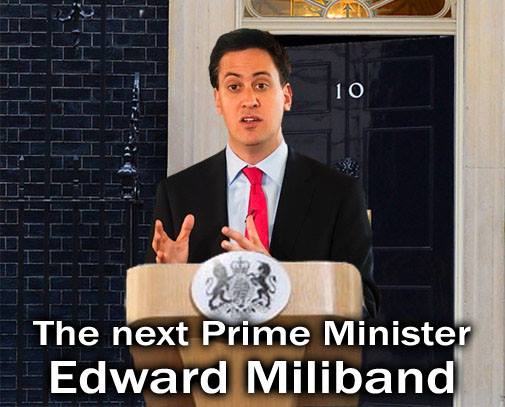
10424302_677497562319775_766713150422913861_nFrom the Guardian editorial today: On Labour party leader Ed Miliband – ‘He has resilience and, above all, a strong sense of what is just.’ Election 2015 poses some profound questions for this country. Ed Miliband has better answers than his rivals, and so deserves a chance to govern.

The campaign is nearly over and it is time to choose. We believe Britain needs a new direction. At home, the economic recovery is only fragile, while social cohesion is threatened by the unequal impact of the financial crisis and the continuing attempt to shrink the postwar state. Abroad, Britain remains traumatised by its wars, and, like our neighbours, is spooked by Vladimir Putin, the rise of jihadist terrorism and by mounting migratory pressures. In parts of Britain, nationalist and religious identities are threatening older solidarities, while privacy and freedom sometimes feel under siege, even as we mark 800 years since Magna Carta. More people in Britain are leading longer, healthier and more satisfying lives than ever before – yet too many of those lives feel stressed in ways to which politics struggles to respond, much less to shape.

This is the context in which we must judge the record of the outgoing coalition and the choices on offer to voters on 7 May. Five years ago, Labour was exhausted and conflicted, amid disenchantment over war, recession and Gordon Brown’s leadership. The country was ready for a change, one we hoped would see a greatly strengthened Liberal Democrat presence in parliament combine with the core Labour tradition to reform politics after the expenses scandal. That did not happen. Instead the Conservatives and the Liberal Democrats have governed together for five difficult years.

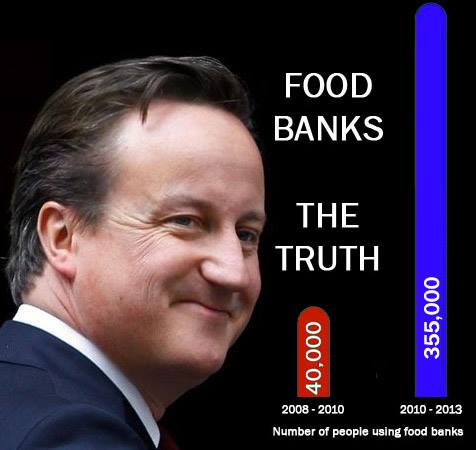
That experiment has clearly run its course. The outgoing government proved that coalitions can function, which is important, and it can be proud of its achievements on equal marriage and foreign aid. But its record, as our recent series of editorials on detailed themes has shown, is dominated by an initial decision to pursue a needless and disastrous fiscal rigidity. That turned into a moral failure, by insisting on making the neediest and the least secure pay the highest price for an economic and financial crash that they did not cause. The evidence is there in the one million annual visits to foodbanks, a shocking figure in what is, still, a wealthy country.

David Cameron has been an increasingly weak prime minister. On issues such as Europe, the integrity of the United Kingdom, climate change, human rights and the spread of the low-wage economy, he has been content to lead the Tories back towards their nastiest and most Thatcherite comfort zones. All this is particularly disappointing after the promise of change that Mr Cameron once embodied.

The Union At Risk

The Conservative campaign has redoubled all this. Economically, the party offers more of the same, prioritising public-sector austerity which will worsen life for the most needy – imposing £12bn of largely unspecified welfare cuts – while doing little to ensure the rich and comfortable pay a fair share. Internationally, the party is set on a referendum over Europe which many of its activists hope will end in UK withdrawal. It’s also set on an isolationist abandonment of British commitment to international human rights conventions and norms, outcomes which this newspaper – unlike most others – will always do all in its power to oppose. At the same time, the Tories go out of their way to alienate Scotland and put the UK at risk. The two are related: if a 2017 referendum did result in a British exit from the EU, it could trigger a fresh and powerful demand for a Scottish exit from the UK. The Conservative campaign has been one of the tawdriest in decades.

The overriding priority on 7 May is therefore, first, to stop the Conservatives from returning to government and, second, to put a viable alternative in their place. For many decades, this newspaper’s guiding star has been the formulation offered by John Maynard Keynes in a speech in Manchester in 1926: “The political problem of mankind is to combine three things: economic efficiency, social justice and individual liberty.” The task on 7 May is to elect the parliament and government that will come closest to passing Keynes’s triple test.

Some despair of the whole system, believing a model created for two-party politics is now exhausted, failing to give adequate expression to the diverse society we have become. We are hardly newcomers to that view: we have demanded electoral reform for a century and believe that demand will find new vigour on 8 May. But for now, this is the voting system we’ve got. How should we use it?

To the charge that they enabled a government whose record we reject, the Liberal Democrats would plead that they made a difference, mitigating and blocking on issues such as Europe, the environment, child benefit and human rights, without which things would have been worse. That adds weight to the view that the next Commons would be enhanced by the presence of Lib Dem MPs to insist on the political reform and civil liberties agendas – as they did, almost alone, over Edward Snowden’s revelations. Similarly, it would be good to hear Green voices in Westminster to press further on climate change and sustainability. Where the real constituency choice is between these parties and the Conservatives, as it is between the Lib Dems and the Tories in the south-west, we support a vote for them. But they are not the answer.

In Scotland, politics is going through a cultural revolution. The energy and engagement on show are formidable – and welcome. The level of registration is an example to the rest of Britain. If the polls are right, and the SNP is returned as Scotland’s majority party, we must respect that choice – and would expect all parties that believe in the union, and the equal legitimacy of all its citizens, to do the same. We do that even as we maintain our view that, whatever myriad problems the peoples of these islands face, the solution is not nationalism. Breaking apart is not the answer: not in Europe and not in the UK. We still believe that the union rests on something precious – the social and economic solidarity of four distinct nations – and that is to be nurtured and strengthened, not turned against itself.

A sense of what is just

Which brings us to Labour. There have been times when a Labour vote has been, at best, a pragmatic choice – something to be undertaken without enthusiasm. This is not such a time. Of course there are misgivings. The party has had some bad instincts – on civil liberties, penal policy and on Trident, about which it is too inflexible. Questions linger over Ed Miliband’s leadership, and whether he has that elusive quality that inspires others to follow.

But Mr Miliband has grown in this campaign. He may not have stardust or TV-ready charisma, but those are qualities that can be overvalued. He has resilience and, above all, a strong sense of what is just. Mr Miliband understood early one of the central questions of the age: inequality. While most Tories shrug at that yawning gap between rich and poor, Labour will at least strive to slow and even reverse the three-decade march towards an obscenely unequal society. It is Labour that speaks with more urgency than its rivals on social justice, standing up to predatory capitalism, on investment for growth, on reforming and strengthening the public realm, Britain’s place in Europe and international development – and which has a record in government that it can be more proud of than it sometimes lets on.

In each area, Labour could go further and be bolder. But the contrast between them and the Conservatives is sharp. While Labour would repeal the bedroom tax, the Tories are set on those £12bn of cuts to social security, cuts that will have a concrete and painful impact on real lives. Even if they don’t affect you, they will affect your disabled neighbour, reliant on a vital service that suddenly gets slashed, or the woman down the street, already working an exhausting double shift and still not able to feed her children without the help of benefits that are about to be squeezed yet further. For those people, and for many others, a Labour government can make a very big difference.

This newspaper has never been a cheerleader for the Labour party. We are not now. But our view is clear. Labour provides the best hope for starting to tackle the turbulent issues facing us. On 7 May, as this country makes a profound decision about its future, we hope Britain turns to Labour.

Related

It’s time to end the lie that Labour and Tories are ‘the same’ on austerity – Sunny Hundal & Sue Jones

The ultimate aim of the “allthesame” lie is division and disempowerment of the Left.

The real progressive in the leader’s debate is Ed Miliband

Ed Miliband’s New Year Message: “2015 is a year of possibility, the chance to change direction”

Miliband is an excellent leader, and here’s why.

10635953_696483917087806_7307164383030383606_nMany thanks to Robert Livingstone for the pictures.

Cameron believes that saving ‘the tax payer’ money is more important than saving lives.

rich keep millons

The following is from a very revealing transcript of David Cameron’s interview with Andrew Marr earlier today.

Cameron implied that dying is somehow an appropriate punishment for failing to attend an interview at the Jobcentre, in order to save “the tax payer” money. Cameron thinks that taxing the wealthy is “immoral,”  but evidently, formulating policies that cause the death of vulnerable citizens is acceptable. Cameron made it plain that he has no intention of carrying out a policy review, or of investigating the growing number of deaths correlated with the conservative party’s welfare cuts.

He showed a complete lack of remorse and basic compassion for David Clapson (and his family,) who died as a direct consequence of the cruel sanction regime that Cameron introduced as part of benefit conditionality,  which is now an integral part of the wider welfare “reforms.”

 THE ANDREW MARR SHOW, BBC 19.4.15 (Full transcript here.)
David Cameron before the news:

AM: Well you also talked to Evan Davis about the twenty two billion pounds of welfare cuts you’ve made so far as if that was easy. Do you accept that has hurt a lot of poor and vulnerable people?

DC: Well it has involved difficult decisions. But of course as we’ve done that we’ve been getting two million people into work, nine hundred thousand people…

AM: Difficult decisions for you; a lot of real pain and suffering for people out there.

DC: Well, we have protected for instance the pension, we’ve protected benefits for the lowest paid, we’ve always made sure that we’ve increased spending on disability benefits rather than reduced it. But crucially the nine hundred thousand people we’ve got off welfare and into work that has actually saved money but it’s also been good for ourcountry and crucially good for them:a job is the best route out of poverty that there is.

AM: What about the million people depending on food banks?

DC: Well obviously I want a country where people don’t depend on food banks, we did something.

AM: But why are more people depending on food banks?

DC: One of the things we did was that Labour, because they didn’t like the PR of this, they didn’t advertise or promote the existence of food banks through job centres. We changed that because we thought that was, that was basically sort of selfish and shortminded…

1390648_548165358586330_1740107407_nAM: And according to the Trussell Trust who run these banks that accounts for just three percent of people using food banks at the moment so it’s not a significant thing. But can I take you to an individual case, James [he meant David] Clapson. Clapson who was a former soldier worked very hard for a long time then was on benefits, failed to turn up to two job centre interviews, [it was just one interview that David missed,] had his benefits removed for a month, he was diabetic, his insulin couldn’t be refrigerated and he died two weeks later.

Now that is the kind of case that is coming up again and again and again and shows that the welfare cuts have been agonisingly painful for real people out there.

DM: Well we have hardship funds and councils have hardship funds for exactly those sorts of tragic cases but if you’re asking me…

AM: It didn’t work.

DC: If you are asking me is it right that people who are asked to turn up for interviews or asked to fill in a CV or asked to apply for a job should have to do those things before getting benefits then yes it’s right that we do have that system in place but we always, as I put it on the steps of…

AM: But the system has been very very aggressive, another case of a man who had learning difficulties and filled in his form by hand rather than by computer and was refused benefits, there is lots of these cases as you won’t have a review, you should have a review of the system surely?

DC: I look at all of those individual cases and all of those cases can be addressed by the hardship funds and by the flexibilities that are there in the system but we have sanctions for a reason, people watching this programme…

AM: You don’t get the hardship fund for two weeks.

DC: Hold on a second

AM: Alright.

DC: People watching this programme who pay their taxes, who work very hard, they don’t pay their taxes so people can sign on and show no effort at getting a job, as I put it on the steps of Downing Street those who can should; those who can’t we always help – that is the principle that should always underline a compassionate benefits system.

scroll2
We do not have a compassionate welfare system: we have a re-designed system that is draconian because of the “reforms” – it’s more about taking money from people than supporting them. It’s about punishing people into work. That is precisely why people like David Clapson are dying. No support was given to David, and many others like him.

Cameron’s rhetoric isn’t remotely coherent or compassionate, let alone honest.

Let’s not forget that it was Cameron’s government that has ruthlessly stigmatised, dehumanised and scapegoated unemployed and disabled people, in order to justify punishing them by removing their support and handing out the subsequent “savings” to millionaires, who gained £107,000 each per year, whilst those who paid for it – and we are also tax payers, Mr Cameron – are suffering and dying, and the establishment look on with contemptible, pathological, greedy, grasping, self-serving indifference.

Related

11046274_80388630968089cam cThanks to Robert Livingstone for the excellent memes.

Everyone matters: it’s time to vote for our lives – vote Labour

430847_149933881824335_1645102229_n (1)I published an article earlier this month from Debbie Abrahams and added a short piece by myself: Anyone worried about protecting the welfare state should concentrate on kicking out the Tories.

Benefits and Work published a very good article this week: Vote for your life – “dramatic”, “life-changing” cuts are coming, I have  reproduced the most salient parts of it here for those who don’t have access to their site. I’ve also added a few links with information.

“Dramatic” and “life-changing” benefits cuts will be imposed if the Tories are running the country after 7 May, Iain Duncan Smith has warned.

They could include taxing DLA, PIP and AA, axeing contribution-based ESA and JSA, cutting the work-related activity component of ESA to 50p, cutting carers allowance numbers by 40%, and making people pay the first 10% of their housing benefit.

For many, these will be life-threatening cuts, rather than life-changing ones.

But claimants are in a position to prevent them happening.

And it won’t take a miracle.

In fact, just an additional 5% turnout by working age claimants could have a dramatic and life-changing effect on Iain Duncan Smith and his plans instead.

But a higher turnout won’t happen by itself.  Many of the major charities and disability organisations have been scared into silence by the Lobbying Act. And the media has little interest in benefits cuts, other than to applaud them as a good thing.

So it looks like it’s up to ordinary claimants to make sure as many other claimants as possible understand the threat they are facing.

Dramatic cuts
Iain Duncan Smith told Andrew Marr last week he didn’t become a minister to make “cheese-paring” cuts. Instead he has ‘dramatic’ and ‘life-changing’ plans for claimants.

And the tool for those dramatic changes is £12 billion of cuts to benefits in the space of just two years.

So far, we only know where £2 billion of the cuts will come from – a freeze on working age benefits. But the Conservatives are refusing to say where the other savings will be made.

Hit list
A document leaked to the BBC, however, set out some of the cuts the Conservative party are considering, including:

  • Taxing DLA, PIP and AA.
  • Abolishing contribution based ESA and JSA entirely, so that only claimants who pass a means test can claim these benefits.
  • Cutting the number of people getting carer’s allowance by 40%.
  • Limiting child benefit to the first two children.

There are other proposed cuts too, including replacing industrial injuries benefits with an insurance policy for employers, regional benefit caps and changes to council tax.

Not enough cuts
But all of this will still not be enough.

According to the Institute for Fiscal Studies (IFS):

“If all of these were implemented, the total saving would be likely to fall well short of the missing £10 billion per year that the Conservatives intend to find by 2017–18”

So, what else might be in the firing line?

Housing benefit and ESA cuts
We know that pensioners benefits are protected. And JSA costs such a tiny amount compared to other benefits that further cuts there would make little difference.

Cuts to housing benefit are one possibility that the IFS have highlighted, however, as this makes up a large and growing proportion of the benefits bill.

The IFS have estimated that making everyone pay the first 10% of their housing benefit would save £2.5 billion over two years.

Another extremely strong contender is to cut the work-related activity component (WRAC) of ESA to just 50 pence.

We know that the Conservatives are keen to slash the WRAC, because they’ve considered doing it before.

Cutting the WRAC wouldn’t save huge amounts, probably less than £1 billion a year.

But combined with cuts to housing benefit and all the other cuts listed above, it would probably be enough.

What you can do
Is this all nothing more than unnecessarily distressing speculation? After all, we don’t know what cuts will be made until – and unless – the Tories are elected.

But by then it will be too late. As Andrew Marr said in his interview with Iain Duncan Smith, if the Conservatives won’t tell us which benefits will be cut, sick and disabled claimants will have to expect the worst:

“What I’m saying to you is if I was on welfare, if I was on disability benefit and I was told that you were taking £12 billion out of the budget, I would really need to know before I voted was I going to be hit. Or if I didn’t know that, I’d have to be assume that I was going to be hit.”

Iain Duncan Smith, Osborne and Cameron have all now said no details of the cuts will be given before the election. So there’s no time to lose.

Clearly, the most important thing is to make sure you are registered to vote and then actually vote for a candidate who can keep the Tories out, if that’s possible, in your constituency.

But there’s more.

Above all, alert other claimants and carers to the dramatic threat they face – because many people still have no idea how huge £12 billion in cuts in two years really is.

And then try to persuade them that voting isn’t a waste of time. Because it is no longer true that all the parties are the same.

Here at Benefits and Work we have no trust for either of the major parties. But Labour, regardless of your political preferences, don’t drool at the thought of cutting welfare in the way that the Tories do.

And the £7 billion savings Labour say they plan to make are very much smaller than the Conservative cuts. Even if every single pound Labour saved was from cutting benefits, instead of from other measures such as raising taxes from the wealthy, it would still amount to just over half the benefits cuts the Tories have guaranteed.

[To clarify, Labour have stated they will not be cutting benefits, but they will address the overall costs to the welfare budget, tackling high private sector rent, repealing the bedroom tax, reducing costs such as private contracts within the Depatment of Work and Pensions, for example. See: We can reduce the Welfare Budget by billions: simply get rid of Iain Duncan Smith. Kitty]

You can make a difference
And don’t imagine that your voice can’t make a difference.

Bar chart:  Tory Majority 333, claimant count 6840 Lancaster Fleetwood

This is a very close election so far.

There will be many seats where the winner’s majority is in the low hundreds, some where it will be less than a hundred. Even a 5% additional turnout by working age claimants – amounting to perhaps 400 voters in many constituencies – could make the difference between Labour and the Conservatives being the largest party.

If you can convince a handful of people to vote and to talk to other claimants, you could genuinely help to change the course of this election.

Remember, you’re not trying to persuade hard-faced, right wing tabloid readers that cutting benefits is wrong. That undoubtedly would be a waste of time.

You’re talking to people who already know how painful the Coalition benefits cuts have been – because they’ve been hit by them.

You just have to persuade them that it’s not time to despair.

It’s time to fight back.

It’s time to vote for your life.

Related

Rising ESA sanctions: punishing the vulnerable for being vulnerable

As predicted, Mandatory Review has effectively destroyed independent Tribunals

Government under fire for massaging unemployment figures via benefit sanctions from Commons Select Committee

Osborne’s razor, smoke and mirrors

Osborne’s Autumn statement reflects the Tory ambition to reduce State provision to rubble

Follow the Money: Tory Ideology is all about handouts to the wealthy that are funded by the poor

Thanks to Robert Livingstone for the excellent memes.