Category: Uncategorized

You’d have to be Green to believe the Green Party: two more lies exposed.

PANews+BT_N0321471377269205233A_I1“David Cameron and George Osborne believe the only way to persuade millionaires to work harder is to give them more money. But they also seem to believe that the only way to make you (ordinary people) work harder is to take money away.” Ed Miliband. Source: Hansard, 12 December, 2012

The Tories have trashed the economy, damaged the very structure of our society and destroyed people’s lives. We have seen the return of absolute poverty, malnutrition and illnesses not seen since Victorian times. People have died as a consequence of Tory policies. What do the Green Party do? Lie about the Labour Party.

The Green Party are not opposing Tory austerity: they are opposing what is currently the only credible alternative instead. They prefer to undermine those that ARE challenging the Coalition regarding policies that are having devastating consequences on the poorest and most vulnerable citizens. That’s very telling. I fully support some Green policies, and wish that the Left generally would work in a much more collaborative way. Really that’s the only way of effectively challenging the current neoliberal conservative dominant paradigm.

Given an opportunity to engage in genuine political conversation and to cooperate in opposing the Tory-led draconian policies, those parties claiming to be “further left” than Labour have instead behaved exactly like the Tories. They chose to undermine Labour. These are parties that prioritise grandstanding and electioneering above the needs of the public. That has entailed lying and smearing campaigns. Yet we all share many of the same aims and objectives, values and principles. The infighting simply weakens a broader and more important progressive Movement.

Here are two examples of lies that are currently being circulated on Facebook and elsewhere by the Green Party and the Scottish National Party (SNP), amongst others:

Lie number 1: “Rachel Reeves said she would be tougher on welfare.”

Rachel Reeves has NEVER said she will be “tougher on welfare.” Those saying that she did are lying. She issued a statement shortly after being misquoted. It was Natalie Bennett who perpetuated that misquote too, originally from the Observer. (See Bennett’s article: Rachel Reeves is clear: Labour would set the struggling against the poorest.)

What Rachel actually said was she would be “tougher on the CAUSES of high welfare spending – such as low wages, unemployment, high private sector rents, private company contracts and outsourcing – especially that of Iain Duncan Smith: his vanity projects have cost us millions because contracted private companies have failed to deliver services, the policies are ill-conceived, creating higher costs, ultimately, rather than making any savings as the Tories claimed – the bedroom tax being an example.

The fact that Rachel Reeves was misquoted was clarified to Caroline Lucas too, so the Green Party have no excuse for shamefully lying about the Labour Party’s policy intentions.

In the middle of crucial debate about the Work Capability Assessment and the plight of disabled people because of Coalition policies, initiated by the WOW campaign, Lucas lost all of my respect when she chose political point scoring instead of constructive debate and said this:

Caroline Lucas (Brighton, Pavilion, Green); I was disappointed that Rachel Reeves, on taking up her post as shadow Secretary of State for Work and Pensions, used the opportunity of her first interview to say that she would be tougher than the Tories on people on benefits.

Kate Green (Shadow Minister (Work and Pensions); Stretford and Urmston, Labour); My hon. Friend the Member for Leeds West did not say that. She said that she would be tougher on welfare spending, not on people on benefits.

Sheila Gilmore (Edinburgh East, Labour); Does the hon. Lady agree that there are some forms of welfare spending that we should bring down? In my view, one of those is the excessive amount that is paid to private landlords through housing benefit. I am certainly in favour of reducing that form of welfare spending. Is she not?

Caroline Lucas (Brighton, Pavilion, Green); I am very much in favour of that if the hon. Lady wants to put it under the heading of welfare spending... Source: Hansard which is the parliamentary record. (See: 27 Feb 2014 : Column 457  at 1.29 pm, on the 2nd page.)

Nonetheless the Green Party has continued to misquote Reeves, to my disgust, using negative campaigning and smear tactics akin to the Tories to promote their own party. It’s time that some people distinguished between welfare spending and benefits, to conflate the two purely for political gain is deplorable, dishonest and not in the best interests of the electorate.

Lie number 2: “Labour voted for austerity.”

This is such a blatant lie. The vote, clearly stated on the Hansard record (see 13 Jan 2015: Column 738, Charter for Budget Responsibility), was pertaining strictly to the motion: “That the Charter for Budget Responsibility : Autumn Statement 2014 update, which was laid before this House on 15 December 2014, be approved.”  That isn’t about austerity.

The charter sets out that the Office of Budget Responsibility (OBR) will continue to monitor our fiscal rules. As we know, the  OBR has written extremely critical economic forecasts and analysis of austerity and the Tory spending cuts, clearly expressing the risks that the Chancellor is running and the scale of the damage his strategy will inflict on what remains of our public services.

It’s worth noting that whilst Ed Balls challenged Osborne, there was a curious silence from the  SNP and the Green Party. It was Ed Balls that challenged Osborne’s outrageous claims regarding “halving the deficit”- such a blatant lie, upon which even the exceedingly Conservative Spectator spluttered contempt. Or any of the other lies, some of which have already earned the Conservatives official rebukes from the Office for National Statistics. (See “bankruptcy lie” for example, on the hyperlinked article)

Furthermore, it’s about time that some MP’s, including Caroline Lucas, amongst others, recognised that there is a fundamental difference between the meaning of the word budget and the word austerity. Conflating the two for the purpose of politicking is unprincipled and dishonest.

It’s also worth noting from the same debate on the Hansard record:

13 Jan 2015 : Column 746

Caroline Lucas: Does the Chancellor agree with me that with the feeble and inconsistent opposition coming from the Labour Front Bench, there is a very good reason for seeing the SNP, the Greens and Plaid as the real opposition on this issue because we are clear and consistent about the fact that austerity is not working?

Mr Osborne: That shows why we want the hon. Lady’s party in the TV debates.

Yes, I just bet they do, to collaborate with the Tories in attacking and undermining the Labour Party, not the Coalition, who are, after all, the ones responsible for introducing austerity measures. I don’t imagine for a moment that Osborne values further challenges to his outrageous claims of efficacy regarding austerity measures. What is very evident when you read through this debate, is that Ed Balls and a couple of other Labour MPs presented the ONLY challenges to Osborne on this matter, just to reiterate this important point.
10940505_767712909964906_6225427822143651262_n

It’s also worth bearing in mind that Ed Miliband established the International ANTI-austerity Alliance. Back in 2012, Miliband said: “There is a grip of centre-right leadership on Europe which has said there’s only one way forward and that’s austerity, and you’ve got to have a decisive move away from that.(See also: Labour leader Ed Miliband’s anti-austerity alliance will fight for the European dream.)

And why would Miliband be attending ANTI-austerity protests if he supported austerity?

Labour leader Ed Miliband speaks on stage at Hyde Park, during the TUC organised protest against austerity measures in London

 Labour leader Ed Miliband speaks on stage to over 150,000 at Hyde Park, during the TUC organised protest against austerity measures in London

It’s interesting to see the Chicago Tribune’s article: Ed Balls, UK’s anti-austerity finance chief in waiting.  Balls dismissed Osborne as a “downgraded chancellor”after Britain lost its triple-A credit rating.One of his main charges has been that the government is unfairly spreading the economic pain it deems necessary to fix the economy. Austerity cuts are the burden of the poorest.

Balls says that a decision to cut the top tax rate amounts to an unjustified “tax cut for millionaires”, whilst his party has been scathing of reform of the welfare system. A point echoed many times by Ed Miliband, too. Accusing the government of making lower or no income groups pay for the recovery while shielding the rich is a claim which strikes a chord with some voters who view Cameron and his government – many of whom were educated at the same top fee-paying school – as out of touch.

Caroline Lucas was born in Malvern to Conservative parents and attended Malvern Girls’ College (which became Malvern St James in 2006), a fee-paying private school. Ed Miliband, on the other hand, went to a comprehensive school. Polls also show that many voters approve of the government’s drive to rein in welfare costs and the government has demanded Labour spell out what it would do to fix the economy. They have, but with understandable caution.

Labour’s careful, costed and evidence-based policies include: a Bankers’ Bonus Tax; a Mansion Tax; repeal of the Bedroom Tax; a reversal of the Pension Tax relief that the Tories gifted to millionaires; a reversal of the Tory Tax cut for Hedge Funds; freezing gas and electricity bills for every home a the UK for at least 20 months; the big energy firms will be split up and governed by a new tougher regulator to end overcharging; banning exploitative zero hour contracts; introduction of a living wage (already introduced by some Labour councils); a reversal of the £107,000 tax break that the Tories have given to the millionaires; reintroduction of the 50p tax; scrapping George Osborne’s “Shares for Rights” scheme that has opened up a tax loophole of £1 billion; ensuring Water Companies place the poorest households on a Social Tariff that makes it easier for them to pay their Water Bills; breaking up the banks and separating retail banking from investment banking; introduction of measures to prevent corporate tax avoidance, scrapping the Profit Tax Cut (Corporation Tax) that George Osborne has already announced for 2015 and many more.

These are not austerity measures. They are strongly redistributive policies.

It’s difficult enough opposing the manipulative, lying authoritarian Conservative-led government, without having to constantly counter lies and smears from parties claiming to be on the left, too. Shame on the Green Party and the SNP.

As I have said elsewhere, there’s a clear gap between professed principles and their application amongst the parties that claim to be “real socialists”.  How can it be principled or moral (or “socialist” for that matter) to collaborate with the Tories in attempting to damage, smear and discredit the only viable option of removing the Tories from Office in May? Bearing in mind that many people are suffering profoundly, some have died as a consequence of Conservative-led policies, we can see what the Green Party’s priorities actually are, here.

They don’t include the best interests of citizens and consideration of their well-being, that’s for sure.

403898_365377090198492_976131366_nThanks to Robert Livingstone for his excellent memes.

Public perceptions of party positions on the political spectrum: Labour’s leftward shift under Ed Miliband, the Conservatives’ rightward swing since 2010.

Good to see the public generally don’t swallow the “allthesame” myth.

Electioneering and grandstanding: how to tell the difference between a moral political party and a moralistic one.

1796655_294409220710133_3373329_nThis past four years or so, I’ve watched the media distort the truth, often removing it from a meaningful context and twisting it out of recognisable shape. Or very often avoiding it altogether. I’ve watched minor parties claiming to be on the Left do the same, too, and I won’t ever forgive them for that. Nonetheless we have done our best to share truths and information and to decode rhetoric and re-translate lies.

One thing I can do is analyse social policy, I’ve a perceptive and predictive eye for how policies will affect us – the implications and probable consequences – well before they are implemented. The last four years will bear that out. It’s not just because I studied it, it’s also because I see underpinning ideology, too. I recognise that policy is comprised of a set of scripted motives and intentions on the part of any government and instructions to society on how to organise itself, how to behave and how our individual degree of freedoms are defined, extended or restricted. Policies also send out instructions regarding how social groups are perceived and treated.

Policies may express and extend tolerance and reflect a valuing of diversity, or, as the case is now, they may also prescribe social prejudice and serve to institutionalize discrimination.

Ideology reflects how a government believes society is (and what it isn’t,) and also prescribes how it SHOULD be. The Tories have been imposing their own narrow, nightmarish vision upon us for the past five years.

Today it struck me again just how we have had to decode so very much misinformation. For example, someone asked me about the headline lie that the Labour Party intend to “scrap benefits for young people.” Of course it’s not true. Or rather, it’s a carefully selected, out of context, partial truth.

Miliband is REPLACING jobseekers allowance with another allowance for young people. He thinks that conditional benefits are inappropriate for young people, as to be entitled to jobseekers allowance requires having to be available for work and actively looking for work, so it excludes the very possibility of further education and learning experiences. But young people need the freedom and support to gain from learning. That’s why Ed Miliband will replace out of work benefits for those aged 18-21 with a youth allowance of the same value – currently around £57 a week. This isn’t the controversial issue that was presented by the mainstream media and other parties at all: it’s actually a very well thought out, cost efficient and positive policy.

So young people don’t have to be available for work, but they do have to use their freedom to be learning or training. This detail matters a lot and was excluded from most accounts of the policy. Miliband had a good idea, it won’t cost any more than we currently pay young people, but it means we are investing in young people’s potential and their futures.

This is just one example of how truths are being distorted and not just by the media, but also by the likes of the SNP, the Green Party, TUSC and many of the other increasingly authoritarian groups competing for votes from the Left. Yet when you think about how they have lied to you on fundamental issues, (and they really have) would you REALLY trust them with your vote? Would you REALLY have faith that these parties will suddenly become honest and develop some integrity if they ever got any power?  They won’t. Not one bit.

More recently, there was an intentional distortion of the parliamentary debate on the Infrastructure Bill and fracking, with the Green Party in particular being very critical of Labour’s fracking amendments, which involve regulations that were, after all, succesful: they were accepted by the Tories. Labour proposals considerably tighten environmental regulations. In the UK, drilling for shale gas is still at an exploratory stage, though the Conservatives had planned on fast-tracking the fracking process. The regulations will halt exploratory drilling going ahead in the UK for at least a year. Meanwhile, the Environmental Audit Committee continue with its inquiry, gathering the strong, credible evidence we need if there is to be a justifiable, democratic and fully accountable ban on fracking.

A ban would never have been successful at this stage, and Labour knew this. The other thing NONE of the of aggressive, electioneering “critics” consider, apparently, is that had the proposed moratorium actually scraped a successful yes vote, and that was unlikely, the Tories would most certainly NOT have abided by that outcome, leaving them free without amendments and thus no regulation at all, to go ahead and fast-track fracking. Labour got them to agree on considerable restrictions, which will tie the Tories’ hands at least until well after the election. That is a success.

Anyone with concerns regarding fracking and the legislation ought to be big and authentic enough to take their issues directly to the TORIES, they are the ones that introduced this Bill, after all, not Labour. Yet all we have seen is moralising accounts from rival left parties about how Labour should have done things. Labour have made a difference. Only the grandstanding, electioneering parties would and did turn a success into an opportunity for unreasonable criticism. And they do this every single time the Labour Party achieve or present something positive.

Evidence is much more important than rhetoric and gesture politics. Reasoned and evidenced debate, however, seems to have been sidelined by those who, rather than engaging in genuine politics, prefer gesturing and politicking, no matter what that costs us.

Another claim made recently by the Green Party, again, amongst others, is that “Labour voted to keep austerity”. That is such a blatant lie, because the vote, clearly stated on the Hansard record (13 Jan 2015: Column 738, Charter for Budget Responsibility), was pertaining strictly to the motion: “That the Charter for Budget Responsibility: Autumn Statement 2014 update, which was laid before this House on 15 December 2014, be approved.”

The charter sets out that the Office of Budget Responsibility (OBR) will continue to monitor our fiscal rules. As we know, the  OBR has written extremely critical economic forecasts and analysis of austerity and the Tory spending cuts, clearly expressing the risks that the Chancellor is running and the scale of the damage his strategy will inflict on what remains of our public services. It’s worth noting that whilst Ed Balls challenged Osborne, there was a curious silence from the  SNP and the Green Party. It was Ed Balls that challenged Osborne’s outrageous claims regarding “halving the deficit”- such a blatant lie, upon which even the exceedingly Conservative Spectator spluttered contempt. Or any of the other lies, some of which have already earned the Conservatives official rebukes from the Office for National Statistics. (See “bankruptcy lie” for example, on the hyperlinked article)

Furthermore, it’s about time that some MP’s, including Caroline Lucas, amongst others, recognised that there is a fundamental difference between the meaning of the word budget and the word austerity. Conflating the two for the purpose of politicking is unprincipled and dishonest.

It’s also worth noting from the same debate on the Hansard record:

13 Jan 2015 : Column 746

Caroline Lucas: Does the Chancellor agree with me that with the feeble and inconsistent opposition coming from the Labour Front Bench, there is a very good reason for seeing the SNP, the Greens and Plaid as the real opposition on this issue because we are clear and consistent about the fact that austerity is not working?

Mr Osborne: That shows why we want the hon. Lady’s party in the TV debates.

Yes, I just bet they do, to collaborate with the Tories in attacking and undermining the Labour Party, not the Coalition, who are, after all, the ones responsible for introducing austerity measures. I don’t imagine for a moment that Osborne values further challenges to his outrageous claims of efficacy regarding austerity measures. What is very evident when you read through this debate, is that Ed Balls and a couple of other Labour MPs presented the ONLY challenges to Osborne on this matter, just to reiterate.

10940505_767712909964906_6225427822143651262_nThere’s a clear gap between professed principles and their application amongst the parties that claim to be “real socialists”.  How can it be principled or moral (or “socialist” for that matter) to collaborate with the Tories in attempting to damage, smear and discredit the only viable option of removing the Tories from Office in May? Bearing in mind that many people are suffering profoundly, some have died as a consequence of Conservative-led policies, we can see what the Green Party’s priorities actually are, here. They don’t include the best interests of citizens and consideration of their well-being, that’s for sure.

There is a big difference between being moral and being moralistic. Being moral means that we know what is right and wrong, what is fair and what is unfair, and so on. Being moral means we take responsibility for ourselves. We extend our morality to others, it shapes how we relate to them, our esteem of others and respect. It tends to frame democratic relationships

Being moralistic means we impose on others our own definitions. We tell others what is right and wrong, we define those things for them. Being moral is also about being authentic, being moralistic is often inauthentic and hypocritical. It’s more about control and overburdening others with  responsibility, whilst restricting their choices, than genuine morality. Moralising shapes how we interact with others too, forming power imbalances and inequalities.

We can use this dichotomy to explore political parties and democracy. The Tories often talk about morality, they are a moralistic party that impose what they think is right on everyone else. We know how that has worked out this past five years and it’s got nothing to do with right and wrong, nor is it even remotely related to fairness or social justice. Tory moralising is about control and subjugation of the poorest, liberation and freedom of the wealthiest. That’s what the Tories are all about.They don’t possess any moral core themselves, which is evident in the sleaze and corruption that they tend to leave in their wake.

Labour are moral. This is evident in policies which are coherent, embedding human rights and equality principles. There’s an integrity evident in their social policies, because they reflect core values that Labour have always held, regardless of who has been party leader. They  impose a legal framework of moral codes that establish decent, civilised conduct. Labour’s policies accommodate democracy, equality, diversity and meet a broad array of social needs. In debate, the Labour party are generally rational and reasoned, rather than emotive and judgemental. They favour a learning approach – which is progressive – it’s about development, rather than imposing dogma on the population.

It’s evident that the Green Party are moralisers too. They criticise Labour, often imposing their view of what Labour should do. Meanwhile, the Tories are destroying the country and people’s lives. Even a cursory glance at the Green manifesto indicates plainly that it is a set of policies from idealising moralists, rather than a meaningful democratic representation of the whole population and a balanced reflection of their varied needs.

For example, the universal basic income that the Green Party propose – will it be paid to millionaires as well as the poorest? How would that address inequality – an issue which the Green Party claims to be concerned with? How will it contribute to a so-called steady-state, zero growth economy?

How does banning page three, but legalising prostitution and the sex industry, which is also about economically exploited women being economically exploited, reflect any joined-up thinking? Inconsistency and incoherence.

It’s more dogma.

Think very carefully about what you are voting for. Look for the facts and truth to inform that decision, because in such bleak times, it’s easy to cling to a populist, superficial, dressed-up promise of better things than the Tories offer, but easy fixes don’t exist. Look for coherence, depth and consistency in the narratives being proffered. And look for evidence. You will see that once you look below the surface of false claims, false promises and electioneering, there’s a big difference between moral policies (they tend to be democratic) and moralising ones (they tend to be authoritarian).

14301012075_2454438e62_o (1)Many thanks to Robert Livingstone for his outstanding pictures.

Old New Labour: some thoughts on myths, strengths and weaknesses.

1044468_500666173336249_1718830491_n

Most people like to criticise New Labour. In political debates with the right, and people loosely assembled on the “left” and pseudo-left, with a variety of affiliations, ranging from the Green Party, the SNP, the Socialist party, TUSC, Left Unity to UKIP and the Judean People’s Popular Front, you can bet your bottom, top and middle dollar that Tony Blair will be wheeled out and painted in curses as the High Priest of “neoliberalism” sooner rather than later, I set my watch and warrant on it. But it’s become difficult to separate party politicking and opportunism from the genuine and useful commentaries.

Labour Party supporters and members also criticise Blair, of course. Quite properly so. However, it’s about time we learned that in order to learn constructively and move on, we must also balance those criticisms with some acknowledgement of New Labour’s achievements. We have tended to focus on the negatives. That puts us in a defensive position – apologising endlessly for the same things over and over again, and it’s difficult to advance from such a position. Even the term “Blairite” has become a deprecatory one. Yet Blair gave us the Good Friday Agreement, Every Child Matters, the Equality Act, the Human Rights Act, the Gender Recognition Act, the Fox Hunting Ban, among many others.

This said, much of that depreciation is probably justified, but not fully. I’ve watched centrists and those of us further left polarise more and more, and that can only weaken us and lead to diversionary infighting in the long run. Our focus ought to be on making progress, not on “Progress.” I have nonetheless been concerned that the core of centrists have contributed to negative media campaigns directed at the left of the party. But this said, some of the more aggressive amongst the so-called “hard left” haven’t done the party any favours either, on the whole. For the record, the “hard left” are also in a minority. Most of our membership are anti-neoliberals and occupy a loose left of centre position, which is not the same as “hard left”.

No party is or ought to be above criticism, but it’s not wholly constructive or appropriate for Labour to be placed in a position of endlessly defending itself from critics for the same misdemeanor from years ago, over and over, because New Labour also had some rarely mentioned, outstanding and comprehensive flagship policies and achievements very worth celebrating, such as the Climate Change Act, free prescriptions for people being treated for cancer or the effects of cancer and many more. Despite the shift towards neoliberal values on an economic level, (and even much of that was a media manufactured consensus) after the heavily and relentlessly neoliberalising Thatcher years, most of Labour’s social policies have never relinquished our core values of equality, inclusivity and valuing diversity, human rights, cooperation, support of public services and all that our post-war settlement entailed.

It’s worth keeping this in mind now that we have moved on and approach the General Election, just a few months away. If we don’t, we will simply see the Tories returned to office, with more devastation being inflicted on the country to follow. We do need to think more strategically here and spend a vote on something better than that.

And no, I’m not a “Blairite”, just someone who likes to analyse in a conscientious, honest, thorough and balanced way. I’m not a “black and white”, reductionist thinker. People are rarely one just thing, they don’t have only one quality or characteristic, political parties possess a similar kind of complexity. I’m much further left than Blair, with some anarchist principles chucked in the mix. I believe in participatory democracy, and I’m also an advocate of prefigurative movements. If we want a society that is more tolerant and equal, for example, we must practice what we preach and treat others with tolerance and regard them as having equal worth. We must be the change we want to see.

Blair’s policy virtues – which are manifold – seem to have dropped out of our collective memory. Ask a psychologist, and they’ll explain this as a cognitive bias whereby certain positive associations, or in this case negative ones, disproportionately colour an overall opinion about someone.

The Iraq war presents the cognitive short-cut when we talk about Tony Blair. Indeed, the aftermath of Iraq has been so appalling that it has even distorted our understanding of Blair’s role in the war itself. Regardless of how it started and worked out, the 2003 invasion evolved from a debated and democratic parliamentary decision. I didn’t like that decision. Many of us didn’t. Many in the Labour party broke ranks and voted against the war, all of the liberal democrats also did. The Tories all voted for the war.

Most major intelligence agencies also believed that Saddam Hussein had weapons of mass destruction – many of Saddam’s generals believed he did. This probably wasn’t a lie fabricated by Blair’s inner circle. That doesn’t mean he didn’t get it wrong, however. He very clearly did.

But it’s also worth considering the fact that Thatcher and other western leaders sold Saddam Hussein the materials to build weapons of mass destruction, including the components for chemical weapons, which were used in a genocide campaign against the Kurdish people. Without that, the first Gulf War under John Major would never had been deemed “necessary.” That war was equally unforgivable. I don’t think the second war would have happened either. The Scott Report brought to light the illegal arms sales from the early 80s, and it undoubtedly contributed to the confusion about Iraq’s capabilities and arsenal. There’s a much bigger picture which also needs some scrutiny. Blair was by no means the only one who should be held accountable for what has happened in Iraq.

Of course, a lot of the intelligence was wrong, we learned in hindsight. However the evidence from the UN and other sources showed that Saddam planned to develop nuclear and other weapons of mass destruction as soon as sanctions yielded. Chemical weapons, which are weapons of mass destruction, had already been deployed against the Kurds. The attacks killed at least 5,000 people and injured 7,000 to 10,000 more, most of them civilians. Thousands more died of complications, diseases, and birth defects in the years after the attack. Dead livestock, contaminated land and subsequent grinding poverty is still a problem in the villages that were attacked, too.

The incident, which has been now officially defined as an act of genocide against the Kurdish people, was and still remains the largest chemical weapons attack directed against a civilian-populated area in history. The Halabja attack has been recognised by the UK, amongst other countries, as a separate event from the Anfal Genocide  – also known as “Chemical Ali” due to the use of chemical weapons, too – that was also conducted against the Kurdish people by the Iraqi regime under Saddam Hussein.

Furthermore, the New York Times and other sources reported recently that from 2004 to 2011, UK and American-trained Iraqi troops repeatedly encountered, and were wounded by, chemical weapons remaining from years earlier during Saddam Hussein’s rule. American troops reported finding roughly 5,000 chemical warheads, shells or aviation bombs, according to interviews with dozens of participants, Iraqi and American officials, and heavily redacted intelligence documents obtained under the Freedom of Information Act.

140 Labour MPs voted against the Iraq war. I protested against it, as did many of us. But nonetheless I would have an accurate and reasonable account of it, rather than some of the almost hysterical accusations of “war criminal”, “illegal war” “there were no weapons of mass destruction” and so forth, that I very often see. It’s far more complex and horrifying than that.

Like him or loathe him personally, by all means, disagree with and protest the invasion of Iraq, sure, but you ought not let that interfere with being honest and objective about policies and events. It’s great myth that Blair didn’t achieve anything in whilst office; the truth is he fundamentally transformed the country after the Thatcher and Major years. And the Tories really DID leave a “mess”.

It’s not just the Good Friday Agreement, workers rights, tax credits and the minimum wage either, that credit him: he left a vast legacy. Civil partnerships. Bank of England independence. The Welsh Assembly. The Scottish Parliament. Every Child Matters. A mayor of London. A plunging crime rate. Abroad, his brand of interventionism in Sierra Leone and Kosovo successful. He is a hero to Kosovan Albanians, many of whom have named their children “Tonibler” in his honour (well, according to Charlie Burton of GQ fame). Personally I object to wars on principle. But that includes John Major’s Gulf War, which many seem to have forgotten about, and Thatcher’s Falklands war. I also object to illegal arms deals with known despots. I mean, what could possibly go right there? If we want to avoid wars, we need to ensure those most likely to start them aren’t handed weapons of mass destruction from “free marketing” western leaders.

I remember that we didn’t need austerity measures under Blair or Brown, despite the depth of the global depression. That in itself tells us that Tory austerity is entirely ideological. Blair and Brown protected citizens to a considerable degree against the worst ravages of deep global recession. This is something many seem to have forgotten, too. Brown instead proposed an economic stimulus, which is the use of monetary or fiscal policy changes to kick-start a struggling economy. Governments can use tactics such as lowering interest rates, increasing government spending and quantitative easing, to name a few, to accomplish this. Our public services were not cut, Labour continued to invest in them.

I think the myth that Labour “borrowed excessively” has been well and truly exposed, since it’s become common knowledge that the Coalition has borrowed more in just 4 years than the last government, indeed, the Tory-led government borrowing has exceeded that of  every single Labour government combined since 1920.

Thanks to the Labour government’s excellent management of the consequences of the global crash caused by the banks and financial institutions,  we were out of recession by 2009. So the Tory austerity measures, which targeted the poorest people, were completely unjustifiable. Osborne used the “bankrupcy lie” to legitimise an entirely ideological Tory-led program of “shrinking the state“, cutting social support for those who need it and slashing public services. However, whilst the poorest paid dearly, this government handed out £107, 000 each per year to millionaires in the form of a “tax break”.

Cameron has been rebuked twice for lying about “paying down the debt” already. The national debt is still rising. It currently stands at more than twice its level than when the Coalition took office.  Osborne is responsible for more debt than every Labour chancellor in history combined. Even the staunchly Tory Spectator commented that it’s “… a depressing point: the Tory leadership is prepared to use dishonesty as a weapon in this election campaign.”

Miliband denounced New Labour in 2010 and has done so since. He presents a break from the established neoliberal paradigm, which is why the establishment hate him so much. Miliband will extend the best of our long-standing tradition, whilst learning from the worst of our mistakes. His tax proposals, for example, are progressive and fair. His proposal to implement the Leveson recommendations is also a plus. He demonstrated learning from the past when he took a principled stance on Syria in 2013 and led a rebellion that even included some Conservatives, too. Cameron was furious at the time with Miliband, because he was thwarted, and cleverly.

Anyone still believing the biggest myth of all: “allthesame”, needs to actually look at a comparison of policies here, and read this: The ultimate aim of the “allthesame” lie is division and disempowerment of the Left.he

The Labour Party have moved on, progressing since 2010. We need to do likewise. They aren’t perfect and certainly not the solution to everything that’s wrong. But a Labour government would be a start for us to build a strong, united labour movement. We would have a bigger platform from which to push for our common aims of social justice, equality, civil rights and so on. If the Tories remain in power, we will continue to become fragmented, isolated, increasingly silenced and disempowered. My view is that sometimes we have to vote for what’s better for us all, rather than what’s our own prefered best. Taking small steps in a much bigger journey, closing the gap between the ideal and the real is better than seeing the regressive Tory authoritarians returned to office on May 7.

Until ALL of us on the Left learn a little about strategy, learn to look at a bigger picture, learn to organise and unite, the country’s nightmare fate is endless authoritarian neoliberal Tory governments.

14533697838_dffcc736f2_o (1)

Many thanks to Robert Livingstone for his excellent memes

Government faces major setback on fracking as MPs call for total ban

945744_222576267893429_574558961_n
Joan Walley, Labour MP for Stoke-on-Trent, has said that Shale fracking should be put on hold in the UK because it is incompatible with our climate change targets and could pose significant localised environmental risks to public health.  Joan, who is also chair of the Environmental Audit Committee today said:

“Ultimately fracking cannot be compatible with our long-term commitments to cut climate changing emissions unless full-scale carbon capture and storage technology is rolled out rapidly, which currently looks unlikely. There are also huge uncertainties around the impact that fracking could have on water supplies, air quality and public health.”

“We cannot allow Britain’s national parks and areas of outstanding natural beauty to be developed into oil and gas fields. Even if a national moratorium on shale drilling in the UK is not accepted there should be an outright ban on fracking in such special sites.”

“The Government is trying to rush through changes to the trespass laws that would allow companies to frack under people’s homes without permission. This is profoundly undemocratic and Parliament should protect the rights of citizens by throwing these changes out when they are debated later today.”

That is the conclusion of MPs on the cross-party Environmental Audit Committee, who are to amended the Government’s Infrastructure Bill in Parliament today.

A number of  backbench rebel Conservatives and Liberal Democrats are set to defy a three-line whip and vote in favour of amendments to the Government’s Infrastructure Bill that would effectively impose a moratorium on fracking in the UK.

The rebels include the former Cabinet minister Caroline Spelman and Home Office minister Norman Baker as well as a significant number of other MPs with constituencies in potential fracking zones who are worried that the issue could cost them their seats in May.

The backlash comes as the report from the cross-party Environmental Audit Committee concludes that fracking should be suspended in the UK because it poses significant health risks to locals and makes it virtually impossible for the country to meets its carbon reduction targets.

The report conclusively expresses a call for :“a moratorium on the extraction of unconventional gas through fracking to avoid the UK’s carbon budgets being breached in the 2020s and beyond… The [forthcoming] infrastructure Bill should be amended to explicitly bar fracking of shale gas.”

Eight MPs on the Committee put forward the amendment to introduce a moratoriums, linked to the Bill’s clauses aimed at setting a strategy to maximise fossil fuel extraction: House of Commons notices of amendments: Infrastructure Bill (PDF 262KB) (see amendments 68 and 69)

Labour has also tabled an amendment to the Bill being debated today that would make it far harder for companies to obtain fracking licences. In a rare moment of cross party co-operation, the Scottish National Party has pledged to back the rebels in a move that could potentially inflict a defeat on the Government. Quite rightly so.

The Environmental Audit Committee report warns that only a very small fraction of our shale reserves can be safely burned if we are to keep global temperatures below 2 degrees. And that considerable uncertainties remain about the hazards fracking poses to groundwater quality, air quality, health and biodiversity. It points out that continually tightening carbon budgets under the Climate Change Act will have significantly curtailed the scope for fossil fuel energy by the time shale gas is likely to be commercially viable on a large scale.

The Committee is also calling for other changes to the Infrastructure Bill. Proposed changes to trespass law that would grant companies automatic right of access to land at depth should be removed from the Bill because they seriously undermine citizens’ rights and are not supported by the public. Fracking should also be prohibited outright in nationally important areas such as National Parks, the Broads, Areas of Outstanding Natural Beauty, SSIs, ancient woodland.The Committee is also insisting that:

  • Licences and permits must not be issued if commercial operators cannot demonstrate sufficient resources and insurances to cover full liability in event of pollution incidents.
  • Venting of methane emissions is unacceptable. Full containment of methane must be mandated in all fracking permits and permissions.
  • To protect groundwater a minimum separation distance — between the shales being fracked and underground aquifers — should be defined and mandated.

Last Wednesday Cuadrilla received a blow to its plans to carry out the first fracking since the moratorium on it was lifted in 2012, when Lancashire planning officials recommended their councillors block the plan. The councillors are due to vote this week.

The Government has said it is going “all out” for developing a shale industry in the UK – claiming it would create jobs and growth, reduce energy prices and cut the country’s reliance on gas imports. See – George Osborne urges ministers to fast-track fracking measures in leaked letter.

The Infrastructure Bill includes measures to make it easier for energy companies to drill under people’s homes without their permission and allows them to leave “any substance” deep underground.

The Committee also criticised the changes to trespass laws to allow fracking without residents’permission as having serious implications for citizens’ rights, with Ms Walley quite rightly calling on Parliament to throw out the “profoundly undemocratic” proposals.

Fracking has been hailed by the Government as the solution to all of our energy needs, despite evidence to the contrary. We know that although it may well be good for your own bank account, fracking is very bad for people, ecology and the environment. Cuadrilla’s UK operation was put on hold after causing tremors (small earthquakes), but the report by the UK Government’s advisers published in April 2012 gave the green light to fracking, despite acknowledging the link between the process and the earthquakes in Lancashire in 2011.

We know that the Government “advisory report” was funded in part by companies involved in the hydraulic fracturing industry, including Chevron, ConocoPhillips, Exxon, BG Group and Schlumberger, and that raises some serious concerns about the impartiality of the report commissioned by the UK Government. (See also Frackademic scandals).

1016893_10151586093372831_133919409_n

See also: Frack off Lord Howell, you greedy, Tory, nasty, NIMBY snob.

Another myth debunked: Labour does NOT support the Tories on fracking

71407_222385347912521_137557564_nMany thanks to Robert @LivingstonePics for the pictures used.

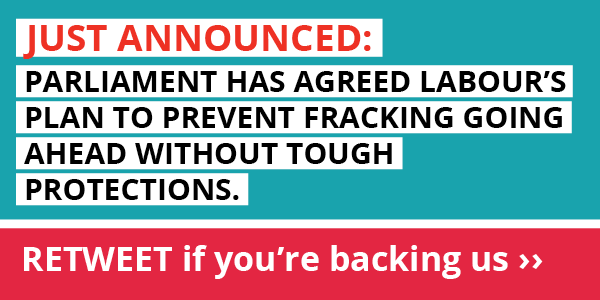
Update: The successful part of the proposals regarding fracking, presented by various MPs were those presented by Labour regarding the introduction of rigorous safety criteria. I would have been happier to see a moratorium, however, the Environmental Audit Committee inquiry is ongoing, gathering evidence is important in policy-making. Meanwhile, the introduction of strict controls and regulations thanks to Labour means it is now extremely unlikely that the Tories can plough ahead with their plans to go ahead and frack this side of the General election.

From the Guardian: the government made a major U-turn on plans to fast-track UK fracking on Monday after accepting Labour proposals to tighten environmental regulations.

David Cameron had previously said the government was “going all out” for shale gas development, but widespread public concern and a looming defeat by worried Tory and Liberal Democrat backbenchers forced ministers to back down.

The Guardian revealed on Monday that George Osborne, the chancellor, was demanding “rapid progress” from cabinet ministers, including delivering the “asks” of fracking company Cuadrilla.

But the changes accepted by ministers would ban fracking in national parks, areas of outstanding natural beauty and in areas where drinking water is collected, with the amendments collectively ruling out significant regions of the UK’s shale gas deposits. The new regulations will slow down exploration by, for example, requiring at least a year of background monitoring before drilling can begin.

Embedded image permalink


TORIES SPENT £114,000 ON FACEBOOK LIKES AND ADS IN JUST ONE MONTH – Political Scrapbook

1209102_539900659412800_1664499134_n

Many thanks to Robert Livingstone

Article originally posted on Political Scrapbook, 13 Jan, 2014.

They’ve already been accused of trying to “buy the General Election” by quietly raising the legal spending limit by £6.2 million to £32.7m in the face of concerns from the Electoral Commission over ‘undue influence’. The party has reportedly amassed a war chest of more than £70 million.

So if you want a flavour of how much cash Tories could be splashing on their bid to retain power, have a look at the document below. It’s a £114,000 invoice from Facebook to the Conservative Party — and that’s for just one month.

The bill (which Scrapbook obtained as part of the spending returns for the Rochester and Strood by-election) is dated 2 December and lists its ‘billing period’ as ‘NOV-14′.

Tory Facebook invoice

The invoice is itemised as follows:

  • “Email Collection New” — £71,147.25
  • “Page likes – Conservatives” — £23,998.82
  • “4040 Likes” — £12,713.38
  • “Kelly Tolhurst for Rochester and Strood” — £3,084.41
  • “Video advertising” — £4,014.35

If this is representative, it means they could be spaffing around £1 million per year on Facebook alone.

Cameron, debt and misinformation – Richard Murphy

10689499_731152076954323_875040546185242333_n

Originally posted on Tax Research UK,  12 January 2015

The Guardian reports this morning that:

Britain will be on the “path to ruin” if Labour takes charge of the public finances, David Cameron will say on Monday as he warns parents and grandparents of the dangers to future generations if the country fails to deal with its debts.

So let’s talk debt:

All data is from the HM Treasury Pocket Bank for 30 September. I have extrapolated 2014/15 borrowing form the August data to suggest whole year borrowing of just over £107 billion based on average proportion of total year borrowing to 31 August over the past five years.

The conclusions are stark: the Coalition has borrowed more than four times more a year than 3.3 times a year what Labour did, on average.

In five years the Coalition has borrowed more than Labour did in 13, by a considerable margin.

And there wasn’t an unforeseen banking crisis on the Coalition’s watch.

But what’s very odd is the data on gilt yields from the Government. In April 1998 long dated gilts yielded 5.71%. A decade later that was 4.5%. By April 2012 it was 3.31% and in April 2014 this had little changed at 3.46%, but now it is 2.62%. If we had a debt crisis very clearly risk would have increased and so interest rates would have risen. But they haven’t. Interest rates have fallen, significantly, and not just to reflect inflation.

So first of all we have no gilt crisis.

Second, we have no affordability crisis.

And third, we have a lost opportunity to invest at rates lower than we have almost ever known, which lost opportunity is why we have an economic crisis.

It’s very hard to see how one man can get as much wrong as David Cameron can in the repeated sentiment he has to offer to the UK. But the evidence is clear: every single word of what he has to say is deeply misleading because it is so wrong. After five years in office all he has learned is that keeping repeating the misinformation is the only policy he can find that he still thinks worth pursuing. And, unfortunately, some still believe him.


Labour MPs speak out against the TTIP and investigation opens into the impacts on environmental protections

923022_488684277867772_33457858_n

The impact of the controversial Transatlantic Trade and Investment Partnership trade deal on environmental protections in Europe is to be investigated by parliament. Opposition MPs will examine if the agreement could weaken regulations on chemical and pesticide use, oil and gas extraction and genetically modified food.

The Transatlantic Trade and Investment Partnership (TTIP) is a planned free trade agreement between the European Union and the US. Those who support it claim that it will “boost” economies. However there have been many concerns raised regarding this agreement. Critics say that not only have the economic benefits of TTIP have been overstated, it will additionally put downward pressure on regulation in sectors such as health and the environment and poses a significant threat to national democratic decision-making.

Worryingly, moves by a future democratically elected government to put the deregulation process into reverse and bring our public services – including our NHS, railways, water, energy and other utilities – back into public ownership would be confronted by an international court system (ISDS) where lawyers will judge what is or is not a barrier to “free trade”. And it will be carried out behind closed doors. Corporates can go on to sue nation states that stand in the way of “free trade” and threats to future as well as actual losses to profits.

In August 2014, Labour MP Katy Clark urged David Cameron to stop the EU-US trade pact from opening more public services to the private sector.

The Transatlantic Trade and Investment Partnership (TTIP), which has remained under negotiation behind closed doors, “would let companies sue if national governments pass laws that hurt profits,” Ms Clark warned.

This is bad news for our existing public services such as the NHS, or other services that we may wish to take back into public ownership such as the railways.

“Private companies already run certain services but under the new plans the government would never be allowed to run these again, as doing so would hurt the profits of the companies involved.”

Since discussions on the content of the Treaty have remained secret, its exact content is unknown, (including to the Labour Party) but private firms on both sides of the Atlantic are keen to use competition rules to force open what remains of the public sector.

During a parliamentary debate in February, secured by back bench Labour MP John Healy, Labour MPs, including Katy Clark, raised many concerns about the TTIP.  Jeremy Corbyn said: “Why is there such secrecy surrounding the negotiations? Why are not all the documents on the table? Why are the demands made on European public services by the American negotiators not made public? Why are not the demands made in the other direction also made public? I suspect that, if the agreement ever comes to fruition, every Parliament in Europe and the US system will be presented with a fait accompli: they will be told that they have to accept it.”

Ian Lavery  commented: “A number of people have said that there must be a good business case for the transatlantic trade and investment partnership. I think that we need much more than a good business case. I am concerned that there are huge inherent dangers in the TTIP for many working people and for public services in the UK. My major concern is that the trade agreement has the potential to dilute workers’ rights.”

Katy Clark, the North Ayrshire and Arran MP, wrote to the Prime Minister urging him to protect public services and pointed out that France won the right to continue supporting its film industry and that the US had blocked any deal on its finance sector.

She said: “If the leaders of these countries can protect what’s important to them, then David Cameron can do the same for Britain.”

Neil Clark from the Campaign for Public Ownership, said the Labour MP’s warning was timely as people had “still not woken up to the consequences of TTIP.”

“It is fundamentally undemocratic, since though large majorities of the public are in favour of renationalising key services such as the railways or energy, subsequent governments would be unable to do so without breaking the terms of the pact.

“But it would impose privatisation forever and must be stopped in its tracks.”

Angela Eagle said: “I know that following widespread public concern, the European Commission halted negotiations on the investor state dispute settlement (ISDS) section of TTIP pending the outcome of a public consultation. I appreciate that there are serious concerns about the potential impact of the ISDS provisions and I hope that the European Commission will consider the responses to this consultation carefully.”

In November last year, Labour MP Clive Efford, with the backing of the party’s leadership, called for the exemption of the NHS from the trade deal. It was a victory for the Private Member’s Bill to repeal the Tory privatisation of the NHS and Exempt the NHS from the TTIP Agreement. Mr Efford said: “The Bill will not save the NHS overnight – only the election of a Labour government can do that. But it does give all MPs the opportunity to accept that the 2012 Act has been a disaster and to begin to create an NHS which puts patient care at the centre of all it does, not private profit.”

Andy Burnham, the shadow Health Secretary, claimed that signing TTIP could jeopardise the founding principles of the health service. The many critics of this trade agreement fear that the deal would leave the NHS vulnerable to takeover by American healthcare giants and undermine the principle of a service free at the point of delivery.

Joan Walley MP, chair of the Commons Select Environmental Audit Committee (EAC), which launched its inquiry on 8th January, said: “We will be investigating whether it really is possible to sign such a deal and at the same time safeguard European environmental standards, as negotiators have claimed.

Greater transatlantic trade and investment could be beneficial for Britain, but we must monitor these talks carefully to ensure they are not trading-in the rules that keep our food and environment safe.”

A recent report from the Center for International Environmental Law (Ciel) argues that the European chemical industry wants the US system of chemical risk assessment to be adopted, which the group says would allow the use of over 80 pesticides currently banned in the EU. Other campaigners say US biotech companies want to use TTIP to open EU borders to imports of genetically modified food.

Samuel Lowe, from Friends of the Earth, said: “With the potential for essential environmental and food standards to be discarded as ‘trade irritants’, the TTIP presents a unique challenge to the health of our environment. The EAC should scrutinise the proposals and ensure that these serious concerns are no longer brushed under the carpet.”

Absolutely. Labour has said very clearly that they won’t back this Treaty unless the NHS and other key public services are excluded. The crucial inquiry, which Labour MPs have called for is welcome. It`will focus on the potential environmental impacts in the UK of TTIP, including through changes to regulations and product standards and the operation of an “inter-state dispute settlement” regime; and on the potential effects on developing countries. Gathering evidence is an essential when it comes to the process of agreeing, formulating or rejecting policies


Further reading:

The coming Corporatocracy and the death of democracy

Just what will TTIP mean for our jobs, environment, consumer rights – and publicly provided health service?

Lord Howe said we couldn’t exempt the NHS because it would place our pharmaceutical companies at a disadvantage.

If we don’t do something about the TTIP it may be all of us who will be at a disadvantage.

And one thing which is clear is that the TTIP will open up the NHS to American private health companies.”

There are some things we just can’t afford to risk – and the NHS is one of them.
Andy Burnham has already been to Brussels to discuss NHS exemptions.
Labour is committed to them.

“The report – on the workings of NAFTA – the North American Free Trade Agreement – which has been around for 20 years suggests we may need to go further – and we certainly need far more open discussion of what’s at stake.

This is something the LibDem/Tory Coalition seem very reluctant to have.
Could the pattern of funding of the Tory party have anything to do with that?

We merely ask.” – TTIP/ EU-US Trade Agreement – you can’t trust the LibDem/Tory Coalition with the NHS Alex Sobel MP


Pictures courtesy of  Robert Livingstone

Some thoughts for 2015

10635953_696483917087806_7307164383030383606_n

In one respect, I think there is nothing new under the sun when it comes to socio-political ideas. Underpinning political ideologies basically tend towards either an elitist, individualist, traditional, prescriptive and regressive narrative or a democratic, collectivist, divergent, responsive and progressive one. The latter is a relatively recent part of our history, evolving as a response to the harsh and oppressive social conditions imposed by the former.

And one of the themes throughout my writing this past two years is that we need to grasp the meanings offered by the learning opportunities of history in order to progress. But here we are, with a government that has undone 100 years of civil rights achievements in just 4 years. It’s a government that will scrap our Human Rights Act and withdraw from the European Convention on Human Rights (ECHR) given the opportunity – another 5 years in office.

I’ve written at length on this site about how and why human rights arose and why we need them. To undo the progressive international laws that were developed in response to the atrocities of World War 2 and in response to fascism would be a terrible and historic tragedy with horrific ramifications for democracy. Human rights provide basic protection from corrupt and fascistic governments. The UN declaration of Human Rights is founded on the tenet that each and every human life has equal worth.

Human Rights are our means of protection from uncivilising forces, brutal regimes, fascism, totalitarianism, inequality, social injustices and genocide. The Coalition are currently in breach of the UN conventions of the rights of women, children and are under investigation for gross abuses of disabled people’s human rights. This is frankly terrifying. The government hasn’t simply betrayed us as a society, pushing at established moral and legal boundaries, it has betrayed each of us on an intimate level. The consequences of Coalition policies intrude on people’s lives, re-shaping experiences, causing damage and harm. Those who have, so far, escaped the consequences of this government’s draconian policies are reduced to either denial or bystander apathy and tainted by it. The harm being inflicted isn’t just on a material level because of the cuts: it’s damaging on a psychic level, too.

This is the time we live in. We have regressed so much as a society in such a short space of time. This past four years have been a political process of uncivilising, and have seen the wilful destruction of much of the gains made from our progressive post-war settlement.

One of my areas of interest is ideology and how that translates into policies. The Human Rights Act was a Labour legislation, and the last Labour government signed us up to the rights of disabled people’s convention. They also gave us the Equality Act, and the current government have been quietly editing that. But without those laws, we would not have won the handful of cases that we have against the current administration. Human rights are paramount – the very foundation of democracy and civilised society.

Ideology narrates and informs policies. It tells us something of what a government intends to do. Most of the people reading here are not surprised at what the Tories have done, though we are still shocked. I’ve lobbied Labour for the past few years, seeking clarity regarding their own intentions towards the most vulnerable citizens. They have responded steadily and positively. There are still some issues that need to be addressed, such as the legal aid bill. But I appreciate that review, evidence and costing have to happen before any policy repeal. That is how needs-led policy happens.

I have already said this many times, but will say it again because it’s crucially important. The electoral system is currently established as pretty much a two party competition. Other fringe parties have drawn some support away from the main two, but none of these have developed sufficiently  to give us a credible, clear, coherent and viable alternative to the mainstreamed narratives.

The only way to see  positive change and protect our citizens is a Labour vote as it stands. We don’t have an ideal situation, sure. But this is not the time to be protest voting or experimenting with radicalism, because our society as a whole is in peril, and many of us  won’t survive another Tory term.

We must not risk another 5 years of uncivilising, regressive, punitive and damaging right-wing policies and I can’t condone the actions of those intent on splitting the left-wing vote. Besides, I’ve yet to see a set of policy proposals, costed and evidenced, that are as clearly stated and positive as Labour’s are, to date. If you value our NHS, public services, equality, education, welfare, human rights, democracy, freedom of speech, justice, animal welfare and rights and ecology, amongst other things, then the only way to preserve and enhance those is through a Labour government.

It was Sue Marsh who said something along the lines of “let’s get out of hell first, then we can work on building our utopia.”

She’s right. We will never make any progress if the Tories remain in power. Ever.

We must be vote them out. Labour is our safest and most viable option.

That is our only starting point, without a Labour victory in 2015, we cannot make progress and evolve as a society at all.

Stepping into 2015, I’m armed with hope that this year we will see a process begin again that will shape a world that is fair, safe, civilised and a comfortable place for all and not just a few.

Wishing everyone the very, very best for 2015.

Upwards and onwards.

Related:
Ed Miliband’s message is a statement of hope for the future –  Ed Miliband’s New Year Message: “2015 is a year of possibility, the chance to change direction”.
Ed Miliband’s policy pledges at a glance
47 more good reasons to vote labour
Political parties – there are very BIG differences in their policies.


Ed Miliband’s New Year Message: “2015 is a year of possibility, the chance to change direction”.

Here is Ed Miliband’s New Year speech, which reflects the needs of the nation: it is responsive and offers us a message of hope for the future:

Transcript of the speech:

“I want to wish you a very Happy New Year, from my family to yours. This is the season for new beginnings and hopes for the future. And Britain is ready for a new beginning. Because I don’t have to tell you that all over our country today, there are people working harder and harder, but standing still: families struggling with bills that are growing faster than their wages; young people, taking on mountains of debt to get a proper education, only to find themselves with no job at the other end; and an NHS where people are waiting longer and longer to get the care they need.

“It doesn’t have to be this way. As this New Year dawns, we have the chance to change direction; a chance to build a recovery for all of Britain; to fight for policies that actually honour and reward hard work; and hold the banks and energy companies accountable. We have the chance- all of us together- to fight for a new plan that cuts our deficit responsibly, without threatening our NHS or short changing our children and their future. This year, we have the power to bring about the change working families all over Britain need. This isn’t about idle dreams or empty promises. It’s about a real, concrete plan: a plan for a recovery which reaches your kitchen table.

“In the coming months, I look forward to sharing our ideas with you about how we raise wages, give our young people a proper chance to get on, set fair rules for immigration and rescue our NHS. None of this will be easy or instant. But it is possible if we run the country in a different way: with a different idea, a different plan: putting working people first. And I know we will be a better, stronger and more prosperous country for it. So this is a moment of possibility for Britain. We have it within our grasp not just to see out the old year but to see out the old ways of running the country. Can we do it? Of course we can.

“This coming year, we mark the seventieth anniversary of the end of the second world war, when our parents and grandparents overcame the most daunting odds to rebuild. After the war, badly battered and deeply in debt, Britain rose again. We built the NHS, a modern welfare state, homes for people to live in and still dealt with our debts; we set the stage for a generation of progress for working people. Today’s challenges are different. But if we could walk through those fires, we surely can meet the problems of our time. We can build a country that works for everyday people. Change is possible if we reach for it. If you are one of the millions of people who think Britain can do a lot better, I am with you. I am with you and this year, together, we can bring about the change we need.”

Related:
Ed Miliband’s policy pledges at a glance
47 more good reasons to vote Labour
Here’s what I believe – Ed Miliband
Ed Miliband’s 10 Biggest Successes as Labour Leader, at a glance – LabourLeft
Ed Miliband is an excellent leader, and here’s why.
Miliband’s New Year message hits the nail on the head
– Mike Sivier


Revealed: Labour did NOT pilot the Bedroom Tax – Mike Sivier

Thanks to Mike at Vox Political for debunking this myth.

141230SNPbedroomtaxlie

The ‘infographic’ above is very popular among Scottish nationalists at the moment. In line with the wishes of the Scottish National Party (SNP), they are working hard to smear or discredit the Labour Party in order to undermine its support north of the border. There’s just one problem.

The claim is untrue.

The facts were revealed by a Labour councillor, Paul Bull, on Twitter today (December 30) after Yr Obdt Srvt spent yesterday evening arguing the matter with some particularly avid nationalists.

“I too was concerned by Malcolm Wicks’ comments in Hansard that seemed to suggest [a] Bedroom Tax pilot,” he tweeted. “So troubled that I decided to research what form that Bedroom Tax pilot took. That research … has even gone as far as the House of Commons Library.”

Then he wrote:

141230bedroomtaxfact

So this was a scheme that was announced by a Labour minister, certainly – but the Labour government of 2001 did not go through with it.

So much for the nationalists’ claims. “Oh what a tangled web we weave, when first we practise to deceive”, as someone once said. Or, more appropriately (perhaps), “The best-laid schemes o’ mice an’ men gang aft agley”.

Cllr Bull continued: “However, back then Labour did do something to encourage social tenants to downsize, where many local authorities offered cash incentives to encourage [it], and this scheme was available to ALL social housing tenants, so not just those on Housing Benefit.”

He provided information on Exeter City Council’s schemes, which are available to read here and here. The second link is to a PDF file which may not open in some browsers.

He concludes: “Elements of [the] Exeter Council scheme [are] still in place but incentives are not so generous. But Exeter Council now employ a Downsizing Officer to assist social housing tenants who do want to move.”

The reality, it seems, is a long way away from the harsh brutality of the Coalition’s Bedroom Tax, with which the SNP and its supporters hoped to tar the Labour Party.

Next time anyone tries to tell you Labour had anything to do with the Bedroom Tax, point them to this article.

How can people trust the SNP when it launches lying smear campaigns like this?


See also: Debunked: More claims about LHA and the Bedroom Tax