Category: Uncategorized

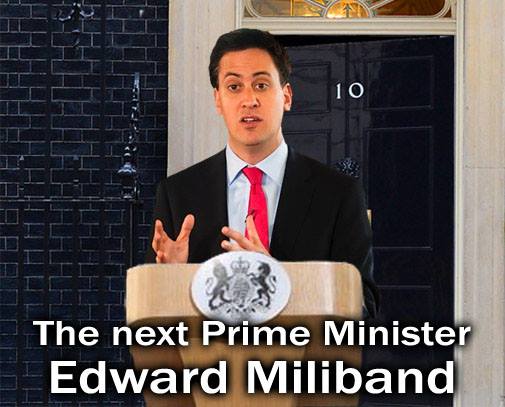
The establishment are ‘frit’ because Ed Miliband is the biggest threat to the status quo we’ve seen for decades

10424302_677497562319775_766713150422913861_n“We’re in a fight not because our opponents think we’re destined to lose the election. But because they fear we can win. And between now and the election they are going to use every tactic to try to destabilise, distract us and throw us off course. Our task, the task for every person in this party, is simple: To focus our eyes on the prize of changing this country.” Ed Miliband.

Ed Miliband has pledged to take on “vested interests” and “powerful forces” in his bid to win the next general election. Not even the Crosby and Murdoch-orchestrated media campaign, which was aimed at demoralising, undermining and monstering Ed Miliband can disguise the fact that the Tories are in a state of panic.

In fact the media campaign, aimed at attempting to undermine Miliband’s credibility as a leader, arose precisely because Miliband is the biggest threat to the UK power base and status quo that we’ve seen for many decades. He’s challenging the neo-liberal consensus of the past 30 years – now that is a plain indication of strong leader, and someone with personal strength and courage.

As for the media, and the attempt at agenda-setting, well we’ve known for the past four years that there is now a big chasm between what is real, and what is deemed “newsworthy”. Because the mainstream media have no interest in public interests, only vested ones. It’s about time that we reclaimed our democracy and showed them that WE set the agenda, not overpaid and highly corrupted journalists and editors. Or monopolies like the wake of scandals that is News Corp.

In his inspiring speech at the University of London, Ed Miliband said he would tackle a “zero-zero economy”, saying people were on so-called zero-hours contracts while the rich “get away with zero tax”. He talked about the Labour policy to defend our NHS – currently being fragmented by a privatisation programme that no-one voted for – which was particularly welcome, funded by a clampdown on tax avoidance and taxing hedge funds and cigarette companies.

He said he would “I am willing to put up with whatever is thrown at me in order to fight for you.”, and that it was the party’s “duty… not to shrink from the fight, not to buckle under the pressure but to win”.

This is a very strong indication of a very strong leader, who won’t be threatened or intimidated by Crosby’s dog-whistle, negative smear campaigning tactics. Miliband has indicated quite plainly that he intends to return to the “true soul” of the Labour Party, his frequent use of the inclusive word “together” putting social solidarity back on the agenda, and heralding a new politics of social and economic democracy. Miliband is about a politics where no-one is abandoned.

Shadow health secretary Andy Burnham said there had not been a “shred of truth” in a newspaper story linking him with a leadership plot, calling it “pure fiction”.

Speaking on BBC Radio 4’s Today programme, he said Mr Miliband had shown “courageous leadership” in the face of attacks from “vested interests” who did not want Labour to win.

He added: “There has been a campaign in the last few days to destabilise and demoralise us.

My message today is that it won’t work, in fact it is going to galvanise us.”

And it has.

Miliband said Labour would talk about immigration: “but always on the basis of Labour values, not Ukip values.” He added: “We know that the deep discontent with the country gives rise to those who suggest false solutions. But unlike the Tories, what we will never do is try to out-Ukip Ukip.” I found this particularly reassuring, as a consistent reflection of traditional Labour inclusion, equality and diversity principles.

Miliband certainly has the fight and belief in what is right to get into Downing Street, he is  “driven by how we must change the country. That is why I am in this job, that is why it matters to me, that is what drives me on.” Quite properly so.

He said he wants to be prime minister because the country was “deeply unequal, deeply unfair, deeply unjust”.

This inequality is not some accident. It is driven by beliefs about how you run countries and how we should run Britain,” he said.

Wrong beliefs.

The belief that insecurity is the way you make working people work harder.

[I swear Mr Miliband could have written Conservatism in a nutshell!] 

The view that low pay is the only way we can compete in the world.

The idea that markets will always get the right outcome, even if that means powerful interests have all the power.

The notion that we cannot afford decent public services when money is tight.

And above all, the most mistaken view of all, that the success of the country depends just on a few at the top.

And when they do well, everyone in Britain does well.

These are the failed ideas of the past.

Beliefs that have had their time.”

This isn’t the speech of a “career politician”: it’s the speech of a partisan, conviction politician, Miliband is precisely the prime minister that this country so desperately needs.

Meanwhile, Nick Clegg has ignored official rebukes from the OBR and ONS for telling lies, and has taken to the same tired old lying again, claiming that the previous Labour government “left the economy in a mess”. A remarkable comment from a deputy prime minister, who’s government have borrowed more in 4 years than the last Labour government borrowed in 13,  and whose “Economic Plan” has depressed real wages for the past 4 years, causing extreme hardship, and the return of Victorian levels of  absolute poverty and inequality, affecting many UK citizens. Perhaps Clegg is hoping the public have forgotten that it was the Coalition that lost us the Moody and Fitch triple  A credit ratings, and not Labour.

And in light of yesterday’s news concerning the foreign exchange fines, as banks were handed £2.6bn in penalties for market rigging, even George Osborne conceded that “Today we take tough action to clean up corruption by a few so that we have a financial system that works for everyone. It’s part of a long-term plan that is fixing what went wrong in Britain’s banks and our economy.”  The recession in 2007/8 was caused by a global banking crisis which began with the collapse  of Lehman Brothers, a sprawling global bank, in September 2008, which almost brought down the world’s financial system.

Brown steered us out of that recession by 2010, and the Tories, with their bogus austerity plan, designed to reward the wealthy with more wealth, taken from the poorest, and least able to shoulder the burden of the cuts, put us back into recession. Tories ALWAYS cause recessions, just like Thatcher and Major did.

Labour builds, the Tories always destroy.

scroll2

A must read: Ed Miliband’s powerful speech 

An excellent summary of Ed Miliband’s values and views:  Here’s what I believe – “People sometimes say to me politicians are all the same. That couldn’t be further from the truth. So let me explain what I stand for, in the simplest terms”.

Ed Miliband is an excellent leader, and here’s why.


10359559_723668077702723_4383422308887814918_nThanks to Robert Livingstone


Will GPs be bribed to put you back to work? – Mike Sivier.

Fit note: could GPs be paid to get patients back to work? (Photo: JH Lancy for GP Online)

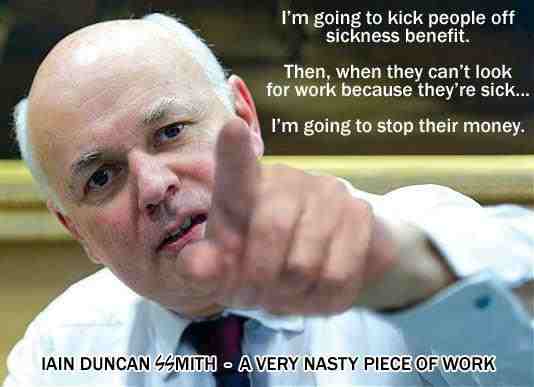
Doctors could ask for funding from the Department of Work and Pensions (DWP) to ensure patients go back to work quickly, a top NHS England official has suggested, according to GP Online. Is this the next stage in Iain Duncan Smith’s war on the sick?

Addressing the annual conference of the out-of-hours provider body Urgent Health UK, Professor Keith Willett, national director for acute episodes of care, said getting a patient in to see a GP quickly and issued with a return to work certificate could save the government two weeks of benefits payments.Oh really? And what if the patient isn’t better by then?

He said: “So, in the same way as health has given social care the Better Care Fund, and said “come and help us out”, we could, arguably, go to work and pensions and say, ‘Excuse me, we can get them to go back to work seven days quicker. Can we have some of your money to be able to do that?’”

Correct me if I’m wrong, but the gentleman seems to be admitting that doctors are signing people off work who don’t need it – and suggesting that the DWP should bribe them into sending people back to work.

Why is he following an Iain Duncan Smith narrative that has not been proved?


Miliband is an excellent leader, and here’s why.

10424302_677497562319775_766713150422913861_n
Breaking news: Thirty MPs. and almost the entire nation demand that Cameron stands down. UKIP defectors say he’s not leadership quality, and can’t eat a chip butty without looking stupid, and Lynton Crosby blames Labour…

Odd, isn’t it, that the media didn’t declare that Cameron’s leadership is in crisis, recently, with the two high profile UKIP defections.

Rumour-mongering in the media, paraded as newsworthy headlines, about “discontent” over Miliband’s leadership is based almost entirely on two cowardly backbenchers – who have curiously chosen to remain anonymous and thus remain conveniently unquotable – grumbling about Miliband.

Welcome to the new era of media-amplified political campaigning Crosby-style: the politics of spite.

Not only is this malicious approach meant to be potentially profoundly damaging to Miliband, but to candidates and of course, to the millions of people that are suffering enormously under the current regime, who desperately need a Labour government. It’s an attempt to divide the party and its supporters. But isn’t that what the Tories always do?

I wonder if the positive comments about Miliband and the support from Labour shadow minsters will make it into the mainstream media, after all, these far outnumber the comments of a pair of anonymous backstabbers. I somehow doubt it.

Tristram Hunt, the shadow education secretary, said Miliband was on course to become an “innovative, reforming, radical” prime minister.

Miliband is being so viciously but insubstantially attacked, and on such a superficial level, precisely because he is the most left-wing leader of the Labour party for decades.

The right-wing and their lackeys in the media are engaged in an all out propaganda war. Firstly they right know that Ed Miliband has edited their script, abandoning the free-market fundamentalist consensus established by Thatcherism in favour of social democracy. Secondly, the right-wing media barons who set the terms of what is deemed politically palatable in Britain have never forgiven Ed Miliband for his endorsement of Leveson, which they believe is an unacceptable threat to their power. Thirdly, they know Labour under Ed Miliband is set to win the 2015 election.

Socialism for a Sceptical Age, by Ralph Miliband was about the continued relevance of socialism in a post-communist world. Ed Miliband has said that the final few sentences of this book are his favourites of all his father’s work:

In all the countries there are people in numbers large and small who are moved by the vision of a new social order in which democracy, egalitarianism and co-operation – the essential values of socialism – would be the prevailing values of social organization. It is in the growth of their numbers and in the success of their struggles that lies the best hope for mankind.”  

“Socialism is not a rigid economic doctrine, but ‘a set of values’ It is ‘a tale that never ends’. Indeed, the strange fact is that  while there’s capitalism, there’ll be socialism, because there is always a response to injustice.” Ed  Miliband. (Source – The moment Ed Miliband said he’ll bring socialism back to Downing Street .)

This provides a good insight into what Miliband is all about.

And he’s right.

Yvette Cooper, the shadow home secretary, and Andy Burnham, the shadow health secretary, said the speculation in the Times was a lie.

Andy Burnham told Sky News: “The stories in today’s newspapers are complete and pure fiction. There is not a shred of truth in them.

What I think it’s part of is a deliberate and desperate attempt to destabilise the Labour party and to divide us. But I can say this: it won’t work. We are a united team, we are united behind Ed.”

Rachel Reeves said: “A Labour government will make a huge difference to the lives of millions of people. But we’ll only get one if we stay united behind Ed Miliband.”

Chuka Umunna, the shadow business secertary, hailed Miliband for taking Labour to within “touching distance” of government. In his blog on the PoliticsHome website he wrote: “We have a leader who has kept us united and overseen the renewal which so eluded us at the end of our time in government. Ed is an honest, sincere man of deep beliefs, and these are just some of the reasons why I backed his campaign to become leader. In an era of extreme scepticism about politics, these are not qualities most people attribute to politicians. What is too often not remarked upon is that these are qualities which people – even our political opponents – attribute to Ed.”

I agree entirely. Miliband is consistently honest and has shown integrity. And another one of Miliband’s greatest virtues is that he re-humanises politics. For him, people’s individual experiences matter, and he always cites many examples throughout his speeches. He includes qualitative accounts from real people. It’s a particularly contrasting quality to Cameron’s unempathic, dehumanising, quantitative, scapegoating, and negative labelling approach.

As I have previously said, the Tories always strive to foster divisions, or the illusion of them. One of their approaches has been to perpetuate an impression that MPs are “allthesame”.  This  myth came straight from Tory HQ.

BBC’s Tory correspondent Nick Robinson admitted live on air that Cameron’s best chance of winning the next election is if people believe politicians are “all the same”. But that is very clearly not the case. I think one major ploy has been to use propaganda based on an exclusively class-based identity politics aimed at the “working class”: an approach that UKIP have most overtly tried to adopt. The Tories are more about subterfuge and covert propaganda.

Identity politics purposefully excludes other social groups and also sets them against each other, for example, working class unemployed attacking migrants – it’s really is divisive, anti-democratic, and quite deliberately flies in the face of Labour’s equality and diversity principles. That’s the problem with identity politics: it tends to enhance a further sense of social segregation, and it isn’t remotely inclusive.

Of course it also enhances the myth of “out of touch”/ “allthesame”. It’s a clever strategy, because it attacks Labour’s equality and inclusive principles – the very reason why the Labour movement happened in the first place – and places restriction on who ought to be ‘included’. Think of that divisive strategy 1) in terms of equality. 2) in terms of appealing to the electorate 3) in terms of policy. Note how it imposes limits and is reductive.

Only a year ago, even the Torygraph stated that Ed Miliband is proving himself to be a brave and adroit leader. If Mr Miliband is remembered for nothing else, his stand on Syria changed the course of history. The Murdoch media empire, propagandarising for the US-led wars of the last two decades, is now isolated in its obsessive screeching for military action, and the fact that MPs ignored the bellicose pro-“intervention” editorials in Murdoch papers is a clear indication as to just how much they are declining in influence.

Let us not forget that it has been an iron law of politics since most of today’s Cabinet were in nursery that you do not “take on” Rupert Murdoch. And that if you were foolhardy enough to try, you would end up fatally weakened.

Ed Miliband did. He has shown he has principles and courage on many occasions, sadly this is very seldom reported and reflected fairly in the media. And Miliband didn’t just take the easy option of calling for specific action targeted at the paper where the hacking scandal began – that would have been a safer way of doing it – but by calling for a whole judicial enquiry. Rupert Murdoch probably thought that Ed would leave it at that. But no, when the leader of the Opposition turned up at the proceedings of that enquiry, he said explicitly that if he were Prime Minister, he would seek to limit the percentage of media that one man could own. Quite properly so.

Then there was the banks. Many in the Labour party would have preferred him to stick safely to making outraged noises about misconduct, Miliband pushed for one wide enough to cover the whole culture of banking which had led to the global crisis – a much bigger threat to the banks. After that, Ed threatened them with separation between their investment (casino) and retail (piggy bank) arms. Each time Miliband had the opportunity to ease off, he went further. These are not the actions of a weak leader.

Some will argue that the banks and the media were both wounded giants: once-powerful interests which had been left limping by the financial crisis and the phone hacking scandal respectively.

But Ed Miliband didn’t stop with them. In the last few years he has taken on the energy companies too. Not in a small way either, for example, by threatening to legislate to make sure that they give the elderly their cheapest tariffs (although he has done that too). But by actually threatening to break up the Big Six unless they start giving consumers a better deal. That is not a small threat for a potential Prime Minister to make.

I have every faith in this man, as a decent, principled and strong leader of the Labour party and future Prime Minister.

When Miliband clearly outlined his view that there needed to be a proper international process at the United Nations that was evidence-led regarding Syria, he argued powerfully that we needed the “time and space” to come to a judgement and that we shouldn’t rush headlong into a political timetable that was being driven elsewhere. A government source told the Times, unbelievably: “No 10 and the Foreign Office think Miliband is a fucking cunt and a copper-bottomed shit.”

Several churlish Tory Ministers, regrettably, chose to heckle him with the word “weak”.

They wish.

scroll2

Here are 46 more reasons why Miliband is an excellent leader, with a sound foundation of effective and much-needed costed and evidence-based policy proposals:

1. Labour pledge to build  200,000 by 2020, focusing on social housing.

2. Labour pledged to create a State-Owned Rail Company that would compete and win back Rail Franchises.

3. Labour vow to cut business rates for small firms.

4. Labour vowed to introduce an increased Bankers’ Bonus Tax if they win in 2015.

5. Labour promised Free Childcare worth £5,000 a year for working parents who had children aged 3&4.

6. Labour committed to Sacking ATOS, Serco and G4S if they win the election.

7. Ed Miliband promised to repeal the Bedroom Tax.

8. Ed Balls pledged to reverse the Pension Tax relief that the Tories gifted to millionaires.

9. Labour promised to reverse the Tory Tax cut for Hedge Funds.

10. Labour pledged they will create 200,000 Apprenticeships

11. Ed Miliband vowed to increase the fine levied on firms not paying the Minimum Wage by 1000% to £50,000.

12. Labour are to introduce a new Disability Hate Crime Prevention Law.

13. Labour would freeze gas and electricity bills for every home and business in the UK for at least 20 months, the big energy firms would be split up and governed by a new tougher regulator to end overcharging.

14. Voting age to be lowered to 16.

15. NHS to be re-nationalised.

16. Miliband also said that any private company that does not meet the needs of the public will be brought under state control.

17. Labour will ban exploitative zero hour contracts.

18.  Labour have pledged to introduce a living wage.

19.  Labour have pledged to reverse the £107,000 tax break that the Tories have given to the millionaires.

20. Labour will reintroduce the 50p tax.

21. Labour will repeal clause 119.

22. Labour will introduce a law making Private Companies subject to the Freedom of Information Act.

23. Labour will introduce a Mansion Tax on properties worth more than £2 million

24.  Labour will make up the difference to the value in the minimum wage is restored, reversing the Tory cut of 5%.

25. Labour will halt Michael Gove’s Free School Expansion Programme.

26. Labour will abolish the Tory ban on Local Education Authorities opening State Schools once more.

27. Labour will scrap George Osborne’s “Shares for Rights” scheme that has opened up a tax loophole of £1 billion .

28. Labour will launch a full public inquiry into blacklisting.

29. Labour will ensure Water Companies place the poorest households on a Social Tariff that makes it easier for them to pay their Water Bills.

30. Labour will double the tax duty on Pay Day Lenders and will use the additional £13,000,000 that raises to help foster more Credit Unions.

31. Labour will impose a cap on the cost of credit, setting a limit at which Pay Day Lenders can charge borrowers.

32. Labour will regulate food labelling to simplify pricing so that Supermarkets cannot con customers.

33. Labour plan to introduce a Bill that would ban Recruitment Consultancy firms from only hiring abroad & ban firms from paying temporary workers less than permanent staff.

34. Labour would set up a Financial Crime Unit, with increased staffing, in the Serious Fraud Office to enable the SFO to pursue bankers who break the law.

35. Labour will break up the banks, separating retail banking from investment banking.

36. Labour will scrap Police Commissioners.

37. Labour will introduce a Forces & Veterans Bill of Rights to build upon the Military Covenant.

38. As a minimum measure, Labour will at least cut Tuition Fees by 33%.

39. Labour will introduce measures to prevent corporate tax avoidance.

40. Labour will also increase the Bank Levy by £800m a year.

41. Labour will scrap the Profit Tax Cut (Corporation Tax) that George Osborne has already announced for 2015.

42. Labour will scrap Cameron’s “Gagging” Act.

43. Labour will ensure all MPs will be banned from receiving any income from corporations after 2015.

44. Labour will tackle the abuse and exploitation of migrant labour that undercuts wages.

45. Labour will extend their 2002 public interest test to protect us from exploitative multinational takeovers.

46. Labour will end unpaid workfare.
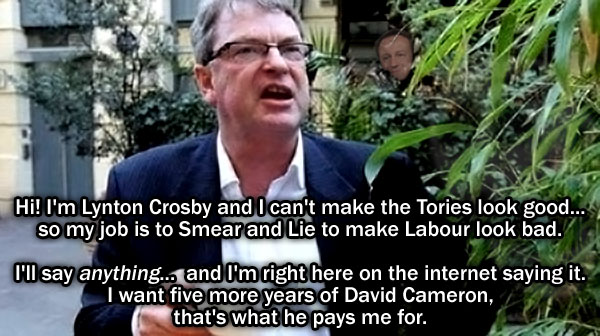
10853165213_ddb97ac601_oThanks to Robert Livingstone for the memes used in this article.


Government under fire for massaging unemployment figures via benefit sanctions from Commons Select Committee

385294_195107567306966_1850351962_n

Benefits sanctions are financial penalties that are given to people who are deemed to have not met the conditions for claiming benefits. The social security system has always been based on people meeting certain conditions – this has  been true for all working-age benefit claimants, with sanctions applicable to those who fail to observe those conditions. This has been the case since its inception.

However, the Coalition changed the conditions and increased the application, duration and severity of sanctions that apply to those claiming Job Seekers Allowance (JSA) and extended the application of sanctions to those in the Work Related Activity Group of those claiming Employment and Support Allowance (ESA). Since 2012, benefit payments can be suspended for a minimum of four weeks and for up to three years where a person “fails to take sufficient steps to search for work”, to “prepare themselves for the labour market” or where they turn down an offer of employment or leave a job voluntarily.

It emerged during an ongoing inquiry instigated by the parliamentary Work and Pensions Select Committee that Research conducted by Professor David Stuckler shows that more than 500,000 Job Seekers Allowance (JSA) claimants have disappeared from unemployment statistics, without finding work, since the sanctions regime was toughened in October, 2012.

This means that in August 2014, the claimant count – which is used to gauge unemployment – is likely to be very much higher than the 970,000 figure that the government is claiming, if those who have been sanctioned are included.

The research finding confirms what many of us already knew.

Professor Stuckler, who has analysed data from 375 local authorities, said: “The data clearly show that many people are not leaving Job Seekers Allowance for work but appear to be being pushed off in unprecedented numbers in association with sanctions.”

The Work and Pensions Committee decided to conduct a further in depth inquiry into benefit sanctions policy, following the findings of the research. This inquiry will consider aspects of sanctions policy which were outside the remit of the Oakley Review. (You can see the terms of reference for the inquiry, and submissions are invited, all details of which are here – Committee launch inquiry into benefit sanctions.)

Labour MP, Debbie Abrahams, said: “Sanctions are being applied unfairly to job-seekers, as well as the sick and disabled.

The reason the Government is doing this is that it gets them off the JSA claimant figures, so it looks like there are fewer people unemployed.”

The Government claims that sanctioned claimants who leave the benefit system are going into work – they also claim that their punitive sanctions regime “works”. But the Oxford study found this is untrue in a “majority” of cases.

Debbie Abrahams asked the Tory Minister Iain Duncan Smith how many people were excluded from unemployment figures after being sanctioned but not going into work.

In the angry exchange, during the Work and Pensions Committee questions session yesterday, Mr Duncan Smith said that Ms Abrahams’ claims were “ludicrous”.

Mrs Abraham said: “Hundreds of thousands of people have had their benefits stopped for a minimum of four weeks and then approximately a quarter of these people, from the research that I’ve seen, are disappearing.

They are leaving and we don’t know where they are going. That’s an absolute indictment of this policy and it’s a little bit worrying if we’re trying to tout this internationally as a real success story.”

Mr Duncan Smith responded: “Well I don’t agree with any of that. I actually believe the sanctions regime as applied is fair, we always get the odd case of …”

The MP for Oldham East and Saddleworth cut in and said : “People have died after being sanctioned, Minister.”

“No, I don’t agree with that,” Mr Duncan Smith answered. But he has yet to provide any evidence that supports his view.

Many of us have been calling for an inquiry following the death of  former soldier David Clapson. He died starving after being sanctioned for missing a single Job Centre meeting. David had type one diabetes, which is an autoimmune illness. He was unable to afford to maintain an electricity supply to keep his fridge running, where he safely stored his life-saving insulin. Sadly David is not an isolated case, and this government have been presented with many other cases of extreme hardship and suffering because of sanctions, which they simply deny.

Of course a DWP spokesman dismissed the study, saying: “It looks to be partially based on unreliable data.”

I don’t see how that could be the case. The data presented in the study explictly relates to people vanishing from the DWP’s records after claiming Job Seekers Allowance, who are not in work, so the comment from the DWP isn’t even a coherent, rational response.

We do know that the real problem is not people that people aren’t trying hard enough to work, or failing to try,  but rather, it is the Tories ideological obsession with austerity policies that contract the economy and fail to provide the job opportunities that people are desperately looking for. And the fact that the government are lying to hide the consequences of their damaging and extremely cruel policies.Those policies are ultimately about removing support from people that need it, as part of a broader ideological aim of dismantling welfare provision.

Since the government does not track or follow up the destination of all those leaving the benefit system, as discussed, the off-flow figures will inevitably include many having their claim ended for reasons other than securing employment, including sanctions, awaiting mandatory review, appeal, death, hospitalisation, imprisonment, on a government “training scheme” (see consent.me.uk  and the Telegraph – those on workfare are counted as employed by the Labour Force Survey.)

And it’s clear that sanctions, which are a crudely applied politicised form of punitive behaviourist pseudo-psychology, are being used to prop up an insidious ideological drive to remove people’s basic lifeline support at a time when they need it.  Sanctions are the removal of money that the state previously deemed necessary for meeting basic needs, and as such, cannot possibly be justified when all they may ever achieve is to force people to focus on basic survival rather than on gaining employment.

544547_466042163465317_917876792_n

Many thanks to Robert Livingstone for the excellent pictures.

Related

A letter of complaint to Andrew Dilnot regarding Coalition lies about employment statistics

Punishing Poverty: A review of benefits sanctions and their impacts on clients and claimants

Rising ESA sanctions: punishing the vulnerable for being vulnerable

Conservatives should repay cost of misleading tax stunt, says TUC

Over the past four years, the government has scapegoated people who need to claim benefits by blaming them for their circumstances, which are actually because of Tory-led economic policies. This is a government that is ideologically opposed to welfare provision of any kind, and we have already seen the steady dismantling of our post- war settlement, which was agreed by the main political parties at the time, and comprised of a mixed economy, a free public sector, free healthcare and education, a guaranteed state pension, social welfare provision and access to legal aid.

There was a political consensus that this was the basis for a healthy society. The provisions under the post-war settlement, together with our observation of human rights, have been the solid basis of our democratic society, until recently.

To justify their ideology, and their draconian policies, the government have used a propaganda campaign that has vilified benefit claimants, and portrayed them as a “burden on the taxpayer.” Of course we know that most people needing welfare have also paid tax, and aren’t a discrete group at all. Indeed, the poorest pay a proportionally higher percentage of tax in this country. And the government have form for telling big lies.

Thanks to the Tory-led government propaganda machine, we have a society that deems it acceptable that wealthy people don’t pay taxes, and when faced with the prospect of contributing to a society that they have taken so much from, it’s considered the norm that they complain and threaten to move abroad.

When poor people lose money, they become homeless, starve and die. That is also becoming a norm.

George Osborne has promised to send a letter out to tax payers every year, telling us where our money is being spent. The problem is that it’s just another part of the Tory propaganda campaign to portray our welfare system as a “burden on tax payers”, in order to justify  disassembling it completely. So Osborne has lied, by conflating public sector pensions with welfare, but by splitting state pensions – the bulk of our welfare bill – from the standard and established category of “welfare spending”, amongst other things. This has been done this to make the welfare budget look bigger than it actually is.

141105osbornetaxsummary
George Osborne’s grossly misleading summary

.
141105richardmurphy1
This is from Richard Murphy, from Tax Research UKwhich gives us an accurate picture of government spending.

The TUC say that the Treasury’s breakdown of how tax revenue is spent by government is a political stunt, the costs of which should be repaid to taxpayers.

The tax breakdown given in tax statements has been criticised by the Institute for Fiscal Studies for labelling a quarter of all spending “welfare”. The Institute says that this includes areas such as public service pensions and social care, whereas only 14 per cent of public spending is on working-age benefits – and much of this is spent on people in work.

TUC General Secretary Frances O’Grady said: “The Conservatives have been caught blue-handed using tax payers’ money for party political campaigning. They should now be made to pay the full costs of this stunt.”

The tax breakdown given in tax statements has been criticised by the Institute for Fiscal Studies (ILF) for claiming that  a quarter of all spending “welfare”. The Institute says that this includes areas such as public service pensions and social care, however,  only 14 per cent of public spending is on working-age benefits – and much of this is spent on people in work.

The government has started to send out information on how tax revenue is spent to individuals who pay income tax or National Insurance contributions. It has broken down spending into a number of categories. The biggest of these is “welfare”, which represents a quarter of total spending. State pensions also appear as a separate category, accounting for 12% of spending. In this observation we look at what counts as pension and welfare spending, and offer some alternative breakdowns.

Spending on state pensions is straightforward. This is essentially just the annual spend on the basic state pension and earnings-related state pensions from various different schemes.

“Welfare” spending, at 25% of the total, is taken directly from the government’s public expenditure statistical analyses. It is the total spending defined as “social protection” in these analyses, less spending on state pensions. Total spending on social protection comes in at £251 billion in 2013-14, which is about 37% of total public spending of £686 billion (before accounting adjustments). Take off £83 billion of spending on state pensions and you get to £168 billion on “welfare” – very nearly a quarter of total spending.

What is included in that “welfare” total?

It includes £28.5 billion on “personal social services”. This is a number that in many analyses one would want to report separately from other welfare spending. It includes spending on a range of things, such as looked-after children and long term care for the elderly, the sick and disabled. Unlike other elements of “social protection” it is not a cash transfer payment and in many ways has more in common with spending on health than spending on social security benefits.

Another £20 billion of the spending counted under welfare is pensions to older people other than state pensions. That includes spending on public service pensions – to retired nurses, soldiers and so on [1]. This is not spending that would normally be classed as “welfare”. The rest of the pay package of a public sector worker is included as departmental spending within the department of that worker. One could either report such pension payments separately or, like pay, as part of the relevant spending function. The pay of nurses counts as health spending. One could count their pensions in the same way.

That leaves around £120 billion of other welfare spending, which can be broken down in a number of different ways.

Since the government has chosen to report state pension spending separately, one obvious division would be to separate spending on those of working age and those of pension age. In addition to state pensions a further £28 billion is spent on pensioners, of which £15 billion goes on benefits specifically for that group, such as pension credit, attendance allowance and winter fuel payment, while the remaining £13 billion is largely spent on housing benefit and disability living allowance. So of the £205 billion or so spent on tax credits and social security benefits about £111 billion is spent on those over pension age and £94 billion on those of working age.

Figure 1 and Table 1 show this breakdown of the 25% of total spending described as “welfare” by the government, alongside the 12% spent on state pensions. 4% goes on “personal social services”, 3% on public service pensions, 4% on other benefits for pensioners, and the remaining 14% on benefits for those of working age.

Figure 1. Breakdown of “welfare” as a share of total spending

Sources: Public Expenditure Statistical Analyses, Department for Work and Pensions benefit expenditure tables.

Table 1. Breakdown of “welfare” as a share of total spending


Sources: see Figure 1.

It could of course be argued that this would provide too much detail. But there are five categories reported in the government’s breakdown of spending, each representing less than 2 percent of total spending. If it is worth reporting contributions to the EU budget which represent less than 0.1 percent of total spending then there might be a case for providing this additional breakdown of “welfare spending”.

There are of course other ways of breaking down spending on social security benefits. The Office for Budget Responsibility (OBR)  for example, show spending on the elderly, sick and disabled, families with children, the unemployed and help with housing costs (table 2.1 here)

In our survey of the benefits system we provide a similar split (table 3.1 here), separating out spending according to its function as best we can. There are clearly different judgments one can make here (we include attendance allowance in spending aimed at the sick and disabled, rather than the elderly for example), but it does give a good sense of the overall spending priorities within the system. Table 2 shows this split, including the 12 percent of total spending going on state pensions, and excluding the 4 percent spent on personal social services and the 3 percent reported as going on pensions other than the state pension (both of which the government includes in “welfare”).

Table 2. Welfare spending by function


Note: categories correspond to the primary recipient of a given benefit, rather than capturing all of the expenditure on each group.

Source: Department for Work and Pensions benefit expenditure tables.

There are different ways of reporting how our taxes are spent, and there is a balance to be struck between the amount of detail presented and clarity of message. Lumping a quarter of total spending into one bucket labelled “welfare” may not strike the most helpful balance, especially when it includes such diverse items as spending on social care, public service pensions, disability benefits, child benefit and unemployment benefits.

Note: The IFS provides detailed breakdowns of tax revenue here, benefit spending here, and other public service spending here.

[1] It is also not the number reported by the OBR when looking at spending on public service pensions (see table 4.24 here). The OBR reports gross spending of £36 billion and “net” spending – i.e. gross spending less contributions received – of £10.5 billion. But for the purposes of this note we stick with the numbers published in PESA.

Image: http://www.kayamarart.com

Related

REVEALED: The Government will use its new tax summaries to MISLEAD THE PUBLIC about welfare spending

The OBR shows why welfare cuts won’t control spending

The personal tax statement George Osborne doesn’t want you to see

Tax leaflet or Targetted Anti Welfare Propoganda?

Please sign the petition from Mike Sivier: Withdraw the new ‘Annual Tax Summary’ and apologise for misleading the public

UK Government still in breach of the human rights convention on gender discrimination.

994596_517805604955639_608589568_n

The welfare reforms present a particular challenge to the financial security and autonomy of women. The “reforms” have been strongly influenced by (a particular form of) economic modelling, and do not take into account the lived experiences or the impact of the cuts on those targeted. Conservative ideology also informs the reforms and the Government uses an out-of-date model of households and concern about “dependency” on the state, not within families. The form of modelling depopulates social policy, dehumanises people, and indicates that the Tory policy-makers see the public as objects of their policies, and not as human subjects.

We therefore need to ask whose needs the “reforms” are fulfilling.

In 2010 the Equality and Human Rights Commission warned the government about its potential failure to meet its legal duties. This followed concerns raised by the Fawcett Society and others, regarding the estimated grossly disproportionate impact of the austerity cuts on women. The Commission recognised the serious concerns about the impact of the deficit reduction measures on vulnerable groups and, in particular, following the House of Commons library report, the impact of the budget on women. The Commission stated:

We have written to the Treasury to ask for reassurance that they will comply with their equality duties when making decisions about the overall deficit reduction, and in particular in relation to any changes to tax and benefits for which they are directly responsible.”

A more inclusive understanding of the range of impacts on both men and women is essential in the formulation of gender-aware, as opposed to gender-blind, policy responses to recession and recovery. It’s clear that the UK government is not interested in collating information regarding impacts and subsequent implications regarding inequality, yet they do have a legal duty to do so.

The United Nations Committee report on the Elimination of Discrimination against Women highlights areas where women’s rights in the UK have come to a standstill and appallingly, shamefully, some have been reversed.

Committee on the Elimination of Discrimination against Women: concluding observations on the UK’s report

August 13, 2013

The Committee on the Elimination of Discrimination against Women released its concluding observations on the UK’s seventh periodic report on 26 July 2013.

Concerns raised by the Committee include protection from discrimination under the Public Sector Equality Duty, the impact of austerity measures on women and women’s services, and restrictions on women’s access to legal aid.

Background information

On 17 July 2013, in Geneva, the United Nations Committee on the Elimination of Discrimination against Women examined how the United Kingdom has implemented the provisions of the Convention on the Elimination of All Forms of Discrimination against Women (CEDAW).

The Committee, a 23-person expert body, monitors compliance with the treaty. It assesses to what extent each State is meeting its obligations on ending all political, economic, social, cultural, civil or other forms of discrimination against women, and makes recommendations for the implementation of the Convention.

The UK CEDAW Shadow Report – “Women’s Equality in the UK: A health check” – was published in May 2013. It was produced by the CEDAW Working Group, a coalition of 42 women’s and human rights organisations from across the UK. The Shadow Report brings together issues impacting on the realisation of women’s rights under CEDAW in the UK in order to support the Government to make positive change in the future.

The report highlights the key areas where women’s rights in the UK have come to a standstill and in fact some are being reversed.

The Equality and Human Rights Commission (EHRC) published its submission to the United Nations Committee on the Elimination of All Forms of Discrimination Against Women on 1 July 2013. In its submission the Commission, as a national human rights institution, identifies key issues it believes should be highlighted as actions following the examination and sets out a number of questions the Committee may wish to put to the Government.

These include:

There is no joined up national strategy to implement the Convention in the UK, although there are equality strategies for England, Scotland and Wales. Devolution and localism mean responsibility for delivery and funding is spread across different levels of government. This could lead to geographical inconsistencies and hamper national progress in, for example, the availability of services to women experiencing violence.

Further questions raise issues around legal aid and access to justice; the effect of austerity measures on women and how these are assessed and mitigated and how the persistent educational and occupational gender segregation that contribute to the pay gap will be tackled.

The report says:

While noting the State party’s efforts to harmonise anti-discrimination laws under a single piece of legislation on equality (Equality Act 2010), the Committee is concerned that the Equality Act replaces the Gender Equality Duty (GED) with a single Public Sector Equality Duty (PSED) that covers all prohibited grounds of discrimination, and that the specific duty requirements of the PSED have now have no explicit gender component in England, unlike in Scotland and Wales, and does not adequately protect women against multiple discrimination. The Committee is also concerned that certain provisions of the Equality Act have not entered into force, such as provisions relating to the new public sector duty on socio-economic inequalities (sections 1-3); the recognition of “combined discrimination” (section 14); and the publication of gender pay information on (section 78).

The Committee is concerned that the austerity measures introduced by the State party have resulted in serious cuts in funding for organisations providing social services to women, including those providing for women only. The Committee is concerned that these cuts have had a negative impact on women with disabilities and older women. It is also concerned that the State party resorts to commissioning women’s services instead of direct funding, which allegedly risks undermining the provision of these services. The Committee is further concerned that budgetary cuts in the public sector, disproportionately affect women, due to their concentration in this sector.

The Committee is concerned that the Legal Aid, Sentencing and Punishment of Offenders Act of 2012 unduly restricts women’s access to legal aid, as it removes access to legal aid for litigation concerning, inter alia, divorce, property disputes, housing and and that a proposed residency test is under consultation. It is also concerned at the introduction of court fees under the Employment Appeal Tribunal Fees Order 2013. The Committee notes with concern reports that these limitations may push women, particularly ethnic minority women, into informal community arbitration systems, including faith-based tribunals, which are often not in conformity with the Convention. 

The Committee notes the reforms to the welfare benefit system in order to consolidate benefits and tax credits into a single payment under the Universal Credit system. However, it is concerned that, under the Universal Credit system, benefits and tax credits will be paid into a bank account of one member of the family, which poses risks of financial abuse for women due to power imbalances in the family, particularly if payment is made to an abusive male spouse.

The government has failed to publish a gender equality assessment of how their policy measures will hit women and men differently. This obscures somewhat the extent to which they have adhered to their legal duty to give due , or in fact any, regard to what their policies will mean for women’s equality.

Click here for details of the Committee’s consideration of the UK’s report, including presentation of the report by the Government Equalities Office, questions by experts and the delegation’s response

Click here for information about the Committee on the Elimination of Discrimination against Women – 55th session

Click here for live webcast of UK session

Click here for link to Shadow Report

Click here for link to EHRC submission

Click here for Touchstone blog by Scarlet Harris, Women’s Equality Officer at the TUC

Related

The welfare reforms and the language of flowers: the Tory gender agenda

Equality laws fail to protect working women from budget cuts

Thanks to Robert Livingstone for the excellent pictures

The great council house sell off scandal, again – right to buy leaves nowhere for poor people to live

14533697838_dffcc736f2_o (1)

Council houses, already in limited supply, are being sold off on the cheap to people who immediately rent them back to housing benefit tenants, according to an Independent investigation that exposes a new “Right to Buy” scandal.

Cameron launched a revamped version of Right to Buy in 2012, giving new preferential terms. He increased the cap on the maximum discount to £75,000 (or £100,000 for London). This means a quadrupling of the discount in London and a trebling for most parts of Britain.

Now the Independent has uncovered evidence that the Government’s drive to encourage councils to sell off their already limited supplies of housing stock is allowing former council tenants to profiteer as buy-to-let landlords.

Margaret Thatcher coerced local authorities who were strapped for cash in the 1980s to sell their properties at a cut price, and the Tory Government’s latest  initiative to encourage councils to sell off their remaining stock of houses is having a disastrous effect because it allows social housing, intended to house those people in most need of housing, to be exploited for personal profit. The policy, introduced in 1980, gave generous discounts for council tenants to buy their own home. More than two million homes were sold under Right to Buy between 1980 and 1995.

Local authorities, already facing massive funding cuts,  now have to pay much more to place vulnerable families in properties that were once council-owned. At least 32 councils now rent or pay out housing benefit to tenants living in homes sold since the Government revamped the Right to Buy scheme in 2012, Freedom of Information requests show.

There are rules to deter the immediate sale of properties bought under Right to Buy but renting is unregulated, so the Government’s hefty discounts on sales have turned former council tenants into buy-to-let landlords overnight. Council leaders have branded the situation a national scandal.

In April 2012, David Cameron increased the cap on the maximum discount to £75,000, or £100,000 for London. In the borough of Haringey 396 homes have been sold under Right to Buy since April 2012; of those, 28 are already being rented out to people on housing benefit at a cost of more than £265,000 a year to the public purse.

And of course the real costs of the Tory Right To Buy scheme are shouldered by those in greatest need of accommodation, who are forced to rent from the increasingly unaffordable private sector, whilst private landlords rake in profits. This means that people are forced to cut their spending on essentials like food and heating, or uproot and move away from community, jobs, schools and families.

There are currently five million people on housing waiting lists. The lack of affordable council and social housing has become even more acute due to the Government slashing the budget for building new social housing by 60%, soon after gaining office.

This Government’s housing policies are creating misery for thousands of families.

Labour demand big improvements to Work Capability Assessments – by Kate Green

995658_494538353949031_779653065_n

Today the government has announced the new provider for the ailing Work Capability Assessment (WCA). Maximus are replacing Atos, who quit the process after repeated concerns, raised by Labour and disabled people, about the operation of the test.

The government has spent months seeking an alternative provider.

While we’ve always said that simply changing the provider isn’t enough to deal with the underlying problems, Labour hope the new start under Maximus will lead to improved results.

Disabled people have every right to feel wary. The Department for Work and Pensions (DWP) are agreeing a new contract that will last years. With a general election looming, and Labour already having outlined a series of reforms we’d make to the Work Capability Assessment, it is unclear how the new provider will be expected to deliver improvements – or what penalties they’ll face if they don’t.

That’s why I have written to the Minister for Disabled People to ensure that any change of policy direction under a future Labour government can be accommodated within the contract, and that action can be taken swiftly to address poor performance.

We have also said that the new provider should be made responsible for ensuring that the Work Capability Assessment is better connected to work support to increase the number of disabled people in work. It’s essential that the new provider gains credibility quickly by providing more accurate results about assessments.

And crucially, the new provider must ensure the huge backlog of Work Capability Assessments is tackled swiftly.

We also expect Maximus to make significant improvements in the day to day delivery of Work Capability Assessments. Labour will insist that:

  • Every assessment centre must be accessible; that information about the Work Capability Assessment process must be available in accessible formats; and that disabled people who cannot reasonably be expected to attend a face to face interview should be assessed at home or another convenient and accessible location.
  • Claimants are advised that they are able to bring a companion to the assessment, who can assist them as appropriate.
  • Information sharing must be improved, including between Department for Work and Pensions, Maximus and Work Programme contractors.
  • Recordings of assessments must be provided on request.
  • Reports from assessors must include information on how an impairment or health condition affects someone’s ability to work.

But there is a broader need for reforming the Work Capability Assessment. Assessments must be part of the support to help disabled people back to work. Currently, the Work Capability Assessment is seen as entirely separate to the Work Programme – contributing to the appalling failure rate of the government’s flagship employment scheme.

Iain Duncan Smith’s DWP set a target of a 15 per cent employment rate for people on the Work Programme after two years. But after three years only 7 per cent of Employment Support Allowance (ESA) claimants who have accessed the programme have found work.

Our new approach would provide information about the support that is available in the local area to help individuals. Improving this element of the assessment and decision-making process is a crucial step towards a more integrated system of support.

Disabled people should also have a central role in monitoring the tests. A Labour government would ensure that for the first time disabled people would get a real say in how the assessments are delivered.

The independent reviewer of the Work Capability Assessment would work alongside a scrutiny group of disabled people supported by the Office for Disability Issues. We would also require the DWP to respond to Work Capability Assessment reviews and end the practice of ‘accepting’ recommendations that are then kicked into the long grass.

Accuracy of Work Capability Assessments must be dramatically improved under Maximus. Thousands of disabled people appealing inaccurate decisions have had to wait months for decisions, wasting millions of pounds in appeals and tribunals.

The DWP must deliver a better service for disabled people and better value for money for taxpayers. The Public Accounts Committee has already reported that targets set for the quality of the assessment were not challenging enough.

Labour would ensure a new system would impose penalties for poor performance, measured both on the number of times decisions are overturned by the DWP or through appeals. Clear financial penalties will ensure assessors improve the quality of assessments.

This means collecting all the medical evidence needed to make a decision and ensuring they listen to what claimants tell them to ensure decisions are based on the full facts.

The new provider of Work Capability Assessments takes over at a difficult time. Maximus will be judged very quickly on whether its performance is an improvement on years of failure and chaos in the DWP.

Ministers and the new provider need to urgently get a grip of Work Capability Assessments.

Kate Green MP​ is shadow minister for disabled people

scroll2

The Labour Party introduced a host of measures to strengthen the rights of disabled people. They passed the Disability Discrimination Act 2005, introduced the Equality Act 2010, and formed the Equality and Human Rights Commission, and, in 2009, the Labour government signed the United Nations convention on the rights of persons with disabilities.

It’s worth noting that without the Equality Act in particular, it would have been difficult to win the cases that have been presented to court against the government, concerning the unprecedented level of discrimination embedded in their policies.

Kate Green and Anne McGuire have pointed out that the original intentions when Labour introduced the Employment Support Allowance pilot and an assessment of people’s capacity for work, have been distorted – that the original aim was to be a supportive and facilitative process, with Disability Living Allowance (DLA), and other supportive measures in place to help people with disability lead a dignified life, fulfilling their potential, but, as Anne McGuire has pointed out, the renegotiation of the Atos contract by the current Government, (along with the addition of targets to remove people’s benefits, and sanctions,) has rebalanced the system to be punitive, rather than facilitative.

Of course the Tories have been very quick to blame Labour for the current situation, however, following a review of their pilot, Labour warned the government of problems with the Work Capability Assessment, which Iain Duncan Smith duly ignored, passing the ESA system into law, making the WCA even more problematic, and as stated, re-contracting Atos “in line with the welfare reforms” in 2011, including targets to take people’s lifeline benefits away, despite the claims made by the Tories. The targets were exposed by Dr Steven Bicks, a GP that applied for job with Atos, assessing whether benefit applicants were fit for work, and secretly filmed his training, which was broadcast by channel 4 – on their Dispatches programme, on Monday 30 July, 2012.

I was very pleased to hear of Labour’s proposal to introduce a new Disability Hate Crime Prevention Law, particularly in light of what has happened this past four years regarding right wing and media portrayals of sick and disabled people, using fake statistics, vicious stigmatising and scapegoating rhetoric to justify the punitive cuts, which have been aimed disproportionately at disabled people.

Comparing policies indicates clearly the stark differences between the parties, and given the briefing from Labour from their ESA review that was blatantly disregarded, and the refusal of the Coalition to undertake a cumulative impact assessment of the “reforms”, it’s clear that the Tories do not regard the poorest and most vulnerable worthy of government diligence, accountability, support and fair treatment.

KittySJones.

Related

“By the general election in May 2010, it was becoming clear that the WCA was getting too many decisions wrong. Unfortunately, the new Conservative-led government was so unmoved by these failings that Iain Duncan Smith ordered that the number of assessments be increased. So while assessments had previously been restricted to new applications for ESA, in November 2010 Atos started to put all 2.2 million existing incapacity benefit claimants through the WCA.

Unsurprisingly things did not improve – many people who were genuinely unable to work were still being declared as fit to do so, and there is now a backlog of more than 700,000 claimants awaiting an assessment. These delays not only cause financial hardship – they also often exacerbate people’s existing physical and mental health conditions.”Sheila Gilmore.

New ‘fit for work’ contract will not be fit for purpose

14533697838_dffcc736f2_o (1)With thanks to Robert Livingstone for his brilliant art work

Cuts to employment support allowance are being “considered” by ministers

37079_433060243430176_1848475368_n
Tory ministers are considering drastically cutting the main Employment and Support Allowance sickness (ESA) benefit, internal documents seen by the BBC suggest.

New claimants, judged to be capable of work with appropriate support, could be given just 50p more per week than people on job seekers allowance.

Current recipients get almost £30 per week more. This is to meet additional costs that arise because of a person’s disability.

The Department for Work and Pensions said the ESA proposals were “not government policy.”

The documents reveal that the government has also been forced to hire extra staff to clear the backlog on the benefit.

Some 100 healthcare professionals are being hired to carry out fitness-for-work tests. The staff, who will be employed through the Pertemps agency, will help to reduce a backlog of more than 600,000 cases.

They will be in addition to any extra staff brought in when a new contractor is announced shortly to replace ATOS. The American firm, Maximus, has been awarded the contract. Controversies and scandals have been unearthed by UK researchers since Maximus was handed the lucrative contract in July to deliver the government’s new health and work service in England and Wales.

Leaked documents over the summer showed that ministers considered ESA – formerly known as incapacity benefit – to be “one of the largest fiscal risks currently facing the government”.

They also revealed “concerns” about claimants moving off jobseekers allowance onto ESA.

Giving consideration to cutting the differential paid to ESA recipients in the Work Related Activity Group (WRAG) – individuals who have to prepare for employment – is a reflection of that concern. However these are people that have been declared unfit for work by their doctor. They currently receive £28.75 more per week but the documents show plans are being discussed to cut that to just 50p more than jobseekers allowance. People receiving JSA, who are aged 25 or over, currently get £72.40 per week.

However, disabled people do have have additional needs and higher living costs, which is why ESA was set at a higher amount than JSA. Furthermore, because ESA is paid to people who can’t work, that means they are potentially reliant on benefit to meet their living costs indefinitely, and certainly longer term than those claiming JSA. ESA wasn’t designed to be such a temporary means of support as JSA was.

Employment and Support Allowance is paid to approximately two million people. Claimants have to undergo an extremely controversial Work Capability Assessment (WCA) to determine whether they are eligible and at what level.

Many people have been wrongly assessed as fit for work, and have been forced to appeal in order to receive the benefit that they are entitled to, and the high success rate of appeals in itself indicates that the WCA is deeply flawed. People have died within weeks of being told they are fit for work, also indicating that this assessment process is heavily weighted towards ensuring that sick and disabled people lose their lifeline benefit.

Labour MP, Dame Anne Begg, who chairs the Commons Work and Pensions Select Committee, said she would support overhauling the delivery of ESA but: “did not envisage any reduction in the value of the benefit.”

She added: “That’s not reform, that is just saving money. I hope that is not something the government is going to come forward with.”

Of course the Conservatives have used the word “reform” as a euphemism for severe cuts since 2010.

If we look at how the Coalition austerity cuts have been targeted, we see that:

  • People in poverty are targeted 5 times more than most citizens
  • Disabled people are targeted 9 times more than most citizens
  • Disabled people needing social care are targeted 19 times more than most citizens.

The PM who cried wolf.

Excellent blog exposing the Tory lie of economic ‘recovery’

thelovelywibblywobblyoldlady's avatarThe lovely wibbly wobbly old lady

Prime Minister David Cameron arrives for a European Union summit at the EU headquarters in Brussels

David Cameron can thump the table, stamp his feet and shout all he likes …. he’s been caught out in a lie and now the pigeons have come home to roost!

When you have an (unelected) prime minister and a chancellor of the exchequer (who doesn’t even know his seven times table), who have manipulated and lied about the economy, they shouldn’t be surprised when they are forced to live up to their fiction.

The EU have asked the UK to pay £1.7 billion pounds because… the UK economy has improved.

If the economy HAD improved to the extent that CaMORON says it has, then this payment would not be too much of a problem.

There has indeed been an improvement in the economy, but only because of factors such as the money from activities such as drug use and prostitution being used to bolster the figures.

Prostitution and illegal…

View original post 266 more words