
-
Paul Bernal @PaulbernalUK
Under the coalition, April is the cruellest month. Apart from all the other, equally cruel months.
Retweeted by Paul Bernal
-
 Revolution Breeze @suejone02063672 @PaulbernalUK We sure did beware the IDS of March though…and the Osborne of March sucked as well.
–
So why can’t tweets be shared directly on FB? It makes no sense!
Category: Uncategorized

Labour welfare cap rebels: the full list
Labour welfare cap rebels: the full list
Thirteen Labour MPs, including Diane Abbott and Tom Watson, voted against George Osborne’s new cap on welfare spending.
BY GEORGE EATON PUBLISHED 26 MARCH, 2014 – 16:09 – Source: The New Statesman

Former Labour minister Tom Watson was one of the 13 rebels. Photograph: Getty Images.
In the end, the Labour rebellion over George Osborne’s new cap on welfare spending (which The Staggers revealed details of on Monday) was smaller than most predicted, with 13 voting against the measure, including Diane Abbott and Tom Watson (22 MPs voted against in total, with 520 in favour).
But it’s worth noting that some would-be rebels were away at a funeral and that party sources may well have inflated the likely number of dissenters in an attempt to manage expectations (a figure of 25 was mentioned at one point). It’s also likely that at least some MPs were persuaded by the whips not to vote against the measure on the grounds that it won’t automatically result in any new cuts and that a future Labour government could amend the cap as it sees fit.
The policy won’t take effect until 2015-16 (the limit has been set at £119.5bn for that year) and is largely intended as a political trap for the opposition. It’s for this reason that Ed Balls and other shadow cabinet ministers have been unambiguous in their support for the measure today. It’s also why some MPs, most notably Diane Abbott, who made a fiercely critical speech during the debate, couldn’t stomach voting with the Tories. At a time when many of their constituents are suffering the effects of benefits cuts, they regard Osborne’s attempt to perpetuate a false divide between “strivers” and “scroungers” as politics of the lowest kind.
Here’s a list of the 13 Labour MPs who voted against the cap:
Diane Abbott
Ronnie Campbell
Katy Clark
Michael Connarty
Jeremy Corbyn
Kelvin Hopkins
Glenda Jackson
John McDonnell
George Mudie
Linda Riordan
Dennis Skinner
Tom Watson
Mike Wood
Share this:

47 more good reasons to vote labour
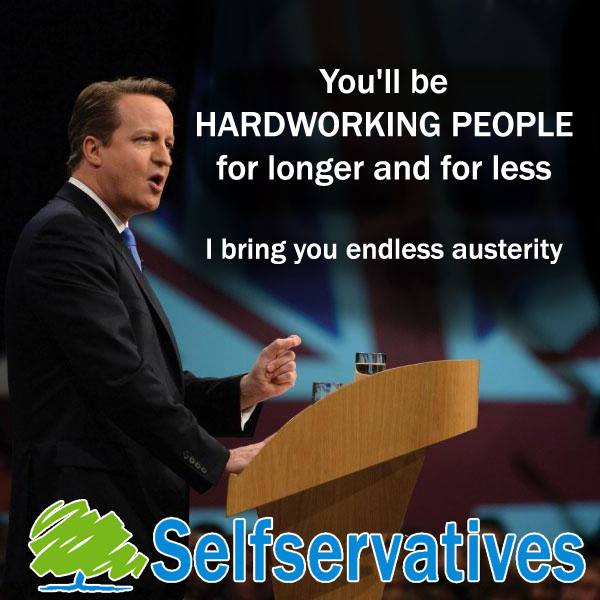
Labour builds, the Tories always destroy.
Here is the first stage of Labours’ costed and evidence-based plan to rebuild the UK:
1. Labour pledge to build 200,000 per year by 2020, focusing on social housing.
2. Labour pledged to create a State-Owned Rail Company that would compete and win back Rail Franchises.
3. Labour vow to cut business rates for small firms.
4. Labour vowed to introduce an increased Bankers’ Bonus Tax if they win in 2015.
5. Labour promised Free Childcare worth £5,000 a year for working parents who had children aged 3&4.
6. Labour committed to Sacking ATOS, Serco and G4S if they win the election.
7. Ed Miliband promised to repeal the Bedroom Tax.
8. Ed Balls pledged to reverse the Pension Tax relief that the Tories gifted to millionaires.
9. Labour promised to reverse the Tory Tax cut for Hedge Funds.
10. Labour pledged they will create 200,000 Apprenticeships
11. Ed Miliband vowed to increase the fine levied on firms not paying the Minimum Wage by 1000% to £50,000.
12. Labour are to introduce a new Disability Hate Crime Prevention Law.
13. Labour would freeze gas and electricity bills for every home and business in the UK for at least 20 months, the big energy firms would be split up and governed by a new tougher regulator to end overcharging.
14. Voting age to be lowered to 16.
15. NHS to be re-nationalised.
16. Miliband also said that any private company that does not meet the needs of the public will be brought under state control.
17. Labour will ban exploitative zero hour contracts.
18. Labour have pledged to introduce a living wage.
19. Labour have pledged to reverse the £107,000 tax break that the Tories have given to the millionaires.
20. Labour will reintroduce the 50p tax.
21. Labour will repeal clause 119.
22. Labour will introduce a law making Private Companies subject to the Freedom of Information Act.
23. Labour will introduce a Mansion Tax on properties worth more than £2 million
24. Labour will make up the difference to the value in the minimum wage is restored, reversing the Tory cut of 5%.
25. Labour will halt Michael Gove’s Free School Expansion Programme.
26. Labour will abolish the Tory ban on Local Education Authorities opening State Schools once more.
27. Labour will scrap George Osborne’s “Shares for Rights” scheme that has opened up a tax loophole of £1 billion .
28. Labour will launch a full public inquiry into blacklisting.
29. Labour will ensure Water Companies place the poorest households on a Social Tariff that makes it easier for them to pay their Water Bills.
30. Labour will double the tax duty on Pay Day Lenders and will use the additional £13,000,000 that raises to help foster more Credit Unions.
31. Labour will impose a cap on the cost of credit, setting a limit at which Pay Day Lenders can charge borrowers.
32. Labour will regulate food labelling to simplify pricing so that Supermarkets cannot con customers.
33. Labour plan to introduce a Bill that would ban Recruitment Consultancy firms from only hiring abroad & ban firms from paying temporary workers less than permanent staff.
34. Labour would set up a Financial Crime Unit, with increased staffing, in the Serious Fraud Office to enable the SFO to pursue bankers who break the law.
35. Labour will break up the banks, separating retail banking from investment banking.
36. Labour will scrap Police Commissioners.
37. Labour will introduce a Forces & Veterans Bill of Rights to build upon the Military Covenant.
38. As a minimum measure, Labour will at least cut Tuition Fees by 33%.
39. Labour will introduce measures to prevent corporate tax avoidance.
40. Labour will also increase the Bank Levy by £800m a year.
41. Labour will scrap the Profit Tax Cut (Corporation Tax) that George Osborne has already announced for 2015.
42. Labour will scrap Cameron’s “Gagging” Act.
43. Labour will ensure all MPs will be banned from receiving any income from corporations after 2015.
44. Labour will tackle the abuse and exploitation of migrant labour that undercuts wages.
45. Labour will extend their 2002 public interest test to protect us from exploitative multinational takeovers.
46. Labour will end unpaid workfare
47. Labour have pledged to scrap sanction targets.
48. Labour will scrap the non-domicile tax rule.
 Thanks to Robert Livingstone for the pictures
What Labour achieved, lest we forget
The pre-election pledges that the Tories are trying to wipe from the internet, lest we forget
The Coalitions’ biggest hits, volume 1
The Tories cynically veto Balls’s plan to allow the OBR to audit Labour’s manifesto
Share this:

Hi
Hi. Just to let you all know I can’t access my FB account from here, just twitter and wordpress. But there’s share on FB option on wordpress, don’t know if this will get there, though. Cheapskate and limitd hospital broadband! . But will be home hopefully tomorrow. I am carefully plotting my escape.. 🙂 xxx

Share this:

Ed Miliband’s response to the Budget: full text
Foreword
New coin, same old cons.
“Films, football, beer, and above all, gambling filled up the horizon of their minds. To keep them in control was not difficult….” – George Orwell, 1984.

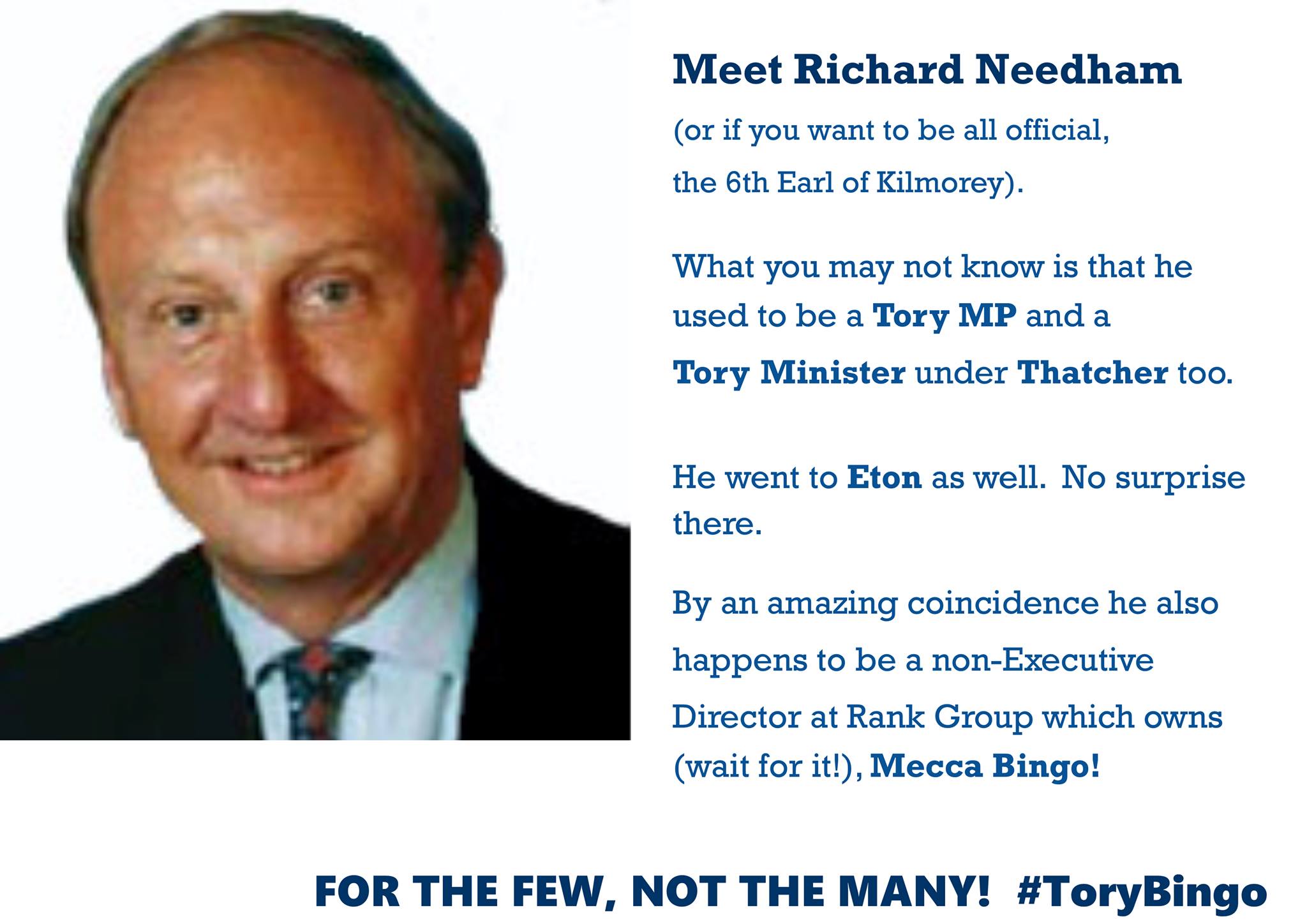
The government’s own Office for Budget Responsibility (OBR) laid bare an important truth – that any semblance of economic recovery is despite the Coalition and not because of them.
The Chairman of the OBR, Robert Chote, spoke to journalists, and there was some coverage on the BBC News – though so far they have managed to mute this salient fact. Chote said this:
“Looking over the forecast as a whole – net trade makes very little contribution and government spending cuts will act as a drag.”
The OBR have also stated that any slight economic recovery is in no way because of Osborne and Tory policy, but simply due to the wider global recovery from the global crash.
The government has drastically cut its spending on everything – including the NHS, in spite of their claims to the contrary, this means that the government has consistently damaged the prospect of any economic recovery.
It’s therefore outrageous to hear Osborne trying to claim credit for the appearance of something that the Tories have done their very best to impede.
The Tories create high unemployment deliberately. Every time they are in Office. The subsequent increased reserve army of labour are then forced to ‘compete’ to take lower paid work, under less favourable working conditions, because they are desperate – and especially more so now that our welfare system is so unfit for purpose. The Tories made sure of that, too.
“Making work pay” is a big Tory lie that has benefited no-one but the very wealthy, and the reduction in both the value and the amount of welfare support for unemployed individuals has come at a time when we are witnessing steady reductions in worker’s rights, and worryingly, the Tory-led Government has stepped up its attack on employment health and safety regulations.
This suits Tory donor profit- seeking businesses just fine, but unforgivingly and unforgivably, it costs lives, and costs us a decent, civilised standard of living. This is what Tories always do. It’s an intrinsic tenet of Tory ideology. They always start a brutal race to the bottom.
They are NOT paying down the debt, they are raising more money for the rich.
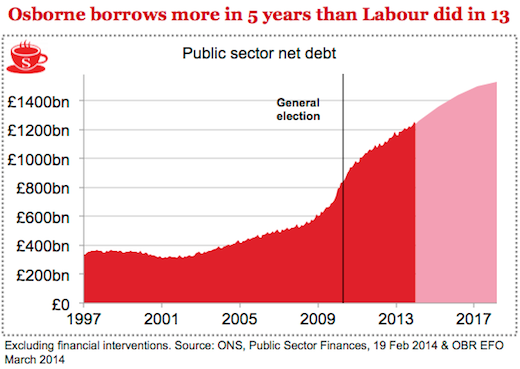
Tory austerity is a false economy.
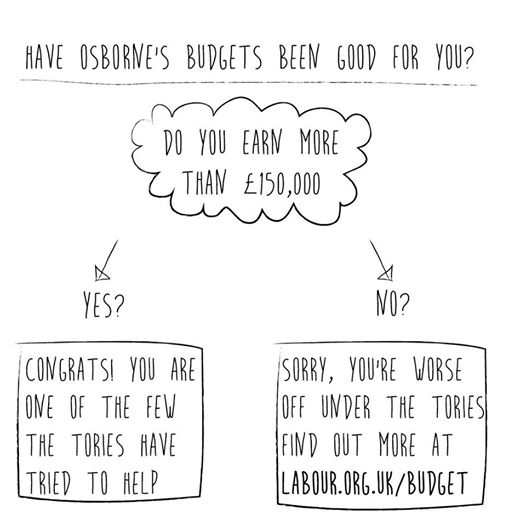
The Chancellor spoke for nearly an hour. But he did not mention one central fact:
The working people of Britain are worse off under the Tories. Living standards down: month after month, year after year.
2011 – living standards down.
2012 – living standards down.
2013 – living standards down.
And since the election working people’s living standards £1,600 a year – down. You’re worse off under the Tories.
Their 2010 manifesto promised:
“An economy where…[people’s] standard of living…rises steadily and sustainably”
But they have delivered exactly the opposite. Standards of living not rising steadily and sustainably, but falling sharply and steeply.
And today the Chancellor simply reminded people of the gap between the Chancellor’s rhetoric and the reality of peoples’ lives. Living standards falling for 44 out of 45 months under this Prime Minister.
Unmatched since records began. No amount of smoke and mirrors today can hide it.
We already know the answer to the question millions of people will be asking in 2015:
“Are they better off now than they were five years ago?”
The answer is no. Worse off.
Much worse off. Worse off under the Tories.
And the Chancellor trumpeted the tax allowance today. But what he didn’t tell you is that it is the same old Tory trick. He didn’t tell you the rest of the story. He didn’t mention the 24 tax rises introduced since he became chancellor.
He forgot to mention that he put up VAT.
He taxed away Child Benefit.
He raised insurance tax.
And gave us the ‘Granny Tax’.
It’s a classic Tory con. Give with one hand and take far more away with another.
Same old Tories.
Now the Chancellor painted a picture of the country today that millions of people simply will not recognise. Because this is Cameron’s Britain 2014:
350,000 people going to food banks.
400,000 disabled people paying the Bedroom Tax.
1 million more people paying 40p tax.
4.6 million families facing cuts to tax credits.
But there is one group who are better off. Much better off.
We all know who they are. The Chancellor’s chums. The Prime Minister’s friends.
The Prime Minister rolls his eyes, he doesn’t want to talk about the millionaire’s tax cut. No mention of it in the Budget speech.
The beneficiaries of this year’s millionaire’s tax cut.
Because if you are a City banker earning £5m and you are feeling the squeeze, don’t worry because they feel your pain. Because this year that city banker was given a tax cut. Not just any tax cut.
£664 a day.
£20,000 a month.
A tax cut worth more than £200,000 a year.
So the Prime Minister chooses to afford a tax cut of £200,000 for a banker. But he can’t afford a pay rise of £250 for a nurse.
And these are the people that had the nerve to tell us we’re all in this together.
It’s Tory values.
It’s Tory choices.
It’s the same old Tories.
And of course, the Leader of the Liberal Democrats, with them every step of the way. Day after day he claims he doesn’t support Tory policy. But day after day he votes for Tory policy.
Now to listen to the Chancellor today, for a recovery that arrived three years later than he promised, he expects the country to be grateful.
Back in 2010, he told us that by the end of 2014, the economy would have grown by nearly 12 per cent. Today the figures say it has been barely half that. And he wants the country to be grateful.
Back in 2010 he said the Government would clear the deficit in this parliament by 2014/15. Today he wants the country to be grateful because he says he can do it by 2018/19.
Three years ago the Chancellor told us in his 2011 Budget speech he would deliver an economy “carried aloft by the march of the makers”:
But what has actually happened since then to the rebalancing that he promised?
Manufacturing output has fallen by 1.3 per cent.
Construction output has fallen by 4.2 per cent.
Infrastructure investment down 11 per cent.
Every time he comes to this house he promises a rebalancing.
And every time he fails.
He talked about housing today, but what has he actually delivered?
They’ve overseen the lowest house building since the 1920s. And rents have risen twice as fast as wages.
At the heart of the argument we will have over the next fourteen months is this question: whose recovery is it?
Under them it’s a recovery for the few not the many. Bankers pay in London rising five times faster than the pay of the average worker. This recovery’s not working for working people whose living standards are falling.
It’s not working for millions of women who see the gap between men and women’s pay rising. It’s not working for low-paid people promised by the Chancellor a £7 minimum wage, but given just 19p more an hour.
Under this Government it’s an economy of the privileged, by the privileged, for the privileged.
And instead of today admitting the truth about what is happening in most people’s lives, they want to tell them the opposite.
They tell people their wages are rising when they’re falling. Just like they tell people their energy bills are falling when they’re rising. And they tell people they’re better off but everyone knows the truth.
You can change the shape of the pound. But it doesn’t matter if the pound is square, round or oval. If you’re £1,600 pounds worse off, you’re still £1,600 pounds worse off.
You’re worse off under the Tories.
And the reason they can’t deliver is because of what they believe. His global race is a race to the bottom.People forced to do 2 or even 3 jobs to make ends meet. Not knowing how many hours they will get from one week to the next.
And no idea what the future holds for their kids.
Low wages.
Low skills.
Insecure work.
That’s how they think Britain succeeds.
That is why they’re not the solution to the cost of living crisis.
They are the problem.
We needed a Budget today that would make the long-term changes our economy needs in housing, banking and energy. But they can’t do it. They won’t stand up to the vested interests.
They won’t tackle developers sitting on land, even though they can’t solve the housing crisis without it.They won’t force the banks to improve competition, even though small businesses say they need it.
They won’t stand up to the energy companies and freeze energy bills, even though the public support it.
Same old Tories.
We know what their long term plan is: more tax cuts for the richest, while everyone else gets squeezed.
What does the Chancellor say about the people dragged into paying 40p tax?
He says they should be happy. It’s good news for them.
So this is the new Osborne tax theory:
If you’re in the middle paying 40p you should be pleased to pay more.
But if you’re at the top paying 50p, you should be helped to pay less.
Same old Tories.
It’s no wonder that even their own side think they’re totally out-of-touch. And even now, even after all the embarrassment of the millionaire’s tax cut, they won’t rule out going further.
Maybe today we can get the straight answer we haven’t had so far?
Will he rule out a further tax cut for millionaires to 40p?
Just nod your head if you’re ruling it out!
There they go again.
They won’t rule it out.
Doesn’t it say everything about them?
They really do believe the way you make the rich work hard is to make them richer, and the way you make everyone else work harder is by making them poorer.
And just like they paint a picture of the country that working people will not recognise, so too themselves. Now the Prime Minister is an expert in re-branding. Remember the huskies, the bike, the tree?
That was before they said cut the green crap.
What is the latest re-brand from the Bullingdon club?
It is beyond parody.
Because what does this lot now call themselves?
They call themselves ‘The workers’ party’.
And who is writing the manifesto for this new workers’ party?
We already know the answer and I quote:
“There are six people writing the manifesto, five went to Eton…”
By my count more Etonians writing the manifesto than there are women in the Cabinet.
No girls allowed.
And this week we’ve heard it right from the top. Here’s what his former best friend, his closest ally, the Education Secretary had to say about the Prime Minister’s inner circle. He said it was, and I quote:
“Ridiculous.
Preposterous.
Unlike anywhere else in the world.”
You know you’re in trouble when even the Education Secretary calls you a bunch of out of touch elitists.
And where is the Education Secretary? I think he has been banished … He’s hiding! I think he has been consigned to the naughty step by the Prime Minister.
I think it’s time we listened to Baroness Warsi and took the whole Eton mess out of Downing Street. And what a mess it is.
There are more sides in the Tory briefing war than there are on the new pound coin. We don’t need a party for the privileged few.
We need a party for the many.
That is why a Labour government will:
Freeze energy bills.
Guarantee jobs for unemployed young people.
Cut business rates.
Reform the banks.
Get 200,000 homes built a year.
And abolish the Bedroom Tax.
This is the Budget that confirms people are worse off under the Tories. A worse off budget, from an out-of-touch Chancellor.
Britain can do better than them.
Britain needs a Labour government.
Ed Miliband.

21 more good reasons to vote labour:
1. Labour pledge to build a million new homes
2. Labour pledged to create a State-Owned Rail Company that would compete and win back Rail Franchises.
3. Labour vow to cut business rates for small firms.
4. Labour vowed to introduce an increased Bankers’ Bonus Tax if they win in 2015.
5. Labour promised Free Childcare worth £5,000 a year for working parents who had kids aged 3+4.
6. Labour committed to Sacking ATOS, Serco and G4S if they win the election.
7. Ed Miliband promised to repeal the Bedroom Tax.
8. Ed Balls pledged to reverse the Pension Tax relief that the Tories gifted to millionaires.
9. Labour promised to reverse the Tory Tax cut for Hedge Funds.
10. Labour said they would create 200,000 Apprenticeships and tie it to immigration.
11. Ed Miliband vowed to increase the fine levied on firms not paying the Minimum Wage by 1000% to £50,000.
12. Labour are to introduce a new Disability Hate Crime Prevention Law.
13. Labour would freeze gas and electricity bills for every home and business in the UK for at least 20 months,the big energy firms would be split up and governed by a new tougher regulator to end overcharging.
14. Voting age to be lowered to 16.
15 NHS to be re-nationalised.
16. Miliband also said that any private company that does not meet the needs of the public will be brought under state control.
17. Labour will scrap zero hour contracts.
18. Labour have pledged a living wage.
19. Labour have pledged to reverse the £107,000 tax break that the Tories have given to the millionaires.
20. Labour will reintroduce the 50p tax.
21. Labour will repeal clause 119.
Further reading:
What Labour Achieved
The Great Debt Lie and the Myth of the Structural Deficit
The mess we inherited – some facts with which to fight the Tory Big Lies
A short-term Budget to shrink the state and help the rich – Frances O’Grady
Budget 2014: George Osborne’s ‘recovery’ exposed as con – Graham Hiscott
Follow the money
Share this:

The commercialisation and undemocratising of the NHS: the commodification of patients

Last September, I wrote an article entitled: Jobseekers are being coerced into experimental drug trials dressed up as “job opportunities” .
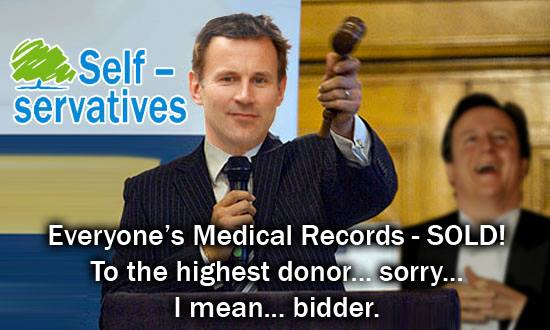
I reported that David Cameron had announced that it was: “simply a waste to have a health service like the NHS and not use the data it generated. Let me be clear, this does not threaten privacy”, he reassured us, “it doesn’t mean anyone can look at your health records, but it does mean using anonymous data to make new medical breakthroughs”.
Cameron often inadvertently signposts the coming of a diabolical lie with the phrase “let me be clear”, as we know. We also know that so-called anonymisation of data offers no protection at all to identities and personal details. Campaigners described the plan as an”unprecedented threat” to confidentiality, Health Secretary Jeremy Hunt says, rather worryingly, that it will be a boon to research.
It’s common knowledge that many Coalition MPs and Peers are heavily financially invested in pharmaceutical and health care companies. Over 200 parliamentarians have recent past or present financial links with, and vested interests in companies involved in healthcare and all were allowed to vote on the Health and Social Care Bill. The Tories have normalised corruption and made it almost entirely legal. Our democracy and civic life are now profoundly compromised as a result of corporate and financial power colonising the State, and vice versa.
The Health and Social Care Bill, 2012, has a telling insert: The Secretary of State’s duty as to research, which is “In exercising functions in relation to the health service, the Secretary of State must promote – (a) research on matters relevant to the health service, and (b) the use in the health service of evidence obtained from research”.
And also very worryingly: (1) The National Patient Safety Agency is abolished. (2) The National Patient Safety Agency (Establishment and Constitution) Order 2001 (S.I. 2001/1743) is revoked. (3) In section 13 of the NHS Redress Act 2006 (scheme authority’s duties of co-operation), omit subsection (2)
So we must ponder just how coincidental it is that Jobseekers are now being coerced into experimental drug trials, or risk benefit sanctions, as the trials are being dressed up as “job opportunities”.
People claiming Jobseekers Allowance while searching for new employment are being forced to accept ever worsening working conditions or join exploitative Government work programmes in desperate attempts to survive, as our civilised social safety nets and lifeline benefits are being torn away by a draconian and authoritarian Government.
The rising number of unemployed and underemployed citizens of the UK are having their desperation to survive exploited, enticed into zero hour contracts, workfare and now, clinical trials. My revulsion at this Government is at an all time absolute.
Jobseekers using the Government’s job website – the Universal JobMatch – have been receiving multiple messages from the service inviting them to apply for jobs, only to find that these “employment opportunities” are actually clinical trials.
Drug companies are also to be given provisional approval to treat the severely ill with new drugs and use the data in later licence applications In other words, our government is permitting pharmaceutical companies to experiment using severely ill people.
Behind the scheme is a Tory concern that the UK is no longer a favourite location for the drug companies to develop and trial new medicines – “Making Britain the best place in the world for science, research and development is a central part of our long-term economic plan,” said Health Secretary, Jeremy Hunt.
George Freeman, Conservative MP for Mid-Norfolk, who has long campaigned for the scheme, said: “it would benefit small biotech companies and charities, which may have breakthrough drugs that they cannot afford to take all the way through the long and expensive regulatory process – increasingly the source of innovative medicines which are then bought up by big pharma.
They would get their drugs into NHS patients, hopefully giving them positive data which would attract investors for the large-scale clinical trials.”
So not this is not actually about patient welfare, as Hunt had initially claimed. If it were, then there would have been no need for the abolition of The National Patient Safety Agency, or the revoking of The National Patient Safety Agency.
In 2011, an influential report written by Colin Haslam, Pauline Gleadle and Nick Tsitsianis entitled UK bio-pharma: Innovation, re-invention and capital at risk concludes by presenting the case for innovative short and medium term government-led policy initiatives for the sector and highlights four central areas in which the current bio-pharma business model could evolve. The study concludes by presenting the case for innovative short and medium term government-led policy.
The acknowledgement reads: “in order to complete our research work we have obtained the support of a number of senior executives in private and publicly quoted SME bio-pharma companies and also industry experts in big-pharma. We would like to thank this group for giving up their time to be interviewed for this research project.”
One of the key recommendations of the report is: access to NHS clinical datasets to provide a significant knowledge resource to strategically drive UK drug discovery.
The report is primarily concerned with “the evolution of the bio-pharma business model.”
Reuters reports that the UK is currently one of the only markets in the world in which pharmaceutical companies are free to set prices for their drugs. At the moment, the UK Pharmaceutical Price Regulation Scheme (PPRS) regulates profits, not prices on sales to the NHS, whilst the National Institute for Health and Clinical Excellence (NICE) assesses if drugs are cost effective.
However, this is set to change with the introduction of the “Programme for Government” document indicating that the coalition would “reform NICE and move to a system of value-based pricing”. This would lead to changes in the way that drug prices are determined.
The Association of British Pharmaceutical Industry has stated that it will be keeping an open mind ahead of talks with the government.
“Valued-based pricing is one way of doing it,” said spokesman Richard Ley. “We are not opposed to the principle. It is a question of how it is achieved to get it right.” By that, he means how to make it very profitable, of course.
“The regulatory process is inefficient,” according to one leading biotech investor.From a business side of things these products stop being developed in the UK when they get into later stage because the UK is not a very good market for pharmaceuticals.”
Drug companies have for years strongly criticised the National Institute for Health and Care Excellence (Nice), the UK pricing regulator, which they believe is blocking new and innovative medicines by complicated approval processes and a heavy emphasis on cost control.
Steve Bates, chief executive of the Biotech Industry Association, said: “It’s fantastic and very important that there is a new designation and an “all hands on deck” approach.
“The Coalition Government is determined to secure and expand the UK’s position as an international hub for innovation, medical science and research and in the last 12 months has generated more than £1 billion industry and private sector investment. The Prime Minister will use his visit to the US to meet with CEOs and senior figures from leading pharmaceutical companies, including Johnson & Johnson, Baxter, Covance and Pfizer. The meeting will focus on the UK’s life sciences sector and initiatives such a genomics and dementia research”.
A key policy advisory group – The Ministerial Industry Strategy Group – is co-chaired by the Secretary of State for Health and the Chairman of the British Pharma Group, and aims to promote a “strong and profitable UK-based bio-pharmaceutical industry capable of sustained research”.
The Deregulation Bill is wide-ranging in scope. It’s when we look at what it might mean for the NHS that we see why so much of the contents are very worrying.
This Bill imposes a new duty on non-economic regulators to promote economic growth, for example. What exactly would that mean for the Care Quality Commission? How would the Medicines and Healthcare Regulatory Agency, which regulates the pharmaceutical industry, promote growth?
The bill also imposes a new “growth duty” on watchdogs as well as regulators. Currently, such bodies exist to monitor particular sectors – like health – and take action in the best interests of the public according to the relevant law.
But Clause 58 of the Deregulation Bill puts a responsibility on regulators in England so that when they take regulatory action it has to be with regard to “promoting economic growth”, and not to promoting the best interests of the public. The Bill was quietly tabled in draft by Ken Clarke and Oliver Letwin, and didn’t Letwin say back in 2004 that the “NHS will not exist within five years of a Conservative election victory”?
Regulation evolved to “help build a more fair society and even save lives”, but regulation is often considered a hindrance by business. So this is all about The Coalition making it easier for big profits to be made out of the NHS by private healthcare multinationals. True to Tory form, it’s another policy which is designed to facilitate the exploitation of the vulnerable by the wealthy.
It’s also worth noting that last week, two of the government’s top health and work advisers stated they believed in the merits of “prioritising NHS treatment for working people”, and this needs to be seriously discussed.
If that isn’t further clear evidence of the relentless Tory drive towards economic reductionism and determinism, I don’t know what is.
I need not go on to discuss the religion of the Pope or the toilet habits of bears, I suppose.
Further reading:
Profit before human need – “The drug companies will get away with whatever they can get away with within the law to look after the interests of their shareholders. But they couldn’t get away with these things were it not for members of my profession being willing to collude with them and put patients in second place”: unfavourable results from medical trials are being withheld, MPs warn
Share this:

‘Gaslighting’ and Private Eye on February 2013 on Further Restrictions to Disabled Claimants by Atos
“‘Gaslight’, verb – to ‘gaslight’ someone is to lie repeatedly to them, even though you both know it is a lie, with the intention of causing the other person to doubt their sanity; ‘Gaslighting’, a form of abusive behaviour.
Origin: 1940s film/play/novel in which an evil husband drives his wife insane by turning the gas lights down, while swearing that the darkness was in his wife’s imagination.
This term needs to be made well known, because the Tories have chosen this as one of their strategies for the next election.” – Robert Livingstone
Yesterday I reblogged one of Mike Sivier’s articles from Vox Political, reporting that Atos/ OH Assist was trying to bully blogs criticising them into taking down their posts. Atos/OH Assist was demanding that they do so as these articles encouraged hate towards their members and staff, some of whom have received death threats. This looks to me like another example of a rich and corrupt corporation trying to silence its critics through legal action, regardless of whether the criticisms levelled at the company are true or not. Mike’s article has extensively rebutted these claims, to which I’ve added the classic Private Eye response to bullying, unfounded threats of legal action ‘Arkell vs. Pressdram’.
Atos/ OH Assist is hated, because its administration of the Work Capability Assessment for the DWP has resulted in thousands of the poor and desperate being thrown off benefit, to die in poverty and starvation. Some have taken their own life. The actual numbers, who may have died after being assessed by Atos and then had their benefits stopped by the DWP may be as high as 38,000. Commenters on Mike’s blog have suggested that it is no accident that Atos/OH Assist have made these accusations of threats and intimidation now, just when they are trying to get out of the government contract.
One of Mike’s commenters, Kittysjones, has identified Atos/OH Assist’s tactics as ‘gaslighting’. She says:
Gas-lighting on a political level is a manipulative strategy used to prevent us forming a secure picture of reality. In its most basic form, gaslighting involves modifying evidence and falsifying information for the purpose of making the intended victim question his or her recollection, memory, analysis, and perception of events or behaviours. Gaslighting is commonly used by the military and other high-level organizations for socio-political operations. It is sometimes used by the mental health profession as a concept to describe a particular form of psychological manipulation in inter-personal relationships. A common form of gaslighting is victim-blame , where the perpetrator attempts to convince others that the targeted victim is the aggressor,and the perpetrator is the victim. These tactics are commonly used by psychopaths to control and manipulate others
The language manipulations and redefinitions of this government are attempts to distort and control your view of reality. As are the denials of the terrible impact of their policies
Sometimes, gaslighting can be as simple as knowingly denying something took place. This is a common behaviour exhibited by perpetrators of child abuse, who will sometimes deny completely that abuse happened, intending to make the victim doubt his or her own recollection.
Other times, gaslighting can involve the creation of elaborate schemes, experiences, and situations that cause a person to question their own judgment and recollection. There are a good number of con games based upon the concept of gaslighting, almost all of which are designed to steal money from the victim.
A brilliant example of gaslighting is the Michael Douglas movie The Game. It is one great series of gaslighting from beginning to end.
So basically, Atos here are blaming their victims in order to divert attention from their own heinous persecution of society’s most vulnerable.
It is interesting after hearing these accusations by Atos/OH Assist, to read an article from February last year in Private Eye, that reported that the company was making the tests for disability benefit even more stringent in order to have more claimants declared ‘fit for work’. The article is as follows:
Fitness to Work
Ill Thought OutDespite cross-party condemnation last week over the way thousands of sick and disabled people have had their benefits axed after the private company Atos wrongly found them fit to work, the government is trying to sneak in new measures which will make the problem worse.
It has tabled amendments to employment and support allowance legislation which, academics and campaigners say, will lead to even greater suffering by the genuinely ill.
Plans include withdrawing benefit if an assessor decides that a claimant’s ability to work would be improved by aids, such as guide dogs, walking sticks or prosthetic limbs – whether or not the claimant has access to them or can use them. Atos assessors already have the power to carry out an “imaginary wheelchair test” when they decide that a person could work if they used a wheelchair – even if they do not have one.
Under the changes people will also lose benefit if an assessor decides that adjustments could be made for them in the workplace – whether or not those changes have been made. The amendments also include plans to consider physical and mental health problems separately, instead of looking at the combined effects of mental and physical health on a person’s ability to work. As is common knowledge, some disease impact on both mental and physical health, and treatments for one can severely impact the other.
The changes, due to take effect at the end of the month after no public debate, have been condemned in a briefing by Ekklesia, which says they fly in the face of “coalition claims to be protecting and supporting sick and disabled people in a climate of austerity, cutbacks and hardship”.
MP Tom Greatrex, a critic of Atos, said: ‘The fact that people can be assessed as fit for work on the basis of an imaginary guide dog, without taking an account of the availability of guide dogs and the time taken to train both dogs and users, highlights just how far the DWP seem to be prepared to go to find people fit for work without the support they need to make work a reality.”
Last week the Commons heard of may cases where patients had died, or committed suicide, after being assessed as fit for work following “a demeaning process that was making sick people sicker”. Under coalition proposals there will be many more such cases.
(Private Eye, 25th January 7th February 2013, p. 20.)
It looks like after the DWP made the conditions for passing the Work Capability Assessment even more severe and restrictive, Atos/OH Assist found themselves even more unpopular than they were already. They are thus trying to salvage some kind of positive image from the public by trying to get out of their contract. The accusations and claims of death threats by their staff are merely attempts to deflect the blame for a cruel, callous and punitive system intent of throwing as many of the disabled off benefit as possible. Not only does Atos need to go, but the whole DWP also needs to be comprehensively reviewed and overhauled.


Yesterday I reblogged one of Mike’s articles from Vox Political, reporting that Atos/ OH Assist was trying to bully blogs criticising them into taking down their posts. Atos/OH Assist was demanding that they do so as these articles encouraged hate towards their members and staff, some of whom have received death threats. This looks to me like another example of a rich and corrupt corporation trying to silence its critics through legal action, regardless of whether the criticisms levelled at the company are true or not. Mike’s article has extensively rebutted these claims, to which I’ve added the classic Private Eye response to bullying, unfounded threats of legal action ‘Arkell vs. Pressdram’.
Atos/ OH Assist is hated, because its administration of the Work Capability Assessment for the DWP has resulted in thousands of the poor and desperate being thrown off benefit, to die in poverty and starvation. Some have…
View original post 948 more words
Share this:

Punishing Poverty: A review of benefits sanctions and their impacts on clients and claimants

Benefits sanctions are financial penalties that are given to people who are deemed to have not met the conditions for claiming benefits. The social security system has always been based on people meeting certain conditions – this has been true for all working-age benefit claimants, with sanctions applicable to those who fail to observe those conditions. This has been the case since its inception.
However, the Coalition changed the conditions and increased the application, duration and severity of sanctions that apply to those claiming Job Seekers Allowance (JSA) and extended the application of sanctions to those in the Work Related Activity Group of those claiming Employment and Support Allowance (ESA). Since 2012, benefit payments can be suspended for a minimum of four weeks and for up to three years where a person “fails to take sufficient steps to search for work”, to “prepare themselves for the labour market” or where they turn down an offer of employment or leave a job voluntarily.
Although it has been claimed officially there are no targets for the number of sanctions that are made, Greater Manchester Citizens Advice Bureau became very concerned about the increase in the number of clients they were seeing who had sanctions against them, and the duration of these sanctions. From July to September in 2013 they conducted a research survey to investigate these issues, and to look at how people claiming benefits who were already on very restricted incomes coped with the further reductions made.
Despite initial Government denials, it is clear that recently some Job Centres have been set targets for sanctioning claimants, with DWP staff creating “league tables” based on the number of sanctions issued by individual Job Centres.
The effects are apparent in the dramatic increase in the number of sanctions issued: in 2009 the number of claimants sanctioned was 139,000, consistent with number earlier in the decade; by 2011 this had increased to 508,0005.
Here are the key findings of the research:
1. 60% of those sanctioned had been receiving JSA, but a further 33% were unfit for work and were receiving ESA.
2. 40% of respondents said they had not received a letter from the Job Centre informing them of the sanction.
3. Almost a quarter of respondents did not know why they had been sanctioned. 29% of respondents said they had been sanctioned because they had not done enough to look for work. However, many people commented that the sanction had been applied unfairly, when they had in fact looked for work or attended an interview as required, because of a very narrow interpretation of the rules or for reasons that were beyond their control.
4. More than half the respondents said they had not received any information about how to appeal against the sanction. Nonetheless, three-fifths (62%) of respondents had appealed. One third of these appeals had been successful and a further 23% of those who had appealed were still waiting to hear the outcome. Administrative delays in receiving formal notification of the sanction meant that a number of people had been refused leave to appeal because they were out of time, adding further to the perception that they had been treated unfairly.
5. The majority of respondents had been sanctioned for four weeks or less, but almost one third had been sanctioned for 10 weeks or more. The average duration of the sanction was 8 weeks.
6. Two-thirds of respondents had been left with no income after the sanction was imposed. Those with children reported they only had child benefit and child tax credits.
7. Just under a quarter (23%) of those sanctioned were living in households with children. More than 10% of respondents were lone parents.
8. Respondents coped with the loss of income by borrowing money from friends and family (80%), from the bank or on their credit card (8%) or from a pay day loan company (9%).
9. They also cut down on food (71%), heating (49%) and travel (47%). Almost a quarter (24%) had applied for a food parcel. Some respondents had been left to scrounge for food from skips or bins, or had had to resort to begging to feed themselves.
10. The sanction had a severe impact on the mental and physical health of many respondents. Existing health conditions were exacerbated because of poor diet and stress, and a number of respondents said they had attempted suicide or that they felt suicidal.
11. There were also serious effects on the wider family, particularly children, because of the loss of income. There were stresses also on adult relationships: one respondent said ‘the strain has quite literally smashed our family to pieces’.
12. Many respondents felt they had been unjustly treated because of the Job Centre’s own administrative errors or because a sanction had been imposed unreasonably given their circumstances.
Conclusions and recommendations
13. The Government’s Social Security Advisory Committee (SSAC), in its 2012 review of conditionality and sanctions in the benefits system, concluded that for conditionality to work it was essential that there was: (1) good communication; (2) personalisation; and (3) fairness.
14. The evidence of this survey is that none of these conditions is currently being met and that the imposition of sanctions is causing great hardship not only to claimants but to their dependants. The hardship is likely to make claimants less rather than more likely to be in a position to find and keep paid work.
15. CAB recommend that the findings of the SSAC should be implemented swiftly and effectively. Further, we recommend that greater consideration needs to be given to what the intended effects of sanctions are and how to avoid the many “unintended consequences” revealed by this survey.
Respondents also reported having their Disability Living Allowance (DLA), Housing Benefit and Council Tax Benefit cut.
DLA is a benefit paid on the basis of a persons’ care needs and is not conditional. It is not included in the benefits that can be the sanctioned. The fact that some people reported that this benefit had been cut, indicates that communication from the DWP had been poor and that people did not understand their situation adequately.
Although Housing Benefit and Council Tax reduction are also not subject to the sanctions regime, the local authority Revenue and Benefits Unit is informed by the Job Centre whenever a claim has stopped. This means that when a sanction is imposed people need to inform their local housing office in order to make sure that their housing benefit and council tax reduction restart, otherwise they risk incurring rent and council tax arrears, in addition to losing their benefit income. People claiming these benefits may be unaware that they need to let their housing office know about a sanction, and may therefore lose these benefits too.
Almost two-thirds of respondents (63%) had been left with no income after the imposition of the sanction. Those with children reported that they only had child benefit and child tax credits.
Almost three quarters of respondents (72%) said that they had no other income for the period that they were sanctioned. Only 13% had received hardship payments and 15% reported that they had had other benefits.
The majority of respondents were living alone (51%), but almost a quarter of those sanctioned were living in households with children. More than 10% of respondents were lone parents. Where there are others in the household, the sanction clearly affects the whole household, not just the individual, even though other household members are not subject to the claimant’s conditionality rules. This is a particularly serious issue for children’s welfare. This also raises questions about what the boundaries are to the intended consequences of the benefits sanction. Is it fair to penalise children and others who are dependent on benefit claimants. What justification can be given for the effects of sanctions on other household members or wider family?
It is worrying that almost a quarter of those sanctioned lived in households with children and more than 10% of respondents were single parents. Loss of income for the parent inevitably imposes hardship on children in the household, as respondents’ accounts made clear. Children were aware of the threat of eviction and of the stress on their parent(s). Although parents did their best to shield their children from the effects of the sanction (for example by going without food themselves so that their children could eat), children were adversely affected.
One child was taken out of school because her mother could not afford the taxi fare to get her to school. There was no evidence that DWP had sought to monitor these effects or that there was adequate access to appropriate hardship arrangements.
A number of respondents said they had not been told about the possibility of applying for a hardship payment until it was too late to do so. Turning these payments into loans, under the 2012 Welfare Reform legislation, adds further to the indebtedness that sanctions create, and therefore to consequences that extend well beyond the period of the sanction. Additionally, a proportion of those sanctioned had taken out pay day loans, (the high-cost credit sector has many lucrative links with Conservatives, too), others had used overdrafts and credit cards to try and get by. Several people reported that they were forced to take out illegal loans from loan sharks. Respondents also reported that they had had to sell furniture and other household items, or pawn goods in order to cope financially.
Furthermore, many people who had had a sanction imposed had suffered serious consequences, particularly in terms of their mental and physical health, which cannot be regarded as an appropriate part of the conditional provision of social security.
Appeals
Forty percent of respondents said they had not received a letter from the Job Centre informing them of the sanction, and it is therefore not surprising that more than half of all respondents (51%) said they had not received any information about how to appeal against the sanction. Nevertheless 62% of respondents had appealed. One third of those who appealed were successful, a further 23% were still awaiting the outcome of their appeal.
A number of claimants had been unfairly refused leave to appeal because they were outside the one month time limit, this was because of DWP administrative delays in informing them formally of the sanction.
The key recommendations are:
- The DWP should put into place effective arrangements to monitor sanctions and the impacts on claimants and their families. Data from this should be published regularly.
- Action should be taken to mitigate the negative effects of sanctions such as exacerbating ill health and penalising claimants’ children.
- Sanctions should be fair and proportional. Clients should not be sanctioned for things that are not their fault, such as administrative errors, or that are beyond their control.
- Job Centre Plus should review its communications with clients and ensure that important information about sanctions and appeals reaches them effectively. In particular, clients should understand the reason why the sanction has been imposed and how they can appeal against it. They should also be given information about hardship payments.
The results of the survey indicate very clearly that the three requirements for effective conditionality of benefits set out by the Social Security Advisory Committee (SSAC) in their 2012 report – communication, personalisation and fairness – are not being met in an unacceptably large number of cases.
The requirements placed on people claiming benefits that had led to a sanction being imposed, often failed to take into account the realities of life, whether this was the lack of resources in rural areas for those on a low income, the effects of disability, illness, lack of familiarity with computers, or bereavement, as many claimants’ accounts indicated.
It was found that many people who had had a sanction imposed suffered serious consequences, particularly in terms of their family relationships, mental and physical health, which cannot be regarded as an appropriate or acceptable part of the conditional provision of social security.
The full report is here

Pictures from the brilliant Robert Livingstone.
Related
Benefit sanctions are not fair and are not helping people into work
Rising ESA sanctions: punishing vulnerable citizens for being vulnerable
The targeting, severity and impact of sanctions on benefit claimants needs urgent review
Update
Samuel Miller, a very dedicated Canadian campaigner for human rights and a disability specialist has been submitting work to the United Nations Convention on the Rights of Persons with Disabilities, (to which the last Labour government signed up) to inform a much-needed inquiry, which he has requested.
Samuel has included articles from my site to support his request on our behalf, including this one, and he forwarded this to me:
The UNCRPD Secretary, Mr. Jorge Araya, has acknowledged receipt of your article and attached report on benefit-sanctioning.
Jorge Araya
Attachments 3:29 AM
Dear Mr. Miller
I acknowledge receipt of the attachment.
Regards
United Nations Human Rights
Jorge Araya
Secretary of the Committee on the Rights of Persons with Disabilities
Groups in Focus Section
Human Rights Treaties Division
Office of the United Nations High Commissioner for Human Rights
E-mail: jaraya@ohchr.org
Tel: +41 22 917 9106
Fax: +41 22 917 9008
Web: www.ohchr.org
And previously:
Letter to High Commissioner, Navi Pillay, below. I included your superb article in my letter, Sue.
Subject: There is an urgent need for a UN investigation into the United Kingdom’s benefit-sanctioning regime
Samuel Miller <disabilityinliterature@gmail.com>
Attachments3:58
High Commissioner Navi Pillay
Office of the United Nations High Commissioner for Human Rights (OHCHR)
Palais Wilson
52 rue des Pâquis
CH-1201 Geneva, Switzerland.
Dear Ms. Pillay,
I am a 57-year-old Disability Studies specialist and disability activist from Montreal, Canada who has been communicating frequently and voluntarily, since January 2012, to senior United Nations officials, on the welfare crisis for the United Kingdom’s sick and disabled. (See attached, and the following: http://www.twitlonger.com/show/n_1rp0uui,http://www.twitlonger.com/show/n_1rtnc63, http://www.twitlonger.com/show/n_1rtvfk5).
It is my understanding that a 22-page letter, pointing out that cuts to social security benefits introduced by Iain Duncan Smith and enforced by his Department for Work and Pensions on behalf of the Coalition government may constitute a breach of the UK’s international treaty obligations to the poor, will also be discussed at a meeting of the UN Human Rights Council in New York, in September. It is signed by Raquel Rolnik, the former UN special rapporteur on adequate housing; Magdalena Sepúlveda Carmona, the former UN special rapporteur on extreme poverty; and Olivier De Schutter, the former UN special rapporteur on the right to food.
Could you please add, as an addendum to that letter, my partial bibliography on Britain’s benefit-sanctioning regime, which is attached below in PDF format. My views can be found on page two; I am extremely concerned about the British government’s soaring use of benefit sanctions, and the evidence from MPs and the Work & Pensions Committee, which provides oversight of the Department for Work and Pensions, is especially compelling and strongly suggests that the government is stitching-up benefit claimants and is involved in a cover-up of that fact. The refusal of the government to agree to the Work & Pensions Committee’s request for an independent inquiry into this matter only compounds suspicion.
In closing, I would be most appreciative if the Human Rights Council and the OHCHR would open an investigation into this matter. This article (https://kittysjones.wordpress.com/2014/08/16/uk-becomes-the-first-country-to-face-a-un-inquiry-into-disability-rights-violations/) is very worthy of your—and their—attention, as well.
I wish to congratulate you on your tenure as High Commissioner, and wish you every success in your future endeavors.
Warm regards
Samuel Miller
—
Share this:

Request for information about your experiences of ESA and the WCA for Commons Select Committee Inquiry

Employment and Support Allowance and Work Capability Assessments
Inquiry status: Inquiry announced on 6 February, deadline for receipt of evidence is Friday 21 March.
The deadline for submitting evidence is Friday, March 21, 2014
Background
Employment and Support Allowance (ESA) was introduced in October 2008 for claimants making a new claim for financial support on the grounds of illness or incapacity. It replaced Incapacity Benefits, Income Support by virtue of a disability and Severe Disablement Allowance.
ESA is paid to people who have limited capability for work (who are placed in the Work Related Activity Group (WRAG)), and people who have limited capability for work related activity (who are placed in the Support Group).
The majority of claimants applying for ESA are invited to a face-to-face assessment to help determine whether they fall within either of these two groups or whether they are fit for work. This assessment, called the Work Capability Assessment (WCA), is carried out by Atos Healthcare under its medical services contract with DWP. Atos produces a report following the WCA and this is used by the DWP Decision Maker, alongside any other additional evidence, to determine whether the claimant should be placed in the WRAG or the Support Group, or is fit for work.
In April 2011, the Government began reassessing existing Incapacity Benefits (IB) claimants to determine their eligibility for ESA using the WCA. The Committee published a report on Incapacity Benefit Reassessment in July 2011.
The Committee’s inquiry
In light of recent developments in this area, including the publication of a number of reviews of the WCA, expressions of concern from DWP regarding Atos’s performance in delivering the WCA, and the introduction of mandatory reconsideration, the Committee has decided to undertake an inquiry into ESA and WCAs to follow-up its 2011 report.
Submissions of no more than 3,000 words are invited from interested organisations and individuals.
The Committee is particularly interested to hear views on:
- Delivery of the WCA by Atos, including steps taken to improve the claimant experience
- The effectiveness of the WCA in indicating whether claimants are fit for work, especially for those claimants who have mental, progressive or fluctuating illnesses, including comparison with possible alternative models
- The process and criteria for procuring new providers of the WCA
- The ESA entitlement decision-making process
- The reconsideration and appeals process
- The impact of time-limiting contributory ESA
- Outcomes for people determined fit for work or assigned to the WRAG or the Support Group
- The interaction between ESA and Universal Credit implementation
Submissions do not need to address all of these points.
The deadline for submitting evidence is Friday 21 March.
How to submit your evidence
To encourage paperless working and maximise efficiency, select committees are now using a new web portal for online submission of written evidence. The web portal is available on this website.
The personal information you supply will be processed in accordance with the provisions of the Data Protection Act 1998 for the purposes of attributing the evidence you submit and contacting you as necessary in connection with its processing.
Each submission should:
- be no more than 3,000 words in length
- be in Word format with as little use of colour or logos as possible
- have numbered paragraphs
If you need to send a paper copy please send it to: The Clerk, Work and Pensions Committee, House of Commons, 7 Millbank, London SW1P 3JA
Material already published elsewhere should not form the basis of a submission, but may be referred to within a proposed memorandum, in which case a web link to the published work should be included.
Once submitted, evidence is the property of the Committee. It is the Committee’s decision whether or not to accept a submission as formal written evidence.
Select Committees are unable to investigate individual cases.
The Committee normally, though not always, chooses to make public the written evidence it receives, by publishing it on the internet (where it will be searchable), or by making it available through the Parliamentary Archives. If there is any information you believe to be sensitive you should highlight it and explain what harm you believe would result from its disclosure. The Committee will take this into account in deciding whether to publish or further disclose the evidence.
Further guidance on submitting evidence to Select Committees is available on the parliamentary website ( PDF 2.41 MB)
 .
.
Many thanks to Robert Livingstone for his pictures
Related links:
What you need to know about Atos assessments.
Clause 99, Catch 22 – The ESA Mandatory Second Revision and Appeals
ESA RevolvingThe ESA ‘Revolving Door’ Process, and its Correlation with a Significant Increase in Deaths amongst the Disabled.
Share this:

The coming Corporatocracy and the death of democracy
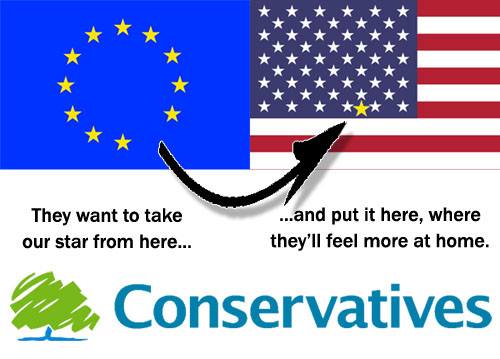
“Fascism should more appropriately be called Corporatism because it is a merger of state and corporate power.” – Benito Mussolini.
“The real corruption that has eaten into the heart of British public life is the tightening corporate grip on government and public institutions – not just by lobbyists, but by the politicians, civil servants, bankers and corporate advisers who increasingly swap jobs, favours and insider information, and inevitably come to see their interests as mutual and interchangeable… Corporate and financial power have merged into the state.” – Seumus Milne.
The Conservative privatisation programme has been an unmitigated failure. We have witnessed scandalous price rigging, and massive job losses, decreased standards in service delivery and a disempowerment of our Unions. But then the Tories will always swing policy towards benefiting private companies and not the public, as we know. In Britain, privatisation was primarily driven by Tory ideological motives, to “roll back the frontiers of the State”. The “survival of the fittest’ Conservative social policies are simple translations from the “very privileged survival of the wealthiest at all cost” and “profiteering for Tory donors and sponsors'” economic ideology.
Consider, for example, who the beneficiaries of Tory workfare policy are. Despite spectacular failure in “helping people into work”, these schemes persist. In 2012, the National Institute of Economic and Social Research (NIESR) reviewed the DWP’s impact assessment into how its “mandatory work programme” was working. Former Cabinet Office chief economist and NIESR director Jonathan Portes wrote: “Whatever your position on the morality of mandatory work programmes like these – the costs of the programme, direct and indirect, are likely to far exceed the benefits.”
“At at time of austerity, it is very difficult to see the justification for spending millions of pounds on a programme which isn’t working.”
So we ask ourselves who benefits from this “scheme”. Big business does of course. They get free labour, funded by the tax payer, to maximise profits. The service providers also benefit. What this means is that the money “saved”’ in public sector cuts has been used to subsidise some of this Country’s richest companies, and they have been provided with free labour from a reserve of State induced unemployment. Workfare is nothing less than the gross exploitation of the economic victims of this Government.
The apparent Conservative desire for wider share ownership in some instances of privatisation was certainly intended to make the privatisation reforms difficult to reverse: it would make them very expensive to reverse, but also, it’s partly because re-nationalisation risks alienating the critical middle class swing voters in the electorate, quite apart from the fiscal implications.
Private ownership is considered by the Tories as one of the better ways of reducing the power of the trades unions, and with it the perceived support for the opposition Labour Party. Indeed, creating counterweights to the perceived and mythologised “monolithic” unions meant that inadequate attention was given to dispersed control and competition, evident in the early utility privatisations of telecoms and gas, for example.
Privatisation and liberalisation are distinct policies, whilst it is possible (and common) to privatise services without liberalising, it is less often understood that one can liberalise without privatisation.
For example, it is quite common for gas and electricity distribution networks to be municipally owned, with private ownership elsewhere. After the collapse of Railtrack, the British Government created Network Rail, a not-for-profit-distribution public-private partnership, a quasi-commercial public entity that is a compromise between the desire to renationalise and a desire to keep the debt off the public sector’s balance sheet.
Roads are almost entirely in public ownership while transport services are almost entirely privately supplied. The main case for privatising networks like the power grid is that they can be more effectively exposed to profit-related incentives, while at the same time clarifying the nature of regulation, and separating the regulatory and ownership functions.
Of course the alternative view is that the state can better pursue its interests [on behalf of citizens] by direct control through ownership than by indirect control through regulation. Tory privatisation has been a total failure. It’s entirely ideologically driven.
The Conservatives are endorsing the Trans Pacific Partnership (TPP) and the Transatlantic Trade and Investment Partnership (TTIP) , which will enshrine the rights of Corporations under International Law, and restrict future governments in overturning the changes through the threat of expensive legal action. These are the largest trade agreements in history, and yet they are NOT open for review, debate or amendment by Parliaments or the public. This agreement will shift the balance of power between Corporations and the State – effectively creating a Corporatocracy. It will have NO democratic foundation or restraint whatsoever. The main thrust of the agreement is that Corporations will be able to actively exploit increased rights in the TPP and TTIP to extend the interests of the corporation, which is mostly to maximise their profits.
Human rights and public interests won’t be a priority. Six hundred US corporate advisors have had input into this trade agreement. The draft text has not been made available to the public, press or policy makers. The level of secrecy around this agreement is unparalleled. The majority of US Congress is being kept in the dark while representatives of US corporations are being consulted and privy to the details.
A major concern is that many of the regulations likely to be affected under TTIP are designed to protect our health and the environment by setting safe levels of pesticides in food and chemicals in our toiletries and household cleaning products for example. These safeguards will be eroded or eliminated, potentially exposing people to greater risks of unsafe, unregulated commercial goods to support the interests of multinationals.
In November, WikiLeaks published a draft chapter of the agreement – and the reasons for secrecy became clear. The draft confirms our fears that this agreement tips the balance of power between Corporations and the State and citizens firmly in favour of Corporations.
The Transatlantic Trade and Investment Partnership includes a particularly toxic mechanism called investor-state dispute settlement (ISDS). Where this has been forced into other trade agreements, it has allowed big global corporations, already with too much power, to sue Governments in front of secretive arbitration panels composed of corporate lawyers, which bypass our domestic courts and override the decisions of parliaments and interests of citizens. Not that this would be a particular issue in the case of the UK, with the Government always favouring policies that promote the interests of such powerful businesses at the expense of the public, anyway. But this mechanism would also remove any chance whatsoever of public interests being a consideration in the decision-making process In short, it will bypass what remains of our democratic process completely.
We have seen already that this mechanism is being used by mining companies elsewhere in the world to sue governments trying to keep them out of protected areas; by banks fighting financial regulation; by a nuclear company contesting Germany’s decision to switch off atomic power. After a big political fight we’ve now been promised plain packaging for cigarettes. But it could be anexed by an offshore arbitration panel. The tobacco company Philip Morris is currently suing the Government in Australia through the same mechanism in another treaty.
In the UK, we already have a highly corporatised Government. These agreements will suppress internet freedom, restrict civil liberties, decimate internal economies, stop developing countries distributing the lowest cost drugs, endanger public healthcare, and hand corporations the right to overturn decisions made by democratic governments in the public interest.
The chief agricultural negotiator for the US is the former Monsanto lobbyist, Islam Siddiqui. If ratified, the TPP would impose punishing regulations that give multinational corporations unprecedented rights to demand taxpayer compensation for policies that corporations deem a barrier to their profits.
It seems to me that our Government has been paving the way for this shortcut to corporocratic hell since they took Office. If you want an idea of what kind of socio-political changes the outlined Agreements will entail, J P Morgan gave us a chilling preview, earlier this year. What J P Morgan made clear is that “socialist” and collectivist inclinations must be removed from political structures; localism must be replaced with strong, central, authority; labour rights must be removed, consensus politics [that’s democracy] must cease to be of concern and the right to protest must be curtailed.
This is an agenda for hard right, corporatist government.
Say goodbye forever to your human rights, to democracy, and to the environment.
Pictures courtesy of Robert Livingstone
Please ask your MP to sign the EDM:
TRANSATLANTIC TRADE AND INVESTMENT PARTNERSHIP
Session: 2013-14
Date tabled: 26.11.2013
Primary sponsor: Lucas, Caroline
Sponsors: Meale, Alan Caton, Martin Hopkins, Kelvin Corbyn, Jeremy Flynn, Paul
That this House is concerned about the inclusion of investor-to-state dispute settlements in the Transatlantic Trade and Investment Partnership (TTIP); notes that their inclusion would enable foreign investors to file complaints against a national government whenever investors perceive a violation of their rights and that these complaints are filed directly to international arbitration tribunals and completely bypass national courts and the judicial system; believes there is a real risk that these provisions in the TTIP could overturn years of laws and regulations agreed by democratic institutions on social, environmental and small business policy on both sides of the Atlantic and is of the view that the Government’s assertions about the economic benefits of the trade deal are questionable; further believes that any transatlantic partnership implies a relationship based on mutual trust, respect and shared values, something that the ongoing revelations about US secret services’ surveillance of EU citizens and public representatives up to the highest level has shown to be gravely lacking; therefore calls for investor-to-state dispute settlements to be removed from the TTIP; and further calls on the Government to push for talks on the partnership agreement to be frozen immediately, in order to allow for a full public debate and Parliamentary scrutiny from both Houses of Parliament with a view to establishing whether full transparency and fundamental EU rights and rules can be guaranteed.
The Alternative Trade Mandate Alliance (and the Corporate Europe Observatory), which has just been launched, is a European alliance of over 50 civil society organisations. It forwards a proposal to make EU trade and investment policy work for people and the planet, not just the profit interests of a few.
EU – wide campaign to make Trade/Investment Policies work for People not Corporations
Further reading:
The lies behind this transatlantic trade deal
How the EU is making NHS privatisation permanent
THE SECRET TRADE AGREEMENT ABOUT TO COMPLETE THE CORPORATE TAKEOVER OF DEMOCRACY
Osborne’s bid to end democracy by the back door

 Politics and Insights