Posted by Mike Sivier in Benefits, Conservative Party, Disability, Health, People, Politics, UK


I’ve often thought that Conservatism is an enclave for those with socially destructive dark triad personality traits (Machiavellianism, Narcissism, and Psychopathy). Tories tend to share the same regressive social Darwinist ideology, so they will always formulate the same policies that divide society into steep hierarchies of wealth and privilege, resulting in massive inequalities, suffering and poverty, lies, corruption and indifference to the majority of the publics’ needs. No matter who is in the driving seat of the Tory tank, it will still knock most of us down and drive over us.
Psychologist Robert D. Hare developed a comprehensive checklist of characteristics to establish whether or not an individual is a psychopath.
Hare’s checklist criteria of psychopathy are:
Facet 1: Interpersonal
Facet 2: Affective
David Cameron is glib, dishonest and manipulative. He often uses a tactic called gaslighting . Last week, for example, we witnessed him attacking what he called “complete and utter lies” promulgated at the Labour conference last week, the PM jutted his jaw and grimaced: “I just think: HOW DARE YOU! For me, this is personal. I’m someone who’s relied on the NHS and … who knows what it’s like when you go to hospital night after night with a sick child in your arms. How dare they say that I would ever put that at risk for other people’s children.”
Labour told the truth. Backed up with evidence. Cameron purposefully uses deeply personal anecdote, (and anecdote is something he dismisses from others) specifically formulated and delivered to garner sympathy and create discomfort. And to intentionally distract people from the fact that he is dismantling our NHS and selling it off, that he is deliberately underfunding it, perpetually setting it up to fail in order to justify its privatisation, and people are suffering and dying because of that. Including other people’s children.
ANGRY CAMERON PUT HIS DEAD SON IN CONFERENCE SPEECH. HERE ARE THE DISABLED KIDS HE LEFT OUT.
It’s worth reading the following article with Hare’s diagnostic criteria for psychopathy in mind.

Originally posted on sturdyblog:
I beg your indulgence. Resist the urge to take the understandable, but impetuous, position that a dead child should not be the subject of conversation in any context. Hear me out.
Ivan Reginald Ian was born in April 2002. He was diagnosed with Ohtahara Syndrome – a rare and debilitating combination of cerebral palsy and epilepsy. After an all-too-brief life, he died at St Mary’s in Paddington in 2009. Ivan was six. He was also the son of the soon-to-be Prime Minister, David Cameron.
I remember vividly the first time I felt an uncomfortable knot in my stomach about Ivan. I was thumbing through a copy of the Guardian and came across an article in which Cameron explained how his experience with Ivan had given him a passion and love for the NHS and the professionals within it. It was accompanied by this picture: And then, a few days later, something began to gnaw at my insides, like a carrion beetle, when I saw this picture in another paper:
 A few days later, in another publication this:
 Then this:
 Something highly unnatural about the poses, about the way Ivan is turned towards the camera, as is his father… Something about the different shots – the protagonists are wearing the same outfits, are similarly framed, but some are indoors and some outdoors. Everything had the feel of a “photo opportunity” – not a family portrait.
I tried to be open to friends who asked “would you rather they hid the child away in shame?”. But there was something interesting about both the timing and tone of this – pitched like a curiosity tent in the middle of an election circus. What about the other side in that election?
I am no fan of Gordon Brown, but credit ought to go where it is due. The man is partly blind, he and his wife lost a child only days after she was born, then had another diagnosed with cystic fibrosis. There was no denial; no attempt to hide away the facts; no shame. But there was also no feeding the media in order to boost likeability – and, heaven knows, Brown needed it. There was stoicism. There was dignity.
I tried to dismiss my extreme discomfort with the way Ivan was being used, at least in my subjective judgement. I tried to convince myself that this was my own cynicism talking; my political dislike of conservatism; my shameful, selfish awkwardness and guilt at being confronted with disability.
Unfortunately the pattern continued, even after his death. There were photographs from the funeral, which did not appear “papped”. There were pictures at assorted memorials, taken by the Camerons’ official photographer, engineered to engender sympathy or even pity. There were visits to hospices sponsored by OK! Magazine.
Last week David Cameron referred to baby Ivan during Prime Minister’s Questions again. It was the sixth or seventh time he has done so, either obliquely or directly, in response to difficult questions about the NHS or welfare or disability benefits. Occasionally Cameron is baited into it. He must rise above such occasions. Occasionally, however, the mention is defensive and entirely unprompted.
In last week’s PMQs Cameron was asked by Dame Joan Ruddock about cutting the benefits to one of her constituents – a 10-year-old girl with cerebral palsy. In his response he denied that the benefits available to disabled children were being cut (a distinct untruth with regard to new claimants as explained in this factcheck) and continued: “As someone who has actually filled out the form for disability allowance and had a child with cerebral palsy, I know how long it takes to fill in that form.”
No reference to the girl about whom the question was; no offer to look into her case; no attempt to answer the question. Only an out-of-context reference to Cameron’s dead child, offered as irrefutable proof that his reforms must be right and implied rebuke for daring to question them.
We always complain that our politicians are out of touch. What is the objection about a Prime Minister using his personal experience to help shape policy? No objection. But policy consists of words put into action. When the action is distinctly contrary to the words, it is not policy. It is hypocrisy.
He has presided over an unprecedented, concerted campaign against the NHS. So much so, that the very unit in which his child died is threatened with closure. To do this while citing his personal experiences to silence his critics, is unspeakably wicked.
To stand there, at the dispatch box, and invoke his plight as the parent of a disabled child, then minutes later announce the closure of 36 Remploy factories (not via a statement by the relevant minister, but by placing a letter in the library) is utterly cowardly.
The net result? A conversation about Ivan in which nobody dares speak up for Ivan. A muted debate, in which the interests of children like him are not fully represented in our Parliament.
I have every sympathy for David Cameron as a parent. I also have a right to demand the highest standards of him as a Prime Minister. The two concepts are not incompatible. It should not be taboo to say so.
Each time, the spectre of that poor child is raised like an invincible shield by his own father, each time his memory is drop-kicked into a political minefield – knowing that nobody will dare touch it – debate is silenced and legitimate questions about these reforms go unanswered.
It is not only inappropriate. It is distasteful and immoral.
Related: Disabled charity that helped Cameron’s son loses out in cuts

Ad hominem – A Latin phrase which has come to mean attacking your opponent, as opposed to attacking their arguments. David Cameron employs this strategy with considerable psychopathic expertise in Parliamentary debate. (See Prime Ministers Questions).
Ad nauseam – This approach uses tireless repetition of an idea. An idea, especially a simple slogan, that is repeated enough times, may begin to be taken as the truth. This approach works best when media sources are limited and controlled by the propagator. Joseph Goebbels, not known to be driven by the passionate inspiration of the moment, but by the result of sober psychological calculation, was particularly talented in utilising this approach. Iain Duncan Smith has a similar penchant for repeated mendacity. A serial offender.
Common man – The ordinary folks or Common man approach is an attempt to convince the audience that the propagandist’s positions reflect the common sense of the people. It is designed to win the confidence of the audience by communicating in the common manner and style of the target audience. Propagandists use ordinary language and mannerisms (and clothe their message in face-to-face and audiovisual communications) in attempting to identify their point of view with that of the average person.
Appeals to authority – this technique involves citing prominent figures to support a position, idea, argument, or course of action. The Tories covertly appeal to the Nazis, although overtly, there are none who know better, or have more authority than the Tories. According to the Tories.
Bandwagon – Bandwagon and “inevitable-victory” appeals attempt to persuade the target audience to join in and take the course of action that “everyone else is taking.”
Black and White fallacy – Presenting only two choices, with the product or idea being propagated as the better choice. (e.g. “You are either with us, or you are with the enemy” or “If you aren’t part of the solution, then you are part of the problem”). So this involves reducing complex issues to overly simplified and contrived oppositional dichotomies, and uncritically favouring one of the two schemata.
Loaded language – Specific words and phrases with strong emotional implications are used to influence the audience. News headlines are often used for this purpose. For example “Britain risks huge influx of east Europe migrants”, from the Telegraph.
Examples also include the ad nauseum use of value-laden terms in political narratives and the media, such as “benefit cheat”, “dependency”, “entrenched”, “fraud”, “worklessness”, “addiction”, and more opprobrious examples such as “scrounger”, “skiver”, “workshy” (see Aktion Arbeitsscheu Reich and the origins of this word, it’s now being used very frequently in the media to describe unemployed and disabled people.)
Appeal to fear or Ad Horribilis – Appeals to fear seek to build support by instilling anxieties and panic in the general population, for example Goebbels exploited Theodore N. Kaufman’s Germany Must Perish! to claim that the Allies sought the extermination of the German people.
This strategy is often employed to justify racism. It often appeals to the “burden on the taxpayer” proposition, and often utilises Stereotyping and Flag-Waving techniques. Use of reactionary words like “swamping”, “spiralling”, “invading” and “crisis” have a long history of creating and heightening public fears of immigration, implying blame for economic downturns and recession and justifying racist policy.
Big Lie – See also Disinformation. The repeated articulation of a complex of series of events that justify subsequent action. The descriptions of these events have elements of truth, and the “big lie” generalisations merge and eventually supplant the public’s accurate perception of the underlying events. After World War I the German Stab in the back explanation of the cause of their defeat became a justification for Nazi re-militarisation and revanchist aggression.
Common man – The ordinary folks or Common man approach is an attempt to convince the audience that the propagandist’s positions reflect the common sense of the people. It is designed to win the confidence of the audience by communicating in the common manner and style of the target audience. Propagandists use ordinary language and mannerisms (and clothe their message in face-to-face and audiovisual communications) in attempting to identify their point of view with that of the average person.
Demonising the enemy – Making individuals from the opposing nation, from a different ethnic group, or those who support the opposing viewpoint appear to be subhuman (e.g., the Vietnam War-era term “gooks” for National Front for the Liberation of South Vietnam aka Vietcong, (or ‘VC’) soldiers), worthless, or immoral, through suggestion or false accusations.
Another example is the current Government making individuals of the Opposition Party appear responsible for the socio-economic crisis of Coalition origin and manufacture. (See The Great Debt Lie and the Deficit Myth).
Direct order – This technique is an attempt to simplify the decision making process by using images and words to tell the audience exactly what actions to take, eliminating any other possible choices. Authority figures can be used to give the order, overlapping it with the Appeal to authority technique, but not necessarily.
Disinformation – The creation or deletion of information from public records, in the purpose of making a false record of an event or the actions of a person or organisation, including outright forgery of photographs, motion pictures, broadcasts, and sound recordings as well as printed documents. And in the case of the Tories, statistics (Iain Duncan Smith).See David “paying down the debt” Cameron also.
Euphoria – The use of an event that generates euphoria or “feel good”, happiness, or using an appealing event to boost morale, such as the Olympic games. Euphoria can also be created by declaring a holiday, or mounting a military parade with marching bands and patriotic messages. Royal weddings and births are elevated and spotlighted by the media for this purpose. See also Ad Nauseum
Flag-waving – An attempt to justify an action on the grounds that doing so will make one more patriotic, or in some way benefit a group, country, or idea. The feeling of patriotism which this technique attempts to inspire may not necessarily diminish or entirely omit one’s capability for rational examination of the matter in question.
Intentional vagueness – Generalities are deliberately vague so that the audience may supply its own interpretations. The intention is to move the audience by use of undefined phrases, without analysing their validity or attempting to determine their reasonableness or application. The intent is to cause people to draw their own interpretations rather than simply being presented with an explicit idea. In trying to “figure out” the propaganda, the audience forgoes judgement of the ideas presented. Their validity, reasonableness and application may still be considered.
Labeling – A Euphemism is used when the propagandist attempts to increase the perceived quality, credibility, or credence of a particular ideal. A Dysphemism is used when the intent of the propagandist is to discredit, diminish the perceived quality, or hurt the perceived righteousness of the Mark. By creating a “label” or “category” or “faction” of a population, it is much easier to make an example of these larger bodies, because they can uplift or defame the Mark without actually incurring legal-defamation. “Scrounger/striver” rhetoric would fall into this category.
Name-calling – Propagandists use this technique to incite fears and arouse prejudices in their hearers with the intent that the bad names will cause hearers to construct a negative opinion about a group or set of beliefs or ideas that the propagandist would wish hearers to denounce. The method is intended to provoke conclusions about a matter apart from impartial examinations of facts. Name-calling is thus a substitute for rational, fact-based arguments against the an idea or belief on its own merits. Again, “scrounger”, “fraud” and “workshy” are examples of this technique. See also Labeling and Stereotyping.
Obtain disapproval or Reductio ad Hitlerum – This technique is used to persuade a target audience to disapprove of an action or idea by suggesting that the idea is popular with groups hated, feared, or held in contempt by the target audience. Thus if a group which supports a certain policy is led to believe that undesirable, subversive, or contemptible people support the same policy, then the members of the group may decide to change their original position. This is a form of bad logic, where it is said that a ∈ X and a ∈ Y, therefore, X=Y.
Invocation of Reductio ad Hitlerum or the related Godwin’s Law is unreasonable where such a comparison is apt and reasonable (for example, in discussions of dangers involved in eugenics, the stigmatisation and persecution of a social group, the tolerance of racist and nationalist political parties, and the use of propaganda for any of these purposes.) In such contexts, the belittling and dismissal of an opponent’s argument on this basis becomes its own form of association fallacy and Ad Hominem attack.
Oversimplification – Favourable generalities are used to provide simple answers to complex social, political, economic, or military problems. An example of this is the use of the word “worklessness” instead of unemployment. We know that unemployment arises through political and economic macro-level structural conditions caused by Government decision making. But the word “worklessness” is used by the current Government to shift the burden of guilt, divert attention from their shortcomings and to blame individuals for the fact they cannot find a job. There aren’t enough jobs, it’s a grim recession, we know this is so, but the Government blatantly ignores this crucial detail, or invents statistical “evidence” of none existent jobs. See Labeling also
Quotes out of Context – Selective editing of quotes which can change meanings. Political documentaries designed to discredit an opponent or an opposing political viewpoint often make use of this technique.
An example of this is Liam Byrne’s jesting note to David Laws, his successor. It said “I’m afraid to tell you there’s no money left.” It is a long-standing convention for outgoing ministers to leave notes for their successors with advice on how to settle into the job, which are often slanted with humour. But Byrne’s note – which he later confirmed was certainly intended as a private joke – was used in Tory-led attempts to negate Labour’s credibility regarding their economic record. Mind the logical gap.
Rationalisation – Individuals or groups may use favourable generalities to rationalise questionable acts or beliefs. Vague and pleasant phrases are often used to justify such actions or beliefs. A good example is the rationalisation that benefit sanctions – the taking away of someone’s means of basic survival – will “support people into work”.
Red herring – Presenting data or issues that, while compelling, are irrelevant to the argument at hand, and then claiming that it validates the argument. Or if you are Iain Duncan Smith, invention of statistics is the preferred sub-set technique here.
Repetition – This type of propaganda deals with a jingle or word that is repeated over and over again, thus getting it stuck in someone’s head, so they can buy the product. The “Repetition” method has been described previously. A good example is “making work pay”, which has also become something of a Tory slogan, (see below). The phrase has come to mean stripping social security, and welfare provision, whilst driving down wages at the same time. Another example is Cameron’s unconvincing “Big Society”. There is definitely Orwellian Doublespeak going on there. See also Ad Nauseum.
Slogans – A slogan is a brief, striking phrase that may include labeling and stereotyping. Although slogans may be enlisted to support reasoned ideas, in practice they tend to act only as emotional appeals. Opponents of the US’s invasion and occupation of Iraq use the slogan “blood for oil” to suggest that the invasion and its human losses was done to access Iraq’s oil riches. On the other hand, “hawks” who argued that the US should continue to fight in Iraq use the slogan “cut and run” to suggest that it would be cowardly or weak to withdraw from Iraq. Similarly, the names of the military campaigns, such as “enduring freedom” or “just cause”, may also be regarded as slogans, devised to influence people.
A Tory slogan of epic farce value is “We are all in it together”. We know that whilst the majority endure austerity, and life changing cuts to our basic income, the minority of the very wealthy are enjoying an increase in their already considerable standard of living, at our expense. Also see Repetition and Ad Nauseum. Again.
Stereotyping (Name-Calling or Labeling) – This technique attempts to arouse prejudices in an audience by labeling the object of the propaganda campaign as something the target audience fears, hates, loathes, or finds undesirable. For instance, reporting on a foreign country or social group may focus on the stereotypical traits that the reader expects, even though they are far from being representative of the whole country or group; such reporting often focuses on the constructed and amplified negative traits (See the Telegraph, Daily Mail and Sun in particular).
Testimonial – Testimonials are quotations, in or out of context, especially cited to support or reject a given policy, action, program, or personality. The reputation or the role (expert, respected public figure, etc.) of the individual giving the statement is exploited. The testimonial places the official sanction of a respected person or authority in a propaganda message. This is done in an effort to cause the target audience to identify itself with the authority or to accept the authority’s opinions and beliefs as its own. See also damaging quotation and Appeal to Authority.
Transfer – Also known as Association, this is a technique of projecting positive or negative qualities (praise or blame) of a person, entity, object, or value (an individual, group, organisation, nation, patriotism, etc.) to another to make the second more acceptable or to discredit it. It evokes an emotional response, which stimulates the target to identify with recognised authorities.
Unstated assumption – This technique is used when the propaganda concept that the propagandist intends to transmit would seem less credible if explicitly stated. The concept is instead repeatedly assumed or implied.
Virtue words – These are words in the value system of the target audience which tend to produce a positive image when attached to a person or issue. Peace, happiness, security, wise leadership, freedom, “The Truth”, striver etc. are virtue words. In countries such as the U.S. religiosity is seen as a virtue, making associations to this quality effectively beneficial. This technique is now very evident in the UK. See Transfer.
Straw man – This type of argument is an informal fallacy based on misrepresentation of an opponent’s position. To “attack a straw man” is to create the illusion of having refuted a proposition by substituting a superficially similar proposition (the “straw man”), and refuting it, without ever having actually refuted the original position.
This was taken from a much longer piece of work – Full length version here, with many current examples of the application of propaganda.

Thanks to Robert Livingstone for his brilliant pictures

1. Introduced unpaid, unlimited workfare for those deemed too ill or disabled to work by their doctor.
2. Scrapped crisis loans and community care grants for the most vulnerable citizens.
3. Severely reduced Legal Aid so that equal, fair access to justice is no longer preserved.
4. Increased VAT ensuring the poorest pay proportionately more in tax. Cut top tax rate to 45% giving millionaires a £40000 pa tax windfall.
5. Legalised state surveillance of all personal internet traffic.
6. Planning to curtail human rights, guaranteed by membership of the EU. That is written in their Program for Government, and has been planned from the very start.
7. Introduced charges for Child Support Agency, so that vulnerable single parents have to pay to get maintanance from absent fathers, for their children.
8. Introduced the Council Tax Bill, with the same unfair principles as the Poll tax Bill, sneaked in via the Localism Bill. The poorest will pay the most.
9. Sold off the publically owned and publically funded NHS to their sponsors and donors, and to Companies that many of them have financial interests in. Despite promises not to.
10. Sold off most of the Council housing stock. The numbers of homes built under the Tories are at levels lower than any time since the Second World War.
11. Rationed access to Health Services, to the detriment of patients, Closed A and E’s and the out of hours and walk in surgeries set up by Labour.
12. Halved Support for disabled children
Scrapped the “Youth Premium” for the most profoundly disabled children
13. Closed 250 Sure start centres, 124 of those closed in the first year of the Coalition.
14. Cut housing support for disabled people
15. Reduced contributions based ESA eligibility to just one year. This means many people living in households with other income lose their benefit
16. Cut Council budgets so they can no longer provide social care for some of the most vulnerable people
17. Introduced PIP to replace DLA, with the aim of cutting 500,000 vulnerable people from the figures before any assessments have happened.
18. Removed basic rate ESA for sick and disabled people for those wishing to appeal their ESA decisions from October 2013, whilst they await a mandatory review. From April 2013 for JSA.
19. Persistently lied to the public about Work Capability Assessments and failed to address the fact they are unfit for purpose while disabled people suffer and die.
20. Introduced targets – 7 out of 8 ESA claimants to lose their ESA, regardless of their significant illness and disabilities, which has meant even cancer patients have had to go to the job centre to look for work
21. Encouraged hate crime by using the “scrounger” and Nazi “burden on the State” style propaganda in speeches and in the media about the sick and disabled, and the unemployed, fed politicised press releases to the Media. Yet £66 billion goes unclaimed every Parliament in benefits.
22. Introduced authoritarian “monitoring” of the BBC, and other media , for “left wing bias”.
23. Lied about benefit fraud rates, and failed to apologise when they were rumbled.
24. Closing Remploy factories, throwing over 1500 working disabled people on the scrapheap
25. Fostering a divisive nation by using ideology of hate – low paid workers are set against benefit claimants, for example, in the speech about “making work pay”, which was simply a front for cutting welfare provision.
26. Cut respite care.
27. Suggesting in the PIP regulations that a sick or disabled person can “bathe” if they can wash above the waist only.
28. Re-classified paraplegics as “fully mobile” if they use their wheelchairs too well.
29. Lying about Workfare repeatedly to the press. The Tory Work Programme has delivered less than a 2% success rate, after they ignored NAO warnings it was a waste of money.
30. Falsifying internet documents and issuing press releases to make workfare look successful when it’s a corrupt sham.
31. Reduced employment, workers pay, and workers rights.
32. Fostered a Nation that prioritises profits over basic human needs
33. Generated more wealth for the very wealthy, and forced many others into destitution, bleak poverty and 60% of those using food banks are in work.
34. Given away a billion pounds of our assets in the form of schools, gifted to private corporations, in the name of academies, with the associated half a billion in legal costs paid out of our taxes. Sold off school playing fields.
35. Deliberately sabotaged the economy to profit a few, whilst inflicting austerity, misery and poverty on many, many others, because of a Tory ideological drive to dismantle welfare, and any other form of State support. And to support only the wealthy
36. Gap between wealthy and poor has widened, and many now living in absolute poverty as a result of policies that cut social security to below subsistence levels (JRF)
37. Are responsible for an average of 73 deaths per week of sick and disabled people as a consequence of “reform”, despite denial that is so, the Government have nonetheless refused to monitor and account for the deaths of those Atos has declared for to work, and those awaiting appeal.
38. Introduced the grossly unfair Bedroom Tax.
39. Made squatting illegal, and at a time when their own policies have led to a rise in homelessness.
40. Significantly reduced access to the provision of digital hearing aids through the NHS (again, the same rationing happened under the Thatcher Government).
41. Local Authority budgets reduced, and Every Child Matters – Labour’s comprehensive child protection and welfare policy – demolished the day after the Coalition got in office. Preventative social work is no longer funded effectively, only “crisis management” possible, and even that provision is now being rationed.
42. Introduced targets and financial incentives for euthanasia in hospitals, to “save health care costs”. This involves withdrawing food and fluids from “frail” patients, including sick babies.
43. Quietly removed key sections of the Equality Bill (Labour flagship policy) , rendering it much less protective of basic human rights.
44. Capped housing benefit, whilst private landlords are recouping a record amount of over £42 billion a year from tenants, rather than capping private rents.
45. Lost the Moody’s Investors Service triple A grade, despite pledges to keep it secure. Moody’s credit ratings represent a rank-ordering of creditworthiness, or expected loss.
46. Fitch credit rating downgraded due to increased borrowing.
47. Rail fare increased 20%
48. Public sector pensions decreased but contributions increased.
49. Reduced the consultation period for redundancies from 90 to 45 days
50. Removed the Severe Disability Premium from Income Support
51. Scrapped the Agricultural Wages Board. It was set up in 1948 to provide a fair wage and skills structure for agricultural workers
52. Tripled student fees, making higher education inaccessible to many
53. Set DWP targets to sanction benefit claimants unfairly, depriving them of a means of meeting their basic living needs.
54. Scrapped the Independent Living Fund.
55. Introduced Personal Independence Payments to replace Disability Living Allowance, with the aim of cutting benefit for more than 300,000 disabled people. Although Esther Mcvey said the Government has built ‘robust expectations of performance’ into PIP contracts with Atos Origin and Capita’, we know from that comment that this means inbuilt targets to reduce eligibility, since the anticipated saving was announced by Government PRIOR to any assessment.
56. There are now 600,000 less public sector workers than there were when the Tories came to Office.
57. The Universal Benefit Payment has forced families to move into squalid housing, typically defined as the lowest 33% of houses by rental value in an area. Given that 46% of private rental homes are deemed sub-standard, (ONS).
58. The UK Statistics Authority has rebuked David Cameron, Michael Gove and Iain Duncan Smith for their consistent misuse of government statistics. More than once
59. Failed to make permanent the Bankers’ Bonus Tax and profiteers in the City of London are still being rewarded, disproportionately, for taking unnecessary risks and they have also refused to cap bankers bonuses.
60. Refused to regulate the Fast Food industry. Instead, they asked their nudge unit to consider “fat taxes” on the poor. They even stopped obese people having access to some NHS operations. Unashamed of their deeds, one Tory MP said NHS Patients should pay for their medicines if they contract illnesses through “Lifestyle Choice”.
61. Guilty of blatantly sexist policies, the Tories have Tax Credits which impacts on women with children in particular that want to work, and accused feminists of holding back men.
62. The Tories have wasted more than £90 billion of taxpayers’ cash, on policy schemes that are doomed to failure.
63. The Tories have increasingly refused Freedom of Information Requests, and have changed the rules to make it easier for an FOI request to be refused.
64. The Tories have axed 5,000 fire men & fire women.
65. The Tories have axed 28,000 staff in police forces throughout the country.
66. The Tories have accepted £20 million of donations from people who have directly benefited from their corrupted policies.
67. The Tories scrapped the 50p rate of Tax, and in doing so have given a tax cut to millionaires.
68. Increased borrowing – admit they will now have to borrow well over a £150 billion extra this parliament because of their failed growth.
69. The numbers of workers paid LESS than the National Minimum Wage has grown under this government, with women being the worst affected.
70. The number of working households now relying on Housing Benefit to make their rent payments has doubled.
71. Deliberately underfunding and sabotaging the NHS, at the expense of patient welfare to justify full privatisation. Lying about funding.
71. Suicide rates have risen substantially, with links to austerity measures and government policy between 2010 and 2012 (Samaritans)
72. Cost of living has risen by 25% (a quarter) but benefits and wages have been frozen
73. When Labour left office NHS Patient Satisfaction was the highest it had ever been (73%). It has since taken a record slump to (58%). Just over half of people are now happy with what the NHS has to offer.
74. Post code health care lottery – children’s access to expensive cancer drugs now vary from trust to trust.
75. NHS treatments for cataracts, hip replacements, and physiotherapy, amongst other essential treatments, are no longer available free of charge on the NHS in some parts of England. In total, 22 treatments are now restricted.
76. Over 4,000 nurses have been axed under the Tories and thousands more have received redundancy notices.
77. Michael Gove scrapped EMA that the Institute of Fiscal Studies called ‘value for money’. His decision was not based upon the deficit since he first sought to scrap it in 2004.
78. Michael Gove has closed more than 200 schools at a time when class sizes are rising.
79. Michael Gove halved the funding on school meals decreasing the quality & nutrition and affecting childrens’ health. Increase in scurvy in children
80. Cancelled Labour’s plan to roll out free school meals for middle-class families at a time when evidence shows more families are in desperate need of the meals.
81. Infant mortality rates have started to rise again after a long period of them failing.
82. Ian Duncan Smith is forcing public sector workers to accept a 3% tax hike in their pension contributions against their will or any consultation.
83. Half of England’s Ambulance Stations are being shut down and sold off. In total, 591 hectares of NHS land is up for sale.
84. Gove refused to discuss Ofqual’s letter of concerns about the E-Bacc in front of the Select Committee. The one-off 3 hour replacement of GCSE English has been labelled dangerous, unequal, unaccountable and unprecedented.
85. George Osborne signed a record number of PFI deals in his first year in power that will cost the Tax Payer £33bn.
86. George Osborne raised an extra £41bn in taxes in 2011 at a time when the economy was struggling but cut taxes for the rich.
87. Gas Prices are up 31% under the Tories & 40% of families are on the brink of fuel poverty.
88. Food Banks have grown every year of this government and child poverty has also increased. The Tories have responded in various ways from trying to claim this as a success of the Big Society, saying that food bans provide “freebies” to denying poverty even exists in the UK
89. Female rates of redundancy are climbing at a faster rate than men. More than 80%+ of workers losing their job in the NHS are women. Huge wage differentials exist between men and women.
90. Despite violence against women climbing, and domestic abuse jumping 20%, one Tory MP drew parallels between the allegations of sex crimes, and smoking a joint. Refuges and shelters are closing because of Tory underfunding,
91. Halved redundancy notice from 90 to 45 days, the Tories persisted with blaming workers for their declining rights. One Tory MP cruelly judged that British Workers were among the ‘Worst idlers’ in the World.
92. David Cameron has now abolished Equality Impact Assessments meaning that we now have less equal services for disabled, elderly, LGBT citizens.
93. Michael Gove cancelled a plan to rebuild 715 crumbling schools thereby ensuring that all Labour’s great advancements in updating our school infrastructure were put on hold.
94. At least 570,000 more households (1.2 million people) were forced into fuel poverty in one single day when energy companies announced a massive price hike in the winter of 2012.
95. Andrew Lansley & David Cameron ignored a Tribunal Ruling to publish Risk Register.This Risk Register if published could have saved lives as it would have led to an improved mitigation response to the Tories new NHS impositions. It has yet to be published
96. The security arrangements for the Olympics, arranged by the Tories wasted taxpayers’ money, and payed a company £80 million+ for failure, a Tory MP had the audacity to mock the Olympic Ceremony as “Leftie Multi-Cultural Crap”. It has also come to light that the same security company G4 has been robbing the tax payer blind in what is now a police investigation.
97. 74% of GPs say that there has been a reduced entitlement to treatments on the NHS this year.
98. 600,000 people will go bankrupt under this government.
99. 2012 saw record high Clinical Negligence payouts totalling more than £1.2 billion. This is a £500 million increase than payouts under Labour. Each claim takes on average 1.3 years, so the 2012 payouts were for errors in 2010-11.
100. 25,000 businesses have already gone bust under this government.
101. 11,000 Hospital Beds have been axed in 2 years. We now have the lowest number of hospital beds in our NHS in living memory.
102. 10,000 students GCSE English Results were debated in a High Court as Michael Gove oversaw a belated altering of the grade boundaries that unduly punished some students by as much as 2 grades.
103. A benefit cap was brought in that will save just a 110 million a year while the Tory party still ignore the loss of 25 billion in tax avoidance.
104. Iain Duncan Smiths universal credit scheme has turned into a multi billion pound disaster with the software unable to cope on a national roll out.
105. The bedroom tax has not saved a penny and is now costing a lot more money, as those who are affected are having to claim for private rents, that is, if they are not homeless or living in caves around Stockport.
Further reading:
Tom Pride – 14 quotes that prove the nasty party is still just as nasty as ever
Kitty S Jones – What Labour achieved, lest we forget
Dr Simon Duffy – Who Really Benefits from Welfare?
Kitty S Jones – Quantitative Data on Poverty from the Joseph Rowntree Foundation
Kitty S Jones – The Great Debt Lie and the Myth of the Structural Deficit
Dr Simon Duffy –Briefing on How Cuts Are Targeted

Many thanks to Robert Livingstone for his brilliant art work
My work is unfunded and I don’t make any money from it. But you can support Politics and Insights and contribute by making a donation which will help me continue to research and write informative, insightful and independent articles, and to provide support to others.

The tax-benefit system is unfair to people who are living in poverty. It appears to be generous, but it is not. Most people do not understand how unfair the current system really is.
To make things worse the current UK government is targeting the benefit system for cuts (£18 billion annual cut by 2014-15) – this is shown in Figure 1. It has declared that the benefit system is in need of radical reform and it is in the final stages of passing its Welfare Reform Bill. Under the cover of something that could have been good – a redesigned tax-benefit system – we will have something that is an attack on disabled people and people in poverty.

Figure 1 Planned changes to annual UK central government expenditure by 2015
One of the things that has made this possible is the great confusion that exists in the minds of the media and, hence, the public about the way the benefit system works.
Net benefit
In many respects the current system works by a sleight of hand. It appears to be generous (giving about £180 billion in benefits and pensions) but actually it takes almost all of this money back through the tax system. Only a tiny amount of the benefit system provides a net benefit.
Figure 2 is based on data published by the government on the net effect of benefits and taxes for households. Households vary in size, but on average contain nearly 3 people. As the chart shows, 40% of households see their net incomes increase after benefits and taxes – but only by a very modest amount.

Figure 2 Net impact of tax-benefit system on household income (ONS data, 2009)
The overall positive adjustment for the 40% of households who do see a net improvement is only £25 billion (only 13% of all benefits paid out, about 5% of government spending and about 2.5% of GDP). The reason that this is possible is that benefit recipients are also tax payers – so much so that the benefit system hardly benefits them at all. Almost all benefits are paid back as taxes.
On average the poorest 10% of households are only £1,500 better off after paying their taxes (less than £28 per week). The idea that the benefit system is overly generous and needs to be capped is ludicrous.
Super tax payers
The poor not only pay taxes they also pay the highest taxes. See Figure 3 which shows the rate of tax paid by each group. For instance, the poorest 10% of households pay 47% of their income in tax. This is a higher percentage than any other group. We forget that people in poverty pay taxes because we forget how many different ways we are taxed:

Figure 3 Average income and tax paid by household for each decile (ONS data, 2009)
Poverty traps
In addition people in poverty also pay extreme rates of what is called marginal tax – the amount paid to government for the next pound earned (although this tax is disguised as a ‘benefit reduction rates’ and is part of the benefit system). Often people are paying taxes at marginal rates of over 100%.
This problem, known as the ‘poverty trap’ is so great that the government has slowly begun to recognise that people often find that working can make them poorer. However the government’s plans for solving this problem are problematic. Their strategy is to:
Even if we are optimistic, and hope that the economy will improve and that employment will increase, we will be left with a system that gives the poor next to nothing – while all the time pretending that it is very generous. It is worth bearing in mind that the UK is a very wealthy country – but also the third most unequal developed country. The changes planned will inevitably make us even more unequal.
If we are less optimistic then we can expect to see more people in poverty with an increase in the social problems associated with inequality (crime, mental and physical illness, reduced educational achievement).
A more positive way of resolving this problem would be to move to a system with a universal minimum income for all, and where everybody pays taxes at a fair level above the minimum income. This idea is outlined in A Fair Income.
Who really benefits?
It is natural to ask, if the welfare state doesn’t actually reduce poverty, what does it do with all that money? After all the state is currently spending over £585 billion per year. The answer is interesting. The table below sets out current government spending (from the October Spending Review 2010).
| Spend (£ billion) | Share (%) | |
| Schools and colleges | 60.6 | 10.4 |
| NHS | 101.8 | 17.4 |
| Transport | 13.1 | 2.2 |
| English local government | 38.6 | 6.6 |
| Business and universities | 20 | 3.4 |
| Police, justice & prisons | 22.4 | 3.8 |
| Defence | 35.7 | 6.1 |
| Foreign Aid | 9.6 | 1.6 |
| Energy, environ. & culture | 14.1 | 2.4 |
| Scotland | 28.2 | 4.8 |
| Wales | 14.9 | 2.5 |
| Northern Ireland | 16 | 2.7 |
| Tax Benefit Admin | 10.7 | 1.8 |
| Treasury, Cabinet, Quangos | 1.1 | 0.2 |
| Financial Crisis | 8.2 | 1.4 |
| Pensions | 71.6 | 12.2 |
| Benefits | 118.4 | 20.2 |
| TOTAL | 585 |
Most of the money goes on services, government and administration. Of course much of this is needed, and it is used by, and benefits everyone (although not equally, the poorest 10% of households actually use £1,675 less than the average household). However most of it is actually delivered through salaried posts in government and government funded agencies.
In other words less than 5% of government spending (£25 billion) is spent on directly reducing inequality and poverty, most is spent on employing people to provide services that benefit everyone (to different degrees), but which particularly benefit those who are lucky enough to be employed directly, or indirectly, by government.
There is a particular danger that those of us who work for the welfare state become rather complacent about our own role. I recently attended a seminar on welfare reform in London where an eminent speaker summarised the welfare state’s function as ‘being for the benefit of the poor.’ Yet her audience (academics, think-tankers, civil servants) seemed, to me at least, to be the real beneficiaries of the welfare state. They were all on very high salaries, all enjoying very nice lifestyles, and all funded by the tax payer.
It is almost as if, when we work for government we don’t see ourselves as beneficiaries, instead we see ourselves as doing everyone else a favour by offering them our services. We believe we are fully entitled to our own salaries, to our pensions and to our power, whereas ‘the poor’ should think themselves lucky to be getting our services. This is self-deception on a rather grand scale and it encourages a deeply patronising attitude to those who live in poverty.
In addition, the danger for the welfare state, is that it becomes a centralised, cumbersome and disempowering system that doesn’t even tackle the most basic problem – poverty. Most of the money raised in taxes goes, not to the poorest, but to the better off – many of them functionaries of the state. It justifies its existence by the ‘good’ it appears to do – but for those with the least this claim looks very hollow indeed.
Further reading:
Briefing on How Cuts Are Targeted – Dr Simon Duffy
Quantitative Data on Poverty from the Joseph Rowntree Foundation.
 Thanks to Robert Livingstone
The publisher is The Centre for Welfare Reform.
Who Really Benefits from Welfare? © Simon Duffy 2012.
Republished here with thanks.

Anyone with a degree of sociological imagination, an interest in what happens in our society, a conscience, and a mind of their own, will know that this is lie of unprecedented magnitude. One of many Tory lies. We know that “reform” is Tory-speak for CUT.
How can any of these savage CUTS improve the lives of the growing numbers of already poor people in this Country? CUTS that are falsely named “reforms” by our deceitful, shameful, lying Government – CUTS to people’s already subsistence level income.
We must not lose sight of the fact that it is our money, paid via taxes, that funds our social security. And that basic subsistence level income is just enough to ensure we meet basic survival needs. Food, fuel and shelter. Basic Department of Work and Pensions linked benefit rates were originally calculated with the assumption that people will also receive full housing benefit and council tax benefit. The amounts were carefully calculated by officials and specialists to cover those costs of our fundamental survival needs – enshrined in “the amount the law says you need to live on”.
However, the cost of living has risen by 25%, and our benefit rates have not. People are struggling to survive now, and the impact of the cuts in April hasn’t yet become fully apparent. We have lost entitlement to full housing benefit because of the bedroom tax, and the Local Housing Rate policy, and eligibility to council tax benefit is now a postcode lottery, the amount you pay depends on your Local Authority, full exemption for those on other State benefits no longer applies.
The massive welfare cuts, unemployment, insecure work, benefit sanctions, and rising costs of living – all caused by this Government – have had a devastating impact on the most vulnerable citizens. Does anyone actually believe that the only people in this Country that fail to see, and who seem unable to accept that there is a growing social crisis driven by the these brutal cuts under the guise of austerity, and the rapidly rising cost of living, is the Government? The same Government that is responsible for the accelerating, deepening social crisis? I don’t.
Not one bit. Bloody liars.
How can they NOT know that their massive cuts to social safety nets and lifeline benefits have gone much too far, leading to destitution, hardship and hunger, and sometimes, death? This IS economic violence. This IS deliberate and calculated, and not “short-sighted”, or down to simple incompetence. This Government knows exactly what they are doing.
Your money and your services ARE being stolen so that a handful of millionaires can have £107, 000 extra each, every year, and so that ruthless self-serving big businesses and greedy, self-serving, irresponsible and anti-socially behaved rich people can carry on avoiding their tax contributions and social responsibility. The same people have taken a lot from our society, and benefited greatly from it. They don’t want to give anything back. Poor people pay the most tax in the UK.
Income tax forms the bulk of revenues collected by the Government. The second largest source of Government revenue is National Insurance Contributions. The third largest source of Government revenues is value added tax (VAT), and the fourth-largest is corporation tax. A good question to ask is how does this Government spend our money on improving the lives of the citizens of this Country? What is this money for – OUR MONEY – if not to provide services and support those who need it?
US millionaire Stephen King said recently: “The majority would rather douse their dicks with lighter fluid, strike a match, and dance around singing Disco Inferno than pay one more cent in taxes to Uncle Sugar.” Set aside the sexist presumption that all unwilling tax payers are men, stop visualising the unlikely scenario of someone singing Trammps classics with their genitals on fire and realise the truth that tax-gathering institutions are rarely headed by men with pimps’ names.
King has a point: no one wants to pay taxes, least of all the very wealthy. They go to great lengths to avoid their obligation. Worse, some think that what they have been taxed is their money and should be returned to them lickety split or faster. His other point, that stayed in my mind was that the tax system is supposed to stop “rich jerks favouring jerk-off projects” and making our society even more disgustingly inegalitarian than it already is. That’s what democratically elected Governments should do, isn’t it?
Not ours though. Our Tory-led Government with no mandate has truly turned back the tide of social evolution. There are people now living in caves around Stockport, the UK is the world’s six largest economy, yet 1 in 5 of the UK population live below the official poverty line, this means that they experience life as a daily struggle for survival.
This is the reality of the situation: poverty is now more acutely absolute, and becoming more widespread because of an enormous wealth transfer from the taxpayer to private interests, and a bogus ideological austerity programme, sold as a fait accompli. But how do you sell such a thing to civil society?
The battle is being won by propaganda. Disability hate crime is up by 25% after the Government’s attacks on disability benefit claimants, claiming that they are all committing benefit fraud, that these are people pretending to be ill to avoid work. Negative day-to-day reporting, with political endorsement and open support from malevolent individuals such as Mark Hoban and Iain Duncan Smith, constantly portrays people with disability and those facing unemployment as a burden or drain on society.
This method of constructing “Otherness” by the politically powerful colluding in social narrative, commonly via the mainstream media, is a recognised method of social exclusion, minorization and marginalisation. Constructing “Other” social identities involves highlighting difference, rather than acknowledging our common, shared human qualities, characteristics and needs, and typically involves the demonisation and dehumanisation of specific groups, which further justifies political attempts to “civilise” and exploit these “inferior” others. It is a method of propaganda that is commonly employed by authoritarian Governments to justify atrocities such as ethnic cleansing.
A recent TUC study in the UK revealed people’s perceptions about the scale of the welfare bill and welfare fraud were entirely unrelated to the reality. This method of crass negative labelling, demonisation and scapegoating clearly works. Tory – created , “Others”, folk devils and moral panics, to justify the dismantling of our social security and support for the vulnerable. That is an outrage. So where IS the public outrage?
We need to constantly confront the lies with truths and facts, and replace the propaganda with a compelling narrative of our own.

The Tories use a distinctive propaganda technique – much the same as Orwellian “doublespeak” – for example, calling unemployment “worklessness” to imply individual blame and responsibility for a socio-economic phenomenon caused by Governments, and calling benefit sanctions – which condemn those desperate enough to need to claim the pittance “benefits” to survive (just) – “helping people into work”.
What kind of “help” is starvation, destitution and deliberately inflicted pauperisation? I have never come across any theory in psychological research that even suggests that punishment and calculated, callously inflicted impoverishment will motivate anyone at all to get a (none existent) job. In an economic recession.
Actually, it tends not to motivate people on ANY level at all. Maslow points this out, in his well known work on the hierarchy of human needs. He says basically that if people are struggling to meet their basic survival needs, such as finding food, fuel and shelter, then they can’t do anything else but try to survive.
The Chicago Mafia used very similar “techniques of neutralisation” – a series of methods by which those who commit illegitimate acts temporarily neutralise certain values within themselves which would normally prohibit them from carrying out such acts, such as morality, obligation to abide by the law, and so on. In simpler terms, it is a psychological method for people to turn off “inner protests” when they do, or are about to do something they themselves perceive as wrong. Some people don’t have such inner protests – psychopaths, for example, but they employ techniques of neutralisation to manipulate, and switch off those conscience protests of others.
Language use can reflect attempts at minimising the impact of such wrongful acts. The Mafia don’t ever commit “murder”, for example, instead they “take someone out”, “whack them” or “give someone their medicine”. But the victim ends up dead, though, no matter what people choose to call it.
In a similar way, the Tories attempt to to distort meanings, to minimise the impact of what they are doing. For example, when they habitually use the word “reform”, what they are referring to is an act that entails “removal and cut”, and “help and support”: Tory-speak that means to “punish and take from”.Targets for such punishment and cuts translates as Tory “statistical norms” or “not targets but aspirations” and “robust expectations of performance”.
So let’s explore the “help” and “incentivisation” that the Tory-led Coalition have provided for jobseekers in the recession, at a time when jobs are scarce, full-time work is also scarce, and decent jobs that pay enough to get by on are like …well…Tory statistics. Conjured from the aether, a very cheap trick – an illusion. We know that unemployment and underemployment are rising.
The number and length of benefit sanctions has risen hugely under the coalition. This is because the Government have set sanction targets. This means that the sanctions have been decided in advance of any possible reason for them to be applied. As such, they cannot possibly be deemed “fair” or reasonable. When we see they are combined with persecution, media lies and political scapegoating, we see clearly that this is nothing short of economic terrorism.
Two and a quarter million JSA claimants have had their money stopped, and sanctions are for a minimum of four weeks and a maximum of three years. ESA claimants can have 70% of their benefits stopped indefinitely. Imagine being without any income for a month, when your annual income is less than £4,000 a year – no chance of savings to fall back onto.
Here are a few cases gathered from a variety of sources online, in newspapers and parliamentary debates. Remember that sanctions are supposedly there to “incentivise” claimants to find work. As we see, the State is imposing a Kafkaesque, existential attack on benefit claimants, as well as committing acts of economic terrorism. (Gathered originally by Birmingham Against Cuts, reproduced here with thanks.)
We know that benefits are calculated to meet basic living requirements only such as food, fuel and shelter needs. To take away that basic support is devastating for those people having to then struggle for basic survival. The Labour Party managed to secure concessions recently that ensured that the right of appeal for those sanctioned is maintained. Iain Duncan Smith wanted to remove that right. But appeals take months to happen, and meanwhile people are left suffering as a result of having no money to live on.
Sanctions are not “help” for jobseekers, sanctions are punishment and persecution. It doesn’t matter how hard you look for work when you are one of 2,500,000 unemployed people and there are only 400,000 jobs available. If we want to help people into work we need to create jobs, not punish individuals for being out of work during the worst recession for over 100 years.
Under Universal Credit rules, it won’t be only the unemployed, sick or disabled people facing sanctions, but everyone dependent on some form of support, such as Tax Credits or Housing Benefits. Part-time workers earning less than the minimum wage for a full week’s work will be placed under the same “conditionality” regime for in-work benefits as those currently claiming Jobseekers Allowance. This is intended to to “incentivise” low paid workers to continuously look for “more or better paid work”.
This conditionality, already experienced by sick and disabled people and those facing unemployment is known as “Work Related Activity”, and will include regular interviews at the Jobcentre, and people will be expected to spend a few hours every day searching for additional work hours. That’s in addition to the hours they already work. How can workers be held accountable and responsible for the work hours that are available to them, when that is a matter decided by employers?
This is not a reasonable policy at all. Sanctioning is senseless, brutal and cruel and serves only to make vulnerable people suffer terribly for the mess that the Tory-led Government are creating by their redistribution of wealth to those who need it the very least.
Not content with “helping” sick and disabled people and the unemployed, the Government is now turning it’s extremely anti-social, baleful Basilisk-styled glance at those in work. They are “making work pay”. That same baleful stare is petrifying society, group by group, starting with the most vulnerable. Martin Niemöller had the measure of this process when he wrote of his pre-Holocaust observations. Group by group. We think we are free, but we are not.
Well I’m getting the hang of this new Tory language, and I can translate, loosely, quite well now: “Tory Ideology is all about Handouts to the Wealthy paid for by the Poor“.
I believe that when the State initiates, perpetuates and encourages mocking and bullying of the vulnerable, and all in an attempt to justify State economic terrorism and theft, then WE NEED TO OPPOSE AND CHANGE IT.
Further reading:
The BBC is colluding in the government’s attack on benefit claimants
Confirmed: Duncan Smith will be grilled by MPs in September over misuse of benefit statistics
UK inequality rising more quickly than under Thatcher – report
The poverty of responsibility and the politics of blame
Holocaust and Genocide Studies: Visualising Otherness

Many thanks to Robert Livingstone for his brilliant graphics
The Labour Party have always supported cumulative and equality impact assessments, and embedded this practice in their own legislative process. I know this because it was an issue I raised in discussion with Anne McGuire last year, I was very aware that the welfare reforms had not undergone such essential cumulative impact assessment. And now we are seeing the devastating impacts of those “reforms”.
Impact assessments were enshrined in Labour’s Equality Act, implemented in 2010. This issue is something that I have felt very strongly about, not least because equality and cumulative impact assessments are a positive way of safeguarding our most fundamental human rights. They also assure fairness and safety, and ensure that people’s circumstances are not made worse by policies.
Impact assessments are intended to ensure that neither discrimination nor adverse treatment to people from different groups occurs based on age, race, religion, disability, gender, sexual orientation, transgender, pregnancy and maternity, socio-economic status, marriage and civil partnership and other groups who may experience disparities in opportunity. Where there is any identified potential for discrimination or adverse treatment, action plans will be created to counter this and demonstrate that the equality impact assessment process is leading to positive change. This is a legal requirement.
Labour have recognised it is disabled people and the most vulnerable who bear a disproportionate share of the austerity cuts, simply because of the inequality they face in employment, which means they are more likely to rely on benefits. In other words they are facing a double penalty simply because of their characteristics – disadvantaged in the (now somewhat limited) labour market and now targeted by benefit “reform”. (Cuts). This also raises further concern about human rights, since this Coalition action constitutes discrimination on the basis of “characteristics”, in accordance with Labour’s Equality Act.
The general duty to perform equality impact assessments applies across the full range of our public activities. This means that the duty applies to policy-making, budget setting, developing high level strategies, plans, procedures, reports, business cases, service provision, employment matters, and enforcement or statutory discretion and decision-making. Essentially, it applies to everything we do. It also applies to our functions in relation to procurement and contracting out services. In addition, the duty applies to private and voluntary bodies carrying out our public functions on our behalf.
However, under the Equality Act, the need for public bodies in England to undertake or publish an equality impact assessment (EIA) of their policies, practices and decisions was removed in April 2011 by the Tory-led Coalition, when the “single equality duty” was introduced. Public bodies must still give “due regard” to the need to avoid discrimination and promote equality of opportunity for all protected groups when making policy decisions. They are also required to publish information showing how they are complying with this duty – but can do that…
“…without having to carry out lengthy and detailed impact assessments.” – David Cameron
Although the Government have produced some perfunctory impact assessment of each individual policy strand of the welfare “reforms”, these documents are useless. Worse than useless, in fact, because they give us – the media, policy analysts and anyone else caring to look at them – the impression that we know what the impact of the Government’s welfare reform agenda will be. But we don’t. And the Government doesn’t either. This is due to the fragmented nature of our welfare system – many people claim more than one benefit and tax credit at a time.
As a result, the impact of the Government’s plan to cut several benefits in several ways will inevitably affect some households repeatedly. The Government’s impact assessments only consider each cut in isolation, and cannot quantify this cumulative effect. And so the government had identified dozens of individual groups who will experience a reduction in income, but gave no indication if they are actually identifying the same group over and over again. We now know that it IS the same group that has been hit by multiple cuts. Thousands of disabled people have been hit by as many as six welfare cuts simultaneously.
We do know from “Briefing on How Cuts Are Targeted” by Dr Simon Duffy that if we compare the relative targeting of the welfare cuts on different groups then:
For anyone, this represents the loss of substantial sums of money, essential for meeting fundamental needs. But for disabled people struggling with spiralling costs of living, and the withdrawal of public services and support also, such multiple financial losses are life-changing and devastating.
Individual impact assessments are utilised when making a single policy change here and there, but when dozens of changes are made simultaneously – 18 impact assessments were issued for the Welfare Reform Bill alone – this piecemeal approach is both inadequate and very misleading.
Each impact assessment identifies a relatively small amount of money shared across a large group. On the face of it, reading them, one might conclude that the cuts are being widely and fairly spread. But the reality is that three, four, or more losses affect a single person. This is the case for hundreds of thousands of people across the country. How can we evaluate the fairness of such a comprehensive package of cuts when its the case that the assessments have provided no real overview of who will be affected, and to what extent? We can not. That was very clearly the aim.
Reading though the Tory-led “equality impact assessment” for universal credit, I can say that the emphasis is strictly on justifying the legislation, and utilises Coalition propaganda, and glib, superficial assurances such as “there will be significant opportunities to promote equality for disabled people through improving work incentives and smoothing the transition into work”, without any explanation as to how this will be achieved. And of course we know that “work incentives” are actually punitive measures, including the use of sanctions, rather than support offered in any meaningful and real way.
And only the Tories would have the utter mendacity to claim that benefit CUTS will contribute to a reduction in the poverty rate amongst disabled households. We know that this is a very blatant lie. It doesn’t take any degree of genius to work that out, either
I have written to the Labour Party to raise my own concerns about the Coalition’s abandonment of effective impact assessments, as a means of protecting human rights and as a way of ensuring that policies are fair, safe, none discriminatory and democratic. I know many others have also campaigned regarding this important issue.
I have had the following response from Liam Byrne:
“Dear Susan,
Time to come clean.
After more than three years in power, it’s time for this Government to finally come clean and tell us exactly what impact their changes will have on the lives of disabled people and their carers. So on Wednesday 10 July, Labour will drag Ministers to the House of Commons to debate the changes they have made that affect disabled people, and at about 16:00 we will force a vote to demand a Cumulative Impact Assessment by October 2013 at the latest – and we will be calling on MPs from across the House to support it.
I am asking supporters to help build pressure on the government in three ways:
This government is failing to support our disabled people. It’s time for Ministers to come clean, admit where they are getting things wrong and change course.
It’s time to start making rights a reality for disabled people.
Please forward this email to anyone who might be interested.
This is the motion in full:
That this House believes that the Government should publish a cumulative impact assessment of the changes made by this Government that affect disabled people (to be published by October 2013).
Yours,
Liam Byrne”.
Please support this move, by pressuring your MP, and by publicising the need for a cumulative impact assessment, and emphasising the crucial role it has in democratic process, as a way of ensuring policies are fair and safe, and as a fundamental safeguard of our human rights.
Further reading:
Osborne ‘forgets’ to assess impact of benefits cap on disabled people
 Thank you to Robert Livingstone for his brilliant art work.

If we look back through history, we see that in any period of time when persecution and punishment of the poor, and destruction of the integral bonds of our society reflects the dominant paradigm, that paradigm is scripted by harsh, shrill ideologues and economic liberals. The Poor Law of 1834 is a very good historical example. That also was also about “making work pay”, by ensuring, through the principle of less eligibility, that those without a job were far more miserable and had much less than the lowest paid worker.
Owen Jones recently claimed that: “The political right is the inevitable, rational product of an unequal society”. I disagree. Unequal society is and always has been the rational product of Conservative Governments.
If Toryism is simply about rationalising from the relative isolation of a privileged background, and a belief that “hard work” means prosperity – those old mythological meritocratic principles – then how is it so that unemployment and poverty grows and extends under EVERY Tory Government? And why would such rationalisation include persecution and punishment of the poorest and most vulnerable members of society? And such WILFUL denial of their suffering, and even death, because of Tory policies?
And since when did the aristocracy work hard for their own wealth? Self-reliance, from a Tory perspective is only for those who have no money. “Making work pay” is one of the biggest and most malicious lies the current Tory-led Government have told, to justify raiding our tax-funded welfare provision and using it to provide handouts to the very wealthy – £107, 000 EACH PER YEAR in the form of a tax cut for millionaires. The Conservatives claim that it is “unfair” that people on benefits are “better off” than those in work. But the benefit cuts are having a dire impact on workers as well. Wages have decreased in value and are now at an all time low, while the cost of living has risen steeply. Making work pay for whom?
That calculated lie isn’t a product of “rationalisation” from Tory upbringing and background: we are not simply products of our life experiences, because we have intentionality and a degree of free will to shape those experiences and relate to others. It is therefore wilful greed, theft and deliberately inflicted punishment on the most vulnerable. It is the destruction of a once civilised society that represented ideals which were from the very best of us as a species – altruism, mutual aid, cooperation, compassion and empathy.
Human rights enshrined these ideals and human qualities. Our welfare, social support programs and National Health Service embedded these ideals. Sixty years of human social evolution and progress is being unraveled wilfuly and deliberately by the Tories. If that isn’t evil, then I don’t know what is.
Poverty is not simply about being on a low income and going without – it is also to do with being denied health, justice, education, adequate housing and social activities, as well as basic autonomy, self-esteem and a sense of identity.
It is about being marginalised and excluded from society. It’s also about stigmatisation and minoritization. This part of the process is blatantly deliberate and wilful. It is undertaken by the wealthy and politically powerful. To justify the calculated impoverishment of others for the gain of a few. It’s what David Harvey describes as a process of accumulation by dispossession: predatory policies are used to centralise wealth and power in the hands of a few by dispossessing the public of their wealth and assets.
I wonder how we should characterise the socioeconomic period we have seen ushered in by the Tory-led Coalition? It’s one that will certainly change the life course and character of more than one generation. It will leave an indelible imprint on so very many. It has already plunged many communities into a despair not seen for many decades, and my fear is that ultimately it is likely to warp our politics, culture and the character of our society for many years to come. It is change propelled by loss for the majority of people. It isn’t simply a material loss, it’s so much worse.
Shocking Key findings from the Poverty and Social Exclusion Project, in The Impoverishment of the UK report, reveals that:
• Over 30 million people (almost half the population) are suffering some degree of financial insecurity.
• Almost 18 million people cannot afford adequate housing conditions.
• Roughly 14 million cannot afford one or more essential household goods.
• Almost 12 million people are too poor to engage in common social activities considered necessary by the majority of the population.
• About 5.5 million adults go without essential clothing.
• Around 4 million children and adults are not properly fed by today’s standards.
• Almost 4 million children go without at least two of the things they need.
• Around 2.5 million children live in homes that are damp.
• Around 1.5 million children live in households that cannot afford to heat their home.
For me, the grim figures and statistics understate the magnitude of the real crisis, though they do provide us with some quantitative proof of the catastrophic loss, and the wilful destruction of our civilised public services and civilising social support mechanisms. But it’s the qualitative changes that I am considering, too. I think that the collective psyche has changed as a result the new political authoritarianism that goes hand in hand with neoliberal policies, incremental impoverishment and micro-management of the population, ethical relativism and moral impoverishment, political scandal and lies, distortions of language and contortions of rationale, and a subversion of democracy that we are going through. Sorry, being subjected to.
And we’re different as a result.Yet somehow we have let all of this this happen. The term bystander apathy refers to the phenomenon in which the greater the number of people present, the less likely people are to help a person in distress. When an emergency situation occurs, observers are more likely to take action if there are few or no other witnesses.
There are two major factors that contribute to the bystander effect. First, the presence of other people creates a diffusion of responsibility. Because there are other observers, individuals do not feel as much pressure to take action, since the responsibility to take action is thought to be shared among all of those present. So who will step forward?
The second reason is we seem to have the need to behave in socially normative, “acceptable” ways. When other observers fail to react, individuals often take this as a signal that a response is not needed or not appropriate.
But who defines “socially normative”? The media? Our parents? Social institutions? Isn’t that ultimately down to us? Don’t we have a capacity for making choices, don’t we have a degree of free will and intentionality, each of us? So who will take some responsibility?
I don’t believe in the simplistic “economic entropy” model that we have been provided with as a means of explanation for the draconian social policies we are currently witnessing. The Coalition continue to deny that alternatives to austerity are viable. But we know that austerity is damaging our economy, and it is simply a front for an enormous wealth transfer from the taxpayer to private interests, and the very wealthy. The case for austerity is not even convincing: it hasn’t worked. It has not reduced borrowing. The Government borrowing is likely to come out at £120bn this year, exactly where it’s been for the previous two years. The Coalition has borrowed more in three years than the previous Government borrowed in thirteen.
Surveys and lab experiments show that, for better or worse, Schadenfreude is a powerful psychological force: at any fixed level of income, people are somehow happier when the income of others is reduced. However, that Schadenfreude becomes more apparent generally in those with the greatest power and wealth. This is a fundamental quality that the Tory-led Coalition have both fueled and drawn on to justify their crass redistribution of our public wealth to private bank accounts. Whilst they repress our most positive human qualities: caring, cooperation and altruism. Well…they try.
But it’s a terrible fact that whilst those who don’t experience empathy, such as psychopaths, can’t generally learn to, those who can may be switched off. Dehumanising language and dehumanising metaphors, narratives that emphasise prejudice and construct the other and political outgrouping can all serve to de-empathise the general public. As Wittgenstein once said, the limits of my language are the limits of my world.
Social qualities are so rarely acknowledged by Tories because the implications counter the dominant narrative of meritocracy, competition, free markets, hierarchies, outgroups and legitimated authority figures. The view exemplified by Ayn Rand, that any kind of altruism is actually bad is found at the core of Conservative ideology, and manifests in their social Darwinist policies. She argued that thinking about the needs of others is an enemy of freedom, strength and self-expression. Whose freedom, strength and self-expression does Rands’ recommendations of competitive individualism and individual selfishness suppress? Oh yes, the most vulnerable and poor. Hello America.
The real catastrophe is that we have collectively allowed the associations between people, society and politics to become unravelled. We are truly alienated from decision-making about how our society is, and should be. But we opted out. We let go of our responsibility to each other. Research shows that some 70% of the public supports the welfare cuts. That includes many labour party supporters.
Tory rhetoric has succeeded in creating and justifying monetary apartheid. But this is the reality of the situation: poverty is now more acutely absolute, and becoming more widespread because of an enormous wealth transfer from the taxpayer to private interests, and a bogus ideological austerity programme, presented as a fait accompli. But how do you sell such a thing to civil society? How are the Tory-led Government getting away with such blatant theft and lies?
The battle is being won by the calculated use of techniques of persuasion. Disability hate crime is up by 25% after the Government’s attacks on disabled people needing to claim benefits. The government insinuated that they are all committing benefit fraud, that these are people pretending to be ill to avoid work. Negative day-to-day reporting, with political endorsement and open support from malevolent individuals such as Mark Hoban and Iain Duncan Smith, constantly portrays people with a disability and those facing unemployment as a burden or drain on society.
This method of constructing “Otherness” by the politically powerful colluding in dominant social narrative, commonly via the mainstream media, is a recognised method of social exclusion, minorization and marginalisation. Constructing “Other” social identities involves highlighting difference, rather than acknowledging our common, shared human qualities, characteristics and needs, and typically involves the demonisation and dehumanisation of specific groups, which further justifies political attempts to “civilise” and exploit these “inferior” others. It is a method of propaganda that is commonly employed by authoritarian Governments to justify atrocities such as ethnic cleansing.
A recent TUC study in the UK revealed people’s perceptions about the scale of the welfare bill and welfare fraud were entirely unrelated to the reality. This method of crass negative labelling, demonisation and scapegoating clearly works, as attempts to justify the dismantling of our social security and support for the vulnerable. That is an outrage.
The same type of dehumanising rhetoric that the Nazis used to justify the Holocaust, ultimately. And for those itching to cry
This deliberately misleading rhetoric concerning those who have to seek support from the welfare state, such as the contrived contrast between “strivers” and “shirkers”, underpinned by the anachronistic, discredited notions of “deserving” and “undeserving” – and other similar, not so subliminal betrayals spilt into legislative cruelty, of an underlying brand of authoritarian and elitist egoism – is undermining that trust and, with it, one of the key foundations of our society. We have welfare to protect the poorest; those with least power, to ensure that no-one has to live in absolute poverty. Well, at least we did.
Now we have a Government that regards public funding for our welfare provision as their very own reward pot, disposable income for the already wealthy. Whilst the poorest people in our society have seen their only safety net (self funded via taxes) snatched away by this vicious, misanthropic brood of schadenfreuders.

The minimum cost of living has soared by a quarter- 25% – since the start of the economic downturn, according to a report for the Joseph Rowntree Foundation, which details the true inflationary pressures facing low income households. The research finds families are facing an “unprecedented erosion of household living standards” thanks to rapid inflation and flat-lining wages.
Cuts to benefits and tax credits have exacerbated the problem over the past 12 months, according to the report. Now we are seeing the hard evidence that the Coalition’s “reforms” are pushing employed people in low paid work and unemployed people into absolute poverty, as our welfare system is no longer meeting basic living needs, and Government policy has distorted the original purpose of our social security, using rhetoric about costs to “the tax payer”, whilst carefully excluding the fact from their monologue that most benefit recipients are also tax payers.
A terrible and frightening consideration is that this report doesn’t include the latest round of benefit cuts – the very worst of them to date – that were implemented in April of this year. The report was produced prior to then, covering the period up to April, but doesn’t include it.
A quarter of households in the UK already fell short of the income required to reach an adequate standard of living – for them a 25% increase in costs intensifies the everyday struggle to make ends meet. The price of food and goods we need for an acceptable living standard has risen far faster than average inflation. This has combined with low pay increases to create a widening gap between income and needs.
The freeze in child benefit, the decision to uprate tax credits by just 1% and the increase in the cost of essentials faster than inflation mean that a working couples with children an working lone parents will lose out, making a mockery of the Coalition’s claim of ” making work pay”.
Over the past five years:
• Childcare costs have risen over twice as fast as inflation at 37%.
• Rent in social housing has gone up by 26%.
• Food costs have increased by 24%.
• Energy costs are 39% more.
• Public transport is up by 30%.
Since 2010, wages have been rising more slowly than prices, and over the past 12 months, incomes have been further eroded by cuts to benefits and tax credits. Ministers argue that the raising of the personal tax allowance to £10, 000 for low income households will help, however, the report says its effect is cancelled out by cuts and rising living costs.
I would add that for many who are low paid, and the increasing numbers of part-time workers, this political gesturing is meaningless. The policy only benefits those who earn enough to pay tax. Most of this group are affected by the benefit cuts – many have to claim housing benefit and council tax benefit, and they are therefore likely to be affected by the bedroom tax and the poll tax-styled reductions to benefits under the Localism Bill, to compound matters.
It has to be said that the greatest percentage change in net income from the personal tax free allowance of £10,000 is seen by those on the upper end of the income scale – not, as is often claimed, low earners. This does explain the policy. Increasing the personal allowance serves to increase the gap between the those on the lowest incomes and those on middle range incomes, resulting in low income households falling further into poverty.
At the low paid end of salaried work there are a cohort of workers trapped in a cycle of very poorly paid, low – skilled work, zero hour contracts, with few, if any, employee rights. They tend to work for a few months here and there, in work is often seasonal. There is no opportunity for saving money or hope of better employment prospects. This group of workers tend to live hand to mouth from one pay day to the next, so have no opportunity to build a reserve when the contract ends, there is nothing in reserve.
The net result is that it is increasingly very difficult for low-to-middle income families to balance the weekly budget. There is now a widening gulf between public expectations of a minimum decent living standard and their ability to earn enough to meet it. I would add that the gap between low and middle income families is widening, and will continue to do so because of the impact of policies that have recently been implemented.
Welfare support is one of the hallmarks of a civilised society. All developed countries have such support for the vulnerable, and the less developed ones are striving to establish their own. Welfare states depend on a fair collection and redistribution of resources, which in turn rests upon the maintenance of trust between different sections of society and across generations. In the UK, the poorest people not only pay taxes, they also pay the highest taxes.
Statisticians hold two basic definitions of poverty – relative poverty is a measure which looks at those well below the median average of income (60% of income) – who are excluded from participating in what society generally regards as normal activities. This kind of poverty is relative to the rest of society, and is the type that we have seen and measured since the welfare state came into being.
Absolute poverty refers to a level of poverty beyond the ability to afford the essentials which we need simply to live and survive. People in absolute poverty cannot afford some of the basic requirements that are essential for survival. It is horrifying that this is now the fastest growing type of poverty in Britain, according to research bodies such as the Institute for Fiscal Studies (IFS) and Joseph Rowntree Foundation. When the IFS produced its report on growing child poverty, David Cameron’s callous, calculated and unflinching reaction was to question the figures, rather than accept the consequences of his Government policies.
And it IS calculated and deliberate legislative spite. The Government’s own impact assessment has demonstrated that the 1% uprating in the Welfare Benefits Up-rating Act will have a disproportionate effect on the poorest. Families with children will be particularly hard hit, pushing a further 200,000 children into poverty. In addition, those with low to middle earnings and single-earner households will be caught by the 1% limit on tax credit rates. These new cuts come on top of the cumulative impact of previous tax, benefit and public expenditure cuts which have already meant the equivalent to a loss of around 38% of net income for the poorest tenth of households and only 5% for the richest tenth.
According to a TUC report, average wages have dropped by 7.5 per cent since the Coalition came into office. This has a direct impact on child poverty statistics, which the government has conveniently ignored in its latest, Iain Duncan Smith-endorsed, child poverty figures.
Child poverty is calculated in relation to median incomes – the average income earned by people in the UK. If incomes drop, so does the number of children deemed to be in poverty, even though – in fact – more families are struggling to make ends meet with less money to do so.
This is why the Department for Work and Pensions has been able to sound an announcement that child poverty in “workless” families (which translates from Tory propaganda-speak to “victims of the Government- induced recession”) has dropped, even though we can all see that this is nonsense. As average incomes drop, the amount received by families not in work – taken as an average of what’s left – appears to rise, even though, as we know, the increase is not even keeping up with inflation any more.
Liam Byrne said: “The IFS report shows that the price of ministers’ failure on child poverty isn’t just a million more children growing up poor – it’s a gigantic £35 billion bill for the tax payer. It’s not just a moral failure, but an economic disaster.
“Ministers should be doing everything they can for struggling families but instead they are slashing working families’ tax credits whilst handing a massive tax cut to the richest people in the country. That tells you all you need to know about this Government’s priorities.”
“Not only is there a cost attached to rising levels of child poverty but the trend is illegal. Left unabated child poverty will reach 24% in 2020, compared with the goal of 10% written in law.”
Iain Duncan Smith, the welfare and pensions secretary, has publicly questioned whether poverty targets are useful – arguing that “feckless” parents only spend money on themselves. The spirits of Samuel Smiles, Thomas Malthus and David Ricardo, they of the workhouse mentality, speak clearly through Iain Duncan Smith from across the centuries.
And of course the Department for Work and Pensions ludicrously continue to blame the previous Administration. We know, however, that the research here shows starkly that poverty has risen under this Government, and we are now seeing cases of childhood malnutrition, such as scurvy. The breakfast clubs established under the previous Labour Government, as a part of the Extending Schools program and Every Child Matters Bill often provided crucial meals, particularly for children who relied on school provision – in fact, for one in four of all UK children, school dinners are their only source of hot food. Malnutrition is rising and schools see children coming in hungry.
The previous Government recognised the importance of adequate nutrition and saw the link between low educational attainment, behavioural difficulties and hunger in school. The breakfast club provision also helped parents on low incomes in other ways, for example, the free childcare that these wrap-around services provided is essential to support them to keep on working.
There are further issues worth a mention from Osborne’s Comprehensive Spending Review, that are not in the report. They are worth a mention not least because they tell you all you need to know about the Coalition. They speak volumes about Tory-led intention, malice and despicable aims. They expose the lie once again that the Tories “support” the most vulnerable citizens.
I’m very concerned about Osborne’s plans to set a cap on benefits spending. This cap will include disability benefits, but exclude spending on the state pension. Disabled people have already faced over £9 billion of cuts to benefits they rely on, with at least 600,000 fewer expected to qualify for the new Personal Independence Payment, which is replacing disability living allowance, and over 400,000 facing cuts to their housing benefit through the bedroom tax. Disabled people of working age have borne the brunt of cuts, and the Government is once again targeting those who can least afford to lose out.
By including “Disability Benefits” in the cap, the Government have signalled clearly that they fully intend severing any remaining link between social security and need. We are hurtling toward a system that is about eradicating the cost of any social need. But taxation hasn’t stopped, however, public services and provisions are shrinking.
Barely a month now passes without one of David Cameron’s ministers being rebuked for some act of statistical chicanery (or, indeed, the Prime Minister himself). And it’s not just the number crunchers at the UK Statistics Authority who are concerned. An alliance of 11 churches, including the Methodist Church, the Quakers and the Church of Scotland, has written to Cameron demanding “an apology on behalf of the Government for misrepresenting the poor.”
Many people have ended their lives. Many people have died because of the sustained attack from our Government on them both psychologically and materially, via what ought to be unacceptable, untenable and socially unconscionable policies. People are going without food. People are becoming homeless. There are people now living in caves around Stockport. The UK is the world’s six largest economy, yet 1 in 5 of the UK population live below the official poverty line, this means that they experience life as a daily struggle for survival.
And this is because of the changes this Government is making. And we are allowing them to do so. Unless we can form a coalition with other social groups in our society, we are unlikely to influence or produce enduring, positive political change.
The author of the Joseph Rountree Doundation report, Donald Hirsch, says the cumulative effect is historically significant:
“From this April, for the first time since the 1930s, benefits are being cut in real terms by not being linked to inflation. This combined with falling real wages means that the next election is likely to be the first since 1931 when living standards are lower than at the last one.”
For most of us. The millionaires, however, are celebrating a rise in their already lofty standard of living. That’s not mentioned in the JRF report, so I thought I would mention it. Just so you know where our money is going, why poverty is rising and where the real ‘culture of entitlement’ label belongs: with the rich.
Further reading:
Chris Mould, a former NHS chief executive, now the director of food bank charity the Trussell Trust, is scathing about how the state can coldly impose benefit penalties on vulnerable individuals while “knowing that no one will actually die of starvation because someone else – the voluntary sector – is looking after them”. In some ways, Trussell may be regarded as embodying the government’s “big society”, by Cameron, but Mould himself is a member of the Labour party – A question of responsibility
Food poverty ‘puts UK’s international human rights obligations in danger
“A DWP spokesperson said: “Our welfare reforms will improve the lives of some of the poorest families in our communities, with the universal credit simplifying the complex myriad of benefits and making 3 million people better off.”
That comment left me dumbfounded. How can welfare CUTS (not “reforms”) improve the lives of some of the poorest families? Once again we see the enormous chasm between Government rhetoric and stark, terrible reality. The conservatives’ idea of “helping” people who are struggling is to take money from them,to punish and stigmatise and to deny and negate the subsequent devastating experiences of their poor victims. Tory gaslighting.
It is grossly irresponsible and hateful that journalists and politicians collude in this manner to create a climate that engenders hatred, hostility and abuse towards people for whom life is already so difficult. This would be true at any time, but especially at a time of such uncertainty, when people are fearful of the future and looking for others to blame for their misfortune.
Many people have ended their lives. Many people have died because of the deliberate, sustained attack from our Government on them both psychologically and materially, via what ought to be unacceptable, untenable and socially unconscionable policies. People are going without food. People are becoming homeless.
And this is because of the changes this Government is making. And we are allowing them to do so. Unless we can form a coalition with other social groups in our society, we are unlikely to influence or produce enduring, positive political change.
Iain Duncan Smith’s most shocking statistical lie yet: Child poverty
The demonisation of the disabled is a chilling sign of the times
Constructing the Other
Holocaust and Genocide Studies: Visualising Otherness
Why tackling poverty is crucial in achieving a truly tolerant society
According to the Tories, economic terrorism is the new humanism.The Conservative-led government IS evil, Owen Jones – even if its supporters aren’t
Quantitative Data on Poverty from the Joseph Rowntree Foundation.
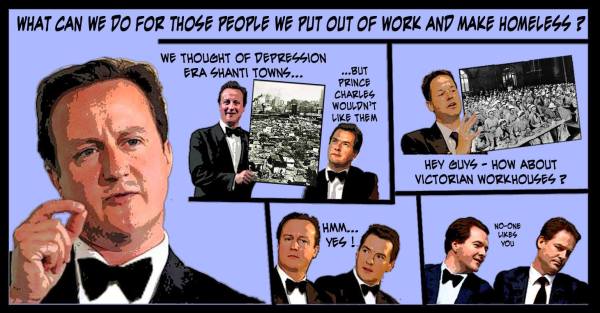
Thanks to Robert Livingstone for his brilliant memes
Posted originally by Mike Sivier on Vox Political here: DWP refuses to provide information on ESA/IB deaths. What is it hiding?.
Brian McArdle. On the BBC’s Question Time in November last year, Iain Duncan Smith flew into a rage when Owen Jones challenged him about what happened to Mr McArdle, “57 years old, paralysed down one side, blind in one eye; he couldn’t speak. He died one day after being found ‘fit for work’ by Atos.”
Once bitten, twice shy – the DWP has refused to release an update to its figures on the deaths of people in receipt of incapacity benefits (including Employment and Support Allowance).
Long-term readers may recall there was quite a stir last year when these figures were released, showing that around 73 people were dying every week after having been denied ESA or put in the work-related activity group.
This was more than twice as many as the previously-accepted figure of 32 people every week (which was still scandalous).
I received word of the cover-up last night, from Samuel Miller, the long-time friend of Vox Political who has been liaising with the United Nations about the Coalition government’s record on disability and incapacity benefits and the possibility that the Coalition is committing crimes against humanity.
“Just received word from the DWP that they will NOT release an update to ‘Incapacity Benefits: Deaths of recipients’,” he wrote.
“Is this tantamount to a cover-up of thousands of deaths and/or has mortality of the sick and disabled become too politicized for the government?
“Needless to say, I am furious.”
The response from the DWP runs as follows:
“Thank you for your email and apologies for the delay in responding.
“The publication you refer to was released on Department’s website as an ad-hoc statistical analysis publication. As such there is no intention of releasing an updated version of these statistics.” [Emphasis mine]
The “delay in responding” was a particularly long one. Mr Miller sent, by email, a copy of the original acknowledgement he received from the DWP, dated – if you can believe it – November 16, 2012. Were they hoping he would forget about it?
That letter stated: “I am sorry that the information you require is not readily available. As this would take a considerable length of time to pull together I am unable, at this stage, to tell you when the next report will be available.”
Never, if the department has its way, it seems.
This is not good enough, and we would be letting down everybody who has died if we let it pass.
I have therefore, today, sent a Freedom of Information request to the DWP, asking almost exactly the same questions as those to which ‘Incapacity Benefits: Deaths of recipients’ responds.
Sent to ministers@dwp.gsi.gov.uk and under the title ‘Freedom of Information requests’, it runs as follows:
“Please provide the number of Incapacity Benefit and Employment and Support Allowance claimants who have died in 2012. Please break that figure down into the following categories:
“I am aware that the Department for Work and Pensions came under criticism last year because it did not follow up on the conditions of people who had been found fit for work and signed off the benefit. It is to be hoped that this has been rectified and follow-up checks have been carried out. If this is the case, please provide details of:
“Thank you for your co-operation in this matter.”
I strongly urge you to do the same. There is strength in numbers.
Further reading:
“A Department for Work and Pensions FOI reveals that people having their claim for Employment Support Allowance (ESA) stopped, between October 2010 and November 2011, with a recorded date of death within six weeks of that claim ceasing, who were until recently claiming Incapacity Benefit, totalled 310. Between January and November 2011, those having their ESA claim ended, with a recorded date of death within six weeks of that claim ending totalled 10,600.” KittySJones – The ESA ‘Revolving Door’ Process, and its Correlation with a Significant Increase in Deaths amongst the Disabled.
Clause 99, the Mandatory Review is yet another indication that the Coalition are authoritarian, and aiming to silence the victims of its maladministration – those it has oppressed – and of hiding the evidence of that maladministration – Clause 99, Catch 22: The ESA Mandatory Second Revision and Appeals
How the cuts target disabled people
The UK government is making big cuts in public expenditure in order to try and solve a financial crisis that was primarily triggered by excessive house price inflation, private borrowing and over-lending by the banks. However, most people think that everything is being cut and that the cuts being made are probably fair. The latest report from The Centre for Welfare Reform – A Fair Society? – shows that this is not true.
Not everything is being cut.
In fact over 50% of cuts fall in just two areas which together make up only 25% of government spending:
The cuts are not fair.
They target the very groups that a decent society would protect:
These facts are represented in the following info-graphic:

The unfairness of this policy is seen even more clearly when we look at the difference between the burden of cuts that falls on most citizens and the burdens that fall on minority groups. By 2015 the annual average loss in income or services will be:
These facts are represented in the following info-graphic:

This also means that if we compare the relative targeting of the cuts on different groups then:
These facts are represented in the following info-graphic:

If regressive tax increases were also included in this analysis the picture would be even worse.
This is a conservative analysis, based upon facts taken from the government’s own reports and from the reports of reputable national bodies like CIPFA and ADASS.
Cuts to social care are already in underway – over £4 billion has already been cut from the social care budget reducing care and support to disabled children, adults and frail older people.
Cuts to benefits are being disguised within ‘reforms’ that mask reductions in the value, type and scope of benefits.
The UK is the third most unequal developed country in the world and most disabled people live in poverty. The current policy is guaranteed to increase inequality and to make extreme poverty even worse.
All of this may seem surprising given the UK government’s claim that the cuts would be “fair” and that they have even provided “extra money” for social care. However it seems that many of the government’s claims are either very misleading or utterly false.
Many people do not know the real facts about the current welfare system:
The report argues that the main reason for the unfairness of the cuts is that the current democratic and welfare system has a built-in bias towards protecting some services and for cutting others. The public have been persuaded that the NHS, pensions and education are universal services that benefit everybody; but they see benefits and social care as being for ‘other people’.
This bias is highly dangerous, especially when politicians pander to it, and use the rhetoric of ‘shirkers’, ‘scroungers’ or ‘cheats’ to appeal to the prejudices of swing voters. A new level of honesty and self-discipline is required within our political elites.
Not only is this policy dangerously unfair it will be ineffective. Increased inequality and reduced social care will increase social crises, crime, institutionalisation and will increase the inefficiency of other public services, like the NHS. Benefits and social care are relatively efficient and effective at reducing need and strengthening communities.
The current economic crisis was created by unsustainable house price inflation which was certainly not caused by people in poverty or by disabled people. Nor did they benefit from this inflation in asset values. However they are now being made to foot the bill for the mistakes of others. None of this is necessary. Even if one were to accept the need for public expenditure cuts then effective salary control would have saved jobs and reduced inequality.
The Campaign for a Fair Society demands that MPs of all political parties call for:
Further information:
All the facts, figures and analysis described above can be found in the latest report by The Centre for Welfare Reform titled:
A Fair Society? How the cuts target disabled people
The statistics are taken from government sources. Most refer to the real term impact of funding changes by 2015, primarily as set out in the 2010 CSR. However many later changes and amendments have been included, particularly the increased cut to benefits which has increased from an original cut of £10 billion in 2010, to a planned cut of £22 billion.
The report was produced, pro bono, for the Campaign for a Fair Society, an alliance of over 300 charities who are advocating an end to unfair cuts and the radical reform of the welfare state:
www.campaignforafairsociety.com
The author of the report is Dr Simon Duffy, winner of the RSA Prince Albert Medal and the Social Policy Association award for outstanding contribution to social policy: http://about.me/simonduffy
The publisher is The Centre for Welfare Reform.
Briefing on How Cuts Are Targeted © Simon Duffy 2013.


 Politics and Insights