
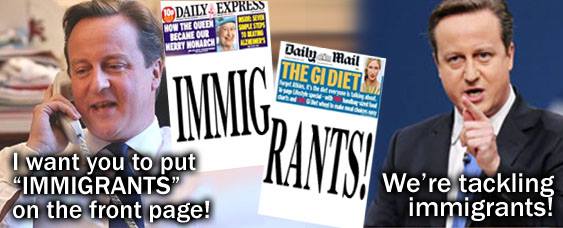
I’ve said before, probably more than once, that the Conservatives are, on the whole, supremicist creatures of habit rather than reason. They carry with them a poisonous, heavy burden of longstanding, traditional grudges and prejudices. That is why their policies are so stifling and anti-progressive for the majority of us. It’s why Tory policies don’t meet public needs and are so blatantly class-contingent.
There’s always an air of doom and gloom when we have a Tory government, and a largely subdued, depressed, repressed nation, carrying vague and fearful intuitions that something truly catastrophic is just around the corner.
It usually is.
I can remember the anxiety and creeping preternatural fear infecting and agitating young people back in the eighties, and our subsequent teenage, transcendent defiance, which we carried like the banners at the Rock Against Racism marches, in the Thatcher era. It struck me more than once that we always witness the social proliferation of ultranationalist sentiments and fascist ideals whenever we have a Tory government, too. It stems from the finger-pointing divide and rule mantra: it’s them not us, them not us. But of course history refutes as much as it verifies, and we learned that it’s been the Tories all along. Well, some of us did, anyway
With a Conservative government, the general public are always fighting something. Poverty, inequality, social injustice: we fight for political recognition of our fundamental rights, which the Tories always circumvent. We fight despair and material hardship, caused by the rising cost of living, low wages, high unemployment and the intentionally manufactured recessions that are a key characteristic of every single neoliberal Tory government.
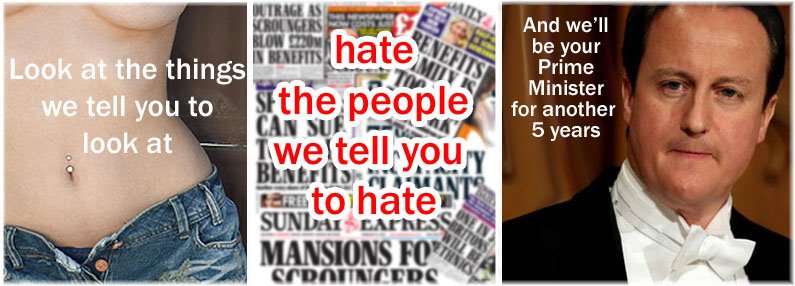
I think people mistranslate what that something is; they quickly lose sight of what they are fighting, of why they feel fearful. A loss of identity and sense of belonging is inevitable, because Tory rhetoric is all about outgrouping and othering: dividing, fragmenting society into alienated bite-sized manageable pieces by amplifying an ultimately anomic, pathologically paranoid narrative of sneaking suspicions and hate thy neighbours.
The Tories are and always have been psychocrats. They insidiously intrude into people’s everyday thoughts and try to nudge, micro-manage and police them. They use Orwellian-styled rhetoric crowded with words like “market forces”, “meritocracy” “autonomy”, “incentivisation”, “democracy”, “efficient, small state”, and even “freedom”, whilst all the time they are actually extending a brutal, bullying, extremely manipulative, all-pervasive and socially damaging authoritarianism.
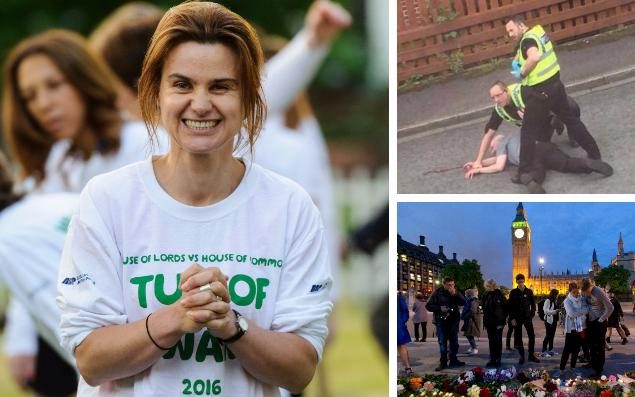
The man who murdered Jo Cox in cold blood, who shot her, stabbed her, then continued to brutally kick her when she was on the ground, was apparently described as a “loner”. Neighbours expressed their shock at the atrocity he has committed, because he was “quiet” and because he also has a strong work ethic. He tidies people’s gardens and he had said that he believed “hard work” could cure mental illness. That’s a Conservative notion, by the way. Work is now considered to be a “health” outcome. We have a government that wants to put therapists in jobcentres and job coaches in GP surgeries. Not that all hardworking and reserved people are right-wing or murderers, of course. Nor are most people with mental health problems.
He said: “All these [mental health-related] problems are alleviated by doing voluntary work. Getting out of the house and meeting new people is a good thing, but more important in my view is doing physically demanding and useful labour.”
I wonder how many of those people who readily misjudged Mair because of his superficial politeness and reserved nature would be equally quick to condemn those who cannot work because they are sick and disabled? Or those so poor that it takes every ounce of energy they have to simply survive, with none spare for cutting people’s hedges or passing on horticultural tips?
The hardworking taxpayer and economic free-rider myth is founded on a false dichotomy, since it is estimated that around 70% of households claim benefits of one kind or another at some point in their lives. In the current climate of poor pay, poor working conditions, job insecurity, and high living costs, the myth of an all pervasive welfare-dependent something for nothing culture is being used to foster prejudice and resentment towards those unfortunate enough to be out of work. It also serves to bolster Right-wing justification narratives that are entirely ideologically driven, which are aimed at dismantling the welfare state, whilst concurrently undermining public support for it.
Thomas Mair was clearly wrong about “hard work” being anything like a positive “mental health outcome” and so are the Tories. It’s frustrating that people don’t pay enough attention to details and look beyond surface appearances. Since when was being “quiet” or submissively “hard working” anything to do with being a decent, humane, moral, empathic and good citizen? And since when did having those qualities exclude the possibility that someone may be a murderer?
As someone with an academic background in psychology (and sociology), and as someone who also worked within mental health services, I have yet to encounter a mental illness that directs people to plan and carry out the brutal murder of their political opponents.
Thomas Mair, it emerges, is a neo-Nazi. He was living quietly, he presented himself to his community as a plausible, calm, respectable character, generating positive public perceptions of himself, whilst arming himself and planning to carry out a murder in a calculated, cold-blooded manner. All of those very dutiful people out there conforming to the frightfully exploitative and alienating Tory redefinition of our social norms, and a narrative that imposes directives of how a small group of authoritarians think we ought to be, seem to fail to recognise how empty such superficial gestures are, and how they lack meaning when they are premised on repression, festering hatred, fear of others and such rage-driven motives. It’s time to take a closer look at what is happening here. Here is where people are getting poorer, more excluded, isolated, more fearful, suspicious, lonelier and angrier by the day.
And who really bothered to get to know Thomas Mair?
How quickly his local community disassociated themselves from him, preferring instead to see him as some kind of pathological mystery; someone with “mental health problems” hiding in their midst, rather than as a member of the community, as someone living and sharing a realm of intersubjective cultural meanings. Us and them again. He was apparently a pillar of the community, until it was very plain that actually, he wasn’t.
More than one person killed Jo Cox. Surely our whole, indifferent, ever so competitively individualistic, neoliberal, right-wing, increasingly intolerant, prejudiced society is also culpable. Sure, it was only one person that pulled the trigger of a gun and wielded the knife, but Jo was murdered by a process of unfolding prejudice and hate every bit as much as by the person and weapons chosen and purposefully gathered to carry out the terrible and intentional act. It’s all too easy to dismiss this terrible murder as a random and meaningless act carried out in isolation by a “mentally ill loner” (yet another prejudice), but we must not take the easy option: there is an awful, but far bigger and more important truth to be found in exploring the broader context of these horrific events, difficult though that is.
The Conservatives (and those further Right) have parochialised both explanations of and responses to the global economic crisis, reducing us to a gossiping around the parish-pump type of politics. Parochialism entails neglect of the interests of identified “outsiders”, and this kind of isolationist tendency has also provided a political platform for nationalism. Parochialism tends to support inter-group hostilities, and it tends to lead to violations of human rights, as we are currently witnessing. Parochialism directly opposes a fundamental set of [internationally agreed] principles that constitute these rights: namely that all humans beings are of equal worth, and that human rights are universally applicable – they apply to everyone.
Even to the social groups that you don’t like.
It’s also worth bearing in mind that fascists never stop at discriminating against and persecuting the one social group of your choice. Fascists are fascists and tend to discriminate almost indiscriminately. However, fascists generally spare the establishment, curiously enough. Pastor Martin Niemöller famously observed public complicity and the consequences of bystander apathy and silence when he wrote: “First they came for the socialists, and I did not speak out – Because I was not a Socialist…”
Of course Britain is not divided by race and culture: it’s divided by wealth inequalities fueled by the government’s ideology, policies and austerity programme. Blaming people who are unemployed, sick and disabled, refugees and immigrants for the failings of the government has fueled misperceptions that drive support for the far-Right. People complain they can’t get council houses, surely the only really honest question an honest politician ought to ask is: “Why aren’t there more council houses?”
And when there are large numbers of people receiving unemployment benefit or tax credits, then the only honest question to ask is: “Why is the economy failing to provide enough jobs, or pay adequate wages?”
As a society that once promised equality and democracy, we now preside over massive inequalities of wealth: that’s a breeding ground for racism, classism and other vicious resentments.
Hate crime directed at disabled people has risen over the past five years, and is now at the highest level it’s ever been since records began. That’s the kind of society we have become.
Austerity cuts and the steady and deliberate erosion of democratic inclusion have served to awaken the disgruntled beast within people, the one that feeds on anger, disempowerment, demoralisation, fear, resentment and uncertainty. And loss of a sense of meaning and identity.
And wherever antipathy and a degree of enmity exist, the far-Right have always tried to perpetuate, exploit and increase rancour. The fascism of the 20s and 30s gained prominence because it played on wider public fears, manipulating them, and deflecting attention, as ever, from those who are truly to blame for dire social conditions: the ever-greedy elite. There’s a well-established link between political extremism, economic hardship and recession and social cleavages, with the far-Right “anti-system” parties now deceitfully winning the support of those who would never previously have thought of themselves as extremists.
Such extremism and rancour feeds the disgruntled beast. The political Right have always sought to divide sections of the poor and middle class and set them to fight one against the other; to have us see enemies in our midst which do not exist, so that we see economic policies – the Tory-rigged “free market” competition – as the solution rather than the cause of our problems.
And here we are again.
When you just feed disgruntled beasts, you only end up with beasts.
I’ve often written about the Right’s tendency to infrahumanise, dehumanise and create categories of “others”; scapegoating, using a media manufactured stigma to extend the politics of division and prejudice, and hate-mongering rhetoric. I’ve also written about how Conservative governments always work to encourage the rise of far-right groups and a toxic climate of nationalism. Thatcher’s government was no different. Now they need to take some responsibility for what that kind of context does to people’s sense of identity and mental health, to social solidarity and community cohesion. They need to take some responsibility for transforming what was a diverse and reasonably tolerant culture into one of labeling and bullying, and ultimately into, dear God, one of murder: Perhaps the Conservatives need to read Gordon Allport’s work about how prejudice escalates and as a reminder from history about the terrible social consequences of that, again.
Gordon Allport studied the psychological and social processes that create a society’s progression from prejudice and discrimination to genocide. In his research of how the Holocaust happened, he describes socio-political processes that foster increasing social prejudice and discrimination and he demonstrates how the unthinkable becomes tenable: it happens incrementally, because of a steady erosion of our moral and rational boundaries, and propaganda-driven changes in our attitudes towards politically defined others, that advances culturally, by almost inscrutable degrees.
Decades of research findings in sociology and psychology inform us that as soon as a group can be defined as an outgroup, people will start to view them differently. The very act of demarcating groups begins a process of ostracisation.
The process always begins with the political scapegoating of a social group and with ideologies that identify that group as the Other: an “enemy” or a social “burden” in some way. A history of devaluation of the group that becomes the target, authoritarian culture, and the passivity of internal and external witnesses (bystanders) all contribute to the probability that violence against that group will develop, and ultimately, if the process is allowed to continue evolving, extermination of the group being targeted.
Economic recession, uncertainty and political systems on the authoritarian -> totalitarian spectrum contribute to shaping the social conditions that seem to trigger Allport’s escalating scale of prejudice.
Prejudice requires the linguistic downgrading of human life, it requires dehumanising metaphors: a dehumanising socio-political system using a dehumanising language, and it has now become familiar and all-pervasive: it has seeped almost unnoticed into our lives. Because we permitted it to do so.
‘Though some of us do challenge it, we need the wider public to recognise their moral and rational boundaries are being politically manipulated and systematically pushed. That has consequences. Increasing inequality, poverty, prejudice, discrimination and social injustice and social isolation, decreasing democracy, social inclusion and civic rights are just some such consequences. There are many more, some happening at a profoundly existential level. All at a time when supportive provision is being steadily withdrawn, public and mental health services are in crisis because of the Conservative cuts to funding. And many people are dying as a consequence.
Let’s freeze this, let’s stop and observe the context and full horror of this awful event for a moment, so we can see something of the enormity of the tragic murder of Jo Cox. She was a dedicated Labour MP, who fought tirelessly for social justice. She was just 41 and was taken from a husband and two young children, as well as her friends and constituents. Her final words were “my pain is too much.” Jo’s grieving husband, Brendan, has urged us to “fight the hatred that killed her.” We must.
It must be time to recognise that each and every one of us bears some responsibility and has some positive contribution to make to the kind of society we live in.
And want to live in.
And surely that society is not the one we witness today.
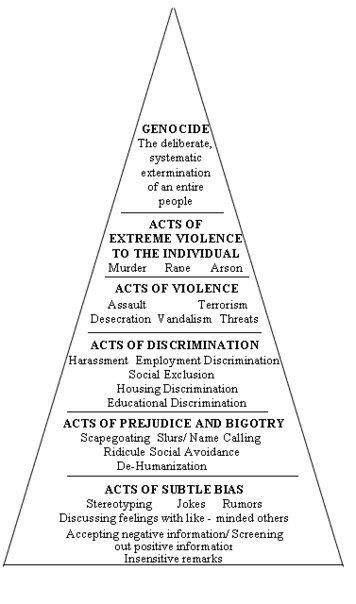
Adapted from Gordon Allport’s “The Nature of Prejudice”
Related
The Psychological Impact of Austerity – Psychologists Against Austerity
Mainstream politicians ‘clueless on migration debate’, says Jo Cox’s husband – Brendan Cox / Patrick Wintour
Jo Cox: The Labour MP who campaigned tirelessly for refugees
Jo Cox’s Husband Brendan Pays Moving Tribute To Labour MP After Shooting In Birstall, West Yorkshire
UKIP: Parochialism, Prejudice and Patriotic Ultranationalism
Aktion Arbeitsscheu Reich, Human Rights and infrahumanisation
I don’t make any money from my work. But you can support Politics and Insights and contribute by making a donation which will help me continue to research and write informative, insightful and independent articles, and to provide support to others. The smallest amount is much appreciated, and helps to keep my articles free and accessible to all – thank you.


 Politics and Insights