Tag: Andrew Dilnot

The DWP are being Conservative with the truth, yet again

Sarah's story: Turned out to be fiction rather than fact

Sarah’s story: Turned out to be fiction rather than fact


In 2015, Welfare Weekly exposed the Department for Work and Pensions for using fake testimonies from fake characters via a well-placed freedom of information (FoI) request, revealing that the lengths that the government is prepared to go to justify extremely punitive policies. Remarkably, even the 
Chartered Institute of Public Relations (CIPR)  were alarmed at the level of deception, and said it had written to all of its members who work at the Department to find out whether they had played any part in putting the leaflet together. 

Sarah Pinch, the CIPR’s president, said: “Falsely creating the impression of independent, popular support is a naive and opaque technique which blatantly disregards the CIPR’s standards of ethical conduct. It is deeply disappointing if public relations professionals allowed it to be published.” 

This happened during the same month that the it was only this month that the UK statistics watchdog censured the DWP for understating the scale” of its sanctions regime – essentially failing to release adequate data to give jobseekers or the public a genuine picture of the way it’s imposing sanctions, and of monitoring the real impact of this draconian policy. The revelation that the DWP has faked information to distort the reality that so many citizens face is reflective of how deep the rot is in the entire system. 

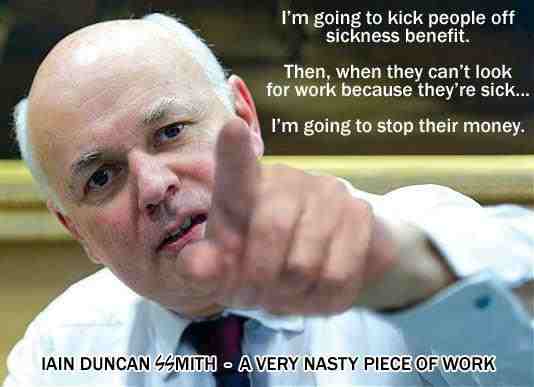
Then there are the fictional statistics. Iain Duncan Smith was rebuked by the Office for National Statistics (ONS) for the ‘misuse’ of benefit statistics  his claim that 8,000 people moved into work as a result of the benefit cap is “unsupported by the official statistics”, says the UK Statistics Authority. 

In letter to Duncan Smith, Andrew Dilnot writes: “In the manner and form published, the statistics do not comply fully with the principles of the Code of Practice, particularly in respect of accessibility to the sources of data, information about the methodology and quality of the statistics, and the suggestion that the statistics were shared with the media in advance of their publication.”

Another claim by Duncan Smith later in the same month also drew criticism and a reprimand. The (then) minister said around 1 million people have been stuck on benefits for at least three of the last four years “despite being judged capable of preparing or looking for work”.

However, the figures cited also included single mothers, people who were seriously ill, and people awaiting testing. Grant Shapps was also rebuked by UK Statistics Authority for misrepresenting benefit figures the Tory chairman claimed that “nearly a million people” (878,300) on incapacity benefit had dropped their claims, rather than face a new medical assessment for its successor, the employment and support allowance.

The figures, he claimed, “demonstrate how the welfare system was broken under Labour and why our reforms are so important”. The claim was faithfully reported by the Sunday Telegraph  but as the UK Statistics Authority confirmed in its response to Labour MP Sheila Gilmore, it was entirely fabricated.

In his letter to Shapps and Duncan Smith, UKSA chair Andrew Dilnot wrote that the figure conflated “official statistics relating to new claimants of the ESA with official statistics on recipients of the incapacity benefit (IB) who are being migrated across to the ESA”. Of the 603,600 incapacity benefit claimants referred for reassessment as part of the introduction of the ESA between March 2011 and May 2012, just 19,700 (somewhat short of Shapps’s “nearly a million) abandoned their claims prior to a work capability assessment in the period to May 2012. 

The figure of 878,300 refers to the total of new claims for the ESA closed before medical assessment from October 2008 to May 2012. Thus, Shapps’s suggestion that the 878,300 were pre-existing claimants, who would rather lose their benefits than be exposed as “scroungers”, was entirely wrong. Significantly, there is no evidence that those who abandoned their claims did so for the reasons ascribed by Shapps.

Now the DWP have been found out submitting fake claims to the Work and Pensions Committee. The DWP claimed the Institute for Fiscal Stdies (IFS) had reviewed its data which asserts that UC will help more than 250,000 people into employment, once the flagship welfare reform is fully implemented across the UK. However the IFS have contradicted the claim, leading to heavy criticism regarding the DWP’s statement and ‘evidence’ regarding Universal Credit’s ‘causal relatonship’ with employment. 

The Committee says:

“A central part of the Department for Work and Pension’s (DWP) case for the benefit of Universal Credit (UC) is their assertion of its effect on employment. In to a request for an estimate of the magnitude of that effect, DWP stated it has “determined” that UC will result in 250,000 more people in employment once it is fully implemented.

How the Department ‘arrived’ at these figures

In a follow up letter to Employment Minister Alok Sharma (PDF PDF 1.38 MB)Opens in a new window the Chair asked a set of specific questions about how the Department had arrived at each of the stated constituent parts of that figure:

  • 150,000 more due to “increased financial incentives to work” 
  • 50,000 more due to “increased conditionality”
  • 60,000 due to “simplification of the benefit system”

(That’s basically euphemisms for cuts, sanctions, and more cuts and sanctions)

The Department’s response (PDF PDF 800 KB)Opens in a new window did not answer any of the Chair’s specific questions, although it did supply an account of academic research papers that have informed the Department’s work on UC, and restated the principles underlying those three ostensible benefits of the reform.

DWP concluded by stating: “The approach to our analysis underpinning these estimates was reviewed by the Institute for Fiscal Studies.”

Accordingly, the Committee wrote to the Institute for Fiscal Studies (IFS) (PDF PDF 141 KB)Opens in a new window asking if, in that review, it had found those three estimates reasonable, and what the margin of statistical error might be on the numbers.

The IFS’ reply (PDF PDF 197 KB)Opens in a new window starts out “clarifying the role we had in reviewing DWP’s approach” in coming up with the numbers:

Note that at no stage did we review their approach to estimating the impact of increased conditionality or simplification, to which they attribute 50,000 and 60,000 respectively of the overall 250,000 forecast effect on employment”.

The employment impact of Universal Credit is highly uncertain

The IFS goes on to say: “Neil Couling’s letter to Baroness Hollis on 16 November states that the 250,000 figure is based on the same methodology we reviewed in 2012. For the reasons given above, that can only be true of the element (150,000) which is a result of changes to financial incentives. And we are not in a position to confirm whether and to what extent DWP took on board our comments and implemented our recommended improvements before applying the methodology….”

The employment impact of UC is highly uncertain. The move to UC involves a number of changes for which it is hard to find comparable precedents (especially UK precedents)” — casting doubt on DWP’s use of academic evidence to substantiate its estimates — “It is not even possible to produce statistical margins of error for estimates of the employment impact, as the nature of the uncertainty is not conducive to standard statistical analysis…”

Sadly, it will be difficult even after the event to produce convincing estimates of the overall employment impact of UC. The early impact estimates that DWP have published – cited in the Minister’s letter of 12 March – apply only to a small group of claimants who are not affected by UC in the same way as most other claimants […]” and;

“We emphasise that the overall employment impact of UC will conceal very different effects for different groups in the population, with employment rates likely to rise for some and fall for others.”

The last point contradicts what DWP have previously told the Committee when asked about the impact on other groups:

“We remain committed to producing robust comparative analysis of the employment impacts of Universal Credit. As we informed the Committee we are planning to expand the analysis for single cases in the Live Service to couples and families in both services.

This analysis will estimate a labout market impact for these broader claimant groups. In this instance it is misleading to draw a distinction between two services. The underlying policy for both is the same so any comparative analysis will hold true for both systems”.

Lack of evidence

Rt Hon Frank Field MP, Chair of the Committee, said:

“The ongoing lack of evidence to back up the much-vaunted employment impact of Universal Credit was already extremely disappointing. But to have our specific queries about basis of this claim answered with airy, irrelevant and, it appears, plainly inaccurate assertions adds insult to injury.

The IFS’ letter shows that Old Mother Hubbard hasn’t got much in the cupboard, despite the bragging of the Department. This clumsy and ill-judged attempt to piggyback on one of the most trusted, unimpugnable authorities on public policy and finance would be farcical if it was not so deeply worrying.”

Call it what it is, Frank. It’s just more glib, ideologically driven lies

Image result for Universal credit criticism


I don’t make any money from my work. But you can support Politics and Insights and contribute by making a donation which will help me continue to research and write informative, insightful and independent articles, and to provide support to others. The smallest amount is much appreciated, and helps to keep my articles free and accessible to all – thank you. 

DonatenowButton

Labour Party To Refer Groundless Iain Duncan Smith Claim To Statistics Watchdog Again

Steve Bell cartoon


Iain Duncan Smith is telling fibs again. Work and pensions secretary claims that 75% of jobseekers think that benefit sanctions have helped them “focus and get on.”

The following is reported by Rowena Mason and Patrick Butler, for theguardian.com on Saturday 12th March 2016:

Labour is to challenge Iain Duncan Smith’s claim that 75% of jobseekers think benefit sanctions have helped them “focus and get on” by lodging a complaint with the official statistics watchdog.

Owen Smith, the shadow work and pensions secretary, said he would write to Duncan Smith challenging him to back up the “groundless” figure and refer the matter to the UK Statistics Authority for investigation.

The work and pensions secretary made the claim in an interview with the Camden New Journal, in which he suggested many claimants were grateful for the consequences of benefit sanctions.

“Seventy-five per cent of all those who have been sanctioned say it helped them focus and get on. Even the people in the jobcentres think it’s the right thing to do … sanctions are the reason why we now have the highest employment levels ever in the UK, and more women in work,” Duncan Smith said.

“What we say is: ‘We’ll give you all the support but at the end of the day we expect you to do something for it: go back to work, take the job, take the interviews.’ And it works, talk to any of the advisers in the jobcentres.”

While out campaigning for the Tory London mayoral candidate, Zac Goldsmith, Duncan Smith also dismissed protests about the controversial sanctions regime as “a classic buzz from the left” and claimed “these people are never going to vote for us – you have to understand, these people hate us”.

Owen Smith said: “Iain Duncan Smith’s claim that 75% of people who had been sanctioned say it ‘helped them focus and get on’ is groundless and shows he is out of touch with the real impacts of policies introduced by his department.

In reality, widespread concerns have been raised about this government’s use of sanctions, including from their own advisers, which is why the cross-party work and pensions select committee called for a full independent review into the system.

However, Iain Duncan Smith is reluctant to accept such scrutiny. Labour is calling for far greater transparency and honesty in this debate, so we can ensure greater numbers of people are actually helped into work, while being treated fairly.

That is why I will be writing to the secretary of state to inform him that we will refer his use of data to the Statistics Authority and calling for the long overdue independent review into sanctions to begin.”

Duncan Smith is believed to have been referring to DWP research that found 72% of jobseeker’s allowance (JSA) claimants said awareness of sanctions made them “more likely to follow the rules.”

However, that paper also said: “There was no evidence from the survey that knowledge of JSA conditions led to actual movement into work. Respondents who said they were more likely to look for work because of their knowledge of JSA conditions were no more likely than other respondents to have moved into work when they left JSA.”

After the interview, the Department for Work and Pensions released a statement saying: “Decisions on sanctions aren’t taken lightly but are an important part of our benefits system – they are only ever used as a last resort and the number of sanctions continues to fall.”

It is not the first time the UK statistics watchdog has been asked to adjudicate on the DWP’s approach to the sanctions regime.

Last year, it asked the DWP to ensure its statements on jobseeker sanctions are “objective and impartial” following a series of complaints by experts.

At the time, the authority’s chair, Sir Andrew Dilnot, wrote to the DWP’s top statistician asking the department to publish far more data and give the public a clearer understanding of how it is imposing sanctions on jobseekers.

Sanctions are used by civil servants to penalise jobseekers when they are alleged to have broken benefit rules, with punishments becoming increasingly severe over the last parliament.

The government has faced repeated calls from Labour to rethink the system, but is resisting pressure for an independent inquiry.

The Commons work and pensions committee last year urged the government to hold a wide-ranging independent review of the regime to address widespread concerns that it is unfair, excessively punitive, and does little to help people get into work.

© Guardian News & Media Limited 2010.

Related

A List of Official Rebukes For Tory Lies

Department of Work and Pensions officials admit to using fake claimant’s comments to justify benefit sanctions

The Department of Whopping Porkies is rebuked as claimants suddenly develop mysterious superpowers after being sanctioned

A letter of complaint to Andrew Dilnot regarding Coalition lies about employment statistics

Audit finds whereabouts and circumstances of 1.5 million people leaving welfare records each year “a mystery”

Iain Duncan Smith used false statistics again to justify disability benefit cuts

486294_4737578711832_1816039541_n
The Department of Work and Pensions has a long track record of misusing statistics, making unsubstantiated inferences and stigmatising claimants, and it’s clear these are tactics used to vindicate further welfare cuts.

The Tories have peddled the lie that he UK was “on the brink bankruptcy” and claimed the solution to is to cut government spending with a painful programme of austerity cuts. Of course, the UK economy was growing in 2010 when the Tories took over and was subsequently plunged back into recession by Osborne’s austerity policies, which have meant that the economy has not grown at all under the coalition; and for much of their tenure has been contracting. Despite the fact that Osborne was officially rebuked for this lie, the Goebbels-styled repetition propaganda technique employed by the conservatives has embedded this lie in the minds of the public.  However, our current problems are the result of a global financial crisis that we and not the banks that caused it, continue to pay for.

Austerity is a smokescreen – the Coalition has used the deficit as an excuse to do what they have always wanted to do: shrink the state, privatise the NHS, and hand out our money to the wealthy minority. We cannot trust them. 

It’s become clear that the Tories have seized an opportunity to dismantle the institutions they have always hated since the post-war social democratic settlement – institutions of health, welfare, education, culture and human rights which should be provided for all citizens. The Tories also attempt to destroy fundamental public support for the health, education and welfare of its people by a divisive scapegoating of vulnerable groups, perpetuated via the media, and by offering and inflicting only regressive, punitive policies and devastating cuts. 

The  Official statistics watchdog (UKSA) has found that the Department for Work and Pensions (DWP) have repeatedly made false claims about the numbers of people living on disability benefits.

Ministers claim that the majority of people claiming disability living allowance (DLA) were given benefits for life, and without any supporting medical evidence. This is untrue.

According to DWP press releases:

“More than 50% of decisions on entitlement are made on the basis of the claim form alone, without any additional corroborating medical evidence.”

However, the UK Statistics Authority (UKSA) found that the real percentage of claims passed without supporting medical evidence was just 10%.

The DWP also claimed that “Under the current system of Disability Living Allowance, 71% of claimants get indefinite awards without systematic reassessments.” However the UKSA found that in the last two years, just 23% and 24% of claimants were given indefinite awards of DLA.


The DWP accept that their claims were “ambiguous” and “had not been re-checked by the Department’s analysts, as is the usual practice.”

The findings were uncovered by an investigation by Channel Four News following complaint by the charity Parkinson’s UK.

 Parkinson’s UK policy advisor Donna O’Brien said:

“People with Parkinson’s who claimed DLA have told us supporting medical evidence was crucial due to a woeful knowledge of the condition amongst assessors, and it is absurd that the Government was trying to imply that anyone going through the system had an easy ride.”

This is the third time in the past year that Iain Duncan Smith has come under fire for the use of false statistics to justify cuts to benefits.

Last year Duncan Smith was rebuked by UKSA for misuse of benefit statistics. He claimed that 8000 people who had been affected by the benefits cap had “moved back into work.”

The UKSA found that this figure was “unsupported by the official statistics.”

Another statement by Duncan Smith later in the month also drew criticism and a reprimand. The minister said around 1 million people have been stuck on benefits for at least three of the last four years “despite being judged capable of preparing or looking for work”.

However, the figures cited also included single mothers, people who were seriously ill, and people awaiting their assessment.

Grant Shapps was also rebuked by UK Statistics Authority for misrepresenting benefit figures – Shapps joined his fellow Conservatives in the data hall of shame. In March, the Tory chairman claimed that “nearly a million people” (878,300) on incapacity benefit had dropped their claims, rather than face a new medical assessment for its successor, the employment and support allowance (ESA).

The figures, he said, “demonstrate how the welfare system was broken under Labour and why our reforms are so important”.  The claim was faithfully reported by the Sunday Telegraph  but as the UK Statistics Authority has now confirmed in its response to Labour MP Sheila Gilmore (the complainant), it was entirely and intentionally fabricated.

In his letter to Shapps and Iain Duncan Smith, UKSA chair Andrew Dilnot writes that the figure conflated “official statistics relating to new claimants of the ESA with official statistics on recipients of the incapacity benefit (IB) who are being migrated across to the ESA”.

Of the 603,600 incapacity benefit claimants referred for reassessment as part of the introduction of the ESA between March 2011 and May 2012, just 19,700 (somewhat short of Shapps’s “nearly a million) abandoned their claims prior to a work capability assessment in the period up to May 2012. The figure of 878,300 refers to the total of new claims for the ESA closed before medical assessment from October 2008 to May 2012.

Thus, Shapps’s suggestion that the 878,300 were pre-existing claimants, who would rather lose their benefits than be exposed as “scroungers”, was entirely wrong. As significantly, there is no evidence that those who abandoned their claims did so for the reasons ascribed by Shapps. However, he did at least honestly reveal his own prejudices regarding disabled people, at least. But he did so without a trace of shame and remorse.

At the time Iain Duncan Smith dismissed the findings, saying that he “believed” that he was “right”, anyway. It seems that Iain Duncan Smith has some disdain for evidence-based policy.

“I believe this to be right, I believe that we are already seeing people going back to work who were not going to go back to work,”  he said.

This is a remarkable claim, given that the Department for Work and Pensions does not track the destination of people no longer entitled to benefits. Simply measuring how many people no longer claim benefits does not accurately reflect the numbers of those actually moving into employment. The DWP off-flow figures will inevitably include many having their claim ended for reasons other than securing employment, including sanctions, awaiting mandatory review, appeal, death, hospitalisation, imprisonment, or on a government “training scheme” (workfare). 

In 2011, the Work and Pensions Select Committee warned the Department for Work and Pensions (DWP) needed to take more care when releasing and commenting on benefit statistics, to make sure media stories were “accurate.”

It seems unlikely, however, that accuracy will replace Duncan Smith’s “gut feelings” and ideologically-driven rhetoric – which is aimed at presenting excuses for the steady reduction of support for the most vulnerable citizens – any time soon.

36626_217452248405831_532419169_n

Pictures courtesy of Robert Livingstone 

A letter of complaint to Andrew Dilnot regarding Coalition lies about employment statistics

 10270806_319228004894921_8005540502444686357_n
I’ve written the following to Andrew Dilnot:

Dear Sir,

I write in response to the government claims made recently regarding employment. During Prime Minister’s questions in Parliament on Wednesday, Mr Cameron said that the number of people in full-time employment had risen. Other ministers, such as Esther McVey have echoed these claims.

We are growing the economy and we’ve got more people in work,”  Mr Cameron said.

And: The number of people out of work in the UK fell by 133,000 to a fresh five-year low of 2.2 million in the three months to March, official figures show.The jobless rate also fell to a five-year low of 6.8%, the Office for National Statistics (ONS) has said”.

I am very concerned about the accuracy of these claims, and should like to challenge both the validity and reliability of them, given the current methodological problems with measurement, which the ONS have acknowledged in part, previously.

To count as unemployed, people have to say they are not working, are available for work and have either looked for work in the past four weeks or are waiting to start a new job they have already obtained. Someone who is out of work but doesn’t meet these criteria counts as “economically inactive”. The results from a selected sample, based on narrow criteria, are then weighted to give an estimate that reflects the entire population.

The other measure of joblessness – the claimant count – is published for each single month. It doesn’t suffer from the limitations of sample size and sampling frame, because it derives from the numbers of Jobseeker’s Allowance (JSA) claimants recorded by Jobcentre Plus, so a monthly figure is possible right down to local level. But because many people who are out of work won’t be eligible for JSA, it’s an  even narrower measure.

I draw your attention to the following, taken from the Summary of recommendations: Response from the Employment Related Services Association (ERSA) to the Work and Pensions Select Committee inquiry into Jobcentre Plus, dated May, 2013:

Jobcentre Plus performance metrics:

  • The effectiveness of Jobcentre Plus (JCP) should be measured by sustained job outcomes rather than off-benefit flows to create greater incentives to support jobseekers into employment and provide a more accurate picture of success rates. This would address potential perverse incentives to sanction claimants inappropriately, plus ensure greater comparability between JCP provision and contracted out provision.
  •   Such a change could help to provide greater transparency in order to identify those who would benefit from intensive employment support. Such a performance metric would prevent the phenomenon of ‘cycling’, jobseekers moving between short term jobs and unemployment for many years, but not building up the length of time of continual unemployment to qualify them for specialist support.

In particular, I wish to draw your attention to this from the same document – Response from ERSA to the Work and Pensions Select Committee inquiry into JCP, 2013:

4.1. JCP is measured by off-benefit flows rather than sustained job outcomes. This can create perverse incentives to move jobseekers into short term employment outcomes, rather than refer them to long term contracted out support. It can also create a perverse incentive to sanction claimants as discussed below.

ERSA recommends that whilst off-benefit checks are monitored for national statistical purposes, job outcome and sustainment measure, comparable to the Work Programme, should be introduced for Jobcentre Plus. This would enable analysis between the performance of JCP and contracted out provision and provide accurate value for money comparisons.

5.1. DWP point to off-benefit flows as an indication of the effectiveness of pre-Work Programme support. However, analysis undertaken by Policy Exchange calls into question the validity of off-benefit figures as a success measure given that many do not go into sustainable employment or simply move on to another type of benefit.

8.1 As identified by the Committee in its report into the experience of different user groups on the Work Programme, the use of sanctions is inconsistent. 

Providers are obliged to notify Jobcentre Plus if a jobseeker fails to undertake an activity, for example if they miss an appointment. The decision as to whether to actually enact sanctions rests with Jobcentre Plus though. This means that sanctions are not applied even though a provider may think there is a clear case to do so. Conversely, a provider may be satisfied with the progress made by a participant but may be overruled by Jobcentre Plus who have a case for applying conditionality.

For example, one ERSA member reported that Jobcentre Plus decided to sanction a Work Programme participant for insufficient use of the Universal Jobmatch website, despite the fact that the provider had explicitly asked the participant to focus on resolving some other issues ahead of any formal job search activity. Sanctioning represented a great setback in the trust and progress made up to that point. ERSA agrees with the recommendation put forward by the Committee in its most recent report into the Work Programme for DWP to conduct a review of sanctioning activity with a view to ensuring that the processes are clearly understood by participants and consistently applied.

8.2 Part of the problem lies in the fact that Jobcentre Plus is measured by off-benefit flows rather than sustained job outcomes. This therefore means that a situation in which a Personal Advisor applies a sanction that may in fact damage an individual’s progress to employment, would register as a success according to the off-benefit flow measure. ERSA believes that measuring Jobcentre Plus success by sustained job outcomes would remove any perverse incentives to sanction individuals.

So, in summary, simply measuring how many people end their claims for benefits does not reveal the true impact of jobcentre services, nor does it accurately reflect the numbers of those moving into employment.

Let’s not forget that in 1996, the Conservative government introduced the jobseeker’s allowance that cut benefits to young people up to 18 years old – the new allowance was designed to replace unemployment benefit and income support. Young people excluded from eligibility for benefit are therefore absent from unemployment statistics.

The Department has simplified its performance measures and now primarily targets the move by claimants away from benefits, or “off-flow”, as a simple and intuitive measure of performance. However, this gives no information about how individual jobcentres perform in supporting claimants to work. Some may have found work but, in more than 40 per cent of cases, the reason for moving off benefits is not actually recorded.

I am also concerned that underemployment continues to remain very high, despite a small fall of 7,000 in the number in involuntary part time work, the total still stands at 1.42m. This is an increase of a 100 per cent beyond the pre-recession level of 701,000. The rise in employment also continued to be driven by self-employment, which is extraordinary as self-employment is a relatively small part of the UK jobs market. But although just one in seven workers are self-employed, over half of all jobs growth over the year has been in this type of employment. The TUC share this concern, and have said that some people have been forced in to self-employment as they have no alternative.

Previous TUC’s analysis  suggests that rising self-employment is part of a wider shift towards insecure employment, rather than as a result of a growing number of people starting up new companies as ministers have claimed. Analysis shows that self-employed workers are often earning less, underemployed, and have less job security than employees.

One very important issue not currently considered is that since the government does not track or follow up the destination of all those leaving the benefit system, as discussed, the off-flow figures will inevitably include many having their claim ended for reasons other than securing employment, including sanctions, awaiting mandatory review, appeal, death, hospitalisation, imprisonment, on a government “training scheme” (see consent.me.uk  and the Telegraph – those on workfare are counted as employed by the Labour Force Survey.)

Furthermore, last week Iain Duncan Smith met a whistle-blower who has worked for his Department for Work and Pensions for more than 20 years. Giving the Secretary of State a dossier of evidence, the former Jobcentre Plus adviser told him of a “brutal and bullying” culture of “setting claimants up to fail”.

“The pressure to sanction customers was constant,” he said. “It led to people being stitched-up on a daily basis.”

The whistle-blower wishes to be anonymous but gave his details to Iain Duncan Smith, DWP minister Esther McVey and Neil Couling, Head of Jobcentre Plus, who also attended the meeting. He said:

“We were constantly told ‘agitate the customer’ and that ‘any engagement with the customer is an opportunity to ­sanction.”

Iain Duncan Smith and his department have repeatedly denied there are targets for sanctions. However, the whistle-blower says:

“They don’t always call them targets, they call them ‘expectations’ that you will refer people’s benefits to the decision maker. It’s the same thing.”

He claimed managers fraudulently altered claimants’ records, adding: “Managers would change people’s appointments without telling them. The appointment wouldn’t arrive in time in the post so they would miss it and have to be sanctioned. That’s fraud. The customer fails to attend. Their claim is closed. It’s called ‘off-flow’ – they come off the statistics. Unemployment has dropped. They are being stitched up.”

Labour MP Debbie Abrahams, the member of the DWP Select Committee who set up the meeting, has renewed her call for an inquiry into inappropriate sanctioning. Debbie said:

“I am deeply concerned that sanctions are being used to create the illusion the Government is bringing down unemployment.

It is my belief that the claims made by David Cameron and his ministers are an unwarranted, far-fetched inferential leap from methodological premises that don’t stand up to scrutiny, for all of the reasons I have outlined. I felt obliged to draw your attention to this matter, not least because I am not alone in my concerns, and I feel very strongly that it is immoral of any government to mislead the public to which it is meant to be accountable.

Yours sincerely
Ms Susan Jones.

Related article: Austerity, socio-economic entropy and being conservative with the truth

Petition to Stop DWP Minsters Spinning Statistics 

995658_494538353949031_779653065_n
Thanks to  Robert Livingstone for the pictures.