Tag: Authoritarianism

Granfalloonery, scapegoating, social dominance theory and Conservatism

images

Anyone who has read Kurt Vonnegut’s Cat’s Cradle will know what a granfalloon is. The University of Chicago awarded Vonnegut a Master’s in anthropology for what was essentially a work of satire, irony, black humor and parody. The term has since been adopted by market researchers and social scientists.

A granfalloon is a group of people who affect a proud and shared identity or some cohesive purpose, but whose mutual association is actually meaningless – associations and societies based on a shared but ultimately fabricated premise. Yet members often feel very superior in some way to others.

Granfalloons are powerful propaganda devices because they are easy to create and, once established, the granfalloon then defines social reality, establishes a normative order, by demarcating and maintaining social identities. Granfalloons also play to our strong normative tendencies towards sociability, grouping and a fundamental need for a sense of belonging, based on perceived shared characteristics. They tend not to like deviations from the norm. Or at least from what they perceive as the norm.  

However, group identities constructed around labels such as “strivers”, “tax payers” and “hard working families” are non inclusive, too. These are created politically to justify economic exclusion and outgrouping, and to manage public perceptions. Exclusive language and dominant, prejudiced narrative is an effective means of social control since it can be used to frame the interpretation of events. The group categories are designed to create or redefine moral norms and also, to stigmatise, to define deviance and to create scapegoats.

One of the purposes of the construction of granfalloons is to create categories of outsiders, as much as it is to create a false sense of privilege amongst ingroup members.

The granfalloon technique is used in advertising, in political rhetoric and by pseudoscientists, cults and other dubious groups, as a technique of persuasion in which individuals are encouraged to identify with a particular granfalloon or social group. The pressure to identify with a group is meant as a method of securing the individual’s loyalty and commitment through adoption of the group’s symbols, slogans, language, norms, rituals, actions, goals and beliefs. We like to conform and we like to “belong” and that is manipulated endlessly by granfallooners everywhere.

It’s ultimately very socially divisive. 

Think of UKIP’s extensive granfalloonery; the shrinking island of logic; an ever-decreasing ingroup of supremicists, and you get the gist. The only people who properly “belong” in UKIP  are older, “hard done by” white labourers, predominantly but not quite exclusively males, who don’t like anyone else’s social groups. Everyone else is “privileged” in some way, and that’s a bad thing to be, apparently. Scapegoating can often cause oppressed groups to attack other oppressed groups. Even when injustices are committed against a minority group by a majority ingroup, minorities sometimes lash out against a different minority group in lieu of confronting the more powerful majority.

Sometimes the oppressed can be very oppressive too.

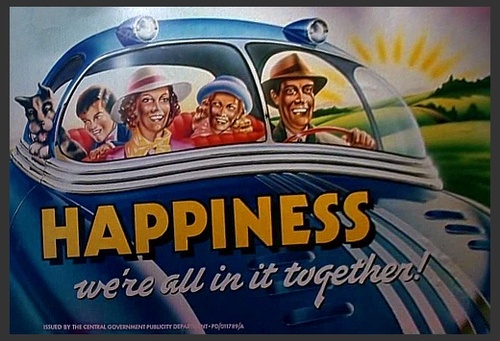
Then there is the “all in it together” granfalloonery of Conservatism, where social groups are targeted by the ever-electioneering, purposeful and powerful elite to vote for policies that serve absolutely no-one but the elite, and cause real harm to other group members of society. All that “hate thy neighbour stuff”, you know: it’s the sick and disabled people, the unemployed people, the ethnic minorities, the working poor, the junior doctors, the unions, the Labour Party, Harold Wilson, Ed Miliband, Jeremy Corbyn, the “extremist” critics and academics. How very dare they.

But the biggest miscreants of all are in office, for crying out loud. “They’re behind you!” came the pantomime call from a usually passive, disengaged audience. We all know the score, yet here we are as an entire society of sub-grouped granfalloons, following all the divisive finger-pointing and scapegoating like dizzy, distracted cats running around in circles chasing unravelling strings.

tumblr_m81dzafFA21qcekj1o1_500

The Conservatives are creatures of habit rather than reason. Traditional. That is why their policies are so anti-progressive, and stifling for the majority of us. It’s also why Tory policies don’t meet public needs. 

I’ve observed before that there’s always an air of doom and gloom when we have a Tory government, and a largely subdued, depressed, repressed nation, carrying vague and fearful intuitions that something truly catastrophic is just around the corner.

I’ve said more than once before that we always witness the social proliferation of fascist ideals with a Tory government, too. It stems from the finger-pointing divide and rule mantra: it’s them not us, them not us. But history refutes as much as it verifies, and we learned that it’s been the Tories all along.

With a Conservative government, we are always fighting something. Poverty, social injustice: we are forced to compete and fight for political recognition of our fundamental rights, which the Tories always circumvent. We fight despair and material hardship, caused by the rising cost of living, low wages, high unemployment or more recently, underemployment, and recession that is characteristic of every Tory government.

I think people often mistranslate what that something is. Because Tory rhetoric is all about othering: dividing, atomising of society into bite-sized manageable pieces by amplifying a narrative of sneaking suspicion and hate thy neighbour via the media. Scapegoating serves as a mechanism of psychological dumping and emotional relief in acts of misplaced aggression towards oppressed outgroups for oppressed ingroups. The social order is maintained this way.

In social psychology, the granfalloon concept stems from research by the British social psychologist Henri Tajfel, in particular, from social identity theory. The significance of ingroup and outgroup categorization was identified using a method that has come to be known as the minimal group paradigm. In his research, Tajfel found that strangers would form groups on the basis of completely inconsequential criteria, such as liking certain paintings, fictions, pseudoscientific dogmas or Elvis.

In one study, Tajfel’s experimental subjects were asked to watch a coin toss. They were then designated to a particular group based on whether the coin landed on heads or tails. The subjects placed in groups based on such meaningless associations between them have consistently been found to “act as if those sharing the meaningless labels were kin or close friends.” Research demonstrates that people are differentially influenced by ingroup members. That is, under conditions where group categorisation is psychologically salient, people will shift their beliefs in line with ingroup social norms.

Outgrouping leads to the homogeneity effect. This is a process where the perception of members of an outgroup as being homogenous arises (“all the same”), while members of one’s ingroup are perceived as being individual and diverse. This is especially likely to occur on the basis of prejudiced, stereotyped negative characteristics. Of course ingroup members can be perceived as being similar to one another in regards to loosely identified positive characteristics. This effect is called ingroup homogeneity.

Authoritarian governments often utilise granfalloonery, maintaining social order by the creation of social allegiances through various means of outgrouping and ingrouping, socialisation and indoctrination. This is also used to justify prejudice, discrimination and socioeconomic inequality.

Being sociable is a positive human quality. But perhaps being duped by trivia and artificially constructed categories, intentionally stigmatised identities and politically constructed social taxonomies is also a human tendency. It seems so.

Granfalloonery is used as a propaganda technique. It is an improper appeal to emotion, which purposefully bypasses the rational thought-processes of populations. It used for the purpose of changing the opinions of a targeted audience or population. The closely related Bandwagon technique involves encouraging people to think or act in some way simply because other people are doing so.

Some people much prefer wide social inequalities. Social dominance orientation (SDO) is conceptualised as a measure of individual differences in levels of group-based discrimination; that is, it is a measure of a person’s preference for status-ranking and hierarchy within society and domination over what are perceived as lower-status outgroups. It is a predisposition toward anti-egalitarianism within and between social groups. High scores of SDO predict stereotyping, discrimination and prejudice. SDO correlates with forms of right-wing authoritarianism. Hello Mrs May.

The concept of SDO as a measurable individual difference arose from social dominance theory. Individuals who score high in SDO desire to maintain and, in many cases, increase the differences between social statuses of different groups, as well as individual group members. Typically, they are controlling, manipulative, competitive, aggressive, dominating, tough, and relatively unempathic, uncaring power-seekers. People scoring high in SDO also prefer hierarchical group orientations. Often, people who score high in SDO have strongly held beliefs in ‘meritocracy’, hierarchical societies and forms of social Darwinism.

See also:

Groupthink

False-consensus effect

How to sell a pseudoscience – Anthony R. Pratkanis

Don’t believe everything you think: cognitive dissonance

3822587_600x600


I don’t make any money from my work. But you can support Politics and Insights and contribute by making a donation which will help me continue to research and write informative, insightful and independent articles, and to provide support to others. The smallest amount is much appreciated, and helps to keep my articles free and accessible to all – thank you.

DonatenowButton

Infantilizing the nation – an insight into Conservative ‘paternalism’

                                               hqdefault                                                 Young Bullers


Paternalist parenting classes? Heaven forbid

The Prime Minister claims that every family needs help in improving behaviour and discipline. Ironically, this is from a politician who claims to despise the “nanny state”. He much prefers the Bullingdon brand of paternalist interference in people’s everyday lives. Cameron is also recommending “parenting classes” for all, which is understandable given his own strong instincts as a parent. He left his own child in a pub, after all.

Of course Cameron feels that it’s other people that need parenting and discipline. After all, this is a man who spent his early adulthood involved in bizarre initiation rituals, patriarchal debauchery, recklessly banqueting, getting drunk, trashing college rooms and pubs, listening to Supertramp and smoking pot with James Delingpole and vandalising restaurants. In 2013, it was reported that members of the Bullingdon Club were required to burn a £50 note in front of a beggar as part of an “initiation ceremony”. How encouraging to see the elite showing responsibility, compassion, a concern for social justice and cohesion, equality and alleviating poverty, at an early age.

Now that’s a real deviant subculture.

The draconian sentences handed down to the rioters in 2011, advocated by Cameron –  like the 23-year-old student with no previous convictions who was jailed for the maximum permitted six months after pleading guilty to stealing bottles of water worth £3.50 from Lidl in Brixton, for example –  shows only too well that he believes there is one rule for the Oxford elite and another for the rest of the society. Punishment is a central component of the social order and a means by which social order is produced and maintained.

Actually, defining others as deviant is, too. It’s a Conservative means of enhancing social power and status differentials by degrading the rule-breaker’s status and power.

Cameron’s response to the riots reflects a characteristically Bullingdon conservative disdain: an authoritarian, strict and oppressive approach towards perceived, labelled and stigmatised subordinates. Conservatives have always seen the social world as being organised in terms of hierarchies of worth. Smashing up a pub or restaurant and causing 10k worth of damage is no problem if you can cough up the costs on the spot to keep your thuggish behaviour private, hidden away from the scrutiny of the legal system and the public. Money talks and bullshit struts.

The Conservatives inform us that it is bad parents that cause poverty, opting for a rhetoric of authoritarian populism, creating cardboard monsters, manufacturing folk devils and moral outrage for the tabloids, making excuses for the consequences of their own prejudiced and damaging policy-making.

The establishment is a kind of Moebius strip of finger-pointing, arrogant, moralising privileged and feckless bullies passing the buck. And importantly, these wayward boys and girls always get their own way. They can’t democratically govern the country; they lack the social skills, motivation, developmental and emotional capacity to actually engage in any genuine and democratic dialogue with ordinary people, so they rule. Conservatives have always prefered the simplicity of a socio-economic system defined by inherited social ranks.

Cameron says that the government’s Life Chances Strategy – an “initiative to target tackle child poverty” – will include a plan for “significantly expanding parenting provision”. It will also recommend ways to “incentivise” all parents to take up the offer of classes. The hope is, presumably, that if the middle class take Cameron up on his offer of state parenting instructions, the process of social norming will provide the foundation of state-defined “correct behaviours” for the insubordinate working classes, who are perpetually caught up, according to the Tories, in a pathological cycle of something or other, and therefore need state therapy from elitist antipodean role models to set them straight and put them in their place. It’s the new behaviourism: do as we say, but not what we do.

It seems that poverty is to be addressed with nothing more than a paternalist brand of cheap psychopolitics. The government won’t be dipping their hands into the treasury, which is what’s needed. Instead they prefer to employ shabby techniques of persuasion aimed at indoctrinating a Conservative world-view and enforcing conformity as a replacement for genuinely needs-led and evidence-based policies.

At no point does Cameron mention any commitment to improving people’s standard of living, or ensuring that families have a basic level of income in order to meet their fundamental needs, such as food, fuel and shelter – because struggling to meet basic material needs are the main barriers for people experiencing poverty. It’s sobering to consider that the Tory obsession with the work ethic, embodied in their mantra “making work pay”, is nothing more than a meaningless glittering generality, that purposefully diverts attention from elitist policy-making, and subsequent growing poverty and inequality.

Around half of those who are in poverty and of working age live in a household where at least one person works. The steady drop in real wages since 2010, according to the Office for National Statistics, is the longest for 50 years.

Furthermore, since 2010, the decline in UK wage levels has been amongst the very worst in Europe. The fall in earnings under the Coalition is the biggest in any parliament since 1880, according to analysis by the House of Commons Library, and at a time when the cost of living has spiralled upwards.

Ah, and Cameron uttered that inane managementspeak word again – “incentivise”. It never bodes well when Conservatives use that word. It means he has been listening to the psychobabbling of the Nudge Unit, again. Welfare sanctions, which are the punitive withdrawal of lifeline benefits from people who need to claim welfare support to meet their basic needs are claimed to “incentivise” people to find a job, despite empirical evidence to the contrary, and the cuts to child tax credit, limiting support to just two children, are based on the charming and archaic eugenicist idea that poor people ought to be “incentivised” to have fewer children.

Rich people are apparently “incentivised” by large cash carrots, but poor people just get the brutal, merciless stick. What a classic example of flagrant Conservative ideological incoherence.

Psychopolitical paternalism doesn’t address poverty, it is simply a way of apportioning blame, of abdicating political responsibility and ensuring that poor people accept the Conservative and neoliberal decree that they somehow deserve to be poor.

Cameron claims that:

“Families are the best anti-poverty measure ever invented. They are a welfare, education and counselling system all wrapped up into one. Children in families that break apart are more than twice as likely to experience poverty as those whose families stay together. That’s why strengthening families is at the heart of our agenda.”

The announcement from Cameron was welcomed by Relate, whose chief executive, Chris Sherwood, said:

“Relationship support can help to reduce family breakdown, which is a key driver of poverty and can result in poor outcomes for children.”

Actually, family breakdown is quite often a consequence of poverty, not a cause of it. Back in 2010, Fergus Drake, director of UK programmes with Save the Children expressed an unease that many of us felt, regarding the Conservative’s feckless drive to offload the responsibility for poverty onto poor people, who are casualities of the consequences of neoliberalism, which extends discriminatory economic policies. He said:

“We would say poverty causes family breakdown rather than vice versa. If you are worried about putting food on the table, or being able to turn on the heater so you can have a hot bath, the stress that causes to a relationship can make things really difficult.”

Poverty isn’t caused by family breakdown, it’s caused by discriminatory policies and social insititutions that extend and perpetuate inequality. We are now the most unequal country in the European Union, and even more unequal than the US. If Cameron really wanted to address childhood poverty, he would ensure that people have enough to meet their basic needs, instead of steadily withdrawing welfare support and cutting public services. He should end the class-contingent austerity that his government have imposed on only the poorest people.

Tim Nichols, of the Child Poverty Action Group, agrees that the Conservatives should be careful not to confuse causes and consequences. He says:

“We don’t think that this is robust strategy. Tackling child poverty can’t be done without more redistribution.”

Cameron is talking ideologically-driven nonsense, reflecting traditional Tory prejudices. This government has become obsessed with moralising about and manipulating individual agency, which is increasingly seen as being to blame for high levels of poverty and social exclusion in the UK, which are created entirely by callous, discriminatory political policies. Political gaslighting does not help people out of poverty.

People are poor because they don’t have enough money to meet their needs. That is what Cameron needs to acknowledge and address.

Parenting and elitist-authoritarian ideology

Cameron’s paternalist-authoritarian turn was evident back in 2010, when he said that:

“Discipline is the foundation of a good education. Headteachers need to decide on exclusions.”

Most people that have worked in either formal or informal education settings are very aware that using punishment and threats is very counterproductive. Making young people suffer in order to change their future behaviour can often elicit temporary compliance, but this strategy is highly unlikely to lead to conversion or to help children become ethical, responsible decision makers in the long term. Punishments don’t involve any engagement of deliberative processes.

Punishment, even if referred to euphemistically as “consequences,” tends to generate oppositional behaviours, anger and defiance.  Furthermore, it models the use of power rather than reason and damages the important trust-based relationship between adult and child.

Authoritarian models of parenting are emotionally and physically traumatising. There’s an Old Testament brand of harshness in conservative authoritarian approaches to human behaviours.

Authoritarian parents often have prejudices based on wealth and what may be defined as “achievement”, gender, class and race. They tend to be highly competitive, lacking warmth and empathy. They teach their children to compete at all costs, and to win by whatever means. Most authoritarians are behaviourists, with a preference for punishments rather than rewards to control others.

Authoritarians tend to advocate corporal punishment, they see freedom as chaotic, they can’t tolerate ambiguity or recognise the complexities and subtleties of human conduct, and they tend to advocate capital punishment.

Because authoritarian parents expect absolute obedience, children raised in such settings are typically very good at following rules.

However, they often lack self-discipline. Children raised by authoritarian parents are not encouraged to explore and act independently, so they never really learn how to set their own limits and personal standards.

Whilst developmental experts agree that rules, boundaries and consistency are important for children to have, most believe that authoritarian parenting is too punitive and lacks the warmth, unconditional love, safety, trust and nurturing that children need.

Of course public schools also foster authoritarianism and elitism. Boarding school: the trauma of the ‘privileged’ child by Joy Schaverien explores the emotional deprivation and abuse that many experience as a result of public school culture. Psychotherapist Nick Duffell (2000) wrote a book based on workshops he has conducted over ten years with adults who attended boarding schools as children. He has identified many lasting pathological psychological patterns common in those he calls Boarding school survivors.

In his recent work: Wounded Leaders: the Psychohistory of British Elitism and the Entitlement Illusion, Nick says:

“A cherished national character ideal, eschewing vulnerability and practising a normalised covert hostility based on bullying in the dorm adversely affects even those who did not have the privilege of such an education. It leaves Britain in the social and emotional dark ages, led by “the boys in the men that run things.

This specific culture of elitism, protected by financial interests and the “It never did me any harm” syndrome, means that Britain is unlikely to foster the kind of leadership necessary in our world of increasing complexity, which needs a communal mindset and cooperative global solutions. But worse, new scientific evidence shows that this hyper-rational training leaves its devotees trapped within the confines of an inflexible mind, beset with functional defects, presented here as the Entitled Brain.”

It’s a sobering thought that so many boarding school survivors – psychologically and emotionally damaged individuals – are involved in running the country and determining the terms and conditions of our lives.

002fc17b9115fe26a6ed5d9d58b1ece1.603x472x1


I don’t make any money from my work. My articles are free. If you like, you can make a donation to help me continue to research and write free, informative, insightful and independent articles, and to provide support to others. The smallest amount is much appreciated – thank you.

DonatenowButton

Controversial GCHQ Unit Engaged in Domestic Law Enforcement, Online Propaganda, Psychology Research – Glenn Greenwald and Andrew Fishman

Introduction

A visit by Government national security agents on Saturday 20 July 2013 to smash up computers at The Guardian newspaper office in London hit the news surprisingly quietly, when Edward Snowden exposed a gross abuse of power and revealed mass surveillance programmes by American and British secret policing agencies (NSA and GCHQ) last year. (More detailed information here).

David Miranda, partner of Glenn Greenwald, the Guardian interviewer of the whistleblower Edward Snowden, was held for 9 hours at Heathrow Airport and questioned under the Terrorism Act. Officials confiscated electronics equipment including his mobile phone, laptop, camera, memory sticks, DVDs and games consoles.

This was a profound attack on press freedoms and the news gathering process, and Greenwald said:

“To detain my partner for a full nine hours while denying him a lawyer, and then seize large amounts of his possessions, is clearly intended to send a message of intimidation.”

Absolutely. Since when was investigative journalism a crime?

Since it flies in the face of an increasingly authoritarian and psychocratic government that exercises rigid control over public access to information, and manipulates public perceptions and behaviours.

Sure, it sounds like the basis of a conspiracy theory doesn’t it?

But it’s not.

___

The following article was originally posted on The Intercept site by Glenn Greenwald and Andrew FishmanReproduced here with thanks.


The spy unit responsible for some of the United Kingdom’s most controversial tactics of surveillance, online propaganda and deceit focuses extensively on traditional law enforcement and domestic activities — even though officials typically justify its activities by emphasizing foreign intelligence and counterterrorism operations.

Documents published today by The Intercept demonstrate how the Joint Threat Research Intelligence Group (JTRIG), a unit of the signals intelligence agency Government Communications Headquarters (GCHQ), is involved in efforts against political groups it considers “extremist,” Islamist activity in schools, the drug trade, online fraud and financial scams.

Though its existence was secret until last year, JTRIG quickly developed a distinctive profile in the public understanding, after documents from NSA whistleblower Edward Snowden revealed that the unit had engaged in “dirty tricks” like deploying sexual “honey traps” designed to discredit targets, launching denial-of-service attacks to shut down Internet chat rooms, pushing veiled propaganda onto social networks and generally warping discourse online.

Early official claims attempted to create the impression that JTRIG’s activities focused on international targets in places like Iran, Afghanistan and Argentina. The closest the group seemed to get to home was in its targeting of transnational “hacktivist” group Anonymous.

While some of the unit’s activities are focused on the claimed areas, JTRIG also appears to be intimately involved in traditional law enforcement areas and U.K.-specific activity, as previously unpublished documents demonstrate. An August 2009 JTRIG memo entitled “Operational Highlights” boasts of “GCHQ’s first serious crime effects operation” against a website that was identifying police informants and members of a witness protection program. Another operation investigated an Internet forum allegedly “used to facilitate and execute online fraud.” The document also describes GCHQ advice provided “to assist the UK negotiating team on climate change.”

Particularly revealing is a fascinating 42-page document from 2011 detailing JTRIG’s activities. It provides the most comprehensive and sweeping insight to date into the scope of this unit’s extreme methods. Entitled “Behavioral Science Support for JTRIG’s Effects and Online HUMINT [Human Intelligence] Operations,” it describes the types of targets on which the unit focuses, the psychological and behavioral research it commissions and exploits, and its future organizational aspirations. It is authored by a psychologist, Mandeep K. Dhami.

Among other things, the document lays out the tactics the agency uses to manipulate public opinion, its scientific and psychological research into how human thinking and behavior can be influenced, and the broad range of targets that are traditionally the province of law enforcement rather than intelligence agencies.

JTRIG’s domestic and law enforcement operations are made clear. The report states that the controversial unit “currently collaborates with other agencies” including the Metropolitan police, Security Service (MI5), Serious Organised Crime Agency (SOCA), Border Agency, Revenue and Customs (HMRC), and National Public Order and Intelligence Unit (NPOIU). The document highlights that key JTRIG objectives include “providing intelligence for judicial outcomes”; monitoring “domestic extremist groups such as the English Defence League by conducting online HUMINT”; “denying, deterring or dissuading” criminals and “hacktivists”; and “deterring, disrupting or degrading online consumerism of stolen data or child porn.”

It touts the fact that the unit “may cover all areas of the globe.” Specifically, “operations are currently targeted at” numerous countries and regions including Argentina, Eastern Europe and the U.K.

JTRIG’s domestic operations fit into a larger pattern of U.K.- focused and traditional law enforcement activities within GCHQ.

Many GCHQ documents describing the “missions” of the “customers” for which it works make clear that the agency has a wide mandate far beyond national security, including providing help on intelligence to the Bank of England, to the Department for Children, Schools and Families on reporting of “radicalization,” to various departments on agriculture and whaling activities, to government financial divisions to enable good investment decisions, to police agencies to track suspected “boiler room fraud,” and to law enforcement agencies to improve “civil and family justice.”

Previous reporting on the spy agency established its focus on what it regards as political radicalism. Beyond JTRIG’s targeting of Anonymous, other parts of GCHQ targeted political activists deemed to be “radical,” even monitoring the visits of people to the WikiLeaks website. GCHQ also stated in one internal memo that it studied and hacked popular software programs to “enable police operations” and gave two examples of cracking decryption software on behalf of the National Technical Assistance Centre, one “a high profile police case” and the other a child abuse investigation.

The JTRIG unit of GCHQ is so notable because of its extensive use of propaganda methods and other online tactics of deceit and manipulation. The 2011 report on the organization’s operations, published today, summarizes just some of those tactics:

Throughout this report, JTRIG’s heavy reliance on its use of behavioral science research (such as psychology) is emphasized as critical to its operations. That includes detailed discussions of how to foster “obedience” and “conformity”:


In response to inquiries, GCHQ refused to provide on-the-record responses beyond its boilerplate claim that all its activities are lawful.

———

Documents published with this article:

Propaganda techniques part one: Glittering Generalities – language and the New Word Order.

Image result for securing a better futurePropaganda techniques

Introduction.

This is part one of a series of articles I am writing about propaganda techniques, with the aim of explaining the seven main types that The Institute for Propaganda Analysis identified in 1938, and looking at current examples of their use.

Propaganda techniques are still very commonly used in the media, in advertising, in politics, in rhetoric and debate. In the US, much of the work by the Institute of Propaganda Analysis tended to focus on the techniques of persuasion used by Stalin and Hitler. Many people think that there is no need for research nowadays, but propaganda techniques are still being used widely.

In Britain, the current government has adopted a psychocratic approach to governing, reflected in public policies that have a central aim of  directing”behavioural change” of targeted social groups, and are founded on quasi-scientific understandings of the basis of human decision-making.

The Conservatives claim to champion the small-state and minimal intervention, yet the consequences of their policies insidiously intrude into people’s everyday experiences and thoughts. Our attitudes and beliefs are being manipulated, our decision-making is being “nudged,” citizens are being micro-managed and policed by the state.

The Conservatives use Orwellian-styled rhetoric crowded with words like “market forces”, “meritocracy” “autonomy”, “incentivisation”, “democracy”, “efficient, small state”, and even “freedom”, whilst all the time they are actually extending a brutal, bullying, extremely manipulative, all-pervasive state authoritarianism.

Furthermore, this authoritarianism entails a mediacratic branch of government that powerfully manipulates public opinion. The mind-numbing mainstream media is conformative rather than informative, and is designed to manufacture and manage public consensus, whilst setting agendas for what ought to be deemed important issues. The media is scripting events rather than simply reporting them, filtering information by deciding which events may and may not have precedence.

And really, it’s the same old same old. Propaganda is an extremely powerful weapon and seizing control of the mainstream media is one of the first things that all tyrants do:

“Everything within the state, nothing outside the state, nothing against the state.” Benito Mussolini.

The current government is not interested in any form of democratic dialogue. They simply want to set a rigid agenda to control socio-political outcomes to benefit the powerful and wealthy elite.

We are witnessing attempts to control virtually all aspects of social life, including the economy, education, our private life, morals and the beliefs and attitudes of citizens. We are also seeing the rise of political behaviourism, which is closely linked with totalitarian forms of thinking.

The officially proclaimed ideology penetrates into the deepest reaches of societal structure and the totalitarian government seeks to completely control the thoughts and actions of its citizens.” Richard Pipes.

Recent public policies related to behavioural change exploit the emotive, automatic drivers of decision-making through methods such as subconscious priming or default settings. This is extremely worrying, as it bypasses rational processes, and has some serious implications for conceptions of human autonomy and agency, which is central to the design of liberal democracies.

Democracy is based on a process of dialogue between the public and government, ensuring that the public are represented: that governments are responsive, shaping policies that address identified social needs. However, Conservative policies are no longer about reflecting citizen’s needs: they are increasingly all about telling us how to be.

So we do need to expose and challenge such insidious, anti-democratic state control freakery and psychocratic shenanigans.

scroll2Part 1. Glittering Generalities: all that glitters is glib, not gold.

Glittering Generalities is one category of the seven main propaganda techniques identified by the Institute for Propaganda Analysis in 1938. It’s a device often used by the media and in political rhetoric to persuade us to approve and accept something without examining any evidence.

This is a propaganda technique purposefully designed to divert and distract, so that people are less likely to develop their own critical thoughts. This said, the purpose of all forms of propaganda is to tell you what to think, and not how to think.

Glittering Generalities capitalise on increasingly sloganised political discourses, leading to a loss of conceptual clarity, over-idealisation and they also reflect conceptual miserliness – a tendency for some people to prefer simple, superficial and easy answers, rather than having to expend time and effort to grapple with complexity, critical analysis and the need to weigh up evidence. They also succeed in conveying codified messages that reference underpinning discourses which are often prejudiced and controversial, but presented in a way that bypasses any detailed scrutiny, as a consensus view and “common sense.”  An example is the slogan “Taking our country back” as it references an underpinning racist, supremicist discourse.

Gordon Allport’s Principle of Least Effort is a theory that humans engage in economically prudent thought processes, taking “short-cuts” instead of acting like “naive scientists” who rationally investigate, weigh evidence, costs and benefits, test hypotheses, and update their expectations based upon the results of the “experiments” that are a part of our everyday actions.

Sometimes we are more inclined to act as cognitive misers, using mental short-cuts to make assessments and decisions, concerning issues and ideas about which we know very little, as well as issues of great salience.

The term “Cognitive Miser” was coined by Fiske and Taylor (in 1984) to refer, like Allport, to the general idea that individuals frequently rely on simple and time efficient strategies when evaluating information and making decisions.

Rather than rationally and objectively evaluating new information, the cognitive miser assigns new information to categories that are easy to process mentally. These categories arise from prior information, including schemas, scripts and other knowledge structures, such as stereotypes, that have been stored in our memory.

The cognitive miser tends not to extend much beyond established belief when considering new information. This of course may perpetuate prejudices and cognitive biases.

Glittering Generalities imply – or signpost us – via common stock phrases to our own tacit knowledge, which often lies below our current focal awareness – prior information, beliefs, ideals, values, schemata and mental models, stereotypes and so on, creating the impression that the person using the terms and phrases understands and sees the world as you do, creating a false sense of rapport by doing so. Or the feeling that some very important recognition has been made.

Glittering Generalities propaganda is sometimes based on a kind of logical fallacy known as Equivocation – it is the misleading use of a term with more than one meaning (usually by glossing over which meaning is intended at a particular time)

Glittering Generalities is a technique very often used by people who seek to stifle debate, sidestep accountability and suppress democratic processes. Because Glittering Generalities tend to obscure or gloss over serious areas of disagreement, they hide controversy and submerge alternative propositions.

As such, Glittering Generalities may often be used to neutralise opposition to dominant ideas. It’s a way of disguising partisanship and of manipulating and reducing democratic choices. It’s part of a process of the political micro-management of your beliefs and decision-making.

It also reduces public expectation of opposition and in doing so it contributes to establishing diktats: it’s a way of mandating acceptance of ideology, policies or laws by presenting them as if they are the only viable alternative.

This propaganda technique bypasses rationality altogether, by employing morally laden or emotionally appealing words and phrases so closely associated with highly valued concepts and beliefs that carry conviction – convince us – without need for enquiry, supporting information or reason.

The meanings of such words and phrases is generally based on a loose, tacit public consensus, often varying between groups and individuals. Semantic shift describes a process of how the meanings of words may change over time, but meanings also shift and vary amongst social groups. Language is elusive and changeable. (Words like wicked and bad, for example, shifted subculturally. Originally: evil, corrupt, sinful, malevolent → superb, excellent, great, fantastic. ) Let’s not forget that when we use language, it is with purpose and intent.

So, Glittering Generalities are rather like platitudes or clichés presented as semantic signs to cognitive short-cuts that are often used to distract and placate people, they provide a superficial, broad, symbolic map to a logical cul-de-sac. They are superficially appealing and convincing but ultimately empty, meaningless words or phrases.

To summarise, Glittering Generalities may be identified by the following criteria:

  • Use of attractive, but vague “virtue” words that make speeches and other communications sound good, but in practice say nothing in particular.
  • Use of lulling linguistic patterns such as alliteration, metaphor and reversals that turn your words into easy to remember soundbites that often flow and rhyme in hypnotic patterns.
  • Use of words that appeal to morals and values, which often themselves are related to triggering of powerful emotions.
  • A common element of glittering generalities are intangible nouns that embody ideals, such as freedom, democracy, integrity, justice, respect.

Some further examples of Glittering Generalities are: economic plan, all in it together, big society,  freedom, family values, the common good, democracy,  principles, choice, incentivise, efficiency, fairness, hard-working families, parental choice, a caring society, fiscal responsibility, market choice, meritocracy, personal responsibility, making work pay, scroungers and strivers, anti-austerity, socialism, progressive, disenfranchised, deceit, Westminster establishment, the needs of the people, but that’s all just semantics really.

A good example of a Glittering Generality is the Conservative’s phrase “making work pay.” It refers to the Tory welfare “reforms” which were nothing to do with the level of wages. How does reducing benefits for unemployed people actually make work pay? Especially given the fact that wages have dropped for those in work, at the same time, the cost of living has risen, and consequently many working people are now living in poverty. The question to ask is: making work pay for whom?

The Tories have an Orwellian dexterity in manipulating semantic shifts. They do like to dress-up words and parade them as something else. For example, take the word “reform,” which usually means to make changes to an institution, policy or practice in order to improve it. The welfare “reforms” have involved the steep and steady reduction of welfare provision and an increase in political scapegoating and victim-blame narratives.

We have also seen the return of absolute poverty since the “reforms” were (undemocratically) implemented in 2012, which can hardly be considered as an “improvement” to what came before the Tories made savage and brutal cuts to poor people’s lifeline benefits, making them even poorer, with some people dying as a consequence.

Then there is the Tory drift on the word “fair.”  It’s generally taken to mean treating people equally without favouritism or discrimination, and without cheating or trying to achieve unjust advantage.

However, the Conservatives have repeatedly claimed that cutting people’s lifeline benefits is “fair.”  As I’ve previously stated, the value of wages has also dropped to its lowest level ever, whilst the cost of living has risen and many in low paid work are now living in poverty, in reality the welfare cuts have simply made people desperate enough to take any low paid work, which does not alleviate circumstances of poverty.

Furthermore, how can the welfare cuts be regarded as remotely fair, when they took place in a context where the government handed out £107,000 of public funds to each millionaire, in the form of an annual tax break?

Finally, it’s not only the Tories that utilise propaganda techniques, and some parties on the Left have also used Glittering Generalities. These parties especially capitalized on the public’s growing cynicism and dissatisfaction with the “Westminster establishment.” UKIP and the Scottish National Party drew on nationalism (and independence,) whilst using superficial, simplistic and ambiguous phrases and symbols, the Green Party and other Left-wing factions also drew on public dissatisfaction with “mainstream parties” and appealed to people’s hopes and fears to present an “alternative.”

Both the Greens and the Scottish nationalists presented a rhetoric skillfully tailored and laden with words and phrases that reflect progressive ideals whilst also claiming a position that opposed austerity. Yet this lacked integrity, as the rhetoric wasn’t fully connected to actual manifesto policies.

Crucially, the Scottish National Party’s spending plans implied deeper cuts than Labour’s plans entailed over the next five years, as the Institute for Fiscal Studies (IFS) said in a report in April, highlighting a “considerable disconnect” between the nationalist’s rhetoric on austerity and their policies.

The Green Party had a similar disconnect between an anti-austerity rhetoric and their incompatable policy proposals of a zero-growth economy and the universal citizen’s income. The latter was heavily criticised because, as it was modelled, the universal basic income would create deeper poverty for the poorest citizens and further extend social inequality.

The Labour Party ran a more rational but superficially less appealing campaign based on improving the material conditions of society for the majority of people. The policy plans for an extensively redistributive tax system, for example, matched the rhetoric about addressing growing social inequality, as well as a social reality. But the current climate of  right-wing anti-intellectualism, widespread disillusionment with the political establishment and increasing public disengagement from democracy doesn’t prompt a rational exploration of policy proposals and any analysis of potential consequences for society from many people.

Watchdog that scrutinises constitutional reform is quietly abolished and Tory proposals are likely to lead to constitutional crisis.

 936319_485819054820961_1954794757_n

The Political and Constitutional Reform Committee, which was originally established for the duration of the 2010 parliament, has been very quietly scrapped following a meeting of party whips.

Originally, the cross-party committee was established to scrutinise the plans of the Coalition government, such as the House of Lords Reform and the Alternative Vote – many of which never made it onto the statute books.

The parliamentary committee’s main role was to scrutinise proposed major constitutional changes. This undemocratic development is especially worrying given the likelihood of significant constitutional changes in the forthcoming parliament, with the referendum on  membership of the European Union set to be held within the next two years.

There are further plans for devolution of powers to Scotland and Wales, as well as to cities, and it is expected that these will be delivered at the same time as the government repeals the Human  Rights Act, and draws up a bill of rights to replace it.

Considerable doubt exists among experts that the Council of Europe, a human rights watchdog responsible for ensuring the Convention is upheld, will accept the Tories’ proposals. In fact the plans are highly unlikely to be accepted. As a result, it is quite widely believed Britain will disengage from the European Convention on Human Rights (ECHR) and undermine Europe’s’ civil liberties framework in the process.

Cameron has previously pledged to withdraw from the ECHR, indicating plainly that he is indifferent to the fact that such a withdrawal would very likely spark a complex constitutional crisis in the UK.

If the Human Rights Act is repealed in its entirety, the repeal will apply to the whole of the UK. The Scotland Act gives powers to the Scottish Parliament, provided that they comply with the ECHR (among other things). This would not change with repeal of the Human Rights Act alone.

However, human rights are also partially devolved (the Scottish Parliament, for example, has set up a Scottish Human Rights Commission), and so any unilateral repeal of the Human Rights Act by Westminster would violate the Sewell Convention, which outlines that the Westminster government will: “not normally legislate with regard to devolved matters in Scotland without the consent of the Scottish Parliament.” Nicola Sturgeon has stated clearly that the Scottish National Party oppose the repeal of the Human Rights Act.

And similar principles apply through the memoranda of understandings with each of the devolved legislatures in the UK.

In Northern Ireland, human rights are even further devolved than in Scotland, and the Human Rights Act (HRA) is explicitly mentioned in the Good Friday Act in 1998. To repeal the HRA would violate an international treaty as the Agreement was also an accord between two sovereign states – the UK and the Irish Republic.

Repealing the HRA unilaterally would put the UK in violation of the Good Friday Agreement, and its international treaty obligations to Ireland.  This would certainly damage our international reputation, as well as having consequences for the reciprocity on which the Treaty depends.

It’s quite possible that it would also be understood within Northern Ireland as a violation of both letter and the spirit of the Good Friday Agreement,  signalling that the UK government were no longer committed to the Agreement.

The Good Friday Agreement was also subject to a referendum in both Northern Ireland and the Republic of Ireland, both having to consent for the Agreement to be implemented.  The referendum enabled the Agreement to have widespread legitimacy, but importantly, because it took place in both parts of Ireland, it answered historic Republican claims to be using violence to secure the “right to self-determination” of the Irish people.

It was also necessary to changing the Irish Constitution. So a unilateral move away from UK commitments carries serious bad faith and democratic legitimacy implications, potentially with deeply problematic historical consequences.

The Conservatives also have plans to reintroduce the redefining of parliamentary constituency boundaries in a way that will be advantageous to the Conservative party. It is estimated that the planned changes will help the Tories to win up to 20 extra seats at a future election.

It was during the last term that the proposals were originally put forward. Labour and Liberal Democrat MPs were joined by those of smaller parties – including the SNP, Plaid Cymru, the DUP,  the Greens and Respect – to defeat the proposals, giving them majority in voting down the Tory plans for boundary changes.

The Tories are also committed to implementing a form of “English vote for English” laws – a move which will further undermine ties within the UK. But this pre-election pledge placed an emphasis upon English voting rights to undermine the nationalist appeal of UKIP south of the Border, whilst spotlighting the constitution to bolster the Scottish National Party in Scotland, again using nationalism tactically  to disadvantage the Labour Party.

At a time when the government is planning potentially turbulent constitutional changes in the forthcoming parliament, the move to abolish the watchdog – The Political and Constitutional Reform Committee – will serve to insulate the Tories from democratic accountability and scrutiny.

The Political and Constitutional Reform Committee had instigated an inquiry in 2013 regarding increasingly inconsistent standards in the quality of legislation, which resulted in several key recommedations, one of which was the development of a Code of Legislative Standards, and another was the creation of a Legislative Standards Committee.

The government response was little more than an extravagant linguistic exercise in avoiding accountability, transparency and scrutiny. Having waded through the wordy Etonian etiquette of paragraph after paragraph in the formal responses to each recommendation, the meaning of each may be translated easily enough into just one word: no.

For example: “A bill when it is published is the collectively agreed view of the whole Government on how it wishes to proceed. The process by which it has arrived at that view is a matter for the Government, not for Parliament.”

“The Government does not believe that a Code of Legislative Standards is necessary or would be effective in ensuring quality legislation. It is the responsibility of government to bring forward legislation of a high standard and it has comprehensive and regularly updated guidance to meet this objective. … Ultimately, it is for Ministers to defend both the quality of the legislation they introduce and the supporting material provided to Parliament to aid scrutiny.”

It’s troubling that the House of Lords Constitution Committee raised concerns during the inquiry that there is currently no acceptable watertight definition of what constitutional legislation actually is. The current ad hoc process of identifying which bills to take on the Floor of the House of Commons in a Committee of the whole House lacks transparency: it is clear that differentiation is taking place in order to decide which bills are to be considered by a Committee of the whole House, but the decision-making process is “unclear.” The very worrying response:

“The Government does not accept that it would be helpful to seek to define “constitutional” legislation, nor that it should automatically be subject to a different standard of scrutiny. The tests suggested by Lord Norton and the list of characteristics suggested by Professor Sir John Baker are themselves subjective: whether something raises an important issue of principle, or represents a “substantial” alteration to the liberties of the subject [citizen], for example, are matters more for political rather than technical judgement.

Well no, such matters may be more for legal judgement, given the current framework of Human Rights and Equality legislation. The idea that the law is superior to the megrims of rulers is the cornerstone of English constitutional thought as it developed over the centuries. The Universal Declaration of Human Rights and the European Convention on Human Rights both refer to the Rule of Law.

The Universal Declaration of Human Rights of 1948, is the historic international recognition that all human beings have fundamental rights and freedoms, and it recognises that “… it is essential, if man is not to be compelled to have recourse, as a last resort, to rebellion against tyranny and oppression, that human rights should be protected by the rule of law…”

And of course there are implications for our current understanding of the word “democracy.”

Oh. There you have it: the government does seem to regard the liberty of citizens to be enclosed within their own doctrinal boundaries. Those Tory boundaries are entirely defined by partisan dogma and value-judgements, ad hoc justifications, all of which distinctly lack any coherence and rational expertise. Or independence and protection from state intrusion and abuse.

This is a government that has taken legal aid from the poorest and most vulnerable, in a move that is contrary to the very principle of equality under the law.

The Tories have turned legal aid into an instrument of discrimination. They have tried to dismantle a vital legal protection available to the citizen – judicial review – which has been used to stop the Conservatives abusing their powers again more than once. The Tories have restricted legal aid for domestic abuse victims, welfare claimants seeking redress for wrongful state decisions, victims of medical negligence, for example.

Reflected in many Conservative proposals and actions is the clear intent on continuing to tear up British legal protections for citizens and massively bolstering the powers of the state.

The hypocrisy is evident in that this is a government which claims to pride itself on its dislike for the state. But in every meaningful way, the Tories are vastly increasing state powers and intrusive authoritarian reach.

564882_438358886199493_1982719183_n

There is no such thing as a ‘one nation’ Tory: they always create two nations

CnUOm0-WYAIa-NE Tomorrow is cancelled

Cameron has announced that he will not seek a third term of office as Prime Minister. He named three of his senior colleagues – Home Secretary Theresa May, Chancellor George Osborne and London mayor Boris Johnson – as possible replacements for the conservative leadership when he stands down. It doesn’t matter who leads the Tory party: they all share the same despotic tendency.

I’ve often thought that Conservatism is an enclave for those with socially destructive dark triad personality traits (Machiavellianism, Narcissism, and Psychopathy). Tories share the same regressive social Darwinist ideology, so they will always tend to formulate the same policies that divide society into steep hierarchies of wealth and privilege, resulting in massive inequalities, suffering and poverty, lies, corruption and indifference to the majority of the publics’ needs. No matter who is in the driving seat of the Tory tank, it will still knock most of us down and drive over us.

Cameron’s soundbites, such as “we are all in it together” and concepts like “the Big Society” hark back to a traditional paternalist Conservatism that had an element of communitarianism to offer. But without a “big state.” One nation Conservatives are often seen as being less harsh and a tad more “cuddly” than New Right Conservatives. Whilst one nation Conservatism is sometimes hailed as “progressive,” (but only ever amongst Conservatives,) that is tempered by the fact that all tories tend to hold onto a misty-eyed illusion of some great Victorian golden-age and the Feudal era “good ole’ days.” They never look forwards, only backwards.

It was the dominance of so-called “Red Toryism” that facilitated the post-war consensus which saw the welfare state embraced by the major parties in the 1940s. However, most Conservatives, including the new so-called Red Tories, claim that the post-war expansion of the state led to a “breakdown of once-strong communities.” Not only is this claim immensely counter-intuitive, it’s utter pseudo-nostalgic nonsense.

Cameron’s rhetoric is full of references to “rolling back the state”, the “re-awakening of community spirit”, and a restoration of the kind of “intermediate civic institutions” that preceded the welfare state. The whole idea of Cameron’s “big society” is that private charities fill the holes created by public spending cuts. Food banks have increasingly replaced welfare, for example, yet the point of post-1945 European welfare states was to free the needy from dependence on the insecurity of private generosity, which tends to miss out the socially marginalised, and to be least available when times are hardest.

Welfare, or social security, if you prefer, has provided a sense of security and dignity that we never previously enjoyed, it established a norm of decency, mutuality of our social obligations and created a parity of esteem and worth which was, until fairly recently, universal, regardless of wealth and status. The “big bad state” is comprised of civilised and civilising institutions. It is such stable and enduring institutions and subsequently secure individuals that are raised above a struggle for basic survival which provide a frame for coherent communities. The Conservatives, with their demagoguery of rigid class division, and policies of social stratification, tend to create ghettoes, not communities.

Traditional Conservatives were very influenced by Malthus, and opposed every form of social insurance “root and branch”, arguing, as the economist Brad DeLong put it:

“Make the poor richer, and they would become more fertile. As a result, farm sizes would drop (as land was divided among ever more children), labor productivity would fall, and the poor would become even poorer. Social insurance was not just pointless; it was counterproductive.” 

Malthus was a miserable, misanthropic clergyman for whom birth control was anathema. He believed that poor people needed to learn the hard way to practice frugality, self-control, and chastity. He liked to hand out allegoric and austere hair shirts and birch rods for the poor. The traditional Conservatives also protested that the effect of social insurance would be to weaken private charity and loosen traditional social bonds of family, friends, religious, and non-governmental welfare organisations.

The moralising scrutiny, control and punishment of the poor is a quintessential element of Tory narrative. Tory ideology never changes. They refuse the lessons of history, and reject the need for coherence. Tories really are stuck in the Feudal era. They have never liked the idea of something for everyone:

“The crisis is an opportunity to sweep away the rotten postwar settlement of British politics. Labour is moribund. But David Cameron has a chance to develop a “red Tory” communitarianism, socially conservative but sceptical of neoliberal economics.” Phillip Blond, The Rise of the Red Tories, 2009.

The Telegraph identified Blond as a key “driving force behind Cameron’s Big Society agenda.” There are possibly two kinds of Tory. But both types will always engineer two nations: fundamentally demarcated by wealth and privilege: one nation of haves and another of have nots.

Conservatives also believe they have moral superiority, and they always impose a framework of moral authoritarianism on the poorest. For example, Cameron’s idea of “social responsibility” does not extend to the behaviours of irresponsible bankers, the finacial class and the tax-avoidant  wealthy. It’s not just a cognitive dissonance amongst Conservatives – many in the UK fail to recognise the direct relationship between high salaries and a concentration of wealth at the top of society, and low salaries paid to the poor, and poverty at the bottom: there you have it – two nations.

demcracy

The paternalism of traditional Tories and the authoritarianism of the New Right are profoundly undemocratic: neither design can reflect the needs of the public since both frameworks are imposed on a population, reflecting only the needs of the ruling class, to preserve social order.

Solidarity was said to be the movement that turned the direction of history. But we have turned away from it. Émile Durkheim, one of the three founding fathers of theoretical sociology, first developed the concept of social exclusion to describe the manifold consequences of poverty and inequality.

Much of Durkheim’s work was concerned with how societies could maintain their integrity, order and coherence. Durkheim’s answer is that our collective consciousness produces society and holds it together. His view that societies evolve through a stage of mechanistic solidarity to progress to a state of organic solidarity betrays his traditional conservative roots. But Tory notions of solidarity are not based on any belief in the value of cooperation, community, collectivism or altruism: Tories don’t feel any connection with ordinary people. It’s entirely a detached and pragmatic consideration: for Tories, social solidarity serves the sole purpose of maintaining the status quo. Preserving the two nations.

Disraeli’s Conservatism favoured a paternalistic society with the hierarchical social classes maintained but with the working class receiving support from the establishment. He emphasised the importance of social obligation rather than individualism. Disraeli warned that Britain would become divided into two “nations”, of the rich and poor, as a result of increased industrialisation and inequality. Concerned at this stark division, he supported measures to improve the lives of the people, to provide social support and protect the working classes.

One nation Conservatism originally emphasised the obligation of those at the top to those below. This was based on the Feudal concept of noblesse oblige – the belief that the aristocracy had an obligation to be generous and honourable. Disraeli felt that governments should be paternalistic, because it is “good” for society as a whole, to maintain social order. So his ultimate motivation was to simply prop up the established status quo.

Disraeli became Conservative prime minister in February 1868. He devised one nation policy to appeal to working class men as a solution to worsening divisions in society. But conservatives always conclude that the preservation of social hierarchy is in the interests of all classes, and therefore all classes should collaborate in its defense.

Both the lower and the higher classes should accept their roles and perform their respective duties.

The rich man at his castle, the poor man at his gate.

The stability and the prosperity of the nation was seen as the ultimate purpose of collaboration between classes.

Traditional Conservatives believed that organic societies are fashioned ultimately by natural necessity, and therefore cannot be improved by reform or revolution. Indeed, reform or revolution would destroy the delicate fabric of society, creating the possibility of radical social breakdown, from this perspective.

Disraeli once said: “If the cottages are happy, the castle is safe.” Characteristically pragmatic and relatively paternalistic, then.

One nation Conservatives such as R. Butler, I. Macleod, H. Macmillan and Q. Hogg, who harked back to the Disraeli pragmatist tradition, were prepared to accept the expansion of state activity ushered in via by the 1945-51 Labour government programmes, involving selective nationalisation, expansion of the welfare state, Keynesian economic policies and tripartite decision-making. 

Though the Tories continued to place emphasis on the most profitable sectors of the economy, which would remain in private control and they still supported the perpetuation of economic inequality because of their belief that private property was a prerequisite for liberty and that capitalist economic inequality could best promote wider economic growth and rising living standards. However, in fairness, one nation Conservatives also recognised that full employment and the expansion of the welfare state were necessary to improve health, housing, education and to reduce poverty if the UK was to be cohesive.

Thatcher’s New Right neoliberalism was quite a radical break from Tory tradition and it embodied a regressive, mechanistic, individualistic theory of society. She said: “There’s no such thing as society; only individuals and families.”

Traditional Conservatives had a deep mistrust of human rationality and reason and a deep dislike of the abstract, certainly since Edmund Burke. In contrast, the New Right’s neoliberalism heralded a new image of “human nature,” which was very much based on the imported philosophy of Ayn Rand: we are rational and entirely self-seeking, in the context of negative economic freedom (free from state intervention, in theory, a least), within the free market. Rand rejected altruism and opposed collectivism.

Rand was a major inspiration for the American Tea Party movement, which has swept a new generation of Republicans and self-described Conservatives into power in the USA. The Randian neoliberalist economic context has also framed a political, social and moral authoritarianism, disciplinarianism and illiberality that has replaced traditional paternalism, and in this respect, the New Right pioneered a strongly anti-democratic, over-controlling state.

The ideological roots of the New Right also lie partly in the liberal free market economy that dominated the Victorian era, (and liberalism has always been about individualism), along with a strong belief in social hierarchy based on a natural order. However, laissez faire was a form of industrial capitalism. Neoliberalism is a newer form of financial capitalism. As an ideology it is totalising, because it’s also about literalising the market metaphor; thinking all interacations as governed by a rationale like that of markets.

New Right Conservatism weds meritocratic principles to the strong class divide tradition, though it’s an insincere partnership. References to meritocracy are usually used to bolster the claim by the wealthy and powerful that their wealth is deserved. Of course, by inference, poverty is also deserved. Yet we had certainly learned by the 1940s that it is social policies that create inequality and poverty.

Cameron claims Disraeli’s one nation Conservatism as a mantle. However, he has much more in common with Thatcher. Disraeli’s notion of a “benevolent hierarchy” bears little resemblance to the New Right’s persistent attacks on the dependency or entitlement culture deemed to have been created by the welfare state.

And one nation Conservatives would not privatise our public services, NHS and dismantle welfare. Nor would they endorse such unrestained neoliberalism.

The New Right is rather more about noblesse disoblige.

One nation Tories would recognise that the welfare state is a necessity that arose to protect citizens against the worst ravages of unfettered capitalism. It’s really the very least they can do to preserve social order. Inequality didn’t change as a consequence of welfare, but at least poverty was relativised, until recently.

Cameron’s policies of anti-welfarism have resulted in the return of absolute poverty. There’s a certain irony in the Tory preoccupation with preserving social order: their rigid ideologically-driven policies create the very things they fear – dissent, insecurity, disorder, and the recognition of a need for social change and reform. It’s always the case that Tory governments prompt a growth of radicalism and revolutionary ideas. That happens when people are stifled and oppressed.

Social Security policy resulted in the development of what was considered to be a state responsibility towards its citizens. Welfare is a social protection that is necessary. There was also an embedded doctrine of fostering equity in these policies, although that doctrine arose from within the Labour Party, of course.

As I have said elsewhere, New Right rhetoric is designed to have us believe there would be no poor if the welfare state didn’t “create” them. If the Conservatives must insist on peddling the myth of meritocracy, then surely they must also concede that whilst such a system has some beneficiaries, it also creates situations of insolvency and poverty for others.

This wide recognition that the raw “market forces” of laissez-faire and stark neoliberalism causes casualties is why the welfare state came into being, after all – because when we allow such competitive economic dogmas to manifest, there are invariably “winners and losers”. That is the nature of competitive individualism, and along with inequality, it’s an implicit, undeniable and fundamental part of the meritocracy script. And that’s before we consider the fact that whenever there is a Conservative-led government, there is no such thing as a “free market”: in reality, all markets are rigged for elites.

New Right Conservatism has blended classical liberalism, with its roots in competitive individualism and with ideas of a status-based social order. In contrast, democratic socialism has its foundation in solidarity. The former framework atomises society, breaking our sense of common bonds, pitching us against each other to compete for resources, fracturing our narrative of collective, common experience: it is about social exclusion. The latter framework unites us in cooperation, mutuality, mutual aid and reciprocity of perspective: it is about social inclusion.

I’ve said elsewhere that the Conservatives are creatures of habit rather than reason. Traditionalists, always. That is the why their policies are so stifling and anti-progressive for the majority of us. It’s why Tory policies don’t meet public needs. We always witness the social proliferation of fascist ideals with a Tory government, too. It stems from the finger-pointing divide and rule mantra: it’s them not us, them not us. But history refutes as much as it verifies, and we learned that it’s been the Tories all along. With a Conservative government, we are always fighting something. Poverty, social injustice: we fight for political recognition of our fundamental rights, which the Tories always circumvent. We fight despair and material hardship, caused by the rising cost of living, low wages, high unemployment and recession that is characteristic of every Tory government.

I think people often mistranslate what that something is. Because Tory rhetoric is all about othering: dividing, atomising of society into bite-sized manageable pieces by amplifying a narrative of sneaking suspicion and hate thy neighbour via the media.

The Tories foster incoherence and division. The world stopped making sense in 2010. The Tory-led government don’t even pretend to be rational policy-makers. Our foundations and our grounding are being knocked away. Everything becomes relative and fleeting. Transient and precarious.

Except for the rich and powerful: they still have their absolutes. We ordinary people are left just coping with crumbling logic, crumbling lives and a crumbling sense of what is real.

It strikes me that whilst we appear to have enclaves of consensus – and the media help perpetuate that impression – when you step back from that, you begin to see how divisive that apparent group consensus actually is, paradoxically. It’s really a form of bystander apathy.

We have in groups/out groups. We divide and make people into “others.” Each group fighting for something in a manufactured context of “scare resources”, the rising cost of living, sometimes against each other, but with no combined effort and genuine cooperation amongst us, that leaves each individual group wishing in the wind.

Now is the time for people to work together and value cooperation, joint efforts and pooled resources. People’s identities only make sense in the context of society, anyway. The Tories are historically unempathically, unremorsefully and irresponsibly wrong. We are social and interdependent, inter-relating creatures. Social hierarchies damage our bonds.

The barbarians are not outside the gates: they are inside the castle governing us, inflicting irremediable economic deprivation, extending inequalities and divisions of wealth and income, organising our society into competing and antagonistic interests.

Two nations.

537138_298121333590735_348384495_n (1)
Thanks to Robert Livingstone for the excellent memes. 

Narxism


10534673_673759979360200_9173930462113592426_n

Socialism is not just about what you believe or what you say, it’s about how you see, treat and relate to OTHERS.

Socialism has never been about division and exclusion, yet there are some that have rigid ideas about who and what can properly be labelled “socialist.”

I call this elitist perspective “narxism,” as protagonists, drawn from several scattered, disparate camps, tend to be perpetually disgruntled, often aggressive and they don’t half nark a lot. Narxists tend to have a highly selective, limited and unsophisticated grasp of what Marxism entails. They tend to use nasty personal insults and call you a “class traitor” in discussions, which is a tactic aimed at closing down debate.

Included under this rubric are some of the neomilitants, Trotskyists, nationalists, some of the more nihilistic anarchist revolutionaries, some of the Greens and the “none of the above” group. (NOTA, who advocate voting for no-one in order to register “protest” but end up helping the Tories back into office.)

vote
Robert Livingstone compiled a list of some of the various fringe parties, each claiming left-wing status: Behold, the united Left.

Oh, and there’s The People’s Front of Judea.  Image result for small wink emoticon copy and paste

We certainly don’t need any more new parties of the Left: what we do need is people that are willing to get behind Labour, to contribute and to take some responsibility by having a positive input – to engage in democratic dialogue with the Party – rather than expecting some silent and spontaneous process of political osmosis to happen.

A Labour government would be only a starting point for us to build a strong movement, not an end to our effort. They are certainly not the best we can do, but they are currently the most viable challenge to the Conservatives that we have, and their policies would make things easier for many people currently struggling under the authoritarians. Not ideal, but an improvement on what we have now. For the moment, we only have an available route comprised of small steps.

Meanwhile, we can contribute to setting a policy agenda and shaping priorities. Democracy doesn’t just happen to us: it is an ongoing process that requires our responsibility-taking and active participation.

There are some people amongst the various fragmentary fringe groups that state plainly they would rather see another Tory government than see the Labour Party in Office, some believe that this will “speed up the revolution”, others think that another Tory term will push Labour far left, sufficiently enough to fulfil their own personal wish list of limited, undemocratic, identity politics; reflecting undemocratic, cherry-picked ideals and an aggressive, highly circumscribed kind of socialist perfection.

Over the last five years, we’ve seen the public view shift rightwards though the Overton window. Many welcomed the welfare “reforms”, for example. If the Tories get back in office again this year, it will be almost impossible to get them out by 2020. There’s already a big gap opened up between electoralism and ideological integrity. Meanwhile, the Right only push further rightwards. That process will continue to factionalise the Left. It will continue to polarise the moderates and the socialists. It will ultimately fragment the Labour movement.

Narxists don’t like to be inclusive, they tend to see socialism as some kind of exclusive, highly idealised, olden-days “working class” club with a membership of people that use a distinctive and adapted language, incorporating heavily utilised and negative terms such “blue labour,” “red tories,” “new labour,” “tory lites,” and they also have a penchant for endless unforgiving discussion of both Clause 4 and “Tony Blair” (Blair blah blah…). Sure some things should change, but we need to take responsibility for making that change, instead of simply bleating about all that’s wrong.

Narxists tend to spread a lot of propaganda and outright lies, which they often parade as “criticism.” Narxists can become very aggressive and personal when their continually repeated soundbites are effectively challenged with solid evidence. That gets us nowhere fast. And it’s not very genuinely socialist either.

There is an identifiable strand of classist anti-intellectualism amongst the narxists, too: an inverted elitism. It’s something of an irony to hear that Labour are “no longer the party of the working class”, when you consider that Marx, who is quoted quite often by such ideological purists, wasn’t remotely “working class”, nor was Engels, for that matter. Or Kropotkin and Bakunin, whose family owned 500 serfs. Most academic neo-marxist theorists were terribly middle-class, too, you know.

1796655_294409220710133_3373329_n
Narxists claim to be “real socialists.” Yet in their insistence on orthodoxy and their quest for a kind of socialist supremacy, the claim to being “principled” does not generally extend to those foundational socialist values of collectivism, cooperation, organisation and unity. Instead we see a mandatory ideological purism, monocratic perfectionism and bellicose individualism rather than collectivism, that simply divides the Left into competitive factions, which serve only to dilute and disempower us, ultimately.

Narxists seem to have no awareness that the world is populated by others, and it really has moved on. Nor do they seem to pay heed to the more pressing circumstances we currently face. Sick and disabled people are being persecuted by our current Tory-led Government, and many have died as a consequence of this Government’s welfare “reforms.” Many are suffering distress and hardship, and that must stop.

For the record, I hate party politics. My own political inclinations lie somewhere along an anarcho-socialist axis. However, I’m a realist, for the moment the only viable means we have of improving social conditions is to vote, whilst organising, awareness-raising, agitating and promoting progressive ideas for positive change.

Who we choose to vote for has profound implications for everyone else, too. This is the most important general election of our lifetime: the outcome will have historic ramfications. It will affect generations to come. If we allow the Tories another unforgiving (and unforgivable) five years, our once progressive and civilised society will be reduced to a neo-feudalist hinterland, where market forces maintain serfdom and increase pauperisation for the majority and the government of aristocrats select who lives and dies.

Remarkably, narxists prefer to endlessly criticise Tony Blair, who left the building some years back, rather than address and oppose the atrocities of the current government. We have an authoritarian government that are unravelling the very fabric of our once civilised society, dismantling democratic process, abusing human rights and destroying lives. People really are suffering and dying because of Tory policies. The typified, dogmatic response from Narxists everywhere? “Yeah, yeah, but I won’t vote for Labour, because that Tony Blair was a tory lite….” or “Yeah, but they’re all the same…” Ad nauseam.

Oh but they are not the same at all.

And the Labour Party has moved on since Blair.

The only viable means currently available to us of preventing another five years of Tory dystopic vision being realised and the destruction of all that reflects the very best of our society – the blueprint of which is our post-war settlement – is a collective act: a Labour vote. The electoral system is the way that it is – we don’t have proportional representation – nonetheless, we have to use what we have intelligently , strategically and conscientiously. For now. Small steps.

I didn’t like Tony Blair either. I am strongly opposed to neoliberalism more generally, and felt he betrayed the working-class by advocating an economic system that invariably creates social hierarchies of wealth. Some of his social policies were okay. But this isn’t about dogma: it’s about doing the very best we can, acknowledging our circumstances. There is so very much at stake. The Tories want to completely destroy our NHS, public services and support provisions. They want to repeal our Human Rights Act and withdraw from the European Convention. Many of us won’t survive another Tory term. Unfortunately, I don’t see a revolution on the horizon. I do see a very fragmented, disillusioned, apathetic, disengaged and indifferent population.

We need to be responsive to our current situation – in the here and now, and clinging to tired and past-their-usefulness doctrines isn’t going to achieve that. The world has moved on, we have to adapt, respond and move with it.

Let’s try for some genuine solidarity, let’s unite in our common aims, let’s recognise our basic similarities as fellow humans with the same fundamental basic needs, and fight the real enemy, instead of bickering about what socialism is or ought to be about, and what our only current hope – the Labour party – ought to adopt as its brand and mantle. We don’t have a choice, we have to be strategic and tactical at the present. It sucks, but that’s how it is.

Socialism isn’t about what we think and say: it’s about what we DO. Collectively, and for each other.

I’m not a Blairite, but I’m no “Narxist” either. Socialism isn’t about ideological purity, it isn’t about what you think or say, or even what you want: it’s what you DO. It’s about how you relate to others and how you view community and society. It’s about solidarity, cooperation, mutual aid and all of those other values that we should practice instead of just preaching. It’s not ever about competitiveness and exclusivity.

The hardline “real socialists” have damaged our movement every bit as much as “blue labour” have, in their advocacy of factionism.

Without cooperation, solidarity and unity, the Labour movement will die. That must not happen.

In solidarity.

Upwards and onwards.

Related

Osborne’s Autumn statement reflects the Tory ambition to reduce State provision to rubble

Human rights are the bedrock of democracy, which the Tories have imperiled.

47 more good reasons to vote Labour

The moment Ed Miliband said he’ll bring socialism back to Downing Street

Ed Miliband’s policy pledges at a glance

Electioneering and grandstanding: how to tell the difference between a moral political party and a moralistic one.

You’d have to be Green to believe the Green Party: two more lies exposed.

 10635953_696483917087806_7307164383030383606_nMany thanks to Robert Livingstone for his brilliant memes

Cameron’s Nudge that knocked democracy down: mind the Mindspace.

tumblr_m81dzafFA21qcekj1o1_500
There is an extremely anti-democratic design becoming increasingly evident in policies being formulated by the Coalition, which is aimed at protecting the interests of the very wealthy; at stifling debate, challenges and opposition; permitting political and corporate corruption whilst obscuring it; restricting access to justice for victims of government and corporate corruption and oppression; removing accountability and transparency. There is a detachment of policies from wider public needs and interests. Instead, policies are all about instructing us how to behave.

It’s only a matter of time before the new behavioural economics and so-called science of nudging decision-making is applied to influencing the population’s voting behaviour as well.

Free-will, determinism and bounded rationality in decision-making: implications for democracy

One of our fundamental freedoms, as human beings, is that of decision-making regarding our own lives and experiences. To be responsible for our own thoughts, reflections, intentions and actions is generally felt to be an essential part of what it means to be human.

Of course there are social and legal constraints on some intentions and actions, especially those that may result in harming others, and quite rightly so.

There are other constraints which limit choices, too, insofar that choices are context-bound. We don’t act in an infinite space of opportunities, alternatives, time, information, nor do we have limitless cognitive abilities, for example.

In other words, there are always some limitations on what we can choose to do, and we are further limited because our rationality is bounded. Most people accept this with few problems, because we are still left ultimately with the liberty to operate within those outlined parameters, some of which may be extended to a degree – rationality, for example. But our thoughts, reflections, decisions and actions are our own, held within the realm of our own individual, unique experiences.

However, the government have employed a group of behavioural economists and “decision-making psychologists” who claim to have found a “practical” and (somehow) “objective way” from the (impossible) perspective of an “outside observer” – in this case, the government – to define our best interests and to prompt us to act in ways that conform to their views. Without our consent.

But democracy is based on a process of dialogue between the public and government, ensuring that the public are represented: that governments are responsive, shaping policies that address identified social needs. However, Coalition policies are no longer about reflecting citizen’s needs: they are all about telling us how to be.

The ideas of libertarian paternalism were popularised around five years ago by the legal theorist Cass Sunstein and the behavioral economist Richard Thaler, in their bestselling book Nudge. Sunstein and Thaler argue that policymakers can preserve an individual’s liberty whilst still nudging a person towards choices that are supposedly in their best interests.

But who nudges the nudgers? Who decides what is in our “best interests”?

That would be the government, of course. Thaler, who studied the psychology of decision-making, drawing on the exploitation of “cognitive bias” and techniques of persuasion that have until now been used only by the advertising industry, claims that we are fundamentally irrational. But according to Professor Thaler, we would “all invest in the stock market if we were rational.”  That’s a rather unique and remarkably narrow definition.

I wonder if he bothered asking everyone about that. I imagine that if he gets his way, university entrance criteria will change forever. Mind you, so will ideas about human diversity. There seems to be a lot of emphasis on social conformity, directed from the Conservative Cabinet office.

Nudge has become a prop for neoliberal hegemony and New Right Conservative ideology. It’s become a technocratic fix – pseudo-psychology that doubles up as “common sense”, aimed at maintaining the socioeconomic order.

Another phrase the authors introduced was “choice architecture”, a concept implying that the State can be the architect that arranges personal choice in way that nudges consumers in the right direction. It seems that even policies have been commodified. Poor people get bargain basement “incentives” to work harder by having their income reduced, while millionaires get the deluxe model incentives, entailing massive tax cuts and exemptions, all handed out from public funds. 

The “right” direction is towards a small State, with nothing but behavioural “incentives” to justify forcing citizens who have needs to be “responsible” and “self-sufficient,” achieving this presumably by paying taxes and then pulling themselves up strictly by their own invisible bootstraps. It’s the government’s new nothing for something culture, specifically for those who fall on hard times.

The pseudo-psychological framework

Behavioural Economics is actually founded in part on crude operant conditioning: it marks the return of a psychopolitical theory that arose in the mid-20th century, which was linked to behaviourism Advocates of this perspective generalised that all human behaviour may be explained and described by a very simple reductive process: that of Stimulus–Response. There is no need, according to behaviourists, to inquire into human thoughts, feelings, beliefs or values, because we simply respond to external stimuli, and change our automatic responses accordingly, like automatons or rats in a laboratory.

In the Coalition agreement, there is mention of “finding intelligent ways to encourage people to make better choices for themselves. David Halpern, an apparently adaptable, very pro-business behavioural economist, also plays a role in David Cameron’s Big Society project. In 2010, the entire Cabinet were impressed with Nudge, and it quickly became required reading for ministers and civil servants. 

The Guardian casually reported that Nick Clegg said he believed the new Behavioural Insights Team could “change the way citizens think.” What is particularly shocking is that the comment elicited no shock whatsoever. (The very idea of a group of right-wing authoritarians that recognise human worth only in terms of money, covertly influencing my behaviour, and that of everyone else, quite frankly appalls me.)

Formally instituted by Cameron in September 2010, the Behavioural Insights Team, which is a part of the Cabinet Office, is made up of people such as David Halpern, who co-authored the Cabinet Office report: Mindspace: Influencing Behaviour Through Public Policy, which comes complete with a cover illustration of the human brain, with an accompanying psychobabble of decontextualised words such as “incentives”, “habit’, “priming” and “ego.” It’s a lot of inane managementspeak. However, the ideas behind the corporate jargon are providing a framework of experimental and often controversial policy-making on an unsuspecting public.

The report addresses the needs of policy-makers. Not the public. The behaviourist educational function made patronisingly explicit through the Nudge Unit is now operating on many levels, including through policy programmes, forms of “expertise”, and through the State’s influence on the mass media, other cultural systems and at a subliminal level: it’s embedded in the very language that is being used in political narratives.

Tory ideology is extended under the misleading  label of libertarian paternalism, which is all about shaping our behaviour, by offering “choice architecture”, that reduces public choices to “Choice.” At the heart of every Coalition welfare policy is a behaviour modification attempt, promoted by the influential Nudge Unit and founded on the discredited, pseudoscientific behaviourism, which is basically just about making people do what you want them to do, using a system of punishments and reinforcements. Once you see it, you can’t unsee it.

At the same time, as well as shaping behaviour, the psychopolitical messages being disseminated are all-pervasive, entirely ideological and not remotely rational: they reflect and are shaping an anti-welfarism that sits with Conservative agendas for welfare “reform”, austerity, the “efficient”small State (minarchism) and also legitimizes them. (I’ve written at length elsewhere about the fact that austerity isn’t an economic necessity, but rather, it’s a Tory ideological preference.)

The Conservatives are traditional, they are creatures of habit, rather than being responsive and rational. Coalition narratives, amplified via the media, have framed our reality, stifled alternatives, and justified Tory policies that extend psychological coercion, including through workfare; benefit sanctions; in stigmatizing the behaviour and experiences of poor citizens, and they endorse the loss of autonomy for citizens who were disempowered to begin with.

Nudge theory has made Tory ideology seem credible, and the Behavioural Insights Team have condoned, justified and supported punitive, authoritarian policies, with bogus claims about “objectivity” and by using inane, meaningless acronyms to spell out a pseudoscientific neuroliberalism and to peddle made-up nonsense founded on the whopping, extensive cognitive biases of paternalist libertarians. Most of the nudge unit is comprised of behavioural economists, who are basically peddling the kind of techniques of persuasion that were usually reserved for the dubious end of the advertising industry. This is not “social psychology”, nor is it in any way related to any legitimate social science discipline. However, the creep of behaviourism into nudge based “interventions” is cause for considerable concern.

This government’s policies have contravened the human rights of women, children and disabled people, to date. Nudge is hardly in our “best interests,” then. 

The Coalition aren’t engaging with us democratically, they are simply nudging us into compliance with how they think the UK ought to be. We need to ask, in a democracy, where do behavioural economists, policymakers and Tories gain the moral authority to manipulate people’s behaviour? Governments ought to be about supporting people in realising their aspirations, not about changing those aspirations so that they correspond to the worldview of the “choice architects.”

Nudge application: irrationality and ideological justification

Here’s a recent example of choice architecture being “rearranged.” Iain Duncan Smith said recently that limiting child benefit to the first two children in a family is well worth considering and could save a significant amount of money. The idea is being examined by the Conservatives, despite previously being vetoed by Downing Street because of fears that it could alienate parents. Asked about the idea on the BBC’s Sunday Politics programme, Duncan Smith said:

“I think it’s well worth looking at,” he said. “It’s something if we decide to do it we’ll announce out. But it does save significant money and also it helps behavioural change.”

Firstly, this is a clear indication of the Tories’ underpinning eugenicist designs – exercising control over the reproduction of the poor, albeit by stealth. It also reflects the underpinning belief that poverty somehow arises because of faulty individual choices, (as opposed to faulty political decision-making and ideologically driven socioeconomic policies), that those choices are non-rational, stereotypical, and that reducing cost to the State involves making people change their faulty, stereotypical behaviours.

Secondly, the very casual use of the phrase behavioural change is an indication of just how influential  the Behavioural Insights Team (Cameron’s pet project, the Nudge Unit) has become in Tory policy-making and justification narratives. The new “behavioural theories” are all-pervasive.

On the Institute for Government website, the section called MINDSPACE Behavioural Economics  mentions “behaviour change theory” and “influencing behaviour through public policy.” A lot. But surely, in democracies, public policies are supposed to reflect and serve identified public needs, rather than being about the public meeting specific policy outcomes and government needs.

And how many of us have consented to allow this government to experiment on us via policy with what is, after all, simply a set of pet theories? And that’s what nudge theory applications via policy amounts to.

Again, the Nudge Unit simply reflects a pseudoscientific platform for extension of the government’s ideological reach, reflecting and legitimizing Tory dogmas, such as minarchism (small state, reduced or no public services and support). It’s aim is to persuade the public, using an old and discredited theory – behaviourism – that austerity, cuts to welfare and a massive reduction and mass privatisation of our remaining public services are the only option we have.

From the Mindspace site: “New insights from science and behaviour change could lead to significantly improved outcomes, and at a lower cost, than the way many conventional policy tools are used.”

The welfare “reforms” were hailed by the Conservatives as a system of help and incentives – to “nudge” people into changing their behaviour so that they try harder to find work – but they are in fact eroding people’s motivation. In other words, the reforms have deincentivised and hindered people looking for employment, achieving the very opposite to the intent claimed by the  Conservative-led Coalition. 

But given that the “reforms” are extremely punitive – cutting people’s lifeline benefits at a time when the cost of living is rocketing, unemployment and underemployment is high, jobs are insecure, wages are at an all time low, and at the time of the reforms bill being drafted and passed through parliament (it was very opposed by many, including the House of Lords – but it was forced through into law only because Cameron invoked “financial privilege”), we were in a deep recession – it’s inconceivable that the Coalition didn’t realise that the “reforms” would push people into utter desperation.

How can anyone claim that forcing people to struggle to meet basic survival needs “incentivises” or helps people into finding almost non-existent work that actually pays sufficiently to meet the cost of living? It’s impossible for people to be motivated to do anything but survive when they can’t meet their most fundamental needs. (See Maslow’s Hierarchy of Needs.

Sanctions are used – involving the complete removal of lifeline benefits for periods of up to 3 years – when jobseekers “don’t try hard enough” to find work. However, the existence of sanction targets in job centres  indicates clearly that sanctions are being used by the government simply to remove people’s benefits and reduce the numbers of people registered as unemployed. 

Gathered evidence shows that the sanctions are rarely connected to the actual behaviours of people who are looking for work. People are being punished for simply being poor, vulnerable and claiming benefits. The recent Just about Surviving report, for example, describes a culture of fear, especially among those with serious disability or illness, who were unable to work and so felt powerless to escape or offset the financial losses causes by welfare cuts. 

Disabled people are also sanctioned, despite being deemed unfit for work by Doctors and by Atos. The report says: The sheer scale and speed of the cuts to State support left interviewees with “almost no flexibility to live with any comfort”. It meant some of those interviewed were: “Barely surviving.”

Most people who were interviewed told researchers they both wanted to work and saw benefit in working. The report calls on ministers to provide more help in getting people into work, and criticises the “lack of compassion” in the implementation of the reforms.

It is probable that the Department for Work and Pensions will dismiss the findings of the report as “anecdotal,” drawing attention to the small size and geographical reach of the research and suggest that it is not a representative analysis. But the researchers quite rightly point out: “In the absence of an official cumulative impact assessment, this report makes a crucial contribution to our understanding of the impacts of the Coalition’s welfare reforms”.


I believe there are very good reasons to employ qualitative methodology, not least, to counter the Tory preference for the quantitative, where human experience is excluded, lives are reduced in worth by referring to accounts of them as merely “anecdotal”, social groups are marginalised, dehumanised and re-defined as Others,  and the Tory statistical justificationisms – a dressed-up, dogmatic pseudopositivismend up earning them yet another toothless rebuke from Andrew Dilnot.

I’ve said elsewhere that the Tories certainly have a problem confronting human needs as well as observing and upholding concomitant human rights. It’s almost as if they assume there is an ideal, unidimensional, default-type citizen that has no needs at all. Conservatives seem to think that a person who is responsible is part of an ideally invisible, non-demanding, compliant public, who simply get on quietly with working hard for Tory corporate sponsors to make rich people profits, whilst accepting insultingly low pay and poor working conditions. If you can’t or won’t do that, then you will be nudged into compliance.

And back into the 19th century. This is not only oppression at a political level – for example, material inequality has grown because of Conservative-led policies that punish the poor and reward the wealthy – people are also being repressed existentially: emotionally, psychologically and cognitively, to ensure conformity to the prevailing elite’s idea of (Social Darwinist) norms and values.

That’s why the bankers and financial institutions that caused the global recession through behaving “irrationally” aren’t included in Cameron’s nudge social conditioning experiment. It’s largely aimed at the poor, curiously enough. Though apparently, the Conservatives believe that the wealthy are incentivised differently from the rest of us: they need rewards of even more money, tax breaks and large bonuses, rather than financial punishments to ensure they are “responsible citizens.”

The Conservatives and a largely complicit media, convey the message that poor people suffer from some sort of character flaw – a poverty of aspiration, a deviance from the decenthard-working norm. That’s untrue, of course: poor people simply suffer from material poverty which steals motivation and aspiration from any and every person that is reduced to struggling for basic survival.

However, the Conservatives have decided that in addition to bearing the burden of your poverty, you now have to work at improving your behaviour.

Mind the Mindspace:

A summary of the main influences outlined in the MINDSPACE acronym framework

MINDSPACE.jpg

All of these basic ideas are being utilised to prop up Conservative ideology, to shape Conservative policies and to justify them; to deploy justification narratives through the mass media, in schools and throughout all of our social institutions.

For example, incentives being linked to the mental “shortcut” of strongly avoiding losses (a “cognitive bias” called loss aversion) shows us precisely where the Tories imported their justification narrative for the welfare cuts and benefit sanctions from. What the government calls incentivising people, by using systematic punishments, translates from Orwellian Doublespeak to “state coercion” in plain language.

“We act in ways that make us feel better about ourselves” – norms, committments, affect, ego“behavioural insights”  are manipulations of a neoliberal, paternalist ideological grammar, contributing to Tory rhetoric, lexical semantics and media justification narratives that send both subliminal and less subtle, overt messages about how poor and disabled people ought to behave. And it establishs a “default setting” regarding how the public ought to behave towards poor and disabled people.

The night-watchman who looks the other way from those who need looking out for

This is political micro-management and control, and has nothing to do with alleviating poverty. Nor can this ever be defined as being our “best interests.” There’s an identifiable psychocratic approach embedded in Conservative policies aimed at the poorest. Whilst on the one hand, the Tories ascribe deleterious intrinsic motives to rational behaviours that simply express unmet needs, such as claiming benefit when out of work, and pathologise these by deploying a narrative with subtextual personality disorder labels, such as scrounger, skiver and the resurrected Nazi catch-all category for deemed miscreants: workshy,”  the Tories are not at all interested in your motivations, attitudes, thoughts, hopes and dreams. They are interested only in how your expectations and behaviour fits in with their intent to reduce the State to that of  night-watchman  proportions – one that is only watching out for the privileged and propertied class.

Poor people are not culpable, regarding their predicament. No-one would choose to be poor. They don’t formulate the policies that create rising inequality and poverty: the Tories do. Conservatives are very good at laying out the price of everything, they even go to the trouble of sending out a grossly inaccurate statement to try to persuade the public that their taxes are paying for a projected, shameful, disproportionately costly and wasteful welfare system supporting free riders – a “bad investment” for a mythological, discrete class of taxpayers that needs to be dismantled by a thousand more Tory cuts, but they never once reflect the value and worth of anyone who has been or is going to be destroyed in the wake of their dystopic, Social Darwinist, ideologically driven meddling and propaganda peddling.

And they also fail to mention that although Conservatives are claiming they don’t agree with state interventions, they do an awful lot of those anyway, just to ensure that virtually all of our public wealth is privatised, whilst the debt, risks and pain of this is carried by those people who are the very least able to bear the burden, and actually, the least expensive to society.

The Tory market place harbours no democracy, or sentiment for rights to temper our responsibilities, unless you are rich: everyone else has to content themselves with only responsibilities, the weight of which are inversely proportional to your wealth, of course.

The link between nudge and totalitarianism

As a psychology student, I remember wondering why few psychologists had commented on the political ramifications of B.F. Skinner and behaviourism. After all, he was clearly a totalitarian thinker, and behaviour modification techniques are the delight of authoritarians.

To recap, behaviourism is basically the theory that human and animal behaviour can be explained in terms of conditioning, without appeal to consciousness, character, traits, personality, internal states, intentions, purpose, thoughts or feelings, and that psychological disorders and “undesirable” behaviours are best treated by using a system of reinforcement and punishment to alter behaviour “patterns.”

Skinner and the behaviourists casually removed the person from people. There’s no-one in the “driving seat.” We are being remotely controlled.

Behaviourism was discredited and labelled “pseudoscience” many decades ago, (very memorably by Noam Chomsky, amongst others). Most psychologists and cognitive scientists don’t accept that myriad, complex human behaviours are determined by and reducible to nothing more than an empty stimulus/response relationship; our deeds and words merely a soulless, heartless and mindless cause and effect circuit.

How can behaviourists claim objectivity when they are active participants within the (intersubjective) social environment, sharing the same context that allegedly shapes everyone else’s behaviour? And how does behaviourism itself miraculously transcend the deterministic confines of stimulus-response? If all behaviours are determined, then so are psychological theories.

The Behavioural Insights Team are charlatans that are propping up the policies of an authoritarian government. Hannah Arendt wrote extensively about totalitarian regimes, in particular Nazism and Stalinism. She says that Hitler and Stalin sought to eliminate all restraints upon the power of the State and furthermore, they sought to dominate every aspect of everyone’s life. This domination tends to happen in stages – incrementally.

In Skinner’s best-selling book Beyond Freedom and Dignity1971, he argued that freedom and dignity are illusions that hinder the science of behaviour modification, which he claimed could create a better-organised and happier society, where no-one is autonomous, because we have no autonomy. (See also Walden Two1948: Skinner’s “Utopian” antidemocratic novel).

There is, of course, no doubt that behaviour can be controlled, for example, by threat of violence, actual violence or a pattern of deprivation and reward. Freedom and dignity are values that are intrinsic to human rights. And all tyrants and bullies are behaviourists.

The insidiousness of “libertarian paternalism” is not only due to a slippery slope from the implicit “non-coercive nudge” to explicitly coercive limits on individual autonomy and liberty.

There is also a problem with the very term, as an example of Orwellian language-use, “libertarian paternalism” renders difficult the ability to conceive of a principled distinction between policy that respects individual autonomy and policy that violates it. But there is a distinction, and the ability to defend our liberty depends on ensuring it is maintained.

Democracy involves governments that shape themselves in response to what people need and want, it’s not about people who reshape their lifestyles in response to what the government wants. Democracy is meant to involve the formulation of a government that reflects and meets public needs.

Under the nudge tyranny, that is turned totally on its head: instead the government is devising more and more ways to put pressure on us to change. We elect governments to represent us, not to manipulate us covertly.

Nudge is actually about bypassing rationality, reason, political accountability and transparency – democratic process, critical debate. The government is substituting those with manipulation, coercion, and an all-pervasive social operant conditioning experiment. The irony is that there is no scope offered with nudging for engaging with rational processes and stimulating critical thinking, in fact nudge bypasses rational and deliberative processes and therefore presents no opportunities whatsoever for people to learn and develop new cognitive skills.


The Nudge Unit has been part-privatised, protected from public scrutiny. It is no longer subject to the Freedom of Information Act. It can sue for libel.

Another application of “behavioural insights”: How to demonise and demoralise jobseekers in one meaningless test. Psychometric tests always tell us more about the designers than about the people who fill them in. And at best, they can only ever indicate that a person is capable of completing a psychometric test. The whole approach of “working” on jobseekers’ “self-esteem” is complete nonsense. It assumes that unemployment is an individual failing that may be fixed at a personal level, rather than a problem of arithmetic where there are fewer jobs than the number of people who want them.

Related

The just world fallacy 

DEFINING FEATURES OF FASCISM AND AUTHORITARIANISM

A reminder of the established standards and ethics of Public Office, as the UK Coalition have exempted themselves

10616235_686911748045023_5041552951187809370_n

How policies are justified is increasingly being detached from the aims and consequences of them, partly because democratic processes and basic human rights are being disassembled or side-stepped, and partly because the current government employs the widespread use of a “malevolent benevolence” type of propaganda to intentionally divert us from the aims and the consequences of their ideologically (rather than rationally) driven policies.

An example of such propaganda is the common use of words such as “support”, “incentives”, “responsibility” and “fairness” to legitimise welfare cuts during a recession and the punitive benefit sanctions regime introduced by the Coalition. (I’ve written at length about this elsewhere on this site).

Furthermore, policies have become increasingly detached from public interests and needs.

Transparency International are a politically non-partisan, independent organisation whose mission is to prevent corruption and promote transparency, accountability and integrity at all levels and across all sectors of society, particularly in governments. Their core values are: transparency, accountability, integrity, solidarity, courage, justice and democracy.

In 2013, Transparency International undertook their annual opinion survey called the Global Corruption Barometer and found 65% of people believed the UK had become more corrupt in the last two years. 90% said British politics is now run by a few “big entities” who were looking after their own interests.

Corruption is defined as the abuse of entrusted power for private gain.

For example, Cameron’s defence secretary, Liam Fox, resigned over his relationship with the lobbyist Adam Werritty, and his election adviser, Lynton Crosby, is a lobbyist – for tobacco, alcohol, oil and gas companies. Which is why the prime minister came under attack for dropping curbs on cigarette packaging and alcohol pricing. His party treasurer Peter Cruddas resigned after offering access to Cameron for a £250,000 party donation.

Corporate influence extends beyond lobbying, though. Corporate and political interests have become increasingly interchangeable and mutual. The Tory party receives over half of its income from bankers, hedge fund and private equity financiers. The Tory party is bankrolled by a few hundred millionaires. We know that Peers who have made six-figure donations have been rewarded with government jobs. 

We know that venture capitalists such as Adrian Beecroft have influenced Tory employment policies, and in July, it emerged that millions of pounds of taxpayers’ money is being spent on a venture capital fund overseen by Beecroft, who is one of the Conservative Party’s biggest donors, and head of the private equity group that administers the high profile barely legal loan shark operation Wonga. The Wonga “business model” is basically to prey on the poor, vulnerable and absolutely desperate by offering them exploitative loans at eye-watering interest rates of 5,853% APR. Tellingly, even in the globally renowned haven of free-marketeering – the United States – such outrageous loans are illegal, but in the UK the Tory party are defiantly resisting efforts to regulate the so-called Payday lending sector and introduce maximum APRs.

Following the tide of sleaze and corruption allegations, Cameron “dealt” with with parliamentary influence-peddling by introducing the Gagging Act, which is primarily a blatant attack on Trade Unions (which are the most democratic part of the political funding system) and Labour Party funding, giving the Tories powers to police union membership lists, to make strike action very difficult and to cut union spending in election campaigns.

10553308_680322242037307_1558281906340939819_n

At least 142 peers linked to companies involved and invested in private healthcare were able to vote on last year’s Health Bill that opened the way to sweeping and corrosive outsourcing and privatisation. Tory MP Patrick Mercer also resigned the party whip when details of yet another lobbying scandal emerged, in May 2013, following questions surrounding paid advocacy, he was an Independent MP representing the constituency of Newark in Parliament until his resignation at the end of April 2014 after the Standards Committee suspended him for six months for “an unprecedented, sustained and pervasive breach of the house’s rules”

252299_486936058042594_609527550_n

The Tories have normalised political corruption and made it almost entirely legal. Our democracy and civic life are now profoundly compromised as a result of corporate and financial power colonising the State.

The Transparency of Lobbying, non-Party Campaigning, and Trade Union Administration Bill is a calculated and partisan move to insulate Tory policies and records from public and political scrutiny, and to stifle democracy. There are many other examples of this government removing mechanisms of transparency, accountability and safeguards to rights and democracy.

Transparency International have flagged up many areas of concern in their report: A mid-term assessment of the UK Coalition Government’s record on tackling corruption

Here is a list of the main causes for concern, many of which we have reported also:

  • There is no coordinated strategy or action plan to combat corruption in the UK. Data on corruption are not currently collected or are subsumed with other data such as fraud.
  • There is no strategic plan or clear channels of accountability; this is symptomatic of the lack of coordination surrounding Whitehall’s anti-corruption efforts.
  • Resources available to the institutions responsible for fighting corruption have been significantly reduced by the Government. Notably, the Serious Fraud Office’s budget has been cut from £51 million in 2008-9 to £33m in 2012-13. Its budget is expected to fall further to £29m by 2014-15.
  • The Government is seeking to amend the Freedom of Information Act to make it easier for authorities to refuse requests on cost grounds.
  • This Government is threatening to reduce the access of civil society and others to use judicial review mechanisms.
  • Legal Aid is being cut extensively,  this is likely to deny access to justice to individuals and groups who are victims of corruption.
  • The Government’s Localism Act abolished the Audit Commission, which in addition to overseeing and commissioning audit for local government and other bodies like the NHS, had statutory functions for investigating financial management and value for money. There was insufficient public discussion and consultation on the decision to abolish the Audit Commission and to debate and discuss the alternatives to it.
  • The Leveson enquiry and associated criminal investigations revealed a disturbing picture of the cosy relationship between politicians and the media, the bribing of police officers by journalists and the lack of will to hold the media accountable even when laws had clearly been broken.  Concentration of media ownership remains a significant corruption risk. The Government has thus far failed to implement the Leveson reforms or any alternative.
  • Labour’s Bribery Act has succeeded in encouraging many private companies to implement adequate procedures to combat corruption. However the Coalition  has reduced resources for investigation and prosecution.
  • The “Generals for hire scandal” in October 2012 suggests that the current system of controls and oversight of movement between the Governmentand the private sector is insufficient. There have been too many similar scandals. In July 2012 the Public Administration Select Committee (PASC) recommended that Advisory Committee on Business Appointments (ACoBA) be replaced by a new, statutory, Conflicts of Interest and Ethics Commissioner. This recommendation has been ignored by the Government.
  • The Government has failed to address the problems with Tory political party funding.
  • Cash-for-access scandals indicate that donations to the government are a major source of vulnerability to corruption. Current funding rules lead to a lack of public trust in political parties. 42%  of voters believe that donations of over £100,000 are designed to gain access and influence over the Tory party.
  • It has been estimated that billions of pounds of dirty money is laundered into and through the UK each year. Currently the UK and its Overseas Dependent Territories and Crown Dependencies do not require companies to declare who the ultimate beneficial ownership are of companies and trusts. Action taken against the facilitators and enablers of corruption is inadequate, for example, the lawyers, bankers and accountants that handle corrupt transactions.

Perhaps it is worth a reminder of the Nolan principles, which are The Seven Principles of Public Life. They are included in the Ministerial Code, they were defined by the Committee for Standards in Public Life and they provide the basis of an ethical framework for responsible conduct, expected of those who hold positions in public office. The seven principles of conduct are:

1) Selflessness – Holders of public office should act solely in terms of the public interest. They should not do so in order to gain financial or other benefits for themselves, their family or their friends.

2) Integrity – Holders of public office should not place themselves under any financial or other obligation to outside individuals or organisations that might seek to influence them in the performance of their official duties.

3) Objectivity – In carrying out public business, including making public appointments, awarding contracts, or recommending individuals for rewards and benefits, holders of public office should make choices on merit.

4) Accountability – Holders of public office are accountable for their decisions and actions to the public and must submit themselves to whatever scrutiny is appropriate to their office.

5) Openness – Holders of public office should be as open as possible about all the decisions and actions they take. They should give reasons for their decisions and restrict information only when the wider public interest clearly demands.

6) Honesty – Holders of public office have a duty to declare any private interests relating to their public duties and to take steps to resolve any conflicts arising in a way that protects the public interest.

7) Leadership – Holders of public office should promote and support these principles by leadership and example.

These principles apply to all aspects of public life. The Committee that set them out did so for the benefit of all who serve the public in anyway.

The principles were drawn up in 1995 after previous Tory “sleaze scandals”. Recently, both the Guardian and Huff Post report that the Chairman of the Parliamentary Committee into Standards in Public Life says in a report that: “MPs should be required to undergo an induction course to teach them about the seven principles of public life that are meant to promote openness and honesty.”

He warned the Prime Minister: “that making sure politicians are aware of their duties to be honest, open, accountable and selfless cannot be left to chance”.

The report is part of the committee’s submission to an inquiry being carried out into standards procedure set up amid controversies over the way MPs self-police misconduct in their ranks, notably in the case of the expenses scandal surrounding then cabinet minister Maria Miller.

In 1997, Tony Blair extended the Committee’s terms of reference: “To review issues in relation to the funding of political parties, and to make recommendations as to any changes in present arrangements”.  

However, other ethical matters ultimately come under the jurisdiction of the Commons Standards Committee.

The Standards Board for England, branded as Standards for England was sponsored by the Department for Communities and Local Government. Established under Labour’s Local Government Act 2000, it was responsible for promoting  and ensuring high ethical standards in local government. It oversaw the nationally imposed Code of Conduct – now abandoned – which covered elected and co-opted members across a range of local authorities. The Standards Board has been abolished by the Coalition. It is now left to local authorities to make and police their own codes of conduct.

Part 1 of the Local Government Act 2000 introduced a power for local authorities in England and Wales to promote the economic, social and environmental well-being of their area. A similar power was introduced in section 20 of the Local Government in Scotland Act 2003.  The well-being power in the Local Government Act 2000 was repealed in 2011 with respect to England,  and replaced with a provision in the Localism Act. Section 1 (1) of the Act provides that “a local authority has power to do anything that [private] individuals generally may do.” This is called a general power of competence.

The Act was certainly not introduced in an open way which promoted any meaningful debate and participation, it was preceded by no White Paper, the rationale for the Bill was left largely unexplained before its introduction, and although devolution was mentioned a lot, ministers advocating the repeal of the well-being power and its replacement with the somewhat lame general competence power, were rather shorter on concrete explanations as to why the Bill was either necessary or desirable.

The Act will divorce local government from clear and transparent accountability mechanisms, making it difficult for local people to challenge its actions effectively.

There is a clear pattern of alarming and extremely anti-democratic policies formulated by the Coalition that are designed to protect the interests of the very wealthy; to stifle debate; challenges and opposition; to encourage corruption whilst obscuring it; to restrict access to justice for victims of government and corporate corruption; to remove accountability and transparency, and there is an increasing detachment of policies from wider public needs and interests.

Legal equality, freedom and rule of law have been identified as important characteristics of representative democracy since ancient times. More contemporary definitions include: political pluralism; equality before the law; the right to petition elected officials for redress of grievances; due process; civil liberties; human rights – all of these are considered to be crucial criteria for defining liberal democracies.

Since 2010, many of the essential processes and safeguards of democracy have been dismantled: we no longer have a democratic state.

946487_494193727316827_2051552810_nPictures courtesy of Robert Livingstone


I don’t make any money from my work. I am disabled because of illness and have a very limited income. But you can help by making a donation to help me continue to research and write informative, insightful and independent articles, and to provide support to others. The smallest amount is much appreciated – thank you.

DonatenowButton

Tory dogma and hypocrisy: the “big state”, bureaucracy, austerity and “freedom”

1965037_301820166635705_1502392114_n (1)

The Tories are not “paying down the debt” as claimed. They are raising more money for the rich.

Labour’s social and economic policy was a success, and this is substantiated by the LSE’s definitive survey of the Blair-Brown years:

There is clear evidence that public spending worked, contrary to popular belief.” Nor did Labour overspend. It inherited “a large deficit and high public sector debt”, with spending “at a historic low” – 14th out of 15 in the EU.

Labour’s spending increased, and money was invested in public services and social programs, and until the crash was still “unexceptional”, either by historic UK standards or international ones.

Until 2007 “national debt levels were lower than when Labour took office”. After years of neglect during the previous Conservative administration [2 recessions during the Thatcher era, another during Major’s],  Labour inherited a mess: public services in very poor state, shabby and squalid public buildings and unforgivably neglected human lives that formed a social deficit much more costly than any Treasury debt.

Labour Ministers set about addressing the causes and devastating effects of poverty and social marginalisation. Both poverty and inequality had risen to levels unprecedented in post-war history. This process accelerated during the 1980s.

Unlike every other post-war decade, in which the benefits of economic growth had been shared across social groups, the economic gains of the 1980s disproportionately benefited the rich at the expense of the poor (Hills, 2004). Social inequality on such a gross level was not only the result of Thatcher’s policies, she celebrated it. She declared that inequality is essential to fostering “the spirit of envy” and hailed greed as a “valuable spur to economic activity”.

The mess that Thatcher left is verified by several longitudinal studies. Dr. Alex Scott-Samuel and colleagues from the Universities of Durham, West of Scotland, Glasgow and Edinburgh, sourced data from over 70 existing research papers, which concludes that as a result of unnecessary unemployment, welfare cuts and damaging housing policies, the former prime minister’s legacy

…includes the unnecessary and unjust premature death of many British citizens, together with a substantial and continuing burden of suffering and loss of well-being.

The article also cites evidence including the substantial increase in income inequality under Thatcher – the richest 0.01% of society had 28 times the mean national average income in 1978 but 70 times the average in 1990, and the rise in UK poverty rates from 6.7% in 1975 to 12% in 1985.

It concludes that:

Thatcher’s governments wilfully engineered an economic catastrophe across large parts of Britain” by dismantling traditional industries such as coal and steel in order to undermine the power of working class organisations, such as unions. This ultimately fed through into growing regional disparities in health standards and life expectancy, as well as greatly increased inequalities between the richest and poorest in society.

Blair established the social exclusion unit inside No 10. “Social exclusion” signified not just poverty, but its myriad causes and symptoms, with 18 task forces examining education, babies’ development, debt, addiction, mental health, housing and much more. Policies followed and so did improvements.

John Prescott’s department published an annual Opportunities for All report that monitored these social targets: 48 out of 59 indicators improved. So when Cameron and his band of brigands sneer that “all Labour did was give tax credits to lift families just over the poverty line” – “poverty plus a pound” – they lie through their teeth.

Contrary to Tory claims, benefits were not Labour’s main instrument of social change: the benefit budget fell as a proportion of spending, outstripped by increases in health, education and other social services.

Despite Blair’s neoliberal turn, Labour’s social policies enshrined principles of equality and inclusion. The Tories deplore such principles, yet that doesn’t stop them claiming that their socially regressive policies are somehow “fair”. Things got better with a Labour administration, money was mostly well spent. That’s not the case now. It’s all being intentionally and spitefully undone. We are moving backwards on just about every positive social measure Labour put in place: the coalition’s “more for less” is exposed as pretence. They are simply raising more money for the rich.

And all because of their driving ideology. George Osborne’s “plan A” isn’t about economics: it amounts to little more than a rehashed Thatcherite ideological agenda of deregulation and labour market “flexibility”, as modelled by the Beecroft report – the assault on the rights of employees, and Labour’s historic equality legislation. The Tory demand for a “nightwatchman state” is both ill-conceived and completely irrelevant to Britain’s economic circumstances.

The Coalition have borrowed more in 4 years than labour did in 13 and have NOTHING to show for it except a handful of wealthier millionaires. And the return of absolute poverty.

We know that austerity was intentionally imposed by the Coalition, using a feigned panic over the budget deficit to front an opportunistic vulture capitalist approach to stripping our public assets. With the Coalition in power for 4 years, the deficit has apparently receded in importance.

We can hope that Labour can return to its  pro-social role of advocating government spending for the provision of public services. Conservatives have always played on dogma and popular prejudice by constantly equating government with bureaucracy. But that’s just the superficial excuse for their obsession with removing every trace of supportive provision and our public services.

It’s more accurate to say that Conservatives equate socially responsible, democratic, caring governments with “bureaucracy”. Conservatives aren’t ever interested in championing independent and merit-based public service. But most criticisms of government bureaucracy are based on myth, not reality.

The agencies that the Tories attack and destroy actually play a valuable and indispensable role in making our society a better place to live. They are the very hallmarks of what makes us civilised, they are how we support vulnerable citizens, ensure equal opportunities, uphold human rights.

The whole point of having human rights is that they apply to EVERYONE – something the Tories never understand – if rights are  not universally applied, then they are worthless. In fact they are hostile to the very notion that we each have equal worth, as we know.

Tories value and develop social hierarchy. When Tories want to make “shrinking” government sound attractive and feasible, they claim they are cutting “bureaucracy” and not social “programs.” Most people recognise the public value of State programs – in the areas of education, health and the environment for example – and don’t want to see these reduced; but everyone hates bureaucracy.

Using the term “bureaucracy” in this way is a rhetorical sleight-of-hand that attempts to obscure the real costs of cutting back on government programs. The lack of coherent reasoning underpinning the rhetoric is because this is simply Tory fundamentalism: it is not founded at all on rational, evidenced discourse.

I’ve said elsewhere that Edwardian levels of inequality led to the Great Depression. Austerity measures under Chancellor Hindenburg contributed to the rise of Nazism. The drop in household income in Japan between 1929 and 1931 led to a wave of assassinations of Government officials and bankers.

Social policies after World War 2 turned the tables and brought peace, with inequality steadily dropping in Britain until recently. But inequality is now returning to pre-war levels. The Tories are incapable of learning from historic lessons, because of their own sense of entitlement, privilege and ideological bondage.

In response to the atrocities committed during the War, the International Community sought to define the rights and freedoms necessary to secure the dignity and worth of each individual. Ratified by the United Kingdom, one of the first countries to do so, in 1951, those human rights originally established in the Universal Declaration have been steadily eroded since the Coalition gained Office.

There’s a clear link between high levels of inequality and failure of Governments to recognise human rights, and to implement them in policies. Authoritarians view the rights of the individual, (including those considered to be human rights by the international community), as subject to the needs of the Government. Of course in democracies, Governments are elected to represent and serve the needs of the population.

Democracy is not only about elections. It is also about distributive and social justice. The quality of the democratic process, including transparent and accountable Government and equality before the law, is critical. Façade democracy occurs when liberalisation measures are kept under tight rein by elites who fail to generate political inclusion.

Related articles:

How remarkable that a government that argues against bureaucracy on the grounds that it’s a “threat to individual freedom” have no problems imposing the Gagging Act and the Legal Aid Act – policies purposefully designed to severely limit our freedoms. But then, the Tories were never known for their rationality, coherence and joined-up narratives. Or for integrity and telling the truth.

Thatcher’s secret plot to dismantle the welfare state and privatise the NHS revealed

The mess we inherited: some facts with which to fight the Tory Big Lies

The great debt lie and the structural deficit myth

539627_450600381676162_486601053_n (2)
scroll2

Osborne’s real aim is not budget surplus, but attack on Welfare State & public sectors It’s not a difficult task for a government to guarantee a safety-net that is always available for anyone who falls on hard times during an era of huge social and economic change. We all fund it, after all. And we all know that unemployment, injury or illness may happen to anyone through no fault of their own. It’s considered a duty of any first-world government to provide the means of basic survival for its citizens and to fund that with the money we contribute via taxes. In fact such an approach to social and economic welfare is internationally codified in human rights.

Article 25 of the Universal Declaration of Human Rights, to which the UK is a signatory, reads:

Everyone has the right to a standard of living adequate for the health and well-being of himself and of his family, including food, clothing, housing and medical care and necessary social services, and the right to security in the event of unemployment, sickness, disability, widowhood, old age or other lack of livelihood in circumstances beyond his control. Motherhood and childhood are entitled to special care and assistance. All children, whether born in or out of wedlock, shall enjoy the same social protection.

The Tories prefer to spend the tax they take from you on Tory donors – private companies that don’t deliver a service but simply fleece profit; on undeserving millionaires’ tax breaks – the feckless, scrounging rich had at least £107,000 each per year extra already. Then there is the never ending list of Tory expense scandals – all at our expense. And tax evasion. Why are we paying for this?

Furthermore, why are we indifferent as a society to the fact that our government is causing harm to our fellow citizens? I can’t comprehend this, how can we have allowed this to happen, as a so-called civilised and once democratic society? It’s about a driving ideology that is socially detrimental, malevolent, and not economically necessary: the Tories do not think that people have a right to food, housing or medical care, that much is clear. But they continue to take the money we have paid since the 1940s for those things. And hand it out to the wealthy.

Despite these facts, the Govt and the right-wing media have the audacity to talk about welfare claimants, as if all our woes are their fault. They aren’t, the spiteful authoritarian Tories are the problem.

1234134_539964652739734_1075596050_n

We can’t afford this government, economically, socially, morally or psychologically. Osborne’s austerity message was seriously undermined, and his lies in trying to blame the last government were demonstrated last November when the Office for National Statistics found that the coalition had borrowed £430.072 billion since it took over, whereas the last Labour government managed to borrow just £429.975 billion in 13 years. –  George Osborne Says Britain’s ‘Best Days Lie Ahead’, Ignoring These 6 Graphs


Many thanks to Robert Livingstone for his brilliant memes