

Max Weber’s principle of Verstehen is a fundamentally critical approach in all social sciences, including politics, and we can see the consequences of its absence in the cold, pseudo-positivist approach of the Coalition in the UK. Their policies clearly demonstrate that they lack the capacity to understand, or meaningfully “walk a mile in the shoes of another”. The Coalition treat the population of the UK as objects of their policies and not as equal, subjective human beings. Policies are designed by the government, for the government, and reflect nothing of public interests. Whenever the government are challenged and confronted with evidence from citizens that their policies are causing harm, they simply deny the accounts and experiences of those raising legitimate concerns.
The Conservatives do not serve us or meet our needs, they think that we, the public, are here to serve political needs and to fulfil politically defined economic outcomes. Citizens are seen as a means to government ends. We are ‘economic units’. In fact we are being increasingly nudged to align our behaviours with narrow, politically defined neoliberal outcomes.
My own starting point is that regardless of any claim towards the merits of value-freedom in any discussion about society, we cannot abdicate moral responsibility, cannot justify moral indifference. We see values and principles enshrined in a positive approach, exemplified in our laws, human rights and democratic process. We are also seeing an erosion of this tendency towards a globalisation of values, and inclusion of a recognition and account of the full range of human experiences in policy making. Indeed recently in the UK, public policy has become an instrument of stigmatisation, social exclusion and increasing minoritization.
As a society, we have allowed the state to redefine our collective, universal, relatively egalitarian and civilising support structures, such as social housing, legal aid, welfare and broader public services as being somehow problematic. Those who need support are stigmatised, scapegoated, outgrouped and othered. The government tells us that welfare and other public services present “moral hazards”, and that they “disincentivise” citizens to be self sufficient. Yet the social gains of our post-war settlement were made to include everyone, should they fall on difficult times. We each pay into the provision, after all.
These provisions are civilising and civilised socioeconomic mechanisms that ensure each citizen’s life has equal dignity and worth; that no-one dies prematurely because of absolute poverty or because they have no access to justice, medical care and housing.
Our post-war settlement was the closest that we ever came to a genuine democracy, here in the UK. It arose because of the political consensus, partly founded on a necessity of the state to meet the social needs of the newly franchised working class.
However, we are now being reduced in terms of human worth: dehumanised to become little more than economically productive actors. We have a government that tends to describe protected vulnerable social groups in terms of costs to the State, regardless of their contributions to society, and responsibility is attributed to these social groups via political scapegoating in the media and state rhetoric, while those decision-makers actually responsible for the state of the economy have been exempted, legally and morally, and are hidden behind complex and highly diversionary ‘strategic communication’ campaigns and techniques of neutralisation (elaborate strategies of denial and rebuff).
Techniques of neutralisation are a series of methods by which those who commit illegitimate acts temporarily neutralise certain values within themselves which would normally prohibit them from carrying out such acts, such as morality, obligation to abide by the law, and so on. In simpler terms, these are psychological methods for people to turn off “inner protests” when they do, or are about to do something they themselves perceive as wrong. Some people don’t have such inner protests – psychopaths, for example – but they employ techniques of neutralisation to manipulate and switch off those conscience protests of others.
Language use can reflect attempts at minimising the impact of such wrongful acts. The Mafia don’t ever commit “murder”, for example, instead they “take someone out”, “whack them” or “give someone their medicine”. But the victim ends up dead, no matter what people choose to call it. Examining discourses and underpinning ideologies is useful as a predictive tool, as it provides very important clues to often hidden political attitudes and intentions – clues to social conditions and unfolding events. Linguistic habits are frequently important symptoms of underlying feelings and attitudes.
We know that benefits, for example, are calculated to meet basic living requirements only, such as food, fuel and shelter needs. To take away that basic support is devastating for those people having to struggle for basic survival. The Labour Party recently managed to secure concessions that ensured that the right of appeal for those sanctioned is maintained.
Iain Duncan Smith wanted to remove that right. But appeals take months to happen, and meanwhile people are left suffering enormously, living in absolute poverty, as a result of having no money to meet their most fundamental survival needs.
Sanctions are not “help” for jobseekers. Sanctions are state punishment and a form of persecution. It doesn’t matter how hard you look for work when you are one of 2,500,000 unemployed people and there are only 400,000 jobs available. If we want to help people into work we need to create decent pay and secure jobs, rather than punishing individuals for being out of work during the worst recession for over 100 years.
Work is no longer a guaranteed route out of poverty, as wages have stagnated and remain lower than they were before the global recession. More than half of the people queuing at food banks are in work. Reducing welfare has also lowered wages, as people who are desperate are forced to take any form of employment with poor conditions and wages.
In a similar way, the Tories attempt to to distort meanings, to minimise the impact of what they are doing. For example, when they habitually use the word “reform”, what they are referring to is an act that entails “removal of income”, “cuts”, and punitive “incentives”, “help” and “support”: Tory-speak “help” means to “punish and take from”. Targets for such punishment and cuts are translated as Tory “statistical norms” or “not targets but aspirations” and “robust expectations of performance”. As I said earlier, these are techniques of neutralisation. Or Newspeak, if you prefer.
The “help” and “incentivisation” that the Tory-led Coalition have provided for jobseekers in the recession, at a time when quality jobs are scarce, secure and stable full-time work is also scarce, are entirely class contingent and punitive. Decent jobs that pay enough to get by on are like …well…Tory statistics; conjured from the aether, a very cheap trick – an illusion. We know that unemployment and underemployment are rising.
Sartre once said that oppressors oppress themselves as well as those they oppress. Freedom and autonomy are also reciprocal, and it’s only when we truly recognise our own liberty that we may necessarily acknowledge that of others. Conservatism has always been associated with a capacity to inhibit and control, and never liberate. We need to take responsibility for the Government that we have. In fact we must.
Fascism evolves over a period of time. No-one ever woke up one morning to find it had suddenly happened overnight. It’s an ongoing process just as Nazism was. Identifying traits is therefore useful. Fascism and totalitarianism advance by almost inscrutable degrees.
If you really think it could never happen here, you haven’t been paying attention this past few years to the undemocratic law repeals and quiet edits – especially laws that protect citizens from state abuse – the muzzling of the trade unions, a hatred of left and socialist perspectives, the corporocratic dominance and rampant cronyism, the human rights abuses, the media control and othering narratives, the current of anti-intellectualism and other serious blows to our democracy.
Dr. Lawrence Britt examined the fascist regimes of Hitler (Germany), Mussolini (Italy), Franco (Spain), Suharto (Indonesia) and several Latin American regimes. Britt found 14 defining characteristics common to each, and it is difficult to overlook some of the parallels with the characteristics of the increasingly authoritarian government here in the UK:
1. Powerful and continuing Nationalism – fascist regimes tend to make constant use of patriotic mottos, slogans, soundbites, symbols, songs, and other paraphernalia. Flags are seen everywhere, as are flag symbols on clothing and in public displays.
2. Disdain for any recognition of Human Rights – politically justified by stirring up fear of “enemies” and the need for “security”, the people in fascist regimes are persuaded that human rights can be ignored in certain cases because of “need.” The public tend to become apathetic, or look the other way, some even approve of persecution, torture, summary executions, assassinations, long incarcerations of prisoners, often without charge and so forth. But the whole point of human rights is that they are universal.
3. Identification of enemies and scapegoats used as a unifying cause – the public are rallied into a unifying patriotic frenzy over the need to eliminate a perceived common threat or foe: social groups; racial, ethnic or religious minorities; liberals; communists; socialists, terrorists international organisations and so forth.
4. Supremacy of the Military – even when there are widespread domestic problems, the military is given a disproportionate amount of government funding, and the domestic agenda is neglected. Soldiers and military service are glamorised.
5. Rampant sexism – The governments of fascist nations tend to be almost exclusively male-dominated. Under fascist regimes, traditional gender roles are made more rigid. Divorce, abortion and homosexuality are suppressed and the state is represented as the ultimate guardian of the family institution. Policies emphasise traditional and rigid roles. The government become the ‘parent’, because they “know what’s best for you”. Families that don’t conform are pathologised.
6. Controlled mass media – the media is directly controlled by the government, but in other cases, the media is indirectly controlled by government regulation, or by ensuring strategically placed sympathetic media spokespeople and executives. Censorship is very common.
7. Obsession with “National Security” and protecting “borders”- fear is used as a motivational tool by the government over the masses.
8. Historically, religion and Government are intertwined – governments in fascist nations tend to use the most common religion of the nation as a tool to manipulate public opinion. Religious rhetoric and terminology is common from government leaders, even when the major tenets of the religion are diametrically opposed to the government’s policies or actions. But technocratic rule – referencing ‘science’ may also be used to appeal to the public and garner a veneer of credibility.
9. Corporate Power is protected – The industrial and business aristocracy of a fascist nation often are the ones who put the government leaders into power, creating a mutually beneficial business/government relationship and power elite.
10. Labour power is suppressed – because the organising power of labour is the only real threat to a fascist government, labour unions are either eliminated entirely, or are severely suppressed.
11. Disdain for intellectuals and the Arts – fascist nations tend to promote and tolerate open hostility to higher education, and academia. It is not uncommon for professors and other academics to be censored or even arrested. Free expression in the arts and letters is openly attacked.
12. Obsession with Crime and Punishment – under fascist regimes, the police are given almost limitless power to enforce laws. The people are often willing to overlook police abuses and even forego civil liberties in the name of patriotism. There is often a national police force with virtually unlimited power in fascist nations.
13. Rampant cronyism and corruption – fascist regimes almost always are governed by groups of friends and associates who appoint each other to government positions and use governmental power and authority to protect their friends from accountability. It is not uncommon in fascist regimes for national resources and even treasures to be appropriated or even outright stolen by government leaders.
14. Fraudulent elections – sometimes elections in fascist nations are a complete sham. Other times, elections are manipulated by smears, the strategic misuse of psychology and propaganda campaigns, and even assassination of opposition candidates has been used, use of legislation to control voting numbers or political district boundaries, and of course, strategic communications together with targeted manipulation of the media. Fascist nations also typically use their judiciaries to manipulate or control elections, historically.
All fascist governments are authoritarian, but not all authoritarian governments are fascists. Fascism tends to arise with forms of ultra-nationalism. Authoritarianism is anti-democratic. Totalitarianism is the most intrusive; a ‘totalising’ form of authoritarianism, involving the attempted change, control and regulation of citizens’ perceptions, beliefs, emotions, behaviours, accounts and experiences. (See “nudge”, the Cambridge Analytica scandal, and the “Integrity Initiative” scandal, for example)
Authoritarian legitimacy is often based on emotional appeal, especially the identification of the regime as a “necessary evil” to combat easily recognisable societal problems, such as economic crises, with “tough choice”.
Authoritarian regimes commonly emerge in times of political, economic, or social instability, and because of this, especially during the initial period of authoritarian rule, such governments may have broad public support. Many won’t immediately recognise authoritarianism, especially in formerly liberal and democratic countries.
In the UK, there has been an incremental process of un-democratising, permeated by a wide variety of deliberative and disassembling practices which have added to the problem of recognising it for what it is.
Authoritarians typically prefer and encourage a population to be apathetic about politics, with no desire to participate in the political process. Authoritarian governments often work via propaganda techniques to cultivate such public attitudes, by fostering a sense of a deep divide between social groups, society and the state, they tend to generate prejudice between social groups, and repress expressions of dissent, using media control, law amendments or by quietly editing existing laws.
There is a process of gradual habituation of the public to being governed by shock and surprise; to receiving decisions and policies deliberated and passed in secret; to being persuaded that the justification for such deeds was based on real evidence that the government parades in the form of propaganda. It happens incrementally. Many don’t notice the calculated step-by-step changes, but those that do are often overwhelmed with the sheer volume of them.
Authoritarians view the rights of the individual, (including those considered to be human rights by the international community), as subject to the needs of the government. Of course in democracies, governments are elected to represent and serve the needs of the population.
Again, the whole point of human rights, as a protection for citizens, is that they apply universally. They are premised on a view that each human life has equal worth.
Democracy is not only about elections. It is also about distributive and social justice. The quality of the democratic process, including transparent and accountable government and equality before the law, is critical. Façade democracy occurs when liberalisation measures are kept under tight rein by elites who fail to generate political inclusion. See Corporate power has turned Britain into a corrupt state and also Huge gap between rich and poor in Britain is the same as Nigeria and worse than Ethiopia, UN report reveals.
Some of the listed criteria are evident now. I predict that other criteria will gain clarity over the next couple of years.
“One doesn’t see exactly where or how to move. Believe me, this is true. Each act, each occasion, is worse than the last, but only a little worse. You wait for the next and the next. You wait for the one great shocking occasion, thinking that others, when such a shock comes, will join with you in resisting somehow. You don’t want to act, or even to talk, alone; you don’t want to “go out of your way to make trouble.” Why not? – Well, you are not in the habit of doing it. And it is not just fear, fear of standing alone, that restrains you; it is also genuine uncertainty.
“Uncertainty is a very important factor, and, instead of decreasing as time goes on, it grows. Outside, in the streets, in the general community, “everyone is happy. One hears no protest, and certainly sees none. You know, in France or Italy there will be slogans against the government painted on walls and fences; in Germany, outside the great cities, perhaps, there is not even this.
In the university community, in your own community, you speak privately to your colleagues, some of whom certainly feel as you do; but what do they say? They say, “It’s not so bad” or “You’re seeing things” or “You’re an alarmist.” (Or “scaremonger”)
“And you are an alarmist”. You are saying that this must lead to this, and you can’t prove it. These are the beginnings, yes; but how do you know for sure when you don’t know the end, and how do you know, or even surmise, the end?
On the one hand, your enemies, the law, the regime, the Party, intimidate you. On the other, your colleagues pooh-pooh you as pessimistic or even neurotic. You are left with your close friends, who are, naturally, people who have always thought as you have.” – Milton Mayer, They Thought They Were Free.
Citizens feel increasingly powerless to shape the political institutions that are meant to reflect their interests. Politicians must relearn how to speak to disenfranchised citizens in an inclusive, meaningful way, to show that dysfunctional democracies can be mended.
Directing collective fear, frustration and cultivating hatred during times of economic turbulence at politically constructed scapegoats – including society’s protected groups which are historically most vulnerable to political abuse – has never been a constructive and positive way forward.
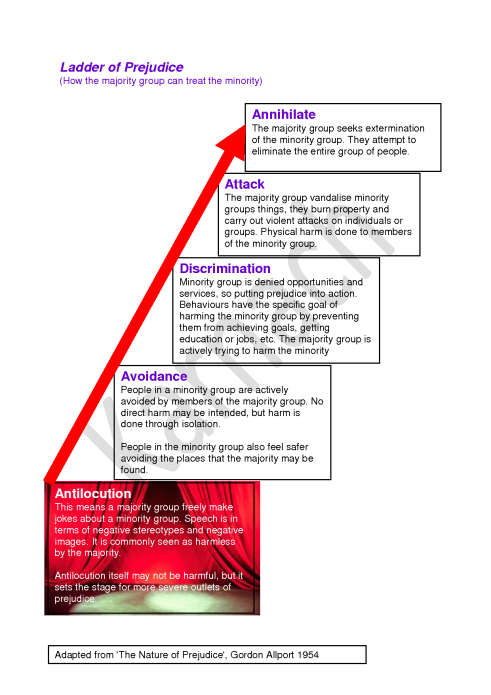
As Gordon Allport highlighted, political othering leads to increasing prejudice, exclusion, social division, discrimination, hatred and if this process is left to unfold, it escalates to hate crime, violence and ultimately, to genocide.
Othering and outgrouping are politically weaponised and strategic inhumanities designed to misdirect and convince populations suffering the consequences of intentionally targeted austerity, deteriorating standards of living and economic instability – all of which arose because of the actions of a ruling financial class – that the “real enemy is “out there”, that there is an “us” that must be protected from “them.”
In the UK, democracy more generally is very clearly being deliberately and steadily eroded. And worse, much of the public has disengaged from participatory democratic processes.
It’s time to be very worried.
Further reading
“We must keep alert, so that the sense of these words will not be forgotten again. Ur-Fascism is still around us, sometimes in plainclothes. It would be so much easier, for us, if there appeared on the world scene somebody saying, “I want to reopen Auschwitz, I want the Black Shirts to parade again in the Italian squares.” Life is not that simple. Ur-Fascism can come back under the most innocent of disguises. Our duty is to uncover it and to point our finger at any of its new instances—every day, in every part of the world. Franklin Roosevelt’s words of November 4, 1938, are worth recalling: “I venture the challenging statement that if American democracy ceases to move forward as a living force, seeking day and night by peaceful means to better the lot of our citizens, fascism will grow in strength in our land.” Freedom and liberation are an unending task.” Umberto Eco, in Ur-Fascism
Politics and Insight’s independent, measured, authoritative reporting has never been so vital, or in the public interest. These are turbulent, decade-defining times. Whatever lies ahead for us all, I will be with you – investigating, disentangling, analysing and scrutinising, as I have done for the last 9 years.
More people, like you, are reading and supporting independent, investigative and in particular, public interest journalism, than ever before.
I don’t make any money from my research and writing, and want to ensure my work remains accessible to all.
I have engaged with the most critical issues of our time – the often devastating impact of almost a decade of Conservative policies, widespread inequality to the influence of big tech on our lives. At a time when factual information is a necessity, I believe that each of us, around the world, deserves access to accurate reporting with integrity and the norms of democracy at its heart.
My editorial independence means I set my own agenda and present my own research and analyisis. My work is absolutely free from commercial and political interference and not influenced one iota by billionaire media barons. I have worked hard to give a voice to those less heard, I have explored where others turn away, and always rigorously challenge those in power.
This morning I came across this on Twitter:
 John Mann@LordJohnMann
I can this morning announce that as government advisor on antisemitism that I will be instigating an investigation this January into the role of the Canary and other websites in the growth of antisemitism in the United Kingdom. https://twitter.com/supergutman/status/1205296902301990912 …
Marlon Solomon@supergutmanWho’d have guessed that Mendoza – one of the people most responsible for toxifying the British left with racially charged conspiracy theories about Jews – would blame a Jew before anyone else.
Whoever takes control of Labour, from whatever faction, please fuck these people off.
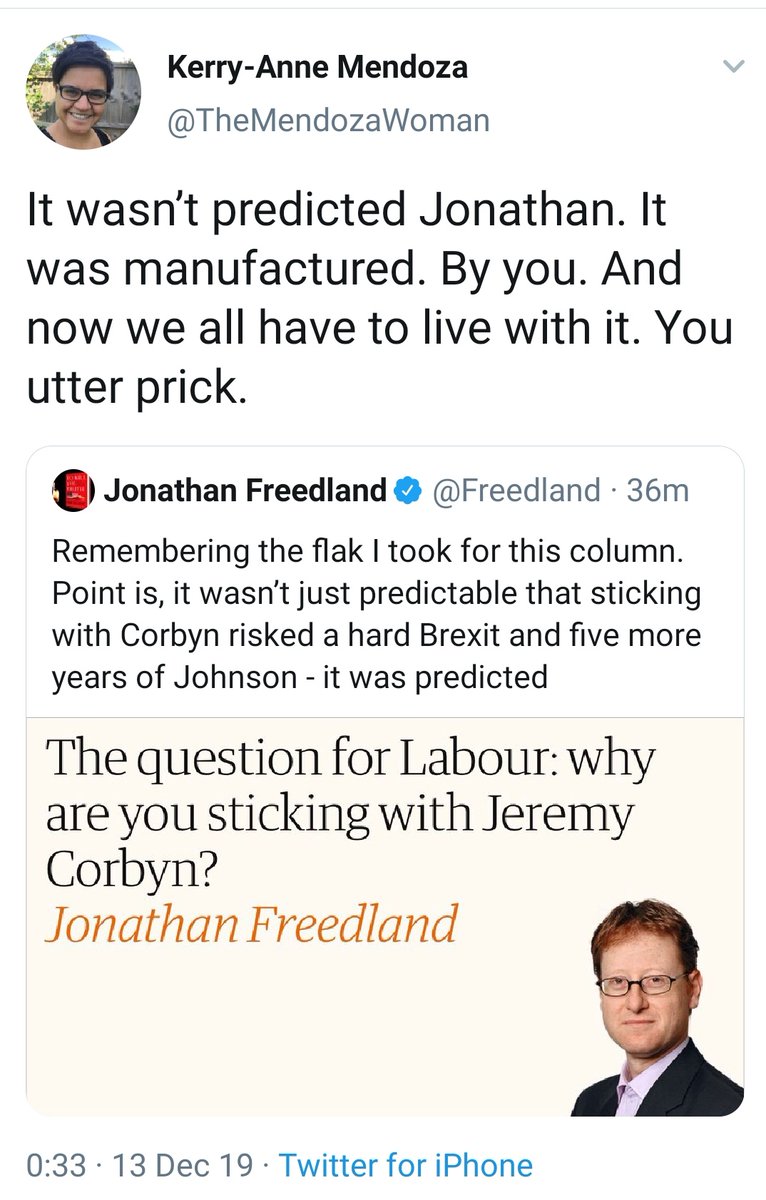
Independent journalists are now facing a threat from an authoritarian government, who have successfully managed to distort our mainstream media.
I did expect this promise of a purge on left leaning sites if Boris Johnson was returned to office, but not quite so soon after the event. It’s a case of vote Tory on Thursday, get fascism by Saturday.
John Mann isn’t by a long stretch the only so-called moderate ex-Labour neoliberal extremist whipping up McCarthyist hysteria and hate. But he has been strategically placed for a while by the Conservatives to destroy independent sites like mine. He’s a particularly nasty individual.
My first step to fight back in the coming year is to join the National Union of Journalists (NUJ). It is an essential protection, now.
It’s not cheap, especially for someone like me, as I’ve no income from my work. I pay WordPress to keep adverts off my site, too. But I am one of those people who often has to make daily choices about whether to eat or keep warm. I am disabled because of an illness called lupus. Like many others in similar circumstances, I am now living in fear for our future under a government that has already systematically and gravely violated the human rights of disabled people, which has resulted in fear, suffering, harm and all too often, premature death.
I hope you will consider supporting me today, or whenever you can. As independent writers, we will all need your support to keep delivering quality research and journalism that’s open and independent.
Every reader contribution, however big or small, is so valuable and helps keep me going.


 Politics and Insights