Tag: bedroom tax

United Nation’s investigation in the UK concerning the human rights of disabled people- submission deadline

536738_306169162785952_999031084_n

I reported last year that the UK is to be investigated formally by the United Nations because of allegations of “systematic and grave” violations of disabled people’s human rights.

In August I wrote that officials from the United Nation’s Committee on the Rights of Persons with Disabilities (UNCRPD) are to visit Britain. The inquiry is confidential, and those giving evidence have been asked to sign a confidentiality agreement.

A United Nations team have arrived in the UK and it’s understood they will visit Manchester, London, Bristol, as well as parts of Scotland, Wales and Northern Ireland.

The United Nations team are also expecting to meet with the Equality and Human Rights Commission, members of parliament, individual campaigners and disabled people’s organisations, representatives from local authorities and academics.

The team will be gathering direct evidence from individuals about the impact of government austerity measures, with a focus on benefit cuts and sanctions; cuts to social care; cuts to legal aid; the closure of the Independent Living Fund (ILF); the adverse impact of the Work Capability Assessment (WCA); the shortage of accessible and affordable housing; the impact of the bedroom tax on disabled people, and also, the rise in disability hate crime.

In 2013, Amnesty International condemned the erosion of human rights of disabled people in UK, and the Joint Parliamentary Committee on Human Rights conducted an inquiry into the UK Government’s implementation of Article 19 of the United Nations Convention on the Rights of Persons with Disabilities – the right to live independently and to be included in the community. The inquiry, which began in 2011, has received evidence from over 300 witnesses.

The inquiry highlighted just how little awareness, understanding and employment of the Convention there is by the (then) Tory-led Government. Very few of the witnesses made specific reference to the Convention in their presented evidence, despite the inquiry being conducted by the Parliamentary Human Rights Committee, with the terms of reference clearly framing the inquiry as being about Article 19 of the UN’s committee on the rights of persons with disabilities. (UNCRPD.)

“This finding is of international importance”, said Oliver Lewis, MDAC Executive Director, “Our experience is that some Governments are of the view that the CRPD is nothing more than a policy nicety, rather than a treaty which sets out legal obligations which governments must fulfil.”

The report was particularly critical of the Minister for Disabled People (Maria Miller, at the time) who told the Committee that the CRPD was “soft law”. The Committee criticised this as “indicative of an approach to the treaty which regards the rights it protects as being of less normative force than those contained in other human rights instruments.” (See the full report.) The Committee’s view is that the CRPD is hard law, not soft law. 

In August, I wrote about how the inquiry was triggered by campaigners and groups using the convention’s optional protocol, (which the last Labour government signed us up to, in addition to the convention.) The protocol allows individuals (and groups) who are affected by violations to submit formal complaint to the UNCRPD.

The deadline for evidence submissions to the UNCRPD is thought to be 31 October.

Contact details are here.

The budget: from trickle-down to falling down, whilst holding hands with Herbert Spencer.

proper Blond
“We are moving Britain from a high welfare, high tax economy, to a lower welfare, lower tax society.”

George Osborne, 8 July 2015

The pro-wealthy and anti-humanist budget indicates clearly that the Conservatives are preoccupied with highlighting and cutting the state cost of sustaining the poorest citizens rather than the costs of subsidising the rich.

I’ve pointed out before that the Conservatives operate a perverse, dual logic: that wealthy people need support and encouragement – they are offered substantial financial incentives – in order to work and contribute to the economy, whereas poor people apparently need to be punished – by the imposition of financial cuts – in order to work and contribute to the economy.

That Osborne thinks it is acceptable to cut the lifeline benefits of sick and disabled people to pay for government failures, whilst offering significant cuts to corporation tax rates; raising the tax-free personal allowance and extending inheritance tax relief demonstrates very clearly that the myth of trickle-down is still driving New Right Conservative ideology, and that policy is not based on material socio-economic conditions and public need. (And Cameron is not a one-nation Tory, despite his claims.)

Research by the Tax Justice Network in 2012 indicates that wealth of the very wealthy does not trickle down to improve the economy, but tends to be amassed and sheltered in tax havens with a detrimental effect on the tax bases of the home economy.

A more recent report – Causes and Consequences of Income Inequality : A Global Perspective by the International Monetary Fund concluded in June this year that there is no trickle-down effect –  the rich simply get richer:

“We find that increasing the income share of the poor and the middle class actually increases growth while a rising income share of the top 20 percent results in lower growth—that is, when the rich get richer, benefits do not trickle down.”

It’s inconceivable that the Conservatives fail to recognise such policy measures will widen inequality. Conservatives regard inequality and social hierarchy as inevitable, necessary and functional to the economy. Furthermore, Conservatives hail greed and envy as emotions to be celebrated, since these drive competition.

Since the emergence of the New Right, from Thatcher to Cameron, we have witnessed an increasing entrenchment of Neoliberal principles, coupled with an aggressive, authoritarian brand of social conservatism that has an underpinning of crude, blunt social Darwinist philosophy, as carved out two centuries ago by the likes of Thomas Malthus and Herbert Spencer.

Spencer is best known for the expression “survival of the fittest,” which he coined in Principles of Biology (1864), after reading Charles Darwin’s work. Spencer extended natural selection into realms of sociology, political theory and ethics, ultimately contributing to the eugenics movement. He believed that struggle for survival spurred self-improvement which could be inherited. Maslow would disagree. All a struggle for survival motivates is just a struggle for survival.

Spencer’s ideas of laissez-faire; a survival-of-the-fittest brand of competitive individualism; minarchism – minimal state interference in the processes of natural law – and liking for private charity, are echoed loudly in the theories of 20th century thinkers such as Friedrich HayekMilton Friedman and Ayn Rand who each popularised Spencer’s ideas, whilst Neoliberal New Right Conservatives such as Ronald Reagan, Margaret Thatcher and David Cameron have translated these ideas into policies.

Ideology has considerable bearing on policies, and policies may be regarded as overt, objective statements of political intent. I’ve said many times over the past five years that Conservatives have forgotten that democracy is based on a process of dialogue between the public and government, ensuring that the public are represented: that governments are responsive, shaping policies that address identified social needs. Conservative policies are quite clearly no longer about reflecting citizen’s needs: they are increasingly authoritarian, and all about telling us how to be.

Conservatives have always coldly conceived society as a hierarchy of human value, and they have, from their pinnacle of supremacist, self-appointed authority, historically cast the vulnerable and the poorest as the putative “enemies of civilization.” Social Darwinism is written in bold throughout their policies.

Furthermore, such a combination of Neoliberal and Conservative political theory, explicitly opposes democratic goals and principles. Neoliberalism was originally used by academics on the Left as a pejorative to capture the policies of imposed exploitation, privatisation, and inequality.

Neoliberalism is now characterised by the use of international loans and other mechanisms to suppress unions, squash state regulation, elevate corporate privilege, privatise public services, and protect the holdings of the wealthy. The term became widely recognised shorthand for rule by the rich, authoritarianism and the imposition of limits on democracy.

Banks, corporations, the financial sector, and the very wealthy are exercising power and blocking any attempt to restructure the economic system that brought about the crash.

Meanwhile, the free market is a market free for powerful interests; the profit motive has transformed the organising value of social life, and those who the Conservatives evidently regard as collateral damage of this socio-economic dogma made manifest are paying the price for the global crash, with Osborne and the Conservatives constructing narratives that problematise welfare support, generating moral panic and folk devils to demonise the poorest citizens in need of support.

Growing social inequality generates a political necessity for cultivating social prejudices.

Such Othering narratives divert public attention from the fact that the right to a fair and just legal system, a protective and effective safety net for the poorest, free healthcare – all of the social gains of our post-war settlement – are all under attack.

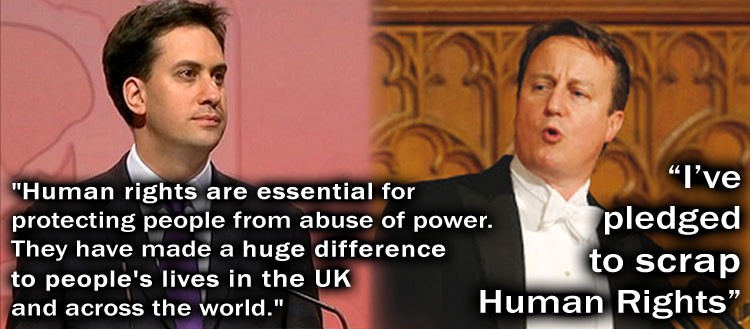
I have said elsewhere that Conservative ideology is incompatible with our legal commitments to human rights. The United Nations declaration of Human Rights is founded on the central tenet that each and every human life has equal worth. The Conservatives don’t agree, preferring to organise society into hierarchies of worth and privilege.

Conservative austerity measures and further impending welfare cuts are not only a deliberate attack on the poorest and most vulnerable social groups; the range of welfare cuts do not conform to a human rights standard; the “reforms” represent a serious failure on the part of the government to comply with Britain’s legal international human rights obligations.

The cuts announced by the chancellor include a further reduction to the benefits cap – not only from £26,000 to £23,000, as promised in the Conservative Party’s 2015 manifesto, but down even further to £20,000 outside of London.

Child tax credit, housing benefit and working tax credit will be reduced, with child tax credit only being paid for the first two children. Presumably this is, to quote Iain Duncan Smith, to “incentivise behavioural change,” placing pressure on the poorest to “breed less,” though personally, being the direct, blunt, no-nonsense sort, I prefer to call it a nudge towards “eugenics by stealth.”

The Social Mobility and Child Poverty Commission say that any cuts to tax credits will cut the incomes of 45 per cent of working families. These cuts are particularly controversial, since the benefits cap was partly justified as a way of “making work pay”  – a Conservative narrative that echoes the punitive 1834 New Poor Law Principle of less eligibility – see: The New New Poor Law.

The Government asserts that its welfare “reform” strategy is aimed at breaking the cycle of “worklessness” and dependency on the welfare system amongst the poorest families. It’s more punitive Poor Law rhetoric.

There’s no such thing as “worklessness”, it’s simply a blame apportioning word, made up by the Tories to hide the fact that they have destroyed the employment market, just as Thatcher did, and as the Conservatives always do.

Punishing the low paid, cutting the income of families who work for low wages directly contradicts the claim that the Conservatives are “making work pay.”

Yet Osborne has framed his welfare cuts with the “The best route out of poverty is work” mantra, claiming that slashing the social security budget by £46 billion in the next five years, (including cutting those benefits to disabled people, who have been assessed as unfit for work and placed in the Work Related Activity Group (WRAG), and cutting in-work benefits, such as tax credits) is needed to make sure “work pays” and that: “we give a fair deal for those on welfare and a fair deal to the people, the taxpayers of this country who pay for it.”

The Conservatives always conveniently divide people into an ingroup of taxpayers and an outgroup of stigmatised others – non-tax payers. However, most people claiming benefits are either in work, and are not paid enough, through no fault of their own, to pay tax, or are pensioners who have worked most of their lives; or are unemployed, but have previously worked and contributed tax.

Most people claiming disability benefits have also worked and contributed tax, too.

Unemployment and in-work benefit claims are generally a measure of how well or poorly the government is handling the economy, not of how “lazy” or “incentivised” people are.

And only the Tories have the cheek to claim that raising the minimum wage (long overdue, especially given the hikes in the cost of living) is the introduction of a living wage. The basic idea is that these are the minimum pay rates needed so that workers have an acceptable standard of living. Over the last few years, wages have very quickly fallen far behind the ever-rising cost of living.

The increase is at a rate of £7.20 an hour for people over the age of 25.  Housing benefit will be withdrawn from those aged between 18 and 21, while tax credits and universal credits will be targeted at people on lower wages by reducing the level at which they are withdrawn.

The chancellor’s announcement amounted merely to an increase in the minimum wage, and the curbs on tax credits would hit low-paid workers in other ways, unfortunately.

Whilst the announcement of a phased increase in the minimum wage is welcome, it is difficult to see how this will reverse the increasing inequality that will be extended as a further consequence of this budget without a matching commitment to improving the structural framework – the quality and stability of employment available. As it is, we are now the most unequal country in EU.

If the government were sincerely interested in raising wages to make work genuinely pay, ministers would be encouraging rather than stifling trade unionism and collective bargaining. But instead we see further cuts to public sector pay in real terms year after year and the raising of the legal bar for industrial action so that strikes will be effectively outlawed in public services. And let’s not forget the grubby partisan policy of two years ago – the Let Lynton Lobby Gagging Act.

Rhys Moore, director of the Living Wage Foundation, said:

“Is this really a living wage? The living wage is calculated according to the cost of living whereas the Low Pay Commission calculates a rate according to what the market can bear. Without a change of remit for the Low Pay Commission this is effectively a higher national minimum wage and not a living wage.”

Those most affected by the extreme welfare cuts are those groups for which human rights law provides special protections. The UK government has already contravened the human rights of women, children, and disabled people.

The recent report of the UK Children’s Commissioner to the UN Committee on the Rights of the Child, published in July this year, says:

“Response to the global economic downturn, including the imposition of austerity measures and changes to the welfare system, has resulted in a failure to protect the most disadvantaged children and those in especially vulnerable groups from child poverty, preventing the realisation of their rights under Articles 26 and 27 [of the UN CRC] … Reductions to household income for poorer children as a result of tax, transfer and social security benefit changes have led to food and fuel poverty, and the sharply increased use of crisis food bank provision by families.”

The parliamentary Joint Committee on Human Rights recently reported on the UK’s compliance with the United Nations Convention on the Rights of the Child (CRC), and found it woefully lacking:

“Welfare cuts will ensure that the government is not in compliance with its international human rights obligations to realise a right to an adequate standard of living under Article 11 of the International Covenant on Economic and Social Rights (ICESR) and a child’s right to an adequate standard of living under Article 27 of the UN CRC. Further it will be in breach of the statutory target to eliminate child poverty contained in the Child Poverty Act 2010.”

Just in case you missed it, there has been a very recent, suspiciously timed change to the definition of child poverty, and a proposed repeal of the Child Poverty Act – something that Iain Duncan Smith has been threatening to bring about since 2013.

It’s yet another ideologically directed Tory budget, dressed-up in the rhetoric of economic necessity, detached from public needs.

And Conservative ideology is all about handouts to the wealthy that are funded by the poor.

Related:

George Osborne’s Political MasterstrokeA View from the Attic

Osborne’s class spite wrapped in spin will feed a backlashSeumas Milne

Budget 2015: what welfare changes did George Osborne announce, and what do they mean?  New Statesman: The Staggers

How Osborne’s new cuts breach the UK’s human rights obligations, Lecturer in Law at Lancaster University

Osborne’s Autumn statement reflects the Tory ambition to reduce State provision to rubble

Osborne’s razor: the Tory principle of parsimony is applied only to the poorest

The BBC expose a chasm between what the Coalition plan to do and what they want to disclose

1450041_569755536427312_1698223275_n
Thanks to Robert Livingstone

UN report: Britains ‘boy’s club culture’ – women in the UK are left vulnerable to violence, poverty & hardship


I wrote last year that Conservative small-state ideology has led to “depopulated” social policies, resuting in the dehumanisation of people in some social groups, and it indicates that Tory policy-makers see the public as objects of their policies, and not as human subjects. Policies are inceasingly being detached from public needs. We therefore need to ask whose needs Conservative policies are fulfilling.

In 2010 the Equality and Human Rights Commission warned the government about its potential failure to meet its legal duties. This followed concerns raised by the Fawcett Society amongst others, regarding the estimated grossly disproportionate impact of the austerity cuts on women.

The Commission recognised the serious concerns about the impact of the deficit reduction measures on vulnerable groups and, in particular, following the House of Commons library report, the impact of the budget on women. The Commission stated:

We have written to the Treasury to ask for reassurance that they will comply with their equality duties when making decisions about the overall deficit reduction, and in particular in relation to any changes to tax and benefits for which they are directly responsible.”

A more inclusive understanding of the range of impacts on both men and women is essential in the formulation of gender-aware, as opposed to gender-blind, policy responses to recession and recovery. It’s clear that the UK government is not interested in collating information regarding impacts and subsequent implications regarding inequality, yet they do have a legal duty to do so.

A previous United Nations Committee report on the Elimination of Discrimination against Women highlights areas where women’s rights in the UK had come to a standstill and appallingly, shamefully, some rights have been reversed.

On August 13, 2013, the Committee on the Elimination of Discrimination against Women released its concluding observations on the UK’s seventh periodic report on 26 July 2013.

Concerns raised by the Committee include protection from discrimination under the Public Sector Equality Duty, the impact of austerity measures on women and women’s services, and restrictions on women’s access to legal aid.

The Equality and Human Rights Commission (EHRC) published its submission to the United Nations Committee on the Elimination of All Forms of Discrimination Against Women on 1 July 2013. In its submission the Commission, as a national human rights institution, identifies key issues it believes should be highlighted as actions following the examination and sets out a number of questions the Committee may wish to put to the Government. You can see a full list here – UK Government still in breach of the human rights convention on gender discrimination.

Despite Labour’s protective Human Rights Act and Equality Act, Britain has become increasingly sexist, has an all-pervasive, patriarchal “boy’s club culture” and Conservative austerity measures are leaving women increasingly vulnerable to violence, poverty and hardship, the UN special rapporteur for women, Rashida Manjoo, has recently said.

The special rapporteur said there was “a more visible presence of sexist portrayals of women and girls” and a “marketisation of women’s and girls’ bodies” in the UK, which was “more pervasive than elsewhere.”

She warned that sexual bullying and harassment were now “routine” in UK schools, according to NGOs she had interviewed, and recommended that schools have mandatory education modules on sexism. “The state has a responsibility to protect, to prevent, to punish, to provide effective remedies,” she said. “These are part of the state’s responsibility.”

Rashida added: “Have I seen this level of sexist cultures in other countries? It hasn’t been so in-your-face.”

Amongst the figures quoted in her report are: 30% of women in England and Wales have reported experience of domestic abuse since the age of 16; 77 women were killed by partners or former partners in 2012-13; 18,915 sexual crimes against children were recorded in England and Wales in 2012-13; and almost one in three 16- to 18-year-old girls have experienced “groping” or other unwanted sexual touching at school.

The special rapporteur also drew attention to the disproportionate impact of funding cuts on the provision of services to women and girls at risk of violence, and the adverse consequenes of the Tory welfare “reforms.”

Access to trauma services, financial support and housing are crucial, yet current reforms to the funding and benefits system continue to adversely impact women’s ability to address safety and other relevant issues,” Rashida said.

She added that the austerity cuts “not only [affected] the specific provision of ‘violence against women’ services’, but also had a more general impact as poverty and unemployment were known contributory factors.”

“Service providers argue that they are being forced to make cuts to their frontline services as a result of reduced funding, whether by closing refuges, reducing support hours, or increasing waiting lists … current reforms to the funding and benefits system continue to adversely impact women’s ability to address safety and other relevant issues.”

Manjoo also heavily criticised the bedroom tax, she recognised that it makes it very difficult for women to escape domestic violence. She also attacked the Conservative government’s austerity programme.

She said: “Austerity measures are having an effect on the provision of services to address violence against women, as well as other cross-cutting issues affecting women such as poverty and unemployment.” 

Rashida Manjoo quite properly condemned the lack of human rights-driven government measures to combat violence against women and girls.

The special rapporteur, who travelled across the UK during a 16-day fact-finding mission into violence against women, said she was barred at the gates of Yarl’s Wood immigration detention centre on Monday, on instructions “from the highest levels of the Home Office”.

Manjoo received reports of violations at the privately run Yarl’s Wood centre, near Bedford, before her visit to the UK, and said she wanted to verify the allegations of abuse. Last month a Jamaican woman, Christine Case, 40, died at the centre, which holds about 400 women.

After repeated unsuccessful requests to the Home Office, the investigator attempted an independent visit to Yarl’s Wood. Under the terms of her mandate, Manjoo should have been offered unrestricted access.  A Home Office spokesperson said a tour of Yarl’s Wood “was never agreed as part of this fact-finding mission.” 

So much for democratic, open, transparent and accountable government.

In her preliminary report, (and unsurprisingly,) Manjoo said the number of women detained in prisons and immigration centres in the UK was rising, with a significant over-representation of black and minority ethnic women.

“A large number of women in detention have a history of being subjected to violence prior to being imprisoned … the strong link between violence against women and women’s incarceration, whether prior to, during or after incarceration, needs to be fully acknowledged,” she said.

Manjoo also said the UK court system is “widely perceived to be biased in favor of men.

Rashida Manjoo’s full 24 page report is expected to be published later this year and will be presented at a meeting of the UN Human Rights Council in Geneva on Tuesday.

The report’s findings echo the views of  many campaigners, including hundreds of psychotherapists, counsellors and mental health practitioners, who in April used a rallying, open letter to the Guardian to warn against “malign” welfare reforms and severe austerity measures.

The group of signatories, made up of therapists, psychotherapists and mental health experts, said Britain has seen a “radical shift” in the mental state of ordinary people since the coalition came to power.

British society has been “thrown completely off balance by the emotional toxicity of neoliberal thinking” and the distress this is causing and the wide adverse effects of this ideology are particularly visible in therapists’ consulting rooms.

This letter sounds the starting-bell for a broadly based campaign of organisations and professionals against the damage that neoliberalism is doing to the nation’s mental health,” they added.

A democratic government, especially in a very wealthy, so-called liberal first-world country, is expected to reflect and accommodate the needs of a population in its policy-making, and to formulate policies within a human rights framework.

That clearly is not happening in the UK.


Related

Welfare reforms and the language of flowers: the Tory gender agenda

994596_517805604955639_608589568_n
Pictures courtesy of Robert Livingstone


I don’t make any money from my work. But you can support Politics and Insights and contribute by making a donation which will help me continue to research and write informative, insightful and independent articles, and to provide support to others. The smallest amount is much appreciated, and helps to keep my articles free and accessible to all – thank you. 

DonatenowButton

Cameron believes that saving ‘the tax payer’ money is more important than saving lives.

rich keep millons

The following is from a very revealing transcript of David Cameron’s interview with Andrew Marr earlier today.

Cameron implied that dying is somehow an appropriate punishment for failing to attend an interview at the Jobcentre, in order to save “the tax payer” money. Cameron thinks that taxing the wealthy is “immoral,”  but evidently, formulating policies that cause the death of vulnerable citizens is acceptable. Cameron made it plain that he has no intention of carrying out a policy review, or of investigating the growing number of deaths correlated with the conservative party’s welfare cuts.

He showed a complete lack of remorse and basic compassion for David Clapson (and his family,) who died as a direct consequence of the cruel sanction regime that Cameron introduced as part of benefit conditionality,  which is now an integral part of the wider welfare “reforms.”

 THE ANDREW MARR SHOW, BBC 19.4.15 (Full transcript here.)
David Cameron before the news:

AM: Well you also talked to Evan Davis about the twenty two billion pounds of welfare cuts you’ve made so far as if that was easy. Do you accept that has hurt a lot of poor and vulnerable people?

DC: Well it has involved difficult decisions. But of course as we’ve done that we’ve been getting two million people into work, nine hundred thousand people…

AM: Difficult decisions for you; a lot of real pain and suffering for people out there.

DC: Well, we have protected for instance the pension, we’ve protected benefits for the lowest paid, we’ve always made sure that we’ve increased spending on disability benefits rather than reduced it. But crucially the nine hundred thousand people we’ve got off welfare and into work that has actually saved money but it’s also been good for ourcountry and crucially good for them:a job is the best route out of poverty that there is.

AM: What about the million people depending on food banks?

DC: Well obviously I want a country where people don’t depend on food banks, we did something.

AM: But why are more people depending on food banks?

DC: One of the things we did was that Labour, because they didn’t like the PR of this, they didn’t advertise or promote the existence of food banks through job centres. We changed that because we thought that was, that was basically sort of selfish and shortminded…

1390648_548165358586330_1740107407_nAM: And according to the Trussell Trust who run these banks that accounts for just three percent of people using food banks at the moment so it’s not a significant thing. But can I take you to an individual case, James [he meant David] Clapson. Clapson who was a former soldier worked very hard for a long time then was on benefits, failed to turn up to two job centre interviews, [it was just one interview that David missed,] had his benefits removed for a month, he was diabetic, his insulin couldn’t be refrigerated and he died two weeks later.

Now that is the kind of case that is coming up again and again and again and shows that the welfare cuts have been agonisingly painful for real people out there.

DM: Well we have hardship funds and councils have hardship funds for exactly those sorts of tragic cases but if you’re asking me…

AM: It didn’t work.

DC: If you are asking me is it right that people who are asked to turn up for interviews or asked to fill in a CV or asked to apply for a job should have to do those things before getting benefits then yes it’s right that we do have that system in place but we always, as I put it on the steps of…

AM: But the system has been very very aggressive, another case of a man who had learning difficulties and filled in his form by hand rather than by computer and was refused benefits, there is lots of these cases as you won’t have a review, you should have a review of the system surely?

DC: I look at all of those individual cases and all of those cases can be addressed by the hardship funds and by the flexibilities that are there in the system but we have sanctions for a reason, people watching this programme…

AM: You don’t get the hardship fund for two weeks.

DC: Hold on a second

AM: Alright.

DC: People watching this programme who pay their taxes, who work very hard, they don’t pay their taxes so people can sign on and show no effort at getting a job, as I put it on the steps of Downing Street those who can should; those who can’t we always help – that is the principle that should always underline a compassionate benefits system.

scroll2
We do not have a compassionate welfare system: we have a re-designed system that is draconian because of the “reforms” – it’s more about taking money from people than supporting them. It’s about punishing people into work. That is precisely why people like David Clapson are dying. No support was given to David, and many others like him.

Cameron’s rhetoric isn’t remotely coherent or compassionate, let alone honest.

Let’s not forget that it was Cameron’s government that has ruthlessly stigmatised, dehumanised and scapegoated unemployed and disabled people, in order to justify punishing them by removing their support and handing out the subsequent “savings” to millionaires, who gained £107,000 each per year, whilst those who paid for it – and we are also tax payers, Mr Cameron – are suffering and dying, and the establishment look on with contemptible, pathological, greedy, grasping, self-serving indifference.

Related

11046274_80388630968089cam cThanks to Robert Livingstone for the excellent memes.

What will the Tories suggest next. “Compassionate” genocide?

68196_116423458427191_5364492_n
The Tory parliamentary candidate for Cambridge, Chamali Fernando sparked outrage and horror after saying mental health patients should wear wristbands to identify their conditions. Fernando was speaking at a hustings event hosted by the campaign group Keep Our NHS Public when she made the comment.

Andy Burnham, Labour’s Shadow Health Secretary, said:

“There has been an enormous amount of work in Parliament to challenge the stigma surrounding mental health. But comments like this are so disappointing – they set us back and remind us how far we have to go. Jeremy Hunt must disown these comments, instruct his candidate to apologise and make it clear that they form no part of Conservative Party policy.”

“This proposal shows the candidate’s harmful views on mental health.

Disability and Mental Health Adviser at University of the Arts, London Annabel Crowley said.

“Research carried out by the Institute of Psychiatry, Psychology & Neuroscience at King’s College London shows personal contact with mentally ill people is the most effective way to reduce discrimination.”

Crowley says Fernando’s proposals would only alienate the mentally ill and “further curtail their freedom,” which would encourage further stigmatization.

We need to provide adequate care and support, not blame the victims of a failing health service,” she added.

Mental Health Services are in crisis because of Coalition cuts to funding. The Government has been criticised for allowing mental health services to be cut disproportionately, as the NHS as a whole undergoes the most severe budget cut in its history. And let’s not forget that under the guise of a “policy of deinstitutionalisation,” Thatcher’s “Care in the Community” Bill was about anything but care: it was all about cutting costs, as reflected in the experiences of many people leaving long term institutional care and being left to fend for themselves in the community. “Compassionate Tories”: there is no such thing.

Dr. Pooky Kingsmith, a mental health specialist, said that she [Fernando] “fails to understand” what the wristbands would achieve “beyond increasing the stigma and prejudice already experience by mentally ill people.”

A petition has since been set up calling for Fernando to stand down in the election. The description on the petition read:

“This kind of thinking has no place in modern society and especially not in someone who is hoping to be elected as an MP.

I can’t see any possible justification in allowing Ms Fernando to continue to stand for election after showing such prejudice against the mentally ill, and if allowed to do so, shows a total disregard to the people in this country, who already have to battle against the misunderstanding and ignorance of their mental illness.”

Chamali Fernando was asked how the authorities could help the police better deal with people with mental health issues.

Fernando responded that wristbands which disclose a person’s illness could help barristers, such as herself, to better aid the public.

She said wearing colour-coded wristbands indicating the nature of the person’s condition would be helpful to professionals as “they often could not explain themselves.”

Perhaps Fernando had designs that are something like this in mind:


1936 illustration of Nazi camp ID-emblems.

The red triangle was used by the Nazis to identify social democrats, socialists, trade unionists, Freemasons and communists, for example. The pink triangle was primarily used for identifying homosexual men, and the black triangle was used to identify “asocial elements” (asozial) and “work shy” (arbeitsscheu) including those who were mentally ill, pacifists, vagrants and the Roma.

And for anyone itching to invoke Godwin’s law at this point, I suggest you hang fire and read about Allport’s Ladder of Prejudice. Whilst I am very aware that we need take care not to trivialise the terrible events of Nazi Germany by making casual comparisons, there are some clear and important parallels on a socio-political level and a psycho-social one, that I feel are crucially important to recognise.

Gordon Allport studied the psychological and social processes that create a society’s progression from prejudice and discrimination to genocide. In his research of how the Holocaust happened, he describes socio-political processes that foster increasing social prejudice and discrimination and he demonstrates how the unthinkable becomes acceptable: it happens incrementally, because of a steady erosion of our moral and rational boundaries, and propaganda-driven changes in our attitudes towards “others” that advances culturally, by almost inscrutable degrees.

The process always begins with political scapegoating of a social group and with ideologies that identify that group as an “enemy” or a social “burden” in some way. A history of devaluation of the group that becomes the target, authoritarian culture, and the passivity of internal and external witnesses (bystanders) all contribute to the probability that violence against that group will develop, and ultimately, if the process is allowed to continue evolving, genocide.

As I have discussed elsewhere on this site, we have a government that uses words like workshy to describe vulnerable groups. This is a government that is intentionally scapegoating poor, unemployed, disabled people and migrants. One Tory councillor called for the extermination of gypsies, more than one Tory MP has called for illegal and discriminatory levels of pay for disabled people. (See also David Freud was made to apologise for being a true Tory in public.)

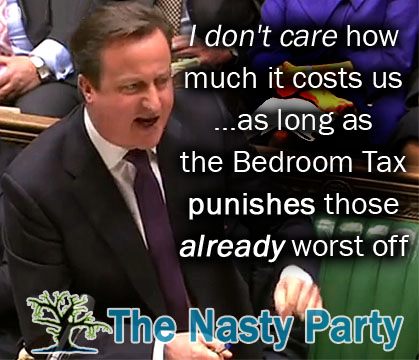
David Freud’s comment that disabled people are not worth the minimum wage was not a momentary lapse, nor was it unrepresentative of Tory views more generally. He is the contemptuous architect of the grossly punitive Tory Bedroom Tax that disproportionately affects households of disabled people. The Tories endorsed Freud’s discriminatory policy proposal, and savagely ridiculed the UN rapporteur, Raquel Rolnik, when she pointed out, very professionally and reasonably, that the policy contravenes human rights.

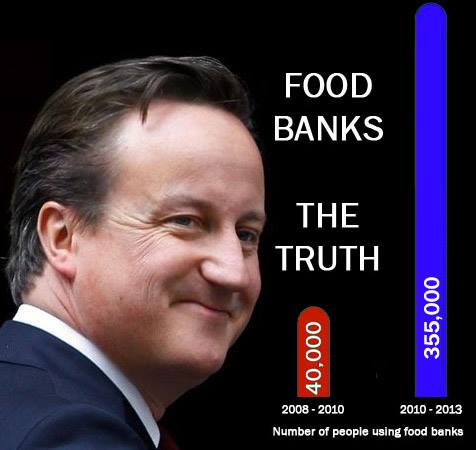
He is the same government minister that rejected suggestions that austerity policies have led to an increase in food bank use – making the jaw-droppingly astonishing suggestion that food bank charities are somehow to blame. This former investment banker and peer told the Lords that the increase in the usage of food banks was “supply led”. He said:

“If you put more food banks in, that is the supply. Clearly, food from the food banks is a free good and by definition with a free good there’s almost infinite demand.”

Poverty reduced to blame-the-individual neoliberal motivational formulae. Yet it is the government that are responsible for policies that create and sustain inequality and poverty.

We need only look at the discriminatory nature of policies such as the legal aid bill, the wider welfare “reforms” and research the consequences of austerity for the vulnerable – those with the  “least broad shoulders” –  to understand that these comments reflect how conservatives think.

This is a government that is using public prejudice to justify massive socio-economic inequalities and their own policies that are creating a steeply hierarchical, society based on social Darwinist “survival of the fittest” libertarian, minarchist principles.

The Tory creation of socio-economic scapegoats, involving vicious stigmatisation of vulnerable social groups, particularly endorsed by the mainstream media, is simply a means of manipulating public perceptions and securing public acceptance of the increasingly punitive and repressive basis of the Tories’ welfare “reforms”, and the steady stripping away of essential state support and provision.

Let’s not forget that we were recently informed that the Tories plan to limit child benefit to the first two children because it would save money. The idea is being examined by the Conservatives, despite previously being vetoed by Downing Street because of fears that it could “alienate” parents.

Asked about the idea on the BBC’s Sunday Politics programme, Duncan Smith said:

“I think it’s well worth looking at. It’s something if we decide to do it we’ll announce out. But it does save significant money and also it helps behavioural change.”

This is a clear indication of the Tories’ underpinning eugenicist designs – exercising control over the reproduction of the poor, albeit by stealth. It also reflects the underpinning belief that poverty somehow arises because of faulty individual choices, (as opposed to faulty political decision-making and ideologically-driven socio-economic policies), that those choices are non-rational, stereotypical, and that reducing cost to the State involves making people change their “faulty,” stereotypical behaviours.

This government’s policies are contibuting significantly to mental illness: Suicides have reached a ten year high and are linked with welfare “reforms”.

And Osborne announced in the budget that the government will be funding a “package of measures” to improve “employment outcomes” which will entail putting Cognitive Behaviour therapists in more than 350 job centres to provide “support” to those with “common mental health conditions” who are claiming employment support allowance (ESA) and job seekers allowance (JSA).

As I have written elsewhere, the government have put up an online contract notice which specifically states:

“This provision is designed to support people with common mental health conditions to prepare for and move into work, with intervention at the earliest possible point in a claim to benefit or access to the Fit for Work service.”

Cognitive Behaviour Therapy (CBT) is used to change how you think (“Cognitive”) and what you do (“Behaviour”). It bypasses emotions, personal history and narrative, to a large extent, and tends to focus on the “here and now.” In this case, the here and now consists of taking any job available, regardless of its suitability, or face being sanctioned.

CBT is an approach that facilitates the identification of “negative thinking patterns” and associated “problematic behaviours” and challenges them. This approach is at first glance a problem-solving approach, however, it is of course premised on the assumption that interpreting situations “negatively” is a bad thing, and that thinking positively about bad events is beneficial.

The onus is on the individual to adapt by perceiving their circumstances in a stoical and purely rational way.

So we need to ask what are the circumstances that the government are expecting people claiming benefits to accept stoically. Sanctions? Work fare? Being forced to accept very poorly paid work, abysmal working conditions and no security? The loss of social support, public services and essential safety nets ? Starvation and destitution?

The political vilification of sick and disabled people and the poor, amplified in the media, has preceded policies particularly aimed at the steady removal of State support, indicating a clear scapegoating process, and this isn’t indicative of a government that is “neglectful”- it is patently intentional, hence the pre-emptive “justification” narratives to garner public support and acceptance towards such punitive and harsh policies.

As Frances Ryan says:

“The ideology of a small state or the belief that benefits build dependency are crass, irrelevant details to what at its core is simply a decision about how to treat a human being. This is particularly damning when one person has all the power and the other is forced through economic necessity to take whatever humiliation or pain they are given. To do that to someone – let alone hundreds of thousands – is no accident. It is a conscious decision, that has been made over and over again by this government.”

I’ve consistently expressed my own well-founded, carefully considered, evidenced view that the Tories are authoritarians,  social Dawinists, and their social policies are founded on a creeping and implicit eugenics by stealth, fueled by their preference for a steeply hierarchical, unequal society, anachronistic ideas about “deserving” and “undeserving”, which belong to the 1834 Poor Law era, and a behaviourist approach to socio-economic circumstances .

In Edgbaston, Keith Joseph, (1974) announced to the world that:

“The balance of our population, our human stock is threatened … a high and rising proportion of children are being born to mothers least fitted to bring children into the world and bring them up. They are born to mothers who were first pregnant in adolescence in social classes 4 and 5. Many of these girls are unmarried, many are deserted or divorced or soon will be. Some are of low intelligence, most of low educational attainment.”

And in 2010, the former deputy chairman of Conservative Party, Lord Howard Flight, told the London Evening Standard:

“We’re going to have a system where the middle classes are discouraged from breeding because it’s jolly expensive. But for those on benefits, there is every incentive. Well, that’s not very sensible.”

These comments are not momentary lapses, nor are they unrepresentative of Tory views more generally. They reflect the true colours of the nazi nasty party.

demcracy

Pictures courtesy of Robert Livingstone


My work is unfunded and I don’t make any money from it. I am disabled because of illness and struggle to get by. But you can support Politics and Insights and contribute by making a donation which will help me continue to research and write informative, insightful and independent articles, and to provide support to others.  DonatenowButton

Revealed: Labour did NOT pilot the Bedroom Tax – Mike Sivier

Thanks to Mike at Vox Political for debunking this myth.

141230SNPbedroomtaxlie

The ‘infographic’ above is very popular among Scottish nationalists at the moment. In line with the wishes of the Scottish National Party (SNP), they are working hard to smear or discredit the Labour Party in order to undermine its support north of the border. There’s just one problem.

The claim is untrue.

The facts were revealed by a Labour councillor, Paul Bull, on Twitter today (December 30) after Yr Obdt Srvt spent yesterday evening arguing the matter with some particularly avid nationalists.

“I too was concerned by Malcolm Wicks’ comments in Hansard that seemed to suggest [a] Bedroom Tax pilot,” he tweeted. “So troubled that I decided to research what form that Bedroom Tax pilot took. That research … has even gone as far as the House of Commons Library.”

Then he wrote:

141230bedroomtaxfact

So this was a scheme that was announced by a Labour minister, certainly – but the Labour government of 2001 did not go through with it.

So much for the nationalists’ claims. “Oh what a tangled web we weave, when first we practise to deceive”, as someone once said. Or, more appropriately (perhaps), “The best-laid schemes o’ mice an’ men gang aft agley”.

Cllr Bull continued: “However, back then Labour did do something to encourage social tenants to downsize, where many local authorities offered cash incentives to encourage [it], and this scheme was available to ALL social housing tenants, so not just those on Housing Benefit.”

He provided information on Exeter City Council’s schemes, which are available to read here and here. The second link is to a PDF file which may not open in some browsers.

He concludes: “Elements of [the] Exeter Council scheme [are] still in place but incentives are not so generous. But Exeter Council now employ a Downsizing Officer to assist social housing tenants who do want to move.”

The reality, it seems, is a long way away from the harsh brutality of the Coalition’s Bedroom Tax, with which the SNP and its supporters hoped to tar the Labour Party.

Next time anyone tries to tell you Labour had anything to do with the Bedroom Tax, point them to this article.

How can people trust the SNP when it launches lying smear campaigns like this?


See also: Debunked: More claims about LHA and the Bedroom Tax

Guest post: Rachel Reeves – ‘the bedroom tax is cruel and ineffectual’

13098_443459169056950_136726932_n

On 17 December, MPs voted against scrapping the bedroom tax – here, shadow secretary of state for work and pensions Rachel Reeves argues that the policy doesn’t work, and punishes the most vulnerable.

 Rachel Reeves MP Shadow secretary of state for work and pensions

   Posted on: Wed 17-Dec-14 15:44:27

Lead photo

‘Two thirds of those hit by the bedroom tax are disabled. 60,000 are carers.’

Ever heard of the ‘Housing Benefit Social Sector Size Criteria’? No? Well you’re not alone. On the other hand, if you were asked what the name for the government’s decision to force half a million families to pay a tax on their bedroom is called, most people would say the ‘bedroom tax’.

Last month I travelled to Pembrokeshire to meet Paul, Sue, and their grandson Warren, who are one of thousands of families hit by the bedroom tax. Paul and Sue look after Warren, who suffers from a very rare genetic disorder called Potocki-Shaffer Syndrome. Their home has been specially adapted to meet Warren’s needs. Paul and Sue share one room, Warren sleeps in another, and the third room is needed for carers to stay overnight and to store equipment for Warren’s condition. Without the help of overnight care workers, Warren would have to be put into residential care, at substantial extra cost to his local authority and to taxpayers.

We should be celebrating the incredible contribution Paul and Sue are making both to Warren’s life and to our country. Instead, this government has deducted £60 a month from their Housing Benefit because they live in a bungalow with three bedrooms, one of which has been deemed a spare bedroom and so chargeable under the bedroom tax.

Like thousands of families across the country, Sue and Paul are doing the right thing – working hard, and providing fantastic care to ensure their grandson gets the best start in life. And yet they’re finding the government is taking money out of their pockets, making it hard to get by.

With a week before Christmas I hope MPs think carefully about the impossible choices that thousands of families are facing right now. Heating or eating. Paying the rent or paying the bills. Mums and Dads who want the best for their children, but are struggling to make ends meet as the cost of living continues to rise.

On average, the bedroom tax has cost families over £1,200 since it was brought in by the government in April 2013. Around half a million people are being forced to pay it, at an average of £14 a week. Two thirds of those hit are disabled, and 60,000 are carers. Two fifths of the households affected have children living in them.

Ed Miliband and I have pledged that the next Labour government will repeal the bedroom tax, but the Rutherfords – and thousands like them – can’t afford to wait until the next election.

That’s why we have forced a debate and a vote in the House of Commons today (17 December) on the bedroom tax. If enough MPs vote with Labour, it will be effectively abolished by Christmas.

Few people outside of Downing Street and the Department for Work and Pensions defend the bedroom tax. Even the government’s own independent report on it found a series of failings in the policy. Less than 5% of people affected had moved to another smaller home in the social rented sector. It also found that over 60% of people had fallen behind with their rent. And despite the government promising the bedroom tax would save money, the amount of money spent on Housing Benefit is rising, not falling. The bedroom tax is just another example of Tory welfare waste.

With a week left until Christmas, I hope MPs think carefully about the impossible choices thousands of families are facing right now. Heating or eating. Paying the rent or paying the bills. Mums and dads who want the best for their children, but are struggling to make ends meet as the cost of living continues to rise.

I have a simple belief that government is there to help people fulfil their dreams and realise their potential. But too often, government holds people back and is making them worse off.

So it doesn’t matter whether it’s called the bedroom tax or the ‘Housing Benefit Social Sector Size Criteria’ – this cruel tax is making life harder, not easier, for thousands of people. It’s time for this nasty tax on thousands of children and families to go once and for all.

By Rachel Reeves MP

Twitter: @RachelReevesMP

Originally posted on mumsnet

The Blame Game

539627_450600381676162_486601053_n (2)

The Government are playing a game. They don’t serve the needs of the public. They serve a wealthy elite. The Conservatives don’t care about the consequences of taking money from the poorest and giving it to the wealthiest. But they won’t tell us that. They are playing the game that the game is not a game.

It’s called the “blame game.” As welfare “reforms” and housing cuts bite increasingly harder, do we ever reach the point where the government concedes that the horror and hardship caused to many is an inevitable consequence of their own policies? Not at all.  Instead we see their adeptness at digging ever deeper holes of denial.

At least Thatcher admitted there was increased unemployment, that it was as a tool of economic policy, and it was, in her opinion, a price worth paying to bring down inflation. Shucks, shame that didn’t work, Maggie. We had high unemployment AND high inflation. But at least she was honest about her original intent.

The government denies that there is job insecurity, unemployment and underemployment. Or indeed any hardship at all; public sacrifices made through an elites’ economic policy-making. They blame anyone other than the ministers who have instituted the cuts. Whenever some new example of the horrendous effects of their policies is presented to them, they have a range of stock responses. You have to wonder if there is a standard Whitehall crib sheet for ministers. Cases that clearly indicate a correlation between their policies and harm are dismissed as “anecdotal evidence”, and that “no causal link can be established”. 

Correlation often implies a causal link, but to find it, you have to investigate further, rather than issuing flat denials, loudly.

Here is what the crib sheet looks like, in the interests of democracy and open Government:-

Deny that alternatives to austerity are viable

The repetition of a lie ad nauseum is based on the idea Goebbels had – that repeated lies will somehow convince people that they are true. Cameron was busted when he repeatedly told the lie We are paying down the debt. Despite being rumbled, the Coalition have stuck with this lie doggedly. The bonus of the lie is that it may undermine the opposition’s economic credibility, and the Tories particularly delight in the lie that it’s all Labour’s fault because they “overspent” as it further justifies austerity measures and starving public services of Government funding, with our paid taxes, as well as stripping our welfare provision away.

The Conservatives have REALLY messed up the economy. We know it’s a big fat Tory lie that cutting spending at a time of economic recession will re-balance public finances. As many academics and economists have stated, cutting spending when the economy is flat is likely to cause further contraction to the economy, and that will negatively affect public finances, rather than help at all.

The government will never confess to this because they are so tightly ideologically bound to an übertreiben Neo-Liberalism, no matter what the cost is in human terms, or even in economic terms. What we need is Labour’s expansionary fiscal policies, not contractionary ones. Real, sensible economists know that the only way to address a recession is to grow the economy, and that means more public spending in the short term, to stimulate economic activity, and cutting if needed when the economy is back on the up (which needn’t mean absolute cuts, but relative cuts because the economy is growing).

Repeat that implementing the cuts is avoidable

The trick is to give the impression that all the cuts can be made painlessly by eliminating luxuries and sacking “backroom staff”. Cameron used this one at PMQs last week when he accused Councils of making high-profile cuts “to try to make a point,” and not because they need to. Delivered with a straight face and psychopathic calm, this sounds like a feasible lie that some will believe.  So, central government is severely reducing budgets to Local Authorities, leaving them with a kind of impossible table cloth pulling trick to accomplish. Rip away the funding and hope the contents of the table – local services and provisions – stay put, and don’t crash to the floor. Of course, Labour Councils will be affected by the cuts more than other Councils, too. That also works out well for the Conservatives.

Blame the previous Labour Government. A lot

“It’s all their fault we have too few homes.” The Conservatives focus on the fact that housebuilding in Labour’s very last year was the worst they achieved, even though we know that was because of the credit crunch. The government won’t admit either that housebuilding under the Coalition is on average 45,000 homes less per year than the output under Labour, or that 2010/11 and 2011/12 were the two worst years since the war for English housebuilding. They don’t mention that Thatcher sold off all of the social housing stock, either. Again, they blame local government. Westminster is putting homeless families up in expensive hotels and Camden is sending them to Coventry (or Leicester, Liverpool, or somewhere else absurdly far from London). The Government say, hiding their smug smiles, how stupid this is, and tell them to stop it, even though both they and we know they cannot.

(See also The UK deficit scam: George Osborne is nailedwe are paying down the debt and rumbled).

Don’t admit that cutting welfare affects anything else.

Cuts in all benefits for private tenants and the bedroom tax will mean that more people will become homeless, and more people will need accommodation with lower rents ad fewer rooms in the social sector. The government deny that this will happen. Most of the political debate at the moment is focused on the consequences of the bedroom tax, which they claim is “fair”and the implications of private sector high rents, local rent allowance caps, (and in some areas, councils are quietly imposing a bedroom tax on those in privately rented properties, too, despite the rhetoric that this will affect only those tenants in social housing) the poll tax style council benefit reductions and DWP related benefits cap have been somewhat obscured.

Current debate does not, and probably cannot cover the depth of utter disruption and destruction to people’s lives that these changes are going to bring about. That is partly because the full details of the changes are not being released by this government in a transparent and timely manner.

If any evidence emerges that shows them to be wrong, under no circumstances will the government agree with it. All valid criticism and evidence will be passed off as “scaremongering”. Better still, the government don’t read the evidence then no-one can accuse them of knowing the facts but ignoring them. Alternatively, officials may be able to find an obscure or outdated source that on the surface appears to contradict the evidence.

Blame the victims

Extravagant housing benefit claims may only happen in a few isolated cases, but even so the press will amplify and stigmatise those few, especially if they are large families, unemployed, migrants or – even better – all three. The government gives the impression that such claims make up most of the welfare budget. They won’t ever admit that over half of welfare spending goes to older people, as they are seen as deserving of it, by the general public. Athough older people may not be as secure as they think – there’s a little rhetoric creeping in that portrays elderly people needing social care as being a “burden” on “the tax payer”. That never bodes well for a social group, it usually signals some significant cut to their income and support.

If the government is talking about housing benefit, they will try to give the impression that it’s spent by the tenants themselves to fund their indolent lifestyles – they won’t ever confess that the money goes directly to landlords who are pushing up rents because there are insufficient houses available. There is the old Poor Law binary conceptual schema, especially resurrected to inform Tory narratives  – the notion of  “deserving” and “undeserving” poor, which is implicit in all of their anti-welfare and anti-public service rhetoric.

The government use keywords and sound bites in debate, speeches and in the media. They repeatedly refer to “scroungers”, “hard working families” , “the workshy,” “strivers” and “skivers” and talk about “subsidised housing,” and not council homes. (£23,000,000,000 every year is given to private landlords in subsidies by tax payers). This helps “confirm” the impression that most welfare spending is a waste of (“striving” tax payers’) money.

Suggestions for new and even more derogative terms are always welcome. IDS made a good attempt to link welfare recipients in the public collective consciousness with drug addicts and alcoholics. Other MPs are following his lead. Again, evidence that is presented to the contrary is dismissed, usually with angry derision and a renewed psychological and linguistic assault on the victims, and/or the label of  “scaremongering” directed at the critic that presented the evidence.

Another important strategy employed by the Tories is to manipulate the victims of their savage cuts via propaganda, so they blame each other. Those in low paid work can blame the poor unemployed for the economic recession and the misery of the cuts, those unemployed people can blame poor immigrants, and everyone can blame the poor “feckless” and “fraudulent” sick and disabled people. The Conservatives are very adept at creating  social divisions by constructing folk devils and generating moral outrage. It’s an old and established bullying tactic to blame the victim, as this serves to cover up the abuse of the victim or to “justify” that abuse.

The Tories managed to use others to persecute victims further in order to oppress and silence them. Scapegoating victims and persecution of selective social groups is also one of the hallmarks of an authoritarian government, one that does not serve the needs of the public, but rather, sees the public as a means of serving government ends.

Deny that the cuts are taking place

The government will point out if there is any part of any budget that they decided to protect, however small, and they will grossly exaggerate its importance. Take a historical lesson from Grant Shapps: every time someone has said funding for homelessness is being cut and services are being decimated, he would point to his department’s very small fund for homelessness prevention, and claim that because it hadn’t been reduced, other services had been unaffected, or – oh yes of course – any cuts are the fault of the Local Authorities. The ones that have had their funding drastically cut by central government, and that face even more cuts once the Localism Bill has been implemented.

It’s obvious to all that the scale of the welfare cuts in reality must mean massive suffering and hardship. Furthermore, Labour find and present deserving examples of cases, such as people dying of cancer, homeless ex-servicemen, that sort of thing. (There are many, many deserving examples of cases, too.) One Tory tactic is to almost always offer to investigate the particular case, implying they may do something (even though they won’t.) Another is that they point to the money that’s been set aside for special cases (e.g. Discretionary Housing Payments). They never fail to give the impression that this is sufficient to deal with any genuine hardship.

Usually there is mention of an amount e.g. Discretionary Housing Payments total £60 million in 2012/13. This will seem a large sum to the public even though it’s only a tiny fraction of the cuts taking place. There isn’t a chance in hell that such a small amount of funding “on one side” will alleviate the chaos, suffering and mass homelessness as a result of the bedroom tax, council “poll” tax and benefit cap and all of their terrible effects hit hard, which they undoubtedly will despite the pseudo-reassuring Tory rhetoric that glides with glib indifference over the surface of these socially regressive horrors. 

Stick a public plaster on it

Unfortunately some problems are so big and so obvious that the government have to pretend they are doing something about them. For example, everyone knows builders have almost stopped building. Given that the housing budget had one of the biggest cuts of all in the latest Spending Review, there’s precious little they can can do, but they will nonetheless pretend otherwise. Firstly, they argue that output is going up even when it’s going down (Tory tip – don’t appear on Sunday Politics, choose programmes where they don’t do their research.) Secondly, the government always have to hand some useful initiative available that sounds like it might solve the problem, even if it’s far too small to make any difference.

Grant Schapps gave us NewBuy and FirstBuy, which both sound sufficiently impressive, but then they may need to invent one or two more when people realise how inconsequential they are. The government have said they are selling more homes under the right to buy scheme, as if this helps solve the problems, even though they aren’t and it doesn’t.

Richard Vize made an excellent point in the Guardian last week that Cameron and Co. are undermining Local Government and failing to prepare people for the depth of the cuts that are now hitting them – with much worse still in the pipeline. He says that ministers are “giving the impression that public services can indeed manage cuts without pain or profound change. They can’t.”

How on earth can the government expect to be taken seriously, if they make cuts on an unprecedented scale over a dangerously tight time-scale, but refuse even to admit there might be consequences for public services?

Perhaps  the frightening answer is that they refuse to admit it because their intention is to push ahead relentlessly, and regardless of public opinion, and that they don’t care about the consequences.

734072_148205235330533_659227219_n


Picture courtesy of Robert Livingstone