Tag: #Cameron

Narxism


10534673_673759979360200_9173930462113592426_n

Socialism is not just about what you believe or what you say, it’s about how you see, treat and relate to OTHERS.

Socialism has never been about division and exclusion, yet there are some that have rigid ideas about who and what can properly be labelled “socialist.”

I call this elitist perspective “narxism,” as protagonists, drawn from several scattered, disparate camps, tend to be perpetually disgruntled, often aggressive and they don’t half nark a lot. Narxists tend to have a highly selective, limited and unsophisticated grasp of what Marxism entails. They tend to use nasty personal insults and call you a “class traitor” in discussions, which is a tactic aimed at closing down debate.

Included under this rubric are some of the neomilitants, Trotskyists, nationalists, some of the more nihilistic anarchist revolutionaries, some of the Greens and the “none of the above” group. (NOTA, who advocate voting for no-one in order to register “protest” but end up helping the Tories back into office.)

vote
Robert Livingstone compiled a list of some of the various fringe parties, each claiming left-wing status: Behold, the united Left.

Oh, and there’s The People’s Front of Judea.  Image result for small wink emoticon copy and paste

We certainly don’t need any more new parties of the Left: what we do need is people that are willing to get behind Labour, to contribute and to take some responsibility by having a positive input – to engage in democratic dialogue with the Party – rather than expecting some silent and spontaneous process of political osmosis to happen.

A Labour government would be only a starting point for us to build a strong movement, not an end to our effort. They are certainly not the best we can do, but they are currently the most viable challenge to the Conservatives that we have, and their policies would make things easier for many people currently struggling under the authoritarians. Not ideal, but an improvement on what we have now. For the moment, we only have an available route comprised of small steps.

Meanwhile, we can contribute to setting a policy agenda and shaping priorities. Democracy doesn’t just happen to us: it is an ongoing process that requires our responsibility-taking and active participation.

There are some people amongst the various fragmentary fringe groups that state plainly they would rather see another Tory government than see the Labour Party in Office, some believe that this will “speed up the revolution”, others think that another Tory term will push Labour far left, sufficiently enough to fulfil their own personal wish list of limited, undemocratic, identity politics; reflecting undemocratic, cherry-picked ideals and an aggressive, highly circumscribed kind of socialist perfection.

Over the last five years, we’ve seen the public view shift rightwards though the Overton window. Many welcomed the welfare “reforms”, for example. If the Tories get back in office again this year, it will be almost impossible to get them out by 2020. There’s already a big gap opened up between electoralism and ideological integrity. Meanwhile, the Right only push further rightwards. That process will continue to factionalise the Left. It will continue to polarise the moderates and the socialists. It will ultimately fragment the Labour movement.

Narxists don’t like to be inclusive, they tend to see socialism as some kind of exclusive, highly idealised, olden-days “working class” club with a membership of people that use a distinctive and adapted language, incorporating heavily utilised and negative terms such “blue labour,” “red tories,” “new labour,” “tory lites,” and they also have a penchant for endless unforgiving discussion of both Clause 4 and “Tony Blair” (Blair blah blah…). Sure some things should change, but we need to take responsibility for making that change, instead of simply bleating about all that’s wrong.

Narxists tend to spread a lot of propaganda and outright lies, which they often parade as “criticism.” Narxists can become very aggressive and personal when their continually repeated soundbites are effectively challenged with solid evidence. That gets us nowhere fast. And it’s not very genuinely socialist either.

There is an identifiable strand of classist anti-intellectualism amongst the narxists, too: an inverted elitism. It’s something of an irony to hear that Labour are “no longer the party of the working class”, when you consider that Marx, who is quoted quite often by such ideological purists, wasn’t remotely “working class”, nor was Engels, for that matter. Or Kropotkin and Bakunin, whose family owned 500 serfs. Most academic neo-marxist theorists were terribly middle-class, too, you know.
1796655_294409220710133_3373329_n
Narxists claim to be “real socialists.” Yet in their insistence on orthodoxy and their quest for a kind of socialist supremacy, the claim to being “principled” does not generally extend to those foundational socialist values of collectivism, cooperation, organisation and unity. Instead we see a mandatory ideological purism, monocratic perfectionism and bellicose individualism rather than collectivism, that simply divides the Left into competitive factions, which serve only to dilute and disempower us, ultimately.

Narxists seem to have no awareness that the world is populated by others, and it really has moved on. Nor do they seem to pay heed to the more pressing circumstances we currently face. Sick and disabled people are being persecuted by our current Tory-led Government, and many have died as a consequence of this Government’s welfare “reforms.” Many are suffering distress and hardship, and that must stop.

For the record, I hate party politics. My own political inclinations lie somewhere along an anarcho-socialist axis. However, I’m a realist, for the moment the only viable means we have of improving social conditions is to vote, whilst organising, awareness-raising, agitating and promoting progressive ideas for positive change.

Who we choose to vote for has profound implications for everyone else, too. This is the most important general election of our lifetime: the outcome will have historic ramfications. It will affect generations to come. If we allow the Tories another unforgiving (and unforgivable) five years, our once progressive and civilised society will be reduced to a neo-feudalist hinterland, where market forces maintain serfdom and increase pauperisation for the majority and the government of aristocrats select who lives and dies.

Remarkably, narxists prefer to endlessly criticise Tony Blair, who left the building some years back, rather than address and oppose the atrocities of the current government. We have an authoritarian government that are unravelling the very fabric of our once civilised society, dismantling democratic process, abusing human rights and destroying lives. People really are suffering and dying because of Tory policies. The typified, dogmatic response from Narxists everywhere? “Yeah, yeah, but I won’t vote for Labour, because that Tony Blair was a tory lite….” or “Yeah, but they’re all the same…” Ad nauseam.

Oh but they are not the same at all.

And the Labour Party has moved on since Blair.

The only viable means currently available to us of preventing another five years of Tory dystopic vision being realised and the destruction of all that reflects the very best of our society – the blueprint of which is our post-war settlement – is a collective act: a Labour vote. The electoral system is the way that it is – we don’t have proportional representation – nonetheless, we have to use what we have intelligently , strategically and conscientiously. For now. Small steps.

I didn’t like Tony Blair either. I am strongly opposed to neoliberalism more generally, and felt he betrayed the working-class by advocating an economic system that invariably creates social hierarchies of wealth. Some of his social policies were okay. But this isn’t about dogma: it’s about doing the very best we can, acknowledging our circumstances. There is so very much at stake. The Tories want to completely destroy our NHS, public services and support provisions. They want to repeal our Human Rights Act and withdraw from the European Convention. Many of us won’t survive another Tory term. Unfortunately, I don’t see a revolution on the horizon. I do see a very fragmented, disillusioned, apathetic, disengaged and indifferent population.

We need to be responsive to our current situation – in the here and now, and clinging to tired and past-their-usefulness doctrines isn’t going to achieve that. The world has moved on, we have to adapt, respond and move with it.

Let’s try for some genuine solidarity, let’s unite in our common aims, let’s recognise our basic similarities as fellow humans with the same fundamental basic needs, and fight the real enemy, instead of bickering about what socialism is or ought to be about, and what our only current hope – the Labour party – ought to adopt as its brand and mantle. We don’t have a choice, we have to be strategic and tactical at the present. It sucks, but that’s how it is.

Socialism isn’t about what we think and say: it’s about what we DO. Collectively, and for each other.

I’m not a Blairite, but I’m no “Narxist” either. Socialism isn’t about ideological purity, it isn’t about what you think or say, or even what you want: it’s what you DO. It’s about how you relate to others and how you view community and society. It’s about solidarity, cooperation, mutual aid and all of those other values that we should practice instead of just preaching. It’s not ever about competitiveness and exclusivity.

The hardline “real socialists” have damaged our movement every bit as much as “blue labour” have, in their advocacy of factionism.

Without cooperation, solidarity and unity, the Labour movement will die. That must not happen.

In solidarity.

Upwards and onwards.

Related

Osborne’s Autumn statement reflects the Tory ambition to reduce State provision to rubble

Human rights are the bedrock of democracy, which the Tories have imperiled.

47 more good reasons to vote Labour

The moment Ed Miliband said he’ll bring socialism back to Downing Street

Ed Miliband’s policy pledges at a glance

Electioneering and grandstanding: how to tell the difference between a moral political party and a moralistic one.

You’d have to be Green to believe the Green Party: two more lies exposed.

 10635953_696483917087806_7307164383030383606_nMany thanks to Robert Livingstone for his brilliant memes

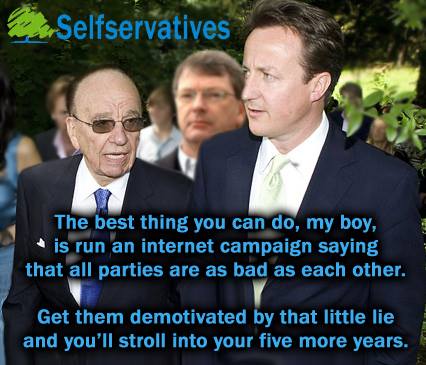
The ultimate aim of the “allthesame” lie is division and disempowerment of the Left.

1796655_294409220710133_3373329_n

The speech-writer for David Cameron in the run-up to the 2010 general election, Ian Birrellseems to have finger in every lie on behalf of the Tories. He’s the contributing editor of The Mail on Sunday, whilst writing columns regularly in several other papers. He’s been published in The Guardian, The Wall Street Journal, The Economist, The Daily Mail, The Financial Times, The Times, The Observer, The London Evening Standard, The Sun, The Daily Telegraph, The Sunday Telegraph, The Independent, The Independent on Sunday, Prospect, New Statesman and The Spectator.

On the 2nd January, Birrell cobbled together a somewhat strange and hugely speculative article in the Guardianclaiming that “a Tory-Labour unity coalition may be the only way forward after 7 May” and the two parties have more in common with each other than with the insurgents. A national government would prevent a constitutional crisis.”

There are no quotes or citations, just an unsubstantiated comment: “But most people in Westminster privately predict a hung parliament.”

As I said, entirely speculative, seemingly without an aim.

Birrell also claims there was “a brief flicker of unity” between the parties during the Scottish referendum. That’s a neat side-stepping of the fundamental fact that Labour, like most socialists, have always been internationalists, which has absolutely nothing to do with the Tories’ position on Scottish independence at all, and everything to do with Labour’s core values. It’s also a claim frequently made by the Scottish Nationalists –  Labour “sided with the Tories.” Anyone would think that the Scottish National Party want to undermine support for the Labour Party in Scotland…

There is of course a subtext to Birrell’s article. It is a piece of propaganda. The subtext is “the mainstream political parties are all the same.”

The “allthesame” myth came straight from Tory HQ. The BBC’s Tory correspondent Nick Robinson admitted live on air that Cameron’s best chance of winning the next election is if people believe politicians are “all the same.” That is very clearly not the case. I think this is a major ploy aimed at propagandarising an exclusively class-based identity politics, to target and fragment the “working class left.”

It purposefully excludes other social groups and also sets them against each other, for example, working class unemployed people attacking migrants – it really is divisive, anti-democratic, and quite deliberately flies in the face of Labour’s equality and diversity principles. That’s the problem with identity politics: it tends to enhance a further sense of social segregation, fragmentation and it isn’t remotely inclusive.

Of course it also enhances the tropes “outoftouch” and  “allthesame.” It’s a clever strategy, because it attacks Labour’s equality and inclusive principles – the very reason why the Labour movement happened in the first place – and places restriction on who ought to be included.

Think of that divisive strategy 1) in terms of equality; 2) in terms of appealing to the electorate; 3) in terms of policy. Note how it imposes limits and is reductive.

It also demoralises and confuses people.

The Tories set this strategy up in the media, UKIP have extended it further and the minority rival parties, including the Green Party and the Scottish National Party have utilised the same rhetoric tool: all of these parties frequently use the term “liblabcon”for example. That’s a sort of cognitive shortcut to what has been tacitly accepted, apparently, as a “common sense” view that partisanship amongst the mainstream parties is dead. I’ve written at length about this process of “normalisation” –  how social conservatism and neoliberalism have been absorbed culturally, and how this serves to naturalise the dominance of the Right and stifle the rationale for critical debate here – Manufacturing consensus: the end of history and the partisan man.

Be prepared for much more of this propaganda tactic: the Right are engaged in an all out war.

Firstly they know that Ed Miliband has edited their script, abandoning the free-market fundamentalist consensus established by Thatcherism in favour of social democracy.

Secondly, the right-wing media barons who set the terms of what is deemed politically palatable in Britain have never forgiven Ed Miliband for his endorsement of Leveson, which they believe is an unacceptable threat to their power.

Thirdly, they know Labour under Ed Miliband may well actually win the 2015 election.

It doesn’t take much effort to work out that the two main parties in competition have nothing in common at all. They debate oppositionally in parliament. Cameron attacks Miliband at every opportunity and on a very personal level, quite often. It’s plain, if you listen to the parliamentary debates, that neither man can stand what the other represents.

And how would the Tories and Labour reconcile their fundamental differences regarding human rights, the European Convention On Human Rights (ECHR) and the European Union? How about the bedroom tax? The National Health Service? Taxation? The welfare reforms? Equality? These are issues on which the two rival parties will never be able reach a consensus.

10635953_696483917087806_7307164383030383606_n

It’s quite difficult to assert that there are significant differences between the parties, because of the constant repetition of the “allthesame” lie. It has become almost like a comforting, lulling mantra and a shortcut from cognitive dissonance. People often get quite angry when confronted with evidence that challenges this soundbite. But policies provide very good evidence, they are scripted from ideologies and are statements of a party’s intentions.

Ed Miliband has been cautious in making policy promises and has said that he won’t pledge anything that he may not be able to deliver. Here are Labour’s key policies to date, each has been costed and evidenced.

The thing about policies that have been passed into law is that they can be verified on the Parliamentary website and elsewhere. How many of you reading this think that Blair was a “Thatcherite”? I’m not a Blairite. I do like Miliband, who is a very different leader than Blair was. Miliband denounced New Labour in 2010. His stance on Syria in 2013 draws a clean line under the Blair approach. Yet Blair is still being used as a stick to hit the Labour Party with.

The claims made in lying articles in the media and the often inaccurate and distorted claims of fringe party supporters are based on a propaganda technique called transfer and association, which is a method of projecting negative (or positive) qualities of a person, entity, object, or value (an individual, group, organisation) to another in order to discredit it (or sometimes, to make the second more acceptable, this tactic is used in advertising a lot.)

It evokes an emotional response, which stimulates the target to identify with recognised authorities. But that stick is hitting a closed door now. Newsflash: Blair hasn’t been party leader for some years.

I worked on compiling a list of New Labour’s policies, and despite Blair’s faults, there really were some outstanding achievements, such as the Equality Act, the Human Rights Act, various animal welfare laws, Every Child Matters and the Good Friday Agreement. I have listed New Labour’s achievements with a comparable list of the Coalition’s “memorable” moments, too. If you hated Blair, and see him as some sort of high priest of neoliberalism, it’s probably even more important that you read this. I promise it will help you to understand cognitive dissonance, at the very least, and perhaps to appreciate the importance of evidence and critical thinking: Political parties – there are very BIG differences in their policies.

And this, for some balance and perspective: Thatcher, Mad Cow Disease and her other failings, the Blair detour and déjà entendu, Mr Cameron.

The “allthesame” lie is a way of neutralising opposition to dominant ideas. It’s a way of disguising partisanship and of manipulating and reducing democratic choices. It’s nothing less than a political micro-management of your beliefs and decision-making.

It also reduces public expectation of opposition and in doing so it establishes diktats: it’s a way of mandating acceptance of ideology, policies or laws by presenting them as if they are the only viable alternative. And those that refuse to accept the diktats are enticed by the marginal parties who offer much, safe in the knowledge that they won’t have to rationalise, evidence, cost or deliver those promises. This also plays a part in diluting viable opposition, because the smaller parties tend to employ the same strategy to gain credibility and support – negative campaigning and repeated lies and soundbites.

Lynton Crosby, who has declared that his role is to destroy the Labour Party, rather than promote the Conservatives, based on any notion of merit, is also all about such a targeted “divide and rule” strategy. This is a right wing tactic of cultivating and manipulating apostasy amongst support for the opposition. It’s a very evident ploy in the media, too, with articles about Labour screaming headlines that don’t match content, and the Sun, Mail and Telegraph in particular blatantly lying about Labour’s policy intentions regularly.

Propaganda isn’t always obvious, and that’s how it works. We need to be very mindful of this.

Ultimately, the only party that will gain from any of this negative campaigning approach and divisive propaganda is the Tories. And that is who we should be collectively opposing.

The Tories launched their election campaign a couple of days ago, and already, it’s obvious that the entire campaign is founded on attempting to undermine Labour’s  credibility by telling lies about their economic management – The Tory election strategy is more of the same: Tories being conservative with the truth.

Contrast the Conservative with the truth approach I’ve discussed here with Miliband’s consistently genuine approach to politics – Ed Miliband: Labour election campaign will be one of hope, not falsehood.  

Whatever party you support and regardless of whether or not we agree on the issues I raise, my key aim, whenever I write, is to inspire a sense of responsibility and some critical thinking. That helps to reliably inform our decision-making.

I won’t apologise to my critics for being a Labour Party supporter, but I will always provide evidence and analysis to support and justify my own views and I will always be happy to engage in dialogue, provided that it’s a respectful and polite exchange. No party is above criticism, quite rightly so, as politics has to be an accountable, reflective and responsive process. That’s what democracy is about.

There is, however, a big difference between genuine criticism, on the one hand and propaganda and lies on the other, which are being masqueraded as “criticism.” If debate isn’t established on a genuine, critical exploration of evidence and establishing truths, then it’s not debate: it’s simply indoctrination.

Related

Don’t believe everything you think: it’s almost election time.

From  Psycho-Linguistics to the Politics of Psychopathy. Part 1: Propaganda

Ed Miliband is the biggest threat to the status quo we’ve seen for decades.

Once you hear the jackboots, it’s too late.

The moment Ed Miliband said he’ll bring socialism back to Downing Street.

Ed Miliband’s policy pledges at a glance

Miliband is an excellent leader, and here’s why.

Cameron’s Nudge that knocked democracy down: mind the Mindspace.

403898_365377090198492_976131366_nThanks to Robert Livingstone for the excellent memes.

Cuts to employment support allowance are being “considered” by ministers

37079_433060243430176_1848475368_n
Tory ministers are considering drastically cutting the main Employment and Support Allowance sickness (ESA) benefit, internal documents seen by the BBC suggest.

New claimants, judged to be capable of work with appropriate support, could be given just 50p more per week than people on job seekers allowance.

Current recipients get almost £30 per week more. This is to meet additional costs that arise because of a person’s disability.

The Department for Work and Pensions said the ESA proposals were “not government policy.”

The documents reveal that the government has also been forced to hire extra staff to clear the backlog on the benefit.

Some 100 healthcare professionals are being hired to carry out fitness-for-work tests. The staff, who will be employed through the Pertemps agency, will help to reduce a backlog of more than 600,000 cases.

They will be in addition to any extra staff brought in when a new contractor is announced shortly to replace ATOS. The American firm, Maximus, has been awarded the contract. Controversies and scandals have been unearthed by UK researchers since Maximus was handed the lucrative contract in July to deliver the government’s new health and work service in England and Wales.

Leaked documents over the summer showed that ministers considered ESA – formerly known as incapacity benefit – to be “one of the largest fiscal risks currently facing the government”.

They also revealed “concerns” about claimants moving off jobseekers allowance onto ESA.

Giving consideration to cutting the differential paid to ESA recipients in the Work Related Activity Group (WRAG) – individuals who have to prepare for employment – is a reflection of that concern. However these are people that have been declared unfit for work by their doctor. They currently receive £28.75 more per week but the documents show plans are being discussed to cut that to just 50p more than jobseekers allowance. People receiving JSA, who are aged 25 or over, currently get £72.40 per week.

However, disabled people do have have additional needs and higher living costs, which is why ESA was set at a higher amount than JSA. Furthermore, because ESA is paid to people who can’t work, that means they are potentially reliant on benefit to meet their living costs indefinitely, and certainly longer term than those claiming JSA. ESA wasn’t designed to be such a temporary means of support as JSA was.

Employment and Support Allowance is paid to approximately two million people. Claimants have to undergo an extremely controversial Work Capability Assessment (WCA) to determine whether they are eligible and at what level.

Many people have been wrongly assessed as fit for work, and have been forced to appeal in order to receive the benefit that they are entitled to, and the high success rate of appeals in itself indicates that the WCA is deeply flawed. People have died within weeks of being told they are fit for work, also indicating that this assessment process is heavily weighted towards ensuring that sick and disabled people lose their lifeline benefit.

Labour MP, Dame Anne Begg, who chairs the Commons Work and Pensions Select Committee, said she would support overhauling the delivery of ESA but: “did not envisage any reduction in the value of the benefit.”

She added: “That’s not reform, that is just saving money. I hope that is not something the government is going to come forward with.”

Of course the Conservatives have used the word “reform” as a euphemism for severe cuts since 2010.

If we look at how the Coalition austerity cuts have been targeted, we see that:

  • People in poverty are targeted 5 times more than most citizens
  • Disabled people are targeted 9 times more than most citizens
  • Disabled people needing social care are targeted 19 times more than most citizens.

It’s the Tories that want something for nothing: the democratic contract and government responsibility

430847_149933881824335_1645102229_n (1)
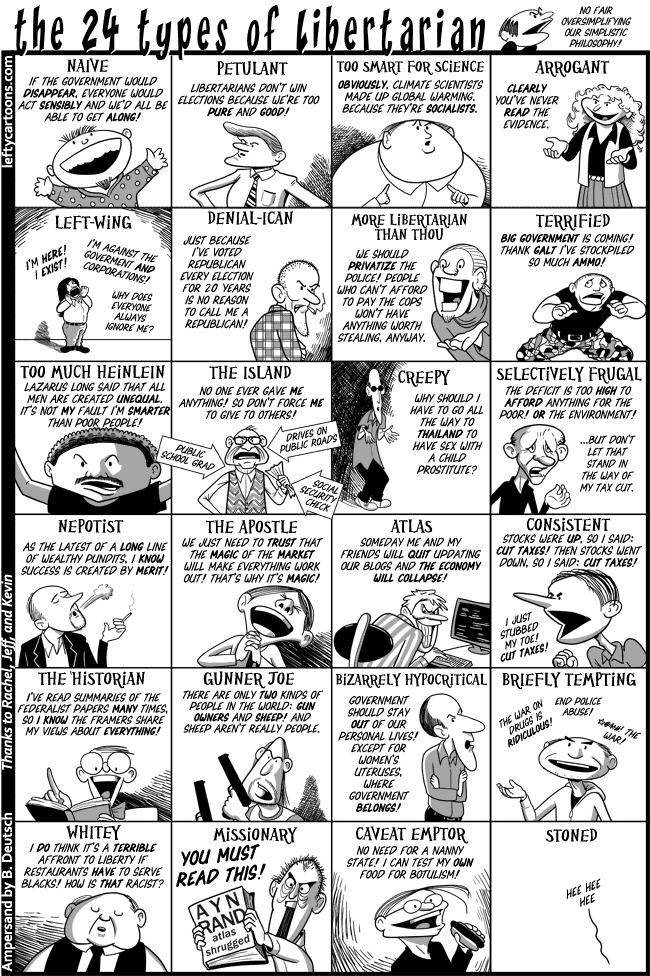
The Conservative defense of increasing economic inequality, the lionisation of Randian, Libertarian, selfish individualism and the proliferation of ideological justification narratives regarding the dismantling of the “Big (Welfare) State”, where the latter, in Orwellian fashion, is now being indicted for many of the very social and economic ills that the free market era has actually delivered has surely worn threadbare by now. 

It’s abundantly clear that it’s the Tories and the very wealthy that want something for nothing. Cameron’s mantra is “social responsibility, not state control equals Big Society.” Cameron, in his Hugo Young lecture (2009), claimed that the “Big Society demands mass engagement: a broad culture of responsibility, mutuality and obligation”.

But this isn’t about a transfer of political power or decision-making from government to the public: it’s a transfer of responsibility and duty only.

In true Orwellian spirit, Cameron went on to say: “The recent growth of the state has promoted not social solidarity, but selfishness and individualism.”  Only a conservative would claim poverty and social cohesion as their concern and passion, and then attack  the mechanism that until now has been used to alleviate them  – publicly funded state spending.

Democracy (based on the partnership between political and economic enfranchisement) happens when the concept of property encompasses access to “social goods” such as healthcare, education and public infrastructure as a right of citizenship. The idea of political representation becomes consolidated when access to such social goods is guaranteed by a legal process, as well as a political process.

The electoral franchise in countries which adopted a Lockean liberal constitutional  system, such as  Britain, had a property qualification attached to it. Universal suffrage coincided with a wider public access to social goods, giving rise to a new type of social contract: by giving up a portion of their property by way of taxation, the propertied class ensured the survival of capitalism, and the working class escaped the worst ravages of capitalism.

Access to social goods was a means of widening and legitimising the scope of democratic political representation.

However, whilst removing all of our public services, provisions, destroying our post-war settlement, the key features of which were accepted in principle by the main political parties at the time, namely: a mixed economy, a free public sector healthcare and education, a guaranteed (though minimal) state pension and social welfare provision, the government is removing social goods, nullifying the established social contract between state and individual, and is expecting that we each fend for ourselves.

I don’t remember any consent amongst the public to accept diminished living standards in return for Cameron’s proposal of national fiscal security (which he has consistently and spectacularly failed to deliver) and the maintenance of the “market-state”. Nor was there consent for authority, inequality and hierarchy, or an acceptance of being less than we can be and having less than we can have.

Our welfare provision (and I include our National Health Service, here), paid for by us, IS OUR MEANS OF BEING RESPONSIBLE AS A SOCIETY AND INDIVIDUALLY: it is a means of securing provision for ourselves if or when we need it. Our welfare provision is, and has been since its inception, each citizens’ responsibility, because we pay for it. It doesn’t belong to the government.

The consensus that the welfare state was the best basis for a healthy society was first rejected by Thatcher, who notoriously denied the very existence of society, and unashamedly espoused greed as the  “best social driver.”  Cameron, building on Thatcher’s previous groundwork, has effectively delivered an economic enclosure act, claiming OUR collective, public funds, turning that money into the private property right of the rich, in the same way the land enclosure act robbed the public of their commonly shared land, and enabled rich landowners use of their control of state processes to appropriate public land for their private benefit.

Yet despite this blatant theft: the massive transference of public funds to a few private accounts, the demands being made by the state on citizens have never been greater. All the Tories talk about are OUR obligations and individual responsibilities, whilst they claim they have NO responsibility for citizen well-being. But we have paid for state services and continue to do so via the tax and national insurance system.

In 2013 the Government spent approximately £93.5billion of our money on the private sector. This is half the £187bn government usually spends on goods and services each year. Recent growth in outsourcing of government services to private providers has been widely criticised for a lack of transparency, poor management of money and, in particular, excessive remuneration of top executives and pay inequality between employees. Extreme pay inequality and a succession of scandals in the largest government suppliers suggests that, in its present form, government outsourcing is a very poor use of tax payers’ money and not fit for purpose. This is verified by the Equality Trust’s research report: Subsidising Unfairness

It’s only the very wealthy that gain (enormously) from austerity, and they  manage to avoid  any socially responsible contribution by using government endorsed accounting systems and dodges to avoid paying taxes wherever possible. The estimated amount of taxes unpaid, thanks to evasion, avoidance, error and criminality, soared to £34 billion, according to HM Revenue and Customs. This equates to £1 in every £15 owed in taxes not being collected last year.

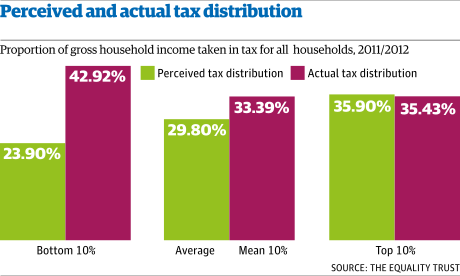
Furthermore, it is the poorest 10 percent of households that pay eight percent more of their income in all taxes than the richest – 43 percent compared to 35 percent, outlined in a report from the Equality Trust. The poorest pay more than four times as much of their income, in Cameron’s poll tax-styled council tax system, than the wealthiest top 10 precent.

The government’s “hardworking taxpayer” myth which is at the heart of the Tory ideologically driven austerity narrative, and divert, divide and poison strategy, creates an artificial dichotomy between benefit claimants and taxpayers. Cameron’s diversionary rhetoric has got nothing to do with responsibility and fairness: it’s simply about justifying policies that privilege a wealthy elite at the expense of the poor.

 Such us and them dichotomies  can be linked to the distinctions made between the “deserving” and  “undeserving” poor, going back over a hundred years or more, to the cruel and punitive Poor Law Reform Act. The Tories have purposefully created scapegoats: adversarial identities that are politically constructed according to notions of difference which simultaneously encourages a public comparison to, and rejection of, Others. This Othering narrative portrays benefit recipients as the enemy in a battle against fairness and responsibility.

And the public have bought into it, the Equality Trust thinktank highlights a gulf between perceptions of the tax system and its reality. A poll, conducted with Ipsos Mori, found that nearly seven in ten people believe that households in the highest 10% income group pay more of their income in tax than those in the lowest 10%.

Wealth concentration damages economies. It focuses activity within finance and other services geared towards only towards serving the super rich.Maintaining inequality requires penalising and further impoverishing the poor.

Reducing  wealth inequalities will require the introduction of wealth taxes, like the inheritance tax  we introduced a century ago. Reducing inequality requires a high top rate of income tax. This reduces income inequality not only by raising revenue, but by deterring the profit-driven greedy from asking for more money. When there is a tax rate of 60 percent on incomes above £200,000 a year, it makes little sense to pay employees much more than that.

But the wealthy tend to get so indignant when policy proposals from the opposition indicate that they will be required to actually contribute something to a society that they have taken so much more than others from. There’s been an outraged outcry, for example, regarding Labour’s Mansion tax proposals. These ignoble, self-serving Randians are happy to sit back and allow the poorest and most vulnerable to suffer and starve, whilst being subjected to the unfair, punitive bedroom tax, which contravened human rights: the poorest are bearing the terrible burden of austerity cuts whilst the wealthy continue to profit massively. Presumably, Cameron exempted the very rich from responsibility, duty and contributing  to society in any meaningful way.

Of course this is about restricting political engagement, the Conservatives have always sought to reduce it to a basic partnership between corporate interests and professional politicians. Cameron’s Conservatism rests on the unwitting rejection  of the social democratic consensus by the population which, paradoxically, need what they reject. Public consent is being manipulated to accommodate the idea that democracy is a relationship between rulers and governed, rather than it being about an elected government that reflects, represents and serves public needs. The population are being incrementally subordinated to a political system which is not conducive to the betterment of their lives, well-being or material conditions –  the Tories are imposing an imbalanced social contract comprised of citizen duties with no citizen rights; the acceptance of ever-lower living standards and increasing state authoritarianism.

The Conservative scapegoating narratives, which have blamed Labour, the poor and the unemployed for a recession caused by the private finance sector, and not the “big state” as claimed, have permitted the Coalition to pursue an ideological, destructive and grossly unfair economic strategy, which has generated only a bogus and isolated recovery largely based on government-fuelled asset bubbles in real estate and private finance, with stagnant productivity, plummeting wages, millions of people in precarious jobs, inflated living costs and utterly savage welfare cuts.

One obligation that all democratic states have, surely, is that of protecting citizens rights and freedoms. Those are most certainly being steadily diminished, and Cameron has been quite candid about scrapping our Human Rights Act, and withdrawing from the ECHR in the future.

See what I mean? It’s all take take take…

Danny Dorling says: “Gross economic inequality is as vile as racism, misogyny and hatred of the disabled; as damaging in effect; and as dependent on a small group of supporters who believe that just a few should have more and more and more, because they’re “worth it”.”

I believe that growing social inequality generates a political necessity for prejudices: they are entrenched vis-à-vis Social Darwinism in Tory ideology, fueled and perpetuated through justification narratives and amplified via the media.

I’ve said many times previously that never in this country have those who fight for democracy and social justice carried a greater burden or faced the possibility of bigger losses of human rights, human freedoms, human dignity and human welfare than they do right now.

14533697838_dffcc736f2_o (1)

 Many thanks to Robert Livingstone for his brilliant art work

Miliband: hope, humanism, joined-up thinking and integrity.


1044468_500666173336249_1718830491_n


One of Miliband’s virtues is that he re-humanises politics. For him, people’s individual experiences matter, and he always cites many examples throughout his speeches. He includes qualitative accounts from real people. It’s a particularly contrasting quality to Cameron’s unempathic, dehumanising, quantitative and negative labelling approach.

To the Tories, we are all reducible to their often cited, fake statistics. The numbers tell us what the Tories want us to “know”, and not what actually is. And we know that the Tories have never been big on free speech – see the Gagging Act, for example. They like to exclude “inconvenient” voices of truth from the grand, overarching Tory narrative. Miliband listens to accounts of people’s realities, and accommodates those accounts. Cameron imposes both accounts and realities upon us.

Hardly surprising, therefore, that the right-wing bitcherati press have taken the piss once again and tried to make Miliband’s approach to the paramount importance of everyday people look small. Littlejohn in particular is being his pernicious, old, fascist self. How anyone that writes for the Mail for a living has the cheek to criticise anyone at all is beyond me. But it shows that the right are determined to portray any strengths that Ed Miliband has as a weakness. Propaganda at its worst. But its so blatant, superficial and unsophisticated, at least.

I have criticised Tory ontology and methodology previously, using social science as a frame of reference. Politics is a social science, and not a “stand-alone” one: it draws on the disciplines of psychology and sociology, too. As a critical interpretivist, I believe that social reality is not “out there” waiting to be discovered: we are constructing and reconstructing it meaningfully. However, politically, there’s been a marked shift away from understanding the lived experiences of real people in context: a systematic dehumanisation. The Tories have depopulated social policy. This is a characteristic of authoritarianism, and other hallmarks include stigmatisation of social groups, moral disengagement, moral exclusion, impunity, and a societal “bystander apathy”, as I’ve discussed elsewhere.

In the social sciences, there was a big shift away from Cameron’s approach to “understanding the social world” from the 70s onwards. Mostly we realised that  counting people’s responses doesn’t give us any clue about meanings and intentions, it can only turn up statistics. And these are open to reductionist and determinist interpretations and inferences from the persons gathering them, as we know.

Qualitative researchers aim to gather an in-depth understanding of human behaviour and intention – the reasons that govern such behaviour. The qualitative method investigates the why and how of our decision making, rather than just what. And we get to interpret our own reality and experiences. We are each experts in our realm of experiences, and Miliband understands this. He invites our expertise, Cameron stifles it.

The social researcher and the politician do not stand apart from or outside of the intersubjectively constructed universe they wish to describe/measure: there is no “objective” vantage point, because we all participate personally within it.

Clifford Geertz, an anthropologist said: Man is an animal suspended in webs of significance he himself has spun, I take culture to be those webs, and the analysis of it to be therefore not an experimental science in search of law but an interpretive one in search of meaning.

And in Thick Description, which compared the “thin” descriptions of measurements with the “thick”, densely layered description of context and meaning that qualitative research can provide in any given situation, he said : “The difference between a twitch and a wink is vast.  From a purely physiological perspective, a wink is the contraction of the muscles of a single eye that cause the eyelid to close.  So, of course, is a twitch.  And so is a slow-motion, exaggerated parody of a wink; a fast motion parody of a twitch; and any number of parodies of parodies of twitches and winks that a group boys sitting in the back row might engage in to amuse one another on a spring afternoon”.

And any measure of the interactions that include and are driven by these twitches and winks is bound to measure the wrong things and fail to measure the right ones.

No-one but the Tories would try to argue that poverty is an intentional act of the poor, that food banks are a symptom of rising greed rather than need. I have never known a government to be so blatantly insouciant with the measurable social phenomena it causes via its policies. Or with its own credibility, for that matter.

In contrast to quantitative research, qualitative research involves the collection and analysis of information that focuses on the meanings attached to people’s actions and behaviours, often referred to as the lived experience.It defines us as active participants in the world, instead of merely reducing us to statistics and preferences.  It makes priority of our perceptions and experiences and the way we make sense of our lives.

First-hand experiences matter. And quite properly so. It puts us, the people, in the driving seat, we construct our own meanings, rather than having authoritarians like Cameron imposing meanings, definitions, convenient labels and Tory ideology upon us. Quantitative methods tend to hammer the world into a presupposed state  – as Einstein once said: the theory tells you what you may observe. How very Cameron. All quantitative studies can yield are conventionalised expressions of the experience of the author, or the one commissioning the research.

Quantitative, positivist paradigms share commensurable assumptions but are largely incommensurable with critical, constructivist, and participatory paradigms.. In other words, they don’t accommodate any critical  approaches or analysis, nor are they inclusive. How very Cameron.

Furthermore, quantitative methodology in the social sciences depends upon faith in the “verification principle”. Which is itself unverifiable…

How very  cul-de-sac, and how very Cameron.

Quantitative methodology objectifies us, whereas the qualitative method draws on a humanist, hermeneutic/phenomenological approach: understanding moves from the outer manifestations of human action and productivity (the superficial) to the exploration of their inner meanings and references. Numbers cannot convey human experiences: it is thought, language and our expression that converts experience into meaning.

Humanist thinkers within the discipline of psychology, such as Ronald D Laing, drew on a qualitative  approach, and in his earliest works, he starts from the experience of the individual ego, in “The Divided Self” (1961) and moves towards existential phenomenology , and in his later work, such as “The Politics Of Experience And The Bird Of Paradise“(1967), he manages to integrate these perspectives within a Marxist framework.

Laing, along with others who led the anti-psychiatry movement in the late 50’s and early 60’s, such as Erving Goffman and Thomas Szasz, had a profound and hugely significant impact within the field of psychology, which had been dominated by associationism, behaviourism, psychometrics and eugenics and of course, psychoanalysis.

At a time when theorists from social sciences maintained that their perspectives were premised on scientific (usually positivistic) principles, Laing offered a humanist critique of these approaches, which he said trivialised psychology and dehumanised its subjects. Laing shifted the emphasis from an experimental approach, and a searching for “facts” and “predictability” regarding human behaviours to dialogue, intersubjectively constructed and reconstructed meanings and human experience. Laing and others challenged established categories of behaviour deemed pathological or abnormal, by meaningful explorations of individual accounts of their experience of being.

Laing in particular gave a rational voice to those individuals who had experienced exploitation within family relationships, which he studied extensively, discovering sets of interactions that often involved complex tactical games, relationship knots and strategies, with family members making alliances with some and creating enmity with other members. Within the nexus of the family there is an unremitting demand for constant strategic interpersonal interaction based on mutual reciprocal concern and attention. Individuals are therefore vulnerable to existential harm. They are emotionally imprisoned via the nexus, internalising other family members, and the interaction patterns.

Laing believed that some families acted like gangsters, offering each other protection against each other’s violence. Some governments do, too.  He also believed that the internalisation of family interaction patterns becomes our world – and it restricts the development of the self, with individuals carrying the emotional blueprint of their family for the rest of their life, which may inhibit any real autonomy or self awareness. This blueprint may manifest as expression through behaviours that are clinically identified and diagnosed as schizophrenia. Laing and others exposed the negative labelling processes, and ritualised humiliation directed towards those experiencing self-fragmentation because of the internalisation of negative family interaction patterns. For Laing, madness is simply a perfectly rational adjustment to an insane world. Of course that world exists within a political framework.

In sociology, phenomenology was expressed in the work of Alfred Schutz (1899 – 1959) who studied the ways in which people directly experience everyday life, and imbue their activities with meanings. In contrast to the predominant structural and somewhat deterministic perspectives within the discipline, Schultz moved away from the tendency of subordinating everything within disaffecting, abstruse and overarching ideologies or grand narratives, and he emphasised a multiplicity of new and often spontaneously co-authored ideologies lived out day-by-day and based on common sense and intersubjectively constructed values.

Schultz expressed a vitalism that engendered an organic way of thinking, with characteristics such as intuitive insight as a way of perceiving things from within, and placed emphasis on understanding as a holistic grasp of the widely varied, often complex and subtle elements of situations, and on experience as something that is lived through in common with others.

Schultz says that we draw on a common stock of knowledge – “typifications” and common sense which orientates us, helps us navigate socially, and achieve a reciprocity of perspective with others. Socialisation processes mediate and normalise this common stock of knowledge.

Phenomenological Sociology went hand in hand with a preference for a qualitative methodology that emphasised authentic everyday accounts of social reality, with agency and meaning being the focus. Quantitative methodology, on the other hand, had primarily focused on measurement, notions of the predictability of behaviours due to these being determined by social structure for example, as was the case with many advocates of Functionalism, such as Social Darwinist Herbert Spencer, and a socially detached and “objective” researcher.

Such a researcher was evidently armed with the belief that he/she possessed the somewhat unique ability to stand outside of human experience and values, unlike the subjects of enquiry, and would thus gather “social facts” and then interpret them from this independently existing standpoint. For example, a sociologist studying drug use amongst young people may gather statistics and hand out closed questionnaires with short directive and directed yes/no type questions. From the information gathered, the researcher may conclude that anomie and alienation lead to drug use, because, for example, many young drug users singled out for study live in deprived inner city areas.

Most young drug users, however, would not use terms like anomie to explain or give meaningful accounts of their drug use. This imposed conceptual framework of the researcher demonstrates very well how detachment and objectivity is not possible, in sociological enquiry. Indeed, some have extended this criticism to scientific enquiry. We each operate within idioms of belief, and Michael Polanyi has proposed that Western Science is such a self-sustaining idiom. (“Personal Knowledge”, 1958). He compares science with Azande Witchcraft, (Evans-Pritchard’s anthropological study: “Witchcraft, Oracles and Magic Among the Azande”), noting that each conceptual framework is “segregated’ by a logical gap” (they are incommensurable), but from within each idiom, beliefs tended to be circulatory, self-confirming and self-sustaining.

This is true of all ideologies. We can make inferences from sociological research, for example, but every sociologist knows about the Hawthorne effect: that the very fact that people know they are being observed changes their behaviour and distorts the result.

Polanyi had become acutely aware of the extent to which worldviews penetrate into language, and that he had sensed that this may have important ramifications for relations between frameworks of belief. As the basis of his argument, Polanyi gives a precis of his epistemology in “Science, Faith And Society” (1946) and “Scientific Beliefs” (1951). Polanyi considers that discovery, verification and falsification of propositions in science do not obey “any definite rule” but proceed with the aid of “certain maxims” which defy both precise formulation and rigorous evaluation. The maxims are “premisses or beliefs … embodied in … the tradition of science”.

Sustained by this tradition, science is governed by the coherent opinion of its practitioners, who employ the “idiom of science” in which its interpretative framework, Polanyi concludes, is an entrenched tangled and negotiated reciprocity of perspective, and all founded on the the belief of scientists that science is true: a personal conviction which they cannot factually justify. And again, how can we verify the principle at the heart of scientific methodology: verificationism itself, for example?

It is also possible to identify imported scientific metaphors operating at the heart of social science. For example, the shift from “structure” to “events” in physics is reflected in a similar shift in theoretical focus in sociology. There was a marked shift in structural and deterministic accounts of human behaviour and a move to study small scale interactions, social events, context bound interactions and situations, which can be linked with phenomenology. Behaviour was relativised by a multiplicity of contexts, which meant that more descriptive methodologies were employed.

A phenomenologist would ask open-ended questions, preferring interviews and the use of dialogue. Responses would be directed as little as possible, ensuring that the account given is a true and meaningful reflection of the direct experience of the person/social agent. This kind of research also reflects immediacy – the here and nowness of the social world, that has a full potential yet to be explored, rather than the positivist emphasis on a narrowing predictability and replicating results to try and determine their’ “accuracy.” It is also democratic and founded on notions of equality.

The person/agent has the centre stage and is the author of the research. Furthermore, phenomenologists have pointed out that sociologists are also embedded in everyday life and cannot therefore escape the shared norms, values and meanings of the life world they inhabit. Phenomenologists value valid accounts, rather than social “facts”, as it is not possible to be “objective” when one occupies a completely intersubjective realm of enquiry.

Miliband, of course, recognises this, he values authenticity, inclusion, equality, democracy and spontaneity over and above ideology. Cameron is completely driven by ideology. and the ghastly assumptions that Tory dogma entails.

Social existence is not one dimensional; it is complex, ambiguous, poorly defined, deceptive, fragmented, emotional and often unpredictable. It is animated by a plurality of perspectives. It is often based on what we take for granted – tacit knowledge – that which is self-evident that informs our intellectual constructions. A phenomenological approach can uncover those taken for granted underpinning assumptions – quintessentially cultural phenomena, in that these assumptions are what societies are built upon.

Miliband understands this. He acknowledges that human experiences are complex, multidimensional, inter and intrasubjective, and multipersonal, many layered events, where both “verifiable statement” and valid existential account each have an important place in our endlessly creative narratives, and of the endless possibilities of our being in a social universe of expansive potential. Cameron only reduces that potential. And he really has, in just four years.

In a sense, we’ve all been doing such qualitative research our whole life, and therefore have very much to contribute to a pluralist, socially democratic society. Miliband knows this, Cameron freely chooses not to. Cameron is an epistemological and ontological fascist: he predefines what we “know”, and what is “acceptable” as “knowledge”, and he predefines social reality, excluding its’ members accounts.

Max Weber’s principle of Verstehen  is a critical approach in all social sciences, and we can see the consequences of its absence in the cold, pseudo-positivist approach of the Coalition in the UK. Their policies clearly demonstrate that they lack the capacity to understand, or meaningfully “walk a mile in the shoes of another”. The Coalition treat the population of the UK as objects and not human subjects of their policies.

My own starting point is that regardless of any claim to value-freedom in political science, we cannot abdicate moral responsibility, and cannot justify moral indifference. We see this positive approach exemplified in our laws, human rights and democratic process. We are also seeing an erosion of this tendency to a globalisation of values, and inclusion of a recognition and account of the full range of human experiences in policy making. Indeed Tory policy has become an instrument of social exclusion and increasing minoritization.

We are being reduced to little more than economic statements here in the UK. We have a Government that tends to describe vulnerable social groups in terms of costs to the State, and responsibility is attributed to these social groups via media and State rhetoric, whilst those decision-makers actually responsible for the state of the economy have been exempted, legally and morally, and are hidden behind complex and diversionary scapegoating propaganda campaigns.

Sartre once said that oppressors oppress themselves as well as those they oppress. Freedom and autonomy are also reciprocal, and it’s only when we truly recognise our own liberty that we may necessarily acknowledge that of others. Conservatism has always been associated with a capacity to inhibit and control, and never liberate. We need to take responsibility for the Government that we have. In fact we must.

Miliband is offering us social democracy. The accusations of political “cross-dressing” from the fringes of the left are utter nonsense, hence the persistent right-wing media smear campaign. Miliband is offering us inclusivity, he speaks with an obvious decency and passion, and has consistently presented us with a  comprehensive and coherent narrative, if only we will listen.

Socialism for a Sceptical Age, by Ralph Miliband was about the continued relevance of socialism in a post-communist world. Ed Miliband has said that the final few sentences of this book are his favourites of all his father’s work:

In all the countries there are people in numbers large and small who are moved by the vision of a new social order in which democracy, egalitarianism and co-operation – the essential values of socialism – would be the prevailing values of social organization. It is in the growth of their numbers and in the success of their struggles that lies the best hope for mankind.”  

“Socialism is not a rigid economic doctrine, but ‘a set of values’ It is ‘a tale that never ends’. Indeed, the strange fact is that  while there’s capitalism, there’ll be socialism, because there is always a response to injustice.” Ed  Miliband. (Source)

He’s right.

14533697838_dffcc736f2_o (1)

Thanks to Robert Livingstone for his brilliant pictorial truths

Inequality has risen: Incomes increased for the richest last year, but fell for everyone else

1459720_569627496440116_902730897_n

On 04 June, 2014, at 3.52pm BST, Cameron said inequality is at its lowest level since 1986. I really thought I’d misheard him. This isn’t the first time Cameron has used this lie. We have a government that provides disproportionate and growing returns to the already wealthy, whilst imposing austerity cuts on the very poorest. How can such a government possibly claim that inequality is falling, when inequality is so fundamental to their ideology and when social inequalities are extended and perpetuated by all of their policies? The standard measure of inequality is  certainly being used to mislead us into thinking that the economy is far more “inclusive’ than it is.

Dr Simon Duffy authored report – A Fair Society?  – last year, for the Centre for Welfare Reform, about how the austerity cuts have been targeted. He said:

  • People in poverty are targeted 5 times more than most citizens
  • Disabled people are targeted 9 times more than most citizens
  • People needing social care are targeted 19 times more than most citizens

“The UK is the third most unequal developed country in the world and most disabled people live in poverty. The current policy is guaranteed to increase inequality and to make extreme poverty even worse.”

I also wrote an article last year –  Follow the Money: Tory Ideology is all about handouts to the wealthy that are funded by the poor. I said:

The following cuts came into force in April 2013:

  • 1 April – Housing benefit cut, including the introduction of the ‘bedroom tax’
  • 1 April – Council tax benefit cut
  • 1 April – Legal Aid savagely cut
  • 6 April – Tax credit and child benefit cut
  • 7 April – Maternity and paternity pay cut
  • 8 April – 1% cap on the rise of in working-age benefits (for the next three years)
  • 8 April – Disability living allowance replaced by personal independence payment (PIP)
  • 15 April – Cap on the total amount of benefit working-age people can receive

Here are some of the “incentives” for the wealthy:

  • Rising wealth – 50 richest people from this region increased their wealth by £3.46 billion last year to a record £28.5 billion.
  • Falling taxes – top rate of tax cut from 50% to 45% for those earning over £150,000 a year. This is 1% of the population who earn 13% of the income.
  • No mansion tax and caps on council tax mean that the highest value properties are taxed proportionately less than average houses.
  • Benefited most from Quantitative Easing (QE) – the Bank of England say that as 50% of households have little or no financial assets, almost all the financial benefit of QE was for the wealthiest 50% of households, with the wealthiest 10% taking the lions share
  • Tax free living – extremely wealthy individuals can access tax avoidance schemes which contribute to the £25bn of tax which is avoided every year, as profits are shifted offshore to join the estimated £13 trillion of assets siphoned off from our economy.

I also said: “A simple truth is that poverty happens because some people are very, very rich. That happens ultimately because of Government policies that create, sustain and extend inequalities. The very wealthy are becoming wealthier, the poor are becoming poorer. This is a consequence of  “vulture capitalism”, designed by the opportunism and greed of a few, it is instituted, facilitated and directed by the Tory-led  Coalition. ”  

Inequality Briefing reports that richest fifth of the UK population saw their incomes increase by £940 in 2013. But incomes were down by £250 for the other 80% of the population… and by £381 for the poorest fifth , according to data from the Office for National Statistics (ONS)

Incomes increased for the richest fifth of the population last year, but fell for everyone else

Thanks to Inequality Briefing for the info graphic and summary

To download the full pdf, click here

Explaining the data

This data compares the ‘equivalised disposable household income’ for 2011/12 and 2012/13. It was published by the Office for National Statistics as part of ‘the effects of UK tax and benefits on household income 2012/13 study.’ ONS have found that the recession did have a small effect on reducing inequality, but it now looks as though inequality is set to increase.

It has increased. Just as we have predicted.

1234134_539964652739734_1075596050_nPicture courtesy of  Robert Livingstone

Other relevant articles:

Quantitative data on poverty from the Joseph Rowntree Foundation

Welfare reforms, food banks, malnutrition and the return of Victorian diseases are not coincidental, Mr Cameron

The poverty of responsibility and the politics of blame 

“We are raising more money for the rich” – an analysis 

Cameron’s Gini and the hidden hierarchy of worth

How the Tories chose to hit the poor

Once you hear the jackboots, it’s too late.

556770_138948196256237_144572172_n

Dr. Lawrence Britt examined the fascist regimes of Hitler (Germany), Mussolini (Italy), Franco (Spain), Suharto (Indonesia) and several Latin American regimes. Britt found 14 defining characteristics common to each, and it is becoming increasingly difficult to overlook some of the parallels with increasingly authoritarian characteristics of our own right wing government here in the UK.

Controlled mass media is one example of such a defining feature of fascism, with “news” being directly controlled and manipulated by the government, by regulation, or via sympathetic media spokespeople and executives. Censorship is very common. And then there is an obsession with “National Security” –  with fear being used as a “motivational tool” by the government on the public.

In June 2013, a visit by Government national security agents to smash computer hard drives at the Guardian newspaper offices hit the news surprisingly quietly, when Edward Snowden exposed a gross abuse of power and revealed mass surveillance programmes by American and British secret policing agencies (NSA and GCHQ) last year. (More detailed information here).

David Miranda, partner of Glenn Greenwald, Guardian interviewer of the whistleblower Edward Snowden, was held for 9 hours at Heathrow Airport and questioned under the Terrorism Act. Officials confiscated electronics equipment including his mobile phone, laptop, camera, memory sticks, DVDs and games consoles. 

This was a profound attack on press freedoms and the news gathering process, and as Greenwald said: “To detain my partner for a full nine hours while denying him a lawyer, and then seize large amounts of his possessions, is clearly intended to send a message of intimidation.”

Absolutely. Since when was investigative journalism a crime?

Even the Telegraph columnist Janet Daley remarked that these events were like something out of East Germany in the 1970s.

This certainly raised critically important legal and ethical issues, for those involved in journalism, especially if some kinds of journalism can be so easily placed at risk of being politically conflated with terrorism.

Once again, the mild and left wing/liberal Guardian is under attack by our Tory-led government. In an extraordinary and vicious attack on The Guardian newspaper, Department for Work and Pensions (DWP) communications chief and senior government spin doctor, Richard Caseby, has called for the newspaper to be “blackballed” and prevented from joining the new press regulatory body, because “day after day it gets its facts wrong.” Remarkably, “ineptitude or ideology” were to blame for what he deemed “mistakes” in the paper’s coverage of the DWP’s cuts to benefits. He called for the broadsheet to be kept out of the new Independent Press Standards Organisation (IPSO), set up after the Leveson Inquiry into media standards. 

As a former journalist at the Sun and The Sunday Times, Caseby certainly has an axe to grind against the paper that revealed how those right wing papers’ stablemate, the News Of The World, had hacked the voicemail of murdered teenager Millie Dowler, sparking the phone hacking scandal that prompted Rupert Murdoch to close the tabloid down.

richard caseby

Richard Caseby, pictured when giving evidence to MPs as managing editor of The Sun.

In July 2011 it emerged that Cameron met key executives of Murdoch’s News Corporation 26 times during the 14 months that Cameron had served as Prime Minister. It was also reported that Murdoch had given Cameron a personal guarantee that there would be no risk attached to hiring Andy Coulson, the former editor of News of the World, as the Conservative Party’s communication director in 2007. This was in spite of Coulson having resigned as editor over phone hacking by a reporter. Cameron chose to take Murdoch’s advice, despite warnings from Nick Clegg, Lord Ashdown and the Guardian. Coulson resigned his post in 2011 and was later arrested and questioned on allegations of further criminal activity at the News of the World, specifically regarding the News International phone hacking scandal.

The Culture, Media and Sport Committee of the House of Commons served a summons on Murdoch, his son James, and his former CEO Rebekah Brooks to testify before a committee on 19 July. After an initial refusal, the Murdochs confirmed they would attend after the committee issued them a summons to Parliament. The day before the committee, the website of the News Corporation publication the Sun was “hacked”, and a false story was posted on the front page claiming that Murdoch had died. Murdoch described the day of the committee “the most humble day of my life.”  He argued that since he ran a global business of 53,000 employees and that the News of the World was “just 1%” of this, he was not ultimately responsible for what went on at the tabloid. 

On 1 May 2012, the Culture, Media and Sport Committee issued a report stating that Murdoch was “not a fit person to exercise the stewardship of a major international company.”

On 3 July 2013 Exaro and Channel 4 news broke the story of a secretly recorded tape. It had been recorded by Sun journalists, and in it Murdoch can be heard telling them that the whole investigation was “one big fuss over nothing”, and that he, or his successors, would “take care” of any journalists who went to prison.

He said: “Why are the police behaving in this way? It’s the biggest inquiry ever, over next to nothing.” Murdoch believes that he doesn’t have to be accountable. His initial refusal to testify, despite being summonsed, is extraordinarily indifferent and arrogant.

In connection with Murdoch’s testimony to the Leveson Inquiry “into the ethics of the British press,” editor of Newsweek International, Tunku Varadarajan, referred to him as “the man whose name is synonymous with unethical newspapers.”

Not a shred of concern raised about any of this or Murdoch’s nasty and corrupt myth industry, and right wing scapegoating empire, coming from our government, a point worth reflecting on for a moment. Miliband said the phone-hacking was not just a media scandal, but it was a symbol of what was wrong with British politics.  He called for cross-party agreement on new media ownership laws that would cut Murdoch’s current market share, arguing that he has “too much power over British public life.He said: “If you want to minimise the abuses of power, then that kind of concentration of power is frankly quite dangerous.” 

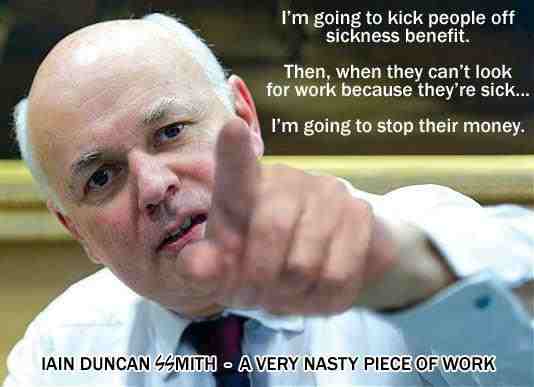
Meanwhile, Iain Duncan  Smith is “monitoring” the BBC for any “left wing bias”. Gosh, I just bet that took the jolly well-known ardent commie Chris Patten by complete surprise…

The BBC Trust said that a programme called the “Future of Welfare”, written and presented by John Humphrys, breached its rules on impartiality and accuracy. It found that the programme had failed to back up with statistics claims that there was a “healthy supply of jobs”.

Iain Duncan Smith, the Work and Pensions Secretary, defended Humphrys as a “robust broadcaster” and said the documentary was “thoughtful and intelligent”. And perhaps most importantly, it endorsed the Governments’ punitive and callous welfare  “reforms.”

Duncan Smith was infuriated by the BBC’s coverage of the ruling, which he felt gave “too much airtime to campaigners.” Too much for what, exactly, we have to wonder. Perish the thought that anyone may dare to poke at the half-timbered facade of Tory ideology – Duncan Smiths’ rhetoric is a painful parody of fact that loudly dismisses – and intentionally obscures – the private despair and ruined lives of so many of those least able to speak up for themselves.

He said: “I have just watched reporting on the BBC about the Government winning a High Court judgement on the Spare Room Subsidy (that’s the Bedroom Tax to you and I) that once again has left me absolutely staggered at the blatant Left-wing bias within the coverage. And yet the BBC Trust criticise John Humphrys’s programme, which was thoughtful, intelligent and born out of the “real” life experience of individuals.”  The same Duncan Smith, who chooses to deny the all too painful and impoverished real life experiences his policies have inflicted on many. He prefers to lie them away from public attention. Or dismiss them as merely “anecdotal”.

Duncan Smith’s credibility doesn’t stand up to much scrutiny here, as someone attempting to verify “accuracy” and er…  statistical claims. Ah, yes. The Department of Work and Pensions – Iain Duncan Smiths’ Department – has a long track record of misusing statistics, making unsubstantiated inferences and stigmatising claimants, and it’s clear these are tactics used to attempt to vindicate further welfare cuts. In fact several minsters, including Cameron, have been officially rebuked by the Office of National Statistics for telling lies, and in Duncan Smith’s case – on at least 3 occasions this past 12 months despite warnings regarding his dishonest claims in the media, as well as in parliament. 

So considering all of this, it was with some incredulity that I read Caseby’s comments in the Huff Post earlier: “Should the new IPSO members accept (editor Alan Rusbridger) as a johnny-come-lately? No, rather he should be blackballed. Sorry, but the Guardian isn’t fit to become a member of IPSO until it starts valuing accuracy.”

And: “In the end, of course, it’s IPSO’s decision. But should the new standards body be so gracious as to invite him in, I guess I’ll be waiting to lodge the first complaint.” He said an MP had complained to the Office for National Statistics over The Guardian’s reporting of its data. I bet that was said without a trace of irony, too.

So, if alleged (and improbable) benefits inaccuracies “should get [The] Guardian blackballed,” what is this spin doctor’s recommendation for the perpetual propagandarising, lying, right wing media and a lying government minister’s serial offensive “benefits inaccuracies”?

Oh … of course, this is Iain Duncan Smiths’ relatively new pet guard dog.

An interesting choice of word from Caseby – “blackballing”, which is a rejection in a traditional form of secret ballot, where a white ball ballot constitutes a vote in support and a black ball signifies opposition. This system is typically used where a club (or Lodge) rules provide that, rather than a majority of the votes, one or two objections are sufficient to defeat a proposition. Since the seventeenth century, these rules have commonly applied to elections to membership of many gentlemen’s clubs and similar institutions such as in Freemasonry. It’s an apt term because of its association with conservatism, tradition and secrecy. 

In contrast, and unlike many whistleblowers who remain anonymous, Edward Snowden chose to be open and go public. Snowdens’ sole motive for leaking the documents was, in his words, “to inform the public as to that which is done in their name and that which is done against them.”  He believes that the global public is due an explanation of the motives of those who act outside of the democratic process.

To “protect democracy” we have governments that are subverting the law. This is a fundamental paradox, of course and Snowden saw this could lead to the collapse of democracy and critically endanger our freedom. And Snowden reminds us that what no individual conscience can change, a free press can. It has to be one that is free enough to allow a diverse range of political commentaries, rather than a stranglehold of right wing propaganda from the Murdoch empire and its ideological stablemates.

I think that the process of dismantling democracy started in May 2010 here in the UK, and has been advancing incrementally ever since, almost undetected at first, because of pervasive government secrecy and a partly complicit, dominant right wing media.

But once you hear the jackboots, it’s far too late.

994763_494550317281168_1024248164_n

With big thanks to Robert Livingstone

Related 

The Transparency of Lobbying, non-Party Campaigning, and Trade Union Administration Bill is a calculated and partisan move to insulate Tory policies and records from public and political scrutiny, and to stifle democracy. The Government’s Lobbying Bill has been criticised by bloggers and campaigners from right across the political spectrum, with the likes of Owen Jones and Guido Fawkes united in agreement over this issue: that the Bill is a “Gagging Act”. Five Conservatives – Douglas Carswell, Philip Davies, David Davis, Zac Goldsmith and David Nuttall – voted against the Bill, whilst others also expressed concerns.

The Bill will treat charities, think tanks, community groups and activists of every hue as “political parties”. From small groups addressing local matters to big national organisations, all equally risk being silenced in the year before a general election, to avoid falling under electoral law. Any organisation spending £5,000 a year and expressing an opinion on anything remotely political must register with the Electoral Commission. Since most aspects of our public life are political, (and a substantial proportion of our private life has been increasingly politicised under this authoritarian government) this stifles much essential debate in election years when voters should be hearing and evaluating policy choices.

The ‘Let Lynton Lobby Bill’: Grubby Partisan Politics and a Trojan Horse 


I  don’t make any money from my work. But you can help Politics and Insights if you like by making a donation to help me continue to research and write free, informative, insightful and independent articles, and to provide support to others. The smallest amount is much appreciated – thank you.

DonatenowButton

Cameron’s ‘divine inspiration’ came from Max Weber, not God

10257904_309423985875323_7153330499946730765_n
The Department of Work and Pensions announce that they are to be re-named the
“Congregation for the Doctrine of the Faith”. The government have released a statement that although they favoured the strappado, a variety of other methods of trial by ordeal will be used in addition to replace the Work Capability Assessment. Iain Duncan Smith has called for the introduction of dunking – a form of water ordeal and divination – to determine who is disabled enough to build the HS2.

Conservatives have reassured the appalled public by explaining that really, the old English word ordǣl,”  simply means a “judgement or verdict”, so not to worry, as pretending that a word means something else is a magick formula used for ensuring public compliance and conformity. Lynton Crosby has been announced as the new Pontifex Maximus of such formulae. Previous successes include the words “fair”, “reform” and the phrase “making work pay” in the context of the Tory’s neoliberal cunning stunts known collectively as the misnamed “welfare reforms.”

I can see where Cameron thinks he’s coming from with his recent claims of “divine inspiration”. Cameron’s social policies may certainly be regarded as a codified version of the Malleus Malificarum (The Hammer of the Witches).

His ideology is founded on principles similar to those found in Commentarius de Maleficius. There are some uncanny similarities between such legal treatises on witchcraft and the Tory Welfare “Reform” Act, especially regarding the establishing of entitlement to benefits.

“Christians are now the most persecuted religion around the world. We should stand up against persecution of Christians and other faith groups wherever and whenever we can,” says the Prime Minister.

Contrary to what you said, Christians have often been the persecutors, rather than the persecuted, Mr Cameron.

witch-hunt is a search for witches or evidence of witchcraft, often involving carefully manufactured public moral panics. This is a manipulated intense feeling expressed in a population about an issue that appears to threaten the social order. Or in this case, that mythical beast of burden – the right-wing tax payer. Tories are moral entrepreneurs, who have despicably used the media to transform the poorest and most vulnerable social groups into folk devils. Conservatives have always created social tension and ensured that criticism and disagreement are difficult because the matter at the centre of such controversies are taboo.

The right-wing media have aided and abetted the Tories, who have long operated as agents of moral indignation. I can see a very clear, common framework of reference for prejudice and persecution here, Mr Cameron.

Proofs of practising witchcraft in Commentarius de Maleficius read a lot like Techniques of Neutralisation, (Sykes and Matza). The first “proof” is the identification of the “diabolical mark”. Usually, this was a mole or a birthmark. If no such mark was visible, the examiner would claim to have found an invisible mark. Or invent statistics. It seems using physical characteristics as an opportunity and excuse to persecute a social group is no new thing then, in the name of “God”, Mr Cameron. As you know.

The “diabolical pact” was an alleged pact with Satan to perform evil acts in return for rewards. Benefit “Fraud” is the new diabolical pact. Thus spake the grand inquisitor Iain “de Torquemáda”  Duncan Smith.

Mr Duncan Smith claims to know of many invisible families with generations of witches, and feels the need produce imaginary statistics and to take measures to “prevent” this invisible culture of entitlement. To be afraid during the interrogatories is a sure sign of guilt.

This is called being Condemned by the condemners – it’s a formula ensuring an abdication of all responsibility for behaviour, and instead the condemned point to the people condemning them: they  are the problem, not us. What they have done “wrong” excuses persecution, appalling and unforgivable political behaviour and policies.

Denying harm is another technique of neutralisation, which is evident in words like ‘support’, help’, which the Tories use to mask the fact that their blatantly punitive welfare policies are absolutely draconian, with sanctions, for example, involving the withdrawal of the means for citizens to meet their basic survival needs.

Mr Cameron, in 1540: Antonio Venegas de Figueroa, Bishop of Pamplona, sent a circular to the priests in his diocese, explaining that witchcraft was a false belief. He recommended medical treatment for those accused of witchcraft, and blamed the ignorance of the people for their confusion of witchcraft with medical conditions. Didn’t you get the memo?

…..For the extraordinarily evil and cruel are always with us.

Manly P Hall

Satirical swipes aside, Cameron’s deluded and quite alarming declaration that “divine inspiration was at work when it came to drafting a key concept for Conservative Party policy” is founded on the Tory affinity with hierarchies and social stratification – and this is reflected in the appeal to “higher authority”. Of course, much of our religious organisation is extremely hierarchical too. This is Cameron’s version of psychobabble, a warped and inverted idea of noblesse oblige, he’s clearly close to meltdown.

And what utter moral cowardice, Cameron’s claim is an attempt to endorse Tory policy by partially disowning responsibility for it himself. It’s obvious that Tory policies have not arisen from anything remotely resembling an “intelligent design”, from a Christian deity or otherwise.

Marx said that: “Religion is the sigh of the oppressed creature, the heart of a heartless world, and the soul of soulless conditions. It is the opiate of the people”.  Yes, and for Cameron and his ilk, social control and moral codification is an attractive feature of religion. And aligning with a doctrine that makes a virtue of virtue, Cameron is attempting to add legitimacy to his unchristian and uncharitable “reforms”.

The Puritan work ethic has long considered indispensable for right wing political ideologues. Protestantism offers a concept of the worldly “calling,” and gives worldly activity and ruthless profiteering a religious character. 

Max Weber’s The Protestant Ethic and the Spirit of Capitalism is a study of the relationship between the ethics of ascetic Protestantism, (which embodies values such as thrift, self help, and hard work) and the emergence of the spirit of modern capitalism.

Weber observed a correlation between being Protestant and being involved in business, and went on to explore religion as a potential cause of modern economic conditions. He concluded that the modern spirit of capitalism sees profit as an end in itself, and pursuing profit as virtuous.

Calvinism promoted the idea that profit and material success as signs and cues of God’s favour. Other religious groups, such as the Pietists, Methodists, and the Baptist sects had similar attitudes, but to a lesser degree. Weber proposed that that this new attitude broke down the traditional economic system, paving the way for modern capitalism, and once capitalism emerged, the ethic took on a life of its own. We are now locked into the spirit of capitalism.

Weber doesn’t exactly argue that Protestantism caused the capitalist spirit, but rather, that they are correlated. He also acknowledges the converse: that capitalism itself had an impact on the development of the religious ideas. It’s a teleology (a doctrine explaining phenomena by final causes) that would appeal to Cameron for obvious reasons.

Cameron clearly hasn’t spotted the gaping contradictions in what he claims. His cognitive dissonance arises from the fact that while he claims to hold true a predestination doctrine – that God has ordained all that will happen, especially with regard to the salvation of some and not others, (particularly associated with the teachings of St Augustine of Hippo and of Calvin), this contradicts Cameron’s beliefs that are evident in his “reforms” for the poor – which are based on the premise that the poor are responsible for their own circumstances, and may be “helped”, coerced, sanctioned and legislated into somehow different “choices” and circumstances.

Cameron fails to reconcile his apparent belief in predestiny with his punitive, welfare “reforms” apparently designed to coerce socially “responsible” citizens into work. 

You can’t argue from a perspective of predetermination that only poor people are responsible for their actions and situations of poverty – that only poor people have a degree of free will – and then go on to formulate punitive policies based on notions of “deserving” and “undeserving” poor people, and a redistribution of wealth from the poorest to the wealthiest. AND claim you believe in God. With a straight face.  

The stunning hypocrisy and incoherence of Cameron’s claim to “divine inspiration” for such uncharitable, unkind, inhumane, persecutory and malevolent deeds as the welfare “reforms”, when empathy and compassion are so widely regarded to be central to Christianity, amongst a diverse range of religions and world-views, demonstrates only too well that Cameron lacks the integrity, depth, basic empathy and regard for others that is crucially required of a leader. He has absolutely no conscience, compassion, remorse or shame.

12787_401370889932445_1764534847_n
  Pictures courtesy of Robert Livingstone

Follow the Money: Tory ideology is all about handouts to the wealthy that are funded by the poor

310024_618087491552293_1852914423_n

Here is yet another great Tory lie exposed – “Making work pay”. This Government have raided our tax-funded welfare provision and used it to provide handouts to the very wealthy – £107, 000 EACH PER YEAR in the form of a tax cut for millionaires. The Conservatives claim that it is “unfair” that people on benefits are “better off” than those in work. But the benefit cuts are having a dire impact on workers as well.

People in work, especially those who are paid low wages, often claim benefits. Housing benefit, tax credit and council tax benefit are examples of benefits that are paid to people with jobs. Indeed the number of working people claiming housing benefit has risen by 86 percent in three years, which debunks another Tory myth that benefits are payable only to the “feckless” unemployed.

By portraying housing benefit as a payment for “the shirkers”, not “the strivers”, Cameron and Osborne aim to convince the public that their draconian, unprecedented welfare “reforms” are justified. 60 percent of people visiting food banks last year were in work. But unemployment benefits are just 13 percent of the national average earnings. What Cameron’s Government have done is created extreme hardship for many of those in work, and further severe hardship for those who are unemployed.

“Making work pay” is a big lie that has benefited no-one but the very wealthy, and the reduction in both the value and the amount of welfare support for unemployed individuals has come at a time when we are witnessing steady reductions in worker’s rightsand worryingly, the Tory-led Government is stepping up its attack on employment health and safety regulations. And the unions.

Last week, on the 25th April 2013, the Enterprise and Regulatory Reform Bill was granted royal assent, bringing into law the Government’s widely unpopular proposals to scrap employers’ 114-year-old liability for their staff’s health and safety in the workplace. This steady erosion of our fundamental and hard-earned rights in the workplace is linked to the steady erosion of the basic human rights of the poorest citizens. The Government have liberated wealthy private companies of any moral or legal responsibilities, so that they can simply generate vast profits by exploiting workers who have increasingly fewer means of redress.

There is also a growing reserve army of labour that may be exploited via the workfare schemes. This will mean that unscrupulous, greedy, profit-driven employers will increasingly replace paid workers with unpaid ones that are forced to work for their benefits or face losing them. This is a politically enforced programme of reducing the population’s expectations regarding choice, opportunities, rights, and quality of life.

A recent proposal from our “caring Conservatives” is that new in-work claimants should be required to attend an initial interview at a Job Centre “where a conditionality regime should be set up to ensure the individual is doing all they can to increase their hours and earnings”.

Claimants “should then be forced to attend a quarterly meeting to be reminded of their “responsibility” to try to increase their earnings”, with sanctions applied for failing to attend. This may well be the next stage of the welfare “reforms”, incorporating a punitive approach to those in work on low hours or low pay, as well as those unfortunate enough to be out of work.

There is absolutely no evidence, sense or logic behind the Tory claim that cutting welfare will “make work pay”. Well, unless we are referring to the greedy employers that will benefit and profit from the welfare “reforms” and reduction in worker’s pay level and rights. This is about gross exploitation and profiteering at any cost to human lives.

“Making work pay” is an entirely ideologically-driven, dogmatic, absurd and reductionist Conservative superficial soundbite. There is certainly an essence of all that is Tory in the word “peremptory”. There is also many a Tory donor in private business that wants to see more profit and a more abject workforce.

The real “culture of entitlement” is not to be found among poor citizens, those who are unemployed, sick and disabled citzens, as this Government would have you believe. As a matter of fact, most amongst this politically demarcated social group have paid tax and paid for the provision that they ought to be able to rely on when they/we have need of it, it’s ours, after all. The real culture of entitlement emanates from the very wealthy, and is well-fed and sustained by an aristocratic and authoritarian Government.

Every time we have periods of high unemployment, growing inequalities, substantial increases in poverty, and loss of protective rights, there is a Conservative administration behind this wilful destruction of people’s lives, and the unravelling of many years of essential social progress and civilised development that spans more than one century in ontogeny and maturation.

The Conservatives lied about our “generous welfare”. It wasn’t and it certainly isn’t now. Coming at the same time that severe cuts to tax credits and benefits are set to make an estimated 11.5 million households poorer, the Chancellor was accused by Britain’s largest union, Unite, of conducting class war on the poor while giving handouts to the rich.

The following cuts came into force in April 2013:

  • 1 April – Housing benefit cut, including the introduction of the ‘bedroom tax’
  • 1 April – Council tax benefit cut
  • 1 April – Legal Aid savagely cut
  • 6 April – Tax credit and child benefit cut
  • 7 April – Maternity and paternity pay cut
  • 8 April – 1% cap on the rise of in working-age benefits (for the next three years)
  • 8 April – Disability living allowance replaced by personal independence payment (PIP)
  • 15 April – Cap on the total amount of benefit working-age people can receive

    922829_509977429064049_604527973_n

In addition, wages have not risen in real terms since 2003 and there are further fears that the Government is trying to pressurise the Low Pay Commission into cutting the national minimum wage from its present £6.19 per hour. At a time when the cost of living has risen so steeply, the Government has also increased VAT.

Commenting, general secretary Len McCluskey of Unite said: “Millionaires will be raising a glass of champagne to George Osborne this weekend as he slashes the incomes of people struggling to get by to give handouts to the rich.”

“But ordinary people – taxpayers – will be furious that George Osborne has chosen to give away £1 billion to the super-rich while their fuel and food costs rise and wages are falling”.

“His party knows no shame. They are trying to claim that their tax cuts benefit ordinary people but this is another lie – the truth is that while those earning over £1 million per year will be an average £100,000 better off, low income families will be around £900 worse off.”

“This is not the way to recover our failing economy.  Creating real jobs and paying decent wages, including a one pound increase on the minimum wage, will bring down the benefits bill and get people spending again.”

“Instead of getting on with the job he ought to be doing, like sorting out the problems he has caused to our economy, Osborne prefers to encourage hatred and demonise the poor, both in and out of work, in an ideological attack on our welfare state.”

Ed Miliband said: “David Cameron and George Osborne believe the only way to persuade millionaires to work harder is to give them more money.

But they also seem to believe that the only way to make you (ordinary people) work harder is to take money away.”

Bravo Ed, a very well spotted contradiction regarding Cameron’s claims about how “incentives” work. Apparently, the rich are a different kind of human from the majority of human beings.

Here are some of the Tory “incentives” for the wealthy:

  • Rising wealth – 50 richest people from this region increased their wealth by £3.46 billion last year to a record £28.5 billion.
  • Falling taxes – top rate of tax cut from 50% to 45% for those earning over £150,000 a year. This is 1% of the population who earn 13% of the income.
  • No mansion tax and caps on council tax mean that the highest value properties are taxed proportionately less than average houses.
  • Benefited most from Quantitative Easing (QE) – the Bank of England say that as 50% of households have little or no financial assets, almost all the financial benefit of QE was for the wealthiest 50% of households, with the wealthiest 10% taking the lions share
  • Tax free living – extremely wealthy individuals can access tax avoidance schemes which contribute to the £25bn of tax which is avoided every year, as profits are shifted offshore to join the estimated £13 trillion of assets siphoned off from our economy.

It’s plain to see that Cameron rewards his wealthy friends, and has a clear elitist agenda, while he funds his friends and sponsors by stealing money from the taxpayer, by stripping welfare provision and public services down to bare bones.

A simple truth is that poverty happens because some people are very, very rich. That happens ultimately because of Government policies that create, sustain and extend inequalities. The very wealthy are becoming wealthier, the poorest are becoming poorer. This is a consequence of  “vulture capitalism”, designed by the opportunism and greed of a few, it is instituted, facilitated and directed by the Tory-led  Coalition.  

Welfare provision was paid for by the public, via tax and NI contributions. It is not a “handout.” It is not the Governments money to cut. That is our provision, paid for by us to support us if and when we need it. It’s the same with the National Health Service. Public services and provisions do not and never did belong to the Government to sell off, to make a profit from, and to strip bare as they have done

Low wages and low benefit levels, rising unemployment and a high cost of living are major causes of poverty. (“worklessness” is a made-up word to imply that the consequences of Government policies are somehow the fault of the victims of this traditional Tory harshness. It’s a psychological and linguistic attack on the poorest, disabled people and the most vulnerable citizens – blaming the unemployed for unemployment, and the poor for poverty.)

Those are a direct consequence of Coalition policies. The Coalition take money from those who need it most to give away to those who need it least. That causes poverty, and cannot fail to create growing inequality. The Coalition are creating more poverty via the class-contingent consequences of policies.

It’s time to debunk the great myth of meritocracy. Wealth has got nothing whatsoever to do with “striving” and hard work. If it were so simple, then most of the poor would be billionaires by now. 

This week it was reported that one school liaison officer told how a parent came to her pleading for help because her children were suffering from SCURVY – a potentially fatal condition caused by a severe Vitamin C deficiency. It’s an illness linked with malnutrition and poverty, and has seldom been seen in this Country for most of this century, due to improvements in medical knowledge, and the development of adequate welfare provision – that had eliminated absolute poverty in Britain. Until now. It’s increasing again.

We now have pre-Victorian Health and Safety laws in the workplace. We have Victorian malnutrition and illnesses such as scurvy and rickets. Malnutrition has resurfaced because of the re-appearance of absolute poverty – something that was eradicated because of our effective, essential welfare program, until now. We have a punitive Poor Law approach to “supporting” the poorest instead of welfare provision. These ideas and subsequent harsh and punitive policies were a dark part of our history, and now they have been resurrected by the Tories to be a part of our future. It’s social regression.

We have recession and austerity, entirely manufactured, based on ideology and not because of any economic necessity. Austerity does not include and affect the very privileged. Indeed they have benefited immensely from the politically engineered economic situation.  We have a society that has been lulled into forgetting equality, decency and fairness. We have a lying authoritarian Government that created a crisis for many to make profiteering opportunities for a few.

The New Poor Law of 1834 was based on the “principle of less eligibility,” which stipulated that the condition of the “able-bodied pauper” on relief be less “eligible” – that is, less desirable, less favourable – than the condition of the independent labourer. “Less-eligibility” meant not only that the pauper receive less by way of relief than the labourer did from his wages but also that he receive it in such a way (in the workhouse, for example) as to make pauperism less respectable than work – to stigmatise it. Thus the labourer would be discouraged from lapsing into a state of “dependency” and the pauper would be encouraged to work.

The Poor Law “made work pay”, in other words.

The clocks stopped the moment that the Tories took Office. Now their policies mean that we are losing a decade a day.

544840_330826693653532_892366209_n

208082_397796890289845_858870070_n (1)

 Pictures courtesy of Robert Livingstone

Further reading:

Conservatism in a nutshell

Families £900 Per Year Worse Off After Benefit And Tax Changes, Says Labour’s Ed Balls

Labour exposes Osborne’s tax cut for bankers

A catalogue of failure and broken promises-Catherine Mckinnell MP’s verdict on George Osborne’s autumn statement

The poverty of responsibility and the politics of blame 

“We are raising more money for the rich” – an analysis 


I  don’t make any money from my work. But you can help if you like by making a donation to help me continue to research and write free, informative, insightful and independent articles, and to provide support to others. The smallest amount is much appreciated – thank you.

DonatenowButton