Tag: George Osborne

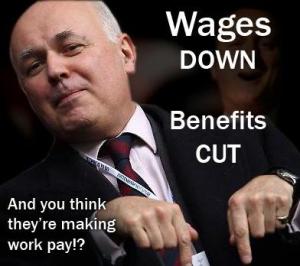
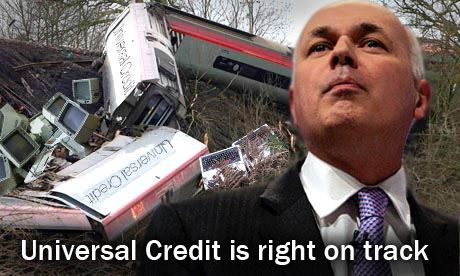
Iain Duncan Smith abandoned his own sinking ship

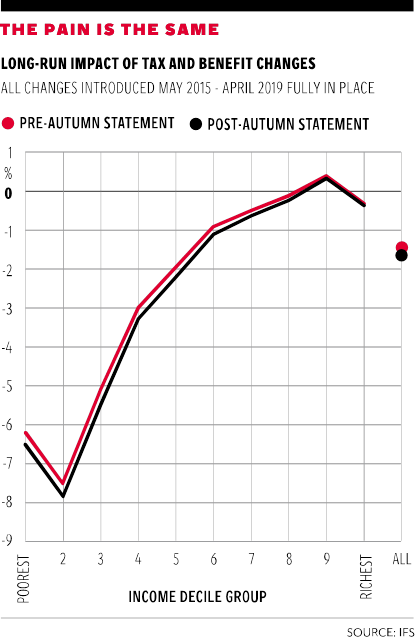
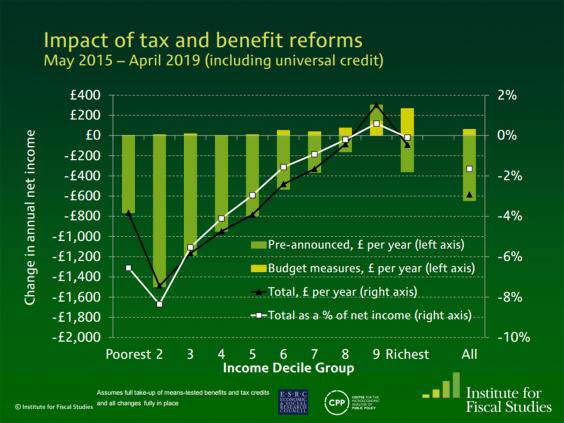
Impact of tories on income.jpg

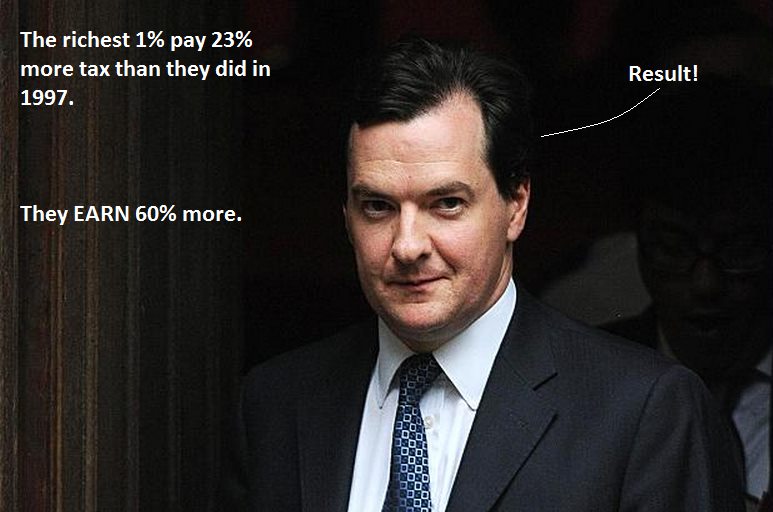
Analysis of George Osborne’s budget from the Institute for Fiscal Studies.

Stephen Crabb has been appointed as the new work and pensions secretary, after Iain Duncan Smith resigned in a flurry of controversy on Friday.

Mr Duncan Smith has said the latest planned cuts to disability benefits were “not defensible” in a Budget that benefited higher-earning taxpayers.

David Cameron said he was “puzzled and disappointed” that Mr Duncan Smith had decided to go when they had agreed to have a rethink about the policies

Iain Duncan’s Smith’s letter of resignation must be a BIG embarrassment to the  Government. It was certainly designed to inflict maximum damage particularly on Chancellor George Osborne. I’ve previously noted that the Chancellor has a tendency to regard the Department for Work and Pensions as little more than an annex to the Treasury, and the welfare budget as the Treasury’s disposable income, but I never anticipated that Duncan Smith would come to say that he sees it that way, too. This is, after all, a minister that has invented statistics and told some pretty far-fetched fibs to prop up justifications of his policies that entail some pretty draconian measures, such as sanctions and work fare, after all.

Yet surprisingly, Duncan Smith has also quite willingly and very publicly provided the government’s opponents with ammunition. He has effectively denounced not only Osborne’s budget, but also, his targeted austerity measures, yet curiously, Duncan Smith has until now been one of the most ideologically devout Thatcherite Conservatives, which is reflected in every policy he has formulated.

He has basically said what many of us have been saying for a long time: that the cuts are political and not because of economic necessity, nor will they help the economy. He also as good as said he doesn’t think we are “all in it together”. It turns out that Osborne blamed Duncan Smith for the Personal Independence Payment (PIP) and Employment Support Allowance (ESA) cuts. But Duncan Smith has been a very quiet man recently, often conspicuous by his absence during parliamentary debates, with Priti Patel left defending the ESA cuts in particular in the Commons.

However, the Department for Work and Pensions did a review of PIP last year, and that’s where the “justification” for the cuts came from – a sample of just 150 people, which was hardly a representative sample. It’s difficult to imagine that IDS didn’t order that review. But it was Osborne who announced the cuts to PIP, not Iain Duncan Smith. Just who carries the original responsibility for the proposed PIP cuts is probably never going to be fully untangled from the crossfire of accusations and counter accusations. But surely Cameron is ultimately responsible for Conservative policies?

In his resignation letter, Iain Duncan Smith says:

“I have for some time and rather reluctantly come to believe that the latest changes to benefits to the disabled, and the context in which they’ve been made are, a compromise too far. While they are defensible in narrow terms, given the continuing deficit, they are not defensible in the way they were placed within a budget that benefits higher earning taxpayers. They should have instead been part of a wider process to engage others in finding the best way to better focus resources on those most in need.

I am unable to watch passively while certain policies are enacted in order to meet the fiscal self imposed restraints that I believe are more and more perceived as distinctly political rather than in the national economic interest.

Too often my team and I have been pressured in the immediate run up to a budget or fiscal event to deliver yet more reductions to the working age benefit bill. There has been too much emphasis on money saving exercises and not enough awareness from the Treasury, in particular, that the government’s vision of a new welfare-to-work system could not be repeatedly salami-sliced.

It is therefore with enormous regret that I have decided to resign. You should be very proud of what this government has done on deficit reduction, corporate competitiveness, education reforms and devolution of power.

I hope as the government goes forward you can look again, however, at the balance of the cuts you have insisted upon and wonder if enough has been done to ensure ‘we are all in this together’ “

You can read the letter in full here

You can see Cameron’s response in full here

Many Conservatives have suggested that Duncan Smith – a supporter of Brexit – had been looking over several weeks for an opportunity to resign, and claimed that he wanted to find a moment when he could inflict maximum damage on the campaign led by Cameron and Osborne to keep Britain in the European Union. But writing in the Observer, Bernard Jenkin, a Tory MP and chair of the Commons public administration select committee, says that Duncan Smith was not prepared to tolerate another raid on the disability budget.

Referring to the prime minister’s letter to Duncan Smith, in which Cameron said he was “puzzled” by the resignation, Jenkin says: “What that letter does not make clear is that the £4bn savings in the budget from welfare still stands and, once again, Iain was being told to find similar cuts from other benefits for working-age people – including for the disabled – again undermining the positive incentives that make it worthwhile for them to take work. That is what he finds morally indefensible.”

However, Debbie Abrahams, the shadow minister for disabled people, who has faced Duncan Smith many times during Commons debates and Work and Pensions Committee inquiries, says she does not accept the reasons Iain Duncan Smith has given for resigning, and believes he chose to resign so he could “embarrass the government as much as he can”.

She adds that planned cuts to disability benefit payments in the Budget were “grossly unfair” and would hit “the most vulnerable in society at the same time the highest earners are getting tax cuts”. 

She says she is grateful that many Conservative MPs are critical of the proposals, but adds: 

“We must make sure that this last cut that has been announced around Personal Independence Payments is stopped and does not carry on.”

The resignation is particularly surprising given that, just hours earlier, the Treasury shelved the proposed cuts to PIP – following threats of a Tory backbench rebellion. Three Tory MPs – including mayoral candidate Zac Goldsmith – have  also been asked to resign as patrons of disability charities over their support for the recent welfare cuts. The complete failure of the austerity project is finally unravelling the Conservatives, and at a time when the Brexit faction of the party is already causing considerable disarray.

Even some of the most loyal Tories were finding it difficult to defend taking money away from sick and  disabled people – particularly since many of those who receive PIP are in work, and in fact some rely on it to stay in work. The cuts to ESA and PIP take place in the context of a Tory manifesto that included a pledge not to cut disability benefits. In fact in March last year, the Prime Minister signalled that the Conservatives will protect disabled claimants from welfare cuts in the next parliament (this one). Cameron said the Conservatives would not “undermine” PIP, which was introduced under the Coalition to save money by “targeting those most in need.” Now it seems those most in need are not the ones originally defined as such.

Controversially, the cuts to disability benefits were planned to fund tax cuts for the most affluent – the top 7% of earners. The Chancellor raised the threshold at which people start paying the 40p tax, in a move that will  see many wealthier people pulled out of the higher rate of income tax, in the coming budget. Mr Osborne said that he wants to “accelerate progress” towards the Conservative’s manifesto pledge of raising the threshold for the 40p rate to £50,000 in 2020. The average annual income in the UK is around £27,000.

The Labour Party have urged Stephen Crabb to appear before MPs on Monday to announce formally that the cuts to disability benefits had been dropped. Owen Smith, the shadow work and pensions secretary, said: “His very first act as secretary of state must be to come to parliament on Monday to announce the full reversal of cruel Tory cuts that will see 370,000 disabled people lose £3,500 a year.”

He also urged Crabb to “stand up to a Treasury that is intent on cutting support for those most in need to pay for tax breaks for those who least need them”.

The main retaliation from the Conservative frontbench has been that Duncan Smith knew about the disability cuts (which he did) and that this is an act of mischief and sabotage designed and timed to destablise Cameron regarding Europe. It may well be. But the divisions had already caused wobbles, Duncan Smith just delivered a swift and hefty kick to the “in” crowd.

However, it’s also clear there has been a rising tension between the Treasury and the Department for Work and Pensions for some time. Duncan Smith felt that the benefits system could be scaled back only so far. Osborne and Cameron would prefer to see the welfare state completely dismantled.

Nonetheless, we have witnessed Duncan Smith’s long term disconnection from the impacts of his policies. He has persistently refused to engage with critics raising serious concerns about the consequences of the welfare “reforms”. He has refused to carry out a cumulative impact assessment of his policies and absolutely refused to monitor the impacts, most of which have been dire for sick and disabled people, and when the specifics of negative consequences were pointed out to him, he has typically reacted with denial, anger and accusations of “scaremongering.”

Duncan Smith used the mantra “there’s no proof of causality” to dismiss those who recognised a correlation between his welfare “reforms” and an increase in premature mortality rates and suicide. He has consistently and quite unforgivably shown that he is more concerned about hiding evidence and stifling criticism than he is about conscienciously investigating the harmful and sometimes devastating consequences that his policies have had on many people.

On the day he resigned, Duncan Smith’s department lost a four year legal battle to keep the many potentially humiliating problems with Universal Credit from the public.

Whatever the reasons may be for Duncan Smith’s resignation, he has certainly highlighted very well that Conservative budget decisions are partisan, taken for  party political interest rather than with consideration for the national interest. But in more than one way.

It’s also worth bearing in mind that it is Iain Duncan Smith’s “reforms” that have prompted a United Nations inquiry into grave and systematic violations of the human rights of disabled people. It’s highly unlikely that Duncan Smith’s reputation will be enhanced in the long-term regarding his legislative legacy, particularly regarding disabled people. He has collaborated with other ministers in designing and extending techniques of neutralisation to attempt justify what are extremely prejudiced, discriminatory and punitive policies aimed at the poorest citizens.

This is a man who has removed people from a structural socioeconomic context and then intentionally blamed them for their individual socioeconomic circumstances, most of which have been created by this government’s actions since 2010. Every single Conservative budget has taken money from the poorest and gifted it to the wealthiest. It’s inconceivable that Tory ministers don’t understand such policies will invariably extend and perpetuate inequality and poverty.

Duncan Smith has damned himself, but nonetheless, a Conservative minister resigning and stating that it is because of a Conservative budget, publicly citing reasons that correlate with the opposition’s objections regarding the government’s ideologically driven and targeted austerity, is a particularly damning turn of events for the Conservative Party as a whole, that’s for sure.

Now that Duncan Smith has publicly denounced the Conservative austerity project, I wonder if he will also recognise and embrace the rational expertise and economic competence of a real party of social justice, which rescued this country from the consequences of a global recession by the last quarter of 2009, whilst Osborne had us back in recession by 2011, and lost us our triple A Fitch and Moody credit ratings after promising not to. I wonder if Duncan Smith now supports the fair party with a track record of verifiable economic expertise – that would be the Labour Party.
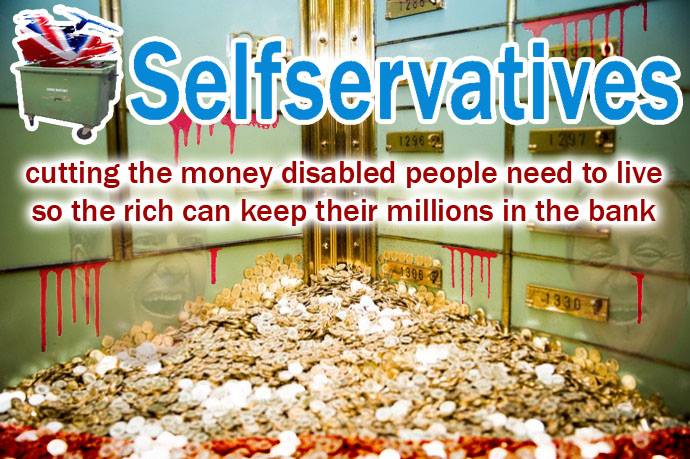
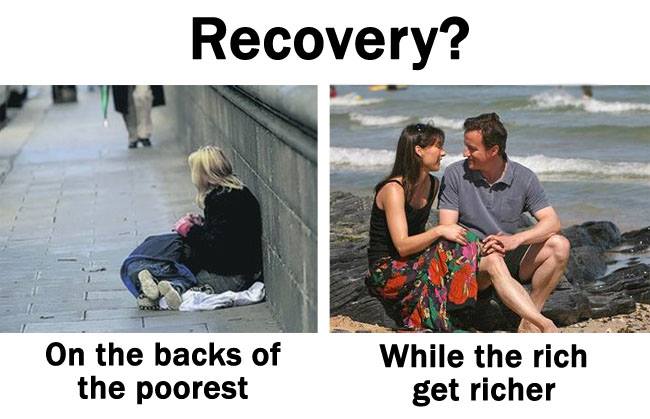
rich keep millons
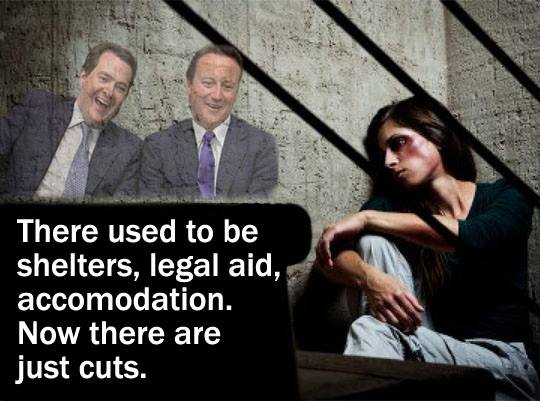
Picture courtesy of Robert Livingstone

I don’t make any money from my work and I’m not funded. You can support Politics and Insights by making a donation to help me continue researching and writing independently, and to continue to help others.

DonatenowButton
cards

The Government’s brutal cuts to disability support isn’t ‘increasing spending’, Chancellor, but handing out tax cuts to the rich is

Chancellor George Osborne


2 wrag

Source: Hansard

Context

Many of us recognised in 2012, when the welfare “reforms” and other cuts to public services that support the poorest citizens were forced through parliament despite considerable opposition, using only the “financial privilege” of the Commons as a justification, that the Conservatives are on an ideological crusade, which flies in the face of public needs, democracy and sound economics, to shrink the welfare state and privatise our essential services.

In a wealth transfer from the poorest to the very rich, we have witnessed the profits of public services being privatised, but the losses have been socialised – entailing a process of economic enclosure for the wealthiest, whilst the burden of losses have been placed on the poorest social groups and our most vulnerable citizens – largely those who are ill, disabled and elderly. The Conservative’s justification narratives regarding their draconian policies, targeting the poorest social groups, have led to media scapegoating, social outgrouping, persistent political denial of the aims and consequences of policies and reflect a wider process of political disenfranchisement of the poorest citizens, especially sick and disabled people.

That the cuts are ideologically driven, and have nothing whatsoever to do with economic necessity, was demonstrated only too well by the National Audit Office (NAO) report earlier this year. The NAO scrutinises public spending for Parliament and is independent of government. The report indicates how public services are being appropriated for purely private benefit.

The audit report in January concluded that the Department for Work and Pension’s spending on contracts for disability benefit assessments is expected to double in 2016/17 compared with 2014/15. The government’s flagship welfare-cut scheme will be actually spending more money on the assessments conducted by private companies than it is saving in reductions to the benefits bill.

From the report:

£1.6 billion
Estimated cost of contracted-out health and disability assessments over three years, 2015 to 2018

£0.4 billion
Latest expected reduction in annual disability benefit spending.

This summary reflects staggering economic incompetence, a flagrant, politically motivated waste of tax payers money and even worse, the higher spending has not created a competent or ethical assessment framework, nor is it improving the lives of sick and disabled people. Some people are dying after being wrongly assessed as “fit for work” and having their lifeline benefits brutally withdrawn. Maximus is certainly not helping the government to serve even the most basic needs of sick and disabled people.

However, Maximus is serving the private needs of a “small state” doctrinaire neoliberal government, and making lots of private profit whilst it does so. The Conservatives are systematically dismantling the UK’s social security system, not because there is an empirically justifiable reason or economic need to do so, but because the government has purely ideological, anticollectivist, antidemocratic, profoundly uncivilising prescriptions and longstanding prejudices.

Last week I wrote about the £30 a week Employmen Support Allowance (ESA) work related activity group (WRAG) cuts, which the Government have forced through the legislative process, despite meeting with widespread opposition, the government claim that it is their financial privilege to do so. Yesterday I wrote about the brutal cuts that are planned for Personal Independence Payments (PIP) for sick and disabled people, which are aimed at saving money by reducing eligibility for the support. The cut, it is estimated, will affect at least 640,000 disabled people by 2020, who may lose up to £150 a week. This is money that provides essential support for people who need help to prepare food, use the toilet or dress themselves, amongst other things, and to maintain a degree of dignity and independence.

The cuts to ESA and Personal Independent Payments (PIP) take place in the context of a Tory manifesto that included a pledge not to cut disability benefits. In fact in March last year, the Prime Minister signalled that the Conservatives will protect disabled claimants from welfare cuts in the next parliament (this one). Cameron said the Conservatives would not “undermine” PIP, which was introduced under the Coalition to save money by “targeting those most in need.” Now it seems those most in need are not the ones originally defined as such.

At the time he told BBC Breakfast: “We’ve replaced one benefit – Disability Living Allowance – with a new benefit – Personal Independence Payment – it’s working well, it is also going to lead to some savings over time and we haven’t created that benefit in order to undermine it. We want to enhance it and safeguard it.”

Semantic thrifts: being Conservative with the truth

Only a Conservative minister would claim that taking money from sick and disabled people is somehow “fair,” or about “helping”, “supporting” or insultingly, “incentivising” sick and disabled people who have already been deemed unfit for work by their doctors and the state via the work capability assessment to work.

The Tories all too frequently employ such semantic shifts and euphemism – linguistic strategies – as an integral part of a wider range of techniques of neutralisation that are used, for example, to provide linguistic relief from conscience and to suspend moral constraint – to silence both “inner protest” and public objections – to the political violation of social and moral norms; to justify acts that cause harm to others whilst also denying there is any subsequent harm being inflicted; to deny the target’s and casualties’ accounts and experiences of political acts of harm, and to neutralise remorse felt by themselves or other witnesses.

Media discourse has often preempted the Conservative austerity cuts, resulting in the identification, stereotyping and scapegoating of the groups in advance of the targeted, discriminatory policies. Media discourse is being used as a vehicle for the government to push their ideological agenda forward without meeting legitimate criticism, public scrutiny and without due regard for essential democratic processes and safeguards.

The five neutralisation techniques identified by Gresham Sykes and David Matza are: denial of responsibility, denial of injury, denial of victims, appeal to higher loyalties, and condemnation of condemners.

The really critical part of Sykes and Matza’s argument is that rationalisations precede immoral, cruel or controversial acts and are a key factor in making deviant behaviour possible (amongst delinquents, the mafia or Conservative ministers). As such, the rationalisations betray intent.

The cuts of £120 a month to the disability benefit Employment Support Allowance  are also claimed to be “fair.” and “supportive.” Though I have yet to hear a coherent and rational  explanation of how this can possibly be the case. Ministers claimed that people subjected to the ESA Work Related Activity Group cuts could claim PIP if they required support with extra living costs, but now we are told that PIP is to be cut, too.

Osborne’s techniques of neutralisation: calling a cut “increased spending”

The chancellor has defended his decision to use the cuts in disability benefits to fund tax breaks for the wealthy. On the Andrew Marr show yesterday, he was questioned about his decision to cut PIP, currently made to over 640,000 disabled people in a bid to save at least £1.2 billion. Many severely disabled people are facing a cut of up to £150 a week under the new reduced eligibility assessment criteria.

Controversially, the cuts to disability benefits will fund tax cuts for the most affluent – the top 7% of earners. The Chancellor is set to raise the threshold at which people start paying 40p tax, in a move that will probably see  many wealthier people pulled out of the higher rate of income tax, in the coming budget. Mr Osborne says he wants to “accelerate progress” towards the Conservative’s manifesto pledge of raising the threshold for the 40p rate to £50,000 in 2020, it is understood. The average annual income in the UK is around £27,000. 

Andrew Marr said: You’re taking money out of the pockets of some of the most vulnerable people in this country, disabled people. These are the people who can least afford the sacrifice, the people with the weakest shoulders.

And you’re changing the rules to hit them. Is that really your priority?”

Osborne ludicrously claimed that the Conservative government was “increasing spending on disabled people”, he said: “Controlling welfare bills is part of what you need to do if you’re a secure country confronting the problems in the world.”

But as Marr pointed out, the cuts to ESA and PIP show an intended substantial reduction on government spending to essential support for disabled people.

From January 2017, the cut to PIP is likely to hit sick and disabled people who face fundamental barriers to health and essential basic care. The cut, it is estimated, will affect at least 640,000 disabled people by 2020.

Andrew Marr went on to say: “At the same time as you’re raising thresholds to help middle-class tax payers, it’s going to seem a very callous set of priorities.”

However, Mr Osborne maintained that the brutal and uncivilised cuts were “necessary to improve the economic conditions in the UK”. He said: “Yes, times are tough. The fiscal situation is a difficult one. All Western countries are not productive enough.”

You can see the interview here:


Austerity and premature mortality

Since 2011, a year after the government began their austerity programme, mortality rates have increased rapidly. Advisers to Public Health England (PHE) have warned that the 4-year trend may be the worst since World War II.

Data from the Office of National Statistics shows a 5.4% (27,000) increase in deaths in the past year alone, prompting calls for an urgent investigation. The year-on-year rise, to a total of 528,340 deaths, is the highest since 1968.

PHE said the elderly were bearing the worst of Tory austerity cuts, with women suffering disproportionately, though this is partly because they live longer, however, it is also due to a growing crisis in the NHS and cuts to social care. Professor Danny Dorling, from Oxford University, an advisor to PHE on older age life expectancy, said:

“When we look at 2015, we are not just looking at one bad year. We have seen excessive mortality – especially among women – since 2012.”

Figures show that the number of deaths had been falling steadily until 2011, a year after the government began their austerity programme, when deaths rates began to increase rapidly.

Professor Dorling cited Tory austerity as the biggest cause:

“I suspect the largest factor here is cuts to social services – to meals on wheels, to visits to the elderly.”

Empirical research published two years ago demonstrated the high a cost the country paid in terms of health and wellbeing for the Thatcher administration’s economic and social policies. The study, which looked at material from existing research and data from the Office for National Statistics, illustrates that Thatcherism resulted in the unnecessary and unjust premature deaths of British citizens, together with a substantial and continuing burden of suffering and a widespread degradation of wellbeing. Co-author and researcher Professor Clare Bambra from the Wolfson Research Institute of Health and Wellbeing said that deaths from violence and suicide all increased substantially during the Thatcher era in comparison with other countries. Regional inequalities in life expectancy between north and south were also exacerbated, as were health inequalities between the richest and poorest in British society.

Professor Bambra also says that the welfare cuts implemented by Thatcher’s governments led to a rise in poverty rates from 6.7% in 1975 to 12% by 1985; poverty is well known to be one of the major causes of ill health and mortality. Income inequality also increased in the Thatcher period, as the richest 0.01% of society had 28 times the mean national average income in 1978 but 70 times the average by 1990. Other research (The Spirit Level) indicates that income inequality is internationally associated with higher mortality and morbidity.

Welfare reform minister, Lord Freud, refused to monitor the number of people who take their own lives as a result of the £120-a-month cut planned for those people in the work related activity group (WRAG), claiming employment and support allowance from April 2017. Concerns were raised in the House of Lords last week, when Baroness Meacher, amongst others, warned that for the most vulnerable, the cut was “terrifying” and bound to lead to increased debt.

Condemning the truly callous and terrible actions of the Treasury, she urged ministers to monitor the number of suicides in the year after the change comes in, adding: “I am certain there will be people who cannot face the debt and the loss of their home, who will take their lives.”

Many people have died as a consequence of the welfare “reforms.”

Not only have the government failed to carry out an impact assessment regarding the cuts, Lord Freud said that the impact, potential increase in deaths and suicides won’t be monitored, apart from “privately” because individual details can’t be shared and because that isn’t a “useful approach”.

He went on to say “We have recently produced a large analysis on this, which I will send to the noble Baroness. That analysis makes it absolutely clear that you cannot make these causal links between the likelihood of dying – however you die – and the fact that someone is claiming benefit.”

Actually, a political refusal to investigate an established correlation between the welfare “reforms” and an increase in the mortality statistics of those hit the hardest by the cuts – sick and disabled people – is not the same thing as there being no causal link. Often, correlation implies causality and therefore such established links require further investigation. It is not possible to disprove a causal link without further investigation.

Whilst the government continue to deny there is a causal link between their welfare policies, austerity measures and an increase in premature deaths and suicides, they cannot deny there is a clear correlation establised, which warrants further research and political accountability.

Then they came for the ESA Support Group …

Despite the fact that this government face a UN inquiry into grave and systematic abuses of the human rights of disabled people, the blatant attacks on a social group with legally protected characteristics continues and the Conservatives continue to target disabled people for a disproportionately large and unfair burden of austerity cuts.

A government advisor, who is a specialist in labour economics and econometrics, has proposed scrapping all ESA sickness and disability benefits. Matthew Oakley, a senior researcher at the Social Market Foundation, recently published a report entitled Closing the gap: creating a framework for tackling the disability employment gap in the UK, in which he proposes abolishing the ESA Support Group. To meet extra living costs because of disability, Oakley says that existing spending on PIP and the Support Group element of ESA should be brought together to finance a new extra costs benefit. Eligibility for this benefit should be determined on the basis of need, with an assessment replacing the WCA and PIP assessment. The Conservative definition of “the basis of need” seems to be an ever-shrinking category.

Oakely also suggests considering a “role that a form of privately run social insurance could play in both increasing benefit generosity and improving the support that individuals get to manage their conditions and move back to work.”

I’m sure the private company Unum would jump at the opportunity. Steeped in controversy, with a wake of scandals that entailed the company denying people their disabilty insurance, in 2004, Unum entered into a regulatory settlement agreement (RSA) with insurance regulators in over 40 US states. The settlement related to Unum’s handling of disability claims and required the company “to make significant changes in corporate governance, implement revisions to claim procedures and provide for a full re-examination of both reassessed claims and disability insurance claim decisions.

The company is the top disability insurer in both the United States and United Kingdom. By coincidence, the  company has been involved with the UK’s controversial Welfare Reform Bill, advising the government on how to cut spending, particularly on disability support. What could possibly go right?

It’s difficult to see how someone with a serious, chronic and often progressive illness, (which most people in the ESA Support Group have) can actually “manage” their illness and “move back into work.” The use of the extremely misinformed, patronising and very misleading term manage implies that very ill people actually have some kind of choice in the matter. For people with Parkinson’s disease, rheumatoid arthritis, lupus and multiple sclerosis, cancer and kidney failure, for example, mind over matter doesn’t fix those problems, positive thinking and sheer will power cannot cure these illnesses sadly. Nor does benefit conditionality and being coerced into work by callously insensitive and medically ignorant assessors, advisors and ministers.

The Reform think tank has also recently proposed scrapping what is left of the disability benefit support system, in their report Working welfare: a radically new approach to sickness and disability benefits and has called for the government to set a single rate for all out of work benefits and reform the way sick and disabled people are assessed. 

Reform says the government should cut the weekly support paid to 1.3 million sick and disabled people in the ESA Support Group from £131 to £73. This is the same amount that Jobseeker’s Allowance claimants receive. However, those people placed in the Support Group after assessement have been deemed by the state as unlikely to be able to work again. It would therefore be very difficult to justify this proposed cut.

Yet the authors of the report doggedly insist that having a higher rate of weekly benefit for extremely sick and disabled people encourages them “to stay on sickness benefits rather than move into work.”

The report recommended savings which result from removing the disability-related additions to the standard allowance should be reinvested in support services and extra costs benefits – PIP. However, as outlined, the government have ensured that eligibility for that support is rapidly contracting, with the ever-shrinking political and economic re-interpretation of medically defined sickness and disability categories and a significant reduction in what the government deem to be a legitimate exemption from being “incentivised” into hard work.

The current United Nations investigation into the systematic and gross violations of the rights of disabled people in the UK because of the Conservative welfare “reforms” is a clear indication that there is no longer any political commitment to supporting disabled people in this country, with the Independent Living Fund being scrapped by this government, ESA for the work related activiy group (WRAG) cut back, PIP is becoming increasingly very difficult to access, and now there are threats to the ESA Support Group. The Conservative’s actions have led to breaches in the CONVENTION on the RIGHTS of PERSONS with DISABILITIES – CRPD articles 4, 8, 9, 12, 13, 14, 15, 17, and especially 19, 20, 27 and 29 (at the very least.) There are also probable violations of articles 22, 23, 25, 30, 31.

The investigation began before the latest round of cuts to ESA and PIP were announced.


426785_10151205298996274_171693454_n

Reverse the ESA disability benefit cut: sign the petition

Extend the PIP consultation & stop cuts to supporting terminally ill & disabled: sign the petition


Related

A tale of two suicides and a very undemocratic, inconsistent government

Paternalistic Libertarianism and Freud’s comments in context

Let’s keep the job centre out of GP surgeries and the DWP out of our confidential medical records

Conservative governments are bad for your health

Research finds strong correlation between Work Capability Assessment and suicide

Benefits Assessor: How Long Are You Likely To Have Parkinson’s?

scroll2

I don’t make any money from my work and I’m not funded. You can support Politics and Insights by making a donation to help me continue researching and writing independently, and to continue to help others.

DonatenowButton
cards

Government plans further brutal cuts to disability support

358-burden-of-cuts

Disabled people are already carrying a disproportionately high burden of the austerity cuts, despite government claims of economic recovery.

Government ministers are planning to cut a key element of the Personal Independent Payment (PIP). Last year a consultation indicated that the Conservatives were considering ways of reducing eligibility criteria for the daily living component of PIP, by narrowing definitions of aids and appliances.

From January 2017, the cut is likely to hit people experiencing incontinence, who struggle to dress themselves, and those facing other fundamental barriers to health and essential basic care. The cut, it is estimated, will affect at least 640,000 disabled people by 2020.

Controversially, it is alleged that the cuts to disability benefit will fund tax cuts for the most affluent – the top 7% of earners. The Chancellor is set to raise the threshold at which people start paying 40p tax, in a move that will probably see  many wealthier people pulled out of the higher rate of income tax, in the coming budget. Mr Osborne says he wants to “accelerate progress” towards the Conservative’s manifesto pledge of raising the threshold for the 40p rate to £50,000 in 2020, it is understood.

Meanwhile, under the plans announced on Friday, sick and disabled people will be much less likely to receive essential disabled benefits if they use aids such as a handrail or a walking stick to get dressed or use the toilet.

The Department for Work and Pensions reviewed a sample of 105 cases of people who had scored all, or the majority, of their points for PIP due to aids and appliances, in order to assess the extent to which the award may reflect extra costs.

The review led the government to conclude that PIP “doesn’t currently fulfil the original policy intent”, which was to cut costs and “target” the benefit to “those with the greatest need.” That originally meant a narrowing of eligibility criteria for people formerly claiming Disability Living Allowance, increasing the number of  reassessments required, and limiting the number of successful claims.

Prior to the introduction of PIP, Esther McVey stated that of the initial 560,000 claimants to be reassessed by October 2015, 330,000 of these are targeted to either lose their benefit altogether or see their payments reduced. Of course the ever-shrinking category of “those with the greatest need” simply reflects a government that has simply made a partisan political decision to cut disabled people’s essential income to fund a financial gift to the wealthiest citizens. There is no justification for this decision, nor is it “fair.”

The government now  claim that the proportion of people awarded the daily living component of PIP, who scored all of their points because they need aids and appliances, has more that tripled, from 11 per cent in April 2014 to 35 per cent in 2015.

The PIP assessment currently examines an individual’s ability to complete ten daily living activities and two mobility activities. Regular reviews were also introduced by the last government to ensure that claimants continue to receive the “right level of support.”

The increase has largely been driven by a significant and sustained rise in relation to activities one, four, five and six: preparing food, washing and bathing, dressing and undressing, and managing incontinence and toileting. Around three-quarters of those who score all of their points through aids and appliances score the minimum number of daily living points needed to qualify for the standard rate of the daily living component.

The government ridiculously claim that the “evidence” presented to the review suggested that in some instances points were being awarded “… because claimants chose to use aids and appliances, rather than needed them.”  And noted that in many cases “ these were non-specialised items of very low cost.”

However, it’s very difficult to justify cutting support for people who require aids to meet fundamental needs such as preparing food, dressing, basic and essential personal care and managing incontinence.

Ministers have now announced their intention to cut PIP for people who currently receive it to help them afford specially-adapted appliances and equipment. Examples of qualifying equipment currently includes adapted cutlery for people who find it difficult to hold things for long periods of time and specially-designed household items for people less able to stand.

Justin Tomlinson, the disabilities minister, said that the cuts to funding for aids and appliances for the disabled could save about £1bn a year and was announced the week before the budget. Charities warned that the cuts to personal independence payments (PIP) would be devastating after the move was confirmed by Tomlinson on Friday.

Tomlinson, said: “The introduction of Personal Independence Payment to replace the outdated Disability Living Allowance for working age claimants has been a hugely positive reform.

But it is clear that the assessment criteria for aids and appliances are not working as planned. Many people are eligible for a weekly award despite having minimal to no extra costs and judicial decisions have expanded the criteria for aids and appliances to include items we would expect people to have in their homes already.

We consulted widely to find the best approach. And this new change will ensure that PIP is fairer and targets support at those who need it most.”

Only a Conservative minister would claim that taking money from sick and disabled people is somehow “fair,” and they frequently do. The cuts of £120 a month to the disability benefit employment support allowance (ESA) are also claimed to be “fair.” and “supportive.” Though I have yet to hear an explanation of how this can possibly be the case. Ministers claimed that people subjected to the ESA Work Related Activity Group cuts could claim PIP if they required support with extra living costs, but now we are told that PIP is to be cut, too.

Bearing in mind the Department for Work and Pensions “review” was based on a sample of just 105 people, it’s very difficult to see how further inhumane cuts to the lifeline income for this group of amongst the most disabled citizens can possibly be justified. How did ministers “plan” the assessment criteria for aids and appliances to work, exactly?  People qualifying for PIP need extra support in meeting their living costs.

A coalition of 25 disability charities has written to the Government to warn against plans that would strip some disabled people of a key payments meant to help them live more independent lives.

The Disability Benefits Consortium wrote to Justin Tomlinson, to argue that proposed changes to Personal Independence Payment – or PIP – assessments would have a “severe impact” on people’s security and make it harder for them to find work.

Debbie Abrahams, the shadow disabilities minister, said: “Removing support for people who need help to use the toilet or dress is an attack on dignity.”

“These further cuts would represent another huge blow, making life even more difficult for many people who already facing huge barriers.”

Phil Reynold, policy and campaigns adviser at Parkinson’s UK, said: “If someone needs aids and appliances to carry out the most basic tasks that most people take for granted then they clearly need ongoing support to live independently, which is often expensive. They should not be penalised by making personal independence payments even more difficult to claim.”

Michelle Mitchell, chief executive of the MS Society, said: “This decision could have a devastating impact on the lives of people with MS. In the worst cases, they could lose up to £150 a week.

PIP is an essential benefit which goes towards the extra cost of being disabled. The new plans will fail some of the most vulnerable people in society and we have serious concerns about the future health and welfare of those affected.”

The government is currently being investigated by the United Nations because of  serious allegations that many of us have made regarding the welfare “reforms”, which have extended gross and systematic abuse of the human rights of disabled people. The UK is the first country to be subject to an investigation regarding the government’s failure to meet legal obligations to uphold disabled people’s human rights. In the 6th wealthiest nation of the world, and a so-called liberal democracy, this treatment of an already marginalised and protected social group is utterly shameful.

536738_306169162785952_999031084_n

scroll2

I don’t make any money from my work and I’m not funded. You can support Politics and Insights by making a donation to help me continue researching and writing independently, and to continue to help others.
DonatenowButton
cards

The Labour Party is considering a Universal Basic Income policy

o-JEREMY-CORBYN-JOHN-MCDONNELL-facebook.jpg

There was some speculation last year about the possibility of the Labour Party leader, Jeremy Corbyn, lending his support to the idea of basic universal income. Basic income (which is sometimes called “citizen’s income” or “universal income”) is the idea that absolute poverty can be alleviated by providing every member of a society with an unconditional subsistence income. Supporters of basic income argue that it would alleviate absolute poverty and would also motivate people to work because they would always better off, as work-related income would be additional to their subsistence income. 

Jeremy Corbyn had stated during the leadership contest that he was interested in the idea of a “guaranteed social wage” but that he believed there were issues that needed to be worked through.

Richard Murphy is a highly esteemed economist at Tax Research UK and an advocate of basic income. He’s also the co-author of Financing the Social State (pdf), which recommends the implementation of basic income in the U.K. This policy paper was published in 2013 by the Centre for Labour and Social Studies. Grassroots supporters across the left are happy to see Richard Murphy is involved in drafting Corbyn’s economic policy.

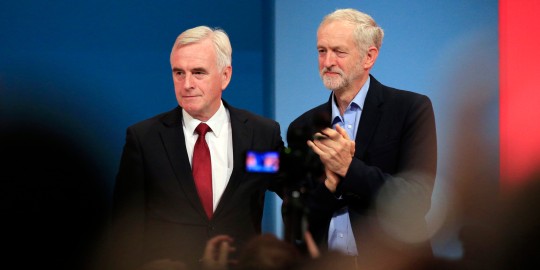
John McDonnell, the shadow chancellor, has said that the Labour Party will consider universal basic income as a part of its new policy, during a recent talk at the London School of Economics. He said: “It’s an idea we want to look at. Child benefit was a form of basic income so it’s not something that I would rule out.”

At the very least, this indicates the idea of universal provision has regained some credence in the face of a longstanding and seemingly unchallengeable political norm of increasing means-testing and welfare conditionality, established by the Thatcher adminstration, and radically extended by the current government.

McDonnell also said that economists were “close to consensus” that the Conservative Party’s austerity policies had failed, highlighting a largely welcomed and clear opposition to rigid, neoliberal Osbornomics. It’s true that austerity was founded purely on ideology and traditional Conservative prejudices, it was a political decision taken in the context of better alternatives and more humane choices. The poorest citizens have been targeted for the largest proportion of austerity cuts, with disabled people carrying the financial largest burden. It’s worth remembering that after the global recession of 2007, we were in economic recovery by the last quarter of 2009, without any need for austerity.

1379986_541109785958554_2049940708_n

Last month, an Early Day Motion (EDM) on the policy, tabled by Green Party MP Caroline Lucas, calls on the Government to commission research into the idea of universal basic income’s effects and examine its feasibility to replace the UK’s existing social security system, instead paying all citizens a flat, unconditional income, which would likely come in place of existing social security measures like means-tested benefits.

The motion, which raises the profile of the idea, says the policy “has the potential to offer genuine social security to all while boosting entrepreneurialism.”

But opponents of the basic income have raised concerns including work disincentives, lack of targeted support for those most in need, and the size of the political spending commitment required.

Lucas says:

“The basic income offers genuine social security to everyone and sweeps away most of the bureaucracy of the current welfare system. Fundamentally it would allow people the freedom and flexibility to do more of what they want to do – as well as supporting them in the caring roles they might need – or choose – to do,” she said.

“A basic income would also protect people from rising insecurity in our increasingly ‘flexible’ labour market and help rebuild our crumbling welfare state. I also know from speaking to people in my own constituency that the stability of a basic income could be a real boost to freelancers and entrepreneurs who need support to experiment, learn and take risks, while keeping their heads above water.”

“It’s crucial that any shift towards this bold new policy protects and increases the income for the poorest and those who aren’t able to work. A universal payment for all must not undermine additional help for those who need it most.”

However, last year, the Citizen’s Income Trust (CIT), which has given advice to the Green Party and often cited by the Greens, has modelled the party’s scheme and discovered a major design flaw. It was revealed that that 35.15% of households would lose money, with many of the biggest losers among the poorest households. At the time, Malcolm Torry, director of the CIT, which is a small charitable research body, said: “I am not sure the Green party has yet taken on our new research or the need to retain a means-tested element. We have only just published the new work.”

The criticisms of the scheme, as well as doubts about costings, led the Greens to make a temporary tactical retreat on the issue, with the party’s leader, Natalie Bennett, saying detailed costings for the policy would not be available in the manifesto last March. The Greens had proposed a citizen’s income of around £72 to every adult in Britain regardless of wealth and existing income, which would cost the Treasury around £280bn.

One longstanding criticism of basic income is that it would provide  payments to citizens that are already very wealthy, perpetuating social inequality, and wasting resources.

The CIT added that if the policy was applied without a means-tested component, then poorer households would end up receiving far less in state benefits than they would under the existing system. 

In 2012, an affordability study done in the Republic of Ireland by Social Justice Ireland found that basic income would be affordable with a 45% income tax rate. This would lead to an improvement in income for the majority of the population.

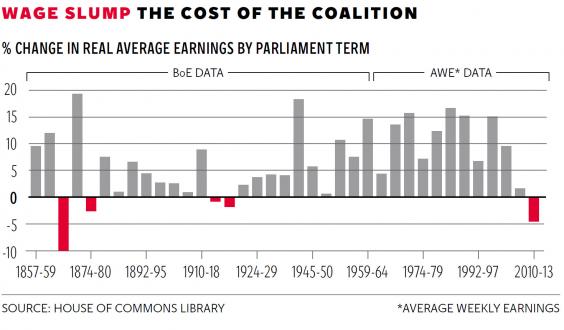
At a time when the politically planned decline in state provision leaves us questioning how we may prepare for the future, state provision funded by taxation seems by far the most fair way of providing for social support in the long term, and is part of a philosophy that each person, community and society as a whole should care for all. Furthermore, as we have witnessed the biggest and most sustained drop in wages since the 1800s, the government’s assurances that “work is the only route from poverty” no longer carry weight and credibility. For many, work does not “pay.”

430835_148211001996623_1337599952_n (1)

Collectivist values are under threat – the failure of “reformed” social security, which has in reality entailed ideologically-driven cuts to the poorest people’s lifeline income, leaves people marginalised, excluded from society, and increasingly, in absolute poverty, is clear evidence of this loss of the core principles of community cohesion, consensus and the post-war collectivist spirit. Collectivism is founded on the idea that everyone has equal worth, and that equality does not imply a lack of unique individuality, but an equal amount of freedom and equal opportunity to develop one’s own potential. Collectivists also tend to strongly favour inclusion and democratic decision-making.

One valid concern about raising people’s household wealth through citizen’s income is that it would encourage inflation. The price of services may rise. Rents may be hiked by private landlords, for example. After the introduction of child tax credits, many private childcare companies subsquently massively increased their prices, and it wasn’t unusual for some to demand payments for a full year, which included periods when childcare wasn’t required. An introduction of basic income must also, therefore, include a package of anti-inflationary measures (such as rent caps) or the value of the payment will soon be eroded, as basic costs for essentials and services rise.

One of the strongest arguments for basic income is that people would no longer be compelled to work in order to meet their basic needs. This means that employers would find it difficult to exploit workers, and would be pushed to offer decent wages, good terms and employment conditions in order to attract workers. People would have greater freedom to pursue meaningful, suitable and appropriate employment rather than having to take any job to avoid poverty and destitution.

However, opponents claim that the incentive to work would be destroyed because basic income is unconditional. Nonetheless it’s difficult to justify dehumanising policies that keep people financially desperate so that they take any job, regardless of its pay, security, terms and conditions. That ignores the fact that people have potential, skills and talents, and simply reduces working to a way of meeting only basic survival needs, which demotivates people and means that they are not willing participants in their working lives. Very wealthy people that inherited fortunes often continue to work, it’s a nonsense that keeping people close to starvation can “incentivise” them in any way at all, other than to fight for their survival. That reduces and regresses society, uncivilising us.

De-commodifying labor by decoupling work from income liberates people from the “tyranny of wage slaveryand leaves a space for innovation, creativitity and rebalances power relationships between wealthy, profit-motivated employers and employees.

There is little support for basic income from the Conservatives, as a means of redistributing income. Whilst a handful of right-wing advocates of basic income generally favour the minimisation or abolition of the public provision of welfare, some have cited basic income as a viable strategy to reduce the amount of bureaucratic administration that is prevalent in many contemporary welfare systems.

Yet we have seen an unprecedented increase in a dark, unaccountable  bureacracy this past five years, with private companies such as Atos, Maximus, and the likes of A4E and other private welfare-for-work providers marking the increased conditionality of welfare support – for both out of work support, and soon, for support paid to those in low paid and part-time work. Conservative inclination has been towards substantially raising the (increasingly privatised and for profit) administrative costs of welfare, whilst at the same time radically reducing the lifeline benefits for people needing support for meeting basic needs.

Conservatives may well raise the “something for nothing” objection to basic income, which is founded on the absurd idea that the only way people may contribute to society is through paid labor. Yet non-remunerated activities such as bringing up children, caring for elderly or sick and disabled relatives, supporting vulnerable neighbours, community work, volunteering for charities or investing time and effort in other voluntary endeavours such as contributions to the arts, sharing knowledge, education, writing, are all clearly valuable contributions to society, but these skills and activities have been steadily devalued, whilst providing an increasingly passive, exploitable, disposable (“flexible”) labor force for employers is seen by the Conservatives as somehow fulfiling the best of our potential.

The Conservatives would have us believe that any kind of social security system, which supports the casualties of free-markets, somehow creates those casualties, via vague pet theories of unverified mechanisms such as a “culture of dependency” and a “something for nothing” culture. But we know that the competitive, market choice-driven Tory policies create a few haves and many have-nots.

Even the most ardent neoliberalist would concede that whilst such a free-market system creates clear winners, it also invariably creates casualities – situations of insolvency for others. Inequality is a fundamental element of the meritocracy script that neoliberals so often pull from the top pockets of their bespoke suits. It’s the big contradiction in the smug, vehement meritocrat’s competitive individualism narrative.

This is why the welfare state came into being, after all – because when we allow such competitive economic dogmas to manifest, there are always winners and losers. It’s hardly “fair”, therefore, to leave the casualties of competition facing destitution and starvation, with a hefty, cruel and patronising barrage of calculated psychopolicical scapegoating, politically-directed cultural blamestorming, and a coercive, pathologising and punitive behaviourist approach to the casualities of inbuilt, systemic, inevitable and pre-designated sentences of economic exclusion and poverty.

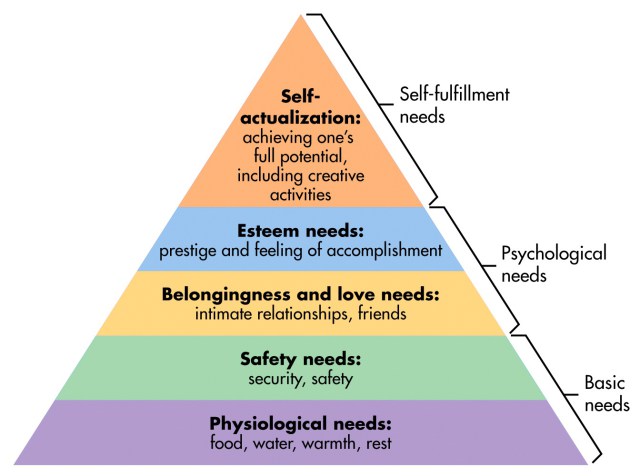
For me, the most compelling argument for a basic income comes from Abraham Maslow, who was humanist psychologist. He proposed his classical theory of motivation and the hierarchical nature of human needs in 1943. Maslow said basically that the imperative to fulfil basic needs will become stronger the longer the duration that they are denied. For example, the longer a person goes without food, the more hungry and preoccupied with food they will become.

So, a person must satisfy lower level basic biological needs before progressing on to meet higher level personal growth needs. A pressing need would have to be satisfied before someone would give their attention to the next highest need. If a person has not managed to meet their basic physical needs, it’s highly unlikely that they will be motivated to fulfil higher level psychosocial ones.

Maslow’s theory has certainly been verified by the findings of the Minnesota semi-starvation Experiment, and other studies of the effects of food deprivation. Abraham Maslow’s humanist account of motivation also highlights the same connection between fundamental motives and immediate situational threats.

The experiment highlighted a striking sense of immediacy and fixation that arises when there are barriers to fulfiling basic physical needs – human motivation is frozen to meet survival needs, which take precedence over all other needs. This is observed and reflected in both the researcher’s and the subject’s accounts throughout the study. If a person is starving, the desire to obtain food will trump all other goals and dominate the person’s thought processes. This idea of cognitive priority is also clearly expressed in Maslow’s needs hierarchy. 

In a nutshell, this means that if people can’t meet their basic survival needs, it is extremely unlikely that they will have either the capability or motivation to meet higher level psychosocial needs, including personal aspirations, social obligations and responsibilities, and the capacity to seek employment.

Keeping people in a state of desperation to meet their basic needs damages social cohesion, places limits on both individual’s and society’s developmental and progressive potential: it stifles personal and social growth. A basic income would liberate people from the all-consuming struggle to meet basic survival needs, allowing them to live meaningful lives. A basic income would rebalance citizen’s rights and responsibilities fairly. It would also ensure that the state does not abuse and exploit socially protected groups.

As a very wealthy first-world nation, ensuring that all citizens can meet their basic needs for food, fuel and shelter is the very least we ought to expect from a so-called democratic government.

maslow-5

Maslow’s classic hierarchy of human needs


 —

I don’t make any money from my work. But you can support Politics and Insights and contribute by making a donation which will help me continue to research and write informative, insightful and independent articles, and to provide support to others. The smallest amount is much appreciated, and helps to keep my articles free and accessible to all – thank you.

DonatenowButton
cards

Osborne’s housing benefit cap could mean tens of thousands of the most vulnerable citizens losing their homes

994596_517805604955639_608589568_n

Grave concerns regarding the impact of proposed housing benefit cuts on the most vulnerable social groups have also arisen. Last month a specialist housing association warned that people under the age of 35 in mental health accommodation face rent shortfalls of almost £200 a week under  government plans to cap housing benefit for social housing tenants at Local Housing Allowance rates.

John Healey MP, Labour’s Shadow Cabinet Minister for Housing and Planning, warned at the time that housing providers could be forced to close accommodation for the most vulnerable because of housing benefit cuts.

Brighton Housing Trust (BHT) said that its fincancial modelling of the impact of capping housing benefit for social tenants, including supported housing tenants, at Local Housing Allowance rates revealed that 70% of all its homes would be unaffordable to under 35s under the plan, as they would only qualify for the “shared room rate” – the cost of renting a single room within a house.

The Trust said in its specialist supported housing, under-35s would face a shortfall of between £52.60 and £193.49 in 71 of 101 mental health units. There would also be shortfalls of up to £75 per week in specialist drug and alcohol units, homelessness hostels and young people’s accommodation.

Tenants older than 35 would also be unable to afford many of the homes, although the benefit gaps would be smaller.

BHT is a specialist housing association which provides for tenants with support needs, even in much of its general needs accommodation.

The association warned that the government’s offer of additional Discretionary Housing Payments to plug the rent shortfalls would also be insufficient.

The housing benefit cuts which were announced last Autumn in  George Osborne’s budget Statement are claimed to be aimed at bringing housing benefit rates for social housing in line with the sums paid to landlords in the private sector. However, the National Housing Federation has raised further concerns in a press release statement today. The Federation’s Chief Executive, David Orr, said:

“New homes for people with support needs – vulnerable people – that would be being built have been cancelled.

The impacts of the LHA cap are real and immediate. The threat alone has caused the building of thousands of specialist homes for the nation’s most vulnerable to grind to a halt. And if the cap comes into force, our research suggests that 156,000 specialist homes could be lost.

The PM has said that this would be a government that supports the vulnerable. But if this cap applies, society’s most vulnerable – dementia patients, women fleeing domestic violence, army veterans suffering mental health problems, older and disabled people – will be asked to find an extra £68 a week.

“We have repeatedly tried to engage the Government on the urgency and severe impacts of this cap on supported housing – we need clarity that this won’t apply to those in specialist homes today.”

Mr Osborne said the move, which will affect England, Scotland and Wales, would deliver savings of £225m by 2020-21, and is part of a £12bn package of cuts from the welfare bill. Conservative ministers claim they are reviewing the sheltered housing sector “to ensure it works in the best way possible”.

But hundreds of planned new sheltered accommodation units have been delayed or scrapped owing to proposed cuts to housing benefit. And several housing associations have said they are no longer financially viable. The National Housing Federation (NHF) has calculated that nearly 2,500 units have so far been scrapped or delayed as sheltered housing providers face losing an average of £68 a week per tenant.

Flats for elderly people and people with learning disabilities are more expensive to build and run because they provide crucial additional support. Concerns raised about the cap on housing benefit will affect society’s poorest and most vulnerable people, such as  women fleeing domestic violence, dementia patients,  army veterans suffering mental health problems, older and disabled people, because these peoeple  will need to find an extra £68 a week.

BBC News reports that a further four housing associations confirmed their plans had needed to change:

  • Southdown Housing in East Sussex has ben forced to scrap plans for 18 units for people with learning disabilities
  • Knightstone Housing in Somerset has delayed a complex of 65 homes for the elderly and 13 properties for learning-disabled people
  • In Manchester, Contour Homes has had to put on hold a scheme to build 36 units for the elderly
  • In North Yorkshire, Harrogate Neighbours has delayed construction of 55 extra care flats

John Healey MP Labour’s Shadow Cabinet Minister for Housing and Planning, has commented further today on the new reports of the effect that the Chancellor’s planned cuts to housing benefit are having on specialist accommodation for elderly and vulnerable people. He said:

“George Osborne’s crude cuts to housing benefit could mean tens of thousands of people losing their homes, including elderly people with dementia, veterans and women fleeing domestic violence.

“The consequences of these cuts are being felt right now, with the building of thousands of new homes stopped or scrapped because of Ministers’ failure to act.

“Labour will continue to lead the opposition to these crude cuts. George Osborne must halt these dangerous plans and consult fully with housing providers to safeguard this essential specialist housing.”

1459720_569627496440116_902730897_n
Pictures courtesy of Robert Livingstone

Conservatives plan stealth raid on in-work benefits and the long-term phasing out of child benefit


Tory UK

Picture courtesy of Tina Millis

The respected Institute for Fiscal Studies (IFS) has warned in a recent Green budget report that George Osborne’s plan to achieve a budget surplus will result in 500,000 families losing child benefit and tens of thousands having to pay a higher tax rate. More than half a million families will be stripped of child benefit over the next five years under a series of “stealth” tax raids by the Chancellor to help “balance the books.” Fuel duty will also need to be be significantly raised over the next five years or Osborne will face a £3billion black hole in his surplus plans.

Currently those earning £50,000 will lose some benefit and those earning £60,000 or more lose it all. Eventually, the report concluded, even those earning modest wages and paying the basic rate of tax will start to lose their child benefit entitlement.

The authors of the report concluded that Mr Osborne’s tax plans “lack any coherent principle” and called for more transparency, adding: “If the desire is for these tax rates to apply to a greater fraction of individuals than is currently the case, it would be better for politicians to state this clearly, rather than achieving the outcome through stealth using fiscal drag.”

Osborne’s promise to deliver a budget surplus from 2019-20 is “risky” and could have a long-term impact on the UK because the Government refuse to borrow money to fund large-scale infrastructure projects, despite low inflation.

Total public spending, excluding health, will be at its lowest level since 1948 as a proportion of national income.

The authors said: “If continued indefinitely, child benefit would be received by fewer and fewer families over time.

“But if this is the government’s intention, it would again be better to state this clearly rather than achieving it by stealth.”

Tim Loughton, a former Conservative education minister, branded the IFS findings a “double whammy” for families who are already paying the 40p higher rate of income tax.

He said: “This was inevitable. It inevitably means more and more families suffer a double whammy of having to pay higher rate tax because of the freezing of the threshold and losing out on all or most of their child benefit at the same time.

“This is hardly helpful for hardworking families trying to do the right thing for their children – if you don’t index up the rates and if you have very complicated formula that doesn’t accurately reflect household income … it’s a double unfairness.”

The Treasury has declined to comment on the IFS criticism of the Office of Responsible Budget (OBR) charter, which Osborne has committed to. But a spokesperson has said: “There may be bumpy times ahead – so here in the UK we must stick to the plan that’s cutting the deficit.”

That will invariably mean further austerity cuts. Up until recently austerity targeted those claiming out of work benefits, particularly those who are unemployed because they are sick and disabled. But increasingly, austerity is being aimed at those in low paid or part-time work, and the middle classes are set to lose further income, under the Conservative plans, too.

Despite being a party that claims to support “hard-working families,” the Conservatives have nonetheless made several attempts to undermine the income security of a signifant proportion of that group of citizens recently. Their proposed tax credit cuts, designed to creep through parliament in the form of secondary legislation, which tends to exempt it from meaningful debate and amendment in the Commons, was halted only because the House of Lords have been paying attention to the game.

The use of secondary legislation has risen at an unprecedented rate, reaching an extraordinary level since 2010, and it’s increased use is to ensure that the Government meet with little scrutiny and challenge in the House of Commons when they attempt to push through controversial and unpopular, ideologically-driven legislation. The Shadow secretary for Work and Pensions, Owen Smith, has pointed out that cuts to benefit in-work entitlements being introduced through Universal Credit mean controversial tax credit reductions have been simply been “rebranded” by the government rather than reversed.

In the Spending Review last November, George Osborne announced that tax credit reforms, which were set to almost halve the income level at which support is withdrawn from £6,420 to £3,850, would not be enacted, an analysis of the changes published by the Office for Budget Responsibility (OBR) highlighted that cuts to work allowances in Universal Credit, which set the level at which benefits will begin to be withdrawn under the new system, have not been reversed. Furthermore, people claiming Universal Credit needing in-work benefit because of low pay and  part-time hours will be expected to increase their wages and working hours, or controversially, face losing their benefit.

The Chancellor has cut in half the amount people can earn before their working tax credit starts to “taper” (reduce) – down from £6,420 to £3,850 from April 2016. Restrictions to eligibility for child tax credit means that families with more than two children are set to lose a significant amount of weekly income from April 2017. whilst the flat £545 “family element” paid before the amount for each child will also be removed completely. This will affect people in work, the think-tank Resolution Foundation said that working mothers would be worst hit – accounting for 70% of money saved by the Treasury, but overall the cuts will hit those out of work the hardest.

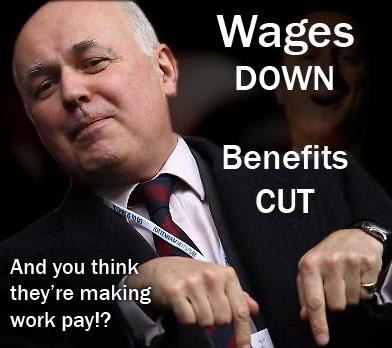
Many of us recognised the Tory “making work pay” mantra for what it was in 2012, when the first welfare “reforms” were pushed through parliament against widespread resistance, on the back of “financial privilege.” It was and always has been a diversion to allow the Conservatives to dismantle our welfare state, and reduce the value of labour, in much the same way as the 1834 Poor Law principle of less eligibility, which fulfilled the same purpose. The Poor Law Committee also wanted to “make work pay.” Since 2012, steadily rising in-work poverty has shown that having a job no longer provides a route out of poverty.

web-earnings-graphic

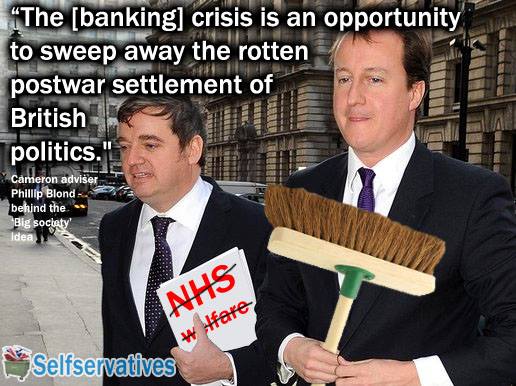
The IFS report conclusions simply confirm what many of us have suspected since 2012: that the government have a secret long-term aim to completely dismantle the social gains of our post-war settlement: the welfare state, affordable social housing provision, the National Health Service and access to justice through legal aid.

proper Blond
Picture courtesy of Robert Livingstone

Frank Field’s New Report: Fixing Broken Britain?


In a study report that was published today – Fixing Broken Britain? An audit of working-age welfare reform since 2010, Labour MP Frank Field and co-author Andrew Forsey argue that: 

The Department for Business, Innovation and Skills should take a lead role in tackling the dependence of employers and landlords, whose subsidies in the form of tax credits and Housing Benefit have grown exponentially, by raising wages and productivity.

… the next front in welfare reform will see a fundamental switch from the Department for Work and Pensions – historically always responsible for welfare reform – to the Department for Business, Innovation and Skills, reflecting the new reform agenda.

Field and Forsey, writing for the cross-party think tank Civitas, propose that the next step of welfare reform:

 … involves a renewed drive to help those who have not yet been found a job under the Work Programme – principally the over-50s and the disabled. This should involve weighting the payment-by-results systems further in favour of those claimants facing the steepest barriers to work. This major task, and the prompt and efficient payment of benefits, should be the primary objective of the Department for Work and Pensions.

We believe the payment-by-results system the government introduced now requires a significant recalibration to give the most disadvantaged participants a fighting chance of getting and keeping a job.

The language used in the publication is controversial and I was both concerned and disappointed to see the phrase “welfare dependency” used more than once. It alludes to the Conservative claims of a so-called “culture of dependency”, for which there has never been any supportive empirical evidence presented, (and that’s despite Sir Keith Joseph’s notorious best efforts and meticulous but ultimately forlorn research into a neoliberal New Right myth.)

However, there is much empirical evidence to support structural explanations of unemployment and poverty, but the current government has tended to psychopoliticise these issues, blaming the character and attitudes of unemployed people, reflected in language shifts – for example, the frequent use of words such as “worklessness” which implies responsibility and choice – making unfortunate circumstances a very personal  burden – as opposed to “unemployment”, which at least accommodates factors such as labour market constraints, economic conditions, structural inequalities, state responsibilities and the consequences of political decision-making.

Field and Forsey also recommend “identifying claimants’ strengths and difficulties” as early as possible once they begin claiming benefit; early referrals to the new Work and Health Programme for those on any benefit in most need of support; and lifting the cap on numbers who can enrol on the voluntary welfare-to-work programme for claimants with disabilities, and extending the time for which they can participate.

The problem is that referrals are unlikely to be on a voluntary basis. One of the aims of the Work and Health Programme is to enlist the support of GPs in “prescribing” work coaches to sick and disabled people. Given the confidential nature of the patient/doctor relationship, such an intrusive measure is likely to ultimately undermine people’s trust in their GP, and leave sick people who genuinely cannot work feeling harrassed and coerced by the state. There is good evidence that the work programme has not increased sustainable employment outcomes, and furthermore, it has harmed people with mental health problems.

In fairness to Field and Dorsey, they do accommodate some structural factors in their analysis. They say:

A second major new front against benefit dependency involves raising the earnings of low-paid workers, which requires a national productivity strategy that can be built around the new National Living Wage. The major objective here is to prevent yesterday’s workless poor becoming today’s working poor.

The conditionality attached to the receipt of benefit may have made work an easier option, but real wage growth at the bottom end of the labour market has been the missing piece of the government’s welfare reform puzzle.

In order to enshrine work as the best route out of poverty, the next front in welfare reform must build upon the National Living Wage to deliver the higher productivity that can sustain rising real incomes across the board. This policy needs to be driven by the Secretary of State for Business, Innovation and Skills.

Field and Forsey criticise Universal Credit, stating that if it is ever rolled out nationally, it will not “incentivise” work.  They go on to say:

The government’s flagship welfare scheme will only deliver a lower marginal tax rate for certain groups of claimants and even for them it will be undermined by Universal Credit’s failure to encompass council tax support and free school meals.

Because of Universal Credit’s higher taper rate for many claimants the strategy of fixing “broken Britain” by offering lower withdrawal rates than the current system lies in ruins.

If creating an incentive to work is the goal the present system for the vast majority of claimants meets that goal more effectively. Any reduction in the marginal tax rate will only come for particular groups of Universal Credit claimants should the benefit be introduced.

But then, the failure of Universal Credit to encompass also Council Tax support and free school meals will throw all of these calculations into a mild chaos, to put it at its gentlest.

However, it’s clear that the whole point of Universal Credit is to facilitate a further withdrawal of funding for welfare support.

Field and Forsey argue in the report that because there is little prospect of Universal Credit being rolled out fully by 2020,  George Osborne should act now to “protect lower-paid families with children within the framework of the welfare cuts he is planning.”

They formulate a five-point plan for in-work benefit reform in the current parliament:

  • The tax credit system should be centred on lower-paid workers with children, with entitlements to families earning up to twice the level of the National Living Wage, a ceiling of £32,000.
  • By 2020, childless couples and single workers without children should no longer be eligible for support from the tax credit system.
  • Jobcentre Plus should be revamped so that staff have the skills to help claimants in work increase their hours and/or pay, either in their current job or by finding a new one.
  • Tax credit claimants should be allowed to increase their earnings by up to £5,000 in any 18-month period without any clawback of entitlement, so that they do not lose large chunks of income for working more or for better pay.
  • Vulnerable workers who cannot currently work a full week should be allowed to work up to 24 hours a week and claim Jobseeker’s Allowance or Employment and Support Allowance, rather than the current 16-hour maximum.

They say:

These five reforms would be much more effective in protecting those in work on modest earnings than anything the government is proposing. They build around the revolutionary idea the chancellor has introduced into British politics, particularly welfare reform, namely of introducing a National Living Wage.

This move begins the process of transferring the responsibility for lower earners’ welfare to employers and the Department for Business, Innovation and Skills, and away from the Department for Work and Pensions and Her Majesty’s Revenue and Customs.

However, this is a heavily corporate-sponsored “business friendly” neoliberal government with a clear anti-welfare agenda. What could possibly go right?

 —

 This post was written for Welfare Weekly, which is a socially responsible and ethical news provider, specialising in social welfare related news and opinion.

Cuts under Universal Credit are discriminatory and may be illegal

66864_464287263640807_1896397853_n

The Labour Party released details of research last month, showing how new claimant families will get lower in-work benefit entitlements when tax credits are replaced by the Universal Credit benefit system.

Owen Smith, the shadow Work and Pensions secretary, said research commissioned from the House of Commons library shows that next year, thousands of working families will be at least £2,500 a year worse off as a result of the government’s cuts to Universal Credit.

Mr Smith MP, responding to Iain Duncan Smith’s recent claim on the Andrew Marr show that “nobody loses a penny” from cuts to Universal Credit, said:

Iain Duncan Smith is completely wrong to say nobody loses a penny from his cuts to in-work support.

 Cutting Universal Credit raises £100m for the government next year and that money has to come from somewhere.

What the Tories aren’t telling us is that the £100m – and a further £9.5 billion over the next five years – comes from the pockets of low- and middle-income families.

That means those currently on Universal Credit face losses of up to £2,400 come April.

Just like tax credit cuts, working families will be worse off next year and just like those cuts, Labour will fight them at every turn.

Earlier this month, analysis from the independent Office for Budget Responsibility, (OBR) suggested the changes to universal credit announced in the July budget would save the Chancellor close to £3bn by 2019-20.

The Labour Party is taking advice from lawyers about the legality of the benefit cuts under universal credit. Owen Smith, the shadow work and pensions secretary, said it is discriminatory that a single mother working full-time on the minimum wage could be almost £3,000 worse off under universal credit than a mother in precisely the same circumstances on tax credits.

The challenge raises the possibility that the new welfare system could be challenged in court.

Although the Chancellor abandoned plans to cut tax credits affecting millions of working families, in his Autumn Statement, it was due to  pressure from the opposition, because the cuts were rejected by the House of Lords and a number of uneasy Tory backbenchers also raised concerns about the negative impact the cuts would have on working families.

Labour MPs have highlighted that claimants will be substantially worse of claiming Universal Credit, the  in-work benefit payments are much lower.

In his autumn statement speech, the Chancellor said: “The simplest thing to do is not to phase these changes in but to avoid them altogether.” But he added: “Tax credits are being phased out anyway as we introduce universal credit.”

The OBR’s analysis show that by 2021 the changes to Universal Credit will save the Treasury almost as much each year as the controversial tax credits policy would have done.

Mr Smith said:

Those lucky enough to stay on tax credits will be massively better off than those on universal credit … That disparity cannot be fair, it cannot be right and it may not even be legal, and we are seeking advice as to the legality of that move.

Mr Smith also confirmed that a Labour government would reverse cuts to benefits happening under Universal Credit. He said:

We will press for the same reversal for the victims of the universal credit heist that will hit precisely the same Tory and Labour constituents just before the next election.

He made the comments in a debate about the welfare cap, after the government sought approval for a motion that said the breach of Osborne’s own fiscal rules were justified because of the reversal of tax credit cuts.

Junior Work and Pensions minister, Shailesh Vara, has confirmed that on current forecasts the cap will not be met for three years.

Universal Credit is to be rolled out gradually, with about 500,000 people on the new benefit by next April. The government has insisted they will be compensated for lower payments through a special scheme called the flexible support fund.

However, Owen Smith said the only money on offer was a £69m grant for job centre managers to help people who are close to getting into work with costs such as bus fares and new clothing.

He said:

Even if it were permissible to use that money, it is in no way going to make up for the £100m shortfall next year, the £1.2bn shortfall the year after, and certainly not the £3bn shortfall in 2020. It is completely impossible and I fear it is also misleading to the public.

Mr Smith also queried the Chancellor’s absence from the House of Commons during the debate, saying he had “carelessly, ignominiously fallen into his own welfare trap” and “slipped on his own smirk”.

He said:

But inexplicably, he’s not here to account for it. Last spring he was quite definite that he should be. He said: ‘The charter makes clear what will happen if the welfare cap is breached. The chancellor must come to parliament, account for the failure of public expenditure control’”.

430835_148211001996623_1337599952_n (1)

The media need a nudge: the government using ‘behavioural science’ to manipulate the public isn’t a recent development, nudging has been happening since 2010

8+Ways+to+Protect+Yourself+From+Emotional+Manipulation

Last year I wrote a critical article about the government’s Nudge Unit. The ideas of libertarian paternalism were popularised around five years ago by the legal theorist Cass Sunstein and the behavioural economist Richard Thaler, in their bestselling book Nudge. Sunstein and Thaler argue that we are fundamentally “irrational” and that many of our choices are influenced negatively by “cognitive bias.” They go on to propose that policymakers can and ought to nudge citizens towards making choices that are supposedly in their best interests and in the best interests of society.

But who nudges the nudgers?

Who decides what is in our “best interests”?

And how can human interests be so narrowly defined and measured in terms of economic outcomes, within a highly competitive, “survival of the fittest” neoliberal framework? The Nudge Unit is concerned with behavioural economics, not human happiness and wellbeing.

The welfare reforms, especially the increased application of behavioural conditionality criteria and the extended use of benefit sanctions, are based on a principle borrowed from behavioural economics theory – the cognitive bias called “loss aversion.” It refers to the idea that people’s tendency is to strongly prefer avoiding losses to acquiring gains. The idea is embedded in the use of sanctions to “nudge” people towards compliance with welfare rules of conditionality, by using a threat of punitive financial loss, since the longstanding, underpinning Conservative assumption is that people are unemployed because of behavioural deficits.

I’ve argued elsewhere, however, that benefit sanctions are more closely aligned with operant conditioning (behaviourism) than “libertarian paternalism,” since sanctions are a severe punishment intended to modify behaviour and restrict choices to that of compliance and conformity or destitution. But nudge was always going to be an attractive presentation at the top of a very slippery slope all the way down to open state coercion. Most people think that nudge is just about helping men to pee on the right spot on urinals, getting us to pay our taxes on time, or to save for our old age. It isn’t.

How can sanctioning ever be considered a rational political action –  that taking away lifeline income from people who are already struggling to meet their basic needs is somehow justifiable, or “in their best interests” or about making welfare “fair”?  The government claim that sanctions “incentivise” people to look for work. But there is an established body of empirical evidence which demonstrates clearly that denying people the means of meeting basic needs, such as money for food and fuel, undermines their physical, emotional and psychological wellbeing, and serves to further “disincentivise” people who are already trapped at a basic level of struggling to simply survive.

The Minnesota Semistarvation Experiment for example, provided empirical evidence and a highly detailed account regarding the negative impacts of food deprivation on human motivation, behaviour, sociability, physical and psychological health. Abraham Maslow, a humanist psychologist who studied human potential, needs and motivation, said that if a person is starving, the desire to obtain food will trump all other goals and dominate the person’s thought processes. This idea of cognitive priority is also represented in his classic hierarchy of needs. 

0_0_0_0_370_308_csupload_52703375

Maslow’s hierarchy of needs

In a nutshell, this means that if people can’t meet their basic survival needs, it is extremely unlikely that they will have either the capability or motivation to meet higher level psychosocial needs, including social obligations and responsibilities to job seek.

Libertarian paternalists claim that whilst it is legitimate for government, private and public institutions to affect behaviour the aims should be to ensure that “people should be free to opt out of specified arrangements if they choose to do so.” The nudges favoured by libertarian paternalists are also supposed to be “unobtrusive.” That clearly is not the case with the application of coercive, draconian Conservative welfare sanctions. (See Nudging conformity and benefit sanctions.)

Evidently the government have more than a few whopping cognitive biases of their own.

I have previously criticised nudge because of its fundamental incompatibility with traditional democratic principles, and human rights frameworks, amongst other things. Democracy is based on a process of dialogue between the public and government, ensuring that the public are represented: that governments are responsive, shaping policies that address identified social needs. However, policies are no longer about representing and reflecting citizen’s needs: they are all about telling us how to be.

I’ve also pointed out that nudge operates to manipulate at a much broader level, too. The intentional political construction of folk devils and purposeful culturally amplified references to a stereotype embodying fecklessness, idleness and irresponsibility, utilising moral panic and manufactured public outrage as an effective platform for punitive welfare reform legislation, is one example of the value-laden application of pseudoscientific “behavioural insights” theory. The new paternalists have drawn on our psychosocial inclinations towards conformity, which is evident in the increasing political use of manipulative normative messaging. (For example, see: The Behavioral Insights Team in the U.K. used social normative messages to increase tax compliance in 2011.) 

The paternalist’s behavioural theories have been used to increasingly normalise a moral narrative based on a crude underpinning “deserving” and “undeserving” dichotomy, that justifies state interventions imposing conditions of extreme deprivation amongst some social groups – especially those previously considered legally protected. Public rational and moral boundaries have been and continue to be nudged and shifted, incrementally. Gordon Allport outlined a remarkably similar process in his classic political psychology text, The Nature of Prejudice, which describes the psychosocial processes involved in the construction of categorical others, and the subsequent escalating scale of prejudice and discrimination.

So we really do need to ask exactly in whose “best interests” the new paternalist “economologists” are acting. Nudge is being targeted specifically at the casualties of inequality, which is itself an inevitability of neoliberalism. The premise of nudge theory is that poor people make “bad choices” rather than their circumstances being recognised as an inexorable consequence of a broader context in which political decisions and the economic Darwinism that neoliberalism entails creates “winners and losers.”

I have seen very little criticism of nudge in the mainstream media until very recently. On Monday the Independent published an article about how the Chancellor exploited our cognitive biases to secure his cuts to welfare, drawing particularly on the loss aversion theory. To reiterate, in economics decision theory, loss aversion refers to people’s tendency to strongly prefer avoiding losses to acquiring gains.

From the Independent article:

“Researchers have also found that people do not treat possible forgone gains resulting from a decision in the same way as equivalent potential out-of-pocket losses from that same decision. The forgone gains are much less psychologically painful to contemplate than the losses. Indeed, the gains are sometimes ignored altogether.

There was an apparent attempt to harness this particular psychological bias in George Osborne’s Autumn Statement. Of course the Chancellor was forced into a memorable U-turn on his wildly unpopular tax credit cuts. Millions of poor working families will now not see their benefits cut in cash terms next April. Yet the Chancellor still gets virtually all his previously targeted savings from the welfare bill by 2020.

How? Because the working age welfare system will still become much less generous in five years’ time. As research from the Institute for Fiscal Studies and the Resolution Foundation has shown, the typical low-income working family in 2020 will be hit just as hard as they were going to be before the Autumn Statement U-turn. The Chancellor seems to be calculating that the pain of future forgone gains will be less politically toxic than immediate cash losses.”

 image002

It’s hardly a revelation that the Conservative government are manipulating public opinion, using scapegoating, outgrouping and the creation of folk devils in order desensitize the public to the plight of the poorest citizens and to justify dismantling the welfare state incrementally. As I’ve pointed out previously, this has been going on since 2010, hidden in plain view.

In the article, Ben Chu also goes on to say:

“Experiments by Daniel Kahneman, Jack Knetsch and Richard Thaler also suggest that this stealth approach fits with people’s sense of fairness. They found that in a time of recession and high unemployment most people they surveyed thought a hypothetical company that cut pay in cash terms was acting unfairly, while one that merely raised it by less than inflation was behaving fairly.

There was another exploitation of our psychological biases in the Autumn Statement. The Chancellor announced an increase in stamp duty for people buying residential properties to let. That underscored the fact that the Chancellor remains wedded to the stamp duty tax, despite pressure from public finance experts to shift to a more progressive and efficient annual property tax (perhaps an overhauled council tax).

But Mr Osborne, like all his recent predecessors, realises that stamp duty, for all its deficiencies, tends to be less resented as a form of taxing property. Why? Because of “anchoring”. When people buy a house they are mentally prepared to part with a huge sum, usually far bigger than any other transaction they will make in their lives. The additional stamp duty payable to the Treasury on top of this massive sum, large though it is, seems less offensive. People resent it less than they would if the tax were collected annually in the form of a property tax – even if, for most, it would actually make little difference over the longer term. Sticking with stamp duty is the path of least resistance.”

There is another economologist “experiment” that seems to have slipped under the radar of the media – an experiment to nudge sick and disabled people into work, attempting to utilise GPs in a blatant overextension of the intrusive and coercive arm of the state. It is aimed at ensuring sick and disabled people don’t claim benefits. I don’t recall any mention of behaviourist social experiments on the public in the Conservative manifesto.

When I am ill, I visit a doctor. I expect professional and expert support. I wouldn’t consider consulting Iain Duncan Smith about my medical conditions. Or the government more generally. There are very good reasons for that. I’m sure that Iain Duncan Smith has Dunning–Kruger syndrome. He thinks he knows better than doctors and unreliably informs us that work can set you free, it can help prevent and cure illness.  Yet I’ve never heard of a single case of work curing blindness, heart disease, rheumatoid arthritis, cerebral palsy, multiple sclerosis, cancer or even so much as a migraine. I’ve also yet to hear of a person’s missing limbs miraculously growing back. The Conservative “medical intervention” entails a single prescription: a work coach from the job centre. State medicine – a single dose to be taken daily: Conservative ideology, traditional prejudice and some patronising and extremely coercive paternalism. The blue pill.

I don’t agree with the conclusions that Ben Chu draws in his article. Whilst he acknowledges that:

“The Government has a Behavioural Insights Team (or “Nudge Unit”) whose objective is to exploit the public’s psychological biases,” he goes on to say that it’s merely “to push progressive policies, such as getting us to save more for retirement and helping us make “better choices”, perhaps by counteracting the negative impact of loss aversion. But, as we’ve seen, the Chancellor is not above exploiting our biases in a cynical fashion too.” 

Progressive policies? The draconian welfare “reforms” aren’t remotely “progressive.” In the UK, the growth and institutionalisation of prejudice and discrimination is reflected in the increasing tendency towards the transgression of international legal human rights frameworks at the level of public policy-making. Policies that target protected social groups with moralising, stereotypical (and nudge-driven) normative messages, accompanied with operant disciplinary measures, have led to extremely negative and harmful outcomes for the poorest and most vulnerable citizens, but there is a marked political and social indifference to the serious implications and consequences of such policies.

There is a relationship between the world that a person inhabits and that person’s actions. Any theory of behaviour and cognition that ignores context can at best be regarded as very limited and partial. Yet the libertarian paternalists overstep their narrow conceptual bounds, with the difficulty of reconciling individual and social interests somewhat glossed over. They conflate “social interests” with neoliberal outcomes.

The asymmetrical, class-contingent application of paternalistic libertarian “insights” establishes a hierarchy of decision-making “competence” and autonomy, which unsurprisingly corresponds with the hierarchy of wealth distribution.

So nudge inevitably will deepen and perpetuate existing inequality and prejudice, adding a dimension of patronising psycho-moral suprematism to add further insult to politically inflicted injury. Nudge is a technocratic fad that is overhyped, theoretically trivial, unreliable; a smokescreen, a prop for neoliberalism and monstrously unfair, bad policy-making.

Libertarian paternalists are narrowly and uncritically concerned only with the economic consequences of decisions within a neoliberal context, and therefore, their “interventions” will invariably encompass enforcing behavioural modifiers and ensuring adaptations to the context, rather than being genuinely and more broadly in our “best interests.” Defining human agency and rationality in terms of economic outcomes is extremely problematic. And despite the alleged value-neutrality of the new behavioural economics research it is invariably biased towards the status quo and social preservation rather than progressive social change.

At best, the new “behavioural science” is merely theoretical, at a broadly experimental stage, and therefore profoundly limited in terms of scope and academic rigour, as a mechanism of explanation, and in terms of its capacity for generating comprehensive and coherent accounts and understandings of human motivation and behaviour.

At worst, the rise of this new form of psychopolitical behaviourism reflects, and aims at perpetuating, the hegemonic nature of neoliberalism.

But for the record, when a government attempts to micromanage and manipulate the behaviour of citizens, we call that “totalitarianism” not “nudge.” 

behavchange.jpg

Related reading

A critique of Conservative notions of social research

The government plan social experiments to “nudge” sick and disabled people into work

Mind the MINDSPACE: the nudge that knocked democracy down

Nudging conformity and benefit sanctions

Osbornomics – the self-perpetuating omnishambles that we can’t escape

Chancellor George Osborne


Osborne’s targeted austerity measures, based entirely on Conservative small state ideology, rather than economic necessity, have established an economic trap. It’s a vicious cycle, because tax cuts to the wealthy, and low, stagnated wages reduce Treasury income, thus increasing the deficit – which is the gap between Treasury income and what is needed for spending. His solution? Cut spending and public services. Again and again.

Yet this is clearly not working. Reducing spending means shrinking the economy further. The services that the state provides – education, healthcare, social security, housing, for example – also contribute to our wellbeing and raise our standard of living. Of course reducing consumer spending also serves to deflate the economy further.

Meanwhile our overall debt has increased. It’s a strategy doomed to failure all round, and it certainly exposes the lie that the financial burden of paying the deficit is shared and that “those with the broadest shoulders” carry the largest burden. Those experiencing the worst of the cuts are the poorest.

I’m not sure if the Conservatives have massively understated the damage that spending cuts inflict on a weak economy because they don’t understand that this is the case or because they don’t actually care. But you would think that the evidence after five years would have prompted a rethink, if it were the former case.

The initial economic research that was held up to support austerity measures has since been thoroughly discredited. Widely touted statistical results were, it turned out, based on highly dubious assumptions and procedures and a few outright mathematical errors –  it didn’t stand up to scrutiny.

The textbook answer to recession was and still is fiscal expansion: increasing government spending both to create jobs directly and to put money in consumers’ pockets to stimulate the economy. Fiscal stimulus measures should continue until economies had recovered. John Maynard Keynes wrote in 1937: “The boom, not the slump, is the right time for austerity at the Treasury.”

You really can’t cut your way out of a shrinking economy. Austerity and spending cuts are actually intrinsic to New Right and neoliberal ideology. Margaret Thatcher radically cut public spending, created recession and generally messed up, but Cameron’s government have gone much further than she dared.


proper Blond


Conservatives have manipulated the general public’s lack of understanding about basic economics, and lied about the “dangers” of debt and deficits in order to radically reduce the welfare state and justify cuts to people’s lifeline benefits, cuts to public services such as the national health service, social care, legal aid, and to councils, for example.

The Tories have also set about reversing all of the social gains of our post-war settlement, in fact. It’s something they have always hated. They have persistently denied that higher spending might actually be beneficial to the majority of UK citizens. Austerity has been paraded as the only possibility, as “economically necessary” but that’s utter tosh.

Gordon Brown said today that when the worst of the global recession hit, his government protected the most vulnerable social groups – including children. He’s right, we didn’t need austerity back then, in the throes of the global crisis. Brown put in place a package of expansionary fiscal measures, and we were in recovery by the last quarter of 2009.

The Conservatives put us straight back into recession and lost our Fitch and Moody international credit ratings to boot. Something that George Osborne pledged he would maintain as a priority, back in 2010.


539627_450600381676162_486601053_n (2)

And the national debt is growing, not shrinking.

uk debt


Economic competence is measured by our social conditions and the living standards of citizens far more than by dry numbers and the ideological commitments of government. Austerity is failing millions, who have witnessed the biggest fall in living standards since before the war.

And if a political strategy is failing and damaging people’s lives, as austerity clearly is, then it’s time to change that strategy.

Related

The word “Tories” is an abbreviation of “tall stories”

The Great Debt Lie and the Myth of the Structural Deficit

Osborne’s Autumn statement reflects the Tory ambition to reduce State provision to rubble

Tory dogma and hypocrisy: the “big state”, bureaucracy, austerity and “freedom”

The BBC expose a chasm between what the Coalition plan to do and what they want to disclose

Follow the Money: Tory Ideology is all about handouts to the wealthy that are funded by the poor