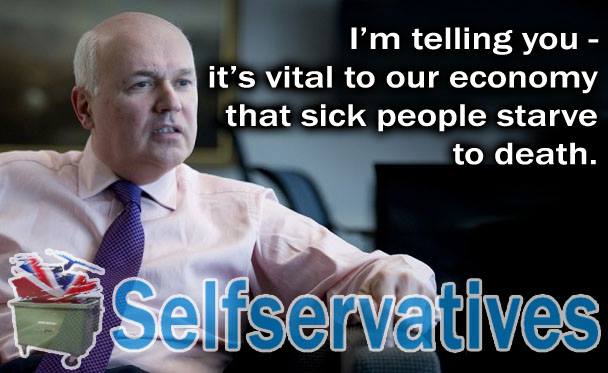
Tag: Iain Duncan Smith

Largest study of UK poverty shows full-time work is no safeguard against deprivation

430835_148211001996623_1337599952_n (1)

By Andrew Naughtie, Deputy editor, Politics + Society, The Conversation

The largest study of poverty ever conducted in the UK has laid out the dire state of British deprivation – and seriously undercut the government’s claim to be lifting people out of poverty through work.

The Poverty and Social Exclusion in the UK (PSE) project details how, over the last 30 years, the percentage of households living below society’s minimum standard of living has increased from 14% to 33% – despite the fact that the economy has doubled in size over the same period.

The 3rd Peter Townsend Memorial Conference, which begins in London today, will hear from an array of academic analysts discussing the findings and how the problems they reveal can best be tackled.

The extent of poverty

Funded by the Economic and Social Research Council and led by the University of Bristol, the PSE report is based on surveys of more than 12,000 people made in June 2012. The surveys found that that millions of Britons in paid employment live with high levels of deprivation.

Among other things, the report found that around 5.5m adults go without essential clothing, around 2.5m children live in homes that are damp, and around 1.5m children live in households that cannot afford to heat their homes.

Meanwhile, one in four adults lives on an income below what they themselves consider necessary to avoid poverty, while one in every six in paid work is technically poor. More than one in five had been forced to borrow money to pay for basic day-to-day needs in the year prior to being surveyed.

But most topically of all, the PSE finds that full-time work is not always sufficient to keep families out of poverty. This calls into question the government’s flagship strategy of getting low-income families into employment and shifting them off state assistance.

Since 2010, Iain Duncan Smith, the work and pensions secretary, has put reducing unemployment and dependence on benefits at the core of his welfare policy. But the PSE finds that children who suffer multiple deprivations are not typically living in homes marked by family breakdown and unemployment.

Instead, the majority live with both parents, at least one of whom is employed; they live in small families, with one or two siblings, are white, and live in England.

The cost of austerity

Commenting on the study’s findings, Professor Jonathan Bradshaw of the University of York said they showed many parents who work full time still have to make huge sacrifices to try and protect their children from deprivation.

“We already know from DWP data that the majority of children with incomes below the the relative income poverty threshold have a working parent. The PSE survey shows that the majority of deprived children, those lacking two or more socially perceived necessities, and very deprived children (lacking five or more socially perceived necessities) have a working parent.

“We found that 65% of the deprived and 58% of the very deprived children had a working parent, and 50% of the deprived and 35% of the very deprived had at least one parent working full-time. Child poverty is not being driven by skivers, but is the consequence of strivers working for low earnings while in-work benefits are being dissipated by government austerity measures”.

The study finds that low wages are a central cause of the widespread deprivation it describes. For many people, full-time work is not enough to lift them out of poverty; almost half of the working poor work 40 hours a week or more. And one in six adults in paid work (17%) is poor, suffering low income and unable to afford basic necessities.

Reacting to the findings, Clare Bambra, professor of geography at Durham University, said that the research was a shameful picture of “the devastating and far-reaching human costs of inequality and poverty in the UK today”.

She said: “It’s shameful for a rich country like ours to be tolerating such levels of poverty especially amongst our children and young people. The mantra that work sets people free from poverty has been shown to be a grand old lie.

“We will be living with the long term consequences of this social neglect for decades to come – there are clear links between poverty and reduced life expectancy and higher rates of ill health, especially concentrated in deprived areas and the north.

“These findings show us the true cost of austerity.”

The Conversation

Andrew Naughtie, Deputy editor, Politics + Society, The Conversation

This article was originally published on The Conversation.

Read the original article.

Sanctions are founded on Tory psychobabble. You can’t “incentivise” people by starving them

430835_148211001996623_1337599952_n (1)

The fact that there is now such an extensive gap between Conservative rhetoric, the claims being made and reality makes the task of critical analysis difficult.

But the most striking thing isn’t just the disorientating gap between rhetoric and reality: it is also the gap between the bland vocabulary used and the references, meanings and implications of what is actually being said.

Lying, saying one thing and doing another, creating a charade to project one false reality when something else is going on, is very damaging: it leaves people experiencing such deception deeply disorientated, doubting their own memory, perception and sanity.

To cover their tracks and gloss over the gaping holes in their logic, the Tories employ mystification techniques, the prime function of which is to maintain the status quo. Marx used the concept of mystification to mean a plausible misrepresentation of what is going on (process) or what is being done (praxis) in the service of the interests of one socioeconomic class (the exploiters) over or against another class (the exploited). By representing forms of exploitation as forms of benevolence, the exploiters confuse and disarm the exploited.

The Conservatives also use Orwellian-styled language – semantic shifts – and construct incongruent, dissonance-inducing narratives to misdirect us, and to mask the aims and consequences of their policies.  For example, the words “fair”, “support” and the phrase “making work pay” have shifted to become simple socio-linguistic codifications for very regressive punitive measures such as cuts to social security support. 

The semantics are also stratified. People who are unaffected by austerity policies will probably take the bland vocabulary at face value. Cameron said:

“The British people are decent, sensible, reasonable, and they just want a government that supports the vulnerable.”

However, the “vulnerable” know a very different reality to the one substituted and described on their behalf. People who are adversely affected by Conservative policy will regard the bland vocabulary as bewildering, deceitful, frightening – especially because of its incongruence with reality – and most likely, as very threatening. Such rhetoric is designed to hide intention, but it is also designed to deliberately invalidate people’s own experiences of Tory policies and ultimately, the consequences of an imposed Tory ideology.

Not that there can be any mistaking the threats aimed at sick and disabled people from Duncan Smith in his Conference speech. He said:

“We won’t lift you out of poverty by simply transferring taxpayers’ money to you. With our help, you’ll work your way out of poverty.”

Of course the Work and Pensions secretary employed a traditionally Tory simplistic, divisive rhetoric that conveniently sections the population into “deserving” tax payers and “undeserving” non-tax paying citizens, to justify his balefully misanthropic attitude towards the latter group, as usual. However, the majority of sick and disabled people have worked and have contributed tax. 

Tory claims are incongruent with reality, evidence, academic frameworks and commonly accepted wisdom.

As Dr Simon Duffy, from the Centre for Welfare Reform points out, the poor not only pay taxes they also pay the highest taxes.  For example, the poorest 10% of households pay 47% of their income in tax. This is a higher percentage than any other group. We tend to forget that people in poverty pay taxes because we forget how many different ways we are taxed:

  • VAT
  • Duties
  • Income tax
  • National Insurance
  • Council tax
  • Licences
  • Social care charges, and many others taxes.

Mr Duncan Smith said that many sick and disabled people “wanted to work” and that the Government should give them “support” to find jobs and make sure the welfare system encouraged them to get jobs.

Ah, he means the “making work pay,” approach, which is the Tory super-retro approach to policy-making, based on the 1834 Poor Law principle of less eligibility again.  The reality is that sick and disabled people are being coerced by the state into taking any very poorly paid work, regardless of whether or not they can work, and to translate the rhetoric further, Duncan Smith is telling us that the government will ensure the conditions of claiming social security are so dismal and brutal that no-one can survive it.

Cameron also claims that the Conservatives are the “party for workers”, and of course lamblasted Labour. Again. Yet it was the Labour party that introduced tax credits to ensure low paid workers had a decent standard of living, and this government are not only withdrawing that support, we are also witnessing wages drop lower than all of the other G20 countries, since 2010, the International Labour Organisation reliably informs us.

This fall not only led to a tight squeeze on living standards (the cost of living has rapidly increased), it also led to a shortfall in treasury income in the form of tax revenues. But all of this is pretty standard form for Conservative governments, and shouldn’t come as any surpise, given their history and ideological foundation. We see recession, lower standards of living, wages being driven down and poorer working conditions under very single Tory government. Thatcher did the same, for example.

And Cameron’s promise during his address to the Conservative party conference that “an all-out assault on poverty” would be at the centre of his second term is contradicted by a sturdy research report from the Resolution Foundation that reveals planned welfare cuts will lead to an increase of 200,000 working households living in poverty by 2020.

Duncan Smith also criticised what he claimed was Labour’s “something for nothing culture” which was of course a very supportive and fair, reasonably redistributive system. He also dismissed and scorned the protests against his policies, which his party’s conference has been subject to. But demonstration and protest is a mechanism of democracy for letting a government know that their policies are having adverse consequences.

Many of the disabled protesters at the conference are being hounded, hurt and persecuted by this government and actually, we are fighting for our lives. But clearly this is not a government that listens, nor is it one that likes democratic dialogue and accountability.

In his teeth-grindingly vindictive and blindly arrogant speech, Duncan Smith also criticised the old Employment Support Allowance benefit for signing people off work when they were judged by doctors as too sick to work. He claimed that Labour treated disabled people as “passive victims.” I’m wondering what part of professional judgements that a person is too sick to work this lunatic and small-state fetishist finds so difficult to grasp. Duncan Smith is a confabulating zealot who drives a dogmatic steam-roller over people and their experiences until they take some Tory neo-feudalist deferential, flat-earth shape that he thinks they should be.

Let’s not forget that this government have actually cut support for disabled people who want to work. The Access To Work funding has been severely cut, this is a fund that helps people and employers to cover the extra living costs arising due to disabilities that might present barriers to work. The Independent Living fund was also cruelly scrapped by this Government, which also has a huge impact on those trying their best to lead independent and dignified lives.

By “support to get jobs”, what Duncan Smith actually means is no support at all. He means more workfare – free labor for Tory donors – and more sanctions – the removal of people’s lifeline social security. He also means that good ole’ totalitarian dictum of “behaviour change,” a phrase that the Tories are bandying about a lot, these days.  Ask not what the government can do for you.

And what about the very frail and elderly people needing support?

The public care sector has been cut by a third this past 5 years, yet people are still aging and living longer, so demand for the services has risen. We know that private residential care homes notoriously put profit over care standards, as yet there’s not been an equivalent local authority scandal, but cuts and gross underfunding mean care workers are stretched beyond limit, and there aren’t enough funds to run an adequate home care service. It’s mostly the very frail and elderly who need this service. And it’s those vulnerable citizens that are being increasingly left without adequate care, and certainly not care of a sufficient standard to maintain their dignity.

These are citizens that have paid into a social security system that was established for “cradle to the grave” support if it was needed. This government has so wickedly betrayed them. That’s hardly making a lifetime of work and contribution “pay”.

The knock-on effect is that many people without adequate care end up stranded in hospital, taking up beds and resources, through no fault of their own, and as we know, the health service is also desperately struggling to provide adequate service because of Tory cuts.

Tory policy is all about social engineering using justification narratives founded on an insensate, draconian ideological and semantic unobtainium equivalent. It’s clear that this government lacks the experience and understanding necessary for the proper use of psychological terms. The content of their smug and vindictive justification narratives and stapled-together, alienating and psychopathic rhetoric deviates markedly from even basic common sense and good judgement.

The Tories reduce long debated, complex ideas to surprisingly spiteful platitudes, and hand us back dogmas gift wrapped in aggrandized certitude.

They bandy about insidiously bland, psychobabble words like “incentivise” in the context of coercive state actions – such as the ideas for welfare increased conditionality and brutal operant conditioning based sanctions.

I sent an Freedom of Information request (FOI) to the Department of Work and Pensions asking about the sanction figures from 2010 to present day, and I also asked how sanctions can possibly “incentivise” or “help” people into work,  what psychological/academic/theoretical framework the claim is premised on and what research evidence supports this claim, after I pointed out Maslow’s motivation theory based on a hierarchy of needs – accepted conventional wisdom is that you can’t fulfil higher level psycho-social needs without first fulfiling the fundamental biological ones.

If people are reduced to struggling to meet basic survival needs, then they can’t be “incentivised” to do anything else. And even very stupid people know that if you remove people’s means to eat, keep warm and shelter, they will probably die. It’s worth remembering that originally, benefits were calculated to meet only these basic survival needs. That’s why welfare is called a social “safety net”.

No response from the Department of Work and Pensions yet.

maslow-5Maslow’s hierarchy of needs

There can be no justification whatsoever for removing that crucial safety net, and certainly not as a political punishment for people falling on hard times – that may happen to anyone through no fault of their own.

No matter what vocabulary is used to dress this up and attempt to justify the removal of people’s lifeline benefits, such treatment of citizens by an allegedly democratic, first-world government is unacceptable, despicable, cruel: it’s an act of violence that cannot fail to cause harm and distress, it traps people into absolute poverty and it is particularly reprehensible because it jeopardises people’s lives.

And what kind of government does that?

This is an excerpt, taken from a much longer article about the Tory Conference.
430847_149933881824335_1645102229_n (1)
Related

Sanctions misery for tens of thousands of families this Christmas

If the Tories don’t like being compared to the Nazis, then they need to stop behaving like despots.

Government under fire for massaging unemployment figures via benefit sanctions from Commons Select Committee

A tale of two suicides and a very undemocratic, inconsistent government

Rising ESA sanctions: punishing sick and disabled people for being sick and disabled

Benefit sanctions are not fair and are not helping people into work

292533_330073053728896_1536469241_nThanks to Robert Livingstone for the illustrations

Employment and Support Allowance – Another Mean Cut From IDS – Sheila Gilmore

Originally posted in the Huff Post, by Sheila Gilmore.

544840_330826693653532_892366209_nCruel cuts.

Policies developed on a false premise will inevitably run into problems. When these policies apply to people this can also cause great harm.

The Government’s policy on ‘sickness benefits’ is framed on the assertion that previous governments ‘dumped’ people on these benefits who never worked again. For their own good they needed to be re-tested on a new basis. Many people would then be returned to the labour market and spending on the benefit would be cut. The trouble is that numbers haven’t reduced much, and projected savings haven’t been made. But rather than review the basis on which their policy was built, it appears that the Government is simply going to cut by £30 per week the benefits of many of those its own test has found unfit for work for the time being. 

Like all good myths this has some elements of truth. Incapacity Benefit was used to deal with the problem of those displaced from industries like coal, textiles and steel during the 1980s. Job opportunities where they lived were limited, and many genuinely suffered from work related poor health . This was particularly true of older workers whose chances of a new job were always the slimmest. Under the Conservatives between 1978/79 and 1996/97, the total number of claimants more than doubled from 1.204 million to 2.569 million. This rate of increase slowed under Labour, with total numbers eventually peaking at 2.678 million in 2008/09 when ESA was introduced.

As this Budget rolls out I suspect we are going to hear a vigorous refreshing of the ‘people being callously dumped’ argument from Tory Ministers and backbenchers. However the truth is more complex. Even where total numbers have remained similar over a fairly long period, these are not by any means the same people. There is substantial flow both on and off benefit. Of those who are long term claimants , many have long term conditions making employment difficult, sometimes impossible.

 The Government insisted on rolling out the transfer of all existing Incapacity Benefit claimants to Employment & Support Allowance from 2011 , believing that the more stringent test applied for ESA would result in many existing claimants being found fit for work. In its first three years ESA was for new claimants only, with around 35% being found fit for work. The correctness of the testing process has rightly been the subject of much controversy , but applying the same test to those moving from IB produced a different result with only 23% being found fit for work initially.
One conclusion which may be reached is that in fact many people in receipt of IB actually were more unwell or disabled than the Government’s propaganda keeps suggesting . Not a conclusion it appears the Government wants to accept.

Even more crucially despite all the numbers being found ‘fit for work’, trumpeted by the Government as proof of their assertions, when you look at the total numbers in receipt of ESA, together those still on the older benefits, this number remains very high. The total number in receipt of ESA and IB is only 100,000 lower than in 2008/9.

Yet taking just the period between April 2011 and March 2013 some 234,600 former IB claimants had been found fit for work. With the toughness of the test also applying to new claimants, and the time-limiting of contributory ESA to a year for many , one would expect the total number of claimants to drop by more than the number of Incapacity Benefit claimants declared Fit for Work – but bizarrely it has dropped by considerably less.

With unemployment falling since 2008/9, one might hope that more people with health issues would have been able to find work.

Something unexplained is going on. Despite all the stress to individuals, the increasing cost and difficulty of administering the system (the migration process created a huge backlog in the assessment process), nothing much seems to have changed and savings not achieved. Are more people are becoming ill or disabled? This seems unlikely.

But what if the initial assumptions were wrong, and that there are not lots of ‘fit’ people sidelined onto incapacity benefits. Three quarters of those being ‘migrated ‘ from IB are not fit for work. The proportion of new claimants being found fit for work has fallen to 23%, and has been steadily falling . In addition I suspect that a good number of those declared Fit for Work, are simply not getting better, not getting jobs, getting less well and end up reapplying for ESA and being awarded benefit the second time round.

If we accept that most claimants actually face significant barriers to returning to work, we need to be putting more effort into both giving them the help they need, and encouraging employers to take people on. This was what the Work Related Activity Group was intended to do, but for many the support offered is minimal . People are invited to ‘work focused interviews (in letters that contain severe warnings about the consequences of not attending) and are then sent away for a year in some cases. Box ticked but no help given. Some are referred to the Work Programme which has very poor outcomes for this group, not surprising given that those attending say that all the emphasis was on the mechanics of job search with little reference to their heath.

Taking away £30 pw of income won’t tackle these weaknesses of the system. Will there still be a Work Related Activity Group at all? The only difference from being on JSA will be less conditionality (although there is still some and examples of ESA-WRAG claimants being sanctioned).

Nor are we dealing here with people with minor illness. Charities report that 45% of people who put in a claim for ESA, and had Parkinson’s, Cystic Fibrosis, multiple sclerosis, or Rheumatoid Arthritis, were placed in the Work Related Activity Group (WRAG).

While this change isn’t due to start until 2017 it won’t take long for it to apply to a substantial number of people . Around 700,000 apply each year for ESA, of which number around 60% proceed to full assessment (the others generally return to work before the process is complete). Currently around 14% of these go into the WRAG. That’s around 60,000 people affected every year.

37079_433060243430176_1848475368_nPictures courtesy of Robert Livingstone

Don’t believe everything you think: cognitive dissonance

sipress-cognitive-dissonance

“Some things have to be believed to be seen.” – Ralph Hodgson

I’ve often thought that once people identify with a political party, there is often an accompanying tendency to edit the world so that it conforms with their ideology. I suspect that exposure to more information about objective reality and politics quite often doesn’t affect partisan bias because people tend to only assimilate those “facts” that confirm what they already believe. Perhaps this is why many people become defensive, aggressive, incoherent and dogmatic when challenged with evidence that contradicts their fundamental world-view.

President Lyndon Johnson once said: It’s a heck of a lot easier to throw grenades than to catch them.

It’s always a good idea to look at who is lobbing the explosives, too. And to see if they are recycling their bombshells

It’s certainly the same with criticism, especially those which challenge our cherished beliefs. Critical thinking is a difficult and sometimes painful process. It requires facing often challenging and contradictory narratives about the fundamental nature of the world and ourselves, analysing and evaluating them. It also requires work: practice, time and effort. But the more you do it, the easier it becomes.

Critical thinking is the foundation for intelligence, for making sound decisions, and for accommodating dissonant narratives within our own paradigm, and importantly, for understanding them.

“Knowledge” isn’t simply something arising from a closed fact-finding mission to confirm what we already hold as a theory of the world, but rather, it’s about understanding the diverse views of others who are part of our world, after all, and who contribute to its rich, meaningful pluralism.

That doesn’t mean, of course, that each account or theory of the world has equal merit and worth, but without a genuinely critical and open exploration of other views, we cannot know the worth of our own views, let alone anyone elses’. Knowledge isn’t something we have, either, it’s something we have to do. Learning is a process that is ongoing, and knowledge is always subject to challenges, revision and expansion.

Never has there been a greater need for critical thinking, yet it seems there has never been a time when that has been more difficult, because of the constant bombardment from the media of fragmented, discordant, conflicting, non-linear narratives, purposefully misdirecting and whopping lies, dead cat ploys, semantic thrifts, glittering generalities, government PR, Orwellian double-speak and other strategies being deployed to keep us in a state of fearful, confused, manipulable stupification and, to be terribly Marxist about this … in a state of false consciousness. Well, dazed and confused, at the very least.

This Adam Curtis video (below) was originally shown as part of Charlie Brooker’s 2014 Wipe show. It’s about strategies adopted by political leaders, here and abroad, to keep the population confused, uncertain what to believe or what to do – and therefore powerless.

Cognitive dissonance warfare is one weapon of choice. It isn’t just the Tories that use this method. 

We are subjected to an overwhelming barrage of partial accounts, contradictory accounts, screaming headlines, vicious lies, smears and ferocious mudslinging – negative campaigning in the media. It’s like being trapped in a hall of mirrors with Beelzebub, a few of hells’ myrmidons and your best friends, all in fancy dress.

So how do we escape the hall of mirrors?

Well, I’ve already discussed critical thinking. A good approach is to look for integrity, consistency and coherence in narratives, as well as evidence to support and refute the claims being made. And it’s important to examine scope  –  what those narratives accommodate – how comprehensive they are, how much they connect up, how much they make sense. If they involve personal attacks, this is generally a strategy of diversion, and  indicate the group flinging smears has less to offer the public than the person or being viciously attacked. 

It’s also worth understanding a little more about cognitive dissonance.

Leon Festinger: Let’s see what happens when you are stood up by the aliens.

images

Leon Festinger is the social psychologist that proposed cognitive dissonance theory, which basically states that a powerful motive to maintain cognitive consistency can give rise to irrational, and often, maladaptive behaviour.

According to Festinger, we hold many cognitions about the world and ourselves; when they clash, an uncomfortable discrepancy is evoked, resulting in a state of tension known as cognitive dissonance. As the experience of dissonance is unpleasant, we are motivated to reduce or eliminate it to achieve consonance (agreement).

How we do so seems to be very much our own business, with avoidance, biased perception and denial commonly used as a defence to eliminate our discomforts – but as I pointed out earlier, the only real and lasting solution is critical thinking.

Leon Festinger once infiltrated a flying saucer doomsday cult in the late 1950s. The members of this cult had given up their entire lives – left everything and everyone behind – because they believed that the world was about to end and that their faith would ensure that they would be the sole survivors of a global flood. Up until the fateful day, the cult shunned publicity and didn’t entertain journalists.

Festinger posed as a member of the group and was present when the foretold space ship failed to show up. He was particularly interested in what would happen next. How would the disappointed cult react to the failure of their prophecy?

In science, when a theory is challenged by evidence that contradicts it, adjustments or ad hoc hypotheses are sometimes formulated to preserve the theory, attempting to explain away anomalies. However, ad hoc hypotheses are often a key characteristic of pseudoscience, as they are used to ensure a theory is never falsified, no matter how much evidence accrues to falsify that theory. Ultimately, it’s a get out clause for failed theories.

In science, whilst we accommodate gaps in our knowledge, the use of many ad hoc hypotheses is frowned upon. (Einstein’s proposition of hidden variables is a good example of this method of accommodating anomaly: he used an ad hoc hypothesis to explain quantum mechanics and maintain the integrity of relativity theory: explaining quantum entanglement without action at a distance).

Ad hoc hypotheses are a widely used strategy in managing cognitive dissonance. So, after the failure of their prophecy and the non-materialisation of the rescue space ship, the cult suddenly wanted publicity. They wanted media attention. This was apparently so the world would know how their faith had helped save the entire planet from flood.

The hypothesis was that aliens had spared planet earth for their sake – and now their new role was to spread the word and make us all listen. This fascinated Festinger. He observed that the real motivation behind the apparently inexplicable response was the need to not face an uncomfortable truth and to re-assert emotional comfort and equilibrium – to smooth over the apparently unacceptable and whopping inconsistencies between prophecy and events.

Theory and reality.

Explanations of events such as the one offered by the doomsday cult are clearly not founded on a rational process: it’s largely an emotional defence mechanism that is rationalised post hoc. Festinger coined the term “cognitive dissonance” to describe the uncomfortable tension we feel when we experience conflicting thoughts or beliefs (cognitions), or engage in behavior that is apparently opposed to our stated beliefs.

What is particularly interesting is the lengths to which people will go to reduce the inner tension without accepting that they might, in fact, be wrong. They will accept almost any form of relief, other than admitting being at fault, or mistaken. If a person believes, for example, that they are not racist, but then they discriminate against someone on the basis of race, they are then faced with the discomfort of acknowledging that they are racist after all. In an attempt to escape this discomfort, they may seek to rationalise (explain away) their behaviour on some other grounds, which may be spurious, but which allows them to hold on to their otherwise discredited belief.

Many UKIP supporters, for example, often say something like: “I’m not racist though, my brother-in-law/ friend/ uncle’s wife is actually Indian/Chinese/African” and so forth.

Another example is the “allthesame” myth. When you present people with evidence that refutes what was originally a Tory propaganda soundbite, rather than acknowledging verifiable evidence, some people choose to start a hate campaign aimed at trying to attribute all kinds of bizarre “motives” to the person simply telling a truth. Truth and populist perspectives are often poles apart.

And such tactics serve only to fragment opposition to the Right even further. Dividing people by using blame and prejudice further weakens our opposition to oppression. The oppressed can be very oppressive, it has to be said.

Festinger quickly realised that our intolerance for cognitive dissonance could explain many mysteries and irrationalities of human behavior.

Politicians have utilised this intolerance to their advantage – most particularly the Right, who deploy rhetoric heavily steeped in propaganda and behavioural manipulation techniques. (See Cameron’s behaviourist Nudge Unit,  I’ve previously discussed the implications of such manipulation on an unconsenting public and the ramifications for democracy.)

Marshall McLuhan once said: There is absolutely no inevitability as long as there is a willingness to contemplate what is happening.

Objective truth does not change according to our inclination to want something else. Facing that may be difficult at times, but the alternative is simply the idle creation of pseudo-enclaves of fleeting comfort – illusions that distract and disempower us. And make us apathetic.

It’s worth noting that totalitarian and authoritarian regimes arise in societies where populations are politically disengaged and apathetic. If we want to change unpalatable truths – part of the way things are –  the only way to do so is to have the courage, first, to face those truths head-on.

We can’t lie those truths away. There are no short-cuts or real, tenable escapes from that. We have to work our way through the confusion, avoiding the appeal and brief comfort of avoidance strategies, defence mechanisms and flat denial – short-cuts down what is invariably a cul-de-sac – difficult though that often is.

Look at where we are: we have Tory small minds attempting to justify the Tory notion of a small state. But small states and competitive individualism foster adversarial relationships, and reduce us all. Small states and individualism disconnect us from others, sever any sense of social responsibility, mutuality, cooperation and obligation we have towards others.

It divides, isolates and fragments us. Neoliberal small states make us all smaller individuals, less coherent, less connected. Less comprehending. We lose touch with social reality when we disengage with others. We become less rational agents. More dissonant. How can we hold rational, reasoned and democratic debates to oppose what is little more than Tory superstition and prejudice?  

But we must.

Iain Duncan Smith’s “magical elitism” thinking – he’s just knows he’s right – is another indication that we don’t have a democratic government that is willing to engage in dialogue: we have an authoritarian one that is interested only in imposing its own incoherent neoliberal monologue on the masses.

The Queen’s Honours list shows us just what we have become as a society this past 4 years, and how little worth we place on intelligence, honour, basic coherence, decency and genuine achievement. The Maurice Mills MBE is a farce – he blamed Hurricane Katrina on gay people – it’s like open, raucous, insane, cackling laughter from a decrepit, senile, evil elite that has lived far too long. One that is completely detached from our society and its needs. That’s the reality.

Cognitive dissonance theory is an example of the political misuse of psychology which is being used as a means of thought micro-management to ensure that we don’t move and progress. Personal and social development – growth – by their very nature demand that we have the courage to seek to extend ourselves beyond what we know and where we are. It’s very uncomfortable to acknowledge that we are limited, especially when some of that is our own doing, but it’s also essential we do acknowledge it in order to at least try and transcend those limits, extend their context step by step and make progress.

There are no alien space ships to save us from ourselves or from our government. It’s down to us to seek and evaluate the truth, and there really are no shortcuts to positive change and progress. But we can take responsibilty to ensure that what we hold to be true and the decisions we make are fully and bravely informed.

cogDisMeter

The government need to learn about the link between correlation and causality. Denial of culpability is not good enough.


IDS_n

Correlation isn’t quite the same as causality. When researchers talk about correlation, what they are saying is that they have found a relationship between two, or more, variables. “Correlation does not mean causation” is a quip that researchers chuck at us to explain that events or statistics that happen to coincide with each other are not necessarily causally related.

Correlation means that an association has been established, however, and the possibility of causation isn’t refuted or somehow invalidated by the establishment of a correlation. Quite the contrary. Indeed an established association implies there may also be a causal link. To prove causation, further research into the association must be pursued. So, care should be taken not to assume that correlation never implies causation, because it quite often does indicate a causal link.

Whilst the government deny there is a causal link between their welfare policies, austerity measures and an increase in premature deaths and suicides, they cannot deny there is a clear correlation, which warrants further research – an independent inquiry at the VERY least. But the government are hiding behind this distinction to deny any association at all between policy and policy impacts. That’s just plain wrong.

Correlations between two things may be caused by a third factor that affects both of them. This sneaky, hidden third factor is called a confounding variable, or simply a confounder.

However, most of the social research you read tends to indicate and discuss a correlation between variables, not a direct cause and effect relationship. Researchers tend to talk about associations, not causation. Causation is difficult but far from impossible to establish, especially in complex sociopolitical environments. It’s worth bearing in mind that establishing correlations is crucial for research and show that something needs to be examined and investigated further. That’s precisely how we found out that smoking causes cancer, for example – through repeated findings showing an association (those good solid, old fashioned science standards of replicability and verification). It is only by eliminating other potential associations – variables – that we can establish causalities.

The objective of a lot of research or scientific analysis is to identify the extent to which one variable relates to another variable. If there is a correlation then this guides further research into investigating whether one action causes the other. Statistics measure occurrences in time and can be used to calculate probabilities. Probability is important in studies and research because measurements, observations and findings are often influenced by variation. In addition, probability theory provides the theoretical groundwork for statistical inference.

Statistics are fundamental to good government, to the delivery of public services and to decision-making at all levels of society. Statistics provide parliament and the public with a window on the work and performance of a government. Such data allows for the design of policies and programs that aim to bring about a desired outcome, and permits better targeting of resources. Once a policy has been implemented it is necessary to monitor and evaluate the effectiveness of the policy to determine whether it has been successful in achieving the intended outcomes. It is also important to evaluate whether services (outputs) are effectively reaching those people for whom they are intended. Statistics play a crucial role in this process.  So statistics, therefore, represent a significant role in good policy making and monitoring. The impact of policy can be measured with statistics.

So firstly, we need to ask why the government are not doing this.

If policy impacts cannot be measured then it is not good policy.

Ensuring accuracy and integrity in the reporting of statistics is a serious responsibility. In cases where there may not be an in-depth understanding of statistics in general, or of a particular topic, the use of glossaries, explanatory notes and classifications ought to be used to assist in their interpretation.

Statistics can be presented and used in ways that may lead readers and politicians to draw misleading conclusions. It is possible to take numbers out of context, as Iain Duncan Smith, amongst others, is prone to do. However, official statistics are supposed to be produced impartially and free from political influence, according to a strict code of practice. This is a government that systematically breaches the code of conduct. See: List of official rebukes for Tory lies and statistical misrepresentations, for example

We need to ask why the government refuses to conduct any research into their austerity policies, the impact they are having and the associated deaths and suicides.

Without such research, it isn’t appropriate or legitimate to deny a causal link between what are, after all, extremely punitive, targeted, class contingent policies and an increase in premature mortality rates.

The merits of qualitative research

However, I believe that social phenomena cannot always be studied in the same way as natural phenomena. There are, for example, distinctions to be made between facts and meanings. Qualitative researchers are concerned with generating explanations and extending understanding rather than simply describing and measuring social phenomena and establishing basic cause and effect relationships. Qualitative research tends to be exploratory, potentially illuminating underlying intentions, reasons, opinions, and motivations to human behaviours. It often provides insight into problems, helps to develop ideas, and may also be provide potential for the formulation hypotheses for further quantitative research.

The dichotomy between quantitative and qualitative methodological approaches, theoretical structuralism (macro-level perspectives) and interpretivism (micro-level perspectives) in sociology, for example, is not nearly so clear as it once was, however, with many social researchers recognising the value of both means of data collection and employing methodological triangulation, reflecting a commitment to methodological and epistemological pluralism. Qualitative methods tend to be much more inclusive, lending participants a dialogic, democratic voice regarding their experiences.

The government have tended to dismiss qualitative evidence of the negative impacts of their policies – presented cases studies, individual accounts and ethnographies – as “anecdotal.”

However, such an approach to research potentially provides insight, depth and rich detail because it explores beneath surface appearances, delving deeper than the simplistic analysis of ranks, categories and counts. It provides a reliable record of experiences, attitudes, feelings and behaviours and prompts an openness that quantitative methods tend to limit, as it encourages people to expand on their responses and may then open up new topic areas not initially considered by researchers. As such, qualitative methods bypass problems regarding potential power imbalances between the researcher and the subjects of research, by permitting participation and creating space for genuine dialogue and reasoned discussions to take place. Research regarding political issues and impacts must surely engage citizens on a democratic basis and allow participation in decision-making, to ensure an appropriate balance of power between citizens and government.

That assumes of course that governments want citizens to engage and participate. There is nothing to prevent a government deliberately exploiting a research framework as a way to test out highly unethical and ideologically-driven policies, and to avoid democratic accountability, transparency and safeguards. How appropriate is it to apply a biomedical model of prescribed policy “treatments” to people experiencing politically and structurally generated social problems, such as unemployment, inequality and poverty, for example?

Conservative governments are indifferent to fundamental public needs

The correlation between Conservative policies and an increase in suicides and premature deaths is a fairly well-established one.

For example, Australian social scientists found the suicide rate in the country increased significantly when a Conservative government was in power.

And an analysis of figures in the UK strongly suggests a similar trend.

The authors of the studies argue that Conservative admininistration traditionally implies a less supportive, interventionist and more market-orientated policy than a Labour one. This may make people feel more detached from society, they added. It also means support tends to be cut to those who need it the most.

Lead researcher Professor Richard Taylor, of the University of Sydney, told BBC News Online:

“We think that it may be because material conditions in lower socio-economic groups may be relatively better under labour because of government programmes, and there may be a perception of greater hope by these groups under labour.

There is a strong relationship between socio-economic status and suicide.”

The research is published in the Journal of Epidemiology and Community Health.

In one of a series of accompanying editorials, Dr Mary Shaw and colleagues from the University of Bristol say the same patterns were evident in England and Wales between 1901 and 2000.

Rates have been lower under Labour governments and soared under the last Conservative regime, which began in 1979 under Margaret Thatcher.

Interestingly, the authors of more recent research point out that although suicide rates tend to increase when unemployment is high, they were also above average during the 1950s when Britain “never had it so good,” but was ruled by the Conservative party.

Overall, they say, the figures suggest that 35,000 people would not have died had the Conservatives not been in power, equivalent to one suicide for every day of the 20th century or two for every day that the Conservatives ruled.

The UK Conservative Party typically refused to comment on the research.

Not a transparent, accountable and democratic government, then.

More recently, public health experts from Durham University have denounced the impact of Margaret Thatcher’s policies on the wellbeing of the British public in research which examines social and health inequality in the 1980s.

The study, which looked at over 70 existing research papers, concludes that as a result of unnecessary unemployment, welfare cuts and damaging housing policies, the former prime minister’s legacy includes the unnecessary and unjust premature death of many British citizens, together with a substantial and continuing burden of suffering and loss of well-being.

The research shows that there was a massive increase in income inequality under Baroness Thatcher – the richest 0.01 per cent of society had 28 times the mean national average income in 1978 but 70 times the average in 1990, and UK poverty rates went up from 6.7 per cent in 1975 to 12 per cent in 1985.

Thatcher’s governments wilfully engineered an economic catastrophe across large parts of Britain by dismantling traditional industries such as coal and steel in order to undermine the power of working class organisations, say the researchers. They suggest this ultimately fed through into growing regional disparities in health standards and life expectancy, as well as greatly increased inequalities between the richest and poorest in society.

Co-author Professor Clare Bambra from the Wolfson Research Institute for Health and Wellbeing at Durham University, commented:

“Our paper shows the importance of politics and of the decisions of governments and politicians in driving health inequalities and population health. Advancements in public health will be limited if governments continue to pursue neoliberal economic policies – such as the current welfare state cuts being carried out under the guise of austerity.”

Housing and welfare changes are also highlighted in the paper, with policies to sell off council housing such as Right to Buy  scheme and to reduce welfare payments resulting in further inequalities and causing “a mushrooming of homelessness due to a chronic shortage of affordable social housing.” Homeless households in England tripled during the 1980s from around 55,000 in 1980 to 165,000 in 1990.

And while the NHS was relatively untouched, the authors point to policy changes in healthcare such as outsourcing hospital cleaners, which removed “a friendly, reassuring presence” from hospital wards, led to increases in hospital acquired infections, and laid the ground for further privatisation under the future Coalition government.

The figures analysed as part of the research also show high levels of alcohol and drug-related mortality and a rise in deaths from violence and suicide as evidence of health problems caused by rising inequality during the Thatcher era.

The study, carried out by the Universities of Liverpool, Durham, West of Scotland, Glasgow and Edinburgh, is published in the International Journal of Health Services. It was scientifically peer-reviewed and the data upon which it was based came from more than 70 other academic papers as well as publicly available data from the Office for National Statistics (ONS).

The Government has repeatedly denied any links between social security cuts and deaths, despite the fact that there is mounting and strong evidence to the contrary. Yet it emerged that the Department for Work and Pensions (DWP) has carried out 60 reviews into deaths linked to benefit cuts in the past three years.

The information, released by John Pring, a journalist who runs the Disability News Service (DNS), was obtained through Freedom of Information requests. The data showed there have been 60 investigations into the deaths of benefit claimants since February 2012.

The DWP says the investigations are “peer reviews following the death of a customer.”

Iain Duncan Smith has denied that this review happened:

“No, we have not carried out a review […] you cannot make allegations about individual cases, in tragic cases where obviously things go badly wrong, you can’t suddenly say this is directly as a result of government policy.”

Secretary of State for Work and Pensions, 5 May 2015.

Several disability rights groups and individual campaigners, including myself, have submitted evidence regularly to the United Nations over the past three years, including details of Conservative policies, decision-making narratives and the impact of those policies on sick and disabled people. This collective action has triggered a welcomed international level investigation, which I reported last August: UK becomes the first country to face a UN inquiry into disability rights violations.

The United Nations only launch an inquiry where there is evidence of “grave or systemic violations” of the rights of disabled people.

Government policies are expressed political intentions regarding how our society is organised and governed. They have calculated social and economic aims and consequences.

How policies are justified is increasingly being detached from their aims and consequences, partly because democratic processes and basic human rights are being disassembled or side-stepped, and partly because the government employs the widespread use of propaganda to intentionally divert us from their aims and the consequences of their ideologically (rather than rationally) driven policies.  All bullies and despots scapegoat and stigmatise their victims. Furthermore, policies have become increasingly detached from public interests and needs.

It’s possible to identify which social groups this government are letting down and harming the most – it’s the ones that are being politically marginalised and socially excluded. It’s those groups that are scapegoated and deliberately stigmatised by the perpetrators of their misery.

Iain Duncan Smith and Priti Patel claim that we cannot make a link between government policies and the deaths of some sick and disabled people. There are no grounds whatsoever for that claim. There has been no cumulative impact assessment, no inquiry, no further research regarding an established correlation and a longstanding refusal from the Tories to undertake any of these. There is therefore no evidence for their claim.

Political denial is repressive, it sidesteps democratic accountability and stifles essential debate and obscures evidence. Denial of causality does not reduce the probability of it, especially in cases where a correlation has been well-established and evidenced.

arnstein-ladder-citizenship-participation.png

This is Sherry Arnstein’s Ladder of Citizen Participation and Power. Whereabouts are we?

For Arnstein, participation reflects “the redistribution of power that enables the have-not citizens, presently excluded from the political and economic processes, to be deliberately included in the future. It is the strategy by which the excluded join in determining how information is shared, goals and policies are set, tax resources are allocated, programmess are operated, and benefits like contracts and patronage are parceled out. In short, it is the means by which they can induce significant social reform which enables them to share in the benefits of the affluent society.”

A starting point may be the collective gathering of evidence and continual documentation of our individual experiences of austerity and the welfare “reforms”, which we must continue to present to relevant ministers, parliament, government departments, the mainstream media and any organisations that may be interested in promoting citizen inclusion, empowerment and democratic  participation.

We can give our own meaningful account of our own experiences and include our own voice, reflecting our own first-hand knowledge of policy impacts, describing how we make sense of and understand our own situations, including the causal links between our own circumstances, hardships, sense of isolation and distress, and Conservative policies, as active, intentional, consciencious citizens. Furthermore, we can collectively demand a democratic account and response (rather than accepting denial) from the government.


Related

A tale of two suicides and a very undemocratic, inconsistent government

The Tories are epistemological fascists: about the DWP’s Mortality Statistics release

The DWP mortality statistics: facts, values and Conservative concept control
1450041_569755536427312_1698223275_n

Pictures courtesy of Robert Livingstone


I don’t make any money from my work. I am disabled because of illness and have a very limited income. But you can help by making a donation to help me continue to research and write informative, insightful and independent articles, and to provide support to others. The smallest amount is much appreciated – thank you. 

DonatenowButton cards

A tale of two suicides and a very undemocratic, inconsistent government

385294_195107567306966_1850351962_n

“No, we have not carried out a review […] you cannot make allegations about individual cases, in tragic cases where obviously things go badly wrong, you can’t suddenly say this is directly as a result of government policy”– Iain Duncan Smith, Secretary of State for Work and Pensions, 5 May 2015.

Back in July, the Information Commissioner’s Office opened an investigation into four of the UK’s largest charities, following allegations that their fundraisers contacted people registered with the government’s opt-out nuisance call database.

David Cameron led the calls for fundraising regulators to investigate whether a 92-year-old poppy-seller, found dead in Avon Gorge after committing suicide, had been under pressure from charities asking for donations.

A spokesperson for the Information Commissioner’s Office, the watchdog responsible for enforcing data protection laws, said: “We’re aware of allegations raised against several charities, and will be investigating whether there have been any breaches of the Data Protection Act or privacy and electronic communication regulations.” 

It was the workers at a London call centre, fundraising on behalf of the charities, who were accused of calling, and being prepared to take money from, vulnerable people, including the elderly and those living with dementia, the Daily Mail reported.

Those with dementia and Alzheimer’s were allegedly being treated as legitimate targets – as long as they agree to the call and are able to answer a few basic questions over the phone.

Cameron said: “I know there is a code that is meant to protect people from feeling pressured by charities and I hope the Fundraising Standards Board will look at whether any more could have been done to prevent this.” 

However, although Olive Cooke did tragically kill herself, it has since been established by her family and at an inquest that her suicide wasn’t related to charity fundraising requests at all.

So, Mr Cameron didn’t hesitate to make a connection between a tragic suicide and the policy of “charities, who were accused of calling, and being prepared to take money from, vulnerable people.” As it happens, he drew the wrong inference from remarkably little empirical evidence. I say remarkably little, because in similar circumstances involving suicides and deaths in other social groups, David Cameron demands that people don’t make any inferences at all and from much more reliable evidence than he had to draw on in order to conclude that an investigation was warranted into the impact of charities’ fundraising requests.

This said, one tragic death really ought to trigger an inquiry into policy. That is the right thing to do.

The Stark Contrast.

In 2013, a disabled man committed suicide as a direct result of being found “fit to work” by the government’s work capability assessment. In a report to the Department of Work and Pensions, the coroner for Inner North London demanded that the Government department take action to prevent further deaths.

The coroner’s report on the death of Michael O’Sullivan warns of the risk of more such deaths. Michael, a 60-year-old father of two from north London, killed himself at his home after being moved from employment support onto jobseekers allowance, despite providing reports from three doctors, including his GP, that he was suffering from serious long-term depression and agoraphobia and had been certified as unable to work.

The coroner said that Michael’s anxiety and depression were long-term problems, but the intense anxiety that triggered his suicide was caused by his (then) recent assessment by the DWP as being fit for work.

Surprisingly, David Cameron did not lead any calls for an investigation into the policies that caused this tragic suicide, despite the coroner’s report and widely shared, well-documented, (and evidenced) concerns that the Department of Work and Pensions is placing sick and disabled people under enormous strain which is unacceptably harmful and distressing. The Conservative welfare reforms included an increase in benefit “conditionality” which involves punitive sanctions and rigid assessments that are not designed to provide support, but rather, to save money and remove people’s eligibility for lifeline social security benefit, causing them severe hardship, harm, and sometimes, causing their death.

In other words, the Department of Work and Pensions “are prepared to take money from vulnerable people.”  This is the only income that people claiming benefits have to meet their basic survival needs.

Furthermore, Mr Cameron has persistently refused to carry out even basic monitoring of the impact of his government’s policies despite longstanding public concerns about the fact that they are causing sick and disabled people harm. This government have doggedly refused to release information regarding the mortality rates of people who face the negative impact of Conservative policies every day.

David Clapson, 59, was a former soldier and had type-one diabetes, he died in last year after he was sanctioned – his benefit was stopped as a punishment – because he missed an appointment at the jobcentre. The coroner reported that Mr Clapson had no food in his stomach, £3.44 in the bank and no money on his electricity meter card, leaving him unable to operate his fridge where he kept insulin, which has to be kept refrigerated. He died of diabetic ketoacidosis because he couldn’t take his insulin.

In addition to tragic cases like those of Michael and David that are reported in the media, there are many others raised in parliament by MPs and through the work of select committees, which are evidenced on the parliamentary Hansard record of course. Additionally, some of us also keep a record of the growing number of people who have died prematurely because of the welfare “reforms”. 

Furthermore, the United Nations believe there is sufficient evidence to warrant an investigation into the impact of Tory policies, the UK has  become the first developed country to be the subject of an inquiry into “grave and systematic” violations of the rights of disabled people. Wouldn’t you think that this would prompt some concern and scrutiny of policies and impacts from the Government? But it hasn’t.

The government persistently deny there is any correlation between suffering, hardship, an increase in suicide and deaths amongst disabled people and their punitive policies. Yet there is substantial evidence to demonstrate a very clear correlation, and certainly more than enough to warrant an inquiry into the harmful impact of the policies on sick and disabled people. After all, one unrelated death was sufficient to warrant an inquiry into the fundraising policy of charities.

Yet we are told by David Cameron that “it is quite wrong to suggest any causal link between the death of an individual and their benefit claim” when evidence strongly suggests such a link. An inquiry is the only way that the correlation could possibly be refuted, but the Government realise that a refutation is an unlikely outcome, hence their refusal to allow an inquiry in the first place.

Campaigners have fought to ensure that information about the harmful impact of government reforms was open to public scrutiny. The truth, however, still remains hidden beneath the excessively and purposeful bureaucratic management of this information and political denials of culpability. Mike Sivier, a fellow campaigner and writer at Vox Political, requested a tribunal after he made a Freedom of Information request for access to the information – and it was refused. Over the last three years, many of us submitted FOI requests for the same information and all were refused.

This is not an accountable, transparent or democratic Government. Let’s not forget the political fabrication of case studies of people “helped” by having their lifeline benefits stopped, presumably because they couldn’t find any real people who would attest to such absurd, ideologically driven, class contingent political acts of targeted cruelty. What real person would ever claim that starvation, being cold and facing destitution “helped” them in any way?

After suppressing information for years, the Department of Work and Pensions finally released data about the deaths of sick and disabled people, but the release was partial, and was not responsive to the detailed request made for detailed and specific information. In fact the data was presented in such an intentionally contextless and incomplete way that there wasn’t even scope for analytical cross comparisons to be made. The release was deliberately limited and impenetrable, as the department of Work and Pensions acknowledged when the report was published with this proviso:

“Any causal effect between benefits and mortality cannot be assumed from these statistics. Additionally, these isolated figures provide limited scope for analysis and nothing can be gained from this publication that would allow the reader to form any judgement as to the effects or impacts of the Work Capability Assessment.”

(From the Department of Work and Pensions report Mortality Statistics, 2015.)

I will leave you to draw your own inferences regarding the startling disparity and incoherence apparent in the two distinct government  responses to suicides and deaths in two separate and differentially valued social groups – one that is politically marginalised, one that is not – and the government suppression of information regarding the impact of their targeted, draconian austerity policies.

All lives have equal worth. But I think it’s safe to say that we’re not “all in it together” as Cameron claimed. He believes that some lives are more important and some suicides are more worthy of investigation than others. It is very clear that this government does not care about the lives and welfare of sick and disabled people.

Call me cynical but I wonder which social group are more likely to vote Conservative?

Related

Suicides reach a ten year high and are linked with welfare “reforms”

292533_330073053728896_1536469241_nPictures courtesy of Robert Livingstone

Work Programme continues to harm people with mental health problems

10270806_319228004894921_8005540502444686357_n
The Government’s Work Programme is making the lives of people with mental health problems worse, and having a detrimental impact on people’s ability to work, research by a leading mental health charity has found.

A report from Mind said the flagship scheme, which requires people to take unpaid work allocated by contractors or face losing their lifeline benefits, was taking entirely the wrong approach and actually damaging people’s motivation and capacity to work.

The research found that most people who are on the scheme because of their mental health problems reported worsening health issues due to their experiences of it.

83 per cent of people surveyed said the scheme’s “support” had made their mental health problems worse or much worse.

The latest statistics from the Department for Work and Pensions (DWP) reveal that less than 8 per cent of people being supported by Employment and Support Allowance (ESA) have moved into employment through the Work Programme. Around half of people on ESA are being supported primarily because of their mental health problems.

Tom Pollard, Policy and Campaigns Manager at Mind, said:

“These latest figures provide further evidence that the overwhelming majority of people with disabilities and mental health problems are not being helped by the Government’s flagship back-to-work support scheme. A recent report from Mind found that people with mental health problems are less likely to be supported into employment through the Work Programme than those with other health conditions and are more likely to have their benefits sanctioned.”

Even more worryingly, the majority of respondents to our survey said the Work Programme was actually making their health worse, and as a result they had needed more support from health services and felt further from work than previously. Mind is calling for everyone with a mental health problem who is receiving mainstream support through this scheme to be placed onto a new scheme and offered more personalised, specialist support which acknowledges and addresses the challenges people face in getting and keeping a job.”

Additionally, over three quarters of people – 76 per cent – said the Work Programme had actually made them feel less able to work than before they were coerced to participate in the scheme.

The results resonate with figures released in a number of previous years suggesting that people on the Work Programme are actually far less likely to return to work than people who are simply left to their own initiative.

In the first year of the £450 million programme, just two out of 100 people on the scheme returned to work for more than six months.

In 2013 Labour’s then shadow work and pensions secretary Liam Byrne described the scheme as “literally worse than doing nothing”.

Mind’s chief executive Paul Farmer wrote:

“Cutting someone’s support for failing to meet certain requirements causes not just financial problems but a great deal of psychological distress too.

Mind was one of a group of six mental health organisations to respond to a Work and Pensions Committee Welfare to Work inquiry within which we voiced concerns with the system and made a number of recommendations for improving benefits and back-to-work support. A number of schemes deliver far more effective support to people with mental health problems, at a fraction of the cost of the Work Programme.

WorkPlace Leeds, for example, delivered by Leeds Mind, costs much less than the Work Programme and achieves far better outcomes, with nearly a third (32 per cent) of people with severe and enduring mental health problems gaining paid employment. Schemes such as these are far more helpful and effective in supporting those ready and able to work into fulfilling, appropriate paid employment, relevant to their individual skills and ambitions.

We wholeheartedly support the Government’s aspiration to halve the disability employment gap by helping a million more disabled people into work. However, this will only happen if bold changes are made. As the Welfare Reform and Work Bill makes its way through Parliament, Mind is calling on Employment Minister Priti Patel to overhaul the benefits system, by focusing less on pressurising people and investing more in tailored, personalised support. We’re calling for everyone with mental health problems on the Work Programme to be taken out of this scheme, and instead given alternative support which acknowledges and addresses the challenges they face in getting and keeping a job.”

There are perverse political incentives for pushing people onto workfare programmes. The DWP has simplified its performance measures and now primarily targets the move by claimants away from benefits, or “off-flow”, as a simple and intuitive measure of performance. However, this gives no information about how individual jobcentres perform in supporting claimants to work. Some may have found work but, in more than 40 per cent of cases, the reason for moving off benefits is not actually recorded.

The government does not track or follow up the destination of all those leaving the benefit system, and so the off-flow figures will inevitably include many having their claim ended for reasons other than securing employment, including sanctions, awaiting mandatory review, appeal, death, hospitalisation, imprisonment, on a government “training scheme” (see consent.me.uk  and the Telegraph – those on workfare are counted as employed by the Labour Force Survey, which informs government “employment” statistics.)

Workfare programmes offer further opportunity for imposing sanctions, too. Last year, Iain Duncan Smith met a whistle-blower who has worked for his Department for Work and Pensions for more than 20 years. Giving the Secretary of State a dossier of evidence, the former Jobcentre Plus adviser told him of the development of a “brutal and bullying” culture of “setting claimants up to fail”.

“The pressure to sanction customers was constant,” he said. “It led to people being stitched-up on a daily basis.”

The whistle-blower wished to remain anonymous but gave his details to Iain Duncan Smith, DWP minister Esther McVey and Neil Couling, Head of Jobcentre Plus, who also attended the meeting.

“We were constantly told ‘agitate the customer’ and that ‘any engagement with the customer is an opportunity to ­sanction’,”  he told them. 

Iain Duncan Smith and his department have repeatedly denied there are targets for sanctions.

“They don’t always call them targets, they call them ‘expectations’ that you will refer people’s benefits to the decision maker,”  the whistle-blower says. “It’s the same thing.”

He said that managers fraudulently altered claimants’ records, adding: “Managers would change people’s appointments without telling them. The appointment wouldn’t arrive in time in the post so they would miss it and have to be sanctioned. That’s fraud. The customer fails to attend. Their claim is closed. It’s called ‘off-flow’ – they come off the statistics. Unemployment has dropped. They are being stitched up.”

The Department of Work and Pensions no longer meets the needs of people requiring support to find work. Instead it serves only the requirements of an ideologically-driven, irrational and authoritarian government.


Related

The Government are under fire for massaging employment statistics

A letter of complaint to Andrew Dilnot regarding Coalition lies about employment statistics

544840_330826693653532_892366209_nPictures courtesy of Robert Livingstone

The DWP mortality statistics: facts, values and Conservative concept control

rich keep millons


I wrote
last week about the exchange in the Commons between Debbie Abrahams and Iain Duncan Smith regarding the Mortality Statistics Report released by Department of Work and Pensions. Debbie Abrahams asked a very reasonable question:

“The Government’s own data show that people in the work-related activity group are twice as likely to die than the general population. How can the Secretary of State justify £30-a-week cuts for people in that category?”

Duncan Smith gave a petty, vindictive and unqualified retort to avoid answering the question:

“The hon. Lady put out a series of blogs on the mortality stats last week that were fundamentally wrong. Her use of figures is therefore quite often incorrect. I simply say to her—[Interruption.] She has had an offer to meet the Under-Secretary of State for Work and Pensions, my hon. Friend the Member for North Swindon (Justin Tomlinson), time and again, but she just wants to sit in the bitter corner screaming abuse.”

Adversarial style over meaningful content every time.

It’s certainly true that Conservatives advocate a limited ambition in politics, especially when it comes to maintaining the state support of even basic levels of human welfare. Small state fetishist Duncan Smith failed to provide a rational and evidenced response to a very reasonable question. He didn’t qualify why he thought that the blogs on the mortality statistics release last week were “fundamentally wrong,” either.

It has to be said that in light of the many official public rebukes that the Tories have faced for telling lies and using misrepresentations of statistics to justify their own value-laden, ideologically driven policies, and given the fact that the Government face a United Nations inquiry regarding the fact that their welfare “reforms” are incompatible with the Convention on the Rights of Persons with Disabilities, it’s truly remarkable that Priti Patel and Iain Duncan Smith have the cheek to call disability campaigners “thugs” and state that all other accounts of the mortality statistics are “wrong”, or to imply that opposition MPs are “liars”, when they are faced with valid concerns and founded criticisms regarding the consequences of their draconian policies.

Moreover, being civilised, values of decency and legitimate concerns about the welfare of sick and disabled citizens were depreciated as mere matters of “subjective interpretation” and not as worthy subjects of political, rational or objective discussion.

The Mortality Statistics release from Department of Work and Pension “provides further commentary on the appropriate use of this information” – in other words, it informs us what we may and may not do with the “data”, and carries this pre-emptive caution:

“Any causal effect between benefits and mortality cannot be assumed from these statistics.

Additionally, these isolated figures provide limited scope for analysis and nothing can be gained from this publication that would allow the reader to form any judgement as to the effects or impacts of the Work Capability Assessment.”

The way that the statistical data was intentionally presented without context, clarification or meaning, but with a warning that we may not draw any inferences from it lends a whole new layer of meaning to the phrase “the disappeared”.

The question we ought to ask is why? Firstly, why is it the case that we are being told that there is no reliable data regarding the impact of the Government’s policies, including their reformed Work Capability Assessment?

And of course, what is being hidden beneath the excessively  bureacratic management of information?

What kind of Government doesn’t concern itself with the well-being of citizens that it is meant to represent? A basic expectation surely ought to be that Governments monitor the effects of policy, especially the sort of policies that are, by their very design, likely to have a negative impact on sick and disabled people.

Cutting lifeline benefits, and using punishment in the form of sanctions to leave people without money to meet basic survival needs is never going to have a positive, or, to use a toryism, “incentivising” impact on people who are deemed medically unfit for work. The Government know this. And everyone who claims Employment Support Allowance may only do so because a qualified doctor has provided an evidenced statement that those people are unfit for work.

And what justification can there possibly be for a Government that is persistently refusing to carry out a cumulative impact assessment on such extensive, far-reaching welfare “reforms”?

When it comes to “knowledge” and “evidence,” the most significant struggle in what passes for Conservative epistemology is simply nothing more than wrestling with a grasping and malicious stranglehold over control of the terms of discourse. Those who can frame a controversial issue or concept in terms they prefer have the advantage in shaping and controlling public opinion.

There is existing empirical evidence (“data” if you prefer) of the correlation between the Government’s punitive policy regime and its negative effects, including increased mortality. As I argued with the Telegraph journalist Tom Chivers last year, the media have presented a record of evidence of tragic, individual cases where Government policy has clearly been correlated with deaths.

Though Chivers questioned the inferences and experiences of disabled people and disability campaigners back then, and though he stated how abysmally “unclear” the previous mortality statistics release was, remarkably, he didn’t once question that or investigate why.

Many studies have also clearly linked Tory policies with evidence of extremely adverse consequences of Tory policies. But Conservatives don’t take kindly to challenge, preferring to discredit those who criticise policy, and threaten them rather than stepping up to adopt a dialogic, democratic, transparent and accountable approach to Government.

Additionally, MPs, including Dennis Skinner, John McDonnell, Michael Meacher, Debbie Abrahams, Sheila Gilmore, Anne Begg, and Glenda Jackson, amongst many others, have raised concerns regarding people’s awful experiences of the negative impact of the Tory “reforms” as well as the mortality statistics, meticulously citing the evidence of case studies, often from their own constituencies. Those cited cases are recorded on the parliamentary Hansard site.

As well as via the use of early day motions (EDM) and adjournment debate, the many problems concerning the consequences of the welfare “reforms” are also addressed rigorously by the Work and Pensions Committee, through formal inquiries, (again, see Hansard record,) which are also informed by witnesses and empirical evidence.

I’ve also gathered some evidence here: Suicides reach a ten-year high and are linked with welfare “reforms” and here: Remembering the Victims of the Government’s Welfare “Reforms”

The Tories have dismissed such collective accounts of individual cases as “anecdotal evidence,” whilst also dismissing any attempt to cite quantitative data – statistics – as “wrong” simply to divert criticism of their policies and diminish public sympathy and concern.

I’m wondering where the empirical evidence is for Tory notions, such as a “culture of worklessness” or the “something for nothing culture”. Or for “making work pay”. The Tories tend to adopt a pseudo-positivist stance, claiming credibility via their ideological assumptions and by making invalid inferences from statistics when it suits them, and dismissing other accounts as merely “subjective”, yet no-one conflates the fact-value distinction more than the rigidly ideologically bound, staunchly neoliberal Conservatives, who produce every discussion as if there are no alternatives to Conservatism at all.

Statistics tend to dehumanise, and exclude people’s own validating  accounts of experiences of the social phenomena they measure. In a democratic society, qualitative accounts – “the people’s voice” – ought to matter to the Government. The impact of such draconian, punitive policies cannot be reduced to abstract speculation regarding what inferences may and may not be drawn from statistics: this is about very real experiences, real lives and real people being damaged and some, destroyed, in a real world of real and brutal Tory policies.

I’ve argued elsewhere that the point-blank refusal to enter into open debate and to allow an independent inquiry into the deaths that are most likely correlated with Tory policy reflects a callous, irrational and undemocratic government that draws on an underpinning toxic social Darwinist ideology and presents a distinctly anti-enlightenment, impervious epistemological fascism from which to formulate justification narratives for their draconian policies, in order to avoid democratic accountability and to deflect well-reasoned and justified criticism.

The lack of rational responses from Iain Duncan Smith, or concern about the welfare of the sick and disabled people that he tellingly differentiates from “normal” people, and the message from his Department, urging us not to make inferences about the deaths of sick and disabled people is an oblique reference to the fact/value distinction. It’s a method called “framing”. Such concept control is a way of rigging the debate: You must talk about this controversial issue using our categories, terms, and definitions only.

Or a way of avoiding debate altogether.

 The fact/value distinction is the alleged difference between descriptive statements (about what is) and prescriptive or normative statements (about what ought to be). Facts are one sort of thing, values another sort of thing, and the former never determine the latter. That’s the idea, anyway. But it isn’t considered to be very clear-cut when it comes to the “social sciences” such as politics and economics. I go further than the critics of logical positivism, and propose that it’s a false dichotomy anyway, especially where politics and policy-making are concerned, as these are invariably value-laden activities.

Whenever the Conservatives talk about “difficult decisions” or “tough choices”, they are in fact reflecting their own subjectivity and indulging Tory values, demonstrating their intentionality – and the capacity for a degree of free-will. Those “difficult decisions” have included the wilful handing out of £107,000 each per year to millionaires, in the form of a tax-break, and the intentional cutting of our social security down to the bone, the purposeful cutting of crucial public support services.

Sick and disabled people in this country have borne the brunt of the Tory directed austerity cuts. These cuts were the “tough choice” that the Tories freely made, ignoring less cruel and harmful alternative choices that could have been made. The Tories are masters at foreclosing possibilities.

Would you like to see some empirical data about Tory decision-making? Statistics? Facts and figures?  Here they are: Briefing on How Cuts Are Targeted – Dr Simon Duffy and here: Follow the Money: Tory Ideology is all about handouts to the wealthy that are funded by the poor.

tough choices

Government policies are expressed political intentions, regarding how our society is organised and governed. They have calculated social and economic aims and consequences.

How policies are justified is increasingly being detached from their aims and consequences, partly because democratic processes and basic human rights are being disassembled or side-stepped, and partly because the government employs the widespread use of propaganda to intentionally divert us from their aims and the consequences of their ideologically (rather than rationally) driven policies. Furthermore, policies have become increasingly detached from public interests and needs.

Regardless of what kind of epistemology you may subscribe to, there are no “facts” that can ever justify the targeted political persecution of social groups in democratic societies. And the Tories know exactly what the impacts of their policies are likely to be. The level and extent of the stigmatisation and scapegoating of sick and disabled people in the media, coming from the Conservative camp to justify punitive cuts informs us of that.

Politics is invariably about values. That’s not a bad thing in itself. However, being open and honest about those values is crucial, and expected behaviour from a democratically elected government.

Human societies are not shaped by unchanging natural laws, despite what the Tories try and tell you. They are shaped by ideas of what ought to be. We make moral judgements about how to live and be. We have potential, intention and we make collective, cooperative decisions about how best to organise society. We progress, we change and evolve. 

Well, except during those times that we have regressive, authoritarian Right-wing Governments. 

Governments ought to face their moral obligations towards the well-being and interests of all citizens, to take responsibility for their ethical decisions and own their value-judgements. Rather than disguise them as shallow and meaningless “facts” to hide behind, as the pseudo-positivist Tories frequently do.

It’s truly remarkable that Tories loudly attribute the capacity for moral agency to people claiming benefits, for example, formulating punitive sanctions and “assessments” to both shape and question the morality of the poor constantly, yet stand outside of any obligation to morality and ethical behaviour themselves. It’s always someone else’s responsibility, never theirs.

Any claim to “value-freedom” in political decision-making does not and cannot exempt ministers from moral responsibility, or justify moral indifference.

A genuinely rational and morally responsible Government would hold an independent investigation into the reasons why people have died after being told they are “fit for work” when they clearly were not, and  commit to keeping data that effectively monitors and accurately reflects the impact of policy changes on citizens. A genuinely rational and morally responsible Government would be concerned about the possibility that their policies are harming people and causing deaths.

After all, this is a first-world liberal democracy, isn’t it?

430847_149933881824335_1645102229_n (1)Pictures courtesy of Robert Livingstone


I don’t make any money from my work. I am disabled because of illness and have a very limited income. But you can help by making a donation to help me continue to research and write informative, insightful and independent articles, and to provide support to others. The smallest amount is much appreciated – thank you. 

DonatenowButton cards

It’s truly priceless that Iain Duncan Smith can accuse anyone of misrepresenting statistics with a straight face.

430847_149933881824335_1645102229_n (1)

I’m not well at the moment and supposed to be resting, but I must make some comment on record regarding the disgraceful behaviour yesterday in parliament of Priti Patel and Iain Duncan Smith, such is my utter disbelief, disgust and outrage.

For example, Debbie Abrahams (Oldham East and Saddleworth) (Labour) asked the very reasonable question:

“The Government’s own data show that people in the work-related activity group are twice as likely to die than the general population. How can the Secretary of State justify £30-a-week cuts for people in that category?”

Duncan Smith made a petty and vindictive retort to avoid answering the question:

“The hon. Lady put out a series of blogs on the mortality stats last week that were fundamentally wrong. Her use of figures is therefore quite often incorrect. I simply say to her—[Interruption.] She has had an offer to meet the Under-Secretary of State for Work and Pensions, my hon. Friend the Member for North Swindon (Justin Tomlinson), time and again, but she just wants to sit in the bitter corner screaming abuse.”

Hardly a reasonable and adult response to a very reasonable question, which wasn’t anything remotely like “screaming abuse” as claimed. In light of the many official public rebukes that the Tories have faced for telling lies and using fake statistics, and given the fact that the Government face a United Nations inquiry regarding the fact that their welfare “reforms” are incompatible with the Convention on the Rights of Persons with Disabilities, it’s truly remarkable that Priti Patel and Iain Duncan Smith have the cheek to call disability campaigners “thugs” and imply the opposition MPs are “liars”, when they are faced with valid concerns and founded criticisms regarding the consequences of their draconian policies.

This said, a well-known bullying tactic is projection of the bully’s own inadequacies and nasty traits onto their victims to cover their tracks. Scapegoating is used to divert public attention, to discredit the victims and invalidate their experience of bullying and to justify the bully’s own vicious actions towards their targets. It’s so telling that bullies always accuse others of the very things that they themselves are guilty of.

Rather than do the decent, democratic thing and organise an independent inquiry into the Work Capability Assessment related deaths of sick and disabled people, and carry out a legally required cumulative impact assessment of their nasty, punitive and cruel welfare “reforms”, the Tories prefer to simply loudly and repeatedly deny that there is any correlation between their policies and the increased mortality statistics, released recently by the Department of Work and Pensions, following the order of the Information commissioner and a tribunal ruling.

Debbie Abrahams, amongst others, had raised concerns regarding the  recent mortality statistics release, as well as calling for an inquiry into the cruel sanctions regime that is leaving people without their lifeline benefits, and too often, without the means of meeting basic survival needs. The aggression, malice, defensive diversionary tactics and lack of capacity for rational response that Patel and Duncan Smith demonstrated was frankly far beyond disgusting: it was frightening.

These ministers are sneering, dishonourable, dishonest and callous Social Darwinist stains in British political history and they need removing from the position of power that they occupy, simply on the grounds that they are formulating and continually justifying policies that cause harm, distress, and sometimes, terrible and tragic consequences for sick and disabled people. That they demonstrate such a fundamental lack of concern for the welfare of UK citizens and persist in their refusal to accept that there is even a possibility that Tory policies may be causing harm to ill and disabled people is a very damning indictment.

Yet these ministers have no grounds whatsoever for their claims that there is no provable causal link between their policies and the increase in mortality, because the correlation is shown by their own record of statistics. The same statistics that they fought very hard to withhold.

Denial, sneering and directing malice at anyone who raises concerns and by accusing everyone else of being liars does not constitute a reasoned debate, as is expected of a government, nor does it count as empirical evidence of the claims being made by Tory ministers.

So it’s absolutely priceless comment from Patel and Duncan Smith that opposition ministers, who have raised concerns and cited cases of extreme hardship and tragic deaths many times – all recorded on the Hansard record, as well as in the media – that are clearly correlated with the welfare “reforms,” are “liars” and are “misrepresenting statistics” by the despicable liar Iain Duncan Smith.

It’s very reasonable to raise concerns about policies that are damaging people. It’s unreasonable of the government to deny those concerns have any legitimacy, despite evidence to the contrary. Many of us have gone through the Tory-reformed Work Capability Assessment more than once and know only too well what a dreadfully stressful experience it is, and how the strain tends to exacerbate illness, only to be dismissed by the Tories and told that the accounts we have provided and the cases we present as evidence of the urgent need for investigation are merely “anecdotal”.

Yet when the government talk of “scroungers”, the “workshy”, “generations of ‘worklessness’”, a “culture of entitlement”, a “something for nothing culture”, we are expected to accept that at face value as “empirical evidence”. With no offer of reasoned discussion.

The Tories are masters at closing down crucial open and democratic debate, which worries me greatly. This is not a government that models responsible and accountable behaviours towards UK citizens, or the opposition parties, for that matter.

With further debate about the assisted dying Bill due in parliament, one Tory minister said: “ We have to legislate on behalf of the weak and vulnerable”. However, the Tories’ track record on policies aimed at the weak and vulnerable is hardly shining with compassion and good intention.

This is a government that doesn’t provide adequate support for many sick and disabled people to live, so I doubt it has the capacity for the compassionate administration of assisted dying. It’s a government that prefers to simply scapegoat rather than support social groups and dismiss them as some kind of “burden on the state”. How could we be sure that “euthanasia” won’t simply become another Tory method of reducing welfare and healthcare costs?

Yet most sick and disabled people have worked and paid for their own support provision. And for those that have been unable to work, any civilised country would choose to support them, rather than direct malice at them. I don’t think this is a good context to debate euthanasia – with such an untrustworthy and unreasonable government in power and with their history of draconian policies, and rationing of health care and welfare for those most in need of support. Such class-directed rationing of services and the systematic closing down of access to support is very clearly underpinned by Social Darwinist ideology.

In fact I am very worried because history has taught us that there’s a very steep, slippery slope from euthanasia to eugenics.

As I have discussed elsewhere, the point-blank refusal to enter into an open debate and allow an open, independent inquiry into the deaths that are correlated with Tory policy is extremely worrying and reflects a callous, irrational and undemocratic government that draws on a toxic and implicit eugenicist ideology and presents a distinctly anti-enlightenment, impervious epistemological fascism from which to formulate justification narratives for their draconian policies, in order to avoid democratic accountability and to deflect well-reasoned and justified criticism.

This is not the conduct expected of a government of a very wealthy, so-called first-world liberal democracy. It’s not the behaviour of accountable, responsible, decent, moral, rational and reasonable people, either.

See also:

Black Propaganda

Iain Duncan Smith used false statistics again to justify disability benefit cuts again

A list of official rebukes for Tory lies

Department of Department of Work and Pensions officials admit to using fake claimant’s comments to justify benefit sanctions

The Department of Whopping Porkies is rebuked as claimants suddenly develop mysterious superpowers after being sanctioned

A distillation of thoughts on Tory policies aimed at the vulnerable

We can reduce the Welfare Budget by billions: simply get rid of Iain Duncan Smith

UN officials to visit UK over coming months to investigate whether Iain Duncan Smith’s “reforms” to disability benefits are compatible with Human Rights

The Daily Mail is a far-right rag and an utter disgrace for meddling in the Human Rights of sick and disabled people

Techniques of neutralisation – a framework of prejudice

UK becomes the first country to face a UN inquiry into disability rights violations

385294_195107567306966_1850351962_nPictures courtesy of Robert Livingstone


I don’t make any money from my work. I am disabled because of illness and have a very limited income. But you can help by making a donation to help me continue to research and write informative, insightful and independent articles, and to provide support to others. The smallest amount is much appreciated – thank you.

DonatenowButton cards

Health officials and sociologists voice concerns about the effects of tabloids on the general public

Image result for tabloids


Research has consistently shown that reading tabloid newspapers such as the Sun, Express and Daily Mail causes an obsession with borders, contagious fatalism, addictive irritable incoherence syndrome, an anxiety-inducing paranoia, a pre-occupation with foreigners and other people stealing tax payer’s money. It’s thought to be the fault of vagabonds, migrants, the EU and scrounging poor, everyone knows offshore banks and tax avoidance are run by the EU. A highly suggestible state results, presenting with swollen spite, distended misery guts, clinical resentment retention, rash folk devils and suppurating moral panic.

These symptoms usually precede the completely incapacitating open mouth of closed-mind syndrome, leading to premature, ejaculated brain death.

Sociologists have discovered that many unfortunate tabloid addicts have nasty outbreaks of brazen neighbours, usually from other countries, or with very dodgy disabilities. Some poor and self-rightously outraged readers even have suspiciously lazy single mothers, layabout, loutish students, suspected illegal foreigners wearing cunning disguises or daring unemployed bad sorts living right next door or just down the street. This is usually preceded by a malignant disdain that is difficult to contain.

Although there has been fierce debate about the aetiology of this condition, sociologists believe that it’s psycho-semantic. The cause also precedes the effects. In other words, it is the victims of these nasty epidemics of dodgy bad sorts that actually manifest those symptomatic phenomena, during fits of psycho-enigmatic, convulsive curtain twitching, whilst presenting further shocking symptoms of frank, febrile tutting. 

Health officials carried out research over many years, which revealed  that during the early stages of chronic tabloiditis, acute, screaming headlines bind to the victim’s brain and dopamine receptors, releasing a surge of bile and some other unidentifiable, free-floating, profuse bitter stuff. This has the unfortunate effect of oxidising the part of the brain ordinarily used to rationalise and the nubbin in the noggin that usually facilitates discernment. The deadly process also affects the vocal chords, leaving the poor patient with an over-developed sense of indignance and a hyper-reactive moral outrage. This culminates in excessive sweating, incoherent shrieking and convulsive knee-jerk responses.

The most alarming health survey reports have revealed that the process involves rapid shrinkage and withering of the gland that regulates reality uptake – the part of the body that scientists call the “getagrippe.”  This reduces the reader to thinking in unsound soundbites, leading to a terminal condition called “end-stage pernicious gullibility.” Once patients reach this stage, there is little hope for them. They tend to rapidly succumb to the malignant “cuttingyournoseofftospiteyourface” syndrome.

For example, many patients suffer a dreadful condition involving hallucinations that it’s better to have no welfare, human rights or NHS rather than have other people using them. In particular, patients tend to stipulate that unless they alone need to use tax-funded public services, they should be blown up or demolished, so no-one else can use them. Some have resorted to self-lobotomising, whilst other hopeless cases mimic end-stage Rumplestiltskinism.

Another symptom is that patients become clinically cynical. These poor victims become increasingly intolerant of everyone else, especially anyone claiming benefits, who chaf their considerably swollen sensibilities. This common reaction is a severe allergic response to others, along with a strong dose of feverish outrage manifested in the obsessive compulsive thought that anyone else should be punished regularly with public floggings, being hung, drawn and quartered and no supper. Or anything. 

Once a person is in a super state of autoimmunity to others, (a condition that some in the government Nudge Unit call “Pavlov’s delight”) the body rejects the spleen, which exits the body through the bile duct and vents. Transplants have been unsuccessful, with issues around host and grafting and NHS tourism, leading to further rejection, atrophic anomie and gonadotrophic adenoids, empathy deficiency heart failure syndrome, brought on by persistent exposure to viral epidemics of the protestant work ethic.

The patient becomes fixated on what they think everyone else has, particularly the poor, and it’s always thought to be a lot more than what the patient has, though this is usually fueled by short bursts of media stereotypes, acute delusions of impacted resentment with profuse sub-arachnoid diarrhoea, spasms of inferiority complexes and feverish exaggerations, culminating in the fatal vomited outcry of “they’ve got a flat-screened TV, an iPhone, and two scruffy kids and a packet of fags that I paid for, the cheeky scrounging b*stards.”

It’s a pernicious, humourless disease that leads to rapid degeneration and further distress through pustular outbreaks of inflamatory comments, extensive diversionary metastases, profound rectal aphasia and ultimately, to a terminal and toxic irrelevance leaking like pus from the brain and mouth. The patient is usually unaware that he/she is mortally offensive to other people at this stage. Painful class envy and terminal false consciousness follow, inevitably.

The contamination was believed to have originated from 2010, when an acute case of Murdochitis broke out and spread to other media. Some sociologists pin-pointed David Cameron’s government as the main source of the outbreak, though many public health officials have argued that Cameron’s lot were merely the original carrier of the deadly bug.

Evidence suggests that even some of the working class on the left of the political spectrum are succumbing rapidly to chronic, deteriorating narksism. This is usually characterised by a pitiful and repetitive cry of “Blair blah blah red Tory. That Nigel Farage speaks his mind.” Unfortunately, Nigel Farrage’s mind causes further contamination, which requires radical treatment in cultural isolation units, but there is currently no cure for having associated symptoms like phobias of God’s wrath and gay rain flooding.

Many narksists have succumbed to the terrible agony of massively enlarged bolsheviks. There’s been a reported number of tragic suicides associated with the condition, and so far, thirty people have been found hung by the baubles on christmas trees after their extreme state of delirium had inexplicably led them to vote for turkeys. What a terrible way to go.

There is no cure for these epidemics, and officials don’t think there is any hope for sufferers in sight until at least 2020. Then there’s a small chance of putting them out of our misery.

Iain Duncan Smith has denied that there is any cause for concern, and today, determined to demonstrate tabloid safety, he ate a full Daily Mail in front of cameras in a public place. Despite growing contrary evidence from experts in their field, government advice, meanwhile, is to keep taking the tabloids.

No automatic alt text available.


I don’t make any money from my work. But you can contribute by making a donation and help me continue to research and write informative, insightful and independent articles, and to provide support to others, if you like. The smallest amount is much appreciated – thank you.