Tag: Iain Duncan Smith

What will the Tories suggest next. “Compassionate” genocide?

68196_116423458427191_5364492_n
The Tory parliamentary candidate for Cambridge, Chamali Fernando sparked outrage and horror after saying mental health patients should wear wristbands to identify their conditions. Fernando was speaking at a hustings event hosted by the campaign group Keep Our NHS Public when she made the comment.

Andy Burnham, Labour’s Shadow Health Secretary, said:

“There has been an enormous amount of work in Parliament to challenge the stigma surrounding mental health. But comments like this are so disappointing – they set us back and remind us how far we have to go. Jeremy Hunt must disown these comments, instruct his candidate to apologise and make it clear that they form no part of Conservative Party policy.”

“This proposal shows the candidate’s harmful views on mental health.

Disability and Mental Health Adviser at University of the Arts, London Annabel Crowley said.

“Research carried out by the Institute of Psychiatry, Psychology & Neuroscience at King’s College London shows personal contact with mentally ill people is the most effective way to reduce discrimination.”

Crowley says Fernando’s proposals would only alienate the mentally ill and “further curtail their freedom,” which would encourage further stigmatization.

We need to provide adequate care and support, not blame the victims of a failing health service,” she added.

Mental Health Services are in crisis because of Coalition cuts to funding. The Government has been criticised for allowing mental health services to be cut disproportionately, as the NHS as a whole undergoes the most severe budget cut in its history. And let’s not forget that under the guise of a “policy of deinstitutionalisation,” Thatcher’s “Care in the Community” Bill was about anything but care: it was all about cutting costs, as reflected in the experiences of many people leaving long term institutional care and being left to fend for themselves in the community. “Compassionate Tories”: there is no such thing.

Dr. Pooky Kingsmith, a mental health specialist, said that she [Fernando] “fails to understand” what the wristbands would achieve “beyond increasing the stigma and prejudice already experience by mentally ill people.”

A petition has since been set up calling for Fernando to stand down in the election. The description on the petition read:

“This kind of thinking has no place in modern society and especially not in someone who is hoping to be elected as an MP.

I can’t see any possible justification in allowing Ms Fernando to continue to stand for election after showing such prejudice against the mentally ill, and if allowed to do so, shows a total disregard to the people in this country, who already have to battle against the misunderstanding and ignorance of their mental illness.”

Chamali Fernando was asked how the authorities could help the police better deal with people with mental health issues.

Fernando responded that wristbands which disclose a person’s illness could help barristers, such as herself, to better aid the public.

She said wearing colour-coded wristbands indicating the nature of the person’s condition would be helpful to professionals as “they often could not explain themselves.”

Perhaps Fernando had designs that are something like this in mind:


1936 illustration of Nazi camp ID-emblems.

The red triangle was used by the Nazis to identify social democrats, socialists, trade unionists, Freemasons and communists, for example. The pink triangle was primarily used for identifying homosexual men, and the black triangle was used to identify “asocial elements” (asozial) and “work shy” (arbeitsscheu) including those who were mentally ill, pacifists, vagrants and the Roma.

And for anyone itching to invoke Godwin’s law at this point, I suggest you hang fire and read about Allport’s Ladder of Prejudice. Whilst I am very aware that we need take care not to trivialise the terrible events of Nazi Germany by making casual comparisons, there are some clear and important parallels on a socio-political level and a psycho-social one, that I feel are crucially important to recognise.

Gordon Allport studied the psychological and social processes that create a society’s progression from prejudice and discrimination to genocide. In his research of how the Holocaust happened, he describes socio-political processes that foster increasing social prejudice and discrimination and he demonstrates how the unthinkable becomes acceptable: it happens incrementally, because of a steady erosion of our moral and rational boundaries, and propaganda-driven changes in our attitudes towards “others” that advances culturally, by almost inscrutable degrees.

The process always begins with political scapegoating of a social group and with ideologies that identify that group as an “enemy” or a social “burden” in some way. A history of devaluation of the group that becomes the target, authoritarian culture, and the passivity of internal and external witnesses (bystanders) all contribute to the probability that violence against that group will develop, and ultimately, if the process is allowed to continue evolving, genocide.

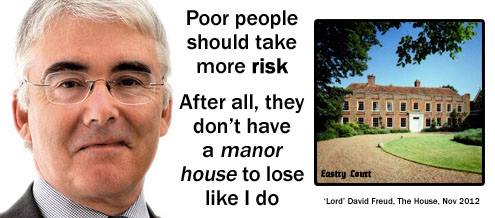
As I have discussed elsewhere on this site, we have a government that uses words like workshy to describe vulnerable groups. This is a government that is intentionally scapegoating poor, unemployed, disabled people and migrants. One Tory councillor called for the extermination of gypsies, more than one Tory MP has called for illegal and discriminatory levels of pay for disabled people. (See also David Freud was made to apologise for being a true Tory in public.)

David Freud’s comment that disabled people are not worth the minimum wage was not a momentary lapse, nor was it unrepresentative of Tory views more generally. He is the contemptuous architect of the grossly punitive Tory Bedroom Tax that disproportionately affects households of disabled people. The Tories endorsed Freud’s discriminatory policy proposal, and savagely ridiculed the UN rapporteur, Raquel Rolnik, when she pointed out, very professionally and reasonably, that the policy contravenes human rights.

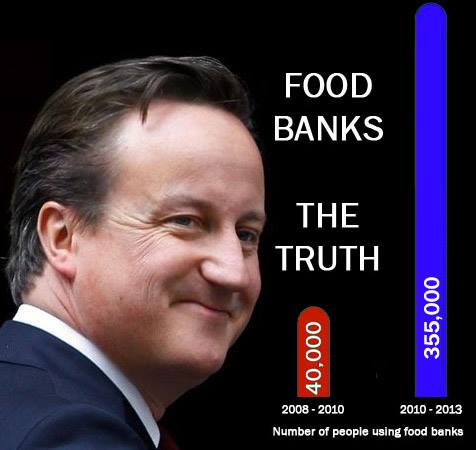
He is the same government minister that rejected suggestions that austerity policies have led to an increase in food bank use – making the jaw-droppingly astonishing suggestion that food bank charities are somehow to blame. This former investment banker and peer told the Lords that the increase in the usage of food banks was “supply led”. He said:

“If you put more food banks in, that is the supply. Clearly, food from the food banks is a free good and by definition with a free good there’s almost infinite demand.”

Poverty reduced to blame-the-individual neoliberal motivational formulae. Yet it is the government that are responsible for policies that create and sustain inequality and poverty.

We need only look at the discriminatory nature of policies such as the legal aid bill, the wider welfare “reforms” and research the consequences of austerity for the vulnerable – those with the  “least broad shoulders” –  to understand that these comments reflect how conservatives think.

This is a government that is using public prejudice to justify massive socio-economic inequalities and their own policies that are creating a steeply hierarchical, society based on social Darwinist “survival of the fittest” libertarian, minarchist principles.

The Tory creation of socio-economic scapegoats, involving vicious stigmatisation of vulnerable social groups, particularly endorsed by the mainstream media, is simply a means of manipulating public perceptions and securing public acceptance of the increasingly punitive and repressive basis of the Tories’ welfare “reforms”, and the steady stripping away of essential state support and provision.

Let’s not forget that we were recently informed that the Tories plan to limit child benefit to the first two children because it would save money. The idea is being examined by the Conservatives, despite previously being vetoed by Downing Street because of fears that it could “alienate” parents.

Asked about the idea on the BBC’s Sunday Politics programme, Duncan Smith said:

“I think it’s well worth looking at. It’s something if we decide to do it we’ll announce out. But it does save significant money and also it helps behavioural change.”

This is a clear indication of the Tories’ underpinning eugenicist designs – exercising control over the reproduction of the poor, albeit by stealth. It also reflects the underpinning belief that poverty somehow arises because of faulty individual choices, (as opposed to faulty political decision-making and ideologically-driven socio-economic policies), that those choices are non-rational, stereotypical, and that reducing cost to the State involves making people change their “faulty,” stereotypical behaviours.

This government’s policies are contibuting significantly to mental illness: Suicides have reached a ten year high and are linked with welfare “reforms”.

And Osborne announced in the budget that the government will be funding a “package of measures” to improve “employment outcomes” which will entail putting Cognitive Behaviour therapists in more than 350 job centres to provide “support” to those with “common mental health conditions” who are claiming employment support allowance (ESA) and job seekers allowance (JSA).

As I have written elsewhere, the government have put up an online contract notice which specifically states:

“This provision is designed to support people with common mental health conditions to prepare for and move into work, with intervention at the earliest possible point in a claim to benefit or access to the Fit for Work service.”

Cognitive Behaviour Therapy (CBT) is used to change how you think (“Cognitive”) and what you do (“Behaviour”). It bypasses emotions, personal history and narrative, to a large extent, and tends to focus on the “here and now.” In this case, the here and now consists of taking any job available, regardless of its suitability, or face being sanctioned.

CBT is an approach that facilitates the identification of “negative thinking patterns” and associated “problematic behaviours” and challenges them. This approach is at first glance a problem-solving approach, however, it is of course premised on the assumption that interpreting situations “negatively” is a bad thing, and that thinking positively about bad events is beneficial.

The onus is on the individual to adapt by perceiving their circumstances in a stoical and purely rational way.

So we need to ask what are the circumstances that the government are expecting people claiming benefits to accept stoically. Sanctions? Work fare? Being forced to accept very poorly paid work, abysmal working conditions and no security? The loss of social support, public services and essential safety nets ? Starvation and destitution?

The political vilification of sick and disabled people and the poor, amplified in the media, has preceded policies particularly aimed at the steady removal of State support, indicating a clear scapegoating process, and this isn’t indicative of a government that is “neglectful”- it is patently intentional, hence the pre-emptive “justification” narratives to garner public support and acceptance towards such punitive and harsh policies.

As Frances Ryan says:

“The ideology of a small state or the belief that benefits build dependency are crass, irrelevant details to what at its core is simply a decision about how to treat a human being. This is particularly damning when one person has all the power and the other is forced through economic necessity to take whatever humiliation or pain they are given. To do that to someone – let alone hundreds of thousands – is no accident. It is a conscious decision, that has been made over and over again by this government.”

I’ve consistently expressed my own well-founded, carefully considered, evidenced view that the Tories are authoritarians,  social Dawinists, and their social policies are founded on a creeping and implicit eugenics by stealth, fueled by their preference for a steeply hierarchical, unequal society, anachronistic ideas about “deserving” and “undeserving”, which belong to the 1834 Poor Law era, and a behaviourist approach to socio-economic circumstances .

In Edgbaston, Keith Joseph, (1974) announced to the world that:

“The balance of our population, our human stock is threatened … a high and rising proportion of children are being born to mothers least fitted to bring children into the world and bring them up. They are born to mothers who were first pregnant in adolescence in social classes 4 and 5. Many of these girls are unmarried, many are deserted or divorced or soon will be. Some are of low intelligence, most of low educational attainment.”

And in 2010, the former deputy chairman of Conservative Party, Lord Howard Flight, told the London Evening Standard:

“We’re going to have a system where the middle classes are discouraged from breeding because it’s jolly expensive. But for those on benefits, there is every incentive. Well, that’s not very sensible.”

These comments are not momentary lapses, nor are they unrepresentative of Tory views more generally. They reflect the true colours of the nazi nasty party.

demcracy

Pictures courtesy of Robert Livingstone


My work is unfunded and I don’t make any money from it. I am disabled because of illness and struggle to get by. But you can support Politics and Insights and contribute by making a donation which will help me continue to research and write informative, insightful and independent articles, and to provide support to others.  DonatenowButton

Osborne’s razor: the Tory principle of parsimony is applied only to the poorest

The BBC reports that leaked documents from the Department for Work and Pensions suggest the government is planning a regional benefits cap, reducing child benefit, taxing disability benefits and reducing eligibility for the carers’ allowance. The proposals are aimed at helping to save £12 billion from the welfare budget by 2017/18. The Conservatives have of course insisted that the proposals were “not party policy.” Yet. They dismissed the leaked report as “ill-informed and inaccurate speculation.”

However, the documents were prepared by civil servants and commissioned by Conservative Party officials. These are the key proposals in the report:

  • Industrial Injuries Compensation Scheme – could be replaced by companies providing industrial injury insurance policy for employees. Any that did not would become members of a default national industrial injuries scheme, similar to the programme for asbestos sufferers. DWP predicted saving – £1bn
  • Carer’s Allowance – this could be restricted to those eligible for Universal Credit. Leaked documents suggest about 40% of claimants would lose out. DWP predicted saving – £1bn
  • The contributory element of Employment and Support Allowance and Job Seekers Allowance – currently claimants who have paid enough National Insurance contributions can get the benefits with little means testing; DWP analysis suggests 30% of claimants, over 300,000 families, would lose about £80 per week. DWP predicted saving – £1.3bn in 2018/19
  • Disability benefits – Disability Living Allowance, Personal Independence Payments and Attendance Allowance (for over 65s who have personal care needs) would no longer be paid tax free. Possible saving – £1.5bn per annum (based on IFS Green Budget calculation )
  • Council Tax Support – to be incorporated into Universal Credit. Possible saving – not known
  • Child Benefit – Limiting the benefit to the first two children. Possible saving IFS estimates £1bn saving per annum in the long run but little initially
  • Regional Benefit Caps – The £23,000 limit would vary in different parts of the country, with for instance Londoners receiving the top amount due to the higher cost of living. Possible saving – not known and dependent on where levels were set

Meetings about these options have taken place in recent weeks between the chancellor and Iain Duncan Smith. It is also understood that the permanent secretary, Sir Jeremy Heywood, has been coordinating some of the efforts to find savings.

The government has cut around £20bn from projected welfare spending over the course of the past five years, through a range of measures from freezing payments rates to cutting housing benefit. But Robert Joyce, a senior economist with the IFS, says finding another £12bn over the next two years will not be easy.

The easier benefit cuts are the ones that will have been done first, so what’s left will be harder.

“In addition, the Conservatives want to do this by 2017-18, in the next two years. It means they have to be looking at less palatable options that would involve overnight takeaways from certain families.”

Shadow work and pensions secretary, Rachel Reeves, said the Conservatives now needed to explain how they would achieve the welfare savings they needed to make.

She said: “These plans to hit the disabled and carers were drawn up for Conservative ministers to deliver their extreme cuts plan.” “The Tories now need to come clean about what cuts they plan to make and who will pay the price. If they are ruling out these extreme cuts for the most disabled and carers, then it is clear they will be hitting the tax credits, and support for children, for millions of working families.”

Rosanna Trudgian, policy officer at the charity Mencap, said the proposed changes were unfair. “Disabled people don’t choose to have their disability. They don’t choose to pay for these additional costs related to that disability,” she told BBC News.

“For example, if you have to go to hospital on a regular basis and you are paying for those huge car parking fees. Therefore, it’s just unfair if this is treated as taxable income.”

These cuts would hit the elderly, disabled people, poor people, especially those with large families, and those injured at work – and would devastate many communities.

Earlier this week, the Institute for Fiscal Studies (IFS) has asked Osborne to specify how he will reach targets announced in the budget, given that the poorest had been the hardest hit by draconian benefit cuts already. The IFS say the worst of the UK’s spending cuts are still to come.

I proposed that, as a society, we cannot possibly accommodate a further 12 billion cut from welfare spending. It’s not that Osborne can’t answer the IFS challenge: he won’t. He’s being conservative with the truth – which is that we cannot afford to reduce any more from welfare without ending welfare provision as we know it.

Related

Osborne’s razor, smoke and mirrors

Osborne’s Autumn statement reflects the Tory ambition to reduce State provision to rubble

Follow the Money: Tory Ideology is all about handouts to the wealthy that are funded by the poor

385294_195107567306966_1850351962_n  Thanks to Robert Livingstone for the memes used in this article

Poor people are rubbish at being poor, says Iain Duncan Smith and Conservative Baroness Jenkin of Kennington

526544_532055030197363_2137237288_n

It’s truly remarkable that whenever we have a Conservative government, we suddenly witness media coverage of an unprecedented rise in the numbers of poor people who suddenly seem to develop a considerable range of baffling personal ineptitudes and immediately dysfunctional lives.

We see a proliferation of  “skivers” and “scroungers”, an uprising of “fecklessness”, a whole sneaky “culture of entitlement”, “drug addicts”, a riot of general all-round bad sorts, and apparently, the numbers of poor people who suddenly can’t cook a nutritious meal has climbed dramatically, too. We are told that starvation is not because of a lack of money and access to food, but rather, it’s because people don’t know how to budget and cook, that’s according to the Conservative Baroness Jenkin of Kennington.

She recommends that poor people stop avoiding porridge, since it only costs 4 pence a bowl.

1390648_548165358586330_1740107407_n
The alarming rise in numbers of adults who have suddenly forgotten how to cook and eat porridge since David Cameron took Office, up to last year.

The very fact that people suddenly and worryingly forget these crucial life-skills under every single Conservative government, but most particularly under this one, provides a darn good reason to vote them out on May 7th, 2015, I should say.

Iain Duncan Smith added: “People are going to food banks because they get divorced, ill or addicted to drugs,  it is “ridiculous” to blame the Government.

It is really rather ridiculous to assume that that every single reason that someone is going to a food bank is down to what the Department for Work and Pensions does.

The report itself today and other reports are also clear and they show there are often people with very dysfunctional lives, people who have been caught in drug addiction, family breakdown, people who have gone into serious illness that aren’t claiming benefits and come into difficulty.”

1002589_521987671204099_896277269_n (1)

Gosh, such a massive rise in “dysfunctional lives”, divorce, family breakdown, serious illness and drug addiction, and all since 2010 – even more reasons to vote them out. This Government has clearly created a tide of social problems, as very few people were incompetently hungry and desperately silly enough to need food banks under the last government. In fact I didn’t even know they existed back then. But that’s the “Big Society” for you. What a bright idea to replace welfare with charity. It’s just like the good old Victorian days. Hurrah!

I mean it’s not as if wealthy people ever suffer from messy divorce, serious illness, family breakdown and drug addiction. That must be why we never see them at food banks.

These people simply need to stop being seriously ill, divorced and all of that, that’s what I say.

A lot of people who specialise in studying poverty have said the welfare “reforms” are behind the rise in food bank use, as well as rising benefit sanctions, low pay and ever-rising living costs. But Iain Duncan Smith seems to know what he’s doing, especially when it comes to talking about “fairness”. Or statistics, for that matter.  You never hear about people starving who don’t have a messed-up life, after all. The man has solved that cause and effect dilemma conveniently and to his discredit, very cheaply. Bravo. We should give him a break, as the poor, inadequate vicious bully defensive man can’t even afford to buy his own underwear.

It’s just a coincidence that the Tory austerity measures have been targeted at the poorest, after all. Nothing to do with those draconian, punitive fair and much-needed cuts to people’s lifeline benefits.

Meanwhile, I’m delighted to see the rise in tax-avoiding, sanctimonious kindly wealthy people preaching Victorian values of thrift, self-help and morality, but only to the poor, of course. We really must learn to manage how to not have the basic requirements for survival better, after all. We’re just going about being paupers all wrong. We all know that increasing absolute poverty is an indulgent lifestyle choice. Who wouldn’t jump at the chance to have such an easy time of it, languishing in all of that deprivation, a shorter life and constant cold and hunger? Not to mention such a special social status. It’s so important to know one’s place.

Yes. Poor people are just so incompetent at being impoverished. How utterly selfish. We really ought to make much better use of our absolute poverty. Perhaps we should learn how to announce a flounce from the country, like many of the tight-fisted, selfish, personality disordered,  socially irresponsible hard done by millionaires do, at the prospect of social policy not going quite their way. Some of them were very cross indeed about the very idea of contributing to our economy, and who can blame them. After all, it matters not that poor people starve, as the most important and useful thing for this country is the accumulation of more wealth by an already very wealthy minority. The destruction of our country’s economy, public services, welfare and so many lives is a sacrifice the wealthy are more than happy to pay.

Good thing that David Cameron has obliged their generosity. Phew. The alternative just wouldn’t bear thinking about for those poor millionaires, who are, after all, victims of terrible discrimination, and inequality. Someone has to be, apparently. It’s in the Tory social order rule book. Still, at least we are all better off than Iain Duncan Smith. Most of us are still capable of managing coherence, as money can’t buy that. So we can be cheap and cheerful.

But the rich have obviously forgotten the virtues of porridge and thrift, too.

Perhaps the poor could run budgeting classes for poor, needy millionaires. It seems not many people know that porridge provides the way out of grinding, long-term material deprivation and helps to prevent terrible social problems. Better safe than sorry, I say.

And David Cameron says rich people need looking after. They must be very vulnerable and fragile. I’m sure it will make the mansion tax more palatable, too, for the tax dodging unbearably tortured souls that may have to dip their hands in their vast vaults and pay their way for once endure it. They didn’t mind the bedroom tax, though, despite it being a breach of human rights, and they even managed to stay calm and silent at the destitution and deaths it has caused: they didn’t complain once, bless them. So perhaps they’ll cope with the mansion tax after all.

There’s no porridge on the House of Lord’s menu, either. I feel so sorry for them:

Embedded image permalink

See what I mean? An example of Baroness Jenkin’s “budgeting skills”, which are subsidised by UK tax-payers. The House of Lords’ 760 peers benefit from an £84 discount on their food every week. The generous cut is more than the weekly Jobseeker’s Allowance, which is just £71. And the subsidy comes on top of the £300-a-day “subsistence” given to peers for each day they attend the Lords, to cover food and accommodation. How do they endure it?

And thinking about it, isn’t it odd that whenever we see the curiously abrupt forgetfulness and sudden ineptitude on the rise amongst the poorest members of the public and their increasingly chaotic, difficult lives, it coincides every time with a significant increase in poverty, inequality, politically manufactured unemployment, a significant rise in the cost of living, poor working conditions and lower wages, and welfare “reforms”.

And a bunch of selfservatives in Office. There’s a correlation there somewhere, isn’t there?

Primary referral causes in 2013-14

Latest foodbank figures top 900,000: life has got worse not better for the poorest in 2013/14, and this is just the tip of the iceberg – The Trussell Trust.

Executive Summary of Emergency Use Only Report.

The just about surviving report


1459165_266124213538634_1461740450_n
Thanks to Robert Livingstone for his excellent memes

A list of official rebukes for Tory lies

1235473_537097386359794_65317730_n (1)

Here is catalogue of officially recognised Tory lies – each one used to justify their unjustifiable policies – which have resulted in official reprimands:

Government used ‘misleading’ figures to claim homelessness halved – Statistics authority warns Government claims to have halved homelessness  are based on the government’s very narrow definition of terms.

George Osborne rebuked for ‘no cuts in police budgets’ claim –  The Chancellor claimed he would provide “real-terms protection” but forces face £160m funding cut, statistics watchdog rules. Sir Andrew Dilnot, the chair of the UK Statistics Authority, ruled that despite Osborne’s claim to be providing “real-terms protection” for the police, forces actually faced a £160m real-terms cut in their Whitehall funding in 2015-16 and 2016-17.

A House of Commons analysis estimated that the £160m cut was equal to the salaries of 3,200 police officers over the two years.

David Cameron rebuked by statistics watchdog over national debt claims The PM said the government was ‘paying down Britain’s debts’ in a political broadcast, even though the debt is actually rising.

“Now that his false claims have been exposed, it’s time the prime minister stopped deliberately misleading people about his economic record” – Rachel Reeves.

Finally Exposed! The Deficit Myth! So, David Cameron When Are You Going to Apologise? David Cameron rebuked over austerity claims – Cameron has been corrected by the Treasury’s own forecaster over claims that cuts in public spending are not reducing economic growth. The Office for Budget Responsibility told the Prime Minister that it does believe that cutting public spending will reduce economic growth in the short term.

Robert Chote, the head of the OBR, contradicted a claim Cameron made in a speech about the economy, in which the Prime Minister said the forecaster does not believe cuts are reducing growth.

In fact, as Mr Chote wrote, the OBR believes that cuts in spending and increases in tax will depress economic activity, meaning lower growth.

OBR head rebukes Osborne: the UK was never at risk of bankruptcy. Office for Budget Responsibility chief Robert Chote dismisses the Conservative “danger of insolvency” claim.

In the weeks after he took office, George Osborne justified his austerity programme by claiming that Britain was on “the brink of bankruptcy”. He told the Conservative conference in October 2010: “The good news is that we are in government after 13 years of a disastrous Labour administration that brought our country to the brink of bankruptcy.”

It was, of course, nonsense.

*Please note the original link to the New Statesman article seems to have curiously vanished. So here is a cached link to the same article: OBR head rebukes Osborne: the UK was never at risk of bankruptcy.

David Cameron rebuked over jobs claim: Sir Andrew Dilnot, head of the UK Statistics Authority, the independent statistics regulator, said the prime minister was wrong to say figures showed that more than three-quarters of all new jobs went to British citizens when “official statistics do not show the number of new jobs.”

Cameron was attempting to show in an interview for the Daily Telegraph that the government had reversed a situation in its first few years of office when he claimed most new jobs were taken by migrant workers. The interview was widely interpreted as an attempt to win over Ukip voters who believe most jobs created as Britain’s economy recovers are being snapped up by foreigners.

Following a complaint by Jonathan Portes, head of the National Institute for Economic & Social Research, Dilnot confirmed that neither the original fear that migrants were taking British jobs nor the reversal of this trend were supported by official data.

Employment data collected by the Office for National Statistics relates to jobs in the economy whether or not they are newly created by employers. Dilnot said the relevant figures from the ONS showed the number of migrants in the labour force increased by 400,000 over the last five years, an 18% rise, while the number of UK nationals increased by 3%, or 900,000.

Sir Andrew Dilnot, head of the UK Statistics Authority, the independent statistics regulator, said the prime minister was wrong to say figures showed that more than three-quarters of all new jobs went to British citizens when “official statistics do not show the number of new jobs.”

Information Commissioner Christopher Graham launched a scathing rebuke of the decision to exercise the Government’s veto in a report on the case to Parliament. Blocking the publication of a report into the risks of NHS reforms is a sign that ministers want to downgrade freedom of information laws, a watchdog has warned. Health Secretary Andrew Lansley deployed it to block an Information Tribunal ruling that he should meet Labour demands to disclose the document.

Duncan Smith rebuked by ONS for misuse of benefit statistics – The claim that 8,000 people moved into work as a result of the benefit cap is “unsupported by the official statistics”, says the UK Statistics Authority. In letter to Duncan Smith, Andrew Dilnot writes: “In the manner and form published, the statistics do not comply fully with the principles of the Code of Practice, particularly in respect of accessibility to the sources of data, information about the methodology and quality of the statistics, and the suggestion that the statistics were shared with the media in advance of their publication.”

Another statement by Duncan Smith later in the month also drew criticism and a reprimand. The minister said around 1 million people have been stuck on benefits for at least three of the last four years “despite being judged capable of preparing or looking for work”.

However, the figures cited also included single mothers, people who were seriously ill, and people awaiting testing.

Iain Duncan Smith Rebuked Over Immigration Statistics – Iain Duncan Smith and the Department of Work and Pensions have been accused of publishing misleading immigration figures that were “highly vulnerable to misinterpretation”. Figures showing 371,000 immigrants were on benefits were rushed out by ministers with insufficient regard for “weaknesses” in the data, according to the UK Statistics Authority.

In a strongly-worded rebuke to Work and Pensions Secretary Iain Duncan Smith, the head of the UKSA, Sir Michael Scholar, condemned the handling of the research, the Press Association reported.

Sir Michael said that despite being “highly vulnerable to misinterpretation”, the claims were given to the media without the safeguards demanded for official statistics and by issuing the figures as a “research paper”, the DWP had bypassed the need to meet the usual code of conduct, he noted.

Grant Shapps rebuked by UK Statistics Authority for misrepresenting benefit figures – Yet another Conservative politician is caught making it up. Grant Shapps has joined his fellow Conservatives in the data hall of shame. In March, the Tory chairman claimed that “nearly a million people” (878,300) on incapacity benefit had dropped their claims, rather than face a new medical assessment for its successor, the employment and support allowance.

The figures, he said, “demonstrate how the welfare system was broken under Labour and why our reforms are so important”. The claim was faithfully reported by the Sunday Telegraph  but as the UK Statistics Authority has now confirmed in its response to Labour MP Sheila Gilmore (see below), it was entirely fabricated.

In his letter to Shapps and Iain Duncan Smith, UKSA chair Andrew Dilnot writes that the figure conflated “official statistics relating to new claimants of the ESA with official statistics on recipients of the incapacity benefit (IB) who are being migrated across to the ESA”. Of the 603,600 incapacity benefit claimants referred for reassessment as part of the introduction of the ESA between March 2011 and May 2012, just 19,700 (somewhat short of Shapps’s “nearly a million) abandoned their claims prior to a work capability assessment in the period to May 2012.

The figure of 878,300 refers to the total of new claims for the ESA closed before medical assessment from October 2008 to May 2012. Thus, Shapps’s suggestion that the 878,300 were pre-existing claimants, who would rather lose their benefits than be exposed as “scroungers”, was entirely wrong.

As significantly, there is no evidence that those who abandoned their claims did so for the reasons ascribed by Shapps.

The chair of the UK Statistics Authority has rebuked shadow home secretary Chris Grayling – the authority have said  he “must take issue” with claims made by the Conservatives and  warned the way they use violent crime statistics is “likely to mislead the public” and damage public trust. Mr Grayling has used a comparison between  figures to suggest that the Labour government has presided over a runaway rise in violent crime.

Even Iain Duncan Smith said that such comparisons were “profoundly misleading” and London’s Conservative Mayor, Boris Johnson, described Grayings’ claim as “absolute nonsense”. Chris Grayling made a headline-grabbing speech in which he likened life in Britain’s inner cities to that in Baltimore, Maryland, as portrayed in the acclaimed television series The Wire. Alan Johnson, the Home Secretary, remarked: “The connection between The Wire and Chris Grayling’s grasp on the problems of modern Britain is that they are both fictional.”

Treasury rebuked by UK Statistics Authority for inflation leaks – Britain’s statistics watchdog, ordered the Treasury to review its processes after sensitive inflation data this month was sent to 400 unauthorised people 17 hours before its release. Sir Michael warned: “There is a risk of market manipulation if key economic data fall in to the wrong hands before publication.”

Speculation data was leaking into the market ahead of the Office for National Statistics (ONS) announcement has been rife. Market rumours correctly predicted the last two Consumer Price Index inflation releases just before publication – in April and May.

UK Statistics rebukes Government over NHS spending claims – David Cameron famously promised he would cut the deficit, not the NHS. We now have it in black and white: he is cutting the NHS, not the deficit. There could be no clearer evidence of the failure of this Prime Minister and his Government.

“For months, David Cameron’s Government have made misleading boasts about NHS spending, misrepresenting the true financial difficulties he has brought upon the NHS. At the same time they have recently begun to try to distance themselves from these problems which David Cameron has created, trying to shift the blame to the NHS and its staff”Andy Burnham.

The watchdog has called on ministers to correct claims the coalition has made that they increased NHS spending in England. The UK Statistics Authority upheld a complaint by Labour about government claims the NHS budget had increased in real-terms in the past two years.

The watchdog found that the best-available Treasury data suggested real-terms health spending was lower in 2011-12 than in 2009-10. The Coalition said during its spending review that the NHS budget had gone up.

Coalition rebuked again by UK Statistics Authority  – this time on flood defence spending. Andrew Dilnot says a Treasury graph on infrastructure left readers with “a false impression of the relative size of investment between sectors”. George Osborne and the Treasury have been reprimanded for misleading people about the government’s investment in infrastructure. For example, their chart made it look like investment in flood defences was roughly the same as in other areas, when in fact it was a tiny fraction.

Andrew Dilnot rebukes Treasury again over the false presentation of statistics in the National Infrastructure Plan.

The UK Statistics Authority has censured the Department for Education Sir Michael Wilshaw – appointed by Mr Gove as Ofsted chief inspector – for using uncertain, weak and “problematic” statistics to claim that England’s schools have tumbled down the global rankings – the central justification for Goves’ sweeping school reforms. But now the government’s own statistics watchdog has called into question the figures at the heart of the education secretary’s argument. His verdict is a blow to Mr Gove’s claim that England has “plummeted in the world rankings” given that the education secretary has been so unequivocal about the figures, arguing that “these are facts from which we cannot hide”.

Senior Conservative ministers have been rebuked for attempting to cover up Government statistics – showing one of their key housing policies is not working. In his ruling, seen by the Independent, the Information Commissioner roundly rejected the argument put forward by DCLG officials and demanded that the information be released.

“The exemptions cited by DCLG require more than the possible inconvenience in responding to queries about disclosures,” he wrote scathingly.

“The Commissioner considers that DCLG has not provided arguments which demonstrate that disclosure would inhibit the free and frank provision of advice or the free and frank exchange of views for the purposes of deliberation.”

He ordered that the information is to be released.

And what did it show? In a short table released to the Labour Party, it showed that the number of people who begin self-build homes had fallen since the depths of the recession in 2009 under Labour from 11,800 to 10,400 in 2011.

Oddly the department claimed it did not hold the statistics for 2012 – despite the fact that more than five months had elapsed since the period covered by the data.

Theresa May rebuked over illegally deported asylum seeker – A rare court order calls on the home secretary to find and bring back a Turkish national and investigate UK Border Agency conduct.

The home secretary has returned to the high court and asked Mr Justice Lloyd Jones to set aside the order. The request was rejected and May now has to ensure the man is brought back to the UK. It is rare for orders to be granted by the court calling for people who have been forcibly removed from the UK to be returned and even rarer for the home secretary not to comply with them.

Mr Justice Singh stated that he was “very concerned” the government had failed to comply with his order.

In the court documents a senior UK Border Agency official admitted: “It is regrettable that the claimant was removed in spite of a court order preventing removal.”

Watchdog reprimands Eric Pickles’ department for £217m overdraft – The National Audit Office finding is embarrassing for the communities secretary, who was praised by chancellor as a ‘model of lean government’ – for his ability to impose cuts on struggling councils – he has been reprimanded by the Whitehall spending watchdog for running up an unauthorised departmental overdraft of £217m, the NAO disclosed that the Treasury had imposed a £20,000 fine on his department as a punishment for its poor financial management.

The head of the civil service officially reprimanded David Cameron over the behaviour of his special advisers – following ‘unacceptable’ briefings to journalists, PR Week has learned. Sir Gus O’Donnell was so alarmed at briefings coming out of Government that he wrote a strongly worded letter to the Prime Minister urging him to restrain his aides.

Prime Minister is rebuked over Liam Fox inquiry, for failing to call in his independent adviser to look at claims that the ministerial code had been breached. Fox resigned after being found guilty of breaching the code in his relations with lobbyist Mr Werritty.

MPs also claim the advisory role itself “lacks independence” after a new candidate was appointed behind closed doors by Mr Cameron.

Office of National Statistics rebukes David Cameron because of his false claim that average waiting time in Accident & Emergency has fallen.

Andrew Dilnot rebukes Cameron regarding the false claim that most new jobs in Britain used to go to foreign workers but now go to British workers.

David Cameron rebuked AGAIN by the Office of National Statistics for the false claim that Britain is “paying down its debts”. The Prime Minister said Britain had been “paying down its debts” during the Tory party conference, Sir Andrew Dilnot, pointed out that, while the deficit has fallen since the Coalition came to power in 2010, debt has risen.

And he noted that he had already rebuked Mr Cameron for making the same claim in a party political broadcast in 2013.

George Osborne rebuked for boasting he halved £1.7bn EU surchargeThe all-party Treasury select committee said: “The suggestion that the £1.7bn bill demanded by the European Union was halved is not supported by published information.”

The committee’s reproach is a blow to Osborne before the general election, when the Tories are expected to come under fire from Eurosceptics inside the party and from Ukip over the size of the UK’s EU contribution.

Finally, Coalition is rebuked by Churches over ‘human cost’ of austerity measures – despite Camerons’ claim that his policies are because of “divine inspiration”

Further evidence – UK Statistics Authority correspondence listcomplaints and responses regarding Tory lies.

This list was taken from a longer article: Austerity, socio-economic entropy and being conservative with the truth

578979_459860714083462_1726333689_n


Pictures courtesy of Robert Livingstone.

Related articles:

The Great Debt Lie and the Myth of the Structural Deficit

The mess we inherited” – some facts with which to fight the Tory Big Lies

The word “Tories” is an abbreviation of “tall stories”

Selling off NHS for profit: Tories’ and Liberal Democrats’ links with private healthcare firms revealed

252299_486936058042594_609527550_n

Article from the Mirror 

PM David Cameron and Health Secretary Jeremy Hunt are among 64 Tory MPs named in a study by Unite – Lib Dems Nick Clegg and Vince Cable are also on the list.

One in five Coalition MPs have links with private firms who could profit from the Government’s NHS reforms, a damning dossier will reveal on Tuesday.

Prime Minister David Cameron, former Health Secretary Andrew Lansley and his successor Jeremy Hunt are among 64 Tory MPs named in a study by the Unite union.

Deputy PM Nick Clegg and Business Secretary Vince Cable are among seven Liberal Democrats on the list.

All 71 MPs named in the dossier voted in favour of the Government’s controversial Health and Social Care Act in 2012, which opened up the NHS to more private firms.

It comes ahead of Friday’s crunch vote on Labour frontbencher Clive Efford’s Private Members’ Bill, when MPs will decide whether to scrap key sections of the Act.

[However, the only way to see the Act scrapped in full is to make sure we have a Labour Government on May 7th 2015, as the Labour Party have pledged to repeal the entire Act since it came into being, in 2012.]

Unite general secretary Len McCluskey raged: “This dossier of disgrace exposes the corruption at the heart of our Government’s sinister health reforms.”

‘Dossier of shame’: Clegg, Cameron, Hague, Hunt, Duncan Smith and Lansley are named.

Len McCluskey at the Daily Mirror Real Britain Fringe

Unite leader Len McCluskey

He added: “The Government’s real plan is the complete and irreversible privatisation of our NHS.”

Many of the MPs named in the document have directly received donations from business leaders or firms with links to the private health industry.

There is no suggestion any of the politicians or donors acted illegally.

The Conservative Party stressed tonight that all donations are reported to the Electoral Commission in line with electoral law.

But critics said the dossier shines a bright light on the close ties between members of the ­Coalition and the private health industry.

Mr McCluskey said: “The sheer scale of the conflict of interest is staggering.

“But it is the subsequent betrayal and privatisation of our NHS, driven by the monstrous Health and Social Care Act, that has made this a genuine scandal for our democracy.”

The dossier shows Mr Lansley, the chief architect of the Coalition’s NHS reforms, accepted a £21,000 donation in November 2009 from John Nash, the former chairman of Care UK.

Andrew Lansley


Chief architect: Former Health Secretary Lansley received £21k from former chairman of Care UK.

 Two other Tory MPs received donations from Mr Nash’s wife Caroline.

Hunt, who took over as Health Secretary when Mr Lansley was sacked in September 2012, received more than £20,000 from hedge fund baron Andrew Law, a major investor in health care firms.

Other Cabinet Ministers to have received donations include Leader of the Commons William Hague, who accepted £20,000 from MMC Ventures, the part-owner of The Practice plc which runs 60 GP surgeries.

And Culture ­Secretary Sajid Javid received £11,000 from Moundsley Healthcare Ltd.

The Prime Minister is named in the dossier after handing a life peerage to nursing and care home tycoon Dolar Popat, who has given the Tories more than £200,000 in donations.

Tory Dolar: PM Cameron, pictured, gave peerage to nursing and care home tycoon who donated £200k+

Work and Pensions Secretary Iain Duncan Smith has share options in hygiene tech firm Byotrol, which sells products to the NHS.

Foreign Secretary Philip Hammond is named because his former firm Castlemead is a health care and nursing home developer.

Andy Burnham, Labour’s Shadow Health Secretary, said of the Tories: “They were bankrolled by private health in Opposition as they drew up secret plans to put market forces at the heart of the NHS.

“And once in Government, MPs and peers with links to private health voted it through without a mandate from the public.”

For the Lib Dems, the dossier says party leader Mr Clegg received a £5,000 donation to his constituency office from Alpha Medical Consultancy.

And Vince Cable was given £2,000 by Chartwell Care Services, which is owned by Chartwell Health & Care plc.

Liberal Democrat leader Nick Clegg accompanied by shadow chancellor Vince CableDonations: Clegg’s (left) office received £5k while Cable was given £2k

Tonight a Conservative spokesman hit back, and said: “Here in the ­Conservative Party, donations don’t buy our leader, our candidates or our ­policies. If only the same could be said of Unite and the Labour Party.

“The most important thing with NHS care is that it is high quality and free at the point of delivery.”

A Lib Dem spokesman said his party had “stopped Conservative privatisation plans and reversed Labour’s special favours to private health companies”.

He added: “We have already committed to spending at least £1billion extra on health and care in each year of the next Parliament.”

Some MPs’ health connections

  • George Osborne, Chancellor: Received donation through Conservative Campaign HQ from Julian Schild whose family made £184m in 2006 by selling hospital bed-makers Huntleigh Technology
  • Michael Fallon, Defence Secretary: Former director of Attendo AB, a Swedish private health company
  • Philip Hammond, Foreign Secretary: Beneficiary of a trust which owns controlling interest in nursing home developer Castlemead Ltd
  • David Davis, former Shadow Home Secretary: Received £4,250 for a speaking engagement for health insurance company Aviva
  • Liam Fox, former Defence Secretary: Received £5,000 from iIPGL Ltd, which purchased health care company Cyprotex
  • John Redwood, former Cabinet Minister: Advised the private equity company which runs Pharmacy2u
  • Vince Cable, Business Secretary: Received a donation of £2,000 from Chartwell Care Services, which is 100% owned by Chartwell Health & Care PLC.

    Click here for a full list of MPs with links to private healthcare firms

    See also: The Coalition has deliberately financially trashed the NHS to justify its privatisation


    1912510_690135534389311_7775048840596309303_o

Aktion Arbeitsscheu Reich, Human Rights and infrahumanisation

1379986_541109785958554_2049940708_n

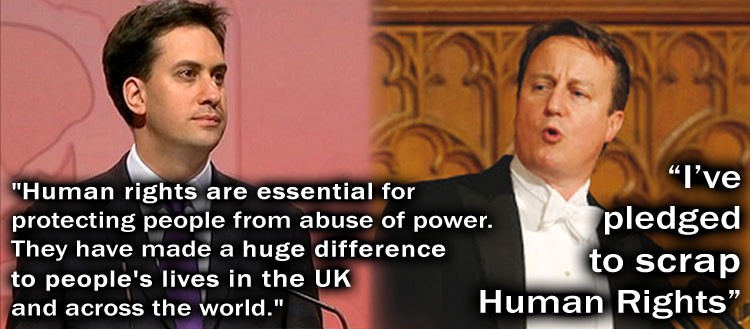
The European Convention on Human Rights, which came into force on 3 September 1953, guarantees a range of political rights and freedoms of the individual against interference by the State. The Convention came about as an international response to the horrors of World War Two, and the Holocaust.

Before the incorporation of the Convention, people in the United Kingdom could only complain of unlawful interference with their Convention rights by lodging a petition with the European Commission of Human Rights in Strasbourg. That all changed on 2 October 2000 when Labour’s Human Rights Act 1998 came into force, allowing UK citizens to sue public bodies for violations of their Convention rights in domestic courts.

David Cameron wants to scrap the Human Rights Act and has pledged to leave the European Convention. Human Rights are the bedrock of any democracy. He also wants to scrap consultations, impact assessments, audits, judicial reviews: all essential safeguards for citizens and mechanisms of democracy. 

Government policies are expressed political intentions, regarding how our society is organised and governed. They have calculated social and economic aims and consequences.

How policies are justified is increasingly being detached from their aims and consequences, partly because democratic processes and basic human rights are being disassembled or side-stepped, and partly because the government employs the widespread use of propaganda to intentionally divert us from their aims and the consequences of their ideologically (rather than rationally) driven policies. Furthermore, policies have become increasingly detached from public interests and needs.

A clear example of an ideologically-driven policy is the Welfare “Reform” Act, which is founded on a stigmatising, Othering narrative: benefit recipients are portrayed as the enemy that battles against fairness and responsibility. The mythological economic “free-rider,” a “burden on the state.” The “reforms” left people in receipt of lifeline benefits much worse off than they were, the word reform has been used as a euphemism for cuts.

Iain Duncan Smith’s Department for Work and Pensions  (DWP) has launched a new propaganda scapegoating  advertising campaign encouraging people to phone a hotline if they suspect somebody they know is fraudulently claiming benefits.

I’m sure that serious fraudulent claimants inform their friends and neighbours of their every activity, including holidays, sleeping arrangements, moments of intimacy and all of their benefit payment details, all the time, so that makes sense…

Mark Harper said: “Those who cheat the system need to know we will use everything in our power to stop them stealing money from hardworking taxpayers.”  

Yet we know that there isn’t a real distinction between benefit claimants and hard-working taxpayers, as the Tories would have us believe. Many people on benefits are also in work, but are not paid a sufficient wage to live on. Most people claiming benefits, including disabled people, have worked and contributed income tax previously.

It’s worth bearing in mind that the poorest citizens, including people claiming benefits, pay proportionally more indirect taxes than the wealthiest citizens, such as VAT. The strivers/skivers rhetoric is simply a divert, divide and scapegoating strategy. Growing social inequality evidently generates a political necessity for creating scapegoats and cultivating prejudices.

The real cost of out-of-work benefits is over-estimated in relation to the welfare bill for pensions and in-work benefits such as tax credits and housing benefit, obscuring the increasing role that the British state plays in subsidising the scandalously low wages paid by increasingly exploitative employers, in order to meet a minimum standard of living for the hardworking.

The hardworking taxpayer myth is founded on a false dichotomy, since it is estimated that around 70% of households claim benefits of one kind or another at some point in their lives. In the current climate of poor pay, poor working conditions, job insecurity, and high living costs, the myth of an all pervasive welfare-dependent something for nothing culture is being used to foster prejudice and resentment towards those unfortunate enough to be out of work. It also serves to bolster right-wing justification narratives that are entirely ideologically driven, which are aimed at dismantling the welfare state, while concurrently undermining public support for it.

As the Huff Post’s Asa Bennett points out, there are much bigger costs to the taxpayer that the government are reluctant to discuss.

For example, the tax gap, charting the estimated amount of taxes unpaid thanks to evasion, avoidance, error and criminality, soared to £34 billion, according to HM Revenue and Customs. This equates to £1 in every £15 owed in taxes not being collected last year.

The National Audit Office found that the Department for Work and Pensions had made £1.4 billion in declared benefit overpayments, an increase of nearly 6%.

Meanwhile, the DWP estimate that between £7.5 billion and £12.3 billion of the six main benefits it administered were left unclaimed in 2009/2010. On top of that. HMRC suggest that several billion pounds more is most in unclaimed tax credits, with childless families missing out on £2.3 billion worth. That’s a grand total of 22.1 billion that ordinary taxpayers aren’t claiming, even though they are entitled to do so. 

Iain Duncan Smith’s Department have wasted an estimated total of £6,221,875,000.00 of taxpayers’ money on the implementation of Universal Credit and private company contracts, amongst other things. (See We can reduce the Welfare Budget by billions: simply get rid of Iain Duncan Smith ). 

Duncan Smith’s claims that his policies are about fairness and saving taxpayers’ money, simply don’t stand up to scrutiny. 

The policies are entirely ideologically-driven. We have a government that uses words like workshy to describe vulnerable social groups. This is a government that is intentionally scapegoating poor, unemployed, disabled people and migrants. One Tory councillor called for the extermination of gypsies, more than one Tory MP has called for illegal and discriminatory levels of pay for disabled people. A conservative deputy mayor said, unforgivably, that the “best thing for disabled children is the guillotine.”

These weren’t “slips”, it’s patently clear that the Tories believe these comments are acceptable, and we need only look at the discriminatory nature of policies such as the legal aid bill, the wider welfare “reforms” and research the consequences of austerity for the most economically vulnerable citizens – those with the “least broad shoulders” –  to understand that these comments reflect how conservatives think.

This is a government that is using public prejudice to justify massive socio-economic inequalities and their own policies that are creating a steeply hierarchical society based on social Darwinist survival of the fittest neoliberal “small state” principles.

The Tory creation of socio-economic scapegoats, involving vicious stigmatisation of vulnerable social groups, particularly endorsed by the mainstream media, is simply a means of manipulating public perceptions and securing public acceptance of the increasingly punitive and repressive basis of the Tories’ welfare “reforms”, and the steady stripping away of essential state support and provision.

The political construction of social problems also marks an era of increasing state control of citizens with behaviour modification techniques, (under the guise of paternalistic libertarianism) all of which are a part of the process of restricting access rights to welfare provision and public services.

The mainstream media has been complicit in the process of constructing deviant welfare stereotypes and in engaging prejudice and generating moral outrage from the public:

“If working people ever get to discover where their tax money really ends up, at a time when they find it tough enough to feed their own families, let alone those of workshy scroungers, then that’ll be the end of the line for our welfare state gravy train.” James Delingpole 2014

Delingpole conveniently fails to mention that a majority of people needing lifeline welfare support are actually in work. He also fails to mention that while this government were imposing austerity on the poorest citizens, the wealthiest got generous handouts from the Treasury, in the form of tax breaks – hundreds of thousands of pounds each per year. 

Poverty cannot be explained away by reference to simple narratives of the workshy scrounger as Delingpole claims, no matter how much he would like to apply such simplistic, blunt, stigmatising, dehumanising labels that originated from the Nazis (see arbeitssheu.)

This past four years we have witnessed an extraordinary breakdown of the public/private divide, and a phenomenological intrusion on the part of the state and media into the lives of the poorest members of society. (For example, see: The right-wing moral hobby horse: thrift and self-help, but only for the poor. ) Many people feel obliged to offer endless advice on thrift and self help aimed at persuading poor people to “manage” their poverty better.

Hannah Arendt wrote extensively about totalitarian regimes, in particular Nazism and Stalinism, which she distinguishes from Italian Fascism, because Hitler and Stalin sought to eliminate all restraints upon the power of the State and furthermore, they sought to dominate and control every aspect of everyone’s life. There are parallels here, especially when one considers the continued attempts at dismantling democratic processes and safeguards since the Coalition took office.

Many policies are aimed at ‘incentivising’ certain behaviours and perceptions of citizens, using psychology to align them with political and defined economic goals. Citizens are increasingly seen by government as a means to an end.

Further parallels may be found here: Defining features of Fascism and Authoritarianism

Between February 1933 and the start of World War Two, Nazi Germany underwent an economic “recovery” according to the government. Rather like the “recovery” that Osborne and Cameron are currently claiming, which isn’t apparent to most citizens.

This economic miracle, sold to the people of Germany, entailed a huge reduction in unemployment. However, the main reason for this was fear – anyone who was found guilty of being “workshy” (arbeitssheucould then be condemned to the concentration camps that were situated throughout Germany. Hitler frequently referred to the economic miracle, whilst people previously employed in what was the professional class were made to undertake manual labour on the autobahns. People didn’t refuse the downgraded status and pay, or complain, lest they became Arbeitsscheu Reich compulsory labor camp prisoners, and awarded a black triangle badge for their perceived mental inferiority and Otherness.

Behaviour can be controlled by manipulating fear, using a pattern of deprivation. Benefit sanctions, for example, leave “workshy” people without the means to meet their basic survival needs and are applied for periods of weeks or months and up to a maximum of 3 years.

That the government of a so-called first world liberal democracy is so frankly inflicting such grotesquely cruel punishments on some of our most vulnerable citizens is truly horrific. It’s also terrifying that the media and the British public are complicit in this: they fail to recognise that the Social Darwinism inherent in Tory ideological grammar is being communicated through discourses and policies embodying crude behaviour modification techniques and an implicit eugenic subtext .

There were various rationales for the Nazi Aktion T4 programme, which include eugenics, Social Darwinism, racial and mental “hygiene”, cost effectiveness and the welfare budget.

Those involved with the operation of the Aktion T4 programme used the term euthanasia as bureaucratic cover, in the minimal public relations effort to invest what was essentially eugenics. It is clear that none of the killing was done to alleviate pain or suffering on the part of the victims. Rather, the evidence, including faked death certificates, deception of the victims and of the victims’ families, and widespread use of cremation, indicates the killing was done solely according to the socio-political aims and ideology of the perpetrators. The Nazis believed that the German people needed to be “cleansed” of the so-called racial enemies, but the Aktion T4 programme also included people with disabilities, the poor and the workshy.  

Although many were gassed using carbon monoxide or killed by lethal injection, many more of these people deemed “life unworthy of life” were simply starved to death.

The Holodomor – “extermination by hunger” –  was Joseph Stalin’s intentionaly inflicted famine, designed to destroy  people in the Ukraine seeking independence from his rule. As a result, an estimated 7,000,000 people starved to death. The attitude of the Stalinist regime in 1932–33 was that many of those starving to death were “counterrevolutionaries”idlers” or “thieves” who “fully deserved their fate”. In 2008, the European Parliament adopted a resolution that recognised the Holodomor as a crime against humanity.

Implementing policies that lead to members of vulnerable social groups starving, which is an INTENTIONAL political act, however, is not currently included in the UN Treaty definition of genocide. Nor are disabled people amongst the categories of groups protected by the Convention on the Prevention and Punishment of the Crime of  Genocide.

While I am very aware that we need take care not to trivialise the terrible events of Stalinist Russia and Nazi Germany by making casual comparisons, there are some clear and important parallels on a socio-political level and a psycho-social one, that I feel are crucially important to recognise.

Gordon Allport studied the psychological and social processes that create a society’s progression from prejudice and discrimination to genocide. In his research of how the Holocaust happened, he describes socio-political processes that foster increasing social prejudice and discrimination and he demonstrates how the unthinkable becomes tenable: it happens incrementally, because of a steady erosion of our moral and rational boundaries, and propaganda-driven changes in our attitudes towards politically defined others, that advances culturally, by almost inscrutable degrees.

The process always begins with political scapegoating of a social group and with ideologies that identify that group as the Other: an “enemy” or a social “burden” in some way. A history of devaluation of the group that becomes the target, authoritarian culture, and the passivity of internal and external witnesses (bystanders) all contribute to the probability that violence against that group will develop, and ultimately, if the process is allowed to continue evolving, extermination of the group being targeted.

Economic recession, uncertainty and political systems on the authoritarian -> totalitarian spectrum contribute to shaping the social conditions that seem to trigger Allport’s escalating scale of prejudice.

In the UK, the media is certainly being used by the right-wing as an outlet for blatant political propaganda, and much of it is manifested as a pathological persuasion to hate others. The Coalition clearly have strong authoritarian tendencies, and that is most evident in their anti-democratic and behaviourist approach to policy, human rights, equality, social inclusion and processes of government accountability.

Vulnerable groups are those which our established principles of social justice demand we intervene to help, support and protect. However, the Coalition’s rhetoric is aimed at a deliberate identification of citizens as having inferior behaviour. The poorest citizens are presented as a problem group because of their individual faulty characteristics, and this is intentionally diverting attention from  wider socio-economic and political causes of vulnerability. Individual subjects experiencing hardships have been placed beyond state protection and are now the objects of policies that embody behaviourism, and pathologising, punitive and coercive elements of social control. Vulnerable people are no longer regarded as human subjects, the state is acting upon them, not for or on behalf of them.

People are still debating if Stalin’s Holodomor conforms to a legal definition of genocide, no-one doubts that Hitler’s gas chambers do, though Hitler also killed thousands by starvation.

Our own government have formulated and implemented policies that punish unemployed people for being “workshy” – for failing to meet the never-ending benefit conditionality requirements which entails the use of negative incentives, coercion and behaviour modification to “support” a person into  work –  by withdrawing their lifeline benefit. We also know that sanction targets have led to many people losing lifeline benefits for incoherent and grossly unfair reasons that have nothing to do with an unwillingness to cooperate or work.

Since benefits were originally calculated to meet basic living requirements – food, fuel and shelter – it’s  inconceivable that the government haven’t already considered the consequences of removing people’s means of meeting these fundamental survival needs. Of course, the Tory claim that this draconian measure is to incentivise people to “find work” doesn’t stand up to scrutiny when we consider that there isn’t enough work for everyone, and certainly not enough work around that pays an adequate amount to actually survive on.

Furthermore, the Tories “incentivise” the  wealthy by rewarding them with more money (such as the £107,000  tax break that was handed out to each millionaire every year from our own taxes by Osborne). It flies in the face of our conventional and established wisdom that reducing people to starvation and desperation will somehow motivate people to do anything other than to try and survive. (See Maslow’s Hierarchy, and two tragic accounts of the consequences of imposed sanctions.)

Tory austerity is all about ideology – the dehumanisation of the poor, and the destruction of public services and provisions – state infrastructure – and nothing to do with the state of the economy. It’s also about cutting money from the poorest and handing it to the wealthiest. Many economists agree that austerity is damaging to the economy.

There has been a media complicity with irrational and increasingly punitive Tory policies. But why are the public so compliant?

Decades of  research findings in sociology and psychology inform us that as soon as a group can be defined as an outgroup, people will start to view them differently. The very act of demarcating groups begins a process of ostracisation.

As well as the political and social definitions of others, there also exists deeper, largely unconscious beliefs that may have even more profound and insidious effects. These are related to whether people claiming benefits are even felt to be truly, properly human in the same way that “we” are.

This is called infrahumanisation. Infra means “below”, as in below or less than fully human. The term was coined by a researcher at the University of Louvain called Jacque-Philippe Leyens to distinguish this form of dehumanisation from the more extreme kind associated with genocide.

However, I don’t regard one form of dehumanisation as being discrete from another, since studies show consistently that it tends to escalate when social prejudice increases. It’s a process involving accumulation.

According to infrahumanisation theory, the denial of uniquely human emotions to the outgroup is reflective of a tacit belief that they are less human than the ingroup.

Poor people, homeless people, drug addicts and welfare claimants are the frequently outgrouped. It is these most stigmatised groups that people have the most trouble imagining having the same uniquely human qualities as the rest of us. This removes the “infrahumanised” group from the bonds, moral protection and obligations of our community, because outgrouping de-empathises us.

This would explain why some people attempt to justify the cuts, which clearly fall disproportionately on the most vulnerable. This is probably  why fighting the austerity cuts is much more difficult than simply fighting myths and political propaganda. I think the government are very aware of the infrahumanisation tendency amongst social groups and are manipulating it, because growing social inequality generates a political necessity for social prejudices to use as justification narratives.

During a debate in the House of Lords, Freud described the changing number of disabled people likely to receive the employment and support allowance as a bulge of, effectively, stock”. After an outraged response, this was actually transcribed by Hansard as “stopped”, rendering the sentence meaningless.  He is not the only person in the Department for Work and Pensions who uses this term. The  website describes disabled people entering the government’s work programme for between three and six months as 3/6Mth stock.

This infrahumanised stock are a source of profit for the companies running the programme. The Department’s delivery plan recommends using  credit reference agency data to cleanse the stock of fraud and error.

The linguistic downgrading of human life requires dehumanising metaphors: a dehumanising socio-political system using a dehumanising language, and it is becoming familiar and pervasive: it has seeped almost unnoticed into our lives.

Until someone like Freud or Mellins pushes our boundaries of decency a little too far. Then we suddenly see it, and wonder how such prejudiced and discriminatory comments could be deemed acceptable and how anyone could possibly think they would get away with such blatantly offensive rhetoric without being challenged. It’s because they have got away with less blatantly offensive comments previously: it’s just that they pushed more gently and so we didn’t see.

It’s also the case that the government distorts people’s perceptions of the  aims of their policies by using techniques of neutralisation. An example of this method of normalising prejudice is the use of the words “incentivise” and “help” in the context of benefit sanctions, which as we know are intentionally extremely punitive, and people have died as a consequence of having their lifeline benefit withdrawn.

As Allport’s scale of prejudice indicates, hate speech and incitement to genocide start from often subliminal expressions of prejudice and subtle dehumanisation, which escalate. Germany didn’t wake up one morning to find Hitler had arranged the murder of millions of people. It happened, as many knew it would, and was happening whilst they knew about it. And many opposed it, too.

The dignity and equal worth of every human being is the axiom of international human rights. International law condemns statements which deny the equality of all human beings.

As a so-called civilised society, so should we.

526544_532055030197363_2137237288_n
Pictures courtesy of Robert Livingstone

Once you hear the jackboots, it’s too late.

556770_138948196256237_144572172_n

Dr. Lawrence Britt examined the fascist regimes of Hitler (Germany), Mussolini (Italy), Franco (Spain), Suharto (Indonesia) and several Latin American regimes. Britt found 14 defining characteristics common to each, and it is becoming increasingly difficult to overlook some of the parallels with increasingly authoritarian characteristics of our own right wing government here in the UK.

Controlled mass media is one example of such a defining feature of fascism, with “news” being directly controlled and manipulated by the government, by regulation, or via sympathetic media spokespeople and executives. Censorship is very common. And then there is an obsession with “National Security” –  with fear being used as a “motivational tool” by the government on the public.

In June 2013, a visit by Government national security agents to smash computer hard drives at the Guardian newspaper offices hit the news surprisingly quietly, when Edward Snowden exposed a gross abuse of power and revealed mass surveillance programmes by American and British secret policing agencies (NSA and GCHQ) last year. (More detailed information here).

David Miranda, partner of Glenn Greenwald, Guardian interviewer of the whistleblower Edward Snowden, was held for 9 hours at Heathrow Airport and questioned under the Terrorism Act. Officials confiscated electronics equipment including his mobile phone, laptop, camera, memory sticks, DVDs and games consoles. 

This was a profound attack on press freedoms and the news gathering process, and as Greenwald said: “To detain my partner for a full nine hours while denying him a lawyer, and then seize large amounts of his possessions, is clearly intended to send a message of intimidation.”

Absolutely. Since when was investigative journalism a crime?

Even the Telegraph columnist Janet Daley remarked that these events were like something out of East Germany in the 1970s.

This certainly raised critically important legal and ethical issues, for those involved in journalism, especially if some kinds of journalism can be so easily placed at risk of being politically conflated with terrorism.

Once again, the mild and left wing/liberal Guardian is under attack by our Tory-led government. In an extraordinary and vicious attack on The Guardian newspaper, Department for Work and Pensions (DWP) communications chief and senior government spin doctor, Richard Caseby, has called for the newspaper to be “blackballed” and prevented from joining the new press regulatory body, because “day after day it gets its facts wrong.” Remarkably, “ineptitude or ideology” were to blame for what he deemed “mistakes” in the paper’s coverage of the DWP’s cuts to benefits. He called for the broadsheet to be kept out of the new Independent Press Standards Organisation (IPSO), set up after the Leveson Inquiry into media standards. 

As a former journalist at the Sun and The Sunday Times, Caseby certainly has an axe to grind against the paper that revealed how those right wing papers’ stablemate, the News Of The World, had hacked the voicemail of murdered teenager Millie Dowler, sparking the phone hacking scandal that prompted Rupert Murdoch to close the tabloid down.

richard caseby

Richard Caseby, pictured when giving evidence to MPs as managing editor of The Sun.

In July 2011 it emerged that Cameron met key executives of Murdoch’s News Corporation 26 times during the 14 months that Cameron had served as Prime Minister. It was also reported that Murdoch had given Cameron a personal guarantee that there would be no risk attached to hiring Andy Coulson, the former editor of News of the World, as the Conservative Party’s communication director in 2007. This was in spite of Coulson having resigned as editor over phone hacking by a reporter. Cameron chose to take Murdoch’s advice, despite warnings from Nick Clegg, Lord Ashdown and the Guardian. Coulson resigned his post in 2011 and was later arrested and questioned on allegations of further criminal activity at the News of the World, specifically regarding the News International phone hacking scandal.

The Culture, Media and Sport Committee of the House of Commons served a summons on Murdoch, his son James, and his former CEO Rebekah Brooks to testify before a committee on 19 July. After an initial refusal, the Murdochs confirmed they would attend after the committee issued them a summons to Parliament. The day before the committee, the website of the News Corporation publication the Sun was “hacked”, and a false story was posted on the front page claiming that Murdoch had died. Murdoch described the day of the committee “the most humble day of my life.”  He argued that since he ran a global business of 53,000 employees and that the News of the World was “just 1%” of this, he was not ultimately responsible for what went on at the tabloid. 

On 1 May 2012, the Culture, Media and Sport Committee issued a report stating that Murdoch was “not a fit person to exercise the stewardship of a major international company.”

On 3 July 2013 Exaro and Channel 4 news broke the story of a secretly recorded tape. It had been recorded by Sun journalists, and in it Murdoch can be heard telling them that the whole investigation was “one big fuss over nothing”, and that he, or his successors, would “take care” of any journalists who went to prison.

He said: “Why are the police behaving in this way? It’s the biggest inquiry ever, over next to nothing.” Murdoch believes that he doesn’t have to be accountable. His initial refusal to testify, despite being summonsed, is extraordinarily indifferent and arrogant.

In connection with Murdoch’s testimony to the Leveson Inquiry “into the ethics of the British press,” editor of Newsweek International, Tunku Varadarajan, referred to him as “the man whose name is synonymous with unethical newspapers.”

Not a shred of concern raised about any of this or Murdoch’s nasty and corrupt myth industry, and right wing scapegoating empire, coming from our government, a point worth reflecting on for a moment. Miliband said the phone-hacking was not just a media scandal, but it was a symbol of what was wrong with British politics.  He called for cross-party agreement on new media ownership laws that would cut Murdoch’s current market share, arguing that he has “too much power over British public life.He said: “If you want to minimise the abuses of power, then that kind of concentration of power is frankly quite dangerous.” 

Meanwhile, Iain Duncan  Smith is “monitoring” the BBC for any “left wing bias”. Gosh, I just bet that took the jolly well-known ardent commie Chris Patten by complete surprise…

The BBC Trust said that a programme called the “Future of Welfare”, written and presented by John Humphrys, breached its rules on impartiality and accuracy. It found that the programme had failed to back up with statistics claims that there was a “healthy supply of jobs”.

Iain Duncan Smith, the Work and Pensions Secretary, defended Humphrys as a “robust broadcaster” and said the documentary was “thoughtful and intelligent”. And perhaps most importantly, it endorsed the Governments’ punitive and callous welfare  “reforms.”

Duncan Smith was infuriated by the BBC’s coverage of the ruling, which he felt gave “too much airtime to campaigners.” Too much for what, exactly, we have to wonder. Perish the thought that anyone may dare to poke at the half-timbered facade of Tory ideology – Duncan Smiths’ rhetoric is a painful parody of fact that loudly dismisses – and intentionally obscures – the private despair and ruined lives of so many of those least able to speak up for themselves.

He said: “I have just watched reporting on the BBC about the Government winning a High Court judgement on the Spare Room Subsidy (that’s the Bedroom Tax to you and I) that once again has left me absolutely staggered at the blatant Left-wing bias within the coverage. And yet the BBC Trust criticise John Humphrys’s programme, which was thoughtful, intelligent and born out of the “real” life experience of individuals.”  The same Duncan Smith, who chooses to deny the all too painful and impoverished real life experiences his policies have inflicted on many. He prefers to lie them away from public attention. Or dismiss them as merely “anecdotal”.

Duncan Smith’s credibility doesn’t stand up to much scrutiny here, as someone attempting to verify “accuracy” and er…  statistical claims. Ah, yes. The Department of Work and Pensions – Iain Duncan Smiths’ Department – has a long track record of misusing statistics, making unsubstantiated inferences and stigmatising claimants, and it’s clear these are tactics used to attempt to vindicate further welfare cuts. In fact several minsters, including Cameron, have been officially rebuked by the Office of National Statistics for telling lies, and in Duncan Smith’s case – on at least 3 occasions this past 12 months despite warnings regarding his dishonest claims in the media, as well as in parliament. 

So considering all of this, it was with some incredulity that I read Caseby’s comments in the Huff Post earlier: “Should the new IPSO members accept (editor Alan Rusbridger) as a johnny-come-lately? No, rather he should be blackballed. Sorry, but the Guardian isn’t fit to become a member of IPSO until it starts valuing accuracy.”

And: “In the end, of course, it’s IPSO’s decision. But should the new standards body be so gracious as to invite him in, I guess I’ll be waiting to lodge the first complaint.” He said an MP had complained to the Office for National Statistics over The Guardian’s reporting of its data. I bet that was said without a trace of irony, too.

So, if alleged (and improbable) benefits inaccuracies “should get [The] Guardian blackballed,” what is this spin doctor’s recommendation for the perpetual propagandarising, lying, right wing media and a lying government minister’s serial offensive “benefits inaccuracies”?

Oh … of course, this is Iain Duncan Smiths’ relatively new pet guard dog.

An interesting choice of word from Caseby – “blackballing”, which is a rejection in a traditional form of secret ballot, where a white ball ballot constitutes a vote in support and a black ball signifies opposition. This system is typically used where a club (or Lodge) rules provide that, rather than a majority of the votes, one or two objections are sufficient to defeat a proposition. Since the seventeenth century, these rules have commonly applied to elections to membership of many gentlemen’s clubs and similar institutions such as in Freemasonry. It’s an apt term because of its association with conservatism, tradition and secrecy. 

In contrast, and unlike many whistleblowers who remain anonymous, Edward Snowden chose to be open and go public. Snowdens’ sole motive for leaking the documents was, in his words, “to inform the public as to that which is done in their name and that which is done against them.”  He believes that the global public is due an explanation of the motives of those who act outside of the democratic process.

To “protect democracy” we have governments that are subverting the law. This is a fundamental paradox, of course and Snowden saw this could lead to the collapse of democracy and critically endanger our freedom. And Snowden reminds us that what no individual conscience can change, a free press can. It has to be one that is free enough to allow a diverse range of political commentaries, rather than a stranglehold of right wing propaganda from the Murdoch empire and its ideological stablemates.

I think that the process of dismantling democracy started in May 2010 here in the UK, and has been advancing incrementally ever since, almost undetected at first, because of pervasive government secrecy and a partly complicit, dominant right wing media.

But once you hear the jackboots, it’s far too late.

994763_494550317281168_1024248164_n

With big thanks to Robert Livingstone

Related 

The Transparency of Lobbying, non-Party Campaigning, and Trade Union Administration Bill is a calculated and partisan move to insulate Tory policies and records from public and political scrutiny, and to stifle democracy. The Government’s Lobbying Bill has been criticised by bloggers and campaigners from right across the political spectrum, with the likes of Owen Jones and Guido Fawkes united in agreement over this issue: that the Bill is a “Gagging Act”. Five Conservatives – Douglas Carswell, Philip Davies, David Davis, Zac Goldsmith and David Nuttall – voted against the Bill, whilst others also expressed concerns.

The Bill will treat charities, think tanks, community groups and activists of every hue as “political parties”. From small groups addressing local matters to big national organisations, all equally risk being silenced in the year before a general election, to avoid falling under electoral law. Any organisation spending £5,000 a year and expressing an opinion on anything remotely political must register with the Electoral Commission. Since most aspects of our public life are political, (and a substantial proportion of our private life has been increasingly politicised under this authoritarian government) this stifles much essential debate in election years when voters should be hearing and evaluating policy choices.

The ‘Let Lynton Lobby Bill’: Grubby Partisan Politics and a Trojan Horse 


I  don’t make any money from my work. But you can help Politics and Insights if you like by making a donation to help me continue to research and write free, informative, insightful and independent articles, and to provide support to others. The smallest amount is much appreciated – thank you.

DonatenowButton

Iain Duncan Smith used false statistics again to justify disability benefit cuts

486294_4737578711832_1816039541_n
The Department of Work and Pensions has a long track record of misusing statistics, making unsubstantiated inferences and stigmatising claimants, and it’s clear these are tactics used to vindicate further welfare cuts.

The Tories have peddled the lie that he UK was “on the brink bankruptcy” and claimed the solution to is to cut government spending with a painful programme of austerity cuts. Of course, the UK economy was growing in 2010 when the Tories took over and was subsequently plunged back into recession by Osborne’s austerity policies, which have meant that the economy has not grown at all under the coalition; and for much of their tenure has been contracting. Despite the fact that Osborne was officially rebuked for this lie, the Goebbels-styled repetition propaganda technique employed by the conservatives has embedded this lie in the minds of the public.  However, our current problems are the result of a global financial crisis that we and not the banks that caused it, continue to pay for.

Austerity is a smokescreen – the Coalition has used the deficit as an excuse to do what they have always wanted to do: shrink the state, privatise the NHS, and hand out our money to the wealthy minority. We cannot trust them. 

It’s become clear that the Tories have seized an opportunity to dismantle the institutions they have always hated since the post-war social democratic settlement – institutions of health, welfare, education, culture and human rights which should be provided for all citizens. The Tories also attempt to destroy fundamental public support for the health, education and welfare of its people by a divisive scapegoating of vulnerable groups, perpetuated via the media, and by offering and inflicting only regressive, punitive policies and devastating cuts. 

The  Official statistics watchdog (UKSA) has found that the Department for Work and Pensions (DWP) have repeatedly made false claims about the numbers of people living on disability benefits.

Ministers claim that the majority of people claiming disability living allowance (DLA) were given benefits for life, and without any supporting medical evidence. This is untrue.

According to DWP press releases:

“More than 50% of decisions on entitlement are made on the basis of the claim form alone, without any additional corroborating medical evidence.”

However, the UK Statistics Authority (UKSA) found that the real percentage of claims passed without supporting medical evidence was just 10%.

The DWP also claimed that “Under the current system of Disability Living Allowance, 71% of claimants get indefinite awards without systematic reassessments.” However the UKSA found that in the last two years, just 23% and 24% of claimants were given indefinite awards of DLA.


The DWP accept that their claims were “ambiguous” and “had not been re-checked by the Department’s analysts, as is the usual practice.”

The findings were uncovered by an investigation by Channel Four News following complaint by the charity Parkinson’s UK.

 Parkinson’s UK policy advisor Donna O’Brien said:

“People with Parkinson’s who claimed DLA have told us supporting medical evidence was crucial due to a woeful knowledge of the condition amongst assessors, and it is absurd that the Government was trying to imply that anyone going through the system had an easy ride.”

This is the third time in the past year that Iain Duncan Smith has come under fire for the use of false statistics to justify cuts to benefits.

Last year Duncan Smith was rebuked by UKSA for misuse of benefit statistics. He claimed that 8000 people who had been affected by the benefits cap had “moved back into work.”

The UKSA found that this figure was “unsupported by the official statistics.”

Another statement by Duncan Smith later in the month also drew criticism and a reprimand. The minister said around 1 million people have been stuck on benefits for at least three of the last four years “despite being judged capable of preparing or looking for work”.

However, the figures cited also included single mothers, people who were seriously ill, and people awaiting their assessment.

Grant Shapps was also rebuked by UK Statistics Authority for misrepresenting benefit figures – Shapps joined his fellow Conservatives in the data hall of shame. In March, the Tory chairman claimed that “nearly a million people” (878,300) on incapacity benefit had dropped their claims, rather than face a new medical assessment for its successor, the employment and support allowance (ESA).

The figures, he said, “demonstrate how the welfare system was broken under Labour and why our reforms are so important”.  The claim was faithfully reported by the Sunday Telegraph  but as the UK Statistics Authority has now confirmed in its response to Labour MP Sheila Gilmore (the complainant), it was entirely and intentionally fabricated.

In his letter to Shapps and Iain Duncan Smith, UKSA chair Andrew Dilnot writes that the figure conflated “official statistics relating to new claimants of the ESA with official statistics on recipients of the incapacity benefit (IB) who are being migrated across to the ESA”.

Of the 603,600 incapacity benefit claimants referred for reassessment as part of the introduction of the ESA between March 2011 and May 2012, just 19,700 (somewhat short of Shapps’s “nearly a million) abandoned their claims prior to a work capability assessment in the period up to May 2012. The figure of 878,300 refers to the total of new claims for the ESA closed before medical assessment from October 2008 to May 2012.

Thus, Shapps’s suggestion that the 878,300 were pre-existing claimants, who would rather lose their benefits than be exposed as “scroungers”, was entirely wrong. As significantly, there is no evidence that those who abandoned their claims did so for the reasons ascribed by Shapps. However, he did at least honestly reveal his own prejudices regarding disabled people, at least. But he did so without a trace of shame and remorse.

At the time Iain Duncan Smith dismissed the findings, saying that he “believed” that he was “right”, anyway. It seems that Iain Duncan Smith has some disdain for evidence-based policy.

“I believe this to be right, I believe that we are already seeing people going back to work who were not going to go back to work,”  he said.

This is a remarkable claim, given that the Department for Work and Pensions does not track the destination of people no longer entitled to benefits. Simply measuring how many people no longer claim benefits does not accurately reflect the numbers of those actually moving into employment. The DWP off-flow figures will inevitably include many having their claim ended for reasons other than securing employment, including sanctions, awaiting mandatory review, appeal, death, hospitalisation, imprisonment, or on a government “training scheme” (workfare). 

In 2011, the Work and Pensions Select Committee warned the Department for Work and Pensions (DWP) needed to take more care when releasing and commenting on benefit statistics, to make sure media stories were “accurate.”

It seems unlikely, however, that accuracy will replace Duncan Smith’s “gut feelings” and ideologically-driven rhetoric – which is aimed at presenting excuses for the steady reduction of support for the most vulnerable citizens – any time soon.

36626_217452248405831_532419169_n

Pictures courtesy of Robert Livingstone 

A letter of complaint to Andrew Dilnot regarding Coalition lies about employment statistics

 10270806_319228004894921_8005540502444686357_n
I’ve written the following to Andrew Dilnot:

Dear Sir,

I write in response to the government claims made recently regarding employment. During Prime Minister’s questions in Parliament on Wednesday, Mr Cameron said that the number of people in full-time employment had risen. Other ministers, such as Esther McVey have echoed these claims.

We are growing the economy and we’ve got more people in work,”  Mr Cameron said.

And: The number of people out of work in the UK fell by 133,000 to a fresh five-year low of 2.2 million in the three months to March, official figures show.The jobless rate also fell to a five-year low of 6.8%, the Office for National Statistics (ONS) has said”.

I am very concerned about the accuracy of these claims, and should like to challenge both the validity and reliability of them, given the current methodological problems with measurement, which the ONS have acknowledged in part, previously.

To count as unemployed, people have to say they are not working, are available for work and have either looked for work in the past four weeks or are waiting to start a new job they have already obtained. Someone who is out of work but doesn’t meet these criteria counts as “economically inactive”. The results from a selected sample, based on narrow criteria, are then weighted to give an estimate that reflects the entire population.

The other measure of joblessness – the claimant count – is published for each single month. It doesn’t suffer from the limitations of sample size and sampling frame, because it derives from the numbers of Jobseeker’s Allowance (JSA) claimants recorded by Jobcentre Plus, so a monthly figure is possible right down to local level. But because many people who are out of work won’t be eligible for JSA, it’s an  even narrower measure.

I draw your attention to the following, taken from the Summary of recommendations: Response from the Employment Related Services Association (ERSA) to the Work and Pensions Select Committee inquiry into Jobcentre Plus, dated May, 2013:

Jobcentre Plus performance metrics:

  • The effectiveness of Jobcentre Plus (JCP) should be measured by sustained job outcomes rather than off-benefit flows to create greater incentives to support jobseekers into employment and provide a more accurate picture of success rates. This would address potential perverse incentives to sanction claimants inappropriately, plus ensure greater comparability between JCP provision and contracted out provision.
  •   Such a change could help to provide greater transparency in order to identify those who would benefit from intensive employment support. Such a performance metric would prevent the phenomenon of ‘cycling’, jobseekers moving between short term jobs and unemployment for many years, but not building up the length of time of continual unemployment to qualify them for specialist support.

In particular, I wish to draw your attention to this from the same document – Response from ERSA to the Work and Pensions Select Committee inquiry into JCP, 2013:

4.1. JCP is measured by off-benefit flows rather than sustained job outcomes. This can create perverse incentives to move jobseekers into short term employment outcomes, rather than refer them to long term contracted out support. It can also create a perverse incentive to sanction claimants as discussed below.

ERSA recommends that whilst off-benefit checks are monitored for national statistical purposes, job outcome and sustainment measure, comparable to the Work Programme, should be introduced for Jobcentre Plus. This would enable analysis between the performance of JCP and contracted out provision and provide accurate value for money comparisons.

5.1. DWP point to off-benefit flows as an indication of the effectiveness of pre-Work Programme support. However, analysis undertaken by Policy Exchange calls into question the validity of off-benefit figures as a success measure given that many do not go into sustainable employment or simply move on to another type of benefit.

8.1 As identified by the Committee in its report into the experience of different user groups on the Work Programme, the use of sanctions is inconsistent. 

Providers are obliged to notify Jobcentre Plus if a jobseeker fails to undertake an activity, for example if they miss an appointment. The decision as to whether to actually enact sanctions rests with Jobcentre Plus though. This means that sanctions are not applied even though a provider may think there is a clear case to do so. Conversely, a provider may be satisfied with the progress made by a participant but may be overruled by Jobcentre Plus who have a case for applying conditionality.

For example, one ERSA member reported that Jobcentre Plus decided to sanction a Work Programme participant for insufficient use of the Universal Jobmatch website, despite the fact that the provider had explicitly asked the participant to focus on resolving some other issues ahead of any formal job search activity. Sanctioning represented a great setback in the trust and progress made up to that point. ERSA agrees with the recommendation put forward by the Committee in its most recent report into the Work Programme for DWP to conduct a review of sanctioning activity with a view to ensuring that the processes are clearly understood by participants and consistently applied.

8.2 Part of the problem lies in the fact that Jobcentre Plus is measured by off-benefit flows rather than sustained job outcomes. This therefore means that a situation in which a Personal Advisor applies a sanction that may in fact damage an individual’s progress to employment, would register as a success according to the off-benefit flow measure. ERSA believes that measuring Jobcentre Plus success by sustained job outcomes would remove any perverse incentives to sanction individuals.

So, in summary, simply measuring how many people end their claims for benefits does not reveal the true impact of jobcentre services, nor does it accurately reflect the numbers of those moving into employment.

Let’s not forget that in 1996, the Conservative government introduced the jobseeker’s allowance that cut benefits to young people up to 18 years old – the new allowance was designed to replace unemployment benefit and income support. Young people excluded from eligibility for benefit are therefore absent from unemployment statistics.

The Department has simplified its performance measures and now primarily targets the move by claimants away from benefits, or “off-flow”, as a simple and intuitive measure of performance. However, this gives no information about how individual jobcentres perform in supporting claimants to work. Some may have found work but, in more than 40 per cent of cases, the reason for moving off benefits is not actually recorded.

I am also concerned that underemployment continues to remain very high, despite a small fall of 7,000 in the number in involuntary part time work, the total still stands at 1.42m. This is an increase of a 100 per cent beyond the pre-recession level of 701,000. The rise in employment also continued to be driven by self-employment, which is extraordinary as self-employment is a relatively small part of the UK jobs market. But although just one in seven workers are self-employed, over half of all jobs growth over the year has been in this type of employment. The TUC share this concern, and have said that some people have been forced in to self-employment as they have no alternative.

Previous TUC’s analysis  suggests that rising self-employment is part of a wider shift towards insecure employment, rather than as a result of a growing number of people starting up new companies as ministers have claimed. Analysis shows that self-employed workers are often earning less, underemployed, and have less job security than employees.

One very important issue not currently considered is that since the government does not track or follow up the destination of all those leaving the benefit system, as discussed, the off-flow figures will inevitably include many having their claim ended for reasons other than securing employment, including sanctions, awaiting mandatory review, appeal, death, hospitalisation, imprisonment, on a government “training scheme” (see consent.me.uk  and the Telegraph – those on workfare are counted as employed by the Labour Force Survey.)

Furthermore, last week Iain Duncan Smith met a whistle-blower who has worked for his Department for Work and Pensions for more than 20 years. Giving the Secretary of State a dossier of evidence, the former Jobcentre Plus adviser told him of a “brutal and bullying” culture of “setting claimants up to fail”.

“The pressure to sanction customers was constant,” he said. “It led to people being stitched-up on a daily basis.”

The whistle-blower wishes to be anonymous but gave his details to Iain Duncan Smith, DWP minister Esther McVey and Neil Couling, Head of Jobcentre Plus, who also attended the meeting. He said:

“We were constantly told ‘agitate the customer’ and that ‘any engagement with the customer is an opportunity to ­sanction.”

Iain Duncan Smith and his department have repeatedly denied there are targets for sanctions. However, the whistle-blower says:

“They don’t always call them targets, they call them ‘expectations’ that you will refer people’s benefits to the decision maker. It’s the same thing.”

He claimed managers fraudulently altered claimants’ records, adding: “Managers would change people’s appointments without telling them. The appointment wouldn’t arrive in time in the post so they would miss it and have to be sanctioned. That’s fraud. The customer fails to attend. Their claim is closed. It’s called ‘off-flow’ – they come off the statistics. Unemployment has dropped. They are being stitched up.”

Labour MP Debbie Abrahams, the member of the DWP Select Committee who set up the meeting, has renewed her call for an inquiry into inappropriate sanctioning. Debbie said:

“I am deeply concerned that sanctions are being used to create the illusion the Government is bringing down unemployment.

It is my belief that the claims made by David Cameron and his ministers are an unwarranted, far-fetched inferential leap from methodological premises that don’t stand up to scrutiny, for all of the reasons I have outlined. I felt obliged to draw your attention to this matter, not least because I am not alone in my concerns, and I feel very strongly that it is immoral of any government to mislead the public to which it is meant to be accountable.

Yours sincerely
Ms Susan Jones.

Related article: Austerity, socio-economic entropy and being conservative with the truth

Petition to Stop DWP Minsters Spinning Statistics 

995658_494538353949031_779653065_n
Thanks to  Robert Livingstone for the pictures.