Tag: #Ideology

The Conservatives are guilty of great deceit in blaming Labour for the deficit – Ed Miliband.

gret deceit

The first part of this article was originally posted in the Guardian, on Thursday 6 January 2011:

Ed Miliband accuses the Conservatives today of a “great deceit” in blaming Labour for the national deficit and warned that they have concocted a false narrative to justify politically driven cuts. Speaking at Labour’s campaign centre in Oldham yesterday, the Labour leader  attacked the Tories for rewriting history.

In announcing a raft of swingeing public spending cuts the coalition government has repeatedly sought to portray that its hands are tied because of the size of the deficit it inherited from the last government.

The same argument was rolled out this week to defend this week’s rise in VAT from 17.5% to 20%, after warnings of the likely impact on low and middle-income families and the fragile economy. Amid Labour concerns that the opposition has not been forcefully contradicting the coalition’s narrative on the deficit, Miliband insisted that it was not caused by Labour overspending but by the global financial crisis.

“My concern is that a great deceit designed to damage Labour has led to profoundly misguided and dangerous economic decisions that I fear will cause deep damage to Britain’s future,” he writes in today’s Times (paywall).

The Labour leader says that by blaming the deficit on overspending the Conservative-led government is seeking to win consensus for its policy of cutting the deficit “as far and as fast as possible”. But he accuses the chancellor of “gambling on a rapid rebalancing of the economy” and says he is going “too far and too fast on the deficit”.

Accusing the Tories of attempting to rewrite history, Miliband points out that Britain’s debt at the outset of the economic crisis was the second-lowest in the G7 and lower than it was under the Conservatives in 1997 and says neither of the parties in the coalition government called for lower spending at the time.

Miliband repeats his warning from earlier this week that the VAT increase will squeeze families on middle and low incomes and says growth will be restricted as a consequence. He argues that while some would argue those are prices worth paying in the short-term, the effect will be to store up greater problems for the future.

He says Labour is not opposed to every cut, but that he does oppose those being inflicted on the county’s poorest. He added: “but neither is it true that Labour is to blame for the deficit or that the deficit-reduction programme being pursued by this government is necessary and fair. Because this Conservative-led government is trying to deceive people about the past, it is making the wrong judgments about the future”.

David Cameron said yesterday that the joint impact of increases on duty and VAT meant things were “very painful and difficult” and raised the prospect of introducing a fair fuel stabiliser which would keep fuel duty down when oil prices rise. He also admitted that the rise in VAT to 20% this week was regressive in terms of people’s income but “might not be if it was looked at in terms of people’s spending.”

See also: Ed Miliband’s speech on the deficit and economy: George Osborne’s cuts are extreme and ideological.

scroll2
Ed Miliband’s speech shows that he is a very perceptive and conscientious leader.

The claims made by the Conservatives that Labour “left a mess” don’t stand up to scrutiny. Here is a little evidence which demonstrates that the Tories have a track record of lying, and of blaming everyone else for their own ideological preferences, policy decisions and economic incompetence:

https://i0.wp.com/www.taxresearch.org.uk/Blog/wp-content/uploads/2014/10/Screen-Shot-2014-10-06-at-09.36.30.png

Thanks to Richard Murphy, who produced this graphic, all data is from the HM Treasury Pocket Bank for 30 September on the Government’s own website.

See also: Labour is not responsible for crash, says former Bank of England governor

OBR head rebukes Osborne: the UK was never at risk of bankruptcy. Osborne was rebuked by the Office for Budget Responsibility (OBR) for telling the great big lie about Labour leaving the country “near bankrupt”, yet Cameron has used that same lie in the televised leaders debates. You’d think that a near “bankrupt” country would have had the Fitch and Moody triple A credit ratings downgraded …oh hang on, didn’t that happen … under the TORIES?

And haven’t the Tories borrowed more in 5 years than Labour did in 13? Surely we must be bankrupt now, by the Tories’ own reckoning.

Then there is the oft-cited Liam Byrne note. The jest recalls a similar note left by Tory Reginald Maudling to his Labour successor James Callaghan in 1964: “Good luck, old cock … Sorry to leave it in such a mess.”

Byrne clarified at the time that the note was meant in jest: “My letter was a joke, from one chief secretary to another,” he said. “I do hope David Laws’s sense of humour wasn’t another casualty of the coalition deal.”

Treasury sources said the full text of the letter from Byrne – dated 6 April, the day Gordon Brown called the general election – was: “Dear chief secretary, I’m afraid there is no money. Kind regards – and good luck! Liam.”

Byrne’s notes have caused bemusement before. When he was promoted to the cabinet in 2008, he gave officials a set of instructions entitled “Working with Liam Byrne”, which included the lines: “Coffee/Lunch. I’m addicted to coffee. I like a cappuccino when I come in, an espresso at 3pm and soup at 12.30-1pm … If I see things that are not of acceptable quality, I will blame you.”

Gary Gibbon of Channel 4 News remembers that former chancellor Alistair Darling had also left a note for his successor, George Osborne, as well as a bottle (how very civilsed) – but, in Gibbon’s words, “no revolver.”

It’s an indication of how desperately determined this government are to blame the previous government for the consequences of their own policy decisions and economic catastrophe, that the Tories have to seize on a traditional and humorous exchange between outgoing and incoming ministers as “proof” to bolster their spurious claims and to prop up such deception.

The Office of National Statistics (ONS) has said that David Cameron has presided over an economy with the weakest productivity record of any government since the second world war, and revealed that output per worker fell again in the final three months of 2014.

In a separate blow to the credibility of the government, two-thirds of leading UK economists said they believed George Osborne’s austerity strategy had been damaging for the economy.

The Centre for Macroeconomics polled 50 leading economists, asking them whether they agreed that the government’s deficit-reduction strategy had a positive impact on growth and employment. One third disagreed and a further third strongly disagreed.

Furthermore, 77% feel that the outcome of the general election will have serious (“non-trivial”) consequences for the economy, and are clearly not in favour of the Conservatives’ “long-term economic plan.”

The Tories seem to think we have forgotten that it was they that lost the Moody’s Investors Service triple A grade, despite pledges to keep it secure. Moody’s credit ratings represent a rank-ordering of creditworthiness, or expected loss.

The Fitch credit rating was also downgraded due to increased borrowing by the Tories, who have borrowed more in 4 years than Labour did in 13.

I remember that we were very well sheltered from the consequences of the global banking crisis by the last government. It’s remarkable that despite George Osborne’s solid five-year track record of failure, the Tories still mechanically repeat the “always cleaning up Labour’s mess” lie, as if increasing the national debt by 11% of GDP in 13 years, mitigated by a global recession, caused by bankers, as Labour did, is somehow significantly worse than George Osborne’s unmitigated record of increasing the national debt by 26% in just 5 years. Osborne has ironically demonstrated that it is possible to dramatically cut spending and massively increase debt. Austerity doesn’t work as a means of reducing debt, but works exceptionally well as a smokescreen for an ideologically-driven reduction of the state.
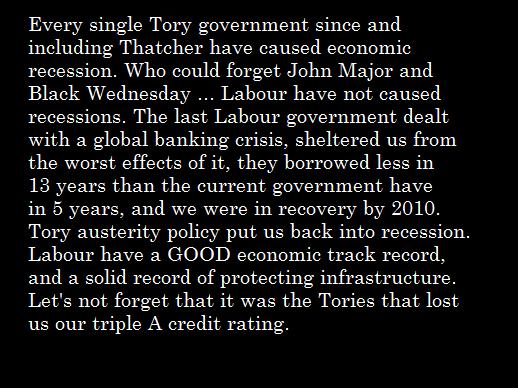
econ lies

The Tories have seized an opportunity to dismantle the institutions they have always hated since the post-war social democratic settlement – institutions of health, welfare, education, culture and human rights which should be provided for all citizens. The Tories attempt to destroy fundamental public support for the health, education and welfare of its people. Offering and inflicting only regressive, punitive policies and devastating cuts, the Tories lie, lie and lie some more to attempt to justify the unustifiable.

proper Blond

The Conservatives have not encouraged investment in the UK either:


The Tories have told many lies. Here’s a list of those that have earned them official rebukes – A list of official rebukes for Tory lies.

Further reading:

The Austerity Con Simon Wren-Lewis

The Tory election strategy is more of the same: Tories being conservative with the truth.

The Great Debt Lie and the Myth of the Structural Deficit.

One of the most destructive Tory myths has been officially debunked.

“The mess we inherited” – some facts with which to fight the Tory Big Lies.

Political scrapbook: Telegraph business leaders letter ‘was padded out with Sam Cam’s luvvie friends’

Follow the Money: Tory Ideology is all about handouts to the wealthy that are funded by the poor.

The word “Tories” is an abbreviation of “tall stories”.

10689499_731152076954323_875040546185242333_nWith thanks to Robert Livingstone 

Narxism


10534673_673759979360200_9173930462113592426_n

Socialism is not just about what you believe or what you say, it’s about how you see, treat and relate to OTHERS.

Socialism has never been about division and exclusion, yet there are some that have rigid ideas about who and what can properly be labelled “socialist.”

I call this elitist perspective “narxism,” as protagonists, drawn from several scattered, disparate camps, tend to be perpetually disgruntled, often aggressive and they don’t half nark a lot. Narxists tend to have a highly selective, limited and unsophisticated grasp of what Marxism entails. They tend to use nasty personal insults and call you a “class traitor” in discussions, which is a tactic aimed at closing down debate.

Included under this rubric are some of the neomilitants, Trotskyists, nationalists, some of the more nihilistic anarchist revolutionaries, some of the Greens and the “none of the above” group. (NOTA, who advocate voting for no-one in order to register “protest” but end up helping the Tories back into office.)

vote
Robert Livingstone compiled a list of some of the various fringe parties, each claiming left-wing status: Behold, the united Left.

Oh, and there’s The People’s Front of Judea.  Image result for small wink emoticon copy and paste

We certainly don’t need any more new parties of the Left: what we do need is people that are willing to get behind Labour, to contribute and to take some responsibility by having a positive input – to engage in democratic dialogue with the Party – rather than expecting some silent and spontaneous process of political osmosis to happen.

A Labour government would be only a starting point for us to build a strong movement, not an end to our effort. They are certainly not the best we can do, but they are currently the most viable challenge to the Conservatives that we have, and their policies would make things easier for many people currently struggling under the authoritarians. Not ideal, but an improvement on what we have now. For the moment, we only have an available route comprised of small steps.

Meanwhile, we can contribute to setting a policy agenda and shaping priorities. Democracy doesn’t just happen to us: it is an ongoing process that requires our responsibility-taking and active participation.

There are some people amongst the various fragmentary fringe groups that state plainly they would rather see another Tory government than see the Labour Party in Office, some believe that this will “speed up the revolution”, others think that another Tory term will push Labour far left, sufficiently enough to fulfil their own personal wish list of limited, undemocratic, identity politics; reflecting undemocratic, cherry-picked ideals and an aggressive, highly circumscribed kind of socialist perfection.

Over the last five years, we’ve seen the public view shift rightwards though the Overton window. Many welcomed the welfare “reforms”, for example. If the Tories get back in office again this year, it will be almost impossible to get them out by 2020. There’s already a big gap opened up between electoralism and ideological integrity. Meanwhile, the Right only push further rightwards. That process will continue to factionalise the Left. It will continue to polarise the moderates and the socialists. It will ultimately fragment the Labour movement.

Narxists don’t like to be inclusive, they tend to see socialism as some kind of exclusive, highly idealised, olden-days “working class” club with a membership of people that use a distinctive and adapted language, incorporating heavily utilised and negative terms such “blue labour,” “red tories,” “new labour,” “tory lites,” and they also have a penchant for endless unforgiving discussion of both Clause 4 and “Tony Blair” (Blair blah blah…). Sure some things should change, but we need to take responsibility for making that change, instead of simply bleating about all that’s wrong.

Narxists tend to spread a lot of propaganda and outright lies, which they often parade as “criticism.” Narxists can become very aggressive and personal when their continually repeated soundbites are effectively challenged with solid evidence. That gets us nowhere fast. And it’s not very genuinely socialist either.

There is an identifiable strand of classist anti-intellectualism amongst the narxists, too: an inverted elitism. It’s something of an irony to hear that Labour are “no longer the party of the working class”, when you consider that Marx, who is quoted quite often by such ideological purists, wasn’t remotely “working class”, nor was Engels, for that matter. Or Kropotkin and Bakunin, whose family owned 500 serfs. Most academic neo-marxist theorists were terribly middle-class, too, you know.

1796655_294409220710133_3373329_n
Narxists claim to be “real socialists.” Yet in their insistence on orthodoxy and their quest for a kind of socialist supremacy, the claim to being “principled” does not generally extend to those foundational socialist values of collectivism, cooperation, organisation and unity. Instead we see a mandatory ideological purism, monocratic perfectionism and bellicose individualism rather than collectivism, that simply divides the Left into competitive factions, which serve only to dilute and disempower us, ultimately.

Narxists seem to have no awareness that the world is populated by others, and it really has moved on. Nor do they seem to pay heed to the more pressing circumstances we currently face. Sick and disabled people are being persecuted by our current Tory-led Government, and many have died as a consequence of this Government’s welfare “reforms.” Many are suffering distress and hardship, and that must stop.

For the record, I hate party politics. My own political inclinations lie somewhere along an anarcho-socialist axis. However, I’m a realist, for the moment the only viable means we have of improving social conditions is to vote, whilst organising, awareness-raising, agitating and promoting progressive ideas for positive change.

Who we choose to vote for has profound implications for everyone else, too. This is the most important general election of our lifetime: the outcome will have historic ramfications. It will affect generations to come. If we allow the Tories another unforgiving (and unforgivable) five years, our once progressive and civilised society will be reduced to a neo-feudalist hinterland, where market forces maintain serfdom and increase pauperisation for the majority and the government of aristocrats select who lives and dies.

Remarkably, narxists prefer to endlessly criticise Tony Blair, who left the building some years back, rather than address and oppose the atrocities of the current government. We have an authoritarian government that are unravelling the very fabric of our once civilised society, dismantling democratic process, abusing human rights and destroying lives. People really are suffering and dying because of Tory policies. The typified, dogmatic response from Narxists everywhere? “Yeah, yeah, but I won’t vote for Labour, because that Tony Blair was a tory lite….” or “Yeah, but they’re all the same…” Ad nauseam.

Oh but they are not the same at all.

And the Labour Party has moved on since Blair.

The only viable means currently available to us of preventing another five years of Tory dystopic vision being realised and the destruction of all that reflects the very best of our society – the blueprint of which is our post-war settlement – is a collective act: a Labour vote. The electoral system is the way that it is – we don’t have proportional representation – nonetheless, we have to use what we have intelligently , strategically and conscientiously. For now. Small steps.

I didn’t like Tony Blair either. I am strongly opposed to neoliberalism more generally, and felt he betrayed the working-class by advocating an economic system that invariably creates social hierarchies of wealth. Some of his social policies were okay. But this isn’t about dogma: it’s about doing the very best we can, acknowledging our circumstances. There is so very much at stake. The Tories want to completely destroy our NHS, public services and support provisions. They want to repeal our Human Rights Act and withdraw from the European Convention. Many of us won’t survive another Tory term. Unfortunately, I don’t see a revolution on the horizon. I do see a very fragmented, disillusioned, apathetic, disengaged and indifferent population.

We need to be responsive to our current situation – in the here and now, and clinging to tired and past-their-usefulness doctrines isn’t going to achieve that. The world has moved on, we have to adapt, respond and move with it.

Let’s try for some genuine solidarity, let’s unite in our common aims, let’s recognise our basic similarities as fellow humans with the same fundamental basic needs, and fight the real enemy, instead of bickering about what socialism is or ought to be about, and what our only current hope – the Labour party – ought to adopt as its brand and mantle. We don’t have a choice, we have to be strategic and tactical at the present. It sucks, but that’s how it is.

Socialism isn’t about what we think and say: it’s about what we DO. Collectively, and for each other.

I’m not a Blairite, but I’m no “Narxist” either. Socialism isn’t about ideological purity, it isn’t about what you think or say, or even what you want: it’s what you DO. It’s about how you relate to others and how you view community and society. It’s about solidarity, cooperation, mutual aid and all of those other values that we should practice instead of just preaching. It’s not ever about competitiveness and exclusivity.

The hardline “real socialists” have damaged our movement every bit as much as “blue labour” have, in their advocacy of factionism.

Without cooperation, solidarity and unity, the Labour movement will die. That must not happen.

In solidarity.

Upwards and onwards.

Related

Osborne’s Autumn statement reflects the Tory ambition to reduce State provision to rubble

Human rights are the bedrock of democracy, which the Tories have imperiled.

47 more good reasons to vote Labour

The moment Ed Miliband said he’ll bring socialism back to Downing Street

Ed Miliband’s policy pledges at a glance

Electioneering and grandstanding: how to tell the difference between a moral political party and a moralistic one.

You’d have to be Green to believe the Green Party: two more lies exposed.

 10635953_696483917087806_7307164383030383606_nMany thanks to Robert Livingstone for his brilliant memes

It’s about time the Green Party stopped their compliance with the Conservatives

10940505_767712909964906_6225427822143651262_n

“Of all tyrannies, a tyranny sincerely exercised for the good of its victims may be the most oppressive.”  C.S Lewis.

Following her election as party leader, Natalie Bennett told a press conference that the policies of the Green Party were “the only viable way forward for British people, for the world.”  It is extremely presumptuous of people to claim to act for “the people” when they seem to despise the ideology of a large part of “the people.”

Much Green Party policy and philosophy seems to be essentially grounded in a sort of eco-supremicist bad faith. We consume too much. (Who does, exactly? ) And no matter how much the Greens try to distance themselves from the stigma attached to Malthusianism there is no escaping the fact that arguments about consumption and population are inextricably linked.

Tristam Hunt recently described the Green Party as “stop-the-world-I-want-to-get-off politics.” Apt for what is ultimately a politics of perpetual bad faith and lip-curling disapproval of others. The language used to describe other parties by grassroot supporters betrays this and lends to the Green Party worrying characteristics of cult thinking.

The ecology movement will never gain any real influence or have any significant impact on society if it advances a message of despair rather than hope, of a regressive and impossible return to primordial human cultures and sensibilities, rather than a commitment to human progress and to a uniquely human empathy for life as a whole. I agree with the following:

“I can easily understand why despair exists among mystical ecologists – indeed, in the environmental movement generally – over the impact of a grow-or-die capitalistic economy on the biosphere and on the human psyche. While a patronising, quasi-religious often misanthropic ecology that denigrates the uniqueness of human beings and the wondrous role they can play in natural evolution may be an understandable response to that economy, it is a flat denial of humanities’ most human potentiality: the ability to change the world for the better and enrich it for all life forms.

We must recover the utopian impulses, the hopefulness, the appreciation of what is good, what is worth rescuing in human civilization, as well as what must be rejected, if the ecology movement is to play a transformative and creative role in human affairs. For without changing society, we will not change the disastrous ecological direction in which capitalism is moving.” – Murray Bookchin, 1991

In an article titled: In response to the Socialist Party of GB’s slur on the Green Party & Ecosocialism, Martin O’Beirne writes:“We also need a mass movement against climate change and to promote new ways of existing, prefigurative, perhaps moneyless, primitivist, eco-technic or some combination. Something that points the way to that which can exist beyond capitalism.”  He went on to say: “Capitalism and consumerism, manufacturing consent, keep the multitude docile chasing trinkets and so on.”

In other words, most of us are stupid, and need “fixing”. Not moral, progressive, socialist proposals, but rather, moralising, regressive ones.

The Green Party have gathered up many dislillusioned ex-Liberal Democrat voters, the ones who haven’t learned from last time that like the Liberal  Democrats, any party that tries to appear to be all things to all people is not being honest with you.

Badly disappointed idealists most readily succumb to the depths of disillusioned, resentful cynicism. The Greens are very busy trying to hoover up the votes of all of those disillusioned souls on the Left, and regardless of the potentially devastating consequences that may have on the election outcome.

The pressing issue for me is that people are suffering, some have died because of Tory policies, our society is being fundamentally damaged, and to the point where it will soon be impossible to repair it in our lifetimes. The damage will be lasting, probably for more than one generation. I care about that. I care about the suffering, growing inequality, the re-appearance of absolute poverty, not seen in the UK since the 1930s, and the damage to our society and country.

I’m a socialist because of those long-standing concerns, which transcend the parochial and actually, they transcend party politics. What matters to me is ensuring that we vote intelligently for the best possible outcome we can, especially for those who are suffering greatly because of the current government. I am fundamentally cooperative and community-minded. I care about what happens to others.

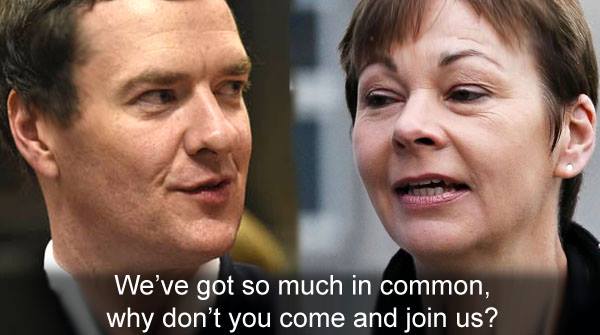
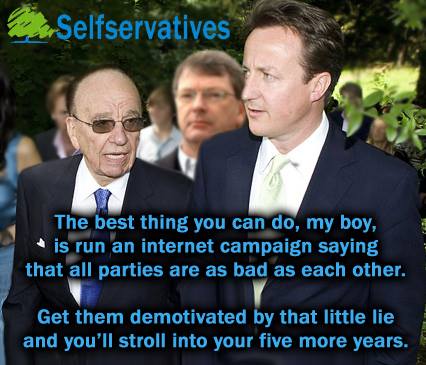
Cameron has made no secret of the fact he is playing up the Greens’ potential for influencing and eating into Labour voters. It was very apparent when he refused to appear in TV debates unless Bennett is also invited to take part. The Conservatives’ sudden pro-Green tactics, focusing on the party’s exclusion from the debates, and some Tory MPs suggesting left-wing voters in their constituencies vote Green instead of Labour, are pretty transparent.

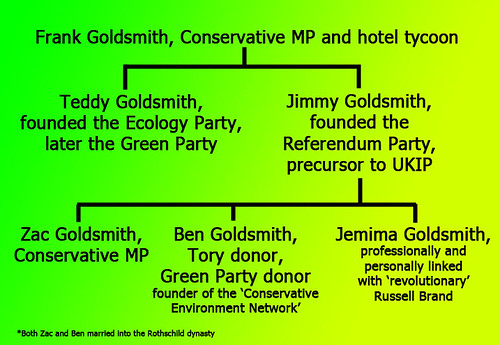
All this from the prime minister who dismissed environment policy as “green crap” not long ago. It isn’t just the Tories displaying utter cynicism, here. The Greens are too. They have attempted to account for their unlikely alliance with the Tories by claiming that the Green Party sees itself as having a role to put pressure on Labour to become more “progressive”  However, the Greens themselves are not progressive at all. As their roots indicate, as much as their policies:

goldsmith greenHow about putting pressure on left-wing voters to divide them, with the likeliest outcome of allowing another Tory government? It’s rather pointless trying to claim the Greens are “pushing Labour left” when the outcome of that is likely to bleed votes from Labour, ultimately.

And that attempt at explanation of the fact that the Greens attack and undermine Labour, rather than the Tories conveniently circumvents the fact that the Green Party tell intentional lies about Labour’s policies. A genuine attempt to influence Labour policy would entail negotiation and co-operation, not constant, hostile undermining tactics, coupled with an alliance with the Tories.

The Greens are not cooperative or community-minded. They are dividing our opposition to the Tories and risking returning Cameron to Office in May. They prefer to undermine the Labour Party, because they are purely electioneering, rather that directing challenges at the Tory-led Coalition. That is not “socialist”.

How “socialist” is it to join ranks with the party inflicting all of that damage and harm on people of this country to attack and undermine the only viable alternative to the tories? That’s not genuine politics, that’s grandstanding. It’s not “socialist” at all.

Jon Ashworth, Labour’s shadow Cabinet Office minister, said: “David Cameron’s new-found affection for the Green Party is nothing short of political opportunism. If you ever needed proof that a vote for the Greens is a vote for David Cameron, this is it.

The Tories and the Greens seem to be working hand-in-hand. The Tories need the Greens because they are scared to run on their own record. The Greens need the Tories because Labour is the only party with a progressive policy agenda.”

You can’t claim to be a “progressive ” political party and at the same time advocate zero growth and parochialisation – to cut us off from global trade. The Green Party says: “In our Green vision for Europe we seek to replace the unsustainable economics of free trade and unrestricted growth with the ecological alternative of local self reliance and resource conservation, within a context of wider diversity.” That’s a clear step back from internationalism and forwards towards parochialisation. It’s not progressive at all to shut out the rest of the world. And socialists have always been internationalists. The Green Party, on the other hand, find natural allies with nationalist parties such as the Scottish National Party (SNP).

The economy matters to every country in the world and no growth or low growth economies invariably mean high unemployment, increased inequality and increased absolute poverty. There are a variety of ways by which governments may mitigate social inequality. It’s known that Countries with a left-leaning legislature have lower levels of inequality. Many factors constrain economic inequality – they are often divided into two classes: government sponsored, and market driven. The relative merits and effectiveness of each approach is of course debated.

Government initiatives to reduce economic inequality include: public education: increasing the supply of skilled labor and reducing income inequality due to education differentials.

Progressive taxation: the rich are taxed proportionally more than the poor, reducing the amount of income inequality in society if the change in taxation does not cause changes in income. These form the basis of  Miliband’s approach, with his proposals for redistribution via a very progressive tax system. This is why tax-dodging billionaires  such as Stephano Pessina are complaining about Labour’s genuinely coherent, costed, evidenced, progressive equality-focussed redistributive tax policies, and not Green Party policies.

Market forces outside of government intervention may also reduce economic inequality, including the propensity to spend. The Green Party, however, does not support any of these options. Their anti-growth, anti-consumption starting point excludes all of these measures. Their key policy  proposal – Universal Basic Income – was shown to be so flawed that the Greens announced it is to be withdrawn from their manifesto.

Bennett has tried to brush aside criticisms that her party’s policies would lead to economic catastrophe, emphasising the Green’s stance against materialism. “People don’t just want to work to earn more and more money,” she said. “They want to do other things that often now aren’t recognised and valued.”

However, an isolationist zero growth economy would be a disastrous experiment, just like the austerity measures have been – with the same outcomes. The Green Party does not present a single coherent policy that may be deemed a viable alternative to austerity, yet it claims: A real change: from austerity and welfare cuts to investment in decent jobs.”

Not only would the Green Party’s anti-progressive zero growth economy create high unemployment, it most certainly create deep recession and the policies are cumulatively pro-austerity, in that they advocate inhibiting public spending on consumer goods.

The Green Party fail to show us any understanding of imbalances of power, they provide no class analysis, they aren’t connected with marginalised groups, they don’t reflect their needs and they clearly have no understanding of the mechanics and virtues of redistribution. There isn’t a single policy currently in their manifesto that demonstrates a coherent offer of support to very poorest. That isn’t “socialist” at all.

The Greens grew out of the environmental movement, with David Icke at the helm as a spokesperson, well, until they got embarrassed by him and sacked him. As Suzanne Moore commented, the incoherence is even apparent at how they fail to define the State. They offer the biggest of big-state polices with huge intervention in some areas, without specifying the role of the state except as a series of committees. It’s a curious mix of immense levels of authoritarian state control over our private lives, a strongly moralising approach, alongside a moral relativism towards things like sex industry, terrorism and crime. Page 3 is frowned upon, but how can prostitution be regarded as any less economical exploitative of women? That’s certainly not coherent policy-making.

The Green’s “anti-austerity measures” seem to translate as “taking on corporations and vested interests.” But Miliband has already explicitly stated (and shown) that he will do that. (He already has – Leveson, the banks, the big power companies, water companies, to name a few)

The Green Party’s key policy idea – that of a Citizen’s Income for everyone whether they work or not – sounds so great on the surface. Just like a lot of their rhetoric and policies, it lacks depth and doesn’t connect up – it lacks integrity and falls to pieces when properly examined. Many of the poorest households would lose out. Most wealthy households will gain. How does that address inequality – something the Greens claim to be concerned about?

The “citizen’s income” of just £71 a week, at an annual cost of £280billion would replace existing welfare payments such as personal tax allowances and means tested benefits such as income allowance and jobseekers benefit.

It was a popular policy during the 1990s, with notable libertarian economists on the Right, such as Milton Friedman (the founding father of monetarism) favoring the model as a type of negative income tax. Friedman attacked the very notion of Social Security, stating that it had created welfare dependency. Friedman’s political philosophy extolled the virtues of a free-market economic system with minimal state intervention. Friedman proposed the replacement of the existing U.S. welfare system with a negative income tax, a progressive tax system in which the poor receive a basic living income from the government.

The Liberal Democrats have included similar policies in their manifesto in 1996.

The Citizen’s Income Trust (CIT), which has given advice to the Green party (and has also been repeatedly cited by the Greens a credible source), has modelled the Green Party scheme and discovered it would mean 35.15% of households would be losers, with many of the biggest losers among the poorest households.

The Trust’s research shows that for the two lowest disposable income deciles, more than one-fifth would suffer income losses of more than 10%.

If anything, this policy will EXTEND inequality.  That’s not very “socialist”.

Many critics of the Green party point to their many failures in Brighton and Hove, where they couldn’t even get the rubbish collection right. However, the most damning criticism – their fundamental inability to run services for the most vulnerable – is the one that ought to concern us the most. That’s not very “socialist.”

Using minorities as nothing more than political props and tools. That’s not very “socialist”.

During a recent interview, with the Times, Bennett defended commitments to decriminalise membership of terrorist organisations, possession of drugs, and prostitution, as well as promising to abolish the monarchy and remove the Queen from Buckingham Palace.

Bennett said: “I can’t see that the Queen is ever going to be really poor, but I’m sure we can find a council house for her.”

The remark appeared to be a glib, clumsy attempt to grab some media attention, given the Queen’s private wealth. As far as an appeal to juvenile anti-establishmentarians go, it was probably a successful glib, clumsy remark. The Green Party’s stated policy on the monarchy is that it should cease to be an office of government and that the property held by the royal family should be divided between that required for the private life of current members of the family, with the remainder to become public property. Not sure I could use any staff, spare tiaras or corgis, personally, but thanks for the thought.

The Tories have trashed the economy, damaged the very structure of our society and destroyed people’s lives. We’ve seen the return of absolute poverty, malnutrition and illness, such absolute poverty-related illness has not been seen since Victorian times. People have died as a consequence of Tory policy.

What do the Greens do? Bitch about LabourMany thanks to Robert Livingstone for his excellent memes

Old New Labour: some thoughts on myths, strengths and weaknesses.

1044468_500666173336249_1718830491_n

Most people like to criticise New Labour. In political debates with the right, and people loosely assembled on the “left” and pseudo-left, with a variety of affiliations, ranging from the Green Party, the SNP, the Socialist party, TUSC, Left Unity to UKIP and the Judean People’s Popular Front, you can bet your bottom, top and middle dollar that Tony Blair will be wheeled out and painted in curses as the High Priest of “neoliberalism” sooner rather than later, I set my watch and warrant on it. But it’s become difficult to separate party politicking and opportunism from the genuine and useful commentaries.

Labour Party supporters and members also criticise Blair, of course. Quite properly so. However, it’s about time we learned that in order to learn constructively and move on, we must also balance those criticisms with some acknowledgement of New Labour’s achievements. We have tended to focus on the negatives. That puts us in a defensive position – apologising endlessly for the same things over and over again, and it’s difficult to advance from such a position. Even the term “Blairite” has become a deprecatory one. Yet Blair gave us the Good Friday Agreement, Every Child Matters, the Equality Act, the Human Rights Act, the Gender Recognition Act, the Fox Hunting Ban, among many others.

This said, much of that depreciation is probably justified, but not fully. I’ve watched centrists and those of us further left polarise more and more, and that can only weaken us and lead to diversionary infighting in the long run. Our focus ought to be on making progress, not on “Progress.” I have nonetheless been concerned that the core of centrists have contributed to negative media campaigns directed at the left of the party. But this said, some of the more aggressive amongst the so-called “hard left” haven’t done the party any favours either, on the whole. For the record, the “hard left” are also in a minority. Most of our membership are anti-neoliberals and occupy a loose left of centre position, which is not the same as “hard left”.

No party is or ought to be above criticism, but it’s not wholly constructive or appropriate for Labour to be placed in a position of endlessly defending itself from critics for the same misdemeanor from years ago, over and over, because New Labour also had some rarely mentioned, outstanding and comprehensive flagship policies and achievements very worth celebrating, such as the Climate Change Act, free prescriptions for people being treated for cancer or the effects of cancer and many more. Despite the shift towards neoliberal values on an economic level, (and even much of that was a media manufactured consensus) after the heavily and relentlessly neoliberalising Thatcher years, most of Labour’s social policies have never relinquished our core values of equality, inclusivity and valuing diversity, human rights, cooperation, support of public services and all that our post-war settlement entailed.

It’s worth keeping this in mind now that we have moved on and approach the General Election, just a few months away. If we don’t, we will simply see the Tories returned to office, with more devastation being inflicted on the country to follow. We do need to think more strategically here and spend a vote on something better than that.

And no, I’m not a “Blairite”, just someone who likes to analyse in a conscientious, honest, thorough and balanced way. I’m not a “black and white”, reductionist thinker. People are rarely one just thing, they don’t have only one quality or characteristic, political parties possess a similar kind of complexity. I’m much further left than Blair, with some anarchist principles chucked in the mix. I believe in participatory democracy, and I’m also an advocate of prefigurative movements. If we want a society that is more tolerant and equal, for example, we must practice what we preach and treat others with tolerance and regard them as having equal worth. We must be the change we want to see.

Blair’s policy virtues – which are manifold – seem to have dropped out of our collective memory. Ask a psychologist, and they’ll explain this as a cognitive bias whereby certain positive associations, or in this case negative ones, disproportionately colour an overall opinion about someone.

The Iraq war presents the cognitive short-cut when we talk about Tony Blair. Indeed, the aftermath of Iraq has been so appalling that it has even distorted our understanding of Blair’s role in the war itself. Regardless of how it started and worked out, the 2003 invasion evolved from a debated and democratic parliamentary decision. I didn’t like that decision. Many of us didn’t. Many in the Labour party broke ranks and voted against the war, all of the liberal democrats also did. The Tories all voted for the war.

Most major intelligence agencies also believed that Saddam Hussein had weapons of mass destruction – many of Saddam’s generals believed he did. This probably wasn’t a lie fabricated by Blair’s inner circle. That doesn’t mean he didn’t get it wrong, however. He very clearly did.

But it’s also worth considering the fact that Thatcher and other western leaders sold Saddam Hussein the materials to build weapons of mass destruction, including the components for chemical weapons, which were used in a genocide campaign against the Kurdish people. Without that, the first Gulf War under John Major would never had been deemed “necessary.” That war was equally unforgivable. I don’t think the second war would have happened either. The Scott Report brought to light the illegal arms sales from the early 80s, and it undoubtedly contributed to the confusion about Iraq’s capabilities and arsenal. There’s a much bigger picture which also needs some scrutiny. Blair was by no means the only one who should be held accountable for what has happened in Iraq.

Of course, a lot of the intelligence was wrong, we learned in hindsight. However the evidence from the UN and other sources showed that Saddam planned to develop nuclear and other weapons of mass destruction as soon as sanctions yielded. Chemical weapons, which are weapons of mass destruction, had already been deployed against the Kurds. The attacks killed at least 5,000 people and injured 7,000 to 10,000 more, most of them civilians. Thousands more died of complications, diseases, and birth defects in the years after the attack. Dead livestock, contaminated land and subsequent grinding poverty is still a problem in the villages that were attacked, too.

The incident, which has been now officially defined as an act of genocide against the Kurdish people, was and still remains the largest chemical weapons attack directed against a civilian-populated area in history. The Halabja attack has been recognised by the UK, amongst other countries, as a separate event from the Anfal Genocide  – also known as “Chemical Ali” due to the use of chemical weapons, too – that was also conducted against the Kurdish people by the Iraqi regime under Saddam Hussein.

Furthermore, the New York Times and other sources reported recently that from 2004 to 2011, UK and American-trained Iraqi troops repeatedly encountered, and were wounded by, chemical weapons remaining from years earlier during Saddam Hussein’s rule. American troops reported finding roughly 5,000 chemical warheads, shells or aviation bombs, according to interviews with dozens of participants, Iraqi and American officials, and heavily redacted intelligence documents obtained under the Freedom of Information Act.

140 Labour MPs voted against the Iraq war. I protested against it, as did many of us. But nonetheless I would have an accurate and reasonable account of it, rather than some of the almost hysterical accusations of “war criminal”, “illegal war” “there were no weapons of mass destruction” and so forth, that I very often see. It’s far more complex and horrifying than that.

Like him or loathe him personally, by all means, disagree with and protest the invasion of Iraq, sure, but you ought not let that interfere with being honest and objective about policies and events. It’s great myth that Blair didn’t achieve anything in whilst office; the truth is he fundamentally transformed the country after the Thatcher and Major years. And the Tories really DID leave a “mess”.

It’s not just the Good Friday Agreement, workers rights, tax credits and the minimum wage either, that credit him: he left a vast legacy. Civil partnerships. Bank of England independence. The Welsh Assembly. The Scottish Parliament. Every Child Matters. A mayor of London. A plunging crime rate. Abroad, his brand of interventionism in Sierra Leone and Kosovo successful. He is a hero to Kosovan Albanians, many of whom have named their children “Tonibler” in his honour (well, according to Charlie Burton of GQ fame). Personally I object to wars on principle. But that includes John Major’s Gulf War, which many seem to have forgotten about, and Thatcher’s Falklands war. I also object to illegal arms deals with known despots. I mean, what could possibly go right there? If we want to avoid wars, we need to ensure those most likely to start them aren’t handed weapons of mass destruction from “free marketing” western leaders.

I remember that we didn’t need austerity measures under Blair or Brown, despite the depth of the global depression. That in itself tells us that Tory austerity is entirely ideological. Blair and Brown protected citizens to a considerable degree against the worst ravages of deep global recession. This is something many seem to have forgotten, too. Brown instead proposed an economic stimulus, which is the use of monetary or fiscal policy changes to kick-start a struggling economy. Governments can use tactics such as lowering interest rates, increasing government spending and quantitative easing, to name a few, to accomplish this. Our public services were not cut, Labour continued to invest in them.

I think the myth that Labour “borrowed excessively” has been well and truly exposed, since it’s become common knowledge that the Coalition has borrowed more in just 4 years than the last government, indeed, the Tory-led government borrowing has exceeded that of  every single Labour government combined since 1920.

Thanks to the Labour government’s excellent management of the consequences of the global crash caused by the banks and financial institutions,  we were out of recession by 2009. So the Tory austerity measures, which targeted the poorest people, were completely unjustifiable. Osborne used the “bankrupcy lie” to legitimise an entirely ideological Tory-led program of “shrinking the state“, cutting social support for those who need it and slashing public services. However, whilst the poorest paid dearly, this government handed out £107, 000 each per year to millionaires in the form of a “tax break”.

Cameron has been rebuked twice for lying about “paying down the debt” already. The national debt is still rising. It currently stands at more than twice its level than when the Coalition took office.  Osborne is responsible for more debt than every Labour chancellor in history combined. Even the staunchly Tory Spectator commented that it’s “… a depressing point: the Tory leadership is prepared to use dishonesty as a weapon in this election campaign.”

Miliband denounced New Labour in 2010 and has done so since. He presents a break from the established neoliberal paradigm, which is why the establishment hate him so much. Miliband will extend the best of our long-standing tradition, whilst learning from the worst of our mistakes. His tax proposals, for example, are progressive and fair. His proposal to implement the Leveson recommendations is also a plus. He demonstrated learning from the past when he took a principled stance on Syria in 2013 and led a rebellion that even included some Conservatives, too. Cameron was furious at the time with Miliband, because he was thwarted, and cleverly.

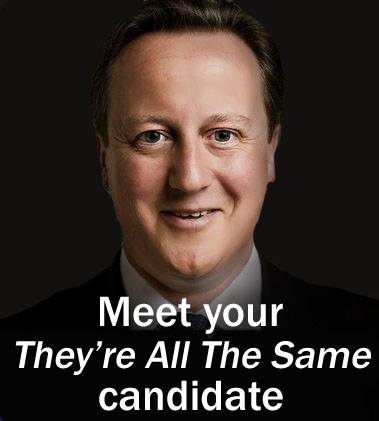
Anyone still believing the biggest myth of all: “allthesame”, needs to actually look at a comparison of policies here, and read this: The ultimate aim of the “allthesame” lie is division and disempowerment of the Left.he

The Labour Party have moved on, progressing since 2010. We need to do likewise. They aren’t perfect and certainly not the solution to everything that’s wrong. But a Labour government would be a start for us to build a strong, united labour movement. We would have a bigger platform from which to push for our common aims of social justice, equality, civil rights and so on. If the Tories remain in power, we will continue to become fragmented, isolated, increasingly silenced and disempowered. My view is that sometimes we have to vote for what’s better for us all, rather than what’s our own prefered best. Taking small steps in a much bigger journey, closing the gap between the ideal and the real is better than seeing the regressive Tory authoritarians returned to office on May 7.

Until ALL of us on the Left learn a little about strategy, learn to look at a bigger picture, learn to organise and unite, the country’s nightmare fate is endless authoritarian neoliberal Tory governments.

14533697838_dffcc736f2_o (1)

Many thanks to Robert Livingstone for his excellent memes

The moment Ed Miliband said he’ll bring socialism back to Downing Street

1796655_294409220710133_3373329_n

One of the most frequent and misinformed comments I see about the Labour Party is “Oh, but they aren’t socialist enough.”  My standard response is to post Labour’s policy proposals, because the people who raise this complaint most often can’t name even one of the policies. Then I try and engage in a discussion about what the policies are about – the implications and social consequences of them, and what they reflect about the Labour Party.

I often waste my time, because the people usually making this claim are defensive None of The Above protagonists, or Green and Scottish National Party  supporters, who have no intention of genuinely discussing anything critically, they offer dogmatic, propaganda-styled soundbites instead, designed to mislead. Yet they ought to be our natural allies, and invest some time in attacking the Conservatives regarding their austerity cuts and idiosyncratic brand of anti-democracy instead of telling lies about the Labour Party.

10534673_673759979360200_9173930462113592426_n

The following short article is from Fraser Nelson, published in the right-wing Spectator last year.

What’s Ed Miliband about? In a word: socialism. You can think this a good or a bad thing, but there ought to be no doubt about where he stands. At a Q&A in the Labour conference last night, he was challenged by an activist: When will you bring back socialism?’ ‘That’s what we are doing, sir’ Miliband replied, quick as a flash. ‘That’s what we are doing. It says on our party card: democratic socialism’. It was being filmed, and your baristas at Coffee House have tracked down the clip as an exclusive. This little exchange will perhaps tell you more about Ed Miliband and his agenda than much of the over-wrought character-spinning stunts you can expect to see this week.

It was no slip of the tongue. Miliband’s fidelity to socialism is explained by his definition of it – as he says on the clip. He seems to regard ‘socialism’ as synonymous with justice, and ‘capitalism’ with injustice. When interviewed in the Daily Telegraph by Charles Moore this time last year, he put it thusly:

“Isn’t the great lesson from his parents’ that socialism was a god that failed? ‘No!’, exclaims Ed Miliband vehemently, because socialism is not a rigid economic doctrine, but ‘a set of values’ It is ‘a tale that never ends’. Indeed, the strange fact is that ‘While there’s capitalism, there’ll be socialism, because there is always a response to injustice.”

Miliband’s father, Ralph, was made famous by his book Parliamentary Socialism. His 1993 book, Socialism for a Sceptical Age, was about the continued relevance of socialism in a post-communist world. Ed Miliband has said that the final few sentences of this book are his favourites of all his father’s work:

“In all the countries there are people in numbers large and small who are moved by the vision of a new social order in which democracy, egalitarianism and co-operation – the essential values of socialism – would be the prevailing values of social organization. It is in the growth of their numbers and in the success of their struggles that lies the best hope for mankind.”

Miliband considered his father too dogmatic and sectarian on many things, but agreed with him on this. And personally, I’m all in favour. There is a long history of British socialism, which Ralph Miliband did much to document.

Mr Miliband makes no bones out it in conversation. Many of his enemies say he has no principles at all: this is flatly untrue. For all his faults, Miliband does not lack ideological direction. It’s pretty clear that Ed Miliband regards himself as the man who’ll bring socialism back to Downing St.


scroll2


Ed Miliband has pledged to take on “vested interests” and “powerful forces” in his bid to win the next general election. Not even the Crosby and Murdoch-orchestrated media campaign, which was aimed at demoralising, undermining and monstering Ed Miliband can disguise the fact that the Tories are in a state of panic.

In fact the media campaign, aimed at attempting to undermine Miliband’s credibility as a leader, arose precisely because Miliband is the biggest threat to the UK power base and status quo that we’ve seen for many decades. He’s challenging the neo-liberal consensus of the past 30 years – now that is a plain indication of strong leader, and someone with personal strength and courage.

Related

The establishment are ‘frit’ because Ed Miliband is the biggest threat to the status quo we’ve seen for decades

Ed Miliband’s 10 Biggest Successes as Labour Leader, at a glance – LabourLeft

Ed Miliband’s policy pledges at a glance

46 more good reasons to vote labour

See video: Ed Miliband in a Q&A at the 2013 Labour Party conference in Blackpool


10359559_723668077702723_4383422308887814918_n

Thanks to @LivingstonePics

One of the most destructive Tory myths has been officially debunked

1450041_569755536427312_1698223275_n

The Organisation for Economic Co-operation and Development (OECD) has discovered what most of us already knew: that income inequality actually stifles economic growth in some of the world’s wealthiest countries, whilst the redistribution of wealth via progressive taxation and benefits encourages growth.

The recent report from the OECD, a leading global think tank, shows basically that what creates and reverses growth is the exact opposite of what the current right-wing government are telling us, highlighting the truth of Miliband’s comments in his speech today – that the Tory austerity cuts are purely ideologically-driven, and not about effectively managing the economy at all. But again, many of us knew this was so.

The Labour Party’s economic plan, based on progressive taxation, equality and funding of public services is the best way forward for economic growth and social stability. The Conservatives have killed the potential for a sustainable economic recovery, and will continue to do so, because they promise endless austerity. This is rather akin to treating a disease with more disease.

Osborne’s economic policy is comparable with riding the fabled rubber bicycle.

We aren’t going anywhere.

The report showed evidence that the UK would have been at least 20 percent better off if the gap between the rich and poor hadn’t widened since the eighties under Thatcher, and successive Conservative administrations – the most recent having reversed the equality measures put in place by Blair. (Yes, he really did).

Prior to the global recession, the Tories said they would match the Labour government’s state spending and suggested they may even further it. However, when the global crash happened, a sudden opportunity presented for Tories to become fully-fledged… Tories, grinding their ideological axe, taking a neoliberal swing at the “bloated” public sector and at Labours’ public spending for the protection of public services and the most vulnerable citizens during the economic crisis.

It’s worth remembering that the Coalition has borrowed more in just 3 years than Labour did in 13. In fact Osborne has borrowed more than every Labour government since 1900 combined. And the current government have nothing to show for it, whereas the Labour government at least adequaltely funded public services and effectively sheltered the poorest citizens from the worst consequences of the global crisis.

Let us not forget that this feckless government inherited an economy that was in recovery. They destroyed that and caused a UK recession by imposing austerity, savagely cutting public spending and public services. Thatcher used the same basic strategy to redistribute public wealth to private bank accounts and create inequality, although she didn’t cut as deeply. It didn’t work back then either. She caused a deep recession, as did John Major – Tories being Tories.

Let us not forget that despite the finger-pointing blame game that the Conservatives indulge in – their perpetual attempts to undermine Labour’s economic credibility and bolster their own ineptitude – that it was Osborne that lost the triple A Fitch and Moody credit ratings, despite his pledge that he wouldn’t. We are regarded as an economic liability on an international level, which flies in the face of Osborne’s lies about economic growth and removes any credibility from his blustering, swaggering claims. I do wish the public more broadly would engage in some joined-up thinking, since many have believed that the cuts were inevitable, but Tory propaganda, in fairness, is designed to fragment the truth and disjoint rationality.

The truth is that Gordon Brown was right with his ideas about fiscal stimulation (rather than Osborne’s coercive fiscal contraction): it’s been a confirmed model over and over by economists and by the fact that we were out of recession in 2010. The Tories’ austerity measures have since damaged the economy profoundly.

But austerity was never about what works. Austerity is simply a front for policies that are entirely founded on Tory ideology, which is  all about handouts to the wealthy that are funded by the poor. 

Accumulation for the wealthy by dispossession of the poor.

The OECD report highlights the fact that Conservative economic rhetoric is based on utter nonsense: it isn’t remotely rational. Tory ideology is incoherent, vindictive towards the poorest and extremely damaging, socio-economically. It shows us that the sacrifices of austerity, which were cruelly imposed on those least able to carry that burden, were justified by a malicious lie dressed-up as a promise of economic growth. But that is precisely what the Tories are destroying.

We knew that the laissez faire capitalism of industrial capitalism  and the more recent financial capitalism of post industrial neoliberalism  extend inequality. How can such systems, founded on competitive individualism, not do so? But now we have the evidence that inequality damages rather than encourages economic growth.

I’ve said elsewhere that Conservatism is centred around the preservation of traditional social hierarchy and inequality. Tories see this, erroneously, as an essential element for expanding economic opportunity. But never equal opportunity.

Conservatives think that civilised society requires imposed order, top down control and clearly defined classes, with each person aware of their rigidly defined “place” in the social order. Conservatism is a gate-keeping exercise geared towards economic discrimination and preventing social mobility for the vast majority.

David Cameron’s Conservative party got into Office by riding on the shockwaves of the 2008 global banking crisis: by sheer opportunism, dishonesty and by extensively editing the narrative about cause of that crisis. The Conservatives shamefully blamed it on “the big state” and “too much state spending.”

They have raided and devastated the public services and social security that citizens have paid for via taxes and national insurance. Support provision for citizens is cut to the bone. And then unforgivably, they blamed the victims of those savage, ideologically-directed cuts for the suffering imposed on them by the Conservative Party, using the media to amplify their despicable, vicious scapegoating narratives.

Conservatives really do think that inequality is necessary, they think that our society ought to be divided and hierarchical. They are traditional rather than rational. They have an almost feudalist approach to economic policy, blended with a strong old boys network of corporocrats.

The Tories have long been advocates of the market society, which turns everyone and everything into a commodity. Neoliberalism is an invisible hand in an iron glove, with its whispered broken promise of a mythological “trickle down” as justification – now the new right neoliberals are officially a cult of vicious cranks.


Related

The BBC expose a chasm between what the Coalition plan to do and what they want to disclose

The word “Tories” is an abbreviation of “tall stories”

Conservatism in a nutshell

Osborne’s Autumn statement reflects the Tory ambition to reduce State provision to rubble

A list of official rebukes for Tory lies


1017174_500690710000462_512008904_n
Many thanks to Robert Livingstone @LivingstonePics


I don’t make any money from my work. I am disabled because of illness. But you can contribute by making a donation and help me continue to research and write informative, insightful and independent articles, and to provide support to others.

The smallest amount is much appreciated – thank you.

DonatenowButton

The BBC expose a chasm between what the Coalition plan to do and what they want to disclose

1379986_541109785958554_2049940708_n

“Traditions are not killed by facts” – George Orwell.

The Conservatives are creatures of habit rather than reason. Traditional. That is the why their policies are so stifling and anti-progressive for the majority of us. It’s why Tory policies don’t meet public needs.

There’s always an air of doom and gloom when we have a Tory government, and a largely subdued, depressed, repressed nation, carrying vague and fearful intuitions that something truly catastrophic is just around the corner.

I can remember the anxiety and creeping preternatural fear amongst young people in the eighties, and our transcendent defiance, which we carried like the banners at a Rock Against Racism march, back in the Thatcher era. We always witness the social proliferation of fascist ideals with a Tory government, too. It stems from the finger-pointing divide and rule mantra: it’s them not us, them not us. But history refutes as much as it verifies, and we learned that it’s been the Tories all along.

With a Conservative government, we are always fighting something. Poverty, social injustice: we fight for political recognition of our fundamental rights, which the Tories always circumvent. We fight despair and material hardship, caused by the rising cost of living, low wages, high unemployment and recession that is characteristic of every Tory government.

I think people often mistranslate what that something is. Because Tory rhetoric is all about othering: dividing, atomising of society into bite-sized manageable pieces by amplifying a narrative of sneaking suspicion and hate thy neighbour via the media.

The Tories are and always have been psychocrats. They insidiously intrude into people’s everyday thoughts and try to micro-manage and police them. They use Orwellian-styled rhetoric crowded with words like “market forces”, “meritocracy” “autonomy”, “incentivisation”, “democracy”, “efficient, small state”, and even “freedom”, whilst all the time they are actually extending a brutal, bullying, extremely manipulative, all-pervasive authoritarianism.

The Conservative starting point is control of the media and information. All Conservatives do this, and historically, regardless of which country they govern. (As well as following the hyperlinks (in blue) to British and Canadian media takeovers, also, see the Australian media Tory takeover via Murdoch, from last year: The political empire of the News Corp chairman.)

As we saw earlier this year when the Tories launched an attack on Oxfam, any implied or frank criticism of Conservative policies or discussion of their very often terrible social consequences is stifled, amidst the ludicrous accusations of “politically biased.”

When did concern for poverty and the welfare of citizens become the sole concern of “the left wing”? I think that casually spiteful and dismissive admission of indifference tells us all we need to know about the current government’s priorities. And no amount of right-wing propaganda will hide the fact that poverty and inequality rise under every Tory government. And how is it possible to discuss poverty meaningfully without reference to the policies that cause it? That isn’t “bias”: it’s truthful. Tory policies indicate consistently that when it comes to spending our money, the Tories are very generous towards the wealthy, and worse than parsimonious regarding the rest of us.

Then there are the Tory pre-election promises, all broken and deleted from the internet. And valid criticism of their spinner of Tory yarns and opposition smears, also deleted. This is not a democratic government that values political accountability, nor is it one that is prepared to bear any scrutiny at all.

The Conservatives are attempting to intimidate the BBC (again) into silence regarding its candid commentary regarding the autumn statement made by Osborne, exposing the vast scale of cuts to come for the British public. I’m pleased to see the BBC hitting back, for once, with a robust defence, declaring that: “We’re satisfied our coverage has been fair and balanced and we’ll continue to ask ministers the questions our audience want answered.”

It was BBC assistant political editor Norman Smith’s description of the Office for Budget Responsibility (OBR) response to the autumn statement document as “the book of the doom” and his suggestion that the UK was heading “back to the land of Road to Wigan Pier” that provoked Osborne’s outrage.

But whilst journalists are hardly unknown for hyperbole, Smith certainly can be cleared of this charge. Because many agree that the figures contained in the OBR blue book are truly remarkable and worry-provoking. Many of us have concluded the same, from the OBR and Institute of Fiscal Studies (IFS) to an army of quietly reflective bloggers, who have collectively anticipated this purely ideological outcome for some time.

The BBC are absolutely right to point out to the public that there will be severe social repercussions as a consequence of the scale of cuts that Osborne is planning, especially given that sixty percent of the cuts are yet to come.

The judgements of the OBR, which Osborne set up, and IFS, were at least as damning as the BBC’s, but it’s worth noting that the Chancellor doesn’t publicly attack either report. Because he can’t.

Instead the Conservatives have accused the BBC of “bias” and “systematic exaggeration,”  David Cameron and George Osborne launched an unprecedented attack on the coverage of the Autumn Statement. However, the Conservatives have been openly policing the media for a while. (See: Tories to closely monitor BBC for left wing bias ahead of party conference season and: Once you hear the jackboots, it’s too late.)

Senior Tory MP Andrew Bridgen suggested there was a risk that unless the BBC was “scrupulously fair” in its reporting, it may “drive voters into the arms of Labour”, adding the threat “and may even find its future funding arrangements affected.”

A blatant threat.

On Thursday, Bridgen wrote to Rona Fairhead, the BBC Trust’s chairperson, to complain “about a pattern of systematic exaggeration in the BBC’s reporting of the Autumn Statement”. It’s not his first complaint about alleged bias, either: he whined when the TUC’s senior economist Duncan Weldon became Newsnight’s new economics correspondent earlier this year.

Mr Bridgen said he wanted “to seek assurances that in the remaining six months until the general election your coverage will demonstrate the impartiality and balance that the public, and indeed the BBC charter, demand”.

He added: “Over the last four years the entire nation has pulled together to achieve something many said could not be done: we are now the fastest growing advanced economy in the developed world. The sacrifices and hard work of the British people are ill-served by pessimistic reporting which obscures our economic success with the language of fear and doom.”

I don’t think this is about “impartiality” or what best serves the British people. This is about the Conservatives not getting their own way, so they resort to bullying and  attempts to discredit people who have simply told the truth.

The Chancellor responded angrily to the references to Orwell’s The Road to Wigan Pier in the Today report on BBC Radio 4. He said: “I would have thought the BBC would have learned from the last four years that its totally hyperbolic coverage of spending cuts has not been matched by what has actually happened. I had all that when I was interviewed four years ago and has the world fallen in? No it has not.”

Well, that all depends George. For many people, the only genuine growth we’ve seen is in poverty, inequality, destitution, hunger, suffering and referrals to foodbanks. And deaths. So yes, for growing numbers, their’ world has fallen in.

A BBC spokesman said the BBC was satisfied that the Today programme’s coverage had been “fair and balanced and we gave the Chancellor plenty of opportunity to respond on the programme.”

And the comments were justified because the Office for Budget Responsibility had itself said that nominal government consumption will fall to its lowest level since 1938, the BBC said.

Both the OBR and IFS said in their responses to the autumn statement that Britain has not seen public spending reduced to this level as a proportion of GDP since the grim days of the 1930s.

The public sector spending cuts over the next five years set out in the autumn statement may force a “fundamental re-imagining of the state,” the Institute for Fiscal Studies said in their report.

The warning from the IFS – Britain’s public spending analysts – came only hours after Osborne had angrily rounded on the BBC, accusing its reporters of “totally hyperbolic” reporting about his spending plans and “conjuring up bogus images of the 1930s depression”.

The IFS confirmed that the scale of cuts to departmental budgets and local government would reduce the role of the state to a point where it would have “changed beyond recognition.” The government’s spending watchdog, the Office for Budget Responsibility (OBR), also said yesterday that Osborne’s statement indicated that with the cuts set out in Treasury assumptions, we would see the state reduced to its smallest size relative to GDP for 80 years – since the 1930s.

It was about this era, the Great Depression, against which Orwell set The Road to Wigan Pier, in his account of the bleak living conditions, social injustices, suffering and misery of the working class in the Northwest of England. Norman Smith made an apt comparison.

Scenes from the Jarrow Crusade, 1936, Marchers from Jarrow in the North East of England, walk to London where they will hand in a petition to the House of Commons in a plead for more work as the depression and starvation of the 1930's hits hard

Scenes from the Jarrow Hunger March, 1936, Marchers from Jarrow in the North East of England, walked to London where they handed a petition to the House of Commons in a plead for more work as the depression and starvation of the 1930’s hit hard

Osborne admitted to John Humphrys two hours later, that “difficult” decisions on welfare would include freezing working age benefits for two years and lowering the welfare cap on spending from £26,000 for a family each year on benefits to a maximum of £23,000. But he maintained his glib assurances that the outlook was not as grim as Smith and Humphrys were claiming.

With the cost of living rising sharply year after year, and with the catastrophic consequences of the first wave of welfare “reforms” now clearly evident, it is difficult to envisage how the outlook for the poorest can be deemed anything other than enduringly, grindingly bleak.

If any evidence was needed that the Conservatives fear the political consequences of the cuts to come, the assault on the BBC’s coverage of the autumn statement has certainly provided it. The Conservative responses are strictly about discrediting the BBC as a means of pre-election damage-limitation, and not about the accuracy or “bias” of the reporting, because Osborne had not anticipated that the real consequences of his budget plans would be shared with the public. Most people don’t, after all, read the OBR or IFS forecasts and reports. As it is, Osborne had set out to mislead the public, and was well and truly exposed.

The IFS director, Paul Johnson, said: “The chancellor is right to point out that it has proved possible to implement substantial cuts over this parliament. One cannot just look at the scale of implied cuts going forward and say they are unachievable. But it is surely incumbent upon anyone set on taking the size of the state to its smallest in many generations to tell us what that means.

It’s also worth bearing in mind that Clegg has claimed co-authorship of the budget statement. Clegg’s absence from parliament for the third Wednesday in a row suggests he is farcically trying to distance himself from David Cameron and Osborne in the run-up to the election.

However, he attempted to take credit for the central policies of the statement, including the stamp duty overhaul unveiled by Osborne, when questioned on his LBC 97.3 radio show by Ed Balls, the shadow chancellor.

“Everything in that autumn statement is there because we’ve agreed it and I fully support it,” Clegg said.

The BBC exposed the chasm between what the Tory-led Coalition plan and what they are prepared to disclose and discuss publicly. That’s because of a chasm that exists between Tory ideology and a genuine economic problem-solving approach to policy: Osborne’s autumn budget statement was entirely about political gesturing, designed to divert attention from the sheer extent of social and economic damage  wreaked by five years of strictly ideologically-prompted policy.

This is a Chancellor who rested all of his credibility on paying down the debt and has borrowed more than every Labour government combined.

It must be abundantly clear that the Tory aim of much bigger and destructive cuts after 2015 is not about deficit reduction, but the destruction of the public sector, our services and social safety nets, the undoing of a century of our the hard-won achievements of civil rights movements, and all in favour of greedy, elevated, unbridled market forces.

Conservatism is centred around the preservation of traditional social hierarchy and inequality. Tories see this, erroneously, as an essential element for expanding economic opportunity. But never equal opportunity.

Conservatives think that civilised society requires imposed order, control and clearly defined classes, with each person aware of their rigidly defined “place” in the social order. Conservatism is a gate-keeping exercise geared towards economic discrimination and preventing social mobility for the vast majority.

It is these core beliefs that fuel Osborne’s stubborn adherence to austerity policies, even though it is by now patently obvious that austerity isn’t working for the economy, and for majority of the public. It never will.

942124_214298768721179_2140233912_nThanks to Robert Livingstone for the memes.

Related

Osborne’s Autumn statement reflects the Tory ambition to reduce State provision to rubble

Ed Balls: response to the Autumn Statement

David Freud was made to apologise for being a true Tory in public

1459165_266124213538634_1461740450_n

Lord Freud, a Conservative Welfare Reform Minister, has admitted comments he made that some disabled people are  not worth” the full national minimum wage”  were “offensive”, after they were disclosed by Ed Miliband during Prime Minister’s Questions yesterday afternoon. The Labour leader has called on the Tory peer to resign. Cameron called for a full apology from Freud.

He has since apologised after slipping up and suggesting that disabled people are “not worth” the national minimum wage and some could only be paid “£2 an hour.” Cameron says the comments made by Lord Freud at the Tory conference do not represent the views of government. However, his austerity measures and the welfare “reforms” tell us a very different story.

Cameron betrayed his anger at being challenged when he once again alluded to his severely disabled late son, Ivan, and his late father, as he told Miliband that he would take no lectures on disabled people.

This is not the first time that the prime minister has used his son in anger, as a tactic designed to cause others emotional discomfort, deflect criticism and to avoid answering difficult questions regarding this government’s harsh and punitive policies towards disabled people.

The Labour leader quoted Freud, saying: “You make a really good point about the disabled. There is a group where actually, as you say, they’re not worth the full wage.”

Amidst cries of “outrage” and “shame” from the Labour benches, Mr Miliband said: “To be clear about what the Welfare Reform Minister said, it’s very serious. He didn’t just say disabled people weren’t worth the minimum wage, he went further and he said he was looking at whether there is something we can do, if someone wants to work for £2 an hour.”

He added: “Surely someone holding those views can’t possibly stay in your Government?”

Cameron said: “Those are not the views of the government, they are not the views of anyone in the government. The minimum wage is paid to everybody, disabled people included.”

Clearly very angry, the prime minister added: “Let me tell you: I don’t need lectures from anyone about looking after disabled people. So I don’t want to hear any more of that. We pay the minimum wage, we are reforming disability benefits, we want to help disabled people in our country, we want to help more of them into work. And instead of casting aspersions why doesn’t he get back to talking about the economy.”  

Once again, note the rhetorical diversionary tactics that Cameron used.

Miliband responded: “I suggest, if he wants to protect the rights of disabled people, he reads very carefully what his welfare minister has said because they are not the words of someone who ought to be in charge of policy related to disabled people.

“In the dog days of this government the Conservative party is going back to its worst instincts – unfunded tax cuts, hitting the poorest hardest, now undermining the minimum wage. The nasty party is back.”

In the Guardian said: We are in the climate of the Work Programme  and  employment and support allowance travesties, in jobseeker’s allowance sanctions and personal independent payment delays.

Coerced, free labour and a shrinking, ever conditional benefit system. Freud has not spoken out of turn, but encapsulated Conservative attitudes to both disabled people and workers: pay them as little as possible and they will be grateful for it.

The Tories are not content with forcing disabled people into work. They want to pay them a pittance when they get there. I suppose we can thank Freud. The government has been producing enough measures that infers disabled people are slightly less than human. He’s finally said it out loud.”

I couldn’t agree more. Freud’s comments are simply a reflection of a wider implicit and fundamental Social Darwinism underpinning Tory ideology, and even Tim Montgomerie, who founded the Conservative­Home site has conceded that: “Conservative rhetoric often borders on social Darwinism…and has lost a sense of social justice.”

Of course the problem with such an ideological foundation is that it directly contradicts the basic principles that modern, western democracy was founded on, it is incompatible with our Human Rights Act, which enshrines the principle that we are each of equal worth. And our Equality Act, introduced by Labour to ensure that people are not discriminated against on the grounds of their disability, gender, age and a variety of other protected characteristics.

Sam Bowman, research director of the Adam Smith Institute, has said that Freud was “shamefully mistreated” by Labour leader Ed Miliband.

The Adam Smith Institute – a think tank that promotes Conservative “libertarian and free market ideas”, minarchism and claims it is:“known for its pioneering work on privatization, deregulation, and tax reform, and for its advocacy of internal markets in healthcare and education, working with policy-makers”  – has, perhaps unsurprisingly, defended Lord Freud’s disgraceful comments regarding striving disabled workers.

Mr Bowman said: “His (Freud’s) point was that the market value of some people’s wages is below the minimum wage. This is often true of the severely disabled and can have appalling consequences for their self-esteem and quality of life.”

He added: “To point out that someone’s market value is less than minimum wage has nothing to do with their moral value as human beings.”

I beg to differ. We have a government that claims meritocratic principles define those who are worthy and deserving of wealth.We have a government that generates socially divisive narratives founded on ideological dichotomies like strivers and skivers. We have a government that systematically disregards the human rights of disabled people. Their very policies define the moral value they attribute to the poor, disabled people and the wealthy, respectively. This defence is based on a false distinction, because the Tories conflate market value and moral value explicitly, their policies are evidence of that.

The think tank president, Madsen Pirie,  once said: “We propose things which people regard as being on the edge of lunacy. The next thing you know, they’re on the edge of policy.”  

This group of neoconservatives brought you the fundamentals of Thatcher’s poll tax, the Adam Smith Institute was also the ideological driving force behind the sales of council house stock. If you need any further convincing of their Tory credentials, then their proposals that the National Health Service should establish an internal market with hospitals buying the use of facilities from other districts and from the private sector ought to be sufficient.

The Institute has always been a fierce critic of the NHS, it thinks that the government should only regulate healthcare and that healthcare should be privately funded and privately provided by private sector companies. The Adam Smith Institute said: Congratulations to the new Health Secretary Andrew Lansley, for what could be the biggest revolution in the UK’s state-run National Health Service for 60 years. 

Also recommended by this group of privatisation vultures was an internal market system for UK schools that would have (reduced) state funds to follow students to independently run academic institutions. This approach to school funding is now Coalition policy. Following the Institute’s call for the use of private businesses by local governments, many council-run local services, such as waste collection and cleaning, were contracted out. Additionally, local governments are now required to solicit competitive bids for local services.

And it was this group of Hayek-worshipping, pro-exploitation neofeudalists, who don’t declare their funding sources, that called for a radical shake-up of welfare policy, which would make work requirements absolutely central to the benefits system. These proposals subsequently became Tory policy.

And who could forget their peddling of unfettered free markets and trade as an objection to fair trade?

In the UK and elsewhere, such Conservative neoliberal ideas have drastically changed how states operate. By heavily promoting market-based economies that highly value competition and efficiency, such neoliberalist economies have moved countries to retrogressively adopting Social Darwinist philosophies to prop up free market “logic”. 

Bourdieu (1999) contends that neoliberalism as a form of national governance has become a doxa, or an unquestioned and simply accepted world-view.(See also Manufacturing consensus: the end of history and the partisan man.)

Harvey (2005) is not surprised that the ideas of capitalism have been infused into political, social, and cultural institutions at state-level. By placing a mathematical quality on social life, the neoconservatives have encouraged a formerly autonomous state to regress into penal state that values production, competition, and profit above all else, and social issues and consequences are increasingly disregarded.

Tories view their brand of economics as a social science that is capable of explaining all human behaviours, since all social agency is thought to be directed by a rationale of individualistic and selfish goals. And the focus on the individual means that ideas related to concepts such as “the public good” and realities such as “the community” are now being discarded as unnecessary components of a welfare state.

Unsurprisingly, then, high unemployment, gross inequality, and increasingly absolute poverty are increasingly blamed on individuals rather than on structural/economic constraints.

Tory economic policy is designed to benefit only a very small class of people. Such a world-view also makes it easier to justify the thought that some people are deserving of much more than others because, after all, it is a common refrain that we are all responsible for our own destinies. (See the just-world fallacy.)

Freud’s comment was not a momentary lapse, nor was it unrepresentative of Tory views more generally. He is the contemptuous architect of the grossly punitive Tory Bedroom Tax that disproportionately affects households of disabled people. The Tories endorsed Freud’s discriminatory policy proposal, and savagely ridiculed the UN rapporteur, Raquel Rolnik, when she pointed out, very professionally and reasonably, that the policy contravened human rights.

He is the same government minister that rejected suggestions that austerity policies have led to an increase in food bank use – making the jaw-droppingly astonishing suggestion that food bank charities are somehow to blame. This former investment banker and peer told the Lords that the increase in the usage of food banks was “supply led”.

He said: “If you put more food banks in, that is the supply. Clearly, food from the food banks is a free good and by definition with a free good there’s almost infinite demand.”

Poverty reduced to individual neoliberal motivational formulae. Yet it is the government that are responsible for policies that create and sustain inequality and poverty.

In the wake of the longer wait for unemployment benefits introduced by George Osborne, a massive increase in the use of cruel benefit sanctions, the introduction of the mandatory review, during which benefits are not payable to disabled people, Freud also rejected suggestions by leading food bank operators that delays in benefit payments drove demand for emergency food aid.

Such brutal, dehumanising and inequitable treatment of our most vulnerable citizens cannot be regarded as an exceptional incident: the Tories have formulated policies that have at their very core the not so very subliminal message that we are worthless and undeserving of support, basic honesty and decency.

Social Darwinism, with its brutalising indifference to human suffering, has been resurrected from nineteenth century and it fits so well with the current political spirit of neoliberalism. As social bonds are replaced by narcissistic, unadulterated materialism, public concerns are now understood and experienced as utterly private miseries, except when offered up to us on the Jerry Springer Show or Benefit Street as spectacle.

The Tories conflate autonomy (the ability to act according to our own internalised beliefs and values) with independence (not being reliant on or influenced by others). Tories like Freud have poisoned the very idea that we are a social species, connected by mutual interdependencies that require a degree of good will, kindliness and willingness to operate beyond our own exclusive, strangle hold of self-interest.

The time has come to ask ourselves what possible benefit to society such a government actually is – what use is an authoritarian, punitive state that is more concerned with punishing, policing and reducing citizens than with nurturing, supporting and investing in them?

224079_411432638926270_715135125_n

Tory Values Explained In One Easy Chart

The word “Tories” is an abbreviation of “tall stories”

1450041_569755536427312_1698223275_n


“The deficit reduction programme takes precedence over any of the other measures in this agreement”
 – stated in the Coalition Agreement.

For a government whose raison d’etre is deficit reduction, the coalition really isn’t very good at all.

Of course the truth is that this whole process of prolonged austerity is NOT about deficit-cutting. It’s just the cover for Tory ideology. It is actually about “shrinking the state” and squeezing the public sector until it becomes marginal, then none existent, in an entirely market-driven, competitively individualist society. The banker crisis-generated deficit has been a gift to the Tories in enabling them to launch the scuttlebutt that public expenditure has to be massively cut back, which they would never have been able to get away with without the deficit-reduction excuse in the first place.

And I am still seeing the “inherited debt” LIES that the Tories are still telling, despite official rebuke from the Office for Budget Responsibility (OBR) chief Robert Chote. This is the same Tory-led government that lost our triple A Moody and Fitch credit rating, and that borrowed more in 3 years than Labour did in 13. Figures from the Office for National Statistics (ONS) showed that the coalition had borrowed £430.072 billion in just 3 short years, whereas the last Labour government managed to borrow just £429.975 billion in 13 years, and unlike the  Tories, Labour invested most of what they borrowed in public services.

After continuously lying that the UK had the biggest debt in the world, George Osborne admitted to the Treasury Select Committee that he did not know the UK under Labour had the lowest debt in the G7. Also, confirmed by the Organisation for Economic Co-operation and Development (OECD). Those who have used cash terms (instead of percentages) have done so to scare, mislead and give less than half the story.

The much banded about 2010 deficit of “over 11%” is false. This is the Public Sector Net Borrowing (PSNB – total borrowings) and not the actual budget deficit which was -7.7%. (See OBR Economic and Fiscal Outlook March 2012  page 19, table 1.2.)

Secondly, in 1997 Labour inherited a deficit of 3.9% of GDP (not a balanced budget) and by 2008 it had fallen to 2.1% – a reduction of a near 50% – now that’s impressive. Hence, it’s implausible and ludicrous to claim there was “overspending.”

It’s common sense, in cash terms, that a millionaire’s debt would be greater than most people’s. Therefore, the UK would have a higher debt and deficit than most countries because we are the sixth largest economy. Therefore, its laughable to compare UK’s debt and deficit with Tuvalu’s who only have a GDP/Income of £24 million whilst, the UK’s income is £1.7 trillion.

In 1997, Labour inherited a debt of 42% of GDP. By the start of the global banking crises 2008 the debt had fallen to 35% –  almost a 22% reduction (page 6 ONS). Surprisingly, a debt of 42% was not seen as a major problem and yet at 35% you would think the sky was suddenly falling, to hear the Tories acting up.

The deficit was then exacerbated by the global banking crises after 2008. (See HM Treasury archives). The IMF have also concluded the UK experienced an increase in the deficit as result of a large loss in output/GDP caused by the global banking crisis and not even as result of the bank bailouts, fiscal stimulus and bringing forward of capital spending. It’s basic economics: when output falls the deficit increases.

The large loss in output occurred because the UK, like the US, have the biggest financial centres and as this was a global banking crisis we suffered the most, and not as a result of overspending prior to and after 2008 – as the International Money Fund (IMF) concur.

The UK national debt is the total amount of money the British government owes to the private sector and other purchasers of UK gilts. The national debt now stands at £1.5 TRILLION (and rising).

So a further saving of £3 Billion in benefits, as proposed by Osborne, will clear the debt in, say, a mere… 500 YEARS.

Once again, this exposes the nonsense of the “reducing the deficit” excuse as being a genuine motivation behind cutting the incomes of the poorest and the most vulnerable citizens in the UK.

Gosh. Tories in “telling lies” shocker. Here’s a  few more:

In October 2010, Cameron said : “But it’s fair that those with broader shoulders should bear a greater load.”

The prime sinister minister talked of “fairness” as he tried to dodge the criticism that the poorest would suffer from the second big announcement of that week: a cap on benefits paid to out-of-work households.

Cameron said his government would: “always look after the sick and the vulnerable”, but said that: “society will have to rethink its approach to fairness.” 

It hasn’t been “rethought” : it was the very first austerity cut.

He lied, because:

Cameron also said said : “Too many people thought: ‘I’ve paid my taxes, the state will look after everything.’ But citizenship isn’t a transaction – in which you put your taxes in and get your services out. It’s a relationship – you’re part of something bigger than yourself and it matters what you think and feel and do.”

Well actually, Cameron, your arrogance will be your greatest downfall, because we DO have a right in a so-called democracy to demand transparency and accountability from government, the state IS responsible for maintaining essential public services and provision, AND for upholding our human rights. Citizenship isn’t all about responsibility and giving to the government and an elite of millionaires – there IS something of a contract which we call “democracy”. 

Citizenship is a foundational and structural institution of democracy, insofar as it is both a legal status and a societal and political value. As a status, citizenship bestows a collection of rights and a set of responsibilities on individuals who are free and equal in rights.

In a democracy, citizenship is not a privilege that may be granted by the government at their discretion; it is a right.

Someone should remind Cameron that the term democracy comes from the Greek language and translates simply as “rule by the people”. The so-called “democracies” in classical antiquity (Athens and Rome) represent precursors of modern democracies. Like modern democracy, they were created as a reaction to a concentration and abuse of power by the rulers. Yet the theory of modern democracy was not formulated until the Age of Enlightment (17th/18th centuries), when philosophers defined the essential elements of democracy: separation of powers, basic civil rights / human rights, religious liberty and separation of church and state.

In order to earn the label democracy, a country needs to fulfill some basic requirements – and they need not only be written down in it’s constitution but must be kept up in everyday life by the government:

  • Guarantee of basic Human Rights to every individual person (including poor people and sick and disable people) vis-à-vis the state and its authorities as well as vis-à-vis any social groups (especially religious institutions) and vis-à-vis other persons.
  • Separation of Powers between the institutions of the state:
    Government [Executive Power],
    Parliament [Legislative Power] and
    Courts of Law [Judicative Power]
  • Freedom of opinion, speech, press and mass media
  • Religious liberty
  • General and equal right to vote (one person, one vote)
  • Good Governance (focus on public interest and the absence of corruption).

I think the Conservatives have spectacularly failed on meeting most of these criteria.

We also have an absolute democratic right to ask: what have you done with OUR money?

This was (allegedly) a liberal democracy before you took office, Cameron, not your “kingdom”.

Democracy isn’t something the government is elected to redefine and “manage”.


It’s worth noting that the word “Tory” was originally used as term of abuse. It derives from the Middle Irish word “tóraidhe” which means outlaw, robber or brigand. That explains Conservative policies, then. This Government is certainly robbing the poor to give  handouts to the rich.

Further reading

The Great Debt Lie and the Myth of the Structural Deficit

The mess we inherited” – some facts with which to fight the Tory Big Lies

Tory dogma and hypocrisy: the “big state”, bureaucracy, austerity and “freedom” State

A catalogue of official rebukes for Tory lies: Austerity, socio-economic entropy and being conservative with the truth

540525_186110078206715_79170441_n
Pictures courtesy of Robert Livingstone