Tag: #Ideology

Miliband: hope, humanism, joined-up thinking and integrity.


1044468_500666173336249_1718830491_n


One of Miliband’s virtues is that he re-humanises politics. For him, people’s individual experiences matter, and he always cites many examples throughout his speeches. He includes qualitative accounts from real people. It’s a particularly contrasting quality to Cameron’s unempathic, dehumanising, quantitative and negative labelling approach.

To the Tories, we are all reducible to their often cited, fake statistics. The numbers tell us what the Tories want us to “know”, and not what actually is. And we know that the Tories have never been big on free speech – see the Gagging Act, for example. They like to exclude “inconvenient” voices of truth from the grand, overarching Tory narrative. Miliband listens to accounts of people’s realities, and accommodates those accounts. Cameron imposes both accounts and realities upon us.

Hardly surprising, therefore, that the right-wing bitcherati press have taken the piss once again and tried to make Miliband’s approach to the paramount importance of everyday people look small. Littlejohn in particular is being his pernicious, old, fascist self. How anyone that writes for the Mail for a living has the cheek to criticise anyone at all is beyond me. But it shows that the right are determined to portray any strengths that Ed Miliband has as a weakness. Propaganda at its worst. But its so blatant, superficial and unsophisticated, at least.

I have criticised Tory ontology and methodology previously, using social science as a frame of reference. Politics is a social science, and not a “stand-alone” one: it draws on the disciplines of psychology and sociology, too. As a critical interpretivist, I believe that social reality is not “out there” waiting to be discovered: we are constructing and reconstructing it meaningfully. However, politically, there’s been a marked shift away from understanding the lived experiences of real people in context: a systematic dehumanisation. The Tories have depopulated social policy. This is a characteristic of authoritarianism, and other hallmarks include stigmatisation of social groups, moral disengagement, moral exclusion, impunity, and a societal “bystander apathy”, as I’ve discussed elsewhere.

In the social sciences, there was a big shift away from Cameron’s approach to “understanding the social world” from the 70s onwards. Mostly we realised that  counting people’s responses doesn’t give us any clue about meanings and intentions, it can only turn up statistics. And these are open to reductionist and determinist interpretations and inferences from the persons gathering them, as we know.

Qualitative researchers aim to gather an in-depth understanding of human behaviour and intention – the reasons that govern such behaviour. The qualitative method investigates the why and how of our decision making, rather than just what. And we get to interpret our own reality and experiences. We are each experts in our realm of experiences, and Miliband understands this. He invites our expertise, Cameron stifles it.

The social researcher and the politician do not stand apart from or outside of the intersubjectively constructed universe they wish to describe/measure: there is no “objective” vantage point, because we all participate personally within it.

Clifford Geertz, an anthropologist said: Man is an animal suspended in webs of significance he himself has spun, I take culture to be those webs, and the analysis of it to be therefore not an experimental science in search of law but an interpretive one in search of meaning.

And in Thick Description, which compared the “thin” descriptions of measurements with the “thick”, densely layered description of context and meaning that qualitative research can provide in any given situation, he said : “The difference between a twitch and a wink is vast.  From a purely physiological perspective, a wink is the contraction of the muscles of a single eye that cause the eyelid to close.  So, of course, is a twitch.  And so is a slow-motion, exaggerated parody of a wink; a fast motion parody of a twitch; and any number of parodies of parodies of twitches and winks that a group boys sitting in the back row might engage in to amuse one another on a spring afternoon”.

And any measure of the interactions that include and are driven by these twitches and winks is bound to measure the wrong things and fail to measure the right ones.

No-one but the Tories would try to argue that poverty is an intentional act of the poor, that food banks are a symptom of rising greed rather than need. I have never known a government to be so blatantly insouciant with the measurable social phenomena it causes via its policies. Or with its own credibility, for that matter.

In contrast to quantitative research, qualitative research involves the collection and analysis of information that focuses on the meanings attached to people’s actions and behaviours, often referred to as the lived experience.It defines us as active participants in the world, instead of merely reducing us to statistics and preferences.  It makes priority of our perceptions and experiences and the way we make sense of our lives.

First-hand experiences matter. And quite properly so. It puts us, the people, in the driving seat, we construct our own meanings, rather than having authoritarians like Cameron imposing meanings, definitions, convenient labels and Tory ideology upon us. Quantitative methods tend to hammer the world into a presupposed state  – as Einstein once said: the theory tells you what you may observe. How very Cameron. All quantitative studies can yield are conventionalised expressions of the experience of the author, or the one commissioning the research.

Quantitative, positivist paradigms share commensurable assumptions but are largely incommensurable with critical, constructivist, and participatory paradigms.. In other words, they don’t accommodate any critical  approaches or analysis, nor are they inclusive. How very Cameron.

Furthermore, quantitative methodology in the social sciences depends upon faith in the “verification principle”. Which is itself unverifiable…

How very  cul-de-sac, and how very Cameron.

Quantitative methodology objectifies us, whereas the qualitative method draws on a humanist, hermeneutic/phenomenological approach: understanding moves from the outer manifestations of human action and productivity (the superficial) to the exploration of their inner meanings and references. Numbers cannot convey human experiences: it is thought, language and our expression that converts experience into meaning.

Humanist thinkers within the discipline of psychology, such as Ronald D Laing, drew on a qualitative  approach, and in his earliest works, he starts from the experience of the individual ego, in “The Divided Self” (1961) and moves towards existential phenomenology , and in his later work, such as “The Politics Of Experience And The Bird Of Paradise“(1967), he manages to integrate these perspectives within a Marxist framework.

Laing, along with others who led the anti-psychiatry movement in the late 50’s and early 60’s, such as Erving Goffman and Thomas Szasz, had a profound and hugely significant impact within the field of psychology, which had been dominated by associationism, behaviourism, psychometrics and eugenics and of course, psychoanalysis.

At a time when theorists from social sciences maintained that their perspectives were premised on scientific (usually positivistic) principles, Laing offered a humanist critique of these approaches, which he said trivialised psychology and dehumanised its subjects. Laing shifted the emphasis from an experimental approach, and a searching for “facts” and “predictability” regarding human behaviours to dialogue, intersubjectively constructed and reconstructed meanings and human experience. Laing and others challenged established categories of behaviour deemed pathological or abnormal, by meaningful explorations of individual accounts of their experience of being.

Laing in particular gave a rational voice to those individuals who had experienced exploitation within family relationships, which he studied extensively, discovering sets of interactions that often involved complex tactical games, relationship knots and strategies, with family members making alliances with some and creating enmity with other members. Within the nexus of the family there is an unremitting demand for constant strategic interpersonal interaction based on mutual reciprocal concern and attention. Individuals are therefore vulnerable to existential harm. They are emotionally imprisoned via the nexus, internalising other family members, and the interaction patterns.

Laing believed that some families acted like gangsters, offering each other protection against each other’s violence. Some governments do, too.  He also believed that the internalisation of family interaction patterns becomes our world – and it restricts the development of the self, with individuals carrying the emotional blueprint of their family for the rest of their life, which may inhibit any real autonomy or self awareness. This blueprint may manifest as expression through behaviours that are clinically identified and diagnosed as schizophrenia. Laing and others exposed the negative labelling processes, and ritualised humiliation directed towards those experiencing self-fragmentation because of the internalisation of negative family interaction patterns. For Laing, madness is simply a perfectly rational adjustment to an insane world. Of course that world exists within a political framework.

In sociology, phenomenology was expressed in the work of Alfred Schutz (1899 – 1959) who studied the ways in which people directly experience everyday life, and imbue their activities with meanings. In contrast to the predominant structural and somewhat deterministic perspectives within the discipline, Schultz moved away from the tendency of subordinating everything within disaffecting, abstruse and overarching ideologies or grand narratives, and he emphasised a multiplicity of new and often spontaneously co-authored ideologies lived out day-by-day and based on common sense and intersubjectively constructed values.

Schultz expressed a vitalism that engendered an organic way of thinking, with characteristics such as intuitive insight as a way of perceiving things from within, and placed emphasis on understanding as a holistic grasp of the widely varied, often complex and subtle elements of situations, and on experience as something that is lived through in common with others.

Schultz says that we draw on a common stock of knowledge – “typifications” and common sense which orientates us, helps us navigate socially, and achieve a reciprocity of perspective with others. Socialisation processes mediate and normalise this common stock of knowledge.

Phenomenological Sociology went hand in hand with a preference for a qualitative methodology that emphasised authentic everyday accounts of social reality, with agency and meaning being the focus. Quantitative methodology, on the other hand, had primarily focused on measurement, notions of the predictability of behaviours due to these being determined by social structure for example, as was the case with many advocates of Functionalism, such as Social Darwinist Herbert Spencer, and a socially detached and “objective” researcher.

Such a researcher was evidently armed with the belief that he/she possessed the somewhat unique ability to stand outside of human experience and values, unlike the subjects of enquiry, and would thus gather “social facts” and then interpret them from this independently existing standpoint. For example, a sociologist studying drug use amongst young people may gather statistics and hand out closed questionnaires with short directive and directed yes/no type questions. From the information gathered, the researcher may conclude that anomie and alienation lead to drug use, because, for example, many young drug users singled out for study live in deprived inner city areas.

Most young drug users, however, would not use terms like anomie to explain or give meaningful accounts of their drug use. This imposed conceptual framework of the researcher demonstrates very well how detachment and objectivity is not possible, in sociological enquiry. Indeed, some have extended this criticism to scientific enquiry. We each operate within idioms of belief, and Michael Polanyi has proposed that Western Science is such a self-sustaining idiom. (“Personal Knowledge”, 1958). He compares science with Azande Witchcraft, (Evans-Pritchard’s anthropological study: “Witchcraft, Oracles and Magic Among the Azande”), noting that each conceptual framework is “segregated’ by a logical gap” (they are incommensurable), but from within each idiom, beliefs tended to be circulatory, self-confirming and self-sustaining.

This is true of all ideologies. We can make inferences from sociological research, for example, but every sociologist knows about the Hawthorne effect: that the very fact that people know they are being observed changes their behaviour and distorts the result.

Polanyi had become acutely aware of the extent to which worldviews penetrate into language, and that he had sensed that this may have important ramifications for relations between frameworks of belief. As the basis of his argument, Polanyi gives a precis of his epistemology in “Science, Faith And Society” (1946) and “Scientific Beliefs” (1951). Polanyi considers that discovery, verification and falsification of propositions in science do not obey “any definite rule” but proceed with the aid of “certain maxims” which defy both precise formulation and rigorous evaluation. The maxims are “premisses or beliefs … embodied in … the tradition of science”.

Sustained by this tradition, science is governed by the coherent opinion of its practitioners, who employ the “idiom of science” in which its interpretative framework, Polanyi concludes, is an entrenched tangled and negotiated reciprocity of perspective, and all founded on the the belief of scientists that science is true: a personal conviction which they cannot factually justify. And again, how can we verify the principle at the heart of scientific methodology: verificationism itself, for example?

It is also possible to identify imported scientific metaphors operating at the heart of social science. For example, the shift from “structure” to “events” in physics is reflected in a similar shift in theoretical focus in sociology. There was a marked shift in structural and deterministic accounts of human behaviour and a move to study small scale interactions, social events, context bound interactions and situations, which can be linked with phenomenology. Behaviour was relativised by a multiplicity of contexts, which meant that more descriptive methodologies were employed.

A phenomenologist would ask open-ended questions, preferring interviews and the use of dialogue. Responses would be directed as little as possible, ensuring that the account given is a true and meaningful reflection of the direct experience of the person/social agent. This kind of research also reflects immediacy – the here and nowness of the social world, that has a full potential yet to be explored, rather than the positivist emphasis on a narrowing predictability and replicating results to try and determine their’ “accuracy.” It is also democratic and founded on notions of equality.

The person/agent has the centre stage and is the author of the research. Furthermore, phenomenologists have pointed out that sociologists are also embedded in everyday life and cannot therefore escape the shared norms, values and meanings of the life world they inhabit. Phenomenologists value valid accounts, rather than social “facts”, as it is not possible to be “objective” when one occupies a completely intersubjective realm of enquiry.

Miliband, of course, recognises this, he values authenticity, inclusion, equality, democracy and spontaneity over and above ideology. Cameron is completely driven by ideology. and the ghastly assumptions that Tory dogma entails.

Social existence is not one dimensional; it is complex, ambiguous, poorly defined, deceptive, fragmented, emotional and often unpredictable. It is animated by a plurality of perspectives. It is often based on what we take for granted – tacit knowledge – that which is self-evident that informs our intellectual constructions. A phenomenological approach can uncover those taken for granted underpinning assumptions – quintessentially cultural phenomena, in that these assumptions are what societies are built upon.

Miliband understands this. He acknowledges that human experiences are complex, multidimensional, inter and intrasubjective, and multipersonal, many layered events, where both “verifiable statement” and valid existential account each have an important place in our endlessly creative narratives, and of the endless possibilities of our being in a social universe of expansive potential. Cameron only reduces that potential. And he really has, in just four years.

In a sense, we’ve all been doing such qualitative research our whole life, and therefore have very much to contribute to a pluralist, socially democratic society. Miliband knows this, Cameron freely chooses not to. Cameron is an epistemological and ontological fascist: he predefines what we “know”, and what is “acceptable” as “knowledge”, and he predefines social reality, excluding its’ members accounts.

Max Weber’s principle of Verstehen  is a critical approach in all social sciences, and we can see the consequences of its absence in the cold, pseudo-positivist approach of the Coalition in the UK. Their policies clearly demonstrate that they lack the capacity to understand, or meaningfully “walk a mile in the shoes of another”. The Coalition treat the population of the UK as objects and not human subjects of their policies.

My own starting point is that regardless of any claim to value-freedom in political science, we cannot abdicate moral responsibility, and cannot justify moral indifference. We see this positive approach exemplified in our laws, human rights and democratic process. We are also seeing an erosion of this tendency to a globalisation of values, and inclusion of a recognition and account of the full range of human experiences in policy making. Indeed Tory policy has become an instrument of social exclusion and increasing minoritization.

We are being reduced to little more than economic statements here in the UK. We have a Government that tends to describe vulnerable social groups in terms of costs to the State, and responsibility is attributed to these social groups via media and State rhetoric, whilst those decision-makers actually responsible for the state of the economy have been exempted, legally and morally, and are hidden behind complex and diversionary scapegoating propaganda campaigns.

Sartre once said that oppressors oppress themselves as well as those they oppress. Freedom and autonomy are also reciprocal, and it’s only when we truly recognise our own liberty that we may necessarily acknowledge that of others. Conservatism has always been associated with a capacity to inhibit and control, and never liberate. We need to take responsibility for the Government that we have. In fact we must.

Miliband is offering us social democracy. The accusations of political “cross-dressing” from the fringes of the left are utter nonsense, hence the persistent right-wing media smear campaign. Miliband is offering us inclusivity, he speaks with an obvious decency and passion, and has consistently presented us with a  comprehensive and coherent narrative, if only we will listen.

Socialism for a Sceptical Age, by Ralph Miliband was about the continued relevance of socialism in a post-communist world. Ed Miliband has said that the final few sentences of this book are his favourites of all his father’s work:

In all the countries there are people in numbers large and small who are moved by the vision of a new social order in which democracy, egalitarianism and co-operation – the essential values of socialism – would be the prevailing values of social organization. It is in the growth of their numbers and in the success of their struggles that lies the best hope for mankind.”  

“Socialism is not a rigid economic doctrine, but ‘a set of values’ It is ‘a tale that never ends’. Indeed, the strange fact is that  while there’s capitalism, there’ll be socialism, because there is always a response to injustice.” Ed  Miliband. (Source)

He’s right.

14533697838_dffcc736f2_o (1)

Thanks to Robert Livingstone for his brilliant pictorial truths

Conservatism in a nutshell

Image result for Theresa May poor wages
It’s not enough to challenge Tory ideology. We also have to dismantle the Orwellian semantic thrifts and shifts. We have to defeat the Tory propaganda machine that lies, persuades and lulls people with meaningless populist slogans, empty glittering generalities and glib catch-phrases.

You’ve heard those slogans – “less government”, “personal responsibility”, “hard-working families”, “making work pay” and lots of nationalist flag waving. These are shorthand messages to the public that are thrifty with the truth, codifications for an entire world-view. But it’s ever such a shabby, ruthless, isolating and paltry one.

1209102_539900659412800_1664499134_n

The clue is in the name: the word “Tory” derives from the Middle Irish word tóraidhe, which means outlaw, robber or brigand, from the Irish word tóir, meaning “pursuit”, since outlaws were “pursued men”. It was originally used to refer to an Irish outlaw and later applied to Confederates or Royalists in arms. The term was originally one of abuse.

The Tories live by plundering. They steal your taxes, your public services, your state provision and your labour in order to raise more money for the rich. They have reneged on our post war democratic settlement. Legal aid, human rights, social housing, the NHS, lifeline welfare support – the essential components of any functioning democracy – are being viciously and systematically dismantled by the Tories. 

It’s a dystopic world of corporate fiefdom. I heard a very smart person from the States once sum up the Tories neatly with the phrase “cheap-labour conservatism”. How very apt. It fits so well. It makes sense of such a lot.

Basically, the larger the labour supply, the cheaper it is. The more desperately you need a job, the less you tend to demand for your wages to be fair, and the more power those big business Tory buddies have over you. This is what the Tories actually mean by “making work pay” – it’s either rationed out peanuts or starvation. But for big business, your work pays them handsomely in fat profits.

The Tories engineer this same socioeconomic situation every time they are in office. Think back to the Thatcher era, she did it, Major did it – it’s a manufactured recession and a large reserve army of cheap labour every time. ALWAYS the same with the Tories. Because it suits their “business friendly” agenda.

That’s another Tory slogan that means corporate greed, profit before people and Tory donations – see the Beecroft Report, for example, written by a British “venture capitalist” that has donated more than £500,000 to the Conservative Party. The overdogs write policies to make sure that we remain the underdogs. Fat profits are all that matter to the vulture capitalists. 

Beecroft is currently Chairman of Dawn Capital. The release in May 2012, of the long awaited Beecroft Report in the UK caused considerable controversy because it recommended that the government should “cut red tape” in order to make the hiring and firing of employees easier and cheaper.

The report claimed this would help to ‘boost’ the economy although no evidence for this was provided. It’s hard to imagine how increasing job insecurity would encourage workers to spend their money. It does, however, help boost profits for venture  vulture capitalists, and the government-commissioned report strips workers of their rights.

As the TUC said at the time, the ideas have taken the UK back towards Victorian era working conditions and standards. Conservatives don’t like social spending or welfare – our safety net. The safety net we funded. That’s because when you’re unemployed and desperate, companies can pay you whatever they feel like – which is inevitably next to nothing, so their profits can grow. 

You see, the Tories want you in a position to work for next to nothing or starve, so their business buddies can focus on feeding their profits, which is their only priority.

Cheap-labour conservatives don’t like the minimum wage, or other improvements in wages and working conditions. These policies undo all of their efforts to keep you desperate. They don’t like European Union labour laws and directives either, for the same reason.

Cheap-labour conservatives don’t like unions, because when we unite, organise and collectively bargain, wages go up and living standards rise. Working conditions improve. That’s why workers unionise. Seems workers don’t like being desperate.

10553308_680322242037307_1558281906340939819_n

But businesses don’t like to pay out money. They like to hoard it. Cheap-labour conservatives constantly bray about “morality”, “virtue”, “respect for authority”, “hard work”, “responsibility” and other such vaguely defined values. This is only so that they can blame you for being desperate due to your own “immorality”, “lack of values”, “lack of character” , “idleness” and “poor life-choices”  when you are poor, within a system designed to generate a few ‘winners’ and a lot more ‘losers’. It’s not a level playing field that hosts the great neoliberal ‘competition’.

Those inane soundbites have been used to dismantle another worker’s protection: the welfare state.

They have also been deployed so that the Tories can justify their “business friendly” workfare schemes to further exploit the reserve army of labour and keep us desperate, unpaid and in our place.

1235473_537097386359794_65317730_n (1)

Cheap-labour conservatives encourage racism, misogyny, homophobia and other forms of bigotry. That’s because bigotry among wage earners distracts them, and keeps them from recognising their common interests as wage earners. Divide and rule was invented by cheap labour-conservatives. To keep labour cheap.

An ugly truth is that cheap-labour conservatives don’t like working people. They don’t like working class opportunities and prosperity, and the reason for this is very simple. Lords have a harder time kicking us around when we aren’t desperate, hungry and in fear of destitution.

Once we understand this about the cheap-labour conservatives, the real motivation for their policies makes perfect sense. Cheap-labour conservatives, the neo-feudalist fools, believe in social hierarchy and limited privilege, so the only prosperity they want to permit is limited to them and their elite class.

They want to see absolutely nothing that benefits us whatsoever. And even better if we fight amongst ourselves for scraps. Divide and rule. The Tory mantra “making work pay” is an argument for RAISING WAGES, not cutting benefits, talk about the rationally illiterate …. But then cheap-labour conservatives hope that those affected will take comfort in the fact that if your wages are not enough to meet the cost of living, at least those without a job are much worse off.

The Tory “race to the bottom” is hidden in plain view, and after five years of austerity, Osborne is forced to concede that the new welfare cuts leave £9bn of the deficit reductions promised by the Chancellor unaccounted for. The cuts are PURELY ideological. Tories: dangerous with the economy, dangerous for society.

1965037_301820166635705_1502392114_n (1)

“Less government” is another defining right-wing slogan. It’s also all about cheap labour. Referenced by the slogan is the whole conservative set of assumptions about the nature of the “free market” and government’s role in that market. However, we pay for government. We pay for protective state services. It is not the government’s money to hand out to millionaires, it is ours. 

The slogan “less government” permitted the conservatives’ cunning transformation of a crisis caused by banks into a crisis of public spending. It was a huge triumph of Tory dogma over the facts. And of course, our public services are being sold off to private companies. A few people are quietly making megabucks while the rest of us are told to “live within our means.”

And anyone would think, to hear the Tories talk, that the “free-market” isn’t rigged to benefit the wealthy. There’s no such thing as an “invisible hand”, unless you count the iron fist of the authoritarian state, getting on with getting their own way. The bedroom tax, welfare cuts, public service cuts, cutting inheritance tax and handing out tax breaks to the wealthy are, after all, examples of state interventions, and not “market forces”, which the Tories always use as a front to suck the life out of entire communities and to keep people desperate.

The whole “public sector/private sector” distinction is an invention of the cheap-labour conservatives. They say that the “private sector” exists outside and independently of the “public sector”. The public sector, according to cheap-labour ideology, can only “interfere” with the “private sector”, and that such “interference” is “inefficient”, “costly” and “unprincipled”.

Using this ideology, the cheap-labour ideologue paints him/her self as a defender of “freedom” against “big government tyranny,” while all the time, the conservatives are extending an extreme, oppressive authoritarianism.They have to because no ordinary person who knows what they’re up to actually wants their policies. And in fact, the whole idea that the “private sector” is independent of the public sector is totally bogus, because “the market” is created by public laws, public institutions and public infrastructure. 

But the cheap-labour conservative isn’t really interested in “freedom”. What they want is the privatised tyranny of industrial and financial serfdom, the main characteristic of which is – you guessed it – cheap labour.

1395990_559940054075527_258446375_n

Pictures courtesy of Robert Livingstone 


I don’t make any money from my work. But you can contribute by making a donation and help me continue to research and write informative, insightful and independent articles, and to provide support to others. The smallest amount is much appreciated – thank you.

DonatenowButton

Eugenics is hiding behind Hitler, and it informs Tory and Labour policies.

eugenics

One of the commentators on this site raised some interesting issues, in response to part of an article that I wrote, which warrant some discussion.

I had said: “Eugenics is now embodied in economic acts, carried out by a government that has systematically rigged the neoliberal market, the act of [state] murder simply requires policies that leave the poorest and the most vulnerable people without support to meet their basic survival needs, denial from government that this is happening, and then it’s just a matter of withholding or hiding the evidence ….  the Right are and always have been Social Darwinists.”

The response: “I think you exaggerate a bit by bringing in eugenics – which was a deliberate attempt to wipe out/sterilise large proportions of the poor, whereas here it’s only a side effect that the powerful aren’t particularly concerned about.

There is a strong sense of the ‘deserving and undeserving poor’ in Tory narratives though, and I find the lack of empathy mindboggling. Particularly as David Cameron himself had a severely disabled son, so must have first-hand knowledge of the expensive nature of care for the disabled.

I don’t disagree with them [the Tories] being Social Darwinists at all – there is a brutal ‘survival of the fittest’ logic to many of their policies in practice. But eugenics is different – I don’t believe that anyone in the current government actually wants the poor and disabled to be dead or infertile, just that they don’t want to pay to support them. There’s a small, but important, distinction between neglect and genocide.” 

There are several facets to my initial response. Firstly, eugenics is tightly entwined with social Darwinist ideology. Charles Darwin’s theory of natural selection and concept of the “struggle for existence,” presented in his On the Origin of Species in 1859, captivated the minds of biologists and policy makers. Darwin’s ideas also played to the dangerously receptive imaginations of certain members of Victorian society. It resonated strongly with ideological individualism and with laissez faire economics – the dominant paradigm of the era.  The ideas became embedded in political and economic theory and policies.  Francis Galton, Darwin’s half-cousin, introduced his own controversial idea—the theory of eugenics—in 1883.  He used “natural selection” as the basis of his theory to describe selective breeding in humans as a means to improve the “fitness” of the human race. These ideas were part of a broader notion of  “progress” during the era of modernity.  Any idea that aims at ensuring the “survival of the fittest” is essentially eugenic.

The cross-over of natural selection themes from “science” into political and social thinking is reflected in the fact that it was a sociologist, not a scientist, who coined the term “survival of the fittest” – the very Conservative Herbert Spencer.

Neoliberalism, which has been the dominant framework of socio-economic organisation since the Thatcher era, is underpinned with eugenic notions. It justifies “competitive individualism” and both creates and legitimises wide economic inequalities. 

While the government may not be committing conspicuous murder, people ARE dying as a consequence of Conservative policies. Ethically, is there any difference between withdrawing lifeline support for vulnerable citizens and letting “nature take its course” on the one hand, and taking up more visible and overt methods of eliminating perceived “faulty” traits” and disposing of “undesirable” people on the other? Some people call the government’s “eugenics by indifference'”approach ‘democide‘, rather than genocide.

However,  policies tend to have INTENDED aims and consequences.

The pertinent question is: are the well-documented welfare-related deaths an intentional consequence of Conservative policies or simply because of government “neglect” regarding consequences of their policies? Does withdrawing essential state support for the poorest citizens, disabled citizens and vulnerable social groups constitute eugenics? 

I think it does. A government that kills citizens, regardless of the means that are used, is not a democratic one. Nor is it in any way liberal. 

The objectives of democide include the disintegration of the political and social institutions of culture, language, national feelings, religion, and the economic existence of national groups; the destruction of the personal security, liberty, health, dignity; and sometimes, the lives of the individuals belonging to such groups. While genocide is regarded generally as political murder on the basis of race, democide covers a broader definition to include those killed in large numbers as a result of government policies, regardless of ethnicity. 

There is an intimate and historical connection between Social Darwinism and eugenics, which is worth some discussion, because ideology has considerable bearing on policies, and policies may be regarded as objective statements of political intent regarding how a government thinks society should be socioeconomically organised.

Social Darwinism was one of the pillars of fascism and Nazi ideology, and the consequences of the application of policies based on notions of “survival of the fittest” by the Nazis drove the eugenics program, which eventually created a very powerful international backlash against the theory, culminating in the Universal Declaration of Human Rights

Social Darwinists interpret human society primarily in terms of biology, struggle, competition, and natural law (a philosophy based on what are considered to be the immutable characteristics of human nature). Social Darwinism characterises a variety of past and present social policies and theories. Social Darwinism explains the philosophical rationalisation behind racism, imperialism, capitalism and eugenics.

The term quite rightly has negative implications for most people because we consider it a rejection of democracy,  decency, compassion, civilisation and social responsibility, and a devaluing of human life.

Neoliberalism is incompatible with democracy, human rights and notion of equality. It is all about competitive individualism and it also normalises  inequality. Neoliberal ideology has become a throw back to the New Poor Law of 1834. The poorest are financially punished for being poor, while the very wealthy are consistently rewarded for being rich. It doesn’t take a genius to work out why inequality is so high in the UK, or why poverty continues to grow. When Tories, and more recently, the Labour government tell us they want to ‘grow the economy’ we should be asking ‘for whom’? Who will benefit from this? Because so far, all we see is government policies that make the poorest citizens even poorer. We are gradually being excluded from economic consideration, and the poorest are seeing their lifeline support ripped away. 

Any social policy based on an underpinning philosophy of Social Darwinism –  explicitly or implicitly – invariably has eugenic implications. Modern eugenics was rooted in the Social Darwinism of the late 19th century, and is used to justify a hierarchy of entitlement to rights, State withdrawal of support for the most marginalised (and vulnerable) social groups, with all of its associated metaphors of fitness, competition, and intrinsic, tautological rationalisations of inequality.

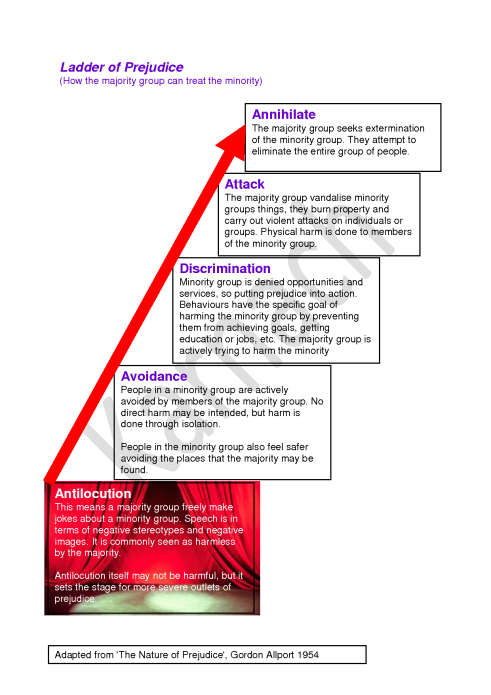
I want to make clear at this point that any consideration of the political and psychosocial processes that culminated in the atrocities of the Holocaust is not in any way an attempt to trivialise those events. Quite the contrary. In recognising the processes that important researchers such as Gordon Allport identified – the unfolding stages involved in the growth of prejudice in a society that manifests othering, outgrouping, and permits a society to incrementally discriminate and hate over time – and in drawing parallels, we may try to ensure that such atrocities never happen again.

Allport's ladder

Eugenic theories are most commonly associated with Nazi Germany’s racially motivated social policies. The Nazis sought the improvement of the Aryan race or Germanic Ubermenschen – master race – through eugenics, which was the foundation of Nazi ideology.

Those people targeted by the Nazis were identified as life unworthy of Life Lebensunwertes Leben – including but not limited to the “idle”, “insane”, “degenerate”, “dissident”, “feeble-minded”, homosexual and the generally weak, for elimination from the chain of heredity. More than 400,000 people were sterilised against their will, whilst 275,000 were killed under Action T4, a “euthanasia” programme.

However, there is quite a broad definition of eugenics and I propose that because it has been so thoroughly discredited, it has been forced to “go incognito” over the last century. The public support for eugenics greatly waned after the fall of Nazi Germany and the Nazis’ attempt to use eugenic justifications for the Holocaust at the Nuremberg Trials.

Right-wing philosopher, Roger Scruton, said in an article in the American Spectator: “The once respectable subject of eugenics was so discredited by Nazism that “don’t enter” is now written across its door,” implying he would like to see more openness to eugenics as an idea. In a way, he does make a valid point, because when what was once stated explicitly becomes implicit and tacit – normalised – it is difficult to oppose and challenge, essential debate is therefore stifled.

Eugenics is the infamous idea that governments should decide which kinds of citizens ought to be considered desirable – the consensus tends to be that these are white, athletic, intelligent, and wealthy – and which kinds of citizens ought to be considered undesirable – these tended to be black, Jewish, disabled, or poor –  and employ the power of the State to encourage increases of desirable citizens (positive eugenics) and encourage decreases of undesirable citizens (negative eugenics).

Eugenics is specifically State interference in and engineering of the “survival of the fittest”. That is happening here in the UK, with Tory policies like the extremely punitive welfare “reforms”, which are aimed at the most vulnerable citizens – such as those who are seriously ill and/or disabled – all too often denying them the means to meet basic survival needs.

The founder of eugenics, Sir Francis Galton, who was a half-cousin of  Charles Darwin, formulated the idea that the protection afforded by civil society had prevented the kind of natural selection occurring in Darwin’s Origin of Species from happening in humans, thus perpetuating the existence of “weak and feeble-minded” people who would have been unable to survive in the “state of nature”.

Thomas Malthus went further, and is most often considered the founding father of this ideology of profound antihumanism: he also believed that giving support to the needy would only imperil everyone else, because resources are limited, so the brutal reality was that it was better to let them starve. Malthus held the belief that the poor are akin to a “horde of vermin whose unconstrained aspirations and appetites endanger the natural order”: that tyrannical measures are necessary to constrain humanity.

It was Malthus that offered a pseudo-scientific basis for the idea that human reproduction always outstrips available resources. Following this pessimistic and inaccurate assessment of the capacity of human ingenuity to develop new resources, Malthus advocated oppressive policies that led to the starvation of millions in India and Ireland.

Malthus’s position as professor at the British East India Company training college gave his theories considerable influence over Britain’s administration of India through most of the nineteenth century, which led to the official response of neglect to India’s periodic famines.

Malthus wrote about restraints on population growth which included famine, disease and war. His theory was later used to explain the British government policy of maintaining agricultural exports from Ireland during the Great Famine (1845-49) in which at least 1.5 million people died of starvation or the side-effects of malnutrition, and at least another million immigrated.

Malthus was also very influential in bringing about the punitive Poor Law Amendment Act of 1834. His work, An Essay on the Principle of Population, was a product of that era, it resonated with the laissez-faire framework of competitive individualism, and the dominant socio-political paradigm. It remains influential today, despite being thoroughly discredited, not least by social history since his time of writing.

Prior to the Holocaust, eugenics was widely accepted in the UK. Malthus’s ideas on population control and Spencer’s Social Darwinism fitted neatly into the sociopolitcal ideological framework. The ruling elite feared that offering medical treatment and social services to disabled people would undermine the natural struggle for existence and lead to the degeneration of the human race.

Those ideas, once explicitly endorsed, are now implicitly captured in policies and Conservative narratives about sanctions, “conditionality,”  “making work pay,” (compare with the principle of less eligibility enshrined in the New Poor Law) “fairness,” “incentives,” “scroungers,” and so forth. A crucial similarity with the early part of the century and now is reflected in Tory austerity rhetoric – a perceived shortage of resources for health and welfare. Another parallel is the scapegoating process and a rise in the level of social prejudices and sociopolitical discrimination.

Anti-immigration rhetoric, reflected in the media, with the vilification of sick and disabled people and the poor, has preceded policies particularly aimed at the steady removal of State support indicating a clear scapegoating process, and this isn’t indicative of a government that is “neglectful”- it is patently intentional, hence the pre-emptive “justification” narratives to garner public support and acceptance towards such punitive and harsh policies.

So, the first purpose of such justification narratives is to make cruel and amoral policies seem acceptable. However, such propaganda narratives also serve to intimidate the targeted minority, leading them to question whether their dignity and social status is secure. In many instances, such intimidation is successful.

Furthermore, this type of hate speech is a gateway to harassment and violence. (See Allport’s scale of prejudice, which shows clearly how the Nazis used this type of propaganda and narrative to justify prejudice, discrimination, to incite hatred and ultimately, to incite genocide.)

As Allport’s scale indicates, hate speech and incitement to genocide start from often subtle expressions of prejudice. The dignity, worth and equality of every individual is the axiom of international human rights. International law condemns statements which deny the equal worth of all human beings. This is for very good reason.

Article 20(2) of the ICCPR requires states to prohibit hate speech. Hate speech is prohibited by international and national laws, not because it is offensive, but rather, because it amounts to the intentional degradation and repression of groups that have been historically oppressed. In the UK, we have a government that endorses the repression of the historically oppressed.

Social Darwinists generally argue that the “strong” should see their wealth and power increase while the weak should see their wealth and power decrease. In most contemporary western societies these views tend to emphasise competition between individuals for resources in a neoliberal State. In the UK, this idea is very apparent in the policies of the conservative-led government, and previously, we saw similar views from Thatcher.

The biological concept of “adaptation” is used by the Right to claim that the rich and powerful are better adapted to the social and economic climate of the time, and the concept of natural selection perpetuates the supremacist argument that it is natural, normal and proper for the strong to thrive at the expense of the weak.

Notions of deserving and undeserving poor flourished at a time when Social Darwinism and eugenics where widely acceptable here in the UK. The utilitarianism of Jeremy Bentham and John Stuart Mill, identifying moral actions in public policy as those which produce the greatest good for the greatest number, also support the contention that, whilst in the short term the interests of the poor would seem to be supported by public relief, the ultimate result of relief is detrimental to their interests.

Social Darwinism was popular in the late Victorian era in England, America, and elsewhere and the ethical philosophies of Conservatives are underpinned by a strongly elitist view based on the pseudo-scientific arguments of “adaptation and natural selection.” The Victorian era has made a deep impact upon many contemporary Conservatives, such as Gove and Osborne.

Michael Gove has written: For some of us Victorian costume dramas are not merely agreeable ways to while away Sunday evening but enactments of our inner fantasies … I don’t think there has been a better time in our history” in “Alas, I was born far too late for my inner era”.

A better time for whom, precisely? It was a time of child labour, desperation, prostitution, low life expectancy, disease, illiteracy, workhouses, and a truly dog-eat-dog social perspective. Or was it the deferential protestant work ethic reserved only for the poor, the pre-destiny of the aristocracy, and “the rich man in his castle, the poor man at his gate” that appeals to Gove?

In a speech to the Confederarion of British Industry, (CBI) George Osborne argued that both parties in the coalition had revitalised themselves by “revisiting their 19th-century roots.”

Herbert Spencer’s Social Darwinism, with his dictum “the survival of the fittest” – he was a sociologist, not a biologist – provided further support for the view that the “vices” of the lowest class in society make such persons undeserving of help from those who were financially privileged. (“Us” are the fittest: “Them” – the “Other” – are not.)

It is but a short step from the eugenics movement of the early twentieth century to the radical individualism of Ayn Rand, the latter’s popularity on the Right continuing to support a Conservative libertarian celebration of selfishness – “Nobody is mine.”

And:1965037_301820166635705_1502392114_n (1)
Conservatives have always seen society and human relationships in terms of hierarchies, based on “red in tooth and claw” Darwinist conflict. A hierarchy is any system of persons or things ranked one above the other, on the basis of human worth.

The term was originally used to describe the system of church government by priests graded into ranks. Organised religion is very hierarchical. Hierarchical thinking is about seeing the world through systems of  worth, domination or importance. But the central principle of human rights is that each have equal worth: that we are all equally important. But hierarchies ensure that privilege and decision-making is not socially distributed. Nor is power.

The very way that Tories think leads to a collision between their ideology and our human rights, and is completely incompatible with the principles of equality and democracy. Tories think that some people hold a more important place in society than others. This reduces people – they become inferiors or superiors, and really, that is about unequal distribution of power, subordination and domination – those power relationships are no longer entirely notional, we have moved some distance from being a liberal democracy these past four years – and feudalism and manorialism are very Tory ideals. 

It’s worth noting that disabled people have been disproportionately affected by the government’s austerity programme. People are dying prematurely because the government has radically cut their lifeline support, leaving them without the means to meet their fundamental survival needs.

To summarise, there are strong links between the neoliberal idea of competitive individualism, Social Darwinism, social inequalities, eugenics, nationalism, fascism and authoritarianism. Those ideas are implicit in Tory rhetoric, because they form the very foundations of Tory ideology. A society with inequalities is and always has been the ideologically founded and rationalised product of Conservative Governments. Inequality is at the heart of ‘competitive individualism’ which is at the heart of neoliberal ideology. In any competitive system, there are always a handful of ‘winners’ and many more ‘losers’. 

Robert Michel’s iron law of oligarchy describes the inevitable tendency of hierarchical organisations to become oligarchic in their decision making – anti-democratic. And prejudice is an in-built feature of hierarchy, because of the stratified nature of power, esteem and status.  Right-wing populism so often takes the form of distrust of the European Union, and of politicians in general, combined with anti-immigrant rhetoric, and a call for a return to “traditional, national values”.

Those “traditional values” that the Tories cherish, and often speak about, mean the end of our hard-earned rights, the end of any principle of the equal worth of everyone, the end of government accountability and increasingly, legal restraint, the end of democracy, the end of access to social opportunities, the end of any meaningful citizen autonomy. Yet these are civilising conditions. The Tories would prefer to have us outwardly oppressed and inwardly repressed, and fighting amongst ourselves for ever-decreasing resources.

This government’s schadenfreude, the intent and motivation behind the draconian policies that we’ve seen this past four years, which target the most vulnerable citizens most of all, is debated.

Some people believe that the policies are a consequence of a redistribution of wealth from the poorest to the wealthy rather than being malicious acts. But the Tories laughed on hearing the accounts of suffering of the poor because of the bedroom tax and an increasing dependency on food banks, for all to see, during parliamentary debate with the opposition.

But entertaining the idea for a moment that the inflicted suffering is not a motivation but rather, a consequence, well that would make the Government at the very least indifferent, callous and unremorseful, since they show a supreme lack of concern for the plight of those least able to defend themselves against injustice and inflicted poverty. And such indifference contravenes fundamental human rights. It breaches international laws.

Either way, I feel shock and anger at the recognition that all of those principles and beliefs we held dear – such as justice, fairness, democracy, freedom, Government accountability, equality (at least in terms of the worth of each life), institutionalised philanthropy – all trodden under foot by advocates of Social Darwinism – an aristocratic elite – in just four years. And the faith we each had in those collective ideals undermined by the constant perpetuation of socially divisive propaganda tactics from the Right.

Dividing people by using blame and prejudice further weakens our opposition to oppression. It’s a strategy the Tories have mastered.

Government policies are expressed political intentions, regarding how our society is organised and governed. They have calculated socio-economic aims and consequences. None of the policies that this government have formulated regarding the “support and care” of some of the most vulnerable citizens could be seen as anything other than expressions of intentional harm.

Services and support have been cut, lifeline benefits have been restricted by a variety of means, such as the revolving door process application of the work capability assessment, benefit sanctions, the mandatory reconsideration process.

Where is the investigation into the very high number of deaths associated with the Tory-led welfare reforms? The government have been made aware of those deaths through parliamentary debate, yet they persist in denying any “causal link” with the significant increase of sick and disabled people dying and their savage cuts to lifeline benefits. If there is no causal link, an inquiry would demonstrate that, surely?

It’s a universally recognised fact that if people are prevented from meeting their basic survival needs, they will die. Benefit sanctions, and cuts to welfare and public services, the rising cost of living and the depression of wages are having a detrimental effect on many. I don’t imagine that it’s the case that everyone but the government are aware of this. Yet the harmful policies remain.

The Coalition will leave more debt than all Labour governments since 1900. The current government’s now responsible for £517 billion of the trillion-plus-pound UK public debt, compared to £472 billion accrued during the 33 years Labour led the country since the turn of the twentieth century.

And the figures look even worse when you adjust for inflation. When you do that, the Coalition’s share jumps to nearly half of the total debt.

But the Coalition don’t meet any public’s needs, they simply serve the wants of the 1%. Labour invested in public services, the Tories have bled them dry. So, what have they done with the money? Because the public have seen only austerity cuts.

These policies are intentional. Withholding State support for poor, disabled, ill and vulnerable people – paid for via our taxes – is a deliberate act.

While our government have been busy denying the eugenics-by-stealth consequences of their diabolical policies in this Country, back in 2012, the Guardian exposed the fact that the British government has spent millions of pounds funding a policy of forced sterilisation of the poor in India as part of an effort to reduce human population to “help combat climate change”. But we also know that many Tories deny climate change exists.

The governments of China and India practice hard eugenics, underwritten by American and British tax money, these are coercive measures undertaken by governments to decrease citizen population.  The exposure of support for hard eugenics prompted denial and backtracking.  United Nations Population Fund (UNFPAclaims to support “voluntary family planning” in China. They assume that women, who are aware that conceiving a second child will result in a forced abortion, are free to make choices – thus the forced abortion is a State arrangement entered into “voluntarily.”

Hard eugenics is the ideology that is hiding behind Hitler. But soft eugenics  is based on the same pathological belief – that a government should spend its resources to prevent the propagation of those who the government believes to be “detrimental” to society and economic production. It won’t be long before there is some UK policy that imposes a restriction on the number of children poor people may have – probably “soft” eugenic policy, initially. Perhaps a limit on the number of children that unemployed or underemployed families may claim support for. Of course that will have ghastly ramifications for the human rights of children, since it would discriminate against a child on the grounds of when he/she was born.

Here in the UK, our government has been quite explicit in its drive to end “the something for nothing culture”. Our taxes  have been handed out to the wealthy and State support has been steadily withdrawn from the vulnerable. Government policies are an explicit statement of political and socio-economic intentions.

Policies based on Social Darwinism and eugenics cannot be justified. Our morality is liberated from the biological, reductionist constraints of evolutionary thinking. We relate to one another through culture, shared histories, language, morality, and law. Even if it were true that we are biologically determined – fixed by evolution, as intentional beings, we are not culturally fixed.

There is a difference between what we are, and who we are. There is also a difference between what is and what ought to be. The theories of Social Darwinism, eugenics and sociobiology involve biological reductionism. A recognition of the importance of biological conditions and even “human nature” need and ought not involve biological reductionism. And to embrace reductionism is to ultimately deny our capacity for making rational choices.

But we exceed the limits of reductionism and determinism every time we make any claim to knowledge (including those claims of reductionism and determinism), make a choice, discuss ethics and morals, explore possibilities, create, discover, invent – we are greater than the sum of our parts. The humanist ideas of human potential have never interested the Tories.

However, humanist principles, particularly those of Maslow, are very closely connected to our human rights and the development of our welfare state. Maslow’s psychology about possibility, not restraints. His metaphysics were all about the possibilities of change and progress, within a democratic framework. These ideas run counter to Tory ideology.

It’s therefore of no surprise that the Tory-led Coalition has steadily eroded our welfare and public service provisions and that Cameron has stated plainly that he fully intends to repeal the Human Rights Act and withdraw from the European Convention on Human Rights

This is a government that chooses to treat our most vulnerable citizens brutally, with absolutely no regard for their legal and moral obligation to ensure that our taxes are used to meet our most basic needs.

There can be no justification for editing or repealing the Human Rights Act itself, that would make Britain the first European country to regress in the level and degree of our human rights protection. It is through times of recession and times of affluence alike that our rights ought to be the foundation of our society, upon which the Magna Carta, the Equality Act and the Human Rights Act were built – protecting the vulnerable from the powerful and ensuring those who govern are accountable to the rule of law, and as an instrument of equality, social cohesion and public purpose.

It is expected of a democratic government to improve the understanding and application of the Act. That is an international expectation, also. Quite rightly so.

Observation of human rights distinguishes democratic leaders from dictators and despots. Human Rights are the bedrock of our democracy, they are universal and are a reflection of a society’s and a governments’ recognition of the equal worth of every citizens’ life.

We need to ask, in light of the issues I’ve raised here, why would any government want to opt out of such protections for its citizens?

We know from history that a society which isn’t founded on the basic principles of equality, decency, dignity and mutual respect is untenable and unthinkable.

scroll2

Article 2 of the Convention on Human Rights uses the following definitions of genocide, amongst others:

  • Killing members of the group
  • Causing serious bodily or mental harm to members of the group.
  •  Deliberately inflicting on the group conditions of life calculated to bring about its physical destruction in whole or in part
  • Imposing measures intended to prevent births within the group
  •  Forcibly transferring children of the group to another group

The right to life contained in Article 2:

  • Prohibits the State from intentionally killing;
  • and  requires an effective and proper investigation into all deaths caused by the State.

14533697838_dffcc736f2_o (1)

Pictures courtesy of Robert Livingstone

My work isn’t funded and I don’t get paid to write. But you can support Politics and Insights, and help me to continue researching, analysing and writing independently.

The smallest amount is much appreciated, and helps to keep my articles free and accessible to all – thank you.

And a massive thank you to those who have already contributed.

DonatenowButton
cards

UKIP: Parochialism, Prejudice and Patriotic Ultranationalism.

999622_566748676727998_1599547969_n (1)

Political outgrouping

Over the past four years, we have witnessed the political right using rhetoric that has increasingly transformed a global economic crisis into an apparently ethno-political one, and this also extends to include the general scapegoating and vilification of other groups and communities that have historically been the victims of prejudice and social exclusion: the poorest, unemployed and disabled people. These far-right rhetorical flourishes define and portray the putative “outsider” as an economic threat. This is then used to justify active political exclusion of the constitutive Other.

The poorest have been politically disenfranchised. Politically directed and constructed cultural and social boundaries, exclusionary discourses and practices create and define strangers who are further stigmatised and reduced by labels of “economic freerider.”  Groups are politically redefined and reduced to a basic, standard right wing category: “a burden on the state”. In Zygmunt Bauman’s analysis of the Holocaust, the Jews became “strangers” par excellence in Europe, the Final Solution was an extreme example of the attempts made by societies to excise the (politically defined) uncomfortable and indeterminate elements existing within them. Here in the UK, it’s evident that many citizens now feel like strangers in their own communities – they have become politically alienated. 

Definitions of citizenship and associated privileges have been reformulated and restricted here in the UK, and the current Conservative neoliberal framework of intensifying an aggressive competitive individualism is further motivated by far-right reforms that embed socioeconomic Darwinism.

This has provided opportunity for UKIP to become established as a populist part of the mainstream political conversation, the Tory rhetoric, founded on social divisions and established hierarchy, has created a space for UKIP’s subversive “insurgency”.

UKIP has an extremist appeal that is based entirely on fear-mongering, and attempts to shape and perpetuate fears, resentment and hatreds, social group phobias and deliberate attempts at further undermining social cohesion. UKIP try to make this extremely divisive approach somehow “respectable”, (by the frequent use of phrases such as “we say what many think”, “we speak our minds” and “it’s not racist to be worried about too many people coming here,” which are used to attempt to normalise and justify what are actually very objectionable, prejudice-laden opinions, for example) whilst offering nothing at all that might improve our living conditions and quality of life.

UKIP is also manipulating an anti-politics and anti-establishment public mood. This is not just about gaining electoral success but in shifting the terms of debate. Farage admits that UKIP’s effect on the Tories is “psychological not numerical”. His success in this encourages the further right Tory backbenchers, encourages the populist strategies of Lynton Crosby, as it forces political and media focus on right-wing concerns, like welfare and immigration. Public moral boundaries are being pushed.   

UKIP utilises, amplifies and perpetuates an increasingly poisonous climate of distrust and cynicism. UKIP manipulate public views and in particular, they perpetuate a myth that politicians of all colours are an out of touch elite that is far removed from, and largely unconcerned with, the everyday struggles of “ordinary people.” But the category of “ordinary people” is an ever-shrinking one, from this perspective.

UKIP make the mistake of portraying the entire political class as pampered elitistswhich is grossly inaccurate. Whilst it’s true that the Conservative party most certainly can claim aristocratic membership, the same isn’t true of the Labour party. Furthermore, Farage, an ex-Tory public school boy (and Miliband attended a comprehensive school), an ex-stockbroker, with offshore tax havens and an inclination for far-right policy is hardly likely to be “in touch” with the man and woman on the Clapham omnibus.

Although UKIP suffers from a chronic, persistent failure to appeal to three key groups of voters – women (because of the chauvinistic and anti-feminist views of UKIP members and politicians); young people (who find the party almost farcically out of touch with their own world-view) and ethnic minorities (because of its strident and emotive language about immigration). UKIP does represent something of a “blue-collar revolt”- its electoral base is “old, male, working class, white and less educated,” say academics Matthew Goodwin and Robert Ford.

Anti-intellectual prejudice is a strong undercurrent amongst UKIP’s supporters. Anti-intellectualism is a dominant feature of far-right politics – especially those entailing authoritarianism, fascism and Nazism.

 10403497_472514972893769_324031577992330978_n
Anti-intellectualism and inverted snobbery from the patriotic nationalist and racist Britain First site on Facebook

Parochialisation

The Conservatives have parochialised both explanations of and responses to the global economic crisis. Parochialism entails neglect of the interests of identified “outsiders”, and this kind of isolationist tendency has also provided a political platform for nationalism. Parochialism tends to support inter-group hostilities, and it tends to lead to violations of human rightsParochialism directly opposes a fundamental set of principles that constitute these rights: namely that all humans beings are of equal worth, and that human rights are universally applicable – they apply to everyone.

The alternative perspective is social Darwinism, which is used to justify a hierarchy of entitlement to rights. Modern eugenics was rooted in the Social Darwinism of the late 19th century, with all its metaphors of fitness, competition, and rationalisations of inequality. For progressives, eugenics was a branch of the drive for social improvement or perfection that many reformers of the day thought might be achieved through the deployment of science to “good” social ends. Eugenics, of course, drew appreciable support from Conservatives, concerned to “prevent” the “proliferation” of lower income groups and save on the cost of providing support for them.

The progressives progressed. They ceased to believe that progress was about advancing the human race by physical “improvement” – that kind of supremacist view was a product of its time – context bound by a cumulatively catastrophic zeitgeist. Progressives liberated themselves from the superficial characteristics and taxonomic ranking of human beings – the emphasis on “what” we are – and began to cherish “who” we are, delving into our human potential and celebrating our diversity as much as our individual equal worth.

Although eugenics programmes are usually associated with Nazi Germany, they could, and did, happen everywhere. They focused on manipulating heredity or breeding to produce politically defined “better” people and on eliminating those considered biologically inferior. In the 1920s and 1930s, eugenic sterilisation laws were passed in 24 of the American states, in Canada, and in Sweden. Here in the UKMalthus saw overpopulation as the cause of misery and poverty, which was an element of the social Darwinism that contributed to the devaluing of human life due to its stress on the struggle for existence and competition for resources. 

Eugenic doctrines were criticised increasingly during the inter-war years, on scientific grounds and for their blatant class and racial bias, and were attacked widely when a eugenics narrative and role in the holocaust was revealedHuman rights evolved in response to the Holocaust, to ensure that race genocide doesn’t happen again. And to the growth of fascism. Human rights are premised on the belief that all human lives are of equal value. That is why those rights apply to everyone, that was the whole point of them, and to exclude people on whatever basis from enjoying those rights is to stray onto a very dangerous slippery slope in terms of recognising the equal worth of other human beings. Again.

The concept of adaptation remains, and allows the right to claim that the rich and powerful are better adapted to the social and economic climate of the time, and the concept of natural selection perpetuates the supremacist argument that it is natural, normal, and proper for the “strong” to thrive at the expense of the weak. Strength, however, is conflated with wealth.

British and American imperialists employed the language of social Darwinism to promote and justify Anglo-Saxon expansion and domination of other peoples. Such different personalities as Machiavelli, Sir Francis Bacon, Ludwig Gumplowicz, Adolf Hitler, and Benito Mussolini, each reasoning on different grounds, nevertheless arrived at similar conclusions. Imperialism to them is part of the natural struggle for survival. Those endowed with “superior” qualities are “destined” to rule all others. Imperialism has been morally excused as the means of liberating peoples from tyrannical rule or of bringing them the benefits of a “superior” way of life. Imperialism is all about human aggressiveness and greed, the search for security, drive for power and prestige and nationalist emotions, amongst other things.

Nationalism is anti-progressive. It’s a paradigm of competitive individualism that further undermines principles of cooperation, equality and social cohesion. It’s also a recognisable symptom of the rise of fascism. The UKIP brand of Parish pump politics nurtures fear, spite and vilifies people on the basis of one of our most wonderful assets: our human diversity.

Ordinary people did not caused the financial crisis. The real culprits are sat untouched in mansions, making even more money from the “austerity” imposed on the poorest and some of the most vulnerable members of society, whilst too many comply with misdirected blame of their oppressed brothers and sisters, rather than a political elite that have deliberately engineered a prolonged recession in the UK. Conservative governments always do. Our current social hardships have been created by this government’s policies and not powerless immigrants, disabled people or the unemployed. These are people whose lives are being broken by an elite.

The answer to our problems isn’t making the rest of the world go away, it isn’t bigotry and “national pride” – we surely learned those are not tenable answers from the terrible consequences of Nazism.

Dividing people by using blame and prejudice only weakens our opposition to oppression.

UKIP, however, have capitalised on the current government’s lack of clear, open and honest debate about why the UK has become more unequal and anomic (anomie – a sociological concept – is the breakdown of social bonds between an individual and the community resulting in fragmentation of social identity and rejection of self-regulatory values. This has been heightened by a significant discrepancy between Conservative ideology – rhetorical values commonly professed – and what is real, actual and achievable in our everyday life).

UKIP have exercised a crass manipulation of the existentially destabilised: many people are confused and anxious about where they belong, where their country is heading, and why the current government won’t do anything about it. Of course Farage denies vigorously that in giving these anxieties a directed voice they are merely acting as outlets for prejudice and faux protest votes. But prejudice, protest and a politics of fear is nevertheless UKIP’s leitmotif.

And farce. Like the UKIP councillor blamed the recent floods on the Government’s decision to legalise gay marriage. David Silvester said the Prime Minister had acted “arrogantly against the Gospel,” and God had punished the Thames Valley as a result. And John Sullivan, a UKIP candidate, explained that physical exercise in schools can “prevent homosexuality”.

Farage says he represents such “ordinary people”. As I stated earlier, he is an ex-Tory, a public school-educated former banker and stockbroker, whose policies will help him and his kind, maintaining the status quo, whilst presenting a fake challenge to the establishment. He set up a trust fund in an offshore tax haven, in a bid to avoid paying thousands of pounds in tax money. So UKIP are a “protest vote” for pretty much more of the same.

Farage claims he is the voice of “common sense”, whilst having allegiance with every kind of homophobic, wild conspiracy theorist, misogynist, racist, chauvinist , classist, peevish, vindictive and resentful inadequate. The only sense he and his followers seem to have in common is a fear of anyone who is not like them.

Farage disowned the entire 2010 UKIP manifesto – and not in the transparent manner of an honest politician admitting to past mistakes. Instead, he pretended he knew nothing of his party’s promises for a dress code for taxi drivers and a state-enforced repainting of the nation’s trains in traditional colours. Imagine if anyone else in public life said that a document they had put their name to, and claimed ownership of, was “drivel” and tried to avoid awkward questions by pretending that it had never been read. 

“Our traditional values have been undermined. Children are taught to be ashamed of our past. Multiculturalism has split our society. Political correctness is stifling free speech”, states the UKIP manifesto. Their “Pocket Guide to Immigration” promises to “end support for multiculturalism and promote one, common British culture”. After attracting some negative publicity, it has disappeared from here, but an archived version can be seen here.

Conformity, prejudice and language

Bigots quite often seem to use the freedom of speech plea to justify their prejudice. They say they have a right to express their thoughts. But speech is an intentional ACT. Hate speech is intended to do harm – it’s used purposefully to intimidate and exclude vulnerable groups. Hate speech does not “democratise” speech, it tends to monopolise it. Nor is it  based on reason, critical thinking or open to debate. Bigotry is a crass parody of opinion and free speech. Bigots are conformists – they tend not to have independent thoughts. Prejudice and Groupthink are longstanding bedfellows.

Being inequitable, petty or prejudiced isn’t “telling it like it is” – a claim which is an increasingly common tactic for the right, and particularly UKIP – it’s just being inequitable, petty or prejudiced.  And some things are not worth saying. Really. We may well have an equal right to express an opinion, but not all opinions are of equal worth. And UKIP do frequently dally with hate speech. Hate speech generally is any speech that attacks a person or group on the basis of e.g. race, religion, gender, disability, or sexual orientation. 

In law, hate speech is any speech, gesture or conduct, writing, or display which is forbidden because it may incite violence or prejudicial action against or by a protected individual or group, or because it disparages or intimidates a protected individual or group. Critics have argued that the term “hate speech” is a contemporary example of Newspeak, used to silence critics of social policies that have been poorly implemented in order to appear politically correct

This term was adopted by US Conservatives as a pejorative term for all manner of attempts to promote multiculturalism and identity politics, particularly, attempts to introduce new terms that sought to leave behind discriminatory baggage attached to older ones, and conversely, to try to make older ones taboo.

“Political correctness” arose originally from attempts at making language more culturally inclusive. Critics of political correctness show a curious blindness when it comes to examples of conservative correctness. Most often, the case is entirely ignored or censorship of the left is justified as a positive virtue. Perhaps the key argument supporting this form of linguistic and conceptual inclusion is that we still need it, unfortunately. We have a right-wing Logocracy, creating pseudo-reality by prejudicial narratives and words. We are witnessing that narrative being embedded in extremely oppressive policies and in the justification rhetoric.

The negative impacts of hate speech cannot be mitigated by the responses of third-party observers, as hate speech aims at two goals. Firstly, it is an attempt to tell bigots that they are not alone. It validates and reinforces prejudice.

The second purpose of hate speech is to intimidate a targeted minority, leading them to question whether their dignity and social status is secure. In many cases, such intimidation is successful. Furthermore, hate speech is a gateway to harassment and violence. (See Allport’s scale of prejudice, which shows clearly how the Nazis used “freedom of speech” to incite hatred and then to incite genocide.)

As Allport’s scale indicates, hate speech and incitement to genocide start from often subtle expressions of prejudice. The dignity, worth and equality of every individual is the axiom of international human rights. International law condemns statements which deny the equality of all human beings.

Article 20(2) of the ICCPR requires states to prohibit hate speech. Hate speech is prohibited by international and national laws, not because it is offensive, but rather, because it amounts to the intentional degradation and repression of groups that have been historically oppressed.

The most effective way to diffuse prejudice is an early preventative approach via dialogue: education and debate. Our schools, media and public figures have a vital part to play in positive role-modelling, in challenging bigotry, encouraging social solidarity, respect for diversity and in helping to promote understanding and empathy with others.

Hate speech categories are NOT about “disagreement” or even offence. Hate speech doesn’t invite debate. It’s about using speech to intentionally oppress others. It escalates when permitted, into harassment and violence. We learn this from history, and formulated human rights as a consequence. UKIP would have us unlearn the lessons of the Holocaust so that people can say “I’m not being  racist, but…” or “It’s not wrong to say immigrants should be sent home…” and so on.

There are recognisable effects of Social Norms and conformity on Prejudice: Minard (1952) investigated how social norms influence prejudice and discrimination. The behaviour of black and white miners in a town in the southern United States was observed, both above and below ground.

Results: Below ground, where the social norm was friendly behaviour towards work colleagues, 80 of the white miners were friendly towards the black miners. Above ground, where the social norm was prejudiced behaviour by whites to blacks, this dropped to 20.

Conclusion: The white miners were conforming to different norms above and below ground. Whether or not prejudice is shown depends on the social context within which behaviour takes place. See also Milgram experiment on conformity – Milgram showed that people tend to conform in groups and defer to authority even when it means behaving immorally. It’s very depressing reading, but it’s important to recognise the role of conformity and obedience in the genocides we’ve witnessed, and Allport’s work is also important here too. Asch came up with more optimistic results, showing that an objection from just one person could change the behaviour of the whole group.

And that’s our responsibility, surely.

UKIP are not simply a collective of classist, sexist, xenophobes and homophobes: they are omniphobes. Political rhetoric has been reduced to simplistic, crude dichotomies which provoke arguments instead of rational debate, the populist themes trade on fear, and fear provokes strongly emotive responses. You can’t reason with those, they don’t lend themselves well to rational discourse.

I am appalled and horrified at the public stage that UKIP have gained, at how the right generally have pushed back our boundaries of decency and are cultivating prejudice and fear towards politically constructed Others, which share common themes with Nazi ideology, and worse, some people don’t see these terrifying connections. The increasing class of the poorest and most vulnerable people are being turned into outsiders by both the Conservatives and UKIP. And that is NOT okay.

Farage demands that “We want our country back.” So do I. But my vision is very different to the shrunken patriotic neo-imperialism of Farage. No one hates his own country more that the resentful nationalist – and how they complain that “things ain’t what they used to be”.

My country is multicultural, rich and diverse, it is one that has learned from history and evolved. It is founded on progress and civil rights movements, past battles of the oppressed fought and won – our hard-earned freedoms to be who we are without fear.

We have a government that reduces benefits so that poorly paid workers can feel a little better about being so poorly paid. It’s a government that is all about lowering standards, and crucially, our expectations, and our regard of each other. So much mean spirited resentment has been kindled and perpetuated by the Coalition amongst the oppressed, aimed at the oppressed.

I recognise political themes of oppression and repression, and it is NOT okay. How can anyone think it is?

This governments’ schadenfreude – motivation for the vindictive policies that we’ve seen this past 4 years, which target the most vulnerable citizens most of all – is debated. Some people believe that the policies are a consequence of a redistribution of wealth from the poorest to the wealthy rather than being malicious acts. But the Tories laughed on hearing the accounts of suffering of the poor because of the bedroom tax and the food banks in parliament, for all to see.

But entertaining the idea for a moment that the inflicted suffering isn’t a motivation but a consequence, well that would make the Government at the very least indifferent, callous and unremorseful, since they show a supreme lack of concern for the plight of those least able to defend themselves against injustice and inflicted poverty. Either way, I know evil when I see it, and this government ARE evil. The shock and anger at the recognition that all of those principles and beliefs we held dear – such as justice, fairness, democracy, freedom, Government accountability, equality (at least in terms of the worth of each life), institutionalised philanthropy – all trodden under foot by the social Darwinist aristocratic elite in just 4 years. And the faith we each had in those collective ideals undermined by the constant perpetuation of divisive propaganda tactics from the right.

Dividing people by using blame and prejudice only weakens our opposition to oppression.

We must each take some responsibility and work to put right the terrible mistakes and inhumane acts that we’ve allowed to be written into our collective history. Our starting point must be founded on an egalitarian doctrine that maintains that all humans are equal in fundamental worth and social status. We have to learn and evolve. If we remain silent and indifferent, that makes us nothing more than complicit bystanders.

68196_116423458427191_5364492_n

Pictures courtesy of Robert Livingstone

We can forgive children who are afraid of the dark, the real tragedy of life is when men and women are afraid of the light.


Related

DEFINING FEATURES OF FASCISM AND AUTHORITARIANISM 

Nigel Farage schooldays letter reveals concerns over fascism

Techniques of neutralisation: Cameron says keep calm and carry on climbing Allport’s ladder

Winston McKenzie, organiser for UKIP, Croydon, defending normalisation and legitimisation of racism and racist language in the UKRadio 4 PM, discussion with Sunny Singh; Friday May 23rd, 2014.

Remarkable linguistic bullying from McKenzie and a Godwin’s law type of approach to the word ‘racism’, which UKIP seem to have adopted to shut down critical debate about racism.

Racism and other forms of prejudice are normalised almost inscrutably, in stages as Allport’s ladder demonstrated all too well as an explanation of how the Holocaust happened. Allport describes social processes, and how the unthinkable becomes acceptable, by a steady erosion of our moral and rational boundaries.  

The prejudice happens on a symbolic level first – language – and it starts with subtlety, such as the use of phrases like ‘immigrants “swamping” our shores’ in the media, as part of political rhetoric and so on. Racists very seldom own up to being racists. They also quite often employ linguistic bullying strategies that makes challenging them very difficult. But as history has taught us, we must challenge them.


Austerity, socio-economic entropy and being conservative with the truth

734072_148205235330533_659227219_n

The Coalition have a track record of lying and trying to mislead the public. David Cameron has now been rebuked several times for making false claims: on NHS spending, the rising national debt and the impact of his tax rises and deep spending cuts on economic growth. The Tories invented figures to claim people are now “better off”, but which totally ignored and excluded an account of the impact of significant factors like the rise in VAT, the cost of living, cuts to tax credits and other benefits.

The government is committing fraud on a grand scale. The reason for such deceit has nothing to do with public finances or the state of the economy, and everything to do with shrinking the public realm. There is an irreducibly ideological dimension to Tory economics, and by making it sound “scientific” when really, it’s more akin to philosophy or Tory buck passing, they attempt to lend it an air of authority and legitimacy it does not deserve. 

The only thing that unites Tories is wealth, they mostly thrive on creating social divisions. The Tories have used a justification narrative based on a moral entrepreneur approach to scapegoat and vilify vulnerable social groups in order to justify transferring our public wealth to private bank accounts, behind the façade of austerity. What we are witnessing is a governments’ nonchalant adherence to Tory ideology which scripts policies that generate and perpetuate inequality, no matter what the consequences for the most vulnerable. Or the economy.

The Tories peddled the lie that due to Labour’s management of the economy, the UK was “on the brink bankruptcy” and claim the solution to is to cut government spending with a painful programme of austerity cuts. Of course the UK economy was growing in 2010 when the Tories took over and was subsequently plunged back into recession by Osborne’s austerity policies which have meant that the economy has not grown at all under the coalition; and for much of their tenure has been contracting.

Many economists have said consistently that this is the wrong approach. The best solution is to borrow or, better, create money to invest in infrastructure. But what we have instead is Osbornes’ closed economy, with a colossal redistribution of public funds to few private businesses and millionaires, who are sat on our money, whilst the government is steadily removing even more of our public capital through deep cuts. There is no investment in the infrastructure, public services – it’s a framework of increasing and devastating socio-economic entropy.

The Tories seem to think we have forgotten that it was they that lost the Moody’s Investors Service triple A grade, despite pledges to keep it secure. Moody’s credit ratings represent a rank-ordering of creditworthiness, or expected loss.

The Fitch credit rating was also downgraded due to increased borrowing by the Tories, who have borrowed more in 4 years than Labour did in 13. In fact this Tory administration have borrowed more than every single Labour government ever, combined.

The Tories have seized an opportunity to dismantle the institutions they have always hated since the post-war social democratic settlement – institutions of health, welfare, education, culture and human rights which should be provided for all citizens. The Tories attempt to destroy fundamental public support for the health, education and welfare of its people. Offering and inflicting only regressive, punitive policies and devastating cuts, the Tories lie to drag the compliant, conforming and increasingly shell-shocked electorate along as they dismantle our social democracy, our public services, fundamental rights and the very basis of our civilisation.

Whenever this authoritarian government have been challenged and opposed effectively, they simply ignore or edit the law, veto tribunal rulings or invoke archaic government privilege to bypass opposition and to get their own way with unpopular policies, such as The Health and Social Care Bill and the Welfare “Reforms”.

That a government needs to employ such underhanded methods to pass their policy through the legislative process, and justify such policies by lying, and by the malevolent scapegoating of vulnerable sections of society via the media, informs us that those policies are not addressing public needs, and wishes; that they are not democratically motivated or processed and that they reflect a political ideology which does not accommodate social and economic realities, nor is it fitting for a so-called first world liberal democracy that is a signatory to several international human rights charters to witness a government so deceptive and arbitrary in its approach to legitimacy.

Here is catalogue of officially recognised Tory lies used to justify their unjustifiable policies, which have have resulted in official reprimands:

David Cameron rebuked by statistics watchdog over national debt claims -The PM said the government was ‘paying down Britain’s debts’ in a political broadcast, even though the debt is actually rising.

“Now that his false claims have been exposed, it’s time the prime minister stopped deliberately misleading people about his economic record” – Rachel Reeves.

Finally Exposed! The Deficit Myth! So, David Cameron When Are You Going to Apologise? David Cameron rebuked over austerity claims – David Cameron has been corrected by the Treasury’s own forecaster over claims that cuts in public spending are not reducing economic growth. The Office for Budget Responsibility told the Prime Minister that it does believe that cutting public spending will reduce economic growth in the short term.

Robert Chote, the head of the OBR, contradicted a claim Mr Cameron made this week in a speech about the economy, in which the Prime Minister said the forecaster does not believe cuts are reducing growth.

In fact, as Mr Chote wrote, the OBR believes that cuts in spending and increases in tax will depress economic activity, meaning lower growth.

OBR head rebukes Osborne: the UK was never at risk of bankruptcy. Office for Budget Responsibility chief Robert Chote dismisses the “danger of insolvency”.

In the weeks after he took office, George Osborne justified his austerity programme by claiming that Britain was on “the brink of bankruptcy”. He told the Conservative conference in October 2010: “The good news is that we are in government after 13 years of a disastrous Labour administration that brought our country to the brink of bankruptcy.”

It was, of course, nonsense.

*Please note the original link to the New Statesman article seems to have curiously vanished. So here is a cached link to the same article: OBR head rebukes Osborne: the UK was never at risk of bankruptcy.

David Cameron rebuked over jobs claim Sir Andrew Dilnot, head of the UK Statistics Authority, the independent statistics regulator, said the prime minister was wrong to say figures showed that more than three-quarters of all new jobs went to British citizens when “official statistics do not show the number of new jobs.”

Cameron was attempting to show in an interview for the Daily Telegraph that the government had reversed a situation in its first few years of office when he claimed most new jobs were taken by migrant workers. The interview was widely interpreted as an attempt to win over Ukip voters who believe most jobs created as Britain’s economy recovers are being snapped up by foreigners.

Following a complaint by Jonathan Portes, head of the National Institute for Economic & Social Research, Dilnot confirmed that neither the original fear that migrants were taking British jobs nor the reversal of this trend were supported by official data.

Employment data collected by the Office for National Statistics relates to jobs in the economy whether or not they are newly created by employers. Dilnot said the relevant figures from the ONS showed the number of migrants in the labour force increased by 400,000 over the last five years, an 18% rise, while the number of UK nationals increased by 3%, or 900,000.

Sir Andrew Dilnot, head of the UK Statistics Authority, the independent statistics regulator, said the prime minister was wrong to say figures showed that more than three-quarters of all new jobs went to British citizens when “official statistics do not show the number of new jobs.”

Information Commissioner Christopher Graham launched a scathing rebuke of the decision to exercise the Government’s veto in a report on the case to Parliament. Blocking the publication of a report into the risks of NHS reforms is a sign that ministers want to downgrade freedom of information laws, a watchdog has warned. Health Secretary Andrew Lansley deployed it to block an Information Tribunal ruling that he should meet Labour demands to disclose the document.

Duncan Smith rebuked by ONS for misuse of benefit statistics – The claim that 8,000 people moved into work as a result of the benefit cap is “unsupported by the official statistics”, says the UK Statistics Authority. In letter to Duncan Smith, Andrew Dilnot writes: “In the manner and form published, the statistics do not comply fully with the principles of the Code of Practice, particularly in respect of accessibility to the sources of data, information about the methodology and quality of the statistics, and the suggestion that the statistics were shared with the media in advance of their publication.”

Another statement by Duncan Smith later in the month also drew criticism and a reprimand. The minister said around 1 million people have been stuck on benefits for at least three of the last four years “despite being judged capable of preparing or looking for work”.

However, the figures cited also included single mothers, people who were seriously ill, and people awaiting testing.

Iain Duncan Smith Rebuked Over Immigration Statistics – Iain Duncan Smith and the Department of Work and Pensions have been accused of publishing misleading immigration figures that were “highly vulnerable to misinterpretation”.Figures showing 371,000 immigrants were on benefits were rushed out by ministers with insufficient regard for “weaknesses” in the data, according to the UK Statistics Authority.

In a strongly-worded rebuke to Work and Pensions Secretary Iain Duncan Smith, the head of the UKSA, sir Michael Scholar, condemned the handling of the research, the Press Association reported.

Sir Michael said that despite being “highly vulnerable to misinterpretation”, the claims were given to the media without the safeguards demanded for official statistics and by issuing the figures as a “research paper”, the DWP had bypassed the need to meet the usual code of conduct, he noted.

Grant Shapps rebuked by UK Statistics Authority for misrepresenting benefit figures – Yet another Conservative politician is caught making it up. Grant Shapps has joined his fellow Conservatives in the data hall of shame. In March, the Tory chairman claimed that “nearly a million people” (878,300) on incapacity benefit had dropped their claims, rather than face a new medical assessment for its successor, the employment and support allowance.

The figures, he said, “demonstrate how the welfare system was broken under Labour and why our reforms are so important”. The claim was faithfully reported by the Sunday Telegraph  but as the UK Statistics Authority has now confirmed in its response to Labour MP Sheila Gilmore (see below), it was entirely fabricated.

In his letter to Shapps and Iain Duncan Smith, UKSA chair Andrew Dilnot writes that the figure conflated “official statistics relating to new claimants of the ESA with official statistics on recipients of the incapacity benefit (IB) who are being migrated across to the ESA”. Of the 603,600 incapacity benefit claimants referred for reassessment as part of the introduction of the ESA between March 2011 and May 2012, just 19,700 (somewhat short of Shapps’s “nearly a million) abandoned their claims prior to a work capability assessment in the period to May 2012.

The figure of 878,300 refers to the total of new claims for the ESA closed before medical assessment from October 2008 to May 2012. Thus, Shapps’s suggestion that the 878,300 were pre-existing claimants, who would rather lose their benefits than be exposed as “scroungers”, was entirely wrong.

As significantly, there is no evidence that those who abandoned their claims did so for the reasons ascribed by Shapps.

The chair of the UK Statistics Authority has rebuked shadow home secretary Chris Grayling – the authority have said  he “must take issue” with claims made by the conservatives and  warned the way they use violent crime statistics is “likely to mislead the public” and damage public trust. Mr Grayling has used a comparison between  figures to suggest that the Labour government has presided over a runaway rise in violent crime.

Even colleague Iain Duncan Smith said that such comparisons were “profoundly misleading and London’s Conservative Mayor, Boris Johnson, described Grayings’ claim as “absolute nonsense”. Chris Grayling made a headline-grabbing speech in which he likened life in Britain’s inner cities to that in Baltimore, Maryland, as portrayed in the acclaimed television series The Wire. Alan Johnson, the Home Secretary, remarked: “The connection between The Wire and Chris Grayling’s grasp on the problems of modern Britain is that they are both fictional.”

Treasury rebuked by UK Statistics Authority for inflation leaks – Britain’s statistics watchdog, ordered the Treasury to review its processes after sensitive inflation data this month was sent to 400 unauthorised people 17 hours before its release. Sir Michael warned: “There is a risk of market manipulation if key economic data fall in to the wrong hands before publication.”

Speculation data was leaking into the market ahead of the Office for National Statistics (ONS) announcement has been rife. Market rumours correctly predicted the last two Consumer Price Index inflation releases just before publication – in April and May.

UK Statistics rebukes Government over NHS spending claims – David Cameron famously promised he would cut the deficit, not the NHS. We now have it in black and white: he is cutting the NHS, not the deficit. There could be no clearer evidence of the failure of this Prime Minister and his Government.

“For months, David Cameron’s Government have made misleading boasts about NHS spending, misrepresenting the true financial difficulties he has brought upon the NHS. At the same time they have recently begun to try to distance themselves from these problems which David Cameron has created, trying to shift the blame to the NHS and its staff”Andy Burnham.

The watchdog has called on ministers to correct claims the coalition has made that they increased NHS spending in England. The UK Statistics Authority upheld a complaint by Labour about government claims the NHS budget had increased in real-terms in the past two years.

The watchdog found the best-available Treasury data suggested real-terms health spending was lower in 2011-12 than in 2009-10. The coalition said during its spending review the NHS budget had gone up.

Coalition rebuked again by UK Statistics Authority  – this time on flood defence spending. Andrew Dilnot says a Treasury graph on infrastructure left readers with “a false impression of the relative size of investment between sectors”. George Osborne and the Treasury have been reprimanded for misleading people about the government’s investment in infrastructure. For example, their chart made it look like investment in flood defences was roughly the same as in other areas, when in fact it was a tiny fraction.

Andrew Dilnot rebukes Treasury again over the false presentation of statistics in the National Infrastructure Plan.

The UK Statistics Authority has censured the Department for Education – Sir Michael Wilshaw – appointed by Mr Gove as Ofsted chief inspector – for using uncertain, weak and “problematic” statistics to claim that England’s schools have tumbled down the global rankings – the central justification for Goves’ sweeping school reforms. But now the government’s own statistics watchdog has called into question the figures at the heart of the education secretary’s argument. His verdict will be seen by critics as a blow to Mr Gove’s claim that England has “plummeted in the world rankings” given that the education secretary has been so unequivocal about the figures, arguing that “these are facts from which we cannot hide”.

Senior Conservative ministers have been rebuked for attempting to cover up Government statistics – showing one of their key housing policies is not working. In his ruling, seen by The Independent, the Information Commissioner roundly rejected the argument put forward by DCLG officials and demanded that the information be released.

“The exemptions cited by DCLG require more than the possible inconvenience in responding to queries about disclosures,” he wrote scathingly.

“The Commissioner considers that DCLG has not provided arguments which demonstrate that disclosure would inhibit the free and frank provision of advice or the free and frank exchange of views for the purposes of deliberation.”

He ordered the information be released.

And what did it show? In a short table released to the Labour Party, it showed that the number of people who begin self-build homes had fallen since the depths of the recession in 2009 under Labour from 11,800 to 10,400 in 2011.

Oddly the department claimed it did not hold the statistics for 2012 – despite the fact that more than five months had elapsed since the period covered by the data.

Theresa May rebuked over illegally deported asylum seeker – Rare court order calls on home secretary to find and bring back Turkish national and investigate UK Border Agency conduct.

The home secretary has returned to the high court and asked Mr Justice Lloyd Jones to set aside the order. The request was rejected and May now has to ensure the man is brought back to the UK. It is rare for orders to be granted by the court calling for people who have been forcibly removed from the UK to be returned and even rarer for the home secretary not to comply with them.

Mr Justice Singh stated that he was “very concerned” the government had failed to comply with his order.

In the court documents a senior UK Border Agency official admitted: “It is regrettable that the claimant was removed in spite of a court order preventing removal.”

Watchdog reprimands Eric Pickles’ department for £217m overdraft – The National Audit Office finding is embarrassing for communities secretary who was praised by chancellor as ‘model of lean government’ – for his ability to impose cuts on struggling councils – he has been reprimanded by the Whitehall spending watchdog for running up an unauthorised departmental overdraft of £217m, the NAO disclosed that the Treasury had imposed a £20,000 fine on his department as a punishment for its poor financial management.

The head of the civil service officially reprimanded David Cameron over the behaviour of his special advisers – following ‘unacceptable’ briefings to journalists, PR Week has learned. Sir Gus O’Donnell was so alarmed at briefings coming out of Government that he wrote a strongly worded letter to the Prime Minister urging him to restrain his aides.

Prime Minister is rebuked  over Liam Fox inquiry, for failing to call in his independent adviser to look at claims that the ministerial code had been breached. Fox resigned after being found guilty of breaching the code in his relations with lobbyist Mr Werritty.

MPs also claim the advisory role itself “lacks independence” after a new candidate was appointed behind closed doors by Mr Cameron.

Office of National Statistics rebukes David Cameron because of his false claim that average waiting time in Accident & Emergency has fallen.

Andrew Dilnot rebukes Cameron regarding the false claim that most new jobs in Britain used to go to foreign workers but now go to British workers.

David Cameron rebuked AGAIN by the Office of National Statistics for the false claim that Britain is “paying down its debts”. The Prime Minister said Britain had been “paying down its debts” during the Tory party conference, Sir Andrew Dilnot, pointed out that, while the deficit has fallen since the Coalition came to power in 2010, debt has risen.

And he noted that he had already rebuked Mr Cameron for making the same claim in a party political broadcast in 2013.

George Osborne rebuked for boasting he halved £1.7bn EU surchargeThe all-party Treasury select committee said: “The suggestion that the £1.7bn bill demanded by the European Union was halved is not supported by published information.”

The committee’s reproach is a blow to Osborne before the general election, when the Tories are expected to come under fire from Eurosceptics inside the party and from Ukip over the size of the UK’s EU contribution.

Finally, Coalition is rebuked by Churches over ‘human cost’ of austerity measures – despite Camerons’ claim that his policies are because of “divine inspiration”

Further evidence – UK Statistics Authority correspondence listcomplaints and responses regarding Tory lies.

578979_459860714083462_1726333689_n

                   Pictures courtesy of Robert Livingstone

Related articles:

The Great Debt Lie and the Myth of the Structural Deficit

The mess we inherited” – some facts with which to fight the Tory Big Lies

Follow the Money: Tory ideology is all about handouts to the wealthy that are funded by the poor

310024_618087491552293_1852914423_n

Here is yet another great Tory lie exposed – “Making work pay”. This Government have raided our tax-funded welfare provision and used it to provide handouts to the very wealthy – £107, 000 EACH PER YEAR in the form of a tax cut for millionaires. The Conservatives claim that it is “unfair” that people on benefits are “better off” than those in work. But the benefit cuts are having a dire impact on workers as well.

People in work, especially those who are paid low wages, often claim benefits. Housing benefit, tax credit and council tax benefit are examples of benefits that are paid to people with jobs. Indeed the number of working people claiming housing benefit has risen by 86 percent in three years, which debunks another Tory myth that benefits are payable only to the “feckless” unemployed.

By portraying housing benefit as a payment for “the shirkers”, not “the strivers”, Cameron and Osborne aim to convince the public that their draconian, unprecedented welfare “reforms” are justified. 60 percent of people visiting food banks last year were in work. But unemployment benefits are just 13 percent of the national average earnings. What Cameron’s Government have done is created extreme hardship for many of those in work, and further severe hardship for those who are unemployed.

“Making work pay” is a big lie that has benefited no-one but the very wealthy, and the reduction in both the value and the amount of welfare support for unemployed individuals has come at a time when we are witnessing steady reductions in worker’s rightsand worryingly, the Tory-led Government is stepping up its attack on employment health and safety regulations. And the unions.

Last week, on the 25th April 2013, the Enterprise and Regulatory Reform Bill was granted royal assent, bringing into law the Government’s widely unpopular proposals to scrap employers’ 114-year-old liability for their staff’s health and safety in the workplace. This steady erosion of our fundamental and hard-earned rights in the workplace is linked to the steady erosion of the basic human rights of the poorest citizens. The Government have liberated wealthy private companies of any moral or legal responsibilities, so that they can simply generate vast profits by exploiting workers who have increasingly fewer means of redress.

There is also a growing reserve army of labour that may be exploited via the workfare schemes. This will mean that unscrupulous, greedy, profit-driven employers will increasingly replace paid workers with unpaid ones that are forced to work for their benefits or face losing them. This is a politically enforced programme of reducing the population’s expectations regarding choice, opportunities, rights, and quality of life.

A recent proposal from our “caring Conservatives” is that new in-work claimants should be required to attend an initial interview at a Job Centre “where a conditionality regime should be set up to ensure the individual is doing all they can to increase their hours and earnings”.

Claimants “should then be forced to attend a quarterly meeting to be reminded of their “responsibility” to try to increase their earnings”, with sanctions applied for failing to attend. This may well be the next stage of the welfare “reforms”, incorporating a punitive approach to those in work on low hours or low pay, as well as those unfortunate enough to be out of work.

There is absolutely no evidence, sense or logic behind the Tory claim that cutting welfare will “make work pay”. Well, unless we are referring to the greedy employers that will benefit and profit from the welfare “reforms” and reduction in worker’s pay level and rights. This is about gross exploitation and profiteering at any cost to human lives.

“Making work pay” is an entirely ideologically-driven, dogmatic, absurd and reductionist Conservative superficial soundbite. There is certainly an essence of all that is Tory in the word “peremptory”. There is also many a Tory donor in private business that wants to see more profit and a more abject workforce.

The real “culture of entitlement” is not to be found among poor citizens, those who are unemployed, sick and disabled citzens, as this Government would have you believe. As a matter of fact, most amongst this politically demarcated social group have paid tax and paid for the provision that they ought to be able to rely on when they/we have need of it, it’s ours, after all. The real culture of entitlement emanates from the very wealthy, and is well-fed and sustained by an aristocratic and authoritarian Government.

Every time we have periods of high unemployment, growing inequalities, substantial increases in poverty, and loss of protective rights, there is a Conservative administration behind this wilful destruction of people’s lives, and the unravelling of many years of essential social progress and civilised development that spans more than one century in ontogeny and maturation.

The Conservatives lied about our “generous welfare”. It wasn’t and it certainly isn’t now. Coming at the same time that severe cuts to tax credits and benefits are set to make an estimated 11.5 million households poorer, the Chancellor was accused by Britain’s largest union, Unite, of conducting class war on the poor while giving handouts to the rich.

The following cuts came into force in April 2013:

  • 1 April – Housing benefit cut, including the introduction of the ‘bedroom tax’
  • 1 April – Council tax benefit cut
  • 1 April – Legal Aid savagely cut
  • 6 April – Tax credit and child benefit cut
  • 7 April – Maternity and paternity pay cut
  • 8 April – 1% cap on the rise of in working-age benefits (for the next three years)
  • 8 April – Disability living allowance replaced by personal independence payment (PIP)
  • 15 April – Cap on the total amount of benefit working-age people can receive

    922829_509977429064049_604527973_n

In addition, wages have not risen in real terms since 2003 and there are further fears that the Government is trying to pressurise the Low Pay Commission into cutting the national minimum wage from its present £6.19 per hour. At a time when the cost of living has risen so steeply, the Government has also increased VAT.

Commenting, general secretary Len McCluskey of Unite said: “Millionaires will be raising a glass of champagne to George Osborne this weekend as he slashes the incomes of people struggling to get by to give handouts to the rich.”

“But ordinary people – taxpayers – will be furious that George Osborne has chosen to give away £1 billion to the super-rich while their fuel and food costs rise and wages are falling”.

“His party knows no shame. They are trying to claim that their tax cuts benefit ordinary people but this is another lie – the truth is that while those earning over £1 million per year will be an average £100,000 better off, low income families will be around £900 worse off.”

“This is not the way to recover our failing economy.  Creating real jobs and paying decent wages, including a one pound increase on the minimum wage, will bring down the benefits bill and get people spending again.”

“Instead of getting on with the job he ought to be doing, like sorting out the problems he has caused to our economy, Osborne prefers to encourage hatred and demonise the poor, both in and out of work, in an ideological attack on our welfare state.”

Ed Miliband said: “David Cameron and George Osborne believe the only way to persuade millionaires to work harder is to give them more money.

But they also seem to believe that the only way to make you (ordinary people) work harder is to take money away.”

Bravo Ed, a very well spotted contradiction regarding Cameron’s claims about how “incentives” work. Apparently, the rich are a different kind of human from the majority of human beings.

Here are some of the Tory “incentives” for the wealthy:

  • Rising wealth – 50 richest people from this region increased their wealth by £3.46 billion last year to a record £28.5 billion.
  • Falling taxes – top rate of tax cut from 50% to 45% for those earning over £150,000 a year. This is 1% of the population who earn 13% of the income.
  • No mansion tax and caps on council tax mean that the highest value properties are taxed proportionately less than average houses.
  • Benefited most from Quantitative Easing (QE) – the Bank of England say that as 50% of households have little or no financial assets, almost all the financial benefit of QE was for the wealthiest 50% of households, with the wealthiest 10% taking the lions share
  • Tax free living – extremely wealthy individuals can access tax avoidance schemes which contribute to the £25bn of tax which is avoided every year, as profits are shifted offshore to join the estimated £13 trillion of assets siphoned off from our economy.

It’s plain to see that Cameron rewards his wealthy friends, and has a clear elitist agenda, while he funds his friends and sponsors by stealing money from the taxpayer, by stripping welfare provision and public services down to bare bones.

A simple truth is that poverty happens because some people are very, very rich. That happens ultimately because of Government policies that create, sustain and extend inequalities. The very wealthy are becoming wealthier, the poorest are becoming poorer. This is a consequence of  “vulture capitalism”, designed by the opportunism and greed of a few, it is instituted, facilitated and directed by the Tory-led  Coalition.  

Welfare provision was paid for by the public, via tax and NI contributions. It is not a “handout.” It is not the Governments money to cut. That is our provision, paid for by us to support us if and when we need it. It’s the same with the National Health Service. Public services and provisions do not and never did belong to the Government to sell off, to make a profit from, and to strip bare as they have done

Low wages and low benefit levels, rising unemployment and a high cost of living are major causes of poverty. (“worklessness” is a made-up word to imply that the consequences of Government policies are somehow the fault of the victims of this traditional Tory harshness. It’s a psychological and linguistic attack on the poorest, disabled people and the most vulnerable citizens – blaming the unemployed for unemployment, and the poor for poverty.)

Those are a direct consequence of Coalition policies. The Coalition take money from those who need it most to give away to those who need it least. That causes poverty, and cannot fail to create growing inequality. The Coalition are creating more poverty via the class-contingent consequences of policies.

It’s time to debunk the great myth of meritocracy. Wealth has got nothing whatsoever to do with “striving” and hard work. If it were so simple, then most of the poor would be billionaires by now. 

This week it was reported that one school liaison officer told how a parent came to her pleading for help because her children were suffering from SCURVY – a potentially fatal condition caused by a severe Vitamin C deficiency. It’s an illness linked with malnutrition and poverty, and has seldom been seen in this Country for most of this century, due to improvements in medical knowledge, and the development of adequate welfare provision – that had eliminated absolute poverty in Britain. Until now. It’s increasing again.

We now have pre-Victorian Health and Safety laws in the workplace. We have Victorian malnutrition and illnesses such as scurvy and rickets. Malnutrition has resurfaced because of the re-appearance of absolute poverty – something that was eradicated because of our effective, essential welfare program, until now. We have a punitive Poor Law approach to “supporting” the poorest instead of welfare provision. These ideas and subsequent harsh and punitive policies were a dark part of our history, and now they have been resurrected by the Tories to be a part of our future. It’s social regression.

We have recession and austerity, entirely manufactured, based on ideology and not because of any economic necessity. Austerity does not include and affect the very privileged. Indeed they have benefited immensely from the politically engineered economic situation.  We have a society that has been lulled into forgetting equality, decency and fairness. We have a lying authoritarian Government that created a crisis for many to make profiteering opportunities for a few.

The New Poor Law of 1834 was based on the “principle of less eligibility,” which stipulated that the condition of the “able-bodied pauper” on relief be less “eligible” – that is, less desirable, less favourable – than the condition of the independent labourer. “Less-eligibility” meant not only that the pauper receive less by way of relief than the labourer did from his wages but also that he receive it in such a way (in the workhouse, for example) as to make pauperism less respectable than work – to stigmatise it. Thus the labourer would be discouraged from lapsing into a state of “dependency” and the pauper would be encouraged to work.

The Poor Law “made work pay”, in other words.

The clocks stopped the moment that the Tories took Office. Now their policies mean that we are losing a decade a day.

544840_330826693653532_892366209_n

208082_397796890289845_858870070_n (1)

 Pictures courtesy of Robert Livingstone

Further reading:

Conservatism in a nutshell

Families £900 Per Year Worse Off After Benefit And Tax Changes, Says Labour’s Ed Balls

Labour exposes Osborne’s tax cut for bankers

A catalogue of failure and broken promises-Catherine Mckinnell MP’s verdict on George Osborne’s autumn statement

The poverty of responsibility and the politics of blame 

“We are raising more money for the rich” – an analysis 


I  don’t make any money from my work. But you can help if you like by making a donation to help me continue to research and write free, informative, insightful and independent articles, and to provide support to others. The smallest amount is much appreciated – thank you.

DonatenowButton

What you need to know about Atos assessments.

A-demonstration-against-A-011

Courageous whistleblower, Scottish nurse and ex-Atos employee, Joyce Drummond, who recently made a heartfelt apology to Atos assessment victims, has submitted evidence to the Scottish Parliament Select Committee on Welfare Reform.

Joyce forwarded some of her notes to me, containing this information about Atos assessments. We had some dialogue about the content. I have edited where needed, organised the notes and added some information to the text. I’ve included the contents from Joyce’s notes in full.

Both Joyce and I share this information in the hope that people going through Atos assessments will find it helpful.

Joyce told me: 

“I knew nothing about Atos when I joined, and left as soon as I realised that there was no way to ‘fight from the inside.’  I stated at my interview for the job that I believed in social inclusion and social justice.

I attended 4 weeks training in England. The training did not prepare me for what I was expected to do in real life.

The forms that are completed prior to assessment, I have recently found out, are actually opened by Royal Mail Staff. They are then sent for “scrutiny” where nurses decide whether or not a face to face assessment is required. I was not involved in this and do not know what criteria are used.  

 It is made clear throughout training and working that we are not nurses – we are disability analysts.  Also, we do not carry out “medical assessments” – we carry out “functional assessments”. We did not even need a diagnosis to carry out assessments. I had reservations around consent, as we were expected to assess patients – sorry, we didn’t have patients, we had ‘claimants’ – who appeared to be under the influence of alcohol or other substances. 

We were also consistently told that we did not make benefit decisions. The final decision was made by a Department for Work and Pensions (DWP) decision maker with no medical qualification. If our assessment was overturned at appeal we never knew about it. There was no accountability for assessments overruled.”

Please note that assessment starts on the day of your appointment with the Health Care Professional (HCP) reading the form you completed when you applied for disability support. Remember that every single question you are asked is designed to justify ending your claim for ESA and passing you as “fit for work”. That is what Atos are contracted to do by the Government.  This is not a genuine medical assessment, but rather, an opportunity for the DWP to take away the financial support that you are entitled to.

Things that are carefully noted at this stage are:

  • Did you complete the form yourself?
  • Is the handwriting legible?
  • Are the contents coherent?

These observations are already used in assessing your hand function, vision, your cognitive state and concentration.

Further observations made:

  • Do the things you have written ‘add up’? Are there any ‘discrepancies’?
  • Does your medication support your diagnosis?
  • What tests have you had to confirm diagnosis? For example a diagnosis of sciatica is not accepted unless diagnosed by MRI scan.
  • Do you have supporting medical evidence from your GP or consultants? If you do, it shows that you are able to organise getting this information

Joyce observes:

“This is also a hidden cost to the NHS. I believe that if ATOS request information there is a charge levied by GP’s. However claimants are expected to source medical evidence themselves. It uses valuable NHS time for medical staff to write supporting statements. 

There were no hidden cameras, at least in Glasgow, to watch people arriving for assessment or sitting in waiting room. This may not be true in other areas.”

When the HCP has read your form they input some data into the computer system. The assessment properly begins when they call your name in the waiting room.

At this point the HCP assesses:

  • Did you hear your name being called?
  • Did you rise from your chair unaided, did the chair have support arms or not?
  • Were you accompanied? – assessing your ability to go out alone
  • Were you reading a paper while waiting? – assessing your concentration
  • Did you walk to the assessment room unaided, did you use any aids correctly? Did you navigate any obstacles safely? – assessing sight.

The HCP will shake your hand on introduction – assessing your handshake, noting if are you trembling, sweating – signs of anxiety. The HCP carefully scrutinises everything you do and say. The HCP will often ask on the way to waiting room:

  • How long you’ve been waiting – assessing ability to sit, physically, and appraising your mental state
  • How you got to the appointment – assessing ability to drive or use public transport

Formal assessment begins by listing medical conditions/complaints. For each complaint you will be asked:

  • How long have you had it, have you seen a specialist?
  • Have you had any tests, what treatments have you had?
  • What’s your current treatment? Have you had any other specialist input e.g. physiotherapy, CPN?

The HCP will use lack of specialist input/ hospital admissions to justify assessing your condition as “less severe”. Medications will be listed and it will be noted if they are prescribed or bought. Dates will be checked on boxes to assess compliance with dosage and treatment regime. Any allergies or side-effects should be noted.

  • A brief note is made of how you feel each condition affects your life
  • A brief social history will be taken – who you live with, if have you stairs in your house or steps outside your house
  • Employment history taken – asking when you last worked, what you work entailed, and the reason for leaving employment.

Your typical day – this is the part of the assessment where how you function on a day to day basis is used to justify the HCP decisions. Anything you say here is what is most likely to be used to justify you failing your assessment and being passed as “fit for work”. Along side this, the HCP records their observations.

Starting with your sleep pattern, questions are asked around your ability to function. This will include:

  • Lower limb problems – ability to mobilise to shops, around the house, drive, use public transport, dress, shower
  • Upper limb – ability to wash, dress, cook, shop, complete ESA form
  • Vision – did you manage to navigate safely to the assessment room
  • Hearing – did you hear your name being called in the waiting room
  • Speech – could the HCP understand you at assessment
  • Continence – do you describe incontinence NOT ‘CONTROLLED’ by pads, medication. Do you mention its effects on your life when describing your typical day
  • Consciousness – Do you suffer seizures – with loss of continence, possible injury, witnessed, or uncontrolled diabetes
  • HCP observations include – how far did you walk to the examination room, did you remove your coat independently, did you handle medications without difficulty, did you bend to pick up your handbag.

Formal examination consists of simple movements to assess limited function. Things the HCP also looks at:

  • Are you well presented, hair done, wearing make-up, eyebrows waxed
  • Do you have any pets – this can be linked with ability to bend to feed and walk
  • Do you look after someone else – as a parent or carer – if you do, this will be taken as evidence of functioning
  • Any training, voluntary work, socialising – this will be used as evidence of functioning
  • Do you watch TV – this may be used as evidence of being able to sit unaided or as evidence of being able to concentrate
  • If you wear jewelry it will be assumed you have sufficient dexterity to open and close the clasps on chains and so on.

This is not a comprehensive list, but it gives you an idea of how seemingly innocent questions are used to justify HCP decisions to pass you as “fit for work.” For example, “Do you watch soaps on TV?” is translated as “Can sit unaided for at least half an hour” on the report.

Mental Health:

  • Learning tasks – Can you use a phone, computer, washing machine
  • Hazards – Can you safely make tea, if claiming accident, there must have been some emergency services involvement, e.g. fire service. Near miss accidents do not count.

Personal Actions:

  • Can you wash, dress, gather evidence for assessment
  • Do you manage bills

Further observations made by the HCP – appearance and presentation:

  • Coping with assessment interview – any abnormal thoughts, hallucinations, confusion
  • Coping with change – ability to attend assessment, attend GP or hospital appointments, shopping and socialising

More HCP observations:

  • Appearance, eye contact, rapport, any signs/symptoms that are abnormal mood/thoughts/perceptions. Any suicidal thoughts
  • Coping with social engagement/appropriateness of behaviour – any inappropriate behaviour must have involved police to be considered significant
  • Ability to attend assessment, engage with assessor, behave appropriately

Again, this is not an exhaustive list, merely some examples.

Further information: 

At present to qualify for ESA you need to score 15 points, unless the Exceptional Circumstances Regulations apply to you. The 15 points can be from a combination of scores from physical and mental health descriptors.

To qualify for the Support Group you must score 15 points in one section. As long as you are claiming income-based ESA then your award can be renewed at each assessment, if you gain 15 points.

You may also qualify without meeting the 15 points criterion, even if you don’t score any points, because of Exceptional Circumstances (Regulation 29 and Regulation 35, (or 25 and 31 for Universal Credit – see link at the foot of article) if there would be a substantial risk to your mental or physical health if you were found not to have limited capability for work. Regulation 29 is about exceptional circumstances for being assessed as having limited capability for work (Work Related Activity Group), and Regulation 35 is about being assessed as having limited capability for work-related activity (Support Group).

Special cases – exemptions from assessment include those people having: terminal illness, intravenous chemotherapy treatment and those considered a danger to self or others if found fit to work.

Contribution-based ESA lasts for one year only, unless you are in the support group. After one year in the work-related activity group, you may only get income-based ESA if your household income is below a certain threshold. It makes no difference how long you have previously paid National Insurance.

Joyce told me:

“For clarity, as far as I know in the real world, doctors carry out medical assessments, nurses carry out nursing assessments and physios carry out physiotherapy assessments. In the world of Atos, people from each of these separate professions are employed as disability analysts, carrying out functional assessments.

Nurses are employable for these posts if they have been qualified for at least 3 years, are registered to practice with the NMC, and have basic computer skills.

My interview consisted of:

  • Face to face interview with medical director and nurse team leader.
  • A written paper assessing a scenario, in my case someone with back pain
  • A 10 minute basic computer test

“In order to be approved as a disability analyst I had to complete 4 weeks of Atos disability training, reach a certain standard of assessment reports – as decided by audit of all cases seen (I don’t know what criteria was) and was finally approval to carry out Work Capability Assessments (WCA) from the Secretary for Work and Pensions.

In my opinion the money given to Atos and spent on tribunals should be given to NHS GPs. They are best placed to make assessments regarding patients’ work capability. They have access to all medical reports, knowledge of past history, specialist input and they know their patients. My concern would be about what criteria the DWP would impose on GPs risking the doctor/patient relationship. GPs already assess patients for “fit notes”, which have to be submitted to DWP during assessment phase of ESA.

While I worked at Atos, sessional medical staff were being paid £40 per assessment, as far as I am aware. I have no idea of wages of permanent medical staff. Nurses were on a salary, which, based on 10 assessments a day (Atos target), equalled around £10 per assessment. These are approximate figures but may give a clue as to why Atos are employing nurses rather than doctors.”

Appendix

Most Atos HCPs are not doctors, they are usually nurses or occupational therapists. There are some conditions that will mean you need to be assessed by a qualified specialist nurse, or a doctor and you can ask for this.

List of conditions judged suitable for assessment by neuro trained nurses/any health care profession:

Prolapsed intervertebral disc
Lumbar nerve root compression
Sciatica
Slipped disc
Lumbar spondylosis
Lumbar spondylolisthesis
Lumbar spondylolysis
Cauda equina syndrome
Spinal stenosis
Peripheral neuropathy
Neuropathy
Drop foot
Meralgia paraesthetica
Cervical spondylosis
Cervical nerve root compression
Cervicalgia
Nerve entrapment syndrome
Carpal tunnel syndrome
Trapped nerve
Paraesthesia
Tingling
Numbness
Brachial plexus injury
Polyneuropathy
Dizziness
Vertigo
Essential Tremor
VWF
Alzheimers

List of conditions judged by the DWP and Atos Healthcare as suitable only for assessment by doctors:

Stroke
Head injury with neuro sequelae
Brain haemorrhage/Sub Arachnoid Haemorrhage
Brain tumour
Acoustic Neuroma
Multiple Sclerosis
Motor Neurone Disease
Parkinson’s disease
TIAs
Bulbar Palsy
Myasthenia Gravis
Muscular Dystrophy
Guillain-Barre Syndrome
Amyotrophic lateral sclerosis
Syringomyelia
Neurofibromatosis
Spina bifida
Polio
Fits (secondary to brain tumour)
Learning difficulties (with physical problems)
Nystagmus Myelitis
Bells Palsy
Trigeminal Neuralgia
Paraplegia
Quadriplegia
Huntington’s Chorea
Huntington’s Disease

Further information:

Special exemptions from the 15 points criteria: The New Regulation 25
Useful updated information about Regulations 25 & 31: Exceptional Circumstances and Universal Credit.
Exceptional Circumstances:
Employment and Support Regulation 31

Employment and Support Allowance: 2013 Regulations in full
The Amendments to ESA Regulations: as laid before Parliament
Clause 99 and important changes to the appeal process: Clause 99, Catch 22 – The ESA Mandatory Second Revision and Appeals
Questions you may be asked at assessment: dwpexamination forum 
How to deal with Benefits medical examinations: A Useful Guide to Benefit Claimants when up against ATOS Doctors
More support and helpful advice here: How to deal with Benefits medical examinations

Essential information for ESA claims, assessments and appeals

Previous related articles: 

Joyce’s campaign:  The Daily Record 
Joyce Drummond and Sue Jones:  After Atos

Further reading:

Targets in Atos contract

7 out of 8 targeted to lose ESA

Amnesty condemns erosion of human rights of disabled in UK

Whistleblower says Atos Work Capability Assessments are unfair

377683_445086432227557_1770724824_n (1)

Many thanks to Robert Livingstone for his excellent artwork. Many thanks to Joyce for the information she has provided, and for her courage and integrity, which is so strongly evident in her outstanding campaign work.


I don’t make any money from my work. I am disabled because of illness and have a very limited income. But you can help by making a donation to help me continue to research and write informative, insightful and independent articles, and to provide support to others. The smallest amount is much appreciated – thank you. 

DonatenowButton

‘We are raising more money for the rich’ revisited: some thoughts

facade-welfare

The exposure of Cameron’s lie that the welfare “reforms” are about “making work pay” and his Freudian-style slip – “We are raising more money for the rich” – during Parliamentary debate on 12th December 2012 deserve a little scrutiny and analysis. This was a memorable Commons debate, with Ed Miliband delivering some outstanding challenges to David Cameron, some of which provoked the Freudian-style slip, and exposed the traditional Tory values and neoliberal ideology underpinning their policies.

So Cameron is raising more money for the rich. Get outta town! Well, it’s not as if most of us haven’t spotted the growing gap between the wealthiest and the poorest, and made a fundamental connection there.

Tax avoidance and evasion costs this Country at least £69 billion a year, at a conservative estimate. Also, note that the highest earners each stand to gain a further £107, 000 EXTRA per year, courtesy of the Tory-led Coalition.

That’s most certainly reflects traditional Tory ideological commitments, and it drags Osborne’s sham “economic strategy” shrieking into daylight, revealing it starkly for what it is. The real reason for the austerity measures this Government have inflicted on the poorest citizens is that Tory sponsors and very greedy, hoarding rich people are being handsomely rewarded with tax payers money.

The money for our welfare provision, our healthcare, our public services, schools, and so on, is being stolen from the British public and backhanded to the undeserving rich – there is the REAL “culture of entitlement”.

Private companies, many of which donate to the Conservative party, and have a subsequent powerful (and corrupt) lobbying influence on Tory policies, are making a fortune from the poverty that has been inflicted on many citizens. We have seen that the private sector do not deliver public “services” or meet public needs at all. (AtosA4E , G4S, for example.)

Private companies simply make profit. Indeed, that profit is all too often made at the expense of the well being of Citizens. That is most certainly and clearly true of Atos.

Ed Milliband said: ‘David Cameron and George Osborne believe the only way to persuade millionaires to work harder is to give them more money.’

‘But they also seem to believe that the only way to make you (ordinary people) work harder is to take money away.’ 

A very well spotted contradiction regarding Cameron’s claims about how “incentives” work. Apparently, the rich are a different kind of human from the majority of human beings. One set of punitive incentives for the poorest, another set of deluxe incentives, based on reward, for the wealthiest. That’s most certainly discrimination, embedded in Tory policy.

Cameron rewards his wealthy friends and has a clear elitist agenda, while he funds his friends and sponsors by stealing money from the tax payer, by stripping welfare provision and public services down to the bare bones. The truly terrible and catastrophic thing is that some are paying for Cameron’s shameful and unwarranted generosity to the already wealthy with their very lives. 73 sick and disabled people die on average every week, having their benefit claim ended by the Department for Work and Pensions.

This Government have written targets into Atos’s contract when they renewed it: 7 out of 8 claimants to lose their benefit. That indicates quite clearly that people are losing their benefit regardless of whether or not they they are fit to work, since the target exists before the claimant is even assessed.

Cameron’s generosity to his pals means eugenics by the back door for the most vulnerable citizens.

  • Article 2 of the Convention of Human Rights uses the following definitions of genocide, amongst others: 
  • Killing members of the group Causing serious bodily or mental harm to members of the group.

However, under the UN Convention on the Prevention and Punishment of the Crime of Genocide, disabled people are not currently recognised as a clearly defined protected group. The many deaths of vulnerable people are currently being denied or passed off as “unintended consequences” of Coalition policies.

The persistent denials and consistent refusal to carry out a cumulative impact assessment, or conduct an independent investigation into the many  deaths indicates, to me, that those policies are intentional. The Coalition have no intention of changing them.

Taking money from the most vulnerable and poorest members of Society means they are unlikely  to be able to meet their basic biological needs. Welfare provision – our various benefits system – was based on the carefully calculated amounts we need to survive, so the amount of benefit we have meets just basic needs. The Tories have cut that basic survival level from the money we paid in for our own provisions and services. Meanwhile, those provisions and services are being sold off to Tory-sponsoring businesses. What a truly cunning heist.

This is not just about an ideologically motivated economic theft from the people with the least, and a redistribution of wealth to those that need it least, the Tories have also waged an existential attack: a psychic war is being waged on us every bit as much as a fiscal one, with the media on the enemy frontline, attacking on a linguistic and psychological level every day.

Unemployed, ill and disabled people have been redefined, semantically reduced, dehumanised, and demarcated from the rest of the population and turned into the ‘others’, and this divisive strategy has paid off for the enemy, because we are now regularly attacked by our own side: by those people who are also with us on this increasingly sparsely resourced, economically excavated side of the growing inequality divide.

Imagine what that does to faith and hope. For those of you that are not sick and/or disabled, I can tell you that it is often a very isolating and lonely experience. That is made so much more unbearable by prejudice and hate from other people. To be excluded further from everyday life and experience, both materially and existentially, brings about a terrible, bleak, desolating sense of social abandonment and a very real imprisonment.

We are living in a Government-directed culture of division and hatred.  

It’s no coincidence that hate crime against disabled people has risen steeply over this past two years. Most of us have experienced some verbal abuse from members of the wider public, at the very least. It’s become such a common experience that it may be regarded as almost normalised behaviour.

So let’s get this right… Cameron claims that the wealthy need more money as an incentive to work, whereas the poor need money taking from them via “Reforms” to “incentivise” them to work harder. Sixty percent of the welfare cuts will affect the working poor most of all. So much for the flat lie that Cameron and Co. are “making work pay”. The jobless, of course, are to be starved into finding none-existent jobs, in an economic depression.

Everyone knows that when people are prevented from meeting basic needs – food, fuel and shelter –  they die. It’s an irrefutable fact. Consider the new sanction regime that the Tory – led Government has just introduced from December 3rd 2012. Up to three years with no benefit at all for those benefit claimants that don’t “meet certain conditions for eligibility.” 

That certainly contravenes fundamental and established human rights. And it is certainly calculated and deliberate removal of the means that the poor have of basic survival. That is certainly a calculated and deliberate eugenics agenda.

Bearing in mind that the Government has set sanction targets for the DWP, and also, we know that claimants are set up to be sanctioned by DWP staff, we know that the sanction regime is just another way that the Government are stripping welfare, punishing and harming claimants, and in a recession (some are calling it a depression).

How on earth did it become the ‘norm’ – for a government to punish people by withholding public funds to deny them their basic survival needs? How is it acceptable in any way that people are being punished by starvation and the threat of homelessness? This is a government creating destitution within a targeted sector of the population.

What kind of Government would do that? This is Cameron’s Cruel Britannia. Killing vulnerable citizens via policy IS deliberate.

People are dying so that Cameron can hand out their publicly funded welfare provision budget as pocket money for the already rich.

We are raising more money for the rich

Hansard source and my original article 

382035_141704259313964_676863845_n

 Many thanks to Robert Livingstone for his brilliant artwork

Worth reading:

Ed Miliband challenges Cameron on the massive growth of food banks over the past two years –I never thought the big society was about feeding hungry children in Britain,” Miliband tells Cameron.

On the subject of foodbanks – private companies with Conservative connections are benefiting from ‘reform’ of the British welfare state


I  don’t make any money from my work. But you can help if you like by making a donation to help me continue to research and write free, informative, insightful and independent articles, and to provide support to others. The smallest amount is much appreciated – thank you.

DonatenowButton

The Tories are not simply “out of touch”, their policies are deliberate and malevolent

307323_448254408577426_1641857278_n

It’s a common belief that inhumane Tory policies – which are directed at taking money and support from the most vulnerable citizens – have happened because of a kind of naivety, lack of experience, or a simple egocentricity of the privileged. Or general incompetence.

These certainly may well contribute to the obvious lack of joined-up thinking, apparent when we step back to consider that the most vulnerable citizens in our so-called civilised society are suffering and dying as a direct consequence of recent legislations and “reforms,” but it certainly doesn’t explain why the Tories persistently and historically CHOOSE to continue to ignore any other account of social reality but their own. That implies some intentionality, to me. Selective perception involves a certain degree of free will. And choice. 

So we are now almost through the doorway to the “mad or bad” debate.

Tories also reduce every single human deed to an underlying motivation of greed for financial gain, no matter what the circumstances. They know the price of everything and the value of nothing. Some would argue that this is classic Freudian projection. But that doesn’t account for the fact that the Tories normalise and make a virtue of the financial gain principle, for the wealthy, big business and of course, the Tories themselves. That corrupts government policy and our democracy. 

These motivations are held to be universal, and are translated into a vice when it comes to ordinary, everyday people, or in particular, poor and vulnerable people. That doesn’t hang together coherently at all, nor does it corroborate the view that the Tories are simply out of touch with everyday experience, since there is a deep and fundamental – and very apparent – contradiction here. It is a very significant flaw in their ideological grammar.

Human beings are not static when it comes to ideas and beliefs: we are capable of learning, and in a variety of ways: though experience, through the experience of others, through historical accounts, evidence and so on. The Tories simply choose to overlook the need. They prefer, instead, to stay put, or regress, and simply insist that they know best. Challenge a Tory, and they often believe that simply talking louder, and over the top of you will somehow make what they are saying “right.” They are not called “Conservative” for nothing – they do like to maintain a status quo and resist progressive change.

Tory notions of change apply only to their idea of how a society ought to be, hence the proliferation of legislation these past couple of years. The Conservatives are unravelling the progress we have made as a society, because they prefer the simplicity of basic feudal relationships. I’m not really joking here, unfortunately. The Tories are re-privileging the privileged and reinforcing a traditional hierarchy. 

It’s as if the clocks stopped the moment the Tory-led Coalition took Office, and now we are losing a decade a day.

The truth is that austerity is NOT about deficit-cutting. It’s just the cover for Tory ideology. It is actually about shrinking the State and squeezing the public sector until it becomes marginal, then non-existent, in an entirely market-driven society. The banking crisis-generated deficit has been a gift to the Tories in enabling them to launch the narrative that public expenditure has to be massively cut back, which they would never have been able to get away with without the deficit-reduction excuse in the first place.

Austerity won’t benefit the economy: it will damage it further, since the cuts will reduce the income of those that spend proportionally the most money and add to the economy – the poorest. Taking more money out of an already struggling economy and impacting local economies will simply exacerbate the problem. In the longer term, the Tories will destroy our prosperity as a nation, because they are disaster capitalists. Worse, they don’t care if citizens die as a consequence. 

“We can safely abandon the doctrine of the eighties, namely that the rich were not working because they had too little money, the poor because they had too much” – John Kenneth Galbraith

Nope, that hasn’t happened, the Tories are still taking money from the poor and handing it to the wealthy. Why? Is it because the Tories are phenomenologically impoverished and incapable of learning, ever? No, I don’t think so.

I think it’s much worse than that. I think that the Tories DO understand the consequences of their ideologically-driven policies, but they don’t care. Money for the wealthy has to come from somewhere, after all. The whole “out of touch/lack of experience” proposition overlooks the fact that the Tories refuse to listen, quite deliberately, they exercise authoritarian tactics to shut people up – such as excluding those people from debate who oppose their views – witnessed during the passage of the Health and Social Care Bill, for example. Then there is the “monitoring” of the media for alternative political “biases.”

That is a quite deliberate narrowing down of experience, not naivety, based on a lack of understanding. That’s deliberate, calculated and certainly bears all of the hallmarks of authoritarianism. That’s the wilful imposition of a pre-moulded, dystopic Tory version of reality onto a largely unwilling population.

The propaganda regarding unemployed, ill and disabled people is not based on naivety either: it is deliberate, and calculated, a horrible and wicked attempt to justify their small state ideology and punitive approach to stripping welfare provision from the poorest, and from vulnerable citizens to redistribute funds from the public purse to the already wealthy.

David Cameron, Iain Duncan Smith and Chris Grayling have all contributed a selection of propagandic pieces of work to the press – largely the Sun, Express and the Daily Mail. The language they use – words like “scrounger” “fraud” and “workshy” and the implied “burden on the state,” together with their knowledge that so-called benefit fraud was a mere 0.7% (and that includes DWP’s own errors, too) indicates clearly that the policies aimed at removing welfare provision, and the propaganda campaign that has led to an increase in hate crimes directed at sick and disabled people, are absolutely intentional.

10,600 chronically ill and disabled people died last year between January and November, many within six weeks of their ESA claim closing. It’s very telling that the Department for Work and Pensions do not monitor or account for just how many of those were passed as “fit for work” by Atos, or awaiting Appeal.

Furthermore, this Government introduced targets which were written into the Atos contract when they renewed it in 2010: 7 out of 8 sick and disabled people to lose their benefits.

Bearing in mind that those targets exist BEFORE those ill and disabled people are assessed (and the Government have also redesigned the work capability assessment to make sure that there is a heavy bias towards withdrawing people’s support) then we can reasonably infer that the Government see those deaths – that have happened as a result of absolute poverty and extreme distress, some of our most vulnerable citizens have had their means of meeting their basic survival needs removed – as an intended outcome.

That the Government have not acted upon the high number of deaths associated with their welfare “reforms” is truly outrageous, and also indicates quite plainly, to me, that this “outcome” is not simply a by-product of their legislation, or incompetence, or lack of experience: it is calculated and intentional. All policies are intentional. 

This is much, much worse than a little “Tory egocentricity,” incompetence, phenomenological ineptitude, or naivety: this is the deliberate, calculated and wholesale destruction of every State mechanism of support for the most vulnerable citizens as well as for the “ordinary” person. If people cannot meet their basic needs – food, warmth, shelter and so on, they die. That is fact, it’s common sense, something that everyone knows.

Yet this Government are taking away people’s only means of support. Social security, the safety net paid for by the tax paying public to ensure no-one dies of starvation or exposure. This Government have stolen our collective funds for social security, and blamed those they have stolen it from for their deed.

They blame the poor for poverty. They blame the unemployed for unemployment. But we know that the Government are to blame. Have you ever noticed that, historically, whenever poverty grows and inequalities become wider and deeper, look to the helm and lo and behold, we have a Tory-led Government steering the way. We need to put this Government out of our misery.

Every single “reform” has been about taking money away from the poorest and some of the most vulnerable people. The fact that the Legal Aid Bill has been timed for implementation next year, when the horrific consequences of the welfare cuts, the bedroom tax and the new council tax will become very apparent, as well as the Health and Social Care reforms, indicates quite plainly that these policies have been planned and coordinated for a long time.

The Legal Aid Bill means that challenging the Government regarding the reforms will be very difficult. Indeed, the Coalition have been steadily removing the essential democratic processes that safeguard our human rights and enable us to challenge effectively.

This is certainly an authoritarian Government.

We should hang their heads in shame.

It’s truly despicable. How utterly horrifying that they are getting away with it. There is an increasingly discernible taint of eugenics embedded in Tory ideology. This, and the propaganda, smoke and mirrors, media scapegoating diversions and theft from the poorest to handout to the wealthiest –  these actions are intentional, calculated and are being increasingly inflicted and administered, whilst the general population waits passively in the wings, shrugging off the blow by hammer blow accounts: more bad news of further Tory cuts, more devastating consequences. More preventable deaths.

Too many people are finding temporary distractions, watching the idiot box, hoping quietly that those things they can see from the corner of their eye are not real. 

Oh, but they are.

544840_330826693653532_892366209_n

Hanlon’s razor is an eponymous adage that allows the elimination of unlikely explanations for a phenomenon. It reads: “never attribute to malice that which is adequately explained by stupidity.”

However, I always considered intentional malice and stupidity to be strongly correlated characteristics.