Tag: Jeremy Corbyn

The BBC’s disgraceful attempt at a McCarthyist-style shaping of public perceptions and flouting impartiality rule

jc newsnight krem.jpg

Many of us have criticised the BBC over the past 7 years of bias, and of reflecting broadly establishment opinion. However, the broadcasting corporation has persistently defended itself against legitimate charges of ideological favouritism, claiming a reputation for fair coverage.  Given the BBC’s reach, and the trust placed in it, any biases could potentially have a much more significant impact on altering public understanding of an issue than biases arising on other media platforms. 

A key reason why BBC bias is important is that, unlike its broadcast competitors and newspapers, the BBC is guaranteed its funds through a compulsory licence fee. Consumers are not able to punish the institution financially for perceived coverage bias. This puts it in a highly privileged position, one in which TV viewers are made to pay for the content, irrespective of their views on it.

In addition, the method through which the BBC is funded means that the organisation itself has a vested interest in the political process. It uses a chunk of its guaranteed revenues to lobby for the maintenance of the licence fee. If a government had a manifesto commitment to radically slash or abolish the BBC licence fee, the BBC’s coverage of that issue could be vitally important in framing that debate. This is not a mere theoretical point –  in 2015, Andrew Marr interviewed BBC Director General, Lord (Tony) Hall on just this issue.  

On Thursday night, the BBC’s Newsnight programme featured a large backdrop showing Jeremy Corbyn apparently standing outside of the Kremlin wearing a Russian-styled hat. Of course the photograph of the opposition leader was superimposed over the background. Jeremy Corbyn’s face had also been treated to a rather blatant red makeover by the BBC.

This is a blatant attempt at shaping public perception and disgraceful breach of the BBC’s impartiality obligations.  This was also most certainly a deviation in coverage from objective truth. It was a reference to the frequent, false and libelous accusations of Jeremy Corbyn being a  “Commie spy” and so on. Rather than highlighting the fact that these are false allegations, the BBC chose to highlight them using a picture that had been doctored to create a backdrop, giving viewers the impression that the lies and hysterical, long standing right wing smears are facts. 

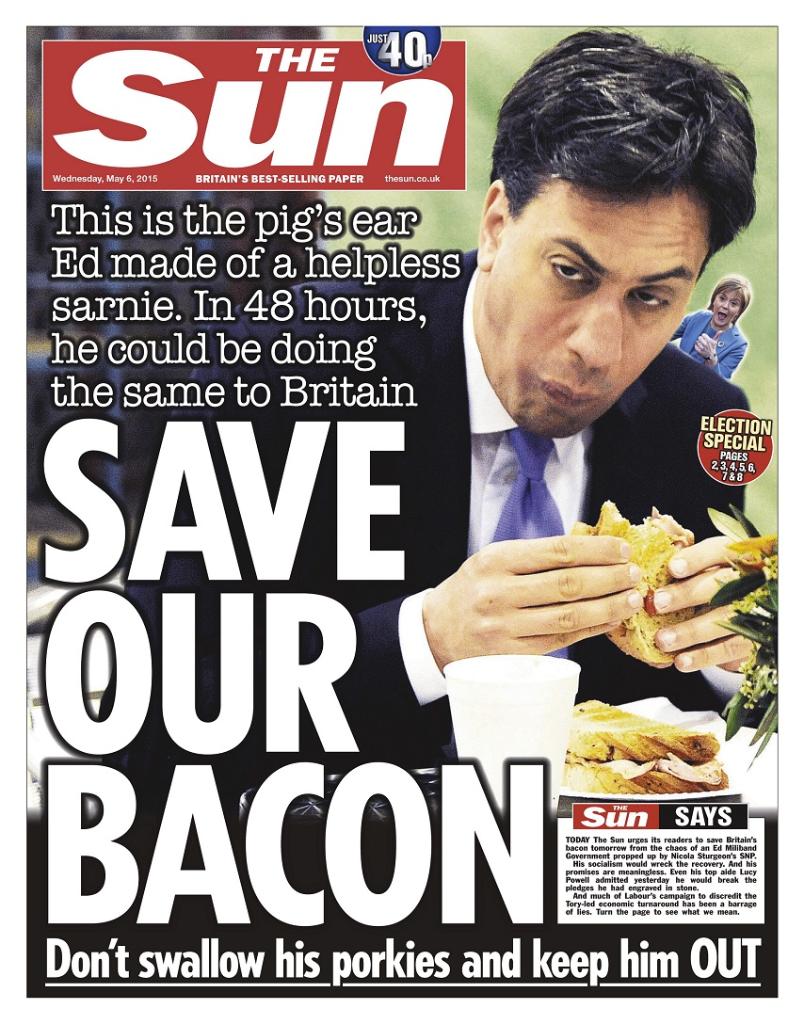
The BBC set is the kind of nasty tactic that we ordinarily expect from the right wing rags. Like the photograph of the previous Labour Party leader, Ed Miliband, eating a bacon sandwich, which became the source of sustained commentary in 2014 and 2015. Taken for the Evening Standard while Miliband was campaigning for local elections in May 2014, it was purposely shared to make him look awkward, error prone or incapable of performing simple tasks, as if eating  is somehow related to political performance. The photo was used in a deeply mocking front page of The Sun on the day before the 2015 general election.
Media bias in the UK

Last year, the Conservatives were accused of “criminalising public interest journalism” as it plans to increase the number of years for the “leaking of state secrets” from 2 years to 14, in the first “overhaul” of the Official Secrets Act for over 100 years.

Under the proposals, which were published last February, officials who leak “sensitive information” about the British economy that damages national security could also be jailed. Currently, official secrets legislation is limited to breaches which jeopardise security, intelligence defence, confidential information and international relations.

The government released the proposals citing the “new reality” of the 21st-century internet and national security dangers as justification for a more “robust” system of prosecution.

The recommendations centre around the Official Secrets Act (1989) which governs how public servants in government and the military must keep government information secret and out of publication.

Journalists and civil liberties groups warned that the threshold for the increased sentence has been lowered and that journalists and whistleblowers acting in the public interest will be effectively gagged. (See The erosion of democracy and the repression of mainstream media in the UK. ) 

However, the Conservatives’ direction of travel regarding media freedoms was clear well before last year. As far back as 2012, the government were ‘monitoring’ the BBC in particular for ‘left wing bias’. The government’s fury at what they call the liberal, left-wing leaning of the state broadcaster was laid bare after Iain Duncan Smith accused the BBC’s economics editor, Stephanie Flanders, of ‘peeing all over British business’. (See also Once you hear the jackboots, it’s too late ). 

Let’s not forget government officials smashing up hard drives containing the Snowden leaks at the Guardian office, too, and the intimidation involving the detention of Glenn Greenwald’s partner under the ‘terrorism’ act. As part of the global surveillance disclosure, the first of Snowden’s documents were published on June 5, 2013, in The Guardian in an article by Greenwald.

Journalists are regarded as “democracy’s watchdogs” and the protection of their sources is the “cornerstone of freedom of the press.” And freedom of the press is a cornerstone of democracy. Although enshrined in such terms by the European Court of Human Rights, these democratic safeguarding principles are being attacked in an increasingly open manner all over the world, including in the democratic countries that first proclaimed them. 

Reporters Without Borders (RSF) are a collective of journalists who study freedom of the press at a comparative and international level. The UK has been consistently in low position (the higher the score, the lower the ranking) for the last five years, last year it dropped lower still, highlighting an increasing intrusion of the government on and restriction of the freedom of the press. RSF ranks the UK 40th in the index; a fall from 38th place in 2016. 

We have a media with a very heavy weighted right wing bias, yet any criticism of government policy reduces our government to shrieking hysterically that the communists have been infiltrating the establishment. It’s a curious fact that authoritarians project their rigidity, insecurities and micro-controlling tendencies onto everyone else.

Types of bias

One source of media bias is a failure to include a perspective, viewpoint or information within a news story that might be objectively regarded as being important. This is important because exclusion of a particular viewpoint or opinion on a subject might be expected to shift the ‘Overton Window’, defining what it is politically acceptable to say. This can happen in such a way that a viewpoint becomes entirely eliminated or marginalised from political discourse. Within academic media theory, there is a line of reasoning that media influence on audiences is not immediate but occurs more through a continual process of repeated arguments – the ‘steady drip’ effect. 

A second potential source of bias is ‘bias by selection’. This might entail particular issues or viewpoints being more frequently covered, or certain guests or organisations being more likely to be selected. There are several others, for some of which the BBC has regularly been criticised. 

Herman and Chomsky (1988) proposed a propaganda model hypothesising systematic biases of media from structural economic causes. Their proposition is that media ownership by corporations, (and in other media, funding from advertising), the use of official sources, efforts to discredit independent media (“flak”), and “anti-communist ideology as the filters that bias news in favour of corporate and partisan political interests.

Politically biased messages may be conveyed via visual cues from the sets as a kind of underhanded reference-dependent framing.  A frame defines the packaging of an element of rhetoric in such a way as to encourage certain interpretations and to discourage others. It entails the selection of some aspects of a perceived reality and makes them more salient in a communicating text, in such a way as to promote a particular problem definition, causal interpretation, moral evaluation and so on. 

On Friday’s night’s programme, author Owen Jones quite properly took Newsnight’s Evan Davis to task about the “disgraceful framing” of the narrative around the nerve-agent poisoning of Sergei Skripal. Davis actually had the brazen cheek to laugh about Jones’s observations, and to deny them.

As other independent journalists have reported, Jones also referred to the observation of sharp-eyed Twitter user @duckspeech that Newsnight had not merely added Corbyn’s image to the backdrop – but had also photoshopped his hat to make it more closely resemble a Russian hat. This was of course referencing the long running and debunked “Russian stooge” and “appeasement” narrative of the Conservatives, which started with the fake Zinoviev letter, when the very first Labour government was in power.

The government have reduced politics to crude ad hominem attacks, aggressive posturing, overly simplistic sound bites and negative, divisive and emotive appeals. The media have reflected a corresponding lack of sophistication in their delivery of ‘news’.

The details and rationality matters 

Corbyn condemned the nerve agent attack on the Skripals in no uncertain terms. However, he responded rationally and stressed that any response to Russia must be based on clear evidence. Of course the right wing rags ran a smear campaign, despicably calling Corbyn a “Kremlin stooge”, and some of  the Labour party’s centrists started sniping.

Yet Corbyn has been rational and reasonable. He said: “The attack in Salisbury was an appalling act of violence. Nerve agents are abominable if used in any war. It is utterly reckless to use them in a civilian environment.

Our response as a country must be guided by the rule of law, support for international agreements and respect for human rights .Our response must be decisive, proportionate and based on clear evidence.” ​He is absolutely right. Meanwhile, the Conservatives have responded with a politics of petulance, with defence minister Gavin Williamson disgracefully saying that Russia should “go away and shut up” when asked how the Kremlin should respond to the expulsion of 23 of its diplomats.

Corbyn was derided when presented a series of simple and reasonable questions to the prime minister, asking what steps the government has taken to collect evidence for its claims, he was loudly heckled by puerile, braying McCarthist members of the House of Commons.

He said: “If the government believe that it is still a possibility that Russia negligently lost control of a military-grade nerve agent, what action is being taken through the OPCW with our allies? I welcome the fact that the police are working with the Organisation for the Prohibition of Chemical Weapons (OPCW). Has the prime minister taken the necessary steps under the chemical weapons convention to make a formal request for evidence from the Russian government under Article IX(2)?

“How has she responded to the Russian government’s request for a sample of the agent used in the Salisbury attack to run their own tests? Has high-resolution trace analysis been run on a sample of the nerve agent, and has that revealed any evidence as to the location of its production or the identity of its perpetrators?”

Perhaps Corbyn’s carping neoliberal opponents inside the Labour party should remember why party membership has significantly grown since Corbyn became the elected leader (twice) and precisely why the party’s popularity surged during last year’s snap election.

One particularly cowardly backbencher, wishing to remain anonymous, shamefully told the Guardian: “Putin’s constant and shameful apologist might just as well stand aside and let the Russian ambassador write the speeches and brief the media himself.” Despicable.

Yet on Wednesday Benjamin Griveaux, a spokesperson for the French government, said it was too early to decide on retaliatory measures against Russia, as its involvement was yet to be proven. Griveaux said France was waiting for “definitive conclusions,” and evidence that the “facts were completely true,” before taking a position. 

 As Walter Lipman once noted, the news media are a primary source of those “pictures in our heads” about the larger world of public affairs, a world that for most citizens is “out of reach, out of sight, out of mind.”  What people know about the world is largely based on what the media decide to show them. More specifically, the result of this mediated view of the world is that the priorities of the media strongly influence the priorities of the public. Elements prominent on the media agenda become prominent in the public mind.

Given the reduction in sophistication and rationality in government rhetoric, media news and current affairs presentation, (and reduction in democratic accountability, for that matter) we don’t currently have a climate that particularly encourages citizens to think critically and for themselves.

Read Jeremy Corbyn’s  article in the Guardian: The Salisbury attack was appalling. But we must avoid a drift to conflict


I don’t make any money from my work. But you can support Politics and Insights and contribute by making a donation which will help me continue to research and write informative, insightful and independent articles, and to provide support to others. The smallest amount is much appreciated, and helps to keep my articles free and accessible to all – thank you. 

DonatenowButton

PM says ‘highly likely’ Russia is responsible for nerve agent attack, without any conclusive evidence

The prime minister says that it has been concluded that Sergei Skripal and his daughter Yulia were poisoned by “military-grade nerve agent of a type developed by Russia.”

May revealed that experts at Britain’s Porton Down defence laboratory, coincidently very close to where the attack happened, have confirmed the Salisbury poisoning involved “highly-specialised” and “military grade” Novichok, first developed by the Soviet Union in the 1970s. 

Updating the Commons earlier today, the prime minister explained that as a result of the nerve agent being found to be military grade Novichok, it is “highly likely that Russia was responsible” for the act against ex-double agent Sergei Skripal and his daughter, which also left Wiltshire Police Detective Sergeant Nick Bailey in a serious condition and parts of the medieval cathedral city closed off.

She also says the Russia was likely to be responsible for the attack because of Russia’s “history of involvement in state-sponsored attacks of this kind.” 

However, the Kremlin has denied involvement, while the Russian embassy accused Britain of playing a “very dangerous game” and warned of “serious long-term consequences.”  

Moscow responded, saying Theresa May’s words were “another political information campaign based on a provocation”, and has branded the prime minister’s suggestion that Moscow was “probably” behind the Salisbury poisonings as a “circus show”.

The spokesperson from Moscow also added, cryptically: “Before making up new fairy tales, let the British disclose how the Litvinenko case ended.” 

Russian dissident Alexander Litvinenko was poisoned with radioactive polonium-210 in London in 2006. It seems that Russia is pointing an accusation back at the UK. 

A former Kremlin adviser, Alexander Nekrasoff, has said that the nerve agent is “possessed by about 16 countries in their laboratories”.

“Why do I know this?” he added. “Because that’s how the antidote is developed.”

Andrei Lugovoi, one of the two men accused of assassinating Alexander Litvinenko with radioactive polonium in 2006, said Britain’s response to events was suspiciously quick. Evidence, he said, that London was operating according to its own script.

Any chemist or physicist will tell you that as a minimum you need some kind of serious expertise on a serious expert level to determine whether or not a country is responsible,” he told the Interfax news agency.

“When such statements are made in the course of a few days, this speaks only of irresponsibility and the fact that they haven’t set out to discover the truth.”

Novichok agents may feasibly be created in pesticide and agricultural fertilizer manufacturing plants, as they have an organophosphate core, as do other nerve agents. So far the government have offered no firm evidence of Russia’s involvement. 

May has said the decision to blame Russia is based on “Russia’s record of conducting state-sponsored assassinations and our assessment that Russia views some defectors as legitimate targets for assassinations”.Yet already the government are talking about ‘robust responses’, which is very worrying. 

The Washington Post reports: “Former special services agent Mikhail Lyubimov was quoted in Komsomolskaya Pravda, one of Russia’s most popular newspapers, as suggesting Skripal wouldn’t have been worth the trouble of a hit.

Skripal was sent to the West in a swap; that means he’s absolutely uninteresting to us. He’s a small-fry,’ Lyubimov said.”

Skripal was jailed for 13 years by Russia in 2006. In July 2010, he was one of four prisoners released by Moscow in exchange for 10 Russian spies arrested by the FBI as part of a swap. He was later flown to the UK.

On Sunday, Dimtry Kiselev, one of Russia’s most powerful media figures, spoke during his Sunday news programme on state-owned TV channel Rossiya-1, in Moscow. Kiselev suggested a possible connection between the poisonings in Salisbury, which British officials said resulted from exposure to an unspecified nerve agent, and international  upcoming World Cup football tournament. 

Kiselev suggested the poisoning could be a “special operation” aimed at justifying a boycott of the tournament. I don’t think that is likely, however.

Skripal wasn’t much use to Britain as an exposed ex-spy, but “as someone who’s been poisoned, who is ill, he’s very useful,” Kiselev said. 

The programme included an on-the-ground report from Britain. The reporter noted that Salisbury, the town where Skripal was lived and fell sick, is about a 20-minute drive from the Porton Down laboratories where Britain developed chemical and bacteriological agents.

“But in the British press and special services, there is no suspicion” [of any British involvement], said another reporter, Alexander Khabarov.

So Russia has been given an ultimatum. May goes on to say that if Russia does not give a “credible response”, the government will conclude that the attack involved “unlawful use of force by the Russian state against the United Kingdom”. 

May also said the UK must stand ready to take much more “extensive measures”, and these would be set out in the Commons on Wednesday should there be no adequate explanation from Russia.

The prime minister will then return to the Commons to outline retaliatory proposals, should there be no adequate explanation.

Here are the key passages from Theresa May’s statement today:

Mr Speaker, this morning I chaired a meeting of the National Security Council in which we considered the information so far available.

As is normal, the Council was updated on the assessment and intelligence picture, as well as the state of the investigation.

It is now clear that Mr Skripal and his daughter were poisoned with a military-grade nerve agent of a type developed by Russia.

This is part of a group of nerve agents known as ‘Novichok’.

Based on the positive identification of this chemical agent by world-leading experts at the Defence Science and Technology Laboratory at Porton Down; our knowledge that Russia has previously produced this agent and would still be capable of doing so; Russia’s record of conducting state-sponsored assassinations; and our assessment that Russia views some defectors as legitimate targets for assassinations; the Government has concluded that it is highly likely that Russia was responsible for the act against Sergei and Yulia Skripal.

Mr Speaker, there are therefore only two plausible explanations for what happened in Salisbury on the 4 March.

Either this was a direct act by the Russian State against our country.

Or the Russian government lost control of this potentially catastrophically damaging nerve agent and allowed it to get into the hands of others.

This afternoon my Rt Hon Friend the Foreign Secretary has summoned the Russian Ambassador to the Foreign and Commonwealth Office and asked him to explain which of these two possibilities it is – and therefore to account for how this Russian-produced nerve agent could have been deployed in Salisbury against Mr Skripal and his daughter.

My Rt Hon Friend has stated to the Ambassador that the Russian Federation must immediately provide full and complete disclosure of the Novichok programme to the Organisation for the Prohibition of Chemical Weapons.

And he has requested the Russian Government’s response by the end of tomorrow.

Mr Speaker, this action has happened against a backdrop of a well-established pattern of Russian State aggression.

Russia’s illegal annexation of Crimea was the first time since the Second World War that one sovereign nation has forcibly taken territory from another in Europe.

Russia has fomented conflict in the Donbas, repeatedly violated the national airspace of several European countries, and mounted a sustained campaign of cyber espionage and disruption. This has included meddling in elections, and hacking the Danish Ministry of Defence and the Bundestag, among many others.

During his recent State of the Union address, President Putin showed video graphics of missile launches, flight trajectories and explosions, including the modelling of attacks on the United States with a series of warheads impacting in Florida.

While the extra-judicial killing of terrorists and dissidents outside Russia were given legal sanction by the Russian Parliament in 2006.

And of course Russia used radiological substances in its barbaric assault on Mr Litvenenko. We saw promises to assist the investigation then, but they resulted in denial and obfuscation – and the stifling of due process and the rule of law …

Mr Speaker, on Wednesday we will consider in detail the response from the Russian State.

Should there be no credible response, we will conclude that this action amounts to an unlawful use of force by the Russian State against the United Kingdom.

And I will come back to this House and set out the full range of measures that we will take in response.

Mr Speaker, this attempted murder using a weapons-grade nerve agent in a British town was not just a crime against the Skripals.It was an indiscriminate and reckless act against the United Kingdom, putting the lives of innocent civilians at risk.

And we will not tolerate such a brazen attempt to murder innocent civilians on our soil.

In his response to May’s statement,  Jeremy Corbyn condemned the Salisbury attack, and he included criticism of the Tories for taking money from Russian donors. .

The government could impose unilateral sanctions on Russian individuals and businesses. However, it is unlikely to get support from European partners for tougher EU-wide sanctions. Brexit makes those kinds of negotiations much more difficult, and some EU countries are already trying to soften their approach to Moscow.

The government could also make it more difficult for Russians generally to get visas to the UK. However, this is unlikely as such restrictions might also hit Russian dissidents whom the UK welcomes and wealthy businessmen whose laundered cash the UK tolerates to support London’s property market. Few analysts believe targeting rich Russians with tougher asset-stripping orders would make much difference. They would simply take their money elsewhere. 

The government could pass a British version of the 2012 US Magnitsky act, which punishes Russians involved in corruption and human rights violations with asset freezes and travel bans. It is named after a Russian lawyer who died in custody after revealing alleged fraud by state officials. Opposition MPs have been pushing for a Magnitsky amendment to be added to the Sanctions and Anti-Money Laundering Bill now going through Parliament. 

Other options include the expulsion of Russian diplomats from the UK, as happened after the poisoning of former Russian Federal Security Service operative Litvinenko in 2006. 

There has also been discussion of taking Russian broadcasters such as RT (formerly Russia Today) off the air , and broadcasting regulator Ofcom has said it will “consider the implications for RT’s broadcast licences” after May speaks on Wednesday.  

The UK has already internationalised the matter by asking Russia to provide a “full and complete disclosure” of the Novichok nerve agent programme to an international agency, the Organisation for the Prohibition of Chemical Weapons.

By framing the poisoning as a possible “unlawful use of force” by Russia against the UK,  May has also prompted questions as to whether this could be a matter for NATO, the military alliance of 29 countries. The alliance’s policy of collective defence – under Article 5 – states that an attack on any one ally is seen as an attack on all. It was invoked for the first and only time by the United States after the 9/11 attacks in New York.

Lord Ricketts, a former UK national security adviser, told the BBC that such an “unlawful act” warranted the involvement of NATO.

Any action “will be much more effective if there can be a broader, Nato-EU solidarity behind us”, he said. So far, Downing Street has played down suggestions that this is an Article 5 matter, though.

However, the magnitude of the response that may be announced on Wednesday will depend on the scale of international co-operation that the government can secure, 

The risk with any of the options  considered is the scale of any Russian retaliation, of course.

Before the basic facts of the case have been established, both sides have indulged in an early confrontational exchange. Let’s hope and pray that a diplomatic solution can be reached, rather than any further potentially catastrophic escalation.


Related

From the age of nuclear ‘deterrence’ to an era of first-strike posturing – a creeping escalation


I don’t make any money from my work. I’m a disabled person with lupus, and I’m stuggling to get by. But you can help by making a donation and enable me to continue to research and write informative, insightful and independent articles, and to provide support to others going through disability benefit assessment processes and appeals. The smallest amount is much appreciated – thank you.

DonatenowButton

Jeremy Corbyn and Noam Chomsky receive the prestigious international MacBride Peace Prize


Jeremy Corbyn was awarded the Sean MacBride Peace Prize along with Noam Chomsky and Japanese anti-military base activists, yet the award received no coverage in the British media. It was International Human Rights day today. Corbyn made an outstanding speech in Geneva, but the UK media unbelievably appear to have vetoed what ought to have been headline news.

So it’s been left to a handful independent journalists and writers like me to report this event.

The International Peace Bureau presents the prestigious Sean MacBride Peace Prize to individuals, organisations or movements for their work for peace, disarmament and human rights. 

Sean MacBride was a founding member of Amnesty International, a hugely well-known and successful charity that was set up by “ordinary people from across the world standing up for humanity and human rights.” MacBride was also a prominent Irish MP who participated in many international organisations including the United Nations and the Council of Europe as well as Amnesty International. He received the Nobel Peace Prize in 1974, the Lenin Peace Prize for 1975–1976 and the UNESCO Silver Medal for Service in 1980. He was Secretary-General of the International Commission of Jurists from 1963 to 1971. Following this, he was also elected Chair (1968–1974) and later President (1974–1985) of the International Peace Bureau in Geneva. He was Vice-President of the Organisation for European Economic Co-operation and President of the Committee of Ministers of the Council of Europe. He had many other key roles.

Despite the significance of such an award being handed to a mainstream British politician, the only media platforms to report the story were independent ones such as EvolvePolitics, The Canary, The Skwawkbox and Vox Political.

As Skwawkbox commented: “Had Theresa May or any other establishment lackey been awarded with a prestigious International Peace Award, can you seriously imagine the entire media would ignore it?”

Corbyn was this year’s recipient, along with renowned scholar Noam Chomsky and the All Okinawa Council Against Henoko New Base. He received his award in Geneva on Friday. 

Noam Chomsky was recognised “for his tireless commitment to peace, his strong critiques to U.S. foreign policy, and his anti-imperialism. Professor Chomsky has been properly described as ‘a genuine people’s hero, an inspiration for struggles all over the world for that basic decency known as freedom’, as ‘one of the greatest and most radical public thinkers of our time’, ‘one of the most significant challengers of unjust power and delusions’, and as a ‘guru’ for the world’s anti-capitalist and anti-imperialist movement. In recent years, in addition to his continuing contributions to the fields of linguistics, philosophy and cognitive science, his critiques have focused on the U.S. post-9-11 ‘War on Terror’ which has provided cover for a continuation of U.S. imperial policies, and the imperative of addressing the dangers posed by nuclear weapons and climate change.” 

Corbyn was recognised and honoured for his “sustained and powerful political work for disarmament and peace.” His longtime work with the Campaign for Nuclear Disarmament in the UK and the Stop the War Campaign was commended, along with his outstanding work for peace as a politician more generally. The award is presented jointly by the International Peace Bureau (IPB) and the World Democratic Forum. The reasons for the award are described on the IPB’s website. It says:

“As a member of parliament in the UK he has, for 34 years continually taken that work for justice, peace and disarmament to the political arena both in and outside of Parliament. He has ceaselessly stood by the principles, which he has held for so long, to ensure true security and well-being for all – for his constituents, for the citizens of the UK and for the people of the world. Now, as leader of the Labour Party and Leader of the Opposition he continues to carry his personal principles into his political life – stating openly that he could not press the nuclear button and arguing strongly for a re-orientation of priorities – to cut military spending and spend instead on health, welfare and education.”

You can watch his speech here:

You can read Corbyn’s outstanding speech here

In 2013, Corbyn was also given The Gandhi Foundation International Peace Award. This is a leader who has unwavering principles and he has shown a deep and lasting commitment to peace and human rights.

Jeremy Corbyn receiving The Gandhi Foundation International Peace Award 

Corbyn has always preferred a diplomatic approach to conflict. The biased media made a big issue of that during general election campaigning earlier this year, with some of the right wing rags wearing away the proverbial barrel to label him a “terrorist sympathiser”. 

Despite the fact the Labour leader said several times during televised interviews that he condemns “all bombing”, journalists, political editors and correspondents seemed to nonetheless feel an inexplicable need to constantly ask if he would “denounce” IRA terrorism.

Meanwhile, Conservatives have been permitted to peddle untruths and manipulate half-truths unchecked. It was almost as if Lynton Crosby, the high priest of divisive politics, dead cats and dog whistles, had widely distributed a crib sheet of a limited range of limited questions to be repeated over and over, such as this one, to divert everyone from any discussion whatsoever about policies or anything remotely meaningful. 

The so-called “impartial” national media are pretty disgusting for allowing this to happen without any critical thought or investigation whatsoever. They permitted no genuine facilitation of democratic debate. You know, those things that journalists are actually paid to do. 

Consequently the run-up to the general election this year saw an absolutely disgusting media manipulation and misrepresentation of Corbyn’s integrity. 

It is possible to feel sympathy for ALL of the deaths and those family and loved ones left behind, in such a tragic, violent and seemingly relentless ethno-nationalist conflict. It’s possible to recognise that all of civilian deaths are an outrage and tragic. It’s possible to recognise the pain of their loved ones and families left behind. It’s also possible to condemn the acts of terrorism that left english civilians dead, too. It’s possible to honour ALL of those people who were killed in the conflict. I know I do.

Human lives are equally precious and have equal worth. It’s a mark of Corbyn’s insighfulness, maturity and integrity that he recognises this. History has a scattering of despots who committed atrocities and genocide, because they refused to consider all people as human beings. It seems some people never learn, though. Holding this perspective does not mean that we cannot also condemn acts of despicable terrorism. 

The Good Friday Agreement in 1998 brought lasting peace. History demonstrated that Corbyn’s approach was the right one. So we need to ask ourselves why it is that Theresa May, her party, and the media are so fixated on events that happened over 20 years ago. For the record, Margaret Thatcher held secret meetings with the IRA to negotiate peace.

Despite being known for her unyielding stance against the IRA during the Troubles, released documents show Thatcher made secret concessions, and that in May 1985 a member of her Cabinet approved a Royal Prerogative of Mercy for Donal Donnelly, who had fled prison 25 years earlier, after being convicted for his membership of the IRA. It seems the media had forgotten this detail in the run-up to the general election.

John Major also had established links with the IRA to negotiate peace.

It’s reasonable to expect governments to explore diplomatic solutions in conflicts in order to keep citizens safe. It’s also reasonable to expect governments to be honest. The Conservatives haven’t been that.

Jermy Corbyn, however, has been consistently open and honest.

Well done and congratulations, Jeremy Corbyn!

This is a very well-deserved award and a measure of his hard work, integrity, honesty, ethics and principles.


I don’t make any money from my work, and I’m not funded. You can help to support Politics and Insights by making a donation to help me continue to research and write independently and continue to support other people

DonatenowButton

The uncouth and uncaring Conservative Party’s budget

After trying to address a rudely interrupting, unhearing, unfeeling, jeering and sneering Conservative party to deliver his response to the budget today, Jeremy Corbyn called the government “uncouth” and “uncaring” in a passionate speech, with barely constrained anger at how Conservatives’ policies are creating hardship and suffering for some of our most vulnerable citizens. A Conservative had made an inappropriate and ageist comment about Corbyn’s age, while he was addressing the Conservatives’ brutal cuts to social care.  

Corbyn spoke in defence of those elderly people suffering cuts in care budgets. It has been alleged that Conservative Party whip Andrew Griffiths – hiding out of sight of the Speaker’s chair – said the Labour leader should “be in a care home” himself.

Many of us have also used those words among others – uncouth and uncaring – many times over the past seven years to describe a government that laughed when hearing about people suffering because of their policies, laughed at the accounts of those suffering hardships because of the impact of the bedroom tax, laughed at the misery of those having to visit food banks. This is the same government that has stripped our public services bare, presided over falling and stagnating wages and huge hikes in the cost of living, removed lifeline support from ill and disabled people, stripping them of the means of meeting their basic needs, their independence and dignity, and savagely reducing funding to our local authorities, and essential public services such as health and social care. 

As Labour MP Laura Pidcock says: “It was absolutely right to be angry at the attitude of members on the benches opposite – shouting him down when he’s talking about serious issues, like the lack of social care services as a result of massive cuts (£6 billion) to budgets. This neglect, these holes in our safety net for vulnerable people, hurt people in reality. It is not a game.”

We have seen, over the last 7 years, the Conservatives’ authoritarianism embedded in punitive policies, in a failure to observe the basic human rights of some social groups, in their lack of accountability and diffusion of responsibility for the consequences of their draconian policies, and in their lack of democratic engagement with the opposition. Hurling personal insults, sneering and shouting over critics has become normalised by the Conservatives. They don’t debate, they simply attack on a personal level. This is not the standard and quality of debate that the public expect. Yet people don’t recoil any more from what has often been dreadfully unreasonable hectoring and terribly poor decorum. But they reallty ought to.

The budget details – pretty much more of the same

Philip Hammond finally faced up to the problem of “slower growth than predicted.” What a pity he didn’t have the balls to own the REASONS for that, which are chiefly linked to the seven year long economically inept, miserly austerity programme, aimed solely at ordinary people, especially the poorest citizens, and the deluxe “incentivisation” package designed to overindulge the hoarding wealthy.

The nations’ redistributed wealth simply trickles offshore, as we have discovered.

Those of us opposing the implicit “trickle down” philosophy of the government have won this debate several times over. Yet still the Tories persist in peddling magical thinking and neoliberal mythologies. The budget is simply more of the same economic ineptitude.

The answer to failing neoliberism is apparently more neoliberalism. It’s a budget of more of the same. 

The Office for Budget Responsibility (OBR) has presented a rather grim picture, slashing an average of 0.7% percentage points off UK trend productivity growth each year. That means the economy will be at least 3% smaller in 2020 than previously expected, leading to the sharp growth downgrade.  It’s another sign that the UK economy is weaker than we were led to believe by the bumbling government, who are not delivering the “robust” growth that policymakers have claimed. 

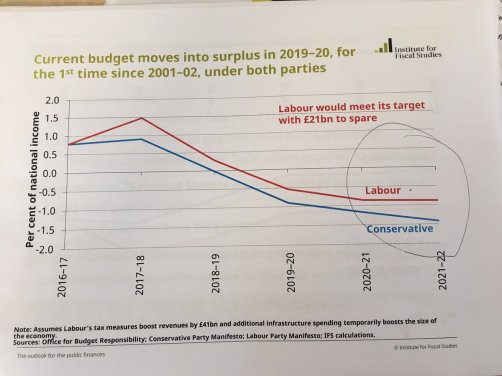
From the Institute for Fiscal Studies (IFS)

The OBR has also revised up its expected mortality rate. It’s now expected that 502,000 pensioners will die each year, up from 476,000 previously. 

The OBR says:

“This is consistent with life expectancy increasing less than projected since mid-2014. By 2022, the population in this age group [adults aged above the state pension age] is 1.2% lower than previously assumed.” 

What this means is that our life expectancy is falling, which is shameful in a developed and wealthy nation. 

Here is the response to the budget from John McDonnell, the shadow chancellor. And here is an excerpt:

“This is a ‘nothing has changed’ budget from an out-of-touch Government with no idea of the reality of people’s lives and no plan to improve them.

Philip Hammond has completely failed to recognise the scale of the emergency in our public services.

Today’s budget has found no meaningful funding for our schools still facing their first real terms funding cuts since the mid-90s and nothing even approaching the scale needed to address the crisis in our NHS or local government.”

Corbyn has also condemned Philip Hammond’s second Budget as Chancellor, saying that it demonstrates a “record of failure with a forecast of more to come”.  

The Labour leader, who was not provided with an advance sight of Hammond’s Budget, criticised the Government for repeatedly pushing back its target to eliminate Britain’s deficit, now it’s not likely to be “paid down” until at least 2030. If ever. I don’t think the Conservatives care about the deficit. They are rather more interested in privatising public services, and taking money from the poorest to hand out to the wealthiest. Their policies are not practical, they are simply ideological, revealing the very worst of their own traditional prejudices.

Corbyn said that 120,000 children would spend this Christmas living in temporary accommodation, he said: “Three new pilot schemes for rough sleepers simply doesn’t cut it.

“It’s a disaster for those people sleeping on our streets, forced to beg for the money for a night shelter,” he added. “They’re looking for action now from government to give them a roof over their heads.” 

Corbyn also cited cuts to police officer numbers and rising levels of in-work poverty. He also criticised the Government for failing to take action to tackle credit card debt.

He said: “Debt is being racked up because the Government is weak on those who exploit people, such as rail companies hiking up fares above inflation year on year, and water companies and energy suppliers.” 

The Labour party leader also criticised the Government’s measures on housing, saying very little was mentioned about the private rented sector – even though landlords were paid £10bn in housing benefit.

“With this Government delivering the worst rate of house building since the 1920s and 250,000 fewer council homes, any commitment would be welcome,” he said.

“But we’ve been here before. The Government promised 200,000 starter homes three years ago. Not a single one has yet been built in those three years.

You can watch Corbyn’s speech in full here

Here is a transcript of the core parts of his speech:

Mr Deputy Speaker, this Budget has been an advertisement for just how out-of-touch this government is with the reality of people’s lives. 
 
Pay is now lower for most people than it was in 2010 and wages are now falling again.

Economic growth in the first three quarters of this year is the lowest since 2009 and the slowest of the major economies in the G7.

It’s a record of failure with a forecast of more. Economic growth has been revised down. Productivity growth has been revised down. Business investment revised down.

People’s wages and living standards revised down. What sort of “strong economy, fit for the future” is that?

The deficit was due to be eradicated by 2015, then 2016, then 2017, then 2020 and now 2025. They’re missing their major targets but the failed and damaging policy of austerity remains.

The number of people sleeping rough has doubled since 2010 and 120,000 children will spend this Christmas in temporary accommodation. In some parts of the country life expectancy is actually starting to fall.

The last Labour government lifted a million children out of poverty. Under this government an extra 1 million children will be plunged into poverty by the end of this Parliament. 1.9 million pensioners and one in six are living in poverty – the worst rate in Western Europe.

Falling pay, slow growth, and rising poverty. This is what the Chancellor has the barefaced cheek to call a “strong economy”.

His predecessor said they would put the burden on “those with the broadest shoulders”. How has that turned out?

The poorest tenth of households will lose about 10 per cent of their income by 2022 while the richest will lose just 1 per cent.

So much for “tackling burning injustices”. This government is tossing fuel on the fire.

Personal debt levels are rising and 8.3 million people are over-indebted. If he wants to help people out of debt, he should back Labour’s policy for a Real Living Wage of £10 per hour by 2020.

And with working class young people now leaving university with £57,000 of debt – because this government trebled tuition fees – this government’s new policy to win over young people is to keep fees at £9,250.
 
But that is just one of a multitude of injustices presided over by this government. Another is Universal Credit, which Labour has called on ministers to pause and fix.
 
That’s the view of this House. It’s the verdict of those on the frontline with evidence showing food bank use increases 30 per cent where Universal Credit is rolled out.
 
And the benches opposite should listen to Martin’s experience, a full-time worker on the minimum wage, he says: “I get paid four weekly meaning that my pay date is different each month”, because of that, under the UC system he was paid twice in a month and deemed to have earned too much so his UC was cut off. He goes on: “This led me into rent arrears and I had to use a food bank for the first time in my life”.
 
This Chancellor’s solution to a failing system causing more debt; is to offer a loan. And the six week wait, with 20 per cent waiting even longer, becomes a five week wait.
 
This system has been run down by £3 billion cuts to Work Allowances, the two-child limit and the perverse ‘rape clause’ – and caused evictions because housing benefit isn’t paid direct to the landlord.
 
So I say to the Chancellor: put this broken system on hold, so it can be fixed, and keep a million more children out of poverty.
 
For years we have had the rhetoric of a “long-term economic plan” that never meets its targets; when what all too many are experiencing is long-term economic pain.
 
And the hardest hit are disabled people, single parents and women.
 
So it is disappointing the Chancellor did not back the campaign of my Hon Friend for Brent Central, Dawn Butler, to end period poverty.
 
The Conservative manifesto has now been shredded and some ministers opposite have since put forward decent proposals, several conspicuously borrowed from the Labour manifesto.
 
Let me tell the Chancellor, as socialists we are happy to share. 
 
The Communities Secretary called for £50 billion of borrowing to invest in housebuilding. Presumably the Prime Minister slapped him down for wanting to “bankrupt Britain”. 
 
The Health Secretary has said the pay cap is over but where is the money to fund a pay rise? The Chancellor hasn’t been clear today, not for NHS workers nor for our police, firefighters, teachers or teaching assistants, bin collectors, tax collectors or our armed forces personnel.
 
Will the Chancellor listen to Claire? She says, “My Mum works for the NHS. She goes above and beyond for her patients. Why does the government think it’s ok to under pay, over stress and underappreciate all that work?”
 
The NHS Chief Executive says “the budget for the NHS next year is well short of what is currently needed”. 
 
The Health Secretary said in 2015 he would fund another 5,000 GPs, but in the last year we have 1,200 fewer GPs. We’ve lost community nurses. We’ve lost mental health nurses. 
 
The Chancellor promised £10 billion in 2015 but delivered only £4.5 billion so we’ll wait for the small print on today’s announcement. It certainly falls well short of the £6 billion Labour would have delivered.
 
Over a million of our elderly aren’t receiving the care they need. Over £6 billion will have been cut from social care budgets by March next year. 
 
Our schools will be 5 per cent worse off by 2019 despite the Conservative manifesto promising that no school would be worse off. 
 
5,000 head teachers from 25 counties wrote to the Chancellor, saying “we are simply asking for the money that is being taken out of the system to be returned”. 
 
Robert wrote to me saying, “As a senior science technician my pay has been reduced by over 30 per cent. I’ve seen massive cuts at my school. Good teachers and support staff leave“.
 
According to this government, 5,000 head teachers are wrong. Robert is wrong. The IFS is wrong.
 
Councils are warning that services for vulnerable children are under more demand than ever, yet have a £2 billion shortfall. Local councils will have lost nearly 80 per cent in direct funding by 2020.
 
In reality, across the country this means women’s refuges closing, youth centres closing, libraries closing, museums closing.
 
But compassion can cost very little and just £10 million is needed to establish the child funeral fund campaigned for by my hon friend for Swansea East, Carolyn Harris.  
 
Under this government there are 20,000 fewer police officers. And another 6,000 community support officers, and 11,000 Fire Service staff have been cut too. 
 
Our communities cannot be kept safe on the cheap.
 
Tammy explains how this has affected her: “our police presence has been taken away meaning increasing crime. As a single parent I no longer feel safe in my own village, particularly after dark.”
 
Mr Deputy Speaker, five and a half million workers earn less than the living wage, a million more than just five years ago. 
 
And the Chancellor can’t even see 1.4 million unemployed people. 
 
There is a crisis of low pay and insecure work, affecting 1 in 4 women, and 1 in 6 men, a record 7.4 million people in working households in poverty. 
 
If we want workers earning better pay, less dependent on in-work benefits, we need to strengthen trade unions. the most effective means to boost workers’ pay. 
 
Instead this government weakened trade unions and introduced Employment Tribunal fees – now scrapped thanks to Unison’s legal victory.
 
And Mr Deputy Speaker, why didn’t the Chancellor take the opportunity to make two changes to control debt?
 
Firstly, to cap credit card debt so that nobody pays back more than they borrowed.
 
And secondly, to stop credit card companies increasing people’s credit limit without their say so.
 
Debt is being racked up because this government is weak on those who exploit people: the rail companies hiking fares above inflation year-on-year, the water companies and the energy suppliers.
 
During the general election it promised an energy cap that would benefit “around 17 million families on standard variable tariffs”. But every bill tells millions of families the government has broken its promise.
 
And with £10 billion in housing benefit going into the pockets of private landlords every year, housing is a key factor in driving up the welfare bill.
 
With this government delivering the worst rate of housebuilding since the 1920s and a quarter of a million fewer council homes, any commitment is welcome. 
 
But we’ve been here before. The government promised 200,000 starter homes three years ago and not a single one has been built. 
 
We need a large scale public house building programme, not this government’s accounting tricks and empty promises.
 
We back the abolition of stamp duty for first-time buyers because it was another Labour policy at the election, not a Tory one.
 
It’s this government’s continual preference for spin over substance that means, across this country, the words “Northern Powerhouse” and “Midlands Engine” are now met with derision.
 
Yorkshire and Humber gets only one-tenth of the transport investment per head given to London. 
 
And government figures show that every region in the north of England has seen a fall in spending on services since 2012. 
 
The Midlands, East and West, is receiving less than 8 per cent of total transport infrastructure investment, compared with over 50 per cent going to London.
 
In the East and West Midlands 1 in 4 workers are paid less than the living wage. So much for the ‘Midlands Engine’.
 
Re-announced funding for the Transpennine rail route won’t cut it and today’s other announcements won’t redress the balance.
 
Combined with counterproductive austerity, this lack of investment has consequences in sluggish growth and shrinking pay packets, and public investment has virtually halved.
 
Under this government, the UK has the lowest rate of public investment in the G7, but it is now investing in driverless cars after months of road-testing back seat driving in government.
 
By moving from RPI to CPI indexation on business rates the Chancellor has adopted another Labour policy, but why don’t they go further and adopt Labour’s entire business rates pledges including exempting plant and machinery and annual revaluation of business rates.
 
Nowhere has that been more evident than over Brexit.
 
Following round after round of fruitless Brexit negotiations the Brexit Secretary has been shunted out for the Prime Minister who has got no further.
 
Every major business organisation has written to the government telling them to pull their finger out.
 
Businesses are delaying investment decisions, but if this government doesn’t get its act together soon they will be taking relocation decisions.
 
Crashing out with ‘No deal’ and turning Britain into a tin-pot tax haven will damage people’s jobs and living standards, serving only a wealthy few.
 
It’s not as if this government isn’t doing its best to protect tax havens and their clients in the meantime.
 
The Paradise papers have again exposed how a super-rich elite is allowed to get away with dodging taxes.
 
This government has opposed measure after measure in this House, and in the European Parliament, to clamp down on the tax havens that facilitate this outrageous leaching from the public purse.
 
Mr Deputy Speaker, too often it feels like there is one rule for the super-rich and another for the rest of us.
 
The horrors of Grenfell Tower were a reflection of a system that puts profits before people, that fails to listen to working class people.
 
In 2013 this government received advice in a coroner’s report that sprinklers should be fitted in all high rise buildings.
 
Today this government failed to fund the £1 billion investment needed to make homes safe. The Chancellor says councils should contact them, but Nottingham has, Westminster has, and they’ve been refused!
 
In a Parliament building scheduled to be retrofitted with sprinklers, to protect us, the message from this government to people living in high rise homes is: You matter less.
 
Our country is marked by growing inequality and injustice. 
 
We were promised a revolutionary Budget. The reality is nothing has changed.
 
People were looking for help from this Budget, they have been let down. 
 
Let down by a government that like the economy they’ve presided over is weak and unstable and in need of urgent change.
 
They call this Budget, ‘Fit for the Future’. The reality is this is a government no longer fit for office.


I don’t make any money from my work. But you can support Politics and Insights and contribute by making a donation which will help me continue to research and write informative, insightful and independent articles, and to provide support to others. The smallest amount is much appreciated, and helps to keep my articles free and accessible to all – thank you. 

DonatenowButton

top 100 blogs

Please let the Conservatives know that the Grenfell tragedy must not be trivialised and ignored

Yesterday I had the following email from Jeremy Corbyn:

Sue, we’ve just found out that the Tories in Kensington have been asking residents how important the Grenfell tragedy is on a scale of 0-10.

It is insulting and insensitive.

Preventing another fire like Grenfell couldn’t be more important. And Theresa May has the power to do it — she could use next Wednesday’s budget to set aside money to fit social housing with sprinklers that would save lives. Let’s make sure she hears our message.

Please sign this and tell the Tories why Grenfell must not be ignored.

Sign this and help us make sure that residents of high rise social housing can sleep safely with the knowledge that they are being listened to.

Jeremy Corbyn
Leader of the Labour Party


It’s like they need instructions for being human.” Kay Bailey

I agree, the Conservatives’ survey is crass and insensitive, it trivialises the Grenfell tragedy, putting it at the same level of priority as refuse collection and local parking facilities, which is insulting and callous. Asking people to place such an avoidable and tragic event on a scale of priority, from one to ten, is both brutal and shows a complete lack of responsibility and remorse on the part of the government. 

I have signed both petitions. 

Will you?


Related

Grenfell, inequality and the Conservatives’ bonfire of red tape

Grenfell is a horrific consequence of a Conservative ‘leaner and more efficient state’

Dangerous electrical faults were historically ignored at Glenfell Tower


Jeremy Corbyn’s greatest success is the discrediting of neoliberalism. He gets my vote

Jeremy Corbyn Labour conference speech in full (2017)

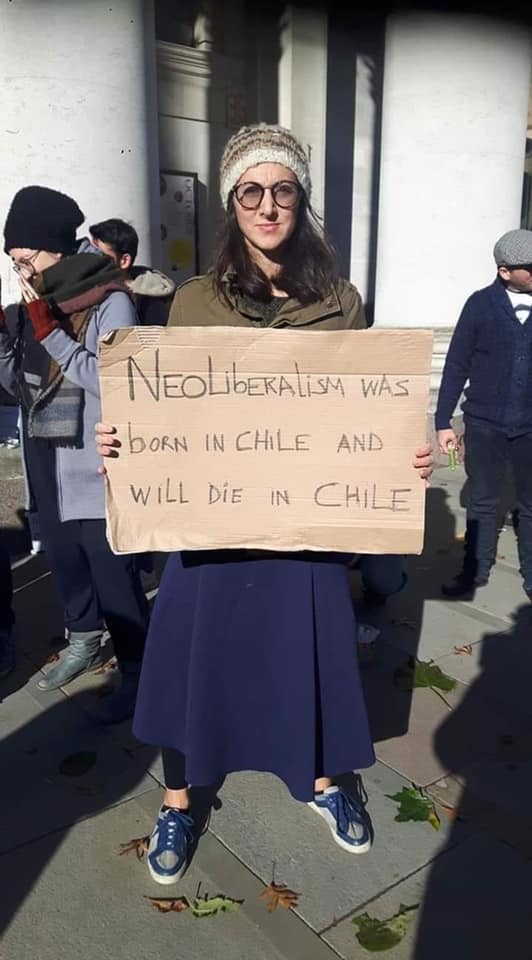
One of Corbyn’s most important achievements is in extending national debate beyond the limits of neoliberal ideology and challenging the hegemony imposed by Margaret Thatcher. The sell by date was last century, it expired in General Pinochet’s Chile. Yet the Tories continue to flog a dead horse, selling England by the pound, while selling the public very short indeed.

With it’s justification narrative of meritocracy, entrenched notions of ‘deserving and undeserving’ applied post hoc to explain away the steeply unequal hierarchy of the economic order, neoliberalism is founded on deeply eugenic ideas and social Darwinism. Neoliberals from Margaret Thatcher onwards have embraced white supremacist thinkers such as Charles Murray

Murray is a statistically minded sociologist by training. Statistics tend to exclude qualitative accounts and details of the populations researched. They don’t do much to generate understandings or meaningful accounts, often imposing a theoretical framework onto those being studied, rather than presenting any meanigful dialogue between researcher and those researched. The result is rather a restricted, one sided account. 

Murray has spent decades working to rehabilitate long-discredited theories of IQ and heredity, turning them into a foundation on which to build a Conservative theory of society that rejects notions of equality and egalitarianism completely. He is fiercely opposed to welfare programmes and social safety nets of any kind. His thinking is embedded in neoliberal narrative.

In Murray’s view, wealth and social power naturally accrue towards a “cognitive elite” made up of high-IQ individuals (who are overwhelmingly white, male, and from well-to-do families), while those on the lower end of the eponymous bell curve form an “underclass” whose misfortunes stem from their ‘low intelligence’. 

It never crossed his mind that IQ tests simply measure a person’s ability to perform IQ tests. Or that other qualities, such as ruthlessness and dark triad traits (psychopathy, narcissism and Machiavellianism) – which are linked by callousness, manipulation, and a lack of remorse and empathy – are a more accurate measure of qualities that result in “success” and financial reward. The reckless behaviours of the financial class that caused the global crash bear out this theory, after all.

Narcissism consists of dominance motivation, a sense of entitlement, and perceived superiority combined with intolerance to criticism. Machiavellianism includes facile social charm, deceitful behaviour aimed at undermining others, and a reliance on manipulation. Psychopathy shows itself in low or absent empathy, an absence of remorse and conscience, high impulsivity, heartless social attitudes, and interpersonal hostility. Taken together, the most powerful tendency underlying all three Dark Triad traits is a knack for sadism, manipulation and exploiting others. 

Research has indicated that Machiavellianism significantly correlated with right-wing authoritarianism and social dominance orientation. Furthermore, narcissism was associated with right-wing authoritarianism, and both narcissism and psychopathy were associated with social dominance orientation. Finally, dark personality traits have been shown to be associated with moral foundations that in turn are linked to Conservatism.

For example, showed that Machiavellianism predicted both ingroup/loyalty and authority/respect, whereas psychopathy was positively associated with ingroup/loyalty. (Also see: The impact of dark tetrad traits on political orientation and extremism: an analysis in the course of a presidential election.)

The myth of economic growth

The Tories have frequently shrieked, with vindictive and borderline hysterical relish, that Labour’s pro-social economic policies reflect “fiscal irresponsibility”, but that doesn’t resonate with the government’s calamitous economic record over the past seven years. Nor does it fit with historic facts and accuracy. 

The Labour party were in power when the global crash happened. The recession in 2007/8 in the UK was not one that happened as a direct consequence of Labour’s policies. The seeds of The Great Recession were sown in the 80s and 90s. The global crisis of 2008 was the result of the financialization process: of the massive creation of fictitious financial capital and the hegemony of a reactionary ideology, neoliberalism, which is based on the assumption that markets are self-regulating and efficient. 

The New Right argued that competition and unrestrained selfishness was of benefit to the whole society in capitalist societies. It asserted that as a nation gets wealthier the wealth will “trickle down” to the poorest citizens, because it is invested and spent thereby creating jobs and prosperity. In fact the global financial crisis has demonstrated only too well that financial markets provide opportunities for investment that extend relatively few extra jobs and that feed a precarious type of prosperity that can be obliterated in just a matter of days. 

Neoliberalism: the social sins and economic incompetence of the New Right

The financial deregulation promoted by the New Right permitted the financial institutions to dictate government policy and allowed wealth to be channelled into speculative investments, exacerbating the volatility of share and housing markets. Neoliberal theories were embraced and cherished by big business because they provided a legitimation for their pursuit of self-interest, personal profit and ample avenues for business expansion.  

Private companies supported the argument that government regulation interfered with business and undermined “enterprise culture”.  In this view, government intervention in the management of the economy is unnecessary and unwise because the market is a “self-correcting” mechanism. There was also certain appeal in free market ideology for governments too, in that it absolved them of responsibility for economic performance and living standards of the population. Government functions were and continue to be consigned to profit-seeking private companies,.

The New Right advocated policies that aided the accumulation of profits and wealth in fewer hands with the argument that it would promote investment, thereby creating more jobs and more prosperity for all. As neoliberal policies were implemented around the world inequalities in wealth and income increased, there were health inequalities and poverty increased, contradicting neoliberal theories that by increasing the wealth at the top, everyone would become more affluent. Public funds were simply funnelled away into private hands.

Neoliberal politics were shaped by the decisions and policy activities of Reagan and Thatcher, the architects of deregulation, privatisation, competition, the somewhat mysterious “market forces”, reduced public spending, austerity and trickle-down economics.

The changes pushed through in the US and the UK in the 80s removed constraints on bankers, made finance more important at the expense of manufacturing and reduced the power of unions, making it difficult for employees to secure as big a share of the national economic wealth as they had in previous decades.

The flipside of rising corporate profits and higher rewards for the top 1% of earners was stagnating wages for ordinary citizens, and of course a higher propensity to get into debt.

The Conservatives have a historical record of economic incompetence, and of ignoring empirical evidence that runs counter to their ideological stance. Margaret Thatcher’s failed neoliberal experiment resulted in a crashed economy in 1980-1, which had devastating consequences for communities and many individuals.

Neoliberalism gives economic goals and profiteering an elevated priority over social goals. Many of the social gains made as a result of our post-war settlement have been unravelled since the 1980s, and this process accelerated from 2010, under the guise of austerity.  Rather than arising as a response to an economic need, austerity is central to neoliberal economic strategy. 

While free market advocates claim that neoliberalism promotes a democratic, minimal state, in practice, the neoliberal state has consistently demonstrated quite the opposite tendency, requiring authoritarianism and extensive, all pervasive ideological apparatus to implement an anti-social economic doctrine. As David Harvey says in A Brief History of Neoliberalismthe neoliberals’ economic ideals suffer from inevitable contradictions that require a state structure to regulate them.

If the citizens were free to make decisions about their own lives democratically, perhaps the first thing they would choose to undertake is interference with the property rights of the ruling elite, therefore posing an existential threat to the neoliberal experiment. Whether these popular aspirations take the form of drives towards  progressive taxation, unionisation or pushing for social policies that require the redistribution of resources, the “minimal state” cannot be so minimal that it is unable to respond to and crush the democratic demands of citizens. 

Any state method that seeks to subvert the democratic demands of citizens, whether it’s through force, coercion, ideology and propaganda or social engineering, is authoritarian.

Following Thatcher’s reluctant but necessary resignation, John Major’s government became responsible for British exit from the ERM after Black Wednesday on 16 September 1992. This led to a loss of confidence in Conservative economic policies and Major was never able to achieve a lead in opinion polls again. The disaster of Black Wednesday left the government’s economic credibility irreparably damaged. It’s a pity that the public tend to forget such historical facts subsequently, at election time.

The abiding consequences of Thatcher’s domestic policies from the 1980s and her policy template and legacy set in motion the fallout from the global neoliberal crisis. We are witnessing the terrible social costs of the current government’s perpetual attempts to fix the terminal problems of neoliberalism with more neoliberalism. 

Under the fraying blue banner, the public are now seeing the incongruence between political narrative and reality; there’s an irreconcilable gap between their own lived experiences of neoliberal policies, and what the government are telling them their experiences are.  

“Ten years after the global financial crash the Tories still believe in the same dogmatic mantra – deregulate, privatize, cut taxes for the wealthy, weaken rights at work, delivering profits for a few, and debt for the many.

[…] We are now the political mainstream. Our manifesto and our policies are popular because that is what most people in our country actually want, not what they’re told they should want.” Jeremy Corbyn.

What is the point of a socioeconomic system that benefits only a minority proportion of citizens? It hardly reflects a functioning democracy.  

Ideology is a linked set of ideas and beliefs that act to uphold and justify an existing or desired arrangement of power, authority, wealth and status in a society. Ideological hegemony arises where a particular ideology, such as neoliberalism, is pervasively reflected throughout a society in all principal social institutions and permeates cultural ideas and social relationships. It’s very difficult to “stand outside” of such a system of belief to challenge it, because it has become normalised, taking on the mantle of “common sense”.

Corbyn has talked about forging a “new common sense” during the Conference season. It’s one that has increasingly resonated with the wider public. If there were a general election tomorrow, Labour would win comfortably. In Jeremy Corbyn’s own words, “a new consensus is emerging.” 

However, neoliberal policies are insidious machinations controlled by the capitalist ruling class, in the context of a historic class struggle, to repress, exploit, extort and subjugate the ruled class. One of the key conditions for this to work is public compliance. Such compliance is garnered through an increasingly authoritarian and repressive state.

Of course, as previous discussed, this is one of the biggest inherent ideologic contradictions within neoliberalism: it demands a lean and small state, austerity, and the dismantling of support mechanisms that ensure the quality of life for all citizens, on the one hand, but requires an authoritarian state that is focussed primarily on public conformity and compliance in order to impose a mode of socioeconomic organisation that benefits so few, and lowers the standard of living for so many.

Neoliberalism was never the way forward: it only went backwards

Conservatives would be better named “Regressives”. They’re elitist and really are nasty authoritarians, who have chosen to impose a socioeconomic model that fails most people, destroys all of our public services, extends exploitation of labour, creates massive inequality and absolute poverty, damages the environment, eats away at public funds while shifting them to private bank accounts. Then the need exists to manufacture political justification narratives to cover the devastating social damage inflicted, which stigmatises and blames everyone who is failed by this failing system for being failed.

If the public had known all along what neoliberalism really is, and what its consequences are, they would never have wanted it. People are dying and other people are buying the planned and prepared bent rationale and political denials. Others simply look the other way. Until the consequences of the sheer unfairness of our social and economic organisation touches their own lives.

Apparently, there is “no causal link between punitive “behavioural change” policies and distress”, apparently. Examples of hardship, harm, suicide and death are simply “anecdotal”. Critics of policies and government decision-making are “scaremongering”, “extremists”, “enemies of the state”,  “deluded commies” and so on. Yet most of us are simply advocates of social democracy and justice. 

If you ever wondered how genocide happens, and how a nation come to somehow accept the terrible deeds of despots, well it starts much like this. It unfolds in barely perceptible stages: it starts with prejudiced language, divisive narratives, the promotion of the work ethic, exclusion, media propaganda, widening political prejudice, scapegoating, outgrouping and stigmatisation, acts of violence, and then extermination.

Our moral boundaries are being pushed incrementally. Before you know it, you hate the “workshy”, you believe that disabled people are shirkers who place an unacceptable burden on the state, you see all refugees and migrants as potential thieves, fraudsters and terrorists, and poor people are simply choosing the easy option. When political role models permit the public to hate, directing anger and fear at marginalised social groups, it isn’t long before the once unacceptable becomes thinkable.

The public conforms to changing norms. We become habituated. It’s difficult to believe a state may intentionally inflict harm on citizens. Our own government is guilty of “grave and systematic” abuses of the human rights of disabled people. A government capable of targeting such punitive policies at disabled people is capable of anything.

Conservatives think that civilised society requires imposed order, top down control and clearly defined classes, with each person aware of their rigidly defined “place” in the social order. Conservatism is a gate-keeping exercise geared towards economic discrimination and preventing social mobility for the vast majority.

David Cameron’s Conservative party got into Office by riding on the shockwaves of the 2008 global banking crisis: by sheer opportunism, dishonesty and by extensively editing the narrative about cause of that crisis. The Conservatives shamefully blamed it on “the big state” and “too much state spending.”

They have raided and devastated the public services and social security that citizens have paid for via taxes and national insurance. Support provision for citizens has been cut to the bone. And then unforgivably, they blamed the victims of those savage, ideologically-directed cuts for the suffering imposed on them by the Conservative Party, using the media to amplify their despicable, vicious scapegoating narratives. 

Setting up competition between social groups for resources just means everyone loses except for the very wealthy and powerful. This last 7 years we have witnessed the dehumanisation of refugees and migrants, of disabled people, of unemployed people, of young people, of the elderly and those on low pay. We have also witnessed the unearned contempt for and subsequent deprofessionalisation of doctors, economists, social scientists, academics, teachers, and experts of every hue in order to silence valid and democratic challenges and criticism of destructive government policies and ideology.

Many of us have pointed out that intent behind austerity has nothing to do with economic necessity, nor is it of any benefit to the economy. It’s simply to redistribute public wealth to private (and often offshore) bank accounts. The many deaths correlated with the Conservative’s punitive policies were considered and dismissed as acceptable “collateral damage”. The government constructed a lie about the economic “need” for people “living within our means” but at the same time as imposing cruel cuts on the poorest citizens, George Osborne awarded an obscene handout in the form of a tax cut of £107, 000 each per year to the millionaires.

Neoliberalism has transformed public funds into the disposible income of the very rich. Disabled people are suffering, and some are dying in poverty, unable to meet their basic needs so that wealthy people can hoard a little more wealth. Since 2010, very wealthy people have enjoyed other fiscally rewarding policy whilst the poorest have endured harsh austerity and seen their living standards deteriorate steadily. We have witnessed the return of absolute poverty – where people cannot meet the costs of their basic survival needs, such as for food, fuel and shelter –  as a direct consequence of the diminished welfare state since 2010. 

The current political and cultural narrative was carefully constructed to hide the truth from the wider population, ensuring that responsibility for individual people’s circumstances was relocated from the state to within those harmed by state actions: those ministers doing the harming via policies simply deny any empirical evidence of harm that they are presented, often clinging to psychological explanations of “mental illness” rather than acknowledging the wider role of adverse socioeconomic circumstances and political decision-making in the increasing number of people ending their own life, for example. Cases are despicably and callously dismissed as mere “anecdotal” accounts.

The harm being inflicted on disabled people in order to snatch back their lifeline support cannot be passed off as being the “unintentional consequences” of policies. The government clearly knew in advance what harm such draconian policies would result in. I say this because the evidence is that planning and preparation went into a comprehensive programme of reducing living conditions, public expectation, civil liberties and human rights. Or at least ignoring human rights legal frameworks. The right to redress and remedy has also been removed.

For example, the withdrawing of legal aid – particularly for welfare and medical negligence cases – preparing in advance for a UN inquiry; the political use of denial, behaviourism and pseudoscience to stifle public criticism; the introduction of mandatory reviews to deter appeals for wrongful Department for Work and Pensions (DWP) decisions; the devastating cuts to every support available to the poorest; the deprofessionalising of GPs and medical professionals; the claims that work is the only route out of poverty (when wages are intentionally depressed and many working people live in poverty) despite, evidence to the contrary, and our national insurance and tax system; the framework of psychological and material coercion inflicted on people claiming any form of welfare, forcing them to accept ANY work, thus pushing wages down further, since that completely removes any chance of wage bargaining; further destroying the unions; the passing of controversial and harmful policies by using statutory instruments, which reduces scope for scrutiny and objection in parliament; re-writing policies, legal rulings and changing the law to accommodate Conservative ideological criteria; shaping media “striver/scrounger” narratives and so on – all of these political deeds indicate a government that was well aware of the harmful consequences of their policies in advance of passing them into law, and that planned ahead, taking measures to stifle the potential for a public backlash.

Jeremy Corbyn’s apparently ‘improbable’ success in promoting a politics of social democracy, justice and integrity has matured, and realigned its centre with national sentiment. The Labour party have succeeded in breaking the neoliberal grip on intellectual thought in the UK, at last.

“For a long period of time, all economic thought has been dominated by trickle down economics, where if you issue tax cuts to corporations and the rich, the money will somehow filter down the rest of society,” John McDonnell says. 

“Well that’s significantly been proven wrong in this recent political debate, and we can see it, whether it’s people queuing up at food banks, housing shortages, millions of children living in poverty, two thirds of those families with someone in work. People all around are realising that this economic theory has failed, and what we’re trying to do is offer them an alternative. That’s what our manifesto was all about.”

A paradigm change is long overdue – by which I mean a substantial shift in the accepted way of thinking about the economy.  It may well be imminent. 

By the end of the second world war, the Keynesian revolution was sufficiently advanced for the Labour party to offer a comprehensive new approach to economic policymaking. Similarly, in 1979, the Conservative party was able to present the main elements of neoliberal thinking as the solution to the economic problems that blighted the economy in the 1970s. Up until recently, there was nothing comparable for the opponents of neoliberalism to latch on to.

New Labour continued with the neoliberal project, though they did temper this with a focus on ensuring adequate social provision to mitigate the worst ravages of untrammelled free market capitalism.

May recently felt the need to defend free market capitalism itself, which is a measure of how terrified the Tories are by Labour’s rise. yet the Conservative manifesto had drawn on left wing rhetoric, in order to appeal. It didn’t, however, because no-one believes the Conservatives’ “progressive” claims any more.

Laughably, the Conservative manifesto claimed: “We do not believe in untrammeled free markets. We reject the cult of selfish individualism. We abhor social division, injustice, unfairness and inequality.”

It’s a pretty desperate improvisation by the Tories as they try to respond to angry citizens and mass concerns about social issues like inequality and growing poverty. However, the Conservatives have never been a “savior” of the working people, as their dismantling of Trade Union power demonstrates all too well. The Tories’ savage cuts to spending on public services belied May’s phoney redistributionist rhetoric. May’s hysterical left-wing posturing against the inequality and social division created by Conservatives has simply confirmed that the Anglo-American neoliberal revolution of the 1980s is over.

Corbyn’s Labour party has built a consensus for change. Such change is essential to ensure that the toothmarks of necessity – the bite of absolute poverty, and the social disarray caused by over 35 years of culminating neoliberalism – are eased, soothed and healed in much the same way that the post-war Keynesian consensus era – which brought with it legal aid, social housing, the NHS and welfare – healed our society following the devastating consequences of a world war. 

McDonnell has also articulated his vision for what he terms a “political renaissance”, where people aren’t limited by existing ideas and structures and have the space to come up with ideas that the party can debate and discuss. This is participatory politics and democracy in action. 

He says: “We’re trying to open up every avenue we possibly can for people to get engaged. It’s about asking people what are you interested in, how do you think it works better, what ideas have you got? It just overcomes some of the staleness we might have had in past years.”

This is a welcomed, long overdue and such a refreshing contrast to Conservatism, which is defined by its opposition to social progressivism. Neoliberals have tried to persuade us that there is no alternative to neoliberalism. They lied. A lot. Now they are dazed and confused because the establishment were so certain that Corbyn’s rise wasn’t supposed to happen. It couldn’t, the media informed us. Over and over.

But it has. It was inevitable. The Labour party had an ace up their sleeve: public interest and democratic accountability. Two sides of the same card.

It’s about time someone lit the way for us, enabling us to find the way out of the dark neoliberal torture dungeon. And once we’ve escaped, we really ought to jail our jailers.

At the very least, neoliberalism should be confined to the dustbin of history.


Image result for neoliberalism eugenic


I don’t make any money from my work. But you can support Politics and Insights and contribute by making a donation which will help me continue to research and write informative, insightful and independent articles, and to provide support to others. The smallest amount is much appreciated, and helps to keep my articles free and accessible to all – thank you. 

DonatenowButton

top 100 blogs

The debate on tuition fees today was a prime example of Tory abuse and bullying

Related image

Today the Speaker of the House of Commons,  John Bercow, was forced to intervene in debate and issue reprimands because of the deplorable behaviour of hectoring and abusive Conservative MPs, who persistently heckled and shouted over Labour’s Angela Rayner’s questions and responses. 

Corbyn promised to scrap university tuition fees. And he will

The Labour party gained a huge swell of student support when they made a manifesto pledge to scrap tuition fees, which increased to £9,000-a-year under the coalition government in 2012. 

However, many recent graduates complained that the pledge was “unfair”, leaving them as a “collateral damage generation” when it comes to tuition fees. Corbyn sympathised with the group, and hinted he may try to find a way of ameliorating or wiping tuition fees debt for thousands of graduates if he was elected on June 8. 

The problem is that if Labour’s tuition fee policy were to be implemented from 2018, students who began three-year degrees between 2012 and 2015 will be the only ones left with £27,000 worth of tuition fee debt.  

Speaking to the NME, Corbyn acknowledged that: “Yes, there is a block of those that currently have a massive debt, and I’m looking at ways that we could reduce that, ameliorate that, lengthen the period of paying it off, or some other means of reducing that debt burden.” 

However, Corbyn admitted at the time that he’s not sure how he would fund such a scheme – in 2013 alone, almost 496,000 people started full-time undergraduate courses in the UK. 

He said: “I don’t have the simple answer for it yet – I don’t think anybody would expect me to, because this election was called unexpectedly; we had two weeks to prepare all this – but I’m very well aware of that problem.” 

“And I don’t see why those that had the historical misfortune to be at university during the £9,000 period should be burdened excessively compared to those that went before or those that come after. I will deal with it. ” 

The Labour party have pledged to scrap tuition fees in their manifesto. That pledge will be honoured in the event of a Labour government. Although there is no pledge to cancel out the debt of those who have already graduated, Corbyn did commit to at least exploring ways of helping graduates to ameliorate their massive debt burden.

The Conservatives have claimed that the Labour party have “broken a promise” to reimburse students who have already graduated. However, that promise was never made. Nor is it in the Labour manifesto. What the shadow Chancellor, John McDonnell, and other MPs have said is that finding the money to do this would be difficult, but nonetheless they will at least try to do so. I think that is refreshingly fair and honest. 

That didn’t stop Conservative MP Amanda Milling MP saying: “Yet another member of Jeremy Corbyn’s top team backtracks on Labour’s promise on student debt – betraying many of the young people who voted for them.” 

She may want to consider that sentence more carefully. The real betrayal was the tripling of student tuition fees, brought in under the Tory-led Coalition. If she considers the acknowledgement of difficulties in reimbursing graduates “a betrayal”, then surely she must also concede that the act of raising of tuition fees and inflicting such massive debts on young people as a result constituted the betrayal in the first place. 

The pledge to scrap tuition fees IS in Labour’s manifesto, and that pledge will be honoured. 

The Tories frequently like to take quotes out of context in order to smear the opposition, and mislead the public. That’s because they cannot win debates with honest, legitimate and rational argument.

The following excerpt is taken from an NME  interview with Jeremy Corbyn on the issue of student debt:

student debt

Speaking to HuffPost UK in May, a Labour Party spokesperson said: We think that it is deeply unfair that a generation has been saddled with huge debts since the Tory-Lib Dem Coalition trebled fees in 2012, and will look for ways to ameliorate this debt burden in future.”  

In May, Corbyn also said he would look at ways to reduce the tuition fee debt of former students, adding : “‘We’ve not got a policy or proposal on it. There wasn’t time between the announcement of the election and the publication of the manifesto but I do understand that point and I’m entirely sympathetic to it.” 

Despite claiming that there is “no magic money tree” when it comes to ensuring that people aren’t individually saddled with the nation’s huge debt, Damian Green has since said that cutting university bills needs a “national debate” in response to Labour winning over youth voters with their manifesto promise to scrap tuition fees. This is a move is all about the Tories winning elections and clinging onto power, rather than about a genuine interest in student debt and wellbeing. If you want a vote from students, then include them in your policy and economic decision-making, rather than marginalising them year in year out. 

Many Tory MPs are angry about the fact that despite their high profile, media amplified, deplorable and persistent personalised smear campaign, Labour received a higher number of votes than they had expected, based on a democratically inclusive manifesto and costed policies.

Disabled people also welcomed the disabled people’s manifesto from Labour, which was also economically inclusive, after five years of Conservative policy that has systematically marginalised us, causing distress and harm, as well as contravening our human rights. That the Conservatives regard this democratic and economic inclusion of the social outgroups they themselves have created as “bribery” speaks volumes about their own nasty authoritarian mindset.

Shadow education secretary Angela Rayner has said: “If they [the Conservatives] want a debate on fees they could start by allowing one in the Commons on their latest fee hike, along with a vote.” 

Rayner, the Shadow Education Secretary, made the application for a debate in the Commons after a previous one scheduled for 19 April – the day after Theresa May called the general election – was cancelled.

MPs had been due to debate a decision made last year to raise university fees to £9,250 from £9,000 per year from 2017 and then with inflation in subsequent years. 

Rayner went on: “Oddly, Mr Speaker, they have been determined not to grant the House a vote since that election,” adding that her party had raised the issue on multiple occasions and had received a letter from Andrea Leadsom, the Commons leader, saying there were no plans to schedule these debates in Government time.

“Both universities and thousands of students across the country are now uncertain about the rate of tuition fees that can be charged,” Ms Rayner added. ”With neither Government nor opposition time being provided, we have no choice but to use Standing Order 24.

“So, Mr Speaker, 109 days since it was first promised by ministers, I ask leave of the House for an emergency debate on their plans to raise tuition fees.” 

Approving the application, John Bercow, the Speaker, said the emergency debate will now take place following the Prime Minister’s Questions on Wednesday (today) – the penultimate day of Government before the summer parliamentary recess. 

The Conservatives have, despite having absolutely no policies that would benefit students, attempted to use the right wing media’s limp and dishonest”pledge breaking” accusations as a blatant attempt to try to discourage students from voting Labour. Additionally, 38 Tory MPs have labelled student voters as “frauds”, claiming that they voted twice, when the electoral commission has found no hard evidence of these claims, just hearsay from the Conservatives. This is an utterly deplorable, dishonest and authoritarian way of conducting what should be democratic political debate. 

Today’s debate

Tory MPs behaved disgracefully, hectoring and refusing to listen and talking over opposition responses pretty much all the way through the debate. They were given a slap down for failing to listen to shadow education secretary Angela Rayner and shouting over her during the emergency debate on tuition fees. The debate was called because the Conservatives used a statutory instrument to push their policy on tuition fees. Statutory instruments are usually reserved for uncontroversial policies, but increasingly, the Conservatives have used them to push through controversial legislation which enables them to pass legislation and amendments without proper parliamentary scrutiny and debate.

sis

The significant increase in the use of statutory instruments by the Conservatives to pass unpopular policies, which bypasses proper democratic scrutiny and signals their authoritarianism loud and clear

Statutory Instruments are the principal form in which delegated legislation is made, and are intended to be used for simple, non-controversial measures, in contrast to more complex items of primary legislation (known as Bills.) The opposition has frequently complained that the Government uses Statutory Instruments to pass complex and controversial legislation which should have been subject to full Parliamentary scrutiny. Universal credit, the legal aid and tax credit cuts are clear examples of the misuse of secondary legislation, each with far-reaching and detrimental socioeconomic consequences for many people.

More Tory hectoring and bullying tactics – another hallmark of authoritarianism 

Speaker John Bercow was forced to intervene after Conservative MPs repeatedly interrupted the Labour politician, who eventually said she would refuse to take any more interventions. 

Bercow said: “It is normal manners and parliamentary etiquette that a member is given the chance to respond to an intervention before being hollered at to take another.

“It’s not a laughing matter. I am telling you what the situation is, and you can accept it whether you like it or not.  Behave.” Bercow also reprimanded the Conservative minister he addressed for smirking at him. 

Throughout the debate, Tory ministers behaved deplorably, heckled, sneered and spoke over the opposition’s questions and responses and repeatedly tried to claim that scrapping “all student debt” was a Labour policy, attempting to divert the debate.

Again, the policy that was stated clearly in the Labour party’s manifesto is the scrapping of tuition fees. The intention to look further at the wider impact of graduate debt was stated in an interview with NME. Yet Tory MPs repeatedly misquoted the NME interview claiming it was a “policy”.

Meanwhile, Labour ARE looking at feasible ways of ameliorating student debt.

Absolutely disgraceful conduct and claims from Tory ministers, which are being intentionally used as a crib sheet propaganda tactic to mislead the public and divert democratic debate.

Image result for angela rayner

Labour’s shadow education secretary, Angela Rayner

You can read today’s full debate here on Hansard.


Related

It’s time the government took some lessons in the ethical use of power and influence amid the discussion about abuse


I don’t make any money from my work and I am not funded. I am disabled because of illness and struggle to get by. But you can help me continue to research and write informative, insightful and independent articles, and to provide support to others, by making a donation. The smallest amount is much appreciated – thank you.

DonatenowButton

Conservatives forced to say they’ll ‘end austerity’ because they face electoral extinction

5939d6ea1d00004600cc1f8f

I think it’s safe to say that election opinion polls are no more useful than paying heed to Boris Johnson on a brandy binge, solemnly casting the runes and making wide ranging wishful but witless declarations. Theresa May made a decision to hold a snap election because Labour were polling badly, she saw an opportunity to increase the Conservative’s majority. She looks rather weak, wobbly and vapid now.

David Davies has loyally taken one on the chin, claiming it was his idea that May called the very ill-advised snap election. I didn’t know that Mr and Mrs May took him on walking holidays with them. That’s a bit weird and implies a kind of kinkiness that doesn’t bear thinking about.

Two of May’s close senior advisors were pushed onto their swords, too, in a bid to divert the blame for such a dreadful election result for the Tories. I wasn’t aware that the government permitted spin artists to write their policies as well as putting them through the PR machine. Still, the privileged class have always sacked their servants whenever they need to re-channel their own accountability.

I’d be more convinced that a sincere change in Tory campaign approach was due by the sacking of the wedgie and dog whistle king, the lizard of Oz, Lynton Crosby. He should go and take Murdoch with him.

The right-wing tabloids also announced the Conservative aim to “destroy” the Labour party, in savage, squawking and despotic headlines such as “Squash the saboteurs” and “Blue murder”. Brendan O’Neill gleefully announced the end of the Labour party in the Spectator back in February. The midstream media predictions and Tory plan backfired spectacularly, though many on the left were very anxious at the time.  

Media soundbites bite back hard

Here is a small sample of comments from journalists, now having to eat the toxic bile they spat out, wearing their disguise of professional contrarians. They were just glorified and well-paid trolls after all, attempting to stage-manage our democracy:

Jason Cowley, The New Statesman, March 30

“The stench of decay and failure coming from the Labour Party is now overwhelming. From the beginning we were opposed to the Corbyn leadership but, in the spirit of plural debate, happy to open our pages to him and his confidants. Our view was that Corbyn was ill-equipped to be leader of the opposition and, indeed, an aspirant prime minister…There was nothing in his record to suggest that he could remake social democracy or under­stand, let alone take advantage of, the post-liberal turn in our politics. The decline of Labour pre-dated Corbyn’s leadership, of course, but he and his closest allies have accelerated its collapse into irrelevance.”

Dominic Lawson, Sunday Times, April 30

“Corbyn’s cadre await the rout with open arms. A growing sense of puzzlement pervades Conservative campaign headquarters. Is their traditional Labour opponent at general elections really fighting to win? Or is something else going on? Obviously the individual Labour candidates will be trying their utmost to get the most votes they can. But the Tories have the peculiar sense that the Labour leadership is not properly trying.”

Dan Hodges, Daily Mail, April 29

“I’d been hearing increasingly wild stories about feedback on the doorsteps. One Tory MP told me any seat with a Labour majority of 8,000 or less was a target. Labour MPs said they were drawing that line at 10,000. Then I was told about the Bunker Project. So great is the potential scale of the meltdown, Labour moderates have identified a select group of MPs whose seats must be defended at all costs. They will receive additional financial resources and extra activists.”

Sebastian Payne, Financial Times, March 17

“The opposition leader has taken his party deep into the realms of unelectability and irrelevance. Some say he is a nice man, trying his best in a difficult job that he never wanted. That would be true if he had stepped aside by now for someone more suited to the role. Even Mr Corbyn must realise how incompetent he is at leading a serious political party.”

Allister Heath, Daily Telegraph, January 6

“Corbyn’s Labour Party faces electoral annihilation. Their poll ratings will deteriorate even further when the public finally starts to pay attention properly in the run-up to the next election. Corbyn would be lucky to get more than 26 per cent of the vote – and the Tories will be back over 40 per cent for the first time since John Major…The truth is that it is no longer possible for any sensible Labour politician to serve in Corbyn’s shadow cabinet while retaining their self-respect.” 

Suzanne Moore, The Guardian, January 11

“This is painful to watch. Labour now dwells in a kind of limbo. Nothing can move forward until he goes, and he will only go in an electoral wipe out…What vainglorious egotism, this willingness to kill a party for the thing he loves. One fundamental of populism is simply that it is popular. He is not.”  

Nick Cohen, The Observer, March 18  

“The Tories have gone easy on Corbyn and his comrades to date for the transparently obvious reason that they want to keep them in charge of Labour. In an election, they would tear them to pieces. They will expose the far left’s record of excusing the imperialism of Vladimir Putin’s gangster state, the oppressors of women and murderers of gays in Iran, the IRA, and every variety of inquisitorial and homicidal Islamist movement, while presenting itself with hypocritical piety as a moral force. Will there be 150, 125, 100 Labour MPs by the end of the flaying? My advice is to think of a number then halve it.”

The death toll of the meanstream media resonates with the chimes of freedom.


Image result for Jeremy Corbyn

The view through the Overton Window: the landscape of politics is fundamentally changed

The election results were a surprise to many, including some of those who support Labour. But Corbyn’s real achievement has been that the political landscape has changed forever. It’s a luxuriant and verdant pasture that defies the laws of neoliberal gravity – it’s a new land without the clutter of elite economic enclosures.

Ever since they won a small majority in 2015, the Conservatives have struggled to pass further austerity measures. They were forced to abandon planned cuts to tax credits and disability benefits. Philip Hammond dropped the proposed increase in National Insurance on self-employed citizens only a week after the Budget.

Now, Theresa May announces to her ministers that austerity is over. Take a moment to let that sink in. Corbyn’s aim when he put himself forward as Labour leader was originally to shift the debate about our economic organisation and to challenge the neoliberal orthodoxy.

Austerity is an intrinsic feature of neoliberalism, and has been presented as our only choice of economic organisation, since the Thatcher era. Blair’s continuation, albeit a watered down version, tempered with a handful of social protections to spare us from the worst ravages of unbridled capitalism, seemed to consolidate an “end of history” consensus that it was the only viable option. Of course it isn’t and never was. 

Corbyn has succeeded. The consensus is no more. What an extraordinary achievement. His alternative narrative has demolished the rights’ defining ideology and their reductive economic model of enclosure. 

Ed Miliband was hated by the Tories, especially because of his manifesto promise of a progressive, tax among other things, and the mainstain media hated him because of his intention to implement the Leveson recommendations. I think we should give him some credit for planting seeds in a ground that wasn’t quite fertile enough back then for the growth of a perenial bipartisan politics to flourish. It has now.  

Theresa May is poised to bring to a close seven years of ideologically driven, painful and pointless austerity after Conservative MPs warned that they would refuse to vote for further cuts. Gavin Barwell, her new advisor, explained that a key reason the Conservative party lost their majority in the election is because it “struggled” to convince people that their “quality of life” would improve under the Tories, while Jeremy Corbyn “tapped” into their concerns.

However, as we learned, it takes rather more than “convincing” rhetoric and “tapping into concerns”: it requires a genuinely alternative narrative and policies that demonstrate a commitment to the promises made. Corbyn did all of that.

Barwell has told the prime minister: “We are in danger of being deserted by the millions of working people who have deserted Labour because they don’t feel we are on their side.  

“They feel they [the Tories] are the party of BHS and not the NHS – by BHS I mean the corporate, awful revolting people like that Phillip Green and the dodgy guy he sold it to.”

804-cover-1200

The Conservatives have finally realised the inevitable: that their ideologically fueled austerity programme has made them pretty much unelectable by large sections of the population. What they hadn’t expected, though, is that young people would mobilise to participate in democracy and register their disaffection and alienation as a consequence of seven years of Tory-inflicted punishment and loss.

An attempt to re-brand the party because of the election result, however, is unlikely to be successful. The Conservatives have never been particularly accountable and transparent, and the public won’t forget the last seven years of punitive austerity that the Tories have now revealed to be neither necessary nor “in the public [or economic] interest.” Given that people have died as a consequence of the relentless austerity programme, such political expediency is highly unlikely to be forgiven.

The Conservative manifesto attack on pensions, the “dementia tax” and proposed winter fuel cuts also demonstrated to everyone that they had no respect for a section of the traditionally more right leaning electorate. If anything should have triggered the recognition that the Conservatives are callous and indifferent to the needs of the electorate, it is their utterly brutal treatment of disabled people for the last few years, leaving many of us suicidal and in utter despair. A moral boundary was crossed with impunity. It was always inevitable that other social groups would be targeted for damaging cuts to their lifeline support sooner or later.

There’s a big difference between having your hand forced to present an image that is simply more palatable to voters and facing difficulties in pushing controversial policy through the legislative process because of a diminished majority, and actually having a genuine motivation to make changes that genuinely benefit the public. Historically, the Conservatives have always been inclined towards authoritarianism, with a view that “there’s no gain without pain”. Their gain, our pain, that is. As for the declaration that austerity has ended, well, I’ll believe it when I see it.

The prime minister spent yesterday apologising to her cabinet and backbenchers, saying that she took full responsibility for losing the party’s Commons majority and running a poor campaign. “I’m the person who got us into this mess and I’m the one who will get us out of it,” she told a meeting of the 1922 Committee last night.

With Parliament being hung, the Conservatives don’t have much of a say, and austerity will all but end because they won’t be able to get further cuts through the legislative process with the ease they experienced previously. The DUP, who the Conservatives will depend on for their majority, have long opposed aggressive spending cuts, despite their controversial roots and extreme social conservatism. Their manifesto called for the abolition of the “bedroom tax” and the maintenance of universal pensioner benefits and the state pension “triple lock”.

Sources have said that Theresa May accepted that the electorate’s tolerance of austerity was “at an end” after Boris Johnson, David Davis and a series of Tory MPs told her that she had “misjudged the public mood.” So it is only the prospect of facing electoral annhilation and “minority related difficulties” that has prompted the so-called U-turn on austerity.

However, I wonder when May will apologise to the public for her party’s last few years of painful and pointless idologically driven austerity programme? Telling her MPs who lost their seats that they “didn’t deserve it” indicates that she still clings to power for the sake of power – authoritarianism – she clearly doesn’t understand democracy and does not respect the needs and wishes of the public.

Voters strongly signaled that they are tired of excruciating budget cuts. May has announced to her Ministers that austerity has ended solely because Jeremy Corbyn presented a viable and resonant alternative narrative for voters.

After accusing Labour of “magic money tree” economics, the Tories are now forced to reluctantly divert their own magic money away from the privileged 1%.

The Labour party’s anti-austerity manifesto helped propel Labour to its highest share of the vote since Tony Blair’s landslide victory in 2001.

There has already been some backlash, however. Fraser Nelson was bastard signaling on behalf of the beneficaries of neoliberalism yesterday on radio 4, telling anyone who was listening to his tedious tirade that “we have to balance the books”. He even defended the devastating cuts, controversially claiming that the decision to limit public expenditure has somehow helped the poorest citizens. 

He’s part of the grotesque pro-neoliberal parade, they are currently out in force, telling us it’s okay that we have such a grossly unequal society, that people can’t meet their basic living needs and that working people need to use foodbanks, because the wealthy want to pay less tax and take more of our public funds to park offshore. Selfservatism at its most transparent and it’s very very ugly.

This privileged establishment mouthpiece thinks it’s acceptable that disabled people die prematurely and without dignity because of cuts to their lifeline support, that young people can’t afford a place of their own; that students have to take out the equivalent of a small mortgage just to study for a degree and extend their almost non-existent opportunities; that elderly people are faced with policies that stop just short of a government recommended euthanasia programme, just so the bleating, hectoring minority of beneficiaries of neoliberalism like him, with ridiculous affected accents and a culture of entitlement, pay less tax.

Nelson won’t like the fact that the run-up to the election also exposed a political culture in which debate is framed largely by appeals to base emotion, particularly in the painstream media, and has been disconnected from the details of policies on offer. The Conservatives and the press ran campaigns based on telling people who they should and should not vote for, attempting to stage manage our democracy.

Politics was reduced to fear, smearing, lying and gossip-mongering about individuals. All of the media used the repeated assertion of talking points to which factual rebuttals were ignored. The media have fueled a post-truth approach to politics, which differs from traditional contesting and falsifying of fact by rendering it of “secondary” importance. The electorate responded, and it’s hard lines for those media hard headlines. Farewell to the authoritarian Tory domination of authoritarian festering fake news.

The targeted dark ads campaign, which reflect a longstanding political misuse of psychology and personal data, were also doomed to fail for the very same reasons. People really don’t like to be told what to think and do, after all.

While post-truth has been described as a contemporary problem, there is a possibility that it has long been a part of political life, but was less notable before the advent of the Internet. Over recent years, we have been propelled into a world in which the state changes historic records daily to fit its propaganda aims of the day. But now, the public are starting to see this and are resisting the attempts at micro-management of their perceptions and voting behaviours. 

corbyn rainbow.png

Corbyn has established himself as a plausible, respectable, authentic and decent potential prime minister, despite the press gang telling us we shouldn’t under any circumstances see him that way. In the end, the likes of the Spectator, the Sun and Daily Mail did him a favour in scraping their evidently bottomless barrel of totalising ruthlessness, hatefulness, outrageous accusations, lies, half truths and misquotes. They went too far in telling people who they should vote for. Authoritarianism doesn’t work once people see it for what it is.

The Tories have tripped themselves up and lie winded and chaotically sprawling for all to see. They have lost their step on the road to hard Brexit, and lost their momentum. They won’t be able to implement their manifesto, and will struggle desperately to get any new austerity measures through parliament. Even the DUP won’t support more cuts.

But none of this will undo the damage already done.

In contrast to the Conservatives, Labour costed their detailed manifesto meticulously, though it needs a little more work to ensure that the Institute of Fiscal Responsibility (IFS) see it as fully viable. However, the IFS have endorsed it overall, so far.

DAwfPxtWAAEs8DG

Barry Gardiner, shadow trade secretary, today spelled out a good Labour line for “achieving the benefits” of the single market: putting jobs and the economy first allows Labour to savage every authoritarian Brexit move that makes people poorer.

Quite properly so. Meanwhile, Labour can now get on with preparing for government.

An old spiritual that sounds so fresh in a new political context of hope.


My work is unfunded and I don’t make any money from it. But you can support Politics and Insights and contribute by making a donation which will help me continue to research and write informative, insightful and independent articles, and to provide support to others.

DonatenowButton

Theresa May voted against anti-terror legislation, Jeremy Corbyn signed a motion that condemned IRA violence in 1994

The Conservatives have conducted their election campaign with sneering contempt, meaningless soundbites, trivial glittering generalities and barely a veneer of democratic engagement.

The misleading comments, half-truths, out of context one-liners and misquotes that have dominated the Conservatives’ typically authoritarian approach are a disgrace to politics, and the media that has accommodated these deplorable tactics and vapid crib sheet insults without holding the government to account have also played a part in undermining our democracy and distorting the terms of debate.

Any question the Tories are asked that they would prefer not to answer is met with a descent into gossipmongering about Jeremy Corbyn and Diane Abbott. And when pressed, the Conservatives are always conservative with the truth. They are masters at erecting fact proof screens. This shows that the Conservatives have nothing but contempt for our democratic process. 

The corporate media are providing fewer and fewer venues for genuine democratic deliberation of political issues. Ordinary citizens are most often being treated as passive receptacles of “information” provided by media networks. It’s all style over content, though. The media should never be reduced to being a front for Conservative fake news.

Indexing, and media framing means that large organizations authorised to advance a news agenda often take their direction from political elites, and rely on those elite actors as sources of “information.” Media literacy and public democratic debate has little room to thrive in such a media environment. That needs to change. The public’s trust in the media has already been undermined considerably over recent years. The biggest concern is the negative impact that this has on our democracy and on public interest.

The Tories have no decorum, nor do they offer any genuine discussion about the details of Conservative policies whatsoever. Even worse, the Conservatives are so arrogant, they don’t feel they have to discuss their policy intentions or behave in an accountable and transparent manner at all. This is a government that have got their own way for far too long. They have spent their campaign telling the public who they should and should not vote for.  To vote for anyone but the Conservatives, they say, is “dangerous”. 

Not if you happen to be sick and disabled, however. Ask the United Nations.

A strategy of tension and perpetuated myths

Despite what the Conservatives have been saying to the public, Jeremy Corbyn signed a motion in the House of Commons that condemned IRA violence and “extended its sympathy to the relatives of those murdered”. 

He supported an early day motion put forward by Labour MP David Winnick to commemorate the victims of the IRA bombing in Birmingham in 1974. 

The motion was tabled on the 20 year anniversary of the attack that killed 21 people and injured 182 others and was signed by Corbyn in November 1994.  

The motion said: “This House notes that it is 20 years since the mass killings of 21 people in Birmingham as a result of terrorist violence; deplores that such an atrocity occurred and again extends its deepest sympathy to the relatives of those murdered and also to all those injured. And strongly hopes that the present cessation of violence by the paramilitary organisations in Northern Ireland will be permanent and thus ensure that such an atrocity as took place in Birmingham as well as the killings in many other places both in Northern Ireland itself and Great Britain will never occur again.”

Despite the fact the Labour leader has said several times during televised interviews that he condemns “all bombing” that took place during that period, journalists, political editors and correspondents seem to nonetheless feel a need to constantly ask if he will “denounce” IRA terrorism. The Conservatives have been permitted to peddle untruths and manipulate half truths unchecked. It’s almost as if Lynton Crosby, the high priest of divisive politics, dead cats and dog whistles, has widely distributed a crib sheet of a limited range of limited questions to be repeated over and over, such as this one, to divert everyone from any discussion whatsoever about policies or anything remotely meaningful. 

I’m rather disgusted in our so-called “impartial” national media for allowing this to happen without any critical thought or investigation whatsoever. Or genuine facilitation of democratic debate. You know, those things that journalists and such are actually paid to do. 

If someone pressed me over and over to denounce the IRA and to imply that England were entirely blameless in the Troubles, I would have been much less polite than Corbyn. This was an absolutely disgusting manipulation of Corbyn’s integrity.

It is possible to feel sympathy for ALL of those deaths and those family and loved ones left behind, in such a tragic, violent and seemingly relentless ethno-nationalist conflict.

Despite the fact that the British government claimed neutrality and deployed military forces to Northern Ireland simply to “maintain law and order”, the British security forces focused on republican paramilitaries and activists, and the Ballast investigation by the Police Ombudsman confirmed that British forces colluded on several occasions with loyalist paramilitaries, were involved in murder, and furthermore obstructed the course of justice when claims of collusion and murder were investigated. 

The British Army shot dead thirteen unarmed male civilians at a proscribed anti-internment rally in Derry, on 30 January, 1972 (“Bloody Sunday”). A fourteenth man died of his injuries some months later and more than fourteen other civilians were wounded. The march had been organised by the Northern Ireland Civil Rights Association (NICRA). 

This was one of the most prominent events that occurred during the Northern Irish Conflict as it was recorded as the largest number of people killed in a single incident during the period.

Bloody Sunday greatly increased the hostility of Catholics and Irish nationalists towards the British military and government while significantly elevating tensions during the Northern Irish Conflict. As a result, the Provisional Irish Republican Army (IRA) gained more support, especially through rising numbers of recruits in the local areas.

It’s possible to recognise that those civilian deaths were an outrage and tragic. It’s possible to recognise the pain of their loved ones and families left behind. It’s also possible to condemn the acts of terrorism that left english civilians dead, too. It’s possible to honour ALL of those people who were killed in the conflict. I do.

Human lives are equally precious and have equal worth. It’s a mark of insighfulness, maturity and integrity to recognise this. History has a scattering of despots commiting atrocities and genocide, because they refused to consider all people as human beings. It seems we never learn, though. Holding this perspective does not mean that I cannot also condemn acts of despicable terrorism. 

The Good Friday Agreement in 1998 brought lasting peace. History actualy showed that Corbyn’s approach was the right one. So we need to ask ourselves why it is that Theresa May, her party, and the media are so fixated on events that happened over 20 years ago. For the record, Margaret Thatcher held secret meetings with the IRA to negotiate peace. John Major also had established links with the IRA for the same reason.

Quite properly so. It’s reasonable to expect our government to explore diplomatic solutions to conflicts in order to keep citizens safe.

It beggars belief that the media have permitted this opportunist political hectoring from the Tories to continue relatively unchallenged. It didn’t take a lot of  research – fact checking – to find this information, yet nobody else seems to have bothered.

It’s against the law for politicians to lie about their opponent’s character, or misrepresent them during an election campaign, by the way. I’m saving up all f those dark ads to send to the Electoral Commission with my complaint.

Just to emphasis how absurd the Conservative election campaign has become, it’s worth considering this:

DBV_9kHW0AE-2T6
And this

download

Does Prince Charles have “links with terrorists”?

FT5S-Gerry-Adams-Donald-Trump-Irish-Voice

How about Donald Trump?

image-20150206-28612-128izlw

Gosh, I have a strong sense of deja vu

There is a picture of Corbyn circulating in both the mainstream media and on social media that was taken in 1995 with Gerry Adams, (of Sinn Fein), in an attempt to try to link Corbyn with IRA “sympathies”, albeit indirectly. The picture was actually taken after the Downing Street Declaration (an agreement between the UK and Ireland that the Northern Irish people had the right to self-determination) which led to the first IRA ceasefire, under Major’s government. Corbyn contributed to the debate by pushing the IRA to abandon the bombings and sit down to negotiate since the 1980s. He has made it clear that he prefers diplomatic solutions to war. Rightly so. War should only ever be considered as a last resort. Wars do not keep people safe, but sometimes they become necessary, of course.

Voting against Anti-Terrorism Legislation

Jeremy Corbyn has voted against Anti-Terrorism Bills. They are complex pieces of legislation which have sometimes presented human rights conflicts within the details, for example. Theresa May also voted against Anti-Terrorism Legislation in 2005. The Conservatives have certainly been conservative with the truth and misled the public, implying that Corbyn is “soft” on terrorism, but of course Theresa May isn’t. Strong and stable propaganda from the Selfservatives.

Amber Rudd said recently on the televised leader’s debate:“I am shocked that Jeremy Corbyn, just in 2011, ‘boasted’ that he had opposed every piece of anti-terror legislation in his 30 years in office.”

Much to Rudd’s discomfort, Corbyn has replied:

“Can I just remind you that in 2005 Theresa May voted against the anti-terror legislation at that time. She voted against it, as did David Davis, as did a number of people that are now in your cabinet, because they felt that the legislation was giving too much executive power.”  ( Jeremy Corbyn, BBC Election Debate.)

I looked at the voting records to fact check this. Corbyn is right, of course. Here is what I found:

On 28 Feb 2005: Theresa May voted no on the Prevention of Terrorism Bill — Third Reading 

On 9 Mar 2005: Theresa May voted no on Prevention of Terrorism Bill — Rejection of New Lords’ Amendment — Sunset Clause

On 9 Mar 2005: Theresa May voted no on Prevention of Terrorism Bill — Rejection of Lords’ Amendment — Human Rights Obligations

On 10 Mar 2005: Theresa May voted no on Prevention of Terrorism Bill — Insisted Amendment — on Human Rights Obligations 

Source: Theyworkforyou.  

Broadening my search, I also found:

Terrorism Act 2000 – legislation introduced by the Labour government which gave a broad definition of terrorism for the first time. The Act also gave the police the power to detain terrorist suspects for up to seven days and created a list of proscribed terrorist organisations.

May: Absent from the final vote.

Counter-terrorism Act 2008

This legislation gave powers to the police to question terrorist suspects after they had been charged. It also tried to extend detention without charge to 42 days, but the Labour government abandoned this after being defeated in the House of Lords.

May: Absent from the vote.

Political journalists are uninterested in serious political debate, and have permitted, fairly uniformly, Conservative propaganda to frame the debates, with the same misquotes, misinformation and misleading and trivial emphasis being repeated over and over. That the government are using such underhand tactics – mostly smear and fearmongering attempts – to win an election, unchallenged, is disgraceful. To witness such illiberal discussion taking place without a shred of concern is actually pretty frightening.

We have seen, over the last 7 years, the Conservatives’ authoritarianism embedded in punitive policies, in a failure to observe the basic human rights of some social groups, in their lack of accontability and diffusion of responsibility for the consequences of their draconian policies, and in their lack of democratic engagement with the opposition. Hurling personal insults, sneering and shouting over critics has become normalised by the Tories. People don’t recoil any more from what has often been dreadfully unreasonable hectoring. But they ought to.

Journalists may uphold public interest, they may contribute to the damage of democratic discourse, or they may remain indifferent. They make choices. One day the public will recognise those choices for what they are. The media have permitted a government to run an election campaign on simply telling people who they should not vote for, rather than one which informs people of policy choices, impacts and future political intentions. That is not healthy for democracy, which has been reduced by the Conservatives to gossipmongering, a lack of decorum, misquotes, dark ads and nudging people’s voting decisions.

You can learn such a lot about a person from the tone they use, and by a basic analysis of their language. The unforgettable slips by Iain Duncan Smith recently, when pressed about the triple tax lock and manifesto  – “Look, what we were trying to get away with… er… get away from, rather…” 

Who could forget Cameron’s slip: “We are saving more money for the rich”. A couple of moments of inadvertent truth.

Theresa May says “I will”.  A lot.

Jeremy Corbyn says “WE will”.

Only one of them is democratic and open to genuine dialogue. The other one is Theresa May.


Related

The biggest threat to our national security and safety is authoritarian Conservative posturing and their arms deals to despotic states

Theresa May lies about Labour Policy on Question Time 

Theresa May is ‘responsible’ for London terror attack and must resign says top David Cameron aide

I Served In Northern Ireland – And Corbyn’s Understanding Of The Troubles Has Been Proven Right By History


My work is unfunded and I don’t make any money from it. But you can support Politics and Insights and contribute by making a donation which will help me continue to research and write informative, insightful and independent articles, and to provide support to others.

DonatenowButton

Conservative dark ads on Facebook and the media commentaries grossly misrepresent Corbyn’s views on ‘national security’ issues

Pg-26-sinking-reu

                The real – Right wing authoritarian meets Pinochet

image-20150206-28612-128izlw

The fake – Déjà vu: the Tories seem to imply that every Labour leader has “links” with the IRA and need a “coalition of chaos” to succeed. 

There is a picture of Corbyn circulating in both the mainstream media and on social media that was taken in 1995 with Gerry Adams, of Sinn Fein, in an attempt to try and link Corbyn with the IRA, albeit indirectly. The picture was actually taken after the Downing Street Declaration (an agreement between the UK and Ireland that the Northern Irish people had the right to self determination) which led to the first IRA ceasefire.

Corbyn contributed to the debate by pushing the IRA to abandon the bombings and sit down to negotiate since the 1980s. Margaret Thatcher held secret meetings with the IRA with the very same objective. By 1995, the Conservative Prime Minister John Major had taken the first hugely important steps towards peace in Northern Ireland. Blair built on that with the Good Friday Agreement, which led to lasting peace.

Corbyn has publicly denounced ALL acts of terrorism. Several times.

 Image result for Corbyn's links with IRA
You never hear of the Tories being “concerned” about Prince Charles’s links with the IRA, do you.

Image result for Theresa May meets Gerry Adams
Or Donald Trump’s

Image result for Theresa May meets Gerry Adams
and curiously, Boris Johnson’s (what a complete hypocrit).

DBV_9kHW0AE-2T6

The Conservatives win general elections by using a combination of lying, smearing the opposition, misquoting the opposition and micro-targeted psychological manipulation that largely entails fearmongering and more lies.  Furthermore, much of this approach is being embedded in “dark ads” on social media, which target individuals, and are tailored according to the psychological profile of the recipient, to manipulate their perceptions. The profiling is based on “big data”, collected from a variety of sources, including social media platforms. The role of big data and social data and the micro-targeting of voters to influence voting decisions and election outcomes cannot be ignored.

The Information Commissioner’s Office (ICO), a public body in charge of data protection in Britain, began a formal investigation into the use of data analytics for political purposes last month. In a statement, an ICO spokesperson said:

“These tools have a significant potential impact on individuals’ privacy,” adding that public awareness about how personal data was being collected online was generally low.

“It is important that there is greater and genuine transparency about the use of such techniques.”

Facebook itself has declined to comment on its advertising sales strategy for the British election.

In 2015, I wrote an article about Cameron being subjected to much ridicule after he misquoted the leader of the opposition, Jeremy Corbyn, by taking his comments out of context, during the Prime minster’s Conservative party conference speech. This led to thousands of people sharing a video of Cameron himself describing Osama bin Laden’s death as “a tragedy.” 

Corbyn’s original comments had come from an interview with Iranian news channel, The Agenda. During the interview, Jeremy Corbyn, who was actually introduced as an “outspoken rebel in the Labour party’s ranks”, said:

“There was no attempt whatsoever that I can see to arrest him, to put him on trial, to go through that process.

This was an assassination attempt, and is yet another tragedy, upon a tragedy, upon a tragedy.

The World Trade Center was a tragedy, the attack on Afghanistan was a tragedy, the war in Iraq was a tragedy. Tens of thousands of people have died. Torture has come back on to the world stage, been canonised virtually into law by Guantanamo and Bagram.”

However the malicious Cameron made no show of an attempt at quoting Corbyn correctly and instead used the old quote out of context, to mislead people, claiming he felt Corbyn somehow constituted a “threat to national security.” This is a long running theme in Conservative propaganda.

BBC’s Steven Sackur has previously said that as soon as Corbyn was elected as Labour party leader, the Conservatives “issued propaganda” suggesting that Corbyn is a “threat” to national security. He also pointed directly to the government’s fundamental lack of accountability, transparency and democracy in the unprecedented move to refuse to share military and intelligence information in 2015, which is conventionally shared with the leader of the opposition.

“National security” is a theme that has run through the Conservatives campaigns and media commentary since. It works because it generates fear. It’s the political use of psychological manipulation at its very worst, as it presents an “enemy” for the public to vote against, rather than something inspiring to vote for. 

The Conservative party always emphasise and distort issues of national defense and magnify our perception of threat, whether of foreign aggressors, immigrants, terrorists, or “invading” ideologies like Socialism (see the Zinoviev letter, for example). They reduce and present the world as a frightening place, and justify authoritarian policies to remedy the perceived threats. This is then used to portray the party as “strong”, and any opposition as “weak”. 

The Conservatives, with the cooperation of much of the media, are using this strategy of tension, designed intentionally to create public alarm, to divide, manipulate, and control public opinion using fear, propaganda, disinformation, intensive psychological operations and false flags in order to achieve their strategic aims – to portray the left as a “threat” to the wellbeing of society – and it reverberates around the media, to be used as part of an arsenal of pro-establishment, anti-progressive propaganda to discredit Corbyn. That is before he even has an opportunity to put the record straight. Yet even a glance through the Labour manifesto shows that this “threat” patently untrue.

The Labour party has again accused the Conservatives of creating “fake news” after a Tory attack video that went viral was edited to show Jeremy Corbyn refusing to condemn the IRA, when in fact the Labour leader said: “I condemn all the bombing by the loyalists and the IRA.”

The 85-second montage of Corbyn’s quotes has been circulating online for the last week and has been viewed 5.3m times, three times more than any other political campaign video. The Conservatives are also paying Facebook to insert it into people’s news feeds. It is subtitled: “On June 9th, this man could be Prime Minister. We can’t let that happen.”

Actually, we can and must. The frightful and unthinkable alternative is an extreme authoritarian right wing government with clear fascistic tendencies. 

Another Facebook advert that was paid for by the Conservatives claims Corbyn wants to abolish Britain’s armed forces. This is false. The Labour manifesto pledges to spend 2% of GDP on defence and states: “We will ensure that our armed forces are properly equipped and resourced to respond to wide-ranging security challenges.”

A spokesperson for the Labour Party said: “The Conservatives are running a hateful campaign based on smears, innuendo and fake news.

“They do so because they have nothing to offer the British people and their super-rich donors fear Labour’s plan to transform Britain for the many not the few.”

For balance, the Guardian asked Conservative HQ if they wanted to highlight false claims in any Labour party advertisments, but it declined. 

The media don’t help people sift facts from fiction either. Home Secretary Amber Rudd has claimed several times that she is “worried” about Labour’s ability to deal with terror threats. She based her claim on Corbyn’s “voting record”, saying: 

“I am shocked that Jeremy Corbyn, just in 2011, boasted that he had opposed every piece of anti-terror legislation in his 30 years in office.”

Much to Rudd’s discomfort, Corbyn has replied:

“Can I just remind you that in 2005 Theresa May voted against the anti-terror legislation at that time. She voted against it, as did David Davis, as did a number of people that are now in your cabinet, because they felt that the legislation was giving too much executive power.”  Jeremy Corbyn, Labour leader, BBC Election Debate.

I looked at the voting records to fact check this. Corbyn is right, of course. Here is what I found:

On 28 Feb 2005: Theresa May voted no on the Prevention of Terrorism Bill — Third Reading 

On 9 Mar 2005: Theresa May voted no on Prevention of Terrorism Bill — Rejection of New Lords’ Amendment — Sunset Clause

On 9 Mar 2005: Theresa May voted no on Prevention of Terrorism Bill — Rejection of Lords’ Amendment — Human Rights Obligations

On 10 Mar 2005: Theresa May voted no on Prevention of Terrorism Bill — Insisted Amendment — on Human Rights Obligations 

Source: Theyworkforyou.  

Broadening my search, I also found:

Terrorism Act 2000 – legislation introduced by the Labour government which gave a broad definition of terrorism for the first time. The Act also gave the police the power to detain terrorist suspects for up to seven days and created a list of proscribed terrorist organisations.

May: Absent from the final vote (there was no Second Reading)

Counter-terrorism Act 2008

This legislation gave powers to the police to question terrorist suspects after they had been charged. It also tried to extend detention without charge to 42 days, but the Labour government abandoned this after being defeated in the House of Lords.

May: Absent from the vote

Character assassination

Character assassination is a deliberate and sustained process that destroys the credibility and reputation of a person, institution, or social group. The method involves a mix of open and covert methods, such as raising false accusations, planting and fostering rumours, and manipulating information. It may also involve exaggeration, misleading half-truthsto present an untrue picture of the targeted person. It is a form of defamation and typifies the Conservative overuse of ad hominem argument in debate.

The Labour leader’s rising popularity, particularly since his recent televised appearances, has led to the Conservatives stepping up their heavy targeting of Corbyn with nine out of 10 of their adverts attacking him, according to an analysis of 889 Facebook ads placed by the three main parties into the feeds of more than 8,000 voters. The data has been gathered by the Who Targets Me project and analysed by the Bureau of Investigative Journalism.

One ad is subtitled: “A leader who supports our armed forces or one who wants to abolish them? The choice is clear: Corbyn and your security is too big a risk.”

By contrast, the Labour party hardly Theresa May in its social media campaign with only 9% of the 136 different ads seen so far by Who Targets Me referring to the prime minister.

The adverts that Labour is promoting hardest are related to policy, but the majority are urging people to get out and vote. The next most common topics addressed in paid for ads by the party are the NHS and tuition fees. The Conservatives are focusing most on smearing Corbyn, Brexit, the economy and security while the Liberal Democrats are using Facebook ads to talk about Brexit and dementia but also to seek donations.

The fact that the Conservatives feel safe enough to reduce politics to little more than smear and fear campaigning, and accusing anyone opposing them as subverting “the people’s will” indicates just how dangerously authoritarian they are.

It’s not as if the Conservatives have demonstrated any such democratic accountability and actually care about what the wider public think, until the run-up to an election day. Nor do they listen to what we have to say. A plurality of perspectives and healthy debate are the foundation of democracy, yet the Conservatives don’t want that. 

Image result for saboteurs daily mail
Elections are supposed to provide choices: the opportunity for voters to have a say on the big issues. There is no shortage of serious questions facing Britain in 2017 – not just what type of relationship we want with the European Union after we leave, but on a much wider range of important economic and social challenges, after seven years of an unsuccessful “long term plan” of austerity cuts. 

It’s time to ensure that your voting decision is based on real policy choices, a responsible decision that prioritises both societies’ and your own best interests, rather than on a fleeting emotional response from empty style-over-content marketing strategies, and superficial glittering generalities captured in a meaningess Tory slogan or meme. The Tories don’t do dialogue or democracy: they simply shout over their opponents and critics very loudly to stifle healthy debate. They also pay a lot of money to ensure that they saturate social media with toxic smear campaigns and lies.

Don’t let the Tories buy the election again.


vote_labour_red


I don’t make any money from my work. But you can support Politics and Insights and contribute by making a donation which will help me continue to research and write informative, insightful and independent articles, and to provide support to others. The smallest amount is much appreciated, and helps to keep my articles free and accessible to all – thank you.

DonatenowButton