Tag: Neoliberalism

Tory policies are class contingent, express prejudice and are discriminatory

incon
Conservatives persistently peddle a fallacy that they don’t subscribe to an ideological belief system.
Francis Fukuyama announced the end of history and the arrival of a post-ideological world. But Fukuyama’s declarations were really just New Right ideology incognito.

I always saw Fukuyama as an ardent champion of ultra-neoliberalism, and he disguised his neo-conservatist ideology behind apparently benign virtue words and phrases (as part of a propaganda technique called Glittering Generalities), such as “Man’s universal right to freedom.” 

He meant the same sort of self-interested “freedom” as Ayn Rand – “a free mind and a free market are corollaries.” He meant the same kind of implicit Social Darwinist notions long-held by Conservatives like Herbert Spencer – where the market rather than evolution decides who is “free,” who survives; and as we know, that’s rigged in favour of a minority of rich and powerful people, by rich and powerful people. Tory ideology does not ever yield a remotely utilitarian outcome.

Fukuyama’s ideas have been absorbed culturally, and serve to naturalise the dominance of the Right, to stifle the rationale for critical debate and discredit alternatives. Not all “common sense” is established by consensus, nor does it always make sense. Tacit assumptions and prejudices often lie beneath the stock of glittering generalities and comforting soundbites that are quite commonly what passes as public and political acumen.

To quote Owen Jones:

“Since they were founded as a modern political force in 1834, the Conservatives have acted as the parliamentary wing of the wealthy elite. When I was at university, a one-time very senior Tory figure put it succinctly at an off-the-record gathering: the Conservative Party, he explained, was a “coalition of privileged interests. Its main purpose is to defend that privilege. And the way it wins elections is by giving just enough to just enough other people.”

It’s not just that Tories don’t reflect working class interests though. It’s much worse. Margaret Thatcher’s policies caused premature deaths, and her Cabinet were far less harsh towards unemployed, sick and disabled people than Cameron’s government.

A research report which looked at over 70 existing research papers concludes that as a result of unnecessary unemployment, welfare cuts and damaging housing policies, the former prime minister’s legacy includes the unnecessary and unjust premature death of many British citizens, together with a substantial and continuing burden of suffering and loss of well-being.

It doesn’t take a genius to work out that if you inflict stress and harm on people who are already ill, by withholding their lifeline support; by constantly reassessing them and telling them they are fit for work when they clearly are not; by invalidating their experiences, by forcing them to fight for the means of survival – without having the means of survival, it will probably exacerbate any illness and quite possibly, this will kill them.

Cameron and his government have consistently displayed an absolute lack of concern for sick and disabled people, who have borne the brunt of Tory austerity cuts. Yet it’s inconceivable that Conservatives don’t grasp the fact that their policies are at least potentially very harmful, and certainly very punitive in nature.

Government policies are expressed political intentions, regarding how our society is organised and governed. They have calculated social and economic aims and consequences.

Tory ideology is founded on toxic subterranean values and principles, which are anachronistic and incompatible with a society that has evolved to value democracy, human rights and the socio-economic gains from our post-war settlement.

Conservatives have always seen inequality as a necessary and beneficial element to a market driven economy, for example; and their policies tend to assemble a steeply hierarchical society, especially given their small state fetishism, which involves removing socioeconomic support services and civilising mechanisms such as welfare, free healthcare and access to legal aid.

Beneath the familiar minarchist, class contingent Conservative policies and neoliberal schema is a tacit acceptance of socioeconomic Darwinism and a leaning towards eugenicist principles, expressed most clearly recently in the withdrawal of tax credit support for low paid families with more than two children, in order to “change behaviours” as Iain Duncan Smith put it. The reasoning behind this is the government believe they can “nudge” poor people into “breeding” less. Such a class contingent policy, based on archaic methods of operant conditioning, reflects a deep prejudice and also demonstrates a considerable degree of authoritarianism that is certainly incompatible with democracy.

(See also David Freud was made to apologise for being a true Tory in public, Paternalistic Libertarianism and Freud’s comments in context and What will the Tories suggest next. “Compassionate” eugenics?)

The Tories employ a variety of strategies to attempt to justify their ideology, narratives and policies amongst which are techniques of neutralisation. These are used to rationalise or justify acts that contravene social norms or that are illegal.  There are five basic techniques of neutralization; denial of responsibility; denial of injury; denial of victims; condemnation of the condemners and an appeal to higher loyalties.

The recognition of techniques of neutralisation by David Matza and Gresham Sykes happened during their work on Edwin Sutherland’s Differential Association in the 1950s. Matza and Sykes were working on juvenile delinquency at the time, and they theorised that the same techniques could be found throughout society and published their ideas in Delinquency and Drift, 1964.

It was Alexander Alverez who identified that these techniques were used more broadly at a socio-political level in Nazi Germany to “justify” the Holocaust. He added a sixth technique – Disengagement and Dehumanisation.

Such techniques allow people to neutralise and temporarily suspend their commitment to societal and moral values, and to switch off their own “inner protests”, providing them with the freedom to commit deviant acts. Some people don’t have such inner protests – psychopaths, for example – but they may employ techniques of neutralisation to manipulate, and switch off the conscience protests of others.

It’s clear that this is a method frequently employed by the government. The Tories systematically attempt to distort meanings, to withhold, or to deny any evidence that may expose the impact of their draconian policies on targeted social groups.

For example, when the Tories habitually and dishonestly use the word “reform” in reference to cutting public funding or support and “help” and “support” is Tory-speak that means to coerce and punish. The claim that the bedroom tax is “helping” people into workorhelping child poverty– when empirical research shows that 96% of those affected by the bedroom tax can NOT downsize due to a lack of available homes in their area – is a completely outrageous lie. People can’t move as there is a housing crisis, which is due to a lack of affordable homes and appropriately sized accommodation.

How can policies that further impoverish the poorest ever “help them to into work” or alleviate poverty? It’s glib, irrational tosh from a Government that can’t do coherent, joined up thinking, and even worse, thinks that we can’t either.

Forms of social prejudice are normalised gradually, almost inscrutably and incrementally – in stages. Allport describes the political, social and psychological processes, and how techniques of persuasion – propaganda – are used to facilitate stigmatising and dehumanisation of targeted groups to justify discrimination, until the unthinkable becomes acceptable, because of a steady erosion of our moral and rational boundaries.

The prejudice happens on a symbolic level first – via language – and it starts with subtlety, such as the use of divisive and stigmatising phrases like “scroungers and strivers” in the media and political rhetoric, referring to people who need support and social security as “stock”, suggesting that disabled people are not worth a minimum wage and so on.

These comments and strategies are not “mistakes”; this is how Conservatives really think. People who are prejudiced very seldom own up to being so, nor do bullies. They employ linguistic strategies, deceitful, diversionary and irrational responses that makes challenging them very difficult.

But as history has taught us, we really must challenge them.

This was taken from a longer article, in part – Techniques of neutralisation: David Cameron’s excuses for Iain Duncan Smith

Related

Conservatism in a nutshell

Briefing on How Cuts Are Targeted – Dr Simon Duffy

Inverted totalitarianism and neoliberalism. Oh dear.

There is no such thing as a ‘one nation’ Tory: they always create two nations

Inequality has risen: Incomes increased for the richest last year, but fell for everyone else

The UK is now the most unequal country in EU, and Cameron has been very conservative with the truth

Cameron’s Gini and the hidden hierarchy of worth

Follow the Money: Tory Ideology is all about handouts to the wealthy that are funded by the poor

‘We are raising more money for the rich’ revisited: some thoughts

UK becomes the first country to face a UN inquiry into disability rights violations

Aktion Arbeitsscheu Reich, Human Rights and infrahumanisation

A list of official rebukes for Tory lies
demcracyPictures courtesy of Robert Livingstone

Work: for what it’s worth

b584

I’ve yet to see a decent challenge to the Tory proposition that citizenship and rights can be determined by, and ought to be conditional, on how hard-working a person is. Of course the definition of “hard-working” is narrowly restricted to categories of paid employment. People working for nothing on workfare programs aren’t considered to have any value at all. They are simply left to fall down into the vortex created by neoliberal logical gaps.

The Conservatives have always had a pathological need to create social systems comprised of ranks and categories, it’s a fundamental feature of their collective ontological insecurity and fits in very well with the key features and demands of neoliberalism.

It’s complete and utter nonsense. Dogma

People’s worth isn’t measured in terms of their contribution to the increasingly private wealth of businesses, or what they can do for an employer. Or their participation in an increasingly enclosed neoliberal economy. Human worth is universal, regardless of whether or not we work to make someone else rich.

Nor is entrepreneurship the pinnacle of human achievement.

Behave.

If work was so rewarding, there wouldn’t be any resentment directed at people who aren’t working. Workers would be content with their lot, rather than regarding others with envy, sneaking suspicion and vilifying those people trying to simply survive on the meagre benefits that most of them contributed towards via taxes. The establishment and the media would have no public complicity in their perpetual scapegoating, outgrouping and socially divisive programmes. We can always expect a particularly controversial, targeted and damaging policy from the Tories when we see the sudden appearance in the media of a new category of folk devils. It’s intentional, strategic, calculated and scapegoating is presented as a justification narrative for yet another battle against another marginalised group in the establishment’s broader class war.

The truth is that the majority of people don’t find work rewarding at all, and for many, having a paid job isn’t a way out of poverty. Labourers are deeply envious of the perceived freedom of those they feel don’t have to toil. The Conservatives know this and have virtually culturally criminalised being unemployed. This said, if you end up in prison, at least you can rely on being fed, whereas if you are claiming jobseekers allowance or sickness and disability benefits, there’s a substantial risk of being arbitrarily sanctioned, suddenly leaving you without the means of buying food and meeting other basic survival needs.

Effective collective bargaining can only happen if people have the right to refuse jobs that are exploitative. Workfare has taken that right away. Welfare conditionality has taken that right away. 

As welfare provision shrinks, an increasingly desperate reserve army of disposable labour becomes easier to exploit; work choices shrink, wages are driven down, job insecurity grows and working conditions worsen. It’s the cast-iron law of Conservatism. As I’ve pointed out before, the Poor Law of 1834 worked in the same way: the enshrined principle of less eligibility, which meant that conditions in workhouses had to be much worse than conditions available to those in the lowest paid work outside so that there was a deterrence to claiming support. In reality this meant that an individual had to be completely destitute in order to quality for poor relief.  The Tory mantra “making work pay” is based on the same ideology as the less eligibility principle. It was always a front for the neoliberal New Right imperative to dismantle welfare support and compete in a race to the bottom through the various descending layers and facets of absolute poverty. Whilst employers ascend and profit.

We decided, agreed and ratified that each human life has equal worth at an international level after the consequences of hierarchical thinking culminated in the atrocities of World War Two. Hitler thought that some people were worth more than others. All despots do. However, we progressed, we learned. We evolved. We formulated Human Rights as a coherent and collective response.

But it’s a lesson the Tories clearly have forgotten. Or chose not to learn. Our society is more unequal and steeply hierarchical than ever, inequalities are greater here than anywhere else in Europe, and including the USA. That’s a direct result of Tory policy, weighted towards handouts to the wealthy at the expense of the poor. Despite our human rights and equality legislations.

But the blame doesn’t entirely belong to the Tories. The next time you look down on your neighbours for being sick, disabled, mentally ill, unemployed or for being from a different ethnic background, remember where that sort of collective thinking takes us as a society. If you don’t believe me, go away and read Gordon Allport’s The Nature of Prejudice, have a look at Allport’s Ladder, and compare to where we are now, in the UK, in the 21st Century.

As a society, we need to learn from history. Progress. Evolve.But we are regressing instead. Human Rights are fundamentally incompatible with neoliberalism.

Allport wrote about how the Holocaust happened. Public acceptance of eugenic thinking happens incrementally; rational and moral boundaries are pushed, bit by bit, almost imperceptibly, until the unacceptable becomes acceptable. And prejudice multi-tasks. Hitler killed the sick, disabled, the poor and “workshy” first.

That psychosocial and political process is happening here, unfolding in stages day by day, week by week, year by year: the media are a large part of the ideological mechanism; a state apparatus used to push against our rational and moral boundaries. And this mechanism is being used to de-empathise us, to make us less sympathetic to the plight of politically defined others. And to regard them as having less worth than ourselves. Neoliberalism creates steep hierarchies of power and wealth, it isn’t generous to most people. 

My message here is about the equal worth of all human beings. Who we are is a universal, and not the same as “what” we are or the labels we may acquire because of our superficial characteristics. Those things are artificial and culturally relative. We all share the same basic needs, fears and hopes, we share archetypal dreams and nightmares. To paraphrase RD Laing:

All in each, each in all, all distinctions are mind; of mind, in mind, by mind. No distinctions, no mind to distinguish.

All lives equally precious.

Our worth can never be measured out in meagre pounds and pennies.

demcracy
But they don’t and they never will.

Many thanks to Robert Livingstone for the image.

The welfare state: from hung, drawn and quartered to Tory privatisation

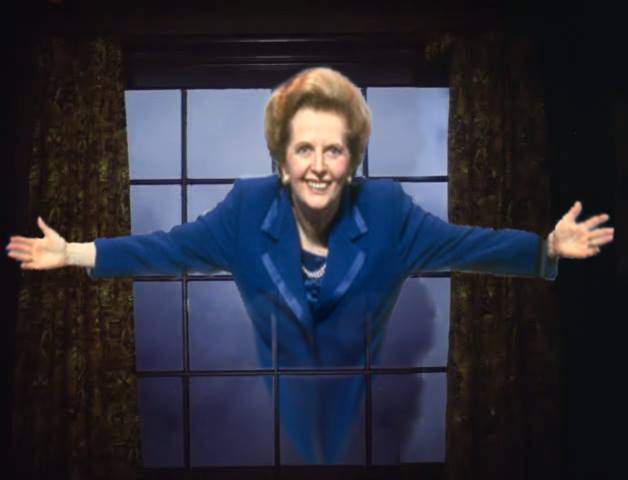
Thatcher scary

The mess that Thatcher left in her wake is verified by several longitudinal studies. Dr. Alex Scott-Samuel and colleagues from the Universities of Durham, West of Scotland, Glasgow and Edinburgh, sourced data from over 70 existing research papers, which concludes that as a result of unnecessary unemployment, welfare cuts and damaging housing policies, the former prime minister’s legacy:

includes the unnecessary and unjust premature death of many British citizens, together with a substantial and continuing burden of suffering and loss of well-being. 

The article also cites evidence including the substantial increase in income inequality under Thatcher – the richest 0.01% of society had 28 times the mean national average income in 1978 but 70 times the average in 1990, and there was a rise in UK poverty rates from 6.7% in 1975 to 12% in 1985.

The research article concludes that:

Thatcher’s governments wilfully engineered an economic catastrophe across large parts of Britain by dismantling traditional industries such as coal and steel in order to undermine the power of working class organisations, such as unions.This ultimately fed through into growing regional disparities in health standards and life expectancy, as well as greatly increased inequalities between the richest and poorest in society.

New Right Conservatives have a curiously evidence-resistant conviction that the “big state” has somehow stymied our society: that the “socialist relic” – our NHS and our Social Security system, which supports the casualties of Tory free markets, have somehow created those casualties. But we know from history and recent events that competitive individualism and market choice-driven Tory policies create a few haves and many have-nots.

Tory rhetoric is designed to have us believe there would be no poor if the welfare state didn’t somehow “create” them. If the Conservatives must insist on peddling the myth of meritocracy, then surely they must also concede that whilst such a system has some beneficiaries, it also creates situations of insolvency and poverty for others.

In a wealthy so-called first world democracy, it is profoundly uncivilised and anti-democratic to simply dismiss people experiencing poverty and hardship effectively as collateral damage, and terribly cruel and irresponsible to blame those people for the situations of difficulty and deprivation created by policies and the socio-economic framework itself.

This wide recognition that the raw “market forces” of stark laissez faire cause casualties is why the welfare state came into being, after all – because when we allow such competitive economic dogmas to manifest – as the stormy present – there are winners and losers. That is the nature of competitive individualism, and along with inequality, it’s an implicit, undeniable and fundamental part of the meritocracy script.

And that’s before we consider the fact that whenever there is a Conservative-led government, there is no such thing as a “free market”: in reality, all markets are rigged to favour elites.

Cameron is continuing to build on Thatcher’s legacy. We know from the Central Policy Review Staff (CPRS) report, which was encouraged and commissioned by Margaret Thatcher and Geoffrey Howe in 1982, that there was a radical, politically toxic plan to dismantle the welfare state, to introduce education vouchers, ending the state funding of higher education; to freeze welfare benefits and to introduce an insurance-based health service, ending free health care provision of the NHS. One of the architects of the report was Lord Wasserman, he  was one of Cameron’s advisors until 2012.

A confidential cabinet memorandum by the Central Policy Review Staff in September 1982, said: “This would of course mean the end of the National Health Service.” The report was declassified and released in 2012 by the National Archives under the 30-year rule.

But the fear of the scale of opposition to the plan meant the grand dismantling of the welfare state didn’t happen. Instead the Conservatives have planned and worked to take it apart a piece at a time.

In 1982 unemployment rose above three million. Yet the Tories were happy with further increases to try and drive down wages. John Sparrow of the Cabinet Office’s Central Policy Review Staff think-tank, wrote in a June memo to Thatcher that the youth training scheme, introduced in 1983, would be “likely to displace some older workers”.

He continued:

Displacement is not necessarily a bad thing, since it puts downward pressure on wage rates.” Sparrow noted that government plans to end out-of-work benefits for 16 year olds would remove them from the unemployment figures.

Fast-forward to the present: David Cameron is prepared to consider making workers pay into flexible saving accounts to self-fund periods of illness and unemployment benefits, Downing Street has confirmed.

The idea was first floated by Iain Duncan Smith who said he was “very keen” to have a debate about encouraging people to use personal accounts to save for unemployment or illness, even though it is not “official” government policy.

Duncan Smith told the Sunday Telegraph:

We need to support the kind of products that allow people through their lives to dip in and out when they need the money for sickness or care or unemployment.

We need to encourage people to save from day one but they need to know that they can get some of the money out when their circumstances change. This is not government policy but I am very keen to look at it, as a long-term way forward for the 21st century.

Duncan Smith seems to be suggesting that benefits are replaced with a kind of unemployment insurance scheme as seen in the US or products known as “fortune accounts”, which are used in Singapore.

Asked about the idea of workers saving up for their sickness and unemployment benefits, Cameron’s official spokeswoman confirmed he was prepared to consider such a model. She said:

I think the PM shares the work and pensions secretary’s view that we should be doing more to encourage people to take personal responsibility for how they manage their affairs.

The proposal of fortune accounts for the UK was examined in depth in a paper by the Right-wing libertarian Adam Smith Institute thinktank in 1995, which considered how people could go to a single private provider for an account that gave them long-term care insurance, disability cover, health insurance, savings fund management and unemployment insurance.

The paper suggested:

Many other things that we often regard as ‘welfare’ today are also insurable and will be part of the fortune account package. Cover against incapacity to work, long-term care services, and disability, will all be in the package.

A report from Civitas argued (preemptively) that National Insurance is “no longer fit for purpose” and that everyone in work should be forced to save into a private pension to help shoulder the burden of the rising costs of old age.

Civitas professorial research fellow Peter Saunders argued in the report, titled Beyond Beveridge, that the principle that those who are able to should pay into the system has been eroded and “taxpayer-funded hand-outs” have increasingly replaced contributions-based benefits.

He goes on to say that whilst the main purpose of the proposed personal welfare accounts would be for retirement saving, they could also provide cover for when times are tough during periods of short-term unemployment, sickness and parental leave.

It reads like Daily Mail dogma to me.

The report reviews Britain’s National Insurance system and
proposes that it be replaced by compulsory “personal welfare

accounts.”

The introduction of personal insurance schemes would mark the end of welfare provision as we know it. Furthermore, those least likely to be able to afford the premiums are those most at risk of losing their jobs.

The Tories fully intended that the welfare “reforms” were the beginning of the end of our welfare state. The welfare cuts were ushered in strictly because of the despotic use of “financial privilege” by Cameron to bypass the widespread and vehement opposition to the Bill.

At the time, such was my dismay at the proposed welfare “reform” Bill that I emailed the entire House of Lords, imploringly. After using a reasoned approach, my second email simply said: the welfare reforms must not happen. Many of the peers and members replied, and many responded with “agreed.” But Cameron made the “reforms” happen anyway and apparently felt no obligation to observe the niceties of democratic process.

The Tories clearly have no intention of ensuring a safety net for citizens and have plotted to dismantle our welfare state since the Thatcher era. This is a long-planned outcome for the Tories. Social security and public services are in serious jeopardy.

Cameron’s rhetoric is full of references to “rolling back the state”, the “re-awakening of community spirit”, and a restoration of the kind of “intermediate civic institutions” that preceded the welfare state. The whole idea of Cameron’s “big society” is that private charities fill the holes created by public spending cuts.

Food banks have increasingly replaced welfare, for example, yet the point of post-1945 European welfare states was to free those in need from dependence on the insecurity of private generosity, which tends to miss out the socially marginalised, and to be least available when times are hardest.

Welfare, or social security, if you prefer, has provided a sense of security and dignity that we never previously enjoyed, it established a norm of decency, mutuality of our social obligations and created a parity of esteem and worth which was, until fairly recently, universal, regardless of wealth and status.

The “big bad state” is comprised of civilised and civilising institutions. It is such stable and enduring institutions and subsequently secure individuals that are raised above a struggle for basic survival which provide a frame for coherent communities. The Conservatives, with their anti-humanist, anti-enlightenment demagoguery of rigid class division, and policies that engineer steep social stratification, tend to create ghettoes, not communities.

The paternalism of traditional Tories and the authoritarianism of the current New Right are profoundly undemocratic: neither design can reflect the needs of the public since both frameworks are imposed on a population, reflecting only the needs of the ruling class, to preserve social order.

Conservative small-state ideology has led to depopulated social policies, which have dehumanised people, and indicate that the Tory policy-makers see the public as objects of their policies, and not as human subjects.

The moralising scrutiny and control of the poor is a quintessential element of tory narrative. Tory ideology never changes. They refuse the lessons of history, and reject the need for coherence and rationality. Tories really are stuck in the Feudal era. They have never liked the idea of something for everyone, yet everyone has paid for welfare provision:

“The [financial] crisis is an opportunity to sweep away the rotten postwar settlement of British politics. Labour is moribund. But David Cameron has a chance to develop a “red Tory” communitarianism, socially conservative but sceptical of neoliberal economics.” Phillip Blond, The Rise of the Red Tories, 2009.

Cameron was never sceptical of neoliberalism: like Thatcher, he has extended it without restraint. Neoliberalism entails a charismatic ideology – what sociologist Pierre Bourdieu calls a doxa: an unquestionable orthodoxy that operates as if it were the objective truth – that facilitates an uncompromising attack on public welfare; inevitable, growing inequality, and the individualization of all social actions, all in the name of private “enterprise”, the accummulation of private wealth for a minority and “global competitiveness.”

Unsurprisingly, then, unemployment, inequality, and poverty are increasingly blamed on the individuals experiencing these conditions rather than on the structural constraints that create the conditions.

We are being turned away from the role of the community and instead our attention is being purposefully diverted and re-focused solely on the “responsibilities” of individuals (and those responsiblities are inversely proportional to how much wealth a person has), common social values such as cooperation, mutual support, reciprocal altruism are being eroded, and the interdependent and intersubjective nature of social life is flatly denied: mutual relationships and common bonds are being dissolved and replaced by a social Darwinist narrative – founded on the mantra of competitive individualism.

The policies, practices and irrational beliefs of the state are distorting the perceptions of social groups and individuals, the colonisation of public language and space with neoliberal narratives – facilitated by a largely complicit media – delivers a distinctive anti-rationalist epistemology that restructures public ontological understandings.

Those understandings have become profoundly anti-collectivist and increasingly, antisocial, ultimately undermining social cohesion, stability and social security.

___


Related

The welfare debate and the end of reason

The welfare state – can we afford it?

Can we afford the welfare state?

Britain can still afford the welfare state

We can’t afford to lose the welfare state.

Images courtesy of Robert Livingstone

The budget: from trickle-down to falling down, whilst holding hands with Herbert Spencer.

proper Blond
“We are moving Britain from a high welfare, high tax economy, to a lower welfare, lower tax society.”

George Osborne, 8 July 2015

The pro-wealthy and anti-humanist budget indicates clearly that the Conservatives are preoccupied with highlighting and cutting the state cost of sustaining the poorest citizens rather than the costs of subsidising the rich.

I’ve pointed out before that the Conservatives operate a perverse, dual logic: that wealthy people need support and encouragement – they are offered substantial financial incentives – in order to work and contribute to the economy, whereas poor people apparently need to be punished – by the imposition of financial cuts – in order to work and contribute to the economy.

That Osborne thinks it is acceptable to cut the lifeline benefits of sick and disabled people to pay for government failures, whilst offering significant cuts to corporation tax rates; raising the tax-free personal allowance and extending inheritance tax relief demonstrates very clearly that the myth of trickle-down is still driving New Right Conservative ideology, and that policy is not based on material socio-economic conditions and public need. (And Cameron is not a one-nation Tory, despite his claims.)

Research by the Tax Justice Network in 2012 indicates that wealth of the very wealthy does not trickle down to improve the economy, but tends to be amassed and sheltered in tax havens with a detrimental effect on the tax bases of the home economy.

A more recent report – Causes and Consequences of Income Inequality : A Global Perspective by the International Monetary Fund concluded in June this year that there is no trickle-down effect –  the rich simply get richer:

“We find that increasing the income share of the poor and the middle class actually increases growth while a rising income share of the top 20 percent results in lower growth—that is, when the rich get richer, benefits do not trickle down.”

It’s inconceivable that the Conservatives fail to recognise such policy measures will widen inequality. Conservatives regard inequality and social hierarchy as inevitable, necessary and functional to the economy. Furthermore, Conservatives hail greed and envy as emotions to be celebrated, since these drive competition.

Since the emergence of the New Right, from Thatcher to Cameron, we have witnessed an increasing entrenchment of Neoliberal principles, coupled with an aggressive, authoritarian brand of social conservatism that has an underpinning of crude, blunt social Darwinist philosophy, as carved out two centuries ago by the likes of Thomas Malthus and Herbert Spencer.

Spencer is best known for the expression “survival of the fittest,” which he coined in Principles of Biology (1864), after reading Charles Darwin’s work. Spencer extended natural selection into realms of sociology, political theory and ethics, ultimately contributing to the eugenics movement. He believed that struggle for survival spurred self-improvement which could be inherited. Maslow would disagree. All a struggle for survival motivates is just a struggle for survival.

Spencer’s ideas of laissez-faire; a survival-of-the-fittest brand of competitive individualism; minarchism – minimal state interference in the processes of natural law – and liking for private charity, are echoed loudly in the theories of 20th century thinkers such as Friedrich HayekMilton Friedman and Ayn Rand who each popularised Spencer’s ideas, whilst Neoliberal New Right Conservatives such as Ronald Reagan, Margaret Thatcher and David Cameron have translated these ideas into policies.

Ideology has considerable bearing on policies, and policies may be regarded as overt, objective statements of political intent. I’ve said many times over the past five years that Conservatives have forgotten that democracy is based on a process of dialogue between the public and government, ensuring that the public are represented: that governments are responsive, shaping policies that address identified social needs. Conservative policies are quite clearly no longer about reflecting citizen’s needs: they are increasingly authoritarian, and all about telling us how to be.

Conservatives have always coldly conceived society as a hierarchy of human value, and they have, from their pinnacle of supremacist, self-appointed authority, historically cast the vulnerable and the poorest as the putative “enemies of civilization.” Social Darwinism is written in bold throughout their policies.

Furthermore, such a combination of Neoliberal and Conservative political theory, explicitly opposes democratic goals and principles. Neoliberalism was originally used by academics on the Left as a pejorative to capture the policies of imposed exploitation, privatisation, and inequality.

Neoliberalism is now characterised by the use of international loans and other mechanisms to suppress unions, squash state regulation, elevate corporate privilege, privatise public services, and protect the holdings of the wealthy. The term became widely recognised shorthand for rule by the rich, authoritarianism and the imposition of limits on democracy.

Banks, corporations, the financial sector, and the very wealthy are exercising power and blocking any attempt to restructure the economic system that brought about the crash.

Meanwhile, the free market is a market free for powerful interests; the profit motive has transformed the organising value of social life, and those who the Conservatives evidently regard as collateral damage of this socio-economic dogma made manifest are paying the price for the global crash, with Osborne and the Conservatives constructing narratives that problematise welfare support, generating moral panic and folk devils to demonise the poorest citizens in need of support.

Growing social inequality generates a political necessity for cultivating social prejudices.

Such Othering narratives divert public attention from the fact that the right to a fair and just legal system, a protective and effective safety net for the poorest, free healthcare – all of the social gains of our post-war settlement – are all under attack.

I have said elsewhere that Conservative ideology is incompatible with our legal commitments to human rights. The United Nations declaration of Human Rights is founded on the central tenet that each and every human life has equal worth. The Conservatives don’t agree, preferring to organise society into hierarchies of worth and privilege.

Conservative austerity measures and further impending welfare cuts are not only a deliberate attack on the poorest and most vulnerable social groups; the range of welfare cuts do not conform to a human rights standard; the “reforms” represent a serious failure on the part of the government to comply with Britain’s legal international human rights obligations.

The cuts announced by the chancellor include a further reduction to the benefits cap – not only from £26,000 to £23,000, as promised in the Conservative Party’s 2015 manifesto, but down even further to £20,000 outside of London.

Child tax credit, housing benefit and working tax credit will be reduced, with child tax credit only being paid for the first two children. Presumably this is, to quote Iain Duncan Smith, to “incentivise behavioural change,” placing pressure on the poorest to “breed less,” though personally, being the direct, blunt, no-nonsense sort, I prefer to call it a nudge towards “eugenics by stealth.”

The Social Mobility and Child Poverty Commission say that any cuts to tax credits will cut the incomes of 45 per cent of working families. These cuts are particularly controversial, since the benefits cap was partly justified as a way of “making work pay”  – a Conservative narrative that echoes the punitive 1834 New Poor Law Principle of less eligibility – see: The New New Poor Law.

The Government asserts that its welfare “reform” strategy is aimed at breaking the cycle of “worklessness” and dependency on the welfare system amongst the poorest families. It’s more punitive Poor Law rhetoric.

There’s no such thing as “worklessness”, it’s simply a blame apportioning word, made up by the Tories to hide the fact that they have destroyed the employment market, just as Thatcher did, and as the Conservatives always do.

Punishing the low paid, cutting the income of families who work for low wages directly contradicts the claim that the Conservatives are “making work pay.”

Yet Osborne has framed his welfare cuts with the “The best route out of poverty is work” mantra, claiming that slashing the social security budget by £46 billion in the next five years, (including cutting those benefits to disabled people, who have been assessed as unfit for work and placed in the Work Related Activity Group (WRAG), and cutting in-work benefits, such as tax credits) is needed to make sure “work pays” and that: “we give a fair deal for those on welfare and a fair deal to the people, the taxpayers of this country who pay for it.”

The Conservatives always conveniently divide people into an ingroup of taxpayers and an outgroup of stigmatised others – non-tax payers. However, most people claiming benefits are either in work, and are not paid enough, through no fault of their own, to pay tax, or are pensioners who have worked most of their lives; or are unemployed, but have previously worked and contributed tax.

Most people claiming disability benefits have also worked and contributed tax, too.

Unemployment and in-work benefit claims are generally a measure of how well or poorly the government is handling the economy, not of how “lazy” or “incentivised” people are.

And only the Tories have the cheek to claim that raising the minimum wage (long overdue, especially given the hikes in the cost of living) is the introduction of a living wage. The basic idea is that these are the minimum pay rates needed so that workers have an acceptable standard of living. Over the last few years, wages have very quickly fallen far behind the ever-rising cost of living.

The increase is at a rate of £7.20 an hour for people over the age of 25.  Housing benefit will be withdrawn from those aged between 18 and 21, while tax credits and universal credits will be targeted at people on lower wages by reducing the level at which they are withdrawn.

The chancellor’s announcement amounted merely to an increase in the minimum wage, and the curbs on tax credits would hit low-paid workers in other ways, unfortunately.

Whilst the announcement of a phased increase in the minimum wage is welcome, it is difficult to see how this will reverse the increasing inequality that will be extended as a further consequence of this budget without a matching commitment to improving the structural framework – the quality and stability of employment available. As it is, we are now the most unequal country in EU.

If the government were sincerely interested in raising wages to make work genuinely pay, ministers would be encouraging rather than stifling trade unionism and collective bargaining. But instead we see further cuts to public sector pay in real terms year after year and the raising of the legal bar for industrial action so that strikes will be effectively outlawed in public services. And let’s not forget the grubby partisan policy of two years ago – the Let Lynton Lobby Gagging Act.

Rhys Moore, director of the Living Wage Foundation, said:

“Is this really a living wage? The living wage is calculated according to the cost of living whereas the Low Pay Commission calculates a rate according to what the market can bear. Without a change of remit for the Low Pay Commission this is effectively a higher national minimum wage and not a living wage.”

Those most affected by the extreme welfare cuts are those groups for which human rights law provides special protections. The UK government has already contravened the human rights of women, children, and disabled people.

The recent report of the UK Children’s Commissioner to the UN Committee on the Rights of the Child, published in July this year, says:

“Response to the global economic downturn, including the imposition of austerity measures and changes to the welfare system, has resulted in a failure to protect the most disadvantaged children and those in especially vulnerable groups from child poverty, preventing the realisation of their rights under Articles 26 and 27 [of the UN CRC] … Reductions to household income for poorer children as a result of tax, transfer and social security benefit changes have led to food and fuel poverty, and the sharply increased use of crisis food bank provision by families.”

The parliamentary Joint Committee on Human Rights recently reported on the UK’s compliance with the United Nations Convention on the Rights of the Child (CRC), and found it woefully lacking:

“Welfare cuts will ensure that the government is not in compliance with its international human rights obligations to realise a right to an adequate standard of living under Article 11 of the International Covenant on Economic and Social Rights (ICESR) and a child’s right to an adequate standard of living under Article 27 of the UN CRC. Further it will be in breach of the statutory target to eliminate child poverty contained in the Child Poverty Act 2010.”

Just in case you missed it, there has been a very recent, suspiciously timed change to the definition of child poverty, and a proposed repeal of the Child Poverty Act – something that Iain Duncan Smith has been threatening to bring about since 2013.

It’s yet another ideologically directed Tory budget, dressed-up in the rhetoric of economic necessity, detached from public needs.

And Conservative ideology is all about handouts to the wealthy that are funded by the poor.

Related:

George Osborne’s Political MasterstrokeA View from the Attic

Osborne’s class spite wrapped in spin will feed a backlashSeumas Milne

Budget 2015: what welfare changes did George Osborne announce, and what do they mean?  New Statesman: The Staggers

How Osborne’s new cuts breach the UK’s human rights obligations, Lecturer in Law at Lancaster University

Osborne’s Autumn statement reflects the Tory ambition to reduce State provision to rubble

Osborne’s razor: the Tory principle of parsimony is applied only to the poorest

The BBC expose a chasm between what the Coalition plan to do and what they want to disclose

1450041_569755536427312_1698223275_n
Thanks to Robert Livingstone

Stigmatising unemployment: the government has redefined it as a psychological disorder

proper Blond

The current government has made the welfare system increasingly conditional on the grounds that “permissive” welfare policies have led to welfare “dependency.” Strict behavioural requirements and punishments in the form of sanctions are an integral part of the Conservative ideological pseudo-moralisation of welfare, and their  “reforms” aimed at making claiming benefits much less attractive than taking a low paid, insecure, exploitative job.

Welfare has been redefined: it is preoccupied with assumptions about and modification of the behaviour and character of recipients rather than with the alleviation of poverty and ensuring economic and social wellbeing.

The stigmatisation of people needing benefits is designed purposefully to displace public sympathy for the poor, and to generate moral outrage, which is then used to further justify the steady dismantling of the welfare state.

But the problems of austerity and the economy were not caused by people claiming welfare, or by any other powerless, scapegoated, marginalised group for that matter, such as migrants. The problems have arisen because of social conservatism and neoliberalism. The victims of this government’s policies and decision-making are being portrayed as miscreants – as perpetrators of the social problems caused by the government’s decisions, rather than as the casualities.

And actually, that a recognisable bullying tactic known as projection, (the vehicle for projection is blame, criticism and allegation), as is scapegoating.

The 2015 budget included plans to provide online Cognitive Behaviour Therapy to 40,000 claimants and people on the Fit for Work programme, as well as putting therapists in more than 350 job centres.

I wrote an article in March about the government plans to make the receipt of social security benefits conditional on undergoing “state therapy.” I raised concern about ethical issues – such as consent, the inappropriateness of using behaviour modification as a form of “therapy,” and I criticised the proposed Cognitive Behaviour Therapy (CBT) programme on methodological and theoretical grounds, as well as considering wider implications.

I’ve written at length about the coercive and punitive nature of the conservative psychopolicy interventions, underpinning the welfare “reforms,” and giving rise to increased welfare “conditionality” and negative sanctions.

In particular, I’ve focussed on the influence of the Cabinet’s Behavioural Insights Team or “nudge unit” and “the application of behavioural science and psychology to public policy. (See: The nudge that knocked down democracy, The power of positive thinking is really political gaslighting, and Despotic paternalism and punishing the poor. Can this really be England? )

I was pleased to see that the BBC reported a summary of the research findings of Lynne Friedli and Robert Stearn, which was supported by the Wellcome Trust. The report – Positive affect as coercive strategy: conditionality, activation and the role of psychology in UK government workfare programmes reflects many of the concerns raised by other professionals. I strongly recommend you read it. (See: Psychologists Against Austerity: mental health experts issue a rallying call against coalition policies.)

The BBC summarised from the report that benefit claimants are being forced to take part in “positive thinking” courses in an effort to “change their personalities.” Those people claiming benefits that do not exhibit a “positive” outlook must undergo “reprogramming” or face having their benefits cut. This is humiliating for job seekers and does not help them find suitable work.

New benefit claimants are interviewed to find out whether they have a “psychological resistance” to work, with those deemed “less mentally fit” given more “intensive coaching.”

And unpaid work placements are increasingly judged on psychological results, such as improved motivation and confidence, rather than whether they have led to a job.

The co-author of the report, Lynne Friedli, describes such programmes, very aptly, as “Orwellian.” She says:

“Claimants’ ‘attitude to work’ is becoming a basis for deciding who is entitled to social security – it is no longer what you must do to get a job, but how you have to think and feel.

“This makes the government’s proposal to locate psychologists in job centres particularly worrying.

“By repackaging unemployment as a psychological problem, attention is diverted from the realities of the UK job market and any subsequent insecurities and inequalities it produces.”

Friedli also criticised the way psychologists were being co-opted as “government enforcers” and called on professional bodies to denounce the practice.

Quite rightly so. It’s our socio-economic system, and the ideologues who shape it that present the problems, not the groups of people forced to live in it as its casualities – the “collateral damage” of neoliberalism and social conservatism.

“I don’t think anything can justify forced psychological coercion. If people want to go on training courses that should be entirely voluntary,” Lynne told BBC News.

She also questioned the aim of the motivational courses and welfare-to-work placements, which felt like “evangelical” self-help seminars.

“Do we really want a world where the only kind of person considered employable is a ‘happy clappy’, hyper-confident person with high self-esteem?

“That is a very a narrow set of characteristics. There is also a role in the workplace for the ‘eeyore’ type.”

Absolutely. Frankly, I would rather have health and safety programmes that are designed by a pessimist, capable of thinking of the worst case scenario, for example, than by a jolly, positively biased, state-coerced optimist.

I would also prefer pessimistic appraisal of social policies. That way, we may actually have impact assessments carried out regarding the consequences of Conservative policies, instead of glib, increasingly Orwellian political assurances that are on the other, more scenic, illusory side across the chasm from social realities.

Although pessimism and depression are considered to be affective disorders, in a functional magnetic resonance imaging study of the brain, depressed patients were shown to be more accurate in their causal attributions of positive and negative social events, and in self assessments, and assessment of their own performance of tasks, than non-depressed participants, who demonstrated a positive bias.

As a former community-based psychosocial practitioner who saw the merits and value of a liberationist model, the question that needs to be asked is: for whose benefit is CBT being used, and for what purpose? Seems to me that this is about helping those people on the wrong side of punitive government policy to accommodate that, and to mute negative responses to negative situations.

The socially dispossessed are being coerced by the state, part of that process is the internalisation of the negative images of themselves created and propagated by their oppressors.

CBT is not based on a genuinely liberational approach, nor is it based on any sort of democratic dialogue. It’s all about modifying and controlling behaviour, particularly when it’s aimed at such a narrow, politically defined and specific outcome.

The problem that we need to confront is politically designed and perpertuated social injustice, rather than the responses and behaviour of excluded, stigmatised individuals in politically oppressed, marginalised social groups.

CBT is founded on blunt oversimplifications of what causes human distress – for example, in this case it is assumed that the causes of unemployment are psychological rather than socio-political, and that assumption authorises intrusive state interventions that encode a Conservative moral framework which places responsibility on the individual, who is characterised as “faulty.”

However, democracy is based on a process of dialogue between the public and government, ensuring that the public are represented: that governments are responsive, shaping policies that address identified social needs. Conservative policies are quite clearly no longer about reflecting citizen’s needs: they are increasingly about telling us how to be.

As I have said elsewhere, as well as aiming at shaping behaviour, the psycho-political messages being disseminated are all-pervasive, entirely ideological and not remotely rational: they reflect and are shaping an anti-welfarism that sits with Conservative agendas for neoliberal welfare “reform”, austerity policies, the small State (minarchism) and also legitimises them. (I’ve written at length elsewhere about the fact that austerity isn’t an economic necessity, but rather, it’s a Tory ideological preference.) The Conservatives are traditional, they are creatures of habit, rather than being responsive and rational.

Conservative narratives, amplified via the media, have framed our reality, stifled alternatives, and justified Tory policies that extend psychological coercion including through workfare; benefit sanctions; in stigmatising the behaviour and experiences of poor citizens and they endorse the loss of autonomy for citizens who were disempowered to begin with.

Many of the current ideas behind “reforming” welfare come from the Behavioural Insights  Team – the Nudge Unit at the heart of the Cabinet. Nudge theory has made Tory ideology, with its totalitarian tendencies, seem credible, and the Behavioural Insights Team have condoned, justified and supported punitive, authoritarian policies, with bogus claims about “objectivity” and by using discredited pseudoscience. Those policies have contravened the human rights of women, children and disabled people, to date.

Nudge-based policy is hardly in our “best interests,” then.

526544_532055030197363_2137237288_n
Pictures courtesy of Robert Livingstone


I don’t make any money from my work. I am disabled because of illness. But you can contribute by making a donation and help me continue to research and write informative, insightful and independent articles, and to provide support to others.

The smallest amount is much appreciated – thank you.

DonatenowButton

It’s the Tories that want something for nothing: the democratic contract and government responsibility

430847_149933881824335_1645102229_n (1)
The Conservative defense of increasing economic inequality, the lionisation of Randian, Libertarian, selfish individualism and the proliferation of ideological justification narratives regarding the dismantling of the “Big (Welfare) State”, where the latter, in Orwellian fashion, is now being indicted for many of the very social and economic ills that the free market era has actually delivered has surely worn threadbare by now. 

It’s abundantly clear that it’s the Tories and the very wealthy that want something for nothing. Cameron’s mantra is “social responsibility, not state control equals Big Society.” Cameron, in his Hugo Young lecture (2009), claimed that the “Big Society demands mass engagement: a broad culture of responsibility, mutuality and obligation”.

But this isn’t about a transfer of political power or decision-making from government to the public: it’s a transfer of responsibility and duty only.

In true Orwellian spirit, Cameron went on to say: “The recent growth of the state has promoted not social solidarity, but selfishness and individualism.”  Only a conservative would claim poverty and social cohesion as their concern and passion, and then attack  the mechanism that until now has been used to alleviate them  – publicly funded state spending.

Democracy (based on the partnership between political and economic enfranchisement) happens when the concept of property encompasses access to “social goods” such as healthcare, education and public infrastructure as a right of citizenship. The idea of political representation becomes consolidated when access to such social goods is guaranteed by a legal process, as well as a political process.

The electoral franchise in countries which adopted a Lockean liberal constitutional  system, such as  Britain, had a property qualification attached to it. Universal suffrage coincided with a wider public access to social goods, giving rise to a new type of social contract: by giving up a portion of their property by way of taxation, the propertied class ensured the survival of capitalism, and the working class escaped the worst ravages of capitalism.

Access to social goods was a means of widening and legitimising the scope of democratic political representation.

However, whilst removing all of our public services, provisions, destroying our post-war settlement, the key features of which were accepted in principle by the main political parties at the time, namely: a mixed economy, a free public sector healthcare and education, a guaranteed (though minimal) state pension and social welfare provision, the government is removing social goods, nullifying the established social contract between state and individual, and is expecting that we each fend for ourselves.

I don’t remember any consent amongst the public to accept diminished living standards in return for Cameron’s proposal of national fiscal security (which he has consistently and spectacularly failed to deliver) and the maintenance of the “market-state”. Nor was there consent for authority, inequality and hierarchy, or an acceptance of being less than we can be and having less than we can have.

Our welfare provision (and I include our National Health Service, here), paid for by us, IS OUR MEANS OF BEING RESPONSIBLE AS A SOCIETY AND INDIVIDUALLY: it is a means of securing provision for ourselves if or when we need it. Our welfare provision is, and has been since its inception, each citizens’ responsibility, because we pay for it. It doesn’t belong to the government.

The consensus that the welfare state was the best basis for a healthy society was first rejected by Thatcher, who notoriously denied the very existence of society, and unashamedly espoused greed as the  “best social driver.”  Cameron, building on Thatcher’s previous groundwork, has effectively delivered an economic enclosure act, claiming OUR collective, public funds, turning that money into the private property right of the rich, in the same way the land enclosure act robbed the public of their commonly shared land, and enabled rich landowners use of their control of state processes to appropriate public land for their private benefit.

Yet despite this blatant theft: the massive transference of public funds to a few private accounts, the demands being made by the state on citizens have never been greater. All the Tories talk about are OUR obligations and individual responsibilities, whilst they claim they have NO responsibility for citizen well-being. But we have paid for state services and continue to do so via the tax and national insurance system.

In 2013 the Government spent approximately £93.5billion of our money on the private sector. This is half the £187bn government usually spends on goods and services each year. Recent growth in outsourcing of government services to private providers has been widely criticised for a lack of transparency, poor management of money and, in particular, excessive remuneration of top executives and pay inequality between employees. Extreme pay inequality and a succession of scandals in the largest government suppliers suggests that, in its present form, government outsourcing is a very poor use of tax payers’ money and not fit for purpose. This is verified by the Equality Trust’s research report: Subsidising Unfairness

It’s only the very wealthy that gain (enormously) from austerity, and they  manage to avoid  any socially responsible contribution by using government endorsed accounting systems and dodges to avoid paying taxes wherever possible. The estimated amount of taxes unpaid, thanks to evasion, avoidance, error and criminality, soared to £34 billion, according to HM Revenue and Customs. This equates to £1 in every £15 owed in taxes not being collected last year.

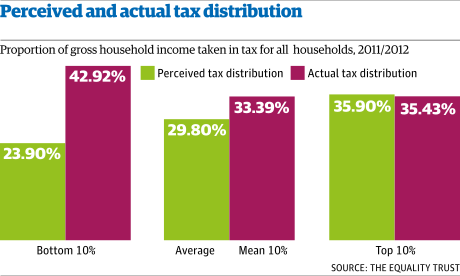
Furthermore, it is the poorest 10 percent of households that pay eight percent more of their income in all taxes than the richest – 43 percent compared to 35 percent, outlined in a report from the Equality Trust. The poorest pay more than four times as much of their income, in Cameron’s poll tax-styled council tax system, than the wealthiest top 10 precent.

The government’s “hardworking taxpayer” myth which is at the heart of the Tory ideologically driven austerity narrative, and divert, divide and poison strategy, creates an artificial dichotomy between benefit claimants and taxpayers. Cameron’s diversionary rhetoric has got nothing to do with responsibility and fairness: it’s simply about justifying policies that privilege a wealthy elite at the expense of the poor.

 Such us and them dichotomies  can be linked to the distinctions made between the “deserving” and  “undeserving” poor, going back over a hundred years or more, to the cruel and punitive Poor Law Reform Act. The Tories have purposefully created scapegoats: adversarial identities that are politically constructed according to notions of difference which simultaneously encourages a public comparison to, and rejection of, Others. This Othering narrative portrays benefit recipients as the enemy in a battle against fairness and responsibility.

And the public have bought into it, the Equality Trust thinktank highlights a gulf between perceptions of the tax system and its reality. A poll, conducted with Ipsos Mori, found that nearly seven in ten people believe that households in the highest 10% income group pay more of their income in tax than those in the lowest 10%.

Wealth concentration damages economies. It focuses activity within finance and other services geared towards only towards serving the super rich.Maintaining inequality requires penalising and further impoverishing the poor.

Reducing  wealth inequalities will require the introduction of wealth taxes, like the inheritance tax  we introduced a century ago. Reducing inequality requires a high top rate of income tax. This reduces income inequality not only by raising revenue, but by deterring the profit-driven greedy from asking for more money. When there is a tax rate of 60 percent on incomes above £200,000 a year, it makes little sense to pay employees much more than that.

But the wealthy tend to get so indignant when policy proposals from the opposition indicate that they will be required to actually contribute something to a society that they have taken so much more than others from. There’s been an outraged outcry, for example, regarding Labour’s Mansion tax proposals. These ignoble, self-serving Randians are happy to sit back and allow the poorest and most vulnerable to suffer and starve, whilst being subjected to the unfair, punitive bedroom tax, which contravened human rights: the poorest are bearing the terrible burden of austerity cuts whilst the wealthy continue to profit massively. Presumably, Cameron exempted the very rich from responsibility, duty and contributing  to society in any meaningful way.

Of course this is about restricting political engagement, the Conservatives have always sought to reduce it to a basic partnership between corporate interests and professional politicians. Cameron’s Conservatism rests on the unwitting rejection  of the social democratic consensus by the population which, paradoxically, need what they reject. Public consent is being manipulated to accommodate the idea that democracy is a relationship between rulers and governed, rather than it being about an elected government that reflects, represents and serves public needs. The population are being incrementally subordinated to a political system which is not conducive to the betterment of their lives, well-being or material conditions –  the Tories are imposing an imbalanced social contract comprised of citizen duties with no citizen rights; the acceptance of ever-lower living standards and increasing state authoritarianism.

The Conservative scapegoating narratives, which have blamed Labour, the poor and the unemployed for a recession caused by the private finance sector, and not the “big state” as claimed, have permitted the Coalition to pursue an ideological, destructive and grossly unfair economic strategy, which has generated only a bogus and isolated recovery largely based on government-fuelled asset bubbles in real estate and private finance, with stagnant productivity, plummeting wages, millions of people in precarious jobs, inflated living costs and utterly savage welfare cuts.

One obligation that all democratic states have, surely, is that of protecting citizens rights and freedoms. Those are most certainly being steadily diminished, and Cameron has been quite candid about scrapping our Human Rights Act, and withdrawing from the ECHR in the future.

See what I mean? It’s all take take take…

Danny Dorling says: “Gross economic inequality is as vile as racism, misogyny and hatred of the disabled; as damaging in effect; and as dependent on a small group of supporters who believe that just a few should have more and more and more, because they’re “worth it”.”

I believe that growing social inequality generates a political necessity for prejudices: they are entrenched vis-à-vis Social Darwinism in Tory ideology, fueled and perpetuated through justification narratives and amplified via the media.

I’ve said many times previously that never in this country have those who fight for democracy and social justice carried a greater burden or faced the possibility of bigger losses of human rights, human freedoms, human dignity and human welfare than they do right now.

14533697838_dffcc736f2_o (1)

 Many thanks to Robert Livingstone for his brilliant art work

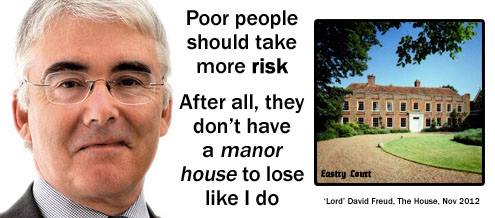
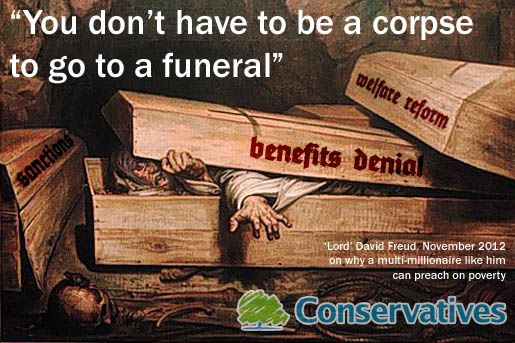
David Freud was made to apologise for being a true Tory in public

1459165_266124213538634_1461740450_n

Lord Freud, a Conservative Welfare Reform Minister, has admitted comments he made that some disabled people are  not worth” the full national minimum wage”  were “offensive”, after they were disclosed by Ed Miliband during Prime Minister’s Questions yesterday afternoon. The Labour leader has called on the Tory peer to resign. Cameron called for a full apology from Freud.

He has since apologised after slipping up and suggesting that disabled people are “not worth” the national minimum wage and some could only be paid “£2 an hour.” Cameron says the comments made by Lord Freud at the Tory conference do not represent the views of government. However, his austerity measures and the welfare “reforms” tell us a very different story.

Cameron betrayed his anger at being challenged when he once again alluded to his severely disabled late son, Ivan, and his late father, as he told Miliband that he would take no lectures on disabled people.

This is not the first time that the prime minister has used his son in anger, as a tactic designed to cause others emotional discomfort, deflect criticism and to avoid answering difficult questions regarding this government’s harsh and punitive policies towards disabled people.

The Labour leader quoted Freud, saying: “You make a really good point about the disabled. There is a group where actually, as you say, they’re not worth the full wage.”

Amidst cries of “outrage” and “shame” from the Labour benches, Mr Miliband said: “To be clear about what the Welfare Reform Minister said, it’s very serious. He didn’t just say disabled people weren’t worth the minimum wage, he went further and he said he was looking at whether there is something we can do, if someone wants to work for £2 an hour.”

He added: “Surely someone holding those views can’t possibly stay in your Government?”

Cameron said: “Those are not the views of the government, they are not the views of anyone in the government. The minimum wage is paid to everybody, disabled people included.”

Clearly very angry, the prime minister added: “Let me tell you: I don’t need lectures from anyone about looking after disabled people. So I don’t want to hear any more of that. We pay the minimum wage, we are reforming disability benefits, we want to help disabled people in our country, we want to help more of them into work. And instead of casting aspersions why doesn’t he get back to talking about the economy.”  

Once again, note the rhetorical diversionary tactics that Cameron used.

Miliband responded: “I suggest, if he wants to protect the rights of disabled people, he reads very carefully what his welfare minister has said because they are not the words of someone who ought to be in charge of policy related to disabled people.

“In the dog days of this government the Conservative party is going back to its worst instincts – unfunded tax cuts, hitting the poorest hardest, now undermining the minimum wage. The nasty party is back.”

In the Guardian said: We are in the climate of the Work Programme  and  employment and support allowance travesties, in jobseeker’s allowance sanctions and personal independent payment delays.

Coerced, free labour and a shrinking, ever conditional benefit system. Freud has not spoken out of turn, but encapsulated Conservative attitudes to both disabled people and workers: pay them as little as possible and they will be grateful for it.

The Tories are not content with forcing disabled people into work. They want to pay them a pittance when they get there. I suppose we can thank Freud. The government has been producing enough measures that infers disabled people are slightly less than human. He’s finally said it out loud.”

I couldn’t agree more. Freud’s comments are simply a reflection of a wider implicit and fundamental Social Darwinism underpinning Tory ideology, and even Tim Montgomerie, who founded the Conservative­Home site has conceded that: “Conservative rhetoric often borders on social Darwinism…and has lost a sense of social justice.”

Of course the problem with such an ideological foundation is that it directly contradicts the basic principles that modern, western democracy was founded on, it is incompatible with our Human Rights Act, which enshrines the principle that we are each of equal worth. And our Equality Act, introduced by Labour to ensure that people are not discriminated against on the grounds of their disability, gender, age and a variety of other protected characteristics.

Sam Bowman, research director of the Adam Smith Institute, has said that Freud was “shamefully mistreated” by Labour leader Ed Miliband.

The Adam Smith Institute – a think tank that promotes Conservative “libertarian and free market ideas”, minarchism and claims it is:“known for its pioneering work on privatization, deregulation, and tax reform, and for its advocacy of internal markets in healthcare and education, working with policy-makers”  – has, perhaps unsurprisingly, defended Lord Freud’s disgraceful comments regarding striving disabled workers.

Mr Bowman said: “His (Freud’s) point was that the market value of some people’s wages is below the minimum wage. This is often true of the severely disabled and can have appalling consequences for their self-esteem and quality of life.”

He added: “To point out that someone’s market value is less than minimum wage has nothing to do with their moral value as human beings.”

I beg to differ. We have a government that claims meritocratic principles define those who are worthy and deserving of wealth.We have a government that generates socially divisive narratives founded on ideological dichotomies like strivers and skivers. We have a government that systematically disregards the human rights of disabled people. Their very policies define the moral value they attribute to the poor, disabled people and the wealthy, respectively. This defence is based on a false distinction, because the Tories conflate market value and moral value explicitly, their policies are evidence of that.

The think tank president, Madsen Pirie,  once said: “We propose things which people regard as being on the edge of lunacy. The next thing you know, they’re on the edge of policy.”  

This group of neoconservatives brought you the fundamentals of Thatcher’s poll tax, the Adam Smith Institute was also the ideological driving force behind the sales of council house stock. If you need any further convincing of their Tory credentials, then their proposals that the National Health Service should establish an internal market with hospitals buying the use of facilities from other districts and from the private sector ought to be sufficient.

The Institute has always been a fierce critic of the NHS, it thinks that the government should only regulate healthcare and that healthcare should be privately funded and privately provided by private sector companies. The Adam Smith Institute said: Congratulations to the new Health Secretary Andrew Lansley, for what could be the biggest revolution in the UK’s state-run National Health Service for 60 years. 

Also recommended by this group of privatisation vultures was an internal market system for UK schools that would have (reduced) state funds to follow students to independently run academic institutions. This approach to school funding is now Coalition policy. Following the Institute’s call for the use of private businesses by local governments, many council-run local services, such as waste collection and cleaning, were contracted out. Additionally, local governments are now required to solicit competitive bids for local services.

And it was this group of Hayek-worshipping, pro-exploitation neofeudalists, who don’t declare their funding sources, that called for a radical shake-up of welfare policy, which would make work requirements absolutely central to the benefits system. These proposals subsequently became Tory policy.

And who could forget their peddling of unfettered free markets and trade as an objection to fair trade?

In the UK and elsewhere, such Conservative neoliberal ideas have drastically changed how states operate. By heavily promoting market-based economies that highly value competition and efficiency, such neoliberalist economies have moved countries to retrogressively adopting Social Darwinist philosophies to prop up free market “logic”. 

Bourdieu (1999) contends that neoliberalism as a form of national governance has become a doxa, or an unquestioned and simply accepted world-view.(See also Manufacturing consensus: the end of history and the partisan man.)

Harvey (2005) is not surprised that the ideas of capitalism have been infused into political, social, and cultural institutions at state-level. By placing a mathematical quality on social life, the neoconservatives have encouraged a formerly autonomous state to regress into penal state that values production, competition, and profit above all else, and social issues and consequences are increasingly disregarded.

Tories view their brand of economics as a social science that is capable of explaining all human behaviours, since all social agency is thought to be directed by a rationale of individualistic and selfish goals. And the focus on the individual means that ideas related to concepts such as “the public good” and realities such as “the community” are now being discarded as unnecessary components of a welfare state.

Unsurprisingly, then, high unemployment, gross inequality, and increasingly absolute poverty are increasingly blamed on individuals rather than on structural/economic constraints.

Tory economic policy is designed to benefit only a very small class of people. Such a world-view also makes it easier to justify the thought that some people are deserving of much more than others because, after all, it is a common refrain that we are all responsible for our own destinies. (See the just-world fallacy.)

Freud’s comment was not a momentary lapse, nor was it unrepresentative of Tory views more generally. He is the contemptuous architect of the grossly punitive Tory Bedroom Tax that disproportionately affects households of disabled people. The Tories endorsed Freud’s discriminatory policy proposal, and savagely ridiculed the UN rapporteur, Raquel Rolnik, when she pointed out, very professionally and reasonably, that the policy contravened human rights.

He is the same government minister that rejected suggestions that austerity policies have led to an increase in food bank use – making the jaw-droppingly astonishing suggestion that food bank charities are somehow to blame. This former investment banker and peer told the Lords that the increase in the usage of food banks was “supply led”.

He said: “If you put more food banks in, that is the supply. Clearly, food from the food banks is a free good and by definition with a free good there’s almost infinite demand.”

Poverty reduced to individual neoliberal motivational formulae. Yet it is the government that are responsible for policies that create and sustain inequality and poverty.

In the wake of the longer wait for unemployment benefits introduced by George Osborne, a massive increase in the use of cruel benefit sanctions, the introduction of the mandatory review, during which benefits are not payable to disabled people, Freud also rejected suggestions by leading food bank operators that delays in benefit payments drove demand for emergency food aid.

Such brutal, dehumanising and inequitable treatment of our most vulnerable citizens cannot be regarded as an exceptional incident: the Tories have formulated policies that have at their very core the not so very subliminal message that we are worthless and undeserving of support, basic honesty and decency.

Social Darwinism, with its brutalising indifference to human suffering, has been resurrected from nineteenth century and it fits so well with the current political spirit of neoliberalism. As social bonds are replaced by narcissistic, unadulterated materialism, public concerns are now understood and experienced as utterly private miseries, except when offered up to us on the Jerry Springer Show or Benefit Street as spectacle.

The Tories conflate autonomy (the ability to act according to our own internalised beliefs and values) with independence (not being reliant on or influenced by others). Tories like Freud have poisoned the very idea that we are a social species, connected by mutual interdependencies that require a degree of good will, kindliness and willingness to operate beyond our own exclusive, strangle hold of self-interest.

The time has come to ask ourselves what possible benefit to society such a government actually is – what use is an authoritarian, punitive state that is more concerned with punishing, policing and reducing citizens than with nurturing, supporting and investing in them?

224079_411432638926270_715135125_n

Tory Values Explained In One Easy Chart

The word “Tories” is an abbreviation of “tall stories”

1450041_569755536427312_1698223275_n


“The deficit reduction programme takes precedence over any of the other measures in this agreement”
 – stated in the Coalition Agreement.

For a government whose raison d’etre is deficit reduction, the coalition really isn’t very good at all.

Of course the truth is that this whole process of prolonged austerity is NOT about deficit-cutting. It’s just the cover for Tory ideology. It is actually about “shrinking the state” and squeezing the public sector until it becomes marginal, then none existent, in an entirely market-driven, competitively individualist society. The banker crisis-generated deficit has been a gift to the Tories in enabling them to launch the scuttlebutt that public expenditure has to be massively cut back, which they would never have been able to get away with without the deficit-reduction excuse in the first place.

And I am still seeing the “inherited debt” LIES that the Tories are still telling, despite official rebuke from the Office for Budget Responsibility (OBR) chief Robert Chote. This is the same Tory-led government that lost our triple A Moody and Fitch credit rating, and that borrowed more in 3 years than Labour did in 13. Figures from the Office for National Statistics (ONS) showed that the coalition had borrowed £430.072 billion in just 3 short years, whereas the last Labour government managed to borrow just £429.975 billion in 13 years, and unlike the  Tories, Labour invested most of what they borrowed in public services.

After continuously lying that the UK had the biggest debt in the world, George Osborne admitted to the Treasury Select Committee that he did not know the UK under Labour had the lowest debt in the G7. Also, confirmed by the Organisation for Economic Co-operation and Development (OECD). Those who have used cash terms (instead of percentages) have done so to scare, mislead and give less than half the story.

The much banded about 2010 deficit of “over 11%” is false. This is the Public Sector Net Borrowing (PSNB – total borrowings) and not the actual budget deficit which was -7.7%. (See OBR Economic and Fiscal Outlook March 2012  page 19, table 1.2.)

Secondly, in 1997 Labour inherited a deficit of 3.9% of GDP (not a balanced budget) and by 2008 it had fallen to 2.1% – a reduction of a near 50% – now that’s impressive. Hence, it’s implausible and ludicrous to claim there was “overspending.”

It’s common sense, in cash terms, that a millionaire’s debt would be greater than most people’s. Therefore, the UK would have a higher debt and deficit than most countries because we are the sixth largest economy. Therefore, its laughable to compare UK’s debt and deficit with Tuvalu’s who only have a GDP/Income of £24 million whilst, the UK’s income is £1.7 trillion.

In 1997, Labour inherited a debt of 42% of GDP. By the start of the global banking crises 2008 the debt had fallen to 35% –  almost a 22% reduction (page 6 ONS). Surprisingly, a debt of 42% was not seen as a major problem and yet at 35% you would think the sky was suddenly falling, to hear the Tories acting up.

The deficit was then exacerbated by the global banking crises after 2008. (See HM Treasury archives). The IMF have also concluded the UK experienced an increase in the deficit as result of a large loss in output/GDP caused by the global banking crisis and not even as result of the bank bailouts, fiscal stimulus and bringing forward of capital spending. It’s basic economics: when output falls the deficit increases.

The large loss in output occurred because the UK, like the US, have the biggest financial centres and as this was a global banking crisis we suffered the most, and not as a result of overspending prior to and after 2008 – as the International Money Fund (IMF) concur.

The UK national debt is the total amount of money the British government owes to the private sector and other purchasers of UK gilts. The national debt now stands at £1.5 TRILLION (and rising).

So a further saving of £3 Billion in benefits, as proposed by Osborne, will clear the debt in, say, a mere… 500 YEARS.

Once again, this exposes the nonsense of the “reducing the deficit” excuse as being a genuine motivation behind cutting the incomes of the poorest and the most vulnerable citizens in the UK.

Gosh. Tories in “telling lies” shocker. Here’s a  few more:

In October 2010, Cameron said : “But it’s fair that those with broader shoulders should bear a greater load.”

The prime sinister minister talked of “fairness” as he tried to dodge the criticism that the poorest would suffer from the second big announcement of that week: a cap on benefits paid to out-of-work households.

Cameron said his government would: “always look after the sick and the vulnerable”, but said that: “society will have to rethink its approach to fairness.” 

It hasn’t been “rethought” : it was the very first austerity cut.

He lied, because:

Cameron also said said : “Too many people thought: ‘I’ve paid my taxes, the state will look after everything.’ But citizenship isn’t a transaction – in which you put your taxes in and get your services out. It’s a relationship – you’re part of something bigger than yourself and it matters what you think and feel and do.”

Well actually, Cameron, your arrogance will be your greatest downfall, because we DO have a right in a so-called democracy to demand transparency and accountability from government, the state IS responsible for maintaining essential public services and provision, AND for upholding our human rights. Citizenship isn’t all about responsibility and giving to the government and an elite of millionaires – there IS something of a contract which we call “democracy”. 

Citizenship is a foundational and structural institution of democracy, insofar as it is both a legal status and a societal and political value. As a status, citizenship bestows a collection of rights and a set of responsibilities on individuals who are free and equal in rights.

In a democracy, citizenship is not a privilege that may be granted by the government at their discretion; it is a right.

Someone should remind Cameron that the term democracy comes from the Greek language and translates simply as “rule by the people”. The so-called “democracies” in classical antiquity (Athens and Rome) represent precursors of modern democracies. Like modern democracy, they were created as a reaction to a concentration and abuse of power by the rulers. Yet the theory of modern democracy was not formulated until the Age of Enlightment (17th/18th centuries), when philosophers defined the essential elements of democracy: separation of powers, basic civil rights / human rights, religious liberty and separation of church and state.

In order to earn the label democracy, a country needs to fulfill some basic requirements – and they need not only be written down in it’s constitution but must be kept up in everyday life by the government:

  • Guarantee of basic Human Rights to every individual person (including poor people and sick and disable people) vis-à-vis the state and its authorities as well as vis-à-vis any social groups (especially religious institutions) and vis-à-vis other persons.
  • Separation of Powers between the institutions of the state:
    Government [Executive Power],
    Parliament [Legislative Power] and
    Courts of Law [Judicative Power]
  • Freedom of opinion, speech, press and mass media
  • Religious liberty
  • General and equal right to vote (one person, one vote)
  • Good Governance (focus on public interest and the absence of corruption).

I think the Conservatives have spectacularly failed on meeting most of these criteria.

We also have an absolute democratic right to ask: what have you done with OUR money?

This was (allegedly) a liberal democracy before you took office, Cameron, not your “kingdom”.

Democracy isn’t something the government is elected to redefine and “manage”.


It’s worth noting that the word “Tory” was originally used as term of abuse. It derives from the Middle Irish word “tóraidhe” which means outlaw, robber or brigand. That explains Conservative policies, then. This Government is certainly robbing the poor to give  handouts to the rich.

Further reading

The Great Debt Lie and the Myth of the Structural Deficit

The mess we inherited” – some facts with which to fight the Tory Big Lies

Tory dogma and hypocrisy: the “big state”, bureaucracy, austerity and “freedom” State

A catalogue of official rebukes for Tory lies: Austerity, socio-economic entropy and being conservative with the truth

540525_186110078206715_79170441_n
Pictures courtesy of Robert Livingstone

Manufacturing consensus: the end of history and the partisan man

10001887913_f8b7888cbe_o
The Tories are not “paying down the debt” as claimed. They are “raising more money for the rich”

Austerity is not being imposed by the Coalition to achieve an economic result. Austerity IS the economic result. In the wake of the global banking crisis, the Tories, aided and abetted by the Liberal Democrats, have opportunistically delivered ideologically driven cuts and mass privatisation.

We also know that the government’s own Office for Budget Responsibility (OBR) laid bare an important truth – that any semblance of economic recovery is despite the Coalition and not because of them. Yet the Tories have continued to claim that austerity is “working”. The Chairman of the OBR, Robert Chote said:

“Looking over the forecast as a whole – net trade makes very little contribution and government spending cuts will act as a drag.

The OBR state that any slight economic recovery is in no way because of Osborne and Tory policy, but simply due to the wider global recovery from the global crash. 

The government has drastically cut its spending on everything – including the NHS, and welfare in spite of their ludicrous claims to the contrary, this means that the government has consistently damaged the prospect of any economic recovery. This also demonstrates clearly that Coalition policy is driven by their own ideology rather than a genuine problem-solving approach to the economy. Yes, I know I’ve said all of this before – and so have others – but it’s so important to keep on exposing this Tory lie.

However, I believe that Conservatives really do have a conviction that the “big state” has stymied our society: that the “socialist relic” – our NHS and our Social Security system, which supports the casualties of Tory free markets, have somehow created those casualties. But we know that the competitive, market choice-driven Tory policies create a few haves and many have-nots.

Coalition rhetoric is designed to have us believe there would be no poor if the welfare state didn’t “create” them. If the Coalition must insist on peddling the myth of meritocracy, then surely they must also concede that whilst such a system has some beneficiaries, it also creates situations of insolvency and poverty for others.

Inequality is a fundamental element of the same meritocracy script that neoliberals so often pull from the top pockets of their bespoke suits. It’s the big contradiction in the smug, vehement meritocrat’s competitive individualism narrative. This is why the welfare state came into being, after all – because when we allow such fundamentally competitive economic dogmas to manifest, there are always winners and losers. It’s hardly “fair”, therefore, to leave the casualties of competition facing destitution and starvation, with a hefty, cruel and patronising barrage of calculated psychopolicical scapegoating, politically-directed cultural blamestorming, and a coercive, pathologising and punitive behaviourist approach to the casualities of inbuilt, systemic, inevitable and pre-designated sentences of economic exclusion and poverty.

And that’s before we consider the fact that whenever there is a Conservative-led government, there is no such thing as a “free market”: in reality, all markets are rigged to serve elites.

Political theorist Francis Fukuyama, announced in 1992 that the great ideological battles between “east and west” were over, and that western liberal democracy had triumphed. He was dubbed the “court philosopher of global capitalism” by John Gray. In his book The End of History and the Last Man, Fukuyama wrote:

“At the end of history, it is not necessary that all societies become successful liberal societies, merely that they end their ideological pretensions of representing different and higher forms of human society…..What we are witnessing, is not just the end of the cold war, or a passing of a particular period of postwar history, but the end of history as such: that is, the end point of mankind’s ideological evolution and the universalisation of western liberal democracy as the final form of human government.”

I always saw Fukuyama as an ardent champion of ultra-neoliberalism, and he disguised his neo-conservatism behind apparently benign virtue words and phrases (as part of a propaganda technique called Glittering Generalities), such as “Man’s universal right to freedom.” 

He meant the same sort of self-interested “freedom” as Ayn Rand – “a free mind and a free market are corollaries.” He meant the same kind of implicit Social Darwinist notions long held by Conservatives like Herbert Spencer – where the market rather than evolution decides who is “free,” who survives, and as we know, that’s rigged. Tory ideology does not ever have a utilitarian outcome.

Fukuyama’s ideas have been absorbed culturally, and serve to naturalise the dominance of the Right, and stifle the rationale for critical debate.

Like Marx, Fukuyama drew to some extent on the ideas of Hegel – who defined history as a linear procession of “epochs” – technological progress and the progressive, cumulative resolution of conflict allowed humans to advance from tribal to feudal to industrial society. Fukuyama was determined to send us on an epic detour – Marx informed us the journey ended with communism, but Fukuyama has diverted us to another destination.

I agree with Fukuyama on one point: since the French Revolution, democracy has repeatedly proven to be the fundamentally better system (ethically, politically, economically) than any of the alternatives. However we haven’t witnessed the “triumph of liberal democracy” at all: in the UK, we are seeing the imposition of rampant, unchecked neoliberalism coupled with an unyielding, authoritarian-styled social conservatism, with the safety net of democracy removed.

Fukuyama’s declaration manufactures an impression of global consensus politics but I believe this is far from the truth. I don’t believe this can possibly be the endpoint of humanity’s sociocultural evolution. It doesn’t reflect any global and historical learning or progress.

Jacques Derrida (Specters of Marx (1993) ) said that Fukuyama – and the quick celebrity of his book – is but one symptom of the wider anxiety to ensure the “death of Marx”. He goes on to say:

“For it must be cried out, at a time when some have the audacity to neo-evangelize in the name of the ideal of a liberal democracy that has finally realized itself as the ideal of human history: never have violence, inequality, exclusion, famine, and thus economic oppression affected as many human beings in the history of the earth and of humanity. Instead of singing the advent of the ideal of liberal democracy and of the capitalist market in the euphoria of the end of history, instead of celebrating the ‘end of ideologies’ and the end of the great emancipatory discourses, let us never neglect this obvious macroscopic fact, made up of innumerable singular sites of suffering: no degree of progress allows one to ignore that never before, in absolute figures, have so many men, women and children been subjugated, starved or exterminated on the earth.”

Fukuyama’s work is a celebration of neoliberal hegemony and a neo-conservative endorsement of it. It’s an important work to discuss simply because it has been so widely and tacitly accepted, and because of that, some of the implicit, taken-for-granted assumptions and ramifications need to be made explicit.

I don’t think conviction politics is dead, as claimed by Cameron – he has said that he doesn’t “do isms”, that politics is doing “what works”, “working together in the National interest” and “getting the job done”. But we know he isn’t working to promote a national interest, only an elite one. Cameron may have superficially smoothed recognisable “isms” from Tory ideology, but Nick Clegg has most certainly taken the politics out of politics, and added to the the impression that old polarities no longer pertain –  that all the main parties have shifted to the right.

However, the authoritarian Right’s domination of the ideological landscape, the Liberal Democrat’s complete lack of any partisan engagement and their readiness to compromise with their once political opponents has certainly contributed to popular disaffection with mainstream politics, and a sense of betrayal.

It’s ironic that many of those on the left who mistake divisiveness for a lack of political choice have forgotten the degree of consensus politics between 1945 and 1979, when Labour achieved so much, and manifested what many deem “real” socialist ideals. The Conservatives at that time largely agreed the need for certain basic government policies and changes in government responsibility in the decades after World War II, from which we emerged economically exhausted.

The welfare state, the national health service (NHS), and widespread nationalisation of industry happened at a time of high national debt, because the recommendations of the Beveridge Report were adopted by the Liberal Party, to some extent by the Conservative Party, and then most expansively, by the Labour Party.

It was Thatcher’s government that challenged the then accepted orthodoxy of Keynesian economics – that a fall in national income and rising unemployment should be countered by increased government expenditure to stimulate the economy. There was increasing divergence of economic opinion between the Labour and the Tories, ending the consensus of the previous decades. Thatcher’s policies rested on a strongly free-market monetarist platform aiming to curb inflation by controlling the UK’s money supply, cut government spending, and privatise industry, consensus became an unpopular word.

The Thatcher era also saw a massive under-investment in infrastructure. Inequality increased. The winners included much of the corporate sector and the City, and the losers were much of the public sector and manufacturing. Conservatism: same as it ever was.

Those on the “Narxist” left who claim that there is a consensus – and that the Blair government continued with the tenets of Thatcherism need to take a close look at Blair’s policies, and the important achievements that were underpinned with clear ethical socialist principles: strong themes of equality, human rights, anti-discrimination legislation, and strong programmess of support for the poorest, sick and disabled and most vulnerable citizens. Not bad going for a party that Narxists lazily dubbed “Tory-lite”.

Narxism is founded on simplistic, sloganised references to Marxist orthodoxy, and the claim to “real socialism.” Many Narxists claim that all other political parties are “the same.”

The Narxist “all the samers” tend to think at an unsophisticated populist level, drawing heavily on a frustratingly narrow lexicon of blinding glittering generalities, soundbites and slogans. But we need to analyse and pay heed to what matters and what defines a political party: policies and their impact. Despite New Labour’s shortcomings, if we are truly to learn anything of value and evolve into an effective opposition, presenting alternatives to the Conservative neoliberal doxa, we must also examine the positives: a balanced and even-handed analysis. We won’t progress by fostering further divisions along the longstanding “real socialist”, “left” and “moderate” faultlines.

It’s very clear that it is the Coalition who are continuing Thatcher’s legacy. We know this from the Central Policy Review Staff (CPRS) report, which was encouraged and commissioned by Thatcher and Howe in 1982, which shows a radical, politically toxic plan to dismantle the welfare state, to introduce education vouchers, ending the state funding of higher education, to freeze welfare benefits and to introduce an insurance-based health service, ending free health care provision of the NHS. One of the architects of the report was Lord Wasserman, he is now one of Cameron’s advisors.

New Labour had 13 years to fulfil Thatcher’s legacy – and did not. However, in four short years, the Coalition have gone a considerable way in making manifest Thatcher’s ideological directives. To do this has required the quiet editing and removal of Labour’s policies – such as key elements of Labour’s Equality Act .

The imposed austerity is facilitated by the fact that we have moved away from the equality and rights based society that we were under the last Labour government to become a society based on authoritarianism  and the market-based distribution of power. The only recognisable continuity is between Thatcher’s plans and Cameron’s policies. The intervening Labour government gave us some respite from the cold and brutal minarchism of the Tories.

There was never a greater need for partisan politics. The media, which is most certainly being managed by the authoritarian Tory-led government creates an illusory political “centre ground” – and a manufactured consensus – that does not exist.

Careful scrutiny and comparison of policies indicates this clearly. Yet much propaganda in the media and Tory rhetoric rests on techniques of neutralisation – a deliberately employed psychological method used to direct people to turn off “inner protests”, blur distinctions: it’s a mechanism often used to silence the inclination we have to follow established moral obligations, social norms, as well as recognise our own values and principles. And it’s also used to disguise intentions. Therefore, it’s important to examine political deeds rather than words: policy, and not narratives.

My own partisanship is to fundamental values, moral obligations  and principles, and is certainly none-negotiable. Those include equality, human rights, recognising diversity, justice and fairness, mutual aid, support and cooperation, collective responsibility, amongst others, and the bedrock of all of these values and principles is, of course, democracy.

Democracy exists partly to ensure that the powerful are accountable to the vulnerable. The far-right Coalition have blocked that crucial exchange, and they despise the welfare state, which provides the vulnerable protection from the powerful. They despise human rights.

Conservatives claim that such protection causes vulnerability, yet history has consistently taught us otherwise. The Coalition’s policies are expressions of contempt for the lessons of over a century of social history and administration.

The clocks stopped when the Tories took Office, now we are losing a decade a day.

382035_141704259313964_676863845_n
Thank you to Robert Livingstone for the pictures. More here