Tag: #ONS

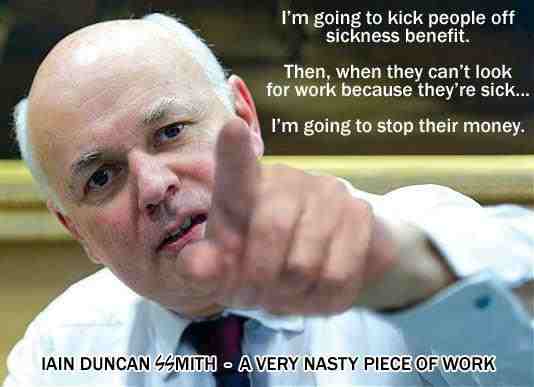
Employment and Support Allowance – Another Mean Cut From IDS – Sheila Gilmore

Originally posted in the Huff Post, by Sheila Gilmore.

544840_330826693653532_892366209_nCruel cuts.

Policies developed on a false premise will inevitably run into problems. When these policies apply to people this can also cause great harm.

The Government’s policy on ‘sickness benefits’ is framed on the assertion that previous governments ‘dumped’ people on these benefits who never worked again. For their own good they needed to be re-tested on a new basis. Many people would then be returned to the labour market and spending on the benefit would be cut. The trouble is that numbers haven’t reduced much, and projected savings haven’t been made. But rather than review the basis on which their policy was built, it appears that the Government is simply going to cut by £30 per week the benefits of many of those its own test has found unfit for work for the time being. 

Like all good myths this has some elements of truth. Incapacity Benefit was used to deal with the problem of those displaced from industries like coal, textiles and steel during the 1980s. Job opportunities where they lived were limited, and many genuinely suffered from work related poor health . This was particularly true of older workers whose chances of a new job were always the slimmest. Under the Conservatives between 1978/79 and 1996/97, the total number of claimants more than doubled from 1.204 million to 2.569 million. This rate of increase slowed under Labour, with total numbers eventually peaking at 2.678 million in 2008/09 when ESA was introduced.

As this Budget rolls out I suspect we are going to hear a vigorous refreshing of the ‘people being callously dumped’ argument from Tory Ministers and backbenchers. However the truth is more complex. Even where total numbers have remained similar over a fairly long period, these are not by any means the same people. There is substantial flow both on and off benefit. Of those who are long term claimants , many have long term conditions making employment difficult, sometimes impossible.

 The Government insisted on rolling out the transfer of all existing Incapacity Benefit claimants to Employment & Support Allowance from 2011 , believing that the more stringent test applied for ESA would result in many existing claimants being found fit for work. In its first three years ESA was for new claimants only, with around 35% being found fit for work. The correctness of the testing process has rightly been the subject of much controversy , but applying the same test to those moving from IB produced a different result with only 23% being found fit for work initially.
One conclusion which may be reached is that in fact many people in receipt of IB actually were more unwell or disabled than the Government’s propaganda keeps suggesting . Not a conclusion it appears the Government wants to accept.

Even more crucially despite all the numbers being found ‘fit for work’, trumpeted by the Government as proof of their assertions, when you look at the total numbers in receipt of ESA, together those still on the older benefits, this number remains very high. The total number in receipt of ESA and IB is only 100,000 lower than in 2008/9.

Yet taking just the period between April 2011 and March 2013 some 234,600 former IB claimants had been found fit for work. With the toughness of the test also applying to new claimants, and the time-limiting of contributory ESA to a year for many , one would expect the total number of claimants to drop by more than the number of Incapacity Benefit claimants declared Fit for Work – but bizarrely it has dropped by considerably less.

With unemployment falling since 2008/9, one might hope that more people with health issues would have been able to find work.

Something unexplained is going on. Despite all the stress to individuals, the increasing cost and difficulty of administering the system (the migration process created a huge backlog in the assessment process), nothing much seems to have changed and savings not achieved. Are more people are becoming ill or disabled? This seems unlikely.

But what if the initial assumptions were wrong, and that there are not lots of ‘fit’ people sidelined onto incapacity benefits. Three quarters of those being ‘migrated ‘ from IB are not fit for work. The proportion of new claimants being found fit for work has fallen to 23%, and has been steadily falling . In addition I suspect that a good number of those declared Fit for Work, are simply not getting better, not getting jobs, getting less well and end up reapplying for ESA and being awarded benefit the second time round.

If we accept that most claimants actually face significant barriers to returning to work, we need to be putting more effort into both giving them the help they need, and encouraging employers to take people on. This was what the Work Related Activity Group was intended to do, but for many the support offered is minimal . People are invited to ‘work focused interviews (in letters that contain severe warnings about the consequences of not attending) and are then sent away for a year in some cases. Box ticked but no help given. Some are referred to the Work Programme which has very poor outcomes for this group, not surprising given that those attending say that all the emphasis was on the mechanics of job search with little reference to their heath.

Taking away £30 pw of income won’t tackle these weaknesses of the system. Will there still be a Work Related Activity Group at all? The only difference from being on JSA will be less conditionality (although there is still some and examples of ESA-WRAG claimants being sanctioned).

Nor are we dealing here with people with minor illness. Charities report that 45% of people who put in a claim for ESA, and had Parkinson’s, Cystic Fibrosis, multiple sclerosis, or Rheumatoid Arthritis, were placed in the Work Related Activity Group (WRAG).

While this change isn’t due to start until 2017 it won’t take long for it to apply to a substantial number of people . Around 700,000 apply each year for ESA, of which number around 60% proceed to full assessment (the others generally return to work before the process is complete). Currently around 14% of these go into the WRAG. That’s around 60,000 people affected every year.

37079_433060243430176_1848475368_nPictures courtesy of Robert Livingstone

The government need to learn about the link between correlation and causality. Denial of culpability is not good enough.


IDS_n

Correlation isn’t quite the same as causality. When researchers talk about correlation, what they are saying is that they have found a relationship between two, or more, variables. “Correlation does not mean causation” is a quip that researchers chuck at us to explain that events or statistics that happen to coincide with each other are not necessarily causally related.

Correlation means that an association has been established, however, and the possibility of causation isn’t refuted or somehow invalidated by the establishment of a correlation. Quite the contrary. Indeed an established association implies there may also be a causal link. To prove causation, further research into the association must be pursued. So, care should be taken not to assume that correlation never implies causation, because it quite often does indicate a causal link.

Whilst the government deny there is a causal link between their welfare policies, austerity measures and an increase in premature deaths and suicides, they cannot deny there is a clear correlation, which warrants further research – an independent inquiry at the VERY least. But the government are hiding behind this distinction to deny any association at all between policy and policy impacts. That’s just plain wrong.

Correlations between two things may be caused by a third factor that affects both of them. This sneaky, hidden third factor is called a confounding variable, or simply a confounder.

However, most of the social research you read tends to indicate and discuss a correlation between variables, not a direct cause and effect relationship. Researchers tend to talk about associations, not causation. Causation is difficult but far from impossible to establish, especially in complex sociopolitical environments. It’s worth bearing in mind that establishing correlations is crucial for research and show that something needs to be examined and investigated further. That’s precisely how we found out that smoking causes cancer, for example – through repeated findings showing an association (those good solid, old fashioned science standards of replicability and verification). It is only by eliminating other potential associations – variables – that we can establish causalities.

The objective of a lot of research or scientific analysis is to identify the extent to which one variable relates to another variable. If there is a correlation then this guides further research into investigating whether one action causes the other. Statistics measure occurrences in time and can be used to calculate probabilities. Probability is important in studies and research because measurements, observations and findings are often influenced by variation. In addition, probability theory provides the theoretical groundwork for statistical inference.

Statistics are fundamental to good government, to the delivery of public services and to decision-making at all levels of society. Statistics provide parliament and the public with a window on the work and performance of a government. Such data allows for the design of policies and programs that aim to bring about a desired outcome, and permits better targeting of resources. Once a policy has been implemented it is necessary to monitor and evaluate the effectiveness of the policy to determine whether it has been successful in achieving the intended outcomes. It is also important to evaluate whether services (outputs) are effectively reaching those people for whom they are intended. Statistics play a crucial role in this process.  So statistics, therefore, represent a significant role in good policy making and monitoring. The impact of policy can be measured with statistics.

So firstly, we need to ask why the government are not doing this.

If policy impacts cannot be measured then it is not good policy.

Ensuring accuracy and integrity in the reporting of statistics is a serious responsibility. In cases where there may not be an in-depth understanding of statistics in general, or of a particular topic, the use of glossaries, explanatory notes and classifications ought to be used to assist in their interpretation.

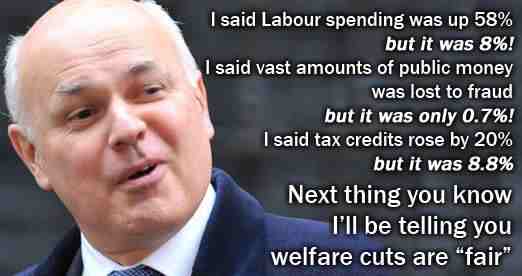
Statistics can be presented and used in ways that may lead readers and politicians to draw misleading conclusions. It is possible to take numbers out of context, as Iain Duncan Smith, amongst others, is prone to do. However, official statistics are supposed to be produced impartially and free from political influence, according to a strict code of practice. This is a government that systematically breaches the code of conduct. See: List of official rebukes for Tory lies and statistical misrepresentations, for example

We need to ask why the government refuses to conduct any research into their austerity policies, the impact they are having and the associated deaths and suicides.

Without such research, it isn’t appropriate or legitimate to deny a causal link between what are, after all, extremely punitive, targeted, class contingent policies and an increase in premature mortality rates.

The merits of qualitative research

However, I believe that social phenomena cannot always be studied in the same way as natural phenomena. There are, for example, distinctions to be made between facts and meanings. Qualitative researchers are concerned with generating explanations and extending understanding rather than simply describing and measuring social phenomena and establishing basic cause and effect relationships. Qualitative research tends to be exploratory, potentially illuminating underlying intentions, reasons, opinions, and motivations to human behaviours. It often provides insight into problems, helps to develop ideas, and may also be provide potential for the formulation hypotheses for further quantitative research.

The dichotomy between quantitative and qualitative methodological approaches, theoretical structuralism (macro-level perspectives) and interpretivism (micro-level perspectives) in sociology, for example, is not nearly so clear as it once was, however, with many social researchers recognising the value of both means of data collection and employing methodological triangulation, reflecting a commitment to methodological and epistemological pluralism. Qualitative methods tend to be much more inclusive, lending participants a dialogic, democratic voice regarding their experiences.

The government have tended to dismiss qualitative evidence of the negative impacts of their policies – presented cases studies, individual accounts and ethnographies – as “anecdotal.”

However, such an approach to research potentially provides insight, depth and rich detail because it explores beneath surface appearances, delving deeper than the simplistic analysis of ranks, categories and counts. It provides a reliable record of experiences, attitudes, feelings and behaviours and prompts an openness that quantitative methods tend to limit, as it encourages people to expand on their responses and may then open up new topic areas not initially considered by researchers. As such, qualitative methods bypass problems regarding potential power imbalances between the researcher and the subjects of research, by permitting participation and creating space for genuine dialogue and reasoned discussions to take place. Research regarding political issues and impacts must surely engage citizens on a democratic basis and allow participation in decision-making, to ensure an appropriate balance of power between citizens and government.

That assumes of course that governments want citizens to engage and participate. There is nothing to prevent a government deliberately exploiting a research framework as a way to test out highly unethical and ideologically-driven policies, and to avoid democratic accountability, transparency and safeguards. How appropriate is it to apply a biomedical model of prescribed policy “treatments” to people experiencing politically and structurally generated social problems, such as unemployment, inequality and poverty, for example?

Conservative governments are indifferent to fundamental public needs

The correlation between Conservative policies and an increase in suicides and premature deaths is a fairly well-established one.

For example, Australian social scientists found the suicide rate in the country increased significantly when a Conservative government was in power.

And an analysis of figures in the UK strongly suggests a similar trend.

The authors of the studies argue that Conservative admininistration traditionally implies a less supportive, interventionist and more market-orientated policy than a Labour one. This may make people feel more detached from society, they added. It also means support tends to be cut to those who need it the most.

Lead researcher Professor Richard Taylor, of the University of Sydney, told BBC News Online:

“We think that it may be because material conditions in lower socio-economic groups may be relatively better under labour because of government programmes, and there may be a perception of greater hope by these groups under labour.

There is a strong relationship between socio-economic status and suicide.”

The research is published in the Journal of Epidemiology and Community Health.

In one of a series of accompanying editorials, Dr Mary Shaw and colleagues from the University of Bristol say the same patterns were evident in England and Wales between 1901 and 2000.

Rates have been lower under Labour governments and soared under the last Conservative regime, which began in 1979 under Margaret Thatcher.

Interestingly, the authors of more recent research point out that although suicide rates tend to increase when unemployment is high, they were also above average during the 1950s when Britain “never had it so good,” but was ruled by the Conservative party.

Overall, they say, the figures suggest that 35,000 people would not have died had the Conservatives not been in power, equivalent to one suicide for every day of the 20th century or two for every day that the Conservatives ruled.

The UK Conservative Party typically refused to comment on the research.

Not a transparent, accountable and democratic government, then.

More recently, public health experts from Durham University have denounced the impact of Margaret Thatcher’s policies on the wellbeing of the British public in research which examines social and health inequality in the 1980s.

The study, which looked at over 70 existing research papers, concludes that as a result of unnecessary unemployment, welfare cuts and damaging housing policies, the former prime minister’s legacy includes the unnecessary and unjust premature death of many British citizens, together with a substantial and continuing burden of suffering and loss of well-being.

The research shows that there was a massive increase in income inequality under Baroness Thatcher – the richest 0.01 per cent of society had 28 times the mean national average income in 1978 but 70 times the average in 1990, and UK poverty rates went up from 6.7 per cent in 1975 to 12 per cent in 1985.

Thatcher’s governments wilfully engineered an economic catastrophe across large parts of Britain by dismantling traditional industries such as coal and steel in order to undermine the power of working class organisations, say the researchers. They suggest this ultimately fed through into growing regional disparities in health standards and life expectancy, as well as greatly increased inequalities between the richest and poorest in society.

Co-author Professor Clare Bambra from the Wolfson Research Institute for Health and Wellbeing at Durham University, commented:

“Our paper shows the importance of politics and of the decisions of governments and politicians in driving health inequalities and population health. Advancements in public health will be limited if governments continue to pursue neoliberal economic policies – such as the current welfare state cuts being carried out under the guise of austerity.”

Housing and welfare changes are also highlighted in the paper, with policies to sell off council housing such as Right to Buy  scheme and to reduce welfare payments resulting in further inequalities and causing “a mushrooming of homelessness due to a chronic shortage of affordable social housing.” Homeless households in England tripled during the 1980s from around 55,000 in 1980 to 165,000 in 1990.

And while the NHS was relatively untouched, the authors point to policy changes in healthcare such as outsourcing hospital cleaners, which removed “a friendly, reassuring presence” from hospital wards, led to increases in hospital acquired infections, and laid the ground for further privatisation under the future Coalition government.

The figures analysed as part of the research also show high levels of alcohol and drug-related mortality and a rise in deaths from violence and suicide as evidence of health problems caused by rising inequality during the Thatcher era.

The study, carried out by the Universities of Liverpool, Durham, West of Scotland, Glasgow and Edinburgh, is published in the International Journal of Health Services. It was scientifically peer-reviewed and the data upon which it was based came from more than 70 other academic papers as well as publicly available data from the Office for National Statistics (ONS).

The Government has repeatedly denied any links between social security cuts and deaths, despite the fact that there is mounting and strong evidence to the contrary. Yet it emerged that the Department for Work and Pensions (DWP) has carried out 60 reviews into deaths linked to benefit cuts in the past three years.

The information, released by John Pring, a journalist who runs the Disability News Service (DNS), was obtained through Freedom of Information requests. The data showed there have been 60 investigations into the deaths of benefit claimants since February 2012.

The DWP says the investigations are “peer reviews following the death of a customer.”

Iain Duncan Smith has denied that this review happened:

“No, we have not carried out a review […] you cannot make allegations about individual cases, in tragic cases where obviously things go badly wrong, you can’t suddenly say this is directly as a result of government policy.”

Secretary of State for Work and Pensions, 5 May 2015.

Several disability rights groups and individual campaigners, including myself, have submitted evidence regularly to the United Nations over the past three years, including details of Conservative policies, decision-making narratives and the impact of those policies on sick and disabled people. This collective action has triggered a welcomed international level investigation, which I reported last August: UK becomes the first country to face a UN inquiry into disability rights violations.

The United Nations only launch an inquiry where there is evidence of “grave or systemic violations” of the rights of disabled people.

Government policies are expressed political intentions regarding how our society is organised and governed. They have calculated social and economic aims and consequences.

How policies are justified is increasingly being detached from their aims and consequences, partly because democratic processes and basic human rights are being disassembled or side-stepped, and partly because the government employs the widespread use of propaganda to intentionally divert us from their aims and the consequences of their ideologically (rather than rationally) driven policies.  All bullies and despots scapegoat and stigmatise their victims. Furthermore, policies have become increasingly detached from public interests and needs.

It’s possible to identify which social groups this government are letting down and harming the most – it’s the ones that are being politically marginalised and socially excluded. It’s those groups that are scapegoated and deliberately stigmatised by the perpetrators of their misery.

Iain Duncan Smith and Priti Patel claim that we cannot make a link between government policies and the deaths of some sick and disabled people. There are no grounds whatsoever for that claim. There has been no cumulative impact assessment, no inquiry, no further research regarding an established correlation and a longstanding refusal from the Tories to undertake any of these. There is therefore no evidence for their claim.

Political denial is repressive, it sidesteps democratic accountability and stifles essential debate and obscures evidence. Denial of causality does not reduce the probability of it, especially in cases where a correlation has been well-established and evidenced.

arnstein-ladder-citizenship-participation.png

This is Sherry Arnstein’s Ladder of Citizen Participation and Power. Whereabouts are we?

For Arnstein, participation reflects “the redistribution of power that enables the have-not citizens, presently excluded from the political and economic processes, to be deliberately included in the future. It is the strategy by which the excluded join in determining how information is shared, goals and policies are set, tax resources are allocated, programmess are operated, and benefits like contracts and patronage are parceled out. In short, it is the means by which they can induce significant social reform which enables them to share in the benefits of the affluent society.”

A starting point may be the collective gathering of evidence and continual documentation of our individual experiences of austerity and the welfare “reforms”, which we must continue to present to relevant ministers, parliament, government departments, the mainstream media and any organisations that may be interested in promoting citizen inclusion, empowerment and democratic  participation.

We can give our own meaningful account of our own experiences and include our own voice, reflecting our own first-hand knowledge of policy impacts, describing how we make sense of and understand our own situations, including the causal links between our own circumstances, hardships, sense of isolation and distress, and Conservative policies, as active, intentional, consciencious citizens. Furthermore, we can collectively demand a democratic account and response (rather than accepting denial) from the government.


Related

A tale of two suicides and a very undemocratic, inconsistent government

The Tories are epistemological fascists: about the DWP’s Mortality Statistics release

The DWP mortality statistics: facts, values and Conservative concept control

1450041_569755536427312_1698223275_n

Pictures courtesy of Robert Livingstone


I don’t make any money from my work. I am disabled because of illness and have a very limited income. But you can help by making a donation to help me continue to research and write informative, insightful and independent articles, and to provide support to others. The smallest amount is much appreciated – thank you. 

DonatenowButton cards

Suicides reach a ten year high and are linked with welfare “reforms”

Figures released in February by the Office for National Statistics (ONS) indicate that suicide rates, which had fallen consistently since 1981, are now at their highest in over a decade. It is primarily male suicides which have increased.

The figures for 2013 give a total of 6,233 deaths by suicide, 252 more than in 2012.

Suicide rates are highest in areas of high unemployment, with the north-east of England having the highest rate and London the lowest. Older males are now the most at risk, with 45-59 year olds having the highest rate.

The link between the welfare “reforms” and increased suicide risk has been highlighted by Mind, amongst other organisations. The charity has found that people with mental illnesses are having their benefits cut more than those with other kinds of illnesses.

There has been growing concern regarding how benefits are administered in relation to vulnerable individuals and last year, revelations that the Department for Work and Pensions had internally investigated 60 suicides related to benefit changes led to calls for greater accountabilty and transparency.

As an organisation, Mind is supportive of those with mental health problems being helped into work. But they find that often people are pushed before they are properly well. Research published last year by Mind found that people with mental illness were having their benefits cut more than people with other illnesses.

Most of the telephone calls to Mind’s national helpline are from those wanting to talk about suicide and self-harm, followed by advice on support services, mainly advocacy and welfare benefits.

Kauppinen, who has worked at Mind for 10 years, said that the team used to help people with mental health problems remain stable. But she said they have seen more clients in crisis in recent years.

“We see people in crisis every week,” she said. “I started here in 2005, but when it came to 2010-11, it became crisis work rather than having people just stay where they are.”

Tom Pollard, policy and campaigns manager at Mind, said:

“Pressurising people by threatening to stop their benefits causes a great deal of financial problems and emotional distress, with some people attempting to take their own lives as a result.”

“While the right type of employment can be beneficial to wellbeing, the support offered to those on mandatory back-to-work schemes such as the Work Programme is far too generic to effectively help people with mental health problems move towards employment. We need to see an overhaul of the system with more tailored specialised support and less focus on sanctioning.”

Kauppinen added: “There is very limited mental health awareness from people assessing clients in the new Work Programme. They find it very difficult to ask questions and you can see that the assessors are awkward. It takes a long time to train someone in mental health awareness.”

If you are experiencing suicidal thoughts, please contact the Samaritans, their number is: 08457 90 90 90.

Related:

Benefits and suicide: “You have to be strong to ask for help”the Guardian.

377683_445086432227557_1770724824_n (1)Thanks to Robert Livingstone

Research shows only a fifth of 2 million people find employment after losing jobseeker’s allowance

430835_148211001996623_1337599952_n (1)Further to an article I wrote last November – Government under fire for massaging unemployment figures via benefit sanctions from Commons Select Commitee – it’s emerged that the Coalition’s claims regarding an increase in employment are again under scrutiny after research shows only a fifth of 2 million people find employment after losing jobseeker’s allowance.

Fresh research, presented at the Commons Select Committee inquiry into welfare sanctions on Wednesday, suggests that hundreds of thousands are leaving jobseeker’s allowance because of benefit sanctions without finding employment, though the report’s authors cannot provide an exact figure.

Written by academics at the University of Oxford and the London School of Hygiene and Tropical Medicine, the report raises questions about why so many of those losing their benefit then disappear from the welfare system – possibly to rely on food banks.

The Guardian reports that Professor David Stuckler, of Oxford University, said that benefit sanctions “do not appear to help people return to work. There is a real concern that sanctioned persons are disappearing from view. What we need next is a full cost-benefit analysis that looks not just narrowly at employment but possibly at hidden social costs of sanctions.

“If, as we’re finding, people are out of work but without support – disappeared from view – there’s a real danger that other services will absorb the costs, like the NHS, possibly jails and food support systems, to name a few. Sanctions could be costing taxpayers more.”

However, the Department for Work and Pensions, which is expected to announce a further rise in UK employment on Wednesday, countered that it was “proud” that 1 million jobless people were now subject to the “claimant commitment”, which sets out tougher requirements on the jobless to find work or risk losing their benefit payments.

Iain Duncan Smith, the work and pensions secretary, said: “It is only right that in return for government support – and in return for their benefits – jobseekers are expected to do all they can to find work. Although on benefits, they still have a job: the job is to get back into work.

“The claimant commitment, which is deliberately set to mimic a contract of employment, makes this expectation explicit. It has created a real change in attitudes. Already more than a million people have signed up to – and are benefiting from – this new jobseeking regime.”

Seems that Iain Duncan Smith forgets that it’s not government money that supports jobseekers, but rather their own, which was paid in tax contributions, in good faith that should any of us need state support, that support would be there to ensure we don’t become destitute or starve. It is not jobseekers attitudes that create jobs and a decent wage: that is the role of the government.People who are sanctioned can hardly be described as “benefitting” from a social scheme that was originally designed to support, not punish.

The Oxford-based research showed that between June 2011 and March 2014, more than 1.9 million sanctions were imposed on people receiving jobseeker’s allowance (JSA), with 43% of those sanctioned having their benefit claim ceased. Only 20% of those who left the benefit system gave as their stated reason that they had found work.

As I have stated before, the Department for Work and Pensions conducts no systematic research into what happens to those sanctioned, so the new findings start to fill an evidential gap in what has been one of the biggest but least publicised changes to the welfare system since the government came to power.

The 1.9 million benefit removals between June 2011 and March 2014 represent a 40% increase compared with the previous seven years. The figures are based on official monthly and quarterly data from databases covering UK local authorities between 2005 and 2014.

Dispute has arisen about a central aspect of government welfare reform centres on whether jobcentre staff, driven by senior management, are following arbitrary and poorly communicated rules that punish not just the minority of those who don’t look for work, but some of the most vulnerable in society, including mentally ill and disabled people. Many independent witnesses have urged the DWP inquiry at least to suspend the sanctions regime for those claiming employment support allowance, the main disability benefit. Evidence, however, strongly suggests that most people receiving sanctions want to work and that sanctions are imposed because of targets, and so are not related to any claimant claim of non-cooperation or unwillingness to work at all. Rather, it’s the case that sanctions are punishing the vulnerable for being vulnerable.

Study author Dr Rachel Loopstra, from Oxford University, said: “The data did not give us the full picture of why sanctioned people have stopped claiming unemployment benefit. We can say, however, that there was a large rise in the number of people leaving JSA for reasons that were not linked to employment in association with sanctioning. On this basis, it appears that the punitive use of sanctions is driving people away from social support.”

The study also shows widespread variation in how local authorities used sanctions. In Derby, Preston, Chorley and Southampton, researchers found particularly high rates of people being referred for sanctions. In some months, more than 10% of claimants in these areas were sanctioned – the highest rates nationwide.

Co-author Prof Martin McKee, from the London School of Hygiene & Tropical Medicine, said: “There is a need for a cost-benefit analysis of sanctioning, looking at it not just in narrow terms of unemployment benefit, but also the bigger picture, focusing on employment, health, and other social costs.”

He added: “The coalition government has embarked upon an unprecedented experiment to reform social security. I hope policymakers will be informed by these findings and see the value of investigating the consequences.”

Separate evidence in front of the DWP select committee inquiry includes witness statements from former jobcentre staff suggesting senior management threaten staff if they do not take a harsh approach to claimants. There is also cumulative evidence that many of those sanctioned have little or no knowledge of why they are being punished.

The main union representing jobcentre staff, PCS – which was also due to give evidence on Wednesday to the select committee inquiry – suggests: “While there is considerable anecdotal evidence about the inappropriate use of sanctions, there is a lack of empirical evidence. We believe that DWP should publish a more detailed breakdown of sanctions, and specifically more detailed explanations as to why they were imposed. PCS’s survey of our adviser members showed that 61% had experienced pressure to refer claimants to sanctions where they believed it may be inappropriate to do so.”

DWP select committee member Debbie Abrahams said: “This government has developed a culture in which Jobcentre Plus advisers are expected to sanction claimants using unjust, and potentially fraudulent, reasons in order get people “off-flow”. This creates the illusion the government is bringing down unemployment.”

The government counters that its policies are turning the UK into “the jobs factory of Europe”, and dismisses the idea that the unemployment figures are being subverted by sanctions.

A DWP spokesman said: “As the authors admit themselves the data does not give a full picture. What we do know – according to independent figures from the Office for National Statistics – is that we now have a record number of people in employment in this country and there are two million more people in private sector jobs compared to 2010.”

That is a claim which is not very well substantiated by income tax revenue collected by the Treasury at all. (See also A letter of complaint to Andrew Dilnot regarding Coalition lies about employment statistics).


Related
: Cameron’s Nudge that knocked democracy down – a summary of the implications of Nudge theory

Jobless are being punished with hunger for claiming unemployment benefit, say churches

Hain’s horror as figures reveal four in five who have JSA sanctioned “don’t find work”

385294_195107567306966_1850351962_nMany thanks to Robert @LivingstonePics

Inequality has risen: Incomes increased for the richest last year, but fell for everyone else

1459720_569627496440116_902730897_n

On 04 June, 2014, at 3.52pm BST, Cameron said inequality is at its lowest level since 1986. I really thought I’d misheard him. This isn’t the first time Cameron has used this lie. We have a government that provides disproportionate and growing returns to the already wealthy, whilst imposing austerity cuts on the very poorest. How can such a government possibly claim that inequality is falling, when inequality is so fundamental to their ideology and when social inequalities are extended and perpetuated by all of their policies? The standard measure of inequality is  certainly being used to mislead us into thinking that the economy is far more “inclusive’ than it is.

Dr Simon Duffy authored report – A Fair Society?  – last year, for the Centre for Welfare Reform, about how the austerity cuts have been targeted. He said:

  • People in poverty are targeted 5 times more than most citizens
  • Disabled people are targeted 9 times more than most citizens
  • People needing social care are targeted 19 times more than most citizens

“The UK is the third most unequal developed country in the world and most disabled people live in poverty. The current policy is guaranteed to increase inequality and to make extreme poverty even worse.”

I also wrote an article last year –  Follow the Money: Tory Ideology is all about handouts to the wealthy that are funded by the poor. I said:

The following cuts came into force in April 2013:

  • 1 April – Housing benefit cut, including the introduction of the ‘bedroom tax’
  • 1 April – Council tax benefit cut
  • 1 April – Legal Aid savagely cut
  • 6 April – Tax credit and child benefit cut
  • 7 April – Maternity and paternity pay cut
  • 8 April – 1% cap on the rise of in working-age benefits (for the next three years)
  • 8 April – Disability living allowance replaced by personal independence payment (PIP)
  • 15 April – Cap on the total amount of benefit working-age people can receive

Here are some of the “incentives” for the wealthy:

  • Rising wealth – 50 richest people from this region increased their wealth by £3.46 billion last year to a record £28.5 billion.
  • Falling taxes – top rate of tax cut from 50% to 45% for those earning over £150,000 a year. This is 1% of the population who earn 13% of the income.
  • No mansion tax and caps on council tax mean that the highest value properties are taxed proportionately less than average houses.
  • Benefited most from Quantitative Easing (QE) – the Bank of England say that as 50% of households have little or no financial assets, almost all the financial benefit of QE was for the wealthiest 50% of households, with the wealthiest 10% taking the lions share
  • Tax free living – extremely wealthy individuals can access tax avoidance schemes which contribute to the £25bn of tax which is avoided every year, as profits are shifted offshore to join the estimated £13 trillion of assets siphoned off from our economy.

I also said: “A simple truth is that poverty happens because some people are very, very rich. That happens ultimately because of Government policies that create, sustain and extend inequalities. The very wealthy are becoming wealthier, the poor are becoming poorer. This is a consequence of  “vulture capitalism”, designed by the opportunism and greed of a few, it is instituted, facilitated and directed by the Tory-led  Coalition. ”  

Inequality Briefing reports that richest fifth of the UK population saw their incomes increase by £940 in 2013. But incomes were down by £250 for the other 80% of the population… and by £381 for the poorest fifth , according to data from the Office for National Statistics (ONS)

Incomes increased for the richest fifth of the population last year, but fell for everyone else

Thanks to Inequality Briefing for the info graphic and summary

To download the full pdf, click here

Explaining the data

This data compares the ‘equivalised disposable household income’ for 2011/12 and 2012/13. It was published by the Office for National Statistics as part of ‘the effects of UK tax and benefits on household income 2012/13 study.’ ONS have found that the recession did have a small effect on reducing inequality, but it now looks as though inequality is set to increase.

It has increased. Just as we have predicted.

1234134_539964652739734_1075596050_nPicture courtesy of  Robert Livingstone

Other relevant articles:

Quantitative data on poverty from the Joseph Rowntree Foundation

Welfare reforms, food banks, malnutrition and the return of Victorian diseases are not coincidental, Mr Cameron

The poverty of responsibility and the politics of blame 

“We are raising more money for the rich” – an analysis 

Cameron’s Gini and the hidden hierarchy of worth

How the Tories chose to hit the poor

It’s absolute poverty, not “market competition” that has led to a drop in food sales.

1450041_569755536427312_1698223275_n
Public spending in food stores fell for the first time on record in July this year, putting the UK recovery in doubt. Such a worrying, unprecedented record fall in food sales indicates that many consumers evidently have yet to feel the benefit of the so-called recovery.

The price of food was 0.2% higher than a year ago. The Office for National Statistics (ONS) started collecting the data for food sales in 1989The volume of food sales was also down last month, by 1.5% on an annualised basis.

There was also a marked fall in petrol consumption, and the only prominent area of growth was in spending that entailed use of mail order catalogues, and at market stalls, as people use credit to buy essential items and shop around for cheap alternatives and bargains.

Food manufacturing is the UK’s single largest manufacturing sector. The food and drink supply chain is a major part of the UK economy, accounting for 7% of GDP, employing over 3.7 million people, and generating at least £80 billion per year,  according to data from the Cabinet Office. There was an increase in the food sector (excluding agriculture) from 2000-2009 in Britain; the whole UK economy increased by 47% during the same period.

The Office for National Statistics has put the recent decline down to “prolonged discounting and price wars”.

However, crucially, the quantity of food bought in food stores also decreased by 1.5 per cent year-on-year in July.

It doesn’t take a genius to work out that repressed, stagnant wages and RISING living costs are going to result in reduced sale volumes. Survation’s research in March this year indicates that only four out of every ten of UK workers believe that the country’s economy is recovering. But we know that the bulk of the Tory austerity cuts were aimed at those least able to afford any cut to their income.

What we need to ask is why none of the mainstream media articles, or the ONS account, duly reporting the drop in food sales, have bothered to link this with the substantial increase in reported cases of malnutrition and related illnesses across the UK. It’s not as if this correlation is a particularly large inferential leap, after all.

It stands to reason that if people cannot afford food, they won’t be able to buy it. Furthermore, that consumers were not actually considered as a part of the ONS and media assessment is frankly strange, to say the least, with emphasis being placed solely on deterministic market competition criteria, and hardly a skim over any analysis of the social-political conditions that have undoubtedly contributed to the significant drop in food sales.

Food banks provide food aid to people in acute need, usually following referral by health or social care professionals, such as social workers, doctors, health visitors, and organisations such as the Citizens Advice Bureau and Jobcentre Plus. The Department for Work and Pensions has acknowledged that there is internal guidance to staff on signposting to food banks and a recent Freedom of Information request reported in The Guardian, revealed a “high level process” to be observed by jobcentre staff for referring claimants who say that they are suffering hardship and need food.

The role of Jobcentre Plus in referring people to food banks was described by Mark Hoban, Minister of State for Employment at the Department for Work and Pensions (DWP) as follows in December 2012: “The DWP, through Jobcentre Plus, operates a foodbank referral service. This is a simple signposting process which builds on the Jobcentre Plus standard practice of holding, locally, the details of organisations to which we signpost claimants who tell us they are in financial difficulty. Jobcentre Plus will only signpost claimants when they can offer no more help.”

Jobcentre Plus have been “signposting” people to food banks nationally since September 2011. Circumstances where a Jobcentre might make a referral to a food bank include:

  •  where a Crisis Loan or Short Term Benefit Advance had been refused;
  •  where a change in circumstances had affected a person’s entitlement to benefit, or reduced the amount they receive;
  •  where payment of benefit had been delayed (e.g. because a claim was still being
    assessed, or DWP was awaiting information to enable a decision on a claim).

The original version of the Jobcentre Plus referral form included boxes to tick to indicate the reason for the referral. However, the report in the Guardian on 6 September 2013 highlighted that the DWP had suddenly “unilaterally redesigned the food bank vouchers it issues to clients” – the three boxes on the previous form which had enabled JobCentre Plus “to indicate why they referred the person: because of benefit delay, benefit change, or refusal of crisis loan … have been removed from the new version of the form. The vouchers no longer tell the [Trussell] trust why the person has been referred”.

As Patrick Butler astutely observed, this has the effect of removing data that helps highlight why impoverishment caused by welfare “reform” has become one of the biggest single drivers of people turning to food banks. The Government needs political cover for lying ministers such as Freud and McVey, who like to pretend food banks have nothing to do with austerity and welfare reform; but the DWP sends its impoverished customers in droves to them anyway.

Research by the Joseph Rowntree Foundation and others indicates quite clearly that:

  • Some of the increase in the number of people using food banks is
    caused by unemployment, increasing levels of underemployment,
    low and falling income, and rising food and fuel prices. The
    National Minimum Wage and benefits levels need to rise in line
    with inflation, in order to ensure that families retain the ability to
    live with dignity and can afford to feed and clothe themselves and
    stay warm.
  • More alarmingly, up to half of all people turning to food banks
    are doing so as a direct result of having benefit payments delayed,
    reduced, or withdrawn altogether. Figures gathered by the Trussell
    Trust show that changes to the benefit system are the most common reasons for people using food banks;these include changes to crisis loan eligibility rules, delays in payments, Jobseeker’s Allowance ,sanctions and sickness benefit
    reassessments.
  • There is very clear evidence that the benefit sanctions regime is leading to destitution, hardship and hunger on a large scale.

Furthermore, in November last year, in a letter to the British Medical Journal, a group of doctors and senior academics from the Medical Research Council and two leading universities said that the effect of Government austerity policies on vulnerable people’s ability to afford food needed to be “urgently” monitored.

There was a significant surge in the number of people requiring emergency food aid, a decrease in the amount of calories consumed by British families, and a doubling of the number of malnutrition cases seen at English hospitals, which represents “all the signs of a public health emergency that could go unrecognised until it is too late to take preventative action,” they wrote.

Despite mounting evidence for a growing food poverty crisis in the UK, Tory ministers continue to maintain the lie that there is “no robust evidence” of a link between their sweeping welfare “reforms” and a rise in the use of food banks. However, publication of research into the phenomenon, commissioned by the Government itself, was delayed, amid speculation that the findings may prove embarrassing for the Government.

“Because the Government delayed the publication of research it commissioned into the rise of emergency food aid in the UK, we can only speculate that the cause is related to the rising cost of living and increasingly austere welfare reforms,” the public health experts wrote. It is very evident that the welfare state is “failing to provide a robust last line of defence against hunger.”

The authors of the letter, who include Dr David Taylor-Robinson and Professor Margaret Whitehead of Liverpool University’s Department of Public Health, say that malnutrition can have a devastating, long-lasting impact on health, particularly amongst children.

Chris Mould, chief executive of the Trussell Trust, the largest national food bank provider, said that one in three of the 350,000 people who required food bank  support at the Trussell Trust centres alone this year were children. It is estimated that by 2013, at least 500,000 people were reliant on food aid.

Access to adequate food is the most basic of human needs and rights. The right to food is protected under international human rights and humanitarian law and the correlative state obligations are equally well-established under international law. This right is recognised in the 1948 Universal Declaration of Human Rights (Article 25) as part of the right to an adequate standard of living, and is enshrined in the 1966 International Covenant on Economic, Social and Cultural Rights (Article 11).

Olivier De Schutter (a United Nations Special Rapporteur on the Right to Food) recently pointed to increases in the number of food banks in developed countries  such as the UK as an indicator that Governments are “in danger of failing in their duty to protect citizens under the International Covenant on Economic, Social and Cultural Rights” (IESCR), which states that all citizens should have access to adequate diet without having to compromise other basic needs.

Whilst the Department for Work and Pensions (DWP) claims that the benefits system provides a “safety net for essentials such as food”, the evidence increasingly does not support this claim. In fact, there is substantial and ever-mounting evidence that the inadequacies of the welfare safety net are now directly driving the growth of hunger and reliance on charitable food handouts.

The BBC reported the “‘Shocking increase’ in Employment Support Allowance (ESA) sickness benefit sanctions” on August 13th, within the first three months of 2014, there were 15,955 sanctions on ESA claimants, compared with 3,574 in the same period last year. I reported about the impact of sanctions in February, 2014, and I reported the substantial increase in ESA sanctions May 2014, along with the Benefits and Work site, amongst other “non-mainstream” writers. It’s incredible that the BBC, with relatively vast resources to hand hasn’t bothered researching and reporting this issue until now.

Perhaps this explains the BBC’s endorsement of the Government welfare “reforms” and their complicity with the persecution of sick and disabled people: James Purnell – one  of the chief architects of the current government’s “reforms”  (Gordon Brown had previously rebuffed Purnell’s proposals, and Purnell resigned as a consequence), is the BBC’s Director of Strategy & Digital which “brings together Communications, Future Media, Marketing, Policy, Research and Development and Strategy”. So, Mr Purnell is on the Executive Board, which, I am sure, contributes to the BBC’s current degree of “impartiality”, especially evident in attempts to defer delivery of politically damning news, or in their other quest to purposefully deliver politically motivated factual detours.

There is currently no established government measure of food poverty. A recent report by the Centre for Economics and Business Research defined households who have to spend more than 10% of their annual income on food as being in food poverty.

The Food Ethics Council states that food poverty means that an individual or household isn’t able to obtain healthy, nutritious food – they have to eat what they can afford or find, not what they choose to.

If people can’t meet basic survival needs, then that is defined as absolute poverty. We haven’t seen absolute poverty in the UK since before the inception of the welfare state. Until  now.

“Food banks open across the country, teachers report children coming to school hungry; advice services and local authorities prepare for the risks attached to welfare reform. There is evidence of a rising number of people sleeping rough, and destitution is reported with increasing frequency.” Julia Unwin, Joseph Rowntree Foundation, 2013.

“In households which cannot afford an adequate diet for their children, 93% have at least one adult who “skimps” on their own food to try to protect the children. Half a million children are not adequately fed in the UK today, not as a result of negligence but due to a lack of money.” Poverty and Social Exclusion UK. 2013.

We know that the imposed limitations on welfare processes and procedures have been found to be impacting on the growing demand for food banks. Decision-making around sanctions has been found to be particularly problematic from the perspective of food banks, where decisions were seen as unfair and/or arbitrary. Similarly, errors made in declaring people on Employment Support Allowance fit for work were also highlighted, by research undertaken by the Sheffield University Political Economy Research Institute.

More generally, “ineffective administration” of lifeline welfare payments is also seen to be an important driver of need, where people’s payments are delayed or stopped and they are left with no or heavily reduced income. Tory policy changes to the length of time sanctions run for (from 2 weeks to 3 years) is “significantly problematic”, given the  enormous implications for financial insecurity. And resultant absolute poverty.

Basic incomes are being reduced, making it much more difficult for people to make ends meet. In addition, “reforms” – which is the Orwellian Tory word for severe cuts – impacting on food poverty include the cap to benefit payments, the Bedroom Tax, and the loss of full Council Tax exemption for many benefit claimants.

No-one should be hungry, without food in this Country. That there are people living in a politically imposed state of absolute poverty is unacceptable in the UK, the world’s sixth largest economy (and the third largest in Europe). This was once a civilised first-world country that cared for and supported vulnerable citizens. After all, we have paid for our own welfare provision, and we did so in the recognition that absolutely anyone can lose their job, become ill or have an accident that results in disability. This is a Government that very clearly does not reflect the needs of the majority of citizens.

It is also unacceptable in a so-called liberal democracy that we have a Government that has persistently denied the terrible consequences of their own policies, despite  overwhelming evidence that the welfare “reforms” are causing people, harm, distress and sometimes, death. Furthermore, this is a Government that has systematically employed methods to effectively hide the evidence of the harm caused to others as a consequence of their devastating, draconian “reforms” from the public. This clearly demonstrates an intention to deceive, and an intention to continue causing people harm.

In English criminal law, intention is one of the types of mens rea (Latin for “guilty mind”) that, when accompanied by an actus reus (“guilty act”), constitutes a crime. It’s difficult to envisage that anyone in the UK would fail to understand that any act that prevents people from accessing food, and the means of meeting other basic survival needs, such as shelter, will cause them harm.

This is a Government that knows exactly what it is doing.

1459720_569627496440116_902730897_n
Many thanks to Robert Livingstone for his excellent artwork

Iain Duncan Smith used false statistics again to justify disability benefit cuts

486294_4737578711832_1816039541_n
The Department of Work and Pensions has a long track record of misusing statistics, making unsubstantiated inferences and stigmatising claimants, and it’s clear these are tactics used to vindicate further welfare cuts.

The Tories have peddled the lie that he UK was “on the brink bankruptcy” and claimed the solution to is to cut government spending with a painful programme of austerity cuts. Of course, the UK economy was growing in 2010 when the Tories took over and was subsequently plunged back into recession by Osborne’s austerity policies, which have meant that the economy has not grown at all under the coalition; and for much of their tenure has been contracting. Despite the fact that Osborne was officially rebuked for this lie, the Goebbels-styled repetition propaganda technique employed by the conservatives has embedded this lie in the minds of the public.  However, our current problems are the result of a global financial crisis that we and not the banks that caused it, continue to pay for.

Austerity is a smokescreen – the Coalition has used the deficit as an excuse to do what they have always wanted to do: shrink the state, privatise the NHS, and hand out our money to the wealthy minority. We cannot trust them. 

It’s become clear that the Tories have seized an opportunity to dismantle the institutions they have always hated since the post-war social democratic settlement – institutions of health, welfare, education, culture and human rights which should be provided for all citizens. The Tories also attempt to destroy fundamental public support for the health, education and welfare of its people by a divisive scapegoating of vulnerable groups, perpetuated via the media, and by offering and inflicting only regressive, punitive policies and devastating cuts. 

The  Official statistics watchdog (UKSA) has found that the Department for Work and Pensions (DWP) have repeatedly made false claims about the numbers of people living on disability benefits.

Ministers claim that the majority of people claiming disability living allowance (DLA) were given benefits for life, and without any supporting medical evidence. This is untrue.

According to DWP press releases:

“More than 50% of decisions on entitlement are made on the basis of the claim form alone, without any additional corroborating medical evidence.”

However, the UK Statistics Authority (UKSA) found that the real percentage of claims passed without supporting medical evidence was just 10%.

The DWP also claimed that “Under the current system of Disability Living Allowance, 71% of claimants get indefinite awards without systematic reassessments.” However the UKSA found that in the last two years, just 23% and 24% of claimants were given indefinite awards of DLA.


The DWP accept that their claims were “ambiguous” and “had not been re-checked by the Department’s analysts, as is the usual practice.”

The findings were uncovered by an investigation by Channel Four News following complaint by the charity Parkinson’s UK.

 Parkinson’s UK policy advisor Donna O’Brien said:

“People with Parkinson’s who claimed DLA have told us supporting medical evidence was crucial due to a woeful knowledge of the condition amongst assessors, and it is absurd that the Government was trying to imply that anyone going through the system had an easy ride.”

This is the third time in the past year that Iain Duncan Smith has come under fire for the use of false statistics to justify cuts to benefits.

Last year Duncan Smith was rebuked by UKSA for misuse of benefit statistics. He claimed that 8000 people who had been affected by the benefits cap had “moved back into work.”

The UKSA found that this figure was “unsupported by the official statistics.”

Another statement by Duncan Smith later in the month also drew criticism and a reprimand. The minister said around 1 million people have been stuck on benefits for at least three of the last four years “despite being judged capable of preparing or looking for work”.

However, the figures cited also included single mothers, people who were seriously ill, and people awaiting their assessment.

Grant Shapps was also rebuked by UK Statistics Authority for misrepresenting benefit figures – Shapps joined his fellow Conservatives in the data hall of shame. In March, the Tory chairman claimed that “nearly a million people” (878,300) on incapacity benefit had dropped their claims, rather than face a new medical assessment for its successor, the employment and support allowance (ESA).

The figures, he said, “demonstrate how the welfare system was broken under Labour and why our reforms are so important”.  The claim was faithfully reported by the Sunday Telegraph  but as the UK Statistics Authority has now confirmed in its response to Labour MP Sheila Gilmore (the complainant), it was entirely and intentionally fabricated.

In his letter to Shapps and Iain Duncan Smith, UKSA chair Andrew Dilnot writes that the figure conflated “official statistics relating to new claimants of the ESA with official statistics on recipients of the incapacity benefit (IB) who are being migrated across to the ESA”.

Of the 603,600 incapacity benefit claimants referred for reassessment as part of the introduction of the ESA between March 2011 and May 2012, just 19,700 (somewhat short of Shapps’s “nearly a million) abandoned their claims prior to a work capability assessment in the period up to May 2012. The figure of 878,300 refers to the total of new claims for the ESA closed before medical assessment from October 2008 to May 2012.

Thus, Shapps’s suggestion that the 878,300 were pre-existing claimants, who would rather lose their benefits than be exposed as “scroungers”, was entirely wrong. As significantly, there is no evidence that those who abandoned their claims did so for the reasons ascribed by Shapps. However, he did at least honestly reveal his own prejudices regarding disabled people, at least. But he did so without a trace of shame and remorse.

At the time Iain Duncan Smith dismissed the findings, saying that he “believed” that he was “right”, anyway. It seems that Iain Duncan Smith has some disdain for evidence-based policy.

“I believe this to be right, I believe that we are already seeing people going back to work who were not going to go back to work,”  he said.

This is a remarkable claim, given that the Department for Work and Pensions does not track the destination of people no longer entitled to benefits. Simply measuring how many people no longer claim benefits does not accurately reflect the numbers of those actually moving into employment. The DWP off-flow figures will inevitably include many having their claim ended for reasons other than securing employment, including sanctions, awaiting mandatory review, appeal, death, hospitalisation, imprisonment, or on a government “training scheme” (workfare). 

In 2011, the Work and Pensions Select Committee warned the Department for Work and Pensions (DWP) needed to take more care when releasing and commenting on benefit statistics, to make sure media stories were “accurate.”

It seems unlikely, however, that accuracy will replace Duncan Smith’s “gut feelings” and ideologically-driven rhetoric – which is aimed at presenting excuses for the steady reduction of support for the most vulnerable citizens – any time soon.

36626_217452248405831_532419169_n

Pictures courtesy of Robert Livingstone 

Austerity, socio-economic entropy and being conservative with the truth

734072_148205235330533_659227219_n

The Coalition have a track record of lying and trying to mislead the public. David Cameron has now been rebuked several times for making false claims: on NHS spending, the rising national debt and the impact of his tax rises and deep spending cuts on economic growth. The Tories invented figures to claim people are now “better off”, but which totally ignored and excluded an account of the impact of significant factors like the rise in VAT, the cost of living, cuts to tax credits and other benefits.

The government is committing fraud on a grand scale. The reason for such deceit has nothing to do with public finances or the state of the economy, and everything to do with shrinking the public realm. There is an irreducibly ideological dimension to Tory economics, and by making it sound “scientific” when really, it’s more akin to philosophy or Tory buck passing, they attempt to lend it an air of authority and legitimacy it does not deserve. 

The only thing that unites Tories is wealth, they mostly thrive on creating social divisions. The Tories have used a justification narrative based on a moral entrepreneur approach to scapegoat and vilify vulnerable social groups in order to justify transferring our public wealth to private bank accounts, behind the façade of austerity. What we are witnessing is a governments’ nonchalant adherence to Tory ideology which scripts policies that generate and perpetuate inequality, no matter what the consequences for the most vulnerable. Or the economy.

The Tories peddled the lie that due to Labour’s management of the economy, the UK was “on the brink bankruptcy” and claim the solution to is to cut government spending with a painful programme of austerity cuts. Of course the UK economy was growing in 2010 when the Tories took over and was subsequently plunged back into recession by Osborne’s austerity policies which have meant that the economy has not grown at all under the coalition; and for much of their tenure has been contracting.

Many economists have said consistently that this is the wrong approach. The best solution is to borrow or, better, create money to invest in infrastructure. But what we have instead is Osbornes’ closed economy, with a colossal redistribution of public funds to few private businesses and millionaires, who are sat on our money, whilst the government is steadily removing even more of our public capital through deep cuts. There is no investment in the infrastructure, public services – it’s a framework of increasing and devastating socio-economic entropy.

The Tories seem to think we have forgotten that it was they that lost the Moody’s Investors Service triple A grade, despite pledges to keep it secure. Moody’s credit ratings represent a rank-ordering of creditworthiness, or expected loss.

The Fitch credit rating was also downgraded due to increased borrowing by the Tories, who have borrowed more in 4 years than Labour did in 13. In fact this Tory administration have borrowed more than every single Labour government ever, combined.

The Tories have seized an opportunity to dismantle the institutions they have always hated since the post-war social democratic settlement – institutions of health, welfare, education, culture and human rights which should be provided for all citizens. The Tories attempt to destroy fundamental public support for the health, education and welfare of its people. Offering and inflicting only regressive, punitive policies and devastating cuts, the Tories lie to drag the compliant, conforming and increasingly shell-shocked electorate along as they dismantle our social democracy, our public services, fundamental rights and the very basis of our civilisation.

Whenever this authoritarian government have been challenged and opposed effectively, they simply ignore or edit the law, veto tribunal rulings or invoke archaic government privilege to bypass opposition and to get their own way with unpopular policies, such as The Health and Social Care Bill and the Welfare “Reforms”.

That a government needs to employ such underhanded methods to pass their policy through the legislative process, and justify such policies by lying, and by the malevolent scapegoating of vulnerable sections of society via the media, informs us that those policies are not addressing public needs, and wishes; that they are not democratically motivated or processed and that they reflect a political ideology which does not accommodate social and economic realities, nor is it fitting for a so-called first world liberal democracy that is a signatory to several international human rights charters to witness a government so deceptive and arbitrary in its approach to legitimacy.

Here is catalogue of officially recognised Tory lies used to justify their unjustifiable policies, which have have resulted in official reprimands:

David Cameron rebuked by statistics watchdog over national debt claims -The PM said the government was ‘paying down Britain’s debts’ in a political broadcast, even though the debt is actually rising.

“Now that his false claims have been exposed, it’s time the prime minister stopped deliberately misleading people about his economic record” – Rachel Reeves.

Finally Exposed! The Deficit Myth! So, David Cameron When Are You Going to Apologise? David Cameron rebuked over austerity claims – David Cameron has been corrected by the Treasury’s own forecaster over claims that cuts in public spending are not reducing economic growth. The Office for Budget Responsibility told the Prime Minister that it does believe that cutting public spending will reduce economic growth in the short term.

Robert Chote, the head of the OBR, contradicted a claim Mr Cameron made this week in a speech about the economy, in which the Prime Minister said the forecaster does not believe cuts are reducing growth.

In fact, as Mr Chote wrote, the OBR believes that cuts in spending and increases in tax will depress economic activity, meaning lower growth.

OBR head rebukes Osborne: the UK was never at risk of bankruptcy. Office for Budget Responsibility chief Robert Chote dismisses the “danger of insolvency”.

In the weeks after he took office, George Osborne justified his austerity programme by claiming that Britain was on “the brink of bankruptcy”. He told the Conservative conference in October 2010: “The good news is that we are in government after 13 years of a disastrous Labour administration that brought our country to the brink of bankruptcy.”

It was, of course, nonsense.

*Please note the original link to the New Statesman article seems to have curiously vanished. So here is a cached link to the same article: OBR head rebukes Osborne: the UK was never at risk of bankruptcy.

David Cameron rebuked over jobs claim Sir Andrew Dilnot, head of the UK Statistics Authority, the independent statistics regulator, said the prime minister was wrong to say figures showed that more than three-quarters of all new jobs went to British citizens when “official statistics do not show the number of new jobs.”

Cameron was attempting to show in an interview for the Daily Telegraph that the government had reversed a situation in its first few years of office when he claimed most new jobs were taken by migrant workers. The interview was widely interpreted as an attempt to win over Ukip voters who believe most jobs created as Britain’s economy recovers are being snapped up by foreigners.

Following a complaint by Jonathan Portes, head of the National Institute for Economic & Social Research, Dilnot confirmed that neither the original fear that migrants were taking British jobs nor the reversal of this trend were supported by official data.

Employment data collected by the Office for National Statistics relates to jobs in the economy whether or not they are newly created by employers. Dilnot said the relevant figures from the ONS showed the number of migrants in the labour force increased by 400,000 over the last five years, an 18% rise, while the number of UK nationals increased by 3%, or 900,000.

Sir Andrew Dilnot, head of the UK Statistics Authority, the independent statistics regulator, said the prime minister was wrong to say figures showed that more than three-quarters of all new jobs went to British citizens when “official statistics do not show the number of new jobs.”

Information Commissioner Christopher Graham launched a scathing rebuke of the decision to exercise the Government’s veto in a report on the case to Parliament. Blocking the publication of a report into the risks of NHS reforms is a sign that ministers want to downgrade freedom of information laws, a watchdog has warned. Health Secretary Andrew Lansley deployed it to block an Information Tribunal ruling that he should meet Labour demands to disclose the document.

Duncan Smith rebuked by ONS for misuse of benefit statistics – The claim that 8,000 people moved into work as a result of the benefit cap is “unsupported by the official statistics”, says the UK Statistics Authority. In letter to Duncan Smith, Andrew Dilnot writes: “In the manner and form published, the statistics do not comply fully with the principles of the Code of Practice, particularly in respect of accessibility to the sources of data, information about the methodology and quality of the statistics, and the suggestion that the statistics were shared with the media in advance of their publication.”

Another statement by Duncan Smith later in the month also drew criticism and a reprimand. The minister said around 1 million people have been stuck on benefits for at least three of the last four years “despite being judged capable of preparing or looking for work”.

However, the figures cited also included single mothers, people who were seriously ill, and people awaiting testing.

Iain Duncan Smith Rebuked Over Immigration Statistics – Iain Duncan Smith and the Department of Work and Pensions have been accused of publishing misleading immigration figures that were “highly vulnerable to misinterpretation”.Figures showing 371,000 immigrants were on benefits were rushed out by ministers with insufficient regard for “weaknesses” in the data, according to the UK Statistics Authority.

In a strongly-worded rebuke to Work and Pensions Secretary Iain Duncan Smith, the head of the UKSA, sir Michael Scholar, condemned the handling of the research, the Press Association reported.

Sir Michael said that despite being “highly vulnerable to misinterpretation”, the claims were given to the media without the safeguards demanded for official statistics and by issuing the figures as a “research paper”, the DWP had bypassed the need to meet the usual code of conduct, he noted.

Grant Shapps rebuked by UK Statistics Authority for misrepresenting benefit figures – Yet another Conservative politician is caught making it up. Grant Shapps has joined his fellow Conservatives in the data hall of shame. In March, the Tory chairman claimed that “nearly a million people” (878,300) on incapacity benefit had dropped their claims, rather than face a new medical assessment for its successor, the employment and support allowance.

The figures, he said, “demonstrate how the welfare system was broken under Labour and why our reforms are so important”. The claim was faithfully reported by the Sunday Telegraph  but as the UK Statistics Authority has now confirmed in its response to Labour MP Sheila Gilmore (see below), it was entirely fabricated.

In his letter to Shapps and Iain Duncan Smith, UKSA chair Andrew Dilnot writes that the figure conflated “official statistics relating to new claimants of the ESA with official statistics on recipients of the incapacity benefit (IB) who are being migrated across to the ESA”. Of the 603,600 incapacity benefit claimants referred for reassessment as part of the introduction of the ESA between March 2011 and May 2012, just 19,700 (somewhat short of Shapps’s “nearly a million) abandoned their claims prior to a work capability assessment in the period to May 2012.

The figure of 878,300 refers to the total of new claims for the ESA closed before medical assessment from October 2008 to May 2012. Thus, Shapps’s suggestion that the 878,300 were pre-existing claimants, who would rather lose their benefits than be exposed as “scroungers”, was entirely wrong.

As significantly, there is no evidence that those who abandoned their claims did so for the reasons ascribed by Shapps.

The chair of the UK Statistics Authority has rebuked shadow home secretary Chris Grayling – the authority have said  he “must take issue” with claims made by the conservatives and  warned the way they use violent crime statistics is “likely to mislead the public” and damage public trust. Mr Grayling has used a comparison between  figures to suggest that the Labour government has presided over a runaway rise in violent crime.

Even colleague Iain Duncan Smith said that such comparisons were “profoundly misleading and London’s Conservative Mayor, Boris Johnson, described Grayings’ claim as “absolute nonsense”. Chris Grayling made a headline-grabbing speech in which he likened life in Britain’s inner cities to that in Baltimore, Maryland, as portrayed in the acclaimed television series The Wire. Alan Johnson, the Home Secretary, remarked: “The connection between The Wire and Chris Grayling’s grasp on the problems of modern Britain is that they are both fictional.”

Treasury rebuked by UK Statistics Authority for inflation leaks – Britain’s statistics watchdog, ordered the Treasury to review its processes after sensitive inflation data this month was sent to 400 unauthorised people 17 hours before its release. Sir Michael warned: “There is a risk of market manipulation if key economic data fall in to the wrong hands before publication.”

Speculation data was leaking into the market ahead of the Office for National Statistics (ONS) announcement has been rife. Market rumours correctly predicted the last two Consumer Price Index inflation releases just before publication – in April and May.

UK Statistics rebukes Government over NHS spending claims – David Cameron famously promised he would cut the deficit, not the NHS. We now have it in black and white: he is cutting the NHS, not the deficit. There could be no clearer evidence of the failure of this Prime Minister and his Government.

“For months, David Cameron’s Government have made misleading boasts about NHS spending, misrepresenting the true financial difficulties he has brought upon the NHS. At the same time they have recently begun to try to distance themselves from these problems which David Cameron has created, trying to shift the blame to the NHS and its staff”Andy Burnham.

The watchdog has called on ministers to correct claims the coalition has made that they increased NHS spending in England. The UK Statistics Authority upheld a complaint by Labour about government claims the NHS budget had increased in real-terms in the past two years.

The watchdog found the best-available Treasury data suggested real-terms health spending was lower in 2011-12 than in 2009-10. The coalition said during its spending review the NHS budget had gone up.

Coalition rebuked again by UK Statistics Authority  – this time on flood defence spending. Andrew Dilnot says a Treasury graph on infrastructure left readers with “a false impression of the relative size of investment between sectors”. George Osborne and the Treasury have been reprimanded for misleading people about the government’s investment in infrastructure. For example, their chart made it look like investment in flood defences was roughly the same as in other areas, when in fact it was a tiny fraction.

Andrew Dilnot rebukes Treasury again over the false presentation of statistics in the National Infrastructure Plan.

The UK Statistics Authority has censured the Department for Education – Sir Michael Wilshaw – appointed by Mr Gove as Ofsted chief inspector – for using uncertain, weak and “problematic” statistics to claim that England’s schools have tumbled down the global rankings – the central justification for Goves’ sweeping school reforms. But now the government’s own statistics watchdog has called into question the figures at the heart of the education secretary’s argument. His verdict will be seen by critics as a blow to Mr Gove’s claim that England has “plummeted in the world rankings” given that the education secretary has been so unequivocal about the figures, arguing that “these are facts from which we cannot hide”.

Senior Conservative ministers have been rebuked for attempting to cover up Government statistics – showing one of their key housing policies is not working. In his ruling, seen by The Independent, the Information Commissioner roundly rejected the argument put forward by DCLG officials and demanded that the information be released.

“The exemptions cited by DCLG require more than the possible inconvenience in responding to queries about disclosures,” he wrote scathingly.

“The Commissioner considers that DCLG has not provided arguments which demonstrate that disclosure would inhibit the free and frank provision of advice or the free and frank exchange of views for the purposes of deliberation.”

He ordered the information be released.

And what did it show? In a short table released to the Labour Party, it showed that the number of people who begin self-build homes had fallen since the depths of the recession in 2009 under Labour from 11,800 to 10,400 in 2011.

Oddly the department claimed it did not hold the statistics for 2012 – despite the fact that more than five months had elapsed since the period covered by the data.

Theresa May rebuked over illegally deported asylum seeker – Rare court order calls on home secretary to find and bring back Turkish national and investigate UK Border Agency conduct.

The home secretary has returned to the high court and asked Mr Justice Lloyd Jones to set aside the order. The request was rejected and May now has to ensure the man is brought back to the UK. It is rare for orders to be granted by the court calling for people who have been forcibly removed from the UK to be returned and even rarer for the home secretary not to comply with them.

Mr Justice Singh stated that he was “very concerned” the government had failed to comply with his order.

In the court documents a senior UK Border Agency official admitted: “It is regrettable that the claimant was removed in spite of a court order preventing removal.”

Watchdog reprimands Eric Pickles’ department for £217m overdraft – The National Audit Office finding is embarrassing for communities secretary who was praised by chancellor as ‘model of lean government’ – for his ability to impose cuts on struggling councils – he has been reprimanded by the Whitehall spending watchdog for running up an unauthorised departmental overdraft of £217m, the NAO disclosed that the Treasury had imposed a £20,000 fine on his department as a punishment for its poor financial management.

The head of the civil service officially reprimanded David Cameron over the behaviour of his special advisers – following ‘unacceptable’ briefings to journalists, PR Week has learned. Sir Gus O’Donnell was so alarmed at briefings coming out of Government that he wrote a strongly worded letter to the Prime Minister urging him to restrain his aides.

Prime Minister is rebuked  over Liam Fox inquiry, for failing to call in his independent adviser to look at claims that the ministerial code had been breached. Fox resigned after being found guilty of breaching the code in his relations with lobbyist Mr Werritty.

MPs also claim the advisory role itself “lacks independence” after a new candidate was appointed behind closed doors by Mr Cameron.

Office of National Statistics rebukes David Cameron because of his false claim that average waiting time in Accident & Emergency has fallen.

Andrew Dilnot rebukes Cameron regarding the false claim that most new jobs in Britain used to go to foreign workers but now go to British workers.

David Cameron rebuked AGAIN by the Office of National Statistics for the false claim that Britain is “paying down its debts”. The Prime Minister said Britain had been “paying down its debts” during the Tory party conference, Sir Andrew Dilnot, pointed out that, while the deficit has fallen since the Coalition came to power in 2010, debt has risen.

And he noted that he had already rebuked Mr Cameron for making the same claim in a party political broadcast in 2013.

George Osborne rebuked for boasting he halved £1.7bn EU surchargeThe all-party Treasury select committee said: “The suggestion that the £1.7bn bill demanded by the European Union was halved is not supported by published information.”

The committee’s reproach is a blow to Osborne before the general election, when the Tories are expected to come under fire from Eurosceptics inside the party and from Ukip over the size of the UK’s EU contribution.

Finally, Coalition is rebuked by Churches over ‘human cost’ of austerity measures – despite Camerons’ claim that his policies are because of “divine inspiration”

Further evidence – UK Statistics Authority correspondence listcomplaints and responses regarding Tory lies.

578979_459860714083462_1726333689_n

                   Pictures courtesy of Robert Livingstone

Related articles:

The Great Debt Lie and the Myth of the Structural Deficit

The mess we inherited” – some facts with which to fight the Tory Big Lies