Tag: PIP

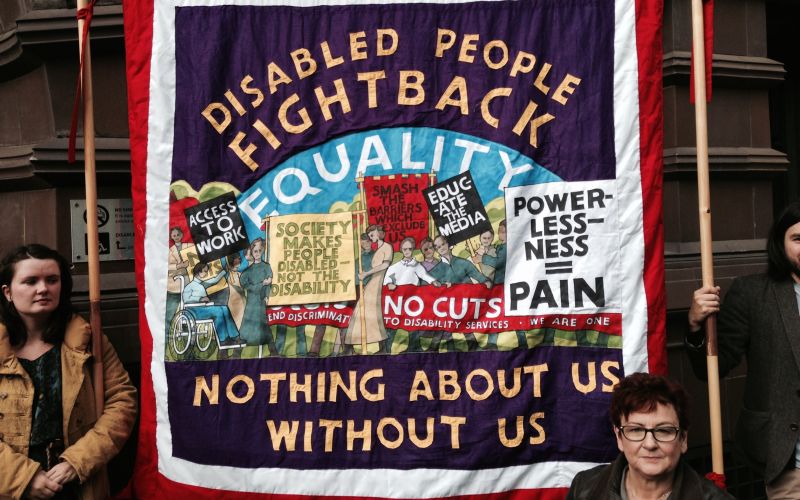
Nothing about you without you – the Labour party manifesto for disabled people

dis manifesto.png

FOREWORD

Over the last seven years disabled people have borne the brunt of the cuts inflicted on them by the Conservative Government and the Coalition before them.

The cuts have had a detrimental effect on the lives of disabled people, cutting living standards and undermining their access to education, social care and to justice.

Two years ago the United Nations (UN) convened a committee to investigate state violations of the UN Convention of the Rights of Persons with Disabilities (UN CRPD). Last year the UN published their report and concluded that the Conservative Government had committed ‘grave, systematic violations of the rights of persons with disabilities.’

This is a damning indictment of the treatment of disabled people by the Conservatives, one which shames us as a country.

We believe in a social model of disability, a society which removes the barriers restricting opportunities and choices for disabled people. As such we will build on the previous Labour government’s commitment to disabled people in 2009 as signatories to the UN CRPD. A Labour government will incorporate the UN CRPD into UK law.

We are proud of the manifesto we have developed with, and for, disabled people, and would like to take the opportunity of thanking everyone who has taken part in Labour’s Disability Equality Roadshow over the last year. We have crossed the length and breadth of the country to engage with disabled people and their carers, capturing their views on what needs to change for disabled people to live full and independent lives.

We will continue to work with disabled people in government, fulfilling our promise of ‘nothing about you, without you’.

Jeremy Corbyn, Leader of the Labour Party

Debbie Abrahams, Shadow Work & Pensions Secretary

Marie Rimmer Shadow, Minister for Disabled People.

To access full CONTENT click here (PDF)

After seven years of punitive policies and systematic abuse of the human human rights of disabled people by the coalition and Conservative governments, it is such a profound relief to see Labour have developed this manifesto, using consultations as a democratic opportunity to HEAR and include us in political decision making, and will strongly support disabled people and their families. I am proud to have contributed to this via the consultation held in Newcastle.

Here is a brief summary of some of Labour’s policies:

  • Labour will make it a priority to repeal the numerous cuts in social security support for people with disabilities. They will do this through a new Social Security Bill that will be passed within the first year of the new parliament.

  • Labour will reverse the £30 per week cut that the Tories recently imposed on disabled people who receive Employment and Support Allowance (ESA).

  • Labour will scrap the Bedroom Tax that has cruelly and disproportionately hit over 400,000 families with disabled members with punitive charges for “spare” rooms that are often used to store medical equipment, or for carers to sleep in.
  • Labour will end the pointless and needlessly expensive continuous reassessments of disabled people with permanent disabilities, chronic illness and degenerative illness.

  • Labour will end the privatisation of disability assessments so that disabled people never again have to face the indignity degradation of having to prove their disability to some corporate bureaucrat with targets to throw as many disabled people off their benefits as possible.
  • Labour will scrap the discriminatory and degrading Work Capacity Assessment (WCA) regime that costs billions more to administer than it actually saves in reduced payments in social security support for disabled people.
  • Labour will end the privatisation of disability assessments so that disabled people never again have to face the indignity degradation of having to prove their disability 
  • Labour will scrap the Personal Independence Payment (PIP) assessment regime too.
  • Labour will replace the WCA and PIP assessment regimes with a system where personal advisers help to provide every disabled person who feels capable of work to develop a tailored personal plan, adopting a genuinely holistic approach. Those who feel they can’t work will be supported without punishment or threat of uncertainty.
  • Labour will incorporate the UN Convention on the Rights of Persons with Disabilities into UK law. And observe the law.
  • Labour will scrap  the draconian sanctions regime that has consigned hundreds of thousands of disabled people to absolute destitution. 
  • Labour will increase the Carer’s Allowance by £11 per week to bring it into line with the rate of unemployment benefit. 
  • Labour will reverse the Tories’ assault on the Bereavement Allowance.

The Labour Party manifesto is a fantastic demonstration that they have been listening to the concerns of disabled people and their families.

The manifesto presents a set of policies that will make people’s lives better.

I’ve summarised a handful of policies here, so be sure to read the full document.

DSCN3314.JPG

 Alex Cunnigham, me, Debbie Abrahams and Gail Ward at the Disability Equality Roadshow in Newcastle

Fear of losing disability support led a vulnerable man to a horrific suicide

PAY-Protesters-with-posters-outside-the-Dept-of-Work-Pensions

The government have persistently denied that there is a “causal link” between their welfare “reforms” (a Conservative euphemism for savage cuts) and an increase in suicides, premature deaths, psychological distress and severe hardship. However, a number of researchers and many campaigners have demonstrated a clear correlation that the government have so far refused to investigate further. Correlation quite often implies a causal relationship, and as such, requires further research.

Each case that has been presented to the government as evidence that their policies are causing severe harm has been dismissed as “anecdotal”.

Dr Simon Duffy, Director of the Centre for Welfare Reform said: “It is not enough to just stop introducing new policies to attack the rights and lives of disabled people and the poorest in society. These policies have been in place for six years and many are designed to increase poverty year on year. The Government should apologise for the harm it has caused since 2010, calculate the full impact of cuts that targeted the most disadvantaged and begin a full programme of reparations.”

This is the third harrowing article I have written this week about the devastating impact of the Conservatives’ punitive welfare policies on some of our most vulnerable citizens. I wish with all my heart that this is the last such article.

However, we have a government that has casually and systematically transgressed the human rights of disabled people, and then casually denied that they have done so. 

There will continue to be a need of witnesses like myself and other campaigners until the political denial stops.

Last month, an inquest in Ipswich heard how Peter, a disabled man, struggling to cope with mental health problems, committed suicide by setting himself on fire because of fear that he would lose his lifeline support, following his compulsory re-assessment for Personal Independence Payment (PIP).

The government introduced the controversial PIP to replace Disability Living Allowance (DLA) in order to save costs and to “target those most in need” in 2013.  

Peter Sherwood set fire to himself in front of horrified onlookers in Lowestoft town centre on September 4, 2015.  The retired builder died in Broomfield Hospital, Chelmsford, which has a specialist burns unit, on September 8, 2015, following the horrific incident in Lowestoft town centre four days before.

Peter had received a letter from the Department for Work and Pensions, informing him that his DLA was ending and that he needed to reapply for PIP.

He suffered with a recurrent depressive disorder and psychosis. Peter had attempted to take his own life on a number of occasions previously. He also had a condition called tardive dyskinesia, which caused involuntary movements to his mouth and is a known side-effect of anti-psychotic medications.

Giving evidence at the inquest, Lucinda Stapleton, care coordinator from the Waveney Recovery Team, said this had affected Peter’s self-confidence as he was worried people were laughing and staring at him when he left the house.

In a statement read during the hearing, Mr Sherwood’s niece, Sarah Wilby, said: “I knew he was feeling a bit low the last time I saw him, which was two weeks before he died. He held me close on the sofa and told me he loved me.

“He was a loving person and had a great sense of humour.

He was angry at many things in life, but could put a good front on.

“I loved him very much and miss him dreadfully.”

Ms Wilby said she was shocked at the drastic way her uncle took his own life.

She added: “He seemed to want to make some kind of a statement, but I don’t know what.”

During the inquest Ms Wilby said that Peter was claiming Disability Living Allowance but not long before his death he received a letter informing him he needed to reapply for Personal Independence Payment, which she believes contributed to his low mood at that time.

She said: “I personally think quite an underlying cause of his anger was the change in benefits.

“Knowing Peter as we did that would have had a huge impact on him.”

Paul Anderson, a community support worker for the Norfolk and Suffolk Foundation Trust, said Peter had claimed that the Government was trying to take money off him.

The Coroner, Peter Dean, read statements from witnesses, who described seeing Peter spraying something on the pavement starting with the letter ‘h’ with an aerosol can.

The inquest heard passer-by William Groves asked Peter if he was a street artist, to which he replied “no, I’m a suicide artist”.

Peter then poured liquid over his head and set himself on fire using a lighter.

Members of the public tried to douse the flames by first throwing their jackets onto Peter, and then using a fire extinguisher from a nearby shop.

Police at the scene reported that Peter had muttered the word “humanity” to them a couple of times following the incident.

On September 4, 2015, Peter was visited at home by the community mental health team and he had expressed plans to end his life.

An urgent appointment was made for Peter to see a psychiatrist the following week, but it was tragically too late.

Norfolk and Suffolk NHS Foundation Trust has since updated its criteria of when patients should be referred to the 24-hour crisis team, following its routine investigation into Peter’s death.

The medical cause of death was given as 75% non-survivable full thickness burns, and mental health concerns.

The coroner’s conclusion was suicide.

If you are experiencing distress and feel suicidal, please don’t suffer in silence. The Samaritans have launched a free telephone national helpline number, 116 123. 

People who are going through a difficult time can access the service round the clock, every single day of the year.

This number is free to call from both landlines and mobiles, including pay-as-you-go mobiles. You do not need to have any credit or call allowance on your plan to call 116 123.


Related

Government guidelines for PIP assessment: a political redefinition of the word ‘objective’

New discriminatory regulations for PIP come into effect today

Disabled mum took fatal overdose after she was refused PIP

Vote Labour to uphold the rights of disabled people – our letter to the Guardian


I don’t make any money from my work. I am disabled because of illness and have a very limited income. 

But you can help by making a donation to help me continue to research and write informative, insightful and independent articles, and to provide support to others. The smallest amount is much appreciated – thank you.

DonatenowButton


Vote Labour to uphold the rights of disabled people – our letter to the Guardian

Image result for Human rights are universal

The following letter was published in the Guardian today, written and signed by a group of academics, professionals, campaigners and grassroots activists who work together cooperatively.

We collaborate to fulfil our mutual aims of achieving a progressive, civilised, just and safe society for all. We hope to do this by ensuring that the society we are a part of is democratic and fully inclusive: we want a civilised society that observes and meets its human rights obligations on behalf of all social groups. This isn’t happening currently. (See: UN’s highly critical report confirms UK government has systematically violated the human rights of disabled people).

As an independent researcher, writer, campaigner, and as a disabled person, I am very proud to be included among them. 

westminster-20121020-00081

Many disabled people see Labour’s policies as a lifeline, say the 30 signatories to this letter. 

For chronically ill and disabled people, recent years have been a disaster. The UN recently found “reliable evidence that the threshold of grave or systematic violations of the rights of persons with disabilities has been met” (Report, 8 November 2016).

We have been forced through a work capability assessment that the government’s own expert adviser described as “inhumane”, and which in 2015 was found to be associated with an additional 599 suicides.

Many needing help are now forced through another persecutory assessment – the personal independence payment – designed to reduce the numbers qualifying for help by half a million.

Social care has been so savagely cut that some young disabled must wear incontinence pads for lack of toileting assistance. People can’t take any more of this.

Many disabled people are not party-political, but see Labour’s policies for disabled people as a lifeline – envisioning a society where people are treated as human beings deserving of respect, equality and a decent life. Please, don’t endorse recent human-rights abuses; endorse the human rights of disabled people by registering, and by voting Labour on 8 June.

Paul Atkinson Jungian psychotherapist
Stef Benstead Spartacus Network
Peter Beresford Co-chair, Shaping Our Lives
Gary Bourlet Founder, People First Movement in England
Dr Emma Bridger Research fellow in psychology
Professor Woody Caan Journal of Public Mental Health
Dr Kelly Camilleri Registered clinical psychologist
Merry Cross
Dr David Drew Labour Parliamentary candidate for Stroud
Nick Duffell Psychohistorian
Dr Simon Duffy Centre for Welfare Reform
Dr Dina Glouberman Skyros Holistic Holidays
Catherine Hale Chronic Illness Inclusion Project
AC Howard DWPexamination.org – For The UK’s Disabled Community
Chris Johnstone General practitioner
Sue Jones Psychologists Against Austerity, researcher and writer, campaigner
Jayne Linney Disability activist
Alec McFadden TUC Salford
Helen McGauley Trainee clinical psychologist, Lancaster University
Beatrice Millar Person-centred counsellor/psychotherapist
Rev Paul Nicolson Taxpayers Against Poverty
Gavin Robinson Alliance for Counselling and Psychotherapy
Professor Andrew Samuels University of Essex
Nicola Saunders Psychotherapist
Martyn Sibley Disability blogger
Mike Sivier Vox Political
Professor Ernesto Spinelli
Mo Stewart Independent researcher, disability studies
Gail Ward
Dr Jay Watts Queen Mary, University of London
Dr Claudia GillbergSenior Research Associate in Education; Fellow at Centre for Welfare Reform and Disability Rights Activist

Dr Richard House Alliance for Counselling and Psychotherapy


Join the debate – email guardian.letters@theguardian.com

Read more Guardian letters – click here to visit gu.com/letters


I don’t make any money from my work. I am disabled because of illness and have a very limited income. The budget didn’t do me any favours at all.

But you can help by making a donation to help me continue to research and write informative, insightful and independent articles, and to provide support to others. The smallest amount is much appreciated – thank you.

DonatenowButton

Disabled mum took fatal overdose after she was refused PIP

Susan Roberts was found dead because of a morphine overdose (Photo: Philip Coburn)

A disabled mum, Susan Roberts, was found dead at home following an overdose of morphine. Susan died just metres away from a heartbreaking 11-page letter she had written to the Department for Work and Pensions (DWP), detailing her suffering following being told she wasn’t eligible for Personal Independence Payment (PIP). 

Susan, a grandmother of eight, had survived four heart attacks. She died £4,000 in debt, after taking a fatal overdose within hours of being informed that her claim for PIP was unsuccessful. She had previously claimed Disability Living Allowance (DLA) and had been given an indefinite award, as her medical conditions were considered highly unlikely to get better.

The letter from the Department for Work and Pensions (Photo: Philip Coburn)

Susan was asked to apply for PIP by the DWP following the proposed closure of her DLA claim. Many people who have previously been eligible for DLA have found that they lose their support once they are reassessed for PIP. The government introduced PIP to replace DLA and to cut costs in 2013, as a part of their welfare “reform” programme, which inflicted cuts on the poorest citizens. The Conservatives claim that PIP “targets those most in need”. However, many people with the highest level of needs have been turned down for PIP after having indefinite or lifetime awards of DLA.

Susan’s tragic death also highlights that despite their claims, the government are not succeeding in “targeting the most vulnerable people”

Before taking a fatal dose of morphine, Susan had placed the paperwork from the DWP, which informed her that she had been turned down for PIP following mandatory review, a Do Not Resuscitate note and her unsent letter, on her dresser.

Susan was shocked when she was informed that she did not even qualify for an award of PIP at the lower rate. 

She began her heartbreaking letter: “Dear sirs, first of all, I request that you read this through carefully – this is my life after all.”

She said: “I am in a considerable state of depression after receiving your decision about my claim for PIP.”

Describing her health, she said: “My gall bladder needs to be removed because of multiple stones, weight loss, vomiting, excruciating pain – but specialists won’t operate because of my heart condition.”

She then describes the impact of suffering from ME, and explains that she can only manage to do tasks for just two or three hours a day. 

Susan had a stent fitted after her heart attacks and spent most of her time bedbound, largely due to also having ME.

An operation to remove part of her bowel meant she needed help to go to the toilet. She also needed help with her personal care, such as showering and with shopping, as she struggled to walk. But in late 2015, the Conservatives scrapped DLA and replaced it with PIP. Anyone 65 or older on April 8, 2013 still got DLA.

Susan’s daughter, Hayley Storrow, said: “It’s so sad. If she was born a week earlier she may have still been alive today.”

Susan’s PIP assessor had somehow erroneously decided that she could wash and bathe unaided, go to the loo and walk over 200 metres. Shockingly, this type of “error” and gross inaccuracy is very commonplace in the reports produced when disabled people are assessed for their lifeline support. In fact, earlier this year, the Labour party, the Green party and the Liberal Democrats called for the government to act on claims of widespread dishonesty by the medical professionals paid to compile benefits assessment reports, following a two-month investigation by Disability News Service.

Susan added in her letter that she would be virtually housebound without her Motability vehicle and her concluding comment is: “Thank you for reading this, with the greatest respect.”

She lost her Motability car last April because of the DWP’s decision not to award her PIP. Susan had sent a heartbreaking text to her daughter, Hayley, saying: “I’m never going to be able to see you again because they are taking the car.”

Susan is among thousands of disabled people who have lost their specialist Motability vehicles and wheelchairs because of cruel Conservative cuts and the restrictions to the eligibility criteria of PIP, and many more are likely to be affected. 

The PIP is supposed to help with the additional costs of being disabled, and in supporting disabled people in maintaining their independence and dignity, but many people are being denied the benefit because they are not assessed properly, and because the eligibility criteria have been made increasingly restrictive.

This means people previously eligible for the mobility component of DLA lose their cars and wheelchairs once they have been reassessed for the new PIP, if they don’t qualify for the mobility component. For many disabled people, this is a massive blow which impacts on their ability to remain independent, take part in their communities or get and keep a job. PIP is not means tested, so disabled people in work may claim it to help with additional support and extra costs. Many people losing their Motability vehicle will no longer be able to work.

Susan had asked for a review of the DWP decision following her first appeal. On 18 May last year, a letter arrived at her warden-assisted flat to tell her that the PIP award had been turned down yet again.

She was found dead the following morning and despite the letter and papers left out on the dresser, remarkably, a coroner said in October that she “had not taken her own life as there was no suicide note”, ruling it was a “drugs-related death”.

However, her daughter, Hayley, said: “I believe her unsent letter was her suicide note.”

It’s highly unlikely that an accidental overdose would have somehow prompted Susan to include a Do Not Resuscitate note with her letter and the bundle of DWP paperwork, too.

Do Not Resuscitate (DNR) orders are basically notes kept in a patient’s file that they do not want to be resuscitated should their heart stop. The medical establishment views DNR orders as the patient’s choice, though they do request that those considering DNR orders to discuss it with their family members. DNR orders may be requested by patients for a variety of reasons, all of them designed to keep the patient from suffering further. However, DNR laws do not take into account the situation of mentally ill patients framing a DNR order as a preparation for suicide.

The fact that Susan left the DNR note out with her letter and bundle of DWP documents indicates that her overdose was not accidental.

The Coroner’s verdict

By the end of 2015 it had emerged that the UK had experienced the largest annual spike in mortality rates for nearly 50 years.

Much media coverage seems to avoid reporting suicide as a response to structural conditions, and instead tends to emphasise suicide as an outcome of “mental illness” – as an individual act, rather than a problem that is influenced by socioeconomic and political conditions. The government has attempted to reconfigure wider social and economic problems as psychological problems, which has pushed highly politicised individual clinical and state therapeutic interventions – embodied in a rise of the mass provision of cognitive behavioural therapy and mandatory “attitude adjustment” classes for welfare recipients in the UK. This approach reflects political ideology and prejudices, rather than tackling the bigger issues of social inequality, poverty, lack of opportunity and an extremely punitive welfare regime. All of which are largely shaped by government policies.

Earlier this year, the Samaritans pubished their report Dying from Inequalitywhich clearly recognised rising socioeconomic inequality with a higher risk of suicide. The charity called on the government to direct support to those with unstable employment, insecure housing, low income or in areas of socioeconomic deprivation.

Mary Hassell, the senior coroner for inner North London, wrote directly to the DWP in 2015, stating that the suicide of Michael O’Sullivan, a disabled man who hanged himself, had been a direct result of being ruled “fit to work.

The coroner’s verdict of Michael O’Sullivan’s suicide is widely seen as ground-breaking by disability rights campaigners and groups like Disabled People Against Cuts (DPAC) because the DWP, the media and charities usually frame suicide as “complex” with no single cause, which means suicide has rarely been directly linked to the austerity programme, nor have government policies more generally been seen as directly responsible for suicides. 

Suicide is a significant social problem. Over 800,000 people commit suicide every year. Many of these can be quite properly understood as “economic suicides” because they take place against a backdrop of structural adjustment policies and rampant neoliberal market-led reforms. A counter discourse to the government tendency of psychologising socioeconomic conditions, making them the responsibility of individuals, rather than government and wider society, is of course crucial.

Technically, a coroner makes a finding of fact at the end of an Inquest. The coroner cannot attribute blame to any individual and cannot imply a criminal or civil liability, by law. The Coroner must use the evidence heard to decide who the deceased person was, where they died, when they died, and what the cause of their death was. Commonly, the “finding of fact” is referred to as a verdict or conclusion. A conclusion of suicide is decided where the evidence indicates a person has voluntarily acted to destroy his or her life in an intentional way. Inquest verdicts of Suicide (and Unlawful Killing) must be decided “beyond reasonable doubt”. Other causes of death may be decided on “a balance of probability”.

However, there is evidence to suggest that suicides are being under-reported because of the change in Coroner’s statutory regulations and guidelines, in 2013. Interestingly, contrary to the current trend in health and safety inquests, the Ministry of Justice guidance tells coroners that, wherever possible, short-form conclusions should be delivered, rather than the more detailed narrative conclusion.

Furthermore, open conclusions are discouraged, to be used only as a “last resort”. Concerns have been raised about the government’s new short-form conclusions and some organisations, including the Royal College of Psychiatrists, have asked the government to give due consideration to changing the standard of proof required for suicide verdicts. The 2013 reforms also enable the government to suspend an independent inquest into any death in favour of an inquiry, which under the Inquiries Act 2005 can be now be held in secret. 

The House of Commons Health Committee Suicide prevention: interim report Fourth Report of Session 2016–17 says: “Our evidence suggests the need for a more rapid provisional notification of suicide at the time when a suspected death by suicide occurs. We recommend that the Government take action to improve consistency between coroners and to make routine the use of provisional notifications of suicide. Furthermore, we recommend that the standard of proof for conclusions of death by suicide should be changed to the balance of probabilities rather than beyond reasonable doubt.” 

Rule 43 of the Coroners Rules (1984) states that if the Coroner is of the opinion that a death could have been prevented if different action had been taken by a particular person or organisation, he/she may make a recommendation for change. Also, the scope of the coroner’s investigation must be widened to include an investigation of the broad circumstances of the death, including events leading up to the death in question, where this wider investigation is necessary to ensure compliance with Article 2 of the European Convention on Human Rights (right to life). The positive duty to protect life implies a duty to investigate unnatural deaths, including but not confined to deaths in which state agents may be implicated.

Hayley has accused the government of having blood on their hands. She said: “People are living in poverty or considering suicide because of these benefits changes. My Mum won’t be the last to die.”

A DWP spokeswoman said: “Our thoughts are with Mrs Roberts’ family but there is no evidence to suggest any link between her death and her benefit claim.”

There is no evidence to suggest it isn’t, either, without further investigation, which so far, the government have refused to do. There is an established correlation between disability benefit assessments and increased mental health problems, distress and exacerbations of physical illness symptoms, too. While correlation isn’t necessarily the same thing as causation, it quite often implies a causal link, which may only be ruled out following further investigation, rather than political denial.

The DWP has quietly carried out investigations into 60 cases where benefit claimants are said to have taken their own lives. Labour MP Diana Johnson said the figures cast doubt on claims that there is no link between suicide and welfare re-assessments, with the DWP carrying out the internal reviews over the last five years. 

Johnson said: “Ministers have repeatedly claimed there to be no link between suicide and welfare re-assessment whenever figures have come to light.

“This parliamentary answer to me blows this claim out of the water.

“If there was no link, there wouldn’t have been 60 reviews of suicides in the past five years.

“I am appalled that these figures have remained unpublished for so long.”

A written parliamentary question from the Hull North MP revealed that the DWP carried out 15 internal reviews into suicides or alleged suicides of so-called DWP “clients” in 2012/13 alone.

“Families who’ve been left in the dark need to know everything the DWP knows about these cases,” Johnson said.

“Most importantly, we need a welfare system that supports, rather than victimises, the poorest and most vulnerable in our society.”

Susan’s daughter, Hayley said: “When my brother went to mum’s flat after she died, he found 37p in her purse. Even with DLA she was living day to day, scraping by. She was found dead with the PIP refusal letter placed strategically on a dresser.

“She was a poorly woman and this ­decision tipped her over the edge – she was in a desperate situation. I feel if it wasn’t for PIP and the Tory Government, my mum would still be alive. 

“They failed her like they have failed thousands.”

Susan wrote the 11-page letter criticising the decision and outlining her circumstances but as the DWP turned down her initial appeal within six days, she did not have time to send it. 

Hayley said: “I just want Theresa May to know that her rules and regime are killing the most vulnerable people in society.

“With the election coming up, it is so vital that things change.

“I feel any vote for the Tories is going to lead to more deaths.”


If you are experiencing distress and feel suicidal, please don’t suffer in silence. The Samaritans have launched a free telephone national helpline number, 116 123. 

People who are going through a difficult time can access the service round the clock, every single day of the year.

This number is free to call from both landlines and mobiles, including pay-as-you-go mobiles. You do not need to have any credit or call allowance on your plan to call 116 123.


Related

Government guidelines for PIP assessment: a political redefinition of the word ‘objective’

Government subverts judicial process and abandons promise on mental health ‘parity of esteem’ to strip people of PIP entitlement

New discriminatory regulations for PIP come into effect today


I don’t make any money from my work. I am disabled because of illness and have a very limited income. The budget didn’t do me any favours at all.

But you can help by making a donation to help me continue to research and write informative, insightful and independent articles, and to provide support to others. The smallest amount is much appreciated – thank you.

DonatenowButton


Theresa May euphemizes savage cuts to PIP when confronted by an angry disabled person demanding democratic accountability

Theresa May

The prime minister has been avoiding confrontation with real citizens and voters so far, and has simply concerned herself with a series of stage-managed media appearances featuring Conservative supporters.

However, Theresa May faced a series of difficult questions after she was confronted by a furious voter over cuts to disability benefits while she was campaigning in Abingdon, Oxfordshire.

Cathy Mohan, who has learning difficulties, challenged the Prime Minister over Conservative cuts, which meant she lost her carer. She also asked about how others had been affected as the Disability Living Allowance (DLA) is replaced by the new cost cutting Personal Independence Payment (PIP). She told the PM that she has been forced to live on £100 a month in benefits after being denied essential support with the extra costs of coping with a learning disability.

In the footage captured by Channel 5 News, the voter demanded tht the government return to the DLA payments system, explaining that she couldn’t survive on the PIP scheme that has replaced it. 

Suprisingly, The Express also ran the story, although it was interesting to note the language use and interpretation to describe the exchange, with the Prime Minister “replying”, “saying”, “concluding” and Cathy “continuing her tirade” and “her rant“. Anyone would think that the Express journalist wanted to portray this citizen demanding democratic inclusion as unreasonable. 

Cathy simply asked: “Theresa, are you going to help people with learning difficulties? 

It’s good to see the Prime Minister being held democratically accountable for once by a real member of the public with a real life account of the devastating impacts of Tory austerity cuts, which have fallen disproportionately on those with the very least, and those who are among our most vulnerable citizens. 

2014-02-17-BurdenoftheCuts-thumb

You can see Cathy angrily and bravely confronting the Prime Minister here

Cathy says “I’m being serious, I want you to do something for us.”

 May replied: “We’ve got a lot of plans for people with mental health in particular…”

But absolutely furious with being fobbed off,  Cathy swiftly interrupted the Prime Minister and continued: “And learning difficulties? 

Because I’ve got mild learning disabilities and I haven’t got a carer at the moment, and I’m angry.

I would like somebody to help me because I can’t do everything I want to do.

I’m talking about everybody not just me, for everybody who’s got mental health and anybody who’s got learning disabilities.

I want them not to have their money taken away from them, and being crippled.

They just took it all away from me,” she said.

She added: “The fat cats keep the money and us lot get nothing.”

It’s true that the vulture capitalist private companies undertaking disability assessments take millions from the public purse to deliver pseudo-medical assessments that are specifically designed to make it unlikely that your claim will be successful, regardless of how ill and disabled you are. 

An audit report concluded that the Department for Work and Pension’s spending on contracts for disability benefit assessments is expected to double in 2016/17 compared with 2014/15. The government’s flagship welfare-cutting scheme will be actually spending more money on the assessments themselves than it is saving in reductions to the benefits bill – as Frances Ryan pointed out in the Guardian, it’s the political equivalent of burning bundles of £50 notes.

The report also states that only half of all the doctors and nurses hired by Maximus – the US outsourcing company brought in by the Department for Work and Pensions to carry out the assessments – had even completed their training.

The NAO report summarises:

£1.6 billion
Estimated cost of contracted-out health and disability assessments over three years, 2015 to 2018

£0.4 billion
Latest expected reduction in annual disability benefit spending

13%
Proportion of ESA and PIP targets met for assessment report quality meeting contractual standard (September 2014 to August 2015).

See: Doctors bribed with 70-90k salaries to join Maximus and “endorse a political agenda regardless of how it affects patients.”

May responded by using trite and meaningless sloganised reassurances: “The government is “particularly focused on those who are most in need”.

“Focusing on those most in need” is a Conservative euphemism for cutting lifeline support for those who need it, by a series of incremental restrictions to the eligibility criteria for PIP.

The criteria for receiving PIP has recently been restricted by the Conservatives, leading to more than 160,000 vulnerable people being denied the additional financial help that they once received.

May continued: What I can do is ensure that we’re giving more help to people with mental health and learning disabilities.

We want to ensure when we look at the help we’re giving to people with any disability that particularly we focus on those who are most in need.”

PIP is a non means tested benefit for people with a long-term health condition or impairment, whether physical, sensory, mental, cognitive, intellectual, or any combination of these. It is an essential financial support towards the extra costs that ill and disabled people face, to help them lead as full, active and independent lives as possible, including staying in work. 

Before 2010, policies that entailed cutting lifeline support for disabled people and those with serious illnesses were unthinkable. Now, systematically dismantling social security for those citizens who need support the most has become the political norm.

Any social security policy that is implemented with the expressed aim of “targeting those most in need” and is implemented to replace a policy that is deemed “unsustainable” is invariably about cost cutting, aimed at reducing the eligibility criteria for entitlement. The government were explicit in their statement about the original policy intent behind PIP. However, what it is that defines those “most in need” involves ever-shrinking, constantly redefined categories, pitched at an ever-shifting political goalpost.

Two independent tribunals have ruled that the Department for Work and Pensions (DWP) should expand the scope and eligibility criteria of PIP, which helps both in-work and out-of work disabled people fund their additional living costs. 

Following a court ruling in favour of disabled people, the government rushed in an “urgent change” to the law to prevent many people with mental health conditions being awarded the mobility component of PIP. Without any parliamentary debate. The court held that people  with conditions such as severe anxiety can qualify for the enhanced rate of the mobility component, on the basis of problems with “planning and following a journey”, or “going out”.  The new regulations were rushed in without any dialogue with the Social Security Advisory Committee, too, via statutory instrument. 

The government’s new regulations will reverse the recent ruling and means that people with mental health conditions such as severe anxiety who can go outdoors, even if they need to have someone with them, are much less likely to get an award of even the standard rate of the PIP mobility component. The new regulations also make changes to the way that the descriptors relating to taking medication are interpreted, again in response to a ruling by a tribunal in favour of disabled people.

The first tribunal said more points should be available in the “mobility” element for people who suffer “overwhelming psychological distress” when travelling alone. The second tribunal recommended more points in the “daily living” element for people who need help to take medication and monitor a health condition. 

The DWP warned that it would cost £3.7bn extra by 2022 to implement the court rulings. The government have responded by formulating an extremely authoritarian “emergency legislation” to stop the legal changes that the upper tribunals had ruled on from happening. From 16 March the law was changed, without any democratic conversation with disabled people and related organisations, or debate in parliament, so that the phrase “For reasons other than psychological distress will be added to the start of descriptors c, d and f in relation to “Planning and following journeys”on the PIP form.

It’s worth noting that the Coalition Government enshrined in law a “commitment” to parity of esteem for mental and physical health in the Health and Social Care Act 2012. In January 2014 it published the policy paper Closing the Gap: priorities for essential change in mental health (Department of Health, 2014), which sets out 25 priorities for change in how children and adults with mental health problems are supported and cared for.

The limiting changes to PIP legislation certainly does not reflect that commitment.  

Let us not forget that last year, the United Nations’ highly critical report confirmed that the UK government has systematically violated the human rights of disabled people.

And let us not forget that this government dismissed the findings of the inquiry and each of the major concerns raised, calling it “offensive”.

It’s rather more offensive that a government of one of the wealthiest so-called democratic nations in the world chooses to disregard its human rights obligations towards disabled people, often leaving them without lifeline support and with devastating consequences, whilst gifting millionaires and rogue multinationals with tax payers money.

Image result for disabled people's rights uk


I don’t make any money from my work. I am disabled because of illness and have a very limited income. But you can help by making a donation to help me continue to research and write informative, insightful and independent articles, and to provide support to others. The smallest amount is much appreciated – thank you.

DonatenowButton

Cystic fibrosis sufferer refused PIP – the Conservative bureaucratic wall and systematic dismantling of social security

PAY-Protesters-with-posters-outside-the-Dept-of-Work-Pensions

A disabled person suffering from cystic fibrosis, who struggles breathing because his lungs function at as low as 31 per cent capacity, has been told that benefits he receives in order to help pay with his healthcare costs will be stopped.

Peter Trengove nearly died three days after he was born because of the illness, which makes it difficult for sufferers to breathe and digest food.

Cystic fibrosis also claimed the life of Peter’s older brother when he was just six years old.

Peter had been in receipt of disability living allowance (DLA) in order to help to pay care costs, but DLA is currently being replaced by personal independence payments (PIP) as the Department for Work and Pensions (DWP) believes it is “outdated” and “unsustainable”.

Peter received notice on New Year’s Eve that he would have to attend an assessment as part of his PIP application, with forms on how cystic fibrosis affects his day-to-day life taking three hours to fill out.

On Saturday, Peter was informed that his DLA will end next month and that he will not be awarded PIP.

He told the Warrington Guardian: “According to the unqualified professionals at the DWP, cystic fibrosis isn’t a disability and has no effect on the sufferer at all.

“I was informed by the assessor that the decision would not be based on the assessment but on the written evidence given by my consultant – this was something I was relieved about because the assessor saw me on a good day.

“The decision cannot be based on one hour spent with a cystic fibrosis patient, which is why the decision makers should be focussing more on the evidence given by the consultant.

“The assessor claimed I can walk 200m – however no physical evidence was given that I can do this and the assumption was made based on me walking from the waiting room to the assessor’s office, which is less than 5m.”

Peter believes his assessor also disregarded evidence presented from his doctors, including medical notes on a chest infection in October that took three months to treat and a further month to recover from.

Peter had used his DLA for health costs including prescriptions, travel to specialists clinics a 40-mile round trip away and the cost of a personal trainer who helps to keep his lungs working as well as possible.

He is now appealing the decision, but says his health has been affected by the PIP assessment process and the subsequent cut in payments.

Peter added: “Since the assessment I’ve had bad days, which mainly includes not leaving my house unless I really have to in fear of exposure to illness, plus I’ve had no motivation.

People with cystic fibrosis are very prone to chest infections that lead to pneumonia. Catching a cold can put someone with this condition at substantial risk of becoming very seriously ill.

He continued: “I even have to force myself to get ready to go to the gym because I know I’ll basically become ill again if I don’t go.

“Whether I will be motivated tomorrow with the weight of my PIP application outcome lying heavy on my shoulders is a question yet to be answered.

“The only hope I have at present is that by appealing the decision, this will result in the answer I had hoped for on this occasion.”

As Peter points out, the assessment and appeal process for disability related support is very stressful and intrusive, as is the loss of income when the claim is turned down. Stress tends to exacerbate illness.

A spokesman for the DWP said: “Decisions for PIP are made following consideration of all the information provided by the claimant, including supporting evidence from their GP or medical specialist.

Anyone that disagrees with a decision can ask us to look at it again and if they’re still unhappy with it they can appeal to an independent tribunal.”

When someone is very ill, dealing with day to day living and personal care becomes very difficult. The additional strain of facing a bureaucratic wall of assessments, mandatory reviews and tribunals is having adverse consequences on people who have health vulnerabilities as it is.  

I have been through assessment, tribunal and within three months of winning my appeal, a reassessment. The whole process, which took many months, exacerbated my illness substantially, hastening its progression. I have lupus. I also know only too well how having a limited lung capacity impacts on your day to day living, as mine is currently at 40%. 

The Conservatives claim that their recent authoritarian re-writing of the law, to exclude some categories of support for some kinds of disability, is to ensure that those in “most need” receive support. That is not happening. The category of “most in need” is being redefined to exclude more and more people who are struggling meet their basic living needs and cope with their disability. 

Perversely, the government claims that cutting disability support “incentivises” disabled people into work. Sanctions and cuts are described by Conservative ministers as “help” and “support” – a breathtakingly Orwellian doublespeak tactic.

Yet ESA benefit is only awarded to people that doctors and assessors acting on behalf of the state have deemed unfit for work. The recent re-titling of the minister for disabled people’s role to “Minister for disabled people, health and work indicates plainly that the government intends to continue to coerce people who have previously been exempted from work by both the state and by people’s doctors into work. 

The government have refused to accept that there is a well established correlation between their draconian cuts to disability support and severe psychological distress, material hardship, harm and sometimes, premature death

The commonly associated deterioration in people’s already poor health because of the unrelenting strain of facing the bureacratic wall – politically designed to ensure and enforce cuts to disabled people’s lifeline support provision and save costs on spending – is adding additional strain and cost to our NHS. It’s a false economy. As people’s health deteriorates further, they are more likely to need more social care support, too.

The majority of people who become ill and disabled have worked, contributed tax and national insurance, which was in part meant to contribute to social safety nets for people who may, through no fault of their own, face hardships because they became ill or had an accident which resulting in disability.  

The money we pay for publicly funded provisions and services is not the government’s money to cut and re-allocate to millionaires in the form of substantial tax cuts. Against the backdrop of the Conservative ideologically driven, neoliberal austerity programme, which disproportionately targeted disabled people, cuts to lifeline benefits were offset with a tax cut for millionaires, who gained £107, 000 each per year. 

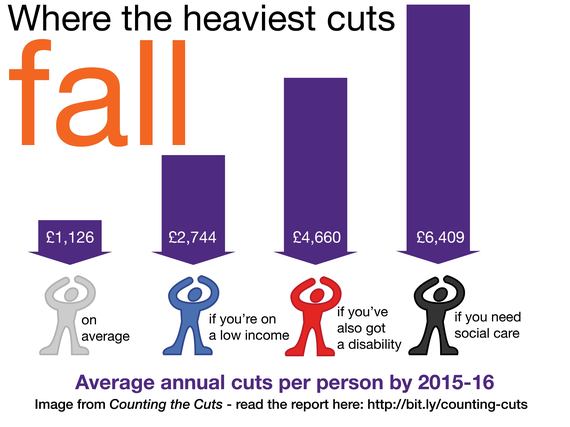
Disabled people who are struggling to meet the cost of their basic survival needs are awarded on average £6,000 per year, excluding a PIP award, if they somehow manage to get through the repressive bureaucratic wall composed of the work capability assessment, mandatory review, (without any income), and the appeal process.

This is what David Cameron meant when he attacked what he dubbed a “culture of entitlement.” It means the systematic dismantling of our welfare state, a cut at a time. It means the dismantling of other social gains that we made following the postwar settlement, such as the NHS, social housing and legal aid. It means a regressive and oppressive government that deliberately fails to observe the basic human rights of some of our most vulnerable citizens.

In one of the wealthiest so-called democracies in the world, we have an authoritarian government that is imposed draconian policies which are all about punishment and taking money from our poorest citizens, causing them severe material hardship, physical harm and lasting psychological damage.

That is not a decent, civilised or remotely democratic thing to do.

2014-02-17-BurdenoftheCuts-thumb


I don’t make any money from my work. I am disabled because of illness and have a very limited income. Successive Conservative chancellors have left me in increasing poverty. But you can help by making a donation to help me continue to research and write informative, insightful and independent articles, and to provide support to others. The smallest amount is much appreciated – thank you. 

DonatenowButton cards

Successful Appeals Against Disability Assessments – It’s As If There’s Something Wrong With The System

PAY-Protesters-with-posters-outside-the-Dept-of-Work-Pensions

Source: the Independent, written by James Moor.

It’s rapidly becoming clear that Prime Minister Theresa May’s bold pledge to create a Britain that works for everyone should have an asterisk attached to facilitate the addition of “except for those pesky people with disabilities, can’t we pack them off somewhere else?”

In recent days the Government’s plan to cut people with serious mental health conditions out of eligibility for personal independent payments has justifiably come under sustained fire. 

However, the attitude problem displayed by both May’s administration, and that of her predecessor David Cameron, goes beyond that, as a delve into the latest statistics demonstrates.

What they show is that the number of appeals against decisions made by the DWP on the basis of assessments made by the private, profit driven contractors working on its behalf is increasing at a similar speed to that at which Lewis Hamilton exits Silverstone corners. 

They show that there were 60,600 Social Security & Child Support appeals between October and December 2016, an increase of 47 per cent. Even Lewis might think twice about acceleration like that. 

Some 85 per cent of those appeals were accounted for by the Personal Independence Payment (PIP) and the Employment & Support Allowance (ESA).

The rate at which the decisions made by the DWP on the basis of information supplied by the Government’s contractors – Capita and Atos – are overturned is also increasing. 

People started taking notice when it was running at 50 per cent. Now close to two thirds of appeals in the case of the PIP (65 per cent) are successful. The figure is higher still when it comes to ESA (68 per cent). 

I’m given to understand that the people who sit on tribunals have been asked to keep June clear, in an attempt to reduce a growing backlog. So forget about an early summer holiday. 

Needless to say, these people have to be paid, which puts extra cost into the system at a time when the Government says it’s trying to save money. 

Simply applying for either benefit causes a great deal of stress to people with disabilities. Having to go to appeal only exacerbates that. Applicants find themselves in the middle of a process that is humiliating and dehumanising.

That process also seems to throw up scandals with alarming regularity. Channel Four, for example, infamously filmed a Capita assessor saying a claimant had a “disability known as being fat”. Another claimed to have filled out forms before even seeing clients amid pressure to get as many done as quickly as possible. 

Other scandals have involved people with weeks or months to live being told they’re fit for work in the case of ESA, which is paid to people whose fitness to do so is impacted by medical conditions and disabilities. 

Set against that backdrop, is it any wonder that there has been so much criticism of the process, and so many successful appeals? 

If the assessment process worked effectively, and as it should, the number should be limited, and you wouldn’t expect such a large majority to be successful.

Ken Butler, welfare rights advisor at Disability Rights UK, says he is “very worried for all those disabled people who get turned down for benefits and don’t have the time or energy to challenge poor decisions made by the Department for Work and Pensions (DWP)”. 

He adds: “We’d advise all claimants to get benefits advice and, if they are turned down, to use the independent appeals process.”

Butler says that the high success rate of appeals clearly demonstrates that there is something wrong with the system. 

Unless, of course, the system, also savagely criticised by the United Nations, was deliberately set up to be this way. 

Before you suggest that is me indulging in a conspiracy theory, take a moment to think about this. If you make something difficult, stressful and painful, if you litter it with traps, and take the view that everyone getting involved in it is a dirty scrounger until proven otherwise, a lot of people will get put off and won’t apply. Still more won’t appeal when turned down, saving the Government money it can use for things like millionaires tax cuts. 

Dealing with a disability presents enough of a challenge as it is, without having to get to grips with a state that operates in a manner that would have impressed some of George Orwell’s darker characters. Would anyone be terribly surprised to find O’Brien working as a civil servant in the DWP?

The cynicism on display is breathtaking, if my assessment is correct. Alternatively, the situation I’ve discussed could simply have been created by a toxic mix of bureaucratic callousness and incompetence. 

The net effect is the same regardless, which is why there will be peals of bitter laughter emanating from Britain’s disabled community every time those words of Theresa May’s are trotted out. 

You’d be able to hear them if it weren’t for the fact that so many people with disabilities are now trapped in their own homes.  

New discriminatory regulations for PIP come into effect today

westminster-20121020-00081

A Department for Work and Pensions spokesperson has denied allegations that people with mental health conditions claiming Personal Independence Payment (PIP) are being treated differently to those with physical disabilities: “At the core of PIP’s design is the principle that mental health conditions should be given the same recognition as physical ones”, the spokesperson said.

“In fact, there are more people with mental health conditions receiving the higher rates of both PIP components than the DLA equivalents.

This Government is also investing more in mental health than ever before – spending more than £11 billion this year.”

However, following two independent tribunal rulings that the Department for Work and Pensions (DWP) should expand the scope and eligibility criteria of PIP, which helps both in-work and out-of work disabled people fund their additional living costs, the government is rushing in an “urgent change” to the law to prevent many people with mental health conditions being awarded the mobility component of PIP. The court held that people with conditions such as severe anxiety can qualify for the enhanced rate of the mobility component, on the basis of problems with “planning and following a journey”, or “going out”. 

The government’s new regulations will reverse the recent tribunal ruling and will mean that people with mental health conditions such as severe anxiety who can go outdoors, even if they need to have someone with them, are much less likely to get an award of even the standard rate of the PIP mobility component. The regulations also make changes to the way that the descriptors relating to taking medication are interpreted, again in response to a ruling by a tribunal in favour of disabled people.

The first tribunal said more points should be available in the “mobility” element for people who suffer “overwhelming psychological distress” when travelling alone. The second tribunal recommended more points in the “daily living” element for people who need help to take medication and monitor a health condition. 

It’s worth noting that the Coalition Government enshrined in law a commitment to parity of esteem for mental and physical health in the Health and Social Care Act 2012. In January 2014 it published the policy paper Closing the Gap: priorities for essential change in mental health (Department of Health, 2014), which sets out 25 priorities for change in how children and adults with mental health problems are supported and cared for. The limiting changes to PIP legislation does not reflect that commitment.  

PIP is defined by Capita, the private company employed by the government to carry out “functional assessments of disabled people as “a non means tested benefit for people with a long-term health condition or impairment, whether physical, sensory, mental, cognitive, intellectual, or any combination of these.” It is an essential financial support towards the extra costs that ill and disabled people face, to help them lead as socially and economically inclusive, active and independent lives as possible.

Who will be affected by the reversal of the tribunal rulings?

As I reported previously, from 16 March (today)  the law will be changed so that the phrase “For reasons other than psychological distress” will be added to the start of descriptors c, d and f in relation to “Planning and following journeys” on the PIP form. 

New guidelines circulated by the DWP instruct assessors to disregard the physical impact of mental illness, in relation to how the impairments affect a person’s mobility in completing a journey unaccompanied, which will effectively exclude them from eligibility to the higher mobility component of PIP.

This means that claimants with severe mental illness that impacts on their mobility will be refused the same level of financial support as people with physical disabilities.

It effectively means that people suffering with debilitating mental health conditions are to be denied equal access to the disability benefits system.

People with the following conditions are likely to be affected by the reversal of the independent tribunal’s ruling regarding PIP mobility awards, with conditions in the general category of “severe psychological distress”:

Mood disorders – Other / type not known, Psychotic disorders – Other / type not known, Schizophrenia, Schizoaffective disorder, Phobia – Social Panic disorder, Learning disability – Other / type not known, Generalized anxiety disorder, Agoraphobia, Alcohol misuse, Anxiety and depressive disorders – mixed Anxiety disorders – Other / type not known, Autism, Bipolar affective disorder (Hypomania / Mania), Cognitive disorder due to stroke, Cognitive disorders – Other / type not known, Dementia, Depressive disorder, Drug misuse, Stress reaction disorders – Other / type not known, Post-traumatic stress disorder (PTSD), Phobia – Specific Personality disorder, Obsessive compulsive disorder (OCD).

A case study is included in the new guidance, which says: “Sukhi has sought an award under mobility descriptor 1f as she cannot follow the route of a familiar journey without another person.

However, the [decision maker] determines that because of the wording of mobility descriptor 1f (“for reasons other than psychological distress, cannot follow the route of a familiar journey without another person, an assistance dog or an orientation aid”), any problems following the route due to psychological distress are not relevant.”

PIP consists of two separate components – a daily living component and a mobility element – each paying a standard or enhanced rate, with the enhanced rate paying more than the lower rate. 

In response to the rulings, government have simply chosen to rewrite the law in a way that denies higher PIP payments for those claimants who would have benefited from the rulings, without consulting medical experts, disabled people, advocacy organisations and MPs – including the Work and Pensions parliamentary committee.

Responding to the new guidelines, Paul Farmer, chief executive of the mental health charity Mind, said: “The purpose of PIP is to cover the extra costs people incur because of a disability – decisions makers shouldn’t discriminate between disabilities on the basis of their cause, but decisions should be based on the impact of the disability.

People who struggle to leave the house without support may face the same costs whether their difficulties arise from, for example, a sensory disability or severe anxiety or other mental health problems.

Yet those making decisions about the level of support someone will receive will now be explicitly told to disregard those barriers if they are a result of someone’s mental health problem.”

He added: “This move undermines the Government’s commitment to look at disabled people as individuals, rather than labelling them by their condition, and completely goes against the Government’s commitment to putting mental health on an equal footing with physical health.

Meanwhile, the government’s own expert welfare advisors have said that the changes to PIP – affecting the mentally ill – should be delayed until they have been properly tested and “clearly understood”. 

The Social Security Advisory Committee (SSAC) said in their report that they are “particularly concerned” that overturning the tribunal’s ruling will cause confusion. They warn it is “not clear” how assessors will interpret the changes, raising concerns over a real possibility that claimants will not be “consistently treated”.

The committee have disputed ministers’ claims that emergency legislation must be rushed through today, suggesting the feared increase in costs has been “over-hyped”.

The government claimed the tribunal ruling would cost at least £3.7bn over the next five years – money which should go to “really disabled people who need it”, according to one minister.

The committees’ damning conclusions have sparked angry exchanges in the Commons, with some Tory MPs joining Labour and the Liberal Democrats in criticising the impact of the PIP regulations on some of the most vulnerable citizens.

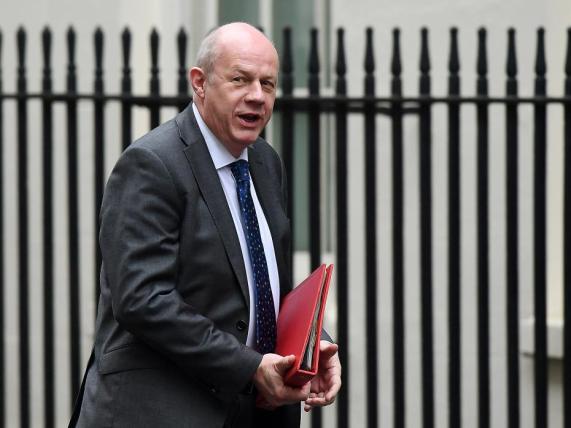
However, Damian Green, the Work and Pensions Secretary, refused to allow MPs to vote on the changes – insisting that was “above my pay grade”.

Green also acknowledged “a handful of people” could now have their PIP payments cut, having been awarded higher sums in the last few months.

Debbie Abrahams, Labour’s Work and Pensions spokeswoman, said that contradicted repeated assurances – including by Theresa May – that no disabled people would lose money, with only new claimants affected.

And she said: “The Government’s decision to change the law on PIP is a clear example of the way people with mental health conditions are not given equal treatment.”

The SSAC have urged the DWP to consider “testing the proposed changes with health care professionals and decision makers to ensure the policy intent behind the regulation is clearly understood”.

They concluded: “The department should both (a) consult more widely with representative bodies and health care professionals; and (b) improve the estimate of likely impact before the changes are introduced.”

Answering an urgent question in parliament, Mr Green insisted the SSAC was “not challenging the decision” to tighten the criteria for PIP.

But he added: “We think there may be a handful of people whose appeals have gone through the courts in this very, very small period.”

While “that money will not be clawed back from them” they would receive lower PIP payments once those appeals were struck out by the new regulations.

In their recent Equality Analysis PIP assessment criteria document, the government concede that: “Since PIP is a benefit for people with a disability, impairment or long-term health condition, any changes will have a direct effect on disabled people. The vast majority of people receiving PIP are likely to be covered by the definition of “disability” in the Equality Act 2010.

By definition, therefore, the UT [upper tribunal] judgment results in higher payments to disabled people, and reversing its effect will prevent that and keep payments at the level originally intended. The difference in income will clearly make a real practical difference to most affected claimants, and (depending on factors such as their other resources) is capable of affecting their ability to be independently mobile, access services etc – all matters covered by the UN Convention on the Rights of Persons with Disabilities as set out at the start of this Analysis.”

It goes on to say in the document: “However, this does not necessarily mean that the increased payments that would result from the judgment are a fair reflection of the costs faced by those affected, or represent a fair approach as between different groups of PIP claimants.” 

I think it’s much less likely that the government’s decision to subvert the ruling of the upper tribunal reflects any consideration of a fair reflection of costs faced by those affected, or a “fair approach” between different groups of PIP claimants. 

The purpose of Upper Tribunals

The government introduced the restrictive regulations after losing two cases at tribunals, showing an utter contempt for the UK judiciary system. However, the UK tribunal system is part of the national system of administrative justice. 

Administrative law is the body of law that governs the activities of administrative agencies of government. It is designed to independently review the decisions of governments, and as such, it provides protection and promotion of fundamental rights and freedoms for citizens.

The Upper Tribunal is a superior court of record, giving it equivalent status to the High Court and it can both set precedents and can enforce its decisions (and those of the First-tier Tribunal) without the need to ask the High Court or the Court of Session to intervene. It is also the first (and only) tribunal to have the power of judicial review. (The Conservatives have a historical dislike of judicial review. See for example: The real “constitutional crisis” is Chris Grayling’s despotic tendencies and his undermining of the Rule of Law.)

The Tribunals, Courts and Enforcement Act 2007 created a new unified structure for tribunals and recognises legally qualified members of tribunals as members of the judiciary of the United Kingdom who are guaranteed continued judicial independence. This means that the judiciary is kept discrete from other branches of government. That is so that courts are not subjected to improper influence from the other branches of government, or from private or partisan interests.

Judicial Independence is vital and important to the idea of separation of powers. The intent behind this concept is to prevent the concentration of political power and provide for checks and balances. It has been significantly influenced by judicial independence principles developed by international human rights constitutional documents. in the application of the European Convention on Human Rights in British law through the Human Rights Act 1998, which came into force in the UK in 2000.

The government’s new regulations are a particularly autocratic move, aimed at simply overturning two legal rulings that the government did not like, partly because their zealotry concerning their anti-welfarism and “small state” neoliberal ideology has been challenged. The regulations were ushered in and imposed so that they would not be subjected to parliamentary scrutiny and debate or democratic dialogue with disabled people or groups and organisations that support and advocate for those with disability. 

damian-green
Work and Pensions Secretary Damian Green

Related

Two EDMs have been tabled to stop Tory cuts to disability support, with cross-party endorsement


I don’t make any money from my work. I am disabled because of illness and have a very limited income. But you can help by making a donation to help me continue to research and write informative, insightful and independent articles, and to provide support to others. The smallest amount is much appreciated – thank you. 

DonatenowButton cards

A brief view of the budget

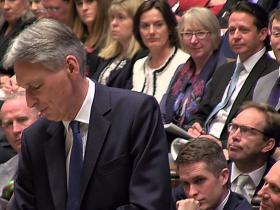
budget-hammond-commons-6

He’s not very bright our chancellor, is he? Self-employed people face an increase in their National Insurance (NI) contributions as the Chancellor says he wants to “tackle the unfair burden on people in employment”. Presumably he means self employed people are not in employment. Yet they certainly aren’t included in unemployment figures, either. Last time I checked, employment means “the state of having paid work.”

That’s yet another broken manifesto pledge.

Gutto Bebb, Conservative Welsh minister, hit out at the proposals and called on the Government to “apologise.” Iain Duncan Smith added his voice to calls for a rethink of proposed changes to the National Insurance contributions after Hammond suggested that Brexit is responsible for the Government’s tax raid – conveniently mentioning Brexit for the first time regarding his budget. But he later denied that self-employed workers were paying the price for Brexit. Hard to keep up with what passes as the Conservative brand of reasoning and justification. It certainly makes me feel dizzy and nauseous, that’s for sure.

Hammond could have simply reduced the rate of NI that employees pay instead. He’s a bit of a wally. We did have a period of economic growth last year, second to only Germany, apparently. Good old Tories, eh?  Hurrah!

But I wonder who will benefit from that, assuming it’s really a growth in the economy? It won’t be disabled people claiming Personal Independence Payment (PIP) with severe psychological distress who can’t leave the house, that’s for sure. Or those suffering epilepsy, both types of diabetes and blackouts who need support with managing their treatments and monitoring their health conditions.

17191393_10154323613132014_6367986618227533020_n

A period of Orwellian growth. The economy is currently being propped up by increasing personal debt.  

All of these conditions in fact: Diabetes mellitus (category unknown), Diabetes mellitus Type 1 (insulin dependent), Diabetes mellitus Type 2 (non-insulin dependent), Diabetic neuropathy, Diabetic retinopathy, Disturbances of consciousness – Nonepileptic – Other / type not known, Drop attacks, Generalised seizures (with status epilepticus in last 12 months), Generalised seizures, (without status epilepticus in last 12 months), Narcolepsy, Non epileptic Attack disorder (pseudoseizures), Partial seizures (with status epilepticus in last 12 months), Partial seizures (without status epilepticus in last 12 months), Seizures – unclassified Dizziness – cause not specified, Stokes Adams attacks (cardiovascular syncope), Syncope – Other / type not known.

And these:  Mood disorders – Other / type not known, Psychotic disorders – Other / type not known, Schizophrenia, Schizoaffective disorder, Phobia – Social Panic disorder, Learning disability – Other / type not known, Generalized anxiety disorder, Agoraphobia, Alcohol misuse, Anxiety and depressive disorders – mixed Anxiety disorders – Other / type not known, Autism, Bipolar affective disorder (Hypomania / Mania), Cognitive disorder due to stroke, Cognitive disorders – Other / type not known, Dementia, Depressive disorder, Drug misuse, Stress reaction disorders – Other / type not known, Post-traumatic stress disorder (PTSD), Phobia – Specific Personality disorder, Obsessive compulsive disorder (OCD).

What kind of government cuts support for those needing help to manage medication, monitor a health condition, or both?

What kind of government cuts mobility support for people who can’t leave the house alone?

It seems that most people who are actually ill won’t be eligible for PIP. I wonder which people the government have in mind when they say “those in greatest need”?

Oh, it’s the millionaires again. Phew! Silly me.

From the Equality Trust:

pie wealth

The poorest people lose out from the budget yet again, of course. The distribution of wealth won’t change, with many households in the lowest deciles being worse off. The graph above does not show the full extent of the difference between the richest and the rest of society. This is because the top 1% have incomes substantially higher than the rest of those in the top 10%. In 2012, the top 1% had an average income of £253,927 and the top 0.1% had an average income of £919,882.

If you earn a few hundred thousand, you are set to do rather well yet again from another Tory budget. It’s remarkable how those need it least always get the financial “incentive” isn’t it?  Carrots for the fat cats.  It’s the delux model of “incentives”.

Meanwhile those who need it most pay for those who need it least. Poor people get the budget premium “incentive”, which includes standing on the naughty step, and thinking about what you have not done.

The Tories like wielding a stout stick and giving out a good thrashing for those who dare to fall ill. 

And just to clarify, social justice, equality and inclusion are NOT the same thing as work. They should exist independently of someone’s employment status. Otherwise, “inclusion” takes an Orwellian turn to the far right. We know from history that work doesn’t really set us free. People “enjoying the security and dignity of work” does not entail ensuring those who can’t work or who lost their job are utterly insecure, hungry or destitute. 

The government’s “pledge” to increase adult social care funding is being paid for by increases in council tax, some of which will be paid by those previously exempted from council tax because they are sick, disabled or unemployed. Social security was originally calculated to meet only the cost of fuel and food on the assumption that people needing support would be exempt from rent and council tax. That no longer is the case.

The rises due to come into force from April will not be sufficient to avoid strapped for cash councils having to make deep cuts to essential services, including road repair, parks, children’s centres, leisure centres and libraries. All of this in a time of “economic growth”. It looks like austerity is to be a permanent feature of Conservative neoliberal policy-making.

For many families who are just about managing, the withdrawal of state support for those who are in low paid work is hardly an incentive to “make work pay”. Of course Hammond has ignored the scandal of in-work poverty. This is one of the other austerity measures that he has chosen to keep. Introducing sanctions for those claiming social security because their employers don’t pay them enough to live on is simply a big bully’s stick, which would be better aimed at exploitative and miserly big business employers. Fancy punishing people because profit driven businesses pay as little as possible. 

It’s all the same peevish and spiteful mentality as “making work pay.” Instead of ensuring workers get a decent rate of pay, like you’d think from the Tory claim, the truly nasty party cut benefits and decided to impose punishing conditions on people who need state support indiscriminately, regardless of the reason, instead.

That’s pure upper class prejudice and malice.

And greed. 

banksy-elephant-in-room1
Meet Brexit, by the way, he’s the big elephant in the room, Mr Hammond


I don’t make any money from my work. I am disabled because of illness  and have a very limited income. The budget didn’t do me any favours at all.

But you can help by making a donation to help me continue to research and write informative, insightful and independent articles, and to provide support to others. The smallest amount is much appreciated – thank you.

DonatenowButton cards

Heartless PIP Cuts Latest, ESA WRAG Cut Regulations Published – Benefits and Work

tories-19

I got the following email from Benefits and Work:

Dear Sue,

Even by this government’s standards it’s a shockingly cruel move.

Last month a tribunal of judges ruled that claimants with mental health conditions such as severe anxiety have a right to claim even the higher rate of PIP for help with going outdoors.

It was a decision that put an end to years of the DWP deliberately misinterpreting the law. It meant that many thousands of people with serious mental health conditions finally had a chance to gain a little bit more independence.

So the government acted with remarkable speed.

Bypassing the social security advisory committee, who are supposed to get the chance to comment on all changes to social security law, they published a statutory instrument that will reverse the judges’ decision.

In an effort to justify overturning the judges’ ruling, Tory policy supremo George Freeman mocked as “bizarre” the idea that claimants with mental health conditions should be eligible for PIP. Instead, he said, PIP should only be for “the really disabled people who need it.”

The changes will apply to all claims made from 16 March, 2017.

Just a few days ago we had the following feedback by email.

“Just wanted to say thank you so much for your amazing site! I have used your advice over the years for my son’s DLA applications with great success, have now had his PIP awarded for enhanced care, and after mandatory reconsideration, got the award for mobility as well (thanks to your advice about the tribunal rulings on this for people with a mental health issue).”

Unless attempts by the Lib Dems and Labour to overturn the statutory instrument are successful, and that seems a very long shot, we won’t be seeing many more emails like that.

ESA CUTS REGULATIONS FINALLY PUBLISHED
The DWP have finally published regulations removing the work-related activity component of employment and support allowance (ESA) for new claims.

New ESA claimants in the work-related activity group who are aged 25 or over will receive only £73.10 a week. They will not receive the additional £29.05 component that current claimants receive.

Similar regulations apply to universal credit claimants who have limited capability for work.

Claimants who made a claim for ESA before 3 April, or who are deemed to have made a claim before that date, as well as claimants who are still waiting to be transferred from incapacity benefits to ESA, will not be affected.

Claimants who qualify for the support group are not affected by the changes.

TRIBUNAL CHANGES
Sir Ernest Ryder, the Senior President of Tribunals, has confirmed that benefits claimants will be the Guinea pigs for changes to appeal tribunals due to begin in September 2017. From that date social security tribunals will move more and more online.

You can look forward to attempting to upload your personal data to the cloud, getting emails from tribunal clerks or judges which hopefully won’t disappear into your spam folder and to having a hearing – if you get one at all – via Skype or telephone.

We’ll keep you informed, and our appeals guides updated, as we learn more.

HAVE YOU BEEN ASKED TO JOIN THE DWP’S CLAIMANT PANEL?
DWP minister Penny Mordaunt told the Commons last week, in relation to PIP and ESA, that:

“One thing I have done to ensure that we get more timely information about where things are going wrong and where standards are not being maintained is to establish a claimant user rep panel, which will go live in the next few weeks. It will be rolled out on a very large scale across the country.”

We’re very keen to hear from anyone who has been invited to join this, until now, completely unknown body. Please contact us if you have.

HOME MEDICALS SURVEY
Many thanks to everyone who took part in our survey on PIP and ESA home medicals. We had almost 2,000 responses. There were a lot more additional comments than we had expected, so we’re making sure we go through them all before we publish our findings, which we plan to do in a fortnight.

Good luck,

Steve Donnison

Related

Two EDMs have been tabled to stop Tory cuts to disability support, with cross-party endorsement

Tory MP says PIP should only go to ‘really disabled’ people, not those with anxiety ‘taking pills at home’

Government subverts judicial process and abandons promise on mental health ‘parity of esteem’ to strip people of PIP entitlement

Lords table motion to kill new Tory restrictions on PIP


I don’t make any money from my work. I am disabled because of illness and have a very limited income. But you can help by making a donation to help me continue to research and write informative, insightful and independent articles, and to provide support to others. The smallest amount is much appreciated – thank you. 

DonatenowButton cards