Tag: PIP

Department for Work and Pensions Recruits Staff To Reduce ESA And PIP Appeal Success Rates

8a26960ab68d6c169049cd0b22475a12

Legal Aid funding became unavailable for welfare cases at First Tier tribunal in April 2013, because of the Conservative-led Legal Aid, Sentencing and Punishment of Offenders Act 2012 (LASPO). This included Legal Aid for appealing all benefit decisions. Legal Aid at Second Tier tribunal may be available if the case is about a point of law. Political lip service was paid to the legal human rights implications regarding the violation to the right to a fair trial (Article 6 of the ECHR), equal access to justice , and the Act provided that funding may be granted on a case-by-case basis where the failure to provide legal aid would be a breach of the individual’s rights under the European Convention on Human Rights (ECHR) or the rights of the individual to the provision of legal services that are enforceable European Union rights.

The Lord Chancellor’s Exceptional Funding Guidance (Non-Inquests) clarified that in determining whether Article 6 ECHR would be breached, it has to be shown that the failure to grant funding would mean that bringing the case would be “practically impossible or lead to an obvious unfairness in proceedings” (para 63). But Ministry of Justice figures showed that from 1 April 2013 to 31 December 2013, of the 1,083 applications determined, funding was granted in only 35 cases (3% of cases). This indicates that the criteria are being applied in an intentionally “overly restrictive manner” and, in the case of welfare benefits, all 11 applications were refused: Exceptional Case Funding Statistics – April 2013 to March 2014

Considering this in a context that includes the introduction of the Mandatory Review, in 2013, and in light of more recent events, I think it’s fair to say that the Conservatives have shown they are determined to take away money that provides essential support from disabled people in particular, one way or another, no matter how much it costs to do so.

Many thanks to Benefits and Work for the following information:

The Department for Work and Pensions has been given £22 million to recruit presenting officers in an effort to reduce the number of claimants winning their personal independence payment (PIP) and employment and support allowance (ESA) appeals.

The Office for Budget Responsibility’s (OBR) “Economic and Fiscal Outlook” document lists the following amount:

“£22 million to DWP to recruit presenting officers across 2016-17 to 2017-18 to support the department in personal independent payments and employment and support allowance tribunals.”

Buzzfeed is reporting that the money will pay for 180 new presenting officers.

The number of PIP appeals is expected to skyrocket over the coming two years as the forced move from DLA to PIP takes place.

In addition, the proportion of successful PIP appeals has increased with every quarter since the benefit was introduced. PIP claimants won in 60% of cases from July to September 2015, up from 56% in the previous quarter.

58% of ESA cases are also won by the claimant.

The DWP is also concerned by the way that tribunal judges have been interpreting the very badly drafted PIP legislation in favour of claimants. In particular, the widening of what counts as aids and appliances for PIP activities by judges is what led to the disastrous attempt to change the point scores for PIP.

In theory, presenting officers should act a s a ‘friend of the court’, helping judges to reach a fair decision. In reality, they will be sent by the DWP to try to discredit claimants and argue as forcibly as possible for the DWP’s interpretation of the law to be accepted.

Attending an appeal tribunal is likely to be an even more gruelling process for claimants over the next few years.

Update

Recovery In The Bin is a mental health social justice group, who are fundraising to help train 16 volunteers to support people with mental health difficulties before and up to ESA/ PIP tribunals. They say:

“Here’s what we’re doing about it

We have asked Welfare trainer Tom Messere, author of the Big Book of Benefits, if he would train 20 volunteers in the basics that they will support people up to these tribunals to give them a bit more of a fighting chance. And whilst we have Tom at our disposal we are also we will be training the volunteers to help fill out the often complex and confusing forms, so that less have to go to tribunal in the first place. The training will be on ESA and PIP, form filling, getting any available medical and informal evidence correctly pitched (what the person needs to ask for), possible calls, key pointers for accompanying, and up to tribunals.

You can join us

We are hoping you can donate to help pay for the training, the venue, transport and accommodation for Tom, and as we are recruiting volunteers, many on low incomes themselves, and as we will need to have representatives in as many places as we can (sorry, we wish we could provide for everywhere) then we are trying to raise as much help for their travel as well.

As such we are looking to raise £2250.”


You can support Recovery In The Bin in their aim to provide support for people who need to fight at tribunal for their ESA and PIP award, and donate here

The Government’s brutal cuts to disability support isn’t ‘increasing spending’, Chancellor, but handing out tax cuts to the rich is

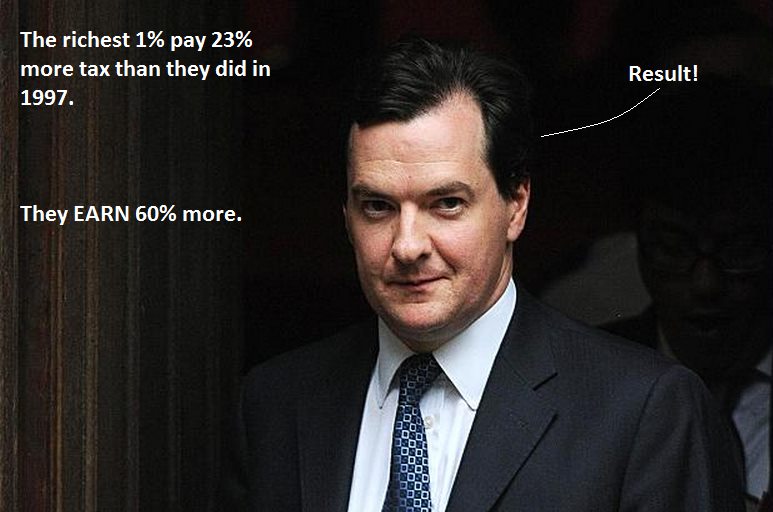
Chancellor George Osborne


2 wrag

Source: Hansard

Context

Many of us recognised in 2012, when the welfare “reforms” and other cuts to public services that support the poorest citizens were forced through parliament despite considerable opposition, using only the “financial privilege” of the Commons as a justification, that the Conservatives are on an ideological crusade, which flies in the face of public needs, democracy and sound economics, to shrink the welfare state and privatise our essential services.

In a wealth transfer from the poorest to the very rich, we have witnessed the profits of public services being privatised, but the losses have been socialised – entailing a process of economic enclosure for the wealthiest, whilst the burden of losses have been placed on the poorest social groups and our most vulnerable citizens – largely those who are ill, disabled and elderly. The Conservative’s justification narratives regarding their draconian policies, targeting the poorest social groups, have led to media scapegoating, social outgrouping, persistent political denial of the aims and consequences of policies and reflect a wider process of political disenfranchisement of the poorest citizens, especially sick and disabled people.

That the cuts are ideologically driven, and have nothing whatsoever to do with economic necessity, was demonstrated only too well by the National Audit Office (NAO) report earlier this year. The NAO scrutinises public spending for Parliament and is independent of government. The report indicates how public services are being appropriated for purely private benefit.

The audit report in January concluded that the Department for Work and Pension’s spending on contracts for disability benefit assessments is expected to double in 2016/17 compared with 2014/15. The government’s flagship welfare-cut scheme will be actually spending more money on the assessments conducted by private companies than it is saving in reductions to the benefits bill.

From the report:

£1.6 billion
Estimated cost of contracted-out health and disability assessments over three years, 2015 to 2018

£0.4 billion
Latest expected reduction in annual disability benefit spending.

This summary reflects staggering economic incompetence, a flagrant, politically motivated waste of tax payers money and even worse, the higher spending has not created a competent or ethical assessment framework, nor is it improving the lives of sick and disabled people. Some people are dying after being wrongly assessed as “fit for work” and having their lifeline benefits brutally withdrawn. Maximus is certainly not helping the government to serve even the most basic needs of sick and disabled people.

However, Maximus is serving the private needs of a “small state” doctrinaire neoliberal government, and making lots of private profit whilst it does so. The Conservatives are systematically dismantling the UK’s social security system, not because there is an empirically justifiable reason or economic need to do so, but because the government has purely ideological, anticollectivist, antidemocratic, profoundly uncivilising prescriptions and longstanding prejudices.

Last week I wrote about the £30 a week Employmen Support Allowance (ESA) work related activity group (WRAG) cuts, which the Government have forced through the legislative process, despite meeting with widespread opposition, the government claim that it is their financial privilege to do so. Yesterday I wrote about the brutal cuts that are planned for Personal Independence Payments (PIP) for sick and disabled people, which are aimed at saving money by reducing eligibility for the support. The cut, it is estimated, will affect at least 640,000 disabled people by 2020, who may lose up to £150 a week. This is money that provides essential support for people who need help to prepare food, use the toilet or dress themselves, amongst other things, and to maintain a degree of dignity and independence.

The cuts to ESA and Personal Independent Payments (PIP) take place in the context of a Tory manifesto that included a pledge not to cut disability benefits. In fact in March last year, the Prime Minister signalled that the Conservatives will protect disabled claimants from welfare cuts in the next parliament (this one). Cameron said the Conservatives would not “undermine” PIP, which was introduced under the Coalition to save money by “targeting those most in need.” Now it seems those most in need are not the ones originally defined as such.

At the time he told BBC Breakfast: “We’ve replaced one benefit – Disability Living Allowance – with a new benefit – Personal Independence Payment – it’s working well, it is also going to lead to some savings over time and we haven’t created that benefit in order to undermine it. We want to enhance it and safeguard it.”

Semantic thrifts: being Conservative with the truth

Only a Conservative minister would claim that taking money from sick and disabled people is somehow “fair,” or about “helping”, “supporting” or insultingly, “incentivising” sick and disabled people who have already been deemed unfit for work by their doctors and the state via the work capability assessment to work.

The Tories all too frequently employ such semantic shifts and euphemism – linguistic strategies – as an integral part of a wider range of techniques of neutralisation that are used, for example, to provide linguistic relief from conscience and to suspend moral constraint – to silence both “inner protest” and public objections – to the political violation of social and moral norms; to justify acts that cause harm to others whilst also denying there is any subsequent harm being inflicted; to deny the target’s and casualties’ accounts and experiences of political acts of harm, and to neutralise remorse felt by themselves or other witnesses.

Media discourse has often preempted the Conservative austerity cuts, resulting in the identification, stereotyping and scapegoating of the groups in advance of the targeted, discriminatory policies. Media discourse is being used as a vehicle for the government to push their ideological agenda forward without meeting legitimate criticism, public scrutiny and without due regard for essential democratic processes and safeguards.

The five neutralisation techniques identified by Gresham Sykes and David Matza are: denial of responsibility, denial of injury, denial of victims, appeal to higher loyalties, and condemnation of condemners.

The really critical part of Sykes and Matza’s argument is that rationalisations precede immoral, cruel or controversial acts and are a key factor in making deviant behaviour possible (amongst delinquents, the mafia or Conservative ministers). As such, the rationalisations betray intent.

The cuts of £120 a month to the disability benefit Employment Support Allowance  are also claimed to be “fair.” and “supportive.” Though I have yet to hear a coherent and rational  explanation of how this can possibly be the case. Ministers claimed that people subjected to the ESA Work Related Activity Group cuts could claim PIP if they required support with extra living costs, but now we are told that PIP is to be cut, too.

Osborne’s techniques of neutralisation: calling a cut “increased spending”

The chancellor has defended his decision to use the cuts in disability benefits to fund tax breaks for the wealthy. On the Andrew Marr show yesterday, he was questioned about his decision to cut PIP, currently made to over 640,000 disabled people in a bid to save at least £1.2 billion. Many severely disabled people are facing a cut of up to £150 a week under the new reduced eligibility assessment criteria.

Controversially, the cuts to disability benefits will fund tax cuts for the most affluent – the top 7% of earners. The Chancellor is set to raise the threshold at which people start paying 40p tax, in a move that will probably see  many wealthier people pulled out of the higher rate of income tax, in the coming budget. Mr Osborne says he wants to “accelerate progress” towards the Conservative’s manifesto pledge of raising the threshold for the 40p rate to £50,000 in 2020, it is understood. The average annual income in the UK is around £27,000. 

Andrew Marr said: You’re taking money out of the pockets of some of the most vulnerable people in this country, disabled people. These are the people who can least afford the sacrifice, the people with the weakest shoulders.

And you’re changing the rules to hit them. Is that really your priority?”

Osborne ludicrously claimed that the Conservative government was “increasing spending on disabled people”, he said: “Controlling welfare bills is part of what you need to do if you’re a secure country confronting the problems in the world.”

But as Marr pointed out, the cuts to ESA and PIP show an intended substantial reduction on government spending to essential support for disabled people.

From January 2017, the cut to PIP is likely to hit sick and disabled people who face fundamental barriers to health and essential basic care. The cut, it is estimated, will affect at least 640,000 disabled people by 2020.

Andrew Marr went on to say: “At the same time as you’re raising thresholds to help middle-class tax payers, it’s going to seem a very callous set of priorities.”

However, Mr Osborne maintained that the brutal and uncivilised cuts were “necessary to improve the economic conditions in the UK”. He said: “Yes, times are tough. The fiscal situation is a difficult one. All Western countries are not productive enough.”

You can see the interview here:


Austerity and premature mortality

Since 2011, a year after the government began their austerity programme, mortality rates have increased rapidly. Advisers to Public Health England (PHE) have warned that the 4-year trend may be the worst since World War II.

Data from the Office of National Statistics shows a 5.4% (27,000) increase in deaths in the past year alone, prompting calls for an urgent investigation. The year-on-year rise, to a total of 528,340 deaths, is the highest since 1968.

PHE said the elderly were bearing the worst of Tory austerity cuts, with women suffering disproportionately, though this is partly because they live longer, however, it is also due to a growing crisis in the NHS and cuts to social care. Professor Danny Dorling, from Oxford University, an advisor to PHE on older age life expectancy, said:

“When we look at 2015, we are not just looking at one bad year. We have seen excessive mortality – especially among women – since 2012.”

Figures show that the number of deaths had been falling steadily until 2011, a year after the government began their austerity programme, when deaths rates began to increase rapidly.

Professor Dorling cited Tory austerity as the biggest cause:

“I suspect the largest factor here is cuts to social services – to meals on wheels, to visits to the elderly.”

Empirical research published two years ago demonstrated the high a cost the country paid in terms of health and wellbeing for the Thatcher administration’s economic and social policies. The study, which looked at material from existing research and data from the Office for National Statistics, illustrates that Thatcherism resulted in the unnecessary and unjust premature deaths of British citizens, together with a substantial and continuing burden of suffering and a widespread degradation of wellbeing. Co-author and researcher Professor Clare Bambra from the Wolfson Research Institute of Health and Wellbeing said that deaths from violence and suicide all increased substantially during the Thatcher era in comparison with other countries. Regional inequalities in life expectancy between north and south were also exacerbated, as were health inequalities between the richest and poorest in British society.

Professor Bambra also says that the welfare cuts implemented by Thatcher’s governments led to a rise in poverty rates from 6.7% in 1975 to 12% by 1985; poverty is well known to be one of the major causes of ill health and mortality. Income inequality also increased in the Thatcher period, as the richest 0.01% of society had 28 times the mean national average income in 1978 but 70 times the average by 1990. Other research (The Spirit Level) indicates that income inequality is internationally associated with higher mortality and morbidity.

Welfare reform minister, Lord Freud, refused to monitor the number of people who take their own lives as a result of the £120-a-month cut planned for those people in the work related activity group (WRAG), claiming employment and support allowance from April 2017. Concerns were raised in the House of Lords last week, when Baroness Meacher, amongst others, warned that for the most vulnerable, the cut was “terrifying” and bound to lead to increased debt.

Condemning the truly callous and terrible actions of the Treasury, she urged ministers to monitor the number of suicides in the year after the change comes in, adding: “I am certain there will be people who cannot face the debt and the loss of their home, who will take their lives.”

Many people have died as a consequence of the welfare “reforms.”

Not only have the government failed to carry out an impact assessment regarding the cuts, Lord Freud said that the impact, potential increase in deaths and suicides won’t be monitored, apart from “privately” because individual details can’t be shared and because that isn’t a “useful approach”.

He went on to say “We have recently produced a large analysis on this, which I will send to the noble Baroness. That analysis makes it absolutely clear that you cannot make these causal links between the likelihood of dying – however you die – and the fact that someone is claiming benefit.”

Actually, a political refusal to investigate an established correlation between the welfare “reforms” and an increase in the mortality statistics of those hit the hardest by the cuts – sick and disabled people – is not the same thing as there being no causal link. Often, correlation implies causality and therefore such established links require further investigation. It is not possible to disprove a causal link without further investigation.

Whilst the government continue to deny there is a causal link between their welfare policies, austerity measures and an increase in premature deaths and suicides, they cannot deny there is a clear correlation establised, which warrants further research and political accountability.

Then they came for the ESA Support Group …

Despite the fact that this government face a UN inquiry into grave and systematic abuses of the human rights of disabled people, the blatant attacks on a social group with legally protected characteristics continues and the Conservatives continue to target disabled people for a disproportionately large and unfair burden of austerity cuts.

A government advisor, who is a specialist in labour economics and econometrics, has proposed scrapping all ESA sickness and disability benefits. Matthew Oakley, a senior researcher at the Social Market Foundation, recently published a report entitled Closing the gap: creating a framework for tackling the disability employment gap in the UK, in which he proposes abolishing the ESA Support Group. To meet extra living costs because of disability, Oakley says that existing spending on PIP and the Support Group element of ESA should be brought together to finance a new extra costs benefit. Eligibility for this benefit should be determined on the basis of need, with an assessment replacing the WCA and PIP assessment. The Conservative definition of “the basis of need” seems to be an ever-shrinking category.

Oakely also suggests considering a “role that a form of privately run social insurance could play in both increasing benefit generosity and improving the support that individuals get to manage their conditions and move back to work.”

I’m sure the private company Unum would jump at the opportunity. Steeped in controversy, with a wake of scandals that entailed the company denying people their disabilty insurance, in 2004, Unum entered into a regulatory settlement agreement (RSA) with insurance regulators in over 40 US states. The settlement related to Unum’s handling of disability claims and required the company “to make significant changes in corporate governance, implement revisions to claim procedures and provide for a full re-examination of both reassessed claims and disability insurance claim decisions.

The company is the top disability insurer in both the United States and United Kingdom. By coincidence, the  company has been involved with the UK’s controversial Welfare Reform Bill, advising the government on how to cut spending, particularly on disability support. What could possibly go right?

It’s difficult to see how someone with a serious, chronic and often progressive illness, (which most people in the ESA Support Group have) can actually “manage” their illness and “move back into work.” The use of the extremely misinformed, patronising and very misleading term manage implies that very ill people actually have some kind of choice in the matter. For people with Parkinson’s disease, rheumatoid arthritis, lupus and multiple sclerosis, cancer and kidney failure, for example, mind over matter doesn’t fix those problems, positive thinking and sheer will power cannot cure these illnesses sadly. Nor does benefit conditionality and being coerced into work by callously insensitive and medically ignorant assessors, advisors and ministers.

The Reform think tank has also recently proposed scrapping what is left of the disability benefit support system, in their report Working welfare: a radically new approach to sickness and disability benefits and has called for the government to set a single rate for all out of work benefits and reform the way sick and disabled people are assessed. 

Reform says the government should cut the weekly support paid to 1.3 million sick and disabled people in the ESA Support Group from £131 to £73. This is the same amount that Jobseeker’s Allowance claimants receive. However, those people placed in the Support Group after assessement have been deemed by the state as unlikely to be able to work again. It would therefore be very difficult to justify this proposed cut.

Yet the authors of the report doggedly insist that having a higher rate of weekly benefit for extremely sick and disabled people encourages them “to stay on sickness benefits rather than move into work.”

The report recommended savings which result from removing the disability-related additions to the standard allowance should be reinvested in support services and extra costs benefits – PIP. However, as outlined, the government have ensured that eligibility for that support is rapidly contracting, with the ever-shrinking political and economic re-interpretation of medically defined sickness and disability categories and a significant reduction in what the government deem to be a legitimate exemption from being “incentivised” into hard work.

The current United Nations investigation into the systematic and gross violations of the rights of disabled people in the UK because of the Conservative welfare “reforms” is a clear indication that there is no longer any political commitment to supporting disabled people in this country, with the Independent Living Fund being scrapped by this government, ESA for the work related activiy group (WRAG) cut back, PIP is becoming increasingly very difficult to access, and now there are threats to the ESA Support Group. The Conservative’s actions have led to breaches in the CONVENTION on the RIGHTS of PERSONS with DISABILITIES – CRPD articles 4, 8, 9, 12, 13, 14, 15, 17, and especially 19, 20, 27 and 29 (at the very least.) There are also probable violations of articles 22, 23, 25, 30, 31.

The investigation began before the latest round of cuts to ESA and PIP were announced.


426785_10151205298996274_171693454_n

Reverse the ESA disability benefit cut: sign the petition

Extend the PIP consultation & stop cuts to supporting terminally ill & disabled: sign the petition


Related

A tale of two suicides and a very undemocratic, inconsistent government

Paternalistic Libertarianism and Freud’s comments in context

Let’s keep the job centre out of GP surgeries and the DWP out of our confidential medical records

Conservative governments are bad for your health

Research finds strong correlation between Work Capability Assessment and suicide

Benefits Assessor: How Long Are You Likely To Have Parkinson’s?

scroll2

I don’t make any money from my work and I’m not funded. You can support Politics and Insights by making a donation to help me continue researching and writing independently, and to continue to help others.

DonatenowButton
cards

Government plans further brutal cuts to disability support

358-burden-of-cuts

Disabled people are already carrying a disproportionately high burden of the austerity cuts, despite government claims of economic recovery.

Government ministers are planning to cut a key element of the Personal Independent Payment (PIP). Last year a consultation indicated that the Conservatives were considering ways of reducing eligibility criteria for the daily living component of PIP, by narrowing definitions of aids and appliances.

From January 2017, the cut is likely to hit people experiencing incontinence, who struggle to dress themselves, and those facing other fundamental barriers to health and essential basic care. The cut, it is estimated, will affect at least 640,000 disabled people by 2020.

Controversially, it is alleged that the cuts to disability benefit will fund tax cuts for the most affluent – the top 7% of earners. The Chancellor is set to raise the threshold at which people start paying 40p tax, in a move that will probably see  many wealthier people pulled out of the higher rate of income tax, in the coming budget. Mr Osborne says he wants to “accelerate progress” towards the Conservative’s manifesto pledge of raising the threshold for the 40p rate to £50,000 in 2020, it is understood.

Meanwhile, under the plans announced on Friday, sick and disabled people will be much less likely to receive essential disabled benefits if they use aids such as a handrail or a walking stick to get dressed or use the toilet.

The Department for Work and Pensions reviewed a sample of 105 cases of people who had scored all, or the majority, of their points for PIP due to aids and appliances, in order to assess the extent to which the award may reflect extra costs.

The review led the government to conclude that PIP “doesn’t currently fulfil the original policy intent”, which was to cut costs and “target” the benefit to “those with the greatest need.” That originally meant a narrowing of eligibility criteria for people formerly claiming Disability Living Allowance, increasing the number of  reassessments required, and limiting the number of successful claims.

Prior to the introduction of PIP, Esther McVey stated that of the initial 560,000 claimants to be reassessed by October 2015, 330,000 of these are targeted to either lose their benefit altogether or see their payments reduced. Of course the ever-shrinking category of “those with the greatest need” simply reflects a government that has simply made a partisan political decision to cut disabled people’s essential income to fund a financial gift to the wealthiest citizens. There is no justification for this decision, nor is it “fair.”

The government now  claim that the proportion of people awarded the daily living component of PIP, who scored all of their points because they need aids and appliances, has more that tripled, from 11 per cent in April 2014 to 35 per cent in 2015.

The PIP assessment currently examines an individual’s ability to complete ten daily living activities and two mobility activities. Regular reviews were also introduced by the last government to ensure that claimants continue to receive the “right level of support.”

The increase has largely been driven by a significant and sustained rise in relation to activities one, four, five and six: preparing food, washing and bathing, dressing and undressing, and managing incontinence and toileting. Around three-quarters of those who score all of their points through aids and appliances score the minimum number of daily living points needed to qualify for the standard rate of the daily living component.

The government ridiculously claim that the “evidence” presented to the review suggested that in some instances points were being awarded “… because claimants chose to use aids and appliances, rather than needed them.”  And noted that in many cases “ these were non-specialised items of very low cost.”

However, it’s very difficult to justify cutting support for people who require aids to meet fundamental needs such as preparing food, dressing, basic and essential personal care and managing incontinence.

Ministers have now announced their intention to cut PIP for people who currently receive it to help them afford specially-adapted appliances and equipment. Examples of qualifying equipment currently includes adapted cutlery for people who find it difficult to hold things for long periods of time and specially-designed household items for people less able to stand.

Justin Tomlinson, the disabilities minister, said that the cuts to funding for aids and appliances for the disabled could save about £1bn a year and was announced the week before the budget. Charities warned that the cuts to personal independence payments (PIP) would be devastating after the move was confirmed by Tomlinson on Friday.

Tomlinson, said: “The introduction of Personal Independence Payment to replace the outdated Disability Living Allowance for working age claimants has been a hugely positive reform.

But it is clear that the assessment criteria for aids and appliances are not working as planned. Many people are eligible for a weekly award despite having minimal to no extra costs and judicial decisions have expanded the criteria for aids and appliances to include items we would expect people to have in their homes already.

We consulted widely to find the best approach. And this new change will ensure that PIP is fairer and targets support at those who need it most.”

Only a Conservative minister would claim that taking money from sick and disabled people is somehow “fair,” and they frequently do. The cuts of £120 a month to the disability benefit employment support allowance (ESA) are also claimed to be “fair.” and “supportive.” Though I have yet to hear an explanation of how this can possibly be the case. Ministers claimed that people subjected to the ESA Work Related Activity Group cuts could claim PIP if they required support with extra living costs, but now we are told that PIP is to be cut, too.

Bearing in mind the Department for Work and Pensions “review” was based on a sample of just 105 people, it’s very difficult to see how further inhumane cuts to the lifeline income for this group of amongst the most disabled citizens can possibly be justified. How did ministers “plan” the assessment criteria for aids and appliances to work, exactly?  People qualifying for PIP need extra support in meeting their living costs.

A coalition of 25 disability charities has written to the Government to warn against plans that would strip some disabled people of a key payments meant to help them live more independent lives.

The Disability Benefits Consortium wrote to Justin Tomlinson, to argue that proposed changes to Personal Independence Payment – or PIP – assessments would have a “severe impact” on people’s security and make it harder for them to find work.

Debbie Abrahams, the shadow disabilities minister, said: “Removing support for people who need help to use the toilet or dress is an attack on dignity.”

“These further cuts would represent another huge blow, making life even more difficult for many people who already facing huge barriers.”

Phil Reynold, policy and campaigns adviser at Parkinson’s UK, said: “If someone needs aids and appliances to carry out the most basic tasks that most people take for granted then they clearly need ongoing support to live independently, which is often expensive. They should not be penalised by making personal independence payments even more difficult to claim.”

Michelle Mitchell, chief executive of the MS Society, said: “This decision could have a devastating impact on the lives of people with MS. In the worst cases, they could lose up to £150 a week.

PIP is an essential benefit which goes towards the extra cost of being disabled. The new plans will fail some of the most vulnerable people in society and we have serious concerns about the future health and welfare of those affected.”

The government is currently being investigated by the United Nations because of  serious allegations that many of us have made regarding the welfare “reforms”, which have extended gross and systematic abuse of the human rights of disabled people. The UK is the first country to be subject to an investigation regarding the government’s failure to meet legal obligations to uphold disabled people’s human rights. In the 6th wealthiest nation of the world, and a so-called liberal democracy, this treatment of an already marginalised and protected social group is utterly shameful.

536738_306169162785952_999031084_n

scroll2

I don’t make any money from my work and I’m not funded. You can support Politics and Insights by making a donation to help me continue researching and writing independently, and to continue to help others.

DonatenowButton
cards

Conservative welfare “reforms” – the sound of one hand clapping

1022654909

“Labour MPs sat perplexed … By cutting housing benefit for the poor, the Government was helping the poor. By causing people to leave their homes, the Government was helping people put a roof over their heads. By appealing the ruling that it discriminated against the vulnerable, the Government was supporting the vulnerable.

Yes, this was a tricky one.” – From an unusually insightful article in the Telegraph about the incoherence of Conservative welfare rhetoric:  How bedroom tax protects the vulnerable.

“Ministers keep using the mantra that their proposals are to protect the most vulnerable when, quite obviously, they are the exact opposite. If implemented their measures would, far from protecting the most vulnerable, directly harm them. Whatever they do in the end, Her Majesty’s Government should stop this 1984 Orwellian-type misuse of language.”  – Lord Bach, discussing the Legal Aid Bill. Source: Hansard, Column 1557, 19 May, 2011.

Conservative policies are incoherent: they don’t fulfil their stated aims and certainly don’t address public needs. Furthermore, Conservative rhetoric has become completely detached from the experiences of most citizens and their everyday realities.

Under the Equality Act, provision was made by the Labour government to ensure that legislations didn’t discriminate against protected social groups, which included disabled people. However, the need for public bodies in England to undertake or publish an equality impact assessment of government policies, practices and decisions was quietly removed by David Cameron in April 2011. The legal requirement in the Equality Act that ensured public bodies attempt to reduce inequalities caused by socio-economic factors was also scrapped by Theresa May in November 2010, who said she favoured a greater focus on “fairness” rather than “equality.”

The Conservatives have since claimed to make welfare provision “fair” by introducing substantial cuts to benefits and introducing severe conditionality requirements regarding eligibility to social security, including the frequent use of extremely punitive benefit sanctions as a means of “changing behaviours,” highlighting plainly that the Conservatives regard unemployment and disability as some kind of personal deficit on the part of those who are, in reality, simply casualties of unfortunate circumstances, bad political decision-making and subsequent politically-constructed socio-economic circumstances.

The word “fair” originally meant “treating people equally without favouritism or discrimination, without cheating or trying to achieve unjust advantage.” Under the Conservatives, we have witnessed a manipulated semantic shift, “fair” has become a Glittering Generality – part of a lexicon of propaganda that simply props up Tory ideology in an endlessly erroneous and self-referential way. Conservative ideology is permeating language, prompting semantic shifts towards bland descriptors which mask power and class relations, coercive state actions and political intentions. One only need to look at the context in which the government use words like “fair”, “support”, “help”, “justice” , “equality” and “reform” to recognise linguistic behaviourism in action. Or if you prefer, Orwellian doublespeak.

The altered semantics clearly signpost an intentionally misleading Conservative narrative, constructed on the basic, offensive idea that people claiming welfare do so because of “faulty” personal characteristics, and that welfare creates problems, rather than it being an essential mechanism aimed at alleviating poverty, extending social and economic support and opportunities – social insurance and security when people need it.

The government claims to be “committed to supporting the most vulnerable” and ensuring “everyone contributes to reducing the deficit, and where those with the most contribute the most.” That is blatantly untrue, as we can see from just a glance at Conservative policies.

2014-02-17-BurdenoftheCuts-thumb

Conservative rhetoric is a masterpiece of stapled together soundbites and meaningless glittering generalities. And intentional mystification. Glittering Generalities are being used to mask political acts of discrimination.

Cameron claims that he is going to address “inequality” and “social problems”, for example, but wouldn’t you think that he would have done so over the past five years, rather than busying himself creating those problems via policies? Under Cameron’s government, we have become the most unequal country in the European Union, even the USA, home of the founding fathers of neoliberalism, is less divided by wealth and income, than the UK.

I’m also wondering how tripling university tuition fees, removing bursaries and maintainance grants for students from poorer backgrounds and reintroducing banding in classrooms can possibly indicate a party genuinely interested in extending “equal opportunities.”

It’s perplexing that a government claiming itself to be “economically competent” can possibly attempt to justify spending more tax payers money on appealing a Supreme Court decision that the bedroom tax policy is discriminatory, when it would actually cost less implementing the legal recommendations of the court. As Owen Smith, Shadow Work and Pensions Secretary, said: “Just the Supreme Court session itself will cost the Government more in legal fees than the £200,000 needed to exempt domestic abuse victims affected.

“If the Tories had an ounce of decency they could have stood by the decision and exempted the two groups.

“Instead they are instructing expensive lawyers to fight in the Supreme Court for the right to drive people further into poverty.”

As a consequence of the highly discriminatory and blatantly class-contingent Tory policies, rampant socio-economic inequality apparently is the new Tory “fair”. There is a clear incongruence between Conservative rhetoric and the impact of their policies. This is further highlighted by the fact that the UK is currently being investigated by the United Nations regarding serious contraventions of the human rights of sick and disabled people, and other marginalised groups, because of the dire impact of Conservative welfare “reforms.”

It’s clear that the austerity cuts which target the poorest are intentional, ideologically-driven decisions, taken within a context of other available choices and humane options.

The rise in the need for food banks in the UK, amongst both the working and non-working poor, over the past five years and the return of absolute poverty, not seen since before the advent of the welfare state in this country, makes a mockery of government claims that it supports the most vulnerable.

Income tax receipts to the Treasury have fallen because those able to pay the most are being steadily exempted from social responsibility, and wages for many of the poorer citizens have fallen, whilst the cost of living has risen significantly over this past five years.

The ideologically motivated transfer of funds from the poorest half of the country to the more affluent has not contributed to deficit reduction. It doesn’t take a genius to work out that the cumulative impact of Tory tax and welfare changes, from out-of-work and in-work benefits to council tax support, to the cut in the top rate of income tax and an increase in tax-free personal allowances, has been extremely regressive and detrimental to the poorest.

The revenue gains from the tax changes and benefit cuts were offset by the cost of tax reductions, particularly the increase in the income tax personal allowance, benefitting the wealthiest.

The Treasury response to this is to single out the poorest yet again for more cuts to “balance the books” – which basically translates as the Conservative “small state” fetish, and deep dislike of the gains we made from the post-war settlement. Yet for a government that claims a non-interventionist stance, it sure does make a lot of interventions. Always on behalf of the privileged class, with policies benefitting only the wealthy minority.

How can Conservatives believe that poor people are motivated to work harder by taking money from them, yet also apparently believe that wealthy people are motivated by giving them more money? This is not “behavioural science,” it’s policy-making founded entirely on traditional Tory prejudices.

The government claim that “Every individual policy change is carefully considered, including looking at the effect on disabled people in line with legal obligations,” but without carrying out a cumulative impact assessment, the effects and impacts of policies can’t possibly be accurately measured. And that is intentional, too.

Despite being a party that claims to support “hard-working families,” the Conservatives have nonetheless made several attempts to undermine the income security of a signifant proportion of that group of citizens recently. Their proposed tax credit cuts, designed to creep through parliament in the form of secondary legislation, which tends to exempt it from meaningful debate and amendment in the Commons, was halted only because the House of Lords have been paying attention to the game.

The use of secondary legislation has risen at an unprecedented rate, reaching an extraordinary level since 2010, and it’s increased use is to ensure that the Government meet with little scrutiny and challenge in the House of Commons when they attempt to push through controversial and unpopular, ideologically-driven legislation.

Conservative cuts are most often applied by stealth, using statutory instruments. This indicates a government that is well aware that its policies are not fit for purpose.

We can’t afford Conservative ideological indulgence.

The National Audit Office (NAO) scrutinises public spending for Parliament and is independent of government. An audit report earlier this month concluded that the Department for Work and Pension’s spending on contracts for disability benefit assessments is expected to double in 2016/17 compared with 2014/15. The government’s flagship welfare-cut scheme will be actually spending more money on the assessments themselves than it is saving in reductions to the benefits bill – as Frances Ryan pointed out in the Guardian, it’s the political equivalent of burning bundles of £50 notes.

The report also states that only half of all the doctors and nurses hired by Maximus – the US outsourcing company brought in by the Department for Work and Pensions to carry out the assessments – had even completed their training.

The NAO report summarises:

5.5
Million assessments completed in five years up to March 2015

65%
Estimated increase in cost per ESA assessment based on published information after transfer of the service in 2015 (from £115 to £190)


84%
Estimated increase in healthcare professionals across contracts from 2,200 in May 2015 to 4,050 November 2016

£1.6bn
Estimated cost of contracted-out health and disability assessments over three years, 2015 to 2018

£0.4 billion
Latest expected reduction in annual disability benefit spending

13%
Proportion of ESA and PIP targets met for assessment report quality meeting contractual standard (September 2014 to August 2015).

This summary reflects staggering and deliberate economic incompetence, a flagrant, politically-motivated waste of tax payers money and even worse, the higher spending has not created a competent or ethical assessment framework, nor is it improving the lives of sick and disabled people.

The government claim they want to “help” sick and disabled people into work, but nearly 14,000 disabled people have lost their mobility vehicle after the changes to Personal Independence Payments (PIP) assessment, which are carried out by private companies. Many more, yet to be reassessed, are also likely to lose their specialised vehicles.

In 2012, Esther McVey revealed that the new PIP  was about cutting costs and that there were targets to reduce the number of successful claims when she told the House of Commons:330,000 of claimants are expected to either lose their benefit altogether or see their payments reduced.How else could she have known that before those people were actually assessed? A recent review led the government to conclude that PIP doesn’t currently fulfil the original policy intent, which was to cut costs and “target” the benefit to “those with the greatest need.”

That basically meant a narrowing of eligibility criteria for people formerly claiming Disability Living Allowance, increasing the number of reassessments required, and limiting the number of successful claims. The government have used the review to attempt to justify further restrictions to PIP eligibility, aimed at cutting support for people who require aids to meet fundamental needs such as preparing food, dressing, basic and essential personal care and managing incontinence. “Greatest need” has become an ever-shrinking category under Conservative austerity measures. 

DPAC

The use of political pseudo-psychological “diagnoses” to both stigmatise and “treat” what are generally regarded by the Conservatives as deviant behaviours from cognitively incompetent citizens, infering that the problem lies within the individual rather than in their circumstances, or arise as a consequence of political decision-making and socio-economic models, has become the new normal. We are discussing people here who have been deemed too ill to work by their own doctor AND the state. Not for the first time, the words Arbeit macht frei spring to mind.

Welfare has been redefined: it is preoccupied with assumptions about and modification of the behaviour and character of recipients rather than with the alleviation of poverty and ensuring economic and social wellbeing.

The stigmatisation of people needing benefits is designed purposefully to displace public sympathy for the poor, and to generate moral outrage, which is then used to further justify the steady dismantling of the welfare state.

It is the human costs that are particularly distressing, and in a wealthy, first world liberal democracy, such draconian policies ought to be untenable. Some people are dying after being wrongly assessed as “fit for work” and having their lifeline benefits brutally withdrawn. Maximus is certainly not helping the government to serve even the most basic needs of sick and disabled people.

However, Maximus is serving the needs of a “small state” doctrinaire neoliberal government. The Conservatives are systematically dismantling the UK’s social security system, not because there is an empirically justifiable reason or economic need to do so, but because the government has purely ideological, anticollectivist prescriptions. Those prescriptions are costing the UK in terms of the economy, but MUCH worse, it is costing us in terms of our decent, collective, civilised response to people experiencing difficult circumstances through no fault of their own; it’s costing the most vulnerable citizens their wellbeing and unforgivably, it is also costing precious human lives.

It’s not just that Conservative rhetoric is incoherent and incongruent with the realities created by their policies. Policy-making has become increasingly detached from public needs and instead, it is being directed at “incentivising” and “changing behaviours” of citizens to meet a rigidly ideological state agenda. That turns democracy completely on its head. There is no longer a genuine dialogue between government and citizens, only a diversionary and oppressive state monologue.

And it’s the sound of one hand clapping.

one hand clapping

There are many ways of destroying people’s lives, not all of them are obvious. Taking away people’s means of meeting basic survival needs, such as money for food, fuel and shelter – which are the bare essentials that benefits were originally calculated to cover – invariably increases the likelihood that they will die. The people most adversely and immediately affected are those who have additional needs for support.

The moment that sick and disabled people were defined as a “burden on the state” by the government, we began climbing Allport’s Ladder of Prejudice.

Whilst I am very aware that we need take care not to trivialise the terrible events of  world war 2 and Nazi Germany by making casual comparisons, there are some clear and important parallels on a socio-political level and a psycho-social one, that I feel are crucially important to recognise.

Gordon Allport studied the psychological and social processes that create a society’s progression from prejudice and discrimination to genocide. In his research of how the Holocaust happened, he describes socio-political processes that foster increasing social prejudice and discrimination and he demonstrates how the unthinkable becomes acceptable: it happens incrementally, because of a steady erosion of our moral and rational boundaries, and propaganda-driven changes in our attitudes towards “others” that advances culturally, by almost inscrutable degrees.

The process always begins with the political scapegoating and systematic dehumanisation of a social group and with ideologies that identify that group as an “enemy” or a social “burden” in some way. A history of devaluation of the group that becomes the target, authoritarian culture, and the passivity of internal and external witnesses (bystanders) all contribute to the probability that violence against that group will develop, and ultimately, if the process is allowed to continue evolving, genocide.

If you think this observation is “extreme” then you really haven’t been paying attention. By 2012, hate crime incidents against disabled people had risen to be the highest ever recorded. By 2015, there was a further 41 per cent rise in disability hate crime. This is the so-called “civilised” first world, very wealthy liberal democracy that is the UK.

Most disabled people have worked, contributed to society, paid taxes and national insurance. Those that haven’t genuinely cannot work, and as a decent, civilised society, we should support them. Being ill and disabled is not a “lifestyle choice.” Unfortunately it can happen to anyone. A life-changing accident or illness doesn’t only happen to others: no-one is exempted from such a possibility. That this government thinks it can get away with peddling utter nonsense about the characters, lives and motivations of a marginalised social group, dehumanising them, directing hatred, resentment, prejudice and public derision towards them, demonstrates only too well just how far we have moved away from being a decent, civilised society. 

It seems to be almost weekly that there’s a report in the media about a sick and disabled person dying after being told by the state that they are “fit for work” and their lifeline benefits have been halted, or because the state has sanctioned someone and withdrawn their only support. There are many thousands more suffering in silence, fearful and just about living.


Thousands of disabled people have lost their specialist Motability vehicles because of Conservative benefit cuts and many more are likely to be affected

westminster-20121020-00081


In 2012, Esther McVey, then the Minister for people with disabilities, as good as admitted there are targets to reduce or remove eligibility for the new disability benefit Personal Independent Payment (PIP), which was to replace Disability Living Allowance. How else could she know in advance of people’s reassessment that 330,000 of claimants are expected to either lose their benefit altogether or see their payments reduced as she had informed the House of Commons?

This was a clear indication that the new assessment framework was designed to cut support for disabled people. A recent review led the government to conclude that PIP doesn’t currently fulfil the original policy intent, which was to cut costs and “target” the benefit to “those with the greatest need.”

That basically meant a narrowing of eligibility criteria for people formerly claiming Disability Living Allowance, increasing the number of reassessments required, and limiting the number of successful claims. The government have used the review to attempt to justify further restrictions to PIP eligibility, aimed at cutting support for people who require aids to meet fundamental needs such as preparing food, dressing, basic and essential personal care and managing incontinence. “Greatest need” has become an ever-shrinking category under Conservative austerity measures. 

McVey also said that around 200 disabled people in every parliamentary constituency were likely to lose their Motability vehicle when she changed the qualifying walking distance limit from 50 metres to 20-metres. 

And she pointed out that one of the Department for Transport’s own publications, Inclusive Mobility, recommends that “seating should be provided on pedestrian routes at intervals of no more than 50 metres, and that parking spaces for blue badge holders should preferably be provided within 50 metres of the facilities they serve”.

The Motability Scheme helped around 650,000 disabled people to lease specialist cars, wheelchairs and scooters. Anyone on the highest level of the Disability Living Allowance (DLA) was entitled to join the scheme which also helped to pay for expensive adaptations. Motability provides financial help (grants) to disabled people who would not otherwise be able to afford the vehicle or adaptations they need, and the charity undertakes a range of fundraising activities to contribute to the provision of financial help to those Scheme customers whose allowance does not cover the cost of the mobility solution that they need.

Last year, Motability revealed that around 100 disabled people claiming PIP are losing their crucial vehicle benefit every week.

According to Motability, who lease specialised cars and powered wheelchairs to disabled people, 3,000 out of 8,000 of their customers who have so far been reassessed for PIP, who were previously claiming the Disability Living Allowance, have lost their eligibility for the scheme and have therefore had to give up their vehicles.

Motability raised concerns that the government reforms to DLA would affect many more. It has.

Nearly 14,000 disabled people have had their mobility vehicle confiscated after the changes to benefit assessment, which are carried out by private companies. Many more, yet to be reassessed, are also likely to lose their specialised vehicles.

Under the new PIP rules thousands more people who rely on disability allowance to keep their independence are set to lose their vehicles. Many had been adapted to meet their owners’ needs and many campaigners warn that it will lead to a devastating loss of independence for disabled people.

A total of 45% or 13,900 people, were deemed as not needing the higher rate of PIP, and therefore lost their vehicles after reassessment. And out of the 31,200 people who were once on the highest rate of DLA who have been reassessed, just 55%, or 17,300 – have kept their car.

Given that many Motability vehicles are specially adapted to meet the highly individual needs of each person, I wonder what happens to all of those vehicles that are lost under the new restricted benefit eligibility criteria.

Around 51,200 disabled people have joined the Motability scheme using their PIP. Around 360,000 more people will undergo PIP reassessments and that will include “indefinite” or “lifetime” awards under the original DLA support.

Perhaps the government expect that severely and chronically ill people will miraculously recover, their progressive illness will stop progressing, maybe people will grow new limbs, find cures of their own where medical professionals and drug companies have failed and battle their “choice” of disability alone.

Being disabled is very expensive. The charity Scope has calculated that disabled people pay a huge financial penalty over and above the everyday living costs faced by the typical able-bodied person – on average £550 per month. One in ten pay more than £1000 a month over the odds.

Expenses range from door-to-door taxis to get around, extra heating costs, pricey specialist items like wheelchairs, hoists, or stair lifts. There may be extra laundry costs, continence aids, special dietary requirements, a need for home help and meals on wheels. Some disabilities place more wear and tear on shoes and clothing, some people need suitable kinds of footwear. Non-prescription medical items are also an additional cost. These are just a few examples of extra expenses. There are many more that most able-bodied people wouldn’t ever need to think of.

Liz Sayce, chief executive of Disability Rights UK, said: “Being disabled costs money.

The Personal Independence Payment is supposed to help with those costs, but many people are being denied the benefit because they are not assessed properly. Sometimes that means people lose their cars; a massive blow which impacts on their ability to remain independent, take part in their communities or get and keep a job.”

Recent research revealed that of all the appeals related to PIP, 60% of tribunals have ruled in the claimant’s favour.

Motability provides a support package, including a £2,000 grant, to anyone forced to leave the scheme following a PIP reassessment.

The charity added: “This helps individuals to remain mobile, in many cases by purchasing a used car. Motability has already provided some £16m in support through this transitional package.”

The Conservative claim that “Government is committed to supporting the most vulnerable” doesn’t stand up to scrutiny, given the Conservative policy record, including cruelly scrapping the Independent Living Fund, which has had a hugely negative impact on those trying their best to lead independent and dignified lives, and the Access To Work funding has been severely cut, this is also a fund that helps people and employers to cover the extra living costs arising due to disabilities that might present barriers to work. 

Mr Duncan Smith said at the Conservative conference last year that many sick and disabled people “wanted to work” and that the Government should give them “support” to find jobs and make sure the welfare system encouraged them to get jobs. I’m wondering what the word “support” actually means to Conservatives, because there’s every indication that over the past five years, there has only been a withdrawal of essential support and lifeline benefits from those who need them the most.

Article 19 of the United Nations Convention on the rights of persons with disabilities states that persons with disabilities have access to a range of in-home, residential and other community support services, including personal assistance necessary to support living and inclusion in the community, and to prevent isolation or segregation from the community. Article 20 states that Parties shall take effective measures to ensure personal mobility with the greatest possible independence for persons with disabilities, including by:

a) Facilitating the personal mobility of persons with disabilities in the manner and at the time of their choice, and at affordable cost;

b) Facilitating access by persons with disabilities to quality mobility aids, devices, assistive technologies and forms of live assistance and intermediaries, including by making them available at affordable cost;

c) Providing training in mobility skills to persons with disabilities and to specialist staff working with persons with disabilities;

d) Encouraging entities that produce mobility aids, devices and assistive technologies to take into account all aspects of mobility for persons with disabilities.

Article 28 requires that States Parties recognise the right of persons with disabilities to an adequate standard of living for themselves and their families, including adequate food, clothing and housing, and to the continuous improvement of living conditions, and should take appropriate steps to safeguard and promote the realisation of these rights without discrimination on the basis of disability.

It’s difficult to see how the government’s cuts to lifeline disability benefits can possibly be consistent with their obligations to uphold human rights law. 


images

Doctors bribed with 70-90k salaries to join Maximus and “endorse a political agenda regardless of how it affects patients.”

maximus-logoYes, but which people?


The National Audit Office (NAO) scrutinises public spending for Parliament and is independent of government. An audit report earlier this month concluded that the Department for Work and Pension’s spending on contracts for disability benefit assessments is expected to double in 2016/17 compared with 2014/15. The government’s flagship welfare-cut scheme will be actually spending more money on the assessments themselves than it is saving in reductions to the benefits bill – as
Frances Ryan pointed out in the Guardian, it’s the political equivalent of burning bundles of £50 notes.

The report also states that only half of all the doctors and nurses hired by Maximus – the US outsourcing company brought in by the Department for Work and Pensions to carry out the assessments – had even completed their training.

The NAO report summarises:

5.5
Million assessments completed in five years up to March 2015

65%
Estimated increase in cost per ESA assessment based on published information after transfer of the service in 2015 (from £115 to £190)


84%
Estimated increase in healthcare professionals across contracts from 2,200 in May 2015 to 4,050 November 2016

£1.6 billion
Estimated cost of contracted-out health and disability assessments over three years, 2015 to 2018

£0.4 billion
Latest expected reduction in annual disability benefit spending

13%
Proportion of ESA and PIP targets met for assessment report quality meeting contractual standard (September 2014 to August 2015).

This summary reflects staggering economic incompetence, a flagrant, politically motivated waste of tax payers money and even worse, the higher spending has not created a competent or ethical assessment framework, nor is it improving the lives of sick and disabled people. Some people are dying after being wrongly assessed as “fit for work” and having their lifeline benefits brutally withdrawn. Maximus is certainly not helping the government to serve even the most basic needs of sick and disabled people.

However, Maximus is serving the needs of a “small state” doctrinaire neoliberal government. The Conservatives are systematically dismantling the UK’s social security system, not because there is an empirically justifiable reason or economic need to do so, but because the government has purely ideological, anticollectivist prescriptions.

This is a government that claims social security is “unsustainable” and a “burden” on the public purse, yet has no problem with an extraordinary profligacy with public funds and dispossessing tax payers when it comes to implementing “cost-cutting” and draconian welfare “reforms.” Conservative anti-welfare dogma and prejudice are costing the UK billions of pounds.

In April 2014, Atos was forced to abandon their contract with the government because of a growing public backlash, but not before they had profited from very large sums of public money. Meanwhile, sick and disabled people have had their support callously slashed to the bone, people have suffered and some have died as a consequence of that. Yet our welfare state is being used as a sporting arena for big business profit-making, eating up public funds that were supposed to help people who have encountered difficulties meeting their basic needs through disability, losing their job or becoming ill.

The selling of our public services and lucrative contracting out of state functions to private companies who exchange public money for a notoriously poor service is a prominent feature of Tory “small state” Britain.

The Department for Work and Pensions uses the controversial work capability assessments to decide if people are eligible for benefits or to force those on long-term sick leave back into work. The assessment is conducted using a computer software package called Logic Integrated Medical Assessment (LiMA) application.

The assessments are heavily weighted towards finding people capable for work, regardless of the medical evidence presented by claimant’s own doctors. Patients with severe brain damage, kidney failure, cancer, multiple sclerosis and Parkinson’s Disease, amongst many others with seriously incapacitating illnesses, have been found fit for work. On 24 April 2013, a woman who was a double heart and lung transplant patient died in hospital only days after she had been told that her Incapacity Benefit was being stopped and that she was fit for work. There are many other instances of grave errors in the decision-making of the Department for Work and Pensions which are based on the work capability assessment.

Between April 2015 and March 2018, the Department for Work and Pensions expects to carry out around 7 million assessments which it estimates will cost a total of £1.6 billion.

The National Audit Office report on contracted-out “health and disability assessments” states that the cost of providing assessments is rising and providers are still struggling to meet expected performance standards, and that providers continue to struggle with hiring and training staff.

From the NAO summary:

“The Department continues, however, to struggle with setting targets and requirements with clear evidence and failed to adequately test bidders’ assumptions, for example about staff training, during the contract tender process. It does not yet have a clear strategy for contracting-out assessments and risks damaging market interest through tight procurement timetables, inflexibility towards critical assumptions and lack of transparency.

…For PIP, both providers have failed to meet targets for the quality of assessment reports since October 2013. The Department is paying more for assessments, caused in part by capacity shortages pushing up salaries.”

In the last month, recruitment website healthjobs.co.uk has added almost 100 job advertisements for “functional assessor” roles with Maximus, the US company contracted by the Department for Work and Pensions to conduct work capability assessments. Applicants are required to have two years post-qualification medical experience and are offered positions with whoppingly “incentivising” salaries that start at £72,000, with some roles attracting salaries of up to £98,000. The salary for a junior doctor working in the National Health Service (NHS) with two years of experience is approximately £30,000.

Junior doctors working within the NHS were forced to take industrial action recently – the first strike action for more than four decades – over the government’s proposed new junior doctor contracts, because of serious concerns about patient safety, the quality of doctor’s working lives and the lack of recognition regarding the strain of working long and unsocial hours.

The British Medical Association said:

“The biggest threat to patient care is the government’s insistence on removing safeguards which prevent junior doctors from being forced to work dangerously long hours without breaks, with patients facing the prospect of being treated by exhausted doctors.

“The government is threatening to impose contracts in which junior doctors have no confidence and which represents the first step in a wholesale attack on all NHS staff at night and over weekends. We want a contract that is safe for patients, fair for juniors and good for the NHS.”

Maximus offer substantially better working conditions and pay for junior doctors, but compromising patient safety is an inevitable consequence of the company drive to provide administrative solutions to improve the cost effectiveness … and efficiency of government-sponsored benefit programs.

One NHS doctor, Karl Norrington, noted on Twitter that despite Maximus’s company motto: “Helping Government Serve the People” – in reality Maximus is: “paying drs to medically endorse a political agenda regardless of how it affects patients.”

enhanced-9119-1453733217-2

Related

The disturbing truth about disability assessments

Why I blew the whistle on Atos fitness-for-work test

We can reduce the Welfare Budget by billions: simply get rid of Iain Duncan Smith


PIP refused for allegedly spending too much time on Facebook

Facebook-Logo-Wallpaper-Full-HD

Thanks to Benefits and Work for this post.

A shocked welfare rights worker, posting on Rightsnet, has revealed how his client had their personal independence payment (PIP) appeal refused because of the amount of time the claimant allegedly spent on Facebook.

Accused of lying
The claimant had appealed to a first-tier tribunal about the decision on their PIP claim and attended an oral hearing with a representative.

Whilst considering their mental health, the claimant was asked by the panel whether they ever used Facebook. The claimant replied that they did so ‘now and again’.

After all the evidence had been taken, the claimant and their representative returned to the waiting room while the tribunal made their deliberations.

However, when they were called back before the panel to hear the decision, the claimant was accused of lying to the tribunal. The medical panel member had the claimant’s Facebook page open on their smartphone and was reading from it, clearly taking the view that the number of posts was too frequent to be regarded as ‘now and again’.

Because the evidence gathering phase of the appeal had ended, the claimant was not allowed to respond, they could only listen to the decision of the tribunal in shocked silence.

Thus they were given no opportunity to challenge the accusation that they were lying or to explain that their partner also used their Facebook page.

Instead, they must now go through the lengthy process of asking for a statement of reasons from the tribunal judge – which can take many weeks or months to be provided – before asking for the decision to be set aside or appealing to the upper tribunal.

Breach of natural justice
There is a very strong probability that the decision will be overturned because it is such a flagrant breach of natural justice: the decision was based on evidence acquired by the panel itself from elsewhere and the claimant was given no opportunity to comment on it.

But, as well as leaving a big question mark over the quality of training for tribunal members, this episode also raises the possibility that claimants’ use of social media may in the future be used as evidence when making decisions on benefits entitlement.

If all the facts are collected and the claimant is given the opportunity to comment on them, this may just be another indignity that claimants are expected to learn to live with. Either that or claimants will need to make sure that their online life is kept as private as possible.

But if decisions are made based on partial evidence and wrong assumptions, as in this case, it will simply lead to more unfairness and injustice for sick and disabled people.

View the topic on Rightsnet

Debbie Abrahams MP Calls Slow Disability Payments “Unjust And Inhumane”

536738_306169162785952_999031084_nOldham East and Saddleworth MP Debbie Abrahams is calling for an end to the ‘injustice of delayed payments to disabled and terminally ill people’.

Mrs Abrahams has spoken in a Westminster debate detailing her concerns about the quality of the Personal Independence Payment (PIP), how assessments are processed, and the huge toll slow payments are putting on thousands of disabled people and their families.

In her speech, the Labour MP said: “Along with other Labour MPs I welcome welfare reforms where we can see there will be genuine benefit.

“But the PIP process has been beset with problems since it was introduced – the toll of process cannot be overestimated.”

The National Audit Office report, which came out in February last year, described it as a ‘poor early operational performance’ with ‘long uncertain delays’ for new PIP claimants.

At that time, the average wait was 107 days – for terminally ill claimants, claims were taking 28 days on average.

Mrs Abrahams added: “I heard from a woman whose partner has cancer and is waiting for radiotherapy – they have been living on £113 a week since they applied at the beginning of April.

“There is also an effect on passported benefits such as a carer’s allowance, disability premiums and concessionary travel.”

It is estimated that 602,000 people currently receiving Disability Living Allowance will not be eligible for PIP, by 2018 – £24billion will have been cut from 3.7million disabled people.

Mrs Abrahams noted that about a third of respondents to a survey of more than 4,000 Parkinson’s suffers said they are ‘financially worse off’ since being diagnosed.

She said: “For more than a quarter of them money concerns are having a negative impact on their Parkinson’s.

“Some 42,000 people are waiting more than 42 weeks, and four out of 10 people are still waiting for their PIP claim to be processed.”

After the debate Debbie said: “How the government expects people to manage with no money for so long is a complete mystery to me.

“It was clear from this debate that there is no remorse from the government. I still find it hard to comprehend their injustice and inhumanity.

“There is evidence of a culture of intimidation and general hassling of claimants on JSA, ESA and DLA/PIP – the delays are just another way of making people ‘give up’.

“If there is one message I would like to get across it is that this could be you or me!

“We could become ill, or have an accident and become disabled, or lose our jobs and then we’d rely on our welfare system.

“We should be proud not just of our NHS but of all parts of our welfare system. This is what a wealthy, humane society such as the UK should do for its citizens. 

“Yes, there will always be people who misuse the system but they are a tiny, tiny minority and not as the government always tries to imply the majority. The evidence just doesn’t support them.”

Thanks to Neil Athey.

10177255_710935002309364_996655242459079802_nPictures courtesy of Robert Livingstone.

The ESA ‘Revolving Door’ Process, and its Correlation with a Significant Increase in Deaths amongst Sick and Disabled People

598830_399390316797169_2004284912_n

A Department for Work and Pensions Freedom Of Information request (FOI) yielded a response showing that people having their claim for Employment Support Allowance (ESA) stopped, between October 2010 and November 2011, with a recorded date of death within six weeks of that claim ceasing, who were until recently claiming Incapacity Benefit (IB), totalled 310. Between January and November 2011, those having their ESA claim ended, with a recorded date of death within six weeks of that claim ending totalled 10,600. 

Bearing in mind that those who were successfully migrated to ESA from IB were assessed and deemed unfit for work, (under a different assessment process, originally) one would expect that the death rates would be similar to those who have only ever claimed ESA. This is very clearly not the case.

Furthermore, there are NO alarming increases in mortality rates amongst those who are still in receipt of Incapacity Benefit – there were approximately a million and a half claimants, compared to less than a million ESA claimants for this period. Many of those migrated so far have not yet had a Work Capability Assessment, as the Government decided to re-assess those people when their review from the Incapacity Benefit  Personal Capability Assessment is due, for practical reasons. The migration process won’t be completed, it is anticipated, until 2014.

David Green from the DWP has urged that “care should therefore be taken when interpreting these figures”. Well I have taken care interpreting this data, Mr Green. My careful interpretation is that there is a probable correlation demonstrated here, linking the reformed Work Capability Assessment process and the withdrawal of lifeline benefits with an increase in mortality amongst sick and disabled people.

Incapacity Benefit was fair, it was a genuine social security provision. The “reforms”, including the new Tory-shaped ESA benefit, by stark contrast, are all about taking support and provision away from the sick and disabled, leaving them potentially very vulnerable. It’s very evident that there are measures in place to reduce successful claims for ESA, and many lose their lifeline support for the most arbitrary or manufactured reasons.

Indeed, the Tories have been very keen to articulate the welfare “savings” that they anticipated with regard to the disability benefits, including PIP, which is replacing DLA. But of course, these anticipated “savings” reflect a dark truth: the Government are setting targets to remove benefits from people, regardless of the impact of that imposed deprivation (and frank State theft of our tax funded welfare) on their wellbeing, health and safety. How else is it possible to predict probable “savings?”

Those claiming IB were not required to have continuous assessments, whereas those on ESA are constantly required to have the Work Capability Assessment. Many claimants have described a “revolving door” process of endless assessment, ceased ESA claim, (based on an outcome of almost invariably being wrongly “assessed” as fit for work), appeal, successful appeal outcome, benefit reinstated, only to find just 3 months later another assessment is required. The uncertainty and loss of even the most basic security that this process creates, leading to constant fear and anxiety, is having a damaging, negative impact on the health and wellbeing of so many.

A significant proportion of those required to have endless assessments have very obviously serious illnesses such as cancer, kidney failure, lung disease, heart disease, severe and life threatening chronic conditions such as multiple sclerosis, lupus, myalgic encephalomyelitis, rheumatoid arthritis, brain tumours, severe heart conditions, and severe mental health illnesses, for example. To qualify for ESA, the claimant must provide a note from a doctor stating that the person is unfit for work. There can be no justification for subjecting people who are so ill to further endless assessments, and to treating us as if we have done something wrong.

Marginalising and stigmatising vulnerable social groups via political propaganda in the media, using despiteful and malicious terms such as “workshy” and “feckless” is a major part of the Government’s malevolent “justification” to the public for removing the lifeline support from sick and disabled people, amongst whom are some of our most vulnerable citizens.

We are climbing Allport’s Ladder.

I have often suspected that Iain Duncan Smith is channelling the spirit of Goebbels.

In addition to very justified anxieties regarding the marked increase in disability hate crime that the Tory-led propaganda campaign has resulted in, many sick and disabled people have also stated that they feel harassed and bullied by the Department of Work and Pensions and Atos. Many talk of the dread they feel when they see the brown Atos envelope containing the ESA50 form arrive through the letter box.

The strain of constantly fighting for ESA eligibility/entitlement and perpetually having to prove that we are a “deserving” and “genuine” sick and disabled person is clearly taking a toll on so many people’s health and wellbeing. Many families of those who have died have said that the constant strain, anxiety and stress of this revolving door process has contributed significantly to their loved ones’ decline in health and subsequent death. The figures from the DWP, and the marked contrast between the ESA and IB death statistics certainly substantiates these claims.

The horrific, unforgivable and massive increase in deaths over this period coincides with the Government’s totalitarian styled rapid fire legislation – the “Reforms” – in the face of protest, horror, disbelief, fear and mass opposition. The Tories cited “financial privilege” to trample over opposition and stifle dissent, to drown out the voices of protest. Those protesting this Bill notably included many from the House of Lords. I lobbied the Peers, and emailed every single one of them, stating very clearly that the welfare reforms must not happen. I got a high number of encouraging responses. But  David Cameron got his own way.

Cameron made a Freudian-style slip when he announced to Ed Miliband recently, during Parliamentary debate, that We are raising more money for the rich.” Not that we didn’t already know this was so. Many of us – around 73 sick and disabled people every week –  are paying for that wealth increase for the already wealthy with our very lives.

There are many who have so tragically lost their lives because of this malicious Government’s brutal and grossly unjust economic war on the poorest, on sick and disabled people and on the most vulnerable citizens, because of the Tory-led ransacking and plundering of our welfare provision and social support programs.

But just one life would be one too many.

Further reading:

The Black Triangle Campaign

536738_306169162785952_999031084_n
Many thanks to Robert Livingstone for his outstanding artwork.

This is an excerpt taken from a much longer piece of work – Remembering the Victims of the Welfare “Reforms.”